EP1457712A1 - Differential locking mechanism for a drive axle assembly - Google Patents
Differential locking mechanism for a drive axle assembly Download PDFInfo
- Publication number
- EP1457712A1 EP1457712A1 EP04075336A EP04075336A EP1457712A1 EP 1457712 A1 EP1457712 A1 EP 1457712A1 EP 04075336 A EP04075336 A EP 04075336A EP 04075336 A EP04075336 A EP 04075336A EP 1457712 A1 EP1457712 A1 EP 1457712A1
- Authority
- EP
- European Patent Office
- Prior art keywords
- set forth
- drive axle
- assembly
- axle assembly
- differential case
- Prior art date
- Legal status (The legal status is an assumption and is not a legal conclusion. Google has not performed a legal analysis and makes no representation as to the accuracy of the status listed.)
- Withdrawn
Links
- 239000012530 fluid Substances 0.000 claims description 17
- 241000239290 Araneae Species 0.000 claims description 6
- 230000003321 amplification Effects 0.000 claims description 2
- 238000003199 nucleic acid amplification method Methods 0.000 claims description 2
- 230000005540 biological transmission Effects 0.000 description 2
- 238000007789 sealing Methods 0.000 description 2
- 239000000969 carrier Substances 0.000 description 1
- 230000007812 deficiency Effects 0.000 description 1
- 239000000463 material Substances 0.000 description 1
- 238000012986 modification Methods 0.000 description 1
- 230000004048 modification Effects 0.000 description 1
- 238000004806 packaging method and process Methods 0.000 description 1
- 238000003825 pressing Methods 0.000 description 1
Images




Classifications
-
- F—MECHANICAL ENGINEERING; LIGHTING; HEATING; WEAPONS; BLASTING
- F16—ENGINEERING ELEMENTS AND UNITS; GENERAL MEASURES FOR PRODUCING AND MAINTAINING EFFECTIVE FUNCTIONING OF MACHINES OR INSTALLATIONS; THERMAL INSULATION IN GENERAL
- F16H—GEARING
- F16H48/00—Differential gearings
- F16H48/20—Arrangements for suppressing or influencing the differential action, e.g. locking devices
- F16H48/22—Arrangements for suppressing or influencing the differential action, e.g. locking devices using friction clutches or brakes
-
- B—PERFORMING OPERATIONS; TRANSPORTING
- B60—VEHICLES IN GENERAL
- B60K—ARRANGEMENT OR MOUNTING OF PROPULSION UNITS OR OF TRANSMISSIONS IN VEHICLES; ARRANGEMENT OR MOUNTING OF PLURAL DIVERSE PRIME-MOVERS IN VEHICLES; AUXILIARY DRIVES FOR VEHICLES; INSTRUMENTATION OR DASHBOARDS FOR VEHICLES; ARRANGEMENTS IN CONNECTION WITH COOLING, AIR INTAKE, GAS EXHAUST OR FUEL SUPPLY OF PROPULSION UNITS IN VEHICLES
- B60K17/00—Arrangement or mounting of transmissions in vehicles
- B60K17/04—Arrangement or mounting of transmissions in vehicles characterised by arrangement, location or kind of gearing
- B60K17/16—Arrangement or mounting of transmissions in vehicles characterised by arrangement, location or kind of gearing of differential gearing
-
- F—MECHANICAL ENGINEERING; LIGHTING; HEATING; WEAPONS; BLASTING
- F16—ENGINEERING ELEMENTS AND UNITS; GENERAL MEASURES FOR PRODUCING AND MAINTAINING EFFECTIVE FUNCTIONING OF MACHINES OR INSTALLATIONS; THERMAL INSULATION IN GENERAL
- F16D—COUPLINGS FOR TRANSMITTING ROTATION; CLUTCHES; BRAKES
- F16D25/00—Fluid-actuated clutches
- F16D25/08—Fluid-actuated clutches with fluid-actuated member not rotating with a clutching member
- F16D25/082—Fluid-actuated clutches with fluid-actuated member not rotating with a clutching member the line of action of the fluid-actuated members co-inciding with the axis of rotation
- F16D25/087—Fluid-actuated clutches with fluid-actuated member not rotating with a clutching member the line of action of the fluid-actuated members co-inciding with the axis of rotation the clutch being actuated by the fluid-actuated member via a diaphragm spring or an equivalent array of levers
-
- F—MECHANICAL ENGINEERING; LIGHTING; HEATING; WEAPONS; BLASTING
- F16—ENGINEERING ELEMENTS AND UNITS; GENERAL MEASURES FOR PRODUCING AND MAINTAINING EFFECTIVE FUNCTIONING OF MACHINES OR INSTALLATIONS; THERMAL INSULATION IN GENERAL
- F16H—GEARING
- F16H48/00—Differential gearings
- F16H48/06—Differential gearings with gears having orbital motion
- F16H48/08—Differential gearings with gears having orbital motion comprising bevel gears
-
- F—MECHANICAL ENGINEERING; LIGHTING; HEATING; WEAPONS; BLASTING
- F16—ENGINEERING ELEMENTS AND UNITS; GENERAL MEASURES FOR PRODUCING AND MAINTAINING EFFECTIVE FUNCTIONING OF MACHINES OR INSTALLATIONS; THERMAL INSULATION IN GENERAL
- F16H—GEARING
- F16H48/00—Differential gearings
- F16H48/20—Arrangements for suppressing or influencing the differential action, e.g. locking devices
- F16H48/30—Arrangements for suppressing or influencing the differential action, e.g. locking devices using externally-actuatable means
-
- F—MECHANICAL ENGINEERING; LIGHTING; HEATING; WEAPONS; BLASTING
- F16—ENGINEERING ELEMENTS AND UNITS; GENERAL MEASURES FOR PRODUCING AND MAINTAINING EFFECTIVE FUNCTIONING OF MACHINES OR INSTALLATIONS; THERMAL INSULATION IN GENERAL
- F16H—GEARING
- F16H48/00—Differential gearings
- F16H48/20—Arrangements for suppressing or influencing the differential action, e.g. locking devices
- F16H48/30—Arrangements for suppressing or influencing the differential action, e.g. locking devices using externally-actuatable means
- F16H48/34—Arrangements for suppressing or influencing the differential action, e.g. locking devices using externally-actuatable means using electromagnetic or electric actuators
-
- F—MECHANICAL ENGINEERING; LIGHTING; HEATING; WEAPONS; BLASTING
- F16—ENGINEERING ELEMENTS AND UNITS; GENERAL MEASURES FOR PRODUCING AND MAINTAINING EFFECTIVE FUNCTIONING OF MACHINES OR INSTALLATIONS; THERMAL INSULATION IN GENERAL
- F16H—GEARING
- F16H48/00—Differential gearings
- F16H48/20—Arrangements for suppressing or influencing the differential action, e.g. locking devices
- F16H2048/204—Control of arrangements for suppressing differential actions
-
- F—MECHANICAL ENGINEERING; LIGHTING; HEATING; WEAPONS; BLASTING
- F16—ENGINEERING ELEMENTS AND UNITS; GENERAL MEASURES FOR PRODUCING AND MAINTAINING EFFECTIVE FUNCTIONING OF MACHINES OR INSTALLATIONS; THERMAL INSULATION IN GENERAL
- F16H—GEARING
- F16H2200/00—Transmissions for multiple ratios
- F16H2200/20—Transmissions using gears with orbital motion
- F16H2200/203—Transmissions using gears with orbital motion characterised by the engaging friction means not of the freewheel type, e.g. friction clutches or brakes
- F16H2200/2071—Transmissions using gears with orbital motion characterised by the engaging friction means not of the freewheel type, e.g. friction clutches or brakes using three freewheel mechanism
-
- F—MECHANICAL ENGINEERING; LIGHTING; HEATING; WEAPONS; BLASTING
- F16—ENGINEERING ELEMENTS AND UNITS; GENERAL MEASURES FOR PRODUCING AND MAINTAINING EFFECTIVE FUNCTIONING OF MACHINES OR INSTALLATIONS; THERMAL INSULATION IN GENERAL
- F16H—GEARING
- F16H48/00—Differential gearings
- F16H48/20—Arrangements for suppressing or influencing the differential action, e.g. locking devices
- F16H48/30—Arrangements for suppressing or influencing the differential action, e.g. locking devices using externally-actuatable means
- F16H48/32—Arrangements for suppressing or influencing the differential action, e.g. locking devices using externally-actuatable means using fluid pressure actuators
-
- F—MECHANICAL ENGINEERING; LIGHTING; HEATING; WEAPONS; BLASTING
- F16—ENGINEERING ELEMENTS AND UNITS; GENERAL MEASURES FOR PRODUCING AND MAINTAINING EFFECTIVE FUNCTIONING OF MACHINES OR INSTALLATIONS; THERMAL INSULATION IN GENERAL
- F16H—GEARING
- F16H48/00—Differential gearings
- F16H48/38—Constructional details
- F16H48/40—Constructional details characterised by features of the rotating cases
Definitions
- This invention relates generally to a differential assembly for a drive axle assembly, and more particularly to a locking mechanism for the differential assembly.
- Vehicle drive axles typically include a pair of axle shafts for driving vehicle wheels.
- the drive axle uses a differential assembly to control input speed and torque to the axle shafts.
- the wheels will be turning at approximately the same speed and the torque will be equally split between both wheels.
- the outer wheel must travel over a greater distance than the inner wheel.
- the differential assembly allows the inner wheel to turn at a slower speed than the outer wheel as the vehicle turns.
- Power is transmitted from a vehicle drive shaft to a drive pinion that is in constant mesh with a ring gear.
- the ring gear is bolted to a differential case that turns with the ring gear.
- a differential spider having four (4) support shafts orientated in the shape of a cross, has four (4) differential pinions.
- One differential pinion is supported for rotation on each support shaft.
- Power is transferred from the differential case to side gears that are splined to the axle shafts.
- the side gears are in constant mesh with the differential pinions.
- the outer ends of the axle shafts are bolted to the wheel hubs to which the wheels are mounted.
- the ring gear, differential case, spider, differential pinions, and side gears all rotate as one unit to transfer power to the axle shafts. There is no relative movement between the differential pinions and the side gears.
- the differential pinion gears rotate on their respective shafts to speed up the rotation of one axle shaft while slowing the rotation of the other axle shaft.
- the differential assembly includes a differential locking or biasing mechanism.
- the locking mechanism allows maximum wheel traction for improved control. If the differential assembly does not have the locking mechanism and one tire is on ice, the available traction torque on the opposite wheel is same as on the wheel on ice. Thus, the tire just spins on the ice and the vehicle is prohibited from traveling forward.
- the locking mechanism allows the axle shafts to rotate at the same speed while transferring most of the available torque to the tire not on the ice. If the tractive effort at this tire is sufficient, the vehicle can be moved off of the ice.
- the mechanism is activated, power is transmitted through the differential gearing, and locking mechanism rather than through the differential gearing only.
- One type of the locking mechanism includes a wet disc clutch that locks the differential case to the axle shafts, until a predetermined torque level is exceeded.
- the wet disc clutch includes a plurality of stationary discs interspersed with rotating discs in a fluid chamber.
- a piston applies a force to the wet disc clutch to compress the rotating and stationary discs of the wet disc clutch together to apply torque between the differential case to be locked to the axle shafts.
- the terms stationary and rotating applied to the disc are relative to the differential case.
- a drive axle assembly includes a carrier and a differential case rotatably disposed in the carrier.
- a pair of axle shafts, disposed within the differential case, are rotatable relative to each other and about an axis.
- a drive hub is disposed about the axle shaft.
- a plurality of friction discs are disposed within the differential case and are alternatively connected to the differential case and the drive hub. The friction discs are adjacent one another in an alternating relationship to define a running clearance therebetween.
- a plurality of levers extends radially relative to the axis between a radially inward end to a radially outward end to engage the friction discs.
- An actuator assembly is disposed about one of the axle shafts for engaging the levers and to force the levers into engagement with the friction discs for forcing the friction discs into engagement with one another for transmitting torque between one of the axle shafts and the differential case.
- Each lever is characterized by the radially inward end engaging the actuator assembly and the radially outward end engaging the differential case having a disc engaging portion between the radial inward and outward ends for engaging the friction discs between the radially inward and outward ends of each lever.
- the disc engaging portion amplifies a thrust force applied by the actuator assembly by pivoting about the engagement of the radially outward end with the differential case in response to axial movement of the radially inward end by the actuator assembly.
- the present invention therefore provides a locking mechanism where an amplified thrust force is transferred from a non-rotatable piston to a plurality of friction discs.
- a unique lever mechanism is provided which amplifies the thrust force on the friction discs. This in turn lowers the actuation force on the differential case bearings.
- Figure 1 is a perspective view of a drive axle assembly
- Figure 2 is a perspective view of a differential assembly
- Figure 3 is another perspective view of the differential assembly
- Figure 4 is a fragmented cross-sectional view of the differential assembly
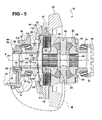
- Figure 5 is another fragmented cross-sectional view of the differential assembly
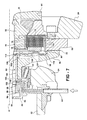
- Figure 6 is an exploded fragmentary cross-sectional view of the differential assembly of Figure 5 shown in an deactivated mode
- Figure 7 is an exploded fragmentary cross-sectional view of the differential assembly of Figure 5 shown in activated mode
- Figure 8 is a plan view of a plurality of levers interconnected with one another to form a plate.
- Figure 9 is a cross-sectional view taken elongated line 9-9 of Figure 8.
- a drive axle assembly for a vehicle is generally shown at 10 in Figure 1.
- the drive axle assembly 10 transmits torque from an engine (not shown) and a transmission (not shown) to drive a pair of wheels (not shown).
- the drive axle assembly 10 changes direction of a power flow, multiplies torque, and allows different speeds between the wheels.
- the drive axle assembly 10 includes an axle housing 12, and first 14 and second 16 axle shafts, shown in Figures 2 and 3, for driving the wheels, extending through the axle housing 12.
- the drive axle assembly 10 uses a carrier 24, disposed within and supported by the axle housing 12 to transfer input speed and torque to the first 14 and second 16 axle shafts.
- the carrier 24 is a geared mechanism that is mounted to the axle housing 12.
- a differential assembly 18 is mounted to the carrier 24 and is protected by the axle housing 12.
- the differential assembly 18 is operably connected to the first 14 and second 16 axle shafts extending therethrough.
- the carrier 24 has first 36 and second 38 ends and a cavity 40 defined therebetween.
- An annular flange 42 is integral with and extends around the first end 36.
- the annular flange 42 includes a plurality of holes 44 defined therein for facilitating mounting of the carrier 24 to the axle housing 12.
- a pair of stationary towers 48 are spaced diametrically one from another and are connected to and extend from the annular flange 42. Each stationary tower 48, includes a hole 52 defined therein to receive one of the axle shaft 14, 16 extending therethrough.
- Each stationary tower 48 houses side bearings 32, 34, respectively, as best shown in Figures 4 and 5, for facilitating rotational movement of a differential case 22 relative to the carrier 24.
- the differential case 22 includes a fluid chamber 50 defined therein.
- the differential case 22 includes a first half 53 and a second half 54 interconnected to each other with the fluid chamber 50 formed therebetween.
- the differential case 22 rotates with the second axle shaft 16.
- the differential case 22 is partially disposed within the cavity 40 of the carrier 24, as shown in Figure 4, and rotates relative to the carrier 24.
- a ring gear 20 is mounted to the first half 53 of the differential case 22.
- power is transmitted from the engine and the transmission to the drive axle assembly 10 via a longitudinally extending driveshaft (not shown) operably coupled to a pinion gear extending through and supported in the cavity 40 of the carrier 24.
- the pinion gear meshes with the ring gear 20 and to transfers power to the differential case 22.
- the differential assembly 18 includes a differential spider 26, as best shown in Figures 4 and 5, disposed in and is supported by the differential case 22.
- the differential spider 26 has four support shafts 62, 64.
- the support shafts 62, 64 are orientated in the shape of a cross.
- Pinion gears 66 are each supported for rotation on each of the support shafts 62, 64.
- Side gear 28, 30 are splined to each of the respective first 14 and second 16 axle shafts.
- the side gears 28, 30 are in constant mesh with the pinion gears 66.
- This type of differential assembly 18 is well known in the art and will not be discussed in a greater detail.
- the differential case 22 When the vehicle is driven in a straight path the differential case 22, the differential spider 26, and the pinion gears 66 all rotate as one unit to transfer power to the first 14 and second 16 axle shafts. There is no relative movement between the pinion gears 66, and the side gears 28, 30.
- the differential assembly 18 rotates the first 14 and second 16 axle shafts at different speeds when the vehicle turns a comer and allows both axle shafts 14, 16 to turn at the same speed when the vehicle moves in the straight path.
- the differential assembly 18 serves to establish a state of balance between forces between the wheels and allow the wheels to turn at different speeds when the vehicle changes direction.
- the differential assembly 18 includes a locking mechanism comprising a wet disc clutch pack, generally indicated at 72, that locks the differential case 22 to the first axle shaft 14 for transmitting equal torque to the first 14 and second 16 axle shafts and the differential case 22.
- the wet disc clutch pack 72 is mounted within the fluid chamber 50.
- the wet disc clutch pack 72 has a first 74 and second 76 set of friction discs.
- the first 74 and second 76 sets of friction discs are adjacent one another in an alternating relationship and define a running clearance therebetween, wherein, for example, a friction disc from the first set 74 is oriented next to a friction disc from the second set 76.
- the first set of friction discs 74 is mounted to the differential case 22, in particular to the first half 53 of the differential case 22.
- the second set of friction discs 76 is mounted to the first axle shaft 14.
- the second set of the friction discs 76 is operably connected to the first axle shaft 14 via a drive hub 78 disposed annularly about and splined to the first axle shaft 14.
- a pressure plate 80 which is also disposed in the fluid chamber 50 of the differential case 22, abuts the first set of friction discs 74.
- the pressure plate 80 distributes a thrust force uniformly.
- the first set of friction discs 74 compresses with the second set of the friction discs 76 to reduce a rotational speed and to allow the differential case 22 to be locked to the first axle shaft 14.
- the locking mechanism includes a stationary section generally indicated at 82 and an actuator assembly, generally indicated at 84.
- the actuator assembly 84 rotates relative to the stationary section 82.
- the stationary section 82 is operably connected and supported by one of the stationary towers 48, extending from and bolted to the annular flange 42 of the carrier 24.
- the stationary section 82 of the locking mechanism includes an adjusting ring 86 operably connected to the stationary tower 48 surrounding the first axle shaft 14 extending therethrough.
- a piston housing 88 is positioned stationary within the adjusting ring 86.
- a piston 90 is positioned stationary within the piston housing 88.
- the piston housing 88 and the piston 90 define a cavity 92 therebetween.
- the cavity 92 is a hydraulic cavity.
- a fluid input or hydraulic inlet 94 is connected to the piston housing 88 for introducing a fluid into the hydraulic cavity 92 for pressurizing the hydraulic cavity 92 thereby pushing the piston 90 away from the piston housing 88.
- the piston 90 applies a force to the wet disc clutch pack 72 to compress the friction discs of the first 74 and second 76 sets together to reduce rotational speed and allow the differential case 22 to be locked to the first axle shaft 14.
- a sealing assembly of the piston 90 includes a top seal 96 and a bottom seal 98.
- the sealing assembly 96, 98 is used to provide a sealed environment as fluid flows from the hydraulic inlet 94 filling the hydraulic cavity 92 between the piston housing 88 and the piston 90.
- the subject invention eliminates fluid leakage by utilizing a new inventive concept of the aforementioned stationary section 82 of the locking mechanism that works in conjunction with the actuator assembly 84.
- the actuator assembly 84 includes a sleeve 100 that moves axially with respect to the axis A and has first 106 and second 108 ends with the first end 106 defining a lip 110.
- a thrust bearing 112 is positioned between the lip 110 and the piston 90 to provide a soft contact between the stationary section 82 and the actuator assembly 84. The thrust bearing 112 rotates about the axis A.
- a plurality of levers 104 extend radially relative to the axis A between a radially inward end 114 to a radially outward end 116 and engage the friction discs of the first 74 and second 76 sets.
- the radially inward end 114 which engages the sleeve 100
- the radially outward end 116 which engages the differential case 22
- This mechanical engagement operates as a second-class lever to amplify the thrust force applied by the sleeve 100.
- the lever 104 pivots about an engagement of the radially outward end 116 with the differential case 22 in response to axial movement of the radially inward end 114 by the actuator assembly.
- the radially outward end 116 operates as a fulcrum of the second-class lever.
- Each of the levers 104 includes an elongated portion 120 extending from the radially inward end 114 to the disc engaging portion 118.
- a length of the elongated portion 120 defines a degree of amplification of the thrust force. It is preferred that the disc engaging portion 118, or fulcrum, remain closer to the radially outward end 116 as opposed to the radially inward end 114.
- the disc engaging portion 118 is generally V-shaped.
- the radially outward end 116 slopes downwardly to the disc engaging portion 118 and then upwardly through a peak 124 to the elongated portion 120.
- the levers 104 may have slightly different configurations, as seen in the differences between the levers 104 shown in Figures 6 and 7 and the levers 104 shown in Figures 8 and 9.
Landscapes
- Engineering & Computer Science (AREA)
- General Engineering & Computer Science (AREA)
- Mechanical Engineering (AREA)
- Chemical & Material Sciences (AREA)
- Combustion & Propulsion (AREA)
- Transportation (AREA)
- Physics & Mathematics (AREA)
- Electromagnetism (AREA)
- Retarders (AREA)
Abstract
Description
- The subject patent application claims priority to and all the benefits of U.S. Provisional Patent Application Serial No. 60/445,171 filed on February 4, 2003.
- This invention relates generally to a differential assembly for a drive axle assembly, and more particularly to a locking mechanism for the differential assembly.
- Vehicle drive axles typically include a pair of axle shafts for driving vehicle wheels. The drive axle uses a differential assembly to control input speed and torque to the axle shafts. Under ideal conditions, when the vehicle is driven along a straight path, the wheels will be turning at approximately the same speed and the torque will be equally split between both wheels. When the vehicle negotiates a turn, the outer wheel must travel over a greater distance than the inner wheel.
- The differential assembly allows the inner wheel to turn at a slower speed than the outer wheel as the vehicle turns. Power is transmitted from a vehicle drive shaft to a drive pinion that is in constant mesh with a ring gear. The ring gear is bolted to a differential case that turns with the ring gear. A differential spider having four (4) support shafts orientated in the shape of a cross, has four (4) differential pinions. One differential pinion is supported for rotation on each support shaft. Power is transferred from the differential case to side gears that are splined to the axle shafts. The side gears are in constant mesh with the differential pinions. The outer ends of the axle shafts are bolted to the wheel hubs to which the wheels are mounted.
- When the vehicle is driven in a straight path the ring gear, differential case, spider, differential pinions, and side gears all rotate as one unit to transfer power to the axle shafts. There is no relative movement between the differential pinions and the side gears. When the vehicle executes a turning maneuver, the differential pinion gears rotate on their respective shafts to speed up the rotation of one axle shaft while slowing the rotation of the other axle shaft.
- Often the differential assembly includes a differential locking or biasing mechanism. When there are poor traction conditions, e.g., slippery or rough surfaced roads, the locking mechanism allows maximum wheel traction for improved control. If the differential assembly does not have the locking mechanism and one tire is on ice, the available traction torque on the opposite wheel is same as on the wheel on ice. Thus, the tire just spins on the ice and the vehicle is prohibited from traveling forward. The locking mechanism allows the axle shafts to rotate at the same speed while transferring most of the available torque to the tire not on the ice. If the tractive effort at this tire is sufficient, the vehicle can be moved off of the ice. When the mechanism is activated, power is transmitted through the differential gearing, and locking mechanism rather than through the differential gearing only.
- One type of the locking mechanism includes a wet disc clutch that locks the differential case to the axle shafts, until a predetermined torque level is exceeded. The wet disc clutch includes a plurality of stationary discs interspersed with rotating discs in a fluid chamber. A piston applies a force to the wet disc clutch to compress the rotating and stationary discs of the wet disc clutch together to apply torque between the differential case to be locked to the axle shafts. The terms stationary and rotating applied to the disc are relative to the differential case.
- One disadvantage with a typical wet disc clutch system is fluid leakage. The leakage problem results from the pressurized fluid transfer from stationary members to rotating members to actuate the piston. Complicated rotating seal units, sometimes comprising leak-by recapture circuits, must be incorporated into the differential assembly, which take up valuable packaging space and are expensive. The recapture system recovers the leaked fluid and returns it to a pump that is used for applying pressure to actuate the wet disc clutch. Another disadvantage is that the clutch torque capacity is limited by the discs and actuator assembly that can be physically fit within the differential case.
- Thus, it is desirable to have a compact actuator assembly for a differential locking mechanism that can deliver significant pressure from a stationary source to a rotating source while eliminating leakage and overcoming other deficiencies in the prior art as outlined above.
- A drive axle assembly includes a carrier and a differential case rotatably disposed in the carrier. A pair of axle shafts, disposed within the differential case, are rotatable relative to each other and about an axis. A drive hub is disposed about the axle shaft. A plurality of friction discs are disposed within the differential case and are alternatively connected to the differential case and the drive hub. The friction discs are adjacent one another in an alternating relationship to define a running clearance therebetween. A plurality of levers extends radially relative to the axis between a radially inward end to a radially outward end to engage the friction discs. An actuator assembly is disposed about one of the axle shafts for engaging the levers and to force the levers into engagement with the friction discs for forcing the friction discs into engagement with one another for transmitting torque between one of the axle shafts and the differential case.
- Each lever is characterized by the radially inward end engaging the actuator assembly and the radially outward end engaging the differential case having a disc engaging portion between the radial inward and outward ends for engaging the friction discs between the radially inward and outward ends of each lever. The disc engaging portion amplifies a thrust force applied by the actuator assembly by pivoting about the engagement of the radially outward end with the differential case in response to axial movement of the radially inward end by the actuator assembly.
- The present invention therefore provides a locking mechanism where an amplified thrust force is transferred from a non-rotatable piston to a plurality of friction discs. In addition, a unique lever mechanism is provided which amplifies the thrust force on the friction discs. This in turn lowers the actuation force on the differential case bearings.
- Other advantages of the present invention will be readily appreciated as the same becomes better understood by reference to the following detailed description when considered in connection with the accompanying drawings wherein:
- Figure 1 is a perspective view of a drive axle assembly;
- Figure 2 is a perspective view of a differential assembly;
- Figure 3 is another perspective view of the differential assembly;
- Figure 4 is a fragmented cross-sectional view of the differential assembly;
- Figure 5 is another fragmented cross-sectional view of the differential assembly;
- Figure 6 is an exploded fragmentary cross-sectional view of the differential assembly of Figure 5 shown in an deactivated mode;
- Figure 7 is an exploded fragmentary cross-sectional view of the differential assembly of Figure 5 shown in activated mode;
- Figure 8 is a plan view of a plurality of levers interconnected with one another to form a plate; and
- Figure 9 is a cross-sectional view taken elongated line 9-9 of Figure 8.
- Referring to the Figures, wherein like numerals indicate like or corresponding parts, a drive axle assembly for a vehicle (not shown), is generally shown at 10 in Figure 1. The
drive axle assembly 10 transmits torque from an engine (not shown) and a transmission (not shown) to drive a pair of wheels (not shown). Thedrive axle assembly 10 changes direction of a power flow, multiplies torque, and allows different speeds between the wheels. Thedrive axle assembly 10 includes anaxle housing 12, and first 14 and second 16 axle shafts, shown in Figures 2 and 3, for driving the wheels, extending through theaxle housing 12. Thedrive axle assembly 10 uses acarrier 24, disposed within and supported by theaxle housing 12 to transfer input speed and torque to the first 14 and second 16 axle shafts. Thecarrier 24 is a geared mechanism that is mounted to theaxle housing 12. These types ofcarriers 24 are well known in the art and will not be discussed in a greater detail. - Referring to Figures 2 through 4, a
differential assembly 18 is mounted to thecarrier 24 and is protected by theaxle housing 12. Thedifferential assembly 18 is operably connected to the first 14 and second 16 axle shafts extending therethrough. Thecarrier 24 has first 36 and second 38 ends and acavity 40 defined therebetween. Anannular flange 42 is integral with and extends around thefirst end 36. Theannular flange 42 includes a plurality ofholes 44 defined therein for facilitating mounting of thecarrier 24 to theaxle housing 12. A pair ofstationary towers 48 are spaced diametrically one from another and are connected to and extend from theannular flange 42. Eachstationary tower 48, includes ahole 52 defined therein to receive one of theaxle shaft carrier 24, with the pair of thestationary towers 48, forms a fork to support the first 14 and second 16 axle shafts operably connected to thedifferential assembly 18. Eachstationary tower 48houses side bearings differential case 22 relative to thecarrier 24. - Referring to Figures 4 through 7, the
differential case 22 includes afluid chamber 50 defined therein. Thedifferential case 22 includes afirst half 53 and asecond half 54 interconnected to each other with thefluid chamber 50 formed therebetween. Thedifferential case 22 rotates with thesecond axle shaft 16. Thedifferential case 22 is partially disposed within thecavity 40 of thecarrier 24, as shown in Figure 4, and rotates relative to thecarrier 24. Aring gear 20 is mounted to thefirst half 53 of thedifferential case 22. As appreciated by those skilled in the art, power is transmitted from the engine and the transmission to thedrive axle assembly 10 via a longitudinally extending driveshaft (not shown) operably coupled to a pinion gear extending through and supported in thecavity 40 of thecarrier 24. The pinion gear meshes with thering gear 20 and to transfers power to thedifferential case 22. - The
differential assembly 18 includes adifferential spider 26, as best shown in Figures 4 and 5, disposed in and is supported by thedifferential case 22. Thedifferential spider 26 has foursupport shafts support shafts support shafts Side gear differential assembly 18 is well known in the art and will not be discussed in a greater detail. - When the vehicle is driven in a straight path the
differential case 22, thedifferential spider 26, and the pinion gears 66 all rotate as one unit to transfer power to the first 14 and second 16 axle shafts. There is no relative movement between the pinion gears 66, and the side gears 28, 30. Thedifferential assembly 18 rotates the first 14 and second 16 axle shafts at different speeds when the vehicle turns a comer and allows bothaxle shafts differential assembly 18 serves to establish a state of balance between forces between the wheels and allow the wheels to turn at different speeds when the vehicle changes direction. - The
differential assembly 18 includes a locking mechanism comprising a wet disc clutch pack, generally indicated at 72, that locks thedifferential case 22 to thefirst axle shaft 14 for transmitting equal torque to the first 14 and second 16 axle shafts and thedifferential case 22. The wet discclutch pack 72 is mounted within thefluid chamber 50. The wet discclutch pack 72 has a first 74 and second 76 set of friction discs. The first 74 and second 76 sets of friction discs are adjacent one another in an alternating relationship and define a running clearance therebetween, wherein, for example, a friction disc from thefirst set 74 is oriented next to a friction disc from thesecond set 76. The first set offriction discs 74 is mounted to thedifferential case 22, in particular to thefirst half 53 of thedifferential case 22. The second set offriction discs 76 is mounted to thefirst axle shaft 14. In particular, the second set of thefriction discs 76 is operably connected to thefirst axle shaft 14 via adrive hub 78 disposed annularly about and splined to thefirst axle shaft 14. Apressure plate 80, which is also disposed in thefluid chamber 50 of thedifferential case 22, abuts the first set offriction discs 74. Thepressure plate 80 distributes a thrust force uniformly. The first set offriction discs 74 compresses with the second set of thefriction discs 76 to reduce a rotational speed and to allow thedifferential case 22 to be locked to thefirst axle shaft 14. - The locking mechanism includes a stationary section generally indicated at 82 and an actuator assembly, generally indicated at 84. The
actuator assembly 84 rotates relative to thestationary section 82. Thestationary section 82 is operably connected and supported by one of thestationary towers 48, extending from and bolted to theannular flange 42 of thecarrier 24. Thestationary section 82 of the locking mechanism includes an adjustingring 86 operably connected to thestationary tower 48 surrounding thefirst axle shaft 14 extending therethrough. Apiston housing 88 is positioned stationary within the adjustingring 86. Apiston 90 is positioned stationary within thepiston housing 88. Thepiston housing 88 and thepiston 90 define acavity 92 therebetween. Preferably thecavity 92 is a hydraulic cavity. A fluid input orhydraulic inlet 94 is connected to thepiston housing 88 for introducing a fluid into thehydraulic cavity 92 for pressurizing thehydraulic cavity 92 thereby pushing thepiston 90 away from thepiston housing 88. Thepiston 90 applies a force to the wet discclutch pack 72 to compress the friction discs of the first 74 and second 76 sets together to reduce rotational speed and allow thedifferential case 22 to be locked to thefirst axle shaft 14. A sealing assembly of thepiston 90 includes atop seal 96 and abottom seal 98. The sealingassembly hydraulic inlet 94 filling thehydraulic cavity 92 between thepiston housing 88 and thepiston 90. The subject invention eliminates fluid leakage by utilizing a new inventive concept of the aforementionedstationary section 82 of the locking mechanism that works in conjunction with theactuator assembly 84. - The
actuator assembly 84 includes asleeve 100 that moves axially with respect to the axis A and has first 106 and second 108 ends with thefirst end 106 defining alip 110. Athrust bearing 112 is positioned between thelip 110 and thepiston 90 to provide a soft contact between thestationary section 82 and theactuator assembly 84. Thethrust bearing 112 rotates about the axis A. - Turning to Figures 4 through 9, a plurality of
levers 104 extend radially relative to the axis A between a radiallyinward end 114 to a radiallyoutward end 116 and engage the friction discs of the first 74 and second 76 sets. Specifically, the radiallyinward end 114, which engages thesleeve 100, and the radiallyoutward end 116, which engages thedifferential case 22, further include adisc engaging portion 118 therebetween for engaging the friction discs of the first 74 and second 76. This mechanical engagement operates as a second-class lever to amplify the thrust force applied by thesleeve 100. In particular, thelever 104 pivots about an engagement of the radiallyoutward end 116 with thedifferential case 22 in response to axial movement of the radiallyinward end 114 by the actuator assembly. The radiallyoutward end 116 operates as a fulcrum of the second-class lever. Each of thelevers 104 includes anelongated portion 120 extending from the radiallyinward end 114 to thedisc engaging portion 118. A length of theelongated portion 120 defines a degree of amplification of the thrust force. It is preferred that thedisc engaging portion 118, or fulcrum, remain closer to the radiallyoutward end 116 as opposed to the radiallyinward end 114. - Referring to Figures 8 and 9, the
disc engaging portion 118 is generally V-shaped. The radiallyoutward end 116 slopes downwardly to thedisc engaging portion 118 and then upwardly through apeak 124 to theelongated portion 120. It should be appreciated that thelevers 104 may have slightly different configurations, as seen in the differences between thelevers 104 shown in Figures 6 and 7 and thelevers 104 shown in Figures 8 and 9. - When the
hydraulic inlet 94 supplies fluid to activate thepiston 90 via a fluid path, the fluid fills thehydraulic cavity 92 thereby pushing thepiston 90 inwardly against thesleeve 100 which in turn pushes thesleeve 100 inwardly against the radiallyinward end 114 of eachlever 104. The mechanical power is further distributed from theelongated portion 120 of the lever to the radiallyoutward end 116 and back to thedisc engaging surface 118 that abuts thepressure plate 80 positioned against the friction discs of the first 74 and second 76 sets. For example, a 1,000 1b. force from thesleeve 100 creates a 4,000 1b. reaction force at the radiallyoutward end 116 which in turn creates a 5,000 1b. force at thedisc engaging portion 118 acting as a lever to amplify the thrust force applied by the actuator assembly by pivoting about the engagement of the radiallyoutward end 116 with thedifferential case 22 in response to axial movement of the radiallyinward end 116 by thesleeve 100. When the fluid escapes from thehydraulic cavity 92 toward thehydraulic inlet 94, thepiston 90 moves axially to thepiston housing 88 forced by thesleeve 100 biased by the radiallyinward end 114 of eachlever 104. - While the invention has been described with reference to an exemplary embodiment, it will be understood by those skilled in the art that various changes may be made and equivalents may be substituted for elements thereof without departing from the scope of the invention. In addition, many modifications may be made to adapt a particular situation or material to the teachings of the invention without departing from the essential scope thereof. Therefore, it is intended that the invention not be limited to the particular embodiment disclosed as the best mode contemplated for carrying out this invention, but that the invention will include all embodiments falling within the scope of the appended claims.
Claims (19)
- A drive axle assembly (10), comprising:a carrier (24);a differential case (22) rotatably disposed in said carrier (24);a pair of axle shafts (14, 16) disposed within said differential case (22) and rotatable relative to each other about an axis (A);a drive hub (78) disposed about one of said axle shafts (14, 16);a plurality of friction discs (74, 76) adjacent one another in an alternating relationship defining a running clearance therebetween and disposed within and alternatively connected to said differential case (22) and said drive hub (78);a plurality of levers (104) extending radially relative to said axis (A) between a radially inward end (114) to a radially outward end (116) and engaging said friction discs (74, 76);an actuator assembly (84) disposed about one of said axle shafts (14, 16) for engaging said levers (104) to force said levers (104) into engagement with said friction discs (74, 76) for forcing said friction discs (74, 76) into engagement with one another for transmitting torque between one of said axle shafts (14, 16) and said differential case (22); andeach of said plurality of levers (104) characterized by said radially inward end (114) engaging said actuator assembly (84) and said radially outward end (116) engaging said differential case (22) having a disc engaging portion (118) between said radially inward (114) and outward (116) ends for engaging said friction discs (74, 76) between said radially inward (114) and outward (116) ends thereof for amplifying a thrust force applied by said actuator assembly (84) by pivoting about the engagement of said radially outward end (116) with said differential case (22) in response to axial movement of said radially inward end (114) by said actuator assembly (84).
- A drive axle assembly (10) as set forth in claim 1 wherein each of said levers (104) includes an elongated portion (120) extending between said radially inward end (114) and said disc engaging portion (118) with a length of said elongated portion (120) defining a degree of amplification of the thrust force.
- A drive axle assembly (10) as set forth in either of claims 1 or 2 wherein said disc engaging portion (118) is generally V-shaped.
- A drive axle assembly (10) as set forth in any one of claims 1 to 3 wherein said actuator assembly (84) includes a sleeve (100) movable axially and having first (106) and second (108) ends with said first end (106) defining a lip (110) and said second end (108) engaging said radially inward end (114) of said levers (104).
- A drive axle assembly (10) as set forth in any one of claims 1 to 4 wherein said levers (104) are interconnected one with another by a link to form a plate (102).
- A drive axle assembly (10) as set forth in claim 5 wherein said levers (104) of said plate (102) define a generally octagonal configuration.
- A drive axle assembly (10) as set forth in any one of claims 1 to 6 wherein said radially outward end (116) slopes downwardly to said disc engaging portion (118) and then upwardly through a peak (124) to said elongated portion (120).
- A drive axle assembly (10) as set forth in claim 4 wherein said sleeve (100) and said levers (104) rotate about said axis (A) with said differential case (22) and at least one of said axle shafts (14, 16).
- A drive axle assembly (10) as set forth in any one of claims 1 to 8 further including a pressure plate (80) disposed annularly about said axis (A) between said disc engaging portion (118) and said friction discs (74, 76).
- A drive axle assembly (10) as set forth in any one of claims 1 to 9 including a piston housing (88) circumscribing at least one of said axle shafts (14, 16) and supported by said carrier (24).
- A drive axle assembly (10) as set forth in claim 10 including a piston (90) disposed in said piston housing (88) defining a cavity (92) therebetween.
- A drive axle assembly (10) as set forth in claim 11 wherein said piston (90) operably engages said sleeve (100) to provide the thrust force.
- A drive axle assembly (10) as set forth in any one of claims 11 or 12 wherein said actuator assembly (84) further includes a thrust bearing (112) coupled between said piston (90) and said sleeve (100) for isolating said piston (90) from said sleeve (100) such that any rotation of said sleeve(100) does not translate to said piston (90).
- A drive axle assembly (10) as set forth in any one of claims 11 to 13 including a hydraulic inlet (94) connected to said piston housing (88) for introducing a fluid into said cavity (92) for pressurizing said cavity (92) and forcing said piston (90) away from said piston housing (88).
- A drive axle assembly (10) as set forth in any one of claims 1 to 14 including an adjusting ring (86) operably connected to said carrier (24) and disposed annularly and stationary about one of said axle shafts (14, 16).
- A drive axle assembly (10) as set forth in any one of claims 1 to 15 including a ring gear (20) operably connected to said differential case (22) and rotatable about said axis (A).
- A drive axle assembly (10) as set forth in claim 16 wherein said differential assembly (18) further includes a differential spider (26) presenting four support shafts (62, 64) orientated in the shape of a cross.
- A drive axle assembly (10) as set forth in claim 17 wherein said differential assembly (18) further includes pinion gears (66) each supported for rotation on each of said support shafts (62, 64).
- A drive axle assembly (10) as set forth in claim 18 wherein said differential assembly (18) further includes a pair of side gears (28, 30) presenting a meshing engagement with said pinion gears (66) and connected to each of said axle shafts (14, 16).
Applications Claiming Priority (2)
| Application Number | Priority Date | Filing Date | Title |
|---|---|---|---|
| US44517103P | 2003-02-04 | 2003-02-04 | |
| US445171P | 2003-02-04 |
Publications (1)
| Publication Number | Publication Date |
|---|---|
| EP1457712A1 true EP1457712A1 (en) | 2004-09-15 |
Family
ID=32772069
Family Applications (1)
| Application Number | Title | Priority Date | Filing Date |
|---|---|---|---|
| EP04075336A Withdrawn EP1457712A1 (en) | 2003-02-04 | 2004-02-04 | Differential locking mechanism for a drive axle assembly |
Country Status (2)
| Country | Link |
|---|---|
| US (1) | US6991572B2 (en) |
| EP (1) | EP1457712A1 (en) |
Cited By (1)
| Publication number | Priority date | Publication date | Assignee | Title |
|---|---|---|---|---|
| CN111853201A (en) * | 2020-08-03 | 2020-10-30 | 十堰戎马汽车特种传动有限公司 | an overrun differential |
Families Citing this family (7)
| Publication number | Priority date | Publication date | Assignee | Title |
|---|---|---|---|---|
| US8454471B2 (en) | 2010-07-21 | 2013-06-04 | Ford Global Technologies, Llc | Electronic locking differential |
| WO2015021213A1 (en) * | 2013-08-07 | 2015-02-12 | Eaton Corporation | Limited slip differential with separation of clutch and actuator |
| JP6187407B2 (en) * | 2014-07-26 | 2017-08-30 | 株式会社オーエス技研 | Differential unit with differential limiting mechanism |
| US11236804B2 (en) * | 2020-02-19 | 2022-02-01 | Dana Automotive Systems Group, Llc | Electric drive axle system with removable planetary gear assembly |
| US11235660B2 (en) * | 2020-02-19 | 2022-02-01 | Dana Automotive Systems Group, Llc | Electric drive axle system with multi-speed gear train |
| US11518225B2 (en) | 2020-02-19 | 2022-12-06 | Dana Automotive Systems Group, Llc | Electric drive axle with lubrication system |
| WO2022215447A1 (en) * | 2021-04-05 | 2022-10-13 | 日立建機株式会社 | Vehicle axle device |
Citations (7)
| Publication number | Priority date | Publication date | Assignee | Title |
|---|---|---|---|---|
| US3107766A (en) * | 1961-05-03 | 1963-10-22 | Gen Motors Corp | Friction engaging devices having a lever spring |
| US4644823A (en) * | 1982-04-03 | 1987-02-24 | Dr. Ing. H.C.F. Porsche Aktiengesellschaft | Differential gear |
| US4712659A (en) * | 1986-12-11 | 1987-12-15 | Dana Corporation | Adjustable clutch brake apparatus |
| DE3839787A1 (en) * | 1987-12-03 | 1989-06-15 | Zahnradfabrik Friedrichshafen | Self-locking differential with actuating-force multiplication levers |
| EP0321335A1 (en) * | 1987-12-17 | 1989-06-21 | Automobiles Peugeot | Differential system with variable controlled slip |
| US4848549A (en) * | 1988-04-08 | 1989-07-18 | Chipper Industries, Inc. | Coaxial adjustable hydraulic clutch actuator |
| DE19848582A1 (en) * | 1998-10-21 | 2000-04-27 | Mannesmann Sachs Ag | Friction clutch, particularly for road vehicle, has clutch housing non-rotatably connectable to driven flywheel and pressure plate activated by spring supporting on clutch housing |
-
2004
- 2004-02-04 US US10/771,977 patent/US6991572B2/en not_active Expired - Lifetime
- 2004-02-04 EP EP04075336A patent/EP1457712A1/en not_active Withdrawn
Patent Citations (7)
| Publication number | Priority date | Publication date | Assignee | Title |
|---|---|---|---|---|
| US3107766A (en) * | 1961-05-03 | 1963-10-22 | Gen Motors Corp | Friction engaging devices having a lever spring |
| US4644823A (en) * | 1982-04-03 | 1987-02-24 | Dr. Ing. H.C.F. Porsche Aktiengesellschaft | Differential gear |
| US4712659A (en) * | 1986-12-11 | 1987-12-15 | Dana Corporation | Adjustable clutch brake apparatus |
| DE3839787A1 (en) * | 1987-12-03 | 1989-06-15 | Zahnradfabrik Friedrichshafen | Self-locking differential with actuating-force multiplication levers |
| EP0321335A1 (en) * | 1987-12-17 | 1989-06-21 | Automobiles Peugeot | Differential system with variable controlled slip |
| US4848549A (en) * | 1988-04-08 | 1989-07-18 | Chipper Industries, Inc. | Coaxial adjustable hydraulic clutch actuator |
| DE19848582A1 (en) * | 1998-10-21 | 2000-04-27 | Mannesmann Sachs Ag | Friction clutch, particularly for road vehicle, has clutch housing non-rotatably connectable to driven flywheel and pressure plate activated by spring supporting on clutch housing |
Cited By (1)
| Publication number | Priority date | Publication date | Assignee | Title |
|---|---|---|---|---|
| CN111853201A (en) * | 2020-08-03 | 2020-10-30 | 十堰戎马汽车特种传动有限公司 | an overrun differential |
Also Published As
| Publication number | Publication date |
|---|---|
| US6991572B2 (en) | 2006-01-31 |
| US20040185983A1 (en) | 2004-09-23 |
Similar Documents
| Publication | Publication Date | Title |
|---|---|---|
| US3974717A (en) | Four pinion differential | |
| KR100498819B1 (en) | Planetary transmission for a vehicle | |
| US6398686B1 (en) | Electronically controlled limited slip differential assembly | |
| US5350340A (en) | Lockable differential gear | |
| US6508734B2 (en) | Differential lock actuator | |
| JP2000351336A (en) | Under carriage for vehicle | |
| EP2289709B1 (en) | Dual wheelend for a vehicle | |
| JP2003207025A (en) | Engagement mechanism with two-step tilt angle | |
| KR100562767B1 (en) | Transfer case assembly and differential assembly with magnetic fluid clutch | |
| KR20000005657A (en) | Transfer case having speed proportional clutch | |
| US6991572B2 (en) | Differential locking mechanism for a drive axle assembly | |
| US5906249A (en) | Drive system of a drive wheel | |
| CN103687731A (en) | Hub assembly, in particular for dual wheels | |
| US7390278B2 (en) | Torque-coupling device for front-wheel-drive transaxle unit | |
| JP2007505276A (en) | Transmission assembly | |
| US9005070B2 (en) | Clutch arrangement for a vehicle drive train | |
| US20030224896A1 (en) | Hydraulic differential lock | |
| US6354979B1 (en) | Limited-slip differential | |
| US4452100A (en) | Differential speed limiting device | |
| EP1132270B1 (en) | Wheel hub for vehicles | |
| US6536560B1 (en) | Single braking assembly for a drive axle | |
| US6554732B1 (en) | Differential assembly with modified limited slip clutch arrangement | |
| US7287635B2 (en) | Force -transmission unit comprising speed -dependent hydraulic clutch and centrifugal force compensation | |
| JP2711404B2 (en) | Differential gearing | |
| EP2302246B1 (en) | A rotary transmission coupling |
Legal Events
| Date | Code | Title | Description |
|---|---|---|---|
| PUAI | Public reference made under article 153(3) epc to a published international application that has entered the european phase |
Free format text: ORIGINAL CODE: 0009012 |
|
| AK | Designated contracting states |
Kind code of ref document: A1 Designated state(s): AT BE BG CH CY CZ DE DK EE ES FI FR GB GR HU IE IT LI LU MC NL PT RO SE SI SK TR |
|
| AX | Request for extension of the european patent |
Extension state: AL LT LV MK |
|
| 17P | Request for examination filed |
Effective date: 20050315 |
|
| AKX | Designation fees paid |
Designated state(s): AT BE BG CH CY CZ DE DK EE ES FI FR GB GR HU IE IT LI LU MC NL PT RO SE SI SK TR |
|
| 17Q | First examination report despatched |
Effective date: 20070115 |
|
| STAA | Information on the status of an ep patent application or granted ep patent |
Free format text: STATUS: THE APPLICATION IS DEEMED TO BE WITHDRAWN |
|
| 18D | Application deemed to be withdrawn |
Effective date: 20070526 |