TECHNICAL FIELD
-
The present invention relates to a paint composition for
thermal drying and more specifically to a paint composition for
thermal drying which is favorable as a thick film paint
composition comprising emulsion.
PRIOR ART
-
Paint composition for thermal drying are materials which
are widely used in industries since they form films developing
various functions on base materials, and among them, a paint
composition, comprising an emulsion and being able to form a
thick film, is useful as construction materials for the exterior
and coating materials absorbing vibrations. However, in
thermal drying a film formed by the paint composition for thermal
drying comprising an emulsion and particularly in forming a thick
film, blisters tend to be generated on the surface of a film,
and therefore there is room for a contrivance to prevent the
blisters and improve the thermal drying characteristics.
-
As the conventional paint composition for thermal drying,
there is disclosed an aqueous composition for coating, having
chipping resistance, which consists of an aqueous dispersion
and an inorganic filler with respect to an aqueous dispersion
of an acrylic polymer in Japanese Patent Publications No. 2904995
(p. 1-3) . However, such an aqueous composition for coating was
not one in which the thermal drying characteristics was improved
by preventing the blisters in thermal drying a film and, for
example, the inorganic filler was added as a bulk filler in the
aqueous composition for coating, and therefore there is room
for a contrivance to make the thermal drying characteristics
become better.
-
By the way, emulsions are used as a vibration damping
material to prevent vibration and noise of various structures
to insure sustained quietude. These emulsions for vibration
damping materials have been preferably used as materials which
constitute dampening coating formulation, that is, vibration
damping material composition and have been used not only beneath
the cabin floors of road vehicles but also applied to train cars,
ships, aircraft, electric machines, buildings, and construction
machines, among other uses. As such vibration damping
materials, an inorganic powder-containing asphalt sheet has been
installed under automotive cabin flooring, for instance, but
since the sheet must be secured in position by thermal fusion,
improvements in workability and other parameters are needed.
-
As the vibtration damping material composition composing
a conventional vibration damping material, there is disclosed
a copolymer latex containing emulsion in Japanese Kokai
Publication Hei-9-104842. In other words, it discloses a
water-based vibration damper paint composition comprising at
least one vehicle selected from the group consisting of synthetic
resin emulsions. Japanese Kokai Publication Hei-11-29737 (page
1,2) discloses a copolymer latex for water-based paints which
is obtainable by copolymerizing an aliphatic conjugated diene
monomer, an ethylenically unsaturated carboxylic acid monomer,
in the presence of α-methylstyrene. Japanese Kokai Publication
2000-178497 (page 1,2) discloses a copolymer latex for
chipping-resistant paint which is obtainable by
emulsion-polymerizing a monomer mixture comprising a conjugated
diene monomer, an ethylenically unsaturated carboxylic acid
amide monomer, an ethylenically unsaturated carboxylic acid
monomer and other monomers in the presence of an inorganic
persulfate polymerization initiator. Japanese Kokai
Publication 2000-178498 (page 1,2) discloses a copolymer latex
for vibration damping materials which is obtainable by
emulsion-polymerizing a conjugated diene monomer, an epoxy
group-containing ethylenically unsaturated monomer, an
ethylenically unsaturated carboxylic acid alkyl ester monomer,
and other monomers. Japanese Kokai Publication 2000-178499
(page 1,2) discloses a copolymer latex for vibration damping
materialswhichisobtainablebyemulsion-polymerizingamonomer
composition comprising a conjugated diene monomer, an epoxy
group-containing ethylenically unsaturated monomer, an
ethylenically unsaturated carboxylic amide monomer, and other
monomers.
-
By any of these technologies, however, it is impossible
to obtain a vibration damping material which satisfies both
thermal drying characteristics and vibration damping properties
sufficiently. Thus, when a synthetic resin emulsion or an
asphalt emulsion is used and a coating film is formed by thermal
drying, blisters tend to form as the vaporized moisture in the
undried interior of the coating is forced out through the dried
surface so that it is necessary to provide some measure for
improving the thermal drying characteristics. When a copolymer
latex comprising a conjugated diene monomer and other monomers
is used, the conjugated diene monomer unit is not so contributory
to the expression of vibration damping properties so that there
is room for a contrivance to reconcile satisfactory thermal
drying characteristics and satisfactory vibration damping
properties.
-
In addition, Japanese Patent Publications No.2904995
(p.1-3) discloses that with respect to an aqueous dispersion
containing acrylic polymer particles which are composite
particles comprising a core portion and a cortical layer portion,
an aqueous dispersion can be prepared by using a reactive anionic
surfactant and such an aqueous dispersion is favorable for
forming a chipping material.
-
Since in such an aqueous dispersion, emphasis is placed
on a physical property of a hard film such that the film resists
scratches and is hard from the viewpoint of being favorable for
forming a chipping material, the viscosity of the dispersion
is set at low value so as to be able to perform spray coating.
However, as a vibration damping material, high hardness film
is better but softness is also required. In addition, a
composition for the vibration damping material has the viscosity
set at a relatively high value so as to be able to form a thick
film. Accordingly, there is room for a contrivance to make the
aqueous dispersion favorably applicable as the composition for
the damping material, having such the characteristics and in
addition to make it have the excellent vibration damping property
and thermal drying characteristics and furthermore have less
time-course deterioration.
SUMMARY OF THE INVENTION
-
The present invention has been made considering the
above-mentioned situations, and it is an object of the present
invention to provide the paint composition for thermal drying
which is favorable as material forming a thick film since it
can develop an excellent thermal drying characteristics.
-
The present inventors noted first that aqueous emulsions
were superior in point of workability as a result of studying
a paint composition for thermal drying widely, and found that
by using the emulsion of which a glass transition temperature
is specified to be lower as such an emulsion in order to facilitate
a film formation in thermal drying and combining the emulsion
with organic fine particles of which a mean particle diameter
is specified to be smaller, the occurrence of blister was
suppressed and the thermal drying characteristics becomes
excellent, and thereby the paint composition becomes favorable
as a material forming a thick film, and has come up with the
idea that the above-mentioned issues can be well solved. And,
with respect to an organic fine particle, the inventors have
found that when its melting point by differential scanning
calorimetry is specified to be higher in order to prevent the
organic fine particle from being fused with emulsion in thermal
drying and contributing to film formation, such actions can be
adequately developed and reached the present invention.
Usually, since in forming a thick film by thermal drying the
emulsion, a water content in a yet-to-be dried film is evaporated
after the surface of the film is dried, blisters are generated,
but in the present invention, it is considered that the
above-mentioned organic fine particles are present in the film,
and thereby a water content in the film becomes easy to escape
when the emulsion forms a film to protect the occurrence of
blisters and to improve the thermal drying characteristics.
-
And, the present inventors noted first that emulsions,
which provide aqueous vibration dampingmaterials, were superior
in point of workability and the like during studying rawmaterial
used in various dampening coating formulation, and have come
up with the idea that when a coating material composition
comprises an emulsion formed by emulsion polymerizing a monomer
component with a reactive emulsifier, thereby, liberation of
the emulsifier contained in the emulsion into water being amedium
was suppressed and this enabled to provide a emulsion for a
vibration damping material composing a dampening coating
formulation, which could develop an excellent vibration damping
property and also an excellent thermal drying characteristics,
and furthermore had less time-course deterioration and could
enhance stability and dispersibility of the formulation.
-
That is, when the emulsifier contained in the emulsion
is liberated into water, the emulsifier being a substance of
low molecular weight bleeds to the surface of the film and that
bleeding portion is only dried faster than another portion in
thermal drying to cause a heat blister and the emulsifier is
liberated into water with lapse of time, whereby causing the
viscosity of the emulsion to decrease. In addition, since the
mechanical stability of the emulsion is not good, the formulaion
may be gelated in forming a paint by blending it. However, it
was found that when an emulsion polymerization is conducted by
using a reactive emulsifier, an excellent thermal drying
characteristics is developed since the liberation of the
emulsifier into water becomes less and the time-course change
of the emulsion becomes less since the liberation of the
emulsifier with lapse of time becomes less. Furthermore, it
was also found that the mechanical stability was improved since
the emulsifier is chemically combined with the emulsion.
-
Further, in a vibration damping material formed from the
above-mentioned emulsion for the vibration damping material,
by adjusting a glass transition temperature of the emulsion,
an effect of enhancing the action to prevent vibrations and noises
in various structures and to keep quietness is adequately
attained. These actions are considered to result from that the
stability and the dispersibility of the emulsion were enhanced
and the vibration damping material is composed of the
above-mentioned emulsion which is favorable as the emulsion for
the vibration damping material.
-
In the present invention, such an emulsion for the damping
material is employed in the paint composition for theral drying.
-
That is, the present invention is a paint composition for
thermal drying, which comprises an emulsion having a glass
transition temperature of 50°C or lower and organic fine
particles having a mean particle diameter of 15 µm or smaller.
-
As a preferable aspect of the paint composition for thermal
drying in the present invention, there are given an aspect in
which the above-mentioned organic fine particles have a melting
point by differential scanning calorimetry of 65°C or higher,
an aspect in which the above-mentioned emulsion is formed by
emulsion polymerizing a monomer component with a reactive
emulsifier and an aspect in which the above-mentioned emulsion
has a glass transition temperature of -50°C to 40°C.
DETAILED DESCRIPTION OF THE INVENTION
-
The present invention is now described in detail.
-
A paint composition for thermal drying in the present
invention is one which forms a film by forming a film with an
emulsion having a glass transition temperature (Tg) of 50°C or
lower and a thermal drying characteristics of which is improved
by organic fine particles having a mean particle diameter of
15 µm or smaller. In addition, term "for thermal drying" means
that a composition is favorably used when a film is formed by
thermal drying. Apreferable aspect of an organic fine particle
in the present invention is a high hardness organic fine particle
which has a hardness, not melting or decomposing in thermal drying
the paint composition for thermal drying, and is incompatible
with a solvent contained in the above-mentioned emulsion or paint
composition for thermal drying. By such an organic fine
particle, the thermal drying characteristics is improved in
forming a film and since the organic fine particles exist in
the formed film, basic performances such as rigidity of the film
are also improved. Further, such an organic fine particle is
hard to inhibit water resistance of a film and thereby the film
formed from the paint composition for thermal drying in the
present invention is superior in water resistance.
-
With respect to such the emulsion and organic fine
particles, one or two or more thereof, respectively, may be used.
-
When Tg of the above-mentioned emulsion is more than 50°C,
the film formation property and the thermal drying
characteristics of the paint composition for thermal drying
become insufficient. Preferably, Tg is -50°C or higher and 40°C
or lower. More preferably, Tg is -10°C or higher and 20°C or
lower. Incidentally, Tg of the emulsion can be calculated from
Tg of individual polymer of respective monomers forming the
emulsion.
-
The above-mentioned emulsion is an aqueous one in which
a continuous phase is water and polymer formed by polymerizing
monomer components is dispersed. Usually, the paint
composition for thermal drying is composed of such an emulsion,
and another additives, solvents or the like as required.
-
As a monomer component to form the emulsion in the present
invention, it may be appropriately set in such a way that a glass
transition temperature of the emulsion is 50°C or lower and
preferably it comprises unsaturated carboxylic acid monomer.
Though a compound having an unsaturated bond and a carboxyl group
in a molecule may be used as the unsaturated carboxylic acid
monomer, this monomer preferably contains an ethylenic
unsaturated carboxylic acid monomer. A paint composition for
thermal drying comprising an emulsion formed by polymerizing
a monomer component comprising ethylenic unsaturated carboxylic
acid monomer is one of preferable embodiments of the present
invention.
-
As the above-mentioned ethylenic unsaturated carboxylic
acid monomer, one, or two or more of unsaturated carboxylic acids
or derivatives thereof such as (meth) acrylic acid, crotonic acid,
itaconic acid, fumaric acid, maleic acid, monomethyl fumarate,
monoethyl fumarate and monomethyl maleate, monoethyl maleate
are favorable.
-
And, the above-mentoned monomer component preferably
comprises an acrylic monomer. The acrylic monomer means
(meth) acrylic acid derivatives such as (meth) acrylic acid and
(meth)acrylate ester.
-
Preferably, a content of an acrylic monomer in the
above-mentioned monomer component is set so as to be 50 mass
% or more with respect to total monomer components. With a
content of such a monomer component, when the monomer is used
as exterior materials for the construction materials, a content
of a conjugate dienic monomer is preferably 10 mass % or less
with respect to total monomer components from the viewpoint of
dry blistering. More preferably, it is 5 mass % or less, and
most preferably, the monomer component does not contain the
conjugate dienic monomer.
-
Furthermore, the above-mentioned monomer component
preferably contains an unsaturated monomer having a functional
group in an amount of less than 10 mass % with respect to total
monomer components. The functional group in the unsaturated
monomer having a functional group may be a functional group which
can crosslink in obtaining the emulsion by polymerization. An
action of such a functional group allows the film formation
property and the thermal drying characteristics of the emulsion
to improve. More preferably, it is 0.1 to 3.0 mass %.
-
Incidentally, the above-mentioned mass rate is a mass
rate with respect to 100 mass % of the total monomer components.
-
As the above-mentioned functional group, an epoxy group,
an oxazoline group, a carbodiimide group, an aziridinyl group,
an isocyanate group, a methylol group, a vinyl ether group, a
cyclocarbonate group and an alkoxysilane group are favorable.
One or two or more of these functional groups may be contained
in a molecule of the unsaturated monomer.
-
The above-mentioned unsaturated monomer having a
functional groups, for example, may be any of the following
polyfunctional unsaturated monomers: divinylbenzene, ethylene
glycol di(meth)acrylate, N-methoxymethyl(meth)acrylamide,
N-methxoyethyl(meth)acrylamide,
N-n-butoxymethyl(meth)acrylamide,
N-i-butoxymethyl(meth)acrylamide,
N-methylol(meth)acrylamide, diallyl phthalate, diallyl
terephthalate,polyethyleneglycoldi(meth)acrylate,propylene
glycol di(meth)acrylate, polypropylene glycol
di(meth)acrylate, tetramethylene glycol di(meth)acrylate,
polytetramethylene glycol di(meth)acrylate, 1,6-hexanediol
di (meth) acrylate, neopentyl glycol di (meth) acrylate, and so on;
glycidyl group-containing unsaturatedmonomers such as glycidyl
(meth)acrylate and acryloyl glycidyl ether. Among these,
unsaturated monomers having not less than two functional groups
(polyfunctional unsaturated monomers) are preferred. These can
be used each independently or in a combination of two or more
species.
-
In the present invention, preferably, the above-mentioned
monomer component contains an ethylenic unsaturated carboxylic
acid monomer in an amount of 0.1 to 20 mass % and other
copolymerizable ethylenically unsaturated monomer in an amount
of 99. 9 to 80 mass %. By containing the ethylenic unsaturated
carboxylic acid monomer, it becomes possible to enhance the
dispersibility of the organic fine particles and to develop
actions of the present invention more adequately in the paint
composition for thermal drying comprising such an emulsion.
Further, by containing other copolymerizable ethylenically
unsaturated monomer, an acid value, Tg, physical properties or
the like of the emulsion becomes easy to adjust. In the
above-mentioned monomer component, when the content of the
ethylenic unsaturated carboxylic acid monomer is less than 0.1
mass % or more than 20 mass %, there is a possibility that the
emulsion cannot stably copolymerize.
-
Incidentally, the above-mentioned mass rate is amass rate
with respect to 100 mass % of the total monomer components.
-
As said other copolymerizable ethylenically unsaturated
monomer or monomers, it is preferable to use one or more species
of the functional group-containing unsaturated monomers
mentioned above; (meth)acrylic acid esters such as methyl
(meth)acrylate, ethyl (meth)acrylate, butyl (meth)acrylate,
2-ethylhexyl (meth) acrylate, cyclohexyl (meth) acrylate, etc.;
and aromatic unsaturated monomers such as styrene.
-
As the polymerizing method for the above-mentionedmonomer
component, the emulsion polymerization method, among others,
can be used advantageously. The mode of emulsion polymerization
may comprise adding the monomer component, a polymerization
initiator and a surfactant to an aqueous medium judiciously and
conducting the polymerization reaction. For molecular weight
adjustment, a chain transfer agent may be employed.
-
The aqueous medium mentioned above is preferably water,
a mixture solvent composed of one or more water-miscible
solvents, or a mixture solvent consisting of such a solvent and
a predominant proportion of water. Among these, water is
preferred.
-
Asthe polymerizationinitiator mentioned above,theknown
water-soluble or oil-soluble initiator, such as ammonium
persulfate, potassium persulfate, hydrogen peroxide, butyl
hydroperoxide or the like, can be used with advantage. To
accelerate the emulsion polymerization, a redox initiator system
may be formed by adding sodium hydrogensulfite or L-ascorbic
acid as a reducing agent. These may be used each independently
or in a combination of two or more species.
-
The level of use of said polymerization initiator may
be judiciously selected according to the kind of initiator but,
based on 100 weight parts of the total monomer composition, is
preferably 0.1 to 2 weight parts, more preferably 0.2 to 1 weight
part.
-
The surfactant mentioned above may be any of anionic,
nonionic, and nonionic-anionic emulsifiers. In terms of the
stability of emulsion polymerization, nonionic emulsifiers and
nonionic-anionic emulsifiers are preferred among them, and more
preferably a nonionic emulsifier and a nonionic-anionic
emulsifier are used together. The anionic emulsifier includes,
for example, fatty acid soaps, rosin soaps, alkylsulfonic acid
soaps, dialkylarylsulfonate, alkylsulfosuccinate, and
polyoxyethylene-alkylsulfate, among others. The nonionic
emulsifier includes, for example, polyoxyethylene alkyl ethers,
polyoxyethylene alkylaryl ethers, polyoxyethylene sorbitan
fatty acid esters, and oxyethylene-oxypropylene block
copolymers, among others. These surfactants can be used each
independently or in a combination of two or more species.
-
The level of use of such surfactant can be judiciously
selected according to the kind of surfactant, among other
factors, but based on 100 weight parts of the total monomer
composition, is preferably 0.05 to 5.0 weight parts, more
preferably 0.1 to 3 weight parts.
-
The above-mentioned polymerization chain transfer agent
may be any of alkylmercaptans, e.g. hexylmercaptan,
octylmercaptan, n-dodecylmercaptan, t-dodecylmercaptan,
n-hexadecylmercaptan, n-tetradecylmercaptan, etc.;
halogenated hydrocarbons, e.g. carbon tetrachloride, carbon
tetrabromide, ethylene bromide, etc.; mercaptocarboxylic acid
alkyl esters, e.g. 2-ethylhexyl mercaptoacetate, 2-ethylhexyl
mercaptopropionate, tridecyl mercaptopropionate, etc.;
mercaptocarboxylic acid alkoxyalkyl esters, e.g. methoxybutyl
mercaptoacetate, methoxybutyl mercaptopropionate, etc.;
carboxylic acid mercaptoalkyl esters, e.g. 2-mercaptoethyl
octanoate etc.; α-methylstyrene dimer, terpinolene,
α-terpinene, γ-terpinene, dipentene, anisole, and allyl
alcohol, among others. These can be used each independently
or in a combination of two or more species. Among these, it
is preferable to use an alkylmercaptan such as hexylmercaptan,
octylmercaptan, n-dodecylmercaptan, t-dodecylmercaptan,
n-hexadecylmercaptan, n-tetradecylmercatan or the like. The
level of use of the polymerizaitn chain transfer agent based
on 100 weight parts of the total monomer composition is generally
0 to 1 weight part, preferably 0 to 0.5 weight part.
-
The above-mentioned emulsion polymerization may be
carried out in the presence of a chelating agent such as sodium
ethylenediaminetetracetate, a dispersant such as poly(sodium
acrylate), and/or an inorganic salt. As to the mode of addition
of the monomers, for example, polymerization initiator, etc.,
any of en bloc addition, continuous addition, multistage
addition, etc. may be employed. These modes of addition may
be used in a suitable combination.
-
Regarding the reaction conditions to be used for said
emulsion polymerization, the optimum conditions can be selected
according to the monomer formulation, the kind of polymerization
initiator, and other factors. The polymerization temperature
is preferably 5 to 90°C, more preferably 20 to 85°C. The
preferred polymerization time is 3 to 8 hours. The
polymerization and dropwise additions are preferably carried
out under stirring.
-
In the above process, the emulsion prepared by emulsion
polymerization as above is preferably neutralized with a
neutralizing agent, whereby the emulsion is stabilized. The
neutralizing agent which is preferably employed includes
tertiary amines, such as triethanolamine,
dimethylethanolamine, diethylethanolamine, morpholine, etc.;
aqueous ammonia; sodium hydroxide; and so forth. These can be
used each independently or in a combination of two ormore species.
Among these, volatile bases which will be evaporated off on
heating in the thermal drying of the film are preferred because
these are conducive to an enhancement in the blistering property
of the film on heating in the thermal drying formed from a paint
composition for thermal drying. More preferably, it is
advantageous to use an amine whose boiling point at 80 to 360°C,
for it contributes to improved thermal drying characteristics
and improved dry blistering properties. Thus, as the
neutralizing agent, a tertiary amine such as triethanolamine,
dimethylethanolamine, diethylethanolamine, morpholine or the
likeispreferred. Morepreferably, anaminewhoseboilingpoint
at 130 to 170°C is employed.
-
The boiling point referred to above is the boiling point
at atmospheric pressure.
-
The preferred level of addition of said neutralizing agent
is 0.6 to 1.4 equivalents relative to the acid value of the
emulsion, namely to 1 equivalent of the acid radical in the
emulsion. The more preferred level is 0.8 to 1.2 equivalents.
-
Preferably, the above-mentioned emulsion has a gel
fraction of 0 to 45 mass %, measured with a toluene solvent.
The gel fraction in the present invention is an index which
represents the solubility of a film formed from an emulsion in
a toluene solvent, and the solubility in a toluene solvent is
lowered as the gel fraction increases. The gel fraction reflects
a molecular structure of resin and when the gel fraction of
emulsion is more than 45 mass %, there is a possibility that
the film formation property may be deteriorated.
-
The gel fraction referred to above is preferably
determined by a method of quantitating toluene-insolubles, for
example as described below.
<Method for determination of the gel fraction
(toluene-insolubles)>
-
The emulsion is cast into a 0.2 cm-deep frame on a sheet of
releasing paper to mold a 0.2 cm-thick film. This film was cut
to 2 cm (L) × 2 cm (W) × 0.2 cm (T) to prepare a test film.
This test film was immersed in 100 ml of toluene and agitated
for 6 hours using a magnetic stirrer at room temperature. The
mixture was then filtered through a 100-mesh metal sieve and
the solid matter of the filtrate is quantitated to calculate
the gel fraction.
-
The emulsion mentioned above is preferably such that when
it is formulated into a dampening coating formulation as
described above, the loss factor (loss tangent: tan δ) of the
dampening coating formulation will be not less than 0.15. Thus,
when the emulsion according to the present invention is
formulated into a dampening coating formulation described below,
the loss factor (tan δ) of the film formed from the dampening
coating formulation is preferably not less than 0.15. With
respect to the vibration dampering properties, the loss factor
of the currently used steel panel which is covered with asphalt
sheet of 2mm thickness is about 0.1 and more than this value
is generally required. The vibration damping properties, that
is loss factor, of the film is correlated with the tan δ of the
film used, and it is thought that the higher the tan δ value
of the film is, the higher is the vibration damping properties
of the film.
-
If said loss factor (tan δ) is less than 0.15, acceptable
vibration damping properties may not be expressed in a
water-based vibration damping material. The loss factor is more
preferably not less than 0.16, still more preferably not less
than 0.18.
<Composition of the dampening coating formulation>
-
- Emulsion 100 weight parts
- Calcium carbonate: NN#200 (trademark, product of Nitto Powder
Industry Co.) 250 weight parts
- Dispersant: Demol EP (trademark, product of Kao Corporation)
1 weight part
- Thickener: Acryset AT-2 (trademark, Nippon Shokubai Co.) 2
weight parts
- Antifoaming agent: Nopco 8034L (trademark, product of Sun
Nopco Co.) 0.3 weight part
-
<Method for determination of loss factor (tan δ)>
-
The above dampening coating formulation was poured into
a 3 mm-deep frame on a cationically electrocoated steel panel
(15 mm (W) × 250 mm (L) × 0.8 mm (T)) and dried at 150°C for
30 minutes to prepare a testpiece. Using Ono Instrument's loss
factor determination system and a cantilever method, the loss
factor of the testpiece in a 25°C measuring environment was
determined.
-
Organic fine particles, which are components of the paint
composition for thermal drying in the present invention, have
a mean particle diameter of 15 µm or smaller. When the mean
particle diameter is larger than 15 µm, in drying the paint
composition for thermal drying, an effect of suppressing the
occurrence of blister becomes insufficient. Preferably, the
mean particle diameter is not less than 0.01 µm and not more
than 13 µm. More preferably, it is not less than 0.05 µm and
not more than 12 µm. Furthermore preferably, it is not less
than 0.1 µm and not more than 10 µm.
-
As the above-mentioned organic fine particle, a high
hardness emulsion having a glass transition temperature of higher
than 50°C and a crosslinked substance are favorable. As the
high hardness emulsion having a glass transition temperature
of higher than 50°C, there is given (meth)acrylic acid base
emulsion or the like, and as the crosslinked substance, there
is given polymethyl (meth)acrylate-based crosslinked
substances etc.. Among them, it is preferred to use a high
hardness micro gel which has a hardness, not melting or
decomposing in thermal drying the paint composition for thermal
drying, and is incompatible with a solvent contained in the
above-mentioned emulsion or paint composition for thermal
drying.
-
As a preferable aspect of the above-mentioned organic
fine particles, there is given one have a melting point by
differential scanning calorimetry (DSC) of 65°C or higher. When
the melting point is less than 60°C, there is a possibility that
an effect of suppressing the occurrence of blister may not become
sufficient since there is a possibility that the organic fine
particles may melt in thermal drying the paint composition for
thermal drying. More preferably, the melting point is not less
than 70°C and not more than 120°C. Furthermore preferably, it
is not less than 80°C and not more than 110°C. In addition,
DSC is preferablymeasured in the followingmeasuring conditions.
<Measuring conditions of differential scanning calorimetry>
Apparatus: DSC 6200 (trade mark, product of Seiko Instruments
Inc.)
-
Measuring temperature: a temperature is raised at a speed
of 20°C/minute from -100 to 110°C and a melting point is
measured.
-
A glass transition temperature (Tg) of the above organic
fine particle is preferably 60°C or higher. More preferably,
Tg is 65°C or higher and 90°C or lower. Furthermore preferably,
Tg is 70°C or higher and 80°C or lower. As such an organic fine
particle, a (meth)acrylic emulsion is favorable.
-
The paint composition for thermal drying in the present
invention may be produced by mixing the above-mentioned emulsion
having a glass transition temperature of 50°C or lower and the
organic fine particles having a mean particle diameter of 15
µm or smaller, which are described above, with an additive, a
solvent or the like as required.
-
Though an blending amount of the emulsion having a glass
transition temperature of 50°C or lower in the paint composition
for thermal drying in the present invention may be appropriately
set depending on uses and desired physical properties of the
paint composition for thermal drying, preferably, the blending
amount of the emulsion is set in such a way that a solid matter
content of the emulsion having a glass transition temperature
of 50°C or lower is 7 mass % or more with respect to 100 mass
% of the paint composition for thermal drying and 50 mass % or
less. More preferably, it is set in such a way that the solid
matter content of the emulsion is 13 mass % or more and 30 mass
% or less. And, preferably, an blending amount of the organic
fine particles is set in such a way that a solid matter content
of the organic fine particles is 1.0 mass % or more and 20 mass
% or less with respect to 100 mass % of the above-mentioned solid
matter content of the emulsion having a glass transition
temperature of 50°C or lower. When the solid matter content
of the organic fine particles is less than 1.0 mass %, there
is a possibility that the thermal drying characteristics may
not be improved sufficiently and also there is a possibility
that water resistance and rigidity of a film formed from the
paint composition for thermal drying may not be improved
sufficiently. When it is more than 20 mass %, there is a
possibility of depressing a film formation property. More
preferably, it is 2.0 mass % or more and 10.0 mass % or less.
-
As above-mentioned additives, there can be mentioned,
for example, the filler, colorant, aseptic, dispersant,
thickener, thioxtropic agent, antifreezing agent, pH control
agent, antifoam, wetting agent, rust inhibitor, and adhesive
mass, among others. These may be used each alone or in a
combination of two or more species. Among these, the filler
is preferably formulated.
-
The filler mentioned above includes inorganic fillers
such as calcium carbonate, kaolin, silica, talc, barium sulfate,
alumina, iron oxide, titanium oxide, glass powder, etc.; flaky
inorganic fillers such as glass flakes, mica, etc.; and
filamentous inorganic fillers such asmetal oxide whiskers, glass
fibers and so forth.
-
The formulating level of the filler is preferably 50 to
400 weight parts based on 100 weight parts of a solid matter
content of the emulsion having a glass transition temperature
of 50 °C or lower. The more preferred level is 100 to 350 weight
parts on the same basis.
-
The solvent mentioned aboveisnot particularly restricted
provided that the operation and effect of the present invention
can be insured, and one or more solvent species can be employed.
The formulating level of the solvent may be appropriately set
depending on uses and desired physical properties of the paint
composition for thermal drying.
-
As for the equipment used for the production of the paint
composition for thermal drying in the present invention, the
butterfly mixer, planetary mixer, spiral mixer, kneader and
Dissolver are preferred.
-
The paint composition for thermal drying in the present
invention is favorable as a thick film material since it can
develop an excellent thermal drying characteristics.
-
A film thickness of a dried film formed from the paint
composition for thermal drying in the present invention may be
appropriately set depending on uses of the film, preferably,
it is set to be 0.5 mm or more and 8.0 mm or less. More preferably,
it is set to be 1.5 mm or more and 6.0 mm or less.
-
In order to form such a film, it is preferred to employ
100 Pa·s or higher and 500 Pa·s or lower as the viscosity of
the paint composition for thermal drying. It is more preferably
to employ 120 Pa·s or higher and 250 Pa·s or lower. And, in
applying the paint composition for thermal drying to the base
material and drying it, the brush, spatula, air spray gun, airless
spray gun, mortar gun, texture gun, etc. can be used for coating,
and coating by air spray and the like is preferred.
-
As conditions of applying the paint composition for
thermal drying in the present invention and then drying it to
form a film, the film may be dried by thermal drying or dried
at room temperature but thermal drying is preferable in point
of efficiency, and is favorable because of an excellent thermal
drying characteristics in the present invention. For example,
in the case of using the paint composition to exterior mat4rials
such as constructionmaterials, drying temperature is preferably
set at 70 to 210°C, more preferably 110 to 180°C. And in the
case of forming the vibration damping material, drying
temperature is preferably set at 80 to 210°C, more preferably
110 to 160°C.
-
The paint composition for thermal drying in the present
invention is favorable as exteriormaterials such as construction
materials, coating materials absorbing vibrations and the like
since it has an excellent thermal drying characteristics.
-
Next, an emulsion for the vibration damping material,
which is suitable for the paint composition for thermal drying
in the present invention, will be described. Though such an
emulsion for the vibration damping material may be favorably
used as an emulsion composing the paint composition for thermal
drying in the present invention, it has an industrial
applicability to an emulsion for the vibration damping material
and is useful.
-
The above-mentioned emulsion for the vibration damping
material contains an emulsion obtained by emulsion polymerizing
using one comprising a reactive emulsifier as an emulsifier in
emulsion polymerizing the monomer component using a emulsifier.
As the above-mentioned emulsifier, one comprising a reactive
emulsifier may be used, but it is preferable to use one based
on the reactive emulsifier and it is most preferable that all
of the emulsifier used in emulsion polymerizing the monomer
component is a reactive emulsifier.
-
By such an emulsion for the vibration damping material,
it is possible to improve the stability, the dispersibility and
the thermal drying characteristics and also to improve the
vibration damping property of the damping material formed from
the dampening coating formulation comprising such an emulsion
for the vibration damping material.
-
As the above-mentioned reactive emulsifier, reactive
anionic surfactants, sulfosuccinate type reactive anionic
surfactants, and alkenyl succinate type reactive anionic
surfactants are preferred and one, or two or more of them may
be used.
-
As commercial products of the sulfosuccinate type reactive
anionic surfactant, there are given LATEMUL S-120, S-120A, S-180
and S-180A (each trade mark, products of Kao Corporation),
ELEMINOL JS-2 (trade mark, product of Sanyo Kasei Co., Ltd.)
and the like. As commercial products of the alkenyl succinate
type reactive anionic surfactant, there is given LATEMUL ASK
(trade mark, product of Kao Corporation).
-
As the above-mentioned reactive emulsifier, the following
surfactants are favorable.
-
Surfactants in the form of sulfoalkyl (1 to 4 carbon atoms)
ester salt of aliphatic unsaturated carboxylic acid having 3
to 5 carbon atoms, for example, sulfoalkyl (meth) acrylate ester
type surfactants such as sodium 2-sulfoethyl (meth) acrylate and
ammonium 3-sulfopropyl (meth) acrylate; Surfactants in the form
of alkylsulfoalkyl diester salt of aliphatic unsaturated
dicarboxylic acid such as alkyl ester sodium sulfopropylmaleate,
polyoxyethylene alkyl ester ammonium sulfopropylmaleate and
polyoxyethylene alkyl ester ammonium sulfoethylfumarate.
-
Dipolyethyleneglycol maleate alkylphenol ether sulfate
ester salt, dihydroxyethyl phthalate (meth)acrylate sulfate
ester salt, 1-allyloxy-3-alkylphenoxy-2-polyoxyethylene
sulfate ester (trademark: ADEKARIASOAP SE-10N, product of Asahi
Denka Co., Ltd.), polyoxyethylene alkylalkenyl phenol sulfate
ester (trade mark: AQUARON, product of Daiichi Kogyo Seiyaku
Co., Ltd.)
-
In the above-mentioned emulsion for the vibration damping
material, a reactive emulsifier, which has an addition structure
of ethylene oxide, is preferably used because the emulsion
becomes high in ability to be mixed with pigment, filler and
the like by this emulsifier. The stability to pigment, filler
and the like is enhanced by the addition structure of ethylene
oxide. As such a reactive emulsifier, for example,
α-hydro-ω-[2-(1-propenyl)-4-nonyl-phenoxy]polyoxyethylene
(trade mark: AQUARON, product of Daiichi Kogyo Seiyaku Co.,
Ltd.), etc. is preferred.
-
In the case the vibration damping material is formed using
the above-mentioned emulsion, usually, the vibration damping
material is formed by applying an emulsion for the damping
material comprising such an emulsion and a dampening coating
formulation containing another additives and solvents as
required.
-
As the monomer component to form the above-mentioned
emulsion, it is preferable to contain ethylenic unsaturated
carboxylic acid monomer described above, and in addition the
above-mentioned monomer component preferably contains an
ethylenic unsaturated carboxylic acid alkyl ester monomer in
an amount of 32 mass % or more. By an action of the ethylenic
unsaturated carboxylic acid alkyl ester monomer, Tg and physical
properties of the emulsion for the vibration damping material
become easy to adjust. An upper limit of the above-mentioned
mass rate of the ethylenic unsaturated carboxylic acid alkyl
ester monomer is preferably 90 mass % or lower. More preferably,
it is 60 mass % or lower. By containing the ethylenic unsaturated
carboxylic acid monomer, it becomes possible to enhance the
dispersibility of the filler such as an inorganic powder and
to improve the vibration damping property more in the dampening
coating formulation comprising the above-mentioned emulsion for
the vibration damping material.
-
In the above-mentioned emulsion, it becomes possible to
develop excellent thermal drying characteristics and vibration
dampingpropertymoresufficientlyinanaqueousdampingmaterial
through a synergism of effects of monomer units formed from these
monomers.
-
The above-mentioned ethylenic unsaturated carboxylic
acid alkyl ester monomer is not particulary restricted and, for
example, one, or two or more of an unsaturated monomer having
the above-mentioned functional group and (meth) acrylate esters
such as methyl(meth)acrylate, ethyl(meth)acrylate,
butyl(meth)acrylate, 2-ethylhexyl(meth)acrylate and
cyclohexyl(meth)acrylate can be given.
-
As the monomer contained in the monomer component to form
the above-mentioned emulsion, one, or two or more of aromatic
unsaturated monomers such as styrene, etc. may be used other
than monomers described above.
-
As a method of producing the above-mentioned emulsion,
a monomer component is polymerized by emulsion polymerization
in the presence of the reactive emulsifier, but a form of emulsion
polymerizing is not particulary restricted and the emulsion
polymerization can be conducted in the form described above.
-
Further, in conducting the above-mentioned emulsion
polymerization, a non-reactive emulsifier may be used together
with a reactive emulsifier and as the non-reactive emulsifier,
any of an anionic emulsifier, a nonionic emulsifier and
nonionanionic emulsifier may be used.
-
An amount of the emulsifier used comprising the reactive
emulsifier is similar to that of a surfactant in emulsion
polymerization described above.
-
In the method of producing the above-mentioned emulsion,
after an emulsion is produced by emulsion polymerization, the
emulsion is preferably neutralized with a neutralizer and as
the neutralizer, the above-mentioned one may be used, but it
is preferable to use a volatile bases which will be evaporated
off on heating in the thermal drying of the film because water
resistance of a film formed from the dampening coating
formulation comprising the emulsion for the vibration damping
material is improved. More preferably, it is preferable to
employ amine having a boiling point of 80 to 360°C because it
improves the thermal drying characteristics and the vibration
damping property. As such a neutralizer, for example, tertiary
amines such as triethanolamine, dimethylethanolamine,
diethylethanolamine and morpholine are preferred. It is more
preferable to employ amine having a boiling point of 130 to 280°C.
-
In addition, the above-mentioned boiling point is a
boiling point at atmospheric pressure.
-
An amount of addition of the above-mentioned neutralizer
is similar to that described above.
-
When the number average molecular weight of
above-mentioned emulsion is small, the mutual affinity of the
filler, e. g. an inorganic powder, and the emulsion is enhanced
to improve dispersibility in the dampening coating formulation
containing the above-mentioned emulsion for vibration damping
material which comprises the emulsion.
-
In the above-mentioned emulsion for the vibration damping
material, it is preferable that the above-mentioned emulsion
has a Tg of -50 to 40°C. That is, it is preferable that a glass
transition temperature (Tg) of an overall emulsion composing
the above-mentioned emulsion for the vibration damping material
falls within the above range. Thereby, a loss factor of the
dampening coating formulation becomes preferable and it becomes
possible to develop an excellent vibration damping property.
If the above Tg is below -50°C or over 40°C, sufficient vibration
damping property may not be expressed. The more preferably,
Tg is not less than -10 and not more than 20 °C. The Tg of an
emulsion can be calculated from the Tg values of homopolymers
of the respective monomers constituting the emulsion.
-
And, preferably, the above-mentioned emulsion for the
vibration damping material comprises the emulsion having a high
glass transition temperature (Tg), and also includes the
emulsions having a high Tg and a low Tg, respectively.
-
As the above-mentioned emulsion having a high Tg, an
emulsion having a Tg of 0°C or higher and 50°C or lower is
preferable. More preferably, Tg is 0°C or higher and 30°C or
lower. As the above emulsion having a low Tg, an emulsion having
a Tg of -50°C or higher and 10°C or lower is preferable. More
preferably, Tg is -20°C or higher and 0°C or lower.
-
Thus, an emulsion for the vibration damping material,
which includes two or more emulsions having different glass
transition temperatures (Tg) and includes the emulsions having
a high Tg and a low Tg, respectively, as described above, can
sufficiently develop various basic performance such as a
vibration damping property, etc. in the emulsion for the damping
material.
-
As the above-mentioned emulsion having a high Tg, it is
preferred to employ the emulsion formed by emulsion polymerizing
a monomer component with the above-mentioned reactive
emulsifier, and as the above-mentioned emulsion having a low
Tg, an emulsion containing a reactive emulsifier can be used
but, not specifically limited, commercially available products
such as SBR and acrylic emulsion may be used.
-
The above-mentioned emulsion for the vibration damping
material is one which can produce a dampening coating formulation
byblending the emulsionwith an additive or a solvent as required.
Such a dampening coating formulation, in which the
above-mentioned emulsion for the vibration damping material is
essential, is one of preferable embodiments of the present
invention.
-
The dampening coating formulation comprising the
above-mentioned emulsion for the vibration damping material can
be produced by mixing the emulsion for the vibration damping
material with the above-mentioned additive or solvent and so
forth.
-
A blending amount of the emulsion for the damping material
in the above-mentioned dampening coating formulation is
preferably set, for example, in such a way that a solid matter
content of the emulsion for the damping material is 30 to 60
mass % with respect to 100 mass % of the dampening coating
formulation. And, a solidmatter concentration of the dampening
coating formulation is preferably set, for example, to be 10
to 40 mass % with respect to 100 mass % of the dampening coating
formulation.
-
A blending amount of the additive is similar to that
described above, and an amount of addition of the solvent is
preferably set, for example, in such a way that a solid matter
concentration of the dampening coating formulation is 50 to 400
parts by weight per 100 parts by weight of a solid matter of
the emulsion, more preferably 100 to 350 parts by weight.
-
An apparatus used for producing the above-mentioned
dampening coating formulation is not particulary restricted and,
for example, an apparatus used for producing the above-mentioned
paint composition for thermal drying can be used.
-
The above-mentioned dampening coating formulation
develops excellent characteristics such as a thermal drying
characteristics and the like and will form a coat to act as a
vibration damping material by being applied to the base material
and dried. Such an aqueous vibration damping material, which
is formed from the dampening coating formulation comprising the
above-mentioned emulsion for the vibration damping material,
is one of preferable embodiments of the present invention.
-
In the above-mentioned aqueous vibration damping
material, it is preferred to form a film thickness of a coating
dried so as to be 0.5 to 5.0 mm, more preferably 1.5 to 4.5 mm.
In order to form such an aqueous vibration damping material,
it is preferred to employ 50,000 to 200,000 mPa·s (BM type
viscometer, rotor 2, 20 rpm) as the viscosity of the dampening
coating formulation. It is more preferably to employ 100,000
to 150, 000 mPa·s. And, in applying the above dampening coating
formulation to the base material and drying it, as a method of
applying it, it is possible to employ, for example, a method
similar to that in applying the paint composition for thermal
drying in the present invention to the base material described
above, but it is preferable to coat by using slit extrusion etc.
-
As conditions of applying the above-mentioned dampening
coating formulation and then drying it to form a coat, there
can be used the similar conditions as that of applying the paint
composition for thermal drying and then drying it to form a film.
-
A use of the dampening coating formulation comprising
the above-mentioned emulsion for the vibration damping material
is not particulary restricted and it can be preferably applied
to, for example, train cars, ships, aircrafts, electric
equipment, construction structures, construction machines,
etc., in addition to beneath the cabin floor of road vehicles
since it can develop excellent thermal drying characteristics
and vibration damping property.
-
With respect to any of the above-mentioned element in
the present invention, the present invention may suitably
"comprise", "consist of", or "consist essentially of" the
element.
-
Since the paint composition for thermal drying in the
present invention is constituted as described above, it can
develop an excellent thermal drying characteristics, it is
preferable as material forming a thick film and can be favorably
applied to various uses such as exterior materials such as
construction materials and coating materials absorbing
vibrations.
-
And, since the emulsion for the vibration damping material
is constructed as described above, it can be favorably used as
a component composing the dampening coating formulation.
Further, the dampening coating formulation comprising such an
emulsion for the vibration damping material can develop an
excellent vibration damping property and also an excellent
thermal drying characteristics, and furthermore it has less
time-course deterioration and can enhance the stability and the
dispersibility of the formulation, and therefore it can be
applied to train cars, ships, aircrafts, electric equipment,
construction structures, construction machines, etc., in
addition to beneath the cabin floor of road vehicles.
BEST MODE FOR CARRYING OUT THE INVENTION
-
Hereinafter, the present invention will be described in
more detail by way of examples, but the present invention is
not limited to these examples. In addition, "part" refers to
"part by weight" and "%" refers to "mass %" unless otherwise
indicated.
Synthetic Example 1 (Polymerization example of a base acrylic
emulsion)
-
A separable flask equipped with a stirrer, reflux
condenser, thermometer, nitrogen gas inlet pipe and dropping
funnel was charged with 170.5 parts of deionized water. Then,
under stirring in a nitrogen gas stream, the contents of the
flask were heated to an internal temperature of 70°C. On the
other hand, the dropping funnel was charged with a monomer
emulsion composed of 126.9 parts of methyl methacrylate, 253.9
parts of styrene, 147.3 parts of 2-ethylhexyl acrylate, 5. 4 parts
of glycidyl methacrylate, 5.4 parts of acrylic acid, 53.8 parts
of 20% aqueous solution of Hitenol N-08 (trademark, a
polyoxyethylene alkyl ether sulfate ester salt; product of
Dai-Ichi Kogyo Seiyaku Co.) previously prepared, 21.5 parts of
25% aqueous solution of Nonipol 200 (trademark, apolyoxyethylene
phenyl ether, product of Sanyo Chemical Industries Co.), and
129.3 parts of deionized water. Then, with the separable flask
being held at an internal temperature of 70°C, the above monomer
emulsion was added uniformly dropwise over 3 hours. At the same
time, 53. 9 parts of 5% aqueous solution of potassium persulfate
and 40 parts of 2% aqueous solution of sodium hydrogensulfite
were added uniformly dropwise over 3 hours. After completion
of dropwise addition, the reaction mixture was incubated for
ripening at 76°C for 3 hours. After cooling, 5.1 parts of 25%
aqueous ammonia was added. The emulsion was cooled and taken
out through a 100-mesh stainless steel filter screen, whereby
an aqueous resin (emulsion) was obtained. The nonvolatile
matter content, a pH and viscosity of the resulting aqueous resin
were 55.1%, 8.8 and 500 mPa·s, respectively.
Example 1
-
5 parts of spherical organic fine particles, EPOSTAR
MA1013 (trade mark, a polymethyl methacrylate base crosslinked
substance, mean particle diameter 12 to 15 µm, product of Nippon
Shokubai Co., Ltd.) , was added to 100 parts of the above-mentioned
emulsion and a paint was formed from this mixture according the
following formulation to obtain an acrylic resin emulsion.
Example 2
-
5 parts of spherical organic fine particles, EPOSTAR
MA1002 (trade mark, a polymethyl methacrylate base crosslinked
substance, mean particle diameter 2 to 3 µm, product of Nippon
Shokubai Co., Ltd.), was added to 100 parts of the above-mentioned
emulsion and a paint was formed from this mixture according the
following formulation to obtain an acrylic resin emulsion.
Example 3
-
10 parts of spherical organic fine particles, EPOSTAR
MA1002 (trade mark, a polymethyl methacrylate base crosslinked
substance, mean particle diameter 2 to 3 µm, product of Nippon
Shokubai Co., Ltd.), was added to 100 parts of the above-mentioned
emulsion and a paint was formed from this mixture according the
following formulation to obtain an acrylic resin emulsion.
Example 4
-
10 parts of spherical organic fine particles, EPOSTAR
MA 100W (trade mark, a polymethyl methacrylate base crosslinked
substance, emulsion type, concentration 10%, mean particle
diameter 0.15 to 0.20 µm, product of Nippon Shokubai Co., Ltd.),
was added to 100 parts of the above-mentioned emulsion and a
paint was formed from this mixture according the following
formulation to obtain an acrylic resin emulsion.
Example 5
-
5 parts of high hardness acryl emulsion, EMN-11E (trade
mark, acryl emulsion, Tg = 83.6°C, concentration 42.6%, mean
particle diameter 0.1 to 0.2 µm, product of Nippon Shokubai Co.,
Ltd.), was added to 100 parts of the above-mentioned emulsion
and a paint was formed from this mixture according the following
formulation to obtain an acrylic resin emulsion.
Example 6
-
10 parts of high hardness acryl emulsion, EMN-11E (acryl
emulsion, Tg = 83.6°C, concentration 42.6%, mean particle
diameter 0.1 to 0.2 µm, product of Nippon Shokubai Co., Ltd.),
was added to 100 parts of the above-mentioned emulsion and a
paint was formed from this mixture according the following
formulation to obtain an acrylic resin emulsion.
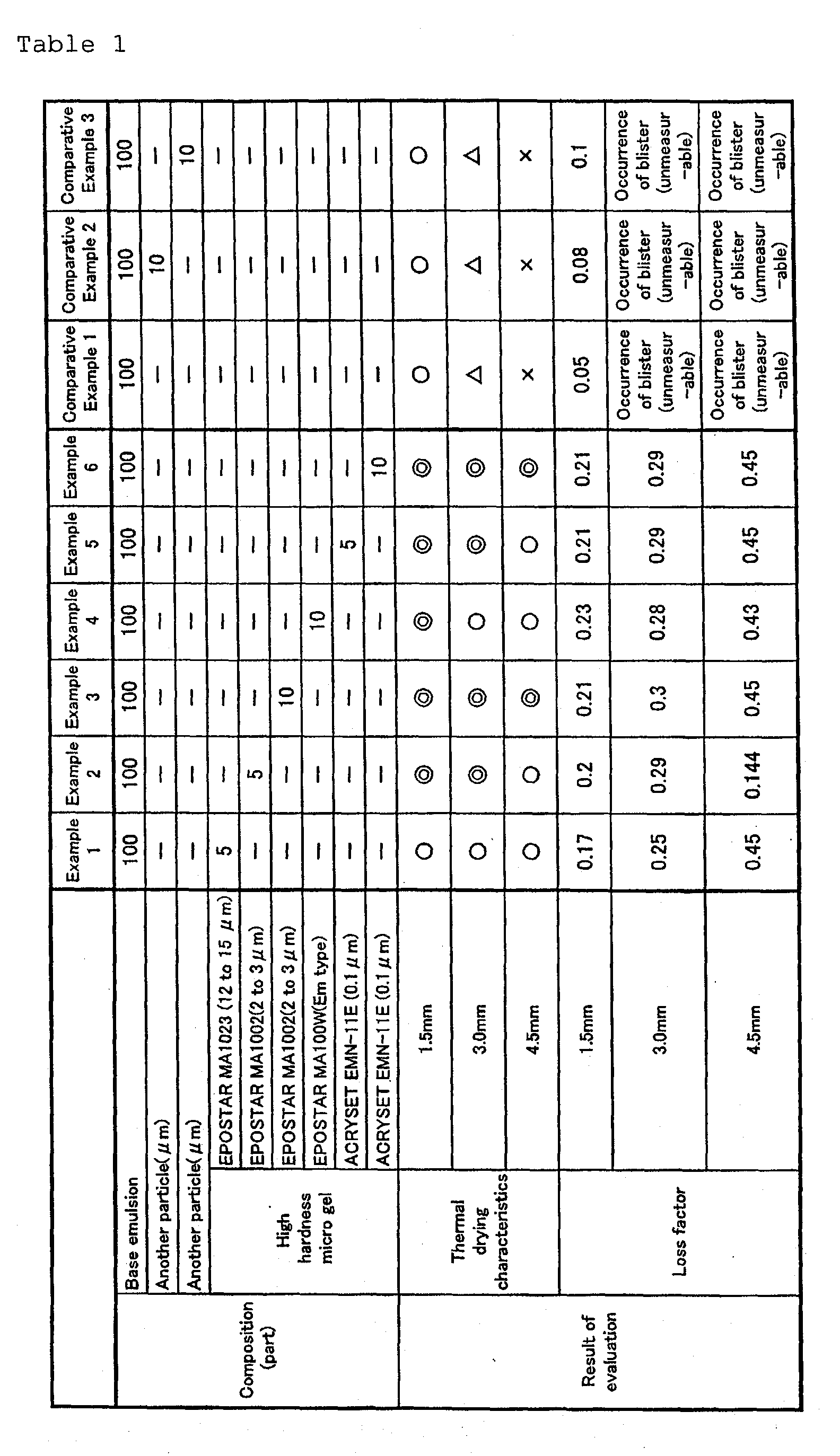
Comparative Examples 1 to 3
-
A paint was formed from the mixture to obtain an acrylic
resin emulsion following the same procedure as Examples 1 to
6 except for using the formulation as shown in Table 1.
-
With respect to the acrylic resin emulsions obtained in
the Examples 1 to 6 and Comparative Examples 1 to 3, the following
evaluation tests were conducted. These results were as shown
in Tables 1.
-
The acrylic resin emulsions obtained in the Examples 1
to 6 and Comparative Examples 1 to 3 were blended as follows
to form water-based paint compositions and thermal drying
characteristics and damping properties were verified.
- Acrylic resin emulsion 100 parts
- Calcium carbonate: NN#200 (trademark, product of Nitto Powder
Industry Co.) 250 parts
- Dispersant: Demol EP (trademark, product of Kao Corporation)
1 parts
- Thickener: Acryset AT-2 (trademark, product of Nippon
Shokubai Co.) 2 parts
- Antifoaming agent: Nopco 8034L (trademark, product of Sun
Nopco Co.) 0.3 part
-
(Thermal drying characteristics)
-
Each of the above-mentioned water-based paint
compositions was applied on to a substrate (70mm wide x 150mm
long x 0.8mm thick) of SPCC-SD (dull rigid sheet: product of
Nippon Testpanel Co.,Ltd.) in such a way that a film thickness
after drying is 1.5 mm, 3.0 mm or 4.5 mm and dried at 160°C for
30 minutes to form a film. The surface of the film dried was
observed visually.
Evaluation criteria
-
- o ○: film not having blister throughout its surface
- ○ : film having less than four to five blisters of 2 to 3 mm
in diameter
- Δ : film having five or more blisters of 4 to 10 mm in diameter
- × : film having blisters throughout its surface
-
(Loss factor)
-
Each of the above-mentioned water-based paint
compositions was poured into a form having a thickness of 1.5
mm, 3.0 mm or 4.5 mm on a cold-rolled steel panel (SPCC, 15mm
wide × 250mm long × 0.8mm thick) and dried twice at 150°C for
25 minutes to form a film of 1.5mm, 3.0 mm or 4.5 mm in thickness
on the cold-rolled steel panel. A vibration damping properties
was evaluated by measuring tan δ by the cantilever method in
a measuring environment of 25°C using Ono Instrument's loss
factor determination system. Thus, the larger the loss factor
value is, the more satisfactory is the vibration damping
properties.
Example 7
-
A separable flask equipped with a stirrer, reflux
condenser, thermometer, nitrogen gas inlet pipe and dropping
funnel was charged with 170.5 parts of deionized water. Then,
under stirring in a nitrogen gas stream, the contents of the
flask were heated to an internal temperature of 70°C. On the
other hand, the above dropping funnel was charged with a monomer
emulsion composed of 54.5 parts of methyl methacrylate, 246 parts
of styrene, 192 parts of 2-ethylhexyl acrylate, 7.5 parts of
acrylic acid, 125 parts of 20% aqueous solution of ADEKARIA SOAP
(trademark, product of Asahi Denka Co., Ltd.) previously
prepared and 64.6 parts of deionized water. Then, with the
separable flask being held at an internal temperature of 70°C,
the above monomer emulsion was added uniformly dropwise over
3 hours. At the same time, 53.9 parts of 5% aqueous solution
of potassium persulfate and 40 parts of 2% aqueous solution of
sodium hydrogensulfite were added uniformly dropwise over 3
hours. After completion of dropwise addition, the mixture was
incubated for ripening at 76°C for 3 hours. After cooling, 5.1
parts of 25% aqueous ammonium was added. The emulsion was cooled
and taken out through a 100-mesh stainless steel filter screen,
whereby an aqueous resin was obtained. The nonvolatile matter
content, a pH and viscosity of the resulting aqueous resin were
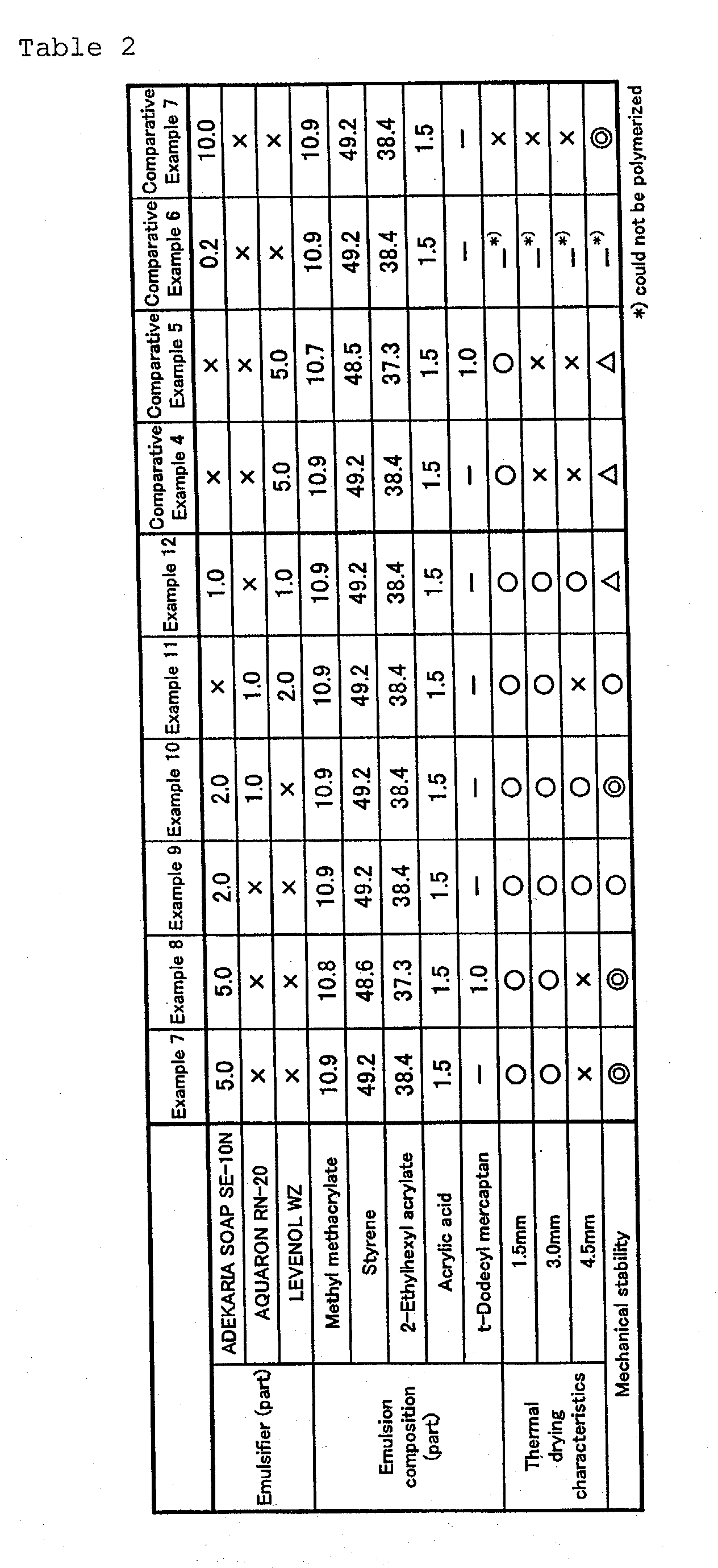
55.1%, 8.8 and 500 mPa·s, respectively. The composition of the
above monomer composition was shown together with another
compositions in Table 2.
Example 8
-
A separable flask equipped with a stirrer, reflux
condenser, thermometer, nitrogen gas inlet pipe and dropping
funnel was charged with 170.5 parts of deionized water. Then,
under stirring in a nitrogen gas stream, the contents of the
flask were heated to an internal temperature of 70°C. On the
other hand, the above dropping funnel was charged with a monomer
emulsion composed of 53.5 parts of methyl methacrylate, 243.5
parts of styrene, 186.5parts of 2-ethylhexyl acrylate, 7.5 parts
of acrylic acid, 10 parts of t-dodecylmercaptan, 125 parts of
20% aqueous solution of ADEKARIA SOAP (trademark, product of
Asahi Denka Co., Ltd.) previously prepared and 64.6 parts of
deionized water. Then, with the separable flask being held at
an internal temperature of 70°C, the above monomer emulsion was
added uniformly dropwise over 3 hours. At the same time, 53.9
parts of 5% aqueous solution of potassium persulfate and 40 parts
of 2% aqueous solution of sodium hydrogensulfite were added
uniformly dropwise over 3 hours. After completion of dropwise
addition, the mixture was incubated for ripening at 76°C for
3 hours. After cooling, 5.1 parts of 25% aqueous ammonium was
added. The emulsion was cooled and taken out through a 100-mesh
stainless steel filter screen, whereby an aqueous resin was
obtained. The nonvolatile matter content, a pH and viscosity
of the resulting aqueous resin were 55.1%, 8.7 and 620 mPa·s,
respectively. The composition of the above monomer composition
was shown together with another compositions in Table 2.
Example 9
-
A separable flask equipped with a stirrer, reflux
condenser, thermometer, nitrogen gas inlet pipe and dropping
funnel was charged with 170.5 parts of deionized water. Then,
under stirring in a nitrogen gas stream, the contents of the
flask were heated to an internal temperature of 70°C. On the
other hand, the above dropping funnel was charged with a monomer
emulsion composed of 54 . 5 parts of methyl methacrylate, 246 parts
of styrene, 192 parts of 2-ethylhexyl acrylate, 7.5 parts of
acrylic acid, 50 parts of 20% aqueous solution of ADEKARIA SOAP
(trademark, product of Asahi Denka Co., Ltd.) previously
prepared and 112 parts of deionized water. Then, with the
separable flask being held at an internal temperature of 70°C,
the above monomer emulsion was added uniformly dropwise over
3 hours. At the same time, 53.9 parts of 5% aqueous solution
of potassium persulfate and 40 parts of 2% aqueous solution of
sodium hydrogensulfite were added uniformly dropwise over 3
hours. After completion of dropwise addition, the mixture was
incubated for ripening at 76°C for 3 hours. After cooling, 5.1
parts of 25% aqueous ammonium was added. The emulsion was cooled
and taken out through a 100-mesh stainless steel filter screen,
whereby an aqueous resin was obtained. The nonvolatile matter
content, a pH and viscosity of the resulting aqueous resin were
54.9%, 8.7 and 520 mPa·s, respectively. The composition of the
above monomer composition was shown together with another
compositions in Table 2.
Example 10
-
A separable flask equipped with a stirrer, reflux
condenser, thermometer, nitrogen gas inlet pipe and dropping
funnel was charged with 170.5 parts of deionized water. Then,
under stirring in a nitrogen gas stream, the contents of the
flask were heated to an internal temperature of 70°C. On the
other hand, the above dropping funnel was charged with a monomer
emulsion composed of 54.5 parts of methyl methacrylate, 246 parts
of styrene, 192 parts of 2-ethylhexyl acrylate, 7.5 parts of
acrylic acid, 50 parts of 20% aqueous solution of ADEKARIA SOAP
(trademark, product of Asahi Denka Co., Ltd.) previously
prepared, 20 parts of 25% aqueous solution of AQUARON RN-20
(trademark, product of Daiichi Kogyo Seiyaku Co., Ltd.) and 91.6
parts of deionized water. Then, with the separable flask being
held at an internal temperature of 70°C, the above monomer
emulsion was added uniformly dropwise over 3 hours. At the same
time, 53.9 parts of 5% aqueous solution of potassium persulfate
and 40 parts of 2% aqueous solution of sodium hydrogensulfite
were added uniformly dropwise over 3 hours. After completion
of dropwise addition, the mixture was incubated for ripeninig
at 76°C for 3 hours. After cooling, 5.1 parts of 25% aqueous
ammonium was added. The emulsion was cooled and taken out through
a 100-mesh stainless steel filter screen, whereby an aqueous
resin was obtained. The nonvolatile matter content, a pH and
viscosity of the resulting aqueous resin were 55.0%, 8.8 and
550 mPa·s, respectively. The composition of the above monomer
compositionwasshowntogetherwithanothercompositionsinTable
2.
Example 11
-
A separable flask equipped with a stirrer, reflux
condenser, thermometer, nitrogen gas inlet tube and dropping
funnel was charged with 170.5 parts of deionized water. Then,
under stirring in a nitrogen gas stream, the contents of the
flask were heated to an internal temperature of 70°C. On the
other hand, the above dropping funnel was charged with a monomer
emulsion composed of 54 . 5 parts of methyl methacrylate, 246 parts
of styrene, 192 parts of 2-ethylhexyl acrylate, 7.5 parts of
acrylic acid, 50 parts of 20% aqueous solution of sodium
polyoxyethylene alkyl ether sulfate (trademark: LEVENOL WZ,
product of Kao Corporation), 20 parts of 25% aqueous solution
of AQUARON RN-20 (trademark, product of Daiichi Kogyo Seiyaku
Co., Ltd.) and 91.6 parts of deionized water. Then, with the
separable flask being held at an internal temperature of 70°C,
the above monomer emulsion was added uniformly dropwise over
3 hours. At the same time, 53.9 parts of 5% aqueous solution
of potassium persulfate and 40 parts of 2% aqueous solution of
sodium hydrogensulfite were added uniformly dropwise over 3
hours. After completion of dropwise addition, the mixture was
incubated for ripeninig at 76°C for 3 hours. After cooling,
5.1 parts of 25% aqueous ammonium was added. The emulsion was
cooled and taken out through a 100-mesh stainless steel filter
screen, whereby an aqueous resin was obtained. The nonvolatile
matter content, a pH and viscosity of the resulting aqueous resin
were 55.0%, 8.8 and 540 mPa·s, respectively. The composition
of the above monomer composition was shown together with another
compositions in Table 2.
Example 12
-
A separable flask equipped with a stirrer, reflux
condenser, thermometer, nitrogen gas inlet pipe and dropping
funnel was charged with 170.5 parts of deionized water. Then,
under stirring in a nitrogen gas stream, the contents of the
flask were heated to an internal temperature of 70°C. On the
other hand, the above dropping funnel was charged with a monomer
emulsion composed of 54 . 5 parts of methyl methacrylate, 246 parts
of styrene, 192 parts of 2-ethylhexyl acrylate, 7.5 parts of
acrylic acid, 25 parts of 20% aqueous solution of ADEKARIA SOAP
(trademark, product of Asahi Denka Co., Ltd.) previously
prepared, 25 parts of 20% aqueous solution of LEVENOL WZ
(trademark, product of Kao Corporation) and 112 parts of
deionized water. Then, with the separable flask being held at
an internal temperature of 70°C, the above monomer emulsion was
added uniformly dropwise over 3 hours. At the same time, 53.9
parts of 5% aqueous solution of potassium persulfate and 40 parts
of 2% aqueous solution of sodium hydrogensulfite were added
uniformly dropwise over 3 hours. After completion of dropwise
addition, the mixture was incubated for ripeninig at 76°C for
3 hours. After cooling, 5.1 parts of 25% aqueous ammonium was
added. The emulsion was cooled and taken out through a 100-mesh
stainless steel filter screen, whereby an aqueous resin was
obtained. The nonvolatile matter content, a pH and viscosity
of the resulting aqueous resin were 55.0%, 8.9 and 540 mPa·s,
respectively. The composition of the above monomer composition
was shown together with another compositions in Table 2.
Comparative Example 4
-
A separable flask equipped with a stirrer, reflux
condenser, thermometer, nitrogen gas inlet pipe and dropping
funnel was charged with 170.5 parts of deionized water. Then,
under stirring in a nitrogen gas stream, the contents of the
flask were heated to an internal temperature of 70°C. On the
other hand, the above dropping funnel was charged with a monomer
emulsion composed of 54.5 parts of methyl methacrylate, 246 parts
of styrene, 192 parts of 2-ethylhexyl acrylate, 7.5 parts of
acrylic acid, 125 parts of 20% aqueous solution of LEVENOL WZ
(trademark, product of Kao Corporation) previously prepared,
and 64.6 parts of deionized water. Then, with the separable
flask being held at an internal temperature of 70°C, the above
monomer emulsion was added uniformly dropwise over 3 hours. At
the same time, 53.9 parts of 5% aqueous solution of potassium
persulfate and 40 parts of 2% aqueous solution of sodium
hydrogensulfite were added uniformly dropwise over 3 hours.
After completion of dropwise addition, the mixture was incubated
for ripeninig at 76°C for 3 hours. After cooling, 5.1 parts
of 25% aqueous ammonium was added. The emulsion was cooled and
taken out through a 100-mesh stainless steel filter screen,
whereby an aqueous resin was obtained. The nonvolatile matter
content, a pH and viscosity of the resulting aqueous resin were
55.1%, 8.8 and 500 mPa·s, respectively. The composition of the
above monomer composition was shown together with another
compositions in Table 2.
Comparative Example 5
-
A separable flask equipped with a stirrer, reflux
condenser, thermometer, nitrogen gas inlet pipe and dropping
funnel was charged with 170.5 parts of deionized water. Then,
under stirring in a nitrogen gas stream, the contents of the
flask were heated to an internal temperature of 70°C. On the
other hand, the above dropping funnel was charged with a monomer
emulsion composed of 53.5 parts of methyl methacrylate, 243.5
parts of styrene, 186.5 parts of 2-ethylhexyl acrylate, 7.5 parts
of acrylic acid, 10 parts of t-dodecylmercaptan, 125 parts of
20% aqueous solution of LEVENOL WZ (trademark, product of Kao
Corporation) previously prepared, and 64.6 parts of deionized
water. Then, with the separable flask being held at an internal
temperature of 70°C, the above monomer emulsion was added
uniformly dropwise over 3 hours. At the same time, 53.9 parts
of 5% aqueous solution of potassium persulfate and 40 parts of
2% aqueous solution of sodium hydrogensulfite were added
uniformly dropwise over 3 hours. After completion of dropwise
addition, the mixture was incubated for ripeninig at 76°C for
3 hours. After cooling, 5.1 parts of 25% aqueous ammonium was
added. The emulsion was cooled and taken out through a 100-mesh
stainless steel filter screen, whereby an aqueous resin was
obtained. The nonvolatile matter content, a pH and viscosity
of the resulting aqueous resin were 55.3%, 8.4 and 450 mPa·s,
respectively. The composition of the above monomer composition
was shown together with another compositions in Table 2.
Comparative Example 6
-
A separable flask equipped with a stirrer, reflux
condenser, thermometer, nitrogen gas inlet pipe and dropping
funnel was charged with 170.5 parts of deionized water. Then,
under stirring in a nitrogen gas stream, the contents of the
flask were heated to an internal temperature of 70°C. On the
other hand, the above dropping funnel was charged with a monomer
emulsion composed of 54.5 parts of methyl methacrylate, 24 6 parts
of styrene, 192 parts of 2-ethylhexyl acrylate, 7.5 parts of
acrylic acid, 25 parts of 20% aqueous solution of ADEKARIA SOAP
(trademark, product of Asahi Denka Co., Ltd.) previously
prepared, and 128.4 parts of deionized water. Then, with the
separable flask being held at an internal temperature of 70°C,
the above monomer emulsion was added uniformly dropwise over
3 hours. At the same time, 53.9 parts of 5% aqueous solution
of potassium persulfate and 40 parts of 2% aqueous solution of
sodium hydrogensulfite were added uniformly dropwise over 3
hours. But, the emulsion was gelated halfway through dropwise
addition and therefore the remainder of the evaluation was not
performed.
Comparative Example 7
-
A separable flask equipped with a stirrer, reflux
condenser, thermometer, nitrogen gas inlet pipe and dropping
funnel was charged with 156 parts of deionized water. Then,
under stirring in a nitrogen gas stream, the contents of the
flask were heated to an internal temperature of 70°C. On the
other hand, the above dropping funnel was charged with a monomer
emulsion composed of 54.5 parts of methyl methacrylate, 24 6 parts
of styrene, 192 parts of 2-ethylhexyl acrylate, 7.5 parts of
acrylic acid and 250 parts of 20% aqueous solution of ADEKARIA
SOAP (trademark, product of Asahi Denka Co., Ltd.) previously
prepared. Then, with the separable flask being held at an
internal temperature of 70°C, the above monomer emulsion was
added uniformly dropwise over 3 hours. At the same time, 53.9
parts of 5% aqueous solution of potassiumpersulfate and 40 parts
of 2% aqueous solution of sodium hydrogensulfite were added
uniformly dropwise over 3 hours. After completion of dropwise
addition, the mixture was incubated for ripeninig at 76°C for
3 hours. After cooling, 5.1 parts of 25% aqueous ammonium was
added. The emulsion was cooled and taken out through a 100-mesh
stainless steel filter screen, whereby an aqueous resin was
obtained. The nonvolatile matter content, a pH and viscosity
of the resulting aqueous resin were 55.1%, 8.8 and 350 mPa · s,
respectively. The composition of the above monomer composition
was shown together with another compositions in Table 2.
-
With respect to each of the emulsions obtained in the
above-mentioned Examples 7 to 12 and Comparative Examples 4 to
7, the following evaluation tests were conducted. These results
were as shown in Tables 2 and 3.
(1) Mechanical stability test(Maron Test)
-
50 g of the emulsion filtered with a 300-mesh stainless
steel filter screen was subj ected to a mechanical stability test
(according to JIS K 6828, 1996, the scale of a platform weighing
machine is graduated in 10 kg, disc rotational speed 1, 000 rpm,
rotation time 5 minutes, test temperature 25°C) using a Maron
Test stability tester (product of KUMAGAI RIKI KOGYO CO.).
-
After testing, the emulsion was filtered with a 100-mesh
stainless steel filter screen and dried at 110°C for 1 hour in
a drying oven.
-
An evaluation after the test was conducted according to
the following equation.
-
Flocculation rate (%) = (weight of the steel filter screen after
drying (g) - weight of the steel screen before drying
(g)) / 50 g × 100
- o ○ : not more than 0.1%
- ○ : not less than 0.1% and not more than 0.5%
- Δ : not less than 0.5% and not more than 1.0%
- × : not less than 1.0%
-
(2) Thermal drying characteristics
-
The acrylic resin emulsions obtained in the Examples 7
to 12 and Comparative Examples 4 to 7 were blended as follows
to form water-based paint compositions having a vibration damping
property and thermal drying characteristics were verified.
- Acrylic copolymer emulsion 100 parts
- Calcium carbonate: NN#200 (*1) 250 parts
- Dispersant: Demol EP (*2) 1 part
- Thickener: Acryset WR-600 (*3) 2 parts
- Antifoaming agent: Nopco 8034L (*4) 0.3 part
-
-
Each of the dampening coating formulation was poured into
a formhaving a thickness of 1.5mm, 3.5 mm or 4.5 mm on a cold-rolled
steel panel (SPCC, 15mm wide × 250mm long × 0.8mm thick) and
dried at 150°C for 25 minutes to form a film. After drying,
the state of a film was observed and a drying characteristics
was evaluated according to the following criteria.
Evaluation criteria
-
- ○ : no blister
- × : occurrence of blister on the surface of a film
-
(3) Time-course stability of emulsion
-
The viscosity of emulsions was measured with a BM type
viscometer (rotor 2, 30 rpm). The initial viscosity and the
viscosity after a storage of 1 month at 40°C were measured and
the rate of change of viscosity
*) was determined. When the rate
of change of viscosity was 10% or less, it was assumed to be
in a level of acceptance.
| Sample | Solid matter content (%) | pH | Initial viscosity (mPa·s) | Viscosity after storage at 40°C (Mpa.s) | a Rate of change of viscosity (%) |
| Example 7 | 55.1 | 8.8 | 500 | 470 | 6 |
| Example 8 | 55.1 | 8.7 | 620 | 590 | 5 |
| Example 9 9 | 54.9 | 8.7 | 520 | 500 | 4 |
| Example 10 | 55.0 | 8.8 | 550 | 530 | 4 |
| Example 11 | 55.0 | 8.9 | 540 | 500 | 7 |
| Example 12 | 55.0 | 8.9 | 540 | 520 | 4 |
| Comparative Example 4 | 55.1 | 8.9 | 500 | 410 | 18 |
| Comparative Example 5 | 55.3 | 8.4 | 450 | 380 | 16 |
| Comparative Example 6 | - | - | - | - | - |
| Comparative Example 7 | 55.1 | 8.8 | 350 | 310 | 11 |
-
The present application claims priority under 35 U.S.C.
§ 119 to Japanese Patent Application No. 2003-069641, filedMarch
14, 2003, entitled "PAINT COMPOSITION FOR THERMAL DRYING."
The contents of that application are incorporated herein by
reference in their entirety.