EP1457469A1 - Piezoelectric-electrostrictive material and its production method - Google Patents
Piezoelectric-electrostrictive material and its production method Download PDFInfo
- Publication number
- EP1457469A1 EP1457469A1 EP02786148A EP02786148A EP1457469A1 EP 1457469 A1 EP1457469 A1 EP 1457469A1 EP 02786148 A EP02786148 A EP 02786148A EP 02786148 A EP02786148 A EP 02786148A EP 1457469 A1 EP1457469 A1 EP 1457469A1
- Authority
- EP
- European Patent Office
- Prior art keywords
- piezoelectric
- batio
- porcelain
- electrostrictive material
- temperature
- Prior art date
- Legal status (The legal status is an assumption and is not a legal conclusion. Google has not performed a legal analysis and makes no representation as to the accuracy of the status listed.)
- Granted
Links
Images
Classifications
-
- H—ELECTRICITY
- H10—SEMICONDUCTOR DEVICES; ELECTRIC SOLID-STATE DEVICES NOT OTHERWISE PROVIDED FOR
- H10N—ELECTRIC SOLID-STATE DEVICES NOT OTHERWISE PROVIDED FOR
- H10N30/00—Piezoelectric or electrostrictive devices
- H10N30/80—Constructional details
- H10N30/85—Piezoelectric or electrostrictive active materials
- H10N30/853—Ceramic compositions
-
- C—CHEMISTRY; METALLURGY
- C04—CEMENTS; CONCRETE; ARTIFICIAL STONE; CERAMICS; REFRACTORIES
- C04B—LIME, MAGNESIA; SLAG; CEMENTS; COMPOSITIONS THEREOF, e.g. MORTARS, CONCRETE OR LIKE BUILDING MATERIALS; ARTIFICIAL STONE; CERAMICS; REFRACTORIES; TREATMENT OF NATURAL STONE
- C04B35/00—Shaped ceramic products characterised by their composition; Ceramics compositions; Processing powders of inorganic compounds preparatory to the manufacturing of ceramic products
- C04B35/01—Shaped ceramic products characterised by their composition; Ceramics compositions; Processing powders of inorganic compounds preparatory to the manufacturing of ceramic products based on oxide ceramics
- C04B35/46—Shaped ceramic products characterised by their composition; Ceramics compositions; Processing powders of inorganic compounds preparatory to the manufacturing of ceramic products based on oxide ceramics based on titanium oxides or titanates
- C04B35/462—Shaped ceramic products characterised by their composition; Ceramics compositions; Processing powders of inorganic compounds preparatory to the manufacturing of ceramic products based on oxide ceramics based on titanium oxides or titanates based on titanates
- C04B35/465—Shaped ceramic products characterised by their composition; Ceramics compositions; Processing powders of inorganic compounds preparatory to the manufacturing of ceramic products based on oxide ceramics based on titanium oxides or titanates based on titanates based on alkaline earth metal titanates
- C04B35/468—Shaped ceramic products characterised by their composition; Ceramics compositions; Processing powders of inorganic compounds preparatory to the manufacturing of ceramic products based on oxide ceramics based on titanium oxides or titanates based on titanates based on alkaline earth metal titanates based on barium titanates
-
- C—CHEMISTRY; METALLURGY
- C04—CEMENTS; CONCRETE; ARTIFICIAL STONE; CERAMICS; REFRACTORIES
- C04B—LIME, MAGNESIA; SLAG; CEMENTS; COMPOSITIONS THEREOF, e.g. MORTARS, CONCRETE OR LIKE BUILDING MATERIALS; ARTIFICIAL STONE; CERAMICS; REFRACTORIES; TREATMENT OF NATURAL STONE
- C04B35/00—Shaped ceramic products characterised by their composition; Ceramics compositions; Processing powders of inorganic compounds preparatory to the manufacturing of ceramic products
- C04B35/622—Forming processes; Processing powders of inorganic compounds preparatory to the manufacturing of ceramic products
- C04B35/626—Preparing or treating the powders individually or as batches ; preparing or treating macroscopic reinforcing agents for ceramic products, e.g. fibres; mechanical aspects section B
- C04B35/62605—Treating the starting powders individually or as mixtures
- C04B35/6261—Milling
-
- C—CHEMISTRY; METALLURGY
- C04—CEMENTS; CONCRETE; ARTIFICIAL STONE; CERAMICS; REFRACTORIES
- C04B—LIME, MAGNESIA; SLAG; CEMENTS; COMPOSITIONS THEREOF, e.g. MORTARS, CONCRETE OR LIKE BUILDING MATERIALS; ARTIFICIAL STONE; CERAMICS; REFRACTORIES; TREATMENT OF NATURAL STONE
- C04B2235/00—Aspects relating to ceramic starting mixtures or sintered ceramic products
- C04B2235/02—Composition of constituents of the starting material or of secondary phases of the final product
- C04B2235/30—Constituents and secondary phases not being of a fibrous nature
- C04B2235/32—Metal oxides, mixed metal oxides, or oxide-forming salts thereof, e.g. carbonates, nitrates, (oxy)hydroxides, chlorides
- C04B2235/3205—Alkaline earth oxides or oxide forming salts thereof, e.g. beryllium oxide
- C04B2235/3213—Strontium oxides or oxide-forming salts thereof
-
- C—CHEMISTRY; METALLURGY
- C04—CEMENTS; CONCRETE; ARTIFICIAL STONE; CERAMICS; REFRACTORIES
- C04B—LIME, MAGNESIA; SLAG; CEMENTS; COMPOSITIONS THEREOF, e.g. MORTARS, CONCRETE OR LIKE BUILDING MATERIALS; ARTIFICIAL STONE; CERAMICS; REFRACTORIES; TREATMENT OF NATURAL STONE
- C04B2235/00—Aspects relating to ceramic starting mixtures or sintered ceramic products
- C04B2235/02—Composition of constituents of the starting material or of secondary phases of the final product
- C04B2235/30—Constituents and secondary phases not being of a fibrous nature
- C04B2235/32—Metal oxides, mixed metal oxides, or oxide-forming salts thereof, e.g. carbonates, nitrates, (oxy)hydroxides, chlorides
- C04B2235/3205—Alkaline earth oxides or oxide forming salts thereof, e.g. beryllium oxide
- C04B2235/3215—Barium oxides or oxide-forming salts thereof
-
- C—CHEMISTRY; METALLURGY
- C04—CEMENTS; CONCRETE; ARTIFICIAL STONE; CERAMICS; REFRACTORIES
- C04B—LIME, MAGNESIA; SLAG; CEMENTS; COMPOSITIONS THEREOF, e.g. MORTARS, CONCRETE OR LIKE BUILDING MATERIALS; ARTIFICIAL STONE; CERAMICS; REFRACTORIES; TREATMENT OF NATURAL STONE
- C04B2235/00—Aspects relating to ceramic starting mixtures or sintered ceramic products
- C04B2235/02—Composition of constituents of the starting material or of secondary phases of the final product
- C04B2235/30—Constituents and secondary phases not being of a fibrous nature
- C04B2235/32—Metal oxides, mixed metal oxides, or oxide-forming salts thereof, e.g. carbonates, nitrates, (oxy)hydroxides, chlorides
- C04B2235/3231—Refractory metal oxides, their mixed metal oxides, or oxide-forming salts thereof
- C04B2235/3232—Titanium oxides or titanates, e.g. rutile or anatase
- C04B2235/3234—Titanates, not containing zirconia
- C04B2235/3236—Alkaline earth titanates
-
- C—CHEMISTRY; METALLURGY
- C04—CEMENTS; CONCRETE; ARTIFICIAL STONE; CERAMICS; REFRACTORIES
- C04B—LIME, MAGNESIA; SLAG; CEMENTS; COMPOSITIONS THEREOF, e.g. MORTARS, CONCRETE OR LIKE BUILDING MATERIALS; ARTIFICIAL STONE; CERAMICS; REFRACTORIES; TREATMENT OF NATURAL STONE
- C04B2235/00—Aspects relating to ceramic starting mixtures or sintered ceramic products
- C04B2235/02—Composition of constituents of the starting material or of secondary phases of the final product
- C04B2235/30—Constituents and secondary phases not being of a fibrous nature
- C04B2235/32—Metal oxides, mixed metal oxides, or oxide-forming salts thereof, e.g. carbonates, nitrates, (oxy)hydroxides, chlorides
- C04B2235/3231—Refractory metal oxides, their mixed metal oxides, or oxide-forming salts thereof
- C04B2235/3251—Niobium oxides, niobates, tantalum oxides, tantalates, or oxide-forming salts thereof
-
- C—CHEMISTRY; METALLURGY
- C04—CEMENTS; CONCRETE; ARTIFICIAL STONE; CERAMICS; REFRACTORIES
- C04B—LIME, MAGNESIA; SLAG; CEMENTS; COMPOSITIONS THEREOF, e.g. MORTARS, CONCRETE OR LIKE BUILDING MATERIALS; ARTIFICIAL STONE; CERAMICS; REFRACTORIES; TREATMENT OF NATURAL STONE
- C04B2235/00—Aspects relating to ceramic starting mixtures or sintered ceramic products
- C04B2235/02—Composition of constituents of the starting material or of secondary phases of the final product
- C04B2235/30—Constituents and secondary phases not being of a fibrous nature
- C04B2235/32—Metal oxides, mixed metal oxides, or oxide-forming salts thereof, e.g. carbonates, nitrates, (oxy)hydroxides, chlorides
- C04B2235/3281—Copper oxides, cuprates or oxide-forming salts thereof, e.g. CuO or Cu2O
-
- C—CHEMISTRY; METALLURGY
- C04—CEMENTS; CONCRETE; ARTIFICIAL STONE; CERAMICS; REFRACTORIES
- C04B—LIME, MAGNESIA; SLAG; CEMENTS; COMPOSITIONS THEREOF, e.g. MORTARS, CONCRETE OR LIKE BUILDING MATERIALS; ARTIFICIAL STONE; CERAMICS; REFRACTORIES; TREATMENT OF NATURAL STONE
- C04B2235/00—Aspects relating to ceramic starting mixtures or sintered ceramic products
- C04B2235/02—Composition of constituents of the starting material or of secondary phases of the final product
- C04B2235/50—Constituents or additives of the starting mixture chosen for their shape or used because of their shape or their physical appearance
- C04B2235/54—Particle size related information
- C04B2235/5409—Particle size related information expressed by specific surface values
-
- C—CHEMISTRY; METALLURGY
- C04—CEMENTS; CONCRETE; ARTIFICIAL STONE; CERAMICS; REFRACTORIES
- C04B—LIME, MAGNESIA; SLAG; CEMENTS; COMPOSITIONS THEREOF, e.g. MORTARS, CONCRETE OR LIKE BUILDING MATERIALS; ARTIFICIAL STONE; CERAMICS; REFRACTORIES; TREATMENT OF NATURAL STONE
- C04B2235/00—Aspects relating to ceramic starting mixtures or sintered ceramic products
- C04B2235/70—Aspects relating to sintered or melt-casted ceramic products
- C04B2235/72—Products characterised by the absence or the low content of specific components, e.g. alkali metal free alumina ceramics
-
- C—CHEMISTRY; METALLURGY
- C04—CEMENTS; CONCRETE; ARTIFICIAL STONE; CERAMICS; REFRACTORIES
- C04B—LIME, MAGNESIA; SLAG; CEMENTS; COMPOSITIONS THEREOF, e.g. MORTARS, CONCRETE OR LIKE BUILDING MATERIALS; ARTIFICIAL STONE; CERAMICS; REFRACTORIES; TREATMENT OF NATURAL STONE
- C04B2235/00—Aspects relating to ceramic starting mixtures or sintered ceramic products
- C04B2235/70—Aspects relating to sintered or melt-casted ceramic products
- C04B2235/74—Physical characteristics
- C04B2235/78—Grain sizes and shapes, product microstructures, e.g. acicular grains, equiaxed grains, platelet-structures
- C04B2235/786—Micrometer sized grains, i.e. from 1 to 100 micron
-
- C—CHEMISTRY; METALLURGY
- C04—CEMENTS; CONCRETE; ARTIFICIAL STONE; CERAMICS; REFRACTORIES
- C04B—LIME, MAGNESIA; SLAG; CEMENTS; COMPOSITIONS THEREOF, e.g. MORTARS, CONCRETE OR LIKE BUILDING MATERIALS; ARTIFICIAL STONE; CERAMICS; REFRACTORIES; TREATMENT OF NATURAL STONE
- C04B2235/00—Aspects relating to ceramic starting mixtures or sintered ceramic products
- C04B2235/70—Aspects relating to sintered or melt-casted ceramic products
- C04B2235/74—Physical characteristics
- C04B2235/79—Non-stoichiometric products, e.g. perovskites (ABO3) with an A/B-ratio other than 1
Definitions
- the present invention relates to a piezoelectric/electrostrictive material made of a porcelain obtained by firing, for example, to a piezoelectric/electrostrictive material used as an actuator or a sensor both assembled as an electromechanical transducer for positioning in precision machine tool or length control of optical path in optical instrument or in valve for flow rate control, etc. More particularly, the present invention relates to a piezoelectric/electrostrictive material suitably used in a very small sensor or a highly integrated very small actuator both used in an element for measurement of liquid property or very small weight.
- PZT piezoelectric/electrostrictive materials
- BaTiO 3 piezoelectric/electrostrictive materials
- PZT type piezoelectric/electrostrictive materials have been used mainly because they are superior in overall piezoelectric properties.
- Pb contained in PZT, etc. is stabilized and essentially generates no problem caused by decomposition or the like.
- a Pb-free material is required depending upon its application.
- Pb-containing porcelains such as PZT, PLZT [(Pb,La) (Zr,Ti)O 3 ] and the like give rise to vaporization of small amount of Pb in high-temperature firing, they have had, particularly when used in applications requiring a thin or thick film, a problem that they hardly show stable properties owing to the compositional change during firing.
- BaTiO 3 contains no Pb and offers a promising material for such a need.
- BaTiO 3 viewed as a piezoelectric/electrostrictive material is inferior in piezoelectric/electrostrictive properties to a PZT type material, and has seldom been used as an actuator or as a sensor. Therefore, the present invention has been made in view of the above-mentioned problems of the prior art and aims at providing a BaTiO 3 -based piezoelectric/electro-strictive material which is superior in piezoelectric/electrostrictive properties to conventional products and which can be suitably used in an actuator or a sensor, and a process for producing such a piezoelectric/electrostrictive material.
- a piezoelectric/electrostrictive material when used in an actuator, is required to show a large displacement to a voltage applied.
- the present inventors have found that a piezoelectric/electrostrictive material showing a large displacement can be obtained by optimizing the composition for BaTiO 3 -based porcelain, as a result of an intensive study made on the piezoelectric/electrostrictive characteristics. Furthermore, the present inventors have found that a piezoelectric/electrostrictive material showing a large displacement can be obtained, by controlling the fine structure of BaTiO 3 -based porcelain, particularly the distribution of the crystal grain constituting the BaTiO 3 -based porcelain.
- a piezoelectric/electrostrictive material made of a BaTiO 3 -based porcelain composed mainly of BaTiO 3 and containing CuO and Nb 2 O 5 , characterized in that strain of transversal direction is 650 ⁇ 10 -6 or more in an electric field of 4,000 V/mm.
- a piezoelectric/electrostrictive material made of a BaTiO 3 -based porcelain composed mainly of BaTiO 3 and containing CuO and Nb 2 O 5 , characterized in that a Curie temperature of the porcelain is 110 to 130 °C.
- a piezoelectric/electrostrictive material made of a BaTiO 3 -based porcelain composed mainly of BaTiO 3 and containing CuO and Nb 2 O 5 , characterized in that crystal phase of the porcelain at ambient temperature consists essentially of tetragonal phase and cubic phase.
- the Ba/Ti (molar ratio) or the (Ba + Sr)/Ti (molar ratio) is preferably in a range of 1.001 to 1.02, more preferably in a range of 1.001 to 1.01 because such a molar ratio can easily prevent the growth of abnormal grains occurring during the firing for porcelain formation and can easily control the particle diameters of the crystal grains constituting the porcelain.
- a process for producing a piezoelectric/electrostrictive material made of a BaTiO 3 -based porcelain composed mainly of BaTiO 3 and containing CuO and Nb 2 O 5 , characterized by weighing individual raw materials so as to give a predetermined composition, mixing and grinding them, calcinating the resulting mixed powder in the air at 850 to 950°C, then grinding the resulting calcinated material until the ground material comes to have a specific surface area of 7 m 2 /g or less, and molding and firing the ground material.
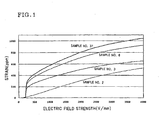
- Fig. 1 is a graph showing the strain (S 4000 ) (ppm) of transversal direction when an electric field of 4,000 V/mm was applied in the thickness direction.
- the piezoelectric/electrostrictive material according to the present invention is described in more detail below.
- the piezoelectric/electrostrictive material according to the present invention is made of a BaTiO 3 -based porcelain composed mainly of BaTiO 3 and containing CuO, Nb 2 O 5 , etc.
- Nb 2 O 5 and CuO each in an amount of 0.05 to 0.5% by weight, more preferably each in an amount of 0.1 to 0.3% by weight as a superaddition.
- the porcelain of the present invention may be added rare earth metals and/or transition metals other than the above components, in a total amount of 0.5% by weight or less in terms of their metal oxides.
- the forms of the components added are ordinarily oxides, carbonates or sulfates thereof.
- the individual crystal grains constituting the porcelain of the present invention have crystal lattices of perovskite structure.
- the porcelain of the present invention is one having a strain of transversal direction is 650 ⁇ 10 -6 or more, preferably 700 ⁇ 10 -6 or more, more preferably 800 ⁇ 10 -6 in an electric field of 4,000 V/mm.
- the present porcelain is a material having a characteristic electric field - strain curve, as mentioned hereinafter.
- the porcelain of the present invention is characterized in that it has a Curie temperature of 110 to 130 °C, and that crystal phase of the porcelain at ambient temperature consists essentially of tetragonal phase and cubic phase.
- the porcelain of the present invention has a dielectric constant value of 2000 to 3000 at ambient temperature.
- the porcelain of the present invention has also the characteristics in the distribution of the particle diameter constituting the respective crystal grains.
- 85% or more of the crystal grains are constituted by grains having particle diameters of 10 ⁇ m or less and the maximum particle diameter of the grains is in a range of 5 to 25 ⁇ m.
- 90% to less than 100% of the crystal grains have particle diameters of 10 ⁇ m or less and the maximum particle diameter of the grains is in a range of 10 to 25 ⁇ m.
- raw materials (oxides, hydroxides and carbonates of metal elements) are weighed as so as to give a compositional range of the present invention and are mixed using a mixer such as ball mill or the like.
- a mixer such as ball mill or the like.
- the primary particles of each raw material after mixing it is preferred to allow the primary particles of each raw material after mixing to have particle diameters of 1 ⁇ m or less, in order to allow the porcelain obtained to have a particle diameter distribution specified in the present invention.
- the resulting mixed powder is calcinated in the air at 850 to 950°C to obtain a calcinated material.
- An appropriate calcination temperature is 850 to 950°C.
- the resulting sintered material With a calcination temperature above 950°C, the resulting sintered material is nonuniform and, with a calcination temperature below 850 °C, an unreacted phase remains in the resulting sintered material, making it impossible to obtain a dense porcelain.
- the calcinated material obtained is ground using a grinder such as ball mill or the like until the ground material comes to have a specific surface area of preferably 7 m 2 /g or less, more preferably 5 m 2 /g or less.
- the ground material is molded by a monoaxial press and then by a hydrostatic press to obtain a molded material of desired shape.
- the molded material is fired at 1,100 to 1,250°C to obtain a sintered material.
- the most appropriate firing temperature is 1,150 to 1,200°C.
- the Ba/Ti ratio of BaTiO 3 [the (Ba + Sr)/Ti ratio when part of the Ba has been substituted with Sr] depending upon the kinds and amounts of the components (e.g. CuO and Nb 2 O 5 ) added to the main component BaTiO 3 .
- the Ba/Ti (molar ratio) [or the (Ba + Sr)/Ti (molar ratio)] is appropriately controlled so that an intended crystal grain diameter distribution can be obtained depending upon the amounts and forms (e.g. salt or metal) of the components added, the firing temperature, etc.
- the sintered material (porcelain) obtained by firing sufficiently shows a high strain property.
- the piezoelectric/electrostrictive material according to the present invention is superior in displacement property; therefore, it is useful as a general electromechanical transducer and is suitably used in an actuator, a sensor, etc.
- the resulting mixture was dried and then subjected to a calcination treatment in the air at 900°C for 2 hours.
- the resulting calcinated material was subjected to a grinding treatment in a ball mill.
- the amount of zirconia balls, the grinding time, etc. were appropriately controlled to obtain a powder after grinding treatment (the powder is hereinafter referred to as ground powder) having a specific surface area of 5 m 2 /g.
- the specific surface area of the ground powder was measured by a BET method.
- a polyvinyl alcohol as a binder was added to the ground powder.
- the mixture was molded into a shape of 20 mm in diameter and 15 mm in height using a monoaxial press molding machine and a hydrostatic press molding machine.
- the molded material obtained above was fired in the air at a firing temperature of 1,100 to 1,250°C for a firing time of 3 hours to obtain a porcelain.
- a scanning electron micrograph was taken for the porcelain; from the micrograph were calculated diameters of equivalent area circles to use them as the diameters of the individual grains constituting the porcelain; from these diameters, the proportions of the individual particles were determined based on their area.
- the crystal phase constituting each porcelain was examined by X-ray diffraction method.
- the porcelain was processed to obtain a rectangular sample of 12 mm in length, 3 mm in width and 1 mm in thickness. After an electrode was formed on the surface of thus obtained sample having a length of 12 mm and a width of 3mm, the resultant sample was subjected to a polarization treatment in the thickness direction under the conditions of 70°C, 2,000 V and 15 minutes. After the polarization treatment, the electrode was allowed to stand for 100 hours and measured for transversal strain (S 4000 ) (ppm) when a voltage of 4,000 V/mm was applied in the thickness direction, using a strain gauge. Simultaneously, piezoelectric constant d 31 was measured by a resonance-antiresonance method, using an impedance analyzer. The results are shown in Table 1. Incidentally, * mark in Table 1 indicates Comparative Example. Additionally, T denotes tetragonal phase, and C denotes cubic phase.
- Example 1 Curie temperature of all the porcelains except the samples for Comparative Examples were measured, and found that every porcelain measured showed a Curie temperature within a range of 110 °C to 130 °C.
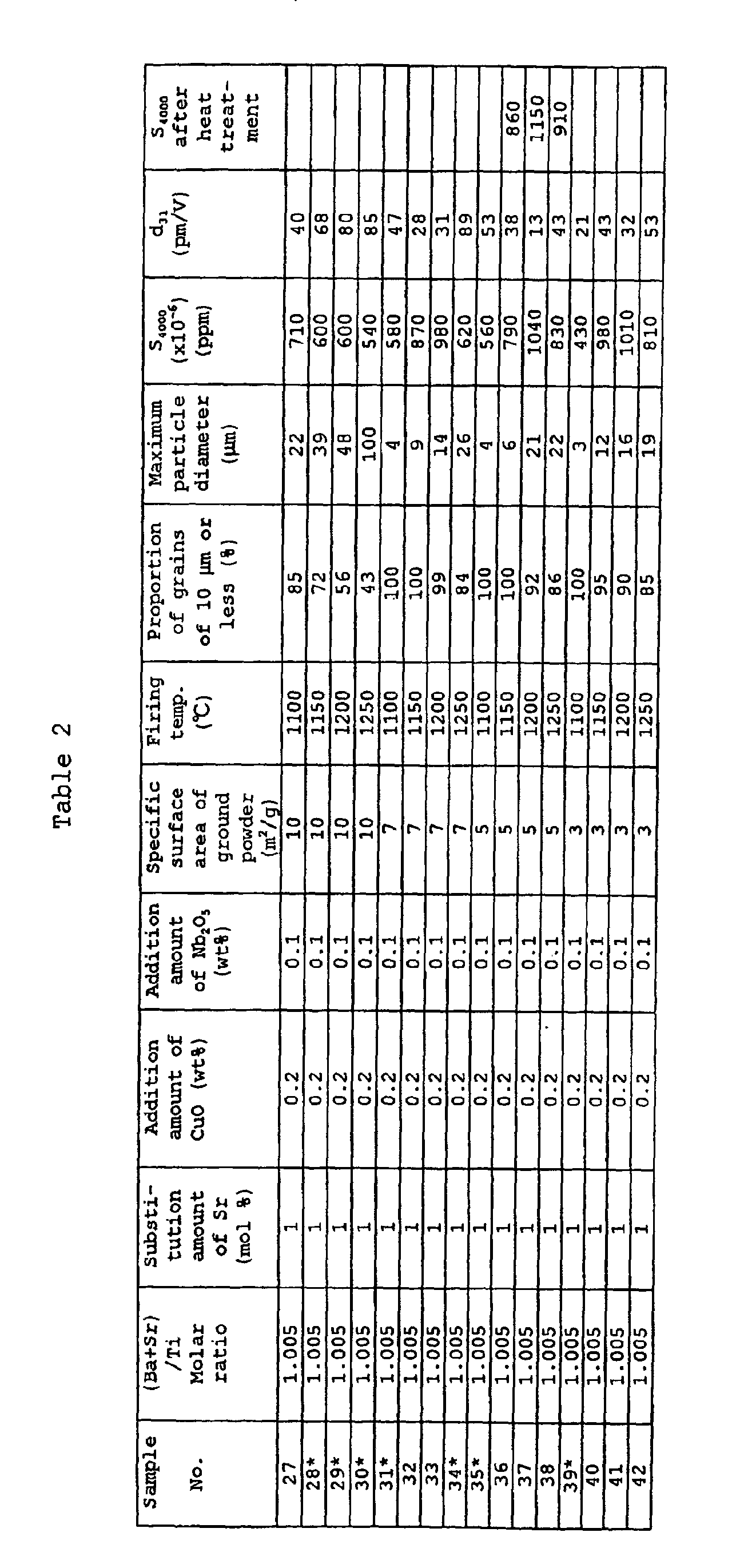
- Example 2 The same starting materials as those for Example 1 were used, and they were weighed so that the composition of the porcelain to be obtained became such in which 1 mole % of Ba was substituted with Sr, the A/B molar ratio [(Ba + Sr)/Ti] became 1.005, and the contents of Nb 2 O 5 and CuO became 0.1% by weight and 0.2% by weight, respectively, as a superaddition. Those materials were mixed in the same manner as that for Example 1.
- the resulting mixture was subjected to a calcination treatment in the same manner as that for Example 1, and the specific surface area of the powders after grinding treatment was adjusted as shown in Table 2.
- each of molded article materials was formed by forming using ground material, the molded materials obtained above were fired at a firing temperature shown in Table 2 to obtain a porcelain in the same manner as that for Example 1.
- strain (S 4000 ) of transversal direction in an electric filed of 4,000 V/mm and piezoelectric constant d 31 were measured.
- the results are shown in Table 2. Incidentally, * mark in Table 2 indicates Comparative Example.
- the strain (S 4000 ) was determined as to Sample No. 36, Sample No. 37, Sample No. 38, after those samples were subjected to a heat treatment wherein the obtained porcelains were kept at temperature of 150 °C for 30 minutes, then temperature was decreased to 50 °C at a decreasing speed of 200 °C/hr. The temperature increasing speed was set at 200 °C/hr, when the heat treatment was carried out.
- strain property (S 4000 ) can be further improved by subjecting the obtained porcelain to a heat treatment.
- the piezoelectric/electrostrictive material of the present invention is superior in piezoelectric/electrostrictive properties to conventional products, and it can be suitably used in an actuator or a sensor.
Landscapes
- Chemical & Material Sciences (AREA)
- Engineering & Computer Science (AREA)
- Ceramic Engineering (AREA)
- Manufacturing & Machinery (AREA)
- Materials Engineering (AREA)
- Structural Engineering (AREA)
- Organic Chemistry (AREA)
- Inorganic Chemistry (AREA)
- Compositions Of Oxide Ceramics (AREA)
Abstract
Description

Claims (10)
- A piezoelectric/electrostrictive material made of a BaTiO3-based porcelain composed mainly of BaTiO3 and containing CuO and Nb2O5, characterized in that a strain (S4000) of transversal direction is 650 × 10-6 or more, in an electric field of 4,000 V/mm.
- A piezoelectric/electrostrictive material made of a BaTiO3-based porcelain composed mainly of BaTiO3 and containing CuO and Nb2O5, characterized in that it has a Curie temperature of 110 to 130 °C.
- A piezoelectric/electrostrictive material made of a BaTiO3-based porcelain composed mainly of BaTiO3 and containing CuO and Nb2O5, characterized in that crystal phase of the porcelain at ambient temperature consists essentially of tetragonal phase and cubic phase.
- A piezoelectric/electrostrictive material according to any one of Claims 1 to 3, wherein at least part of the Ba is substituted with Sr.
- A piezoelectric/electrostrictive material according to any one of Claims 1 to 3, wherein the Ba/Ti molar ratio is 1.001 to 1.02.
- A piezoelectric/electrostrictive material according to Claim 4, wherein the (Ba + Sr)/Ti molar ratio is 1.001 to 1.02.
- A piezoelectric/electrostrictive material according to any one of Claims 1 to 3, wherein content of CuO is 0.05 to 0.5 wt %, and content of Nb2O5 is 0.05 to 0.5 wt %.
- A piezoelectric/electrostrictive material according to any one of Claims 1 to 4, wherein 85% or more of the crystal grains constituting the porcelain are grains having particle diameters of 10 µm or less and the maximum particle diameters of the grains is in a range of 5 to 25 µm.
- A process for producing a piezoelectric/electrostrictive material made of a BaTiO3-based porcelain composed mainly of BaTiO3 and containing CuO and Nb2O5, characterized by weighing individual raw materials so as to give a predetermined composition, mixing and grinding them, calcinating the resulting mixed powder in the air at 850 to 950°C, then grinding the resulting calcinated material until the ground material comes to have a specific surface area of 7 m2/g or less, and molding and firing the ground material.
- A process for producing a piezoelectric/electrostrictive material, characterized by subjecting a porcelain obtained according to Claim 9, to a heat treatment wherein temperature is increased up to a maximum temperature of 150 °C to 600 °C, and this temperature is kept for 1 to 180 minutes, thereafter temperature is decreased to 50 °C or less at a decreasing speed of 50 to 200 °C/hr.
Applications Claiming Priority (3)
| Application Number | Priority Date | Filing Date | Title |
|---|---|---|---|
| JP2001385733 | 2001-12-19 | ||
| JP2001385733 | 2001-12-19 | ||
| PCT/JP2002/013272 WO2003051789A1 (en) | 2001-12-19 | 2002-12-19 | Piezoelectric/electrostrictive material and its production method |
Publications (3)
| Publication Number | Publication Date |
|---|---|
| EP1457469A1 true EP1457469A1 (en) | 2004-09-15 |
| EP1457469A4 EP1457469A4 (en) | 2007-08-22 |
| EP1457469B1 EP1457469B1 (en) | 2011-04-06 |
Family
ID=19187868
Family Applications (1)
| Application Number | Title | Priority Date | Filing Date |
|---|---|---|---|
| EP20020786148 Expired - Lifetime EP1457469B1 (en) | 2001-12-19 | 2002-12-19 | Piezoelectric-electrostrictive material and its production method |
Country Status (7)
| Country | Link |
|---|---|
| US (1) | US6702952B2 (en) |
| EP (1) | EP1457469B1 (en) |
| JP (1) | JP4102308B2 (en) |
| CN (1) | CN1267375C (en) |
| AU (1) | AU2002354230A1 (en) |
| DE (1) | DE60239700D1 (en) |
| WO (1) | WO2003051789A1 (en) |
Families Citing this family (4)
| Publication number | Priority date | Publication date | Assignee | Title |
|---|---|---|---|---|
| US6887397B2 (en) * | 2001-12-19 | 2005-05-03 | Ngk Insulators, Ltd. | Piezoelectric/electrostrictive material and process for production thereof |
| JP4997521B2 (en) * | 2004-11-15 | 2012-08-08 | 独立行政法人物質・材料研究機構 | Piezoelectric materials and nonlinear piezoelectric elements |
| JP5281786B2 (en) * | 2007-11-14 | 2013-09-04 | 日本碍子株式会社 | (Li, Na, K) (Nb, Ta) O3-based piezoelectric material and manufacturing method thereof |
| JP6075765B2 (en) * | 2013-03-23 | 2017-02-08 | 京セラ株式会社 | Piezoelectric element |
Family Cites Families (8)
| Publication number | Priority date | Publication date | Assignee | Title |
|---|---|---|---|---|
| JP2681214B2 (en) * | 1988-05-11 | 1997-11-26 | 堺化学工業株式会社 | Composition for ceramic dielectric, ceramic dielectric obtained by using the same, and method for producing the same |
| JPH03112858A (en) * | 1989-09-26 | 1991-05-14 | Asahi Chem Ind Co Ltd | Dielectric porcelain composition |
| JPH05213669A (en) * | 1992-01-31 | 1993-08-24 | Asahi Chem Ind Co Ltd | Dielectric porcelain composition |
| JPH05213666A (en) * | 1992-01-31 | 1993-08-24 | Asahi Chem Ind Co Ltd | Dielectric porcelain composition and its production |
| JPH08198675A (en) * | 1995-01-20 | 1996-08-06 | Murata Mfg Co Ltd | Lead-containing combined perovskite type dielectric porcelain |
| JP3465549B2 (en) * | 1996-11-22 | 2003-11-10 | 北興化学工業株式会社 | Barium titanate sintered body and method for producing the same |
| US6399529B1 (en) * | 1999-06-14 | 2002-06-04 | Ngk Insulators, Ltd. | Electric-field-inducible deformable material |
| JP2001089230A (en) * | 1999-09-20 | 2001-04-03 | Hokko Chem Ind Co Ltd | Powder composition for producing barium titanate-based sintered body and sintered body |
-
2002
- 2002-05-20 US US10/151,462 patent/US6702952B2/en not_active Expired - Fee Related
- 2002-12-19 AU AU2002354230A patent/AU2002354230A1/en not_active Abandoned
- 2002-12-19 EP EP20020786148 patent/EP1457469B1/en not_active Expired - Lifetime
- 2002-12-19 CN CNB02825323XA patent/CN1267375C/en not_active Expired - Fee Related
- 2002-12-19 JP JP2003552681A patent/JP4102308B2/en not_active Expired - Fee Related
- 2002-12-19 WO PCT/JP2002/013272 patent/WO2003051789A1/en not_active Ceased
- 2002-12-19 DE DE60239700T patent/DE60239700D1/en not_active Expired - Lifetime
Also Published As
| Publication number | Publication date |
|---|---|
| EP1457469A4 (en) | 2007-08-22 |
| CN1604884A (en) | 2005-04-06 |
| DE60239700D1 (en) | 2011-05-19 |
| CN1267375C (en) | 2006-08-02 |
| EP1457469B1 (en) | 2011-04-06 |
| US20030114295A1 (en) | 2003-06-19 |
| JP4102308B2 (en) | 2008-06-18 |
| JPWO2003051789A1 (en) | 2005-04-28 |
| WO2003051789A1 (en) | 2003-06-26 |
| AU2002354230A1 (en) | 2003-06-30 |
| US6702952B2 (en) | 2004-03-09 |
Similar Documents
| Publication | Publication Date | Title |
|---|---|---|
| EP1457471B1 (en) | Crystal oriented ceramics and production method of same | |
| CN101389580B (en) | Piezoelectric ceramic composition | |
| Kim et al. | Dielectric and piezoelectric properties of lanthanum-modified lead magnesium niobium-lead titanate ceramics | |
| KR20140040258A (en) | Piezoelectric material | |
| EP3085678B1 (en) | Piezoelectric ceramic, manufacturing method therefor, and electronic component | |
| CN112457007A (en) | Method for preparing high-performance piezoelectric ceramic by pre-synthesizing and co-firing mixed bicrystal phase | |
| JP3020493B1 (en) | Piezoelectric ceramics | |
| EP1457469B1 (en) | Piezoelectric-electrostrictive material and its production method | |
| JP3032761B1 (en) | Piezoelectric ceramics | |
| Moure et al. | Microstructural and piezoelectric properties of fine grained PZT ceramics doped with donor and/or acceptor cations | |
| US6887397B2 (en) | Piezoelectric/electrostrictive material and process for production thereof | |
| KR100663971B1 (en) | NiN-added PNP-PPT piezoceramic and its manufacturing method | |
| JPH1160334A (en) | Piezoelectric ceramic composition for actuator | |
| EP1063208B1 (en) | Electric-field-inducible deformable material | |
| US4882078A (en) | Piezoelectric ceramic composition for actuators | |
| EP4393897A1 (en) | Lead-free piezoelectric magnetic composition and piezoelectric element | |
| Antonova et al. | Structure and properties of hot-pressed Pb (Lu1/2Nb1/2) O3-PbTiO3 binary system ceramics | |
| US5425889A (en) | Method for producing a piezoceramic | |
| JP3830315B2 (en) | Piezoelectric ceramic composition | |
| JP3481832B2 (en) | Piezoelectric ceramic | |
| KR102069360B1 (en) | Lead-free piezoceramics composition and manufacturing the same | |
| JP2839253B2 (en) | Piezoelectric ceramic composition for actuator | |
| KR101125700B1 (en) | Lead-free piezoelectric ceramics and method for the preparation thereof | |
| US20060290240A1 (en) | Piezoelectric/electrostrictive porcelain composition, piezoelectric/electrostrictive body, and piezoelectric/electrostrictive film type device | |
| JP2000264733A (en) | Piezoelectric ceramics |
Legal Events
| Date | Code | Title | Description |
|---|---|---|---|
| PUAI | Public reference made under article 153(3) epc to a published international application that has entered the european phase |
Free format text: ORIGINAL CODE: 0009012 |
|
| 17P | Request for examination filed |
Effective date: 20040629 |
|
| AK | Designated contracting states |
Kind code of ref document: A1 Designated state(s): AT BE BG CH CY CZ DE DK EE ES FI FR GB GR IE IT LI LU MC NL PT SE SI SK TR |
|
| AX | Request for extension of the european patent |
Extension state: AL LT LV MK RO |
|
| A4 | Supplementary search report drawn up and despatched |
Effective date: 20070724 |
|
| 17Q | First examination report despatched |
Effective date: 20080219 |
|
| GRAP | Despatch of communication of intention to grant a patent |
Free format text: ORIGINAL CODE: EPIDOSNIGR1 |
|
| GRAS | Grant fee paid |
Free format text: ORIGINAL CODE: EPIDOSNIGR3 |
|
| GRAA | (expected) grant |
Free format text: ORIGINAL CODE: 0009210 |
|
| AK | Designated contracting states |
Kind code of ref document: B1 Designated state(s): DE FR GB |
|
| REG | Reference to a national code |
Ref country code: GB Ref legal event code: FG4D |
|
| REF | Corresponds to: |
Ref document number: 60239700 Country of ref document: DE Date of ref document: 20110519 Kind code of ref document: P |
|
| REG | Reference to a national code |
Ref country code: DE Ref legal event code: R096 Ref document number: 60239700 Country of ref document: DE Effective date: 20110519 |
|
| PLBE | No opposition filed within time limit |
Free format text: ORIGINAL CODE: 0009261 |
|
| STAA | Information on the status of an ep patent application or granted ep patent |
Free format text: STATUS: NO OPPOSITION FILED WITHIN TIME LIMIT |
|
| 26N | No opposition filed |
Effective date: 20120110 |
|
| REG | Reference to a national code |
Ref country code: DE Ref legal event code: R097 Ref document number: 60239700 Country of ref document: DE Effective date: 20120110 |
|
| PGFP | Annual fee paid to national office [announced via postgrant information from national office to epo] |
Ref country code: GB Payment date: 20121128 Year of fee payment: 11 |
|
| PGFP | Annual fee paid to national office [announced via postgrant information from national office to epo] |
Ref country code: FR Payment date: 20121219 Year of fee payment: 11 |
|
| GBPC | Gb: european patent ceased through non-payment of renewal fee |
Effective date: 20131219 |
|
| REG | Reference to a national code |
Ref country code: FR Ref legal event code: ST Effective date: 20140829 |
|
| PG25 | Lapsed in a contracting state [announced via postgrant information from national office to epo] |
Ref country code: GB Free format text: LAPSE BECAUSE OF NON-PAYMENT OF DUE FEES Effective date: 20131219 Ref country code: FR Free format text: LAPSE BECAUSE OF NON-PAYMENT OF DUE FEES Effective date: 20131231 |
|
| PGFP | Annual fee paid to national office [announced via postgrant information from national office to epo] |
Ref country code: DE Payment date: 20151215 Year of fee payment: 14 |
|
| REG | Reference to a national code |
Ref country code: DE Ref legal event code: R119 Ref document number: 60239700 Country of ref document: DE |
|
| PG25 | Lapsed in a contracting state [announced via postgrant information from national office to epo] |
Ref country code: DE Free format text: LAPSE BECAUSE OF NON-PAYMENT OF DUE FEES Effective date: 20170701 |