EP1456777B1 - System zur verteilung von digitalem inhalt - Google Patents
System zur verteilung von digitalem inhalt Download PDFInfo
- Publication number
- EP1456777B1 EP1456777B1 EP02804920.3A EP02804920A EP1456777B1 EP 1456777 B1 EP1456777 B1 EP 1456777B1 EP 02804920 A EP02804920 A EP 02804920A EP 1456777 B1 EP1456777 B1 EP 1456777B1
- Authority
- EP
- European Patent Office
- Prior art keywords
- message
- encrypted
- section
- packet
- message section
- Prior art date
- Legal status (The legal status is an assumption and is not a legal conclusion. Google has not performed a legal analysis and makes no representation as to the accuracy of the status listed.)
- Expired - Lifetime
Links
- 238000000034 method Methods 0.000 claims description 80
- 239000003550 marker Substances 0.000 claims description 39
- 238000009938 salting Methods 0.000 claims description 10
- 238000004590 computer program Methods 0.000 claims description 4
- 230000008569 process Effects 0.000 description 29
- 238000012545 processing Methods 0.000 description 9
- 238000011969 continuous reassessment method Methods 0.000 description 7
- 230000006870 function Effects 0.000 description 7
- 238000007726 management method Methods 0.000 description 5
- 238000012163 sequencing technique Methods 0.000 description 5
- 230000008901 benefit Effects 0.000 description 4
- 230000001351 cycling effect Effects 0.000 description 4
- 230000015654 memory Effects 0.000 description 4
- 230000009471 action Effects 0.000 description 2
- 238000004458 analytical method Methods 0.000 description 2
- 230000005540 biological transmission Effects 0.000 description 2
- 239000000872 buffer Substances 0.000 description 2
- 230000008859 change Effects 0.000 description 2
- 230000006835 compression Effects 0.000 description 2
- 238000007906 compression Methods 0.000 description 2
- 230000000694 effects Effects 0.000 description 2
- 238000011156 evaluation Methods 0.000 description 2
- 230000007246 mechanism Effects 0.000 description 2
- 238000007781 pre-processing Methods 0.000 description 2
- 238000011084 recovery Methods 0.000 description 2
- 230000009467 reduction Effects 0.000 description 2
- 230000001360 synchronised effect Effects 0.000 description 2
- XUIMIQQOPSSXEZ-UHFFFAOYSA-N Silicon Chemical compound [Si] XUIMIQQOPSSXEZ-UHFFFAOYSA-N 0.000 description 1
- 239000000654 additive Substances 0.000 description 1
- 230000000996 additive effect Effects 0.000 description 1
- 230000032683 aging Effects 0.000 description 1
- 238000013459 approach Methods 0.000 description 1
- 230000015556 catabolic process Effects 0.000 description 1
- 230000001413 cellular effect Effects 0.000 description 1
- 238000004891 communication Methods 0.000 description 1
- 238000012937 correction Methods 0.000 description 1
- 238000013461 design Methods 0.000 description 1
- 238000010586 diagram Methods 0.000 description 1
- 238000005538 encapsulation Methods 0.000 description 1
- 238000005516 engineering process Methods 0.000 description 1
- 239000000284 extract Substances 0.000 description 1
- 230000007274 generation of a signal involved in cell-cell signaling Effects 0.000 description 1
- 230000006872 improvement Effects 0.000 description 1
- 230000010365 information processing Effects 0.000 description 1
- 238000002372 labelling Methods 0.000 description 1
- 239000004973 liquid crystal related substance Substances 0.000 description 1
- 230000005291 magnetic effect Effects 0.000 description 1
- 230000014759 maintenance of location Effects 0.000 description 1
- 238000013507 mapping Methods 0.000 description 1
- 238000012986 modification Methods 0.000 description 1
- 230000004048 modification Effects 0.000 description 1
- 230000003287 optical effect Effects 0.000 description 1
- 238000004806 packaging method and process Methods 0.000 description 1
- 230000000750 progressive effect Effects 0.000 description 1
- 238000000926 separation method Methods 0.000 description 1
- 229910052710 silicon Inorganic materials 0.000 description 1
- 239000010703 silicon Substances 0.000 description 1
- 238000001228 spectrum Methods 0.000 description 1
- 230000003068 static effect Effects 0.000 description 1
- 230000007704 transition Effects 0.000 description 1
- 230000007723 transport mechanism Effects 0.000 description 1
Images



Classifications
-
- H—ELECTRICITY
- H04—ELECTRIC COMMUNICATION TECHNIQUE
- H04N—PICTORIAL COMMUNICATION, e.g. TELEVISION
- H04N21/00—Selective content distribution, e.g. interactive television or video on demand [VOD]
- H04N21/80—Generation or processing of content or additional data by content creator independently of the distribution process; Content per se
- H04N21/83—Generation or processing of protective or descriptive data associated with content; Content structuring
-
- H—ELECTRICITY
- H04—ELECTRIC COMMUNICATION TECHNIQUE
- H04N—PICTORIAL COMMUNICATION, e.g. TELEVISION
- H04N21/00—Selective content distribution, e.g. interactive television or video on demand [VOD]
- H04N21/80—Generation or processing of content or additional data by content creator independently of the distribution process; Content per se
- H04N21/83—Generation or processing of protective or descriptive data associated with content; Content structuring
- H04N21/835—Generation of protective data, e.g. certificates
-
- H—ELECTRICITY
- H04—ELECTRIC COMMUNICATION TECHNIQUE
- H04L—TRANSMISSION OF DIGITAL INFORMATION, e.g. TELEGRAPHIC COMMUNICATION
- H04L63/00—Network architectures or network communication protocols for network security
- H04L63/04—Network architectures or network communication protocols for network security for providing a confidential data exchange among entities communicating through data packet networks
- H04L63/0428—Network architectures or network communication protocols for network security for providing a confidential data exchange among entities communicating through data packet networks wherein the data content is protected, e.g. by encrypting or encapsulating the payload
-
- H—ELECTRICITY
- H04—ELECTRIC COMMUNICATION TECHNIQUE
- H04L—TRANSMISSION OF DIGITAL INFORMATION, e.g. TELEGRAPHIC COMMUNICATION
- H04L9/00—Cryptographic mechanisms or cryptographic arrangements for secret or secure communications; Network security protocols
- H04L9/06—Cryptographic mechanisms or cryptographic arrangements for secret or secure communications; Network security protocols the encryption apparatus using shift registers or memories for block-wise or stream coding, e.g. DES systems or RC4; Hash functions; Pseudorandom sequence generators
- H04L9/0618—Block ciphers, i.e. encrypting groups of characters of a plain text message using fixed encryption transformation
- H04L9/0637—Modes of operation, e.g. cipher block chaining [CBC], electronic codebook [ECB] or Galois/counter mode [GCM]
-
- H—ELECTRICITY
- H04—ELECTRIC COMMUNICATION TECHNIQUE
- H04L—TRANSMISSION OF DIGITAL INFORMATION, e.g. TELEGRAPHIC COMMUNICATION
- H04L9/00—Cryptographic mechanisms or cryptographic arrangements for secret or secure communications; Network security protocols
- H04L9/12—Transmitting and receiving encryption devices synchronised or initially set up in a particular manner
-
- H—ELECTRICITY
- H04—ELECTRIC COMMUNICATION TECHNIQUE
- H04N—PICTORIAL COMMUNICATION, e.g. TELEVISION
- H04N21/00—Selective content distribution, e.g. interactive television or video on demand [VOD]
- H04N21/20—Servers specifically adapted for the distribution of content, e.g. VOD servers; Operations thereof
- H04N21/23—Processing of content or additional data; Elementary server operations; Server middleware
- H04N21/234—Processing of video elementary streams, e.g. splicing of video streams or manipulating encoded video stream scene graphs
- H04N21/2347—Processing of video elementary streams, e.g. splicing of video streams or manipulating encoded video stream scene graphs involving video stream encryption
-
- H—ELECTRICITY
- H04—ELECTRIC COMMUNICATION TECHNIQUE
- H04N—PICTORIAL COMMUNICATION, e.g. TELEVISION
- H04N21/00—Selective content distribution, e.g. interactive television or video on demand [VOD]
- H04N21/20—Servers specifically adapted for the distribution of content, e.g. VOD servers; Operations thereof
- H04N21/23—Processing of content or additional data; Elementary server operations; Server middleware
- H04N21/238—Interfacing the downstream path of the transmission network, e.g. adapting the transmission rate of a video stream to network bandwidth; Processing of multiplex streams
- H04N21/2389—Multiplex stream processing, e.g. multiplex stream encrypting
- H04N21/23895—Multiplex stream processing, e.g. multiplex stream encrypting involving multiplex stream encryption
-
- H—ELECTRICITY
- H04—ELECTRIC COMMUNICATION TECHNIQUE
- H04N—PICTORIAL COMMUNICATION, e.g. TELEVISION
- H04N21/00—Selective content distribution, e.g. interactive television or video on demand [VOD]
- H04N21/20—Servers specifically adapted for the distribution of content, e.g. VOD servers; Operations thereof
- H04N21/25—Management operations performed by the server for facilitating the content distribution or administrating data related to end-users or client devices, e.g. end-user or client device authentication, learning user preferences for recommending movies
- H04N21/254—Management at additional data server, e.g. shopping server, rights management server
- H04N21/2541—Rights Management
-
- H—ELECTRICITY
- H04—ELECTRIC COMMUNICATION TECHNIQUE
- H04N—PICTORIAL COMMUNICATION, e.g. TELEVISION
- H04N21/00—Selective content distribution, e.g. interactive television or video on demand [VOD]
- H04N21/40—Client devices specifically adapted for the reception of or interaction with content, e.g. set-top-box [STB]; Operations thereof
- H04N21/43—Processing of content or additional data, e.g. demultiplexing additional data from a digital video stream; Elementary client operations, e.g. monitoring of home network or synchronising decoder's clock; Client middleware
- H04N21/4302—Content synchronisation processes, e.g. decoder synchronisation
- H04N21/4305—Synchronising client clock from received content stream, e.g. locking decoder clock with encoder clock, extraction of the PCR packets
-
- H—ELECTRICITY
- H04—ELECTRIC COMMUNICATION TECHNIQUE
- H04N—PICTORIAL COMMUNICATION, e.g. TELEVISION
- H04N21/00—Selective content distribution, e.g. interactive television or video on demand [VOD]
- H04N21/40—Client devices specifically adapted for the reception of or interaction with content, e.g. set-top-box [STB]; Operations thereof
- H04N21/43—Processing of content or additional data, e.g. demultiplexing additional data from a digital video stream; Elementary client operations, e.g. monitoring of home network or synchronising decoder's clock; Client middleware
- H04N21/438—Interfacing the downstream path of the transmission network originating from a server, e.g. retrieving encoded video stream packets from an IP network
- H04N21/4385—Multiplex stream processing, e.g. multiplex stream decrypting
- H04N21/43853—Multiplex stream processing, e.g. multiplex stream decrypting involving multiplex stream decryption
-
- H—ELECTRICITY
- H04—ELECTRIC COMMUNICATION TECHNIQUE
- H04N—PICTORIAL COMMUNICATION, e.g. TELEVISION
- H04N21/00—Selective content distribution, e.g. interactive television or video on demand [VOD]
- H04N21/60—Network structure or processes for video distribution between server and client or between remote clients; Control signalling between clients, server and network components; Transmission of management data between server and client, e.g. sending from server to client commands for recording incoming content stream; Communication details between server and client
- H04N21/63—Control signaling related to video distribution between client, server and network components; Network processes for video distribution between server and clients or between remote clients, e.g. transmitting basic layer and enhancement layers over different transmission paths, setting up a peer-to-peer communication via Internet between remote STB's; Communication protocols; Addressing
- H04N21/633—Control signals issued by server directed to the network components or client
- H04N21/6332—Control signals issued by server directed to the network components or client directed to client
- H04N21/6334—Control signals issued by server directed to the network components or client directed to client for authorisation, e.g. by transmitting a key
- H04N21/63345—Control signals issued by server directed to the network components or client directed to client for authorisation, e.g. by transmitting a key by transmitting keys
-
- H—ELECTRICITY
- H04—ELECTRIC COMMUNICATION TECHNIQUE
- H04N—PICTORIAL COMMUNICATION, e.g. TELEVISION
- H04N21/00—Selective content distribution, e.g. interactive television or video on demand [VOD]
- H04N21/80—Generation or processing of content or additional data by content creator independently of the distribution process; Content per se
- H04N21/85—Assembly of content; Generation of multimedia applications
- H04N21/854—Content authoring
- H04N21/85406—Content authoring involving a specific file format, e.g. MP4 format
-
- H—ELECTRICITY
- H04—ELECTRIC COMMUNICATION TECHNIQUE
- H04N—PICTORIAL COMMUNICATION, e.g. TELEVISION
- H04N7/00—Television systems
- H04N7/16—Analogue secrecy systems; Analogue subscription systems
- H04N7/167—Systems rendering the television signal unintelligible and subsequently intelligible
- H04N7/1675—Providing digital key or authorisation information for generation or regeneration of the scrambling sequence
-
- H—ELECTRICITY
- H04—ELECTRIC COMMUNICATION TECHNIQUE
- H04L—TRANSMISSION OF DIGITAL INFORMATION, e.g. TELEGRAPHIC COMMUNICATION
- H04L2209/00—Additional information or applications relating to cryptographic mechanisms or cryptographic arrangements for secret or secure communication H04L9/00
- H04L2209/60—Digital content management, e.g. content distribution
Definitions
- SSS secure scalable streaming
- downstream transcoders to perform transcoding operations such as bitrate reduction and spatial downsampling by simply truncating or discarding packets, and without decrypting the data.
- Secure scalable packets have unencrypted headers that can provide hints such as optimal truncation points to downstream transcoders. Using these hints, downstream transcoders can perform RD-optimal transcoding for fine-grain bitrate reduction.
- the SSS transcoding operation has low complexity and is stateless, so SSS transcoders can support many simultaneous transcoding sessions.
- SSS works with existing scalable image and video compression standards and systems including Motion JPEG-2000, 3D subband coding, and MPEG-4 FGS.
- This invention relates to cryptographic protocols for use, for example, in performing effective content level encryption (e. g., on MPEG-4 bit streams).
- a method for generating cryptographically protected digital data encoding content and arranged into messages, each message being decodable by a decoder application on a client terminal having a service interface to assemble each message for the decoder application including: retrieving a message from a machine-readable medium; encrypting at least part of the message; and providing the encrypted messages as output in a format enabling a server service interface to arrange the message into at least one packet including at least one header and a payload, each payload including at least part of the message, at least one header including information enabling the service interface on the client to assemble each message for the decoder application from the payload of the packets.
- a server may enable decryption of cryptographically protected data encoding content and arranged into messages, generated by means of such a method.
- a system for generating cryptographically protected digital data encoding content and arranged into messages, each message being decodable by a decoder application on a client terminal having a service interface to assemble each message for the decoder application, the system being configured to: retrieve a message from a machine-readable medium; encrypt at least part of the message; and to provide the encrypted messages as output in a format enabling a server service interface to arrange the message into at least one packet including at least one header and a payload, each payload including at least part of the message, at least one header including information enabling the service interface on the client to assemble each message for the decoder application from the payload of the packets.
- a method for distributing digital data encoding content and arranged into messages from a server to one or more client terminals through a network, each message being decodable by a decoder application on a client terminal said method including: transmitting a plurality of data packets from the server through a network through a network interface of the server, each packet including at least one header and a payload, each payload including at least part of a message; providing each message to a first of a series of at least one service interface between two layers in a protocol stack, installed on the server, each service interface configured to add at least one packet header to the packet encoding information enabling the client to process the remainder of the packet, the method further comprising transmitting packets including at least one header including information enabling a service interface on the client to assemble each message for the decoder application from the payload of the packets.
- a server for distributing digital data encoding content and arranged into messages to one or more client terminals through a network, each message being decodable by a decoder application on a client terminal, said server including: a network interface for transmitting a plurality of data packets from the server through a network, each packet including at least one header and a payload, each payload including at least part of a message, the server further including a series of at least one service interface between two layers in a protocol stack, each service interface configured to add at least one packet header to the packet encoding information enabling the client to process the remainder of the packet, the server being configured to transmit packets including at least one header including information enabling a service interface on the client to assemble each message for the decoder application from the payload of the packets.
- a client terminal for receiving and processing digital data encoding content and arranged into messages, each message being decodable by a decoder application, comprising an interface for receiving a plurality of data packets, each packet including at least one header and a payload, the terminal further including a series of at least one service interface between two layers in a protocol stack, each service interface configured to remove at least one packet header from the packet and process the remainder of the packet using information encoded in the removed packet header, including a service interface configured to assemble the messages for the decoder application from the payload of at least one packet, using information included in at least one header of the packet.
- a computer program loadable into a computer may have the potential, when run on the computer, to provide the computer with the functionality of such a system, server or client terminal.
- a computer program loadable into a computer may have the potential, when run on the computer, to enable the computer to execute one of the above-mentioned types of methods.
- MPEG and MPEG-4 are standards that have been proposed and, in the case of MPEG, are widely used in the distribution of video and, to a lesser degree, other forms of content. Moreover, applications such as distributing digital content over the Internet and others, have created a need for encrypting content, whether in the MPEG, MPEG-4 or any other format.
- the MPEG-4 standard specifies an architecture of which the basic building blocks are formed by a scene description and elementary streams that convey streaming data. To distribute the streaming data, it is conveyed in SL-packetised streams (SPS).
- SPS SL-packetised streams
- the packets contain elementary stream data partitioned in access units as well as side information, e. g. for timing and access unit labelling.
- the timing model relies on clock references and time stamps to synchronise audio-visual data conveyed by the one or more elementary streams.
- the concept of a clock with its associated clock references is used to convey the notion of time to a receiving terminal. Time stamps are used to indicate the precise time instants at which the receiving terminal consumes the access units in decoding buffers.
- An object time base (OTB) defines the notion of time for a given data stream.
- the resolution of this OTB can be selected as required by the application or as defined by a profile. All time stamps that the sending terminal inserts in a coded data stream refer to this time base.
- the OTB of a data stream is known at the receiving terminal by means of object clock reference (OCR) time stamps in the SL packet headers for this stream or by means of an indication of the elementary stream from which this object descriptor stream inherits the time base.
- OCR object clock reference
- the object description framework consists of a set of descriptors that allows to identify, describe and properly associate elementary stream to each other and to audio-visual objects used in the scene description.
- Object descriptors are a collection of descriptors that describe one or more elementary streams that are associated to a single node in the scene.
- An elementary stream descriptor within an object descriptor identifies a single elementary stream.
- Each elementary stream descriptor contains the information necessary to initiate and configure the decoding process for the elementary stream, as well as intellectual property identification.
- Intellectual Property Management and Protection (IPMP) information is conveyed both through IPMP descriptors as part of the object descriptor stream and through IPMP streams, elementary streams that carry time variant IPMP information, in particular content encryption keys.
- IPMP Intellectual Property Management and Protection
- Keys are associated with the content or other streams via appropriate IPMP stream descriptors. These keys must be synchronised with the content stream.
- the existing MPEG-4 model is used for delay and synchronisation management.
- the decryption application in the receiving terminal must appropriately manage time stamping.
- the MPEG-4 bit stream syntax in its current form offers no explicit support for resynchronisation of the decryption process in the event that parts of the encrypted content bit stream are lost during transmission. Since the transport layer is not specified by MPEG-4 it is not possible to utilize characteristics of the underlying transport protocol for synchronization. MPEG-4 media may also be played back locally, in which case there is no transport involved. In an error-prone environment, the loss of a single bit would effectively destroy the remainder of the frame. There are many ciphers and associated modes that cannot perform self-synchronization, but that are very attractive under a wide range of evaluation criteria. Currently, these must all be ruled out, simply because there is not support in the extensions for the synchronization of the decryption process in the event of data loss.
- the present invention provides a method and system for generating cryptographically protected digital data encoding content and for distributing the digital data, and a client terminal and method for receiving and processing the digital data of the type mentioned above, that implement a data distribution system in which the content is adequately protected against unauthorised access and which shows improved error resilience.
- the invention achieves this by providing a method of generating cryptographically protected digital data encoding content and arranged into messages, each message being decodable by a decoder application on a client terminal having a service interface to assemble each message for the decoder application, the method including: retrieving a message from a machine-readable medium; encrypting at least part of the message; and providing the encrypted messages as output in a format enabling a server service interface to arrange the message into at least one packet including at least one header and a payload, each payload including a unique part of the message, at least one header including information enabling the service interface on the client to assemble each message for the decoder application from the payload of the packets, wherein the method comprises separating each message into a first and at least one further message section, wherein at least one of the message sections is encrypted in such a way as to be decryptable independently of the other message sections, and wherein the encrypted message is assembled by adding a resynchronisation marker, separating a message section from an adjacent
- a message is the unit of data that is transmitted from the encoder program that encoded the content to the decoder application on the client, which is arranged to process the individual messages to decode the content.
- the content may, for example, be video, audio, or text.
- a service interface is an interface implementing part of a protocol in a protocol stack and providing a communication service that applications at one level of the protocol stack can use to exchange messages, using the functionality of protocols at a different level in the protocol stack.
- this is a network protocol stack, for example conform the OSI network architecture.
- the service interface may also provide an interface between application programs and a system's operating system, translating, for example the message into packets defined for the file system of the operating system.
- a header is a piece of data preceding or following the payload of a packet and encoding information describing something about the packet or its payload.
- a packet is a self-contained, independent entity of data carrying sufficient information to be routed from a source to a destination without reliance on earlier exchanges between this source and destination and the interface between them.
- each message section is independently decryptable, and because the resynchronisation markers provide an explicit indication of the boundaries between adjacent encrypted message sections, an error or loss of data in one section does not influence the client's ability to decrypt the other message sections. In other words, the lack of all or part of any preceding data blocks does not influence the ability to decrypt the current data block in the client.
- Resync Markers offer error resilience by increasing the opportunities for resynchronisation between the decoder and the bit stream after a residual error or errors have been detected. Typically, data between the synchronization point prior to the error and the point at which resynchronisation is established is discarded. These markers are guaranteed to be unique for valid, unencrypted MPEG-4 content. While this construct works well for clear content, it is not very well suited to content that is encrypted after being coded. This seems to hold regardless of whether selective encryption or brute force encryption of the entire message is used.
- the MPEG-4 standard does not disclose encrypting at least one of the message sections in such a way as to be decryptable independently of the other message sections, so that, in case of data loss, complicated and often inadequate error recovery techniques are needed to re-construct the complete message, before it can be decrypted by the client.
- Each resynchronisation marker further includes a unique sequence number.
- sequence numbers addresses all of the problems surrounding the requirement to allow random access into the encrypted media stream. It provides a cryptographic framework that enables synchronisation of cycling session keys with associated media and does not impose state dependency on either the sender or receiver in a content distribution system.
- the MPEG-4 bit stream syntax in its current form offers no explicit support for resynchronisation of the decryption process in the event that the user performs a random seek into the encrypted content bit stream.
- MPEG-4 does not specify any dependable continuity or sequencing information that may be relied on during decryption.
- Use of Sync Layer information is problematic, since traditionally all SL information is discarded prior to decryption. Retention and delivery of SL information to an IPMP tool would represent a significant obstacle for most terminal implementations. Timing information cannot be used for synchronisation, since DTS/CTS may change from the time that the content is secured, to the point where content is consumed.
- MPEG-4 media may also be played back locally, in which case there is not transport involved. Even if one could define a normative mapping to the transport layer sequencing information, this would be of little help, since this information is not known at the time that the media is secured.
- a sequence number allows for effective management of transitions during key cycling.
- a sequence number allows packaging and delivery of the content from a media server while delivering keys independently from that server in a reliable way (such as media carried on MPEG-2 or stored on DVD/CD-ROM and IPMP carried on IP (Internet Protocol) networks ahead of time).
- IP Internet Protocol
- the MPEG-4 IPMP Message stream provides the ability to deliver cycled session keys in band
- the MPEG-4 standard fails to provide a reliable mechanism whereby the timing of the delivery of a new key may be related to a particular media access unit.
- DTS/CTS Media Time
- IPMP message streams carrying decryption keys could suffer very different delivery jitters, packet loss or network congestion and a tight synchronisation using time-stamps would be almost impossible to achieve if IPMP message streams are sent to the client from a different server.
- IPMP message streams are sent to the client from a different server.
- a delay in an IPMP AU would result in decryption using an incorrect key.
- the loss of synchronisation of even a single frame per key period is completely unacceptable.
- a preferred embodiment of the method according to the invention further comprises adding a wrapper that encapsulates each encrypted message and includes a unique sequence number.
- a wrapper is the data that is put in front of or around the message that provides information about it and may also encapsulate it from view to anyone other than the intended recipient.
- a wrapper may consist of either a header that precedes the encapsulated data, or a trailer that follows it, or both.
- sequencing information is also attributed to the first message section in the message, which need not necessarily carry a resynchronisation marker with explicit synchronisation information.
- each unique sequence number is provided in a self-describing format.
- sequence numbers can be of variable length, allowing for a decrease in data addition.
- a preferred embodiment of the method according to the invention further comprises generating at least one key message, each key message carrying data linking at least one unique sequence number added to a message to a key value enabling decryption of at least parts of that message.
- This information can be used to associate key data with access unit data to any granularity, regardless of the receiving terminal clock resolution.
- An advantageous embodiment of the method according to the invention further comprises encrypting message sections by employing a cipher in a cryptographic mode using feedback, wherein the cipher is re-initialised at the start of each message section.
- ECC Electronic Codebook Mode
- a unique sequence number in a resynchronisation marker separating a further message section from another message section is used as an initialisation vector to encrypt the further message section.
- the decryption process can be synchronised in the event of data loss or random seeking into the media.
- Additive stream ciphers are ideal solutions, but require the presence of implicit or explicit sequencing information, the latter being provided by this embodiment of the invention.
- the key messages are distributed from a separate server, allowing separation of the functions of distributing the encrypted content and distribution of the key message stream enabling decryption of the content. This also allows a separate entity to take care of charging for and controlling decryption of the content.
- a system for generating cryptographically protected digital data the digital data encoding content and arranged into messages, each message being decodable by a decoder application on a client terminal having an interface to assemble each message for the decoder application, the system being configured to: retrieve a message from a machine-readable medium; separate the message into a first and at least one further message section; encrypt at least part of the message, wherein said encrypting comprises encrypting each message section in such a way as to be decryptable independently of the other message sections; generate an encrypted message by adding a resynchronisation marker to each encrypted further message section, wherein said resynchronisation marker separates said encrypted further message section from an adjacent encrypted message section and includes explicit synchronisation information for resetting a cipher for decryption of said encrypted further message section; and provide the encrypted message as an output for a server interface configured to arrange the encrypted message into at least one packet including at least one header and a payload, each payload including
- This system is essentially arranged to carry out the various embodiments of the method of the invention just described above, and provides the associated advantageous effects.
- a method of distributing digital data encoding content and arranged into messages from a server to one or more client terminals through a network, each message being decodable by a decoder application on a client terminal said method including: transmitting a plurality of data packets from the server through a network through a network interface of the server, each packet including at least one header and a payload, each payload including at least part of a message; providing each message to a first of a series of at least one service interface between two layers in a protocol stack, installed on the server, each service interface configured to add at least one packet header to the packet encoding information enabling the client to process the remainder of the packet, the method further comprising transmitting packets including at least one header including information enabling a service interface on the client to assemble each message for the decoder application from the payload of the packets, wherein packets are transmitted having a packet payload including a first section and at least one further section, each further section including a resynchron
- a method for distributing content such as may be generated using an embodiment of the method for generating cryptographically protected digital data encoding content according to the invention. It is particularly useful for providing resilience against errors and jitter introduced by the network.
- a server for distributing digital data encoding content and arranged into messages to one or more client terminals through a network, each message being decodable by a decoder application on a client terminal, said server including: a network interface for transmitting a plurality of data packets from the server through a network, each packet including at least one header and a payload, each payload including at least part of a message, the server further including a series of at least one service interface between two layers in a protocol stack, each service interface configured to add at least one packet header to the packet encoding information enabling the client to process the remainder of the packet, the server being configured to transmit packets including at least one header including information enabling a service interface on the client to assemble each message for the decoder application from the payload of the packets, wherein the server is configured to distribute packets having a packet payload including a first section and at least one further section, each further section including a resynchronisation marker separating a message section from an adjacent message section
- This server is useful for carrying out the method of distributing content according to the invention.
- a client terminal for receiving and processing digital data encoding content and arranged into messages, each message being decodable by a decoder application, comprising an interface for receiving a plurality of data packets, each packet including at least one header and a payload, the terminal further including a series of at least one service interface between two layers in a protocol stack, each service interface configured to remove at least one packet header from the packet and process the remainder of the packet using information encoded in the removed packet header, including a service interface configured to assemble the messages for the decoder application from the payload of at least one packet, using information included in at least one header of the packet, wherein the terminal is configured to receive packet payloads including a first section and at least one further section, each further section including a resynchronisation marker separating a message section from an adjacent message section and including an explicit synchronisation sequence, to extract each section by locating the resynchronisation markers, to decrypt each encrypted message section independently of the other message sections, and to insert each decrypted message
- the client terminal is able to recover large portions of the encrypted message if errors are introduced into the message during transmission.
- An error in one of the message sections enables all of the other message sections to be decrypted to the original plaintext message sections, as the client system is able to locate each individual message section and decrypt it independently of the other message sections, i.e. without knowledge of the ciphertext or plaintext of the other message sections.
- the terminal is configured to re-assemble at least part of each received packet after decryption, by adding at least one of the headers of each packet to the payload with the inserted decrypted message sections, before passing it to the service interface.
- the presence of resynchronisation markers allows the payload of a packet to be decrypted before it is processed by the interfaces implementing the protocol stack on the client system, which can be a network protocol stack, for example. This provides increased efficiency and allows independence of the particular protocol stack used.
- the client terminal further comprises a network interface device for receiving the data packets from a server through a network, wherein the added headers include a header including a network address, identifying the client terminal as intended recipient of the packet.
- a method for receiving and processing in a client terminal digital data encoding content and arranged into messages, each message being decodable by a decoder application comprising receiving a plurality of data packets by means of an interface of the client terminal, each packet including at least one header and a payload; providing each packet to a first of a series of at least one service interface between two layers in a protocol stack, each service interface configured to remove at least one packet header from the packet and process the remainder of the packet using information encoded in the removed packet header, including a service interface configured to assemble the messages for the decoder application from the payload of at least one packet, using information included in at least one header of the packet, wherein packet payloads are received comprising a first section and at least one further section, each further section including a resynchronisation marker separating a message section from an adjacent message section and including an explicit synchronisation sequence, wherein each section is extracted by locating the resynchronisation markers, and wherein each encrypted message section is
- This method is the method implemented by the client terminal, and has essentially the same advantages in terms of error resilience.
- a computer program which, when executed by one or more processors, causes the one or more processors to carry out the method according to an embodiment of the invention.
- a content encryption system 1 is used to generate cryptographically protected data encoding content.
- the data can have been created on the same system 1, or have been received from a separate source.
- the data is arranged into messages.
- Each message is decodable by a decoder application on a client system 2.
- the term message refers to the unit of data that the encoder application and decoder application use for data exchange.
- each cryptographically protected message comprises an encrypted MPEG-4 access unit (AU) 3 (see Figs. 4 , 5A and 5B ).
- An access unit is an individually accessible portion of data within an elementary stream.
- An elementary stream is a consecutive flow of mono-media data from a single source entity to a single destination entity on the compression layer, the layer that translates between the coded representation of an elementary stream and its decoded representation and incorporates the decoders. It is, however, noted, that the invention can also be used with other types of messages, for example MPEG-2 elementary stream packets.
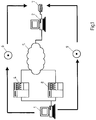
- the encoded, encrypted messages generated by the content encryption system 1 are transferred to a first distribution server 4 ( Fig. 1 ), connected to a network 5 by means of a network interface, where they are stored.
- the client system 2 may access the encrypted content by downloading it from the server 4.
- the encrypted access units 3 are downloaded, they are encapsulated in Sync Layer packets (SL-packets), consisting of a configurable header and a payload.
- the payload may consist of one complete access unit or a partial access unit.
- the SL-packets are subsequently mapped to another packet format used in the network 5, e.g. RTP, MPEG-2 Transport Stream packets, or UDP.
- RTP Real-Time Transport Stream packets
- UDP User Datagram Protocol
- the encoded, encrypted messages generated by the content encryption system 1 are stored on a content carrying medium 6, such as a CD-ROM, DVD-ROM or other suitable medium.
- Disk drive 7 is used to load the encoded, encrypted messages from the content-carrying medium 6 into the client system 2.
- information is stored in the files with the access units, in a format enabling an appropriate interface on the client system 2 to retrieve and assemble the access units (e.g. into SL-packets). This information also allows the client system 2 to pass the access units to the appropriate decoder buffers and thence the correct decoder application, after they have been read from file.
- the encrypted access units are stored in MP4-files.
- MP4-files typically carry the .mp4 extension.
- the MP4 file format is designed to contain the media information of an MPEG-4 presentation in a flexible, extensible format that facilitates interchange, management, editing, and presentation of the media. This presentation may be 'local' to the system containing the presentation or may be via a network or other stream delivery mechanism.
- the file format is designed to be independent of any particular delivery protocol while enabling efficient support for delivery in general. The design is based on the QuickTime format from Apple Computer Inc.
- the content encryption system 1 encrypts sections of the access units using at least one key (product or session key) having a cycling key value.
- Content may be encrypted using a single product key or a sequence of time-varying session keys, that are in turn encrypted with the product key.
- the same encryption scheme can be used for video, audio and any associated data (the content).
- the invention provides for content level encryption of MPEG-4 media and data. Examples of the manner in which access units are encrypted will be given below.
- a symmetric algorithm is used, i.e. the decryption key is the same as the encryption key.
- the scheme caters for selective encryption at both the intra-frame and inter-frame levels. (An example of where selective encryption may be desirable could be low complexity devices and low value content that may warrant the encryption of I-frames only, while other applications may require the encryption of texture or motion vector information only.)
- unique sequence numbers are added to message sections.
- the encryption used is such as to enable the client system 2 to decrypt each message section independently of the others, i.e. without knowledge of the data comprised in the other message sections.
- the content encryption system 1 generates at least one key message, each key message carrying data linking at least one unique sequence number added to a message to a key value enabling decryption of at least parts of that message.
- the key messages are preferably also formed into an MPEG-4 elementary stream, i.e. into access units, identified by a separate elementary stream identifier (ES_ID).
- ES_ID elementary stream identifier
- these messages are called IPMP (Intellectual Property Management and Protection) Messages.
- the IPMP Messages may be streamed from the first distribution server 4.
- the IPMP Message stream is downloaded by the client system 2 from a second distribution server 8.
- the IPMP Messages could be comprised in a separate file on key stream carrying medium 9, distributed separately, for example a CD-ROM, DVD-ROM, flash memory device, smart card, etc.
- the key values may be provided separately.
- the key messages contain pointers linked to sequence numbers, enabling the keys to be retrieved by the client system 2.
- the keys could be stored on the key stream carrying medium 9, whereas the IPMP Message Stream is provided from the second distribution server 8.
- the key messages may also contain the key values.
- Opaque data in the IPMP Message Stream could associate keys with media in the following manner:
- the DTS (delivery time stamp: an indication of the nominal decoding time of the access unit) of the access unit carrying a cycled session key may be advanced so it arrives before the corresponding encrypted media AU(s) 3 (which carry the data encoding the content). It is suggested that the DTS of the IPMP message stream be advanced by one key cycle period. This would allow ample time for network jitter and any preprocessing on the client system 2.
- the information given above can then be used to associate key data with content access unit data to any granularity, regardless of the receiving terminal clock resolution.
- the presence of unique sequence information also allows for sending the entire key stream prior to the delivery of any media.
- the DTS of the media access units 3 is not relevant and synchronization is performed purely on the value of the IPMP sequence numbers.
- This invention may find application in all multimedia delivery systems where it is desired to perform effective content level encryption of data (e.g., MPEG-4 data) using cycled keys.
- data e.g., MPEG-4 data
- This includes heterogeneous environments such as streaming over IP networks, as well as delivery of MPEG-4 over MPEG-2 transport, or any other error-prone or error-free transport mechanism that may be used to deliver MPEG-4 content.
- one embodiment of this invention is based upon a framework for the protection of MPEG-4 content that uses two different constructs:
- the content encryption system 1 reads an original access unit 10 from a machine-readable medium.
- the original access unit 10 is separated into three sections, which are independently encrypted, resulting in the encrypted access unit 3, comprising a first encrypted AU section 11, a second encrypted AU section 12 and a third encrypted AU section 13.
- a first Resync Marker 14 is added to the second encrypted AU section 12, separating it from the first encrypted AU section 11.
- a second Resync Marker 15 is added to the third encrypted AU section 13, separating it from the second encrypted AU section 12.
- a header 16 is prepended to the encrypted AU 3.
- the secure wrapper of this invention may be thought of as a cryptographic encapsulation envelope that provides security for any "wrapped" MPEG-4 access unit (video frame, audio sample, data unit).
- the publisher/server/owner protects the content by wrapping individual Aus 3 in these envelopes. The content may then only be unwrapped by an end-user who has the appropriate key / rights. Wrappers of various kinds are quite common and appear in a number of cryptographic protocols. Thus, this invention can operate with a generic wrapper.
- the wrapper may specifically be defined for use in the MPEG-4 environment.
- this invention may use characteristics of the wrapper (the sequence number, etc.) to do "double duty", by also providing the capability to cycle keys, and perform random access.
- this invention may operate by taking a number of widely used protocols, and adding thereto specific constructs (such as the Resync Markers 14,15) to create a solution by putting them all together in a framework and using them in a certain way.
- the header 16 comprises the following fields: Version - two-bit version field 17. Set to zero for the first revision.
- E - Bit flag 18 indicating whether the payload is encrypted (1) or clear (0). Note that only the Payload portion is encrypted.
- a - Bit flag 19 indicating the presence (1) or not (0) of the Authentication Code field. If present, the authentication code relates to the entire structure - wrapper 16 and AU 3.
- CRM - Bit flag 20 indicating presence (1) or not (0) of crypto Resync Markers 14,15 within the AU 3.
- Sequence Number A unique sequence number, carried in a sequence number field 22.
- the method of generation of the sequence number is considered outside the scope of this document.
- the value may be monotonically increasing, since Hamming distance attacks do not pose a significant threat against AES in counter mode .
- the length of this field 22 is not preset, since it uses a self-describing format.
- the lower seven bits of each byte are used for carrying the sequence number.
- the setting of the high order bit of each byte indicates the presence of another byte, while the last byte has its MSB set to zero.
- the value 350 would be represented as follows: 11010111 00000010
- Authentication Code An optional field (not shown in Fig. 4 ) carries a self-describing authentication code.
- the framework is agnostic to the authentication code scheme to be used, but it is assumed that a keyed hash (HMAC) would be most suitable.
- Digital signatures are catered for, but the assumption is that these schemes are currently too expensive to be performed at the AU level. Note that the entire structure - header 16 + AU 3 is authenticated.
- the encrypted AU 3 will be larger than the original 10.
- the markers 14,15 carry some unique and explicit synchronization information 23,24, respectively, to allow the cipher to be "reset" in the event of data loss.
- the following is a Crypto Resync Marker that performs well in the encrypted domain.
- the marker is byte aligned, and consists of sixteen zeros followed by a variable length, self describing sequence counter: 0000 0000 0000 XXXX XXXX
- multiple crypto Resync Markers 14,15 may be inserted in a single AU 3. Markers 14,15 located within the AU 3 are easily locatable and therefore guaranteed to be unique. There is a small statistical probability that collisions may still result, since a given plaintext / key combination may result in ciphertext that has the form 0000 0000 0000. Although the probability of this happening is extremely low, the possibility of marker emulation may be removed completely by the use of escape codes. In such an embodiment the presence of emulated Resync Markers is announced by "escaping" them, in a similar manner to C language escape codes.
- each Resync Marker 14,15 may be placed within a given AU 3.
- the body of each Resync Marker 14,15 contains a unique counter 25,26, respectively that has the same format and usage as the sequence number in the secure wrapper. It is suggested that the counter 25,26 increment monotonically from the initial sequence number carried in the header 16.
- the sequence number within the Resync Marker is preferably absolute, rather than specified as an offset from the sequence counter specified in the header 16. It is also important to ensure that the value of the sequence number in the header of the following AU is greater than the last sequence number used in the current AU 3 in order to avoid using the cipher in depth.
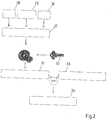
- FIG. 2 is a schematic of the encryption process according to one preferred embodiment of the invention.
- a counter 27 is formed from a salting key 28, a sequence number 29 and a block index 30.
- An encrypted counter 31 is generated using a key 32 with a cycling value.
- the encrypted counter is XOR-ed with a clear AU data block 33, generating an enciphered AU data block 34.
- the AES / Rijndael algorithm has been selected for media encryption.
- the cipher is run in counter mode and makes use of explicit counters (sequence numbers and crypto Resync Markers) carried within the media.
- the Rijndael algorithm was selected as the new Federal Information Processing Standard (FIPS) for data encryption and is poised to replace the aging DES and Triple DES standards.
- FIPS Federal Information Processing Standard
- the AES algorithm has been subjected to a significant amount of cryptanalysis during the selection process.
- the level of analytic effort thrown at AES is comparable to DES. It is widely accepted that the best-known attack method is exhaustive search of the key space.
- Counter mode requires only an additional XOR operation, and thus adds negligible overhead.
- Counter mode encryption operates by applying an encryption function to a monotonically increasing counter 27 to generate a one-time pad. This pad is then XORed with the plaintext. The decryption operation is identical.
- Counter mode requires that sender and receiver share a counter in addition to sharing the usual secret key 32. Note that the counter 27 doesn't need to be secret.
- Ci Pi XOR E counter
- E() is the encryption function of a block cipher.
- Ci is the i-th block of ciphertext.
- Pi is the i-th block of plaintext.
- the cipher has known cryptographic strength against an appropriate set of attack methods and has undergone extensive analysis by the world cryptographic community, and is widely adopted.
- the cipher itself is almost universal, having been accepted by NIST (National Institute of Standards and Technology.
- NIST National Institute of Standards and Technology.
- the cipher supports a key length of at least 128 bits. Scalability is important, since ideally the same cipher should be capable of being parameterised to protect content that may differ widely in value - from three-minute video clips to Hollywood blockbusters. Key lengths of greater than 128 bits may be overkill for certain applications; support for longer keys is considered an advantage.
- Adoption of a single parameterised algorithm also promises economy of scale benefits to silicon vendors.
- the invention does not use obscure ciphers or well-known ciphers in obscure modes.
- the cryptosystem is self-synchronizing, providing random access or seek capabilities, as well as recovery from data loss. Although these are different scenarios, in practice they depend on the same criteria: the lack of all or part of any preceding data blocks does not influence the ability to decrypt the current data block. The availability of reliable (explicit or implicit) continuity information for the data to be decrypted can therefore be assumed.
- the cryptosystem provides good error propagation characteristics. Single bit error extension (a bit error in the cipher text results in only the corresponding bit in the plaintext being in error) is very important. Schemes with same block, multiple block or infinite error extension properties do not apply.
- the cipher offers good performance in both hardware and software across a wide range of computing environments. Key set-up time, key agility and parallelism are all important.
- the choice of algorithm reflects a "security to a point" policy in which acceptable security concessions are made to increase efficiency and reduce complexity.
- the cryptosystem offers low data expansion.
- the size of the resulting cipher text is the same as or close to that of the plaintext, and the size of any additional "security headers" is kept to a minimum. Encryption of more than one message with the same product or session key is possible, without compromising security in any way.
- Fig. 3 is a schematic of the decryption process (not the symmetry of the encryption/decryption process) according to one embodiment of the invention.
- Decryption proceeds as follows in one exemplary embodiment of the present invention: The decryption engine checks the Encryption flag 18 in the wrapper of the AU 3. If the flag 18 is not set, and no authentication is used, the wrapper may simply be removed, and the original AU 3 passed to the decoder.
- the sequence number in the wrapper is extracted, and used to generate the counter 27.
- the counter block size is the same as the selected AES block size. This requirement is due to the fact that the counter 27 is input to the block cipher. This approach is extensible, since it is relatively easy to pad the counter 27 to a larger size in the event that a larger AES block size is specified.
- the salting key 28 is optional, but it should be noted that the lack of a salting key 28 would lead to a complete breakdown of security in the event that multiple bit streams are encrypted with the same key 32. (If, for example, audio and video are encrypted with the same product and session keys, then one or more salting keys 28 are used to prevent using the cipher in depth.) The value of the salting key 28 does not have to be secret.
- the 32-bit block index 30 is the block count within a single AU 3.
- the first 128-bit block of an AU has the index 0; the next has 1 and so on.
- the block index is reset to zero after every Resync Marker 14,15. Note that the value of the block index 30 is not transmitted, but is computed by the encryption and decryption processes.
- the block index 30 must never cycle during the processing of an AU 3. Assuming the worst case of a 128 bit AES block size and a maximally sized video AU 3, a 32-bit block size offers more than enough headroom.
- the counter block 27 is then used as the input of the AES block cipher during the pad computation.
- E() is the encryption function of the AES cipher.
- Ci is the i-th block of the encrypted MPEG-4 AU.
- Pi is the n first bytes of the i-th block of the original AU data.
- the value of n is between 1 and the block size.
- the assumption is that the length of each AU 3is provided to the decryption tool together with the AU data.
- Trunc(x,y) function truncates the x first bytes of the y value.
- the bit stream is checked to ensure that this is not an emulated CRM that has been escaped. If this is an emulated marker, then the marker should be "un-escaped" and decryption should proceed as normal.
- the Block index 30 is reset to zero, and decryption proceeds using this new counter value as input to the cipher.
- number of parameters may be needed to be set in order to use the cryptosystem effectively.
- These may include, for example
- Fig. 6 shows a diagrammatic representation of machine in the exemplary form of a computer system 35 within which a set of instructions, for causing the machine to perform any one of the methodologies discussed above, may be executed.
- the machine may comprise a set-top box (STB), a network router, a network switch, a network bridge, Personal Digital Assistant (PDA), a cellular telephone, a web appliance or any machine capable of executing a sequence of instructions that specify actions to be taken by that machine.
- STB set-top box
- PDA Personal Digital Assistant
- the computer system 35 includes a processor 36, a main memory 37 and a static memory 38, which communicate with each other via a bus 39.
- the computer system 35 may further include a video display unit 40 (e.g., a liquid crystal display (LCD) or a cathode ray tube (CRT)).
- the computer system 35 also includes an alphanumeric input device 41 (e.g., a keyboard), a cursor control device 42 (e.g., a mouse), a disk drive unit 43, a signal generation device 44 (e.g., a speaker) and a network interface device 45.
- the disk drive unit 43 includes a machine-readable medium 46 on which is stored a set of instructions (i.e., software) 47 embodying any one, or all, of the methodologies or functions described herein.
- the software 47 is also shown to reside, completely or at least partially, within the main memory 37 and/or within the processor 36.
- the software 47 may further be transmitted or received via the network interface device 45.
- the term "machine-readable medium” shall be taken to include any medium that is capable of storing, encoding or carrying a sequence of instructions for execution by the machine and that cause the machine to perform any one of the methodologies of the present invention.
- the term “machine-readable medium” shall accordingly be taken to included, but not be limited to, solid-state memories, optical and magnetic disks, and carrier wave signals.
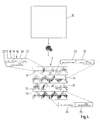
- Figs. 5A and 5B jointly form a schematic illustrating the use of Crypto Resync Markers 14,15 to resynchronise in the event of data loss, according to one embodiment of the present invention.
- Fig. 5A represents the prior art. No Resync Markers are present.
- the encrypted AU 3 merely has the header 16 prepended to it.
- the client system 2 to receive the encrypted access unit 3 with a block of lost data 49.
- the client system 2 Using a block cipher in counter mode with only the sequence number of the header 16 being utilisable as initialisation vector, the client system 2 would only be able to decrypt the encrypted access unit 3 correctly up to the lost data 49.
- the use of crypto Resync Markers 14,15 means that the decryption process results in a first recovered AU data part 52, a (much smaller) block 53 of lost AU data, and a second recovered AU data part 54.
- This is due to the fact that the client system 2 is able to recognise the explicit synchronisation information 23 and 24 in the resynchronisation markers 14 and 15, respectively.
- Fig. 7 there is shown a schematic diagram of an IP packet 55, used to distribute the encrypted AU 3 over the network 5 to client system 2.
- the IP packet 55 comprises an IP header 56, comprising a network address, from which the client system 2 can tell whether it is an or the intended recipient of the IP packet 55.
- the IP address can be a unique address, a multicast address, or a broadcast address, as is known in the art.
- UDP is used as the transport protocol.
- the IP packet 55 comprises a UDP header 57.
- the encrypted access unit 3 has been encapsulated by an application implementing the sync layer, defined in the MPEG-4 standard, on the first distribution server 4.
- the IP packet comprises an SL header 58.
- a header 59 that forms the secure wrapper. It is identical to the header 16 described above, except that it further comprises an explicit synchronisation sequence 60, identical to the explicit synchronisation information 23,24 of the crypto Resync Markers 14,15.
- the header 59 further comprises the bit flag 18 indicating encryption of the access unit 3, the bit flag 19 indicating authentication, the CRM flag 20, the reserved field 21 and the sequence number field 22.
- the first encrypted AU section 11 follows the header 59.
- the second encrypted AU section 12 is separated from the first encrypted AU section 11 by the first crypto Resync Marker 14, comprising the synchronisation information 23 and counter 25.
- the third encrypted AU section 13 is separated from the second encrypted AU section 12 by the second crypto Resync Marker 15, comprising the synchronisation information 24 and counter 26.
- the synchronisation information 23,24,60 is advantageously exploited by the present invention to implement a type of decryption known as decryption under the stack.
- decryption a type of decryption known as decryption under the stack. This type of decrypt is described more fully in copending international patent application PCT/US01/41361 by the same applicant as the present application.
- the client system 2 comprises an interface that implements the IP protocol. That is to say, the interface processes the IP packet 55 using information in the IP header 56 to determine what to do with the remainder of the IP packet 55. Whereas usually, the remainder is passed to an interface implementing a higher level protocol, i.e. the UDP protocol in this case, and from there on up further, i.e. to an interface implementing the MPEG-4 sync layer in this example, in the present embodiment of the invention, the IP packet 55 is first decrypted.
- a higher level protocol i.e. the UDP protocol in this case
- the client system 2 receives the entire IP packet 55 as input from the interface implementing the IP protocol on the client system 2. It is agnostic about the remainder of the IP packet 55, but it searches the data in the payload of the IP packet 55 for the explicit synchronisation information 23,24,60. It then extracts the encrypted message sections from the IP packet 55 to decrypt them using the methods described above. Subsequently, the IP packet 55 is re-assembled, and passed back to the interface implementing the IP protocol on the client system 2, whereupon it is processed by the various interfaces implementing the other protocols, i.e. UDP, SL.
- UDP User Datagram Protocol
Landscapes
- Engineering & Computer Science (AREA)
- Signal Processing (AREA)
- Multimedia (AREA)
- Computer Security & Cryptography (AREA)
- Computer Networks & Wireless Communication (AREA)
- Computing Systems (AREA)
- Computer Hardware Design (AREA)
- General Engineering & Computer Science (AREA)
- Theoretical Computer Science (AREA)
- Databases & Information Systems (AREA)
- Data Exchanges In Wide-Area Networks (AREA)
- Storage Device Security (AREA)
- Two-Way Televisions, Distribution Of Moving Picture Or The Like (AREA)
Claims (9)
- Verfahren zur Erzeugung kryptographisch geschützter digitaler Daten, wobei die digitalen Daten einen Inhalt codieren und in Nachrichten angeordnet sind, wobei jede Nachricht durch eine Decodiereranwendung auf einem Client-Endgerät decodierbar ist, welches eine Schnittstelle aufweist, um jede Nachricht für die Decodiereranwendung zusammenzustellen, wobei das Verfahren umfasst:Abrufen einer Nachricht von einem maschinenlesbaren Medium;Separieren der Nachricht in einen ersten und wenigstens einen weiteren Nachrichtenabschnitt;Verschlüsseln wenigstens eines Teils der Nachricht, wobei das Verschlüsseln ein Verschlüsseln jedes Nachrichtenabschnitts in einer derartigen Weise umfasst, dass er unabhängig von den anderen Nachrichtenabschnitten decodierbar ist;Erzeugen einer verschlüsselten Nachricht, indem jedem verschlüsselten weiteren Nachrichtenabschnitt ein Resynchronisationsmarker hinzugefügt wird, wobei der Resynchronisationsmarker den verschlüsselten weiteren Nachrichtenabschnitt von einem benachbarten verschlüsselten Nachrichtenabschnitt separiert und eine explizite Synchronisationsinformation zum Zurücksetzen einer Chiffre zur Decodierung des verschlüsselten weiteren Nachrichtenabschnitts umfasst; undBereitstellen der verschlüsselten Nachricht als eine Ausgabe für eine Serverschnittstelle, welche dazu eingerichtet ist, die verschlüsselte Nachricht in wenigstens einem Paket anzuordnen, welches wenigstens eine Kopfzeile und eine Nutzinformation umfasst, wobei jede Nutzinformation einen individuellen Teil der verschlüsselten Nachricht umfasst, wobei wenigstens eine Kopfzeile eine Information umfasst, welche ermöglicht, dass die Schnittstelle auf dem Client-Endgerät aus der Nutzinformation der Pakete die Nachricht für die Decodiereranwendung zusammenstellt;wobei entweder(a) das Verschlüsseln jedes Nachrichtenabschnitts eine Chiffre in einem kryptographischen Modus verwendet, welcher ein Feedback verwendet, wobei die Chiffre zu Beginn jedes Nachrichtenabschnitts mit einem entsprechenden Initialisierungsvektor reinitialisiert wird und wobei die jedem verschlüsselten weiteren Nachrichtenabschnitt hinzugefügte explizite Synchronisationsinformation des Resynchronisationsmarkers eine individuelle Sequenznummer umfasst, welche als der Initialisierungsvektor für die Verschlüsselung des verschlüsselten weiteren Nachrichtenabschnitts verwendet wird; oder(b) das Verschlüsseln jedes Nachrichtenabschnitts eine Chiffre in einem Zählermodus verwendet, wobei ein Zähler des Zählermodus vor dem Verschlüsseln des Nachrichtenabschnitts zurückgesetzt wird und wobei die jedem verschlüsselten weiteren Nachrichtenabschnitt hinzugefügte explizite Synchronisationsinformation des Resynchronisationsmarkers eine individuelle Sequenznummer umfasst, welche verwendet wird, um den Zähler für die Verschlüsselung des verschlüsselten weiteren Nachrichtenabschnitts zu bilden.
- Verfahren nach Anspruch 1, ferner umfassend ein Hinzufügen eines Wrappers, welcher jede verschlüsselte Nachricht einkapselt und die individuelle Sequenznummer umfasst.
- Verfahren nach Anspruch 1 oder 2, wobei jede individuelle Sequenznummer in einem selbstbeschreibenden Format bereitgestellt ist, wobei das selbstbeschreibende Format definiert, dass untere sieben Bits eines Bytes zum Tragen wenigstens eines Teils der Sequenznummer verwendet werden, ein Bit hoher Ordnung des Bytes mit einem Wert von 1 das Vorhandensein eines weiteren Bytes anzeigt, welches einen weiteren Teil der Sequenznummer trägt, und ein letztes Byte einen signifikantesten Bitwert von 0 aufweist.
- Verfahren nach einem der Ansprüche 2-4, ferner umfassend ein Erzeugen wenigstens einer Schlüsselnachricht, wobei jede Schlüsselnachricht Daten trägt, welche wenigstens eine individuelle Sequenznummer einer verschlüsselten Nachricht mit einem Schlüsselwert verknüpfen, welcher eine Decodierung wenigstens von Teilen dieser verschlüsselten Nachricht ermöglicht.
- Verfahren nach Anspruch 1, wobei Nachrichten verschlüsselt werden, welche separaten Elementarströmen angehören, wobei jeder Strom für eine Decodiereranwendung auf dem Client-Endgerät vorgesehen ist, wobei das Verfahren ein Bereitstellen der verschlüsselten Nachrichten als eine Ausgabe für die Schnittstelle auf dem Client-Endgerät umfasst, um die Nachrichten in separaten Elementarströmen zusammenzustellen, wobei der Zähler aus einem AES-Salt-Schlüssel gebildet ist, wobei für die Nachrichten jedes Elementarstroms ein unterschiedlicher Salt-Schlüssel verwendet wird.
- Verfahren nach einem der vorhergehenden Ansprüche, ferner umfassend:Anordnen der verschlüsselten Nachricht in dem wenigstens einem Paket durch die Serverschnittstelle; undÜbertragen des wenigstens einen Pakets an das Client-Endgerät.
- System zur Erzeugung kryptographisch geschützter digitaler Daten, wobei die digitalen Daten einen Inhalt codieren und in Nachrichten angeordnet sind, wobei jede Nachricht durch eine Decodiereranwendung auf einem Client-Endgerät decodierbar ist, welches eine Schnittstelle aufweist, um jede Nachricht für die Decodiereranwendung zusammenzustellen, wobei das System eingerichtet ist zum:Abrufen einer Nachricht von einem maschinenlesbaren Medium;Separieren der Nachricht in einen ersten und wenigstens einen weiteren Nachrichtenabschnitt;Verschlüsseln wenigstens eines Teils der Nachricht, wobei das Verschlüsseln ein Verschlüsseln jedes Nachrichtenabschnitts in einer derartigen Weise umfasst, dass er unabhängig von den anderen Nachrichtenabschnitten decodierbar ist;Erzeugen einer verschlüsselten Nachricht, indem jedem verschlüsselten weiteren Nachrichtenabschnitt ein Resynchronisationsmarker hinzugefügt wird, wobei der Resynchronisationsmarker den verschlüsselten weiteren Nachrichtenabschnitt von einem benachbarten verschlüsselten Nachrichtenabschnitt separiert und eine explizite Synchronisationsinformation zum Zurücksetzen einer Chiffre zur Decodierung des verschlüsselten weiteren Nachrichtenabschnitts umfasst; undBereitstellen der verschlüsselten Nachricht als eine Ausgabe für eine Serverschnittstelle, welche dazu eingerichtet ist, die verschlüsselte Nachricht in wenigstens einem Paket anzuordnen, welches wenigstens eine Kopfzeile und eine Nutzinformation umfasst, wobei jede Nutzinformation wenigstens einen Teil der verschlüsselten Nachricht umfasst, wobei wenigstens eine Kopfzeile eine Information umfasst, welche ermöglicht, dass die Schnittstelle auf dem Client aus der Nutzinformation der Pakete die Nachricht für die Decodiereranwendung zusammenstellt;wobei entweder(a) das Verschlüsseln jedes Nachrichtenabschnitts eine Chiffre in einem kryptographischen Modus verwendet, welcher ein Feedback verwendet, wobei die Chiffre zu Beginn jedes Nachrichtenabschnitts mit einem entsprechenden Initialisierungsvektor reinitialisiert wird und wobei die jedem verschlüsselten weiteren Nachrichtenabschnitt hinzugefügte explizite Synchronisationsinformation des Resynchronisationsmarkers eine individuelle Sequenznummer umfasst, welche als der Initialisierungsvektor für die Verschlüsselung des verschlüsselten weiteren Nachrichtenabschnitts verwendet wird; oder(b) das Verschlüsseln jedes Nachrichtenabschnitts eine Chiffre in einem Zählermodus verwendet, wobei ein Zähler des Zählermodus vor dem Verschlüsseln des Nachrichtenabschnitts zurückgesetzt wird und wobei die jedem verschlüsselten weiteren Nachrichtenabschnitt hinzugefügte explizite Synchronisationsinformation des Resynchronisationsmarkers eine individuelle Sequenznummer umfasst, welche verwendet wird, um den Zähler für die Verschlüsselung des verschlüsselten weiteren Nachrichtenabschnitts zu bilden.
- System nach Anspruch 7, ferner umfassend die Serverschnittstelle, welche dazu eingerichtet ist, die verschlüsselte Nachricht in dem wenigstens einen Paket anzuordnen, wobei das System ferner dazu eingerichtet ist, das wenigstens eine Paket an das Client-Endgerät zu übertragen.
- Computerprogramm, welches, wenn es durch einen oder mehrere Prozessoren ausgeführt wird, den einen oder die mehreren Prozessoren veranlasst, das Verfahren nach einem der Ansprüche 1-6 durchzuführen.
Applications Claiming Priority (3)
| Application Number | Priority Date | Filing Date | Title |
|---|---|---|---|
| US34271801P | 2001-12-19 | 2001-12-19 | |
| US342718P | 2001-12-19 | ||
| PCT/EP2002/014828 WO2003052630A2 (en) | 2001-12-19 | 2002-12-18 | Digital content distribution system |
Publications (2)
| Publication Number | Publication Date |
|---|---|
| EP1456777A2 EP1456777A2 (de) | 2004-09-15 |
| EP1456777B1 true EP1456777B1 (de) | 2019-11-20 |
Family
ID=23342980
Family Applications (1)
| Application Number | Title | Priority Date | Filing Date |
|---|---|---|---|
| EP02804920.3A Expired - Lifetime EP1456777B1 (de) | 2001-12-19 | 2002-12-18 | System zur verteilung von digitalem inhalt |
Country Status (14)
| Country | Link |
|---|---|
| US (2) | US7433472B2 (de) |
| EP (1) | EP1456777B1 (de) |
| JP (1) | JP2005513839A (de) |
| KR (1) | KR100927322B1 (de) |
| CN (1) | CN100450177C (de) |
| AU (1) | AU2002364752C1 (de) |
| BR (1) | BR0207375A (de) |
| CA (1) | CA2434863C (de) |
| HU (1) | HUP0501109A2 (de) |
| MX (1) | MXPA04006196A (de) |
| PL (1) | PL370774A1 (de) |
| RU (1) | RU2308079C2 (de) |
| WO (1) | WO2003052630A2 (de) |
| ZA (1) | ZA200306420B (de) |
Families Citing this family (57)
| Publication number | Priority date | Publication date | Assignee | Title |
|---|---|---|---|---|
| US7159039B1 (en) * | 2000-02-28 | 2007-01-02 | Verizon Laboratories Inc. | Systems and methods for providing in-band and out-band message processing |
| BR0207375A (pt) * | 2001-12-19 | 2004-06-15 | Irdeto Access Bv | Sistema de distribuição de conteúdo digital |
| US7055039B2 (en) * | 2003-04-14 | 2006-05-30 | Sony Corporation | Protection of digital content using block cipher crytography |
| JP4544156B2 (ja) * | 2003-07-15 | 2010-09-15 | ソニー株式会社 | 処理方法並びにコンピュータ・プログラム |
| US7552334B2 (en) | 2003-09-24 | 2009-06-23 | The Boeing Company | System and method for presentation integrity |
| US20070083659A1 (en) * | 2003-12-01 | 2007-04-12 | Matsushita Electric Industrial Co., Ltd. | Streaming system |
| EP1693999A4 (de) * | 2003-12-11 | 2011-09-14 | Panasonic Corp | Paketsendervorrichtung |
| US7734042B2 (en) * | 2003-12-22 | 2010-06-08 | Aol Inc. | System and method for using a streaming protocol |
| KR100542383B1 (ko) * | 2004-01-09 | 2006-01-12 | 주식회사 바넷정보기술 | 3-Tier 구조 기반의 데이터베이스 접근 통제 시스템및 방법 |
| US20050216752A1 (en) * | 2004-03-26 | 2005-09-29 | Microsoft Corporation | Common scrambling |
| US20060184790A1 (en) * | 2004-03-26 | 2006-08-17 | Microsoft Corporation | Protecting elementary stream content |
| US20060036551A1 (en) * | 2004-03-26 | 2006-02-16 | Microsoft Corporation | Protecting elementary stream content |
| JP2008508806A (ja) * | 2004-07-29 | 2008-03-21 | ヴァディアム テクノロジー インコーポレイテッド | ワンタイムパスワード暗号化を強化するための技術 |
| GB2418565B (en) * | 2004-08-18 | 2006-09-20 | Wecomm Ltd | Transmitting data over a network |
| US8145908B1 (en) * | 2004-10-29 | 2012-03-27 | Akamai Technologies, Inc. | Web content defacement protection system |
| US7634502B2 (en) * | 2005-01-24 | 2009-12-15 | Paul Colton | System and method for improved content delivery |
| WO2006095742A1 (ja) * | 2005-03-08 | 2006-09-14 | Matsushita Electric Industrial Co., Ltd. | パケット送信装置 |
| JP4806204B2 (ja) * | 2005-03-30 | 2011-11-02 | 株式会社日立国際電気 | 暗号化データ通信システム |
| US7620181B2 (en) * | 2005-04-20 | 2009-11-17 | Harris Corporation | Communications system with minimum error cryptographic resynchronization |
| US7684566B2 (en) | 2005-05-27 | 2010-03-23 | Microsoft Corporation | Encryption scheme for streamed multimedia content protected by rights management system |
| US7363628B2 (en) * | 2005-06-27 | 2008-04-22 | Microsoft Corporation | Data centric and protocol agnostic workflows for exchanging data between a workflow instance and a workflow host |
| US8321690B2 (en) | 2005-08-11 | 2012-11-27 | Microsoft Corporation | Protecting digital media of various content types |
| DE102005040889A1 (de) * | 2005-08-29 | 2007-03-15 | Siemens Ag | Verfahren und Anordnung zum sicheren Übertragen von Daten in einem ein Mehrsprungverfahren nutzenden Kommunikationssystem |
| US7743253B2 (en) * | 2005-11-04 | 2010-06-22 | Microsoft Corporation | Digital signature for network coding |
| DE602005022001D1 (de) * | 2005-11-08 | 2010-08-05 | Irdeto Access Bv | Verfahren zur Verschlüsselung und Entschlüsselung von Dateneinheiten |
| JP4482630B2 (ja) * | 2005-11-21 | 2010-06-16 | インターナショナル・ビジネス・マシーンズ・コーポレーション | 通信装置および通信方法 |
| AU2006330475B2 (en) * | 2005-12-27 | 2012-04-26 | Microsoft Technology Licensing, Llc | Streaming media casts, such as in a video game or mobile device environment |
| US8978154B2 (en) | 2006-02-15 | 2015-03-10 | Samsung Electronics Co., Ltd. | Method and apparatus for importing content having plurality of parts |
| KR100846787B1 (ko) | 2006-02-15 | 2008-07-16 | 삼성전자주식회사 | 트랜스포트 스트림을 임포트하는 방법 및 장치 |
| KR100782847B1 (ko) | 2006-02-15 | 2007-12-06 | 삼성전자주식회사 | 복수의 컨텐트 부분들을 포함하는 컨텐트를 임포트하는방법 및 장치 |
| KR101310894B1 (ko) * | 2006-10-17 | 2013-09-25 | 주식회사 넷앤티비 | LASeR 서비스에서 다른 SAF 세션의 스트림 참조방법, 기록매체, 장치 및 그 서비스 제공 장치 |
| US20080205635A1 (en) * | 2007-02-27 | 2008-08-28 | Glen Alan Jaquette | Apparatus, system, and method for self-describing heterogeneous magnetic tape formatting |
| US8423789B1 (en) | 2007-05-22 | 2013-04-16 | Marvell International Ltd. | Key generation techniques |
| US8935718B2 (en) * | 2007-05-22 | 2015-01-13 | Apple Inc. | Advertising management method and system |
| US8467526B2 (en) | 2008-06-09 | 2013-06-18 | International Business Machines Corporation | Key evolution method and system of block ciphering |
| KR101508794B1 (ko) * | 2008-07-09 | 2015-04-06 | 삼성전자주식회사 | Ndef 메시지에서 선택적으로 레코드들을 보안하기 위한 방법 |
| US20100158243A1 (en) * | 2008-12-19 | 2010-06-24 | Robert Bosch Gmbh | Method of encryption in networked embedded systems |
| WO2011092786A1 (ja) * | 2010-01-26 | 2011-08-04 | 日本電気株式会社 | コンテンツ配信システム、コンテンツ配信方法、アプリケーションサーバシステム、ユーザ端末、及び、記録媒体 |
| CN107257326B (zh) * | 2010-04-20 | 2021-04-23 | 三星电子株式会社 | 用于传送和接收媒体数据的接口装置和方法 |
| US8687808B2 (en) | 2012-04-10 | 2014-04-01 | Comtech Ef Data Corp. | Method and system for self synchronizing cryptographic parameters |
| TW201417598A (zh) | 2012-07-13 | 2014-05-01 | Interdigital Patent Holdings | 安全性關聯特性 |
| US9602557B2 (en) * | 2012-10-15 | 2017-03-21 | Wowza Media Systems, LLC | Systems and methods of communication using a message header that includes header flags |
| US9819601B2 (en) | 2012-12-27 | 2017-11-14 | Vonage America Inc. | Systems and methods of modifying data packets used in IP telephony communications |
| US9615131B2 (en) * | 2013-08-08 | 2017-04-04 | Honeywell International Inc. | System and method of motion detection on encrypted or scrambled video data streams |
| CN103825885A (zh) * | 2014-01-23 | 2014-05-28 | 广东顺德中山大学卡内基梅隆大学国际联合研究院 | 一种互联网内容加密发布方法及系统 |
| EP2955629B1 (de) * | 2014-06-11 | 2021-10-27 | Home Control Singapore Pte. Ltd. | System zur Installation von neuer Firmware auf einem Gerät mit kleinem Speicher |
| WO2016048382A1 (en) * | 2014-09-26 | 2016-03-31 | Hewlett Packard Enterprise Development Lp | Storage of hypervisor messages in network packets generated by virtual machines |
| EP3054690A1 (de) * | 2015-02-05 | 2016-08-10 | Illuminated Rocks Oy | System und verfahren zur erzeugung eines sofort-handlungsstrangfeeds für eine laufende sportveranstaltung |
| EP3320447A4 (de) * | 2015-07-07 | 2019-05-22 | Private Machines Inc. | System und verfahren zur sicheren durchsuchbaren und gemeinsam verwendbaren fernspeicherung |
| US10432685B2 (en) * | 2016-05-31 | 2019-10-01 | Brightcove, Inc. | Limiting key request rates for streaming media |
| TWI708508B (zh) * | 2019-05-14 | 2020-10-21 | 大陸商物聯智慧科技(深圳)有限公司 | 影音訊號流的加密方法與裝置 |
| CN112714120B (zh) * | 2020-12-24 | 2021-10-29 | 四川长虹电器股份有限公司 | 一种链式数据加密、解密方法、加密数据的分离式存储方法 |
| US11997189B2 (en) * | 2021-02-26 | 2024-05-28 | International Business Machines Corporation | Encrypted communication using counter mode encryption and secret keys |
| CN113259718B (zh) * | 2021-04-27 | 2023-06-09 | 深圳市锐明技术股份有限公司 | 视频流的加密方法、装置、通信设备及存储介质 |
| US12495042B2 (en) * | 2021-08-16 | 2025-12-09 | Capital One Services, Llc | Systems and methods for resetting an authentication counter |
| GB2611321A (en) * | 2021-09-29 | 2023-04-05 | Quantum Blockchain Tech Plc | Message scheduling for cryptographic hashing |
| CN120050284B (zh) * | 2025-04-21 | 2025-07-18 | 北京尚优力达科技有限公司 | 基于分布式集群的高性能音视频平台 |
Family Cites Families (12)
| Publication number | Priority date | Publication date | Assignee | Title |
|---|---|---|---|---|
| US5872784A (en) * | 1993-10-20 | 1999-02-16 | Lsi Logic Corporation | High speed single chip digital video network apparatus |
| EP0762765B1 (de) * | 1995-09-05 | 2002-07-10 | Hitachi, Ltd. | Verfahren zur digitalen Zugangskontrolle |
| KR0186210B1 (ko) * | 1995-11-10 | 1999-04-15 | 구자홍 | 디지탈 데이터의 저작권 보호와 변속 재생을 위한 자기 기록 테이프의 기록방법 |
| RU2152134C1 (ru) * | 1998-05-25 | 2000-06-27 | Военный институт правительственной связи | Устройство засекречивания и мультиплексирования трафика речи и данных |
| DE69828401D1 (de) * | 1998-10-12 | 2005-02-03 | St Microelectronics Srl | Verschlüsselungs-Methode und -Station für Paketvermittlungsnetzwerke auf der Grundlage digitaler chaotischer Modelle |
| JP3816689B2 (ja) | 1999-03-31 | 2006-08-30 | 株式会社東芝 | 情報配信装置、情報受信装置及び通信方法 |
| US6948186B1 (en) * | 1999-10-07 | 2005-09-20 | General Instrument Corporation | Multi-tasking message extractor |
| JP4880158B2 (ja) * | 1999-12-22 | 2012-02-22 | イルデト アイントホーフェン ベー フェー | データコンテンツへのアクセスを制御する条件付きアクセスシステム |
| EP1143722B1 (de) * | 2000-04-07 | 2008-11-05 | Irdeto Access B.V. | Datenverschlüsselungs und -entschlüsselungssystem |
| US7895616B2 (en) * | 2001-06-06 | 2011-02-22 | Sony Corporation | Reconstitution of program streams split across multiple packet identifiers |
| BR0207375A (pt) | 2001-12-19 | 2004-06-15 | Irdeto Access Bv | Sistema de distribuição de conteúdo digital |
| US7116894B1 (en) * | 2002-05-24 | 2006-10-03 | Digeo, Inc. | System and method for digital multimedia stream conversion |
-
2002
- 2002-12-18 BR BR0207375-7A patent/BR0207375A/pt not_active IP Right Cessation
- 2002-12-18 HU HU0501109A patent/HUP0501109A2/hu unknown
- 2002-12-18 RU RU2004100277/09A patent/RU2308079C2/ru not_active IP Right Cessation
- 2002-12-18 EP EP02804920.3A patent/EP1456777B1/de not_active Expired - Lifetime
- 2002-12-18 PL PL02370774A patent/PL370774A1/xx unknown
- 2002-12-18 CN CNB028051874A patent/CN100450177C/zh not_active Expired - Lifetime
- 2002-12-18 WO PCT/EP2002/014828 patent/WO2003052630A2/en not_active Ceased
- 2002-12-18 MX MXPA04006196A patent/MXPA04006196A/es active IP Right Grant
- 2002-12-18 CA CA2434863A patent/CA2434863C/en not_active Expired - Fee Related
- 2002-12-18 US US10/468,625 patent/US7433472B2/en not_active Expired - Lifetime
- 2002-12-18 AU AU2002364752A patent/AU2002364752C1/en not_active Ceased
- 2002-12-18 KR KR1020047001237A patent/KR100927322B1/ko not_active Expired - Fee Related
- 2002-12-18 JP JP2003553448A patent/JP2005513839A/ja active Pending
-
2003
- 2003-08-18 ZA ZA200306420A patent/ZA200306420B/en unknown
-
2007
- 2007-11-08 US US11/936,919 patent/US8135949B2/en active Active
Non-Patent Citations (1)
| Title |
|---|
| None * |
Also Published As
| Publication number | Publication date |
|---|---|
| PL370774A1 (en) | 2005-05-30 |
| US20040139336A1 (en) | 2004-07-15 |
| KR20040068100A (ko) | 2004-07-30 |
| AU2002364752A1 (en) | 2003-06-30 |
| EP1456777A2 (de) | 2004-09-15 |
| CA2434863C (en) | 2013-04-02 |
| ZA200306420B (en) | 2004-10-04 |
| BR0207375A (pt) | 2004-06-15 |
| MXPA04006196A (es) | 2004-10-15 |
| KR100927322B1 (ko) | 2009-11-19 |
| US7433472B2 (en) | 2008-10-07 |
| AU2002364752C1 (en) | 2010-05-13 |
| US20100027795A1 (en) | 2010-02-04 |
| RU2308079C2 (ru) | 2007-10-10 |
| CA2434863A1 (en) | 2003-06-26 |
| HK1066675A1 (zh) | 2005-03-24 |
| WO2003052630A3 (en) | 2003-11-20 |
| HUP0501109A2 (en) | 2006-03-28 |
| WO2003052630A2 (en) | 2003-06-26 |
| RU2004100277A (ru) | 2005-03-27 |
| JP2005513839A (ja) | 2005-05-12 |
| CN1524381A (zh) | 2004-08-25 |
| CN100450177C (zh) | 2009-01-07 |
| US8135949B2 (en) | 2012-03-13 |
| AU2002364752B2 (en) | 2009-06-04 |
Similar Documents
| Publication | Publication Date | Title |
|---|---|---|
| EP1456777B1 (de) | System zur verteilung von digitalem inhalt | |
| US7356147B2 (en) | Method, system and program product for attaching a title key to encrypted content for synchronized transmission to a recipient | |
| CA2522046C (en) | Methods and apparatus for secure and adaptive delivery of multimedia content | |
| US7746853B2 (en) | Method and apparatus for transporting broadcast video over a packet network including providing conditional access | |
| US9769506B2 (en) | Methods and apparatus for independent decryption of encrypted video frames | |
| EP1913776A2 (de) | Schutz von elementarstrominhalten | |
| EP1913727A1 (de) | Schutz von elementarstrominhalten | |
| EP1678586A1 (de) | Verfahren und vorrichtung zur sicherstellung der datenintegrität | |
| US9031227B2 (en) | Pattern-free encryption | |
| EP1407574B1 (de) | Synchronisationsinformation welche im nächsten paket eines verschlüsselten rahmens einer stromverschlüsselung redundant eingefügt ist | |
| HK1066675B (en) | Digital content distribution system |
Legal Events
| Date | Code | Title | Description |
|---|---|---|---|
| PUAI | Public reference made under article 153(3) epc to a published international application that has entered the european phase |
Free format text: ORIGINAL CODE: 0009012 |
|
| 17P | Request for examination filed |
Effective date: 20040513 |
|
| AK | Designated contracting states |
Kind code of ref document: A2 Designated state(s): AT BE BG CH CY CZ DE DK EE ES FI FR GB GR IE IT LI LU MC NL PT SE SI SK TR |
|
| AX | Request for extension of the european patent |
Extension state: AL LT LV MK RO |
|
| 17Q | First examination report despatched |
Effective date: 20100426 |
|
| RAP1 | Party data changed (applicant data changed or rights of an application transferred) |
Owner name: IRDETO B.V. |
|
| REG | Reference to a national code |
Ref country code: DE Ref legal event code: R079 Ref document number: 60250045 Country of ref document: DE Free format text: PREVIOUS MAIN CLASS: G06F0017300000 Ipc: H04N0021234700 |
|
| GRAP | Despatch of communication of intention to grant a patent |
Free format text: ORIGINAL CODE: EPIDOSNIGR1 |
|
| STAA | Information on the status of an ep patent application or granted ep patent |
Free format text: STATUS: GRANT OF PATENT IS INTENDED |
|
| RIC1 | Information provided on ipc code assigned before grant |
Ipc: H04N 21/2347 20110101AFI20180913BHEP Ipc: H04N 21/43 20110101ALI20180913BHEP |
|
| INTG | Intention to grant announced |
Effective date: 20180926 |
|
| GRAJ | Information related to disapproval of communication of intention to grant by the applicant or resumption of examination proceedings by the epo deleted |
Free format text: ORIGINAL CODE: EPIDOSDIGR1 |
|
| STAA | Information on the status of an ep patent application or granted ep patent |
Free format text: STATUS: EXAMINATION IS IN PROGRESS |
|
| GRAP | Despatch of communication of intention to grant a patent |
Free format text: ORIGINAL CODE: EPIDOSNIGR1 |
|
| STAA | Information on the status of an ep patent application or granted ep patent |
Free format text: STATUS: GRANT OF PATENT IS INTENDED |
|
| INTC | Intention to grant announced (deleted) | ||
| INTG | Intention to grant announced |
Effective date: 20190226 |
|
| RIN1 | Information on inventor provided before grant (corrected) |
Inventor name: MCLEAN, IVAN HUGH Inventor name: WAJS, ANDREW AUGUSTINE |
|
| GRAS | Grant fee paid |
Free format text: ORIGINAL CODE: EPIDOSNIGR3 |
|
| GRAA | (expected) grant |
Free format text: ORIGINAL CODE: 0009210 |
|
| STAA | Information on the status of an ep patent application or granted ep patent |
Free format text: STATUS: THE PATENT HAS BEEN GRANTED |
|
| AK | Designated contracting states |
Kind code of ref document: B1 Designated state(s): AT BE BG CH CY CZ DE DK EE ES FI FR GB GR IE IT LI LU MC NL PT SE SI SK TR |
|
| REG | Reference to a national code |
Ref country code: GB Ref legal event code: FG4D |
|
| REG | Reference to a national code |
Ref country code: CH Ref legal event code: EP |
|
| REG | Reference to a national code |
Ref country code: IE Ref legal event code: FG4D |
|
| REG | Reference to a national code |
Ref country code: DE Ref legal event code: R096 Ref document number: 60250045 Country of ref document: DE |
|
| REG | Reference to a national code |
Ref country code: AT Ref legal event code: REF Ref document number: 1205524 Country of ref document: AT Kind code of ref document: T Effective date: 20191215 |
|
| REG | Reference to a national code |
Ref country code: NL Ref legal event code: FP |
|
| PG25 | Lapsed in a contracting state [announced via postgrant information from national office to epo] |
Ref country code: ES Free format text: LAPSE BECAUSE OF FAILURE TO SUBMIT A TRANSLATION OF THE DESCRIPTION OR TO PAY THE FEE WITHIN THE PRESCRIBED TIME-LIMIT Effective date: 20191120 Ref country code: GR Free format text: LAPSE BECAUSE OF FAILURE TO SUBMIT A TRANSLATION OF THE DESCRIPTION OR TO PAY THE FEE WITHIN THE PRESCRIBED TIME-LIMIT Effective date: 20200221 Ref country code: BG Free format text: LAPSE BECAUSE OF FAILURE TO SUBMIT A TRANSLATION OF THE DESCRIPTION OR TO PAY THE FEE WITHIN THE PRESCRIBED TIME-LIMIT Effective date: 20200220 Ref country code: FI Free format text: LAPSE BECAUSE OF FAILURE TO SUBMIT A TRANSLATION OF THE DESCRIPTION OR TO PAY THE FEE WITHIN THE PRESCRIBED TIME-LIMIT Effective date: 20191120 Ref country code: SE Free format text: LAPSE BECAUSE OF FAILURE TO SUBMIT A TRANSLATION OF THE DESCRIPTION OR TO PAY THE FEE WITHIN THE PRESCRIBED TIME-LIMIT Effective date: 20191120 |
|
| PG25 | Lapsed in a contracting state [announced via postgrant information from national office to epo] |
Ref country code: PT Free format text: LAPSE BECAUSE OF FAILURE TO SUBMIT A TRANSLATION OF THE DESCRIPTION OR TO PAY THE FEE WITHIN THE PRESCRIBED TIME-LIMIT Effective date: 20200412 Ref country code: EE Free format text: LAPSE BECAUSE OF FAILURE TO SUBMIT A TRANSLATION OF THE DESCRIPTION OR TO PAY THE FEE WITHIN THE PRESCRIBED TIME-LIMIT Effective date: 20191120 Ref country code: CZ Free format text: LAPSE BECAUSE OF FAILURE TO SUBMIT A TRANSLATION OF THE DESCRIPTION OR TO PAY THE FEE WITHIN THE PRESCRIBED TIME-LIMIT Effective date: 20191120 Ref country code: DK Free format text: LAPSE BECAUSE OF FAILURE TO SUBMIT A TRANSLATION OF THE DESCRIPTION OR TO PAY THE FEE WITHIN THE PRESCRIBED TIME-LIMIT Effective date: 20191120 |
|
| REG | Reference to a national code |
Ref country code: CH Ref legal event code: PL |
|
| REG | Reference to a national code |
Ref country code: AT Ref legal event code: MK05 Ref document number: 1205524 Country of ref document: AT Kind code of ref document: T Effective date: 20191120 |
|
| REG | Reference to a national code |
Ref country code: DE Ref legal event code: R097 Ref document number: 60250045 Country of ref document: DE |
|
| REG | Reference to a national code |
Ref country code: BE Ref legal event code: MM Effective date: 20191231 |
|
| PG25 | Lapsed in a contracting state [announced via postgrant information from national office to epo] |
Ref country code: SK Free format text: LAPSE BECAUSE OF FAILURE TO SUBMIT A TRANSLATION OF THE DESCRIPTION OR TO PAY THE FEE WITHIN THE PRESCRIBED TIME-LIMIT Effective date: 20191120 Ref country code: MC Free format text: LAPSE BECAUSE OF FAILURE TO SUBMIT A TRANSLATION OF THE DESCRIPTION OR TO PAY THE FEE WITHIN THE PRESCRIBED TIME-LIMIT Effective date: 20191120 |
|
| PLBE | No opposition filed within time limit |
Free format text: ORIGINAL CODE: 0009261 |
|
| STAA | Information on the status of an ep patent application or granted ep patent |
Free format text: STATUS: NO OPPOSITION FILED WITHIN TIME LIMIT |
|
| 26N | No opposition filed |
Effective date: 20200821 |
|
| GBPC | Gb: european patent ceased through non-payment of renewal fee |
Effective date: 20200220 |
|
| PG25 | Lapsed in a contracting state [announced via postgrant information from national office to epo] |
Ref country code: LU Free format text: LAPSE BECAUSE OF NON-PAYMENT OF DUE FEES Effective date: 20191218 Ref country code: IE Free format text: LAPSE BECAUSE OF NON-PAYMENT OF DUE FEES Effective date: 20191218 Ref country code: FR Free format text: LAPSE BECAUSE OF NON-PAYMENT OF DUE FEES Effective date: 20200120 |
|
| PG25 | Lapsed in a contracting state [announced via postgrant information from national office to epo] |
Ref country code: BE Free format text: LAPSE BECAUSE OF NON-PAYMENT OF DUE FEES Effective date: 20191231 Ref country code: SI Free format text: LAPSE BECAUSE OF FAILURE TO SUBMIT A TRANSLATION OF THE DESCRIPTION OR TO PAY THE FEE WITHIN THE PRESCRIBED TIME-LIMIT Effective date: 20191120 Ref country code: CH Free format text: LAPSE BECAUSE OF NON-PAYMENT OF DUE FEES Effective date: 20191231 Ref country code: AT Free format text: LAPSE BECAUSE OF FAILURE TO SUBMIT A TRANSLATION OF THE DESCRIPTION OR TO PAY THE FEE WITHIN THE PRESCRIBED TIME-LIMIT Effective date: 20191120 Ref country code: LI Free format text: LAPSE BECAUSE OF NON-PAYMENT OF DUE FEES Effective date: 20191231 |
|
| PG25 | Lapsed in a contracting state [announced via postgrant information from national office to epo] |
Ref country code: GB Free format text: LAPSE BECAUSE OF NON-PAYMENT OF DUE FEES Effective date: 20200220 Ref country code: IT Free format text: LAPSE BECAUSE OF FAILURE TO SUBMIT A TRANSLATION OF THE DESCRIPTION OR TO PAY THE FEE WITHIN THE PRESCRIBED TIME-LIMIT Effective date: 20191120 |
|
| PG25 | Lapsed in a contracting state [announced via postgrant information from national office to epo] |
Ref country code: CY Free format text: LAPSE BECAUSE OF FAILURE TO SUBMIT A TRANSLATION OF THE DESCRIPTION OR TO PAY THE FEE WITHIN THE PRESCRIBED TIME-LIMIT Effective date: 20191120 |
|
| PGFP | Annual fee paid to national office [announced via postgrant information from national office to epo] |
Ref country code: DE Payment date: 20211222 Year of fee payment: 20 |
|
| PGFP | Annual fee paid to national office [announced via postgrant information from national office to epo] |
Ref country code: NL Payment date: 20211220 Year of fee payment: 20 |
|
| PG25 | Lapsed in a contracting state [announced via postgrant information from national office to epo] |
Ref country code: TR Free format text: LAPSE BECAUSE OF FAILURE TO SUBMIT A TRANSLATION OF THE DESCRIPTION OR TO PAY THE FEE WITHIN THE PRESCRIBED TIME-LIMIT Effective date: 20191120 |
|
| REG | Reference to a national code |
Ref country code: DE Ref legal event code: R071 Ref document number: 60250045 Country of ref document: DE |
|
| REG | Reference to a national code |
Ref country code: NL Ref legal event code: MK Effective date: 20221217 |