EP1455352A1 - New dyes for optical data recording - Google Patents
New dyes for optical data recording Download PDFInfo
- Publication number
- EP1455352A1 EP1455352A1 EP03004798A EP03004798A EP1455352A1 EP 1455352 A1 EP1455352 A1 EP 1455352A1 EP 03004798 A EP03004798 A EP 03004798A EP 03004798 A EP03004798 A EP 03004798A EP 1455352 A1 EP1455352 A1 EP 1455352A1
- Authority
- EP
- European Patent Office
- Prior art keywords
- alkyl
- optical
- independently
- represent hydrogen
- hydroxy
- Prior art date
- Legal status (The legal status is an assumption and is not a legal conclusion. Google has not performed a legal analysis and makes no representation as to the accuracy of the status listed.)
- Withdrawn
Links
- 230000003287 optical effect Effects 0.000 title claims abstract description 75
- 239000000975 dye Substances 0.000 title abstract description 54
- 150000001450 anions Chemical class 0.000 claims abstract description 20
- PCCVSPMFGIFTHU-UHFFFAOYSA-N tetracyanoquinodimethane Chemical compound N#CC(C#N)=C1C=CC(=C(C#N)C#N)C=C1 PCCVSPMFGIFTHU-UHFFFAOYSA-N 0.000 claims abstract description 13
- -1 hexafluoroantimonate Chemical compound 0.000 claims abstract description 10
- 229910052739 hydrogen Inorganic materials 0.000 claims description 30
- 239000001257 hydrogen Substances 0.000 claims description 30
- 150000001875 compounds Chemical class 0.000 claims description 25
- 125000004209 (C1-C8) alkyl group Chemical group 0.000 claims description 22
- 239000000758 substrate Substances 0.000 claims description 21
- UFHFLCQGNIYNRP-UHFFFAOYSA-N Hydrogen Chemical compound [H][H] UFHFLCQGNIYNRP-UHFFFAOYSA-N 0.000 claims description 20
- 229910052736 halogen Inorganic materials 0.000 claims description 17
- 150000002367 halogens Chemical class 0.000 claims description 17
- 125000002887 hydroxy group Chemical group [H]O* 0.000 claims description 14
- 239000000203 mixture Substances 0.000 claims description 14
- 125000001997 phenyl group Chemical group [H]C1=C([H])C([H])=C(*)C([H])=C1[H] 0.000 claims description 11
- 125000004178 (C1-C4) alkyl group Chemical group 0.000 claims description 10
- LFQSCWFLJHTTHZ-UHFFFAOYSA-N Ethanol Chemical group CCO LFQSCWFLJHTTHZ-UHFFFAOYSA-N 0.000 claims description 10
- 125000003545 alkoxy group Chemical group 0.000 claims description 10
- 150000002431 hydrogen Chemical class 0.000 claims description 10
- 238000000034 method Methods 0.000 claims description 9
- 125000003118 aryl group Chemical group 0.000 claims description 8
- 125000004104 aryloxy group Chemical group 0.000 claims description 8
- SWXVUIWOUIDPGS-UHFFFAOYSA-N diacetone alcohol Chemical compound CC(=O)CC(C)(C)O SWXVUIWOUIDPGS-UHFFFAOYSA-N 0.000 claims description 8
- 239000003960 organic solvent Substances 0.000 claims description 8
- ZWEHNKRNPOVVGH-UHFFFAOYSA-N 2-Butanone Chemical compound CCC(C)=O ZWEHNKRNPOVVGH-UHFFFAOYSA-N 0.000 claims description 6
- CSCPPACGZOOCGX-UHFFFAOYSA-N Acetone Chemical compound CC(C)=O CSCPPACGZOOCGX-UHFFFAOYSA-N 0.000 claims description 6
- YMWUJEATGCHHMB-UHFFFAOYSA-N Dichloromethane Chemical compound ClCCl YMWUJEATGCHHMB-UHFFFAOYSA-N 0.000 claims description 6
- OKKJLVBELUTLKV-UHFFFAOYSA-N Methanol Chemical compound OC OKKJLVBELUTLKV-UHFFFAOYSA-N 0.000 claims description 6
- ZMXDDKWLCZADIW-UHFFFAOYSA-N N,N-Dimethylformamide Chemical compound CN(C)C=O ZMXDDKWLCZADIW-UHFFFAOYSA-N 0.000 claims description 6
- 150000001298 alcohols Chemical class 0.000 claims description 6
- 125000001153 fluoro group Chemical group F* 0.000 claims description 6
- 229920003229 poly(methyl methacrylate) Polymers 0.000 claims description 6
- 239000004926 polymethyl methacrylate Substances 0.000 claims description 6
- 239000011248 coating agent Substances 0.000 claims description 5
- 238000000576 coating method Methods 0.000 claims description 5
- 125000000229 (C1-C4)alkoxy group Chemical group 0.000 claims description 4
- BNDRWEVUODOUDW-UHFFFAOYSA-N 3-Hydroxy-3-methylbutan-2-one Chemical compound CC(=O)C(C)(C)O BNDRWEVUODOUDW-UHFFFAOYSA-N 0.000 claims description 4
- HEDRZPFGACZZDS-UHFFFAOYSA-N Chloroform Chemical compound ClC(Cl)Cl HEDRZPFGACZZDS-UHFFFAOYSA-N 0.000 claims description 4
- XFXPMWWXUTWYJX-UHFFFAOYSA-N Cyanide Chemical compound N#[C-] XFXPMWWXUTWYJX-UHFFFAOYSA-N 0.000 claims description 4
- RTZKZFJDLAIYFH-UHFFFAOYSA-N Diethyl ether Chemical group CCOCC RTZKZFJDLAIYFH-UHFFFAOYSA-N 0.000 claims description 4
- KFZMGEQAYNKOFK-UHFFFAOYSA-N Isopropanol Chemical compound CC(C)O KFZMGEQAYNKOFK-UHFFFAOYSA-N 0.000 claims description 4
- JCXJVPUVTGWSNB-UHFFFAOYSA-N Nitrogen dioxide Chemical compound O=[N]=O JCXJVPUVTGWSNB-UHFFFAOYSA-N 0.000 claims description 4
- 125000000217 alkyl group Chemical group 0.000 claims description 4
- 150000001408 amides Chemical class 0.000 claims description 4
- 125000001797 benzyl group Chemical group [H]C1=C([H])C([H])=C(C([H])=C1[H])C([H])([H])* 0.000 claims description 4
- 125000004093 cyano group Chemical group *C#N 0.000 claims description 4
- 125000001495 ethyl group Chemical group [H]C([H])([H])C([H])([H])* 0.000 claims description 4
- 150000002576 ketones Chemical class 0.000 claims description 4
- 125000002496 methyl group Chemical group [H]C([H])([H])* 0.000 claims description 4
- 125000000449 nitro group Chemical group [O-][N+](*)=O 0.000 claims description 4
- 239000004417 polycarbonate Substances 0.000 claims description 4
- 229920000515 polycarbonate Polymers 0.000 claims description 4
- QTBSBXVTEAMEQO-UHFFFAOYSA-M Acetate Chemical compound CC([O-])=O QTBSBXVTEAMEQO-UHFFFAOYSA-M 0.000 claims description 3
- KRKNYBCHXYNGOX-UHFFFAOYSA-K Citrate Chemical compound [O-]C(=O)CC(O)(CC([O-])=O)C([O-])=O KRKNYBCHXYNGOX-UHFFFAOYSA-K 0.000 claims description 3
- BDAGIHXWWSANSR-UHFFFAOYSA-M Formate Chemical compound [O-]C=O BDAGIHXWWSANSR-UHFFFAOYSA-M 0.000 claims description 3
- AEMRFAOFKBGASW-UHFFFAOYSA-M Glycolate Chemical compound OCC([O-])=O AEMRFAOFKBGASW-UHFFFAOYSA-M 0.000 claims description 3
- JVTAAEKCZFNVCJ-UHFFFAOYSA-M Lactate Chemical compound CC(O)C([O-])=O JVTAAEKCZFNVCJ-UHFFFAOYSA-M 0.000 claims description 3
- MUBZPKHOEPUJKR-UHFFFAOYSA-N Oxalic acid Chemical compound OC(=O)C(O)=O MUBZPKHOEPUJKR-UHFFFAOYSA-N 0.000 claims description 3
- 150000001335 aliphatic alkanes Chemical class 0.000 claims description 3
- 150000007942 carboxylates Chemical class 0.000 claims description 3
- 229910001914 chlorine tetroxide Inorganic materials 0.000 claims description 3
- 150000004820 halides Chemical class 0.000 claims description 3
- VLTRZXGMWDSKGL-UHFFFAOYSA-M perchlorate Chemical compound [O-]Cl(=O)(=O)=O VLTRZXGMWDSKGL-UHFFFAOYSA-M 0.000 claims description 3
- KUGBQWBWWNPMIT-UHFFFAOYSA-N 1,1,2,2,3,3,4,4-octafluoropentan-1-ol Chemical compound CC(F)(F)C(F)(F)C(F)(F)C(O)(F)F KUGBQWBWWNPMIT-UHFFFAOYSA-N 0.000 claims description 2
- YIHRGKXNJGKSOT-UHFFFAOYSA-N 1,1,2,2,3,3-hexafluorobutan-1-ol Chemical compound CC(F)(F)C(F)(F)C(O)(F)F YIHRGKXNJGKSOT-UHFFFAOYSA-N 0.000 claims description 2
- VFWCMGCRMGJXDK-UHFFFAOYSA-N 1-chlorobutane Chemical compound CCCCCl VFWCMGCRMGJXDK-UHFFFAOYSA-N 0.000 claims description 2
- KPWDGTGXUYRARH-UHFFFAOYSA-N 2,2,2-trichloroethanol Chemical compound OCC(Cl)(Cl)Cl KPWDGTGXUYRARH-UHFFFAOYSA-N 0.000 claims description 2
- NBUKAOOFKZFCGD-UHFFFAOYSA-N 2,2,3,3-tetrafluoropropan-1-ol Chemical compound OCC(F)(F)C(F)F NBUKAOOFKZFCGD-UHFFFAOYSA-N 0.000 claims description 2
- SZIFAVKTNFCBPC-UHFFFAOYSA-N 2-chloroethanol Chemical compound OCCCl SZIFAVKTNFCBPC-UHFFFAOYSA-N 0.000 claims description 2
- NTIZESTWPVYFNL-UHFFFAOYSA-N Methyl isobutyl ketone Chemical compound CC(C)CC(C)=O NTIZESTWPVYFNL-UHFFFAOYSA-N 0.000 claims description 2
- UIHCLUNTQKBZGK-UHFFFAOYSA-N Methyl isobutyl ketone Natural products CCC(C)C(C)=O UIHCLUNTQKBZGK-UHFFFAOYSA-N 0.000 claims description 2
- FXHOOIRPVKKKFG-UHFFFAOYSA-N N,N-Dimethylacetamide Chemical compound CN(C)C(C)=O FXHOOIRPVKKKFG-UHFFFAOYSA-N 0.000 claims description 2
- 229910006069 SO3H Inorganic materials 0.000 claims description 2
- 125000004414 alkyl thio group Chemical group 0.000 claims description 2
- 125000005110 aryl thio group Chemical group 0.000 claims description 2
- 238000001704 evaporation Methods 0.000 claims description 2
- 238000004519 manufacturing process Methods 0.000 claims description 2
- 229940043265 methyl isobutyl ketone Drugs 0.000 claims description 2
- 239000002904 solvent Substances 0.000 claims description 2
- 125000002091 cationic group Chemical group 0.000 abstract description 10
- HYZJCKYKOHLVJF-UHFFFAOYSA-N 1H-benzimidazole Chemical compound C1=CC=C2NC=NC2=C1 HYZJCKYKOHLVJF-UHFFFAOYSA-N 0.000 abstract description 5
- BBBQWRHMACVVMG-UHFFFAOYSA-N 2-(1-benzofuran-2-yl)-1h-benzimidazole Chemical compound C1=CC=C2NC(C3=CC4=CC=CC=C4O3)=NC2=C1 BBBQWRHMACVVMG-UHFFFAOYSA-N 0.000 abstract description 4
- IOKQVGHOQCPQNH-UHFFFAOYSA-N 2-(1h-benzimidazol-2-yl)-1,3-benzoxazole Chemical compound C1=CC=C2OC(C=3NC4=CC=CC=C4N=3)=NC2=C1 IOKQVGHOQCPQNH-UHFFFAOYSA-N 0.000 abstract description 3
- 230000005855 radiation Effects 0.000 abstract description 2
- 239000010410 layer Substances 0.000 description 45
- 238000003860 storage Methods 0.000 description 6
- 238000004528 spin coating Methods 0.000 description 5
- 239000000463 material Substances 0.000 description 4
- 230000008569 process Effects 0.000 description 4
- 125000000499 benzofuranyl group Chemical group O1C(=CC2=C1C=CC=C2)* 0.000 description 3
- 125000004541 benzoxazolyl group Chemical group O1C(=NC2=C1C=CC=C2)* 0.000 description 3
- 230000015572 biosynthetic process Effects 0.000 description 3
- 230000035945 sensitivity Effects 0.000 description 3
- 238000003786 synthesis reaction Methods 0.000 description 3
- 238000005282 brightening Methods 0.000 description 2
- 238000006243 chemical reaction Methods 0.000 description 2
- 238000005516 engineering process Methods 0.000 description 2
- 238000011156 evaluation Methods 0.000 description 2
- 239000010408 film Substances 0.000 description 2
- 239000011368 organic material Substances 0.000 description 2
- 238000002360 preparation method Methods 0.000 description 2
- 239000000047 product Substances 0.000 description 2
- 238000010561 standard procedure Methods 0.000 description 2
- 238000012360 testing method Methods 0.000 description 2
- CSUFEOXMCRPQBB-UHFFFAOYSA-N 1,1,2,2-tetrafluoropropan-1-ol Chemical compound CC(F)(F)C(O)(F)F CSUFEOXMCRPQBB-UHFFFAOYSA-N 0.000 description 1
- GUSUSBHIPXDBSY-UHFFFAOYSA-O 2-(benzimidazol-1-ium-1-ylidene)-3h-1,3-benzoxazole Chemical compound N1C2=CC=CC=C2OC1=[N+]1C2=CC=CC=C2N=C1 GUSUSBHIPXDBSY-UHFFFAOYSA-O 0.000 description 1
- FGADJQRSGZPZKT-UHFFFAOYSA-O 3-(1-benzofuran-2-yl)-1h-benzimidazol-3-ium Chemical compound C1=CC=C2OC([N+]=3C4=CC=CC=C4NC=3)=CC2=C1 FGADJQRSGZPZKT-UHFFFAOYSA-O 0.000 description 1
- CPELXLSAUQHCOX-UHFFFAOYSA-M Bromide Chemical compound [Br-] CPELXLSAUQHCOX-UHFFFAOYSA-M 0.000 description 1
- VEXZGXHMUGYJMC-UHFFFAOYSA-M Chloride anion Chemical compound [Cl-] VEXZGXHMUGYJMC-UHFFFAOYSA-M 0.000 description 1
- RYGMFSIKBFXOCR-UHFFFAOYSA-N Copper Chemical compound [Cu] RYGMFSIKBFXOCR-UHFFFAOYSA-N 0.000 description 1
- KRHYYFGTRYWZRS-UHFFFAOYSA-M Fluoride anion Chemical compound [F-] KRHYYFGTRYWZRS-UHFFFAOYSA-M 0.000 description 1
- 239000004809 Teflon Substances 0.000 description 1
- 229920006362 Teflon® Polymers 0.000 description 1
- 238000010521 absorption reaction Methods 0.000 description 1
- 238000004026 adhesive bonding Methods 0.000 description 1
- 239000012790 adhesive layer Substances 0.000 description 1
- 230000004075 alteration Effects 0.000 description 1
- 239000004411 aluminium Substances 0.000 description 1
- XAGFODPZIPBFFR-UHFFFAOYSA-N aluminium Chemical compound [Al] XAGFODPZIPBFFR-UHFFFAOYSA-N 0.000 description 1
- 229910052782 aluminium Inorganic materials 0.000 description 1
- 238000009835 boiling Methods 0.000 description 1
- 239000003795 chemical substances by application Substances 0.000 description 1
- 238000006482 condensation reaction Methods 0.000 description 1
- 238000010276 construction Methods 0.000 description 1
- 238000007796 conventional method Methods 0.000 description 1
- 229910052802 copper Inorganic materials 0.000 description 1
- 239000010949 copper Substances 0.000 description 1
- 238000013500 data storage Methods 0.000 description 1
- 238000000354 decomposition reaction Methods 0.000 description 1
- 238000001035 drying Methods 0.000 description 1
- 230000008570 general process Effects 0.000 description 1
- PCHJSUWPFVWCPO-UHFFFAOYSA-N gold Chemical compound [Au] PCHJSUWPFVWCPO-UHFFFAOYSA-N 0.000 description 1
- 229910052737 gold Inorganic materials 0.000 description 1
- 239000010931 gold Substances 0.000 description 1
- XMBWDFGMSWQBCA-UHFFFAOYSA-N hydrogen iodide Chemical compound I XMBWDFGMSWQBCA-UHFFFAOYSA-N 0.000 description 1
- 230000008018 melting Effects 0.000 description 1
- 238000002844 melting Methods 0.000 description 1
- JZMJDSHXVKJFKW-UHFFFAOYSA-M methyl sulfate(1-) Chemical compound COS([O-])(=O)=O JZMJDSHXVKJFKW-UHFFFAOYSA-M 0.000 description 1
- 231100000956 nontoxicity Toxicity 0.000 description 1
- 230000037361 pathway Effects 0.000 description 1
- IEQIEDJGQAUEQZ-UHFFFAOYSA-N phthalocyanine Chemical compound N1C(N=C2C3=CC=CC=C3C(N=C3C4=CC=CC=C4C(=N4)N3)=N2)=C(C=CC=C2)C2=C1N=C1C2=CC=CC=C2C4=N1 IEQIEDJGQAUEQZ-UHFFFAOYSA-N 0.000 description 1
- 229920002239 polyacrylonitrile Polymers 0.000 description 1
- 239000011148 porous material Substances 0.000 description 1
- 239000002244 precipitate Substances 0.000 description 1
- 238000007639 printing Methods 0.000 description 1
- 239000011241 protective layer Substances 0.000 description 1
- 238000001953 recrystallisation Methods 0.000 description 1
- 238000002310 reflectometry Methods 0.000 description 1
- 238000005096 rolling process Methods 0.000 description 1
- 239000004065 semiconductor Substances 0.000 description 1
- 229910052709 silver Inorganic materials 0.000 description 1
- 239000004332 silver Substances 0.000 description 1
- 238000002791 soaking Methods 0.000 description 1
- 239000007858 starting material Substances 0.000 description 1
- 239000010409 thin film Substances 0.000 description 1
- ANRHNWWPFJCPAZ-UHFFFAOYSA-M thionine Chemical compound [Cl-].C1=CC(N)=CC2=[S+]C3=CC(N)=CC=C3N=C21 ANRHNWWPFJCPAZ-UHFFFAOYSA-M 0.000 description 1
- 238000007738 vacuum evaporation Methods 0.000 description 1
- 230000002087 whitening effect Effects 0.000 description 1
Classifications
-
- G—PHYSICS
- G11—INFORMATION STORAGE
- G11B—INFORMATION STORAGE BASED ON RELATIVE MOVEMENT BETWEEN RECORD CARRIER AND TRANSDUCER
- G11B7/00—Recording or reproducing by optical means, e.g. recording using a thermal beam of optical radiation by modifying optical properties or the physical structure, reproducing using an optical beam at lower power by sensing optical properties; Record carriers therefor
- G11B7/24—Record carriers characterised by shape, structure or physical properties, or by the selection of the material
- G11B7/241—Record carriers characterised by shape, structure or physical properties, or by the selection of the material characterised by the selection of the material
- G11B7/242—Record carriers characterised by shape, structure or physical properties, or by the selection of the material characterised by the selection of the material of recording layers
- G11B7/244—Record carriers characterised by shape, structure or physical properties, or by the selection of the material characterised by the selection of the material of recording layers comprising organic materials only
- G11B7/246—Record carriers characterised by shape, structure or physical properties, or by the selection of the material characterised by the selection of the material of recording layers comprising organic materials only containing dyes
-
- G—PHYSICS
- G11—INFORMATION STORAGE
- G11B—INFORMATION STORAGE BASED ON RELATIVE MOVEMENT BETWEEN RECORD CARRIER AND TRANSDUCER
- G11B7/00—Recording or reproducing by optical means, e.g. recording using a thermal beam of optical radiation by modifying optical properties or the physical structure, reproducing using an optical beam at lower power by sensing optical properties; Record carriers therefor
- G11B7/24—Record carriers characterised by shape, structure or physical properties, or by the selection of the material
- G11B7/241—Record carriers characterised by shape, structure or physical properties, or by the selection of the material characterised by the selection of the material
- G11B7/242—Record carriers characterised by shape, structure or physical properties, or by the selection of the material characterised by the selection of the material of recording layers
- G11B7/244—Record carriers characterised by shape, structure or physical properties, or by the selection of the material characterised by the selection of the material of recording layers comprising organic materials only
- G11B7/246—Record carriers characterised by shape, structure or physical properties, or by the selection of the material characterised by the selection of the material of recording layers comprising organic materials only containing dyes
- G11B2007/24612—Record carriers characterised by shape, structure or physical properties, or by the selection of the material characterised by the selection of the material of recording layers comprising organic materials only containing dyes two or more dyes in one layer
-
- G—PHYSICS
- G11—INFORMATION STORAGE
- G11B—INFORMATION STORAGE BASED ON RELATIVE MOVEMENT BETWEEN RECORD CARRIER AND TRANSDUCER
- G11B7/00—Recording or reproducing by optical means, e.g. recording using a thermal beam of optical radiation by modifying optical properties or the physical structure, reproducing using an optical beam at lower power by sensing optical properties; Record carriers therefor
- G11B7/24—Record carriers characterised by shape, structure or physical properties, or by the selection of the material
- G11B7/241—Record carriers characterised by shape, structure or physical properties, or by the selection of the material characterised by the selection of the material
- G11B7/252—Record carriers characterised by shape, structure or physical properties, or by the selection of the material characterised by the selection of the material of layers other than recording layers
- G11B7/253—Record carriers characterised by shape, structure or physical properties, or by the selection of the material characterised by the selection of the material of layers other than recording layers of substrates
- G11B7/2533—Record carriers characterised by shape, structure or physical properties, or by the selection of the material characterised by the selection of the material of layers other than recording layers of substrates comprising resins
- G11B7/2534—Record carriers characterised by shape, structure or physical properties, or by the selection of the material characterised by the selection of the material of layers other than recording layers of substrates comprising resins polycarbonates [PC]
-
- G—PHYSICS
- G11—INFORMATION STORAGE
- G11B—INFORMATION STORAGE BASED ON RELATIVE MOVEMENT BETWEEN RECORD CARRIER AND TRANSDUCER
- G11B7/00—Recording or reproducing by optical means, e.g. recording using a thermal beam of optical radiation by modifying optical properties or the physical structure, reproducing using an optical beam at lower power by sensing optical properties; Record carriers therefor
- G11B7/24—Record carriers characterised by shape, structure or physical properties, or by the selection of the material
- G11B7/241—Record carriers characterised by shape, structure or physical properties, or by the selection of the material characterised by the selection of the material
- G11B7/252—Record carriers characterised by shape, structure or physical properties, or by the selection of the material characterised by the selection of the material of layers other than recording layers
- G11B7/258—Record carriers characterised by shape, structure or physical properties, or by the selection of the material characterised by the selection of the material of layers other than recording layers of reflective layers
- G11B7/259—Record carriers characterised by shape, structure or physical properties, or by the selection of the material characterised by the selection of the material of layers other than recording layers of reflective layers based on silver
Definitions
- the present invention relates to the use of compounds known as optical brighteners as dyes in optical layers for optical data recording.
- CD-R recordable compact discs
- DVD-R recordable digital versatile discs
- these dyes have to be suitable for the spin coating process to prepare thin films, i.e. they have to be sufficiently soluble in the organic solvents generally applied in the spin coating process.
- WORM type and erasable type optical recording media reproduce information by detecting variations in the reflectivity caused by physical deformation, by alterations of optical characteristics as well as by phase and magnetic properties of a recording layer before and after the recording.
- Recordable compact disks CD-R
- DVD digital versatile disks
- the DVD-R technology adopts as a light source a red diode laser with a wavelength of 630-670 nm. Thereby the pit size and track interval can be reduced, increasing the information storage capacity by up to 6-8 times compared to CD-R's.
- Blu-ray discs (Blu-ray disc is a standard developed by Hitachi Ltd., LG Electronics Inc., Matsushita Electric Industrial Co. Ltd., Pioneer Corporation, Royal Philips Electronics, Samsung Electronics Co. Ltd., Sharp Corporation, Sony Corporation, Thomson Multimedia) are going to be the next milestone in optical recording technology. Its new specification increases the data storage up to 27 GBytes per recording layer for a 12 cm diameter disk. By adopting a blue diode laser with a wavelength of 405 nm (GaN or SHG laser diodes), the pit size and track interval can be further reduced, again increasing the storage capacity by an order of magnitude.
- An optical data recording media generally comprises a substrate and a recording layer, the optical layer.
- a substrate usually disks or wavers of organic polymeric materials are used as substrates.
- Preferred substrates are polycarbonate (PC) or polymethylmethacrylate (PMMA).
- the substrate has to provide an even and uniform surface of high optical quality.
- the optical layer is deposited thereon in a thin and uniform film of high optical quality and defined thickness.
- a reflective layer e.g. aluminium, gold, copper, is deposited upon the optical layer.
- Advanced optical data recording media may comprise further layers, such as protective layers, adhesive layers or additional optical layers.
- the material is usually deposited by spin coating, vacuum evaporation, jet coating, rolling coating, or soaking.
- the preferred process in industry is spin coating to form an optical layer of about 70 nm to 250 nm thickness.
- the material of the optical layer has to be highly soluble in organic solvents.
- Cationic optical brighteners of the benzofuranyl benzimidazolium type and of the benzoxazolyl benzimidazolium type are known in the art.
- the British Patent GB 1331670 discloses quaternised benzofuranyl-benzimidazoles and their use for the optical brightening of organic materials.
- Leukophor® and Hostalux® are Trademarks of Clariant.
- said cationic optical brighteners are useful as dye compounds in optical layers for optical recording media.
- the present invention therefore in general terms relates to optical layers comprising cationic optical brighteners as dyes and the use of said optical layers for optical recording media.
- the invention relates to cationic benzimidazol type dyes, to an optical layer comprising said dyes and to a write only read many (WORM) type optical recording medium capable of recording and reproducing information with radiation of blue laser of preferably 405 nm, which employs a cationic benzimidazol type dye in the optical layer.
- WORM write only read many
- the invention relates to cationic benzofuranyl benzimidazol type dyes or benzoxazolyl benzimidazol type dyes with high-performance anions as counterions, such as tetracyanoquinodimethane (TCNQ-), tetraphenyborate or hexafluoroantimonate.
- TCNQ- tetracyanoquinodimethane
- tetraphenyborate tetraphenyborate
- hexafluoroantimonate hexafluoroantimonate
- the present invention is described to be an optical layer comprising at least one dye compound of the formula (I) wherein
- the present invention relates to an optical layer comprising at least one dye compound of the formula (I) as described above, wherein
- the present invention relates to an optical layer comprising at least one dye compound of the formula (I) as described above, wherein
- the present invention relates to an optical layer comprising at least one dye compound of the formula (I) as described above, wherein
- the present invention relates to an optical layer comprising at least one dye compound of the formula (I) as described above, wherein
- An optical layer according to the invention may also comprise a mixture of two or more, preferably of two dye compounds according to formula (I) as defined above.
- Preferred mixtures are mixtures of one benzoxazolyl type dye with one benzofuranyl type dye.
- mixtures are mixtures of dye compounds derived from Leukophor® KCB with high-performance anions as described above, mixtures of dye compounds derived from Hostalux® ACK with high-performance anions as described above and in particular mixtures of a dye compound derived from Leukophor® KCB with high-performance anions as described above with a dye compound derived from Hostalux® ACK with high-performance anions as described above
- the invention relates to a method for producing optical layers comprising the following steps
- Preferred substrates are polycarbonate (PC) or polymethylmethacrylate (PMMA).
- Organic solvents are selected from C 1-8 alcohol , halogen substituted C 1-8 alcohols, C 1-8 ketone, C 1-8 ether, halogen substituted C 1-4 alkane, or amides.
- Preferred C 1-8 alcohols or halogen substituted C 1-8 alcohols are for example methanol, ethanol, isopropanol, diacetone alcohol (DAA), 2,2,3,3-tetrafluoropropanol, trichloroethanol, 2-chloroethanol, octafluoropentanol or hexafluorobutanol.
- Preferred C 1-8 ketones are for example acetone, methylisobutylketone, methylethylketone, or 3-hydroxy-3-methyl-2-butanone.
- Preferred halogen substituted C 1-4 alkanes are for example chloroform, dichloromethane or 1-chlorobutane.
- Preferred amides are for example dimethylformamide or dimethylacetamide.
- the optical layer (dye layer) obtained preferably has a thickness from 70 to 250 nm.
- the present invention provides for optical layers suitable for high-density recording material, e.g. of the WORM disk format, in a laser wavelength range of from 350-450nm, preferably around 405 nm.
- the dye compounds of formula (I) possess the required optical characteristics (such as high absortivity, high recording sensitivity as example), an excellent solubility in organic solvents, an excellent light stability and a decomposition temperature of 250-300°C.
- the dye compounds of formula (I) are easy to synthesize with high yields and can be manufactured at a reduced cost.
- the general synthesis pathway is known in the art.
- the European Patent EP 0 010 063 discloses a general process for the condensation reaction to obtain benzofuranyl benzimidazol type compounds.
- the preparation of a high density optical disk recording medium conventionally comprises the following steps:
- step (e) preferably a second substrate is bonded with the first substrate to form the high-density optical disc recording medium.
- Conventional techniques for bonding are printing, glueing or melting.
- counter-ion salt e.g. sodium hexafluoroantimonate, LiTCNQ, sodium tetraphenylborate
- product A Hostalux® ACK
- the precipitate is isolated following standard methods.
- the synthesis of LiTCNQ is done according to L. R. Melby et al., J. Am. Chem. Soc., 84, p.3374, (1962).
- 0.20 g of the dye of formula (1) obtained from example 1 were dissolved in 10 ml of tetrafluoropropanol, and stirred at room temperature for 5 hours. The solution was filtered with a Teflon filter (having 0,2 ⁇ m pore size) and spin coated over a substrate to form a dye layer.
- the substrate was a polycarbonate substrate with 0.6 mm thickness having pregrooves with 150 nm depth, 300 nm width and 800 nm track pitch.
- the substrate having the dye layer was dried in a vacuum oven set at 40°C for 12 hours.
- the optical layers obtained had a uniform and even surface at a thickness of 120 nm.
- silver was deposited over the dye layer with a thickness of 100 nm.
- the substrate formed with the reflective layer and the recording layer is combined with another blank substrate with a thickness of 0.6mm.
- a high-density recordable optical disc of 1.20mm thickness can be thus formed.
- the optical recording medium having the thus formed recording layer therein was subjected to the following evaluation tests.
- the recording conditions were the following ones: constant linear velocity (CLV) at 5 m/s, wavelength at 405 nm, numerical aperture (NA) at 0.65 and writing power from 8-10 mW.
- CLV constant linear velocity
- NA numerical aperture
- writing power from 8-10 mW.
- the reading conditions were: CLV at 5.0 m/s, wavelength at 405 nm, NA at 0.65, and reading power from 0.5 to 1.5 mW.
- the tests provided for results within the expectations with regard to absorptivity, reflectance and recording sensitivity. Further, the obtained optical layers were sufficiently stable to light and heat. The optical recording media were storage stable within specification.
- Optical recording media with an optical layer comprising the dyes obtained according to examples 2 to 5 were manufactured and tested according to the procedure given for example 6.
Landscapes
- Thermal Transfer Or Thermal Recording In General (AREA)
- Optical Record Carriers And Manufacture Thereof (AREA)
Abstract
Description
- The present invention relates to the use of compounds known as optical brighteners as dyes in optical layers for optical data recording.
- Recently, organic dyes have attracted considerable attentions in the field of diode-laser optical storage. Commercial recordable compact discs (CD-R) and recordable digital versatile discs (DVD-R) can contain, as recording layer, numerous dyes based on phthalocyanine, hemicyanine, cyanine and metallized azo structures. These dyes are suitable in their respective fields with the laser wavelength criteria. Other general requirements for dye media are strong absorption, high reflectance, high recording sensitivity, low thermal conductivity as well as light and thermal stabilities, durability for storage or non-toxicity.
- For industrial application, these dyes have to be suitable for the spin coating process to prepare thin films, i.e. they have to be sufficiently soluble in the organic solvents generally applied in the spin coating process.
- WORM type and erasable type optical recording media reproduce information by detecting variations in the reflectivity caused by physical deformation, by alterations of optical characteristics as well as by phase and magnetic properties of a recording layer before and after the recording.
Recordable compact disks (CD-R) are widely known as a WORM type optical recording medium. Recently, digital versatile disks (DVD) with increased information storage capabilities up to 4.7 GBytes have been commercialized.
The DVD-R technology adopts as a light source a red diode laser with a wavelength of 630-670 nm. Thereby the pit size and track interval can be reduced, increasing the information storage capacity by up to 6-8 times compared to CD-R's. - Blu-ray discs (Blu-ray disc is a standard developed by Hitachi Ltd., LG Electronics Inc., Matsushita Electric Industrial Co. Ltd., Pioneer Corporation, Royal Philips Electronics, Samsung Electronics Co. Ltd., Sharp Corporation, Sony Corporation, Thomson Multimedia) are going to be the next milestone in optical recording technology. Its new specification increases the data storage up to 27 GBytes per recording layer for a 12 cm diameter disk. By adopting a blue diode laser with a wavelength of 405 nm (GaN or SHG laser diodes), the pit size and track interval can be further reduced, again increasing the storage capacity by an order of magnitude.
- The construction of optical data recording media is known in the art. An optical data recording media generally comprises a substrate and a recording layer, the optical layer. Usually disks or wavers of organic polymeric materials are used as substrates. Preferred substrates are polycarbonate (PC) or polymethylmethacrylate (PMMA). The substrate has to provide an even and uniform surface of high optical quality. The optical layer is deposited thereon in a thin and uniform film of high optical quality and defined thickness. Finally, a reflective layer, e.g. aluminium, gold, copper, is deposited upon the optical layer.
- Advanced optical data recording media may comprise further layers, such as protective layers, adhesive layers or additional optical layers.
- To provide for a thin and uniform film of the optical layer, the material is usually deposited by spin coating, vacuum evaporation, jet coating, rolling coating, or soaking. The preferred process in industry is spin coating to form an optical layer of about 70 nm to 250 nm thickness. For the application in the spin coating process, the material of the optical layer has to be highly soluble in organic solvents.
- Cationic optical brighteners of the benzofuranyl benzimidazolium type and of the benzoxazolyl benzimidazolium type are known in the art.
- The British Patent GB 1331670 discloses quaternised benzofuranyl-benzimidazoles and their use for the optical brightening of organic materials.
- The US Patent No. 4,429,133 discloses 2'-benzoxazolyl-2-benzimidazoles and their use as optical brightening agents for polyacrylonitrile.
- The US Patent No. 4,313,846 discloses N-acyl-o-phenylenediamines, their conversion into benzimidazolium compounds and their use for whitening man-made organic material.
- Since several years, compounds according to the following formulae are known as highly efficient optical brighteners and are commercially available:
 Leukophor® and Hostalux® are Trademarks of Clariant.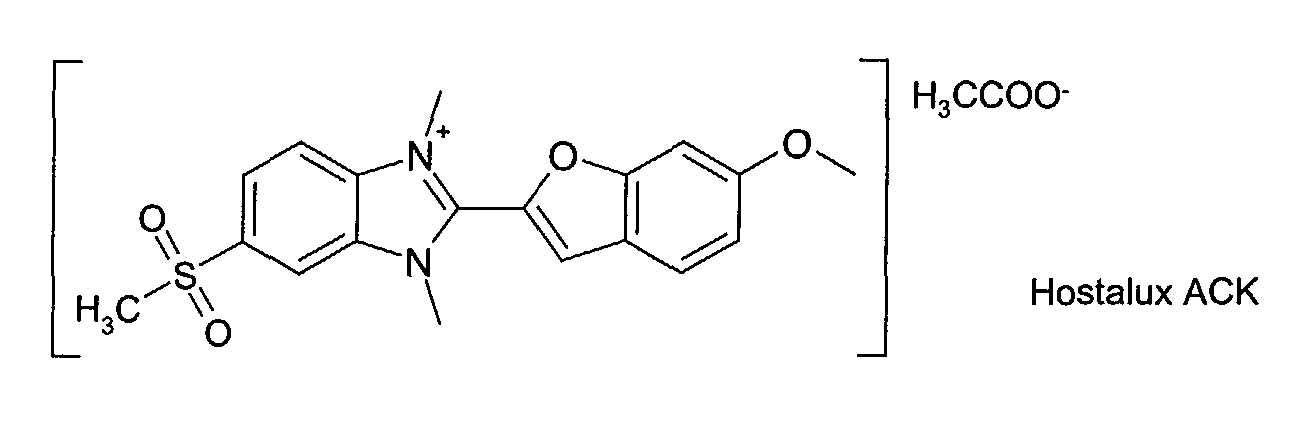
- Surprisingly it has been found, that said cationic optical brighteners are useful as dye compounds in optical layers for optical recording media.
- The present invention therefore in general terms relates to optical layers comprising cationic optical brighteners as dyes and the use of said optical layers for optical recording media.
- More particularly, the invention relates to cationic benzimidazol type dyes, to an optical layer comprising said dyes and to a write only read many (WORM) type optical recording medium capable of recording and reproducing information with radiation of blue laser of preferably 405 nm, which employs a cationic benzimidazol type dye in the optical layer.
- Surprisingly it has also been found, that the performance of dyes for optical layers derived from compounds known as cationic optical brighteners with conventional anions as counterions, such as halide (fluoride, chloride, bromide, iodide), C1-20 carboxylate, formiate, acetate, oxalate, lactate, glycolate, citrate or methylsulfate can be significantly improved by exchanging the conventional anions for high-performance anions, such as tetracyanoquinodimethane (TCNQ-), BX4 -, SbX6 -, PX6 - in which X represents halogen (-F, -Cl, -Br, -I) or phenyl.
- Therefore in a preferred embodiment, the invention relates to cationic benzofuranyl benzimidazol type dyes or benzoxazolyl benzimidazol type dyes with high-performance anions as counterions, such as tetracyanoquinodimethane (TCNQ-), tetraphenyborate or hexafluoroantimonate.
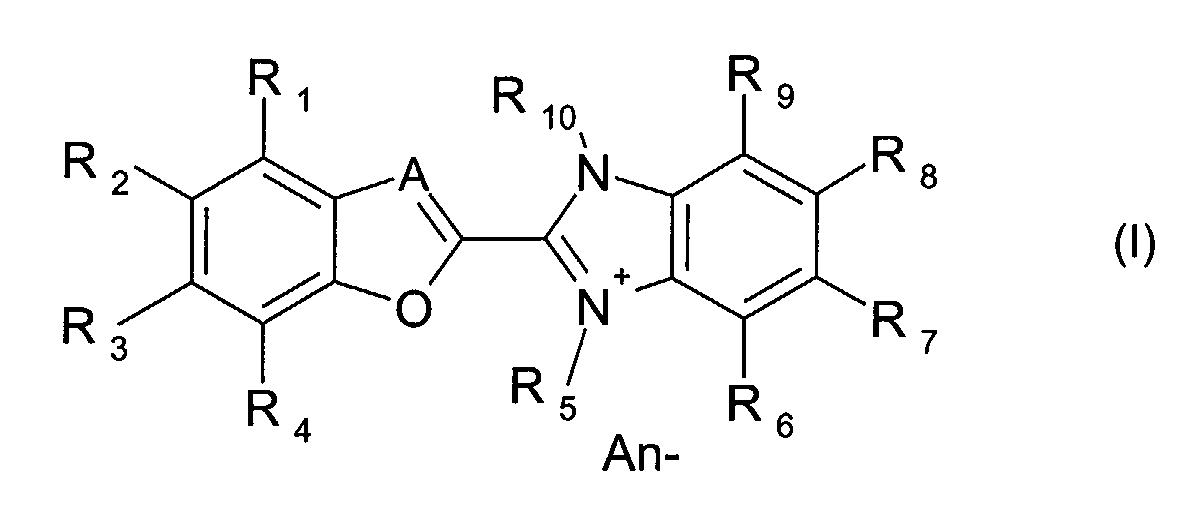
- The present invention is described to be an optical layer comprising at least one dye compound of the formula (I)wherein
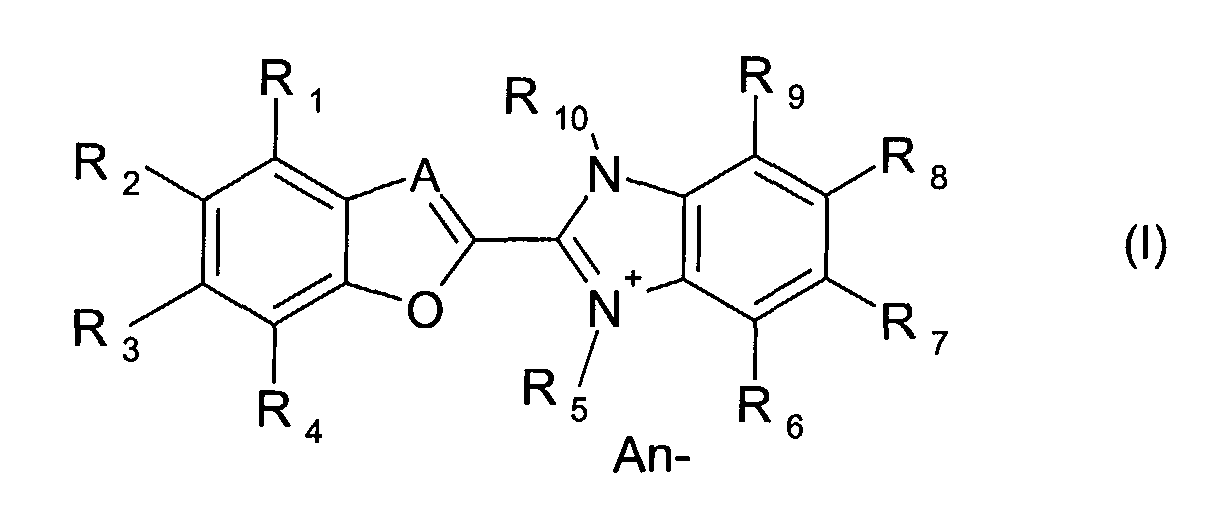
- A
- is either N or a group CH,
- R1, R2, R3, R4
- independently of one another, represent hydrogen, halogen (-F, -Cl, -
Br, -I), cyano (-CN), nitro (-NO2), C1-8 alkyl, C6-12 aryl, -NR11R12,
hydroxy, C1-8 alkoxy, C1-8 alkylthio, C6-12 aryloxy, C6-12 arylthio, -
SO3H, -SO2R11, -SO2NR11R12, -CO2R11, -CONR11R12, -NHCOR11,
in which R11 and R12 are independently hydrogen or C1-8 alkyl; - R5
- is C1-8 alkyl, wherein the alkyl can be unsubstituted or substituted by hydroxy, -NR11R12 or C6-12 aryl;
- R6, R7, R8, R9
- independently of one another, represent hydrogen, hydroxy (-OH),
C1-8 alkyl, C6-12 aryl, C1-8 alkoxy, C6-12 aryloxy, -NR11R12, -SO2R11, -
SO2NR11R12, -CO2R11, -CONR11R12, -NHCOR11,
in which R11 and R12 are independently hydrogen or C1-8 alkyl; - R10 is
- C1-8 alkyl, wherein the alkyl can be unsubstituted or substituted by
hydroxy, -NR11R12 or C6-12 aryl,
in which R11 and R12 are independently hydrogen or C1-8 alkyl; - An-
- represents an anion selected from halide, C1-20 carboxylate, formiate,
acetate, oxalate, lactate, glycolate, citrate, H3C-SO4 -, ClO4 -,
tetracyanoquinodimethane (TCNQ-), H3C-SO3 -, ClO4 -, BX4 -, SbX6 -,
PX6 -
in which X represents halogen (-F, -Cl, -Br, -I) or phenyl. - In a preferred aspect, the present invention relates to an optical layer comprising at least one dye compound of the formula (I) as described above, wherein
- A
- is either N or a group CH,
- R1, R2, R3, R4
- independently of one another, represent hydrogen, halogen (-F, -Cl, - Br, -I), cyano (-CN), nitro (-NO2), hydroxy (-OH), C1-8 alkoxy, C6-12 aryloxy,
- R5
- is C1-8 alkyl or benzyl;
- R6, R7, R8, R9
- independently of one another, represent hydrogen, hydroxy, C1-8
alkoxy, -SO2R11, -SO2NR11R12, -CO2R11,
-CONR11R12,
in which R11 and R12 are independently hydrogen or C1-8 alkyl, - R10
- is C1-8 alkyl;
- An-
- represents an anion selected from tetracyanoquinodimethane
(TCNQ-), BX4 -, SbX6 -, PX6 -,
in which X represents halogen (-F, -Cl, -Br, -I) or phenyl. - In a more preferred aspect, the present invention relates to an optical layer comprising at least one dye compound of the formula (I) as described above, wherein
- A
- is either N or a group CH,
- R1, R2, R3, R4
- independently of one another, represent hydrogen, hydroxy, C1-8 alkoxy, C6-12 aryloxy,
- R5
- is C1-4 alkyl or benzyl;
- R6, R7, R8, R9
- independently of one another, represent hydrogen,
-SO2R11 or -SO2NR11R12;
in which R11 and R12 are independently hydrogen or C1-8 alkyl, - R10
- is C1-4 alkyl;
- An-
- represents an anion selected from tetracyanoquinodimethane
(TCNQ-), BX4 -, SbX6 -, PX6 -,
in which X represents fluoro or phenyl. - In one most preferred embodiment, the present invention relates to an optical layer comprising at least one dye compound of the formula (I) as described above, wherein
- A
- is N,
- R1, R2, R3, R4
- three thereof represent hydrogen and one thereof represents C1-4 alkoxy;
- R5
- is methyl or ethyl;
- R6, R7, R8, R9
- all four represent hydrogen;
- R10
- is C1-4 alkyl;
- An-
- represents an anion selected from tetracyanoquinodimethane
(TCNQ-), BX4 -, SbX6 -, PX6 -
in which X represents fluoro or phenyl. - In another most preferred embodiment, the present invention relates to an optical layer comprising at least one dye compound of the formula (I) as described above, wherein
- A
- is CH,
- R1, R2, R3, R4
- three thereof represent hydrogen and one thereof represents C1-4 alkoxy;
- R5
- is methyl or ethyl;
- R6, R7, R8, R9
- three thereof represent hydrogen and one thereof represents -SO2R11;
in which R11 is C1-4 alkyl, - R10
- is C1-4 alkyl;
- An-
- represents an anion selected from tetracyanoquinodimethane
(TCNQ-), BX4 -, SbX6 -, PX6 -
in which X represents fluoro or phenyl. - An optical layer according to the invention may also comprise a mixture of two or more, preferably of two dye compounds according to formula (I) as defined above.
- Mixtures of two or more dye compounds according to formula (I) comprise mixtures of two or more benzoxazolyl type dyes (A = N), mixtures of two or more benzofuranyl type dyes (A = CH) or mixtures of one or more benzoxazolyl type dye with one or more benzofuranyl type dye.
- Preferred mixtures are mixtures of one benzoxazolyl type dye with one benzofuranyl type dye.
- Most preferred mixtures are mixtures of dye compounds derived from Leukophor® KCB with high-performance anions as described above, mixtures of dye compounds derived from Hostalux® ACK with high-performance anions as described above and in particular mixtures of a dye compound derived from Leukophor® KCB with high-performance anions as described above with a dye compound derived from Hostalux® ACK with high-performance anions as described above
- Further, the invention relates to a method for producing optical layers comprising the following steps
- (a) providing a substrate
- (b) dissolving a dye compound or a mixture of dye compounds of formula (I) in an organic solvent to form a solution,
- (c) coating the solution (b) on the substrate (a);
- (d) evaporating the solvent to form a dye layer.
-
- Preferred substrates are polycarbonate (PC) or polymethylmethacrylate (PMMA).
- Organic solvents are selected from C1-8 alcohol , halogen substituted C1-8 alcohols, C1-8 ketone, C1-8 ether, halogen substituted C1-4 alkane, or amides.
- Preferred C1-8 alcohols or halogen substituted C1-8 alcohols are for example methanol, ethanol, isopropanol, diacetone alcohol (DAA), 2,2,3,3-tetrafluoropropanol, trichloroethanol, 2-chloroethanol, octafluoropentanol or hexafluorobutanol.
Preferred C1-8 ketones are for example acetone, methylisobutylketone, methylethylketone, or 3-hydroxy-3-methyl-2-butanone. - Preferred halogen substituted C1-4alkanes are for example chloroform, dichloromethane or 1-chlorobutane.
- Preferred amides are for example dimethylformamide or dimethylacetamide.
- The optical layer (dye layer) obtained preferably has a thickness from 70 to 250 nm.
- In a further aspect, the present invention provides for optical layers suitable for high-density recording material, e.g. of the WORM disk format, in a laser wavelength range of from 350-450nm, preferably around 405 nm.
- The dye compounds of formula (I) possess the required optical characteristics (such as high absortivity, high recording sensitivity as example), an excellent solubility in organic solvents, an excellent light stability and a decomposition temperature of 250-300°C.
- The dye compounds of formula (I) are easy to synthesize with high yields and can be manufactured at a reduced cost. The general synthesis pathway is known in the art.
- The European Patent EP 0 010 063 discloses a general process for the condensation reaction to obtain benzofuranyl benzimidazol type compounds.
- The US Patent No. 4,313,846 discloses a general synthesis of benzoxazolyl benzimidazol type compounds.
- The preparation of a high density optical disk recording medium conventionally comprises the following steps:
- (a) providing a first substrate
- (b) dissolving the dye set forth in claim 1 in an organic solvent to form a solution, and coating the first solution on the first substrate;
- (c) drying the solution to form a dye layer and
- (d) disposing a reflection layer on the dye layer and
- (e) disposing a second substrate on the reflection layer
-
- In step (e), preferably a second substrate is bonded with the first substrate to form the high-density optical disc recording medium. Conventional techniques for bonding are printing, glueing or melting.
- All dyes are prepared using standard procedures known in the art. If required, the dyes can be purified by recrystallization from an alcohol.
- The complex dyes are prepared by reaction of a solution of counter-ion salt (e.g. sodium hexafluoroantimonate, LiTCNQ, sodium tetraphenylborate) with a boiling or hot solution of the corresponding starting material (e.g. product A = Hostalux® ACK) in a selected alcohol. The precipitate is isolated following standard methods.
The synthesis of LiTCNQ is done according to L. R. Melby et al., J. Am. Chem. Soc., 84, p.3374, (1962). -
-
-
-

-

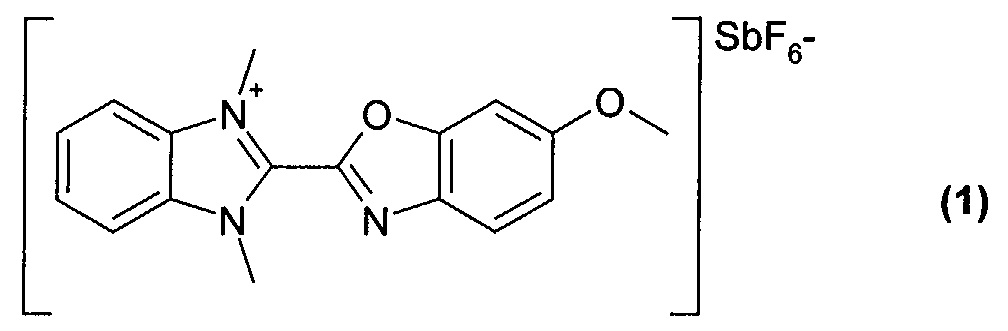
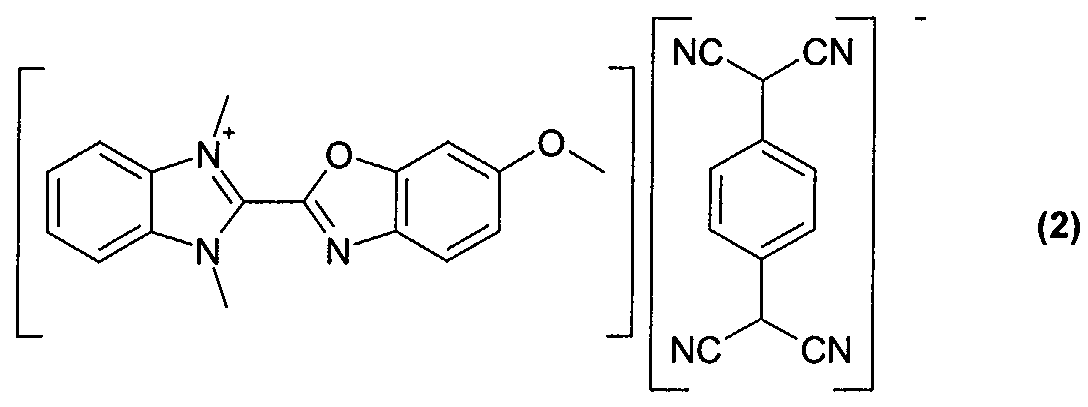
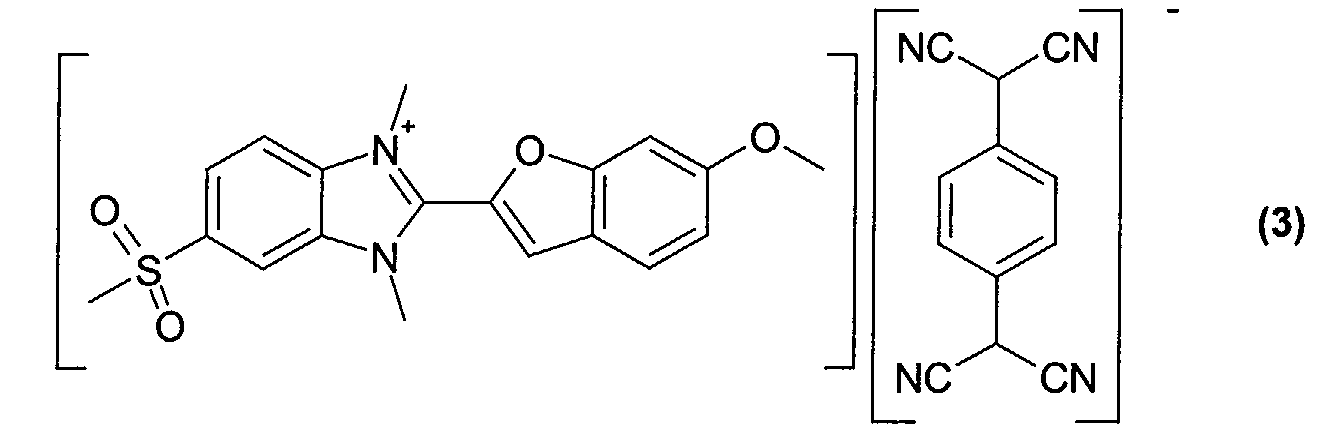
Optical characteristics (in solution) Example Anion λmax ε (λmax) (1) SbF6 - 360 nm 31 000 (2) TCNQ- 392 nm 51 500 (3) TCNQ- 376 nm 44 000 (4) B(Ph)4 - 360 nm 29 000 (5) B(Ph)4 - 378 nm 36 800 product A AcO- 363 nm 27 000 - 0.20 g of the dye of formula (1) obtained from example 1 were dissolved in 10 ml of tetrafluoropropanol, and stirred at room temperature for 5 hours. The solution was filtered with a Teflon filter (having 0,2 µm pore size) and spin coated over a substrate to form a dye layer. The substrate was a polycarbonate substrate with 0.6 mm thickness having pregrooves with 150 nm depth, 300 nm width and 800 nm track pitch.
- The substrate having the dye layer was dried in a vacuum oven set at 40°C for 12 hours. The optical layers obtained had a uniform and even surface at a thickness of 120 nm. As a reflective layer, silver was deposited over the dye layer with a thickness of 100 nm. Finally, the substrate formed with the reflective layer and the recording layer is combined with another blank substrate with a thickness of 0.6mm. A high-density recordable optical disc of 1.20mm thickness can be thus formed.
- The optical recording medium having the thus formed recording layer therein was subjected to the following evaluation tests.
The recording conditions were the following ones: constant linear velocity (CLV) at 5 m/s, wavelength at 405 nm, numerical aperture (NA) at 0.65 and writing power from 8-10 mW. With an evaluation device equipped with a blue semiconductor laser head, pits were formed and signals recorded. - By the use of the same device, these pits could be read.
The reading conditions were: CLV at 5.0 m/s, wavelength at 405 nm, NA at 0.65, and reading power from 0.5 to 1.5 mW. - The tests provided for results within the expectations with regard to absorptivity, reflectance and recording sensitivity. Further, the obtained optical layers were sufficiently stable to light and heat. The optical recording media were storage stable within specification.
- Optical recording media with an optical layer comprising the dyes obtained according to examples 2 to 5 (compounds of formula (2)-(5)) were manufactured and tested according to the procedure given for example 6.
Claims (12)
- An optical layer comprising at least one dye compound of the formula (I)wherein
- A
- is either N or a group CH,
- R1, R2, R3, R4
- independently of one another, represent hydrogen, halogen
(-F, -Cl, -Br, -I), cyano (-CN), nitro (-NO2), C1-8 alkyl,
C6-12 aryl, -NR11R12, hydroxy, C1-8 alkoxy, C1-8 alkylthio,
C6-12 aryloxy, C6-12 arylthio, -SO3H, -SO2R11, -SO2NR11R12, -
CO2R11, -CONR11R12, -NHCOR11,
in which R11 and R12 are independently hydrogen or C1-8 alkyl, - R5
- is C1-8 alkyl, wherein the alkyl can be unsubstituted or substituted by hydroxy, -NR11R12 or C6-12 aryl;
- R6, R7, R8, R9
- independently of one another, represent hydrogen,
hydroxy (-OH), C1-8 alkyl, C6-12 aryl, C1-8 alkoxy, C6-12
aryloxy, -NR11R12, -SO2R11, -SO2NR11R12, -CO2R11,-CONR11R12,
-NHCOR11,
in which R11 and R12 are independently hydrogen or C1-8 alkyl - R10 is
- C1-8 alkyl, wherein the alkyl can be unsubstituted or
substituted by hydroxy, -NR11R12 or C6-12 aryl;
in which R11 and R12 are independently hydrogen or C1-8 alkyl - An-
- represents an anion selected from halide, C1-20 carboxylate,
formiate, acetate, oxalate, lactate, glycolate, citrate,
H3C-SO4 -, ClO4 -, tetracyanoquinodimethane (TCNQ-),
BX4 -, SbX6 -, PX6 -
in which X represents halogen (-F, -Cl, -Br, -I) or phenyl.
- An optical layer according to claim l,wherein
- A
- is either N or a group CH,
- R1, R2, R3, R4
- independently of one another, represent hydrogen, halogen (-F, -Cl, -Br, -I), cyano (-CN), nitro (-NO2), hydroxy (-OH), C1-8 alkoxy, C6-12 aryloxy,
- R5
- is C1-8 alkyl or benzyl;
- R6, R7, R8, R9
- independently of one another, represent hydrogen,
hydroxy, C1-8 alkoxy, -SO2R11, -SO2NR11R12, -CO2R11,
-CONR11R12,
in which R11 and R12 are independently hydrogen or C1-8 alkyl, - R10
- is C1-8 alkyl;
- An-
- represents an anion selected from
tetracyanoquinodimethane (TCNQ-), BX4 -, SbX6 -, PX6 -
in which X represents halogen (-F, -Cl, -Br, -I) or phenyl.
- An optical layer according to claim 2,wherein
- A
- is either N or a group CH,
- R1, R2, R3, R4
- independently of one another, represent hydrogen, hydroxy, C1-8 alkoxy, C6-12 aryloxy,
- R5
- is C1-4 alkyl or benzyl;
- R6, R7, R8, R9
- independently of one another, represent hydrogen,
-SO2R11 or -SO2NR11R12,;
in which R11 and R12 are independently hydrogen or C1-8 alkyl, - R10
- is C1-4 alkyl;
- An-
- represents an anion selected from
tetracyanoquinodimethane (TCNQ-), BX4 -, SbX6 -, PX6 -
in which X represents fluoro or phenyl.
- An optical layer according to claim 3,wherein
- A
- is N,
- R1, R2, R3, R4
- three thereof represent hydrogen and one thereof represents C1-4 alkoxy;
- R5
- is methyl or ethyl;
- R6, R7, R8, R9
- all four represent hydrogen;
- R10
- is C1-4 alkyl;
- An-
- represents an anion selected from
tetracyanoquinodimethane (TCNQ-), BX4 -, SbX6 -, PX6 -
in which X represents fluoro or phenyl.
- An optical layer according to claim 3,wherein
- A
- is CH,
- R1, R2, R3, R4
- three thereof represent hydrogen and one thereof represents C1-4 alkoxy;
- R5
- is methyl or ethyl;
- R6, R7, R8, R9
- three thereof represent hydrogen and one thereof
represents -SO2R11;
in which R11 is C1-4 alkyl, - R10
- is C1-4 alkyl;
- An-
- represents an anion selected from
tetracyanoquinodimethane (TCNQ-), BX4 -, SbX6 -, PX6 -
in which X represents fluoro or phenyl.
- An optical layer according to claim 1 comprising a mixture of dye compounds according to formula (I) as defined in claims 1 to 5.
- A method for producing optical layers according to claims 1 to 6, comprising the following steps(e) providing a substrate(f) dissolving a dye compound or a mixture of dye compounds of formula (I) as defined in claims 1 to 6 in an organic solvent to form a solution,(g) coating the solution (b) on the substrate (a);(h) evaporating the solvent to form a dye layer.
- A method according to claim 7, wherein the substrate is polycarbonate (PC) or polymethylmethacrylate (PMMA).
- A method according to claim 5, wherein the organic solvent is selected from C1-8 alcohol , halogen substituted C1-8 alcohols, C1-8 ketone, C1-8 ether, halogen substituted C1-4 alkane, or amides.
- A method according to claim 6, wherein the C1-8 alcohols or halogen substituted C1-8 alcohols are selected from methanol, ethanol, isopropanol, diacetone alcohol (DAA), 2,2,3,3-tetrafluoropropanol, trichloroethanol, 2-chloroethanol, octafluoropentanol or hexafluorobutanol;
the C1-8 ketones are selected from acetone, methylisobutylketone, methylethylketone, or 3-hydroxy-3-methyl-2-butanone;
the halogen substituted C1-4 alkanes are selected from chloroform, dichloromethane or 1-chlorobutane; and
the amides are selected from dimethylformamide or dimethylacetamide. - A method according to claim 7, wherein the optical layer (dye layer) has a thickness from 70 to 250 nm.
- An optical recording medium comprising an optical layer according to claims 1 to 6, wherein at least one dye compound of the formula (I) as defined in claims 1 to 6 is used.
Priority Applications (1)
| Application Number | Priority Date | Filing Date | Title |
|---|---|---|---|
| EP03004798A EP1455352A1 (en) | 2003-03-05 | 2003-03-05 | New dyes for optical data recording |
Applications Claiming Priority (1)
| Application Number | Priority Date | Filing Date | Title |
|---|---|---|---|
| EP03004798A EP1455352A1 (en) | 2003-03-05 | 2003-03-05 | New dyes for optical data recording |
Publications (1)
| Publication Number | Publication Date |
|---|---|
| EP1455352A1 true EP1455352A1 (en) | 2004-09-08 |
Family
ID=32798774
Family Applications (1)
| Application Number | Title | Priority Date | Filing Date |
|---|---|---|---|
| EP03004798A Withdrawn EP1455352A1 (en) | 2003-03-05 | 2003-03-05 | New dyes for optical data recording |
Country Status (1)
| Country | Link |
|---|---|
| EP (1) | EP1455352A1 (en) |
Citations (6)
| Publication number | Priority date | Publication date | Assignee | Title |
|---|---|---|---|---|
| CH560277B5 (en) * | 1971-11-09 | 1975-03-27 | ||
| US4146725A (en) * | 1976-07-26 | 1979-03-27 | Ciba-Geigy Corporation | Benzofuranyl-benzimidazoles |
| US4313846A (en) * | 1978-11-20 | 1982-02-02 | Ciba-Geigy Corporation | N-Acyl-o-phenylenediamines |
| US4429133A (en) * | 1976-08-04 | 1984-01-31 | Sandoz Ltd. | 2'-Benzothiazolyl-and 2'-benzoxazolyl-2-benzimidazoles |
| EP0405568A2 (en) * | 1989-06-30 | 1991-01-02 | Koninklijke Philips Electronics N.V. | Direct effect master/stamper for optical recording |
| US6265140B1 (en) * | 1997-02-24 | 2001-07-24 | Tridstore Ip, Llc | Silver halide material for optical memory devices with luminescent reading and methods for the treatment thereof |
-
2003
- 2003-03-05 EP EP03004798A patent/EP1455352A1/en not_active Withdrawn
Patent Citations (6)
| Publication number | Priority date | Publication date | Assignee | Title |
|---|---|---|---|---|
| CH560277B5 (en) * | 1971-11-09 | 1975-03-27 | ||
| US4146725A (en) * | 1976-07-26 | 1979-03-27 | Ciba-Geigy Corporation | Benzofuranyl-benzimidazoles |
| US4429133A (en) * | 1976-08-04 | 1984-01-31 | Sandoz Ltd. | 2'-Benzothiazolyl-and 2'-benzoxazolyl-2-benzimidazoles |
| US4313846A (en) * | 1978-11-20 | 1982-02-02 | Ciba-Geigy Corporation | N-Acyl-o-phenylenediamines |
| EP0405568A2 (en) * | 1989-06-30 | 1991-01-02 | Koninklijke Philips Electronics N.V. | Direct effect master/stamper for optical recording |
| US6265140B1 (en) * | 1997-02-24 | 2001-07-24 | Tridstore Ip, Llc | Silver halide material for optical memory devices with luminescent reading and methods for the treatment thereof |
Similar Documents
| Publication | Publication Date | Title |
|---|---|---|
| EP0962923B1 (en) | Information recording medium and novel oxonol compound | |
| JP2010530317A (en) | Use of indolinium diazamethine cation for optical data recording | |
| JP4137771B2 (en) | Optical information recording medium and novel oxonol compound | |
| JP3636857B2 (en) | Optical information recording medium | |
| EP1869674B1 (en) | Basic yellow dyes as dye component for optical data recording media | |
| WO2001019923A1 (en) | Styryl dye | |
| KR100528709B1 (en) | New indolestyryl compounds and their uses in high-density recording media | |
| WO2000061687A1 (en) | Cyanine dye | |
| JP3807872B2 (en) | Information recording medium and novel oxonol compound | |
| JP3707759B2 (en) | Information recording medium and oxonol compound | |
| JP2008511472A (en) | Use of dyes based on thiazolyl-pyridinium in optical layers for optical data recording | |
| JP3841534B2 (en) | Optical recording material | |
| KR20070085414A (en) | Monosubstituted squaric acid metal complex dyes and use thereof in optical layers for optical data recording | |
| JP3768346B2 (en) | Information recording medium and information recording method | |
| JPH1148615A (en) | Optical information recording medium | |
| JP3573600B2 (en) | Optical information recording medium | |
| JP3707760B2 (en) | Information recording medium and information recording method | |
| EP1502917A1 (en) | Use of mono- and dicationic naphthalene-based imide dyes in optical layers for optical data recording | |
| AU2005249031A1 (en) | Use of squaric acid dyes in optical layers for optical data recording | |
| JPH11321110A (en) | Information recording medium and oxonol compound | |
| JP2003039831A (en) | Optical information recording medium and novel imonium compound | |
| WO2006103254A1 (en) | Betaines of squaric acid for use in optical layers for optical data recording | |
| JP2597517B2 (en) | Information recording medium | |
| JP2008012884A (en) | Optical information recording medium and its manufacturing method | |
| JPH11321108A (en) | Information recording medium and novel oxonol compound |
Legal Events
| Date | Code | Title | Description |
|---|---|---|---|
| PUAI | Public reference made under article 153(3) epc to a published international application that has entered the european phase |
Free format text: ORIGINAL CODE: 0009012 |
|
| AK | Designated contracting states |
Kind code of ref document: A1 Designated state(s): AT BE BG CH CY CZ DE DK EE ES FI FR GB GR HU IE IT LI LU MC NL PT SE SI SK TR |
|
| AX | Request for extension of the european patent |
Extension state: AL LT LV MK RO |
|
| RIN1 | Information on inventor provided before grant (corrected) |
Inventor name: STEFFANUT, PASCAL Inventor name: MURA, JEAN-LUC |
|
| AKX | Designation fees paid | ||
| REG | Reference to a national code |
Ref country code: DE Ref legal event code: 8566 |
|
| STAA | Information on the status of an ep patent application or granted ep patent |
Free format text: STATUS: THE APPLICATION IS DEEMED TO BE WITHDRAWN |
|
| 18D | Application deemed to be withdrawn |
Effective date: 20050309 |