EP1455076A2 - Propulsion device, flying object comprising the same and propulsion device igniting method - Google Patents
Propulsion device, flying object comprising the same and propulsion device igniting method Download PDFInfo
- Publication number
- EP1455076A2 EP1455076A2 EP04290501A EP04290501A EP1455076A2 EP 1455076 A2 EP1455076 A2 EP 1455076A2 EP 04290501 A EP04290501 A EP 04290501A EP 04290501 A EP04290501 A EP 04290501A EP 1455076 A2 EP1455076 A2 EP 1455076A2
- Authority
- EP
- European Patent Office
- Prior art keywords
- propulsion device
- oxidizer
- surface area
- fuel
- area increasing
- Prior art date
- Legal status (The legal status is an assumption and is not a legal conclusion. Google has not performed a legal analysis and makes no representation as to the accuracy of the status listed.)
- Granted
Links
- 238000000034 method Methods 0.000 title claims description 13
- 239000000446 fuel Substances 0.000 claims abstract description 88
- MHAJPDPJQMAIIY-UHFFFAOYSA-N Hydrogen peroxide Chemical compound OO MHAJPDPJQMAIIY-UHFFFAOYSA-N 0.000 claims abstract description 86
- 239000007800 oxidant agent Substances 0.000 claims abstract description 58
- 239000007788 liquid Substances 0.000 claims abstract description 55
- 238000002485 combustion reaction Methods 0.000 claims abstract description 34
- 230000001965 increasing effect Effects 0.000 claims description 43
- 239000013626 chemical specie Substances 0.000 claims description 37
- BASFCYQUMIYNBI-UHFFFAOYSA-N platinum Chemical compound [Pt] BASFCYQUMIYNBI-UHFFFAOYSA-N 0.000 claims description 21
- BQCADISMDOOEFD-UHFFFAOYSA-N Silver Chemical compound [Ag] BQCADISMDOOEFD-UHFFFAOYSA-N 0.000 claims description 15
- 229910052709 silver Inorganic materials 0.000 claims description 15
- 239000004332 silver Substances 0.000 claims description 15
- 239000003054 catalyst Substances 0.000 claims description 14
- KDLHZDBZIXYQEI-UHFFFAOYSA-N Palladium Chemical compound [Pd] KDLHZDBZIXYQEI-UHFFFAOYSA-N 0.000 claims description 12
- 229910052697 platinum Inorganic materials 0.000 claims description 10
- 239000000523 sample Substances 0.000 claims description 7
- KJTLSVCANCCWHF-UHFFFAOYSA-N Ruthenium Chemical compound [Ru] KJTLSVCANCCWHF-UHFFFAOYSA-N 0.000 claims description 6
- 239000000919 ceramic Substances 0.000 claims description 6
- 229910052741 iridium Inorganic materials 0.000 claims description 6
- GKOZUEZYRPOHIO-UHFFFAOYSA-N iridium atom Chemical compound [Ir] GKOZUEZYRPOHIO-UHFFFAOYSA-N 0.000 claims description 6
- 229910052763 palladium Inorganic materials 0.000 claims description 6
- 229910052707 ruthenium Inorganic materials 0.000 claims description 6
- 230000004044 response Effects 0.000 abstract description 15
- 238000000354 decomposition reaction Methods 0.000 abstract description 11
- 238000002156 mixing Methods 0.000 abstract description 4
- 239000003380 propellant Substances 0.000 description 22
- 230000000694 effects Effects 0.000 description 16
- 239000007789 gas Substances 0.000 description 16
- 239000010970 precious metal Substances 0.000 description 10
- 238000006243 chemical reaction Methods 0.000 description 9
- WFPZPJSADLPSON-UHFFFAOYSA-N dinitrogen tetraoxide Chemical compound [O-][N+](=O)[N+]([O-])=O WFPZPJSADLPSON-UHFFFAOYSA-N 0.000 description 8
- HDZGCSFEDULWCS-UHFFFAOYSA-N monomethylhydrazine Chemical compound CNN HDZGCSFEDULWCS-UHFFFAOYSA-N 0.000 description 8
- LFQSCWFLJHTTHZ-UHFFFAOYSA-N Ethanol Chemical compound CCO LFQSCWFLJHTTHZ-UHFFFAOYSA-N 0.000 description 7
- 230000003197 catalytic effect Effects 0.000 description 7
- 239000000463 material Substances 0.000 description 7
- CURLTUGMZLYLDI-UHFFFAOYSA-N Carbon dioxide Chemical compound O=C=O CURLTUGMZLYLDI-UHFFFAOYSA-N 0.000 description 6
- 239000010419 fine particle Substances 0.000 description 6
- 229910052751 metal Inorganic materials 0.000 description 6
- 239000002184 metal Substances 0.000 description 6
- MYMOFIZGZYHOMD-UHFFFAOYSA-N Dioxygen Chemical compound O=O MYMOFIZGZYHOMD-UHFFFAOYSA-N 0.000 description 5
- 238000009835 boiling Methods 0.000 description 5
- 229910001882 dioxygen Inorganic materials 0.000 description 5
- 238000007747 plating Methods 0.000 description 5
- 238000011144 upstream manufacturing Methods 0.000 description 5
- CSCPPACGZOOCGX-UHFFFAOYSA-N Acetone Chemical compound CC(C)=O CSCPPACGZOOCGX-UHFFFAOYSA-N 0.000 description 4
- 230000004913 activation Effects 0.000 description 4
- QVGXLLKOCUKJST-UHFFFAOYSA-N atomic oxygen Chemical compound [O] QVGXLLKOCUKJST-UHFFFAOYSA-N 0.000 description 4
- 239000002360 explosive Substances 0.000 description 4
- 230000007246 mechanism Effects 0.000 description 4
- 239000001301 oxygen Substances 0.000 description 4
- 229910052760 oxygen Inorganic materials 0.000 description 4
- 238000012360 testing method Methods 0.000 description 4
- 231100000331 toxic Toxicity 0.000 description 4
- 230000002588 toxic effect Effects 0.000 description 4
- ZWEHNKRNPOVVGH-UHFFFAOYSA-N 2-Butanone Chemical compound CCC(C)=O ZWEHNKRNPOVVGH-UHFFFAOYSA-N 0.000 description 3
- VYPSYNLAJGMNEJ-UHFFFAOYSA-N Silicium dioxide Chemical compound O=[Si]=O VYPSYNLAJGMNEJ-UHFFFAOYSA-N 0.000 description 3
- ZMANZCXQSJIPKH-UHFFFAOYSA-N Triethylamine Chemical compound CCN(CC)CC ZMANZCXQSJIPKH-UHFFFAOYSA-N 0.000 description 3
- 229910045601 alloy Inorganic materials 0.000 description 3
- 239000000956 alloy Substances 0.000 description 3
- 229910002092 carbon dioxide Inorganic materials 0.000 description 3
- 239000001569 carbon dioxide Substances 0.000 description 3
- 230000008859 change Effects 0.000 description 3
- 238000010276 construction Methods 0.000 description 3
- 238000002309 gasification Methods 0.000 description 3
- 231100001231 less toxic Toxicity 0.000 description 3
- 238000011068 loading method Methods 0.000 description 3
- 239000002245 particle Substances 0.000 description 3
- 230000009467 reduction Effects 0.000 description 3
- 229910000990 Ni alloy Inorganic materials 0.000 description 2
- PXHVJJICTQNCMI-UHFFFAOYSA-N Nickel Chemical compound [Ni] PXHVJJICTQNCMI-UHFFFAOYSA-N 0.000 description 2
- 150000001412 amines Chemical class 0.000 description 2
- 150000001540 azides Chemical class 0.000 description 2
- 230000008901 benefit Effects 0.000 description 2
- 238000002474 experimental method Methods 0.000 description 2
- 238000010438 heat treatment Methods 0.000 description 2
- 238000002844 melting Methods 0.000 description 2
- 230000008018 melting Effects 0.000 description 2
- 239000000203 mixture Substances 0.000 description 2
- 231100000252 nontoxic Toxicity 0.000 description 2
- 230000003000 nontoxic effect Effects 0.000 description 2
- KWYHDKDOAIKMQN-UHFFFAOYSA-N N,N,N',N'-tetramethylethylenediamine Chemical compound CN(C)CCN(C)C KWYHDKDOAIKMQN-UHFFFAOYSA-N 0.000 description 1
- 229910001257 Nb alloy Inorganic materials 0.000 description 1
- 239000000654 additive Substances 0.000 description 1
- 230000000996 additive effect Effects 0.000 description 1
- 230000001476 alcoholic effect Effects 0.000 description 1
- PNEYBMLMFCGWSK-UHFFFAOYSA-N aluminium oxide Inorganic materials [O-2].[O-2].[O-2].[Al+3].[Al+3] PNEYBMLMFCGWSK-UHFFFAOYSA-N 0.000 description 1
- 238000013459 approach Methods 0.000 description 1
- 238000000889 atomisation Methods 0.000 description 1
- 231100000481 chemical toxicant Toxicity 0.000 description 1
- 238000012790 confirmation Methods 0.000 description 1
- 238000011109 contamination Methods 0.000 description 1
- 238000005485 electric heating Methods 0.000 description 1
- 230000002708 enhancing effect Effects 0.000 description 1
- 230000007613 environmental effect Effects 0.000 description 1
- 230000005484 gravity Effects 0.000 description 1
- 231100000086 high toxicity Toxicity 0.000 description 1
- 239000012535 impurity Substances 0.000 description 1
- 229910000765 intermetallic Inorganic materials 0.000 description 1
- 239000003350 kerosene Substances 0.000 description 1
- 150000002576 ketones Chemical class 0.000 description 1
- 238000005259 measurement Methods 0.000 description 1
- 150000002739 metals Chemical class 0.000 description 1
- 229910052759 nickel Inorganic materials 0.000 description 1
- 238000011017 operating method Methods 0.000 description 1
- 238000005457 optimization Methods 0.000 description 1
- 239000005416 organic matter Substances 0.000 description 1
- 230000008569 process Effects 0.000 description 1
- 230000005855 radiation Effects 0.000 description 1
- 239000000741 silica gel Substances 0.000 description 1
- 229910002027 silica gel Inorganic materials 0.000 description 1
- 239000000377 silicon dioxide Substances 0.000 description 1
- 238000004088 simulation Methods 0.000 description 1
- 239000007787 solid Substances 0.000 description 1
- 239000002910 solid waste Substances 0.000 description 1
- 239000010935 stainless steel Substances 0.000 description 1
- 229910001220 stainless steel Inorganic materials 0.000 description 1
- 239000000126 substance Substances 0.000 description 1
- -1 that is Chemical compound 0.000 description 1
- 239000003440 toxic substance Substances 0.000 description 1
- 231100000419 toxicity Toxicity 0.000 description 1
- 230000001988 toxicity Effects 0.000 description 1
Images

Classifications
-
- F—MECHANICAL ENGINEERING; LIGHTING; HEATING; WEAPONS; BLASTING
- F02—COMBUSTION ENGINES; HOT-GAS OR COMBUSTION-PRODUCT ENGINE PLANTS
- F02K—JET-PROPULSION PLANTS
- F02K9/00—Rocket-engine plants, i.e. plants carrying both fuel and oxidant therefor; Control thereof
- F02K9/42—Rocket-engine plants, i.e. plants carrying both fuel and oxidant therefor; Control thereof using liquid or gaseous propellants
- F02K9/60—Constructional parts; Details not otherwise provided for
- F02K9/68—Decomposition chambers
-
- F—MECHANICAL ENGINEERING; LIGHTING; HEATING; WEAPONS; BLASTING
- F02—COMBUSTION ENGINES; HOT-GAS OR COMBUSTION-PRODUCT ENGINE PLANTS
- F02K—JET-PROPULSION PLANTS
- F02K9/00—Rocket-engine plants, i.e. plants carrying both fuel and oxidant therefor; Control thereof
- F02K9/42—Rocket-engine plants, i.e. plants carrying both fuel and oxidant therefor; Control thereof using liquid or gaseous propellants
-
- F—MECHANICAL ENGINEERING; LIGHTING; HEATING; WEAPONS; BLASTING
- F05—INDEXING SCHEMES RELATING TO ENGINES OR PUMPS IN VARIOUS SUBCLASSES OF CLASSES F01-F04
- F05D—INDEXING SCHEME FOR ASPECTS RELATING TO NON-POSITIVE-DISPLACEMENT MACHINES OR ENGINES, GAS-TURBINES OR JET-PROPULSION PLANTS
- F05D2250/00—Geometry
- F05D2250/20—Three-dimensional
- F05D2250/28—Three-dimensional patterned
- F05D2250/283—Three-dimensional patterned honeycomb
-
- F—MECHANICAL ENGINEERING; LIGHTING; HEATING; WEAPONS; BLASTING
- F05—INDEXING SCHEMES RELATING TO ENGINES OR PUMPS IN VARIOUS SUBCLASSES OF CLASSES F01-F04
- F05D—INDEXING SCHEME FOR ASPECTS RELATING TO NON-POSITIVE-DISPLACEMENT MACHINES OR ENGINES, GAS-TURBINES OR JET-PROPULSION PLANTS
- F05D2300/00—Materials; Properties thereof
- F05D2300/10—Metals, alloys or intermetallic compounds
- F05D2300/14—Noble metals, i.e. Ag, Au, platinum group metals
- F05D2300/141—Silver
-
- F—MECHANICAL ENGINEERING; LIGHTING; HEATING; WEAPONS; BLASTING
- F05—INDEXING SCHEMES RELATING TO ENGINES OR PUMPS IN VARIOUS SUBCLASSES OF CLASSES F01-F04
- F05D—INDEXING SCHEME FOR ASPECTS RELATING TO NON-POSITIVE-DISPLACEMENT MACHINES OR ENGINES, GAS-TURBINES OR JET-PROPULSION PLANTS
- F05D2300/00—Materials; Properties thereof
- F05D2300/10—Metals, alloys or intermetallic compounds
- F05D2300/14—Noble metals, i.e. Ag, Au, platinum group metals
- F05D2300/143—Platinum group metals, i.e. Os, Ir, Pt, Ru, Rh, Pd
-
- F—MECHANICAL ENGINEERING; LIGHTING; HEATING; WEAPONS; BLASTING
- F05—INDEXING SCHEMES RELATING TO ENGINES OR PUMPS IN VARIOUS SUBCLASSES OF CLASSES F01-F04
- F05D—INDEXING SCHEME FOR ASPECTS RELATING TO NON-POSITIVE-DISPLACEMENT MACHINES OR ENGINES, GAS-TURBINES OR JET-PROPULSION PLANTS
- F05D2300/00—Materials; Properties thereof
- F05D2300/20—Oxide or non-oxide ceramics
- F05D2300/21—Oxide ceramics
Definitions
- the present invention generally relates to a propulsion device and igniting method thereof and more specifically to a propulsion device and igniting method thereof both excellent in a response performance as required for attitude control of an artificial satellite, lunar probe, planet probe, on-trajectory work station, launch vehicle or other aerospace craft.
- bi-liquid type propulsion device using a liquid fuel and liquid oxidizer as propellant, such one as uses dinitrogen tetraoxide (hereinafter referred to as NTO) as oxidizer and monomethylhydrazine (hereinafter referred to as MMH) as fuel is known.
- NTO dinitrogen tetraoxide
- MMH monomethylhydrazine
- Such a bi-liquid type propulsion device is preferably used for attitude control or trajectory change of an artificial satellite, on-trajectory work station, lunar or planet probe, launch vehicle or other aerospace craft.
- NTO or MMH being a highly toxic chemical species, requires a special consideration for handling of safety and also has an environmental risk if it leaks out. Hence, studies for changing-over to a less toxic oxidizer are being carried out.
- H 2 O 2 hydrogen peroxide
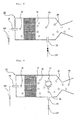
- a propulsion device as designated by reference numeral 50 in Figs. 5 and 6, that uses hydrogen peroxide as oxidizer, a mono-liquid mode and bi-liquid mode are known.
- Fig. 5 is a schematic cross sectional view showing the mono-liquid mode of the propulsion device 50 in the prior art.
- the operation is done such that an oxidizer 30, that is, hydrogen peroxide as a first liquid, is supplied from an oxidizer supply means 10, this hydrogen peroxide is decomposed through a catalyst 16 so that a high temperature oxygen gas 34 and high temperature steam 36 are generated and then the high temperature oxygen gas 34 and high temperature steam 36, as they are, are jetted out of the propulsion device 50 to thereby obtain a thrust.
- an oxidizer 30, that is, hydrogen peroxide as a first liquid is supplied from an oxidizer supply means 10
- this hydrogen peroxide is decomposed through a catalyst 16 so that a high temperature oxygen gas 34 and high temperature steam 36 are generated and then the high temperature oxygen gas 34 and high temperature steam 36, as they are, are jetted out of the propulsion device 50 to thereby obtain a thrust.
- Such of the propulsion device 50 is also called a mono-liquid type thruster in this field of the industry.
- Fig. 6 is a schematic cross sectional view showing the bi-liquid mode of the propulsion device 50 in the prior art.
- the operation is done such that the high temperature oxygen gas 34 and high temperature steam 36 both obtained by the mono-liquid mode are supplied with fuel 32 as a second liquid from a fuel supply means 12 so that the high temperature oxygen gas 34, high temperature steam 36 and fuel 32 are mixed together in a combustion chamber 14.
- a high temperature carbon dioxide 38 together with the high temperature steam 36 is obtained and this is also jetted out of the propulsion device 50 to thereby obtain a larger thrust or specific thrust.
- Such of the propulsion device 50 is also called a bi-liquid type thruster in the field.
- the bi-liquid type thruster is more preferably used than the mono-liquid type thruster in case where a high specific thrust is needed and a large propellant tank is provided.
- the start itself of the propulsion device 50 cannot be done by the bi-liquid mode.
- steps are needed that, while a fuel supply valve 12V is closed, an oxidizer supply valve 10V is opened so that the start is done by the mono-liquid mode and, after the temperature and pressure in the combustion chamber 14 are sufficiently elevated so that a necessary condition of temperature and pressure for ignition of the fuel 32 is secured, the fuel supply valve 12V is opened to start jetting of the fuel 32 and the operation is thereby shifted to the bi-liquid mode.
- the propulsion device 50 As the propulsion device 50 is first started by the mono-liquid mode and then the operation is shifted to the bi-liquid mode, there is caused a time difference of several seconds for the shift of the mode, although the time difference changes according to the type of device and condition of operation. For this reason, the bi-liquid mode is not always appropriately used, especially in case where a high response performance or responsibility is required, such as in a propulsion device for attitude control of an artificial satellite or in a propulsion device for direction change of an aerospace craft.
- the combination of hydrogen peroxide and pure fuel may lead to a less ignitable property as compared with the combination of NTO and MMH as the conventionally used toxic propellant. That is, while the combination of NTO and MMH has a self-ignitability, the combination of hydrogen peroxide and pure fuel is weak in such a property. Thus, if this property is to be made up, it is necessary for the upstream hydrogen peroxide to pass through thick layers of catalyst to be decomposed to become a high temperature gas appropriate for ignition and the thick layers of catalyst used therefore involve a weight increase. For this reason also, the bi-liquid type propulsion device is expected to be made lighter in weight than the propulsion device using NTO and MMH.
- Patent Document 1 USP5932837 (Especially, ABSTRACT)
- the propulsion device shown in the Patent Document 1 has shortcomings, such as a contamination of the surroundings of an aerospace craft due to toxicity of the exhaust gas and solid wastes contained in the exhaust gas, a blockage of the combustion chamber, etc. and the area for which the propulsion device is used is limited. Also, if an azide is used, handling thereof is difficult and the area of use is further limited.
- the present invention is characterized in the construction comprising a preheated surface area increasing means in a combustion chamber.
- a first aspect of the present invention is a propulsion device that comprises a preheating means provided in a combustion chamber, a liquid fuel supply means opening toward the combustion chamber, a surface area increasing means provided in the combustion chamber and an oxidizer supply means opening toward the combustion chamber.
- H 2 O 2 and an organic matter (fuel) when they are mixed together, have an explosive nature but their self-ignitability is small enough so that no instantaneous ignition is caused.
- the H 2 O 2 and fuel, respectively are supplied (jetted) toward substantially the same position on the surface area increasing means to thereby collide with each other, or the H 2 O 2 and fuel, as previously mixed together by an appropriate means, are supplied, or both of them, while they are being atomized and mixed together, are supplied, and thereby an instantaneous ignition can be effected.
- a bi-liquid type thruster using the less toxic propellant there is obtained an effect that a response performance and compactness of the device substantially the same as in the above mentioned bi-liquid type toxic propellant thruster can be realized.
- a second aspect of the present invention is a propulsion device that is characterized in that, additionally to the first aspect, at least one of an orientation to which the liquid fuel supply means opens and an orientation to which the oxidizer supply means opens includes a vector toward the surface area increasing means.
- this propulsion device one or both of the liquid fuel and oxidizer are jetted toward the surface area increasing means.
- the propellant collides with the surface area increasing means so that atomization and mixing of the propellant are accelerated and the contact surface area by which the fuel contacts with the oxidizer is increased.
- a third aspect of the present invention is a propulsion device that is characterized in, additionally to the first and second aspects, further comprising a preheating means, that supplies heat, connected to the surface area increasing means.
- the surface area increasing means has not only its own surface area increasing function but also a preheating function.
- a fourth aspect of the present invention is a propulsion device that is characterized in that, additionally to the first to third aspects, the surface area increasing means is formed in a net shape, a laminated net shape in which a plurality of nets are laminated or a honeycomb shape.
- the weight of the surface area increasing means can be alleviated, thereby reducing the mass of the surface area increasing means. Hence, heat quantity required for the temperature elevation can be reduced and the preheating can be done quickly.
- a fifth aspect of the present invention is a propulsion device that is characterized in that, additionally to the first to fourth aspects, a chemical species of the surface area increasing means is any one or more selected from the group of silver, platinum, palladium, ruthenium and iridium.
- the surface area increasing means has not only its own surface area increasing function but also a function as a decomposition catalyst to decompose the hydrogen peroxide. Thus, a smooth ignitability and high response performance can be realized.
- the hard ignition means an explosive ignition in which a large quantity of propellant instantaneously reacts due to ignition delay and this is not preferable in view of the reliability of the parts and components.
- the chemical species enumerated in this fifth aspect are all precious metals having a catalytic performance to decompose H 2 O 2 , the problem of the hard ignition can be easily avoided consequentially. The mechanism of the hard ignition and avoidance thereof will be described later.
- a heat resistant alloy of a comparatively low cost can be employed to thereby realize a cost reduction.
- a heat resistant alloy nickel alloy or niobium alloy is known.
- Figs. 4(a) to 4(d) show cross sections of wires forming a metal-made net or wire 18, as described later, as the surface area increasing means.
- cross sections of a clod or solid form 20 of a first chemical species forming the wires cross sections of fine particles 26 of the first chemical species and cross sections of fine particles 24 of a second chemical species are shown in circular shapes, it is a matter of course that the cross sections of these wires and particles of the present invention are not limited to the circular shapes.
- a form having a portion of a surface of the clod 20 of the first chemical species covered with a plated layer 22 of the second chemical species as shown in Fig. 4(a)
- a form having the surface of the clod 20 of the first chemical species supporting the fine particles 24 of the second chemical species as shown in Fig. 4(b)
- a form having a net of the first chemical species and a net of the second chemical species alternately laminated on each other and a form having a surface of a clod of a chemical species not enumerated herein supporting particles of the first chemical species and particles of the second chemical species.
- the chemical species of three kinds or more can also be mixedly used.
- the mode using only one kind of the chemical species enumerated herein there can be employed a form having the entire surface of the clod 20 of the first chemical species covered with a plated layer 22 of the second chemical species, as shown in Fig. 4(c). More concretely, as the first chemical species, a kind of a comparatively low cost is employed among the abovementioned precious metals and as the second chemical species, a kind of a comparatively high cost is employed among the precious metals. Thus, apparently, the surface of the net 18 only of the second chemical species is exposed to be used.
- a minute roughness of the surface or an increase of the surface area can be realized. This can be done by optimally carrying out the control of the electric current density in the plating process. For example, in a silver net manufactured by wire materials, the surface is relatively flat. But it is known that, if the wire materials are previously applied with silver plating or the silver net is applied with silver plating, then the minute roughness of the surface can be increased.
- a form as having the surface of the clod 20 of the first chemical species supporting fine particles 26 of the first chemical species can be employed.
- the microscopic surface area per the macroscopic area is increased and an effect to enhance the reaction activation can be obtained.
- a form having a surface of a clod of platinum supporting fine particles of platinum, that is, platinum black corresponds to this.
- a support is made of a substance that is inactive as a decomposition catalyst to decompose the hydrogen peroxide, for example a ceramic selected from the group of alumina, silica, silica gel, etc.
- a form having a surface of this support supporting fine particles of the first chemical species can be employed.
- the ceramic in this case may be also a ceramic that is known from the olden times, if such a ceramic as is excellent in the strength and heat resistance, that is, such one as is called a fine ceramic in the field, is used, then a reliability of the entire propulsion device can be enhanced.
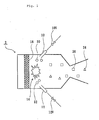
- Fig. 1 is a schematic cross sectional view showing a first embodiment of a propulsion device 2 according to the present invention.
- the propulsion device 2 is shown to jet exhaust gas to the right-hand direction so that the propulsion device 2 moves to the left-hand direction.
- a net or wire 18 made of a metal is provided in the propulsion device 2.
- An oxidizer 30, of which flow rate is appropriately adjusted, is supplied from an oxidizer storing means (not shown) via an oxidizer supply valve 10V and is jetted into the propulsion device 2 by an oxidizer supply means 10.
- a fuel 32 of which flow rate is appropriately adjusted, is supplied from a fuel storing means (not shown) via a fuel supply valve 12V and is jetted into the propulsion device 2 by a fuel supply means 12.
- the oxidizer 30 and fuel 32 are jetted so that they are joined together preferably at one point on the net 18, that is, for example, at a central point of the net 18 as schematically shown in Fig. 1.
- both of the oxidizer supply means 10 and fuel supply means 12 are opened inclinedly relative to a wall surface of the propulsion device 2, that is, inclinedly with an angle of about 45 degrees in the example shown in Fig. 1.
- the scope of the combustion chamber 14 is generally understood to be the portion of the net 18 and the downstream vicinity thereof. This is because it is taken into consideration that the point on the net 18 where the oxidizer 30 and fuel 32 are joined together is the starting point of the combustion and that the direction to which steam 36 and carbon dioxide 38 generated by the combustion can proceed, that is, the direction to which the combustion can spread is the right-hand direction in the figure.
- downstream side of the propulsion device 2 is formed in a constricted shape is to regulate the jetting of the steam 36 and carbon dioxide 38 as well as to regulate the direction thereof. But this does not directly relate to the object of the present invention and detailed description thereof is omitted.
- liquid hydrogen peroxide is employed as the oxidizer 30. Consistency of the hydrogen peroxide is not specifically limited, but if the consistency of the hydrogen peroxide is low, a predetermined thrust cannot be obtained unless a surplus of the oxidizer 30 is loaded. This surplus of the oxidizer 30 becomes a burden and is disadvantageous. That is, in order to obtain a high specific thrust, a higher consistency is preferable. If this is considered, the consistency of the hydrogen peroxide is preferably 50% or more in weight, more preferably 80% or more in weight or most preferably 90% or more in weight and there is no upper limit in any case.
- the propulsion device is used for launching a space rocket, as the flying object is launched against the gravity, even a small alleviation of the weight can bring forth a large cost reduction as a whole.
- a propellant used for launching a space rocket even if hydrogen peroxide of 99.9% in weight, for example, is used, the consistency may not be excessively high.
- oxidizer supply means 10 there is no specific limit in the shape of the oxidizer supply means 10 and a cylindrical shape or gradually enlarged tube shape, for example, can be employed.
- Fig. 2 is a schematic cross sectional view showing a propulsion device 2 having such a construction.
- the propulsion device jets the exhaust gas from the left to the right and the left hand side is the upstream side and the right hand side the downstream side.
- alcoholic fuel represented by ethanol
- ketonic fuel represented by acetone or methyl ethyl ketone
- hydrocarbonic fuel represented by JP-8, JP-10 or kerosine
- amine fuel represented by tetramethylethylenediamine or triethylamine, or a combination thereof
- JP-8 and JP-10 are names of aerofuel well known by experts in the field.
- the fuel supply means 12 opens inclinedly toward the upstream side from the downstream side of the combustion chamber. There is no specific limit in the direction of the opening. But if it is considered that the fuel is to be mixed with H 2 O 2 or an instantaneous ignitability is to be obtained preferably by simultaneously heating the fuel and H 2 O 2 on the net 18, it is basically preferable that the fuel and H 2 O 2 , respectively, are jetted toward a target on the same one point of the net 18. In the example of Fig. 1, the fuel is jetted from the right hand lower position and H 2 O 2 from the right hand upper position so that imaginary lines of the respective jetting directions cross together at one point on the net 18.
- the propulsion device 2 constructed as shown in Fig. 1 as the net 18 of a thin catalyst can be used in place of the thick catalyst 16 of Figs. 5 and 6 that has been used in the prior art propulsion device 50, advantages of a compact size, light weight, low cost, etc. can be obtained. Also, the structure becomes simplified and the realibility is enhanced. Moreover, as the mono-liquid mode itself can be eliminated in the propulsion device 2 constructed as shown in Fig. 1, such a propulsion device as excellent in the startability can be obtained.
- a preheating means (not shown) to the net 18 so that the net 18 is supplied with heat.
- a preheating means there is no specific limit in the kind of the preheating means and a means by electric heating, infrared radiation, etc., for example, can be employed.
- Extent of the preheating is preferably such one that a sufficiently high temperature can be realized relative to the boiling point of the fuel 32. More concretely, in case the fuel is ethanol as alcohol, or acetone as ketone, the preheating is done preferably to the temperature of 100°C or more, more preferably of 150°C or more.
- the material of the net 18 is silver.
- the net 18, made of silver, has a catalytic capability for reaction to decompose the hydrogen peroxide and the problem of the hard ignition can be avoided.
- Material, other than silver, having such a catalytic capability is platinum, palladium, iridium, ruthenium, etc.
- Another technical object to use the precious metals having the catalytic capability is as follows. That is, even if no ignition is effected, the object is to quickly decompose the H 2 O 2 component so that it is made non-toxic to be discharged outside. That is, the object is to obtain a higher safety as compared with the case where the H 2 O 2 as it is not decomposed is discharged outside of the propulsion device.
- the durability relates to a problem of heat-resistance. That is, the problem is whether the catalyst can stand for being exposed to the combustion of long seconds of time or not. If a high heat resistant one is to be selected, such one as has a high melting point can be selected.
- the melting point of each of the precious metals is compared as follows: iridium (2446°C)>ruthenium (2250°C) >platinum (1768°C) >palladium( 1555°C) >silver (962°C).
- the preheating means connected to the net 18 for supplying heat can be provided in an arbitrary structure so that decomposition of the hydrogen peroxide can be accelerated.
- a test device is prepared for ignition tests in simulation of material and shape of an ignition portion of a propulsion device. This test device is for confirmation not of a continuous combustion but of an ignitability of the starting time and has no combustion chamber 14.
- the position relation of the oxidizer supply means 10, fuel supply means 12 and net 18 is the same as shown in Fig. 1 and illustration thereof is omitted.
- Ethanol as the fuel 32 and H 2 O 2 as the oxidizer 30 are used and a surface area increasing means of net shape is employed to form the net 18.
- the net 18 is made of silver and is kept in a preheated state.
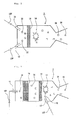
- Fig. 3 is a schematic cross sectional view showing a second embodiment of a propulsion device according to the present invention.
- the present second embodiment is different from the first embodiment of Fig. 1 in the point, for example, that the oxidizer 30, after it has passed through a catalyst 16, becomes a H 2 O 2 decomposed hot gas to enter the combustion chamber.
- the term "H 2 O 2 decomposed hot gas” is used to collectively mean oxygen - 34 and steam 36 generated by the decomposition of H 2 O 2 .
- the oxygen 34 and steam 36 generated by the decomposition of H 2 O 2 while it passes through the catalyst 16 meet with the fuel 32 on the net 18. While there is a slight time delay until the H 2 O 2 decomposed hot gas meets with the fuel 32 in the second embodiment, the effect exhibited by both of the embodiments is the same in consequence.
- the point that the oxidizer 30 is jetted in parallel with the axial direction of the propulsion device 2 is different from the first embodiment. But the fact that the oxidizer 30 meets with the fuel 32 at one point on the net 18 is the same as in the first embodiment and the effect exhibited by both of the embodiments is also the same.
- the present second embodiment is made such that the main point of the conventional H 2 O 2 bi-liquid type thruster is improved.
- the fuel is directly jetted in the high temperature H 2 O 2 decomposed gas. While this method enables a stable ignition, as it is necessary to blow the fuel in the state that the temperature and pressure of the decomposed gas are sufficiently elevated by the mono-liquid mode, there is a problem that it takes time to shift to the bi-liquid mode, as mentioned before. Hence, this problem is improved in the present second embodiment. That is, the fuel is jetted onto the preheated surface area increasing means and thereby a portion of the fuel is gasified and the remaining fuel is also spread on the surface area increasing means. Thus, the contact surface area and contact time of the fuel with the decomposed gas generated by the decomposition of H 2 O 2 can be increased.
- the propulsion device constructed as mentioned above the ignitability can be enhanced and the response performance can also be enhanced.
- the present second embodiment can exhibit the effect as follows; That is, as the result of the enhanced ignitability, the volume of the combustion chamber 14 necessary for the ignition reaction can be reduced and the weight of the combustion chamber 14 can also be alleviated. This enables the propulsion device 2 itself to be made smaller and lighter.
- the propulsion device is started by the mono-liquid mode, the net 18 can be preheated by heat of the decomposed hot gas itself generated by the decomposition of the hydrogen peroxide and thereby a predetermined performance can be obtained even if no exclusive preheating means is provided.
- the net 18, preferably the preheated metal net, of the second embodiment is arranged between the generated gas obtained by the decomposition of H 2 O 2 and the fuel 32. Thereby, the gasification of the fuel 32 and the reaction activation of the fuel 32 with the generated gas can be accelerated. It is to be noted that the effect obtained by the increase of the contact surface area is the same as in the first embodiment.
- a heating means can be provided between the oxidizer supply means 10 and combustion chamber 14. Thereby, the decomposition of the hydrogen peroxide is accelerated so as to realize a smooth ignition and a high response performance as a propulsion device can be obtained.
- the necessary time for the mono-liquid mode can be reduced.
- the condition of pressure and temperature required for shifting to the bi-liquid mode from the mono-liquid mode can be mitigated as compared with the conventional propulsion device. More concretely, even if the surrounding pressure or temperature is comparatively low, shifting to the bi-liquid mode can be done. Thereby, the time to shift to the bi-liquid mode after the start by the mono-liquid mode can be reduced. Also, the combustion chamber can be designed smaller.
- the propulsion device of the present invention has a high response performance and is made in a compact size, as compared with the conventional bi-liquid type thruster using H 2 O 2 . Also, with respect to any of the response performance, specific thrust, compactness and simplicity, the propulsion device of the present invention has a performance near the conventional toxic propellant thruster using the combination of NTO and MMH and yet can avoid the difficulty of handling caused by the high toxicity of NTO and MMH.
- the propulsion device of the present invention can be preferably applied to the attitude control of a flying object that requires a quick attitude control, such as an artificial satellite, on-trajectory working station, lunar probe, planet probe, guided aerospace craft, launching rocket, etc.
- a quick attitude control such as an artificial satellite, on-trajectory working station, lunar probe, planet probe, guided aerospace craft, launching rocket, etc.
- a main propulsion device can be separately provided for propulsion only and the propulsion device of the present invention can be used as a sub-propulsion device, that is, an exclusive attitude control device.
- the propulsion device exclusive for the attitude control can exhibit its effect even with a small thrust. But in order to control the attitude in an arbitrary direction, it is preferable to provide a plurality of the propulsion devices exclusive for the attitude control.
- the term "attitude control" as used herein includes to correct or change the trajectory on which the flying object moves.
- the main propulsion device and sub-propulsion device can be provided by the propulsion device of the present invention. But, as a single propulsion device can hardly control the attitude, it is preferable that the flying object is provided with a plurality of the propulsion devices.
- the flying object is of a type that moves on the trajectory without a propulsion drive force, as there is needed no main propulsion device, it can only have the propulsion device of the present invention.
- an artificial satellite can be named, for example.
- a propulsion device using a non-toxic propellant and yet having both of a high thrust or specific thrust and a high response performance can be provided.
- a flying object excellent in the attitude control performance can be provided.
Landscapes
- Engineering & Computer Science (AREA)
- Chemical & Material Sciences (AREA)
- Combustion & Propulsion (AREA)
- Mechanical Engineering (AREA)
- General Engineering & Computer Science (AREA)
- Catalysts (AREA)
Abstract
Description
Claims (12)
- A propulsion device comprising;a preheating means provided in a combustion chamber (14),a liquid fuel supply means (12) opening toward said combustion chamber (14),a surface area increasing means (18) provided in said combustion chamber (14),an oxidizer supply means (10) opening toward said combustion chamber (14),an oxidizer storing means connected to said oxidizer supply means and hydrogen peroxide stored in said oxidizer storing means.
- A propulsion device as claimed in Claim 1, characterized in that at least one of an orientation to which said liquid fuel supply means (12) opens and an orientation to which said oxidizer supply means (10) opens includes a vector toward said surface area increasing means (18).
- A propulsion device as claimed in Claim 1 or 2, characterized in further comprising a preheating means, that supplies heat, connected to said surface area increasing means (18).
- A propulsion device as claimed in any one of Claims 1 to 3, characterized in that said surface area increasing means (18) is formed in any one shape selected from the group of a net shape, a laminated net shape in which a plurality of nets are laminated and a honeycomb shape.
- A propulsion device as claimed in any one of Claims 1 to 4, characterized in that a chemical species of said surface area increasing means (18) is any one or more selected from the group of silver, platinum, palladium, ruthenium and iridium.
- A propulsion device as claimed in Claim 5, characterized in that said surface area increasing means (18) comprises a support made of a ceramic and a catalyst arranged in contact with said support and a chemical species of said catalyst is any one or more selected from the group of silver, platinum, palladium, ruthenium and iridium.
- A flying object comprising a propulsion device as claimed in any one of Claims 1 to 6.
- A flying object as claimed in Claim 7, characterized in that said flying object is any one of an artificial satellite, an on-trajectory working station, a lunar probe, a planet probe, a guided aerospace craft and a launch vehicle.
- A propulsion device igniting method comprising the steps of;preheating a surface area increasing means (18) provided in a combustion chamber (14) (a preheating step),supplying a liquid fuel (32) into said combustion chamber (14) (a fuel supply step),causing said liquid fuel (32) to contact with said surface area increasing means (18) (a fuel contacting step),supplying an oxidizer (30) into said combustion chamber (14) (an oxidizer supply step) andcausing said oxidizer (30) to contact with said surface area increasing means (18) (an oxidizer contacting step).
- A propulsion device igniting method as claimed in Claim 9, characterized in that at least one of an orientation to which said liquid fuel (32) is supplied and an orientation to which said oxidizer (30) is supplied includes a vector toward said surface area increasing means (18).
- A propulsion device igniting method as claimed in Claim 9 or 10, characterized in that said preheating step is a step of supplying said surface area increasing means (18) with heat.
- A propulsion device igniting method as claimed in any one of Claims 9 to 11, characterized in that a chemical species of said oxidizer (30) is hydrogen peroxide.
Applications Claiming Priority (2)
| Application Number | Priority Date | Filing Date | Title |
|---|---|---|---|
| JP2003049481A JP2004257318A (en) | 2003-02-26 | 2003-02-26 | Propulsion apparatus and flying object including the same and method for igniting propulsion apparatus |
| JP2003049481 | 2003-02-26 |
Publications (3)
| Publication Number | Publication Date |
|---|---|
| EP1455076A2 true EP1455076A2 (en) | 2004-09-08 |
| EP1455076A3 EP1455076A3 (en) | 2005-04-20 |
| EP1455076B1 EP1455076B1 (en) | 2011-04-13 |
Family
ID=32821124
Family Applications (1)
| Application Number | Title | Priority Date | Filing Date |
|---|---|---|---|
| EP04290501A Expired - Lifetime EP1455076B1 (en) | 2003-02-26 | 2004-02-25 | Propulsion device, flying object comprising the same and propulsion device igniting method |
Country Status (3)
| Country | Link |
|---|---|
| US (1) | US20040231766A1 (en) |
| EP (1) | EP1455076B1 (en) |
| JP (1) | JP2004257318A (en) |
Cited By (4)
| Publication number | Priority date | Publication date | Assignee | Title |
|---|---|---|---|---|
| DE102007057275A1 (en) * | 2007-11-28 | 2009-06-10 | Möcker, Jochen | Thermodynamically operating engine for use as propulsion device in modeling and in air travel, has injection device arranged within pipe for propellant and oxidant |
| KR101032622B1 (en) | 2009-09-28 | 2011-05-09 | 한국과학기술원 | Dual Propellant Rocket Engine Using Hydrogen Peroxide Degradation and Its Propulsion Method |
| CN103790734A (en) * | 2014-02-18 | 2014-05-14 | 苟仲武 | Booster rocket engine device and method with liquefied air thrust augmentation |
| WO2024151491A1 (en) * | 2023-01-10 | 2024-07-18 | Venus Aerospace Corp | 3d-printed catalyst bed for rocket engine |
Families Citing this family (10)
| Publication number | Priority date | Publication date | Assignee | Title |
|---|---|---|---|---|
| JP4915868B2 (en) * | 2007-10-02 | 2012-04-11 | 株式会社Ihiエアロスペース | 2-component thruster |
| JP5424470B2 (en) * | 2009-06-24 | 2014-02-26 | 三菱重工業株式会社 | Low temperature propellant |
| CA2892229A1 (en) * | 2013-02-14 | 2014-08-21 | Clearsign Combustion Corporation | Startup method and mechanism for a burner having a perforated flame holder |
| JP6000159B2 (en) * | 2013-02-19 | 2016-09-28 | 三菱重工業株式会社 | Rocket engine |
| EP2999684B1 (en) * | 2013-05-20 | 2020-05-06 | ECAPS Aktiebolag | Dual mode chemical rocket engine and dual mode propulsion system comprising the rocket engine |
| WO2014193300A1 (en) * | 2013-05-29 | 2014-12-04 | Ecaps Ab | Dual mode chemical rocket engine, and dual mode propulsion system comprising the rocket engine |
| WO2018160869A1 (en) * | 2017-03-02 | 2018-09-07 | Clearsign Combustion Corporation | Fuel nozzle with augmented fuel/air mixing |
| WO2021245821A1 (en) * | 2020-06-03 | 2021-12-09 | 合同会社パッチドコニックス | Propulsion system and method using self-decomposition of nitrous oxide |
| CN112897443B (en) * | 2021-01-19 | 2021-11-16 | 北京航空航天大学 | Mobile high-concentration hydrogen peroxide filling, storage and delivery system |
| CN113107710B (en) * | 2021-05-10 | 2023-10-20 | 苏州旗磐科技有限公司 | Low-thrust double-component attitude control engine |
Family Cites Families (9)
| Publication number | Priority date | Publication date | Assignee | Title |
|---|---|---|---|---|
| US2791883A (en) * | 1951-10-25 | 1957-05-14 | Gen Electric | Propellant system |
| US3056663A (en) * | 1959-06-15 | 1962-10-02 | Gen Electric | Catalyst decomposition chamber |
| US3150485A (en) * | 1961-11-24 | 1964-09-29 | Frederick R Hickerson | Variable thrust rocket engine |
| DE2706679C2 (en) * | 1977-02-17 | 1979-09-13 | Deutsche Forschungs- Und Versuchsanstalt Fuer Luft- Und Raumfahrt E.V., 5000 Koeln | Device for the thermal decomposition of liquid fuels |
| US4288982A (en) * | 1977-07-25 | 1981-09-15 | Nasa | Low thrust monopropellant engine |
| US5932837A (en) * | 1997-12-22 | 1999-08-03 | The United States Of America As Represented By The Secretary Of The Navy | Non-toxic hypergolic miscible bipropellant |
| US6272846B1 (en) * | 1999-04-14 | 2001-08-14 | The United States Of America As Represented By The Administrator Of The National Aeronautics And Space Administration | Reduced toxicity fuel satellite propulsion system |
| US6779335B2 (en) * | 2000-12-07 | 2004-08-24 | Joseph Roger Herdy, Jr. | Burning nitrous oxide and a fuel |
| WO2002095207A1 (en) * | 2001-05-23 | 2002-11-28 | Svenska Rymdaktiebolaget | Reactor for decomposition of ammonium dinitramide-based liquid monopropellants and process for the decomposition |
-
2003
- 2003-02-26 JP JP2003049481A patent/JP2004257318A/en not_active Withdrawn
-
2004
- 2004-01-05 US US10/750,851 patent/US20040231766A1/en not_active Abandoned
- 2004-02-25 EP EP04290501A patent/EP1455076B1/en not_active Expired - Lifetime
Non-Patent Citations (1)
| Title |
|---|
| None |
Cited By (5)
| Publication number | Priority date | Publication date | Assignee | Title |
|---|---|---|---|---|
| DE102007057275A1 (en) * | 2007-11-28 | 2009-06-10 | Möcker, Jochen | Thermodynamically operating engine for use as propulsion device in modeling and in air travel, has injection device arranged within pipe for propellant and oxidant |
| KR101032622B1 (en) | 2009-09-28 | 2011-05-09 | 한국과학기술원 | Dual Propellant Rocket Engine Using Hydrogen Peroxide Degradation and Its Propulsion Method |
| CN103790734A (en) * | 2014-02-18 | 2014-05-14 | 苟仲武 | Booster rocket engine device and method with liquefied air thrust augmentation |
| CN103790734B (en) * | 2014-02-18 | 2015-10-21 | 苟仲武 | The afterburning booster rocket engine Apparatus and method for of a kind of liquid air |
| WO2024151491A1 (en) * | 2023-01-10 | 2024-07-18 | Venus Aerospace Corp | 3d-printed catalyst bed for rocket engine |
Also Published As
| Publication number | Publication date |
|---|---|
| EP1455076B1 (en) | 2011-04-13 |
| EP1455076A3 (en) | 2005-04-20 |
| US20040231766A1 (en) | 2004-11-25 |
| JP2004257318A (en) | 2004-09-16 |
Similar Documents
| Publication | Publication Date | Title |
|---|---|---|
| EP1455076B1 (en) | Propulsion device, flying object comprising the same and propulsion device igniting method | |
| Li et al. | Comparative investigation on combustion characteristics of ADN-based liquid propellants in inert gas and oxidizing gas atmospheres with resistive ignition method | |
| Schmidt | Hydrazine and Its Derivatives: Preparation, Properties, Applications, 2 Volume Set | |
| US6779335B2 (en) | Burning nitrous oxide and a fuel | |
| US10180118B2 (en) | Electrical/chemical thruster using the same monopropellant and method | |
| US20110005194A1 (en) | Flashback shut-off | |
| US7506498B2 (en) | Pulsed detonation engines for reaction control systems | |
| US6073437A (en) | Stable-combustion oxidizer for hybrid rockets | |
| US8024918B2 (en) | Rocket motor having a catalytic hydroxylammonium (HAN) decomposer and method for combusting the decomposed HAN-based propellant | |
| Meinhardt et al. | Development and testing of new, HAN-based monopropellants in small rocket thrusters | |
| US5794435A (en) | Stable-combustion oxidizer vaporizer for hybrid rockets | |
| Li et al. | Effect of voltage and droplet size on electrical ignition characteristics of ADN-based liquid propellant droplet | |
| US7735311B2 (en) | Pulsed detonation engines manufactured from materials having low thermal stability | |
| EP1533511A1 (en) | Process for igniting a rocket engine and rocket engine | |
| Liu et al. | A long duration and high reliability liquid apogee engine for satellites | |
| Quintens et al. | Experimental comparison of hydrogen peroxide catalysts for a hydrogen peroxide/n-decane bipropellant combustor | |
| Tiliakos et al. | Development and testing of a nitrous oxide/propane rocket engine | |
| Pasini et al. | A light unsaturated hydrocarbon and hydrogen peroxide as future green propellants for bipropellant thrusters | |
| Matsuura et al. | Investigation on Suppression of Hard-Start Phenomena in a Hypergolic Bipropellant Engine | |
| Pinto et al. | Green gelled propellant highly throtteable rocket motor and gas generator technology: status and application | |
| JP5250873B2 (en) | Catalytic decomposition thruster for spacecraft | |
| Tyll et al. | The nitrous oxide-propane rocket engine | |
| Torre et al. | PulCheR–Pulsed Chemical Rocket with Green High Performance Propellants: First Year Project Overview | |
| Herdy | Nitrous oxide/hydrocarbon fuel advanced chemical propulsion: DARPA contract overview | |
| Negri et al. | Lessons Learned from Thermal Ignition Testing with Ammonium Dinitramide-Based Monopropellants |
Legal Events
| Date | Code | Title | Description |
|---|---|---|---|
| PUAI | Public reference made under article 153(3) epc to a published international application that has entered the european phase |
Free format text: ORIGINAL CODE: 0009012 |
|
| 17P | Request for examination filed |
Effective date: 20040309 |
|
| AK | Designated contracting states |
Kind code of ref document: A2 Designated state(s): AT BE BG CH CY CZ DE DK EE ES FI FR GB GR HU IE IT LI LU MC NL PT RO SE SI SK TR |
|
| AX | Request for extension of the european patent |
Extension state: AL HR LT LV MK |
|
| PUAL | Search report despatched |
Free format text: ORIGINAL CODE: 0009013 |
|
| AK | Designated contracting states |
Kind code of ref document: A3 Designated state(s): AT BE BG CH CY CZ DE DK EE ES FI FR GB GR HU IE IT LI LU MC NL PT RO SE SI SK TR |
|
| AX | Request for extension of the european patent |
Extension state: AL HR LT LV MK |
|
| RIC1 | Information provided on ipc code assigned before grant |
Ipc: 7F 02K 9/42 A Ipc: 7F 02K 9/68 B |
|
| AKX | Designation fees paid |
Designated state(s): FR GB |
|
| REG | Reference to a national code |
Ref country code: DE Ref legal event code: 8566 |
|
| GRAP | Despatch of communication of intention to grant a patent |
Free format text: ORIGINAL CODE: EPIDOSNIGR1 |
|
| GRAS | Grant fee paid |
Free format text: ORIGINAL CODE: EPIDOSNIGR3 |
|
| GRAA | (expected) grant |
Free format text: ORIGINAL CODE: 0009210 |
|
| AK | Designated contracting states |
Kind code of ref document: B1 Designated state(s): FR GB |
|
| REG | Reference to a national code |
Ref country code: GB Ref legal event code: FG4D |
|
| RIN2 | Information on inventor provided after grant (corrected) |
Inventor name: NISHIDA, MITSURU Inventor name: TSUTAYA, HIROYUKI Inventor name: YASUTAKE, AKINORI Inventor name: MORIAI, HIDEKI |
|
| PLBE | No opposition filed within time limit |
Free format text: ORIGINAL CODE: 0009261 |
|
| STAA | Information on the status of an ep patent application or granted ep patent |
Free format text: STATUS: NO OPPOSITION FILED WITHIN TIME LIMIT |
|
| 26N | No opposition filed |
Effective date: 20120116 |
|
| REG | Reference to a national code |
Ref country code: FR Ref legal event code: PLFP Year of fee payment: 13 |
|
| REG | Reference to a national code |
Ref country code: FR Ref legal event code: PLFP Year of fee payment: 14 |
|
| REG | Reference to a national code |
Ref country code: FR Ref legal event code: PLFP Year of fee payment: 15 |
|
| PGFP | Annual fee paid to national office [announced via postgrant information from national office to epo] |
Ref country code: GB Payment date: 20200212 Year of fee payment: 17 |
|
| PGFP | Annual fee paid to national office [announced via postgrant information from national office to epo] |
Ref country code: FR Payment date: 20200113 Year of fee payment: 17 |
|
| GBPC | Gb: european patent ceased through non-payment of renewal fee |
Effective date: 20210225 |
|
| PG25 | Lapsed in a contracting state [announced via postgrant information from national office to epo] |
Ref country code: FR Free format text: LAPSE BECAUSE OF NON-PAYMENT OF DUE FEES Effective date: 20210228 Ref country code: GB Free format text: LAPSE BECAUSE OF NON-PAYMENT OF DUE FEES Effective date: 20210225 |