EP1454903A1 - Thiadiazoline derivative - Google Patents
Thiadiazoline derivative Download PDFInfo
- Publication number
- EP1454903A1 EP1454903A1 EP02788786A EP02788786A EP1454903A1 EP 1454903 A1 EP1454903 A1 EP 1454903A1 EP 02788786 A EP02788786 A EP 02788786A EP 02788786 A EP02788786 A EP 02788786A EP 1454903 A1 EP1454903 A1 EP 1454903A1
- Authority
- EP
- European Patent Office
- Prior art keywords
- substituted
- unsubstituted
- compound
- mmol
- unsubstituted lower
- Prior art date
- Legal status (The legal status is an assumption and is not a legal conclusion. Google has not performed a legal analysis and makes no representation as to the accuracy of the status listed.)
- Granted
Links
- 0 CC1(*)SC(N(*)*)=NN1* Chemical compound CC1(*)SC(N(*)*)=NN1* 0.000 description 1
Classifications
-
- C—CHEMISTRY; METALLURGY
- C07—ORGANIC CHEMISTRY
- C07D—HETEROCYCLIC COMPOUNDS
- C07D285/00—Heterocyclic compounds containing rings having nitrogen and sulfur atoms as the only ring hetero atoms, not provided for by groups C07D275/00 - C07D283/00
- C07D285/01—Five-membered rings
- C07D285/02—Thiadiazoles; Hydrogenated thiadiazoles
- C07D285/04—Thiadiazoles; Hydrogenated thiadiazoles not condensed with other rings
- C07D285/12—1,3,4-Thiadiazoles; Hydrogenated 1,3,4-thiadiazoles
- C07D285/125—1,3,4-Thiadiazoles; Hydrogenated 1,3,4-thiadiazoles with oxygen, sulfur or nitrogen atoms, directly attached to ring carbon atoms, the nitrogen atoms not forming part of a nitro radical
- C07D285/135—Nitrogen atoms
-
- A—HUMAN NECESSITIES
- A61—MEDICAL OR VETERINARY SCIENCE; HYGIENE
- A61K—PREPARATIONS FOR MEDICAL, DENTAL OR TOILETRY PURPOSES
- A61K31/00—Medicinal preparations containing organic active ingredients
- A61K31/33—Heterocyclic compounds
- A61K31/395—Heterocyclic compounds having nitrogen as a ring hetero atom, e.g. guanethidine or rifamycins
- A61K31/41—Heterocyclic compounds having nitrogen as a ring hetero atom, e.g. guanethidine or rifamycins having five-membered rings with two or more ring hetero atoms, at least one of which being nitrogen, e.g. tetrazole
- A61K31/433—Thidiazoles
-
- A—HUMAN NECESSITIES
- A61—MEDICAL OR VETERINARY SCIENCE; HYGIENE
- A61K—PREPARATIONS FOR MEDICAL, DENTAL OR TOILETRY PURPOSES
- A61K31/00—Medicinal preparations containing organic active ingredients
- A61K31/33—Heterocyclic compounds
- A61K31/395—Heterocyclic compounds having nitrogen as a ring hetero atom, e.g. guanethidine or rifamycins
- A61K31/435—Heterocyclic compounds having nitrogen as a ring hetero atom, e.g. guanethidine or rifamycins having six-membered rings with one nitrogen as the only ring hetero atom
- A61K31/44—Non condensed pyridines; Hydrogenated derivatives thereof
- A61K31/4427—Non condensed pyridines; Hydrogenated derivatives thereof containing further heterocyclic ring systems
- A61K31/4439—Non condensed pyridines; Hydrogenated derivatives thereof containing further heterocyclic ring systems containing a five-membered ring with nitrogen as a ring hetero atom, e.g. omeprazole
-
- A—HUMAN NECESSITIES
- A61—MEDICAL OR VETERINARY SCIENCE; HYGIENE
- A61K—PREPARATIONS FOR MEDICAL, DENTAL OR TOILETRY PURPOSES
- A61K31/00—Medicinal preparations containing organic active ingredients
- A61K31/33—Heterocyclic compounds
- A61K31/395—Heterocyclic compounds having nitrogen as a ring hetero atom, e.g. guanethidine or rifamycins
- A61K31/495—Heterocyclic compounds having nitrogen as a ring hetero atom, e.g. guanethidine or rifamycins having six-membered rings with two or more nitrogen atoms as the only ring heteroatoms, e.g. piperazine or tetrazines
- A61K31/4965—Non-condensed pyrazines
- A61K31/497—Non-condensed pyrazines containing further heterocyclic rings
-
- A—HUMAN NECESSITIES
- A61—MEDICAL OR VETERINARY SCIENCE; HYGIENE
- A61K—PREPARATIONS FOR MEDICAL, DENTAL OR TOILETRY PURPOSES
- A61K31/00—Medicinal preparations containing organic active ingredients
- A61K31/33—Heterocyclic compounds
- A61K31/395—Heterocyclic compounds having nitrogen as a ring hetero atom, e.g. guanethidine or rifamycins
- A61K31/535—Heterocyclic compounds having nitrogen as a ring hetero atom, e.g. guanethidine or rifamycins having six-membered rings with at least one nitrogen and one oxygen as the ring hetero atoms, e.g. 1,2-oxazines
- A61K31/5375—1,4-Oxazines, e.g. morpholine
- A61K31/5377—1,4-Oxazines, e.g. morpholine not condensed and containing further heterocyclic rings, e.g. timolol
-
- A—HUMAN NECESSITIES
- A61—MEDICAL OR VETERINARY SCIENCE; HYGIENE
- A61P—SPECIFIC THERAPEUTIC ACTIVITY OF CHEMICAL COMPOUNDS OR MEDICINAL PREPARATIONS
- A61P35/00—Antineoplastic agents
-
- A—HUMAN NECESSITIES
- A61—MEDICAL OR VETERINARY SCIENCE; HYGIENE
- A61P—SPECIFIC THERAPEUTIC ACTIVITY OF CHEMICAL COMPOUNDS OR MEDICINAL PREPARATIONS
- A61P43/00—Drugs for specific purposes, not provided for in groups A61P1/00-A61P41/00
-
- A—HUMAN NECESSITIES
- A61—MEDICAL OR VETERINARY SCIENCE; HYGIENE
- A61P—SPECIFIC THERAPEUTIC ACTIVITY OF CHEMICAL COMPOUNDS OR MEDICINAL PREPARATIONS
- A61P7/00—Drugs for disorders of the blood or the extracellular fluid
-
- C—CHEMISTRY; METALLURGY
- C07—ORGANIC CHEMISTRY
- C07D—HETEROCYCLIC COMPOUNDS
- C07D285/00—Heterocyclic compounds containing rings having nitrogen and sulfur atoms as the only ring hetero atoms, not provided for by groups C07D275/00 - C07D283/00
- C07D285/01—Five-membered rings
- C07D285/02—Thiadiazoles; Hydrogenated thiadiazoles
- C07D285/04—Thiadiazoles; Hydrogenated thiadiazoles not condensed with other rings
- C07D285/12—1,3,4-Thiadiazoles; Hydrogenated 1,3,4-thiadiazoles
Definitions
- the present invention relates to an antitumor agent comprising a thiadiazoline derivative or a pharmacologically acceptable salt thereof as an active ingredient, and a thiadiazoline derivative or a pharmacologically acceptable salt thereof which is useful for therapeutic treatment of a tumor.
- anticancer agents including antimitotic agents such as taxane and vinca alkaloid, topoisomerase inhibitors, alkylating agents and the like have been used. These agents have side effects such as bone marrow toxicity and neuropathy, a problem of drug resistance and the like. Therefore, novel anticancer agents which have improvement in the above problems have so far been desired.
- thiadiazoline derivatives have inhibitory activity against transcription factor STAT6 activation, antagonistic action of integrin, and the control of insect or acarid pests (Japanese Published Unexamined Patent Application No. 2000-229959, WO01/56994, US6235762).
- the derivatives have antibacterial activity, ACE inhibitory activity and the like [J. Bangladesh Chem. Soc., Vol. 5, p. 127 (1992), WO93/22311, Japanese Published Unexamined Patent Application No. 62-53976 ( 1987)].
- An object of the present invention is to provide a thiadiazoline derivative or a pharmacologically acceptable salt thereof which is useful for therapeutic treatment of a human malignant tumor, for example, breast cancer, gastric cancer, ovarian cancer, colon cancer, lung cancer, brain tumor, laryngeal cancer, hematological cancer, urinary or genital tumor including bladder cancer and prostatic cancer, renal cancer, skin carcinoma, hepatic carcinoma, pancreatic cancer, a uterine cancer, or the like.
- Another object of the present invention is to provide an antitumor agent comprising a thiadiazoline derivative or a pharmacologically acceptable salt thereof as an active ingredient.
- the present invention relates to the following (1) to (43).
- Example of the pharmacologically acceptable salt of Compound (I) and Compound (IA) include pharmacologically acceptable acid addition salts, metal salts, ammonium salts, organic amine addition salts, amino acid addition salts and the like.
- the acid addition salt include an inorganic salt such as a hydrochloride, a sulfate and a phosphate, an organic acid salt such as an acetate, a maleate, a fumarate, a tartrate, a citrate, a lactate, an aspartate, a glutamate, succinate and the like.
- Examples of the metal salt include an alkali metal salt such as a sodium salt and a potassium salt, an alkaline-earth metal salt such as a magnesium salt and a calcium salt, an aluminium salt, a zinc salt and the like.
- Examples of the ammonium salt include a salt of ammonium, tetramethylammonium and the like.
- Examples of the organic amine addition salt include an addition salt with morpholine, piperidine or the like.
- Examples of the amino acid addition salt include an addition salt with lysine, glycine, phenylalanine and the like.
- the desired compound when the defined group changes under the conditions of the method carried out, or the method is inappropriate for carrying out, the desired compound can be obtained by using the protection and deprotection of the groups which are ordinarily used in the synthetic organic chemistry [e.g., Protective Groups in Organic Synthesis, T. W. Greene, John Wiley & Sons Inc. (1981)] and the like.
- the order of the steps for introducing a substituent and the like may be changed, if necessary.
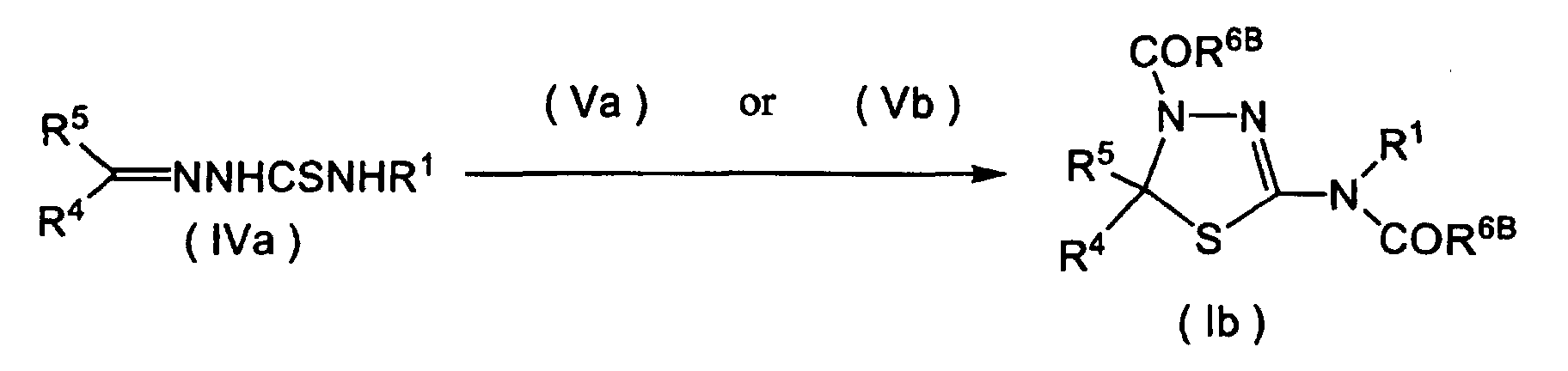
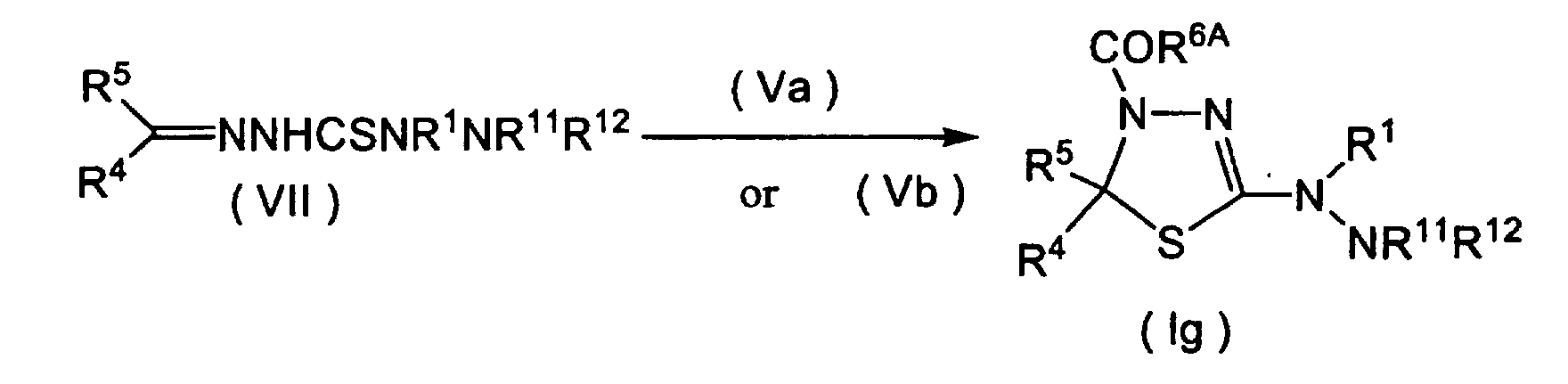
- Compound (I) can be prepared according to the following reaction steps.
- Compound (IA) can also be prepared in the similar manner as in the preparing methods of Compound (I) as shown below.
- Compound (Ia) wherein R 2 is a hydrogen atom, substituted or unsubstituted lower alkyl, substituted or unsubstituted lower alkynyl, substituted or unsubstituted lower alkenyl, or substituted or unsubstituted cycloalkyl, or R 1 and R 2 are combined to form a substituted or unsubstituted heterocyclic group together with the adjacent nitrogen atom, and R 3 is -C( O)R 6A can be obtained from Compound (II) and Compound (III),via Compound (IV), in accordance with known methods [e.g., J. Heterocyclic Chem., Vol. 21, p.
- R 1 , R 4 , R 5 , R 6 and R 6A have the same meanings as those mentioned above, respectively, X 1 has the same meaning as that of the aforementioned X, and R 2a represents a hydrogen atom, substituted or unsubstituted lower alkyl, substituted or unsubstituted lower alkynyl, substituted or unsubstituted lower alkenyl, or substituted or unsubstituted cycloalkyl among the definition of the aforementioned R 2 , or R 1 and R 2a are combined to form a substituted or unsubstituted heterocyclic group together with the adjacent nitrogen atom.
- Compound (Ic) can be obtained by treatment of Compound (Ib) in an inert solvent, for example, N,N-dimethylformamide and the like, in the presence of an appropriate base such as sodium hydride and the like, at a temperature between 0°C and 80°C for 10 minutes to 10 hours.
- the base is preferably used in an amount of 1 to 5 equivalents to Compound (Ib).
- Compound (Ic) can also be obtained by the following method.
- Compound (Ic) can be obtained by treatment of Compound (Ib) in an inert solvent, for example, aqueous or anhydrous ethanol, acetonitrile, chloroform and the like, in the presence of an appropriate base such as hydrazine monohydrate, aqueous sodium hydroxide and the like, at a temperature between 0°C and 50°C for 1 to 10 hours.
- an appropriate base such as hydrazine monohydrate, aqueous sodium hydroxide and the like, at a temperature between 0°C and 50°C for 1 to 10 hours.
- the base is preferably used in an amount of 2 to 10 equivalents to Compound (Ib).
- Compound (Ic) can also be obtained by the following method.
- Compound (Ic) can be obtained by treatment of Compound (Ib) in a solvent such as methanol, tert-butanol and the like, in the presence of a reducing agent such as sodium borohydride and the like, and if necessary, in the presence of cerium chloride heptahydrate and the like, at a temperature between -10°C and 100°C for 0.1 to 15 hours.
- a reducing agent such as sodium borohydride and the like
- cerium chloride heptahydrate and the like at a temperature between -10°C and 100°C for 0.1 to 15 hours.
- the reducing agent is preferably used in an amount of 1 to 200 equivalents to Compound (Ib).
- Compound (Ie) can be obtained by allowing Compound (Ic) to react with Compound (VA) or Compound (VB) in an inert solvent, for example, acetone, ethyl acetate, acetonitrile, N,N-dimethylformamide, dichloromethane and the like, in the presence of an appropriate base such as pyridine, 4-(dimethylamino)pyridine (DMAP), sodium hydride and the like, at a temperature between 0°C and 120°C for 2 to 12 hours.
- the base and Compound (VA) or Compound (VB) are preferably used, respectively, in an amount of 1 to 3 equivalents to Compound (Ic).
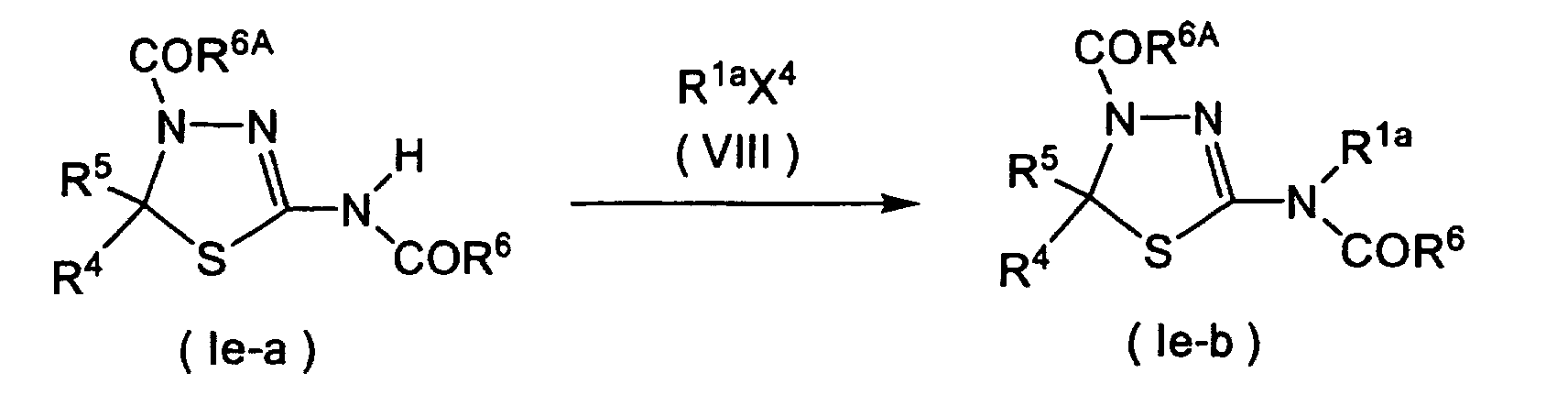
- Compound (Ie-b) wherein R 1 is substituted or unsubstituted lower alkyl, substituted or unsubstituted lower alkynyl, substituted or unsubstituted lower alkenyl, or substituted or unsubstituted cycloalkyl can be obtained by the following step from Compound (Ie-a) among Compound (Ie) wherein R 1 is a hydrogen atom prepared by the Preparing method 4: (wherein R 4 , R 5 , R 6 and R 6A have the same meanings as those mentioned above, respectively, X 4 has the same meaning as that of the aforementioned X, and R 1a represents substituted or unsubstituted lower alkyl,a substituted or unsubstituted lower alkynyl, substituted or unsubstituted lower alkenyl, or substituted or unsubstituted cycloalkyl among the definition of the aforementioned R 1 .)
- Compound (Ie-b) can be obtained by allowing Compound (Ie-a) to react with Compound (VIII) in an inert solvent, for example, N,N-dimethylformamide and the like, in the presence of an appropriate base such as sodium hydroxide, at a temperature between 0°C and room temperature for 1 to 24 hours.
- the base and Compound (VIII) are preferably used in amounts of 2 to 5 equivalents and 2 to 3 equivalents, respectively, to Compound (Ie-a).
- Compound (Ih) wherein R 3 is a hydrogen atom can be obtained by the methods described in for example, Phosphorus, Sulfur and Silicone and the Related Elements, Vol. 122, p. 307 (1997) and Chem. Ber., Vol. 123, p. 691 (1990) and the like, or the methods similar to the aforementioned methods.
- Compound (Ij) can be obtained by treatment of Compound (Ik) in a solvent such as toluene and tetrahydrofuran, with an appropriate thiocarbonylating agent such as 2,4-bis(4-methoxyphenyl)-1,3-dithia-2,4-diphophethane-2,4-disulfide (Lawesson's reagent), phosphorus pentasulfide and the like, at a temperature between room temperature and the boiling point of the solvent for 1 to 24 hours.
- the thiocarbonylating agent is preferably used in an amount of 2 to 10 equivalents to Compound (Ik).
- Compound (Ip) can be obtained from Compound (In) by the methods described in for example, Chem. Commun., Vol. 8, p. 873 (1998) and the like, or the methods similar to the aforementioned methods.
- Compound (Im) can be obtained by allowing Compound (Ip) to react with Compound (IX) in an inert solvent, for example, dichloromethane and the like, at a temperature between 0°C and 64°C for 10 minutes to 24 hours.
- Compound (IX) is preferably used in an amount of 2 to 50 equivalents to Compound (Ip).
- Compound (Im) can also be obtained from Compound (Ie-c) wherein R 1 is a hydrogen atom and R 6 is an alkyl group substituted with carboxyl group among Compound (Ie) prepared by the Preparing method 4 by the method described in for example, Synthesis-Stuttgart, Vol. 5, p. 420 (1991) or the methods similar to the aforementioned method.
- Compound (Im) can also be obtained from Compound (Ie-d) wherein R 1 is a hydrogen atom and R 6 is an alkyl group substituted with halogen among Compound (Ie) by the method described in for example, Shin-Jikken-Kagaku-Koza (New Experiment Chemistry Lecture) Vol. 14, p. 1174 (Maruzen, 1978) and the like, or the methods similar to the aforementioned methods.
- Compound (I) having the desired functional group at the desired position can be obtained by carrying out the aforementioned methods in appropriate combination.
- the intermediates and the objective compounds in the aforementioned preparation methods can be purified and isolated by conducting a purification method ordinarily used in the synthetic organic chemistry such as filtration, extraction, washing, drying, concentration, recrystallization, various chromatography such as high performance liquid chromatography, thin layer chromatography, silica gel chromatography and the like.
- the intermediates can also be subjected to the next reaction without paticular purification.
- Compounds (I) may exist as position isomers, geometrical isomers, optical isomers, tautomers and the like. All possible isomers including the aforementioned isomers and mixtures thereof can be used for the antitumor agent of the present invention.
- Compound (I) obtained as a salt form when Compound (I) obtained as a salt form, it may be purified as it is. When Compound (I) obtained as a free form, it may be dissolved or suspended in an appropriate solvent, and added with an appropriate acid or base to form a salt and then be isolated.
- Compound (I) or a pharmacologically acceptable salt thereof may exist in the form of adducts with water or variety of solvents, which also can be used for the antitumor agent of the present invention.
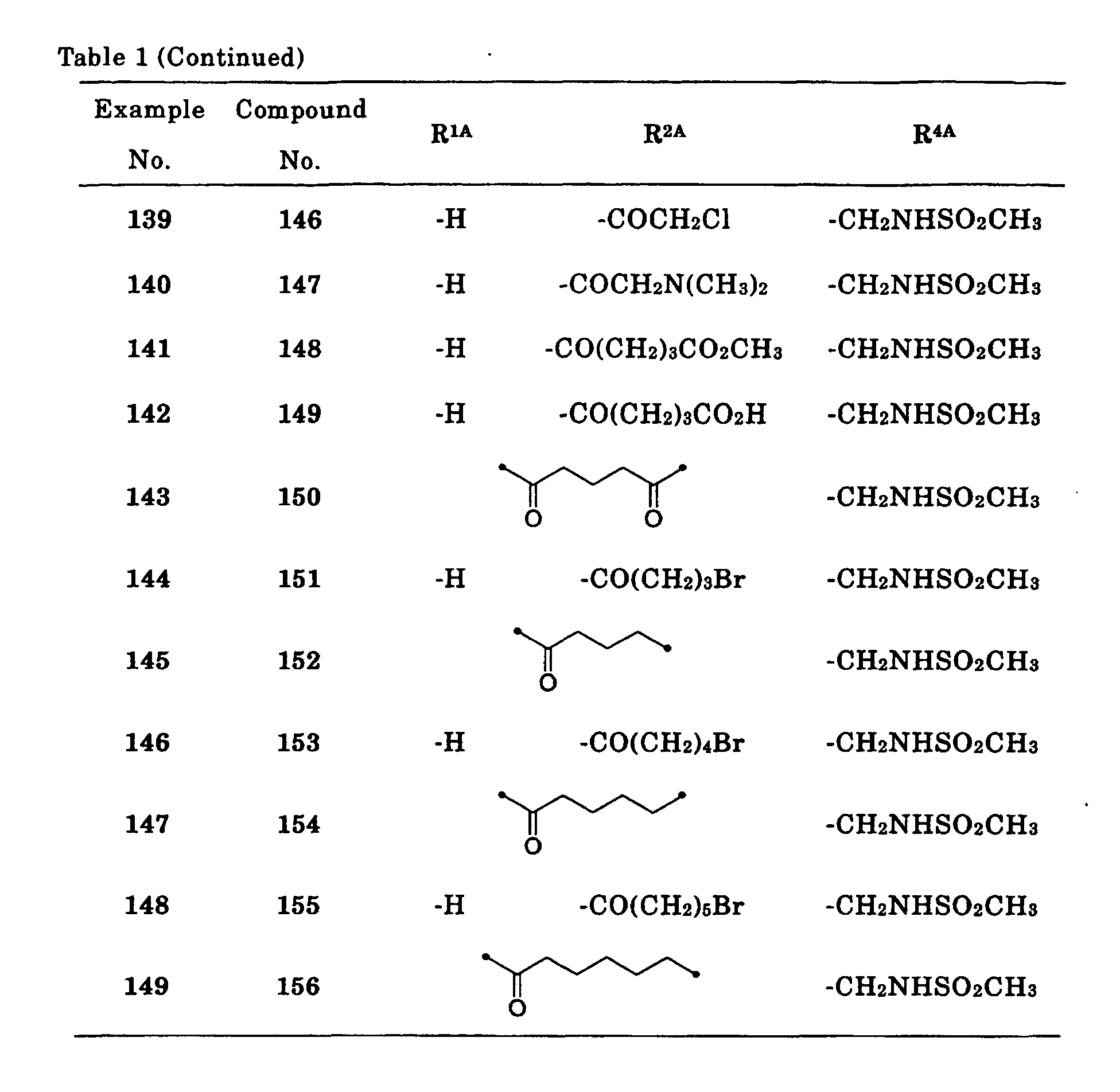
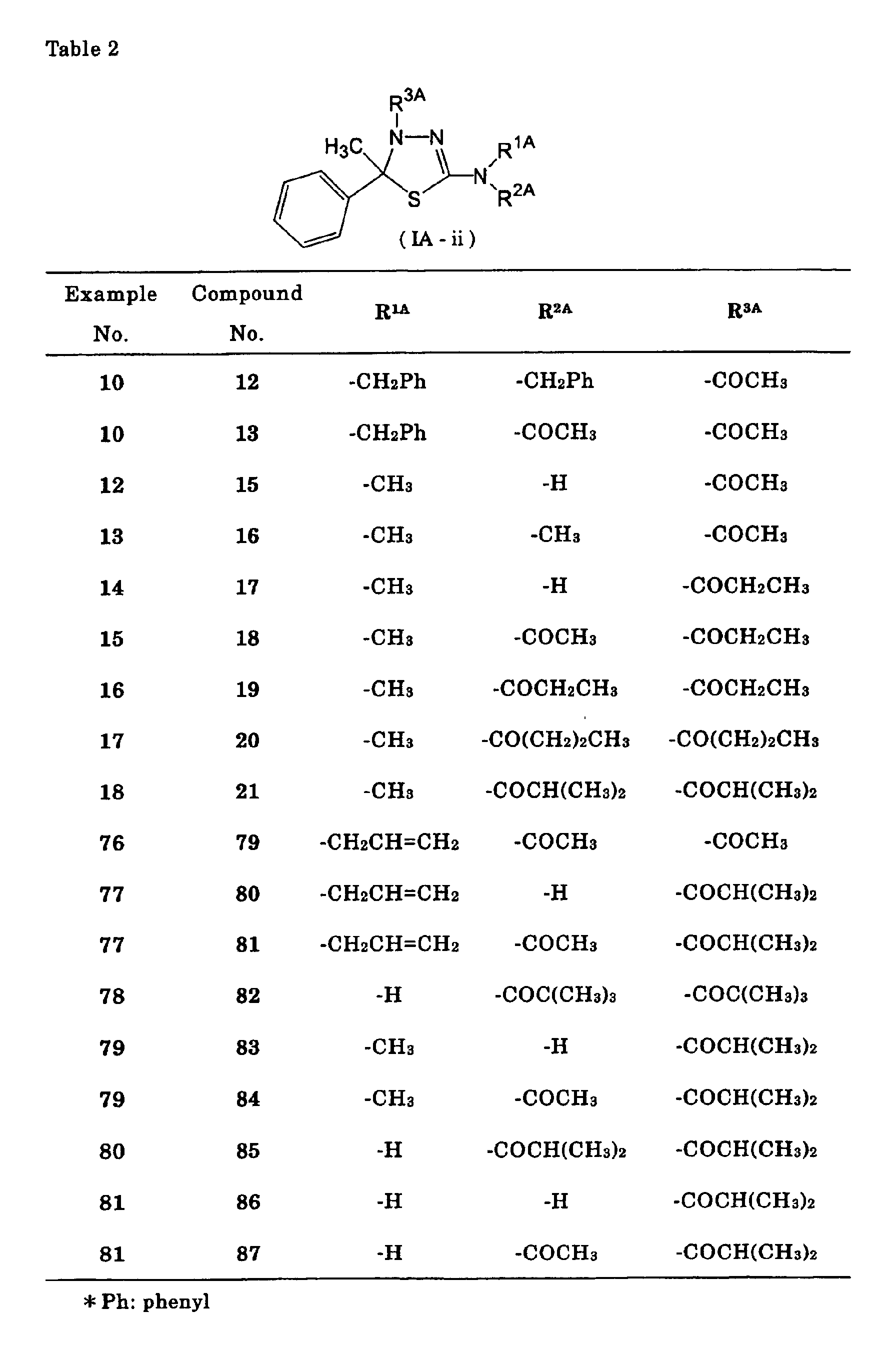
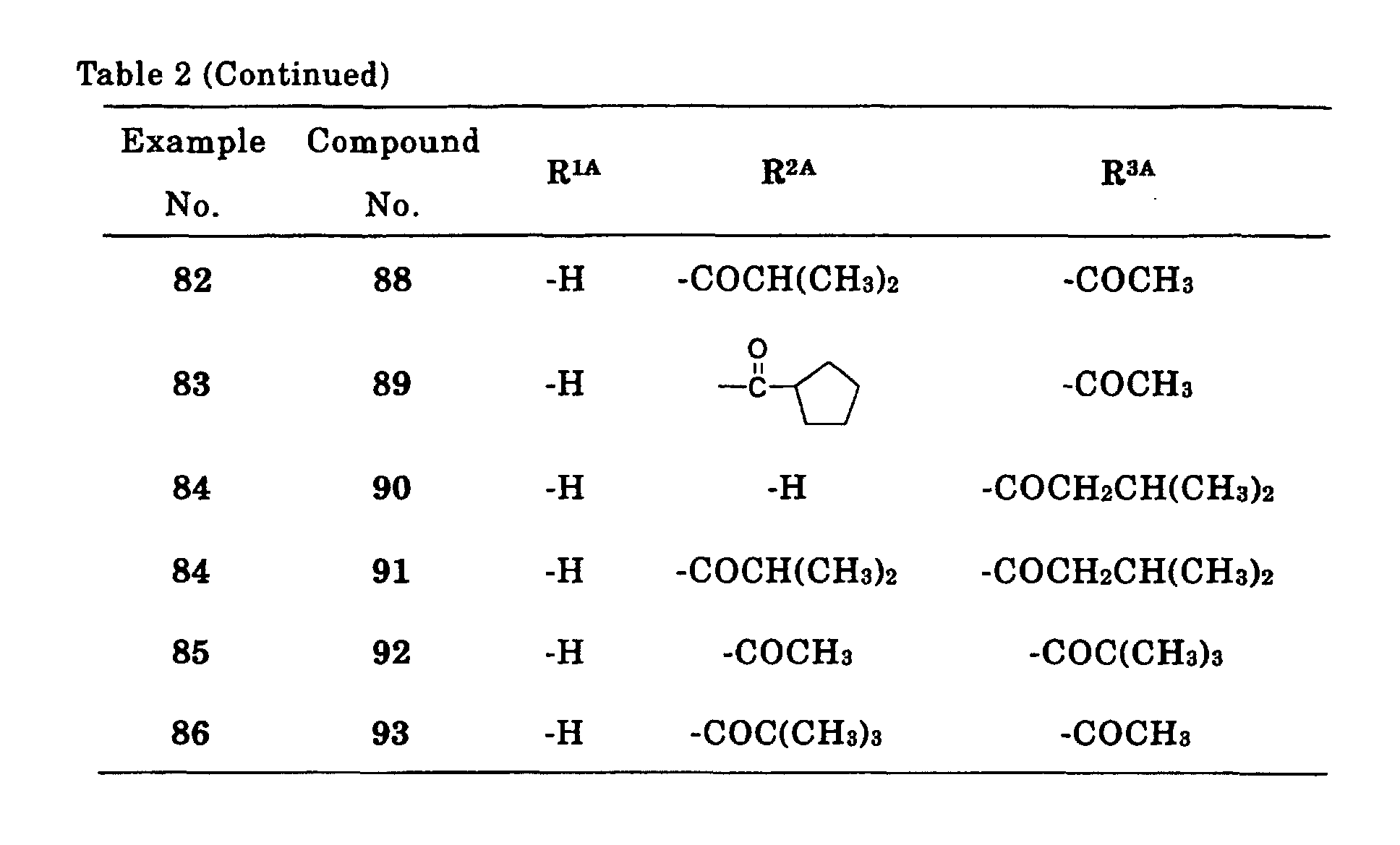
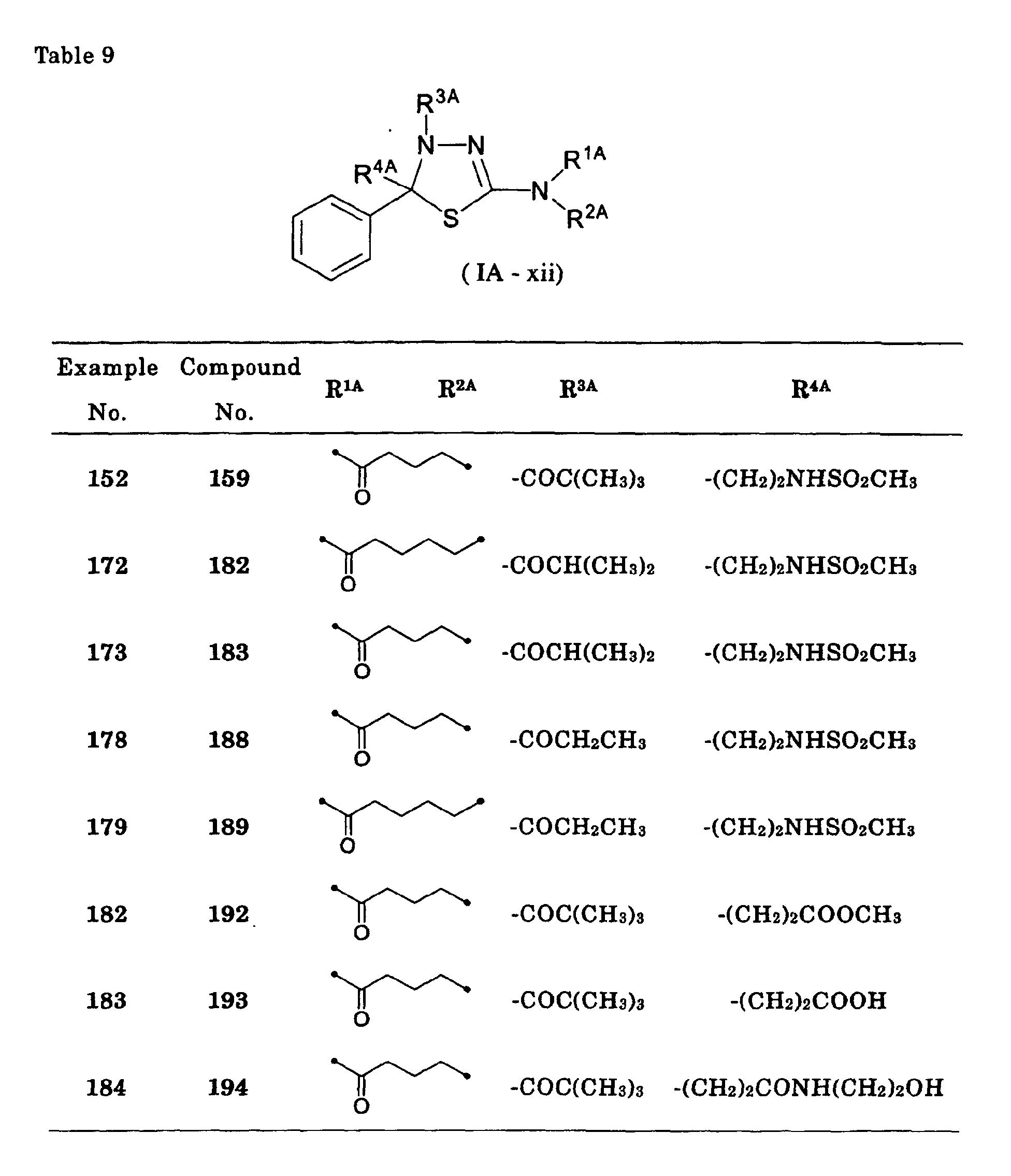
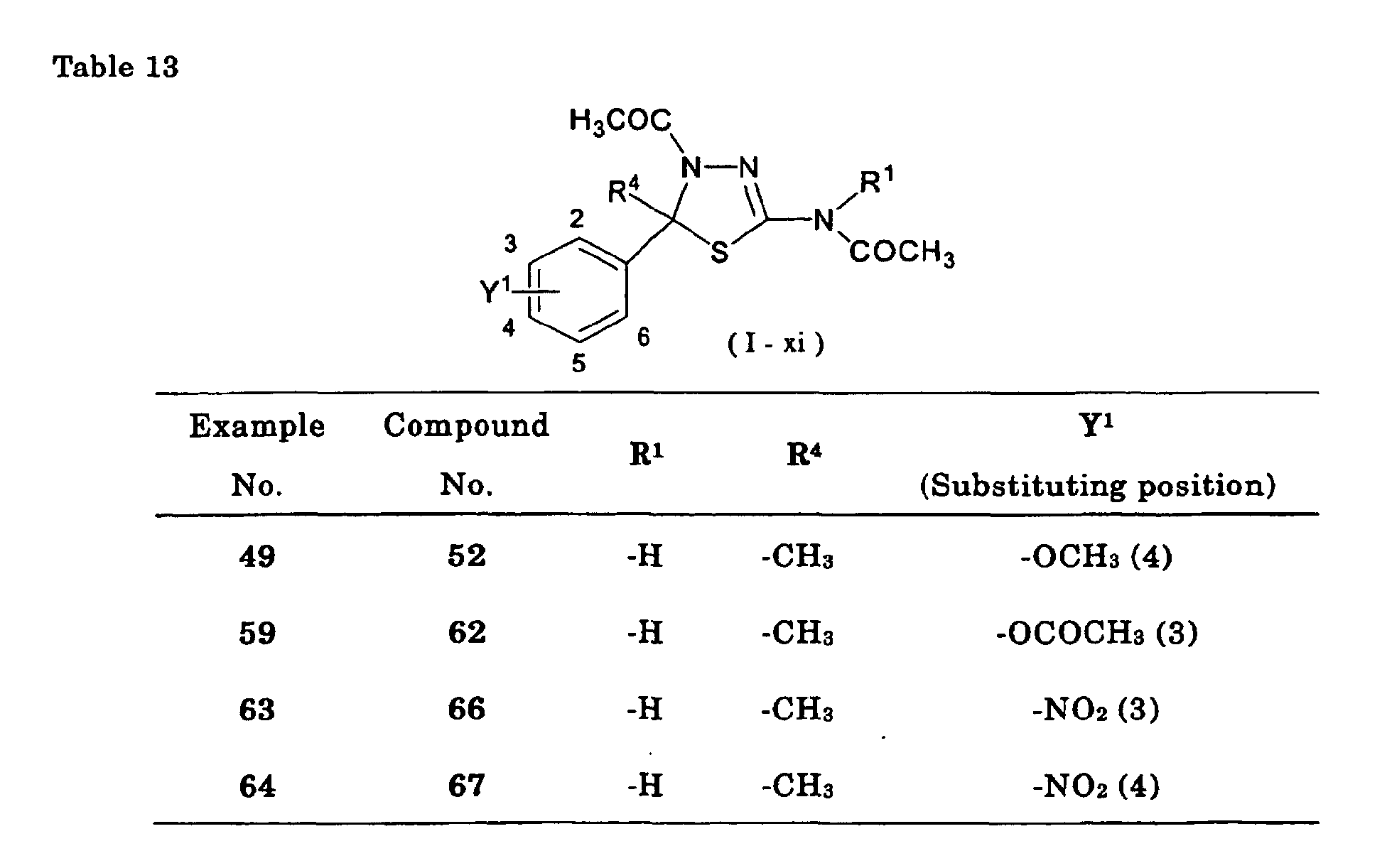
- the compounds shown in Tables 1 to 10 are used for the antitumor agent of the present invention, and other than the compounds, specific examples of compounds used in the present invention are shown in Tables 11 to 13. However, the compound used in the present invention is not limited to these examples.
- Test example 1 Antiproliferative activity in HCT 116 human colon cancer cells
- HCT 116 cells (ATCC No.: CCL-247) were placed on a 96-well microtiter plate (Nunc, 167008) at a density of 1x10 3 cells/well. The plate was incubated in a 5% CO 2 incubator at 37°C for 24 hours, and then to the plate was added test compounds diluted stepwise to 100 mL/well in total, and the plate was further incubated in a 5% CO 2 incubator at 37°C for 72 hours.
- the XTT (sodium 3'-[1-(phenylaminocarbonyl)-3,4-tetrazolium]-bis(4-methoxy-6-nitro)benzenesulfonic acid hydrate) labeling mixture (Roche Diagnostics, 1465015) was dispensed in 50 mL/well portions, then the plate was incubated in a 5% CO 2 incubator at 37°C for 1 hour, and the absorbance was measured at 490 nm and 655 nm with a microplate spectrophotometer (Bio-Rad, Model 550). The inhibitory activity against cell proliferation was shown as a concentration of 50% proliferation inhibition, GI 50 .
- GI 50 calculation method The value (difference in absorbance) was calculated by subtracting the absorbance at 655nm from the absorbance at 490nm of each well. The difference in absorbance obtained from the cells untreated with a test compound was defined as 100%, and compared with the difference in absorbance obtained from the cells treated with the solution of the compound in the known concentration, and thereby the concentration of the compound of 50% inhibition against cell proliferation was calculated to obtain GI 50 .
- Test example 1 The results of the typical compounds obtained in Test example 1 are shown in Table 14. Compounds 138, 152, 165, 170, 173, and 199 showed the GI 50 value less than 10 ⁇ mol/L. Compound No. GI 50 ( ⁇ mol/L) 1 1.0 7 0.48 18 0.62 41 0.60 46 0.57 57 0.53 69 0.23 82 0.18 99 0.063 104 0.074 107 0.061 134 0.40
- Compound (I) or Compound (IA), or a pharmacologically acceptable salt thereof, per se can be administered, however, is generally desired to be provided as a form of various pharmaceutical preparations. Also, the pharmaceutical preparations are used for animals or human.
- the pharmaceutical preparations according to the present invention can comprise as an active ingredient Compound (I) or Compound (IA), or a pharmacologically acceptable salt thereof, solely or as a mixture with any other effective ingredient for the treatment.
- the pharmaceutical preparations are manufactured by mixing the active ingredient with one or more of pharmacologically acceptable carriers using any method well known in the technical field of pharmaceutical science.
- administration routes it is preferred to chose the most effective route for the treatment such as oral administration or parenteral administration, for example, intravenous administration and the like.
- formulations for administration include tablets, injections and the like.
- Examples of the pharmaceutical carrier used include lactose, mannitol, glucose, hydroxypropyl cellulose, starch, magnesium stearate, sorbitan fatty acid ester, glyceric acid ester, polyvinyl alcohol, distilled water for injection, physiological saline, propylene glycol, polyethylene glycol, ethanol and the like.
- the pharmaceutical preparation according to the present invention may comprise other various additives such as excipients, lubricants, binders, disintegrator, isotonicities and emulsifiers.
- Compound (I) or Compound (IA), or a pharmacologically acceptable salt thereof is generally administered systemically or locally in the form of an oral or parenteral preparation when used for the aforementioned purpose.
- the dose and the frequency of administration may vary depending on the administration form, the age and body weight of a patient, nature and severity of the condition to be treated, and the like. Generally, 0.1 to 1,000 mg/kg, preferably 0.5 to 500 mg/kg per single administration for an adult may be administered orally or parenterally, once a day or a few times a day, or may be continuously administered intravenously for 1 to 24 hours a day. However, the dose and the frequency of administration may vary depending on the aforementioned various conditions and the like.
- Compound 111 (480 mg, 84%) was obtained from Compound 106 (51.8 mg, 0.124 mmol) prepared in Example 99, oxalyl chloride (0.5 mL), ethanolamine (7.58 mg, 0.248 mmol) and triethylamine (18.8 mg, 0.186 mmol).
- 2-(Methylsulfonylamino)acetophenone thiosemicarbazone (300 mg, 1.05 mmol) prepared in Step 2 of Example 88 was dissolved in tetrahydrofuran (18 mL). To the solution was added 4-dimethylaminopyridine (641 mg, 5.25 mmol) and pivaloyl chloride (0.13 mL, 1.1 mmol), and the mixture was stirred at room temperature. To the mixture was further added, after 1 hour and after 2 hours each, pivaloyl chloride (0.065 mL, 0.53 mmol), and the mixture was stirred for 3.6 hours in total. To the reaction mixture was added water, and the mixture was extracted with ethyl acetate.
- 6-Bromohexanoic acid (469 mg, 2.41 mmol) was dissolved in dichloromethane (15 mL). To the solution was added oxalyl chloride (0.28 mL, 3.2 mmol), and the mixture was stirred at room temperature for 2 hours. The solvent was evaporated from the reaction mixture under reduced pressure, and the resulting residue was dissolved in dichloromethane (15 mL). To the solution was added Compound 120 (297 mg, 0.802 mmol) prepared in Example 113 and pyridine (0.20 mL, 2.4 mmol), and the mixture was stirred at room temperature for 1 hour. After the reaction mixture was concentrated under reduced pressure, water was added to the residue, and the solution was extracted with ethyl acetate.
- Example 141 In a manner similar to that in Example 133, Compound 141 (22 mg, 18%) was obtained from Compound 118 (100 mg, 0.305 mmol) prepared in Example 111, pyridine (0.062 mL, 0.78 mmol) and crotonoyl chloride (0.075 mL, 0.78 mmol).
- Example 146 In a manner similar to that in Example 133, Compound 146 (105 mg, 85%) was obtained from Compound 118 (100 mg, 0.305 mmol) prepared in Example 111, pyridine (0.062 mL, 0.76 mmol) and chloroacetyl chloride (0.061 mL, 0.76 mmol).
- Example 151 In a manner similar to that in Example 133, Compound 151 (113 mg, 78%) was obtained from Compound 118 (100 mg, 0.305 mmol) prepared in Example 111, pyridine (0.062 mL, 0.76 mmol) and 4-bromobutyryl chloride (0.088 mL, 0.76 mmol).
- Tablets comprising the following composition are obtained according to the conventional method.
- Compound 1 5 mg Lactose 60 mg Potato starch 30 mg Polyvinyl alcohol 2 mg Magnesium stearate 1 mg Tar dye trace
- the present invention provides a thiadiazoline derivative or a pharmacologically acceptable salt thereof which is useful for therapeutic treatment of a human malignant tumor, for example, breast cancer, gastric cancer, ovarian cancer, colon cancer, lung cancer, brain tumor, laryngeal cancer, hematological cancer, urinary or genital tumor including bladder cancer and prostatic cancer, renal cancer, skin carcinoma, hepatic carcinoma, pancreatic cancer, or uterine cancer, or the like.
- the present invention provides an antitumor agent comprising a thiadiazoline derivative or a pharmacologically acceptable salt thereof as an active ingredient.
Landscapes
- Health & Medical Sciences (AREA)
- Chemical & Material Sciences (AREA)
- Organic Chemistry (AREA)
- Animal Behavior & Ethology (AREA)
- Veterinary Medicine (AREA)
- Public Health (AREA)
- Medicinal Chemistry (AREA)
- General Health & Medical Sciences (AREA)
- Pharmacology & Pharmacy (AREA)
- Life Sciences & Earth Sciences (AREA)
- Epidemiology (AREA)
- Chemical Kinetics & Catalysis (AREA)
- Nuclear Medicine, Radiotherapy & Molecular Imaging (AREA)
- General Chemical & Material Sciences (AREA)
- Bioinformatics & Cheminformatics (AREA)
- Engineering & Computer Science (AREA)
- Diabetes (AREA)
- Hematology (AREA)
- Pharmaceuticals Containing Other Organic And Inorganic Compounds (AREA)
- Nitrogen- Or Sulfur-Containing Heterocyclic Ring Compounds With Rings Of Six Or More Members (AREA)
- Plural Heterocyclic Compounds (AREA)
Abstract

Description

R1 and R4 are the same or different and each represents
a hydrogen atom, substituted or unsubstituted lower alkyl, substituted or unsubstituted lower alkynyl, substituted or unsubstituted lower alkenyl, substituted or unsubstituted cycloalkyl, a substituted or unsubstituted heterocyclic group, or substituted or unsubstituted aryl;
R2 represents
a hydrogen atom, substituted or unsubstituted lower alkyl, substituted or unsubstituted lower alkynyl, substituted or unsubstituted lower alkenyl, substituted or unsubstituted cycloalkyl,
-C(=W)R6 [wherein
W represents
an oxygen atom or a sulfur atom
R6 represents
a hydrogen atom, substituted or unsubstituted lower alkyl, substituted or unsubstituted lower alkenyl, substituted or unsubstituted cycloalkyl, a substituted or unsubstituted aryl, a substituted or unsubstituted heterocyclic group,
-NR7R8 (wherein
R7 and R8 are the same or different and each represents
a hydrogen atom, substituted or unsubstituted lower alkyl, substituted or unsubstituted lower alkenyl, substituted or unsubstituted cycloalkyl, substituted or unsubstituted aryl, or a substituted or unsubstituted heterocyclic group, or
R7 and R8 are combined together with the adjacent nitrogen atom to form a substituted or unsubstituted heterocyclic group);
-OR9 (wherein
R9 represents
substituted or unsubstituted lower alkyl, substituted or unsubstituted lower alkenyl, substituted or unsubstituted cycloalkyl, or substituted or unsubstituted aryl) or
-SR10 (wherein
R10 represents
substituted or unsubstituted lower alkyl, substituted or unsubstituted lower alkenyl, or substituted or unsubstituted aryl)]
-NR11R12 {wherein
R11 and R12 are the same or different and each represents
a hydrogen atom, substituted or unsubstituted lower alkyl, substituted or unsubstituted lower alkenyl, substituted or unsubstituted cycloalkyl, or
-C(=O)R13 [wherein
R13 represents
substituted or unsubstituted lower alkyl, substituted or unsubstituted lower alkenyl, substituted or unsubstituted aryl, a substituted or unsubstituted heterocyclic group,
-NR7AR8A (wherein R7A and R8A have the same meanings as those of the aforementioned R7 and R8, respectively), or
-OR9A (wherein R9A has the same meaning as that of the aforementioned R9)]} or
-SO2R14 (wherein
R14 represents
substituted or unsubstituted lower alkyl, substituted or unsubstituted lower alkenyl, substituted or unsubstituted aryl, or a substituted or unsubstituted heterocyclic group), or
R1 and R2 are combined together with the adjacent nitrogen atom to form a substituted or unsubstituted heterocyclic group,
R5 represents
substituted or unsubstituted lower alkyl, substituted or unsubstituted lower alkynyl, substituted or unsubstituted lower alkenyl, substituted or unsubstituted cycloalkyl, a substituted or unsubstituted heterocyclic group, or substituted or unsubstituted aryl, or
R4 and R5 are combined together to represent
-(CR28R29)m1-Q-(CR28AR29A)m2- {wherein
Q represents
a single bond, substituted or unsubstituted phenylene, or cycloalkylene,
m1 and m2 are the same or different and each represents
an integer of from 0 to 4, with the proviso that m1 and m2 are not 0 at the same time,
R28, R29, R28A and R29A are the same or different and each represents
a hydrogen atom, substituted or unsubstituted lower alkyl,
-OR30 [wherein
R30 represents
a hydrogen atom,
substituted or unsubstituted lower alkyl,
substituted or unsubstituted lower alkenyl,
-CONR31R32 (wherein
R31 and R32 are the same or different and each represents
a hydrogen atom, substituted or unsubstituted lower alkyl, a substituted or unsubstituted heterocyclic group, or substituted or unsubstituted aryl),
-SO2NR33R34 (wherein
R33 and R34 are the same or different and each represents
a hydrogen atom, substituted or unsubstituted lower alkyl, a substituted or unsubstituted heterocyclic group, or substituted or unsubstituted aryl), or
-COR35 (wherein
R35 represents
a hydrogen atom, substituted or unsubstituted lower alkyl, a substituted or unsubstituted heterocyclic group, or substituted or unsubstituted aryl)],
-NR36R37 [wherein
R36 and R37 are the same or different and each represents
a hydrogen atom,
substituted or unsubstituted lower alkyl,
-COR38 (wherein
R38 represents
a hydrogen atom, substituted or unsubstituted lower alkyl, a substituted or unsubstituted heterocyclic group, substituted or unsubstituted aryl, substituted or unsubstituted lower alkoxy, substituted or unsubstituted aryloxy, amino, substituted or unsubstituted lower alkylamino, substituted or unsubstituted di(lower alkyl)amino, or substituted or unsubstituted arylamino), or
-SO2R39 (wherein
R39 represents
substituted or unsubstituted lower alkyl, a substituted or unsubstituted heterocyclic group, or substituted or unsubstituted aryl)], or
-CO2R40 (wherein
R40 represents
a hydrogen atom, substituted or unsubstituted lower alkyl, or substituted or unsubstituted aryl), and
when m1 or m2 is an integer of 2 or more, each R28, R29, R28A and R29A may be the same or different, respectively, and any two of R28, R29, R28A and R29A which are bound to the adjacent two carbon atoms may be combined to form a bond}, and R3 represents
a hydrogen atom or
-C(=WA)R6A (wherein WA and R6A have the same meanings as those of the aforementioned W and R6, respectively)>.

when R2A and R3A are the same to be -CONHR8B (wherein R8B represents a substituted or unsubstituted lower alkyl, or substituted or unsubstituted aryl), and
- (a) when R1A, R2A and R3A are hydrogen atoms, and
one of R4A and R5A is methyl,
the other of R4A and R5A is not any of phenyl, 4-nitrophenyl, 4-aminophenyl, 4-bromophenyl, 3-nitrophenyl and 4-methoxy-3-nitrophenyl, - (b) when R1A and R2A are hydrogen atoms, R3A is acetyl,
- (i) and one of R4A and R5A is methyl,
the other of R4A and R5A is not any of methyl, ethyl, phenyl, 4-methoxyphenyl, 2-naphthylsulfonylmethyl, 4-bromophenylsulfonylmethyl and 4-chlorophenylsulfonylmethyl, and - (ii) and R4A is a hydrogen atom,
R5A is not any of phenyl, 4-nitrophenyl, 4-chlorophenyl, 4-methoxyphenyl, 4-dimethylaminophenyl and pyridyl,
the other of R4A and R5A is not any of methyl, ethyl, propyl, butyl, hexyl, heptyl, phenyl, benzyl, acetylmethyl, tert-butoxycarbonylmethyl, ethoxycarbonylmethyl, 4-bromophenylsulfonylmethyl, 4-bromophenylsulfonylethyl, 4-chlorophenylsulfonylmethyl, 3,4-dichlorophenylsulfonylmethyl, 3,4-dichlorophenylsulfonylethyl, 3,4-dimethylphenylsulfonylmethyl, phenylsulfonylmethyl, 4-methylphenylsulfonylmethyl, 4-methylphenylsulfonylethyl, 4-(acetylamino)phenylsulfonylethyl, 4-bromophenylsulfonylethyl, 2-(4-methylphenylsulfonyl)-2-phenylethyl, 2-(4-methylphenylthio)-2-phenylethyl, 2-naphthylsulfonylethyl, 2-naphthylsulfonylmethyl, phenethyl, 3-benzoyloxyphenyl, 2-oxo-2H-1-benzopyran-3-yl, 2-furyl, 5-nitro-2-furyl, 5-methyl-2-furyl, 2-thienyl, 5-chloro-2-thienyl, 3-acetoxyphenyl, 3-nitrophenyl, 4-nitrophenyl, 4-fluorophenyl, 3-acetylaminophenyl, 4-methoxyphenyl, 3-methoxyphenyl, 4-ethylphenyl, 4-methylphenyl, 4-bromophenyl, 4-nonyloxyphenyl, 4-phenylphenyl, 3,4-dimethoxyphenyl, 1,3-benzodioxol-5-yl, 4-(benzimidazol-2-ylamino)phenyl, 4-(1-methylbenzimidazol-2-ylamino)phenyl, 3-pyridyl, 2-naphthyl, 2-acetylamino-4-acetyl-1,3,4-thiadiazolin-5-yl and 4-acetylaminophenylsulfonylmethyl,
the other of R4A and R5A is not any of phenyl, 4-methoxyphenyl, 3,4-dimethoxyphenyl, 4-nitrophenyl, ethoxycarbonylmethyl, isobutyl, sec-butyl, n-butyl and acetylaminomethyl,
the other of R4A and R5A is not 2-phenylethenyl,
R5A is not 4-methoxyphenyl,
R6A is not any of phenyl, 4-nitrophenyl, 4-chlorophenyl, 4-dimethylaminophenyl and pyridyl,
-(CH2)m1-Q-(CH2)m2- (wherein m1, m2 and Q have the same meanings as those of the aforementioned, respectively),
-(CH2)m1-Q-(CH2)m2- wherein Q is a single bond and the sum of m1 and m2 is 5, is excluded
the other of R4A and R5A is not 3,4-dihydro-3-oxo-2-quinoxalinyl, and
the other of R4A and R5A is not ethyl,
R5A is not phenyl,
R2A is acetyl, and
one of R4A and R5A is methyl,
the other of R4A and R5A is not either of phenyl and 3,4-dichlorophenylsulfonylethyl,
the other of R4A and R5A is not either of 4-acetoxy-6-methyl-2-oxo-2H-pyran-3-yl and 2-oxo-2H-1-benzopyran-3-yl, and
R5A is not phenyl,
R5A is not phenyl,
the other of R4A and R5A is not either of ethoxycarbonylethyl and ethoxycarbonylpropyl,
R5A is pyridyl,
R3A is not -CORC (wherein RC represents methyl, chloromethyl, methoxy, ethoxycarbonylmethyl or ethoxycarbonylethenyl),
the other of R1A and R2A is ethyl, and
R3A is a hydrogen atom or acetyl,
R4A and R5A are not methyl at the same time,
R2A is a hydrogen atom, and
one of R4A and R5A is methyl,
the other of R4A and R6A is not (1-methylbenzimidazol-2-ylamino)phenyl, and
R3A is not acetyl,
R2A is a hydrogen atom, and
R4A and R5A are methyl,
R3A is not any of acetyl, 4-chlorophenoxyacetyl, 2-chlorophenoxyacetyl, 3-methylphenoxyacetyl and phenylaminocarbonyl,
one of R4A and R5A is methyl,
- (i) and the other of R4A and R5A is 1H-benzotriazol-1-ylmethyl,
R1A is not any of cyclohexyl, benzyl, phenyl, 2-methylphenyl and 4-methoxyphenyl, - (ii) and the other of R4A and R5A is 2-methylbenzimidazol-1-ylmethyl or
2-ethylbenzimidazol-1-ylmethyl,
R1A is not any of cyclohexyl, phenyl and 4-bromophenyl, - (o) when R1A is a hydrogen atom,
R2A is acetyl, and
R4A and R5A are methyl,
R3A is not benzoyl, - (p) when one of R1A and R2A is hydrogen atom,
the other of R1A and R2A is methyl, and
R4A and R5A are both methyl or both ethyl,
R3A is not any of acetyl, benzoyl, pivaloyl, 3-nitrobenzoyl, 2-fluorobenzoyl, 4-fluorobenzoyl, 2-trifluoromethylbenzoyl and 3-trifluoromethylbenzoyl, and - (q) when R1A is methyl,
R2A is methylaminocarbonyl, and
R4A and R5A are both methyl or both ethyl,
R3A is not any of acetyl; benzoyl, pivaloyl, 2-fluorobenzoyl, 4-fluorobenzoyl, 2-trifluoromethylbenzoyl, 3-trifluoromethylbenzoyl and 4-trifluoromethylbenzoyl]}.
R15 and R16 are the same or different and each represents
a hydrogen atom, hydroxy, cycloalkyl, lower alkyl,
lower alkenyl, aryl, a heterocyclic group,
substituted aryl (the substituent in said substituted aryl has the same meaning as that of the after-mentioned substituent (xii) in the substituted aryl),
a substituted heterocyclic group (the substituent in said substituted heterocyclic group has the same meaning as that of the after-mentioned substituent (xiii) in the substituted heterocyclic group) or
substituted lower alkyl {in said substituted lower alkyl, the substituents are the same or different and 1 to 3 substituent(s), such as
hydroxy, lower alkoxy, oxo, carboxy,
lower alkoxycarbonyl, an aryl, a heterocyclic group,
-CONR15AR16A [wherein
R15A and R16A are the same or different and each represents
a hydrogen atom, hydroxy, lower alkyl, or
substituted lower alkyl (in said substituted lower alkyl, the substituents (a) are the same or different and 1 to 3 substituent(s), such as hydroxy, lower alkoxy, oxo, carboxy, lower alkoxycarbonyl, aryl, a heterocyclic group, amino, lower alkylamino, di(lower alkyl)amino and the like), or
R15A and R16A are combined to form a heterocyclic group
together with the adjacent nitrogen atom],
- NR41R42 [wherein
R41 and R42 are the same or different and each represents
a hydrogen atom, lower alkyl,
lower alkanoyl, aroyl, aryl,
a heterocyclic group,
substituted lower alkyl (the substituent in said substituted lower alkyl has the same meaning as that of the aforementioned substituent (a) in the substituted lower alkyl),
a substituted lower alkanoyl (in said substituted lower alkanoyl, the substituents (b) are the same or different and 1 to 3 substituent(s), such as hydroxy, lower alkoxy, oxo, carboxy, lower alkoxycarbonyl, amino, lower alkylamino, di(lower alkyl)amino and the like),
substituted aroyl (the substituent in said substituted aroyl has the same meaning as that of the aforementioned substituent (b) in the substituted lower alkanoyl),
substituted aryl (the substituent in said substituted aryl has the same meaning as that of the after-mentioned substituent (xii) in the substituted aryl) or
a substituted heterocyclic group (the substituent in said substituted heterocyclic group has the same meaning as that of the after-mentioned substituent (xiii) in the substituted heterocyclic group), or
R41 and R42 are combined to form a heterocyclic group or a substituted heterocyclic group together with the adjacent nitrogen atom (the substituent in said substituted heterocyclic group formed together with the adjacent nitrogen atom has the same meaning as that of the after-mentioned substituent (xiii) in the substituted heterocyclic group formed together with the adjacent nitrogen atom)]}, or
R15 and R16 are combined to form a heterocyclic group or a substituted heterocyclic group together with the adjacent nitrogen atom (the substituent in said substituted heterocyclic group formed together with the adjacent nitrogen atom has the same meaning as that of the after-mentioned substituent (xiii) in the substituted. heterocyclic group formed together with the adjacent nitrogen atom)>,
-CO2R26 {wherein
R26 represents
a hydrogen atom, lower alkyl, cycloalkyl, lower alkenyl,
lower alkynyl, aryl,
substituted aryl (the substituent in said substituted aryl has the same meaning as that of the after-mentioned substituent (xii) in the substituted aryl), or
substituted lower alkyl [in said substituted lower alkyl, the substituents (c) are the same or different and 1 to 3 substituent(s), such as
hydroxy, halogen, lower alkoxy, oxo, carboxy,
lower alkoxycarbonyl, aryl, a heterocyclic group,
-CONR15BR16B (wherein R15B and R16B have the same meanings as those of the aforementioned R15 and R16, respectively),
-NR41AR42A (wherein R41A and R42A have the same meanings as those of the aforementioned R41 and R42, respectively), and the like]},
-COR26A (wherein R26A has the same meaning as that of the aforementioned R26),
-NR17R18 <wherein
R17 and R18 are the same or different and each represents
a hydrogen atom, lower alkyl, lower alkenyl, aroyl,
aryl, a heterocyclic group, cycloalkyl,
aralkyloxycarbonyl,
substituted lower alkyl {in said substituted lower alkyl, the substituents (d) are the same or different and 1 to 3 substituent(s), such as
hydroxy, lower alkoxy, oxo, carboxy,
lower alkoxycarbonyl, aryl, a heterocyclic group,
substituted aryl (the substituent in said substituted aryl has the same meaning as that of the after-mentioned substituent (xii) in the substituted aryl),
a substituted heterocyclic group (the substituent in said substituted heterocyclic group has the same meaning as that of the after-mentioned substituent (xiii) in the substituted heterocyclic group),
-O(CH2CH2O)nR19 (wherein n represents an integer of from 1 to 15, and R19 represents lower alkyl),
-CONR15CR16C (wherein R15C and R16C have the same meanings as those of the aforementioned R15 and R16, respectively),
-SO2R24 [wherein
R24 represents
lower alkyl, arylor
substituted aryl (the substituent in said substituted aryl has the same meaning as that of the after-mentioned substituent (xii) in the substituted aryl)],
-NR41BR42B (wherein R41B and R42B have the same meanings as those of the aforementioned R41 and R42, respectively), and the like),
substituted aryl (the substituent in said substituted aryl has the same meaning as that of the after-mentioned substituent (xii) in the substituted aryl),
a substituted heterocyclic group (the substituent in said substituted heterocyclic group has the same meaning as that of the after-mentioned substituent (xiii) in the substituted heterocyclic group),
-COR26B {wherein
R26B represents
lower alkyl, lower alkenyl, lower alkynyl,
aryl,
substituted lower alkyl (the substituent in said substituted lower alkyl has the same meaning as that of the aforementioned substituent (c) in the substituted lower alkyl),
substituted aryl (the substituent in said substituted aryl has the same meaning as that of the after-mentioned substituent (xii) in the substituted aryl),
-NR26CR26D (wherein R26C and R26D are the same or different, and each has the same meaning as that of the aforementioned R26) or
-OR27 [wherein
R27 represents
lower alkyl, aryl,
substituted lower alkyl (the substituent in said substituted lower alkyl has the same meaning as that of the aforementioned substituent (c) in the substituted lower alkyl) or
substituted aryl (the substituent in said substituted aryl has the same meaning as that of the after-mentioned substituent (xii) in the substituted aryl)]}, or
- SO2R26E (wherein R26E has the same meaning as that of the aforementioned R26), or
R17 and R18 are combined to form a heterocyclic group or a substituted heterocyclic group together with the adjacent nitrogen atom (the substituent in said substituted heterocyclic group formed together with the adjacent nitrogen atom has the same meaning as that of the after-mentioned substituent (xiii) in the substituted heterocyclic group formed together with the adjacent nitrogen atom)>,
-N+R20R21R22X- (wherein
R20 and R21 are the same or different and each represents lower alkyl, or R20 and R21 are combined to form a heterocyclic group together with the adjacent nitrogen atom,
R22 represents lower alkyl, and
X represents each atom of chlorine, bromine or iodine),
-OR23 {wherein
R23 represents
lower alkyl, cycloalkyl, aryl, a heterocyclic group,
substituted aryl (the substituent in said substituted aryl has the same meaning as that of the after-mentioned substituent (xii) in the substituted aryl),
a substituted heterocyclic group (the substituent in said substituted heterocyclic group has the same meaning as that of the after-mentioned substituent (xiii) in the substituted heterocyclic group),
substituted lower alkyl [in said substituted lower alkyl, the substituents (e) are the same or different and 1 to 3 substituent(s), such as
hydroxy, halogen, lower alkoxy, oxo, carboxy,
lower alkoxycarbonyl, aryl, a heterocyclic group,
substituted aryl (the substituent in said substituted aryl has the same meaning as that of the after-mentioned substituent (xii) in the substituted aryl),
a substituted heterocyclic group (the substituent in said substituted heterocyclic group has the same meaning as that of the after-mentioned substituent (xiii) in the substituted heterocyclic group),
-O(CH2CH2O)nAR19A (wherein nA and R19A have the same meanings as those of the aforementioned n and R19, respectively),
-CONR15DR16D (wherein R15D and R16D have the same meanings as those of R15 and R16, respectively);
-NR41CR42C (wherein R41C and R42C have the same meanings as those of the aforementioned R41 and R42, respectively) and the like],
-COR26F (wherein R26F has the same meaning as that of the aforementioned R26) or
-CONR15ER16E (wherein R15E and R16E have the same meanings as those of the aforementioned R15 and R16, respectively)),
-SR23A (wherein R23A has the same meaning as that of the aforementioned R23),
-SO2R25 [wherein
R25 represents
lower alkyl, cycloalkyl, aryl,
substituted lower alkyl (the substituent in said substituted lower alkyl has the same meaning as that of the aforementioned substituent (c) in the substituted lower alkyl),
a substituted aryl (the substituent in the substituted aryl has the same meaning as that of the after-mentioned substituent (xii) in the substituted aryl), or
-NR15FR16F (wherein R15F and R16F have the same meanings as those of the aforementioned R15 and R16, respectively)],
-OSO2R25A (wherein R25A has the same meaning as that of the aforementioned R25), and the like. Herein, the lower alkyl moiety in the lower alkyl, the lower alkoxy, the lower alkoxycarbonyl, the lower alkylamino and the di(lower alkyl)amino, the aryl moiety in the aryl and the aroyl, the cycloalkyl, the lower alkenyl, the lower alkynyl, the heterocyclic group, and the heterocyclic group formed together with the adjacent nitrogen atom have the same meanings as those of the aforementioned lower alkyl (i), aryl (v), cycloalkyl (ii), lower alkenyl (iii), lower alkynyl (iv), heterocyclic group (vi) and a heterocyclic group formed together with the adjacent nitrogen atom (vii), respectively. Also, the lower alkyl moiety in the lower alkanoyl mentioned here has the same meaning as that of the aforementioned lower alkyl (i), the halogen (ix) represents each atom of fluorine, chlorine, bromine and iodine, and examples of the aralkyl moiety (xi) in the aralkyloxycarbonyl include aralkyl having 7 to 15 carbon atoms, for example, benzyl, phenethyl, benzhydryl, naphthylmethyl and the like.
halogen, lower alkyl, nitro, oxo, hydroxy, lower alkoxy, amino, lower alkylamino, di(lower alkyl)amino, lower alkylaminocarbonyloxy, di(lower alkyl)aminocarbonyloxy, lower alkanoyl, lower alkanoylamino, lower alkanoyloxy, aryl, arylsulfonyl, heterocyclic amino, aroyl, carboxy, lower alkoxycarbonyl, cyano, methylenedioxy,
substituted lower alkyl (in said substituted lower alkyl, the substituents (f) are the same or different and 1 to 3 substituent(s), such as halogen, oxo, carboxy, lower alkoxycarbonyl, amino, lower alkylamino, di(lower alkyl)amino, hydroxy, lower alkoxy and the like),
substituted arylsulfonyl (the substituent in said substituted arylsulfonyl has the same meaning as that of the aforementioned substituent (f)),
substituted heterocyclic amino (the substituent in said substituted heterocyclic amino has the same meaning as that of the aforementioned substituent (f)) and the like.
the lower alkyl moiety in the lower alkyl, the lower alkylamino, the di(lower alkyl)amino, the lower alkylaminocarbonyloxy, the di(lower alkyl)aminocarbonyloxy (the two lower alkyl moieties in said di(lower alkyl)aminocarbonyloxy may be the same or different), the lower alkoxycarbonyl and the lower alkoxy, the heterocyclic moiety in the heterocyclic amino, the aryl moiety in the aryl, the arylsulfonyl and the aroyl, and the halogen have the same meanings as those of the aforementioned lower alkyl (i), heterocyclic group (vi), aryl (v) and halogen (ix), respectively. Also, examples of the lower alkanoyl moiety (x) in the lower alkanoyl, the lower alkanoylamino and the lower alkanoyloxy which are noted here include a straight or branched chain alkanoyl having 2 to 9 carbon atoms, for example, acetyl, propionyl, butyryl, isobutyryl, valeryl, isovaleryl, pivaloyl, hexanoyl, heptanoyl, octanoyl, nonanoyl and the like.









The inhibitory activity against cell proliferation was shown as a concentration of 50% proliferation inhibition, GI50.
GI50 calculation method: The value (difference in absorbance) was calculated by subtracting the absorbance at 655nm from the absorbance at 490nm of each well. The difference in absorbance obtained from the cells untreated with a test compound was defined as 100%, and compared with the difference in absorbance obtained from the cells treated with the solution of the compound in the known concentration, and thereby the concentration of the compound of 50% inhibition against cell proliferation was calculated to obtain GI50.
| Compound No. | GI50 (µmol/L) |
| 1 | 1.0 |
| 7 | 0.48 |
| 18 | 0.62 |
| 41 | 0.60 |
| 46 | 0.57 |
| 57 | 0.53 |
| 69 | 0.23 |
| 82 | 0.18 |
| 99 | 0.063 |
| 104 | 0.074 |
| 107 | 0.061 |
| 134 | 0.40 |
1H NMR (270 MHz, DMSO-d6) δ (ppm): 2.30 (s, 3H), 7.37-7.40 (m, 3H), 7.91-7.94 (m, 3H), 8.27 (br s, 1H), 10.21 (br s, 1H)
1H NMR (270 MHz, CDCl3) δ (ppm): 2.01 (s, 3H), 2.19 (s, 3H), 2.28 (s, 3H), 7.24-7.36 (br s, 5H), 11.63 (br s, 1H)
1H NMR (270 MHz, DMSO-d6) δ (ppm): 1.01 (t, J = 7.4 Hz, 3H), 2.85 (br q, J = 7.4 Hz, 2H), 7.39 (m, 3H), 7.89 (m, 3H), 8.24 (br s, 1H), 10.30 (br s, 1H)
1H NMR (270 MHz, DMSO-d6) δ (ppm): 1.02 (t, J = 7.1 Hz, 3H), 2.00 (s, 3H), 2.21 (s, 3H), 2.38 (dt, J = 7.1, 7.3 Hz, 1H), 2.85 (dt, J = 7.1, 7.3 Hz, 1H), 7.23-7.38 (m, 5H), 11.59 (br s, 1H)
1H NMR (270 MHz, DMSO-d6) δ (ppm): 0.99 (t, J = 7.3 Hz, 3H), 1.38-1.49 (m, 4H), 2.96-2.99 (m, 2H), 7.37-7.39 (m, 3H), 7.87-7.91 (m, 3H), 8.26 (br s, 1H), 10.36 (br s, 1H)
1H NMR (270 MHz, CDCl3) δ (ppm): 0.96 (t, J = 7.3 Hz, 3H), 1.25-1.34 (m, 1H), 1.36-1.54 (m, 2H), 1.68-1.80 (m, 1H), 2.18 (s, 3H), 2.20-2.26 (m, 1H), 2.26 (s, 3H), 2.99-3.10 (m, 1H), 7.22-7.40 (m, 5H), 8.22 (br s, 1H)
1H NMR (270 MHz, DMSO-d6) δ (ppm): 1.07 (d, J = 6.9 Hz, 6H), 2.82 (m, 1H), 7.28 (br d, J = 6.3 Hz, 2H), 7.51-7.60 (m, 3H), 7.78 (br s, 1H), 8.23 (br s, 1H), 8.43 (br s, 1H)
1H NMR (270 MHz, CDCl3) δ (ppm): 1.04 (d, J = 6.9 Hz, 3H), 1.13 (d, J = 6.9 Hz, 3H), 2.09 (s, 3H), 2.19 (s, 3H), 3.86 (m, 1H), 7.25-7.36 (m, 3H), 7.75 (br d, J = 7.3 Hz, 2H), 8.08 (br s, 1H)
1H NMR (270 MHz, CDCl3) δ (ppm): 0.60-0.98 (m, 4H), 1.84 (s, 3H), 2.34 (s, 3H), 2.45 (m, 1H), 7.20-7.35 (m, 3H), 7.54 (br d, J = 8.7 Hz, 2H), 9.40 (br s, 1H)
1H NMR (270 MHz, CDCl3) δ (ppm): 1.89 (s, 3H), 2.32 (s, 3H), 7.25-7.52 (m, 10H), 9.13 (br s, 1H)
1H NMR (270 MHz, DMSO-d6) δ (ppm): 2.21 (s, 3H), 2.23 (s, 3H), 2.26 (s, 3H), 3.41(s, 3H), 7.28-7.36 (m, 5H)
1H NMR (270 MHz, DMSO-d6) δ (ppm): 2.12 (s, 3H), 2.31 (s, 3H), 6.49 (br s, 2H), 7.21-7.41 (m, 5H)
1H NMR (270 MHz, CDCl3) δ (ppm): 2.17 (s, 3H), 2.41 (s, 3H), 2.91 (br d, J = 5.0 Hz, 3H), 3.92 (br s, 1H), 7.25-7.47 (m, 5H)
1H NMR (270 MHz, CDCl3) δ (ppm): 1.12 (t, J = 7.3 Hz, 3H), 1.17 (t, J = 7.5 Hz, 3H), 2.36 (s, 3H), 2.54 (q, J = 7.3 Hz, 2H), 2.66 (q, J = 7.5 Hz, 2H), 3.45 (s, 3H), 7.21-7.42 (m, 5H)
1H NMR (270 MHz, CDCl3) d(ppm): 0.95 (t, J = 7.3 Hz, 3H), 0.98 (t, J = 7.4 Hz, 3H), 1.15-1.78 (m, 4H), 2.35 (s, 3H), 2.49 (t, J = 7.3 Hz, 2H), 2.61 (t, J = 7.4 Hz, 2H), 3.45 (s, 3H), 7.21-7.42 (m, 5H)
1H NMR (270 MHz, CDCl3) δ (ppm): 1.05-1.25 (m, 12H), 2.34 (s, 3H), 2.99 (q, J = 7.3 Hz, 1H), 3.25 (q, J = 7.5 Hz, 1H), 3.50 (s, 3H), 7.21-7.45 (m, 5H)
1H NMR (270 MHz, DMSO-d6) δ (ppm): 1.89 (s, 3H), 1.91 (s, 3H), 7.51 (br s, 1H), 7.98 (br s, 1H), 9.90 (br s, 1H)
1H NMR (270 MHz, CDCl3) δ (ppm): 1.98 (s, 6H), 2.19 (s, 3H), 2.20 (s, 3H), 9.06 (br s, 1H)
1H NMR (270 MHz, DMSO-d6) δ (ppm): 0.88 (t, J = 6.9 Hz, 3H), 1.23-1.31 (m, 2H), 1.41-1.50 (m, 2H), 1.88 (s, 3H), 2.17-2.23 (m, 2H), 7.44 (br s, 1H), 8.02 (br s, 1H), 9.88 (br s, 1H)
1H NMR (270 MHz, CDCl3) δ (ppm): 0.90 (t, J = 6.9 Hz, 3H), 1.23-1.38 (m, 3H), 1.52-1.56 (m, 1H), 1.84-2.18 (m, 1H), 1.97 (s, 3H), 2.18 (s, 3H), 2.19 (s, 3H), 2.44-2.55 (m, 1H), 8.68 (br s, 1H)
1H NMR (270 MHz, DMSO-d6) δ (ppm): 1.92 (s, 3H), 2.52 (m, 2H), 2.84 (m, 2H), 7.14-7.30 (m, 5H), 7.43 (br s, 1H), 8.03 (br s, 1H), 9.94 (br s, 1H)
1H NMR (270 MHz, CDCl3) δ (ppm): 2.00 (s, 3H), 2.17 (s, 3H), 2.13 (dd, J = 2.3, 10.2 Hz, 1H), 2.19 (s, 3H), 2.59 (dd, J = 2.2, 10.2 Hz, 1H), 2.87 (br d, J = 12.2 Hz, 1H), 2.95 (br s, J = 11.8 Hz, 1H), 7.14-7.29 (m, 5H), 8.39 (br s, 1H)
1H NMR (300 MHz, DMSO-d6) δ (ppm): 2.13 (s, 3H), 2.15 (s, 3H), 2.23 (s, 3H), 6.62 (d, J = 12.2 Hz, 1H), 6.65 (d, J = 12.2 Hz, 1H), 7.20-7.39 (m, 5H), 8.57 (br s, 1H)
1H NMR (270 MHz, DMSO-d6) δ (ppm): 0.87 (t, J = 6.9 Hz, 6H), 1.20-1.53 (m, 8H), 2.17-2.22 (m, 2H), 2.31-2.37 (m, 2H), 7.40 (br s, 1H), 8.00 (br s, 1H), 10.03 (br s, 1H)
1H NMR (270 MHz, CDCl3) δ (ppm): 0.90 (t, J = 6.9 Hz, 6H), 1.18-1.37 (m, 6H), 1.55-1.63 (m, 2H), 1.77-1.88 (m, 2H), 2.18 (s, 3H), 2.19 (s, 3H), 2.45-2.56 (m, 2H), 8.90 (br s, 1H)
1H NMR (270 MHz, DMSO-d6) δ (ppm): 1.78-1.82 (m, 2H), 2.65-2.75 (m, 4H), 7.15-7.27 (m, 3H), 7.97 (br s, 1H), 8.20-8.40 (m, 2H), 10.10 (br s, 1H)
1H NMR (270 MHz, CDCl3) δ (ppm): 1.89 (s, 3H), 2.09-2.22 (m, 2H), 2.28 (s, 3H), 2.36-2.41 (m, 1H), 2.80-2.86 (m, 2H), 2.97-3.08 (m, 1H), 7.01 (br d, J = 8.6 Hz, 1H), 7.08-7.18 (m, 2H), 7.40 (br d, J = 7.3 Hz, 1H), 9.24 (br s, 1H)
1H NMR (270 MHz, DMSO-d6) δ (ppm): 2.12 (s, 3H), 2.15-2.30 (m, 1H), 2.24 (s, 3H), 3.05-3.09 (m, 2H), 3.14 (br d, J = 15.8 Hz, 1H), 3.23-3.41 (m, 1H), 4.38 (br d, J = 15.8 Hz, 1H), 6.99-7.00 (m, 1H), 7.02-7.25 (m, 3H), 8.42 (br s, 1H)
1H NMR (270 MHz, DMSO-d6) δ (ppm): 2.85-2.89 (m, 2H), 3.03-3.08 (m, 2H), 7.28-7.38 (m, 3H), 7.87 (br d, J = 7.6 Hz, 1H), 7.92 (br s, 1H), 8.17 (br s, 1H), 10.2 (br s, 1H)
1H NMR (270 MHz, CDCl3) δ (ppm): 2.17 (s, 3H), 2.24 (s, 3H), 2.58-2.65 (m, 1H), 2.96-3.07 (m, 1H), 3.13-3.21 (m, 2H), 7.15-7.27 (m, 3H), 7.32-7.37 (m, 1H), 9.60 (br s, 1H)
1H NMR (270 MHz, DMSO-d6) δ (ppm): 1.55 (br s, 6H), 2.19-2.23 (m, 2H), 2.38 (br s, 2H), 7.50 (br s, 1H), 7.93 (br s, 1H), 10.13 (br s, 1H)
1H NMR (300 MHz, CDCl3) δ (ppm): 1.25-1.53 (m, 3H), 1.58-1.68 (m, 1H), 1.81-1.86 (m, 2H), 2.03-2.08 (m, 2H), 2.16 (s, 3H), 2.17 (s, 3H), 2.90-3.01 (m, 2H), 7.95 (br s, 1H)
1H NMR (270 MHz, CDCl3) δ (ppm): 1.32-1.67 (m, 5H), 1.76-1.89 (m, 2H), 2.18 (s, 3H), 2.19 (br s, 1H), 2.21 (s, 3H), 2.26 (br s, 1H), 3.60 (br d, J = 13.9 Hz, 1H), 8.20 (br s, 1H)
1H NMR (270 MHz,CDCl3) δ (ppm): 2.06 (s, 3H), 2.07 (s, 3H), 2.33 (s, 3H), 7.45-7.65 (m, 4H), 7.89-7.99 (m, 3H), 11.50 (br s, 1H)
1H NMR (270 MHz, DMSO-d6) δ (ppm): 2.42 (s, 3H), 7.53 (m, 2H), 7.86-8.05 (m, 4H), 8.28-8.34 (m, 3H), 10.28 (br s, 1H)
1H NMR (270 MHz, DMSO-d6) δ (ppm): 2.02 (s, 3H), 2.22 (s, 3H), 2.38 (s, 3H), 7.51-7.55 (m, 3H), 7.85-7.95 (m, 4H), 11.68 (br s, 1H)
1H NMR (270 MHz, DMSO-d6) δ (ppm): 2.38 (s, 3H), 7.37 (br t, J = 6.3 Hz, 1H), 7.78 (br t, J = 7.2 Hz, 1H), 8.13 (br s, 1H), 8.40 (br s, 1H), 8.41 (br d, J = 8.2 Hz, 1H), 8.56 (br d, J = 6.6 Hz, 1H), 10.31 (br s, 1H)
1H NMR (270 MHz, CDCl3) δ (ppm): 2.09 (s, 3H), 2.26 (s, 3H), 2.42 (s, 3H), 7.17 (br t, J = 6.9 Hz, 1H), 7.38 (br d, J = 8.2 Hz, 1H), 7.68 (br t, J = 7.7 Hz, 1H), 8.44 (br s, 1H), 8.58 (br d, J = 6.3 Hz, 1H)
1H NMR (270 MHz, DMSO-d6) δ (ppm): 2.32 (s, 3H), 7.32-7.42 (m, 1H), 8.07 (br s, 1H), 8.29-8.34 (m, 2H), 8.54-8.57 (m, 1H), 9.09 (br s, 1H), 10.32 (br s, 1H)
1H NMR (270 MHz, CDCl3) δ (ppm): 2.14 (s, 3H), 2.21 (s, 3H), 2.39 (s, 3H), 7.31 (br dd, J = 5.4, 7.9 Hz, 1H), 7.75 (br d, J = 7.9 Hz, 1H), 8.52 (br d, J = 5.4 Hz, 1H), 8.72 (br s, 1H), 9.08 (br s, 1H)
1H NMR (270 MHz, CDCl3) δ (ppm): 2.16 (s, 3H), 2.25 (s, 3H), 2.35 (s, 3H), 7.30 (d, J = 6.3 Hz, 2H), 8.46 (br s, 1H), 8.60 (d, J = 6.3 Hz, 2H)
1H NMR (270 MHz, CDCl3) δ (ppm): 2.16 (s, 3H), 2.26 (s, 3H), 2.42 (s, 3H), 8.06 (br s, 1H), 8.46 (d, J = 2.7 Hz, 1H), 8.52 (dd, J = 1.7, 2.7 Hz, 1H), 8.71 (d, J = 1.7 Hz, 1H)
1H NMR (270 MHz, CDCl3) δ (ppm): 2.12 (s, 3H), 2.21 (s, 3H), 2.38 (s, 3H), 2.55 (s, 3H), 6.17-6.22(m, 2H), 7.11 (br s, 1H), 8.13 (br s, 1H)
1H NMR (270 MHz, CDCl3) δ (ppm): 2.13 (s, 3H), 2.22 (s, 3H), 2.30 (s, 3H), 6.31 (m, 2H), 7.36 (br s, 1H), 8.43 (br s, 1H)
1H NMR (300 MHz, CDCl3) δ (ppm): 2.07 (s, 3H), 2.24 (s, 3H), 2.42 (s, 3H), 6.89 (br t, J = 7.2 Hz, 1H), 7.06 (dd, J = 6.9, 7.2 Hz 1H), 7.24 (br d, J = 6.9 Hz, 1H), 8.81 (br s, 1H)
1H NMR (270 MHz, CDCl3) δ (ppm): 1.36 (t, J = 7.0 Hz, 3H), 2.25 (s, 3H), 2.30 (s, 3H), 2.43 (s, 3H), 3.92 (br q, J = 7.0 Hz, 2H), 6.91 (br t, J = 5.2 Hz, 1H), 7.06 (br d, J = 5.2 Hz, 1H), 7.24 (br d, J = 5.2 Hz, 1H)
1H NMR (270 MHz, CDCl3) δ (ppm): 2.02 (s, 3H), 2.19 (s, 3H), 2.24 (s, 3H), 2.38 (s, 3H) 6.78 (d, J = 5.0 Hz, 1H), 7.07 (d, J = 5.0 Hz, 1H), 9.37 (br s, 1H)
1H NMR (270 MHz, DMSO-d6) δ (ppm): 2.40 (s, 3H), 7.36-7.41 (m, 2H), 7.45 (br s, 1H), 7.81-7.90 (m, 3H), 8.42 (br s, 1H), 10.56 (br s, 1H)
1H NMR (270 MHz, DMSO-d6) δ (ppm): 2.04 (s, 3H), 2.17 (s, 3H), 2.38 (s, 3H), 7.31-7.40 (m, 3H), 7.79 (br d, J = 7.6 Hz, 1H), 7.89 (br d, J = 7.8 Hz, 1H), 11.75 (br s, 1H)
1H NMR (270 MHz, DMSO-d6) δ (ppm): 2.27 (s, 3H), 7.52 (br d, J = 5.3 Hz, 1H), 7.83 (br d, J = 5.3 Hz, 1H), 7.95 (br s, 1H), 8.22 (br s, 1H), 10.08 (br s, 1H)
1H NMR (270 MHz, DMSO-d6) δ (ppm): 2.02 (s, 3H), 2.15 (s, 3H), 2.25 (s, 3H), 7.05 (br d, J = 6.0 Hz, 1H), 7.37 (br s, 1H), 7.47 (br d, J = 6.0 Hz, 1H)
1H NMR (270 MHz, DMSO-d6) δ (ppm): 2.42 (s, 3H), 7.67 (br s, 1H), 7.79 (br d, J = 4.3 Hz, 1H), 7.87 (br d, J = 4.3 Hz, 1H), 8.51 (br s, 1H), 10.65 (br s, 1H)
1H NMR (270 MHz, DMSO-d6) δ (ppm): 2.03 (s, 3H), 2.18 (s, 3H), 2.31 (s, 3H), 7.74-7.79 (m, 2H), 11.70 (br s, 1H)
1H NMR (270 MHz, CDCl3) δ (ppm): 1.99 (br s, 1H), 2.21 (s, 3H), 2.33 (s, 3H), 2.38 (s, 3H), 7.15-7.20 (m, 3H), 7.38 (m, 1H), 8.90 (br s, 1H)
1H NMR (270 MHz, CDCl3) δ (ppm): 2.15 (s, 3H), 2.23 (s, 3H), 2.34 (s, 3H), 2.37 (s, 3H), 7.01-7.09 (m, 1H), 7.19-7.30 (m, 3H), 7.90 (br s, 1H)
1H NMR (270 MHz, DMSO-d6) δ (ppm): 2.27 (s, 3H), 2.32 (s, 3H), 7.18 (d, J = 7.9 Hz, 2H), 7.82 (d, J = 7.9 Hz, 2H), 7.88 (br s, 1H), 8.23 (br s, 1H), 10.15 (br s, 1H)
1H NMR (270 MHz, DMSO-d6) δ (ppm): 2.06 (s, 3H), 2.24 (s, 3H), 2.31 (s, 3H), 2.36 (s, 3H), 7.13 (d, J = 8.3 Hz, 2H), 7.31 (d, J = 8.3 Hz, 2H), 8.40 (br s, 1H)
1H NMR (270 MHz, CDCl3) δ (ppm): 1.13 (t, J = 6.9 Hz, 3H), 1.24 (t, J = 7.3 Hz, 3H), 1.96 (s, 3H), 2.20 (m, 1H), 2.24 (s, 3H), 2.71 (m, 2H), 3.14 (m, 1H), 7.13 (br t, J = 7.1 Hz, 1H), 7.21-7.26 (m, 2H), 7.51 (br d, J = 7.9 Hz, 1H), 8.87 (br s, 1H)
1H NMR (270 MHz, CDCl3) δ (ppm): 2.08 (s, 3H), 2.29 (s, 3H), 2.45 (s, 3H), 3.87 (s, 3H), 6.90 (br t, J = 7.3 Hz, 1H), 6.91 (br d, J = 7.3 Hz, 1H), 7.06 (br d, J = 7.3 Hz, 1H), 7.27 (br t, J = 7.3 Hz, 1H), 8.31 (br s, 1H)
1H NMR (270 MHz, DMSO-d6) δ (ppm): 2.29 (s, 3H), 3.80 (s, 3H), 6.96 (br d, J = 7.9 Hz, 1H), 7.30 (br t, J = 7.9 Hz, 1H), 7.44 (br s, 1H), 7.46 (br d, J = 7.9 Hz, 1H), 7.94 (br s, 1H), 8.28 (br s, 1H), 10.18 (br s, 1H)
1H NMR (270 MHz, CDCl3) δ (ppm): 2.10 (s, 3H), 2.30 (s, 3H), 2.34 (s, 3H), 3.78 (s, 3H), 6.78 (br d, J = 7.9 Hz, 1H), 6.94 (br s, 1H), 7.01 (br d, J = 7.9 Hz, 1H), 7.25 (br t, J = 7.9 Hz, 1H), 9.48 (br s, 1H)
1H NMR (270 MHz, CDCl3) δ (ppm): 2.06 (s, 3H), 2.24 (s, 3H), 2.35 (s, 3H), 3.78 (s, 3H), 6.84 (d, J = 8.6 Hz, 2H), 7.36 (d, J = 8.6 Hz, 2H), 8.56 (br s, 1H)
1H NMR (270 MHz, DMSO-d6) δ (ppm): 2.29 (s, 3H), 7.19-7.28 (m, 2H), 7.40-7.48 (m, 1H), 7.74-7.80 (m, 2H), 8.30 (br s, 1H), 10.34 (br s, 1H)
1H NMR (270 MHz,CDCl3) δ (ppm): 2.05 (s, 3H), 2.26 (s, 3H), 2.40 (s, 3H), 7.01-7.12 (m , 2H), 7.23-7.31 (m, 2H), 8.68 (br s, 1H)
1H NMR (270 MHz, DMSO-d6) δ (ppm): 2.29 (s, 3H), 7.17-7.24 (m, 1H), 7.38-7.46 (m, 1H), 7.69 (br d, J = 8.9 Hz, 1H), 7.88 (br d, J = 11.2 Hz, 1H), 8.09 (br s, 1H), 8.31 (br s, 1H), 10.24 (br s, 1H)
1H NMR (270 MHz, CDCl3) δ (ppm): 2.08 (s, 3H), 2.26 (s, 3H), 2.35 (s, 3H), 6.92-6.99 (m, 1H), 7.07-7.13 (m, 1H), 7.18-7.22 (m, 1H), 7.28-7.34 (m, 1H), 8.54 (br s, 1H)
1H NMR (270 MHz, CDCl3) δ (ppm): 2.14 (s, 3H), 2.22 (s, 3H), 2.36 (s, 3H), 6.98-7.05 (m, 2H), 7.38-7.44 (m, 2H), 8.09 (br s, 1H)
1H NMR (270 MHz, CDCl3) δ (ppm): 1.98 (s, 3H), 2.23 (s, 3H), 2.38 (s, 3H), 7.22-7.27 (m, 2H), 7.37-7.45 (m, 2H), 9.05 (br s, 1H)
1H NMR (270 MHz, CDCl3) δ (ppm): 1.35 (t, J = 6.9 Hz, 3H), 2.25 (s, 3H), 2.30 (s, 3H), 2.40 (s, 3H), 3.91-3.93 (br s, 2H), 7.22-7.28 (m, 2H), 7.38-7.42 (m, 2H)
1H NMR (270 MHz, CDCl3) δ (ppm): 2.01 (s, 3H), 2.19 (s, 3H), 2.25 (s, 3H), 7.29-7.41 (m, 4H), 11.68 (br s, 1H)
1H NMR (270 MHz, CDCl3) δ (ppm): 2.11 (s, 3H), 2.23 (s, 3H), 2.24 (s, 3H), 7.30 (d, J = 8.6 Hz, 2H), 7.36 (d, J = 8.6 Hz, 2H), 8.34 (br s, 1H)
1H NMR (270MHz, DMSO-d6) δ (ppm): 2.28 (s, 3H), 7.29-7.76 (m, 5H), 8.25 (br s, 1H), 10.35 (br s, 1H)
1H NMR (270 MHz, CDCl3) δ (ppm): 2.01 (s, 3H), 2.23 (s, 3H), 2.38 (s, 3H), 7.13 (br t, J = 7.6 Hz, 1H), 7.30 (br t, J = 7.6 Hz, 1H), 7.47 (br d, J = 7.6 Hz, 1H), 7.62 (br s, J = 7.6 Hz, 1H), 8.86 (br s, 1H)
1H NMR (270 MHz, DMSO-d6) δ (ppm): 2.31 (s, 3H), 6.85 (br t, J = 7.0 Hz, 1H), 6.88 (br d, J = 7.0 Hz, 1H), 7.25 (br t, J = 7.0 Hz, 1H), 7.50 (br s, 1H), 7.53 (br d, J = 7.0 Hz, 1H), 7.81 (br s, 1H), 8.10 (br s, 1H), 10.35 (br s, 1H)
1H NMR (270 MHz, DMSO-d6) δ (ppm): 2.04 (s, 3H), 2.06 (s, 3H), 2.23 (s, 3H), 2.24 (s, 3H), 7.12 (br d, J = 7.6 Hz, 1H), 7.23 (br t, J = 7.6 Hz, 1H), 7.35 (br t, J = 7.6 Hz, 1H), 7.39 (br d, J = 7.6 Hz, 1H), 10.20 (br s, 1H)
1H NMR (270 MHz, DMSO-d6) δ (ppm): 1.96 (s, 3H), 2.27 (s, 3H), 2.28 (s, 3H), 2.34 (s, 3H), 7.07 (br d, J = 8.4 Hz, 1H), 7.15 (br s, 1H), 7.32 (br d, J = 8.4 Hz, 1H), 7.33 (br t, J = 8.4 Hz, 1H), 9.24 (br s, 1H)
1H NMR (270 MHz, DMSO-d6) δ (ppm): 6.80 (m, 1H), 7.13 (br s, 1H), 7.19 (m, 2H), 7.87 (br s, 1H), 7.96 (s, 1H), 8.14 (br s, 1H), 9.56 (br s, 1H), 11.35 (br s, 1H)
1H NMR (270 MHz, DMSO-d6) δ (ppm): 2.18 (s, 3H), 2.25 (s, 3H), 2.28 (s, 3H), 6.86 (s, 1H), 7.04 (br d, J = 7.4 Hz, 1H), 7.05 (s, 1H), 7.19 (br d, J = 7.4 Hz, 1H), 7.31 (br t, J = 7.4 Hz, 1H), 8.16 (br s, 1H)
1H NMR (270 MHz, DMSO-d6) δ (ppm): 2.23 (s, 3H), 6.75 (d, J = 8.5 Hz, 2H), 7.76 (d, J = 8.5 Hz, 2H), 7.78 (br s, 1H), 8.14 (br s, 1H), 9.75 (s, 1H), 10.05 (s, 1H)
1H NMR (270 MHz, CDCl3) δ (ppm): 2.15 (s, 3H), 2.22 (s, 3H), 2.23 (s, 3H), 2.29 (s, 3H), 7.07 (br d, J = 8.6 Hz, 2H), 7.43 (br d, J = 8.6 Hz, 2H), 7.99 (br s, 1H)
1H NMR (270 MHz, DMSO-d6) δ (ppm): 2.27 (s, 3H), 7.32 (br s, 1H), 7.60-7.68 (m, 1H), 7.72-7.79 (m, 2H), 7.96 (br d, J = 7.9 Hz, 1H), 8.31 (br s, 1H), 10.52 (br s, 1H)
1H NMR (270 MHz, CDCl3) δ (ppm): 2.04 (s, 3H), 2.07 (s, 3H), 2.23 (s, 3H), 7.49-7.71 (m, 4H), 11.73 (br s, 1H)
1H NMR (270 MHz, DMSO-d6) δ (ppm): 2.37 (s, 3H), 7.67 (br t, J = 7.9 Hz, 1H), 8.16 (br s, 1H), 8.23 (br d, J = 7.9 Hz, 1H), 8.40 (br s, 1H), 8.43 (br s, J = 7.9 Hz, 1H), 8.61 (br s, 1H), 10.40 (br s, 1H)
1H NMR (270 MHz, CDCl3) δ (ppm): 2.15 (s, 3H), 2.25 (s, 3H), 2.40 (s, 3H), 7.53 (br t, J = 8.3 Hz, 1H), 7.73 (br d, J = 8.3 Hz, 1H), 8.15 (br d, J = 8.3 Hz, 1H), 8.30 (br s, 2H)
1H NMR (270 MHz, CDCl3) δ (ppm): 2.15 (s, 3H), 2.24 (s, 3H), 2.38 (s, 3H), 7.59 (d, J = 8.6 Hz, 2H), 8.20 (d, J = 8.6 Hz, 2H), 8.30 (br s, 1H)
1H NMR (270 MHz, DMSO-d6) δ (ppm): 1.98 (s, 3H), 2.23 (s, 3H), 2.35 (s, 3H), 6.72 (br t, J = 7.6 Hz, 1H), 6.83 (br d, J = 7.6 Hz, 1H), 6.88 (br d, J = 7.6 Hz, 1H), 7.10 (br t, J = 7.6 Hz, 1H), 9.95 (br s, 1H), 11.45 (br s, 1H)
1H NMR (270 MHz, DMSO-d6) δ (ppm): 2.01 (s, 3H), 2.18 (s, 3H), 2.23 (s, 3H), 6.66 (br t, J = 7.9 Hz, 1H), 6.69 (br s, 1H), 6.76 (br d, J = 7.9 Hz, 1H), 7.13 (br t, J = 7.9 Hz, 1H), 9.46 (br s, 1H), 11.60 (br s, 1H)
1H NMR (270 MHz, CDCl3) δ (ppm): 2.00 (s, 3H), 2.16 (s, 3H), 2.23 (s, 3H), 6.71 (d, J = 8.6 Hz, 2H), 7.15 (d, J = 8.6 Hz, 2H), 9.48 (br s, 1H), 11.6 (br s, 1H)
1H NMR (270 MHz, CDCl3) δ (ppm): 2.08 (s, 3H), 2.26 (s, 3H), 2.36 (s, 3H), 7.46 (m, 1H), 7.56 (m, 1H), 7.68 (m, 1H), 7.71 (br s, 1H), 8.73 (br s, 1H)
1H NMR (270 MHz, DMSO-d6) δ (ppm): 2.30 (s, 3H), 7.82 (d, J = 8.4 Hz, 2H), 8.12 (br s, 1H), 8.14 (d, J = 8.4 Hz, 2H), 8.40 (br s, 1H), 10.51 (br s, 1H)
1H NMR (270 MHz, DMSO-d6) δ (ppm): 2.01 (s, 3H), 2.18 (s, 3H), 2.31 (s, 3H), 7.54 (d, J = 11.7 Hz, 2H), 7.81 (d, J = 11.7 Hz, 2H), 11.73 (br s, 1H)
1H NMR (270 MHz, CDCl3) δ (ppm): 2.01 (s, 3H), 2.27 (s, 3H), 2.37 (s, 3H), 7.43 (br t, J = 7.6 Hz, 1H), 7.52 (br d, J = 7.6 Hz, 1H), 7.63 (br d, J = 7.6 Hz, 1H), 7.65 (br s, 1H), 8.89 (br s, 1H)
1H NMR (270 MHz, CDCl3) δ (ppm): 2.04 (s, 3H), 2.29 (s, 3H), 2.38 (s, 3H), 3.20-3.30 (br s, 1H), 7.88-8.15 (m, 3H), 8.32-8.33 (br m, 1H)
1H NMR (270 MHz, DMSO-d6) δ (ppm): 2.09 (s, 3H), 3.77 (s, 6H), 6.80 (d, J = 8.2 Hz, 2H), 7.44 (t, J = 8.2 Hz, 1H), 7.83 (br s, 1H), 8.04 (br s, 1H), 8.31 (br s, 1H)
1H NMR (270 MHz, CDCl3) δ (ppm): 2.02 (s, 3H), 2.21 (s, 3H), 2.51 (s, 3H), 3.78 (s, 6H), 6.53 (d, J = 8.5 Hz, 2H), 7.15 (t, J = 8.5 Hz, 1H), 8.70 (br s, 1H)
1H NMR (270 MHz, DMSO-d6) δ (ppm): 2.20 (s, 3H), 6.25 (br s, 1H), 6.69 (br s, 2H), 7.64 (br s, 1H), 8.26 (br s, 1H), 9.29 (br s, 2H), 10.19 (br s, 1H)
1H NMR (270 MHz, CDCl3) δ (ppm): 2.01 (s, 3H), 2.17 (s, 3H), 2.18 (s, 3H), 6.10 (br s, 1H), 6.16 (br s, 2H), 9.27 (br s, 2H), 11.59 (br s, 1H)
1H NMR (270 MHz, DMSO-d6) δ (ppm): 2.20 (s, 3H), 6.72 (br d, J = 8.3 Hz, 1H), 7.18 (br d, J = 8.3 Hz, 1H), 7.29 (br s, 1H), 7.65 (br s, 1H), 8.18 (br s, 2H), 9.09 (br s, 2H), 10.09 (br s, 1H)
1H NMR (270 MHz, CDCl3) δ (ppm): 2.01 (s, 3H), 2.06 (s, 3H), 2.20 (s, 3H), 6.62 (br t, J = 7.6 Hz, 1H), 6.66 (br d, J = 8.2 Hz, 1H), 6.71 (br s, 1H), 8.93 (s, 1H), 8.97 (s, 1H), 11.56 (br s, 1H)
1H NMR (270 MHz, CDCl3) δ (ppm): 2.16 (s, 3H), 2.21 (s, 3H), 2.35 (s, 3H), 6.92 (d, J = 7.9 Hz, 1H), 7.07 (d, J = 7.9 Hz, 1H), 8.22 (br s, 1H)
1H NMR (270 MHz, DMSO-d6) δ (ppm): 4.11 (t, J = 5.3 Hz, 2H), 4.47 (br s, 2H), 5.03 (d, J = 12.3 Hz, 1H), 5.08 (d, J = 19.1 Hz, 1H), 5.86 (m, 1H), 7.88 (br s, 1H), 8.70 (br s, 1H)
1H NMR (270 MHz, DMSO-d6) δ (ppm): 2.31 (s, 3H), 4.25 (t, J = 5.8 Hz, 2H), 5.10 (d, J = 10.5 Hz, 1H), 5.18 (d, J = 17.5 Hz, 1H), 5.91 (m, 1H), 7.37-7.42 (m, 3H), 7.91-7.94 (m, 2H), 8.61 (t, J = 6.0 Hz, 1H), 10.3 (br s, 1H)
1H NMR (270 MHz, CDCl3) δ (ppm): 2.26 (s, 3H), 2.27 (s, 3H), 2.36 (s, 3H), 4.47-4.53 (m, 2H), 5.24 (d, J = 17.3 Hz, 1H), 5.29 (d, J = 10.5 Hz, 1H), 5.91 (m, 1H), 7.20-7.45 (m, 5H)
FAB-MS (m/z): 318 (M++1)
1H NMR (270 MHz, CDCl3) δ (ppm): 1.10 (d, J = 6.8 Hz, 3H), 1.13 (d, J = 6.9 Hz, 3H), 2.39 (s, 3H), 3.25 (quin., J = 7.0 Hz, 1H), 3.84-4.00 (m, 3H), 5.19 (d, J = 10.2 Hz, 1H), 5.26 (d, J = 17.2 Hz, 1H), 5.93 (m, 1H), 7.20-7.49 (m, 5H)
1H NMR (270 MHz, CDCl3) δ (ppm): 1.10 (d, J = 6.9 Hz, 3H), 1.12 (d, J = 6.9 Hz, 3H), 2.27 (s, 3H), 2.34 (s, 3H), 3.21 (quin., J = 6.9 Hz, 1H), 4.51 (br s, 2H), 5.25 (d, J = 17.2 Hz, 1H), 5.30 (d, J = 10.7 Hz, 1H), 5.93 (m, 1H), 7.20-7.42 (m, 5H)
AP-MS (m/z): 346 (M++1)
1H NMR (270 MHz, CDCl3) δ (ppm): 1.29 (s, 9H), 1.30 (s, 9H), 2.35 (s, 3H), 7.20-7.46 (m, 5H), 7.90 (m, 1H)
AP-MS (m/z): 360 (M+-1)
1H NMR (270 MHz, CDCl3) δ (ppm): 1.12 (d, J = 6.9 Hz, 3H), 1.14 (d, J = 6.9 Hz, 3H), 2.39 (s, 3H), 2.91 (d, J = 4.9 Hz, 3H), 3.30 (m, 1H), 3.90 (br, 1H), 7.20-7.43 (m, 5H)
1H NMR (270 MHz, CDCl3) δ (ppm): 1.12 (d, J = 6.9 Hz, 3H), 1.14 (d, J = 6.9 Hz, 3H), 2.28 (s, 3H), 2.34 (s, 3H), 3.28 (quin., J = 6.9 Hz, 1H), 3.46 (br s, 3H), 7.20-7.43 (m, 5H) FAB-MS (m/z): 320 (M++1)
Elemental analysis (C16H21N3O2S): Found (%) C; 60.16, H; 6.63, N; 13.15, Calcd. (%) C; 60.27, H; 6.73, N; 13.20
1H NMR (270 MHz, CDCl3) δ ppm): 1.09 (d, J = 2.6 Hz, 3H), 1.12 (d, J = 2.6 Hz, 3H), 1.21 (d, J = 2.6 Hz, 3H), 1.23 (d, J = 2.6 Hz, 3H), 2.37 (s, 3H), 2.50 (quin., J = 6.9 Hz, 1H), 3.20 (quin., J = 6.9 Hz, 1H), 7.20-7.48 (m, 5H), 7.98 (br s, 1H)
AP-MS (m/z): 334 (M++1)
Elemental analysis (C17H23N3O2S): Found (%) C; 61.23, H; 6.95, N; 12.60, Calcd. (%) C; 61.22, H; 6.93, N; 12.63
1H NMR (270 MHz, CDCl3) δ (ppm): 1.09 (d, J = 6.9 Hz, 3H), 1.11 (d, J = 6.9 Hz, 3H), 2.40 (s, 3H), 3.21 (quin., J = 6.9 Hz, 1H), 4.12 (br s, 2H), 7.20-7.40 (m, 5H)
1H NMR (270 MHz, CDCl3) δ (ppm): 1.19 (d, J = 6.9 Hz, 3H), 1.20 (d, J = 6.9 Hz, 3H), 2.25 (s, 3H), 2.38 (s, 3H), 2.47 (quin., J = 6.9 Hz, 1H), 7.20-7.50 (m, 5H)
1H NMR (270 MHz, CDCl3) δ (ppm): 1.20 (d, J = 6.9 Hz, 3H), 1.22 (d, J = 6.9 Hz, 3H), 2.24 (s, 3H), 2.38 (s, 3H), 2.48 (quin., J = 6.9 Hz, 1H), 7.20-7.46 (m, 5H), 8.08 (br s, 1H) AP-MS (m/z): 306 (M++1)
1H NMR (270 MHz, CDCl3) δ (ppm): 1.50-1.95 (m, 8H), 2.24 (s, 3H), 2.38 (s, 3H), 2.65 (quin., J = 7.9 Hz, 1H), 7.20-7.45 (m, 5H), 8.04 (br s, 1H)
AP-MS (m/z): 330 (M+-1)
Elemental analysis (C17H21N3O2S·0.4H2O): Found (%) C; 60.30, H; 6.49, N; 12.41, Calcd. (%) C; 60.45, H; 6.49, N; 12.05
1H NMR (270 MHz, CDCl3) δ (ppm): 0.82-1.00 (m, 6H), 2.12 (quin., J = 6.6 Hz, 1H), 2.38 (s, 3H), 2.45 (d, J = 7.7 Hz, 2H), 4.34 (br, 2H), 7.20-7.48 (m, 5H)
1H NMR (270 MHz, CDCl3) δ (ppm): 0.92 (d, J = 6.6 Hz, 1H), 0.93 (d, J = 6.6 Hz, 1H), 1.18 (d, J = 3.3 Hz, 1H), 1.21 (d, J = 3.3 Hz, 1H), 2.13 (quin., J = 6.6 Hz, 1H), 2.38 (s, 3H), 2.39-2.56 (m, 4H), 7.20-7.48 (m, 5H), 8.15 (br s, 1H)
1H NMR (300 MHz, CDCl3) δ (ppm): 2.00 (s, 3H), 5.34 (br s, 2H), 7.22-7.60 (m, 5H) 13C NMR (300 MHz, CDCl3) δ (ppm): 11.3, 125.1, 127.7, 127.9, 139.1, 146.7
1H NMR (300 MHz, DMSO-d6) δ (ppm): 2.15 (s, 3H), 2.28 (s, 3H), 7.47-7.51 (m, 3H), 7.56-7.59 (m, 2H), 11.6 (br s, 1H), 13.6 (br s, 1H)
1H NMR (300 MHz, CDCl3) δ (ppm): 1.27 (s, 9H), 2.25 (s, 3H), 2.38 (s, 3H), 7.23-7.46 (m, 5H), 8.13 (br s, 1H)
13C NMR (300 MHz, CDCl3) δ (ppm): 24.0, 27.2, 39.4, 80.5, 125.1, 128.0, 128.6, 143.0, 143.1, 169.0, 176.7
AP-MS (m/z): 318 (M++1)
1H NMR (270 MHz, CDCl3) δ (ppm): 1.26 (s, 9H), 2.24 (s, 3H), 2.38 (s, 3H), 7.20-7.51 (m, 5H), 8.10 (br s, 1H)
AP-MS (m/z): 319 (M++1)
1H NMR (270 MHz,CDCl3) δ (ppm): 1.15 (dd, J = 7.1, 7.3 Hz, 3H), 1.29 (s, 9H), 1.34 (s, 9H), 2.29 (qd, J = 7.3, 14.6 Hz, 1H), 3.10 (qd, J = 7.1, 14.6 Hz, 1H), 7.21-7.40 (m, 5H), 8.31 (br s, 1H)
AP-MS (m/z): 377 (M++1)
1H NMR (270 MHz, CDCl3) δ (ppm): 1.30 (s, 9H), 1.36 (s, 9H), 2.97 (s, 3H), 3.98 (dd, J = 5.3, 13.8 Hz, 1H), 4.64 (dd, J = 8.5, 13.8 Hz, 1H), 5.10 (br dd, J = 5.3, 8.5 Hz, 1H), 7.25-7.39 (m, 5H), 7.93 (br s, 1H)
AP-MS (m/z): 453 (M+-1)
1H NMR (300 MHz, DMSO-d6) δ (ppm): 1.27 (s, 3H), 1.28 (s, 3H), 2.95 (s, 3H), 3.53 (s, 3H), 3.94 (dd, J = 13.9, 6.4 Hz, 1H), 4.27 (dd, J = 13.9, 7.9 Hz, 1H), 7.11 (t, J = 7.2 Hz, 1H), 7.21-7.38 (m, 5H)
AP-MS (m/z): 467 (M+-1)
1H NMR (270 MHz, CDCl3) δ (ppm): 1.26 (s, 9H), 1.28 (t, J = 7.8 Hz, 3H), 1.29 (s, 9H), 3.09 (m, 2H), 3.97 (dd, J = 5.1, 13.5 Hz, 1H), 4.60 (dd, J = 8.1, 13.5 Hz, 1H), 4.99 (br dd, J = 5.1, 8.1 Hz, 1H), 7.25-7.38 (br s, 5H), 7.93 (br s, 1H)
1H NMR (270 MHz, CDCl3) δ (ppm): 1.28 (s, 9H), 1.32 (s, 9H), 3.51 (s, 3H), 4.36 (d, J = 9.6 Hz, 1H), 4.48 (d, J = 9.6 Hz, 1H), 7.24-7.38 (m, 5H), 7.88 (s, 1H)
AP-MS (m/z): 392 (M++1)
1H NMR (300 MHz, CDCl3) δ (ppm): 1.30 (s, 9H), 1.34 (s, 9H), 2.56-2.65 (m, 1H), 2.94 (s, 3H), 3.21-3.44 (m, 2H), 3.58-3.70 (m, 1H), 4.45 (br s, 1H), 7.28-7.37 (m, 5H), 7.97 (br s, 1H)
AP-MS (m/z): 467 (M--1)
1H NMR (270 MHz, DMSO-d6) δ (ppm): 0.99-1.07 (m, 12H), 2.55-2.66 (m, 2H), 2.80-3.00 (m, 1H), 2.89 (s, 3H), 3.05-3.17 (m, 1H), 3.24-3.38 (m, 2H), 7.15 (br t, J = 5.9 Hz, 1H), 7.24-7.39 (m, 5H), 11.6 (br s, 1H)
1H NMR (270 MHz, CDCl3) δ (ppm): 1.27 (s, 9H), 1.38 (s, 9H), 3.95 (dd, J = 3.0, 13.5 Hz, 1H), 4.89 (dd, J = 3.7, 13.5 Hz, 1H), 7.15 (br d, J = 7.3 Hz, 2H), 7.30-7.40 (m, 3H), 7.92 (br s, 1H), 8.27 (br s, 1H)
AP-MS (m/z): 471 (M--1)
1H NMR (270 MHz, CDCl3) δ (ppm): 1.17 (d, J = 6.9 Hz, 3H), 1.19 (d, J = 6.9 Hz, 3H), 1.25 (d, J = 6.9 Hz, 6H), 1.29 (d, J = 6.9 Hz, 6H), 3.05 (s, 3H), 3.10-3.30 (m, 3H), 4.01 (dd, J = 4.8, 14.2 Hz, 1H), 4.74 (dd, J = 7.8, 14.2 Hz, 1H), 5.37 (br s, 1H), 7.26-7.40 (m, 5H)
1H NMR (270 MHz, CDCl3) δ (ppm): 1.13 (d, J = 6.9 Hz, 3H), 1.18 (d, J = 6.9 Hz, 3H), 1.21 (d, J = 6.9 Hz, 3H), 1.23 (d, J = 6.9 Hz, 3H), 2.50 (m, 1H), 2.90 (s, 3H), 3.27 (m, 1H), 3.98 (dd, J = 5.0, 13.9 Hz, 1H), 4.60 (dd, J = 8.2, 13.9 Hz, 1H), 5.35 (br dd, J = 5.0, 8.2 Hz, 1H), 7.26-7.40 (m, 5H), 8.02 (br s, 1H)
1H NMR (270 MHz, CDCl3) δ (ppm): 1.29 (s, 9H), 1.31 (s, 9H), 2.23-2.29 (m, 1H), 2.26 (br s, 3H), 2.27 (br s, 3H), 2.46 (ddd, J = 8.8, 4.3, 11.3 Hz, 1H), 2.87 (m, 1H), 3.31 (m, 1H), 7.20-7.36 (m, 5H), 7.90 (br s, 1H)
1H NMR (270 MHz, CDCl3) δ (ppm): 1.29 (s, 9H), 1.32 (s, 9H), 2.37 (m, 1H), 2.67 (m, 1H), 2.79 (m, 1H), 3.42 (m, 1H), 3.70 (s, 3H), 7.22-7.40 (m, 5H), 7.89 (br s, 1H)
1H NMR (270 MHz, CDCl3) δ (ppm): 1.30 (s, 9H), 1.33 (s, 9H), 2.00-2.51 (br s, 1H), 2.44 (m, 1H), 2.66 (m, 1H), 2.88 (m, 1H), 3.44 (m, 1H), 7.23-7.40 (m, 5H), 7.92 (br s, 1H)
1H NMR (270 MHz, DMSO-d6) δ (ppm): 1.17 (s, 9H), 1.28 (s, 9H), 1.81-2.03 (m, 1H), 2.15-2.30 (m, 1H), 2.49-2.75 (m, 1H), 2.95-3.20 (m, 1H), 6.80 (br s, 1H), 7.20-7.41 (m, 5H), 10.93 (br s, 2H)
APCI-MS (m/z): 433 (M--1)
AP-MS (m/z): 431 (M--1)
AP-MS (m/z): 447 (M++1)
1H NMR (270 MHz, CDCl3) δ (ppm): 1.29 (s, 9H), 1.33 (s, 9H), 2.16-2.25 (m, 1H), 2.65-2.79 (m, 2H), 3.33-3.44 (m, 3H), 3.72 (m, 2H), 6.18 (br s, 1H), 7.22-7.35 (m, 6H), 8.01 (br s, 1H)
1H NMR (300 MHz, CDCl3) δ (ppm): 0.92 (t, J = 7.1 Hz, 3H), 1.25-1.60 (m, 4H), 1.29 (s, 9H), 1.33 (s, 9H), 2.16 (m, 1H), 2.69 (m, 2H), 3.25 (m, 2H), 3.67 (m, 1H), 5.62 (br s, 1H), 7.23-7.34 (m, 5H), 7.94 (br s, 1H)
1H NMR (270 MHz, CDCl3) δ (ppm): 1.05-1.50 (m, 6H), 1.28 (s, 9H), 1.33 (s, 9H), 1.65-1.80 (m, 2H), 1.85-1.95 (m, 2H), 2.14 (m, 1H), 2.65 (m, 2H), 3.37 (m, 1H), 3.38 (m, 1H), 5.50 (br s, 1H), 7.10-7.38 (m, 5H), 7.93 (br s, 1H)
1H NMR (300 MHz, CDCl3) δ (ppm): 1.29 (s, 9H), 1.32 (s, 9H), 1.51-1.60 (m, 1H), 2.10-2.30 (m, 2H), 2.44 (m, 2H), 3.03-3.17 (m, 1H), 3.68 (s, 3H), 7.20-7.36 (m, 5H), 7.95 (br s, 1H)
1H NMR (270 MHz, CDCl3) δ (ppm): 1.29 (s, 9H), 1.32 (s, 9H), 1.65-1.75 (m, 1H), 2.10-2.35 (m, 2H), 2.50 (m, 2H), 3.10-3.20 (m, 1H), 7.23-7.35 (m, 6H), 7.92 (br s, 1H)
AP-MS (m/z): 431 (M--1)
1H NMR (270 MHz, CDCl3) δ (ppm): 2.29 (s, 3H), 2.99 (s, 3H), 4.04 (d, J = 14.0 Hz, 1H), 4.55 (d, J = 14.0 Hz, 1H), 7.30-7.41 (m, 5H)
AP-MS (m/z): 329 (M++1)
1H-NMR (270 MHz, CDCl3) δ (ppm): 1.27 (s, 9H), 2.32 (s, 3H), 2.95 (s, 3H), 3.98 (dd, J = 5.2, 14.0 Hz, 1H), 4.60 (dd, J = 8.1, 13.9 Hz, 1H), 5.40 (m, 1H), 7.29-7.40 (m, 5H), 8.11 (br s, 1H)
1H NMR (270 MHz, CDCl3) δ (ppm): 1.34 (s, 9H), 2.96 (s, 3H), 4.06 (dd, J = 6.2, 13.7 Hz, 1H), 4.19 (br s, 2H), 4.58 (dd, J = 7.0, 13.7 Hz, 1H), 5.20 (t, J = 6.4 Hz, 1H), 7.27-7.55 (m, 5H)
AP-MS (m/z): 371 (M++1)
1H NMR (270 MHz, CDCl3) δ (ppm): 1.32 (s, 9H), 1.50 (m, 2H), 1.67 (m, 2H), 1.86 (q, J = 6.7 Hz, 2H), 2.34 (t, J = 7.3 Hz, 2H), 2.98 (s, 3H), 3.40 (t, J = 6.6 Hz, 2H), 3.99 (dd, J = 5.2, 13.6 Hz, 1H), 4.63 (dd, J = 8.2, 13.6 Hz, 1H), 5.24 (dd, J = 5.5, 7.9 Hz, 1H), 7.26-7.38 (m, 5H), 8.40 (br s, 1H)
AP-MS (m/z): 547 (M++1)
1H NMR (270 MHz, CDCl3) δ (ppm): 1.32 (s, 9H), 1.42 (m, 2H), 1.55-1.74 (m, 4H), 2.35 (t, J = 7.3 Hz, 2H), 2.97 (s, 3H), 3.28 (t, J = 6.7 Hz, 2H), 4.13 (dd, J = 7.2, 14.3 Hz, 1H), 4.63 (dd, J = 8.3, 13.5 Hz, 1H), 5.21 (dd, J = 5.2, 8.0 Hz, 1H), 7.26-7.38 (m, 5H), 8.37 (s, 1H)
AP-MS (m/z): 510 (M++1)
1H-NMR (270 MHz, CDCl3) δ (ppm): 1.31 (s, 9H), 1.47 (m, 2H), 1.57 (m, 2H), 1.70 (m, 2H), 2.39 (m, 2H), 2.82 (m, 2H), 2.97 (s, 3H), 3.95 (d, J = 13.7 Hz, 1H), 4.14 (br s, 3H), 4.65 (d, J = 13.5 Hz, 1H), 7.24-7.35 (m, 5H)
AP-MS (m/z): 484 (M++1)
1H NMR (270 MHz, CDCl3) δ (ppm): 1.32 (s, 9H), 1.37 (m, 2H), 1.53 (m, 2H), 1.69 (m, 2H), 1.98 (s, 3H), 2.39 (t, J = 7.4 Hz, 2H), 2.97 (s, 3H), 3.24 (m, 2H), 3.98 (dd, J = 5.2, 13.6 Hz, 1H), 4.64 (dd, J = 8.2, 13.5 Hz, 1H), 5.22 (dd, J = 5.4, 8.2 Hz, 1H), 5.68 (m, 1H), 7.24-7.38 (m, 5H), 9.08 (s, 1H)
FAB-MS (m/z): 526 (M++1)
1H NMR (270 MHz, CDCl3) δ (ppm): 2.02 (s, 3H), 2.20 (s, 3H), 2.28 (s, 3H), 2.30 (t, J = 8.4 Hz, 3H), 2.36 (s, 3H), 3.30-3.47 (br s, 2H), 7.20-7.40 (m, 5H)
1H NMR (270 MHz, DMSO-d6) δ (ppm): 2.01 (s, 3H), 2.18 (s, 3H), 2.23 (s, 3H), 2.29 (t, J = 8.4 Hz, 3H), 3.40 (br s, 2H), 6.65-6.80 (m, 3H), 7.13 (m, 1H), 11.6 (br s, 1H)
1H NMR (270 MHz, CDCl3) δ (ppm): 1.21 (t, J = 7.0 Hz, 3H), 2.09 (s, 3H), 2.22 (s, 3H), 2.35 (s, 3H), 3.31 (m, 2H), 5.03 (br s, 1H), 7.06 (br d, J = 8.4 Hz, 1H), 7.24-7.35 (m, 3H), 8.41 (br s, 1H)
1H NMR (270 MHz, CDCl3) δ (ppm): 1.09 (d, J = 6.8 Hz, 3H), 1.10 (d, J = 6.8 Hz, 3H), 1.21 (d, J = 6.8 Hz, 3H), 1.22 (d, J = 6.8 Hz, 3H), 1.29 (d, J = 7.3 Hz, 6H), 2.34 (s, 3H), 2.51 (m, 1H), 2.78 (m, 1H), 3.18 (m, 1H), 7.00 (br d, J = 7.3 Hz, 1H), 7.13 (br s, 1H), 7.25-7.33 (m, 2H), 7.93 (br s, 1H)
1H NMR (270 MHz, CDCl3) δ (ppm): 1.11 (d, J = 7.0 Hz, 3H), 1.12 (d, J = 7.0 Hz, 3H), 1.22 (d, J = 7.0 Hz, 3H), 1.23 (d, J = 7.0 Hz, 3H), 2.23 (s, 3H), 2.51 (m, 1H), 3.20 (m, 1H), 5.60 (br s, 1H), 6.63 (br d, J = 7.3 Hz, 1H), 6.85 (br s, 1H), 6.94 (br d, J = 7.9 Hz, 1H), 7.15 (br t, J = 7.9 Hz, 1H), 8.00 (br s, 1H)
1H NMR (270 MHz, CDCl3) δ (ppm): 1.29 (s, 9H), 1.30 (s, 9H), 2.35 (s, 3H), 7.20-7.27 (m, 2H), 7.35-7.43 (m, 2H), 7.95 (br s, 1H)
1H NMR (270 MHz, CDCl3) δ (ppm): 1.10 (d, J = 6.6 Hz, 3H), 1.12 (d, J = 6.6 Hz, 3H), 1.23 (d, J = 6.9 Hz, 2H), 1.25 (d, J = 6.9 Hz, 3H), 2.39 (s, 3H), 2.52 (m, 1H), 3.18 (m, 1H), 7.22-7.28 (m, 2H), 7.37-7.45 (m, 2H), 7.96 (br s, 1H)
1H NMR (270 MHz, CDCl3) δ (ppm): 2.15 (s, 3H), 2.19 (s, 3H), 2.36 (s, 3H), 6.84 (br s, 1H), 6.86 (br s, 1H), 8.29 (br s, 1H)
1H NMR (270 MHz, CDCl3) δ (ppm): 2.04 (s, 3H), 2.14 (s, 3H), 2.23 (s, 3H), 2.41 (s, 3H), 6.96 (br s, 1H), 7.17 (br s, 1H), 9.08 (br s, 1H)
1H NMR (270 MHz, CDCl3) δ (ppm): 2.14 (s, 3H), 2.21 (s, 3H), 2.43 (s, 3H), 6.89 (d, J = 5.3 Hz, 1H), 7.18 (d, J = 5.3 Hz, 1H), 8.28 (br s, 1H)
1H NMR (270 MHz, CDCl3) δ (ppm): 1.33 (s, 9H), 1.35 (s, 9H), 2.43 (s, 3H), 6.90 (d, J = 6.3 Hz, 1H), 7.20 (d, J = 6.3 Hz, 1H), 7.97 (br s, 1H)
1H NMR (270 MHz, CDCl3) δ (ppm): 1.47 (s, 9H), 2.21 (s, 3H), 2.40 (s, 3H), 7.14-7.48 (m, 6H)
AP-MS (m/z): 334 (M--1)
1H NMR (270 MHz, CDCl3) δ (ppm): 2.23 (s, 3H), 2.37 (s, 3H), 3.00 (s, 6H), 7.20-7.45 (m, 5H)
AP-MS (m/z): 307 (M++1)
1H NMR (270 MHz, CDCl3) δ (ppm): 1.60 (m, 6H), 2.25 (s, 3H), 2.40 (s, 3H), 3.24 (m, 4H), 7.20-7.39 (m, 3H), 7.45 (m, 2H)
AP-MS (m/z): 304 (M++1)
1H NMR (270 MHz, CDCl3) δ (ppm): 0.96 (d, J = 6.4 Hz, 3H), 1.25 (m, 2H), 1.44-1.71 (m, 3H), 2.25 (s, 3H), 2.40 (s, 3H), 2.88 (m, 2H), 3.61 (m, 2H), 7.20-7.49 (m, 3H), 7.46 (m, 2H)
AP-MS (m/z): 318 (M++1)
1H NMR (270 MHz, CDCl3) δ (ppm): 0.90 (t, J = 6.6 Hz, 3H), 1.22-1.41 (m, 4H), 1.64 (m, 2H), 2.31 (s, 3H), 2.32 (t, J = 7.5 Hz, 2H), 2.96 (s, 3H), 3.98 (dd, J = 5.4, 13.9 Hz, 1H), 4.60 (dd, J = 8.1, 13.9 Hz, 1H), 5.38 (dd, J = 5.4, 8.1 Hz, 1H), 7.20-7.44 (m, 5H), 8.02 (s, 1H)
AP-MS (m/z): 427 (M++1)
1H NMR (270 MHz, CDCl3) δ (ppm): 1.91 (dd, J = 1.7, 7.0 Hz, 3H), 2.32 (s, 3H), 2.97 (s, 3H), 3.99 (dd, J = 5.6, 13.9 Hz, 1H), 4.61 (dd, J = 7.6, 13.9 Hz, 1H), 5.51 (dd, J = 5.6, 7.6 Hz, 1H), 5.86 (dd, J = 1.7, 15.2 Hz, 1H), 7.03 (dd, J = 7.0, 15.2 Hz, 1H), 7.22-7.41 (m, 5H), 8.49 (s, 1H)
AP-MS (m/z): 397 (M++1)
1H NMR (270 MHz, CD3OD) δ (ppm): 0.87-0.98 (m, 4H), 1.77 (m, 1H), 2.28 (s, 3H), 3.01 (s, 3H), 3.97 (d, J = 14.0 Hz, 1H), 4.55 (d, J = 14.0 Hz, 1H), 7.22-7.42 (m, 5H)
AP-MS (m/z): 397 (M++1)
1H NMR (270 MHz, CDCl3) δ (ppm): 1.65 (s, 3H), 1.67 (s, 3H), 2.15 (s, 3H), 2.32 (s, 3H), 2.97 (s, 3H), 3.99 (dd, J = 5.5, 14.0 Hz, 1H), 4.61 (dd, J = 8.1, 14.0 Hz, 1H), 5.39 (dd, J = 5.5, 8.1 Hz, 1H), 7.29-7.46 (m, 5H), 8.53 (s, 1H)
AP-MS (m/z): 457 (M++1)
1H NMR (270 MHz, CDCl3) δ (ppm): 1.44 (s, 3H), 1.48 (s, 3H), 2.32 (s, 3H), 2.85 (br s, 1H), 2.97 (s, 3H), 3.98 (dd, J = 5.6, 13.9 Hz, 1H), 4.63 (dd, J = 7.8, 13.9 Hz, 1H), 5.53 (dd, J = 5.6, 7.8 Hz, 1H), 7.25-7.42 (m, 5H), 9.36 (s, 1H)
AP-MS (m/z): 415 (M++1)
1H NMR (270 MHz, CDCl3) δ (ppm): 2.32 (s, 3H), 2.96 (s, 3H), 3.49 (s, 3H), 4.00 (s, 2H), 4.00 (dd, J = 5.8, 13.9 Hz, 1H), 4.61 (dd, J = 7.8, 13.9 Hz, 1H), 5.46 (dd, J = 5.8, 7.8 Hz, 1H), 7.25-7.44 (m, 5H), 8.94 (s, 1H)
AP-MS (m/z): 401 (M++1)
1H NMR (270 MHz, CDCl3) δ (ppm): 2.34 (s, 3H), 2.97 (s, 3H), 4.02 (dd, J = 5.6, 14.0 Hz, 1H), 4.11 (d, J = 15.9 Hz, 1H), 4.18 (d, J = 15.9 Hz, 1H), 4.62 (dd, J = 7.8, 14.0 Hz, 1H), 5.28 (dd, J = 5.6, 7.8 Hz, 1H), 7.22-7.43 (m, 5H), 8.87 (s, 1H)
AP-MS (m/z): 405 (M++1)
1H NMR (270 MHz, CDCl3) δ (ppm): 2.34 (s, 3H), 2.38 (s, 6H), 2.96 (s, 3H), 3.06 (d, J = 17.3 Hz, 1H), 3.10 (d, J = 17.3 Hz, 1H), 4.00 (d, J = 13.9 Hz, 1H), 4.61 (d, J = 13.9 Hz, 1H), 5.36 (br, 1H), 7.25-7.41 (m, 5H)
AP-MS (m/z): 414 (M++1)
1H NMR (270 MHz, CDCl3) δ (ppm): 2.00 (m, 2H), 2.32-2.56 (m, 4H), 2.34 (s, 3H), 2.99 (s, 3H), 3.71 (s, 3H), 4.01 (dd, J = 5.4, 13.9 Hz, 1H), 4.63 (dd, J = 7.9, 13.9 Hz, 1H), 5.45 (m, 1H), 7.21-7.49 (m, 5H), 8.54 (s, 1H)
AP-MS (m/z): 457 (M++1)
1H NMR (270 MHz, CD3OD) δ (ppm): 1.89 (m, 2H), 2.28 (s, 3H), 2.33 (t, J = 7.3 Hz, 2H), 2.43 (t, J = 7.5 Hz, 2H), 3.01 (s, 3H), 3.99 (d, J = 14.0 Hz, 1H), 4.56 (d, J = 14.0 Hz, 1H), 7.20-7.45 (m, 5H)
AP-MS (m/z): 441 (M--1)
AP-MS (m/z): 425 (M++1)
1H NMR (270 MHz, CDCl3) δ (ppm): 2.20 (m, 2H), 2.31 (s, 3H), 2.55 (t, J = 6.9 Hz, 2H), 2.96 (s, 3H), 3.47 (t, J = 6.2 Hz, 2H), 3.99 (dd, J = 5.5, 13.9 Hz, 1H), 4.61 (dd, J = 7.9, 13.9 Hz, 1H), 5.37 (dd, J = 5.5, 7.9 Hz, 1H), 7.23-7.42 (m, 5H), 8.18 (s, 1H)
AP-MS (m/z): 476 (M--1)
1H NMR (270 MHz, CDCl3) δ (ppm): 2.20 (m, 2H), 2.35 (s, 3H), 2.57 (m, 2H), 2.95 (s, 3H), 3.93 (m, 2H), 3.99 (dd, J = 5.5, 13.9 Hz, 1H), 4.61 (dd, J = 8.1, 13.9 Hz, 1H), 5.33 (dd, J = 5.5, 8.1 Hz, 1H), 7.25-7.44 (m, 5H)
AP-MS (m/z): 397 (M++1)
1H NMR (270 MHz, CDCl3) δ (ppm): 1.75-1.98 (m, 4H), 2.31 (s, 3H), 2.36 (t, J = 7.0 Hz, 2H), 2.96 (s, 3H), 3.40 (t, J = 6.2 Hz, 2H), 3.99 (dd, J = 5.5, 13.9 Hz, 1H), 4.61 (dd, J = 7.9, 13.9 Hz, 1H), 5.40 (dd, J = 5.5, 7.9 Hz, 1H), 7.23-7.42 (m, 5H), 8.22 (s, 1H)
AP-MS (m/z): 491, 493 (M++1)
1H NMR (270 MHz, CDCl3) δ (ppm): 1.81-2.02 (m, 4H), 2.36 (s, 3H), 2.54 (m, 2H), 2.94 (s, 3H), 3.85 (m, 2H), 3.95 (dd, J = 4.8, 13.8 Hz, 1H), 4.56 (dd, J = 8.4, 13.8 Hz, 1H), 5.41 (dd, J = 4.8, 8.4 Hz, 1H), 7.25-7.41 (m, 5H)
AP-MS (m/z): 411 (M++1)
1H NMR (270 MHz, CDCl3) δ (ppm): 1.40-1.77 (m, 4H), 1.87 (m, 2H), 2.31 (s, 3H), 2.35 (t, J = 7.4 Hz, 2H), 2.96 (s, 3H), 3.40 (t, J = 6.6 Hz, 2H), 3.99 (dd, J = 5.4, 14.0 Hz, 1H), 4.60 (dd, J = 7.9, 14.0 Hz, 1H), 5.36 (dd, J = 5.4, 7.9 Hz, 1H), 7.20-7.43 (m, 5H), 8.06 (s, 1H)
AP-MS (m/z): 505, 507 (M++1)
1H NMR (270 MHz, DMSO-d6) δ (ppm): 1.55-1.78 (m, 6H), 2.19 (s, 3H), 2.68 (m, 2H), 2.95 (s, 3H), 3.87 (dd, J = 7.9, 13.7 Hz, 1H), 4.12 (m, 2H), 4.29 (dd, J = 5.6, 13.7 Hz, 1H), 7.20-7.41 (m, 6H)
AP-MS (m/z): 425 (M++1)
1H NMR (270 MHz, CDCl3) δ (ppm): 1.31 (s, 9H), 2.62 (m, 1H), 2.94 (s, 3H), 3.22 (m, 1H), 3.41 (m, 1H), 3.61 (m, 1H), 4.21 (s, 2H), 4.79 (m, 1H), 7.19-7.38 (m, 5H)
AP-MS (m/z): 385 (M++1)
1H NMR (270 MHz, CDCl3) δ (ppm): 1.32 (s, 9H), 2.22 (m, 2H), 2.58 (t, J = 7.4 Hz, 2H), 2.65 (m, 1H), 2.97 (s, 3H), 3.27 (m, 1H), 3.39 (m, 1H), 3.49 (t, J = 6.2 Hz, 2H), 3.62 (m, 1H), 4.45 (br t, 1H), 7.21-7.39 (m, 5H), 8.00 (s, 1H)
AP-MS (m/z): 533, 535 (M++1)
1H NMR (270 MHz, CDCl3) δ (ppm): 1.34 (s, 9H), 2.23 (m, 2H), 2.56 (m, 2H), 2.61 (m, 1H), 2.97 (s, 3H), 3.27 (m, 1H), 3.40 (m, 1H), 3.63 (m, 1H), 3.98 (m, 2H), 4.01 (br t, J = 3.5 Hz, 1H), 7.20-7.37 (m, 5H)
AP-MS (m/z): 453 (M++1)
1H NMR (270 MHz, CDCl3) δ (ppm): 1.30 (s, 9H), 2.76 (s, 3H), 3.08 (s, 3H), 4.08 (dd, J = 7.3, 13.8 Hz, 1H), 5.03 (t, J = 7.3 Hz, 1H), 5.54 (dd, J = 7.3, 13.8 Hz, 1H), 7.26-7.42 (m, 5H), 8.16 (s, 1H)
AP-MS (m/z): 429 (M++1)
AP-MS (m/z): 475 (M--1)
AP-MS (m/z) : 507 (M++1)
AP-MS (m/z): 477 (M++1)
AP-MS (m/z): 404 (M--1)
1H NMR (270 MHz, CDCl3) δ (ppm): 1.29 (s, 9H), 1.33 (s, 9H), 1.89 (m, 1H), 2.14 (m, 1H), 2.38 (m, 1H), 3.32 (m, 1H), 4.28 (m, 1H), 4.43 (m, 1H), 5.08 (br s, 1H), 7.29 (m, 5H), 7.93 (br s, 1H)
AP-MS (m/z): 483 (M--1)
1H NMR (300 MHz, DMSO-d6) δ (ppm): 4.67 (s, 2H), 4.94 (s, 2H), 7.54 (t, J = 8.1 Hz, 2H), 7.67 (t, J = 7.5 Hz, 1H), 7.97 (d, J = 8.1 Hz, 2H), 8.01 (br s, 1H)
AP-MS (m/z): 247 (M+)
1H NMR (300 MHz, DMSO-d6) δ (ppm): 4.17 (s, 2H), 4.93 (s, 2H), 7.37-7.42 (m, 3H), 7.52-7.56 (m, 2H), 8.13 (br s, 1H), 8.48 (br, 2H), 8.85 (br s, 1H)
AP-MS (m/z): 319 (M+)
1H NMR (300 MHz, DMSO-d6) δ (ppm): 1.16 (s, 9H), 2.23 (s, 3H), 4.00 (dd, J = 11.3, 8.0 Hz, 1H), 4.47 (dd, J = 11.3, 2.5 Hz, 1H), 4.91 (d, J = 12.0 Hz, 1H), 4.97 (d, J = 12.0 Hz, 1H), 7.28-7.39 (m, 5H), 8.10 (br s, 1H), 11.2 (br s, 1H)
AP-MS (m/z): 446 (M+)
AP-MS (m/z): 404 (M+)
1H NMR (300 MHz, CDCl3) δ (ppm): 4.54 (d, J = 4.5 Hz, 2H), 5.42 (br s, 1H), 5.94 (d, J = 9.9 Hz, 1H), 6.28 (d, J = 16.5 Hz, 1H), 6.53 (br dd, J = 16.2, 9.9 Hz, 1H), 7.52 (t, J = 7.5 Hz, 3H), 7.65 (t, J = 7.8 Hz, 1H), 7.93 (t, J = 5.1 Hz, 1H)
AP-MS (m/z): 225 (M+)
1H NMR (300 MHz, CDCl3) δ (ppm): 4.10 (s, 2H), 5.97 (d, J = 9.9 Hz, 1H), 6.25 (d, J = 16.8 Hz, 1H), 6.54 (dd, J = 16.8, 9.9 Hz, 1H), 7.24-7.27 (m, 2H), 7.42 (br s, 1H), 7.52-7.53 (m, 3H), 7.81 (br s, 1H), 8.70 (m, 1H)
AP-MS (m/z): 297 (M+)
AP-MS (m/z): 424 (M+)
AP-MS (m/z): 511 (M+)
1H NMR (300 MHz, CDCl3) δ (ppm): 1.10 (t, J = 6.9 Hz, 3H), 1.27 (s, 9H), 2.32 (s, 3H), 2.65 (quin, J = 7.2 Hz, 2H), 3.05-3.09 (m, 2H), 3.18-3.20 (m, 2H), 4.00 (d, J = 13.5 Hz, 1H), 4.55 (d, J = 13.8 Hz, 1H), 7.30-7.37 (m, 5H), 8.07 (br s, 1H)
AP-MS (m/z): 470 (M++1)
1H NMR (300 MHz, CDCl3) δ (ppm): 1.26 (s, 9H), 2.24 (s, 6H), 2.31 (s, 3H), 2.71-2.81 (m, 2H), 3.12-3.19 (m, 2H), 4.00 (d, J = 13.5 Hz, 1H), 4.56 (d, J = 13.5 Hz, 1H), 6.00 (br s, 1H), 7.31-7.36 (m, 5H), 8.06 (br s, 1H)
AP-MS (m/z): 469 (M+)
AP-MS (m/z): 485 (M+)
1H NMR (300 MHz, CDCl3) δ (ppm): 1.18 (m, 3H), 1.28 (s, 9H), 1.34 (s, 9H), 2.63 (quin, J = 7.0 Hz, 2H), 2.73 (br q, J = 6.3 Hz, 1H), 2.84 (br q, J = 6.2 Hz, 1H), 3.18 (br t, J = 6.6 Hz, 2H), 4.02 (d, J = 13.2 Hz, 1H), 4.58 (d, J = 13.2 Hz, 1H), 5.85 (br s, 1H), 7.27-7.35 (m, 5H), 8.02 (br s, 1H)
AP-MS (m/z): 512 (M++1)
1H NMR (300 MHz, CDCl3) δ (ppm): 1.28 (s, 9H), 1.34 (s, 9H), 2.25 (s, 6H), 2.73 (br q, J = 6.3 Hz, 1H), 2.84 (br q, J = 6.2 Hz, 1H), 3.18 (br t, J = 6.6 Hz, 2H), 4.02 (d, J = 13.2 Hz, 1H), 4.58 (d, J = 13.2 Hz, 1H), 5.85 (br s, 1H), 7.27-7.35 (m, 5H), 8.02 (br s, 1H)
AP-MS (m/z): 512 (M++1)
1H NMR (270 MHz,CDCl3) δ (ppm): 2.13 (s, 3H), 2.20-2.70 (m, 4H), 3.61 (s, 3H), 6.52 (br s, 2H), 7.20-7.35 (m, 5H)
1H NMR (270 MHz, CDCl3) δ (ppm): 1.30 (s, 9H), 2.10 (s, 3H), 2.17-2.75 (m, 4H), 3.57 (s, 3H), 7.18-7.32 (m, 5H), 8.02 (br s, 1H)
AP-MS (m/z): 390 (M--1)
1H NMR (270 MHz, CDCl3) δ (ppm): 1.14 (t, J = 7.0 Hz, 6H), 2.68 (m, 1H), 2.98 (s, 3H), 3.27 (m, 2H), 3.44 (m, 1H), 3.63 (m, 1H), 4.18 (br s, 2H), 4.51 (br s, 1H), 7.30 (m, 5H) AP-MS (m/z): 371 (M++1)
AP-MS (m/z): 455 (M++1)
AP-MS (m/z): 453 (M++1)
Example 173 (Compound 183)
1H NMR (270 MHz, CDCl3) δ (ppm): 1.15 (d, J = 6.6 Hz, 6H), 2.22 (m, 2H), 2.55-2.67 (m, 3H), 2.94 (s, 3H), 3.31-3.47 (m, 3H), 3.61 (m, 1H), 3.91-3.98 (m, 2H), 5.0 (br s, 1H), 7.20-7.35 (m, 5H)
AP-MS (m/z): 437 (M--1)
AP-MS (m/z): 485 (M++1)
1H NMR (270 MHz, CDCl3) δ (ppm): 1.12 (t, J = 7.5 Hz, 3H), 1.19 (t, J = 7.3 Hz, 3H), 2.37 (m, 2H), 2.63 (m, 3H), 2.96 (s, 3H), 3.35 (m, 2H), 3.58 (m, 1H), 4.55 (br s, 1H), 7.20-7.35 (m, 5H), 8.01 (br s, 1H)
1H NMR (270 MHz, CDCl3) δ (ppm): 1.13 (t, J = 8.7 Hz, 3H), 2.61-2.71 (m, 3H), 2.97 (s, 3H), 3.27-3.47 (m, 2H), 3.60-3.67 (m, 1H), 4.21 (br s, 2H), 4.65 (br s, 1H), 7.26-7.36 (m, 5H)
1H NMR (270 MHz, CDCl3) δ (ppm): 1.13 (t, J = 6.0 Hz, 3H), 1.28 (s, 9H), 2.66 (m, 3H), 2.97 (s, 3H), 3.35 (m, 2H), 3.61 (m, 1H), 4.58 (br s, 1H), 7.32 (m, 5H), 8.08 (br s, 1H) AP-MS (m/z): 441 (M++1)
1H NMR (270 MHz, CDCl3) δ (ppm): 1.14 (t, J = 7.5 Hz, 3H), 2.19 (m, 2H), 2.50-2.81 (m, 5H), 2.96 (s, 3H), 3.35 (m, 2H), 3.59 (m, 1H), 3.93 (m, 2H), 4.52 (br s, 1H), 7.20-7.34 (m, 5H)
AP-MS (m/z): 424 (M--1)
1H NMR (270 MHz, CDCl3) δ (ppm): 1.14 (t, J = 7.5 Hz, 3H), 1.79-1.99 (m, 4H), 2.54-2.75 (m, 5H), 2.96 (s. 3H), 3.19-3.27 (m, 2H), 3.57-3.68 (m, 1H), 3.83-3.95 (m, 2H), 4.36 (br s, 1H), 7.20-7.37 (m, 5H)
AP-MS (m/z): 439 (M++1)
1H NMR (270 MHz, CDCl3) δ (ppm): 1.30 (s, 9H), 2.37-2.46 (m, 1H), 2.63-2.86 (m, 2H), 3.41-3.51 (m, 1H), 3.71 (s, 3H), 4.09 (br s, 2H), 7.22-7.43 (m, 5H) Example 181 (Compound 191)
AP-MS (m/z): 496 (M--1)
1H NMR (270 MHz, CDCl3) δ (ppm): 1.36 (s, 9H), 2.17-2.42 (m, 3H), 2.53-2.84 (m, 4H), 3.38-3.50 (s, 1H), 3.72 (s, 3H), 3.97 (m, 2H), 7.22-7.39 (m, 5H)
AP-MS (m/z): 402 (M--1)
1H NMR (270 MHz, CDCl3) δ (ppm): 1.34 (s, 9H), 2.17-2.28 (m, 3H), 2.54-2.82 (m, 2H), 3.34-3.46(m, 3H), 3.72 (dd, J = 4.0, 6.0 Hz, 2H), 3.96 (br q, J = 7.0 Hz, 2H), 7.32-7.34 (m, 5H)
FAB-MS (m/z): 348 (M++1)
1H NMR (300 MHz, CDCl3) δ (ppm): 2.18 (s, 3H), 2.30 (s, 3H), 2.59-2.68 (m, 1H), 2.76-2.86 (m, 1H), 3.09-3.30 (m, 2H), 4.17 (br s, 2H), 6.99 (dd, J= 7.7, 1.5 Hz, 1H), 7.31 (m, 2H)
1H NMR (270 MHz, CDCl3) δ (ppm): 1.34 (s, 9H), 2.18 (s, 3H), 2.29 (s, 3H), 2.56-2.63 (m, 1H), 2.79-2.92 (m, 1H), 3.08-3.22 (m, 2H), 6.98-7.03 (m, 1H), 7.28-7.31 (m, 2H), 8.08 (br s, 1H)
1H NMR (300 MHz, CDCl3) δ (ppm): 1.34 (s, 9H), 2.21 (s, 3H), 2.58-2.67 (m, 1H), 2.81-2.91 (m, 1H), 3.07-3.27 (m, 2H), 5.25 (br s, 1H), 6.62 (d, J= 7.7 Hz, 1H), 6.94 (d, J= 7.7 Hz, 1H), 7.10 (t, J= 7.7 Hz, 1H), 7.99 (br s, 1H)
| Compound 1 | 5 mg |
| Lactose | 60 mg |
| Potato starch | 30 mg |
| Polyvinyl alcohol | 2 mg |
| Magnesium stearate | 1 mg |
| Tar dye | trace |
Claims (43)
- An antitumor agent which comprises a thiadiazoline derivative represented by the general formula (I) or a pharmacologically acceptable salt thereof as an active ingredient:< wherein R1 and R4 are the same or different and each represents

a hydrogen atom, substituted or unsubstituted lower alkyl, substituted or unsubstituted lower alkynyl, substituted or unsubstituted lower alkenyl, substituted or unsubstituted cycloalkyl, a substituted or unsubstituted heterocyclic group, or substituted or unsubstituted aryl;
R2 represents
a hydrogen atom, substituted or unsubstituted lower alkyl, substituted or unsubstituted lower alkynyl, substituted or unsubstituted lower alkenyl, substituted or unsubstituted cycloalkyl,
-C(=W)R6 [wherein
W represents
an oxygen atom or a sulfur atom
R6 represents
a hydrogen atom, substituted or unsubstituted lower alkyl, substituted or unsubstituted lower alkenyl, substituted or unsubstituted cycloalkyl, substituted or unsubstituted aryl, a substituted or unsubstituted heterocyclic group,
-NR7R8 (wherein
R7 and R8 are the same or different and each represents
a hydrogen atom, substituted or unsubstituted lower alkyl, substituted or unsubstituted lower alkenyl, substituted or unsubstituted cycloalkyl, substituted or unsubstituted aryl, or a substituted or unsubstituted heterocyclic group, or
R7 and R8 are combined together with the adjacent nitrogen atom to form a substituted or unsubstituted heterocyclic group),
-OR9 (wherein
R9 represents
substituted or unsubstituted lower alkyl, substituted or unsubstituted lower alkenyl, substituted or unsubstituted cycloalkyl, or substituted or unsubstituted aryl), or
-SR10 (wherein
R10 represents
substituted or unsubstituted lower alkyl, substituted or unsubstituted lower alkenyl, or substituted or unsubstituted aryl)]
-NR11R12 {wherein
R11 and R12 are the same or different and each represents
a hydrogen atom, substituted or unsubstituted lower alkyl, substituted or unsubstituted lower alkenyl, substituted or unsubstituted cycloalkyl, or
-C(=O)R13 [wherein
R13 represents
substituted or unsubstituted lower alkyl, substituted or unsubstituted lower alkenyl, substituted or unsubstituted aryl, a substituted or unsubstituted heterocyclic group,
- NR7AR8A (wherein R7A and R8A have the same meanings as those of the aforementioned R7 and R8, respectively), or
-OR9A (wherein R9A has the same meaning as that of the aforementioned R9)]}, or
-SO2R14 (wherein
R14 represents
substituted or unsubstituted lower alkyl, substituted or unsubstituted lower alkenyl, substituted or unsubstituted aryl, or a substituted or unsubstituted heterocyclic group), or
R1 and R2 are combined together with the adjacent nitrogen atom to form a substituted or unsubstituted heterocyclic group,
R5 represents
substituted or unsubstituted lower alkyl, substituted or unsubstituted lower alkynyl, substituted or unsubstituted lower alkenyl, substituted or unsubstituted cycloalkyl, a substituted or unsubstituted heterocyclic group or substituted or unsubstituted aryl, or
R4 and R5 are combined to represent
-(CR28R29)m1-Q-(CR28AR29A)m2- (wherein
Q represents
a single bond, substituted or unsubstituted phenylene, or cycloalkylene,
m1 and m2 are the same or different and each represents
an integer of from 0 to 4, with the proviso that m1 and m2 are not 0 at the same time,
R28, R29, R28A and R29A are the same or different and each represents
a hydrogen atom, substituted or unsubstituted lower alkyl,
-OR30 [wherein
R30 represents
a hydrogen atom,
substituted or unsubstituted lower alkyl,
substituted or unsubstituted lower alkenyl,
-CONR31R32 (wherein
R31 and R32 are the same or different.
and each represents
a hydrogen atom, substituted or unsubstituted lower alkyl, a substituted or unsubstituted heterocyclic group, or substituted or unsubstituted aryl),
-SO2NR33R34 (wherein
R33 and R34 are the same or different
and each represents
a hydrogen atom, substituted or unsubstituted lower alkyl, a substituted or unsubstituted heterocyclic group, or substituted or unsubstituted aryl), or
-COR35 (wherein
R35 represents
a hydrogen atom, substituted or unsubstituted lower alkyl, a substituted or unsubstituted heterocyclic group, or substituted or unsubstituted aryl)],
-NR36R37 [wherein
R36 and R37 are the same or different and each represents
a hydrogen atom,
substituted or unsubstituted lower alkyl,
-COR38 (wherein
R38 represents
a hydrogen atom, substituted or unsubstituted lower alkyl, a substituted or unsubstituted heterocyclic group, substituted or unsubstituted aryl, substituted or unsubstituted lower alkoxy, substituted or unsubstituted aryloxy, amino, substituted or unsubstituted lower alkylamino, substituted or unsubstituted di(lower alkyl)amino, or substituted or unsubstituted arylamino), or
-SO2R39 (wherein
R39 represents
substituted or unsubstituted lower alkyl, a substituted or unsubstituted heterocyclic group, or substituted or unsubstituted aryl)], or
-CO2R40 (wherein
R40 represents
a hydrogen atom, substituted or unsubstituted lower alkyl, or substituted or unsubstituted aryl), and
when m1 or m2 is an integer of 2 or more, each R28, R29, R28A and R29A may be the same or different, respectively, and any two of R28, R29, R28A and R29A which are bound to the adjacent two carbon atoms may be combined to form a bond}, and
R3 represents
a hydrogen atom or
-C(=WA)R6A (wherein WA and R6A have the same meanings as those of the aforementioned W and R6, respectively)>. - The antitumor agent according to claim 1, wherein R4 is substituted or unsubstituted lower alkyl, substituted or unsubstituted lower alkynyl, substituted or unsubstituted lower alkenyl, substituted or unsubstituted cycloalkyl, a substituted or unsubstituted heterocyclic group, or substituted or unsubstituted aryl, and R5 is substituted or unsubstituted cycloalkyl, a substituted or unsubstituted heterocyclic group, or substituted or unsubstituted aryl, or R4 and R5 are combined to represent -(CR28R29)m1-Q-(CR28AR29A)m2-.
- The antitumor agent according to claim 1, wherein R5 is substituted or unsubstituted lower alkyl, substituted or unsubstituted lower alkynyl, substituted or unsubstituted lower alkenyl, or substituted or unsubstituted cycloalkyl.
- The antitumor agent according to claim 1 or 2, wherein R5 is substituted or unsubstituted aryl, or a substituted or unsubstituted heterocyclic group.
- The antitumor agent according to claim 1 or 2, wherein R5 is substituted or unsubstituted phenyl, or substituted or unsubstituted thienyl.
- The antitumor agent according to any one of claims 1 to 5, wherein R4 is substituted or unsubstituted lower alkyl.
- The antitumor agent according to claim 1, wherein R4 and R5 are combined to represent -(CR28R29)m1-Q-(CR28AR29A)m2-.
- The antitumor agent according to claim 1, wherein R4 and R5 are combined to represent -(CH2)m1-Q-(CH2)m2-.
- The antitumor agent according to claim 7 or 8, wherein Q is substituted or unsubstituted phenylene.
- The antitumor agent according to any one of claims 1 to 9, wherein R1 is a hydrogen atom, or substituted or unsubstituted lower alkyl.
- The antitumor agent according to any one of claims 1 to 9, wherein R1 is a hydrogen atom.
- The antitumor agent according to any one of claims 1 to 11, wherein R2 is -C(=W)R6.
- The antitumor agent according to claim 12, wherein R6 is substituted or unsubstituted lower alkyl, substituted or unsubstituted lower alkynyl, substituted or unsubstituted lower alkenyl, or substituted or unsubstituted cycloalkyl.
- The antitumor agent according to claim 12 or 13, wherein W is an oxygen atom.
- The antitumor agent according to any one of claims 1 to 9, wherein R1 and R2 are combined to form a substituted or unsubstituted heterocyclic group together with the adjacent nitrogen atom.
- The antitumor agent according to any one of claims 1 to 15, wherein R3 is -C(=WA)R6A.
- The antitumor agent according to claim 16, wherein R6A is substituted or unsubstituted lower alkyl, substituted or unsubstituted lower alkynyl, substituted or unsubstituted lower alkenyl, or substituted or unsubstituted cycloalkyl.
- The antitumor agent according to claim 16, wherein R6A is lower alkyl.
- The antitumor agent according to any one of claims 16 to 18, wherein WA is an oxygen atom.
- A thiadiazoline derivative represented by the general formula (IA) or a pharmacologically acceptable salt thereof:{wherein R1A, R2A, R3A, R4A and R5A have the same meanings as those of the aforementioned R1, R2, R3, R4 and R5, respectively, with the proviso that when R2A and R3A are the same to be -CONHR8B (wherein R8B represents substituted or unsubstituted lower alkyl, or substituted or unsubstituted aryl), and
 then the other of R4A and R5A only represents substituted or unsubstituted cycloalkyl, substituted or unsubstituted lower alkenyl, or substituted or unsubstituted lower alkynyl(i) R4A is a hydrogen atom, or(ii) one of R4A and R5A is substituted or unsubstituted lower alkyl,
[provided that(a) when R1A, R2A and R3A are hydrogen atoms, and
one of R4A and R5A is methyl,
the other of R4A and R5A is not any of phenyl, 4-nitrophenyl, 4-aminophenyl, 4-bromophenyl, 3-nitrophenyl and 4-methoxy-3-nitrophenyl,(b) when R1A and R2A are hydrogen atoms, R3A is acetyl,(i) and one of R4A and R5A is methyl,
the other of R4A and R5A is not any of methyl, ethyl, phenyl, 4-methoxyphenyl, 2-naphthylsulfonylmethyl, 4-bromophenylsulfonylmethyl and 4-chlorophenylsulfonylmethyl, and(ii) and R4A is a hydrogen atom,
R5A is not any of phenyl, 4-nitrophenyl, 4-chlorophenyl, 4-methoxyphenyl, 4-dimethylaminophenyl and pyridyl,(c) when R1A is a hydrogen atom, R2A and R3A are acetyl,(i) and one of R4A and R5A is methyl,
the other of R4A and R5A is not any of methyl, ethyl, propyl, butyl, hexyl, heptyl, phenyl, benzyl, acetylmethyl, tert-butoxycarbonylmethyl, ethoxycarbonylmethyl, 4-bromophenylsulfonylmethyl, 4-bromophenylsulfonylethyl, 4-chlorophenylsulfonylmethyl, 3,4-dichlorophenylsulfonylmethyl, 3,4-dichlorophenylsulfonylethyl, 3,4-dimethylphenylsulfonylmethyl, phenylsulfonylmethyl, 4-methylphenylsulfonylmethyl, 4-methylphenylsulfonylethyl, 4-(acetylamino)phenylsulfonylethyl, 2-(4-bromophenylsulfonyl)-2-phenylethyl, 2-(4-methylphenylthio)-2-phenylethyl, 2-naphthylsulfonylethyl, 2-naphthylsulfonylmethyl, phenethyl, 3-benzoyloxyphenyl, 2-oxo-2H-1-benzopyran-3-yl, 2-furyl, 5-nitro-2-furyl, 5-methyl-2-furyl, 2-thienyl, 5-chloro-2-thienyl, 3-acetoxyphenyl, 3-nitrophenyl, 4-nitrophenyl, 4-fluorophenyl, 3-acetylaminophenyl, 4-methoxyphenyl, 3-methoxyphenyl, 4-ethylphenyl, 4-methylphenyl, 4-bromophenyl, 4-nonyloxyphenyl, 4-phenylphenyl, 3,4-dimethoxyphenyl, 1,3-benzodioxol-5-yl, 4-(benzimidazol-2-ylamino)phenyl, 4-(1-methylbenzimidazol-2-ylamino)phenyl, 3-pyridyl, 2-naphthyl, 2-acetylamino-4-acetyl-1,3,4-thiadiazolin-5-yl and 4-acetylaminophenylsulfonylmethyl,(ii) and one of R4A and R5A is phenyl,
the other of R4A and R5A is not any of phenyl, 4-methoxyphenyl, 3,4-dimethoxyphenyl, 4-nitrophenyl, ethoxycarbonylmethyl, isobutyl, sec-butyl, n-butyl and acetylaminomethyl,(iii) and one of R4A and R5A is 2-acetoxyphenyl,
the other of R4A and R5A is not 2-phenylethenyl,(iv) and R4A is a hydrogen atom or 4-methoxyphenyl,
R5A is not 4-methoxyphenyl,(v) and R4A is a hydrogen atom,
R5A is not any of phenyl, 4-nitrophenyl, 4-chlorophenyl, 4-dimethylaminophenyl and pyridyl,(vi) and R4A and R5A are combined to represent
-(CH2)m1-Q-(CH2)m2- (wherein m1, m2 and Q have the same meanings as those of the aforementioned, respectively),
-(CH2)m1-Q-(CH2)m2- wherein Q is single bond and the sum of m1 and m2 is 5, is excluded(vii) and one of R4A and RbA is 1,2,3-triacetoxypropyl,
the other of R4A and R5A is not 3,4-dihydro-3-oxo-2-quinoxalinyl, and(viii) and one of R4A and R5A is ethyl,
the other of R4A and R6A is not ethyl,(d) when R1A and R4A are hydrogen atoms, and(i) R2A and R3A are the same to be propionyl or benzoyl, or(ii) R2A is propionyl and R3A is acetyl,
R5A is not phenyl,(e) when R1A and R3A are hydrogen atoms,
R2A is acetyl, and
one of R4A and R5A is methyl,
the other of R4A and R5A is not either of phenyl and 3,4-dichlorophenylsulfonylethyl,(f) when R1A is phenyl, R2A and R3A are acetyl,(i) and one of R4A and R5A is methyl,
the other of R4A and R5A is not either of 4-acetoxy-6-methyl-2-oxo-2H-pyran-3-yl and 2-oxo-2H-1-benzopyran-3-yl, and(ii) and R4A is phenyl,
R5A is not phenyl,(g) when R1A is methyl, R2A and R3A are acetyl,(i) and R4A is a hydrogen atom,
R5A is not phenyl,(ii) and one of R4A and R5A is methyl,
the other of R4A and R5A is not either of ethoxycarbonylethyl and ethoxycarbonylpropyl,(h) when R1A, R2A and R4A are methyl, and
R5A is pyridyl,
R3A is not -CORC (wherein RC represents methyl, chloromethyl, methoxy, ethoxycarbonylmethyl or ethoxycarbonylethenyl),(j) when one of R1A and R2A is a hydrogen atom,
the other of R1A and R2A is ethyl, and
R3A is a hydrogen atom or acetyl,
R4A and R5A are not methyl at the same time,(k) when R1A is 4-chlorophenyl,
R2A is a hydrogen atom, and
one of R4A and R5A is methyl,
the other of R4A and R5A is not (1-methylbenzimidazol-2-ylamino)phenyl, and R3A is not acetyl,(m) when R1A is phenyl, 4-chlorophenyl, 4-methylphenyl or
4-methoxyphenyl,
R2A is a hydrogen atom, and
R4A and R5A are methyl,
R3A is not any of acetyl, 4-chlorophenoxyacetyl, 2-chlorophenoxyacetyl, 3-methylphenoxyacetyl and phenylaminocarbonyl,(n) when R2A and R3A are acetyl,
one of R4A and R5A is methyl,(i) and the other of R4A and R5A is 1H-benzotriazol-1-ylmethyl,
R1A is not any of cyclohexyl, benzyl, phenyl, 2-methylphenyl and 4-methoxyphenyl,(ii) and the other of R4A and R5A is 2-methylbenzimidazol-1-ylmethyl or 2-ethylbenzimidazol-1-ylmethyl,
R1A is not any of cyclohexyl, phenyl and 4-bromophenyl,(o) when R1A is a hydrogen atom,
R2A is acetyl, and
R4A and R5A are methyl,
R3A is not benzoyl,(p) when one of R1A and R2A is a hydrogen atom,
the other of R1A and R2A is methyl, and
R4A and R5A are both methyl or both ethyl,
R3A is not any of acetyl, benzoyl, pivaloyl, 3-nitrobenzoyl, 2-fluorobenzoyl, 4-fluorobenzoyl, 2-trifluoromethylbenzoyl and 3-trifluoromethylbenzoyl, and(q) when R1A is methyl,
R2A is methylaminocarbonyl, and
R4A and R5A are both methyl or both ethyl,
R3A is not any of acetyl, benzoyl, pivaloyl, 2-fluorobenzoyl, 4-fluorobenzoyl, 2-trifluoromethylbenzoyl, 3-trifluoromethylbenzoyl and 4-trifluoromethylbenzoyl]}. - The thiadiazoline derivative according to claim 20, wherein R4A is substituted or unsubstituted lower alkyl, substituted or unsubstituted lower alkynyl, or substituted or unsubstituted lower alkenyl, R5A is substituted or unsubstituted cycloalkyl, a substituted or unsubstituted heterocyclic group, or substituted or unsubstituted aryl, or R4A and R5A are combined to represent -(CR28R29)m1-Q-(CR28AR29A)m2- (wherein R28, R29, R28A, R29A, m1, m2 and Q have the same meanings as those of the aforementioned, respectively), or the pharmacologically acceptable salt thereof.
- The antitumor agent according to claim 20, wherein R5A is substituted or unsubstituted lower alkyl, substituted or unsubstituted lower alkynyl, substituted or unsubstituted lower alkenyl, or substituted or unsubstituted cycloalkyl.
- The thiadiazoline derivative according to claim 20 or 21, wherein R5A is substituted or unsubstituted aryl, or a substituted or unsubstituted heterocyclic group, or the pharmacologically acceptable salt thereof.
- The thiadiazoline derivative according to claim 20 or 21, wherein R5A is substituted or unsubstituted phenyl, or substituted or unsubstituted thienyl, or the pharmacologically acceptable salt thereof.
- The thiadiazoline derivative according to any one of claims 20 to 24, wherein R4A is substituted or unsubstituted lower alkyl, or the pharmacologically acceptable salt thereof.
- The thiadiazoline derivative according to any one of claims 20 to 24, wherein R4A is substituted lower alkyl, or the pharmacologically acceptable salt thereof.
- The thiadiazoline derivative according to claim 20, wherein R4A and R5A are combined to represent -(CR28R29)m1-Q-(CR28AR29A)m2- (wherein R28, R29, R28A, R29A, m1, m2 and Q have the same meanings as those of the aforementioned, respectively), or the pharmacologically acceptable salt thereof.
- The thiadiazoline derivative according to claim 20, wherein R4A and R5A are combined to represent -(CH2)m1-Q-(CH2)m2- (wherein m1, m2 and Q have the same meanings as those of the aforementioned, respectively), or the pharmacologically acceptable salt thereof.
- The thiadiazoline derivative according to claim 27 or 28, wherein Q is substituted or unsubstituted phenylene, or the pharmacologically acceptable salt thereof.
- The thiadiazoline derivative according to any one of claims 20 to 29, wherein R1A is a hydrogen atom or substituted or unsubstituted lower alkyl, or the pharmacologically acceptable salt thereof.
- The thiadiazoline derivative according to any one of claims 20 to 29, wherein R1A is a hydrogen atom, or the pharmacologically acceptable salt thereof.
- The thiadiazoline derivative according to any one of claims 20 to 31, wherein R2A is -C(=W)R6 (wherein W and R6 have the same meanings as those of the aforementioned, respectively), or the pharmacologically acceptable salt thereof.
- The thiadiazoline derivative according to claim 32, wherein R6 is substituted or unsubstituted lower alkyl, substituted or unsubstituted lower alkynyl, substituted or unsubstituted lower alkenyl, or substituted or unsubstituted cycloalkyl, or the pharmacologically acceptable salt thereof.
- The thiadiazoline derivative according to claim 32 or 33, wherein W is an oxygen atom, or the pharmacologically acceptable salt thereof.
- The thiadiazoline derivative according to any one of claims 20 to 29, wherein R1A and R2A are combined together with the adjacent nitrogen atom to form a substituted or unsubstututed heterocyclic group, or the pharmacologically acceptable salt thereof.
- The thiadiazoline derivative according to any one of claims 20 to 35, wherein R3A is -C(=WA)R6A (wherein WA and R6A have the same meanings as those of the aforementioned, respectively), or the pharmacologically acceptable salt thereof.
- The thiadiazoline derivative according to claim 36, wherein R6A is substituted or unsubstituted lower alkyl, substituted or unsubstituted lower alkynyl, substituted or unsubstituted lower alkenyl, or substituted or unsubstituted cycloalkyl, or the pharmacologically acceptable salt thereof.
- The thiadiazoline derivative according to claim 36, wherein R6A is lower alkyl, or the pharmacologically acceptable salt thereof.
- The thiadiazoline derivative according to any one of claims 36 to 38, wherein WA is an oxygen atom, or the pharmacologically acceptable salt thereof.
- A pharmaceutical composition which comprises the thiadiazoline derivative according to any one of claims 20 to 39 or a pharmacologically acceptable salt thereof as an active ingredient.
- An antitumor agent which comprises the thiadiazoline derivative according to any one of claims 20 to 39 or a pharmacologically acceptable salt thereof as an active ingredient.
- Use of the thiadiazoline derivative according to any one of claims 20 to 39 or a pharmacologically acceptable salt thereof for the manufacture of an antitumor agent.
- A method for the treatment of a malignant tumor comprising administering an effective amount of the thiadiazoline derivative according to any one of claims 20 to 39 or a pharmacologically acceptable salt thereof.
Priority Applications (4)
| Application Number | Priority Date | Filing Date | Title |
|---|---|---|---|
| EP07015426A EP1847534B9 (en) | 2001-12-11 | 2002-12-11 | Thiadiazoline derivatives for treating cancer |
| SI200230923T SI1454903T1 (en) | 2001-12-11 | 2002-12-11 | Thiadiazoline derivatives for treating cancer |
| DK07015426.5T DK1847534T3 (en) | 2001-12-11 | 2002-12-11 | Thiadiazoline derivatives for the treatment of cancer |
| CY20101100996T CY1112899T1 (en) | 2001-12-11 | 2010-11-04 | THIADIAZOLIN PRODUCTS FOR CANCER TREATMENT |
Applications Claiming Priority (5)
| Application Number | Priority Date | Filing Date | Title |
|---|---|---|---|
| JP2001377456 | 2001-12-11 | ||
| JP2001377456 | 2001-12-11 | ||
| JP2002237399 | 2002-08-16 | ||
| JP2002237399 | 2002-08-16 | ||
| PCT/JP2002/012961 WO2003051854A1 (en) | 2001-12-11 | 2002-12-11 | Thiadiazoline derivative |
Related Child Applications (2)
| Application Number | Title | Priority Date | Filing Date |
|---|---|---|---|
| EP07015426A Division EP1847534B9 (en) | 2001-12-11 | 2002-12-11 | Thiadiazoline derivatives for treating cancer |
| EP07015426.5 Division-Into | 2007-08-07 |
Publications (4)
| Publication Number | Publication Date |
|---|---|
| EP1454903A1 true EP1454903A1 (en) | 2004-09-08 |
| EP1454903A4 EP1454903A4 (en) | 2005-12-21 |
| EP1454903B1 EP1454903B1 (en) | 2010-09-08 |
| EP1454903B9 EP1454903B9 (en) | 2011-10-05 |
Family
ID=26624996
Family Applications (2)
| Application Number | Title | Priority Date | Filing Date |
|---|---|---|---|
| EP02788786A Expired - Lifetime EP1454903B9 (en) | 2001-12-11 | 2002-12-11 | Thiadiazoline derivatives for treating cancer |
| EP07015426A Expired - Lifetime EP1847534B9 (en) | 2001-12-11 | 2002-12-11 | Thiadiazoline derivatives for treating cancer |
Family Applications After (1)
| Application Number | Title | Priority Date | Filing Date |
|---|---|---|---|
| EP07015426A Expired - Lifetime EP1847534B9 (en) | 2001-12-11 | 2002-12-11 | Thiadiazoline derivatives for treating cancer |
Country Status (15)
| Country | Link |
|---|---|
| US (4) | US7425636B2 (en) |
| EP (2) | EP1454903B9 (en) |
| JP (1) | JP4272994B2 (en) |
| KR (1) | KR100915287B1 (en) |
| CN (1) | CN100484928C (en) |
| AT (2) | ATE480527T1 (en) |
| AU (1) | AU2002354465B2 (en) |
| CA (1) | CA2469801C (en) |
| CY (2) | CY1112899T1 (en) |
| DE (1) | DE60237637D1 (en) |
| DK (2) | DK1454903T3 (en) |
| ES (1) | ES2350642T3 (en) |
| PT (2) | PT1454903E (en) |
| SI (2) | SI1454903T1 (en) |
| WO (1) | WO2003051854A1 (en) |
Cited By (5)
| Publication number | Priority date | Publication date | Assignee | Title |
|---|---|---|---|---|
| WO2007057092A1 (en) * | 2005-11-21 | 2007-05-24 | Merck Patent Gmbh | Substituted 5-phenyl-3,6-dihydro-2-oxo-6h-[1,3,4]thiadiazines |
| EP1908755A4 (en) * | 2005-06-24 | 2009-06-24 | Kyowa Hakko Kirin Co Ltd | Therapeutic agent for restenosis |
| US7759371B2 (en) | 2001-12-11 | 2010-07-20 | Kyowa Hakko Kinn Co., Ltd. | Thiadiazoline derivative |
| US7851635B2 (en) | 2003-04-18 | 2010-12-14 | Kyowa Hakko Kirin Co., Ltd. | Mitotic kinesin inhibitor |
| NO341725B1 (en) * | 2004-10-19 | 2018-01-08 | Array Biopharma Inc | Mitotic kinesin inhibitors and their use as a drug, or for the manufacture of a drug for the treatment of a hyperproliferative disorder in a human or animal |
Families Citing this family (11)
| Publication number | Priority date | Publication date | Assignee | Title |
|---|---|---|---|---|
| CA2528433A1 (en) * | 2003-06-10 | 2004-12-23 | Kyowa Hakko Kogyo Co., Ltd. | Thiadiazoline derivative |
| JPWO2004111023A1 (en) * | 2003-06-10 | 2006-07-27 | 協和醗酵工業株式会社 | Thiadiazoline-1-oxide derivative |
| JPWO2005035512A1 (en) * | 2003-10-10 | 2006-12-21 | 協和醗酵工業株式会社 | Thiadiazoline derivatives |
| JPWO2005061707A1 (en) * | 2003-12-24 | 2007-07-12 | 協和醗酵工業株式会社 | Method for determining sensitivity of cancer cells to Eg5 inhibitor |
| CN101193877A (en) * | 2005-03-22 | 2008-06-04 | 协和发酵工业株式会社 | Therapeutic agent for hematopoietic tumor |
| CN101193878A (en) * | 2005-03-22 | 2008-06-04 | 协和发酵工业株式会社 | Agent for treatment of solid tumor |
| UA95907C2 (en) | 2005-05-02 | 2011-09-26 | Эррей Биофарма Инк. | Mitotic kinesin inhibitors and methods of use thereof |
| DE102006002065B4 (en) * | 2006-01-16 | 2007-11-29 | Infineon Technologies Austria Ag | Compensation component with reduced and adjustable on-resistance |
| US8324257B2 (en) * | 2006-10-03 | 2012-12-04 | Array Biopharma Inc. | Mitotic kinesin inhibitors and methods of use thereof |
| JP4875205B2 (en) | 2007-07-12 | 2012-02-15 | イーライ リリー アンド カンパニー | Stable preparation of thiadiazole derivatives |
| WO2009052288A1 (en) | 2007-10-19 | 2009-04-23 | Schering Corporation | Spiro-condensed 1, 3, 4-thiadiazole derivatives for inhibiting ksp kinesin activity |
Family Cites Families (41)
| Publication number | Priority date | Publication date | Assignee | Title |
|---|---|---|---|---|
| DE244989C (en) | ||||
| US4246225A (en) * | 1978-05-25 | 1981-01-20 | Owens-Illinois, Inc. | Method for forming tubular plastic articles |
| US4338449A (en) * | 1981-06-15 | 1982-07-06 | Eli Lilly And Company | Herbicidal thiadiazolines |
| US4346225A (en) * | 1981-06-15 | 1982-08-24 | Eli Lilly And Company | Herbicidal 2-methylamino thiadiazolines |
| US4699913A (en) * | 1985-06-28 | 1987-10-13 | Ciba-Geigy Corporation | Substituted 4,5-dihydro-1,3,4-thiadiazoles useful as insecticides |
| ATE72431T1 (en) * | 1985-08-31 | 1992-02-15 | Fisons Plc | 5-MEMBER HETEROCYCLIC ANGIOTENSIN CONVERSION ENZYME INHIBITORS. |
| DD243930A1 (en) | 1985-12-04 | 1987-03-18 | Akad Wissenschaften Ddr | METHOD OF PREPARING NEW 5,5-DISUBSTITUTED 4-CARBAMOYL-4,5-DIHYDRO-1,3,4-THIADIAZOLE-2-YL-UREA SUBSTANCES |
| AU4288293A (en) | 1992-04-27 | 1993-11-29 | E.I. Du Pont De Nemours And Company | Fungicidal 1,3,4-oxadiazines and 1,3,4-thiadiazines |
| JP2798005B2 (en) | 1994-05-19 | 1998-09-17 | 三菱化学株式会社 | Agent for treating / preventing diseases caused by smooth muscle cell proliferation |
| US5643911A (en) * | 1994-05-19 | 1997-07-01 | Mitsubishi Chemical Corporation | Medicament for therapeutic and prophylactic treatment of diseases caused by smooth muscle cell hyperplasia |
| US5814647A (en) * | 1997-03-04 | 1998-09-29 | Board Of Regents, The University Of Texas System | Use of troglitazone and related compounds for the treatment of the climacteric symptoms |
| JP2000159756A (en) | 1998-11-23 | 2000-06-13 | American Cyanamid Co | 2-aryl-delta2-1,3,4-(oxa and thia)diazoline insecticide and acariside |
| US6235762B1 (en) * | 1998-11-23 | 2001-05-22 | American Cyanamid Company | 2-aryl-Δ2-1,3,4-(oxa and thia)diazoline insecticidal and acaricidal agents |
| JP2000204077A (en) | 1999-01-13 | 2000-07-25 | Warner Lambert Co | Diarylamine |
| JP2002534515A (en) * | 1999-01-13 | 2002-10-15 | ワーナー−ランバート・カンパニー | 1-heterocyclic-substituted diarylamines |
| JP2000229959A (en) * | 1999-02-04 | 2000-08-22 | Sumitomo Pharmaceut Co Ltd | STAT6 activation inhibitor |
| US7230000B1 (en) * | 1999-10-27 | 2007-06-12 | Cytokinetics, Incorporated | Methods and compositions utilizing quinazolinones |
| US6617115B1 (en) * | 1999-10-27 | 2003-09-09 | Cytokinetics, Inc. | Methods of screening for modulators of cell proliferation |
| EP1226129B1 (en) | 1999-10-27 | 2006-05-24 | Cytokinetics, Inc. | Methods and compositions utilizing quinazolinones |
| US6545004B1 (en) * | 1999-10-27 | 2003-04-08 | Cytokinetics, Inc. | Methods and compositions utilizing quinazolinones |
| WO2001056994A1 (en) | 2000-02-04 | 2001-08-09 | Biogen, Inc. | Integrin antagonists |
| US6310716B1 (en) | 2000-08-18 | 2001-10-30 | Corning Incorporated | Amplifier system with a discrete Raman fiber amplifier module |
| EP1360180A1 (en) | 2001-01-19 | 2003-11-12 | Cytokinetics, Inc. | Phenothiazine kinesin inhibitors |
| US20040132830A1 (en) * | 2001-01-19 | 2004-07-08 | Finer Jeffrey T | Triphenylmethane kinesin inhibitors |
| US20040087548A1 (en) * | 2001-02-27 | 2004-05-06 | Salvati Mark E. | Fused cyclic succinimide compounds and analogs thereof, modulators of nuclear hormone receptor function |
| WO2002078639A2 (en) * | 2001-03-29 | 2002-10-10 | Bristol-Myers Squibb Company | A method of treating proliferative diseases using eg5 inhibitors |
| US6900214B2 (en) * | 2001-03-29 | 2005-05-31 | Bristol-Myers Squibb Company | Cyano-substituted dihydropyrimidine compounds and their use to treat diseases |
| US6809102B2 (en) * | 2001-03-29 | 2004-10-26 | Bristol-Myers Squibb Company | Cyano-substituted dihydropyrimidine compounds and their use to treat diseases |
| CA2465491A1 (en) | 2001-11-07 | 2003-05-15 | Merck & Co., Inc. | Mitotic kinesin inhibitors |
| ATE480527T1 (en) | 2001-12-11 | 2010-09-15 | Kyowa Hakko Kirin Co Ltd | THIADIAZOLINE DERIVATIVES FOR CANCER TREATMENT |
| US6561831B1 (en) | 2001-12-27 | 2003-05-13 | Hon Hai Precision Ind. Co., Ltd. | Housing of socket connector and conductive terminal thereof |
| EP1492487B1 (en) | 2002-03-08 | 2009-11-11 | Merck & Co., Inc. | Mitotic kinesin inhibitors |
| EP1517904A4 (en) * | 2002-05-23 | 2007-02-21 | Merck & Co Inc | INHIBITORS OF MITOTIC KINESIN |
| KR101096948B1 (en) | 2003-04-18 | 2011-12-20 | 후지필름 홀딩스 가부시끼가이샤 | MG Kinesin Inhibitor |
| JPWO2004111023A1 (en) | 2003-06-10 | 2006-07-27 | 協和醗酵工業株式会社 | Thiadiazoline-1-oxide derivative |
| CA2528433A1 (en) * | 2003-06-10 | 2004-12-23 | Kyowa Hakko Kogyo Co., Ltd. | Thiadiazoline derivative |
| JPWO2005035512A1 (en) | 2003-10-10 | 2006-12-21 | 協和醗酵工業株式会社 | Thiadiazoline derivatives |
| US7449486B2 (en) | 2004-10-19 | 2008-11-11 | Array Biopharma Inc. | Mitotic kinesin inhibitors and methods of use thereof |
| CN101193878A (en) | 2005-03-22 | 2008-06-04 | 协和发酵工业株式会社 | Agent for treatment of solid tumor |
| CN101193877A (en) | 2005-03-22 | 2008-06-04 | 协和发酵工业株式会社 | Therapeutic agent for hematopoietic tumor |
| WO2006137490A1 (en) | 2005-06-24 | 2006-12-28 | Kyowa Hakko Kogyo Co., Ltd. | Therapeutic agent for restenosis |
-
2002
- 2002-12-11 AT AT02788786T patent/ATE480527T1/en active
- 2002-12-11 CN CNB028279840A patent/CN100484928C/en not_active Expired - Fee Related
- 2002-12-11 DK DK02788786.8T patent/DK1454903T3/en active
- 2002-12-11 AT AT07015426T patent/ATE513821T1/en active
- 2002-12-11 CA CA2469801A patent/CA2469801C/en not_active Expired - Fee Related
- 2002-12-11 EP EP02788786A patent/EP1454903B9/en not_active Expired - Lifetime
- 2002-12-11 PT PT02788786T patent/PT1454903E/en unknown
- 2002-12-11 US US10/497,531 patent/US7425636B2/en not_active Expired - Fee Related
- 2002-12-11 DK DK07015426.5T patent/DK1847534T3/en active
- 2002-12-11 SI SI200230923T patent/SI1454903T1/en unknown
- 2002-12-11 SI SI200230956T patent/SI1847534T1/en unknown
- 2002-12-11 AU AU2002354465A patent/AU2002354465B2/en not_active Ceased
- 2002-12-11 WO PCT/JP2002/012961 patent/WO2003051854A1/en not_active Ceased
- 2002-12-11 KR KR1020047008915A patent/KR100915287B1/en not_active Expired - Fee Related
- 2002-12-11 ES ES02788786T patent/ES2350642T3/en not_active Expired - Lifetime
- 2002-12-11 JP JP2003552739A patent/JP4272994B2/en not_active Expired - Fee Related
- 2002-12-11 EP EP07015426A patent/EP1847534B9/en not_active Expired - Lifetime
- 2002-12-11 PT PT07015426T patent/PT1847534E/en unknown
- 2002-12-11 DE DE60237637T patent/DE60237637D1/en not_active Expired - Lifetime
-
2007
- 2007-05-11 US US11/798,214 patent/US20070213380A1/en not_active Abandoned
-
2008
- 2008-04-07 US US12/098,736 patent/US7759371B2/en not_active Expired - Fee Related
-
2010
- 2010-06-02 US US12/792,448 patent/US7902234B2/en not_active Expired - Fee Related
- 2010-11-04 CY CY20101100996T patent/CY1112899T1/en unknown
-
2011
- 2011-09-07 CY CY20111100863T patent/CY1111816T1/en unknown
Cited By (10)
| Publication number | Priority date | Publication date | Assignee | Title |
|---|---|---|---|---|
| US7759371B2 (en) | 2001-12-11 | 2010-07-20 | Kyowa Hakko Kinn Co., Ltd. | Thiadiazoline derivative |
| US7902234B2 (en) | 2001-12-11 | 2011-03-08 | Kyowa Hakko Kirin Co., Ltd. | Thiadiazoline derivative |
| US7851635B2 (en) | 2003-04-18 | 2010-12-14 | Kyowa Hakko Kirin Co., Ltd. | Mitotic kinesin inhibitor |
| US8318782B2 (en) | 2003-04-18 | 2012-11-27 | Kyowa Hakko Kirin Co., Ltd. | Mitotic kinesin inhibitor |
| NO341725B1 (en) * | 2004-10-19 | 2018-01-08 | Array Biopharma Inc | Mitotic kinesin inhibitors and their use as a drug, or for the manufacture of a drug for the treatment of a hyperproliferative disorder in a human or animal |
| EP1908755A4 (en) * | 2005-06-24 | 2009-06-24 | Kyowa Hakko Kirin Co Ltd | Therapeutic agent for restenosis |
| US7910611B2 (en) | 2005-06-24 | 2011-03-22 | Kyowa Hakko Kirin Co., Ltd. | Therapeutic agent for restenosis |
| WO2007057092A1 (en) * | 2005-11-21 | 2007-05-24 | Merck Patent Gmbh | Substituted 5-phenyl-3,6-dihydro-2-oxo-6h-[1,3,4]thiadiazines |
| US7902186B2 (en) | 2005-11-21 | 2011-03-08 | Merck Patent Gmbh | Substituted 5-phenyl-3,6-dihydro-2-oxo-6H-1,3,4-thiadiazines |
| EA015352B1 (en) * | 2005-11-21 | 2011-06-30 | Мерк Патент Гмбх | Substituted 5-phenyl-3,6-dihydro-2-oxo-6h-[1,3,4]thiadiazines |
Also Published As
Similar Documents
| Publication | Publication Date | Title |
|---|---|---|
| US7759371B2 (en) | Thiadiazoline derivative | |
| AU2004230799B2 (en) | Mitotic kinesin inhibitor | |
| KR101609856B1 (en) | Modulators of hec1 activity and methods therefor | |
| EP3227270A2 (en) | Heterocyclic derivatives and use thereof | |
| CA2684552A1 (en) | Substituted 3-(4-hydroxyphenyl)-indolin-2-one compounds | |
| TWI258472B (en) | Heterodiazinone derivatives | |
| HK1065539A (en) | Thiadiazoline derivative | |
| WO1999051584A1 (en) | Thiadiazole compounds useful as inhibitors of h+/k+ atpase | |
| JPWO2004111023A1 (en) | Thiadiazoline-1-oxide derivative | |
| JP6984824B2 (en) | CPAP-tubulin module | |
| ES2367587T3 (en) | TIADIAZOLINE DERIVATIVES FOR THE TREATMENT OF CANCER. | |
| HK1107814B (en) | Thiadiazoline derivatives for treating cancer | |
| HK1083504A (en) | M-stage kinesin inhibitor |
Legal Events
| Date | Code | Title | Description |
|---|---|---|---|
| PUAI | Public reference made under article 153(3) epc to a published international application that has entered the european phase |
Free format text: ORIGINAL CODE: 0009012 |
|
| 17P | Request for examination filed |
Effective date: 20040615 |
|
| AK | Designated contracting states |
Kind code of ref document: A1 Designated state(s): AT BE BG CH CY CZ DE DK EE ES FI FR GB GR IE IT LI LU MC NL PT SE SI SK TR |
|
| AX | Request for extension of the european patent |
Extension state: AL LT LV MK RO |
|
| REG | Reference to a national code |
Ref country code: HK Ref legal event code: DE Ref document number: 1065539 Country of ref document: HK |
|
| A4 | Supplementary search report drawn up and despatched |
Effective date: 20051108 |
|
| 17Q | First examination report despatched |
Effective date: 20060829 |
|
| RAP1 | Party data changed (applicant data changed or rights of an application transferred) |
Owner name: KYOWA HAKKO KOGYO CO., LTD. Owner name: FUJIFILM CORPORATION |
|
| RAP1 | Party data changed (applicant data changed or rights of an application transferred) |
Owner name: KYOWA HAKKO KIRIN CO., LTD. Owner name: FUJIFILM CORPORATION |
|
| GRAP | Despatch of communication of intention to grant a patent |
Free format text: ORIGINAL CODE: EPIDOSNIGR1 |
|
| RTI1 | Title (correction) |
Free format text: THIADIAZOLINE DERIVATIVES FOR TREATING CANCER |
|
| GRAS | Grant fee paid |
Free format text: ORIGINAL CODE: EPIDOSNIGR3 |
|
| GRAA | (expected) grant |
Free format text: ORIGINAL CODE: 0009210 |
|
| AK | Designated contracting states |
Kind code of ref document: B1 Designated state(s): AT BE BG CH CY CZ DE DK EE ES FI FR GB GR IE IT LI LU MC NL PT SE SI SK TR |
|
| REG | Reference to a national code |
Ref country code: GB Ref legal event code: FG4D |
|
| REG | Reference to a national code |
Ref country code: CH Ref legal event code: EP |
|
| REG | Reference to a national code |
Ref country code: IE Ref legal event code: FG4D |
|
| REF | Corresponds to: |
Ref document number: 60237637 Country of ref document: DE Date of ref document: 20101021 Kind code of ref document: P |
|
| REG | Reference to a national code |
Ref country code: CH Ref legal event code: NV Representative=s name: ISLER & PEDRAZZINI AG |
|
| REG | Reference to a national code |
Ref country code: PT Ref legal event code: SC4A Free format text: AVAILABILITY OF NATIONAL TRANSLATION Effective date: 20101102 |
|
| REG | Reference to a national code |
Ref country code: GR Ref legal event code: EP Ref document number: 20100402476 Country of ref document: GR |
|
| REG | Reference to a national code |
Ref country code: DK Ref legal event code: T3 |
|
| REG | Reference to a national code |
Ref country code: NL Ref legal event code: T3 |
|
| REG | Reference to a national code |
Ref country code: SE Ref legal event code: TRGR |
|
| REG | Reference to a national code |
Ref country code: ES Ref legal event code: FG2A Effective date: 20110113 |
|
| REG | Reference to a national code |
Ref country code: SK Ref legal event code: T3 Ref document number: E 8249 Country of ref document: SK |
|
| PLBE | No opposition filed within time limit |
Free format text: ORIGINAL CODE: 0009261 |
|
| STAA | Information on the status of an ep patent application or granted ep patent |
Free format text: STATUS: NO OPPOSITION FILED WITHIN TIME LIMIT |
|
| 26N | No opposition filed |
Effective date: 20110609 |
|
| REG | Reference to a national code |
Ref country code: DE Ref legal event code: R097 Ref document number: 60237637 Country of ref document: DE Effective date: 20110609 |
|
| REG | Reference to a national code |
Ref country code: HK Ref legal event code: WD Ref document number: 1065539 Country of ref document: HK |
|
| PGFP | Annual fee paid to national office [announced via postgrant information from national office to epo] |
Ref country code: DK Payment date: 20121211 Year of fee payment: 11 |
|
| PGFP | Annual fee paid to national office [announced via postgrant information from national office to epo] |
Ref country code: CZ Payment date: 20121207 Year of fee payment: 11 Ref country code: MC Payment date: 20121127 Year of fee payment: 11 Ref country code: DE Payment date: 20121205 Year of fee payment: 11 Ref country code: BG Payment date: 20121219 Year of fee payment: 11 Ref country code: CH Payment date: 20121213 Year of fee payment: 11 Ref country code: IE Payment date: 20121211 Year of fee payment: 11 Ref country code: LU Payment date: 20121213 Year of fee payment: 11 Ref country code: EE Payment date: 20121126 Year of fee payment: 11 Ref country code: FI Payment date: 20121211 Year of fee payment: 11 |
|
| PGFP | Annual fee paid to national office [announced via postgrant information from national office to epo] |
Ref country code: GR Payment date: 20121130 Year of fee payment: 11 Ref country code: ES Payment date: 20121227 Year of fee payment: 11 Ref country code: IT Payment date: 20121213 Year of fee payment: 11 Ref country code: GB Payment date: 20121205 Year of fee payment: 11 Ref country code: SI Payment date: 20121206 Year of fee payment: 11 Ref country code: PT Payment date: 20121211 Year of fee payment: 11 Ref country code: SK Payment date: 20121206 Year of fee payment: 11 Ref country code: TR Payment date: 20121203 Year of fee payment: 11 Ref country code: SE Payment date: 20121217 Year of fee payment: 11 |
|
| PGFP | Annual fee paid to national office [announced via postgrant information from national office to epo] |
Ref country code: AT Payment date: 20121127 Year of fee payment: 11 Ref country code: NL Payment date: 20121208 Year of fee payment: 11 Ref country code: FR Payment date: 20130107 Year of fee payment: 11 |
|
| PGFP | Annual fee paid to national office [announced via postgrant information from national office to epo] |
Ref country code: BE Payment date: 20121217 Year of fee payment: 11 |
|
| PGFP | Annual fee paid to national office [announced via postgrant information from national office to epo] |
Ref country code: CY Payment date: 20121207 Year of fee payment: 11 |
|
| REG | Reference to a national code |
Ref country code: DE Ref legal event code: R082 Ref document number: 60237637 Country of ref document: DE Representative=s name: GODEMEYER BLUM LENZE PARTNERSCHAFT, PATENTANWA, DE Ref country code: DE Ref legal event code: R082 Ref document number: 60237637 Country of ref document: DE Representative=s name: GODEMEYER BLUM LENZE PATENTANWAELTE, PARTNERSC, DE |
|
| REG | Reference to a national code |
Ref country code: PT Ref legal event code: MM4A Free format text: LAPSE DUE TO NON-PAYMENT OF FEES Effective date: 20140611 |
|
| BERE | Be: lapsed |
Owner name: KYOWA HAKKO KIRIN CO., LTD. Effective date: 20131231 Owner name: FUJIFILM CORP. Effective date: 20131231 |
|
| REG | Reference to a national code |
Ref country code: DE Ref legal event code: R119 Ref document number: 60237637 Country of ref document: DE |
|
| REG | Reference to a national code |
Ref country code: DK Ref legal event code: EBP Effective date: 20131231 |
|
| REG | Reference to a national code |
Ref country code: NL Ref legal event code: V1 Effective date: 20140701 |
|
| REG | Reference to a national code |
Ref country code: SE Ref legal event code: EUG |
|
| PG25 | Lapsed in a contracting state [announced via postgrant information from national office to epo] |
Ref country code: MC Free format text: LAPSE BECAUSE OF NON-PAYMENT OF DUE FEES Effective date: 20131231 |
|
| REG | Reference to a national code |
Ref country code: CH Ref legal event code: PL |
|
| REG | Reference to a national code |
Ref country code: EE Ref legal event code: MM4A Ref document number: E004876 Country of ref document: EE Effective date: 20131231 Ref country code: AT Ref legal event code: MM01 Ref document number: 480527 Country of ref document: AT Kind code of ref document: T Effective date: 20131211 |
|
| GBPC | Gb: european patent ceased through non-payment of renewal fee |
Effective date: 20131211 |
|
| PG25 | Lapsed in a contracting state [announced via postgrant information from national office to epo] |
Ref country code: PT Free format text: LAPSE BECAUSE OF NON-PAYMENT OF DUE FEES Effective date: 20140611 Ref country code: SE Free format text: LAPSE BECAUSE OF NON-PAYMENT OF DUE FEES Effective date: 20131212 Ref country code: FI Free format text: LAPSE BECAUSE OF NON-PAYMENT OF DUE FEES Effective date: 20131211 Ref country code: CY Free format text: LAPSE BECAUSE OF NON-PAYMENT OF DUE FEES Effective date: 20131211 Ref country code: LU Free format text: LAPSE BECAUSE OF NON-PAYMENT OF DUE FEES Effective date: 20131211 Ref country code: CZ Free format text: LAPSE BECAUSE OF NON-PAYMENT OF DUE FEES Effective date: 20131211 |
|
| REG | Reference to a national code |
Ref country code: GR Ref legal event code: ML Ref document number: 20100402476 Country of ref document: GR Effective date: 20140702 Ref country code: SK Ref legal event code: MM4A Ref document number: E 8249 Country of ref document: SK Effective date: 20131211 |
|
| REG | Reference to a national code |
Ref country code: IE Ref legal event code: MM4A |
|
| REG | Reference to a national code |
Ref country code: FR Ref legal event code: ST Effective date: 20140829 |
|
| REG | Reference to a national code |
Ref country code: SI Ref legal event code: KO00 Effective date: 20140805 |
|
| REG | Reference to a national code |
Ref country code: DE Ref legal event code: R119 Ref document number: 60237637 Country of ref document: DE Effective date: 20140701 |
|
| PG25 | Lapsed in a contracting state [announced via postgrant information from national office to epo] |
Ref country code: LI Free format text: LAPSE BECAUSE OF NON-PAYMENT OF DUE FEES Effective date: 20131231 Ref country code: BG Free format text: LAPSE BECAUSE OF NON-PAYMENT OF DUE FEES Effective date: 20140930 Ref country code: CH Free format text: LAPSE BECAUSE OF NON-PAYMENT OF DUE FEES Effective date: 20131231 Ref country code: IE Free format text: LAPSE BECAUSE OF NON-PAYMENT OF DUE FEES Effective date: 20131211 Ref country code: GR Free format text: LAPSE BECAUSE OF NON-PAYMENT OF DUE FEES Effective date: 20140702 Ref country code: NL Free format text: LAPSE BECAUSE OF NON-PAYMENT OF DUE FEES Effective date: 20140701 Ref country code: BE Free format text: LAPSE BECAUSE OF NON-PAYMENT OF DUE FEES Effective date: 20131231 Ref country code: EE Free format text: LAPSE BECAUSE OF NON-PAYMENT OF DUE FEES Effective date: 20131231 Ref country code: DE Free format text: LAPSE BECAUSE OF NON-PAYMENT OF DUE FEES Effective date: 20140701 |
|
| PG25 | Lapsed in a contracting state [announced via postgrant information from national office to epo] |
Ref country code: AT Free format text: LAPSE BECAUSE OF NON-PAYMENT OF DUE FEES Effective date: 20131211 Ref country code: FR Free format text: LAPSE BECAUSE OF NON-PAYMENT OF DUE FEES Effective date: 20131231 Ref country code: SI Free format text: LAPSE BECAUSE OF NON-PAYMENT OF DUE FEES Effective date: 20131212 Ref country code: SK Free format text: LAPSE BECAUSE OF NON-PAYMENT OF DUE FEES Effective date: 20131211 Ref country code: GB Free format text: LAPSE BECAUSE OF NON-PAYMENT OF DUE FEES Effective date: 20131211 |
|
| PG25 | Lapsed in a contracting state [announced via postgrant information from national office to epo] |
Ref country code: DK Free format text: LAPSE BECAUSE OF NON-PAYMENT OF DUE FEES Effective date: 20131231 |
|
| REG | Reference to a national code |
Ref country code: ES Ref legal event code: FD2A Effective date: 20150710 |
|
| PG25 | Lapsed in a contracting state [announced via postgrant information from national office to epo] |
Ref country code: ES Free format text: LAPSE BECAUSE OF NON-PAYMENT OF DUE FEES Effective date: 20131212 |
|
| PG25 | Lapsed in a contracting state [announced via postgrant information from national office to epo] |
Ref country code: IT Free format text: LAPSE BECAUSE OF NON-PAYMENT OF DUE FEES Effective date: 20131231 |
|
| PG25 | Lapsed in a contracting state [announced via postgrant information from national office to epo] |
Ref country code: TR Free format text: LAPSE BECAUSE OF NON-PAYMENT OF DUE FEES Effective date: 20131211 |
|
| PG25 | Lapsed in a contracting state [announced via postgrant information from national office to epo] |
Ref country code: IT Free format text: LAPSE BECAUSE OF NON-PAYMENT OF DUE FEES Effective date: 20131211 |