EP1454313B1 - Verfahren zur adaptation eines aussprache-lexikons für die sprachsynthese - Google Patents
Verfahren zur adaptation eines aussprache-lexikons für die sprachsynthese Download PDFInfo
- Publication number
- EP1454313B1 EP1454313B1 EP03748274A EP03748274A EP1454313B1 EP 1454313 B1 EP1454313 B1 EP 1454313B1 EP 03748274 A EP03748274 A EP 03748274A EP 03748274 A EP03748274 A EP 03748274A EP 1454313 B1 EP1454313 B1 EP 1454313B1
- Authority
- EP
- European Patent Office
- Prior art keywords
- pronunciation
- dictionary
- word
- tts system
- words
- Prior art date
- Legal status (The legal status is an assumption and is not a legal conclusion. Google has not performed a legal analysis and makes no representation as to the accuracy of the status listed.)
- Expired - Lifetime
Links
Images


Classifications
-
- G—PHYSICS
- G10—MUSICAL INSTRUMENTS; ACOUSTICS
- G10L—SPEECH ANALYSIS TECHNIQUES OR SPEECH SYNTHESIS; SPEECH RECOGNITION; SPEECH OR VOICE PROCESSING TECHNIQUES; SPEECH OR AUDIO CODING OR DECODING
- G10L13/00—Speech synthesis; Text to speech systems
- G10L13/08—Text analysis or generation of parameters for speech synthesis out of text, e.g. grapheme to phoneme translation, prosody generation or stress or intonation determination
Definitions
- the present invention relates to a method for operating a text to speech (TTS) system according to claim 1 and a mobile telephone incorporating such a TTS system according claim 13.
- TTS text to speech
- a text to speech (TTS) system converts text to speech and involves determining the correct pronunciation.
- Figure 1 illustrates a typical TTS system incorporating four typical processing steps.
- the input text is analysed, segmented and normalised in the first processing step.
- the normalised text is analysed morphologically and syntactically to determine the words or morphological tokens and the syntax of those words into notation which represents the pronunciation. That notation or linguistic text is combined together with prosodic parameters in step three.
- the linguistic text together with the prosody is synthesised using the pronunciation notation to output speech of the input text.
- the present invention is directed towards such a TTS system and involves an improvement of at least step 2 in determining the pronunciation.
- the first method is to use pronunciation rules. These rules are typically developed (either manually or automatically) based on extensive knowledge and exposure to the language used in the TTS system. Examples for the constructions for such rules can be found from the following references:
- Each entry comprises the word in the form of an orthographic representation, a field defining the syntactic category of the word and the pronunciation, in this case using phonetic notation.
- the above two entries show the two pronunciations for the word "record” for the two different syntactic categories. Entries for many other words can be found in reference [1] noted above.
- the TTS reverts to determining the pronunciation using the pronunciation rules.
- the dictionary method produces a higher quality speech than the pronunciation rule method.
- the dictionary method requires a large memory to store the dictionary.
- the most common way of addressing this trade-off is to design the dictionary so as to include only words which are most likely to be used in that application. Those most frequently used words must be analysed for the particular application. Such a trade-off and alternative ways of addressing this trade-off is described in reference number [2] above and the following references:
- the present invention aims to address this trade-off and improve the balance between speech quality and size of memory.
- the present invention relates to adapting the contents of the memory by adding to or maintaining those words most frequently used and deleting those words which are less frequently used.
- the present invention relates to a method of implementing a text to speech (TTS) system including a pronunciation dictionary and a memory containing pronunciation rules, said method comprising:
- the size of the memory is restricted.
- the method enables the dictionary stored in the memory to be adapted so as to retain only those most frequently used words. This obviates the need for an initial analysis of the application of the TTS system.
- the speech quality can be improved considerably.
- the present invention also relates to a mobile telephone incorporating a TTS system as defined in the attached claims.
- a typical TTS system as shown in Figure 1 converts text to speech and in step 2 analyses the normalised text morphologically and syntactically to determine the words or morphological tokens and the syntax of those words into notation which represents the pronunciation.
- the TTS system determines whether the word or token is present in the dictionary and if so obtains the pronunciation but if not then applies pronunciation rules to determine the pronunciation.
- the present invention provides an improvement as shown in Figure 2.
- the memory 2 containing the dictionary is full and an exceptions log 4 is empty.
- the memory 2 contains for each entry at least an orthographic representation of the word, the syntactic category and the pronunciation in accordance with the prior art.
- the memory 2 contains two further fields for each entry, namely a long term occurrence count and a current occurrence count
- the long term occurrence count stores the average number of tokens analysed between each occurrence of a token.
- the current occurrence count stores the current number of tokens analysed since the last occurrence of a token.
- the exceptions log 4 similarly contains for each entry at least the orthographic representation of the word or token, the syntactic category and the pronunciation together with the long term occurrence count and the current occurrence count.
- a pronunciation module 6 receives the word or morphological token. The module 6 takes each token and searches the dictionary 2 to identify if the token is present in the dictionary 2. If the token is present, then the module obtains the pronunciation. A dictionary search and statistics module 8 increments the current occurrence count for that entry if the token is present in the dictionary. Either module 6 or 8 may search the dictionary 2.
- the pronunciation module 6 searches the exceptions log 4 to identify if the token is present in the exceptions log.
- the module 6 obtains the pronunciation from the exceptions log 4. In addition, if the token is present in the exceptions log, then the current occurrence count for that entry is incremented.
- the module applies the pronunciation rules to obtain the pronunciation for the token.
- the pronunciation rules are stored in a memory (not shown) integral with or coupled to the pronunciation module 6.
- the token is added to the exceptions log. If there is no space in the exceptions log, then the module 6 identifies the token already stored in the exceptions log with the lowest weighted occurrence statistics as follows: k ⁇ 1 * current occurence count + k 2 * long term occurence count
- the new token replaces that stored in the exceptions log. If the lowest weighted occurrence statistic is above a threshold k 3 , then no action is taken with regard to the new token.
- exceptions log 4 will be limited to only those entries which occur most frequently which have not been found in the dictionary 2.
- the dictionary 2 is updated periodically with entries from the exception log 2.
- the updating may be effected at regular intervals in time, or be effected following certain events or a combination of both or even effected through exponentially changing time periods in order to update the dictionary very frequently when first initiated and less frequently thereafter having achieved an optimal content of the dictionary for the application in which the TTS is embodied.
- Certain events could include that the pronunciation module 6 has processed a total number of tokens which exceeds a predetermined threshold or that the exceptions log is full or the event could be effected by a user operating the system or that the application in which the TTS system is embodied has access to a remote pronunciation dictionary to be discussed in more detail below.
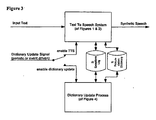
- Figure 3 illustrates the interaction between the pronunciation determining stage and dictionary update stage.
- the dictionary update stage is only effected when the TTS system is not processing text and outputting speech and visa versa.
- a switch 12 disables the pronunciation stage and enables the dictionary update stage.
- a dictionary update control module 14 calculates the mean occurrence statistics and updates the long term occurrence count in both the pronunciation dictionary and the exceptions log.
- the constants k 4 and k 5 may be difference for the exceptions log and for the pronunciation dictionary and they may be fixed or variable. For example, the constants may change depending on the number of tokens processed since the dictionary was last updated.
- the current occurrence count for each entry is reset to zero.
- the dictionary update control module 8 collates a deletion list from the pronunciation dictionary 2 comprising all entries whose long term occurrence count is below a deletion candidate threshold and an addition candidate list from the exceptions log for all entries where the long term occurrence count is above the addition candidate threshold.
- the addition count threshold may or may not be set to zero.
- tokens in the deletion list are those which are rarely encountered by the TTS system. Hence, their deletion from the pronunciation dictionary would imply that there would be no significant speech quality degradation.
- the addition candidate list is sorted in descending order according to the long term occurrence count. That is to say the most likely tokens to be added first.
- the deletion candidate list is sorted in ascending order according to the long term occurrence count. That is to say the most likely deletion candidates first.
- the dictionary update control module 14 analyses the addition candidate list and the deletion candidate list entry by entry with the most likely addition candidate replacing the next deletion candidate, if the addition candidate long term occurrence count is greater than the deletion candidate long term occurrence count.
- the number of entries in the addition list may or may not equal the number of entries in the deletion list.
- the various thresholds and constants may be adapted depending upon previous dictionary update stages.
- Verification may be achieved by one of two ways or both and is effected by a pronunciation acquisition module 16.
- the first way is to request the user to define the correct pronunciation for the token.
- the pronunciation acquisition module 16 requests a user dialogue module 18 to commence a verification dialogue with the user.
- the dialogue comprises interaction with the user via a user interface 20.
- the user interface comprises a screen, keyboard and speech dialogue.
- the user dialogue module 18 announces that a verification dialogue with the user is to commence and requests confirmation from the user. If no confirmation is received, then the verification dialogue is deferred for a period of time. Having received confirmation, the user dialogue module 18 displays tokens on the screen together with the syntax category and pronunciation, usually in the form of phonetic notation. The user is requested to input via the keyboard confirmation that the token definition is correct.
- the user may confirm or correct the token more phonetically. There is also the option for the user to indicate that the TTS system should output the token with the defined pronunciation so that the user can check aurally that the correct pronunciation is defined. Finally, if the token is an abbreviation or acronym, then the user may input the token in it's full form.
- the second way for verification comprises the interaction with a remote pronunciation dictionary 22.
- the remote pronunciation dictionary 22 provides the verification of the pronunciation of the token. If the token is absent from the remote pronunciation dictionary, then the correct pronunciation must be verified from the user in accordance with the first way.
- the remote pronunciation dictionary 22 is typically quite large and would therefore be unlikely to be stored within the application embodying the TTS system. Availability to the remote pronunciation dictionary would be dependent upon the availability of access which is usually subject to physical or cost considerations.
- the pronunciation acquisition module 16 instructs a remote dictionary access module 24 to ascertain whether the remote pronunciation dictionary 22 can be accessed.
- the communications link control 26 initiates a communications link to another communications link control 28.
- the communications link may comprise any of those known in the art, such as an infrared link; wireless link such as the GSM air interface, GDM data channels or GSM Short message service channels; or a cable link connecting the application in which the TTS is embodied to a computer or host PC.
- the communications links 26, 28 access the remote pronunciation dictionary 22 via a remote dictionary server 30.
- the addition candidate list and the verified pronunciation is passed to a dictionary update module 32.
- the dictionary update module 32 updates the pronunciation dictionary 2 by overwriting those entries in the pronunciation dictionary marked for being listed in the deletion list and present in the addition candidate list with those to be added in the addition candidate list.
- the present invention enables the size of the pronunciation dictionary to be minimised; hence reducing the memory size of the TTS system. To ensure that this does not result in an unacceptable loss of speech quality, the method provides steps for adapting the contents of the pronunciation dictionary to contain only those entries that are most frequently encountered by the TTS system.
- the present invention is advantageous for use in small, mobile electronic products such as mobile phones, computers, CD players, DVD players and the like - although it is not limited thereto.
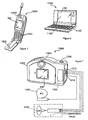
- Fig. 5 is an isometric view illustrating the configuration of the portable phone.
- the portable phone 1200 is provided with a plurality of operation keys 1202, an ear piece 1204, a mouthpiece 1206, and a display panel 100.
- the mouthpiece 1206 or ear piece 1204 may be used for outputting speech.
- FIG. 6 is an isometric view illustrating the configuration of this personal computer.
- the personal computer 1100 is provided with a body 1104 including a keyboard 1102 and a display unit 1106.
- the TTS system may use the display unit 1106 or keyboard 1102 to provide the user interface according to the present invention, as described above.
- FIG. 7 is an isometric view illustrating the configuration of the digital still camera and the connection to external devices in brief.
- Typical cameras sensitise films based on optical images from objects, whereas the digital still camera 1300 generates imaging signals from the optical image of an object by photoelectric conversion using, for example, a charge coupled device (CCD).
- the digital still camera 1300 is provided with an OEL element 100 at the back face of a case 1302 to perform display based on the imaging signals from the CCD.
- the display panel 100 functions as a finder for displaying the object.
- a photo acceptance unit 1304 including optical lenses and the CCD is provided at the front side (behind in the drawing) of the case 1302.
- the TTS system may be embodied in the digital still camera.
- FIG. 6 Further examples of electronic apparatuses, other than the personal computer shown in Fig. 6, the portable phone shown in Fig. 5, and the digital still camera shown in Fig. 7, include television sets, view-finder-type and monitoring-type video tape recorders, car navigation systems, pagers, electronic notebooks, portable calculators, word processors, workstations, TV telephones, point-of-sales system (POS) terminals, and devices provided with touch panels.
- POS point-of-sales system
- the TTS system of the present invention can be applied to any of these electronic apparatuses.
- the exceptions log may not always store the pronunciation of a word which has not been found in the dictionary, merely the word itself together with the average and current occurrence counts.
- the dictionary may not always initially be full but rather the dictionary is empty and all words referred in the first instance are stored in the dictionary.
- the pronunciation module and the dictionary update control module may not set the thresholds and constants but rather these are predetermined. In some circumstances, the number of entries in the deletion list may not equal the number in the addition list.
- the dictionary could be continuously updated rather than waiting until the pronunciation stage has paused and then switching between the pronunciation stage and the dictionary updating stage.
- the TTS system according to the present invention may be disposed on a single semiconductor chip with or without memory for the dictionary and the exceptions log and with or without means for outputting speech encoder-decoder (CODEC).
- CDEC speech encoder-decoder
Landscapes
- Engineering & Computer Science (AREA)
- Computational Linguistics (AREA)
- Health & Medical Sciences (AREA)
- Audiology, Speech & Language Pathology (AREA)
- Human Computer Interaction (AREA)
- Physics & Mathematics (AREA)
- Acoustics & Sound (AREA)
- Multimedia (AREA)
- Machine Translation (AREA)
Claims (13)
- Verfahren zum Betreiben eines Systems zur sprachlichen Wiedergabe von Text (TTS), das ein Aussprachelexikon und einen Speicher aufweist, welcher Ausspracheregeln enthält, wobei das Verfahren umfasst:Vergleichen jedes Wortes in dem Text mit Wörtern im Aussprachelexikon, um zu ermitteln, ob das gleiche Wort vorhanden ist;wenn das Wort ermittelt wird, dann Erhalten der Aussprache des Wortes;wenn das Wort nicht ermittelt wird, dann Anwenden der Ausspracheregeln auf das Wort, um die Aussprache des Wortes zu erhalten; wobeijedes Wort, das nicht ermittelt wird, in einem Ausnahmenprotokoll gespeichert wird; unddie am häufigsten genannten Wörter aus dem Ausnahmenprotokoll dem Aussprachelexikon hinzugefügt werden.
- Verfahren zum Betreiben eines TTS-Systems nach Anspruch 1, in welchem dann, wenn das Wort im Aussprachelexikon nicht ermittelt wird, das Wort mit jenen im Ausnahmenprotokoll vergleichen wird, um zu ermitteln, ob das Wort bereits im Ausnahmenprotokoll gespeichert ist.
- Verfahren zum Betreiben eines TTS-Systems nach Anspruch 1 oder 2, in welchem auch die Aussprache in Ausnahmenprotokoll gespeichert wird.
- Verfahren zum Betreiben eines TTS-Systems nach einem der Ansprüche 1 bis 3, in welchem auch die Syntax im Ausnahmenprotokoll gespeichert wird.
- Verfahren zum Betreiben eines TTS-Systems nach einem der vorhergehenden Ansprüche, welches ferner das Protokollieren der Anzahl von Malen, die ein Wort im Lexikon nicht ermittelt wurde, im Ausnahmenprotokoll umfasst.
- Verfahren zum Betreiben eines TTS-Systems nach einem der vorhergehenden Ansprüche, welches ferner das Protokollieren der Anzahl von Malen, die ein Wort ermittelt wurde, im Lexikon umfasst.
- Verfahren zum Betreiben eines TTS-Systems nach Anspruch 5 und 6, welcher ferner das Analysieren der am häufigsten protokollierten Wörter im Ausnahmenprotokoll mit den am wenigsten häufig protokollierten Wörtern im Lexikon und das Löschen der am wenigstens protokollierten Wörter im Lexikon bei Hinzufügen der am häufigsten protokollierten Wörter aus dem Ausnahmenprotokoll umfasst.
- Verfahren zum Betreiben eines TTS-Systems nach einem der vorhergehenden Ansprüche, welches ferner das regelmäßige Hinzufügen der am häufigsten verwendeten Wörter umfasst.
- Verfahren zum Betreiben eines TTS-Systems nach einem der Ansprüche 1 bis 7, welches ferner das Hinzufügen der am häufigsten verwendeten Wörter umfasst, wenn irgendeines der folgenden Ereignisse eintritt: wenn die Anzahl von Wörtern, die verglichen werden, eine vorbestimmte Anzahl ürberschreitet, oder dass das Ausnahmenprotokoll voll ist, oder nach dem Empfang eines Befehls von einem Benutzer des TTS-Systems, oder exponentiell während der ganzen Zeit, welche auf die Inbetriebnahme des TTS-Systems folgt.
- Verfahren zum Betreiben eines TTS-Systems nach einem der vorhergehenden Ansprüche, welches ferner das Überprüfen der Aussprache der Wörter, die im Ausnahmenprotokoll gespeichert sind, vor dem Hinzufügen der Wörter zum Lexikon umfasst.
- Verfahren zum Betreiben eines TTS-Systems nach Anspruch 10, wobei das Überprüfen der Aussprache das Überprüfen der Aussprache mit einem Benutzer des TTS-Systems umfasst.
- Verfahren zum Betreiben eines TTS-Systems nach Anspruch 10, wobei das Überprüfen der Aussprache das Überprüfen der Aussprache mit einem Fernaussprachelexikon umfasst.
- Mobiltelefon, das ein System zur sprachlichen Wiedergabe von Text aufweist, das so ausgelegt ist, dass es gemäß dem Verfahren nach einem der vorhergehenden Ansprüche betrieben wird.
Applications Claiming Priority (3)
| Application Number | Priority Date | Filing Date | Title |
|---|---|---|---|
| GB0221945A GB2393369A (en) | 2002-09-20 | 2002-09-20 | A method of implementing a text to speech (TTS) system and a mobile telephone incorporating such a TTS system |
| GB0221945 | 2002-09-20 | ||
| PCT/GB2003/004037 WO2004027757A1 (en) | 2002-09-20 | 2003-09-22 | Method for adapting a pronunciation dictionary used for speech synthesis |
Publications (2)
| Publication Number | Publication Date |
|---|---|
| EP1454313A1 EP1454313A1 (de) | 2004-09-08 |
| EP1454313B1 true EP1454313B1 (de) | 2006-10-18 |
Family
ID=9944517
Family Applications (1)
| Application Number | Title | Priority Date | Filing Date |
|---|---|---|---|
| EP03748274A Expired - Lifetime EP1454313B1 (de) | 2002-09-20 | 2003-09-22 | Verfahren zur adaptation eines aussprache-lexikons für die sprachsynthese |
Country Status (5)
| Country | Link |
|---|---|
| EP (1) | EP1454313B1 (de) |
| AU (1) | AU2003267582A1 (de) |
| DE (1) | DE60309131T2 (de) |
| GB (1) | GB2393369A (de) |
| WO (1) | WO2004027757A1 (de) |
Families Citing this family (2)
| Publication number | Priority date | Publication date | Assignee | Title |
|---|---|---|---|---|
| GB2405066A (en) * | 2003-05-13 | 2005-02-16 | Intellprop Ltd | Auditory assistance with language learning and pronunciation via a text to speech translation in a mobile communications device |
| GB2481992A (en) | 2010-07-13 | 2012-01-18 | Sony Europe Ltd | Updating text-to-speech converter for broadcast signal receiver |
Family Cites Families (5)
| Publication number | Priority date | Publication date | Assignee | Title |
|---|---|---|---|---|
| US4692941A (en) * | 1984-04-10 | 1987-09-08 | First Byte | Real-time text-to-speech conversion system |
| US6119085A (en) * | 1998-03-27 | 2000-09-12 | International Business Machines Corporation | Reconciling recognition and text to speech vocabularies |
| US6208968B1 (en) * | 1998-12-16 | 2001-03-27 | Compaq Computer Corporation | Computer method and apparatus for text-to-speech synthesizer dictionary reduction |
| US7292980B1 (en) * | 1999-04-30 | 2007-11-06 | Lucent Technologies Inc. | Graphical user interface and method for modifying pronunciations in text-to-speech and speech recognition systems |
| US6871178B2 (en) * | 2000-10-19 | 2005-03-22 | Qwest Communications International, Inc. | System and method for converting text-to-voice |
-
2002
- 2002-09-20 GB GB0221945A patent/GB2393369A/en not_active Withdrawn
-
2003
- 2003-09-22 DE DE60309131T patent/DE60309131T2/de not_active Expired - Lifetime
- 2003-09-22 WO PCT/GB2003/004037 patent/WO2004027757A1/en not_active Ceased
- 2003-09-22 AU AU2003267582A patent/AU2003267582A1/en not_active Abandoned
- 2003-09-22 EP EP03748274A patent/EP1454313B1/de not_active Expired - Lifetime
Also Published As
| Publication number | Publication date |
|---|---|
| AU2003267582A1 (en) | 2004-04-08 |
| WO2004027757A1 (en) | 2004-04-01 |
| DE60309131D1 (de) | 2006-11-30 |
| DE60309131T2 (de) | 2007-08-23 |
| GB0221945D0 (en) | 2002-10-30 |
| GB2393369A (en) | 2004-03-24 |
| EP1454313A1 (de) | 2004-09-08 |
Similar Documents
| Publication | Publication Date | Title |
|---|---|---|
| CN107632980B (zh) | 语音翻译方法和装置、用于语音翻译的装置 | |
| CN100389381C (zh) | 用于调试与语言模型一起使用的类实体词典的方法和设备 | |
| US12014729B2 (en) | Mixture model attention for flexible streaming and non-streaming automatic speech recognition | |
| US7451084B2 (en) | Cell phone having an information-converting function | |
| EP2485212A1 (de) | Sprachübersetzungssystem, erstes endgerät, spracherkennungsserver, übersetzungsserver und sprachsyntheseserver | |
| JP3426176B2 (ja) | 音声認識装置、方法、コンピュータ・システム及び記憶媒体 | |
| KR20030065473A (ko) | 텍스트 언어 검출 | |
| US6681208B2 (en) | Text-to-speech native coding in a communication system | |
| WO2021046958A1 (zh) | 语音信息处理方法、装置及存储介质 | |
| CN107564526B (zh) | 处理方法、装置和机器可读介质 | |
| CN112580335B (zh) | 多音字消歧方法及装置 | |
| US20070027673A1 (en) | Conversion of number into text and speech | |
| US20010012994A1 (en) | Speech recognition method, and apparatus and computer controlled apparatus therefor | |
| JP2004070959A (ja) | 適応型文脈依存解析 | |
| CN107274903B (zh) | 文本处理方法和装置、用于文本处理的装置 | |
| US20100114564A1 (en) | Dynamic update of grammar for interactive voice response | |
| CN114596846A (zh) | 语音识别文本的处理方法、装置、电子设备及存储介质 | |
| US11295732B2 (en) | Dynamic interpolation for hybrid language models | |
| CN117669602A (zh) | 语义评价模型的训练方法及流式文本的机器翻译方法 | |
| US20060004577A1 (en) | Distributed speech synthesis system, terminal device, and computer program thereof | |
| US8145490B2 (en) | Predicting a resultant attribute of a text file before it has been converted into an audio file | |
| US20050075879A1 (en) | Method of encoding text data to include enhanced speech data for use in a text to speech(tts)system, a method of decoding, a tts system and a mobile phone including said tts system | |
| EP1454313A1 (de) | Verfahren zur adaptation eines aussprache-lexikons für die sprachsynthese | |
| CN113807082B (zh) | 一种目标用户确定方法、装置和用于确定目标用户的装置 | |
| KR20180125863A (ko) | 단어 추천 방법 및 이를 위한 장치 |
Legal Events
| Date | Code | Title | Description |
|---|---|---|---|
| PUAI | Public reference made under article 153(3) epc to a published international application that has entered the european phase |
Free format text: ORIGINAL CODE: 0009012 |
|
| AK | Designated contracting states |
Kind code of ref document: A1 Designated state(s): AT BE BG CH CY CZ DE DK EE ES FI FR GB GR HU IE IT LI LU MC NL PT RO SE SI SK TR |
|
| AX | Request for extension of the european patent |
Extension state: AL LT LV MK |
|
| 17P | Request for examination filed |
Effective date: 20040625 |
|
| GRAP | Despatch of communication of intention to grant a patent |
Free format text: ORIGINAL CODE: EPIDOSNIGR1 |
|
| DAX | Request for extension of the european patent (deleted) | ||
| RBV | Designated contracting states (corrected) |
Designated state(s): DE FR GB |
|
| GRAS | Grant fee paid |
Free format text: ORIGINAL CODE: EPIDOSNIGR3 |
|
| GRAA | (expected) grant |
Free format text: ORIGINAL CODE: 0009210 |
|
| AK | Designated contracting states |
Kind code of ref document: B1 Designated state(s): DE FR GB |
|
| REG | Reference to a national code |
Ref country code: GB Ref legal event code: FG4D |
|
| REF | Corresponds to: |
Ref document number: 60309131 Country of ref document: DE Date of ref document: 20061130 Kind code of ref document: P |
|
| ET | Fr: translation filed | ||
| PLBE | No opposition filed within time limit |
Free format text: ORIGINAL CODE: 0009261 |
|
| STAA | Information on the status of an ep patent application or granted ep patent |
Free format text: STATUS: NO OPPOSITION FILED WITHIN TIME LIMIT |
|
| 26N | No opposition filed |
Effective date: 20070719 |
|
| PGFP | Annual fee paid to national office [announced via postgrant information from national office to epo] |
Ref country code: FR Payment date: 20100921 Year of fee payment: 8 |
|
| REG | Reference to a national code |
Ref country code: FR Ref legal event code: ST Effective date: 20120531 |
|
| PG25 | Lapsed in a contracting state [announced via postgrant information from national office to epo] |
Ref country code: FR Free format text: LAPSE BECAUSE OF NON-PAYMENT OF DUE FEES Effective date: 20110930 |
|
| PGFP | Annual fee paid to national office [announced via postgrant information from national office to epo] |
Ref country code: GB Payment date: 20120919 Year of fee payment: 10 |
|
| PGFP | Annual fee paid to national office [announced via postgrant information from national office to epo] |
Ref country code: DE Payment date: 20120919 Year of fee payment: 10 |
|
| GBPC | Gb: european patent ceased through non-payment of renewal fee |
Effective date: 20130922 |
|
| REG | Reference to a national code |
Ref country code: DE Ref legal event code: R119 Ref document number: 60309131 Country of ref document: DE Effective date: 20140401 |
|
| PG25 | Lapsed in a contracting state [announced via postgrant information from national office to epo] |
Ref country code: GB Free format text: LAPSE BECAUSE OF NON-PAYMENT OF DUE FEES Effective date: 20130922 |
|
| PG25 | Lapsed in a contracting state [announced via postgrant information from national office to epo] |
Ref country code: DE Free format text: LAPSE BECAUSE OF NON-PAYMENT OF DUE FEES Effective date: 20140401 |