EP1452959A1 - RANDOM NUMBER STRING OUTPUT APPARATUS, RANDOM NUMBER STRING OUTPUT METHOD, PROGRAM, AND INFORMATION RECORDING MEDIUM - Google Patents
RANDOM NUMBER STRING OUTPUT APPARATUS, RANDOM NUMBER STRING OUTPUT METHOD, PROGRAM, AND INFORMATION RECORDING MEDIUM Download PDFInfo
- Publication number
- EP1452959A1 EP1452959A1 EP02783553A EP02783553A EP1452959A1 EP 1452959 A1 EP1452959 A1 EP 1452959A1 EP 02783553 A EP02783553 A EP 02783553A EP 02783553 A EP02783553 A EP 02783553A EP 1452959 A1 EP1452959 A1 EP 1452959A1
- Authority
- EP
- European Patent Office
- Prior art keywords
- value
- sequence
- random number
- unit
- predetermined
- Prior art date
- Legal status (The legal status is an assumption and is not a legal conclusion. Google has not performed a legal analysis and makes no representation as to the accuracy of the status listed.)
- Granted
Links
Images





Classifications
-
- G—PHYSICS
- G06—COMPUTING OR CALCULATING; COUNTING
- G06F—ELECTRIC DIGITAL DATA PROCESSING
- G06F7/00—Methods or arrangements for processing data by operating upon the order or content of the data handled
- G06F7/58—Random or pseudo-random number generators
- G06F7/582—Pseudo-random number generators
-
- G—PHYSICS
- G06—COMPUTING OR CALCULATING; COUNTING
- G06F—ELECTRIC DIGITAL DATA PROCESSING
- G06F2207/00—Indexing scheme relating to methods or arrangements for processing data by operating upon the order or content of the data handled
- G06F2207/58—Indexing scheme relating to groups G06F7/58 - G06F7/588
- G06F2207/583—Serial finite field implementation, i.e. serial implementation of finite field arithmetic, generating one new bit or trit per step, e.g. using an LFSR or several independent LFSRs; also includes PRNGs with parallel operation between LFSR and outputs
-
- G—PHYSICS
- G06—COMPUTING OR CALCULATING; COUNTING
- G06F—ELECTRIC DIGITAL DATA PROCESSING
- G06F7/00—Methods or arrangements for processing data by operating upon the order or content of the data handled
- G06F7/58—Random or pseudo-random number generators
- G06F7/582—Pseudo-random number generators
- G06F7/584—Pseudo-random number generators using finite field arithmetic, e.g. using a linear feedback shift register
Definitions
- the present invention relates to a random number sequence output apparatus, a random number sequence output method, a program for realizing the random number sequence output apparatus and the random number sequence output method, and a computer readable information recording medium that stores the program.
- the present invention is a method for avoiding these kinds of problems, and the purpose of the present invention is to provide a random number sequence output apparatus, a random number sequence output method, a program for realizing the two, and a computer readable information recording medium that stores the program.
- a random number sequence output apparatus comprises a sequence acceptance unit, an initial value setting unit, a storage unit, an output unit, a calculation unit, and an updating unit, and is structured as below.
- the sequence acceptance unit accepts input of a numeral sequence.
- the initial value setting unit accepts input of an initial value, and the initial value is stored to the storage unit.
- the output unit outputs the value each time a new value is stored to the storage unit.
- the calculation unit applies a predetermined rational map to the value stored in the storage unit, and further calculates, by carrying out a predetermined operation to the value of above and a value sequentially extracted from the numerical sequence accepted by the sequence acceptance unit.
- the updating unit updates by storing the results of the value calculated by the calculation unit to the storage unit.
- the predetermined rational map may be structured to be a Chebyshev map of equal to or higher than a second degree.
- the storage unit may be structured to store the value at a fixed-point notation of a predetermined number of bits.
- the predetermined operation may be structured to invert the bits of a predetermined position of a fixed-point notation of the predetermined number of bits of the value, in a case where a value sequentially extracted from the numerical sequence is a predetermined value.
- the numerical sequence may be structured so that the sequence that has a length T repeats a binary sequence (including a gold code, an M sequence, and a Baker sequence, etc.), taking a value of 0 or 1, and that the bit of the predetermined position may be a least significant bit of the fixed-point notation, and the predetermined value may be 1.
- a binary sequence including a gold code, an M sequence, and a Baker sequence, etc.
- a random number sequence output method comprises a sequence acceptance step, an initial value setting step, an output step, a calculation step, and an updating step, and is structured as below.
- the sequence acceptance step accepts input of a numerical sequence.
- the initial value setting step accepts input of an initial value, and stores the value in the storage unit.
- the output step outputs the value each time a new value is stored in the storage unit.
- the calculation step applies a predetermined rational map to the value stored in the storage unit, and further calculates, by carrying out a predetermined operation to the value of above and a value sequentially extracted from the numerical sequence accepted in the sequence acceptance step.
- the updating step updates by storing the results of the value calculated in the calculation step, to the storage unit.
- the predetermined rational map may be structured to be a Chebyshev map of equal to or higher than a second degree.
- the random number sequence output method may be structured so that the value is stored in a fixed-point notation of a predetermined bit to the storage unit, in the initial value setting step and the updating step.
- the predetermined operation may be structured to invert the bits of a predetermined position of a fixed-point notation of the predetermined number of bits of the value, in a case where a value sequentially extracted from the numerical sequence is a predetermined value.
- the numerical sequence may be structured so that a sequence that has a length T repeats a binary sequence (including a gold code, an M sequence, and a Baker sequence, etc.), taking a value of 0 or 1, and that the bit of the predetermined position is a least significant bit of the fixed-point notation, and the predetermined value is 1.
- a binary sequence including a gold code, an M sequence, and a Baker sequence, etc.
- a program according to another aspect of the present invention is structured to control a computer (including an ASIC (Application Specific Integrated Circuit), a DSP (Digital Signal Processor), or an FPGA (Field Programmable Gate Array), etc.,) to function as the above random number sequence output apparatus, or to control the computer to execute the above random number sequence output method.
- a computer including an ASIC (Application Specific Integrated Circuit), a DSP (Digital Signal Processor), or an FPGA (Field Programmable Gate Array), etc.
- the program of the present invention may be stored to a computer readable information recording medium (including a compact disk, a flexible disk, a hard disk, a magnetic optical disk, a digital video disk, a magnetic tape, and a semiconductor memory).
- a computer readable information recording medium including a compact disk, a flexible disk, a hard disk, a magnetic optical disk, a digital video disk, a magnetic tape, and a semiconductor memory.
- the above random number sequence output apparatus and the random number output method may be realized by executing the program of the present invention by a general computer, a portable telephone, a PHS (Personal Handyphone System) device, a portable terminal such as a game device, etc., an information processing device, such as a parallel computer, etc., an ASIC, a DSP, or an FPGA, etc., that comprises a storage device, a calculating device, an output device, and a communication device, etc.
- a general computer a portable telephone, a PHS (Personal Handyphone System) device, a portable terminal such as a game device, etc., an information processing device, such as a parallel computer, etc., an ASIC, a DSP, or an FPGA, etc.
- the information recording medium of the present invention can be distributed or sold in stores, etc., or the program of the present invention may be distributed and sold via a computer communication network.
- FIG. 1 is a diagram showing a schematic structure of a random number sequence generating apparatus according to an embodiment of the present invention.
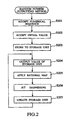
- FIG. 2 is a flowchart showing processing of a random number sequence generating method executed in the random string generating apparatus. Below, descriptions will be made with reference to these drawings.
- a random number sequence output apparatus 101 comprises a sequence acceptance unit 102, an initial value setting unit 103, a storage unit 104, an output unit 105, a calculation unit 106, and an updating unit 107.
- the sequence acceptance unit 102 accepts input of a numerical sequence (step S201).
- the numerical sequence is typically a repetition of a binary sequence, such as a gold code, an M sequence, and a Baker sequence, etc.
- the sequence acceptance unit 102 accepts a numerical sequence of a length T as an integer value, stores the integer value, and as will be later described, may cyclic shift (also called “rotate” and “shift rotate”) the integer value, after using the integer value to sequentially obtain the least significant bit of the integral value.
- the initial value setting unit 103 accepts input of an initial value (step S202), and the initial value is stored to the storage unit 104 (step S203).
- the storage unit 104 typically stores values at a fixed-point notation of a predetermined bit number.
- FIG. 3 shows a situation where a fixed-point notation of N bits is adopted.
- FIG. 3 illustrates a case of fixed-points of 0 to 1. Placing the order from the highest-order bit to the least significant bit in an order of b 0 , b 1 , b 2 ,..., b N-1, each of them takes a value of 1 or 0.
- any one of b 0 to b N-1 (typically b 0 ) is set as a code bit, and the fixed-point notation is expressed by the left others.
- the output unit 105 outputs this, each time a new value is stored to the storage unit 104 (step S204).
- the calculation unit 106 applies a predetermined rational map to the value stored in the storage unit 104 (step S205), and further calculates, by carrying out a predetermined operation (hereinafter referred to as "harnessing") to the value of above and a value sequentially extracted from the numerical sequence accepted by the sequence acceptance unit 102 (step S206).
- the predetermined rational map is a Chebyshev map of a degree equal to or higher than a second degree.
- FIG. 4 is a graph showing a situation of a Chebyshev map.
- the horizontal axis is the x axis, and the vertical axis is the y axis.
- a bit harnessing operation inverts the bits of a predetermined position of a fixed-point notation of the predetermined number of bits of the value. Namely, in a case where the predetermined value is 1, a bit harnessing operation inverts the value of the least significant bit b N-1 .
- An embodiment of calculating an exclusive OR with a bit of another position, and not the least significant bit, can be adopted. However, it is preferable that the bit is not the code bit.
- the updating unit 107 updates by storing the results of the value calculated by the calculation unit 106 to the storage unit 104 (step S207), and returns to step S204.
- bit harnessing may be another mode.
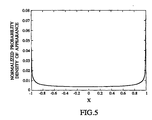
- FIG. 5 is a graph showing a sequence distribution, in a case where a sequence is generated by a Chebyshev map at a rational number notation of an infinite precision.
- FIG. 6 is a graph showing a sequence distribution, in a case where a bit harnessing operation is not carried out at an 8 bit precision.
- FIG. 7 is a graph showing a sequence distribution, in a case where the above embodiment is adopted at an 8 bit precision.
- FIG. 8 is a graph showing a sequence distribution, in a case where a bit harnessing operation is not carried out at a 12 bit precision.
- FIG. 9 is a graph showing a sequence distribution, in a case where the above embodiment is adopted at a 12 bit precision.
- FIG. 10 is a graph showing a sequence distribution, in a case where a bit harnessing operation is not carried out in a 16 bit precision.
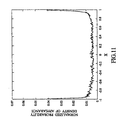
- FIG. 11 is a graph showing a sequence distribution, in a case where the above embodiment is adopted at a 16 bit precision.
- a random number sequence output apparatus a random number sequence output method, a program for realizing the random number sequence output apparatus and the random number sequence output method, and a computer readable information recording medium that stores the program, can be provided.
Landscapes
- Physics & Mathematics (AREA)
- Theoretical Computer Science (AREA)
- General Physics & Mathematics (AREA)
- Engineering & Computer Science (AREA)
- Mathematical Optimization (AREA)
- Pure & Applied Mathematics (AREA)
- Mathematical Analysis (AREA)
- General Engineering & Computer Science (AREA)
- Computational Mathematics (AREA)
- Complex Calculations (AREA)
- Compression, Expansion, Code Conversion, And Decoders (AREA)
- Slot Machines And Peripheral Devices (AREA)
- Pinball Game Machines (AREA)
- Indexing, Searching, Synchronizing, And The Amount Of Synchronization Travel Of Record Carriers (AREA)
- Information Retrieval, Db Structures And Fs Structures Therefor (AREA)
- Management, Administration, Business Operations System, And Electronic Commerce (AREA)
Abstract
Description
corresponds to:
- Cyclic shifting the bit sequence of the fixed-point notation, by the value sequentially extracted (0 or 1) from the numerical sequence.
- Adding the value sequentially extracted (0 or 1) from the numerical sequence to a value looking at the bit sequence of the fixed-point notation as an "unsigned integer".
- Subtracting the value sequentially extracted (0 or 1) from the numerical sequence, from a value looking at the bit sequence of the fixed-point notation as an "unsigned integer".
- Exchanging the value of bit bp and bit bq concerning predetermined integers p and q, (0≤p, q≤N-1 ), in a case where the values sequentially extracted from the numerical sequence is a pre-set value (for example, 1).
Claims (13)
- A random number sequence output apparatus (101) that comprises a sequence acceptance unit (102), an initial value setting unit (103), a storage unit (104), an output unit (105), a calculation unit (106), and an updating unit (107), characterized in that:said sequence acceptance unit (102) accepts input of a numeral sequence;said initial value setting unit (103) accepts input of an initial value, and the initial value is stored to the storage unit (104);said output unit (105) outputs the value each time a new value is stored to the storage unit (104);said calculation unit (106) applies a predetermined rational map to the value stored in the storage unit (104), and further calculates, by carrying out a predetermined operation to the value of above and a value sequentially extracted from the numerical sequence accepted by the sequence acceptance unit (102), andsaid updating unit (107) updates by storing the results of the value calculated by the calculation unit (106) to the storage unit (104).
- The random number sequence output apparatus (101) according to claim 1, characterized in that said predetermined rational map is a Chebyshev map T (a, ·) of an ath (a≥2) degree defined by
- The random number sequence output apparatus (101) according to claim 2, characterized in that said storage unit (104) stores the value at a fixed-point notation of a predetermined number of bits.
- The random number sequence output apparatus (101) according to claim 3, characterized in that said predetermined operation inverts the bits of a predetermined position of a fixed-point notation of the predetermined number of bits of the value, in a case where a value sequentially extracted from the numerical sequence is a predetermined value.
- The random number sequence output apparatus (101) according to claim 4, characterized in that:the numerical sequence has a length T that repeats a binary sequence (including a gold code, an M sequence, and a Baker sequence, etc.), taking a value of 0 or 1, andthe bit of the predetermined position is a least significant bit of the fixed-point notation, and the predetermined value is 1.
- A random number sequence output method using a storage unit that stores values, comprising a sequence acceptance step, an initial value setting step, an output step, a calculation step, and an updating step, and is characterized in that:the sequence acceptance step accepts input of a numerical sequence;the initial value setting step accepts input of an initial value, and stores the value in said storage unit;the output step outputs the value each time a new value is stored in said storage unit;the calculation step applies a predetermined rational map to the value stored in the storage unit, and further calculates, by carrying out a predetermined operation to the value of above and a value sequentially extracted from the numerical sequence accepted in the sequence acceptance step, andthe updating step updates by storing the results of the value calculated in the calculation step, to said storage unit.
- The random number sequence output method according to claim 6, characterized in that said predetermined rational map is a Chebyshev map T (a, ·) of an ath (a≥2) degree defined by
- The random number sequence output method according to claim 7, characterized in that the value is stored in a fixed-point notation of a predetermined bit to said storage unit, in said initial value setting step and said updating step.
- The random number sequence output method according to claim 8, characterized in that said predetermined operation inverts the bits of a predetermined position of a fixed-point notation of the predetermined number of bits of the value, in a case where a value sequentially extracted from the numerical sequence is a predetermined value.
- The random number sequence output method according to claim 9, characterized in that:the numerical sequence is a length T, and is a sequence that repeats a binary sequence (including a gold code, an M sequence, and a Baker sequence, etc.), taking a value of 0 or 1;the bit of the predetermined position is a least significant bit of the fixed-point notation, andthe predetermined value is 1.
- A program that controls a computer to function as the random number sequence output apparatus according to any one of claims 1 to 5.
- A program that controls a computer to execute the random number sequence output method according to any one of claims 6 to 10.
- A computer readable information recording medium (including a compact disk, a flexible disk, a hard disk, a magnetic optical disk, a digital video disk, a magnetic tape, and a semiconductor memory) characterized by storing the program according to claim 11.
Applications Claiming Priority (3)
| Application Number | Priority Date | Filing Date | Title |
|---|---|---|---|
| JP2001339429 | 2001-11-05 | ||
| JP2001339429A JP3525146B2 (en) | 2001-11-05 | 2001-11-05 | Random number sequence output device, random number sequence output method, program, and information recording medium |
| PCT/JP2002/011526 WO2003040910A1 (en) | 2001-11-05 | 2002-11-05 | Random number string output apparatus, random number string output method, program, and information recording medium |
Publications (3)
| Publication Number | Publication Date |
|---|---|
| EP1452959A1 true EP1452959A1 (en) | 2004-09-01 |
| EP1452959A4 EP1452959A4 (en) | 2007-06-20 |
| EP1452959B1 EP1452959B1 (en) | 2010-01-13 |
Family
ID=19153775
Family Applications (1)
| Application Number | Title | Priority Date | Filing Date |
|---|---|---|---|
| EP02783553A Expired - Lifetime EP1452959B1 (en) | 2001-11-05 | 2002-11-05 | Random number string output apparatus |
Country Status (5)
| Country | Link |
|---|---|
| US (1) | US7472147B2 (en) |
| EP (1) | EP1452959B1 (en) |
| JP (1) | JP3525146B2 (en) |
| DE (1) | DE60235115D1 (en) |
| WO (1) | WO2003040910A1 (en) |
Families Citing this family (5)
| Publication number | Priority date | Publication date | Assignee | Title |
|---|---|---|---|---|
| JP3735670B2 (en) * | 2003-03-19 | 2006-01-18 | 独立行政法人情報通信研究機構 | Random number sequence generation device, encryption / decryption device, random number sequence generation method, encryption / decryption method, and program |
| WO2004112271A1 (en) * | 2003-06-13 | 2004-12-23 | Japan Science And Technology Agency | Communication device and communication method |
| JP3740540B2 (en) | 2003-06-20 | 2006-02-01 | 独立行政法人情報通信研究機構 | Pulse generator, pulse generation method, communication apparatus, and communication method |
| JP2007243277A (en) * | 2006-03-06 | 2007-09-20 | Institute Of Physical & Chemical Research | Receiving device, receiving method, and program |
| US8250129B2 (en) * | 2007-06-22 | 2012-08-21 | Lsi Corporation | Cryptographic random number generator using finite field operations |
Family Cites Families (15)
| Publication number | Priority date | Publication date | Assignee | Title |
|---|---|---|---|---|
| JPS5947834A (en) | 1982-09-10 | 1984-03-17 | Omron Tateisi Electronics Co | Pn code generating circuit |
| JPH0282810A (en) | 1988-09-20 | 1990-03-23 | Sony Corp | Binary periodic signal generator |
| JPH0333917A (en) | 1989-06-29 | 1991-02-14 | Nec Corp | Arithmetic circuit |
| US5420928A (en) * | 1994-01-25 | 1995-05-30 | Bell Communications Research, Inc. | Pseudo-random generator |
| US5727063A (en) * | 1995-11-27 | 1998-03-10 | Bell Communications Research, Inc. | Pseudo-random generator |
| GB2333652A (en) * | 1998-01-24 | 1999-07-28 | Motorola Ltd | Random number generator with improved equiprobability |
| JP3455748B2 (en) | 1999-12-21 | 2003-10-14 | 独立行政法人通信総合研究所 | Vector string output device, output method, and information recording medium |
| JP3030341B1 (en) | 1999-03-29 | 2000-04-10 | 郵政省通信総合研究所長 | Random vector sequence output device, output method, and information recording medium |
| JP3234202B2 (en) * | 1999-08-19 | 2001-12-04 | 独立行政法人通信総合研究所 | Pseudo noise sequence output device, transmission device, reception device, communication system, pseudo noise sequence output method, transmission method, reception method, and information recording medium |
| JP3314181B2 (en) | 2000-04-07 | 2002-08-12 | 独立行政法人通信総合研究所 | Pseudo random number sequence output device, transmitting device, receiving device, communication system, filter device, pseudo random number sequence output method, transmission method, reception method, filter method, and information recording medium |
| JP2002305451A (en) | 2001-04-04 | 2002-10-18 | Chaos Sangyo Gijutsu Kenkyusho:Kk | How to get the chaos suppression period |
| JP2002304289A (en) | 2001-04-04 | 2002-10-18 | Chaos Sangyo Gijutsu Kenkyusho:Kk | Pseudo random number cycle cancellation method |
| JP2002312161A (en) | 2001-04-18 | 2002-10-25 | Chaos Sangyo Gijutsu Kenkyusho:Kk | How to generate chaos time series |
| US20030014451A1 (en) * | 2001-07-12 | 2003-01-16 | Optix Networks Inc. | Method and machine for scrambling parallel data channels |
| US7233965B2 (en) * | 2002-09-30 | 2007-06-19 | Sun Microsystems, Inc. | Continuous random number generation method and apparatus |
-
2001
- 2001-11-05 JP JP2001339429A patent/JP3525146B2/en not_active Expired - Lifetime
-
2002
- 2002-11-05 WO PCT/JP2002/011526 patent/WO2003040910A1/en not_active Ceased
- 2002-11-05 DE DE60235115T patent/DE60235115D1/en not_active Expired - Lifetime
- 2002-11-05 EP EP02783553A patent/EP1452959B1/en not_active Expired - Lifetime
- 2002-11-05 US US10/494,792 patent/US7472147B2/en not_active Expired - Fee Related
Also Published As
| Publication number | Publication date |
|---|---|
| WO2003040910A8 (en) | 2003-07-17 |
| JP3525146B2 (en) | 2004-05-10 |
| JP2003140885A (en) | 2003-05-16 |
| EP1452959A4 (en) | 2007-06-20 |
| US7472147B2 (en) | 2008-12-30 |
| DE60235115D1 (en) | 2010-03-04 |
| WO2003040910A1 (en) | 2003-05-15 |
| US20050033785A1 (en) | 2005-02-10 |
| EP1452959B1 (en) | 2010-01-13 |
Similar Documents
| Publication | Publication Date | Title |
|---|---|---|
| US4493046A (en) | Apparatus for generation of binary pseudo-random numbers | |
| CA2179758C (en) | Method and apparatus for performing a fast hadamard transform | |
| KR100498457B1 (en) | The improved method of compressing look up table for reducing memory and non-linear function generating apparatus having look up table compressed using the method and the non-linear function generating method | |
| US20210326407A1 (en) | Optimization problem solving calculation apparatus | |
| KR102697307B1 (en) | Stochastic rounding logic | |
| US7472147B2 (en) | Random number string output apparatus, random number string output method, program, and information recording medium | |
| CN117331530A (en) | Method, device, electronic equipment and storage medium for fast jump of long pseudo-random sequence | |
| CN114281304B (en) | Randomized computing methods, circuits, chips and devices | |
| KR100913467B1 (en) | Parallel Cyclic Redundancy Check Code Generation System and Method | |
| KR20240095009A (en) | Systems and methods for shift last multiplication and accumulation (mac) process | |
| JP2005072843A (en) | Mobile phone, method and program for calculating interleave parameter | |
| KR20160057590A (en) | Elimination Method for Common Sub-Expression And Filter Using the Method | |
| WO2016181978A1 (en) | Matrix operation device, matrix operation method, and program | |
| KR100564764B1 (en) | Finite Field Polynomial Multiplication Apparatus and Method | |
| RU2823911C1 (en) | Pipeline adder-accumulator by arbitrary modules | |
| JP3895887B2 (en) | Decibel level adjustment device | |
| CN114895868B (en) | Division operation unit and divider based on two-bit quotient calculation | |
| JP3656057B2 (en) | Random number sequence generation device, random number sequence generation method, and program | |
| KR100422345B1 (en) | Random number generator | |
| FR3129262A1 (en) | Reduction and conversion of a scalar to a tau-adic representation | |
| JPH10105382A (en) | Information processing apparatus and method | |
| JP2828791B2 (en) | A method for quantizing partial sums used in the product-sum operation | |
| CN120255850A (en) | Selection vector generation method, random vector generator and device | |
| KR101179932B1 (en) | Apparatus and method for calculating modular-3 | |
| CN116957013A (en) | Floating point convolution operator acceleration method and device, electronic equipment and storage medium |
Legal Events
| Date | Code | Title | Description |
|---|---|---|---|
| PUAI | Public reference made under article 153(3) epc to a published international application that has entered the european phase |
Free format text: ORIGINAL CODE: 0009012 |
|
| 17P | Request for examination filed |
Effective date: 20040504 |
|
| AK | Designated contracting states |
Kind code of ref document: A1 Designated state(s): AT BE BG CH CY CZ DE DK EE ES FI FR GB GR IE IT LI LU MC NL PT SE SK TR |
|
| RAP1 | Party data changed (applicant data changed or rights of an application transferred) |
Owner name: INDEPENDENT ADMINISTRATIVE INSTITUTION JAPAN SCIEN Owner name: UMENO, KEN |
|
| RTI1 | Title (correction) |
Free format text: RANDOM NUMBER STRING OUTPUT APPARATUS, RANDOM NUMBER STRING OUTPUT METHOD, PROGRAM, AND INFORMATION RECORDING MEDIUM |
|
| A4 | Supplementary search report drawn up and despatched |
Effective date: 20070521 |
|
| 17Q | First examination report despatched |
Effective date: 20080509 |
|
| RAP1 | Party data changed (applicant data changed or rights of an application transferred) |
Owner name: INDEPENDENT ADMINISTRATIVE INSTITUTION JAPAN SCIEN Owner name: CHAOSWARE, INC. |
|
| GRAP | Despatch of communication of intention to grant a patent |
Free format text: ORIGINAL CODE: EPIDOSNIGR1 |
|
| RTI1 | Title (correction) |
Free format text: RANDOM NUMBER STRING OUTPUT APPARATUS |
|
| GRAS | Grant fee paid |
Free format text: ORIGINAL CODE: EPIDOSNIGR3 |
|
| GRAA | (expected) grant |
Free format text: ORIGINAL CODE: 0009210 |
|
| AK | Designated contracting states |
Kind code of ref document: B1 Designated state(s): DE FI FR GB NL SE |
|
| REG | Reference to a national code |
Ref country code: GB Ref legal event code: FG4D |
|
| REF | Corresponds to: |
Ref document number: 60235115 Country of ref document: DE Date of ref document: 20100304 Kind code of ref document: P |
|
| REG | Reference to a national code |
Ref country code: NL Ref legal event code: VDEP Effective date: 20100113 |
|
| PG25 | Lapsed in a contracting state [announced via postgrant information from national office to epo] |
Ref country code: NL Free format text: LAPSE BECAUSE OF FAILURE TO SUBMIT A TRANSLATION OF THE DESCRIPTION OR TO PAY THE FEE WITHIN THE PRESCRIBED TIME-LIMIT Effective date: 20100113 |
|
| PG25 | Lapsed in a contracting state [announced via postgrant information from national office to epo] |
Ref country code: FI Free format text: LAPSE BECAUSE OF FAILURE TO SUBMIT A TRANSLATION OF THE DESCRIPTION OR TO PAY THE FEE WITHIN THE PRESCRIBED TIME-LIMIT Effective date: 20100113 |
|
| PG25 | Lapsed in a contracting state [announced via postgrant information from national office to epo] |
Ref country code: SE Free format text: LAPSE BECAUSE OF FAILURE TO SUBMIT A TRANSLATION OF THE DESCRIPTION OR TO PAY THE FEE WITHIN THE PRESCRIBED TIME-LIMIT Effective date: 20100113 |
|
| PLBE | No opposition filed within time limit |
Free format text: ORIGINAL CODE: 0009261 |
|
| STAA | Information on the status of an ep patent application or granted ep patent |
Free format text: STATUS: NO OPPOSITION FILED WITHIN TIME LIMIT |
|
| 26N | No opposition filed |
Effective date: 20101014 |
|
| GBPC | Gb: european patent ceased through non-payment of renewal fee |
Effective date: 20101105 |
|
| REG | Reference to a national code |
Ref country code: FR Ref legal event code: ST Effective date: 20110801 |
|
| REG | Reference to a national code |
Ref country code: DE Ref legal event code: R119 Ref document number: 60235115 Country of ref document: DE Effective date: 20110601 Ref country code: DE Ref legal event code: R119 Ref document number: 60235115 Country of ref document: DE Effective date: 20110531 |
|
| PG25 | Lapsed in a contracting state [announced via postgrant information from national office to epo] |
Ref country code: FR Free format text: LAPSE BECAUSE OF NON-PAYMENT OF DUE FEES Effective date: 20101130 |
|
| PG25 | Lapsed in a contracting state [announced via postgrant information from national office to epo] |
Ref country code: GB Free format text: LAPSE BECAUSE OF NON-PAYMENT OF DUE FEES Effective date: 20101105 |
|
| PG25 | Lapsed in a contracting state [announced via postgrant information from national office to epo] |
Ref country code: DE Free format text: LAPSE BECAUSE OF NON-PAYMENT OF DUE FEES Effective date: 20110531 |