EP1452918A1 - Positive resist composition and method of forming resist pattern - Google Patents
Positive resist composition and method of forming resist pattern Download PDFInfo
- Publication number
- EP1452918A1 EP1452918A1 EP02788696A EP02788696A EP1452918A1 EP 1452918 A1 EP1452918 A1 EP 1452918A1 EP 02788696 A EP02788696 A EP 02788696A EP 02788696 A EP02788696 A EP 02788696A EP 1452918 A1 EP1452918 A1 EP 1452918A1
- Authority
- EP
- European Patent Office
- Prior art keywords
- structural unit
- resist composition
- positive type
- group
- type resist
- Prior art date
- Legal status (The legal status is an assumption and is not a legal conclusion. Google has not performed a legal analysis and makes no representation as to the accuracy of the status listed.)
- Granted
Links
- 0 C*CC(*)C(OC(C1)(C2)CC(C)CC1(C1)C21O)=O Chemical compound C*CC(*)C(OC(C1)(C2)CC(C)CC1(C1)C21O)=O 0.000 description 2
Classifications
-
- G—PHYSICS
- G03—PHOTOGRAPHY; CINEMATOGRAPHY; ANALOGOUS TECHNIQUES USING WAVES OTHER THAN OPTICAL WAVES; ELECTROGRAPHY; HOLOGRAPHY
- G03F—PHOTOMECHANICAL PRODUCTION OF TEXTURED OR PATTERNED SURFACES, e.g. FOR PRINTING, FOR PROCESSING OF SEMICONDUCTOR DEVICES; MATERIALS THEREFOR; ORIGINALS THEREFOR; APPARATUS SPECIALLY ADAPTED THEREFOR
- G03F7/00—Photomechanical, e.g. photolithographic, production of textured or patterned surfaces, e.g. printing surfaces; Materials therefor, e.g. comprising photoresists; Apparatus specially adapted therefor
- G03F7/004—Photosensitive materials
- G03F7/039—Macromolecular compounds which are photodegradable, e.g. positive electron resists
-
- G—PHYSICS
- G03—PHOTOGRAPHY; CINEMATOGRAPHY; ANALOGOUS TECHNIQUES USING WAVES OTHER THAN OPTICAL WAVES; ELECTROGRAPHY; HOLOGRAPHY
- G03F—PHOTOMECHANICAL PRODUCTION OF TEXTURED OR PATTERNED SURFACES, e.g. FOR PRINTING, FOR PROCESSING OF SEMICONDUCTOR DEVICES; MATERIALS THEREFOR; ORIGINALS THEREFOR; APPARATUS SPECIALLY ADAPTED THEREFOR
- G03F7/00—Photomechanical, e.g. photolithographic, production of textured or patterned surfaces, e.g. printing surfaces; Materials therefor, e.g. comprising photoresists; Apparatus specially adapted therefor
- G03F7/004—Photosensitive materials
- G03F7/039—Macromolecular compounds which are photodegradable, e.g. positive electron resists
- G03F7/0392—Macromolecular compounds which are photodegradable, e.g. positive electron resists the macromolecular compound being present in a chemically amplified positive photoresist composition
- G03F7/0397—Macromolecular compounds which are photodegradable, e.g. positive electron resists the macromolecular compound being present in a chemically amplified positive photoresist composition the macromolecular compound having an alicyclic moiety in a side chain
Definitions
- the present invention relates to a positive type resist composition and a resist pattern formation method, and more specifically relates to a chemically amplified positive type resist composition suitable for use in a process using a wavelength of no more than 200 nm, and particularly an ArF excimer laser, as the light source, as well as a resist pattern formation method using such a composition.
- resins comprising a benzene ring such as polyhydroxystyrene have insufficient transparency relative to the ArF excimer laser (193 nm).
- (meth)acrylate ester refers to acrylate esters or methacrylate esters.
- a resin with a conventional acrylate ester as the principal chain displays a lower Tg value than a resin with a methacrylate ester as the principal chain (hereafter, simply referred to as a methacrylate ester resin).
- this Tg value is considerably lower than conventional prebake temperatures of 120 to 140°C and PEB (post exposure baking) temperatures of 120 to 130°C required in chemically amplified resist compositions for vaporizing the solvent and forming the resist film, and enabling the acid generated from the acid generator to eliminate the acid dissociable, dissolution inhibiting groups, and in these processes, or even in processes with a lower temperature requirement of, for example, approximately 20°C lower, formation of a resist pattern was impossible.
- This surface roughness is different from conventional dry etching resistance, and in a film etched using a resist pattern as a mask, appears as distortions around the hole patterns in a contact hole pattern or as line edge roughness in a line and space pattern.
- Line edge roughness refers to non-uniform irregularities in the line side walls.
- line edge roughness also occurs in the resist pattern following developing. This line edge roughness following developing also appears as distortions around the hole patterns in a contact hole pattern or as non-uniform irregularities in the line side walls in a line and space pattern.
- Line slimming is a phenomenon in which during observation of a resist pattern using a scanning electron microscope (SEM), the formed resist pattern shrinks and narrows.
- SEM scanning electron microscope
- the cause of line slimming is reported to be due to the fact that when the formed resist pattern is exposed with the electron beam used in a SEM, a cross linking reaction occurs, causing slimming [Journal of Photopolymer Science Technology, Vol. 13, No. 4, page 497 (2000)].
- the present invention has an object of providing a chemically amplified positive type resist composition which displays excellent sensitivity and resolution, and enables the formation of a finely detailed resist pattern with low levels of surface roughness on etching, line edge roughness and line slimming.
- the inventors of the present invention discovered that although a methacrylate ester resin is ideal for resist pattern formation in so far as the Tg value is high, the above type of surface roughness is prevalent in a resist formed using a methacrylate ester resin, and the methacrylate ester resin is the cause of the surface roughness.
- the present invention provides a positive type resist composition
- a resin component with only units derived from an acrylate ester in the principal chain, for which the solubility in alkali increases under the action of acid (B) an acid generator component which generates acid on exposure, and (C) an organic solvent component
- the resin component (A) is a copolymer comprising (a1) a structural unit derived from an acrylate ester comprising, as an acid dissociable dissolution inhibiting group, a polycyclic dissolution inhibiting group which is eliminated more easily than a 2-alkyl-2-adamantyl group, (a2) a structural unit derived from an acrylate ester comprising a lactone containing polycyclic group, and (a3) a structural unit derived from an acrylate ester comprising a hydroxyl group containing polycyclic group.
- the present invention also provides a resist pattern formation method comprising the steps of providing a positive type resist composition described above on a substrate, conducting a prebake at 100 to 120°C for 40 to 120 seconds, performing selective exposure, and then conducting PEB (post exposure baking) at 90 to 110°C for 40 to 120 seconds, and performing alkali developing.
- a resist pattern formation method comprising the steps of providing a positive type resist composition described above on a substrate, conducting a prebake at 100 to 120°C for 40 to 120 seconds, performing selective exposure, and then conducting PEB (post exposure baking) at 90 to 110°C for 40 to 120 seconds, and performing alkali developing.
- a resin component (A) In a positive type resist composition of the present invention, a resin component (A) must be a resin component which does not comprise, in the principal chain, any structural units derived from methacrylate esters which cause resist surface roughness, but comprises only structural units derived from acrylate esters, and for which the solubility in alkali increases under the action of acid. Furthermore, because a composition of the present invention is a positive type resist composition, the resin component (A) must have acid dissociable, dissolution inhibiting groups, and these groups must undergo elimination in the presence of acid generated by an acid generator, altering the resin from an alkali insoluble state to an alkali soluble state, or in other words, increasing the alkali solubility.
- this resin component (A) must be a copolymer comprising (a1) a structural unit derived from an acrylate ester comprising, as an acid dissociable dissolution inhibiting group, a polycyclic dissolution inhibiting group which is eliminated more easily than a 2-methyl-2-adamantyl group, (a2) a structural unit derived from an acrylate ester comprising a lactone containing polycyclic group, and (a3) a structural unit derived from an acrylate ester comprising a hydroxyl group containing polycyclic group.
- the Tg value is increased, the problem of low Tg values associated with acrylate ester resins can be improved, and resist pattern formation can be achieved at temperatures slightly lower than conventional processes, namely, 100 to 120°C for prebake, and 90 to 110°C for PEB.
- Examples of the polycyclic group incorporated within each structural unit include bicycloalkanes, tricycloalkanes and tetracycloalkanes groups, including groups in which one hydrogen atom is removed from a polycycloalkane such as adamantane, norbomane, isobomane, tricyclodecane and tetracyclododecane, and these can be selected appropriately from the multitude of groups proposed for use with ArF resists.
- adamantyl groups and norbornyl groups are preferred, although the groups may be selected appropriately in accordance with the purpose of each of the structural units.
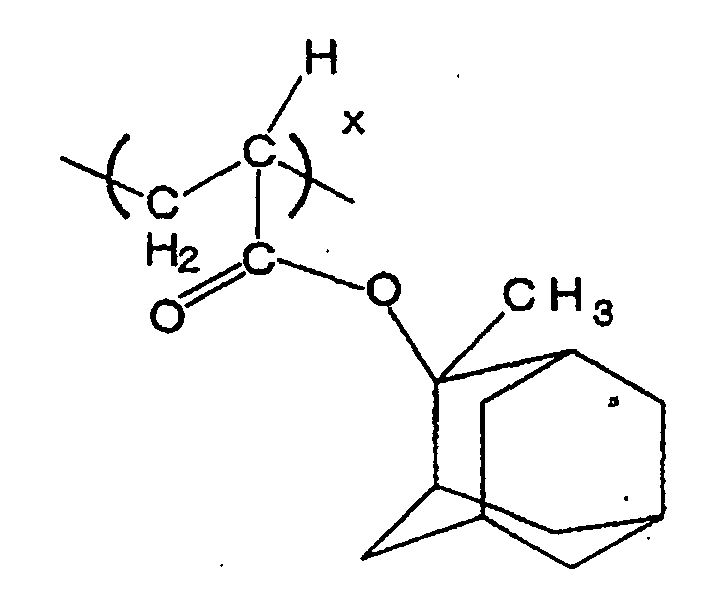
- the structural unit (a1) is a structural unit derived from an acrylate ester comprising, as an acid dissociable dissolution inhibiting group, a polycyclic dissolution inhibiting group which is eliminated more easily than a 2-methyl-2-adamantyl group. It is evident that the introduction of a polycyclic group is successful in increasing the Tg value of the resin component (A), and in order to ensure that the resist pattern can be formed at as low a temperature as possible, the acid dissociability must be increased. As a result, the acid dissociable, dissolution inhibiting group of the structural unit (a1) must be eliminated more easily than a 2-methyl-2-adamantyl group, which is a representative acid dissociable group for an ArF positive type resist.
- the structural unit (a1) has these types of properties, there are no particular restrictions on the structural unit, although specific examples include at least one type of structural unit selected from the general formulas (I) and (II) shown below. (wherein, R 1 represents a lower alkyl group of at least 2 carbon atoms) (wherein, R 2 and R 3 each represent, independently, a lower alkyl group)
- the aforementioned lower alkyl groups are preferably alkyl groups of no more than 5 carbon atoms.
- R 1 is an alkyl group of at least 2 carbon atoms
- the acid dissociability improves compared with the case in which R 1 is a methyl group.
- Suitable examples of R 1 include straight chain or branched chain alkyl groups such as ethyl groups, propyl groups, isopropyl groups, n-butyl groups, isobutyl groups, tert-butyl groups, pentyl groups, isopentyl groups and neopentyl groups, although from an industrial viewpoint, ethyl groups are preferred.
- R 2 and R 3 each represent, independently, a lower alkyl group of 1 to 5 carbon atoms
- the acid dissociability can be increased beyond that of a 2-methyl-2-adamantyl group.
- suitable groups for both R 2 and R 3 include methyl groups, or the same alkyl groups as the lower alkyl groups described above in relation to R 1 , and of these, structural units in which both R 2 and R 3 are methyl groups are preferred industrially.
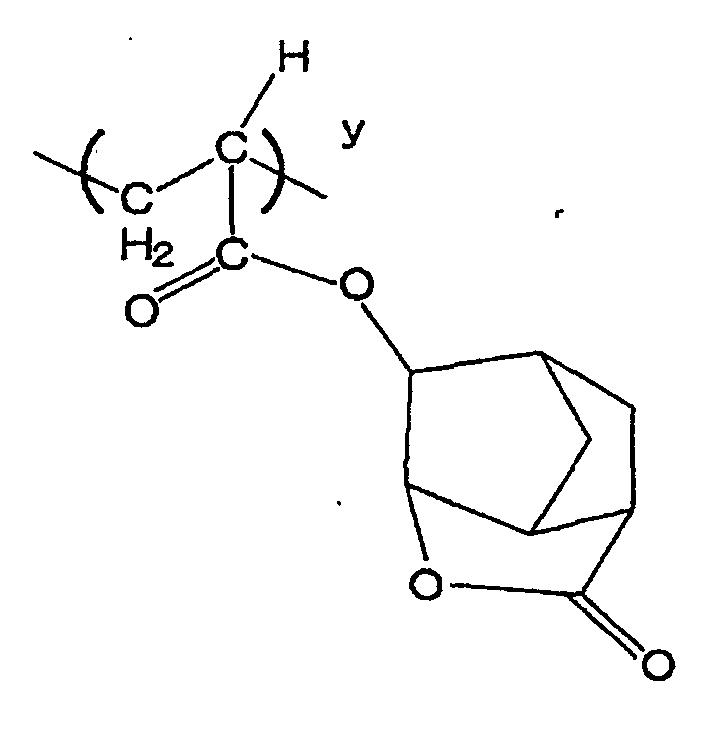
- the structural unit (a2) is a structural unit derived from an acrylate ester comprising a lactone containing polycyclic group. Lactone containing polycyclic groups are effective in increasing the adhesion between the resist layer and the substrate, and in improving the affinity with the developing liquid. There are no particular restrictions on the group, provided the lactone containing polycyclic group of the structural unit (a2) is a lactone containing polycyclic group, although specifically, lactone containing bicycloalkyl groups, and particularly the structural unit represented by the chemical formula shown below, provide a good balance between the Tg value raising effect for the resin component (A), and the lithography characteristics of the resist, and are consequently preferred.
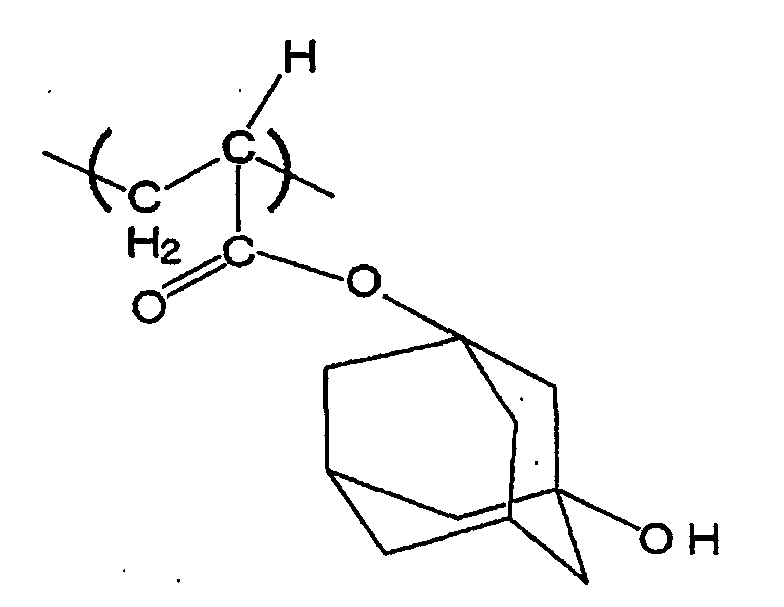
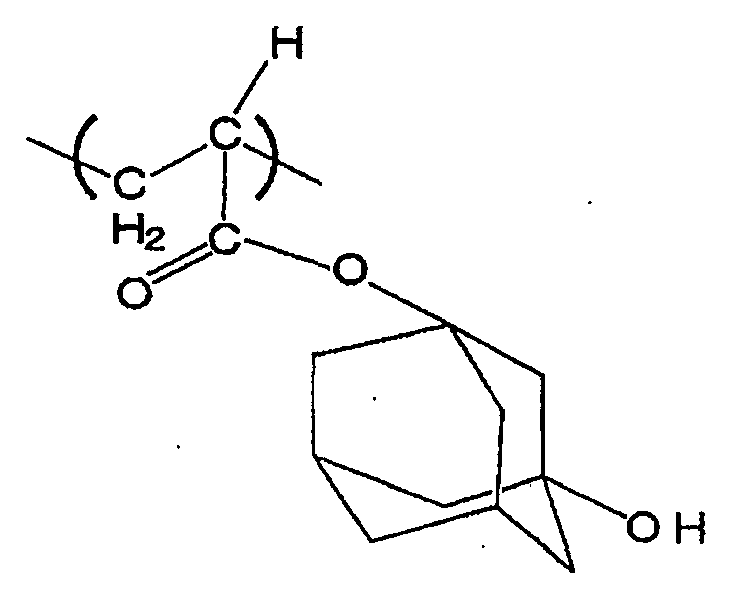
- the structural unit (a3) is a structural unit derived from an acrylate ester comprising a hydroxyl group containing polycyclic group.
- This structural unit contains a polar group such as a hydroxyl group, and consequently improves the overall affinity of the resin component (A) with the developing liquid, and improves the alkali solubility of the exposed sections. Accordingly, this structural unit contributes to improved resolution.
- the hydroxyl group containing polycyclic group of the structural unit (a3) is a hydroxyl group containing polycyclic group, although specifically, hydroxyl group containing adamantyl groups, and particularly the structural unit represented by the chemical formula shown below, provide a good balance between the Tg value raising effect for the resin component (A), and the lithography characteristics of the resist, and are consequently preferred.
- resin component (A) of a positive type resist composition of the present invention if the combined total of the structural unit (a1), the structural unit (a2), and the structural unit (a3) is deemed 100 mol%, then resins in which the structural unit (a1) accounts for 30 to 60 mol%, and preferably 35 to 45 mol%, the structural unit (a2) accounts for 20 to 60 mol%, and preferably 25 to 35 mol%, and the structural unit (a3) accounts for 10 to 50 mol%, and preferably 20 to 30 mol%, are preferred in terms of improving the balance between the reduction in surface roughness during etching, line edge roughness and line slimming, and the resolution.
- the resin component (A) may also contain other structural units, provided such inclusion does not impair the effects of the present invention, although resins formed from the structural unit (a1), the structural unit (a2) and the structural unit (a3) are preferred.
- weight average molecular weight of the resin component (A) Although values from 5,000 to 30,000 are preferred, and values from 8,000 to 20,000 are even more desirable. If the weight average molecular weight is larger than this range, then the solubility relative to the resist solvent deteriorates, whereas if smaller than the above range, the shape of the resist pattern can deteriorate, which is also undesirable.
- the resin component (A) can be produced easily by known radical polymerization of the corresponding acrylate ester monomer using a radical polymerization initiator such as azobisisobutyronitrile (AIBN).
- a radical polymerization initiator such as azobisisobutyronitrile (AIBN).
- an acid generator component (B) of a positive type resist composition of the present invention which generates acid on exposure, can be appropriately selected from known materials used as acid generators in conventional chemically amplified resists.
- the acid generator include onium salts such as diphenyliodonium trifluoromethanephosphate, (4-methoxyphenyl)phenyliodonium trifluoromethanesulfonate, bis(p-tert-butylphenyl)iodonium trifluoromethanesulfonate, triphenylsulfonium trifluoromethanesulfonate, (4-methoxyphenyl)diphenylsulfonium trifluoromethanesulfonate, (p-tert-butylphenyl)diphenylsulfonium trifluoromethanesulfonate, diphenyliodonium nonafluorobutanesulfonate, bis(p-tert-buty
- This radical acid generator component (B) may utilize a single compound, or a combination of two or more compounds.
- the quantity of the acid generator component (B) is typically selected within a range from 0.5 to 30 parts by mass, and preferably 1 to 10 parts by mass per 100 parts by mass of the resin component (A). If the quantity is less than 0.5 parts by mass then the pattern formation does not proceed adequately, whereas if the quantity exceeds 30 parts by mass, then achieving a uniform solution becomes difficult, causing a deterioration in storage stability.
- a positive type resist composition of the present invention is used as a solution obtained by dissolving the aforementioned resin component (A) and the acid generator component (B) in an organic solvent (C).
- the solvent is capable of dissolving both components to generate a uniform solution, then the solvent used can be one, or two or more solvents selected from amongst known solvents used for conventional chemically amplified resists.
- Examples of this type of organic solvent (C) include ketones such as acetone, methyl ethyl ketone, cyclohexanone, methyl isoamyl ketone and 2-heptanone; polyhydric alcohols and derivatives thereof such as ethylene glycol, ethylene glycol monoacetate, diethylene glycol, diethylene glycol monoacetate, propylene glycol, propylene glycol monoacetate, dipropylene glycol, or the monomethyl ether, monoethyl ether, monopropyl ether, monobutyl ether or monophenyl ether of dipropylene glycol monoacetate; cyclic ethers such as dioxane; and esters such as methyl lactate, ethyl lactate, methyl acetate, ethyl acetate, butyl acetate, methyl pyruvate, ethyl pyruvate, methyl methoxypropionate, and ethyl ethoxypropionat
- organic solvents may be used singularly, or as mixed solvents of two or more different solvents.
- mixed solvents mixed solvents of propylene glycol monomethyl ether acetate and a lactate ester are preferred.
- the mixture ratio is preferably a mass referenced ratio from 8:2 to 2:8.
- a positive type resist composition of the present invention using a mixed solvent containing at least one of propylene glycol monomethyl ether acetate and ethyl lactate, together with ⁇ -butyrolactone as the organic solvent is advantageous.
- the mass ratio of the former and latter components in the mixed solvent is selected within a range from 70:30 to 95:5.
- a secondary lower aliphatic amine or a tertiary lower aliphatic amine can also be added as a component (D).
- a lower aliphatic amine refers to an alkyl amine or an alkyl alcohol amine of no more than 5 carbon atoms
- examples of these secondary and tertiary amines include trimethylamine, diethylamine, triethylamine, di-n-propylamine, tri-n-propylamine, tripentylamine, diethanolamine and triethanolamine, and trialkanolamines are particularly preferred.
- These amines are typically added in quantities within a range from 0.01 to 0.2 mass% relative to the quantity of the resin component (A).
- Miscible additives can also be added to a positive type resist composition of the present invention according to need, including additive resins for improving the properties of the resist film, surfactants for improving the ease of application, dissolution inhibitors, plasticizers, stabilizers, colorants and halation prevention agents.
- the resin component (A) in the positive type resist composition of the present invention utilizes an easily eliminated, acid dissociable, dissolution inhibiting group in the structural unit (a1)
- pattern formation can be conducted at a lower temperature than that used in conventional resist pattern formation processes.
- the resist composition is first applied to the surface of a substrate such as a silicon wafer using a spinner, a prebake is conducted at 100 to 120°C for 40 to 120 seconds, and preferably for 60 to 90 seconds, and then following selective exposure of an ArF excimer laser through a desired mask pattern using, for example, an ArF exposure apparatus, PEB (post exposure baking) is conducted at 90 to 110°C for 40 to 120 seconds, and preferably for 60 to 90 seconds.
- PEB post exposure baking
- developing is conducted using an alkali developing liquid such as a 0.1 to 10 mass% aqueous solution of tetramethylammonium hydroxide. In this manner, a resist pattern which is faithful to the mask pattern can be obtained.
- composition of the present invention is particularly applicable to ArF excimer lasers, it is also effective for other types of radiation of shorter wavelength such as F 2 lasers, EUV (extreme ultraviolet radiation), VUV (vacuum ultraviolet radiation), electron beams, X-rays and soft X-rays.
- organic solvent component (C) comprising a mixed solvent of 450 parts by mass of propylene glycol monomethyl ether acetate and 300 parts by mass of ethyl lactate, yielding a uniform positive type resist composition solution.
- This solution was applied to the surface of a silicon wafer using a spinner and then prebaked for 90 seconds at 110°C on a hotplate, and formed a resist layer with a film thickness of 400 nm.
- the hole resist pattern formed by the above operation provided smooth circular shapes with a hole diameter of 130 nm and no distortion around the periphery of the holes, and displayed no line edge roughness.
- the depth of focus range of this 130 nm hole resist pattern was 300 nm.
- the surface roughness of this resist film following etching was Rms 1.1 nm, and in terms of line slimming, there was almost no variation, with the original width of the resist pattern of 100 nm becoming 96 nm following electron beam irradiation.
- a positive type resist composition solution was prepared in the same manner as the example 1.
- the line edge roughness of this pattern was determined by measuring the resist pattern width of the sample at 32 positions using a measuring SEM (S-9220, a trade name, manufactured by Hitachi, Ltd.), and from these measurement results, the value of 3 times the standard deviation (3 ⁇ ) was calculated. The smaller this 3 ⁇ value is, the lower the level of roughness, indicating a resist pattern with a uniform width. The value of 3 ⁇ was 4.2 nm.
- the Rms value which is a measure of the surface roughness of the resist pattern, was 1.6 nm, and in terms of line slimming there was almost no variation, with the value of 100 nm prior to electron beam irradiation becoming 96 nm following irradiation.
- the hole resist pattern formed in this manner provided circular shapes with a hole diameter of 130 nm and distortions around the periphery of the holes, displaying line edge roughness. Furthermore, the sensitivity was 16 mJ/cm 2 . The depth of focus range of this 130 nm hole resist pattern was 300 nm.
- a 130 nm line and space pattern was also formed in a separate preparation, and when the 3 ⁇ value was determined in the same manner as the example 2 as a measure of the line edge roughness, the value was 8.8 nm.
- a hole resist pattern was formed under the same lithography conditions as the example 1, and a 130 nm line and space pattern was formed in the same manner as the example 2.
- the hole resist pattern formed in this manner had a hole diameter of 130 nm, the sensitivity exceeded 100 mJ/cm 2 , and furthermore, the cross-sectional shape of the 130 nm line and space pattern was a taper shape, and the sensitivity was an unsatisfactory 60 mJ/cm 2 .
- a hole resist pattern was formed in a similar manner to the example 1, and a 130 nm line and space pattern was formed in a similar manner to the example 2.
- the thus formed hole resist pattern had a hole diameter of 130 nm, the side walls thereof displayed a marked taper, and the depth of focus range of this 130 nm hole resist pattern was 0 nm.
- the 130 nm line and space pattern had a triangular cross-section and was unsatisfactory.
- the Rms value which is a measure of the surface roughness of the resist pattern, was 1.3 nm.
- the thus formed hole resist pattern formed in this manner had a hole diameter of 130 nm, the depth of focus range of the 130 nm hole resist pattern was 100 nm.
- the Rms value which is a measure of the surface roughness of the resist pattern, was 0.9 nm.
- a hole resist pattern of a resist film using a positive type resist composition of the present invention provides a smooth circular shape with no distortions around the periphery of the holes and no line edge roughness, and a line and space pattern also displays a good rectangular cross section with good resolution, with little roughness and a small Rms value which indicates surface roughness.
- the sensitivity during formation of these patterns is also good. Line slimming is also almost non-existent.
- a hole resist pattern displayed distortions around the periphery of the holes, and also displayed line edge roughness. Furthermore, it was also evident that the roughness of a line and space pattern was large, and line slimming occurred.
- a composition of the present invention is a chemically amplified type composition, and displays good transparency, a high level of sensitivity and a high resolution relative to activated light of less than 200 nm, and particularly ArF excimer laser light, and also produces a resist film following etching with little surface roughness, and little line edge roughness in a line and space pattern. Furthermore, a detailed resist pattern with little line slimming when viewed with a scanning electron microscope can also be provided. Accordingly, as a chemically amplified positive type resist using an ArF excimer laser as the light source, a composition of the present invention can be ideally used in the production of semiconductor elements and the like which require ultra fine processing. Consequently, a composition of the present invention is extremely useful for industrial applications.
Landscapes
- Physics & Mathematics (AREA)
- Spectroscopy & Molecular Physics (AREA)
- General Physics & Mathematics (AREA)
- Materials For Photolithography (AREA)
- Exposure And Positioning Against Photoresist Photosensitive Materials (AREA)
- Addition Polymer Or Copolymer, Post-Treatments, Or Chemical Modifications (AREA)
Abstract
Description





Claims (12)
- A positive type resist composition comprising (A) a resin component with only units derived from an acrylate ester in a principal chain, for which solubility in alkali increases under action of acid, (B) an acid generator component which generates acid on exposure, and (C) an organic solvent component, wherein said resin component (A) is a copolymer comprising (a1) a structural unit derived from an acrylate ester comprising, as an acid dissociable dissolution inhibiting group, a polycyclic dissolution inhibiting group which is eliminated more easily than a 2-methyl-2-adamantyl group, (a2) a structural unit derived from an acrylate ester comprising a lactone containing polycyclic group, and (a3) a structural unit derived from an acrylate ester comprising a hydroxyl group containing polycyclic group.
- A positive type resist composition according to claim 1, wherein said structural unit (a1) is at least one unit selected from a group consisting of a general formula (I) and a general formula (II) shown below:wherein, R1 represents a lower alkyl group of at least 2 carbon atoms,
 wherein, R2 and R3 each represent, independently, a lower alkyl group.
- A positive type resist composition according to claim 2, wherein said structural unit (a1) is represented by said general formula (I), and R1 is an ethyl group.
- A positive type resist composition according to claim 2, wherein said structural unit (a1) is represented by said general formula (II), and R2 and R3 are both methyl groups.
- A positive type resist composition according to claim 1, wherein said structural unit (a2) is a unit derived from an acrylate ester comprising a lactone containing bicycloalkyl group.
- A positive type resist composition according to claim 5, wherein said structural unit (a2) is represented by a chemical formula shown below.

- A positive type resist composition according to claim 1, wherein said structural unit (a3) is a unit derived from an acrylate ester comprising a hydroxyl group containing adamantyl group.
- A positive type resist composition according to claim 7, wherein said structural unit (a3) is represented by a chemical formula shown below.
- A positive type resist composition according to claim 1, wherein if a combined total of said structural unit (a1), said structural unit (a2) and said structural unit (a3) is deemed 100 mol%, then said structural unit (a1) is within a range from 30 to 60 mol%, said structural unit (a2) is within a range from 20 to 60 mol%, and said structural unit (a3) is within a range from 10 to 50 mol%.
- A positive type resist composition according to claim 1, wherein said acid generator component (B) is an onium salt with a fluorinated alkylsulfonate ion as an anion.
- A positive type resist composition according to claim 1, wherein in addition to said resin component (A), said acid generator component (B) and said organic solvent (C), a secondary or tertiary lower aliphatic amine (D) is also provided in a quantity of 0.01 to 0.2 mass% relative to a quantity of said resin component (A).
- A resist pattern formation method comprising the steps of providing a positive type resist composition according to any one of claim 1 through claim 11 on a substrate, conducting a prebake at 100 to 120°C, performing selective exposure, and then conducting PEB (post exposure baking) at 90 to 110°C, and performing alkali developing.
Applications Claiming Priority (3)
| Application Number | Priority Date | Filing Date | Title |
|---|---|---|---|
| JP2001369339 | 2001-12-03 | ||
| JP2001369339A JP3836359B2 (en) | 2001-12-03 | 2001-12-03 | Positive resist composition and resist pattern forming method |
| PCT/JP2002/012525 WO2003048862A1 (en) | 2001-12-03 | 2002-11-29 | Positive resist composition and method of forming resist pattern |
Publications (3)
| Publication Number | Publication Date |
|---|---|
| EP1452918A1 true EP1452918A1 (en) | 2004-09-01 |
| EP1452918A4 EP1452918A4 (en) | 2008-11-05 |
| EP1452918B1 EP1452918B1 (en) | 2010-11-24 |
Family
ID=19178746
Family Applications (1)
| Application Number | Title | Priority Date | Filing Date |
|---|---|---|---|
| EP02788696A Expired - Lifetime EP1452918B1 (en) | 2001-12-03 | 2002-11-29 | Positive resist composition and method of forming resist pattern |
Country Status (9)
| Country | Link |
|---|---|
| US (1) | US8293449B2 (en) |
| EP (1) | EP1452918B1 (en) |
| JP (1) | JP3836359B2 (en) |
| KR (2) | KR100632172B1 (en) |
| CN (1) | CN1310091C (en) |
| AU (1) | AU2002354259A1 (en) |
| DE (1) | DE60238438D1 (en) |
| TW (1) | TW554256B (en) |
| WO (1) | WO2003048862A1 (en) |
Cited By (3)
| Publication number | Priority date | Publication date | Assignee | Title |
|---|---|---|---|---|
| EP1655315A4 (en) * | 2003-08-13 | 2006-12-13 | Tokyo Ohka Kogyo Co Ltd | RESIN FOR RESERVE, POSITIVE RESERVE COMPOSITION, AND RESERVE PATTERN FORMING METHOD |
| US7763412B2 (en) | 2004-06-08 | 2010-07-27 | Tokyo Ohka Kogyo Co., Ltd. | Polymer, positive resist composition and method for forming resist pattern |
| DE112004001155B4 (en) * | 2003-07-01 | 2012-05-31 | Tokyo Ohka Kogyo Co., Ltd. | Positive resist composition and method of forming resist patterns using the same |
Families Citing this family (23)
| Publication number | Priority date | Publication date | Assignee | Title |
|---|---|---|---|---|
| JP2005010488A (en) * | 2003-06-19 | 2005-01-13 | Tokyo Ohka Kogyo Co Ltd | Positive resist composition |
| JP4583790B2 (en) * | 2003-06-26 | 2010-11-17 | 東京応化工業株式会社 | Positive resist composition and resist pattern forming method using the same |
| US7361447B2 (en) | 2003-07-30 | 2008-04-22 | Hynix Semiconductor Inc. | Photoresist polymer and photoresist composition containing the same |
| JP4583008B2 (en) * | 2003-08-07 | 2010-11-17 | ダイトーケミックス株式会社 | resin |
| CN1603957A (en) * | 2003-10-03 | 2005-04-06 | 住友化学工业株式会社 | Chemical amplification type positive resist composition and a resin therefor |
| WO2005073812A1 (en) * | 2004-02-02 | 2005-08-11 | Tokyo Ohka Kogyo Co., Ltd. | Photoresist composition for photomask, method for forming resist pattern and method for manufacturing photomask |
| TWI392969B (en) * | 2005-03-22 | 2013-04-11 | Fujifilm Corp | Positive resist composition and pattern forming method using the same |
| JP4963540B2 (en) * | 2005-05-20 | 2012-06-27 | 三菱レイヨン株式会社 | 3- (Meth) acryloyloxy-4-hydroxytetrahydrofuran and process for producing the same |
| JP4963545B2 (en) * | 2005-10-21 | 2012-06-27 | 三菱レイヨン株式会社 | (Meth) acryloyloxytetrahydrofuran and process for producing the same |
| JP4472586B2 (en) | 2005-06-20 | 2010-06-02 | 東京応化工業株式会社 | Positive resist composition and resist pattern forming method |
| JP4933063B2 (en) | 2005-06-24 | 2012-05-16 | 東京応化工業株式会社 | Pattern formation method |
| JP4530980B2 (en) | 2005-08-26 | 2010-08-25 | 東京応化工業株式会社 | Film forming material and pattern forming method |
| JP4772618B2 (en) | 2006-07-31 | 2011-09-14 | 東京応化工業株式会社 | Pattern forming method, metal oxide film forming material and method of using the same |
| JP2008102429A (en) * | 2006-10-20 | 2008-05-01 | Tokyo Ohka Kogyo Co Ltd | Resist pattern forming method and negative resist composition |
| KR101646813B1 (en) | 2009-03-03 | 2016-08-08 | 미츠비시 가스 가가쿠 가부시키가이샤 | Adamantane derivative, method for producing same, polymer using same as starting material, and resin composition |
| US9150491B2 (en) | 2010-01-14 | 2015-10-06 | Mitsubishi Gas Chemical Company, Inc | Bicyclohexane derivative compound and manufacturing method of the same |
| JP5611907B2 (en) * | 2011-08-17 | 2014-10-22 | 信越化学工業株式会社 | Positive resist composition and pattern forming method |
| US9477151B2 (en) | 2013-04-23 | 2016-10-25 | Mitsubishi Gas Chemical Company, Inc. | Alicyclic ester compound, and (meth)acrylic copolymer and photosensitive resin composition containing same |
| JP2015115524A (en) * | 2013-12-13 | 2015-06-22 | 大日本印刷株式会社 | Manufacturing method of imprint mold |
| JP6418170B2 (en) | 2014-01-31 | 2018-11-07 | 三菱瓦斯化学株式会社 | (Meth) acrylate compound, (meth) acrylic copolymer and photosensitive resin composition containing the same |
| US9994513B2 (en) | 2014-02-14 | 2018-06-12 | Mitsubishi Gas Chemical, Inc. | Method for producing novel ali cyclic ester compound, novel alicyclic ester compound, (meth)acrylic copolymer produced by polymerizing said compound, and photosensitive resin composition using said copolymer |
| CN105960419B (en) | 2014-02-14 | 2018-03-16 | 三菱瓦斯化学株式会社 | (methyl) acrylate compounds and its manufacture method |
| CN118707807B (en) * | 2024-08-29 | 2024-12-10 | 珠海基石科技有限公司 | Patterning composition, patterning film, patterning substrate, semiconductor device, and method of manufacturing the same |
Family Cites Families (27)
| Publication number | Priority date | Publication date | Assignee | Title |
|---|---|---|---|---|
| FR2628896B1 (en) | 1988-03-18 | 1990-11-16 | Alcatel Espace | ANTENNA WITH ELECTRONIC RECONFIGURATION IN EMISSION |
| JP2881969B2 (en) | 1990-06-05 | 1999-04-12 | 富士通株式会社 | Radiation-sensitive resist and pattern forming method |
| JPH066112B2 (en) | 1990-10-19 | 1994-01-26 | 株式会社エイ・ティ・アール視聴覚機構研究所 | Eye movement measuring device |
| US6004720A (en) * | 1993-12-28 | 1999-12-21 | Fujitsu Limited | Radiation sensitive material and method for forming pattern |
| KR100206664B1 (en) * | 1995-06-28 | 1999-07-01 | 세키사와 다다시 | Chemical Amplification Resist Composition and Resist Pattern Formation Method |
| US6200725B1 (en) * | 1995-06-28 | 2001-03-13 | Fujitsu Limited | Chemically amplified resist compositions and process for the formation of resist patterns |
| JPH09130131A (en) | 1995-11-06 | 1997-05-16 | Sutatsufu Kk | Antenna unit |
| JP2750519B2 (en) | 1995-12-14 | 1998-05-13 | 川崎重工業株式会社 | How to lower the bottom plate of the low temperature tank |
| JP3670450B2 (en) | 1997-07-17 | 2005-07-13 | 株式会社山形チノー | Narrow-field thermistor bolometer |
| JPH11223144A (en) | 1998-02-04 | 1999-08-17 | Mazda Motor Corp | Engine control device |
| JPH11285762A (en) | 1998-04-02 | 1999-10-19 | Mitsubishi Nagasaki Mach Co Ltd | Automatically vertical ring-forming machine |
| JPH11312329A (en) | 1998-04-28 | 1999-11-09 | Asahi Glass Co Ltd | Polarizing diffraction element and optical head device |
| JP2000049549A (en) | 1998-07-31 | 2000-02-18 | Japan Radio Co Ltd | High frequency power amplifier |
| JP3810957B2 (en) * | 1998-08-06 | 2006-08-16 | 株式会社東芝 | Resin resin, resist composition, and pattern forming method using the same |
| CN1190706C (en) * | 1998-08-26 | 2005-02-23 | 住友化学工业株式会社 | A chemically amplified positive photoresist composition |
| JP4131062B2 (en) | 1998-09-25 | 2008-08-13 | 信越化学工業株式会社 | Novel lactone-containing compound, polymer compound, resist material, and pattern forming method |
| JP3547047B2 (en) | 1999-05-26 | 2004-07-28 | 富士写真フイルム株式会社 | Positive photoresist composition for deep ultraviolet exposure |
| US6479211B1 (en) * | 1999-05-26 | 2002-11-12 | Fuji Photo Film Co., Ltd. | Positive photoresist composition for far ultraviolet exposure |
| JP3330903B2 (en) * | 1999-08-05 | 2002-10-07 | ダイセル化学工業株式会社 | Polymer compound for photoresist and resin composition for photoresist |
| KR20010099670A (en) | 1999-08-05 | 2001-11-09 | 고지마 아끼로, 오가와 다이스께 | Polymer for Photoresists and Resin Compositions for Photoresists |
| JP3444821B2 (en) * | 1999-10-06 | 2003-09-08 | 富士写真フイルム株式会社 | Positive photoresist composition |
| TW581939B (en) | 1999-11-02 | 2004-04-01 | Toshiba Corp | A high molecular compound for photoresist and a photoresist resin composition |
| JP4282185B2 (en) * | 1999-11-02 | 2009-06-17 | 株式会社東芝 | Polymer compound for photoresist and resin composition for photoresist |
| JP3948506B2 (en) | 1999-11-11 | 2007-07-25 | 富士フイルム株式会社 | Positive photoresist composition |
| JP4275284B2 (en) * | 2000-02-25 | 2009-06-10 | 株式会社東芝 | Polymer compound for photoresist and resin composition for photoresist |
| CN1210623C (en) * | 2000-04-04 | 2005-07-13 | 住友化学工业株式会社 | Chemical amplifying type positive photoetching rubber composition |
| US6692897B2 (en) * | 2000-07-12 | 2004-02-17 | Fuji Photo Film Co., Ltd. | Positive resist composition |
-
2001
- 2001-12-03 JP JP2001369339A patent/JP3836359B2/en not_active Expired - Fee Related
-
2002
- 2002-11-29 AU AU2002354259A patent/AU2002354259A1/en not_active Abandoned
- 2002-11-29 TW TW091134845A patent/TW554256B/en not_active IP Right Cessation
- 2002-11-29 CN CNB028241185A patent/CN1310091C/en not_active Expired - Lifetime
- 2002-11-29 US US10/466,473 patent/US8293449B2/en active Active
- 2002-11-29 EP EP02788696A patent/EP1452918B1/en not_active Expired - Lifetime
- 2002-11-29 DE DE60238438T patent/DE60238438D1/en not_active Expired - Lifetime
- 2002-11-29 KR KR1020037010048A patent/KR100632172B1/en not_active Expired - Fee Related
- 2002-11-29 WO PCT/JP2002/012525 patent/WO2003048862A1/en not_active Ceased
- 2002-11-29 KR KR1020067013075A patent/KR100636569B1/en not_active Expired - Fee Related
Cited By (3)
| Publication number | Priority date | Publication date | Assignee | Title |
|---|---|---|---|---|
| DE112004001155B4 (en) * | 2003-07-01 | 2012-05-31 | Tokyo Ohka Kogyo Co., Ltd. | Positive resist composition and method of forming resist patterns using the same |
| EP1655315A4 (en) * | 2003-08-13 | 2006-12-13 | Tokyo Ohka Kogyo Co Ltd | RESIN FOR RESERVE, POSITIVE RESERVE COMPOSITION, AND RESERVE PATTERN FORMING METHOD |
| US7763412B2 (en) | 2004-06-08 | 2010-07-27 | Tokyo Ohka Kogyo Co., Ltd. | Polymer, positive resist composition and method for forming resist pattern |
Also Published As
| Publication number | Publication date |
|---|---|
| DE60238438D1 (en) | 2011-01-05 |
| KR20040048875A (en) | 2004-06-10 |
| KR100636569B1 (en) | 2006-10-20 |
| KR100632172B1 (en) | 2006-10-11 |
| AU2002354259A1 (en) | 2003-06-17 |
| EP1452918A4 (en) | 2008-11-05 |
| EP1452918B1 (en) | 2010-11-24 |
| KR20060088570A (en) | 2006-08-04 |
| TW200300871A (en) | 2003-06-16 |
| TW554256B (en) | 2003-09-21 |
| WO2003048862A1 (en) | 2003-06-12 |
| US8293449B2 (en) | 2012-10-23 |
| CN1310091C (en) | 2007-04-11 |
| US20040058270A1 (en) | 2004-03-25 |
| CN1599885A (en) | 2005-03-23 |
| JP3836359B2 (en) | 2006-10-25 |
| JP2003167346A (en) | 2003-06-13 |
Similar Documents
| Publication | Publication Date | Title |
|---|---|---|
| EP1452917B1 (en) | Positive resist composition and method of forming resist pattern from the same | |
| US8293449B2 (en) | Positive resist composition and method of forming resist pattern | |
| US20040058269A1 (en) | Positive resist composition and method of forming resist pattern | |
| JP3895350B2 (en) | Positive resist composition and resist pattern forming method using the same | |
| JP4401840B2 (en) | Positive resist composition and resist pattern forming method using the same | |
| JP3895352B2 (en) | Positive resist composition and resist pattern forming method using the same | |
| JP3895351B2 (en) | Positive resist composition and resist pattern forming method using the same | |
| JP2005042092A (en) | Positive-type resist composition and method for forming resist pattern using the same |
Legal Events
| Date | Code | Title | Description |
|---|---|---|---|
| PUAI | Public reference made under article 153(3) epc to a published international application that has entered the european phase |
Free format text: ORIGINAL CODE: 0009012 |
|
| 17P | Request for examination filed |
Effective date: 20040601 |
|
| AK | Designated contracting states |
Kind code of ref document: A1 Designated state(s): AT BE BG CH CY CZ DE DK EE ES FI FR GB GR IE IT LI LU MC NL PT SE SK TR |
|
| AX | Request for extension of the european patent |
Extension state: AL LT LV MK RO SI |
|
| A4 | Supplementary search report drawn up and despatched |
Effective date: 20081006 |
|
| 17Q | First examination report despatched |
Effective date: 20090113 |
|
| GRAP | Despatch of communication of intention to grant a patent |
Free format text: ORIGINAL CODE: EPIDOSNIGR1 |
|
| GRAS | Grant fee paid |
Free format text: ORIGINAL CODE: EPIDOSNIGR3 |
|
| GRAA | (expected) grant |
Free format text: ORIGINAL CODE: 0009210 |
|
| AK | Designated contracting states |
Kind code of ref document: B1 Designated state(s): BE DE FR IT |
|
| REF | Corresponds to: |
Ref document number: 60238438 Country of ref document: DE Date of ref document: 20110105 Kind code of ref document: P |
|
| PG25 | Lapsed in a contracting state [announced via postgrant information from national office to epo] |
Ref country code: BE Free format text: LAPSE BECAUSE OF FAILURE TO SUBMIT A TRANSLATION OF THE DESCRIPTION OR TO PAY THE FEE WITHIN THE PRESCRIBED TIME-LIMIT Effective date: 20101124 |
|
| REG | Reference to a national code |
Ref country code: DE Ref legal event code: R119 Ref document number: 60238438 Country of ref document: DE Effective date: 20110601 Ref country code: DE Ref legal event code: R119 Ref document number: 60238438 Country of ref document: DE Effective date: 20110531 |
|
| PLBE | No opposition filed within time limit |
Free format text: ORIGINAL CODE: 0009261 |
|
| STAA | Information on the status of an ep patent application or granted ep patent |
Free format text: STATUS: NO OPPOSITION FILED WITHIN TIME LIMIT |
|
| 26N | No opposition filed |
Effective date: 20110825 |
|
| PG25 | Lapsed in a contracting state [announced via postgrant information from national office to epo] |
Ref country code: DE Free format text: LAPSE BECAUSE OF NON-PAYMENT OF DUE FEES Effective date: 20110531 |
|
| REG | Reference to a national code |
Ref country code: FR Ref legal event code: PLFP Year of fee payment: 14 |
|
| REG | Reference to a national code |
Ref country code: FR Ref legal event code: PLFP Year of fee payment: 15 |
|
| REG | Reference to a national code |
Ref country code: FR Ref legal event code: PLFP Year of fee payment: 16 |
|
| REG | Reference to a national code |
Ref country code: FR Ref legal event code: PLFP Year of fee payment: 17 |
|
| PGFP | Annual fee paid to national office [announced via postgrant information from national office to epo] |
Ref country code: FR Payment date: 20211109 Year of fee payment: 20 |
|
| PGFP | Annual fee paid to national office [announced via postgrant information from national office to epo] |
Ref country code: IT Payment date: 20211012 Year of fee payment: 20 |