EP1452585A1 - Gamma-glutamylcysteine-producing yeast and method of screening the same - Google Patents
Gamma-glutamylcysteine-producing yeast and method of screening the same Download PDFInfo
- Publication number
- EP1452585A1 EP1452585A1 EP02783594A EP02783594A EP1452585A1 EP 1452585 A1 EP1452585 A1 EP 1452585A1 EP 02783594 A EP02783594 A EP 02783594A EP 02783594 A EP02783594 A EP 02783594A EP 1452585 A1 EP1452585 A1 EP 1452585A1
- Authority
- EP
- European Patent Office
- Prior art keywords
- strain
- yeast
- mnng
- glutamylcysteine
- medium
- Prior art date
- Legal status (The legal status is an assumption and is not a legal conclusion. Google has not performed a legal analysis and makes no representation as to the accuracy of the status listed.)
- Withdrawn
Links
Images
Classifications
-
- C—CHEMISTRY; METALLURGY
- C12—BIOCHEMISTRY; BEER; SPIRITS; WINE; VINEGAR; MICROBIOLOGY; ENZYMOLOGY; MUTATION OR GENETIC ENGINEERING
- C12P—FERMENTATION OR ENZYME-USING PROCESSES TO SYNTHESISE A DESIRED CHEMICAL COMPOUND OR COMPOSITION OR TO SEPARATE OPTICAL ISOMERS FROM A RACEMIC MIXTURE
- C12P13/00—Preparation of nitrogen-containing organic compounds
- C12P13/04—Alpha- or beta- amino acids
-
- A—HUMAN NECESSITIES
- A23—FOODS OR FOODSTUFFS; TREATMENT THEREOF, NOT COVERED BY OTHER CLASSES
- A23L—FOODS, FOODSTUFFS OR NON-ALCOHOLIC BEVERAGES, NOT OTHERWISE PROVIDED FOR; PREPARATION OR TREATMENT THEREOF
- A23L33/00—Modifying nutritive qualities of foods; Dietetic products; Preparation or treatment thereof
- A23L33/10—Modifying nutritive qualities of foods; Dietetic products; Preparation or treatment thereof using additives
- A23L33/14—Yeasts or derivatives thereof
-
- C—CHEMISTRY; METALLURGY
- C12—BIOCHEMISTRY; BEER; SPIRITS; WINE; VINEGAR; MICROBIOLOGY; ENZYMOLOGY; MUTATION OR GENETIC ENGINEERING
- C12N—MICROORGANISMS OR ENZYMES; COMPOSITIONS THEREOF; PROPAGATING, PRESERVING, OR MAINTAINING MICROORGANISMS; MUTATION OR GENETIC ENGINEERING; CULTURE MEDIA
- C12N1/00—Microorganisms; Compositions thereof; Processes of propagating, maintaining or preserving microorganisms or compositions thereof; Processes of preparing or isolating a composition containing a microorganism; Culture media therefor
- C12N1/14—Fungi; Culture media therefor
- C12N1/16—Yeasts; Culture media therefor
- C12N1/18—Baker's yeast; Brewer's yeast
- C12N1/185—Saccharomyces isolates
-
- C—CHEMISTRY; METALLURGY
- C12—BIOCHEMISTRY; BEER; SPIRITS; WINE; VINEGAR; MICROBIOLOGY; ENZYMOLOGY; MUTATION OR GENETIC ENGINEERING
- C12N—MICROORGANISMS OR ENZYMES; COMPOSITIONS THEREOF; PROPAGATING, PRESERVING, OR MAINTAINING MICROORGANISMS; MUTATION OR GENETIC ENGINEERING; CULTURE MEDIA
- C12N15/00—Mutation or genetic engineering; DNA or RNA concerning genetic engineering, vectors, e.g. plasmids, or their isolation, preparation or purification; Use of hosts therefor
- C12N15/01—Preparation of mutants without inserting foreign genetic material therein; Screening processes therefor
-
- C—CHEMISTRY; METALLURGY
- C12—BIOCHEMISTRY; BEER; SPIRITS; WINE; VINEGAR; MICROBIOLOGY; ENZYMOLOGY; MUTATION OR GENETIC ENGINEERING
- C12Q—MEASURING OR TESTING PROCESSES INVOLVING ENZYMES, NUCLEIC ACIDS OR MICROORGANISMS; COMPOSITIONS OR TEST PAPERS THEREFOR; PROCESSES OF PREPARING SUCH COMPOSITIONS; CONDITION-RESPONSIVE CONTROL IN MICROBIOLOGICAL OR ENZYMOLOGICAL PROCESSES
- C12Q1/00—Measuring or testing processes involving enzymes, nucleic acids or microorganisms; Compositions therefor; Processes of preparing such compositions
- C12Q1/02—Measuring or testing processes involving enzymes, nucleic acids or microorganisms; Compositions therefor; Processes of preparing such compositions involving viable microorganisms
- C12Q1/04—Determining presence or kind of microorganism; Use of selective media for testing antibiotics or bacteriocides; Compositions containing a chemical indicator therefor
-
- C—CHEMISTRY; METALLURGY
- C12—BIOCHEMISTRY; BEER; SPIRITS; WINE; VINEGAR; MICROBIOLOGY; ENZYMOLOGY; MUTATION OR GENETIC ENGINEERING
- C12Q—MEASURING OR TESTING PROCESSES INVOLVING ENZYMES, NUCLEIC ACIDS OR MICROORGANISMS; COMPOSITIONS OR TEST PAPERS THEREFOR; PROCESSES OF PREPARING SUCH COMPOSITIONS; CONDITION-RESPONSIVE CONTROL IN MICROBIOLOGICAL OR ENZYMOLOGICAL PROCESSES
- C12Q1/00—Measuring or testing processes involving enzymes, nucleic acids or microorganisms; Compositions therefor; Processes of preparing such compositions
- C12Q1/25—Measuring or testing processes involving enzymes, nucleic acids or microorganisms; Compositions therefor; Processes of preparing such compositions involving enzymes not classifiable in groups C12Q1/26 - C12Q1/66
-
- C—CHEMISTRY; METALLURGY
- C12—BIOCHEMISTRY; BEER; SPIRITS; WINE; VINEGAR; MICROBIOLOGY; ENZYMOLOGY; MUTATION OR GENETIC ENGINEERING
- C12Y—ENZYMES
- C12Y603/00—Ligases forming carbon-nitrogen bonds (6.3)
- C12Y603/02—Acid—amino-acid ligases (peptide synthases)(6.3.2)
- C12Y603/02002—Glutamate-cysteine ligase (6.3.2.2)
-
- C—CHEMISTRY; METALLURGY
- C12—BIOCHEMISTRY; BEER; SPIRITS; WINE; VINEGAR; MICROBIOLOGY; ENZYMOLOGY; MUTATION OR GENETIC ENGINEERING
- C12Y—ENZYMES
- C12Y603/00—Ligases forming carbon-nitrogen bonds (6.3)
- C12Y603/02—Acid—amino-acid ligases (peptide synthases)(6.3.2)
- C12Y603/02003—Glutathione synthase (6.3.2.3)
-
- C—CHEMISTRY; METALLURGY
- C12—BIOCHEMISTRY; BEER; SPIRITS; WINE; VINEGAR; MICROBIOLOGY; ENZYMOLOGY; MUTATION OR GENETIC ENGINEERING
- C12R—INDEXING SCHEME ASSOCIATED WITH SUBCLASSES C12C - C12Q, RELATING TO MICROORGANISMS
- C12R2001/00—Microorganisms ; Processes using microorganisms
- C12R2001/645—Fungi ; Processes using fungi
- C12R2001/85—Saccharomyces
- C12R2001/865—Saccharomyces cerevisiae
-
- G—PHYSICS
- G01—MEASURING; TESTING
- G01N—INVESTIGATING OR ANALYSING MATERIALS BY DETERMINING THEIR CHEMICAL OR PHYSICAL PROPERTIES
- G01N2333/00—Assays involving biological materials from specific organisms or of a specific nature
- G01N2333/37—Assays involving biological materials from specific organisms or of a specific nature from fungi
- G01N2333/39—Assays involving biological materials from specific organisms or of a specific nature from fungi from yeasts
Definitions
- the present invention relates to a ⁇ -glutamylcysteine-producing yeast strain, to a method of screening it, and to a food utilizing cells of that yeast strain.
- ⁇ -glutamylcysteine and cysteine produced therefrom are useful in the field of foods.
- Cysteine is used for the purpose of enhancing the flavor of foods and the like.
- Known production methods of cysteine include, for example, proteolysis method and a semisynthetic method. The methods that are currently used in the main are the proteolysys method and the semisynthetic method.
- natural food materials having high cysteine contents have been demanded for the purpose of using them to enhance the flavor of foods, such natural food materials have little been known.
- heat- or enzyme-treatment of yeast extracts containing ⁇ -glutamylcysteine may give rise to food materials having high cysteine contents (WO 00/30474).
- ⁇ -glutamylcysteine is synthesized from cysteine and glutamic acid as substrates by the function of ⁇ -glutamylcysteine synthetase.
- glutathione is synthesized from ⁇ -glutamylcysteine and glycine as substrates by the function of glutathione synthetase. It has been reported that a yeast whose glutathione synthetase gene has been disrupted accumulates ⁇ -glutamylcysteine (Ohtake, Y. et al., Agric. Biol. Chem., 54(12), 3145-3150, 1990).
- MNNG N-methyl-N'-nitro-N-nitrosoguanidine
- a method of screening a glutathione-defective strain Kistler, M. et al., Mutation Research, 173 (1986) 117-120; Kistler, M. et al., Mutagenesis, 5(1) 39-44, 1990.
- all of the obtained yeasts lost ⁇ -glutamylcysteine synthetase activity but no strain that has reduced glutathione synthetase activity was obtained.
- a method of utilizing sodium nitroprusside has been known. Reportedly, in this case too, the obtained yeasts were all ⁇ -glutamylcysteine synthetase mutants (Kistler, M. et al., Mutagenesis, 5(1) 39-44, 1990).
- an object of the present invention is to provide yeasts that have a reduced glutathione synthetase activity and that produce ⁇ -glutamylcysteine, and a simple screening method for such yeast strains as well as a ⁇ -glutamylcysteine-containing food utilizing such yeast strains.
- the inventors of the present invention have made extensive studies and as a result, they have found that resistance to a certain concentration of MNNG used as a phenotype enables efficient selection of strains that have a reduced glutathione synthetase activity and that have ⁇ -glutamylcysteine productivity, thereby achieving the present invention.
- the present invention is as follows.
- the yeast strain of the present invention is a strain that has a resistance to MNNG and that produces ⁇ -glutamylcysteine.
- “has a resistance to MNNG” means showing better growth than a wild strain does in the presence of a certain concentration of MNNG. However, it is not required that in the presence of MNNG and in the absence of MNNG, the same degree of growth is shown. In other words, if the growth is better than the growth of the wild strain in the presence of MNNG in spite of bad growth in the presence of MNNG as compared with that in the absence of MNNG, the strain is said to have MNNG resistance.
- the yeast strain whose degree of growth, as calculated in the same manner as described above except that an MNNG-containing medium was used having the MNNG concentration of 60 ⁇ g/ml instead of 30 ⁇ g/ml, is 0.015 or more, preferably 0.02 or more, more preferably 0.025 or more is said to have a resistance to MNNG.
- MNNG resistance indicates high possibility that ⁇ -glutamylcysteine synthetase is deficient, so that it is preferred that the MNNG resistance is not higher than is necessary.
- the MNNG concentration is 30 ⁇ g/ml
- the degree of growth is 1.0 or less, preferably 0.2 or less, more preferably 0.075 or less.
- the medium to be used in the above-mentioned preculture includes YPD medium.
- the preculture may be either shaking culture or standig culture, with shaking culture being preferred.
- the medium to be used in the main culture includes YPD medium.
- the main culture may be either shaking culture or standing culture, with standing culture being preferred.
- the temperature suitable for the culture may vary depending on the kind of yeast or strain and may be determined by inoculating yeasts onto suitable media, for example, YPD medium, culturing them at various temperatures, and examining a temperature range where growth is good.
- suitable media for example, YPD medium
- a temperature in the vicinity of 30°C is preferable.
- the culture time is not particularly limited, but it is preferable that the culture is performed in a culture phase that does not exceed the logarithmic growth phase, preferably until the middle logarithmic phase to the late logarithmic phase. Concretely, it is usually about 20 to 40 hours.
- producing ⁇ -glutamylcysteine refers to accumulating ⁇ -glutamylcysteine in the cells in a larger amount than that of a wild strain of yeast.
- it refers to accumulating 1% or more, more preferably 1.5% or more, ⁇ -glutamylcysteine per dry yeast cell in its logarithmic phase when the yeast cell is cultured in an SD medium, and particularly preferably to accumulating ⁇ -glutamylcysteine with an accumulation amount of glutathione being 0.1% or less when the yeast strain is cultured in an SD medium.
- the accumulation amount of ⁇ -glutamylcysteine or glutathione refers to the content (%) of ⁇ -glutamylcysteine or glutathione with respect to the solid components of the cell, for example, the weight of cells after heating at 105°C for 4 hours.
- the term "logarithmic growth phase” refers to a phase in which the number of cells of yeast during culture increases logarithmically with respect to culture time.
- the above-mentioned accumulation amount of ⁇ -glutamylcysteine does not have to be maintained throughout all of the logarithmic phase but it is just needed that the above-mentioned value is shown at least at optional points in time in the logarithmic phase, preferably in the following state in the logarithmic growth phase. That is, the above-mentioned state is a logarithmic phase having an absorbance which is not less than 1/2 of the absorbance of the culture broth at a state when the culture is sifted to the stationary phase from logarithmic growth phase.
- compositions of YPD medium and an SD medium are as follows.
- YPD medium composition Glucose 2% Peptone 1% Yeast extract 0.5% (pH 5.0)
- SD medium composition Glucose 2% Nitrogen Base 1-fold concentration (10-Fold concentration Nitrogen Base is a mixture of 1.7 g of Bacto Yeast Nitrogen Base w/o Amino Acid and Ammonium Sulfate (Difco Laboratories, Inc.) and 5 g of ammonium sulfate dissolved in 100 ml of sterilized water, adjusted to about pH 5.2 and sterilized by filtration through a filter).
- the yeast of the present invention is not particularly limited so far as it can produce ⁇ -glutamylcysteine. Specifically, it includes yeasts belonging to the genus Saccharomyces such as Saccharomyces cerevisiae, yeasts belonging to the genus Schizosaccharomyces such as Schizosaccharomyces pombe, etc. It is preferred that the yeast strains of the present invention have polyploidy of diploidy or more in consideration of good growth.
- Yeasts having diploidy or more polyploidy can be obtained by subjecting them to mutation treatment and selecting a strain that produces ⁇ -glutamylcysteine, or by mating a monoploid yeast used for breeding a ⁇ -glutamylcysteine-producing strain with a monoploid strain which harbors wild-type glutathione synthetase, allowing the obtained diploid yeast to form spores to thereby select a strain that has a reduced glutathione synthetase activity and produces ⁇ -glutamylcysteine, and then mating two ⁇ -glutamylcysteine-producing monoploid yeast strains having different mating types with each other. In a similar manner, yeasts having triploidy or more polyploidy can be obtained.
- the yeast strain of the present invention has a resistance to MNNG and which produces ⁇ -glutamylcysteine.
- Such a yeast strain does not lose the ⁇ -glutamylcysteine synthetase activity but has a reduced glutathione synthetase activity. As a result, it accumulates ⁇ -glutamylcysteine in the cells.
- the term "having reduced glutathione synthetase activity” means that the glutathione synthetase activity of the yeast strain of the present invention is lower than that of the wild strain, including the case in which the activity is lost. However, it is preferred that the yeast strain of the present invention retains a glutathione synthetase activity lower than that of the wild strain rather than that the strain loses the glutathione synthetase activity.
- the yeast strain as described above can be screened by the following steps.
- the yeast strain having a resistance to a certain concentration range of MNNG can be selected, for example, by culturing yeast in liquid medium or on agar medium containing various concentrations of MNNG and examining the growth thereof.
- the strain showing better growth than that of the wild strain has a resistance to MNNG.
- an agar medium having formed thereon a concentration gradient of MNNG may also be used for the selection.
- the concentration gradient of MNNG can be formed by placing on an agar medium a disk impregnated with an MNNG solution, for example, an MNNG solution in a concentration of 1 to 30 mg/ml. The farther from the disk, the lower the concentration of MNNG is in the medium.
- inoculation of the mass of yeast that is the objective of selection on an agar medium and culturing after placing the disk in the center of the medium enables examination of a lot of yeasts for their resistance to various concentrations of MNNG.
- the inoculation amount of the yeast to be inoculated onto the medium is preferably such an amount that the appeared colonies will not contact each other and specifically about 100 to about 200 cells per plate is preferable.
- the term "having a resistance to a certain concentration range of MNNG” means that the strain concerned grows better than the wild strain in the presence of a certain concentration of MNNG but cannot grow in the presence of MNNG in a concentration higher than that concentration.
- selection of a strain having not too high resistance to MNNG but a moderate resistance to MNNG enables efficient selection of a strain that does not lose ⁇ -glutamylcysteine synthetase and has a reduced glutathione synthetase activity.
- the yeast strain having a resistance to a certain concentration range of MNNG forms a colony in a position at a certain distance from the disk on an agar medium on which a concentration gradient of MNNG is formed.
- the concentration of MNNG to which the yeast strain to be selected shows a resistance does not have to be identified but may be a relative value such as the distance from the disk on the agar medium.
- the yeast strain having a resistance to a preferred concentration range of MNNG can be obtained by providing an previously selected yeast strain having a reduced glutathione synthetase activity and ⁇ -glutamylcysteine productivity as a model strain and selecting a yeast strain having an MNNG resistance of the same level as that of the model strain.
- a strain of which the distance between the disk and the colony is of the same level as that of the model strain is selected.
- model strain as a control enables efficient selection of a yeast strain that is does not lose ⁇ -glutamylcysteine synthetase activity and has a reduced glutathione synthetase activity as compared with the wild strain.
- Saccharomyces cerevisiae N ⁇ 3 strain in which the glutathione synthetase encoded by the glutathione synthetase gene on the chromosome is deleted the C-terminal region consisting of the arginine residue at 370 and subsequent thereto. This strain has a reduced glutathione synthetase activity.
- yeast strain that has a reduced glutathione synthetase activity as well as ⁇ -glutamylcysteine productivity selection can be performed without using any model strains by using as an index the concentration of MNNG showing the MNNG resistance of the strain.
- the "mass of yeast” may be either a mass of yeast including a plurality of yeasts of different genera or species or a mass of yeasts of the same species including various mutants thereof.
- the yeast strain to be selected may be either a strain that was subjected to artificial mutation treatment or a spontaneous mutant strain.
- the mass of yeast is prepared preferably by subjecting a wild-type strain of yeast or a mutant thereof having a suitable mutation as a parent strain to a mutation treatment.
- the mass of yeast may be a yeast transformant to which a glutathione synthetase gene having introduced therein a specific mutation or a random mutation has been introduced.
- the yeast strain of the present invention can be obtained by combination of the mutation treatment with a screening step.
- the mutation treatment includes a method in which tereatment with ultraviolet ray irradiation, or a mutagen usually used in mutation treatment such as MNNG, ethyl methansulfonate (EMS) or methyl methanesulfonate (MMS) is performed.
- a mutagen usually used in mutation treatment such as MNNG, ethyl methansulfonate (EMS) or methyl methanesulfonate (MMS) is performed.
- a strain that has a reduced glutathione synthetase activity and ⁇ -glutamylcysteine productivity is selected. Also, it is preferred that the ⁇ -glutamylcysteine synthetase activity of the selected strain be measured to confirm that the strain retains the activity of the enzyme.
- the ⁇ -glutamylcysteine synthetase activity and glutathione synthetase activity can be measured by the method of Jackson (Jackson, R.C., Biochem. J., 111, 309 (1969)), and the method of Gushima et al. (Gushima, T. et al., J. Appl.
- the culture obtained by culturing the ⁇ -glutamylcysteine-producing yeast strain obtained as described above under suitable conditions contains ⁇ -glutamylcysteine.
- a culture or fractionation product thereof contains ⁇ -glutamylcysteine.
- the culture may be a culture broth containing yeast cells or may be yeast cells collected therefrom, disrupted cells or cell extracts (yeast extracts). It is also recommendable to obtain a fraction containing ⁇ -glutamylcysteine from the disrupted cells or yeast extracts.
- Heating the above-mentioned culture containing ⁇ -glutamylcysteine or a fraction thereof can release cysteine from ⁇ -glutamylcysteine.
- the medium to be used for culture is not particularly limited so far as it allows the yeast strain of the present invention to grow well and efficiently produce ⁇ -glutamylcysteine.
- media usually used on an industrial scale can be used. Necessary nutrients may be added to the medium depending on the characteristics of the strain used, if necessary.
- yeast extracts may be those obtained by treating hot water extract of the yeast cells or those obtained by treating digested yeast cells.
- the above-mentioned culture or fraction thereof that contains ⁇ -glutamylcysteine or cysteine can be used for the production of foods and beverages.
- the foods and beverages include alcoholic beverages, bread foods, and fermented food flavoring materials.
- Production of cysteine from ⁇ -glutamylcysteine by heat treatment may be performed during the production of foods and beverages or after their production.
- the above-mentioned foods and beverages are produced by mixing a culture or a fraction thereof containing ⁇ -glutamylcysteine or cysteine with a food or beverage raw material and processing the mixture into a food or beverage.
- the food and beverage of the present invention can be produced by using the same raw materials as those for usual foods and beverages and by the same method as that for usual foods and beverages except that the above-mentioned culture or fractionation product is used.
- Such raw materials include, for example, rice, barley, cornstarch, etc. for alcoholic beverages, wheat flour, sugar, table salt, butter, fermentation yeast, etc., and soybean and wheat for bread foods, etc. for fermented food flavoring materials.
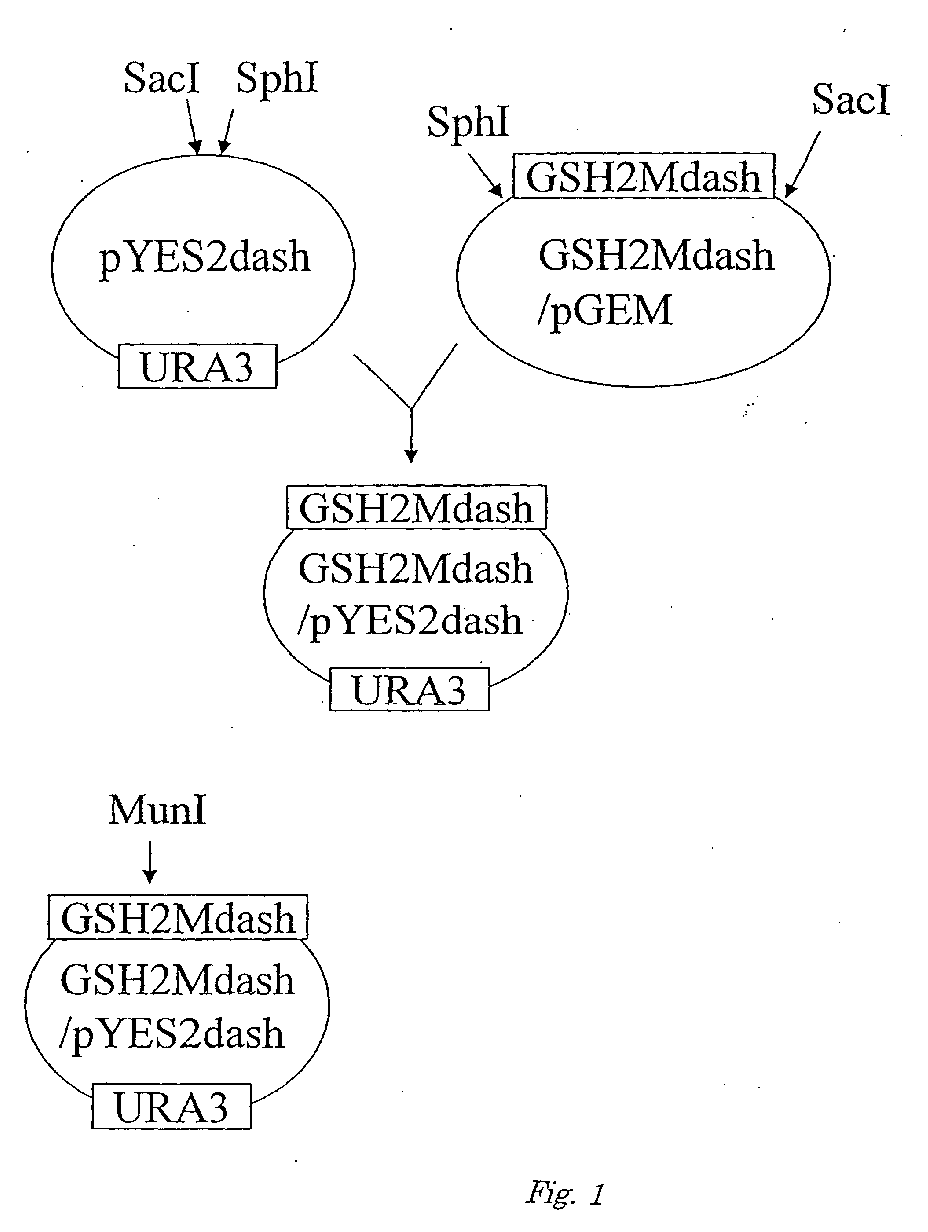
- Fig. 1 is a diagram construction of plasmid GSH2Mdash/pYES2dash containing a cassette for substituting a weakend-type glutathione synthetase gene.
- Example 1 Screening of a strain having a reduced glutathione synthetase using an MNNG resistance as a phenotype
- a monoploid N ⁇ 1 strain (uracil auxotroph) was obtained by a conventional method.
- N ⁇ 1 strain a model strain N ⁇ 3 harboring a weakened-type glutathione synthetase gene was obtained by the method described below.
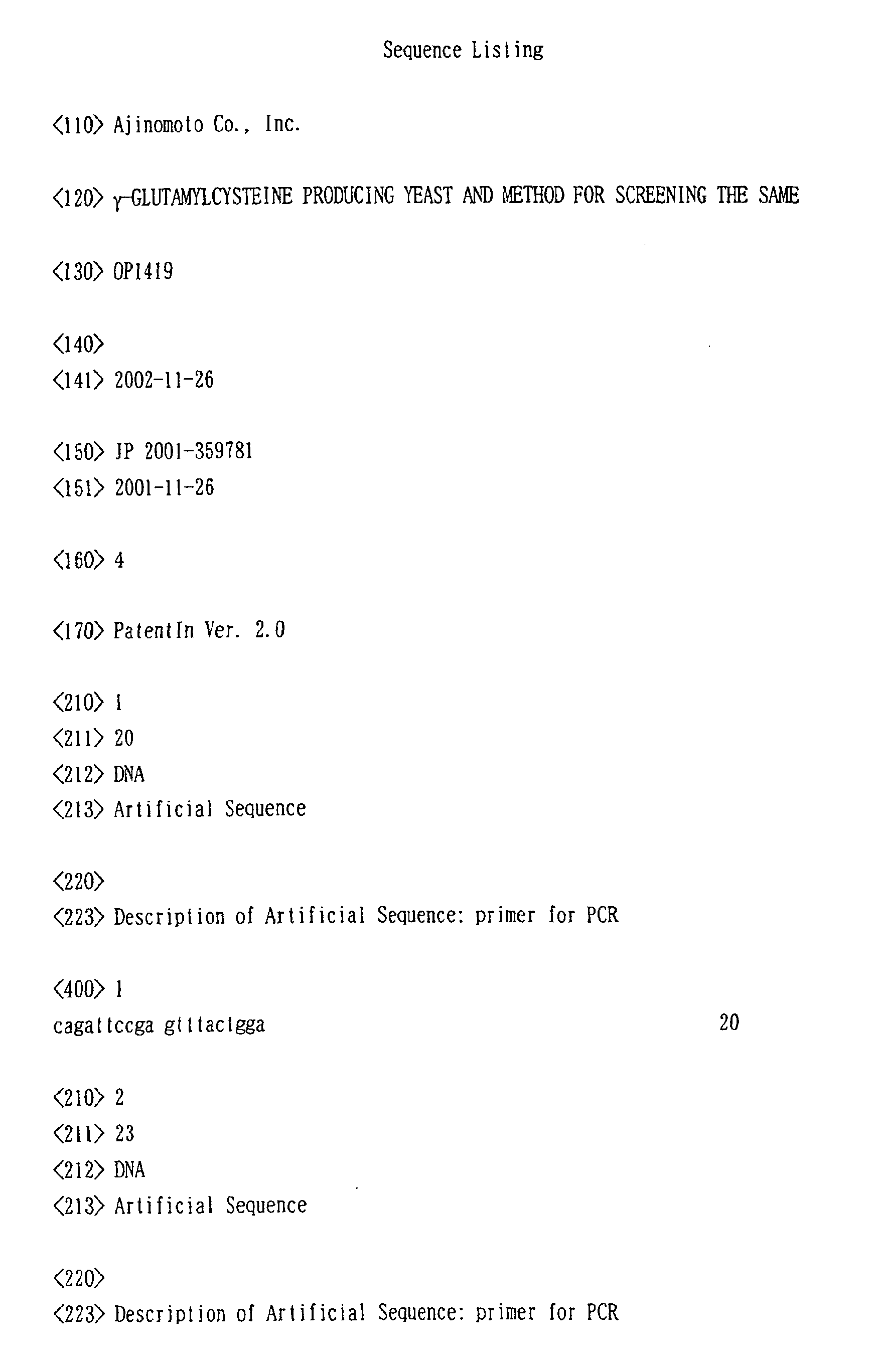
- a region encoding about 120 base pairs from the midstream of an open reading frame (ORF) of the glutathione synthetase gene of Saccharomyces cerevisiae S2 strain to the downstream of the ORF was amplified by a polymerase chain reaction (PCR) using primer F1 (CAGATTCCGAGTTTACTGGA (SEQ ID NO:1)) and R1 (AGAAGGAATGAGCCTAAAACAGC (SEQ ID NO:2)) and Pyrobest DNA Polymerase (Takara Shuzo) under the conditions indicated by the manufacturer.
- the S2 strain was obtained as follows.
- S2 strain which is a uracil-requiring strain, by using SDFOA agar medium containing uracil (SD medium containing 2% purified agar, 50 mg/l of uracil and 1 g/l of 5-fluorooritic acid hydrate in final concentrations)
- the gene fragment amplified as described above was purified and an enzymatic reaction was performed at 72°C for 10 minutes under the following conditions to add A to the termini.
- Composition of reaction mixture Gene fragment solution 5 ⁇ l 10 ⁇ PCR buffer (MgCl 2 free) 5 ⁇ l 25 mM MgCl 2 3 ⁇ l 2.5 mM dATP 5 ⁇ l Taq DNA polymerase (Takara Shuzo) 0.5 ⁇ l Purified water 31.5 ⁇ l Total 50 ⁇ l
- the gene fragment obtained as described above was ligated to plasmid pGEM-T Easy (Promega Corporation) by a conventional method to obtain a plasmid GSH2dash/pGEM.
- GSH2M-F1 GGCAGGGAAGGCAAGTAGCTGGCATTAAGTGAGCCCTC (SEQ ID NO:3)
- GSH2M-R1 GAGGGCTCACTTAATGCCAGCTACTTGCCTTCCCTGCC (SEQ ID NO:4)
- plasmid corresponding to the plasmid pYES2 (Invitrogen) of which 2 ⁇ ori was removed was prepared.
- pYES2 was cleaved with restriction enzymes Ssp I and Nhe I and the cleaved ends were blunted and then ligated to obtain a plasmid pYES2dash.
- pYES2dash and GSH2Mdash/pGEM were each cleaved with restriction enzymes Sac I and Sph I to cleave out a fragment containing URA3 gene from pYES2dash and a glutathione synthetase gene fragment having a mutation from GSH2Mdash/pGEM, and these fragments were ligated.
- a plasmid GSH2Mdash/pYES2dash was prepared.
- GSH2Mdash/pYES2dash was digested with a restriction enzyme Mun I to obtain a cassette for gene substitution (Fig. 1).
- the following operation was performed in order to leave only the weakened-type glutathione synthetase gene on the chromosome.
- the N ⁇ 3 intermediate was cultured on YPD medium and the cultured product was inoculated on an SDFOA plate containing 1 mM of glutathione.
- the sequence of the glutathione synthetase gene of a strain that grew on the plate was determined and it was confirmed that the sequence at the objective site was properly substituted. Thus, an N ⁇ 3 strain was obtained.
- the production amounts per unit time of ⁇ -glutamylcysteine and glutathione in the logarithmic growth phase of N ⁇ 3 strain were investigated. After preculturing the N ⁇ 3 strain in YPD medium, the culture was inoculated in 50 ml of an SD medium (containing a necessary amount of uracil) and cultured with shaking at 30°C.
- the production amounts of ⁇ -glutamylcysteine and glutathione were measured as follows. That is, the culture was centrifuged to obtain cells, which were washed twice with distilled water and then subjected to hot water extraction treatment at 70°C for 10 minutes to obtain cell contents. This was centrifuged and the ⁇ -glutamylcysteine and glutathione contents in the obtained supernatant were measured. On the other hand, yeast cells contained in a certain amount of medium were taken on a filter paper and heated at 105°C for 4 hours, followed by measurement of the weight of the remaining cells, which weight was defined as dry cell weight. Table 1 shows the contents of ⁇ -glutamylcysteine and glutathione per dry cell weight. Culture time until measurement ⁇ -glutamyl-cysteine (%) glutathione (%) N ⁇ 3 No.1 Approximately 1.5 hours 1.101 0.0043 N ⁇ 3 No.2 Approximately 3.8 hours 1.117 0.0045
- a filter was placed in the center of a YPD agar plate and a solution of 1 mg of MNNG dissolved in 30 ⁇ l of dimethyl sulfoxide (DMSO) was totally impregnated to the filter to prepare an MNNG concentration gradient agar medium in which the farther the position is from the central point, the less the MNNG concentration becomes.
- DMSO dimethyl sulfoxide
- On this agar medium were spread the N ⁇ 1 strain and the N ⁇ 3 strain which had been cultured in YPD liquid media. After culturing at 30°C for 70 hours, the distances from the central point of the agar medium to the site where the yeasts formed colonies were measured. As a result, the distances were 2.3 cm for the N ⁇ 1 strain and 1.8 cm for the N ⁇ 3 strain.
- Saccharomyces cerevisiae used for foods was allowed to form spores by a conventional method to obtain a monoploid baker's yeast MS strain and mutation treatment was performed thereto using EMS as a mutagen.
- the mutation treatment was performed under the condition in which mortality was 90%.
- the mutation treatment was performed as follows. That is, the MS strain was cultured with shaking at 30°C for 1 day in 50 ml of YPD medium and yeast cells were collected. The collected yeast cells were washed three times with 0.2 M sodium phosphate buffer (pH 7.5). Then, the yeast cells were suspended in a solution containing 9.2 ml of 0.2 M sodium phosphate buffer (pH 7.5), 0.5 ml of 40% D-glucose, and 0.3 ml of EMS (Nakarai Tesque, Code 155-19) and cultured with shaking at 30°C for 90 minutes.
- the MS strain subjected to the mutation treatment as described above was spread on an MNNG concentration gradient agar medium (prepared by placing a filter in the center of a YPD agar plate and impregnating the filter with the whole amount of a solution of 1 mg of MNNG dissolved in 30 ⁇ l of DMSO) such that the number of appeared colonies becomes 200 or less, and subjected to standing culture at 30°C for 5 days.
- MNNG concentration gradient agar medium prepared by placing a filter in the center of a YPD agar plate and impregnating the filter with the whole amount of a solution of 1 mg of MNNG dissolved in 30 ⁇ l of DMSO) such that the number of appeared colonies becomes 200 or less, and subjected to standing culture at 30°C for 5 days.
- Yeast mutants that grew in an MNNG concentration range in which the yeast that produced an ordinary amount of glutathione (N ⁇ 1 strain) could not grow (about 2.3 cm from the central point of the agar medium) but the yeast that produced ⁇ -glutamylcysteine but produced no or substantially no glutathione (N ⁇ 3 strain) could grow (about 1.8 cm from the central point of the agar medium) were isolated.
- N ⁇ 1 strain an ordinary amount of glutathione
- N ⁇ 3 strain the yeast that produced ⁇ -glutamylcysteine but produced no or substantially no glutathione (N ⁇ 3 strain) could grow (about 1.8 cm from the central point of the agar medium) were isolated.
- Ninety-three (93) such mutant strains were measured for ⁇ -glutamylcysteine productivity and a mutant strain AJ14809 of which the glutathione synthetase activity was reduced was obtained.
- a monoploid yeast (MAT ⁇ ) AJ14809 strain which was obtained by subjecting a monoploid yeast obtained by allowing commercially available baker's yeast (diploid) to form spores to a mutation treatment and selectionn utilizing an MNNG concentration gradient agar medium, was used as Saccharomyces cerevisiae with a reduced glutathione synthetase activity.
- This strain was selected as one having an MNNG resistance of the same level as that of the N ⁇ 3 strain by using the N ⁇ 3 strain as a control as described above.
- the AJ14809 strain was deposited in National Institute of Advanced Industrial Science and Technology, International Patent Organism Depositary (Central 6, 1-1, Higashi 1-Chome, Tsukuba-shi, Ibaraki-ken, 305-8566, Japan) since October 1, 2001 under the accession number of FERM P-18546.
- the original deposit was converted to international deposit based on Budapest Treaty on December 1, 2002, and assigned the accession number of FERM BP-8228.
- AJ14810 strain (MATa) was used as a Saccharomyces cerevisiae wild strain. This strain has been deposited in National Institute of Advanced Industrial Science and Technology, International Patent Organism Depositary since October 1, 2001 under the accession number of FERM P-18547. The original deposit was converted to international deposit based on Budapest Treaty on December 1, 2002, and assigned the accession number of FERM BP-8229.
- Each of the AJ14809 strain and AJ14810 strain was cultured in 4 ml of YPD test tube medium with shaking at 30°C. The cultures were mixed together in YPD test tube medium and cultured with shaking at 30°C. After confirming mating of the AJ14809 strain with the AJ14810 strain, the culture broth was spread on a YPD agar medium and cultured at 30°C. From among the yeasts that grew on the agar medium, a diploid strain having the glutathione synthetase gene derived from the AJ14809 strain and the glutathione synthetase gene derived from the AJ14810 strain was obtained.
- This diploid strain was allowed to form spores and 10 monoploid yeast strains were selected by a random spore method.
- the monoploid yeast strains which retained MATa and had reduced glutathione synthetase activity, and which contained 1% or more of ⁇ -glutamylcysteine and accumulated 0.1% or less of glutathione per dry yeast cell in the logarithmic phase when cultured in an SD medium.
- These 10 strains were each mated with the AJ14809 strain to obtain a diploid yeast AJ14800 strain that had a reduced glutathione synthetase activity and that accumulated about 1.5% of ⁇ -glutamylcysteine per dry yeast cell in the logarithmic phase when cultured in an SD medium.
- a strain that produced a wild-type glutathione synthetase was selected from the diploid yeasts obtained by mating the AJ14809 strain with the AJ14810 strain and was designated as L strain.
- the AJ14800 strain having a reduced glutathione synthetase activity and a diploid Saccharomyces cerevisiae L strain producing a wild-type glutathione synthetase were cultured in a YPD medium to obtain a culture broth, which was inoculated into a YPD medium containing 30 ⁇ g/ml or 60 ⁇ g/ml of MNNG or a YPD medium such that the absorbance at 660 nm became 0.1.
- the absorbance at 660 nm of the medium when subjected to standing culture at 30°C for 26 hours was measured to measure the degree of growth.
- the glutathione synthetase weakened strain AJ14800 strain
- Degree of growth with 60 ⁇ g/ml of MNNG Degree of growth with 60 ⁇ g/ml of MNNG L 0.0195 0.0139 AJ14800 0.0540 0.0254
- the cells were collected.
- the cells were inoculated into an SD medium such that the absorbance at 660 nm became 0.2.
- the intracellular ⁇ -glutamylcysteine accumulation amount measured after 8 hours from the start of the culture was 1.50%.
- a yeast strain that has a reduced glutathione synthetase activity and produces ⁇ -glutamylcysteine is provided.
- the strain of the present invention can be utilized for the production of ⁇ -glutamylcysteine-containing foods or cysteine containing foods.
Landscapes
- Life Sciences & Earth Sciences (AREA)
- Chemical & Material Sciences (AREA)
- Organic Chemistry (AREA)
- Health & Medical Sciences (AREA)
- Engineering & Computer Science (AREA)
- Zoology (AREA)
- Wood Science & Technology (AREA)
- Genetics & Genomics (AREA)
- Bioinformatics & Cheminformatics (AREA)
- General Engineering & Computer Science (AREA)
- Biotechnology (AREA)
- Biochemistry (AREA)
- General Health & Medical Sciences (AREA)
- Microbiology (AREA)
- Mycology (AREA)
- Proteomics, Peptides & Aminoacids (AREA)
- Biomedical Technology (AREA)
- Molecular Biology (AREA)
- Biophysics (AREA)
- Physics & Mathematics (AREA)
- Analytical Chemistry (AREA)
- Immunology (AREA)
- Botany (AREA)
- Virology (AREA)
- Nutrition Science (AREA)
- Food Science & Technology (AREA)
- Polymers & Plastics (AREA)
- Chemical Kinetics & Catalysis (AREA)
- Plant Pathology (AREA)
- Medicinal Chemistry (AREA)
- General Chemical & Material Sciences (AREA)
- Tropical Medicine & Parasitology (AREA)
- Toxicology (AREA)
- Micro-Organisms Or Cultivation Processes Thereof (AREA)
- Measuring Or Testing Involving Enzymes Or Micro-Organisms (AREA)
- Coloring Foods And Improving Nutritive Qualities (AREA)
- Preparation Of Compounds By Using Micro-Organisms (AREA)
Abstract
Description
Specifically, for example, when the MNNG concentration is 30 µg/ml, it is desirable that the degree of growth is 1.0 or less, preferably 0.2 or less, more preferably 0.075 or less.
| [YPD medium composition] | |
| | 2% |
| Peptone | 1% |
| Yeast extract | 0.5% |
| (pH 5.0) |
| [SD medium composition] | |
| | 2% |
| Nitrogen Base | 1-fold concentration |
| (composition of reaction mixture) | |
| Gene fragment solution | 5 µl |
| 10× PCR buffer (MgCl2 free) | 5µl |
| 25 mM MgCl2 | 3 µl |
| 2.5 mM dATP | 5 µl |
| Taq DNA polymerase (Takara Shuzo) | 0.5 µl |
| Purified water | 31.5 µl |
| Total | 50 µl |
| Culture time until measurement | γ-glutamyl-cysteine (%) | glutathione (%) | |
| Nα3 No.1 | Approximately 1.5 hours | 1.101 | 0.0043 |
| Nα3 No.2 | Approximately 3.8 hours | 1.117 | 0.0045 |
| Degree of growth with 60 µg/ml of MNNG | Degree of growth with 60 µg/ml of MNNG | |
| L | 0.0195 | 0.0139 |
| AJ14800 | 0.0540 | 0.0254 |

Claims (14)
- A yeast strain which has a resistance to MNNG and which produces γ-glutamylcysteine.
- The yeast strain according to claim 1, wherein the strain has a degree of growth of 0.03 or more as calculated by the following formula:
- The yeast strain according to claim 1 or 2, wherein the strain has a reduced glutathione synthetase activity.
- The yeast strain according to any one of claims 1 to 3, wherein when cultured in an SD medium, the γ-glutamylcysteine content per dry cell in logarithmic phase is 1% by weight or more.
- The yeast strain according to any one of claims 1 to 4, wherein the strain has diploidy or more polyploidy.
- The yeast strain according to any one of claims 1 to 5, wherein the strain belongs to the genus Saccharomyces.
- A method of screening a yeast strain having a reduced glutathione activity and γ-glutamylcysteine productivity comprising the steps of:(a) selecting yeast strains having a resistance to a certain concentration range of MNNG from a mass of yeast; and(b) selecting a strain having a reduced glutathione synthetase activity and γ-glutamylcysteine productivity from among the selected strains.
- The method according to claim 7, wherein in the step (a), the mass of yeast is prepared by subjecting a parent yeast strain to a mutation treatment.
- The method according to claim 7 or 8, wherein in the step (a), the yeast strain having a resistance to a certain concentration range of MNNG is selected using an agar medium on which a concentration gradient of MNNG has been formed.
- The method according to any one of claims 7 to 9, wherein in the step (a), a yeast model strain having a reduced glutathione synthetase activity and γ-glutamylcysteine productivity previously isolated is provided and a yeast strain having a resistance to MNNG of the same level as that of the model strain is selected.
- A food or beverage comprising a culture obtained by culturing the yeast strain according to any one of claims 1 to 6 under a suitable condition, or a fractionation product of the culture containing γ-glutamylcysteine, or the culture or fractionation product in which cysteine has been produced by a heat treatment.
- The food or beverage according to claim 11, wherein the food or beverage is an alcoholic beverage, a bread food, or a fermented food flavoring material.
- A yeast extract produced by using a culture obtained by culturing the yeast strain according to any one of claims 1 to 6 under a suitable condition.
- A method of producing food which contains γ-glutamylcysteine or cysteine, comprising the steps of culturing the yeast strain according to any one of claims 1 to 6, mixing the obtained culture or fractionation product thereof, or the culture or fractionation product thereof subjected to heat treatment with a beverage or food raw material, and processing the mixture into a food or beverage.
Applications Claiming Priority (3)
| Application Number | Priority Date | Filing Date | Title |
|---|---|---|---|
| JP2001359781A JP2003159048A (en) | 2001-11-26 | 2001-11-26 | gamma-GLUTAMYLCYSTEINE PRODUCING YEAST AND METHOD FOR SCREENING THE SAME |
| JP2001359781 | 2001-11-26 | ||
| PCT/JP2002/012200 WO2003046154A1 (en) | 2001-11-26 | 2002-11-21 | Ϝ-glutamylcysteine-producing yeast and method of screening the same |
Publications (2)
| Publication Number | Publication Date |
|---|---|
| EP1452585A1 true EP1452585A1 (en) | 2004-09-01 |
| EP1452585A4 EP1452585A4 (en) | 2005-07-27 |
Family
ID=19170725
Family Applications (1)
| Application Number | Title | Priority Date | Filing Date |
|---|---|---|---|
| EP02783594A Withdrawn EP1452585A4 (en) | 2001-11-26 | 2002-11-21 | Gamma-glutamylcysteine-producing yeast and method of screening the same |
Country Status (8)
| Country | Link |
|---|---|
| US (1) | US20040214308A1 (en) |
| EP (1) | EP1452585A4 (en) |
| JP (1) | JP2003159048A (en) |
| CN (1) | CN1596301A (en) |
| BR (1) | BR0214335A (en) |
| PE (1) | PE20030594A1 (en) |
| TW (1) | TW200300796A (en) |
| WO (1) | WO2003046154A1 (en) |
Cited By (1)
| Publication number | Priority date | Publication date | Assignee | Title |
|---|---|---|---|---|
| WO2009102050A1 (en) | 2008-02-15 | 2009-08-20 | Ajinomoto Co., Inc. | Intestinal immune system stimulator |
Families Citing this family (6)
| Publication number | Priority date | Publication date | Assignee | Title |
|---|---|---|---|---|
| PE20031013A1 (en) * | 2002-03-26 | 2004-02-05 | Ajinomoto Kk | CANDIDA UTILIS WHICH PRODUCES y-GLUTAMILCYSTEINE |
| JP5315600B2 (en) * | 2006-09-05 | 2013-10-16 | 味の素株式会社 | Y-glutamylcysteine-producing yeast and use thereof |
| EP2251413A4 (en) | 2008-03-04 | 2015-03-25 | Ajinomoto Kk | Gamma-glutamylcysteine-producing yeast, and method for production of yeast extract |
| DE102013209274A1 (en) | 2013-05-17 | 2014-11-20 | Wacker Chemie Ag | Microorganism and method for fermentative overproduction of gamma-glutamylcysteine and derivatives of this dipeptide |
| KR102222210B1 (en) * | 2019-10-29 | 2021-03-05 | 씨제이제일제당 주식회사 | Novel strain and a method of producing glutathione using thereof |
| CN113621640B (en) * | 2021-09-01 | 2023-09-19 | 浙江华睿生物技术有限公司 | Method for constructing glutamic acid-cysteine dipeptide producing strain |
Family Cites Families (5)
| Publication number | Priority date | Publication date | Assignee | Title |
|---|---|---|---|---|
| JP2903659B2 (en) * | 1990-07-06 | 1999-06-07 | 味の素株式会社 | Seasoning manufacturing method |
| DE69930320T3 (en) * | 1998-11-26 | 2014-01-09 | Ajinomoto Co., Inc. | METHOD FOR PRODUCING A TASTING COMPOUND CONSUMPTION FOR FOODSTUFFS |
| MY128920A (en) * | 2000-05-25 | 2007-02-28 | Ajinomoto Kk | METHOD FOR PRODUCING y-GLUTAMYLCYSTEINE |
| JP4273689B2 (en) * | 2001-11-26 | 2009-06-03 | 味の素株式会社 | γ-glutamylcysteine-producing yeast |
| PE20031013A1 (en) * | 2002-03-26 | 2004-02-05 | Ajinomoto Kk | CANDIDA UTILIS WHICH PRODUCES y-GLUTAMILCYSTEINE |
-
2001
- 2001-11-26 JP JP2001359781A patent/JP2003159048A/en active Pending
-
2002
- 2002-11-21 WO PCT/JP2002/012200 patent/WO2003046154A1/en not_active Ceased
- 2002-11-21 CN CNA028235304A patent/CN1596301A/en active Pending
- 2002-11-21 EP EP02783594A patent/EP1452585A4/en not_active Withdrawn
- 2002-11-21 BR BR0214335-6A patent/BR0214335A/en not_active Application Discontinuation
- 2002-11-22 PE PE2002001126A patent/PE20030594A1/en not_active Application Discontinuation
- 2002-11-26 TW TW091134341A patent/TW200300796A/en unknown
-
2004
- 2004-05-26 US US10/853,226 patent/US20040214308A1/en not_active Abandoned
Cited By (1)
| Publication number | Priority date | Publication date | Assignee | Title |
|---|---|---|---|---|
| WO2009102050A1 (en) | 2008-02-15 | 2009-08-20 | Ajinomoto Co., Inc. | Intestinal immune system stimulator |
Also Published As
| Publication number | Publication date |
|---|---|
| JP2003159048A (en) | 2003-06-03 |
| US20040214308A1 (en) | 2004-10-28 |
| TW200300796A (en) | 2003-06-16 |
| CN1596301A (en) | 2005-03-16 |
| EP1452585A4 (en) | 2005-07-27 |
| BR0214335A (en) | 2004-09-14 |
| WO2003046154A1 (en) | 2003-06-05 |
| PE20030594A1 (en) | 2003-08-25 |
Similar Documents
| Publication | Publication Date | Title |
|---|---|---|
| KR102020829B1 (en) | Baker's yeast for outstanding fermentation on various sugar content | |
| EP1449913B1 (en) | Gamma-glutamylcysteine-producing yeast | |
| EP1201747A1 (en) | Process for producing gamma-glutamylcysteine | |
| RS54079B1 (en) | SACCHAROMYCES CEREVISIAE MUTANTS AND THE PROCESS OF PRODUCTION OF RICH RNA MACHINES USING THESE MUTANTS | |
| US20040214308A1 (en) | Gamma-glutamylcystein-producing yeast and method of screening the same | |
| KR20170142648A (en) | Saccharomyces cerevisiae Y297 with adaptability at low temperature and manufacturing method of fermented alchoholic beverage using the same | |
| US7297513B2 (en) | Gene encoding glutathione synthetase from Candida utilis | |
| EP1489173B1 (en) | Candida utilis containing gamma-glutamylcysteine | |
| JP4638591B2 (en) | New yeast and yeast extract | |
| CN114657079A (en) | Yeast with high content of Abu, gamma-Glu-Abu and/or gamma-Glu-Abu-Gly | |
| JP5315600B2 (en) | Y-glutamylcysteine-producing yeast and use thereof | |
| JP4352877B2 (en) | Method for producing γ-glutamylcysteine | |
| US7410790B2 (en) | Method for producing γ-glutamylcysteine | |
| EP0805202A1 (en) | Yeast, and food and drink containing the same | |
| KR102020830B1 (en) | Baker's yeast for outstanding fermentation of various sugar content and cold-sensitivity | |
| Fukuda et al. | Mutants producing high concentrations of the flavor components active amylalcohol and normal propanol in Saccharomyces cerevisiae | |
| JP4649244B2 (en) | Reduced stringiness natto bacteria, and reduced stringiness natto manufactured using the natto bacteria | |
| KR100442574B1 (en) | Novel yeast mutant containing increased RNA content and method of mass-producing of the same | |
| KR102010844B1 (en) | Mixed culture method of aspergillus sp. and rhizopul sp. | |
| KR20220012567A (en) | Method for manufacturing yeast for baking that can be mass-produced | |
| JP2005211068A (en) | Bacillus natto with high glutaminate polypeptidase activity and fermented soybean improved in threading property |
Legal Events
| Date | Code | Title | Description |
|---|---|---|---|
| PUAI | Public reference made under article 153(3) epc to a published international application that has entered the european phase |
Free format text: ORIGINAL CODE: 0009012 |
|
| 17P | Request for examination filed |
Effective date: 20040624 |
|
| AK | Designated contracting states |
Kind code of ref document: A1 Designated state(s): AT BE BG CH CY CZ DE DK EE ES FI FR GB GR IE IT LI LU MC NL PT SE SK TR |
|
| STAA | Information on the status of an ep patent application or granted ep patent |
Free format text: STATUS: THE APPLICATION HAS BEEN WITHDRAWN |
|
| A4 | Supplementary search report drawn up and despatched |
Effective date: 20050614 |
|
| RIC1 | Information provided on ipc code assigned before grant |
Ipc: 7A 23L 1/305 B Ipc: 7C 12Q 1/04 B Ipc: 7C 12N 1/18 J Ipc: 7C 12N 15/01 B Ipc: 7C 12R 1:865 J Ipc: 7A 23L 1/28 B Ipc: 7C 12P 13/04 B Ipc: 7C 12N 1/18 A |
|
| 18W | Application withdrawn |
Effective date: 20050712 |