EP1452515A1 - Method for hydrogenating carbon dioxide,treating apparatus,and basic material for hydrogenation - Google Patents
Method for hydrogenating carbon dioxide,treating apparatus,and basic material for hydrogenation Download PDFInfo
- Publication number
- EP1452515A1 EP1452515A1 EP02778044A EP02778044A EP1452515A1 EP 1452515 A1 EP1452515 A1 EP 1452515A1 EP 02778044 A EP02778044 A EP 02778044A EP 02778044 A EP02778044 A EP 02778044A EP 1452515 A1 EP1452515 A1 EP 1452515A1
- Authority
- EP
- European Patent Office
- Prior art keywords
- carbon dioxide
- base plate
- rollers
- porous
- drive rollers
- Prior art date
- Legal status (The legal status is an assumption and is not a legal conclusion. Google has not performed a legal analysis and makes no representation as to the accuracy of the status listed.)
- Granted
Links
- CURLTUGMZLYLDI-UHFFFAOYSA-N Carbon dioxide Chemical compound O=C=O CURLTUGMZLYLDI-UHFFFAOYSA-N 0.000 title claims abstract description 220
- 229910002092 carbon dioxide Inorganic materials 0.000 title claims abstract description 110
- 239000001569 carbon dioxide Substances 0.000 title claims abstract description 107
- 238000000034 method Methods 0.000 title claims abstract description 43
- 239000000463 material Substances 0.000 title claims description 10
- 238000005984 hydrogenation reaction Methods 0.000 title abstract description 10
- OKKJLVBELUTLKV-UHFFFAOYSA-N Methanol Chemical compound OC OKKJLVBELUTLKV-UHFFFAOYSA-N 0.000 claims abstract description 145
- 239000011701 zinc Substances 0.000 claims abstract description 73
- HCHKCACWOHOZIP-UHFFFAOYSA-N Zinc Chemical compound [Zn] HCHKCACWOHOZIP-UHFFFAOYSA-N 0.000 claims abstract description 72
- 229910052725 zinc Inorganic materials 0.000 claims abstract description 70
- UFHFLCQGNIYNRP-UHFFFAOYSA-N Hydrogen Chemical compound [H][H] UFHFLCQGNIYNRP-UHFFFAOYSA-N 0.000 claims abstract description 54
- 239000001257 hydrogen Substances 0.000 claims abstract description 50
- 229910052739 hydrogen Inorganic materials 0.000 claims abstract description 50
- XLOMVQKBTHCTTD-UHFFFAOYSA-N Zinc monoxide Chemical compound [Zn]=O XLOMVQKBTHCTTD-UHFFFAOYSA-N 0.000 claims abstract description 45
- RYGMFSIKBFXOCR-UHFFFAOYSA-N Copper Chemical compound [Cu] RYGMFSIKBFXOCR-UHFFFAOYSA-N 0.000 claims abstract description 43
- 229910052802 copper Inorganic materials 0.000 claims abstract description 43
- 239000010949 copper Substances 0.000 claims abstract description 43
- 239000003054 catalyst Substances 0.000 claims abstract description 35
- 239000011787 zinc oxide Substances 0.000 claims abstract description 22
- QPLDLSVMHZLSFG-UHFFFAOYSA-N Copper oxide Chemical compound [Cu]=O QPLDLSVMHZLSFG-UHFFFAOYSA-N 0.000 claims abstract description 19
- 239000005751 Copper oxide Substances 0.000 claims abstract description 19
- 229910000431 copper oxide Inorganic materials 0.000 claims abstract description 19
- 238000003487 electrochemical reaction Methods 0.000 claims abstract description 10
- 238000006243 chemical reaction Methods 0.000 claims description 74
- 239000000126 substance Substances 0.000 claims description 63
- 239000003792 electrolyte Substances 0.000 claims description 41
- XLYOFNOQVPJJNP-UHFFFAOYSA-N water Substances O XLYOFNOQVPJJNP-UHFFFAOYSA-N 0.000 claims description 33
- 239000000047 product Substances 0.000 claims description 27
- PXHVJJICTQNCMI-UHFFFAOYSA-N Nickel Chemical compound [Ni] PXHVJJICTQNCMI-UHFFFAOYSA-N 0.000 claims description 16
- 238000005868 electrolysis reaction Methods 0.000 claims description 13
- QVGXLLKOCUKJST-UHFFFAOYSA-N atomic oxygen Chemical compound [O] QVGXLLKOCUKJST-UHFFFAOYSA-N 0.000 claims description 10
- 239000001301 oxygen Substances 0.000 claims description 10
- 229910052760 oxygen Inorganic materials 0.000 claims description 10
- 230000018044 dehydration Effects 0.000 claims description 9
- 238000006297 dehydration reaction Methods 0.000 claims description 9
- 239000007788 liquid Substances 0.000 claims description 9
- 239000007795 chemical reaction product Substances 0.000 claims description 8
- 229910052759 nickel Inorganic materials 0.000 claims description 8
- 229910052751 metal Inorganic materials 0.000 claims description 7
- 239000002184 metal Substances 0.000 claims description 7
- 239000002826 coolant Substances 0.000 claims description 6
- 238000010438 heat treatment Methods 0.000 claims description 6
- 150000002431 hydrogen Chemical class 0.000 claims description 6
- BASFCYQUMIYNBI-UHFFFAOYSA-N platinum Chemical compound [Pt] BASFCYQUMIYNBI-UHFFFAOYSA-N 0.000 claims description 6
- XEEYBQQBJWHFJM-UHFFFAOYSA-N Iron Chemical compound [Fe] XEEYBQQBJWHFJM-UHFFFAOYSA-N 0.000 claims description 4
- 238000004064 recycling Methods 0.000 claims description 4
- 239000003518 caustics Substances 0.000 claims description 3
- 238000001816 cooling Methods 0.000 claims description 3
- 238000007254 oxidation reaction Methods 0.000 claims description 3
- 229910052697 platinum Inorganic materials 0.000 claims description 3
- 235000011089 carbon dioxide Nutrition 0.000 claims description 2
- 229910052742 iron Inorganic materials 0.000 claims description 2
- 230000003647 oxidation Effects 0.000 claims description 2
- 230000001590 oxidative effect Effects 0.000 claims description 2
- 238000003825 pressing Methods 0.000 claims 4
- 238000007789 sealing Methods 0.000 claims 4
- 239000000498 cooling water Substances 0.000 claims 1
- 238000007599 discharging Methods 0.000 claims 1
- 239000002585 base Substances 0.000 description 47
- 239000007789 gas Substances 0.000 description 11
- 238000007796 conventional method Methods 0.000 description 10
- 230000000694 effects Effects 0.000 description 8
- 238000012545 processing Methods 0.000 description 6
- 230000001105 regulatory effect Effects 0.000 description 5
- UGFAIRIUMAVXCW-UHFFFAOYSA-N Carbon monoxide Chemical compound [O+]#[C-] UGFAIRIUMAVXCW-UHFFFAOYSA-N 0.000 description 4
- 229910002091 carbon monoxide Inorganic materials 0.000 description 4
- -1 copper oxide Chemical class 0.000 description 4
- 238000010586 diagram Methods 0.000 description 4
- 230000005611 electricity Effects 0.000 description 4
- 238000010792 warming Methods 0.000 description 4
- LFQSCWFLJHTTHZ-UHFFFAOYSA-N Ethanol Chemical compound CCO LFQSCWFLJHTTHZ-UHFFFAOYSA-N 0.000 description 3
- KWYUFKZDYYNOTN-UHFFFAOYSA-M Potassium hydroxide Chemical compound [OH-].[K+] KWYUFKZDYYNOTN-UHFFFAOYSA-M 0.000 description 3
- 229910052746 lanthanum Inorganic materials 0.000 description 3
- FZLIPJUXYLNCLC-UHFFFAOYSA-N lanthanum atom Chemical compound [La] FZLIPJUXYLNCLC-UHFFFAOYSA-N 0.000 description 3
- 239000012528 membrane Substances 0.000 description 3
- KDLHZDBZIXYQEI-UHFFFAOYSA-N Palladium Chemical compound [Pd] KDLHZDBZIXYQEI-UHFFFAOYSA-N 0.000 description 2
- WGLPBDUCMAPZCE-UHFFFAOYSA-N Trioxochromium Chemical compound O=[Cr](=O)=O WGLPBDUCMAPZCE-UHFFFAOYSA-N 0.000 description 2
- 229910052782 aluminium Inorganic materials 0.000 description 2
- XAGFODPZIPBFFR-UHFFFAOYSA-N aluminium Chemical compound [Al] XAGFODPZIPBFFR-UHFFFAOYSA-N 0.000 description 2
- PNEYBMLMFCGWSK-UHFFFAOYSA-N aluminium oxide Inorganic materials [O-2].[O-2].[O-2].[Al+3].[Al+3] PNEYBMLMFCGWSK-UHFFFAOYSA-N 0.000 description 2
- 229910000423 chromium oxide Inorganic materials 0.000 description 2
- 230000003247 decreasing effect Effects 0.000 description 2
- 230000002708 enhancing effect Effects 0.000 description 2
- 239000002803 fossil fuel Substances 0.000 description 2
- VNWKTOKETHGBQD-UHFFFAOYSA-N methane Chemical compound C VNWKTOKETHGBQD-UHFFFAOYSA-N 0.000 description 2
- 230000036961 partial effect Effects 0.000 description 2
- 239000002245 particle Substances 0.000 description 2
- 239000000843 powder Substances 0.000 description 2
- 230000002829 reductive effect Effects 0.000 description 2
- 239000004575 stone Substances 0.000 description 2
- 229940105296 zinc peroxide Drugs 0.000 description 2
- VYZAMTAEIAYCRO-UHFFFAOYSA-N Chromium Chemical compound [Cr] VYZAMTAEIAYCRO-UHFFFAOYSA-N 0.000 description 1
- 239000005749 Copper compound Substances 0.000 description 1
- BQCADISMDOOEFD-UHFFFAOYSA-N Silver Chemical compound [Ag] BQCADISMDOOEFD-UHFFFAOYSA-N 0.000 description 1
- GWEVSGVZZGPLCZ-UHFFFAOYSA-N Titan oxide Chemical compound O=[Ti]=O GWEVSGVZZGPLCZ-UHFFFAOYSA-N 0.000 description 1
- 239000012773 agricultural material Substances 0.000 description 1
- 239000003513 alkali Substances 0.000 description 1
- 230000009286 beneficial effect Effects 0.000 description 1
- 238000002306 biochemical method Methods 0.000 description 1
- 230000015572 biosynthetic process Effects 0.000 description 1
- 238000006555 catalytic reaction Methods 0.000 description 1
- 229910052804 chromium Inorganic materials 0.000 description 1
- 239000011651 chromium Substances 0.000 description 1
- 239000011248 coating agent Substances 0.000 description 1
- 238000000576 coating method Methods 0.000 description 1
- 150000001880 copper compounds Chemical class 0.000 description 1
- 239000000839 emulsion Substances 0.000 description 1
- 238000005516 engineering process Methods 0.000 description 1
- 239000000446 fuel Substances 0.000 description 1
- 230000020169 heat generation Effects 0.000 description 1
- 230000003100 immobilizing effect Effects 0.000 description 1
- 238000011090 industrial biotechnology method and process Methods 0.000 description 1
- 230000002452 interceptive effect Effects 0.000 description 1
- 238000011835 investigation Methods 0.000 description 1
- WSFSSNUMVMOOMR-NJFSPNSNSA-N methanone Chemical compound O=[14CH2] WSFSSNUMVMOOMR-NJFSPNSNSA-N 0.000 description 1
- 244000005700 microbiome Species 0.000 description 1
- 239000000203 mixture Substances 0.000 description 1
- 229910000510 noble metal Inorganic materials 0.000 description 1
- 229910052763 palladium Inorganic materials 0.000 description 1
- 235000011118 potassium hydroxide Nutrition 0.000 description 1
- 229910052761 rare earth metal Inorganic materials 0.000 description 1
- 238000011084 recovery Methods 0.000 description 1
- 238000011160 research Methods 0.000 description 1
- 230000002441 reversible effect Effects 0.000 description 1
- 229910052703 rhodium Inorganic materials 0.000 description 1
- 239000010948 rhodium Substances 0.000 description 1
- MHOVAHRLVXNVSD-UHFFFAOYSA-N rhodium atom Chemical compound [Rh] MHOVAHRLVXNVSD-UHFFFAOYSA-N 0.000 description 1
- 230000000630 rising effect Effects 0.000 description 1
- 229910052709 silver Inorganic materials 0.000 description 1
- 239000004332 silver Substances 0.000 description 1
- 238000000638 solvent extraction Methods 0.000 description 1
- 230000009469 supplementation Effects 0.000 description 1
- 239000000725 suspension Substances 0.000 description 1
- OGIDPMRJRNCKJF-UHFFFAOYSA-N titanium oxide Inorganic materials [Ti]=O OGIDPMRJRNCKJF-UHFFFAOYSA-N 0.000 description 1
- 229910052723 transition metal Inorganic materials 0.000 description 1
- 150000003624 transition metals Chemical class 0.000 description 1
- 239000002912 waste gas Substances 0.000 description 1
- 238000004056 waste incineration Methods 0.000 description 1
Images


Classifications
-
- C—CHEMISTRY; METALLURGY
- C07—ORGANIC CHEMISTRY
- C07C—ACYCLIC OR CARBOCYCLIC COMPOUNDS
- C07C29/00—Preparation of compounds having hydroxy or O-metal groups bound to a carbon atom not belonging to a six-membered aromatic ring
- C07C29/15—Preparation of compounds having hydroxy or O-metal groups bound to a carbon atom not belonging to a six-membered aromatic ring by reduction of oxides of carbon exclusively
- C07C29/151—Preparation of compounds having hydroxy or O-metal groups bound to a carbon atom not belonging to a six-membered aromatic ring by reduction of oxides of carbon exclusively with hydrogen or hydrogen-containing gases
- C07C29/153—Preparation of compounds having hydroxy or O-metal groups bound to a carbon atom not belonging to a six-membered aromatic ring by reduction of oxides of carbon exclusively with hydrogen or hydrogen-containing gases characterised by the catalyst used
-
- C—CHEMISTRY; METALLURGY
- C07—ORGANIC CHEMISTRY
- C07C—ACYCLIC OR CARBOCYCLIC COMPOUNDS
- C07C29/00—Preparation of compounds having hydroxy or O-metal groups bound to a carbon atom not belonging to a six-membered aromatic ring
- C07C29/15—Preparation of compounds having hydroxy or O-metal groups bound to a carbon atom not belonging to a six-membered aromatic ring by reduction of oxides of carbon exclusively
- C07C29/151—Preparation of compounds having hydroxy or O-metal groups bound to a carbon atom not belonging to a six-membered aromatic ring by reduction of oxides of carbon exclusively with hydrogen or hydrogen-containing gases
- C07C29/152—Preparation of compounds having hydroxy or O-metal groups bound to a carbon atom not belonging to a six-membered aromatic ring by reduction of oxides of carbon exclusively with hydrogen or hydrogen-containing gases characterised by the reactor used
-
- C—CHEMISTRY; METALLURGY
- C07—ORGANIC CHEMISTRY
- C07C—ACYCLIC OR CARBOCYCLIC COMPOUNDS
- C07C29/00—Preparation of compounds having hydroxy or O-metal groups bound to a carbon atom not belonging to a six-membered aromatic ring
- C07C29/15—Preparation of compounds having hydroxy or O-metal groups bound to a carbon atom not belonging to a six-membered aromatic ring by reduction of oxides of carbon exclusively
- C07C29/151—Preparation of compounds having hydroxy or O-metal groups bound to a carbon atom not belonging to a six-membered aromatic ring by reduction of oxides of carbon exclusively with hydrogen or hydrogen-containing gases
- C07C29/153—Preparation of compounds having hydroxy or O-metal groups bound to a carbon atom not belonging to a six-membered aromatic ring by reduction of oxides of carbon exclusively with hydrogen or hydrogen-containing gases characterised by the catalyst used
- C07C29/154—Preparation of compounds having hydroxy or O-metal groups bound to a carbon atom not belonging to a six-membered aromatic ring by reduction of oxides of carbon exclusively with hydrogen or hydrogen-containing gases characterised by the catalyst used containing copper, silver, gold, or compounds thereof
-
- C—CHEMISTRY; METALLURGY
- C07—ORGANIC CHEMISTRY
- C07C—ACYCLIC OR CARBOCYCLIC COMPOUNDS
- C07C45/00—Preparation of compounds having >C = O groups bound only to carbon or hydrogen atoms; Preparation of chelates of such compounds
-
- C—CHEMISTRY; METALLURGY
- C12—BIOCHEMISTRY; BEER; SPIRITS; WINE; VINEGAR; MICROBIOLOGY; ENZYMOLOGY; MUTATION OR GENETIC ENGINEERING
- C12C—BEER; PREPARATION OF BEER BY FERMENTATION; PREPARATION OF MALT FOR MAKING BEER; PREPARATION OF HOPS FOR MAKING BEER
- C12C11/00—Fermentation processes for beer
- C12C11/02—Pitching yeast
-
- C—CHEMISTRY; METALLURGY
- C25—ELECTROLYTIC OR ELECTROPHORETIC PROCESSES; APPARATUS THEREFOR
- C25D—PROCESSES FOR THE ELECTROLYTIC OR ELECTROPHORETIC PRODUCTION OF COATINGS; ELECTROFORMING; APPARATUS THEREFOR
- C25D9/00—Electrolytic coating other than with metals
- C25D9/04—Electrolytic coating other than with metals with inorganic materials
- C25D9/08—Electrolytic coating other than with metals with inorganic materials by cathodic processes
-
- Y—GENERAL TAGGING OF NEW TECHNOLOGICAL DEVELOPMENTS; GENERAL TAGGING OF CROSS-SECTIONAL TECHNOLOGIES SPANNING OVER SEVERAL SECTIONS OF THE IPC; TECHNICAL SUBJECTS COVERED BY FORMER USPC CROSS-REFERENCE ART COLLECTIONS [XRACs] AND DIGESTS
- Y02—TECHNOLOGIES OR APPLICATIONS FOR MITIGATION OR ADAPTATION AGAINST CLIMATE CHANGE
- Y02E—REDUCTION OF GREENHOUSE GAS [GHG] EMISSIONS, RELATED TO ENERGY GENERATION, TRANSMISSION OR DISTRIBUTION
- Y02E60/00—Enabling technologies; Technologies with a potential or indirect contribution to GHG emissions mitigation
- Y02E60/30—Hydrogen technology
- Y02E60/36—Hydrogen production from non-carbon containing sources, e.g. by water electrolysis
-
- Y—GENERAL TAGGING OF NEW TECHNOLOGICAL DEVELOPMENTS; GENERAL TAGGING OF CROSS-SECTIONAL TECHNOLOGIES SPANNING OVER SEVERAL SECTIONS OF THE IPC; TECHNICAL SUBJECTS COVERED BY FORMER USPC CROSS-REFERENCE ART COLLECTIONS [XRACs] AND DIGESTS
- Y02—TECHNOLOGIES OR APPLICATIONS FOR MITIGATION OR ADAPTATION AGAINST CLIMATE CHANGE
- Y02P—CLIMATE CHANGE MITIGATION TECHNOLOGIES IN THE PRODUCTION OR PROCESSING OF GOODS
- Y02P20/00—Technologies relating to chemical industry
- Y02P20/50—Improvements relating to the production of bulk chemicals
- Y02P20/582—Recycling of unreacted starting or intermediate materials
Definitions
- Examples of conventional techniques for hydrogenating carbon dioxide in order to fix carbon dioxide include photoelectrochemical techniques utilizing natural energy, such as sunlight, and biochemical techniques utilizing microorganisms. Disadvantageously, the efficiency of these techniques is low, and the rate of processing is much lower than that of carbon dioxide emission.
- the reduction of carbon dioxide with the use of a catalyst was the only conversion technique having a sufficient rate of processing. This procedure, however, requires a specific reaction vessel in which hydrogen and carbon dioxide can be simultaneously subjected to catalytic reactions in the presence of an adequate catalyst at sufficiently high temperature and high pressure.
- An object of the present invention is to provide a process for hydrogenating carbon dioxide that is capable of processing a large quantity of carbon dioxide to generate a large quantity of methanol as a main product, thereby engaging with the rapidly spreading issue of global warming. It is another object of the present invention to yield significant economic effects through the use of the thus obtained methanol.
- Such methanol has potential to be an important fuel for the future, and can be used as an alternative to fossil fuels, an agricultural material for growing plants, and for other base materials. Thereby, use of the aforementioned process can be developed as a social enterprise.
- a porous layer was employed as a basic material.
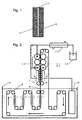
- This porous layer is composed of: a long band-like strip of copper base plate 1; two porous metallic zinc layers 2 and 3, or the layer 2 only, which have been moistened with electrolytes, immobilized on both sides of the copper base plate 1 by electrolysis; and a catalyst comprising a main catalyst of zinc oxide, copper, and copper oxide obtained through oxidation as described below and other additional substances for hydrogenating carbon dioxide on both or one of the porous metallic zinc layers 2 and 3.
- the aforementioned electrolysis is carried out by adopting the aforementioned copper base plate 1 as a cathode in an electrolyte prepared by adding zinc oxide as a main component to a caustic alkali solution.
- porous metallic zinc layers with very large surface areas and high levels of activity are electrodeposited on both sides of the base plate (see JP Laid-open Patent Publication (Kokai) No. 4-72376), and oxygen is generated from an anode.
- This electrolysis reaction is represented by the following chemical formula. [Chemical Formula 2] 2 ZnO ⁇ 2 Zn + O 2 ⁇
- metallic zinc should be oxidized to prepare zinc oxide, and a copper compound, such as copper oxide, an additional substance as a promoter, such as aluminum, chromium oxide, lanthanum, or an oxide thereof, noble metals, such as platinum, palladium, silver, or nickel, transition metals, such as rhodium or copper, and a rare earth element, such as lanthanum, or oxides thereof should be incorporated in the porous zinc layers solely or in combinations of two or more.
- a copper compound such as copper oxide
- an additional substance as a promoter such as aluminum, chromium oxide, lanthanum, or an oxide thereof
- noble metals such as platinum, palladium, silver, or nickel
- transition metals such as rhodium or copper
- a rare earth element such as lanthanum, or oxides thereof
- Hydrogen gas can be generated by an externally supplied electrical current instead of the occurrence of an electrical short circuit due to the internal contact as mentioned above.
- a strip of thin copper base plate 1 (thickness: 0.1mm) is electrolyzed while being guided in the upward and downward directions among plural drive rollers 5 in an electrolyte accommodated in an electrolytic bath 4, and it migrates forward.
- An electrolyte suitable to be used is an emulsion comprising 50 g of zinc oxide powder per liter of a solution comprising 100 g of caustic potash per liter thereof.
- the base plate 1 migrates within the electrolyte, while anodes are employed which comprise insoluble plates, such as zinc plates, immobilized on both of its sides.
- porous metallic zinc layers are deposited and immobilized on both sides of the electrolyzed base plate 1 up to the level of the electrolyte surface 6.
- the base plate migrates upward and exceeds the electrolyte surface.
- the base plate is then pressed with drive rollers 7 and 8 to a porosity of approximately 90%.
- excess amounts of electrolyte contained in the porous metallic zinc layers 2 and 3 are removed, and the porous layers further migrate in the upward direction while maintaining their moistened states.
- porous metallic zinc layers are firmly immobilized on both sides of the base plate 1 by means of pressure bonding, and both sides of the base plate are hardened, stratified and moistened with electrolytes.
- the total of the thickness of the base plate 1, that of the porous layer 2, and that of the porous layer 3 was approximately 0.8 mm.
- gas of carbon oxide compounds such as carbon monoxide or a mixed gas composed of carbon monoxide and carbon dioxide, may also be used.
- the groups of rollers that can be kept sealed at high pressure and high temperature are as described in Example 1.
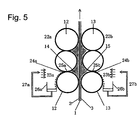
- Fig. 5a and 5b are an enlarged diagram showing a major part of an apparatus for hydrogenating carbon dioxide, and illustrates a process for hydrogenating carbon dioxide for additionally explaining the apparatus and the process described in Example 1 and shown in Fig. 3a and Fig. 3b. More specifically, with the utilization of the apparatus and the process for hydrogenating carbon dioxide, water can be immediately and continuously discharged to the outside of the reaction system simultaneously with the generation of the reaction product shown in the right-hand side of Chemical Formula 1, thereby enhancing the rate of conversion with low chemical equilibrium and enhancing the yield of methanol. The explanation thereof is the same as described from line 2 on page 6 to line 17 on page 7.
Landscapes
- Chemical & Material Sciences (AREA)
- Organic Chemistry (AREA)
- Engineering & Computer Science (AREA)
- Chemical Kinetics & Catalysis (AREA)
- Life Sciences & Earth Sciences (AREA)
- Genetics & Genomics (AREA)
- Zoology (AREA)
- Health & Medical Sciences (AREA)
- Biochemistry (AREA)
- Bioinformatics & Cheminformatics (AREA)
- General Engineering & Computer Science (AREA)
- General Health & Medical Sciences (AREA)
- Mycology (AREA)
- Wood Science & Technology (AREA)
- Food Science & Technology (AREA)
- Microbiology (AREA)
- Inorganic Chemistry (AREA)
- Electrochemistry (AREA)
- Materials Engineering (AREA)
- Metallurgy (AREA)
- Organic Low-Molecular-Weight Compounds And Preparation Thereof (AREA)
- Catalysts (AREA)
- Physical Or Chemical Processes And Apparatus (AREA)
- Low-Molecular Organic Synthesis Reactions Using Catalysts (AREA)
- Electrolytic Production Of Metals (AREA)
Abstract
Description
Furthermore, a relatively low-temperature synthetic catalyst, for example, a methanol synthetic catalyst that causes reactions at 250 °C to 300 °C, mainly composed of a mixed oxide of zinc and copper, must be first prepared, accommodated in a reaction vessel, subjected to reactions, and replaced with another catalyst at any time. Accordingly, this procedure must be intermittently carried out, which prevents the processing of emitted carbon dioxide in large quantities. There exists much literature concerning the hydrogenation of carbon dioxide, although conventional techniques suffer from serious drawbacks as described below.
CO2 + 3 H2 → CH3OH + H2O - 14.3 kcal/mol
2 ZnO → 2 Zn + O2↑
Zn + H2O → ZnO + H2↑
2 Zn + O2 → 2 ZnO - 83.2 kcal/mol
Claims (15)
- A process for hydrogenating carbon dioxide in the presence of a catalyst to generate methanol as a main product comprising steps of:1) first step: preparing a basic material comprising a copper base plate (1), porous metallic zinc layers (2) and (3) moistened with an electrolyte immobilized on both sides of the copper base plate by electrolysis, and a catalyst for hydrogenating carbon dioxide, such as zinc oxide, copper oxide, or other additional substances, which is included in the zinc layers (2) and (3);2) second step: generating hydrogen from the basic material in sealed spaces by means of electrochemical reactions, wherein the porous zinc layers are oxidized to produce oxide layers, and wherein hydrogen gas is allowed to be generated in spaces inside and outside of the oxide layers and to develop a condition of high pressure;3) third step: heating the porous layers to allow the porous layers and the sealed spaces to have a state of high-temperature, high-pressure, and dehydration; and4) fourth step: injecting carbon dioxide into the sealed spaces and allowing it to react with hydrogen, thereby generating methanol as a main product.
- A process for hydrogenating carbon dioxide in the presence of a catalyst to generate methanol as a main product comprising steps of:1) first step: preparing a base material comprising a copper base plate (1) , porous metallic zinc layers (2) and (3) moistened with an electrolyte immobilized on both sides of the copper base plate by electrolysis, and a catalyst for hydrogenating carbon dioxide, such as zinc oxide, copper oxide, or other additional substances, which is included in the metallic zinc layer (2) ;2) second step: generating hydrogen from the zinc layer (2) as the basic material in sealed spaces by means of electrochemical reactions, oxidizing the porous metallic zinc layer to produce an oxide layer, and allowing hydrogen gas to generate in spaces inside and outside of the oxide layer and becoming a condition of high pressure;3) third step: introducing oxygen or air to the porous zinc layer (3) on the opposite side of the porous layer (2) in a moistened state to evolve heat, immediately conducting the heat to the porous layer (2) through the copper baseplate (1) to allow the porous layer (2) to have a state of high-temperature, high-pressure, and dehydration; and4) fourth step: injecting carbon dioxide into the sealed spaces and allowing it to react with hydrogen, thereby generating methanol as a main product.
- A process for hydrogenating carbon dioxide comprising: transporting a long strip of copper base plate (1) with the aid of drive rollers while subjecting said base plate to cathodic electrolysis in an electrolytic bath (4) containing an electrolyte; allowing porous metallic zinc layers (2) and (3) to be electrodeposited and immobilized on both sides of the base plate (1) during transportation; allowing the base plate to migrate upward until it goes beyond the surface of an electrolyte; removing excess amounts of liquid by pressing the base plate with drive rollers (7) and (8) ; allowing the base plate to pass through the inner space sealed with plural groups of rollers in close contact with each other; bringing the zinc layers (2) and (3) into contact with a metal having a low hydrogen overvoltage in the sealed space; becoming a condition of high pressure with the aid of accumulated hydrogen gas generated upon electrochemical reactions; heating the zinc layers (2) and (3) to allow them to have a state of high-temperature, high-pressure, and dehydration; and injecting carbon dioxide into the sealed space to allow it to react with hydrogen, thereby generating methanol as a main product.
- A process for hydrogenating carbon dioxide comprising: transporting a long strip of copper base plate (1) with the aid of drive rollers while subjecting said base plate to cathodic electrolysis in an electrolytic cell (4) containing an electrolyte; allowing porous metallic zinc layers (2) and (3) to be electrodeposited and immobilized on both sides of the base plate (1) during the transportation; allowing the base plate to migrate upward until it goes beyond the surface of an electrolyte; removing excess amounts of liquid by pressing the base plate with drive rollers (7) and (8) ; allowing the base plate to pass through the inner space sealed with plural groups of rollers in close contact with each other; bringing the zinc layer (2) into contact with a metal having a low hydrogen overvoltage in the sealed space; becoming a condition of high pressure with the aid of accumulated hydrogen gas generated upon electrochemical reactions; introducing oxygen or air to the porous zinc layer (3) for oxidization and generation of heat; immediately conducting the heat to the porous metallic zinc layer (2) on the opposite side through the copper base plate (1) to allow the porous layer (2) to have a state of high-temperature, high-pressure, and dehydration; and injecting carbon dioxide into the sealed space to allow it to react with hydrogen, thereby generating methanol as a main product.
- A process for hydrogenating carbon dioxide, wherein the reaction according to claim 3 or 4 is repeatedly carried out by generating methanol, immersing the baseplate (1) into an electrolyte in an electrolytic bath (4) with the aid of drive rollers, and allowing the baseplate (1) to circulate with the aid of drive rollers for recycling.
- An apparatus for hydrogenating carbon dioxide comprising, in the order as described below: an electrolytic bath (4) containing a caustic alkaline electrolyte comprising zinc oxide; a drive roller (5) for transporting a long strip of copper base plate (1) in upward and downward directions in the electrolytic bath while cathodically electro reducing it therein; drive rollers (7) and (8) for pressing the base plate (1) to remove excess amounts of electrolyte contained in porous layers (2) and (3) provided on both sides of the base plate migrated beyond the electrolyte surface; groups (9) and (10) of drive rollers for sealing the inner spaces; and groups (12) and (13) of drive rollers for reactions, connected to the groups (9) and (10) of drive rollers, for forming inner spaces (14) and (15) for mixing carbon dioxide with hydrogen and maintaining the high temperature and sealed conditions by heating, wherein some rollers in the groups (12) and (13) of drive rollers for reaction independently comprise an inlet for carbon dioxide and an outlet for reaction products, the outlet is connected to a cooler (19) and a receiver (20), and a group of drive rollers is provided for transporting the base plate (1), which has passed through a group of drive rollers for reactions and then another group of rollers for reactions, to an electrolyte in the electrolytic bath (4).
- An apparatus for hydrogenating carbon dioxide comprising, in the order as described below: an electrolytic bath (4) containing a caustic alkaline electrolyte comprising zinc oxide; a drive roller (5) for transporting a long strip of copper base plate (1) in upward and downward directions in the electrolytic cell while cathodically electroreducing it therein; drive rollers (7) and (8) for pressing the base plate (1) to remove excess amounts of electrolyte contained in porous layers (2) and (3) provided on both sides of the base plate migrated beyond the electrolyte surface; groups (9) and (10) of drive rollers for sealing the inner spaces; a group (12) of drive rollers for reaction, connected to the groups (9) and (10) of rollers, for forming an inner space (14) for mixing carbon dioxide with hydrogen; and a group (21) of drive rollers for reaction for forming an inner space (15) for generation of heat upon contact between the porous layer (3) and oxygen or air, wherein some rollers in the group (21) of rollers independently comprise an inlet and an outlet for oxygen or air at their center portions, some rollers in the group (12) of drive ro11ers independently comprise an inlet for carbon dioxide and an outlet for reaction products at their center portions, the outlet is connected to a cooler (19) and a receiver (20) , and a group of drive rollers for transporting the base plate (1) , which has passed through a group of drive rollers for reactions and then another group of drive rollers for reactions, to an electrolyte in the electrolytic bath (4).
- The apparatus for hydrogenating carbon dioxide according to claim 6 or 7, wherein a pressure-tight vessel (18) for accommodating dry ice is provided in the electrolytic bath (4).
- A basic material for hydrogenating carbon dioxide comprising: a copper base plate; porous metallic zinc layers moistened with an electrolyte, and immobilized on both sides of said copper base plate; and a catalyst of oxidized metallic zinc for hydrogenating carbon dioxide, such as zinc oxide, copper oxide, or the other additional substances, which is included in both or half of said zinc layers.
- A process for hydrogenating carbon dioxide, wherein while a porous body comprising a long strip of copper base plate and a porous layer containing a catalyst for hydrogenating carbon dioxide, deposited and immobilized on both or half side of the copper base plate migrates to be sandwiched between the groups both (12) and (13) of plural rotating drive rollers having elastic surfaces so as to gear in close contact with each other, the base plate is allowed to react in sealed inner spaces (14) and (15) , which are formed between the groups of rollers, contain carbon dioxide and hydrogen gas, and have high temperature and high pressure, to generate methanol as a main product and water, the process comprising: supplying cold air or coolants (23a) and (23b) form the outer spaces (22a) and (22b) , which are located outside of the aforementioned inner spaces and have conditions of normal temperature and normal pressure, toward the circumscribed surfaces (24a) and (24b) of the rollers to cool the surfaces of the groups (12) and (13) of rollers on the circumscribed surfaces (24a) and (24b) and the vicinities of the circumscribed surfaces in close contact with the rollers; lowering the temperature of the water vapor in the inner spaces or that of the water vapor containing the generated methanol to reach at its dew point to prepare thin liquid layers (25a) and (25b) ; continuously cooling water vapor in the inner spaces to prepare a condensate while keeping the inner spaces sealed; bringing the condensate into contact with the thin liquid layers (25a) and (25b) ; discharging the condensate to the outside of the groups (12) and (13) of rollers; and then recovering the discharged condensate in receivers (26a) and (26b).
- An apparatus for hydrogenating carbon dioxide, wherein while a porous body comprising a long strip of copper base plate and a porous layer containing a catalyst for hydrogenating carbon dioxide, deposited and immobilized on at least one side of the copper base plate migrates to be sandwiched between the groups (12) and (13) of plural rotating drive rollers having elastic surfaces so as to gear in close contact with each other, the base plate is allowed to react in sealed inner spaces (14) and (15) , which are formed between the groups of rollers, contain carbon dioxide and hydrogen gas, and have high temperature and high pressure to generate methanol as a main product and water, the apparatus comprising: a device for supplying cold air or coolants (23a) and (23b) at the outer spaces (22a) and (22b) , which are located outside of the aforementioned inner spaces and have conditions of room temperature and normal pressure, toward the circumscribed surfaces (24a) and (24b) formed along the group of rollers; and receivers (26a) and (26b) for recovering the water vapor in the inner spaces or liquefied condensate prepared by cooling the water vapor containing the generated methanol at the outside of the group of rollers at their lower positions.
- The apparatus for hydrogenating carbon dioxide according to claim 11, wherein the circumscribed surfaces (24a) and (24b) formed by the groups (12) and (13) of rollers have hydrophilic properties suitable as thin liquid layers (25a) and (25b).
- The apparatus for hydrogenating carbon dioxide according to claim 6 or 7, wherein the groups (9) , (10), (12), and (13) of drive rollers comprise, in this order, the groups (9) and (10) of drive rollers for sealing inner spaces and the groups (12) and (13) of drive rollers for reaction maintaining a state of high temperature and sealing by heating connected to the (9) and (10) , for forming inner spaces (14) and (15) for mixing carbon dioxide and hydrogen, characterized by that the inner spaces formed between the drive rollers, which rotate in close contact with each other are sealed due to the elastic surfaces of the rollers.
- The process for hydrogenating carbon dioxide according to claim 3 or 4, wherein a metal having a low hydrogen overvoltage, such as nickel, iron, or platinum, is brought into contact with both or half of the porous metallic zinc layers (2) and (3) moistened with an electrolyte that passes through the sealed inner space formed within the groups (9) and (10) of several drive ro11ers, hydrogen is generated from the metal surface by means of electrochemical reactions, and hydrogen is generated in spaces inside and outside of the porous oxide layers used as catalysts upon oxidation of the porous metallic zinc.
- The apparatus for hydrogenating carbon dioxide according to claim 6 or 7, wherein carbon dioxide or methanol can be introduced into or discharged from both or half surface of the sealed inner spaces (14) and (15) separately comprising inlets for carbon dioxide and outlets for generated methanol at the center portions of the drive rollers (12) and (13).
Applications Claiming Priority (5)
| Application Number | Priority Date | Filing Date | Title |
|---|---|---|---|
| JP2001376464 | 2001-11-06 | ||
| JP2001376464 | 2001-11-06 | ||
| JP2002101899 | 2002-02-28 | ||
| JP2002101899 | 2002-02-28 | ||
| PCT/JP2002/011456 WO2003040071A1 (en) | 2001-11-06 | 2002-11-01 | Method for hydrogenating carbon dioxide, treating apparatus, and basic material for hydrogenation |
Publications (3)
| Publication Number | Publication Date |
|---|---|
| EP1452515A1 true EP1452515A1 (en) | 2004-09-01 |
| EP1452515A4 EP1452515A4 (en) | 2005-04-27 |
| EP1452515B1 EP1452515B1 (en) | 2010-01-27 |
Family
ID=26624977
Family Applications (1)
| Application Number | Title | Priority Date | Filing Date |
|---|---|---|---|
| EP02778044A Expired - Lifetime EP1452515B1 (en) | 2001-11-06 | 2002-11-01 | Method for hydrogenating carbon dioxide,treating apparatus,and basic material for hydrogenation |
Country Status (7)
| Country | Link |
|---|---|
| US (2) | US7064150B2 (en) |
| EP (1) | EP1452515B1 (en) |
| JP (1) | JP3963172B2 (en) |
| AT (1) | ATE456548T1 (en) |
| CA (1) | CA2465442A1 (en) |
| DE (1) | DE60235256D1 (en) |
| WO (1) | WO2003040071A1 (en) |
Cited By (1)
| Publication number | Priority date | Publication date | Assignee | Title |
|---|---|---|---|---|
| WO2019010095A1 (en) | 2017-07-01 | 2019-01-10 | Concord Spirits, Inc. | Systems and methods for on-site liquid alcohol production from carbon dioxide |
Families Citing this family (4)
| Publication number | Priority date | Publication date | Assignee | Title |
|---|---|---|---|---|
| US20070282021A1 (en) * | 2006-06-06 | 2007-12-06 | Campbell Gregory A | Producing ethanol and saleable organic compounds using an environmental carbon dioxide reduction process |
| US8122704B2 (en) * | 2007-08-07 | 2012-02-28 | Efficient Hydrogen Motors | Motor system for diminution of carbon dioxide in the atmosphere |
| US8002969B2 (en) * | 2007-12-05 | 2011-08-23 | Saudi Arabian Oil Company | Upgrading crude oil using electrochemically-generated hydrogen |
| US9528192B1 (en) | 2013-01-16 | 2016-12-27 | The United States Of America As Represented By The Administrator Of The National Aeronautics And Space Administration | Solar powered CO2 conversion |
Family Cites Families (8)
| Publication number | Priority date | Publication date | Assignee | Title |
|---|---|---|---|---|
| US3660262A (en) * | 1969-06-19 | 1972-05-02 | Ransburg Electro Coating Corp | Production of electrophotographic paper by electrophoretic deposition |
| JPH03200734A (en) | 1989-12-28 | 1991-09-02 | Mitsubishi Heavy Ind Ltd | Synthesis of methanol |
| JPH03258737A (en) * | 1990-03-07 | 1991-11-19 | Mitsui Toatsu Chem Inc | Production of methanol |
| JPH0472376A (en) | 1990-07-12 | 1992-03-06 | Masayoshi Matsui | Production of chemical heating element |
| JP3069651B2 (en) | 1991-07-10 | 2000-07-24 | トキコ株式会社 | Silencer for refueling compressor |
| JPH0565237A (en) * | 1991-09-10 | 1993-03-19 | Mitsubishi Heavy Ind Ltd | Energy supply method using methanol as medium |
| JP3089106B2 (en) * | 1992-06-29 | 2000-09-18 | 東京瓦斯株式会社 | Methanol production method |
| US6068755A (en) * | 1996-12-06 | 2000-05-30 | Canon Kabushiki Kaisha | Process for forming zinc oxide film and processes for producing semiconductor device plate and photo-electricity generating device using the film |
-
2002
- 2002-11-01 WO PCT/JP2002/011456 patent/WO2003040071A1/en not_active Ceased
- 2002-11-01 AT AT02778044T patent/ATE456548T1/en not_active IP Right Cessation
- 2002-11-01 EP EP02778044A patent/EP1452515B1/en not_active Expired - Lifetime
- 2002-11-01 US US10/493,064 patent/US7064150B2/en not_active Expired - Fee Related
- 2002-11-01 CA CA002465442A patent/CA2465442A1/en not_active Abandoned
- 2002-11-01 DE DE60235256T patent/DE60235256D1/en not_active Expired - Lifetime
- 2002-11-01 JP JP2003542120A patent/JP3963172B2/en not_active Expired - Fee Related
-
2005
- 2005-06-20 US US11/155,653 patent/US7488404B2/en not_active Expired - Fee Related
Non-Patent Citations (2)
| Title |
|---|
| No further relevant documents disclosed * |
| See also references of WO03040071A1 * |
Cited By (5)
| Publication number | Priority date | Publication date | Assignee | Title |
|---|---|---|---|---|
| WO2019010095A1 (en) | 2017-07-01 | 2019-01-10 | Concord Spirits, Inc. | Systems and methods for on-site liquid alcohol production from carbon dioxide |
| EP3649245A4 (en) * | 2017-07-01 | 2021-03-24 | Air Company Holdings, Inc. | SYSTEMS AND PROCESSES FOR ON-SITE LIQUID ALCOHOL PRODUCTION FROM CARBON DIOXIDE |
| US11434186B2 (en) | 2017-07-01 | 2022-09-06 | Air Company Holdings, Inc. | Systems and methods for on-site liquid alcohol production from carbon dioxide |
| US11919841B2 (en) | 2017-07-01 | 2024-03-05 | Air Company Holdings, Inc. | Systems and methods for on-site liquid alcohol production from carbon dioxide |
| US12331008B2 (en) | 2017-07-01 | 2025-06-17 | Air Company Holdings, Inc. | Systems and methods for on-site liquid alcohol production from carbon dioxide |
Also Published As
| Publication number | Publication date |
|---|---|
| WO2003040071A1 (en) | 2003-05-15 |
| ATE456548T1 (en) | 2010-02-15 |
| US20040259962A1 (en) | 2004-12-23 |
| EP1452515B1 (en) | 2010-01-27 |
| DE60235256D1 (en) | 2010-03-18 |
| US7064150B2 (en) | 2006-06-20 |
| EP1452515A4 (en) | 2005-04-27 |
| CA2465442A1 (en) | 2003-05-15 |
| JP3963172B2 (en) | 2007-08-22 |
| US7488404B2 (en) | 2009-02-10 |
| JPWO2003040071A1 (en) | 2005-03-03 |
| US20050263391A1 (en) | 2005-12-01 |
Similar Documents
| Publication | Publication Date | Title |
|---|---|---|
| Boggs et al. | Urea electrolysis: direct hydrogen production from urine | |
| US9255335B2 (en) | Catalysts for low temperature electrolytic CO2 reduction | |
| Kriescher et al. | A membrane electrode assembly for the electrochemical synthesis of hydrocarbons from CO2 (g) and H2O (g) | |
| US20150136613A1 (en) | Catalysts for low temperature electrolytic co reduction | |
| WO2014045049A1 (en) | Electrolysis electrocatalyst | |
| Han et al. | Thermo-selenized stainless steel as an efficient oxygen evolution electrode for water splitting and CO2 electrolysis in real water matrices | |
| EP1452515B1 (en) | Method for hydrogenating carbon dioxide,treating apparatus,and basic material for hydrogenation | |
| de Tacconi et al. | Composite copper oxide–copper bromide films for the selective electroreduction of carbon dioxide | |
| FI62865B (en) | ELEKTROLYSCELL FOER ELEKTROLYS AV SALTLOESNINGAR | |
| CN119221020A (en) | A bifunctional CoCu catalyst and its preparation method and application in sulfur and ammonia production | |
| CN116354460B (en) | Electrochemical process and device for generating electricity and producing fuel through sewage treatment in cooperation | |
| Yuan et al. | Communication—electrochemical reduction of CO2 and N2 into urea at ZIF-8 cathode | |
| Ma et al. | Electrocatalytic coupling of anodic nitrogen oxidation and cathodic nitrate reduction for ammonia synthesis from air and water | |
| Wang et al. | MOF-derived NiCo2S4/FeS heterostructures with built-in electric field for enhanced electrooxidation in freshwater/brine/ethanol/methanol | |
| Andreassen | Hydrogen production by electrolysis | |
| Koleva et al. | Alternative biological process for livestock manure utilization and energy production using microbial fuel cells | |
| Shahrestani et al. | Investigation of Electrochemical Parameters on Cost-Effective Zn/Ni-Based Electrocatalysts for Electrochemical CO2 Reduction Reaction to SYNGAS (H2+ CO) | |
| Zhang et al. | Metallic porous electrodes enable efficient bicarbonate electrolysis | |
| JPH0153201B2 (en) | ||
| SE462755B (en) | Process for operating a cell for producing hydrogen peroxide | |
| CN102002724B (en) | Acetylene black cathode provided with waterproof membrane and used for producing hydrogen peroxide and manufacturing method thereof | |
| Nogueira et al. | Development of electrochemical reactors for CO2 electroreduction—the viability of an electrochemical CO2 plant in Brazil | |
| Latvyte et al. | (Digital Presentation) Electrocatalytic Ammonia Oxidation Coupled with Hydrogen Production-Moving Towards a Carbon Neutral Water Treatment Cycle | |
| JPH0666142B2 (en) | BFE type electrodes for fuel cells | |
| Botte | Advancing Ammonia Electrocatalysis for Hydrogen Production via Ammonia Electrolysis |
Legal Events
| Date | Code | Title | Description |
|---|---|---|---|
| PUAI | Public reference made under article 153(3) epc to a published international application that has entered the european phase |
Free format text: ORIGINAL CODE: 0009012 |
|
| 17P | Request for examination filed |
Effective date: 20040517 |
|
| AK | Designated contracting states |
Kind code of ref document: A1 Designated state(s): AT BE BG CH CY CZ DE DK EE ES FI FR GB GR IE IT LI LU MC NL PT SE SK TR |
|
| AX | Request for extension of the european patent |
Extension state: AL MK RO |
|
| A4 | Supplementary search report drawn up and despatched |
Effective date: 20050316 |
|
| 17Q | First examination report despatched |
Effective date: 20070507 |
|
| GRAP | Despatch of communication of intention to grant a patent |
Free format text: ORIGINAL CODE: EPIDOSNIGR1 |
|
| GRAS | Grant fee paid |
Free format text: ORIGINAL CODE: EPIDOSNIGR3 |
|
| GRAA | (expected) grant |
Free format text: ORIGINAL CODE: 0009210 |
|
| AK | Designated contracting states |
Kind code of ref document: B1 Designated state(s): AT BE BG CH CY CZ DE DK EE ES FI FR GB GR IE IT LI LU MC NL PT SE SK TR |
|
| REG | Reference to a national code |
Ref country code: GB Ref legal event code: FG4D |
|
| REG | Reference to a national code |
Ref country code: CH Ref legal event code: EP |
|
| REG | Reference to a national code |
Ref country code: IE Ref legal event code: FG4D |
|
| REF | Corresponds to: |
Ref document number: 60235256 Country of ref document: DE Date of ref document: 20100318 Kind code of ref document: P |
|
| REG | Reference to a national code |
Ref country code: NL Ref legal event code: VDEP Effective date: 20100127 |
|
| PG25 | Lapsed in a contracting state [announced via postgrant information from national office to epo] |
Ref country code: AT Free format text: LAPSE BECAUSE OF FAILURE TO SUBMIT A TRANSLATION OF THE DESCRIPTION OR TO PAY THE FEE WITHIN THE PRESCRIBED TIME-LIMIT Effective date: 20100127 |
|
| PG25 | Lapsed in a contracting state [announced via postgrant information from national office to epo] |
Ref country code: PT Free format text: LAPSE BECAUSE OF FAILURE TO SUBMIT A TRANSLATION OF THE DESCRIPTION OR TO PAY THE FEE WITHIN THE PRESCRIBED TIME-LIMIT Effective date: 20100527 Ref country code: NL Free format text: LAPSE BECAUSE OF FAILURE TO SUBMIT A TRANSLATION OF THE DESCRIPTION OR TO PAY THE FEE WITHIN THE PRESCRIBED TIME-LIMIT Effective date: 20100127 Ref country code: ES Free format text: LAPSE BECAUSE OF FAILURE TO SUBMIT A TRANSLATION OF THE DESCRIPTION OR TO PAY THE FEE WITHIN THE PRESCRIBED TIME-LIMIT Effective date: 20100508 |
|
| PG25 | Lapsed in a contracting state [announced via postgrant information from national office to epo] |
Ref country code: FI Free format text: LAPSE BECAUSE OF FAILURE TO SUBMIT A TRANSLATION OF THE DESCRIPTION OR TO PAY THE FEE WITHIN THE PRESCRIBED TIME-LIMIT Effective date: 20100127 |
|
| PG25 | Lapsed in a contracting state [announced via postgrant information from national office to epo] |
Ref country code: BE Free format text: LAPSE BECAUSE OF FAILURE TO SUBMIT A TRANSLATION OF THE DESCRIPTION OR TO PAY THE FEE WITHIN THE PRESCRIBED TIME-LIMIT Effective date: 20100127 Ref country code: GR Free format text: LAPSE BECAUSE OF FAILURE TO SUBMIT A TRANSLATION OF THE DESCRIPTION OR TO PAY THE FEE WITHIN THE PRESCRIBED TIME-LIMIT Effective date: 20100428 Ref country code: EE Free format text: LAPSE BECAUSE OF FAILURE TO SUBMIT A TRANSLATION OF THE DESCRIPTION OR TO PAY THE FEE WITHIN THE PRESCRIBED TIME-LIMIT Effective date: 20100127 Ref country code: SE Free format text: LAPSE BECAUSE OF FAILURE TO SUBMIT A TRANSLATION OF THE DESCRIPTION OR TO PAY THE FEE WITHIN THE PRESCRIBED TIME-LIMIT Effective date: 20100127 Ref country code: CY Free format text: LAPSE BECAUSE OF FAILURE TO SUBMIT A TRANSLATION OF THE DESCRIPTION OR TO PAY THE FEE WITHIN THE PRESCRIBED TIME-LIMIT Effective date: 20100127 |
|
| PG25 | Lapsed in a contracting state [announced via postgrant information from national office to epo] |
Ref country code: CZ Free format text: LAPSE BECAUSE OF FAILURE TO SUBMIT A TRANSLATION OF THE DESCRIPTION OR TO PAY THE FEE WITHIN THE PRESCRIBED TIME-LIMIT Effective date: 20100127 Ref country code: BG Free format text: LAPSE BECAUSE OF FAILURE TO SUBMIT A TRANSLATION OF THE DESCRIPTION OR TO PAY THE FEE WITHIN THE PRESCRIBED TIME-LIMIT Effective date: 20100427 Ref country code: SK Free format text: LAPSE BECAUSE OF FAILURE TO SUBMIT A TRANSLATION OF THE DESCRIPTION OR TO PAY THE FEE WITHIN THE PRESCRIBED TIME-LIMIT Effective date: 20100127 |
|
| PLBE | No opposition filed within time limit |
Free format text: ORIGINAL CODE: 0009261 |
|
| STAA | Information on the status of an ep patent application or granted ep patent |
Free format text: STATUS: NO OPPOSITION FILED WITHIN TIME LIMIT |
|
| 26N | No opposition filed |
Effective date: 20101028 |
|
| PG25 | Lapsed in a contracting state [announced via postgrant information from national office to epo] |
Ref country code: DK Free format text: LAPSE BECAUSE OF FAILURE TO SUBMIT A TRANSLATION OF THE DESCRIPTION OR TO PAY THE FEE WITHIN THE PRESCRIBED TIME-LIMIT Effective date: 20100127 |
|
| PG25 | Lapsed in a contracting state [announced via postgrant information from national office to epo] |
Ref country code: IT Free format text: LAPSE BECAUSE OF FAILURE TO SUBMIT A TRANSLATION OF THE DESCRIPTION OR TO PAY THE FEE WITHIN THE PRESCRIBED TIME-LIMIT Effective date: 20100127 |
|
| PG25 | Lapsed in a contracting state [announced via postgrant information from national office to epo] |
Ref country code: MC Free format text: LAPSE BECAUSE OF NON-PAYMENT OF DUE FEES Effective date: 20101130 |
|
| REG | Reference to a national code |
Ref country code: CH Ref legal event code: PL |
|
| GBPC | Gb: european patent ceased through non-payment of renewal fee |
Effective date: 20101101 |
|
| PG25 | Lapsed in a contracting state [announced via postgrant information from national office to epo] |
Ref country code: LI Free format text: LAPSE BECAUSE OF NON-PAYMENT OF DUE FEES Effective date: 20101130 Ref country code: CH Free format text: LAPSE BECAUSE OF NON-PAYMENT OF DUE FEES Effective date: 20101130 |
|
| REG | Reference to a national code |
Ref country code: FR Ref legal event code: ST Effective date: 20110801 |
|
| REG | Reference to a national code |
Ref country code: DE Ref legal event code: R119 Ref document number: 60235256 Country of ref document: DE Effective date: 20110601 Ref country code: DE Ref legal event code: R119 Ref document number: 60235256 Country of ref document: DE Effective date: 20110531 |
|
| PG25 | Lapsed in a contracting state [announced via postgrant information from national office to epo] |
Ref country code: FR Free format text: LAPSE BECAUSE OF NON-PAYMENT OF DUE FEES Effective date: 20101130 Ref country code: IE Free format text: LAPSE BECAUSE OF NON-PAYMENT OF DUE FEES Effective date: 20101101 |
|
| PG25 | Lapsed in a contracting state [announced via postgrant information from national office to epo] |
Ref country code: GB Free format text: LAPSE BECAUSE OF NON-PAYMENT OF DUE FEES Effective date: 20101101 |
|
| PG25 | Lapsed in a contracting state [announced via postgrant information from national office to epo] |
Ref country code: LU Free format text: LAPSE BECAUSE OF NON-PAYMENT OF DUE FEES Effective date: 20101101 |
|
| PG25 | Lapsed in a contracting state [announced via postgrant information from national office to epo] |
Ref country code: TR Free format text: LAPSE BECAUSE OF FAILURE TO SUBMIT A TRANSLATION OF THE DESCRIPTION OR TO PAY THE FEE WITHIN THE PRESCRIBED TIME-LIMIT Effective date: 20100127 |
|
| PG25 | Lapsed in a contracting state [announced via postgrant information from national office to epo] |
Ref country code: DE Free format text: LAPSE BECAUSE OF NON-PAYMENT OF DUE FEES Effective date: 20110531 |