EP1451773B1 - Verfahren und schaltungen zum virtuellen vergrössern der anzahl von prototypen in artifiziellen neuronalen netzwerken - Google Patents
Verfahren und schaltungen zum virtuellen vergrössern der anzahl von prototypen in artifiziellen neuronalen netzwerken Download PDFInfo
- Publication number
- EP1451773B1 EP1451773B1 EP02758409A EP02758409A EP1451773B1 EP 1451773 B1 EP1451773 B1 EP 1451773B1 EP 02758409 A EP02758409 A EP 02758409A EP 02758409 A EP02758409 A EP 02758409A EP 1451773 B1 EP1451773 B1 EP 1451773B1
- Authority
- EP
- European Patent Office
- Prior art keywords
- ann
- prototypes
- prototype
- distance
- data
- Prior art date
- Legal status (The legal status is an assumption and is not a legal conclusion. Google has not performed a legal analysis and makes no representation as to the accuracy of the status listed.)
- Expired - Lifetime
Links
Images







Classifications
-
- G—PHYSICS
- G06—COMPUTING OR CALCULATING; COUNTING
- G06N—COMPUTING ARRANGEMENTS BASED ON SPECIFIC COMPUTATIONAL MODELS
- G06N3/00—Computing arrangements based on biological models
- G06N3/02—Neural networks
-
- G—PHYSICS
- G06—COMPUTING OR CALCULATING; COUNTING
- G06N—COMPUTING ARRANGEMENTS BASED ON SPECIFIC COMPUTATIONAL MODELS
- G06N3/00—Computing arrangements based on biological models
- G06N3/02—Neural networks
- G06N3/06—Physical realisation, i.e. hardware implementation of neural networks, neurons or parts of neurons
- G06N3/063—Physical realisation, i.e. hardware implementation of neural networks, neurons or parts of neurons using electronic means
-
- G—PHYSICS
- G06—COMPUTING OR CALCULATING; COUNTING
- G06F—ELECTRIC DIGITAL DATA PROCESSING
- G06F18/00—Pattern recognition
- G06F18/20—Analysing
- G06F18/24—Classification techniques
- G06F18/241—Classification techniques relating to the classification model, e.g. parametric or non-parametric approaches
- G06F18/2413—Classification techniques relating to the classification model, e.g. parametric or non-parametric approaches based on distances to training or reference patterns
- G06F18/24147—Distances to closest patterns, e.g. nearest neighbour classification
Definitions
- the present invention relates to artificial neural networks and more particularly to a method and circuits adapted to virtually increase the number of prototypes that can be processed in an input space mapping based artificial neural network (ANN).
- ANN input space mapping based artificial neural network
- an improved ANN which has extended capabilities compared to a conventional ANN in that it may compare a set of input patterns with a number of prototypes that is superior to the number of neurons physically existing in said ANN.
- the improved ANN can process an unlimited number of prototypes with a conventional ANN having only a limited number of neurons without dramatically increasing the required hardware and thus it is fully adequate for advanced real time applications.
- reference databases used to characterize input data.
- these reference databases contain patterns that are sub-images, sub-signals, subsets of data and combination thereof.
- the patterns that are stored in these reference databases are referred to herein below as prototypes. As known for those skilled in the art, they are generally represented by a vector, i.e. an array in a n-dimensional space.
- Well-known methods for characterizing new (unknown) patterns, referred to herein below as input patterns, using reference databases are based upon the input space mapping algorithms like the K-Nearest-Neighbor (KNN) or the Region Of Influence (ROI).
- KNN K-Nearest-Neighbor
- ROI Region Of Influence
- the base principle of these algorithms is to compute the distance between the input pattern and each of the stored prototypes in order to find the closest one(s) depending or not upon predetermined thresholds.
- US patent 5,621,863 assigned to IBM Corp. describes artificial neural networks based on such input space mapping algorithms that include innovative elementary processors of a hew type, referred to as the ZISC neurons (ZISC is a registered trade mark of IBM Corp.).
- ZISC neurons An essential characteristic of the ZISC neurons lies in their ability to work in parallel, i.e. when an input pattern is presented to the ANN, all ZISC neurons compute the distance between the input pattern and their stored prototypes at the same time.
- the ZISC ANN response time regarding the totality of the distance evaluation process is constant whatever the number of prototypes, unlike the response time of a software emulation of such process which linearly depends upon the number of prototypes.
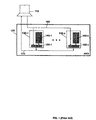
- Fig. 1 is the basic hardware that will be used to illustrate the main principle of the distance evaluation technique as it is currently practiced to date in a ZISC ANN.
- a neural system 100 comprising a host computer 110, e.g. a personal computer, and a conventional ZISC ANN referenced 120 including a plurality of neurons 130-1 to 130-n (generically referenced 130 hereinafter).
- the ANN 120 can consist of a printed circuit board having a few ZISC chips, e.g. ZISC036 chips which include 36 neurons each, mounted thereon.
- Each neuron e.g.
- a prototype memory 140-1 dedicated to store a prototype when the neuron has learned an input vector during the learning phase and a distance evaluator 150-1.
- Data-in bus 160 sequentially applies the set of components of an input pattern to all neurons 130 of the ANN 120 in parallel and data-out bus 170 transmits the results of the distance evaluation process, typically the distance and the category (other or more specified parameters could be envisioned as well) to the host 110.
- the distance evaluator 150 when an input pattern is fed into each neuron 130 through data bus 160, it is compared in the distance evaluator 150 with the prototype stored therein, so that the result generally consists of a pair of values: a distance and the category.
- the category register is not shown in Fig. 1, it is considered to be included in the distance evaluator 150.
- the ZISC ANN architecture is such that all the distance evaluations are simultaneously performed in all the neurons composing the ANN.
- the conventional ANN 120 depicted in Fig. 1 is limited to the storage of a fixed number of prototypes determined by the number n of neurons.
- modem real time applications may use from a few to several hundreds of thousands of ZISC neurons. It is to be considered that it is not always realistic to use as many ZISC neurons as it would be required.
- ANN artificial neural network
- an improved ANN adapted to compare a plurality of q input patterns with p prototypes using an ANN composed of n neurons wherein the number of prototypes is greater than the number of neurons (p > n) during the recognition/classification phase and to generate results therefrom comprising:
- ANN artificial neural network
- the problem solved by the invention is to process a number p of prototypes in a conventional ANN comprised of n physical neurons wherein p is greater than n, even of several orders of magnitude.
- the components of all the prototypes to be processed are saved in a memory, typically a Read/Write memory, forming thereby a first data base.
- the component values stored in the said first database can be read at any time to restore the component values of any neuron of the ANN whenever desired.
- all the q input patterns that have to be evaluated are stored in another memory, typically a R/W memory, to form a second data base.
- the results of the distance evaluation process and more generally the results of the recognition phase (i.e.
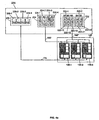
- Fig. 2 shows the architecture of the neural system 100 of Fig. 1 modified to implement the improved ANN according to the present invention wherein the number of prototypes involved in the recognition phase is greater than the number of ZISC neurons physically available in the conventional ANN 120.
- Like reference numerals (with prime) are used through the several drawings to designate identical (corresponding) parts.
- the novel neural system architecture which bears numeral 200 is comprised of host computer 110 and the improved ZISC ANN now referenced 120'.
- Improved ANN 120' still comprises the conventional ANN 120 of Fig. 1, an interface circuit 210, a database block 220 comprised of three data bases 222, 224 and 226 and finally a compare & update circuit 230.
- the role of interface circuit 210 is to receive the data from the host computer 110 for a proper dispatch thereof to the three data bases in data base block 220, and conversely, to transfer the contents of said data bases in the host computer 110.
- the database block 220 includes three data bases.
- the first data base 222 contains the prototypes
- the second data base 224 contains the input patterns
- the third data base 226 contains the results of the distance evaluation process.
- the first data base 222 also referred to as the Prototype data base is split in s sub-data bases or slices 222-1 to 222-s, each slice being adapted to store up to n prototypes. As a result, each slice contains n prototypes except the last one (if any) which contains the remaining prototypes.
- the first data base contains p x m values (when it is completely filled, it contains n x s x m values).
- the second data base 224 is also referred to as the Query data base because the input patterns to be presented to the improved ANN 120' are often referred to as queries in the literature.
- the second database 224 thus contains q x m values.
- the third data base 226 also referred to as the Result data base contains the intermediate results of the distance evaluation process performed during the recognition/classification phase, and, at the end of this process, it contains the final distances DIST and the associated categories CAT. If the results are limited to the distance and category parameters, the third data base thus contains 2 x q values. Because other specified parameters could be envisioned as well, the third data base 226 contains k x q values, if there are k different specified parameters.
- the compare & update circuit 230 compares the global results generated by the ANN for each query (input pattern presentation) with corresponding results that were previously stored in the third data base 226 and updates them whenever necessary.
- the address controller 240 cooperates with the interface circuit 210 to send adequate addresses in the three data bases to select the right data. Note that in the particular implementation of database block 220 in host computer 110, the function of address controller 240 is fulfilled by the host computer 110 itself.
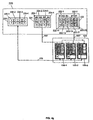
- Fig. 3a shows a flow-chart referenced 300 illustrating the algorithm at the base of the method of the present invention.
- Two current variables will be used, i (sub-database or slice index) which varies from 1 to the number s of slices and j (query index) which varies from 1 to the number q of input patterns to be presented, i.e. of queries.
- the process is started in box 301.
- the first current variable i is set to 1 and the final distance and the category values for all the q input patterns are initialized, for example to the maximum distance value (Max) and zero respectively.
- Max is the maximum value that can be coded.
- the components of all prototypes stored in the current slice are loaded in the n neurons of the ANN 120 and the second current variable j is set to 1.
- the neural system 200 is ready for the first query.
- a query is presented to the ANN, the distance dist and the associated category cat that are determined as standard for that query are intermediate results.
- Fig. 3b shows a variant of the method described by reference to Fig. 3a.
- the initializations of the distance (DIST) and the category CAT that were performed in box 302 (Fig. 3a)
- Fig. 3a the initializations of the distance (DIST) and the category CAT that were performed in box 302
- results simply consist of a distance and a category, but the above reasoning can be generalized to more distances (or categories) and/or to other specified parameters (e.g. thresholds, ... ) as well.
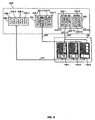
- FIG. 4a three prototypes B1 (5,9,12), B2 (13,9,9) and B3 (2,19,3) and two prototypes B4 (14,3,7) and B5 (11,6,13) are respectively stored in first and second slices referenced 222-1 and 222-2 of Prototype data base 222 at specific memory locations thereof.
- four input patterns A1 (5,15,9), A2 (7,3,12), A3 (18,4,3) and A4 (11,6,13)
- the global results of the distance evaluation process found by the ANN at each input pattern presentation i.e.
- the distance and the category are stored in two positions (lower and upper respectively) at four memory locations (226-1 to 226-4) in the Result data base 226. There are as many memory locations (226-1 to 226-4) in the Result data base 226 as they are memory locations (224-1 to 224-4) in the Query data base 224.
- the content of the upper position, i.e. the category is irrelevant, while the maximum distance Max is stored in the lower position thereof.
- the category register is illustrated in Fig. 4a as being a part of the distance evaluator.
- prototypes B1-B3 of the first memory slice (222-1) are loaded in the prototype memory of their respective neuron via bus 160".
- category which is associated to each prototype is its rank for the sake of illustration, in other words, the category of prototype B1 is 1.
- the first input pattern A1 is presented to the ANN 120 (first query) via bus 160' and the distances are computed.
- the L1 norm is used (see the above mentioned US patent for the details of the calculation technique).
- the three distances that are found, i.e. 9, 14 and 13 for neurons 130-1, 130-2 and 130-3 are local results.
- the value of the minimum distance found is 9 which corresponds to the first prototype.
- the values of this distance and associated category, i.e. 9 and 1 respectively, are global results, which represent the reaction of the ANN 120 to the first input pattern presentation, are stored at memory location 226-1 in their respective positions via bus 170.
- Max is the maximum distance that can be coded in the neural system 200, all distances being necessarily lower than or equal to this value, the Max value is overwritten at each query in the distance position at the corresponding memory location of the Result data base 226.
- the second slice 222-2 containing prototypes B4 and B5 is loaded in the two first neurons of the ANN via bus 160". Note that the categories have been changed accordingly in their respective category registers.
- the input pattern A1 is presented, and the distances with the stored prototypes B4 and B5 are computed. Because, these distances are greater than the distances that were previously found, no change is made at memory location 226-1.
- the presentation of input pattern A2 does not result in any change at memory location 226-2 because the distance that is found, i.e. 8 is equal to the distance previously stored.
- the presentation of input pattern A3 leads to a distance value of 9, lower than the distance previously stored at memory location 226-3 equal to 16, which is thus overwritten. As a result, the new distance value now becomes 9 and the new category is 4.
- the presentation of input pattern A4 leads to a distance value of 0, lower than the distance previously stored at memory location 226-4 equal to 9 which is thus overwritten. As a result, the new distance value now becomes 0 and the new category is 5.
- the neural system 200 is thus able to store five prototypes, then to compare four input patterns A1-A4 with these five prototypes with the support of an ANN physically composed of only three neurons, at the only cost of loading the prototypes in two steps.
- the number of processed prototypes can be much greater than the number of neurons.
- image processing experiments have been conducted and have shown that more than 10 6 prototypes and a similar number of queries could be processed with an ANN comprised of only 10 3 physical neurons. In this case, the number s of slices was 10 3 .
Landscapes
- Engineering & Computer Science (AREA)
- Theoretical Computer Science (AREA)
- Physics & Mathematics (AREA)
- Data Mining & Analysis (AREA)
- Life Sciences & Earth Sciences (AREA)
- Artificial Intelligence (AREA)
- Biophysics (AREA)
- Biomedical Technology (AREA)
- Health & Medical Sciences (AREA)
- Evolutionary Computation (AREA)
- General Engineering & Computer Science (AREA)
- General Physics & Mathematics (AREA)
- General Health & Medical Sciences (AREA)
- Software Systems (AREA)
- Mathematical Physics (AREA)
- Computing Systems (AREA)
- Molecular Biology (AREA)
- Computational Linguistics (AREA)
- Bioinformatics & Cheminformatics (AREA)
- Neurology (AREA)
- Bioinformatics & Computational Biology (AREA)
- Computer Vision & Pattern Recognition (AREA)
- Evolutionary Biology (AREA)
- Character Discrimination (AREA)
- Image Analysis (AREA)
- Prostheses (AREA)
- Electrotherapy Devices (AREA)
Claims (12)
- Verbessertes künstliches neuronales Netzwerk, im Weiteren KNN (120') genannt, zum Vergleich einer Menge von q Eingangsmustern mit p Prototypen unter Einsatz eines aus n Neuronen (130) gebildeten ANN, in dem während der Erkennungs-/Klassifizierungsphase die Anzahl von Prototypen größer ist als die Anzahl von n Neuronen und das verbesserte Netzwerk Folgendes umfasst:ein KNN (120), gebildet aus einer Menge von n Neuronen, wobei jedes Neuron über einen Prototypspeicher (140) zur Speicherung eines Prototyps und einen Auswerter (150) verfügt, um auf der Grundlage des Vergleichs zwischen dem an das KNN übergebenen Eingangsmuster und dem im Neuron gespeicherten Prototyp das lokale Ergebnis einer Auswertung zu erzeugen, sodass das KNN während der Erkennungs-/Klassifizierungsphase entsprechend den k spezifizierten Parametern k globale Ergebnisse erzeugt, wobei k gleich oder größer als eins ist;mindestens drei Datenbanken (222, 224, 226): eine erste Datenbank (222) zur Speicherung von p Prototypen, die auf s Sektoren von bis zu n Prototypen verteilt sind, eine zweite Datenbank (224) zur Speicherung der q Eingangsmuster, die an das KNN übergeben werden sollen, und eine dritte Datenbank (226) zur Speicherung von q mal k Werten;Vergleichs- und Aktualisierungsmittel (230), die für den Vergleich der bei der Auswertung erhaltenen Ergebnisse mit den zuvor für dasselbe Eingangsmuster ermittelten Ergebnissen eines früheren Sektors oder mit den bei der Initialisierung bereits vorhandenen Ergebnissen konfiguriert sind, wobei entsprechend einem vordefinierten Kriterium und auf der Grundlage dieses Vergleichs die zuvor gespeicherten Ergebnisse aktualisiert oder nicht aktualisiert werden; undfür den Transport ausgelegte Datenbusmittel (160', 160"): Transport der Prototypdaten zum Prototypspeicher (140), Transport der Eingangsmuster zum Auswerter (150) und Transport der Ergebnisdaten vom Auswerter (150) zur dritten Datenbank.
- Verbessertes KNN nach Anspruch 1, bei dem die erste, zweite und dritte Datenbank (222, 224, 226) aus Schreib-/Lese-Speichern bestehen.
- Verbessertes KNN nach Anspruch 2, bei dem es sich bei der ersten, zweiten und dritten Datenbank (222, 224, 226) um voneinander unabhängige Einheiten handelt.
- Verbessertes KNN nach Anspruch 1, das weiter einen Computer (110) umfasst und dadurch ein neuronales System bildet.
- Verbessertes KNN nach Anspruch 4, bei dem die erste, zweite und dritte Datenbank (222, 224, 226) einen Teil des RAM-Speichers des Computers bilden.
- Verbessertes KNN nach Anspruch 5, das weiter Folgendes umfasst:einen Datenbankblock, der die erste, zweite und dritte Datenbank (222, 224, 226) enthält; undSchnittstellenmittel (210), die für den Datentransfer zwischen dem Computer (110) und dem Datenbankblock ausgelegt sind, um entweder direkt oder indirekt über einen Adresscontroller die Steuersignale zur korrekten Adressierung der Datenbanken und des KNN zu erzeugen.
- Verbessertes KNN nach Anspruch 1, bei dem die spezifizierten Parameter einen Abstand umfassen.
- Verbessertes KNN nach Anspruch 7, bei dem der Auswerter in jedem Neuron ein Abstandsauswerter ist, der für die Berechnung des Abstandes zwischen dem an das KNN übergebenen Eingabemuster und dem im Neuron gespeicherten Prototyp ausgelegt ist.
- Verbessertes KNN nach Anspruch 8, bei dem das vordefinierte Kriterium die Bestimmung des kleinsten Abstandes ist.
- Verbessertes KNN nach Anspruch 8, bei dem die spezifizierten Parameter weiter die Kategorie umfassen und bei dem der Auswerter ein Kategorieregister zur Speicherung der zu dem Prototyp gehörigen Kategorie umfasst.
- Verfahren zur Erhöhung der Anzahl von Prototypen, die in einem KNN mit einer begrenzten Anzahl von Neuronen verarbeitet werden soll, das die folgenden Schritte umfasst:a) Bereitstellung eines KNN (120), gebildet aus einer Menge von n Neuronen (130), wobei jedes Neuron über einen Prototypspeicher (140) zur Speicherung eines Prototyps und einen Auswerter (150) verfügt, um auf der Grundlage des Vergleichs zwischen dem an das KNN übergebenen Eingangsmuster und dem im Neuron gespeicherten Prototyp das lokale Ergebnis einer Auswertung zu erzeugen, sodass das KNN während der Erkennungs-/Klassifizierungsphase entsprechend den k spezifizierten Parametern k globale Ergebnisse erzeugt, wobei k gleich oder größer als eins ist;b) Bereitstellung einer ersten Datenbank (222), die die zu verarbeitenden p Prototypen enthält, in der die Anzahl p der Prototypen größer ist als die Anzahl n der Neuronen und die die p Prototypen auf s Sektoren verteilt und jeder Sektor bis n Prototypen enthält;c) Bereitstellung einer zweiten Datenbank (224), die die q Eingangsmuster enthält, die dem KNN übergeben werden sollen;d) Bereitstellung einer dritten Datenbank, die die q mal k Werte aus der Auswertung speichern kann;e) Laden eines Sektors i von Prototypen, die im Prototypspeicher (140) der n Neuronen (130) verarbeitet werden sollen, wobei i von 1 bis s variiert;f) Übergeben eines Eingangsmusters mit dem Rang j an das KNN zur Auswertung, wobei j von 1 bis q variiert;g) Vergleichen der für ein Eingangsmuster erhaltenen Ergebnisse mit den zuvor für ein Eingangsmuster desselben Ranges gespeicherten Ergebnissen oder mit den bei der Initialisierung gespeicherten Werten, und je nach Ausgang des Vergleichs Speicherung oder keine Speicherung der Ergebnisse an dem entsprechenden Speicherplatz in der dritten Datenbank (226);h) Wiederholen der Schritte f) und g), bis alle Eingangsmuster an das KNN übergeben wurden;i) Wiederholen der Schritte e) bis h), bis alle Sektoren geladen wurden, sodass am Ende des Auswertungsprozesses die Endergebnisse in der Datenbank (226) enthalten sind.
- Verfahren nach Anspruch 11, bei dem die spezifizierten Parameter einen Abstand und eine Kategorie umfassen und die vordefinierten Kriterien die Bestimmung des kleinsten Abstandes umfassen, sodass die Endergebnisse für jedes Eingangsmuster aus dem kleinsten Abstand und der zugehörigen Kategorie bestehen.
Priority Applications (1)
| Application Number | Priority Date | Filing Date | Title |
|---|---|---|---|
| EP02758409A EP1451773B1 (de) | 2001-07-26 | 2002-07-11 | Verfahren und schaltungen zum virtuellen vergrössern der anzahl von prototypen in artifiziellen neuronalen netzwerken |
Applications Claiming Priority (4)
| Application Number | Priority Date | Filing Date | Title |
|---|---|---|---|
| EP01480058 | 2001-07-26 | ||
| EP01480058 | 2001-07-26 | ||
| EP02758409A EP1451773B1 (de) | 2001-07-26 | 2002-07-11 | Verfahren und schaltungen zum virtuellen vergrössern der anzahl von prototypen in artifiziellen neuronalen netzwerken |
| PCT/EP2002/008473 WO2003012737A2 (en) | 2001-07-26 | 2002-07-11 | Method and circuits to virtually increase the number of prototypes in artificial neural networks |
Publications (2)
| Publication Number | Publication Date |
|---|---|
| EP1451773A2 EP1451773A2 (de) | 2004-09-01 |
| EP1451773B1 true EP1451773B1 (de) | 2005-09-14 |
Family
ID=8183400
Family Applications (1)
| Application Number | Title | Priority Date | Filing Date |
|---|---|---|---|
| EP02758409A Expired - Lifetime EP1451773B1 (de) | 2001-07-26 | 2002-07-11 | Verfahren und schaltungen zum virtuellen vergrössern der anzahl von prototypen in artifiziellen neuronalen netzwerken |
Country Status (8)
| Country | Link |
|---|---|
| US (1) | US7254565B2 (de) |
| EP (1) | EP1451773B1 (de) |
| JP (1) | JP4106021B2 (de) |
| KR (1) | KR20040014577A (de) |
| AT (1) | ATE304725T1 (de) |
| AU (1) | AU2002325379A1 (de) |
| DE (1) | DE60206194T2 (de) |
| WO (1) | WO2003012737A2 (de) |
Families Citing this family (5)
| Publication number | Priority date | Publication date | Assignee | Title |
|---|---|---|---|---|
| US8027942B2 (en) * | 2000-12-13 | 2011-09-27 | International Business Machines Corporation | Method and circuits for associating a complex operator to each component of an input pattern presented to an artificial neural network |
| US8510244B2 (en) * | 2009-03-20 | 2013-08-13 | ISC8 Inc. | Apparatus comprising artificial neuronal assembly |
| US9652712B2 (en) * | 2015-07-27 | 2017-05-16 | Google Inc. | Analyzing health events using recurrent neural networks |
| CN112585624B (zh) * | 2018-08-23 | 2025-10-17 | 三星电子株式会社 | 使用多个处理器处理神经网络模型的电子装置及其操作方法 |
| US12020146B2 (en) | 2018-08-23 | 2024-06-25 | Samsung Electronics Co., Ltd. | Electronic device and operating method thereof of processing neural network model by using plurality of processors |
Family Cites Families (6)
| Publication number | Priority date | Publication date | Assignee | Title |
|---|---|---|---|---|
| WO1991018351A1 (en) * | 1990-05-22 | 1991-11-28 | International Business Machines Corporation | Pyramid learning architecture neurocomputer |
| EP0694852B1 (de) * | 1994-07-28 | 2002-06-26 | International Business Machines Corporation | Innovative Neuronalschaltungsarchitektur |
| US5649070A (en) * | 1995-02-17 | 1997-07-15 | International Business Machines Corporation | Learning system with prototype replacement |
| EP1073013A1 (de) * | 1999-07-29 | 2001-01-31 | International Business Machines Corporation | Selbst-adaptives neuronales Netzwerk |
| US6675164B2 (en) * | 2001-06-08 | 2004-01-06 | The Regents Of The University Of California | Parallel object-oriented data mining system |
| US20030018598A1 (en) * | 2001-07-19 | 2003-01-23 | Cawse James Norman | Neural network method and system |
-
2002
- 2002-05-03 US US10/137,969 patent/US7254565B2/en not_active Expired - Fee Related
- 2002-07-11 AT AT02758409T patent/ATE304725T1/de not_active IP Right Cessation
- 2002-07-11 AU AU2002325379A patent/AU2002325379A1/en not_active Abandoned
- 2002-07-11 WO PCT/EP2002/008473 patent/WO2003012737A2/en not_active Ceased
- 2002-07-11 JP JP2003517837A patent/JP4106021B2/ja not_active Expired - Fee Related
- 2002-07-11 EP EP02758409A patent/EP1451773B1/de not_active Expired - Lifetime
- 2002-07-11 KR KR10-2003-7016795A patent/KR20040014577A/ko not_active Ceased
- 2002-07-11 DE DE60206194T patent/DE60206194T2/de not_active Expired - Lifetime
Also Published As
| Publication number | Publication date |
|---|---|
| US7254565B2 (en) | 2007-08-07 |
| WO2003012737A3 (en) | 2004-05-27 |
| ATE304725T1 (de) | 2005-09-15 |
| EP1451773A2 (de) | 2004-09-01 |
| DE60206194D1 (de) | 2005-10-20 |
| AU2002325379A1 (en) | 2003-02-17 |
| JP2005521118A (ja) | 2005-07-14 |
| WO2003012737A2 (en) | 2003-02-13 |
| DE60206194T2 (de) | 2006-06-14 |
| US20030023569A1 (en) | 2003-01-30 |
| KR20040014577A (ko) | 2004-02-14 |
| JP4106021B2 (ja) | 2008-06-25 |
Similar Documents
| Publication | Publication Date | Title |
|---|---|---|
| Gelenbe et al. | Dynamical random neural network approach to the traveling salesman problem | |
| US5701398A (en) | Adaptive classifier having multiple subnetworks | |
| US5479574A (en) | Method and apparatus for adaptive classification | |
| Battiti | Using mutual information for selecting features in supervised neural net learning | |
| US4835680A (en) | Adaptive processor array capable of learning variable associations useful in recognizing classes of inputs | |
| EP0591921B1 (de) | Lern und Erkennungsmaschine | |
| CN115210718B (zh) | 使用生成对抗网络的半导体制造过程参数确定 | |
| Liaw et al. | Fast exact k nearest neighbors search using an orthogonal search tree | |
| US5524178A (en) | Neural network learning system | |
| EP1451773B1 (de) | Verfahren und schaltungen zum virtuellen vergrössern der anzahl von prototypen in artifiziellen neuronalen netzwerken | |
| US20020073053A1 (en) | Method and circuits for associating a complex operator to each component of an input pattern presented to an artificial neural network | |
| US6505181B1 (en) | Recognition system | |
| Bakshi et al. | Wave-Nets: novel learning techniques, and the induction of physically interpretable models | |
| Shang et al. | Principal features-based texture classification with neural networks | |
| US4783830A (en) | Pattern recognizing content addressable memory system | |
| US6782373B2 (en) | Method and circuits for associating a norm to each component of an input pattern presented to a neural network | |
| EP1172763A2 (de) | Verfahren und Schaltungen zur Zuordnung einer Norm zu jeder Komponente eines Eingangsmusters das einem neuronalen Netzwerk angeboten wird | |
| Howard et al. | Electronic neural networks | |
| EP1321896A2 (de) | Verfahren und Schaltungen zur Bildskalierung mit Hilfe neuronaler Netzwerke | |
| Baldi | Symmetries and learning in neural network models | |
| Escobedo et al. | A neural information retrieval system | |
| US6983265B2 (en) | Method to improve the data transfer rate between a computer and a neural network | |
| JPH08263660A (ja) | 信号認識方法、信号認識装置、信号認識装置の学習方法及び信号認識装置の学習装置 | |
| EP1073013A1 (de) | Selbst-adaptives neuronales Netzwerk | |
| Skarbek | Rough sets for enhancements of local subspace classifier |
Legal Events
| Date | Code | Title | Description |
|---|---|---|---|
| PUAI | Public reference made under article 153(3) epc to a published international application that has entered the european phase |
Free format text: ORIGINAL CODE: 0009012 |
|
| 17P | Request for examination filed |
Effective date: 20040120 |
|
| AK | Designated contracting states |
Kind code of ref document: A2 Designated state(s): AT BE BG CH CY CZ DE DK EE ES FI FR GB GR IE IT LI LU MC NL PT SE SK TR |
|
| 17Q | First examination report despatched |
Effective date: 20040930 |
|
| GRAP | Despatch of communication of intention to grant a patent |
Free format text: ORIGINAL CODE: EPIDOSNIGR1 |
|
| GRAS | Grant fee paid |
Free format text: ORIGINAL CODE: EPIDOSNIGR3 |
|
| GRAL | Information related to payment of fee for publishing/printing deleted |
Free format text: ORIGINAL CODE: EPIDOSDIGR3 |
|
| GRAS | Grant fee paid |
Free format text: ORIGINAL CODE: EPIDOSNIGR3 |
|
| GRAA | (expected) grant |
Free format text: ORIGINAL CODE: 0009210 |
|
| AK | Designated contracting states |
Kind code of ref document: B1 Designated state(s): AT BE BG CH CY CZ DE DK EE ES FI FR GB GR IE IT LI LU MC NL PT SE SK TR |
|
| PG25 | Lapsed in a contracting state [announced via postgrant information from national office to epo] |
Ref country code: IT Free format text: LAPSE BECAUSE OF FAILURE TO SUBMIT A TRANSLATION OF THE DESCRIPTION OR TO PAY THE FEE WITHIN THE PRESCRIBED TIME-LIMIT;WARNING: LAPSES OF ITALIAN PATENTS WITH EFFECTIVE DATE BEFORE 2007 MAY HAVE OCCURRED AT ANY TIME BEFORE 2007. THE CORRECT EFFECTIVE DATE MAY BE DIFFERENT FROM THE ONE RECORDED. Effective date: 20050914 Ref country code: BE Free format text: LAPSE BECAUSE OF FAILURE TO SUBMIT A TRANSLATION OF THE DESCRIPTION OR TO PAY THE FEE WITHIN THE PRESCRIBED TIME-LIMIT Effective date: 20050914 Ref country code: FI Free format text: LAPSE BECAUSE OF FAILURE TO SUBMIT A TRANSLATION OF THE DESCRIPTION OR TO PAY THE FEE WITHIN THE PRESCRIBED TIME-LIMIT Effective date: 20050914 Ref country code: SK Free format text: LAPSE BECAUSE OF FAILURE TO SUBMIT A TRANSLATION OF THE DESCRIPTION OR TO PAY THE FEE WITHIN THE PRESCRIBED TIME-LIMIT Effective date: 20050914 Ref country code: LI Free format text: LAPSE BECAUSE OF FAILURE TO SUBMIT A TRANSLATION OF THE DESCRIPTION OR TO PAY THE FEE WITHIN THE PRESCRIBED TIME-LIMIT Effective date: 20050914 Ref country code: CH Free format text: LAPSE BECAUSE OF FAILURE TO SUBMIT A TRANSLATION OF THE DESCRIPTION OR TO PAY THE FEE WITHIN THE PRESCRIBED TIME-LIMIT Effective date: 20050914 Ref country code: AT Free format text: LAPSE BECAUSE OF FAILURE TO SUBMIT A TRANSLATION OF THE DESCRIPTION OR TO PAY THE FEE WITHIN THE PRESCRIBED TIME-LIMIT Effective date: 20050914 Ref country code: NL Free format text: LAPSE BECAUSE OF FAILURE TO SUBMIT A TRANSLATION OF THE DESCRIPTION OR TO PAY THE FEE WITHIN THE PRESCRIBED TIME-LIMIT Effective date: 20050914 Ref country code: CZ Free format text: LAPSE BECAUSE OF FAILURE TO SUBMIT A TRANSLATION OF THE DESCRIPTION OR TO PAY THE FEE WITHIN THE PRESCRIBED TIME-LIMIT Effective date: 20050914 |
|
| REG | Reference to a national code |
Ref country code: GB Ref legal event code: FG4D |
|
| REG | Reference to a national code |
Ref country code: CH Ref legal event code: EP |
|
| REG | Reference to a national code |
Ref country code: IE Ref legal event code: FG4D |
|
| REF | Corresponds to: |
Ref document number: 60206194 Country of ref document: DE Date of ref document: 20051020 Kind code of ref document: P |
|
| PG25 | Lapsed in a contracting state [announced via postgrant information from national office to epo] |
Ref country code: BG Free format text: LAPSE BECAUSE OF FAILURE TO SUBMIT A TRANSLATION OF THE DESCRIPTION OR TO PAY THE FEE WITHIN THE PRESCRIBED TIME-LIMIT Effective date: 20051214 Ref country code: SE Free format text: LAPSE BECAUSE OF FAILURE TO SUBMIT A TRANSLATION OF THE DESCRIPTION OR TO PAY THE FEE WITHIN THE PRESCRIBED TIME-LIMIT Effective date: 20051214 Ref country code: DK Free format text: LAPSE BECAUSE OF FAILURE TO SUBMIT A TRANSLATION OF THE DESCRIPTION OR TO PAY THE FEE WITHIN THE PRESCRIBED TIME-LIMIT Effective date: 20051214 Ref country code: GR Free format text: LAPSE BECAUSE OF FAILURE TO SUBMIT A TRANSLATION OF THE DESCRIPTION OR TO PAY THE FEE WITHIN THE PRESCRIBED TIME-LIMIT Effective date: 20051214 |
|
| PG25 | Lapsed in a contracting state [announced via postgrant information from national office to epo] |
Ref country code: ES Free format text: LAPSE BECAUSE OF FAILURE TO SUBMIT A TRANSLATION OF THE DESCRIPTION OR TO PAY THE FEE WITHIN THE PRESCRIBED TIME-LIMIT Effective date: 20051225 |
|
| PG25 | Lapsed in a contracting state [announced via postgrant information from national office to epo] |
Ref country code: PT Free format text: LAPSE BECAUSE OF FAILURE TO SUBMIT A TRANSLATION OF THE DESCRIPTION OR TO PAY THE FEE WITHIN THE PRESCRIBED TIME-LIMIT Effective date: 20060214 |
|
| NLV1 | Nl: lapsed or annulled due to failure to fulfill the requirements of art. 29p and 29m of the patents act | ||
| REG | Reference to a national code |
Ref country code: CH Ref legal event code: PL |
|
| ET | Fr: translation filed | ||
| PG25 | Lapsed in a contracting state [announced via postgrant information from national office to epo] |
Ref country code: IE Free format text: LAPSE BECAUSE OF NON-PAYMENT OF DUE FEES Effective date: 20060711 |
|
| PLBE | No opposition filed within time limit |
Free format text: ORIGINAL CODE: 0009261 |
|
| STAA | Information on the status of an ep patent application or granted ep patent |
Free format text: STATUS: NO OPPOSITION FILED WITHIN TIME LIMIT |
|
| PG25 | Lapsed in a contracting state [announced via postgrant information from national office to epo] |
Ref country code: MC Free format text: LAPSE BECAUSE OF NON-PAYMENT OF DUE FEES Effective date: 20060731 |
|
| 26N | No opposition filed |
Effective date: 20060615 |
|
| REG | Reference to a national code |
Ref country code: IE Ref legal event code: MM4A |
|
| PG25 | Lapsed in a contracting state [announced via postgrant information from national office to epo] |
Ref country code: EE Free format text: LAPSE BECAUSE OF FAILURE TO SUBMIT A TRANSLATION OF THE DESCRIPTION OR TO PAY THE FEE WITHIN THE PRESCRIBED TIME-LIMIT Effective date: 20050914 |
|
| REG | Reference to a national code |
Ref country code: GB Ref legal event code: 746 Effective date: 20080704 |
|
| PG25 | Lapsed in a contracting state [announced via postgrant information from national office to epo] |
Ref country code: LU Free format text: LAPSE BECAUSE OF NON-PAYMENT OF DUE FEES Effective date: 20060711 Ref country code: TR Free format text: LAPSE BECAUSE OF FAILURE TO SUBMIT A TRANSLATION OF THE DESCRIPTION OR TO PAY THE FEE WITHIN THE PRESCRIBED TIME-LIMIT Effective date: 20050914 |
|
| PG25 | Lapsed in a contracting state [announced via postgrant information from national office to epo] |
Ref country code: CY Free format text: LAPSE BECAUSE OF FAILURE TO SUBMIT A TRANSLATION OF THE DESCRIPTION OR TO PAY THE FEE WITHIN THE PRESCRIBED TIME-LIMIT Effective date: 20050914 |
|
| PGFP | Annual fee paid to national office [announced via postgrant information from national office to epo] |
Ref country code: FR Payment date: 20110801 Year of fee payment: 10 |
|
| PGFP | Annual fee paid to national office [announced via postgrant information from national office to epo] |
Ref country code: GB Payment date: 20120723 Year of fee payment: 11 |
|
| PGFP | Annual fee paid to national office [announced via postgrant information from national office to epo] |
Ref country code: DE Payment date: 20120723 Year of fee payment: 11 |
|
| REG | Reference to a national code |
Ref country code: FR Ref legal event code: ST Effective date: 20130329 |
|
| PG25 | Lapsed in a contracting state [announced via postgrant information from national office to epo] |
Ref country code: FR Free format text: LAPSE BECAUSE OF NON-PAYMENT OF DUE FEES Effective date: 20120731 |
|
| GBPC | Gb: european patent ceased through non-payment of renewal fee |
Effective date: 20130711 |
|
| PG25 | Lapsed in a contracting state [announced via postgrant information from national office to epo] |
Ref country code: DE Free format text: LAPSE BECAUSE OF NON-PAYMENT OF DUE FEES Effective date: 20140201 Ref country code: GB Free format text: LAPSE BECAUSE OF NON-PAYMENT OF DUE FEES Effective date: 20130711 |
|
| REG | Reference to a national code |
Ref country code: DE Ref legal event code: R119 Ref document number: 60206194 Country of ref document: DE Effective date: 20140201 |