EP1450573A1 - Procédé de contrôle d'un mode de compte rendu de mesures sur une interface radio et contrôleur de réseau radio pour la mise en oeuvre du procédé - Google Patents
Procédé de contrôle d'un mode de compte rendu de mesures sur une interface radio et contrôleur de réseau radio pour la mise en oeuvre du procédé Download PDFInfo
- Publication number
- EP1450573A1 EP1450573A1 EP04290366A EP04290366A EP1450573A1 EP 1450573 A1 EP1450573 A1 EP 1450573A1 EP 04290366 A EP04290366 A EP 04290366A EP 04290366 A EP04290366 A EP 04290366A EP 1450573 A1 EP1450573 A1 EP 1450573A1
- Authority
- EP
- European Patent Office
- Prior art keywords
- messages
- reporting
- radio
- transmission
- mobile terminal
- Prior art date
- Legal status (The legal status is an assumption and is not a legal conclusion. Google has not performed a legal analysis and makes no representation as to the accuracy of the status listed.)
- Granted
Links
- 238000000034 method Methods 0.000 title claims abstract description 53
- 238000005259 measurement Methods 0.000 title claims description 100
- 230000005540 biological transmission Effects 0.000 claims description 45
- 230000000737 periodic effect Effects 0.000 claims description 35
- 238000004891 communication Methods 0.000 claims description 15
- 238000012545 processing Methods 0.000 claims description 11
- 238000001514 detection method Methods 0.000 claims description 7
- 230000001413 cellular effect Effects 0.000 claims description 5
- 230000002123 temporal effect Effects 0.000 claims description 5
- 230000008569 process Effects 0.000 claims description 4
- 230000003247 decreasing effect Effects 0.000 claims description 3
- 238000009877 rendering Methods 0.000 claims 1
- 238000006073 displacement reaction Methods 0.000 abstract 1
- 238000004458 analytical method Methods 0.000 description 12
- 230000007480 spreading Effects 0.000 description 10
- 238000010586 diagram Methods 0.000 description 7
- 208000033126 Colobomatous microphthalmia Diseases 0.000 description 6
- 208000034367 isolated with coloboma microphthalmia Diseases 0.000 description 6
- 230000000977 initiatory effect Effects 0.000 description 5
- 230000011664 signaling Effects 0.000 description 5
- 230000007704 transition Effects 0.000 description 5
- 230000006978 adaptation Effects 0.000 description 4
- 230000015556 catabolic process Effects 0.000 description 4
- 238000006731 degradation reaction Methods 0.000 description 4
- 230000004044 response Effects 0.000 description 4
- 238000012360 testing method Methods 0.000 description 4
- 230000008901 benefit Effects 0.000 description 3
- 238000012423 maintenance Methods 0.000 description 3
- 230000000630 rising effect Effects 0.000 description 3
- 238000005070 sampling Methods 0.000 description 3
- 238000004088 simulation Methods 0.000 description 3
- 238000012546 transfer Methods 0.000 description 3
- 108010003272 Hyaluronate lyase Proteins 0.000 description 2
- 238000009826 distribution Methods 0.000 description 2
- 230000006870 function Effects 0.000 description 2
- 238000013507 mapping Methods 0.000 description 2
- 239000011159 matrix material Substances 0.000 description 2
- 238000000926 separation method Methods 0.000 description 2
- 238000007493 shaping process Methods 0.000 description 2
- 230000001960 triggered effect Effects 0.000 description 2
- 238000012935 Averaging Methods 0.000 description 1
- 230000003044 adaptive effect Effects 0.000 description 1
- 230000003321 amplification Effects 0.000 description 1
- 238000005311 autocorrelation function Methods 0.000 description 1
- 230000033590 base-excision repair Effects 0.000 description 1
- 230000008859 change Effects 0.000 description 1
- 238000011217 control strategy Methods 0.000 description 1
- 238000012217 deletion Methods 0.000 description 1
- 230000037430 deletion Effects 0.000 description 1
- 230000001419 dependent effect Effects 0.000 description 1
- 230000002542 deteriorative effect Effects 0.000 description 1
- 230000000694 effects Effects 0.000 description 1
- 230000002349 favourable effect Effects 0.000 description 1
- 238000009499 grossing Methods 0.000 description 1
- 230000007246 mechanism Effects 0.000 description 1
- 230000000116 mitigating effect Effects 0.000 description 1
- 238000012986 modification Methods 0.000 description 1
- 230000004048 modification Effects 0.000 description 1
- 238000003199 nucleic acid amplification method Methods 0.000 description 1
- 230000008520 organization Effects 0.000 description 1
- 230000010363 phase shift Effects 0.000 description 1
- 238000001228 spectrum Methods 0.000 description 1
- 238000009827 uniform distribution Methods 0.000 description 1
- 238000011144 upstream manufacturing Methods 0.000 description 1
- 239000002699 waste material Substances 0.000 description 1
Images




Classifications
-
- H—ELECTRICITY
- H04—ELECTRIC COMMUNICATION TECHNIQUE
- H04W—WIRELESS COMMUNICATION NETWORKS
- H04W24/00—Supervisory, monitoring or testing arrangements
- H04W24/10—Scheduling measurement reports ; Arrangements for measurement reports
-
- H—ELECTRICITY
- H04—ELECTRIC COMMUNICATION TECHNIQUE
- H04L—TRANSMISSION OF DIGITAL INFORMATION, e.g. TELEGRAPHIC COMMUNICATION
- H04L1/00—Arrangements for detecting or preventing errors in the information received
- H04L1/20—Arrangements for detecting or preventing errors in the information received using signal quality detector
Definitions
- the present invention relates to the measurements carried out in the radiocommunication systems with mobiles.
- Such measures can be used in particular in control of radio links which generally serve to optimize the quality of transmissions and to minimize interference between users.
- these procedures we can cite the regulation of the transmission power by the mobile and / or infrastructure, controlling automatic transfers of cell (“handover”) in cellular networks, adapting the coding of channel to propagation conditions, adaptation of source coding (especially in the case of AMR type variable rate speech coders - "Adaptive Multi-Rate”), link adaptation procedures ("Link Adaptation ”), etc.
- the event designated 1 F provides for the triggering of measurement feedbacks, to the network controller, over a radio link, when the field level of a signal received on this link goes below a threshold value.
- the events specified to pass from one measurement reporting mode to another do not include indicators techniques to take into account more specific criteria, which can lead to maintain too high or too low a measurement reporting rate in some cases.
- a bad choice of the rate of the reports of measures can have consequences up to a cut in communication, for example when field level measurements on neighboring cells were not reassembled by a mobile terminal to the controller radio network frequently enough to allow a transfer of communication from the waiter cell to these neighboring cells, while the communication quality deteriorated rapidly on the current link.
- An object of the present invention is to provide a finer way of compromise between feedback to a controller radio network frequent enough to allow better control of radio resources, based on up-to-date measurements, and a limitation of these same measurement feedback to avoid signaling overload on the radio channel and a grabbing, by these measures, of the means of treatment of the radio network controller.
- the speed estimate is calculated, at level of the terminal and / or a fixed transceiver, from the parameters of propagation channels measured, and is included in an account message returned to be obtained at the radio network controller. She could nevertheless be obtained by other means.
- the determination of the reporting mode preferably comprises the selection between periodic transmission of reporting messages and transmission of report messages on event detection. he it is however possible to envisage only a periodic mode, with a adjustment of the period taking into account at least in certain cases the speed estimated. Yet another possibility is to provide only one mode on event, with at least in some cases the choice of an event more or less likely based on estimated speed.
- This mechanism has the advantage of transmitting radio channel settings preferably when the terminal speed mobile indicates that these settings are subject to change quickly.
- temporal variability of a signal energy on at least some of the radio interface channels is the subject of measures. This variability or the evolution of its value over time can then be taken into account, in addition to the estimated terminal speed mobile, in determining the reporting mode to apply.
- the invention also provides a radio network controller for a cellular radio network infrastructure, including reception means report messages indicating radio propagation parameters measured between a mobile terminal and at least one fixed transceiver of infrastructure, and means for processing report messages to control a mode of transmission of at least part of said messages according to a method as defined above.
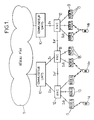
- the invention is described below in its application to a network UMTS, whose figure 1 shows the architecture.
- the switches of the mobile service 10, belonging to a core network are connected on the one hand to one or more fixed networks 11 and on the other hand, by means of a so-called read interface, to control equipment 12, or RNC ("Radio Network Controller").
- RNC Radio Network Controller
- Each RNC 12 is connected to one or more base stations 9 by means of a so-called lub interface .
- the base stations 9, distributed over the network coverage territory, are capable of communicating by radio with the mobile terminals 14, 14a, 14b called UE ("User Equipment").
- the base stations 9, also called “node B”, can each serve one or more cells by means of respective transceivers 13.
- Some RNCs 12 can also communicate with each other by means of a so-called lur interface .
- RNCs and base stations form an access network called UTRAN ("UMTS Terrestrial Radio Access Network").
- the UTRAN comprises elements of layers 1 and 2 of the ISO model in order to provide the required links on the radio interface (called Uu ), and a stage 15A of radio resource control (RRC, "Radio Resource Control") belonging to layer 3, as described in the technical specification 3G TS 25.301, "Radio Interface Protocol", version 3.4.0 published in March 2000 by the 3GPP (3 rd Generation Partnership Project). Seen from above, the UTRAN acts simply as a relay between the EU and CN.
- RRC radio Resource Control
- FIG. 2 shows the stages RRC 15A, 15B and the stages of the layers who belong to UTRAN and to an EU.
- the layer 2 is subdivided into a radio link control stage 16A, 16B (RLC, "Radio Link Control") and a medium access control stage 17A, 17B (MAC, "Medium Access Control”).
- Layer 1 comprises a stage 18A, 18B coding and multiplexing.
- a stage 19A, 19B radio transmits the radio signals from symbol trains provided by stage 18A, 18B, and the reception of signals in the other direction.
- SRNC Serving RNC
- DRNC RNC
- Appropriate protocols ensure exchanges between these RNCs on the lur interface , for example ATM ("Asynchronous Transfer Mode") and AAL2 ("ATM Adaptation Layer No. 2"). These same protocols can also be used on the lub interface for exchanges between a node B and its RNC.
- Layers 1 and 2 are each controlled by the RRC sublayer, the characteristics of which are described in the technical specification TS 25.331, "RRC Protocol Specification”, version 4.1.0 published in June 2001 by 3GPP.
- the RRC stage 15A, 15B supervises the radio interface. It also deals with stream to be transmitted to the remote station according to a "control plan”, by opposition to the "user plan” which corresponds to data processing Layer 3 users.
- UMTS uses the CDMA spread spectrum technique, i.e. that the symbols transmitted are multiplied by spreading codes made up samples called "chips" whose rate (3.84 Mchip / s in the case of UMTS) is greater than that of the symbols transmitted.
- the spreading codes distinguish different physical channels (PhCH) which are superimposed on the same transmission resource constituted by a carrier frequency.
- the self- and cross-correlation properties of spreading codes allow the receiver to separate the PhCHs and extract the symbols intended for it.
- a scrambling code is allocated to each transceiver 13 of each base station 9, and different channels used by this transceiver are distinguished by codes of mutually orthogonal channelization codes.
- the transceiver 13 can also use multiple scrambling codes mutually orthogonal, one of which is a primary scrambling code.
- transceiver 13 uses the scrambling code to separate the transmitting UEs, and possibly the channel code to separate the physical channels from the same UE.
- the code global spread is the product of the channel code and the scrambling code.
- the spreading factor (equal to the ratio between the cadence of the chips and the cadence of symbols) is a power of 2 between 4 and 512. This factor is chosen according to the symbol rate to be transmitted on the PhCH.
- the different physical channels are organized in 10 ms frames which follow one another on the carrier frequency used. Each frame is subdivided into 15 timeslots ("timeslots") of 666 ⁇ s. Each slice can carry the superimposed contributions of one or more physical channels, including common channels and dedicated channels DPCH ("Dedicated Physical Channel ").
- CPICH Common Pilot Channel
- This channel carries a signal pilot, or beacon signal, formed from a sequence of symbols predetermined (see technical specification 3G TS 25.211, “Physical channels and mapping of transport channels onto physical channels (FDD) ", version 3.3.0 published in June 2000 by the 3GPP).
- This signal is transmitted by the transceiver 13 on the primary jamming code of the cubicle, with a determined channel.
- FIG. 3 schematically illustrates the transmission part of a fixed transceiver 13 of a UMTS base station, serving a cell by means of a scrambling code c scr .
- Layer 1 can multiplex several transport channels (TrCH) from the MAC sublayer on one or more PhCHs.
- the module 18A receives the data streams from the descending TrCHs, originating from the RNC, and applies to them the coding and multiplexing operations required to form the data part (DPDCH) of the DPCHs to be transmitted.
- DPDCH data part
- This DPDCH data part is multiplexed in time, within each 666 ms time slot with a control part (DPCCH) comprising control information and predetermined pilot symbols, as shown diagrammatically in FIG. 3 by the multiplexers 20 which form the DPCH bit streams.
- a serial / parallel converter 21 forms a complex digital signal, the real part of which is constituted by the even rank bits of the stream and the imaginary part by the odd rank bits.
- the module 22 applies their respective channel codes c ch , which are allocated by a control unit 23, to these complex signals.
- the module 24 weights the resulting signals in accordance with the respective transmission powers of the physical channels, determined by a process. power control.
- the complex signals of the different channels are then summed by the adder 25 before being multiplied by the scrambling code c scr of the cell by means of the module 26.
- the adder 25 also receives the contribution from the CPICH, which is not not multiplied by a channel code since the CPICH channel code is constant and equal to 1 (3G TS 25.213 technical specification, "Spreading and modulation (FDD)", version 3.2.0 published in March 2000 by 3GPP).
- the complex baseband signal s delivered by the module 26 is subjected to a shaping filter and converted to analog before modulating the carrier frequency in QPSK ("Quadrature Phase Shift Keying"), and to be amplified and transmitted by the base station.
- QPSK Quadrature Phase Shift Keying
- the different transmission resources of the transceiver 13 are allocated to channels by unit 23 under the control of stage RRC 15A located in the RNC.
- the corresponding control messages are transmitted to the by means of an application protocol for controlling the transceivers, called NBAP ("Node B Application Protocol", see technical specification 3G TS 25.433, version 4.1.0, "UTRAN lub Interface NBAP Signaling", published in June 2001 by the 3GPP).
- NBAP Node B Application Protocol
- FIG. 4 schematically illustrates the transmission part of a UE. It is assumed here that this UE transmits on a single physical channel.
- the module 27 ensures the coding and possibly the multiplexing of the TrCHs corresponding to a physical channel. This forms a real signal (DPDCH) which will be transmitted on an I channel.
- DPDCH real signal
- control information as well as pilot symbols are assembled by a module 28 to form a real signal (DPCCH) which will be transmitted on a Q channel.
- digital signals of channels I and Q form the real and imaginary parts of a complex signal whose transmission power is adjusted by a module 29.
- the resulting signal is modulated by the channel spreading code constituted by a scrambling code c scr , as represented by the multiplier 30.
- the complex baseband signal is thus obtained then filtered, converted to analog before modulating the carrier frequency in QPSK.
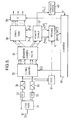
- FIG. 5 is a block diagram of a CDMA receiver capable of be in the UE for the downlink, or in node B for the uplink.
- This receiver comprises a radio stage 31 which performs the analog processing required on the radio signal received by an antenna 32.
- the radio stage 31 delivers a complex analog signal whose real parts and imaginary are digitized by the analog-digital converters 33 on respective treatment channels I and Q.
- a filter 34 adapted to the shaping of the pulses by the transmitter produces a signal digital at the rate of the spreading code chips.
- These digital signals are subjected to a battery of suitable filters 35.
- These filters 35 are adapted to the spreading codes c i of the channels to be taken into consideration.
- These spreading codes c i are supplied to the adapted filters 35 by a control module 40 which notably manages the allocation of the resources of the receiver.
- the control module 40 On the side of node B, the control module 40 is supervised by the RRC stage 15A of the RNC through the NBAP protocol. On the UE side, the control module 40 is supervised by the RRC stage 15B.
- the matched filters 35 deliver N real signals on channel l and N real signals on channel channel Q, which are supplied to a module 36 for separating the data and pilot signals.
- separation consists of extract the portions of the time slots containing the pilot signals complexes issued by node B to supply them to module 37 for analyzing channels, the corresponding data being addressed to the fingers 38 of the rake receiver.
- the separation operated by the module 36 consists in extracting the real pilot signals from channel Q relating to each channel to supply them to the analysis module 37.
- the module 37 For each physical channel, denoted by an integer index i, the module 37 identifies a number of propagation paths, denoted by an index j, based on the portion of the output signal of the matched filter 35 corresponding to the pilot symbols, which constitutes a sampling of the impulse response of the channel.
- One method consists in finding the maxima of the impulse response of the sampled channel at the output of the matched filter 35, averaged over a period of the order of a hundred milliseconds. Each propagation path is then represented by a delay t i, j corresponding to one of the maxima, of instantaneous amplitude a i, j .
- the processing carried out in each finger 38 of the rake receiver, allocated to the path j of the channel i consists in sampling the signal received on the channel i with the delay t i, j and in multiplying the result by a i, j *.
- the paths selected are those for which the reception energies are the greatest, the reception energy following a path j of a channel i being equal to the average of
- each propagation path of a channel i is represented by an eigenvector v i, j of the autocorrelation matrix of the impulse response vector provided by the matched filter 35.
- the sampling with the delay t i, j is then replaced by the scalar product of the output vector of the matched filter 35 by the eigenvector v i, j .
- the analysis module 37 performs a diagonalization of the autocorrelation matrix, which also provides the associated eigenvalues ⁇ i, j .
- the eigenvalue ⁇ i, j equal to the mathematical expectation of
- the combination module 39 of the rake receiver receives the contributions of fingers 38 and, for each channel i, calculates the sum of respective contributions of the paths selected j, indicated by the module of control 40. The result is the local estimation of information symbols transmitted on channel i.
- the module 39 can also add the contributions of the corresponding propagation channels in order to obtain the gain in diversity.
- the resulting combined estimates are then subject to the decoding and demultiplexing stage (not shown in FIG. 5).
- the local estimates delivered by the modules of respective combination 39 of these transceivers 13 are also combined to obtain the gain in diversity.
- the local estimates delivered by the respective combination modules 39 of the transceivers 13 are subjected to the decoding stage and demultiplexing (not shown in Figure 5) to obtain the estimated symbols of the concerned TrCH (s). These symbols are transmitted to the SRNC via the interface lub ( lur ) in which they are combined in order to obtain the gain in diversity.
- the corresponding combination module of RNC 12 is designated by the reference 50 in FIG. 6.
- This module retrieves from the interface lub and / or lur 51 the symbols of the TrCH coming from the different base stations and supplies them with the MAC stage 17A after combination.
- this module 50 belonging to the physical layer is responsible for broadcasting the flows of the TrCHs originating from the MAC stage 17A to the base stations concerned.
- FIG. 6 also schematically illustrates an instance 52 of the NBAP protocol executed at RNC 12 to control a radio station remote base.
- the dialogue between the RRC stage 15A of the RNC and that 15B of a UE is carried out by means of a "RRC connection" managed as described in the section 8.1 of the aforementioned 3G TS 25.331 technical specification.
- RRC protocol procedures include procedures for measure described in section 8.4 of the technical specification 3G TS 25.331, which are used in particular to update the active set for the EU in macrodiversity (or SHO) as well as in the adjustment of powers of the active set's transceivers.
- Measures requested by RNC are requested from UEs in messages "MEASUREMENT CONTROL", in which are also indicated the reporting modes, for example with a specified periodicity or response to certain events.
- the measures specified by the RNC are then made by the EU which feeds them back over the RRC connection in messages "MEASUREMENT REPORT" (see sections 10.2.17 and 10.2.19 of the technical specification 3G TS 25.331).
- These messages "MEASUREMENT CONTROL "and” MEASUREMENT REPORT are relayed so transparent by the transceivers 13 of the base stations.
- the SRNC determines the transceivers 13 of the active set.
- these active set determination algorithms can take into account rising measurements, carried out by transceivers 13 base stations and lifts in accordance with NBAP procedures described in sections 8.3.8 to 8.3.11 of the specification 3G TS 25.433 technique mentioned above.
- the RNC indicates to node B the measures of which he needs in a message "DEDICATED MEASUREMENT INITIATION REQUEST ", and node B feeds them back in a report message "DEDICATED MEASUREMENT REPORT" (see sections 9.1.52 and 9.1.55 of the technical specification 3G TS 25.433).
- the measures taken into account by the RNC to control the SHO radio links include power measurements made on the pilot signals or channels, obtained by a measurement module 41 shown in Figure 5.
- Various measurements that terminals should be able to make mobile and base stations are listed in the technical specification 3G TS 25.215, "Physical layer - Measurements (FDD)", version 3.3.0 released in June 2000 by 3GPP.
- the measurements obtained by the module 41 are transmitted to the RNC via the control module 40 and the RRC connection (EU measurement) or NBAP protocol (node B measurement).
- the sum of the eigenvalues ⁇ i, j determined by the analysis module 37 for the p propagation paths taken into consideration (1 ⁇ j ⁇ p), represents the global energy received on the channel , reduced to the duration of a symbol.
- This energy is called RSCP in the standard ("Received Signal Code Power").
- the analysis module 37 also determines for each channel i the residual power of the noise after taking the p paths into account. This residual power is called ISCP in the standard (“Interference Signal Code Power").
- the quantity (RSCP / ISCP) ⁇ (SF / 2) represents the signal-to-interferer ratio (SIR) for a downlink channel, SF designating the spreading factor of the channel.
- the SIR is equal to (RSCP / ISCP) ⁇ SF for an uplink channel.
- an RSCP type quantity is estimated in the physical layer of the receiver (module 37) over a period d 1 of the order of a hundred milliseconds, and the estimated value is raised to the RRC layer (or NBAP) if a corresponding parameter is required by the RNC. In general, it is required with a longer averaging period d 2 , for example of the order of half a second.
- the values reported by the physical layer are therefore averaged together by the module 41 to determine the measurement to be provided to the RNC.
- the two estimation periods d 1 , d 2 are adjustable.
- the SIR evaluated on the pilot symbols transmitted on a dedicated channel, is a measure that the RNC can request from the UE or node B, and it can possibly take this into account in the management of the active set.
- the radio receiver is also capable of measuring the power received in the signal bandwidth around a UMTS carrier. This power, measured by a module 42 upstream of the adapted filters 35, is indicated by the quantity called RSSI ("Received Signal Strength Indicator").
- the analysis module 37 of the radio receiver makes it possible to calculate the energy C k, i of a signal block received over the p propagation paths considered for the channel i.
- This energy C k, i reduced to the duration of a bit is given by the sum of the square modules of the amplitudes a i, j : where N is the number of pilot symbols of the signal block considered and ⁇ k, i is a weighting coefficient taking into account the amplification or attenuation introduced, if necessary, by the procedures for controlling the transmission power .
- the receiver thus has an energy measurement sample C per received signal block.
- this block corresponds to a time interval of 2560 chips, i.e. 666 ⁇ s, and the number N can range from 2 to 16 (see sections 5.2.1 and 5.3.2 of the technical specification 3G TS 25.211 v3.3.0 "Physical channels and mapping of transport channels onto physical channels (FDD) (Release 1999) ”published in June 2000 by 3GPP ("Third Generation Partnership Project”)).
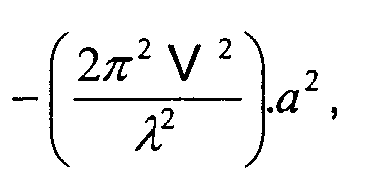
- the proportionality constant is worth ⁇ being the radio wavelength used.
- the module 43 can estimate the speed of movement v in the following manner. We give our a duration to which the speed estimate applies, expressed in number of measurement samples m.
- the energy a is estimated by the mean of the samples C k, i , indexed by an integer k in equation (2):
- the variance of this sequence is estimated by:
- the duration pT e is typically of the order of magnitude of the second.
- Estimates of speed are transmitted to RNC by via the RRC connection or the lub interface.
- the communicating UEs monitor in parallel the energies received on the CPICH channels of the cells belonging to a set MS monitored ("monitored set") including the active set and a certain number of neighboring cells. These energy measurements are generally feedback to the RNC in the "MEASUREMENT REPORT" messages.
- pathloss signal attenuation
- PL CPICH_Tx_Power / CPICH_RSCP
- the analysis module 37 of the receiver calculates the eigenvalues which are summed over the path index j to obtain the RSCP of the channel i estimated over the duration of d 1 : It also has instantaneous values of complex amplitudes a i, j corresponding to the successive pilot symbols, and therefore instantaneous energies whose rscp i is the estimated mathematical expectation over the duration d 1 .
- the measurement module 41 collects the values rscp i and m i (n) and calculates the respective averages over the duration d 2 specified by the RNC in the message MEASUREMENT CONTROL to obtain the RSCP i measurements (average of rscp i ) and M i (n) (average of the m i (n) to be transmitted to the RNC 12.
- the physical channels concerned can also be channels dedicated, the measurements being carried out either on the UE side or on the node B side. in this case, the measurements thus made available to the RNC are limited to cells of the active set.
- FIG. 7 shows results of simulations of the relationship between the normalized variance V i / (RSCP i ) 2 and the ratio Ec / NO (energy per chip over noise power density, expressed in dB) necessary to obtain a rate d binary error rate (BER) given at the output of a rake receiver applying the MRC method to process the paths of the propagation channel i.
- Each point corresponds to a simulated propagation profile, drawn randomly by varying the number of paths as well as their relative energies.
- Point clouds A, B and C correspond to BERs of 1%, 5% and 10% respectively.
- This effect can be exploited in various control procedures of radio resources supervised by the RNC, in particular for determining of the active set and the adjustment of the transmission power of the transceivers of the active set vis-à-vis a mobile terminal.
- the algorithm executed at RNC can admit as input variables the attenuations PL i and the variances V i measured by the UE for the different cells of the monitored set MS and fed back to the RRC connection.
- the attenuations PL i may have been explicitly requested from the UE, or be deduced by the RNC from the RSCP type measurements i ' since the powers CPlCH_Tx_Power are known to the RNC to be broadcast with the system information.
- PL min is the lowest attenuation value (corresponding to the best gain) among the cells of the monitored set and the balance (negative or zero) of the candidate set C (k) composed of N (k) cells compared to the candidate set consisting of the single cell with the minimum attenuation value, assuming that the power emitted would be distributed evenly among the N (k) cells.
- a gain in diversity G (k) is then estimated from the normalized variance V (k) of the sum of the contributions of the N (k) cells.
- V (k) PL i 2 .V i + PL j 2 .V j / (PL i + PL j ) 2 , always assuming a uniform distribution of the power emitted between the cells.
- this normalized variance V (k) is converted into a gain G (k) in terms of the Ec / N0 ratio (G (k) ⁇ 0, expressed in dB) by referring to a determined BER value. It is common to refer to a BER of 10%, so that such an empirical formula can be obtained using a parametric curve C 'having a minimum distance, for example in the sense of least squares, with the points C corresponding to this BER reference in a simulation of channels such as that illustrated in FIG. 7.
- the active set (determined as indicated above or in any other way) comprises two index cells i and j, whose attenuation values PL i are not too far apart, at the meaning that their deviation is less than a determined threshold
- the power variations to be implemented can generally be determined empirically using simulations. We then obtain a correspondence table giving the parameters for adjusting the transmission power to be addressed to each of the transceivers, in function of different attenuation and variance values for each transmitter receiver. Once created, this table can be stored in the RNC 12. The latter may call upon it after analysis of the measures which are his lifts, so as to send back to each transceiver the adequate adjustment parameters of their transmission power.
- the transmit power of the UE is slaved up or down by TPC bits (" Transmit Power Control ") inserted by node B in each time slot of 666 ⁇ s.
- TPC bits Transmit Power Control
- These TPC bits are determined by node B in a fast closed loop aimed at aligning the SIR of the signal received from the UE with a SIR target setpoint assigned to it by the RNC.
- This setpoint is determined by the RNC in a slower external loop so as to achieve a communication quality objective, generally expressed in terms of block error rate (BLER). It is desirable to set a relevant initial value for the SIR target setpoint in order to reduce the convergence time of the external loop. This can be done by taking into account the variability data measured by the mobile on the CPICH before the establishment of the channel and feedback to the RNC: the initial SIR target will typically be chosen lower when the measured variance is low than when it is high . This initial value is supplied to node B in the RADIO LINK SETUP REQUEST message of the NBAP protocol (3G TS 25.433, sections 8.2.17 and 9.1.36).
- Velocity measurements as well as variability measurements, provided to the RNC in accordance with the invention can also be used in the context of procedures for determining the mode of transmission to RNC of messages "MEASUREMENT REPORT” from an EU, or from “DEDICATED messages MEASUREMENT REPORT "from node B.
- the standard provides for an event reporting mode and a mode of periodic reporting.
- periodic mode several periods of reporting can be defined.
- event mode several trigger events can be defined.
- the periodic or event mode is specified by the "MEASUREMENT REPORTING MODE” message “MEASUREMENT CONTROL”, while the period or event trigger is specified in the "INTRA-FREQUENCY MEASUREMENT” of this same message (3G TS 25.331, sections 10.2.17, 10.3.7.36 and 10.3.7.49).
- the possible periods range from 250 ms to 64 s (section 10.3.7.53).
- Nine families trigger events, noted from 1 a to 1i, are planned (section 10.3.7.39).
- the periodic or event mode is specified by IE "REPORT CHARACTERISTICS" of the message “DEDICATED MEASUREMENT INITIATION REQUEST ", as well as the period or event trigger (3G TS 25.433, sections 9.1.52 and 9.2.1.51).
- the periods possible range from 10 ms to 1 h.
- Six families of triggering events, noted from A to F, are provided (section 8.3.8.2).
- the event mode has the advantage when the radio reception conditions remain good (the specified event does not occur), that the interfaces Uu and lub are not loaded unnecessarily with messages "MEASUREMENT REPORT” and / or “DEDICATED MEASUREMENT REPORT "and that the RNC does not waste its time in executing its radio resource management algorithms on the data contained in these messages.
- the radio reception conditions are likely to deteriorate soon, there is interest in favoring the periodic mode, preferably with a short period.
- the implementation of the invention leads to favoring the mode of event reporting to the detriment of the periodic mode when the estimated travel speed of the EU considered is relatively low. AT inside the periodic mode, it leads to favor a period of low measurement feedback when the estimated travel speed of the EU considered is weak. Indeed, the low speed of the EU indicates that the radio conditions are not going to be changed very quickly and therefore only too frequent measurements are unnecessary. On the contrary, the reporting mode possibly periodic with a high ascent period when the EU traveling speed considered is relatively high.
- Figures 8 and 9 illustrate an example of a procedure that can be used by the RNC 12 to specify the reporting mode to be followed by the UE 14 in taking into account the information provided by the EU speed estimates.
- the terminal is initially in event mode, and the event 1f of the standard has been specified to it (step 60). Consequently, the UE monitors the power level measurements received from its serving cell i, for example the parameter CPlCH_RSCP i , by comparing it with a threshold S1 (step 61). As long as the level remains above this threshold, the UE remains in event mode. When the power level drops below the threshold S1, the UE sends to its RNC a message “MEASUREMENT REPORT” specifying in particular the last parameters CPlCH_RSCP i and the estimated speed V of the UE (step 62). In the analysis of these measurements, the RNC compares the speed V with another predetermined threshold S2 (step 63).
- V ⁇ S2 the RNC considers that the UE is moving slowly, so that it keeps the UE in event reporting mode, that is to say that it does not send it a message " MEASUREMENT CONTROL ”.
- V> S2 in step 63 the RNC sends the EU a “MEASUREMENT CONTROL” message in step 64, so that it goes into periodic mode in step 65 with a period of relatively short Tp report.
- the RNC when the speed v appears relatively low during test 63 (V ⁇ S2), the RNC sends a “MEASUREMENT CONTROL” message to put the UE in periodic reporting mode, but with an account period made longer than the period T p indicated in step 65.
- step 63 could on the other hand relate cumulatively to the speed v and to the signal level CPICH_RSCP i so that the event mode is only maintained if v> S2 and CPlCH_RSCP i ⁇ S'1 , the threshold S'1 being less than S1. This makes it possible to pass into periodic mode when the degradation of the CPICH_ RSCP i ; becomes too severe.
- the UE 14 is initially in periodic mode, with a reporting period T p (step 70). Consequently, at each period T p , the UE sends the RNC a message “MEASUREMENT REPORT” in which it indicates in particular the last parameters CPlCH_RSCP i and v.
- the RNC examines whether the signal level CPlCH_RSCP i becomes greater than a threshold S3. If so, it will only send a "MEASUREMENT CONTROL" message to the EU to switch it to event mode (step 73) only if the EU is moving slowly enough, which is expressed by the condition that the speed V is less than a threshold S4.
- this “MEASUREMENT CONTROL” message of step 73 could keep the UE in periodic reporting mode, but with an extended period relative to the period T p .
- the implementation of the invention leads to favoring the event reporting mode over detriment of the periodic mode when the estimated travel speed of the EU is relatively low and the variability of the channel is relatively low, that is to say when the channel is relatively rich in multipaths.
- the degradation of another parameter for example the CPICH_RSCP or the CPICH_Ec / N0, can often be offset by the richness of the multi-path channel, that can be evaluated from the variance information back to RNC according to the invention.
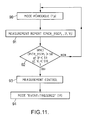
- the terminal is initially in event mode, and the event 1f of the standard has been specified to it (step 80). Consequently, the UE monitors the power level measurements received from its serving cell i, for example the parameter CPICH_RSCP i , by comparing it with a threshold S1 (step 81). As long as the level remains above this threshold, the UE remains in event mode. When the power level drops below the threshold S5, the UE sends to its RNC a message “MEASUREMENT REPORT” specifying in particular the last parameters CPlCH_RSCP i , the estimated speed V and the normalized variance V i (step 82).
- the RNC compares the speed V with a threshold S6 and the variance V i with another threshold S7 chosen inversely proportional to the order of the path diversity desired in cell i (step 83). If V ⁇ S6 or V i ⁇ S7, the RNC respectively considers that the UE is moving slowly enough or that there is a relatively rich multi-path channel, so that it keeps the UE in mode of an event report, that is to say that it does not send him a "MEASUREMENT CONTROL" message.
- the RNC sends the EU a “MEASUREMENT CONTROL” message in step 84, so that it goes into periodic mode in step 85 with a relatively short reporting period Tp.
- test 83 does not consist in comparing the normalized variance V i with a threshold S7, but in determining whether this variance received in the last message "MEASUREMENT REPORT" is greater than that received in the previous message for the same UE and the same cell.
- the message “MEASUREMENT CONTROL” is then sent in step 84 only if the speed V is sufficiently strong and if the variance V i is increasing.
- the UE 14 is initially in periodic mode, with a reporting period T p (step 90). Consequently, at each period T p , the UE sends the RNC a message "MEASUREMENT REPORT" in which it indicates in particular the last parameters CPlCH_RSCP i , V i and v. In the analysis of these parameters, done in step 92, the RNC examines whether the signal level CPlCH_RSCP i becomes at a threshold S8.
- step 93 it will only send a “MEASUREMENT CONTROL” message to the EU to switch it to event mode (step 93) only if the estimated speed of the EU is considered to be slow, ie say less than a threshold S9 and if the channel between the UE and its serving cell is relatively rich in multipaths, which is expressed by the condition that the variance V i is less than a threshold S10.
- This threshold S10 can in particular be inversely proportional to an order of diversity corresponding to one or two propagation paths.
- this “MEASUREMENT CONTROL” message of step 93 could keep the UE in periodic reporting mode, but with an extended period relative to the period T p .
- the example in FIG. 11 can include multiple variants.
- the variance test carried out in step 92 may relate to the variation of the variance rather than to its absolute value, an increasing variance giving rise to the maintenance of the periodic mode with the period T p .
- V of the UE possibly in combination with the variance V i or the evolution of this variance over time.
- the transitions between the measurement feedback modes can take into account the respective measurements on the corresponding channels for each associated radio link. For example, we can switch from event transmission mode to periodic mode if the quantity CPICH_RSPC i is less than a threshold for at least one of the radio links between the UE and a node B of the active set and if the estimated EU speed is above a threshold. Conversely, we can switch from periodic transmission mode to event mode if the quantity CPICH_RSPC i is greater than a threshold for at least one of the radio links between the EU and a node B of the active set and if the estimated speed of the EU is below a threshold.
- determining the reporting mode can also take into account the service in question. For example, if voice communication is in progress between the UE and at least one node B, we can favor the passage or the maintenance in periodic transmission mode, more sensitively than in the case of data transmission. The voice communication is indeed more sensitive to degradations of radio conditions and therefore requires more frequent observation of these conditions.
- speed thresholds can be used S6 and S7 time variability lower for a voice service than for a data service. We thus favor the transition from event mode to periodic mode, considering earlier than the speed of the EU is high and / or that the temporal variability is high.
- control of the mode of RNC report taking into account speed information moving the mobile terminal, consists of adding or removing parameters to be the subject of measurement reports from the UE or node B. This allows for example to adopt differentiated criteria to enter or exit cells in the active set, which are based on measurements of different parameters depending on whether the estimated speed is high or small.
Landscapes
- Engineering & Computer Science (AREA)
- Computer Networks & Wireless Communication (AREA)
- Signal Processing (AREA)
- Quality & Reliability (AREA)
- Mobile Radio Communication Systems (AREA)
- Arrangements For Transmission Of Measured Signals (AREA)
Abstract
Description
- un mode périodique, dans lequel des rapports de mesures sont régulièrement transmis au contrôleur de réseau, avec une période de remontée spécifiée par ce dernier, entre 250 ms et 64 s ; et
- un mode de compte rendu sur événement ("event-triggered"), où l'occurrence d'un événement spécifié, détectée par le terminal ou par l'émetteur-récepteur fixe, provoque l'envoi d'un message de compte rendu au contrôleur.
- mesurer des paramètres de propagation radio entre le terminal mobile et au moins un des émetteurs-récepteurs fixes;
- transmettre au contrôleur de réseau radio des messages de compte rendu indiquant au moins une partie des paramètres mesurés, conformément à un mode de compte rendu spécifié par le contrôleur de réseau radio;
- obtenir une estimation de vitesse de déplacement du terminal mobile au contrôleur de réseau radio; et
- traiter les messages de compte rendu au contrôleur de réseau radio pour déterminer, en tenant compte de ladite estimation de vitesse, un mode de compte rendu à spécifier pour une partie au moins des messages de compte rendu.
- la figure 1 est un schéma d'un réseau UMTS ;
- la figure 2 est un diagramme montrant l'organisation en couches de protocoles de communication employés sur l'interface radio du réseau UMTS;
- la figure 3 est un schéma synoptique de la partie émission d'un émetteur-récepteur radio d'une station de base UMTS ;
- la figure 4 est un schéma synoptique de la partie émission d'un terminal mobile UMTS ;
- la figure 5 est un schéma synoptique d'un récepteur d'une station UMTS ;
- la figure 6 est un schéma synoptique d'un contrôleur de réseau radio UMTS;
- la figure 7 est un graphique utilisable dans certaines formes de réalisation de l'invention; et
- les figures 8 à 11 sont des organigrammes d'exemples de procédures de contrôle de ressources radio exécutées selon l'invention.





Claims (18)
- Procédé de contrôle d'un mode de compte rendu de mesures faites sur une interface radio entre un terminal mobile (14, 14a, 14b) et une infrastructure de réseau radio cellulaire, l'infrastructure comprenant au moins un contrôleur de réseau radio (12) et des émetteurs-récepteurs fixes (13), le procédé comprenant les étapes suivantes :mesurer des paramètres de propagation radio entre le terminal mobile et au moins un des émetteurs-récepteurs fixes;transmettre au contrôleur de réseau radio des messages de compte rendu indiquant au moins une partie des paramètres mesurés, conformément à un mode de compte rendu spécifié par le contrôleur de réseau radio;obtenir une estimation de vitesse de déplacement du terminal mobile au contrôleur de réseau radio; ettraiter les messages de compte rendu au contrôleur de réseau radio pour déterminer, en tenant compte de ladite estimation de vitesse, un mode de compte rendu à spécifier pour une partie au moins des messages de compte rendu.
- Procédé selon la revendication 1, dans lequel l'estimation de vitesse est calculée à partir des paramètres de propagation radio mesurés, et incluse dans un message de compte rendu pour être obtenue au contrôleur de réseau radio (12).
- Procédé selon l'une quelconque des revendications précédentes, dans lequel la détermination du mode de compte rendu comprend la sélection entre une transmission périodique des messages de compte rendu et une transmission des messages de compte rendu sur détection d'événement.
- Procédé selon la revendication 3, dans lequel on privilégie la transmission périodique des messages de compte rendu par rapport à la transmission des messages de compte rendu sur détection d'événement lorsque l'estimation de la vitesse de déplacement du terminal mobile (14, 14a, 14b) est supérieure à un seuil.
- Procédé selon l'une quelconque des revendications précédentes, dans lequel la détermination du mode de compte rendu comprend, dans le cas d'une transmission périodique des messages de compte rendu, la sélection de la période de transmission desdits messages.
- Procédé selon la revendication 5, dans lequel la période de transmission sélectionnée est une fonction décroissante de l'estimation de la vitesse de déplacement du terminal mobile (14, 14a, 14b).
- Procédé selon l'une quelconque des revendications précédentes, dans lequel la détermination du mode de compte rendu comprend, dans le cas d'une transmission des messages de compte rendu sur détection d'événement, la sélection de l'événement dont la détection donne lieu à la transmission d'un desdits messages.
- Procédé selon la revendication 7, dans lequel l'événement sélectionné a une probabilité d'occurrence qui est une fonction croissante de l'estimation de la vitesse de déplacement du terminal mobile (14, 14a, 14b).
- Procédé selon l'une quelconque des revendications précédentes, dans lequel certains au moins des paramètres mesurés indiqués dans les messages de compte rendu pour au moins un émetteur-récepteur fixe (13) comprennent des données représentatives d'une variabilité temporelle d'un niveau énergétique reçu sur le canal entre le terminal mobile (14, 14a, 14b) et ledit émetteur-récepteur fixe.
- Procédé selon la revendication 9, dans lequel le traitement des messages de compte rendu pour déterminer le mode de compte rendu tient en outre compte desdites données représentatives de la variabilité temporelle.
- Procédé selon chacune des revendications 3 et 10, dans lequel on privilégie la transmission périodique des messages de compte rendu par rapport à la transmission des messages de compte rendu sur détection d'événement lorsque la variabilité temporelle du niveau énergétique est supérieure à un seuil.
- Procédé selon chacune des revendications 3 et 10, dans lequel on privilégie la transmission périodique des messages de compte rendu par rapport à la transmission des messages de compte rendu sur détection d'événement lorsque la variabilité temporelle du niveau énergétique est croissante.
- Procédé selon chacune des revendications 5 et 10, dans lequel la période de transmission sélectionnée est une fonction décroissante de la variabilité temporelle du niveau énergétique.
- Procédé selon chacune des revendications 7 et 10, dans lequel l'événement sélectionné a une probabilité d'occurrence qui est une fonction croissante de la variabilité temporelle du niveau énergétique.
- Procédé selon l'une quelconque des revendications précédentes, dans lequel la mesure des paramètres de propagation radio est au moins en partie effectuée dans le terminal mobile, les messages de compte rendu comprenant des messages montants émis par le terminal mobile (14, 14a, 14b) vers l'infrastructure du réseau.
- Procédé selon l'une quelconque des revendications précédentes, dans lequel la mesure des paramètres de propagation radio est au moins en partie effectuée dans un des émetteurs-récepteurs fixes (13), les messages de compte rendu comprenant des messages émis par ledit émetteur-récepteur fixe vers le contrôleur de réseau radio.
- Procédé selon l'une quelconque des revendications précédentes, dans lequel le traitement des messages de compte rendu pour déterminer le mode de compte rendu tient en outre compte d'un service dans le cadre duquel s'inscrit une communication entre le terminal mobile et au moins un desdits émetteurs-récepteurs fixes.
- Contrôleur de réseau radio (12) pour une infrastructure de réseau radio cellulaire, comprenant des moyens de réception de messages de compte rendu indiquant des paramètres de propagation radio mesurés entre un terminal mobile (14, 14a, 14b) et au moins un émetteur-récepteur fixe (13) de l'infrastructure, et des moyens de traitement des messages de compte rendu pour contrôler un mode de transmission d'une partie au moins desdits messages conformément à un procédé selon l'une quelconque des revendications précédentes.
Applications Claiming Priority (2)
| Application Number | Priority Date | Filing Date | Title |
|---|---|---|---|
| FR0301935A FR2851400B1 (fr) | 2003-02-18 | 2003-02-18 | Procede de controle d'un mode de compte rendu de mesures sur une interface radio et controleur de reseau radio pour la mise en oeuvre du procede |
| FR0301935 | 2003-02-18 |
Publications (2)
| Publication Number | Publication Date |
|---|---|
| EP1450573A1 true EP1450573A1 (fr) | 2004-08-25 |
| EP1450573B1 EP1450573B1 (fr) | 2010-11-17 |
Family
ID=32732010
Family Applications (1)
| Application Number | Title | Priority Date | Filing Date |
|---|---|---|---|
| EP04290366A Expired - Lifetime EP1450573B1 (fr) | 2003-02-18 | 2004-02-11 | Procédé de contrôle d'un mode de compte rendu de mesures sur une interface radio et contrôleur de réseau radio pour la mise en oeuvre du procédé |
Country Status (5)
| Country | Link |
|---|---|
| US (1) | US7418260B2 (fr) |
| EP (1) | EP1450573B1 (fr) |
| AT (1) | ATE488972T1 (fr) |
| DE (1) | DE602004030064D1 (fr) |
| FR (1) | FR2851400B1 (fr) |
Families Citing this family (51)
| Publication number | Priority date | Publication date | Assignee | Title |
|---|---|---|---|---|
| US8594690B2 (en) | 2000-02-05 | 2013-11-26 | Telefonaktiebolaget L M Ericsson (Publ) | Subcell measurement procedures in a distributed antenna system |
| WO2010077192A1 (fr) * | 2008-12-29 | 2010-07-08 | Telefonaktiebolaget L M Ericsson (Publ) | Procédures de mesure de sous-cellule dans un système d'antennes distribuées |
| US8811348B2 (en) | 2003-02-24 | 2014-08-19 | Qualcomm Incorporated | Methods and apparatus for generating, communicating, and/or using information relating to self-noise |
| US7218948B2 (en) | 2003-02-24 | 2007-05-15 | Qualcomm Incorporated | Method of transmitting pilot tones in a multi-sector cell, including null pilot tones, for generating channel quality indicators |
| US8514692B2 (en) | 2003-02-24 | 2013-08-20 | Qualcomm Incorporated | Methods and apparatus for determining, communicating and using information which can be used for interference control purposes |
| US9661519B2 (en) | 2003-02-24 | 2017-05-23 | Qualcomm Incorporated | Efficient reporting of information in a wireless communication system |
| US9544860B2 (en) | 2003-02-24 | 2017-01-10 | Qualcomm Incorporated | Pilot signals for use in multi-sector cells |
| TWI272028B (en) * | 2004-05-10 | 2007-01-21 | Benq Corp | Mode control method for mobile wireless communication apparatus |
| US8503938B2 (en) | 2004-10-14 | 2013-08-06 | Qualcomm Incorporated | Methods and apparatus for determining, communicating and using information including loading factors which can be used for interference control purposes |
| DE102005020637B4 (de) * | 2005-05-03 | 2007-05-24 | Infineon Technologies Ag | Verfahren zum Verarbeiten von Messsteuerungsnachrichten und Mobilfunk-Kommunikationsendgerät |
| US8233444B2 (en) * | 2005-09-16 | 2012-07-31 | Koninklijke Philips Electronics N.V. | Spectrum management in dynamic spectrum access wireless systems |
| EP1929714A2 (fr) * | 2005-09-16 | 2008-06-11 | Koninklijke Philips Electronics N.V. | Procede de recuperation d'acces des communications dans des systemes sans fil d'acces dynamique au spectre |
| US20080219201A1 (en) * | 2005-09-16 | 2008-09-11 | Koninklijke Philips Electronics, N.V. | Method of Clustering Devices in Wireless Communication Network |
| JP5133887B2 (ja) * | 2005-09-16 | 2013-01-30 | コーニンクレッカ フィリップス エレクトロニクス エヌ ヴィ | 動的なスペクトラムアクセス無線システムにおける既存ユーザの通知 |
| WO2007031958A2 (fr) * | 2005-09-16 | 2007-03-22 | Koninklijke Philips Electronics N.V. | Gestion de spectre dans des systemes sans fil d'acces dynamique au spectre |
| WO2007031960A2 (fr) * | 2005-09-16 | 2007-03-22 | Koninklijke Philips Electronics, N.V. | Procede visant a ameliorer l'auto-coexistence de reseaux de communication sans fil |
| US8694042B2 (en) | 2005-10-14 | 2014-04-08 | Qualcomm Incorporated | Method and apparatus for determining a base station's transmission power budget |
| US9191840B2 (en) | 2005-10-14 | 2015-11-17 | Qualcomm Incorporated | Methods and apparatus for determining, communicating and using information which can be used for interference control |
| US9137072B2 (en) | 2005-12-22 | 2015-09-15 | Qualcomm Incorporated | Methods and apparatus for communicating control information |
| US9451491B2 (en) | 2005-12-22 | 2016-09-20 | Qualcomm Incorporated | Methods and apparatus relating to generating and transmitting initial and additional control information report sets in a wireless system |
| US9338767B2 (en) | 2005-12-22 | 2016-05-10 | Qualcomm Incorporated | Methods and apparatus of implementing and/or using a dedicated control channel |
| US9572179B2 (en) | 2005-12-22 | 2017-02-14 | Qualcomm Incorporated | Methods and apparatus for communicating transmission backlog information |
| US20070149132A1 (en) | 2005-12-22 | 2007-06-28 | Junyl Li | Methods and apparatus related to selecting control channel reporting formats |
| US9125093B2 (en) | 2005-12-22 | 2015-09-01 | Qualcomm Incorporated | Methods and apparatus related to custom control channel reporting formats |
| US8514771B2 (en) | 2005-12-22 | 2013-08-20 | Qualcomm Incorporated | Methods and apparatus for communicating and/or using transmission power information |
| US9125092B2 (en) | 2005-12-22 | 2015-09-01 | Qualcomm Incorporated | Methods and apparatus for reporting and/or using control information |
| US9119220B2 (en) | 2005-12-22 | 2015-08-25 | Qualcomm Incorporated | Methods and apparatus for communicating backlog related information |
| US8437251B2 (en) | 2005-12-22 | 2013-05-07 | Qualcomm Incorporated | Methods and apparatus for communicating transmission backlog information |
| US9473265B2 (en) | 2005-12-22 | 2016-10-18 | Qualcomm Incorporated | Methods and apparatus for communicating information utilizing a plurality of dictionaries |
| US9148795B2 (en) | 2005-12-22 | 2015-09-29 | Qualcomm Incorporated | Methods and apparatus for flexible reporting of control information |
| US20070249287A1 (en) | 2005-12-22 | 2007-10-25 | Arnab Das | Methods and apparatus for selecting between a plurality of dictionaries |
| DE102006002716B4 (de) * | 2006-01-19 | 2015-02-19 | Intel Mobile Communications GmbH | Verfahren zum Messen von Signal-Empfangsparametern in einer Funk-Kommunikationseinrichtung, Verfahren zum Übermitteln einer Angabe über mindestens einen Zeitbereich, Funk-Kommunikationseinrichtung, Kommunikationsnetzwerk-Einrichtung und Computerprogrammelemente |
| DE102006004439B4 (de) * | 2006-01-31 | 2015-01-22 | Intel Mobile Communications GmbH | Verfahren zum Messen von Signal-Empfangsparametern in einer Funk-Kommunikationseinrichtung, Funk-Kommunikationseinrichtung und Computerprogrammelement |
| US20070243882A1 (en) | 2006-04-12 | 2007-10-18 | Qualcomm Incorporated | Method and apparatus for locating a wireless local area network associated with a wireless wide area network |
| CN100442936C (zh) * | 2006-04-12 | 2008-12-10 | 华为技术有限公司 | 一种无线通信系统中的切换方法和切换装置 |
| KR100909550B1 (ko) * | 2006-04-25 | 2009-07-27 | 삼성전자주식회사 | 이동통신 시스템에서의 무선연결설정 방법 및 장치 |
| US9839005B2 (en) * | 2006-08-02 | 2017-12-05 | Qualcomm Incorporated | Methods and apparatus for mobile terminal-based radio resource management and wireless network optimization |
| DK2421318T3 (da) | 2006-08-21 | 2013-06-10 | Interdigital Tech Corp | Metode og apparat til at transmittere planlægningsinformation i et trådløst kommunikationssystem |
| EP2058957A4 (fr) * | 2006-08-29 | 2012-07-18 | Fujitsu Ltd | Appareil de communication, terminal, et procédé de contrôle qualité de canal radio |
| JP4895908B2 (ja) * | 2006-09-12 | 2012-03-14 | 株式会社リコー | ログ転送装置、ログ転送プログラムおよび記録媒体 |
| ES2401504T3 (es) * | 2007-01-02 | 2013-04-22 | Deutsche Telekom Ag | Método para la detección de datos característicos de la red por parte de usuarios regulares para la sustentación de procesos de planificación y optimización en redes de telefonía móvil |
| JP5197963B2 (ja) * | 2007-01-09 | 2013-05-15 | 株式会社エヌ・ティ・ティ・ドコモ | 移動通信システムで使用される基地局装置、ユーザ装置及び方法 |
| US8160075B2 (en) * | 2007-10-01 | 2012-04-17 | Telefonaktiebolaget Lm Ericsson (Publ) | Downlink out of sync detection in continuous packet connectivity |
| US8155596B2 (en) * | 2007-12-27 | 2012-04-10 | Infineon Technologies Ag | Radio communication device and method for processing measurement control information in a communication device |
| US9313720B2 (en) * | 2008-03-27 | 2016-04-12 | Qualcomm Incorporated | Power efficient small base station scanning and acquisition |
| JP5539976B2 (ja) * | 2008-06-24 | 2014-07-02 | テレフオンアクチーボラゲット エル エム エリクソン(パブル) | 通信システムにおける方法および構成 |
| US9386431B2 (en) * | 2008-08-05 | 2016-07-05 | Qualcomm Incorporated | Battery efficient method to search for preferred femtocell |
| US8737359B2 (en) * | 2009-07-30 | 2014-05-27 | Qualcomm Incorporated | Apparatus and method for feedback-based radio resource management (RRM) parameter optimization |
| JP5605500B2 (ja) * | 2011-03-22 | 2014-10-15 | 富士通株式会社 | 移動通信システム、移動局、及び基地局 |
| US8385911B1 (en) * | 2011-08-08 | 2013-02-26 | Laurent Vallette | Method for generating propagation characteristics of a multipath environment |
| US9992749B2 (en) * | 2014-10-30 | 2018-06-05 | Telefonaktiebolaget L M Ericsson (Publ) | First node and methods therein for controlling a transmission power of a second node |
Citations (4)
| Publication number | Priority date | Publication date | Assignee | Title |
|---|---|---|---|---|
| EP0532485A2 (fr) * | 1991-09-05 | 1993-03-17 | Telefonaktiebolaget L M Ericsson | Allocation adaptative de ressource dans un système de téléphonie mobile |
| WO1999043178A1 (fr) * | 1998-02-17 | 1999-08-26 | Nokia Networks Oy | Releve de mesure dans un systeme de telecommunication |
| WO2001063960A1 (fr) * | 2000-02-22 | 2001-08-30 | Ericsson Inc. | Procede de compte rendu de position d"un terminal mobile dans un reseau de communication mobile |
| WO2003005753A1 (fr) * | 2001-07-05 | 2003-01-16 | Nortel Networks Limited | Procede de controle de ressources radio affectees a une communication entre un terminal mobile et une infrastructure cellulaire a etalement de spectre et equipements pour la mise en oeuvre du procede |
Family Cites Families (10)
| Publication number | Priority date | Publication date | Assignee | Title |
|---|---|---|---|---|
| FR2735639B1 (fr) * | 1995-06-16 | 1997-08-14 | Moreau Christophe | Procede de commande de transfert automatique intercellulaire dans un reseau multicellulaire de radiocommunication, et procedes d'estimation de vitesse s'y rapportant |
| US5715516A (en) * | 1995-10-18 | 1998-02-03 | Cellular Telecom, Ltd. | Method and apparatus for wireless communication employing collector arrays |
| US6236365B1 (en) * | 1996-09-09 | 2001-05-22 | Tracbeam, Llc | Location of a mobile station using a plurality of commercial wireless infrastructures |
| US6330452B1 (en) * | 1998-08-06 | 2001-12-11 | Cell-Loc Inc. | Network-based wireless location system to position AMPs (FDMA) cellular telephones, part I |
| JP2001157264A (ja) * | 1999-11-30 | 2001-06-08 | Nec Corp | 無線通信端末及びそれに用いる自動機能設定方法 |
| FR2802043B1 (fr) | 1999-12-01 | 2002-02-15 | Nortel Matra Cellular | Dispositifs d'estimation de canal radio et de demodulation |
| FR2816774B1 (fr) * | 2000-11-14 | 2004-05-21 | Nortel Matra Cellular | Procede de dispositif d'evaluation du niveau energitique d'un signal radio |
| JP3596477B2 (ja) * | 2001-02-28 | 2004-12-02 | 日本電気株式会社 | 移動通信システム及びそれに用いる変調・符号化モード切替方法 |
| FI113730B (fi) * | 2001-10-08 | 2004-05-31 | Locus Portal Corp | Paikannusmenetelmä matkaviestin verkoille |
| US20030153321A1 (en) * | 2002-02-14 | 2003-08-14 | Glass Michael S. | Wireless response system and method |
-
2003
- 2003-02-18 FR FR0301935A patent/FR2851400B1/fr not_active Expired - Fee Related
-
2004
- 2004-02-11 DE DE602004030064T patent/DE602004030064D1/de not_active Expired - Lifetime
- 2004-02-11 AT AT04290366T patent/ATE488972T1/de not_active IP Right Cessation
- 2004-02-11 EP EP04290366A patent/EP1450573B1/fr not_active Expired - Lifetime
- 2004-02-17 US US10/780,403 patent/US7418260B2/en not_active Expired - Lifetime
Patent Citations (4)
| Publication number | Priority date | Publication date | Assignee | Title |
|---|---|---|---|---|
| EP0532485A2 (fr) * | 1991-09-05 | 1993-03-17 | Telefonaktiebolaget L M Ericsson | Allocation adaptative de ressource dans un système de téléphonie mobile |
| WO1999043178A1 (fr) * | 1998-02-17 | 1999-08-26 | Nokia Networks Oy | Releve de mesure dans un systeme de telecommunication |
| WO2001063960A1 (fr) * | 2000-02-22 | 2001-08-30 | Ericsson Inc. | Procede de compte rendu de position d"un terminal mobile dans un reseau de communication mobile |
| WO2003005753A1 (fr) * | 2001-07-05 | 2003-01-16 | Nortel Networks Limited | Procede de controle de ressources radio affectees a une communication entre un terminal mobile et une infrastructure cellulaire a etalement de spectre et equipements pour la mise en oeuvre du procede |
Non-Patent Citations (2)
| Title |
|---|
| ETSI: "TS 125 331 Universal Mobile Telecommunications System (UMTS);RRC Protocol Specification (3G TS 25.331 Version 3.1.0 Release 1999)", ETSI TS 125 331 V3.1.0, XX, XX, January 2000 (2000-01-01), pages 1 - 282, XP002165164 * |
| HOLTZMAN J M: "Adaptive measurement intervals for handoffs", DISCOVERING A NEW WORLD OF COMMUNICATIONS. CHICAGO, JUNE 14 - 18, 1992. BOUND TOGETHER WITH B0190700, VOL. 3, PROCEEDINGS OF THE INTERNATIONAL CONFERENCE ON COMMUNICATIONS, NEW YORK, IEEE, US, vol. 4, 14 June 1992 (1992-06-14), pages 1032 - 1036, XP010061954, ISBN: 0-7803-0599-X * |
Also Published As
| Publication number | Publication date |
|---|---|
| DE602004030064D1 (de) | 2010-12-30 |
| FR2851400A1 (fr) | 2004-08-20 |
| US7418260B2 (en) | 2008-08-26 |
| US20040248568A1 (en) | 2004-12-09 |
| ATE488972T1 (de) | 2010-12-15 |
| EP1450573B1 (fr) | 2010-11-17 |
| FR2851400B1 (fr) | 2005-06-10 |
Similar Documents
| Publication | Publication Date | Title |
|---|---|---|
| EP1450573B1 (fr) | Procédé de contrôle d'un mode de compte rendu de mesures sur une interface radio et contrôleur de réseau radio pour la mise en oeuvre du procédé | |
| WO2003085856A1 (fr) | Procede de controle de ressources radio affectees a une communication entre un terminal mobile et une infrastructure cellulaire, et equipements pour la mise en oeuvre du procede | |
| WO2003005752A1 (fr) | Procede de controle de ressources radio affectees a une communication entre un terminal mobile et une infrastructure cellulaire a etalement de spectre, et equipements pour la mise en oeuvre du procede | |
| EP1164717B1 (fr) | Procédé pour le contrôle de puissance d'emission dans un système de radiocommunications mobiles | |
| EP1394962B1 (fr) | Procédé d'émission de signaux radio en diversité de polarisation et station de radiocommunication associée | |
| KR20040044400A (ko) | 무선 통신 시스템에서 버스트 데이터의 통신을 선택적으로허용하기 위한 장치 및 관련된 방법 | |
| FR2761838A1 (fr) | Procede de controle de la puissance d'emission de terminaux dans un reseau cellulaire de type cdma, station de base et controleur de stations de base mettant en oeuvre ce procede | |
| EP1393464A1 (fr) | Procede de controle de puissance d'emission | |
| FR2813006A1 (fr) | Procede pour tenir compte de la capacite de traitement du trafic, pour le controle de la charge de trafic dans un reseau de radiocommunications mobiles | |
| EP1402751B1 (fr) | Procede de controle de ressources radio affectees a une communication entre un terminal mobile et une infrastructure cellulaire a etalement de spectre et equipements pour la mise en oeuvre du procede | |
| EP1334577B1 (fr) | Procede et dispositif d'evaluation du niveau energetique d'un signal radio | |
| EP1779701A1 (fr) | Procede de gestion de ressources dans un systeme de communication et equipements pour la mise en oeuvre du procede | |
| EP1492250A1 (fr) | Procédé de contrôle de puissance relative de signaux radio émis en mode macrodiversité, et contrôleur de réseau radio pour la mise en oeuvre du procédé | |
| EP1519608A1 (fr) | Procédé et système de localisation d'un terminal mobile | |
| EP2039208B1 (fr) | Ordonnancement de terminaux pour l'émission de données vers un terminal sur un canal hsdpa par plusieurs stations de base | |
| EP1473955B1 (fr) | Contrôle de charge dans le sens montant pour un système de communication sans fil avec contrôle de puissance | |
| CA2342725C (fr) | Procede d'estimation du rapport signal a bruit dans un recepteur de telecommunications et application de ce procede au controle d'un emetteur | |
| FR2866186A1 (fr) | Serveur de donnees radio et de localisation, et ses applications dans un reseau radio cellulaire | |
| EP0901298A1 (fr) | Station de base contrÔlant les communications mises en oeuvre dans une cellule d'un réseau de radiocommunication cellulaire et numérique et procédé de contrÔle correspondant | |
| EP3039921B1 (fr) | Procédé de détermination de valeurs de paramètres pour le contrôle de la puissance d'émission d'un équipement d'utilisateur | |
| EP4593444A1 (fr) | Procédé de reconfiguration des ressources d'une station de base d'une infrastructure de radiocommunication non fédérée ; infrastructure et produit programme d ordinateur associés | |
| EP4475454A1 (fr) | Procede de gestion d'une interface radio d'un dispositif de communication | |
| EP0996240A2 (fr) | Procédé de contrôle en boucle fermée de la puissance reçue par un récepteur et transmise d'un émetteur d'un système de télécommunications | |
| FR3095096A1 (fr) | Procédé et dispositif de contrôle d’un mode de transmission de données utilisé par un véhicule pour communiquer | |
| WO2018050995A1 (fr) | PROCÉDÉ DE TRANSMISSION CoMP AVEC CONTRAINTE D'AUGMENTATION DE GAIN, PRODUITS PROGRAMME ET DISPOSITIF CORRESPONDANTS |
Legal Events
| Date | Code | Title | Description |
|---|---|---|---|
| PUAI | Public reference made under article 153(3) epc to a published international application that has entered the european phase |
Free format text: ORIGINAL CODE: 0009012 |
|
| AK | Designated contracting states |
Kind code of ref document: A1 Designated state(s): AT BE BG CH CY CZ DE DK EE ES FI FR GB GR HU IE IT LI LU MC NL PT RO SE SI SK TR |
|
| AX | Request for extension of the european patent |
Extension state: AL LT LV MK |
|
| 17P | Request for examination filed |
Effective date: 20040807 |
|
| 17Q | First examination report despatched |
Effective date: 20050119 |
|
| AKX | Designation fees paid |
Designated state(s): AT BE BG CH CY CZ DE DK EE ES FI FR GB GR HU IE IT LI LU MC NL PT RO SE SI SK TR |
|
| RAP1 | Party data changed (applicant data changed or rights of an application transferred) |
Owner name: ALCATEL LUCENT |
|
| GRAP | Despatch of communication of intention to grant a patent |
Free format text: ORIGINAL CODE: EPIDOSNIGR1 |
|
| RIC1 | Information provided on ipc code assigned before grant |
Ipc: H04W 24/10 20090101AFI20100430BHEP |
|
| GRAS | Grant fee paid |
Free format text: ORIGINAL CODE: EPIDOSNIGR3 |
|
| GRAA | (expected) grant |
Free format text: ORIGINAL CODE: 0009210 |
|
| AK | Designated contracting states |
Kind code of ref document: B1 Designated state(s): AT BE BG CH CY CZ DE DK EE ES FI FR GB GR HU IE IT LI LU MC NL PT RO SE SI SK TR |
|
| REG | Reference to a national code |
Ref country code: GB Ref legal event code: FG4D Free format text: NOT ENGLISH |
|
| REG | Reference to a national code |
Ref country code: CH Ref legal event code: EP |
|
| REG | Reference to a national code |
Ref country code: IE Ref legal event code: FG4D |
|
| REF | Corresponds to: |
Ref document number: 602004030064 Country of ref document: DE Date of ref document: 20101230 Kind code of ref document: P |
|
| REG | Reference to a national code |
Ref country code: NL Ref legal event code: VDEP Effective date: 20101117 |
|
| PG25 | Lapsed in a contracting state [announced via postgrant information from national office to epo] |
Ref country code: PT Free format text: LAPSE BECAUSE OF FAILURE TO SUBMIT A TRANSLATION OF THE DESCRIPTION OR TO PAY THE FEE WITHIN THE PRESCRIBED TIME-LIMIT Effective date: 20110317 Ref country code: AT Free format text: LAPSE BECAUSE OF FAILURE TO SUBMIT A TRANSLATION OF THE DESCRIPTION OR TO PAY THE FEE WITHIN THE PRESCRIBED TIME-LIMIT Effective date: 20101117 Ref country code: FI Free format text: LAPSE BECAUSE OF FAILURE TO SUBMIT A TRANSLATION OF THE DESCRIPTION OR TO PAY THE FEE WITHIN THE PRESCRIBED TIME-LIMIT Effective date: 20101117 Ref country code: SE Free format text: LAPSE BECAUSE OF FAILURE TO SUBMIT A TRANSLATION OF THE DESCRIPTION OR TO PAY THE FEE WITHIN THE PRESCRIBED TIME-LIMIT Effective date: 20101117 Ref country code: NL Free format text: LAPSE BECAUSE OF FAILURE TO SUBMIT A TRANSLATION OF THE DESCRIPTION OR TO PAY THE FEE WITHIN THE PRESCRIBED TIME-LIMIT Effective date: 20101117 Ref country code: CY Free format text: LAPSE BECAUSE OF FAILURE TO SUBMIT A TRANSLATION OF THE DESCRIPTION OR TO PAY THE FEE WITHIN THE PRESCRIBED TIME-LIMIT Effective date: 20101117 Ref country code: SI Free format text: LAPSE BECAUSE OF FAILURE TO SUBMIT A TRANSLATION OF THE DESCRIPTION OR TO PAY THE FEE WITHIN THE PRESCRIBED TIME-LIMIT Effective date: 20101117 Ref country code: BG Free format text: LAPSE BECAUSE OF FAILURE TO SUBMIT A TRANSLATION OF THE DESCRIPTION OR TO PAY THE FEE WITHIN THE PRESCRIBED TIME-LIMIT Effective date: 20110217 |
|
| REG | Reference to a national code |
Ref country code: IE Ref legal event code: FD4D |
|
| PG25 | Lapsed in a contracting state [announced via postgrant information from national office to epo] |
Ref country code: GR Free format text: LAPSE BECAUSE OF FAILURE TO SUBMIT A TRANSLATION OF THE DESCRIPTION OR TO PAY THE FEE WITHIN THE PRESCRIBED TIME-LIMIT Effective date: 20110218 |
|
| PG25 | Lapsed in a contracting state [announced via postgrant information from national office to epo] |
Ref country code: IE Free format text: LAPSE BECAUSE OF FAILURE TO SUBMIT A TRANSLATION OF THE DESCRIPTION OR TO PAY THE FEE WITHIN THE PRESCRIBED TIME-LIMIT Effective date: 20101117 Ref country code: EE Free format text: LAPSE BECAUSE OF FAILURE TO SUBMIT A TRANSLATION OF THE DESCRIPTION OR TO PAY THE FEE WITHIN THE PRESCRIBED TIME-LIMIT Effective date: 20101117 Ref country code: ES Free format text: LAPSE BECAUSE OF FAILURE TO SUBMIT A TRANSLATION OF THE DESCRIPTION OR TO PAY THE FEE WITHIN THE PRESCRIBED TIME-LIMIT Effective date: 20110228 Ref country code: CZ Free format text: LAPSE BECAUSE OF FAILURE TO SUBMIT A TRANSLATION OF THE DESCRIPTION OR TO PAY THE FEE WITHIN THE PRESCRIBED TIME-LIMIT Effective date: 20101117 |
|
| BERE | Be: lapsed |
Owner name: ALCATEL LUCENT Effective date: 20110228 |
|
| PG25 | Lapsed in a contracting state [announced via postgrant information from national office to epo] |
Ref country code: SK Free format text: LAPSE BECAUSE OF FAILURE TO SUBMIT A TRANSLATION OF THE DESCRIPTION OR TO PAY THE FEE WITHIN THE PRESCRIBED TIME-LIMIT Effective date: 20101117 Ref country code: RO Free format text: LAPSE BECAUSE OF FAILURE TO SUBMIT A TRANSLATION OF THE DESCRIPTION OR TO PAY THE FEE WITHIN THE PRESCRIBED TIME-LIMIT Effective date: 20101117 Ref country code: DK Free format text: LAPSE BECAUSE OF FAILURE TO SUBMIT A TRANSLATION OF THE DESCRIPTION OR TO PAY THE FEE WITHIN THE PRESCRIBED TIME-LIMIT Effective date: 20101117 |
|
| PLBE | No opposition filed within time limit |
Free format text: ORIGINAL CODE: 0009261 |
|
| STAA | Information on the status of an ep patent application or granted ep patent |
Free format text: STATUS: NO OPPOSITION FILED WITHIN TIME LIMIT |
|
| PG25 | Lapsed in a contracting state [announced via postgrant information from national office to epo] |
Ref country code: MC Free format text: LAPSE BECAUSE OF NON-PAYMENT OF DUE FEES Effective date: 20110228 |
|
| REG | Reference to a national code |
Ref country code: CH Ref legal event code: PL |
|
| 26N | No opposition filed |
Effective date: 20110818 |
|
| PG25 | Lapsed in a contracting state [announced via postgrant information from national office to epo] |
Ref country code: CH Free format text: LAPSE BECAUSE OF NON-PAYMENT OF DUE FEES Effective date: 20110228 Ref country code: LI Free format text: LAPSE BECAUSE OF NON-PAYMENT OF DUE FEES Effective date: 20110228 |
|
| PG25 | Lapsed in a contracting state [announced via postgrant information from national office to epo] |
Ref country code: BE Free format text: LAPSE BECAUSE OF NON-PAYMENT OF DUE FEES Effective date: 20110228 |
|
| REG | Reference to a national code |
Ref country code: DE Ref legal event code: R097 Ref document number: 602004030064 Country of ref document: DE Effective date: 20110818 |
|
| PG25 | Lapsed in a contracting state [announced via postgrant information from national office to epo] |
Ref country code: IT Free format text: LAPSE BECAUSE OF FAILURE TO SUBMIT A TRANSLATION OF THE DESCRIPTION OR TO PAY THE FEE WITHIN THE PRESCRIBED TIME-LIMIT Effective date: 20101117 |
|
| PG25 | Lapsed in a contracting state [announced via postgrant information from national office to epo] |
Ref country code: LU Free format text: LAPSE BECAUSE OF NON-PAYMENT OF DUE FEES Effective date: 20110211 |
|
| PG25 | Lapsed in a contracting state [announced via postgrant information from national office to epo] |
Ref country code: TR Free format text: LAPSE BECAUSE OF FAILURE TO SUBMIT A TRANSLATION OF THE DESCRIPTION OR TO PAY THE FEE WITHIN THE PRESCRIBED TIME-LIMIT Effective date: 20101117 |
|
| PG25 | Lapsed in a contracting state [announced via postgrant information from national office to epo] |
Ref country code: HU Free format text: LAPSE BECAUSE OF FAILURE TO SUBMIT A TRANSLATION OF THE DESCRIPTION OR TO PAY THE FEE WITHIN THE PRESCRIBED TIME-LIMIT Effective date: 20101117 |
|
| REG | Reference to a national code |
Ref country code: FR Ref legal event code: GC Effective date: 20131018 |
|
| REG | Reference to a national code |
Ref country code: FR Ref legal event code: RG Effective date: 20141016 |
|
| REG | Reference to a national code |
Ref country code: FR Ref legal event code: PLFP Year of fee payment: 12 |
|
| REG | Reference to a national code |
Ref country code: FR Ref legal event code: CA Effective date: 20150521 |
|
| REG | Reference to a national code |
Ref country code: FR Ref legal event code: CA Effective date: 20150521 |
|
| REG | Reference to a national code |
Ref country code: FR Ref legal event code: PLFP Year of fee payment: 13 |
|
| REG | Reference to a national code |
Ref country code: FR Ref legal event code: PLFP Year of fee payment: 14 |
|
| REG | Reference to a national code |
Ref country code: FR Ref legal event code: PLFP Year of fee payment: 15 |
|
| PGFP | Annual fee paid to national office [announced via postgrant information from national office to epo] |
Ref country code: ES Payment date: 20190320 Year of fee payment: 18 |
|
| REG | Reference to a national code |
Ref country code: GB Ref legal event code: 732E Free format text: REGISTERED BETWEEN 20190429 AND 20190502 |
|
| REG | Reference to a national code |
Ref country code: DE Ref legal event code: R082 Ref document number: 602004030064 Country of ref document: DE Representative=s name: MENZIETTI WETZEL, DE Ref country code: DE Ref legal event code: R081 Ref document number: 602004030064 Country of ref document: DE Owner name: PROVENANCE ASSET GROUP LLC, PITTSFORD, US Free format text: FORMER OWNER: ALCATEL LUCENT, PARIS, FR |
|
| REG | Reference to a national code |
Ref country code: DE Ref legal event code: R119 Ref document number: 602004030064 Country of ref document: DE |
|
| PG25 | Lapsed in a contracting state [announced via postgrant information from national office to epo] |
Ref country code: DE Free format text: LAPSE BECAUSE OF NON-PAYMENT OF DUE FEES Effective date: 20200901 |
|
| PGFP | Annual fee paid to national office [announced via postgrant information from national office to epo] |
Ref country code: FR Payment date: 20210226 Year of fee payment: 18 |
|
| PGFP | Annual fee paid to national office [announced via postgrant information from national office to epo] |
Ref country code: GB Payment date: 20210301 Year of fee payment: 18 |
|
| GBPC | Gb: european patent ceased through non-payment of renewal fee |
Effective date: 20220211 |
|
| PG25 | Lapsed in a contracting state [announced via postgrant information from national office to epo] |
Ref country code: FR Free format text: LAPSE BECAUSE OF NON-PAYMENT OF DUE FEES Effective date: 20220228 |
|
| PG25 | Lapsed in a contracting state [announced via postgrant information from national office to epo] |
Ref country code: GB Free format text: LAPSE BECAUSE OF NON-PAYMENT OF DUE FEES Effective date: 20220211 |