EP1450424A2 - Electrode paste composition - Google Patents
Electrode paste composition Download PDFInfo
- Publication number
- EP1450424A2 EP1450424A2 EP04002945A EP04002945A EP1450424A2 EP 1450424 A2 EP1450424 A2 EP 1450424A2 EP 04002945 A EP04002945 A EP 04002945A EP 04002945 A EP04002945 A EP 04002945A EP 1450424 A2 EP1450424 A2 EP 1450424A2
- Authority
- EP
- European Patent Office
- Prior art keywords
- paste composition
- water
- paste
- electrode
- boiling point
- Prior art date
- Legal status (The legal status is an assumption and is not a legal conclusion. Google has not performed a legal analysis and makes no representation as to the accuracy of the status listed.)
- Granted
Links
Classifications
-
- F—MECHANICAL ENGINEERING; LIGHTING; HEATING; WEAPONS; BLASTING
- F27—FURNACES; KILNS; OVENS; RETORTS
- F27B—FURNACES, KILNS, OVENS OR RETORTS IN GENERAL; OPEN SINTERING OR LIKE APPARATUS
- F27B9/00—Furnaces through which the charge is moved mechanically, e.g. of tunnel type; Similar furnaces in which the charge moves by gravity
- F27B9/12—Furnaces through which the charge is moved mechanically, e.g. of tunnel type; Similar furnaces in which the charge moves by gravity with special arrangements for preheating or cooling the charge
-
- H—ELECTRICITY
- H01—ELECTRIC ELEMENTS
- H01M—PROCESSES OR MEANS, e.g. BATTERIES, FOR THE DIRECT CONVERSION OF CHEMICAL ENERGY INTO ELECTRICAL ENERGY
- H01M4/00—Electrodes
- H01M4/86—Inert electrodes with catalytic activity, e.g. for fuel cells
- H01M4/90—Selection of catalytic material
- H01M4/9075—Catalytic material supported on carriers, e.g. powder carriers
-
- C—CHEMISTRY; METALLURGY
- C01—INORGANIC CHEMISTRY
- C01G—COMPOUNDS CONTAINING METALS NOT COVERED BY SUBCLASSES C01D OR C01F
- C01G51/00—Compounds of cobalt
- C01G51/04—Oxides
-
- F—MECHANICAL ENGINEERING; LIGHTING; HEATING; WEAPONS; BLASTING
- F27—FURNACES; KILNS; OVENS; RETORTS
- F27B—FURNACES, KILNS, OVENS OR RETORTS IN GENERAL; OPEN SINTERING OR LIKE APPARATUS
- F27B9/00—Furnaces through which the charge is moved mechanically, e.g. of tunnel type; Similar furnaces in which the charge moves by gravity
- F27B9/30—Details, accessories or equipment specially adapted for furnaces of these types
- F27B9/32—Casings
- F27B9/34—Arrangements of linings
-
- F—MECHANICAL ENGINEERING; LIGHTING; HEATING; WEAPONS; BLASTING
- F27—FURNACES; KILNS; OVENS; RETORTS
- F27B—FURNACES, KILNS, OVENS OR RETORTS IN GENERAL; OPEN SINTERING OR LIKE APPARATUS
- F27B9/00—Furnaces through which the charge is moved mechanically, e.g. of tunnel type; Similar furnaces in which the charge moves by gravity
- F27B9/30—Details, accessories or equipment specially adapted for furnaces of these types
- F27B9/40—Arrangements of controlling or monitoring devices
-
- H—ELECTRICITY
- H01—ELECTRIC ELEMENTS
- H01M—PROCESSES OR MEANS, e.g. BATTERIES, FOR THE DIRECT CONVERSION OF CHEMICAL ENERGY INTO ELECTRICAL ENERGY
- H01M4/00—Electrodes
- H01M4/86—Inert electrodes with catalytic activity, e.g. for fuel cells
- H01M4/8605—Porous electrodes
-
- H—ELECTRICITY
- H01—ELECTRIC ELEMENTS
- H01M—PROCESSES OR MEANS, e.g. BATTERIES, FOR THE DIRECT CONVERSION OF CHEMICAL ENERGY INTO ELECTRICAL ENERGY
- H01M4/00—Electrodes
- H01M4/86—Inert electrodes with catalytic activity, e.g. for fuel cells
- H01M4/8647—Inert electrodes with catalytic activity, e.g. for fuel cells consisting of more than one material, e.g. consisting of composites
- H01M4/8652—Inert electrodes with catalytic activity, e.g. for fuel cells consisting of more than one material, e.g. consisting of composites as mixture
-
- H—ELECTRICITY
- H01—ELECTRIC ELEMENTS
- H01M—PROCESSES OR MEANS, e.g. BATTERIES, FOR THE DIRECT CONVERSION OF CHEMICAL ENERGY INTO ELECTRICAL ENERGY
- H01M4/00—Electrodes
- H01M4/86—Inert electrodes with catalytic activity, e.g. for fuel cells
- H01M4/90—Selection of catalytic material
-
- H—ELECTRICITY
- H01—ELECTRIC ELEMENTS
- H01M—PROCESSES OR MEANS, e.g. BATTERIES, FOR THE DIRECT CONVERSION OF CHEMICAL ENERGY INTO ELECTRICAL ENERGY
- H01M4/00—Electrodes
- H01M4/86—Inert electrodes with catalytic activity, e.g. for fuel cells
- H01M4/90—Selection of catalytic material
- H01M4/92—Metals of platinum group
- H01M4/925—Metals of platinum group supported on carriers, e.g. powder carriers
-
- F—MECHANICAL ENGINEERING; LIGHTING; HEATING; WEAPONS; BLASTING
- F27—FURNACES; KILNS; OVENS; RETORTS
- F27B—FURNACES, KILNS, OVENS OR RETORTS IN GENERAL; OPEN SINTERING OR LIKE APPARATUS
- F27B9/00—Furnaces through which the charge is moved mechanically, e.g. of tunnel type; Similar furnaces in which the charge moves by gravity
- F27B9/12—Furnaces through which the charge is moved mechanically, e.g. of tunnel type; Similar furnaces in which the charge moves by gravity with special arrangements for preheating or cooling the charge
- F27B2009/122—Preheating
-
- F—MECHANICAL ENGINEERING; LIGHTING; HEATING; WEAPONS; BLASTING
- F27—FURNACES; KILNS; OVENS; RETORTS
- F27B—FURNACES, KILNS, OVENS OR RETORTS IN GENERAL; OPEN SINTERING OR LIKE APPARATUS
- F27B9/00—Furnaces through which the charge is moved mechanically, e.g. of tunnel type; Similar furnaces in which the charge moves by gravity
- F27B9/12—Furnaces through which the charge is moved mechanically, e.g. of tunnel type; Similar furnaces in which the charge moves by gravity with special arrangements for preheating or cooling the charge
- F27B2009/124—Cooling
-
- Y—GENERAL TAGGING OF NEW TECHNOLOGICAL DEVELOPMENTS; GENERAL TAGGING OF CROSS-SECTIONAL TECHNOLOGIES SPANNING OVER SEVERAL SECTIONS OF THE IPC; TECHNICAL SUBJECTS COVERED BY FORMER USPC CROSS-REFERENCE ART COLLECTIONS [XRACs] AND DIGESTS
- Y02—TECHNOLOGIES OR APPLICATIONS FOR MITIGATION OR ADAPTATION AGAINST CLIMATE CHANGE
- Y02E—REDUCTION OF GREENHOUSE GAS [GHG] EMISSIONS, RELATED TO ENERGY GENERATION, TRANSMISSION OR DISTRIBUTION
- Y02E60/00—Enabling technologies; Technologies with a potential or indirect contribution to GHG emissions mitigation
- Y02E60/30—Hydrogen technology
- Y02E60/50—Fuel cells
Definitions
- the present invention relates to a paste composition for making electrode layers of fuel cells and the like.
- Electrode layers used in fuel cells are produced by applying a paste composition that contains carbon supporting a hydrogen reduction catalyst, on carbon paper and heat treating the resultant coating.
- the present inventors earnestly studied with a view to solving those prior-art problems. As a result, they have developed an electrode paste composition which, while being excellent in storage stability, can give electrodes that have a sufficient pore volume for high generating performance.
- the electrode paste composition comprises organic solvents of a specific boiling point to make it possible for the solvent of the paste composition to evaporate at a controlled rate under drying conditions in the electrode production.
- the present invention has been completed based on this finding.
- the invention provides the following:
- the paste composition for making electrodes according to the invention comprises a carbon black supporting a hydrogen reduction catalyst, an electrolyte, an organic solvent with a boiling point of 100 to 200°C, and a water-soluble organic solvent with a boiling point of less than 100°C. It can optionally contain at least one additional component selected from a dispersant, a carbon fiber and water.
- the hydrogen reduction catalyst for use in the invention is preferably a noble metal catalyst, such as platinum, palladium, gold, ruthenium or iridium.
- the noble metal catalyst may contain two or more elements like alloys or mixtures.
- carrier carbon black for use as the carrier carbon black for the aforesaid hydrogen reduction catalyst, oil furnace blacks, channel blacks, lamp blacks, thermal blacks, acetylene blacks and the like are preferable due to their good electron conductivities and large specific surface areas.
- the oil furnace blacks include those carbon blacks commercially available under the trademarks of VULCAN XC-72, VULCAN P, BLACK PEARLS 880, BLACK PEARLS 1100, BLACK PEARLS 1300, BLACK PEARLS 2000, REGAL 400 (all available from Cabot Corporation), KETJENBLACK EC (available from Lion Corporation), and product Nos. 3150 and 3250 of Mitsubishi Chemical Corporation.
- the acetylene blacks include DENKA BLACKTM (available from Denki Kagaku Kogyo K.K.).
- natural graphites, pitches, cokes, carbon, and synthetic graphites obtained from organic compounds such as polyacrylonitriles, phenolic resins and furan resins, may also be used.
- These carbon blacks may be in the form of particles or fibers.
- the electrolyte for use in the invention is preferably a polymer having proton exchange groups for enhancing the proton conductivity through the catalyst layer.
- the proton exchange groups in the polymer include sulfonic groups, carboxylic groups and phosphoric groups, but are not particularly limited thereto.
- the polymer with such proton exchange groups may be selected without limitation, a proton-exchange polymer composed of a fluoroalkyl main chain and a fluoroalkyl ether side chain, or a sulfonated polyarylene may be preferably employed.
- fluorine-containing polymers, ethylene or styrene polymers, copolymers and blends thereof that contain the proton exchange groups are also available.
- Examples of the organic solvents for use in the invention whose boiling point ranges from 100 to 200°C include n-butyl alcohol (b.p. 117°C, ⁇ 11.30), 2-methyl-1-propanol (b.p. 108°C, ⁇ 11.11*), 1-pentanol (b.p. 138°C, ⁇ 10.96*), 2-pentanol (b.p. 119°C, ⁇ 10.77*), 3-pentanol (b.p. 115°C, ⁇ 10.77*), 2-methyl-1-butanol (b.p. 129°C, ⁇ 10.77*), 3-methyl-1-butanol (b.p.
- the numbers represented by a delta ⁇ are the solubility parameters ((cal/mol) 1/2 )
- those followed by the symbol * are the values calculated by the Fedors method (R. F. Fedors, Polym. Eng. Sci., 14 [2] 147 (1974)).
- the organic solvent with 100 to 200°C boiling point preferably has a solubility parameter of 7.5 to 13 (cal/mol) 1/2 and is other than hydrocarbon and halogenated hydrocarbon solvents.
- the organic solvent will have a boiling point of 110 to 150°C and a solubility parameter of 8.0 to 11.5 (cal/mol) 1/2 .
- the organic solvent is a poor solvent for the electrolyte. The use of this organic solvent results in a paste composition that can give an electrode layer having a larger pore volume. Therefore, the diffusibility of the fuel and oxygen gases may be enhanced and the flooding of resulting water will be prevented, thus leading to improvement in generating performance.
- the water-soluble organic solvent with a boiling point of less than 100°C may be exemplified with alcohols such as methanol, ethanol, n-propyl alcohol, 2-propanol, 2-methyl-2-propanol, 2-butanol and isobutyl alcohol; cyclic ethers such as furan, tetrahydrofuran and tetrahydropyran; and ketones such as acetone and methyl ethyl ketone. These may be used singly or in combination of two or more kinds.
- alcohols such as methanol, ethanol, n-propyl alcohol, 2-propanol, 2-methyl-2-propanol, 2-butanol and isobutyl alcohol
- cyclic ethers such as furan, tetrahydrofuran and tetrahydropyran
- ketones such as acetone and methyl ethyl ketone.
- the paste composition may optionally contain a dispersant.
- the dispersants employable in the invention include anionic surfactants such as sodium laurate, sodium stearate, sodium oleate, sodium lauryl sulfate, sodium cetyl sulfate, sodium stearyl sulfate, sodium oleyl sulfate, lauryl ether sulfate, sodium alkylbenzene sulfonate, oil-soluble alkylbenzene sulfonate, ⁇ -olefin sulfonate, disodium higher alcohol monophosphate, disodium higher alcohol diphosphate and zinc dialkyldithiophosphate; cationic surfactants such as higher alkylamine salts, ethylene oxide adducts of higher alkylamine, 2-heptadecenyl-hydroxyethyl imidazoline, alkyltrimethylammonium salts, alkyldimethylbenzylammonium salts, alkylpyridinium salts and high-molecular weight polyester
- the paste composition contains the dispersant, its storage stability further improves.
- the paste composition according to the invention may optionally contain a carbon fiber.
- the carbon fibers employable in the invention include rayon carbon fibers, PAN carbon fibers, Ligunin-Poval carbon fibers, pitch carbon fibers and vapor grown carbon fibers. Of these, the vapor grown carbon fibers are preferable.
- the paste composition can give an electrode layer having a larger pore volume. Therefore, the diffusibility of the fuel and oxygen gases may be enhanced and the flooding of resulting water will be prevented, thus leading to improvement in generating performance.
- paste composition according to the invention may optionally contain water.
- Addition of water to the paste composition is effective to reduce the risk of heat generation and ignition.
- the paste composition according to the invention will contain:
- the electrode reactivity will be lowered, and when it exceeds the aforesaid range, the paste composition will be so viscous that the application produces irregular surfaces.
- Amounts of the electrolyte less than the aforesaid range will lead to lowered proton conductivity.
- the electrolyte used in such an insufficient amount cannot work as a binder and thus the formation of electrode will fail. Also, when the electrolyte is used in amounts above the aforesaid range, the pore volume in the electrode will decrease.
- the resultant electrode can have an increased pore volume.
- the paste composition according to the invention may be produced by mixing the aforesaid components in a predetermined proportion and kneading the mixture by a common procedure.
- the addition sequence of the components is not particularly limited. For example, and preferably, all the components may be mixed together and stirred for a given time. Also preferably, all the components other than the dispersant may be mixed together and stirred for a given time, and the dispersant may be added according to necessity and the mixture may be stirred for a given time.
- the paste composition may be applied on an electrode substrate or a proton conductive layer to form an electrode catalyst layer.
- the application methods include brushing, brush coating, bar coating, knife coating, screen printing and spray coating.
- the paste composition may be applied on a substrate (transfer substrate) and thereafter the thus-formed electrode catalyst layer may be transferred onto an electrode substrate or a proton conductive layer.
- the transfer substrate may be a polytetrafluoroethylene (PTFE) sheet or a glass or metal plate whose surface has been treated with a releasing agent.
- PTFE polytetrafluoroethylene
- the electrode substrate for use in the invention is not particularly limited and may be selected from those electrode substrates generally used in fuel cells.
- Examples thereof include porous conductive sheets mainly composed of conductive substances.
- the conductive substances are, for example, calcined polyacrylonitriles, calcined pitches, carbon materials such as graphites and expanded graphites, stainless steel, molybdenum and titanium.
- the conductive substances may exist in the form of fibers or particles, but are not limited thereto. Fibrous conductive inorganic substances (inorganic conductive fibers), particularly carbon fibers, are preferable.
- the porous conductive sheets made of such inorganic conductive fibers may be woven or nonwoven fabrics.
- the woven fabrics may be, although not particularly limited to, plain fabrics, twill fabrics, satin fabrics, designed fabrics and figured fabrics.
- the nonwoven fabrics may be, although not particularly limited to, nonwoven fabrics obtained by papermaking methods, needle punched nonwoven fabrics, spunbonded nonwoven fabrics, water jet punched nonwoven fabrics and meltblown nonwoven fabrics. Knitted fabrics of inorganic conductive fibers are also usable as the porous conductive sheets.
- These fabrics are preferably woven fabrics obtained through carbonization or graphitization of plain fabrics of flame-resistant spun yarns, or nonwoven fabrics obtained through carbonization or graphitization of needle punched or water jet punched nonwoven fabrics of flame-resistant yarns, or nonwoven mats obtained by papermaking technique for flame-resistant yarns, carbonized yarns or graphitized yarns.
- carbon paper carbon paper TGP series and SO series (available from Toray Industries, Inc.) and carbon cloths produced by E-TEK may be preferably used.
- conductive particles such as carbon blacks, or conductive fibers such as carbon fibers may be incorporated in the porous conductive sheet used in the invention.
- the incorporation is advantageous in that such conductive materials play an auxiliary roll to provide a higher conductivity.
- the above water-alcohol solution of Nafion contained ethanol and n-propyl alcohol as the alcohols.
- the paste A was applied on carbon paper in a platinum amount of 0.5 mg/cm 2 with use of a doctor blade.
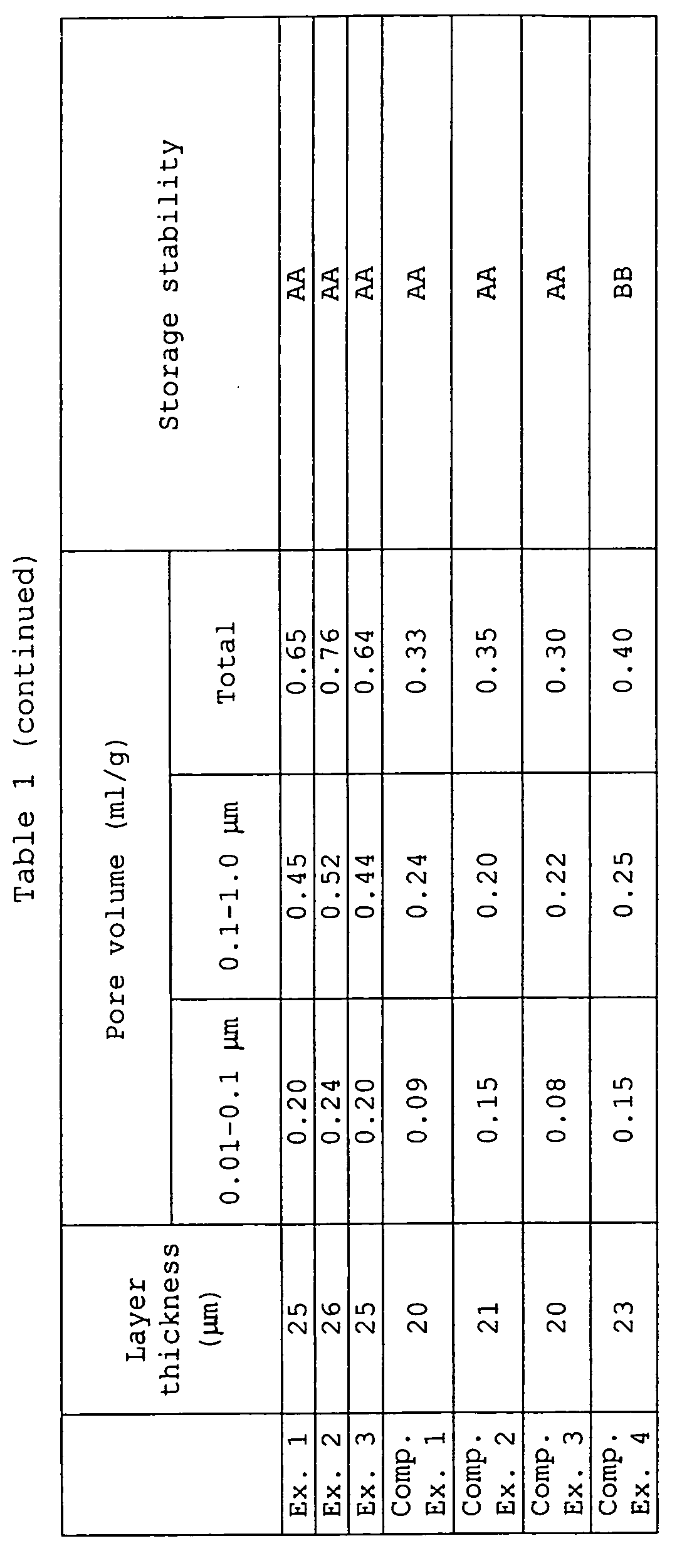
- the resultant coating was dried at 95°C for 10 minutes to form an electrode layer, which was then measured for the following properties.
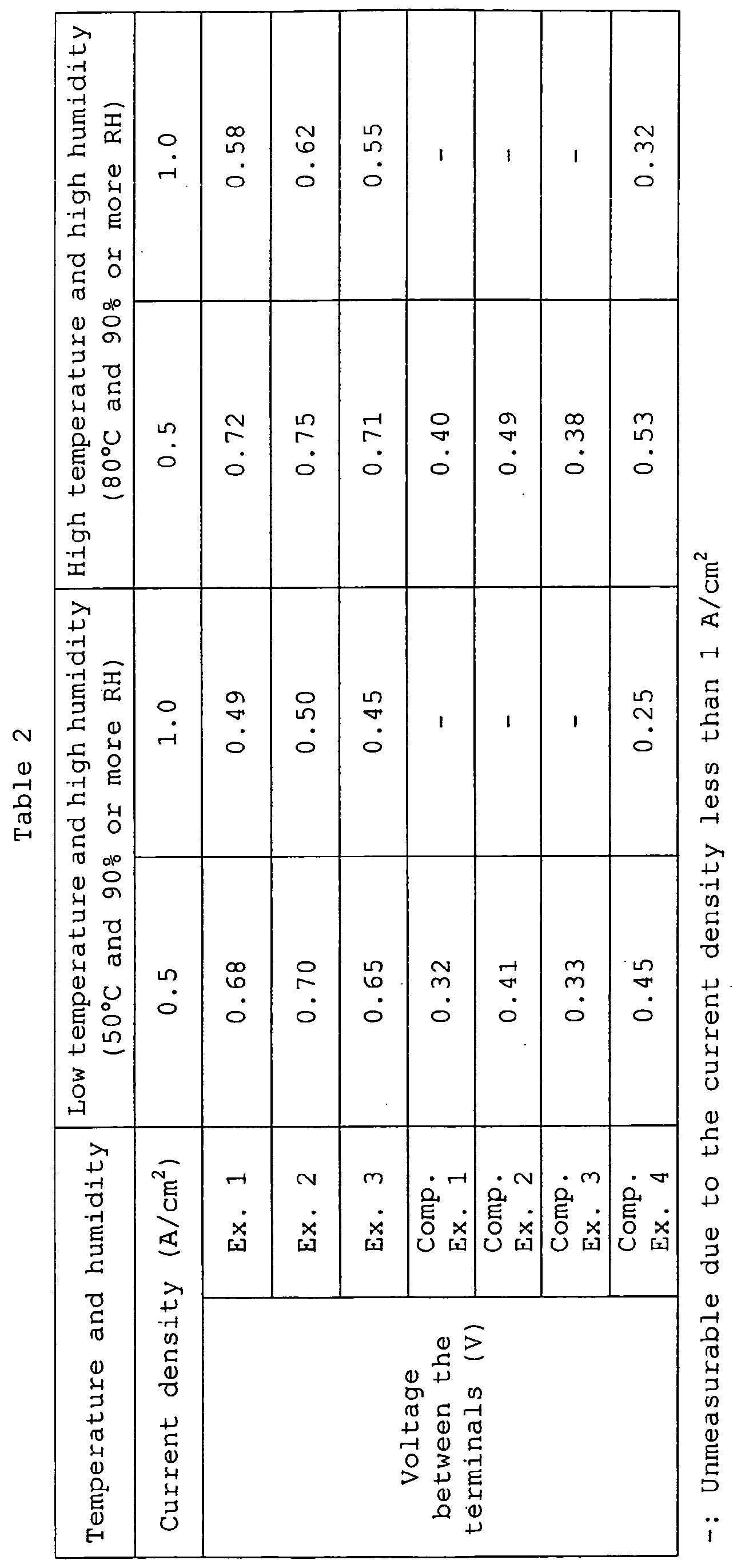
- the results are shown in Tables 1 and 2.
- the pore distribution and pore volume of the electrode layer were measured by a mercury penetration method using a mercury porosimeter.
- a 35 ⁇ m Nafion TM membrane was sandwiched between two electrode layers and they were hot-pressed together at 160°C and a pressure of 40 kg/cm 2 for 15 minutes to form an electrode-membrane assembly. Thereafter, the assembly was sandwiched between two titanium collectors, and a respective heater was provided outside each of the collectors. Thus, a fuel cell having an effective area of 25 cm 2 was prepared.
- the temperature of the fuel cell was maintained at 50°C, and hydrogen and oxygen were supplied thereto at 90% or more relative humidity and 2 atmospheric pressure. Under these conditions, the voltage between the terminals was measured at a current density of 0.5 A/cm 2 and 1.0 A/cm 2 .
- the temperature of the fuel cell was maintained at 80°C, and hydrogen and oxygen were supplied thereto at 90% or more relative humidity and 2 atmospheric pressure. Under these conditions, the voltage between the terminals was measured at a current density of 0.5 A/cm 2 and 1.0 A/cm 2 .
- the electrode paste composition was placed in a 20 cc glass bottle and allowed to stand at room temperature for a week.
- the upper and lower portions of the electrode paste were collected each in an amount of 0.5 cc, and dried on a hot plate at 95°C for 10 minutes. Difference in solid concentration between the upper and lower portions was analyzed to evaluate for the particle sedimentation.
- the above water-alcohol solution of Nafion contained ethanol and n-propyl alcohol as the alcohols.
- Electrodes and a fuel cell were produced by the procedure illustrated in Example 1 except that the paste B was used in place of the paste A. The properties were evaluated as described above. The results are shown in Tables 1 and 2.
- a paste C having a viscosity of 60 cp (25°C) was prepared by the procedure illustrated in Example 1 except that n-butyl alcohol was replaced with 4.3 g of 1-ethoxy-2-propyl alcohol.
- Electrodes and a fuel cell were produced by the procedure illustrated in Example 1 except that the paste C was used in place of the paste A. The properties were evaluated as described above. The results are shown in Tables 1 and 2.
- the above water-alcohol solution of Nafion contained ethanol and n-propyl alcohol as the alcohols.
- Electrodes and a fuel cell were produced by the procedure illustrated in Example 1 except that the paste D was used in place of the paste A. The properties were evaluated as described above. The results are shown in Tables 1 and 2.
- a paste E having a viscosity of 30 cp (25°C) was prepared by the procedure illustrated in Example 1 except that n-butyl alcohol was replaced with 9.9 g of ethyl acetate.
- Electrodes and a fuel cell were produced by the procedure illustrated in Example 1 except that the paste E was used in place of the paste A. The properties were evaluated as described above. The results are shown in Tables 1 and 2.
- a paste F having a viscosity of 75 cp (25°C) was prepared by the procedure illustrated in Example 1 except that n-butyl alcohol was replaced with 4.3 g of cyclohexane.
- Electrodes and a fuel cell were produced by the procedure illustrated in Example 1 except that the paste F was used in place of the paste A.
- the properties were evaluated as described above. The results are shown in Tables 1 and 2.
- the above water-alcohol solution of Nafion contained ethanol and n-propyl alcohol as the alcohols.
- the contents were stirred with a wave rotor for 70 minutes to give a paste G having a viscosity of 550 cp (25°C) .
- Electrodes and a fuel cell were produced by the procedure illustrated in Example 1 except that the paste G was used in place of the paste A. The properties were evaluated as described above. The results are shown in Tables 1 and 2.
- the electrode catalyst paste composition according to the invention contains an organic solvent having a boiling point of 100 to 200°C so that the solvent of the paste composition can evaporate at a controlled rate under drying conditions in the production of electrodes. Therefore, the conventional problem of insufficient pore volume attributed to the containing of dispersant may be solved. As a result, the electrode paste composition of the invention can allow for an increased pore volume in the resultant electrode even when it contains a dispersant for higher storage stability. Accordingly, the contact between the gases and the catalyst can take place favorably and the flooding of resulting water can be prevented. Thus, the generating performance may be enhanced.
- the invention provides an electrode paste composition that enables a sufficient pore volume of electrode for high generating performance while maintaining good storage stability.
- the paste composition comprises a carbon black supporting a hydrogen reduction catalyst, an electrolyte, an organic solvent having a boiling point of 100 to 200°C, a water-soluble organic solvent having a boiling point of less than 100°C, and optionally one or more components selected from a dispersant, a carbon fiber and water.
Landscapes
- Chemical & Material Sciences (AREA)
- Engineering & Computer Science (AREA)
- Electrochemistry (AREA)
- Chemical Kinetics & Catalysis (AREA)
- General Chemical & Material Sciences (AREA)
- Materials Engineering (AREA)
- Mechanical Engineering (AREA)
- General Engineering & Computer Science (AREA)
- Organic Chemistry (AREA)
- Composite Materials (AREA)
- Inorganic Chemistry (AREA)
- Inert Electrodes (AREA)
- Battery Electrode And Active Subsutance (AREA)
Abstract
Description
cationic surfactants such as higher alkylamine salts, ethylene oxide adducts of higher alkylamine, 2-heptadecenyl-hydroxyethyl imidazoline, alkyltrimethylammonium salts, alkyldimethylbenzylammonium salts, alkylpyridinium salts and high-molecular weight polyester acid amide amine salts;
ampholytic surfactants such as sodium laurylaminopropionate, stearyl dimethyl betaine and lauryl dihydroxyethyl betaine; and
nonionic surfactants such as ethylene oxide adducts of higher alcohol, ethylene oxide adducts of alkylphenol, ethylene oxide adducts of fatty acid, ethylene oxide adducts of higher aliphatic amine, ethylene oxide adducts of fatty acid amide, ethylene oxide adducts of polypropylene glycol, fatty acid esters of glycerol, fatty acid esters of pentaerythritol, fatty acid esters of sorbitol, fatty acid esters of sorbitan, fatty acid esters of sugar and fatty acid alkanolamides. These may be used singly or in combination of two or more kinds. Of these, the basic surfactants are preferred and the basic polymeric surfactants are more preferred.

Claims (5)
- A paste composition for making electrodes, comprising a carbon black supporting a hydrogen reduction catalyst, an electrolyte, an organic solvent with a boiling point of 100 to 200°C, and a water-soluble organic solvent with a boiling point of less than 100°C.
- The paste composition according to claim 1, wherein the organic solvent with a boiling point of 100 to 200°C has a solubility parameter of 7.5 to 13 (cal/mol)1/2 and is other than hydrocarbon and halogenated hydrocarbon solvents.
- The paste composition according to claim 1 or 2, further containing a dispersant.
- The paste composition according to any one of claims 1 to 3, further containing a carbon fiber.
- The paste composition according to any one of claims 1 to 4, further containing water.
Applications Claiming Priority (2)
| Application Number | Priority Date | Filing Date | Title |
|---|---|---|---|
| JP2003042967 | 2003-02-20 | ||
| JP2003042967 | 2003-02-20 |
Publications (3)
| Publication Number | Publication Date |
|---|---|
| EP1450424A2 true EP1450424A2 (en) | 2004-08-25 |
| EP1450424A3 EP1450424A3 (en) | 2006-09-06 |
| EP1450424B1 EP1450424B1 (en) | 2007-12-05 |
Family
ID=32732967
Family Applications (1)
| Application Number | Title | Priority Date | Filing Date |
|---|---|---|---|
| EP04002945A Expired - Lifetime EP1450424B1 (en) | 2003-02-20 | 2004-02-10 | Electrode paste composition |
Country Status (4)
| Country | Link |
|---|---|
| US (1) | US20040166399A1 (en) |
| EP (1) | EP1450424B1 (en) |
| KR (1) | KR20040075743A (en) |
| DE (1) | DE602004010444T2 (en) |
Cited By (2)
| Publication number | Priority date | Publication date | Assignee | Title |
|---|---|---|---|---|
| WO2006055652A3 (en) * | 2004-11-16 | 2007-03-29 | Battelle Memorial Institute | Solution based enhancements of fuel cell components and other electrochemical systems and devices |
| CN102255085A (en) * | 2010-05-19 | 2011-11-23 | 中国科学院大连化学物理研究所 | Catalyst sizing agent for preparing catalytic membrane electrode of fuel cell and preparation thereof |
Families Citing this family (6)
| Publication number | Priority date | Publication date | Assignee | Title |
|---|---|---|---|---|
| JP4064890B2 (en) * | 2003-07-30 | 2008-03-19 | Jsr株式会社 | Method for producing electrode paste |
| US20070154774A1 (en) * | 2006-01-05 | 2007-07-05 | More Energy Ltd. | Hydrophilized anode for a direct liquid fuel cell |
| KR100987498B1 (en) * | 2008-07-24 | 2010-10-13 | 고려대학교 산학협력단 | HCC carbon supported catalyst for fuel cell electrode and method for preparing same |
| JP5181004B2 (en) * | 2010-08-27 | 2013-04-10 | Jsr株式会社 | Polyarylene block copolymer having sulfonic acid group and use thereof |
| US20140141153A1 (en) * | 2012-11-20 | 2014-05-22 | E I Du Pont De Nemours And Company | Method of manufacturing conductive paste |
| EP3534445B1 (en) * | 2017-10-31 | 2022-05-18 | Toppan Printing Co., Ltd. | Electrode catalyst layer and solid polymer fuel cell |
Family Cites Families (11)
| Publication number | Priority date | Publication date | Assignee | Title |
|---|---|---|---|---|
| US3442715A (en) * | 1965-03-01 | 1969-05-06 | Monsanto Res Corp | Method of making diffusion membrane electrodes from visco elastic dough |
| US5139642A (en) * | 1991-05-01 | 1992-08-18 | Olin Corporation | Process for preparing a nonconductive substrate for electroplating |
| US5330860A (en) * | 1993-04-26 | 1994-07-19 | E. I. Du Pont De Nemours And Company | Membrane and electrode structure |
| US5454922A (en) * | 1993-05-07 | 1995-10-03 | Ceramatec, Inc. | Fluid dispensing pump |
| JP3712768B2 (en) * | 1995-01-26 | 2005-11-02 | 松下電器産業株式会社 | Production method of polymer electrolyte fuel cell |
| US5783325A (en) * | 1996-08-27 | 1998-07-21 | The Research Foundation Of State Of New York | Gas diffusion electrodes based on poly(vinylidene fluoride) carbon blends |
| AU4982600A (en) * | 1999-05-04 | 2000-11-17 | Moltech Corporation | Electroactive polymers of high sulfur content for use in electrochemical cells |
| JP3614077B2 (en) * | 2000-03-22 | 2005-01-26 | トヨタ自動車株式会社 | Electrocatalyst solution for fuel cell and method for producing the same |
| JP4470271B2 (en) * | 2000-03-31 | 2010-06-02 | 株式会社エクォス・リサーチ | Fuel cell and fuel cell device |
| WO2002003489A1 (en) * | 2000-07-03 | 2002-01-10 | Matsushita Electric Industrial Co., Ltd. | Polyelectrolyte fuel cell |
| US7201993B2 (en) * | 2000-08-04 | 2007-04-10 | Matsushita Electric Industrial Co., Ltd. | Polymer electrolyte fuel cell |
-
2004
- 2004-02-10 DE DE602004010444T patent/DE602004010444T2/en not_active Expired - Lifetime
- 2004-02-10 EP EP04002945A patent/EP1450424B1/en not_active Expired - Lifetime
- 2004-02-12 US US10/776,313 patent/US20040166399A1/en not_active Abandoned
- 2004-02-19 KR KR1020040010899A patent/KR20040075743A/en not_active Ceased
Cited By (4)
| Publication number | Priority date | Publication date | Assignee | Title |
|---|---|---|---|---|
| WO2006055652A3 (en) * | 2004-11-16 | 2007-03-29 | Battelle Memorial Institute | Solution based enhancements of fuel cell components and other electrochemical systems and devices |
| US8124260B2 (en) * | 2004-11-16 | 2012-02-28 | Battelle Memorial Institute | Solution based enhancements of fuel cell components and other electrochemical systems and devices |
| US8481184B2 (en) | 2004-11-16 | 2013-07-09 | Battelle Memorial Institute | Solution based enhancements of fuel cell components and other electrochemical systems and devices |
| CN102255085A (en) * | 2010-05-19 | 2011-11-23 | 中国科学院大连化学物理研究所 | Catalyst sizing agent for preparing catalytic membrane electrode of fuel cell and preparation thereof |
Also Published As
| Publication number | Publication date |
|---|---|
| DE602004010444T2 (en) | 2008-04-30 |
| DE602004010444D1 (en) | 2008-01-17 |
| KR20040075743A (en) | 2004-08-30 |
| US20040166399A1 (en) | 2004-08-26 |
| EP1450424B1 (en) | 2007-12-05 |
| EP1450424A3 (en) | 2006-09-06 |
Similar Documents
| Publication | Publication Date | Title |
|---|---|---|
| EP2889939B1 (en) | Gas-diffusion electrode medium for fuel cell | |
| KR101931890B1 (en) | Membrane electrode assembly | |
| US20040166400A1 (en) | Fuel cell anode structures for voltage reversal tolerance | |
| KR100723280B1 (en) | Gas diffusion structure and gas diffusion electrode for polymer electrolyte fuel cell | |
| JP2011029170A (en) | Hydrophilic porous layer for fuel cell, gas diffusion electrode and its manufacturing method, and membrane electrode assembly | |
| KR100587129B1 (en) | Ink for forming catalyst layer, and electrode, membrane-electrode assembly and electrolyte fuel cell using the same | |
| EP1450424B1 (en) | Electrode paste composition | |
| EP1503439B1 (en) | Process of producing electrode paste | |
| EP1256138B1 (en) | Anode structure with a carbon-based component having little resistance to corrosion | |
| JP5396730B2 (en) | Membrane electrode assembly | |
| JP5034172B2 (en) | Gas diffusion layer for fuel cell and fuel cell using the same | |
| JP4790239B2 (en) | Catalyst layer forming ink, electrode using the same, and membrane electrode assembly | |
| JP5292729B2 (en) | Method for producing gas diffusion layer and paste composition for producing gas diffusion layer | |
| JP2006324104A (en) | Gas diffusion layer for fuel cell and fuel cell using the same | |
| JP2006085984A (en) | MEA for fuel cell and fuel cell using the same | |
| JP2005243295A (en) | Gas diffusion layer and fuel cell MEA using the same | |
| JP2004273434A (en) | Paste composition for electrodes | |
| Yang et al. | Dynamic conducting effect of WO3/PFSA membranes on the performance of proton exchange membrane fuel cells | |
| JP2006179317A (en) | Gas diffusion layer and fuel cell using the same | |
| JP2005019298A (en) | Membrane / electrode assembly for polymer electrolyte fuel cells | |
| EP4503208A1 (en) | Carbon sheet as well as gas diffusion electrode substrate, membrane electrode assembly, and fuel cell using same | |
| JP2004171847A (en) | Fuel cell | |
| CN118805276A (en) | Carbon sheet and gas diffusion electrode substrate, membrane electrode assembly, and fuel cell using the same | |
| WO2014174973A1 (en) | Gas diffusion electrode body, method for manufacturing same, membrane electrode assembly for fuel cell using same, and fuel cell | |
| KR20070044595A (en) | Membrane-electrode assembly for fuel cell and fuel cell system comprising same |
Legal Events
| Date | Code | Title | Description |
|---|---|---|---|
| PUAI | Public reference made under article 153(3) epc to a published international application that has entered the european phase |
Free format text: ORIGINAL CODE: 0009012 |
|
| AK | Designated contracting states |
Kind code of ref document: A2 Designated state(s): AT BE BG CH CY CZ DE DK EE ES FI FR GB GR HU IE IT LI LU MC NL PT RO SE SI SK TR |
|
| AX | Request for extension of the european patent |
Extension state: AL LT LV MK |
|
| PUAL | Search report despatched |
Free format text: ORIGINAL CODE: 0009013 |
|
| AK | Designated contracting states |
Kind code of ref document: A3 Designated state(s): AT BE BG CH CY CZ DE DK EE ES FI FR GB GR HU IE IT LI LU MC NL PT RO SE SI SK TR |
|
| AX | Request for extension of the european patent |
Extension state: AL LT LV MK |
|
| 17P | Request for examination filed |
Effective date: 20061017 |
|
| 17Q | First examination report despatched |
Effective date: 20061130 |
|
| AKX | Designation fees paid |
Designated state(s): DE GB |
|
| GRAP | Despatch of communication of intention to grant a patent |
Free format text: ORIGINAL CODE: EPIDOSNIGR1 |
|
| GRAS | Grant fee paid |
Free format text: ORIGINAL CODE: EPIDOSNIGR3 |
|
| GRAA | (expected) grant |
Free format text: ORIGINAL CODE: 0009210 |
|
| AK | Designated contracting states |
Kind code of ref document: B1 Designated state(s): DE GB |
|
| REG | Reference to a national code |
Ref country code: GB Ref legal event code: FG4D |
|
| REF | Corresponds to: |
Ref document number: 602004010444 Country of ref document: DE Date of ref document: 20080117 Kind code of ref document: P |
|
| PLBE | No opposition filed within time limit |
Free format text: ORIGINAL CODE: 0009261 |
|
| STAA | Information on the status of an ep patent application or granted ep patent |
Free format text: STATUS: NO OPPOSITION FILED WITHIN TIME LIMIT |
|
| 26N | No opposition filed |
Effective date: 20080908 |
|
| PGFP | Annual fee paid to national office [announced via postgrant information from national office to epo] |
Ref country code: DE Payment date: 20190129 Year of fee payment: 16 Ref country code: GB Payment date: 20190206 Year of fee payment: 16 |
|
| REG | Reference to a national code |
Ref country code: DE Ref legal event code: R119 Ref document number: 602004010444 Country of ref document: DE |
|
| GBPC | Gb: european patent ceased through non-payment of renewal fee |
Effective date: 20200210 |
|
| PG25 | Lapsed in a contracting state [announced via postgrant information from national office to epo] |
Ref country code: GB Free format text: LAPSE BECAUSE OF NON-PAYMENT OF DUE FEES Effective date: 20200210 Ref country code: DE Free format text: LAPSE BECAUSE OF NON-PAYMENT OF DUE FEES Effective date: 20200901 |