EP1450256A2 - Inter-task communications method, program, recording medium, and electronic device - Google Patents
Inter-task communications method, program, recording medium, and electronic device Download PDFInfo
- Publication number
- EP1450256A2 EP1450256A2 EP04003561A EP04003561A EP1450256A2 EP 1450256 A2 EP1450256 A2 EP 1450256A2 EP 04003561 A EP04003561 A EP 04003561A EP 04003561 A EP04003561 A EP 04003561A EP 1450256 A2 EP1450256 A2 EP 1450256A2
- Authority
- EP
- European Patent Office
- Prior art keywords
- task
- processing
- queue
- data
- data item
- Prior art date
- Legal status (The legal status is an assumption and is not a legal conclusion. Google has not performed a legal analysis and makes no representation as to the accuracy of the status listed.)
- Granted
Links
Images


Classifications
-
- G—PHYSICS
- G06—COMPUTING OR CALCULATING; COUNTING
- G06F—ELECTRIC DIGITAL DATA PROCESSING
- G06F9/00—Arrangements for program control, e.g. control units
- G06F9/06—Arrangements for program control, e.g. control units using stored programs, i.e. using an internal store of processing equipment to receive or retain programs
- G06F9/46—Multiprogramming arrangements
- G06F9/54—Interprogram communication
- G06F9/546—Message passing systems or structures, e.g. queues
Definitions
- the present invention relates to an inter-task communications method.
- inter-task communications methods that execute communications (sending-receiving, exchanging, or handing-over) of a message including data between tasks controlled by an RTOS (Real Time Operating System).
- RTOS Real Time Operating System
- FIG. 4A shows a flowchart diagram explaining a message transmission processing within a task (or a sub-routine that is invoked by the task) of a sender that is to send a message.
- FIG. 4B shows a flowchart diagram explaining a data reception/utilization processing within a task (or a sub-routine that is invoked by the task) of a recipient that is to receive a message.
- a task of a sender refers to TASK A
- a task of a recipient refers to TASK B
- TASK B is activated by the RTOS based on the message to utilize the data within the message.
- TASK A has a priority A
- TASK B has a priority B.
- the priority A is defined as having a higher priority level than the priority B.
- the RTOS is designed to follow a scheduling where the RTOS activates the most highly prioritized task among the tasks that are queued in an activation wait queue (Ready Queue) where tasks are waiting for being activated.
- Ready Queue activation wait queue
- a message communications processing takes place for causing a processing routine for the event within TASK B to process the data relating to the event.
- the message transmission processing within TASK A includes two Steps 11, 12.
- Step 11 data as a transmission target is queued (or stored) in a queue for TASK B being a recipient of the message.
- Step 12 an activation request is then outputted for requesting the RTOS to activate the corresponding recipient TASK B.
- the RTOS Upon receiving the activation request, the RTOS queues, in an activation wait queue, identification information (task ID) for identifying the task that is requested to be activated.
- identification information for identifying the task that is requested to be activated.
- the RTOS activates TASK B based on the task ID being queued in the activation wait queue to execute TASK B.
- the data reception/utilization processing takes place, as shown in FIG. 4B.
- the data is retrieved from the queue for its own task, namely, the queue for TASK B.
- the processing using the retrieved data then takes place.
- a given processing within TASK A causes TASK B to be activated to execute a certain processing within TASK B itself.
- the certain processing within TASK B then retrieves (or receives) and utilizes the data queued by the certain processing within TASK A. For instance, necessary data for a certain event detected within TASK A is transferred and utilized in a processing routine for the certain event within TASK B.
- the data items corresponding to the respective messages sent multiple times are queued in a queue for TASK B, while an activation request for requesting for activating TASK B is queued multiple times in an activation wait queue (Ready Queue) of the RTOS.
- an activation wait queue Ready Queue
- a series of processings for delivering messages repeats to takes place multiple times. This series of processings includes the following: (1) Activation processing for activating TASK B by RTOS; (2) Data reception processing within TASK B (Step 21); (3) Data utilization processing using the received data within TASK B (Step 22); and (4) Termination processing for terminating TASK B.
- FIG. 5 explains a processing flow of a message communications between tasks.
- the routine for all of the processing shown in FIG. 4A refers to SEND MESSAGE FUNCTION
- the routine for the processing only at Step 21 shown in FIG. 4B refers to RECEIVE MESSAGE FUNCTION.
- Both the functions are included as sub-routines in an event service.
- the event service Via the event service, three messages having Data A, Data B, and Data C, respectively, are sent from TASK A to the event processing routine within TASK B to cause the event processing routine within TASK B to perform based on Data A, Data B, and Data C.
- This event service can be provided as a portion within the RTOS, or a portion (sub-routine) within the respective tasks.
- the processing by the event service is assumed to be performed with the same priority level as an originating party that invokes the event service.
- SEND MESSAGE FUNCTION of the event service is invoked within TASK A
- Data A is transferred as an argument, to the event service.
- the event service then queues, within this SEND MESSAGE FUNCTION, Data A in the queue for TASK B, which corresponds to Step 11 in FIG. 4A.
- the event service then outputs an activation request for activating TASK B to the RTOS, which corresponds to Step 12 in FIG. 4A. Based on this activation request, the RTOS queues the task ID of TASK B in the activation wait queue. Further, TASK A transfers Data B to the event service by repeating to invoke SEND MESSAGE FUNCTION.
- the service then queues Data B in the queue for TASK B (Step 11) to output an activation request for TASK B to the RTOS (Step 12). Based on this activation request, the RTOS queues the task ID of TASK B in the activation wait queue. Yet further, TASK A transfers Data C to the event service by repeating to invoke SEND MESSAGE FUNCTION.
- the service then queues Data C in the queue for TASK B (Step 11) to output an activation request for TASK B to the RTOS (Step 12). Based on this activation request, the RTOS queues the task ID of TASK B in the activation wait queue. When the entire processings of TASK A is terminated, the RTOS takes over the sequence.
- the RTOS refers to the activation wait queue to activate a task corresponding to the task ID having the highest priority level within the queue. Namely, the RTOS activates the tasks corresponding to the task IDs within the activation wait queue in a descending order of a priority level, i.e., from the highest to the lowest priority level.
- a priority level i.e., from the highest to the lowest priority level.
- RECEIVE MESSAGE FUNCTION is invoked from the event service.
- the event service retrieves, as the processing of RECEIVE MESSAGE FUNCTION, Data A queued for TASK B, which corresponds to Step 21 in FIG. 4B.
- the event service then transfers Data A to TASK B.
- TASK B performs processing using Data A retrieved from the event service, which corresponds to Step 22 in FIG. 4B.
- the RTOS takes over the sequence.
- the RTOS refers to the activation wait queue to activate tasks in the descending order of the priority level.
- TASK B is thereby activated.
- the single task ID of TASK B still remains in the activation wait queue.
- RECEIVE MESSAGE FUNCTION is invoked from the event service.
- the event service retrieves Data B queued for TASK B (Step 21), to transfer Data B to TASK B.
- TASK B performs processing using Data B retrieved from the event service (Step 22).
- the RTOS takes over sequence.
- the RTOS refers to the activation wait queue to activate tasks in the descending order of the priority level.
- TASK B since the single task ID of TASK B is queued in the activation wait queue, TASK B is thereby activated, which vacates the activation wait queue.
- RECEIVE MESSAGE FUNCTION is invoked from the event service.
- the event service retrieves Data C queued for TASK B (Step 21) to transfer Data C to TASK B.
- TASK B performs processing using Data C retrieved from the event service (Step 22). As the entire other processings of TASK B are terminated, the RTOS takes over the sequence.
- TASK A within the sender task (TASK A), a message is transmitted multiple times to the recipient task (TASK B) without returning the sequence to the RTOS.
- TASK B a series of processings occurs every a single message.
- This series of processings includes the activation/termination processing (processings in the RTOS [e.g., processing for SCHEDULEs in FIG. 5]) and processing (e.g., determining processing for transferring to the processing shown in FIG. 4B). This increases a processing load in the processing unit (e.g., CPU).
- an inter-task communications method is provided with the following.
- a transmission request occurs that a data item be sent from a processing of a sender (first) task to a processing of a recipient (second) task
- a data queuing is executed within the processing of the sender task.
- the data item is thereby stored in a queue from which the recipient task can retrieve the data item.
- An activation request is then outputted to an operating system for requesting for activating the recipient task.
- the recipient task is activated by a processing of the operating system based on the activation request, a data retrieving is executed within the processing of the recipient task.
- the data item stored in the queue is retrieved from the queue.
- a frequency of the activation request is provided for being less than a frequency of the data queuing.
- more than one data item is retrieved from the queue.
- the sender task outputs a single activation request for activating the recipient task with respect to the multiple transmission requests.
- the recipient task is only activated based on the single activation request to retrieve the multiple data items from the queue. This suppresses a problem of increasing a processing load of a processing unit resulting from a conventional method where the activation and termination of the recipient task takes place each time a single data item (e.g., message) is sent.
- an inter-task communications method is provided with the following.
- a transmission request occurs that a data item be sent from a processing of a sender (first) task to a processing of a recipient (second) task
- a data queuing is executed within the processing of the sender task.
- the data item is thereby stored in a queue from which the recipient task can retrieve the data item.
- An activation request is then outputted to an operating system for requesting for activating the recipient task.
- the recipient task is activated by a processing of the operating system based on the activation request, a data retrieving is executed within the processing of the recipient task.
- the data item stored in the queue is retrieved from the queue.
- the sender task when the sender task sends the data items (e.g., messages) continuously to the processing of the recipient task, the activation request for requesting for activating the recipient task can be once outputted. This suppresses a problem of increasing a processing load of a processing unit resulting from a conventional method where the activation and termination of the recipient task takes place each time a single data item (e.g., message) is sent.
- the data items e.g., messages
- an inter-task communications method is provided with the following.
- a transmission request occurs that a data item be sent from a processing of a sender (first) task to a processing of a recipient (second) task
- a data queuing is executed within the processing of the sender task.
- the data item is thereby stored in a queue from which the recipient task can retrieve the data item.
- An activation request is then outputted to an operating system for requesting for activating the recipient task.
- the recipient task is activated by a processing of the operating system based on the activation request, a data retrieving is executed within the processing of the recipient task.
- the data item stored in the queue is retrieved from the queue.
- a transmission request when a transmission request occurs, it is determined whether the activation request for requesting for activating the recipient task is present in the operating system. When the activation request is present in the operating system, no activation request for requesting for activating the recipient task is outputted. When no activation request is present in the operating system, an activation request for requesting for activating the recipient task is then outputted. Within the data retrieving within the processing of the recipient task, all data items that can be retrieved from the queue is retrieved from the queue.
- the sender task when the sender task sends the data items (e.g., messages) continuously to the processing of the recipient task, the activation request for requesting for activating the recipient task can be once outputted. This suppresses a problem of increasing a processing load of a processing unit resulting from a conventional method where the activation and termination of the recipient task takes place each time a single data item is sent (e.g., message).
- the data items e.g., messages
- the operating system executes the tasks in a descending order of the priority level based on the priority levels of the tasks
- all the tasks are preferably assigned the individual priority level to, and the queue is preferably provided for each of the priority levels.
- This structure can manage the tasks and queue based on the priority. For instance, when a given message is sent, it is determined whether a certain message that is waiting for transmission and has the same priority level as the given message is present or not. When the certain message is present, no activation request for the task corresponding to the given message is outputted. Only when the certain message is not present, an activation request for the task corresponding to the given message is then outputted.
- whether the message is present or not can be determined based on whether a message is already present in the queue corresponding to the same priority level as the given message. Further, whether the message is present or not can be also determined based on whether an activation request for the corresponding task is already present in the queue corresponding to the same priority level as the given message. Thereafter, within the data retrieving within the processing of the recipient task, when any message is present in the queue corresponding to the priority level, all the messages in the queue are retrieved. This structure decreases the activation and termination of the recipient task, resulting in decreasing a processing load of the processing unit when the sender task continuously detects the multiple transmission requests and the recipient task has the same or lower priority level than the sender task.
- the above-mentioned inter-task communications method can be provided as a program that enables a computer to execute them.
- this program can be recorded in a computer readable medium such as a flexible disk, a magnetic optical disk, a CD-ROM, an HDD, a ROM, or a RAM and executed by being loaded and activated in the computer system as needed. Further, this program can be executed by being loaded and activated via a communications network.
- the program and a computer executing the program can be combined as an electronic device. This electronic device can decrease the activation and termination of the task by the computer (processing unit), so that it can assign more processing time to processing that achieves a device's original function.
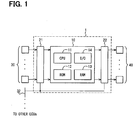
- FIG. 1 A structure of an engine control unit (ECU) 1 as an electronic device according to the embodiment is shown in FIG. 1.
- ECU engine control unit
- the ECU 1 includes an input circuit 21, a micro-computer 10, and an output circuit 22.
- the input circuit 21 receives signals from various sensors 30 for detecting various operating states of an engine to perform waveform shaping or analog/digital conversion.
- the various sensors 30 include as follows: a rotation angle senor for outputting pulse signals each time an engine crank axis rotates by a given angle; a base position sensor for outputting pulse signals when a specific cylinder piston of the engine reaches a given position (e.g., top dead center [TDC]); a water temperature sensor for detecting a temperature of cooling water of the engine; and an oxygen concentration sensor for measuring an oxygen concentration.
- the input circuit 21 further receives signals from an in-vehicle local area network (LAN) 32.
- LAN local area network
- the micro-computer 10 performs various processings for controlling the engine based on the inputted signals via the input circuit 21.
- the micro-computer 10 further performs various processings for receiving the data from other ECUs via the in-vehicle LAN 32 and for generating and sending data to other ECUs.
- the output circuit 22 drives actuators such as an injector and igniter that are disposed in the engine and moreover outputs the data to the in-vehicle LAN 32.
- the micro-computer 10 includes as follows: a known CPU 11 for executing a program; a ROM 12 for storing the program executed by the CPU 11; a RAM 13 for storing results computed by the CPU 11; an I/O 14 for exchanging the signals with the input circuit 21 or output circuit 22; and various registers or free-run counters, etc. (not shown).
- the ECU 1 performs communication processing and engine control processing.
- the communication processing is for communicating with other ECUs by controlling the input and output circuits 21, 22 via the in-vehicle LAN 32.
- the engine control processing is for driving the actuators connected with the output circuit 22 based on the inputted signals via the input circuit 21 from the sensors 30 or the in-vehicle LAN 32.
- a structure of an engine control program stored in the ROM 12 will be explained below.
- this specification includes descriptions such as “a task does (executes)...,” “RTOS does (executes)...,” “an event service task does (executes)...,” or “function does (executes)."
- RTOS Real Time Operating System
- TASK A TASK A
- TASK B TASK C
- TASK C TASK C
- the event service includes SEND MESSAGE FUNCTION of a sub-routine for message transmission processing for the respective tasks, and RECEIVE MESSAGE FUNCTION of a sub-routine for data reception processing for the respective tasks.
- the individual tasks have their own priority levels.
- the functions or sub-routines of the event service are executed based on the priority level possessed by an original party invoking the corresponding program.
- the RAM 13 includes a storing area for queues for the tasks.
- the queues are buffers of FIFO (First In First Out).
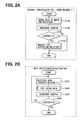
- SEND MESSAGE FUNCTION of this event service will be explained with reference to FIG. 2A.
- the data of a transmission target received (e.g., via stack) as an argument is stored (or queued) in a queue for a recipient task (i.e., recipient task queue, queue for TASK B, TASK B queue) at Step 110.
- a recipient task i.e., recipient task queue, queue for TASK B, TASK B queue
- a message counter for the recipient task queue is then incremented at Step 120.
- a message counter for each task queue is initialized to "0" at initializing processing of the RTOS.
- Step 130 it is determined whether the message counter for the recipient task queue is equal to "1" at Step 130.
- the processing proceeds to Step 140.
- an activation request for activating the recipient task is outputted to the RTOS.
- the RTOS Upon receiving the activation request, the RTOS stores (or queues), in an activation wait queue, identification information (task ID) for identifying the task requested to be activated.
- the task ID of TASK B is queued in the activation wait queue.
- SEND MESSAGE FUNCTION terminates its processing and TASK A takes over the sequence.
- the message counter for the recipient task queue is "1" means that the data of the transmission target data is stored in the recipient task queue for the first time. Only in this case, the activation request for activating the recipient task is then outputted to the RTOS. Thereafter, when the data of the transmission target is additionally queued, no more additional activation request is then outputted.
- TASK A executes other processing within TASK A.
- TASK A informs the RTOS of its termination (or hands over the sequence to the RTOS) to be terminated.
- the RTOS then activates (or hands over the sequence to) the task whose task ID has the highest priority level among the task IDs queued in the activation wait queue. Namely, the RTOS activates the tasks corresponding to the task IDs in a descending order of priority levels (from the highest to the lowest priority level) of the task IDs queued in the activation wait queue.
- the processing posterior to activation of the recipient task will be explained below.
- the data reception/utilization processing takes place, as shown in FIG. 2B.
- the data is retrieved from the own task queue (queue for TASK B).
- RECEIVE MESSAGE FUNCTION of the event service is invoked from TASK B.
- the data queued in the queue for TASK B is retrieved and handed over to TASK B.
- TASK B executes the processing using the data handed over.
- the message counter for TASK B queue is decremented.
- Step 240 it is determined whether the message counter is equal to "0." When the counter is determined to be not "0,” the processing returns to Step 210, repeating the processing from Step 210 to Step 240. By contrast, when the counter is determined to be "0,” the processing of the data reception/utilization is terminated. TASK B notifies the RTOS of its termination or hands over the sequence to the RTOS, to be terminated.
- the recipient task (TASK B) is activated from the processing within the sender task (TASK A) and then executes the processing within the own task.
- the data queued within the processing within the sender task is retrieved to be utilized. For instance, given necessary data for executing the event detected within TASK A can be transferred to the routine of processing the event within TASK B.
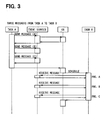
- Step 140 An instance will be explained with reference to FIG. 3 where a message is outputted continuously three times from TASK A to TASK B.
- SEND MESSAGE FUNCTION of the event service is invoked from the processing within TASK A, while data A is handed over as an argument to the event service.
- the event service queues the data A in the queue for TASK B within this function (equivalent to Step 110 in FIG. 2A).
- a message counter for TASK B queue is then incremented at Step 120.
- Step 130: YES an activation request for activating TASK B is outputted to the RTOS (Step 140).
- the RTOS stores a task ID for TASK B in the activation wait queue.
- TASK A then hands over data B to the event service by invoking again SEND MESSAGE FUNCTION.
- the event service queues the data B in the queue for TASK B (Step 110) to increment the message counter for TASK B queue.
- the message counter becomes "2,” and the sequence returns to TASK A (Step 130: NO).
- TASK A furthermore hands over data C to the event service by invoking further again SEND MESSAGE FUNCTION.
- the event service queues the data C in the queue for TASK B (Step 110) to increment the message counter for TASK B queue. As a result, the message counter becomes "3," and the sequence returns to TASK A (Step 130: NO).
- TASK A terminates its entire processing to hand over the sequence to the RTOS.
- the RTOS refers to the activation wait queue to activate the task whose ID has the highest priority among the task IDs queued in the activation wait queue.
- the activation wait queue the task ID of TASK B is queued, so that TASK B is activated (SCHEDULE in FIG. 3).
- the activation wait queue is thereby vacated.
- RECEIVE MESSAGE FUNCTION of the event service is invoked.
- the event service retrieves the data A queued in the queue for TASK B (corresponding to Step 210 in FIG.
- Step 2B in the processing of RECEIVE MESSAGE FUNCTION to hand over the data A to TASK B.
- TASK B then executes the processing using the data A handed over (Step 220). Since the message counter for TASK B queue becomes "2," the determination at Step 240 returns the sequence to Step 210.
- RECEIVE MESSAGE FUNCTION of the event service is invoked again.
- the event service retrieves the data B queued in the queue for TASK B (Step 210) in the processing of RECEIVE MESSAGE FUNCTION to hand over the data B to TASK B.
- TASK B then executes the processing using the data B handed over (Step 220). Since the message counter for TASK B queue becomes "1," the determination at Step 240 returns the sequence to Step 210.
- RECEIVE MESSAGE FUNCTION of the event service is invoked yet again.
- the event service retrieves the data C queued in the queue for TASK B (Step 210) in the processing of RECEIVE MESSAGE FUNCTION to hand over the data C to TASK B.
- TASK B then executes the processing using the data C handed over (Step 220). Since the message counter for TASK B queue eventually becomes "0,” the sequence exits from the data reception/utilization processing (Step 240: YES) to be handed over to another processing within TASK B. Thereafter, as all the processings within TASK B is completed, the sequence is returned to the RTOS.
- the activation/termination of TASK B is repeated as many times (three times) as the transmission of the message, so that the processing has a large overhead.
- the activation/termination of TASK B is performed only once, so that the overhead can be decreased, enabling relief of processing load of the CPU 11.
- a message is exchanged between tasks (inter-task communications or inter-process communications) in the requesting processing such as an asynchronous injection request, a diagnosis processing request, or a communications processing request.
- the asynchronous injection request is for adding fuel by detecting a rapid increase of a required torque based on a signal inputted from the sensor 30.
- the diagnosis processing request is for storing, in a memory for diagnosis, an abnormality detected in a signal from the sensor 30.
- the communications processing request is for responding to incoming communications data via the in-vehicle LAN 32 (e.g., CAN) from an external node.
- the inter-task communications explained in the embodiment is used in the case where a processing of a sender (i.e., TASK A) detecting a request has a different priority level from a processing of a recipient (i.e., TASK B). Further, it can be used for simplifying exclusive processing of the resource of a recipient when a single reception processing is performed correspondingly to the multiple transmission processings having the individually different priority levels.
- a sender i.e., TASK A
- TASK B a processing of a recipient
- the processing of the embodiment of the present invention enables relief of the processing load of the CPU 11, resulting in prevention of deteriorating controllability during the high rotation rate of an engine.
- the data is sent from the processing within TASK A to the processing within TASK B.
- the data can be also sent from the processing within TASK A by being assigned its destination to.
- a recipient task can be designated by an argument of SEND MESSAGE FUNCTION. Designating the recipient task is executed by assigning the task ID to the argument.
- "queue for TASK B" is replaced with "queue corresponding to a task ID received as an argument.”
- designating the recipient task can be executed by using the respective priority levels as the arguments.
- queues are provided for the respective priority levels instead of the respective tasks.
- the processing repeats to proceed to the subsequent reception processing till the message becomes absent.
- This structure meets a case where the multiple transmission requests of the messages having the same certain priority levels are outputted continuously and the recipient task has the same certain priority level or a lower priority level than the certain priority level of the sender task. In this case, the activation/termination of the task can be also decreased, enabling reduction of the processing load of the CPU 11.
- Step 130 in FIG. 2A is replaced with a determination whether the task ID of TASK B is present in the activation wait queue.
- Step 130: YES when the task ID is not present (Step 130: YES), the processing at Step 140 is executed.
- Step 130: NO the processing at Step 140 is skipped without being executed for the processing to be terminated.
- Step 240 is replaced with a determination whether data is present in the queue for TASK B or not.
- Step 240: NO when the data is present (Step 240: NO), the processing proceeds to Step 210.
- Step 240: YES the sequence exits from the data reception processing.
- a transmission request occurs that a data item be sent to a processing of a recipient task.
- the data item is then once stored (Step 110) in a queue from which the recipient task can retrieve the data item when the recipient task is thereafter activated.
- an activation request for activating the recipient task is outputted (Step 130, Step 140) to the operating system.
- no activation request is outputted (Step 130).
- all the data items are retrieved from the queue (Step 240, Step 210). This decreases the activation/termination of the recipient task, reducing the processing load.
Landscapes
- Engineering & Computer Science (AREA)
- Software Systems (AREA)
- Theoretical Computer Science (AREA)
- Physics & Mathematics (AREA)
- General Engineering & Computer Science (AREA)
- General Physics & Mathematics (AREA)
- Multi Processors (AREA)
- Computer And Data Communications (AREA)
Abstract
Description
- The present invention relates to an inter-task communications method.
- Conventionally, various inter-task (inter-process) communications methods are known that execute communications (sending-receiving, exchanging, or handing-over) of a message including data between tasks controlled by an RTOS (Real Time Operating System). (For instance, refer to JP-A-2002-189606)
- For instance, FIG. 4A shows a flowchart diagram explaining a message transmission processing within a task (or a sub-routine that is invoked by the task) of a sender that is to send a message. FIG. 4B shows a flowchart diagram explaining a data reception/utilization processing within a task (or a sub-routine that is invoked by the task) of a recipient that is to receive a message.
- Here, a task of a sender (sender task) refers to TASK A, while a task of a recipient (recipient task) refers to TASK B. TASK B is activated by the RTOS based on the message to utilize the data within the message. TASK A has a priority A, while TASK B has a priority B. The priority A is defined as having a higher priority level than the priority B. The RTOS is designed to follow a scheduling where the RTOS activates the most highly prioritized task among the tasks that are queued in an activation wait queue (Ready Queue) where tasks are waiting for being activated.
- For instance, when an occurrence of an event is detected within TASK A, a message communications processing takes place for causing a processing routine for the event within TASK B to process the data relating to the event. The message transmission processing within TASK A, as shown in FIG. 4A, includes two
Steps Step 11, data as a transmission target is queued (or stored) in a queue for TASK B being a recipient of the message. AtStep 12, an activation request is then outputted for requesting the RTOS to activate the corresponding recipient TASK B. - Upon receiving the activation request, the RTOS queues, in an activation wait queue, identification information (task ID) for identifying the task that is requested to be activated. Suppose that no more task ID of a task having a higher priority than TASK B exists in the activation wait queue after completion of the processing of TASK A having the priority A. Here, the RTOS activates TASK B based on the task ID being queued in the activation wait queue to execute TASK B.
- Within TASK B, the data reception/utilization processing takes place, as shown in FIG. 4B. In detail, at
Step 21, the data is retrieved from the queue for its own task, namely, the queue for TASK B. AtStep 22, the processing using the retrieved data then takes place. In this way, a given processing within TASK A causes TASK B to be activated to execute a certain processing within TASK B itself. The certain processing within TASK B then retrieves (or receives) and utilizes the data queued by the certain processing within TASK A. For instance, necessary data for a certain event detected within TASK A is transferred and utilized in a processing routine for the certain event within TASK B. - In the above-mentioned conventional inter-task communications method, when a message is sent within TASK A multiple times from TASK A to TASK B having a lower priority level than TASK A, the message transmission processing is repeated multiple times, as shown in FIG. 4A. Further, suppose that each of the messages sent multiple times includes an individual data item.
- Therefore, the data items corresponding to the respective messages sent multiple times are queued in a queue for TASK B, while an activation request for requesting for activating TASK B is queued multiple times in an activation wait queue (Ready Queue) of the RTOS. Thereafter, when no more task (or processing, interruption) having a higher priority than TASK B exists, a series of processings for delivering messages repeats to takes place multiple times. This series of processings includes the following: (1) Activation processing for activating TASK B by RTOS; (2) Data reception processing within TASK B (Step 21); (3) Data utilization processing using the received data within TASK B (Step 22); and (4) Termination processing for terminating TASK B.
- For instance, FIG. 5 explains a processing flow of a message communications between tasks. Here, the routine for all of the processing shown in FIG. 4A refers to SEND MESSAGE FUNCTION, while the routine for the processing only at
Step 21 shown in FIG. 4B refers to RECEIVE MESSAGE FUNCTION. Both the functions are included as sub-routines in an event service. Via the event service, three messages having Data A, Data B, and Data C, respectively, are sent from TASK A to the event processing routine within TASK B to cause the event processing routine within TASK B to perform based on Data A, Data B, and Data C. This event service can be provided as a portion within the RTOS, or a portion (sub-routine) within the respective tasks. In addition, the processing by the event service is assumed to be performed with the same priority level as an originating party that invokes the event service. - As shown in FIG. 5, as SEND MESSAGE FUNCTION of the event service is invoked within TASK A, Data A is transferred as an argument, to the event service. The event service then queues, within this SEND MESSAGE FUNCTION, Data A in the queue for TASK B, which corresponds to
Step 11 in FIG. 4A. The event service then outputs an activation request for activating TASK B to the RTOS, which corresponds toStep 12 in FIG. 4A. Based on this activation request, the RTOS queues the task ID of TASK B in the activation wait queue. Further, TASK A transfers Data B to the event service by repeating to invoke SEND MESSAGE FUNCTION. The service then queues Data B in the queue for TASK B (Step 11) to output an activation request for TASK B to the RTOS (Step 12). Based on this activation request, the RTOS queues the task ID of TASK B in the activation wait queue. Yet further, TASK A transfers Data C to the event service by repeating to invoke SEND MESSAGE FUNCTION. The service then queues Data C in the queue for TASK B (Step 11) to output an activation request for TASK B to the RTOS (Step 12). Based on this activation request, the RTOS queues the task ID of TASK B in the activation wait queue. When the entire processings of TASK A is terminated, the RTOS takes over the sequence. - The RTOS refers to the activation wait queue to activate a task corresponding to the task ID having the highest priority level within the queue. Namely, the RTOS activates the tasks corresponding to the task IDs within the activation wait queue in a descending order of a priority level, i.e., from the highest to the lowest priority level. Here, suppose that there are, in the activation wait queue, no more tasks whose task IDs have higher priority levels than that of TASK B. Since the task IDs of TASK B are queued in the activation wait queue, TASK B is thereby activated (the uppermost "SCHEDULE" in FIG. 5). Here, two task IDs of TASK B still remain in the queue. In the processing within TASK B activated, RECEIVE MESSAGE FUNCTION is invoked from the event service. The event service retrieves, as the processing of RECEIVE MESSAGE FUNCTION, Data A queued for TASK B, which corresponds to
Step 21 in FIG. 4B. The event service then transfers Data A to TASK B. TASK B performs processing using Data A retrieved from the event service, which corresponds toStep 22 in FIG. 4B. As the entire other processings of TASK B are terminated, the RTOS takes over the sequence. The RTOS refers to the activation wait queue to activate tasks in the descending order of the priority level. Here, since two task IDs of TASK B are queued in the activation wait queue, TASK B is thereby activated. Here, the single task ID of TASK B still remains in the activation wait queue. In the processing within TASK B activated, RECEIVE MESSAGE FUNCTION is invoked from the event service. The event service retrieves Data B queued for TASK B (Step 21), to transfer Data B to TASK B. TASK B performs processing using Data B retrieved from the event service (Step 22). As the entire other processings of TASK B are terminated, the RTOS takes over sequence. The RTOS refers to the activation wait queue to activate tasks in the descending order of the priority level. Here, since the single task ID of TASK B is queued in the activation wait queue, TASK B is thereby activated, which vacates the activation wait queue. In the processing within TASK B activated, RECEIVE MESSAGE FUNCTION is invoked from the event service. The event service retrieves Data C queued for TASK B (Step 21) to transfer Data C to TASK B. TASK B performs processing using Data C retrieved from the event service (Step 22). As the entire other processings of TASK B are terminated, the RTOS takes over the sequence. - In the above, within the sender task (TASK A), a message is transmitted multiple times to the recipient task (TASK B) without returning the sequence to the RTOS. By contrast, within the recipient task of TASK B, a series of processings occurs every a single message. This series of processings includes the activation/termination processing (processings in the RTOS [e.g., processing for SCHEDULEs in FIG. 5]) and processing (e.g., determining processing for transferring to the processing shown in FIG. 4B). This increases a processing load in the processing unit (e.g., CPU).
- It is an object of the present invention to provide an inter-task communications method capable of decreasing a processing load in a processing unit.
- To achieve the above object, an inter-task communications method is provided with the following. When a transmission request occurs that a data item be sent from a processing of a sender (first) task to a processing of a recipient (second) task, a data queuing is executed within the processing of the sender task. The data item is thereby stored in a queue from which the recipient task can retrieve the data item. An activation request is then outputted to an operating system for requesting for activating the recipient task. When the recipient task is activated by a processing of the operating system based on the activation request, a data retrieving is executed within the processing of the recipient task. The data item stored in the queue is retrieved from the queue. Here, within the processing of the sender task a frequency of the activation request is provided for being less than a frequency of the data queuing. Within the data retrieving within the processing of the recipient task, more than one data item is retrieved from the queue.
- For instance, the sender task outputs a single activation request for activating the recipient task with respect to the multiple transmission requests. By contrast, the recipient task is only activated based on the single activation request to retrieve the multiple data items from the queue. This suppresses a problem of increasing a processing load of a processing unit resulting from a conventional method where the activation and termination of the recipient task takes place each time a single data item (e.g., message) is sent.
- In another aspect of the present invention, an inter-task communications method is provided with the following. When a transmission request occurs that a data item be sent from a processing of a sender (first) task to a processing of a recipient (second) task, a data queuing is executed within the processing of the sender task. The data item is thereby stored in a queue from which the recipient task can retrieve the data item. An activation request is then outputted to an operating system for requesting for activating the recipient task. When the recipient task is activated by a processing of the operating system based on the activation request, a data retrieving is executed within the processing of the recipient task. The data item stored in the queue is retrieved from the queue. Here, when a transmission request that a given data item be sent occurs, it is determined whether the queue stores a certain data item that is being already stored before the given data item is to be stored. When the certain data item is being already stored, no activation request is then outputted. When no certain data item is being already stored, an activation request is then outputted. Within the data retrieving within the processing of the recipient task, all data items that can be retrieved from the queue is retrieved from the queue.
- Here, when the sender task sends the data items (e.g., messages) continuously to the processing of the recipient task, the activation request for requesting for activating the recipient task can be once outputted. This suppresses a problem of increasing a processing load of a processing unit resulting from a conventional method where the activation and termination of the recipient task takes place each time a single data item (e.g., message) is sent.
- In yet another aspect of the present invention, an inter-task communications method is provided with the following. When a transmission request occurs that a data item be sent from a processing of a sender (first) task to a processing of a recipient (second) task, a data queuing is executed within the processing of the sender task. The data item is thereby stored in a queue from which the recipient task can retrieve the data item. An activation request is then outputted to an operating system for requesting for activating the recipient task. When the recipient task is activated by a processing of the operating system based on the activation request, a data retrieving is executed within the processing of the recipient task. The data item stored in the queue is retrieved from the queue. Here, when a transmission request occurs, it is determined whether the activation request for requesting for activating the recipient task is present in the operating system. When the activation request is present in the operating system, no activation request for requesting for activating the recipient task is outputted. When no activation request is present in the operating system, an activation request for requesting for activating the recipient task is then outputted. Within the data retrieving within the processing of the recipient task, all data items that can be retrieved from the queue is retrieved from the queue.
- Here, when the sender task sends the data items (e.g., messages) continuously to the processing of the recipient task, the activation request for requesting for activating the recipient task can be once outputted. This suppresses a problem of increasing a processing load of a processing unit resulting from a conventional method where the activation and termination of the recipient task takes place each time a single data item is sent (e.g., message).
- In particular, when the operating system executes the tasks in a descending order of the priority level based on the priority levels of the tasks, all the tasks are preferably assigned the individual priority level to, and the queue is preferably provided for each of the priority levels. This structure can manage the tasks and queue based on the priority. For instance, when a given message is sent, it is determined whether a certain message that is waiting for transmission and has the same priority level as the given message is present or not. When the certain message is present, no activation request for the task corresponding to the given message is outputted. Only when the certain message is not present, an activation request for the task corresponding to the given message is then outputted. In addition, whether the message is present or not can be determined based on whether a message is already present in the queue corresponding to the same priority level as the given message. Further, whether the message is present or not can be also determined based on whether an activation request for the corresponding task is already present in the queue corresponding to the same priority level as the given message. Thereafter, within the data retrieving within the processing of the recipient task, when any message is present in the queue corresponding to the priority level, all the messages in the queue are retrieved. This structure decreases the activation and termination of the recipient task, resulting in decreasing a processing load of the processing unit when the sender task continuously detects the multiple transmission requests and the recipient task has the same or lower priority level than the sender task.
- Further, the above-mentioned inter-task communications method can be provided as a program that enables a computer to execute them. For instance, this program can be recorded in a computer readable medium such as a flexible disk, a magnetic optical disk, a CD-ROM, an HDD, a ROM, or a RAM and executed by being loaded and activated in the computer system as needed. Further, this program can be executed by being loaded and activated via a communications network. Yet further, the program and a computer executing the program can be combined as an electronic device. This electronic device can decrease the activation and termination of the task by the computer (processing unit), so that it can assign more processing time to processing that achieves a device's original function.
- The above and other objects, features, and advantages of the present invention will become more apparent from the following detailed description made with reference to the accompanying drawings. In the drawings:
- FIG. 1 is a diagram of a structure of an engine control unit as a processing unit according to an embodiment of the present invention;
- FIG. 2A is a flowchart diagram explaining a message transmission processing according to the embodiment;
- FIG. 2B is a flowchart diagram explaining a data reception processing according to the embodiment;
- FIG. 3 is a diagram showing processing where TASK A sends a message to TASK B three times in an inter-task communications method according to the embodiment;
- FIG. 4A is a flowchart diagram explaining a message transmission processing of a related art;
- FIG. 4B is a flowchart diagram explaining a data reception processing of the related art; and
- FIG. 5 is a diagram showing processing where TASK A sends a message to TASK B three times in an inter-task communications method of the related art.
-
- An embodiment of the present invention will be explained with reference to the drawings. A structure of an engine control unit (ECU) 1 as an electronic device according to the embodiment is shown in FIG. 1.
- The
ECU 1 includes aninput circuit 21, a micro-computer 10, and anoutput circuit 22. Theinput circuit 21 receives signals fromvarious sensors 30 for detecting various operating states of an engine to perform waveform shaping or analog/digital conversion. Thevarious sensors 30 include as follows: a rotation angle senor for outputting pulse signals each time an engine crank axis rotates by a given angle; a base position sensor for outputting pulse signals when a specific cylinder piston of the engine reaches a given position (e.g., top dead center [TDC]); a water temperature sensor for detecting a temperature of cooling water of the engine; and an oxygen concentration sensor for measuring an oxygen concentration. Theinput circuit 21 further receives signals from an in-vehicle local area network (LAN) 32. The micro-computer 10 performs various processings for controlling the engine based on the inputted signals via theinput circuit 21. The micro-computer 10 further performs various processings for receiving the data from other ECUs via the in-vehicle LAN 32 and for generating and sending data to other ECUs. Based on the data from the micro-computer 10, theoutput circuit 22 drives actuators such as an injector and igniter that are disposed in the engine and moreover outputs the data to the in-vehicle LAN 32. - The micro-computer 10 includes as follows: a known
CPU 11 for executing a program; aROM 12 for storing the program executed by theCPU 11; aRAM 13 for storing results computed by theCPU 11; an I/O 14 for exchanging the signals with theinput circuit 21 oroutput circuit 22; and various registers or free-run counters, etc. (not shown). - The
ECU 1 performs communication processing and engine control processing. The communication processing is for communicating with other ECUs by controlling the input andoutput circuits vehicle LAN 32. The engine control processing is for driving the actuators connected with theoutput circuit 22 based on the inputted signals via theinput circuit 21 from thesensors 30 or the in-vehicle LAN 32. - Next, a structure of an engine control program stored in the
ROM 12 will be explained below. Here, this specification, includes descriptions such as "a task does (executes)...," "RTOS does (executes)...," "an event service task does (executes)...," or "function does (executes)...." These are expressions where each program acts as a subject, but in fact theCPU 11 executes these programs stored in theROM 12. The engine control program includes tasks for an RTOS (Real Time Operating System), TASK A, TASK B, TASK C, etc. and an event service. The event service includes SEND MESSAGE FUNCTION of a sub-routine for message transmission processing for the respective tasks, and RECEIVE MESSAGE FUNCTION of a sub-routine for data reception processing for the respective tasks. The individual tasks have their own priority levels. The functions or sub-routines of the event service are executed based on the priority level possessed by an original party invoking the corresponding program. - The
RAM 13 includes a storing area for queues for the tasks. The queues are buffers of FIFO (First In First Out). - For instance, suppose that an event occurs within a given routine (or processing) of TASK A and the event needs to be handled in a certain routine (or processing) within TASK B. Here, data needs to be sent from the given processing within TASK A to the certain processing within TASK B. The given processing within TASK A thereby designates the data to be sent as an argument to invoke SEND MESSAGE FUNCTION of the event service.
- The processing of SEND MESSAGE FUNCTION of this event service will be explained with reference to FIG. 2A. At first, the data of a transmission target received (e.g., via stack) as an argument is stored (or queued) in a queue for a recipient task (i.e., recipient task queue, queue for TASK B, TASK B queue) at Step 110.
- A message counter for the recipient task queue is then incremented at Step 120. A message counter for each task queue is initialized to "0" at initializing processing of the RTOS.
- Next, it is determined whether the message counter for the recipient task queue is equal to "1" at
Step 130. When the counter is determined to be "1" (S130: YES), the processing proceeds to Step 140. Here, an activation request for activating the recipient task is outputted to the RTOS. Upon receiving the activation request, the RTOS stores (or queues), in an activation wait queue, identification information (task ID) for identifying the task requested to be activated. In detail, the task ID of TASK B is queued in the activation wait queue. SEND MESSAGE FUNCTION terminates its processing and TASK A takes over the sequence. - Here, that the message counter for the recipient task queue is "1" means that the data of the transmission target data is stored in the recipient task queue for the first time. Only in this case, the activation request for activating the recipient task is then outputted to the RTOS. Thereafter, when the data of the transmission target is additionally queued, no more additional activation request is then outputted.
- After the sequence returns from SEND MESSAGE FUNCTION of the event service, TASK A executes other processing within TASK A. When TASK A completes the processing, TASK A informs the RTOS of its termination (or hands over the sequence to the RTOS) to be terminated. The RTOS then activates (or hands over the sequence to) the task whose task ID has the highest priority level among the task IDs queued in the activation wait queue. Namely, the RTOS activates the tasks corresponding to the task IDs in a descending order of priority levels (from the highest to the lowest priority level) of the task IDs queued in the activation wait queue. Next, the processing posterior to activation of the recipient task will be explained below.
- Within this recipient task (TASK B), the data reception/utilization processing takes place, as shown in FIG. 2B. At first, at Step 210, the data is retrieved from the own task queue (queue for TASK B). Here, RECEIVE MESSAGE FUNCTION of the event service is invoked from TASK B. In the processing within RECEIVE MESSAGE FUNCTION, the data queued in the queue for TASK B is retrieved and handed over to TASK B. At
Step 220, TASK B then executes the processing using the data handed over. At Step 230, the message counter for TASK B queue is decremented. AtStep 240, it is determined whether the message counter is equal to "0." When the counter is determined to be not "0," the processing returns to Step 210, repeating the processing from Step 210 to Step 240. By contrast, when the counter is determined to be "0," the processing of the data reception/utilization is terminated. TASK B notifies the RTOS of its termination or hands over the sequence to the RTOS, to be terminated. - Thus, the recipient task (TASK B) is activated from the processing within the sender task (TASK A) and then executes the processing within the own task. In this processing within the recipient task, the data queued within the processing within the sender task is retrieved to be utilized. For instance, given necessary data for executing the event detected within TASK A can be transferred to the routine of processing the event within TASK B.
- An instance will be explained with reference to FIG. 3 where a message is outputted continuously three times from TASK A to TASK B. As shown in FIG. 3, SEND MESSAGE FUNCTION of the event service is invoked from the processing within TASK A, while data A is handed over as an argument to the event service. The event service queues the data A in the queue for TASK B within this function (equivalent to Step 110 in FIG. 2A). A message counter for TASK B queue is then incremented at Step 120. As a result, as the message counter becomes "1" (Step 130: YES), an activation request for activating TASK B is outputted to the RTOS (Step 140). Based on this activation request, the RTOS stores a task ID for TASK B in the activation wait queue. TASK A then hands over data B to the event service by invoking again SEND MESSAGE FUNCTION. The event service queues the data B in the queue for TASK B (Step 110) to increment the message counter for TASK B queue. As a result, the message counter becomes "2," and the sequence returns to TASK A (Step 130: NO). In detail, as shown in FIG. 3, when the data B being the second data is stored in the queue, no more additional activation request is outputted. TASK A furthermore hands over data C to the event service by invoking further again SEND MESSAGE FUNCTION. The event service queues the data C in the queue for TASK B (Step 110) to increment the message counter for TASK B queue. As a result, the message counter becomes "3," and the sequence returns to TASK A (Step 130: NO). In detail, as shown in FIG. 3, when the data C being the third data is stored in the queue, no more additional activation request is outputted. TASK A terminates its entire processing to hand over the sequence to the RTOS.
- The RTOS refers to the activation wait queue to activate the task whose ID has the highest priority among the task IDs queued in the activation wait queue. Here, suppose that there are, in the activation wait queue, no more tasks whose task IDs have higher priority levels than that of TASK B. In the activation wait queue, the task ID of TASK B is queued, so that TASK B is activated (SCHEDULE in FIG. 3). The activation wait queue is thereby vacated. In the processing within TASK B activated, RECEIVE MESSAGE FUNCTION of the event service is invoked. The event service retrieves the data A queued in the queue for TASK B (corresponding to Step 210 in FIG. 2B) in the processing of RECEIVE MESSAGE FUNCTION to hand over the data A to TASK B. TASK B then executes the processing using the data A handed over (Step 220). Since the message counter for TASK B queue becomes "2," the determination at
Step 240 returns the sequence to Step 210. RECEIVE MESSAGE FUNCTION of the event service is invoked again. The event service retrieves the data B queued in the queue for TASK B (Step 210) in the processing of RECEIVE MESSAGE FUNCTION to hand over the data B to TASK B. TASK B then executes the processing using the data B handed over (Step 220). Since the message counter for TASK B queue becomes "1," the determination atStep 240 returns the sequence to Step 210. RECEIVE MESSAGE FUNCTION of the event service is invoked yet again. The event service retrieves the data C queued in the queue for TASK B (Step 210) in the processing of RECEIVE MESSAGE FUNCTION to hand over the data C to TASK B. TASK B then executes the processing using the data C handed over (Step 220). Since the message counter for TASK B queue eventually becomes "0," the sequence exits from the data reception/utilization processing (Step 240: YES) to be handed over to another processing within TASK B. Thereafter, as all the processings within TASK B is completed, the sequence is returned to the RTOS. - Conventionally, as shown in FIG. 5, the activation/termination of TASK B is repeated as many times (three times) as the transmission of the message, so that the processing has a large overhead. By contrast, in this embodiment, as shown in FIG. 3, the activation/termination of TASK B is performed only once, so that the overhead can be decreased, enabling relief of processing load of the
CPU 11. - In particular, in this engine control of the embodiment, a message is exchanged between tasks (inter-task communications or inter-process communications) in the requesting processing such as an asynchronous injection request, a diagnosis processing request, or a communications processing request. The asynchronous injection request is for adding fuel by detecting a rapid increase of a required torque based on a signal inputted from the
sensor 30. The diagnosis processing request is for storing, in a memory for diagnosis, an abnormality detected in a signal from thesensor 30. The communications processing request is for responding to incoming communications data via the in-vehicle LAN 32 (e.g., CAN) from an external node. The inter-task communications explained in the embodiment is used in the case where a processing of a sender (i.e., TASK A) detecting a request has a different priority level from a processing of a recipient (i.e., TASK B). Further, it can be used for simplifying exclusive processing of the resource of a recipient when a single reception processing is performed correspondingly to the multiple transmission processings having the individually different priority levels. - Each of these messages is sent each time each request is detected, so that multiple recipient tasks enter wait states in the following cases:
- Multiple transmission processings are executed continuously within a single task having a high priority level and the respective transmission conditions are effected. (For instance, a determination of an asynchronous injection and detection of an abnormality are executed every 4 milli-seconds.)
- Multiple tasks having high priority levels are continuously executed and each transmission condition within each of the multiple tasks is effected. (For instance, a reception interruption of CAN overlaps with an asynchronous injection determination taking place every 4 milli-seconds.)
- Multiple messages are continuously transmitted from a single transmission processing (by a single transmission condition). (For instance, an abnormality detection processing every 4 milli-seconds detects multiple sensor abnormalities.)
- In these just-above cases, the processing of the embodiment of the present invention enables relief of the processing load of the
CPU 11, resulting in prevention of deteriorating controllability during the high rotation rate of an engine. - In this embodiment, it is assumed that the data is sent from the processing within TASK A to the processing within TASK B. However, for instance, the data can be also sent from the processing within TASK A by being assigned its destination to. For instance, a recipient task can be designated by an argument of SEND MESSAGE FUNCTION. Designating the recipient task is executed by assigning the task ID to the argument. Here, in the processing from Step 110 to Step 140, "queue for TASK B" is replaced with "queue corresponding to a task ID received as an argument." Further, for instance, when all the priority levels have the individually unique priority levels, designating the recipient task can be executed by using the respective priority levels as the arguments. Here, queues are provided for the respective priority levels instead of the respective tasks. In the processing from Step 110 to Step 140, "queue for TASK B" is thereby replaced with "queue corresponding to a priority level received as an argument." Namely, after transmission data is queued within a message transmission processing, whether the message having a certain priority level is present or not is determined based on a message transmission counter of the corresponding certain priority level. When the message is not present, an activation request for the corresponding task is sent to an RTOS similarly with the conventional processing. By contrast, when the message is present, no more additional activation request is sent, terminating the processing. Thereafter, when the RTOS activates the recipient task, the data queued is retrieved and used in the subsequent processing using the data. Further, it is determined whether a message having the certain priority level is still present. When the message is present, the processing repeats to proceed to the subsequent reception processing till the message becomes absent. This structure meets a case where the multiple transmission requests of the messages having the same certain priority levels are outputted continuously and the recipient task has the same certain priority level or a lower priority level than the certain priority level of the sender task. In this case, the activation/termination of the task can be also decreased, enabling reduction of the processing load of the
CPU 11. - Further, in this embodiment, whether a message is an initial one or not is determined based on the message counter, but it can be also determined based on presence of the task ID of the recipient task in the activation wait queue in the RTOS. Namely, the processing of Steps 120, 230 are not executed. In addition, the processing of
Step 130 in FIG. 2A is replaced with a determination whether the task ID of TASK B is present in the activation wait queue. Here, when the task ID is not present (Step 130: YES), the processing at Step 140 is executed. When the task ID is present (Step 130: NO), the processing at Step 140 is skipped without being executed for the processing to be terminated. Furthermore, the processing atStep 240 is replaced with a determination whether data is present in the queue for TASK B or not. Here, when the data is present (Step 240: NO), the processing proceeds to Step 210. When the data is not present (Step 240: YES), the sequence exits from the data reception processing. - It will be obvious to those skilled in the art that various changes may be made in the above-described embodiments of the present invention. However, the scope of the present invention should be determined by the following claims.
- Within a processing of a sender task, a transmission request occurs that a data item be sent to a processing of a recipient task. The data item is then once stored (Step 110) in a queue from which the recipient task can retrieve the data item when the recipient task is thereafter activated. When the data item is stored, it is determined (Step 130) whether the queue already stores another data item. When no another data item is being stored, an activation request for activating the recipient task is outputted (
Step 130, Step 140) to the operating system. When another data item is being stored, no activation request is outputted (Step 130). Within the processing of the recipient task, all the data items are retrieved from the queue (Step 240, Step 210). This decreases the activation/termination of the recipient task, reducing the processing load.
Claims (7)
- An inter-task communications method achieved by execution of a computer (11), the inter-task communications method where a transmission request occurs, wherein the transmission request is that a data item be sent from a processing of a first task to a processing of a second task,
wherein, when the transmission request occurs, within the processing of the first task, a data queuing is executed (Step 110) so that the data item is stored in a queue from which the second task can retrieve the data item and an activation request is then outputted (Step 140) to an operating system for requesting for activating the second task, and
wherein, when the second task is activated by a processing of the operating system based on the activation request, a data retrieving is executed (Step 210) within the processing of the second task so that the data item stored in the queue is retrieved from the queue,
the inter-task communications method characterized in that,
within the processing of the second task, a frequency of the activation request is provided for being less than a frequency of the data queuing (Step 120, Step 130), and that,
within the data retrieving within the processing of the second task, more than one data item is retrieved from the queue (Step 230, Step 240). - An inter-task communications method achieved by execution of a computer (11), the inter-task communications method where a transmission request occurs, wherein the transmission request is that a data item be sent from a processing of a first task to a processing of a second task,
wherein, when the transmission request occurs, within the processing of the first task, a data queuing is executed (Step 110) so that the data item is stored in a queue from which the second task can retrieve the data item and an activation request is then outputted (Step 140) to an operating system for requesting for activating the second task, and
wherein, when the second task is activated by a processing of the operating system based on the activation request, a data retrieving is executed (Step 210) within the processing of the second task so that the data item stored in the queue is retrieved from the queue,
the inter-task communications method characterized in that,
when a transmission request that a given data item be sent occurs, it is determined (Step 130) whether the queue stores a certain data item that is being already stored before the given data item is to be stored,
wherein, when the certain data item is being already stored before the given data item is to be stored, no activation request is then outputted (Step 130),
wherein, when no certain data item is being already stored before the given data item is to be stored, an activation request is then outputted (Step 130, Step 140), and
wherein, within the data retrieving within the processing of the second task, all data items that can be retrieved from the queue is retrieved from the queue (Step 240, Step 210). - An inter-task communications method achieved by execution of a computer (11), the inter-task communications method where a transmission request occurs, wherein the transmission request is that a data item be sent from a processing of a first task to a processing of a second task,
wherein, when the transmission request occurs, within the processing of the first task, a data queuing is executed (Step 110) so that the data item is stored in a queue from which the second task can retrieve the data item and an activation request is then outputted (Step 140) to an operating system for requesting for activating the second task, and
wherein, when the second task is activated by a processing of the operating system based on the activation request, a data retrieving is executed (Step 210) within the processing of the second task so that the data item stored in the queue is retrieved from the queue,
the inter-task communications method characterized in that,
when a transmission request occurs, it is determined whether a given activation request for requesting for activating the second task is present in the operating system,
wherein, when the given activation request is present in the operating system, no given activation request for requesting for activating the second task is then outputted,
wherein, when no given activation request is present in the operating system, the given activation request for requesting for activating the second task is then outputted, and
wherein, within the data retrieving within the processing of the second task, all data items that can be retrieved from the queue is retrieved from the queue. - The inter-task communications method of any one of Claims 1 to 3,
wherein the second task is one of a plurality of tasks that individually have different priority levels,
wherein the queue is provided for each of the priority levels,
wherein the operating system includes task specifying information that specifies a task, wherein an activation request for activating the task specified by the specifying information is already outputted to the operating system and activating the task specified by the specifying information is yet to be executed, and
wherein the operating system activates, in a descending order of the priority levels, the tasks specified by the task specifying information. - A program that causes the computer to execute each processing within the inter-task communications method of any one of Claims 1 to 3.
- An electronic device (1, 10) including the program of Claim 5 and the computer for executing the program of Claim 5.
- A recording medium (12) storing the program of Claim 5.
Applications Claiming Priority (2)
| Application Number | Priority Date | Filing Date | Title |
|---|---|---|---|
| JP2003040056A JP3882760B2 (en) | 2003-02-18 | 2003-02-18 | Inter-task communication method, program, recording medium, electronic device |
| JP2003040056 | 2003-02-18 |
Publications (3)
| Publication Number | Publication Date |
|---|---|
| EP1450256A2 true EP1450256A2 (en) | 2004-08-25 |
| EP1450256A3 EP1450256A3 (en) | 2004-09-08 |
| EP1450256B1 EP1450256B1 (en) | 2010-01-20 |
Family
ID=32732917
Family Applications (1)
| Application Number | Title | Priority Date | Filing Date |
|---|---|---|---|
| EP04003561A Expired - Lifetime EP1450256B1 (en) | 2003-02-18 | 2004-02-17 | Inter-task communications method, program, recording medium, and electronic device |
Country Status (4)
| Country | Link |
|---|---|
| US (1) | US7461380B2 (en) |
| EP (1) | EP1450256B1 (en) |
| JP (1) | JP3882760B2 (en) |
| DE (1) | DE602004025162D1 (en) |
Families Citing this family (10)
| Publication number | Priority date | Publication date | Assignee | Title |
|---|---|---|---|---|
| JP4238258B2 (en) | 2006-08-10 | 2009-03-18 | 株式会社デンソー | Task management apparatus and task management method for in-vehicle electronic control unit |
| US8166177B1 (en) * | 2006-10-27 | 2012-04-24 | Crimson Corporation | Systems and methods for managing requests for connections to services on a computer system |
| US8286173B2 (en) * | 2007-03-23 | 2012-10-09 | Oracle America, Inc. | Methods and apparatus for window-based fair priority scheduling |
| US8146107B2 (en) * | 2007-07-10 | 2012-03-27 | Mitel Networks Corporation | Virtual machine environment for interfacing a real time operating system environment with a native host operating system |
| US8276143B2 (en) * | 2008-03-10 | 2012-09-25 | Oracle America, Inc. | Dynamic scheduling of application tasks in a distributed task based system |
| US8250579B2 (en) * | 2008-06-27 | 2012-08-21 | Oracle America, Inc. | Method for stage-based cost analysis for task scheduling |
| US10642648B2 (en) * | 2017-08-24 | 2020-05-05 | Futurewei Technologies, Inc. | Auto-adaptive serverless function management |
| JP7147615B2 (en) | 2019-02-15 | 2022-10-05 | 株式会社デンソー | task management device |
| CN110825536B (en) * | 2019-10-31 | 2022-08-12 | 深圳移航通信技术有限公司 | Communication method and device between tasks in embedded real-time operating system |
| US20240092220A1 (en) * | 2022-09-15 | 2024-03-21 | GM Global Technology Operations LLC | Key-off electrical load management for a vehicle |
Citations (2)
| Publication number | Priority date | Publication date | Assignee | Title |
|---|---|---|---|---|
| US6085277A (en) | 1997-10-15 | 2000-07-04 | International Business Machines Corporation | Interrupt and message batching apparatus and method |
| JP2002189606A (en) | 2000-12-20 | 2002-07-05 | Denso Corp | Processing execution device and recording medium |
Family Cites Families (32)
| Publication number | Priority date | Publication date | Assignee | Title |
|---|---|---|---|---|
| JPH01214941A (en) | 1988-02-23 | 1989-08-29 | Nec Corp | Inter-task communication system |
| US5748953A (en) | 1989-06-14 | 1998-05-05 | Hitachi, Ltd. | Document search method wherein stored documents and search queries comprise segmented text data of spaced, nonconsecutive text elements and words segmented by predetermined symbols |
| US5469354A (en) | 1989-06-14 | 1995-11-21 | Hitachi, Ltd. | Document data processing method and apparatus for document retrieval |
| US5220625A (en) | 1989-06-14 | 1993-06-15 | Hitachi, Ltd. | Information search terminal and system |
| US5454105A (en) | 1989-06-14 | 1995-09-26 | Hitachi, Ltd. | Document information search method and system |
| DE69032712T2 (en) | 1989-06-14 | 1999-07-01 | Hitachi, Ltd., Tokio/Tokyo | HIERARCHICAL PRE-SEARCH TYPE DOCUMENT SEARCH METHOD, DEVICE THEREFOR, AND A MAGNETIC DISK ARRANGEMENT FOR THIS DEVICE |
| US5471610A (en) | 1989-06-14 | 1995-11-28 | Hitachi, Ltd. | Method for character string collation with filtering function and apparatus |
| US5138669A (en) | 1990-06-29 | 1992-08-11 | Hitachi, Ltd. | Range-conditional character string retrieving method and system |
| US5140644A (en) | 1990-07-23 | 1992-08-18 | Hitachi, Ltd. | Character string retrieving system and method |
| US5757983A (en) | 1990-08-09 | 1998-05-26 | Hitachi, Ltd. | Document retrieval method and system |
| US5278984A (en) * | 1990-12-19 | 1994-01-11 | Bull Hn Information Systems Inc. | Method for managing requests by specifying time intervals for transmitting a minimum number of messages for specific destinations and priority levels |
| JPH05303503A (en) | 1992-04-28 | 1993-11-16 | Matsushita Electric Ind Co Ltd | Synchronous message communication device |
| JP2818521B2 (en) | 1992-06-11 | 1998-10-30 | 日本電気ソフトウェア株式会社 | Task communication method |
| JPH06309180A (en) | 1993-04-22 | 1994-11-04 | Toshiba Corp | Computer system interrupt controller |
| JPH07295838A (en) | 1994-04-20 | 1995-11-10 | Canon Inc | Information processing system |
| JP3245500B2 (en) | 1994-04-28 | 2002-01-15 | エヌイーシーマイクロシステム株式会社 | Event management method in multi-programming |
| JPH0830523A (en) | 1994-07-12 | 1996-02-02 | Hitachi Ltd | How to communicate online messages |
| JPH08212086A (en) * | 1994-09-30 | 1996-08-20 | Microsoft Corp | System and method for operating of office machine |
| US5758184A (en) | 1995-04-24 | 1998-05-26 | Microsoft Corporation | System for performing asynchronous file operations requested by runnable threads by processing completion messages with different queue thread and checking for completion by runnable threads |
| EP0741356A1 (en) | 1995-05-05 | 1996-11-06 | Rockwell International Corporation | Cache architecture and method of operation |
| US5671365A (en) * | 1995-10-20 | 1997-09-23 | Symbios Logic Inc. | I/O system for reducing main processor overhead in initiating I/O requests and servicing I/O completion events |
| US5708814A (en) * | 1995-11-21 | 1998-01-13 | Microsoft Corporation | Method and apparatus for reducing the rate of interrupts by generating a single interrupt for a group of events |
| US5875329A (en) * | 1995-12-22 | 1999-02-23 | International Business Machines Corp. | Intelligent batching of distributed messages |
| JPH1083313A (en) | 1996-09-10 | 1998-03-31 | Nec Corp | Message simultaneously transmitting system and method for it |
| US20020023175A1 (en) * | 1997-06-04 | 2002-02-21 | Brian R. Karlak | Method and apparatus for efficient, orderly distributed processing |
| JPH1165623A (en) | 1997-08-20 | 1999-03-09 | Denso Corp | Programmable controller |
| JPH11203150A (en) | 1997-10-22 | 1999-07-30 | Matsushita Electric Ind Co Ltd | Task control device and storage medium for storing task control program |
| US6691175B1 (en) * | 2000-02-25 | 2004-02-10 | Sun Microsystems, Inc. | Method and apparatus for managing data propagation between software modules |
| US6920635B1 (en) * | 2000-02-25 | 2005-07-19 | Sun Microsystems, Inc. | Method and apparatus for concurrent propagation of data between software modules |
| GB2368247A (en) * | 2000-10-18 | 2002-04-24 | Power X Ltd | Method and apparatus for regulating process state control messages |
| US7069559B2 (en) * | 2001-08-29 | 2006-06-27 | International Business Machines Corporation | System and method for monitoring software queuing applications |
| US6983462B2 (en) * | 2002-03-15 | 2006-01-03 | Toshiba Corporation | Method and apparatus for serving a request queue |
-
2003
- 2003-02-18 JP JP2003040056A patent/JP3882760B2/en not_active Expired - Fee Related
-
2004
- 2004-02-11 US US10/775,098 patent/US7461380B2/en not_active Expired - Fee Related
- 2004-02-17 DE DE602004025162T patent/DE602004025162D1/en not_active Expired - Lifetime
- 2004-02-17 EP EP04003561A patent/EP1450256B1/en not_active Expired - Lifetime
Patent Citations (2)
| Publication number | Priority date | Publication date | Assignee | Title |
|---|---|---|---|---|
| US6085277A (en) | 1997-10-15 | 2000-07-04 | International Business Machines Corporation | Interrupt and message batching apparatus and method |
| JP2002189606A (en) | 2000-12-20 | 2002-07-05 | Denso Corp | Processing execution device and recording medium |
Also Published As
| Publication number | Publication date |
|---|---|
| US20040163089A1 (en) | 2004-08-19 |
| DE602004025162D1 (en) | 2010-03-11 |
| US7461380B2 (en) | 2008-12-02 |
| EP1450256B1 (en) | 2010-01-20 |
| EP1450256A3 (en) | 2004-09-08 |
| JP3882760B2 (en) | 2007-02-21 |
| JP2004252574A (en) | 2004-09-09 |
Similar Documents
| Publication | Publication Date | Title |
|---|---|---|
| EP0543512B1 (en) | Multiprocessor system | |
| US5606703A (en) | Interrupt protocol system and method using priority-arranged queues of interrupt status block control data structures | |
| US9703595B2 (en) | Multi-core system with central transaction control | |
| US5784647A (en) | Interface for fetching highest priority demand from priority queue, predicting completion within time limitation then issuing demand, else adding demand to pending queue or canceling | |
| US6697876B1 (en) | Distributed kernel operating system | |
| US20090165003A1 (en) | System and method for allocating communications to processors and rescheduling processes in a multiprocessor system | |
| JP5516398B2 (en) | Multiprocessor system and method for sharing device between OS of multiprocessor system | |
| US20050015768A1 (en) | System and method for providing hardware-assisted task scheduling | |
| JPH08241289A (en) | System for message communication between agent processors | |
| JPH07101407B2 (en) | Method and apparatus for scheduling | |
| KR970016979A (en) | Queuing system and method of tasks in a multiprocessing system | |
| US5619647A (en) | System for multiplexing prioritized virtual channels onto physical channels where higher priority virtual will pre-empt a lower priority virtual or a lower priority will wait | |
| US7461380B2 (en) | Inter-task communications method, program, recording medium, and electronic device | |
| US5475850A (en) | Multistate microprocessor bus arbitration signals | |
| KR101426575B1 (en) | Distributed Processing System and Method | |
| US8141077B2 (en) | System, method and medium for providing asynchronous input and output with less system calls to and from an operating system | |
| KR101791182B1 (en) | Computer system interrupt handling | |
| US7590990B2 (en) | Computer system | |
| CN120540791A (en) | Preemption in Interrupt-Driven Microscheduler | |
| US7130936B1 (en) | System, methods, and computer program product for shared memory queue | |
| CN114564298A (en) | Serverless service scheduling system based on combination optimization in mixed container cloud environment | |
| JP2004517424A (en) | Server architecture | |
| CN110928604A (en) | Password card asynchronous calling method based on lockless ring-shaped queue | |
| CN112114967B (en) | GPU resource reservation method based on service priority | |
| JP2007249357A (en) | Information processing apparatus, distributed processing system, and task management method |
Legal Events
| Date | Code | Title | Description |
|---|---|---|---|
| PUAI | Public reference made under article 153(3) epc to a published international application that has entered the european phase |
Free format text: ORIGINAL CODE: 0009012 |
|
| PUAL | Search report despatched |
Free format text: ORIGINAL CODE: 0009013 |
|
| AK | Designated contracting states |
Kind code of ref document: A2 Designated state(s): AT BE BG CH CY CZ DE DK EE ES FI FR GB GR HU IE IT LI LU MC NL PT RO SE SI SK TR |
|
| AX | Request for extension of the european patent |
Extension state: AL LT LV MK |
|
| AK | Designated contracting states |
Kind code of ref document: A3 Designated state(s): AT BE BG CH CY CZ DE DK EE ES FI FR GB GR HU IE IT LI LU MC NL PT RO SE SI SK TR |
|
| AX | Request for extension of the european patent |
Extension state: AL LT LV MK |
|
| 17P | Request for examination filed |
Effective date: 20041026 |
|
| 17Q | First examination report despatched |
Effective date: 20041122 |
|
| AKX | Designation fees paid |
Designated state(s): DE FR GB |
|
| GRAP | Despatch of communication of intention to grant a patent |
Free format text: ORIGINAL CODE: EPIDOSNIGR1 |
|
| RIN1 | Information on inventor provided before grant (corrected) |
Inventor name: NISHIMURA, TADAHARU |
|
| GRAS | Grant fee paid |
Free format text: ORIGINAL CODE: EPIDOSNIGR3 |
|
| GRAA | (expected) grant |
Free format text: ORIGINAL CODE: 0009210 |
|
| AK | Designated contracting states |
Kind code of ref document: B1 Designated state(s): DE FR GB |
|
| REG | Reference to a national code |
Ref country code: GB Ref legal event code: FG4D |
|
| REF | Corresponds to: |
Ref document number: 602004025162 Country of ref document: DE Date of ref document: 20100311 Kind code of ref document: P |
|
| PLBE | No opposition filed within time limit |
Free format text: ORIGINAL CODE: 0009261 |
|
| STAA | Information on the status of an ep patent application or granted ep patent |
Free format text: STATUS: NO OPPOSITION FILED WITHIN TIME LIMIT |
|
| 26N | No opposition filed |
Effective date: 20101021 |
|
| REG | Reference to a national code |
Ref country code: GB Ref legal event code: 746 Effective date: 20110620 |
|
| REG | Reference to a national code |
Ref country code: DE Ref legal event code: R084 Ref document number: 602004025162 Country of ref document: DE Effective date: 20110629 Ref country code: DE Ref legal event code: R084 Ref document number: 602004025162 Country of ref document: DE Effective date: 20110614 |
|
| REG | Reference to a national code |
Ref country code: FR Ref legal event code: PLFP Year of fee payment: 12 |
|
| PGFP | Annual fee paid to national office [announced via postgrant information from national office to epo] |
Ref country code: FR Payment date: 20150219 Year of fee payment: 12 Ref country code: GB Payment date: 20150218 Year of fee payment: 12 |
|
| GBPC | Gb: european patent ceased through non-payment of renewal fee |
Effective date: 20160217 |
|
| REG | Reference to a national code |
Ref country code: FR Ref legal event code: ST Effective date: 20161028 |
|
| PG25 | Lapsed in a contracting state [announced via postgrant information from national office to epo] |
Ref country code: GB Free format text: LAPSE BECAUSE OF NON-PAYMENT OF DUE FEES Effective date: 20160217 Ref country code: FR Free format text: LAPSE BECAUSE OF NON-PAYMENT OF DUE FEES Effective date: 20160229 |
|
| PGFP | Annual fee paid to national office [announced via postgrant information from national office to epo] |
Ref country code: DE Payment date: 20200219 Year of fee payment: 17 |
|
| REG | Reference to a national code |
Ref country code: DE Ref legal event code: R119 Ref document number: 602004025162 Country of ref document: DE |
|
| PG25 | Lapsed in a contracting state [announced via postgrant information from national office to epo] |
Ref country code: DE Free format text: LAPSE BECAUSE OF NON-PAYMENT OF DUE FEES Effective date: 20210901 |