EP1449940A1 - Korrosions- und Gashydratinhibitoren mit verbesserter Wasserlöslichkeit und erhöhter biologischer Abbaubarkeit - Google Patents
Korrosions- und Gashydratinhibitoren mit verbesserter Wasserlöslichkeit und erhöhter biologischer Abbaubarkeit Download PDFInfo
- Publication number
- EP1449940A1 EP1449940A1 EP04002384A EP04002384A EP1449940A1 EP 1449940 A1 EP1449940 A1 EP 1449940A1 EP 04002384 A EP04002384 A EP 04002384A EP 04002384 A EP04002384 A EP 04002384A EP 1449940 A1 EP1449940 A1 EP 1449940A1
- Authority
- EP
- European Patent Office
- Prior art keywords
- bis
- alkyl
- alkenyl
- alkylaryl
- aryl
- Prior art date
- Legal status (The legal status is an assumption and is not a legal conclusion. Google has not performed a legal analysis and makes no representation as to the accuracy of the status listed.)
- Granted
Links
Classifications
-
- C—CHEMISTRY; METALLURGY
- C09—DYES; PAINTS; POLISHES; NATURAL RESINS; ADHESIVES; COMPOSITIONS NOT OTHERWISE PROVIDED FOR; APPLICATIONS OF MATERIALS NOT OTHERWISE PROVIDED FOR
- C09K—MATERIALS FOR MISCELLANEOUS APPLICATIONS, NOT PROVIDED FOR ELSEWHERE
- C09K8/00—Compositions for drilling of boreholes or wells; Compositions for treating boreholes or wells, e.g. for completion or for remedial operations
- C09K8/54—Compositions for in situ inhibition of corrosion in boreholes or wells
-
- C—CHEMISTRY; METALLURGY
- C07—ORGANIC CHEMISTRY
- C07C—ACYCLIC OR CARBOCYCLIC COMPOUNDS
- C07C217/00—Compounds containing amino and etherified hydroxy groups bound to the same carbon skeleton
- C07C217/02—Compounds containing amino and etherified hydroxy groups bound to the same carbon skeleton having etherified hydroxy groups and amino groups bound to acyclic carbon atoms of the same carbon skeleton
- C07C217/04—Compounds containing amino and etherified hydroxy groups bound to the same carbon skeleton having etherified hydroxy groups and amino groups bound to acyclic carbon atoms of the same carbon skeleton the carbon skeleton being acyclic and saturated
- C07C217/06—Compounds containing amino and etherified hydroxy groups bound to the same carbon skeleton having etherified hydroxy groups and amino groups bound to acyclic carbon atoms of the same carbon skeleton the carbon skeleton being acyclic and saturated having only one etherified hydroxy group and one amino group bound to the carbon skeleton, which is not further substituted
- C07C217/08—Compounds containing amino and etherified hydroxy groups bound to the same carbon skeleton having etherified hydroxy groups and amino groups bound to acyclic carbon atoms of the same carbon skeleton the carbon skeleton being acyclic and saturated having only one etherified hydroxy group and one amino group bound to the carbon skeleton, which is not further substituted the oxygen atom of the etherified hydroxy group being further bound to an acyclic carbon atom
-
- C—CHEMISTRY; METALLURGY
- C09—DYES; PAINTS; POLISHES; NATURAL RESINS; ADHESIVES; COMPOSITIONS NOT OTHERWISE PROVIDED FOR; APPLICATIONS OF MATERIALS NOT OTHERWISE PROVIDED FOR
- C09K—MATERIALS FOR MISCELLANEOUS APPLICATIONS, NOT PROVIDED FOR ELSEWHERE
- C09K8/00—Compositions for drilling of boreholes or wells; Compositions for treating boreholes or wells, e.g. for completion or for remedial operations
- C09K8/52—Compositions for preventing, limiting or eliminating depositions, e.g. for cleaning
-
- C—CHEMISTRY; METALLURGY
- C10—PETROLEUM, GAS OR COKE INDUSTRIES; TECHNICAL GASES CONTAINING CARBON MONOXIDE; FUELS; LUBRICANTS; PEAT
- C10L—FUELS NOT OTHERWISE PROVIDED FOR; NATURAL GAS; SYNTHETIC NATURAL GAS OBTAINED BY PROCESSES NOT COVERED BY SUBCLASSES C10G OR C10K; LIQUIFIED PETROLEUM GAS; USE OF ADDITIVES TO FUELS OR FIRES; FIRE-LIGHTERS
- C10L3/00—Gaseous fuels; Natural gas; Synthetic natural gas obtained by processes not covered by subclass C10G, C10K; Liquefied petroleum gas
- C10L3/06—Natural gas; Synthetic natural gas obtained by processes not covered by C10G, C10K3/02 or C10K3/04
-
- C—CHEMISTRY; METALLURGY
- C23—COATING METALLIC MATERIAL; COATING MATERIAL WITH METALLIC MATERIAL; CHEMICAL SURFACE TREATMENT; DIFFUSION TREATMENT OF METALLIC MATERIAL; COATING BY VACUUM EVAPORATION, BY SPUTTERING, BY ION IMPLANTATION OR BY CHEMICAL VAPOUR DEPOSITION, IN GENERAL; INHIBITING CORROSION OF METALLIC MATERIAL OR INCRUSTATION IN GENERAL
- C23F—NON-MECHANICAL REMOVAL OF METALLIC MATERIAL FROM SURFACE; INHIBITING CORROSION OF METALLIC MATERIAL OR INCRUSTATION IN GENERAL; MULTI-STEP PROCESSES FOR SURFACE TREATMENT OF METALLIC MATERIAL INVOLVING AT LEAST ONE PROCESS PROVIDED FOR IN CLASS C23 AND AT LEAST ONE PROCESS COVERED BY SUBCLASS C21D OR C22F OR CLASS C25
- C23F11/00—Inhibiting corrosion of metallic material by applying inhibitors to the surface in danger of corrosion or adding them to the corrosive agent
- C23F11/08—Inhibiting corrosion of metallic material by applying inhibitors to the surface in danger of corrosion or adding them to the corrosive agent in other liquids
- C23F11/10—Inhibiting corrosion of metallic material by applying inhibitors to the surface in danger of corrosion or adding them to the corrosive agent in other liquids using organic inhibitors
- C23F11/14—Nitrogen-containing compounds
- C23F11/145—Amides; N-substituted amides
-
- C—CHEMISTRY; METALLURGY
- C09—DYES; PAINTS; POLISHES; NATURAL RESINS; ADHESIVES; COMPOSITIONS NOT OTHERWISE PROVIDED FOR; APPLICATIONS OF MATERIALS NOT OTHERWISE PROVIDED FOR
- C09K—MATERIALS FOR MISCELLANEOUS APPLICATIONS, NOT PROVIDED FOR ELSEWHERE
- C09K2208/00—Aspects relating to compositions of drilling or well treatment fluids
- C09K2208/22—Hydrates inhibition by using well treatment fluids containing inhibitors of hydrate formers
-
- Y—GENERAL TAGGING OF NEW TECHNOLOGICAL DEVELOPMENTS; GENERAL TAGGING OF CROSS-SECTIONAL TECHNOLOGIES SPANNING OVER SEVERAL SECTIONS OF THE IPC; TECHNICAL SUBJECTS COVERED BY FORMER USPC CROSS-REFERENCE ART COLLECTIONS [XRACs] AND DIGESTS
- Y10—TECHNICAL SUBJECTS COVERED BY FORMER USPC
- Y10S—TECHNICAL SUBJECTS COVERED BY FORMER USPC CROSS-REFERENCE ART COLLECTIONS [XRACs] AND DIGESTS
- Y10S507/00—Earth boring, well treating, and oil field chemistry
- Y10S507/939—Corrosion inhibitor
Definitions
- the present invention relates to an additive and a method for Corrosion inhibition and gas hydrate inhibition on and in facilities for Production and transportation of hydrocarbons in oil production and - processing.
- Suitable anti-corrosion agents for oil production and processing are admittedly has been known for a long time, but for reasons of environmental protection for offshore applications unacceptable in the future.
- amides, Amidoamines or imidazolines of fatty acids and polyamines are extremely good Oil solubility and are therefore worse in the corrosive water phase Distribution equilibria (partitioning) only present in low concentrations. Accordingly, these products, despite their poor biological Degradability can be used in high doses.
- DE-A-199 30 683 describes corresponding amidoamines / imidazolines which pass through Reaction of alkyl polyglycol ether carboxylic acids with polyamines are obtained, and that because of better partitioning in lower concentrations can be used.
- Quaternary alkyl ammonium compounds are alternative Corrosion protection agents of the prior art, which in addition to corrosion-inhibiting can also have biostatic properties.
- the quats show improved water solubility, for example in comparison to the imidazolines, a significantly reduced film persistence and therefore also lead only in higher doses for effective corrosion protection.
- the strenght Algae toxicity and the moderate biodegradability limit the use from quats to ecologically insensitive areas of application, e.g. Onshore.
- EP-B-0 946 788 describes a method for protecting metal surfaces against corrosion using esterquats, a good one of which biodegradability and low aquatoxicity is disclosed.
- EP-A-0 320 769 optionally discloses quaternized fatty acid esters of oxalkylated alkylamino alkylene amines and their use as Corrosion inhibitor.
- EP-B-0 212 265 describes quaternary polycondensates from alkoxylated alkylamines and dicarboxylic acids and their use as corrosion inhibitors and splitters in Crude oils.
- EP-B-0 446 616 describes ampholytes and betaines based on fatty acid amidoalkylamines, which are very good under the given test conditions Corrosion protection and significantly reduced algae toxicity.
- EP-B-0 584 711 discloses esters, amides and imides of alkenyl succinic acids Alkoxyalkylamines and their metal or ammonium salts as emulsifiers and Corrosion inhibitors for metalworking aids.
- Alkenylsuccinic acid ester or amidoamine quats or corresponding betaines is not described.
- Gas hydrates are crystalline inclusion compounds of gas molecules in water, under certain temperature and pressure conditions (low temperature and high pressure).
- the water molecules form cage structures around the corresponding gas molecules.
- the one formed from the water molecules The lattice structure is thermodynamically unstable and is only made possible by the integration of Guest molecules stabilized.
- These ice-like compounds can be dependent of pressure and gas composition also above the freezing point of water (to exist beyond 25 ° C).
- gas hydrates are particularly large Importance, which consists of water and the natural gas components methane, ethane, Form propane, isobutane, n-butane, nitrogen, carbon dioxide and hydrogen sulfide.
- methane, ethane, Form propane, isobutane, n-butane, nitrogen, carbon dioxide and hydrogen sulfide Especially in today's natural gas production, the existence of this gas hydrates a big problem, especially when wet gas or Multi-phase mixtures of water, gas and alkane mixtures under high pressure exposed to low temperatures.
- gas hydrate formation can also be tapped during the drilling process new gas or oil deposits with appropriate pressure and Temperature conditions can lead to problems in the Drilling fluids form gas hydrates.
- thermodynamic inhibitors pose major safety problems (Flash point and toxicity of alcohols), logistical problems (large storage tanks, Recycling of these solvents) and accordingly high costs, especially in the offshore production.
- thermodynamic inhibitors Today, therefore, attempts are being made to replace thermodynamic inhibitors by one at temperature and pressure ranges in which gas hydrates can form, Additives in amounts of ⁇ 2% add to the gas hydrate formation either in time delay (kinetic inhibitors) or the gas hydrate agglomerates small and keep it pumpable so that it can be transported through the pipeline (so-called agglomerate inhibitors or anti-agglomerates).
- the used Inhibitors either hinder nucleation and / or growth Gas hydrate particles, or modify the hydrate growth so that smaller Hydrate particles result.
- thermodynamic inhibitors As gas hydrate inhibitors in the patent literature in addition to the known thermodynamic inhibitors a variety of monomeric as well as polymeric Substance classes described, the kinetic inhibitors or agglomerate inhibitors represent. Polymers with carbon backbones, which in the side groups both cyclic (pyrrolidone or Caprolactam residues) as well as acyclic amide structures.
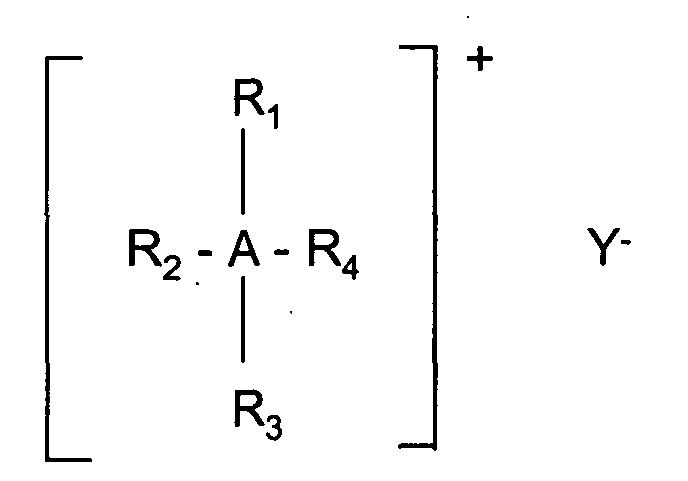
- R 4 can be any radical, but the radicals R 1 to R 3 must represent alkyl radicals with at least 4 carbon atoms.
- Y - is an anion. Two of the radicals R 1 to R 4 must be straight or branched alkyl radicals having 4 or 5 carbon atoms.
- US 5,648,575 discloses a method for inhibiting gas hydrates.
- the method involves the use of a compound of the formula wherein R 1 , R 2 straight or branched alkyl groups with at least 4 carbon atoms, R 3 is an organic radical with at least 4 atoms, X sulfur, NR 4 or PR 4 , R 4 is hydrogen or an organic radical, and Y is an anion.
- R 1 , R 2 straight or branched alkyl groups with at least 4 carbon atoms R 3 is an organic radical with at least 4 atoms
- X sulfur, NR 4 or PR 4 R 4 is hydrogen or an organic radical
- Y is an anion.
- the document only discloses those compounds which have at least two alkyl radicals with at least 4 carbon atoms.
- WO-99/13197 discloses ammonium compounds as gas hydrate inhibitors which have at least one alkoxy group esterified with alkyl carboxylic acids. The Advantages of using quaternary dicarboxylic acid derivatives are not disclosed.
- WO-01/09082 discloses a process for the preparation of quaternary amines which but do not carry alkoxy groups, and their use as Gas hydrate inhibitors.
- WO-00/078 706 discloses quaternary ammonium compounds as Gas hydrate inhibitors, which however do not carry carbonyl residues.
- EP-B-0 914 407 discloses the use of trisubstituted amine oxides as Gas hydrate inhibitors.
- DE-C-10114638 and DE-C-19920152 describe the use of modified ether carboxamides as gas hydrate inhibitors.
- the usage of quaternized ether carboxylic acid derivatives is not disclosed.
- the object of the present invention was to find new corrosion inhibitors, which with constant good or improved corrosion protection in addition to an optimized Water solubility, faster film formation and thus improved Film persistence also improved biodegradability compared to that Provide corrosion inhibitors of the prior art.
- Another object of the present invention was to find improved additives, which both slow the formation of gas hydrates (kinetic inhibitors) as also keep gas hydrate agglomerates small and pumpable (anti-agglomerates), all the more so to ensure a wide range of applications with high potency.
- thermodynamic inhibitors currently used (methanol and glycols), which have significant security and logistics problems cause, can be replaced.
- gas hydrate inhibitors are commonly used Corrosion inhibitors co-additized to prevent transportation and corrosion To prevent funding. Because of the often not immediately given Compatibility of gas hydrate inhibitor and corrosion inhibitor at This results in additional effort for the user. On there would be a significant advantage over the prior art if Co-additives with corrosion inhibitors are no longer absolutely necessary.
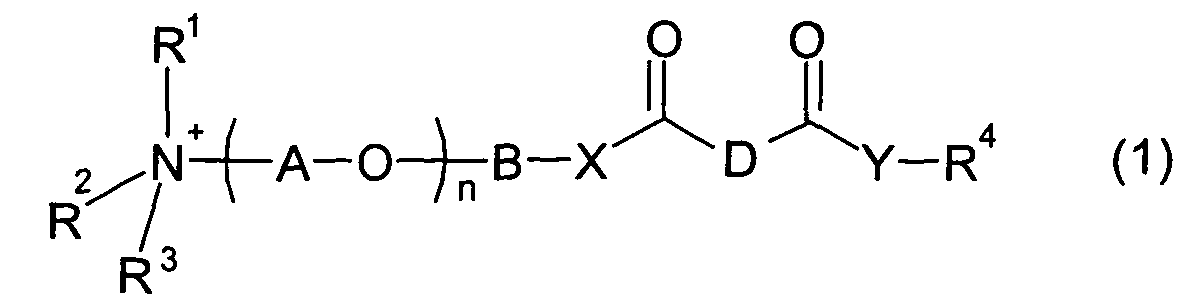
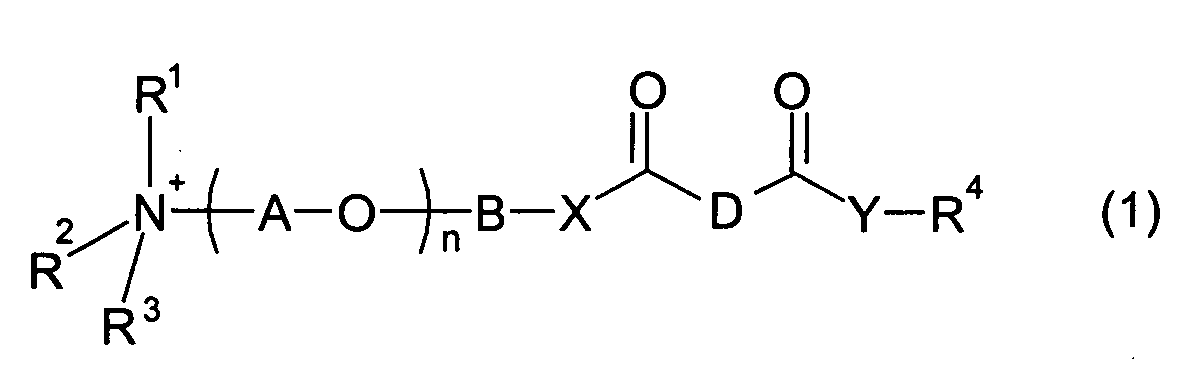
- Another object of the invention is a method for inhibiting Corrosion on metal surfaces, especially ferrous metals, by a corrosive system that is in contact with the metal surfaces, at least one compound of formula (1) is added.
- Another object of the invention is a method for inhibiting Gas hydrates by a system that tends to form gas hydrates Water and hydrocarbons at least one compound of the formula (1) is added.
- the invention further relates to the compounds of the formula (1).
- Corrosive systems in the sense of this invention are preferably liquid / liquid or liquid / gaseous multiphase systems consisting of water and Hydrocarbons, the free and / or dissolved form of corrosive components, such as salts and acids.
- the corrosive components can also be gaseous, such as hydrogen sulfide and carbon dioxide.
- hydrocarbons are organic compounds which Are components of oil / natural gas, and their by-products.
- hydrocarbons are also volatile Hydrocarbons, such as methane, ethane, propane, butane.
- the purposes of this invention also include the other gaseous components of petroleum / natural gas, such as hydrogen sulfide and carbon dioxide.
- A can be straight-chain or branched and is preferably an ethylene or propylene group, in particular an ethylene group.
- the alkoxy groups denoted by (AO) n can also be mixed alkoxy groups.
- B can be straight-chain or branched and is preferably a C 2 -C 4 -alkylene group, in particular an ethylene or propylene group.
- R 1 and R 2 are preferably independently of one another an alkyl or alkenyl group of 2 to 14 carbon atoms, in particular for such groups with 3 to 8 carbon atoms and especially for butyl groups.
- R 3 preferably represents an alkyl or alkenyl group with 1 to 12 carbon atoms, in particular with 1 to 4 carbon atoms.
- R 5 and R 6 are preferably hydrogen.
- n is preferably a number between 1 and 10, particularly preferably between 2 and 6.
- R 4 can be any organic radical which contains 1 to 100 carbon atoms and which can optionally contain heteroatoms. If R 4 contains heteroatoms, it is preferably nitrogen or oxygen atoms or both, preferably both. The nitrogen atoms can be in quaternized form.
- R 4 preferably represents a radical of the formula (2) wherein R 1 , R 2 , R 3 , A and B have the meanings given above with the preferred ranges given above for R 1 , R 2 , R 3 , A and B.
- n stands for a number between 0 and 30, preferably between 1 and 10, and particularly preferably between 2 and 6.
- R 4 comprises hydrogen, which can be both covalently bound and dissociated.
- D can be any divalent organic radical, the 1 to 600 carbon atoms contains, and which may optionally contain heteroatoms. Linking the Both carbonyl functions with D preferably take place via a free valence an alkyl or alkenyl group at any point of D.
- D contains no heteroatoms, it is preferably a C 2 to C 50 alkylene or C 2 to C 50 alkenylene group, which can be straight-chain or branched, and which is derived from saturated and / or unsaturated dicarboxylic acids , such as adipic acid, succinic acid, maleic acid or malonic acid, particularly preferably derived from fatty acids such as dimer fatty acids and trimer fatty acids.
- saturated and / or unsaturated dicarboxylic acids such as adipic acid, succinic acid, maleic acid or malonic acid, particularly preferably derived from fatty acids such as dimer fatty acids and trimer fatty acids.
- D is C 6 to C 50 aryl or alkylaryl radicals, in particular radicals which are derived from benzene dicarboxylic acids, particularly preferably from terephthalic acid (benzene-1,4-dicarboxylic acid).
- D is derived from substituted succinic acid derivatives having 10 to 100 carbon atoms.
- the substituent attached to the succinic acid derivative preferably represents a C 2 -C 90 -alkylene or C 2 -C 90 -alkenylene group, which is obtainable as an oligomer of C 2 -C 8 -alkenes, and be straight-chain or branched can, and is derived in particular from ethylene, propylene and butylene.
- D contains heteroatoms, it is preferably nitrogen or Oxygen atoms or both, preferably both.
- the nitrogen atoms can are in quaternized form.
- D preferably represents a radical of the formula (3) wherein R 7 and R 12 are either hydrogen or a C 2 to C 100 alkyl or C 2 to C 100 alkenyl radical which is obtainable as an oligomer of C 2 to C 8 alkenes and can be straight-chain or branched , and in particular derived from ethylene, propylene and butylene, with the proviso that exactly one of the radicals R 7 and R 12 is hydrogen.
- R 1 , R 2 , R 3 , R 4 , A, B, X, Y and n have the meanings already given above with the meanings given above for R 1 , R 2 , R 3 , R 4 , A, B, X, Y and n specified preferred ranges.
- D according to formula (1) is linked via a valence of an alkyl or alkenyl radical at any point on R 7 or R 12 .
- M stands for a mono- or polyvalent cation, preferably a metal ion, particularly preferably alkali or alkaline earth metal ions.
- M represents an ammonium ion of the formula N + R 8 R 9 R 10 R 11 , in which R 8 , R 9 , R 10 and R 11 independently of one another are hydrogen or any organic radical which is 1 to 100 C - Contains atoms, and which may optionally contain heteroatoms mean. If R 8 , R 9 , R 10 and / or R 11 contain heteroatoms, they are preferably nitrogen or oxygen atoms or both, preferably both. The nitrogen atoms can be in quaternized form.
- R 3 is C 1 to C 22 alkyl, C 2 to C 22 alkenyl or C 6 to C 30 alkylaryl
- all anions are counterions for the compounds of the formulas (1) to (3) suitable that do not affect the solubility of the compounds of formula (1) to (3) in the organic-aqueous mixed phases.
- Such counterions are, for example, methyl sulfate ions (methosulfate) or halide ions.
- R 3 stands for radicals -CHR 5 -COO- or -O-
- the compounds of the formulas (1) to (3) are betaines or amine oxides and have an intramolecular counterion as internal salts (ampholytes).
- the compounds of the invention can be used alone or in combination with other known corrosion inhibitors and / or gas hydrate inhibitors used become. In general, so much of the invention Use corrosion inhibitors and / or gas hydrate inhibitors that one among the adequate corrosion protection and protection against given conditions Gas hydrate formation is maintained.
- Preferred use concentrations of the corrosion inhibitors based on the pure Compounds according to the invention are 5 to 5000 ppm, preferably 10 to 1000, especially 15 to 150 ppm.
- the gas hydrate inhibitors are generally used in amounts between 0.01 and 5 % By weight of the pure compounds according to the invention, based on the aqueous Phase, preferably between 0.05 and 2 wt .-% used.
- Corrosion inhibitors and / or gas hydrate inhibitors are particularly suitable as corrosion inhibitors and / or gas hydrate inhibitors also mixtures of the products according to the invention with others Corrosion inhibitors and / or gas hydrate inhibitors of the prior art.
- Embodiments of this invention are mixtures of the compounds according to Formula (1) to (3), such as with amidoamines and / or imidazolines from fatty acids and Polyamines and their salts, quaternary ammonium salts, oxyethylated / oxypropylated amines, amphoglycinates and propionates, betaines or compounds described in DE-A-19930683.
- Particularly suitable as gas hydrate inhibitors and thus a preferred one Embodiments of this invention are mixtures of the compounds according to Formula (1) with one or more polymers with one by polymerization obtained carbon backbone and amide bonds in the side chains.
- polymers such as polyvinylpyrrolidone, polyvinylcaprolactam, Polyiisopropylacrylamide, polyacryloylpyrrolidine, copolymers of vinylpyrrolidone and Vinyl caprolactam, copolymers of vinyl caprolactam and N-methyl-N-vinyl acetamide as well as terpolymers of vinylpyrrolidone, vinylcaprolactam and other anionic, cationic and neutral comonomers with vinyl double bond such as 2-dimethylaminoethyl methacrylate, 1-olefins, N-alkyl acrylamides, N-vinylacetamide, Acrylamide, sodium 2-acrylamido-2-methyl-1-propanesulfonate (AMPS)
- N, N-dialkylacrylamides such as N-acryloylpyrrolidine, N-acryloylmorpholine and N-acryloylpiperidine or N-alkylacrylamides such as isopropylacrylamide and homo- as copolymers of alkoxyalkyl-substituted (meth) acrylic acid esters are also suitable.
- N, N-dialkylacrylamides such as N-acryloylpyrrolidine, N-acryloylmorpholine and N-acryloylpiperidine
- N-alkylacrylamides such as isopropylacrylamide and homo- as copolymers of alkoxyalkyl-substituted (meth) acrylic acid esters are also suitable.
- alkyl polyglycosides such as hydroxyethyl cellulose, Carboxymethyl cellulose and other ionic or nonionic Suitable surfactant molecules.
- the gas hydrate inhibitors according to the invention are used in a mixture with polymers which are disclosed in WO-A-96/08672.
- These polymers are structural units of the formula in which R 1 is a hydrocarbon group having 1 to 10 carbon atoms and 0 to 4 heteroatoms selected from N, O and S, R 2 is a hydrocarbon group of the same definition as R 1 , and X is the average number of repeating units, the latter being such that the polymer has a molecular weight of 1,000 to 6,000,000.
- Polyisopropylacrylamides and polyacryloylpyrrolidines are particularly suitable for use within the scope of the present invention.
- gas hydrate inhibitors according to the invention are used in a mixture with polymers which are disclosed in WO-A-96/41785.
- This document discloses gas hydrate inhibitors comprising structural units where n is a number from 1 to 3, and x and y represent the number of repetitive units, which is such that the molecular weight of the polymer is between 1000 and 6,000,000.
- Copolymers of N-vinylcaprolactam and N-vinyl-N-methylacetamide or vinylpyrrolidone are particularly suitable for use within the scope of the present invention.
- the gas hydrate inhibitors according to the invention in a mixture with other polymers used which are disclosed in WO-A-94/12761.
- the document discloses additives to prevent the formation of gas hydrates comprising polymers contain cyclic substituents with 5 to 7 ring members.
- polyvinylcaprolactam, Polyvinyl pyrrolidone and hydroxyethyl cellulose are suitable.
- Mixtures of the polymers according to the invention are also particularly suitable Maleic anhydride-based gas hydrate inhibitors as described in WO-A-97/6506 are described, in particular reacted with mono- and or or diamines Maleic anhydride copolymers. These include, in particular, modified ones Vinyl acetate-maleic anhydride copolymers are particularly preferred.
- the gas hydrate inhibitors according to the invention in a mixture with other polymers used, which are disclosed in DE-C-10059 816.
- the document discloses additives to prevent the formation of gas hydrates comprising polymers Homo- as well as copolymers, the alkoxyalkyl substituted (meth) acrylic acid esters contain.
- the concentration ratios are between the gas hydrate inhibitors according to the invention and the admixed ones Components from 90:10 to 10:90 percent by weight are preferred Mixtures in the ratios 75:25 to 25:75, and in particular from 60:40 to 40:60 used.
- the compounds can Gas hydrate inhibitors, in the oil and gas production or the preparation of Drilling fluids using common equipment such as injection pumps or the like that for the Hydrate formation-prone multiphase mixture can be added due to the good solubility of the polymers according to the invention is rapid and uniform distribution of the inhibitor in the tendency to hydrate formation Given water phase or the condensate phase.
- the compounds of the invention can be prepared in that alkoxylated alkylamines, alkylaminoalkylene amines or Alkylaminoalkyletheramines with dicarboxylic acid derivatives to the corresponding Mono- or dicarboxylic acid esters or mono- or dicarboxylic acid amides, optionally to cyclic dicarboximides, according to the Implementation relationships implemented. Then use suitable Quaternized alkylating agents.
- alkoxylated alkylamines alkylaminoalkylene amines or else Alkylaminoalkyl ether amines are described in the prior art.
- the alkoxylated alkylamines used are based on dialkylamines having C 1 -C 22 -alkyl radicals or C 2 -C 22 -alkenyl radicals, preferably C 3 -C 8 -dialkylamines.
- Suitable dialkylamines are, for example, di-n-butylamine, diisobutylamine, dipentylamine, dihexylamine, dioctylamine, dicyclopentylamine, dicyclohexylamine, diphenylamine, dibenzylamine.
- the alkylamines are generally mixed with ethylene oxide, propylene oxide, butylene oxide or mixtures of various such alkylene oxides, ethylene oxide or mixtures of ethylene oxide and propylene oxide are preferred.
- Related to the Alkylamines are charged with 1-30 moles of alkylene oxide, preferably 1-10 moles, particularly preferably 2-6 mol.
- Suitable solvents for the alkoxylation are inert ethers such as dioxane, Tetrahydrofuran, glyme, diglyme and MPEGs.
- the alkoxylation is uncatalyzed in the first reaction step to> 95 wt .-% tert-nitrogen. Higher alkoxylation takes place after Add basic compounds as catalysts.
- basic compounds Alkaline earth metal / alkali metal hydroxides or alcoholates (sodium methylate, Sodium ethylate, potassium tert-butoxide) can be used, but are preferred Alkali metal hydroxides, especially sodium hydroxide or potassium hydroxide.
- the alkylaminoalkylene amines used are essentially dialkylaminoalkylene amines with C 1 to C 22 alkyl radicals or C 2 to C 22 alkenyl radicals, preferably tertiary C 1 to C 8 dialkylamino alkylene amines.
- dicarboxylic acid derivatives used are free dicarboxylic acids, Dicarboxylic acid diesters, dicarboxylic acid anhydrides and dicarboxylic acid halides, prefers diesters and anhydrides.
- Anhydrides are particularly suitable, for example maleic anhydride, succinic anhydride, phthalic anhydride and alkenyl succinic anhydrides.
- alkenyl succinic anhydrides by thermal or Catalyzed "ene” reaction is described in the prior art.
- Olefins preferably terminal double bond olefins, with maleic anhydride implemented under elevated temperatures.
- Mono and / or bisadducts optionally polyadducts.
- the ether dicarboxylic acids on which the invention is based can be prepared in known ways either by converting the terminal -CH 2 OH function of a diol to which alkylene oxide has been added to give the carboxylic acid by alkylation with chloroacetic acid derivatives according to Williamson's ether synthesis or by oxidation.
- Suitable base alcohols are particularly preferably C 2 -C 30 diols, such as ethylene glycol, propanediols and butanediols, which are reacted with alkylene oxides such as ethylene oxide, propylene oxide or butylene oxide or mixtures thereof to give corresponding glycol ethers, ethylene oxide being particularly preferred.
- the products are preferably reacted with 1-30 mol of alkylene oxide, particularly preferably 2-6 mol of ethylene oxide.
- Alkylene glycol alkyl ethers are the alkylene glycol units in a statically controlled sequence and / or contained as block oligomers.
- the ether dicarboxylic acid is made from these alkylene glycol alkyl ethers by oxidation with atmospheric oxygen in the presence of catalysts or by oxidation with Hypochlorite or chlorite made with and without catalysts.
- the alkylation of the alkylene glycol alkyl ethers with is particularly preferred Chloroacetic acid derivatives, preferably with sodium chloroacetate and sodium hydroxide solution the Williamson method.
- the free carboxylic acid is made from the alkaline Alkylation mixture by acidification with mineral acid (hydrochloric, sulfuric acid) and Heat above the cloud point and separate the organic phase.
- the dicarboxylic acid derivatives are generally with the alkoxylated alkylamines or alkylaminoalkylene amines at 60-240 ° C, preferably at 120-200 ° C such implemented that, depending on the used Dicarboxylic acid derivative with elimination of water of reaction or alcohol complete condensation to the corresponding mono- or dicarboxylic acid esters or mono- or dicarboxamides, optionally to cyclic Dicarboximides.
- the degree of implementation can be determined by determining the Acid number, saponification number and / or by determining the base and / or Amide nitrogen can be tracked.
- the reaction is carried out in bulk, but can also preferably be carried out in solution be performed. Especially when using carboxylic acids Use of solvents required when high sales and lower Acid numbers of the resulting reaction products are aimed for. Suitable solvents for the production are organic compounds through which the water of reaction is removed azeotropically. In particular, aromatic Solvents or solvent mixtures, or alcohols can be used. Especially 2-ethylhexanol is preferred.
- the reaction is then carried out at the boiling point of the azeotrope.
- Dicarboxylic acid diesters are preferred in the production of dicarboxylic acid diamides and used an excess of the corresponding amine with the free one alcohol or after the reaction are removed by distillation can.
- dicarboxylic acid anhydrides it is preferred to iteratively fully esterified with a suitable alcohol and then amidated.
- suitable Alcohols are e.g. Ethanol, propanol, iso-propanol or 2-ethylhexanol. Especially 2-ethylhexanol is preferred.
- esterifications or amidations can be accelerated by adding suitable acidic catalysts with a pK a value of less than or equal to 5, such as mineral acids or sulfonic acids.
- suitable acidic catalysts with a pK a value of less than or equal to 5, such as mineral acids or sulfonic acids.
- Alkylstannanic acids are particularly preferred.
- alkylamino alkyl / alkoxy esters or alkylaminoalkyl / alkoxy amides accordingly quaternized.
- the quaternization can be done by appropriate alkylating agents are carried out at 50 to 150 ° C.
- suitable Alkylating agents are alkyl halides and alkyl sulfates, preferred Methyl chloride, methyl iodide, butyl bromide and dimethyl sulfate.
- a Halogen carboxylic acid and a base preferably chloroacetic acid and Sodium hydroxide implemented. This can be done by using the alkylaminoamides with 50 to 125 mol% of halocarboxylic acid at 40 ° C and at 40 to 100 ° C by one-time or portioned addition of the base and 125 mol% remaining residual amount of halocarboxylic acid.
- Alkaline earth metal / alkali metal hydroxides or alcoholates can be used as basic compounds (Sodium methylate, sodium ethylate, potassium tert-butoxide) can be used, preferred but are alkali metal hydroxides, especially sodium hydroxide or potassium hydroxide, especially their aqueous solutions.
- the amine oxides according to the invention are prepared by known methods Prior art methods, preferably by oxidation of the corresponding tertiary amine group with peroxides or peracids, preferably with Hydrogen peroxide.
- Suitable solvents for the production of quats, betaines and amine oxides are inert alcohols such as isopropanol, 2-ethylhexanol or inert Ethers such as tetrahydrofuran, glyme, diglyme and MPEGs.
- the solvent used can remain in the product according to the invention or must be removed by distillation.
- Example 1 Dodecenyl / tetradecenylsuccinic acid-N, N-dibutylamino-N-tri (ethoxy) ethyl ester
- Dibutylamine + 3.7 EO 20.9 mg KOH / g
- tripropylene succinic acid bis [N, N-dibutylamino-N-tri (ethoxy) ethyl ester] with SZ 8.2 mg KOH / g
- Example 8 Tetrapropylene succinic acid bis [N, N-dibutylamino-N-tri (ethoxy) ethyl ester]
- Example 1 polyisobutenylsuccinic acid bis [N, N-dibutylamino-N-tri (ethoxy) ethyl ester]
- Example 11 polyglycol dicarboxylic acid bis [N, N-dibutylamino-N-tri (ethoxy) ethyl ester]
- Polyvinylcaprolactam with MW 5000 g / mol are in a ratio of 1: 1 with Quat from Example 1 described in Example 13 mixed and in butyl diglycol set.
- Polyvinylcaprolactam with MW 5000 g / mol are in a ratio of 1: 1 with Quat from Example 6 described in Example 18 mixed and in butyl diglycol set.
- the compounds according to the invention were tested as corrosion inhibitors in the Shell Wheel test. Coupons made of carbon steel (DIN 1.1203 with a surface area of 15 cm 2 ) were immersed in a salt water / petroleum mixture (9: 1.5% NaCl solution with acetic acid adjusted to pH 3.5) and at a speed of 40 rpm exposed to this medium at 70 ° C for 24 hours. The inhibitor dosage was 50 ppm of a 40% solution of the inhibitor. The protection values were calculated from the mass decrease of the coupons, based on a blank value.
- Comparison 1 denotes a commercially available residue amine quat based on dicocosalkyldimethylammonium chloride and "Comparison 2” denotes a commercially available soy fatty acid amidopropyl-N, N-dimethylammonium carboxymethylbetaine described by EP-B-0 446 616 (corrosion inhibitors of the prior art of the technique).
- the inventive Products have very good corrosion protection properties at low doses on and essentially exceed the effectiveness of the inhibitors of the prior art Technology.
- the compounds have a due to their ester or amide structure better biodegradability and can with a lower dosage rate be used.
- the time from reaching the minimum temperature of 2 ° C. until the first gas uptake (T ind ) or the time until the torque increases (T agg ) is used as a measure of the inhibitory action of the compounds according to the invention.
- Long induction times or agglomeration times indicate an effect as a kinetic inhibitor.
- the torque measured in the autoclave serves as a parameter for the agglomeration of the hydrate crystals.
- the measured pressure drop ( ⁇ p) allows a direct conclusion to be drawn about the amount of hydrate crystals formed. With a good anti-agglomerate, the torque that builds up after the formation of gas hydrates is significantly reduced compared to the blank value. Ideally, snow-like, fine hydrate crystals form in the condensate phase, which do not accumulate and therefore do not lead to the blockage of the installations used for gas transport and gas production.
- PVCap polyvinylcaprolactam
- the inventive ones work Products as a synergistic component of kinetic hydrate inhibitors and show a significant improvement over the prior art. You can therefore to increase (synergy effect) the performance of inhibitors of State of the art can be used.
Landscapes
- Chemical & Material Sciences (AREA)
- Organic Chemistry (AREA)
- Engineering & Computer Science (AREA)
- General Life Sciences & Earth Sciences (AREA)
- Materials Engineering (AREA)
- Life Sciences & Earth Sciences (AREA)
- Oil, Petroleum & Natural Gas (AREA)
- Chemical Kinetics & Catalysis (AREA)
- General Chemical & Material Sciences (AREA)
- Mechanical Engineering (AREA)
- Metallurgy (AREA)
- Organic Low-Molecular-Weight Compounds And Preparation Thereof (AREA)
- Preventing Corrosion Or Incrustation Of Metals (AREA)
- Anti-Oxidant Or Stabilizer Compositions (AREA)
Abstract

- R1, R2
- unabhängig voneinander C1- bis C22-Alkyl, C2- bis C22-Alkenyl, C6- bis C30-Aryl- oder C7- bis C30-Alkylaryl,
- R3
- C1- bis C22- Alkyl, C2- bis C22- Alkenyl, C6- bis C30-Aryl- oder C7- bis C30-Alkylaryl, -CHR5-COO- oder -O-,
- R4
- M, Wasserstoff oder einen gegebenenfalls Heteroatome enthaltenden organischen Rest mit 1 bis 100 Kohlenstoffatomen,
- A
- eine C2- bis C4-Alkylengruppe,
- B
- eine C1- bis C10-Alkylengruppe,
- D
- einen gegebenenfalls Heteroatome enthaltenden organischen Rest mit 1 bis 600 Kohlenstoffatomen,
- X, Y
- unabhängig voneinander O oder NR6,
- R5, R6
- unabhängig voneinander Wasserstoff, C1- bis C22-Alkyl, C2- bis C22-Alkenyl, C6- bis C30-Aryl- oder C7- bis C30-Alkylaryl, und
- M
- ein Kation
- n
- eine Zahl von 1 bis 30
Description



- R1, R2
- unabhängig voneinander C1- bis C22-Alkyl, C2- bis C22-Alkenyl, C6- bis C30-Aryl- oder C7- bis C30-Alkylaryl,
- R3
- C1- bis C22- Alkyl, C2- bis C22- Alkenyl, C6- bis C30-Aryl- oder C7- bis C30-Alkylaryl, -CHR5-COO- oder -O-,
- R4
- M, Wasserstoff oder einen gegebenenfalls Heteroatome enthaltenden organischen Rest mit 1 bis 100 Kohlenstoffatomen,
- A
- eine C2- bis C4-Alkylengruppe,
- B
- eine C1- bis C10-Alkylengruppe,
- D
- einen gegebenenfalls Heteroatome enthaltenden organischen Rest mit 1 bis 600 Kohlenstoffatomen,
- X, Y
- unabhängig voneinander O oder NR6,
- R5, R6
- unabhängig voneinander Wasserstoff, C1- bis C22-Alkyl, C2- bis C22-Alkenyl, C6- bis C30-Aryl- oder C7- bis C30-Alkylaryl, und
- M
- ein Kation
- n
- eine Zahl von 1 bis 30


R7 und R12 entweder Wasserstoff oder einen C2- bis C100-Alkyl- oder C2- bis C100-Alkenyl-Rest, der als Oligomer von C2- bis C8-Alkenen erhältlich ist und geradkettig oder verzweigt sein kann, und insbesondere von Ethylen, Propylen und Butylen abgeleitet ist, bedeuten, mit der Maßgabe, dass genau einer der Reste R7 und R12 für Wasserstoff steht. R1, R2, R3, R4, A, B, X, Y und n haben die bereits oben angegebenen Bedeutungen mit den jeweils oben für R1, R2, R3, R4, A, B, X, Y und n angegebenen Vorzugsbereichen.


| (SHELL-Wheel-Test) | ||
| Beispiel | Korrosionsinhibitor | Schutz % |
| Vergleich 1 | Standard-Quat | 36,0 |
| Vergleich 2 | Standard-Betain | 75,4 |
| 13 | Quat aus Beispiel 1 | 92,5 |
| 14 | Quat aus Beispiel 2 | 94,2 |
| 15 | Quat aus Beispiel 3 | 93,8 |
| 16 | Quat aus Beispiel 4 | 93,6 |
| 17 | Quat aus Beispiel 5 | 88,7 |
| 18 | Quat aus Beispiel 6 | 93,3 |
| 19 | Quat aus Beispiel 7 | 94,5 |
| 20 | Quat aus Beispiel 8 | 91,9 |
| 21 | Quat aus Beispiel 9 | 93,1 |
| 22 | Quat aus Beispiel 10 | 90,6 |
| (LPR-Test) | ||||
| Beispiel | Korrosionsinhibitor | Schutz nach [%] | ||
| 10 min | 30 min | 60 min | ||
| Vergleich 1 | Standard-Quat | 53,9 | 61,2 | 73,7 |
| Vergleich 2 | Standard-Betain | 45,9 | 59,2 | 64,3 |
| 13 | Quat aus Beispiel 1 | 79,6 | 86,1 | 87,6 |
| 14 | Quat aus Beispiel 2 | 79,1 | 85,1 | 87,3 |
| 15 | Quat aus Beispiel 3 | 84,6 | 89,6 | 91,2 |
| 16 | Quat aus Beispiel 4 | 81,8 | 87,3 | 89,7 |
| 17 | Quat aus Beispiel 5 | 74,1 | 80,0 | 83,5 |
| 18 | Quat aus Beispiel 6 | 78,9 | 85,0 | 86,7 |
| 19 | Quat aus Beispiel 7 | 81,6 | 86,4 | 88,2 |
| 20 | Quat aus Beispiel 8 | 76,2 | 82,8 | 85,9 |
| 21 | Quat aus Beispiel 9 | 77,3 | 81,6 | 83,2 |
| 22 | Quat aus Beispiel 10 | 68,9 | 74,2 | 79,8 |
- Gas 1:
- Methan 79,3 %, Ethan 10,8 %, Propan 4,8 %, Butan 1,9 %, Kohlendioxid 1,4 %, Stickstoff 1,8 %. Unterkühlung unter die Gleichgewichtstemperatur der Hydratbildung bei 50 bar: 12°C.
- Gas 2:
- Methan 92,1 %, Ethan 3,5 %, Propan 0,8 %, Butan 0,7 %, Kohlendioxid 0,6 %, Stickstoff 2,3 %. Unterkühlung unter die Gleichgewichtstemperatur der Hydratbildung bei 50 bar: 7°C, Unterkühlung bei 100 bar: 12°C.
| (Test als Antiagglomerant) | ||||
| Beispiel | Gashydratinhibitor | Druckverlust Δ p (bar) | Temperaturanstieg ΔT (K) | Drehmoment Nmax (Ncm) |
| Blindwert | - | > 40 | > 8 | 15,9 |
| 13 | Quat aus Beispiel 1 | 15,2 | 1,1 | 4,9 |
| 18 | Quat aus Beispiel 6 | 10,3 | 0,5 | 0,5 |
| 23 | Quat aus Beispiel 11 | 14,7 | 1,0 | 1,0 |
| 24 | Quat aus Beispiel 12 | 13,9 | 1,0 | 0,8 |
| Vergleich 3 | TBAB | 21,5 | 1,0 | 1,5 |
| Vergleich 4 | TBAB | 15,0 | 1,0 | 1,2 |
| (Test als kinetische Inhibitoren) | ||||||
| Beispiel | Inhibitor | Gas | Druck p (bar) | Tind | Druckverlust Δ p (bar) | Temperaturanstieg Δ T (K) |
| Blindwert | - | 1 | 50 | 0 | > 40 | > 1,5 |
| Blindwert | - | 2 | 100 | 0 | > 40 | > 1,5 |
| 25 | Quat aus Beispiel 1 | 1 | 50 | 8,0 h | 7,2 | 0,4 |
| 25 | Quat aus Beispiel 1 | 2 | 100 | < 5 min | 10,8 | 0,4 |
| 26 | Quat aus Beispiel 6 | 1 | 50 | 6,5 h | 9,5 | 0,1 |
| 26 | Quat aus Beispiel 6 | 2 | 100 | < 5 min | 10,1 | 0,2 |
| Vergleich 5 | PVCap | 1 | 50 | < 5 min | 10 | 0,4 |
| Vergleich 5 | PVCap | 2 | 100 | < 5 min | 6 | 0,1 |
Claims (12)
- Verwendung von Verbindungen der Formel (1)worin
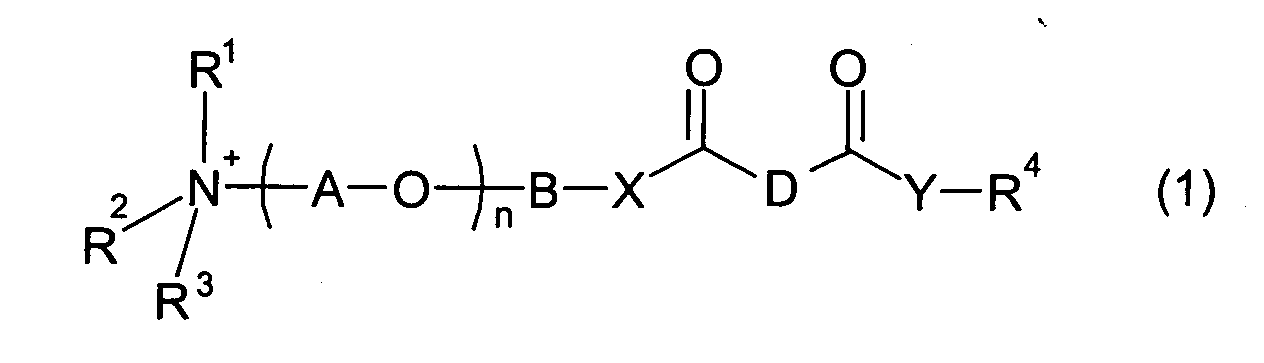
- R1, R2
- unabhängig voneinander C1- bis C22-Alkyl, C2- bis C22-Alkenyl, C6- bis C30-Aryl- oder C7- bis C30-Alkylaryl,
- R3
- C1- bis C22- Alkyl, C2- bis C22- Alkenyl, C6- bis C30-Aryl- oder C7- bis C30-Alkylaryl, -CHR5-COO- oder-O-,
- R4
- M, Wasserstoff oder einen gegebenenfalls Heteroatome enthaltenden organischen Rest mit 1 bis 100 Kohlenstoffatomen,
- A
- eine C2- bis C4-Alkylengruppe,
- B
- eine C1- bis C10-Alkylengruppe,
- D
- einen gegebenenfalls Heteroatome enthaltenden organischen Rest mit 1 bis 600 Kohlenstoffatomen,
- X, Y
- unabhängig voneinander O oder NR6,
- R5, R6
- unabhängig voneinander Wasserstoff, C1- bis C22-Alkyl, C2- bis C22-Alkenyl, C6- bis C30-Aryl- oder C7- bis C30-Alkylaryl, und
- M
- ein Kation
- n
- eine Zahl von 1 bis 30
- Verwendung nach Anspruch 1, wobei A für eine Ethylen- oder Propylengruppe steht.
- Verwendung nach Anspruch 1 und/oder 2, wobei B für eine C2- bis C4-Alkylengruppe steht.
- Verwendung nach einem oder mehreren der Ansprüche 1 bis 3, wobei R1 und R2 unabhängig voneinander für eine Alkyl- oder Alkenylgruppe von 2 bis 14 Kohlenstoffatomen stehen.
- Verwendung nach einem oder mehreren der Ansprüche 1 bis 4, wobei R3 für eine Alkyl- oder Alkenylgruppe mit 1 bis 12 Kohlenstoffatomen steht.
- Verwendung nach einem oder mehreren der Ansprüche 1 bis 5, wobei R5 und R6 für Wasserstoff stehen.
- Verwendung nach einem oder mehreren der Ansprüche 1 bis 6, wobei n für eine Zahl zwischen 1 und 10 steht.
- Verwendung nach einem oder mehreren der Ansprüche 1 bis 7, wobei R4 für einen Rest der Formel (2) stehtworin R1, R2, R3, A und B die in Anspruch 1 angegebenen Bedeutungen haben, und m unabhängig von n für eine Zahl zwischen 0 und 30 steht.

- Verwendung nach einem oder mehreren der Ansprüche 1 bis 8, wobei D eine C2- bis C50-Alkylen- oder C2- bis C50-Alkenylen-Gruppe ist.
- Verwendung nach einem oder mehreren der Ansprüche 1 bis 8, wobei D von substituierten Bernsteinsäurederivaten mit 10 bis 100 Kohlenstoffatomen abgeleitet ist.
- Verwendung nach einem oder mehreren der Ansprüche 1 bis 8, wobei D für einen Rest der Formel (3) stehtworin
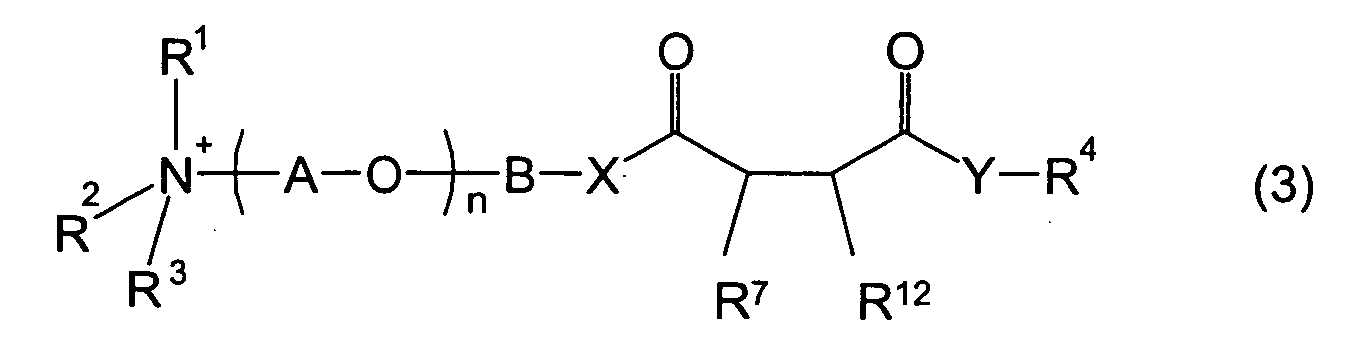
R7 und R12 entweder Wasserstoff oder einen C2- bis C100-Alkyl- oder C2- bis C100-Alkenyl-Rest, der als Oligomer von C2- bis C8-Alkenen erhältlich ist und geradkettig oder verzweigt sein kann bedeuten, mit der Maßgabe, dass genau einer der Reste R7 und R12für Wasserstoff steht, und R1, R2, R3, R4, A, B, X, Y und n die in Anspruch 1 angegebenen Bedeutungen aufweisen. - Verbindungen der Formel (1),worin
- R1, R2
- unabhängig voneinander C1- bis C22-Alkyl, C2- bis C22-Alkenyl, C6- bis C30-Aryl- oder C7- bis C30-Alkylaryl,
- R3
- C1- bis C22- Alkyl, C2- bis C22- Alkenyl, C6- bis C30-Aryl- oder C7- bis C30-Alkylaryl, -CHR5-COO- oder -O-,
- R4
- M, Wasserstoff oder einen gegebenenfalls Heteroatome enthaltenden organischen Rest mit 1 bis 100 Kohlenstoffatomen,
- A
- eine C2- bis C4-Alkylengruppe,
- B
- eine C1- bis C10-Alkylengruppe,
- D
- einen gegebenenfalls Heteroatome enthaltenden organischen Rest mit 1 bis 600 Kohlenstoffatomen,
- X, Y
- unabhängig voneinander O oder NR6,
- R5, R6
- unabhängig voneinander Wasserstoff, C1- bis C22-Alkyl, C2- bis C22-Alkenyl, C6- bis C30-Aryl- oder C7- bis C30-Alkylaryl, und
- M
- ein Kation
- n
- eine Zahl von 1 bis 30 bedeuten.
Applications Claiming Priority (2)
| Application Number | Priority Date | Filing Date | Title |
|---|---|---|---|
| DE10307727 | 2003-02-24 | ||
| DE10307727A DE10307727B3 (de) | 2003-02-24 | 2003-02-24 | Verwendung von Verbindungen als Korrosions- und Gashydratinhibitoren mit verbesserter Wasserlöslichkeit und erhöhter biologischer Abbaubarkeit und diese Verbindungen |
Publications (2)
| Publication Number | Publication Date |
|---|---|
| EP1449940A1 true EP1449940A1 (de) | 2004-08-25 |
| EP1449940B1 EP1449940B1 (de) | 2009-06-24 |
Family
ID=32731114
Family Applications (1)
| Application Number | Title | Priority Date | Filing Date |
|---|---|---|---|
| EP04002384A Expired - Lifetime EP1449940B1 (de) | 2003-02-24 | 2004-02-04 | Korrosions- und Gashydratinhibitoren mit verbesserter Wasserlöslichkeit und erhöhter biologischer Abbaubarkeit |
Country Status (5)
| Country | Link |
|---|---|
| US (1) | US7341617B2 (de) |
| EP (1) | EP1449940B1 (de) |
| DE (2) | DE10307727B3 (de) |
| MX (1) | MXPA04001681A (de) |
| NO (1) | NO335699B1 (de) |
Cited By (1)
| Publication number | Priority date | Publication date | Assignee | Title |
|---|---|---|---|---|
| US7615102B2 (en) | 2004-10-07 | 2009-11-10 | Clariant Produkte (Deutschland) Gmbh | Corrosion and gas hydrate inhibitors with an increased biological degradability and a reduced toxicity |
Families Citing this family (17)
| Publication number | Priority date | Publication date | Assignee | Title |
|---|---|---|---|---|
| DE10134224B4 (de) | 2001-07-13 | 2012-12-20 | Clariant Produkte (Deutschland) Gmbh | Additive zur Inhibierung der Gashydratbildung |
| DE10307728B4 (de) * | 2003-02-24 | 2005-09-22 | Clariant Gmbh | Korrosions-und Gashydratinhibitoren mit verbesserter Wasserlöslichkeit und erhöhter biologischer Abbaubarkeit und derartige Verbindungen |
| US7264653B2 (en) * | 2003-10-21 | 2007-09-04 | Champion Technologies, Inc. | Methods for inhibiting hydrate blockage in oil and gas pipelines using simple quaternary ammonium and phosphonium compounds |
| DE102005006421A1 (de) * | 2005-02-12 | 2006-08-24 | Clariant Produkte (Deutschland) Gmbh | Polymere und ihre Herstellung und Verwendung als Gashydratinhibitoren |
| DE102005007287B4 (de) * | 2005-02-17 | 2007-01-25 | Clariant Produkte (Deutschland) Gmbh | Verwendung von Polyestern als Gashydratinhibitoren |
| DE102005009134A1 (de) * | 2005-03-01 | 2006-09-14 | Clariant Produkte (Deutschland) Gmbh | Biologisch abbaubare Gashydratinhibitoren |
| US7481276B2 (en) * | 2006-05-12 | 2009-01-27 | Bj Services Company | Method of inhibiting and/or preventing corrosion in oilfield treatment applications |
| US7989403B2 (en) | 2009-03-02 | 2011-08-02 | Nalco Company | Corrosion inhibitors containing amide surfactants for a fluid |
| US8288323B2 (en) * | 2009-03-02 | 2012-10-16 | Nalco Company | Compositions containing amide surfactants and methods for inhibiting the formation of hydrate agglomerates |
| EA026467B1 (ru) | 2009-07-03 | 2017-04-28 | Акцо Нобель Кемикалз Интернэшнл Б.В. | Полимерные ингибиторы коррозии |
| EP2611889B1 (de) | 2010-08-30 | 2014-11-26 | Akzo Nobel Chemicals International B.V. | Verwendung von polyesterpolyaminen und polyester-polyquartenärammoniumverbindungen als korrosionsinhibitoren |
| US8618025B2 (en) | 2010-12-16 | 2013-12-31 | Nalco Company | Composition and method for reducing hydrate agglomeration |
| US9605196B2 (en) * | 2011-11-17 | 2017-03-28 | Baker Hughes Incorporated | Lubricity agents to increase pump efficiency in hydrate inhibitor applications |
| BR112018076418B1 (pt) * | 2016-06-22 | 2022-06-21 | The Lubrizol Corporation | Formulação de aditivo antiaglomerante, aditivo antiaglomerante, composição de antiaglomerante, e, método para prevenir a aglomeração de hidratos. |
| EP3589613A4 (de) | 2017-02-28 | 2020-12-16 | Huntsman Petrochemical LLC | Kinetische hydroxyalkylurethan-hydratinhibitoren |
| US11174235B2 (en) | 2018-06-14 | 2021-11-16 | Championx Usa Inc. | Carboxy alkyl-ester anti-agglomerants for the control of natural gas hydrates |
| US12139662B2 (en) | 2022-03-17 | 2024-11-12 | Baker Hughes Oilfield Operations Llc | Synergistic corrosion inhibitor blends |
Citations (3)
| Publication number | Priority date | Publication date | Assignee | Title |
|---|---|---|---|---|
| DE19920152C1 (de) * | 1999-05-03 | 2000-10-12 | Clariant Gmbh | Additive zur Inhibierung der Gashydratbildung und deren Verwendung |
| EP1069147A2 (de) * | 1999-07-02 | 2001-01-17 | Clariant GmbH | Korrosionsinhibitoren mit verbesserter Wasserlöslichkeit |
| DE10114638C1 (de) * | 2001-03-24 | 2002-05-23 | Clariant Gmbh | Additive zur Inhibierung der Gashydratbildung und deren Verwendung |
Family Cites Families (19)
| Publication number | Priority date | Publication date | Assignee | Title |
|---|---|---|---|---|
| DE3526600A1 (de) | 1985-07-25 | 1987-01-29 | Hoechst Ag | Quaternaere oxalkylierte polykondensate, verfahren zu deren herstellung und deren verwendung |
| DE3742935A1 (de) | 1987-12-18 | 1989-06-29 | Hoechst Ag | Gegebenenfalls quaternierte fettsaeureester von oxalkylierten alkyl-alkylendiaminen |
| DE4003893A1 (de) | 1990-02-09 | 1991-08-14 | Norol Hoechst Oil Chemicals As | Verfahren zur verhinderung von korrosion in fluessigkeiten bei der rohoelfoerderung |
| US5432292A (en) | 1992-11-20 | 1995-07-11 | Colorado School Of Mines | Method for controlling clathrate hydrates in fluid systems |
| US5460728A (en) | 1993-12-21 | 1995-10-24 | Shell Oil Company | Method for inhibiting the plugging of conduits by gas hydrates |
| US5600044A (en) | 1994-09-15 | 1997-02-04 | Exxon Production Research Company | Method for inhibiting hydrate formation |
| US5648575A (en) | 1995-01-10 | 1997-07-15 | Shell Oil Company | Method for inhibiting the plugging of conduits by gas hydrates |
| AR001674A1 (es) | 1995-04-25 | 1997-11-26 | Shell Int Research | Método para inhibir la obstrucción de conductos por hidrato de gas |
| RU2134678C1 (ru) | 1995-06-08 | 1999-08-20 | Эксон продакшн рисерч компани | Способ ингибирования образования гидратов |
| DE19629662A1 (de) | 1996-07-23 | 1998-01-29 | Clariant Gmbh | Verfahren zur Inhibierung der Gashydratbildung |
| JP2001505971A (ja) | 1996-11-22 | 2001-05-08 | クラリアント・ゲゼルシャフト・ミト・ベシュレンクテル・ハフツング | 水和ガスの形成を抑制するための添加剤 |
| DE19649285A1 (de) | 1996-11-28 | 1998-06-04 | Henkel Kgaa | Verfahren zum Schutz von Metalloberflächen gegenüber Korrosion in flüssigen oder gasförmigen Medien |
| DE69809575T2 (de) | 1997-09-09 | 2003-07-17 | Shell Int Research | Verfahren und zusammensetzung zur inhibierung der verstopfung von rohrleitungen durch gashydraten |
| DE19803384C1 (de) | 1998-01-29 | 1999-04-15 | Clariant Gmbh | Additive zur Inhibierung der Gashydratbildung und Verfahren zur Inhibierung der Bildung von Gashydraten |
| US6025302A (en) | 1998-05-18 | 2000-02-15 | Bj Services Company | Quaternized polyether amines as gas hydrate inhibitors |
| US6444852B1 (en) | 1999-06-24 | 2002-09-03 | Goldschmidt Chemical Corporation | Amines useful in inhibiting gas hydrate formation |
| DE60005963D1 (de) | 1999-07-29 | 2003-11-20 | Akzo Nobel Nv | Verfahren zur herstellung von esterquats |
| DE10059816C1 (de) | 2000-12-01 | 2002-04-18 | Clariant Gmbh | Verwendung von Additiven zur Inhibierung der Gashydratbildung |
| US7264653B2 (en) * | 2003-10-21 | 2007-09-04 | Champion Technologies, Inc. | Methods for inhibiting hydrate blockage in oil and gas pipelines using simple quaternary ammonium and phosphonium compounds |
-
2003
- 2003-02-24 DE DE10307727A patent/DE10307727B3/de not_active Expired - Fee Related
-
2004
- 2004-02-04 DE DE502004009636T patent/DE502004009636D1/de not_active Expired - Lifetime
- 2004-02-04 EP EP04002384A patent/EP1449940B1/de not_active Expired - Lifetime
- 2004-02-09 NO NO20040584A patent/NO335699B1/no not_active IP Right Cessation
- 2004-02-20 US US10/783,407 patent/US7341617B2/en not_active Expired - Fee Related
- 2004-02-23 MX MXPA04001681A patent/MXPA04001681A/es active IP Right Grant
Patent Citations (6)
| Publication number | Priority date | Publication date | Assignee | Title |
|---|---|---|---|---|
| DE19920152C1 (de) * | 1999-05-03 | 2000-10-12 | Clariant Gmbh | Additive zur Inhibierung der Gashydratbildung und deren Verwendung |
| EP1050567A1 (de) * | 1999-05-03 | 2000-11-08 | Clariant GmbH | Additive zur Inhibierung der Gashydratbildung |
| EP1069147A2 (de) * | 1999-07-02 | 2001-01-17 | Clariant GmbH | Korrosionsinhibitoren mit verbesserter Wasserlöslichkeit |
| DE19930683A1 (de) * | 1999-07-02 | 2001-01-18 | Clariant Gmbh | Korrosionsinhibitoren mit verbesserter Wasserlöslichkeit |
| DE10114638C1 (de) * | 2001-03-24 | 2002-05-23 | Clariant Gmbh | Additive zur Inhibierung der Gashydratbildung und deren Verwendung |
| EP1243637A2 (de) * | 2001-03-24 | 2002-09-25 | Clariant GmbH | Additive zur Inhibierung der Gashydratbildung |
Cited By (1)
| Publication number | Priority date | Publication date | Assignee | Title |
|---|---|---|---|---|
| US7615102B2 (en) | 2004-10-07 | 2009-11-10 | Clariant Produkte (Deutschland) Gmbh | Corrosion and gas hydrate inhibitors with an increased biological degradability and a reduced toxicity |
Also Published As
| Publication number | Publication date |
|---|---|
| NO20040584L (no) | 2004-08-25 |
| DE502004009636D1 (de) | 2009-08-06 |
| EP1449940B1 (de) | 2009-06-24 |
| NO335699B1 (no) | 2015-01-26 |
| MXPA04001681A (es) | 2004-08-27 |
| US7341617B2 (en) | 2008-03-11 |
| US20040164278A1 (en) | 2004-08-26 |
| DE10307727B3 (de) | 2004-11-11 |
Similar Documents
| Publication | Publication Date | Title |
|---|---|---|
| DE10307725B4 (de) | Korrosions-und Gashydratinhibitoren mit verbesserter Wasserlöslichkeit und erhöhter biologischer Abbaubarkeit | |
| DE10307729B3 (de) | Additive zur Inhibierung der Gashydtratbildung | |
| DE10307728B4 (de) | Korrosions-und Gashydratinhibitoren mit verbesserter Wasserlöslichkeit und erhöhter biologischer Abbaubarkeit und derartige Verbindungen | |
| DE10307727B3 (de) | Verwendung von Verbindungen als Korrosions- und Gashydratinhibitoren mit verbesserter Wasserlöslichkeit und erhöhter biologischer Abbaubarkeit und diese Verbindungen | |
| EP1412613B1 (de) | Additive zur inhibierung der gashydratbildung | |
| DE10307730B3 (de) | Verwendung von Verbindungen als Korrosions- und Gashydratinhibitoren mit verbesserter Wasserlöslichkeit und erhöhter biologischer Abbaubarkeit und diese Verbindungen | |
| EP0946788B1 (de) | Verfahren zum schutz von metalloberflächen gegenüber korrosion in flüssigen oder gasförmigen medien | |
| WO2007087960A1 (de) | Korrosionsinhibitoren mit erhöhter biologischer abbaubarkeit und verminderter toxizität | |
| DE102007037017A1 (de) | 1-Alkyl-5-oxo-pyrrolidin-3-carbonsäureester mit verbesserter biologischer Abbaubarkeit | |
| DE102004048778B3 (de) | Korrosions-und Gashydratinhibitoren mit erhöhter biologischer Abbaubarkeit und verminderter Toxizität | |
| DE102005054038A1 (de) | Pyroglutaminsäureester mit verbesserter biologischer Abbaubarkeit | |
| EP1858834B1 (de) | Biologisch abbaubare gashydratinhibitoren | |
| WO2009086872A1 (de) | Korrosionsinhibitoren mit erhöhter biologischer abbaubarkeit und verminderter toxizität |
Legal Events
| Date | Code | Title | Description |
|---|---|---|---|
| PUAI | Public reference made under article 153(3) epc to a published international application that has entered the european phase |
Free format text: ORIGINAL CODE: 0009012 |
|
| AK | Designated contracting states |
Kind code of ref document: A1 Designated state(s): AT BE BG CH CY CZ DE DK EE ES FI FR GB GR HU IE IT LI LU MC NL PT RO SE SI SK TR |
|
| AX | Request for extension of the european patent |
Extension state: AL LT LV MK |
|
| 17P | Request for examination filed |
Effective date: 20050225 |
|
| AKX | Designation fees paid |
Designated state(s): DE FR GB IT NL |
|
| RBV | Designated contracting states (corrected) |
Designated state(s): DE FR GB IT NL |
|
| RAP1 | Party data changed (applicant data changed or rights of an application transferred) |
Owner name: CLARIANT PRODUKTE (DEUTSCHLAND) GMBH |
|
| GRAP | Despatch of communication of intention to grant a patent |
Free format text: ORIGINAL CODE: EPIDOSNIGR1 |
|
| GRAS | Grant fee paid |
Free format text: ORIGINAL CODE: EPIDOSNIGR3 |
|
| GRAA | (expected) grant |
Free format text: ORIGINAL CODE: 0009210 |
|
| AK | Designated contracting states |
Kind code of ref document: B1 Designated state(s): DE FR GB IT NL |
|
| REG | Reference to a national code |
Ref country code: GB Ref legal event code: FG4D Free format text: NOT ENGLISH |
|
| REF | Corresponds to: |
Ref document number: 502004009636 Country of ref document: DE Date of ref document: 20090806 Kind code of ref document: P |
|
| PLBE | No opposition filed within time limit |
Free format text: ORIGINAL CODE: 0009261 |
|
| STAA | Information on the status of an ep patent application or granted ep patent |
Free format text: STATUS: NO OPPOSITION FILED WITHIN TIME LIMIT |
|
| 26N | No opposition filed |
Effective date: 20100325 |
|
| PGFP | Annual fee paid to national office [announced via postgrant information from national office to epo] |
Ref country code: NL Payment date: 20101214 Year of fee payment: 8 |
|
| PGFP | Annual fee paid to national office [announced via postgrant information from national office to epo] |
Ref country code: FR Payment date: 20110119 Year of fee payment: 8 |
|
| PGFP | Annual fee paid to national office [announced via postgrant information from national office to epo] |
Ref country code: IT Payment date: 20111222 Year of fee payment: 9 |
|
| REG | Reference to a national code |
Ref country code: NL Ref legal event code: V1 Effective date: 20120901 |
|
| REG | Reference to a national code |
Ref country code: FR Ref legal event code: ST Effective date: 20121031 |
|
| PG25 | Lapsed in a contracting state [announced via postgrant information from national office to epo] |
Ref country code: FR Free format text: LAPSE BECAUSE OF NON-PAYMENT OF DUE FEES Effective date: 20120229 Ref country code: NL Free format text: LAPSE BECAUSE OF NON-PAYMENT OF DUE FEES Effective date: 20120901 |
|
| PGFP | Annual fee paid to national office [announced via postgrant information from national office to epo] |
Ref country code: GB Payment date: 20141217 Year of fee payment: 12 |
|
| PGFP | Annual fee paid to national office [announced via postgrant information from national office to epo] |
Ref country code: DE Payment date: 20141222 Year of fee payment: 12 |
|
| PG25 | Lapsed in a contracting state [announced via postgrant information from national office to epo] |
Ref country code: IT Free format text: LAPSE BECAUSE OF NON-PAYMENT OF DUE FEES Effective date: 20140204 |
|
| REG | Reference to a national code |
Ref country code: DE Ref legal event code: R119 Ref document number: 502004009636 Country of ref document: DE |
|
| GBPC | Gb: european patent ceased through non-payment of renewal fee |
Effective date: 20160204 |
|
| PG25 | Lapsed in a contracting state [announced via postgrant information from national office to epo] |
Ref country code: GB Free format text: LAPSE BECAUSE OF NON-PAYMENT OF DUE FEES Effective date: 20160204 Ref country code: DE Free format text: LAPSE BECAUSE OF NON-PAYMENT OF DUE FEES Effective date: 20160901 |