EP1449917A1 - Process for producing l−amino acid using escherichia - Google Patents
Process for producing l−amino acid using escherichia Download PDFInfo
- Publication number
- EP1449917A1 EP1449917A1 EP02788635A EP02788635A EP1449917A1 EP 1449917 A1 EP1449917 A1 EP 1449917A1 EP 02788635 A EP02788635 A EP 02788635A EP 02788635 A EP02788635 A EP 02788635A EP 1449917 A1 EP1449917 A1 EP 1449917A1
- Authority
- EP
- European Patent Office
- Prior art keywords
- amino acid
- phenylalanine
- bacterium
- protein
- lower alkyl
- Prior art date
- Legal status (The legal status is an assumption and is not a legal conclusion. Google has not performed a legal analysis and makes no representation as to the accuracy of the status listed.)
- Granted
Links
Classifications
-
- C—CHEMISTRY; METALLURGY
- C07—ORGANIC CHEMISTRY
- C07K—PEPTIDES
- C07K14/00—Peptides having more than 20 amino acids; Gastrins; Somatostatins; Melanotropins; Derivatives thereof
- C07K14/195—Peptides having more than 20 amino acids; Gastrins; Somatostatins; Melanotropins; Derivatives thereof from bacteria
- C07K14/24—Peptides having more than 20 amino acids; Gastrins; Somatostatins; Melanotropins; Derivatives thereof from bacteria from Enterobacteriaceae (F), e.g. Citrobacter, Serratia, Proteus, Providencia, Morganella, Yersinia
- C07K14/245—Escherichia (G)
-
- C—CHEMISTRY; METALLURGY
- C12—BIOCHEMISTRY; BEER; SPIRITS; WINE; VINEGAR; MICROBIOLOGY; ENZYMOLOGY; MUTATION OR GENETIC ENGINEERING
- C12N—MICROORGANISMS OR ENZYMES; COMPOSITIONS THEREOF; PROPAGATING, PRESERVING, OR MAINTAINING MICROORGANISMS; MUTATION OR GENETIC ENGINEERING; CULTURE MEDIA
- C12N1/00—Microorganisms; Compositions thereof; Processes of propagating, maintaining or preserving microorganisms or compositions thereof; Processes of preparing or isolating a composition containing a microorganism; Culture media therefor
- C12N1/20—Bacteria; Culture media therefor
-
- C—CHEMISTRY; METALLURGY
- C07—ORGANIC CHEMISTRY
- C07K—PEPTIDES
- C07K5/00—Peptides containing up to four amino acids in a fully defined sequence; Derivatives thereof
- C07K5/04—Peptides containing up to four amino acids in a fully defined sequence; Derivatives thereof containing only normal peptide links
- C07K5/06—Dipeptides
- C07K5/06104—Dipeptides with the first amino acid being acidic
- C07K5/06113—Asp- or Asn-amino acid
- C07K5/06121—Asp- or Asn-amino acid the second amino acid being aromatic or cycloaliphatic
- C07K5/0613—Aspartame
-
- C—CHEMISTRY; METALLURGY
- C12—BIOCHEMISTRY; BEER; SPIRITS; WINE; VINEGAR; MICROBIOLOGY; ENZYMOLOGY; MUTATION OR GENETIC ENGINEERING
- C12P—FERMENTATION OR ENZYME-USING PROCESSES TO SYNTHESISE A DESIRED CHEMICAL COMPOUND OR COMPOSITION OR TO SEPARATE OPTICAL ISOMERS FROM A RACEMIC MIXTURE
- C12P13/00—Preparation of nitrogen-containing organic compounds
- C12P13/04—Alpha- or beta- amino acids
-
- C—CHEMISTRY; METALLURGY
- C12—BIOCHEMISTRY; BEER; SPIRITS; WINE; VINEGAR; MICROBIOLOGY; ENZYMOLOGY; MUTATION OR GENETIC ENGINEERING
- C12P—FERMENTATION OR ENZYME-USING PROCESSES TO SYNTHESISE A DESIRED CHEMICAL COMPOUND OR COMPOSITION OR TO SEPARATE OPTICAL ISOMERS FROM A RACEMIC MIXTURE
- C12P13/00—Preparation of nitrogen-containing organic compounds
- C12P13/04—Alpha- or beta- amino acids
- C12P13/08—Lysine; Diaminopimelic acid; Threonine; Valine
-
- C—CHEMISTRY; METALLURGY
- C12—BIOCHEMISTRY; BEER; SPIRITS; WINE; VINEGAR; MICROBIOLOGY; ENZYMOLOGY; MUTATION OR GENETIC ENGINEERING
- C12P—FERMENTATION OR ENZYME-USING PROCESSES TO SYNTHESISE A DESIRED CHEMICAL COMPOUND OR COMPOSITION OR TO SEPARATE OPTICAL ISOMERS FROM A RACEMIC MIXTURE
- C12P13/00—Preparation of nitrogen-containing organic compounds
- C12P13/04—Alpha- or beta- amino acids
- C12P13/22—Tryptophan; Tyrosine; Phenylalanine; 3,4-Dihydroxyphenylalanine
- C12P13/222—Phenylalanine
Definitions
- yedA gene encoding a membrane protein, homologue to RhtA, which is not involved in biosynthetic pathway of a target L-amino acid, conferred a microorganism resistance to several amino acids and amino acid analogues when the wild type allele of the gene was amplified on a multicopy vector in the microorganism.
- yedA gene can enhance amino acid production when its additional copies are introduced into the cells of the respective producing strain.
- concentration of L-amino acid or amino acid analog is generally 1000 to 10000 ⁇ g/ml, preferably 3000 to 5000 ⁇ g/ml in case of L-homoserine, preferably 5000 to 7000 ⁇ g/ml in case of serine and cysteine, generally 0.1 to 1.0 ⁇ g/ml, preferably 0.2 to 0.5 ⁇ g/ml in case of 5-fluoro-DL-tryptophane, generally 0.1 to 2.0 mg/ml, preferably 0.5 to 1.0 mg/ml in case of p-fluoro-phenylalanine; generally 0.1 to 2.0 mg/ml, preferably 0.5 to 1.0 mg/ml in case of 4-aza-DL-leucine and S-(2-aminoethyl)cysteine.
- the DNA which is used for modification of the bacterium of the present invention may code for a protein having L-amino acid excretion activity. More concretely, the DNA is represented by yedA gene.
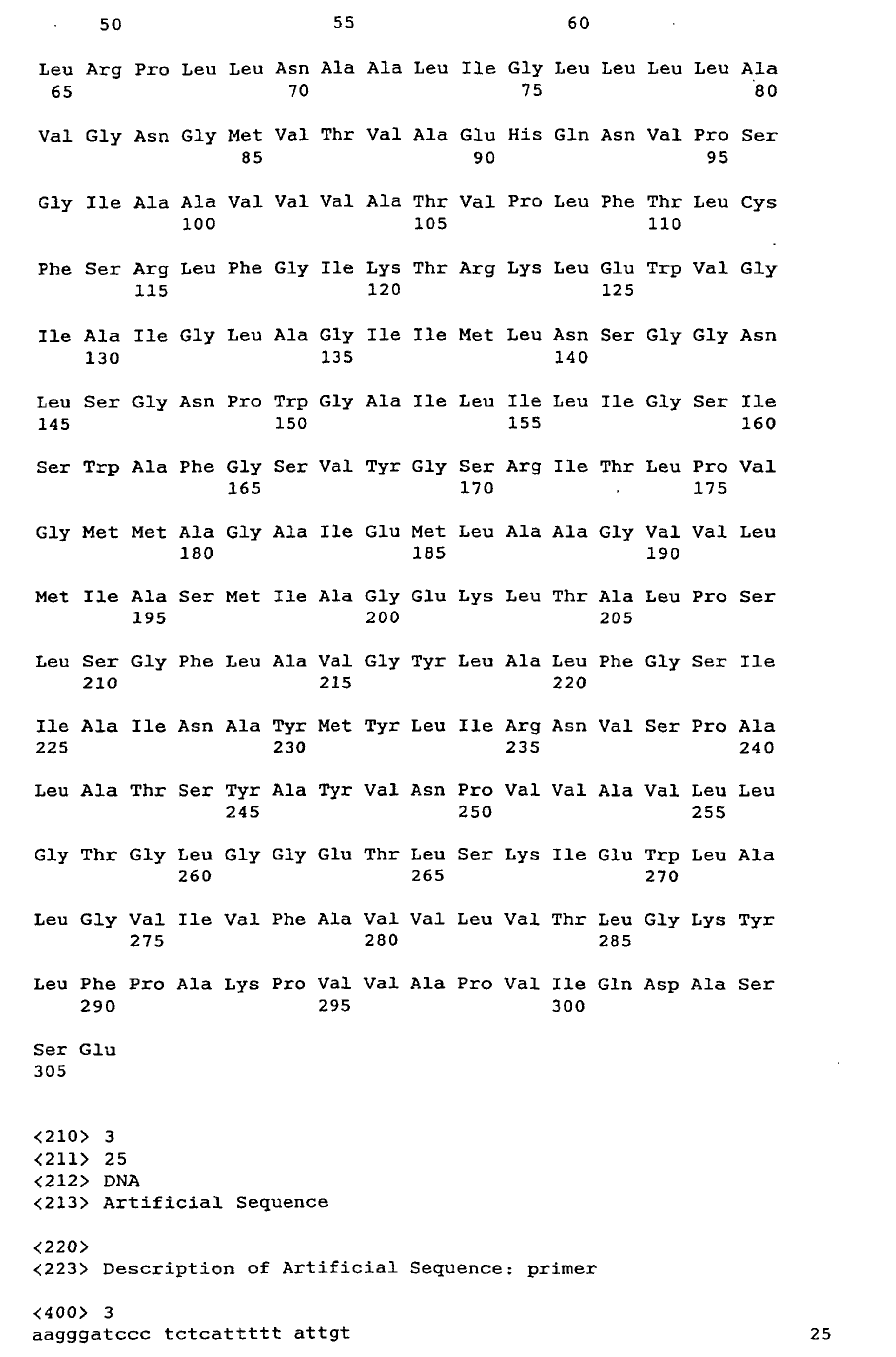
- the yedA gene can be obtained by, for example, PCR using primers based on the nucleotide sequence shown in SEQ ID No: 1.
- the enhancement of gene expression can be achieved by locating the DNA of the present invention under control of a potent promoter instead of the native promoter.
- Strength of promoter is defined by frequency of acts of the RNA synthesis initiation. Methods for evaluation the strength of promoter and an examples of potent promoters are described by Deuschle, U., Kammerer, W., Gentz, R., Bujard, H. (Promoters in Escherichia coli: a hierarchy of in vivo strength indicates alternate structures. EMBO J. 1986, 5, 2987-2994).
- P L promoter of lambda phage are known as potent constitutive promoter.
- Other known potent promoters are lac promoter, trp promoter, trc promoter, and the like. Using the potent promoter can be combined with multiplication of gene copies.
- a bacterium belonging to the genus Escherichia is not particularly limited so long as it has an ability to produce L-amino acid or it can be conferred the ability.
- the examples of the bacterium belonging to the genus Escherichia include Escherichia coli.
- a process for synthesizing lower alkyl ester of ⁇ -L-aspartyl-L-phenylalanine from L-phenylalanine and aspartic acid or its derivative is not particularly limited and any conventional method can be applied so long as L-phenylalanine or its derivative can be used for synthesis of lower alkyl ester of ⁇ -L-aspartyl-L-phenylalanine.
- lower alkyl ester of ⁇ -L-aspartyl-L-phenylalanine may be produced by the following process (US patent No.3,786,039).
- L-phenylalanine is esterified to obtain lower alkyl ester of L-phenylalanine.
- E. coli strain K-12 The entire nucleotide sequence of E. coli strain K-12 has already been determined (Science, 277, 1453-1474, 1997).
- a PSI-BLAST search revealed that at least 10 rhtA paralogues including yedA gene are present in the genome of E. coli K-12.
- the yedA gene encodes putative transmembrane subunit function of which is unknown.
- the phenylalanine-producing strain AJ12739 was transformed with the pYEDA2 plasmid or with the pAYCTER3 vector to obtain the AJ12739/pYEDA2 and AJ12739/pAYCTER3 strains. These strains were each cultivated at 37°C for 18 hours in a nutrient broth with 100 mg/l ampicillin, and 0.3 ml of the obtained culture was inoculated into 3 ml of a fermentation medium containing 100 mg/l ampicilline, in a 20 x 200 mm test tube, and cultivated at 37°C for 48 hours with a rotary shaker. After the cultivation, an accumulated amount of phenylalanine in the medium was determined by TLC.
Landscapes
- Chemical & Material Sciences (AREA)
- Organic Chemistry (AREA)
- Life Sciences & Earth Sciences (AREA)
- Engineering & Computer Science (AREA)
- Health & Medical Sciences (AREA)
- Wood Science & Technology (AREA)
- Zoology (AREA)
- Genetics & Genomics (AREA)
- Biochemistry (AREA)
- General Health & Medical Sciences (AREA)
- Biotechnology (AREA)
- Bioinformatics & Cheminformatics (AREA)
- General Engineering & Computer Science (AREA)
- Microbiology (AREA)
- Chemical Kinetics & Catalysis (AREA)
- General Chemical & Material Sciences (AREA)
- Medicinal Chemistry (AREA)
- Biophysics (AREA)
- Molecular Biology (AREA)
- Proteomics, Peptides & Aminoacids (AREA)
- Gastroenterology & Hepatology (AREA)
- Biomedical Technology (AREA)
- Virology (AREA)
- Tropical Medicine & Parasitology (AREA)
- Preparation Of Compounds By Using Micro-Organisms (AREA)
- Micro-Organisms Or Cultivation Processes Thereof (AREA)
Abstract
Description
cultivating the bacterium according the above acterium in a culture medium to produce and accumulate L-phenylalanine in the medium, said bacterium having L-phenylalanine productivity, and
synthesizing lower alkyl ester of α-L-aspartyl-L-phenylalanine from aspartic acid or its derivative and the obtained L-phenylalanine.
esterifying L-phenylalanine to generate a lower alkyl ester of L-phenylalanine,
condensing the lower alkyl ester of L-phenylalanine with the aspartic acid derivative, wherein the derivative is N-acyl-L-aspartic anhydride,
separating the lower alkyl ester of N-acyl-α-L-aspartyl-L-phenylalanine from the reaction mixture, and
hydrogenating the lower alkyl ester of N-acyl-α-L-aspartyl-L-phenylalanine to generate the lower alkyl ester of α-L-aspartyl-L-phenylalanine.
| Substrate | Concentration, mg/ml | Growth after 44 h | ||
| TG1 (pUC19) | TG1 (pYEDA1) | TG1 (pYEDA2) | ||
| - | - | + | + | + |
| L-phenylalanine | 20.0 | - | + | - |
| L-homoserine | 3.0 | - | + | n.d. |
| L-threonine | 50.0 | - | + | n.d. |
| L-cysteine | 7.5 | - | + | n.d. |
| L-histidine | 20.0 | - | + | n.d. |
| p-fluoro-DL-phenylalanine | 1.0 | - | + | + |
| p-fluoro-DL-phenylalanine | 2.0 | - | + | - |
| 5-fluoro-DL-tryptophane | 0.0005 | - | + | n.d. |
| S(2-aminoethyl)-L-cysteine | 0·4 | - | + | + |
| 4-aza-DL-leucine | 1.0 | - | + | n.d. |
| Glucose | 40.0 |
| (NH4)2SO4 | 16.0 |
| K2HPO4 | 1.0 |
| MgSO4 •7H2O | 1.0 |
| FeSO4 •7H2O | 0.01 |
| MnSO4 •5H2O | 0.01 |
| Thiamine- HCl | 0.0002 |
| Yeast extract | 2.0 |
| Tyrosine | 0.1 |
| CaCO3 | 30.0 |
| E. coli strain | OD600 | Phenylalanine, g/l |
| AJ12739(pAYCTER3) | 7.0 | 1.5 |
| AJ12739 (pAYCTER-YEDA2) | 7.5 | 1.8 |
| Glucose | 50.0 |
| (NH4)2SO4 | 10.0 |
| K2HPO4 | 1.0 |
| MgSO4 •7H2O | 0.4 |
| FeSO4 •7H2O | 0.02 |
| MnSO4 •5H2O | 0.02 |
| Thiamine-HCl | 0.0002 |
| Yeast extract | 1.0 |
| CaCO3 | 20.0 |
| E. coli strain | Threonine, g/l | Yield, (%) |
| MG442 (pUC19) | 2.9 | 5.8 |
| MG442 (pYEDA1) | 4.0 | 8.0 |


Claims (10)
- An L-amino acid producing bacterium belonging to the genus Escherichia wherein the L-amino acid production by said bacterium is enhanced by enhancing activity of a protein as defined in the following (A) or (B) in a cell of said bacterium:(A) a protein which comprises the amino acid sequence shown in SEQ ID NO:2 in Sequence listing;(B) a protein which comprises an amino acid sequence including deletion, substitution, insertion or addition of one or several amino acids in the amino acid sequence shown in SEQ ID NO:2 in Sequence listing, and which has an activity of making bacterium having enhanced resistance to an L-amino acid and/or an amino acid analog.
- The bacterium according to claim 1, wherein said activity of the protein as defined as (A) or (B) is enhanced by transformation of said bacterium with a DNA coding for the protein as defined in (A) or (B), or by alteration of expression regulation sequence of said DNA on the chromosome of the bacterium.
- The bacterium according to claim 2, wherein the transformation is performed with a multicopy vector containing said DNA.
- A method for producing an L-amino acid, which comprises cultivating the bacterium according to any of claims 1 to 3 in a culture medium and collecting from the culture medium the L-amino acid to be produced and accumulated in the medium.
- The method according to claim 4, wherein the L-amino acid to be produced is L-phenylalanine.
- The method according to claim 5, wherein the bacterium has enhanced expression of genes for phenylalanine biosynthesis.
- The method according to claim 4, wherein the L-amino acid to be produced is L-threonine.
- The method according to claim 7, wherein the bacterium has enhanced expression of threonine operon.
- A method for producing lower alkyl ester of α-L-aspartyl-L-phenylalanine, comprising
cultivating the bacterium according to any of claims 1 to 3 in a culture medium to produce and accumulate L-phenylalanine in the medium, said bacterium having L-phenylalanine productivity, and
synthesizing lower alkyl ester of α-L-aspartyl-L-phenylalanine from aspartic acid or its derivative and the obtained L-phenylalanine. - The method according to claim 9, further comprising
esterifying L-phenylalanine to generate a lower alkyl ester of L-phenylalanine,
condensing the lower alkyl ester of L-phenylalanine with the aspartic acid derivative, wherein the derivative is N-acyl-L-aspartic anhydride,
separating the lower alkyl ester of N-acyl-α-L-aspartyl-L-phenylalanine from the reaction mixture, and
hydrogenating the lower alkyl ester of N-acyl-α-L-aspartyl-L-phenylalanine to generate the lower alkyl ester of α-L-aspartyl-L-phenylalanine.
Priority Applications (1)
| Application Number | Priority Date | Filing Date | Title |
|---|---|---|---|
| EP06009979A EP1688482A1 (en) | 2001-11-23 | 2002-11-21 | Method for producing L-amino acid using bacteria belonging to the genus Escherichia |
Applications Claiming Priority (3)
| Application Number | Priority Date | Filing Date | Title |
|---|---|---|---|
| RU2001131570/13A RU2229513C2 (en) | 2001-11-23 | 2001-11-23 | Method for preparing l-amino acids, strain escherichia coli as producer of l-amino acids (variants) |
| RU2001131570 | 2001-11-23 | ||
| PCT/JP2002/012202 WO2003044191A1 (en) | 2001-11-23 | 2002-11-21 | Process for producing l-amino acid using escherichia |
Related Child Applications (1)
| Application Number | Title | Priority Date | Filing Date |
|---|---|---|---|
| EP06009979A Division EP1688482A1 (en) | 2001-11-23 | 2002-11-21 | Method for producing L-amino acid using bacteria belonging to the genus Escherichia |
Publications (3)
| Publication Number | Publication Date |
|---|---|
| EP1449917A1 true EP1449917A1 (en) | 2004-08-25 |
| EP1449917A4 EP1449917A4 (en) | 2005-01-26 |
| EP1449917B1 EP1449917B1 (en) | 2006-07-26 |
Family
ID=20254422
Family Applications (2)
| Application Number | Title | Priority Date | Filing Date |
|---|---|---|---|
| EP02788635A Expired - Lifetime EP1449917B1 (en) | 2001-11-23 | 2002-11-21 | Process for producing l-amino acid using escherichia |
| EP06009979A Withdrawn EP1688482A1 (en) | 2001-11-23 | 2002-11-21 | Method for producing L-amino acid using bacteria belonging to the genus Escherichia |
Family Applications After (1)
| Application Number | Title | Priority Date | Filing Date |
|---|---|---|---|
| EP06009979A Withdrawn EP1688482A1 (en) | 2001-11-23 | 2002-11-21 | Method for producing L-amino acid using bacteria belonging to the genus Escherichia |
Country Status (17)
| Country | Link |
|---|---|
| US (2) | US7259003B2 (en) |
| EP (2) | EP1449917B1 (en) |
| JP (1) | JP4305183B2 (en) |
| KR (1) | KR101023924B1 (en) |
| CN (1) | CN100469875C (en) |
| AR (1) | AR037583A1 (en) |
| AT (1) | ATE334190T1 (en) |
| AU (1) | AU2002355021C1 (en) |
| BR (1) | BR0214329B1 (en) |
| CA (1) | CA2468178C (en) |
| DE (1) | DE60213456T2 (en) |
| DK (1) | DK1449917T3 (en) |
| ES (1) | ES2269788T3 (en) |
| MX (1) | MXPA04004872A (en) |
| PL (1) | PL207851B1 (en) |
| RU (1) | RU2229513C2 (en) |
| WO (1) | WO2003044191A1 (en) |
Cited By (4)
| Publication number | Priority date | Publication date | Assignee | Title |
|---|---|---|---|---|
| WO2007086618A1 (en) | 2006-01-30 | 2007-08-02 | Ajinomoto Co., Inc. | L-amino acid producing bacterium and method of producing l-amino acid |
| EP2460873A1 (en) * | 2006-12-12 | 2012-06-06 | Ajinomoto Co., Inc. | A method for producing an L-amino acid using a bacterium of the Enterobacteriaceae family with attenuated expression of any of the cynT, cynS, cynX or cynR genes or a combination thereof |
| CN110418843A (en) * | 2018-02-23 | 2019-11-05 | Cj第一制糖株式会社 | The method that Novel L-tryptophan exports albumen and produces L-Trp using it |
| CN110592084A (en) * | 2019-08-28 | 2019-12-20 | 内蒙古伊品生物科技有限公司 | A recombinant strain modified by rhtA gene promoter and its construction method and application |
Families Citing this family (83)
| Publication number | Priority date | Publication date | Assignee | Title |
|---|---|---|---|---|
| US5976843A (en) * | 1992-04-22 | 1999-11-02 | Ajinomoto Co., Inc. | Bacterial strain of Escherichia coli BKIIM B-3996 as the producer of L-threonine |
| RU2144564C1 (en) * | 1998-10-13 | 2000-01-20 | Закрытое акционерное общество "Научно-исследовательский институт Аджиномото-Генетика" | Dna fragment rhtb encoding synthesis of protein rhtb that determines resistance of bacterium escherichia coli to l-homoserine and method of l-amino acid producing |
| US20060040364A1 (en) * | 1998-10-13 | 2006-02-23 | Livshits Vitaly A | DNA coding for a protein which imparts L-homoserine resistance to Escherichia coli bacterium, and a method for producing L-amino acids |
| RU2175351C2 (en) | 1998-12-30 | 2001-10-27 | Закрытое акционерное общество "Научно-исследовательский институт "Аджиномото-Генетика" (ЗАО "АГРИ") | Escherichia coli dna fragment determining enhanced production of l-amino acids (variants) and method of l-amino acid producing |
| RU2212447C2 (en) * | 2000-04-26 | 2003-09-20 | Закрытое акционерное общество "Научно-исследовательский институт Аджиномото-Генетика" | Strain escherichia coli as producer of amino acid (variants) and method for preparing amino acid (variants) |
| CN100529057C (en) * | 2001-02-13 | 2009-08-19 | 味之素株式会社 | Method for producing L-amino acid by Escherichia bacterium |
| RU2229513C2 (en) * | 2001-11-23 | 2004-05-27 | Закрытое акционерное общество "Научно-исследовательский институт Аджиномото-Генетика" | Method for preparing l-amino acids, strain escherichia coli as producer of l-amino acids (variants) |
| EP1449918B1 (en) * | 2001-11-23 | 2010-06-09 | Ajinomoto Co., Inc. | Process for producing l-amino acid using escherichia |
| RU2244007C2 (en) * | 2002-02-27 | 2005-01-10 | Закрытое акционерное общество "Научно-исследовательский институт Аджиномото-Генетика" | Method for preparing l-threonine, strain escherichia coli as producer of threonine (variants) |
| RU2273666C2 (en) * | 2003-02-26 | 2006-04-10 | Закрытое акционерное общество "Научно-исследовательский институт Аджиномото-Генетика" | Method for preparing l-amino acids by fermentation of mixture of glucose and pentoses |
| EP1604023A2 (en) * | 2003-03-12 | 2005-12-14 | Ajinomoto Co., Inc. | Optimization of bacterial sucab expression by promoter mutagenesis for efficient l-glutamic acid production |
| US7312058B2 (en) * | 2003-07-16 | 2007-12-25 | Ajinomoto Co., Ltd. | Mutant serine acetyltransferase |
| RU2275425C2 (en) * | 2003-11-03 | 2006-04-27 | Закрытое акционерное общество "Научно-исследовательский институт Аджиномото-Генетика" (ЗАО АГРИ) | Bacterium belonging to genus escherichia as producer of l-cysteine and method for preparing l-cysteine |
| US20050176033A1 (en) | 2003-11-10 | 2005-08-11 | Klyachko Elena V. | Mutant phosphoribosylpyrophosphate synthetase and method for producing L-histidine |
| RU2275424C2 (en) * | 2003-12-05 | 2006-04-27 | Закрытое акционерное общество "Научно-исследовательский институт Аджиномото-Генетика" (ЗАО АГРИ) | Method for preparing l-threonine by using bacterium belonging to genus escherichia |
| US7005333B2 (en) * | 2003-12-30 | 2006-02-28 | Infineon Technologies Ag | Transistor with silicon and carbon layer in the channel region |
| CN103146593B (en) | 2004-01-30 | 2015-07-15 | 味之素株式会社 | L-amino acid-producing microorganism and method for producing l-amino acid |
| US20050181488A1 (en) * | 2004-02-12 | 2005-08-18 | Akhverdian Valery Z. | Method for producing L-threonine using bacteria belonging to the genus Escherichia |
| US20050191684A1 (en) * | 2004-02-25 | 2005-09-01 | Zimenkov Danila V. | Method for producing L-amino acids |
| BRPI0509056A (en) * | 2004-03-31 | 2007-08-21 | Ajinomoto Kk | bacteria belonging to the genus bacillus or genus escherichia, and methods for producing a purine nucleoside, for producing a purine nucleotide, and for producing 5'-guanylic acid |
| JP4604537B2 (en) * | 2004-03-31 | 2011-01-05 | 味の素株式会社 | L-cysteine producing bacterium and method for producing L-cysteine |
| RU2306338C2 (en) * | 2004-06-24 | 2007-09-20 | Закрытое акционерное общество "Научно-исследовательский институт Аджиномото-Генетика" (ЗАО АГРИ) | Mob'-DERIVED RSF1010 PLASMID CONTAINING NO ANTIBIOTIC-RESISTANCE GENES, BACTERIUM CONTAINING SUCH PLASMID AND METHOD FOR PRODUCTION OF USEFUL METABOLITES |
| US7915018B2 (en) | 2004-10-22 | 2011-03-29 | Ajinomoto Co., Inc. | Method for producing L-amino acids using bacteria of the Enterobacteriaceae family |
| EP1848811B1 (en) | 2005-02-18 | 2009-08-05 | Ajinomoto Co., Inc. | A method for producing an l-amino acid using a bacterium of the enterobacteriaceae family |
| WO2006123764A1 (en) * | 2005-05-16 | 2006-11-23 | Ajinomoto Co., Inc. | A method for producing an l-amino acid using a bacterium of the enterobacteriaceae family with attenuated expression of the kefb gene |
| EP1976994A1 (en) * | 2006-01-26 | 2008-10-08 | Ajinomoto Co., Inc. | A method for producing an l-amino acid using a bacterium of enterobacteriaceae family with attenuated expression of the aldh gene |
| JP2009095237A (en) * | 2006-02-02 | 2009-05-07 | Ajinomoto Co Inc | Method for producing l-amino acid |
| JP2009118740A (en) | 2006-03-03 | 2009-06-04 | Ajinomoto Co Inc | Method for producing l-amino acid |
| WO2007119574A2 (en) * | 2006-03-23 | 2007-10-25 | Ajinomoto Co., Inc. | A method for producing an l-amino acid using bacterium of the enterobacteriaceae family with attenuated expression of a gene coding for small rna |
| EP2007873B1 (en) * | 2006-04-18 | 2015-11-18 | Ajinomoto Co., Inc. | A METHOD FOR PRODUCING AN L-AMINO ACID USING A BACTERIUM OF THE ENTEROBACTERIACEAE FAMILY WITH ATTENUATED EXPRESSION OF THE sfmACDFH-fimZ CLUSTER OR THE fimZ GENE |
| JP2009165355A (en) | 2006-04-28 | 2009-07-30 | Ajinomoto Co Inc | L-amino acid-producing microorganism and method for producing l-amino acid |
| WO2007139219A1 (en) | 2006-06-01 | 2007-12-06 | Ajinomoto Co., Inc. | A method for producing an l-amino acid using a bacterium of the enterobacteriaceae family with attenuated expression of the rcsa gene |
| RU2337961C2 (en) * | 2006-07-04 | 2008-11-10 | Закрытое акционерное общество "Научно-исследовательский институт Аджиномото-Генетика" (ЗАО АГРИ) | METHOD OF OBTAINING L-THREONINE USING BACTERIUM, BELONGING TO GENUS Escherichia, IN WHICH OPERON rspAB IS INACTIVATED |
| RU2006129690A (en) | 2006-08-16 | 2008-02-27 | Закрытое акционерное общество "Научно-исследовательский институт Аджиномото-Генетика" (ЗАО АГРИ) (RU) | METHOD FOR PRODUCING L-AMINO ACID USING BACTERIA OF THE Enterobacteriaceae FAMILY IN WHICH EXPRESSION OF THE ydiN GENE, ydiB GENE OR THEIR COMBINATION IS DECREASED |
| JP2010017082A (en) * | 2006-10-10 | 2010-01-28 | Ajinomoto Co Inc | Method for producing l-amino acid |
| JP2010041920A (en) | 2006-12-19 | 2010-02-25 | Ajinomoto Co Inc | Method for producing l-amino acid |
| RU2365622C2 (en) | 2006-12-22 | 2009-08-27 | Закрытое акционерное общество "Научно-исследовательский институт Аджиномото-Генетика" (ЗАО АГРИ) | METHOD OF PURINE NUCLEOZIDES AND NUCLEOTIDES PRODUCTION BY FERMENTATION WITH APPLICATION OF BACTERIA BELONGING TO GENUS Escherichia OR Bacillus |
| BRPI0806790B1 (en) | 2007-01-22 | 2017-02-14 | Ajinomoto Kk | microorganism, and method for producing an 1-amino acid |
| JP2010110216A (en) | 2007-02-20 | 2010-05-20 | Ajinomoto Co Inc | Method for producing l-amino acid or nucleic acid |
| RU2392326C2 (en) * | 2007-02-20 | 2010-06-20 | Закрытое акционерное общество "Научно-исследовательский институт Аджиномото-Генетика" (ЗАО АГРИ) | METHOD OF L-TREONIN MANUFACTURE USING BACTERIA OF Escherichia GENUS WITH INACTIVATED OPERON ycbPONME OPERON (ssuEADCB) |
| JP2010110217A (en) | 2007-02-22 | 2010-05-20 | Ajinomoto Co Inc | L-amino acid-producing microorganism and method for producing l-amino acid |
| RU2395567C2 (en) * | 2007-03-22 | 2010-07-27 | Закрытое акционерное общество "Научно-исследовательский институт Аджиномото-Генетика" (ЗАО АГРИ) | METHOD OF PRODUCING L-AMINO ACIDS USING Escherichia BACTERIA, IN WHICH ONE OR MORE SMALL RNA CODING GENES ARE INACTIVATED |
| RU2396349C2 (en) * | 2007-04-03 | 2010-08-10 | Закрытое акционерное общество "Научно-исследовательский институт Аджиномото-Генетика" (ЗАО АГРИ) | METHOD OF OBTAINING L-THREONINE USING Escherichia GENUS BACTERIA IN WHICH ygiD GENE IS INACTIVATE |
| RU2396337C2 (en) * | 2007-07-24 | 2010-08-10 | Закрытое акционерное общество "Научно-исследовательский институт Аджиномото-Генетика" (ЗАО АГРИ) | METHOD FOR OBTAINING L-THREONINE USING Escherichia GENUS BACTERIA IN WHICH yncD GENE IS INACTIVATED |
| RU2392327C2 (en) * | 2007-08-14 | 2010-06-20 | Закрытое акционерное общество "Научно-исследовательский институт Аджиномото-Генетика" (ЗАО АГРИ) | METHOD OF L-THREONIN OR L-ARGININE MANUFACTURE USING BACTERIUM OF Escherichia GENUS WITH INACTIVATED GENE chaC OR OPERON chaBC |
| RU2395579C2 (en) * | 2007-12-21 | 2010-07-27 | Закрытое акционерное общество "Научно-исследовательский институт Аджиномото-Генетика" (ЗАО АГРИ) | METHOD OF PRODUCING L-AMINO ACIDS USING Escherichia GENUS BACTERIA |
| WO2009031565A1 (en) | 2007-09-04 | 2009-03-12 | Ajinomoto Co., Inc. | Amino acid-producing microorganism and method of producing amino acid |
| RU2396336C2 (en) | 2007-09-27 | 2010-08-10 | Закрытое акционерное общество "Научно-исследовательский институт Аджиномото-Генетика" (ЗАО АГРИ) | METHOD OF PRODUCING AMINO ACIDS USING Escherichia GENUS BACTERIA |
| JP2011067095A (en) | 2008-01-10 | 2011-04-07 | Ajinomoto Co Inc | Method for producing target substance by fermentation process |
| JP5526785B2 (en) | 2008-01-23 | 2014-06-18 | 味の素株式会社 | Method for producing L-amino acid |
| RU2008105793A (en) | 2008-02-19 | 2009-08-27 | Закрытое акционерное общество "Научно-исследовательский институт Аджиномото-Генетика" (ЗАО АГРИ) (RU) | METHOD FOR DESIGNING OPERONS CONTAINING TRANSLATION-CONJUGATED GENES, BACTERIA CONTAINING SUCH OPERON, METHOD FOR PRODUCING USEFUL METABOLITIS AND METHOD FOR EXPRESS MONITORING |
| ES2624913T3 (en) | 2008-09-08 | 2017-07-18 | Ajinomoto Co., Inc. | Microorganism that produces an L-amino acid and procedure to produce an L-amino acid |
| RU2008148283A (en) * | 2008-12-09 | 2010-06-20 | Закрытое акционерное общество "Научно-исследовательский институт Аджиномото-Генетика" (ЗАО АГРИ) (RU) | METHOD FOR PRODUCING L-ARGININE USING THE BACTERIA OF THE ENTEROBACTERIACEAE FAMILY IN WHICH THE EXPRESSION OF THE ARTI GENE WAS DECREASED |
| EP2382320B1 (en) | 2009-01-23 | 2018-04-18 | Ajinomoto Co., Inc. | Process for producing l-amino acids employing bacteria of the enterobacteriacea family in a culture medium with controlled glycerol concentration |
| JPWO2011013707A1 (en) | 2009-07-29 | 2013-01-10 | 味の素株式会社 | Method for producing L-amino acid |
| JP2012223092A (en) | 2009-08-28 | 2012-11-15 | Ajinomoto Co Inc | Method for producing l-amino acid |
| JP2013013329A (en) | 2009-11-06 | 2013-01-24 | Ajinomoto Co Inc | Method for producing l-amino acid |
| RU2460793C2 (en) | 2010-01-15 | 2012-09-10 | Закрытое акционерное общество "Научно-исследовательский институт "Аджиномото-Генетика" (ЗАО АГРИ) | Method for producing l-amino acids with use of bacteria of enterobacteriaceae family |
| JP2013074795A (en) | 2010-02-08 | 2013-04-25 | Ajinomoto Co Inc | MUTANT rpsA GENE AND METHOD FOR PRODUCING L-AMINO ACID |
| RU2471868C2 (en) | 2010-02-18 | 2013-01-10 | Закрытое акционерное общество "Научно-исследовательский институт "Аджиномото-Генетика" (ЗАО АГРИ) | Mutant adenylate cyclase, dna coding it, bacteria of enterobacteriaceae family containing said dan and method for preparing l-amino acids |
| RU2471870C2 (en) | 2010-06-03 | 2013-01-10 | Закрытое акционерное общество "Научно-исследовательский институт "Аджиномото-Генетика" (ЗАО АГРИ) | METHOD FOR PRODUCING L-ARGININE AND L-CITRULLINE WITH USE OF BACTERIA OF ENTEROBACTERIACEAE FAMILY WITH ATTENUATED pepA GENE EXPRESSION |
| RU2497943C2 (en) * | 2010-07-15 | 2013-11-10 | Закрытое акционерное общество "Научно-исследовательский институт "Аджиномото-Генетика" (ЗАО АГРИ) | METHOD OF PRODUCTION OF L-AMINO ACIDS USING BACTERIA OF FAMILY Enterobacteriaceae |
| RU2501858C2 (en) | 2010-07-21 | 2013-12-20 | Закрытое акционерное общество "Научно-исследовательский институт "Аджиномото-Генетика" (ЗАО АГРИ) | METHOD FOR OBTAINING L-AMINOACID USING BACTERIUM OF Enterobacteriaceae FAMILY |
| RU2482188C2 (en) | 2010-07-21 | 2013-05-20 | Закрытое акционерное общество "Научно-исследовательский институт "Аджиномото-Генетика" (ЗАО АГРИ) | METHOD FOR PREPARING L-ARGININE WITH USE OF BACTERIA OF GENUS Escherichia WHEREIN astCADBE OPERON IS INACTIVATED |
| JP2014036576A (en) | 2010-12-10 | 2014-02-27 | Ajinomoto Co Inc | Method for producing l-amino acids |
| RU2011134436A (en) | 2011-08-18 | 2013-10-27 | Закрытое акционерное общество "Научно-исследовательский институт Аджиномото-Генетика" (ЗАО "АГРИ") | METHOD FOR PRODUCING L-AMINO ACID USING THE ENTEROBACTERIACEAE FAMILY POSSESSING AN INCREASED EXPRESSION OF GENES OF THE CASCADE OF THE FORMATION OF FLAGELLS AND CELL MOBILITY |
| RU2013118637A (en) | 2013-04-23 | 2014-10-27 | Закрытое акционерное общество "Научно-исследовательский институт Аджиномото-Генетика" (ЗАО "АГРИ") | METHOD FOR PRODUCING L-AMINO ACIDS USING THE BACTERIA OF THE ENTEROBACTERIACEAE FAMILY IN WHICH THE yjjK GENE IS ADJUSTABLE |
| RU2013140115A (en) | 2013-08-30 | 2015-03-10 | Закрытое акционерное общество "Научно-исследовательский институт Аджиномото-Генетика" (ЗАО "АГРИ") | METHOD FOR PRODUCING L-AMINO ACIDS USING THE BACTERIA OF THE Enterobacteriaceae FAMILY IN WHICH THE EXPRESSION OF THE znuACB GENERAL CLUSTER IS DISORDERED |
| JP2016192903A (en) | 2013-09-17 | 2016-11-17 | 味の素株式会社 | Method for manufacturing l-amino acid from biomass derived from seaweed |
| RU2013144250A (en) | 2013-10-02 | 2015-04-10 | Закрытое акционерное общество "Научно-исследовательский институт Аджиномото-Генетика" (ЗАО "АГРИ") | METHOD FOR PRODUCING L-AMINO ACIDS USING THE BACTERIA OF THE Enterobacteriaceae FAMILY IN WHICH THE EXPRESSION OF A GENE CODING A PHOSPHATE TRANSPORTER IS DECREASED |
| CN106459857B (en) | 2013-10-02 | 2019-04-19 | 味之素株式会社 | Ammonia control device and ammonia control method |
| JP6459962B2 (en) | 2013-10-21 | 2019-01-30 | 味の素株式会社 | Method for producing L-amino acid |
| RU2014105547A (en) | 2014-02-14 | 2015-08-20 | Адзиномото Ко., Инк. | METHOD FOR PRODUCING L-AMINO ACIDS USING THE ENTEROBACTERIACEAE FAMILY HAVING A SUPER EXPRESSED GENE yajL |
| RU2015120052A (en) | 2015-05-28 | 2016-12-20 | Аджиномото Ко., Инк. | A method for producing an L-amino acid using a bacterium of the Enterobacteriaceae family in which gshA gene expression is weakened |
| CN108463555A (en) | 2016-01-12 | 2018-08-28 | 味之素株式会社 | The method for producing benzaldehyde |
| WO2017146195A1 (en) | 2016-02-25 | 2017-08-31 | Ajinomoto Co., Inc. | A method for producing l-amino acids using a bacterium of the family enterobacteriaceae overexpressing a gene encoding an iron exporter |
| JP7066977B2 (en) | 2017-04-03 | 2022-05-16 | 味の素株式会社 | Manufacturing method of L-amino acid |
| EP3861109A1 (en) | 2018-10-05 | 2021-08-11 | Ajinomoto Co., Inc. | Method for producing target substance by bacterial fermentation |
| BR112021014194A2 (en) | 2019-02-22 | 2021-12-28 | Ajinomoto Kk | Method for producing an l-amino acid |
| BR112021017870A2 (en) | 2019-04-05 | 2021-12-07 | Ajinomoto Kk | Method for producing an l-amino acid |
| JP7655312B2 (en) | 2019-09-25 | 2025-04-02 | 味の素株式会社 | Method for producing L-amino acids by bacterial fermentation |
| WO2021085405A1 (en) | 2019-10-28 | 2021-05-06 | 味の素株式会社 | Benzaldehyde production method |
| EP4505875A1 (en) | 2022-04-04 | 2025-02-12 | Ajinomoto Co., Inc. | Method for controlling parasitic plants |
Family Cites Families (33)
| Publication number | Priority date | Publication date | Assignee | Title |
|---|---|---|---|---|
| US3786039A (en) * | 1969-04-30 | 1974-01-15 | Ajinomoto Kk | Method of producing alpha-l-aspartyl-l-phenylalanine lower alkyl esters |
| SU875663A1 (en) * | 1978-06-30 | 1982-09-15 | Всесоюзный научно-исследовательский институт генетики и селекции промышленных микроорганизмов | Strains e. coli vniigenetika voltage 334 ru no.6 and vniigenetika voltage 334 no.7 producersof l-treonite and method for preparing them |
| SU974817A1 (en) | 1981-06-16 | 1990-08-23 | Всесоюзный научно-исследовательский институт генетики и селекции промышленных микроорганизмов | Method of producing l-treonin |
| US4783403A (en) * | 1984-02-08 | 1988-11-08 | Kyowa Hakko Kogyo Co., Ltd. | Process for producing l-phenylalanine |
| SU1694643A1 (en) * | 1987-11-26 | 1991-11-30 | Всесоюзный научно-исследовательский институт генетики и селекции промышленных микроорганизмов | Strain of bacteria escherichia coli - a producer of l-threonine |
| US5705371A (en) * | 1990-06-12 | 1998-01-06 | Ajinomoto Co., Inc. | Bacterial strain of escherichia coli BKIIM B-3996 as the producer of L-threonine |
| US5976843A (en) * | 1992-04-22 | 1999-11-02 | Ajinomoto Co., Inc. | Bacterial strain of Escherichia coli BKIIM B-3996 as the producer of L-threonine |
| JPH03501682A (en) * | 1988-10-25 | 1991-04-18 | 味の素株式会社 | Escherichia coli BKIIM strain B-3996 as an L-threonine producer |
| US5534421A (en) * | 1991-05-30 | 1996-07-09 | Ajinomoto Co., Inc. | Production of isoleucine by escherichia coli having isoleucine auxotrophy and no negative feedback inhibition of isoleucine production |
| US6132999A (en) * | 1992-09-21 | 2000-10-17 | Ajinomoto Co., Inc. | L-threonine-producing microbacteria and a method for the production of L-threonine |
| WO1996038418A1 (en) * | 1995-06-02 | 1996-12-05 | G.D. Searle & Co. | Heterocyclo substituted hydroxamic acid derivatives as cyclooxygenase-2 and 5-lipoxygenase inhibitors |
| JP4032441B2 (en) | 1995-08-30 | 2008-01-16 | 味の素株式会社 | Method for producing L-amino acid |
| DE19548222A1 (en) | 1995-12-22 | 1997-06-26 | Forschungszentrum Juelich Gmbh | Process for the microbial production of amino acids through increased activity of export carriers |
| DE19726083A1 (en) * | 1997-06-19 | 1998-12-24 | Consortium Elektrochem Ind | Microorganisms and processes for the fermentative production of L-cysteine, L-cystine, N-acetyl-serine or thiazolidine derivatives |
| RU2144564C1 (en) * | 1998-10-13 | 2000-01-20 | Закрытое акционерное общество "Научно-исследовательский институт Аджиномото-Генетика" | Dna fragment rhtb encoding synthesis of protein rhtb that determines resistance of bacterium escherichia coli to l-homoserine and method of l-amino acid producing |
| RU2148642C1 (en) * | 1998-12-23 | 2000-05-10 | ЗАО "Научно-исследовательский институт АДЖИНОМОТО-Генетика" (ЗАО "АГРИ") | Dna rhtc fragment encoding synthesis of rhtc protein that determines enhanced resistance of bacterium escherichia coli to l-threonine and method of l-amino acid producing |
| RU2175351C2 (en) * | 1998-12-30 | 2001-10-27 | Закрытое акционерное общество "Научно-исследовательский институт "Аджиномото-Генетика" (ЗАО "АГРИ") | Escherichia coli dna fragment determining enhanced production of l-amino acids (variants) and method of l-amino acid producing |
| RU2209246C2 (en) * | 2000-01-26 | 2003-07-27 | Закрытое акционерное общество "Научно-исследовательский институт Аджиномото-Генетика" | Small subunit of isozyme iii and isozyme iii of acetohydroxyacid synthetase from escherichia coli, dna fragment (variants), strain of bacterium escherichia coli as producer of l-valine (variants) and method for preparing l-valine |
| KR20020097200A (en) * | 2000-03-21 | 2002-12-31 | 엘리트라 파마슈티컬즈, 인코포레이티드 | Identification of essential genes in prokaryotes |
| RU2212447C2 (en) * | 2000-04-26 | 2003-09-20 | Закрытое акционерное общество "Научно-исследовательский институт Аджиномото-Генетика" | Strain escherichia coli as producer of amino acid (variants) and method for preparing amino acid (variants) |
| CN100529057C (en) * | 2001-02-13 | 2009-08-19 | 味之素株式会社 | Method for producing L-amino acid by Escherichia bacterium |
| RU2229513C2 (en) * | 2001-11-23 | 2004-05-27 | Закрытое акционерное общество "Научно-исследовательский институт Аджиномото-Генетика" | Method for preparing l-amino acids, strain escherichia coli as producer of l-amino acids (variants) |
| EP1449918B1 (en) * | 2001-11-23 | 2010-06-09 | Ajinomoto Co., Inc. | Process for producing l-amino acid using escherichia |
| RU2244007C2 (en) * | 2002-02-27 | 2005-01-10 | Закрытое акционерное общество "Научно-исследовательский институт Аджиномото-Генетика" | Method for preparing l-threonine, strain escherichia coli as producer of threonine (variants) |
| EP1604023A2 (en) * | 2003-03-12 | 2005-12-14 | Ajinomoto Co., Inc. | Optimization of bacterial sucab expression by promoter mutagenesis for efficient l-glutamic acid production |
| RU2268300C2 (en) * | 2003-04-07 | 2006-01-20 | Закрытое акционерное общество "Научно-исследовательский институт Аджиномото-Генетика" | METHOD FOR PREPARING L-AMINO ACIDS BY USING MICROORGANISMS POSSESSING ENHANCED EXPRESSION OF pckA GENE |
| US7312058B2 (en) * | 2003-07-16 | 2007-12-25 | Ajinomoto Co., Ltd. | Mutant serine acetyltransferase |
| RU2275424C2 (en) * | 2003-12-05 | 2006-04-27 | Закрытое акционерное общество "Научно-исследовательский институт Аджиномото-Генетика" (ЗАО АГРИ) | Method for preparing l-threonine by using bacterium belonging to genus escherichia |
| US20050181488A1 (en) * | 2004-02-12 | 2005-08-18 | Akhverdian Valery Z. | Method for producing L-threonine using bacteria belonging to the genus Escherichia |
| US20050191684A1 (en) * | 2004-02-25 | 2005-09-01 | Zimenkov Danila V. | Method for producing L-amino acids |
| US8003367B2 (en) * | 2004-03-16 | 2011-08-23 | Ajinomoto Co., Inc. | Method for producing L-amino acids by fermentation using bacteria having enhanced expression of xylose utilization genes |
| RU2306338C2 (en) * | 2004-06-24 | 2007-09-20 | Закрытое акционерное общество "Научно-исследовательский институт Аджиномото-Генетика" (ЗАО АГРИ) | Mob'-DERIVED RSF1010 PLASMID CONTAINING NO ANTIBIOTIC-RESISTANCE GENES, BACTERIUM CONTAINING SUCH PLASMID AND METHOD FOR PRODUCTION OF USEFUL METABOLITES |
| US7915018B2 (en) * | 2004-10-22 | 2011-03-29 | Ajinomoto Co., Inc. | Method for producing L-amino acids using bacteria of the Enterobacteriaceae family |
-
2001
- 2001-11-23 RU RU2001131570/13A patent/RU2229513C2/en active
-
2002
- 2002-11-21 AU AU2002355021A patent/AU2002355021C1/en not_active Ceased
- 2002-11-21 WO PCT/JP2002/012202 patent/WO2003044191A1/en not_active Ceased
- 2002-11-21 CA CA2468178A patent/CA2468178C/en not_active Expired - Fee Related
- 2002-11-21 AT AT02788635T patent/ATE334190T1/en not_active IP Right Cessation
- 2002-11-21 EP EP02788635A patent/EP1449917B1/en not_active Expired - Lifetime
- 2002-11-21 KR KR1020047007782A patent/KR101023924B1/en not_active Expired - Fee Related
- 2002-11-21 ES ES02788635T patent/ES2269788T3/en not_active Expired - Lifetime
- 2002-11-21 DE DE60213456T patent/DE60213456T2/en not_active Expired - Lifetime
- 2002-11-21 BR BRPI0214329-1A patent/BR0214329B1/en not_active IP Right Cessation
- 2002-11-21 DK DK02788635T patent/DK1449917T3/en active
- 2002-11-21 CN CNB028274784A patent/CN100469875C/en not_active Expired - Fee Related
- 2002-11-21 EP EP06009979A patent/EP1688482A1/en not_active Withdrawn
- 2002-11-21 JP JP2003545812A patent/JP4305183B2/en not_active Expired - Fee Related
- 2002-11-21 MX MXPA04004872A patent/MXPA04004872A/en active IP Right Grant
- 2002-11-21 PL PL369776A patent/PL207851B1/en unknown
- 2002-11-22 AR ARP020104507A patent/AR037583A1/en active IP Right Grant
- 2002-11-25 US US10/302,983 patent/US7259003B2/en not_active Expired - Fee Related
-
2007
- 2007-06-12 US US11/761,465 patent/US7531332B2/en not_active Expired - Fee Related
Cited By (5)
| Publication number | Priority date | Publication date | Assignee | Title |
|---|---|---|---|---|
| WO2007086618A1 (en) | 2006-01-30 | 2007-08-02 | Ajinomoto Co., Inc. | L-amino acid producing bacterium and method of producing l-amino acid |
| EP2460873A1 (en) * | 2006-12-12 | 2012-06-06 | Ajinomoto Co., Inc. | A method for producing an L-amino acid using a bacterium of the Enterobacteriaceae family with attenuated expression of any of the cynT, cynS, cynX or cynR genes or a combination thereof |
| CN110418843A (en) * | 2018-02-23 | 2019-11-05 | Cj第一制糖株式会社 | The method that Novel L-tryptophan exports albumen and produces L-Trp using it |
| CN110418843B (en) * | 2018-02-23 | 2021-04-20 | Cj第一制糖株式会社 | Novel L-tryptophan export protein and method for producing L-tryptophan using the same |
| CN110592084A (en) * | 2019-08-28 | 2019-12-20 | 内蒙古伊品生物科技有限公司 | A recombinant strain modified by rhtA gene promoter and its construction method and application |
Also Published As
| Publication number | Publication date |
|---|---|
| ATE334190T1 (en) | 2006-08-15 |
| AR037583A1 (en) | 2004-11-17 |
| RU2229513C2 (en) | 2004-05-27 |
| AU2002355021B2 (en) | 2007-12-13 |
| US7531332B2 (en) | 2009-05-12 |
| CN100469875C (en) | 2009-03-18 |
| KR20050044573A (en) | 2005-05-12 |
| KR101023924B1 (en) | 2011-03-22 |
| US20030148473A1 (en) | 2003-08-07 |
| PL207851B1 (en) | 2011-02-28 |
| JP4305183B2 (en) | 2009-07-29 |
| CA2468178C (en) | 2014-06-17 |
| DE60213456D1 (en) | 2006-09-07 |
| MXPA04004872A (en) | 2004-09-03 |
| BR0214329A (en) | 2004-11-03 |
| AU2002355021C1 (en) | 2009-03-19 |
| DE60213456T2 (en) | 2007-03-01 |
| EP1688482A1 (en) | 2006-08-09 |
| CA2468178A1 (en) | 2003-05-30 |
| EP1449917B1 (en) | 2006-07-26 |
| WO2003044191A1 (en) | 2003-05-30 |
| AU2002355021A1 (en) | 2003-06-10 |
| BR0214329B1 (en) | 2014-07-22 |
| US7259003B2 (en) | 2007-08-21 |
| EP1449917A4 (en) | 2005-01-26 |
| US20080153138A1 (en) | 2008-06-26 |
| DK1449917T3 (en) | 2006-11-27 |
| JPWO2003044191A1 (en) | 2005-03-24 |
| ES2269788T3 (en) | 2007-04-01 |
| PL369776A1 (en) | 2005-05-02 |
| CN1615360A (en) | 2005-05-11 |
Similar Documents
| Publication | Publication Date | Title |
|---|---|---|
| US7259003B2 (en) | Escherichia bacteria transformed with a yedA homolog to enhance L-amino acid producing activity, and methods for producing an L-amino acid using same | |
| EP1449918B1 (en) | Process for producing l-amino acid using escherichia | |
| CN101558163B (en) | Method for production of L-amino acid | |
| KR101188646B1 (en) | Method for producing L-amino acids using bacteria of the Enterobacteriaceae family | |
| WO2011055710A1 (en) | Method for producing l-amino acid |
Legal Events
| Date | Code | Title | Description |
|---|---|---|---|
| PUAI | Public reference made under article 153(3) epc to a published international application that has entered the european phase |
Free format text: ORIGINAL CODE: 0009012 |
|
| 17P | Request for examination filed |
Effective date: 20040614 |
|
| AK | Designated contracting states |
Kind code of ref document: A1 Designated state(s): AT BE BG CH CY CZ DE DK EE ES FI FR GB GR IE IT LI LU MC NL PT SE SK TR |
|
| RTI1 | Title (correction) |
Free format text: PROCESS FOR PRODUCING L-AMINO ACID USING ESCHERICHIA |
|
| A4 | Supplementary search report drawn up and despatched |
Effective date: 20041210 |
|
| RIC1 | Information provided on ipc code assigned before grant |
Ipc: 7C 07K 14/245 B Ipc: 7C 12N 1/21 A Ipc: 7C 12N 15/31 B Ipc: 7C 12P 13/08 B Ipc: 7C 12P 13/22 B Ipc: 7C 12P 13/04 B Ipc: 7C 07K 5/06 B |
|
| GRAP | Despatch of communication of intention to grant a patent |
Free format text: ORIGINAL CODE: EPIDOSNIGR1 |
|
| GRAS | Grant fee paid |
Free format text: ORIGINAL CODE: EPIDOSNIGR3 |
|
| GRAA | (expected) grant |
Free format text: ORIGINAL CODE: 0009210 |
|
| AK | Designated contracting states |
Kind code of ref document: B1 Designated state(s): AT BE BG CH CY CZ DE DK EE ES FI FR GB GR IE IT LI LU MC NL PT SE SK TR |
|
| PG25 | Lapsed in a contracting state [announced via postgrant information from national office to epo] |
Ref country code: CZ Free format text: LAPSE BECAUSE OF FAILURE TO SUBMIT A TRANSLATION OF THE DESCRIPTION OR TO PAY THE FEE WITHIN THE PRESCRIBED TIME-LIMIT Effective date: 20060726 Ref country code: FI Free format text: LAPSE BECAUSE OF FAILURE TO SUBMIT A TRANSLATION OF THE DESCRIPTION OR TO PAY THE FEE WITHIN THE PRESCRIBED TIME-LIMIT Effective date: 20060726 Ref country code: SK Free format text: LAPSE BECAUSE OF FAILURE TO SUBMIT A TRANSLATION OF THE DESCRIPTION OR TO PAY THE FEE WITHIN THE PRESCRIBED TIME-LIMIT Effective date: 20060726 Ref country code: AT Free format text: LAPSE BECAUSE OF FAILURE TO SUBMIT A TRANSLATION OF THE DESCRIPTION OR TO PAY THE FEE WITHIN THE PRESCRIBED TIME-LIMIT Effective date: 20060726 Ref country code: IT Free format text: LAPSE BECAUSE OF FAILURE TO SUBMIT A TRANSLATION OF THE DESCRIPTION OR TO PAY THE FEE WITHIN THE PRESCRIBED TIME-LIMIT;WARNING: LAPSES OF ITALIAN PATENTS WITH EFFECTIVE DATE BEFORE 2007 MAY HAVE OCCURRED AT ANY TIME BEFORE 2007. THE CORRECT EFFECTIVE DATE MAY BE DIFFERENT FROM THE ONE RECORDED. Effective date: 20060726 |
|
| REG | Reference to a national code |
Ref country code: GB Ref legal event code: FG4D |
|
| REG | Reference to a national code |
Ref country code: CH Ref legal event code: EP |
|
| REG | Reference to a national code |
Ref country code: IE Ref legal event code: FG4D |
|
| REF | Corresponds to: |
Ref document number: 60213456 Country of ref document: DE Date of ref document: 20060907 Kind code of ref document: P |
|
| REG | Reference to a national code |
Ref country code: CH Ref legal event code: NV Representative=s name: A. BRAUN, BRAUN, HERITIER, ESCHMANN AG PATENTANWAE |
|
| PG25 | Lapsed in a contracting state [announced via postgrant information from national office to epo] |
Ref country code: BG Free format text: LAPSE BECAUSE OF FAILURE TO SUBMIT A TRANSLATION OF THE DESCRIPTION OR TO PAY THE FEE WITHIN THE PRESCRIBED TIME-LIMIT Effective date: 20061026 Ref country code: SE Free format text: LAPSE BECAUSE OF FAILURE TO SUBMIT A TRANSLATION OF THE DESCRIPTION OR TO PAY THE FEE WITHIN THE PRESCRIBED TIME-LIMIT Effective date: 20061026 |
|
| REG | Reference to a national code |
Ref country code: DK Ref legal event code: T3 |
|
| PG25 | Lapsed in a contracting state [announced via postgrant information from national office to epo] |
Ref country code: MC Free format text: LAPSE BECAUSE OF NON-PAYMENT OF DUE FEES Effective date: 20061130 |
|
| PG25 | Lapsed in a contracting state [announced via postgrant information from national office to epo] |
Ref country code: PT Free format text: LAPSE BECAUSE OF FAILURE TO SUBMIT A TRANSLATION OF THE DESCRIPTION OR TO PAY THE FEE WITHIN THE PRESCRIBED TIME-LIMIT Effective date: 20061226 |
|
| ET | Fr: translation filed | ||
| REG | Reference to a national code |
Ref country code: ES Ref legal event code: FG2A Ref document number: 2269788 Country of ref document: ES Kind code of ref document: T3 |
|
| PLBE | No opposition filed within time limit |
Free format text: ORIGINAL CODE: 0009261 |
|
| STAA | Information on the status of an ep patent application or granted ep patent |
Free format text: STATUS: NO OPPOSITION FILED WITHIN TIME LIMIT |
|
| 26N | No opposition filed |
Effective date: 20070427 |
|
| PGFP | Annual fee paid to national office [announced via postgrant information from national office to epo] |
Ref country code: ES Payment date: 20071127 Year of fee payment: 6 |
|
| PGFP | Annual fee paid to national office [announced via postgrant information from national office to epo] |
Ref country code: IT Payment date: 20071126 Year of fee payment: 6 Ref country code: CH Payment date: 20071114 Year of fee payment: 6 |
|
| PG25 | Lapsed in a contracting state [announced via postgrant information from national office to epo] |
Ref country code: GR Free format text: LAPSE BECAUSE OF FAILURE TO SUBMIT A TRANSLATION OF THE DESCRIPTION OR TO PAY THE FEE WITHIN THE PRESCRIBED TIME-LIMIT Effective date: 20061027 |
|
| REG | Reference to a national code |
Ref country code: CH Ref legal event code: PFA Owner name: AJINOMOTO CO., INC. Free format text: AJINOMOTO CO., INC.#15-1 KYOBASHI 1-CHOME, CHUO-KU#TOKYO 104-8315 (JP) -TRANSFER TO- AJINOMOTO CO., INC.#15-1 KYOBASHI 1-CHOME, CHUO-KU#TOKYO 104-8315 (JP) |
|
| PG25 | Lapsed in a contracting state [announced via postgrant information from national office to epo] |
Ref country code: EE Free format text: LAPSE BECAUSE OF FAILURE TO SUBMIT A TRANSLATION OF THE DESCRIPTION OR TO PAY THE FEE WITHIN THE PRESCRIBED TIME-LIMIT Effective date: 20060726 |
|
| PG25 | Lapsed in a contracting state [announced via postgrant information from national office to epo] |
Ref country code: LU Free format text: LAPSE BECAUSE OF NON-PAYMENT OF DUE FEES Effective date: 20061121 Ref country code: TR Free format text: LAPSE BECAUSE OF FAILURE TO SUBMIT A TRANSLATION OF THE DESCRIPTION OR TO PAY THE FEE WITHIN THE PRESCRIBED TIME-LIMIT Effective date: 20060726 |
|
| PGFP | Annual fee paid to national office [announced via postgrant information from national office to epo] |
Ref country code: BE Payment date: 20071130 Year of fee payment: 6 |
|
| PG25 | Lapsed in a contracting state [announced via postgrant information from national office to epo] |
Ref country code: CY Free format text: LAPSE BECAUSE OF FAILURE TO SUBMIT A TRANSLATION OF THE DESCRIPTION OR TO PAY THE FEE WITHIN THE PRESCRIBED TIME-LIMIT Effective date: 20060726 |
|
| BERE | Be: lapsed |
Owner name: *AJINOMOTO CO. INC. Effective date: 20081130 |
|
| REG | Reference to a national code |
Ref country code: CH Ref legal event code: PL |
|
| PG25 | Lapsed in a contracting state [announced via postgrant information from national office to epo] |
Ref country code: IT Free format text: LAPSE BECAUSE OF NON-PAYMENT OF DUE FEES Effective date: 20081121 |
|
| PGFP | Annual fee paid to national office [announced via postgrant information from national office to epo] |
Ref country code: IE Payment date: 20071120 Year of fee payment: 6 |
|
| PG25 | Lapsed in a contracting state [announced via postgrant information from national office to epo] |
Ref country code: BE Free format text: LAPSE BECAUSE OF NON-PAYMENT OF DUE FEES Effective date: 20081130 |
|
| PG25 | Lapsed in a contracting state [announced via postgrant information from national office to epo] |
Ref country code: CH Free format text: LAPSE BECAUSE OF NON-PAYMENT OF DUE FEES Effective date: 20081130 Ref country code: IE Free format text: LAPSE BECAUSE OF NON-PAYMENT OF DUE FEES Effective date: 20081121 Ref country code: LI Free format text: LAPSE BECAUSE OF NON-PAYMENT OF DUE FEES Effective date: 20081130 |
|
| REG | Reference to a national code |
Ref country code: ES Ref legal event code: FD2A Effective date: 20081122 |
|
| PG25 | Lapsed in a contracting state [announced via postgrant information from national office to epo] |
Ref country code: ES Free format text: LAPSE BECAUSE OF NON-PAYMENT OF DUE FEES Effective date: 20081122 |
|
| PGFP | Annual fee paid to national office [announced via postgrant information from national office to epo] |
Ref country code: DK Payment date: 20141111 Year of fee payment: 13 |
|
| PGFP | Annual fee paid to national office [announced via postgrant information from national office to epo] |
Ref country code: NL Payment date: 20141010 Year of fee payment: 13 |
|
| REG | Reference to a national code |
Ref country code: FR Ref legal event code: PLFP Year of fee payment: 14 |
|
| REG | Reference to a national code |
Ref country code: DK Ref legal event code: EBP Effective date: 20151130 |
|
| REG | Reference to a national code |
Ref country code: NL Ref legal event code: MM Effective date: 20151201 |
|
| PG25 | Lapsed in a contracting state [announced via postgrant information from national office to epo] |
Ref country code: NL Free format text: LAPSE BECAUSE OF NON-PAYMENT OF DUE FEES Effective date: 20151201 |
|
| REG | Reference to a national code |
Ref country code: FR Ref legal event code: PLFP Year of fee payment: 15 |
|
| PG25 | Lapsed in a contracting state [announced via postgrant information from national office to epo] |
Ref country code: DK Free format text: LAPSE BECAUSE OF NON-PAYMENT OF DUE FEES Effective date: 20151130 |
|
| PGFP | Annual fee paid to national office [announced via postgrant information from national office to epo] |
Ref country code: GB Payment date: 20161116 Year of fee payment: 15 Ref country code: FR Payment date: 20161014 Year of fee payment: 15 Ref country code: DE Payment date: 20161116 Year of fee payment: 15 |
|
| REG | Reference to a national code |
Ref country code: DE Ref legal event code: R119 Ref document number: 60213456 Country of ref document: DE |
|
| GBPC | Gb: european patent ceased through non-payment of renewal fee |
Effective date: 20171121 |
|
| REG | Reference to a national code |
Ref country code: FR Ref legal event code: ST Effective date: 20180731 |
|
| PG25 | Lapsed in a contracting state [announced via postgrant information from national office to epo] |
Ref country code: FR Free format text: LAPSE BECAUSE OF NON-PAYMENT OF DUE FEES Effective date: 20171130 Ref country code: DE Free format text: LAPSE BECAUSE OF NON-PAYMENT OF DUE FEES Effective date: 20180602 |
|
| PG25 | Lapsed in a contracting state [announced via postgrant information from national office to epo] |
Ref country code: GB Free format text: LAPSE BECAUSE OF NON-PAYMENT OF DUE FEES Effective date: 20171121 |