EP1449915A1 - Bifidobacterium longum - Google Patents
Bifidobacterium longum Download PDFInfo
- Publication number
- EP1449915A1 EP1449915A1 EP20020804353 EP02804353A EP1449915A1 EP 1449915 A1 EP1449915 A1 EP 1449915A1 EP 20020804353 EP20020804353 EP 20020804353 EP 02804353 A EP02804353 A EP 02804353A EP 1449915 A1 EP1449915 A1 EP 1449915A1
- Authority
- EP
- European Patent Office
- Prior art keywords
- bifidobacterium longum
- strain
- milk
- gastric juice
- survival rate
- Prior art date
- Legal status (The legal status is an assumption and is not a legal conclusion. Google has not performed a legal analysis and makes no representation as to the accuracy of the status listed.)
- Granted
Links
Classifications
-
- A—HUMAN NECESSITIES
- A23—FOODS OR FOODSTUFFS; TREATMENT THEREOF, NOT COVERED BY OTHER CLASSES
- A23C—DAIRY PRODUCTS, e.g. MILK, BUTTER OR CHEESE; MILK OR CHEESE SUBSTITUTES; PREPARATION THEREOF
- A23C9/00—Milk preparations; Milk powder or milk powder preparations
- A23C9/12—Fermented milk preparations; Treatment using microorganisms or enzymes
- A23C9/123—Fermented milk preparations; Treatment using microorganisms or enzymes using only microorganisms of the genus lactobacteriaceae; Yoghurt
- A23C9/1234—Fermented milk preparations; Treatment using microorganisms or enzymes using only microorganisms of the genus lactobacteriaceae; Yoghurt characterised by using a Lactobacillus sp. other than Lactobacillus Bulgaricus, including Bificlobacterium sp.
-
- A—HUMAN NECESSITIES
- A23—FOODS OR FOODSTUFFS; TREATMENT THEREOF, NOT COVERED BY OTHER CLASSES
- A23L—FOODS, FOODSTUFFS OR NON-ALCOHOLIC BEVERAGES, NOT OTHERWISE PROVIDED FOR; PREPARATION OR TREATMENT THEREOF
- A23L29/00—Foods or foodstuffs containing additives; Preparation or treatment thereof
- A23L29/065—Microorganisms
-
- A—HUMAN NECESSITIES
- A23—FOODS OR FOODSTUFFS; TREATMENT THEREOF, NOT COVERED BY OTHER CLASSES
- A23L—FOODS, FOODSTUFFS OR NON-ALCOHOLIC BEVERAGES, NOT OTHERWISE PROVIDED FOR; PREPARATION OR TREATMENT THEREOF
- A23L33/00—Modifying nutritive qualities of foods; Dietetic products; Preparation or treatment thereof
- A23L33/10—Modifying nutritive qualities of foods; Dietetic products; Preparation or treatment thereof using additives
- A23L33/135—Bacteria or derivatives thereof, e.g. probiotics
-
- A—HUMAN NECESSITIES
- A61—MEDICAL OR VETERINARY SCIENCE; HYGIENE
- A61P—SPECIFIC THERAPEUTIC ACTIVITY OF CHEMICAL COMPOUNDS OR MEDICINAL PREPARATIONS
- A61P1/00—Drugs for disorders of the alimentary tract or the digestive system
- A61P1/12—Antidiarrhoeals
-
- A—HUMAN NECESSITIES
- A61—MEDICAL OR VETERINARY SCIENCE; HYGIENE
- A61P—SPECIFIC THERAPEUTIC ACTIVITY OF CHEMICAL COMPOUNDS OR MEDICINAL PREPARATIONS
- A61P35/00—Antineoplastic agents
-
- A—HUMAN NECESSITIES
- A23—FOODS OR FOODSTUFFS; TREATMENT THEREOF, NOT COVERED BY OTHER CLASSES
- A23V—INDEXING SCHEME RELATING TO FOODS, FOODSTUFFS OR NON-ALCOHOLIC BEVERAGES AND LACTIC OR PROPIONIC ACID BACTERIA USED IN FOODSTUFFS OR FOOD PREPARATION
- A23V2400/00—Lactic or propionic acid bacteria
- A23V2400/11—Lactobacillus
- A23V2400/121—Brevis
-
- A—HUMAN NECESSITIES
- A23—FOODS OR FOODSTUFFS; TREATMENT THEREOF, NOT COVERED BY OTHER CLASSES
- A23V—INDEXING SCHEME RELATING TO FOODS, FOODSTUFFS OR NON-ALCOHOLIC BEVERAGES AND LACTIC OR PROPIONIC ACID BACTERIA USED IN FOODSTUFFS OR FOOD PREPARATION
- A23V2400/00—Lactic or propionic acid bacteria
- A23V2400/51—Bifidobacterium
- A23V2400/533—Longum
Definitions
- the present invention relates to novel Bifidobacterium longum which has excellent fermentation characteristic, preservability under acidic conditions and during distribution, and tolerance to gastric juice, and which readily exerts physiological functions.
- the present invention relates to novel Bifidobacterium longum powders, foods, and beverages containing the above Bifidobacterium longum.
- Bifidobacterium such as Bifidobacterium longum (hereinafter referred to as bifidus bacteria), are some of the predominant bacteria of intestinal microflora which may be formed in the intestinal tract of humans, and it is known that consumption of the bacteria is effective for improving the intestinal environment.
- bifidus bacteria have been widely used in cultured milk, acidophilus milk, and so forth.
- various reports have been made on the bioactivity of the bifidus bacteria, such as antitumor activity, and attempts have been made to utilize the bioactivity for various health foods.
- bifidus bacteria is effective for, for example, maintenance of the intestinal microflora and improvement thereof, it is necessary to continuously consume the bifidus bacteria to make the bifidus bacteria exert their effect.
- the bifidus bacteria do not grow well on a milk base medium, and it takes a long period of time for the pH and the number of bacteria to reach a certain value. Also, since it is difficult to preserve the bifidus bacteria under acidic conditions and the bacteria easily die, it is a significant problem to maintain the number of the bacteria during distribution.
- bifidus bacteria which is capable of growing to a certain number in a short period of time (i.e., fermentation characteristic), maintaining more than a certain number of living bacteria during distribution after its production or during consumption (i.e., acid tolerance), and exerting bioactivity by reaching the digestive tract (intestinal tract, in particular) alive using its gastric acid resistance.
- Hei 9-322762 (hereinafter referred to as the cited document 2) on a mutant strain of the Bifidobacterium longum having a strong gastric juice tolerance which is said to be related to the survival rate in a digestive tract (intestinal tract), the preservability of the mutant strain is not sufficient, as is also obvious from the results of tests which will be described later.
- the bacteria also has a strong gastric juice tolerance, and exerts bioactivity by reaching the digestive (intestinal tract) alive.
- Bifidobacterium longum having: (1) fermentation characteristic as to yield a milk base medium to pH 4.6 or lower; (2) survival rate of 50% or higher, after attaining a pH 4.4 to 4.6 in a milk base medium, quenching and storing at 10°C for two weeks; and (3) gastric juice tolerance as giving a survival rate of 10% or higher in the case of storing in artificial gastric juice of pH 3.0 at 37°C for two hours, can be grown so that the number of cells becomes more than a certain number in a short period of time, a certain number of living cells can be maintained during distribution and consumption after its production, and the bacteria is capable of exerting bioactivity by reaching the digestive tract (an intestinal tract, in particular) alive using its gastric juice tolerance, and have completed the present invention.
- the present invention provides Bifidobacterium longum having the following bacteriological characteristics:
- the present invention also provides powders containing the above-mentioned Bifidobacterium longum .
- the present invention also provides foods and beverages containing the above-mentioned Bifidobacterium longum.
- Bifidobacterium longum possesses the above mentioned characteristics of (1), (2), and (3).
- Bifidobacterium longum can be obtained, for example, by using the following method.
- strains of bacteria are separated from various samples, and cells having excellent fermentation characteristic on a milk base medium, i.e., having fermentative characteristics capable of making pH of the milk base medium to be 4.6 or lower, is selected.
- a cultured milk product is prepared using the selected strain as a starter, and strains having excellent survival rate when stored at a low temperature, i.e., one whose survival rate is 50% or higher, after attaining pH 4.4 to 4.6 in a milk medium, quenching and storing at 10°C for two weeks.
- the strain is stored in artificial gastric juice of pH 3.0 at 37°C for two weeks, and a strain having excellent gastric juice tolerance which shows survival rate of 10% or higher is selected to obtain the strain of the present invention.
- the inventors of the present invention to obtain the strain of bacteria having the above-mentioned characteristics in nature, diluted samples obtained from natural habitats using an anaerobic dilution buffer ("Chonaikin no sekai", Tomotari Mitsuoka, pp. 322, published by Soubunsha, 1980, hereinafter referred to as the reference 1), applied it onto a BL agar medium flat plate (the reference 1, pp. 319), and incubated it anaerobically at 37°C.
- anaerobic dilution buffer (“Chonaikin no sekai", Tomotari Mitsuoka, pp. 322, published by Soubunsha, 1980, hereinafter referred to as the reference 1)
- strains which showed morphological characteristics of bifidus bacteria and were Gram positive of rod, club or Y-shaped cell appearance under microscopic observation of applied specimens were collected and streaked onto a BL agar flat plate to repeat anaerobic incubation using the same method described above. In this manner, pure isolated strains were obtained. Then, tests for fermentation and survival rate during conservation of the strains were conducted using the following methods, and about twenty strains having excellent results were obtained. After this, a test for gastric juice tolerance was performed, and strains which showed excellent survival rate in artificial gastric juice of pH 3.0 were obtained. Among them, a strain which was most excellent was deposited, as FERM BP-7787, to the International Patent Organism Depository, National Institute of Advanced Industrial Science and Technology (AIST) on October 31, 2001. bacteriological characteristics of the strain are shown below.
- Chromosomal DNA of each of Bifidobacterium longum ATCC 15707 T and Bifidobacterium animalis R101-8 T was extracted and hybridized with chromosomal DNA extracted from Bifidobacterium longum FERM BP-7787 using microplate hybridization.
- the chromosomal DNA extracted from Bifidobacterium longum FERM BP-7787 showed 95% homology with the chromosomal DNA extracted from Bifidobacterium longum ATCC 15707 while the homology with Bifidobacterium animalis R101-8 T was 22%.
- Bifidobacterium longum FERM BP-7787 of the present invention matches the bifidus bacteria shown in the classification reference of the Bergey's Manual of Systematic Bacteriology, Vol. 2, 1986, and from the results of the fermentation characteristic, property, and DNA homology, it is identified as Bifidobacterium longum.
- Reconstituted skim milk powder medium (11%) including 0.2% yeast extract (a product of Difco Co.) was pasteurized at 115°C for 15 minutes, and a starter of Bifidobacterium longum FERM BP-7787, which was subcultured twice on the same medium, and comparative strains (strains shown in Table 1 other than the strain of the present invention) was inoculated (5%) and incubated at 37°C for six hours. The number of cells and pH of the incubation liquid were measured. The cell count was conducted using a reinforced clostridial agar (RCA, a product of Oxoid Co.) flat plate.
- RCA a reinforced clostridial agar
- Bifidobacterium longum FERM BP-7787 was capable of solidifying the milk base medium in a shorter period of time as compared with the comparative strains, and the highest number of bifidus bacteria was contained in the medium (Table 1).
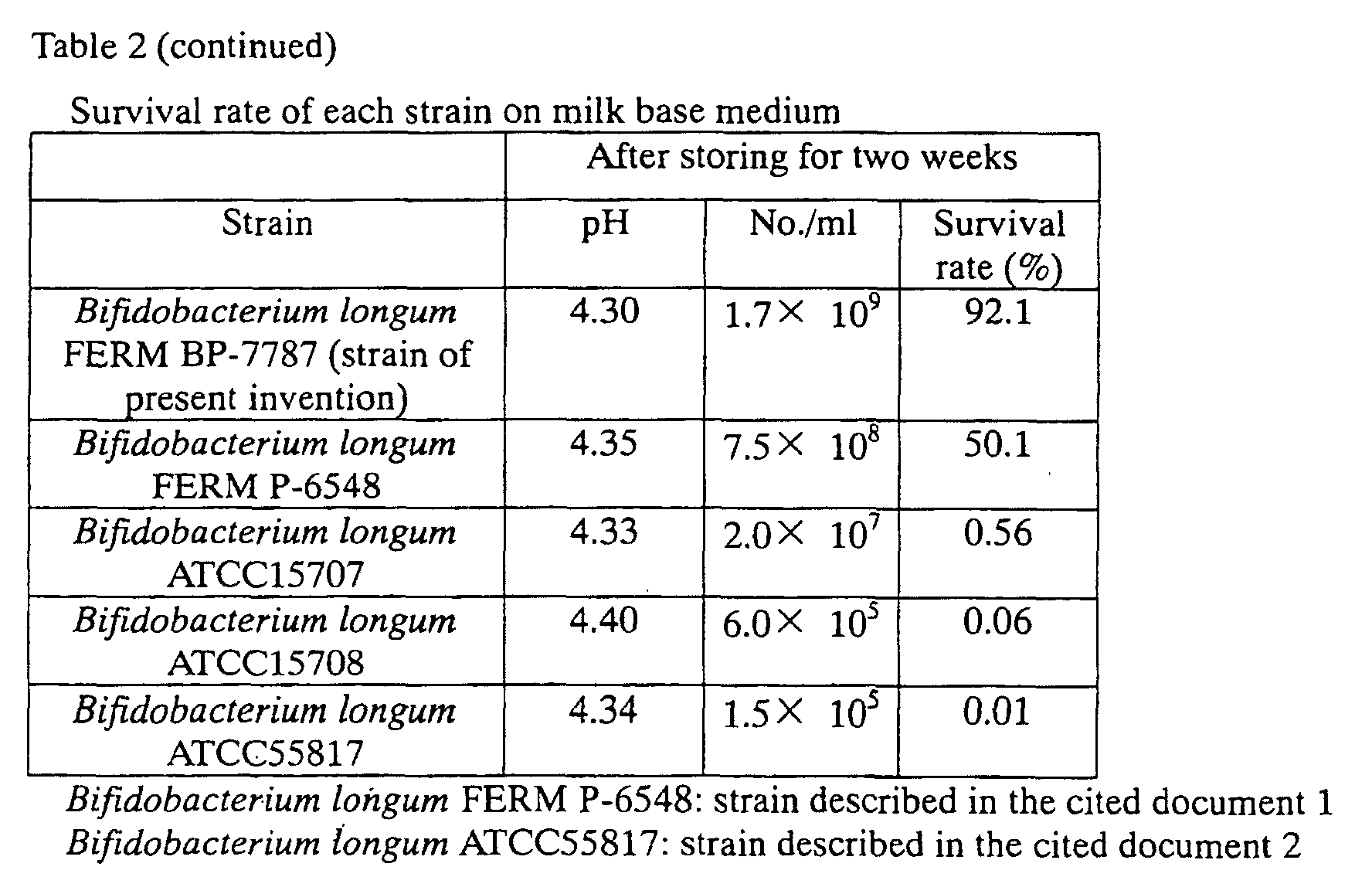
- Reconstituted skim milk powder medium (11%) including 0.2% yeast extract (a product of Difco Co.) was placed in a glass tube and pasteurized at 115°C for 15 minutes, and a starter of Bifidobacterium longum FERM BP-7787 and comparative strains (strains shown in Table 2 other than the strain of the present invention) was inoculated (5%) and incubated at 37°C until the pH became 4.3-4.4. After this, these were rapidly cooled, and storing tests were conducted at 10°C. The number of cells immediately after the cooling, after one week of storing, and after two weeks of storing was measured using a RCA agar flat plate, and the survival rate at each storing period was calculated.
- Mixed culture of Streptococcus thermophilus and Lactobacillus delbrueckii subsp. bulgaricus (0.6%), which was prepared using the same method as in Example 1, was inoculated to the pasteurized base.
- a starter of Bifidobacterium longum FERM BP-7787 and comparative strains which were cultured at 37°C using the above mentioned 11% reconstituted skim milk powder medium including 0.2% yeast extract (a product of Difco Co.) until the pH became 4.3-4.4, were inoculated (5%), placed in test tubes, incubated at 37°C for five hours, and rapidly cooled to conduct storing tests at 10°C.
- the number of cells immediately after the cooling, after one week of storing, and after two weeks of storing was measured using an RCA agar flat plate, and the survival rate for each storing period was calculated.
- Bifidobacterium longum FERM BP-7787 survived after two weeks of storing at 10°C on the fermented medium of pH 4.6 or less showing they have acid tolerance superior to that of Bifidobacterium longum ATCC55817, which is known as having gastric juice tolerance, and the other comparative strains (Table 3).
- Tests for gastric juice tolerance were conducted as follows. That is, bacterial cell suspension (0.1 ml) of Bifidobacterium longum FERM BP-7787 and that of comparative strains, which were twice activation cultured (37°C, 24 hours) using Briggs liver broth (Rinsho Kensa, Tomotari Mitsuoka, Vol.18, pp.1163-1172, 1974) and washed once with physiological saline, was added to 9.9 ml of artificial gastric juice (0.2% NaCl, 0.35% pepsin (1:5000) were dissolved in purified water), whose pH was adjusted to 3.0 using filter-sterilized 1M hydrochloric acid.
- FERM BP-7787 of the present invention showed high gastric juice tolerance which was the same level as that of ATCC55817, while the other strains including FERM P-6548 which has a relatively high acid tolerance, showed almost no tolerance (Table 4).
- Bifidobacterium longum FERM BP-7787 (strain of present invention) 5.1 ⁇ 10 8 23.5
- Bifidobacterium longum FERM P-6548 2.5 ⁇ 10 8 0.01
- Bifidobacterium longum ATCC15707 4.1 ⁇ 10 8 0.01
- Bifidobacterium longum ATCC15708 1.1 ⁇ 10 8 ⁇ 0.001
- Bifidobacterium longum ATCC55817 2.8 ⁇ 10 8 21.3
- Bifidobacterium longum FERM P-6548 strain described in the cited document 1
- Bifidobacterium longum ATCC55817 strain described in the cited document 2
- Bifidobacterium longum FERM BP-7787 strain of the present invention has strong fermentation characteristics on a milk base medium, excellent survival rate when stored under acidic conditions, and strong tolerance to artificial gastric juice, it is obvious that it has characteristics not possessed by the reference strains of Bifidobacterium longum or know bacteria strains.
- the fermentative characteristics on a milk base medium, and the survival rate when stored in an acidic condition of ATCC 55817 strain, which is known to have gastric acid tolerance were very inferior and significantly lower as compared with that of FERM BP-7787 of the present invention.
- Bifidobacterium longum of the present invention is one which is selected from Bifidobacterium longum present in nature having fermentation characteristics, acid tolerance, and gastric acid tolerance. Accordingly, Bifidobacterium longum of the present invention can be rapidly incubated in a short period of time, and the degree of decrease in the number of living cells in a cultured substance or during storing of a processed product thereof is low. Accordingly, it can be applied to food and drink over a wide pH range.
- Bifidobacterium longum of the present invention since it is confirmed by tests that the survival rate of Bifidobacterium longum of the present invention when frozen or freeze-dried is also good, it can be utilized in the form of powder. Moreover, since Bifidobacterium longum of the present invention has gastric acid tolerance, and hence can reach a digestive (intestinal) tract alive with high percentage to exert biological function when taken by human or animal, it is extremely effective industrially. For example, it can be not only used as an intestinal function controlling compound for human or animals known for many years, but may also added or mixed with powdered food or feed, or liquid or semi-solid feed or food.
- Bifidobacterium longum FERM BP-7787 strain of the present invention was inoculated onto a medium (1000 ml) including 0.2% (W/W) yeast extract and 11% (W/W) skim milk powder, which was pasteurized at 90°C for three hours, and incubated for six hours at 37°C.
- mixed culture (50 ml) of Streptococcus thermophilus (Chr. Hansen) and Lactobacillus delbrueckii subsp. bulgaricus (Chr. Hansen) was inoculated to 10% (W/W) reconstituted skim milk medium (1500 ml) which was pasteurized for 30 minutes at 90°C, and incubated for five hours at 42°C.
- raw milk 50 L including 3.0% (W/W) butterfat and 9% (W/W) nonfat milk solid content was heated to 70°C, homogenized at a pressure of 15MPa, pasteurized at 90°C for 10 minutes, and cooled to 40°C.
- a culture 750 ml of Bifidobacterium longum FERM BP-7787 strain of the present invention, which was pre-incubated as described above, and the mixed culture (300 ml) of Streptococcus thermophilus and Lactobacillus delbrueckii subsp.
- bulgaricus were inoculated to the sterilized base, filled in a container of 500 ml, sealed, incubated for five hours at 37°C, and rapidly cooled. Lactic acidity and pH of the obtained cultured milk were 0.81 % and 4.55, respectively, and 2.3 ⁇ 10 8 /ml of Bifidobacterium longum FERM BP-7787 strain, 6.8 ⁇ 10 8 /ml of Streptococcus thermophilus, and 3.4 ⁇ 10 7 /ml of Lactobacillus delbrueckii subsp. bulgaricus were contained therein. The number of cells of Bifidobacterium longum FERM BP-7787 contained in the cultured milk after storing for fourteen days at 10°C was 1.5 ⁇ 10 8 /ml giving the survival rate of 65%.
- a seed culture (500 ml) of Bifidobacterium longum FERM BP-7787 strain of the present invention which was pre-incubated for sixteen hours at 37°C on a medium containing 50 gram of meat extract, 100 gram of peptone, 200 gram of milk sugar, 50 gram of K 2 HPO 4 , 10 gram of KH 2 PO 4 , 4 grams of cystine, and 9.5L of water, was inoculated to the above medium (10L) and incubated for sixteen hours at 37°C.
- an entire amount of the above medium (10.5L) was inoculated to a medium (200L) having the same composition as the above-mentioned medium and pasteurized for 30 minutes at 90°C, and incubated for sixteen hours at 37°C.
- the number of living cells after incubation was 3.0 ⁇ 10 9 /ml.
- bacterial cells were collected using a sharpless type centrifugal device (15,000 rpm), suspended again in physiological saline of the same amount as the medium which was pasteurized for 30 minutes at 90°C, and collected again using the same centrifugal device.
- the obtained cells were suspended in a solution (20 L, pasteurized for 30 minutes at 90°C) including 10% (W/W) skim milk powder, 1% (W/W) sucrose, and 1% (W/W) monosodium glutamate, and freeze-dried using a conventional method.
- a solution (20 L, pasteurized for 30 minutes at 90°C) including 10% (W/W) skim milk powder, 1% (W/W) sucrose, and 1% (W/W) monosodium glutamate, and freeze-dried using a conventional method.
- a solution (20 L, pasteurized for 30 minutes at 90°C) including 10% (W/W) skim milk powder, 1% (W/W) sucrose, and 1% (W/W) mono
- Powder (20 g) including Bifidobacterium longum FERM BP-7787 strain of the present invention obtained in Example 2 was added to dry-sterilized starch (14 kg) and milk sugar (6 kg) and uniformly mixed to obtain about 20 kg of intestinal function controlling compound powder including 1.0 ⁇ 10 8 /g of the strain according to the present invention.
- Bifidobacterium longum FERM BP-7787 strain of the present invention was inoculated onto a medium (1000 ml) including 0.2% (W/W) yeast extract and 11% (W/W) skim milk powder, which was pasteurized at 90°C for three hours, and incubated for six hours at 37°C.
- culture (30 ml) of Streptococcus cremoris (Chr. Hansen) was inoculated to 10% (W/W) reconstituted skim milk medium (1000 ml) including 0.6% (W/W) yeast extract, which was pasteurized for 30 minutes at 90°C, and incubated for 16 hours at 30°C.
- raw milk including 0.5% (W/W) butterfat, 9% (W/W) nonfat milk solid content, and 6.5% sucrose was heated to 70°C, homogenized at a pressure of 15MPa, pasteurized at 90°C for 10 minutes, and cooled to 33°C.
- a culture (750 ml) of Bifidobacterium longum FERM BP-7787 strain of the present invention, which was pre-incubated as described above, and the culture (500 ml) of Streptococcus cremoris were inoculated to the sterilized base, incubated for 16 hours at 30°C, and rapidly cooled with stirring.
- the cooled cultured milk was subjected to a homogenizing process of 15 MPa pressure, filled in a container of 200 ml, and sealed to obtain a yoghurt drink.
- Lactic acidity and pH of the obtained cultured milk were 0.81% and 4.55, respectively, and 1.5 ⁇ 10 8 /ml of Bifidobacterium longum FERM BP-7787 strain, and 9.8 ⁇ 10 8 /ml of Streptococcus cremoris were contained therein.
- the number of cells of Bifidobacterium longum FERM BP-7787 strain contained in the cultured milk after storing for 14 days at 10°C was 8.5 ⁇ 10 7 /ml giving a survival rate of 57%.
- Bifidobacterium longum according to the present invention has excellent fermentation characteristics and survival rate on a milk base medium, and tolerance to artificial gastric juice. Accordingly, it is possible to rapidly prepare the culture of the strain according to the present invention, and the degree of decrease in the number of living cells in the culture or a product when stored thereof is low. Accordingly, the strain can be applied to foods and beverages of wide pH range. Also, the strain of the present invention has gastric juice tolerance and, when taken into a body of a human or animal, reaches the digestive (intestinal) tract alive with a high percentage to exert physiological functions. Accordingly, it is significantly useful in industry.
Landscapes
- Life Sciences & Earth Sciences (AREA)
- Chemical & Material Sciences (AREA)
- Health & Medical Sciences (AREA)
- Engineering & Computer Science (AREA)
- Food Science & Technology (AREA)
- Polymers & Plastics (AREA)
- Microbiology (AREA)
- Nutrition Science (AREA)
- Medicinal Chemistry (AREA)
- Pharmacology & Pharmacy (AREA)
- Chemical Kinetics & Catalysis (AREA)
- General Chemical & Material Sciences (AREA)
- Mycology (AREA)
- Nuclear Medicine, Radiotherapy & Molecular Imaging (AREA)
- Organic Chemistry (AREA)
- Veterinary Medicine (AREA)
- Animal Behavior & Ethology (AREA)
- General Health & Medical Sciences (AREA)
- Public Health (AREA)
- Bioinformatics & Cheminformatics (AREA)
- Micro-Organisms Or Cultivation Processes Thereof (AREA)
- Medicines Containing Material From Animals Or Micro-Organisms (AREA)
- Coloring Foods And Improving Nutritive Qualities (AREA)
- Dairy Products (AREA)
Abstract
Description
Size: 0.3-0.8µm×4-10µm
Shape: rod (club-shaped or Y-shaped)
Shape: protruded to be circular, convex-pulvinate
Edge: entire
Size: 1-4 mm
Color: dark brown at periphery, charcoal brown at center
Surface: smooth
Positive for L-arabinose, D-xylose, galactose, D-glucose, D-fructose, D-mannose, maltose, lactose, melibiose, sucrose, melezitose, raffinose, and D-turanose; and delayed reaction for α-methyl-D-glucoside: and
Negative for glycerol, erythritol, D-arabinose, ribose, L-xylose, adonite, methyl-xyloside, L-sorbose, rhamnose, dulcitol, inositol, mannitol, sorbitol, α-methyl-mannoside, N-acetyl-glucosamin, amygdalin, arbutin, esculin, salicin, cellobiose, trehalose, inulin, starch, glycogen, xylitol, gentiobiose, D-lyxose, D-tagatose, D-fucose, L-fucose, D-arabitol, L-arabitol, gluconate, 2 keto-gluconate, and 5-keto-gluconate.
| Fermentative characteristics of each strain on milk base medium | ||
| Strain | pH | CFU/ml |
| Bifidobacterium longum FERM BP-7787 (strain of present invention) | 4.56 | 2.1×10⁹ |
| Bifidobacterium longum FERM P-6548 | 5.02 | 7.3×10⁸ |
| Bifidobacterium longum ATCC15707 | 5.88 | 1.9×10⁸ |
| Bifidobacterium longum ATCC15708 | 5.82 | 9.3×10⁷ |
| Bifidobacterium longum ATCC55817 | 5.64 | 4.7×10⁸ |
| Bifidobacterium longum FERM P-6548: strain described in the cited document 1 | ||
| Bifidobacterium longum ATCC55817: strain described in the cited document 2 |



| Artificial gastric juice tolerance of each strain | ||
| Strain | Initial cell number (CFU/ml) | Survival rate after 2 hour treatment |
| Bifidobacterium longum FERM BP-7787 (strain of present invention) | 5.1×10⁸ | 23.5 |
| Bifidobacterium longum FERM P-6548 | 2.5×10⁸ | 0.01 |
| Bifidobacterium longum ATCC15707 | 4.1×10⁸ | 0.01 |
| Bifidobacterium longum ATCC15708 | 1.1×10⁸ | <0.001 |
| Bifidobacterium longum ATCC55817 | 2.8×10⁸ | 21.3 |
| Bifidobacterium longum FERM P-6548: strain described in the cited document 1 | ||
| Bifidobacterium longum ATCC55817: strain described in the cited document 2 |
Accordingly, it can be applied to food and drink over a wide pH range.
Claims (4)
- Bifidobacterium longum having the following mycological characteristics:(1) fermentative characteristics as to make a milk base medium to pH 4.6 or lower;(2) survival rate of 50% or higher, after attaining pH 4.4 to 4.6 in a milk base medium, quenching and storing at 10°C for two weeks; and(3) gastric juice tolerance as giving a survival rate of 10% or higher in the case of storing in artificial gastric juice of pH 3.0 at 37°C for two hours.
- Bifidobacterium longum according to claim 1, wherein a strain of the Bifidobacterium longum is Bifidobacterium longum FERM BP-7787.
- Powder comprising Bifidobacterium longum of claim 1 or 2.
- Foods and beverages comprising Bifidobacterium longum of claim 1 or 2.
Applications Claiming Priority (3)
| Application Number | Priority Date | Filing Date | Title |
|---|---|---|---|
| JP2001374327 | 2001-12-07 | ||
| JP2001374327 | 2001-12-07 | ||
| PCT/JP2002/012162 WO2003048343A1 (en) | 2001-12-07 | 2002-11-21 | Bifidobacterium longum |
Publications (3)
| Publication Number | Publication Date |
|---|---|
| EP1449915A1 true EP1449915A1 (en) | 2004-08-25 |
| EP1449915A4 EP1449915A4 (en) | 2005-01-19 |
| EP1449915B1 EP1449915B1 (en) | 2006-04-05 |
Family
ID=19182902
Family Applications (1)
| Application Number | Title | Priority Date | Filing Date |
|---|---|---|---|
| EP02804353A Expired - Lifetime EP1449915B1 (en) | 2001-12-07 | 2002-11-21 | Bifidobacterium longum |
Country Status (8)
| Country | Link |
|---|---|
| US (1) | US7427499B2 (en) |
| EP (1) | EP1449915B1 (en) |
| JP (1) | JP3875237B2 (en) |
| CN (1) | CN1274809C (en) |
| AT (1) | ATE322538T1 (en) |
| DE (1) | DE60210497T2 (en) |
| DK (1) | DK1449915T3 (en) |
| WO (1) | WO2003048343A1 (en) |
Families Citing this family (9)
| Publication number | Priority date | Publication date | Assignee | Title |
|---|---|---|---|---|
| CN100413958C (en) * | 2004-12-29 | 2008-08-27 | 王敖喜 | Bifidobacterium with anti-intestinal pathogenic bacteria and antioxidant properties and application thereof |
| EP1908819B1 (en) * | 2005-07-08 | 2016-10-12 | Morishita Jintan Co., Ltd. | Polysaccharide produced by microorganism belonging to genus bifidobacterium |
| WO2008099543A1 (en) * | 2007-02-13 | 2008-08-21 | Morinaga Milk Industry Co., Ltd. | Method of producing fermented milk using novel lactic acid bacterium |
| DK2554676T3 (en) * | 2010-03-26 | 2015-01-12 | Morinaga Milk Industry Co Ltd | Measurement method for counting viable bacterial cells and culture medium |
| CN102604855B (en) * | 2011-12-15 | 2013-09-11 | 上海交通大学 | Bifidobacterium longum SQS7-31, as well as preparation method and application thereof |
| CN105112333A (en) * | 2015-08-31 | 2015-12-02 | 江南大学 | Bifidobacterium longum with good intestinal tract colonizing ability and screening method and application of bifidobacterium longum |
| CN115066490B (en) * | 2020-02-18 | 2024-04-23 | AuB株式会社 | Novel Bifidobacterium bacteria and compositions containing the same |
| WO2025047884A1 (en) * | 2023-08-31 | 2025-03-06 | 森永乳業株式会社 | Bacterium, composition, and method for producing composition |
| CN117551589B (en) * | 2024-01-10 | 2024-05-07 | 广州集妍化妆品科技有限公司 | Use of lysate of bifidobacterium longum subspecies infantis |
Family Cites Families (7)
| Publication number | Priority date | Publication date | Assignee | Title |
|---|---|---|---|---|
| JPS5283974A (en) | 1976-01-01 | 1977-07-13 | Yakult Honsha Kk | Incubation mixture of milk containing living cell of bifidus strain and method of producing same |
| JPS5953829B2 (en) * | 1982-06-22 | 1984-12-27 | 森永乳業株式会社 | A novel microorganism belonging to Bifidobacterium longum, a method for producing the microorganism, and a composition containing the microorganism |
| JP2922013B2 (en) | 1991-04-17 | 1999-07-19 | 雪印ローリー株式会社 | Novel bifidobacteria with acid and oxygen tolerance |
| TW357191B (en) * | 1996-06-04 | 1999-05-01 | Food Industry Development Res Institute | Bifidobacteria strains with acid, bile salt and oxygen tolerance and their culture method the invention relates to bifidobacteria strains with acid, bile salt and oxygen tolerance and their culture method |
| US6306638B1 (en) * | 1996-10-22 | 2001-10-23 | Food Industry Research And Development Institute | Mutant bifidobacteria strains with acid, bile salt and oxygen tolerance |
| JP3749359B2 (en) | 1997-09-16 | 2006-02-22 | 雪印乳業株式会社 | New bifidobacteria and their use |
| ID29150A (en) * | 1999-01-15 | 2001-08-02 | Entpr Ireland Cs | USE OF LACTOBACILLUS SALIVARIUS |
-
2002
- 2002-11-21 AT AT02804353T patent/ATE322538T1/en not_active IP Right Cessation
- 2002-11-21 CN CNB028222253A patent/CN1274809C/en not_active Expired - Fee Related
- 2002-11-21 WO PCT/JP2002/012162 patent/WO2003048343A1/en not_active Ceased
- 2002-11-21 DK DK02804353T patent/DK1449915T3/en active
- 2002-11-21 DE DE60210497T patent/DE60210497T2/en not_active Expired - Lifetime
- 2002-11-21 EP EP02804353A patent/EP1449915B1/en not_active Expired - Lifetime
- 2002-11-21 JP JP2003549522A patent/JP3875237B2/en not_active Expired - Fee Related
-
2004
- 2004-05-21 US US10/709,674 patent/US7427499B2/en not_active Expired - Fee Related
Also Published As
| Publication number | Publication date |
|---|---|
| ATE322538T1 (en) | 2006-04-15 |
| US7427499B2 (en) | 2008-09-23 |
| EP1449915B1 (en) | 2006-04-05 |
| JPWO2003048343A1 (en) | 2005-04-14 |
| CN1274809C (en) | 2006-09-13 |
| CN1585820A (en) | 2005-02-23 |
| DK1449915T3 (en) | 2006-08-14 |
| DE60210497T2 (en) | 2006-11-23 |
| DE60210497D1 (en) | 2006-05-18 |
| WO2003048343A1 (en) | 2003-06-12 |
| JP3875237B2 (en) | 2007-01-31 |
| US20040202749A1 (en) | 2004-10-14 |
| EP1449915A4 (en) | 2005-01-19 |
Similar Documents
| Publication | Publication Date | Title |
|---|---|---|
| US20250161379A1 (en) | Bifidobacterium animalis subsp. lactis i797, method for separation and purification thereof, and use thereof | |
| Özer et al. | Effect of inulin and lactulose on survival of Lactobacillus acidophilusla-5 and Bifidobacterium bifidum bb-02 in Acidophilus-bifidus yoghurt | |
| EP2112219B1 (en) | Novel lactic acid bacteria | |
| KR101141781B1 (en) | Method for producing fermented milk using novel lactic acid bacteria | |
| US12317904B2 (en) | Composition and process for producing a fermented milk product comprising application of a lactose-deficient S. thermophilus strain, a lactose-deficient L. bulgaricus strain and a probiotic strain | |
| JP2001526024A (en) | Bacterial strain of Lactobacillus paracasei subspecies paracasei, composition thereof for use in food, and products containing said strain | |
| WO2003012074A2 (en) | Bacterial strains belonging to lactobacillus species and their use in food and feed industry | |
| EP0974268B1 (en) | Bifidobacterium-fermented milk and process for producing the same | |
| EP1449915B1 (en) | Bifidobacterium longum | |
| US20130189396A1 (en) | Method for producing a fermented food containing bifidobacteria | |
| JP4794592B2 (en) | New lactic acid bacteria | |
| KR20020072807A (en) | Novel lactobacillus sp. strain having the effect of immune enhancement | |
| JPH07236416A (en) | Method for producing fermented milk with suppressed acidity increase during storage | |
| KR100725012B1 (en) | New Lactobacillus ashdophyllus achywai 7036 with excellent intestinal segregation and organic acid generation ability for Korean adults | |
| JP2000069906A (en) | Fermented food and food produced by using fermented food as raw material | |
| HK1132299A (en) | Novel lactic acid bacteria | |
| HK1119910B (en) | Method of producing fermented milk using novel lactic acid bacterium | |
| HK1073329A1 (en) | Bacterium of the genus bifidobacterium and fermented foods using the same |
Legal Events
| Date | Code | Title | Description |
|---|---|---|---|
| PUAI | Public reference made under article 153(3) epc to a published international application that has entered the european phase |
Free format text: ORIGINAL CODE: 0009012 |
|
| 17P | Request for examination filed |
Effective date: 20040609 |
|
| AK | Designated contracting states |
Kind code of ref document: A1 Designated state(s): AT BE BG CH CY CZ DE DK EE ES FI FR GB GR IE IT LI LU MC NL PT SE SK TR |
|
| RIN1 | Information on inventor provided before grant (corrected) |
Inventor name: HIRAMATSU, A.,,C/O MORINAGA MILK INDUSTRY CO. LTD Inventor name: TAKAHASHI, S.,C/O MORINAGA MILK INDUSTRY CO., LTD Inventor name: YAESHIMA, T.,C/O MORINAGA MILK INDUSTRY CO., LTD. Inventor name: KONDO, SHIZUKI,C/O MORINAGA MILK INDUSTRY CO. LTD Inventor name: SOTOYAMA, KAZUYOSHI Inventor name: TAKAHASHI, N.,C/O MORINAGA MILK INDUSTRY CO., LTD Inventor name: XIAO, J.,C/O MORINAGA MILK INDUSTRY CO., LTD. |
|
| RIN1 | Information on inventor provided before grant (corrected) |
Inventor name: SOTOYAMA, KAZUYOSHI Inventor name: HIRAMATSU, AKINORI Inventor name: TAKAHASHI, SACHIKO Inventor name: XIAO, JIN-ZHONG Inventor name: YAESHIMA, TOMOKO Inventor name: KONDO, SHIZUKI Inventor name: TAKAHASHI, NORITOSHI |
|
| A4 | Supplementary search report drawn up and despatched |
Effective date: 20041203 |
|
| 17Q | First examination report despatched |
Effective date: 20050318 |
|
| GRAP | Despatch of communication of intention to grant a patent |
Free format text: ORIGINAL CODE: EPIDOSNIGR1 |
|
| GRAS | Grant fee paid |
Free format text: ORIGINAL CODE: EPIDOSNIGR3 |
|
| GRAA | (expected) grant |
Free format text: ORIGINAL CODE: 0009210 |
|
| AK | Designated contracting states |
Kind code of ref document: B1 Designated state(s): AT BE BG CH CY CZ DE DK EE ES FI FR GB GR IE IT LI LU MC NL PT SE SK TR |
|
| PG25 | Lapsed in a contracting state [announced via postgrant information from national office to epo] |
Ref country code: IT Free format text: LAPSE BECAUSE OF FAILURE TO SUBMIT A TRANSLATION OF THE DESCRIPTION OR TO PAY THE FEE WITHIN THE PRESCRIBED TIME-LIMIT;WARNING: LAPSES OF ITALIAN PATENTS WITH EFFECTIVE DATE BEFORE 2007 MAY HAVE OCCURRED AT ANY TIME BEFORE 2007. THE CORRECT EFFECTIVE DATE MAY BE DIFFERENT FROM THE ONE RECORDED. Effective date: 20060405 Ref country code: BE Free format text: LAPSE BECAUSE OF FAILURE TO SUBMIT A TRANSLATION OF THE DESCRIPTION OR TO PAY THE FEE WITHIN THE PRESCRIBED TIME-LIMIT Effective date: 20060405 Ref country code: AT Free format text: LAPSE BECAUSE OF FAILURE TO SUBMIT A TRANSLATION OF THE DESCRIPTION OR TO PAY THE FEE WITHIN THE PRESCRIBED TIME-LIMIT Effective date: 20060405 Ref country code: LI Free format text: LAPSE BECAUSE OF FAILURE TO SUBMIT A TRANSLATION OF THE DESCRIPTION OR TO PAY THE FEE WITHIN THE PRESCRIBED TIME-LIMIT Effective date: 20060405 Ref country code: SK Free format text: LAPSE BECAUSE OF FAILURE TO SUBMIT A TRANSLATION OF THE DESCRIPTION OR TO PAY THE FEE WITHIN THE PRESCRIBED TIME-LIMIT Effective date: 20060405 Ref country code: CZ Free format text: LAPSE BECAUSE OF FAILURE TO SUBMIT A TRANSLATION OF THE DESCRIPTION OR TO PAY THE FEE WITHIN THE PRESCRIBED TIME-LIMIT Effective date: 20060405 Ref country code: CH Free format text: LAPSE BECAUSE OF FAILURE TO SUBMIT A TRANSLATION OF THE DESCRIPTION OR TO PAY THE FEE WITHIN THE PRESCRIBED TIME-LIMIT Effective date: 20060405 |
|
| REG | Reference to a national code |
Ref country code: GB Ref legal event code: FG4D |
|
| REG | Reference to a national code |
Ref country code: CH Ref legal event code: EP |
|
| REG | Reference to a national code |
Ref country code: IE Ref legal event code: FG4D |
|
| REF | Corresponds to: |
Ref document number: 60210497 Country of ref document: DE Date of ref document: 20060518 Kind code of ref document: P |
|
| PG25 | Lapsed in a contracting state [announced via postgrant information from national office to epo] |
Ref country code: SE Free format text: LAPSE BECAUSE OF FAILURE TO SUBMIT A TRANSLATION OF THE DESCRIPTION OR TO PAY THE FEE WITHIN THE PRESCRIBED TIME-LIMIT Effective date: 20060705 |
|
| PG25 | Lapsed in a contracting state [announced via postgrant information from national office to epo] |
Ref country code: ES Free format text: LAPSE BECAUSE OF FAILURE TO SUBMIT A TRANSLATION OF THE DESCRIPTION OR TO PAY THE FEE WITHIN THE PRESCRIBED TIME-LIMIT Effective date: 20060716 |
|
| REG | Reference to a national code |
Ref country code: DK Ref legal event code: T3 |
|
| PG25 | Lapsed in a contracting state [announced via postgrant information from national office to epo] |
Ref country code: PT Free format text: LAPSE BECAUSE OF FAILURE TO SUBMIT A TRANSLATION OF THE DESCRIPTION OR TO PAY THE FEE WITHIN THE PRESCRIBED TIME-LIMIT Effective date: 20060905 |
|
| REG | Reference to a national code |
Ref country code: CH Ref legal event code: PL |
|
| ET | Fr: translation filed | ||
| PG25 | Lapsed in a contracting state [announced via postgrant information from national office to epo] |
Ref country code: IE Free format text: LAPSE BECAUSE OF NON-PAYMENT OF DUE FEES Effective date: 20061121 |
|
| PG25 | Lapsed in a contracting state [announced via postgrant information from national office to epo] |
Ref country code: MC Free format text: LAPSE BECAUSE OF NON-PAYMENT OF DUE FEES Effective date: 20061130 |
|
| PLBE | No opposition filed within time limit |
Free format text: ORIGINAL CODE: 0009261 |
|
| STAA | Information on the status of an ep patent application or granted ep patent |
Free format text: STATUS: NO OPPOSITION FILED WITHIN TIME LIMIT |
|
| 26N | No opposition filed |
Effective date: 20070108 |
|
| PG25 | Lapsed in a contracting state [announced via postgrant information from national office to epo] |
Ref country code: GR Free format text: LAPSE BECAUSE OF FAILURE TO SUBMIT A TRANSLATION OF THE DESCRIPTION OR TO PAY THE FEE WITHIN THE PRESCRIBED TIME-LIMIT Effective date: 20060706 |
|
| PG25 | Lapsed in a contracting state [announced via postgrant information from national office to epo] |
Ref country code: EE Free format text: LAPSE BECAUSE OF FAILURE TO SUBMIT A TRANSLATION OF THE DESCRIPTION OR TO PAY THE FEE WITHIN THE PRESCRIBED TIME-LIMIT Effective date: 20060405 Ref country code: BG Free format text: LAPSE BECAUSE OF FAILURE TO SUBMIT A TRANSLATION OF THE DESCRIPTION OR TO PAY THE FEE WITHIN THE PRESCRIBED TIME-LIMIT Effective date: 20060705 |
|
| PG25 | Lapsed in a contracting state [announced via postgrant information from national office to epo] |
Ref country code: TR Free format text: LAPSE BECAUSE OF FAILURE TO SUBMIT A TRANSLATION OF THE DESCRIPTION OR TO PAY THE FEE WITHIN THE PRESCRIBED TIME-LIMIT Effective date: 20060405 Ref country code: LU Free format text: LAPSE BECAUSE OF NON-PAYMENT OF DUE FEES Effective date: 20061121 |
|
| PG25 | Lapsed in a contracting state [announced via postgrant information from national office to epo] |
Ref country code: CY Free format text: LAPSE BECAUSE OF FAILURE TO SUBMIT A TRANSLATION OF THE DESCRIPTION OR TO PAY THE FEE WITHIN THE PRESCRIBED TIME-LIMIT Effective date: 20060405 |
|
| REG | Reference to a national code |
Ref country code: FR Ref legal event code: PLFP Year of fee payment: 14 |
|
| REG | Reference to a national code |
Ref country code: FR Ref legal event code: PLFP Year of fee payment: 15 |
|
| REG | Reference to a national code |
Ref country code: FR Ref legal event code: PLFP Year of fee payment: 16 |
|
| REG | Reference to a national code |
Ref country code: FR Ref legal event code: PLFP Year of fee payment: 17 |
|
| PGFP | Annual fee paid to national office [announced via postgrant information from national office to epo] |
Ref country code: NL Payment date: 20181114 Year of fee payment: 17 |
|
| PGFP | Annual fee paid to national office [announced via postgrant information from national office to epo] |
Ref country code: FI Payment date: 20181109 Year of fee payment: 17 Ref country code: DE Payment date: 20181106 Year of fee payment: 17 Ref country code: DK Payment date: 20181109 Year of fee payment: 17 |
|
| PGFP | Annual fee paid to national office [announced via postgrant information from national office to epo] |
Ref country code: GB Payment date: 20181121 Year of fee payment: 17 Ref country code: FR Payment date: 20181011 Year of fee payment: 17 |
|
| REG | Reference to a national code |
Ref country code: DE Ref legal event code: R119 Ref document number: 60210497 Country of ref document: DE |
|
| REG | Reference to a national code |
Ref country code: FI Ref legal event code: MAE |
|
| REG | Reference to a national code |
Ref country code: DK Ref legal event code: EBP Effective date: 20191130 |
|
| REG | Reference to a national code |
Ref country code: NL Ref legal event code: MM Effective date: 20191201 |
|
| PG25 | Lapsed in a contracting state [announced via postgrant information from national office to epo] |
Ref country code: FI Free format text: LAPSE BECAUSE OF NON-PAYMENT OF DUE FEES Effective date: 20191121 |
|
| GBPC | Gb: european patent ceased through non-payment of renewal fee |
Effective date: 20191121 |
|
| PG25 | Lapsed in a contracting state [announced via postgrant information from national office to epo] |
Ref country code: NL Free format text: LAPSE BECAUSE OF NON-PAYMENT OF DUE FEES Effective date: 20191201 |
|
| PG25 | Lapsed in a contracting state [announced via postgrant information from national office to epo] |
Ref country code: DK Free format text: LAPSE BECAUSE OF NON-PAYMENT OF DUE FEES Effective date: 20191130 Ref country code: DE Free format text: LAPSE BECAUSE OF NON-PAYMENT OF DUE FEES Effective date: 20200603 Ref country code: FR Free format text: LAPSE BECAUSE OF NON-PAYMENT OF DUE FEES Effective date: 20191130 Ref country code: GB Free format text: LAPSE BECAUSE OF NON-PAYMENT OF DUE FEES Effective date: 20191121 |