EP1449894A2 - Ink jet dye design - Google Patents
Ink jet dye design Download PDFInfo
- Publication number
- EP1449894A2 EP1449894A2 EP04076404A EP04076404A EP1449894A2 EP 1449894 A2 EP1449894 A2 EP 1449894A2 EP 04076404 A EP04076404 A EP 04076404A EP 04076404 A EP04076404 A EP 04076404A EP 1449894 A2 EP1449894 A2 EP 1449894A2
- Authority
- EP
- European Patent Office
- Prior art keywords
- ink
- dye
- group
- groups
- jet
- Prior art date
- Legal status (The legal status is an assumption and is not a legal conclusion. Google has not performed a legal analysis and makes no representation as to the accuracy of the status listed.)
- Granted
Links
- 0 *c(c(*)c1Cl)cc(Cl)c1N(C(C1=Nc(c(*)c2)c(*)cc2N(*)*)=O)N=C1N(*)* Chemical compound *c(c(*)c1Cl)cc(Cl)c1N(C(C1=Nc(c(*)c2)c(*)cc2N(*)*)=O)N=C1N(*)* 0.000 description 2
- NUEYSGACGJOOAT-VUTUGFNBSA-N NCc1nc(CN)nc(Cc2cccc(Cc3nc(CN)nc(CN)n3)c2/N=N\c(c(c(O)c(cc2)-c3c(CC(NC(N4)=O)NC4=O)cccc3CC(NC(N3)=O)NC3=O)c2cc2)c2N)n1 Chemical compound NCc1nc(CN)nc(Cc2cccc(Cc3nc(CN)nc(CN)n3)c2/N=N\c(c(c(O)c(cc2)-c3c(CC(NC(N4)=O)NC4=O)cccc3CC(NC(N3)=O)NC3=O)c2cc2)c2N)n1 NUEYSGACGJOOAT-VUTUGFNBSA-N 0.000 description 1
Classifications
-
- C—CHEMISTRY; METALLURGY
- C09—DYES; PAINTS; POLISHES; NATURAL RESINS; ADHESIVES; COMPOSITIONS NOT OTHERWISE PROVIDED FOR; APPLICATIONS OF MATERIALS NOT OTHERWISE PROVIDED FOR
- C09D—COATING COMPOSITIONS, e.g. PAINTS, VARNISHES OR LACQUERS; FILLING PASTES; CHEMICAL PAINT OR INK REMOVERS; INKS; CORRECTING FLUIDS; WOODSTAINS; PASTES OR SOLIDS FOR COLOURING OR PRINTING; USE OF MATERIALS THEREFOR
- C09D11/00—Inks
- C09D11/30—Inkjet printing inks
- C09D11/32—Inkjet printing inks characterised by colouring agents
-
- C—CHEMISTRY; METALLURGY
- C09—DYES; PAINTS; POLISHES; NATURAL RESINS; ADHESIVES; COMPOSITIONS NOT OTHERWISE PROVIDED FOR; APPLICATIONS OF MATERIALS NOT OTHERWISE PROVIDED FOR
- C09B—ORGANIC DYES OR CLOSELY-RELATED COMPOUNDS FOR PRODUCING DYES, e.g. PIGMENTS; MORDANTS; LAKES
- C09B29/00—Monoazo dyes prepared by diazotising and coupling
- C09B29/24—Monoazo dyes prepared by diazotising and coupling from coupling components containing both hydroxyl and amino directing groups
- C09B29/28—Amino naphthols
- C09B29/30—Amino naphtholsulfonic acid
-
- C—CHEMISTRY; METALLURGY
- C09—DYES; PAINTS; POLISHES; NATURAL RESINS; ADHESIVES; COMPOSITIONS NOT OTHERWISE PROVIDED FOR; APPLICATIONS OF MATERIALS NOT OTHERWISE PROVIDED FOR
- C09B—ORGANIC DYES OR CLOSELY-RELATED COMPOUNDS FOR PRODUCING DYES, e.g. PIGMENTS; MORDANTS; LAKES
- C09B55/00—Azomethine dyes
- C09B55/009—Azomethine dyes, the C-atom of the group -C=N- being part of a ring (Image)
-
- C—CHEMISTRY; METALLURGY
- C09—DYES; PAINTS; POLISHES; NATURAL RESINS; ADHESIVES; COMPOSITIONS NOT OTHERWISE PROVIDED FOR; APPLICATIONS OF MATERIALS NOT OTHERWISE PROVIDED FOR
- C09B—ORGANIC DYES OR CLOSELY-RELATED COMPOUNDS FOR PRODUCING DYES, e.g. PIGMENTS; MORDANTS; LAKES
- C09B69/00—Dyes not provided for by a single group of this subclass
-
- C—CHEMISTRY; METALLURGY
- C09—DYES; PAINTS; POLISHES; NATURAL RESINS; ADHESIVES; COMPOSITIONS NOT OTHERWISE PROVIDED FOR; APPLICATIONS OF MATERIALS NOT OTHERWISE PROVIDED FOR
- C09D—COATING COMPOSITIONS, e.g. PAINTS, VARNISHES OR LACQUERS; FILLING PASTES; CHEMICAL PAINT OR INK REMOVERS; INKS; CORRECTING FLUIDS; WOODSTAINS; PASTES OR SOLIDS FOR COLOURING OR PRINTING; USE OF MATERIALS THEREFOR
- C09D11/00—Inks
- C09D11/30—Inkjet printing inks
- C09D11/32—Inkjet printing inks characterised by colouring agents
- C09D11/328—Inkjet printing inks characterised by colouring agents characterised by dyes
-
- C—CHEMISTRY; METALLURGY
- C09—DYES; PAINTS; POLISHES; NATURAL RESINS; ADHESIVES; COMPOSITIONS NOT OTHERWISE PROVIDED FOR; APPLICATIONS OF MATERIALS NOT OTHERWISE PROVIDED FOR
- C09D—COATING COMPOSITIONS, e.g. PAINTS, VARNISHES OR LACQUERS; FILLING PASTES; CHEMICAL PAINT OR INK REMOVERS; INKS; CORRECTING FLUIDS; WOODSTAINS; PASTES OR SOLIDS FOR COLOURING OR PRINTING; USE OF MATERIALS THEREFOR
- C09D11/00—Inks
- C09D11/30—Inkjet printing inks
- C09D11/40—Ink-sets specially adapted for multi-colour inkjet printing
Definitions
- the present invention generally relates to ink-jet printing, and in particular to a specific dye and ink sets for improving ink-jet print stability.
- Ink-jet printing is a non-impact printing process in which droplets of ink are deposited on a print medium in a particular order to form alphanumeric characters, area-fills, and other patterns thereon.
- Low cost and high quality of the hardcopy output combined with relatively noise-free operation, have made ink-jet printers a popular alternative to other types of printers used with computers.
- intensive research and development efforts continue toward improving ink-jet print quality.
- a surge in interest in ink-jet printing has resulted in the need to produce high quality prints at a reasonable cost.
- the challenge remains to further improve the print quality and lightfastness of ink-jet prints.
- the emerging use of ink-jet prints for digital photos requires high-resolution images that have accurate color and are durable.
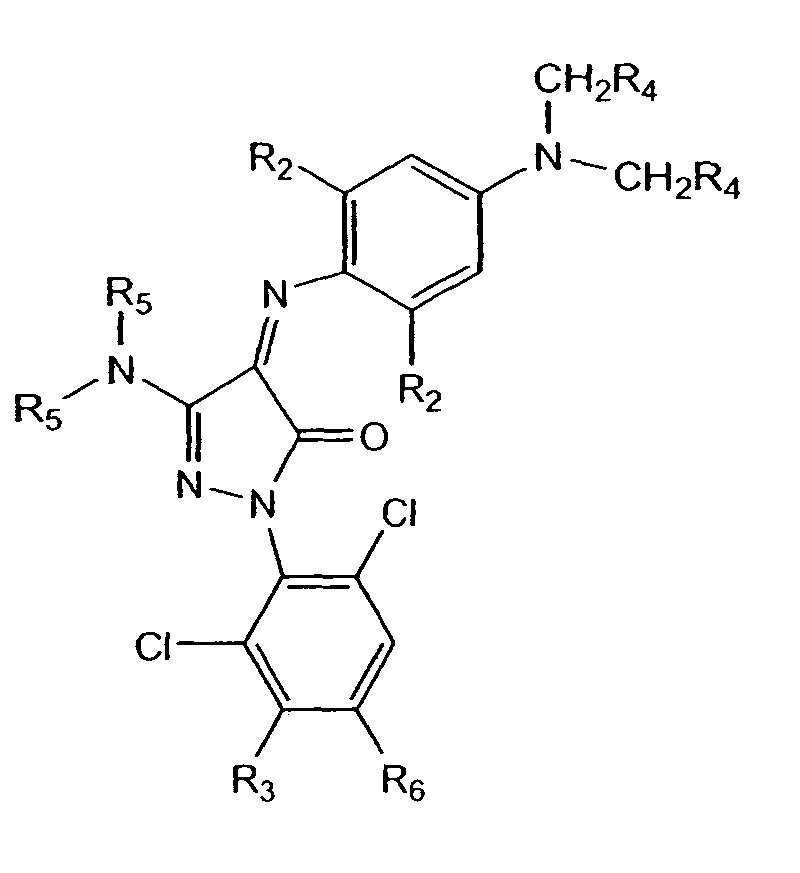
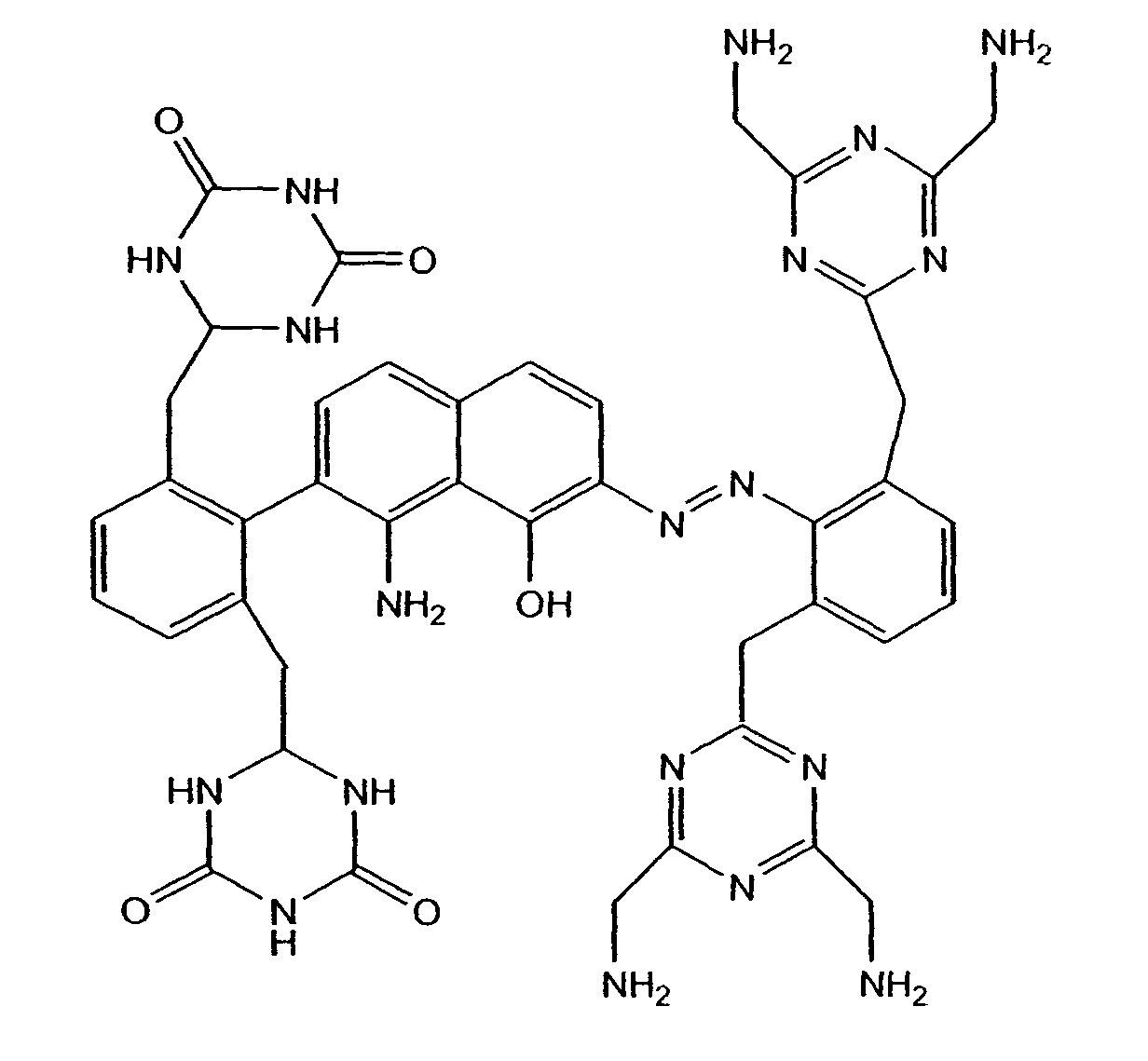
- the present invention relates to a magenta ink for ink-jet printing, comprising a dye having a structure as follows:
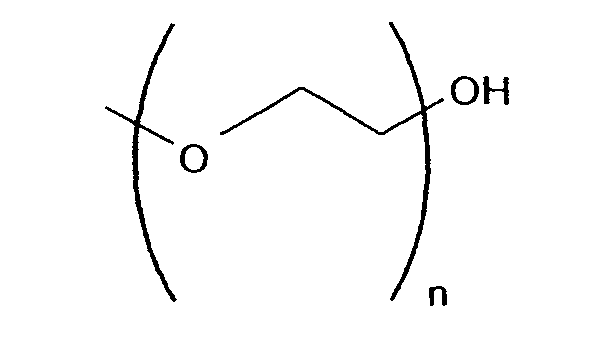
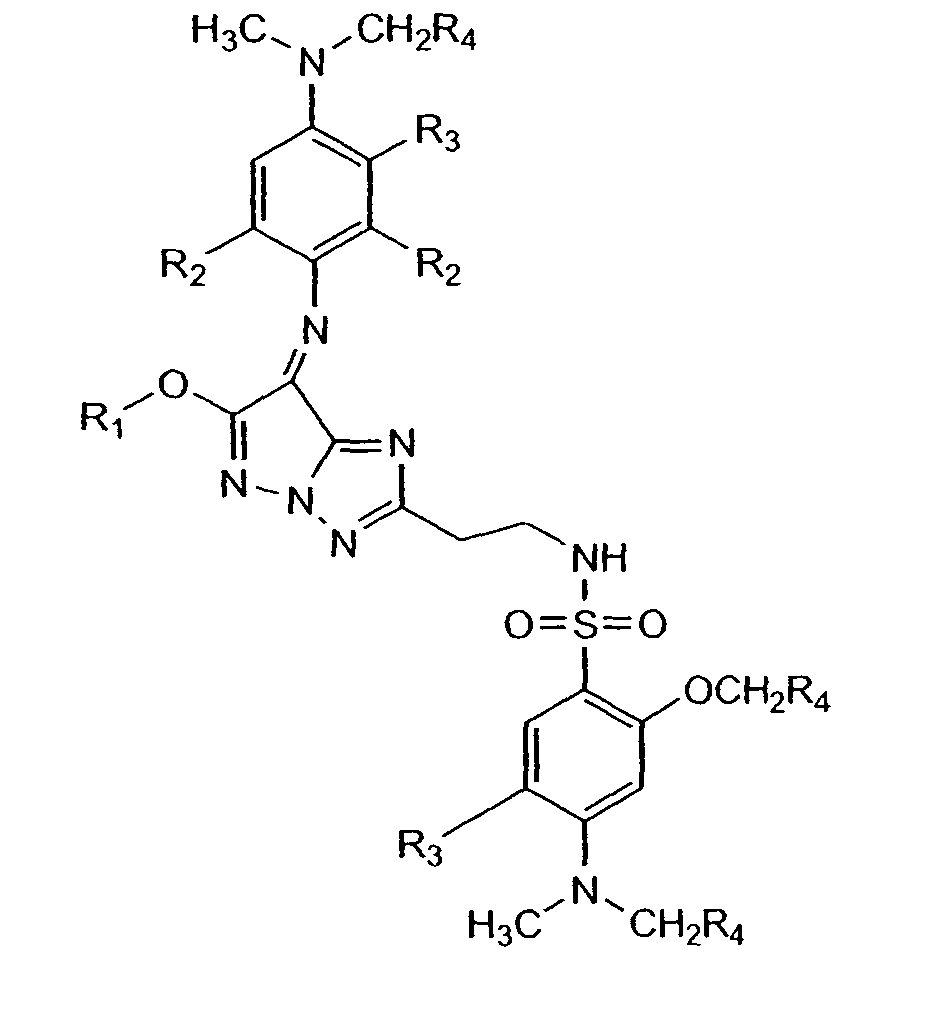
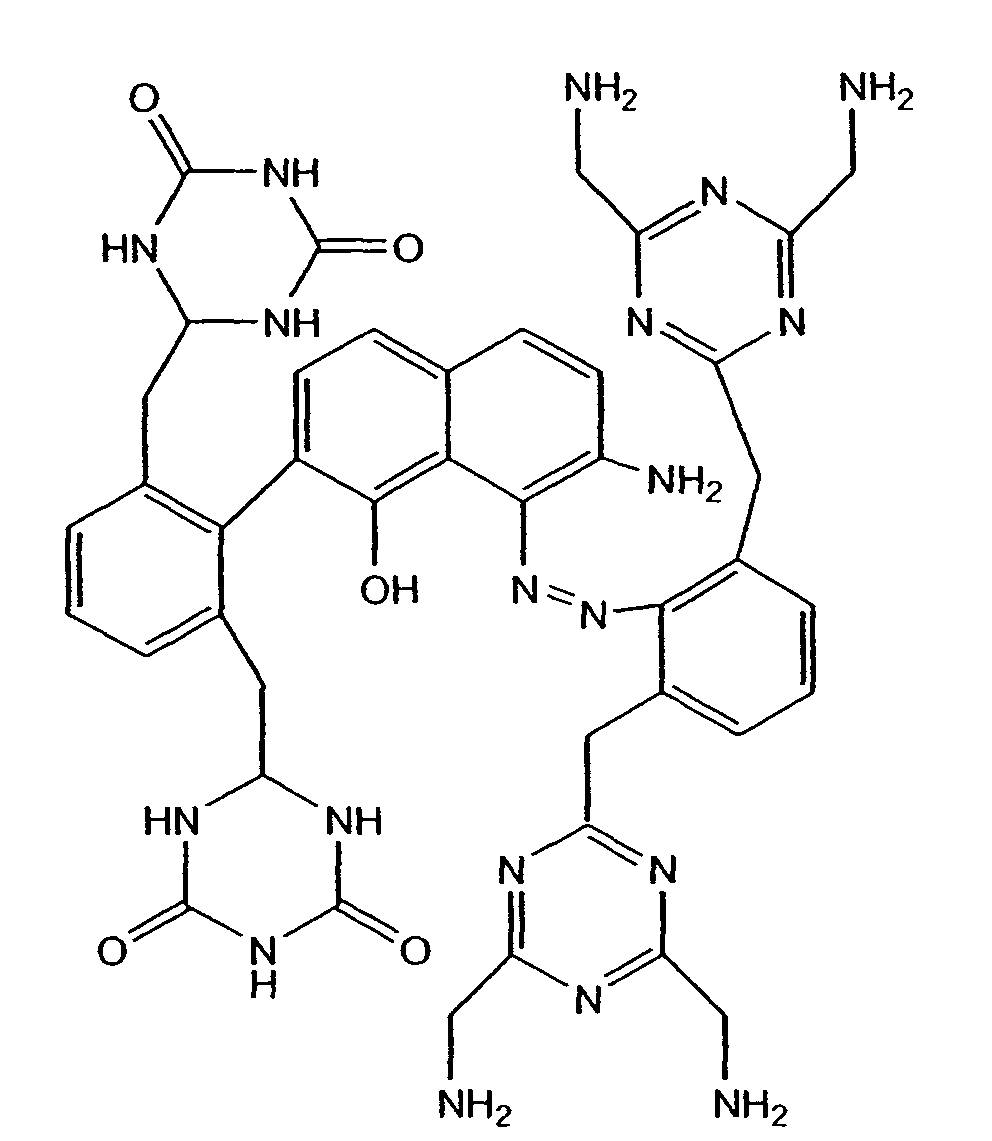
- the present invention also relates to a magenta ink for ink-jet printing, comprising a dye having the following structure: wherein
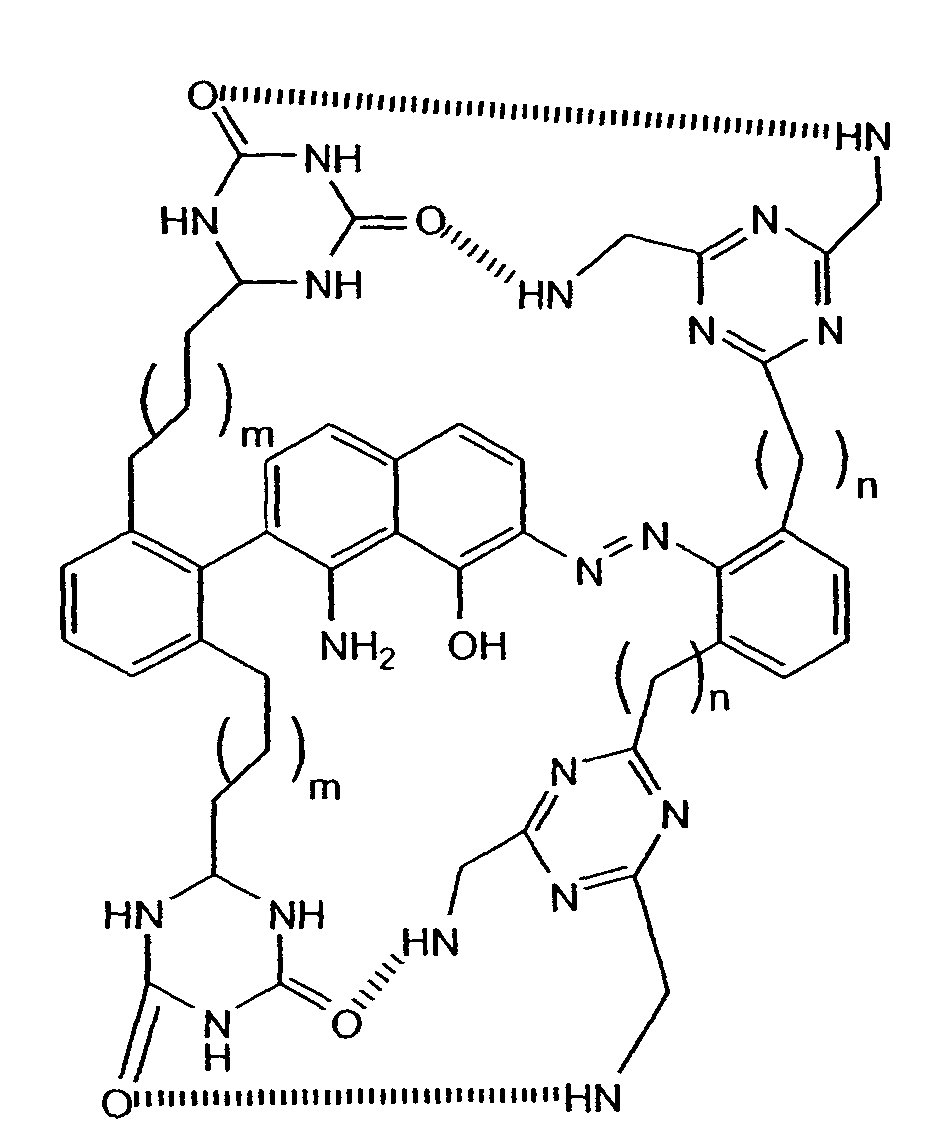
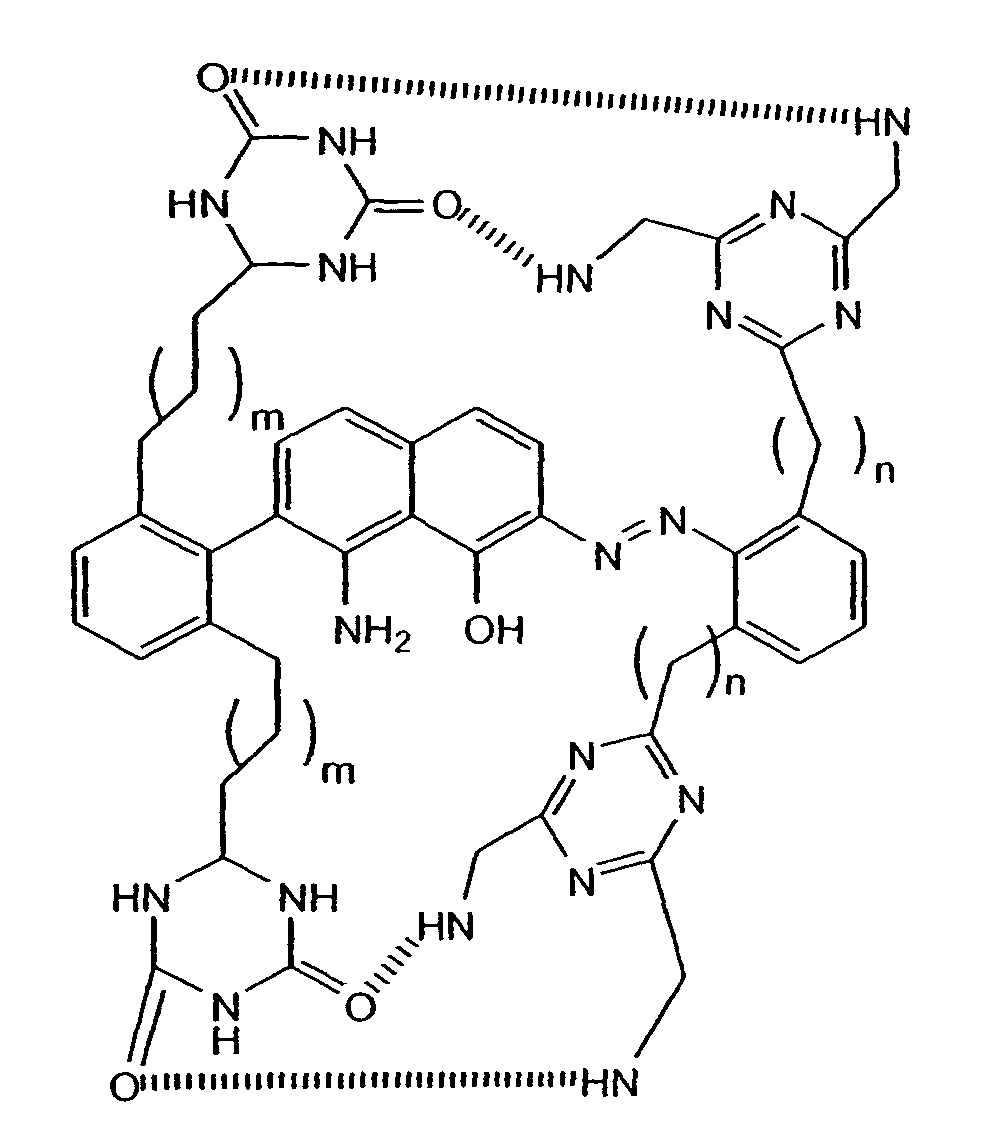
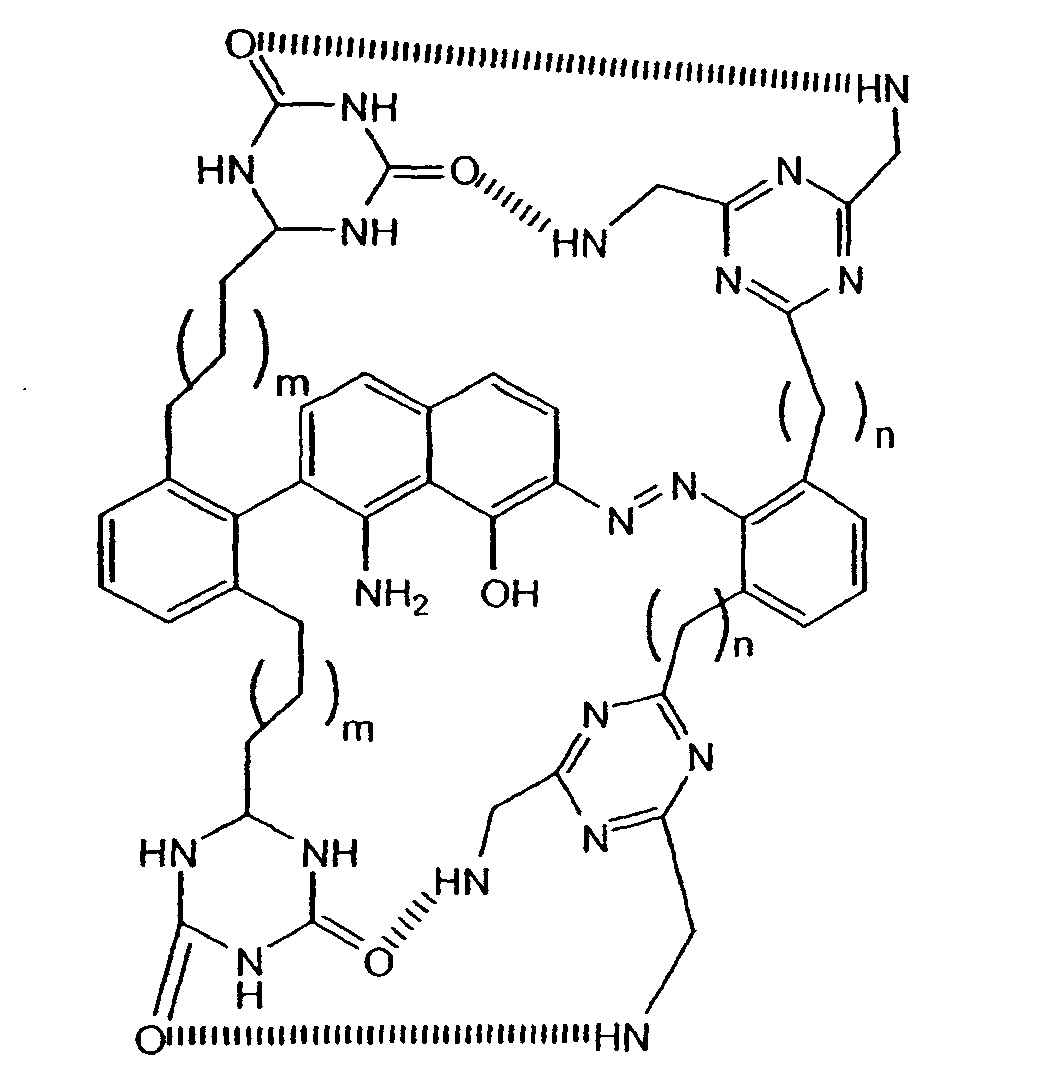
- the present invention relates to a magenta ink for ink-jet printing, comprising a dye having the following structure: wherein m and n are from 0 to 4 added carbons.
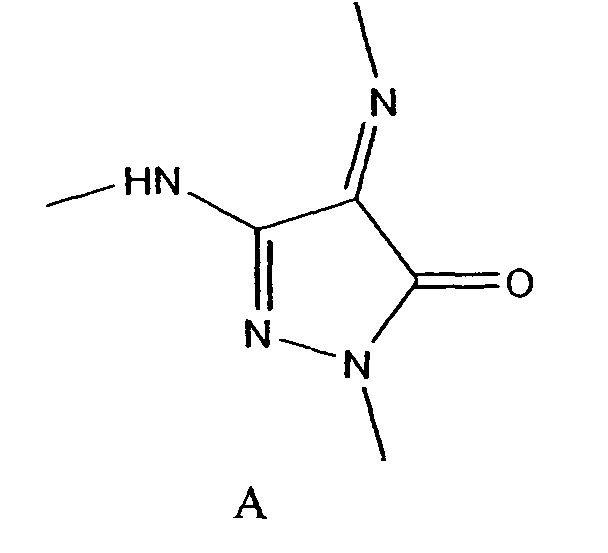
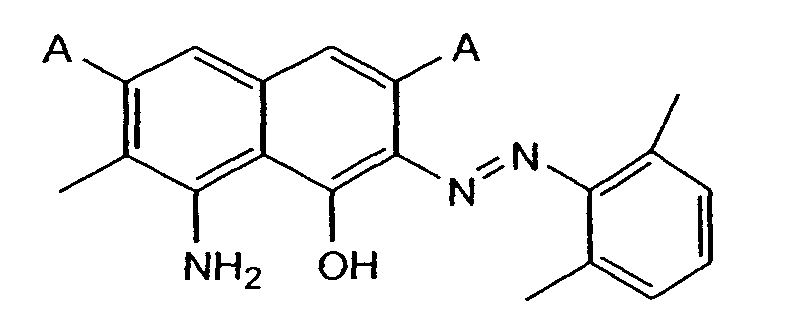
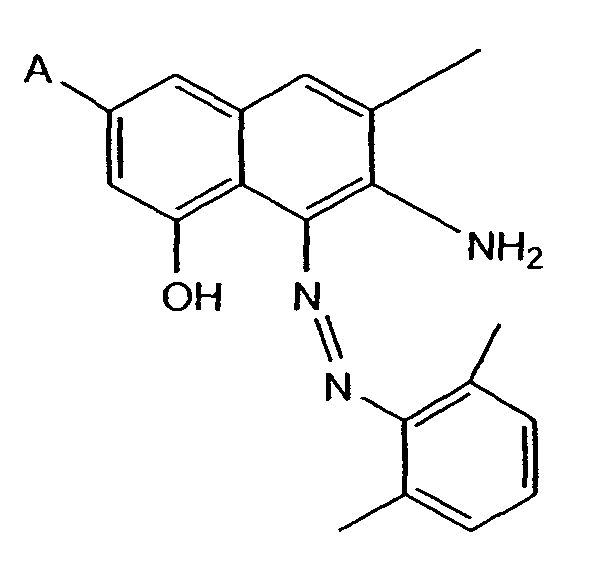
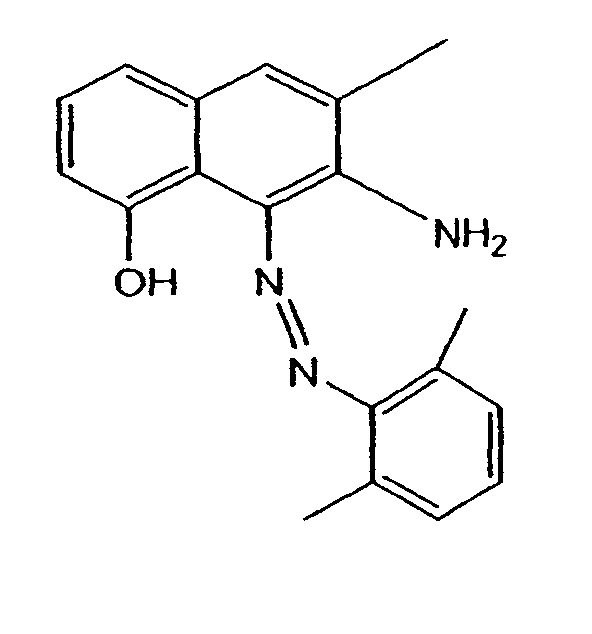
- the present invention relates to a magenta ink for inkjet printing comprising a dye having the following structure: wherein is an azo dye structure wherein A is selected from H and SO 3 H, or a gamma acid based dye structure wherein A is selected from H and SO 3 H.
- the present invention also relates to a method for ink-jet printing, comprising:
- the present invention relates to a method for ink-jet printing, comprising:
- the present invention relates to a method for ink-jet printing, comprising:
- the present invention relates to a method for ink-jet printing, comprising:
- the present invention relates to a method of stabilizing chromophore dyes containing imino groups, the imino groups selected from the group consisting of imino groups A and B: the method comprising adding steric groups to protect imino carbons, the steric groups being selected from phenyl, methyl, ethyl, isopropyl, fluoride, chloride, bromide and iodide.
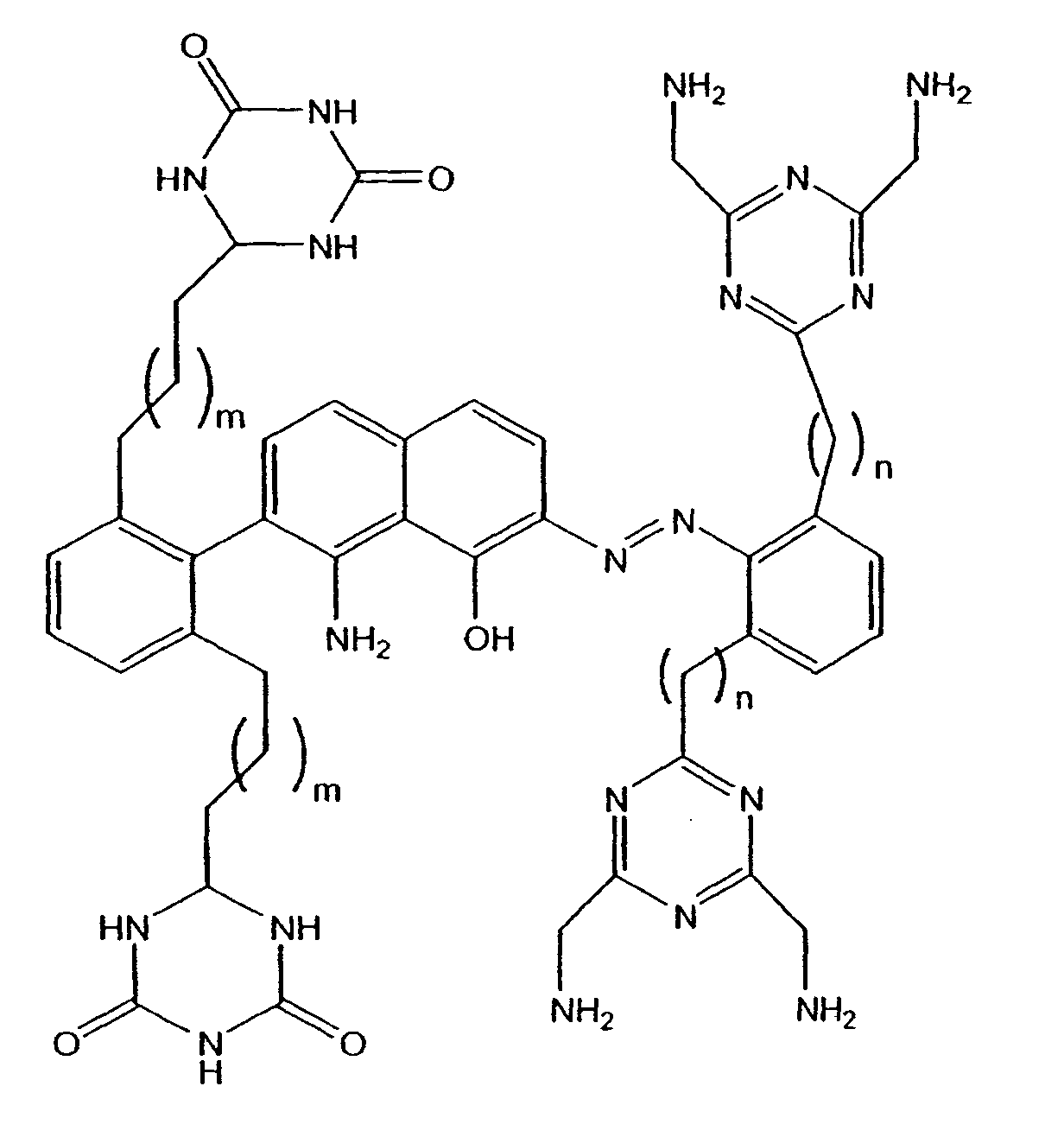
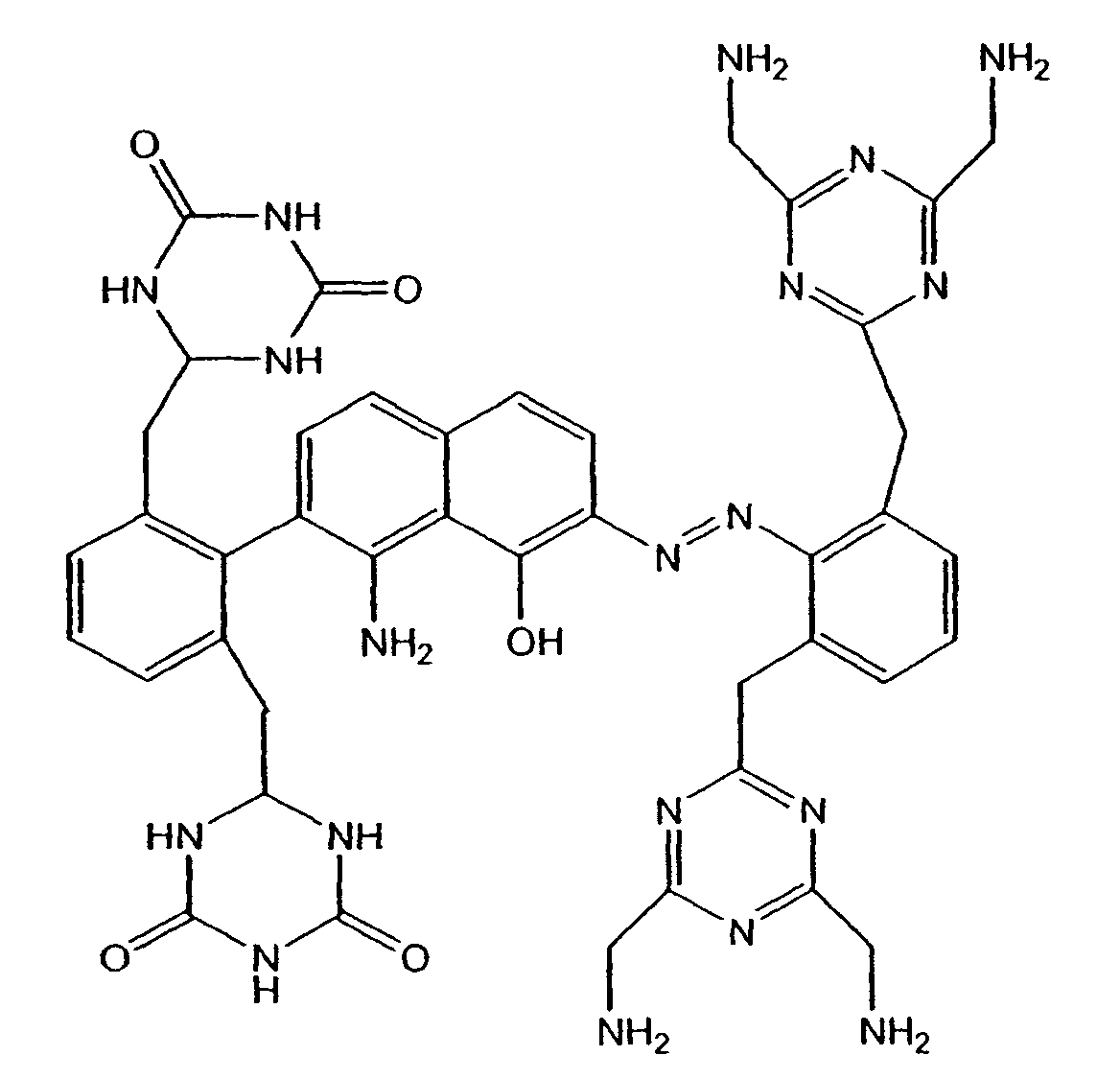
- the present invention relates to a method of stabilizing chromophore dyes comprising arms ending in at least one of cyanuric and melamine groups: wherein m and n are from 0 to 4 added carbons.
- the method comprising forming intramolecular hydrogen bonds between the cyanuric and melamine groups: wherein m and n have from 0 to 4 added carbons.
- the present invention relates to a method of stabilizing chromophore dyes with one of the following structures comprising arms ending in at least one of cyanuric and melamine groups: the method comprising forming intermolecular hydrogen bonds between the cyanuric and melamine groups of two different dye molecules: wherein is an azo dye structure wherein A is selected from H and SO 3 H or a gamma acid based dye structure wherein A is selected from H and SO 3 H.
- the invention described herein is directed to dyes for use with commercially available ink-jet printers such as Design Jet® liner printers, manufactured by Hewlett-Packard Company, of Palo Alto, California. More specifically, a specific dye for formulating the magenta is disclosed.
- the dye enables the production of high-quality print and excellent lightfastness.
- the inks formulated according to the invention produce images having color appearance that meets commercial requirements for color accuracy and durability.
- the phenyl group attached to the imino N at C-4 has ortho-methyl groups, which will inhibit formation of tetrahedral N during ozonolysis.
- the C-5 nitrogen has two phenyl groups with ortho chlorines attached to make approach to C-5 more difficult.
- the azopyrasolotriazole dye(structure 2) has been modified to produce structure 4.
- oxygen at C-8 has an isopropyl instead of an ethyl group.
- Structure 3 shows that the approach to the imine carbon (or to the entire pyrazolone ring) is very hindered.
- Structure 1 shows the energy minimized structure.
- a remaining challenge is to make these dyes water-soluble.
- One is to sulfonate one or more of the aromatic rings.
- Second is to change the acetamide groups to contain a water-solubilizing group, such as COOH, SO 3 H, or polyether.
- Another approach to providing steric protection of dyes is to encase them inside some structure.
- One method of doing this is to construct bridges that cross over above and below the imine or azo plane.
- An alternate method of doing this is to use the concept of "self-assembly".
- the dye is constructed so that it contains arms that spontaneously form bridge like structures. This area of chemistry is extensive and recently reviewed.
- the driving force to make the bridge structure is the formation of several hydrogen bonds, although other methods such as metal chelation are also possible.
- the present magenta aqueous ink compositions each comprise in general from about 0.1 to about 5 wt % of at least one dye, and a vehicle comprising the following components (in wt % of total ink composition): from about 5 to about 30 wt % of at least one organic solvent; 0 to about 2.0 wt % of at least one component independently selected from the group consisting of surfactants, buffers, biocides, and metal chelators; and the balance water. All concentrations herein are in weight percent of total ink composition unless otherwise indicated. The purity of all components is that employed in normal commercial practice for ink-jet inks.
- the inks of the present invention comprise an aqueous vehicle comprising the following components (in wt % of total ink composition): from about 5 to about 30 wt % of at least one water soluble organic solvent; 0 to about 2.0 wt % of at least one component independently selected from the group consisting of surfactants, buffers, biocides, and metal chelators; and the balance water.
- the inks of the present invention comprise from about 5 to about 30 wt % organic solvent. More preferably, the inks comprise from about 8 to about 20 wt % organic solvent, with a concentration from about 9 to about 15 wt % being the most preferred.
- the water soluble organic solvents suitably employed in the present ink-jet ink compositions include any of, or a mixture of two or more, of such compounds as nitrogen-containing heterocyclic ketones, such as 2-pyrrolidone, N-methyl-pyrrolid-2-one (NMP), 1,3-dimethylimidazolid-2-one, and octyl-pyrrolidone; diols such as ethanediols, (e.g., 1,2-ethandiol), propanediols (e.g., 1,2-propanediol, 1,3-propanediol, 2-ethyl-2-hydroxy-methyl-1,3-propanediol, ethylhydroxy-propanediol (EHPD), butanediols (e.g., 1,2-butanediol, 1,3-butanediol, 1,4-butanediol), pentane
- the inks of the present invention optionally comprise 0 to about 2.0 wt % surfactant. More preferably, the inks comprise from about 0.1 to about 1.8 wt % surfactant, with a concentration from about 0.8 to about 1.5 wt % being the most preferred. In the practice of the invention, one or more surfactants may optionally be used.
- Nonionic surfactants such as secondary alcohol ethoxylates (e.g., Tergitol series available from Union Carbide Co.), non-ionic fluoro surfactants (e.g., FC170C available from 3M, non-ionic fatty acid ethoxylate surfactants (e.g., Alkamul PSMO-20 available from Rhone-Poulenc), non-ionic silicone surfactants (e.g., SilwetL7600 available from Osi Specialties, Inc. Danbury, Conn.), and fatty amide ethoxylate surfactants (e.g., Aldamide L203 available from Rhone-Poulenc) are preferred, with secondary alcohol ethoxylates being the most preferred.
- secondary alcohol ethoxylates e.g., Tergitol series available from Union Carbide Co.
- non-ionic fluoro surfactants e.g., FC170C available from 3M
- the surfactant serves to prevent color to color bleed by increasing the penetration of the inks into the print medium, and to improve the spread of the ink on polymer coated media.
- Secondary alcohol ethoxylates are nonionic surfactants and are commercially available, for example, from Union Carbide Co. (Houston, Tex.) as the Tergitol series, such as Tergitol 15-S-5 and Tergitol 1 5-S-7.
- the secondary alcohol ethoxylates contain (a) an aliphatic chain having a prescribed number of carbon atoms in the chain, and (b) a prescribed number of ethoxylated units. These ethoxylates are commercially available as mixtures of ethoxylates, and so are described in terms of the predominance of a given compound. Secondary alcohol ethoxylates suitably employed in the practice of the invention predominantly have from about 12 to about 18 carbon atoms in the aliphatic chain, while the number of ethoxylated units is predominantly in the range of from about 4 to about 8 units.
- Tergitol 15-S-5" represents a secondary alcohol ethoxylate surfactant predominantly having about 15 carbons in its aliphatic chain and about 5 ethoxylated units.
- Tergitol 15-S-5 and Tergitol 15-S-7 are the preferred surfactants.
- the inks of the present invention optionally comprise 0 to about 1.5 wt % buffer. More preferably, the inks comprise from about 0.1 to about 0.5 wt % buffer, with a concentration from about 0.1 to about 0.3 wt % being the most preferred.
- Buffers employed in the practice of the invention to modulate pH can be organic-based biological buffers or inorganic buffers, preferably, organic-based. Further, the buffers employed should maintain a pH ranging from about 3 to about 9 in the practice of the invention, preferably about 6.5 to about 8 and most preferably from about 7.5 to 8.5.
- preferably-employed buffers include Trizma Base, available from companies such as Aldrich Chemical (Milwaukee, Wis.), 4-morpholineethanesulfonic acid (MES), b-hydroxy-4-morpholinepropanesulfonic acid (MOPSO), and 4-morpholinepropanesulfonic acid (MOPS).
- Trizma Base available from companies such as Aldrich Chemical (Milwaukee, Wis.), 4-morpholineethanesulfonic acid (MES), b-hydroxy-4-morpholinepropanesulfonic acid (MOPSO), and 4-morpholinepropanesulfonic acid (MOPS).
- MES 4-morpholineethanesulfonic acid
- MOPSO b-hydroxy-4-morpholinepropanesulfonic acid
- MOPS 4-morpholinepropanesulfonic acid
- the inks of the present invention optionally comprise 0 to about 1.5 wt % metal chelator. More preferably, the inks comprise from about 0.1 to about 0.5 wt % metal chelator, with a concentration from about 0.1 to about 0.3 wt % being the most preferred.
- Metal chelators employed in the practice of the invention are used to bind transition metal cations that may be present in the ink.
- metal chelators include: Ethylenediaminetetraacetic acid (EDTA), Diethylenetriaminepentaacetic acid (DTPA), trans-1,2-diaminocyclohexanetetraacetic acid (CDTA), (ethylenedioxy) diethylenedinitrilotetraacetic acid (EGTA), or other chelators that can bind transition metal actions. More preferably, EDTA, and DTPA; and most preferably EDTA in its disodium salt form is employed in the practice of the invention.
- the inks of the present invention optionally comprise 0 to about 1.5 wt % biocide. More preferably, the inks comprise from about 0.1 to about 0.5 wt % biocide, with a concentration from about 0.1 to about 0.3 wt % being the most preferred.
- Any of the biocides commonly employed in ink-jet inks may be employed in the practice of the invention, such as Nuosept 95, available from Huls America (Piscataway, N.J.); Proxel GXL, available from Zeneca (Wilmington, Del.); and glutaraldehyde, available from Union Carbide Company (Bound Brook, N.J.) under the trade designation Ucarcide 250. Proxel GXL is the preferred biocide.
- the specific ink set disclosed herein is expected to find commercial use in ink-jet color printing.
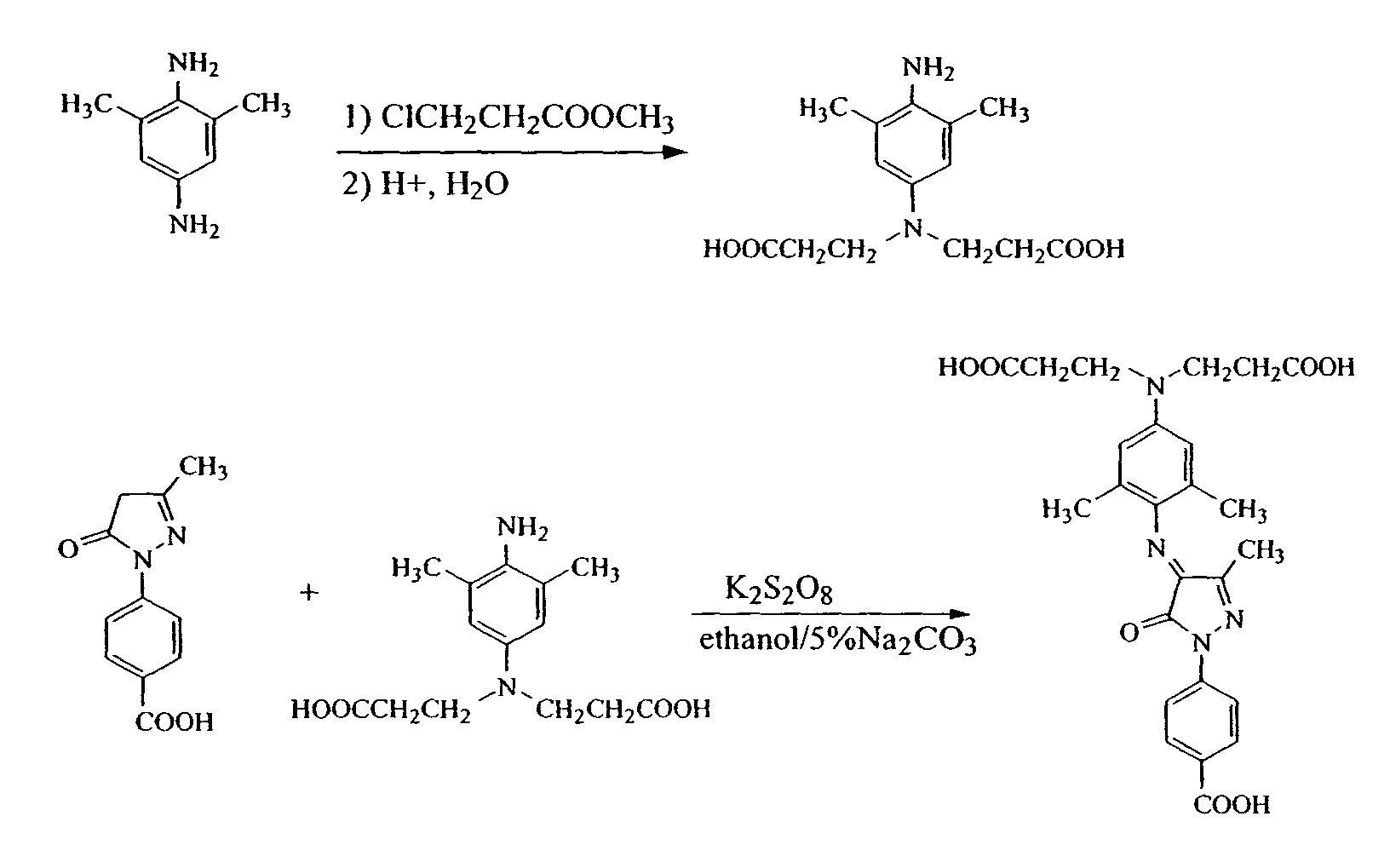
- a pyrazolone azomethine dye dye of the present invention is synthesized as shown below:
- the desired hindered phenylenediamine is made by treating 2,5-dimethyl-1,4-phenylenediamine with methyl-3-chloropropanante and hydrolyzing the resulting ester to the acid.
- the pyrazolone azomethine dye [4-(3-methyl-4-)4-(N,N-di-(ethylsulfonic acid) amino)-1-phenylimino)-5-oxo-2-pyrazotin-yl)-benzoic acid] was prepared by adding 0.6 grams of potassium persulfate to a stirred mixture of 4-(3-methyl-5-oxo-2-pyrazolin-1-yl)-benzoic acid (1 mmol), N,N-diethylsulfonic acid)-1,4-phenylenediamine (0.25 g), methanol (10 mL), and sodium carbonate in water (5%; 20 mL). The mixture was stirred for about 40 minutes and then additional water (70
Landscapes
- Chemical & Material Sciences (AREA)
- Organic Chemistry (AREA)
- Life Sciences & Earth Sciences (AREA)
- Engineering & Computer Science (AREA)
- Materials Engineering (AREA)
- Wood Science & Technology (AREA)
- Inks, Pencil-Leads, Or Crayons (AREA)
- Ink Jet Recording Methods And Recording Media Thereof (AREA)
- Ink Jet (AREA)
- Cosmetics (AREA)
Abstract
Description




or a gamma acid based dye structure

The present invention also relates to a method for ink-jet printing, comprising:


; and
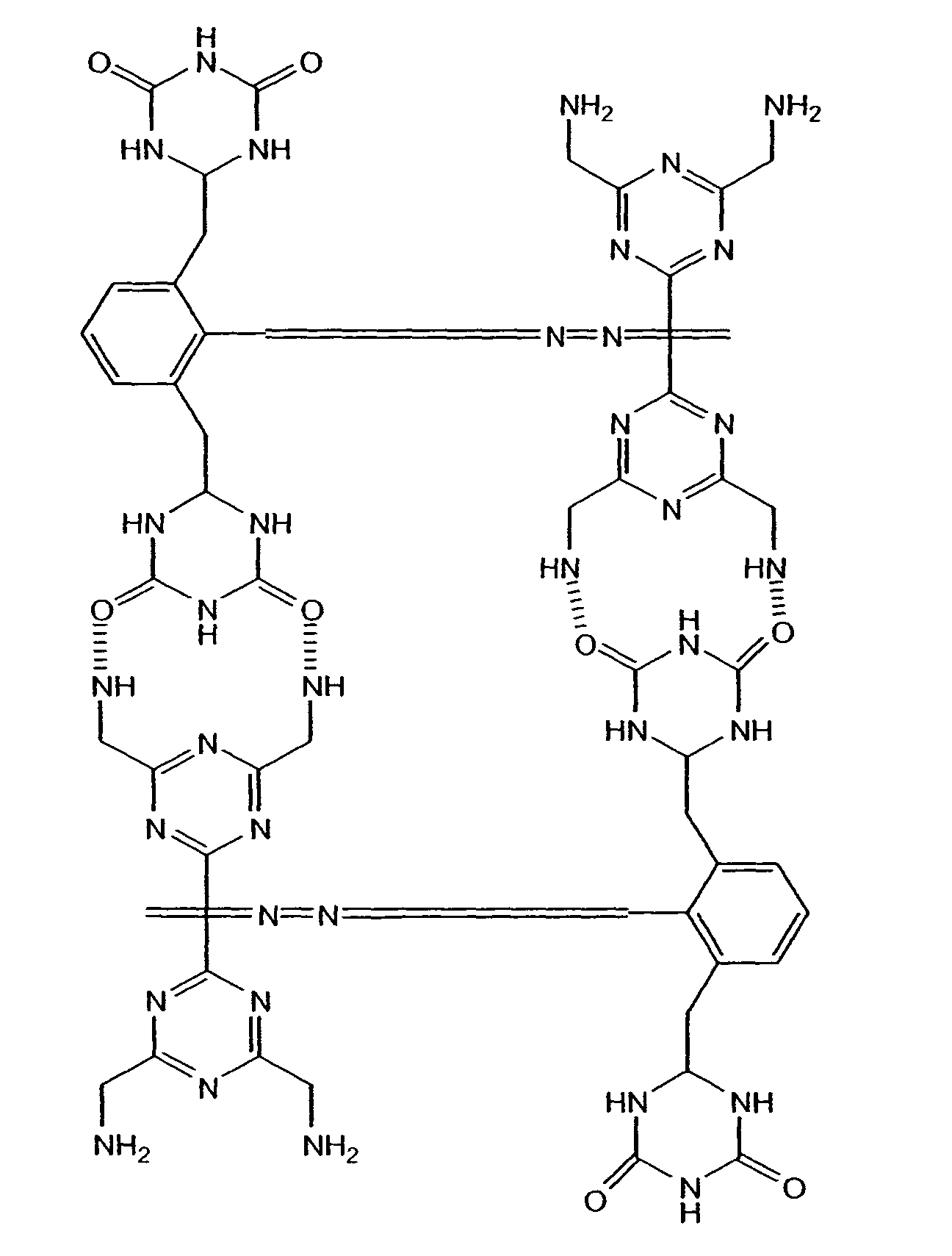


or a gamma-acid based dye structure
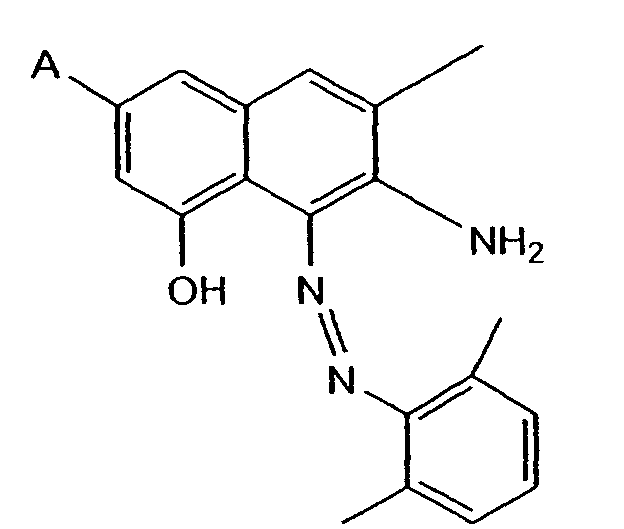
; and


the method comprising forming intramolecular hydrogen bonds between the cyanuric and melamine groups:


or a gamma acid based dye structure

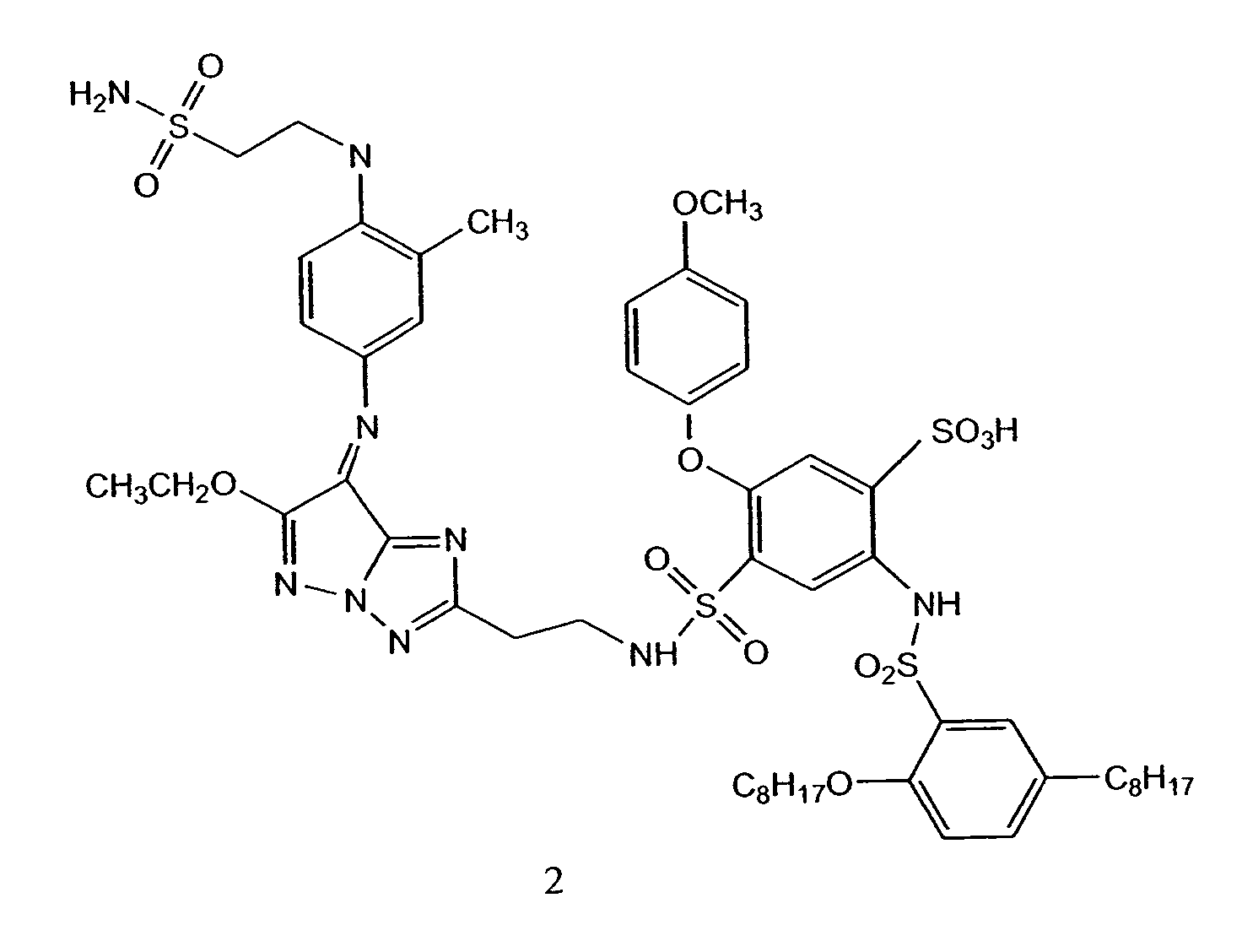
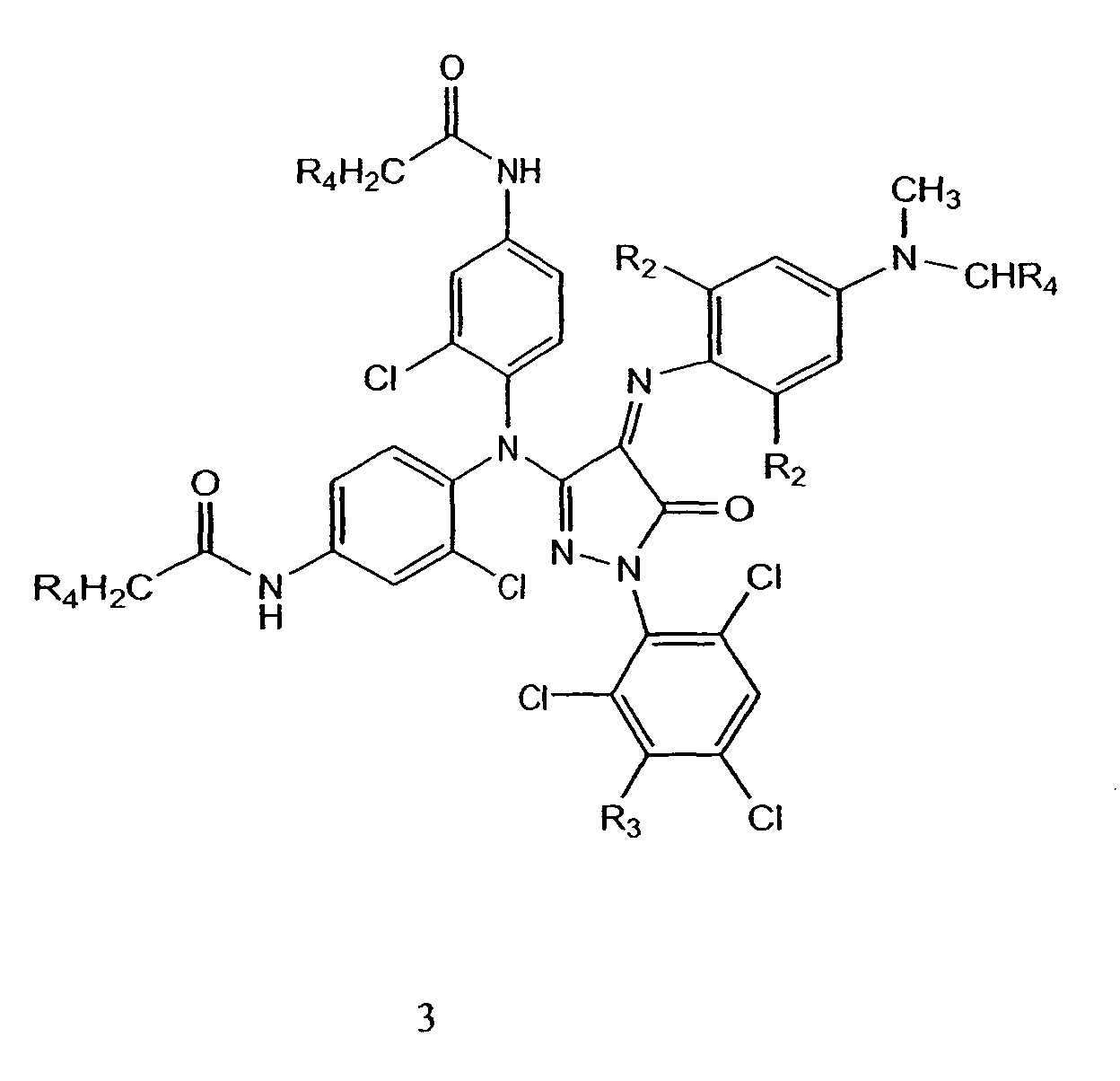

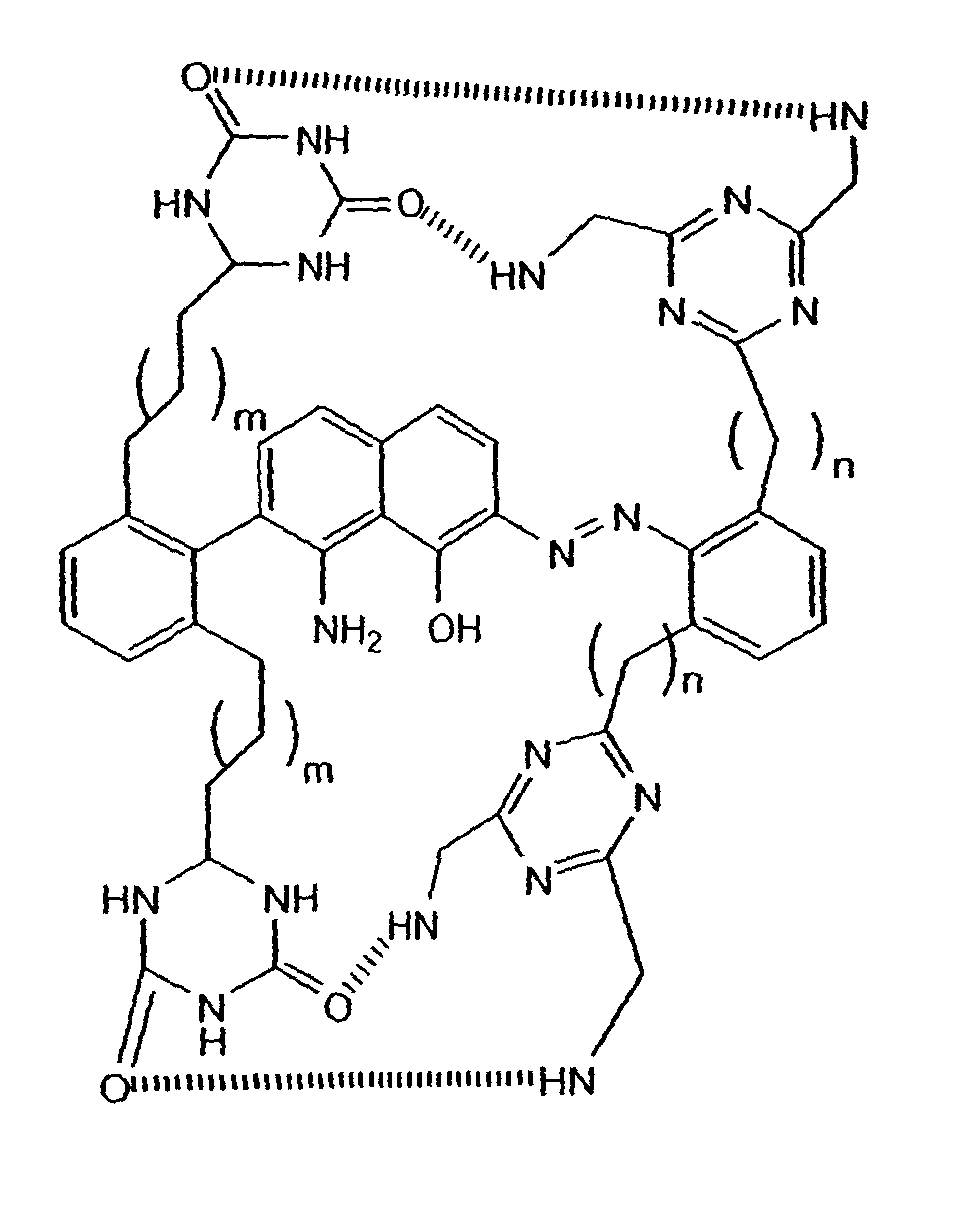


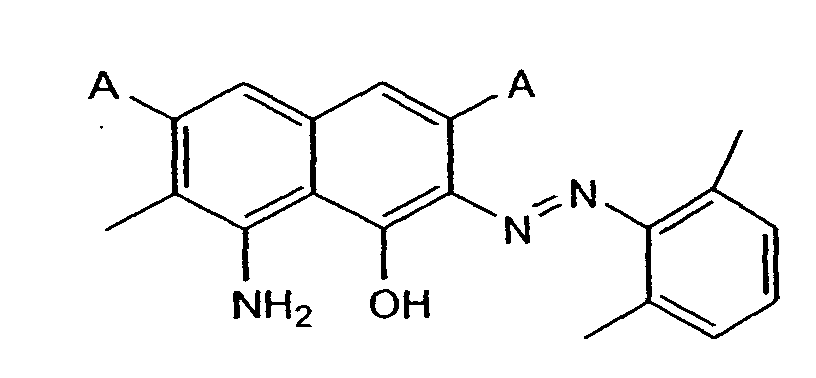
or a gamma acid based dye structure

In the practice of the invention, one or more surfactants may optionally be used. Nonionic surfactants, such as secondary alcohol ethoxylates (e.g., Tergitol series available from Union Carbide Co.), non-ionic fluoro surfactants (e.g., FC170C available from 3M, non-ionic fatty acid ethoxylate surfactants (e.g., Alkamul PSMO-20 available from Rhone-Poulenc), non-ionic silicone surfactants (e.g., SilwetL7600 available from Osi Specialties, Inc. Danbury, Conn.), and fatty amide ethoxylate surfactants (e.g., Aldamide L203 available from Rhone-Poulenc) are preferred, with secondary alcohol ethoxylates being the most preferred. In the practice of the invention, the surfactant serves to prevent color to color bleed by increasing the penetration of the inks into the print medium, and to improve the spread of the ink on polymer coated media. Secondary alcohol ethoxylates are nonionic surfactants and are commercially available, for example, from Union Carbide Co. (Houston, Tex.) as the Tergitol series, such as Tergitol 15-S-5 and Tergitol 1 5-S-7.
Buffers employed in the practice of the invention to modulate pH can be organic-based biological buffers or inorganic buffers, preferably, organic-based. Further, the buffers employed should maintain a pH ranging from about 3 to about 9 in the practice of the invention, preferably about 6.5 to about 8 and most preferably from about 7.5 to 8.5. Examples of preferably-employed buffers include Trizma Base, available from companies such as Aldrich Chemical (Milwaukee, Wis.), 4-morpholineethanesulfonic acid (MES), b-hydroxy-4-morpholinepropanesulfonic acid (MOPSO), and 4-morpholinepropanesulfonic acid (MOPS).
Any of the biocides commonly employed in ink-jet inks may be employed in the practice of the invention, such as Nuosept 95, available from Huls America (Piscataway, N.J.); Proxel GXL, available from Zeneca (Wilmington, Del.); and glutaraldehyde, available from Union Carbide Company (Bound Brook, N.J.) under the trade designation Ucarcide 250. Proxel GXL is the preferred biocide.
The specific ink set disclosed herein is expected to find commercial use in ink-jet color printing.
Claims (4)
- A magenta ink for ink-jet printing, comprising a dye having the following structure:wherein m and n are from 0 to 4 added carbons.
- A magenta ink for inkjet printing comprising a dye having the following structure:wherein
 is an azo dye structure
 wherein A is selected from H and SO3H,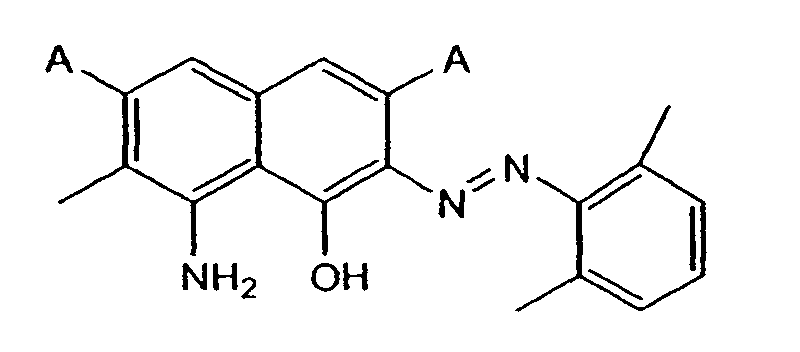
or a gamma acid based dye structurewherein A is selected from H and SO3H.
- A method of stabilizing chromophore dyes comprising arms ending in at least one of cyanuric and melamine groups:wherein m and n are from 0 to 4 added carbons.
the method comprising forming intramolecular hydrogen bonds between the cyanuric and melamine groupswherein m and n are from 0 to 4 added carbons.
- A method of stabilizing chromophore dyes with one of the following structures comprising arms ending in at least one of cyanuric and melamine groups:
 the method comprising forming intermolecular hydrogen bonds between the cyanuric and melamine groups of two different dye molecules:
 wherein
 is an azo dye structure
 or a gamma acid based dye structure
Applications Claiming Priority (3)
| Application Number | Priority Date | Filing Date | Title |
|---|---|---|---|
| US10/057,692 US6730151B2 (en) | 2002-01-25 | 2002-01-25 | Ink jet dye design |
| US57692 | 2002-01-25 | ||
| EP03250156A EP1331252B1 (en) | 2002-01-25 | 2003-01-10 | Ink jet dye design |
Related Parent Applications (1)
| Application Number | Title | Priority Date | Filing Date |
|---|---|---|---|
| EP03250156A Division EP1331252B1 (en) | 2002-01-25 | 2003-01-10 | Ink jet dye design |
Publications (3)
| Publication Number | Publication Date |
|---|---|
| EP1449894A2 true EP1449894A2 (en) | 2004-08-25 |
| EP1449894A3 EP1449894A3 (en) | 2004-10-20 |
| EP1449894B1 EP1449894B1 (en) | 2006-04-26 |
Family
ID=22012171
Family Applications (2)
| Application Number | Title | Priority Date | Filing Date |
|---|---|---|---|
| EP03250156A Expired - Lifetime EP1331252B1 (en) | 2002-01-25 | 2003-01-10 | Ink jet dye design |
| EP04076404A Expired - Lifetime EP1449894B1 (en) | 2002-01-25 | 2003-01-10 | Ink jet dye design |
Family Applications Before (1)
| Application Number | Title | Priority Date | Filing Date |
|---|---|---|---|
| EP03250156A Expired - Lifetime EP1331252B1 (en) | 2002-01-25 | 2003-01-10 | Ink jet dye design |
Country Status (5)
| Country | Link |
|---|---|
| US (4) | US6730151B2 (en) |
| EP (2) | EP1331252B1 (en) |
| JP (1) | JP3759505B2 (en) |
| CH (2) | CH696880A5 (en) |
| DE (2) | DE60327011D1 (en) |
Cited By (1)
| Publication number | Priority date | Publication date | Assignee | Title |
|---|---|---|---|---|
| US7407541B2 (en) | 2002-01-25 | 2008-08-05 | Hewlett-Packard Development Company, L.P. | Inkjet dye design |
Families Citing this family (3)
| Publication number | Priority date | Publication date | Assignee | Title |
|---|---|---|---|---|
| TW200623897A (en) | 2004-12-02 | 2006-07-01 | Seiko Epson Corp | Image display method, image display device, and projector |
| WO2008112993A1 (en) * | 2007-03-15 | 2008-09-18 | Ventana Medical Systems, Inc. | Stabilized hematoxylin |
| US8573465B2 (en) | 2008-02-14 | 2013-11-05 | Ethicon Endo-Surgery, Inc. | Robotically-controlled surgical end effector system with rotary actuated closure systems |
Family Cites Families (40)
| Publication number | Priority date | Publication date | Assignee | Title |
|---|---|---|---|---|
| US3349076A (en) * | 1964-09-03 | 1967-10-24 | Eastman Kodak Co | Monoazo dyes |
| US4042394A (en) * | 1973-05-07 | 1977-08-16 | Eastman Kodak Company | Photographic dye image stabilization |
| CA1032807A (en) * | 1973-05-07 | 1978-06-13 | Wendell F. Smith (Jr.) | Stabilized dyes |
| JPH0764993B2 (en) * | 1986-12-09 | 1995-07-12 | 富士写真フイルム株式会社 | Pyrazoloazole azomethine cyan dye |
| JPH0693105B2 (en) * | 1987-06-10 | 1994-11-16 | 富士写真フイルム株式会社 | Magenta dye forming coupler |
| US5242785A (en) | 1987-06-25 | 1993-09-07 | Fuji Photo Film Co., Ltd. | Silver halide color photographic material containing color stain inhibitors and discoloring inhibitors |
| JPS6440832A (en) * | 1987-08-06 | 1989-02-13 | Fuji Photo Film Co Ltd | Pyrazoloazole azomethine dyestuff |
| DE3842785C1 (en) | 1988-12-20 | 1990-03-22 | Meteor-Siegen Apparatebau Paul Schmeck Gmbh, 5900 Siegen, De | |
| JP2684436B2 (en) * | 1990-02-23 | 1997-12-03 | 富士写真フイルム株式会社 | Thermal transfer dye donating material |
| JP2747848B2 (en) * | 1990-08-03 | 1998-05-06 | 富士写真フイルム株式会社 | Thermal transfer dye donating material |
| JP2729701B2 (en) * | 1990-10-08 | 1998-03-18 | 富士写真フイルム株式会社 | Silver halide photographic emulsion and full-color recording material containing the emulsion |
| US5362882A (en) * | 1991-06-07 | 1994-11-08 | Fuji Photo Film Co., Ltd. | Pyrrolotriazole derivative and heat transfer dye providing material containing a pyrrolotriazole azomethine dye |
| JPH052246A (en) | 1991-06-24 | 1993-01-08 | Fuji Photo Film Co Ltd | Silver halide color photosensitive material |
| JP2681422B2 (en) | 1991-07-09 | 1997-11-26 | 富士写真フイルム株式会社 | Silver halide color photographic materials |
| JP2665642B2 (en) * | 1992-03-16 | 1997-10-22 | 富士写真フイルム株式会社 | Pyrazoloazole azomethine dye and thermal transfer dye-donor containing the same |
| EP0575816B1 (en) | 1992-06-12 | 1999-09-22 | Mitsui Chemicals, Inc. | Light-absorbing compound and optical recording medium containing same |
| EP0574090A1 (en) * | 1992-06-12 | 1993-12-15 | Eastman Kodak Company | One equivalent couplers and low pKa release dyes |
| US5476943A (en) * | 1993-03-22 | 1995-12-19 | Konica Corporation | Dye and heat sensitive transfer material comprising the same |
| DE69522513T2 (en) | 1994-06-23 | 2002-04-11 | Eastman Kodak Co., Rochester | Photographic two-equivalent magenta couplers with activity modifying ballast groups |
| US5545504A (en) | 1994-10-03 | 1996-08-13 | Xerox Corporation | Ink jettable toner compositions and processes for making and using |
| JP2791944B2 (en) | 1995-02-27 | 1998-08-27 | ティーディーケイ株式会社 | Optical recording medium using formazan metal complex dye and optical stabilization method |
| JP3522909B2 (en) * | 1995-07-21 | 2004-04-26 | 大日本印刷株式会社 | Thermal transfer sheet |
| US5753017A (en) * | 1995-10-16 | 1998-05-19 | Konica Corporation | Ink jet recording ink and recording method employing the same |
| GB2308378B (en) * | 1995-12-19 | 2000-06-21 | Zeneca Ltd | Monoazo dyes based on 2-[7-(2'-sulpho-phenylazo)-8-hydroxy-3,6-disulphonaphthylamino]-4,6-disubstituted-triazine skeleton for use in ink |
| JPH09258398A (en) | 1996-03-22 | 1997-10-03 | Fuji Photo Film Co Ltd | Silver halide photographic sensitive material and image forming method |
| JPH09269572A (en) | 1996-04-02 | 1997-10-14 | Fuji Photo Film Co Ltd | Silver halide color photographic sensitive material and image forming method |
| JP3559679B2 (en) | 1996-07-18 | 2004-09-02 | キヤノン株式会社 | Ink jet recording medium and ink jet recording method using the same |
| JPH1060344A (en) | 1996-08-26 | 1998-03-03 | Konica Corp | Polymeric coloring material, and ink jet recording fluid containing it |
| JP3642896B2 (en) * | 1996-09-13 | 2005-04-27 | 大日本印刷株式会社 | Black heat transfer sheet |
| DE19720004C1 (en) | 1997-05-13 | 1999-02-04 | Pelikan Produktions Ag | Ink-jet printing method and ink set for multi-color ink-jet printing |
| DE19804123A1 (en) * | 1998-02-03 | 1999-08-05 | Agfa Gevaert Ag | Ink for use in ink jet printing |
| DE19858730A1 (en) * | 1998-12-18 | 2000-06-21 | Bayer Ag | New monoazo dyes used for dyeing and printing substrate containing hydroxyl or amido groups and in printing ink, e.g. for ink-jet printing on paper are 7-amino-8-triazinylamno-sulfophenylazo-naphthol-sulfphonic acids |
| JP4130030B2 (en) | 1999-03-09 | 2008-08-06 | 富士フイルム株式会社 | Photosensitive composition and 1,3-dihydro-1-oxo-2H-indene derivative compound |
| US6383276B1 (en) * | 1999-03-12 | 2002-05-07 | Fuji Photo Film Co., Ltd. | Azomethine compound and oily magenta ink |
| JP2001240763A (en) * | 1999-12-22 | 2001-09-04 | Fuji Photo Film Co Ltd | Colored fine particle dispersion, ink for ink-jetting and ink-jetting recording method |
| JP4948697B2 (en) * | 2000-02-15 | 2012-06-06 | 富士フイルム株式会社 | Colored fine particle dispersion for inkjet ink and inkjet ink |
| JP4233238B2 (en) * | 2000-07-06 | 2009-03-04 | 富士フイルム株式会社 | Colored fine particle dispersion for ink, ink for ink jet recording using the same, and ink jet recording method |
| US6494942B1 (en) * | 2000-09-15 | 2002-12-17 | Larrie A Deardurff | Dye-based ink jet compositions having improved stability and light fastness |
| US6730151B2 (en) | 2002-01-25 | 2004-05-04 | Hewlett-Packard Development Company, L.P. | Ink jet dye design |
| US7156907B2 (en) * | 2003-10-22 | 2007-01-02 | Hewlett-Packard Development Company, L.P. | Multimeric dye structures |
-
2002
- 2002-01-25 US US10/057,692 patent/US6730151B2/en not_active Expired - Fee Related
-
2003
- 2003-01-10 DE DE60327011T patent/DE60327011D1/en not_active Expired - Lifetime
- 2003-01-10 DE DE60304818T patent/DE60304818T2/en not_active Expired - Lifetime
- 2003-01-10 EP EP03250156A patent/EP1331252B1/en not_active Expired - Lifetime
- 2003-01-10 EP EP04076404A patent/EP1449894B1/en not_active Expired - Lifetime
- 2003-01-20 CH CH00084/03A patent/CH696880A5/en not_active IP Right Cessation
- 2003-01-20 CH CH10/057692A patent/CH696543A8/en not_active IP Right Cessation
- 2003-01-24 JP JP2003016081A patent/JP3759505B2/en not_active Expired - Fee Related
-
2004
- 2004-02-24 US US10/786,587 patent/US7407541B2/en not_active Expired - Fee Related
-
2007
- 2007-11-02 US US11/934,456 patent/US7449057B2/en not_active Expired - Fee Related
-
2008
- 2008-09-24 US US12/237,340 patent/US8119777B2/en not_active Expired - Fee Related
Cited By (3)
| Publication number | Priority date | Publication date | Assignee | Title |
|---|---|---|---|---|
| US7407541B2 (en) | 2002-01-25 | 2008-08-05 | Hewlett-Packard Development Company, L.P. | Inkjet dye design |
| US7449057B2 (en) | 2002-01-25 | 2008-11-11 | Hewlett-Packard Development Company, L.P. | Ink jet dye design |
| US8119777B2 (en) | 2002-01-25 | 2012-02-21 | Hewlett-Packard Development Company, L.P. | Ink jet dye design |
Also Published As
| Publication number | Publication date |
|---|---|
| CH696543A5 (en) | 2007-07-31 |
| DE60304818T2 (en) | 2007-01-11 |
| US7407541B2 (en) | 2008-08-05 |
| US7449057B2 (en) | 2008-11-11 |
| US20090082564A1 (en) | 2009-03-26 |
| CH696543A8 (en) | 2007-10-15 |
| EP1449894B1 (en) | 2006-04-26 |
| US20050081746A1 (en) | 2005-04-21 |
| EP1331252B1 (en) | 2009-04-08 |
| US8119777B2 (en) | 2012-02-21 |
| EP1331252A3 (en) | 2004-07-21 |
| US20030167966A1 (en) | 2003-09-11 |
| DE60327011D1 (en) | 2009-05-20 |
| JP2004002673A (en) | 2004-01-08 |
| EP1449894A3 (en) | 2004-10-20 |
| JP3759505B2 (en) | 2006-03-29 |
| DE60304818D1 (en) | 2006-06-01 |
| EP1331252A2 (en) | 2003-07-30 |
| US20080078303A1 (en) | 2008-04-03 |
| CH696880A5 (en) | 2008-01-15 |
| US6730151B2 (en) | 2004-05-04 |
Similar Documents
| Publication | Publication Date | Title |
|---|---|---|
| EP1006157B1 (en) | Metal complex for ink jet ink | |
| JP4186775B2 (en) | Ink set | |
| US6468338B1 (en) | Dye for ink jet ink | |
| US20050115459A1 (en) | Magenta ink composition | |
| US7503966B2 (en) | Black ink composition and ink jet recording method | |
| JP3263524B2 (en) | Polymer dye having xanthene skeleton and aqueous ink composition using the dye | |
| US7449057B2 (en) | Ink jet dye design | |
| US20070146453A1 (en) | Ink composition | |
| US6527844B2 (en) | Metal complex for ink jet ink | |
| JP2001002966A (en) | Ink-jet recording ink composition | |
| JP2005105136A (en) | Magenta ink composition | |
| US6136080A (en) | Cationic azo dye for ink jet ink | |
| HK1055439A (en) | Ink jet dye design | |
| JP3829419B2 (en) | Method for forming a color image | |
| US7871465B2 (en) | Ink composition, and ink jet recording method and recorded matter using the same | |
| JP5435886B2 (en) | Dye compound and ink containing the dye compound | |
| JP3991376B2 (en) | Method for forming a color image | |
| JP3829420B2 (en) | Recording liquid and ink jet recording method | |
| JP3389784B2 (en) | Recording liquid | |
| JPH1112514A (en) | Recording liquid | |
| JP3484787B2 (en) | Recording liquid | |
| JP4179126B2 (en) | Magenta ink composition | |
| JP3451755B2 (en) | Recording liquid | |
| JP2011042798A (en) | Magenta ink composition | |
| JP2004042547A (en) | Color image forming method |
Legal Events
| Date | Code | Title | Description |
|---|---|---|---|
| PUAI | Public reference made under article 153(3) epc to a published international application that has entered the european phase |
Free format text: ORIGINAL CODE: 0009012 |
|
| AC | Divisional application: reference to earlier application |
Ref document number: 1331252 Country of ref document: EP Kind code of ref document: P |
|
| AK | Designated contracting states |
Kind code of ref document: A2 Designated state(s): AT BE BG CH CY CZ DE DK EE ES FI FR GB GR HU IE IT LI LU MC NL PT SE SI SK TR |
|
| AX | Request for extension of the european patent |
Extension state: AL LT LV MK |
|
| PUAL | Search report despatched |
Free format text: ORIGINAL CODE: 0009013 |
|
| AK | Designated contracting states |
Kind code of ref document: A3 Designated state(s): AT BE BG CH CY CZ DE DK EE ES FI FR GB GR HU IE IT LI LU MC NL PT SE SI SK TR |
|
| AX | Request for extension of the european patent |
Extension state: AL LT LV MK |
|
| RIC1 | Information provided on ipc code assigned before grant |
Ipc: 7C 09B 55/00 B Ipc: 7C 09B 29/00 B Ipc: 7C 09B 29/30 B Ipc: 7C 09B 29/28 B Ipc: 7C 09B 69/00 B Ipc: 7C 09D 11/00 A |
|
| 17P | Request for examination filed |
Effective date: 20050401 |
|
| AKX | Designation fees paid |
Designated state(s): DE FR GB NL |
|
| GRAP | Despatch of communication of intention to grant a patent |
Free format text: ORIGINAL CODE: EPIDOSNIGR1 |
|
| GRAS | Grant fee paid |
Free format text: ORIGINAL CODE: EPIDOSNIGR3 |
|
| GRAA | (expected) grant |
Free format text: ORIGINAL CODE: 0009210 |
|
| AC | Divisional application: reference to earlier application |
Ref document number: 1331252 Country of ref document: EP Kind code of ref document: P |
|
| AK | Designated contracting states |
Kind code of ref document: B1 Designated state(s): DE FR GB NL |
|
| REG | Reference to a national code |
Ref country code: GB Ref legal event code: FG4D |
|
| REF | Corresponds to: |
Ref document number: 60304818 Country of ref document: DE Date of ref document: 20060601 Kind code of ref document: P |
|
| ET | Fr: translation filed | ||
| PLBE | No opposition filed within time limit |
Free format text: ORIGINAL CODE: 0009261 |
|
| STAA | Information on the status of an ep patent application or granted ep patent |
Free format text: STATUS: NO OPPOSITION FILED WITHIN TIME LIMIT |
|
| 26N | No opposition filed |
Effective date: 20070129 |
|
| REG | Reference to a national code |
Ref country code: GB Ref legal event code: 732E Free format text: REGISTERED BETWEEN 20120329 AND 20120404 |
|
| REG | Reference to a national code |
Ref country code: NL Ref legal event code: SD Effective date: 20120731 |
|
| REG | Reference to a national code |
Ref country code: FR Ref legal event code: PLFP Year of fee payment: 14 |
|
| PGFP | Annual fee paid to national office [announced via postgrant information from national office to epo] |
Ref country code: NL Payment date: 20151217 Year of fee payment: 14 |
|
| REG | Reference to a national code |
Ref country code: FR Ref legal event code: PLFP Year of fee payment: 15 |
|
| REG | Reference to a national code |
Ref country code: NL Ref legal event code: MM Effective date: 20170201 |
|
| PG25 | Lapsed in a contracting state [announced via postgrant information from national office to epo] |
Ref country code: NL Free format text: LAPSE BECAUSE OF NON-PAYMENT OF DUE FEES Effective date: 20170201 |
|
| REG | Reference to a national code |
Ref country code: FR Ref legal event code: PLFP Year of fee payment: 16 |
|
| PGFP | Annual fee paid to national office [announced via postgrant information from national office to epo] |
Ref country code: GB Payment date: 20181219 Year of fee payment: 17 Ref country code: FR Payment date: 20181220 Year of fee payment: 17 |
|
| PGFP | Annual fee paid to national office [announced via postgrant information from national office to epo] |
Ref country code: DE Payment date: 20181218 Year of fee payment: 17 |
|
| REG | Reference to a national code |
Ref country code: DE Ref legal event code: R119 Ref document number: 60304818 Country of ref document: DE |
|
| GBPC | Gb: european patent ceased through non-payment of renewal fee |
Effective date: 20200110 |
|
| PG25 | Lapsed in a contracting state [announced via postgrant information from national office to epo] |
Ref country code: FR Free format text: LAPSE BECAUSE OF NON-PAYMENT OF DUE FEES Effective date: 20200131 Ref country code: GB Free format text: LAPSE BECAUSE OF NON-PAYMENT OF DUE FEES Effective date: 20200110 Ref country code: DE Free format text: LAPSE BECAUSE OF NON-PAYMENT OF DUE FEES Effective date: 20200801 |