EP1449519A1 - Liquid composition containing a guanidine amide group derivative and/or a salt thereof - Google Patents
Liquid composition containing a guanidine amide group derivative and/or a salt thereof Download PDFInfo
- Publication number
- EP1449519A1 EP1449519A1 EP04250815A EP04250815A EP1449519A1 EP 1449519 A1 EP1449519 A1 EP 1449519A1 EP 04250815 A EP04250815 A EP 04250815A EP 04250815 A EP04250815 A EP 04250815A EP 1449519 A1 EP1449519 A1 EP 1449519A1
- Authority
- EP
- European Patent Office
- Prior art keywords
- group
- liquid composition
- salt
- component
- composition according
- Prior art date
- Legal status (The legal status is an assumption and is not a legal conclusion. Google has not performed a legal analysis and makes no representation as to the accuracy of the status listed.)
- Granted
Links
Classifications
-
- A—HUMAN NECESSITIES
- A61—MEDICAL OR VETERINARY SCIENCE; HYGIENE
- A61Q—SPECIFIC USE OF COSMETICS OR SIMILAR TOILETRY PREPARATIONS
- A61Q11/00—Preparations for care of the teeth, of the oral cavity or of dentures; Dentifrices, e.g. toothpastes; Mouth rinses
-
- A—HUMAN NECESSITIES
- A61—MEDICAL OR VETERINARY SCIENCE; HYGIENE
- A61K—PREPARATIONS FOR MEDICAL, DENTAL OR TOILETRY PURPOSES
- A61K31/00—Medicinal preparations containing organic active ingredients
- A61K31/13—Amines
- A61K31/155—Amidines (), e.g. guanidine (H2N—C(=NH)—NH2), isourea (N=C(OH)—NH2), isothiourea (—N=C(SH)—NH2)
-
- A—HUMAN NECESSITIES
- A61—MEDICAL OR VETERINARY SCIENCE; HYGIENE
- A61K—PREPARATIONS FOR MEDICAL, DENTAL OR TOILETRY PURPOSES
- A61K8/00—Cosmetics or similar toiletry preparations
- A61K8/02—Cosmetics or similar toiletry preparations characterised by special physical form
- A61K8/0208—Tissues; Wipes; Patches
-
- A—HUMAN NECESSITIES
- A61—MEDICAL OR VETERINARY SCIENCE; HYGIENE
- A61K—PREPARATIONS FOR MEDICAL, DENTAL OR TOILETRY PURPOSES
- A61K8/00—Cosmetics or similar toiletry preparations
- A61K8/18—Cosmetics or similar toiletry preparations characterised by the composition
- A61K8/19—Cosmetics or similar toiletry preparations characterised by the composition containing inorganic ingredients
- A61K8/20—Halogens; Compounds thereof
-
- A—HUMAN NECESSITIES
- A61—MEDICAL OR VETERINARY SCIENCE; HYGIENE
- A61K—PREPARATIONS FOR MEDICAL, DENTAL OR TOILETRY PURPOSES
- A61K8/00—Cosmetics or similar toiletry preparations
- A61K8/18—Cosmetics or similar toiletry preparations characterised by the composition
- A61K8/30—Cosmetics or similar toiletry preparations characterised by the composition containing organic compounds
- A61K8/33—Cosmetics or similar toiletry preparations characterised by the composition containing organic compounds containing oxygen
- A61K8/37—Esters of carboxylic acids
-
- A—HUMAN NECESSITIES
- A61—MEDICAL OR VETERINARY SCIENCE; HYGIENE
- A61K—PREPARATIONS FOR MEDICAL, DENTAL OR TOILETRY PURPOSES
- A61K8/00—Cosmetics or similar toiletry preparations
- A61K8/18—Cosmetics or similar toiletry preparations characterised by the composition
- A61K8/30—Cosmetics or similar toiletry preparations characterised by the composition containing organic compounds
- A61K8/40—Cosmetics or similar toiletry preparations characterised by the composition containing organic compounds containing nitrogen
- A61K8/43—Guanidines
-
- A—HUMAN NECESSITIES
- A61—MEDICAL OR VETERINARY SCIENCE; HYGIENE
- A61K—PREPARATIONS FOR MEDICAL, DENTAL OR TOILETRY PURPOSES
- A61K8/00—Cosmetics or similar toiletry preparations
- A61K8/18—Cosmetics or similar toiletry preparations characterised by the composition
- A61K8/30—Cosmetics or similar toiletry preparations characterised by the composition containing organic compounds
- A61K8/40—Cosmetics or similar toiletry preparations characterised by the composition containing organic compounds containing nitrogen
- A61K8/44—Aminocarboxylic acids or derivatives thereof, e.g. aminocarboxylic acids containing sulfur; Salts; Esters or N-acylated derivatives thereof
-
- A—HUMAN NECESSITIES
- A61—MEDICAL OR VETERINARY SCIENCE; HYGIENE
- A61Q—SPECIFIC USE OF COSMETICS OR SIMILAR TOILETRY PREPARATIONS
- A61Q19/00—Preparations for care of the skin
Definitions
- the present invention relates to a composition containing a specific amide group-containing guanidine derivative or/and a salt thereof. More specifically, the invention relates to a method for suppressing the generation of the precipitate of an amide group-containing guanidine derivative or/and a salt thereof (component A), including a step of blending at least one (component B) selected from the group consisting of specific inorganic salts, organic acid salts, nonionic surfactants and ampholytic surfactants to the amide group-containing guanidine derivative or/and a salt thereof; and a liquid composition with improved storage stability, which contains the amide group-containing guanidine derivative or/and a salt thereof.
- the liquid composition canbe applied to awidevarietyof products such as pharmaceutical fluids for wet tissue, cosmetic lotions, mouthwash agents, lotions, bathing agents and deodorants.
- N-long chain acyl basic amino acid derivatives and salts thereof have been known traditionally as bactericidal washing agents, which are cationic activators like quaternary ammonium salts (JP-B-51-5413) .
- bactericidal washing agents which are cationic activators like quaternary ammonium salts (JP-B-51-5413) .
- N-cocoyl-L-arginine ethyl ester-DL-pyrrolidone carboxylate salt as one of them is commercially available under the trade name "CAE" and has a great surface-acting activity and a great safety profile as well as a high preservative activity or a bactericidal activity.
- N-long chain acyl basic amino acid derivatives are generally used in salt forms and are therefore soluble in water. Accordingly, the ester groups in the molecules of the salts of the derivatives are sometimes hydrolyzed.
- amino group-containing guanidine derivatives or salts thereof having the structure of N-long chain acyl basic amino acid derivatives, from which the ester group is preliminarily removed has great stability against hydrolysis, as expected on the basis of the structure.
- the derivatives or salts thereof have a great hair-adsorbing property and are therefore used as surfactants giving softness, emollience and great finish.
- the inventors prepared pharmaceutical fluids for wet tissue, cosmeticlotionsandthelike (liquidcompositions) using the amide group-containing guanidine derivative represented by the general formula (1) or a salt thereof as a surfactant, a bactericidal agent and a preservative.
- amide group-containing guanidine derivative represented by the general formula (1) or a salt thereof as a surfactant, a bactericidal agent and a preservative.
- precipitates emerged in these liquid compositions, just when the liquid compositions were diluted or were left to stand over time.
- the inventors analyzed the generated precipitates. Consequently, the inventors confirmed that the precipitates were fatty acids secondarily produced during the synthetic reaction of the amide group-containing guanidine derivative represented by the general formula (1) and salts of the amide group-containing guanidine derivative.
- the amide group-containing guanidine derivative represented by the general formula (1) and salts thereof are useful compounds as surfactants, touch-improving agents, preservatives or bactericides.
- the product values thereof are deteriorated when liquid compositions containing the derivative or salts thereof happen to form precipitates. Otherwise, the touch thereof during use is deteriorated when used on skin. From the standpoint of the process control of the industrial preparation of an aqueous solution of the amide group-containing guanidine derivative and salts thereof, the dissolution of the amide group-containing guanidine derivative and salts thereof cannot be visually confirmed in a simple manner, disadvantageously.
- embodiments of the invention provide a method for suppressing the generation of the precipitate of the amide group-containing guanidine derivative represented by the general formula (1) or/and a salt thereof in a liquid composition containing the derivative or/and a salt thereof, and also provide such liquid composition with improved storage stability.
- R 1 and R 2 are independently hydrogen atom or a linear or branched alkyl group or alkenyl group with one to 4 carbon atoms and may be the same or different;
- R 3 represents a linear or branched alkyl group or alkenyl group with one to 22 carbon atoms; and
- X represents a linear or branched alkylene group or alkenylene group with one to 10 carbon atoms.
- amide group-containing guanidine derivative represented by the following general formula (1) and a salt thereof (component A) in accordance with the invention is first described in detail hereinbelow.
- the amide group-containing guanidine derivative in accordance with the invention is represented by the following general formula (1).
- R 1 and R 2 are independently hydrogen atom or a linear or branched alkyl group or alkenyl group with one to 4 carbon atoms and may be the same or different;
- R 3 represents a linear or branched alkyl group or alkenyl group with one to 22 carbon atoms; and
- X represents a linear or branched alkylene group or alkenylene group with one to 10 carbon atoms).
- the long-chain acyl group (R 3 CO) in the amide group-containing guanidine derivative represented by the general formula (1) in accordance with the invention may be linear or branched and saturated or unsaturated and has one to 22 carbon atoms and includes acyl groups prepared from for example acetic acid, propionic acid, capric acid, lauric acid, myristic acid, palmitic acid, stearic acid, behenic acid, linoleic acid, linolenic acid, oleic acid, isostearic acid, 2-ethylhexanoic acid, coconut oil fatty acid, fatty acids in the fats and oils in beef tallow, and fatty acids in the fats and oils in hardened beef tallow.
- acyl groups prepared from for example acetic acid, propionic acid, capric acid, lauric acid, myristic acid, palmitic acid, stearic acid, behenic acid, linoleic acid, linolenic acid
- the acyl group includes caproyl group, lauroyl group, myristyl group, palmitoyl group, stearoyl group, behenoyl group, cocoyl group and acyl groups of fatty acids in hardened beef tallow. More preferably, the acyl group includes relatively inexpensively available lauroyl group, myristyl group, palmitoyl group and stearoyl group. Among them, most preferably, the acyl group is lauroyl group with the highest antimicrobial activity. Additionally, the acyl group includes not only an acyl group of a single chain length but also a mixture of acyl groups with different chain lengths.
- X is a branched or linear alkylene group or alkenylene group with one to 10 carbon atoms, preferably 2 to 6 carbon atoms and includes for example ethylene, propylene, tetramethylene, pentamethylene andhexamethylene, particularly preferably tetramethylene group in 4-aminobutylguanidine produced from a naturally occurring amino acid arginine.
- the amide group-containing guanidine derivative of the invention is generally used in salt forms.
- the amide group-containing guanidine derivative can be used in the forms of inorganic acid salts such as hydrochloride salt, organic acid salts such as glycolate salt, acetate salt, lactate salt and acidic amino acid salts.
- inorganic acid salts such as hydrochloride salt
- organic acid salts such as glycolate salt, acetate salt, lactate salt and acidic amino acid salts.
- One of an amido group-containing guanidine derivative and a salt thereof can be blended singly in the liquid composition of the invention or both thereof can be concurrently blended therein.
- the amide group-containing guanidine derivative representedby the following general formula (1) or a salt thereof in accordance with the invention can be produced for example by treating monoamide amine prepared from diamine at a heating process under reduced pressure or a nitrogen bubbling process under heating and then storing the resulting product in carbon dioxide-free atmosphere, and guanidylating thereafter the product with cyanamide, S-methylisothiourea or the like, and removing contaminating impurities by measures such as crystallization, as disclosed in JP-A-6-312972.
- the amide group-containing guanidine derivative or a salt thereof in accordance with the invention can additionally be produced by reaction of an amino group-containing guanidine derivative represented by the following general formula (2) with a fatty acid halide or with a fatty acid ester.
- an amino group-containing guanidine derivative represented by the following general formula (2) with a fatty acid halide or with a fatty acid ester.
- R 1 and R 2 are independently hydrogen atom or a linear or branched alkyl group or alkenyl group with one to 4 carbon atoms andmaybe the same or different; and X represents a linear or branched alkylene group or alkenylene group with one to 10 carbon atoms.
- inorganic salts, organic acid salts, nonionic surfactants and ampholytic surfactants with a great activity to suppress the generation of the precipitate of the amide group-containing guanidine derivative represented by the general formula (1) and a salt thereof in a liquid composition containing the derivative and a salt thereof is now described in detail hereinbelow.
- precipitation-suppressing agent any inorganic salts, organic acid salts, nonionic surfactants and ampholytic surfactants (generally referred to as precipitation-suppressing agent hereinbelow) with an action to suppress the generation of the precipitate of the amide group-containing guanidine derivative represented by the general formula (1) and a salt thereof are used in accordance with the invention with no specific limitation.
- an appropriate one from those for use in cosmetics can be selected and used, depending on the case.
- Aperson skilled in the art can readily determine whether or not the selected one is appropriate as the precipitation-suppressing agent, with reference to the following Examples.
- Examples of the inorganic salt include sodium chloride and potassium chloride.
- organic acid salt examples include sodium glutamate (monohydrate), potassium glutamate, sodium aspartate, potassium aspartate, sodium lactate, potassium lactate, sodium malate, potassium malate, sodium acetate, ammonium acetate, potassium acetate, sodium salicylate, sodium benzoate, sodium sorbate, and disodium edetate.
- sodium glutamate monohydrate
- sodium aspartate sodium lactate
- potassium lactate sodiummalate and potassium acetate
- sodium lactate and sodium glutamate are more preferable.
- the nonionic surfactant includes for example propylene glycol fatty acid ester, glycerin fatty acid ester, polyoxyethylene glycerin fatty acid ester, polyglycerin fatty acid ester, sorbitan fatty acid ester, polyoxyethylene sorbitan fatty acid ester, polyoxyethylene sorbit fatty acid ester, polyoxyethylene alkylphenylformaldehyde condensates, polyoxyethylene castor oil, polyoxyethylene hardened castor oil, polyoxyethylene sterol and derivatives thereof, polyethylene glycol fatty acid ester, polyoxyethylene alkyl ether, polyoxyethylene polyoxypropylene alkyl ether, polyoxyethylene alkylphenyl ether, polyoxyethylene lanoline and derivatives thereof, polyoxyethylene bee wax derivatives, polyoxyethylene alkylamine, polyoxyethylene fatty acid amide, alkanol amide, sugar esters, polyoxyethylene hardened castor oil pyroglutamate ester, and polyoxyethylene
- sorbitan fatty acid ester polyoxyethylene sorbit fatty acid ester, polyoxyethylene hardened castor oil, polyethylene glycol fatty acid ester, polyoxyethylene hardened castor oil pyroglutamate ester, and polyoxyethylene glyceryl pyroglutamate ester are preferable.
- sorbitan fatty acid ester, polyoxyethylene sorbit fatty acid ester, polyoxyethylene hardened castor oil pyroglutamate ester, and polyoxyethylene glyceryl pyroglutamate ester are more preferable.
- ampholytic surfactant examples include carbobetaine-type ampholytic surfactants, sulfobetaine-type ampholytic surfactants, hydroxysulfobetaine-type ampholytic surfactants, amide sulfobetaine-type ampholytic surfactants, phosphobetaine-type ampholytic surfactants, imidazoline-type ampholytic surfactants and lecithin derivatives.
- ampholytic surfactants carbobetaine-type ampholytic surfactants, sulfobetaine-type ampholytic surfactants and hydroxysulfobetaine-type ampholytic surfactants are preferable. Among them, further, carbobetaine-type ampholytic surfactants are more preferable.
- the amide group-containing guanidine derivative represented by the general formula (1) or/and a salt thereof (component A) contained in the liquid composition of the invention can generally be within a range of for example 0.001 to 5.0 % by weight, preferably 0.01 to 2.0 % by weight, more preferably 0.05 to 1.0 % by weight of the total weight of the liquid composition.
- the inorganic salt,organic acid salt,non ionic surfactant or ampholytic surfactant (component B) as a precipitation-suppressing agent can be blended at any amount within a range with no deterioration of the advantages of the invention, with no other specific limitation.
- the precipitation-suppressing agent can be used within a range of for example 0.01 to 10.0 % by weight, preferably 0.1 to 5.0 % by weight, more preferably 0.2 to 2.0 % by weight of the total weight of the liquid composition.
- two or more of the inorganic salt, organic acid salt, nonionic surfactant and ampholytic surfactant can be used in combination as component B. In case of such use in combination, the total amount thereof can be within the range described above.
- the blend ratio of the components A and B can be appropriately determined readily, depending on the intended product (liquid composition).
- the blend ratio is more than 1/0. 5, the effect on suppressing precipitation is insufficient.
- the blend ratio is less than 1/20, the resulting precipitation-suppressing agent at an amount more than necessary works as impurities to reduce the product value.
- the precipitation-suppressing agent may sometimes separate the component A in oily matter.
- various additives for general use can be added within a range without any deterioration of the advantages of the invention, to the liquid composition of the invention.
- examples thereof include surfactants, emollients, silicone compounds, polymer substances (polymer compounds), alcohols, ultraviolet absorbents, dyes, pigments, vitamin, antioxidants, metal ion sealing agents, preservatives, bactericides, pH adjusters, pearling agents, nucleic acid, enzymes, and raw materials such as naturally-occurring extracts according to the Raw Material Standards for Cosmetics, the Blend Components Standards for Individual Cosmetic Types, the Raw Material Standards for Pharmaceutical Products, the Japanese Pharmacopoeia, and the Official Food Additives Standards.
- the liquid composition of the invention can be produced by general methods in this art, such as a process of dissolving the amide group-containing guanidine derivative represented by the general formula (1) or/and a salt thereof (component A) and at least one of the precipitation-suppressing agents such as the inorganic salt, the organic acid salt, the nonionic surfactant and the ampholytic surfactant (component B) in water.
- the liquid composition of the invention can be applied to a wide variety of products such as pharmaceutical fluids for impregnating supporting base materials, external agents for skin, cosmetic lotions, mouthwash agents, lotions, bathing agents, and deodorants.
- the liquid composition of the invention is produced by dissolving various additives for routine use, if necessary, in addition to the components A and B, in water or the like.
- the liquid composition may be distributed in a so-called premix form before dissolving in water or the like, without being prepared as such final form.
- a person having purchased the premix can readily dissolve the premix in water or the like to prepare the final form of the liquid composition.
- premix is also included within the scope of the invention. It is needless to say that the ratio of the components A and B contained in the premix should be identical to those described above.
- Example 11 0.05 % ⁇ ⁇ ⁇ Example 12 0.1 % O O O Example 13 0.2 % O O O Example 14 0.5 % O O O Example 15 1.0 % O O O Assessment: dissolved transparently: O; slightly precipitated: ⁇ ; precipitated: ⁇ .
- the resulting cosmetic lotions had great storage stability and high emollience with no stickiness, giving great touch during use.
- the resulting mouthwash agents had great storage stability and high bactericidal effects, giving great feeling during use.
- the resulting pharmaceutical fluids were used to impregnate a non-woven fabric of rayon and PET (non-woven fabric 1), a non-woven fabric of rayon and PP/PET (non-woven fabric 2) and a non-woven fabric of pulp (non-woven fabric 3) at a ratio of 2.5 to the individual weights thereof to prepare wet tissues.
- These wet tissues had great temperature stability and good antimicrobial anti-fungal property, also giving great touch during use with enriched emollient effect.
- the generation of precipitates in the liquid composition containing the amide group-containing guanidine derivative represented by the general formula (1) or/and a salt thereof can be readily suppressed, so that the storage stability of such liquid composition can be enhanced. Consequently, the product value thereof can be readily improved.
Landscapes
- Health & Medical Sciences (AREA)
- Life Sciences & Earth Sciences (AREA)
- Animal Behavior & Ethology (AREA)
- General Health & Medical Sciences (AREA)
- Public Health (AREA)
- Veterinary Medicine (AREA)
- Epidemiology (AREA)
- Birds (AREA)
- Chemical & Material Sciences (AREA)
- Inorganic Chemistry (AREA)
- Emergency Medicine (AREA)
- Dermatology (AREA)
- Oral & Maxillofacial Surgery (AREA)
- Engineering & Computer Science (AREA)
- Biomedical Technology (AREA)
- Medicinal Chemistry (AREA)
- Pharmacology & Pharmacy (AREA)
- Cosmetics (AREA)
- Acyclic And Carbocyclic Compounds In Medicinal Compositions (AREA)
- Detergent Compositions (AREA)
- Organic Low-Molecular-Weight Compounds And Preparation Thereof (AREA)
Abstract
Description
- The present invention relates to a composition containing a specific amide group-containing guanidine derivative or/and a salt thereof. More specifically, the invention relates to a method for suppressing the generation of the precipitate of an amide group-containing guanidine derivative or/and a salt thereof (component A), including a step of blending at least one (component B) selected from the group consisting of specific inorganic salts, organic acid salts, nonionic surfactants and ampholytic surfactants to the amide group-containing guanidine derivative or/and a salt thereof; and a liquid composition with improved storage stability, which contains the amide group-containing guanidine derivative or/and a salt thereof. The liquid composition canbe applied to awidevarietyof products such as pharmaceutical fluids for wet tissue, cosmetic lotions, mouthwash agents, lotions, bathing agents and deodorants.
- In the surge of increasing social concerns toward safety profiles and environmental awareness, various amino acid derivatives are now increasingly researched actively. Naturally occurring amino acid derivatives, N-long chain acyl basic amino acid derivatives and salts thereof have been known traditionally as bactericidal washing agents, which are cationic activators like quaternary ammonium salts (JP-B-51-5413) . For example, N-cocoyl-L-arginine ethyl ester-DL-pyrrolidone carboxylate salt as one of them is commercially available under the trade name "CAE" and has a great surface-acting activity and a great safety profile as well as a high preservative activity or a bactericidal activity.
- However, N-long chain acyl basic amino acid derivatives are generally used in salt forms and are therefore soluble in water. Accordingly, the ester groups in the molecules of the salts of the derivatives are sometimes hydrolyzed.
- Meanwhile, amino group-containing guanidine derivatives or salts thereof having the structure of N-long chain acyl basic amino acid derivatives, from which the ester group is preliminarily removed, has great stability against hydrolysis, as expected on the basis of the structure. As described in JP-A-2-243614 (Patent document 1), JP-A-4-49221 (Patent document 2) and JP-A-4-49222 (Patent document 3), additionally, the derivatives or salts thereof have a great hair-adsorbing property and are therefore used as surfactants giving softness, emollience and great finish.
- In case that the derivatives or salts thereof are used as external agents for skin, it has been known that external agents for skin having a great emollient effect, marked spreadability during use and highly smooth touch without any stickiness during use can be provided, as disclosed in JP-A-6-321727 (Patent document 4).
- The inventors prepared pharmaceutical fluids for wet tissue, cosmeticlotionsandthelike (liquidcompositions) using the amide group-containing guanidine derivative represented by the general formula (1) or a salt thereof as a surfactant, a bactericidal agent and a preservative. However, precipitates emerged in these liquid compositions, just when the liquid compositions were diluted or were left to stand over time. The inventors found that these compositions had a problem of storage stability.
- Such phenomenon has never been confirmed in emulsified opaque states of hair cosmetics such as conditioner. The problem has been observed more clearly in liquid compositions semi-transparent to transparent.
- The inventors analyzed the generated precipitates. Consequently, the inventors confirmed that the precipitates were fatty acids secondarily produced during the synthetic reaction of the amide group-containing guanidine derivative represented by the general formula (1) and salts of the amide group-containing guanidine derivative.
- As described above, the amide group-containing guanidine derivative represented by the general formula (1) and salts thereof are useful compounds as surfactants, touch-improving agents, preservatives or bactericides. However, the product values thereof are deteriorated when liquid compositions containing the derivative or salts thereof happen to form precipitates. Otherwise, the touch thereof during use is deteriorated when used on skin. From the standpoint of the process control of the industrial preparation of an aqueous solution of the amide group-containing guanidine derivative and salts thereof, the dissolution of the amide group-containing guanidine derivative and salts thereof cannot be visually confirmed in a simple manner, disadvantageously.
- In such circumstances it is desirable that embodiments of the invention provide a method for suppressing the generation of the precipitate of the amide group-containing guanidine derivative represented by the general formula (1) or/and a salt thereof in a liquid composition containing the derivative or/and a salt thereof, and also provide such liquid composition with improved storage stability.
- The invention relates to a liquid composition containing an amide group-containing guanidine derivative represented by the following general formula (1) or/and a salt thereof (component A) and at least one (component B) selected from the group consisting of an inorganic salt, an organic acid salt, a nonionic surfactant and an ampholytic surfactant with an action to suppress the generation of the precipitate of the component A, where the blend ratio of the component A/component B (in weight ratio) = 1/0.5 to 1/20.

- (In the formula, R1 and R2 are independently hydrogen atom or a linear or branched alkyl group or alkenyl group with one to 4 carbon atoms and may be the same or different; R3 represents a linear or branched alkyl group or alkenyl group with one to 22 carbon atoms; and X represents a linear or branched alkylene group or alkenylene group with one to 10 carbon atoms.)
- Embodiments of the invention are now described in detail hereinbelow.
- The amide group-containing guanidine derivative represented by the following general formula (1) and a salt thereof (component A) in accordance with the invention is first described in detail hereinbelow.
- The amide group-containing guanidine derivative in accordance with the invention is represented by the following general formula (1).

- (In the formula, R1 and R2 are independently hydrogen atom or a linear or branched alkyl group or alkenyl group with one to 4 carbon atoms and may be the same or different; R3 represents a linear or branched alkyl group or alkenyl group with one to 22 carbon atoms; and X represents a linear or branched alkylene group or alkenylene group with one to 10 carbon atoms).
- The long-chain acyl group (R3CO) in the amide group-containing guanidine derivative represented by the general formula (1) in accordance with the invention may be linear or branched and saturated or unsaturated and has one to 22 carbon atoms and includes acyl groups prepared from for example acetic acid, propionic acid, capric acid, lauric acid, myristic acid, palmitic acid, stearic acid, behenic acid, linoleic acid, linolenic acid, oleic acid, isostearic acid, 2-ethylhexanoic acid, coconut oil fatty acid, fatty acids in the fats and oils in beef tallow, and fatty acids in the fats and oils in hardened beef tallow. Preferably, the acyl group includes caproyl group, lauroyl group, myristyl group, palmitoyl group, stearoyl group, behenoyl group, cocoyl group and acyl groups of fatty acids in hardened beef tallow. More preferably, the acyl group includes relatively inexpensively available lauroyl group, myristyl group, palmitoyl group and stearoyl group. Among them, most preferably, the acyl group is lauroyl group with the highest antimicrobial activity. Additionally, the acyl group includes not only an acyl group of a single chain length but also a mixture of acyl groups with different chain lengths.
- Further, X is a branched or linear alkylene group or alkenylene group with one to 10 carbon atoms, preferably 2 to 6 carbon atoms and includes for example ethylene, propylene, tetramethylene, pentamethylene andhexamethylene, particularly preferably tetramethylene group in 4-aminobutylguanidine produced from a naturally occurring amino acid arginine.
- Herein, the amide group-containing guanidine derivative of the invention is generally used in salt forms. Specifically, the amide group-containing guanidine derivative can be used in the forms of inorganic acid salts such as hydrochloride salt, organic acid salts such as glycolate salt, acetate salt, lactate salt and acidic amino acid salts. One of an amido group-containing guanidine derivative and a salt thereof can be blended singly in the liquid composition of the invention or both thereof can be concurrently blended therein.
- The amide group-containing guanidine derivative representedby the following general formula (1) or a salt thereof in accordance with the invention can be produced for example by treating monoamide amine prepared from diamine at a heating process under reduced pressure or a nitrogen bubbling process under heating and then storing the resulting product in carbon dioxide-free atmosphere, and guanidylating thereafter the product with cyanamide, S-methylisothiourea or the like, and removing contaminating impurities by measures such as crystallization, as disclosed in JP-A-6-312972.
- The amide group-containing guanidine derivative or a salt thereof in accordance with the invention can additionally be produced by reaction of an amino group-containing guanidine derivative represented by the following general formula (2) with a fatty acid halide or with a fatty acid ester. However, it is difficult to sufficiently remove fatty acids secondarily produced during such synthetic reactions.

- (In the formula, R1 and R2 are independently hydrogen atom or a linear or branched alkyl group or alkenyl group with one to 4 carbon atoms andmaybe the same or different; and X represents a linear or branched alkylene group or alkenylene group with one to 10 carbon atoms.)
- The inorganic salts, organic acid salts, nonionic surfactants and ampholytic surfactants (component B) with a great activity to suppress the generation of the precipitate of the amide group-containing guanidine derivative represented by the general formula (1) and a salt thereof in a liquid composition containing the derivative and a salt thereof is now described in detail hereinbelow.
- Any inorganic salts, organic acid salts, nonionic surfactants and ampholytic surfactants (generally referred to as precipitation-suppressing agent hereinbelow) with an action to suppress the generation of the precipitate of the amide group-containing guanidine derivative represented by the general formula (1) and a salt thereof are used in accordance with the invention with no specific limitation. As such, generally, an appropriate one from those for use in cosmetics can be selected and used, depending on the case. Aperson skilled in the art can readily determine whether or not the selected one is appropriate as the precipitation-suppressing agent, with reference to the following Examples.
- Examples of the inorganic salt include sodium chloride and potassium chloride.
- Examples of the organic acid salt include sodium glutamate (monohydrate), potassium glutamate, sodium aspartate, potassium aspartate, sodium lactate, potassium lactate, sodium malate, potassium malate, sodium acetate, ammonium acetate, potassium acetate, sodium salicylate, sodium benzoate, sodium sorbate, and disodium edetate.
- Among these organic acid salts, sodium glutamate (monohydrate), sodium aspartate, potassium aspartate, sodium lactate, potassium lactate, sodiummalate and potassium acetate are preferable. Among them, sodium lactate and sodium glutamate are more preferable.
- The nonionic surfactant includes for example propylene glycol fatty acid ester, glycerin fatty acid ester, polyoxyethylene glycerin fatty acid ester, polyglycerin fatty acid ester, sorbitan fatty acid ester, polyoxyethylene sorbitan fatty acid ester, polyoxyethylene sorbit fatty acid ester, polyoxyethylene alkylphenylformaldehyde condensates, polyoxyethylene castor oil, polyoxyethylene hardened castor oil, polyoxyethylene sterol and derivatives thereof, polyethylene glycol fatty acid ester, polyoxyethylene alkyl ether, polyoxyethylene polyoxypropylene alkyl ether, polyoxyethylene alkylphenyl ether, polyoxyethylene lanoline and derivatives thereof, polyoxyethylene bee wax derivatives, polyoxyethylene alkylamine, polyoxyethylene fatty acid amide, alkanol amide, sugar esters, polyoxyethylene hardened castor oil pyroglutamate ester, and polyoxyethylene glyceryl pyroglutamate ester.
- Among these nonionic surfactants, sorbitan fatty acid ester, polyoxyethylene sorbit fatty acid ester, polyoxyethylene hardened castor oil, polyethylene glycol fatty acid ester, polyoxyethylene hardened castor oil pyroglutamate ester, and polyoxyethylene glyceryl pyroglutamate ester are preferable. Among them, sorbitan fatty acid ester, polyoxyethylene sorbit fatty acid ester, polyoxyethylene hardened castor oil pyroglutamate ester, and polyoxyethylene glyceryl pyroglutamate ester are more preferable.
- Examples of the ampholytic surfactant include carbobetaine-type ampholytic surfactants, sulfobetaine-type ampholytic surfactants, hydroxysulfobetaine-type ampholytic surfactants, amide sulfobetaine-type ampholytic surfactants, phosphobetaine-type ampholytic surfactants, imidazoline-type ampholytic surfactants and lecithin derivatives.
- Among these ampholytic surfactants, carbobetaine-type ampholytic surfactants, sulfobetaine-type ampholytic surfactants and hydroxysulfobetaine-type ampholytic surfactants are preferable. Among them, further, carbobetaine-type ampholytic surfactants are more preferable.
- The amide group-containing guanidine derivative represented by the general formula (1) or/and a salt thereof (component A) contained in the liquid composition of the invention can generally be within a range of for example 0.001 to 5.0 % by weight, preferably 0.01 to 2.0 % by weight, more preferably 0.05 to 1.0 % by weight of the total weight of the liquid composition.
- The inorganic salt,organic acid salt,non ionic surfactant or ampholytic surfactant (component B) as a precipitation-suppressing agent can be blended at any amount within a range with no deterioration of the advantages of the invention, with no other specific limitation. Generally, the precipitation-suppressing agent can be used within a range of for example 0.01 to 10.0 % by weight, preferably 0.1 to 5.0 % by weight, more preferably 0.2 to 2.0 % by weight of the total weight of the liquid composition. It is needless to say that two or more of the inorganic salt, organic acid salt, nonionic surfactant and ampholytic surfactant can be used in combination as component B. In case of such use in combination, the total amount thereof can be within the range described above.
- Additionally, the blend ratio of the components A and B can be appropriately determined readily, depending on the intended product (liquid composition). Generally, the components A and B are used within a range of the component A/component B (in weight ratio) = 1/0. 5 to 1/20. When the blend ratio is more than 1/0. 5, the effect on suppressing precipitation is insufficient. When the blend ratio is less than 1/20, the resulting precipitation-suppressing agent at an amount more than necessary works as impurities to reduce the product value. Additionally, the precipitation-suppressing agent may sometimes separate the component A in oily matter. From the standpoint of retaining the sustainable effect on suppressing precipitation, preferably, the component A/component B (in weight ratio) = 1/1 to 1/10. More preferably, the component A/component B (in weight ratio) = 1/2 to 1/5.
- As optional components, various additives for general use can be added within a range without any deterioration of the advantages of the invention, to the liquid composition of the invention. Examples thereof include surfactants, emollients, silicone compounds, polymer substances (polymer compounds), alcohols, ultraviolet absorbents, dyes, pigments, vitamin, antioxidants, metal ion sealing agents, preservatives, bactericides, pH adjusters, pearling agents, nucleic acid, enzymes, and raw materials such as naturally-occurring extracts according to the Raw Material Standards for Cosmetics, the Blend Components Standards for Individual Cosmetic Types, the Raw Material Standards for Pharmaceutical Products, the Japanese Pharmacopoeia, and the Official Food Additives Standards.
- The liquid composition of the invention can be produced by general methods in this art, such as a process of dissolving the amide group-containing guanidine derivative represented by the general formula (1) or/and a salt thereof (component A) and at least one of the precipitation-suppressing agents such as the inorganic salt, the organic acid salt, the nonionic surfactant and the ampholytic surfactant (component B) in water. The liquid composition of the invention can be applied to a wide variety of products such as pharmaceutical fluids for impregnating supporting base materials, external agents for skin, cosmetic lotions, mouthwash agents, lotions, bathing agents, and deodorants.
- Finally, the mode of distributing the liquid composition of the invention is now described. As described above, the liquid composition of the invention is produced by dissolving various additives for routine use, if necessary, in addition to the components A and B, in water or the like. The liquid composition may be distributed in a so-called premix form before dissolving in water or the like, without being prepared as such final form. A person having purchased the premix can readily dissolve the premix in water or the like to prepare the final form of the liquid composition. Thus, such premix is also included within the scope of the invention. It is needless to say that the ratio of the components A and B contained in the premix should be identical to those described above.
- Embodiments of the invention are now described in the following Examples.
- A substance described below in Table 1 was added to an aqueous 0.1 % by weight solution of lauramide butylguanidine hydrochloride salt to 0.2 % by weight, for testing the storage stability at 25°C. The state of the resulting solution was confirmedvisually, immediately after dissolution, one day later and 7 days later. The case of transparent dissolution was marked with O, while the case with precipitates was marked with x. The results are shown below in Table 1.
Examples Additives 25°C immediately after dissolution one day later 7 days later Comparative Example 1 no additive × × × Comparative Example 2 sodium sulfate × × × Comparative Example 3 sodium dihydrogen phosphate × × × Example 1 sodium chloride O O O Example 2 potassium chloride O O O Example 3 sodium lactate O O O Example 4 sodium glutamate monohydrate O O O Example 5 POE (40) hardened castor oil pyroglutamate isostearate diester O O O Assessment: dissolved transparently: O; precipitated: ×. - The results in Table 1 indicate that additives (precipitation-suppressing agents) with an effective activity to suppress the generation of the precipitate of the amide group-containing guanidine derivative used herein could be selected.
- Sodium chloride or potassium chloride was added to an aqueous 0.1 % by weight solution of lauramide butylguanidine hydrochloride salt to various concentrations, for testing the storage stability at 25°C. The states of the resulting solutions were confirmed visually, immediately after dissolution, one day later and 7 days later. The case of transparent dissolution was marked with O, while the case with slight precipitates was marked with Δ and the case with precipitates was marked with ×. The results are shown below in Tables 2 and 3.
Examples Amount of sodium chloride added 25°C immediately after dissolution one day later 7 days later Comparative Example 1 not added × × × Example 6 0.05% O Δ Δ Example 7 0.1 % O O O Example 8 0.2 % O O O Example 9 0.5 % O O O Example 10 1.0 % O O O Assessment: dissolved transparently: O; slightly precipitated: Δ; precipitated: ×. Examples Amount of potassium chloride added 25°C immediately after dissolution one day later 7 days later Comparative Example 1 not added × × × Example 11 0.05 % Δ Δ Δ Example 12 0.1 % O O O Example 13 0.2 % O O O Example 14 0.5 % O O O Example 15 1.0 % O O O Assessment: dissolved transparently: O; slightly precipitated: Δ; precipitated: ×. - As clearly shown in the results in Tables 2 and 3, it was confirmed that the addition of sodium chloride or potassium chloride improved the storage stability. In the Examples, great storage stability one day later and thereafter couldbe confirmed at 0.1 % by weight or more of sodium chloride. It is needless to say that the type and concentration of the additive can be modified, depending on the term and conditions required for the storage stability, in light of the product and form of the liquid composition.
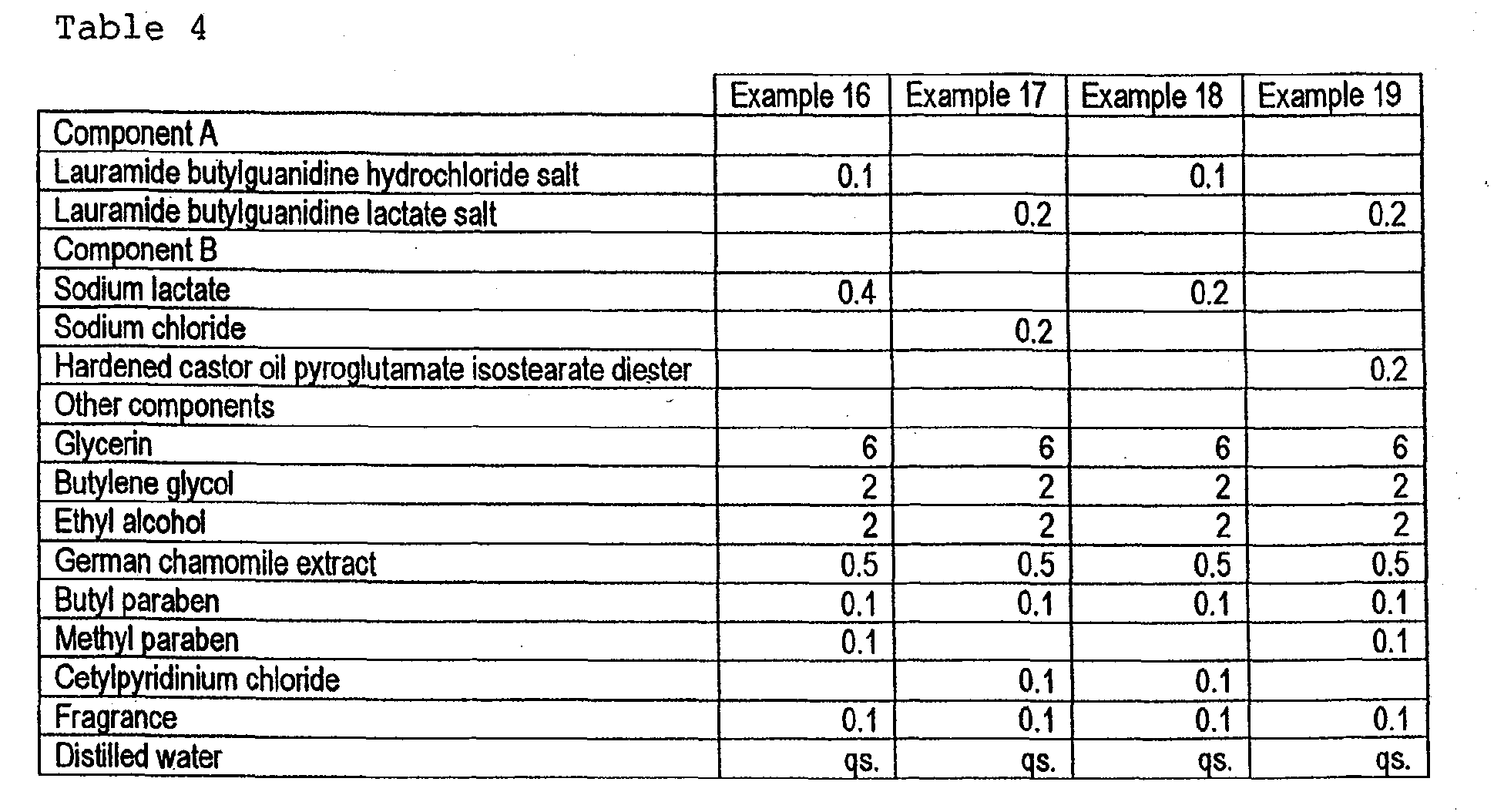
- Cosmetic lotions of the following compositions (expressed in % by weight; total = 100 %) shown below in Table 4 were prepared. The resulting cosmetic lotions had great storage stability and high emollience with no stickiness, giving great touch during use.
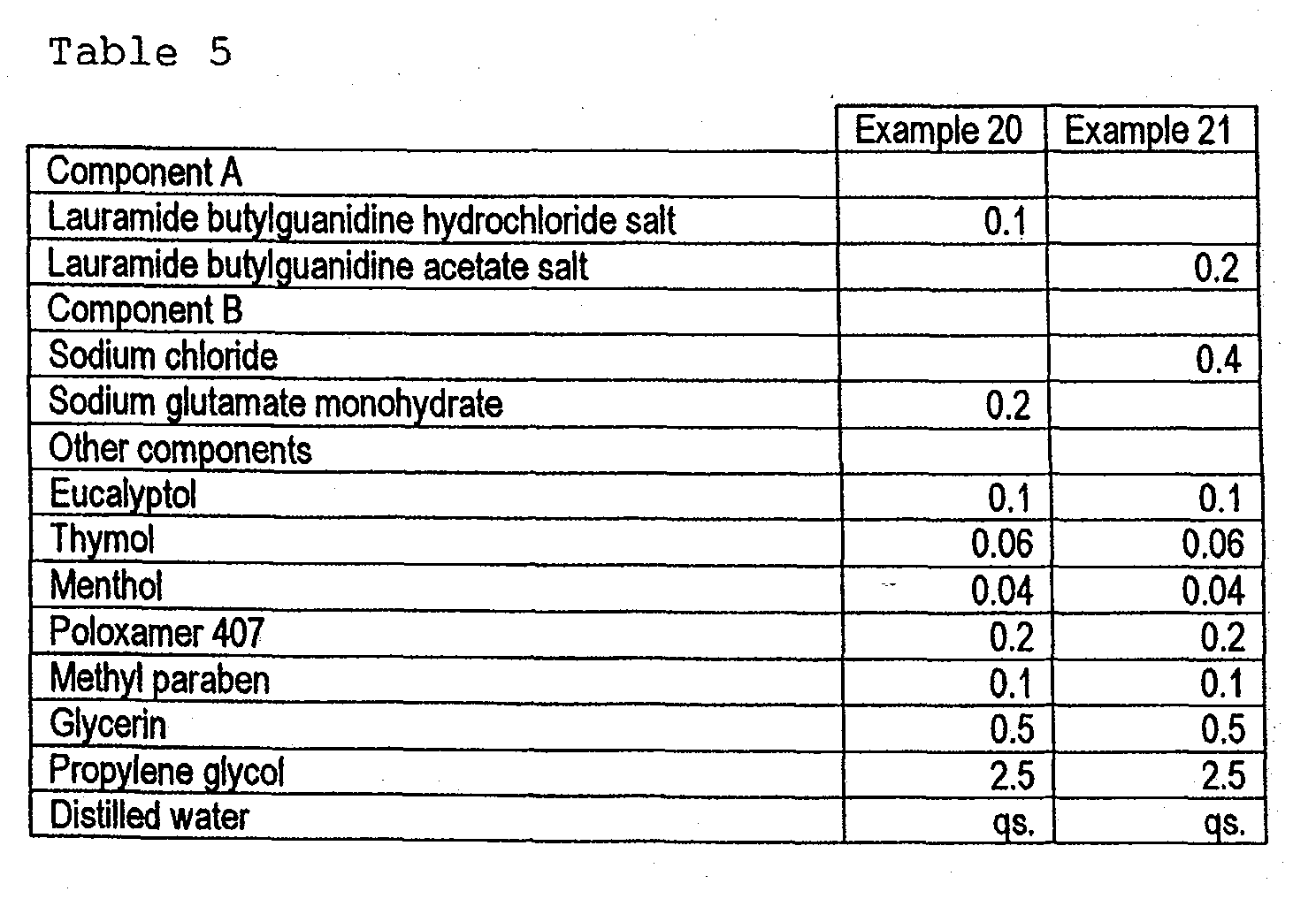
- Mouthwash agents of the following compositions (expressed in % byweight; total = 100 %) shownbelow in Table 5 were prepared. The resulting mouthwash agents had great storage stability and high bactericidal effects, giving great feeling during use.
- Pharmaceutical fluids of the following compositions (expressed in % by weight; total = 100 %) shown below in Table 6 were prepared. The resulting pharmaceutical fluids were used to impregnate a non-woven fabric of rayon and PET (non-woven fabric 1), a non-woven fabric of rayon and PP/PET (non-woven fabric 2) and a non-woven fabric of pulp (non-woven fabric 3) at a ratio of 2.5 to the individual weights thereof to prepare wet tissues. These wet tissues had great temperature stability and good antimicrobial anti-fungal property, also giving great touch during use with enriched emollient effect.

- In accordance with embodiments of the invention, the generation of precipitates in the liquid composition containing the amide group-containing guanidine derivative represented by the general formula (1) or/and a salt thereof can be readily suppressed, so that the storage stability of such liquid composition can be enhanced. Consequently, the product value thereof can be readily improved.
Claims (11)
- A liquid composition containing an amide group-containing guanidine derivative represented by the following general formula (1):(in the formula, R1 and R2 are independently hydrogen atom or a linear or branched alkyl group or alkenyl group with one to 4 carbon atoms and may be the same or different; R3 represents a linear or branched alkyl group or alkenyl group with one to 22 carbon atoms; and X represents a linear or branched alkylene group or alkenylene group with one to 10 carbon atoms) or/and a salt thereof (component A) and at least one (component B) selected from the group consisting of an inorganic salt, an organic acid salt, a nonionic surfactant and an ampholytic surfactant with an action to suppress the generation of the precipitate of the component A, in which the blend ratio of the component A/component B (in weight ratio) = 1/0.5 to 1/20.

- A liquid composition according to claim 1, wherein the inorganic salt is selected from the group consisting of sodium chloride and potassium chloride.
- A liquid composition according to claim 1, wherein the organic acid salt is selected from the group consisting of sodium glutamate (monohydrate), sodium aspartate, potassium aspartate, sodium lactate, potassium lactate, sodium malate, potassium malate and potassium acetate.
- A liquid composition according to claim 1, wherein the nonionic surfactant is selected from the group consisting of sorbitan fatty acid ester, polyoxyethylene sorbit fatty acid ester, polyoxyethylene hardened castor oil, polyethylene glycol fatty acid ester, polyoxyethylene hardened castor oil pyroglutamate ester and polyoxyethylene glyceryl pyroglutamate ester.
- A liquid composition according to claim 1, wherein the ampholytic surfactant is selected from the group consisting of carbobetaine-type ampholytic surfactants, sulfobetaine-type ampholytic surfactants and hydroxysulfobetaine-type ampholytic surfactants.
- A liquid composition according to any one of claims 1 to 5, wherein R3 in the general formula (1) is a linear alkyl group with 11 carbon atoms.
- A liquid composition according to any one of claims 1 to 5, wherein R1 and R2 in the general formula (1) are individually hydrogen atom; R3 is a linear alkyl group with 11 carbon atoms; and X is a linear alkyl group with 4 carbon atoms.
- An impregnated supporting base material such as wet tissue, as prepared by impregnation with a liquid composition according to any one of claims 1 to 7.
- An external agent for skin, as prepared by blending a liquid composition according to any one of claims 1 to 7.
- A mouthwash agent prepared by blending a liquid composition according to any one of claims 1 to 7.
- A premix of a liquid composition according to any one of claims 1 to 7, the liquid composition containing an amide group-containing guanidine derivative represented by the general formula (1) or/and a salt thereof (component A), and at least one (component B) selected from the group consisting of an inorganic salt, an organic acid salt, a nonionic surfactant and an ampholytic surfactant with an action to suppress the generation of the precipitate of the component A, and an appropriate amount of a routine additive if necessary.
Applications Claiming Priority (2)
| Application Number | Priority Date | Filing Date | Title |
|---|---|---|---|
| JP2003042576 | 2003-02-20 | ||
| JP2003042576 | 2003-02-20 |
Publications (2)
| Publication Number | Publication Date |
|---|---|
| EP1449519A1 true EP1449519A1 (en) | 2004-08-25 |
| EP1449519B1 EP1449519B1 (en) | 2008-07-09 |
Family
ID=32732960
Family Applications (1)
| Application Number | Title | Priority Date | Filing Date |
|---|---|---|---|
| EP04250815A Expired - Lifetime EP1449519B1 (en) | 2003-02-20 | 2004-02-16 | Liquid composition containing a guanidine amide group derivative and/or a salt thereof |
Country Status (7)
| Country | Link |
|---|---|
| US (1) | US20040176464A1 (en) |
| EP (1) | EP1449519B1 (en) |
| KR (1) | KR20040075724A (en) |
| CN (1) | CN1530089A (en) |
| DE (1) | DE602004014829D1 (en) |
| SG (1) | SG123597A1 (en) |
| TW (1) | TW200500062A (en) |
Cited By (2)
| Publication number | Priority date | Publication date | Assignee | Title |
|---|---|---|---|---|
| EP1974715A1 (en) * | 2007-03-31 | 2008-10-01 | Zschimmer & Schwarz GmbH & Co KG Chemische Fabriken | Liquid composition for impregnating wet wipes |
| WO2011023465A3 (en) * | 2009-08-31 | 2012-02-16 | Evonik Goldschmidt Gmbh | Antimicrobial ether guanidines |
Families Citing this family (4)
| Publication number | Priority date | Publication date | Assignee | Title |
|---|---|---|---|---|
| US9717930B2 (en) | 2013-03-12 | 2017-08-01 | The Procter & Gamble Company | Antiperspirant compositions |
| BR112015010372A2 (en) | 2013-03-12 | 2017-07-11 | Procter & Gamble | solid antiperspirant stick compositions |
| WO2016003948A1 (en) | 2014-06-30 | 2016-01-07 | The Procter & Gamble Company | Personal care compositions and methods |
| CA2950618C (en) | 2014-06-30 | 2021-08-31 | The Procter & Gamble Company | Antiperspirant products with improved longevity of fragrance |
Citations (3)
| Publication number | Priority date | Publication date | Assignee | Title |
|---|---|---|---|---|
| US4975275A (en) * | 1988-12-19 | 1990-12-04 | Lion Corporation | Hair conditioning compositions |
| DE4425080A1 (en) * | 1993-07-15 | 1995-01-19 | Lion Corp | Cleaner composition |
| EP1285579A1 (en) * | 2001-08-21 | 2003-02-26 | Ajinomoto Co., Inc. | Bactericidal guanidine derivatives, dermally applicable composition, washing composition, and antibacterial fibre aggregate |
Family Cites Families (2)
| Publication number | Priority date | Publication date | Assignee | Title |
|---|---|---|---|---|
| US5997854A (en) * | 1996-12-10 | 1999-12-07 | Henkel Corporation | Conditioning shampoo formulation |
| JP4814409B2 (en) * | 1998-07-22 | 2011-11-16 | 昭 神谷 | Shampoo composition |
-
2004
- 2004-02-05 US US10/771,535 patent/US20040176464A1/en not_active Abandoned
- 2004-02-13 TW TW093103533A patent/TW200500062A/en unknown
- 2004-02-16 EP EP04250815A patent/EP1449519B1/en not_active Expired - Lifetime
- 2004-02-16 DE DE602004014829T patent/DE602004014829D1/en not_active Expired - Lifetime
- 2004-02-17 KR KR1020040010324A patent/KR20040075724A/en not_active Withdrawn
- 2004-02-19 SG SG200400775A patent/SG123597A1/en unknown
- 2004-02-20 CN CNA2004100302972A patent/CN1530089A/en active Pending
Patent Citations (3)
| Publication number | Priority date | Publication date | Assignee | Title |
|---|---|---|---|---|
| US4975275A (en) * | 1988-12-19 | 1990-12-04 | Lion Corporation | Hair conditioning compositions |
| DE4425080A1 (en) * | 1993-07-15 | 1995-01-19 | Lion Corp | Cleaner composition |
| EP1285579A1 (en) * | 2001-08-21 | 2003-02-26 | Ajinomoto Co., Inc. | Bactericidal guanidine derivatives, dermally applicable composition, washing composition, and antibacterial fibre aggregate |
Cited By (2)
| Publication number | Priority date | Publication date | Assignee | Title |
|---|---|---|---|---|
| EP1974715A1 (en) * | 2007-03-31 | 2008-10-01 | Zschimmer & Schwarz GmbH & Co KG Chemische Fabriken | Liquid composition for impregnating wet wipes |
| WO2011023465A3 (en) * | 2009-08-31 | 2012-02-16 | Evonik Goldschmidt Gmbh | Antimicrobial ether guanidines |
Also Published As
| Publication number | Publication date |
|---|---|
| DE602004014829D1 (en) | 2008-08-21 |
| SG123597A1 (en) | 2006-07-26 |
| EP1449519B1 (en) | 2008-07-09 |
| KR20040075724A (en) | 2004-08-30 |
| TW200500062A (en) | 2005-01-01 |
| CN1530089A (en) | 2004-09-22 |
| US20040176464A1 (en) | 2004-09-09 |
Similar Documents
| Publication | Publication Date | Title |
|---|---|---|
| US5100655A (en) | Arginine derivatives and cosmetic compositions containing the same | |
| JP4350269B2 (en) | Cosmetic additive composition | |
| US5759557A (en) | Skin care composition | |
| BR112018015824B1 (en) | COMPOSITIONS FOR PERSONAL HYGIENE | |
| US20050100519A1 (en) | Topical L-carnitine compositions | |
| JPWO2002006225A1 (en) | Agent for preventing or improving atopic dermatitis | |
| WO1996032089A1 (en) | LOW pH SKIN-TREATMENT COMPOSITION | |
| JP5502408B2 (en) | Shampoo composition | |
| JP2002167319A (en) | Whitening cosmetics | |
| EP1449519B1 (en) | Liquid composition containing a guanidine amide group derivative and/or a salt thereof | |
| JP5427422B2 (en) | Oil-in-water emulsion composition | |
| JP2003176217A (en) | Skin care preparation | |
| JP3902174B2 (en) | Method for producing oil-in-water emulsion composition | |
| JPH09157140A (en) | Shampoo composition | |
| JPH1179947A (en) | Hair composition | |
| JP4648600B2 (en) | Hair composition | |
| JP5964048B2 (en) | Emulsified composition | |
| WO2005030152A1 (en) | Hair tonic composition | |
| JP2004269518A (en) | Liquid composition containing guanidine derivative containing amide group and/or its salt improved in storing stability | |
| JP2005239625A (en) | Hair cosmetics | |
| JPH10194964A (en) | Emulsion composition | |
| JPH08268861A (en) | Dermal preparation for external use | |
| JP2003146846A (en) | Hair treatment composition | |
| JP2860124B2 (en) | Hair cosmetics | |
| CA3231023A1 (en) | Ointments for treating dry skin |
Legal Events
| Date | Code | Title | Description |
|---|---|---|---|
| PUAI | Public reference made under article 153(3) epc to a published international application that has entered the european phase |
Free format text: ORIGINAL CODE: 0009012 |
|
| AK | Designated contracting states |
Kind code of ref document: A1 Designated state(s): AT BE BG CH CY CZ DE DK EE ES FI FR GB GR HU IE IT LI LU MC NL PT RO SE SI SK TR |
|
| AX | Request for extension of the european patent |
Extension state: AL LT LV MK |
|
| 17P | Request for examination filed |
Effective date: 20050210 |
|
| AKX | Designation fees paid |
Designated state(s): DE FR GB IT |
|
| RBV | Designated contracting states (corrected) |
Designated state(s): DE FR GB IT |
|
| GRAP | Despatch of communication of intention to grant a patent |
Free format text: ORIGINAL CODE: EPIDOSNIGR1 |
|
| RIC1 | Information provided on ipc code assigned before grant |
Ipc: A61Q 19/00 20060101ALI20071022BHEP Ipc: A61Q 15/00 20060101ALI20071022BHEP Ipc: A61Q 19/10 20060101AFI20071022BHEP |
|
| GRAS | Grant fee paid |
Free format text: ORIGINAL CODE: EPIDOSNIGR3 |
|
| GRAA | (expected) grant |
Free format text: ORIGINAL CODE: 0009210 |
|
| AK | Designated contracting states |
Kind code of ref document: B1 Designated state(s): DE FR GB IT |
|
| REG | Reference to a national code |
Ref country code: GB Ref legal event code: FG4D |
|
| REF | Corresponds to: |
Ref document number: 602004014829 Country of ref document: DE Date of ref document: 20080821 Kind code of ref document: P |
|
| PLBE | No opposition filed within time limit |
Free format text: ORIGINAL CODE: 0009261 |
|
| STAA | Information on the status of an ep patent application or granted ep patent |
Free format text: STATUS: NO OPPOSITION FILED WITHIN TIME LIMIT |
|
| 26N | No opposition filed |
Effective date: 20090414 |
|
| PG25 | Lapsed in a contracting state [announced via postgrant information from national office to epo] |
Ref country code: IT Free format text: LAPSE BECAUSE OF FAILURE TO SUBMIT A TRANSLATION OF THE DESCRIPTION OR TO PAY THE FEE WITHIN THE PRESCRIBED TIME-LIMIT Effective date: 20080709 |
|
| GBPC | Gb: european patent ceased through non-payment of renewal fee |
Effective date: 20090216 |
|
| PG25 | Lapsed in a contracting state [announced via postgrant information from national office to epo] |
Ref country code: GB Free format text: LAPSE BECAUSE OF NON-PAYMENT OF DUE FEES Effective date: 20090216 |
|
| PGFP | Annual fee paid to national office [announced via postgrant information from national office to epo] |
Ref country code: FR Payment date: 20100223 Year of fee payment: 7 |
|
| PGFP | Annual fee paid to national office [announced via postgrant information from national office to epo] |
Ref country code: DE Payment date: 20100226 Year of fee payment: 7 |
|
| REG | Reference to a national code |
Ref country code: FR Ref legal event code: ST Effective date: 20111102 |
|
| REG | Reference to a national code |
Ref country code: DE Ref legal event code: R119 Ref document number: 602004014829 Country of ref document: DE Effective date: 20110901 |
|
| PG25 | Lapsed in a contracting state [announced via postgrant information from national office to epo] |
Ref country code: FR Free format text: LAPSE BECAUSE OF NON-PAYMENT OF DUE FEES Effective date: 20110228 |
|
| PG25 | Lapsed in a contracting state [announced via postgrant information from national office to epo] |
Ref country code: DE Free format text: LAPSE BECAUSE OF NON-PAYMENT OF DUE FEES Effective date: 20110901 |