EP1447646A1 - Information display system - Google Patents
Information display system Download PDFInfo
- Publication number
- EP1447646A1 EP1447646A1 EP02777951A EP02777951A EP1447646A1 EP 1447646 A1 EP1447646 A1 EP 1447646A1 EP 02777951 A EP02777951 A EP 02777951A EP 02777951 A EP02777951 A EP 02777951A EP 1447646 A1 EP1447646 A1 EP 1447646A1
- Authority
- EP
- European Patent Office
- Prior art keywords
- schedule
- information
- terminal
- operator
- map
- Prior art date
- Legal status (The legal status is an assumption and is not a legal conclusion. Google has not performed a legal analysis and makes no representation as to the accuracy of the status listed.)
- Withdrawn
Links
Images




Classifications
-
- G—PHYSICS
- G08—SIGNALLING
- G08G—TRAFFIC CONTROL SYSTEMS
- G08G1/00—Traffic control systems for road vehicles
- G08G1/09—Arrangements for giving variable traffic instructions
- G08G1/0962—Arrangements for giving variable traffic instructions having an indicator mounted inside the vehicle, e.g. giving voice messages
- G08G1/0968—Systems involving transmission of navigation instructions to the vehicle
- G08G1/0969—Systems involving transmission of navigation instructions to the vehicle having a display in the form of a map
-
- G—PHYSICS
- G01—MEASURING; TESTING
- G01C—MEASURING DISTANCES, LEVELS OR BEARINGS; SURVEYING; NAVIGATION; GYROSCOPIC INSTRUMENTS; PHOTOGRAMMETRY OR VIDEOGRAMMETRY
- G01C21/00—Navigation; Navigational instruments not provided for in groups G01C1/00 - G01C19/00
- G01C21/26—Navigation; Navigational instruments not provided for in groups G01C1/00 - G01C19/00 specially adapted for navigation in a road network
- G01C21/34—Route searching; Route guidance
- G01C21/36—Input/output arrangements for on-board computers
-
- G—PHYSICS
- G06—COMPUTING OR CALCULATING; COUNTING
- G06Q—INFORMATION AND COMMUNICATION TECHNOLOGY [ICT] SPECIALLY ADAPTED FOR ADMINISTRATIVE, COMMERCIAL, FINANCIAL, MANAGERIAL OR SUPERVISORY PURPOSES; SYSTEMS OR METHODS SPECIALLY ADAPTED FOR ADMINISTRATIVE, COMMERCIAL, FINANCIAL, MANAGERIAL OR SUPERVISORY PURPOSES, NOT OTHERWISE PROVIDED FOR
- G06Q10/00—Administration; Management
- G06Q10/10—Office automation; Time management
- G06Q10/109—Time management, e.g. calendars, reminders, meetings or time accounting
Definitions
- This invention relates to an information display system.
- a navigation apparatus wherein once a destination and a visit date are selected and registered by an operator i.e., a driver of the vehicle, a route to the destination is automatically searched on that very visit date and therewith the searched route is automatically displayed on a display screen.
- the destination may be, for example, a resort, a sightseeing spot, and an intended visit place;
- the visit date may be, for example, an upcoming day off. For instance, once the operator designates the day off as the visit date, a route to the registered destination is automatically searched on that very day off and therewith the searched route is displayed on the display screen.
- the conventional navigation apparatus can notify the operator of an optimal route to a scheduled destination on the very date of the schedule. Thereby, on the very date of the schedule, the operator can be sure to check the route to the destination.
- said conventional navigation apparatus is functionally limited in that the route to the destination is displayed to the operator only when the date of the schedule comes. This deprives the operator of the opportunity to make sure of his/her schedule before the date of the schedule.
- the conventional navigation apparatus cannot support rough schedule that has no specific date, for example, "Pay a bill from my bank account sometime within the next week” or " Send a parcel from the post office within one week from today.” Since such rough schedule has a certain range in date, the operator gets in trouble when he/she inputs such rough schedule into the conventional navigation apparatus.
- the present invention provides an information display system.
- This information display system can remind the operator of his/her pre-made schedule when his/her vehicle comes close to a specified location within a period of that pre-made schedule. It is the object of the present invention that the information display system gives the operator a schedule reminder message and also it is the object of the present invention to remind the operator of his/her schedule before the date of that schedule comes.
- An information display system comprises; a map information storage in which map information is stored, an input device from which a schedule is inputted, a schedule storage in which the schedule is stored, a display device on which a map is displayed, and a display control device by which a schedule reminder message is displayed on the map at a specified time.
- the information display system can notify the operator at a specified time that a schedule has been registered in connection with a certain position shown on the map.
- Another information display system comprises: a server in which the map information storage, the schedule storage, and a transmit-receive unit are included; a first information terminal in which the input device and a transmit-receive unit are included; and a second information terminal in which the display device, the display control device, and a transmit-receive unit are included.
- Other information display system comprises: a server in which the map information storage, the schedule storage, and the transmit-receive unit are included; and an information terminal in which the input device, the display device, the display control device, and a transmit-receive unit are included.
- the display device displays a calendar on which the period of the schedule is shown by means of the display control device.
- the specified time at which the schedule reminder message is displayed on the map is the moment when a present position of an operator's vehicle arrives at a specified location.
- schedule reminder message may be given to an operator acoustically or visually.
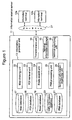
- FIG. 1 shows a conceptual drawing of compositions of the information display system according to a first embodiment of the present invention.
- an information source server 11 is constructed in a computer which comprising processing means such as a CPU or a MPU, storage means such as a semiconductor memory, a magnetic disk, or an optical disk, and a communication interface.
- processing means such as a CPU or a MPU
- storage means such as a semiconductor memory, a magnetic disk, or an optical disk
- a communication interface such as a Wi-Fi connection
- server 11 may not be limited to a single computer but may be so-called a decentralized computer networks in which plural computers are systematically connected one after the other.
- other system may be constructed in said computer.
- the server 11 may be a part of a system that is constructed in other computer.
- An information terminal 12a and an information terminal 12b are respectively operated as a first information terminal and a second information terminal.
- a plurality of the information terminals may be used and operated at a time.
- the description here takes a case where only two terminals i.e., the terminal 12a and 12b are used in the information display system.
- the operator may be a driver or a fellow passenger of a vehicle such as an automobile, a truck, a bus, or a motorcycle, and further may be a pedestrian, a user of public transportation, or possible anyone.
- Either the terminal 12a or 12b comprising: a main processing device such as a CPU or a MPU; a storage device such as a semiconductor memory, a magnetic disk, and an optical disk; a display device such as a liquid crystal display, a LED (Light Emitting Diode) display, and a CRT; an input means such as a keyboard, a joystick, a cross-shaped key, a push-button, a remote control, and a touch-sensitive panel; a display control device by which the display device is controlled; and a transmit-receive unit such as a communication interface.
- a main processing device such as a CPU or a MPU
- a storage device such as a semiconductor memory, a magnetic disk, and an optical disk
- a display device such as a liquid crystal display, a LED (Light Emitting Diode) display, and a CRT
- an input means such as a keyboard, a joystick, a cross-shaped key, a push-button
- Either the terminal 12a or 12b mainly takes the form of a navigation apparatus provided for a vehicle such as an automobile, a truck, a bus, and a motorcycle. Further, each of the terminal 12a and 12b may be a stationary telephone, a portable telephone, a personal handy phone (which used in PHS: Personal Handy-Phone System), a portable information terminal, a PDA (Personal Digital Assistant), a personal computer, a game machine, or a digital television.
- PHS Personal Handy-Phone System
- PDA Personal Digital Assistant
- either the terminal 12a or 12b may include a present position detective device (not shown). If either the terminal 12a or 12b is, for example, a havigation apparatus that includes the present position detective device, the present position of the vehicle can be detected by using a GPS (Global Positioning System), a terrestrial magnetism sensor, a distance sensor, a steering sensor, a beacon sensor, or a gyro sensor. If either the terminal 12a or 12b is, for example, a portable telephone or a portable information terminal, the position of a base station for the portable telephones or the portable information terminals is detected as a present position by means of the present position detective device. This detection is based on communication between the present position detective device and the base station that covers an area where the portable telephone or the portable information terminal exists. Such portable telephone or portable information terminal may be equipped with a GPS receiver.
- the server 11 is connected to either the terminal 12a or the terminal 12b via a network 27 . Based on this connection, the communication between the server 11 and the terminals 12a or 12b is achieved.
- the network 27 may be a wire/wireless public switched network, a dedicated communication network, a portable telephone network, the Internet, an intranet, a LAN (Local Area Network), a WAN (Wide Area Network), a satellite communication network, any possible communication networks, or a certain combined network comprised of said various networks.
- the server 11 may be communicated with the terminal 12a or 12b via CS (Communication Satellite)/BS (Broadcasting Satellite), may be communicated through ground wave digital television broadcasting/ FM (Frequency Modulation) multiplex broadcasting, or may be communicated via an optical beacon/ a radio wave beacon placed along roads.
- CS Communication Satellite
- BS Broadcasting Satellite
- FM Frequency Modulation
- the information display system is mainly made up of the information source server 11 , the information terminal 12a , and the information terminal 12b .
- each operator must be registered with the information display system and accordingly possesses an ID number; not only the operator but also each of the terminal 12a and 12b must be registered with such system.
- the information source server 11 comprises: an information provision unit 13 from which information about a route to a destination and other various information are sent back to either the terminal 12a or 12b upon receipt of information about a departure point and a destination sent off from either the terminal 12a or 12b ; a transmit-receive unit 14 with which each of the terminal 12a and 12b exchange the information; a terminal information storage 15 in which the exchanged information is independently stored for each of the terminal 12a and the terminal 12b ; and a terminal specifying unit 16 by which each of the terminal 12a and 12b is specified based on the ID number.
- the information provision unit 13 including; a map database 17 serving as a map information storage, a POI (Point of Interest) database 18 , a road database 19 , a traffic information database 20 serving as a traffic information storage, and a PIM (Personal Information Manage) database 21 serving as a schedule storage.
- a map database 17 serving as a map information storage
- a POI (Point of Interest) database 18 a POI (Point of Interest) database 18
- a road database 19 serving as a traffic information storage
- a traffic information database 20 serving as a traffic information storage
- PIM Personal Information Manage
- the map database 17 stores map information used for drawing a map; the map information are, for example, nodes, links, coordinates, and facility names.
- the POI database 18 stores facility data, telephone number-address data, event data, and the like, all of which are used for retrieving a point such as a departure point, a destination point, or a pass-through point.
- the road database 19 stores data for searching a route; specifically such data are, for example, road search cost (here, the cost means a weight given to data used in searching a road) and a road type.
- the traffic information database 20 can store traffic information about traffic congestion and traffic regulations. Such traffic information is prepared based on the information collected by traffic regulatory systems that the police or the Japan Highway Traffic Corporation controls. Furthermore, it is desirable that the traffic information database 20 may store event schedule information about a site or a date of a scheduled event such as a festival, a parade, or a fireworks display.
- the traffic information database 20 should store statistical congestion information like "roads around a railway station or a mega commercial facility are congested every day during a certain period of time except a weekend" or "roads around a sea resort during a summer vacation are congested.” Moreover, it is desirable that the traffic information database 20 should store meteorological information such as a weather forecast originally made by the Meteorological Agency.
- the PIM database 21 contains personal files for respective operators.
- attribute files a schedule file, a calendar file, an address book file, a telephone directory file, a registered point list file, a memo file, and the like
- operator's personal information in the form of a schedule list, a calendar, an address book, a telephone directory, a registered point list, and a memo is stored.
- the personal file is generally prepared for every one of the operators who have already been registered in the system, it may be prepared on an information terminal basis. On top of that, the personal file may be prepared on an ID number basis if one operator possesses a plurality of ID numbers.
- the server 11 has storage means for the map database 17 , the POI database 18 , the road database 19 , the traffic information database 20 , and the PIM database 21 .
- Said storage means may be either an internal storage medium or an external storage medium.
- Such medium may be any one of the followings: a magnetic tape, a magnetic disk, a magnetic drum, a CD-ROM, a MD (Mini Disk), a DVD-ROM, a DVD-RAM, an optical disk, a MO (magneto-optical) disk, an IC card, an optical card, a stick memory, a memory card, or any other possible media.
- the information provision unit 13 including: a map drawing unit 22 by which a map is drawn based on the map information; a POI retrieval unit 23 by which positional information, for example coordinates, an address, or a name of a registered location (as a destination), is retrieved based on the information stored in the POI database 18 ; and a route search unit 24 by which a route from a present position of the vehicle to a destination is searched based on information stored in the road database 19 or based on information stored in the traffic information database 20 .
- the information provision unit 13 includes a PIM processing unit 25 by which the operator's schedule list, calendar, address book, telephone directory, registered point list, memo, and the like are prepared and updated based on the information sent from either the terminal 12a or 12b , and such PIM processing unit 25 may extract information from said schedule list, calendar, address book, telephone directory, registered point list, memo, and the like.
- the information provision unit 13 includes a send-out information organizing unit 26 by which information to be sent out to either the terminal 12a and 12b is organized and edited.
- the information provision unit 13 includes a destination-setting unit, an estimated arrival time calculating unit, and a comparing unit (these are not shown). Additionally, the information provision unit 13 stores several programs such as a PIM program and a route search program.
- the PIM program is one of managing a schedule list, a calendar, an address book, a telephone directory, a registered point list, a memo, and the like, all of which are useable in the portable information terminals, PDAs, and personal computers.
- the estimated arrival time calculating unit calculates the estimated arrival time at which the vehicle reaches the destination. This calculation is based on the information about the route searched by the route search unit 24 . For example, the estimated arrival time is calculated based on the sum of the time required for traveling each road segment that leads to the destination. As for the estimated arrival time, it may be recalculated and updated at intervals of a specified time.
- this recalculation and update may take into consideration the latest traffic congestion information as well as the latest traffic regulatory information which are both stored in the traffic information database 20 .
- the comparing unit After the recalculation of the estimated arrival time, the comparing unit starts to compare the recalculated estimated arrival time with operator's desired arrival time.
- Either the terminal 12a or 12b may include a transmit-receive unit and a display control device, whereby the information having inputted in the schedule list, calendar, address book, telephone directory, registered point list, memo, and other information are transmitted/received to/from the server 11 .
- both the calendar and the map transmitted from the server 11 are displayed on the display device by means of the display control device.
- the display control device displays a present position, a destination, and a facility located around said present position.
- the following information be also displayed on said calendar and said map: the desired arrival time, the estimated arrival time, destination name, destination address, the facility data, the telephone number and address data, the event data, road traffic information, the event schedule information, the statistical congestion information, the meteorological information, and the like.
- the server 11 having, for one example, the map database 17 , the PIM database 21 , the route search unit 24 , and the PIM processing unit 25 may work as a main part of the information display system.
- the server 11 carries out the route search, as well as a preparation, update, or edit of the schedule list, calendar, address book, telephone directory, registered point list, memo, and the like.
- the results of said route search, as well as said preparation, update, or edit may be transmitted back to either the terminal 12a or 12b . Since the server 11 works as the main part in the information display system in said example case, a compositional simplification and a downsizing of the terminal 12a and 12b may be achieved. This makes manufacturing costs of the information terminals lower.
- either the terminal 12a or 12b may include the map database 17 and the route search unit 24 in order to carry out the route search.
- either the terminal 12a or 12b may work as the main part of the information display system. This leads to a compositional simplification of the server 11 as well as contributes to the reduction of running costs of the information display system.
- either the terminal 12a or 12b may include the POI database 18 , the road database 19 , the traffic information database 20 , the PIM database 21 , the POI retrieval unit 23 , the PIM processing unit 25 , the destination-setting unit, the estimated arrival time calculating unit, and the comparing unit.
- the description takes a case where the information source server 11 comprises the map database 17 , the POI database 18 , the traffic information database 20 , the PIM database 21 , the route search unit 24 , and the PIM processing unit 25 ; whereby the route search as well as the preparation, update, or edit of the schedule list, calendar, address book, telephone directory, registered point list, memo, and the like, are carried out, and then the results thereof are transmitted back to the information terminal 12b in response to the request from the terminal 12a .
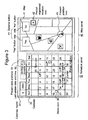
- FIG. 2 shows a process of file classification carried out by a PIM processing unit according to the first embodiment of the present invention.
- FIG. 3 shows a first exemplary screen view displayed on an information terminal according to a first embodiment of the present invention.
- FIG. 4 shows a second exemplary screen view displayed on the information terminal according to the first embodiment of the present invention.
- FIG. 5 is a flowchart showing a process of the file classification carried out by the PIM processing unit according to the first embodiment of the present invention.
- FIG. 6 is a flowchart showing a process of information display according to the first embodiment of the present invention.
- the terminal 12a is operated to input operator's personal information.
- the operator's personal information means schedules to be inputted into a schedule list, the calendar, the address book, the telephone directory, the registered point list, the memo, and the like.
- the operator inputs the schedules for a next month; such as a work, study, hobbies, a drive, a trip, recreations, sports, eat-out, or sightseeing.
- schedules are so made that a site, a destination, or a location of a facility is associated with a specified period.
- the site and the specified period are associated with each other in the schedule as follows: "Build Mr.
- start the PIM program stored in the terminal 12a is started.
- a schedule input view is displayed on the display device in the terminal 12a .
- the PIM program is not stored in the terminal 12a , access the server 11 from the terminal 12a via the network 27 . Upon this access, the PIM program stored in the server 11 is started and the schedule input view is obtained and displayed on the display device in the terminal 12a .
- the schedule input view has some dialog boxes to input or specify a period of the schedule, a location of the schedule, a description of the schedule, and a memo about the schedule.
- a Japanese-syllable input palette be displayed on the schedule input view.
- said period, location, description or memo can be inputted on a syllable-by-syllable basis from the Japanese-syllable input palette.
- an alphanumeric input palette be displayed for the input of telephone numbers or addresses. In this case, the telephone number or the address may be inputted on an alphanumeric basis.
- the keyword-extracting function is such that keywords associated with the period of the schedule or the location of the schedule are extracted from sentences written by a natural language.
- the schedule input view has a single dialog box to input the sentences such as a memo or a note including said period or said location.
- the PIM processing unit 25 starts to extract the keywords associated with the period of the schedule or the location of the schedule from those sentences. Thereafter, the PIM processing unit 25 automatically allocates the extracted keyword, such as the period of the schedule or the location of the schedule to each corresponding dialog box.
- the period of the schedule may not have to be defined by both of a date and a time; rather it may be defined by either a date or a time.
- the location of the schedule may not have to be defined by an accurate address or precise positional coordinates. Furthermore, it is possible to skip the description of the schedule and/or the memo about the schedule.
- the terminal 12a is operated to transmit the inputted schedule to the server 11 via the network 27 .
- the transmit-receive unit 14 receives the schedule from the terminal 12a .
- the terminal specifying unit 16 extracts the ID number to specify the personal file, which corresponding to the terminal 12a , stored in the PIM database 21 .
- the personal file is prepared correspondingly to each operator so that the ID number can serve as information to specify the operator.
- the period of the schedule, the location of the schedule, the description of the schedule, and/or the memo about the schedule are also extracted from the schedule transmitted from the terminal 12a by means of the PIM processing unit 25 .
- the PIM processing unit 25 accesses the POI retrieval unit 23 to obtain the positional coordinates of said location of the schedule.
- the PIM processing unit 25 accesses the personal file, which stored in the PIM database 21 , specified by the terminal specifying unit 16 .
- the extracted information such as, period of the schedule, the position of the schedule, the description of the schedule, and/or the memo about the schedule are/is stored into the specified personal file.
- the location of the schedule (including positional coordinates), the description of the schedule, and/or the memo about the schedule are/is registered in association with the period of the schedule.
- the schedule inputted by the operator can be registered in the personal file stored in the PIM database 21 .
- the PIM processing unit 25 When the personal information (schedule) is inputted, the PIM processing unit 25 starts to store the inputted personal information into the personal file, which corresponding to the operator, stored in the PIM database 21 . In this process, at first the PIM processing unit 25 judges whether the inputted personal information is defined by a date and time. If the personal information is defined by the date and time, it is recognized that the inputted personal information has an attribute of a schedule. If the personal information is not defined by the date and time, then the PIM processing unit 25 judges whether the inputted personal information is defined by a location. If the personal information is defined by the location, it is recognized that the inputted personal information has an attribute of a registered location. If the personal information is not defined by the location, it is recognized that the inputted personal information has an attribute of a memo.
- FIG. 2 Said relationship between the inputted personal information and the attributes is illustrated in FIG. 2 .
- ⁇ tells "Defined,” ⁇ tells "Not defined,” and ⁇ tells "Not affecting the attribute.”
- ⁇ tells "Defined”
- ⁇ tells "Not defined”
- ⁇ tells "Not affecting the attribute.”
- take the top row of FIG. 2 (a) This row shows that the inputted personal information is defined by only the memo and not defined by the location as well as the date and time. In such case, it is judged that the inputted personal information has an attribute of a memo as shown in the top row of FIG. 2 (b) .
- FIG. 2 (a) shows that the inputted personal information is defined by the location and not defined by the date and time.
- the PIM processing unit 25 accesses the personal file stored in the PIM database 21 and specified by the terminal-specifying unit 16 . Then, the personal information is stored into that specified personal file.
- the personal information having the attribute of a memo is stored into the memo file
- the personal information having the attribute of a registered location is stored into the registered location file
- the personal information having the attribute of schedule is stored into the schedule file.
- the PIM processing unit 25 accesses the POI retrieval unit 23 to obtain the positional coordinates of that location.
- the personal information inputted by the operator can be classified into three categories: a memo, a registered location, and a schedule.
- the classified information is registered in its corresponding attribute file contained in the personal file.
- This personal file stored in the PIM database 21 is prepared for each operator. Once the personal information is inputted, whereby the operator can confirm his/her schedule at any time he/she likes.
- the next description centers on operations of confirming the operator's schedule for certain one month by operating the terminal 12b .
- the operator transmits a request for the schedule from the terminal 12b to the server 11 via the network 27 .
- the transmit-receive unit 14 receives that request from the terminal 12a .
- the terminal specifying unit 16 extracts the ID number from said transmitted request in order to specify the personal file, which corresponding to the terminal 12b , stored in the PIM database 21 .
- the personal file is prepared correspondingly to each operator so that the ID number may serve as information to specify each operator.
- the PIM processing unit 25 extracts the personal information for said one month.
- the extracted information undergoes data transformation through the send-out information-organizing unit 26 and then transmitted from the transmit-receive unit 14 to the terminal 12b .
- the PIM program is sent out together with the data-transformed extracted information to the terminal 12b if the PIM program is not stored in the terminal 12b .
- the display control device in the terminal 12b Upon the receipt of the data-transformed personal information, the display control device in the terminal 12b allows the display device to display said data-transformed personal information onto a schedule panel 30 as shown in FIG. 3. On the schedule panel 30 , a calendar 34 showing September 2001 is displayed.
- the panel 30 includes present date and time (year/ month/ day/ hour/ minute) 31 , last update date and time (year/ month/ day/ hour/minute) 32 when the schedule was last updated, and a calendar month (month/year) 33 .
- a date icon 35 displayed within each date rectangle in the calendar 34 indicates that the location of the schedule has already been registered in connection with its related date of the schedule.
- a memo icon 36 displayed within each date rectangle indicates that the memo about the schedule has already been registered in connection with its related date of the schedule.
- Each date rectangle is surrounded by a cursor 37 so that the date rectangle may be highlighted in a bold line.
- a period indicator 38 shows a period of the. schedule in connection which a period-registered location icon 42 (described later).
- the period indicator 38 can take various forms: for example, a frame that surrounds the date rectangles of all dates within a certain period of the schedule, a bar stretched across the date rectangles of all dates within a certain period of the schedule as shown in FIG. 3 , or color applied to the date rectangles of all dates within a certain period of the schedule.
- a map panel 40 is displayed on the display device by means of the display control device in the terminal 12b as shown in FIG. 3 .
- the description takes a case where a map 41 depicting an area around the present position of the terminal 12b is displayed on the panel 40 .
- a present position icon 43 shows the present position of the terminal 12b
- the period-registered location icon 42 shows the period-registered location that is registered in connection with the period of the schedule. It is desirable that a destination, a pass-through point, a registered location where the operator frequently visits, a facility such as a post office or a restaurant, or a landmark be displayed on the map 41 .
- the icon 42 which located within a specified range with reference to the present position of the terminal 12b is displayed on the map 41 .
- Such specified range for example, covers over a N-kilometer radius of the present position of the terminal 12b .
- the value of N is changeable; the operator can confirm any period-registered location as far as it exists within the range defined by N.
- any registered points inputted from the schedule input view or any arbitrary points on the map may serve as the present position of the terminal 12b substitutively. Therefore, the operator could confirm the icon 42 located within the area with reference to said inputted registered point or said arbitrary point on the map. That is, in substitution for the present position any points may be optionally selected, and thereby the period-registered locations within the area with reference to such any points may be informed to the operator.
- the description takes a case where the terminal 12b is the present position and the radius N [kilometer] is 0.5.
- the icon 42 located within a 500-meter radius of the present position of the terminal 12b is displayed on the map 41 .
- the period indicator 38 is displayed on the calendar 34 as shown in FIG. 3 .
- the indicator 38 shows the period of the schedule in connection with the icon 42 ; that is, the operator is scheduled to visit the location indicated by the icon 42 somewhere during the period shown by the indicator 38 .
- the icon 42 is not displayed on the map 41 even the period-registered location exists within the 500-meter radius of the present position. Such case occurs when a date indicated by the present date and time 31 has not yet not come within the period indicated by the indicator 38 .
- the icon 42 to remind the operator of the schedule is not displayed on the map 41 unless the date indicated by the present date and time 31 comes within the period indicated by the indicator 38 .
- an optional button 44 to determine whether to visit the period-registered location.
- the optional button 44 comprises "Yes” button 44a and “No” button 44b .
- the operator can determine whether to visit the period-registered location by clicking the cursor 37 on either the "Yes” button 44a or the "No” button 44b .
- the optional button 44 may take the form of a single button. In this case, when the cursor 37 is clicked on the button 44 , it is determined that the operator visits the period-registered location.
- the determination result is transmitted from the terminal 12b to the server 11 .
- the route search unit 24 starts to search a route from the present position shown by the icon 43 to the registered location shown by the icon 42 .
- the searched route is transmitted from the transmit-receive unit 14 in the server 11 to the terminal 12b , and thereupon route guidance on that searched route is started.
- This route guidance may be visually given to the operator through the display of the searched route on the map 41 , or alternatively given vocally.
- the cursor 37 As for the cursor 37 , it is moved around the screen with the operation of the input device provided in the terminal 12b .
- the cursor 37 moves upward, downward, rightward, or leftward to the desired date rectangle with the operation of, for example, the joystick or the cross-shaped key.
- the cursor 37 is moved to the desired date rectangle by inputting numerals that represent the desired date.
- the display device takes the form of a touch-sensitive panel, the cursor 37 is moved at the touch of the date rectangle. In FIG. 3 , the cursor 37 is placed on the date of September 24 as indicated by the present date and time 31 .
- the description hereinafter centers on operations of displaying a schedule screen 50 on the schedule panel 30 .
- the display control device in the terminal 12b allows the schedule screen 50 as shown in FIG. 4 come up on the schedule panel 30 .
- the screen 50 details the schedule for one of the dates specified by the indicator 38 .
- the schedule panel 30 and the map panel 40 be simultaneously displayed vertically or horizontally side by side on the display device.
- the panel 30 and the panel 40 may be separately displayed from one after another; in other circumstances, the panel 40 is closed and the panel 30 is displayed alone.
- the schedule screen 50 has a reminder-timing box 51 as shown in FIG. 4 .
- This box 51 tells the operator whether the time to visually or acoustically remind him/her of the schedule has already come within the period of the schedule.
- the schedule screen 50 including; a schedule date and time box 52 in which the period of the schedule is shown, a location name box 53 in which a name of the location of the schedule is shown, a memo box 54 in which the description of the schedule is shown, an address box 55 in which an address at the location of the schedule is shown, a telephone number box 56 in which a telephone number to be referred to is shown, an input date box 57 in which the date when the schedule is inputted is shown, a sender name box 58 in which a name of a sender is shown if the schedule is sent by someone from outside to the operator (this will be described hereinafter), and a send date box 59 in which the date when the schedule is sent from outside to the operator is shown.
- the operator can make sure of the details of his/her schedule which having already been inputted and registered.
- the operator may edit the registered schedules.
- the schedule input view is displayed onto the display device in the terminal 12a .
- the operator selects the schedule to be edited and thereby the user-selected schedule is displayed on the schedule input view.
- the schedule can be changed or erased, otherwise a new item is added to the schedule.
- This editing is carried out in the same way as the schedule is newly inputted. For example, the operator may revise the date and time of the schedule, the location of the schedule, or the memo about the schedule in each dialog box. Additionally, if the personal information (schedule) has been inputted in the form of natural language sentences, the operator may revise such sentences so as to change his/her schedule.
- the edited schedule is transmitted from the terminal 12a to the server 11 via the network 27 .
- the transmit-receive unit 14 receives the edited schedule from the terminal 12a .
- the terminal specifying unit 16 starts the same operation as done in the case where a new schedule is inputted.
- the personal file, which corresponding to the terminal 12a stored in the PIM database 21 is specified.
- the PIM processing unit 25 selects and accesses said specified personal file. Then, the edited schedule is stored into that selected personal file.
- the schedule having already been registered may be edited just as in the case where the new schedule is inputted. Therefore, the registered schedule edit is easy operation for the operator.
- the map 41 may be swiftly drawn and displayed on the display device in the terminal 12b if the terminal 12b stores the map information in its storage device as well as includes a map-drawing unit 22 .
- a request for drawing the map 41 is transmitted together with data about the location of the schedule from the terminal 12b to the server 11 via the network 27 .
- the map-drawing unit 22 in the server 11 accesses the map database 17 so as to draw the map 41 that shows the period-registered location icon 42 , the present position icon 43 , and the optional button 44 .
- the drawn map 41 is data-transformed through the send-out information-organizing unit 26 .
- the transformed map is transmitted from the transmit-receive unit 14 to the terminal 12b and displayed onto the display device in the terminal 12b .
- the map 41 may be drawn at the moment when the schedule inputted by the operator is registered in the personal file.
- the PIM processing unit 25 extracts the location of the schedule from the inputted schedule and transmits the extracted location to the map-drawing unit 22 in order that the map 41 covering the extracted location may be drawn.
- the map 41 is stored by means of the PIM processing unit 25 , in connection with the location and the date of the schedule, into the operator's personal file in the PIM database 21 .
- the map 41 may be transmitted together with that schedule to the terminal 12b .
- the map 41 covering the registered location of the schedule can be swiftly displayed onto the map panel 40 even if the terminal 12b has neither the map-drawing unit 22 nor the map information.
- facilities around the location of the schedule may be retrieved and displayed on the map 41 .
- a type of the facility related to the schedule is inputted, such inputted type facilities around the location of the schedule are retrieved.
- the terminal 12b includes the POI retrieval unit 23 and the POI information in its storage means, the facilities around the location of the schedule may be retrieved and displayed onto the display device in the terminal 12b .
- a request for the retrieval of the facility is transmitted together with data about the location of the schedule from the terminal 12b to the server 11 via the network 27 .
- the POI retrieval unit 23 in the server 11 accesses the POI database 18 to retrieve the facility around the location of the schedule.
- the retrieved facility is data-transformed through the send-out information-organizing unit 26 .
- the facility that experienced the data-transformation is transmitted from the transmit-receive unit 14 to the terminal 12b and displayed on the display device in the terminal 12b .
- the facility may be retrieved at the moment when the schedule inputted by the operator is registered in the personal file.
- the PIM processing unit 25 extracts the location of the schedule from the inputted schedule and transmits it to the POI retrieval unit 23 in order that the facilities around the location of the schedule may be retrieved. After being retrieved, such retrieved facilities are stored by means of the PIM processing unit 25 , in connection with the location and the date of the schedule, into the operator's personal file in the PIM database 21 .
- the retrieved facility may be transmitted together with that schedule to the terminal 12b .
- the facility around the location of the schedule may be swiftly displayed onto the map panel 40 even if the terminal 12b has neither the POI retrieval unit 23 nor the POI information.
- a route to the location of the schedule may be searched and displayed onto the map 41 .
- Such route is generally searched based on both a location of the schedule and an operator's house respectively regarded as a destination and a departure point; instead of these points, as needed, any points can be designated as the destination or as the departure point.
- the terminal 12b may search a route to the location of the schedule and display the searched route onto the display device.
- a request for the route search is transmitted together with the data about the location of the schedule from the terminal 12b to the server 11 over the network 27 .
- the route search unit 24 accesses the road database 19 to search a route to the location of schedule. Then, the searched route is data-transformed through the send-out information-organizing unit 26 .
- the route that experienced the data-transformation is transmitted from the transmit-receive unit 14 to the terminal 12b and then displayed on the display device in the terminal 12b .
- the route may be searched at the moment when the schedule inputted by the operator is registered in the personal file.
- the PIM processing unit 25 extracts the location of the schedule from the inputted schedule and transmits it to the route search unit 24 in order that the route to the location of the schedule may be searched.
- the searched route is stored by means of the PIM processing unit 25 , in connection with the location and the date of the schedule, into the operator's personal file in the PIM database 21 .
- the searched route may be transmitted together with that schedule to the terminal 12b .
- the route to the location of the schedule may be swiftly displayed onto the map 41 by means of the terminal 12b even if the terminal 12b has neither the route search unit 24 nor the road information.
- the route search unit 24 may search a route allowing for the traffic congestion that is predicted based on the accumulated statistical congestion information or scheduled event information.
- the route search unit 24 so searches a route that said congested road could be excluded from search results.
- the route search unit 24 so searches the route that the roads around the scheduled event site of a festival, a parade, or a fireworks display could be excluded from the search results, allowing for the predicted traffic congestion around such event site.
- the route search unit 24 may search a route based on the meteorological information such as a weather forecast that is stored in the traffic information database 20 . For example, when heavy rain is predicted, the route search unit 24 may so perform the route search that a mountain route on which a skid accident frequently occurs could be excluded from the search results.
- the meteorological information such as a weather forecast that is stored in the traffic information database 20 .
- the route search unit 24 may so perform the route search that a mountain route on which a skid accident frequently occurs could be excluded from the search results.
- the terminal 12 includes the route search unit 24 as well as includes the traffic information such as the traffic regulation or the traffic congestion, the accumulated statistical congestion information, the scheduled event information, or the meteorological information stored in its storage means.
- the terminal 12b without transmitting a request for a route search to the server 11 , the terminal 12b alone can search a route by referring to said traffic information, statistical congestion information, scheduled event information, or meteorological information.
- the terminal 12b displays onto the display device the map 41 which covering the registered location related to the designated date.
- the traffic information, the statistical congestion information, the scheduled event information, or the meteorological information, each of which related to that designated date can be superimposed along the road on the map 41 .
- the terminal 12b transmits a request for the traffic information, the statistical congestion information, the scheduled event information, or the meteorological information, together with the data about the registered location, to the server 11 .
- the route search unit 24 in the server 11 accesses the traffic information database 20 and predicts the occurrence of the traffic congestion or the traffic regulation around said registered location. This prediction is based on the accumulated statistical congestion information as to the roads around the registered location and the scheduled event information. In detail, the occurrence of the traffic congestion or the traffic regulation is predicted allowing for the day, season, or time of the schedule.
- Such prediction about traffic congestion or the traffic regulation is data-transformed through the send-out information-organizing unit 26 .
- the transformed predicted information is transmitted from the transmit-receive unit 14 to the terminal 12b and then displayed on the display device in the terminal 12b .
- the terminal 12b alone may predict the traffic information without transmitting the request for it to the server 11 .
- the terminal 12b displays onto the display device the map 41 which covering the registered location related to said designated date.
- the meteorological information related to that designated date may be superimposed along the road displayed on the map 41 .
- the terminal 12b transmits a request for the traffic information together with the data about the registered location to the server 11 .
- the route search unit 24 in the server 11 accesses the traffic information database 20 to obtain the meteorological information such as the weather forecast for the area around the registered location.
- meteorological information such as the weather forecast for the area around the registered location.
- such meteorological information for that area on the designated date is data-transformed through the send-out information-organizing unit 26 .
- the transformed meteorological information is transmitted from the transmit-receive unit 14 to the terminal 12b and then displayed onto the display device in the terminal 12b .
- the terminal 12b When the terminal 12b stores the meteorological information such as the weather forecast in its storage device, the terminal 12b alone may display the meteorological information onto the display device with no transmission of the request for the meteorological information to the server 11 .
- the traffic information or the meteorological information for the area around the registered location associated with said designated date may be displayed on the display device.
- the operator may confirm or change his/her schedule.
- the designation of the road can trigger a display of the traffic information about the road.
- the traffic information about such designated road may be displayed on the calendar 34 .
- a request for the traffic information is transmitted together with the road data about the designated road.
- the route search unit 24 in the server 11 accesses the traffic information database 20 in order to predict the occurrence of the traffic congestion or the traffic regulation on the designated road. This prediction is based on the accumulated statistical congestion information or the scheduled event information as to the designated road. If it is predicted that the designated road will suffer from the traffic congestion or predicted that the designated road will be controlled by the traffic regulation, the date of such congestion or regulation is retrieved from the database 20 . Then, such retrieve date is data-transformed through the send-out information-organizing unit 26 . The data-transformed date is transmitted from the transmit-receive unit 14 to the terminal 12b and displayed on the display device in the terminal 12b .
- the present embodiment described hereinbefore takes the case where the schedule is inputted from the terminal 12a and confirmed on the terminal 12b , however the present invention is not limited to such case.
- the schedule may be inputted from the terminal 12b and confirmed on the terminal 12a .
- both the input of the schedule and the confirmation of the schedule may be carried out in one single information terminal.
- the schedules may be inputted and confirmed with no access to the server 11 if said single information terminal comprises the POI database 18 , the road database 19 , the traffic information database 20 , the PIM database 21 , the POI retrieval unit 23 , the PIM processing unit 25 , the destination-setting unit, the estimated arrival time calculating unit, and the comparing unit.
- the present embodiment take the case where the oncoming schedules are confirmed.
- the past schedules can be displayed when the specific site point, destination point, or facility point related to the past schedules including a drive, a trip, recreations, sports, eat-out, or sightseeing, is inputted together with its corresponding date of the schedule.
- the present information display system not only the oncoming schedule but also the past schedule can be displayed onto the display device.
- Step S1 Judge whether the personal information (schedule) inputted by the operator includes a date and time. If the date and time are included, go to Step S5. If the date and time are not included, go to Step S2.
- Step S2 Judge whether the inputted personal information includes a location. If the location is included, go to Step S3. If the location is not included, go to Step S4.
- Step S3 Recognize that the inputted personal information has an attribute of a registered location.
- Step S4 Recognize that the inputted personal information has an attribute of a memo.
- Step S5 Recognize that the inputted personal information has an attribute of a schedule.
- Step S11 Judge whether the period-registered location is within a 500-meter radius of the present position.
- Step S12 Judge whether the date indicated by the present date and time 31 comes within a period of the schedule. If said date comes within the period of the schedule, go to Step 13. If said date does not come within the period of the schedule, the process is terminated.
- Step S13 When the date indicated by the present date and time 31 comes within the period of the schedule, such fact is displayed on the display device.
- Step S14 Judge whether to visit the period-registered location. If the operator determines to visit the period-registered location, go to Step S 15. If the operator determines not to visit the period-registered location, the routine is terminated.
- Step S 15 Start route search and provide route guidance.
- the operator inputs his/her schedule such as a work, study, hobbies, sports, eat-out, sightseeing, shopping, and so on in a manner that a specific site point, a destination point, or a facility point is associated with a specific period of time.
- said any point can be displayed as a period-registered location onto the map 41 as far as said point is within the specified range with reference to the present position.
- the period of the schedule which related to said period-registered location may be displayed onto the calendar 34 .
- Such calendar 34 tells the operator that he/she is scheduled to visit the period-registered location shown on the map 41 within the period of the schedule displayed on the calendar 34 . Thereby, even if the operator registers rough schedule that has a certain range in date, the operator can be reminded of such rough schedule whenever he/she comes close to the period-registered location during the period of said registered rough schedule. This helps the operator to keep track of his/her oncoming schedules.
- the personal information (schedule) having already been inputted or registered may be edited by carrying out the same operations as performed in inputting the personal information newly.
- a route to the period-registered location may be searched and displayed; and also the predicted traffic information or the predicted meteorological information as to the area around such period-registered location on a date of the registered schedule can be displayed.
- the traffic information or the meteorological information as to the area around the registered location on the date of the schedule may be displayed onto the display device.
- both the calendar 34 and the map 41 displayed in the terminal 12b may use the schedule i.e., personal information that is inputted from the terminal 12a .
- the schedule i.e., personal information that is inputted from the terminal 12a .
- the schedule having already been inputted from the personal computer, the electronic personal organizer, or the portable telephone may be directly used as well as displayed onto both of the calendar 34 and the map 41 in the navigation apparatus. That is, the date or the destination of the schedule can be inputted without using the navigation apparatus.
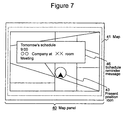
- FIG. 7 shows a first exemplary screen view displayed on the information terminal according to a second embodiment of the present invention.
- FIG. 8 shows a second exemplary screen view displayed on the information terminal according to the second embodiment of the present invention.
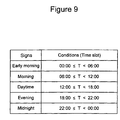
- FIG. 9 shows a third exemplary screen view displayed on the information terminal according to the second embodiment of the present invention.
- the description takes a case where the system reminds the operator of the schedule before the date of that schedule comes.
- the operator operates the terminal 12a to input his/her personal information, for example, a schedule for a next month.
- the schedule is such as a work, study, hobbies, a drive, a trip, recreations, sports, eat-out, or sightseeing.
- Said schedule is so made that a specific site, a destination, a location of a facility, or operator's activity done at the destination is associated with a date of the schedule.
- the operator sets the system so as to be reminded of said inputted schedule before the date of the schedule comes.
- the operator can preset the timing of the reminder; generally, such reminder is given to the operator before the date of the schedule comes.
- the reminder is given to the operator whenever he/she turns on the terminal 12b before the date of the schedule.
- the map panel 40 is displayed on the display device by means of the display control unit in the terminal 12b as shown in FIG. 7 .
- the terminal 12b is an on-board navigation apparatus for a vehicle, the terminal 12b is automatically turned on when the vehicle engine is started.
- a schedule reminder message 46 appears on the map 41 that depicts the area around the present position. The schedule reminder message 46 tells a summary of the schedule having already been inputted.
- the display control device in the terminal 12b allows the schedule screen 50 which detailing the schedule reminder message 46 appear onto the display device as shown in FIG. 8.
- the screen 50 has the reminder-timing box 51 .
- this box 51 tells the timing to remind the operator of his/her schedule. The operator can confirm the details of own schedule on the screen 50 .
- the reminder timing can be set on a day basis; for example, "Remind me of a schedule one day or two days before the date of that schedule.”
- the reminder timing may be set on a time slot basis; for example, "Remind me of a schedule on the evening of the day before the date of that schedule,” “Remind me of a schedule during 18:00-22:00 of the day before the date of that schedule,” or "Reminded me of a schedule on the morning of the date of the schedule.”
- This time slot may be defined as shown in FIG. 9 , for example.
- the reminder timing may be set as follows: "Remind me of a schedule when I am on my way home on one day before the date of that schedule” or "Remind me of a schedule when I am on my way to my office on the date of the schedule.”
- the operator sets the reminder timing as follows: "Remind me of a schedule when I am on my way home on one day before the date of the schedule.”
- the operator is reminded of the registered schedule on his/her way home when the terminal 12b enters the specified area at a certain distance from his/her home, for example, the area within a 500-meter radius of his/her home.
- the operator sets the reminder timing as follows: "Remind me of a schedule when I am on my way to my office on the date of that schedule.”
- the operator is reminded of the schedule on his/her way to the office when the terminal 12b enters the specified area at a certain distance from his/her office, for example, the area within a 500-meter radius of his/her office.
- said reminder timing may base exclusively on a location and not base on the date of the schedule nor the time slot. For example, a railway station near the operator's home, an operator's favorite department store, or a park can be a trigger for the reminder.
- the system may remind the operator of today's schedule or next day's schedule whenever the terminal 12b enters the area at a certain distance from said specified location.
- the schedule reminder message may be given to the operator visually on the display device, or may be given acoustically through voices, music, or chimes. For example, take a case where the system is so set that the operator can be reminded of the schedule when he/she is on his/her way home on the evening of one day before the scheduled date. In such case, with a human voice the operator may be reminded of the schedule such as "Meeting from A.M. XX:XX at XX company tomorrow" as if the operator had a secretary. It is preferable that the system be designed to allow the operator to select a male voice or a female voice optionally. Further, it is desirable that the system be designed to allow the operator to set a voice of someone in his/her family, friend, a voice of his/her favorite actor/actress, or a voice of his/her favorite singer.
- the schedule reminder message may be automatically switched between the visual reminder and the acoustic reminder according to the time slot. If the time slot is set as shown in FIG. 9 , the operator is reminded of the today's schedule acoustically early in the morning while reminded of the tomorrow's schedule visually. In the morning and daytime, the operator is reminded of the today's schedule acoustically or visually while reminded of the tomorrow's schedule visually; in the evening and at midnight, the operator is reminded of both the today's schedule and the tomorrow's schedule visually.
- the schedule reminder message may be one of being externally transmitted from outside to the terminal 12a .
- the terminal 12a is such as a portable telephone, a pocket telephone for PHS (Personal Handy Phone system), a mobile information terminal, or a personal digital assistant, each of which is always carried by the operator; otherwise, take a case where the terminal 12a is a home-use or office-use personal computer in all-day-long service.
- the operator may be reminded of the schedule via the display device or via the speaker, each of which is included in the information terminal 12a .
- the schedule may be one of other's schedule being externally transmitted from other person.
- the other's schedule transmitted from outside may be registered and notified to the user before the date of the other's schedule comes.
- the names of others must have been preliminarily registered in the information display system and accordingly ID numbers must be respectively issued to them.
- such others may be friends, acquaintances, or family members of the operator.
- the "Friend” registration will be described in detail.
- someone on the other end of the communication sends off his/her own schedule to the operator from his/her information terminal to the server 11 via the network 27 .
- the schedule includes a date and time as well as a location for a business meeting, a banquet, a party, a date, or an appointment.
- the system recognizes the transmitted schedule as "Friend Link” and stores it into a friend link file.
- "Friend Link” means personal information (schedule) transmitted to the operator from the other person.
- the friend link file is contained in the PIM database 21 in a manner that each friend link file is associated with each personal file.
- the operator can confirm not only own schedule but also the other's schedule transmitted from other person, i.e., friends, acquaintances, or family members. If the other's schedule includes the business meeting, the banquet, the party, the date, or the appointment with which the operator is involved, such schedule may be copied into the operator's personal file.
- the other's schedule can be stored as the operator's schedule into the personal file. Thereby, the operator may be reminded of such other's schedule before the date of that other's schedule comes. For his/her own schedule, the operator may copy and use the other's schedule in its entirety. Thereby, the operator can save himself/herself some work.
- the preliminarily registration of the schedule makes in-advance acoustic/visual schedule reminder possible, and thereby the operator may be reminded of the registered schedule before the date of the schedule comes.
- the schedule reminder timing is in hand of the operator.
- the operator may set the reminder timing according to his/her most convenient conditions.
- the reminder message style may be selectable from either a visual type or an acoustic type. This allows the operator to be reminded of the schedule in his/her most desirable way.
- the operator can always keep track of the upcoming schedules having already been registered.
- the present invention is applicable to any information display systems.
Landscapes
- Engineering & Computer Science (AREA)
- Remote Sensing (AREA)
- Radar, Positioning & Navigation (AREA)
- Business, Economics & Management (AREA)
- Physics & Mathematics (AREA)
- General Physics & Mathematics (AREA)
- Human Resources & Organizations (AREA)
- Strategic Management (AREA)
- Entrepreneurship & Innovation (AREA)
- Theoretical Computer Science (AREA)
- Tourism & Hospitality (AREA)
- Marketing (AREA)
- General Business, Economics & Management (AREA)
- Economics (AREA)
- Operations Research (AREA)
- Quality & Reliability (AREA)
- Data Mining & Analysis (AREA)
- Automation & Control Theory (AREA)
- Navigation (AREA)
- Traffic Control Systems (AREA)
- Management, Administration, Business Operations System, And Electronic Commerce (AREA)
- Control Of Indicators Other Than Cathode Ray Tubes (AREA)
Abstract
An information display system according to the present invention comprises a map
information storage in which map information is stored, an input device from which
schedules are inputted, a schedule storage in which the schedules are stored, a display
device on which a map (41) is displayed, and a display control device by which a
schedule reminder message is displayed on the map (41) at a specified time; whereby
the operator can be reminded of the schedule when his/her vehicle comes close to a
specified location during a period of the schedule, and further the operator can be
reminded of the schedule before a date of the schedule comes.
Description
- This invention relates to an information display system.
- There have been conventional navigation apparatuses for a vehicle such as an automobile, wherein an optimum route from a user-selected departure point to a user-selected destination is searched based on road map data and therewith the searched route is displayed on a display screen.
- Further, there has been provided a navigation apparatus, wherein once a destination and a visit date are selected and registered by an operator i.e., a driver of the vehicle, a route to the destination is automatically searched on that very visit date and therewith the searched route is automatically displayed on a display screen. Here, the destination may be, for example, a resort, a sightseeing spot, and an intended visit place; the visit date may be, for example, an upcoming day off. For instance, once the operator designates the day off as the visit date, a route to the registered destination is automatically searched on that very day off and therewith the searched route is displayed on the display screen.
- That is, the conventional navigation apparatus can notify the operator of an optimal route to a scheduled destination on the very date of the schedule. Thereby, on the very date of the schedule, the operator can be sure to check the route to the destination.
- Disadvantageously, however, said conventional navigation apparatus is functionally limited in that the route to the destination is displayed to the operator only when the date of the schedule comes. This deprives the operator of the opportunity to make sure of his/her schedule before the date of the schedule.
- Further to this disadvantage, sometimes there is a case where the operator completely forgets his/her upcoming schedule that has already been registered. For example, take a case where the operator has been scheduled to have a Sunday drive to a resort one month later but now completely forgets that schedule. In this case, even if a resort and a date of one-month-ahead Sunday have already been registered respectively as the destination and the date of the schedule, a route to that resort is not displayed beforehand on the display screen until one-month-ahead Sunday comes. That is, the operator cannot be sure to check his/her schedule for one-month-ahead Sunday until he/she turns on his/her navigation apparatus and watches the display screen on that Sunday.
- Further disadvantageously, the conventional navigation apparatus cannot support rough schedule that has no specific date, for example, "Pay a bill from my bank account sometime within the next week" or " Send a parcel from the post office within one week from today." Since such rough schedule has a certain range in date, the operator gets in trouble when he/she inputs such rough schedule into the conventional navigation apparatus.
- For solving aforesaid problems, the present invention provides an information display system. This information display system can remind the operator of his/her pre-made schedule when his/her vehicle comes close to a specified location within a period of that pre-made schedule. It is the object of the present invention that the information display system gives the operator a schedule reminder message and also it is the object of the present invention to remind the operator of his/her schedule before the date of that schedule comes.
- An information display system according to the present invention comprises; a map information storage in which map information is stored, an input device from which a schedule is inputted, a schedule storage in which the schedule is stored, a display device on which a map is displayed, and a display control device by which a schedule reminder message is displayed on the map at a specified time.
- With aforesaid composition, the information display system can notify the operator at a specified time that a schedule has been registered in connection with a certain position shown on the map.
- Another information display system according to the present invention comprises: a server in which the map information storage, the schedule storage, and a transmit-receive unit are included; a first information terminal in which the input device and a transmit-receive unit are included; and a second information terminal in which the display device, the display control device, and a transmit-receive unit are included.
- Other information display system according to the present invention comprises: a server in which the map information storage, the schedule storage, and the transmit-receive unit are included; and an information terminal in which the input device, the display device, the display control device, and a transmit-receive unit are included.
- Further, there is other information display system according to the present invention wherein the specified time at which the schedule reminder message is displayed on the map comes within a period of the schedule.
- Moreover, there is other information display system according to the present invention wherein the display device displays a calendar on which the period of the schedule is shown by means of the display control device.
- Furthermore, there is other information display system according to the present invention wherein a location of the schedule is displayed on the map by means of the display control device.
- Besides, there is other information display system according to the present invention wherein a route to the location of the schedule is displayed on the map by means of the display control device.
- Additionally, there is other information display system according to the present invention wherein the specified time at which the schedule reminder message is displayed on the map comes before a date and time of the schedule.
- On top of that, there is other information display system according to the present invention wherein the specified time at which the schedule reminder message is displayed on the map is the moment when a present position of an operator's vehicle arrives at a specified location.
- In addition, there is other information display system according to the present invention wherein the schedule reminder message may be given to an operator acoustically or visually.
-
- FIG. 1 shows a conceptual drawing of compositions of an information display system according to a first embodiment of the present invention.
- FIG. 2 shows a process of file classification carried out by a PIM processing unit according to the first embodiment of the present invention.
- FIG. 3 shows a first exemplary screen view displayed on an information terminal according to a first embodiment of the present invention.
- FIG. 4 shows a second exemplary screen view displayed on the information terminal according to the first embodiment of the present invention.
- FIG. 5 is a flowchart showing a process of the file classification carried out by the PIM processing unit according to the first embodiment of the present invention.
- FIG. 6 is a flowchart showing a process of information display according to the first embodiment of the present invention.
- FIG. 7 shows a first exemplary screen view displayed on the information terminal according to a second embodiment of the present invention.
- FIG. 8 shows a second exemplary screen view displayed on the information terminal according to the second embodiment of the present invention.
- FIG. 9 shows a third exemplary screen view displayed on the information terminal according to the second embodiment of the present invention.
-
- Embodiments according to the present invention will be described hereinafter in detail with reference to the accompanying drawings.
- FIG. 1 shows a conceptual drawing of compositions of the information display system according to a first embodiment of the present invention.
- In FIG. 1, an
information source server 11 is constructed in a computer which comprising processing means such as a CPU or a MPU, storage means such as a semiconductor memory, a magnetic disk, or an optical disk, and a communication interface. The place where said server is constructed may not be limited to a single computer but may be so-called a decentralized computer networks in which plural computers are systematically connected one after the other. Further, together with theserver 11, other system may be constructed in said computer. Otherwise, theserver 11 may be a part of a system that is constructed in other computer. - An
information terminal 12a and aninformation terminal 12b are respectively operated as a first information terminal and a second information terminal. Actually in the present information display system, a plurality of the information terminals may be used and operated at a time. However, for convenience of explanation, the description here takes a case where only two terminals i.e., theterminal - Either the
terminal - Either the
terminal terminal - Moreover, either the
terminal terminal terminal - Under the foregoing composition, the
server 11 is connected to either theterminal 12a or theterminal 12b via anetwork 27. Based on this connection, the communication between theserver 11 and theterminals network 27 may be a wire/wireless public switched network, a dedicated communication network, a portable telephone network, the Internet, an intranet, a LAN (Local Area Network), a WAN (Wide Area Network), a satellite communication network, any possible communication networks, or a certain combined network comprised of said various networks. Further, theserver 11 may be communicated with theterminal - To sum up, the information display system according to the present embodiment is mainly made up of the
information source server 11, theinformation terminal 12a, and theinformation terminal 12b. To use the information display system, each operator must be registered with the information display system and accordingly possesses an ID number; not only the operator but also each of the terminal 12a and 12b must be registered with such system. - The
information source server 11 comprises: aninformation provision unit 13 from which information about a route to a destination and other various information are sent back to either the terminal 12a or 12b upon receipt of information about a departure point and a destination sent off from either the terminal 12a or 12b; a transmit-receiveunit 14 with which each of the terminal 12a and 12b exchange the information; aterminal information storage 15 in which the exchanged information is independently stored for each of the terminal 12a and the terminal 12b; and aterminal specifying unit 16 by which each of the terminal 12a and 12b is specified based on the ID number. - Hereinafter, the
information provision unit 13 will be described. Theinformation provision unit 13 including; amap database 17 serving as a map information storage, a POI (Point of Interest)database 18, aroad database 19, atraffic information database 20 serving as a traffic information storage, and a PIM (Personal Information Manage)database 21 serving as a schedule storage. - The
map database 17 stores map information used for drawing a map; the map information are, for example, nodes, links, coordinates, and facility names. ThePOI database 18 stores facility data, telephone number-address data, event data, and the like, all of which are used for retrieving a point such as a departure point, a destination point, or a pass-through point. Theroad database 19 stores data for searching a route; specifically such data are, for example, road search cost (here, the cost means a weight given to data used in searching a road) and a road type. - Further, for example, if the present system is used in combination with a traffic information communication system called VICS(R), the
traffic information database 20 can store traffic information about traffic congestion and traffic regulations. Such traffic information is prepared based on the information collected by traffic regulatory systems that the police or the Japan Highway Traffic Corporation controls. Furthermore, it is desirable that thetraffic information database 20 may store event schedule information about a site or a date of a scheduled event such as a festival, a parade, or a fireworks display. In addition, it is desirable that thetraffic information database 20 should store statistical congestion information like "roads around a railway station or a mega commercial facility are congested every day during a certain period of time except a weekend" or "roads around a sea resort during a summer vacation are congested." Moreover, it is desirable that thetraffic information database 20 should store meteorological information such as a weather forecast originally made by the Meteorological Agency. - The
PIM database 21 contains personal files for respective operators. In each personal file, attribute files (a schedule file, a calendar file, an address book file, a telephone directory file, a registered point list file, a memo file, and the like) are included. In each attribute file, operator's personal information in the form of a schedule list, a calendar, an address book, a telephone directory, a registered point list, and a memo is stored. Although the personal file is generally prepared for every one of the operators who have already been registered in the system, it may be prepared on an information terminal basis. On top of that, the personal file may be prepared on an ID number basis if one operator possesses a plurality of ID numbers. - The
server 11 has storage means for themap database 17, thePOI database 18, theroad database 19, thetraffic information database 20, and thePIM database 21. Said storage means may be either an internal storage medium or an external storage medium. Such medium may be any one of the followings: a magnetic tape, a magnetic disk, a magnetic drum, a CD-ROM, a MD (Mini Disk), a DVD-ROM, a DVD-RAM, an optical disk, a MO (magneto-optical) disk, an IC card, an optical card, a stick memory, a memory card, or any other possible media. - Further to said databases, the
information provision unit 13 including: amap drawing unit 22 by which a map is drawn based on the map information; aPOI retrieval unit 23 by which positional information, for example coordinates, an address, or a name of a registered location (as a destination), is retrieved based on the information stored in thePOI database 18; and aroute search unit 24 by which a route from a present position of the vehicle to a destination is searched based on information stored in theroad database 19 or based on information stored in thetraffic information database 20. - Furthermore, the
information provision unit 13 includes aPIM processing unit 25 by which the operator's schedule list, calendar, address book, telephone directory, registered point list, memo, and the like are prepared and updated based on the information sent from either the terminal 12a or 12b, and suchPIM processing unit 25 may extract information from said schedule list, calendar, address book, telephone directory, registered point list, memo, and the like. In addition, theinformation provision unit 13 includes a send-outinformation organizing unit 26 by which information to be sent out to either the terminal 12a and 12b is organized and edited. - Moreover, the
information provision unit 13 includes a destination-setting unit, an estimated arrival time calculating unit, and a comparing unit (these are not shown). Additionally, theinformation provision unit 13 stores several programs such as a PIM program and a route search program. Here, the PIM program is one of managing a schedule list, a calendar, an address book, a telephone directory, a registered point list, a memo, and the like, all of which are useable in the portable information terminals, PDAs, and personal computers. - If the positional information (a destination, a pass-through point, or a registered point) is registered in the schedule list, the address book, the telephone directory, the registered point list, or the memo, a destination is selected by means of the destination-setting unit. The estimated arrival time calculating unit calculates the estimated arrival time at which the vehicle reaches the destination. This calculation is based on the information about the route searched by the
route search unit 24. For example, the estimated arrival time is calculated based on the sum of the time required for traveling each road segment that leads to the destination. As for the estimated arrival time, it may be recalculated and updated at intervals of a specified time. In some cases, this recalculation and update may take into consideration the latest traffic congestion information as well as the latest traffic regulatory information which are both stored in thetraffic information database 20. After the recalculation of the estimated arrival time, the comparing unit starts to compare the recalculated estimated arrival time with operator's desired arrival time. - Hereinafter, the terminal 12a and the terminal 12b will be further described. Either the terminal 12a or 12b may include a transmit-receive unit and a display control device, whereby the information having inputted in the schedule list, calendar, address book, telephone directory, registered point list, memo, and other information are transmitted/received to/from the
server 11. In either the terminal 12a or 12b, both the calendar and the map transmitted from theserver 11 are displayed on the display device by means of the display control device. Further, onto that calendar and the map, the display control device displays a present position, a destination, and a facility located around said present position. At the same time, it is desirable that the following information be also displayed on said calendar and said map: the desired arrival time, the estimated arrival time, destination name, destination address, the facility data, the telephone number and address data, the event data, road traffic information, the event schedule information, the statistical congestion information, the meteorological information, and the like. - In the present embodiment, the
server 11 having, for one example, themap database 17, thePIM database 21, theroute search unit 24, and thePIM processing unit 25 may work as a main part of the information display system. In response to the request from either the terminal 12a or 12b, theserver 11 carries out the route search, as well as a preparation, update, or edit of the schedule list, calendar, address book, telephone directory, registered point list, memo, and the like. The results of said route search, as well as said preparation, update, or edit may be transmitted back to either the terminal 12a or 12b. Since theserver 11 works as the main part in the information display system in said example case, a compositional simplification and a downsizing of the terminal 12a and 12b may be achieved. This makes manufacturing costs of the information terminals lower. - Likewise, from the same economical reasons, instead of the
server 11, either the terminal 12a or 12b may include themap database 17 and theroute search unit 24 in order to carry out the route search. In this case, either the terminal 12a or 12b may work as the main part of the information display system. This leads to a compositional simplification of theserver 11 as well as contributes to the reduction of running costs of the information display system. - Further, in other circumstances, instead of the
server 11 either the terminal 12a or 12b may include thePOI database 18, theroad database 19, thetraffic information database 20, thePIM database 21, thePOI retrieval unit 23, thePIM processing unit 25, the destination-setting unit, the estimated arrival time calculating unit, and the comparing unit. - Next, operations of the information display system in the foregoing composition will be described.
- Hereinafter, the description takes a case where the
information source server 11 comprises themap database 17, thePOI database 18, thetraffic information database 20, thePIM database 21, theroute search unit 24, and thePIM processing unit 25; whereby the route search as well as the preparation, update, or edit of the schedule list, calendar, address book, telephone directory, registered point list, memo, and the like, are carried out, and then the results thereof are transmitted back to theinformation terminal 12b in response to the request from the terminal 12a. - Suppose that the terminal 12a is a portable telephone or a telephone for PHS (Personal Handy phone System) and the terminal 12b is a navigation apparatus aboard a vehicle; the
terminal
The operations of the information display system will be described with reference to the following figures. FIG. 2 shows a process of file classification carried out by a PIM processing unit according to the first embodiment of the present invention. FIG. 3 shows a first exemplary screen view displayed on an information terminal according to a first embodiment of the present invention. FIG. 4 shows a second exemplary screen view displayed on the information terminal according to the first embodiment of the present invention. FIG. 5 is a flowchart showing a process of the file classification carried out by the PIM processing unit according to the first embodiment of the present invention. FIG. 6 is a flowchart showing a process of information display according to the first embodiment of the present invention. - In the operation, firstly, the
terminal 12a is operated to input operator's personal information. Here, the operator's personal information means schedules to be inputted into a schedule list, the calendar, the address book, the telephone directory, the registered point list, the memo, and the like. For example, the operator inputs the schedules for a next month; such as a work, study, hobbies, a drive, a trip, recreations, sports, eat-out, or sightseeing. These schedules are so made that a site, a destination, or a location of a facility is associated with a specified period. For example, the site and the specified period are associated with each other in the schedule as follows: "Build Mr. XX's house by the end of the next month," "Go to the library and borrow some books within a few days," "Visit XX office within this month," "Go to a pharmacy and buy a medicine sometime this week," "Pay a bill from my bank account within the next week," or "Send a parcel from the post office within one week from today." - For inputting schedules, start the PIM program stored in the terminal 12a is started. With the start of the PIM program, a schedule input view is displayed on the display device in the terminal 12a.
- If the PIM program is not stored in the terminal 12a, access the
server 11 from the terminal 12a via thenetwork 27. Upon this access, the PIM program stored in theserver 11 is started and the schedule input view is obtained and displayed on the display device in the terminal 12a. - Then, the schedule is inputted on the schedule input view. The schedule input view has some dialog boxes to input or specify a period of the schedule, a location of the schedule, a description of the schedule, and a memo about the schedule. For the schedule input, it is preferable that a Japanese-syllable input palette be displayed on the schedule input view. In this case, said period, location, description or memo can be inputted on a syllable-by-syllable basis from the Japanese-syllable input palette. Further, it is preferable that an alphanumeric input palette be displayed for the input of telephone numbers or addresses. In this case, the telephone number or the address may be inputted on an alphanumeric basis.
- Furthermore, there is the other alternative way of inputting the schedule when the
PIM processing unit 25 in theserver 11 has a keyword-extracting function. The keyword-extracting function is such that keywords associated with the period of the schedule or the location of the schedule are extracted from sentences written by a natural language. In this case, the schedule input view has a single dialog box to input the sentences such as a memo or a note including said period or said location. When the sentences written by the natural language are inputted into the single dialog box, thePIM processing unit 25 starts to extract the keywords associated with the period of the schedule or the location of the schedule from those sentences. Thereafter, thePIM processing unit 25 automatically allocates the extracted keyword, such as the period of the schedule or the location of the schedule to each corresponding dialog box. When inputting the schedule into the dialogue box, the period of the schedule may not have to be defined by both of a date and a time; rather it may be defined by either a date or a time. Likewise, the location of the schedule may not have to be defined by an accurate address or precise positional coordinates. Furthermore, it is possible to skip the description of the schedule and/or the memo about the schedule. - After the schedule input is finished, the
terminal 12a is operated to transmit the inputted schedule to theserver 11 via thenetwork 27. In theserver 11, the transmit-receiveunit 14 receives the schedule from the terminal 12a. Just at this moment, from that transmitted schedule theterminal specifying unit 16 extracts the ID number to specify the personal file, which corresponding to the terminal 12a, stored in thePIM database 21. The personal file is prepared correspondingly to each operator so that the ID number can serve as information to specify the operator. - In addition to the ID number, the period of the schedule, the location of the schedule, the description of the schedule, and/or the memo about the schedule are also extracted from the schedule transmitted from the terminal 12a by means of the
PIM processing unit 25. Upon this extraction, thePIM processing unit 25 accesses thePOI retrieval unit 23 to obtain the positional coordinates of said location of the schedule. After the acquisition of the positional coordinates, thePIM processing unit 25 accesses the personal file, which stored in thePIM database 21, specified by theterminal specifying unit 16. Then, the extracted information, such as, period of the schedule, the position of the schedule, the description of the schedule, and/or the memo about the schedule are/is stored into the specified personal file. In that specified personal file, according to the present embodiment, the location of the schedule (including positional coordinates), the description of the schedule, and/or the memo about the schedule are/is registered in association with the period of the schedule. Thus, the schedule inputted by the operator can be registered in the personal file stored in thePIM database 21. - In this connection, hereinafter the operations of the
PIM processing unit 25 will be described in detail. - When the personal information (schedule) is inputted, the
PIM processing unit 25 starts to store the inputted personal information into the personal file, which corresponding to the operator, stored in thePIM database 21. In this process, at first thePIM processing unit 25 judges whether the inputted personal information is defined by a date and time. If the personal information is defined by the date and time, it is recognized that the inputted personal information has an attribute of a schedule. If the personal information is not defined by the date and time, then thePIM processing unit 25 judges whether the inputted personal information is defined by a location. If the personal information is defined by the location, it is recognized that the inputted personal information has an attribute of a registered location. If the personal information is not defined by the location, it is recognized that the inputted personal information has an attribute of a memo. - Said relationship between the inputted personal information and the attributes is illustrated in FIG. 2. In FIG. 2 (a), ○ tells "Defined," × tells "Not defined," and ― tells "Not affecting the attribute." For example, take the top row of FIG. 2 (a). This row shows that the inputted personal information is defined by only the memo and not defined by the location as well as the date and time. In such case, it is judged that the inputted personal information has an attribute of a memo as shown in the top row of FIG. 2 (b). Next, take the midst row of FIG. 2 (a). This midst row shows that the inputted personal information is defined by the location and not defined by the date and time. In such case, it is judged that the inputted personal information has an attribute of a registered location as shown in the midst row of FIG. 2(b). Further, take the bottom row of FIG.2 (a). This bottom row shows that the inputted personal information is defined by only the date and time. In such case, it is judged that the inputted personal information has an attribute of a schedule as shown in the bottom row of FIG.2 (b).
- After the judgment of the attribute, the
PIM processing unit 25 accesses the personal file stored in thePIM database 21 and specified by the terminal-specifyingunit 16. Then, the personal information is stored into that specified personal file. In detail, the personal information having the attribute of a memo is stored into the memo file, the personal information having the attribute of a registered location is stored into the registered location file, and the personal information having the attribute of schedule is stored into the schedule file. When the personal information is defined by the location of the schedule, thePIM processing unit 25 accesses thePOI retrieval unit 23 to obtain the positional coordinates of that location. Thus, the personal information inputted by the operator can be classified into three categories: a memo, a registered location, and a schedule. The classified information is registered in its corresponding attribute file contained in the personal file. This personal file stored in thePIM database 21 is prepared for each operator. Once the personal information is inputted, whereby the operator can confirm his/her schedule at any time he/she likes. - The next description centers on operations of confirming the operator's schedule for certain one month by operating the terminal 12b.
- In order to confirm this schedule, firstly the operator transmits a request for the schedule from the terminal 12b to the
server 11 via thenetwork 27. The transmit-receiveunit 14 receives that request from the terminal 12a. Upon the receipt of the request, theterminal specifying unit 16 extracts the ID number from said transmitted request in order to specify the personal file, which corresponding to the terminal 12b, stored in thePIM database 21. As aforesaid, the personal file is prepared correspondingly to each operator so that the ID number may serve as information to specify each operator. - Subsequently, from the schedule file contained in the specified personal file the
PIM processing unit 25 extracts the personal information for said one month. The extracted information undergoes data transformation through the send-out information-organizingunit 26 and then transmitted from the transmit-receiveunit 14 to the terminal 12b. In this transmission, the PIM program is sent out together with the data-transformed extracted information to the terminal 12b if the PIM program is not stored in the terminal 12b. - Upon the receipt of the data-transformed personal information, the display control device in the terminal 12b allows the display device to display said data-transformed personal information onto a
schedule panel 30 as shown in FIG. 3. On theschedule panel 30, acalendar 34 showing September 2001 is displayed. Thepanel 30 includes present date and time (year/ month/ day/ hour/ minute) 31, last update date and time (year/ month/ day/ hour/minute) 32 when the schedule was last updated, and a calendar month (month/year) 33. - Further, a date icon 35 displayed within each date rectangle in the
calendar 34 indicates that the location of the schedule has already been registered in connection with its related date of the schedule. Amemo icon 36 displayed within each date rectangle indicates that the memo about the schedule has already been registered in connection with its related date of the schedule. Each date rectangle is surrounded by acursor 37 so that the date rectangle may be highlighted in a bold line. Aperiod indicator 38 shows a period of the. schedule in connection which a period-registered location icon 42 (described later). Theperiod indicator 38 can take various forms: for example, a frame that surrounds the date rectangles of all dates within a certain period of the schedule, a bar stretched across the date rectangles of all dates within a certain period of the schedule as shown in FIG. 3, or color applied to the date rectangles of all dates within a certain period of the schedule. - In addition to the
panel 30, amap panel 40 is displayed on the display device by means of the display control device in the terminal 12b as shown in FIG. 3. Here, the description takes a case where amap 41 depicting an area around the present position of the terminal 12b is displayed on thepanel 40. On themap panel 40, apresent position icon 43 shows the present position of the terminal 12b, and the period-registeredlocation icon 42 shows the period-registered location that is registered in connection with the period of the schedule. It is desirable that a destination, a pass-through point, a registered location where the operator frequently visits, a facility such as a post office or a restaurant, or a landmark be displayed on themap 41. - In the present embodiment, the
icon 42 which located within a specified range with reference to the present position of the terminal 12b is displayed on themap 41. Such specified range, for example, covers over a N-kilometer radius of the present position of the terminal 12b. Here, the value of N is changeable; the operator can confirm any period-registered location as far as it exists within the range defined by N. - In confirming the period-registered locations, any registered points inputted from the schedule input view or any arbitrary points on the map may serve as the present position of the terminal 12b substitutively. Therefore, the operator could confirm the
icon 42 located within the area with reference to said inputted registered point or said arbitrary point on the map. That is, in substitution for the present position any points may be optionally selected, and thereby the period-registered locations within the area with reference to such any points may be informed to the operator. - Hereinafter, the description takes a case where the terminal 12b is the present position and the radius N [kilometer] is 0.5. In this case, the
icon 42 located within a 500-meter radius of the present position of the terminal 12b is displayed on themap 41. - When the
icon 42 is displayed on themap 41, at the same time theperiod indicator 38 is displayed on thecalendar 34 as shown in FIG. 3. In FIG. 3, theindicator 38 shows the period of the schedule in connection with theicon 42; that is, the operator is scheduled to visit the location indicated by theicon 42 somewhere during the period shown by theindicator 38. However, there is aother case where theicon 42 is not displayed on themap 41 even the period-registered location exists within the 500-meter radius of the present position. Such case occurs when a date indicated by the present date andtime 31 has not yet not come within the period indicated by theindicator 38. - In other words, the
icon 42 to remind the operator of the schedule is not displayed on themap 41 unless the date indicated by the present date andtime 31 comes within the period indicated by theindicator 38. - When the
icon 42 that reminds the operator of the schedule is displayed on themap 41, there appears anoptional button 44 to determine whether to visit the period-registered location. Theoptional button 44 comprises "Yes"button 44a and "No"button 44b. The operator can determine whether to visit the period-registered location by clicking thecursor 37 on either the "Yes"button 44a or the "No"button 44b. Alternatively, theoptional button 44 may take the form of a single button. In this case, when thecursor 37 is clicked on thebutton 44, it is determined that the operator visits the period-registered location. - When the
cursor 37 is placed on theoptional button 44 and clicked to determine to visit the period-registered location, the determination result is transmitted from the terminal 12b to theserver 11. In response to such determination, theroute search unit 24 starts to search a route from the present position shown by theicon 43 to the registered location shown by theicon 42. The searched route is transmitted from the transmit-receiveunit 14 in theserver 11 to the terminal 12b, and thereupon route guidance on that searched route is started. This route guidance may be visually given to the operator through the display of the searched route on themap 41, or alternatively given vocally. - When the
cursor 37 is clicked on the "No"button 44b to determine not to visit the period-registered location, no route search is carried out and therefore no route guidance is given to the operator. - As for the
cursor 37, it is moved around the screen with the operation of the input device provided in the terminal 12b. Thecursor 37 moves upward, downward, rightward, or leftward to the desired date rectangle with the operation of, for example, the joystick or the cross-shaped key. Alternatively, thecursor 37 is moved to the desired date rectangle by inputting numerals that represent the desired date. If the display device takes the form of a touch-sensitive panel, thecursor 37 is moved at the touch of the date rectangle. In FIG. 3, thecursor 37 is placed on the date of September 24 as indicated by the present date andtime 31. - If the
cursor 37 is moved farther upwardly beyond the top row of thecalendar 34, thecalendar 34 goes up to the previous month (August). On the contrary, if thecursor 37 is moved farther downwardly beyond the bottom row of thecalendar 34, thecalendar 34 goes down to the next month (October). - The description hereinafter centers on operations of displaying a
schedule screen 50 on theschedule panel 30. When thecursor 37 is clicked on any one of the date rectangles specified by the period indicator 38 (for example, any date from September 24 to September 28 as shown in FIG. 3), the display control device in the terminal 12b allows theschedule screen 50 as shown in FIG. 4 come up on theschedule panel 30. Thescreen 50 details the schedule for one of the dates specified by theindicator 38. - It is desirable that the
schedule panel 30 and themap panel 40 be simultaneously displayed vertically or horizontally side by side on the display device. However, if the size of the display device is small, thepanel 30 and thepanel 40 may be separately displayed from one after another; in other circumstances, thepanel 40 is closed and thepanel 30 is displayed alone. - The
schedule screen 50 has a reminder-timing box 51 as shown in FIG. 4. Thisbox 51 tells the operator whether the time to visually or acoustically remind him/her of the schedule has already come within the period of the schedule. Further, theschedule screen 50 including; a schedule date and time box 52 in which the period of the schedule is shown, a location name box 53 in which a name of the location of the schedule is shown, a memo box 54 in which the description of the schedule is shown, anaddress box 55 in which an address at the location of the schedule is shown, atelephone number box 56 in which a telephone number to be referred to is shown, aninput date box 57 in which the date when the schedule is inputted is shown, asender name box 58 in which a name of a sender is shown if the schedule is sent by someone from outside to the operator (this will be described hereinafter), and asend date box 59 in which the date when the schedule is sent from outside to the operator is shown. - Thus, from the
schedule screen 50, the operator can make sure of the details of his/her schedule which having already been inputted and registered. - Next, the description centers on operations of editing the registered schedule.
- According to the present embodiment, the operator may edit the registered schedules. In editing, firstly the schedule input view is displayed onto the display device in the terminal 12a. Then, the operator selects the schedule to be edited and thereby the user-selected schedule is displayed on the schedule input view. On the schedule input view, the schedule can be changed or erased, otherwise a new item is added to the schedule. This editing is carried out in the same way as the schedule is newly inputted. For example, the operator may revise the date and time of the schedule, the location of the schedule, or the memo about the schedule in each dialog box. Additionally, if the personal information (schedule) has been inputted in the form of natural language sentences, the operator may revise such sentences so as to change his/her schedule.
- After said editing, the edited schedule is transmitted from the terminal 12a to the
server 11 via thenetwork 27. The transmit-receiveunit 14 receives the edited schedule from the terminal 12a. At the same time, theterminal specifying unit 16 starts the same operation as done in the case where a new schedule is inputted. Thereby, the personal file, which corresponding to the terminal 12a, stored in thePIM database 21 is specified. Subsequently, from the personal files stored in thePIM database 21 thePIM processing unit 25 selects and accesses said specified personal file. Then, the edited schedule is stored into that selected personal file. - Thus, the schedule having already been registered may be edited just as in the case where the new schedule is inputted. Therefore, the registered schedule edit is easy operation for the operator.
- According to the present embodiment, the
map 41 may be swiftly drawn and displayed on the display device in the terminal 12b if the terminal 12b stores the map information in its storage device as well as includes a map-drawingunit 22. By contrast, when the terminal 12b neither stores the map information nor includes the map-drawingunit 22, a request for drawing themap 41 is transmitted together with data about the location of the schedule from the terminal 12b to theserver 11 via thenetwork 27. Upon receipt of such request and the data about the location of the schedule, the map-drawingunit 22 in theserver 11 accesses themap database 17 so as to draw themap 41 that shows the period-registeredlocation icon 42, thepresent position icon 43, and theoptional button 44. Then, the drawnmap 41 is data-transformed through the send-out information-organizingunit 26. The transformed map is transmitted from the transmit-receiveunit 14 to the terminal 12b and displayed onto the display device in the terminal 12b. - In another way, the
map 41 may be drawn at the moment when the schedule inputted by the operator is registered in the personal file. In this case, thePIM processing unit 25 extracts the location of the schedule from the inputted schedule and transmits the extracted location to the map-drawingunit 22 in order that themap 41 covering the extracted location may be drawn. After being drawn, themap 41 is stored by means of thePIM processing unit 25, in connection with the location and the date of the schedule, into the operator's personal file in thePIM database 21. In this case, when the schedule is transmitted from theserver 11 to the terminal 12b in answer to the request from the terminal 12b, themap 41 may be transmitted together with that schedule to the terminal 12b. Thereby, themap 41 covering the registered location of the schedule can be swiftly displayed onto themap panel 40 even if the terminal 12b has neither the map-drawingunit 22 nor the map information. - Additionally, facilities around the location of the schedule may be retrieved and displayed on the
map 41. Usually, when a type of the facility related to the schedule is inputted, such inputted type facilities around the location of the schedule are retrieved. For example, when the terminal 12b includes thePOI retrieval unit 23 and the POI information in its storage means, the facilities around the location of the schedule may be retrieved and displayed onto the display device in the terminal 12b. - By contrast, when the terminal 12b neither includes the
POI retrieval unit 23 nor the POI information in its storage means, a request for the retrieval of the facility is transmitted together with data about the location of the schedule from the terminal 12b to theserver 11 via thenetwork 27. Upon receipt of the request and the data about the location of the schedule, thePOI retrieval unit 23 in theserver 11 accesses thePOI database 18 to retrieve the facility around the location of the schedule. Then, the retrieved facility is data-transformed through the send-out information-organizingunit 26. The facility that experienced the data-transformation is transmitted from the transmit-receiveunit 14 to the terminal 12b and displayed on the display device in the terminal 12b. - In another way, the facility may be retrieved at the moment when the schedule inputted by the operator is registered in the personal file. In this case, the
PIM processing unit 25 extracts the location of the schedule from the inputted schedule and transmits it to thePOI retrieval unit 23 in order that the facilities around the location of the schedule may be retrieved. After being retrieved, such retrieved facilities are stored by means of thePIM processing unit 25, in connection with the location and the date of the schedule, into the operator's personal file in thePIM database 21. - In this case, when the schedule is transmitted from the
server 11 to the terminal 12b in answer to the request from the terminal 12b, the retrieved facility may be transmitted together with that schedule to the terminal 12b. Thereby, the facility around the location of the schedule may be swiftly displayed onto themap panel 40 even if the terminal 12b has neither thePOI retrieval unit 23 nor the POI information. - Further, a route to the location of the schedule may be searched and displayed onto the
map 41. Such route is generally searched based on both a location of the schedule and an operator's house respectively regarded as a destination and a departure point; instead of these points, as needed, any points can be designated as the destination or as the departure point. When the terminal 12b includes theroute search unit 24 and the road information in its storage means, the terminal 12b may search a route to the location of the schedule and display the searched route onto the display device. - By contrast, when the terminal 12b includes neither the
route search unit 24 nor the road information, a request for the route search is transmitted together with the data about the location of the schedule from the terminal 12b to theserver 11 over thenetwork 27. Upon receipt of the request and the data about the location of the schedule, theroute search unit 24 accesses theroad database 19 to search a route to the location of schedule. Then, the searched route is data-transformed through the send-out information-organizingunit 26. The route that experienced the data-transformation is transmitted from the transmit-receiveunit 14 to the terminal 12b and then displayed on the display device in the terminal 12b. - In another way, the route may be searched at the moment when the schedule inputted by the operator is registered in the personal file. In this case, the
PIM processing unit 25 extracts the location of the schedule from the inputted schedule and transmits it to theroute search unit 24 in order that the route to the location of the schedule may be searched. After being searched, the searched route is stored by means of thePIM processing unit 25, in connection with the location and the date of the schedule, into the operator's personal file in thePIM database 21. In this case, when the schedule is transmitted from theserver 11 to the terminal 12b in answer to the request from the terminal 12b, the searched route may be transmitted together with that schedule to the terminal 12b. Thereby, the route to the location of the schedule may be swiftly displayed onto themap 41 by means of the terminal 12b even if the terminal 12b has neither theroute search unit 24 nor the road information. - In searching a route, not only the
road database 19 but also thetraffic information database 20 may be accessed by theroute search unit 24 in order to refer to the traffic information such as the congestion information or the traffic regulatory information stored in thedatabase 20. In this case, theroute search unit 24 may search a route allowing for the traffic congestion that is predicted based on the accumulated statistical congestion information or scheduled event information. - For example, suppose a case where the vehicle follows a road around a rail station or a mega commercial facility and it is statistically confirmed that said road is congested everyday except a weekend at a certain time period such as in the evening. In this case, the
route search unit 24 so searches a route that said congested road could be excluded from search results. In addition, theroute search unit 24 so searches the route that the roads around the scheduled event site of a festival, a parade, or a fireworks display could be excluded from the search results, allowing for the predicted traffic congestion around such event site. - In another way, the
route search unit 24 may search a route based on the meteorological information such as a weather forecast that is stored in thetraffic information database 20. For example, when heavy rain is predicted, theroute search unit 24 may so perform the route search that a mountain route on which a skid accident frequently occurs could be excluded from the search results. - Further, there is other way of searching a route in a case where the terminal 12 includes the
route search unit 24 as well as includes the traffic information such as the traffic regulation or the traffic congestion, the accumulated statistical congestion information, the scheduled event information, or the meteorological information stored in its storage means. In this case, without transmitting a request for a route search to theserver 11, the terminal 12b alone can search a route by referring to said traffic information, statistical congestion information, scheduled event information, or meteorological information. - In this connection, when the operator designates a date by the
cursor 37, the terminal 12b displays onto the display device themap 41 which covering the registered location related to the designated date. At the same time, the traffic information, the statistical congestion information, the scheduled event information, or the meteorological information, each of which related to that designated date can be superimposed along the road on themap 41. - For this superimposition, the following operations are required. First, the terminal 12b transmits a request for the traffic information, the statistical congestion information, the scheduled event information, or the meteorological information, together with the data about the registered location, to the
server 11. Upon the receipt of the request and the data about the registered location, theroute search unit 24 in theserver 11 accesses thetraffic information database 20 and predicts the occurrence of the traffic congestion or the traffic regulation around said registered location. This prediction is based on the accumulated statistical congestion information as to the roads around the registered location and the scheduled event information. In detail, the occurrence of the traffic congestion or the traffic regulation is predicted allowing for the day, season, or time of the schedule. Then, such prediction about traffic congestion or the traffic regulation is data-transformed through the send-out information-organizingunit 26. The transformed predicted information is transmitted from the transmit-receiveunit 14 to the terminal 12b and then displayed on the display device in the terminal 12b. - In this regard, it is possible to store the predicted traffic information into the operator's personal file in the
PIM database 21 in a manner that the registered location and the designated date are associated with the predicted traffic information. - Further, in aforesaid case where the traffic information such as the traffic congestion information/the traffic regulation information, the accumulated statistical congestion information, or the scheduled event information is stored in the storage device in the terminal 12b, the terminal 12b alone may predict the traffic information without transmitting the request for it to the
server 11. - In this connection, when the operator designates a date by the
cursor 37, the terminal 12b displays onto the display device themap 41 which covering the registered location related to said designated date. At the same time, the meteorological information related to that designated date may be superimposed along the road displayed on themap 41. - For said superimposition, the following operations are required. First, the terminal 12b transmits a request for the traffic information together with the data about the registered location to the
server 11. Upon the receipt of the request and the data about the registered location, theroute search unit 24 in theserver 11 accesses thetraffic information database 20 to obtain the meteorological information such as the weather forecast for the area around the registered location. Then, such meteorological information for that area on the designated date is data-transformed through the send-out information-organizingunit 26. The transformed meteorological information is transmitted from the transmit-receiveunit 14 to the terminal 12b and then displayed onto the display device in the terminal 12b. - In this regard, it is possible to store the meteorological information into the operator's personal file in the
PIM database 21 in a manner that the registered location and the designated date are associated with the meteorological information. - When the terminal 12b stores the meteorological information such as the weather forecast in its storage device, the terminal 12b alone may display the meteorological information onto the display device with no transmission of the request for the meteorological information to the
server 11. - Thus, once the date is designated, the traffic information or the meteorological information for the area around the registered location associated with said designated date may be displayed on the display device. By referring to such traffic information or the meteorological information on the display device, the operator may confirm or change his/her schedule.
- Not only the designation of the date, but also the designation of the road can trigger a display of the traffic information about the road. When a certain road on the
map 41 is designated, the traffic information about such designated road may be displayed on thecalendar 34. - In this case, from the terminal 12b to the server 11 a request for the traffic information is transmitted together with the road data about the designated road. Upon the receipt of such request and the road data, the
route search unit 24 in theserver 11 accesses thetraffic information database 20 in order to predict the occurrence of the traffic congestion or the traffic regulation on the designated road. This prediction is based on the accumulated statistical congestion information or the scheduled event information as to the designated road. If it is predicted that the designated road will suffer from the traffic congestion or predicted that the designated road will be controlled by the traffic regulation, the date of such congestion or regulation is retrieved from thedatabase 20. Then, such retrieve date is data-transformed through the send-out information-organizingunit 26. The data-transformed date is transmitted from the transmit-receiveunit 14 to the terminal 12b and displayed on the display device in the terminal 12b. - For example, take a case where an autumn festival is scheduled for September 28 in a certain area around the road designated by the operator and it is predicted that said designated road would suffer from the traffic congestion on September 28. In this case, the display of the date rectangle of September 28 in the
calendar 34 changes in a certain way. This tells the operator that the designated road would suffer from the congestion on September 28; accordingly, the operator can change his/her schedule if need be. - The present embodiment described hereinbefore takes the case where the schedule is inputted from the terminal 12a and confirmed on the terminal 12b, however the present invention is not limited to such case. In opposite manner, the schedule may be inputted from the terminal 12b and confirmed on the terminal 12a. Further, both the input of the schedule and the confirmation of the schedule may be carried out in one single information terminal. Furthermore, in other way, the schedules may be inputted and confirmed with no access to the
server 11 if said single information terminal comprises thePOI database 18, theroad database 19, thetraffic information database 20, thePIM database 21, thePOI retrieval unit 23, thePIM processing unit 25, the destination-setting unit, the estimated arrival time calculating unit, and the comparing unit. - Foregoing descriptions of the present embodiment take the case where the oncoming schedules are confirmed. However, according to the present embodiment, not only such oncoming schedules but also past schedules may be confirmed insofar as the information stored in the
PIM database 21 is not erased. That is, the past schedules can be displayed when the specific site point, destination point, or facility point related to the past schedules including a drive, a trip, recreations, sports, eat-out, or sightseeing, is inputted together with its corresponding date of the schedule. According to the present information display system, not only the oncoming schedule but also the past schedule can be displayed onto the display device. - Hereinafter, flowcharts shown in FIG. 5 and FIG. 6 will be described.
- Firstly, a flowchart showing a process of file classification of the personal information followed by the
PIM processing unit 25 is described by referring to FIG. 5. - Step S1: Judge whether the personal information (schedule) inputted by the operator includes a date and time. If the date and time are included, go to Step S5. If the date and time are not included, go to Step S2.
- Step S2: Judge whether the inputted personal information includes a location. If the location is included, go to Step S3. If the location is not included, go to Step S4.
- Step S3: Recognize that the inputted personal information has an attribute of a registered location.
- Step S4: Recognize that the inputted personal information has an attribute of a memo.
- Step S5: Recognize that the inputted personal information has an attribute of a schedule.
- Next, a flowchart showing a process for displaying the information about the period-registered location will be described by referring to FIG. 6.
- Step S11: Judge whether the period-registered location is within a 500-meter radius of the present position.
- Step S12: Judge whether the date indicated by the present date and
time 31 comes within a period of the schedule. If said date comes within the period of the schedule, go toStep 13. If said date does not come within the period of the schedule, the process is terminated. - Step S13: When the date indicated by the present date and
time 31 comes within the period of the schedule, such fact is displayed on the display device. - Step S14: Judge whether to visit the period-registered location. If the operator determines to visit the period-registered location, go to
Step S 15. If the operator determines not to visit the period-registered location, the routine is terminated. - Step S 15: Start route search and provide route guidance.
- Thus, according to the present embodiment as aforesaid, the operator inputs his/her schedule such as a work, study, hobbies, sports, eat-out, sightseeing, shopping, and so on in a manner that a specific site point, a destination point, or a facility point is associated with a specific period of time. Thereby, said any point can be displayed as a period-registered location onto the
map 41 as far as said point is within the specified range with reference to the present position. On top of that, the period of the schedule which related to said period-registered location may be displayed onto thecalendar 34. -
Such calendar 34 tells the operator that he/she is scheduled to visit the period-registered location shown on themap 41 within the period of the schedule displayed on thecalendar 34. Thereby, even if the operator registers rough schedule that has a certain range in date, the operator can be reminded of such rough schedule whenever he/she comes close to the period-registered location during the period of said registered rough schedule. This helps the operator to keep track of his/her oncoming schedules. - Furthermore, according to the present embodiment as aforesaid, the personal information (schedule) having already been inputted or registered may be edited by carrying out the same operations as performed in inputting the personal information newly.
- That is, for editing the personal information there is no need to invoke specially a schedule-edit view or a memo-edit view. Further, when the personal information is edited and therewith the attribute of the personal information is changed, the system automatically allocates such edited personal information to the file corresponding thereto. Thus, the operator can easily edit the personal information which having already been registered.
- Additionally, according to the present embodiment as aforesaid, when the operator designates a date, a route to the period-registered location may be searched and displayed; and also the predicted traffic information or the predicted meteorological information as to the area around such period-registered location on a date of the registered schedule can be displayed. In such a way, upon the designation of the date, the traffic information or the meteorological information as to the area around the registered location on the date of the schedule may be displayed onto the display device. Thereby, referring to said traffic information and the meteorological information, the operator can confirm or change his/her schedule.
- Furthermore, according to the present embodiment as aforesaid, both the
calendar 34 and themap 41 displayed in the terminal 12b may use the schedule i.e., personal information that is inputted from the terminal 12a. This means that the schedule having already been inputted from the personal computer, the electronic personal organizer, or the portable telephone may be directly used as well as displayed onto both of thecalendar 34 and themap 41 in the navigation apparatus. That is, the date or the destination of the schedule can be inputted without using the navigation apparatus. - Hereinafter, a second embodiment according to the present invention will be described referring to the following figures. For convenience of explanation, the same compositions and operations according to the first embodiment are not described hereinafter.
- FIG. 7 shows a first exemplary screen view displayed on the information terminal according to a second embodiment of the present invention. FIG. 8 shows a second exemplary screen view displayed on the information terminal according to the second embodiment of the present invention. FIG. 9 shows a third exemplary screen view displayed on the information terminal according to the second embodiment of the present invention.
- Here, the description takes a case where the system reminds the operator of the schedule before the date of that schedule comes.
- Firstly, the operator operates the terminal 12a to input his/her personal information, for example, a schedule for a next month. Here, the schedule is such as a work, study, hobbies, a drive, a trip, recreations, sports, eat-out, or sightseeing. Said schedule is so made that a specific site, a destination, a location of a facility, or operator's activity done at the destination is associated with a date of the schedule.
- Then, the operator sets the system so as to be reminded of said inputted schedule before the date of the schedule comes. In this regard, the operator can preset the timing of the reminder; generally, such reminder is given to the operator before the date of the schedule comes. In the present second embodiment, the reminder is given to the operator whenever he/she turns on the terminal 12b before the date of the schedule.
- When the operator turns on the terminal 12b, the
map panel 40 is displayed on the display device by means of the display control unit in the terminal 12b as shown in FIG. 7. If the terminal 12b is an on-board navigation apparatus for a vehicle, the terminal 12b is automatically turned on when the vehicle engine is started. When the navigation apparatus is turned on, aschedule reminder message 46 appears on themap 41 that depicts the area around the present position. Theschedule reminder message 46 tells a summary of the schedule having already been inputted. - When the
cursor 37 is clicked on theschedule reminder message 46, the display control device in the terminal 12b allows theschedule screen 50 which detailing theschedule reminder message 46 appear onto the display device as shown in FIG. 8. Thescreen 50 has the reminder-timing box 51. In the present second embodiment, thisbox 51 tells the timing to remind the operator of his/her schedule. The operator can confirm the details of own schedule on thescreen 50. - It is desirable that the reminder timing be defined by the operator. The reminder timing can be set on a day basis; for example, "Remind me of a schedule one day or two days before the date of that schedule." In another way, the reminder timing may be set on a time slot basis; for example, "Remind me of a schedule on the evening of the day before the date of that schedule," "Remind me of a schedule during 18:00-22:00 of the day before the date of that schedule," or "Reminded me of a schedule on the morning of the date of the schedule." This time slot may be defined as shown in FIG. 9, for example.
- If the terminal 12b is a navigation apparatus or a portable telephone that includes a present position detective device, the reminder timing may be set as follows: "Remind me of a schedule when I am on my way home on one day before the date of that schedule" or "Remind me of a schedule when I am on my way to my office on the date of the schedule." Here, for example, take a case where the operator sets the reminder timing as follows: "Remind me of a schedule when I am on my way home on one day before the date of the schedule." In such case, on that one day before the date of the schedule the operator is reminded of the registered schedule on his/her way home when the terminal 12b enters the specified area at a certain distance from his/her home, for example, the area within a 500-meter radius of his/her home. Further, take a case where the operator sets the reminder timing as follows: "Remind me of a schedule when I am on my way to my office on the date of that schedule." In such case, on the very date of the schedule the operator is reminded of the schedule on his/her way to the office when the terminal 12b enters the specified area at a certain distance from his/her office, for example, the area within a 500-meter radius of his/her office. In other circumstances, said reminder timing may base exclusively on a location and not base on the date of the schedule nor the time slot. For example, a railway station near the operator's home, an operator's favorite department store, or a park can be a trigger for the reminder. Once a location is specified, the system may remind the operator of today's schedule or next day's schedule whenever the terminal 12b enters the area at a certain distance from said specified location.
- The schedule reminder message may be given to the operator visually on the display device, or may be given acoustically through voices, music, or chimes. For example, take a case where the system is so set that the operator can be reminded of the schedule when he/she is on his/her way home on the evening of one day before the scheduled date. In such case, with a human voice the operator may be reminded of the schedule such as "Meeting from A.M. XX:XX at XX company tomorrow" as if the operator had a secretary. It is preferable that the system be designed to allow the operator to select a male voice or a female voice optionally. Further, it is desirable that the system be designed to allow the operator to set a voice of someone in his/her family, friend, a voice of his/her favorite actor/actress, or a voice of his/her favorite singer.
- Advantageously, the schedule reminder message may be automatically switched between the visual reminder and the acoustic reminder according to the time slot. If the time slot is set as shown in FIG. 9, the operator is reminded of the today's schedule acoustically early in the morning while reminded of the tomorrow's schedule visually. In the morning and daytime, the operator is reminded of the today's schedule acoustically or visually while reminded of the tomorrow's schedule visually; in the evening and at midnight, the operator is reminded of both the today's schedule and the tomorrow's schedule visually.
- Further, the schedule reminder message may be one of being externally transmitted from outside to the terminal 12a. For example, take a case where the terminal 12a is such as a portable telephone, a pocket telephone for PHS (Personal Handy Phone system), a mobile information terminal, or a personal digital assistant, each of which is always carried by the operator; otherwise, take a case where the terminal 12a is a home-use or office-use personal computer in all-day-long service. In such cases, the operator may be reminded of the schedule via the display device or via the speaker, each of which is included in the
information terminal 12a. - The schedule may be one of other's schedule being externally transmitted from other person. The other's schedule transmitted from outside may be registered and notified to the user before the date of the other's schedule comes. In this case, the names of others must have been preliminarily registered in the information display system and accordingly ID numbers must be respectively issued to them. Generally, such others may be friends, acquaintances, or family members of the operator. Usually, it is preferable that said others be registered in the operator's personal file in the
PIM database 21. It is desirable that such others be registered in the name of "Friend" as a sender/recipient on the other end of the communication. However, this "Friend" registration is optional. - Hereinafter, the "Friend" registration will be described in detail. First of all, someone on the other end of the communication sends off his/her own schedule to the operator from his/her information terminal to the
server 11 via thenetwork 27. Here, suppose that the schedule includes a date and time as well as a location for a business meeting, a banquet, a party, a date, or an appointment. If such schedule is transmitted with a name of sender to be shown in the sender name box, the system recognizes the transmitted schedule as "Friend Link" and stores it into a friend link file. Here, "Friend Link" means personal information (schedule) transmitted to the operator from the other person. The friend link file is contained in thePIM database 21 in a manner that each friend link file is associated with each personal file. In this manner, the operator can confirm not only own schedule but also the other's schedule transmitted from other person, i.e., friends, acquaintances, or family members. If the other's schedule includes the business meeting, the banquet, the party, the date, or the appointment with which the operator is involved, such schedule may be copied into the operator's personal file. - That is, the other's schedule can be stored as the operator's schedule into the personal file. Thereby, the operator may be reminded of such other's schedule before the date of that other's schedule comes. For his/her own schedule, the operator may copy and use the other's schedule in its entirety. Thereby, the operator can save himself/herself some work.
- As understood from aforesaid embodiment according to the present invention, the preliminarily registration of the schedule makes in-advance acoustic/visual schedule reminder possible, and thereby the operator may be reminded of the registered schedule before the date of the schedule comes.
- According to the present embodiment, the schedule reminder timing is in hand of the operator. For the in-advance confirmation of the schedule, the operator may set the reminder timing according to his/her most convenient conditions. Further advantageously, the reminder message style may be selectable from either a visual type or an acoustic type. This allows the operator to be reminded of the schedule in his/her most desirable way.
- Thus, according to the present embodiment, the operator can always keep track of the upcoming schedules having already been registered.
- As many different embodiments of the present invention may be made without departing from the spirit and scope thereof, it is to be understood that the present invention is not limited to the aforesaid embodiments.
- The present invention is applicable to any information display systems.
Claims (10)
- An information display system, comprising:(a) a map information storage in which map information is stored;(b) an input device from which a schedule is inputted;(c) a schedule storage in which the schedule is stored;(d) a display device on which a map is displayed; and(e) a display control device by which a schedule reminder message is displayed on the map at a specified time.
- The information display system according to claim 1, comprising:(a) a server in which the map information storage, the schedule storage, and a transmit-receive unit are included;(b) a first information terminal in which the input device and a transmit-receive unit are included; and(c) a second information terminal in which the display device, the display control device, and a transmit-receive unit are included.
- The information display system according to claim1, comprising:(a) a server in which the map information storage, the schedule storage, and a transmit-receive unit are included; and(b) an information terminal in which the input device, the display device, the display control device, and a transmit-receive unit are included.
- The information display system according to any one of claims 1-3, wherein the specified time at which the schedule reminder message is displayed on the map comes within a period of the schedule.
- The information display system according to claim 4, wherein the display device displays a calendar on which the period of the schedule is displayed by means of the display control device.
- The information display system according to claim 4 or 5, wherein a location of the schedule is displayed on the map by means of the display control device.
- The information display system according to claim 6, wherein a route to the location of the schedule is displayed on the map by means of the display control device.
- The information display system according to any one of claims 1-3, wherein the specified time at which the schedule reminder message is displayed on the map comes before a date and time of the schedule.
- The information display system according to claim 8, wherein the specified time at which the schedule reminder message is displayed on the map is the moment when a present position of an operator's vehicle arrives at a specified location.
- The information display system according to claim 8 or 9, wherein the schedule reminder message may be given acoustically or visually.
Applications Claiming Priority (5)
| Application Number | Priority Date | Filing Date | Title |
|---|---|---|---|
| JP2001328353 | 2001-10-25 | ||
| JP2001328353A JP2003130672A (en) | 2001-10-25 | 2001-10-25 | Information displaying system |
| JP2001327421 | 2001-10-25 | ||
| JP2001327421A JP2003130662A (en) | 2001-10-25 | 2001-10-25 | Information display system |
| PCT/JP2002/011076 WO2003036232A1 (en) | 2001-10-25 | 2002-10-25 | Information display system |
Publications (1)
| Publication Number | Publication Date |
|---|---|
| EP1447646A1 true EP1447646A1 (en) | 2004-08-18 |
Family
ID=26624095
Family Applications (1)
| Application Number | Title | Priority Date | Filing Date |
|---|---|---|---|
| EP02777951A Withdrawn EP1447646A1 (en) | 2001-10-25 | 2002-10-25 | Information display system |
Country Status (5)
| Country | Link |
|---|---|
| US (1) | US6944539B2 (en) |
| EP (1) | EP1447646A1 (en) |
| KR (1) | KR20040047736A (en) |
| CN (1) | CN100353142C (en) |
| WO (1) | WO2003036232A1 (en) |
Families Citing this family (86)
| Publication number | Priority date | Publication date | Assignee | Title |
|---|---|---|---|---|
| JP5228366B2 (en) * | 2007-04-25 | 2013-07-03 | 株式会社デンソー | Driving information collection system and driving information learning method |
| KR20030041157A (en) * | 2001-08-10 | 2003-05-23 | 아이신에이더블류 가부시키가이샤 | Traffic Information Retrieval Method, Traffic Information Retrieval System, Mobile Communication Device, and Network Navigation Center |
| US20040068525A1 (en) * | 2001-10-22 | 2004-04-08 | Kiyonobu Yamazaki | Information control system, server for information control system, and information terminal for information control system |
| US20040260788A1 (en) * | 2003-05-30 | 2004-12-23 | Kazuhiko Miyano | Information provision system, terminal unit and relay unit forming part of that system, and image display customizing system |
| US7590553B2 (en) * | 2003-10-27 | 2009-09-15 | Microsoft Corporation | Integrated spatial view of time, location, and event schedule information |
| JP3928639B2 (en) * | 2003-12-26 | 2007-06-13 | アイシン・エィ・ダブリュ株式会社 | Car navigation system |
| JP4508728B2 (en) * | 2004-06-07 | 2010-07-21 | アルパイン株式会社 | In-vehicle electronic device and display method of digital broadcast in the device |
| JP4461373B2 (en) * | 2004-08-27 | 2010-05-12 | アイシン・エィ・ダブリュ株式会社 | Navigation device and calendar information data |
| JP2006072642A (en) * | 2004-09-01 | 2006-03-16 | Noritsu Koki Co Ltd | Tourist information guide device |
| JP4314526B2 (en) * | 2004-11-19 | 2009-08-19 | ソニー株式会社 | In-vehicle user interface device and in-vehicle navigation system |
| US7627425B2 (en) * | 2004-11-26 | 2009-12-01 | Microsoft Corporation | Location aware mobile-device software development |
| TWI290667B (en) * | 2005-04-20 | 2007-12-01 | Asustek Comp Inc | Display system and fixed time remind method therefore |
| DE102005020151A1 (en) * | 2005-04-29 | 2006-11-02 | Volkswagen Ag | Geographical map display device controlling method for motor vehicle`s navigation system, involves evaluating relevance of units e.g. restaurants, displayed on map for user, and automatically deciding which units are displayed at positions |
| JP5362544B2 (en) * | 2006-03-15 | 2013-12-11 | クゥアルコム・インコーポレイテッド | Method and apparatus for determining relevant target point information based on user's route |
| KR101226813B1 (en) * | 2006-03-22 | 2013-01-25 | 엘지전자 주식회사 | schedule reporting system and the method that is based on position information |
| US7941753B2 (en) * | 2006-03-31 | 2011-05-10 | Aol Inc. | Communicating appointment and/or mapping information among a calendar application and a navigation application |
| US7743056B2 (en) * | 2006-03-31 | 2010-06-22 | Aol Inc. | Identifying a result responsive to a current location of a client device |
| WO2008011432A2 (en) * | 2006-07-17 | 2008-01-24 | Abraham Vasant | System and method for coordinating customized mobility services through a network |
| US8910044B1 (en) | 2006-08-22 | 2014-12-09 | Aaron T. Emigh | Playlist incorporating tags |
| US7649454B2 (en) * | 2006-09-28 | 2010-01-19 | Ektimisi Semiotics Holdings, Llc | System and method for providing a task reminder based on historical travel information |
| US7528713B2 (en) | 2006-09-28 | 2009-05-05 | Ektimisi Semiotics Holdings, Llc | Apparatus and method for providing a task reminder based on travel history |
| US20080091494A1 (en) * | 2006-10-13 | 2008-04-17 | International Business Machines Corporation | Application for after-hours event notifications |
| US20080215240A1 (en) * | 2006-12-18 | 2008-09-04 | Damian Howard | Integrating User Interfaces |
| JP5676108B2 (en) * | 2006-12-20 | 2015-02-25 | ジョンソン コントロールズ テクノロジー カンパニーJohnson Controls Technology Company | Remote display reproduction system |
| EP2092275B1 (en) * | 2006-12-20 | 2012-10-31 | Johnson Controls Technology Company | System and method for providing route calculation and information to a vehicle |
| US8712810B2 (en) * | 2006-12-29 | 2014-04-29 | Facebook, Inc. | Reserving a time block in a calendar application to account for a travel time between geographic locations of appointments |
| US7869941B2 (en) | 2006-12-29 | 2011-01-11 | Aol Inc. | Meeting notification and modification service |
| US8099084B2 (en) | 2006-12-31 | 2012-01-17 | Ektimisi Semiotics Holdings, Llc | Method, system, and computer program product for creating smart services |
| US7647283B2 (en) * | 2006-12-31 | 2010-01-12 | Ektimisi Semiotics Holdings, Llc | Method, system, and computer program product for adaptively learning user preferences for smart services |
| US7765173B2 (en) * | 2006-12-31 | 2010-07-27 | Ektimisi Semiotics Holdings, Llc | Method, system, and computer program product for delivering smart services |
| EP2116019A1 (en) * | 2007-01-23 | 2009-11-11 | Johnson Controls Technology Company | Mobile device gateway systems and methods |
| KR100815524B1 (en) * | 2007-02-28 | 2008-03-20 | 삼성전자주식회사 | Scheduling method using portable terminal and navigation terminal |
| US9243920B2 (en) | 2007-04-17 | 2016-01-26 | Esther Abramovich Ettinger | System and method for adapting the routing information provided by a mapping or routing device |
| US8930135B2 (en) | 2007-04-17 | 2015-01-06 | Esther Abramovich Ettinger | Device, system and method of landmark-based routing and guidance |
| US9222797B2 (en) * | 2007-04-17 | 2015-12-29 | Esther Abramovich Ettinger | Device, system and method of contact-based routing and guidance |
| KR101387503B1 (en) * | 2007-08-20 | 2014-04-21 | 엘지전자 주식회사 | Terminal having function for managing information related to position and program recording medium |
| WO2009073806A2 (en) | 2007-12-05 | 2009-06-11 | Johnson Controls Technology Company | Vehicle user interface systems and methods |
| US9324230B2 (en) | 2008-12-04 | 2016-04-26 | Gentex Corporation | System and method for configuring a wireless control system of a vehicle using induction field communication |
| US20090150067A1 (en) * | 2007-12-06 | 2009-06-11 | Dorothy Veronica Lindman | Navigation and Itinerary Management System |
| US20090177513A1 (en) * | 2008-01-04 | 2009-07-09 | Colin John Eckhart | Device and Method for Dynamic Itinerary Planning and Tracking for Mobile Communications Device |
| US7889101B2 (en) * | 2008-04-14 | 2011-02-15 | Alpine Electronics, Inc | Method and apparatus for generating location based reminder message for navigation system |
| US8914228B2 (en) * | 2008-09-26 | 2014-12-16 | Blackberry Limited | Method of sharing event information and map location information |
| KR20100037488A (en) * | 2008-10-01 | 2010-04-09 | 엘지전자 주식회사 | Mobile vehicle navigation method and apparatus thereof |
| US8060582B2 (en) | 2008-10-22 | 2011-11-15 | Google Inc. | Geocoding personal information |
| US8271413B2 (en) | 2008-11-25 | 2012-09-18 | Google Inc. | Providing digital content based on expected user behavior |
| US8798914B2 (en) * | 2009-01-13 | 2014-08-05 | Qualcomm Incorporated | Navigating at a wireless device |
| JP2010191486A (en) * | 2009-02-13 | 2010-09-02 | Sony Corp | Information processing apparatus, information processing method, and program |
| TWI578283B (en) * | 2009-02-20 | 2017-04-11 | 尼康股份有限公司 | Carrying information machines, information acquisition systems, information retrieval servers, and information machines |
| JP2011185908A (en) * | 2010-03-11 | 2011-09-22 | Clarion Co Ltd | Navigation system, and method for notifying information about destination |
| CN101917678A (en) * | 2010-08-06 | 2010-12-15 | 深圳市同洲电子股份有限公司 | Mobile terminal schedule management system and method |
| US8768309B2 (en) | 2010-09-29 | 2014-07-01 | At&T Intellectual Property I, L.P. | Reminders based on device presence |
| JP5246248B2 (en) * | 2010-11-29 | 2013-07-24 | 株式会社デンソー | Prediction device |
| US9311628B2 (en) * | 2010-12-22 | 2016-04-12 | Yahoo! Inc. | Location-aware adaptive event reminder |
| US20120254763A1 (en) * | 2011-04-01 | 2012-10-04 | Ford Global Technologies, Llc | Methods and systems for using and managing aggregated electronic calendars in a vehicle |
| KR101834937B1 (en) | 2011-07-06 | 2018-03-06 | 삼성전자 주식회사 | Apparatus and method for obtaining information of user equipment in communication system |
| US9188459B2 (en) * | 2011-10-21 | 2015-11-17 | Telenav, Inc. | Navigation system with location estimation mechanism and method of operation thereof |
| EP2631889B1 (en) * | 2012-02-24 | 2014-12-31 | BlackBerry Limited | System and Method for Providing Traffic Notifications |
| CA2877453A1 (en) | 2012-06-21 | 2013-12-27 | Cellepathy Ltd. | Device context determination |
| US20150177010A1 (en) | 2013-08-23 | 2015-06-25 | Cellepathy Ltd. | Suppressed navigation instructions |
| US20150168174A1 (en) * | 2012-06-21 | 2015-06-18 | Cellepathy Ltd. | Navigation instructions |
| US9638537B2 (en) | 2012-06-21 | 2017-05-02 | Cellepathy Inc. | Interface selection in navigation guidance systems |
| EP3091374A1 (en) | 2012-06-22 | 2016-11-09 | Google, Inc. | Weather forecasts based on expected location |
| US8588821B1 (en) * | 2012-10-08 | 2013-11-19 | Google Inc. | Techniques for automatically outputting severe weather notifications at a user's mobile computing device |
| CN103776457A (en) * | 2012-10-23 | 2014-05-07 | 昆山研达电脑科技有限公司 | Automatic intelligent navigation method |
| CN103900601A (en) * | 2012-12-25 | 2014-07-02 | 上海博泰悦臻电子设备制造有限公司 | Event reminding method and device based on navigation map |
| US20140278057A1 (en) * | 2013-03-15 | 2014-09-18 | John Michael Berns | System and method for automatically calendaring events and associated reminders |
| US9200915B2 (en) | 2013-06-08 | 2015-12-01 | Apple Inc. | Mapping application with several user interfaces |
| US9317813B2 (en) | 2013-03-15 | 2016-04-19 | Apple Inc. | Mobile device with predictive routing engine |
| US9651397B2 (en) * | 2013-06-28 | 2017-05-16 | Harman International Industries, Inc. | Navigation route scheduler |
| US20150035644A1 (en) * | 2013-07-30 | 2015-02-05 | Wave Technologies, LLC | Event management system |
| KR102201727B1 (en) | 2013-08-08 | 2021-01-12 | 엘지전자 주식회사 | Mobile terminal and control method thereof |
| US10154130B2 (en) | 2013-08-23 | 2018-12-11 | Cellepathy Inc. | Mobile device context aware determinations |
| US9009246B1 (en) | 2013-11-20 | 2015-04-14 | Tad Associates | System and method for configuring and displaying communications between users in an organization |
| US20150154566A1 (en) * | 2013-12-03 | 2015-06-04 | Vmware, Inc. | Productivity based meeting scheduler |
| WO2015193853A1 (en) * | 2014-06-19 | 2015-12-23 | Iveco S.P.A. | System for managing a vehicular mission of a goods delivery vehicle |
| KR20160001166A (en) * | 2014-06-26 | 2016-01-06 | 삼성전자주식회사 | Electronic Apparatus and Method for Changing of Alarm Mode |
| KR20160029573A (en) * | 2014-09-05 | 2016-03-15 | 삼성전자주식회사 | Method for time zone setting using the location information and electronic device supporting the same |
| KR102292374B1 (en) * | 2014-10-27 | 2021-08-23 | 현대모비스 주식회사 | Method and apparatus for guiding route |
| KR20160084081A (en) * | 2015-01-05 | 2016-07-13 | 한국전자통신연구원 | Device and method for sart calendar |
| TW201642187A (en) * | 2015-05-19 | 2016-12-01 | 鴻海精密工業股份有限公司 | A reminding method and system of a location based memo and an electronic device using the method |
| US10114544B2 (en) | 2015-06-06 | 2018-10-30 | Apple Inc. | Systems and methods for generating and providing intelligent time to leave reminders |
| JP6684295B2 (en) | 2018-02-09 | 2020-04-22 | 株式会社日立物流 | Management support system |
| JP6714036B2 (en) | 2018-04-25 | 2020-06-24 | 株式会社日立物流 | Management support system |
| JP7017476B2 (en) * | 2018-06-21 | 2022-02-08 | トヨタ自動車株式会社 | Information providing equipment, information providing system, information providing method, and program |
| CN110908743A (en) * | 2018-09-14 | 2020-03-24 | 珠海格力电器股份有限公司 | Method and device for displaying terminal calendar schedule |
| KR20240111696A (en) * | 2023-01-10 | 2024-07-17 | 얀마 홀딩스 주식회사 | Location inforamtion displaying mehtod, location inforamtion displaying system and location inforamtion displaying program |
Family Cites Families (24)
| Publication number | Priority date | Publication date | Assignee | Title |
|---|---|---|---|---|
| JPH0445071Y2 (en) * | 1986-04-10 | 1992-10-23 | ||
| JP3140100B2 (en) * | 1991-08-29 | 2001-03-05 | パイオニア株式会社 | Navigation device |
| JP3305341B2 (en) * | 1991-09-27 | 2002-07-22 | パイオニア株式会社 | Navigation device |
| JPH05151168A (en) * | 1991-11-29 | 1993-06-18 | Casio Comput Co Ltd | Electronic scheduler |
| JPH07311738A (en) * | 1994-05-16 | 1995-11-28 | Aqueous Res:Kk | Electronic notebook |
| EP0795835B1 (en) * | 1994-12-01 | 2007-11-21 | Toyota Jidosha Kabushiki Kaisha | Schedule setting and processing system |
| JP3125669B2 (en) * | 1996-01-31 | 2001-01-22 | トヨタ自動車株式会社 | Travel planning equipment |
| US5790974A (en) * | 1996-04-29 | 1998-08-04 | Sun Microsystems, Inc. | Portable calendaring device having perceptual agent managing calendar entries |
| US5938721A (en) * | 1996-10-24 | 1999-08-17 | Trimble Navigation Limited | Position based personal digital assistant |
| JPH1151671A (en) | 1997-07-31 | 1999-02-26 | Honda Motor Co Ltd | Travel guide device |
| US6275231B1 (en) | 1997-08-01 | 2001-08-14 | American Calcar Inc. | Centralized control and management system for automobiles |
| JPH1194583A (en) | 1997-09-19 | 1999-04-09 | Aisin Seiki Co Ltd | Portable schedule management device |
| US5946687A (en) * | 1997-10-10 | 1999-08-31 | Lucent Technologies Inc. | Geo-enabled personal information manager |
| WO1999023579A1 (en) * | 1997-11-05 | 1999-05-14 | Microsoft Corporation | Notification scheduling system on a mobile device |
| JPH11282864A (en) | 1998-03-30 | 1999-10-15 | Seiko Epson Corp | Information processing apparatus and control method thereof |
| JP3548459B2 (en) * | 1998-11-20 | 2004-07-28 | 富士通株式会社 | Guide information presenting apparatus, guide information presenting processing method, recording medium recording guide information presenting program, guide script generating apparatus, guide information providing apparatus, guide information providing method, and guide information providing program recording medium |
| US6263209B1 (en) * | 1999-07-28 | 2001-07-17 | Motorola, Inc. | Method and apparatus in a wireless communication system for creating a learning function |
| JP2001108457A (en) | 1999-10-13 | 2001-04-20 | Toyota Motor Corp | Position detecting device and recording medium |
| JP2001092878A (en) | 1999-09-27 | 2001-04-06 | Fujitsu Ltd | Schedule presentation and action proposal / execution device corresponding thereto, processing method thereof, recording medium recording program for the processing, schedule recording medium, and automatic schedule generation device |
| JP3749821B2 (en) | 1999-09-30 | 2006-03-01 | 株式会社東芝 | Pedestrian road guidance system and pedestrian road guidance method |
| JP2001109760A (en) * | 1999-10-06 | 2001-04-20 | Toshiba Corp | Geographic information display device and storage medium storing program for executing the same |
| JP3520409B2 (en) | 1999-10-07 | 2004-04-19 | セイコーエプソン株式会社 | Current location system and current location method |
| US6381534B2 (en) * | 2000-02-14 | 2002-04-30 | Fujitsu Limited | Navigation information presenting apparatus and method thereof |
| US6678613B2 (en) * | 2001-09-21 | 2004-01-13 | International Business Machines Corporation | Method and apparatus for notifying a user of an appointment |
-
2002
- 2002-10-25 US US10/451,682 patent/US6944539B2/en not_active Expired - Fee Related
- 2002-10-25 EP EP02777951A patent/EP1447646A1/en not_active Withdrawn
- 2002-10-25 WO PCT/JP2002/011076 patent/WO2003036232A1/en not_active Ceased
- 2002-10-25 CN CNB028033159A patent/CN100353142C/en not_active Expired - Fee Related
- 2002-10-25 KR KR10-2003-7008554A patent/KR20040047736A/en not_active Ceased
Non-Patent Citations (1)
| Title |
|---|
| See references of WO03036232A1 * |
Also Published As
| Publication number | Publication date |
|---|---|
| WO2003036232A1 (en) | 2003-05-01 |
| KR20040047736A (en) | 2004-06-05 |
| US20040054468A1 (en) | 2004-03-18 |
| CN100353142C (en) | 2007-12-05 |
| US6944539B2 (en) | 2005-09-13 |
| CN1481498A (en) | 2004-03-10 |
Similar Documents
| Publication | Publication Date | Title |
|---|---|---|
| US6944539B2 (en) | Information display system for use with a navigation system | |
| US7161502B2 (en) | Information display system | |
| US10860986B2 (en) | Schedule management apparatus | |
| US7171304B2 (en) | Navigation method and apparatus to define favorite spot and extract information concerning the favorite spot | |
| US6587782B1 (en) | Method and system for providing reminders about points of interests while traveling | |
| US7894986B2 (en) | Method and system for forming a keyword database for referencing physical locations | |
| US7739039B2 (en) | Technique for effective navigation based on user preferences | |
| US6487495B1 (en) | Navigation applications using related location-referenced keywords | |
| WO2004036146A1 (en) | Navigation apparatus and server apparatus | |
| US9080873B2 (en) | Sharing GPS navigation information | |
| US20100094536A1 (en) | Friend-finding mobile device | |
| US20040158389A1 (en) | Information display system | |
| EP1160694A2 (en) | Method and system for forming a keyword database for referencing physical locations | |
| EP1443402A1 (en) | Information control system, server for information control system, and information terminal for information control system | |
| JP2003130672A (en) | Information displaying system | |
| JP2005265551A (en) | Travel plan producing management system | |
| JP4165269B2 (en) | Reliability information display system | |
| JP3760836B2 (en) | Information display system | |
| JP2005338687A (en) | Map data updating system | |
| EP2075547A2 (en) | Method and system for identifying a user's desired destination in a navigation system | |
| JP4577298B2 (en) | Information display system | |
| JP2003130662A (en) | Information display system | |
| JP4807882B2 (en) | Navigation system, route search server, terminal device, and route search condition setting method | |
| JP2004177186A (en) | Navigation system, information provider, and program for route guidance method | |
| JP2004184128A (en) | Navigation system and program of route guidance method |
Legal Events
| Date | Code | Title | Description |
|---|---|---|---|
| PUAI | Public reference made under article 153(3) epc to a published international application that has entered the european phase |
Free format text: ORIGINAL CODE: 0009012 |
|
| 17P | Request for examination filed |
Effective date: 20040428 |
|
| AK | Designated contracting states |
Kind code of ref document: A1 Designated state(s): AT BE BG CH CY CZ DE DK EE ES FI FR GB GR IE IT LI LU MC NL PT SE SK TR |
|
| STAA | Information on the status of an ep patent application or granted ep patent |
Free format text: STATUS: THE APPLICATION HAS BEEN WITHDRAWN |
|
| 18W | Application withdrawn |
Effective date: 20090526 |