EP1447445A1 - PROBE SOLUTIN COMPOSITIONS, REACTIVE CHIP USING THE SAME AND PROCESS FOR THE PRODUCTION THEREOF - Google Patents
PROBE SOLUTIN COMPOSITIONS, REACTIVE CHIP USING THE SAME AND PROCESS FOR THE PRODUCTION THEREOF Download PDFInfo
- Publication number
- EP1447445A1 EP1447445A1 EP02778043A EP02778043A EP1447445A1 EP 1447445 A1 EP1447445 A1 EP 1447445A1 EP 02778043 A EP02778043 A EP 02778043A EP 02778043 A EP02778043 A EP 02778043A EP 1447445 A1 EP1447445 A1 EP 1447445A1
- Authority
- EP
- European Patent Office
- Prior art keywords
- probe
- dna
- solution composition
- sialic acid
- probe solution
- Prior art date
- Legal status (The legal status is an assumption and is not a legal conclusion. Google has not performed a legal analysis and makes no representation as to the accuracy of the status listed.)
- Granted
Links
- 239000000523 sample Substances 0.000 title claims abstract description 95
- 239000000203 mixture Substances 0.000 title claims abstract description 86
- 238000004519 manufacturing process Methods 0.000 title claims abstract description 23
- 238000000034 method Methods 0.000 title claims description 23
- ZNVGYHOBTCWGTO-UHFFFAOYSA-N solutin Natural products Cc1cc(O)cc2OC(C)(O)C(=O)c12 ZNVGYHOBTCWGTO-UHFFFAOYSA-N 0.000 title 1
- 239000000758 substrate Substances 0.000 claims abstract description 27
- 239000013076 target substance Substances 0.000 claims abstract description 16
- 239000004909 Moisturizer Substances 0.000 claims abstract description 14
- 230000001333 moisturizer Effects 0.000 claims abstract description 14
- SQVRNKJHWKZAKO-OQPLDHBCSA-N sialic acid Chemical compound CC(=O)N[C@@H]1[C@@H](O)C[C@@](O)(C(O)=O)OC1[C@H](O)[C@H](O)CO SQVRNKJHWKZAKO-OQPLDHBCSA-N 0.000 claims description 45
- XLYOFNOQVPJJNP-UHFFFAOYSA-N water Substances O XLYOFNOQVPJJNP-UHFFFAOYSA-N 0.000 claims description 41
- SQVRNKJHWKZAKO-UHFFFAOYSA-N beta-N-Acetyl-D-neuraminic acid Natural products CC(=O)NC1C(O)CC(O)(C(O)=O)OC1C(O)C(O)CO SQVRNKJHWKZAKO-UHFFFAOYSA-N 0.000 claims description 36
- 150000003839 salts Chemical class 0.000 claims description 24
- 239000007788 liquid Substances 0.000 claims description 20
- 239000012634 fragment Substances 0.000 claims description 15
- 108090000623 proteins and genes Proteins 0.000 claims description 11
- 239000002253 acid Substances 0.000 claims description 7
- 102000004169 proteins and genes Human genes 0.000 claims description 7
- 239000002773 nucleotide Substances 0.000 claims description 4
- 125000003729 nucleotide group Chemical group 0.000 claims description 4
- 108090000765 processed proteins & peptides Proteins 0.000 claims description 3
- 238000001514 detection method Methods 0.000 abstract description 7
- 230000035945 sensitivity Effects 0.000 abstract description 6
- 238000006243 chemical reaction Methods 0.000 abstract description 2
- 239000000243 solution Substances 0.000 description 81
- 108020004414 DNA Proteins 0.000 description 49
- 238000000018 DNA microarray Methods 0.000 description 33
- 239000011734 sodium Substances 0.000 description 31
- DGAQECJNVWCQMB-PUAWFVPOSA-M Ilexoside XXIX Chemical compound C[C@@H]1CC[C@@]2(CC[C@@]3(C(=CC[C@H]4[C@]3(CC[C@@H]5[C@@]4(CC[C@@H](C5(C)C)OS(=O)(=O)[O-])C)C)[C@@H]2[C@]1(C)O)C)C(=O)O[C@H]6[C@@H]([C@H]([C@@H]([C@H](O6)CO)O)O)O.[Na+] DGAQECJNVWCQMB-PUAWFVPOSA-M 0.000 description 28
- 229910052708 sodium Inorganic materials 0.000 description 28
- 239000007864 aqueous solution Substances 0.000 description 18
- 239000011521 glass Substances 0.000 description 18
- HEMHJVSKTPXQMS-UHFFFAOYSA-M Sodium hydroxide Chemical compound [OH-].[Na+] HEMHJVSKTPXQMS-UHFFFAOYSA-M 0.000 description 15
- 239000000872 buffer Substances 0.000 description 15
- 239000002299 complementary DNA Substances 0.000 description 15
- 229920002134 Carboxymethyl cellulose Polymers 0.000 description 12
- 239000001768 carboxy methyl cellulose Substances 0.000 description 11
- 235000010948 carboxy methyl cellulose Nutrition 0.000 description 11
- 239000008112 carboxymethyl-cellulose Substances 0.000 description 11
- 238000009396 hybridization Methods 0.000 description 10
- 240000004808 Saccharomyces cerevisiae Species 0.000 description 9
- 235000014680 Saccharomyces cerevisiae Nutrition 0.000 description 9
- 238000002360 preparation method Methods 0.000 description 8
- 239000003298 DNA probe Substances 0.000 description 6
- KCXVZYZYPLLWCC-UHFFFAOYSA-N EDTA Chemical compound OC(=O)CN(CC(O)=O)CCN(CC(O)=O)CC(O)=O KCXVZYZYPLLWCC-UHFFFAOYSA-N 0.000 description 6
- 238000005119 centrifugation Methods 0.000 description 6
- 230000000694 effects Effects 0.000 description 6
- 235000018102 proteins Nutrition 0.000 description 6
- 239000008213 purified water Substances 0.000 description 6
- 238000005558 fluorometry Methods 0.000 description 5
- 238000005259 measurement Methods 0.000 description 5
- 230000003252 repetitive effect Effects 0.000 description 5
- AHCYMLUZIRLXAA-SHYZEUOFSA-N Deoxyuridine 5'-triphosphate Chemical compound O1[C@H](COP(O)(=O)OP(O)(=O)OP(O)(O)=O)[C@@H](O)C[C@@H]1N1C(=O)NC(=O)C=C1 AHCYMLUZIRLXAA-SHYZEUOFSA-N 0.000 description 4
- PEDCQBHIVMGVHV-UHFFFAOYSA-N Glycerine Chemical compound OCC(O)CO PEDCQBHIVMGVHV-UHFFFAOYSA-N 0.000 description 4
- CDBYLPFSWZWCQE-UHFFFAOYSA-L Sodium Carbonate Chemical compound [Na+].[Na+].[O-]C([O-])=O CDBYLPFSWZWCQE-UHFFFAOYSA-L 0.000 description 4
- FAPWRFPIFSIZLT-UHFFFAOYSA-M Sodium chloride Chemical compound [Na+].[Cl-] FAPWRFPIFSIZLT-UHFFFAOYSA-M 0.000 description 4
- 239000007984 Tris EDTA buffer Substances 0.000 description 4
- 238000011156 evaluation Methods 0.000 description 4
- 108020004999 messenger RNA Proteins 0.000 description 4
- 229920000729 poly(L-lysine) polymer Polymers 0.000 description 4
- 239000011535 reaction buffer Substances 0.000 description 4
- 239000003161 ribonuclease inhibitor Substances 0.000 description 4
- 108091032973 (ribonucleotides)n+m Proteins 0.000 description 3
- 102000053602 DNA Human genes 0.000 description 3
- 108020003215 DNA Probes Proteins 0.000 description 3
- 108091034117 Oligonucleotide Proteins 0.000 description 3
- 239000007983 Tris buffer Substances 0.000 description 3
- 238000010521 absorption reaction Methods 0.000 description 3
- 239000000654 additive Substances 0.000 description 3
- 230000000996 additive effect Effects 0.000 description 3
- 238000002474 experimental method Methods 0.000 description 3
- 238000005375 photometry Methods 0.000 description 3
- 230000006641 stabilisation Effects 0.000 description 3
- 238000011105 stabilization Methods 0.000 description 3
- 239000013638 trimer Substances 0.000 description 3
- LENZDBCJOHFCAS-UHFFFAOYSA-N tris Chemical compound OCC(N)(CO)CO LENZDBCJOHFCAS-UHFFFAOYSA-N 0.000 description 3
- QKNYBSVHEMOAJP-UHFFFAOYSA-N 2-amino-2-(hydroxymethyl)propane-1,3-diol;hydron;chloride Chemical compound Cl.OCC(N)(CO)CO QKNYBSVHEMOAJP-UHFFFAOYSA-N 0.000 description 2
- 102000007469 Actins Human genes 0.000 description 2
- 108010085238 Actins Proteins 0.000 description 2
- 239000004593 Epoxy Substances 0.000 description 2
- 108020004682 Single-Stranded DNA Proteins 0.000 description 2
- XSQUKJJJFZCRTK-UHFFFAOYSA-N Urea Chemical compound NC(N)=O XSQUKJJJFZCRTK-UHFFFAOYSA-N 0.000 description 2
- 150000001413 amino acids Chemical group 0.000 description 2
- 239000000470 constituent Substances 0.000 description 2
- 239000000539 dimer Substances 0.000 description 2
- 238000001035 drying Methods 0.000 description 2
- 235000011187 glycerol Nutrition 0.000 description 2
- 239000000463 material Substances 0.000 description 2
- 230000002107 myocardial effect Effects 0.000 description 2
- 108091033319 polynucleotide Proteins 0.000 description 2
- 102000040430 polynucleotide Human genes 0.000 description 2
- 239000002157 polynucleotide Substances 0.000 description 2
- 238000001556 precipitation Methods 0.000 description 2
- 239000000047 product Substances 0.000 description 2
- 239000007974 sodium acetate buffer Substances 0.000 description 2
- 229910000029 sodium carbonate Inorganic materials 0.000 description 2
- 239000011780 sodium chloride Substances 0.000 description 2
- 239000001509 sodium citrate Substances 0.000 description 2
- NLJMYIDDQXHKNR-UHFFFAOYSA-K sodium citrate Chemical compound O.O.[Na+].[Na+].[Na+].[O-]C(=O)CC(O)(CC([O-])=O)C([O-])=O NLJMYIDDQXHKNR-UHFFFAOYSA-K 0.000 description 2
- VZCYOOQTPOCHFL-UHFFFAOYSA-N trans-butenedioic acid Natural products OC(=O)C=CC(O)=O VZCYOOQTPOCHFL-UHFFFAOYSA-N 0.000 description 2
- LBLYYCQCTBFVLH-UHFFFAOYSA-M 2-methylbenzenesulfonate Chemical compound CC1=CC=CC=C1S([O-])(=O)=O LBLYYCQCTBFVLH-UHFFFAOYSA-M 0.000 description 1
- QTBSBXVTEAMEQO-UHFFFAOYSA-M Acetate Chemical compound CC([O-])=O QTBSBXVTEAMEQO-UHFFFAOYSA-M 0.000 description 1
- KRKNYBCHXYNGOX-UHFFFAOYSA-K Citrate Chemical compound [O-]C(=O)CC(O)(CC([O-])=O)C([O-])=O KRKNYBCHXYNGOX-UHFFFAOYSA-K 0.000 description 1
- 108020004635 Complementary DNA Proteins 0.000 description 1
- FBPFZTCFMRRESA-FSIIMWSLSA-N D-Glucitol Natural products OC[C@H](O)[C@H](O)[C@@H](O)[C@H](O)CO FBPFZTCFMRRESA-FSIIMWSLSA-N 0.000 description 1
- FBPFZTCFMRRESA-JGWLITMVSA-N D-glucitol Chemical compound OC[C@H](O)[C@@H](O)[C@H](O)[C@H](O)CO FBPFZTCFMRRESA-JGWLITMVSA-N 0.000 description 1
- FEWJPZIEWOKRBE-JCYAYHJZSA-N Dextrotartaric acid Chemical compound OC(=O)[C@H](O)[C@@H](O)C(O)=O FEWJPZIEWOKRBE-JCYAYHJZSA-N 0.000 description 1
- VZCYOOQTPOCHFL-OWOJBTEDSA-N Fumaric acid Chemical compound OC(=O)\C=C\C(O)=O VZCYOOQTPOCHFL-OWOJBTEDSA-N 0.000 description 1
- 102100031181 Glyceraldehyde-3-phosphate dehydrogenase Human genes 0.000 description 1
- VEXZGXHMUGYJMC-UHFFFAOYSA-N Hydrochloric acid Chemical compound Cl VEXZGXHMUGYJMC-UHFFFAOYSA-N 0.000 description 1
- CPELXLSAUQHCOX-UHFFFAOYSA-N Hydrogen bromide Chemical compound Br CPELXLSAUQHCOX-UHFFFAOYSA-N 0.000 description 1
- 102000017727 Immunoglobulin Variable Region Human genes 0.000 description 1
- 108010067060 Immunoglobulin Variable Region Proteins 0.000 description 1
- CKLJMWTZIZZHCS-REOHCLBHSA-N L-aspartic acid Chemical compound OC(=O)[C@@H](N)CC(O)=O CKLJMWTZIZZHCS-REOHCLBHSA-N 0.000 description 1
- WHUUTDBJXJRKMK-VKHMYHEASA-N L-glutamic acid Chemical compound OC(=O)[C@@H](N)CCC(O)=O WHUUTDBJXJRKMK-VKHMYHEASA-N 0.000 description 1
- AFVFQIVMOAPDHO-UHFFFAOYSA-N Methanesulfonic acid Chemical compound CS(O)(=O)=O AFVFQIVMOAPDHO-UHFFFAOYSA-N 0.000 description 1
- 229910002651 NO3 Inorganic materials 0.000 description 1
- NHNBFGGVMKEFGY-UHFFFAOYSA-N Nitrate Chemical compound [O-][N+]([O-])=O NHNBFGGVMKEFGY-UHFFFAOYSA-N 0.000 description 1
- MUBZPKHOEPUJKR-UHFFFAOYSA-N Oxalic acid Chemical compound OC(=O)C(O)=O MUBZPKHOEPUJKR-UHFFFAOYSA-N 0.000 description 1
- 108010068086 Polyubiquitin Proteins 0.000 description 1
- 102100037935 Polyubiquitin-C Human genes 0.000 description 1
- CZMRCDWAGMRECN-UGDNZRGBSA-N Sucrose Chemical compound O[C@H]1[C@H](O)[C@@H](CO)O[C@@]1(CO)O[C@@H]1[C@H](O)[C@@H](O)[C@H](O)[C@@H](CO)O1 CZMRCDWAGMRECN-UGDNZRGBSA-N 0.000 description 1
- 229930006000 Sucrose Natural products 0.000 description 1
- QAOWNCQODCNURD-UHFFFAOYSA-L Sulfate Chemical compound [O-]S([O-])(=O)=O QAOWNCQODCNURD-UHFFFAOYSA-L 0.000 description 1
- 102000004357 Transferases Human genes 0.000 description 1
- 108090000992 Transferases Proteins 0.000 description 1
- 102000004243 Tubulin Human genes 0.000 description 1
- 108090000704 Tubulin Proteins 0.000 description 1
- 239000005862 Whey Substances 0.000 description 1
- 102000007544 Whey Proteins Human genes 0.000 description 1
- 108010046377 Whey Proteins Proteins 0.000 description 1
- DPXJVFZANSGRMM-UHFFFAOYSA-N acetic acid;2,3,4,5,6-pentahydroxyhexanal;sodium Chemical compound [Na].CC(O)=O.OCC(O)C(O)C(O)C(O)C=O DPXJVFZANSGRMM-UHFFFAOYSA-N 0.000 description 1
- -1 acetylene alcohol Chemical compound 0.000 description 1
- HSFWRNGVRCDJHI-UHFFFAOYSA-N alpha-acetylene Natural products C#C HSFWRNGVRCDJHI-UHFFFAOYSA-N 0.000 description 1
- 235000001014 amino acid Nutrition 0.000 description 1
- 229940024606 amino acid Drugs 0.000 description 1
- 125000003277 amino group Chemical group 0.000 description 1
- 238000004458 analytical method Methods 0.000 description 1
- 229940009098 aspartate Drugs 0.000 description 1
- WPYMKLBDIGXBTP-UHFFFAOYSA-N benzoic acid Chemical compound OC(=O)C1=CC=CC=C1 WPYMKLBDIGXBTP-UHFFFAOYSA-N 0.000 description 1
- 230000015572 biosynthetic process Effects 0.000 description 1
- 239000004202 carbamide Substances 0.000 description 1
- 239000013065 commercial product Substances 0.000 description 1
- 238000007796 conventional method Methods 0.000 description 1
- 238000001816 cooling Methods 0.000 description 1
- 239000002537 cosmetic Substances 0.000 description 1
- 230000006866 deterioration Effects 0.000 description 1
- 235000014113 dietary fatty acids Nutrition 0.000 description 1
- 238000005516 engineering process Methods 0.000 description 1
- 239000000194 fatty acid Substances 0.000 description 1
- 229930195729 fatty acid Natural products 0.000 description 1
- 150000004665 fatty acids Chemical class 0.000 description 1
- 230000014509 gene expression Effects 0.000 description 1
- 230000002068 genetic effect Effects 0.000 description 1
- 229930195712 glutamate Natural products 0.000 description 1
- 108020004445 glyceraldehyde-3-phosphate dehydrogenase Proteins 0.000 description 1
- 229920001477 hydrophilic polymer Polymers 0.000 description 1
- 230000006872 improvement Effects 0.000 description 1
- 238000011534 incubation Methods 0.000 description 1
- VZCYOOQTPOCHFL-UPHRSURJSA-N maleic acid Chemical compound OC(=O)\C=C/C(O)=O VZCYOOQTPOCHFL-UPHRSURJSA-N 0.000 description 1
- 238000002156 mixing Methods 0.000 description 1
- 230000004048 modification Effects 0.000 description 1
- 238000012986 modification Methods 0.000 description 1
- 230000003020 moisturizing effect Effects 0.000 description 1
- 239000003068 molecular probe Substances 0.000 description 1
- 238000006386 neutralization reaction Methods 0.000 description 1
- 238000000746 purification Methods 0.000 description 1
- 230000009467 reduction Effects 0.000 description 1
- 230000004044 response Effects 0.000 description 1
- 239000012488 sample solution Substances 0.000 description 1
- 238000005245 sintering Methods 0.000 description 1
- 239000000600 sorbitol Substances 0.000 description 1
- 239000000126 substance Substances 0.000 description 1
- KDYFGRWQOYBRFD-UHFFFAOYSA-L succinate(2-) Chemical compound [O-]C(=O)CCC([O-])=O KDYFGRWQOYBRFD-UHFFFAOYSA-L 0.000 description 1
- 239000005720 sucrose Substances 0.000 description 1
- YODZTKMDCQEPHD-UHFFFAOYSA-N thiodiglycol Chemical compound OCCSCCO YODZTKMDCQEPHD-UHFFFAOYSA-N 0.000 description 1
- 229950006389 thiodiglycol Drugs 0.000 description 1
Images
Classifications
-
- G—PHYSICS
- G01—MEASURING; TESTING
- G01N—INVESTIGATING OR ANALYSING MATERIALS BY DETERMINING THEIR CHEMICAL OR PHYSICAL PROPERTIES
- G01N33/00—Investigating or analysing materials by specific methods not covered by groups G01N1/00 - G01N31/00
- G01N33/48—Biological material, e.g. blood, urine; Haemocytometers
- G01N33/50—Chemical analysis of biological material, e.g. blood, urine; Testing involving biospecific ligand binding methods; Immunological testing
- G01N33/53—Immunoassay; Biospecific binding assay; Materials therefor
- G01N33/531—Production of immunochemical test materials
- G01N33/532—Production of labelled immunochemicals
Definitions
- the present invention relates to a probe solution composition employed for producing a reactive chip in which a probe capable of binding specifically to a target substance is aligned and fixed at a high density on a substrate, a reactive chip produced by using this composition, as well as a method for producing this reactive chip.
- Such a reactive chip has several-thousand to several ten-thousand types or more of different probes which are aligned and fixed as spots on a substrate such as a glass slide, and can specify a target substance or deterimine quantity of the target substance in a sample using as an index the presence or absence of the binding of the target substance labeled for example with a fluorescence to the probe.
- the probe to be fixed on a chip may vary depending on the type of the target substance to be analyzed.
- a probe capable of binding complementarily (hybridizing) therewith such as a double-stranded or single-stranded DNA fragment or polynucleotide chain or oligonucleotide chain, is employed so that they are called DNA chip (or DNA array).
- the spotting of a probe is effected by a method in which the DNA fragment itself is fixed on a substrate or a method in which a DNA fragment having a certain base sequence is synthesized on the substrate. In any method, a fixed amount of the respective probe material should be spotted accurately on a predetermined position.
- a known method for spotting a probe material on a substrate is a method in which a pin is used to supply (shot) a probe solution onto the substrate, such as a QUILL method, pin and ring method, spring pin method and the like.
- the applicants of this application invented a method for spotting an extremely small amount of a probe solution rapidly and accurately on a certain position on a substrate by means of using a jet nozzle, and applied for the patent for this technology (JP-A-2001-116750).
- the applicants of this application also applied for the patent for a method for producing a DNA chip allowing the probe solution efficiency to be increased and allowing the spot diameter to be uniform by means of spotting the DNA probe solution plural times repetitively (repetitive shot spotting) (JP-A-2001-186880).
- a probe solution contains carboxymethyl cellulose and the like for the purpose of fixing a probe spot on a substrate stably, and the composition of the probe solution is also improbed for obtaining a further higher detection sensitivity and a further higher spot density.
- JP-A-2000-295990 discloses the probe solution (DNA solution) containing a hydrophilic polymer.
- the document of JP-A-2001-66305 discloses, as a probe solution in an ink jet method, the liquid composition consisting of a probe, urea, glycerin, thiodiglycol and acetylene alcohol.
- a conventional probe solution composition usually employs a salt-containing buffer such as an SSC buffer, sodium carbonate buffer , sodium acetate buffer and the like for increasing the viscosity of the probe solution.
- a salt-containing buffer such as an SSC buffer, sodium carbonate buffer , sodium acetate buffer and the like
- SSC buffer sodium carbonate buffer
- sodium acetate buffer preferably for the purpose of increasing the efficiency of the covalent bond.
- the use of such a salt-containing buffer may pose a problem of a poor spot shape due to the salt precipitation.
- an ordinary reactive chip manufacturing process requires, after the spotting, a water addition step for preventing the spot from drying as well as a baking step and a fixation step.
- the omission of those steps is an objective to be accomplished for the purpose of a mass production of a reactive chip at a low cost.
- the omission of the steps is expected to contribute greatly to the increase in the production efficiency and the reduction in the cost.
- a conventional method for producing a reactive chip or a modification of the composition of a probe sample solution is not successful in solving the problems described above entirely.
- the invention is established under the circumstance discussed above, and its objective is to provide a novel probe solution composition which enables all of an improvement in the detection sensitivity, stabilization of the spot shape and simplification of the manufacturing process.
- Another objective of the invention is to provide a reactive chip produced by using the composition described above as well as a method for producing said reactive chip.
- the invention provides a probe solution composition containing a probe capable of binding specifically to a target substance and a moisturizer, which is utilized for spotting the probe to be fixed on a substrate.
- said moisturizer is one or more selected from the group consisting of sialic acid, sialic acid salt, sialic acid oligomer, sialic acid oligomer salt, colominic acid and colominic acid salt, the moisturizer content is 1 to 15% by weight, and said probe is a DNA fragment, RNA fragment, nucleotide chain, protein, peptide or any mixture thereof. In another preferred embodiment of this probe solution, at least 10 -3 mol/l of salt is further contained.
- the invention also provides a reactive chip comprising the probe solution composition as a spot fixed on a substrate.
- the invention further provides a method for producing a reactive chip comprising spotting the probe solution composition on a substrate and fixing this liquid composition spot on the substrate.
- the spotting is effected by an ink jet method, the spot of the probe solution composition is fixed without adding water, and the spotting is repeated twice or more to fix the probe solution composition in a form of a laminate.
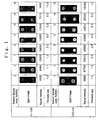
- Figure 1 shows the results of the measurement of the signal intensity in a DNA chip prepared using respective probe solution compositions containing an aqueous solution of sodium sialate at various concentrations.
- An inventive probe solution composition is characterized in that it contains a probe which binds specifically to a target substance together with a moisturizer.
- the moisturizer may for example be a substance capable of retaining residual water of 90% or more when allowed to stand for 10 minutes at 25°C and 40% relative humidity after dropping 1 ml of an aqueous solution containing it onto a filter paper, in comprison to the initially dropped amount.
- Such a moisturizer has one having a molecular weight of 300 to 2000 and a viscosity of 1 to 20 cps such as those employed in cosmetic products, including glycerin, whey, coco fatty acid, sucrose, sorbitol and the like, while it is especially preferred in the inventive probe solution composition to employ one or more of sialic acid, sialic acid salt, sialic acid oligomer, sialic acid oligomer salt, colominic acid and colominic acid salt (hereinafter referred to as "sialic acid analogues" collectively).
- a sialic acid (salt) oligomer is a dimer to hexamer of sialic acid (salt), and a colominic acid (salt) is heptamer of sialic acid (salt) or higher oligomer. Any of these sialic acid analogues may be any commercial product such as a dried product.
- the probe employed in the inventive solution composition is a biological molecule which binds specifically to a target substance.
- the target substance is a DNA fragment derived from a genome DNA (for example cDNA)
- the probe is one which hybridizes with said DNA fragment on the basis of the complementarity, such as a single-stranded DNA fragment, RNA fragment, nucleotide chain (polynucleotide of 100 bases or more, or oligonucleotide of less than 100 bases) and the like.
- the target substance is a protein
- the probe is one which binds specifically to partial the amino acid sequence of said protein, such as a protein or peptide. It is also possible to use as a probe an antibody capable of binding to an epitope of a protein as well as its Fab, F(ab') 2 , Fv fragments and the like.
- the concentration of the probe in this probe solution composition may vary depending on the type and the molecular weight of the probe, and it may be 0.1 to about 5 ⁇ g in the case for example of a DNA fragment or nucleotide chain.
- the concentration of the moisturizer may vary depending on the moisturizing ability or viscosity thereof, and it may be 1 to 15 % by weight in the case of a sialic acid analogue.
- the constitutents of the inventive solution composition other than the probe and the moisturizer may be similar to those of a probe solution employed in the production of an ordinary reactive chip.
- a probe and a moisturizer may be mixed with a buffer at pH7 to 8 to prepare the probe solution composition.
- the buffer may be a salt-free buffer, it is preferably a salt-containing buffer such as an SSC buffer, sodium carbonate buffer , sodium acetate buffer and the like.
- a salt-free buffer may employ hydrochloride, hydrobromide, sulfate, nitrate, acetate, benzoate, maleate, fumarate, succinate, tartarate, citrate, oxalate, methanesulfonate, toluenesulfonate, aspartate, glutamate and the like.
- the concentration of salt may be at least 10 -3 mol/l, preferably 10 -2 to 1 mol/l as revealed in EXPERIMENTS described below.
- a typical example of an inventive probe solution composition when employing a DNA fragment as a probe, contains an aqueous solution of sodium sialate and the DNA fragment dissolved at 10% (w/v) and 0.01% (w/v), respectively, as final concentration in TE buffer (pH8, 0.01M Tris-HCl, 0.001M EDTA).
- a solution containing a sialic acid and a solution containing a probe may be prepared separately, and then mixed with each other to prepare the probe solution composition.
- the probe solution composition by providing a large amount of a solution of a sialic acid analogue and mixing with plural types of the probe solutions separately, all types of the probe solution compositions to be spotted onto a reactive chip can efficiently be prepared.
- the inventive reactive chip is characterized in which the probe solution composition described above has been fixed as a spot on a substrate.
- the substrate may be a glass slide employed in an ordinary reactive chip, and the poly L-lysine-coated substrate disclosed in JP-A-2001-186880 is preferred especially.
- This substrate allows the probe to be fixed on the substrate via an electrostatic bond between the negative charge on a DNA itself and the positive charge on an amino acid.
- an epoxy-coated substrate it is preferred to use the probe solution composition containing salt.
- the probe solution composition to be spotted may for example be a solution composition containing 100 to 20000 types of different probes, and the spotted composition forms the spots each having a diameter of 50 to 500 ⁇ m and are located at a distance of about 100 to 1000 ⁇ m from each other.
- a spotting method for producing such a reactive chip may be a conventional pin method, but the ink jet method disclosed in JP-A-2001-116750 and JP-A-2001-186881 is employed preferably.
- a probe spotted by these methods can be fixed in satisfactory form on a substrate with the aid of the effect of a moisturizer. Also when using a salt-containing buffer, a precipitation of salt is suppressed and a satisfactory spot shape can be obtained. Then such a satisfactory spot shape leads to an increased detection sensitivity and a higher spot density.
- each spot is fixed on a substrate by a procedure similar to that for an ordinary reactive chip production which involves cooling, addition of water to the spots (keeping at a humidity of about 80% over a certain time period), fixation by sintering and drying, and the like. Nevertheless, the water addition step described above may be omitted in the inventive method without undergoing any deterioration of the spot shape (such as a doughnut-like spot), since the spotted probe solution composition has a moisture-keeping ability.
- a repetitive shot spotting disclosed in JP-A-2001-186880 is a preferred embodiment.
- an effect of repetitive shot can further be enhanced since a satisfactory spot shape can be maintained on the basis of each spotting.
- no water addition is required in the repetitive shot, smaller number of the steps is required for producing a reactive chip.
- yeast (Saccharomyces cerevisiae)-derived DNAs (Y1-10B and Y53-1A) were purified, and dissolved each in 200 ⁇ l of TE buffer to prepare respective DNA solutions.
- the DNA concentration of these solutions measured by an absorption photometry was 3 ⁇ g/ml.
- the DNA solution (20 ⁇ l), the sodium sialate solution at each concentration (20 ⁇ l) and pure water (20 ⁇ l) were mixed to prepare respective liquid composition (DNA/Sodium sialate solution) shown in Table 2.
- Each liquid composition (DNA/Sodium sialate solution) prepared in Step (1) described above was filled in a micropipette fitted with an ink jet nozzle (for example, the device described in JP-A-2001-186881), and 200 pl portion thereof was spotted onto a poly L-lysine-coated glass slide. Then, water was added to each spotted area, which was then sintered at about 80°C for 1 hour to effect the fixation, whereby obtaining 16 types of the DNA chips having DNA probes fixed thereon.
- the mixture was neutralized with 25 ⁇ l of a Tris (1M, pH7.5), filtered with centrifuging at 8000 rpm for 5 minutes using Microcon 30, added with 250 ⁇ l of sterilized water, subjected twice to the centrifugation at 8000 rpm for 10 minutes, followed by the centrifugation at 3000 rpm for 45 seconds, whereby recovering the labeled cDNA.
- the glass cover was taken off gently in 2xSSC-0.1% SDS, and the chip was washed twice with 2xSSC-0.1% SDS, washed twice with 2xSSC-0.1% SDS heated at 55°C, rinsed with 0.2xSSC-0.1% SDS, 0.2xSSC and 0.05xSSC, centrifuged and dried.
- the DNA chip after the hybridization was set in a Scan Array (BM KIKI Scanner), and measured at Laser Power of 80%, PMT of 80% and resolution degree of 10 ⁇ m.
- Each of the lyophilized sodium (Na) sialate and dried oligomers (dimer, trimer, tetramer, pentamer, hexamer) thereof was dissolved similarly to Example 1 and the pH was adjusted to prepare a sodium sialate solution whose final concentration was 30%.
- yeast (Saccharomyces cerevisiae)-derived DNAs (Y1-10B and Y53-1A) were purified, and dissolved each in 100 ⁇ l of TE buffer to prepare respective DNA solutions.
- the DNA concentration of each solution measured by an absorption photometry was 3.03 ⁇ g/ml.
- Each liquid composition (DNA/Sodium sialate solution) prepared in Step (1) described above was filled in a micropipette fitted with an ink jet nozzle (for example, the device described in JP-A-2001-186881), and a 200 pl portion thereof was spotted onto a poly L-lysine-coated glass slide. Then, water was added to each spotted area, which was then sintered at about 80°C for 1 hour to effect the fixation, whereby obtaining 7 types of the DNA chips having DNA probes fixed thereon.
- the mixture was neutralized with 25 ⁇ l of a Tris (1M, pH7.5), filtered with centrifuging at 8000 rpm for 5 minutes using a Microcon 30, combined with 250 ⁇ l of sterilized water, subjected twice to the centrifugation at 8000 rpm for 10 minutes, followed by the centrifugation at 3000 rpm for 45 seconds, whereby recovering the labeled cDNA.
- the glass cover was taken off gently in 2xSSC-0.1% SDS, and the chip was washed twice with 2xSSC-0.1% SDS, washed twice with 2xSSC-0.1% SDS heated at 55°C, rinsed with 0.2xSSC-0.1% SDS, 0.2xSSC and 0.05xSSC, centrifuged and dried.
- the DNA chip after the hybridization was set in a Scan Array (BM KIKI Scanner), and measured at Laser Power of 80%, PMT of 80% and resolution degree of 10 ⁇ m.
- the shape of a spot containing the DNA probe fixed on the glass was evaluated visually using a stereoscopic microscope and a rate of the satellite appearance was calculated. Also based on the fluorescent image after the hybridization, any satellite which could not be identified visually was identified and a rate of the appearance was calculated.
- a lyophilized sodium (Na) sialate and a carboxymethyl cellulose (CMC) were dissolved in the constituents shown in Table 5 and the pH was adjusted to prepare a sodium sialate solution at a final concentration ranging from 6 to 42% and CMC solution at 2%.
- yeast (Saccharomyces cerevisiae)-derived DNAs (Y1-10B and Y53-1A) were purified, and dissolved each in 120 ⁇ l of TE buffer to prepare respective DNA solutions.
- the DNA concentration of each solution measured by an absorption photometry was 3.2 ⁇ g/ml.
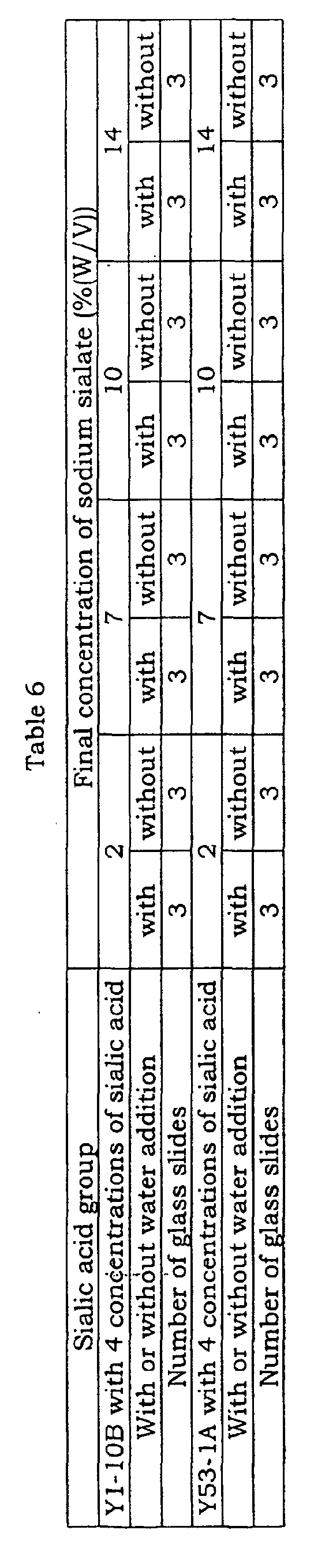
- the DNA solution (20 ⁇ l), the sodium sialate solution at each concentration (20 ⁇ l) and pure water (20 ⁇ l) were mixed to prepare a liquid composition (DNA/Sodium sialate solution) in which respective sodium sialate concentration was 2, 7, 10 or 14.
- the liquid composition in which CMC concentration is 0.5% (DNA/CMC solution) was also prepared.
- Each liquid composition prepared in Step (1) described above was filled in a micropipette fitted with an ink jet nozzle (for example, the device described in JP-A-2001-186881), and spotted 200 pl each onto a poly L-lysine-coated glass slide. Then, water was added to each spotted area on the half of the glass slides (3 slides) on each of which each liquid composition had been spotted, which was then sintered at about 80°C for 1 hour to effect the fixation, whereby obtaining the DNA chips having DNA probes fixed thereon. Remaining half of the slides (3 slides) were baked without adding water and fixed to give the DNA chips (Tables 6 and 7).
- Control-CMC group Final concentration of CMC(%(w/v)) Y1-10B with 1 concentration of CMC 0.7 With or without water addition with without Number of glass slides 3 3 Y53-1A with 1 concentration of CMC 0.7 With or without water addition with without Number of glass slides 3 3
- the mixture was neutralized with 25 ⁇ l of a Tris (1M, pH7.5), filtered with centrifuging at 8000 rpm for 5 minutes using a Microcon 30, added with 250 ⁇ l of sterilized water, subjected twice to the centrifugation at 8000 rpm for 10 minutes, followed by the centrifugation at 3000 rpm for 45 seconds, whereby recovering the labeled cDNA.
- the glass cover was taken off gently in 2xSSC-0.1% SDS, and the chip was washed twice with 2xSSC-0.1% SDS, washed twice with 2xSSC-0.1% SDS heated at 55°C, rinsed with 0.2xSSC-0.1% SDS, 0.2xSSC and 0.05xSSC, centrifuged and dried.
- the DNA chip after the hybridization was set in a Scan Array (BM KIKI Scanner), and examined for the shape of the fixed spot at Laser Power of 80%, PMT of 80% and resolution degree of 10 ⁇ m.
- Laser Power 80%
- PMT 80%
- resolution degree 10 ⁇ m.
- the 20xSSC solution was prepared by which 3M Sodium chloride and 0.3M sodium citrate were mixed and adjusting at pH7.0. Then, sialic acid was dissolved in water to prepare 10% solution of sialic acid. A lyophilized oligo DNA (50-base length) was dissolved in purified water at 100 pmol/ ⁇ l (1.65 ⁇ g/ ⁇ l). Each of these solutions was mixed in the ratio of the DNA solution: 50 pmol/ ⁇ l, 1xSSC (0.3M sodium chloride and 0.03M sodium citrate) and sialic acid solution: 1%, whereby obtaining a liquid composition (DNA/SSC/sialic acid solution). As a control, a sialic acid-free liquid composition (DNA/SSC) was also prepared.
- DNA/SSC sialic acid-free liquid composition
- Each liquid composition (DNA/SSC/sialic acid solution) prepared in Step (1) described above was filled in a micropipette fitted with an ink jet nozzle, and a 200 pl portion thereof was spotted onto an epoxysilane-coated glass slide. Then, the slide was reacted for 8 hours in an incubator at 42°C under 50% humidity to proceed covalently bonding, followed by fixation to obtain a DNA chip having an oligonucleotide DNA probe fixed thereon.
- the control liquid composition was employed similarly to produce a DNA chip.
- 5 ⁇ l of a rat mRNA (Clontech, 5 ⁇ g/ ⁇ l), 1 ⁇ l of a DEPC-treated water and 1 ⁇ l of an oligo (dt) primer were mixed and heated at 70°C for 5 minutes and 42°C for 3 minutes.
- 4 ⁇ l of 5 x reaction buffer, 2 ⁇ l of a dNTP mixture, 2 ⁇ l of 100mM DTT, 2 ⁇ l of mM FluoroLink dUTP and 2.5 ⁇ l of 40 units RNase inhibitor were mixed.
- the glass cover was taken off gently with immersing the DNA chip in 2xSSC-0.1% SDS, and the chip was allowed to stand in 2xSSC-0.1% SDS for 5 minutes, washed with 1xSSC, washed with 0.5xSSC, centrifuged at 900 rpm for 2 minutes and dried.
- the DNA chip after the hybridization was set in Scan Array, and measured at Laser Power of 70%, PMT of 60% and resolution degree of 5 ⁇ m.
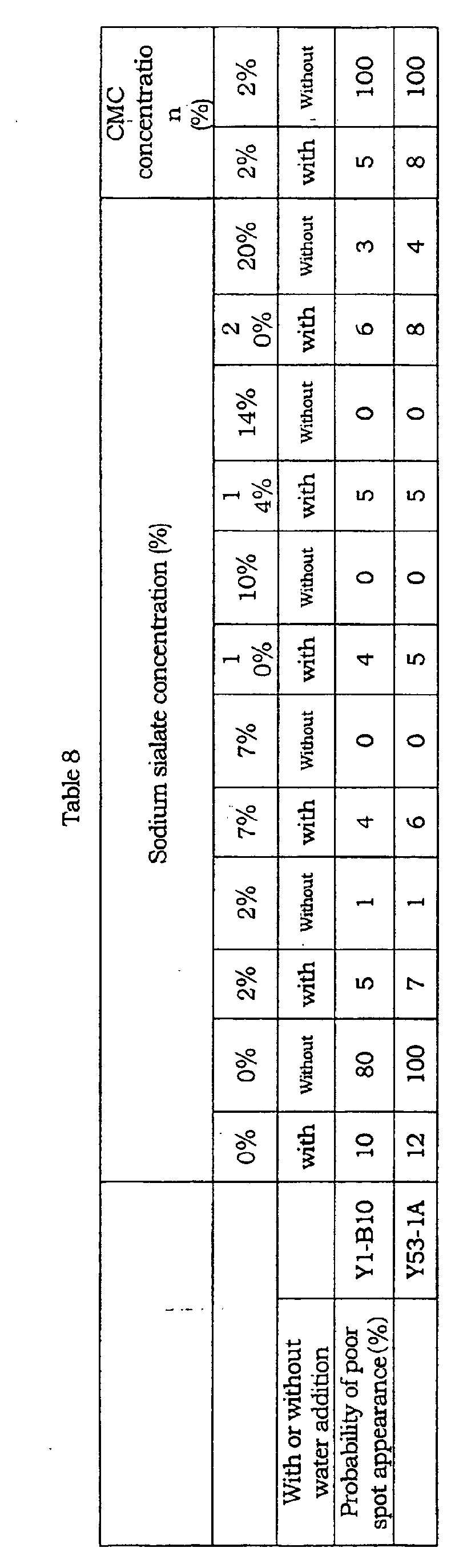
- Liquid composition Final concentration Gene name Polyubiquitin ⁇ -tubulin Libosome protein L8 Myocin heavy chain GAPDH signal intensity
- DNA/SSC DNA 50 (pmol/ ⁇ l) SSC: 2 ⁇ 10 -1 (mol/l) 25071 11976 14275 31348 5302
- DNA/SSC/sialic acid DNA 50 (pmol/ ⁇ l) SSC: 2 ⁇ 10 -1 (mol/l) Sialic acid:1 (%(W/V)) 30121 23270 35123 50361 14272
- a preferred range of the concentration of a salt to be contained in a probe solution composition was investigated.
- Example 4 Similarly to Example 4 except for changing the salt concentration of the SSC buffer, a solution composition (DNA/SSC/Sialic acid solution) was prepared and used to produce a DNA chip. Also similarly to Example 4, a labeled cDNA was prepared, hybridized and subjected to a fluorometry.
- the invention provides a novel probe solution composition, which is utilized for a fixation of a probe capable of binding specifically to a target substance by means of spotting the probe on a substrate.
- a probe solution composition which is utilized for a fixation of a probe capable of binding specifically to a target substance by means of spotting the probe on a substrate.
Landscapes
- Health & Medical Sciences (AREA)
- Immunology (AREA)
- Life Sciences & Earth Sciences (AREA)
- Engineering & Computer Science (AREA)
- Molecular Biology (AREA)
- Biomedical Technology (AREA)
- Chemical & Material Sciences (AREA)
- Hematology (AREA)
- Urology & Nephrology (AREA)
- Biotechnology (AREA)
- Biochemistry (AREA)
- Cell Biology (AREA)
- Food Science & Technology (AREA)
- Medicinal Chemistry (AREA)
- Physics & Mathematics (AREA)
- Analytical Chemistry (AREA)
- Microbiology (AREA)
- General Health & Medical Sciences (AREA)
- General Physics & Mathematics (AREA)
- Pathology (AREA)
- Measuring Or Testing Involving Enzymes Or Micro-Organisms (AREA)
- Automatic Analysis And Handling Materials Therefor (AREA)
- Apparatus Associated With Microorganisms And Enzymes (AREA)
Abstract
Description
| Final concentration of sodium sialate (%(w/v)) | 3 | 5 | 7 | 8 | 10 | 12 | 14 | 16 |
| Adjusted concentration of sodium sialate (%(w/v)) | 9 | 15 | 21 | 24 | 30 | 36 | 42 | 48 |
| Sodium sialate (g) | 2.25 | 3.75 | 5.25 | 6.0 | 7.5 | 9.0 | 10.5 | 12.0 |
| Purified water (ml) | 9.0 | 9.0 | 9.0 | 9.0 | 9.0 | 9.0 | 9.0 | 9.0 |
| 6N NaOH aq (ml) | 2.0 | 2.0 | 2.5 | 2.5 | 3.5 | 4.5 | 5.5 | 6.5 |
| Fill up (ml) | 14.0 | 14.0 | 13.5 | 13.5 | 12.5 | 11.5 | 10.5 | 9.5 |
| pH (final TE: sialic acid: water=1:1:0.8) | 8.05 | 8.03 | 7.95 | 7.98 | 7.97 | 7.92 | 7.98 | 7.98 |
| Final concentration of sodium sialate (%(w/v)) | ||||||||
| Y1-10B (1 µg/ml Aqueous solution of sialic acid) 8 | 3 | 5 | 7 | 8 | 10 | 12 | 14 | 16 |
| Y53-1A (1 µg/ml Aqueous solution of sialic acid) 8 | 3 | 5 | 7 | 8 | 10 | 12 | 14 | 16 |
| No. | Additive | Final additive concentration (%) | Final DNA concentration (µg/ml) |
| 1 | Sodium sialate | 10 | 1.01 |
| 2 | Sialic acid dimer | 10 | 1.01 |
| 3 | Sialic acid trimer | 10 | 1.01 |
| 4 | Sialic acid tetramer | 10 | 1.01 |
| 5 | Sialic acid pentamer | 10 | 1.01 |
| 6 | Sialic acid hexamer | 10 | 1.01 |
| 7 | Blank (purified water) | - | 1.01 |
| No. | Additive | Stereoscopic microscope evaluation | Hybridization evaluation | total rate of appearance |
| 1 | Sodium sialate aqueous solution | 0.3% | 0.2% | 0.5% |
| 2 | Sialic acid dimer aqueous solution | 0.3% | 0.4% | 0.7% |
| 3 | Sialic acid trimer aqueous solution | 0.4% | 0.3% | 0.7% |
| 4 | Sialic acid tetramer aqueous solution | 0.4% | 0.2% | 0.6% |
| 5 | Sialic acid pentamer aqueous solution | 0.3% | 0.2% | 0.5% |
| 6 | Sialic acid hexamer aqueous solution | 0.2% | 0.4% | 0.6% |
| 7 | Purified water | 15% | 10% | 25% |
| Final concentration of sodium sialate (%(w/v)) | 2 | 7 | 10 | 14 | Final concentration of CMC (%(w/v)) | 0.7 |
| Adjusted concentration of sodium sialate (%(w/v)) | 6 | 21 | 30 | 42 | Adjusted concentration of CMC | 2 |
| Sodium sialate (g) | 1.5 | 5.25 | 7.5 | 10.5 | CMC (g) | 0.5 |
| Purified water (ml) | 9.0 | 9.0 | 9.0 | 9.0 | Purified water (ml) | 2.5 |
| 6N NaOH aq (ml) | 1.5 | 2.5 | 3.5 | 5.5 | ||
| Fill up (ml) | 14.5 | 13.5 | 12.5 | 10.5 | ||
| pH(final TE: sialic acid: water=1:1:0.8) | 8.05 | 7.95 | 7.97 | 7.98 | pH(final TE:CMC: water=1:1:0.8) | 8.06 |
| Control-CMC group | Final concentration of CMC(%(w/v)) | |
| Y1-10B with 1 concentration of CMC | 0.7 | |
| With or without water addition | with | without |
| Number of glass slides | 3 | 3 |
| Y53-1A with 1 concentration of CMC | 0.7 | |
| With or without water addition | with | without |
| Number of glass slides | 3 | 3 |
| Liquid composition | Final concentration | Gene name | ||||
| Polyubiquitin | α-tubulin | Libosome protein L8 | Myocin heavy chain | GAPDH | ||
| signal intensity | ||||||
| DNA/SSC | DNA: 50 (pmol/µl) SSC: 2×10⁻¹ (mol/l) | 25071 | 11976 | 14275 | 31348 | 5302 |
| DNA/SSC/sialic acid | DNA: 50 (pmol/µl) SSC: 2×10⁻¹ (mol/l) Sialic acid:1 (%(W/V)) | 30121 | 23270 | 35123 | 50361 | 14272 |
| Final concentration of DNA | 50(pmol/µl) | ||||||
| Final concentration of sialic acid | 1(%(W/V)). | ||||||
| Final concentration of salt (mol/1) (SSC) | 0 | 10-3 | 10-2 | 10-1 | 2×10⁻¹ | 5×10⁻¹ | 1 |
| Signal intensity (gene: myocardial actin) | 700 | 8050 | 25430 | 27520 | 30245 | 21322 | 12342 |
Claims (10)
- A probe solution composition containing a probe capable of binding specifically to a target substance and a moisturizer, which is utilized for spotting the probe to be fixed on a substrate.
- The probe solution composition of claim 1, wherein said moisturizer is one or more selected from the group consisting of sialic acid, sialic acid salt, sialic acid oligomer, sialic acid oligomer salt, colominic acid and colominic acid salt.
- The probe solution composition of claim 1 or 2, wherein the moisturizer content is 1 to 15% by weight.
- The probe solution composition of claim 1, wherein said probe is DNA fragment, RNA fragment, nucleotide chain, protein, peptide or any mixture thereof.
- The probe solution composition of any of claims 1 to 4, which further contains at least 10-3 mol/l of salt.
- A reactive chip comprising the probe solution composition of any of claims 1 to 5 as a spot fixed on a substrate.
- A method for producing a reactive chip comprising spotting the probe solution composition of any of claims 1 to 5 on a substrate and fixing this liquid composition spot on the substrate.
- The method according to claim 7, wherein the spotting is effected by an ink jet method.
- The method according to claim 7 or 8, wherein the spot of the probe solution composition is fixed without adding water.
- The method according to claim 7 or 9, wherein the spotting is repeated twice or more to fix the probe solution composition in a form of laminate.
Applications Claiming Priority (3)
| Application Number | Priority Date | Filing Date | Title |
|---|---|---|---|
| JP2001338490 | 2001-11-02 | ||
| JP2001338490 | 2001-11-02 | ||
| PCT/JP2002/011454 WO2003038089A1 (en) | 2001-11-02 | 2002-11-01 | Probe solutin compositions, reactive chip using the same and process for the production thereof |
Publications (3)
| Publication Number | Publication Date |
|---|---|
| EP1447445A1 true EP1447445A1 (en) | 2004-08-18 |
| EP1447445A4 EP1447445A4 (en) | 2005-03-16 |
| EP1447445B1 EP1447445B1 (en) | 2007-03-14 |
Family
ID=19152977
Family Applications (1)
| Application Number | Title | Priority Date | Filing Date |
|---|---|---|---|
| EP02778043A Expired - Lifetime EP1447445B1 (en) | 2001-11-02 | 2002-11-01 | Probe solution compositions, reactive chip using the same and process for the production thereof |
Country Status (5)
| Country | Link |
|---|---|
| US (1) | US20040248976A1 (en) |
| EP (1) | EP1447445B1 (en) |
| JP (1) | JP4326334B2 (en) |
| DE (1) | DE60218884T2 (en) |
| WO (1) | WO2003038089A1 (en) |
Families Citing this family (3)
| Publication number | Priority date | Publication date | Assignee | Title |
|---|---|---|---|---|
| US7601532B2 (en) | 2003-09-25 | 2009-10-13 | Hisamitsu Pharmaceutical Co., Inc. | Microarray for predicting the prognosis of neuroblastoma and method for predicting the prognosis of neuroblastoma |
| US20060223074A1 (en) * | 2005-04-05 | 2006-10-05 | Bunch Thomas A | Spotting compositions and methods of use thereof |
| JP4999007B2 (en) * | 2008-06-24 | 2012-08-15 | 独立行政法人産業技術総合研究所 | Target substance detection chip using antigen-antibody reaction |
Family Cites Families (6)
| Publication number | Priority date | Publication date | Assignee | Title |
|---|---|---|---|---|
| JP4313861B2 (en) * | 1997-08-01 | 2009-08-12 | キヤノン株式会社 | Manufacturing method of probe array |
| US7244601B2 (en) * | 1997-12-15 | 2007-07-17 | National Research Council Of Canada | Fusion proteins for use in enzymatic synthesis of oligosaccharides |
| US6264975B1 (en) * | 1998-10-20 | 2001-07-24 | The University Of North Carolina At Chapel Hill | Methods of hydrating mucosal surfaces |
| EP1026259B1 (en) * | 1999-02-08 | 2002-11-27 | Fuji Photo Film Co., Ltd. | Process for preparing a dna chip |
| JP2001116750A (en) * | 1999-10-21 | 2001-04-27 | Ngk Insulators Ltd | Method for producing reactive chip, reactive chip that can be produced by the method, and reactive substance |
| US6656432B1 (en) * | 1999-10-22 | 2003-12-02 | Ngk Insulators, Ltd. | Micropipette and dividedly injectable apparatus |
-
2002
- 2002-11-01 WO PCT/JP2002/011454 patent/WO2003038089A1/en not_active Ceased
- 2002-11-01 DE DE60218884T patent/DE60218884T2/en not_active Expired - Fee Related
- 2002-11-01 JP JP2003540354A patent/JP4326334B2/en not_active Expired - Fee Related
- 2002-11-01 EP EP02778043A patent/EP1447445B1/en not_active Expired - Lifetime
- 2002-11-01 US US10/494,326 patent/US20040248976A1/en not_active Abandoned
Also Published As
| Publication number | Publication date |
|---|---|
| EP1447445A4 (en) | 2005-03-16 |
| US20040248976A1 (en) | 2004-12-09 |
| EP1447445B1 (en) | 2007-03-14 |
| JPWO2003038089A1 (en) | 2005-02-24 |
| WO2003038089A1 (en) | 2003-05-08 |
| DE60218884D1 (en) | 2007-04-26 |
| JP4326334B2 (en) | 2009-09-02 |
| DE60218884T2 (en) | 2007-12-20 |
Similar Documents
| Publication | Publication Date | Title |
|---|---|---|
| EP1522853A1 (en) | Dna microarray having standard probe and kit containing the array | |
| WO2001036682A2 (en) | Long oligonucleotide arrays | |
| Wildsmith et al. | Microarrays under the microscope | |
| WO2004046098A2 (en) | Method for predicting autoimmune diseases | |
| CA2402525A1 (en) | Compositions and methods for detecting and quantifying gene expression | |
| JP3872762B2 (en) | DNA chip quality control method | |
| US20070048747A1 (en) | Methods for assaying analytes | |
| WO1991000288A1 (en) | Hydrophobic nucleic acid probe | |
| JP2003528315A (en) | Mixed polynucleotide sequences as discrete assay ends | |
| US20040203050A1 (en) | Polymer arrays and methods of using labeled probe molecules to identify and quantify target molecule expression | |
| CN1268979A (en) | Multiple functionilities within an array element and uses thereof | |
| EP1215287A2 (en) | Process of blocking a device, which is used to detect biochemically active molecules | |
| JP3398366B2 (en) | Method for producing microarray for DNA analysis | |
| EP1447445B1 (en) | Probe solution compositions, reactive chip using the same and process for the production thereof | |
| EP1041160A1 (en) | Methods for detecting mutation in base sequence | |
| US20030211496A1 (en) | Quality control reagents for nucleic acid microarrays | |
| EP2250291A1 (en) | Surface attachment | |
| US20050014147A1 (en) | Method and apparatus for three label microarrays | |
| JP2004028695A (en) | DNA microarray with standard probe for content assay and detection kit | |
| US20090258367A1 (en) | METHOD OF MAPPING OF mRNA DISTRIBUTION WITH ATOMIC FORCE MICROSCOPY | |
| US7642086B2 (en) | Labeled probe bound object, method for producing the same and method for using the same | |
| JP2008249677A (en) | Device for liquid introduction, fixed holder and analysis kit | |
| JP2004264265A (en) | Probe solution composition, reactive chip using the same, and manufacturing method therefor | |
| JP2010014669A (en) | Analysis chip | |
| US8518642B2 (en) | Method of analyzing probe nucleic acid, microarray and kit for the same |
Legal Events
| Date | Code | Title | Description |
|---|---|---|---|
| PUAI | Public reference made under article 153(3) epc to a published international application that has entered the european phase |
Free format text: ORIGINAL CODE: 0009012 |
|
| 17P | Request for examination filed |
Effective date: 20040524 |
|
| AK | Designated contracting states |
Kind code of ref document: A1 Designated state(s): AT BE BG CH CY CZ DE DK EE ES FI FR GB GR IE IT LI LU MC NL PT SE SK TR |
|
| AX | Request for extension of the european patent |
Extension state: AL LT LV MK RO SI |
|
| A4 | Supplementary search report drawn up and despatched |
Effective date: 20050128 |
|
| RIC1 | Information provided on ipc code assigned before grant |
Ipc: 7B 01J 19/00 B Ipc: 7G 01N 33/566 B Ipc: 7G 01N 33/53 B Ipc: 7C 12Q 1/68 B Ipc: 7C 12N 15/09 A |
|
| GRAP | Despatch of communication of intention to grant a patent |
Free format text: ORIGINAL CODE: EPIDOSNIGR1 |
|
| RTI1 | Title (correction) |
Free format text: PROBE SOLUTION COMPOSITIONS, REACTIVE CHIP USING THE SAME AND PROCESS FOR THE PRODUCTION THEREOF |
|
| GRAS | Grant fee paid |
Free format text: ORIGINAL CODE: EPIDOSNIGR3 |
|
| GRAA | (expected) grant |
Free format text: ORIGINAL CODE: 0009210 |
|
| AK | Designated contracting states |
Kind code of ref document: B1 Designated state(s): DE FR GB |
|
| REG | Reference to a national code |
Ref country code: GB Ref legal event code: FG4D |
|
| REF | Corresponds to: |
Ref document number: 60218884 Country of ref document: DE Date of ref document: 20070426 Kind code of ref document: P |
|
| ET | Fr: translation filed | ||
| PLBE | No opposition filed within time limit |
Free format text: ORIGINAL CODE: 0009261 |
|
| STAA | Information on the status of an ep patent application or granted ep patent |
Free format text: STATUS: NO OPPOSITION FILED WITHIN TIME LIMIT |
|
| PGFP | Annual fee paid to national office [announced via postgrant information from national office to epo] |
Ref country code: DE Payment date: 20071025 Year of fee payment: 6 |
|
| 26N | No opposition filed |
Effective date: 20071217 |
|
| PGFP | Annual fee paid to national office [announced via postgrant information from national office to epo] |
Ref country code: GB Payment date: 20071019 Year of fee payment: 6 Ref country code: FR Payment date: 20071024 Year of fee payment: 6 |
|
| GBPC | Gb: european patent ceased through non-payment of renewal fee |
Effective date: 20081101 |
|
| REG | Reference to a national code |
Ref country code: FR Ref legal event code: ST Effective date: 20090731 |
|
| PG25 | Lapsed in a contracting state [announced via postgrant information from national office to epo] |
Ref country code: DE Free format text: LAPSE BECAUSE OF NON-PAYMENT OF DUE FEES Effective date: 20090603 |
|
| PG25 | Lapsed in a contracting state [announced via postgrant information from national office to epo] |
Ref country code: GB Free format text: LAPSE BECAUSE OF NON-PAYMENT OF DUE FEES Effective date: 20081101 |
|
| PG25 | Lapsed in a contracting state [announced via postgrant information from national office to epo] |
Ref country code: FR Free format text: LAPSE BECAUSE OF NON-PAYMENT OF DUE FEES Effective date: 20081130 |