EP1447404A1 - Improved cyclic ketone peroxide compositions - Google Patents
Improved cyclic ketone peroxide compositions Download PDFInfo
- Publication number
- EP1447404A1 EP1447404A1 EP03078216A EP03078216A EP1447404A1 EP 1447404 A1 EP1447404 A1 EP 1447404A1 EP 03078216 A EP03078216 A EP 03078216A EP 03078216 A EP03078216 A EP 03078216A EP 1447404 A1 EP1447404 A1 EP 1447404A1
- Authority
- EP
- European Patent Office
- Prior art keywords
- peroxide
- ketone
- composition
- cyclic ketone
- composition according
- Prior art date
- Legal status (The legal status is an assumption and is not a legal conclusion. Google has not performed a legal analysis and makes no representation as to the accuracy of the status listed.)
- Withdrawn
Links
Classifications
-
- C—CHEMISTRY; METALLURGY
- C08—ORGANIC MACROMOLECULAR COMPOUNDS; THEIR PREPARATION OR CHEMICAL WORKING-UP; COMPOSITIONS BASED THEREON
- C08F—MACROMOLECULAR COMPOUNDS OBTAINED BY REACTIONS ONLY INVOLVING CARBON-TO-CARBON UNSATURATED BONDS
- C08F4/00—Polymerisation catalysts
- C08F4/28—Oxygen or compounds releasing free oxygen
- C08F4/32—Organic compounds
- C08F4/38—Mixtures of peroxy-compounds
-
- C—CHEMISTRY; METALLURGY
- C07—ORGANIC CHEMISTRY
- C07D—HETEROCYCLIC COMPOUNDS
- C07D323/00—Heterocyclic compounds containing more than two oxygen atoms as the only ring hetero atoms
-
- C—CHEMISTRY; METALLURGY
- C08—ORGANIC MACROMOLECULAR COMPOUNDS; THEIR PREPARATION OR CHEMICAL WORKING-UP; COMPOSITIONS BASED THEREON
- C08K—Use of inorganic or non-macromolecular organic substances as compounding ingredients
- C08K5/00—Use of organic ingredients
- C08K5/04—Oxygen-containing compounds
- C08K5/14—Peroxides
Definitions
- the present invention relates to peroxide compositions comprising one or more crystallizing cyclic ketone peroxides, one or more dialkyl peroxides, and, optionally, one or more conventional phlegmatisers.
- the present invention also pertains to the use of such compositions in polymerization and (co)polymer modification processes.
- US 5,808,110 discloses transportable, storage stable cyclic ketone peroxide compositions, which comprise one or more cyclic ketone peroxides and one or more diluents selected from the group consisting of liquid phlegmatisers for cyclic ketone peroxides, plasticizers, solid polymeric carriers, inorganic supports, organic peroxides, and mixtures thereof.
- cyclic ketone peroxide compositions which comprise one or more cyclic ketone peroxides and one or more diluents selected from the group consisting of liquid phlegmatisers for cyclic ketone peroxides, plasticizers, solid polymeric carriers, inorganic supports, organic peroxides, and mixtures thereof.
- these compositions at least 20% of the total active oxygen content must be attributable to one or more cyclic ketone peroxides.
- compositions that are disclosed have such a high active oxygen content of the cyclic ketone peroxides that they impair a safety hazard when stored at -10°C or below due to the formation of explosive crystals, which results in an explosion when heated and thus impairs an enormous safety hazard.
- EP-A-02080128 discloses a cyclic ketone peroxide composition comprising one or more crystallizing peroxides, optionally one or more conventional phlegmatisers (diluents), and a co-crystallizing compound which solidifies in the final composition at a solidification temperature above the crystallization temperature of the crystallizing peroxide.
- compositions of EP-A-02080128 have many advantageous properties, i.e. they have a high active oxygen content and they are safe and storage stable, these compositions are not suitable for all types of polymerization and (co)polymer modification processes.
- the co-crystallizing compound solidifies under the high pressure reaction conditions that are applied, which may block the conduits of the (tubular) reactor system, particularly the peroxide dosing conduits, that is used.
- a cyclic ketone peroxide composition comprising one or more crystallizing cyclic ketone peroxides, wherein the composition has a high active oxygen content and, furthermore, has good safety and storage stability. It is another object of the present invention to provide a cyclic ketone peroxide composition that is suitable for use in polymerization and (co)polymer modification processes, even for processes that require increased or high pressure.
- the present invention provides a cyclic ketone peroxide composition comprising:
- the composition of the invention has an active oxygen content attributable to the cyclic ketone peroxide of below 6 percent by weight (wt.%), preferably below 3.5 wt.%, and most preferably below 3 wt.%, based on the total weight of the composition.
- the active oxygen content of a peroxide as described in this description is calculated according to the formula: 16 ⁇ the number of peroxide bonds / molecular weight of the peroxide ⁇ 100%.
- the active oxygen content of a composition is a weighed average of all compounds of the composition.
- crystallizing cyclic ketone peroxide in this description is used for any cyclic ketone peroxide diluted with Isopar® M and having an active oxygen content of 3.5% or more that forms crystals when subjected to the "crystallization test" as described below.
- Cyclic ketone peroxide formulations in accordance with the invention do not form explosive crystals when subjected to the "crystallization test" and have sufficiently high active oxygen content to allow a generic use. Furthermore, addition of a seed crystal to the composition of the present invention does not initiate crystal growth of the seeds, nor does it result in the formation of additional crystals, not even at a temperature as low as -25°C, such as applied in the "crystallization test". Particularly preferred is the situation wherein the added seed crystals dissolve in the composition, even at a temperature as low as -25°C. Consequently, compositions according to this invention are safe and storage stable.
- compositions are not liable to explode when stored, or heated after storage, at a minimum storage temperature of -20°C and a maximum storage temperature that is determined by the maximum storage temperature of the most labile peroxide in the composition.
- these compositions are suitable for many kinds of polymerization and (co)polymer modification processes, including processes that require increased or high pressure.
- Preferred cyclic ketone peroxides that can be used in a cyclic ketone peroxide composition according to this invention include the cyclic ketone peroxides derived from acetone, acetyl acetone, methyl ethyl ketone, methyl propyl ketone, methyl isopropyl ketone, methyl butyl ketone, methyl isobutyl ketone, methyl amyl ketone, methyl isoamyl ketone, methyl hexyl ketone, methyl heptyl ketone, diethyl ketone, ethyl propyl ketone, ethyl amyl ketone, methyl octyl ketone, methyl nonyl ketone, cyclopentanone, cyclohexanone, 2-methylcyclohexanone, 3,3,5-trimethyl cyclohexanone, and mixtures thereof.
- cyclic ketone peroxides derived from acetone, methyl ethyl ketone, methyl propyl ketone, methyl isopropyl ketone, methyl butyl ketone, methyl isobutyl ketone, methyl amyl ketone, methyl isoamyl ketone, cyclohexanone, and mixtures thereof.
- the preparation of cyclic ketone peroxides from the appropriate ketone generally results in a mixture of peroxides, which predominantly consists of the trimeric and dimeric forms.
- the mixture of peroxides may also comprise some linear as well as some tetrameric and higher oligomeric cyclic structures.
- the ratio between the various forms, notably the trimer/dimer ratio mainly depends on the reaction conditions during the preparation, and the person skilled in the art is referred to WO 96/03397 for obvious variations in the reaction conditions that can be carried out in order to influence this ratio.
- the cyclic ketone peroxide consists essentially of trimer and dimer. If so desired, the reaction mixture may be separated into the individual cyclic ketone peroxide compounds.
- the composition of the invention will typically contain some dimeric structures next to trimeric structures, as defined above. Preference for certain compositions or individual compounds may depend on differences in physical properties or requirements in the application of the peroxides, e.g. storage stability, half life time vs. temperature, volatility, boiling point, solubility, etc.
- the composition according the invention has a total active oxygen content of more than 3 wt.%, based on the total weight of the composition.
- the composition comprises at most 11 wt.%, more preferably at most 10 wt.%, and most preferably at most 8 wt.% of active oxygen, based on the total weight of the composition.
- a conventional (inert) phlegmatiser for storing and transporting bulk quantities of composition according to the invention it may be necessary to dilute the composition with a conventional (inert) phlegmatiser, thereby reducing the total active oxygen content of the composition.
- the composition of the invention comprises at least 1 wt.%, more preferably at least 5 wt.%, and most preferably at least 10 wt.% of the cyclic ketone peroxide, and preferably at most 50 wt.%, more preferably at most 25 wt.%, even more preferably at most 20 wt.%, yet even more preferably at most 17.5 wt.%, and most preferably at most 15 wt.% of the cyclic ketone peroxide, based on the total weight of the composition, preferably such that the active oxygen content attributable to the cyclic ketone peroxide remains below 6 wt.%, based on the total weight of cyclic ketone peroxide composition.
- dialkyl peroxide of formula R 7 -O-O-R 8 (II) in the composition of the present invention can be any symmetrical or asymmetrical dialkyl peroxide with R 7 and R 8 as defined above.
- Preferred are dialkyl peroxides according to formula R 7 -O-O-R 8 (II) wherein at least one of R 7 and R 8 is selected from the group consisting of branched alkyl moieties. More preferred are dialkyl peroxides according to formula R 7 -O-O-R 8 (II) wherein both R 7 and R 8 are selected from the group consisting of branched alkyl moieties.
- Preferred dialkyl peroxides include di(tert-butyl) peroxide, di(tert-amyl) peroxide, (tert-butyl)(tert-amyl peroxide), and (1,1,3,3-tetrametylbutyl)(tert-butyl) peroxide. More preferred dialkyl peroxides are di(tert-butyl) peroxide and di(tert-amyl) peroxide. Particularly preferred dialkyl peroxide is di(tert-butyl) peroxide.
- a composition according to the invention preferably comprises at least 10 wt.%, more preferably at least 20 wt.%, even more preferably at least 40 wt.%, yet even more preferably at least 50 wt.%, and most preferably at least 60 wt.% of one or more dialkyl peroxides, and preferably at most 99 wt.%, more preferably at most 95 wt.%, and most preferably at most 90 wt.% of dialkyl peroxide, based on the total weight of the composition.
- the conventional phlegmatiser (an inert diluent) that may be optionally added to the composition of this invention can be any conventional phlegmatiser. Also mixtures of one or more of these conventional phlegmatisers may be used. If conventional phlegmatiser is added, then the composition according to the invention preferably comprises at least 1 wt.%, more preferably at least 5 wt.%, and most preferably at least 10 wt.% of one or more conventional phlegmatisers, and preferably at most 99 wt.%, more preferably at most 90 wt.%, and most preferably at most 80 wt.% of the one or more conventional phlegmatisers, based on the total weight of the cyclic ketone peroxide composition.
- Preferred conventional phlegmatisers for the cyclic ketone peroxides include various solvents, diluents and oils. More particularly, preferred conventional phlegmatisers include alkanols, cycloalkanols, alkylene glycols, alkylene glycol monoalkyl ethers, cyclic ether substituted alcohols, cyclic amides, aldehydes, ketones, epoxides, esters, hydrocarbon solvents, halogenated hydrocarbon solvents, paraffinic oils, white oils and silicone oils.
- esters which can be used as conventional phlegmatiser in the composition of the present invention include, but are not limited to, monocarboxylic esters of mono- and dihydric alcohols, dicarboxylic acid esters of monohydric alcohols, carbonates of monohydric alcohols, alkoxyalkyl esters, ⁇ -keto esters, phthalates, phosphates, benzoates, adipates and citrates.
- esters useful as conventional phlegmatiser in compositions of the present invention are dimethyl phthalate, dibutyl phthalate, dioctyl phthalate, dibenzyl phthalate, butyl benzyl phthalate, diallyl phthalate, n-pentyl acetate, isopentyl acetate, n-hexyl acetate, 2-ethylhexyl acetate, benzyl acetate, methyl benzoate, ethyl benzoate, isopropyl benzoate, n-octyl benzoate, isodecyl benzoate, n-butyl pivalate, isoamyl pivalate, sec-amyl pivalate, n-hexyl pivalate, dioctyl adipate, diisodecyl adipate, methyl neodecanoate, n-butyl neodecano
- Preferred linear and branched hydrocarbon solvents which can be used as conventional phlegmatiser in compositions of the present invention include, but are not limited to, hydrogenated oligomers of alkanes such as Isopar® products (ex. Exxon), such as Isopar® M, pentane, heptane, isododecane, amyl benzene, isoamyl benzene, decalin, o-diisopropyl benzene, m-diisopropyl benzene, n-dodecane, 2,4,5, 7-tetramethyl octane, n-amyl toluene, 1,2,3,4-tetramethyl benzene, 3,5- diethyl toluene and hexahydronaphthalene, tetradecane, tridecane, Exxsol® D80, Exxsol® D100, Exxsol® D100S, Solt
- Particularly preferred conventional phlegmatisers are Isopar® M and Soltrol® 170.
- Preferred halogenated hydrocarbons include phenyl trichloride, 3-bromo-o-xylene, 4-bromo-o-xylene, 2-bromo-m-xylene, 4-bromo-m-xylene, 5-bromo-m-xylene, o-dibromobenzene, p-dibromobenzene, 1,4-dibromobutane, 1,1-dibromo-2,2-dichloroethane, bromooctane, tetrabromoethytene, 1,2,3-trichlorobenzene, and 1,2,4-trichlorobenzene.
- Preferred aldehydes useful as conventional phlegmatiser in compositions of the present invention include n-chlorobenzaldehyde and decanal.
- ketones useful in the compositions of the present invention include acetophenone, isophorone, isobutyl ketone, methylphenyl diketone, diamyl ketone, diisoamyl ketone, ethyloctyl ketone, ethylphenyl ketone, acetone, methyl-n-amyl ketone, ethylbutyl ketone, ethylpropyl ketone, methylisoamyl ketone, methylheptyl ketone, methylhexyl ketone, ethylamyl ketone, dimethyl ketone, diethyl ketone, dipropyl ketone, methylethyl ketone, methylisobutyl ketone, methylisopropyl ketone, methylpropyl ketone, methyl-t-butyl ketone, isobutylheptyl ketone,
- a preferred epoxide which may be employed as conventional phlegmatiser in compositions of the present invention is styrene oxide.
- Preferred alcohols useful as conventional phlegmatiser in compositions of the present invention are n-butyl alcohol, capryl alcohol, octyl alcohol, dodecyl alcohol, tetrahydrofurfuryl alcohol, 1,4-dihydroxymethyl cyclohexane, cyclohexanol, glycerol, ethylene glycol, polyethylene glycols with molecular weights under 20,000, propylene glycol, dipropylene glycol, neopentyl glycol, hexylene glycol, 1,4-butylene glycol, 2,3-butylene glycol, butene diol, 1,5-pentane diol, 3,6-dimethyloctane-3,6-diol, 2,5-dimethyl-hex-3-yne-2,5-diol, 2,4,7,9-tetramethyldecane-4,7-diol, 2,2,4,4-tetramethyl-1,3-
- Preferred paraffinic oils useful as conventional phlegmatiser in composition of the present invention include, but are not limited to, halogenated paraffinic oils and paraffinic diesel oil.
- Other oils, including white oils, epoxidized soybean oils and silicone oils, are also useful in the compositions of the present invention.
- composition of the present invention was determined by keeping the composition at -25°C for 48 hours, followed by examination of the composition for the presence of crystals ("crystallization test"). (If no crystals are formed after 24 hours at -25°C, a very small amount of seed crystals of pure cyclic ketone peroxide is added to the composition. After addition of the seed crystals, the composition is set aside for another 24 hours at -25°C. Finally, the composition is examined.) The composition is considered safe and storage stable if:
- This crystallization test was also used to determine whether a cyclic ketone peroxide is a "crystallizing cyclic ketone peroxide" as used according to the invention. This was tested by keeping the cyclic ketone peroxide to be tested, at - 25°C for 48 hours, followed by examination of the composition for the presence of crystals. If the cyclic ketone peroxide is to be diluted for safety reasons, then a dissolution of the cyclic ketone peroxide in Isopar® M is to be used during the evaluation.
- composition of the present invention should also pass the following conventional safety tests:
- Passing these tests means a “medium” or “low” rating in the heating under defined confinement tests and a “no” or “yes, slowly” rating in the deflagration tests.
- the final hazard rating, for which the most severe rating in any one of the tests is used, must be “medium” or “low.”
- the safety tests and corresponding criteria are documented in the "United Nations Recommendations on the Transport of Dangerous Goods, Manual of Tests and Criteria”.
- the cyclic ketone peroxide is manufactured directly in one or more of the conventional phlegmatisers as described above, followed by combining the cyclic ketone peroxide/conventional phlegmatiser mixture with one or more dialkyl peroxides of formula (II).
- one or more additional conventional phlegmatisers may be added.
- the manufacture of a cyclic ketone peroxide composition with high total active oxygen content is advantageous with respect to efficient use of the reactor and the reagents.
- dialkyl peroxides of formula (II) and/or one or more conventional phlegmatisers such that it complies with regulations for safe storage and transport.
- This is particularly the case for bulk quantities, which are stored and transported in tanks and intermediate bulk containers (IBCs).
- the dialkyl peroxide(s) and conventional phlegmatiser(s) are preferably added after the preparation of the cyclic ketone peroxide, as long as it is added before storage.
- conventional phlegmatiser(s) may also be added before or during the preparation of the cyclic ketone peroxide. Obviously, dilution of the cyclic ketone peroxide composition of the invention with one or more dialkyl peroxides of formula (II) and/or one or more conventional phlegmatisers reduces the total active oxygen content of the composition.
- dialkyl peroxide of formula (II) and the conventional phlegmatiser may be combined before use. Hence, in that case it is feasible to purchase and use specific dialkyl peroxides that contain one or more conventional phlegmatiser.
- composition of the present invention may optionally contain certain additives as long as these additives do not significantly suppress the safety, transportability and/or storage stability of the composition.
- additives include antiozonants, antioxidants, antidegradants, UV stabilizers, coagents, fungicides, antistatic agents, pigments, dyes, coupling agents, dispersing aids, blowing agents, lubricants, process oils, and mould-release agents.
- antiozonants antioxidants, antidegradants, UV stabilizers, coagents, fungicides, antistatic agents, pigments, dyes, coupling agents, dispersing aids, blowing agents, lubricants, process oils, and mould-release agents.
- additives may be employed in their usual amounts. If used, such additives are typically added to the cyclic ketone peroxide composition shortly before the composition is used in a polymerization or (co)polymer modification process.
- the present invention also relates to the use of cyclic ketone peroxide compositions in (radical) polymerization processes, (co)polymer modification processes, such as controlled rheology polypropylene (CR-PP) processing, and other reactions involving peroxides, like the synthesis of certain chemicals.
- Compositions according to the present invention are pre-eminently suitable for polymerization or (co)polymer modification processes that require increased or high pressure.
- LDPE low-density polyethylene
- conventional additives can be used, such as chain transfer agents and the like.
- the cyclic methyl ethyl ketone peroxide showed formation of crystals when formulated with just Isopar® M such that the product had an active oxygen content of 3.5% or more.
Landscapes
- Chemical & Material Sciences (AREA)
- Organic Chemistry (AREA)
- Engineering & Computer Science (AREA)
- Materials Engineering (AREA)
- Health & Medical Sciences (AREA)
- Chemical Kinetics & Catalysis (AREA)
- Medicinal Chemistry (AREA)
- Polymers & Plastics (AREA)
- Organic Low-Molecular-Weight Compounds And Preparation Thereof (AREA)
- Heterocyclic Compounds That Contain Two Or More Ring Oxygen Atoms (AREA)
- Polymerization Catalysts (AREA)
- Agricultural Chemicals And Associated Chemicals (AREA)
Abstract
The present invention relates to peroxide compositions comprising one or more
cyclic ketone peroxides, one or more dialkyl peroxides, and, optionally, one or
more conventional phlegmatisers. These compositions are safe and storage
stable. In addition, the invention also pertains to the use of such compositions
in polymerization and (co)polymer modification processes.
Description
- The present invention relates to peroxide compositions comprising one or more crystallizing cyclic ketone peroxides, one or more dialkyl peroxides, and, optionally, one or more conventional phlegmatisers. The present invention also pertains to the use of such compositions in polymerization and (co)polymer modification processes.
- US 5,808,110 discloses transportable, storage stable cyclic ketone peroxide compositions, which comprise one or more cyclic ketone peroxides and one or more diluents selected from the group consisting of liquid phlegmatisers for cyclic ketone peroxides, plasticizers, solid polymeric carriers, inorganic supports, organic peroxides, and mixtures thereof. In these compositions at least 20% of the total active oxygen content must be attributable to one or more cyclic ketone peroxides. However, the compositions that are disclosed have such a high active oxygen content of the cyclic ketone peroxides that they impair a safety hazard when stored at -10°C or below due to the formation of explosive crystals, which results in an explosion when heated and thus impairs an enormous safety hazard.
- A solution for this problem of explosive crystals is provided in non-published patent application EP-A-02080128, which discloses a cyclic ketone peroxide composition comprising one or more crystallizing peroxides, optionally one or more conventional phlegmatisers (diluents), and a co-crystallizing compound which solidifies in the final composition at a solidification temperature above the crystallization temperature of the crystallizing peroxide. Although compositions of EP-A-02080128 have many advantageous properties, i.e. they have a high active oxygen content and they are safe and storage stable, these compositions are not suitable for all types of polymerization and (co)polymer modification processes. For example, in the production process of low-density polyethylene (LDPE), the co-crystallizing compound solidifies under the high pressure reaction conditions that are applied, which may block the conduits of the (tubular) reactor system, particularly the peroxide dosing conduits, that is used.
- It is not desired to simply dilute the compositions of US 5,808,110, since this results in compositions with a too low active oxygen content. The manufacture of a cyclic ketone peroxide composition with high total active oxygen content is advantageous with respect to efficient use of the reactor and the reagents and to prevent contamination of polymers, produced with these peroxide compositions, with undesired diluent.
- Hence, it is an object of the present invention to provide a cyclic ketone peroxide composition comprising one or more crystallizing cyclic ketone peroxides, wherein the composition has a high active oxygen content and, furthermore, has good safety and storage stability. It is another object of the present invention to provide a cyclic ketone peroxide composition that is suitable for use in polymerization and (co)polymer modification processes, even for processes that require increased or high pressure.
- The present invention provides a cyclic ketone peroxide composition comprising:
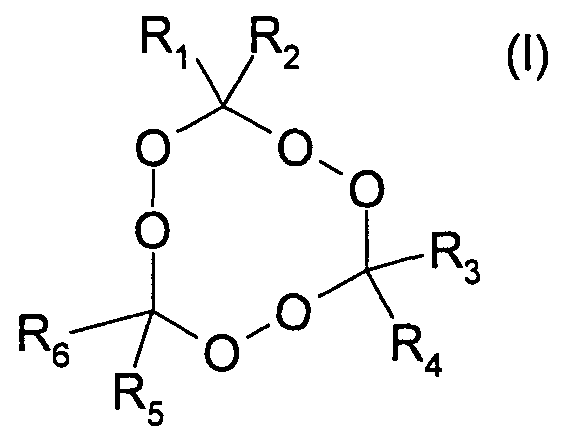
- one or more crystallizing cyclic ketone peroxides of formula (I)

- one or more dialkyl peroxides according to formula R7-O-O-R8 (II), wherein R7 and R8 are independently selected from the group consisting of substituted or unsubstituted, linear or branched C4-C20, C3-C20 cycloalkyl, C6-C20 aryl, C7-C20 aralkyl and C7-C20 alkaryl, and
- optionally, one or more conventional phlegmatisers (diluents).
- Preferably, the composition of the invention has an active oxygen content attributable to the cyclic ketone peroxide of below 6 percent by weight (wt.%), preferably below 3.5 wt.%, and most preferably below 3 wt.%, based on the total weight of the composition.
- The active oxygen content of a peroxide as described in this description is calculated according to the formula: 16 × the number of peroxide bonds / molecular weight of the peroxide × 100%. The active oxygen content of a composition is a weighed average of all compounds of the composition.
- The term "crystallizing cyclic ketone peroxide" in this description is used for any cyclic ketone peroxide diluted with Isopar® M and having an active oxygen content of 3.5% or more that forms crystals when subjected to the "crystallization test" as described below.
- Cyclic ketone peroxide formulations in accordance with the invention do not form explosive crystals when subjected to the "crystallization test" and have sufficiently high active oxygen content to allow a generic use. Furthermore, addition of a seed crystal to the composition of the present invention does not initiate crystal growth of the seeds, nor does it result in the formation of additional crystals, not even at a temperature as low as -25°C, such as applied in the "crystallization test". Particularly preferred is the situation wherein the added seed crystals dissolve in the composition, even at a temperature as low as -25°C. Consequently, compositions according to this invention are safe and storage stable. The terms "storage stable" and "storage stability" used in the description mean that the composition is not liable to explode when stored, or heated after storage, at a minimum storage temperature of -20°C and a maximum storage temperature that is determined by the maximum storage temperature of the most labile peroxide in the composition. In addition, these compositions are suitable for many kinds of polymerization and (co)polymer modification processes, including processes that require increased or high pressure.
- Preferred cyclic ketone peroxides that can be used in a cyclic ketone peroxide composition according to this invention include the cyclic ketone peroxides derived from acetone, acetyl acetone, methyl ethyl ketone, methyl propyl ketone, methyl isopropyl ketone, methyl butyl ketone, methyl isobutyl ketone, methyl amyl ketone, methyl isoamyl ketone, methyl hexyl ketone, methyl heptyl ketone, diethyl ketone, ethyl propyl ketone, ethyl amyl ketone, methyl octyl ketone, methyl nonyl ketone, cyclopentanone, cyclohexanone, 2-methylcyclohexanone, 3,3,5-trimethyl cyclohexanone, and mixtures thereof. More preferred is the use of cyclic ketone peroxides derived from acetone, methyl ethyl ketone, methyl propyl ketone, methyl isopropyl ketone, methyl butyl ketone, methyl isobutyl ketone, methyl amyl ketone, methyl isoamyl ketone, cyclohexanone, and mixtures thereof. The use of cyclic ketone peroxide derived from methyl ethyl ketone, and optionally, further ketones, is most preferred. The preparation of cyclic ketone peroxides from the appropriate ketone generally results in a mixture of peroxides, which predominantly consists of the trimeric and dimeric forms. However, the mixture of peroxides may also comprise some linear as well as some tetrameric and higher oligomeric cyclic structures. The ratio between the various forms, notably the trimer/dimer ratio, mainly depends on the reaction conditions during the preparation, and the person skilled in the art is referred to WO 96/03397 for obvious variations in the reaction conditions that can be carried out in order to influence this ratio. Preferably, the cyclic ketone peroxide consists essentially of trimer and dimer. If so desired, the reaction mixture may be separated into the individual cyclic ketone peroxide compounds. However, in order to avoid laborious purification procedures, the composition of the invention will typically contain some dimeric structures next to trimeric structures, as defined above. Preference for certain compositions or individual compounds may depend on differences in physical properties or requirements in the application of the peroxides, e.g. storage stability, half life time vs. temperature, volatility, boiling point, solubility, etc.
- Preferably, the composition according the invention has a total active oxygen content of more than 3 wt.%, based on the total weight of the composition. Preferably, the composition comprises at most 11 wt.%, more preferably at most 10 wt.%, and most preferably at most 8 wt.% of active oxygen, based on the total weight of the composition. For storing and transporting bulk quantities of composition according to the invention it may be necessary to dilute the composition with a conventional (inert) phlegmatiser, thereby reducing the total active oxygen content of the composition.
- Preferably, the composition of the invention comprises at least 1 wt.%, more preferably at least 5 wt.%, and most preferably at least 10 wt.% of the cyclic ketone peroxide, and preferably at most 50 wt.%, more preferably at most 25 wt.%, even more preferably at most 20 wt.%, yet even more preferably at most 17.5 wt.%, and most preferably at most 15 wt.% of the cyclic ketone peroxide, based on the total weight of the composition, preferably such that the active oxygen content attributable to the cyclic ketone peroxide remains below 6 wt.%, based on the total weight of cyclic ketone peroxide composition.
- The dialkyl peroxide of formula R7-O-O-R8 (II) in the composition of the present invention can be any symmetrical or asymmetrical dialkyl peroxide with R7 and R8 as defined above. Preferred are dialkyl peroxides according to formula R7-O-O-R8 (II) wherein at least one of R7 and R8 is selected from the group consisting of branched alkyl moieties. More preferred are dialkyl peroxides according to formula R7-O-O-R8 (II) wherein both R7 and R8 are selected from the group consisting of branched alkyl moieties. Even more preferred are dialkyl peroxides according to formula R7-O-O-R8 (II) wherein R7 and R8 are independently selected from the group consisting of linear or branched C4-C12 alkyl moieties and at least one of R7 and R8 is branched. Most preferred, are dialkyl peroxides according to formula R7-O-O-R8 (II) wherein both R7 and R8 are independently selected from the group consisting of branched C4-C12 alkyl moieties. Preferred dialkyl peroxides include di(tert-butyl) peroxide, di(tert-amyl) peroxide, (tert-butyl)(tert-amyl peroxide), and (1,1,3,3-tetrametylbutyl)(tert-butyl) peroxide. More preferred dialkyl peroxides are di(tert-butyl) peroxide and di(tert-amyl) peroxide. Particularly preferred dialkyl peroxide is di(tert-butyl) peroxide. A composition according to the invention preferably comprises at least 10 wt.%, more preferably at least 20 wt.%, even more preferably at least 40 wt.%, yet even more preferably at least 50 wt.%, and most preferably at least 60 wt.% of one or more dialkyl peroxides, and preferably at most 99 wt.%, more preferably at most 95 wt.%, and most preferably at most 90 wt.% of dialkyl peroxide, based on the total weight of the composition.
- The conventional phlegmatiser (an inert diluent) that may be optionally added to the composition of this invention can be any conventional phlegmatiser. Also mixtures of one or more of these conventional phlegmatisers may be used. If conventional phlegmatiser is added, then the composition according to the invention preferably comprises at least 1 wt.%, more preferably at least 5 wt.%, and most preferably at least 10 wt.% of one or more conventional phlegmatisers, and preferably at most 99 wt.%, more preferably at most 90 wt.%, and most preferably at most 80 wt.% of the one or more conventional phlegmatisers, based on the total weight of the cyclic ketone peroxide composition. Preferred conventional phlegmatisers for the cyclic ketone peroxides include various solvents, diluents and oils. More particularly, preferred conventional phlegmatisers include alkanols, cycloalkanols, alkylene glycols, alkylene glycol monoalkyl ethers, cyclic ether substituted alcohols, cyclic amides, aldehydes, ketones, epoxides, esters, hydrocarbon solvents, halogenated hydrocarbon solvents, paraffinic oils, white oils and silicone oils.
- Preferred esters which can be used as conventional phlegmatiser in the composition of the present invention include, but are not limited to, monocarboxylic esters of mono- and dihydric alcohols, dicarboxylic acid esters of monohydric alcohols, carbonates of monohydric alcohols, alkoxyalkyl esters, β-keto esters, phthalates, phosphates, benzoates, adipates and citrates. More preferred esters useful as conventional phlegmatiser in compositions of the present invention are dimethyl phthalate, dibutyl phthalate, dioctyl phthalate, dibenzyl phthalate, butyl benzyl phthalate, diallyl phthalate, n-pentyl acetate, isopentyl acetate, n-hexyl acetate, 2-ethylhexyl acetate, benzyl acetate, methyl benzoate, ethyl benzoate, isopropyl benzoate, n-octyl benzoate, isodecyl benzoate, n-butyl pivalate, isoamyl pivalate, sec-amyl pivalate, n-hexyl pivalate, dioctyl adipate, diisodecyl adipate, methyl neodecanoate, n-butyl neodecanoate, propylene glycol diacetate, ethylene glycol diacetate, cyclohexyl acetate, neopentyl acetate, methyl-2-ethylhexanoate, n-heptyl formate, n-octyl formate, dipropyl carbonate, dibutyl carbonate, isoamyl propionate, sec-amyl propionate, benzyl propionate, butyl caproate, ethylene glycol dipropionate, heptyl propionate, methylphenyl acetate, octyl acetate, 2-ethylhexyl acetate, propyl caprylate, triethyl phosphate, tricresyl phosphate, trixylyl phosphate, cresyl diphenyl phosphate, 2-ethylhexyl- diphenyl phosphate, isodecyl-diphenyl phosphate, tri(2-ethylhexyl) phosphate, dimethyl methylphosphonate, chlorinated phosphate esters, tributyl phosphate, tributoxyethyl phosphate, methyl decanoate, dimethyl succinate, diethyl succinate, dimethyl malonate, diethyl malonate, methylethyl succinate, diisobutyl nylonate, 2,2,4-trimethyl-1,3-pentanediol, diethyl oxalate, methyl p-toluate, and acetyltributyl citrate.
- Preferred linear and branched hydrocarbon solvents which can be used as conventional phlegmatiser in compositions of the present invention include, but are not limited to, hydrogenated oligomers of alkanes such as Isopar® products (ex. Exxon), such as Isopar® M, pentane, heptane, isododecane, amyl benzene, isoamyl benzene, decalin, o-diisopropyl benzene, m-diisopropyl benzene, n-dodecane, 2,4,5, 7-tetramethyl octane, n-amyl toluene, 1,2,3,4-tetramethyl benzene, 3,5- diethyl toluene and hexahydronaphthalene, tetradecane, tridecane, Exxsol® D80, Exxsol® D100, Exxsol® D100S, Soltrol® 145, Soltrol® 170, Varsol® 80, Varsol® 110, Shellsol® D100, Shellsol® D70, Halpasol® i 235/265, and mixtures thereof. Particularly preferred conventional phlegmatisers are Isopar® M and Soltrol® 170. Preferred halogenated hydrocarbons include phenyl trichloride, 3-bromo-o-xylene, 4-bromo-o-xylene, 2-bromo-m-xylene, 4-bromo-m-xylene, 5-bromo-m-xylene, o-dibromobenzene, p-dibromobenzene, 1,4-dibromobutane, 1,1-dibromo-2,2-dichloroethane, bromooctane, tetrabromoethytene, 1,2,3-trichlorobenzene, and 1,2,4-trichlorobenzene.
- Preferred aldehydes useful as conventional phlegmatiser in compositions of the present invention include n-chlorobenzaldehyde and decanal.
- Preferred ketones useful in the compositions of the present invention include acetophenone, isophorone, isobutyl ketone, methylphenyl diketone, diamyl ketone, diisoamyl ketone, ethyloctyl ketone, ethylphenyl ketone, acetone, methyl-n-amyl ketone, ethylbutyl ketone, ethylpropyl ketone, methylisoamyl ketone, methylheptyl ketone, methylhexyl ketone, ethylamyl ketone, dimethyl ketone, diethyl ketone, dipropyl ketone, methylethyl ketone, methylisobutyl ketone, methylisopropyl ketone, methylpropyl ketone, methyl-t-butyl ketone, isobutylheptyl ketone, diisobutyl ketone, 2,4-pentanedione, 2,4-hexanedione, 2,4-heptanedione, 3,5-heptanedione, 3,5-octanedione, 5-methyl-2,4-hexanedione, 2,6-dimethyl-3,5-heptanedione, 2,4-octanedione, 5,5-dimethyl-2,4-hexanedione, 6-methyl-2,4-heptanedione, 1-phenyl-1,3-butanedione, 1-phenyl-1,3-pentanedione, 1 ,3-diphenyl-1 ,3-propanedione, 1-phenyl-2,4-pentanedione, methylbenzyl ketone, phenylethyl ketone, methylchloromethyl ketone, methylbromomethyl ketone, 2-pyrrolidone, N-methyl-pyrrolidone, and coupling products thereof.
- A preferred epoxide which may be employed as conventional phlegmatiser in compositions of the present invention is styrene oxide.
- Preferred alcohols useful as conventional phlegmatiser in compositions of the present invention are n-butyl alcohol, capryl alcohol, octyl alcohol, dodecyl alcohol, tetrahydrofurfuryl alcohol, 1,4-dihydroxymethyl cyclohexane, cyclohexanol, glycerol, ethylene glycol, polyethylene glycols with molecular weights under 20,000, propylene glycol, dipropylene glycol, neopentyl glycol, hexylene glycol, 1,4-butylene glycol, 2,3-butylene glycol, butene diol, 1,5-pentane diol, 3,6-dimethyloctane-3,6-diol, 2,5-dimethyl-hex-3-yne-2,5-diol, 2,4,7,9-tetramethyldecane-4,7-diol, 2,2,4,4-tetramethyl-1,3-cyclobutanediol, ethylene glycol monoethyl ether, ethylene glycol monobutyl ether, diethylene glycol monoethyl ether, and diethylene glycol monobutyl ether.
- Preferred paraffinic oils useful as conventional phlegmatiser in composition of the present invention include, but are not limited to, halogenated paraffinic oils and paraffinic diesel oil. Other oils, including white oils, epoxidized soybean oils and silicone oils, are also useful in the compositions of the present invention.
- The safety of the composition of the present invention was determined by keeping the composition at -25°C for 48 hours, followed by examination of the composition for the presence of crystals ("crystallization test"). (If no crystals are formed after 24 hours at -25°C, a very small amount of seed crystals of pure cyclic ketone peroxide is added to the composition. After addition of the seed crystals, the composition is set aside for another 24 hours at -25°C. Finally, the composition is examined.) The composition is considered safe and storage stable if:
- the seed crystals did not grow,
- no additional crystals are present, and, in particular,
- the composition is completely free of crystals, i.e. even the added seed crystals have dissolved.
- This crystallization test was also used to determine whether a cyclic ketone peroxide is a "crystallizing cyclic ketone peroxide" as used according to the invention. This was tested by keeping the cyclic ketone peroxide to be tested, at - 25°C for 48 hours, followed by examination of the composition for the presence of crystals. If the cyclic ketone peroxide is to be diluted for safety reasons, then a dissolution of the cyclic ketone peroxide in Isopar® M is to be used during the evaluation.
- In addition to the above described "crystallization test", the composition of the present invention should also pass the following conventional safety tests:
- Deflagration test (deflagration),
- Time Pressure test (deflagration),
- Koenen test (heating under defined confinement),
- Pressure Vessel test (PVT) (heating under defined confinement), and
- Thermal Explosion Vessel test (heating under defined confinement).
- Passing these tests means a "medium" or "low" rating in the heating under defined confinement tests and a "no" or "yes, slowly" rating in the deflagration tests. The final hazard rating, for which the most severe rating in any one of the tests is used, must be "medium" or "low."
The safety tests and corresponding criteria are documented in the "United Nations Recommendations on the Transport of Dangerous Goods, Manual of Tests and Criteria". - In a preferred embodiment of this invention, the cyclic ketone peroxide is manufactured directly in one or more of the conventional phlegmatisers as described above, followed by combining the cyclic ketone peroxide/conventional phlegmatiser mixture with one or more dialkyl peroxides of formula (II). Optionally, one or more additional conventional phlegmatisers may be added. As already mentioned above, the manufacture of a cyclic ketone peroxide composition with high total active oxygen content is advantageous with respect to efficient use of the reactor and the reagents.
- For storing and transporting bulk quantities of the composition of this invention according to it may be necessary to further dilute the cyclic ketone peroxide composition of the invention with one or more dialkyl peroxides of formula (II) and/or one or more conventional phlegmatisers, such that it complies with regulations for safe storage and transport. This is particularly the case for bulk quantities, which are stored and transported in tanks and intermediate bulk containers (IBCs). The dialkyl peroxide(s) and conventional phlegmatiser(s) are preferably added after the preparation of the cyclic ketone peroxide, as long as it is added before storage. If so desired, conventional phlegmatiser(s) may also be added before or during the preparation of the cyclic ketone peroxide. Obviously, dilution of the cyclic ketone peroxide composition of the invention with one or more dialkyl peroxides of formula (II) and/or one or more conventional phlegmatisers reduces the total active oxygen content of the composition.
- It is noted that the dialkyl peroxide of formula (II) and the conventional phlegmatiser, if used, may be combined before use. Hence, in that case it is feasible to purchase and use specific dialkyl peroxides that contain one or more conventional phlegmatiser.
- The composition of the present invention may optionally contain certain additives as long as these additives do not significantly suppress the safety, transportability and/or storage stability of the composition. As examples of such additives are mentioned: antiozonants, antioxidants, antidegradants, UV stabilizers, coagents, fungicides, antistatic agents, pigments, dyes, coupling agents, dispersing aids, blowing agents, lubricants, process oils, and mould-release agents. These additives may be employed in their usual amounts. If used, such additives are typically added to the cyclic ketone peroxide composition shortly before the composition is used in a polymerization or (co)polymer modification process.
- The present invention also relates to the use of cyclic ketone peroxide compositions in (radical) polymerization processes, (co)polymer modification processes, such as controlled rheology polypropylene (CR-PP) processing, and other reactions involving peroxides, like the synthesis of certain chemicals. Compositions according to the present invention are pre-eminently suitable for polymerization or (co)polymer modification processes that require increased or high pressure. As an example is mentioned the high-pressure polymerization process of ethylene to produce low-density polyethylene (LDPE). In the polymerization reactions, conventional additives can be used, such as chain transfer agents and the like.
- The present invention is illustrated by the following examples.
-
- Di(tert-butyl) peroxide-product (Trigonox® B) ex Akzo Nobel
(Assay: 99 wt.%, Active Oxygen: 10.83 wt.%) - Cyclic methyl ethyl ketone peroxide-product (Trigonox® 301) ex Akzo Nobel
(Assay: 41% in Isopar® M, Active Oxygen: 7.45 wt.%) - Preparation of a composition comprising 16.4 percent by weight (wt.%) of cyclic methyl ethyl ketone peroxide, 60 wt.% of di(tert-butyl) peroxide, and 23.6 wt.% of Isopar® M: A reaction vessel is charged with 900 grams of Trigonox® B. Next, 600 grams of Trigonox® 301 is dosed. The obtained mixture has a total active oxygen content of 9.41 wt.% and an active oxygen content attributable to cyclic methyl ethyl ketone peroxide of 2.98 wt.%.
This composition passes the PVT test: Low - Preparation of a composition comprising 20.5 percent by weight (wt.%) of cyclic methyl ethyl ketone peroxide, 50 wt.% of di(tert-butyl) peroxide, and 29.5 wt.% of Isopar® M: A reaction vessel is charged with 750 grams of Trigonox® B. Next, 750 grams of Trigonox® 301 is dosed. The obtained mixture has a total active oxygen content of 9.14 wt.% and an active oxygen content attributable to cyclic methyl ethyl ketone peroxide of 3.73 wt.%.
This composition passes the PVT test: Low - The cyclic methyl ethyl ketone peroxide showed formation of crystals when formulated with just Isopar® M such that the product had an active oxygen content of 3.5% or more.
Claims (13)
- A cyclic ketone peroxide composition comprising:one or more cyclic ketone peroxides of formula (I)wherein R1-R6 are independently selected from the group consisting of hydrogen, linear or branched C1-C20 alkyl, C3-C20 cycloalkyl, C6-C20 aryl, C7-C20 aralkyl and C7-C20 alkaryl, and each of R1-R6 may be optionally substituted with one or more groups selected from hydroxy, C1-C20 alkoxy, linear or branched C1-C20 alkyl, C6-C20 aryloxy, halogen, ester, carboxy, nitrile, and amido, and
 one or more dialkyl peroxides according to formula R7-O-O-R8 (II), wherein R7 and R8 are independently selected from the group consisting of substituted or unsubstituted, linear or branched C4-C20 alkyl, C3-C20 cycloalkyl, C6-C20 aryl, C7-C20 aralkyl and C7-C20 alkaryl.
 - A composition according to claim 1, further comprising one or more conventional phlegmatisers (diluents).
- A composition according to claim 1 or 2 wherein the active oxygen content attributable to the cyclic ketone peroxide is below 6 wt.%, based on the total weight of the cyclic ketone peroxide composition.
- A composition according to any one of claims 1-3 wherein the active oxygen content attributable to the cyclic ketone peroxide is below 3.5 wt.%, preferably below 3 wt.%, based on the total weight of the cyclic ketone peroxide composition.
- A composition according to any one of claims 1-4 wherein the cyclic ketone peroxide is selected from the group consisting of cyclic ketone peroxides derived from acetone, methyl ethyl ketone, methyl propyl ketone, methyl isopropyl ketone, methyl butyl ketone, methyl isobutyl ketone, methyl amyl ketone, methyl isoamyl ketone, cyclohexanone, and mixtures thereof.
- A composition according to any one of claims 1-5 wherein the cyclic ketone peroxide is cyclic ketone peroxide derived from methyl ethyl ketone, and, optionally, further ketones.
- A composition according to any one of claims 1-6, wherein at least one of R7 and R8 of the dialkyl peroxide according to formula R7-O-O-R8 (II) is selected from the group consisting of branched alkyl moieties.
- A composition according to any one of claims 1-7, wherein both R7 and R8 of the dialkyl peroxide according to formula R7-O-O-R8 (II) are independently selected from the group consisting of branched alkyl moieties.
- A composition according to any one of claims 1-8, wherein R7 and R8 of the dialkyl peroxide according to formula R7-O-O-R8 (II) are independently selected from the group consisting of C4-C12 alkyl moieties.
- A composition according to any one of claims 1-9, wherein the dialkyl peroxide according to formula R7-O-O-R8 (II) is di(tert-butyl) peroxide or di(tert-amyl) peroxide.
- A composition according to any one of claims 2-10, wherein the conventional phlegmatiser is Isopar® M or Soltrol® 170.
- Use of a composition according to any one of claims 1-11 in a polymerization or (co)polymer modification process.
- Use according to claim 12, wherein the process is performed at increased or high pressure.
Priority Applications (13)
| Application Number | Priority Date | Filing Date | Title |
|---|---|---|---|
| BRPI0407472-6A BRPI0407472B1 (en) | 2003-02-13 | 2004-01-28 | Storage stable cyclic ketone peroxide compositions |
| US10/543,606 US7456212B2 (en) | 2003-02-13 | 2004-01-28 | Storage stable cyclic ketone peroxide compositions |
| JP2006501639A JP4764815B2 (en) | 2003-02-13 | 2004-01-28 | Storage stable cyclic ketone peroxide composition |
| MXPA05008615A MXPA05008615A (en) | 2003-02-13 | 2004-01-28 | Storage stable cyclic ketone peroxide compositions. |
| KR1020057014940A KR101089113B1 (en) | 2003-02-13 | 2004-01-28 | Storage stability cyclic ketone peroxide composition |
| DE602004025325T DE602004025325D1 (en) | 2003-02-13 | 2004-01-28 | STORAGE-STABLE COMPOSITIONS OF CYCLIC KETONE PEROXIDE |
| AT04705801T ATE456562T1 (en) | 2003-02-13 | 2004-01-28 | STORAGE-STABLE COMPOSITIONS OF CYCLIC KETONE PEROXIDES |
| RU2005128509/04A RU2351611C2 (en) | 2003-02-13 | 2004-01-28 | Storage-stable cyclic ketone peroxide compositions |
| EP04705801A EP1592682B1 (en) | 2003-02-13 | 2004-01-28 | Storage stable cyclic ketone peroxide compositions |
| PCT/EP2004/000743 WO2004072059A1 (en) | 2003-02-13 | 2004-01-28 | Storage stable cyclic ketone peroxide compositions |
| TW093103350A TW200427677A (en) | 2003-02-13 | 2004-02-12 | Improved cyclic ketone peroxide compositions |
| SA4250019A SA04250019B1 (en) | 2003-02-13 | 2004-03-03 | Improved cyclic ketone peroxide formulations |
| JP2011077500A JP2011173895A (en) | 2003-02-13 | 2011-03-31 | Storage stable cyclic ketone peroxide composition |
Applications Claiming Priority (2)
| Application Number | Priority Date | Filing Date | Title |
|---|---|---|---|
| US44717703P | 2003-02-13 | 2003-02-13 | |
| US447177P | 2003-02-13 |
Publications (1)
| Publication Number | Publication Date |
|---|---|
| EP1447404A1 true EP1447404A1 (en) | 2004-08-18 |
Family
ID=32682475
Family Applications (1)
| Application Number | Title | Priority Date | Filing Date |
|---|---|---|---|
| EP03078216A Withdrawn EP1447404A1 (en) | 2003-02-13 | 2003-10-13 | Improved cyclic ketone peroxide compositions |
Country Status (7)
| Country | Link |
|---|---|
| EP (1) | EP1447404A1 (en) |
| JP (2) | JP4764815B2 (en) |
| CN (1) | CN100546988C (en) |
| AT (1) | ATE456562T1 (en) |
| DE (1) | DE602004025325D1 (en) |
| SA (1) | SA04250019B1 (en) |
| TW (1) | TW200427677A (en) |
Cited By (1)
| Publication number | Priority date | Publication date | Assignee | Title |
|---|---|---|---|---|
| WO2018109415A1 (en) * | 2016-12-15 | 2018-06-21 | Arkema France | Dialkyl peroxide composition for modifying the rheology of polypropylene in molten state |
Families Citing this family (6)
| Publication number | Priority date | Publication date | Assignee | Title |
|---|---|---|---|---|
| EP1447404A1 (en) * | 2003-02-13 | 2004-08-18 | Akzo Nobel N.V. | Improved cyclic ketone peroxide compositions |
| FR2971510B1 (en) * | 2011-02-10 | 2013-03-22 | Arkema France | RADICAL POLYMERIZATION OF ETHYLENE STARCHED WITH HIGH-PRODUCTIVITY ORGANIC PEROXIDES |
| WO2015135865A1 (en) * | 2014-03-11 | 2015-09-17 | Akzo Nobel Chemicals International B.V. | Cyclic ketone peroxide composition |
| CN108586802A (en) * | 2018-05-28 | 2018-09-28 | 广州印田新材料有限公司 | The preparation method of stabilizing ring ketone peroxide compositions containing esters desensitizer |
| CN108503885A (en) * | 2018-05-28 | 2018-09-07 | 广州印田新材料有限公司 | A kind of cyclic ketone peroxide composition of the stabilization containing esters desensitizer |
| CN117229433A (en) * | 2022-12-23 | 2023-12-15 | 任国辉 | Cyclic peroxide initiator containing hindered amine phlegmatizer and synthesis method and application thereof |
Citations (6)
| Publication number | Priority date | Publication date | Assignee | Title |
|---|---|---|---|---|
| WO1996003444A1 (en) * | 1994-07-21 | 1996-02-08 | Akzo Nobel N.V. | Modification of (co)polymers with cyclic ketone peroxides |
| JPH1087652A (en) * | 1996-09-13 | 1998-04-07 | Nof Corp | Ketone peroxide composition and curing of unsaturated polyester resin using the same |
| US5808110A (en) * | 1994-07-21 | 1998-09-15 | Akzo Nobel Nv | Cyclic ketone peroxide formulations |
| WO2001068723A2 (en) * | 2000-03-16 | 2001-09-20 | Basell Polyolefine Gmbh | Method for the production of polyethylene |
| EP1186618A1 (en) * | 2000-09-08 | 2002-03-13 | ATOFINA Research | Controlled rheology polypropylene heterophasic copolymers |
| EP1279684A1 (en) * | 2001-07-26 | 2003-01-29 | Fina Technology, Inc. | Polypropylene copolymers and method of preparing polypropylene copolymers |
Family Cites Families (6)
| Publication number | Priority date | Publication date | Assignee | Title |
|---|---|---|---|---|
| AR001122A1 (en) * | 1995-03-06 | 1997-09-24 | Akzo Nobel Nv | Polymerization process that uses a functionalized (co) polymer peroxide composition obtained by the process and use of a peroxide composition |
| JPH1087562A (en) | 1996-09-12 | 1998-04-07 | Mitsui Petrochem Ind Ltd | Method for producing 3,5-dialkylsalicylic acid |
| TR200001920T2 (en) * | 1997-12-22 | 2000-12-21 | Akzo Nobel N.V. | Fuels with improved ignition properties. |
| DE10012775A1 (en) * | 2000-03-16 | 2001-10-18 | Basf Ag | Production of polyethylene wax by high pressure process involves using peroxide mixture containing 3,6,9-alkyl- and/or aryl-3,6,9-trimethyl-1,2,4,5,7,8-hexaoxonane as free radical initiator and specified hydrogen to ethylene molar ratio |
| KR101315873B1 (en) * | 2002-12-06 | 2013-10-08 | 아크조 노벨 엔.브이. | Cyclic Ketone Peroxide Formulations |
| EP1447404A1 (en) * | 2003-02-13 | 2004-08-18 | Akzo Nobel N.V. | Improved cyclic ketone peroxide compositions |
-
2003
- 2003-10-13 EP EP03078216A patent/EP1447404A1/en not_active Withdrawn
-
2004
- 2004-01-28 CN CN200480004211.7A patent/CN100546988C/en not_active Expired - Fee Related
- 2004-01-28 AT AT04705801T patent/ATE456562T1/en not_active IP Right Cessation
- 2004-01-28 JP JP2006501639A patent/JP4764815B2/en not_active Expired - Fee Related
- 2004-01-28 DE DE602004025325T patent/DE602004025325D1/en not_active Expired - Lifetime
- 2004-02-12 TW TW093103350A patent/TW200427677A/en unknown
- 2004-03-03 SA SA4250019A patent/SA04250019B1/en unknown
-
2011
- 2011-03-31 JP JP2011077500A patent/JP2011173895A/en not_active Withdrawn
Patent Citations (6)
| Publication number | Priority date | Publication date | Assignee | Title |
|---|---|---|---|---|
| WO1996003444A1 (en) * | 1994-07-21 | 1996-02-08 | Akzo Nobel N.V. | Modification of (co)polymers with cyclic ketone peroxides |
| US5808110A (en) * | 1994-07-21 | 1998-09-15 | Akzo Nobel Nv | Cyclic ketone peroxide formulations |
| JPH1087652A (en) * | 1996-09-13 | 1998-04-07 | Nof Corp | Ketone peroxide composition and curing of unsaturated polyester resin using the same |
| WO2001068723A2 (en) * | 2000-03-16 | 2001-09-20 | Basell Polyolefine Gmbh | Method for the production of polyethylene |
| EP1186618A1 (en) * | 2000-09-08 | 2002-03-13 | ATOFINA Research | Controlled rheology polypropylene heterophasic copolymers |
| EP1279684A1 (en) * | 2001-07-26 | 2003-01-29 | Fina Technology, Inc. | Polypropylene copolymers and method of preparing polypropylene copolymers |
Non-Patent Citations (1)
| Title |
|---|
| PATENT ABSTRACTS OF JAPAN vol. 1998, no. 09 31 July 1998 (1998-07-31) * |
Cited By (4)
| Publication number | Priority date | Publication date | Assignee | Title |
|---|---|---|---|---|
| WO2018109415A1 (en) * | 2016-12-15 | 2018-06-21 | Arkema France | Dialkyl peroxide composition for modifying the rheology of polypropylene in molten state |
| FR3060584A1 (en) * | 2016-12-15 | 2018-06-22 | Arkema France | COMPOSITION BASED ON DIALKYL PEROXIDE FOR MODIFICATION OF MOLTEN RHEOLOGY OF POLYPROPYLENE |
| EP3907243A1 (en) * | 2016-12-15 | 2021-11-10 | Arkema France | Composition based on dialkylperoxides for the modification of the melt rheology of polypropylene |
| US11299564B2 (en) | 2016-12-15 | 2022-04-12 | Arkema France | Dialkyl peroxide composition for modifying the rheology of polypropylene in molten state |
Also Published As
| Publication number | Publication date |
|---|---|
| SA04250019B1 (en) | 2008-05-20 |
| CN1771242A (en) | 2006-05-10 |
| DE602004025325D1 (en) | 2010-03-18 |
| ATE456562T1 (en) | 2010-02-15 |
| JP2006517549A (en) | 2006-07-27 |
| TW200427677A (en) | 2004-12-16 |
| CN100546988C (en) | 2009-10-07 |
| JP4764815B2 (en) | 2011-09-07 |
| JP2011173895A (en) | 2011-09-08 |
Similar Documents
| Publication | Publication Date | Title |
|---|---|---|
| EP0772609B1 (en) | Cyclic ketone peroxide formulations | |
| JP2011173895A (en) | Storage stable cyclic ketone peroxide composition | |
| CA2214674C (en) | Cyclic ketone peroxides as polymerization initiators | |
| US6846859B2 (en) | Polyolefin composition having reduced color bodies | |
| KR20000022531A (en) | Process for enhancing the melt strength of polypropylene(co)polymers | |
| US7456212B2 (en) | Storage stable cyclic ketone peroxide compositions | |
| AU758234B2 (en) | Improved phlegmatization of cyclic ketone peroxides | |
| KR20000069953A (en) | Peroxide compositions with improved safety characteristics | |
| KR20040068290A (en) | Continuous dosing of extremely fast initiators during polymerization reactions | |
| US20060142513A1 (en) | Polymerization process for preparing (co)polymers | |
| US20190359743A1 (en) | Dialkyl peroxide composition for modifying the rheology of polypropylene in molten state | |
| IL27376A (en) | Organic peroxydicarbonates and their preparation | |
| MXPA01003838A (en) | Improved phlegmatizationof cyclic ketone peroxides | |
| MXPA00004964A (en) | Extrusion process for enhancing the melt strength of polypropylene |
Legal Events
| Date | Code | Title | Description |
|---|---|---|---|
| PUAI | Public reference made under article 153(3) epc to a published international application that has entered the european phase |
Free format text: ORIGINAL CODE: 0009012 |
|
| AK | Designated contracting states |
Kind code of ref document: A1 Designated state(s): AT BE BG CH CY CZ DE DK EE ES FI FR GB GR HU IE IT LI LU MC NL PT RO SE SI SK TR |
|
| AX | Request for extension of the european patent |
Extension state: AL LT LV MK |
|
| STAA | Information on the status of an ep patent application or granted ep patent |
Free format text: STATUS: THE APPLICATION HAS BEEN WITHDRAWN |
|
| 18W | Application withdrawn |
Effective date: 20040831 |