EP1445641A1 - Ocular lens - Google Patents
Ocular lens Download PDFInfo
- Publication number
- EP1445641A1 EP1445641A1 EP01958580A EP01958580A EP1445641A1 EP 1445641 A1 EP1445641 A1 EP 1445641A1 EP 01958580 A EP01958580 A EP 01958580A EP 01958580 A EP01958580 A EP 01958580A EP 1445641 A1 EP1445641 A1 EP 1445641A1
- Authority
- EP
- European Patent Office
- Prior art keywords
- groups
- formula
- weight
- ophthalmic lens
- acrylamide
- Prior art date
- Legal status (The legal status is an assumption and is not a legal conclusion. Google has not performed a legal analysis and makes no representation as to the accuracy of the status listed.)
- Granted
Links
- 0 CC*C*1=CCC1C(CCC1CCC1)C(CC1)C2C1C2C Chemical compound CC*C*1=CCC1C(CCC1CCC1)C(CC1)C2C1C2C 0.000 description 4
Classifications
-
- C—CHEMISTRY; METALLURGY
- C08—ORGANIC MACROMOLECULAR COMPOUNDS; THEIR PREPARATION OR CHEMICAL WORKING-UP; COMPOSITIONS BASED THEREON
- C08F—MACROMOLECULAR COMPOUNDS OBTAINED BY REACTIONS ONLY INVOLVING CARBON-TO-CARBON UNSATURATED BONDS
- C08F20/00—Homopolymers and copolymers of compounds having one or more unsaturated aliphatic radicals, each having only one carbon-to-carbon double bond, and only one being terminated by only one carboxyl radical or a salt, anhydride, ester, amide, imide or nitrile thereof
- C08F20/02—Monocarboxylic acids having less than ten carbon atoms, Derivatives thereof
- C08F20/52—Amides or imides
- C08F20/54—Amides, e.g. N,N-dimethylacrylamide or N-isopropylacrylamide
- C08F20/58—Amides, e.g. N,N-dimethylacrylamide or N-isopropylacrylamide containing oxygen in addition to the carbonamido oxygen, e.g. N-methylolacrylamide, N-acryloylmorpholine
-
- G—PHYSICS
- G02—OPTICS
- G02B—OPTICAL ELEMENTS, SYSTEMS OR APPARATUS
- G02B1/00—Optical elements characterised by the material of which they are made; Optical coatings for optical elements
- G02B1/04—Optical elements characterised by the material of which they are made; Optical coatings for optical elements made of organic materials, e.g. plastics
- G02B1/041—Lenses
- G02B1/043—Contact lenses
Definitions
- This invention relates to ophthalmic lenses such as contact lenses, intraocular lenses and artificial corneas, and, of these, is most suitable for contact lenses.
- Siloxanyl monomers such as 3-methacryloxypropyltris (trimethylsiloxy)silane are used as monomers for ophthalmic lenses (for example, USP 3808178).
- ophthalmic lenses comprised of these siloxanyl monomers have the advantage of being of high oxygen permeability, they are strongly hydrophobic, for which reason it is difficult to use them for ophthalmic lenses and for contact lenses in particular.
- hydrophilic properties are generally conferred on the ophthalmic lenses by copolymerizing various hydrophilic monomers (for example, N,N-dimethylacrylamide, N-vinyl pyrrolidone and 2-hydroxyethylmethacrylate).
- hydrophilic monomers for example, N,N-dimethylacrylamide, N-vinyl pyrrolidone and 2-hydroxyethylmethacrylate.
- hydrophilic monomers for example, N,N-dimethylacrylamide, N-vinyl pyrrolidone and 2-hydroxyethylmethacrylate.
- This invention has the objective of providing ophthalmic lenses of high tensile elongation (i.e., they do not break readily).
- the ophthalmic lens of this invention has the following structure.
- An ophthalmic lens comprising, as a polymerization component, monomers represented by formula (a) below: wherein, in formula (a), R 1 is H or a methyl group; R 2 is a group that is selected from alkyl groups with 1 to 8 carbon atoms, aralkyl groups with 7 to 12 carbon atoms and aryl groups with 6 to 10 carbon atoms; k is an integer of 0 to 2; L 1 is a substituent that is selected from ethylene groups, 1,2-propylene groups, 1,3-propylene groups and 1,4-butylene groups; and L 2 is a substituent that is selected from methylene groups, ethylene groups, 1,2-propylene groups, 1,3-propylene groups and 1,4-butylene groups.
- R 1 is H or a methyl group.
- H is preferable from the standpoint that monomers of high polymerizability can be obtained.
- k is an integer of 0 to 2. However, 0 or 1 is preferable from the standpoint of ease of polymerization.
- L 1 is a substituent that is selected from ethylene groups, 1,2-propylene groups, 1,3-propylene groups and 1,4-butylene groups.
- ethylene groups are the most desirable from the standpoint that high hydrophilic properties can be obtained.
- L 2 is a substituent that is selected from methylene groups, ethylene groups, 1,2-propylene groups, 1,3-propylene groups and 1,4-butylene groups.
- methylene groups, ethylene groups and 1,3-propylene groups are preferable from the standpoint of ease of synthesis and that high hydrophilic properties are obtained.
- the monomers represented by formula (a) include N-methoxymethylacrylamide, N-ethoxymethylacrylamide, N-propoxymethylacrylamide, N-isopropoxymethylacrylamide, N-butoxymethylacrylamide, N-methoxymethylmethacrylamide, N-ethoxymethylmethacrylamide, N-propoxymethylmethacrylamide, N-isopropoxymethylmethacrylamide, N-butoxymethylmethacrylamide, N-(2-methoxyethyl) acrylamide, N-(2-ethoxyethyl) acrylamide, N-(2-propoxyethyl) acrylamide, N-(2-isopropoxyethyl) acrylamide, N-(2-butoxyethyl) acrylamide, N-(2-methoxyethyl) methacrylamide, N-(2-ethoxyethyl) methacrylamide, N-(2-propoxyethyl) methacrylamide, N-(2-isopropoxyethyl)
- the monomers represented by formula (a) can be manufactured, for example, by usual methods of manufacture of (meth)acrylamide as indicated below.
- the ophthalmic lenses of this invention can be obtained by polymerizing monomers of formula (a).
- the monomers of formula (a) can be polymerized individually or they can be copolymerized with other monomers.
- Several types of monomers of formula (a) and other monomers can be used at the same time.
- copolymerization monomers when copolymerization with other monomers is performed as long as they are copolymerizable, and monomers having (meth)acryloyl groups, styryl groups, allyl groups, vinyl groups and other copolymerizable carbon-carbon unsaturated bonds can be used.
- alkyl (meth)acrylates such as methyl (meth)acrylate and ethyl (meth)acrylate
- polyfunctional (meth)acrylates such as polyalkylene glycol mono(meth)acrylate, polyalkylene glycol monoalkyl ether (meth)acrylate, polyalkyleneglycol bis(meth)acrylate, trimethylol propanetris(meth)acrylate, pentaerythritol tetrakis(meth)acrylate and siloxane macromers having carbon-carbon unsaturated bonds in both terminals
- halogenated alkyl (meth)acrylates such as trifluoroethyl (meth)acrylate and hexafluoroisopropyl (meth)acrylate
- hydroxyalkyl (meth)acrylates such as trifluoroethyl (meth)acrylate and hexafluoroisopropyl (meth)acrylate
- hydroxyalkyl (meth)acrylates
- siloxanyl in this specification means “having siloxanyl groups.” Consequently, the expression “silocanyl monomers” means “monomers that have siloxanyl groups.” Further, the expression “siloxanyl group” in this specification means a group having at least one Si-O-Si bond.
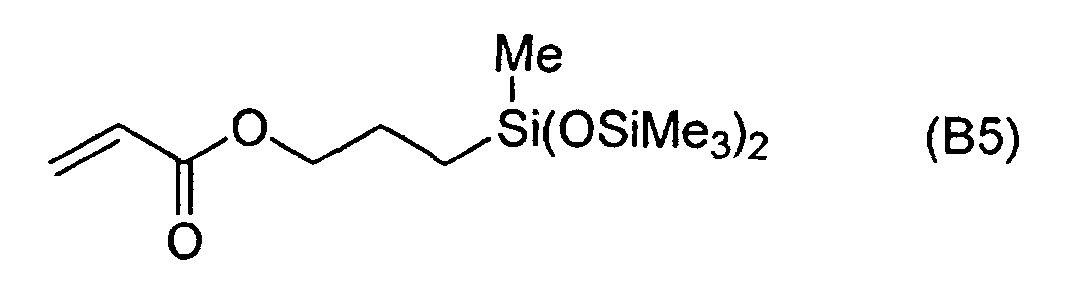
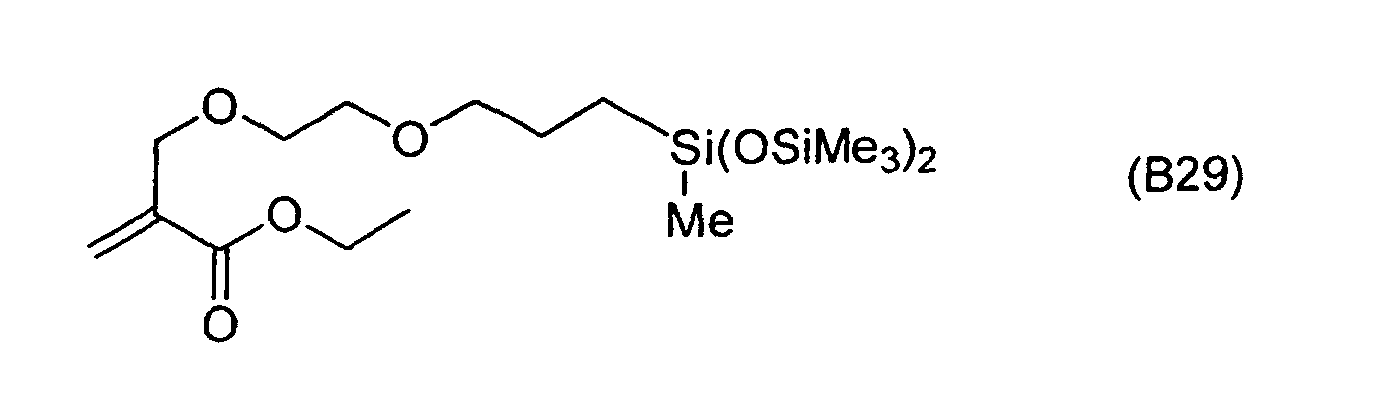
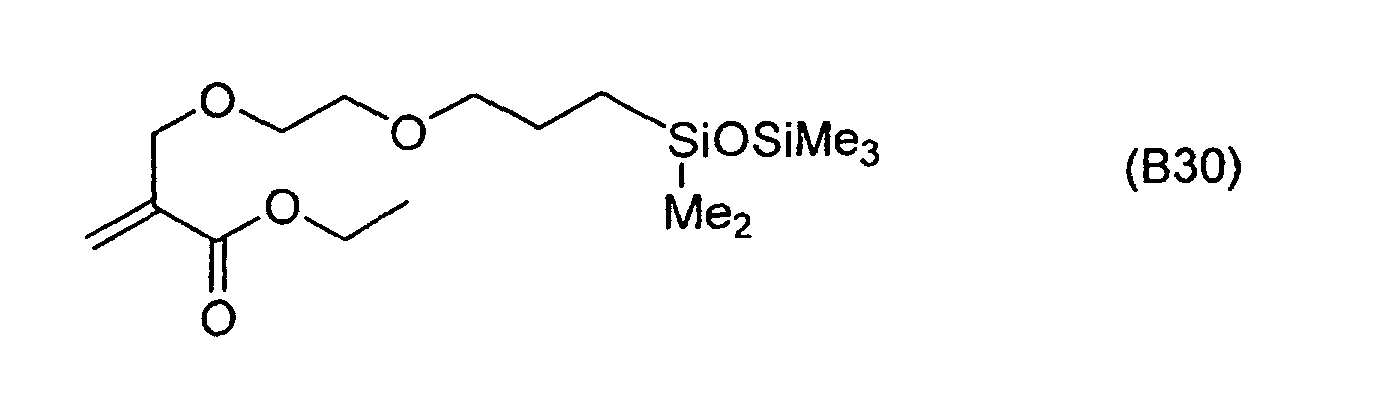
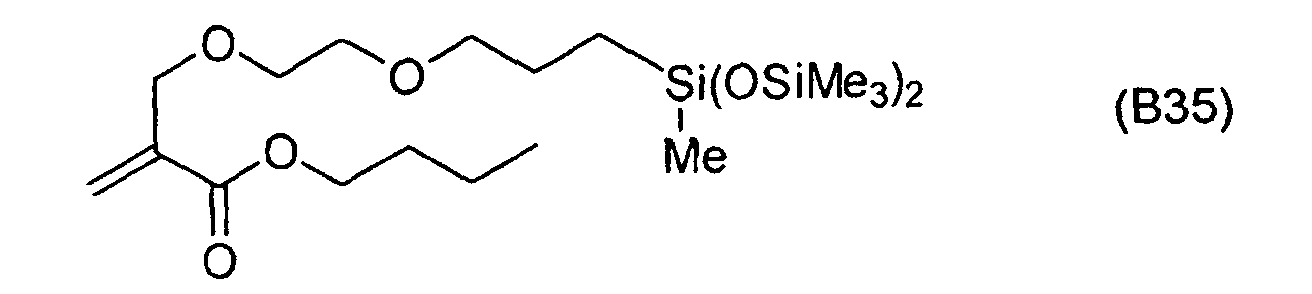
- Desirable siloxanyl monomers include monomers represented by formula (B) below and siloxanyl styrene: X-Z-L-A wherein, in formula (B), A is a siloxanyl group; X is a polymerizable group having a carbon-carbon unsaturated bond; L is a divalent group with 1 to 10 carbon atoms; Z is a substituent selected from O, S and N-Y; and Y is a substituent that is selected from the group consisting of hydrogen, alkyl groups that may be substituted and aryl groups that may be substituted.
- formula (B) siloxanyl styrene: X-Z-L-A wherein, in formula (B), A is a siloxanyl group; X is a polymerizable group having a carbon-carbon unsaturated bond; L is a divalent group with 1 to 10 carbon atoms; Z is a substituent selected from O, S and N-Y; and Y is a substituent that
- A is a siloxanyl group.
- a 1 to A 11 are selected from hydrogen atoms, alkyl groups that may be substituted and aryl groups that may be substituted. Specific examples can include hydrogen atoms; alkyl groups such as methyl groups, ethyl groups, propyl groups, isopropyl groups, butyl groups, isobutyl groups, sec-butyl groups, t-butyl groups, hexyl groups, cyclohexyl groups, 2-ethylhexyl groups and octyl groups; and aryl groups such as phenyl groups and naphthyl groups.
- d is an integer of 0 to 200, preferably, of 0 to 50, and, more preferably, of 0 to 10.
- a, b and c are, respectively and independently, integers of 0 to 20, and, preferably, a, b and c are, respectively and independently, integers of 0 to 5.
- d it is desirable that all of a, b and c are 1 or that a and b are 1 and c is 0.
- substituents represented by formula (A) those that are particularly desirable are tris(trimethylsiloxy) silyl groups, bis(trimethylsiloxy) methylsilyl groups, polydimethylsiloxane groups, polymethylsiloxane groups and poly-co-methylsiloxane-dimethylsiloxane groups.
- X is polymerizable groups having carbon-carbon unsaturated bonds.
- Specific examples can include groups represented by formulas (x1) to (x7) below, and of these, the most desirable are groups represented by formulas (x1), (x2) and (x7): wherein, in formulas (x1) to (x7), R 11 is H or a methyl group, and R 12 is a substituent selected from alkyl groups that may be substituted and aryl groups that may be substituted.
- R 11 is H or a methyl group.
- R 12 is a substituent selected from alkyl groups that may be substituted and aryl groups that may be substituted. Desirable alkyl groups of 1 to 8 carbon atoms that may be substituted include methyl groups, ethyl groups, propyl groups, isopropyl groups, butyl groups, 2-hydroxyethyl groups, 3-hydroxypropyl groups, 4-hydroxybutyl groups, 2-methoxyethyl groups, 3-methoxypropyl groups, 4-methoxybutyl groups, 2-ethoxyethyl groups, 3-ethoxypropyl groups, 4-ethoxybutyl groups, 2-(2-methoxyethoxy) ethyl groups and 2-(2-ethoxyethoxy) ethyl groups. Phenyl groups and 4-methoxyphenyl groups are desirable as the aryl groups that may be substituted.
- L is a divalent group of 1 to 10 carbon atoms, and -CH 2 - -CH 2 CH 2 CH 2 - -CH 2 CH 2 OCH 2 CH 2 CH 2 - are preferable.
- Z is a substituent selected from O, S and N-Y.
- Y is a substituent selected from the group consisting of H, alkyl groups that may be substituted and aryl groups that may be substituted. Desirable examples include H, methyl groups, ethyl groups, propyl groups, butyl groups, isobutyl groups, hexyl groups, octyl groups, 2-ethylhexyl groups, allyl groups, 2-hydroxyethyl groups, 3-hydroxypropyl groups, 2,3-dihydroxypropyl groups, 4-hydroxybutyl groups, 2-(2-hydroxyethoxy) ethyl groups, 2-methoxyethyl groups, 3-methoxypropyl groups, 4-methoxybutyl groups, 2-(2-methoxyethoxy) ethyl groups, furfuryl groups, tetrahydrofurfuryl groups, methoxycarbonylmethyl groups, ethoxycarbonylmethyl groups, propoxycarbonylmethyl groups, methoxyethoxycarbonylmethyl groups, e
- siloxanyl monomers represented by formula (B) those compounds represented by formulas (B1) to (B42) below are particularly desirable.
- Desirable siloxanyl styrene compounds include [tris(trimethylsiloxy)silyl] styrene, [bis(trimehtylsiloxy)methylsilyl] styrene and [(trimethylsiloxy)dimethylsilyl] styrene.
- the ophthalmic lenses of this invention contain monomers having two or more polymerizable carbon-carbon unsaturated bonds in one molecule as copolymerization components.
- the copolymerization ratio of monomers having two or more polymerizable carbon-carbon unsaturated bonds in one molecule should be 0.1 weight % or greater.
- weight % is the value calculated taking the total weight of the monomer composition (excluding the solvent component) as 100. The same applies hereafter.
- the polymerization ratio of monomer of formula (a) in the ophthalmic lens of this invention should be in the range of 1 weight % to 100 weight %, and, preferably, of 5 weight % to 100 weight %.
- the ratio for the monomer of formula (a) should be 1 weight % to 80 weight % and that for the siloxanyl monomer should be 20 weight % to 99 weight %.
- that for the monomer of formula (a) should be 5 weight % to 50 weight % and that for the siloxanyl monomer should be 50 weight % to 95 weight %.
- thermal polymerization initiators and photopolymerization initiators of which peroxides and azo compounds are representative is desirable.
- thermal polymerization a substance having optimum decomposition characteristics at the desired reaction temperature is selected and used.
- azo initiators and peroxide initiators having 10 hour half-life temperatures of 40 to 120°C are suitable.
- Carbonyl compounds, peroxides, azo compounds, sulfur compounds, halogen compounds and metal salts can be cited as photopolymerization initiators.
- These polymerization initiators can be used individually or in mixtures and are used in quantities up to about 1 weight %.
- a polymerization solvent can be used when the ophthalmic lenses of this invention are obtained.
- Various organic and inorganic solvents can be used as the solvents and there are no particular limitations on them. Examples that can be cited include water; alcohol solvents such as methyl alcohol, ethyl alcohol, normal propyl alcohol, isopropyl alcohol, normal butyl alcohol, isobutyl alcohol and tert-butyl alcohol; glycol ether solvents such as methyl cellosolve, ethyl cellosolve, isopropyl cellosolve, butyl cellosolve, propylene glycol monomethyl ether, ethylene glycol dimethyl ether, diethylene glycol dimethyl ether and triethylene glycol dimethyl ether; ester solvents such as ethyl acetate, butyl acetate, amyl acetate, ethyl lactate and methyl benzoate; aliphatic hydrocarbon solvents such as normal hexane, normal heptane
- Known polymerization methods and molding methods can be used as the methods in obtaining the ophthalmic lenses of this invention. For example, there is a method in which they are polymerized and molded into rods or plates and are then processed to the desired shapes by cutting and processing. There are also a mold polymerization method and a spin cast polymerization method.
- the monomer composition is filled into the space of two molds having a fixed shape. Photopolymerization or thermal polymerization is performed and it is formed to the shape of the mold.
- the mold can be made of resin, glass, ceramics or metal. In the case of photopolymerization, a material that is optically transparent is used, and, ordinarily, resin or glass is used. In many cases, when an ophthalmic lens is manufactured, a space is formed by the two opposing molds and the space is filled with the monomer composition.
- a gasket may be used for the purpose of conferring a fixed thickness on the ophthalmic lens and of preventing leakage of the filled monomer composition solution.
- the space of which the monomer composition is filled is then irradiated with active light rays such as ultraviolet rays or is introduced into an oven or water bath or oil bath and is heated and polymerized.
- active light rays such as ultraviolet rays
- the two methods can also be used in combination, with thermal polymerization being performed after photopolymerization, or, conversely, it can be photopolymerization being performed after thermal polymerization.
- photopolymerization for example, light containing a large quantity of ultraviolet rays is usually irradiated for a short time (ordinarily 1 hour or less) using a mercury lamp or an insect attraction lamp.
- the temperature is gradually raised from close to room temperature to a temperature of 60°C to 200°C over a period of several hours to several tens of hours. These conditions are desirable for the purpose of maintaining the optical homogeneity and quality of the ophthalmic lens and of increasing reproducibility.
- the ophthalmic lenses of this invention can be subjected to modification treatments by various methods for the purpose of increasing water content, increasing surface wettability and decreasing the modulus of elasticity.
- Specific modification methods of the ophthalmic lenses of this invention can include electromagnetic wave (including light) irradiation, plasma irradiation, chemical vapor deposition treatments such as vaporization and sputtering, heating and boiling treatments, treatment with bases, treatment with acids, the use of other suitable surface treatment agents and combinations of these treatments.
- electromagnetic wave including light
- plasma irradiation plasma irradiation
- chemical vapor deposition treatments such as vaporization and sputtering
- heating and boiling treatments treatment with bases, treatment with acids, the use of other suitable surface treatment agents and combinations of these treatments.
- treatment with bases and boiling treatment are desirable because they are simple.
- Examples of treatments with bases include a method in which the ophthalmic lens is brought into contact with a basic solution and a method in which the ophthalmic lens is brought into contact with a basic gas. More specific examples of these methods include, for example, methods in which the ophthalmic lens is immersed in a basic solution, methods in which a basic solution or basic gas is sprayed at the ophthalmic lens, methods in which the basic solution is applied to the ophthalmic lens with a spatula or brush and methods in which the basic solution is applied to the ophthalmic lens by a spin coating method or a dip coating method. The method whereby great modifying effects can be obtained the most easily is the method in which the ophthalmic lens is immersed in the basic solution.
- temperature when the ophthalmic lens is immersed in the basic solution there are no particular limitations on temperature when the ophthalmic lens is immersed in the basic solution.
- the procedure is usually performed in a temperature range of -50°C to 300°C.
- a temperature range of -10°C to 150°C is preferable and -5°C to 60°C is more preferable.
- the optimum period for immersion of the ophthalmic lens in the basic solution varies depending on the temperature. In general, a period of up to 100 hours is desirable, a period of up to 24 hours is more preferable and a period of up to 12 hours is most preferable.
- a period of up to 100 hours is desirable, a period of up to 24 hours is more preferable and a period of up to 12 hours is most preferable.
- the bases that can be used include alkali metal hydroxides, alkaline earth metal hydroxides, various carbonates, various borates, various phosphates, ammonia, various ammonium salts and various amines.
- solvents of the basic solution can include water; various alcohols such as methanol, ethanol, propanol, 2-propanol, butanol, ethylene glycol, diethylene glycol, triethylene glycol, tetraethylene glycol, polyethylene glycol and glycerol; various aromatic hydrocarbons such as benzene, toluene and xylene; various aliphatic hydrocarbons such as hexane, heptane, octane, decane, petroleum ether, kerosene, ligroin and paraffin; various ketones such as acetone, methyl ethyl ketone and methyl isobutyl ketone; various esters such as ethyl acetate, butyl acetate, methyl benzoate and dioctyl phthalate; various ethers such as diethyl ether, tetrahydrofuran,
- the basic solutions that are used in the treatment with bases may also contain components other than the basic substances and the solvents.
- washing solvents can include water; various alcohols such as methanol, ethanol, propanol, 2-propanol, butanol, ethylene glycol, diethylene glycol, triethylene glycol, tetraethylene glycol, polyethylene glycol and glycerol; various aromatic hydrocarbons such as benzene, toluene and xylene; various aliphatic hydrocarbons such as hexane, heptane, octane, decane, petroleum ether, kerosene, ligroin and paraffin; various ketones such as acetone, methyl ethyl ketone and methyl isobutyl ketone; various esters such as ethyl acetate, butyl acetate, methyl benzoate and dioctyl
- the boiling treatment is a method in which the ophthalmic lens of this invention is immersed in water or various types of aqueous solutions and they are heated to temperatures on the order of 80°C to 200°C. Heating at temperatures greater than 100°C is possible using an autoclave.
- the optimum period during which the ophthalmic lens is subjected to boiling treatment varies depending on the temperature. In general, a period of up to 100 hours is desirable, a period of up to 24 hours is more desirable and a period of up to 12 hours is most desirable.
- the boiling treatment time is too long, workability and productivity deteriorate and there are instances in which such deleterious effects as decrease in mechanical properties occurs.
- the aqueous solution that is used in the boiling treatment can be a pH buffer solution or a protein aqueous solution.
- a pH buffer solution having weak alkalinity is preferable.
- the ophthalmic lens of this invention is characterized in that it has a high tensile elongation. Specifically, the tensile elongation should be greater than 50%, and, preferably, greater than 100%. When the tensile elongation is small, the ophthalmic lens readily tends to break. This is not desirable.
- the ophthalmic lenses of this invention are suitable for use as contact lenses, intraocular lenses and artificial corneas. Of these, they are most suitable for use as contact lenses.
- a sample [width (minimum part), 5 mm; length, 14 mm; thickness, on the order of 0.2 mm] cut from a substance in the contact lens shape using a specified punch mold was used and determination was performed using a Model RTM-100 Tensilon manufactured by Orientec Corporation. The drawing speed was set to 100 mm/min and the distance between grips was set to 5 mm. The sample was drawn until it broke and the elongation ratio at the time of breaking was found.
- N-(3-methoxypropyl) acrylamide was obtained as a colorless transparent liquid in the same way as in Synthesis 1 except that 3-methoxypropylamine was used instead of 2-methoxyethylamine.
- N-(2-methoxyethyl) acrylamide see Synthesis 1, 10.8 parts by weight
- N,N-dimethylacrylamide (21.7 parts by weight)
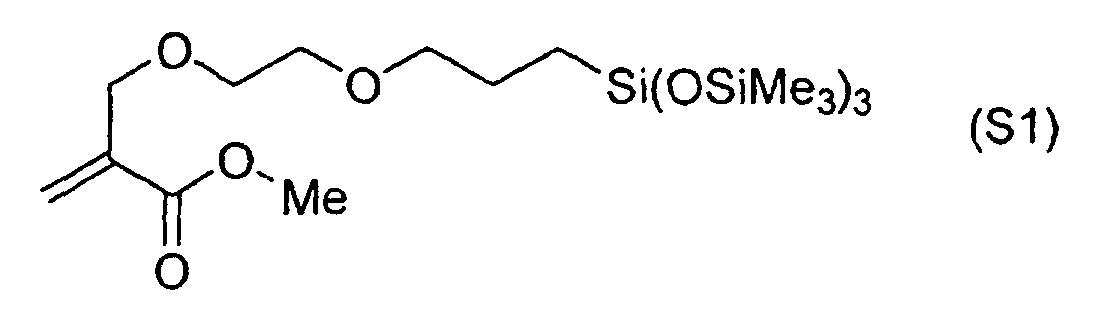
- the compound of formula (S1) see Synthesis 4, 67.5 parts by weight
- polyethylene glycol dimethacrylate PDE600
- diethylene glycol dimethyl ether 10 parts by weight
- the polymerization initiator "Darocure 1173” (manufactured by CIBA Specialty Chemicals Inc., 0.5 part by weight) were mixed to a homogeneous state and a monomer composition was obtained.
- This monomer composition was deaerated in an argon atmosphere.
- a contact lens was obtained by polymerization and post-treatment in exactly the same way as in Example 1 except that N-(3-methoxypropyl) acrylamide (see Synthesis 2) was used instead of N-(2-methoxyethyl) acrylamide.
- N-(3-methoxypropyl) acrylamide see Synthesis 2
- N-(2-methoxyethyl) acrylamide was used instead of N-(2-methoxyethyl) acrylamide.
- N-methoxymethyl acrylamide manufactured by KASANO KOSAN CORPORATION; 32.5 parts by weight
- the compound of formula (S1) see Synthesis 4, 67.5 parts by weight
- polyethylene glycol dimethacrylate (“PDE600,” manufactured by NOF CORPORATION; 1 part by weight)
- diethylene glycol dimethyl ether 10 parts by weight
- the polymerization initiator "Darocure 1173” manufactured by CIBA Specialty Chemicals Inc., 0.5 part by weight
- a contact lens was obtained by polymerization and post-treatment in exactly the same way as in Example 1 using this monomer composition. When the tensile elongation of the sample that was obtained was determined, a high value of 270% was found and the lens did not readily break.
- N,N-dimethyl acrylamide (32.5 parts by weight), the compound of formula (S1) (see Synthesis 4, 67.5 parts by weight), polyethylene glycol dimethacrylate (“PDE600,” manufactured by NOF CORPORATION; 1 part by weight), diethylene glycol dimethyl ether (10 parts by weight) and the polymerization initiator "Darocure 1173" (manufactured by CIBA Specialty Chemicals Inc., 0.5 part by weight) were mixed to a homogeneous state and a monomer composition was obtained.
- a contact lens was obtained by polymerization and post-treatment in exactly the same way as in Example 1 using this monomer composition. Determination of the tensile elongation of the sample that was obtained was attempted. However, it was extremely fragile and broke during handling so that determination of tensile elongation was not possible. That is, it was found that the lens was very easily broken.
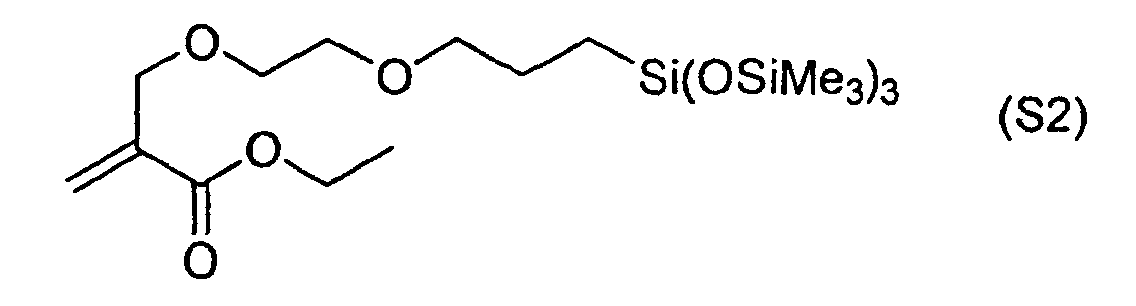
- N-[2-(2-methoxyethoxy)ethyl] acrylamide see Synthesis 3, 10 parts by weight), N,N-dimethylacrylamide (20 parts by weight), the compound of formula (S2) (see Synthesis 5, 70 parts by weight), triethylene glycol dimethacrylate (1 part by weight), diethylene glycol dimethyl ether (10 parts by weight) and the polymerization initiator "Darocure 1173" (manufactured by CIBA Specialty Chemicals Inc., 0.5 part by weight) were mixed to a homogeneous state and a monomer composition was obtained.
- a contact lens was obtained by polymerization and post-treatment in exactly the same way as in Example 1 using this monomer composition. When the tensile elongation of the sample that was obtained was determined, a high value of 610% was found and the lens did not readily break.
- N-N-dimethyl acrylamide (30 parts by weight), the compound of formula (S2) (see Synthesis 4, 70 parts by weight), triethylene glycol dimethacrylate (1 part by weight), diethylene glycol dimethyl ether (10 parts by weight) and the polymerization initiator "Darocure 1173" (manufactured by CIBA Specialty Chemicals Inc., 0.5 part by weight) were mixed to a homogeneous state and a monomer composition was obtained.
- a contact lens was obtained by polymerization and post-treatment in exactly the same way as in Example 1 using this monomer composition. Determination of the tensile elongation of the sample that was obtained was attempted. However, it was extremely fragile and broke during handling so that determination of tensile elongation was not possible. It was found that the lens was very breakable.
- N-(2-methoxyethyl) acrylamide see Synthesis 1, 10 parts by weight), N,N-dimethylacrylamide (20 parts by weight), the compound of formula (S1) (see Synthesis 5, 46.7 parts by weight), 3-acryloxypropyltris(trimethylsiloxy) silane (manufactured by Shin-Etsu Chemical Co., Ltd., 23.3 parts by weight), triethylene glycol dimethacrylate (1 part by weight), diethylene glycol dimethyl ether (10 parts by weight) and the polymerization initiator "Darocure 1173" (manufactured by CIBA Specialty Chemicals Inc., 0.5 part by weight) were mixed to a homogeneous state and a monomer composition was obtained.
- S1 see Synthesis 5, 46.7 parts by weight
- 3-acryloxypropyltris(trimethylsiloxy) silane manufactured by Shin-Etsu Chemical Co., Ltd., 23.3 parts by weight
- triethylene glycol dimethacrylate 1 part by weight
- a contact lens was obtained by polymerization and post-treatment in exactly the same way as in Example 1 using this monomer composition.
- a high value of 610% was found and the lens did not readily break.
- N-N-dimethyl acrylamide (30 parts by weight), the compound of formula (S1) (see Synthesis 5, 46.7 parts by weight), 3-acryloxypropyltris(trimethylsiloxy) silane (manufactured by Shin-Etsu Chemicals Co., Ltd., 23.3 parts by weight), triethylene glycol dimethacrylate (1 part by weight), diethylene glycol dimethyl ether (10 parts by weight) and the polymerization initiator "Darocure 1173" (manufactured by CIBA Specialty Chemicals Inc., 0.5 part by weight) were mixed to a homogeneous state and a monomer composition was obtained.
- a contact lens was obtained by polymerization and post-treatment in exactly the same way as in Example 1 using this monomer composition. When the tensile elongation of the sample that was obtained was determined, it was found to be a low value of 12% and the sample broke easily.
- ophthalmic lenses in particular, contact lenses, of high tensile elongation (i.e., that do not break readily) are obtained.
Landscapes
- Chemical & Material Sciences (AREA)
- Health & Medical Sciences (AREA)
- Chemical Kinetics & Catalysis (AREA)
- Medicinal Chemistry (AREA)
- Polymers & Plastics (AREA)
- Organic Chemistry (AREA)
- Physics & Mathematics (AREA)
- General Physics & Mathematics (AREA)
- Optics & Photonics (AREA)
- Addition Polymer Or Copolymer, Post-Treatments, Or Chemical Modifications (AREA)
- Eyeglasses (AREA)
- Materials For Medical Uses (AREA)
Abstract

Description



















Claims (5)
- An ophthalmic lens comprising, as a polymerization component, monomers represented by formula (a) below:wherein, in formula (a), R1 is H or a methyl group; R2 is a group that is selected from alkyl groups with 1 to 8 carbon atoms, aralkyl groups with 7 to 12 carbon atoms and aryl groups with 6 to 10 carbon atoms; L1 is a substituent that is selected from ethylene groups, 1,2-propylene groups, 1,3-propylene groups and 1,4-butylene groups; and L2 is a substituent that is selected from methylene groups, ethylene groups, 1,2-propylene groups, 1,3-propylene groups and 1,4-butylene groups.
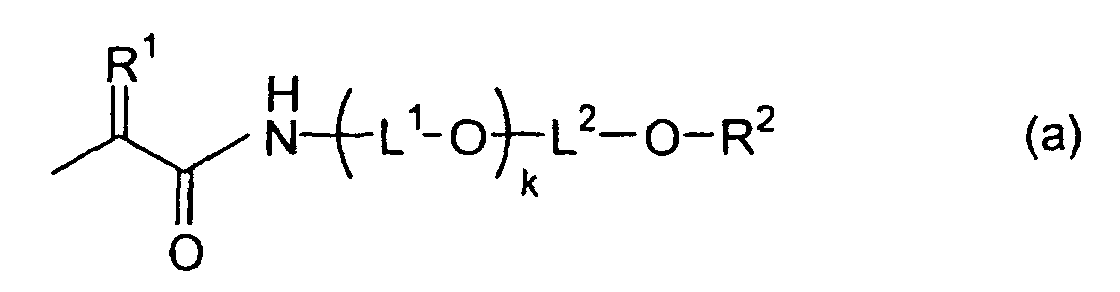
- The ophthalmic lens of claim 1 wherein, refer to formula (a), R2 is a methyl group or an ethyl group, k is an integer of 0 or 1, L1 is an ethylene group and L2 is a substituent that is selected from methylene groups, ethylene groups and 1,3-propylene groups.
- The ophthalmic lens of claim 2 wherein R1 in formula (a) is H.
- The ophthalmic lens of claim 1 that further comprises the monomers of formula (a) and siloxanyl monomers as polymerization components.
- The ophthalmic lens of claim 1 in which the ophthalmic lens is a contact lens.
Applications Claiming Priority (1)
| Application Number | Priority Date | Filing Date | Title |
|---|---|---|---|
| PCT/JP2001/007390 WO2003021337A1 (en) | 2000-03-03 | 2001-08-28 | Ocular lens |
Publications (3)
| Publication Number | Publication Date |
|---|---|
| EP1445641A1 true EP1445641A1 (en) | 2004-08-11 |
| EP1445641A4 EP1445641A4 (en) | 2005-04-27 |
| EP1445641B1 EP1445641B1 (en) | 2007-10-03 |
Family
ID=32652498
Family Applications (1)
| Application Number | Title | Priority Date | Filing Date |
|---|---|---|---|
| EP01958580A Expired - Lifetime EP1445641B1 (en) | 2001-08-28 | 2001-08-28 | Ocular lens |
Country Status (5)
| Country | Link |
|---|---|
| EP (1) | EP1445641B1 (en) |
| AU (1) | AU2001280213B2 (en) |
| DE (1) | DE60130812T2 (en) |
| DK (1) | DK1445641T3 (en) |
| WO (1) | WO2003021337A1 (en) |
Families Citing this family (4)
| Publication number | Priority date | Publication date | Assignee | Title |
|---|---|---|---|---|
| US7052131B2 (en) | 2001-09-10 | 2006-05-30 | J&J Vision Care, Inc. | Biomedical devices containing internal wetting agents |
| US7461937B2 (en) | 2001-09-10 | 2008-12-09 | Johnson & Johnson Vision Care, Inc. | Soft contact lenses displaying superior on-eye comfort |
| US6822016B2 (en) | 2001-09-10 | 2004-11-23 | Johnson & Johnson Vision Care, Inc. | Biomedical devices containing internal wetting agents |
| JP4718766B2 (en) * | 2003-06-03 | 2011-07-06 | テルモ株式会社 | Blood filter |
Family Cites Families (7)
| Publication number | Priority date | Publication date | Assignee | Title |
|---|---|---|---|---|
| GB1494641A (en) * | 1974-07-04 | 1977-12-07 | Smith & Nephew Res | Cross-linked hydrogel copolymer |
| FR2402525A1 (en) * | 1977-09-12 | 1979-04-06 | Toray Industries | PROCESS FOR MANUFACTURING COMPOSITIONS OF SOFT CONTACT LENSES AND NEW PRODUCTS THUS OBTAINED |
| JPS60190424A (en) * | 1984-03-13 | 1985-09-27 | Mitsui Toatsu Chem Inc | Unsaturated amide-substituted polyoxyalkylene and its production |
| WO1992007013A1 (en) * | 1990-10-11 | 1992-04-30 | Permeable Technologies, Inc. | Novel silicone-containing polymers and oxygen permeable hydrophilic contact lenses therefrom |
| JP4859004B2 (en) * | 1999-06-23 | 2012-01-18 | 東レ株式会社 | Polymers and contact lenses for contact lenses, intraocular lenses or artificial corneas |
| JP4524838B2 (en) * | 2000-02-07 | 2010-08-18 | 東レ株式会社 | Ophthalmic lens |
| JP4273612B2 (en) * | 2000-03-03 | 2009-06-03 | 東レ株式会社 | Ophthalmic lens |
-
2001
- 2001-08-28 DK DK01958580T patent/DK1445641T3/en active
- 2001-08-28 DE DE60130812T patent/DE60130812T2/en not_active Expired - Lifetime
- 2001-08-28 WO PCT/JP2001/007390 patent/WO2003021337A1/en not_active Ceased
- 2001-08-28 AU AU2001280213A patent/AU2001280213B2/en not_active Ceased
- 2001-08-28 EP EP01958580A patent/EP1445641B1/en not_active Expired - Lifetime
Non-Patent Citations (2)
| Title |
|---|
| No further relevant documents disclosed * |
| See also references of WO03021337A1 * |
Also Published As
| Publication number | Publication date |
|---|---|
| WO2003021337A1 (en) | 2003-03-13 |
| DK1445641T3 (en) | 2008-02-04 |
| AU2001280213B2 (en) | 2007-04-26 |
| DE60130812T2 (en) | 2008-07-03 |
| DE60130812D1 (en) | 2007-11-15 |
| EP1445641B1 (en) | 2007-10-03 |
| EP1445641A4 (en) | 2005-04-27 |
Similar Documents
| Publication | Publication Date | Title |
|---|---|---|
| AU2001292336B2 (en) | Monomer, polymer, and ocular lens comprising the same | |
| AU2002236279B2 (en) | Monomer, polymer, and ocular lens and contact lens each obtained therefrom | |
| US7329694B2 (en) | Ocular lens | |
| HK1065548A (en) | Monomers, polymers and ophthalmic lenses | |
| EP1403296B1 (en) | Monomers, polymers, and ophthalmic lenses and contact lenses made by using the same | |
| US20040198938A1 (en) | Monomers, polymers and ophthalmic lenses | |
| EP1354898B1 (en) | Monomer composition, polymer obtained therefrom, and ocular lens | |
| JP4882136B2 (en) | Monomer, polymer and ophthalmic lens using the same | |
| JP4144088B2 (en) | Contact lens polymer and contact lens using the same | |
| EP1424339A1 (en) | Monomers, polymers and ophthalmic lenses | |
| EP1445641B1 (en) | Ocular lens | |
| US7390863B2 (en) | Polymeric materials having enhanced ion and water transport property and medical devices comprising same | |
| JP5051808B2 (en) | Plastic molded product and contact lens comprising the same | |
| HK1066601A (en) | Ocular lens | |
| JP4859004B2 (en) | Polymers and contact lenses for contact lenses, intraocular lenses or artificial corneas | |
| JP4622071B2 (en) | Monomers, polymers, ophthalmic lenses and contact lenses | |
| JP4783963B2 (en) | Ophthalmic lens | |
| JP4103174B2 (en) | Method for producing polymer for ophthalmic lens | |
| JP4882137B2 (en) | Ophthalmic lens | |
| JP2002363220A (en) | Monomer, polymer, ophthalmic lens and contact lens using the same | |
| HK1066013A (en) | Monomer, polymer, and ocular lens comprising the same | |
| HK1064393A (en) | Monomers, polymers, and ophthalmic lenses and contact lenses made by using the same |
Legal Events
| Date | Code | Title | Description |
|---|---|---|---|
| PUAI | Public reference made under article 153(3) epc to a published international application that has entered the european phase |
Free format text: ORIGINAL CODE: 0009012 |
|
| 17P | Request for examination filed |
Effective date: 20040329 |
|
| AK | Designated contracting states |
Kind code of ref document: A1 Designated state(s): AT BE CH CY DE DK ES FI FR GB GR IE IT LI LU MC NL PT SE TR |
|
| REG | Reference to a national code |
Ref country code: HK Ref legal event code: DE Ref document number: 1066601 Country of ref document: HK |
|
| A4 | Supplementary search report drawn up and despatched |
Effective date: 20050311 |
|
| GRAP | Despatch of communication of intention to grant a patent |
Free format text: ORIGINAL CODE: EPIDOSNIGR1 |
|
| GRAS | Grant fee paid |
Free format text: ORIGINAL CODE: EPIDOSNIGR3 |
|
| GRAA | (expected) grant |
Free format text: ORIGINAL CODE: 0009210 |
|
| AK | Designated contracting states |
Kind code of ref document: B1 Designated state(s): DE DK FR GB IE IT |
|
| REG | Reference to a national code |
Ref country code: GB Ref legal event code: FG4D |
|
| REG | Reference to a national code |
Ref country code: IE Ref legal event code: FG4D |
|
| REF | Corresponds to: |
Ref document number: 60130812 Country of ref document: DE Date of ref document: 20071115 Kind code of ref document: P |
|
| REG | Reference to a national code |
Ref country code: DK Ref legal event code: T3 |
|
| ET | Fr: translation filed | ||
| PLBE | No opposition filed within time limit |
Free format text: ORIGINAL CODE: 0009261 |
|
| STAA | Information on the status of an ep patent application or granted ep patent |
Free format text: STATUS: NO OPPOSITION FILED WITHIN TIME LIMIT |
|
| 26N | No opposition filed |
Effective date: 20080704 |
|
| REG | Reference to a national code |
Ref country code: HK Ref legal event code: WD Ref document number: 1066601 Country of ref document: HK |
|
| PGFP | Annual fee paid to national office [announced via postgrant information from national office to epo] |
Ref country code: DK Payment date: 20110810 Year of fee payment: 11 |
|
| PGFP | Annual fee paid to national office [announced via postgrant information from national office to epo] |
Ref country code: GB Payment date: 20120822 Year of fee payment: 12 Ref country code: IE Payment date: 20120810 Year of fee payment: 12 |
|
| PGFP | Annual fee paid to national office [announced via postgrant information from national office to epo] |
Ref country code: FR Payment date: 20120823 Year of fee payment: 12 Ref country code: DE Payment date: 20120822 Year of fee payment: 12 Ref country code: IT Payment date: 20120813 Year of fee payment: 12 |
|
| REG | Reference to a national code |
Ref country code: DK Ref legal event code: EBP Effective date: 20130831 |
|
| GBPC | Gb: european patent ceased through non-payment of renewal fee |
Effective date: 20130828 |
|
| PG25 | Lapsed in a contracting state [announced via postgrant information from national office to epo] |
Ref country code: DE Free format text: LAPSE BECAUSE OF NON-PAYMENT OF DUE FEES Effective date: 20140301 |
|
| REG | Reference to a national code |
Ref country code: IE Ref legal event code: MM4A |
|
| REG | Reference to a national code |
Ref country code: DE Ref legal event code: R119 Ref document number: 60130812 Country of ref document: DE Effective date: 20140301 |
|
| REG | Reference to a national code |
Ref country code: FR Ref legal event code: ST Effective date: 20140430 |
|
| PG25 | Lapsed in a contracting state [announced via postgrant information from national office to epo] |
Ref country code: IT Free format text: LAPSE BECAUSE OF NON-PAYMENT OF DUE FEES Effective date: 20130828 |
|
| PG25 | Lapsed in a contracting state [announced via postgrant information from national office to epo] |
Ref country code: IE Free format text: LAPSE BECAUSE OF NON-PAYMENT OF DUE FEES Effective date: 20130828 Ref country code: GB Free format text: LAPSE BECAUSE OF NON-PAYMENT OF DUE FEES Effective date: 20130828 |
|
| PG25 | Lapsed in a contracting state [announced via postgrant information from national office to epo] |
Ref country code: FR Free format text: LAPSE BECAUSE OF NON-PAYMENT OF DUE FEES Effective date: 20130902 |
|
| PG25 | Lapsed in a contracting state [announced via postgrant information from national office to epo] |
Ref country code: DK Free format text: LAPSE BECAUSE OF NON-PAYMENT OF DUE FEES Effective date: 20130831 |