EP1445295A1 - Sialon-based oxynitride phosphor, process for its production, and use thereof - Google Patents
Sialon-based oxynitride phosphor, process for its production, and use thereof Download PDFInfo
- Publication number
- EP1445295A1 EP1445295A1 EP04002508A EP04002508A EP1445295A1 EP 1445295 A1 EP1445295 A1 EP 1445295A1 EP 04002508 A EP04002508 A EP 04002508A EP 04002508 A EP04002508 A EP 04002508A EP 1445295 A1 EP1445295 A1 EP 1445295A1
- Authority
- EP
- European Patent Office
- Prior art keywords
- sialon
- metal
- powder
- lanthanide
- nitrogen
- Prior art date
- Legal status (The legal status is an assumption and is not a legal conclusion. Google has not performed a legal analysis and makes no representation as to the accuracy of the status listed.)
- Withdrawn
Links
Images


Classifications
-
- C—CHEMISTRY; METALLURGY
- C04—CEMENTS; CONCRETE; ARTIFICIAL STONE; CERAMICS; REFRACTORIES
- C04B—LIME, MAGNESIA; SLAG; CEMENTS; COMPOSITIONS THEREOF, e.g. MORTARS, CONCRETE OR LIKE BUILDING MATERIALS; ARTIFICIAL STONE; CERAMICS; REFRACTORIES; TREATMENT OF NATURAL STONE
- C04B35/00—Shaped ceramic products characterised by their composition; Ceramics compositions; Processing powders of inorganic compounds preparatory to the manufacturing of ceramic products
- C04B35/515—Shaped ceramic products characterised by their composition; Ceramics compositions; Processing powders of inorganic compounds preparatory to the manufacturing of ceramic products based on non-oxide ceramics
- C04B35/58—Shaped ceramic products characterised by their composition; Ceramics compositions; Processing powders of inorganic compounds preparatory to the manufacturing of ceramic products based on non-oxide ceramics based on borides, nitrides, i.e. nitrides, oxynitrides, carbonitrides or oxycarbonitrides or silicides
- C04B35/597—Shaped ceramic products characterised by their composition; Ceramics compositions; Processing powders of inorganic compounds preparatory to the manufacturing of ceramic products based on non-oxide ceramics based on borides, nitrides, i.e. nitrides, oxynitrides, carbonitrides or oxycarbonitrides or silicides based on silicon oxynitride, e.g. SIALONS
-
- C—CHEMISTRY; METALLURGY
- C04—CEMENTS; CONCRETE; ARTIFICIAL STONE; CERAMICS; REFRACTORIES
- C04B—LIME, MAGNESIA; SLAG; CEMENTS; COMPOSITIONS THEREOF, e.g. MORTARS, CONCRETE OR LIKE BUILDING MATERIALS; ARTIFICIAL STONE; CERAMICS; REFRACTORIES; TREATMENT OF NATURAL STONE
- C04B35/00—Shaped ceramic products characterised by their composition; Ceramics compositions; Processing powders of inorganic compounds preparatory to the manufacturing of ceramic products
- C04B35/622—Forming processes; Processing powders of inorganic compounds preparatory to the manufacturing of ceramic products
- C04B35/626—Preparing or treating the powders individually or as batches ; preparing or treating macroscopic reinforcing agents for ceramic products, e.g. fibres; mechanical aspects section B
- C04B35/63—Preparing or treating the powders individually or as batches ; preparing or treating macroscopic reinforcing agents for ceramic products, e.g. fibres; mechanical aspects section B using additives specially adapted for forming the products, e.g.. binder binders
- C04B35/6303—Inorganic additives
-
- C—CHEMISTRY; METALLURGY
- C09—DYES; PAINTS; POLISHES; NATURAL RESINS; ADHESIVES; COMPOSITIONS NOT OTHERWISE PROVIDED FOR; APPLICATIONS OF MATERIALS NOT OTHERWISE PROVIDED FOR
- C09K—MATERIALS FOR MISCELLANEOUS APPLICATIONS, NOT PROVIDED FOR ELSEWHERE
- C09K11/00—Luminescent materials, e.g. electroluminescent or chemiluminescent
- C09K11/08—Luminescent materials, e.g. electroluminescent or chemiluminescent containing inorganic luminescent materials
- C09K11/0883—Arsenides; Nitrides; Phosphides
-
- C—CHEMISTRY; METALLURGY
- C09—DYES; PAINTS; POLISHES; NATURAL RESINS; ADHESIVES; COMPOSITIONS NOT OTHERWISE PROVIDED FOR; APPLICATIONS OF MATERIALS NOT OTHERWISE PROVIDED FOR
- C09K—MATERIALS FOR MISCELLANEOUS APPLICATIONS, NOT PROVIDED FOR ELSEWHERE
- C09K11/00—Luminescent materials, e.g. electroluminescent or chemiluminescent
- C09K11/08—Luminescent materials, e.g. electroluminescent or chemiluminescent containing inorganic luminescent materials
- C09K11/77—Luminescent materials, e.g. electroluminescent or chemiluminescent containing inorganic luminescent materials containing rare earth metals
- C09K11/77068—Silicon Aluminium Nitrides or Silicon Aluminium Oxynitrides
-
- C—CHEMISTRY; METALLURGY
- C09—DYES; PAINTS; POLISHES; NATURAL RESINS; ADHESIVES; COMPOSITIONS NOT OTHERWISE PROVIDED FOR; APPLICATIONS OF MATERIALS NOT OTHERWISE PROVIDED FOR
- C09K—MATERIALS FOR MISCELLANEOUS APPLICATIONS, NOT PROVIDED FOR ELSEWHERE
- C09K11/00—Luminescent materials, e.g. electroluminescent or chemiluminescent
- C09K11/08—Luminescent materials, e.g. electroluminescent or chemiluminescent containing inorganic luminescent materials
- C09K11/77—Luminescent materials, e.g. electroluminescent or chemiluminescent containing inorganic luminescent materials containing rare earth metals
- C09K11/7715—Luminescent materials, e.g. electroluminescent or chemiluminescent containing inorganic luminescent materials containing rare earth metals containing cerium
- C09K11/77218—Silicon Aluminium Nitrides or Silicon Aluminium Oxynitrides
-
- C—CHEMISTRY; METALLURGY
- C09—DYES; PAINTS; POLISHES; NATURAL RESINS; ADHESIVES; COMPOSITIONS NOT OTHERWISE PROVIDED FOR; APPLICATIONS OF MATERIALS NOT OTHERWISE PROVIDED FOR
- C09K—MATERIALS FOR MISCELLANEOUS APPLICATIONS, NOT PROVIDED FOR ELSEWHERE
- C09K11/00—Luminescent materials, e.g. electroluminescent or chemiluminescent
- C09K11/08—Luminescent materials, e.g. electroluminescent or chemiluminescent containing inorganic luminescent materials
- C09K11/77—Luminescent materials, e.g. electroluminescent or chemiluminescent containing inorganic luminescent materials containing rare earth metals
- C09K11/7728—Luminescent materials, e.g. electroluminescent or chemiluminescent containing inorganic luminescent materials containing rare earth metals containing europium
- C09K11/77348—Silicon Aluminium Nitrides or Silicon Aluminium Oxynitrides
-
- C—CHEMISTRY; METALLURGY
- C09—DYES; PAINTS; POLISHES; NATURAL RESINS; ADHESIVES; COMPOSITIONS NOT OTHERWISE PROVIDED FOR; APPLICATIONS OF MATERIALS NOT OTHERWISE PROVIDED FOR
- C09K—MATERIALS FOR MISCELLANEOUS APPLICATIONS, NOT PROVIDED FOR ELSEWHERE
- C09K11/00—Luminescent materials, e.g. electroluminescent or chemiluminescent
- C09K11/08—Luminescent materials, e.g. electroluminescent or chemiluminescent containing inorganic luminescent materials
- C09K11/77—Luminescent materials, e.g. electroluminescent or chemiluminescent containing inorganic luminescent materials containing rare earth metals
- C09K11/7743—Luminescent materials, e.g. electroluminescent or chemiluminescent containing inorganic luminescent materials containing rare earth metals containing terbium
- C09K11/77498—Silicon Aluminium Nitrides or Silicon Aluminium Oxynitrides
-
- C—CHEMISTRY; METALLURGY
- C09—DYES; PAINTS; POLISHES; NATURAL RESINS; ADHESIVES; COMPOSITIONS NOT OTHERWISE PROVIDED FOR; APPLICATIONS OF MATERIALS NOT OTHERWISE PROVIDED FOR
- C09K—MATERIALS FOR MISCELLANEOUS APPLICATIONS, NOT PROVIDED FOR ELSEWHERE
- C09K11/00—Luminescent materials, e.g. electroluminescent or chemiluminescent
- C09K11/08—Luminescent materials, e.g. electroluminescent or chemiluminescent containing inorganic luminescent materials
- C09K11/77—Luminescent materials, e.g. electroluminescent or chemiluminescent containing inorganic luminescent materials containing rare earth metals
- C09K11/7766—Luminescent materials, e.g. electroluminescent or chemiluminescent containing inorganic luminescent materials containing rare earth metals containing two or more rare earth metals
- C09K11/77748—Silicon Aluminium Nitrides or Silicon Aluminium Oxynitrides
-
- C—CHEMISTRY; METALLURGY
- C04—CEMENTS; CONCRETE; ARTIFICIAL STONE; CERAMICS; REFRACTORIES
- C04B—LIME, MAGNESIA; SLAG; CEMENTS; COMPOSITIONS THEREOF, e.g. MORTARS, CONCRETE OR LIKE BUILDING MATERIALS; ARTIFICIAL STONE; CERAMICS; REFRACTORIES; TREATMENT OF NATURAL STONE
- C04B2235/00—Aspects relating to ceramic starting mixtures or sintered ceramic products
- C04B2235/02—Composition of constituents of the starting material or of secondary phases of the final product
- C04B2235/30—Constituents and secondary phases not being of a fibrous nature
- C04B2235/32—Metal oxides, mixed metal oxides, or oxide-forming salts thereof, e.g. carbonates, nitrates, (oxy)hydroxides, chlorides
- C04B2235/3205—Alkaline earth oxides or oxide forming salts thereof, e.g. beryllium oxide
- C04B2235/3206—Magnesium oxides or oxide-forming salts thereof
-
- C—CHEMISTRY; METALLURGY
- C04—CEMENTS; CONCRETE; ARTIFICIAL STONE; CERAMICS; REFRACTORIES
- C04B—LIME, MAGNESIA; SLAG; CEMENTS; COMPOSITIONS THEREOF, e.g. MORTARS, CONCRETE OR LIKE BUILDING MATERIALS; ARTIFICIAL STONE; CERAMICS; REFRACTORIES; TREATMENT OF NATURAL STONE
- C04B2235/00—Aspects relating to ceramic starting mixtures or sintered ceramic products
- C04B2235/02—Composition of constituents of the starting material or of secondary phases of the final product
- C04B2235/30—Constituents and secondary phases not being of a fibrous nature
- C04B2235/32—Metal oxides, mixed metal oxides, or oxide-forming salts thereof, e.g. carbonates, nitrates, (oxy)hydroxides, chlorides
- C04B2235/3205—Alkaline earth oxides or oxide forming salts thereof, e.g. beryllium oxide
- C04B2235/3208—Calcium oxide or oxide-forming salts thereof, e.g. lime
-
- C—CHEMISTRY; METALLURGY
- C04—CEMENTS; CONCRETE; ARTIFICIAL STONE; CERAMICS; REFRACTORIES
- C04B—LIME, MAGNESIA; SLAG; CEMENTS; COMPOSITIONS THEREOF, e.g. MORTARS, CONCRETE OR LIKE BUILDING MATERIALS; ARTIFICIAL STONE; CERAMICS; REFRACTORIES; TREATMENT OF NATURAL STONE
- C04B2235/00—Aspects relating to ceramic starting mixtures or sintered ceramic products
- C04B2235/02—Composition of constituents of the starting material or of secondary phases of the final product
- C04B2235/30—Constituents and secondary phases not being of a fibrous nature
- C04B2235/32—Metal oxides, mixed metal oxides, or oxide-forming salts thereof, e.g. carbonates, nitrates, (oxy)hydroxides, chlorides
- C04B2235/3224—Rare earth oxide or oxide forming salts thereof, e.g. scandium oxide
-
- C—CHEMISTRY; METALLURGY
- C04—CEMENTS; CONCRETE; ARTIFICIAL STONE; CERAMICS; REFRACTORIES
- C04B—LIME, MAGNESIA; SLAG; CEMENTS; COMPOSITIONS THEREOF, e.g. MORTARS, CONCRETE OR LIKE BUILDING MATERIALS; ARTIFICIAL STONE; CERAMICS; REFRACTORIES; TREATMENT OF NATURAL STONE
- C04B2235/00—Aspects relating to ceramic starting mixtures or sintered ceramic products
- C04B2235/02—Composition of constituents of the starting material or of secondary phases of the final product
- C04B2235/30—Constituents and secondary phases not being of a fibrous nature
- C04B2235/32—Metal oxides, mixed metal oxides, or oxide-forming salts thereof, e.g. carbonates, nitrates, (oxy)hydroxides, chlorides
- C04B2235/3224—Rare earth oxide or oxide forming salts thereof, e.g. scandium oxide
- C04B2235/3225—Yttrium oxide or oxide-forming salts thereof
-
- C—CHEMISTRY; METALLURGY
- C04—CEMENTS; CONCRETE; ARTIFICIAL STONE; CERAMICS; REFRACTORIES
- C04B—LIME, MAGNESIA; SLAG; CEMENTS; COMPOSITIONS THEREOF, e.g. MORTARS, CONCRETE OR LIKE BUILDING MATERIALS; ARTIFICIAL STONE; CERAMICS; REFRACTORIES; TREATMENT OF NATURAL STONE
- C04B2235/00—Aspects relating to ceramic starting mixtures or sintered ceramic products
- C04B2235/02—Composition of constituents of the starting material or of secondary phases of the final product
- C04B2235/30—Constituents and secondary phases not being of a fibrous nature
- C04B2235/32—Metal oxides, mixed metal oxides, or oxide-forming salts thereof, e.g. carbonates, nitrates, (oxy)hydroxides, chlorides
- C04B2235/3224—Rare earth oxide or oxide forming salts thereof, e.g. scandium oxide
- C04B2235/3229—Cerium oxides or oxide-forming salts thereof
-
- C—CHEMISTRY; METALLURGY
- C04—CEMENTS; CONCRETE; ARTIFICIAL STONE; CERAMICS; REFRACTORIES
- C04B—LIME, MAGNESIA; SLAG; CEMENTS; COMPOSITIONS THEREOF, e.g. MORTARS, CONCRETE OR LIKE BUILDING MATERIALS; ARTIFICIAL STONE; CERAMICS; REFRACTORIES; TREATMENT OF NATURAL STONE
- C04B2235/00—Aspects relating to ceramic starting mixtures or sintered ceramic products
- C04B2235/02—Composition of constituents of the starting material or of secondary phases of the final product
- C04B2235/30—Constituents and secondary phases not being of a fibrous nature
- C04B2235/38—Non-oxide ceramic constituents or additives
- C04B2235/3852—Nitrides, e.g. oxynitrides, carbonitrides, oxycarbonitrides, lithium nitride, magnesium nitride
- C04B2235/3865—Aluminium nitrides
-
- C—CHEMISTRY; METALLURGY
- C04—CEMENTS; CONCRETE; ARTIFICIAL STONE; CERAMICS; REFRACTORIES
- C04B—LIME, MAGNESIA; SLAG; CEMENTS; COMPOSITIONS THEREOF, e.g. MORTARS, CONCRETE OR LIKE BUILDING MATERIALS; ARTIFICIAL STONE; CERAMICS; REFRACTORIES; TREATMENT OF NATURAL STONE
- C04B2235/00—Aspects relating to ceramic starting mixtures or sintered ceramic products
- C04B2235/02—Composition of constituents of the starting material or of secondary phases of the final product
- C04B2235/30—Constituents and secondary phases not being of a fibrous nature
- C04B2235/38—Non-oxide ceramic constituents or additives
- C04B2235/3852—Nitrides, e.g. oxynitrides, carbonitrides, oxycarbonitrides, lithium nitride, magnesium nitride
- C04B2235/3865—Aluminium nitrides
- C04B2235/3869—Aluminium oxynitrides, e.g. AlON, sialon
-
- C—CHEMISTRY; METALLURGY
- C04—CEMENTS; CONCRETE; ARTIFICIAL STONE; CERAMICS; REFRACTORIES
- C04B—LIME, MAGNESIA; SLAG; CEMENTS; COMPOSITIONS THEREOF, e.g. MORTARS, CONCRETE OR LIKE BUILDING MATERIALS; ARTIFICIAL STONE; CERAMICS; REFRACTORIES; TREATMENT OF NATURAL STONE
- C04B2235/00—Aspects relating to ceramic starting mixtures or sintered ceramic products
- C04B2235/02—Composition of constituents of the starting material or of secondary phases of the final product
- C04B2235/30—Constituents and secondary phases not being of a fibrous nature
- C04B2235/38—Non-oxide ceramic constituents or additives
- C04B2235/3852—Nitrides, e.g. oxynitrides, carbonitrides, oxycarbonitrides, lithium nitride, magnesium nitride
- C04B2235/3873—Silicon nitrides, e.g. silicon carbonitride, silicon oxynitride
-
- C—CHEMISTRY; METALLURGY
- C04—CEMENTS; CONCRETE; ARTIFICIAL STONE; CERAMICS; REFRACTORIES
- C04B—LIME, MAGNESIA; SLAG; CEMENTS; COMPOSITIONS THEREOF, e.g. MORTARS, CONCRETE OR LIKE BUILDING MATERIALS; ARTIFICIAL STONE; CERAMICS; REFRACTORIES; TREATMENT OF NATURAL STONE
- C04B2235/00—Aspects relating to ceramic starting mixtures or sintered ceramic products
- C04B2235/02—Composition of constituents of the starting material or of secondary phases of the final product
- C04B2235/30—Constituents and secondary phases not being of a fibrous nature
- C04B2235/38—Non-oxide ceramic constituents or additives
- C04B2235/3852—Nitrides, e.g. oxynitrides, carbonitrides, oxycarbonitrides, lithium nitride, magnesium nitride
- C04B2235/3873—Silicon nitrides, e.g. silicon carbonitride, silicon oxynitride
- C04B2235/3878—Alpha silicon nitrides
-
- C—CHEMISTRY; METALLURGY
- C04—CEMENTS; CONCRETE; ARTIFICIAL STONE; CERAMICS; REFRACTORIES
- C04B—LIME, MAGNESIA; SLAG; CEMENTS; COMPOSITIONS THEREOF, e.g. MORTARS, CONCRETE OR LIKE BUILDING MATERIALS; ARTIFICIAL STONE; CERAMICS; REFRACTORIES; TREATMENT OF NATURAL STONE
- C04B2235/00—Aspects relating to ceramic starting mixtures or sintered ceramic products
- C04B2235/02—Composition of constituents of the starting material or of secondary phases of the final product
- C04B2235/30—Constituents and secondary phases not being of a fibrous nature
- C04B2235/38—Non-oxide ceramic constituents or additives
- C04B2235/3895—Non-oxides with a defined oxygen content, e.g. SiOC, TiON
-
- C—CHEMISTRY; METALLURGY
- C04—CEMENTS; CONCRETE; ARTIFICIAL STONE; CERAMICS; REFRACTORIES
- C04B—LIME, MAGNESIA; SLAG; CEMENTS; COMPOSITIONS THEREOF, e.g. MORTARS, CONCRETE OR LIKE BUILDING MATERIALS; ARTIFICIAL STONE; CERAMICS; REFRACTORIES; TREATMENT OF NATURAL STONE
- C04B2235/00—Aspects relating to ceramic starting mixtures or sintered ceramic products
- C04B2235/02—Composition of constituents of the starting material or of secondary phases of the final product
- C04B2235/30—Constituents and secondary phases not being of a fibrous nature
- C04B2235/48—Organic compounds becoming part of a ceramic after heat treatment, e.g. carbonising phenol resins
- C04B2235/483—Si-containing organic compounds, e.g. silicone resins, (poly)silanes, (poly)siloxanes or (poly)silazanes
-
- C—CHEMISTRY; METALLURGY
- C04—CEMENTS; CONCRETE; ARTIFICIAL STONE; CERAMICS; REFRACTORIES
- C04B—LIME, MAGNESIA; SLAG; CEMENTS; COMPOSITIONS THEREOF, e.g. MORTARS, CONCRETE OR LIKE BUILDING MATERIALS; ARTIFICIAL STONE; CERAMICS; REFRACTORIES; TREATMENT OF NATURAL STONE
- C04B2235/00—Aspects relating to ceramic starting mixtures or sintered ceramic products
- C04B2235/02—Composition of constituents of the starting material or of secondary phases of the final product
- C04B2235/50—Constituents or additives of the starting mixture chosen for their shape or used because of their shape or their physical appearance
- C04B2235/52—Constituents or additives characterised by their shapes
- C04B2235/528—Spheres
-
- C—CHEMISTRY; METALLURGY
- C04—CEMENTS; CONCRETE; ARTIFICIAL STONE; CERAMICS; REFRACTORIES
- C04B—LIME, MAGNESIA; SLAG; CEMENTS; COMPOSITIONS THEREOF, e.g. MORTARS, CONCRETE OR LIKE BUILDING MATERIALS; ARTIFICIAL STONE; CERAMICS; REFRACTORIES; TREATMENT OF NATURAL STONE
- C04B2235/00—Aspects relating to ceramic starting mixtures or sintered ceramic products
- C04B2235/02—Composition of constituents of the starting material or of secondary phases of the final product
- C04B2235/50—Constituents or additives of the starting mixture chosen for their shape or used because of their shape or their physical appearance
- C04B2235/54—Particle size related information
- C04B2235/5409—Particle size related information expressed by specific surface values
-
- C—CHEMISTRY; METALLURGY
- C04—CEMENTS; CONCRETE; ARTIFICIAL STONE; CERAMICS; REFRACTORIES
- C04B—LIME, MAGNESIA; SLAG; CEMENTS; COMPOSITIONS THEREOF, e.g. MORTARS, CONCRETE OR LIKE BUILDING MATERIALS; ARTIFICIAL STONE; CERAMICS; REFRACTORIES; TREATMENT OF NATURAL STONE
- C04B2235/00—Aspects relating to ceramic starting mixtures or sintered ceramic products
- C04B2235/02—Composition of constituents of the starting material or of secondary phases of the final product
- C04B2235/50—Constituents or additives of the starting mixture chosen for their shape or used because of their shape or their physical appearance
- C04B2235/54—Particle size related information
- C04B2235/5418—Particle size related information expressed by the size of the particles or aggregates thereof
- C04B2235/5436—Particle size related information expressed by the size of the particles or aggregates thereof micrometer sized, i.e. from 1 to 100 micron
-
- C—CHEMISTRY; METALLURGY
- C04—CEMENTS; CONCRETE; ARTIFICIAL STONE; CERAMICS; REFRACTORIES
- C04B—LIME, MAGNESIA; SLAG; CEMENTS; COMPOSITIONS THEREOF, e.g. MORTARS, CONCRETE OR LIKE BUILDING MATERIALS; ARTIFICIAL STONE; CERAMICS; REFRACTORIES; TREATMENT OF NATURAL STONE
- C04B2235/00—Aspects relating to ceramic starting mixtures or sintered ceramic products
- C04B2235/02—Composition of constituents of the starting material or of secondary phases of the final product
- C04B2235/50—Constituents or additives of the starting mixture chosen for their shape or used because of their shape or their physical appearance
- C04B2235/54—Particle size related information
- C04B2235/5463—Particle size distributions
- C04B2235/5481—Monomodal
-
- C—CHEMISTRY; METALLURGY
- C04—CEMENTS; CONCRETE; ARTIFICIAL STONE; CERAMICS; REFRACTORIES
- C04B—LIME, MAGNESIA; SLAG; CEMENTS; COMPOSITIONS THEREOF, e.g. MORTARS, CONCRETE OR LIKE BUILDING MATERIALS; ARTIFICIAL STONE; CERAMICS; REFRACTORIES; TREATMENT OF NATURAL STONE
- C04B2235/00—Aspects relating to ceramic starting mixtures or sintered ceramic products
- C04B2235/60—Aspects relating to the preparation, properties or mechanical treatment of green bodies or pre-forms
- C04B2235/608—Green bodies or pre-forms with well-defined density
-
- C—CHEMISTRY; METALLURGY
- C04—CEMENTS; CONCRETE; ARTIFICIAL STONE; CERAMICS; REFRACTORIES
- C04B—LIME, MAGNESIA; SLAG; CEMENTS; COMPOSITIONS THEREOF, e.g. MORTARS, CONCRETE OR LIKE BUILDING MATERIALS; ARTIFICIAL STONE; CERAMICS; REFRACTORIES; TREATMENT OF NATURAL STONE
- C04B2235/00—Aspects relating to ceramic starting mixtures or sintered ceramic products
- C04B2235/65—Aspects relating to heat treatments of ceramic bodies such as green ceramics or pre-sintered ceramics, e.g. burning, sintering or melting processes
- C04B2235/658—Atmosphere during thermal treatment
- C04B2235/6583—Oxygen containing atmosphere, e.g. with changing oxygen pressures
- C04B2235/6584—Oxygen containing atmosphere, e.g. with changing oxygen pressures at an oxygen percentage below that of air
-
- C—CHEMISTRY; METALLURGY
- C04—CEMENTS; CONCRETE; ARTIFICIAL STONE; CERAMICS; REFRACTORIES
- C04B—LIME, MAGNESIA; SLAG; CEMENTS; COMPOSITIONS THEREOF, e.g. MORTARS, CONCRETE OR LIKE BUILDING MATERIALS; ARTIFICIAL STONE; CERAMICS; REFRACTORIES; TREATMENT OF NATURAL STONE
- C04B2235/00—Aspects relating to ceramic starting mixtures or sintered ceramic products
- C04B2235/70—Aspects relating to sintered or melt-casted ceramic products
- C04B2235/72—Products characterised by the absence or the low content of specific components, e.g. alkali metal free alumina ceramics
-
- C—CHEMISTRY; METALLURGY
- C04—CEMENTS; CONCRETE; ARTIFICIAL STONE; CERAMICS; REFRACTORIES
- C04B—LIME, MAGNESIA; SLAG; CEMENTS; COMPOSITIONS THEREOF, e.g. MORTARS, CONCRETE OR LIKE BUILDING MATERIALS; ARTIFICIAL STONE; CERAMICS; REFRACTORIES; TREATMENT OF NATURAL STONE
- C04B2235/00—Aspects relating to ceramic starting mixtures or sintered ceramic products
- C04B2235/70—Aspects relating to sintered or melt-casted ceramic products
- C04B2235/72—Products characterised by the absence or the low content of specific components, e.g. alkali metal free alumina ceramics
- C04B2235/721—Carbon content
-
- C—CHEMISTRY; METALLURGY
- C04—CEMENTS; CONCRETE; ARTIFICIAL STONE; CERAMICS; REFRACTORIES
- C04B—LIME, MAGNESIA; SLAG; CEMENTS; COMPOSITIONS THEREOF, e.g. MORTARS, CONCRETE OR LIKE BUILDING MATERIALS; ARTIFICIAL STONE; CERAMICS; REFRACTORIES; TREATMENT OF NATURAL STONE
- C04B2235/00—Aspects relating to ceramic starting mixtures or sintered ceramic products
- C04B2235/70—Aspects relating to sintered or melt-casted ceramic products
- C04B2235/72—Products characterised by the absence or the low content of specific components, e.g. alkali metal free alumina ceramics
- C04B2235/723—Oxygen content
-
- C—CHEMISTRY; METALLURGY
- C04—CEMENTS; CONCRETE; ARTIFICIAL STONE; CERAMICS; REFRACTORIES
- C04B—LIME, MAGNESIA; SLAG; CEMENTS; COMPOSITIONS THEREOF, e.g. MORTARS, CONCRETE OR LIKE BUILDING MATERIALS; ARTIFICIAL STONE; CERAMICS; REFRACTORIES; TREATMENT OF NATURAL STONE
- C04B2235/00—Aspects relating to ceramic starting mixtures or sintered ceramic products
- C04B2235/70—Aspects relating to sintered or melt-casted ceramic products
- C04B2235/74—Physical characteristics
- C04B2235/76—Crystal structural characteristics, e.g. symmetry
- C04B2235/766—Trigonal symmetry, e.g. alpha-Si3N4 or alpha-Sialon
-
- H—ELECTRICITY
- H10—SEMICONDUCTOR DEVICES; ELECTRIC SOLID-STATE DEVICES NOT OTHERWISE PROVIDED FOR
- H10H—INORGANIC LIGHT-EMITTING SEMICONDUCTOR DEVICES HAVING POTENTIAL BARRIERS
- H10H20/00—Individual inorganic light-emitting semiconductor devices having potential barriers, e.g. light-emitting diodes [LED]
- H10H20/80—Constructional details
- H10H20/85—Packages
- H10H20/851—Wavelength conversion means
- H10H20/8511—Wavelength conversion means characterised by their material, e.g. binder
- H10H20/8512—Wavelength conversion materials
-
- H—ELECTRICITY
- H10—SEMICONDUCTOR DEVICES; ELECTRIC SOLID-STATE DEVICES NOT OTHERWISE PROVIDED FOR
- H10W—GENERIC PACKAGES, INTERCONNECTIONS, CONNECTORS OR OTHER CONSTRUCTIONAL DETAILS OF DEVICES COVERED BY CLASS H10
- H10W72/00—Interconnections or connectors in packages
- H10W72/50—Bond wires
- H10W72/551—Materials of bond wires
- H10W72/552—Materials of bond wires comprising metals or metalloids, e.g. silver
- H10W72/5522—Materials of bond wires comprising metals or metalloids, e.g. silver comprising gold [Au]
-
- H—ELECTRICITY
- H10—SEMICONDUCTOR DEVICES; ELECTRIC SOLID-STATE DEVICES NOT OTHERWISE PROVIDED FOR
- H10W—GENERIC PACKAGES, INTERCONNECTIONS, CONNECTORS OR OTHER CONSTRUCTIONAL DETAILS OF DEVICES COVERED BY CLASS H10
- H10W90/00—Package configurations
- H10W90/701—Package configurations characterised by the relative positions of pads or connectors relative to package parts
- H10W90/751—Package configurations characterised by the relative positions of pads or connectors relative to package parts of bond wires
- H10W90/756—Package configurations characterised by the relative positions of pads or connectors relative to package parts of bond wires between a chip and a stacked lead frame, conducting package substrate or heat sink
Definitions
- the present invention relates to a material having a function which converts a portion of irradiated light into light with a different wavelength and blends it with the non-converted irradiated light into light with a different color. More specifically, it relates to an oxynitride phosphor activated with a rare earth metal element, which exhibits the high brightness of a white light emitting diode (white LED) using a blue light emitting diode (blue LED) as the light source. The present invention also relates to a process for production of the sialon-based oxynitride phosphor and to its use.
- Phosphors comprising silicates, phosphates (for example, apatite) and aluminates as host materials, with transition metals or rare earth metals added as activating materials to the host materials, are widely known.
- phosphates for example, apatite
- aluminates as host materials, with transition metals or rare earth metals added as activating materials to the host materials.
- transition metals or rare earth metals added as activating materials to the host materials
- the currently developed white LEDs generally comprise YAG (yttrium-aluminum-garnet)-based phosphors coated on the surfaces of blue LEDs, with Ce-activated YAG-based phosphors converting the blue light of the blue LEDs to yellow light.
- YAG yttrium-aluminum-garnet
- Ce-activated YAG-based phosphors converting the blue light of the blue LEDs to yellow light.
- a portion of the blue light of 450 nm wavelength emitted by the blue LED penetrates the phosphor layer, while the remainder strikes the phosphor and is converted to yellow light.
- the blue and yellow colors combine to appear as white light.
- YAG-based phosphors are associated with the problem of emission of blue-tinted white light due to a lower intensity when the excitation wavelength exceeds 400 nm, as well as a low light-emitting efficiency because the excitation energy of the blue LED does not match the excitation energy of the YAG-based phosphor.
- Another problem is inadequate durability of the coated phosphor layer. An improvement has therefore been desired in the performance of phosphors used for wavelength conversion.
- Sialon with ⁇ - or ⁇ -Si 8 N 4 crystal structure is a solid solution composed of mainly Si, Al, N and O atoms. Two forms thereof are known, ⁇ -sialon and ⁇ -sialon, which are both materials with excellent abrasion resistance and corrosion resistance.
- the ⁇ -sialon is a solid solution with double substitution of Al for Si position and O for N position of ⁇ -silicon nitride, with a modifying cation M occupying at the interstitial sites.
- Li, Mg, Ca, Y and lanthanide metals are known as metals M which dissolve in ⁇ -silicon nitride lattice and stabilize its structure, occupying the interstitial sites of the unit lattice of ⁇ -silicon nitride.
- La and Ce which are lanthanide metals with large ionic radii, are considered to poorly occupy the interstitial sites of ⁇ -silicon nitride.
- simultaneous addition of La or Ce with the aforementioned metal elements has been carried out in an attempt to produce solid solutions with La or Ce occupying the interstitial sites of ⁇ -silicon nitride.
- the Journal of European Ceramic Society, Vol.8, pp.3-9 (1991) reports that simultaneous addition of Ce with Y yielded ⁇ -sialon having both Ce and Y stabilized therein.
- the aforementioned disclosed technologies all relate to production of sialon-based sintered bodies, and are not directed toward powder production nor toward production of oxynitride phosphors. Furthermore, no reference is made in any way to the effects of the metal impurity concentrations of the obtained sialon-based sintered bodies.
- Japanese Unexamined Patent Publication No. 2002-363554 discloses an oxynitride phosphor with an activated rare earth element, represented by the general formula: M x Si 12-(m+n) Al (m+n) O n N 16-n :Re1 y Re2 z (wherein 0.3 ⁇ x+y+z ⁇ 1.5, 0.01 ⁇ y ⁇ 0.7, 0 ⁇ z ⁇ 0.1, 0.3 ⁇ m ⁇ 4.5, 0 ⁇ n ⁇ 1.5), and having all or a portion of the metal M dissolved in ⁇ -sialon (where M is at least one type of metal selected from among Ca, Mg, Y or lanthanide metals excluding La and Ce) replaced with two different lanthanide metals, specifically a lanthanide metal Re1 as the luminescence center (where Re1 is at least one type of lanthanide metal selected from among Ce, Pr, Eu, Er, Tb and Yb) or a lanthanide metal Re2 as the co-activator with the lan
- this publication not only lacks any mention regarding the powder properties such as purity, crystal phase and particle size distribution of the rare earth element-activated oxynitride phosphor, but it is also completely unconcerned with properties such as purity, crystal phase and particle size distribution of the Si 3 N 4 , AlN, alkali metals and rare earth metals used as the starting materials for preparation of the oxynitride phosphor.
- the present applicant has proposed, in Japanese Unexamined Patent Publication (Kokai) SHOWA No. 62-223009, a process for production of ⁇ -sialon powder using as the starting materials (a) amorphous silicon nitride powder, (b) metallic aluminum or aluminum nitride, (c) an oxide of a metal which interstitially dissolves in the ⁇ -sialon lattice as a solid solution or a metal salt which produces the metal oxide upon thermal decomposition, and (d) an aluminum or silicon compound containing oxygen.
- It is an object of the present invention to provide an oxynitride phosphor composed mainly of rare earth element-activated ⁇ -sialon represented by the general formula: M x Si 12-(m+n) Al (m+n) O n N 16-n :Ln y (wherein 0.3 ⁇ x+y ⁇ 1.5, 0 ⁇ y ⁇ 0.7, 0.3 ⁇ m ⁇ 4.5, 0 ⁇ n ⁇ 2.25, and m ax + by, where a is the valence of the metal M and b is the valence of the lanthanide metal Ln), as a photoluminescent phosphor capable of realizing the high brightness of a white LED using a blue LED as the light source, as well as a process for its production.
- ⁇ -sialon having specified contents of metal impurities other than the constituent components can serve as such a photoluminescent phosphor capable of realizing the high brightness of a white LED using a blue LED as the light source. It was further found that adjustment of the oxygen content of the nitrogen-containing silane compound and/or amorphous silicon nitride powder used as starting materials, and addition of ⁇ -sialon powder pre-synthesized into a starting powder, are important conditions for producing the ⁇ -sialon-based oxynitride photoluminescent phosphor, and the present invention has thus been completed.
- the ⁇ -sialon is present at 90 wt% or greater (as measured by powder X-ray diffraction) when the lanthanide metal Ln is at least one lanthanide metal selected from among Ce, Pr and La, and at 95 wt% or greater when the lanthanide metal Ln is at least one lanthanide metal selected from among Eu, Dy, Er, Tb and Yb, with the remainder consisting of ⁇ -sialon and oxynitride glass, the content of metal impurities other than the constituent components, i.e.
- the metal M, lanthanide metal Ln, silicon, IIIA elements (aluminum, gallium), oxygen and nitrogen is no greater than 0.01 wt%
- the ⁇ -sialon-based oxynitride phosphor has a median size of no greater than 8 ⁇ m in the particle size distribution curve, and the 90% size in the particle size distribution curve is no greater than 25 ⁇ m.
- the present invention further relates to a process for producing an ⁇ -sialon-based oxynitride phosphor, characterized in that a mixed powder comprising a nitrogen-containing silane compound and/or amorphous silicon nitride powder having the oxygen content adjusted to 1-5 wt%, AlN and/or Al powder, an oxide of a metal M or a precursor substance which is converted to an oxide of a metal M upon thermal decomposition, and an oxide of a lanthanide metal Ln or a precursor substance which is converted to an oxide of a lanthanide metal Ln upon thermal decomposition, in a combination such that the metal impurity content is no greater than 0.01 wt% as calculated on the basis of the product being represented by the general formula: M x Si 12-(m+n) Al (m+n) O n N 16-n :Ln y (wherein M is at least one metal selected from among Li, Ca, Mg, Y or lanthanide metals excluding La and Ce,
- the invention still further relates to a process for producing an ⁇ -sialon-based oxynitride phosphor, characterized in that a mixture obtained by adding a pre-synthesized ⁇ -sialon powder represented by the general formula: M x Si 12-(m+n) Al (m+n) O n N 16-n or the general formula: M x Si 12-(m+n) Al (m+n) O n N 16-n :Ln y to a mixed powder comprising a nitrogen-containing silane compound and/or amorphous silicon nitride powder having the oxygen content adjusted to 1-5 wt%, AlN and/or Al powder, an oxide of the metal M or a precursor substance which is converted to an oxide of the metal M upon thermal decomposition, and an oxide of the lanthanide metal Ln or a precursor substance which is converted to an oxide of the lanthanide metal Ln upon thermal decomposition, in a combination such that the metal impurity content is no greater than 0.
- the specific surface area of the nitrogen-containing silane compound and/or amorphous silicon nitride powder is 80-600 m 2 /g, and/or the content of metal impurities other than constituent components of the final product and the content of carbon in the nitrogen-containing silane compound and/or amorphous silicon nitride powder are ⁇ 0.01 wt% and ⁇ 0.3 wt%, respectively.
- the invention still further relates to a process for producing an oxynitride phosphor composed mainly of the aforementioned ⁇ -sialon, characterized in that the firing is carried out in a temperature range of 1600-2000°C in a pressurized nitrogen gas atmosphere.
- the metal M dissolving interstitially in the ⁇ -sialon as solid solution and the lanthanide metal Ln acting as the luminescence center dissolve to a maximum of two per large unit cell of ⁇ -sialon including the four formula weight of (Si, Al) 3 (N,O) 4' and, therefore, from the standpoint of the solid solubility limit the values of the aforementioned general formula are preferably such that 0.3 ⁇ x+y ⁇ 1.5, 0 ⁇ y ⁇ 0.7, 0.3 ⁇ m ⁇ 4.5,
- both the interstitial metals M and Ln are divalent, 0.6 ⁇ m ⁇ 3.0 and 0 ⁇ n ⁇ 1.5, and when both the interstitial metals M and Ln are trivalent, 0.9 ⁇ m ⁇ 4.5 and 0 ⁇ n ⁇ 2.25.
- the metal impurity content is reduced to 0.01 wt% or below, but it is more preferably reduced to 0.001 wt% or below.
- Oxynitride glass is also not preferred because the emitted light color and light emitting properties of the phosphor differ, but a small amount of a another heterogeneous thereof is unavoidable in the synthesis of ⁇ -sialon.
- the ⁇ -sialon content as measured by powder X-ray diffraction must be 75 wt% or greater, preferably 90 wt% or greater and even more preferably 95 wt% or greater, and when the lanthanide metal Ln is at least one lanthanide metal selected from among Eu, Dy, Er, Tb and Yb, the ⁇ -sialon content as measured by powder X-ray diffraction must be 90 wt% or greater, preferably 95 wt% or greater and even more preferably 98 wt% or greater.
- the oxygen content of the nitrogen-containing silane compound and/or amorphous silicon nitride powder is first adjusted to 1-5 wt% and preferably 1.1-3 wt%, is then added with AlN and/or Al powder with oxides of the metal M and the lanthanide metal Ln acting as the luminescence center, and/or precursor substances which are converted to the oxides upon thermal decomposition, and is then fired at 1400-2000°C in a nitrogen-containing inert gas atmosphere, as a process whereby formation of heterogeneous phase other than the ⁇ -sialon phase is inhibited in order to obtain an ⁇ -sialon-based oxynitride phosphor having an ⁇ -sialon content of 75 wt% or greater.
- the ⁇ -sialon-based oxynitride phosphor has a median size of preferably no greater than 8 ⁇ m and more preferably 1-6 ⁇ m in the particle size distribution curve.
- the 90% size (d 90 ) is preferably no greater than 25 ⁇ m and more preferably 2-20 ⁇ m. If the median size is larger than 8 ⁇ m, variations becomes large in the emitted light intensity and color when a light-transforming device is manufactured by mounting a molded mixture thereof with a translucent media such as acrylic resins, epoxy resins, or low-melting-point glass on a light emitting diode (LED). If the 90% size is greater than 25 ⁇ m, the distribution of coarse agglomerates will tend to result in considerable variation in emitted light intensity and color tone.
- the dispersity d 90 /d 10 as defined by the ratio of the 10% size (d 10 ) and the 90% size (d 90 ) in the particle size distribution curve is preferably no greater than 7 and more preferably no greater than 5.
- a low proportion of the dissolved lanthanide metal Ln acting as the luminescence center is not preferred, since this will not only lower the emitted light intensity of the phosphor but will also alter the emitted light color or light emitting properties.
- the degree of interstitial distribution of the metal M and the lanthanide metal Ln in the ⁇ -sialon crystal lattice of the ⁇ -sialon represented by the general formula: M x Si 12-(m+n) Al (m+n) O n N 16-n :Ln y is determined by comparing the (x+y) value as measured using a powder diffraction pattern-fitting RIETAN-2000 Rietveld analysis program for angular dispersion-type diffraction (for example, "Practical Powder X-Ray Diffraction --Introduction to Rietveld Method", edited by Japan Society for Analytical Chemistry, X-Ray Structure Analysis Research Group, by Nakai I., Izumi F., Asakura Publications (2002)), against the (x+y) value as measured by chemical compositional analysis of the product.
- RIETAN-2000 Rietveld analysis program for angular dispersion-type diffraction for example, "Practical Powder X
- the proportion of the added metal M and lanthanide metal Ln dissolved in the ⁇ -sialon crystal lattice may be as high as 80% or greater.
- at least 80% of the metal M and lanthanide metal Ln dissolve interstitially into the ⁇ -sialon crystal lattice of the ⁇ -sialon, while the remainder is present in the amorphous oxynitride glass phase.
- the excess oxygen in the ⁇ -sialon powder of the invention is preferably no greater than 2.5 wt% and more preferably no greater than 2.0 wt% with respect to the theoretical oxygen content specified by the general formula: M x Si 12-(m+n) Al (m+n) O n N 16-n :Ln y .
- the ⁇ -sialon powder of the invention may be obtained by using as the starting materials (a) a nitrogen-containing silane compound and/or amorphous silicon nitride powder, (b) metallic aluminum and/or aluminum nitride powder, (c) an oxide of a metal M which dissolves interstitially the lattice of ⁇ -sialon as a solid solution and/or a metal salt which produces the metal oxide upon thermal decomposition, (d) an oxide of a lanthanide metal Ln which acts as the luminescence center and/or a metal salt which produces the lanthanide metal oxide upon thermal decomposition, replacing all or a portion of the metal element M, and (e) an aluminum and/or silicon compound containing oxygen, and firing a mixture of the starting materials, combined so as to give the desired ⁇ -sialon composition, in a temperature range of 1400-1800°C in a nitrogen-containing inert gas atmosphere.
- the nitrogen-containing silane compound and/or amorphous silicon nitride powder used as the main starting material may be obtained by a known process, for example, a process wherein an Si-N-H based precursor compound, such as a silicon diimide produced by reacting a silicon halide such as silicon tetrachloride, silicon tetrabromide or silicon tetraiodide with ammonia in a gas phase or liquid phase, is thermally decomposed at 600-1200°C in a nitrogen or ammonia gas atmosphere, or a process wherein a silicon halide and ammonia in a gaseous state are reacted at high temperature.
- an Si-N-H based precursor compound such as a silicon diimide produced by reacting a silicon halide such as silicon tetrachloride, silicon tetrabromide or silicon tetraiodide with ammonia in a gas phase or liquid phase
- the mean particle size of the nitrogen-containing silane compound and/or amorphous silicon nitride powder obtained by the process described above is 0.005-0.05 ⁇ m.
- Such nitrogen-containing silane compound and/or amorphous silicon nitride powders are amorphous, exhibiting no distinct diffraction peak in ordinary X-ray diffraction. Depending on the heat treatment conditions it is possible to obtain a powder exhibiting a weak X-ray diffraction peak, and such powders are also included by the "nitrogen-containing silane compound and/or amorphous silicon nitride powder" of the invention.
- the starting materials i.e. a nitrogen-containing silane compound and/or amorphous silicon nitride powder, AlN and/or Al powder, an oxide of the metal M and/or a precursor substance which is converted to the oxide upon thermal decomposition, and an oxide of the lanthanide metal Ln and/or a precursor substance which is converted to the oxide upon thermal decomposition, are selected and combined in such a manner that the metal impurity content is no greater than 0.01 wt% as calculated on the basis of the product being represented by the general formula: M x Si 12-(m+n) Al (m+n) O n N 16-n :Ln y and, therefore, using one high purity starting material will of course widen the range of selection for the other starting materials which can be used.
- the nitrogen-containing silane compound and/or amorphous silicon nitride powder and the AlN and/or Al powder which are added in large amounts generally should have metal impurity contents of no greater than 0.01 wt%, preferably no greater than 0.005 wt% and more preferably no greater than 0.001 wt%.
- the oxide of the metal M and/or a precursor substance which is converted to the oxide upon thermal decomposition, and the oxide of the lanthanide metal Ln and/or a precursor substance which is converted to the oxide upon thermal decomposition also preferably have metal impurity contents of no greater than 0.01 wt%, as the oxides.
- metal impurity refers to metal species other than Ga or the metal components added as constituent components of sialon.
- the nitrogen-containing silane compound and/or amorphous silicon nitride powder used preferably has an oxygen content of 1-5 wt%. It more preferably has an oxygen content of 1-3 wt%. An oxygen content of less than 1 wt% is not preferred because it becomes very difficult to produce an ⁇ -sialon phase by reaction in the firing process, and production of a crystal phase residue of the starting materials or AlN polytypes such as 21R tends to occur. On the other hand, an oxygen content of greater than 5 wt%, while accelerating the ⁇ -sialon production reaction, will also increase the proportion of ⁇ -sialon or oxynitride glass produced.
- the carbon content of the nitrogen-containing silane compound and/or amorphous silicon nitride powder is preferably no greater than 0.3 wt% and more preferably no greater than 0.15 wt%.
- Using a powder with a carbon content of greater than 0.3 wt% in the nitrogen-containing silane compound and/or amorphous silicon nitride powder results in formation of an energy level inherent to the produced oxynitride phosphor composed mainly of the ⁇ -sialon, thereby altering the spectrum and changing the color of the emitted light.
- the nitrogen-containing silane compound and/or amorphous silicon nitride powder used preferably has a specific surface area of 80-600 m 2 /g. It more preferably has a specific surface area of 340-500 m 2 /g. If the specific surface area of the nitrogen-containing silane compound and/or amorphous silicon nitride powder is smaller than 340 m 2 /g, the amorphous particles tend to increase, the particle shapes deviate from equiaxed crystals, and the agglomerates are strengthened.
- the specific surface area of the nitrogen-containing silane compound and/or amorphous silicon nitride powder is smaller than 80 m 2 /g, the particles tend to be coarser than 30 nm, the activity of the sialon formation reaction decreases, and the product results in an large amount of an ⁇ -type silicon nitride phase and ⁇ -type silicon nitride phase in which the interstitial metal does not dissolve.
- the specific surface area is greater than 600 m 2 /g, the particle sizes of the primary particles become too fine, excess agglomerates are produced, the miscibility with the AlN, metal M, lanthanide metal Ln, etc. is notably degraded, and the ⁇ -sialon formation reaction is inhibited.
- Aluminum sources there may be used metallic aluminum powder and aluminum nitride powder, either alone or in combination.
- Aluminum nitride powder may be conventional aluminum nitride powder having an oxygen content of 0.1-8 wt% and a specific surface area of 1-100 m 2 /g.
- metal salts which produce oxides of the metal M or the lanthanide metal Ln upon thermal decomposition there may be mentioned various carbonic acid salts, oxalic acid salts, citric acid salts, basic carbonic acid salts, hydroxides and the like.
- any known method may be employed, such as a dry mixing method or a method of wet mixing in an inert solvent which is substantially unreactive with the starting components and then removing the solvent.
- mixing apparatuses there may be suitably used V-mixers, rocking mixers, ball mills, vibrating mills, medium stirring mills and the like.
- nitrogen-containing silane compound and/or amorphous silicon nitride powders are highly sensitive to moisture and humidity, the mixing of the starting materials must be carried out in a controlled inert gas atmosphere.
- the starting material mixture is fired at 1400-1800°C and preferably 1500-1800°C in a nitrogen-containing inert gas atmosphere at 1 atmosphere pressure, to obtain the desired ⁇ -sialon powder. If the firing temperature is below 1400°C, an impracticably long period of heating will be required for production of the desired ⁇ -sialon powder, and the proportion of ⁇ -sialon phase produced in the powder will also be reduced. A firing temperature of above 1800°C will create an undesirable situation with sublimation and decomposition of the silicon nitride and sialon, and formation of free silicon.
- the starting material powder mixture may be fired in a temperature range of 1600-2000°C and preferably 1600-1900°C in a pressurized nitrogen gas atmosphere.
- the nitrogen gas pressurization suppresses sublimating decomposition of silicon nitride and sialon at high temperature, so that the desired ⁇ -sialon-based oxynitride phosphor can be obtained in a shorter period of time.
- the firing temperature may be raised if the nitrogen gas pressure is increased, and for example, firing may be conducted at 1600-1850°C under nitrogen gas pressure of 5 atmospheric pressure, and at 1600-2000°C under nitrogen gas pressure of 10 atmospheric pressure.
- the heating furnace used for firing of the powder mixture there are no particular restrictions on the heating furnace used for firing of the powder mixture, and for example, there may be used a high-frequency induction heating or resistance heating batch-type electric furnace, a rotary kiln, a fluidizing firing furnace, a pusher-type electric furnace, or the like.
- metals with atomic radii smaller than 0.1 nm such as Li, Ca, Mg, Y, Eu, Dy, Er, Tb and Yb readily dissolve interstitially in the sialon crystal lattice as solid solution by the aforementioned processes, it is possible to easily obtain an ⁇ -sialon-based oxynitride phosphor with an ⁇ -sialon content of 90 wt% or greater.
- Ce, Pr and La having ionic radii larger than 0.1 nm do not readily dissolve in the ⁇ -sialon crystal lattice as simple elements.
- Including the aforementioned elements having ionic radii of less than 0.1 nm makes it possible to produce ⁇ -sialon with Ce, Pr and La interstitially dissolved therein, but in order to obtain an oxynitride phosphor with an ⁇ -sialon percentage of 75 wt% or greater having Ce, Pr and La dissolved therein at the desired concentration, it is necessary to use a precise starting material mixture and a prolonged firing procedure, which are not suitable for industrial sialon powder production.
- the process of the invention for dissolving Ce, Pr and La comprises adding pre-synthesized ⁇ -sialon powder represented by the general formula: M x Si 12-(m+n) Al (m+n) O n N 16-n or the general formula: M x Si 12-(m+n) Al (m+n) O n N 16-n :Ln y to the aforementioned starting material composition.
- Adding such ⁇ -sialon particles as growth nuclei for the ⁇ -sialon phase can easily yield an oxynitride phosphor with an ⁇ -sialon content of 75 wt% or greater, even for Ce, Pr and La which have atomic radii exceeding 0.1 nm.
- the methods mentioned above for the nitrogen-containing silane compound and/or amorphous silicon nitride powder as the starting materials may be directly employed for mixing and firing of the starting materials in this case as well.
- ⁇ -sialon particles are added as growth nuclei for the ⁇ -sialon phase
- ⁇ -sialon particles are added as growth nuclei for the ⁇ -sialon phase
- Ce, Pr and La having ionic radii of larger than 0.1 nm, but it is also useful for metals with ionic radii smaller than 0.1 nm, such as Li, Ca, Mg, Y, Eu, Dy, Er, Tb and Yb.
- the rare earth element-activated ⁇ -sialon-based oxynitride phosphor of the present invention is combined with a transparent medium such as acrylic resin, epoxy resin or low-melting-point glass by a known method to produce a thin coating-molded layer, and the surface of a light emitting diode is then covered with this thin molded layer for use as a light-transforming element.
- a transparent medium such as acrylic resin, epoxy resin or low-melting-point glass
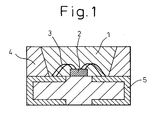
- Fig. 1 An example of such a light-transforming element or light emitting device is shown in Fig. 1.
- Fig. 1 is a transparent medium made of molded low-melting-point glass or a molded resin containing the phosphor, and it covers the surface of a blue LED chip 2.
- Numeral 3 indicates a metal wire, 4 a molded article package and 5 a lead electrode.
- this light-transforming element or light emitting device light emitted from the blue LED chip 2 is converted to white light by the phosphor 1 of the invention distributed in the transparent medium 1, and is therefore emitted outwardly as white light.
- Silicon diimide with a specific surface area of 750 m 2 /g obtained by reaction of silicon tetrachloride and ammonia at below room temperature was thermally decomposed at 700-1200°C to obtain nitrogen-containing silane compounds and/or amorphous silicon nitride powders with specific surface areas of 60-460 m 2 /g.
- Each material was subjected to a known process for improving the condition of chafing between the powder and metal in the reactor material and powder handling machinery, in order to reduce the metal impurities contaminating the nitrogen-containing silane compound and/or amorphous silicon nitride powder to under 10 ppm.
- the oxygen content of the nitrogen-containing silane compound and/or amorphous silicon nitride powder was adjusted to the values shown in Table 1.
- Example 8 there was used nitrogen-containing silane compound and/or amorphous silicon nitride powder having a low specific surface area of 64 m 2 /g.
- AlN powder used in all of the examples was AlN powder having an oxygen content of 1.0 wt%, a carbon content of 0.06 wt%, a specific surface area of 3.8 m 2 /g and a content of metal impurities other than Al, Si and Ca of less than 10 ppm.
- the nitrogen-containing silane compound and/or amorphous silicon nitride powder, aluminum nitride powder, and powder of an oxide of a modifying metal element M or an oxide of a rare earth element Ln were combined in the mixing proportions shown in Table 1 using a vibrating mill for 1 hour in a nitrogen gas atmosphere.
- the powder mixture was molded in a nitrogen-purged glove box, to obtain a molded article with a bulk density of 0.70 g/cm 3 .
- the obtained molded article was packed into a silicon carbide crucible and set in a resistance heating electric furnace, and then the temperature was raised at a schedule from room temperature to 1200°C over a period of 2 hours, from 1200°C to 1440°C over a period of 4 hours and from 1440°C to 1630°C over a period of 2 hours, in a nitrogen gas atmosphere, and then was held at the same temperature for one hour for crystallization to obtain ⁇ -sialon powders composed mainly of Ca- ⁇ -sialon, Mg- ⁇ -sialon, Y- ⁇ -sialon and Dy- ⁇ -sialon.
- the nitrogen-containing silane compound and/or amorphous silicon nitride powder and the aluminum nitride powder used as starting materials were first confirmed to have the prescribed oxygen contents and, then, the nitrogen-containing silane compound and/or amorphous silicon nitride powder, aluminum nitride powder, powder of an oxide of a modifying metal element M or an oxide of a rare earth element Ln and the Ca- ⁇ -sialon powder prepared in Example 1 were combined in the mixing proportions shown in Table 1 using a vibrating mill for 1 hour in a nitrogen gas atmosphere.
- the powder mixture was molded in a nitrogen-purged glove box, to obtain a molded article with a bulk density of 0.70 g/cm 3 .
- the obtained molded article was packed into a silicon carbide crucible and set in a resistance heating electric furnace, and then the temperature was raised at a schedule from room temperature to 1200°C over a period of 2 hours, from 1200°C to 1440°C over a period of 4 hours and from 1440°C to the prescribed temperature over a period of 2 hours, in a nitrogen gas atmosphere, after which it was held at the same temperature for one hour for crystallization to obtain ⁇ -sialon powder.
- the crystal phase of the obtained ⁇ -sialon powder was identified by powder X-ray diffraction, while the proportion of ⁇ -sialon produced and the solid dissolutions of the modifying metal element M or rare earth element Ln were determined by Rietveld analysis.
- the solid dissolutions of the modifying metal element M or rare earth element Ln are listed as X1 in Table 1, using the values of X in the general formula: M x Si 12-(m+n) Al (m+n) O n N 16-n or Ln x Si 12-(m+n) Al (m+n) O n N 16-n .
- the chemical composition was analyzed by ICP.
- the nitrogen content of the powder product was determined by alkali fusion analysis and the oxygen content was determined by inert gas fusion analysis (LECO method).
- the specific surface area was measured by the BET single-point method. The particle shapes were examined with a scanning electron microscope.
- the sialon powder obtained in each of the examples had a mean particle size evenly distributed in the range of 2-7 ⁇ m, and the product was confirmed to be ⁇ -sialon based on the aforementioned X-ray diffraction and compositional analysis.
- ⁇ -Sialon powder was obtained in approximately the same manner as Example 5, except that the temperature was raised at a schedule from room temperature to 1200°C over a period of 2 hours, from 1200°C to 1440°C over a period of 2 hours and from 1440°C to 1800°C over a period of 3.6 hours, in a pressurized nitrogen gas atmosphere at 10 atmospheres, and then was held at the same temperature for one hour for crystallization.
- silicon diimide with a specific surface area of 800 m 2 /g was thermally decomposed at 500-1100°C to obtain nitrogen-containing silane compounds and/or amorphous silicon nitride powders with specific surface areas of 150-550 m 2 /g.
- a known process for altering the condition of chafing between the powder and metal in the reactor material and powder handling machinery was employed to obtain nitrogen-containing silane compounds and/or amorphous silicon nitride powders with different contaminating metal impurity contents.
- the oxygen concentration in the nitrogen gas circulating in the heating furnace was varied, within the range of 5-3000 ppm, to obtain nitrogen-containing silane compounds and/or amorphous silicon nitride powders with low oxygen contents, or nitrogen-containing silane compounds and/or amorphous silicon nitride powders with high oxygen contents.
- These nitrogen-containing silane compounds and/or amorphous silicon nitride powders were used for Comparative Examples 1 to 5, and the methods for preparing the ⁇ -sialon powders and the methods for measuring the properties of the ⁇ -sialon powders were approximately the same as in Examples 5 to 8.
- the specifications and mixing ratios of the starting materials are shown in Table 1, and the results of measuring the crystal phase, chemical composition, specific surface area, particle shapes, etc. of the ⁇ -sialon powders obtained in the same manner as in Examples 5 to 9 are shown in Table 2.
- Comparative Example 4 is an example of a low oxygen content in the nitrogen-containing silane compound and/or amorphous silicon nitride powder, while Comparative Example 5 is an example of a high oxygen content.
- Comparative Example 3 is an example wherein the firing conditions were changed to 1350°C.
- the ⁇ -sialon powder was obtained by temperature increase and firing at the same temperature increase rate as in Example 5, but with a different final temperature.
- Comparative Examples 3 to 5 are examples using different previously prepared sialon powders.
- the Ca- ⁇ -sialon powder prepared in Example 1 was added to obtain ⁇ -sialon powder by approximately the same method as in Example 5.
- Comparative Examples 6 to 8 are examples of using crystalline silicon nitride powder with a specific surface area of about 10 m 2 /g as the starting material. Mixing of the starting materials was carried out using a wet-type ball mill with ethanol as the solvent. The starting materials had different metal impurity contents, but exceeded 150 ppm in Comparative Examples 6 and 8.
- the bulk density of the molded powder mixture was increased to a value of about 1.2 g/cm 3 .
- Comparative Examples 6 and 8 are examples of adding the Ca- ⁇ -sialon powder obtained in Example 1 to the starting materials in the same manner as Examples 5-8 and Comparative Examples 3 to 5.
- Examples 10 to 23 and Comparative Examples 9 to 15 are examples for ⁇ -sialon powder represented by the general formula: M x Si 12-(m+n) Al (m+n) O n N 16-n :Ln y DY z containing Dy as a co-activator, unless otherwise specified.
- the method for preparing the ⁇ -sialon powders and the methods for measuring the properties of the produced ⁇ -sialon powders were the same as in Example 5, except for the modifications listed for each example.
- the conditions for preparation of the ⁇ -sialon powders are shown in Table 3 and the values of the properties of the produced ⁇ -sialon powders are summarized in Table 4.
- ⁇ -Sialon powders were obtained in the same manner as Example 5, except that three different metal oxides were used as the starting material, a modifying metal M oxide (MO), a lanthanide metal Ln oxide (Ln x O y ) as an activator and dysprosium oxide (Dy 2 O 3 ) as a co-activator, and the nitrogen-containing silane compound and/or amorphous silicon nitride powder, aluminum nitride powder and the three different metal oxide powders infiltrating in solid solution were mixed for one hour with a vibrating mill in a nitrogen gas atmosphere, in the mixing proportions shown in Table 3.
- the properties of the obtained ⁇ -sialon powders were measured in the same manner as Example 5.
- Example 10 is an example of firing using a nitrogen-containing silane compound and/or amorphous silicon nitride powder with an increased oxygen content.
- ⁇ -Sialon powder was obtained by using a nitrogen-containing silane compound and/or amorphous silicon nitride powder having an oxygen content of 3 wt% and a specific surface area of 380 m 2 /g or greater, with the oxygen concentration of the nitrogen gas circulating in the heating furnace adjusted up to 1300 ppm, and firing a mixture thereof with aluminum nitride powder and the three different metal oxide powders infiltrating in solid solution using the same temperature increase profile as in Example 8.
- Example 11 is an example of using a nitrogen-containing silane compound and/or amorphous silicon nitride powder with a slightly higher metal impurity content than Example 10.
- Examples 12 to 23 are examples of adding Ca- ⁇ -sialon powder (Example 1), Mg- ⁇ -sialon powder (Example 2), Y- ⁇ -sialon powder (Example 3) and Dy- ⁇ -sialon powder (Example 4), obtained in Examples 1 to 4, to one starting material.
- Example 18 is an example of using a nitrogen-containing silane compound and/or an amorphous silicon nitride powder with a specific surface area of 620 m 2 /g, obtained by 400°C thermal decomposition of silicon diimide with a specific surface area of 800 m 2 /g.
- Fig. 2 and Fig. 3 show the excitation spectrum and emission spectrum charts for the ⁇ -sialon powder having the compositional formula Ca 0.66 Y 0.03 Ce 0.10 DY 0.03 Si 9.3 Al 2.7 O 1.2 N 14.8 obtained in Example 20.
- Examples 21 and 22 are examples of preparing ⁇ -sialon powders by adding the Mg- ⁇ -sialon powder prepared in Example 2 (Example 21) and the Ce- ⁇ -sialon powder prepared in Example 7 (Example 22) to one starting material, and using a temperature increase profile of from room temperature to 1200°C over a period of 2 hours, from 1200°C to 1440°C over a period of 2 hours and from 1440°C to 1800°C over a period of 3.6 hours, in a pressurized nitrogen gas atmosphere of 10 atmospheric pressure, and then holding at the same temperature for one hour.
- Example 22 is an example of using a nitrogen-containing silane compound and/or amorphous silicon nitride powder with a high carbon content as the starting material.
- Example 23 is an example of preparing ⁇ -sialon powder using as the starting material a nitrogen-containing silane compound and/or amorphous silicon nitride powder having a specific surface area of 650 m 2 /g obtained by 400°C thermal decomposition of silicon diimide with a specific surface area of 820 m 2 /g, and firing in a pressurized nitrogen gas atmosphere of 10 atmospheric pressure with the same firing profile as in Example 21, except that the final firing temperature was increased to 1920°C.
- Comparative Examples 9 to 13 are examples of using nitrogen-containing silane compounds and/or amorphous silicon nitride powders with high metal impurity contents of 150 ppm or greater as starting materials.
- the oxygen concentration of the nitrogen gas circulating in the heating furnace was 3000 ppm, and therefore the oxygen content of the nitrogen-containing silane compound and/or amorphous silicon nitride powder is also higher.
- Comparative Example 16 is an example of using a nitrogen-containing silane compound and/or amorphous silicon nitride powder with a low specific surface area of 60 m 2 /g.
- Comparative Examples 14 and 15 are examples of using as the starting material a crystalline silicon nitride powder with a high metal impurity content of about 150 ppm and with a specific surface area of about 10 m 2 /g.
- the starting materials were mixed using a wet-type ball mill with ethanol as the solvent.
- the translucent material used was low-melting-point glass, with a melting point of 500°C.
- the ⁇ -sialon-based oxynitride phosphor obtained as an example or comparative example was combined with the low-melting-point glass in a weight ratio of 5:100 to obtain a phosphor-dispersed mixture.
- the mixture was molded with a heating press and mounted on an ultraviolet emitting LED as the light source for utilization as a fluorescent light emitting layer.
- the light source there was prepared a ZnO/Mg x Zn (1-x) O-based ultraviolet emitting LED having a light emitting layer with a main emission peak of 350-380 nm.
- the ultraviolet emitting LED 2 was mechanically fixed to the recess of the molded package 4 shown in Fig. 3.
- a 35 ⁇ m gold wire was used for wire bonding electrical connection between each electrode of the ultraviolet emitting LED and each lead electrode 5.
- the molded low-melting-point glass containing the ⁇ -sialon-based oxynitride phosphor was fixed into the recess of the molded package 4 on which the ultraviolet emitting LED 2 was situated to obtain a blue emitting LED having the light source covered with a fluorescent layer.
- the emission properties of 500 blue emitting LEDs were measured, and the mean values and standard deviation for the emitted light intensity were calculated to determine the variation in properties between elements. The variation in color was also examined.
- Table 5 shows the light emitting properties of 9 different white emitting LEDs fabricated using ⁇ -sialon-based oxynitride phosphors of the invention, and all were products with satisfactory properties including high emitted light intensity and low variation in emitted light intensity between the individual LED elements.
- the colors were pure white and satisfactory.
- the 5 white emitting LEDs fabricated using ⁇ -sialon-based oxynitride phosphors outside of the scope of the invention, as comparative examples all had low emitted light intensity and high variation in emitted light intensity between the individual LED elements, and were therefore unsuitable in terms of product properties.
- the colors were also bluish, and were judged as unsatisfactory.
- Silicon diimide with a specific surface area of 750 m 2 /g obtained by a reaction of silicon tetrachloride with ammonia at below room temperature was thermally decomposed at 700-1200°C to obtain nitrogen-containing silane compounds and/or amorphous silicon nitride powders with specific surface areas of 60-460 m 2 /g.
- Each material was subjected to a known process for improving the condition of chafing between the powder and metal in the reactor material and powder handling machinery, in order to reduce the metal impurities contaminating the nitrogen-containing silane compound and/or amorphous silicon nitride powder to under 10 ppm.
- the oxygen content of the nitrogen-containing silane compound and/or amorphous silicon nitride powder was adjusted to the values shown in Table 6.
- AlN powder used in all of the examples was AlN powder having an oxygen content of 1.0 wt%, a carbon content of 0.06 wt%, a specific surface area of 3.8 m 2 /g and a content of metal impurities other than Al, Si and Ca of less than 10 ppm.
- the nitrogen-containing silane compound and/or amorphous silicon nitride powder and the aluminum nitride powder used as starting materials were first confirmed to have the prescribed oxygen contents, and then the nitrogen-containing silane compound and/or amorphous silicon nitride powder, aluminum nitride powder, powder of an oxide of a modifying metal element M or an oxide of a rare earth element Ln were combined in the mixing proportions shown in Table 6 using a vibrating mill for 1 hour in a nitrogen gas atmosphere.
- the powder mixture was molded in a nitrogen-purged glove box, to obtain a molded article with a bulk density of 0.70 g/cm 3 .
- the obtained molded article was packed into a silicon carbide crucible and set in a resistance heating electric furnace, and then the temperature was raised at a schedule from room temperature to 1200°C over a period of 2 hours, from 1200°C to 1440°C over a period of 4 hours and from 1440°C to 1630°C over a period of 2 hours, in a nitrogen gas atmosphere, after which it was held at the same temperature for one hour for crystallization to obtain ⁇ -sialon powder.
- the crystal phase of the obtained ⁇ -sialon powder was identified by powder X-ray diffraction, while the proportion of ⁇ -sialon produced and the solid dissolution of the modifying metal element M or rare earth element Ln were determined by Rietveld analysis.
- the solid dissolutions of the modifying metal element M or rare earth element Ln are listed as X1 in Table 6, using the values of X in the general formula: M x Si 12-(m+n) Al (m+n) O n N 16-n or Ln x Si 12-(m+n) Al (m+n) O n N 16-n .
- the chemical composition was analyzed by ICP.
- the nitrogen content of the powder product was determined by alkali fusion analysis and the oxygen content was determined by inert gas fusion analysis (LECO method).
- the specific surface area was measured by the BET single-point method. The particle shapes were examined with a scanning electron microscope.
- the sialon powder obtained in each of the examples had a mean particle size evenly distributed in the range of 2-7 ⁇ m, and the product was confirmed to be ⁇ -sialon based on the aforementioned X-ray diffraction and compositional analysis.
- ⁇ -Sialon powder was obtained in approximately the same manner as Example 101, except that the temperature was raised from room temperature to 1200°C over a period of 2 hours, from 1200°C to 1440°C over a period of 2 hours and from 1440°C to 1800°C over a period of 3.6 hours, in a pressurized nitrogen gas atmosphere at 10 atmospheric pressure, and then was held at the same temperature for one hour for crystallization.
- ⁇ -Sialon powder was obtained in approximately the same manner as Example 101, except that the Ca- ⁇ -sialon powder prepared in Example 101 was added.
- silicon diimide with a specific surface area of 800 m 2 /g was thermally decomposed at 400-1200°C to obtain nitrogen-containing silane compounds and/or amorphous silicon nitride powders with specific surface areas of 62-630 m 2 /g.
- a known process altering the condition of chafing between the powder and metal in the reactor material and powder handling machinery was employed to obtain nitrogen-containing silane compounds and/or amorphous silicon nitride powders with different contaminating metal impurity contents.
- the oxygen concentration in the nitrogen gas circulating in the heating furnace was varied to within the range of 5-3000 ppm to obtain nitrogen-containing silane compounds and/or amorphous silicon nitride powders with low oxygen contents, or nitrogen-containing silane compounds and/or amorphous silicon nitride powders with high oxygen contents.
- nitrogen-containing silane compounds and/or amorphous silicon nitride powders were used for Comparative Examples 101 to 104, and the methods for preparing the ⁇ -sialon powders and the methods for measuring the properties of the ⁇ -sialon powders were approximately the same as in Examples 101 to 106.
- Comparative Example 101 is an example of a low oxygen content in the nitrogen-containing silane compound and/or amorphous silicon nitride powder
- Comparative Example 102 is an example of a high oxygen content.
- Comparative Example 104 an example wherein the firing conditions were changed to 1350°C.
- the ⁇ -sialon powder was obtained by increasing the temperature and firing at the same temperature increase rate as in Example 101, but with a different final temperature.
- Comparative Examples 105 to 108 are examples of using crystalline silicon nitride powder with a specific surface area of about 10 m 2 /g as the starting material. Mixing of the starting materials was carried out using a wet-type ball mill with ethanol as the solvent. The starting materials had different metal impurity contents, but 150 ppm was exceeded in Comparative Examples 105 and 108.
- the bulk density of the molded powder mixture was increased to a value of about 1.2 g/cm 3 .
- the firing conditions for crystallization were a temperature increase schedule of from room temperature to 1200°C over a period of 2 hours, from 1200°C to 1440°C over a period of 2 hours and from 1440°C to 1800°C over a period of 3.6 hours, in a pressurized nitrogen gas atmosphere at 10 atmospheric pressure, followed by holding at the same temperature for one hour.
- Examples 109 to 119 and Comparative Examples 109 to 113 are examples for ⁇ -sialon powder represented by the general formula: M x Si 12-(m+n) Al (m+n) O n N 16-n :Ln y Dy z containing Dy as a co-activator, unless otherwise specified.
- the method for preparing the ⁇ -sialon powders and the methods for measuring the properties of the produced ⁇ -sialon powders were the same as in Example 101, except for the modifications listed for each example.
- the conditions for preparation of the ⁇ -sialon powders are shown in Table 8 and the values of the properties of the produced ⁇ -sialon powders are summarized in Table 9.
- ⁇ -sialon powders were obtained in the same manner as Example 101, except that three different metal oxides were used, a modifying metal M oxide (MO), a lanthanide metal Ln oxide (Ln x O y ) as an activator and dysprosium oxide (Dy 2 O 3 ) as a co-activator, and the nitrogen-containing silane compound and/or amorphous silicon nitride powder, aluminum nitride powder and the three different metal oxide powders infiltrating in solid solution were mixed for one hour with a vibrating mill in a nitrogen gas atmosphere, in the mixing proportions shown in Table 8.
- the properties of the obtained ⁇ -sialon powders were measured in the same manner as Example 101.
- Example 114 is an example of using a nitrogen-containing silane compound and/or amorphous silicon nitride powder with a slightly higher metal impurity content than Examples 109 to 115.
- Example 116 is an example of firing using a nitrogen-containing silane compound and/or amorphous silicon nitride powder with an increased oxygen content and a large specific surface area, and with firing in a pressurized nitrogen gas atmosphere.
- ⁇ -Sialon powder was obtained by using a nitrogen-containing silane compound and/or amorphous silicon nitride powder having an oxygen content of 3 wt% and a specific surface area of 600 m 2 /g or greater, with the oxygen concentration of the nitrogen gas circulating in the heating furnace adjusted up to 1300 ppm, and firing a mixture thereof with aluminum nitride powder and the three different metal oxide powders infiltrating in solid solution, using a temperature increase profile of from room temperature to 1200°C over a period of 2 hours, from 1200°C to 1440°C over a period of 2 hours and from 1440°C to 1910°C over a period of 4 hours, in a pressurized nitrogen gas atmosphere of 10 atmospheric pressure.
- Examples 117 to 119 are examples of adding Ca- ⁇ -sialon powder (Example 119) and Dy- ⁇ -sialon powder (Examples 117, 118), obtained in Examples 101 and 106, to one starting material.
- a Nihon Bunko FP-777 fluorescent spectrophotometer was used to measure the excitation spectrum of the obtained ⁇ -sialon powder for light with a wavelength of 530 nm and the emission spectrum for excitation light with a wavelength of 450 nm.
- Example 119 is an example of preparing ⁇ -sialon powder by adding the Ca- ⁇ -sialon powder prepared in Example 101 to one starting material, and using a temperature increase profile of from room temperature to 1200°C over a period of 2 hours, from 1200°C to 1440°C over a period of 2 hours and from 1440°C to 1800°C over a period of 3.6 hours, in a pressurized nitrogen gas atmosphere of 10 atmospheric pressure, and then holding at the same temperature for one hour.
- Comparative Examples 109 to 111 are examples of using nitrogen-containing silane compounds and/or amorphous silicon nitride powders with high metal impurity contents of 200 ppm or greater as starting materials.
- the oxygen concentration of the nitrogen gas circulating in the heating furnace was 3000 ppm, and therefore the oxygen content of the nitrogen-containing silane compound and/or amorphous silicon nitride powder is also higher.
- the firing temperature is lower than the others.
- Comparative Example 111 is an example of using a nitrogen-containing silane compound and/or amorphous silicon nitride powder with a low specific surface area of 60 m 2 /g.
- Comparative Examples 112 and 113 are examples of using, as the starting material, a crystalline silicon nitride powder with a high metal impurity content of about 150 ppm and with a specific surface area of about 10 m 2 /g.
- the starting materials were mixed using a wet-type ball mill with ethanol as the solvent.
- a translucent resin there was used a liquid epoxy resin having a room temperature viscosity of 50 P.
- the ⁇ -sialon-based oxynitride phosphor obtained as an example or comparative example was combined with the epoxy resin in a weight ratio of 6:100 to obtain a phosphor-dispersed kneaded mixture.
- the kneaded mixture was coated onto an LED light source for utilization as a fluorescent luminescent layer.
- the light source there was prepared a blue LED provided with an In n Al m Ga 1-(m+n) N nitride-based semiconductor in the light emitting layer.
- the blue LED 2 was fixed to the recess of the molded package 4 shown in Fig. 1 using the aforementioned epoxy resin.
- a 35 ⁇ m gold wire was used for wire bonding electrical connection between each electrode of the blue LED and each lead electrode 5.
- the epoxy resin containing the ⁇ -sialon-based oxynitride phosphor was cast into the recess of the molded package 4 on which the blue LED 2 was situated and cured at 120°C for 4 hours to obtain a white emitting LED having the light source coated with a fluorescent layer.
- the emission properties of 500 white emitting LEDs were measured, and the mean values and standard deviation for the emitted light intensity were calculated to determine the variation in properties between elements. The variation in color was also examined.
- Table 10 shows the light emitting properties of 6 different white emitting LEDs fabricated using ⁇ -sialon-based oxynitride phosphors of the invention, and all were products with satisfactory properties including high emitted light intensity and low variation in emitted light intensity between the individual LED elements.
- the color tones were pure white and satisfactory.
- the 3 different white emitting LEDs fabricated using ⁇ -sialon-based oxynitride phosphors outside of the scope of the invention, as comparative examples all had low emitted light intensity and high variation in emitted light intensity between the individual LED elements, and were therefore unsuitable in terms of product properties.
- the color tones were also bluish, and were judged as unsatisfactory.
- the oxynitride phosphors composed mainly of ⁇ -sialon according to the present invention exhibit high emitted light intensity and spectra of appropriate wavelengths, and may therefore be used as high-brightness, high-reliability blue LEDs using ultraviolet-emitting LEDs as light sources.
- the host material is ⁇ -sialon, the thermal stability, chemical stability and light fastness are excellent, they are advantageous for use as long-lasting photoluminescent phosphors which operate stably even in harsh environments. According to the process of the invention, it is possible to easily fabricate phosphors with such excellent properties on an industrial scale.
Landscapes
- Chemical & Material Sciences (AREA)
- Engineering & Computer Science (AREA)
- Inorganic Chemistry (AREA)
- Materials Engineering (AREA)
- Organic Chemistry (AREA)
- Ceramic Engineering (AREA)
- Manufacturing & Machinery (AREA)
- Structural Engineering (AREA)
- Luminescent Compositions (AREA)
Abstract
An alpha -sialon-based oxynitride phosphor characterized in that the content of alpha -sialon represented by the general formula: MxSi12-(m+n)Al(m+n)OnN16-n:Lny (wherein M is at least one metal selected from among Li, Ca, Mg, Y or lanthanide metals excluding La and Ce, Ln is at least one lanthanide metal selected from among Ce, Pr and La or at least one lanthanide metal selected from among Eu, Dy, Er, Tb and Yb, 0.3≤x+y<1.5, 0<y<0.7, 0.3≤m<4.5, 0<n<2.25, and m = ax + by, where a is the valence of the metal M and b is the valence of the lanthanide metal Ln), wherein all or a portion of the metal M dissolved in the alpha -sialon is replaced with the lanthanide metal Ln as the luminescence center, is 75 wt% or greater when the lanthanide metal Ln is at least one lanthanide metal selected from among Ce, Pr and La and 90 wt% or greater when the lanthanide metal Ln is at least one lanthanide metal selected from among Eu, Dy, Er, Tb and Yb, and in that the content of metal impurities other than the metal M, lanthanide metal Ln, silicon, IIIA elements (aluminum, gallium), oxygen and nitrogen, is no greater than 0.01 wt%. <IMAGE>
Description
The present invention relates to a material having a
function which converts a portion of irradiated light
into light with a different wavelength and blends it with
the non-converted irradiated light into light with a
different color. More specifically, it relates to an
oxynitride phosphor activated with a rare earth metal
element, which exhibits the high brightness of a white
light emitting diode (white LED) using a blue light
emitting diode (blue LED) as the light source. The
present invention also relates to a process for
production of the sialon-based oxynitride phosphor and to
its use.
Phosphors comprising silicates, phosphates (for
example, apatite) and aluminates as host materials, with
transition metals or rare earth metals added as
activating materials to the host materials, are widely
known. As blue LEDs, in particular, have become
practical in recent years, the development of white light
sources utilizing such blue LEDs is being energetically
pursued. As white LEDs are expected to have lower power
consumption and longer usable lives than existing white
light sources, development is progressing toward their
applications in backlights of liquid crystal panels,
indoor lighting fixtures, backlights of automobile panels
and the like.
The currently developed white LEDs generally
comprise YAG (yttrium-aluminum-garnet)-based phosphors
coated on the surfaces of blue LEDs, with Ce-activated
YAG-based phosphors converting the blue light of the blue
LEDs to yellow light. A portion of the blue light of 450
nm wavelength emitted by the blue LED penetrates the
phosphor layer, while the remainder strikes the phosphor
and is converted to yellow light. The blue and yellow
colors combine to appear as white light.
YAG-based phosphors, however, are associated with
the problem of emission of blue-tinted white light due to
a lower intensity when the excitation wavelength exceeds
400 nm, as well as a low light-emitting efficiency
because the excitation energy of the blue LED does not
match the excitation energy of the YAG-based phosphor.
Another problem is inadequate durability of the coated
phosphor layer. An improvement has therefore been
desired in the performance of phosphors used for
wavelength conversion.
In recent years, oxynitride phosphors such as
oxynitride glass, β-sialon, α-sialon and the like having
nitrogen in the structure have received attention as
structurally stable substances capable of shifting
excitation light or emitted light toward the long
wavelength end. Sialon with α- or β-Si8N4 crystal
structure is a solid solution composed of mainly Si, Al,
N and O atoms. Two forms thereof are known, β-sialon and
α-sialon, which are both materials with excellent
abrasion resistance and corrosion resistance.
The α-sialon is a solid solution with double
substitution of Al for Si position and O for N position
of α-silicon nitride, with a modifying cation M
occupying at the interstitial sites. Chemical
composition of α-sialon is represented by the general
formula: MxSi12-(m+n)Al(m+n)OnN16-n (wherein 0.3≤x<1.5,
0.3≤m<4.5, 0<n<2.25, and m = ax where a is the valence of
the metal M). Because α-sialon has high hardness and
excellent abrasion resistance, various processes for
producing sialon-based sintered bodies have been
investigated. Li, Mg, Ca, Y and lanthanide metals are
known as metals M which dissolve in α-silicon nitride
lattice and stabilize its structure, occupying the
interstitial sites of the unit lattice of α-silicon
nitride.
La and Ce, which are lanthanide metals with large
ionic radii, are considered to poorly occupy the
interstitial sites of α-silicon nitride. However,
simultaneous addition of La or Ce with the aforementioned
metal elements has been carried out in an attempt to
produce solid solutions with La or Ce occupying the
interstitial sites of α-silicon nitride. For example,
the Journal of European Ceramic Society, Vol.8, pp.3-9
(1991) reports that simultaneous addition of Ce with Y
yielded α-sialon having both Ce and Y stabilized
therein. Also, the Journal of Materials Science Letters,
Vol.15, pp.1435-1438 reports that by rapid cooling from
high temperature it is possible to synthesize α-sialon
stabilized with Ce (Ce-α-sialon). However, the Ce-α-sialon
content is only about 20% while the remaining
major portion is β-sialon, and partial formation of a 21R
phase, a polytype of AlN, has been confirmed. Moreover,
Japanese Unexamined Patent Publication No. 2001-261447
discloses a sialon-based sintered body with high hardness
and excellent abrasion resistance, comprising only β-sialon
and a grain boundary glass phase in addition to
Ce-stabilized α-sialon.
Nevertheless, the aforementioned disclosed
technologies all relate to production of sialon-based
sintered bodies, and are not directed toward powder
production nor toward production of oxynitride phosphors.
Furthermore, no reference is made in any way to the
effects of the metal impurity concentrations of the
obtained sialon-based sintered bodies.
On the other hand, Japanese Unexamined Patent
Publication No. 2002-363554 discloses an oxynitride
phosphor with an activated rare earth element,
represented by the general formula:
MxSi12-(m+n)Al(m+n)OnN16-n:Re1yRe2z
(wherein 0.3<x+y+z<1.5, 0.01<y<0.7, 0≤z<0.1,
0.3<m<4.5, 0≤n<1.5), and having all or a portion of the
metal M dissolved in α-sialon (where M is at least one
type of metal selected from among Ca, Mg, Y or lanthanide
metals excluding La and Ce) replaced with two different
lanthanide metals, specifically a lanthanide metal Re1 as
the luminescence center (where Re1 is at least one type
of lanthanide metal selected from among Ce, Pr, Eu, Er,
Tb and Yb) or a lanthanide metal Re2 as the co-activator
with the lanthanide metal Re1 (where Re2 is Dy).
However, this publication not only lacks any mention
regarding the powder properties such as purity, crystal
phase and particle size distribution of the rare earth
element-activated oxynitride phosphor, but it is also
completely unconcerned with properties such as purity,
crystal phase and particle size distribution of the
Si3N4, AlN, alkali metals and rare earth metals used as
the starting materials for preparation of the oxynitride
phosphor.
The present applicant has proposed, in Japanese
Unexamined Patent Publication (Kokai) SHOWA No. 62-223009,
a process for production of α-sialon powder
using as the starting materials (a) amorphous silicon
nitride powder, (b) metallic aluminum or aluminum
nitride, (c) an oxide of a metal which interstitially
dissolves in the α-sialon lattice as a solid solution or
a metal salt which produces the metal oxide upon thermal
decomposition, and (d) an aluminum or silicon compound
containing oxygen.
However, while some effect is achieved to develop
α-sialon-based oxynitride with excellent mechanical
properties as an abrasion-resistant material, the
properties are inadequate from the standpoint of its use
as an optical material and, therefore, further
improvement has been necessary before it can be
practicably utilized.
It is an object of the present invention to provide
an oxynitride phosphor composed mainly of rare earth
element-activated α-sialon represented by the general
formula: MxSi12-(m+n)Al(m+n)OnN16-n:Lny (wherein 0.3≤x+y<1.5,
0<y<0.7, 0.3≤m<4.5, 0<n<2.25, and m = ax + by, where a is
the valence of the metal M and b is the valence of the
lanthanide metal Ln), as a photoluminescent phosphor
capable of realizing the high brightness of a white LED
using a blue LED as the light source, as well as a
process for its production.
The present inventors have discovered that α-sialon
having specified contents of metal impurities other than
the constituent components can serve as such a
photoluminescent phosphor capable of realizing the high
brightness of a white LED using a blue LED as the light
source. It was further found that adjustment of the
oxygen content of the nitrogen-containing silane compound
and/or amorphous silicon nitride powder used as starting
materials, and addition of α-sialon powder pre-synthesized
into a starting powder, are important
conditions for producing the α-sialon-based oxynitride
photoluminescent phosphor, and the present invention has
thus been completed.
In other words, the invention relates to an α-sialon-based
oxynitride phosphor characterized in that
the content of α-sialon represented by the general
formula: MxSi12-(m+n)Al(m+n)OnN16-n:Lny (wherein M is at least
one metal selected from among Li, Ca, Mg, Y or lanthanide
metals excluding La and Ce, Ln is at least one lanthanide
metal selected from among Ce, Pr and La or at least one
lanthanide metal selected from among Eu, Dy, Er, Tb and
Yb, 0.3≤x+y<1.5, 0<y<0.7, 0.3≤m<4.5, 0<n<2.25, and m = ax
+ by, where a is the valence of the metal M and b is the
valence of the lanthanide metal Ln) wherein all or a
portion of the metal M dissolved in the α-sialon is
replaced with the lanthanide metal Ln as the luminescence
center,
is 75 wt% or greater when the lanthanide metal Ln is at least one lanthanide metal selected from among Ce, Pr and La and 90 wt% or greater when the lanthanide metal Ln is at least one lanthanide metal selected from among Eu, Dy, Er, Tb and Yb, and
in that the content of metal impurities other than the constituent components, i.e. the metal M, lanthanide metal Ln, silicon, IIIA elements (aluminum, gallium), oxygen and nitrogen, is no greater than 0.01 wt%.
is 75 wt% or greater when the lanthanide metal Ln is at least one lanthanide metal selected from among Ce, Pr and La and 90 wt% or greater when the lanthanide metal Ln is at least one lanthanide metal selected from among Eu, Dy, Er, Tb and Yb, and
in that the content of metal impurities other than the constituent components, i.e. the metal M, lanthanide metal Ln, silicon, IIIA elements (aluminum, gallium), oxygen and nitrogen, is no greater than 0.01 wt%.
According to a preferred mode of the invention, one
or more of the following conditions is satisfied: the α-sialon
is present at 90 wt% or greater (as measured by
powder X-ray diffraction) when the lanthanide metal Ln is
at least one lanthanide metal selected from among Ce, Pr
and La, and at 95 wt% or greater when the lanthanide
metal Ln is at least one lanthanide metal selected from
among Eu, Dy, Er, Tb and Yb, with the remainder
consisting of β-sialon and oxynitride glass, the content
of metal impurities other than the constituent
components, i.e. the metal M, lanthanide metal Ln,
silicon, IIIA elements (aluminum, gallium), oxygen and
nitrogen, is no greater than 0.01 wt%, the α-sialon-based
oxynitride phosphor has a median size of no greater
than 8 µm in the particle size distribution curve, and
the 90% size in the particle size distribution curve is
no greater than 25 µm.
The present invention further relates to a process
for producing an α-sialon-based oxynitride phosphor,
characterized in that a mixed powder comprising a
nitrogen-containing silane compound and/or amorphous
silicon nitride powder having the oxygen content adjusted
to 1-5 wt%, AlN and/or Al powder, an oxide of a metal M
or a precursor substance which is converted to an oxide
of a metal M upon thermal decomposition, and an oxide of
a lanthanide metal Ln or a precursor substance which is
converted to an oxide of a lanthanide metal Ln upon
thermal decomposition, in a combination such that the
metal impurity content is no greater than 0.01 wt% as
calculated on the basis of the product being represented
by the general formula: MxSi12-(m+n)Al(m+n)OnN16-n:Lny (wherein M
is at least one metal selected from among Li, Ca, Mg, Y
or lanthanide metals excluding La and Ce, Ln is at least
one lanthanide metal selected from among Ce, Pr and La or
at least one lanthanide metal selected from among Eu, Dy,
Er, Tb and Yb), is fired at 1400-2000°C in a nitrogen-containing
inert gas atmosphere.
The invention still further relates to a process for
producing an α-sialon-based oxynitride phosphor,
characterized in that a mixture obtained by adding a pre-synthesized
α-sialon powder represented by the general
formula: MxSi12-(m+n)Al(m+n)OnN16-n or the general formula:
MxSi12-(m+n)Al(m+n)OnN16-n:Lny to a mixed powder comprising a
nitrogen-containing silane compound and/or amorphous
silicon nitride powder having the oxygen content adjusted
to 1-5 wt%, AlN and/or Al powder, an oxide of the metal M
or a precursor substance which is converted to an oxide
of the metal M upon thermal decomposition, and an oxide
of the lanthanide metal Ln or a precursor substance which
is converted to an oxide of the lanthanide metal Ln upon
thermal decomposition, in a combination such that the
metal impurity content is no greater than 0.01 wt% as
calculated on the basis of the product being represented
by the general formula: MxSi12-(m+n)Al(m+n)OnN16-n:Lny (wherein M
is at least one type of metal selected from among Li, Ca,
Mg, Y or lanthanide metals excluding La and Ce, Ln is at
least one lanthanide metal selected from among Ce, Pr and
La or at least one lanthanide metal selected from among
Eu, Dy, Er, Tb and Yb), is fired at 1400-2000°C in a
nitrogen-containing inert gas atmosphere.
According to a preferred mode of the aforementioned
invention relating to a process for producing an α-sialon-based
oxynitride phosphor, the specific surface
area of the nitrogen-containing silane compound and/or
amorphous silicon nitride powder is 80-600 m2/g, and/or
the content of metal impurities other than constituent
components of the final product and the content of carbon
in the nitrogen-containing silane compound and/or
amorphous silicon nitride powder are ≤0.01 wt% and ≤0.3
wt%, respectively.
The invention still further relates to a process for
producing an oxynitride phosphor composed mainly of the
aforementioned α-sialon, characterized in that the
firing is carried out in a temperature range of 1600-2000°C
in a pressurized nitrogen gas atmosphere.
The present invention will now be explained more in
detail.
In the oxynitride phosphor of the invention
represented by the general formula:
MxSi12-(m+n)Al(m+n)OnN16-n:Lny
(wherein M is at least one metal selected from
among Li, Ca, Mg, Y or lanthanide metals excluding La and
Ce, Ln is at least one lanthanide metal selected from
among Ce, Pr and La or at least one lanthanide metal
selected from among Eu, Dy, Er, Tb and Yb), the metal M
dissolving interstitially in the α-sialon as solid
solution and the lanthanide metal Ln acting as the
luminescence center dissolve to a maximum of two per
large unit cell of α-sialon including the four formula
weight of (Si, Al)3(N,O)4' and, therefore, from the
standpoint of the solid solubility limit the values of
the aforementioned general formula are preferably such
that 0.3≤x+y<1.5, 0<y<0.7, 0.3≤m<4.5, 0<n<2.25, and m =
ax + by where a is the valence of the metal M and b is
the valence of the lanthanide metal Ln. For example,
when both the interstitial metals M and Ln are divalent,
0.6≤m<3.0 and 0<n<1.5, and when both the interstitial
metals M and Ln are trivalent, 0.9≤m<4.5 and 0<n<2.25.
It was discovered that when a metal impurity is
present in a phosphor, an energy level inherent to the
metal impurity is formed, altering the spectrum and
undesirably changing the color of the emitted light.
Transition metals which show absorption in the visible
light region are particularly undesirable. In the α-sialon-based
oxynitride phosphor of the invention, the
metal impurity content is reduced to 0.01 wt% or below,
but it is more preferably reduced to 0.001 wt% or below.
It was also discovered that, because β-sialon will
not dissolve the lanthanide metal acting as the
luminescence center, the emitted light color and light
emitting properties of the phosphor differ from α-sialon,
and its presence is therefore not preferred.
Oxynitride glass is also not preferred because the
emitted light color and light emitting properties of the
phosphor differ, but a small amount of a another
heterogeneous thereof is unavoidable in the synthesis of
α-sialon.
When the lanthanide metal Ln is selected from among
Ce, Pr and La for the α-sialon-based oxynitride phosphor
of the invention, the α-sialon content as measured by
powder X-ray diffraction must be 75 wt% or greater,
preferably 90 wt% or greater and even more preferably 95
wt% or greater, and when the lanthanide metal Ln is at
least one lanthanide metal selected from among Eu, Dy,
Er, Tb and Yb, the α-sialon content as measured by
powder X-ray diffraction must be 90 wt% or greater,
preferably 95 wt% or greater and even more preferably 98
wt% or greater.
According to the invention, the oxygen content of
the nitrogen-containing silane compound and/or amorphous
silicon nitride powder is first adjusted to 1-5 wt% and
preferably 1.1-3 wt%, is then added with AlN and/or Al
powder with oxides of the metal M and the lanthanide
metal Ln acting as the luminescence center, and/or
precursor substances which are converted to the oxides
upon thermal decomposition, and is then fired at 1400-2000°C
in a nitrogen-containing inert gas atmosphere, as
a process whereby formation of heterogeneous phase other
than the α-sialon phase is inhibited in order to obtain
an α-sialon-based oxynitride phosphor having an α-sialon
content of 75 wt% or greater.
The α-sialon-based oxynitride phosphor has a median
size of preferably no greater than 8 µm and more
preferably 1-6 µm in the particle size distribution
curve.
The 90% size (d90) is preferably no greater than 25
µm and more preferably 2-20 µm. If the median size is
larger than 8 µm, variations becomes large in the emitted
light intensity and color when a light-transforming
device is manufactured by mounting a molded mixture
thereof with a translucent media such as acrylic resins,
epoxy resins, or low-melting-point glass on a light
emitting diode (LED). If the 90% size is greater than 25
µm, the distribution of coarse agglomerates will tend to
result in considerable variation in emitted light
intensity and color tone. In the α-sialon-based
oxynitride phosphor of the invention, the dispersity
d90/d10 as defined by the ratio of the 10% size (d10) and
the 90% size (d90) in the particle size distribution
curve is preferably no greater than 7 and more preferably
no greater than 5. By controlling the d90/d10 ratio to no
greater than 7, it is possible to obtain an α-sialon-based
oxynitride phosphor with homogeneous, satisfactory
light emission output and with the desired color tone, as
well as light-transforming devices which employ it.
A low proportion of the dissolved lanthanide metal
Ln acting as the luminescence center is not preferred,
since this will not only lower the emitted light
intensity of the phosphor but will also alter the emitted
light color or light emitting properties.
The degree of interstitial distribution of the metal
M and the lanthanide metal Ln in the α-sialon crystal
lattice of the α-sialon represented by the general
formula: MxSi12-(m+n)Al(m+n)OnN16-n:Lny is determined by
comparing the (x+y) value as measured using a powder
diffraction pattern-fitting RIETAN-2000 Rietveld analysis
program for angular dispersion-type diffraction (for
example, "Practical Powder X-Ray Diffraction --Introduction
to Rietveld Method", edited by Japan Society
for Analytical Chemistry, X-Ray Structure Analysis
Research Group, by Nakai I., Izumi F., Asakura
Publications (2002)), against the (x+y) value as measured
by chemical compositional analysis of the product.
In the α-sialon-based oxynitride phosphor of the
invention, the proportion of the added metal M and
lanthanide metal Ln dissolved in the α-sialon crystal
lattice may be as high as 80% or greater. In this α-silaon,
at least 80% of the metal M and lanthanide metal
Ln dissolve interstitially into the α-sialon crystal
lattice of the α-sialon, while the remainder is present
in the amorphous oxynitride glass phase.
The excess oxygen in the α-sialon powder of the
invention is preferably no greater than 2.5 wt% and more
preferably no greater than 2.0 wt% with respect to the
theoretical oxygen content specified by the general
formula: MxSi12-(m+n)Al(m+n)OnN16-n:Lny.
The α-sialon powder of the invention may be
obtained by using as the starting materials (a) a
nitrogen-containing silane compound and/or amorphous
silicon nitride powder, (b) metallic aluminum and/or
aluminum nitride powder, (c) an oxide of a metal M which
dissolves interstitially the lattice of α-sialon as a
solid solution and/or a metal salt which produces the
metal oxide upon thermal decomposition, (d) an oxide of a
lanthanide metal Ln which acts as the luminescence center
and/or a metal salt which produces the lanthanide metal
oxide upon thermal decomposition, replacing all or a
portion of the metal element M, and (e) an aluminum
and/or silicon compound containing oxygen, and firing a
mixture of the starting materials, combined so as to give
the desired α-sialon composition, in a temperature range
of 1400-1800°C in a nitrogen-containing inert gas
atmosphere.
The nitrogen-containing silane compound and/or
amorphous silicon nitride powder used as the main
starting material may be obtained by a known process, for
example, a process wherein an Si-N-H based precursor
compound, such as a silicon diimide produced by reacting
a silicon halide such as silicon tetrachloride, silicon
tetrabromide or silicon tetraiodide with ammonia in a gas
phase or liquid phase, is thermally decomposed at 600-1200°C
in a nitrogen or ammonia gas atmosphere, or a
process wherein a silicon halide and ammonia in a gaseous
state are reacted at high temperature.
The mean particle size of the nitrogen-containing
silane compound and/or amorphous silicon nitride powder
obtained by the process described above is 0.005-0.05 µm.
Such nitrogen-containing silane compound and/or amorphous
silicon nitride powders are amorphous, exhibiting no
distinct diffraction peak in ordinary X-ray diffraction.
Depending on the heat treatment conditions it is possible
to obtain a powder exhibiting a weak X-ray diffraction
peak, and such powders are also included by the
"nitrogen-containing silane compound and/or amorphous
silicon nitride powder" of the invention.
According to the invention, the starting materials,
i.e. a nitrogen-containing silane compound and/or
amorphous silicon nitride powder, AlN and/or Al powder,
an oxide of the metal M and/or a precursor substance
which is converted to the oxide upon thermal
decomposition, and an oxide of the lanthanide metal Ln
and/or a precursor substance which is converted to the
oxide upon thermal decomposition, are selected and
combined in such a manner that the metal impurity content
is no greater than 0.01 wt% as calculated on the basis of
the product being represented by the general formula:
MxSi12-(m+n)Al(m+n)OnN16-n:Lny and, therefore, using one high
purity starting material will of course widen the range
of selection for the other starting materials which can
be used.
The nitrogen-containing silane compound and/or
amorphous silicon nitride powder and the AlN and/or Al
powder which are added in large amounts generally should
have metal impurity contents of no greater than 0.01 wt%,
preferably no greater than 0.005 wt% and more preferably
no greater than 0.001 wt%. The oxide of the metal M
and/or a precursor substance which is converted to the
oxide upon thermal decomposition, and the oxide of the
lanthanide metal Ln and/or a precursor substance which is
converted to the oxide upon thermal decomposition, also
preferably have metal impurity contents of no greater
than 0.01 wt%, as the oxides.
Here, "metal impurity" refers to metal species other
than Ga or the metal components added as constituent
components of sialon.
The nitrogen-containing silane compound and/or
amorphous silicon nitride powder used preferably has an
oxygen content of 1-5 wt%. It more preferably has an
oxygen content of 1-3 wt%. An oxygen content of less
than 1 wt% is not preferred because it becomes very
difficult to produce an α-sialon phase by reaction in
the firing process, and production of a crystal phase
residue of the starting materials or AlN polytypes such
as 21R tends to occur. On the other hand, an oxygen
content of greater than 5 wt%, while accelerating the α-sialon
production reaction, will also increase the
proportion of β-sialon or oxynitride glass produced.
The carbon content of the nitrogen-containing silane
compound and/or amorphous silicon nitride powder is
preferably no greater than 0.3 wt% and more preferably no
greater than 0.15 wt%. Using a powder with a carbon
content of greater than 0.3 wt% in the nitrogen-containing
silane compound and/or amorphous silicon
nitride powder results in formation of an energy level
inherent to the produced oxynitride phosphor composed
mainly of the α-sialon, thereby altering the spectrum
and changing the color of the emitted light.
The nitrogen-containing silane compound and/or
amorphous silicon nitride powder used preferably has a
specific surface area of 80-600 m2/g. It more preferably
has a specific surface area of 340-500 m2/g. If the
specific surface area of the nitrogen-containing silane
compound and/or amorphous silicon nitride powder is
smaller than 340 m2/g, the amorphous particles tend to
increase, the particle shapes deviate from equiaxed
crystals, and the agglomerates are strengthened. Also,
if the specific surface area of the nitrogen-containing
silane compound and/or amorphous silicon nitride powder
is smaller than 80 m2/g, the particles tend to be coarser
than 30 nm, the activity of the sialon formation reaction
decreases, and the product results in an large amount of
an α-type silicon nitride phase and β-type silicon
nitride phase in which the interstitial metal does not
dissolve. If the specific surface area is greater than
600 m2/g, the particle sizes of the primary particles
become too fine, excess agglomerates are produced, the
miscibility with the AlN, metal M, lanthanide metal Ln,
etc. is notably degraded, and the α-sialon formation
reaction is inhibited. While the reason for this is not
fully understood, it is known that considerable
coalescence occurs between the α-sialon particles
produced after firing, resulting in greater coarseness,
and making it difficult to obtain α-sialon-based
oxynitride phosphor powder having the desired particle
distribution.
As aluminum sources there may be used metallic
aluminum powder and aluminum nitride powder, either alone
or in combination. Aluminum nitride powder may be
conventional aluminum nitride powder having an oxygen
content of 0.1-8 wt% and a specific surface area of 1-100
m2/g.
As metal salts which produce oxides of the metal M
or the lanthanide metal Ln upon thermal decomposition
there may be mentioned various carbonic acid salts,
oxalic acid salts, citric acid salts, basic carbonic acid
salts, hydroxides and the like.
There are no particular restrictions on the method
of mixing the aforementioned starting materials, and any
known method may be employed, such as a dry mixing method
or a method of wet mixing in an inert solvent which is
substantially unreactive with the starting components and
then removing the solvent. As mixing apparatuses there
may be suitably used V-mixers, rocking mixers, ball
mills, vibrating mills, medium stirring mills and the
like. However, because nitrogen-containing silane
compound and/or amorphous silicon nitride powders are
highly sensitive to moisture and humidity, the mixing of
the starting materials must be carried out in a
controlled inert gas atmosphere.
The starting material mixture is fired at 1400-1800°C
and preferably 1500-1800°C in a nitrogen-containing
inert gas atmosphere at 1 atmosphere pressure,
to obtain the desired α-sialon powder. If the firing
temperature is below 1400°C, an impracticably long period
of heating will be required for production of the desired
α-sialon powder, and the proportion of α-sialon phase
produced in the powder will also be reduced. A firing
temperature of above 1800°C will create an undesirable
situation with sublimation and decomposition of the
silicon nitride and sialon, and formation of free
silicon.
The starting material powder mixture may be fired in
a temperature range of 1600-2000°C and preferably 1600-1900°C
in a pressurized nitrogen gas atmosphere. In this
case, the nitrogen gas pressurization suppresses
sublimating decomposition of silicon nitride and sialon
at high temperature, so that the desired α-sialon-based
oxynitride phosphor can be obtained in a shorter period
of time. The firing temperature may be raised if the
nitrogen gas pressure is increased, and for example,
firing may be conducted at 1600-1850°C under nitrogen gas
pressure of 5 atmospheric pressure, and at 1600-2000°C
under nitrogen gas pressure of 10 atmospheric pressure.
There are no particular restrictions on the heating
furnace used for firing of the powder mixture, and for
example, there may be used a high-frequency induction
heating or resistance heating batch-type electric
furnace, a rotary kiln, a fluidizing firing furnace, a
pusher-type electric furnace, or the like.
Since metals with atomic radii smaller than 0.1 nm
such as Li, Ca, Mg, Y, Eu, Dy, Er, Tb and Yb readily
dissolve interstitially in the sialon crystal lattice as
solid solution by the aforementioned processes, it is
possible to easily obtain an α-sialon-based oxynitride
phosphor with an α-sialon content of 90 wt% or greater.
In contrast, Ce, Pr and La having ionic radii larger
than 0.1 nm do not readily dissolve in the α-sialon
crystal lattice as simple elements. Including the
aforementioned elements having ionic radii of less than
0.1 nm makes it possible to produce α-sialon with Ce, Pr
and La interstitially dissolved therein, but in order to
obtain an oxynitride phosphor with an α-sialon
percentage of 75 wt% or greater having Ce, Pr and La
dissolved therein at the desired concentration, it is
necessary to use a precise starting material mixture and
a prolonged firing procedure, which are not suitable for
industrial sialon powder production.
The process of the invention for dissolving Ce, Pr
and La comprises adding pre-synthesized α-sialon powder
represented by the general formula: MxSi12-(m+n)Al(m+n)OnN16-n
or the general formula: MxSi12-(m+n)Al(m+n)OnN16-n:Lny to the
aforementioned starting material composition. Adding
such α-sialon particles as growth nuclei for the α-sialon
phase can easily yield an oxynitride phosphor with
an α-sialon content of 75 wt% or greater, even for Ce,
Pr and La which have atomic radii exceeding 0.1 nm.
The methods mentioned above for the nitrogen-containing
silane compound and/or amorphous silicon
nitride powder as the starting materials may be directly
employed for mixing and firing of the starting materials
in this case as well.
The production process of the invention wherein α-sialon
particles are added as growth nuclei for the α-sialon
phase is particularly effective for Ce, Pr and La
having ionic radii of larger than 0.1 nm, but it is also
useful for metals with ionic radii smaller than 0.1 nm,
such as Li, Ca, Mg, Y, Eu, Dy, Er, Tb and Yb.
The rare earth element-activated α-sialon-based
oxynitride phosphor of the present invention is combined
with a transparent medium such as acrylic resin, epoxy
resin or low-melting-point glass by a known method to
produce a thin coating-molded layer, and the surface of a
light emitting diode is then covered with this thin
molded layer for use as a light-transforming element.
An example of such a light-transforming element or
light emitting device is shown in Fig. 1. In Fig. 1, 1
is a transparent medium made of molded low-melting-point
glass or a molded resin containing the phosphor, and it
covers the surface of a blue LED chip 2. Numeral 3
indicates a metal wire, 4 a molded article package and 5
a lead electrode. In this light-transforming element or
light emitting device, light emitted from the blue LED
chip 2 is converted to white light by the phosphor 1 of
the invention distributed in the transparent medium 1,
and is therefore emitted outwardly as white light.
The present invention will now be explained in
further detail through the following concrete examples.
Silicon diimide with a specific surface area of 750
m2/g obtained by reaction of silicon tetrachloride and
ammonia at below room temperature was thermally
decomposed at 700-1200°C to obtain nitrogen-containing
silane compounds and/or amorphous silicon nitride powders
with specific surface areas of 60-460 m2/g. Each
material was subjected to a known process for improving
the condition of chafing between the powder and metal in
the reactor material and powder handling machinery, in
order to reduce the metal impurities contaminating the
nitrogen-containing silane compound and/or amorphous
silicon nitride powder to under 10 ppm. Also, by varying
the oxygen concentration in the nitrogen gas circulating
in the heating furnace to within the range of 20-1000
ppm, the oxygen content of the nitrogen-containing silane
compound and/or amorphous silicon nitride powder was
adjusted to the values shown in Table 1.
For Example 8 there was used nitrogen-containing
silane compound and/or amorphous silicon nitride powder
having a low specific surface area of 64 m2/g.
The aluminum nitride (AlN) powder used in all of the
examples was AlN powder having an oxygen content of 1.0
wt%, a carbon content of 0.06 wt%, a specific surface
area of 3.8 m2/g and a content of metal impurities other
than Al, Si and Ca of less than 10 ppm.
For Examples 1 to 4, the nitrogen-containing silane
compound and/or amorphous silicon nitride powder,
aluminum nitride powder, and powder of an oxide of a
modifying metal element M or an oxide of a rare earth
element Ln were combined in the mixing proportions shown
in Table 1 using a vibrating mill for 1 hour in a
nitrogen gas atmosphere. The powder mixture was molded
in a nitrogen-purged glove box, to obtain a molded
article with a bulk density of 0.70 g/cm3. The obtained
molded article was packed into a silicon carbide crucible
and set in a resistance heating electric furnace, and
then the temperature was raised at a schedule from room
temperature to 1200°C over a period of 2 hours, from
1200°C to 1440°C over a period of 4 hours and from 1440°C
to 1630°C over a period of 2 hours, in a nitrogen gas
atmosphere, and then was held at the same temperature for
one hour for crystallization to obtain α-sialon powders
composed mainly of Ca-α-sialon, Mg-α-sialon, Y-α-sialon
and Dy-α-sialon.
For Examples 5 to 8, the nitrogen-containing silane
compound and/or amorphous silicon nitride powder and the
aluminum nitride powder used as starting materials were
first confirmed to have the prescribed oxygen contents
and, then, the nitrogen-containing silane compound and/or
amorphous silicon nitride powder, aluminum nitride
powder, powder of an oxide of a modifying metal element M
or an oxide of a rare earth element Ln and the Ca-α-sialon
powder prepared in Example 1 were combined in the
mixing proportions shown in Table 1 using a vibrating
mill for 1 hour in a nitrogen gas atmosphere. The powder
mixture was molded in a nitrogen-purged glove box, to
obtain a molded article with a bulk density of 0.70
g/cm3. The obtained molded article was packed into a
silicon carbide crucible and set in a resistance heating
electric furnace, and then the temperature was raised at
a schedule from room temperature to 1200°C over a period
of 2 hours, from 1200°C to 1440°C over a period of 4
hours and from 1440°C to the prescribed temperature over
a period of 2 hours, in a nitrogen gas atmosphere, after
which it was held at the same temperature for one hour
for crystallization to obtain α-sialon powder.
The crystal phase of the obtained α-sialon powder
was identified by powder X-ray diffraction, while the
proportion of α-sialon produced and the solid
dissolutions of the modifying metal element M or rare
earth element Ln were determined by Rietveld analysis.
The solid dissolutions of the modifying metal element M
or rare earth element Ln are listed as X1 in Table 1,
using the values of X in the general formula:
MxSi12-(m+n)Al(m+n)OnN16-n or LnxSi12-(m+n)Al(m+n)OnN16-n.
After next dissolving the powder product by the
pressurized hydrofluoric acid decomposition method, the
chemical composition was analyzed by ICP. The nitrogen
content of the powder product was determined by alkali
fusion analysis and the oxygen content was determined by
inert gas fusion analysis (LECO method). The specific
surface area was measured by the BET single-point method.
The particle shapes were examined with a scanning
electron microscope.
The sialon powder obtained in each of the examples
had a mean particle size evenly distributed in the range
of 2-7 µm, and the product was confirmed to be α-sialon
based on the aforementioned X-ray diffraction and
compositional analysis.
The measured values for the crystal phase, chemical
composition, specific surface area, particle shapes, etc.
of the obtained α-sialon powders are shown in Table 2.
In this example, the nitrogen gas pressure and
temperature for firing were changed. α-Sialon powder
was obtained in approximately the same manner as Example
5, except that the temperature was raised at a schedule
from room temperature to 1200°C over a period of 2 hours,
from 1200°C to 1440°C over a period of 2 hours and from
1440°C to 1800°C over a period of 3.6 hours, in a
pressurized nitrogen gas atmosphere at 10 atmospheres,
and then was held at the same temperature for one hour
for crystallization.
The specifications and mixing ratios of the starting
materials are shown in Table 1, and the results of
measuring the crystal phase, chemical composition,
specific surface area, particle shapes, etc. of the α-sialon
powders obtained in the same manner as in Examples
5 to 8 are shown in Table 2.
First, silicon diimide with a specific surface area
of 800 m2/g was thermally decomposed at 500-1100°C to
obtain nitrogen-containing silane compounds and/or
amorphous silicon nitride powders with specific surface
areas of 150-550 m2/g. A known process for altering the
condition of chafing between the powder and metal in the
reactor material and powder handling machinery was
employed to obtain nitrogen-containing silane compounds
and/or amorphous silicon nitride powders with different
contaminating metal impurity contents. Also, the oxygen
concentration in the nitrogen gas circulating in the
heating furnace was varied, within the range of 5-3000
ppm, to obtain nitrogen-containing silane compounds
and/or amorphous silicon nitride powders with low oxygen
contents, or nitrogen-containing silane compounds and/or
amorphous silicon nitride powders with high oxygen
contents. These nitrogen-containing silane compounds
and/or amorphous silicon nitride powders were used for
Comparative Examples 1 to 5, and the methods for
preparing the α-sialon powders and the methods for
measuring the properties of the α-sialon powders were
approximately the same as in Examples 5 to 8. The
specifications and mixing ratios of the starting
materials are shown in Table 1, and the results of
measuring the crystal phase, chemical composition,
specific surface area, particle shapes, etc. of the α-sialon
powders obtained in the same manner as in Examples
5 to 9 are shown in Table 2.
Comparative Example 4 is an example of a low oxygen
content in the nitrogen-containing silane compound and/or
amorphous silicon nitride powder, while Comparative
Example 5 is an example of a high oxygen content.
Comparative Example 3 is an example wherein the
firing conditions were changed to 1350°C. In this case,
the α-sialon powder was obtained by temperature increase
and firing at the same temperature increase rate as in
Example 5, but with a different final temperature.
Comparative Examples 3 to 5 are examples using
different previously prepared sialon powders. The Ca-α-sialon
powder prepared in Example 1 was added to obtain
α-sialon powder by approximately the same method as in
Example 5.
Comparative Examples 6 to 8 are examples of using
crystalline silicon nitride powder with a specific
surface area of about 10 m2/g as the starting material.
Mixing of the starting materials was carried out using a
wet-type ball mill with ethanol as the solvent. The
starting materials had different metal impurity contents,
but exceeded 150 ppm in Comparative Examples 6 and 8.
The bulk density of the molded powder mixture was
increased to a value of about 1.2 g/cm3.
Comparative Examples 6 and 8 are examples of adding
the Ca-α-sialon powder obtained in Example 1 to the
starting materials in the same manner as Examples 5-8 and
Comparative Examples 3 to 5.
The following Examples 10 to 23 and Comparative
Examples 9 to 15 are examples for α-sialon powder
represented by the general formula:
MxSi12-(m+n)Al(m+n)OnN16-n:LnyDYz
containing Dy as a co-activator, unless otherwise
specified. The method for preparing the α-sialon
powders and the methods for measuring the properties of
the produced α-sialon powders were the same as in
Example 5, except for the modifications listed for each
example. The conditions for preparation of the α-sialon
powders are shown in Table 3 and the values of the
properties of the produced α-sialon powders are
summarized in Table 4.
α-Sialon powders were obtained in the same manner
as Example 5, except that three different metal oxides
were used as the starting material, a modifying metal M
oxide (MO), a lanthanide metal Ln oxide (LnxOy) as an
activator and dysprosium oxide (Dy2O3) as a co-activator,
and the nitrogen-containing silane compound and/or
amorphous silicon nitride powder, aluminum nitride powder
and the three different metal oxide powders infiltrating
in solid solution were mixed for one hour with a
vibrating mill in a nitrogen gas atmosphere, in the
mixing proportions shown in Table 3. The properties of
the obtained α-sialon powders were measured in the same
manner as Example 5.
Example 10 is an example of firing using a nitrogen-containing
silane compound and/or amorphous silicon
nitride powder with an increased oxygen content.
α-Sialon powder was obtained by using a nitrogen-containing
silane compound and/or amorphous silicon
nitride powder having an oxygen content of 3 wt% and a
specific surface area of 380 m2/g or greater, with the
oxygen concentration of the nitrogen gas circulating in
the heating furnace adjusted up to 1300 ppm, and firing a
mixture thereof with aluminum nitride powder and the
three different metal oxide powders infiltrating in solid
solution using the same temperature increase profile as
in Example 8.
Example 11 is an example of using a nitrogen-containing
silane compound and/or amorphous silicon
nitride powder with a slightly higher metal impurity
content than Example 10.
Examples 12 to 23 are examples of adding Ca-α-sialon
powder (Example 1), Mg-α-sialon powder (Example
2), Y-α-sialon powder (Example 3) and Dy-α-sialon powder
(Example 4), obtained in Examples 1 to 4, to one starting
material.
Example 18 is an example of using a nitrogen-containing
silane compound and/or an amorphous silicon
nitride powder with a specific surface area of 620 m2/g,
obtained by 400°C thermal decomposition of silicon
diimide with a specific surface area of 800 m2/g.
A Nihon Bunko FP-777 fluorescent spectrophotometer
was used to measure the excitation spectrum of the
obtained α-sialon powder for light with a wavelength of
420 nm and the emission spectrum for excitation light
with a wavelength of 355 nm. Fig. 2 and Fig. 3 show the
excitation spectrum and emission spectrum charts for the
α-sialon powder having the compositional formula
Ca0.66Y0.03Ce0.10DY0.03Si9.3Al2.7O1.2N14.8 obtained in Example 20.
Examples 21 and 22 are examples of preparing α-sialon
powders by adding the Mg-α-sialon powder prepared
in Example 2 (Example 21) and the Ce-α-sialon powder
prepared in Example 7 (Example 22) to one starting
material, and using a temperature increase profile of
from room temperature to 1200°C over a period of 2 hours,
from 1200°C to 1440°C over a period of 2 hours and from
1440°C to 1800°C over a period of 3.6 hours, in a
pressurized nitrogen gas atmosphere of 10 atmospheric
pressure, and then holding at the same temperature for
one hour.
Example 22 is an example of using a nitrogen-containing
silane compound and/or amorphous silicon
nitride powder with a high carbon content as the starting
material.
Example 23 is an example of preparing α-sialon
powder using as the starting material a nitrogen-containing
silane compound and/or amorphous silicon
nitride powder having a specific surface area of 650 m2/g
obtained by 400°C thermal decomposition of silicon
diimide with a specific surface area of 820 m2/g, and
firing in a pressurized nitrogen gas atmosphere of 10
atmospheric pressure with the same firing profile as in
Example 21, except that the final firing temperature was
increased to 1920°C.
Comparative Examples 9 to 13 are examples of using
nitrogen-containing silane compounds and/or amorphous
silicon nitride powders with high metal impurity contents
of 150 ppm or greater as starting materials. In
Comparative Example 11 the oxygen concentration of the
nitrogen gas circulating in the heating furnace was 3000
ppm, and therefore the oxygen content of the nitrogen-containing
silane compound and/or amorphous silicon
nitride powder is also higher. Comparative Example 16 is
an example of using a nitrogen-containing silane compound
and/or amorphous silicon nitride powder with a low
specific surface area of 60 m2/g.
Comparative Examples 14 and 15 are examples of using
as the starting material a crystalline silicon nitride
powder with a high metal impurity content of about 150
ppm and with a specific surface area of about 10 m2/g.
The starting materials were mixed using a wet-type ball
mill with ethanol as the solvent.
The properties of the phosphors were evaluated in
the following manner.
The translucent material used was low-melting-point
glass, with a melting point of 500°C. The α-sialon-based
oxynitride phosphor obtained as an example or
comparative example was combined with the low-melting-point
glass in a weight ratio of 5:100 to obtain a
phosphor-dispersed mixture. The mixture was molded with
a heating press and mounted on an ultraviolet emitting
LED as the light source for utilization as a fluorescent
light emitting layer.
As the light source there was prepared a ZnO/MgxZn(1-x)O-based
ultraviolet emitting LED having a light
emitting layer with a main emission peak of 350-380 nm.
The ultraviolet emitting LED 2 was mechanically fixed to
the recess of the molded package 4 shown in Fig. 3. A 35
µm gold wire was used for wire bonding electrical
connection between each electrode of the ultraviolet
emitting LED and each lead electrode 5.
The molded low-melting-point glass containing the
α-sialon-based oxynitride phosphor was fixed into the
recess of the molded package 4 on which the ultraviolet
emitting LED 2 was situated to obtain a blue emitting LED
having the light source covered with a fluorescent layer.
The emission properties of 500 blue emitting LEDs
were measured, and the mean values and standard deviation
for the emitted light intensity were calculated to
determine the variation in properties between elements.
The variation in color was also examined.
The results are shown in Table 5.
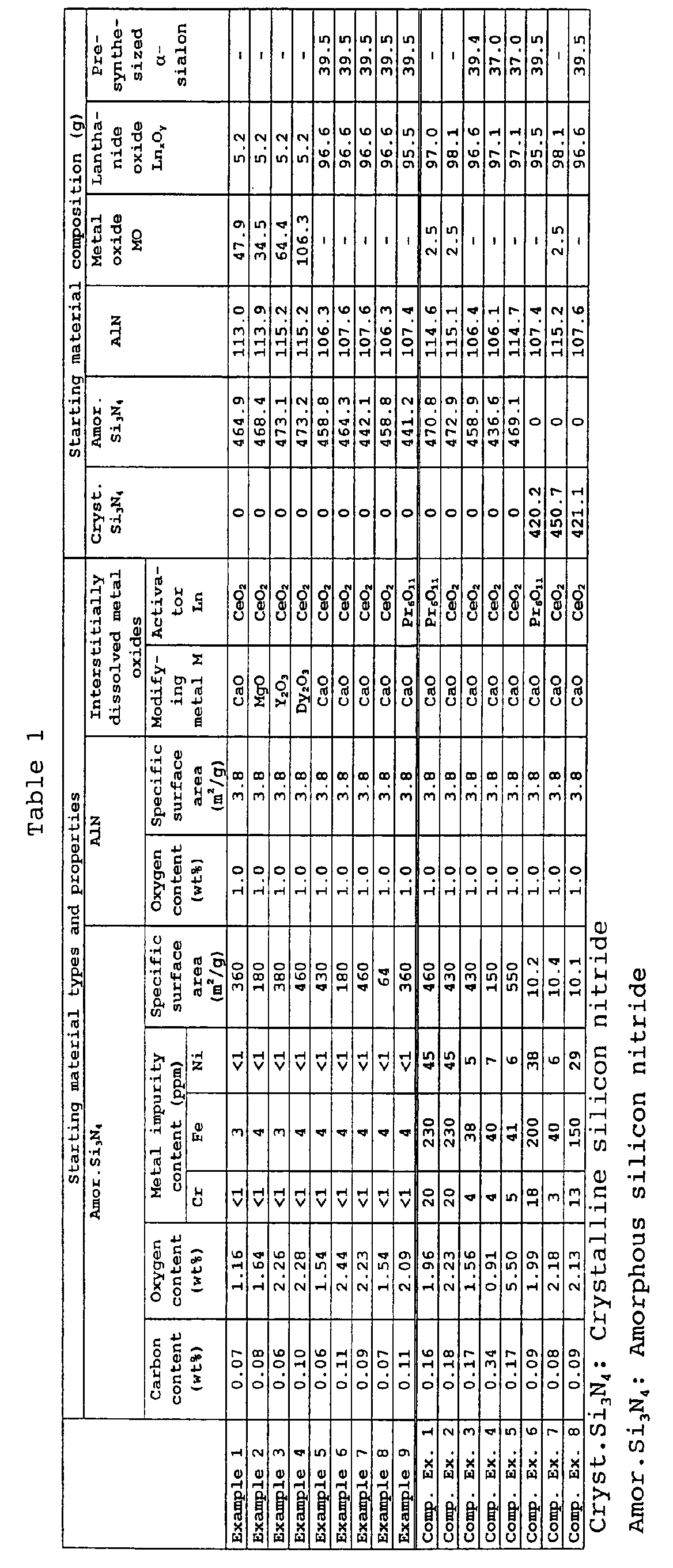


According to the process of the invention described
above, it is possible to obtain α-sialon-based
oxynitride phosphors comprising at least 75 wt% of α-sialon
represented by the general formula:
MxSi12-(m+n)Al(m+n)OnN16-n:Lny (wherein 0.3≤x+y<1.5, 0<y<0.7,
0.3≤m<4.5, 0<n<2.25, and m = ax + by, where a is the
valence of the metal M and b is the valence of the
lanthanide metal Ln), wherein all or a portion of the
metal M dissolved in the α-sialon (where M is at least
one type of metal selected from among Li, Ca, Mg, Y or
lanthanide metals excluding La and Ce) is replaced with
the lanthanide metal Ln as the luminescence center (where
Ln is at least one lanthanide metal selected from among
Ce, Pr and La), having a content of no greater than 0.01
wt% of metal impurities other than the constituent
elements, i.e. the metal M, lanthanide metal Ln, silicon,
IIIA elements (aluminum, gallium), oxygen and nitrogen.
Table 5 shows the light emitting properties of 9
different white emitting LEDs fabricated using α-sialon-based
oxynitride phosphors of the invention, and all were
products with satisfactory properties including high
emitted light intensity and low variation in emitted
light intensity between the individual LED elements. The
colors were pure white and satisfactory. In contrast,
the 5 white emitting LEDs fabricated using α-sialon-based
oxynitride phosphors outside of the scope of the
invention, as comparative examples, all had low emitted
light intensity and high variation in emitted light
intensity between the individual LED elements, and were
therefore unsuitable in terms of product properties. The
colors were also bluish, and were judged as
unsatisfactory.
Silicon diimide with a specific surface area of 750
m2/g obtained by a reaction of silicon tetrachloride with
ammonia at below room temperature was thermally
decomposed at 700-1200°C to obtain nitrogen-containing
silane compounds and/or amorphous silicon nitride powders
with specific surface areas of 60-460 m2/g. Each
material was subjected to a known process for improving
the condition of chafing between the powder and metal in
the reactor material and powder handling machinery, in
order to reduce the metal impurities contaminating the
nitrogen-containing silane compound and/or amorphous
silicon nitride powder to under 10 ppm. Also, by varying
the oxygen concentration in the nitrogen gas circulating
in the heating furnace to within the range of 20-1000
ppm, the oxygen content of the nitrogen-containing silane
compound and/or amorphous silicon nitride powder was
adjusted to the values shown in Table 6.
The aluminum nitride (AlN) powder used in all of the
examples was AlN powder having an oxygen content of 1.0
wt%, a carbon content of 0.06 wt%, a specific surface
area of 3.8 m2/g and a content of metal impurities other
than Al, Si and Ca of less than 10 ppm.
The nitrogen-containing silane compound and/or
amorphous silicon nitride powder and the aluminum nitride
powder used as starting materials were first confirmed to
have the prescribed oxygen contents, and then the
nitrogen-containing silane compound and/or amorphous
silicon nitride powder, aluminum nitride powder, powder
of an oxide of a modifying metal element M or an oxide of
a rare earth element Ln were combined in the mixing
proportions shown in Table 6 using a vibrating mill for 1
hour in a nitrogen gas atmosphere. The powder mixture
was molded in a nitrogen-purged glove box, to obtain a
molded article with a bulk density of 0.70 g/cm3. The
obtained molded article was packed into a silicon carbide
crucible and set in a resistance heating electric
furnace, and then the temperature was raised at a
schedule from room temperature to 1200°C over a period of
2 hours, from 1200°C to 1440°C over a period of 4 hours
and from 1440°C to 1630°C over a period of 2 hours, in a
nitrogen gas atmosphere, after which it was held at the
same temperature for one hour for crystallization to
obtain α-sialon powder.
The crystal phase of the obtained α-sialon powder
was identified by powder X-ray diffraction, while the
proportion of α-sialon produced and the solid
dissolution of the modifying metal element M or rare
earth element Ln were determined by Rietveld analysis.
The solid dissolutions of the modifying metal element M
or rare earth element Ln are listed as X1 in Table 6,
using the values of X in the general formula:
MxSi12-(m+n)Al(m+n)OnN16-n or LnxSi12-(m+n)Al(m+n)OnN16-n.
After next dissolving the powder product by
pressurized hydrofluoric acid decomposition method, the
chemical composition was analyzed by ICP. The nitrogen
content of the powder product was determined by alkali
fusion analysis and the oxygen content was determined by
inert gas fusion analysis (LECO method). The specific
surface area was measured by the BET single-point method.
The particle shapes were examined with a scanning
electron microscope.
The sialon powder obtained in each of the examples
had a mean particle size evenly distributed in the range
of 2-7 µm, and the product was confirmed to be α-sialon
based on the aforementioned X-ray diffraction and
compositional analysis.
The measured values for the crystal phase, chemical
composition, specific surface area, particle shapes, etc.
of the obtained α-sialon powders are shown in Table 7.
The specifications and mixing ratios for the
starting materials of Examples 107 and 108 are also shown
in Table 6, and the results of measuring the crystal
phase, chemical composition, specific surface area,
particle shapes, etc. of the α-sialon powders obtained
by the same method as in Examples 101 to 106 are also
shown in Table 7.
This is an example of changing the nitrogen gas
pressure and temperature for firing. α-Sialon powder
was obtained in approximately the same manner as Example
101, except that the temperature was raised from room
temperature to 1200°C over a period of 2 hours, from
1200°C to 1440°C over a period of 2 hours and from 1440°C
to 1800°C over a period of 3.6 hours, in a pressurized
nitrogen gas atmosphere at 10 atmospheric pressure, and
then was held at the same temperature for one hour for
crystallization.
This is an example of adding previously prepared
sialon powder. α-Sialon powder was obtained in
approximately the same manner as Example 101, except that
the Ca-α-sialon powder prepared in Example 101 was
added.
First, silicon diimide with a specific surface area
of 800 m2/g was thermally decomposed at 400-1200°C to
obtain nitrogen-containing silane compounds and/or
amorphous silicon nitride powders with specific surface
areas of 62-630 m2/g. A known process altering the
condition of chafing between the powder and metal in the
reactor material and powder handling machinery was
employed to obtain nitrogen-containing silane compounds
and/or amorphous silicon nitride powders with different
contaminating metal impurity contents. Also, the oxygen
concentration in the nitrogen gas circulating in the
heating furnace was varied to within the range of 5-3000
ppm to obtain nitrogen-containing silane compounds and/or
amorphous silicon nitride powders with low oxygen
contents, or nitrogen-containing silane compounds and/or
amorphous silicon nitride powders with high oxygen
contents. These nitrogen-containing silane compounds
and/or amorphous silicon nitride powders were used for
Comparative Examples 101 to 104, and the methods for
preparing the α-sialon powders and the methods for
measuring the properties of the α-sialon powders were
approximately the same as in Examples 101 to 106. The
specifications and mixing ratios of the starting
materials are shown in Table 6, and the results of
measuring the crystal phase, chemical composition,
specific surface area, particle shapes, etc. of the α-sialon
powders obtained in the same manner as in Examples
101 to 108 are shown in Table 7.
Comparative Example 101 is an example of a low
oxygen content in the nitrogen-containing silane compound
and/or amorphous silicon nitride powder, and Comparative
Example 102 is an example of a high oxygen content.
Comparative Example 104 an example wherein the
firing conditions were changed to 1350°C. In this case,
the α-sialon powder was obtained by increasing the
temperature and firing at the same temperature increase
rate as in Example 101, but with a different final
temperature.
Comparative Examples 105 to 108 are examples of
using crystalline silicon nitride powder with a specific
surface area of about 10 m2/g as the starting material.
Mixing of the starting materials was carried out using a
wet-type ball mill with ethanol as the solvent. The
starting materials had different metal impurity contents,
but 150 ppm was exceeded in Comparative Examples 105 and
108.
The bulk density of the molded powder mixture was
increased to a value of about 1.2 g/cm3.
In Comparative Example 108, the firing conditions
for crystallization were a temperature increase schedule
of from room temperature to 1200°C over a period of 2
hours, from 1200°C to 1440°C over a period of 2 hours and
from 1440°C to 1800°C over a period of 3.6 hours, in a
pressurized nitrogen gas atmosphere at 10 atmospheric
pressure, followed by holding at the same temperature for
one hour.
The following Examples 109 to 119 and Comparative
Examples 109 to 113 are examples for α-sialon powder
represented by the general formula:
MxSi12-(m+n)Al(m+n)OnN16-n:LnyDyz
containing Dy as a co-activator, unless otherwise
specified. The method for preparing the α-sialon
powders and the methods for measuring the properties of
the produced α-sialon powders were the same as in
Example 101, except for the modifications listed for each
example. The conditions for preparation of the α-sialon
powders are shown in Table 8 and the values of the
properties of the produced α-sialon powders are
summarized in Table 9.
For Examples 109 to 115, α-sialon powders were
obtained in the same manner as Example 101, except that
three different metal oxides were used, a modifying metal
M oxide (MO), a lanthanide metal Ln oxide (LnxOy) as an
activator and dysprosium oxide (Dy2O3) as a co-activator,
and the nitrogen-containing silane compound and/or
amorphous silicon nitride powder, aluminum nitride powder
and the three different metal oxide powders infiltrating
in solid solution were mixed for one hour with a
vibrating mill in a nitrogen gas atmosphere, in the
mixing proportions shown in Table 8. The properties of
the obtained α-sialon powders were measured in the same
manner as Example 101.
Example 114 is an example of using a nitrogen-containing
silane compound and/or amorphous silicon
nitride powder with a slightly higher metal impurity
content than Examples 109 to 115.
Example 116 is an example of firing using a
nitrogen-containing silane compound and/or amorphous
silicon nitride powder with an increased oxygen content
and a large specific surface area, and with firing in a
pressurized nitrogen gas atmosphere.
α-Sialon powder was obtained by using a nitrogen-containing
silane compound and/or amorphous silicon
nitride powder having an oxygen content of 3 wt% and a
specific surface area of 600 m2/g or greater, with the
oxygen concentration of the nitrogen gas circulating in
the heating furnace adjusted up to 1300 ppm, and firing a
mixture thereof with aluminum nitride powder and the
three different metal oxide powders infiltrating in solid
solution, using a temperature increase profile of from
room temperature to 1200°C over a period of 2 hours, from
1200°C to 1440°C over a period of 2 hours and from 1440°C
to 1910°C over a period of 4 hours, in a pressurized
nitrogen gas atmosphere of 10 atmospheric pressure.
Examples 117 to 119 are examples of adding Ca-α-sialon
powder (Example 119) and Dy-α-sialon powder
(Examples 117, 118), obtained in Examples 101 and 106, to
one starting material.
A Nihon Bunko FP-777 fluorescent spectrophotometer
was used to measure the excitation spectrum of the
obtained α-sialon powder for light with a wavelength of
530 nm and the emission spectrum for excitation light
with a wavelength of 450 nm.
The charts in Fig. 4 and Fig. 5 show the excitation
spectrum and emission spectrum, respectively, for the α-sialon
powder having the compositional formula
Ca0.62Eu0.17Dy0.02Si9.3Al2.701.3N14.7 obtained in Example 118.
Example 119 is an example of preparing α-sialon
powder by adding the Ca-α-sialon powder prepared in
Example 101 to one starting material, and using a
temperature increase profile of from room temperature to
1200°C over a period of 2 hours, from 1200°C to 1440°C
over a period of 2 hours and from 1440°C to 1800°C over a
period of 3.6 hours, in a pressurized nitrogen gas
atmosphere of 10 atmospheric pressure, and then holding
at the same temperature for one hour.
Comparative Examples 109 to 111 are examples of
using nitrogen-containing silane compounds and/or
amorphous silicon nitride powders with high metal
impurity contents of 200 ppm or greater as starting
materials. In Comparative Example 110 the oxygen
concentration of the nitrogen gas circulating in the
heating furnace was 3000 ppm, and therefore the oxygen
content of the nitrogen-containing silane compound and/or
amorphous silicon nitride powder is also higher. In
Comparative Example 109, the firing temperature is lower
than the others. Comparative Example 111 is an example
of using a nitrogen-containing silane compound and/or
amorphous silicon nitride powder with a low specific
surface area of 60 m2/g.
Comparative Examples 112 and 113 are examples of
using, as the starting material, a crystalline silicon
nitride powder with a high metal impurity content of
about 150 ppm and with a specific surface area of about
10 m2/g. The starting materials were mixed using a wet-type
ball mill with ethanol as the solvent.
The properties of the phosphors were evaluated in
the following manner.
As a translucent resin there was used a liquid epoxy
resin having a room temperature viscosity of 50 P. The
α-sialon-based oxynitride phosphor obtained as an
example or comparative example was combined with the
epoxy resin in a weight ratio of 6:100 to obtain a
phosphor-dispersed kneaded mixture. The kneaded mixture
was coated onto an LED light source for utilization as a
fluorescent luminescent layer.
As the light source there was prepared a blue LED
provided with an InnAlmGa1-(m+n)N nitride-based
semiconductor in the light emitting layer. The blue LED
2 was fixed to the recess of the molded package 4 shown
in Fig. 1 using the aforementioned epoxy resin. A 35 µm
gold wire was used for wire bonding electrical connection
between each electrode of the blue LED and each lead
electrode 5.
The epoxy resin containing the α-sialon-based
oxynitride phosphor was cast into the recess of the
molded package 4 on which the blue LED 2 was situated and
cured at 120°C for 4 hours to obtain a white emitting LED
having the light source coated with a fluorescent layer.
The emission properties of 500 white emitting LEDs
were measured, and the mean values and standard deviation
for the emitted light intensity were calculated to
determine the variation in properties between elements.
The variation in color was also examined.
The results are shown in Table 10.


According to the process of the invention described
above, it is possible to obtain α-sialon-based
oxynitride phosphors comprising at least 90 wt% of α-sialon
represented by the general formula:
MxSi12-(m+n)Al(m+n)OnN16-n:Lny (wherein 0.3≤x+y<1.5, 0<y<0.7,
0.3≤m<4.5, 0<n<2.25, and m = ax + by, where a is the
valence of the metal M and b is the valence of the
lanthanide metal Ln), wherein all or a portion of the
metal M dissolved in the α-sialon (where M is at least
one type of metal selected from among Li, Ca, Mg, Y or
lanthanide metals excluding La and Ce) is replaced with
the lanthanide metal Ln as the luminescence center (where
Ln is at least one lanthanide metal selected from among
Eu, Dy, Er, Tb and Yb), having a content of no greater
than 0.01 wt% of metal impurities other than the
constituent elements, i.e. the metal M, lanthanide metal
Ln, silicon, IIIA elements (aluminum, gallium), oxygen
and nitrogen.
Table 10 shows the light emitting properties of 6
different white emitting LEDs fabricated using α-sialon-based
oxynitride phosphors of the invention, and all were
products with satisfactory properties including high
emitted light intensity and low variation in emitted
light intensity between the individual LED elements. The
color tones were pure white and satisfactory. In
contrast, the 3 different white emitting LEDs fabricated
using α-sialon-based oxynitride phosphors outside of the
scope of the invention, as comparative examples, all had
low emitted light intensity and high variation in emitted
light intensity between the individual LED elements, and
were therefore unsuitable in terms of product properties.
The color tones were also bluish, and were judged as
unsatisfactory.
The oxynitride phosphors composed mainly of α-sialon
according to the present invention exhibit high
emitted light intensity and spectra of appropriate
wavelengths, and may therefore be used as high-brightness,
high-reliability blue LEDs using ultraviolet-emitting
LEDs as light sources. As the host material is
α-sialon, the thermal stability, chemical stability and
light fastness are excellent, they are advantageous for
use as long-lasting photoluminescent phosphors which
operate stably even in harsh environments. According to
the process of the invention, it is possible to easily
fabricate phosphors with such excellent properties on an
industrial scale.
Claims (16)
- An α-sialon-based oxynitride phosphor characterized in that the content of α-sialon represented by the general formula:
M is at least one metal selected from among Li, Ca, Mg, Y or lanthanide metals excluding La and Ce,
Ln is at least one lanthanide metal selected from among Ce, Pr and La or at least one lanthanide metal selected from among Eu, Dy, Er, Tb and Yb,
0.3≤x+y<1.5,
0<y<0.7,
0.3≤m<4.5,
0<n<2.25, and
m = ax + by, where a is the valence of the metal M and b is the valence of the lanthanide metal Ln),
wherein all or a portion of the metal M dissolved in the α-sialon is replaced with the lanthanide metal Ln as the luminescence center,
is 75 wt% or greater when the lanthanide metal Ln is at least one lanthanide metal selected from among Ce, Pr and La and 90 wt% or greater when the lanthanide metal Ln is at least one lanthanide metal selected from among Eu, Dy, Er, Tb and Yb,
and in that the content of metal impurities other than the metal M, lanthanide metal Ln, silicon, IIIA elements (aluminum, gallium), oxygen and nitrogen, is no greater than 0.01 wt%. - An α-sialon-based oxynitride phosphor according to claim 1, wherein Ln is at least one lanthanide metal selected from among Ce, Pr and La, and the α-sialon content is 90 wt% or greater as measured by powder X-ray diffraction, with the remainder consisting of β-sialon and oxynitride glass.
- An α-sialon-based oxynitride phosphor according to claim 1, wherein Ln is at least one lanthanide metal selected from among Eu, Dy, Er, Tb and Yb, and the α-sialon content is 95 wt% or greater as measured by powder X-ray diffraction, with the remainder consisting of β-sialon and oxynitride glass.
- An α-sialon-based oxynitride phosphor according to any one of claims 1 to 3, wherein the content of metal impurities other than the metal M, lanthanide metal Ln, silicon, IIIA elements (aluminum, gallium), oxygen and nitrogen, is no greater than 0.001 wt%.
- An α-sialon-based oxynitride phosphor according to any one of claims 1 to 4, wherein the median size in the particle size distribution curve is no greater than 8 µm.
- An α-sialon-based oxynitride phosphor according to any one of claims 1 to 5, wherein the 90% size in the particle size distribution curve is no greater than 25 µm.
- A process for producing an α-sialon-based oxynitride phosphor, wherein a mixed powder comprising a nitrogen-containing silane compound and/or amorphous silicon nitride powder having the oxygen content adjusted to 1-5 wt%, AlN and/or Al powder, an oxide of a metal M or a precursor substance which is converted to an oxide of a metal M upon thermal decomposition, and an oxide of a lanthanide metal Ln or a precursor substance which is converted to an oxide of a lanthanide metal Ln upon thermal decomposition, in a combination such that the metal impurity content is no greater than 0.01 wt% as calculated on the basis of the product being represented by the general formula:
Ln is at least one lanthanide metal selected from among Ce, Pr and La or at least one lanthanide metal selected from among Eu, Dy, Er, Tb and Yb,
0.3≤x+y<1.5,
0<y<0.7,
0.3≤m<4.5,
0<n<2.25, and
m = ax + by, where a is the valence of the metal M and b is the valence of the lanthanide metal Ln), is fired at 1400-2000°C in a nitrogen-containing inert gas atmosphere. - A process for producing an α-sialon-based oxynitride phosphor, wherein a mixture obtained by adding a pre-synthesized α-sialon powder represented by the general formula: MxSi12-(m+n)Al(m+n)OnN16-n (wherein the definitions in the formula are the same as below) or the general formula: MxSi12-(m+n)Al(m+n)OnN16-n:Lny (wherein the definitions of M, Ln, x, y, m and n are the same as below) to a mixed powder comprising a nitrogen-containing silane compound and/or amorphous silicon nitride powder having the oxygen content adjusted to 1-5 wt%, AlN and/or Al powder, an oxide of a metal M or a precursor substance which is converted to an oxide of a metal M upon thermal decomposition, and an oxide of a lanthanide metal Ln or a precursor substance which is converted to an oxide of a lanthanide metal Ln upon thermal decomposition, in a combination such that the metal impurity content is no greater than 0.01 wt% as calculated on the basis of the product being represented by the general formula:
Ln is at least one lanthanide metal selected from among Ce, Pr and La or at least one lanthanide metal selected from among Eu, Dy, Er, Tb and Yb,
0.3≤x+y<1.5,
0<y<0.7,
0.3≤m<4.5,
0<n<2.25, and
m = ax + by, where a is the valence of the metal M and b is the valence of the lanthanide metal Ln), is fired at 1400-2000°C in a nitrogen-containing inert gas atmosphere. - A process for producing an α-sialon-based oxynitride phosphor according to claim 7 or 8, wherein the specific surface area of the nitrogen-containing silane compound and/or amorphous silicon nitride powder is 80-600 m2/g.
- A process for producing an α-sialon-based oxynitride phosphor according to any one of claims 7 to 9, characterized in that the content of metal impurities other than Li, Ca, Mg, Al, Si, Ga, Y and lanthanide metals in the nitrogen-containing silane compound and/or amorphous silicon nitride powder and the AlN and/or Al powder is no greater than 0.01 wt%, and the content of carbon is no greater than 0.3 wt%.
- A process for producing an oxynitride phosphor composed mainly of α-sialon according to claim 10, characterized in that the content of metal impurities other than Li, Ca, Mg, Al, Si, Ga, Y and lanthanide metals in the nitrogen-containing silane compound and/or amorphous silicon nitride powder and the AlN and/or Al powder is no greater than 0.001 wt%, and the content of carbon is no greater than 0.15 wt%.
- A process for producing an oxynitride phosphor composed mainly of α-sialon according to any one of claims 7 to 11, characterized in that the firing is carried out at 1400-1800°C in a nitrogen-containing inert gas atmosphere at a pressure of 1 atmosphere.
- A process for producing an oxynitride phosphor composed mainly of α-sialon according to any one of claims 7 to 11, characterized in that the firing is carried out in a temperature range of 1600-2000°C in a pressurized nitrogen gas atmosphere.
- A process for producing an oxynitride phosphor composed mainly of α-sialon according to claim 13, characterized in that the firing is carried out in a temperature range of 1600-1900°C in a pressurized nitrogen gas atmosphere.
- A light emitting device comprising
a light emitting diode, and
a transparent medium comprising an oxynitride phosphor according to any one of claims 1 to 6 dispersed therein, and covering the surface of said light emitting diode. - A light emitting device according to claim 15, wherein said light emitting diode is a blue light emitting diode, and said luminescent device is a white light emitting device.
Applications Claiming Priority (4)
| Application Number | Priority Date | Filing Date | Title |
|---|---|---|---|
| JP2003029274 | 2003-02-06 | ||
| JP2003029277 | 2003-02-06 | ||
| JP2003029277A JP4066828B2 (en) | 2003-02-06 | 2003-02-06 | Sialon oxynitride phosphor and method for producing the same |
| JP2003029274A JP4052136B2 (en) | 2003-02-06 | 2003-02-06 | Sialon oxynitride phosphor and method for producing the same |
Publications (1)
| Publication Number | Publication Date |
|---|---|
| EP1445295A1 true EP1445295A1 (en) | 2004-08-11 |
Family
ID=32658637
Family Applications (1)
| Application Number | Title | Priority Date | Filing Date |
|---|---|---|---|
| EP04002508A Withdrawn EP1445295A1 (en) | 2003-02-06 | 2004-02-05 | Sialon-based oxynitride phosphor, process for its production, and use thereof |
Country Status (2)
| Country | Link |
|---|---|
| US (1) | US7074346B2 (en) |
| EP (1) | EP1445295A1 (en) |
Cited By (36)
| Publication number | Priority date | Publication date | Assignee | Title |
|---|---|---|---|---|
| WO2005033247A1 (en) * | 2003-10-03 | 2005-04-14 | National Institute For Materials Science | Oxynitride phosphor and light-emitting device |
| WO2006073141A1 (en) * | 2005-01-06 | 2006-07-13 | Matsushita Electric Industrial Co., Ltd. | Oxynitride phosphor and light-emitting device |
| WO2006095284A1 (en) * | 2005-03-08 | 2006-09-14 | Philips Intellectual Property & Standards Gmbh | Illumination system comprising a radiation source and a luminescent material |
| WO2006123259A1 (en) * | 2005-03-09 | 2006-11-23 | Koninklijke Philips Electronics N.V. | Illumination system comprising a radiation source and a fluorescent material |
| WO2006094139A3 (en) * | 2005-03-01 | 2007-02-22 | Gelcore Llc | Oxynitride phosphors for use in lighting applications having improved color quality |
| EP1630219A3 (en) * | 2004-08-27 | 2007-04-25 | Dowa Mining Co., Ltd. | Phosphor and manufacturing mehod for the same, and light source using the same |
| US7252788B2 (en) | 2004-02-27 | 2007-08-07 | Dowa Mining Co., Ltd. | Phosphor, light source and LED |
| US7258818B2 (en) * | 2003-12-01 | 2007-08-21 | Ube Industries, Ltd. | Production method of sialon-based phosphor, and sialon-based phosphor |
| US7273568B2 (en) | 2004-06-25 | 2007-09-25 | Dowa Mining Co., Ltd. | Phosphor and production method of the same, method of shifting emission wavelength of phosphor, and light source and LED |
| WO2007107915A1 (en) * | 2006-03-23 | 2007-09-27 | Philips Intellectual Property & Standards Gmbh | Light emitting device with a ceramic garnet material |
| US7291289B2 (en) | 2004-05-14 | 2007-11-06 | Dowa Electronics Materials Co., Ltd. | Phosphor and production method of the same and light source and LED using the phosphor |
| US7319195B2 (en) | 2003-11-28 | 2008-01-15 | Dowa Electronics Materials Co., Ltd. | Composite conductor, superconductive apparatus system, and composite conductor manufacturing method |
| US7345418B2 (en) | 2004-08-27 | 2008-03-18 | Dowa Mining Co., Ltd. | Phosphor mixture and light emitting device using the same |
| US7432647B2 (en) | 2004-07-09 | 2008-10-07 | Dowa Electronics Materials Co., Ltd. | Light source having phosphor including divalent trivalent and tetravalent elements |
| US7434981B2 (en) | 2004-05-28 | 2008-10-14 | Dowa Electronics Materials Co., Ltd. | Manufacturing method of metal paste |
| US7443094B2 (en) | 2005-03-31 | 2008-10-28 | Dowa Electronics Materials Co., Ltd. | Phosphor and manufacturing method of the same, and light emitting device using the phosphor |
| US7445730B2 (en) | 2005-03-31 | 2008-11-04 | Dowa Electronics Materials Co., Ltd. | Phosphor and manufacturing method of the same, and light emitting device using the phosphor |
| US7476336B2 (en) | 2005-04-28 | 2009-01-13 | Dowa Electronics Materials Co., Ltd. | Phosphor and manufacturing method for the same, and light emitting device using the phosphor |
| US7476335B2 (en) | 2004-08-20 | 2009-01-13 | Dowa Electronics Materials Co., Ltd. | Phosphor and manufacturing method therefore, and light source using the phosphor |
| US7476337B2 (en) | 2004-07-28 | 2009-01-13 | Dowa Electronics Materials Co., Ltd. | Phosphor and manufacturing method for the same, and light source |
| US7477009B2 (en) | 2005-03-01 | 2009-01-13 | Dowa Electronics Materials Co., Ltd. | Phosphor mixture and light emitting device |
| US7514860B2 (en) | 2004-10-28 | 2009-04-07 | Dowa Electronics Materials Co., Ltd. | Phosphor mixture and light emitting device |
| US7524437B2 (en) | 2005-03-04 | 2009-04-28 | Dowa Electronics Materials Co., Ltd. | Phosphor and manufacturing method of the same, and light emitting device using the phosphor |
| US7527748B2 (en) | 2004-08-02 | 2009-05-05 | Dowa Electronics Materials Co., Ltd. | Phosphor and phosphor film for electron beam excitation and color display apparatus using the same |
| EP1867698A4 (en) * | 2005-03-22 | 2009-09-02 | Nat Inst For Materials Science | LUMINOPHORE AND PROCESS FOR PRODUCING THE SAME |
| EP1873225A4 (en) * | 2005-03-22 | 2010-01-20 | Nat Inst For Materials Science | FLUORESCENT SUBSTANCE, PROCESS FOR PRODUCING THE SAME, AND LUMINESCENT DEVICE |
| EP1785465A4 (en) * | 2004-08-30 | 2010-03-24 | Fujikura Ltd | OXYNITRIDE TYPE LUMINOPHORE AND LIGHT EMITTING DEVICE |
| EP2036966A4 (en) * | 2006-07-05 | 2011-05-04 | Ube Industries | SIALON OXYNITRIDE PHOSPHORES AND PROCESS FOR PRODUCING SIALON |
| CN102559184A (en) * | 2011-12-31 | 2012-07-11 | 河北大学 | Silicon-based nitrogen oxide fluorescent powder and preparation method thereof |
| US8703019B2 (en) | 2005-05-24 | 2014-04-22 | Mitsubishi Chemical Corporation | Phosphor and use thereof |
| DE102013100429A1 (en) * | 2013-01-16 | 2014-07-17 | Osram Gmbh | Process for the preparation of a powdery precursor material, powdery precursor material and its use |
| JP2014214158A (en) * | 2013-04-22 | 2014-11-17 | 宇部興産株式会社 | Wavelength conversion member and light-emitting device using the same |
| USRE45640E1 (en) | 2004-08-02 | 2015-08-04 | Dowa Electronics Materials Co., Ltd. | Phosphor for electron beam excitation and color display device using the same |
| EP2767572A4 (en) * | 2011-10-12 | 2015-09-30 | Ube Industries | FLUORESCENT OXYNITRIDE POWDER, SILICON NITRIDE POWDER FOR MANUFACTURING OXYNITRIDE FLUORESCENT POWDER, AND METHOD FOR MANUFACTURING OXYNITRIDE FLUORESCENT POWDER |
| EP2910620A4 (en) * | 2012-10-17 | 2016-06-08 | Ube Industries | WAVE LENGTH CONVERTING ELEMENT AND PHOTOEMETER DEVICE EMPLOYING IT |
| DE112006001722B4 (en) * | 2005-07-01 | 2021-05-06 | National Institute For Materials Science | Phosphor and process for its production and use of the phosphor |
Families Citing this family (41)
| Publication number | Priority date | Publication date | Assignee | Title |
|---|---|---|---|---|
| CA2331470A1 (en) * | 2001-01-19 | 2002-07-19 | Houshang Alamdari | Ceramic materials in powder form |
| JP4165318B2 (en) * | 2003-07-16 | 2008-10-15 | 宇部興産株式会社 | Sialon phosphor and method for producing the same |
| CN1856561B (en) * | 2003-09-24 | 2011-09-21 | 奥斯兰姆奥普托半导体有限责任公司 | Green-emitting led |
| TWI344220B (en) * | 2003-09-24 | 2011-06-21 | Osram Gmbh | White emitting led with definite color-temperature |
| JP4045297B2 (en) * | 2004-03-22 | 2008-02-13 | 株式会社フジクラ | Oxynitride phosphor and light emitting device |
| WO2006006582A1 (en) * | 2004-07-13 | 2006-01-19 | Fujikura Ltd. | Fluorescent substance and light bulb color light emitting diode lamp using the fluorescent substance and emitting light bulb color light |
| JP4888624B2 (en) * | 2004-07-30 | 2012-02-29 | 独立行政法人物質・材料研究機構 | Method for producing α-sialon powder |
| JP4618255B2 (en) * | 2004-12-27 | 2011-01-26 | 宇部興産株式会社 | Sialon phosphor particles and manufacturing method thereof |
| US8049264B2 (en) * | 2005-01-28 | 2011-11-01 | Qimonda Ag | Method for producing a dielectric material on a semiconductor device and semiconductor device |
| CN101712869B (en) * | 2005-02-28 | 2013-04-10 | 电气化学工业株式会社 | Fluorescent substance and process for producing the same, and luminescent element using the same |
| CN101128564B (en) * | 2005-02-28 | 2012-07-25 | 电气化学工业株式会社 | Phosphor, method for producing same, and light-emitting element using same |
| JP4104013B2 (en) * | 2005-03-18 | 2008-06-18 | 株式会社フジクラ | LIGHT EMITTING DEVICE AND LIGHTING DEVICE |
| JP4822203B2 (en) * | 2005-04-28 | 2011-11-24 | 独立行政法人物質・材料研究機構 | Lithium-containing sialon phosphor and method for producing the same |
| KR101201266B1 (en) * | 2005-06-14 | 2012-11-14 | 덴끼 가가꾸 고교 가부시키가이샤 | Resin composition and sheet containing phosphor, and light emitting element using such composition and sheet |
| US8883039B2 (en) | 2005-07-01 | 2014-11-11 | National Institute For Materials Science | Fluorophor and method for production thereof and illuminator |
| JP2007204730A (en) * | 2005-09-06 | 2007-08-16 | Sharp Corp | Phosphor and light-emitting device |
| JP2007091960A (en) * | 2005-09-30 | 2007-04-12 | Nitto Denko Corp | Resin composition for sealing optical semiconductor element and optical semiconductor device obtained using the same |
| US7479660B2 (en) | 2005-10-21 | 2009-01-20 | Perkinelmer Elcos Gmbh | Multichip on-board LED illumination device |
| KR100735453B1 (en) * | 2006-02-22 | 2007-07-04 | 삼성전기주식회사 | White light emitting device |
| JP5188687B2 (en) * | 2006-07-18 | 2013-04-24 | 昭和電工株式会社 | Phosphor, manufacturing method thereof, and light emitting device |
| JP2008050496A (en) * | 2006-08-25 | 2008-03-06 | Sony Corp | Luminescent composition, light source device, and display device |
| CN102036999A (en) * | 2008-03-21 | 2011-04-27 | 内诺格雷姆公司 | Metal silicon nitride or metal silicon oxynitride submicron phosphor particles and methods for synthesizing these phosphors |
| WO2010002015A1 (en) * | 2008-07-02 | 2010-01-07 | ソニー株式会社 | Red phosphor, method for producing red phosphor, white light source, illuminating device, and liquid crystal display device |
| US8158026B2 (en) * | 2008-08-12 | 2012-04-17 | Samsung Led Co., Ltd. | Method for preparing B-Sialon phosphor |
| US8663500B2 (en) * | 2009-01-27 | 2014-03-04 | Denki Kagaku Kogyo Kabushiki Kaisha | α-sialon phosphor, method for producing same, and light-emitting device |
| EP2554629B1 (en) * | 2010-03-31 | 2016-03-09 | Ube Industries, Ltd. | Method for producing sialon-based acid nitride phosphor, and sialon-based acid nitride phosphor |
| KR101214234B1 (en) | 2011-02-14 | 2012-12-20 | 삼성전자주식회사 | Phosphor and method for preparing the same |
| TWI456028B (en) * | 2011-02-16 | 2014-10-11 | Univ Nat Cheng Kung | Method for producing fluorescent material of Mg-α-SiAlON as main crystal lattice and post-processing method of fluorescent material |
| US9828545B2 (en) * | 2013-03-29 | 2017-11-28 | Ube Industries, Ltd. | (Oxy)nitride phosphor powder and method of producing same |
| JP6028858B2 (en) * | 2013-05-28 | 2016-11-24 | 宇部興産株式会社 | Oxynitride phosphor powder |
| JP6187342B2 (en) * | 2014-03-20 | 2017-08-30 | 宇部興産株式会社 | Oxynitride phosphor powder and method for producing the same |
| WO2016052468A1 (en) * | 2014-09-29 | 2016-04-07 | 日本特殊陶業株式会社 | Sialon sintered body and cutting insert |
| WO2016063930A1 (en) * | 2014-10-24 | 2016-04-28 | デンカ株式会社 | Wavelength converter, light-emitting device using same, and production method for wavelength converter |
| CN105529389A (en) * | 2015-08-25 | 2016-04-27 | 王子欣 | A full-spectrum light-emitting diode and its application |
| US10978619B2 (en) * | 2016-12-02 | 2021-04-13 | Toyoda Gosei Co., Ltd. | Light emitting device |
| KR102674932B1 (en) | 2018-03-29 | 2024-06-14 | 덴카 주식회사 | α-type sialon phosphor and light emitting device |
| JP7282744B2 (en) | 2018-03-29 | 2023-05-29 | デンカ株式会社 | β-type sialon phosphor and light-emitting device |
| US11932792B2 (en) | 2018-03-29 | 2024-03-19 | Denka Company Limited | Red fluorescent body and light-emitting device |
| US12509630B2 (en) * | 2018-11-21 | 2025-12-30 | Osram Opto Semiconductors Gmbh | Method for producing a ceramic converter element, ceramic converter element, and optoelectronic component |
| US11492257B1 (en) | 2022-05-11 | 2022-11-08 | King Fahd University Of Petroleum And Minerals | Method of forming an alkali metal-doped calcium-SiA1ON material |
| DE102022119601A1 (en) * | 2022-08-04 | 2024-02-15 | Ams-Osram International Gmbh | FLUORESCENT, METHOD FOR PRODUCING A FLUORESCENT AND RADIATION EMITTING COMPONENT |
Citations (2)
| Publication number | Priority date | Publication date | Assignee | Title |
|---|---|---|---|---|
| EP1264873A2 (en) * | 2001-06-07 | 2002-12-11 | National Institute for Materials Science | Oxynitride phosphor activated by a rare earth element, and sialon type phosphor |
| EP1278250A2 (en) * | 2001-07-16 | 2003-01-22 | Patent-Treuhand-Gesellschaft für elektrische Glühlampen mbH | Illumination device with at least one LED as the light source |
Family Cites Families (4)
| Publication number | Priority date | Publication date | Assignee | Title |
|---|---|---|---|---|
| JPS62223009A (en) * | 1986-03-20 | 1987-10-01 | Ube Ind Ltd | Production of alpha-sialon powder |
| DE19638667C2 (en) * | 1996-09-20 | 2001-05-17 | Osram Opto Semiconductors Gmbh | Mixed-color light-emitting semiconductor component with luminescence conversion element |
| JP3472802B2 (en) | 2000-03-17 | 2003-12-02 | 独立行政法人物質・材料研究機構 | Manufacturing method of Sialon sintered body |
| JP3668770B2 (en) | 2001-06-07 | 2005-07-06 | 独立行政法人物質・材料研究機構 | Oxynitride phosphor activated with rare earth elements |
-
2004
- 2004-02-03 US US10/770,700 patent/US7074346B2/en not_active Expired - Lifetime
- 2004-02-05 EP EP04002508A patent/EP1445295A1/en not_active Withdrawn
Patent Citations (2)
| Publication number | Priority date | Publication date | Assignee | Title |
|---|---|---|---|---|
| EP1264873A2 (en) * | 2001-06-07 | 2002-12-11 | National Institute for Materials Science | Oxynitride phosphor activated by a rare earth element, and sialon type phosphor |
| EP1278250A2 (en) * | 2001-07-16 | 2003-01-22 | Patent-Treuhand-Gesellschaft für elektrische Glühlampen mbH | Illumination device with at least one LED as the light source |
Non-Patent Citations (2)
| Title |
|---|
| VAN KREVEL J W H ET AL: "On the Celuminescence in the melilite-type oxide nitride compound Y2Si3-xAlxO3+xN4-x", MATERIALS RESEARCH BULLETIN, ELSEVIER SCIENCE PUBLISHING, NEW YORK, US, vol. 35, no. 5, 15 March 2000 (2000-03-15), pages 747 - 754, XP004215129, ISSN: 0025-5408 * |
| XIE R-J ET AL: "PREPARATION AND LUMINESCENCE SPECTRA OF CALCIUM- AND RARE-EARTH (R = EU, TB, AND PR)-CODOPED ALPHA-SIALON CERAMICS", JOURNAL OF THE AMERICAN CERAMIC SOCIETY, AMERICAN CERAMIC SOCIETY. COLUMBUS, US, vol. 85, no. 5, 1 October 2000 (2000-10-01), pages 1229 - 1234, XP001151981, ISSN: 0002-7820 * |
Cited By (59)
| Publication number | Priority date | Publication date | Assignee | Title |
|---|---|---|---|---|
| US7470378B2 (en) | 2003-10-03 | 2008-12-30 | National Institute For Materials Science | Oxynitride fluorescent material and light-emitting device |
| WO2005033247A1 (en) * | 2003-10-03 | 2005-04-14 | National Institute For Materials Science | Oxynitride phosphor and light-emitting device |
| US7319195B2 (en) | 2003-11-28 | 2008-01-15 | Dowa Electronics Materials Co., Ltd. | Composite conductor, superconductive apparatus system, and composite conductor manufacturing method |
| US7258818B2 (en) * | 2003-12-01 | 2007-08-21 | Ube Industries, Ltd. | Production method of sialon-based phosphor, and sialon-based phosphor |
| US7252788B2 (en) | 2004-02-27 | 2007-08-07 | Dowa Mining Co., Ltd. | Phosphor, light source and LED |
| US7291289B2 (en) | 2004-05-14 | 2007-11-06 | Dowa Electronics Materials Co., Ltd. | Phosphor and production method of the same and light source and LED using the phosphor |
| US7434981B2 (en) | 2004-05-28 | 2008-10-14 | Dowa Electronics Materials Co., Ltd. | Manufacturing method of metal paste |
| US7273568B2 (en) | 2004-06-25 | 2007-09-25 | Dowa Mining Co., Ltd. | Phosphor and production method of the same, method of shifting emission wavelength of phosphor, and light source and LED |
| USRE44996E1 (en) | 2004-06-25 | 2014-07-08 | Nichia Corporation | Phosphor and production method of the same, method of shifting emission wavelength of phosphor, and light source and LED |
| US7884539B2 (en) | 2004-07-09 | 2011-02-08 | Dowa Electronics Materials Co., Ltd. | Light source having phosphor including divalent, trivalent and tetravalent elements |
| US8441180B2 (en) | 2004-07-09 | 2013-05-14 | Dowa Electronics Materials Co., Ltd. | Light source having phosphor including divalent, trivalent and tetravalent elements |
| US7432647B2 (en) | 2004-07-09 | 2008-10-07 | Dowa Electronics Materials Co., Ltd. | Light source having phosphor including divalent trivalent and tetravalent elements |
| US8066910B2 (en) | 2004-07-28 | 2011-11-29 | Dowa Electronics Materials Co., Ltd. | Phosphor and manufacturing method for the same, and light source |
| US7476337B2 (en) | 2004-07-28 | 2009-01-13 | Dowa Electronics Materials Co., Ltd. | Phosphor and manufacturing method for the same, and light source |
| USRE44162E1 (en) | 2004-08-02 | 2013-04-23 | Dowa Electronics Materials Co., Ltd. | Phosphor and phosphor film for electron beam excitation and color display apparatus using the same |
| US7527748B2 (en) | 2004-08-02 | 2009-05-05 | Dowa Electronics Materials Co., Ltd. | Phosphor and phosphor film for electron beam excitation and color display apparatus using the same |
| USRE45640E1 (en) | 2004-08-02 | 2015-08-04 | Dowa Electronics Materials Co., Ltd. | Phosphor for electron beam excitation and color display device using the same |
| USRE45502E1 (en) * | 2004-08-20 | 2015-05-05 | Dowa Electronics Materials Co., Ltd. | Phosphor and manufacturing method therefore, and light source using the phosphor |
| US7476335B2 (en) | 2004-08-20 | 2009-01-13 | Dowa Electronics Materials Co., Ltd. | Phosphor and manufacturing method therefore, and light source using the phosphor |
| US7345418B2 (en) | 2004-08-27 | 2008-03-18 | Dowa Mining Co., Ltd. | Phosphor mixture and light emitting device using the same |
| EP1630219A3 (en) * | 2004-08-27 | 2007-04-25 | Dowa Mining Co., Ltd. | Phosphor and manufacturing mehod for the same, and light source using the same |
| US7803286B2 (en) | 2004-08-27 | 2010-09-28 | Dowa Electronics Materials Co., Ltd. | Phosphor and manufacturing method for the same, and light source |
| US7476338B2 (en) | 2004-08-27 | 2009-01-13 | Dowa Electronics Materials Co., Ltd. | Phosphor and manufacturing method for the same, and light source |
| US8308981B2 (en) | 2004-08-27 | 2012-11-13 | Dowa Electronics Materials Co., Ltd. | Phosphor and manufacturing method for the same, and light source |
| EP1785465A4 (en) * | 2004-08-30 | 2010-03-24 | Fujikura Ltd | OXYNITRIDE TYPE LUMINOPHORE AND LIGHT EMITTING DEVICE |
| US7514860B2 (en) | 2004-10-28 | 2009-04-07 | Dowa Electronics Materials Co., Ltd. | Phosphor mixture and light emitting device |
| WO2006073141A1 (en) * | 2005-01-06 | 2006-07-13 | Matsushita Electric Industrial Co., Ltd. | Oxynitride phosphor and light-emitting device |
| WO2006094139A3 (en) * | 2005-03-01 | 2007-02-22 | Gelcore Llc | Oxynitride phosphors for use in lighting applications having improved color quality |
| US7477009B2 (en) | 2005-03-01 | 2009-01-13 | Dowa Electronics Materials Co., Ltd. | Phosphor mixture and light emitting device |
| US7439668B2 (en) | 2005-03-01 | 2008-10-21 | Lumination Llc | Oxynitride phosphors for use in lighting applications having improved color quality |
| US7524437B2 (en) | 2005-03-04 | 2009-04-28 | Dowa Electronics Materials Co., Ltd. | Phosphor and manufacturing method of the same, and light emitting device using the phosphor |
| WO2006095284A1 (en) * | 2005-03-08 | 2006-09-14 | Philips Intellectual Property & Standards Gmbh | Illumination system comprising a radiation source and a luminescent material |
| US8038905B2 (en) | 2005-03-09 | 2011-10-18 | Koninklijke Philips Electronics N.V. | Illumination system comprising a radiation source and a fluorescent material |
| US7938983B2 (en) | 2005-03-09 | 2011-05-10 | Koninklijke Philips Electronics N.V. | Illumination system comprising a radiation source and a fluorescent material |
| WO2006123259A1 (en) * | 2005-03-09 | 2006-11-23 | Koninklijke Philips Electronics N.V. | Illumination system comprising a radiation source and a fluorescent material |
| EP1867698A4 (en) * | 2005-03-22 | 2009-09-02 | Nat Inst For Materials Science | LUMINOPHORE AND PROCESS FOR PRODUCING THE SAME |
| US7815817B2 (en) | 2005-03-22 | 2010-10-19 | National Institute For Materials Science | Phosphor and process for producing the same |
| US7846351B2 (en) | 2005-03-22 | 2010-12-07 | National Institute For Materials Science | Fluorescent substance, process for producing the same, and luminescent device |
| KR100987086B1 (en) * | 2005-03-22 | 2010-10-11 | 도쿠리츠교세이호징 붓시쯔 자이료 겐큐키코 | Phosphor, Method for Manufacturing the Same, and Light Emitting Instrument |
| EP1873225A4 (en) * | 2005-03-22 | 2010-01-20 | Nat Inst For Materials Science | FLUORESCENT SUBSTANCE, PROCESS FOR PRODUCING THE SAME, AND LUMINESCENT DEVICE |
| US7443094B2 (en) | 2005-03-31 | 2008-10-28 | Dowa Electronics Materials Co., Ltd. | Phosphor and manufacturing method of the same, and light emitting device using the phosphor |
| US7445730B2 (en) | 2005-03-31 | 2008-11-04 | Dowa Electronics Materials Co., Ltd. | Phosphor and manufacturing method of the same, and light emitting device using the phosphor |
| US7476336B2 (en) | 2005-04-28 | 2009-01-13 | Dowa Electronics Materials Co., Ltd. | Phosphor and manufacturing method for the same, and light emitting device using the phosphor |
| TWI475093B (en) * | 2005-05-24 | 2015-03-01 | 三菱化學股份有限公司 | Phosphor and its application |
| US8703019B2 (en) | 2005-05-24 | 2014-04-22 | Mitsubishi Chemical Corporation | Phosphor and use thereof |
| DE112006001722B4 (en) * | 2005-07-01 | 2021-05-06 | National Institute For Materials Science | Phosphor and process for its production and use of the phosphor |
| WO2007107915A1 (en) * | 2006-03-23 | 2007-09-27 | Philips Intellectual Property & Standards Gmbh | Light emitting device with a ceramic garnet material |
| EP2730635A1 (en) * | 2006-07-05 | 2014-05-14 | Ube Industries, Ltd. | Sialon-based oxynitride phosphor and production method thereof |
| US8628687B2 (en) | 2006-07-05 | 2014-01-14 | Ube Industries, Ltd. | Sialon-based oxynitride phosphor and production method thereof |
| EP2036966A4 (en) * | 2006-07-05 | 2011-05-04 | Ube Industries | SIALON OXYNITRIDE PHOSPHORES AND PROCESS FOR PRODUCING SIALON |
| EP2767572A4 (en) * | 2011-10-12 | 2015-09-30 | Ube Industries | FLUORESCENT OXYNITRIDE POWDER, SILICON NITRIDE POWDER FOR MANUFACTURING OXYNITRIDE FLUORESCENT POWDER, AND METHOD FOR MANUFACTURING OXYNITRIDE FLUORESCENT POWDER |
| US9758720B2 (en) | 2011-10-12 | 2017-09-12 | Ube Industries, Ltd. | Oxynitride phosphor powder, silicon nitride powder for production of oxynitride phosphor powder, and production method of oxynitride phosphor powder |
| CN102559184A (en) * | 2011-12-31 | 2012-07-11 | 河北大学 | Silicon-based nitrogen oxide fluorescent powder and preparation method thereof |
| EP2910620A4 (en) * | 2012-10-17 | 2016-06-08 | Ube Industries | WAVE LENGTH CONVERTING ELEMENT AND PHOTOEMETER DEVICE EMPLOYING IT |
| WO2014111312A1 (en) * | 2013-01-16 | 2014-07-24 | Osram Gmbh | Method for producing a powdered precursor material, powdered precursor material, and use thereof |
| DE102013100429A1 (en) * | 2013-01-16 | 2014-07-17 | Osram Gmbh | Process for the preparation of a powdery precursor material, powdery precursor material and its use |
| US10287496B2 (en) | 2013-01-16 | 2019-05-14 | Osram Gmbh | Method for producing a powdered precursor material, powdered precursor material and use thereof |
| DE102013100429B4 (en) | 2013-01-16 | 2023-12-07 | Osram Gmbh | Process for producing a powdery precursor material and use of a powdery precursor material produced by the process |
| JP2014214158A (en) * | 2013-04-22 | 2014-11-17 | 宇部興産株式会社 | Wavelength conversion member and light-emitting device using the same |
Also Published As
| Publication number | Publication date |
|---|---|
| US7074346B2 (en) | 2006-07-11 |
| US20040155225A1 (en) | 2004-08-12 |
Similar Documents
| Publication | Publication Date | Title |
|---|---|---|
| US7074346B2 (en) | Sialon-based oxynitride phosphor, process for its production, and use thereof | |
| JP4052136B2 (en) | Sialon oxynitride phosphor and method for producing the same | |
| JP4066828B2 (en) | Sialon oxynitride phosphor and method for producing the same | |
| JP5025474B2 (en) | β-type sialon phosphor | |
| KR101263062B1 (en) | Sialon-base oxynitride phosphors and process for production thereof | |
| JP5485218B2 (en) | Light emitting device and image display device | |
| KR101115855B1 (en) | Fluorescent substance and process for producing the same, and luminescent element using the same | |
| EP2163595B1 (en) | Fluorescent substance, method for producing the same and light/emitting device using the same | |
| KR101173450B1 (en) | Method for producing phosphor | |
| JP5110518B2 (en) | Phosphor, method of manufacturing the same, and lighting fixture | |
| JP2011140664A5 (en) | ||
| JP2006089547A (en) | Phosphor, method for producing the same, and light emitting device | |
| EP2022835A1 (en) | Sialon phosphor, process for producing the same, and illuminator and luminescent element employing the same | |
| JP5854051B2 (en) | Oxynitride phosphor powder and method for producing the same | |
| EP1873225A1 (en) | Fluorescent substance, process for producing the same, and luminescent device | |
| JP4894048B2 (en) | Phosphor and production method thereof | |
| CN104736664A (en) | Wavelength conversion member and light-emitting device employing same | |
| JP6036987B2 (en) | Oxynitride phosphor powder and method for producing the same | |
| JP2008208238A (en) | Fluorescent substance, method for manufacturing the same, and lighting apparatus and image display apparatus including the same | |
| EP3006539B1 (en) | Oxynitride phosphor powder | |
| JP6950934B2 (en) | Fluorescent material, its manufacturing method, and light emitting device using it | |
| JP2005248184A (en) | Oxynitride phosphor |
Legal Events
| Date | Code | Title | Description |
|---|---|---|---|
| PUAI | Public reference made under article 153(3) epc to a published international application that has entered the european phase |
Free format text: ORIGINAL CODE: 0009012 |
|
| AK | Designated contracting states |
Kind code of ref document: A1 Designated state(s): AT BE BG CH CY CZ DE DK EE ES FI FR GB GR HU IE IT LI LU MC NL PT RO SE SI SK TR |
|
| AX | Request for extension of the european patent |
Extension state: AL LT LV MK |
|
| 17P | Request for examination filed |
Effective date: 20050104 |
|
| 17Q | First examination report despatched |
Effective date: 20050214 |
|
| AKX | Designation fees paid |
Designated state(s): DE |
|
| STAA | Information on the status of an ep patent application or granted ep patent |
Free format text: STATUS: THE APPLICATION IS DEEMED TO BE WITHDRAWN |
|
| 18D | Application deemed to be withdrawn |
Effective date: 20190514 |