EP1445264A1 - Substance specific to pd-1 - Google Patents
Substance specific to pd-1 Download PDFInfo
- Publication number
- EP1445264A1 EP1445264A1 EP02755688A EP02755688A EP1445264A1 EP 1445264 A1 EP1445264 A1 EP 1445264A1 EP 02755688 A EP02755688 A EP 02755688A EP 02755688 A EP02755688 A EP 02755688A EP 1445264 A1 EP1445264 A1 EP 1445264A1
- Authority
- EP
- European Patent Office
- Prior art keywords
- substance
- recognizes
- antibody
- protein
- disease
- Prior art date
- Legal status (The legal status is an assumption and is not a legal conclusion. Google has not performed a legal analysis and makes no representation as to the accuracy of the status listed.)
- Granted
Links
Images

Classifications
-
- C—CHEMISTRY; METALLURGY
- C07—ORGANIC CHEMISTRY
- C07K—PEPTIDES
- C07K16/00—Immunoglobulins [IG], e.g. monoclonal or polyclonal antibodies
- C07K16/18—Immunoglobulins [IG], e.g. monoclonal or polyclonal antibodies against material from animals or humans
- C07K16/28—Immunoglobulins [IG], e.g. monoclonal or polyclonal antibodies against material from animals or humans against receptors, cell surface antigens or cell surface determinants
- C07K16/2803—Immunoglobulins [IG], e.g. monoclonal or polyclonal antibodies against material from animals or humans against receptors, cell surface antigens or cell surface determinants against the immunoglobulin superfamily
- C07K16/2809—Immunoglobulins [IG], e.g. monoclonal or polyclonal antibodies against material from animals or humans against receptors, cell surface antigens or cell surface determinants against the immunoglobulin superfamily against the T-cell receptor (TcR)-CD3 complex
-
- A—HUMAN NECESSITIES
- A61—MEDICAL OR VETERINARY SCIENCE; HYGIENE
- A61P—SPECIFIC THERAPEUTIC ACTIVITY OF CHEMICAL COMPOUNDS OR MEDICINAL PREPARATIONS
- A61P1/00—Drugs for disorders of the alimentary tract or the digestive system
-
- A—HUMAN NECESSITIES
- A61—MEDICAL OR VETERINARY SCIENCE; HYGIENE
- A61P—SPECIFIC THERAPEUTIC ACTIVITY OF CHEMICAL COMPOUNDS OR MEDICINAL PREPARATIONS
- A61P1/00—Drugs for disorders of the alimentary tract or the digestive system
- A61P1/04—Drugs for disorders of the alimentary tract or the digestive system for ulcers, gastritis or reflux esophagitis, e.g. antacids, inhibitors of acid secretion, mucosal protectants
-
- A—HUMAN NECESSITIES
- A61—MEDICAL OR VETERINARY SCIENCE; HYGIENE
- A61P—SPECIFIC THERAPEUTIC ACTIVITY OF CHEMICAL COMPOUNDS OR MEDICINAL PREPARATIONS
- A61P13/00—Drugs for disorders of the urinary system
- A61P13/12—Drugs for disorders of the urinary system of the kidneys
-
- A—HUMAN NECESSITIES
- A61—MEDICAL OR VETERINARY SCIENCE; HYGIENE
- A61P—SPECIFIC THERAPEUTIC ACTIVITY OF CHEMICAL COMPOUNDS OR MEDICINAL PREPARATIONS
- A61P17/00—Drugs for dermatological disorders
-
- A—HUMAN NECESSITIES
- A61—MEDICAL OR VETERINARY SCIENCE; HYGIENE
- A61P—SPECIFIC THERAPEUTIC ACTIVITY OF CHEMICAL COMPOUNDS OR MEDICINAL PREPARATIONS
- A61P17/00—Drugs for dermatological disorders
- A61P17/06—Antipsoriatics
-
- A—HUMAN NECESSITIES
- A61—MEDICAL OR VETERINARY SCIENCE; HYGIENE
- A61P—SPECIFIC THERAPEUTIC ACTIVITY OF CHEMICAL COMPOUNDS OR MEDICINAL PREPARATIONS
- A61P19/00—Drugs for skeletal disorders
- A61P19/02—Drugs for skeletal disorders for joint disorders, e.g. arthritis, arthrosis
-
- A—HUMAN NECESSITIES
- A61—MEDICAL OR VETERINARY SCIENCE; HYGIENE
- A61P—SPECIFIC THERAPEUTIC ACTIVITY OF CHEMICAL COMPOUNDS OR MEDICINAL PREPARATIONS
- A61P21/00—Drugs for disorders of the muscular or neuromuscular system
-
- A—HUMAN NECESSITIES
- A61—MEDICAL OR VETERINARY SCIENCE; HYGIENE
- A61P—SPECIFIC THERAPEUTIC ACTIVITY OF CHEMICAL COMPOUNDS OR MEDICINAL PREPARATIONS
- A61P25/00—Drugs for disorders of the nervous system
- A61P25/02—Drugs for disorders of the nervous system for peripheral neuropathies
-
- A—HUMAN NECESSITIES
- A61—MEDICAL OR VETERINARY SCIENCE; HYGIENE
- A61P—SPECIFIC THERAPEUTIC ACTIVITY OF CHEMICAL COMPOUNDS OR MEDICINAL PREPARATIONS
- A61P25/00—Drugs for disorders of the nervous system
- A61P25/14—Drugs for disorders of the nervous system for treating abnormal movements, e.g. chorea, dyskinesia
-
- A—HUMAN NECESSITIES
- A61—MEDICAL OR VETERINARY SCIENCE; HYGIENE
- A61P—SPECIFIC THERAPEUTIC ACTIVITY OF CHEMICAL COMPOUNDS OR MEDICINAL PREPARATIONS
- A61P25/00—Drugs for disorders of the nervous system
- A61P25/14—Drugs for disorders of the nervous system for treating abnormal movements, e.g. chorea, dyskinesia
- A61P25/16—Anti-Parkinson drugs
-
- A—HUMAN NECESSITIES
- A61—MEDICAL OR VETERINARY SCIENCE; HYGIENE
- A61P—SPECIFIC THERAPEUTIC ACTIVITY OF CHEMICAL COMPOUNDS OR MEDICINAL PREPARATIONS
- A61P25/00—Drugs for disorders of the nervous system
- A61P25/28—Drugs for disorders of the nervous system for treating neurodegenerative disorders of the central nervous system, e.g. nootropic agents, cognition enhancers, drugs for treating Alzheimer's disease or other forms of dementia
-
- A—HUMAN NECESSITIES
- A61—MEDICAL OR VETERINARY SCIENCE; HYGIENE
- A61P—SPECIFIC THERAPEUTIC ACTIVITY OF CHEMICAL COMPOUNDS OR MEDICINAL PREPARATIONS
- A61P29/00—Non-central analgesic, antipyretic or antiinflammatory agents, e.g. antirheumatic agents; Non-steroidal antiinflammatory drugs [NSAID]
-
- A—HUMAN NECESSITIES
- A61—MEDICAL OR VETERINARY SCIENCE; HYGIENE
- A61P—SPECIFIC THERAPEUTIC ACTIVITY OF CHEMICAL COMPOUNDS OR MEDICINAL PREPARATIONS
- A61P3/00—Drugs for disorders of the metabolism
- A61P3/08—Drugs for disorders of the metabolism for glucose homeostasis
- A61P3/10—Drugs for disorders of the metabolism for glucose homeostasis for hyperglycaemia, e.g. antidiabetics
-
- A—HUMAN NECESSITIES
- A61—MEDICAL OR VETERINARY SCIENCE; HYGIENE
- A61P—SPECIFIC THERAPEUTIC ACTIVITY OF CHEMICAL COMPOUNDS OR MEDICINAL PREPARATIONS
- A61P31/00—Antiinfectives, i.e. antibiotics, antiseptics, chemotherapeutics
-
- A—HUMAN NECESSITIES
- A61—MEDICAL OR VETERINARY SCIENCE; HYGIENE
- A61P—SPECIFIC THERAPEUTIC ACTIVITY OF CHEMICAL COMPOUNDS OR MEDICINAL PREPARATIONS
- A61P31/00—Antiinfectives, i.e. antibiotics, antiseptics, chemotherapeutics
- A61P31/02—Local antiseptics
-
- A—HUMAN NECESSITIES
- A61—MEDICAL OR VETERINARY SCIENCE; HYGIENE
- A61P—SPECIFIC THERAPEUTIC ACTIVITY OF CHEMICAL COMPOUNDS OR MEDICINAL PREPARATIONS
- A61P35/00—Antineoplastic agents
-
- A—HUMAN NECESSITIES
- A61—MEDICAL OR VETERINARY SCIENCE; HYGIENE
- A61P—SPECIFIC THERAPEUTIC ACTIVITY OF CHEMICAL COMPOUNDS OR MEDICINAL PREPARATIONS
- A61P37/00—Drugs for immunological or allergic disorders
-
- A—HUMAN NECESSITIES
- A61—MEDICAL OR VETERINARY SCIENCE; HYGIENE
- A61P—SPECIFIC THERAPEUTIC ACTIVITY OF CHEMICAL COMPOUNDS OR MEDICINAL PREPARATIONS
- A61P37/00—Drugs for immunological or allergic disorders
- A61P37/02—Immunomodulators
-
- A—HUMAN NECESSITIES
- A61—MEDICAL OR VETERINARY SCIENCE; HYGIENE
- A61P—SPECIFIC THERAPEUTIC ACTIVITY OF CHEMICAL COMPOUNDS OR MEDICINAL PREPARATIONS
- A61P37/00—Drugs for immunological or allergic disorders
- A61P37/02—Immunomodulators
- A61P37/06—Immunosuppressants, e.g. drugs for graft rejection
-
- A—HUMAN NECESSITIES
- A61—MEDICAL OR VETERINARY SCIENCE; HYGIENE
- A61P—SPECIFIC THERAPEUTIC ACTIVITY OF CHEMICAL COMPOUNDS OR MEDICINAL PREPARATIONS
- A61P37/00—Drugs for immunological or allergic disorders
- A61P37/08—Antiallergic agents
-
- A—HUMAN NECESSITIES
- A61—MEDICAL OR VETERINARY SCIENCE; HYGIENE
- A61P—SPECIFIC THERAPEUTIC ACTIVITY OF CHEMICAL COMPOUNDS OR MEDICINAL PREPARATIONS
- A61P9/00—Drugs for disorders of the cardiovascular system
-
- C—CHEMISTRY; METALLURGY
- C07—ORGANIC CHEMISTRY
- C07K—PEPTIDES
- C07K16/00—Immunoglobulins [IG], e.g. monoclonal or polyclonal antibodies
- C07K16/18—Immunoglobulins [IG], e.g. monoclonal or polyclonal antibodies against material from animals or humans
-
- C—CHEMISTRY; METALLURGY
- C07—ORGANIC CHEMISTRY
- C07K—PEPTIDES
- C07K16/00—Immunoglobulins [IG], e.g. monoclonal or polyclonal antibodies
- C07K16/18—Immunoglobulins [IG], e.g. monoclonal or polyclonal antibodies against material from animals or humans
- C07K16/28—Immunoglobulins [IG], e.g. monoclonal or polyclonal antibodies against material from animals or humans against receptors, cell surface antigens or cell surface determinants
- C07K16/2803—Immunoglobulins [IG], e.g. monoclonal or polyclonal antibodies against material from animals or humans against receptors, cell surface antigens or cell surface determinants against the immunoglobulin superfamily
-
- A—HUMAN NECESSITIES
- A61—MEDICAL OR VETERINARY SCIENCE; HYGIENE
- A61K—PREPARATIONS FOR MEDICAL, DENTAL OR TOILETRY PURPOSES
- A61K39/00—Medicinal preparations containing antigens or antibodies
- A61K2039/505—Medicinal preparations containing antigens or antibodies comprising antibodies
-
- C—CHEMISTRY; METALLURGY
- C07—ORGANIC CHEMISTRY
- C07K—PEPTIDES
- C07K2317/00—Immunoglobulins specific features
- C07K2317/50—Immunoglobulins specific features characterized by immunoglobulin fragments
- C07K2317/55—Fab or Fab'
-
- C—CHEMISTRY; METALLURGY
- C07—ORGANIC CHEMISTRY
- C07K—PEPTIDES
- C07K2317/00—Immunoglobulins specific features
- C07K2317/60—Immunoglobulins specific features characterized by non-natural combinations of immunoglobulin fragments
- C07K2317/62—Immunoglobulins specific features characterized by non-natural combinations of immunoglobulin fragments comprising only variable region components
- C07K2317/626—Diabody or triabody
-
- C—CHEMISTRY; METALLURGY
- C07—ORGANIC CHEMISTRY
- C07K—PEPTIDES
- C07K2319/00—Fusion polypeptide
Definitions
- the invention is related to a substance comprising a substance that recognizes PD-1, a substance that recognizes a membrane protein co-existing with PD-1 on a cell membrane, and a linker.
- the immune system acquired the mechanism that can respond to various foreign antigens.
- the mechanism brings about the diversity of an antigen receptor by recombination of V, (D) and J fragment in T cells and B cells.
- V, (D) and J fragment in T cells and B cells.
- this mechanism brought a result that produces self-reactive lymphocytes simultaneously, these self-reactive lymphocytes are removed by the negative selection in the thymus or bone marrow, and are further controlledby the self-tolerancemechanismof clone removal or anergy in the periphery.
- PD-1 is type I membrane protein of 55kD belonging to an immunoglobulin family. Bothmouse PD-1 and human PD-1 consist of 288 amino acids, and have signal peptide at N terminal (20 amino acid) and hydrophobic region in the middle part, which is a transmembrane region (The EMBO J. 11 (11) : 3887-3895, 1992); Japanese patent Publication No. 5-336973; EMBL/GenBank/DDJB Acc. No. X67914, Genomics 23:704, 1994; Japanese patent Publication No. 7-291996 (U.S. patent No. 5629204).
- PD-1 is expressed during a CD4-CD8- cell differentiation to a CD4+CD8+ cell (Nishimura H. et. al., Int.Immunol. 8:773-780, 1996, Nishimura H. et. al., J. Exp. Med. 191:891-898, 2000).
- PD-1 is expressed in T cells and B cells which were activated by the stimulus from an antigen receptor (Agata Y. et. al., Int. Immunol. 8:765-772, 1996), and in bone marrow cells including activated macrophage.
- PD-1 has ITIM (Immunoreceptor tyrosine-based inhibitory motif) in its intracellular region, therefore it is considered to be a negative regulator in immune reaction.
- PD-1 deficit mice develop a lupus-like autoimmune disease such as glomerular nephritis and arthritis (C57BL/6 genetic background) (Nishimura H. et. al., Int. Imuunol. 10:1563-1572, 1998, Nishimura H. et. al., Immunity 11:141-151, 1999) and dilated cardiomyopathy-like disease (BALB/c genetic background) (Nishimura H. et. al., Science 291:319-322, 2001), it became clear that PD-1 is a regulator of the development of autoimmune disease, especially one of self-tolerance in the periphery.
- ITIM Immunoreceptor tyrosine-based inhibitory motif
- PD-1 is the regulator of various autoimmune diseases, and that it is one of the genes that cause an autoimmune disease.
- the medical treatment and diagnosis of suppression or enhancement of the immune function, infection, the rejection at the time of a transplant, a neoplasm, etc. could be performed, and as a result of repeating examination wholeheartedly, the inventors reached this invention concerning the substance which controls the function of PD-1.
- TCR T cell receptor
- BCR B cell receptor
- PD-1 is controlling negatively various cells responsible for immunity, such as lymphocytes and myeloid cells etc.
- ITIM Immunoreceptor tyrosine-based inhibitory motif
- the inventors considered the molecular mechanism involved in the inhibitory signal transduction of PD-1 to be the recruit of de-phosphorylation enzymes (phosphatases). Therefore, it came to be considered by locating PD-1 near TCR or BCR that it can display the function of PD-1.
- CD3 is the membrane protein expressed on a T cell, and is one component of the complexes that constitute TCR.
- the divalent antibody was constructed by bridging anti-PD-1 antibody and anti-BCR or anti-CD3 antibody. In the present invention, this divalent antibody is called hybrid antibody. The inventors produced this hybrid antibody for the first time.
- the present invention relates to,
- a substance that recognizes PD-1 said by the present invention maybe a substance which recognizes PD-1 specifically, for example, anti-PD-1 antibody, the fragment of anti-PD-1 antibody, PD-1 in itself, the fragment of PD-1, ligand of PD-1 (PD-L1 (Freeman G. J. et. al., J. Exp. Med. 192:1027-1034, 2000), PD-L2, PD-H3) , the fragment thereof and a low molecule organic compound, etc.
- PD-L1 Freeman G. J. et. al., J. Exp. Med. 192:1027-1034, 2000
- PD-L2, PD-H3 ligand of PD-1
- anti-PD-1 antibody produced by the hybridoma strain "J43", which was deposited on May 30, 2001 in International Patent Organism Depositary, National Institute of Advanced Industrial Science and Technology, AIST Tsukuba Central 6, 1-1, Higashi 1-Chome Tsukuba-shi, Ibaraki-ken 305-8566 Japan as Accession number FERM P-18356, and transferred to international deposition on July 16, 2002 as international deposition Accession number FERM BP-8118.
- the Fab portion of the antibody it is not limited to this.
- a substance that recognizes a membrane protein co-existing with PD-1 on a cell membrane said by the present invention maybe a substance which recognizes a membrane protein specifically, for example, a substance which specifically recognizes a complex that constitute T cell receptor (TCR) (TCR complex) etc. expressed on T cells, or a substance which specifically recognizes a complex that constitute B cell receptor (BCR) (BCR complex) etc. expressed on B cells, such as the fragment of a protein constituting TCR complex, anti-TCR antibody, the fragment of anti-TCR antibody, the fragment of a protein constituting BCR complex, anti-BCR antibody and the fragment of anti-BCR antibody.
- TCR T cell receptor
- BCR B cell receptor
- the Fab portion of an anti-TCR antibody or the Fab portion of an anti-BCR antibody it is not limited to these.
- anti-CD3 antibody ⁇ -CD3 ⁇ mAb, manufactured by Pharmingen
- anti-IgG (H+L) polyclonal antibody manufactured by Zymed
- a linker said by the present invention may be a substance which can connect the above mentioned substance recognizing PD-1 and the substance recognizing a membrane protein co-existing with PD-1 on a cell membrane if a suitable distance can be maintained. More specifically, it may be a peptide, amide, etc.
- a linker can be used what is marketed, for example, Phenylenedimaleimide (manufactured by Aldrich) is available.
- a substance that specifically recognizes PD-1 which is the subject of the present invention, can be produced as follows, for example.
- hybrid antibody In the case that an antibody is chosen as a substance which recognizes PD-1 specifically, and that an antibody is also chosen as a substance which recognizes specifically a membrane protein co-existing with PD-1 on a cell membrane (hereinafter, simply referred to as "the membrane protein"), a substance is called hybrid antibody by this invention. The method of producing this hybrid antibody is explained.
- an immunization step (1) it is desirable to administer PD-1 or the membrane protein to an animal into the peritoneal cavity or footpad.
- the animal to be immunized will not be limited especially if it is the one from which the monoclonal antibody is obtained generally such as mouse, rat or the like. In the case of a mouse, the amount of an antigen is enough if 10-200 micrograms is administered per time.
- the cell fusion of (2) is carried out by excising spleen from an immunized animal with which the antibody titer has fully risen among the animals immunized in the step (1), preparing spleen cell suspension according to a usual method, and adding polyethylene glycol (preferably PEG4000) to a mixture of the spleen cells thus obtained and myeloma cells at 37 °C.
- polyethylene glycol preferably PEG4000
- Some kinds, such as P3X63Ag8, P3/NS1/1-Ag4-1, and SP-2/0-Ag-14, are known as the mouse myeloma cell, and all of them are easily available.
- HGPRT hyperxanthine-guanine phosphoribosyl transferase
- HAT medium a medium containing hypoxanthine, aminopterin and thymidine
- SP-2/O-Ag-14 is used.
- the obtained cell fusion mixture is dispensed into a 96-well micro plate at a low density, and cultivated in the HAT medium.
- HAT medium By culturing them for 1 to 2 weeks, un-fused myeloma cells, hybridomas of myeloma cells themselves, un-fused spleen cells and dybridomas of spleen cells themselves die because their surviving conditions are not satisfied, and only the hybridomas of spleen cell with myeloma cell are propagated.
- a hybridoma is the one which produces an antibody against PD-1 or the membrane protein is judged by allowing each hybridoma culture supernatant to react with the immobilized antigen, and then determining amount of the antibody in the supernatant specifically adsorbed to the antigen using a labeled second antibody.
- the step (4) is carried out by cloning the antibody-producing hybridoma in accordance with the soft agar culture method (Monoclonal Antibodies, 372 (1980)). In this case, it is also possible to use the limiting dilution method.
- the step (5) is carried out by culturing the cloned hybridoma in usual medium and then separating and purifying from the culture supernatant, however, to obtain a larger amount of the antibody efficiently a method in which the hybridoma is administered into the abdominal cavity of mouse, allowed to propagate therein and then separated and purified from the ascites is used.
- the purification can be carried out by usual methods such as salting out, ion exchange chromatography, gel filtration, hydrophobic chromatography and affinity chromatography,however,affinity chromatography using protein A-sepharose CL-4B (manufactured by Amersham Bioscience) is used more effectively.
- a hybrid antibody of the present invention recognizes PD-1 specifically, it can be used for the purification and concentration of PD-1, for example, for affinity chromatography etc.
- the step (7) can be carried out by bridging a linker such as sulfo-EMCS (N- (6-maleimidcaproxy) sulfo-succinimide sodium salt) to amide groups or SH (mercapto) groups of an antibody.
- a linker such as sulfo-EMCS (N- (6-maleimidcaproxy) sulfo-succinimide sodium salt)
- amide groups or SH (mercapto) groups of an antibody a linker such as sulfo-EMCS (N- (6-maleimidcaproxy) sulfo-succinimide sodium salt)
- amide groups or SH (mercapto) groups of an antibody amide groups
- one antibody is combined to sulfo-EMCS by amide coupling, un-reacted sulfo-EMCS is discarded by gel filtration, the maleimide groups of the sulfo-EMCS that is bound to the first antibody is reacted with SH
- the step (8) is carried out by digesting each antibody obtained in the step (6) with pepsin at 37°C for 48 hours.
- the separation and purification of F(ab') 2 digested with pepsin can be carried out by usual methods such as salting out, ion exchange chromatography, gel filtration, hydrophobic chromatography and affinity chromatography, however, gel filtration using Sephacryl S-200 (manufactured by Amersham Bioscience) is used more effectively.
- the step (9) is carried out by reducing F(ab') 2 with 2-mercaptoethanol at 30°C for 30 minutes.
- the separation and purification of the reduced Fab SH can be carried out by usual methods such as salting out, ion exchange chromatography, gel filtration, hydrophobic chromatography and affinity chromatography, however, gel filtration using Sephacryl S-200 is used more effectively.
- Fab SH fraction of one antibody is combined with a linker.
- a linker a substance that is combinable with mercapto (SH) groups of Fab SH may be used, for example, a reaction is performed by adding phenylene dimaleimide for 30 minutes at room temperature. Next, the reaction is followed by adding the other Fab SH multiplied by 1.3 at room temperature for 4 hours.
- the separation and purification of bispecific substance can be carried out by usual methods such as salting out, ion exchange chromatography, gel filtration, hydrophobic chromatography and affinity chromatography, however, gel filtration using Sephacryl S-200 is used more effectively.
- the step (11) can be carried out by using the antibody obtained at the step (6) without modification, or by using the antibody with appropriate labeling (for example, biotin-conjugated or FITC-conjugated etc.) in accordance with a usual method.
- an antigen is immobilizedby a usual method, and then an antibody is added.
- enzyme-conjugated second antibody and biotin-conjugated antibody are used, enzyme-conjugated streptavidin is added, then the specific binding between antigen and antibody is measured in the presence of chromophore-producing substance by using absorptiometer.
- the obtained low molecule can be combined with the antibody or Fab by introducing the suitable functional group in it.
- the suitable functional group for example, when maleimide groups is introduced, it is possible to make it combine with mercapto groups of an antibody or Fab.
- both substances are low molecules, it is possible to synthesize a molecule containing both ones.
- bispecific antibody in the present invention.
- the method of producing this bispecific antibody is explained.
- the step (1) consists of the processes, which isolates RNA from hybridoma cells, and which isolates cDNA encoding an antibody or its partial peptide.
- RNA or mRNA from hybridoma cells can be carried out in accordance with known methods (hereinafter, if unstated especially, a known method is the method described in Molecular Cloning (Sambrook J., Fritsch E. F. and Maniatis T., Cold Spring Harbor Laboratory Press, 1989) or Current Protocol in Molecular Biology (Ausubel F. M. et al., John Wiley & Sons and Inc.).
- the cloning of a cDNA encoding an antibody gene or its partial peptide of the present invention can be performed by an amplification using Polymerase Chain Reaction (hereinafter simply referred to as "PCR method") with synthesized DNA primers having partial nucleotide sequence encoding an antibody of the present invention, or by a selection using hybridization of cDNAs inserted into a suitable vector with a labeled DNA fragment or synthetic DNA encoding an antibody of the present invention partially or entirely. Hybridization can be carried out in accordance with known methods.
- An antibody gene may be amplified directly by using Reverse Transcriptase Polymerase Chain Reaction (hereinafter simply referred to as "RT-PCR method”) from total RNA or mRNA.
- Bispecific antibody of the present invention may be prepared by:
- ii) A method of production using recombinant DNA technology, preferably, by the method described in ii) in an industrial production.
- Examples of expression system (host-vector system) for the production of peptide by using recombinant DNA technology are the expression systems using bacteria, yeast, insect cells and mammalian cells.
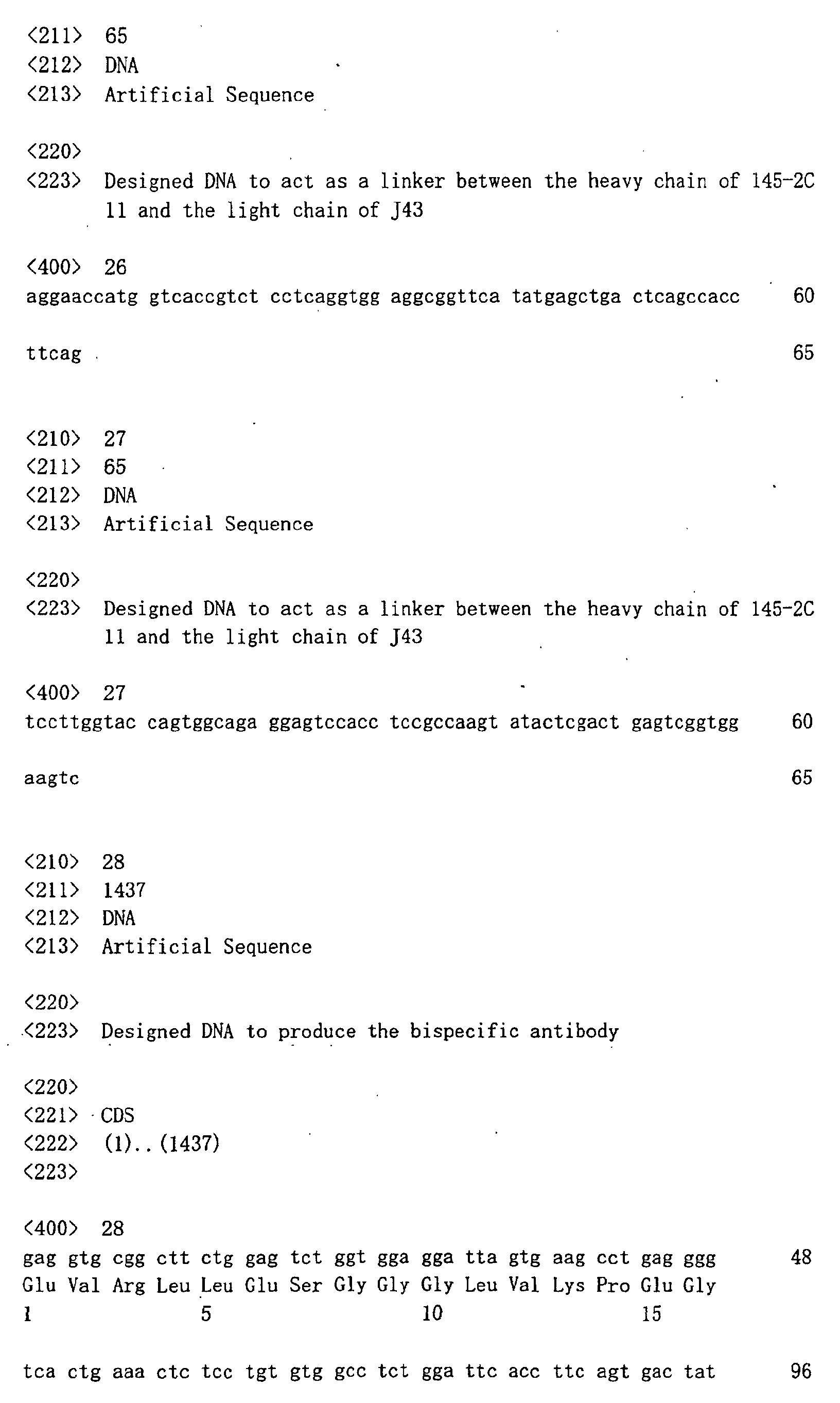
- the initiation codon is added to 5'-end of the nucleotide sequence, for example, shown in SEQ ID NO:28, then the expression vector is prepared by connecting the obtained DNA to the downstream of a suitable promoter (e.g., trp promoter, lac promoter, ⁇ PL promoter, and T7 promoter) , and by inserting it into a vector (e.g., pBR322, pUC18 and pUC19) which functions in an E. coli strain.
- a suitable promoter e.g., trp promoter, lac promoter, ⁇ PL promoter, and T7 promoter
- a vector e.g., pBR322, pUC18 and pUC19
- an E. coli strain (e.g., E. coli strain DH1, E. coli strain JM109 and E. coli strain HB101) which is transformed with the expression vector described above may be cultured in an appropriate medium to obtain the desired peptide.
- a signal peptide of bacteria e.g., signal peptide of pel B
- the desired peptide may be released in periplasm.
- a fusion protein with other peptide may be produced easily.
- an expression vector is prepared by inserting a DNA, for example, having the nucleotide sequence shown in SEQ ID NO: 28, into the downstream of a proper promoter (e.g., SV40 promoter, LTR promoter and metallothionein promoter) in a proper vector (e.g., retro virus vector, papilloma virus vector, vaccinia virus vector and SV40 vector).
- a proper promoter e.g., SV40 promoter, LTR promoter and metallothionein promoter
- a proper vector e.g., retro virus vector, papilloma virus vector, vaccinia virus vector and SV40 vector.
- suitable mammalian cells e.g., monkey COS-1 cells, COS-7 cells, Chinese hamster CHO cells, mouse L cells, 293 cells etc.
- suitable mammalian cells e.g., monkey COS-1 cells, COS-7 cells, Chinese hamster CHO cells, mouse L cells, 293 cells etc.
- the transfectedcells are cultured in an appropriate medium, the aimed peptide can be secreted into the culture medium.
- a transformation of E. coli can be carried out in accordance with the method, for example, described in Proc. Natl. Acad. Sci. (USA) 69:2110, 1972 and Gene 17: 107, 1982.
- a transfection of mammalian cells can be carried out in accordance with the method, for example, described in Saiboukougaku supl.8:263 (New experimental protocol for cell technology), Shujun-sha, 1995 and Virology 52:456, 1973.
- a bispecific antibody can be prepared directly by using recombinant DNA technology.
- Alt et al. FEBS Letter 454:90, 1999
- VH heavy chain variable domain
- VL light chain variable domain
- VH andVLdomains of this fragment are obliged to pair with each complementary VL and VH domain on other chain, and thereby form two antigen binding sites.
- a peptide linker contains 3 to 12 amino acid residues, but it is not limited particularly to its amino acid sequence (Hudson et al., J. Immunol. Met. 231:177, 1999).
- the peptide thus obtained can be purified by usual methods such as salting out, ion exchange chromatography, gel filtration, hydrophobic chromatography and affinity chromatography.
- bispecific antibody of the present invention also recognizes PD-1 specifically, it can be used for the purification and concentration of PD-1, for example, for affinity chromatography etc.
- the greatest and important usage of a substance that specifically recognizes PD-1 by the present invention is for the medical treatment of the following disease.
- a substance that specifically recognizes PD-1 by the present invention is useful for the medical treatment and/or prevention of diseases such as neurodegenerative disease (Parkinson's disease, parkinsonian syndrome, Huntington's disease, Machado-Joseph disease, amyotrophic lateral sclerosis and Creutzfeldt-Jakob disease etc.).
- diseases such as neurodegenerative disease (Parkinson's disease, parkinsonian syndrome, Huntington's disease, Machado-Joseph disease, amyotrophic lateral sclerosis and Creutzfeldt-Jakob disease etc.).
- a substance that specifically recognizes PD-1 by the present invention is also useful for the medical treatment and/or prevention of diseases, in which PD-1 is involved and immune responses are enhanced, such as autoimmune diseases (glomerular nephritis, arthritis, dilated cardiomyopathy-like disease, ulcerative colitis, Sjogren's syndrome, Crohn's disease, systemic lupus erythematosus, chronic rheumatoid arthritis, multiple sclerosis, Psoriasis, allergic contact dermatitis, polymyositis, scleroderma, periarteritis nodosa, rheumatic fever, vitiligo vulgaris, insulin-dependent diabetes mellitus, Behcet's Syndrome and chronic thyroiditis etc.), organ transplant rejection, and allergy.
- autoimmune diseases glomerular nephritis, arthritis, dilated cardiomyopathy-like disease, ulcerative colitis, Sjogren's syndrome, Crohn's disease, systemic lup
- a substance that specifically recognizes PD-1 by the present invention is also useful for the medical treatment and/or prevention of diseases, in which PD-1 is involved and immune responses are reduced, such as neoplasm and infections.
- administration of the substance that specifically recognizes PD-1 by the present invention can be carried out in systemic or local, generally peroral or parenteral ways.
- the dosage to be administered depends upon age, body weight, symptom, desired therapeutic effect, route of administration, and duration of the treatment etc.
- one dose per person is generally between 0.1 mg and 100 mg by oral administration up to several times per day, or between 0.01 mg and 30 mg by parenteral administration (preferably intravenous administration) up to several times per day, or continuous administration between 1 and 24 hrs. per day into vein.
- the doses to be used depend upon various conditions. Therefore, there are cases in which doses lower than or greater than the ranges specified above may be used.
- the compounds of the present invention may be administered as inner solid compositions or inner liquid compositions for oral administration, or as injections, liniments or suppositories etc. for parenteral administration.
- Inner solid compositions for oral administration include compressed tablets, pills, capsules, dispersible powders and granules etc.
- capsules include hard capsules and soft capsules.
- one or more of the active compound(s) remains intact, or is/are admixed with excipients (lactose, mannitol, glucose, microcrystalline cellulose and starch etc.), connecting agents (hydroxypropyl cellulose, polyvinylpyrrolidone, magnesium metasilicate aluminate, etc.), disintegrating agents (cellulose calcium glycolate etc.), lubricating agents (magnesium stearate etc.), stabilizing agents, assisting agents for dissolving (glutamic acid, asparaginic acid etc.) etc. to prepare pharmaceuticals by known methods.
- excipients lactose, mannitol, glucose, microcrystalline cellulose and starch etc.
- connecting agents hydroxypropyl cellulose, polyvinylpyrrolidone, magnesium metasilicate aluminate, etc.
- disintegrating agents cellulose calcium glycolate etc.
- lubricating agents magnesium stearate etc.
- stabilizing agents assisting agents for dissolving (glutamic acid
- Thepharmaceuticals may, if desired, becoated with coating agent (sugar, gelatin, hydroxypropyl cellulose or hydroxypropylmethyl cellulose phthalate etc.), or be coated with two or more films. Further, coating may include capsules of absorbable materials such as gelatin.
- Inner liquid compositions for oral administration may contain pharmaceutically acceptable water-agents, suspensions, emulsions, syrups and elixirs etc.
- one or more of the active compound(s) is/are resolved, suspended or emulsified in inert diluent (s) commonly used in the art (purified water, ethanol or mixture thereof etc.).
- Such liquid compositions may also comprise wetting agents, suspending agents, emulsifying agent, sweetening agents, flavoring agents, perfuming agents, preserving agents and buffer agents etc.
- Injections for parenteral administration include solutions, suspensions and emulsions and solid injections, which are dissolved or suspended in solvent when it is used.
- one or more active compound(s) is/are dissolved, suspended or emulsified in a solvent.
- Solvents include distilled water for injection, physiological salt solution, plant oil, propylene glycol, polyethylene glycol, alcohol such as ethanol, and mixture thereof etc.
- Such compositions may comprise additional stabilizing agents, assisting agents for dissolving (glutamic acid, asparaginic acid, POLYSOLBATE80 (resistered trademark) etc.), suspending agents, emulsifying agents, soothing agent, buffer agents, preserving agents etc.
- They may be manufactured or prepared by sterilization or by aseptic manipulation in a final process. They may also be manufactured in the form of sterile solid compositions such as freeze-dried compositions, and can be dissolved in sterile water or some other sterile solvent for injection immediately before use.
- compositions for parenteral administration include liquids for external use, ointments, endermic liniments, aerosols, spray compositions, suppositories and pessaries for vaginal administration etc., which comprise one or more of the active compound (s) and may be prepared by known methods.
- Spray compositions may comprise additional substances other than inert diluents generally used: e.g. stabilizing agents such as sodium hydrogen sulfate, buffer agents to give isotonicity, isotonic buffer such as sodium chloride, sodium citrate and citric acid.
- stabilizing agents such as sodium hydrogen sulfate, buffer agents to give isotonicity
- isotonic buffer such as sodium chloride, sodium citrate and citric acid.
- the substance that specifically recognizes PD-1 by the present invention can also be used for the screening of substances, which are involved in immune responses, by measuring the expression of PD-1.
- a substance that specifically recognizes PD-1 by the present invention comprises a substance that recognizes PD-1, a substance that recognizes a membrane protein co-existing with PD-1 on a cell membrane, and a linker, is a superior substance recognizable both PD-1 and the membrane protein specifically and transmittable the signal of PD-1.
- anti-PD-1 antibody and anti-T cell receptor antibody are linked by a linker simply referred to as "anti-PD-1/anti-TCR hybrid antibody”
- anti-PD-1/anti-TCR hybrid antibody a substance in which anti-PD-1 antibody and anti-B cell receptor antibody are linked by a linker "anti-PD-1/anti-BCR hybrid antibody”
- Anti-mouse CD3 ⁇ monoclonal antibodies were substituted with Sodium phosphate (0.1M, pH7. 0) and Nacl (50mM), then 200 times quantity of sulfo-EMCS (manufactured by Dojin Chemical) were added and incubated at 20°C for 1 hour. Then the reaction mixture was size-fractionated by gel filtration using Sephacril S-300 [Sodium phosphate (0.1M, pH7.0)] and major peak fractions were collected by monitoring the absorbency at 280nm. The protein content was calculated from the absorbency at 280nm simultaneously.
- Antibodies against mouse PD-1 (produced by the hybridoma cells named (J43) and deposited as international deposition Accession number FERM BP-8118) were substituted with Sodium phosphate (0.1M, pH6.0), added with 2-mercaptoethylamine (final concentration of 10mM) and EDTA (final concentration of 1mM), and reduced at 37°C for 90 minutes. Then the reaction mixture was size-fractionated by gel filtration using Sephacryl S-300 [Sodium phosphate (0.1M, pH6.0)] and major peak fractions (single chain fractions) were collected by monitoring the absorbency at 280nm. The protein content was calculated from the absorbency at 280nm simultaneously.
- Antibodies against mouse PD-1 (produced by the hybridoma cells named (J43) and deposited as international deposition Accession number FERM BP-8118) were substituted with pepsin-buffer [(sodium acetate 0.1M, pH4.5), NaCl (0.1M)], added with pepsin (final concentration of 0.2mg/ml), and digested for 48 hours at 37°C. Then the reaction mixture was size-fractionated by gel filtration using Sephacryl S-200 [Tris-HCl (0.2M, pH8.0), EDTA (10mM)] andmajor peak fractions (F(ab') 2 fraction) were collectedbymonitoring the absorbency at 280nm. The protein content was calculated from the absorbency at 280nm simultaneously.
- Anti-mouse CD3 ⁇ monoclonal antibodies (manufactured by Pharmingen) were substituted with pepsin-buffer [(sodium acetate 0.1M, pH4.5), NaCl (0.1M)], added with pepsin (final concentration of 0.2mg/ml), and digested for 48 hours at 37 °C. Then the reaction mixture was size-fractionated by gel filtration using Sephacryl S-200 [Tris-HCl (0.2M, pH8.0), EDTA (10mM)] and major peak fractions (F(ab') 2 fraction) were collected by monitoring the absorbency at 280nm. The protein content was calculated from the absorbency at 280nm simultaneously.
- Phenylenedimaleimide (manufactured by Aldrich) (final concentration of 4mM) was added to the Fab SH fraction of anti-PD-1 antibodies prepared in step (2-A), and incubated for 30 minutes at room temperature to prepare J43 Fab mal fraction.
- the J43 Fab mal fraction and the Fab SH fraction of anti-mouse CD3 ⁇ monoclonal antibodies were mixed at the rate of 1:1.3 and incubated for 4 hours at room temperature.
- an appropriate amount of Tris-HCl (1M, pH8.0) were added to make the pH of the reaction mixture 8.0, 2-mercaptoethanol (final concentration of 20mM) was added and incubated at 30°C for 30 minutes.
- iodoacetoamide (manufactured by Sigma) was added (final concentration of 25mM) and incubated for additional 10 minutes at room temperature under light shielding.
- reaction mixture was size-fractionated by gel filtration using Sephacryl S-200 [sodium acetate (50mM, pH6.3), EDTA (1mM)] and major peak fractions (BsAb fraction) were collected by monitoring the absorbency at 280nm.
- the protein content was calculated from the absorbency at 280nm simultaneously.
- Example 2 Confirmation of reactivity of anti-PD-1/anti-TCR hybrid Fab antibodies on cell surface antigen (PD-1 and CD3)
- X 10 6 cells were recovered from mPD-1/A 20IIA1.6 cells as a PD-1 positive and CD3 negative cell, and naive T cells prepared from mouse spleen cells as a PD-1 negative and CD3 positive cell, respectively.
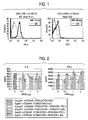
- the cells were added with 91 ⁇ l of FACS buffer (PBS(-) containing 0.5% BSA, EDTA (2mM) and 0.01% NaN 3 ), 5 ⁇ l of mouse serum and 4 ⁇ l of hybrid antibodies (2 ⁇ g) and incubated for 30 minutes on ice. After washing with PBS(-) once, the cells were added with each 2 ⁇ l (1 ⁇ g) of second antibodies, fill upped to final 100 ⁇ l with FACS buffer, and incubated for 30 minutes on ice. Then they were analyzed by using FACScan. The results were shown in figure 1 (in the following figures, hybrid Fab antibody simply referred to as "HFAb").
- Spleen was excised from BALB/c mouse. After red blood cells were hemolyzed, the spleen cells were washed once with PBS (-) and suspended in medium RPMI1640 (10% FCS, antibiotics) (1 X 10 8 cells/ml). Next, T cells were prepared by using nylon fiber column (manufactured by WAKO) for T cell separation equilibrated with the medium.
- Antibodies against mouse PD-1 weresubstitutedwithpepsin-buffer [ (sodium acetate 0.1M, pH4.5), NaCl (0.1M)], added with pepsin (manufactured by SIGMA) (final concentration of 0.2mg/ml), and digested at 37°C for 48 hours. Then the reaction mixture was size-fractionated by gel filtration using Sephacryl S-200 (manufactured by AmarshamParmacia) [Tris-HCl (0.2M, pH8.0), EDTA (10mM)] and major peak fractions (F(ab') 2 fraction) were collected by monitoring the absorbency at 280nm. The protein content was calculated from the absorbency at 280nm simultaneously.
- Phenylenedimaleimide (manufactured by Aldrich) (final concentration of 4mM) was added to the Fab SH fraction of J43 anti-PD-1 antibodies, and incubated for 30 minutes at room temperature to prepare J43 Fab mal fraction.
- the J43 Fab mal fraction and the Fab SH fraction of anti-IgG (H+L) polyclonal antibodies were mixed at the rate of 1:1.3 and incubated for 4 hours at room temperature.
- an appropriate amount of Tris-HCl (1M, pH8.0) were added to make the pH of the reaction mixture 8.0, 2-mercaptoethanol (final concentration of 20mM) was added and incubated at 30°C for 30 minutes.
- DNA fragments of mPD1-flag digested with EcoRI were inserted into the EcoRI site of a commercially available expression vector to construct the expression plasmid mPD1-pA.
- the cells were suspended in 30 ml of medium (RPMI1640 containing 10% FBS, 50 ⁇ l of 2-mercaptoethanol, penicillin and streptomycin), diluted thirtyfold further, and dispensed onto 96-well plates (10 3 /100 ⁇ l/ well) . After 48 hours, the selection was initiated using final 3 ⁇ M of Puromycin to establish the cell line expressing mouse PD-1.
- medium RPMI1640 containing 10% FBS, 50 ⁇ l of 2-mercaptoethanol, penicillin and streptomycin
- A20IIA1.6 cells that was forced to express mouse PD-1 were seeded on 96-well plates (5 X 10 5 cells/ 100 ⁇ l).
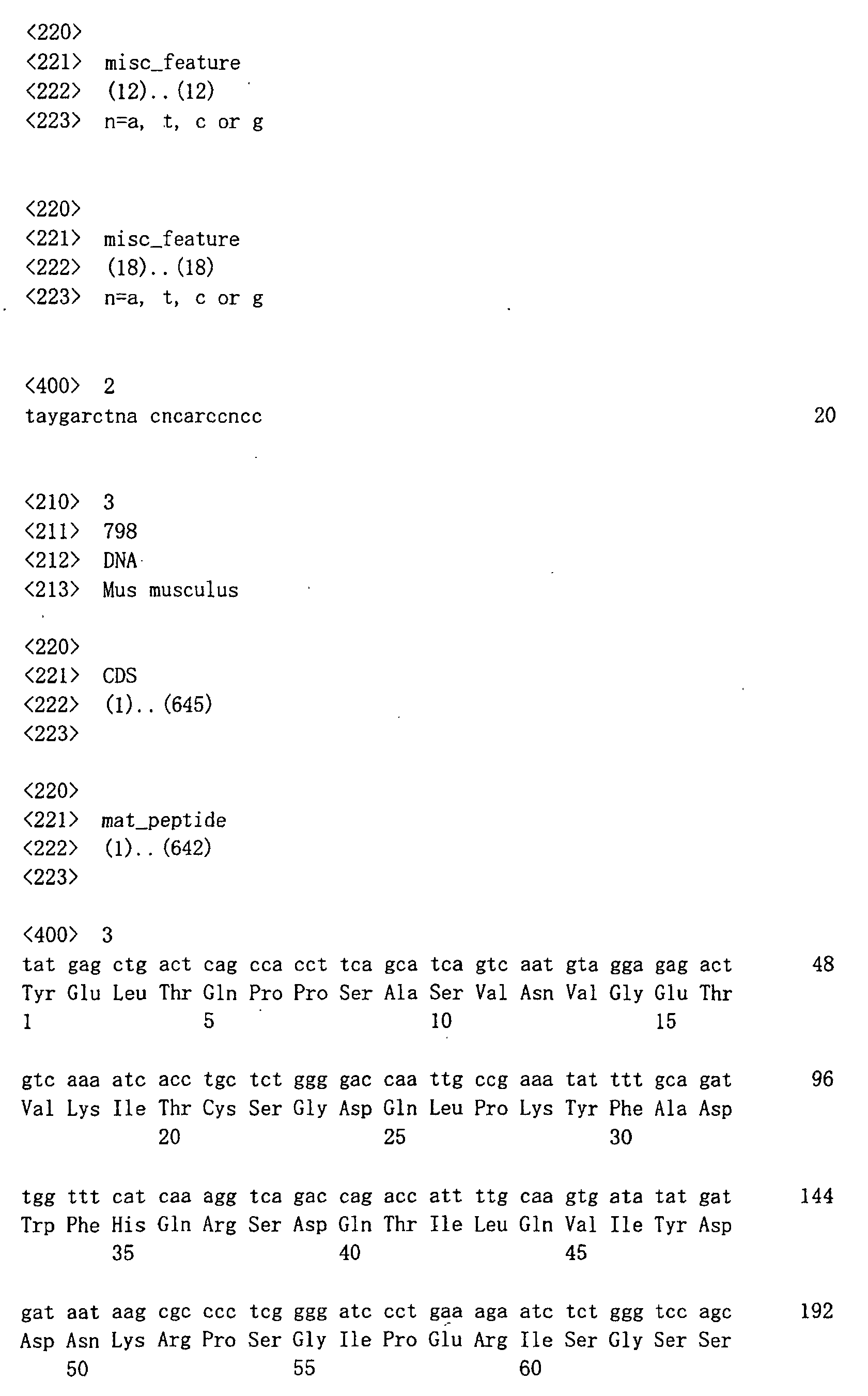
- Anti-PD-1/anti-BCR hybrid Fab antibodies (0, 1, 3, 10 ⁇ g/ 100 ⁇ l) were added, 10 minutes later 100 ⁇ l of anti-mouse IgG (H+L) F(ab') 2 (manufactured by Zymed) (final concentration of 0.3, 1, 3 ⁇ g/ ml) were dispensed and cultivated for 12 hours in a CO 2 incubator (at 37°C).
- the culture supernatants were recovered and the concentrations of IL-2 in the culture supernatants were measured by using mouse IL-2 assay kit (manufactured by R & G System) . The results were shown in figure 3.
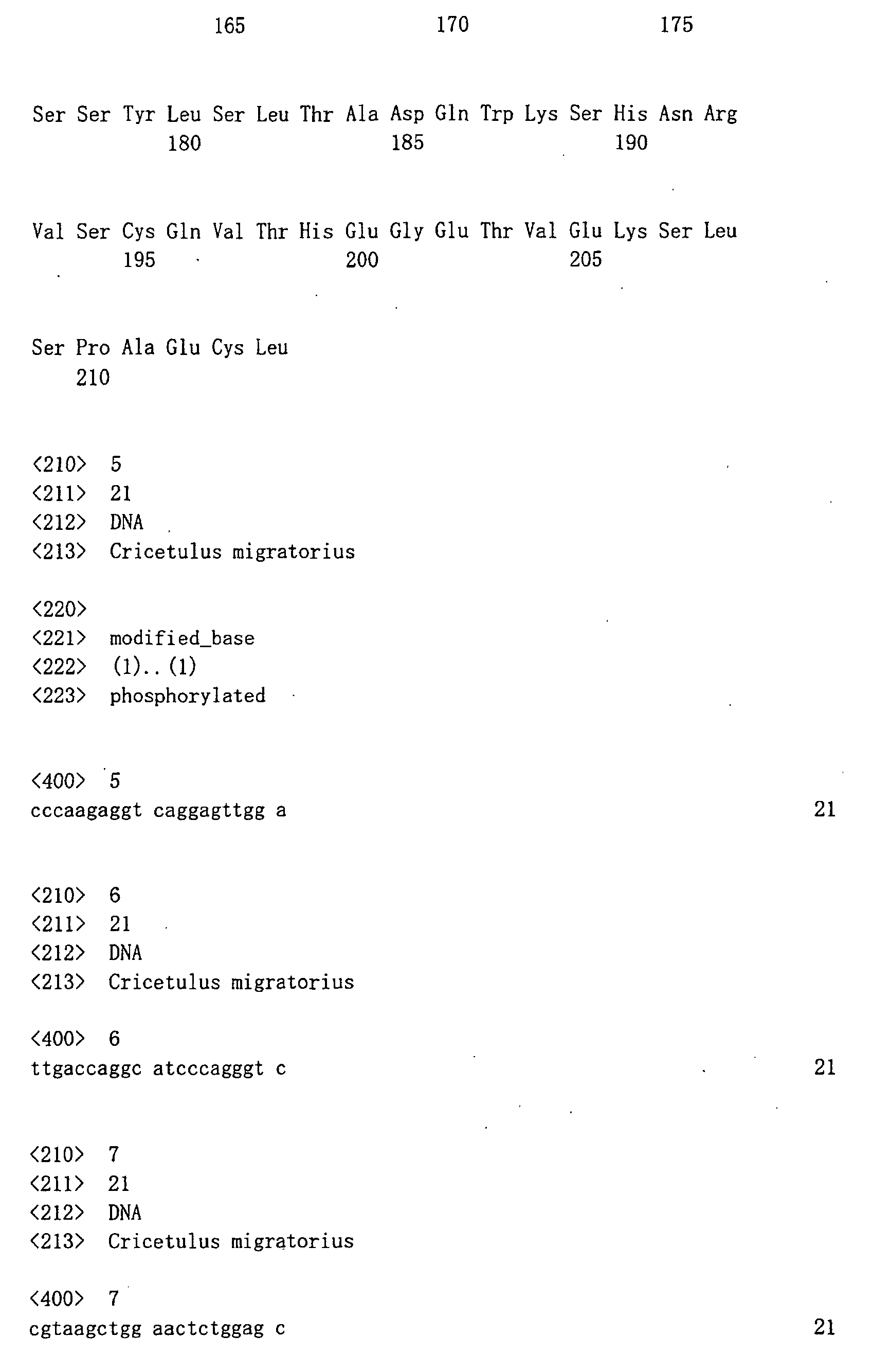
- Anti-PD-1/anti-BCR hybrid Fab antibodies (0, 1, 3, 10 ⁇ g/ 100 ⁇ l) were added to 3 X 10 6 of A20IIA1.6 cells (B cell line) that was forced to express mouse PD-1. After 10 minutes, 100 ⁇ l of anti-mouse IgG (H+L) F(ab') 2 were added and incubated for 5 minutes at room temperature.
- the cells were suspended in 200 ⁇ l of lysis buffer (composition: Tris-HCl (20 mM, pH7.4), NaCl (150 mM), Na 2 EDTA (1 mM), EGTA (1 mM), 1% Triton-X100, sodium pyrophosphate (2.5 mM), ⁇ -sodium glycerophosphate (1 mM), Na 3 VO 4 (1 mM), leupeptin (1 ⁇ g/ ml) and PMSF (1 mM) and left at rest on ice.
- lysis buffer composition: Tris-HCl (20 mM, pH7.4), NaCl (150 mM), Na 2 EDTA (1 mM), EGTA (1 mM), 1% Triton-X100, sodium pyrophosphate (2.5 mM), ⁇ -sodium glycerophosphate (1 mM), Na 3 VO 4 (1 mM), leupeptin (1 ⁇ g/ ml) and PMSF (1 m
- the beads were washed five times with 400 ⁇ l of lysis buffer, added with 20 ⁇ l of lysis buffer and 20 ⁇ l of 2 X SDS sample buffer, and boiled at 100°C for 5 minutes. After discarding the beads by centrifugation, 15 ⁇ l of supernatants were subjected to 4-20% SDS-PAGE. After electrophoresis the gels were substituted with blotting buffer and transferred onto PVDF membrane (manufactured by BIO RAD). Then the membrane was blocked with Block Ace (manufactured by Dainippon Pharmaceuticals) for 1 hour at room temperature.
- Block Ace manufactured by Dainippon Pharmaceuticals
- the membrane was incubated with anti-SHP-2 antibody (manufactured by SANTA CRUZ) diluted 1/200 for 1 hour at room temperature, then washed three times with TBS-T for 10 minutes.
- the membrane was incubated with HRP-conjugated anti-rabbit Ig antibody (manufactured by Amersham Bioscience) diluted 1/2000 for 1 hour at room temperature, then washed three times with TBS-T for 10 minutes.
- the membrane was emitted light by using ECT plus detection kit (manufactured by Amersham Bioscience) and analyzed using luminoimager LAS1000 plus (manufactured by FUJI Film).
- Anti-mouse PD-1 antibody producing hybridoma (J43) cells were cultured in Hybridoma SFM medium (manufactured by Invitrogen) at 37°C under 5% CO 2 , a few days after the culture supernatants of hybridoma cells were recovered. IgG fraction was purified from the culture supernatants recovered by using HiTrap Protein G (manufactured by Amersham Bioscience).
- J43 IgG was subjected to 10-20% SDS-PAGE. After electrophoresis the IgG was electrically transferred from the gel onto PVDF membrane (manufactured by BIO RAD) . The membrane transferred was stained with coomassie, the membrane fraction containing the light chain of J43 IgG was removed, and amino terminal 15 residues of the light chain were determined by using peptide sequencer Procise492 (manufactured by Applied Biosystems)(SEQ ID NO:1).
- RNA was prepared according to the direction of attached document. mRNA was purified from total RNA thus prepared by using Oligo tex-MAG mRNA Purification Kit (manufactured by Takara Shuzo).
- Degenerated primer (primer No.1) was designed based on the amino terminal sequence (YELTQPPSASVNVGE) of the light chain determined by peptide sequencing.
- 3'RACE was carried out by using 3'-Full RACE Core Set (manufactured by Takara Shuzo) under the following conditions.
- the PCRproducts were subjected to electrophoresis using 1% Agarose gel, then the gel was stained by EtBr.
- DNA fragment was recovered from the gel by using MinElute Gel Extraction Kit (manufactured by Quiagen), the DNA fragment recovered was ligated to pGEM-T Easy Vector (manufactured by Promega) by using DNA Ligation Kit ver.2 (manufactured by Takara Shuzo).
- E. coli DH5 ⁇ was transformed with the ligated plasmid.
- the plasmid was purified from E. coli and J43 IgG light chain cDNA was sequenced (SEQ ID NO:3).
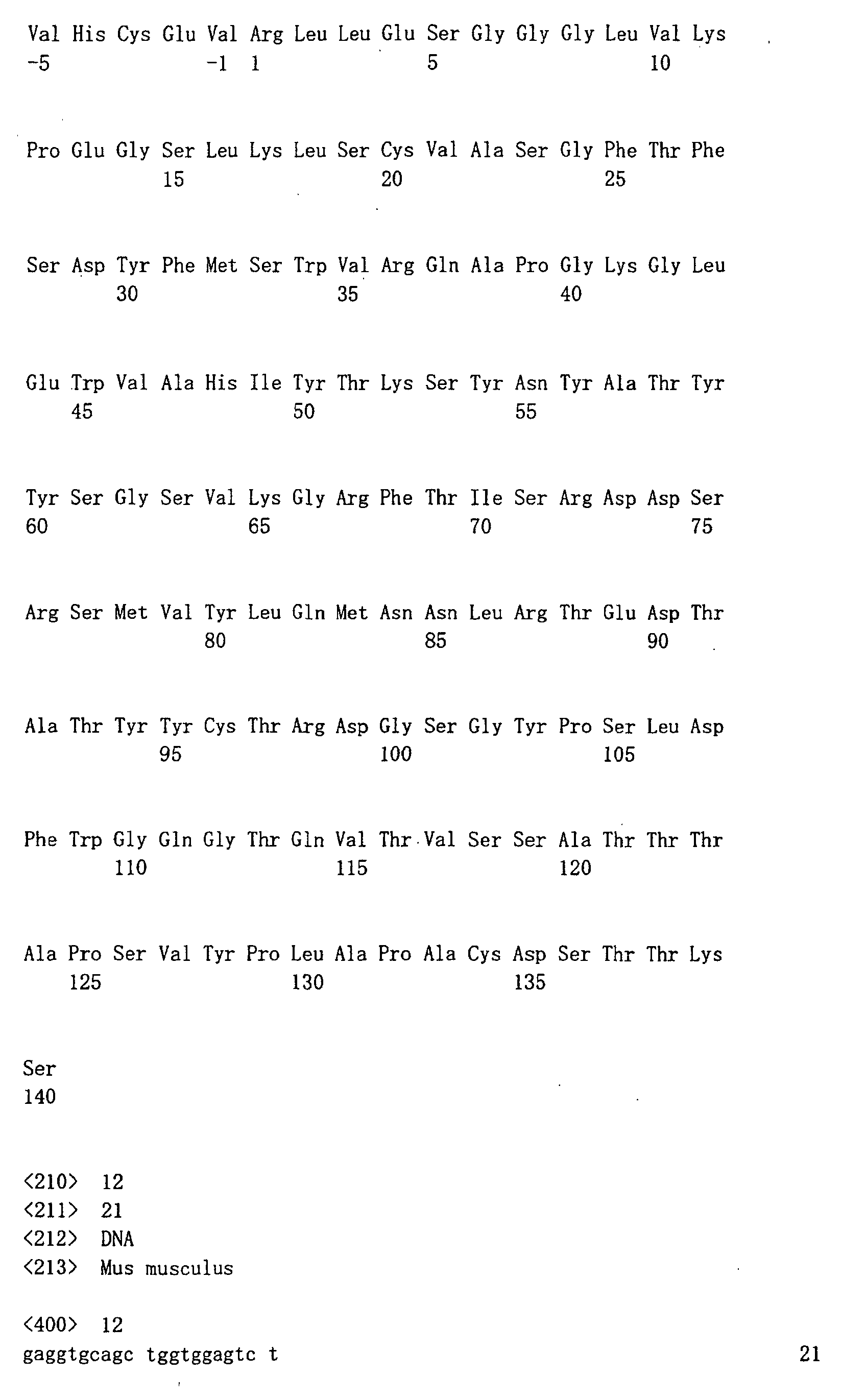
- the deduced amino acid sequence of the cDNA is shown in sequence listing (SEQ ID NO:4).
- 5'RACE primers for constant region were designed based upon the reported information of hamster IgG heavy chain cDNA sequence (GenBank Accession No.U17166). 5'RACE was carried out by using 5'-Full RACE Core Set (manufactured by Takara Shuzo) under the following conditions.
- the PCRproducts were subjected to electrophoresis using 1% Agarose gel, then the gel was stained by EtBr.
- DNA fragment was recovered from the gel by using MinElute Gel Extraction Kit (manufactured by Quiagen), the DNA fragment recovered was ligated to pGEM-T Easy Vector (manufactured by Promega) by using DNA Ligation Kit ver.2 (manufactured by Takara Shuzo).
- E. coli DH5 ⁇ was transformed with the ligatedplasmid.
- the plasmid was purified from E. coli and J43 IgG heavy chain cDNA was sequenced (SEQ ID NO:10).
- the deduced amino acid sequence of the cDNA is shown in sequence listing (SEQ ID NO:11).
- Example 7 cDNA cloning of anti-mouse CD3 ⁇ antibody
- Anti-mouse CD3 ⁇ antibody producing hybridoma 145-2C11: manufactured by Pharmingen cells were cultured in Hybridoma SFM medium (manufactured by Invitrogen) at 37°C under 5% CO 2 , a few days after 5 X 10 6 hybrisoma cells were lysed with 1 ml of TRIzol (manufactured by Invitrogen). Total RNA was prepared according to the direction of attached document.
- cDNA was synthesized from 2.5 ⁇ g of total RNA extracted from hybridoma (145-2C11) cells by oligo-dT prime method using Ready-To-Go You-Prime First-Strand Beads (manufactured by Amersham Pharmacia). Operations and procedures were followed by the instructions of attached document.
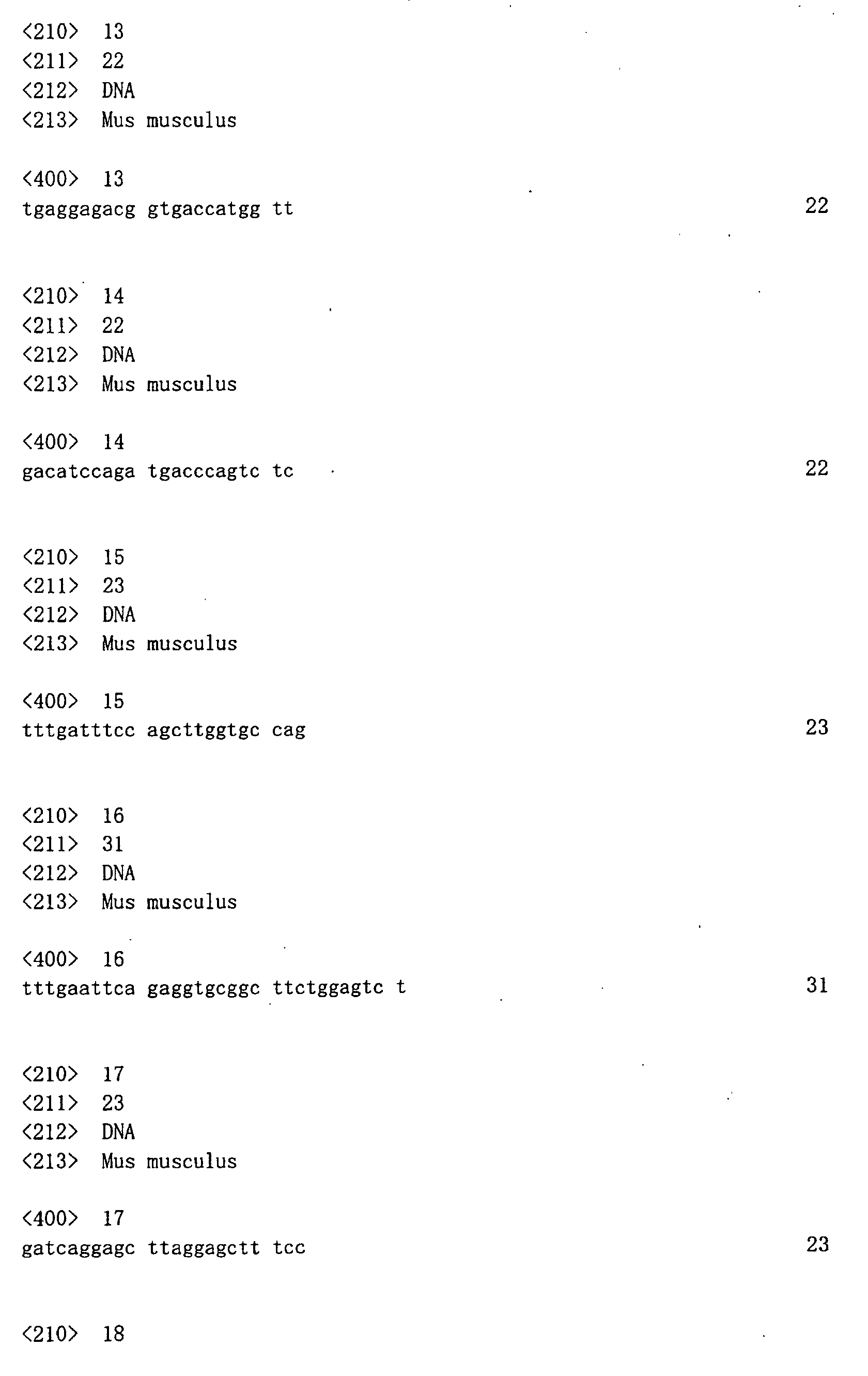
- primers No.7 and No.8 were designed.
- primers No. 9 and No. 10 were designed. PCR was carried out using these primers and the cDNA library from hybridoma 145-2C11 as a template.
- the PCRproducts were subjected to electrophoresis using 1% Agarose gel, then the gel was stained by EtBr. DNA fragments were recovered from the gel by using MinElute Gel Extraction Kit (manufactured by Quiagen), the DNA fragments recovered was ligated to pGEM-T Easy Vector (manufactured by Promega) by using DNA Ligation Kit ver.2 (manufactured by Takara Shuzo). E. coli DH5 ⁇ were transformed with the ligated plasmids. Finally, the plasmids were purified from E. coli, and both DNA were sequenced. It was confirmed that their sequences were identical to those of GenBankAccession No.AF000357 and GenBankAccession No.AF000356, respectively.
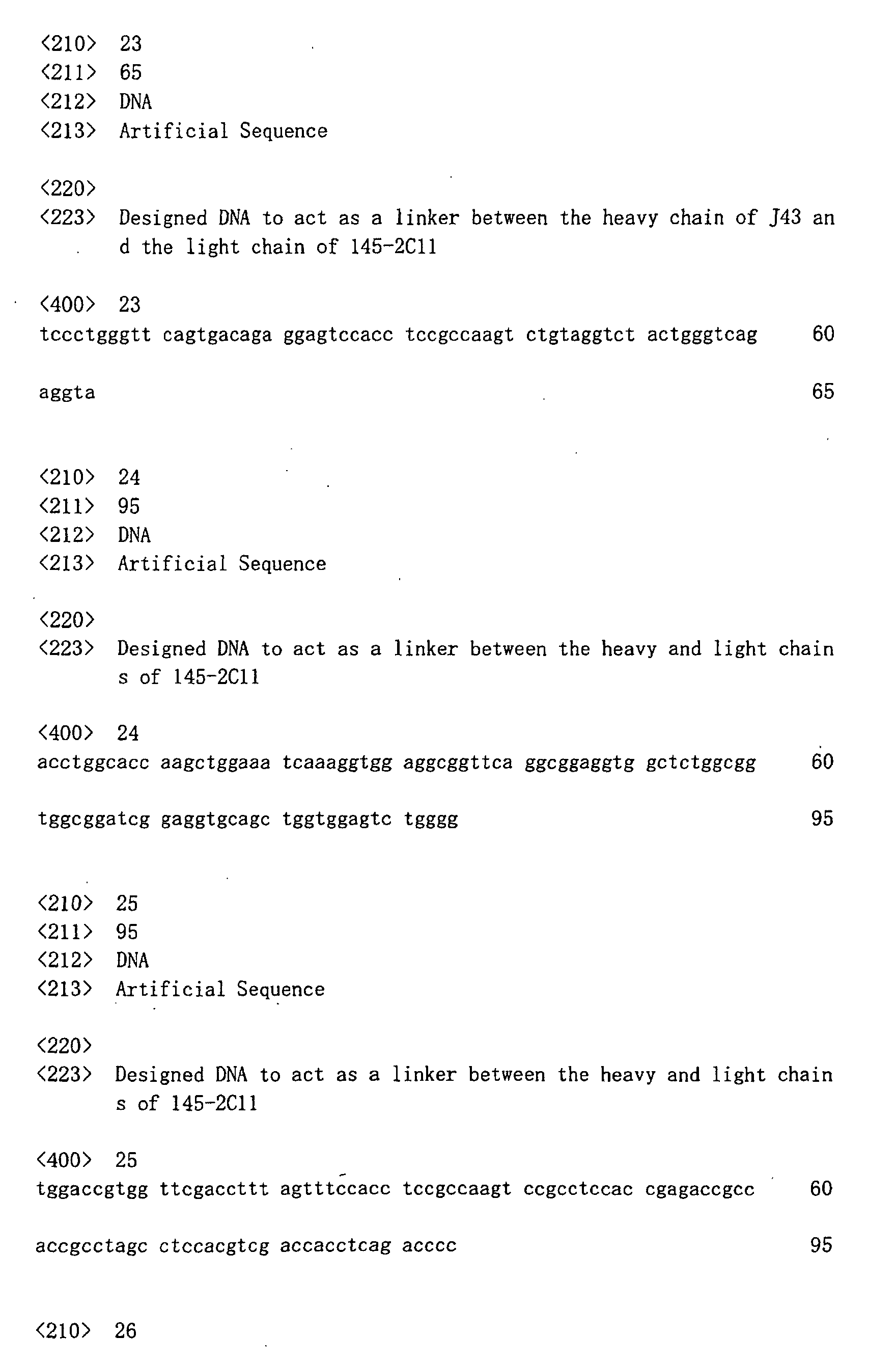
- J43 IgG heavy chain cDNA and 145-2C11 IgG light chain cDNA were connected by PCR using linker No.1, No.2, primer No.11 and No.12 to prepare fragment 1 (see Figure 5).
- 145-2C11 IgG light chain cDNA and 145-2C11 IgG heavy chain cDNA were connected by PCR using linker No.3, No.4, primer No.13 and No.14 to prepare fragment 2 (see Figure 5).
- 145-2C11 IgG heavy chain cDNA and J43 IgG light chain cDNA were connected by PCR using linker No.5, No.6, primer No .15 and No. 16 to prepare fragment 3 (see Figure 5).
- Template 1 Template 2 2 2 Linker (100 ng/ ⁇ l) 2 Linker (100 ng/ ⁇ l) 2 dH 2 O 17
- One shot LA PCR MixTM 25 50 ⁇ l 95°C 5min. ⁇ (94°C 30sec., 40°C 30sec., 72°C 60sec.) X 20 cycles
- the DNA fragments 1, 2 and 3 and plasmid pBluescriptII SK(+) (manufactured by StrateGene) were digested with restriction enzymes EcoRI/KpnI, KpnI/SphI, SphI/XhoI, EcoRI/XhoI, respectively. After electrophoresis on 1% agarose gel, the DNA fragments werepurified from the gel usingMinElute Gel Extraction Kit. Next, these three fragments and plasmid pBluescriptII SK(+) (manufactured by StrateGene) were connected using DNA Ligation Kit ver. 2 (manufactured by Takara Shuzo), then E. coli DH5 ⁇ were transformed with the connected plasmid.
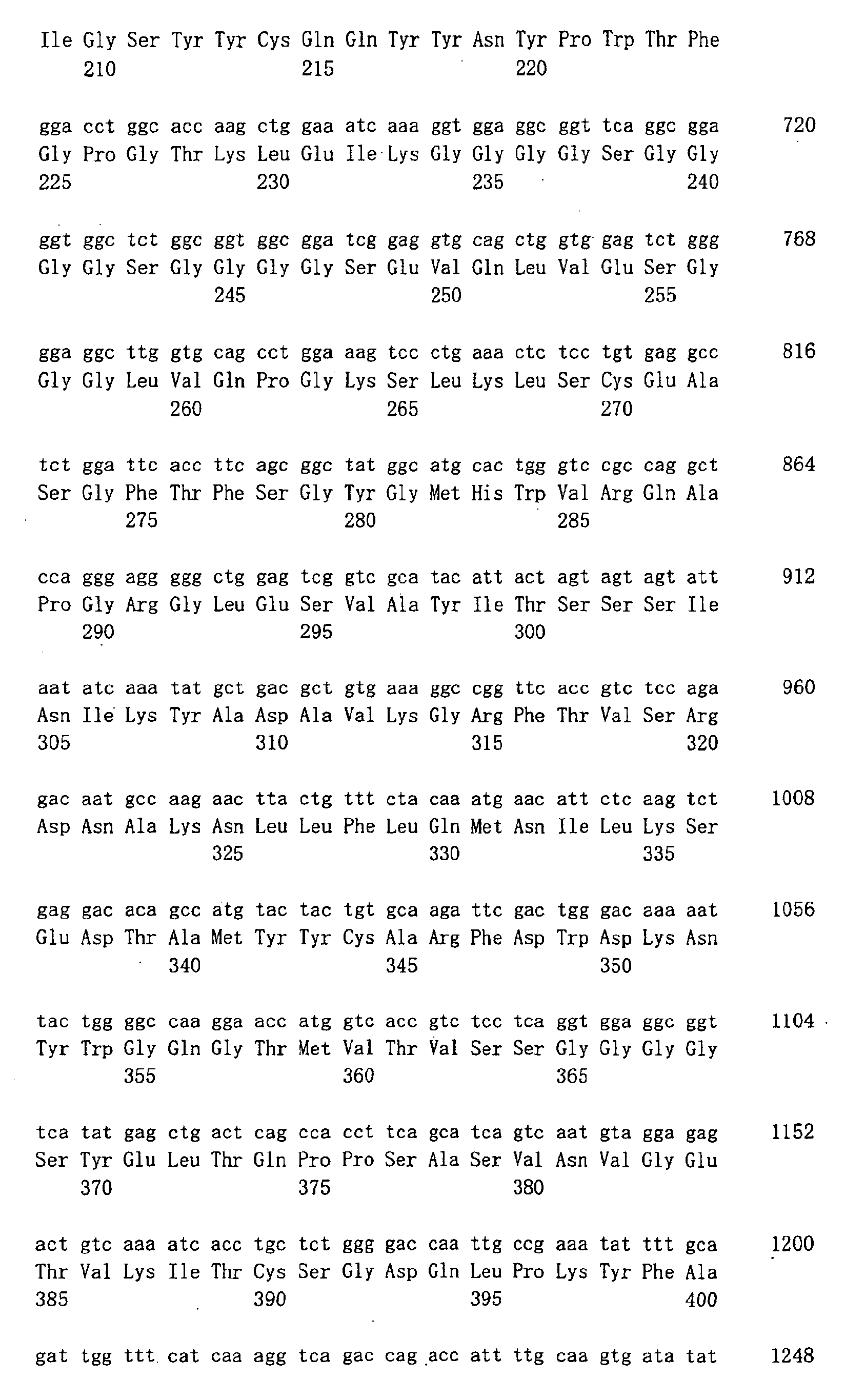
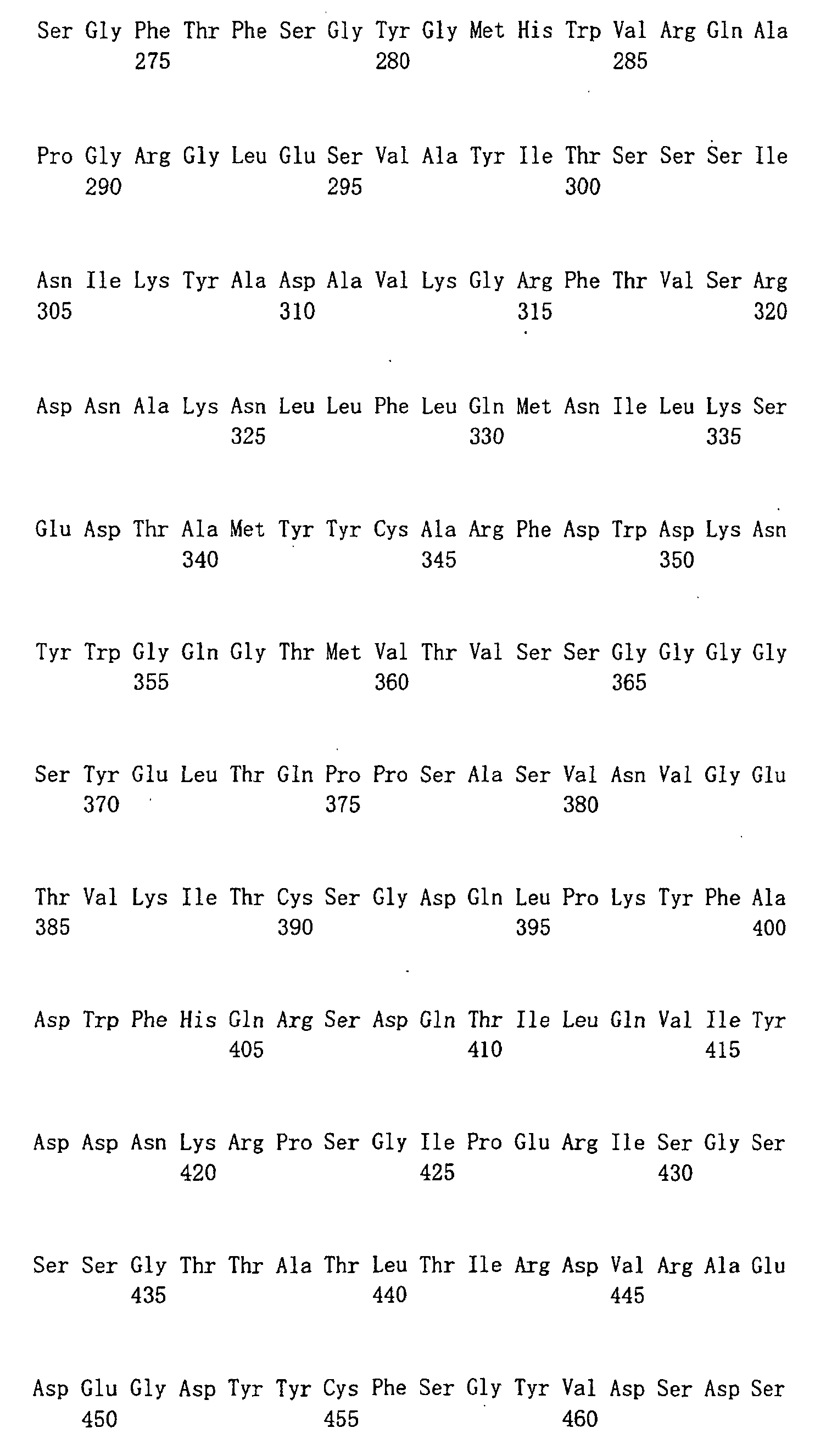
- Plasmid J43-2C11scDb-pBluescriptII SK(+) was prepared from E. coli, then the nucleotide sequence of the insert was determined (SEQ ID NO:28). The deduced amino acid sequence is shown in sequence listing (SEQ ID NO:29).
- J43-2C11scDb-pBluescriptII SK(+) was digested with restriction enzymes BamHI and XhoI, the BamHI-XhoI fragment out of BamHI-XhoI and BamHI-BamHI fragments generated by the digestion was connected with BamHI/XhoI digested mammalian expression vector pSecTag2/Hygro B (manufactured by Invitrogen). Next, the pSecTag2/Hygro B connected with BamHI-XhoI fragment was digested again with restriction enzyme BamHI, and connected with the other BamHI-BamHI fragment. E. coli DH5 ⁇ were transformed with the connected plasmid.
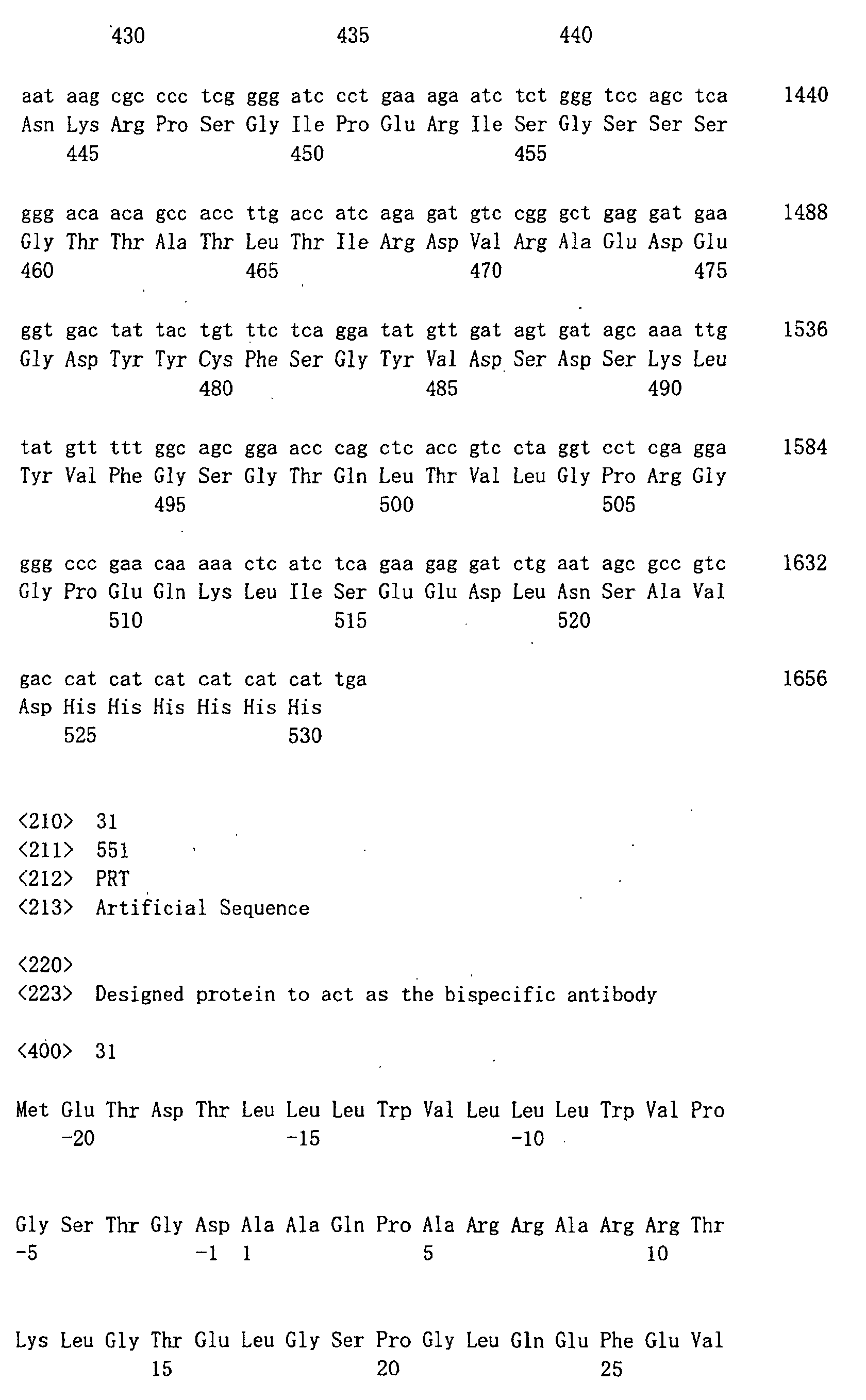
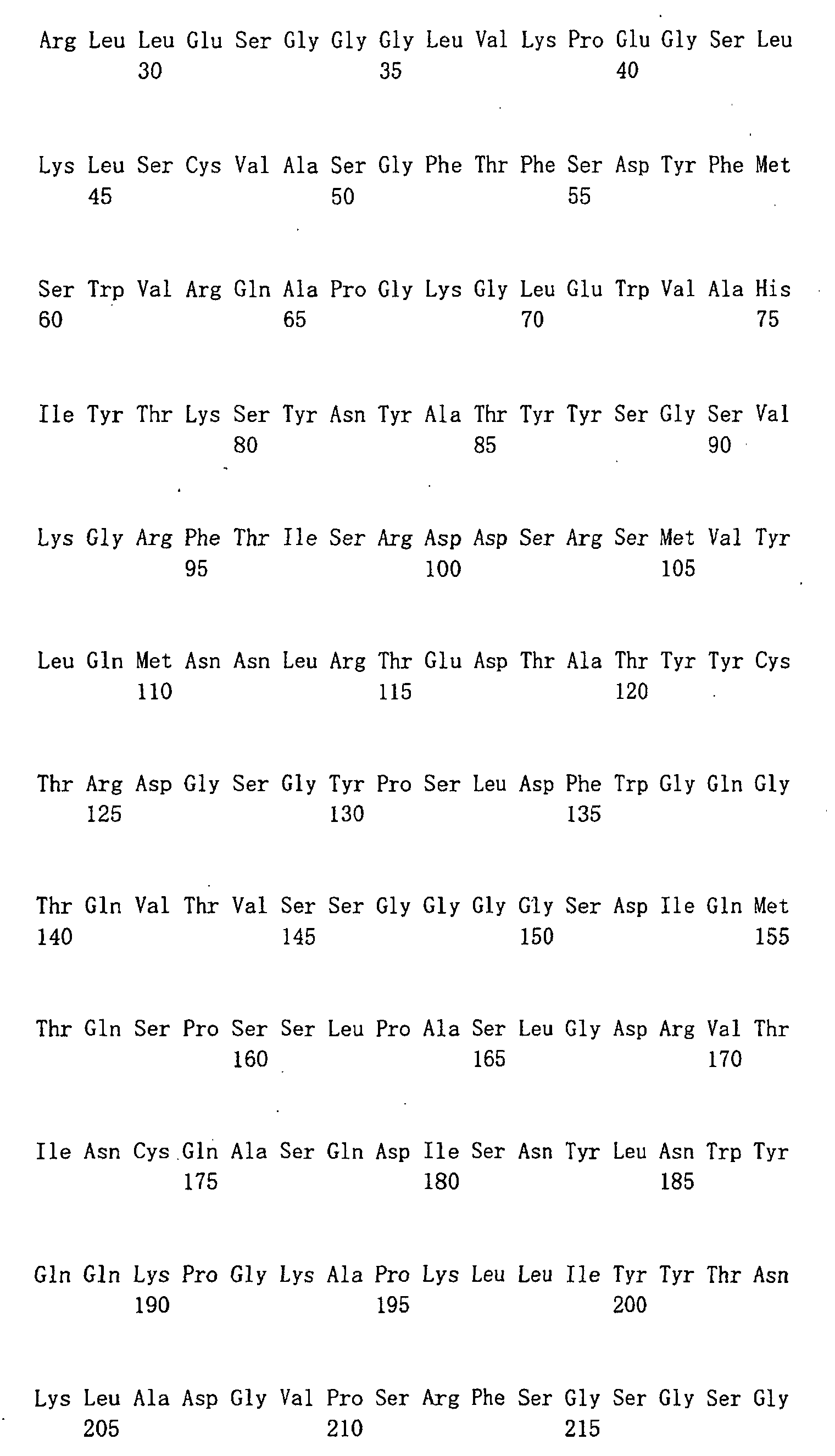
- Plasmid J43-2C11scDb-pSec/Hygro B was prepared from E. coli, then the nucleotide sequence of thus prepared J43-2C11 bispecific antibody was determined (SEQ ID NO:30). The deduced amino acid sequence is shown in sequence listing (SEQ ID NO:31).
- X 10 6 293 T cells were suspended in 20 ml of medium (DMEM containing 10% FBS) and seeded into 150 mm dish coated with Type Ic collagen. Next day, the cells were washed with 10 ml of DMEM and transfected with J43-2C11scDb-pSec/Hygro B by using LipofectAMINE-plus. After 3 hours, 5 ml of DMEM containing 40% FBS were added to the cells. At day 2, the cells were washed with 10 ml of DMEM, added 20 ml of new DMEM, and the culture supernatant was recovered at day 4.
- medium DMEM containing 10% FBS
- the cells were discarded by centrifugation, then the supernatant was filtrated using 0.22 ⁇ m PVDF filter.
- the supernatant was enclosed in dialysis tube, dialyzed against PBS containing 40% PEG20000, and concentrated.
- the concentrated supernatant was purified using HiTrap chelating HP column (manufactured by Amersham Farmacia).
- the antibodies were purified by gel-filtration using Hiprep 16/60 Sephacryl S-200 High Resolution (manufactured by Amersham Farmacia).
- Spleen was removed from BALB/c mouse, and cells were prepared using CellStrainer (70 ⁇ m Nyron). The cells were recoveredbycentrifugation, and red blood cells were hemolyzed by the addition of hemolysis buffer [NH 4 Cl (0.8%), KCO 3 (0.1%) and EDTA (1 mM)]. The cells were washed with PBS(-) once, T cells were enriched by using mouse CD3 + T cell enrichment column kit (manufactured by R&D), and suspended in medium (RPMI1640 containing 10% FBS) in the proportion of 5 X 10 6 cells/ ml.
- the T cells thus prepared were seeded on 96-well plates (2 X 10 5 cells/ 100 ⁇ l/ well), which were coated preliminarily with 5 ⁇ g/ ml of anti-CD3 antibodies (clone KT3) at 37°C for 3 hours, added with J43-2C11 bispecific antibody diluted in the medium (0.01, 0.03, 0.1, 0.3, 1 and 3 ⁇ g/ 100 ⁇ l), and cultivated for 72 hours at 37°C under 5% CO 2 . After 72 hours, the culture supernatants were recovered, and the concentrations of IFN-r in the supernatants were determined by using Quantikine Immunoassay Kit (manufactured by R&D).
- J43-2C11 bispecific antibody suppressed dose dependently the production of IFN-r from activated mouse spleen T cells in vitro.
Landscapes
- Health & Medical Sciences (AREA)
- Chemical & Material Sciences (AREA)
- Organic Chemistry (AREA)
- Medicinal Chemistry (AREA)
- General Health & Medical Sciences (AREA)
- Life Sciences & Earth Sciences (AREA)
- Immunology (AREA)
- Animal Behavior & Ethology (AREA)
- Nuclear Medicine, Radiotherapy & Molecular Imaging (AREA)
- General Chemical & Material Sciences (AREA)
- Pharmacology & Pharmacy (AREA)
- Chemical Kinetics & Catalysis (AREA)
- Public Health (AREA)
- Veterinary Medicine (AREA)
- Engineering & Computer Science (AREA)
- Bioinformatics & Cheminformatics (AREA)
- Neurology (AREA)
- Biomedical Technology (AREA)
- Genetics & Genomics (AREA)
- Biophysics (AREA)
- Molecular Biology (AREA)
- Biochemistry (AREA)
- Proteomics, Peptides & Aminoacids (AREA)
- Neurosurgery (AREA)
- Diabetes (AREA)
- Dermatology (AREA)
- Oncology (AREA)
- Physical Education & Sports Medicine (AREA)
- Orthopedic Medicine & Surgery (AREA)
- Rheumatology (AREA)
- Psychology (AREA)
- Communicable Diseases (AREA)
- Psychiatry (AREA)
- Pulmonology (AREA)
- Obesity (AREA)
- Urology & Nephrology (AREA)
- Emergency Medicine (AREA)
- Hospice & Palliative Care (AREA)
- Transplantation (AREA)
- Heart & Thoracic Surgery (AREA)
Abstract
Description

- 1) Synthesis of first strand cDNA
10 X RNA polymerase chain reaction (PCR) buffer 2 J43 mRNA (50 ng/ µl) 2 Magnesium chloride (25 mM) 4 dNTP mixture (each 10 mM) 2 AMV Reverse Transcriptase XL (5 U/ µl) 1 Oligo dT-3sites Adapter primer (2.5 pmol/ µl) 1 Ribonuclease (RNase) inhibitor (40 U/ µl) 0.5 dH2O 7.5 15 µl 30°C 10min. → 50°C 30min. → 95°C 5min. → 4°C 5min. - 2) Polymerase chain reaction (PCR)
First strand cDNA 1 Primer No.1 (20 pmol/ µl) 1 Anchorprimer 1 dH2O 22 One shot LA PCR Mix™ 25 50 µl 95°C 5min. → (94°C 29sec., 50°C 20sec., 72°C 60sec.) X 30 cycles





- 1) Synthesis of first strand cDNA
J43 total RNA (2 µg/ µl) 2 10 X RNA polymerase chain reaction (PCR) buffer 1.5 Ribonuclease (RNase) inhibitor (40 U/ µl) 0.5 AMV Reverse Transcriptase XL (5 U/ µl) 1 Primer No.2 (100 pmol/ µl) 2 dH2O 8 15 µl 30°C 10min. → 50°C 40min. → 30°C 2min. - 2) Degeneration of hybrid RNA
First strand cDNA 15 5 X Hybrid RNA Degeneration buffer 15 dH2O 45 Ribonuclease H (RNaseH) 1 76 µl 30° C 1 hour - 3) Cyclization of single chain cDNA by ligation
5 X RNA (ssDNA) Ligation buffer 8 40% Polyethylene glycol (PEG) #6000 20 dH2O 12 Pellet after ethanol precipitation T4 RNA ligase 1 41 µl - 4) First PCR
Sample after ligation 1 Primer No.3 (5 pmol/ µl) 2 Primer No.4 (5 pmol/ µl) 2 dH2O 20 One shot LA PCR Mix™ 25 50 µl 94°C 3min. → (94°C 30sec., 52°C 30sec., 72°C 120sec.) X 25 cycles - 5) Second PCR
Product of first PCR 2 Primer No.5 (5 pmol/ µl) 2 Primer No.6 (5 pmol/ µl) 2 dH2O 20 One shot LA PCR Mix™ 25 50 µl 94°C 3min. → (94°C 30sec., 52°C 30sec., 72°C 120sec.) X 30 cycles




| | 2 |
| Primer No.7 or No.9 (5 pmol/ µl) | 2 |
| Primer No.8 or No.10 (5 pmol/ µl) | 2 |
| dH2O | 20 |
| One shot LA PCR Mix™ | 25 |
| 50 µl | |
| (94°C 30sec., 52°C 30sec., 72°C 120sec.) X 30 cycles |












| |
2 |
| |
2 |
| Linker (100 ng/ µl) | 2 |
| Linker (100 ng/ µl) | 2 |
| dH2O | 17 |
| One shot LA PCR Mix™ | 25 |
| 50 µl | |
| 95°C 5min. → (94°C 30sec., 40°C 30sec., 72°C 60sec.) |
| Product of first PCR | 5 |
| Primer (5 pmol/ µl) | 2 |
| Primer (5 pmol/ µl) | 2 |
| dH2O | 16 |
| One shot LA PCR Mix™ | 25 |
| 50 µl | |
| 95°C 5min. → (94°C 30sec., 50°C 30sec., 72°C 60sec.) X 30 cycles |













Claims (16)
- A substance comprising a substance that recognizes PD-1, a substance that recognizes a membrane protein co-existing with PD-1 on a cell membrane, and a linker.
- The substance according to claim 1, which is a divalent substance comprising a substance that recognizes PD-1, a substance that recognizes a membrane protein co-existing with PD-1 on a cell membrane, and a linker.
- The substance according to claim 1 or 2, in which a membrane protein is a protein existing on a T cell membrane or B cell membrane.
- The substance according to claim 1 or 2, which comprises a substance that recognizes PD-1, a substance that recognizes a protein constituting T cell receptor complex or a substance that recognizes a protein consti tuting B cell receptor complex, and a linker.
- The substance according to any one of claims 1 to 4, in which a substance that recognizes PD-1 and in which a substance that recognizes a protein is dimer to pentamer, respectively.
- The substance according to any one of claims 1 to 5, in which one of or both substance that recognizes PD-1 and substance that recognizes a protein are an antibody.
- The substance according to any one of claims 1 to 6, in which one of the two or both substance that recognizes PD-1 and substance that recognizes a protein are a Fab portion of antibody.
- The substance according to any one of claims 1 to 5, in which a linker comprises an organic compound.
- The substance according to any one of claims 1 to 5, in which a linker comprises a peptide.
- The substance according to any one of claims 1 to 5, in which a substance that recognizes PD-1 and in which a substance that recognizes a protein is a peptide, respectively.
- The substance according to any one of claims 1 to 5, in which a substance that recognizes PD-1 and in which a substance that recognizes a protein comprises two or more peptides including a heavy chain variable region and a light chain variable region of antibody, respectively.
- The substance according to any one of claims 1 to 5, in which a substance that recognizes PD-1, in which a substance that recognizes a protein, and in which a linker is a peptide, respectively.
- A pharmaceutical composition containing an effective dose of the substance according to claim 1 for the medical treatment and/or prevention of a disease in which PD-1 participates.
- The pharmaceutical composition according to claim 13, in which disease is selected from the group consisting of neurodegenerative disease, autoimmune disease, organ transplant rejection, neoplasm and infection.
- The pharmaceutical composition according to claim 14, in which neurodegenerative disease is selected from the group consisting of Parkinson's disease, parkinsonian syndrome, Huntington's disease, Machado-Joseph disease, amyotrophic lateral sclerosis and Creutzfeldt-Jakob disease.
- The pharmaceutical composition according to claim 14, in which autoimmune disease is selected from the group consisting of glomerular nephritis, arthritis, dilated cardiomyopathy-like disease, ulcerative colitis, Sjogren's syndrome, Crohn's disease, systemic lupus erythematosus, chronic rheumatoid arthritis, multiple sclerosis, Psoriasis, allergic contact dermatitis, polymyositis, scleroderma, periarteritis nodosa, rheumatic fever, vitiligo vulgaris, insulin-dependent diabetes mellitus, Behcet's Syndrome and chronic thyroiditis.
Applications Claiming Priority (3)
| Application Number | Priority Date | Filing Date | Title |
|---|---|---|---|
| JP2001232303 | 2001-07-31 | ||
| JP2001232303 | 2001-07-31 | ||
| PCT/JP2002/007735 WO2003011911A1 (en) | 2001-07-31 | 2002-07-30 | Substance specific to pd-1 |
Publications (3)
| Publication Number | Publication Date |
|---|---|
| EP1445264A1 true EP1445264A1 (en) | 2004-08-11 |
| EP1445264A4 EP1445264A4 (en) | 2006-01-18 |
| EP1445264B1 EP1445264B1 (en) | 2011-09-14 |
Family
ID=19064242
Family Applications (1)
| Application Number | Title | Priority Date | Filing Date |
|---|---|---|---|
| EP02755688A Expired - Lifetime EP1445264B1 (en) | 2001-07-31 | 2002-07-30 | Substance specific to pd-1 |
Country Status (5)
| Country | Link |
|---|---|
| US (2) | US20040241745A1 (en) |
| EP (1) | EP1445264B1 (en) |
| JP (1) | JP4249013B2 (en) |
| AT (1) | ATE524495T1 (en) |
| WO (1) | WO2003011911A1 (en) |
Cited By (18)
| Publication number | Priority date | Publication date | Assignee | Title |
|---|---|---|---|---|
| EP1591527A4 (en) * | 2003-01-23 | 2006-05-24 | Ono Pharmaceutical Co | Substance specific to human pd-1 |
| US8088905B2 (en) | 2002-12-23 | 2012-01-03 | Wyeth | Nucleic acids encoding antibodies against PD-1 |
| US8217149B2 (en) | 2008-12-09 | 2012-07-10 | Genentech, Inc. | Anti-PD-L1 antibodies, compositions and articles of manufacture |
| EP2439272A3 (en) * | 2005-05-09 | 2013-07-31 | Ono Pharmaceutical Co., Ltd. | Human monoclonal antibodies to programmed death 1(PD-1) and methods for treating cancer using anti-PD-1 antibodies alone or in combination with other immunotherapeutics |
| EP2742953A4 (en) * | 2011-08-11 | 2015-04-08 | Ono Pharmaceutical Co | THERAPEUTIC AGENT FOR AUTOIMMUNE DISEASES COMPRISING A PD-1 AGONIST |
| US9067999B1 (en) | 2002-07-03 | 2015-06-30 | Ono Pharmaceutical Co., Ltd. | Immunopotentiative composition |
| US20160075782A1 (en) | 2005-07-01 | 2016-03-17 | E.R. Squibb & Sons, L. L. C. | Human monoclonal antibodies to programmed death ligand 1 (pd-l1) |
| US9683048B2 (en) | 2014-01-24 | 2017-06-20 | Novartis Ag | Antibody molecules to PD-1 and uses thereof |
| CN108289953A (en) * | 2015-09-29 | 2018-07-17 | 细胞基因公司 | PD-1 binding proteins and its application method |
| US10472419B2 (en) | 2014-01-31 | 2019-11-12 | Novartis Ag | Antibody molecules to TIM-3 and uses thereof |
| US10570204B2 (en) | 2013-09-26 | 2020-02-25 | The Medical College Of Wisconsin, Inc. | Methods for treating hematologic cancers |
| EP3601338A4 (en) * | 2017-03-29 | 2020-12-16 | Celgene Corporation | Formulations comprising pd-1 binding proteins and methods of making thereof |
| US11091550B2 (en) | 2018-02-09 | 2021-08-17 | Ono Pharmaceutical Co., Ltd. | Bispecific antibody |
| US11344620B2 (en) | 2014-09-13 | 2022-05-31 | Novartis Ag | Combination therapies |
| WO2023042202A1 (en) * | 2021-09-14 | 2023-03-23 | Yeda Research And Development Co. Ltd. | Multispecific antibodies for use in treating diseases |
| US12252535B2 (en) | 2014-03-14 | 2025-03-18 | Novartis Ag | Antibody molecules to LAG-3 and uses thereof |
| US12600777B2 (en) | 2015-07-29 | 2026-04-14 | Novartis Ag | Combination therapies comprising antibody molecules to LAG-3 |
| US12630633B2 (en) | 2016-12-16 | 2026-05-19 | Novartis Ag | Antibody molecules to PD-1 and uses thereof |
Families Citing this family (65)
| Publication number | Priority date | Publication date | Assignee | Title |
|---|---|---|---|---|
| WO2007122815A1 (en) * | 2006-04-14 | 2007-11-01 | Ono Pharmaceutical Co., Ltd. | Bivalent antibody directed against bir1 |
| KR101586617B1 (en) | 2007-06-18 | 2016-01-20 | 머크 샤프 앤 도메 비.브이. | Antibodies to human programmed death receptor PD-1 |
| JP5646457B2 (en) | 2008-04-29 | 2014-12-24 | アッヴィ・インコーポレイテッド | Dual variable domain immunoglobulins and uses thereof |
| PE20100054A1 (en) | 2008-06-03 | 2010-03-03 | Abbott Lab | DUAL VARIABLE DOMAIN IMMUNOGLOBULIN |
| EP3002299A1 (en) | 2008-06-03 | 2016-04-06 | AbbVie Inc. | Dual variable domain immunoglobulins and uses thereof |
| MX2010014574A (en) | 2008-07-08 | 2011-04-27 | Abbott Lab | Prostaglandin e2 dual variable domain immunoglobulins and uses thereof. |
| AR078254A1 (en) * | 2009-09-01 | 2011-10-26 | Abbott Lab | IMMUNOGLOBULINS WITH DUAL VARIABLE DOMAIN AND USES OF THE SAME |
| MX2012004415A (en) * | 2009-10-15 | 2012-05-08 | Abbott Lab | Dual variable domain immunoglobulins and uses thereof. |
| UY32979A (en) | 2009-10-28 | 2011-02-28 | Abbott Lab | IMMUNOGLOBULINS WITH DUAL VARIABLE DOMAIN AND USES OF THE SAME |
| US8735546B2 (en) | 2010-08-03 | 2014-05-27 | Abbvie Inc. | Dual variable domain immunoglobulins and uses thereof |
| PH12013500337A1 (en) | 2010-08-26 | 2017-08-23 | Abbvie Inc | Dual variable domain immunoglobulins and uses thereof |
| SI2699264T1 (en) | 2011-04-20 | 2018-08-31 | Medimmune Llc | Antibodies and other molecules that bind B7-H1 and PD-1 |
| US9120870B2 (en) | 2011-12-30 | 2015-09-01 | Abbvie Inc. | Dual specific binding proteins directed against IL-13 and IL-17 |
| AU2013337775B2 (en) | 2012-11-01 | 2017-03-30 | Abbvie Inc. | Anti-VEGF/DLL4 dual variable domain immunoglobulins and uses thereof |
| BR112015020516A2 (en) | 2013-02-26 | 2017-10-10 | Memorial Sloan Kettering Cancer Center | immunotherapy compositions and methods |
| EP2970459A2 (en) | 2013-03-15 | 2016-01-20 | AbbVie Inc. | Dual specific binding proteins directed against il-1beta and il-17 |
| JP6742903B2 (en) | 2013-05-02 | 2020-08-19 | アナプティスバイオ インコーポレイティッド | Antibodies to programmed death-1 (PD-1) |
| WO2014194293A1 (en) | 2013-05-30 | 2014-12-04 | Amplimmune, Inc. | Improved methods for the selection of patients for pd-1 or b7-h4 targeted therapies, and combination therapies thereof |
| WO2015166640A1 (en) * | 2014-05-01 | 2015-11-05 | 株式会社アネロファーマ・サイエンス | Heterogeneous polypeptide expression cassette |
| CN105085680A (en) * | 2014-05-23 | 2015-11-25 | 复旦大学 | Humanized anti-PD-1 and c-MET bispecific antibody, and preparation method and application thereof |
| TWI693232B (en) | 2014-06-26 | 2020-05-11 | 美商宏觀基因股份有限公司 | Covalently bonded diabodies having immunoreactivity with pd-1 and lag-3, and methods of use thereof |
| EP3552615B8 (en) | 2014-07-16 | 2022-03-02 | Transgene | Oncolytic virus for expression of immune checkpoint modulators |
| US9982052B2 (en) | 2014-08-05 | 2018-05-29 | MabQuest, SA | Immunological reagents |
| CA2957258C (en) | 2014-08-05 | 2023-11-07 | MabQuest SA | Immunological reagents |
| WO2016057898A1 (en) | 2014-10-10 | 2016-04-14 | Idera Pharmaceuticals, Inc. | Treatment of cancer using tlr9 agonist with checkpoint inhibitors |
| US10093733B2 (en) | 2014-12-11 | 2018-10-09 | Abbvie Inc. | LRP-8 binding dual variable domain immunoglobulin proteins |
| TWI773646B (en) | 2015-06-08 | 2022-08-11 | 美商宏觀基因股份有限公司 | Lag-3-binding molecules and methods of use thereof |
| TWI870335B (en) | 2015-06-12 | 2025-01-21 | 美商宏觀基因股份有限公司 | Variant chimeric 4d5 antibodies and uses thereof in combination with anti-pd-1 antibodies for the treatment of cancer |
| TW201710286A (en) | 2015-06-15 | 2017-03-16 | 艾伯維有限公司 | Binding proteins against VEGF, PDGF, and/or their receptors |
| CA2991976A1 (en) | 2015-07-13 | 2017-01-19 | Cytomx Therapeutics, Inc. | Anti-pd-1 antibodies, activatable anti-pd-1 antibodies, and methods of use thereof |
| CN116059219A (en) | 2015-07-16 | 2023-05-05 | 比奥克斯塞尔医疗股份有限公司 | Novel method for treating cancer using immunomodulation |
| AU2016298227B9 (en) | 2015-07-30 | 2019-10-31 | Macrogenics, Inc. | PD-1-binding molecules and methods of use thereof |
| WO2017024465A1 (en) | 2015-08-10 | 2017-02-16 | Innovent Biologics (Suzhou) Co., Ltd. | Pd-1 antibodies |
| EP3344656A1 (en) | 2015-09-01 | 2018-07-11 | Agenus Inc. | Anti-pd-1 antibodies and methods of use thereof |
| CN108136010A (en) | 2015-10-08 | 2018-06-08 | 宏观基因有限公司 | For the conjoint therapy for the treatment of cancer |
| JP6955507B2 (en) | 2015-12-14 | 2021-10-27 | マクロジェニクス,インコーポレーテッド | Bispecificity with immune responsiveness to PD-1 and CTLA-4 and how to use it |
| ES3034233T3 (en) | 2016-01-22 | 2025-08-14 | MabQuest SA | Non-blocking pd1 specific antibodies |
| US11214617B2 (en) | 2016-01-22 | 2022-01-04 | MabQuest SA | Immunological reagents |
| EP4086285A1 (en) | 2016-02-25 | 2022-11-09 | Cell Medica Switzerland AG | Binding members to pd-l1 |
| BR112018068461A2 (en) | 2016-03-15 | 2019-01-22 | Mersana Therapeutics Inc | conjugate, pharmaceutical composition, methods for preparing a conjugate and for alleviating a symptom of a cancer. |
| HRP20201993T1 (en) | 2016-09-14 | 2021-02-05 | Abbvie Biotherapeutics Inc. | Anti-pd-1 antibodies |
| WO2018053405A1 (en) | 2016-09-19 | 2018-03-22 | Celgene Corporation | Methods of treating immune disorders using pd-1 binding proteins |
| EP3515943A4 (en) | 2016-09-19 | 2020-05-06 | Celgene Corporation | Methods of treating vitiligo using pd-1 binding proteins |
| EP3666794A1 (en) | 2016-11-01 | 2020-06-17 | AnaptysBio, Inc. | Antibodies directed against programmed death- 1 (pd-1) |
| US11135307B2 (en) | 2016-11-23 | 2021-10-05 | Mersana Therapeutics, Inc. | Peptide-containing linkers for antibody-drug conjugates |
| CN118634323A (en) | 2016-12-07 | 2024-09-13 | 艾吉纳斯公司 | Antibodies and methods of use thereof |
| EP3564678A4 (en) | 2016-12-28 | 2020-08-12 | Kinki University | PROCEDURE FOR SELECTION OF PERSONS FOR ADMINISTRATION OF AN IMMUNCHECKPOINT INHIBITOR |
| EP3565844B8 (en) | 2017-01-09 | 2023-04-12 | Tesaro, Inc. | Methods of treating cancer with anti-pd-1 antibodies |
| WO2018160538A1 (en) | 2017-02-28 | 2018-09-07 | Mersana Therapeutics, Inc. | Combination therapies of her2-targeted antibody-drug conjugates |
| CN107353326B (en) * | 2017-05-09 | 2020-11-03 | 中山大学附属口腔医院 | Non-antibody binding protein binding to PD-1 receptor and its application |
| WO2019070047A1 (en) | 2017-10-06 | 2019-04-11 | 小野薬品工業株式会社 | Bispecific antibody |
| EP3717021A1 (en) | 2017-11-27 | 2020-10-07 | Mersana Therapeutics, Inc. | Pyrrolobenzodiazepine antibody conjugates |
| JP2021506883A (en) | 2017-12-21 | 2021-02-22 | メルサナ セラピューティクス インコーポレイテッド | Pyrrolobenzodiazepine antibody conjugate |
| CN109160949B (en) * | 2018-07-23 | 2021-05-14 | 中国医学科学院血液病医院(血液学研究所) | A mouse anti-human PD-1 monoclonal antibody and its application |
| EP3876986A4 (en) * | 2018-09-18 | 2022-06-01 | Pandion Operations, Inc. | TARGETED IMMUNTOLERANCE |
| MX2021004906A (en) | 2018-10-29 | 2021-09-10 | Mersana Therapeutics Inc | Cysteine engineered antibody-drug conjugates with peptide-containing linkers. |
| TWI862565B (en) | 2019-04-04 | 2024-11-21 | 日商小野藥品工業股份有限公司 | Bispecific antibody |
| KR20220030956A (en) | 2019-07-05 | 2022-03-11 | 오노 야꾸힝 고교 가부시키가이샤 | Hematological cancer treatment by PD-1/CD3 bispecific protein |
| WO2021020416A1 (en) | 2019-07-30 | 2021-02-04 | 小野薬品工業株式会社 | Bispecific antibody |
| TW202120550A (en) | 2019-08-08 | 2021-06-01 | 日商小野藥品工業股份有限公司 | Bispecific protein |
| MA59827B1 (en) | 2020-05-26 | 2024-10-31 | Boehringer Ingelheim International Gmbh | ANTI-PD-1 ANTIBODIES |
| CN115197299B (en) * | 2021-04-09 | 2025-04-29 | 珠海泰速健生物技术有限公司 | Non-antibody binding polypeptide or its derivatives for dual targeting of PD-1 receptor and its ligand PD-L1 and their applications |
| CN120752054A (en) | 2023-03-16 | 2025-10-03 | 小野药品工业株式会社 | Antibody formulations |
| TW202502380A (en) | 2023-03-16 | 2025-01-16 | 日商小野藥品工業股份有限公司 | Antibodies preparation |
| AU2024314278A1 (en) | 2023-06-20 | 2026-01-15 | Tomoki Todo | Immunostimulatory herpes virus |
Family Cites Families (3)
| Publication number | Priority date | Publication date | Assignee | Title |
|---|---|---|---|---|
| JPH07291996A (en) * | 1994-03-01 | 1995-11-07 | Yuu Honshiyo | Containing a polypeptide associated with programmed cell death in humans, a DNA encoding the same, a vector comprising the DNA, a host cell transformed with the vector, an antibody of the polypeptide, and the polypeptide or the antibody Pharmaceutical composition |
| PT1210428E (en) * | 1999-08-23 | 2015-07-21 | Genetics Inst Llc | Pd-1, a receptor for b7-4, and uses therefor |
| AR036993A1 (en) * | 2001-04-02 | 2004-10-20 | Wyeth Corp | USE OF AGENTS THAT MODULATE THE INTERACTION BETWEEN PD-1 AND ITS LINKS IN THE SUBMODULATION OF IMMUNOLOGICAL ANSWERS |
-
2002
- 2002-07-30 US US10/485,466 patent/US20040241745A1/en not_active Abandoned
- 2002-07-30 WO PCT/JP2002/007735 patent/WO2003011911A1/en not_active Ceased
- 2002-07-30 EP EP02755688A patent/EP1445264B1/en not_active Expired - Lifetime
- 2002-07-30 JP JP2003517101A patent/JP4249013B2/en not_active Expired - Lifetime
- 2002-07-30 AT AT02755688T patent/ATE524495T1/en not_active IP Right Cessation
-
2008
- 2008-03-28 US US12/057,637 patent/US7858746B2/en not_active Expired - Lifetime
Cited By (49)
| Publication number | Priority date | Publication date | Assignee | Title |
|---|---|---|---|---|
| US9393301B2 (en) | 2002-07-03 | 2016-07-19 | Ono Pharmaceutical Co., Ltd. | Immunopotentiative composition |
| US9073994B2 (en) | 2002-07-03 | 2015-07-07 | Ono Pharmaceutical Co., Ltd. | Immunopotentiative composition |
| US9067999B1 (en) | 2002-07-03 | 2015-06-30 | Ono Pharmaceutical Co., Ltd. | Immunopotentiative composition |
| US9402899B2 (en) | 2002-07-03 | 2016-08-02 | Ono Pharmaceutical Co., Ltd. | Immunopotentiative composition |
| US9439962B2 (en) | 2002-07-03 | 2016-09-13 | Ono Pharmaceutical Co., Ltd. | Immunopotentiative composition |
| US8088905B2 (en) | 2002-12-23 | 2012-01-03 | Wyeth | Nucleic acids encoding antibodies against PD-1 |
| US8246955B2 (en) | 2003-01-23 | 2012-08-21 | Ono Pharmaceutical Co., Ltd. | Substance specific to human PD-1 |
| EP1591527A4 (en) * | 2003-01-23 | 2006-05-24 | Ono Pharmaceutical Co | Substance specific to human pd-1 |
| US9783609B2 (en) | 2003-01-23 | 2017-10-10 | Ono Pharmaceutical Co., Ltd. | Substance specific to human PD-1 |
| US8951518B2 (en) | 2003-01-23 | 2015-02-10 | Ono Pharmaceutical Co., Ltd. | Substance specific to human PD-1 |
| EP2270051A3 (en) * | 2003-01-23 | 2011-10-19 | Ono Pharmaceutical Co., Ltd. | Antibody specific for human PD-1 and CD3 |
| US7998479B2 (en) | 2003-01-23 | 2011-08-16 | Ono Pharmaceutical Co., Ltd. | Substance specific to human PD-1 |
| US7563869B2 (en) | 2003-01-23 | 2009-07-21 | Ono Pharmaceutical Co., Ltd. | Substance specific to human PD-1 |
| US9492540B2 (en) | 2005-05-09 | 2016-11-15 | Ono Pharmaceutical Co., Ltd. | Methods for treating cancer using anti-PD-1 antibodies |
| US9358289B2 (en) | 2005-05-09 | 2016-06-07 | Ono Pharmaceutical Co., Ltd. | Methods for treating cancer using anti-PD-1 antibodies in combination with anti-CTLA-4 antibodies |
| US9387247B2 (en) | 2005-05-09 | 2016-07-12 | Ono Pharmaceutical Co., Ltd. | Monoclonal antibodies to programmed death 1 (PD-1) |
| US9084776B2 (en) | 2005-05-09 | 2015-07-21 | E.R. Squibb & Sons, L.L.C. | Methods for treating cancer using anti-PD-1 antibodies |
| US8779105B2 (en) | 2005-05-09 | 2014-07-15 | Medarex, L.L.C. | Monoclonal antibodies to programmed death 1 (PD-1) |
| US9492539B2 (en) | 2005-05-09 | 2016-11-15 | Ono Pharmaceutical Co., Ltd. | Monoclonal antibodies to Programmed Death 1 (PD-1) |
| US10441655B2 (en) | 2005-05-09 | 2019-10-15 | Ono Pharmaceutical Co., Ltd. | Monoclonal antibodies to programmed death 1 (PD-1) |
| EP2439272A3 (en) * | 2005-05-09 | 2013-07-31 | Ono Pharmaceutical Co., Ltd. | Human monoclonal antibodies to programmed death 1(PD-1) and methods for treating cancer using anti-PD-1 antibodies alone or in combination with other immunotherapeutics |
| US20160075782A1 (en) | 2005-07-01 | 2016-03-17 | E.R. Squibb & Sons, L. L. C. | Human monoclonal antibodies to programmed death ligand 1 (pd-l1) |
| US9580505B2 (en) | 2005-07-01 | 2017-02-28 | E.R. Squibb & Sons, L. L. C. | Human monoclonal antibodies to programmed death ligand 1 (PD-L1) |
| US9580507B2 (en) | 2005-07-01 | 2017-02-28 | E.R. Squibb & Sons, L. L. C. | Human monoclonal antibodies to programmed death ligand 1 (PD-L1) |
| US9920123B2 (en) | 2008-12-09 | 2018-03-20 | Genentech, Inc. | Anti-PD-L1 antibodies, compositions and articles of manufacture |
| US8217149B2 (en) | 2008-12-09 | 2012-07-10 | Genentech, Inc. | Anti-PD-L1 antibodies, compositions and articles of manufacture |
| EP2742953A4 (en) * | 2011-08-11 | 2015-04-08 | Ono Pharmaceutical Co | THERAPEUTIC AGENT FOR AUTOIMMUNE DISEASES COMPRISING A PD-1 AGONIST |
| EP3939613A1 (en) * | 2011-08-11 | 2022-01-19 | ONO Pharmaceutical Co., Ltd. | Therapeutic agent for autoimmune diseases comprising pd-1 agonist |
| US11708412B2 (en) | 2013-09-26 | 2023-07-25 | Novartis Ag | Methods for treating hematologic cancers |
| US10570204B2 (en) | 2013-09-26 | 2020-02-25 | The Medical College Of Wisconsin, Inc. | Methods for treating hematologic cancers |
| US9683048B2 (en) | 2014-01-24 | 2017-06-20 | Novartis Ag | Antibody molecules to PD-1 and uses thereof |
| US9815898B2 (en) | 2014-01-24 | 2017-11-14 | Novartis Ag | Antibody molecules to PD-1 and uses thereof |
| US11827704B2 (en) | 2014-01-24 | 2023-11-28 | Novartis Ag | Antibody molecules to PD-1 and uses thereof |
| US10752687B2 (en) | 2014-01-24 | 2020-08-25 | Novartis Ag | Antibody molecules to PD-1 and uses thereof |
| US10981990B2 (en) | 2014-01-31 | 2021-04-20 | Novartis Ag | Antibody molecules to TIM-3 and uses thereof |
| US11155620B2 (en) | 2014-01-31 | 2021-10-26 | Novartis Ag | Method of detecting TIM-3 using antibody molecules to TIM-3 |
| US10472419B2 (en) | 2014-01-31 | 2019-11-12 | Novartis Ag | Antibody molecules to TIM-3 and uses thereof |
| US12252535B2 (en) | 2014-03-14 | 2025-03-18 | Novartis Ag | Antibody molecules to LAG-3 and uses thereof |
| US11344620B2 (en) | 2014-09-13 | 2022-05-31 | Novartis Ag | Combination therapies |
| US12600777B2 (en) | 2015-07-29 | 2026-04-14 | Novartis Ag | Combination therapies comprising antibody molecules to LAG-3 |
| CN108289953A (en) * | 2015-09-29 | 2018-07-17 | 细胞基因公司 | PD-1 binding proteins and its application method |
| EP3355920A4 (en) * | 2015-09-29 | 2019-05-15 | Celgene Corporation | PD-1 BINDING PROTEINS AND METHODS OF USE |
| CN108289953B (en) * | 2015-09-29 | 2022-03-11 | 细胞基因公司 | PD-1 binding proteins and methods of using the same |
| US12630633B2 (en) | 2016-12-16 | 2026-05-19 | Novartis Ag | Antibody molecules to PD-1 and uses thereof |
| EP3601338A4 (en) * | 2017-03-29 | 2020-12-16 | Celgene Corporation | Formulations comprising pd-1 binding proteins and methods of making thereof |
| EP3763743A4 (en) * | 2018-02-09 | 2022-05-11 | ONO Pharmaceutical Co., Ltd. | BISPECIFIC ANTIBODIES |
| US12091461B2 (en) | 2018-02-09 | 2024-09-17 | Ono Pharmaceutical Co., Ltd. | Bispecific antibody |
| US11091550B2 (en) | 2018-02-09 | 2021-08-17 | Ono Pharmaceutical Co., Ltd. | Bispecific antibody |
| WO2023042202A1 (en) * | 2021-09-14 | 2023-03-23 | Yeda Research And Development Co. Ltd. | Multispecific antibodies for use in treating diseases |
Also Published As
| Publication number | Publication date |
|---|---|
| JP4249013B2 (en) | 2009-04-02 |
| EP1445264B1 (en) | 2011-09-14 |
| EP1445264A4 (en) | 2006-01-18 |
| WO2003011911A1 (en) | 2003-02-13 |
| ATE524495T1 (en) | 2011-09-15 |
| US20090076250A1 (en) | 2009-03-19 |
| JPWO2003011911A1 (en) | 2004-11-18 |
| US20040241745A1 (en) | 2004-12-02 |
| US7858746B2 (en) | 2010-12-28 |
Similar Documents
| Publication | Publication Date | Title |
|---|---|---|
| EP1445264B1 (en) | Substance specific to pd-1 | |
| US9783609B2 (en) | Substance specific to human PD-1 | |
| US9181342B2 (en) | PD-1 specific antibodies and uses thereof | |
| CA2736829C (en) | Pd-1 specific antibodies and uses thereof | |
| AU2002226086B2 (en) | Silensed anti-CD28 antibodies and use thereof | |
| US20070154477A1 (en) | Humanized anti-CD3 specific antibodies | |
| MX2011000501A (en) | Compositions monovalent for cd28 binding and methods of use. | |
| AU7048691A (en) | Cd4 specific recombinant antibody | |
| AU2002226086A1 (en) | Silensed anti-CD28 antibodies and use thereof | |
| CA3157611A1 (en) | Anti-pd-l1/anti-b7-h3 multispecific antibodies and uses thereof | |
| JP2021526358A (en) | Monoclonal antibody that specifically binds to LAG-3 and its uses | |
| US20250064853A1 (en) | Anti-cd84 antibodies and chimeric antigen receptors | |
| RU2736650C2 (en) | Activator of regulatory t cells and use thereof | |
| US20040116675A1 (en) | Silenced anti-cd28 antibodies and use thereof | |
| CN120418290A (en) | Anti-human CX3CR1 antibodies |
Legal Events
| Date | Code | Title | Description |
|---|---|---|---|
| PUAI | Public reference made under article 153(3) epc to a published international application that has entered the european phase |
Free format text: ORIGINAL CODE: 0009012 |
|
| 17P | Request for examination filed |
Effective date: 20040216 |
|
| AK | Designated contracting states |
Kind code of ref document: A1 Designated state(s): AT BE BG CH CY CZ DE DK EE ES FI FR GB GR IE IT LI LU MC NL PT SE SK TR |
|
| AX | Request for extension of the european patent |
Extension state: AL LT LV MK RO SI |
|
| A4 | Supplementary search report drawn up and despatched |
Effective date: 20051205 |
|
| RIC1 | Information provided on ipc code assigned before grant |
Ipc: A61P 31/02 20000101ALI20051130BHEP Ipc: A61P 37/00 20000101ALI20051130BHEP Ipc: C07K 16/46 19950101AFI20030217BHEP Ipc: C07K 19/00 19950101ALI20051130BHEP Ipc: A61P 35/00 20000101ALI20051130BHEP Ipc: A61K 38/00 19950101ALI20051130BHEP Ipc: A61P 37/06 20000101ALI20051130BHEP |
|
| 17Q | First examination report despatched |
Effective date: 20061103 |
|
| GRAP | Despatch of communication of intention to grant a patent |
Free format text: ORIGINAL CODE: EPIDOSNIGR1 |
|
| GRAS | Grant fee paid |
Free format text: ORIGINAL CODE: EPIDOSNIGR3 |
|
| GRAA | (expected) grant |
Free format text: ORIGINAL CODE: 0009210 |
|
| AK | Designated contracting states |
Kind code of ref document: B1 Designated state(s): AT BE BG CH CY CZ DE DK EE ES FI FR GB GR IE IT LI LU MC NL PT SE SK TR |
|
| REG | Reference to a national code |
Ref country code: GB Ref legal event code: FG4D |
|
| REG | Reference to a national code |
Ref country code: CH Ref legal event code: EP Ref country code: CH Ref legal event code: NV Representative=s name: BOVARD AG |
|
| REG | Reference to a national code |
Ref country code: IE Ref legal event code: FG4D |
|
| REG | Reference to a national code |
Ref country code: DE Ref legal event code: R096 Ref document number: 60241043 Country of ref document: DE Effective date: 20111201 |
|
| REG | Reference to a national code |
Ref country code: SE Ref legal event code: TRGR |
|
| REG | Reference to a national code |
Ref country code: NL Ref legal event code: VDEP Effective date: 20110914 |
|
| PG25 | Lapsed in a contracting state [announced via postgrant information from national office to epo] |
Ref country code: FI Free format text: LAPSE BECAUSE OF FAILURE TO SUBMIT A TRANSLATION OF THE DESCRIPTION OR TO PAY THE FEE WITHIN THE PRESCRIBED TIME-LIMIT Effective date: 20110914 |
|
| PG25 | Lapsed in a contracting state [announced via postgrant information from national office to epo] |
Ref country code: GR Free format text: LAPSE BECAUSE OF FAILURE TO SUBMIT A TRANSLATION OF THE DESCRIPTION OR TO PAY THE FEE WITHIN THE PRESCRIBED TIME-LIMIT Effective date: 20111215 Ref country code: AT Free format text: LAPSE BECAUSE OF FAILURE TO SUBMIT A TRANSLATION OF THE DESCRIPTION OR TO PAY THE FEE WITHIN THE PRESCRIBED TIME-LIMIT Effective date: 20110914 Ref country code: CY Free format text: LAPSE BECAUSE OF FAILURE TO SUBMIT A TRANSLATION OF THE DESCRIPTION OR TO PAY THE FEE WITHIN THE PRESCRIBED TIME-LIMIT Effective date: 20110914 |
|
| REG | Reference to a national code |
Ref country code: AT Ref legal event code: MK05 Ref document number: 524495 Country of ref document: AT Kind code of ref document: T Effective date: 20110914 |
|
| PG25 | Lapsed in a contracting state [announced via postgrant information from national office to epo] |
Ref country code: CZ Free format text: LAPSE BECAUSE OF FAILURE TO SUBMIT A TRANSLATION OF THE DESCRIPTION OR TO PAY THE FEE WITHIN THE PRESCRIBED TIME-LIMIT Effective date: 20110914 Ref country code: SK Free format text: LAPSE BECAUSE OF FAILURE TO SUBMIT A TRANSLATION OF THE DESCRIPTION OR TO PAY THE FEE WITHIN THE PRESCRIBED TIME-LIMIT Effective date: 20110914 |
|
| PG25 | Lapsed in a contracting state [announced via postgrant information from national office to epo] |
Ref country code: EE Free format text: LAPSE BECAUSE OF FAILURE TO SUBMIT A TRANSLATION OF THE DESCRIPTION OR TO PAY THE FEE WITHIN THE PRESCRIBED TIME-LIMIT Effective date: 20110914 Ref country code: IT Free format text: LAPSE BECAUSE OF FAILURE TO SUBMIT A TRANSLATION OF THE DESCRIPTION OR TO PAY THE FEE WITHIN THE PRESCRIBED TIME-LIMIT Effective date: 20110914 Ref country code: PT Free format text: LAPSE BECAUSE OF FAILURE TO SUBMIT A TRANSLATION OF THE DESCRIPTION OR TO PAY THE FEE WITHIN THE PRESCRIBED TIME-LIMIT Effective date: 20120116 Ref country code: NL Free format text: LAPSE BECAUSE OF FAILURE TO SUBMIT A TRANSLATION OF THE DESCRIPTION OR TO PAY THE FEE WITHIN THE PRESCRIBED TIME-LIMIT Effective date: 20110914 |
|
| PLBE | No opposition filed within time limit |
Free format text: ORIGINAL CODE: 0009261 |
|
| STAA | Information on the status of an ep patent application or granted ep patent |
Free format text: STATUS: NO OPPOSITION FILED WITHIN TIME LIMIT |
|
| PG25 | Lapsed in a contracting state [announced via postgrant information from national office to epo] |
Ref country code: DK Free format text: LAPSE BECAUSE OF FAILURE TO SUBMIT A TRANSLATION OF THE DESCRIPTION OR TO PAY THE FEE WITHIN THE PRESCRIBED TIME-LIMIT Effective date: 20110914 |
|
| 26N | No opposition filed |
Effective date: 20120615 |
|
| REG | Reference to a national code |
Ref country code: DE Ref legal event code: R097 Ref document number: 60241043 Country of ref document: DE Effective date: 20120615 |
|
| PG25 | Lapsed in a contracting state [announced via postgrant information from national office to epo] |
Ref country code: MC Free format text: LAPSE BECAUSE OF NON-PAYMENT OF DUE FEES Effective date: 20120731 |
|
| PG25 | Lapsed in a contracting state [announced via postgrant information from national office to epo] |
Ref country code: ES Free format text: LAPSE BECAUSE OF FAILURE TO SUBMIT A TRANSLATION OF THE DESCRIPTION OR TO PAY THE FEE WITHIN THE PRESCRIBED TIME-LIMIT Effective date: 20111225 |
|
| REG | Reference to a national code |
Ref country code: IE Ref legal event code: MM4A |
|
| PG25 | Lapsed in a contracting state [announced via postgrant information from national office to epo] |
Ref country code: BG Free format text: LAPSE BECAUSE OF FAILURE TO SUBMIT A TRANSLATION OF THE DESCRIPTION OR TO PAY THE FEE WITHIN THE PRESCRIBED TIME-LIMIT Effective date: 20111214 |
|
| PG25 | Lapsed in a contracting state [announced via postgrant information from national office to epo] |
Ref country code: IE Free format text: LAPSE BECAUSE OF NON-PAYMENT OF DUE FEES Effective date: 20120730 |
|
| PG25 | Lapsed in a contracting state [announced via postgrant information from national office to epo] |
Ref country code: TR Free format text: LAPSE BECAUSE OF FAILURE TO SUBMIT A TRANSLATION OF THE DESCRIPTION OR TO PAY THE FEE WITHIN THE PRESCRIBED TIME-LIMIT Effective date: 20110914 |
|
| PG25 | Lapsed in a contracting state [announced via postgrant information from national office to epo] |
Ref country code: LU Free format text: LAPSE BECAUSE OF NON-PAYMENT OF DUE FEES Effective date: 20120730 |
|
| REG | Reference to a national code |
Ref country code: FR Ref legal event code: PLFP Year of fee payment: 15 |
|
| REG | Reference to a national code |
Ref country code: FR Ref legal event code: PLFP Year of fee payment: 16 |
|
| REG | Reference to a national code |
Ref country code: FR Ref legal event code: PLFP Year of fee payment: 17 |
|
| PGFP | Annual fee paid to national office [announced via postgrant information from national office to epo] |
Ref country code: FR Payment date: 20210611 Year of fee payment: 20 |
|
| PGFP | Annual fee paid to national office [announced via postgrant information from national office to epo] |
Ref country code: BE Payment date: 20210617 Year of fee payment: 20 |
|
| PGFP | Annual fee paid to national office [announced via postgrant information from national office to epo] |
Ref country code: SE Payment date: 20210712 Year of fee payment: 20 Ref country code: DE Payment date: 20210630 Year of fee payment: 20 Ref country code: CH Payment date: 20210715 Year of fee payment: 20 Ref country code: GB Payment date: 20210701 Year of fee payment: 20 |
|
| REG | Reference to a national code |
Ref country code: DE Ref legal event code: R071 Ref document number: 60241043 Country of ref document: DE |
|
| REG | Reference to a national code |
Ref country code: CH Ref legal event code: PL |
|
| REG | Reference to a national code |
Ref country code: BE Ref legal event code: MK Effective date: 20220730 |
|
| REG | Reference to a national code |
Ref country code: GB Ref legal event code: PE20 Expiry date: 20220729 |
|
| REG | Reference to a national code |
Ref country code: SE Ref legal event code: EUG |
|
| PG25 | Lapsed in a contracting state [announced via postgrant information from national office to epo] |
Ref country code: GB Free format text: LAPSE BECAUSE OF EXPIRATION OF PROTECTION Effective date: 20220729 |