EP1444990A1 - Improved Radiometal Complex Compositions - Google Patents
Improved Radiometal Complex Compositions Download PDFInfo
- Publication number
- EP1444990A1 EP1444990A1 EP03002809A EP03002809A EP1444990A1 EP 1444990 A1 EP1444990 A1 EP 1444990A1 EP 03002809 A EP03002809 A EP 03002809A EP 03002809 A EP03002809 A EP 03002809A EP 1444990 A1 EP1444990 A1 EP 1444990A1
- Authority
- EP
- European Patent Office
- Prior art keywords
- conjugate
- radioprotectant
- tropane
- formula
- radiopharmaceutical
- Prior art date
- Legal status (The legal status is an assumption and is not a legal conclusion. Google has not performed a legal analysis and makes no representation as to the accuracy of the status listed.)
- Withdrawn
Links
- 239000000203 mixture Substances 0.000 title claims abstract description 97
- 229940124553 radioprotectant Drugs 0.000 claims abstract description 46
- 239000002738 chelating agent Substances 0.000 claims abstract description 37
- 238000002360 preparation method Methods 0.000 claims abstract description 32
- 239000012217 radiopharmaceutical Substances 0.000 claims abstract description 31
- 229940121896 radiopharmaceutical Drugs 0.000 claims abstract description 31
- 230000002799 radiopharmaceutical effect Effects 0.000 claims abstract description 31
- 150000004696 coordination complex Chemical class 0.000 claims abstract description 22
- 229910052713 technetium Inorganic materials 0.000 claims abstract description 22
- GKLVYJBZJHMRIY-UHFFFAOYSA-N technetium atom Chemical compound [Tc] GKLVYJBZJHMRIY-UHFFFAOYSA-N 0.000 claims abstract description 22
- 229910052702 rhenium Inorganic materials 0.000 claims abstract description 13
- 230000007935 neutral effect Effects 0.000 claims abstract description 7
- XLRPYZSEQKXZAA-OCAPTIKFSA-N tropane Chemical compound C1CC[C@H]2CC[C@@H]1N2C XLRPYZSEQKXZAA-OCAPTIKFSA-N 0.000 claims description 33
- 229930004006 tropane Natural products 0.000 claims description 32
- CIWBSHSKHKDKBQ-JLAZNSOCSA-N Ascorbic acid Chemical compound OC[C@H](O)[C@H]1OC(=O)C(O)=C1O CIWBSHSKHKDKBQ-JLAZNSOCSA-N 0.000 claims description 30
- 150000003839 salts Chemical class 0.000 claims description 23
- 238000000034 method Methods 0.000 claims description 21
- 230000002285 radioactive effect Effects 0.000 claims description 21
- 239000011668 ascorbic acid Substances 0.000 claims description 16
- 235000010323 ascorbic acid Nutrition 0.000 claims description 15
- 150000001768 cations Chemical class 0.000 claims description 12
- 229960005070 ascorbic acid Drugs 0.000 claims description 11
- 125000005647 linker group Chemical group 0.000 claims description 11
- WUAPFZMCVAUBPE-UHFFFAOYSA-N rhenium atom Chemical compound [Re] WUAPFZMCVAUBPE-UHFFFAOYSA-N 0.000 claims description 10
- ALYNCZNDIQEVRV-UHFFFAOYSA-N 4-aminobenzoic acid Chemical compound NC1=CC=C(C(O)=O)C=C1 ALYNCZNDIQEVRV-UHFFFAOYSA-N 0.000 claims description 8
- 239000003638 chemical reducing agent Substances 0.000 claims description 7
- 125000004178 (C1-C4) alkyl group Chemical group 0.000 claims description 6
- WXTMDXOMEHJXQO-UHFFFAOYSA-N 2,5-dihydroxybenzoic acid Chemical compound OC(=O)C1=CC(O)=CC=C1O WXTMDXOMEHJXQO-UHFFFAOYSA-N 0.000 claims description 6
- 238000002059 diagnostic imaging Methods 0.000 claims description 6
- OJSLUXYIIKQTPB-KGLIPLIRSA-N (1r,5s)-8-methyl-5-phenyl-8-azabicyclo[3.2.1]octane Chemical compound C1([C@@]23CC[C@@](CCC2)(N3C)[H])=CC=CC=C1 OJSLUXYIIKQTPB-KGLIPLIRSA-N 0.000 claims description 5
- 125000006273 (C1-C3) alkyl group Chemical group 0.000 claims description 5
- 125000003709 fluoroalkyl group Chemical group 0.000 claims description 5
- 125000004183 alkoxy alkyl group Chemical group 0.000 claims description 4
- 238000003384 imaging method Methods 0.000 claims description 4
- 125000000732 arylene group Chemical group 0.000 claims description 3
- 229910052739 hydrogen Inorganic materials 0.000 claims description 3
- 235000010378 sodium ascorbate Nutrition 0.000 claims description 3
- PPASLZSBLFJQEF-RKJRWTFHSA-M sodium ascorbate Substances [Na+].OC[C@@H](O)[C@H]1OC(=O)C(O)=C1[O-] PPASLZSBLFJQEF-RKJRWTFHSA-M 0.000 claims description 3
- 229960005055 sodium ascorbate Drugs 0.000 claims description 3
- PPASLZSBLFJQEF-RXSVEWSESA-M sodium-L-ascorbate Chemical compound [Na+].OC[C@H](O)[C@H]1OC(=O)C(O)=C1[O-] PPASLZSBLFJQEF-RXSVEWSESA-M 0.000 claims description 3
- 125000006656 (C2-C4) alkenyl group Chemical group 0.000 claims description 2
- 125000006650 (C2-C4) alkynyl group Chemical group 0.000 claims description 2
- 125000002853 C1-C4 hydroxyalkyl group Chemical group 0.000 claims description 2
- 241000124008 Mammalia Species 0.000 claims description 2
- 125000003342 alkenyl group Chemical group 0.000 claims description 2
- 229910052794 bromium Inorganic materials 0.000 claims description 2
- 229910052801 chlorine Inorganic materials 0.000 claims description 2
- 125000002993 cycloalkylene group Chemical group 0.000 claims description 2
- 229910052731 fluorine Inorganic materials 0.000 claims description 2
- 229960005219 gentisic acid Drugs 0.000 claims description 2
- 125000005549 heteroarylene group Chemical group 0.000 claims description 2
- 229910052740 iodine Inorganic materials 0.000 claims description 2
- 125000000956 methoxy group Chemical group [H]C([H])([H])O* 0.000 claims description 2
- 125000003396 thiol group Chemical group [H]S* 0.000 claims 1
- -1 rhenium metal complex Chemical class 0.000 abstract description 8
- 238000009472 formulation Methods 0.000 description 60
- 230000000694 effects Effects 0.000 description 15
- 238000010828 elution Methods 0.000 description 15
- 239000003446 ligand Substances 0.000 description 15
- 229910052751 metal Inorganic materials 0.000 description 11
- 239000002184 metal Substances 0.000 description 11
- 230000000845 anti-microbial effect Effects 0.000 description 10
- 238000010438 heat treatment Methods 0.000 description 10
- 239000003755 preservative agent Substances 0.000 description 10
- 125000004429 atom Chemical group 0.000 description 9
- 230000002335 preservative effect Effects 0.000 description 9
- 239000000243 solution Substances 0.000 description 9
- ITRMROGJSNWFKO-FOCLMDBBSA-N 4,4'-azodibenzenearsonic acid Chemical compound C1=CC([As](O)(=O)O)=CC=C1\N=N\C1=CC=C([As](O)(O)=O)C=C1 ITRMROGJSNWFKO-FOCLMDBBSA-N 0.000 description 8
- 238000004458 analytical method Methods 0.000 description 8
- 230000001588 bifunctional effect Effects 0.000 description 8
- 238000002347 injection Methods 0.000 description 8
- 239000007924 injection Substances 0.000 description 8
- 238000000163 radioactive labelling Methods 0.000 description 8
- DGAQECJNVWCQMB-PUAWFVPOSA-M Ilexoside XXIX Chemical compound C[C@@H]1CC[C@@]2(CC[C@@]3(C(=CC[C@H]4[C@]3(CC[C@@H]5[C@@]4(CC[C@@H](C5(C)C)OS(=O)(=O)[O-])C)C)[C@@H]2[C@]1(C)O)C)C(=O)O[C@H]6[C@@H]([C@H]([C@@H]([C@H](O6)CO)O)O)O.[Na+] DGAQECJNVWCQMB-PUAWFVPOSA-M 0.000 description 7
- 210000004556 brain Anatomy 0.000 description 7
- 239000011734 sodium Substances 0.000 description 7
- 229910052708 sodium Inorganic materials 0.000 description 7
- 238000012360 testing method Methods 0.000 description 7
- 150000003573 thiols Chemical group 0.000 description 7
- 230000000052 comparative effect Effects 0.000 description 6
- 241000894007 species Species 0.000 description 6
- HZLFSOZSLFKJKA-JSXRDJHFSA-N 2-[2-[[(1s,3s,4r,5r)-3-(4-chlorophenyl)-8-methyl-8-azabicyclo[3.2.1]octan-4-yl]methyl-(2-sulfanylethyl)amino]ethylamino]ethanethiol Chemical compound C1([C@@H]2[C@H](CN(CCS)CCNCCS)[C@H]3CC[C@@H](C2)N3C)=CC=C(Cl)C=C1 HZLFSOZSLFKJKA-JSXRDJHFSA-N 0.000 description 5
- 239000002253 acid Substances 0.000 description 5
- 150000001412 amines Chemical class 0.000 description 5
- 229940072107 ascorbate Drugs 0.000 description 5
- 150000001875 compounds Chemical class 0.000 description 5
- 238000004128 high performance liquid chromatography Methods 0.000 description 5
- 230000014759 maintenance of location Effects 0.000 description 5
- 230000003647 oxidation Effects 0.000 description 5
- 238000007254 oxidation reaction Methods 0.000 description 5
- 238000003608 radiolysis reaction Methods 0.000 description 5
- XLYOFNOQVPJJNP-UHFFFAOYSA-N water Substances O XLYOFNOQVPJJNP-UHFFFAOYSA-N 0.000 description 5
- IJGRMHOSHXDMSA-UHFFFAOYSA-N Atomic nitrogen Chemical compound N#N IJGRMHOSHXDMSA-UHFFFAOYSA-N 0.000 description 4
- FAPWRFPIFSIZLT-UHFFFAOYSA-M Sodium chloride Chemical compound [Na+].[Cl-] FAPWRFPIFSIZLT-UHFFFAOYSA-M 0.000 description 4
- 230000008901 benefit Effects 0.000 description 4
- 230000015572 biosynthetic process Effects 0.000 description 4
- 239000000945 filler Substances 0.000 description 4
- 125000000524 functional group Chemical group 0.000 description 4
- 239000000463 material Substances 0.000 description 4
- 125000002496 methyl group Chemical group [H]C([H])([H])* 0.000 description 4
- 239000003002 pH adjusting agent Substances 0.000 description 4
- 239000000047 product Substances 0.000 description 4
- 239000002904 solvent Substances 0.000 description 4
- QTBSBXVTEAMEQO-UHFFFAOYSA-N Acetic acid Chemical compound CC(O)=O QTBSBXVTEAMEQO-UHFFFAOYSA-N 0.000 description 3
- CSCPPACGZOOCGX-UHFFFAOYSA-N Acetone Chemical compound CC(C)=O CSCPPACGZOOCGX-UHFFFAOYSA-N 0.000 description 3
- WEVYAHXRMPXWCK-UHFFFAOYSA-N Acetonitrile Chemical compound CC#N WEVYAHXRMPXWCK-UHFFFAOYSA-N 0.000 description 3
- WVDDGKGOMKODPV-UHFFFAOYSA-N Benzyl alcohol Chemical compound OCC1=CC=CC=C1 WVDDGKGOMKODPV-UHFFFAOYSA-N 0.000 description 3
- FBPFZTCFMRRESA-KVTDHHQDSA-N D-Mannitol Chemical compound OC[C@@H](O)[C@@H](O)[C@H](O)[C@H](O)CO FBPFZTCFMRRESA-KVTDHHQDSA-N 0.000 description 3
- 102000006441 Dopamine Plasma Membrane Transport Proteins Human genes 0.000 description 3
- 108010044266 Dopamine Plasma Membrane Transport Proteins Proteins 0.000 description 3
- PEDCQBHIVMGVHV-UHFFFAOYSA-N Glycerine Chemical compound OCC(O)CO PEDCQBHIVMGVHV-UHFFFAOYSA-N 0.000 description 3
- 229930195725 Mannitol Natural products 0.000 description 3
- ABLZXFCXXLZCGV-UHFFFAOYSA-N Phosphorous acid Chemical class OP(O)=O ABLZXFCXXLZCGV-UHFFFAOYSA-N 0.000 description 3
- 238000013459 approach Methods 0.000 description 3
- 239000008280 blood Substances 0.000 description 3
- 210000004369 blood Anatomy 0.000 description 3
- 239000013522 chelant Substances 0.000 description 3
- KRKNYBCHXYNGOX-UHFFFAOYSA-N citric acid Chemical compound OC(=O)CC(O)(C(O)=O)CC(O)=O KRKNYBCHXYNGOX-UHFFFAOYSA-N 0.000 description 3
- 238000002474 experimental method Methods 0.000 description 3
- 229940050410 gluconate Drugs 0.000 description 3
- 239000012535 impurity Substances 0.000 description 3
- 238000001727 in vivo Methods 0.000 description 3
- 210000005171 mammalian brain Anatomy 0.000 description 3
- 239000000594 mannitol Substances 0.000 description 3
- 235000010355 mannitol Nutrition 0.000 description 3
- 244000005700 microbiome Species 0.000 description 3
- 210000001577 neostriatum Anatomy 0.000 description 3
- 150000007524 organic acids Chemical class 0.000 description 3
- 125000006239 protecting group Chemical group 0.000 description 3
- 239000011780 sodium chloride Substances 0.000 description 3
- 150000003892 tartrate salts Chemical class 0.000 description 3
- TXUICONDJPYNPY-UHFFFAOYSA-N (1,10,13-trimethyl-3-oxo-4,5,6,7,8,9,11,12,14,15,16,17-dodecahydrocyclopenta[a]phenanthren-17-yl) heptanoate Chemical compound C1CC2CC(=O)C=C(C)C2(C)C2C1C1CCC(OC(=O)CCCCCC)C1(C)CC2 TXUICONDJPYNPY-UHFFFAOYSA-N 0.000 description 2
- YXTDAZMTQFUZHK-ZVGUSBNCSA-L (2r,3r)-2,3-dihydroxybutanedioate;tin(2+) Chemical compound [Sn+2].[O-]C(=O)[C@H](O)[C@@H](O)C([O-])=O YXTDAZMTQFUZHK-ZVGUSBNCSA-L 0.000 description 2
- 125000004217 4-methoxybenzyl group Chemical group [H]C1=C([H])C(=C([H])C([H])=C1OC([H])([H])[H])C([H])([H])* 0.000 description 2
- USFZMSVCRYTOJT-UHFFFAOYSA-N Ammonium acetate Chemical compound N.CC(O)=O USFZMSVCRYTOJT-UHFFFAOYSA-N 0.000 description 2
- 239000005695 Ammonium acetate Substances 0.000 description 2
- 102000004506 Blood Proteins Human genes 0.000 description 2
- 108010017384 Blood Proteins Proteins 0.000 description 2
- QFOHBWFCKVYLES-UHFFFAOYSA-N Butylparaben Chemical compound CCCCOC(=O)C1=CC=C(O)C=C1 QFOHBWFCKVYLES-UHFFFAOYSA-N 0.000 description 2
- OCUCCJIRFHNWBP-IYEMJOQQSA-L Copper gluconate Chemical class [Cu+2].OC[C@@H](O)[C@@H](O)[C@H](O)[C@@H](O)C([O-])=O.OC[C@@H](O)[C@@H](O)[C@H](O)[C@@H](O)C([O-])=O OCUCCJIRFHNWBP-IYEMJOQQSA-L 0.000 description 2
- VMQMZMRVKUZKQL-UHFFFAOYSA-N Cu+ Chemical compound [Cu+] VMQMZMRVKUZKQL-UHFFFAOYSA-N 0.000 description 2
- RGHNJXZEOKUKBD-SQOUGZDYSA-M D-gluconate Chemical compound OC[C@@H](O)[C@@H](O)[C@H](O)[C@@H](O)C([O-])=O RGHNJXZEOKUKBD-SQOUGZDYSA-M 0.000 description 2
- RGHNJXZEOKUKBD-SQOUGZDYSA-N D-gluconic acid Chemical compound OC[C@@H](O)[C@@H](O)[C@H](O)[C@@H](O)C(O)=O RGHNJXZEOKUKBD-SQOUGZDYSA-N 0.000 description 2
- CWYNVVGOOAEACU-UHFFFAOYSA-N Fe2+ Chemical compound [Fe+2] CWYNVVGOOAEACU-UHFFFAOYSA-N 0.000 description 2
- PNKUSGQVOMIXLU-UHFFFAOYSA-N Formamidine Chemical compound NC=N PNKUSGQVOMIXLU-UHFFFAOYSA-N 0.000 description 2
- SEQKRHFRPICQDD-UHFFFAOYSA-N N-tris(hydroxymethyl)methylglycine Chemical compound OCC(CO)(CO)[NH2+]CC([O-])=O SEQKRHFRPICQDD-UHFFFAOYSA-N 0.000 description 2
- ISWSIDIOOBJBQZ-UHFFFAOYSA-N Phenol Chemical compound OC1=CC=CC=C1 ISWSIDIOOBJBQZ-UHFFFAOYSA-N 0.000 description 2
- ZLMJMSJWJFRBEC-UHFFFAOYSA-N Potassium Chemical compound [K] ZLMJMSJWJFRBEC-UHFFFAOYSA-N 0.000 description 2
- CDBYLPFSWZWCQE-UHFFFAOYSA-L Sodium Carbonate Chemical compound [Na+].[Na+].[O-]C([O-])=O CDBYLPFSWZWCQE-UHFFFAOYSA-L 0.000 description 2
- UIIMBOGNXHQVGW-UHFFFAOYSA-M Sodium bicarbonate Chemical compound [Na+].OC([O-])=O UIIMBOGNXHQVGW-UHFFFAOYSA-M 0.000 description 2
- DWAQJAXMDSEUJJ-UHFFFAOYSA-M Sodium bisulfite Chemical compound [Na+].OS([O-])=O DWAQJAXMDSEUJJ-UHFFFAOYSA-M 0.000 description 2
- CZMRCDWAGMRECN-UGDNZRGBSA-N Sucrose Chemical compound O[C@H]1[C@H](O)[C@@H](CO)O[C@@]1(CO)O[C@@H]1[C@H](O)[C@@H](O)[C@H](O)[C@@H](CO)O1 CZMRCDWAGMRECN-UGDNZRGBSA-N 0.000 description 2
- 229930006000 Sucrose Natural products 0.000 description 2
- 229910021626 Tin(II) chloride Inorganic materials 0.000 description 2
- 125000000217 alkyl group Chemical group 0.000 description 2
- 125000002947 alkylene group Chemical group 0.000 description 2
- 238000010976 amide bond formation reaction Methods 0.000 description 2
- 235000019257 ammonium acetate Nutrition 0.000 description 2
- 229940043376 ammonium acetate Drugs 0.000 description 2
- 239000004599 antimicrobial Substances 0.000 description 2
- 239000007864 aqueous solution Substances 0.000 description 2
- QVGXLLKOCUKJST-UHFFFAOYSA-N atomic oxygen Chemical compound [O] QVGXLLKOCUKJST-UHFFFAOYSA-N 0.000 description 2
- WPYMKLBDIGXBTP-UHFFFAOYSA-N benzoic acid Chemical compound OC(=O)C1=CC=CC=C1 WPYMKLBDIGXBTP-UHFFFAOYSA-N 0.000 description 2
- 150000001558 benzoic acid derivatives Chemical class 0.000 description 2
- 125000001797 benzyl group Chemical group [H]C1=C([H])C([H])=C(C([H])=C1[H])C([H])([H])* 0.000 description 2
- 230000008499 blood brain barrier function Effects 0.000 description 2
- 210000001218 blood-brain barrier Anatomy 0.000 description 2
- 238000009835 boiling Methods 0.000 description 2
- 238000006243 chemical reaction Methods 0.000 description 2
- 238000010668 complexation reaction Methods 0.000 description 2
- 238000006731 degradation reaction Methods 0.000 description 2
- 239000003814 drug Substances 0.000 description 2
- 229940079593 drug Drugs 0.000 description 2
- VFRSADQPWYCXDG-LEUCUCNGSA-N ethyl (2s,5s)-5-methylpyrrolidine-2-carboxylate;2,2,2-trifluoroacetic acid Chemical compound OC(=O)C(F)(F)F.CCOC(=O)[C@@H]1CC[C@H](C)N1 VFRSADQPWYCXDG-LEUCUCNGSA-N 0.000 description 2
- 125000005612 glucoheptonate group Chemical group 0.000 description 2
- RWSXRVCMGQZWBV-WDSKDSINSA-N glutathione Chemical compound OC(=O)[C@@H](N)CCC(=O)N[C@@H](CS)C(=O)NCC(O)=O RWSXRVCMGQZWBV-WDSKDSINSA-N 0.000 description 2
- 150000003840 hydrochlorides Chemical class 0.000 description 2
- 125000002768 hydroxyalkyl group Chemical group 0.000 description 2
- 238000000338 in vitro Methods 0.000 description 2
- 230000003993 interaction Effects 0.000 description 2
- 239000007788 liquid Substances 0.000 description 2
- 238000004519 manufacturing process Methods 0.000 description 2
- 229910021645 metal ion Inorganic materials 0.000 description 2
- 229910052757 nitrogen Inorganic materials 0.000 description 2
- 239000001301 oxygen Substances 0.000 description 2
- 229910052760 oxygen Inorganic materials 0.000 description 2
- 229910052700 potassium Inorganic materials 0.000 description 2
- 239000011591 potassium Substances 0.000 description 2
- 230000002829 reductive effect Effects 0.000 description 2
- 150000003281 rhenium Chemical class 0.000 description 2
- JVBXVOWTABLYPX-UHFFFAOYSA-L sodium dithionite Chemical compound [Na+].[Na+].[O-]S(=O)S([O-])=O JVBXVOWTABLYPX-UHFFFAOYSA-L 0.000 description 2
- 239000004289 sodium hydrogen sulphite Substances 0.000 description 2
- 235000010267 sodium hydrogen sulphite Nutrition 0.000 description 2
- XETSAYZRDCRPJY-UHFFFAOYSA-M sodium;4-aminobenzoate Chemical compound [Na+].NC1=CC=C(C([O-])=O)C=C1 XETSAYZRDCRPJY-UHFFFAOYSA-M 0.000 description 2
- 235000011150 stannous chloride Nutrition 0.000 description 2
- 239000001119 stannous chloride Substances 0.000 description 2
- 229940007163 stannous tartrate Drugs 0.000 description 2
- 239000007858 starting material Substances 0.000 description 2
- 239000000126 substance Substances 0.000 description 2
- 239000005720 sucrose Substances 0.000 description 2
- 235000000346 sugar Nutrition 0.000 description 2
- 150000005846 sugar alcohols Chemical class 0.000 description 2
- 150000008163 sugars Chemical class 0.000 description 2
- 125000001412 tetrahydropyranyl group Chemical group 0.000 description 2
- IUTCEZPPWBHGIX-UHFFFAOYSA-N tin(2+) Chemical compound [Sn+2] IUTCEZPPWBHGIX-UHFFFAOYSA-N 0.000 description 2
- 125000002221 trityl group Chemical group [H]C1=C([H])C([H])=C([H])C([H])=C1C([*])(C1=C(C(=C(C(=C1[H])[H])[H])[H])[H])C1=C([H])C([H])=C([H])C([H])=C1[H] 0.000 description 2
- HDTRYLNUVZCQOY-UHFFFAOYSA-N α-D-glucopyranosyl-α-D-glucopyranoside Natural products OC1C(O)C(O)C(CO)OC1OC1C(O)C(O)C(O)C(CO)O1 HDTRYLNUVZCQOY-UHFFFAOYSA-N 0.000 description 1
- 125000000008 (C1-C10) alkyl group Chemical group 0.000 description 1
- OWEGMIWEEQEYGQ-UHFFFAOYSA-N 100676-05-9 Natural products OC1C(O)C(O)C(CO)OC1OCC1C(O)C(O)C(O)C(OC2C(OC(O)C(O)C2O)CO)O1 OWEGMIWEEQEYGQ-UHFFFAOYSA-N 0.000 description 1
- XBNGYFFABRKICK-UHFFFAOYSA-N 2,3,4,5,6-pentafluorophenol Chemical compound OC1=C(F)C(F)=C(F)C(F)=C1F XBNGYFFABRKICK-UHFFFAOYSA-N 0.000 description 1
- QTWJRLJHJPIABL-UHFFFAOYSA-N 2-methylphenol;3-methylphenol;4-methylphenol Chemical compound CC1=CC=C(O)C=C1.CC1=CC=CC(O)=C1.CC1=CC=CC=C1O QTWJRLJHJPIABL-UHFFFAOYSA-N 0.000 description 1
- QGZKDVFQNNGYKY-UHFFFAOYSA-O Ammonium Chemical compound [NH4+] QGZKDVFQNNGYKY-UHFFFAOYSA-O 0.000 description 1
- 208000006096 Attention Deficit Disorder with Hyperactivity Diseases 0.000 description 1
- 208000036864 Attention deficit/hyperactivity disease Diseases 0.000 description 1
- 241000894006 Bacteria Species 0.000 description 1
- 239000005711 Benzoic acid Substances 0.000 description 1
- 0 CN(C(CC1)C2)C1[C@](CN(CCNCCS*)CCSc1ccccc1)[C@]2c(cc1)ccc1Cl Chemical compound CN(C(CC1)C2)C1[C@](CN(CCNCCS*)CCSc1ccccc1)[C@]2c(cc1)ccc1Cl 0.000 description 1
- OYPRJOBELJOOCE-UHFFFAOYSA-N Calcium Chemical compound [Ca] OYPRJOBELJOOCE-UHFFFAOYSA-N 0.000 description 1
- LZZYPRNAOMGNLH-UHFFFAOYSA-M Cetrimonium bromide Chemical compound [Br-].CCCCCCCCCCCCCCCC[N+](C)(C)C LZZYPRNAOMGNLH-UHFFFAOYSA-M 0.000 description 1
- KRKNYBCHXYNGOX-UHFFFAOYSA-K Citrate Chemical compound [O-]C(=O)CC(O)(CC([O-])=O)C([O-])=O KRKNYBCHXYNGOX-UHFFFAOYSA-K 0.000 description 1
- FBPFZTCFMRRESA-FSIIMWSLSA-N D-Glucitol Natural products OC[C@H](O)[C@H](O)[C@@H](O)[C@H](O)CO FBPFZTCFMRRESA-FSIIMWSLSA-N 0.000 description 1
- FBPFZTCFMRRESA-JGWLITMVSA-N D-glucitol Chemical compound OC[C@H](O)[C@@H](O)[C@H](O)[C@H](O)CO FBPFZTCFMRRESA-JGWLITMVSA-N 0.000 description 1
- RGHNJXZEOKUKBD-UHFFFAOYSA-N D-gluconic acid Natural products OCC(O)C(O)C(O)C(O)C(O)=O RGHNJXZEOKUKBD-UHFFFAOYSA-N 0.000 description 1
- FEWJPZIEWOKRBE-JCYAYHJZSA-N Dextrotartaric acid Chemical compound OC(=O)[C@H](O)[C@@H](O)C(O)=O FEWJPZIEWOKRBE-JCYAYHJZSA-N 0.000 description 1
- ZGTMUACCHSMWAC-UHFFFAOYSA-L EDTA disodium salt (anhydrous) Chemical compound [Na+].[Na+].OC(=O)CN(CC([O-])=O)CCN(CC(O)=O)CC([O-])=O ZGTMUACCHSMWAC-UHFFFAOYSA-L 0.000 description 1
- IAYPIBMASNFSPL-UHFFFAOYSA-N Ethylene oxide Chemical compound C1CO1 IAYPIBMASNFSPL-UHFFFAOYSA-N 0.000 description 1
- WQZGKKKJIJFFOK-GASJEMHNSA-N Glucose Natural products OC[C@H]1OC(O)[C@H](O)[C@@H](O)[C@@H]1O WQZGKKKJIJFFOK-GASJEMHNSA-N 0.000 description 1
- 108010024636 Glutathione Proteins 0.000 description 1
- FYYHWMGAXLPEAU-UHFFFAOYSA-N Magnesium Chemical compound [Mg] FYYHWMGAXLPEAU-UHFFFAOYSA-N 0.000 description 1
- PEEHTFAAVSWFBL-UHFFFAOYSA-N Maleimide Chemical compound O=C1NC(=O)C=C1 PEEHTFAAVSWFBL-UHFFFAOYSA-N 0.000 description 1
- GUBGYTABKSRVRQ-PICCSMPSSA-N Maltose Natural products O[C@@H]1[C@@H](O)[C@H](O)[C@@H](CO)O[C@@H]1O[C@@H]1[C@@H](CO)OC(O)[C@H](O)[C@H]1O GUBGYTABKSRVRQ-PICCSMPSSA-N 0.000 description 1
- 241001465754 Metazoa Species 0.000 description 1
- AFVFQIVMOAPDHO-UHFFFAOYSA-N Methanesulfonic acid Chemical class CS(O)(=O)=O AFVFQIVMOAPDHO-UHFFFAOYSA-N 0.000 description 1
- 101100208721 Mus musculus Usp5 gene Proteins 0.000 description 1
- NQTADLQHYWFPDB-UHFFFAOYSA-N N-Hydroxysuccinimide Chemical compound ON1C(=O)CCC1=O NQTADLQHYWFPDB-UHFFFAOYSA-N 0.000 description 1
- 238000007126 N-alkylation reaction Methods 0.000 description 1
- 238000012879 PET imaging Methods 0.000 description 1
- 229910019142 PO4 Inorganic materials 0.000 description 1
- 208000018737 Parkinson disease Diseases 0.000 description 1
- 208000027089 Parkinsonian disease Diseases 0.000 description 1
- 241001482237 Pica Species 0.000 description 1
- DNIAPMSPPWPWGF-UHFFFAOYSA-N Propylene glycol Chemical class CC(O)CO DNIAPMSPPWPWGF-UHFFFAOYSA-N 0.000 description 1
- 241000700157 Rattus norvegicus Species 0.000 description 1
- 240000004808 Saccharomyces cerevisiae Species 0.000 description 1
- UZMAPBJVXOGOFT-UHFFFAOYSA-N Syringetin Natural products COC1=C(O)C(OC)=CC(C2=C(C(=O)C3=C(O)C=C(O)C=C3O2)O)=C1 UZMAPBJVXOGOFT-UHFFFAOYSA-N 0.000 description 1
- FEWJPZIEWOKRBE-UHFFFAOYSA-N Tartaric acid Natural products [H+].[H+].[O-]C(=O)C(O)C(O)C([O-])=O FEWJPZIEWOKRBE-UHFFFAOYSA-N 0.000 description 1
- ZMZDMBWJUHKJPS-UHFFFAOYSA-M Thiocyanate anion Chemical compound [S-]C#N ZMZDMBWJUHKJPS-UHFFFAOYSA-M 0.000 description 1
- 102000004338 Transferrin Human genes 0.000 description 1
- 108090000901 Transferrin Proteins 0.000 description 1
- HDTRYLNUVZCQOY-WSWWMNSNSA-N Trehalose Natural products O[C@@H]1[C@@H](O)[C@@H](O)[C@@H](CO)O[C@@H]1O[C@@H]1[C@H](O)[C@@H](O)[C@@H](O)[C@@H](CO)O1 HDTRYLNUVZCQOY-WSWWMNSNSA-N 0.000 description 1
- 239000007997 Tricine buffer Substances 0.000 description 1
- DTQVDTLACAAQTR-UHFFFAOYSA-M Trifluoroacetate Chemical compound [O-]C(=O)C(F)(F)F DTQVDTLACAAQTR-UHFFFAOYSA-M 0.000 description 1
- DTQVDTLACAAQTR-UHFFFAOYSA-N Trifluoroacetic acid Chemical class OC(=O)C(F)(F)F DTQVDTLACAAQTR-UHFFFAOYSA-N 0.000 description 1
- 239000007983 Tris buffer Substances 0.000 description 1
- 235000011054 acetic acid Nutrition 0.000 description 1
- 150000001242 acetic acid derivatives Chemical class 0.000 description 1
- 230000002411 adverse Effects 0.000 description 1
- 229910052783 alkali metal Inorganic materials 0.000 description 1
- 150000001340 alkali metals Chemical class 0.000 description 1
- 229910052784 alkaline earth metal Inorganic materials 0.000 description 1
- 150000001342 alkaline earth metals Chemical class 0.000 description 1
- 125000002877 alkyl aryl group Chemical group 0.000 description 1
- HDTRYLNUVZCQOY-LIZSDCNHSA-N alpha,alpha-trehalose Chemical compound O[C@@H]1[C@@H](O)[C@H](O)[C@@H](CO)O[C@@H]1O[C@@H]1[C@H](O)[C@@H](O)[C@H](O)[C@@H](CO)O1 HDTRYLNUVZCQOY-LIZSDCNHSA-N 0.000 description 1
- 125000004103 aminoalkyl group Chemical group 0.000 description 1
- 229960004050 aminobenzoic acid Drugs 0.000 description 1
- 230000000844 anti-bacterial effect Effects 0.000 description 1
- 208000015802 attention deficit-hyperactivity disease Diseases 0.000 description 1
- 239000002585 base Substances 0.000 description 1
- 235000010233 benzoic acid Nutrition 0.000 description 1
- 235000019445 benzyl alcohol Nutrition 0.000 description 1
- WQZGKKKJIJFFOK-VFUOTHLCSA-N beta-D-glucose Chemical compound OC[C@H]1O[C@@H](O)[C@H](O)[C@@H](O)[C@@H]1O WQZGKKKJIJFFOK-VFUOTHLCSA-N 0.000 description 1
- GUBGYTABKSRVRQ-QUYVBRFLSA-N beta-maltose Chemical compound OC[C@H]1O[C@H](O[C@H]2[C@H](O)[C@@H](O)[C@H](O)O[C@@H]2CO)[C@H](O)[C@@H](O)[C@@H]1O GUBGYTABKSRVRQ-QUYVBRFLSA-N 0.000 description 1
- 239000000872 buffer Substances 0.000 description 1
- 239000004067 bulking agent Substances 0.000 description 1
- 244000309464 bull Species 0.000 description 1
- 229940067596 butylparaben Drugs 0.000 description 1
- 229910052791 calcium Inorganic materials 0.000 description 1
- 239000011575 calcium Substances 0.000 description 1
- FATUQANACHZLRT-KMRXSBRUSA-L calcium glucoheptonate Chemical class [Ca+2].OC[C@@H](O)[C@@H](O)[C@H](O)[C@@H](O)C(O)C([O-])=O.OC[C@@H](O)[C@@H](O)[C@H](O)[C@@H](O)C(O)C([O-])=O FATUQANACHZLRT-KMRXSBRUSA-L 0.000 description 1
- 238000004364 calculation method Methods 0.000 description 1
- 125000002837 carbocyclic group Chemical group 0.000 description 1
- 125000003178 carboxy group Chemical group [H]OC(*)=O 0.000 description 1
- 125000004181 carboxyalkyl group Chemical group 0.000 description 1
- 230000015556 catabolic process Effects 0.000 description 1
- 229960002798 cetrimide Drugs 0.000 description 1
- 230000008859 change Effects 0.000 description 1
- 239000003795 chemical substances by application Substances 0.000 description 1
- 235000015165 citric acid Nutrition 0.000 description 1
- 150000001860 citric acid derivatives Chemical class 0.000 description 1
- 239000013065 commercial product Substances 0.000 description 1
- 230000000536 complexating effect Effects 0.000 description 1
- 230000021615 conjugation Effects 0.000 description 1
- 238000001816 cooling Methods 0.000 description 1
- 229930003836 cresol Natural products 0.000 description 1
- 125000000753 cycloalkyl group Chemical group 0.000 description 1
- 230000001627 detrimental effect Effects 0.000 description 1
- 238000011161 development Methods 0.000 description 1
- 239000012502 diagnostic product Substances 0.000 description 1
- KCFYHBSOLOXZIF-UHFFFAOYSA-N dihydrochrysin Natural products COC1=C(O)C(OC)=CC(C2OC3=CC(O)=CC(O)=C3C(=O)C2)=C1 KCFYHBSOLOXZIF-UHFFFAOYSA-N 0.000 description 1
- 201000010099 disease Diseases 0.000 description 1
- 208000037265 diseases, disorders, signs and symptoms Diseases 0.000 description 1
- 150000002148 esters Chemical class 0.000 description 1
- 125000001033 ether group Chemical group 0.000 description 1
- 125000005448 ethoxyethyl group Chemical group [H]C([H])([H])C([H])([H])OC([H])([H])C([H])([H])* 0.000 description 1
- 125000001495 ethyl group Chemical group [H]C([H])([H])C([H])([H])* 0.000 description 1
- 229960001617 ethyl hydroxybenzoate Drugs 0.000 description 1
- 239000012467 final product Substances 0.000 description 1
- 239000012530 fluid Substances 0.000 description 1
- 239000012458 free base Substances 0.000 description 1
- 238000004108 freeze drying Methods 0.000 description 1
- 239000000174 gluconic acid Substances 0.000 description 1
- 235000012208 gluconic acid Nutrition 0.000 description 1
- 239000008103 glucose Substances 0.000 description 1
- 229960003180 glutathione Drugs 0.000 description 1
- 150000002334 glycols Chemical class 0.000 description 1
- 229940093915 gynecological organic acid Drugs 0.000 description 1
- 229910052736 halogen Inorganic materials 0.000 description 1
- 150000002367 halogens Chemical class 0.000 description 1
- BCQZXOMGPXTTIC-UHFFFAOYSA-N halothane Chemical compound FC(F)(F)C(Cl)Br BCQZXOMGPXTTIC-UHFFFAOYSA-N 0.000 description 1
- 229960003132 halothane Drugs 0.000 description 1
- XLYOFNOQVPJJNP-ZSJDYOACSA-N heavy water Substances [2H]O[2H] XLYOFNOQVPJJNP-ZSJDYOACSA-N 0.000 description 1
- 125000000623 heterocyclic group Chemical group 0.000 description 1
- 239000001257 hydrogen Substances 0.000 description 1
- ZMZDMBWJUHKJPS-UHFFFAOYSA-N hydrogen thiocyanate Natural products SC#N ZMZDMBWJUHKJPS-UHFFFAOYSA-N 0.000 description 1
- 230000007062 hydrolysis Effects 0.000 description 1
- 238000006460 hydrolysis reaction Methods 0.000 description 1
- 239000012216 imaging agent Substances 0.000 description 1
- 230000001771 impaired effect Effects 0.000 description 1
- 230000006872 improvement Effects 0.000 description 1
- 239000003112 inhibitor Substances 0.000 description 1
- 230000000670 limiting effect Effects 0.000 description 1
- 229910052749 magnesium Inorganic materials 0.000 description 1
- 239000011777 magnesium Substances 0.000 description 1
- 230000004060 metabolic process Effects 0.000 description 1
- 229960002216 methylparaben Drugs 0.000 description 1
- 231100000252 nontoxic Toxicity 0.000 description 1
- 230000003000 nontoxic effect Effects 0.000 description 1
- 235000005985 organic acids Nutrition 0.000 description 1
- 150000003891 oxalate salts Chemical class 0.000 description 1
- QELSKZZBTMNZEB-UHFFFAOYSA-N p-hydroxybenzoic acid propyl ester Natural products CCCOC(=O)C1=CC=C(O)C=C1 QELSKZZBTMNZEB-UHFFFAOYSA-N 0.000 description 1
- IZUPBVBPLAPZRR-UHFFFAOYSA-N pentachloro-phenol Natural products OC1=C(Cl)C(Cl)=C(Cl)C(Cl)=C1Cl IZUPBVBPLAPZRR-UHFFFAOYSA-N 0.000 description 1
- 239000000546 pharmaceutical excipient Substances 0.000 description 1
- 150000004707 phenolate Chemical class 0.000 description 1
- 150000002989 phenols Chemical class 0.000 description 1
- 125000001997 phenyl group Chemical group [H]C1=C([H])C([H])=C(*)C([H])=C1[H] 0.000 description 1
- NBIIXXVUZAFLBC-UHFFFAOYSA-K phosphate Chemical compound [O-]P([O-])([O-])=O NBIIXXVUZAFLBC-UHFFFAOYSA-K 0.000 description 1
- 239000010452 phosphate Substances 0.000 description 1
- 150000003009 phosphonic acids Chemical class 0.000 description 1
- 229920001223 polyethylene glycol Polymers 0.000 description 1
- 229940068917 polyethylene glycols Drugs 0.000 description 1
- 229920005862 polyol Polymers 0.000 description 1
- 150000003077 polyols Chemical class 0.000 description 1
- 230000008092 positive effect Effects 0.000 description 1
- WSHYKIAQCMIPTB-UHFFFAOYSA-M potassium;2-oxo-3-(3-oxo-1-phenylbutyl)chromen-4-olate Chemical compound [K+].[O-]C=1C2=CC=CC=C2OC(=O)C=1C(CC(=O)C)C1=CC=CC=C1 WSHYKIAQCMIPTB-UHFFFAOYSA-M 0.000 description 1
- 229940071643 prefilled syringe Drugs 0.000 description 1
- 230000008569 process Effects 0.000 description 1
- 125000001436 propyl group Chemical group [H]C([*])([H])C([H])([H])C([H])([H])[H] 0.000 description 1
- 235000013772 propylene glycol Nutrition 0.000 description 1
- 229960003415 propylparaben Drugs 0.000 description 1
- 238000003908 quality control method Methods 0.000 description 1
- 230000005855 radiation Effects 0.000 description 1
- 229940124557 radiopharmaceutical for brain imaging Drugs 0.000 description 1
- 239000000376 reactant Substances 0.000 description 1
- 230000009467 reduction Effects 0.000 description 1
- 230000000717 retained effect Effects 0.000 description 1
- 229920006395 saturated elastomer Polymers 0.000 description 1
- 238000007086 side reaction Methods 0.000 description 1
- 238000002603 single-photon emission computed tomography Methods 0.000 description 1
- 229910000030 sodium bicarbonate Inorganic materials 0.000 description 1
- 235000017557 sodium bicarbonate Nutrition 0.000 description 1
- 229910000029 sodium carbonate Inorganic materials 0.000 description 1
- 239000000600 sorbitol Substances 0.000 description 1
- 125000006850 spacer group Chemical group 0.000 description 1
- 230000003019 stabilising effect Effects 0.000 description 1
- 229940013123 stannous chloride Drugs 0.000 description 1
- ANOBYBYXJXCGBS-UHFFFAOYSA-L stannous fluoride Chemical compound F[Sn]F ANOBYBYXJXCGBS-UHFFFAOYSA-L 0.000 description 1
- 229960002799 stannous fluoride Drugs 0.000 description 1
- 238000004659 sterilization and disinfection Methods 0.000 description 1
- 125000001273 sulfonato group Chemical group [O-]S(*)(=O)=O 0.000 description 1
- 238000003786 synthesis reaction Methods 0.000 description 1
- 239000011975 tartaric acid Substances 0.000 description 1
- 235000002906 tartaric acid Nutrition 0.000 description 1
- RTKIYNMVFMVABJ-UHFFFAOYSA-L thimerosal Chemical compound [Na+].CC[Hg]SC1=CC=CC=C1C([O-])=O RTKIYNMVFMVABJ-UHFFFAOYSA-L 0.000 description 1
- 229960004906 thiomersal Drugs 0.000 description 1
- FWPIDFUJEMBDLS-UHFFFAOYSA-L tin(II) chloride dihydrate Chemical compound O.O.Cl[Sn]Cl FWPIDFUJEMBDLS-UHFFFAOYSA-L 0.000 description 1
- 125000005490 tosylate group Chemical group 0.000 description 1
- 231100000419 toxicity Toxicity 0.000 description 1
- 230000001988 toxicity Effects 0.000 description 1
- 239000012581 transferrin Substances 0.000 description 1
- LENZDBCJOHFCAS-UHFFFAOYSA-N tris Chemical compound OCC(N)(CO)CO LENZDBCJOHFCAS-UHFFFAOYSA-N 0.000 description 1
- WFKWXMTUELFFGS-UHFFFAOYSA-N tungsten Chemical compound [W] WFKWXMTUELFFGS-UHFFFAOYSA-N 0.000 description 1
- 229910052721 tungsten Inorganic materials 0.000 description 1
- 239000010937 tungsten Substances 0.000 description 1
- 239000008215 water for injection Substances 0.000 description 1
Classifications
-
- C—CHEMISTRY; METALLURGY
- C07—ORGANIC CHEMISTRY
- C07D—HETEROCYCLIC COMPOUNDS
- C07D451/00—Heterocyclic compounds containing 8-azabicyclo [3.2.1] octane, 9-azabicyclo [3.3.1] nonane, or 3-oxa-9-azatricyclo [3.3.1.0<2,4>] nonane ring systems, e.g. tropane or granatane alkaloids, scopolamine; Cyclic acetals thereof
- C07D451/02—Heterocyclic compounds containing 8-azabicyclo [3.2.1] octane, 9-azabicyclo [3.3.1] nonane, or 3-oxa-9-azatricyclo [3.3.1.0<2,4>] nonane ring systems, e.g. tropane or granatane alkaloids, scopolamine; Cyclic acetals thereof containing not further condensed 8-azabicyclo [3.2.1] octane or 3-oxa-9-azatricyclo [3.3.1.0<2,4>] nonane ring systems, e.g. tropane; Cyclic acetals thereof
-
- A—HUMAN NECESSITIES
- A61—MEDICAL OR VETERINARY SCIENCE; HYGIENE
- A61K—PREPARATIONS FOR MEDICAL, DENTAL OR TOILETRY PURPOSES
- A61K51/00—Preparations containing radioactive substances for use in therapy or testing in vivo
- A61K51/02—Preparations containing radioactive substances for use in therapy or testing in vivo characterised by the carrier, i.e. characterised by the agent or material covalently linked or complexing the radioactive nucleus
- A61K51/04—Organic compounds
-
- A—HUMAN NECESSITIES
- A61—MEDICAL OR VETERINARY SCIENCE; HYGIENE
- A61K—PREPARATIONS FOR MEDICAL, DENTAL OR TOILETRY PURPOSES
- A61K49/00—Preparations for testing in vivo
-
- A—HUMAN NECESSITIES
- A61—MEDICAL OR VETERINARY SCIENCE; HYGIENE
- A61K—PREPARATIONS FOR MEDICAL, DENTAL OR TOILETRY PURPOSES
- A61K51/00—Preparations containing radioactive substances for use in therapy or testing in vivo
- A61K51/02—Preparations containing radioactive substances for use in therapy or testing in vivo characterised by the carrier, i.e. characterised by the agent or material covalently linked or complexing the radioactive nucleus
- A61K51/04—Organic compounds
- A61K51/0497—Organic compounds conjugates with a carrier being an organic compounds
-
- A—HUMAN NECESSITIES
- A61—MEDICAL OR VETERINARY SCIENCE; HYGIENE
- A61K—PREPARATIONS FOR MEDICAL, DENTAL OR TOILETRY PURPOSES
- A61K51/00—Preparations containing radioactive substances for use in therapy or testing in vivo
- A61K51/12—Preparations containing radioactive substances for use in therapy or testing in vivo characterised by a special physical form, e.g. emulsion, microcapsules, liposomes, characterized by a special physical form, e.g. emulsions, dispersions, microcapsules
Definitions
- the present invention relates to stabilised technetium and rhenium metal complex compositions comprising a radioprotectant and a radiometal complex of a tropane-tetradentate chelating agent conjugate.
- Radiopharmaceuticals comprising the stabilised metal complex compositions, and kits for the preparation of the radiopharmaceuticals are also described.
- Tropanes labelled with 123 I, 18 F or 99m Tc are known as diagnostic imaging radiopharmaceuticals for brain imaging [Morgan and Nowotnik, Drug News Perspect. 12(3), 137-145 (1999)]. Tropanes are known to target the dopamine transporter in the brain, and the dopamine transporter has been implicated in several diseases including Parkinson's Disease, Parkinsonian Syndrome and attention-deficit hyperactivity disorder.
- the present invention provides improved radiometal complex compositions comprising a technetium or rhenium metal complex of a tropane-tetradentate chelating agent conjugate and a radioprotectant.
- the improved compositions exhibit more reproducible initial radiochemical purity (RCP) and improved stability post-reconstitution, so that an RCP of 85 to 90% is maintained at 4 hours post-reconstitution.
- RCP initial radiochemical purity
- the problem of unsatisfactory RCP for radiometal tropane conjugates under certain conditions of radioactivity levels, radioactive concentrations or reconstitution volumes was not recognised in the prior art. Such conditions are those that could arise under normal conditions of use of a commercial radionuclide generator, such as a 99m Tc generator.
- the present invention provides compositions comprising a radioprotectant which solve this previously unrecognised problem.
- the present invention provides a stabilised composition which comprises:
- metal complex is meant a coordination complex of the technetium or rhenium metal ion with a ligand, here the tetradentate chelating agent.
- the chelated metal complex is "resistant to transchelation", ie. does not readily undergo ligand exchange with other potentially competing ligands for the radiometal coordination sites.
- Potentially competing ligands include the tropane moiety itself, the radioprotectant or other excipients in the preparation in vitro (eg. antimicrobial preservatives), or endogenous compounds in vivo (eg. glutathione, transferrin or plasma proteins).
- Suitable radioactive isotopes of technetium or rhenium include: 94m Tc, 99m Tc, 186 Re and 188 Re.
- a preferred such radioisotope is 99m Tc.
- tetradentate has its' conventional meaning, ie. the chelating agent has 4 metal donor atoms which coordinate to the metal giving chelate rings on formation of the metal complex.
- the technetium and rhenium metal complexes of the present invention are "neutral", ie. any positive charge on the central metal core is balanced by the sum of the negative charge on the four metal donor atoms of the tetradentate chelating agent, to give an overall electrically neutral metal complex.
- the neutral radioactive technetium or rhenium complexes of the present invention are suitably of Formula I: [ ⁇ tropane ⁇ -(A) n ] m -[metal complex] where:
- the "linker group" (A) n is as defined below for Formula Ia.
- the metal complexes of Formula I are derived from tropane "conjugates".
- the tropane tetradentate chelating agent "conjugates" of the present invention are as defined in Formula Ia: [ ⁇ tropane ⁇ -(A) n ] m -[tetradentate chelating agent] where:
- m is preferably 1 or 2, and is most preferably 1; and (A) n is preferably (CR 2 ) n , where n is chosen to be 1 to 3.
- Suitable tetradentate chelating agents for technetium and rhenium which form neutral metal complexes include, but are not limited to:
- ligands are particularly suitable for complexing technetium eg. 94m Tc or 99m Tc, and are described more fully by Jurisson et al [Chem.Rev., 99, 2205-2218 (1999)].
- N 2 S 2 dithiosemicarbazone chelators are described by Arano et al [Chem.Pharm.Bull., 39, p.104 - 107 (1991)].
- N 2 S 2 phenylenediaminethioetherthiol chelators are described by McBride et al [J.Med.Chem., 36, p.81-6 (1993)].
- Macrocyclic amidetriamine ligands and their tropane conjugates are described by Turpin et al [J.Lab.Comp.Radiopharm., 45, 379-393 (2002)].
- Diaminedioximes are described by Nanjappan et al [Tetrahedron, 50, 8617-8632 (1994)].
- N 3 S ligands having a diamidepyridinethiol donor set are described by Bryson et al [Inorg.Chem., 29, 2948-2951 (1990)].
- N 2 O 2 ligands having a diaminediphenol donor set are described by Pillai et al [Appl.Rad.Isot., 41, 557-561 (1990)].
- Preferred 99m Tc metal complexes of the present invention are those suitable for crossing the blood-brain barrier (BBB) as described by Volkert et al [Radiochim. Acta, 63, p.205-208 (1993)].
- Especially preferred 99m Tc metal complexes of the present invention are 99m Tc-TRODAT and Technepine.
- Preferred tetradentate chelating agents are those having an N 2 S 2 diaminedithiol or amideaminedithiol donor set of Formula II: where:
- protecting group is meant a group which inhibits or suppresses undesirable chemical reactions (eg. oxidation of the free thiol to the corresponding disulphide), but which is designed to be sufficiently reactive that it may be cleaved from the thiol under mild enough conditions that do not modify the rest of the molecule during radiolabelling of the conjugate.
- Thiol protecting groups are well known to those skilled in the art and include but are not limited to: trityl, 4-methoxybenzyl, benzyl, tetrahydropyranyl, include but are not limited to: trityl, 4-methoxybenzyl, benzyl, tetrahydropyranyl, methyltetrahydrofuranyl (MTHF), acetamidomethyl and ethoxyethyl.
- MTHF methyltetrahydrofuranyl
- acetamidomethyl and ethoxyethyl methyltetrahydrofuranyl
- E 1 to E 5 are preferably chosen from: H, C 1-3 alkyl, C 1-3 alkoxyalkyl, C 1-3 hydroxyalkyl or C 1-3 fluoroalkyl. Most preferably, each E 1 to E 4 group is H, and E 5 is C 1-3 alkyl.
- a most particularly preferred chelator of Formula II is the N 2 S 2 diaminedithiol of TRODAT-1.
- the tetradentate chelating agents of Formula II are preferably attached to the tropane via either the bridging group Q or the E 5 group. Most preferably, the tropane is attached via the E 5 group.
- tropane has its' conventional meaning, ie. a bicyclic amine of formula (with numbering of the ring positions shown): where the amine nitrogen at the 8-position may be secondary or tertiary.
- the tetradentate chelating agent is preferably attached at either the 2- or the 8-position of the tropane, most preferably at the 2-position.
- the tropane of the present invention is a phenyl tropane of Formula III: where:
- R 1 is preferably C 1-3 alkyl or C 1-3 fluoroalkyl.
- R 2 is preferably CO 2 CH 3 or C 1-2 alkyl.
- R 3 is preferably 4-chloro, 4-fluoro or 4-methyl, and
- R 4 is preferably H or CH 3 .
- R 1 is most preferably CH 3 .
- radioprotectant is meant a compound which inhibits degradation reactions induced by radioactive emissions, such as redox processes, by trapping highly-reactive free radicals, such as oxygen-containing free radicals arising from the radiolysis of water.
- the radioprotectants of the present invention are suitably chosen from: ascorbic acid, para -aminobenzoic acid (ie. 4-aminobenzoic acid), gentisic acid (ie. 2,5-dihydroxybenzoic acid) and salts thereof with a biocompatible cation.
- Preferred radioprotectants are ascorbic acid and para -aminobenzoic acid, or salts thereof with a biocompatible cation.
- Especially preferred radioprotectants are ascorbic acid and salts thereof with a biocompatible cation.
- a preferred such salt is sodium ascorbate.
- the radioprotectants of the present invention are commercially available to a pharmaceutical grade specification.
- biocompatible cation is meant a positively charged counterion which forms a salt with an ionised, negatively charged group, where said positively charged counterion is also non-toxic and hence suitable for administration to the mammalian body, especially the human body.
- suitable biocompatible cations include: the alkali metals sodium or potassium; the alkaline earth metals calcium and magnesium; and the ammonium ion.
- Preferred biocompatible cations are sodium and potassium, most preferably sodium.
- the role of the linker group ⁇ (A) n - of Formula I is to distance the relatively bulky metal complex, from the tropane, so that binding of the tropane to biological target sites (eg. the dopamine transporter in the mammalian brain) is not impaired.
- This can be achieved by a combination of flexibility (eg. simple alkyl chains), so that the bulky group has the freedom to position itself away from the active site and/or rigidity such as a cycloalkyl or aryl spacer which orientates the metal complex away from the active site.
- linker group can also be used to modify the biodistribution of the resulting metal complex of the conjugate.
- the introduction of ether groups in the linker will help to minimise plasma protein binding.
- Preferred linker groups ⁇ (A) n - have a backbone chain of linked atoms which make up the ⁇ (A) n - moiety of 2 to 10 atoms, most preferably 2 to 5 atoms, with 2 or 3 atoms being especially preferred.
- a minimum linker group backbone chain of 2 atoms confers the advantage that the chelator is well-separated from the tropane, so that any interaction is minimised.
- Non-peptide linker groups such as alkylene groups or arylene groups have the advantage that there are no significant hydrogen bonding interactions with the conjugated tropane, so that the linker does not wrap round onto the tropane.
- Preferred alkylene spacer groups are ⁇ (CH 2 ) q - where q is 2 to 5.
- Preferred arylene spacers are of formula: where: a and b are independently 0, 1 or 2.
- the tropane is bound to the metal complex in such a way that the linkage does not undergo facile metabolism in blood, since that would result in the metal complex being cleaved off before the labelled tropane inhibitor reached the desired in vivo target site.
- the tropane is therefore preferably covalently bound to the metal complexes of the present invention via linkages which are not readily metabolised.
- the concentration of radioprotectant for use in the present invention is suitably 0.3 to 5.0 millimolar, preferably 0.5 to 4.0 millimolar, most preferably 1.0 to 3.5 millimolar.
- concentration of radioprotectant for ascorbic acid this corresponds to a suitable concentration of 50 to 900 ⁇ g/cm 3 , preferably 70 to 800 ⁇ g/cm 3 , most preferably 90 to 700 ⁇ g/cm 3 .
- concentration of an ascorbic acid or ascorbate radioprotectant is in the range 0.5 to 3.8 millimolar.
- the stabilised composition of the present invention may be prepared by reacting a solution of the radiometal in the appropriate oxidation state with the conjugate at the appropriate pH in the presence of the radioprotectant, in solution in a suitable solvent.
- the radioprotectant may be supplied either together with the conjugate or the solution of the radiometal.
- the radioprotectant is pre-mixed with the conjugate, and that mixture is subsequently reacted with the radiometal.
- the conjugate solution may preferably contain a ligand which complexes weakly, but rapidly to the radiometal (such as gluconate or citrate) i.e. the radiometal complex is prepared by ligand exchange or transchelation. Such conditions are useful to suppress undesirable side reactions such as hydrolysis of the metal ion.
- the radiometal When the radiometal is rhenium, the usual radioactive starting material is perrhenate, ie. ReO 4 - . When the radiometal is 99m Tc, the usual radioactive starting material is sodium pertechnetate from a 99 Mo generator. In both perrhenate and pertechnetate the metal (M) is present in the M(VII) oxidation state, which is relatively unreactive.
- the preparation of technetium or rhenium complexes of lower oxidation state M(I) to M(V) therefore usually requires the addition of a suitable pharmaceutically acceptable reducing agent such as sodium dithionite, sodium bisulphite, ascorbic acid, formamidine sulphinic acid, stannous ion, Fe(II) or Cu(I), to facilitate complexation.
- a suitable pharmaceutically acceptable reducing agent such as sodium dithionite, sodium bisulphite, ascorbic acid, formamidine sulphinic acid, stannous ion, Fe(II) or Cu(I)
- the pharmaceutically acceptable reducing agent is preferably a stannous salt, most preferably stannous chloride, stannous fluoride or stannous tartrate.
- the stabilised composition of the present invention may be prepared in a stepwise manner by first forming the radiometal complex in a suitable solvent, and subsequently adding the radioprotectant.
- the radioprotectant should be added as soon as possible after formation of the radiometal complex, so that the stabilising effect of the radioprotectant is brought into effect to minimise radiolysis and possible degradation.
- Methods of preparation wherein the radioprotectant is present prior to formation of the radiometal complex are preferred.
- a preferred method of preparation is the use of a sterile, non-radioactive kit as described in the third and fourth embodiments below.
- the kit provides a convenient supply of the necessary reactants at the right concentration, which needs only be reconstituted with perrhenate or pertechnetate in saline or another suitable solvent.
- the present invention provides a conjugate useful in the preparation of the above stabilised composition, said conjugate being of Formula Ia as defined above.
- the tropane of the conjugate is a phenyl tropane of Formula III (above). Preferred and most preferred phenyl tropanes for the conjugate are as described above for the first embodiment.
- the conjugate is of Formula IV: where P 1 and P 2 are independently H or a thiol protecting group.
- protecting group is as defined for Formula II above.
- Preferred conjugates of Formula IV are where P 1 and P 2 are both H.
- the conjugates of the present invention may be prepared via the bifunctional chelate approach.
- bifunctional chelates chelating agents which have attached thereto a functional group
- Functional groups that have been attached include: amine, thiocyanate, maleimide and active esters such as N-hydroxysuccinimide or pentafluorophenol.
- Such bifunctional chelates can be reacted with suitable functional groups on the tropane to form the desired conjugate.
- suitable functional groups on the tropane include:
- the present invention provides a radiopharmaceutical which comprises the stabilised composition of the first embodiment together with a biocompatible carrier, in a form suitable for mammalian administration.
- a biocompatible carrier is a fluid, especially a liquid, in which the imaging agent can be suspended or dissolved, such that the composition is physiologically tolerable, ie. can be administered to the mammalian body without toxicity or undue discomfort.
- the biocompatible carrier is suitably an injectable carrier liquid such as sterile, pyrogen-free water for injection; an aqueous solution such as saline (which may advantageously be balanced so that the final product for injection is either isotonic or not hypotonic); an aqueous solution of one or more tonicity-adjusting substances (eg. salts of plasma cations with biocompatible counterions), sugars (e.g. glucose or sucrose), sugar alcohols (eg. sorbitol or mannitol), glycols (eg. glycerol), or other non-ionic polyol materials (eg. polyethyleneglycols, propylene glycols and the like).
- injectable carrier liquid such as sterile, pyrogen-free water for injection
- an aqueous solution such as saline (which may advantageously be balanced so that the final product for injection is either isotonic or not hypotonic)
- an aqueous solution of one or more tonicity-adjusting substances e
- the radiopharmaceuticals of the present invention may optionally further comprise an antimicrobial preservative.
- antimicrobial preservative an agent which inhibits the growth of potentially harmful micro-organisms such as bacteria, yeasts or moulds.
- the antimicrobial preservative may also exhibit some bactericidal properties, depending on the dose.
- the main role of the antimicrobial preservative(s) of the present invention is to inhibit the growth of any such micro-organism in the radiopharmaceutical composition post-reconstitution, ie. in the radioactive diagnostic product itself.
- Suitable antimicrobial preservative(s) include: the parabens, ie.
- Preferred antimicrobial preservative(s) are the parabens.
- radiopharmaceuticals are suitably supplied in either a container which is provided with a seal which is suitable for single or multiple puncturing with a hypodermic needle (e.g. a crimped-on septum seal closure) whilst maintaining sterile integrity.
- Such containers may contain single or multiple patient doses.
- Preferred multiple dose containers comprise a single bulk vial (e.g. of 10 to 30 cm 3 volume) which contains multiple patient doses, whereby single patient doses can thus be withdrawn into clinical grade syringes at various time intervals during the viable lifetime of the preparation to suit the clinical situation.
- Pre-filled syringes are designed to contain a single human dose, and are therefore preferably a disposable or other syringe suitable for clinical use.
- the pre-filled syringe may optionally be provided with a syringe shield to protect the operator from radioactive dose. Suitable such radiopharmaceutical syringe shields are known in the art and preferably comprise either lead or tungsten.
- a radioactivity content suitable for a diagnostic imaging radiopharmaceutical is in the range 180 to 1500 MBq of 99m Tc, depending on the site to be imaged in vivo, the uptake and the target to background ratio.
- 99m Tc is suitable for SPECT imaging and 94m Tc for PET imaging.
- the radiopharmaceuticals of the present invention comprise the improved radiometal compositions of the first embodiment. This has the advantage that radioactive impurities are suppressed. Such impurities may either contribute to unnecessary radiation does for the patient, or may in some cases have an adverse effect on imaging by reducing the signal to background ratio.
- the radiopharmaceuticals of the present invention may be prepared from kits, as is described in the fourth embodiment below.
- the radiometal complexes of the present invention in a biocompatible carrier may be prepared under aseptic manufacture conditions to give the desired sterile product.
- the radiopharmaceuticals may also be prepared under non-sterile conditions followed by terminal sterilisation, using eg. gamma irradiation, autoclaving, dry heat or chemical treatment (eg. with ethylene oxide).
- the radiopharmaceuticals of the present invention are prepared from kits.
- the present invention provides a kit for the preparation of the radiopharmaceuticals of the present invention, which comprises:
- kits are designed to give sterile radiopharmaceutical products suitable for human administration, e.g. via direct injection into the bloodstream.
- the kit is preferably lyophilised and is designed to be reconstituted with sterile 99m Tc-pertechnetate (TcO 4 - ) from a 99m Tc radioisotope generator to give a solution suitable for human or mammalian administration without further manipulation.
- Suitable kits comprise a container (eg.
- a septum-sealed vial containing the conjugate (Ia) in either free base or acid salt form, together with a "biocompatible reductant" such as sodium dithionite, sodium bisulphite, ascorbic acid, formamidine sulphinic acid, stannous ion, Fe(II) or Cu(I).
- the biocompatible reductant is preferably a stannous salt such as stannous chloride or stannous tartrate.
- radioprotectant of the kit is as defined above.
- Preferred radioprotectants correspond to those described for the stabilised composition of the first embodiment.
- the conjugate of Formula (Ia) comprises the amine of the tropane 8-position, plus possibly further amine donor atoms of the tetradentate chelating agent.
- the conjugate may optionally be used in the kit as "a salt thereof with a biocompatible counterion", ie. an acid salt of the conjugate.
- Suitable such salts include but are not limited to: hydrochlorides, trifluoroacetates, sulphonates, tartrates, oxalates and sulphosalicyclates.
- preferred salts are the trifluoroacetate or hydrochloride salts, especially the trifluoroacetate salt.
- the non-radioactive kits may optionally further comprise additional components such as a transchelator, antimicrobial preservative, pH-adjusting agent or filler.
- a transchelator is a compound which reacts rapidly to form a weak complex with technetium, then is displaced by the ligand. This minimises the risk of formation of reduced hydrolysed technetium (RHT) due to rapid reduction of pertechnetate competing with technetium complexation.
- Suitable such transchelators are salts of a weak organic acid, ie. an organic acid having a pKa in the range 3 to 7, with a biocompatible cation.
- Suitable such weak organic acids are acetic acid, citric acid, tartaric acid, gluconic acid, glucoheptonic acid, benzoic acid, phenols or phosphonic acids.
- suitable salts are acetates, citrates, tartrates, gluconates, glucoheptonates, benzoates, phenolates or phosphonates.
- Preferred such salts are tartrates, gluconates, glucoheptonates, benzoates, or phosphonates, most preferably phosphonates, most especially diphosphonates.
- a preferred such transchelator is a gluconate or glucoheptonate salt with a biocompatible cation.
- an antimicrobial preservative is as defined for the radiopharmaceutical embodiment (above).
- the inclusion of an antimicrobial preservative means that, once reconstituted, the growth of potentially harmful micro-organisms in the preparation is inhibited.
- pH-adjusting agent means a compound or mixture of compounds useful to ensure that the pH of the reconstituted kit is within acceptable limits (approximately pH 4.0 to 10.5) for human or mammalian administration.
- Suitable such pH-adjusting agents include pharmaceutically acceptable buffers, such as tricine, phosphate or TRIS [ie. tris (hydroxymethyl)aminomethane], and pharmaceutically acceptable bases such as sodium carbonate, sodium bicarbonate or mixtures thereof.
- the pH adjusting agent may optionally be provided in a separate vial or container, so that the user of the kit can adjust the pH as part of a multistep procedure.
- filler is meant a pharmaceutically acceptable bulking agent which may facilitate material handling during production and lyophilisation.
- suitable fillers include inorganic salts such as sodium chloride, and water soluble sugars or sugar alcohols such as sucrose, maltose, mannitol or trehalose.
- a preferred filler is mannitol.
- the present invention provides a method of preparation of the radiopharmaceutical of the second embodiment, which comprises forming the metal complex of the first embodiment in a biocompatible carrier in a form suitable for mammalian administration, and subsequently adding an effective amount of one or more radioprotectants (as defined above).
- the present invention provides the use of the radiopharmaceutical of the second embodiment in a method of diagnostic imaging of the mammalian brain.
- the present invention provides a method of diagnostic imaging of the mammalian brain which comprises imaging a mammal which had previously been administered with the radiopharmaceutical of the second embodiment.
- Example 1 describes the materials and methods used in the comparative studies described in later Examples.
- a formulation of the present invention (Formulation P) is compared with a prior art formulation (Formulation Q).
- Example 2 describes the radiolabelling protocol and quality control methodology employed.
- Example 3 shows that, under elution conditions 1, both formulations gave acceptable initial RCPs (92 and 88% for P and Q respectively) under these 'best case' generator elution conditions.
- Formulation P gave an RCP of 90% at 3.5 hours post-preparation, whereas for Formulation Q, the RCP fell off sharply to 77% over the same period of time.
- Formulation P Under generator elution conditions 2, Formulation P had an RCP of 92% immediately after preparation and 90% at 4 hours. The initial RCP for Formulation Q was 88%, but again it fell off significantly to 77% at 3.5 hours.
- both formulations give acceptable initial RCPs (91 and 88% for P and Q respectively).
- RCP of Formulation P is 88%, whereas the RCP of the Formulation is Q 73% after only 2 hours.
- Formulation P Under generator elution conditions 4, Formulation P exhibits an RCP of 90% after 1.5 hours and 89% at 3.5 hours post-preparation. When subjected to these testing eluate conditions, the RCP of prior art Formulation Q is only 76% at 1.5 hours, falling to 71 % at 3.5 hours.
- Example 4 shows that p-ABA is also effective as a radioprotectant for 99m Tc-TRODAT preparations. Addition of p-ABA led to a significant improvement in RCP. Increasing the level of p-ABA from 200 to 500 ⁇ g increased further the stability at both initial and 4 hours.
- Example 5 studies the effect of the volume of 99m Tc-pertechnetate used to reconstitute the kit vial ("reconstitution volume") on the RCP, at the same eluate radioactive concentration (0.75 GBq/ml).
- the Formulation P kits perform better.
- the Formulation P kits continue to radiolabel well even when reconstituted with 3 GBq in 4 ml, but the RCP drops markedly when kits are reconstituted with 4.5 GBq in 6 ml.
- These results show that the RCP of both formulations are effected by reconstitution volume. This effect may be attributable to an increased path length effect for radiolysis of the solvent.
- the inclusion of the radioprotectant ascorbate in Formulation P suppresses the volume effect compared to the prior art Formulation (Q), but does not eliminate it completely.
- Example 6 studies the effect of use of an autoclave heating cycle (121 C, 30 minutes) as part of the radiolabelling procedure, since Choi et al [Nucl.Med.Biol., 26, p. 461-466 (1999)] employ that vial heating methodology.
- the present experiments were typically conducted using heating via a boiling water bath, since the use of an autoclave as part of the preparation procedure is not an attractive option for a commercial product.
- a comparative study was carried out to determine if the different heating procedure might contribute to the RCP differences observed for Formulations P and Q.
- Example 6 indicates that the use of an autoclave heating cycle has a detrimental effect on the RCP of both formulations.
- Example 7 shows that the addition of the radioprotectant ascorbate to a 99m Tc-TRODAT preparation has a positive effect on the regional brain biodistribution properties, of 99m Tc-TRODAT.
- the apparent differences in blood retention and in selective retention in the striatum may be attributed to either the increased RCP achieved with the radioprotectant-containing formulation and/or the altered ratio of A/B diastereomers.
- Example 1 Materials and methods.
- kits vials were prepared under the same conditions but to different formulations - that of the present invention (Formulation P), and that of the prior art Choi et al formulation (Formulation Q). All vials were stored upright, in the dark at -20 °C until required for use.
- the formulations are given in Table 1: Present Kit Formulation (P) vs that of the Prior Art (Q).
- Kit component Quantity of component per vial Formulation P Formulation Q (prior art) TRODAT-1 10 ⁇ g (as 18 ⁇ g of the trifluoroacetate salt) 10 ⁇ g SnCl 2 .2H 2 O 38 ⁇ g 32 ⁇ g Na-Gluconate 10 mg 10 mg Na 2 EDTA.2H 2 O 840 ⁇ g 840 ⁇ g Na-Ascorbate 500 ⁇ g 0
- Formulation P contains a radioprotectant (sodium ascorbate), whereas Formulation Q does not.
- each kit was reconstituted with 2 ml of sodium 99m Tc-pertechnetate solution containing 1.5 GBq ( ⁇ 10 %) of radioactivity (1.5 GBq corresponds to 2 patient doses of 740 MBq), heated in a boiling water bath for 20 minutes and then cooled for 10 minutes before RCP analysis by HPLC and ITLC. Time of analysis reported as 'post-preparation'.
- Example 3 Comparative kit performance for different generator elution conditions.
- Kits of formulations P and Q (as described in Example 1) were reconstituted, heated and analysed in exactly the same way, as per Example 2.
- Four generator elution conditions were investigated:
- Kits of both formulations were reconstituted, heated and analysed as per Examples 1 and 2.
- the radioactive concentration of eluate used to reconstitute the kits was kept constant at 1.5GBq/ml for each test item and eluate reconstitution volumes of 2, 4 and 6 ml were investigated. Effect of reconstitution volume on RCP of Formulations P and Q.
- Kit formulation P was reconstituted to give 99m Tc-TRODAT as described in Examples 1 and 2, which was the Test Item.
- the radiochemical purity (RCP) of the Test Item was 92% pre-injection, falling to 91% by the post-injection analysis time point.
- RCP radiochemical purity
- the ratio of the A and diastereomers (46:54) remained constant at the pre- and post-injection analysis time points.
- the percentage of the injected dose present in the blood was approximately three-fold lower for Formulation P at all the post-injection time points.
- the uptake and retention of radioactivity into the brain was similar at all except the 20 minute pi time point for both formulations.
- approximately 0.45% of the injected dose (id) was retained within the brain after administration of the radioprotectant formulation, relative to 0.29 % id after administration for the unstabilised formulation. This difference in brain uptake was reflected in the elevated percentage injected dose present in the brain regions at 20 minutes pi when expressed per gram of brain region.
- the selective retention in the striatum was 1.74 ⁇ 0.96 by 2 hours pi and 0.76 ⁇ 0.30 by 4 hours pi.
Landscapes
- Health & Medical Sciences (AREA)
- Chemical & Material Sciences (AREA)
- Life Sciences & Earth Sciences (AREA)
- Organic Chemistry (AREA)
- Epidemiology (AREA)
- Animal Behavior & Ethology (AREA)
- Veterinary Medicine (AREA)
- Public Health (AREA)
- General Health & Medical Sciences (AREA)
- Physics & Mathematics (AREA)
- Medicinal Chemistry (AREA)
- Pharmacology & Pharmacy (AREA)
- Optics & Photonics (AREA)
- Proteomics, Peptides & Aminoacids (AREA)
- Dispersion Chemistry (AREA)
- Medicines Containing Antibodies Or Antigens For Use As Internal Diagnostic Agents (AREA)
- Medicines That Contain Protein Lipid Enzymes And Other Medicines (AREA)
- Organic Low-Molecular-Weight Compounds And Preparation Thereof (AREA)
- Medicinal Preparation (AREA)
Abstract
The present invention relates to stabilised technetium and rhenium metal complex
compositions comprising a radioprotectant and a radiometal complex of a tropane-tetradentate
chelating agent conjugate, wherein the radiometal complex is neutral.
Radiopharmaceuticals comprising the stabilised metal complex compositions, and kits for
the preparation of the radiopharmaceuticals are also described.
Description
- The present invention relates to stabilised technetium and rhenium metal complex compositions comprising a radioprotectant and a radiometal complex of a tropane-tetradentate chelating agent conjugate. Radiopharmaceuticals comprising the stabilised metal complex compositions, and kits for the preparation of the radiopharmaceuticals are also described.
- Tropanes labelled with 123I, 18F or 99mTc are known as diagnostic imaging radiopharmaceuticals for brain imaging [Morgan and Nowotnik, Drug News Perspect. 12(3), 137-145 (1999)]. Tropanes are known to target the dopamine transporter in the brain, and the dopamine transporter has been implicated in several diseases including Parkinson's Disease, Parkinsonian Syndrome and attention-deficit hyperactivity disorder.
- Tropanes labelled with 99mTc are known. The development of 99mTc-TRODAT-1 has been described by Kung [Nucl.Med.Biol., 28, p.505-508 (2001)]:TRODAT is also described in US 5980860 and equivalents.
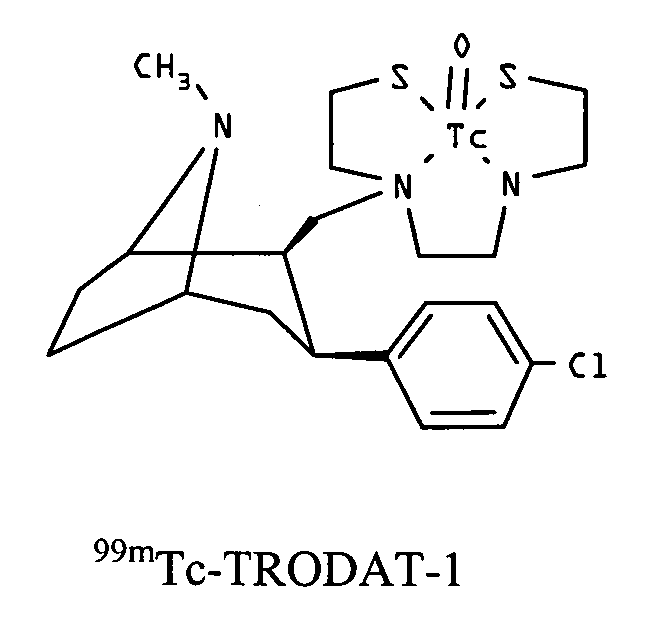
- Technepine has also been described by Meltzer et al [J.Med.Chem., 40, 1835-1844 (1997)]:Technepine is described in US 6171576 and equivalents.

- A range of 99mTc complexes of N2S2 diaminedithiol chelator conjugates of tropanes (including TRODAT-1) have been reported to show good in vitro stability at 4 and 24 hours post preparation, with little change in radiochemical purity [Meegalla et al, J.Med.Chem., 40, p.9-17 (1997)]. Fan et al [Chin.J.Nucl.Med., 19(3) 146-148 (1999)] report that 99mTc-TRODAT-1 is stable for 24 hours at room temperature.
- An improved kit formulation for the preparation of 99mTc-TRODAT-1 has been described [Choi et al, Nucl.Med.Biol., 26, p. 461-466 (1999)]. Choi et al report that, as long as a minimum of 10 µg (microgrammes) of the tropane conjugate is present in the kit, the radiochemical purity consistently reaches greater than 90%. Heating is necessary to achieve a satisfactory radiochemical purity (RCP), and Choi et al use autoclave heating for 30 minutes.
- The present invention provides improved radiometal complex compositions comprising a technetium or rhenium metal complex of a tropane-tetradentate chelating agent conjugate and a radioprotectant. The improved compositions exhibit more reproducible initial radiochemical purity (RCP) and improved stability post-reconstitution, so that an RCP of 85 to 90% is maintained at 4 hours post-reconstitution. The problem of unsatisfactory RCP for radiometal tropane conjugates under certain conditions of radioactivity levels, radioactive concentrations or reconstitution volumes was not recognised in the prior art. Such conditions are those that could arise under normal conditions of use of a commercial radionuclide generator, such as a 99mTc generator. The present invention provides compositions comprising a radioprotectant which solve this previously unrecognised problem.
- In a first embodiment, the present invention provides a stabilised composition which comprises:
- (i) a metal complex of a radioactive isotope of technetium or rhenium chelated to a conjugate, wherein said conjugate comprises a tetradentate chelating agent conjugated to a tropane, and said tetradentate chelating agent forms a neutral metal complex with said radioactive isotope of technetium or rhenium;
- (ii) at least one radioprotectant.
-
- By the term "metal complex" is meant a coordination complex of the technetium or rhenium metal ion with a ligand, here the tetradentate chelating agent. The chelated metal complex is "resistant to transchelation", ie. does not readily undergo ligand exchange with other potentially competing ligands for the radiometal coordination sites. Potentially competing ligands include the tropane moiety itself, the radioprotectant or other excipients in the preparation in vitro (eg. antimicrobial preservatives), or endogenous compounds in vivo (eg. glutathione, transferrin or plasma proteins).
- Suitable radioactive isotopes of technetium or rhenium include: 94mTc, 99mTc, 186Re and 188Re. A preferred such radioisotope is 99mTc.
- The term "tetradentate" has its' conventional meaning, ie. the chelating agent has 4 metal donor atoms which coordinate to the metal giving chelate rings on formation of the metal complex.
- The technetium and rhenium metal complexes of the present invention are "neutral", ie. any positive charge on the central metal core is balanced by the sum of the negative charge on the four metal donor atoms of the tetradentate chelating agent, to give an overall electrically neutral metal complex. Examples of likely technetium cores are O=Tc+=O and Tc3+=O, which both represent technetium in the Tc(V) oxidation state.
- The neutral radioactive technetium or rhenium complexes of the present invention are suitably of Formula I:
- (A)n is a linker group,
- n is an integer of value 0 to 10,
- and m is 1, 2 or 3.
-
- The "linker group" (A)n is as defined below for Formula Ia. The metal complexes of Formula I are derived from tropane "conjugates". The tropane tetradentate chelating agent "conjugates" of the present invention are as defined in Formula Ia:
- -(A)n- is a linker group wherein each A is independently -CR2- , -CR=CR-, -C≡C-, -CR2CO2-, -CO2CR2-, -NRCO-, -CONR-, -NR(C=O)NR-, - NR(C=S)NR-, -SO2NR-, -NRSO2-, -CR2OCR2-, -CR2SCR2-, -CR2NRCR2-, a C4-8 cycloheteroalkylene group, a C4-8 cycloalkylene group, a C5-12 arylene group, or a C3-12 heteroarylene group;
- R is independently chosen from H, C1-4 alkyl, C2-4 alkenyl, C2-4 alkynyl, C1-4 alkoxyalkyl or C1-4 hydroxyalkyl;
- n is an integer of value 0 to 10; and
- m is 1, 2 or 3.
-
- In Formulae I and Ia, m is preferably 1 or 2, and is most preferably 1; and (A)n is preferably (CR2)n, where n is chosen to be 1 to 3.
- Examples of suitable tetradentate chelating agents for technetium and rhenium which form neutral metal complexes include, but are not limited to:
- (i) N2S2 ligands having a diaminedithiol donor set such as BAT, an amideaminedithiol donor set such as MAMA, a phenylenediaminethioetherthiol donor set such as PhAT, or a dithiosemicarbazone donor set;
- (ii) diaminedioximes;
- (iii) N3S ligands having a diamidepyridinethiol donor set such as Pica;
- (iv) open chain or macrocyclic ligands having an amidetriamine donor set, such as monoxocyclam.
- (v) N2O2 ligands having a diaminediphenol donor set.
-
- The above described ligands are particularly suitable for complexing technetium eg. 94mTc or 99mTc, and are described more fully by Jurisson et al [Chem.Rev., 99, 2205-2218 (1999)]. N2S2 dithiosemicarbazone chelators are described by Arano et al [Chem.Pharm.Bull., 39, p.104 - 107 (1991)]. N2S2 phenylenediaminethioetherthiol chelators are described by McBride et al [J.Med.Chem., 36, p.81-6 (1993)]. Macrocyclic amidetriamine ligands and their tropane conjugates are described by Turpin et al [J.Lab.Comp.Radiopharm., 45, 379-393 (2002)]. Diaminedioximes are described by Nanjappan et al [Tetrahedron, 50, 8617-8632 (1994)]. N3S ligands having a diamidepyridinethiol donor set are described by Bryson et al [Inorg.Chem., 29, 2948-2951 (1990)]. N2O2 ligands having a diaminediphenol donor set are described by Pillai et al [Appl.Rad.Isot., 41, 557-561 (1990)].
- Preferred 99mTc metal complexes of the present invention are those suitable for crossing the blood-brain barrier (BBB) as described by Volkert et al [Radiochim. Acta, 63, p.205-208 (1993)]. Especially preferred 99mTc metal complexes of the present invention are 99mTc-TRODAT and Technepine.
- Preferred tetradentate chelating agents are those having an N2S2 diaminedithiol or amideaminedithiol donor set of Formula II:where:
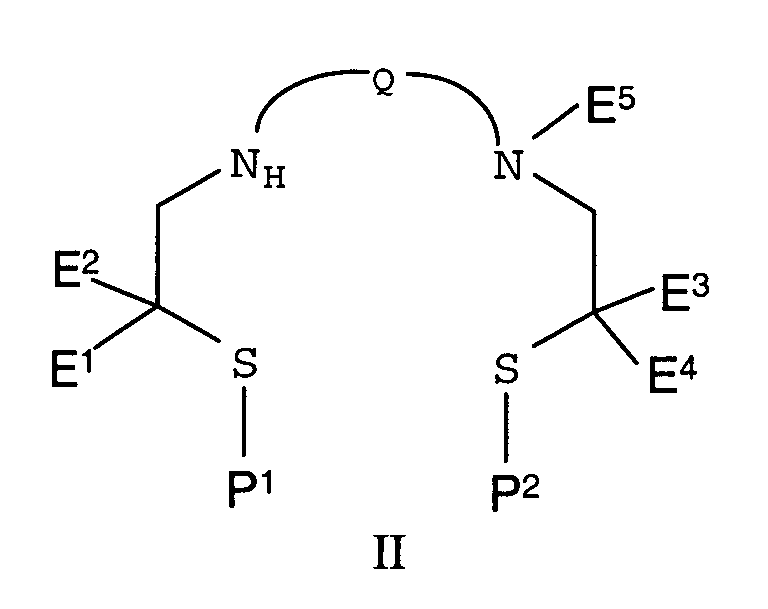
- E1-E5 are each independently an R' group;
- each R' is H or C1-10 alkyl, C3-10 alkylaryl, C2-10 alkoxyalkyl, C1-10 hydroxyalkyl, C1-10 fluoroalkyl, C2-10 carboxyalkyl or C1-10 aminoalkyl, or two or more R' groups together with the atoms to which they are attached form a carbocyclic, heterocyclic, saturated or unsaturated ring, and wherein one or more of the R' groups is conjugated to the tropane;
- and Q is a bridging group of formula -J(CR'2)f- ;
where f is 1 or 2, and J is -CR'2- or C=O; - P1 and P2 are independently H or a thiol protecting group.
-
- By the term "protecting group" is meant a group which inhibits or suppresses undesirable chemical reactions (eg. oxidation of the free thiol to the corresponding disulphide), but which is designed to be sufficiently reactive that it may be cleaved from the thiol under mild enough conditions that do not modify the rest of the molecule during radiolabelling of the conjugate. Thiol protecting groups are well known to those skilled in the art and include but are not limited to: trityl, 4-methoxybenzyl, benzyl, tetrahydropyranyl, include but are not limited to: trityl, 4-methoxybenzyl, benzyl, tetrahydropyranyl, methyltetrahydrofuranyl (MTHF), acetamidomethyl and ethoxyethyl. The use of further thiol protecting groups are described in 'Protective Groups in Organic Synthesis', Theorodora W. Greene and Peter G. M. Wuts, (John Wiley & Sons, 1991). In Formula II, preferably both P1 and P2 are H.
- Preferred Q groups are as follows: -CH2CH2- , -CH2CH2CH2- or -(C=O)CH2-, most preferably -CH2CH2- , -CH2CH2CH2-, with -CH2CH2- being especially preferred.
- E1 to E5 are preferably chosen from: H, C1-3 alkyl, C1-3 alkoxyalkyl, C1-3 hydroxyalkyl or C1-3 fluoroalkyl. Most preferably, each E1 to E4 group is H, and E5 is C1-3 alkyl.
- A most particularly preferred chelator of Formula II is the N2S2 diaminedithiol of TRODAT-1.
- The tetradentate chelating agents of Formula II are preferably attached to the tropane via either the bridging group Q or the E5 group. Most preferably, the tropane is attached via the E5 group.
- The term "tropane" has its' conventional meaning, ie. a bicyclic amine of formula (with numbering of the ring positions shown):where the amine nitrogen at the 8-position may be secondary or tertiary. The tetradentate chelating agent is preferably attached at either the 2- or the 8-position of the tropane, most preferably at the 2-position.

- Preferably, the tropane of the present invention is a phenyl tropane of Formula III:where:
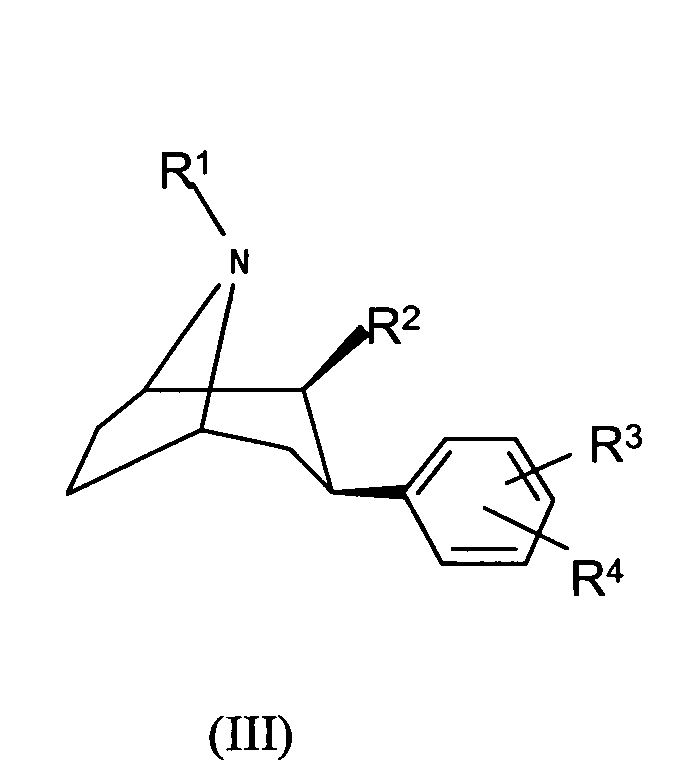
- R1 is H, C1-4 alkyl, C1-4 alkenyl or C1-4 fluoroalkyl;
- R2 is CO2R5, CON(R5)2, COR5 or C1-4 alkyl, where each R5 is independently H or C1-3 alkyl;
- R3 and R4 are independently H, Cl, Br, F, I, CH3, C2H5, CF3, NO2, OCH3 or NH2.
-
- R1 is preferably C1-3 alkyl or C1-3 fluoroalkyl. R2 is preferably CO2CH3 or C1-2 alkyl. R3 is preferably 4-chloro, 4-fluoro or 4-methyl, and R4 is preferably H or CH3. R1 is most preferably CH3.
- By the term "radioprotectant" is meant a compound which inhibits degradation reactions induced by radioactive emissions, such as redox processes, by trapping highly-reactive free radicals, such as oxygen-containing free radicals arising from the radiolysis of water. The radioprotectants of the present invention are suitably chosen from: ascorbic acid, para-aminobenzoic acid (ie. 4-aminobenzoic acid), gentisic acid (ie. 2,5-dihydroxybenzoic acid) and salts thereof with a biocompatible cation. Preferred radioprotectants are ascorbic acid and para-aminobenzoic acid, or salts thereof with a biocompatible cation. Especially preferred radioprotectants are ascorbic acid and salts thereof with a biocompatible cation. A preferred such salt is sodium ascorbate. The radioprotectants of the present invention are commercially available to a pharmaceutical grade specification.
- By the term "biocompatible cation" is meant a positively charged counterion which forms a salt with an ionised, negatively charged group, where said positively charged counterion is also non-toxic and hence suitable for administration to the mammalian body, especially the human body. Examples of suitable biocompatible cations include: the alkali metals sodium or potassium; the alkaline earth metals calcium and magnesium; and the ammonium ion. Preferred biocompatible cations are sodium and potassium, most preferably sodium.
- It is envisaged that the role of the linker group ―(A)n- of Formula I is to distance the relatively bulky metal complex, from the tropane, so that binding of the tropane to biological target sites (eg. the dopamine transporter in the mammalian brain) is not impaired. This can be achieved by a combination of flexibility (eg. simple alkyl chains), so that the bulky group has the freedom to position itself away from the active site and/or rigidity such as a cycloalkyl or aryl spacer which orientates the metal complex away from the active site.
- The nature of the linker group can also be used to modify the biodistribution of the resulting metal complex of the conjugate. Thus, eg. the introduction of ether groups in the linker will help to minimise plasma protein binding. Preferred linker groups ―(A)n- have a backbone chain of linked atoms which make up the ―(A)n- moiety of 2 to 10 atoms, most preferably 2 to 5 atoms, with 2 or 3 atoms being especially preferred. A minimum linker group backbone chain of 2 atoms confers the advantage that the chelator is well-separated from the tropane, so that any interaction is minimised.
- Non-peptide linker groups such as alkylene groups or arylene groups have the advantage that there are no significant hydrogen bonding interactions with the conjugated tropane, so that the linker does not wrap round onto the tropane. Preferred alkylene spacer groups are ―(CH2)q- where q is 2 to 5. Preferred arylene spacers are of formula:where: a and b are independently 0, 1 or 2.

- It is strongly preferred that the tropane is bound to the metal complex in such a way that the linkage does not undergo facile metabolism in blood, since that would result in the metal complex being cleaved off before the labelled tropane inhibitor reached the desired in vivo target site. The tropane is therefore preferably covalently bound to the metal complexes of the present invention via linkages which are not readily metabolised.
- The concentration of radioprotectant for use in the present invention is suitably 0.3 to 5.0 millimolar, preferably 0.5 to 4.0 millimolar, most preferably 1.0 to 3.5 millimolar. For ascorbic acid, this corresponds to a suitable concentration of 50 to 900 µg/cm3, preferably 70 to 800 µg/cm3, most preferably 90 to 700 µg/cm3. For the 99mTc radiopharmaceutical 99mTc-TRODAT, the preferred concentration of an ascorbic acid or ascorbate radioprotectant is in the range 0.5 to 3.8 millimolar.
- The stabilised composition of the present invention may be prepared by reacting a solution of the radiometal in the appropriate oxidation state with the conjugate at the appropriate pH in the presence of the radioprotectant, in solution in a suitable solvent. The radioprotectant may be supplied either together with the conjugate or the solution of the radiometal. Preferably, the radioprotectant is pre-mixed with the conjugate, and that mixture is subsequently reacted with the radiometal. The conjugate solution may preferably contain a ligand which complexes weakly, but rapidly to the radiometal (such as gluconate or citrate) i.e. the radiometal complex is prepared by ligand exchange or transchelation. Such conditions are useful to suppress undesirable side reactions such as hydrolysis of the metal ion. When the radiometal is rhenium, the usual radioactive starting material is perrhenate, ie. ReO4 -. When the radiometal is 99mTc, the usual radioactive starting material is sodium pertechnetate from a 99Mo generator. In both perrhenate and pertechnetate the metal (M) is present in the M(VII) oxidation state, which is relatively unreactive. The preparation of technetium or rhenium complexes of lower oxidation state M(I) to M(V) therefore usually requires the addition of a suitable pharmaceutically acceptable reducing agent such as sodium dithionite, sodium bisulphite, ascorbic acid, formamidine sulphinic acid, stannous ion, Fe(II) or Cu(I), to facilitate complexation. The pharmaceutically acceptable reducing agent is preferably a stannous salt, most preferably stannous chloride, stannous fluoride or stannous tartrate.
- Alternatively, the stabilised composition of the present invention may be prepared in a stepwise manner by first forming the radiometal complex in a suitable solvent, and subsequently adding the radioprotectant. In such an approach, the radioprotectant should be added as soon as possible after formation of the radiometal complex, so that the stabilising effect of the radioprotectant is brought into effect to minimise radiolysis and possible degradation. Methods of preparation wherein the radioprotectant is present prior to formation of the radiometal complex are preferred.
- When the radiometal complexes of the present invention are to be used in radiopharmaceutical compositions, a preferred method of preparation is the use of a sterile, non-radioactive kit as described in the third and fourth embodiments below. The kit provides a convenient supply of the necessary reactants at the right concentration, which needs only be reconstituted with perrhenate or pertechnetate in saline or another suitable solvent.
- In a second embodiment, the present invention provides a conjugate useful in the preparation of the above stabilised composition, said conjugate being of Formula Ia as defined above. Preferably, the tropane of the conjugate is a phenyl tropane of Formula III (above). Preferred and most preferred phenyl tropanes for the conjugate are as described above for the first embodiment. Most preferably, the conjugate is of Formula IV:where P1 and P2 are independently H or a thiol protecting group.
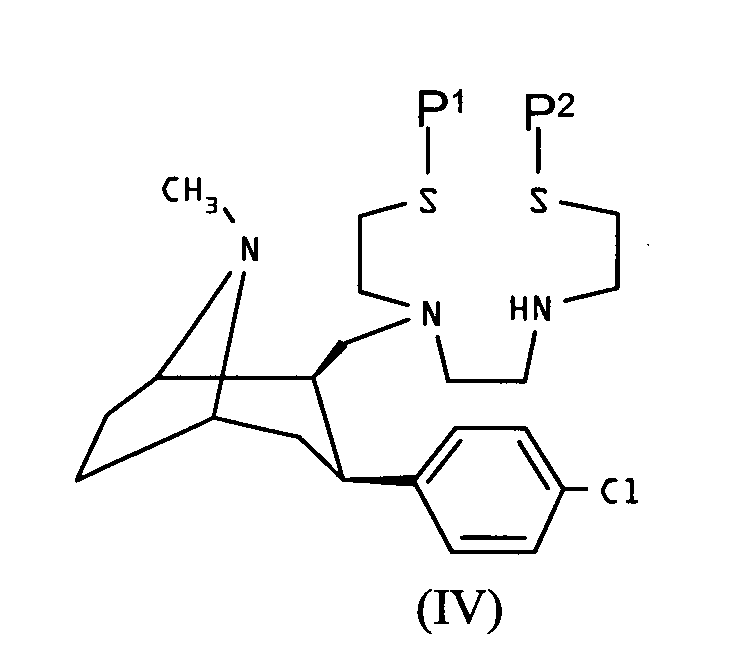
- The term "protecting group" is as defined for Formula II above. Preferred conjugates of Formula IV are where P1 and P2 are both H.
- The conjugates of the present invention may be prepared via the bifunctional chelate approach. Thus, it is well known to prepare chelating agents which have attached thereto a functional group ("bifunctional chelates"). Functional groups that have been attached include: amine, thiocyanate, maleimide and active esters such as N-hydroxysuccinimide or pentafluorophenol. Such bifunctional chelates can be reacted with suitable functional groups on the tropane to form the desired conjugate. Such suitable functional groups on the tropane include:
- carboxyls (for amide bond formation with an amine-functionalised bifunctional chelator);
- amines (for amide bond formation with an carboxyl- or active ester-functionalised bifunctional chelator);
- halogens, mesylates and tosylates (for N-alkylation of an amine-functionalised bifunctional chelator) and
- thiols (for reaction with a maleimide-functionalised bifunctional chelator). Further details of the bifunctional chelate approach are described by Arano [Adv.Drug.Deliv.Rev., 37, 103-120 (1999)]. Further details specific to the conjugation of tropanes with the tetradentate chelating agents indicated are described in: the methods of Meegalla et al [J.Med.Chem., 40, 9-17 (1997)] for N2S2 diaminedithiol chelators; Meltzer et al for N2S2 amideaminedithiol (MAMA) chelators [ibid, 40, 1835-1844 (1997)] and Turpin et al [J.Lab.Comp.Radiopharm., 45, 379-393 (2002)] for monoxocyclam chelators.
-
- In a third embodiment, the present invention provides a radiopharmaceutical which comprises the stabilised composition of the first embodiment together with a biocompatible carrier, in a form suitable for mammalian administration. The "biocompatible carrier" is a fluid, especially a liquid, in which the imaging agent can be suspended or dissolved, such that the composition is physiologically tolerable, ie. can be administered to the mammalian body without toxicity or undue discomfort. The biocompatible carrier is suitably an injectable carrier liquid such as sterile, pyrogen-free water for injection; an aqueous solution such as saline (which may advantageously be balanced so that the final product for injection is either isotonic or not hypotonic); an aqueous solution of one or more tonicity-adjusting substances (eg. salts of plasma cations with biocompatible counterions), sugars (e.g. glucose or sucrose), sugar alcohols (eg. sorbitol or mannitol), glycols (eg. glycerol), or other non-ionic polyol materials (eg. polyethyleneglycols, propylene glycols and the like).
- The radiopharmaceuticals of the present invention may optionally further comprise an antimicrobial preservative. By the term "antimicrobial preservative" is meant an agent which inhibits the growth of potentially harmful micro-organisms such as bacteria, yeasts or moulds. The antimicrobial preservative may also exhibit some bactericidal properties, depending on the dose. The main role of the antimicrobial preservative(s) of the present invention is to inhibit the growth of any such micro-organism in the radiopharmaceutical composition post-reconstitution, ie. in the radioactive diagnostic product itself. Suitable antimicrobial preservative(s) include: the parabens, ie. methyl, ethyl, propyl or butyl paraben or mixtures thereof; benzyl alcohol; phenol; cresol; cetrimide and thiomersal. Preferred antimicrobial preservative(s) are the parabens.
- Such radiopharmaceuticals are suitably supplied in either a container which is provided with a seal which is suitable for single or multiple puncturing with a hypodermic needle (e.g. a crimped-on septum seal closure) whilst maintaining sterile integrity. Such containers may contain single or multiple patient doses. Preferred multiple dose containers comprise a single bulk vial (e.g. of 10 to 30 cm3 volume) which contains multiple patient doses, whereby single patient doses can thus be withdrawn into clinical grade syringes at various time intervals during the viable lifetime of the preparation to suit the clinical situation. Pre-filled syringes are designed to contain a single human dose, and are therefore preferably a disposable or other syringe suitable for clinical use. The pre-filled syringe may optionally be provided with a syringe shield to protect the operator from radioactive dose. Suitable such radiopharmaceutical syringe shields are known in the art and preferably comprise either lead or tungsten.
- When the radioactive isotope is 99mTc, a radioactivity content suitable for a diagnostic imaging radiopharmaceutical is in the range 180 to 1500 MBq of 99mTc, depending on the site to be imaged in vivo, the uptake and the target to background ratio. 99mTc is suitable for SPECT imaging and 94mTc for PET imaging.
- The radiopharmaceuticals of the present invention comprise the improved radiometal compositions of the first embodiment. This has the advantage that radioactive impurities are suppressed. Such impurities may either contribute to unnecessary radiation does for the patient, or may in some cases have an adverse effect on imaging by reducing the signal to background ratio.
- The radiopharmaceuticals of the present invention may be prepared from kits, as is described in the fourth embodiment below. Alternatively, the radiometal complexes of the present invention in a biocompatible carrier may be prepared under aseptic manufacture conditions to give the desired sterile product. The radiopharmaceuticals may also be prepared under non-sterile conditions followed by terminal sterilisation, using eg. gamma irradiation, autoclaving, dry heat or chemical treatment (eg. with ethylene oxide). Preferably, the radiopharmaceuticals of the present invention are prepared from kits.
- In a fourth embodiment, the present invention provides a kit for the preparation of the radiopharmaceuticals of the present invention, which comprises:
- (i) the conjugate of Formula (Ia) or a salt thereof with a biocompatible counterion;
- (ii) a radioprotectant (as defined above);
- (iii) a biocompatible reductant.
-
- Such kits are designed to give sterile radiopharmaceutical products suitable for human administration, e.g. via direct injection into the bloodstream. For 99mTc, the kit is preferably lyophilised and is designed to be reconstituted with sterile 99mTc-pertechnetate (TcO4 -) from a 99mTc radioisotope generator to give a solution suitable for human or mammalian administration without further manipulation. Suitable kits comprise a container (eg. a septum-sealed vial) containing the conjugate (Ia) in either free base or acid salt form, together with a "biocompatible reductant" such as sodium dithionite, sodium bisulphite, ascorbic acid, formamidine sulphinic acid, stannous ion, Fe(II) or Cu(I). The biocompatible reductant is preferably a stannous salt such as stannous chloride or stannous tartrate.
- The "radioprotectant" of the kit is as defined above. Preferred radioprotectants correspond to those described for the stabilised composition of the first embodiment.
- The conjugate of Formula (Ia) comprises the amine of the tropane 8-position, plus possibly further amine donor atoms of the tetradentate chelating agent. Hence, the conjugate may optionally be used in the kit as "a salt thereof with a biocompatible counterion", ie. an acid salt of the conjugate. Suitable such salts include but are not limited to: hydrochlorides, trifluoroacetates, sulphonates, tartrates, oxalates and sulphosalicyclates. When the conjugate is of Formula IV, preferred salts are the trifluoroacetate or hydrochloride salts, especially the trifluoroacetate salt.
- The non-radioactive kits may optionally further comprise additional components such as a transchelator, antimicrobial preservative, pH-adjusting agent or filler. The "transchelator" is a compound which reacts rapidly to form a weak complex with technetium, then is displaced by the ligand. This minimises the risk of formation of reduced hydrolysed technetium (RHT) due to rapid reduction of pertechnetate competing with technetium complexation. Suitable such transchelators are salts of a weak organic acid, ie. an organic acid having a pKa in the range 3 to 7, with a biocompatible cation. Suitable such weak organic acids are acetic acid, citric acid, tartaric acid, gluconic acid, glucoheptonic acid, benzoic acid, phenols or phosphonic acids. Hence, suitable salts are acetates, citrates, tartrates, gluconates, glucoheptonates, benzoates, phenolates or phosphonates. Preferred such salts are tartrates, gluconates, glucoheptonates, benzoates, or phosphonates, most preferably phosphonates, most especially diphosphonates. A preferred such transchelator is a gluconate or glucoheptonate salt with a biocompatible cation.
- The "antimicrobial preservative" is as defined for the radiopharmaceutical embodiment (above). For the kit, the inclusion of an antimicrobial preservative means that, once reconstituted, the growth of potentially harmful micro-organisms in the preparation is inhibited.
- The term "pH-adjusting agent" means a compound or mixture of compounds useful to ensure that the pH of the reconstituted kit is within acceptable limits (approximately pH 4.0 to 10.5) for human or mammalian administration. Suitable such pH-adjusting agents include pharmaceutically acceptable buffers, such as tricine, phosphate or TRIS [ie. tris(hydroxymethyl)aminomethane], and pharmaceutically acceptable bases such as sodium carbonate, sodium bicarbonate or mixtures thereof. When the conjugate is employed in acid salt form, the pH adjusting agent may optionally be provided in a separate vial or container, so that the user of the kit can adjust the pH as part of a multistep procedure.
- By the term "filler" is meant a pharmaceutically acceptable bulking agent which may facilitate material handling during production and lyophilisation. Suitable fillers include inorganic salts such as sodium chloride, and water soluble sugars or sugar alcohols such as sucrose, maltose, mannitol or trehalose. A preferred filler is mannitol.
- In a fifth embodiment, the present invention provides a method of preparation of the radiopharmaceutical of the second embodiment, which comprises forming the metal complex of the first embodiment in a biocompatible carrier in a form suitable for mammalian administration, and subsequently adding an effective amount of one or more radioprotectants (as defined above).
- In a sixth embodiment, the present invention provides the use of the radiopharmaceutical of the second embodiment in a method of diagnostic imaging of the mammalian brain.
- In a further embodiment, the present invention provides a method of diagnostic imaging of the mammalian brain which comprises imaging a mammal which had previously been administered with the radiopharmaceutical of the second embodiment.
- The invention is illustrated by the following non-limiting Examples. Example 1 describes the materials and methods used in the comparative studies described in later Examples. A formulation of the present invention (Formulation P) is compared with a prior art formulation (Formulation Q). Example 2 describes the radiolabelling protocol and quality control methodology employed. Example 3 shows that, under elution conditions 1, both formulations gave acceptable initial RCPs (92 and 88% for P and Q respectively) under these 'best case' generator elution conditions. Formulation P gave an RCP of 90% at 3.5 hours post-preparation, whereas for Formulation Q, the RCP fell off sharply to 77% over the same period of time. These results show that Formulation P exhibits both an improved initial RCP and an improved post-preparation stability.
- Under generator elution conditions 2, Formulation P had an RCP of 92% immediately after preparation and 90% at 4 hours. The initial RCP for Formulation Q was 88%, but again it fell off significantly to 77% at 3.5 hours. These results demonstrate that even with generator eluate at the end of its' usable shelf-life, Formulation P displays an improved initial RCP, and greater post-preparation stability than prior art Formulation Q.
- Under generator elution conditions 3, in spite of a long interval between generator elutions, both formulations give acceptable initial RCPs (91 and 88% for P and Q respectively). At 4 hours post-preparation the RCP of Formulation P is 88%, whereas the RCP of the Formulation is Q 73% after only 2 hours.
- Under generator elution conditions 4, Formulation P exhibits an RCP of 90% after 1.5 hours and 89% at 3.5 hours post-preparation. When subjected to these testing eluate conditions, the RCP of prior art Formulation Q is only 76% at 1.5 hours, falling to 71 % at 3.5 hours.
- Example 4 shows that p-ABA is also effective as a radioprotectant for 99mTc-TRODAT preparations. Addition of p-ABA led to a significant improvement in RCP. Increasing the level of p-ABA from 200 to 500 µg increased further the stability at both initial and 4 hours.
- Example 5 studies the effect of the volume of 99mTc-pertechnetate used to reconstitute the kit vial ("reconstitution volume") on the RCP, at the same eluate radioactive concentration (0.75 GBq/ml). At the standard 2 ml reconstitution volume the Formulation P kits perform better. The Formulation P kits continue to radiolabel well even when reconstituted with 3 GBq in 4 ml, but the RCP drops markedly when kits are reconstituted with 4.5 GBq in 6 ml. These results show that the RCP of both formulations are effected by reconstitution volume. This effect may be attributable to an increased path length effect for radiolysis of the solvent. The inclusion of the radioprotectant ascorbate in Formulation P suppresses the volume effect compared to the prior art Formulation (Q), but does not eliminate it completely.
- Example 6 studies the effect of use of an autoclave heating cycle (121 C, 30 minutes) as part of the radiolabelling procedure, since Choi et al [Nucl.Med.Biol., 26, p. 461-466 (1999)] employ that vial heating methodology. The present experiments were typically conducted using heating via a boiling water bath, since the use of an autoclave as part of the preparation procedure is not an attractive option for a commercial product. Hence, a comparative study was carried out to determine if the different heating procedure might contribute to the RCP differences observed for Formulations P and Q. Example 6 indicates that the use of an autoclave heating cycle has a detrimental effect on the RCP of both formulations. Low RCPs were observed for both formulations at both analysis time points and high levels of hydrophilic impurities were seen in the radioactive HPLC chromatograms. Hence, the reported stability of the prior art Choi et al 99mTc-TRODAT-1 preparations cannot be ascribed to the use of autoclaving.
- Example 7 shows that the addition of the radioprotectant ascorbate to a 99mTc-TRODAT preparation has a positive effect on the regional brain biodistribution properties, of 99mTc-TRODAT. The apparent differences in blood retention and in selective retention in the striatum may be attributed to either the increased RCP achieved with the radioprotectant-containing formulation and/or the altered ratio of A/B diastereomers.
- A series of comparative experiments has been carried out to generate radiolabelling data for the present formulation vs the optimised one for 99mTc-TRODAT described in the prior art. The present formulation demonstrates significant advantages over the prior art published TRODAT formulation [Choi et al, Nucl.Med.Biol., 26, p. 461-466 (1999)].
- All studies were carried out using lyophilised kit formulations, 99mTc-pertechnetate eluate from Amertec II™ generators. The kit vials were prepared under the same conditions but to different formulations - that of the present invention (Formulation P), and that of the prior art Choi et al formulation (Formulation Q). All vials were stored upright, in the dark at -20 °C until required for use. The formulations are given in Table 1:
Present Kit Formulation (P) vs that of the Prior Art (Q). Kit component Quantity of component per vial Formulation P Formulation Q
(prior art)TRODAT-1 10 µg
(as 18 µg of the trifluoroacetate salt)10 µg SnCl2.2H2O 38 µg 32 µg Na-Gluconate 10 mg 10 mg Na2EDTA.2H2O 840 µg 840 µg Na-Ascorbate 500 µg 0 The most significant difference is that Formulation P contains a radioprotectant (sodium ascorbate), whereas Formulation Q does not. - Unless otherwise stated, all test items were radiolabelled and analysed in the same way. Thus, once equilibrated to ambient temperature, each kit was reconstituted with 2 ml of sodium 99mTc-pertechnetate solution containing 1.5 GBq (± 10 %) of radioactivity (1.5 GBq corresponds to 2 patient doses of 740 MBq), heated in a boiling water bath for 20 minutes and then cooled for 10 minutes before RCP analysis by HPLC and ITLC. Time of analysis reported as 'post-preparation'.
- RCP determination
- HPLC:
- Column:
- Xterra RP18 3.5µm 3.0 x 50mm. Part number: 186000416
- Loop size:
- 50µL
- Mobile Phase:
- 60% 50mM Ammonium Acetate pH 7: 40% Acetonitrile
- Flow rate:
- 0.5ml/min
- ITLC:
Pall ITLC-SG sheet (part number 61886) cut into strips 20mm x 200mm and eluted with 50% 1M Ammonium Acetate : 50% Acetone - RCP calculation:
Species A and Species B are the diastereomers of 99mTc-TRODAT as described by Meegalla et al [J.Med.Chem., 41, 428-436 (1998)]. -
- Kits of formulations P and Q (as described in Example 1) were reconstituted, heated and analysed in exactly the same way, as per Example 2. Four generator elution conditions were investigated:
-
- 1. Fresh eluate: 24 hrs between elutions, <2hour old eluate;
- 2. Aged eluate: 24 hrs between elutions, >6 hour old eluate - high level of radiolysis products;
- 3. fresh eluate: 72 hrs between elutions, <2hour old eluate - low 99mTc/99Tc ratio);
- 4. aged eluate: 72 hrs between elutions, >6hour old eluate - low 99mTc/99Tc ratio and high level of radiolysis products.
-
- RCP determinations were carried out at two post-preparation time points. The results are shown in Table 2:
Radiolabelling of Formulations P and Q under four different generator elution conditions. Generator Elution Condition Formulation Time Post Preparation (h & min) Mean %RCP
(S.D.)Mean A:B ratio (1)
24hr, <2hrP 0h 2 min 91.7 (1.2) 45:55 3h 27 min 90.3 (1.1) 47:53 Q 0h 1 min 88.3 (1.9) 46:54 3h 28 min 77.0 (1.5) 56:44 (2)
24hr, >6hrP 0h 4 min 92.3 (1.2) 45:55 4h 2 min 90.1 (1.0) 50:50 Q 0h 1 min 88.0 (1.6) 47:53 3h 59min 75.1 (0.8) 58:42 (3)
72hr, <2hrP 0h 1 min 91.0 (0.6) 45:55 4h 9 min 88.3 (0.6) 53:47 Q 0h 2 min 87.2 (2.3) 46:54 2h 10 min 73.0 (2.1) 56:44 (4)
72hr, >6hrP 1h 40 min 89.8(1.1) 46:54 3h 25 min 88.7 (1.4) 49:51 Q 1h 40 min 76.2 (3.2) 56:44 3h 30 min 70.5 (2.2) 61:39 - A freshly prepared, nitrogen purged solution of sodium p-ABA (sodium para-aminobenzoate was added to a kit of Formulation Q. Radiolabelling of the kits was performed by first adding the radioprotectant (0.2 ml), followed by the immediate addition of pertechnetate solution (1GBq in 1.8 ml). The kits where then heated as described in Example 2. The results are given in Table 3:
Effect of addition of p-ABA radioprotectant. Batch Radioprotectant RCP at 1 hour RCP at 4 hours TRD009 p-ABA (200ug) 90(n=2) 86 (n=2) TRD009 None 84 (n=2) 76 (n=2) TRD018 p-ABA (200ug) 88 (n=2) 84 (n=2) TRD018 None 85 (n=2) 77 (n=2) TRD018 p-ABA (500ug) 89 (n=2) 87 (n=2) TRD018 None 85 (n=2) 78 (n=2) - A comparison of the effects of reconstitution volume on the radiolabelling performance of the P and Q Formulations was carried out. Kits of both formulations were reconstituted, heated and analysed as per Examples 1 and 2. The radioactive concentration of eluate used to reconstitute the kits was kept constant at 1.5GBq/ml for each test item and eluate reconstitution volumes of 2, 4 and 6 ml were investigated.
Effect of reconstitution volume on RCP of Formulations P and Q. Activity/Volume Formulation Time post-preparation
(h & mins)Mean %RCP
(S.D.)Mean A:B 1.5 GBq / 2 ml P (n=2) 0h 4min 91.4 (0.8) 45:55 4h 6min 88.7 (1.2) 46:54 Q (n=2) 0h 4min 84.9 (0.4) 48:52 4h 6min 70.0 (2.8) 58:42 3 GBq / 4 ml P (n=2) 0h 6min 92.6 (1.5) 45:55 4h 7min 88.7 (0.4) 50:50 Q (n=2) 0h 5min 81.7 (3.1) 47:53 4h 9min 60.7 (0.1) 60:40 4.5 GBq / 6 ml P (n=2) 0h 4min 77.2 (5.5) 54:46 4h 7min 74.0 (3.2) 68:32 Q (n=2) 0h 4min 70.6 (1.8) 47:53 4h 5min 41.6 (10.6) 61:39 - 2 vials each of Formulations P and Q were reconstituted in the standard manner with 2 ml of sodium pertechnetate solution containing 1.5 GBq of radioactivity. The vials were subjected to an autoclave cycle of 121 °C for 25 minutes. The total duration of the cycle (heating and cooling) was about 120 minutes. As a result the earliest RCP analysis time point acquired was 2h 20 min post-reconstitution. Analysis times are reported in Table 5 as post-reconstitution (as opposed to post-preparation) time points:
Comparative RCP of Formulations P and Q following an autoclave heating cycle (121 °C, 25 min). Formulation Time Post Reconstitution (hr &min) Mean %RCP Mean Ratio A:B P 2h 35 min 76.6 (n=2) 50:50 5h 43 min 75.1 (n=2) 55:45 Q 3h 03 min 77.1 (n=2) 54:46 5h 40 min 63.7 (n=2) 60:40 Control (P not autoclaved) 0h 12 min 89.1 (n=1) 48:52 - Kit formulation P was reconstituted to give 99mTc-TRODAT as described in Examples 1 and 2, which was the Test Item. The radiochemical purity (RCP) of the Test Item was 92% pre-injection, falling to 91% by the post-injection analysis time point. At the pre- and post-injection analysis time points, there were a low percentage of lipophilic (approximately 2%) and hydrophilic (approximately 6%) radiolabelled species present. The ratio of the A and diastereomers (46:54) remained constant at the pre- and post-injection analysis time points. Experiments were performed at 6 predetermined time points (2 and 20 minutes, 1, 2, 4 and 7 hours) post injection (p.i.) of the Test Item in normal male Wistar rats (180 to 220 g). Animals were anaesthetised with Halothane (6 % in oxygen), injected with 0.1 ml (500 MBq/ml) Test Item, sacrificed, dissected and the samples assayed for radioactivity. A comparative study was carried out using a 99mTc-TRODAT kit preparation corresponding to Formulation P, but lacking the ascorbate radioprotectant.
- The percentage of the injected dose present in the blood was approximately three-fold lower for Formulation P at all the post-injection time points. The uptake and retention of radioactivity into the brain was similar at all except the 20 minute pi time point for both formulations. By 20 minutes pi, approximately 0.45% of the injected dose (id) was retained within the brain after administration of the radioprotectant formulation, relative to 0.29 % id after administration for the unstabilised formulation. This difference in brain uptake was reflected in the elevated percentage injected dose present in the brain regions at 20 minutes pi when expressed per gram of brain region.
- The main difference observed was the elevated selective retention in the striatum after administration of the radioprotectant formulation, which peaked at 2.31±0.31 after 2 hours pi and stayed at this peak level out to 4 hours pi (2.42±0.80). In comparison, after administration of the unstabilised formulation the selective retention in the striatum was 1.74±0.96 by 2 hours pi and 0.76±0.30 by 4 hours pi.
Claims (28)
- A stabilised composition which comprises:(i) a metal complex of a radioactive isotope of technetium or rhenium chelated to a conjugate, wherein said conjugate comprises a tetradentate chelating agent conjugated to a tropane, and said tetradentate chelating agent forms a neutral metal complex with said radioactive isotope of technetium or rhenium;(ii) at least one radioprotectant.
- The stabilised composition of claim 1, wherein the conjugate is of Formula Ia:-(A)n- is a linker group wherein each A is independently -CR2-, -CR=CR-, -C≡C-, -CR2CO2-, -CO2CR2-, -NRCO- , -CONR-, -NR(C=O)NR-, -NR(C=S)NR-, -SO2NR-, -NRSO2-, -CR2OCR2-, -CR2SCR2-, -CR2NRCR2-, a C4-8 cycloheteroalkylene group, a C4-8 cycloalkylene group, a C5-12 arylene group, or a C3-12 heteroarylene group;R is independently chosen from H, C1-4 alkyl, C2-4 alkenyl, C2-4 alkynyl, C1-4 alkoxyalkyl or C1-4 hydroxyalkyl;n is an integer of value 0 to 10; and,m is 1, 2 or 3.
- The stabilised composition of claims 1 or 2, where the tropane is a phenyl tropane of Formula III:where:
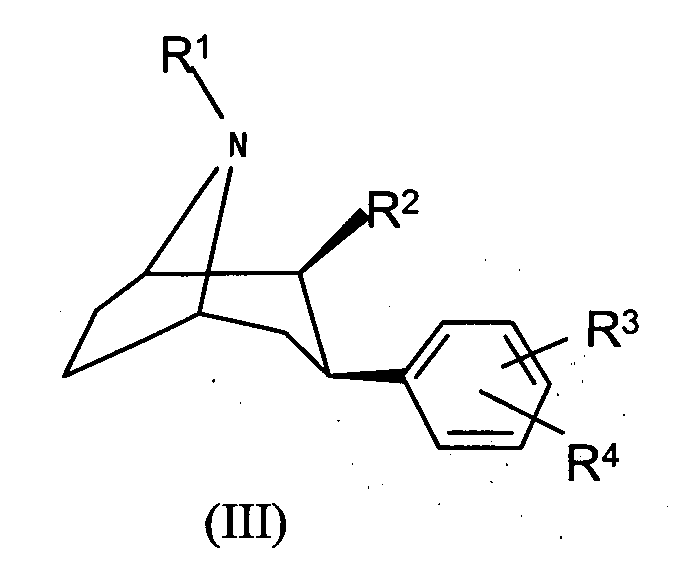 R1 is H, C1-4 alkyl, C1-4 alkenyl or C1-4 fluoroalkyl;R2 is CO2R5, CON(R5)2, COR5 or C1-4 alkyl, where each R5 is independently H or C1-3 alkyl;R3 and R4 are independently H, Cl, Br, F, I, CH3, CF3, NO2, OCH3 or NH2.
 - The stabilised composition of claims 1 to 3, wherein the radioactive isotope of technetium or rhenium is 99mTc.
- The stabilised composition of claims 1 to 4, wherein the tetradentate chelating agent is conjugated to either the 2- or the 8- position of the tropane.
- The stabilised composition of claim 5, wherein the tetradentate chelating agent is conjugated to the 2- position of the tropane.
- The stabilised composition of claims 1 to 6, wherein the tetradentate chelating agent has a donor set chosen from:(i) N2S2;(ii) N3S;(iii) diaminedioxime, or(iv) amidetriamine.
- The stabilised composition of claims 1 to 7, wherein the tetradentate chelating agent has an N2S2 diaminedithiol donor set.
- The stabilised composition of claims 1 to 8, wherein the radioprotectant comprises ascorbic acid, para-aminobenzoic acid or gentisic acid, or a salt thereof with a biocompatible cation.
- The stabilised composition of claim 9, wherein the radioprotectant comprises ascorbic acid or a salt thereof with a biocompatible cation.
- The stabilised composition of claim 10, wherein the radioprotectant comprises ascorbic acid or sodium ascorbate.
- The stabilised composition of claims 1 to 11 wherein the metal complex comprises the radioactive technetium isotope 99mTc;
the tetradentate chelating agent has an N2S2 diaminedithiol donor set and is conjugated to the 2-position of a phenyl tropane of Formula III;
and the radioprotectant comprises ascorbic acid or a salt thereof with a biocompatible cation. - The stabilised composition of claim 12, wherein the metal complex has the Formula:

- A conjugate useful in the preparation of the stabilised composition of claims 1 to 13, said conjugate being of Formula Ia as defined in claim 2.
- The conjugate of claim 14, where the tropane of the conjugate of Formula Ia is a phenyl tropane of Formula III of claim 3.
- The conjugate of claims 14 or 15 of Formula IV:where P1 and P2 are independently H or a thiol protecting group.
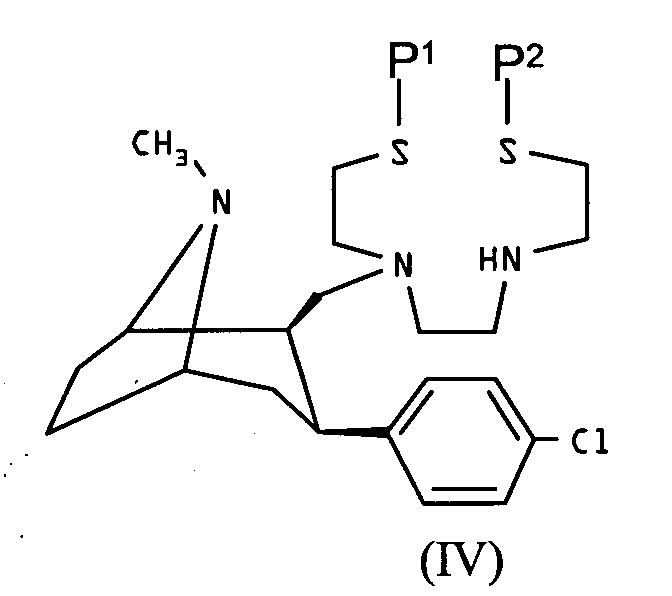
- The conjugate of claim 16, where P1 and P2 are both H.
- A radiopharmaceutical which comprises the stabilised composition of claims 1-13 together with a biocompatible carrier, in a form suitable for mammalian administration.
- The radiopharmaceutical of claim 18, where the radiopharmaceutical is provided in a syringe.
- The radiopharmaceutical of claim 18, where the radiopharmaceutical is provided in a vial fitted with a closure, wherein said closure is suitable for maintaining sterile integrity when punctured with a needle.
- A kit for the preparation of the radiopharmaceutical of claims 18 to 20, which comprises:(i) the conjugate of Formula (Ia) of claims 14 to 17 or a salt of said conjugate with a biocompatible counterion;(ii) the radioprotectant of claim 1;(iii) a biocompatible reductant.
- The kit of claim 21, where the radioprotectant is as defined in claims 7 to 9.
- The kit of claims 21 or 22, where the biocompatible reductant comprises stannous.
- A method of preparation of the radiopharmaceutical of claims 18 - 20, which comprises forming the metal complex of claims 1 to 8 in a biocompatible carrier in a form suitable for mammalian administration, and subsequently adding an effective amount of at least one radioprotectant.
- The method of claim 24, where the metal complex comprises the conjugate of Formula Ia of claims 14 to 17.
- The method of claims 24 or 25, where the radioprotectant is as defined in claims 7 to 9.
- Use of the radiopharmaceutical of claims 18-20 in a method of diagnostic imaging of the mammalian body.
- A method of diagnostic imaging of the mammalian body which comprises imaging a mammal which had previously been administered with the radiopharmaceutical of claims 18-20.
Priority Applications (18)
| Application Number | Priority Date | Filing Date | Title |
|---|---|---|---|
| EP03002809A EP1444990A1 (en) | 2003-02-07 | 2003-02-07 | Improved Radiometal Complex Compositions |
| AU2004210191A AU2004210191B2 (en) | 2003-02-07 | 2004-02-09 | Improved radiometal complex compositions |
| JP2006525001A JP2006528205A (en) | 2003-02-07 | 2004-02-09 | Improved radioactive metal complex composition |
| PCT/GB2004/000443 WO2004069285A1 (en) | 2003-02-07 | 2004-02-09 | Improved radiometal complex compositions |
| MXPA05008356A MXPA05008356A (en) | 2003-02-07 | 2004-02-09 | Improved radiometal complex compositions. |
| EP04709267A EP1590007B1 (en) | 2003-02-07 | 2004-02-09 | Improved radiometal complex compositions |
| BR0407056-9A BRPI0407056A (en) | 2003-02-07 | 2004-02-09 | Stabilized precursor composition, radiopharmaceutical compound, kit and method for preparation thereof, use of the radiopharmaceutical compound, and method of mammalian body diagnostic imaging |
| US10/544,736 US20070020177A1 (en) | 2003-02-07 | 2004-02-09 | Radiometal complex compositions |
| DE602004029983T DE602004029983D1 (en) | 2003-02-07 | 2004-02-09 | IMPROVED RADIO METAL COMPLEX COMPOSITIONS |
| AT04709267T ATE487498T1 (en) | 2003-02-07 | 2004-02-09 | IMPROVED RADIOMETALL COMPLEX COMPOSITIONS |
| KR1020057014518A KR20050103221A (en) | 2003-02-07 | 2004-02-09 | Improved radiometal complex compositions |
| CNB2004800091645A CN100548387C (en) | 2003-02-07 | 2004-02-09 | Improved radiometal complex compositions |
| CA002514307A CA2514307A1 (en) | 2003-02-07 | 2004-02-09 | Improved radiometal complex compositions |
| RU2005123799/15A RU2005123799A (en) | 2003-02-07 | 2004-02-09 | IMPROVED COMPOSITIONS OF RADIOACTIVE METAL COMPLEXES |
| ES04709267T ES2355100T3 (en) | 2003-02-07 | 2004-02-09 | IMPROVED COMPOSITIONS OF RADIOMETAL COMPLEXES. |
| NO20053754A NO20053754L (en) | 2003-02-07 | 2005-08-05 | Improved radiometal complex compositions. |
| ZA200506728A ZA200506728B (en) | 2003-02-07 | 2005-08-22 | Improve radiometal complex compositions |
| JP2011071532A JP2011132258A (en) | 2003-02-07 | 2011-03-29 | Improved radioactive metal complex composition |
Applications Claiming Priority (1)
| Application Number | Priority Date | Filing Date | Title |
|---|---|---|---|
| EP03002809A EP1444990A1 (en) | 2003-02-07 | 2003-02-07 | Improved Radiometal Complex Compositions |
Publications (1)
| Publication Number | Publication Date |
|---|---|
| EP1444990A1 true EP1444990A1 (en) | 2004-08-11 |
Family
ID=32605351
Family Applications (2)
| Application Number | Title | Priority Date | Filing Date |
|---|---|---|---|
| EP03002809A Withdrawn EP1444990A1 (en) | 2003-02-07 | 2003-02-07 | Improved Radiometal Complex Compositions |
| EP04709267A Expired - Lifetime EP1590007B1 (en) | 2003-02-07 | 2004-02-09 | Improved radiometal complex compositions |
Family Applications After (1)
| Application Number | Title | Priority Date | Filing Date |
|---|---|---|---|
| EP04709267A Expired - Lifetime EP1590007B1 (en) | 2003-02-07 | 2004-02-09 | Improved radiometal complex compositions |
Country Status (16)
| Country | Link |
|---|---|
| US (1) | US20070020177A1 (en) |
| EP (2) | EP1444990A1 (en) |
| JP (2) | JP2006528205A (en) |
| KR (1) | KR20050103221A (en) |
| CN (1) | CN100548387C (en) |
| AT (1) | ATE487498T1 (en) |
| AU (1) | AU2004210191B2 (en) |
| BR (1) | BRPI0407056A (en) |
| CA (1) | CA2514307A1 (en) |
| DE (1) | DE602004029983D1 (en) |
| ES (1) | ES2355100T3 (en) |
| MX (1) | MXPA05008356A (en) |
| NO (1) | NO20053754L (en) |
| RU (1) | RU2005123799A (en) |
| WO (1) | WO2004069285A1 (en) |
| ZA (1) | ZA200506728B (en) |
Cited By (15)
| Publication number | Priority date | Publication date | Assignee | Title |
|---|---|---|---|---|
| WO2006082497A1 (en) * | 2005-02-01 | 2006-08-10 | Ge Healthcare Limited | Method for the use of [11c] carbon monoxide in labeling synthesis of 11c-labelled compounds by thermally induced free radical carbonylation |
| WO2006100563A1 (en) * | 2005-03-22 | 2006-09-28 | Ge Healthcare Limited | Methods for carbon isotope labeling synthesis by transition metal-promoted carbonylation via isocyanate using azides and carbon-isotope monoxide |
| WO2006103509A3 (en) * | 2005-03-22 | 2007-01-04 | Ge Healthcare Ltd | Methods for carbon isotope labeling synthesis by transition metal-promoted carbonylation via ketene using diazo compounds and carbon-isotope monoxide |
| WO2007026216A1 (en) * | 2005-08-31 | 2007-03-08 | Ge Healthcare Limited | Method for the use of [11c] carbon monoxide in labeling synthesis of 11c-labelled ketones by photo-induced free radical carbonylation |
| WO2006134424A3 (en) * | 2004-12-03 | 2007-03-08 | Ge Healthcare Ltd | Method for the use of [11c] carbon monoxide in labeling synthesis of 11c-labelled acids by photo-induced free radical carbonylation |
| USD839934S1 (en) | 2017-12-06 | 2019-02-05 | Roger Young | Swing hammer |
| USD840447S1 (en) | 2017-12-06 | 2019-02-12 | Roger Young | Swing hammer |
| US10207274B1 (en) | 2017-08-21 | 2019-02-19 | Roger Young | Non-forged hammermill hammer |
| USD861048S1 (en) | 2017-12-06 | 2019-09-24 | Roger Young | Swing hammer |
| US10478824B2 (en) | 2017-08-21 | 2019-11-19 | Bliss Industries, Llc | System and method for installing hammers |
| US10486160B2 (en) | 2017-08-21 | 2019-11-26 | Bliss Industries, Llc | Method of replacing hammers and spacers |
| US10610870B2 (en) | 2017-08-21 | 2020-04-07 | Bliss Industries, Llc | Hot and cold forming hammer and method of assembly |
| USD905136S1 (en) | 2018-03-05 | 2020-12-15 | Bliss Industries, Llc | Hammermill hammer |
| WO2022156908A1 (en) * | 2021-01-25 | 2022-07-28 | Vrije Universiteit Brussel | Method for preparing a lyophilized composition |
| US12138630B2 (en) | 2017-08-21 | 2024-11-12 | Bliss Industries, Llc | Hammermill hammer |
Families Citing this family (17)
| Publication number | Priority date | Publication date | Assignee | Title |
|---|---|---|---|---|
| EP1444990A1 (en) * | 2003-02-07 | 2004-08-11 | Amersham plc | Improved Radiometal Complex Compositions |
| GB0428020D0 (en) * | 2004-12-22 | 2005-01-26 | Amersham Health As | Stabilisation of radiopharmaceutical precursors |
| KR20080022108A (en) * | 2005-06-14 | 2008-03-10 | 니혼 메디피직스 가부시키가이샤 | Radioactive imaging |
| US20100056826A1 (en) * | 2006-11-09 | 2010-03-04 | Nihon Medi-Physicis Co., Ltd. | Radioactive diagnostic imaging agent |
| RU2366434C1 (en) * | 2007-12-07 | 2009-09-10 | Институт неорганической химии им. А.В. Николаева Сибирского отделения Российской Академии наук | Hexanuclear rhenium clusters based on radioactive isotopes with antitumour properties |
| GB0922023D0 (en) * | 2009-12-17 | 2010-02-03 | Ge Healthcare Ltd | Preparation of n-monofluoroalkyl compounds |
| US9951324B2 (en) | 2010-02-25 | 2018-04-24 | Purdue Research Foundation | PSMA binding ligand-linker conjugates and methods for using |
| ES2804509T3 (en) | 2010-07-27 | 2021-02-08 | Serac Healthcare Ltd | Radiopharmaceutical compositions |
| AU2013344778C1 (en) * | 2012-11-15 | 2024-06-27 | Endocyte, Inc. | Conjugates for treating diseases caused by PSMA expressing cells |
| CN105377287A (en) * | 2013-02-15 | 2016-03-02 | 托马斯杰弗逊大学 | Kit for tumor imaging |
| EP3456700A1 (en) | 2013-10-18 | 2019-03-20 | Deutsches Krebsforschungszentrum | Labeled inhibitors of prostate specific membrane antigen (psma), their use as imaging agents and pharmaceutical agents for the treatment of prostate cancer |
| CN105849568B (en) | 2013-11-14 | 2018-05-04 | 恩多塞特公司 | Compounds for Positron Emission Tomography |
| US20150375901A1 (en) * | 2014-06-30 | 2015-12-31 | Karen J. Orlich | Reusable, eco-friendly container for storing and dispensing food and beverage |
| US10188759B2 (en) | 2015-01-07 | 2019-01-29 | Endocyte, Inc. | Conjugates for imaging |
| RU2624237C1 (en) * | 2016-10-26 | 2017-07-03 | Федеральное государственное бюджетное учреждение "Государственный научный центр Российской Федерации - Федеральный медицинский биофизический центр имени А.И. Бурназяна" | Radio pharmaceutical composition for radiosynovectomy and method for its production |
| KR20210003135A (en) | 2018-04-17 | 2021-01-11 | 엔도사이트, 인코포레이티드 | Cancer treatment method |
| JP7604397B2 (en) | 2019-05-20 | 2024-12-23 | エンドサイト・インコーポレイテッド | Methods for preparing PSMA conjugates |
Citations (8)
| Publication number | Priority date | Publication date | Assignee | Title |
|---|---|---|---|---|
| GB1489330A (en) * | 1975-04-30 | 1977-10-19 | Hoffmann La Roche | Stable diagnostic reagents |
| EP0004684A2 (en) * | 1978-03-31 | 1979-10-17 | THE PROCTER & GAMBLE COMPANY | Stabilized radiographic scanning agents and method for preparing them |
| EP0078642A2 (en) * | 1981-10-30 | 1983-05-11 | AMERSHAM INTERNATIONAL plc | Radiopharmaceutical composition based on technetium-99m and reagent for making it |
| WO1997016210A1 (en) * | 1995-11-03 | 1997-05-09 | President And Fellows Of Harvard College | Dopamine transporter imaging agent |
| WO1998055154A1 (en) * | 1997-06-03 | 1998-12-10 | Coulter Pharmaceutical, Inc. | Radioprotectant for peptides labeled with radioisotope |
| US5980860A (en) * | 1995-10-19 | 1999-11-09 | The Trustees Of University Of Pennsylvania | Dopamine and serotonin transporter ligands and imaging agents |
| WO2001040239A2 (en) * | 1999-12-03 | 2001-06-07 | Yale University | Transition metal-cyclopentadienyl-tropane conjugates |
| WO2002053192A1 (en) * | 2000-12-28 | 2002-07-11 | Amersham Plc | Stabilised radiopharmaceutical compositions |
Family Cites Families (4)
| Publication number | Priority date | Publication date | Assignee | Title |
|---|---|---|---|---|
| US4497744A (en) * | 1978-03-31 | 1985-02-05 | Mallinckrodt, Inc. | Gentisic acid salts as radiographic scanning agent stabilizers |
| US7105678B2 (en) * | 1995-11-03 | 2006-09-12 | Organix, Inc. | Boat tropanes |
| FR2833952B1 (en) | 2001-12-26 | 2004-03-26 | Schering Ag | TROPANE DERIVATIVE, CHELATION PRODUCT COMPRISING THIS TROPANE DERIVATIVE AND A METAL OR A METAL AND RADIOPHARMACEUTICAL COMPLEX |
| EP1444990A1 (en) * | 2003-02-07 | 2004-08-11 | Amersham plc | Improved Radiometal Complex Compositions |
-
2003
- 2003-02-07 EP EP03002809A patent/EP1444990A1/en not_active Withdrawn
-
2004
- 2004-02-09 ES ES04709267T patent/ES2355100T3/en not_active Expired - Lifetime
- 2004-02-09 EP EP04709267A patent/EP1590007B1/en not_active Expired - Lifetime
- 2004-02-09 WO PCT/GB2004/000443 patent/WO2004069285A1/en not_active Ceased
- 2004-02-09 AU AU2004210191A patent/AU2004210191B2/en not_active Ceased
- 2004-02-09 RU RU2005123799/15A patent/RU2005123799A/en not_active Application Discontinuation
- 2004-02-09 AT AT04709267T patent/ATE487498T1/en not_active IP Right Cessation
- 2004-02-09 BR BR0407056-9A patent/BRPI0407056A/en not_active IP Right Cessation
- 2004-02-09 CN CNB2004800091645A patent/CN100548387C/en not_active Expired - Lifetime
- 2004-02-09 MX MXPA05008356A patent/MXPA05008356A/en unknown
- 2004-02-09 US US10/544,736 patent/US20070020177A1/en not_active Abandoned
- 2004-02-09 DE DE602004029983T patent/DE602004029983D1/en not_active Expired - Lifetime
- 2004-02-09 CA CA002514307A patent/CA2514307A1/en not_active Abandoned
- 2004-02-09 JP JP2006525001A patent/JP2006528205A/en active Pending
- 2004-02-09 KR KR1020057014518A patent/KR20050103221A/en not_active Withdrawn
-
2005
- 2005-08-05 NO NO20053754A patent/NO20053754L/en not_active Application Discontinuation
- 2005-08-22 ZA ZA200506728A patent/ZA200506728B/en unknown
-
2011
- 2011-03-29 JP JP2011071532A patent/JP2011132258A/en active Pending
Patent Citations (8)
| Publication number | Priority date | Publication date | Assignee | Title |
|---|---|---|---|---|
| GB1489330A (en) * | 1975-04-30 | 1977-10-19 | Hoffmann La Roche | Stable diagnostic reagents |
| EP0004684A2 (en) * | 1978-03-31 | 1979-10-17 | THE PROCTER & GAMBLE COMPANY | Stabilized radiographic scanning agents and method for preparing them |
| EP0078642A2 (en) * | 1981-10-30 | 1983-05-11 | AMERSHAM INTERNATIONAL plc | Radiopharmaceutical composition based on technetium-99m and reagent for making it |
| US5980860A (en) * | 1995-10-19 | 1999-11-09 | The Trustees Of University Of Pennsylvania | Dopamine and serotonin transporter ligands and imaging agents |
| WO1997016210A1 (en) * | 1995-11-03 | 1997-05-09 | President And Fellows Of Harvard College | Dopamine transporter imaging agent |
| WO1998055154A1 (en) * | 1997-06-03 | 1998-12-10 | Coulter Pharmaceutical, Inc. | Radioprotectant for peptides labeled with radioisotope |
| WO2001040239A2 (en) * | 1999-12-03 | 2001-06-07 | Yale University | Transition metal-cyclopentadienyl-tropane conjugates |
| WO2002053192A1 (en) * | 2000-12-28 | 2002-07-11 | Amersham Plc | Stabilised radiopharmaceutical compositions |
Non-Patent Citations (9)
| Title |
|---|
| ARANO YASUSHI: "Delivery of diagnostic agents for gamma-imaging", ADVANCED DRUG DELIVERY REVIEWS, vol. 37, no. 1, 4 May 1999 (1999-05-04), pages 103 - 120, XP002256765 * |
| CHOI S R ET AL: "An improved kit formulation of a dopamine transporter imaging agent: [Tc-99m]TRODAT-1 - Transchelation preparation of Tc-99m-sestamibi", NUCLEAR MEDICINE AND BIOLOGY, ELSEVIER SCIENCE PUBLISHERS, NEW YORK, NY, US, vol. 26, no. 4, May 1999 (1999-05-01), pages 461 - 466, XP004167081, ISSN: 0969-8051 * |
| FANG P ET AL: "Preparation and animal studies of [Tc-99m]-TRODAT-1 as a dopamine transporter imaging agent", CHINESE JOURNAL OF NUCLEAR MEDICINE, vol. 19, no. 3, August 1999 (1999-08-01), pages 146 - 8, XP009013496 * |
| JURISSON S S ET AL: "Potential technetium small molecule radiopharmaceuticals", CHEMICAL REVIEWS, vol. 99, no. 9, September 1999 (1999-09-01), pages 2205 - 2218, XP000852431, ISSN: 0009-2665 * |
| KUNG H F: "Development of Tc-99m labeled tropanes: TRODAT-1, as a dopamine transporter imaging agent", NUCLEAR MEDICINE AND BIOLOGY, ELSEVIER SCIENCE PUBLISHERS, NEW YORK, NY, US, vol. 28, no. 5, July 2001 (2001-07-01), pages 505 - 508, XP004247058, ISSN: 0969-8051 * |
| MEEGALLA ET AL: "Synthesis and Characterization of Technetium-99m-Labeled Tropanes as Dopamine Transporter-Imaging Agents", JOURNAL OF MEDICINAL CHEMISTRY, AMERICAN CHEMICAL SOCIETY. WASHINGTON, US, vol. 40, no. 1, 1997, pages 9 - 17, XP002194129, ISSN: 0022-2623 * |
| MEEGALLA SANATH K ET AL: "Specificity of diastereomers of (99mTc)TRODAT-1 as dopamine transporter imaging agents.", JOURNAL OF MEDICINAL CHEMISTRY, vol. 41, no. 4, 12 February 1998 (1998-02-12), pages 428 - 436, XP002256766, ISSN: 0022-2623 * |
| MELTZER PC ET AL: "A technetium-99m SPECT imaging agent which targets the dopamine transporter in primate brain", JOURNAL OF MEDICINAL CHEMISTRY, AMERICAN CHEMICAL SOCIETY. WASHINGTON, US, vol. 40, no. 12, 1997, pages 1835 - 1844, XP002194127, ISSN: 0022-2623 * |
| TURPIN F ET AL: "Synthesis of two novel oxocyclam-binding technetium complexes containing an analogue of cocaine.", JOURNAL OF LABELLED COMPOUNDS AND RADIOPHARMACEUTICALS, vol. 45, no. 5, April 2002 (2002-04-01), April, 2002, pages 379 - 393, XP002256764, ISSN: 0362-4803 * |
Cited By (20)
| Publication number | Priority date | Publication date | Assignee | Title |
|---|---|---|---|---|
| US8741261B2 (en) | 2003-12-18 | 2014-06-03 | Ge Healthcare Limited | Methods for carbon isotope labeling synthesis by transition metal-promoted carbonylation via isocyanate using azides and carbon-isotope monoxide |
| WO2006134424A3 (en) * | 2004-12-03 | 2007-03-08 | Ge Healthcare Ltd | Method for the use of [11c] carbon monoxide in labeling synthesis of 11c-labelled acids by photo-induced free radical carbonylation |
| US7667011B2 (en) | 2004-12-03 | 2010-02-23 | Bengt Langstrom | Method for the use of [11C] carbon monoxide in labeling synthesis of 11C-labelled acids by photo-induced free radical carbonylation |
| WO2006082497A1 (en) * | 2005-02-01 | 2006-08-10 | Ge Healthcare Limited | Method for the use of [11c] carbon monoxide in labeling synthesis of 11c-labelled compounds by thermally induced free radical carbonylation |
| WO2006100563A1 (en) * | 2005-03-22 | 2006-09-28 | Ge Healthcare Limited | Methods for carbon isotope labeling synthesis by transition metal-promoted carbonylation via isocyanate using azides and carbon-isotope monoxide |
| WO2006103509A3 (en) * | 2005-03-22 | 2007-01-04 | Ge Healthcare Ltd | Methods for carbon isotope labeling synthesis by transition metal-promoted carbonylation via ketene using diazo compounds and carbon-isotope monoxide |
| WO2007026216A1 (en) * | 2005-08-31 | 2007-03-08 | Ge Healthcare Limited | Method for the use of [11c] carbon monoxide in labeling synthesis of 11c-labelled ketones by photo-induced free radical carbonylation |
| US8273861B2 (en) | 2005-08-31 | 2012-09-25 | Ge Healthcare Limited | Method for the use of [11C] carbon monoxide in labeling synthesis of 11C-labelled ketones by photo-induced free radical carbonylation |
| US10207274B1 (en) | 2017-08-21 | 2019-02-19 | Roger Young | Non-forged hammermill hammer |
| US10478824B2 (en) | 2017-08-21 | 2019-11-19 | Bliss Industries, Llc | System and method for installing hammers |
| US10486160B2 (en) | 2017-08-21 | 2019-11-26 | Bliss Industries, Llc | Method of replacing hammers and spacers |
| US10507468B2 (en) | 2017-08-21 | 2019-12-17 | Bliss Industries, Llc | Non-forged hammermill hammer |
| US10610870B2 (en) | 2017-08-21 | 2020-04-07 | Bliss Industries, Llc | Hot and cold forming hammer and method of assembly |
| US12138630B2 (en) | 2017-08-21 | 2024-11-12 | Bliss Industries, Llc | Hammermill hammer |
| USD840447S1 (en) | 2017-12-06 | 2019-02-12 | Roger Young | Swing hammer |
| USD839934S1 (en) | 2017-12-06 | 2019-02-05 | Roger Young | Swing hammer |
| USD857066S1 (en) | 2017-12-06 | 2019-08-20 | Roger Young | Swing hammer |
| USD861048S1 (en) | 2017-12-06 | 2019-09-24 | Roger Young | Swing hammer |
| USD905136S1 (en) | 2018-03-05 | 2020-12-15 | Bliss Industries, Llc | Hammermill hammer |
| WO2022156908A1 (en) * | 2021-01-25 | 2022-07-28 | Vrije Universiteit Brussel | Method for preparing a lyophilized composition |
Also Published As
| Publication number | Publication date |
|---|---|
| KR20050103221A (en) | 2005-10-27 |
| MXPA05008356A (en) | 2006-03-13 |
| AU2004210191A1 (en) | 2004-08-19 |
| US20070020177A1 (en) | 2007-01-25 |
| NO20053754L (en) | 2005-10-05 |
| DE602004029983D1 (en) | 2010-12-23 |
| JP2006528205A (en) | 2006-12-14 |
| ES2355100T3 (en) | 2011-03-22 |
| EP1590007B1 (en) | 2010-11-10 |
| NO20053754D0 (en) | 2005-08-05 |
| EP1590007A1 (en) | 2005-11-02 |
| BRPI0407056A (en) | 2006-01-17 |
| WO2004069285A1 (en) | 2004-08-19 |
| ATE487498T1 (en) | 2010-11-15 |
| RU2005123799A (en) | 2006-03-27 |
| CN100548387C (en) | 2009-10-14 |
| CA2514307A1 (en) | 2004-08-19 |
| AU2004210191B2 (en) | 2007-08-23 |
| JP2011132258A (en) | 2011-07-07 |
| CN1767859A (en) | 2006-05-03 |
| ZA200506728B (en) | 2006-10-25 |
Similar Documents
| Publication | Publication Date | Title |
|---|---|---|
| EP1590007B1 (en) | Improved radiometal complex compositions | |
| US12558440B2 (en) | Radiopharmaceutical and methods | |
| JP5122721B2 (en) | Stabilized radiopharmaceutical composition | |
| US20090155167A1 (en) | Automated method | |
| US20130209358A1 (en) | Radiotracer compositions | |
| US12440583B2 (en) | Pharmaceutical composition comprising tetrofosmin and pharmaceutically acceptable salts thereof | |
| JP5064236B2 (en) | Stabilized 99mTc composition | |
| ES2616045T3 (en) | Stabilized form of tetrofosmin and its use | |
| US8278448B2 (en) | Technetium and rhenium complexes | |
| US20090142264A1 (en) | 18F-Labeled Phenoxyphenyl Nu-benzyl Alkanamid Derivatives for Positron Emission Tomography (PET) Imaging of Peripheral Benzodiazepine Receptor | |
| US20260102523A1 (en) | Pharmaceutical composition comprising tetrofosmin and pharmaceutically acceptable salts thereof |
Legal Events
| Date | Code | Title | Description |
|---|---|---|---|
| PUAI | Public reference made under article 153(3) epc to a published international application that has entered the european phase |
Free format text: ORIGINAL CODE: 0009012 |
|
| AK | Designated contracting states |
Kind code of ref document: A1 Designated state(s): AT BE BG CH CY CZ DE DK EE ES FI FR GB GR HU IE IT LI LU MC NL PT SE SI SK TR |
|
| AX | Request for extension of the european patent |
Extension state: AL LT LV MK RO |
|
| AKX | Designation fees paid | ||
| REG | Reference to a national code |
Ref country code: DE Ref legal event code: 8566 |
|
| RAP1 | Party data changed (applicant data changed or rights of an application transferred) |
Owner name: GE HEALTHCARE LIMITED |
|
| STAA | Information on the status of an ep patent application or granted ep patent |
Free format text: STATUS: THE APPLICATION IS DEEMED TO BE WITHDRAWN |
|
| 18D | Application deemed to be withdrawn |
Effective date: 20050212 |