EP1442889A2 - Method of dissolving complexes of anionic dye/cationic polymeric fixer - Google Patents
Method of dissolving complexes of anionic dye/cationic polymeric fixer Download PDFInfo
- Publication number
- EP1442889A2 EP1442889A2 EP04250475A EP04250475A EP1442889A2 EP 1442889 A2 EP1442889 A2 EP 1442889A2 EP 04250475 A EP04250475 A EP 04250475A EP 04250475 A EP04250475 A EP 04250475A EP 1442889 A2 EP1442889 A2 EP 1442889A2
- Authority
- EP
- European Patent Office
- Prior art keywords
- immobile
- fixer
- complex
- dye
- slight
- Prior art date
- Legal status (The legal status is an assumption and is not a legal conclusion. Google has not performed a legal analysis and makes no representation as to the accuracy of the status listed.)
- Granted
Links
Images


Classifications
-
- B—PERFORMING OPERATIONS; TRANSPORTING
- B41—PRINTING; LINING MACHINES; TYPEWRITERS; STAMPS
- B41J—TYPEWRITERS; SELECTIVE PRINTING MECHANISMS, i.e. MECHANISMS PRINTING OTHERWISE THAN FROM A FORME; CORRECTION OF TYPOGRAPHICAL ERRORS
- B41J2/00—Typewriters or selective printing mechanisms characterised by the printing or marking process for which they are designed
- B41J2/005—Typewriters or selective printing mechanisms characterised by the printing or marking process for which they are designed characterised by bringing liquid or particles selectively into contact with a printing material
- B41J2/01—Ink jet
- B41J2/135—Nozzles
- B41J2/165—Prevention or detection of nozzle clogging, e.g. cleaning, capping or moistening for nozzles
- B41J2/16517—Cleaning of print head nozzles
- B41J2/16552—Cleaning of print head nozzles using cleaning fluids
-
- C—CHEMISTRY; METALLURGY
- C09—DYES; PAINTS; POLISHES; NATURAL RESINS; ADHESIVES; COMPOSITIONS NOT OTHERWISE PROVIDED FOR; APPLICATIONS OF MATERIALS NOT OTHERWISE PROVIDED FOR
- C09B—ORGANIC DYES OR CLOSELY-RELATED COMPOUNDS FOR PRODUCING DYES, e.g. PIGMENTS; MORDANTS; LAKES
- C09B67/00—Influencing the physical, e.g. the dyeing or printing properties of dyestuffs without chemical reactions, e.g. by treating with solvents grinding or grinding assistants, coating of pigments or dyes; Process features in the making of dyestuff preparations; Dyestuff preparations of a special physical nature, e.g. tablets, films
- C09B67/0071—Process features in the making of dyestuff preparations; Dehydrating agents; Dispersing agents; Dustfree compositions
- C09B67/0072—Preparations with anionic dyes or reactive dyes
- C09B67/0073—Preparations of acid or reactive dyes in liquid form
-
- C—CHEMISTRY; METALLURGY
- C09—DYES; PAINTS; POLISHES; NATURAL RESINS; ADHESIVES; COMPOSITIONS NOT OTHERWISE PROVIDED FOR; APPLICATIONS OF MATERIALS NOT OTHERWISE PROVIDED FOR
- C09B—ORGANIC DYES OR CLOSELY-RELATED COMPOUNDS FOR PRODUCING DYES, e.g. PIGMENTS; MORDANTS; LAKES
- C09B67/00—Influencing the physical, e.g. the dyeing or printing properties of dyestuffs without chemical reactions, e.g. by treating with solvents grinding or grinding assistants, coating of pigments or dyes; Process features in the making of dyestuff preparations; Dyestuff preparations of a special physical nature, e.g. tablets, films
- C09B67/0071—Process features in the making of dyestuff preparations; Dehydrating agents; Dispersing agents; Dustfree compositions
- C09B67/0084—Dispersions of dyes
- C09B67/0085—Non common dispersing agents
- C09B67/009—Non common dispersing agents polymeric dispersing agent
-
- C—CHEMISTRY; METALLURGY
- C09—DYES; PAINTS; POLISHES; NATURAL RESINS; ADHESIVES; COMPOSITIONS NOT OTHERWISE PROVIDED FOR; APPLICATIONS OF MATERIALS NOT OTHERWISE PROVIDED FOR
- C09D—COATING COMPOSITIONS, e.g. PAINTS, VARNISHES OR LACQUERS; FILLING PASTES; CHEMICAL PAINT OR INK REMOVERS; INKS; CORRECTING FLUIDS; WOODSTAINS; PASTES OR SOLIDS FOR COLOURING OR PRINTING; USE OF MATERIALS THEREFOR
- C09D11/00—Inks
- C09D11/30—Inkjet printing inks
-
- C—CHEMISTRY; METALLURGY
- C09—DYES; PAINTS; POLISHES; NATURAL RESINS; ADHESIVES; COMPOSITIONS NOT OTHERWISE PROVIDED FOR; APPLICATIONS OF MATERIALS NOT OTHERWISE PROVIDED FOR
- C09D—COATING COMPOSITIONS, e.g. PAINTS, VARNISHES OR LACQUERS; FILLING PASTES; CHEMICAL PAINT OR INK REMOVERS; INKS; CORRECTING FLUIDS; WOODSTAINS; PASTES OR SOLIDS FOR COLOURING OR PRINTING; USE OF MATERIALS THEREFOR
- C09D11/00—Inks
- C09D11/54—Inks based on two liquids, one liquid being the ink, the other liquid being a reaction solution, a fixer or a treatment solution for the ink
Definitions
- anionic dye and cationic polymer fixer are often used. Together they form a complex that sometimes must be dissolved and removed from places where it has formed, such as the printhead.
- the present invention relates to a method of dissolving an anionic dye/cationic complex.
- Dye-based inkjet inks have become a dominant technology in the inkjet ink arena. However, as many dyes are water-soluble, images printed using many of such dye-based inkjet inks are not as waterfast as may be desirable.
- the waterfastness and durability of anionic dye-based inkjet ink printed on media has been shown to be enhanced by overprinting or underprinting the printed image with a fixer, preferably from a separate pen.
- Fixers work to crash the colorants, e.g. anionic dyes, anionic pigments or carboxylated dyes, by changing the pH of the printed inkjet image or by adding salts such as Ca 2+ and Mg 2+ to the printed inkjet image.
- These fixers had the disadvantages of lacking durability, of causing pen wear and tear and corrosion due to the high salt content and the low pH.
- cationic polymers have been used in the fixer.
- the cationic polymer and the anionic dye contact one another on a substrate, a reaction between the dye and the polymer creates an image with improved durability and waterfastness.
- Inkjet images with improved waterfastness and durability can therefore be obtained by underprinting or overprinting a printed inkjet image with a cationic polymeric fixer.
- anionic inks can be rendered more durable by printing with a fluid containing a cationic polymer.
- a fluid containing a cationic polymer Sometimes during printing, the ink and the polymer fluids come into contact on the surface of one of the printheads, creating a durable complex which is difficult to remove with such servicing fluids as 1,2 hexanediol, glycerol and water.
- the present invention relates to a method of dissolving an anionic dye/cationic polymer complex comprising the step of applying to the complex a water-soluble solvent having a dielectric constant from 20 to 43 at standard temperature and pressure.
- the present invention additionally relates to an inkjet printhead cleaning system, wherein an anionic dye/cationic polymer complex on the printhead is removed by applying to the complex on the printhead a water-soluble solvent having a dielectric constant from 20 to 43 at standard temperature and pressure.
- the present invention relates to a method of removing an anionic dye/cationic polymer complex from an inkjet printhead, comprising the step of applying to the complex on the printhead a water-soluble solvent having a dielectric constant from 20 to 43 at standard temperature and pressure.
- a method of using a water-soluable solvent having a dielectric constant from 20 to 43 at standard temperature and pressure to remove an anionic dye/cationic polymer from an inkjet printhead comprising the step of applying the complex onto the printhead.
- inks containing anionic dyes are underprinted and/or overprinted with fluids containing cationic polymers.
- the dye/polymer complex forms a durable mixture.
- typical water-soluble servicing solvents such as 1,2-hexane diol, glycerol and water.
- the dye/fixer complex precipitate is immobile in water, dipropylene glycol, 1,2 hexanediol, and 1,6-hexanediol indicating a lack of solubility in these solvents.
- 2-amino-2-methyl propanol and 1,2 propanediol it was found that some, but not all, of the complex precipitates are mobile, indicating that at least some of the complex precipitates are soluble in these solvents.
- 2-pyrrolidone is very effective at dissolving the dye-polymer complex. Furthermore, mixtures of 2-pyrrolidone and water are capable of dissolving the complex and are compatible with the printhead materials.
- the weight percentage ratio of 2-pyrrolidone to water can be from 100:0 to 20:80. In a preferred embodiment, the weight percentage ratio is 40:60.
- Dielectric constants at standard temperature and pressure for most of the water- soluble servicing solvents tested have been obtained at standard temperature and pressure.
- solvents that are "effective” at solubilizing anionic dye/cationic fixer complexes have dielectric constants that fall within the range of from approximately 20 to approximately 43 at standard temperature and pressure.
- solvents that are "ineffective” at solubilizing anionic dye/cationic fixer complexes have dielectric constants that fall outside the above range of 20-43 at standard temperature and pressure.
- Non-limiting examples of anionic dyes that are effective with this invention are: direct black dyes, such as Direct Black 168 (DB168), Direct Black 19 (DB19) or variants of Fast Black 2; phthalocyanine cyan dyes, such as ProJet Cyan 485; acid cyan dyes, such as Acid Blue 9 (AB9); mixtures of acid cyan and phthalocyanine cyan, such as AB9 and ProJet Cyan 485 (PJ485); gamma acid magenta dyes, such as Magenta 377 (M377); H-acid magenta dyes, such as ProJet Magenta 364 (M364); Xanthene magenta dyes, such as Acid Red 289 (AR289); mixtures of H-acid magenta and Xanthene magenta dyes, such as mixtures of ProJet Magenta 364 and AR289; direct yellow dyes, such as Direct Yellow 132 (DY132); acid yellow dyes such as Acid Yellow 23 (AY23); and
- polyguanidines and polyethyleneimines have been found to be effective cationic polymers for this purpose.
- the cationic polymers are polymonoguanidines, preferably poly (C 3-18 -hydrocarbyl monoguanidines).
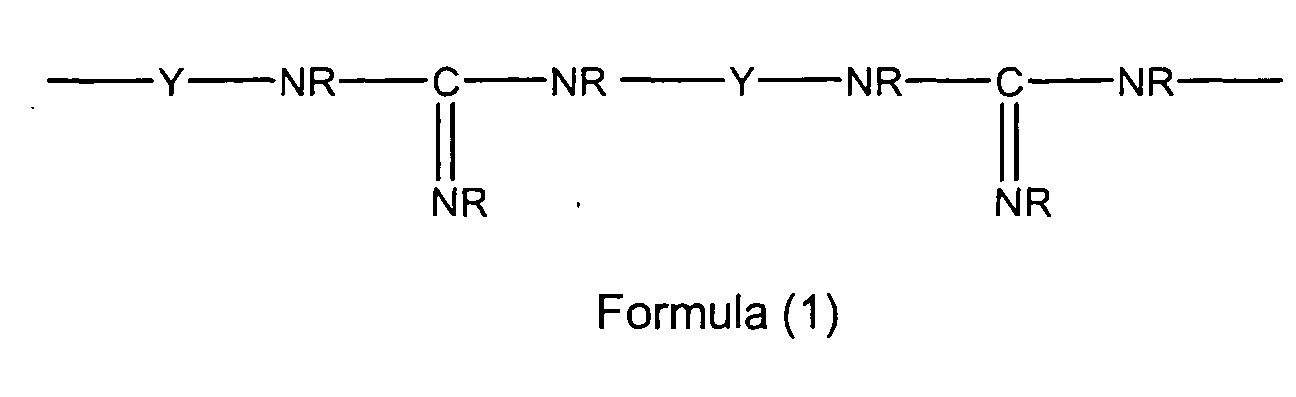
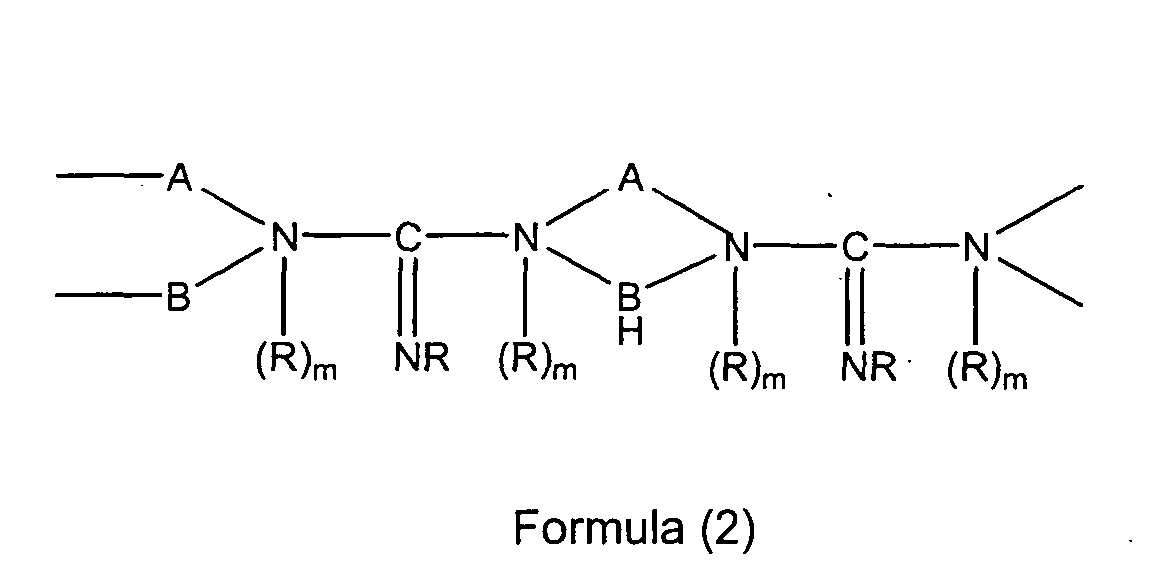
- poly(C 3-18 -hydrocarbyl monoguanidines) comprise groups selected from the group consisting of Formula (1) and Formula (2) or salts thereof: wherein:
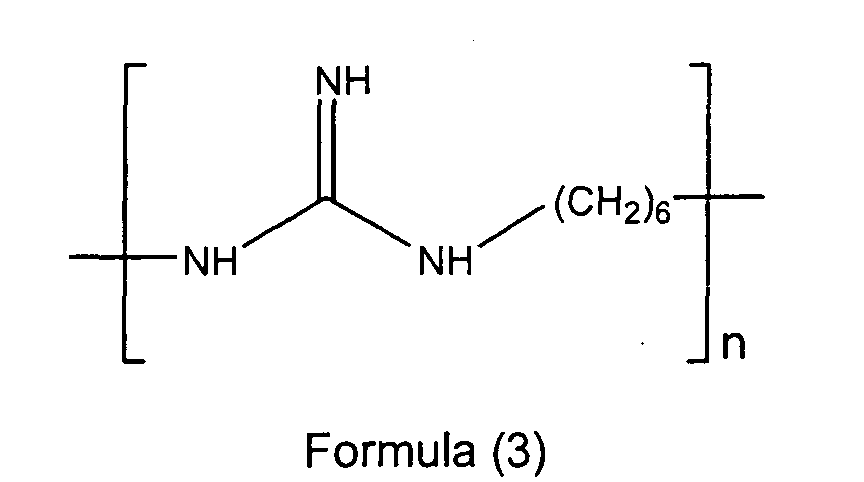
- poly(C 3-18 -hydrocarbyl monoguanidines) comprise at least one group of Formula (3) or salts thereof: wherein:
- Run/ Ink Dye Fixer Dipropylene glycol 1,2 Hexanediol Water Tetraethylene glycol Diethylene glycol 2-pyrrolidone Run 1/K Direct Black Poly-alkyl amine Immobile Immobile Immobile Slight Slight Moderate Run 1/C Phthalocyanine cyan Poly-alkyl amine Immobile Immobile Immobile Immobile Immobile Slight Run 1/M Gamma acid magenta Poly-alkyl amine Immobile Immobile Immobile Immobile Immobile Immobile Completely Run 1/Y Direct yellow Poly-alkyl amine Immobile Immobile Immobile Slight Moderate Completely Run 2/K Direct Black (different from 1/K) Polyguanidine Immobile Immobile Immobile Slight Slight Moderate Run 2/C Phthalocyanine cyan Polyguanidine Immobile Immobile Immobile Immobile Immobile Immobile Slight Run 2/M H-acid magenta Polyguanidine
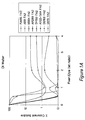
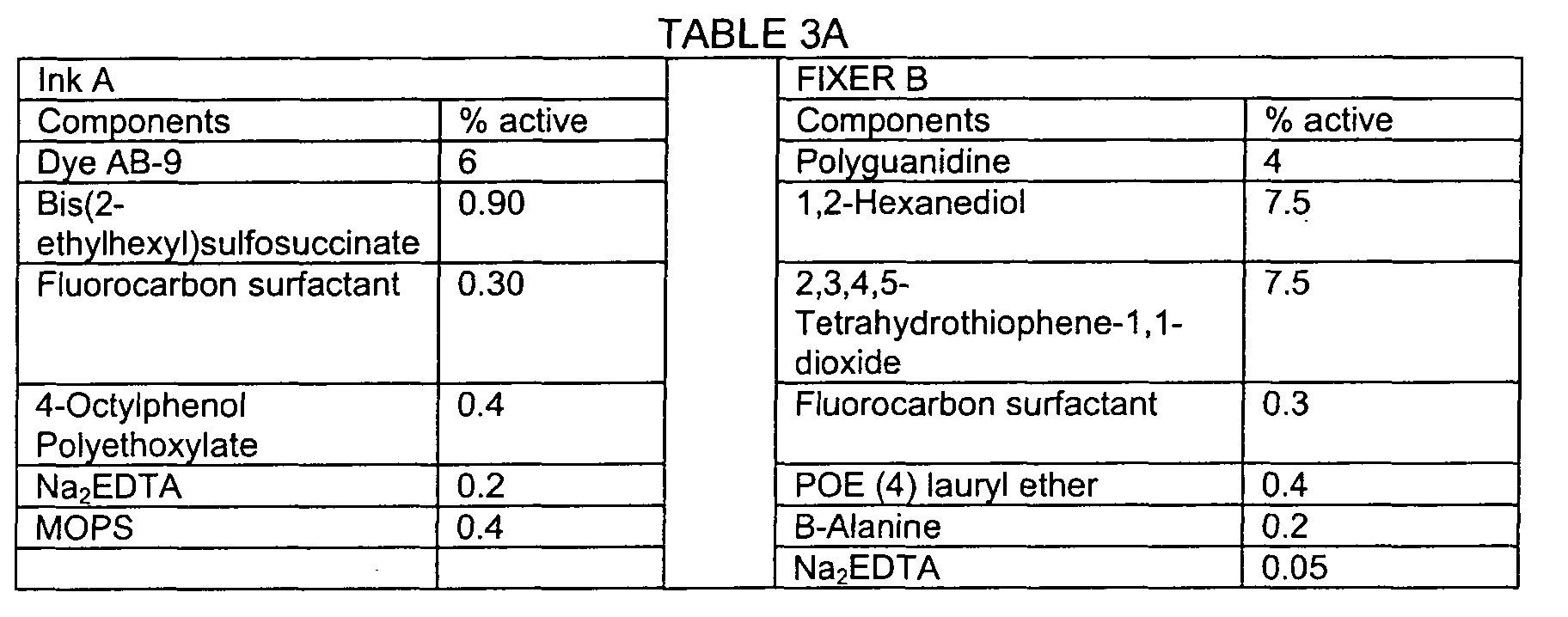
- a stock solution of ink containing anionic dye, Acid Blue 9(AB9), and fixer containing cationic polymer, Polyguanidine, are diluted with ratios of water and 2-P.
- concentrations of water and 2-P are diluted.
- Solubility is determined by examining the mixture for precipitate after 1-day at ambient conditions
- Table 3B summarizes the solubility of Ink A and the Polyguanidine Fixer at various water/2P ratios.
- concentration of 2-pyrrolidone has a strong effect on the interaction of the dye and fixer.
- concentration of 2-P increases the solubility of the dye/fixer complex.
- DB 168 Dye/Polyguanidine Fixer is the most soluble in 88% 2P ⁇ and that the reproducibility of this measurement is good (comparing '2P' and replicate '2P-2'). It also shows that the relative ability of solvents to dissolve the dye/fixer complex changes as water is taken out of the system. For example, at 44%aq TMS is a better solvent for DB 168 Dye /Polyguanidine Fixer than 44% aqueous TEG, but 88% aqueous TEG is a better solvent than 88% aqueous TMS.
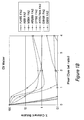
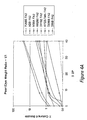
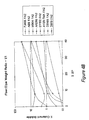
- Fixer-dye mixtures containing 0, 8, and 40% 2P were made by mixing 3% of dye in water or in 40% 2P with 3% of FA11/5 (polymonoguanidine) or FA2 (polybiguanadine) in water, pH adjusted to 4.
- Higher 2P-containing solutions (40% 2P in mixture) were prepared by mixing 3% dye in water with 6% FA11/5 or FA2 (in water, pH adjusted to 4)
- As dyes PJ485, AB9, M364, AR289, DY132, AY23-TMA, DB19 and DB168 were used in this study. The samples were centrifuged.
- fixer-DB168 complex is the least soluble.
- Fixer-DB19 complex was more soluble than fixer-DB168 complex but still less soluble than most of the fixer-color dye complexes.
- % Colorant Soluble increased with increasing % 2P.
- the amount of colorant soluble increased by roughly one order of magnitude from 0 to 40% 2P for most dyes including DB19.
- % Colorant Soluble of fixer -DB168 appeared to be insensitive to 2P content in this region.
- Example 1 microliter anionic dye-based ink and cationic polymeric fixer is pipetted in the order Fixer/Color/Fixer for each of colors black, cyan, magenta and yellow onto cellulose thin layer chromatography (TLC) plates.
- the TLC plates were dried for 30 minutes at ambient temperature.
- the TLC plate was developed in solvent at 55°C.
Landscapes
- Chemical & Material Sciences (AREA)
- Organic Chemistry (AREA)
- Chemical Kinetics & Catalysis (AREA)
- Engineering & Computer Science (AREA)
- Materials Engineering (AREA)
- Wood Science & Technology (AREA)
- Life Sciences & Earth Sciences (AREA)
- Dispersion Chemistry (AREA)
- Ink Jet Recording Methods And Recording Media Thereof (AREA)
- Inks, Pencil-Leads, Or Crayons (AREA)
- Macromolecular Compounds Obtained By Forming Nitrogen-Containing Linkages In General (AREA)
- Ink Jet (AREA)
- Compositions Of Macromolecular Compounds (AREA)
- Paints Or Removers (AREA)
- Processes Of Treating Macromolecular Substances (AREA)
Abstract
Description
| "Effective" Solvents | Dielectric Constants at STP |
| 2-pyrrolidone | 28.18 |
| Diethylene glycol | 31.82 |
| 1,2-propanediol | 32 |
| Tetraethylene glycol | 20.44 |
| 1-methyl-2-pyrrolidone | 32.2 |
| N,n-dimethylpropionamide | 34.6 |
| Triethylene glycol | 23.7 |
| 1,5-pentanediol | 26.2 |
| 1,4-pentanediol | 31.9 |
| "Ineffective" Solvents | Dielectric Constants at STP |
| Water | 78 |
| Cyclohexanone | 16.1 |
| Butoxyethanol | 9.43 |
| Diacetone alcohol | 18.2 |
| 1-pentanol | 16.9 |
| 1,2-pentanediol | 17.3 |
| Glycerol | 46.5 |
| Run/ Ink | Dye | Fixer | Dipropylene | 1,2 Hexanediol | Water | Tetraethylene glycol | Diethylene glycol | 2-pyrrolidone |
| Run 1/K | Direct Black | Poly-alkyl amine | Immobile | Immobile | Immobile | Slight | Slight | Moderate |
| Run 1/C | Phthalocyanine cyan | Poly-alkyl amine | Immobile | Immobile | Immobile | Immobile | Immobile | Slight |
| Run 1/M | Gamma acid magenta | Poly-alkyl amine | Immobile | Immobile | Immobile | Immobile | Immobile | Completely |
| Run 1/Y | Direct yellow | Poly-alkyl amine | Immobile | Immobile | Immobile | Slight | Moderate | Completely |
| Run 2/K | Direct Black (different from 1/K) | Polyguanidine | Immobile | Immobile | Immobile | Slight | Slight | Moderate |
| Run 2/C | Phthalocyanine cyan | Polyguanidine | Immobile | Immobile | Immobile | Immobile | Immobile | Slight |
| Run 2/M | H-acid magenta | Polyguanidine | Immobile | Immobile | Very slight | Slight | Moderate | Moderate |
| Run 2/Y | Direct yellow | Polyguanidine | Immobile | Immobile | Immobile | Slight | Moderate | Completely |
| Run 3/K | Direct Black (different from 1/K) | Polyguanidine | Immobile | Immobile | Immobile | Slight | Slight | Moderate |
| Run 3/C | Mixture of acid cyan and phthalocyanine cyan | Polyguanidine | Immobile | Immobile | Immobile | Slight | Slight | Moderate |
| Run 3/M | Mixture of H-acid magenta and xanthene magenta | Polyguanidine | Very slight | Very slight | Very slight | Slight | Moderate | |
| Run | ||||||||
| 3/Y | Mixture of direct yellow and acid yellow | Polyguanidine | Immobile | Immobile | Very slight | Slight | Moderate | Completely |
| Fixer/ Ink | Dye | Fixer | Cyclohex a-none | Butoxy-ethanol | Diacetone alcohol | 2-amino-2-methyl propanol (AMP) | 1,2-propanediol |
| Run 4/K | Direct Black | Polyalkyl amine | Immobile | Immobile | Immobile | Moderate | Slight |
| Run 4/C | Phthalocyanine cyan | Polyalkyl amine | Immobile | Immobile | Immobile | Completely | Immobile |
| Run 4/M | Gamma acid magenta | Polyalkyl amine | Immobile | Immobile | Immobile | Moderate | Very slight |
| Run 4/Y | Direct yellow | Polyalkyl amine | Immobile | Immobile | Immobile | Completely | Slight |
| Run 5/K | Direct Black (different from 1/K) | Polyguanidine | Immobile | Immobile | Immobile | Immobile | Slight |
| Run 5/C | Phthalocyanine cyan | Polyguanidine | Immobile | Immobile | Immobile | Immobile | Very slight |
| Run 5/M | H-acid magenta | Polyguanidine | Immobile | Immobile | Immobile | Immobile | Moderate |
| Run 5/Y | Direct yellow | Polyguanidine | Immobile | Immobile | Immobile | Slight | Moderate |
| Run 6/K | Direct Black (different from 1/K) | Polyguanidine | Immobile | Immobile | Immobile | Slight | Slight |
| Run 6/C | Mixture of acid cyan and phthalocyanine cyan | Polyguanidine | Immobile | Immobile | Immobile | Slight | Moderate |
| Run 6/M | Mixture of H-acid magenta and xanthene magenta | Polyguanidine | Very slight | Very slight | Very slight | Slight | Moderate |
| Run 6/Y | Mixture of direct yellow and acid yellow | Polyguanidine | Immobile | Immobile | Immobile | Slight | Moderate |
| Sample | Weight% (Dye) | Weight % | Weight % | 2P | ppt with Sample X | ppt with |
| 1 | 0.60 | 90 | 0 | Yes | Yes | |
| 2 | 0.60 | 80 | 20 | Yes | Yes | |
| 3 | 0.60 | 60 | 40 | | None | |
| 4 | 0.60 | 40 | 60 | Yes | None | |
| 5 | 0.60 | 20 | 80 | Yes | None | |
| 6 | 0.60 | 0 | 90 | None | None |
| Sample | Weight% (Fixer) | Weight% | Weight |
| X | |||
| 2 | 98 | 0 | |
| | 2 | 48 | 50 |
| 44% solvent | 88% solvent | |
| 2-pyrrolidone | 0.28 | 34.27 |
| 2-pyrrolidone (rep 2) | 0.27 | 34.87 |
| 1,2-hexanediol | 0.11 | 0.18 |
| Tetramethylene sulfone | 0.38 | 7.63 |
| 1-methyl-2-pyrrolidone | 0.45 | 30.54 |
| 1,2-propanediol | 0.00 | 0.67 |
| Diethylene glycol | 0.00 | 3.47 |
| Tetraethylene glycol | 0.00 | 8.86 |
| Glycerol | 0.00 | 0.00 |
| Ethylene glycol | 0.00 | 0.40 |
| Tetrahydrofuran | 1.32 | 15.45 |
| n,n-dimethylpropionamide | 0.76 | 20.30 |
| Run/ Ink | Dye | Fixer 1- | | 1,2- | Triethylene glycol | 1,5- | 1,4-, butanediol | | |
| Run | |||||||||
| 2/K | Direct Black | Poly-guanidine | Immobile | Slight | Slight | Immobile | Very | Slight | |
| Run | |||||||||
| 2/C | Phthalocyanine cyan | Poly-guanidine | Immobile | Very slight | Slight | Slight | Slight | e | |
| Run | |||||||||
| 2/M | H-acid magenta | Poly-guanidine | Immobile | Very slight | Slight | Slight | Slight | e | |
| Run | |||||||||
| 2/Y | Direct yellow | Poly-guanidine | Immobile | Immobile | Slight | Very slight | Slight | Moderate | |
| Dielectric Constants at STP 16.9 | 17.3 | 23.7 | 26.2 | 31.9 41.4 |
Claims (12)
- A method of dissolving an anionic dye/cationic polymer complex comprising the step of applying to the complex a water-soluble solvent having a dielectric constant from 20 to 43 at standard temperature and pressure.
- A method as claimed in claim 1 wherein the solvent is 2-pyrrolidone, diethylene glycol, 1,2-propanediol, tetraethylene glycol, 1-methyl-2-pyrrolidone, n,n-dimethylpropionamide, 2-amino-2-methyl propanol or any combination thereof.
- A method as claimed in claim 2, wherein the solvent is 2-pyrrolidone.
- A method as claimed in claim 3, wherein the weight percent ratio of 2-pyrrolidone to water is from 100:0 to 20:80.
- A method as claimed in claim 4, wherein said weight percent ratio is 40:60.
- A method as claimed in any preceding claim, wherein, before the complex is dissolved, it adheres to an inkjet printhead.
- A method as claimed in any preceding claim wherein the cationic polymer is a polyguanadine or a polyethyleneimine.
- A method as claimed in claim 7 wherein the cationic polymer is a polymonoguanadine.
- A method as claimed in claim 8 wherein the polymonoguanadine is a poly (C3-18-hydrocarbyl monoguanidine).
- A method as claimed in claim 9 wherein the poly(C3-18-hydrocarbyl monoguanidine) comprises a group of Formula (1) or of Formula (2) or salts thereof:
 wherein:
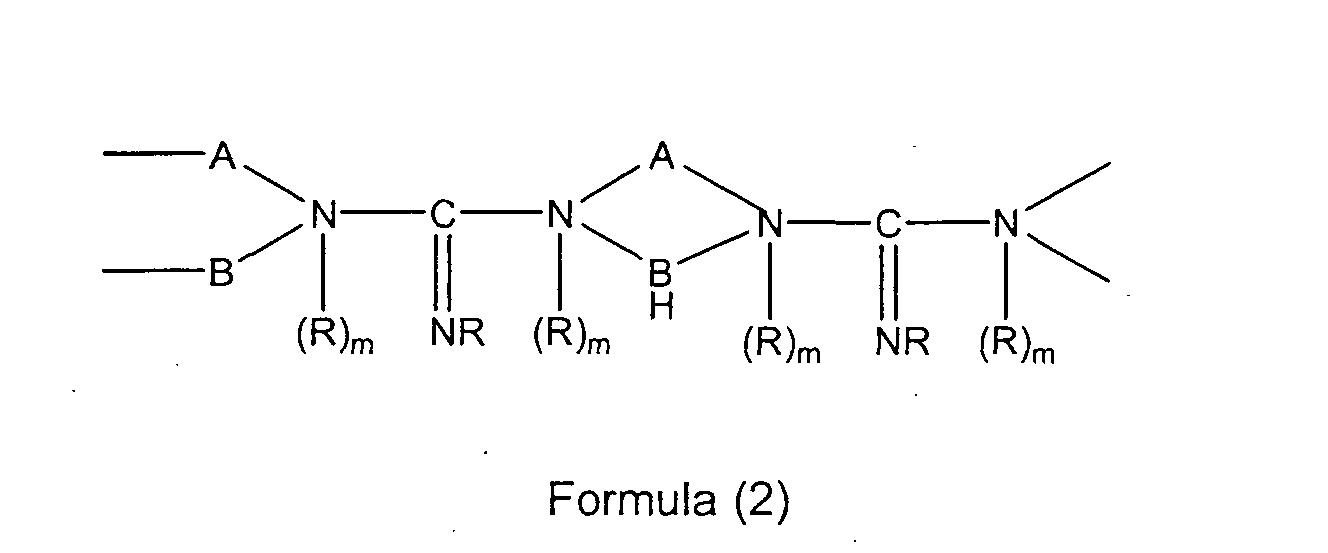 each R is independently hydrogen, alkyl, alkoxy, substituted alkyl or substituted alkoxy.each m is independently 0 or 1;each Y is independently a C2-18-hydrocarbyl group;A and B are hydrocarbyl groups which together comprise a total of 3 to 18 carbon atoms; and
 - A method as claimed in claim 9 wherein the poly(C3-18-hydrocarbyl monoguanidine) comprises at least one group of Formula (3) or salts thereof:wherein:
 n is from 2 to 50.
 - A method of removing an anionic dye/cationic polymer complex from an inkjet printhead, comprising the step of dissolving said complex by means of a method as claimed in any preceding claim.
Applications Claiming Priority (2)
| Application Number | Priority Date | Filing Date | Title |
|---|---|---|---|
| US354624 | 2003-01-28 | ||
| US10/354,624 US6998429B2 (en) | 2003-01-28 | 2003-01-28 | Dissolving complexes of anionic dye/cationic polymeric fixer |
Publications (3)
| Publication Number | Publication Date |
|---|---|
| EP1442889A2 true EP1442889A2 (en) | 2004-08-04 |
| EP1442889A3 EP1442889A3 (en) | 2005-04-27 |
| EP1442889B1 EP1442889B1 (en) | 2008-11-19 |
Family
ID=32655555
Family Applications (1)
| Application Number | Title | Priority Date | Filing Date |
|---|---|---|---|
| EP04250475A Expired - Lifetime EP1442889B1 (en) | 2003-01-28 | 2004-01-28 | Method of dissolving complexes of anionic dye/cationic polymeric fixer |
Country Status (4)
| Country | Link |
|---|---|
| US (3) | US6998429B2 (en) |
| EP (1) | EP1442889B1 (en) |
| JP (1) | JP4286675B2 (en) |
| DE (1) | DE602004017796D1 (en) |
Cited By (1)
| Publication number | Priority date | Publication date | Assignee | Title |
|---|---|---|---|---|
| WO2006047576A1 (en) * | 2004-10-25 | 2006-05-04 | Hewlett-Packard Development Company, L.P. | Reactive color inks |
Families Citing this family (13)
| Publication number | Priority date | Publication date | Assignee | Title |
|---|---|---|---|---|
| US7645403B2 (en) * | 2003-06-24 | 2010-01-12 | Hewlett-Packard Development Company, L.P. | Method of improving color quality in an object produced by solid freeform fabrication |
| US20070167537A1 (en) * | 2003-12-19 | 2007-07-19 | Fuji Photo Film Co., Ltd. | Ink for ink jet, a method for produing ink for ink jet, ink set for ink jet, and ink jet recording method |
| RU2285762C1 (en) * | 2005-07-06 | 2006-10-20 | Государственное образовательное учреждение высшего профессионального образования "Ивановский государственный химико-технологический университет" (ИГХТУ) | Formaldehyde-free composition for fixing water-soluble dyes on cellulose fibers and textiles therefrom |
| RU2285763C1 (en) * | 2005-07-06 | 2006-10-20 | Государственное образовательное учреждение высшего профессионального образования "Ивановский государственный химико-технологический университет" (ИГХТУ) | Formaldehyde-free composition for fixing water-soluble dyes on cellulose fibers and textiles therefrom |
| US20070100022A1 (en) * | 2005-10-28 | 2007-05-03 | Ervin Mubarekyan | Low corrosivity inks and ink systems and methods of making low corrosivity inks |
| WO2009030614A1 (en) * | 2007-09-05 | 2009-03-12 | Basf Se | Personal care compositions comprising dye-polymer complexes |
| WO2009030613A1 (en) * | 2007-09-05 | 2009-03-12 | Basf Se | Home and fabric care compositions comprising dye-polymer complexes |
| JP5793779B2 (en) * | 2011-06-22 | 2015-10-14 | 東洋インキScホールディングス株式会社 | Maintenance liquid for inkjet recording |
| JP6546462B2 (en) * | 2015-06-24 | 2019-07-17 | 東京応化工業株式会社 | Composition |
| JP7567367B2 (en) * | 2020-10-29 | 2024-10-16 | セイコーエプソン株式会社 | Liquid ejection device |
| JP7559502B2 (en) | 2020-10-29 | 2024-10-02 | セイコーエプソン株式会社 | Liquid ejection device |
| JP7847005B2 (en) * | 2021-03-02 | 2026-04-16 | 三菱鉛筆株式会社 | composite colored particles |
| JP7818903B2 (en) * | 2021-05-28 | 2026-02-24 | 三菱鉛筆株式会社 | composite colored particles |
Family Cites Families (15)
| Publication number | Priority date | Publication date | Assignee | Title |
|---|---|---|---|---|
| JPS63215781A (en) | 1987-03-05 | 1988-09-08 | Nippon Shokubai Kagaku Kogyo Co Ltd | Water-base ink composition |
| JP2667401B2 (en) | 1987-05-30 | 1997-10-27 | 株式会社リコー | Inkjet recording method |
| JPH02236741A (en) | 1989-03-10 | 1990-09-19 | Nec Corp | Logic simulator |
| JPH04115954A (en) * | 1990-09-05 | 1992-04-16 | Matsushita Electric Ind Co Ltd | Ink jet head cleaning liquid |
| JPH0789092A (en) | 1993-09-22 | 1995-04-04 | Toray Ind Inc | Ink jet recording apparatus cleaning method and aqueous cleaning solution |
| JPH0881611A (en) | 1994-07-11 | 1996-03-26 | Canon Inc | Liquid composition, ink set, and image forming method and apparatus using the same |
| JP3164745B2 (en) * | 1995-02-13 | 2001-05-08 | キヤノン株式会社 | INK JET PRINTING APPARATUS AND INK JET PRINTING METHOD |
| JP2888511B2 (en) * | 1995-07-25 | 1999-05-10 | 富士ゼロックス株式会社 | Inkjet head cleaning method and cleaning cartridge therefor |
| WO1998041531A2 (en) * | 1997-03-20 | 1998-09-24 | University Of Washington | Solvent for biopolymer synthesis, solvent microdroplets and methods of use |
| JP3550687B2 (en) * | 1997-03-25 | 2004-08-04 | セイコーエプソン株式会社 | Ink for inkjet recording |
| US6342105B1 (en) * | 1997-11-21 | 2002-01-29 | Fuji Xerox Co., Ltd. | Washing solution for ink jet head, method for producing the same, and method for washing ink jet head using the same |
| JPH11157087A (en) | 1997-11-28 | 1999-06-15 | Fuji Xerox Co Ltd | Method for cleaning ink jet print head |
| US6740689B1 (en) | 2000-10-30 | 2004-05-25 | Hewlett-Packard Development Company, L.P. | Ink and underprinting fluid combinations with improved inkjet print image color and stability |
| DE60109055T2 (en) | 2000-12-07 | 2006-04-13 | Avecia Ltd., Blackley | INK-JET PRINTING |
| US6830310B2 (en) * | 2002-10-23 | 2004-12-14 | Hewlett-Packard Development Company, L.P. | Detectable markers in cationic polymeric fixers |
-
2003
- 2003-01-28 US US10/354,624 patent/US6998429B2/en not_active Expired - Fee Related
-
2004
- 2004-01-26 JP JP2004017244A patent/JP4286675B2/en not_active Expired - Fee Related
- 2004-01-28 DE DE602004017796T patent/DE602004017796D1/en not_active Expired - Lifetime
- 2004-01-28 EP EP04250475A patent/EP1442889B1/en not_active Expired - Lifetime
-
2005
- 2005-10-21 US US11/256,136 patent/US7654633B2/en not_active Expired - Fee Related
-
2009
- 2009-01-30 US US12/363,475 patent/US7837291B2/en not_active Expired - Fee Related
Cited By (2)
| Publication number | Priority date | Publication date | Assignee | Title |
|---|---|---|---|---|
| WO2006047576A1 (en) * | 2004-10-25 | 2006-05-04 | Hewlett-Packard Development Company, L.P. | Reactive color inks |
| US7951233B2 (en) | 2004-10-25 | 2011-05-31 | Hewlett-Packard Development Company, L.P. | Reactive color inks |
Also Published As
| Publication number | Publication date |
|---|---|
| DE602004017796D1 (en) | 2009-01-02 |
| US7837291B2 (en) | 2010-11-23 |
| US20060036002A1 (en) | 2006-02-16 |
| JP4286675B2 (en) | 2009-07-01 |
| EP1442889B1 (en) | 2008-11-19 |
| JP2004231960A (en) | 2004-08-19 |
| US6998429B2 (en) | 2006-02-14 |
| US20040147630A1 (en) | 2004-07-29 |
| EP1442889A3 (en) | 2005-04-27 |
| US20090197996A1 (en) | 2009-08-06 |
| US7654633B2 (en) | 2010-02-02 |
Similar Documents
| Publication | Publication Date | Title |
|---|---|---|
| US7837291B2 (en) | Dissolving complexes of anionic dye/cationic polymeric fixer | |
| JP4194914B2 (en) | Inkjet printing method and system providing improved image durability | |
| KR100494254B1 (en) | Bleed control in ink-jet inks via aqueous phase separation | |
| US7281789B2 (en) | Water base ink set for ink-jet recording | |
| EP1764396A1 (en) | Aqueous ink, inkjet recording method, ink cartridge, recording unit, inkjet recorder, and image forming method | |
| EP1764397A1 (en) | Cyan ink and ink set | |
| US5788754A (en) | Ink-jet inks for improved image quality | |
| EP1931739B1 (en) | Ink-jet printing methods and compositions providing improved image durability | |
| EP1462488B1 (en) | Solvent systems for ink-jet inks | |
| JP2001010200A5 (en) | ||
| EP0947569B1 (en) | Ink-jet inks and method for printing the same | |
| US20070100022A1 (en) | Low corrosivity inks and ink systems and methods of making low corrosivity inks | |
| JP2006070189A (en) | Water-based ink set for inkjet recording | |
| KR20090076951A (en) | Ozone stability inkjet ink | |
| EP2059570B1 (en) | Inkjet ink | |
| EP1721944B1 (en) | Ink Set comprising surfactants with different HLB values | |
| US20080178764A1 (en) | Phthalocyanine dyes formulated with salts and anti-flocculent aromatic polyamines for ink-jet imaging | |
| CN101186148A (en) | Inkjet recording method | |
| JP2010502828A (en) | Ink jet ink comprising first and second co-solvents and first and second wetting agents | |
| JP3788026B2 (en) | Ink and inkjet recording method | |
| EP1525989A2 (en) | Systems and methods for printing onto a substrate using reactive ink | |
| HK1125127B (en) | Low corrosivity inks and ink systems and methods of making low corrosivity inks | |
| JP2000297235A (en) | Inkjet recording ink |
Legal Events
| Date | Code | Title | Description |
|---|---|---|---|
| PUAI | Public reference made under article 153(3) epc to a published international application that has entered the european phase |
Free format text: ORIGINAL CODE: 0009012 |
|
| AK | Designated contracting states |
Kind code of ref document: A2 Designated state(s): AT BE BG CH CY CZ DE DK EE ES FI FR GB GR HU IE IT LI LU MC NL PT RO SE SI SK TR |
|
| AX | Request for extension of the european patent |
Extension state: AL LT LV MK |
|
| PUAL | Search report despatched |
Free format text: ORIGINAL CODE: 0009013 |
|
| AK | Designated contracting states |
Kind code of ref document: A3 Designated state(s): AT BE BG CH CY CZ DE DK EE ES FI FR GB GR HU IE IT LI LU MC NL PT RO SE SI SK TR |
|
| AX | Request for extension of the european patent |
Extension state: AL LT LV MK |
|
| 17P | Request for examination filed |
Effective date: 20051010 |
|
| AKX | Designation fees paid |
Designated state(s): CH DE FR GB LI NL |
|
| 17Q | First examination report despatched |
Effective date: 20070205 |
|
| GRAP | Despatch of communication of intention to grant a patent |
Free format text: ORIGINAL CODE: EPIDOSNIGR1 |
|
| GRAS | Grant fee paid |
Free format text: ORIGINAL CODE: EPIDOSNIGR3 |
|
| GRAA | (expected) grant |
Free format text: ORIGINAL CODE: 0009210 |
|
| AK | Designated contracting states |
Kind code of ref document: B1 Designated state(s): CH DE FR GB LI NL |
|
| REG | Reference to a national code |
Ref country code: GB Ref legal event code: FG4D |
|
| REG | Reference to a national code |
Ref country code: CH Ref legal event code: NV Representative=s name: BOVARD AG PATENTANWAELTE Ref country code: CH Ref legal event code: EP |
|
| REF | Corresponds to: |
Ref document number: 602004017796 Country of ref document: DE Date of ref document: 20090102 Kind code of ref document: P |
|
| PLBE | No opposition filed within time limit |
Free format text: ORIGINAL CODE: 0009261 |
|
| STAA | Information on the status of an ep patent application or granted ep patent |
Free format text: STATUS: NO OPPOSITION FILED WITHIN TIME LIMIT |
|
| 26N | No opposition filed |
Effective date: 20090820 |
|
| REG | Reference to a national code |
Ref country code: CH Ref legal event code: PFA Owner name: HEWLETT-PACKARD DEVELOPMENT COMPANY, L.P. Free format text: HEWLETT-PACKARD DEVELOPMENT COMPANY, L.P.#20555 S.H. 249#HOUSTON TX 77070 (US) -TRANSFER TO- HEWLETT-PACKARD DEVELOPMENT COMPANY, L.P.#20555 S.H. 249#HOUSTON TX 77070 (US) |
|
| REG | Reference to a national code |
Ref country code: FR Ref legal event code: PLFP Year of fee payment: 12 |
|
| PGFP | Annual fee paid to national office [announced via postgrant information from national office to epo] |
Ref country code: GB Payment date: 20141219 Year of fee payment: 12 Ref country code: CH Payment date: 20141223 Year of fee payment: 12 |
|
| PGFP | Annual fee paid to national office [announced via postgrant information from national office to epo] |
Ref country code: NL Payment date: 20141217 Year of fee payment: 12 |
|
| PGFP | Annual fee paid to national office [announced via postgrant information from national office to epo] |
Ref country code: DE Payment date: 20141218 Year of fee payment: 12 |
|
| PGFP | Annual fee paid to national office [announced via postgrant information from national office to epo] |
Ref country code: FR Payment date: 20150121 Year of fee payment: 12 |
|
| REG | Reference to a national code |
Ref country code: DE Ref legal event code: R119 Ref document number: 602004017796 Country of ref document: DE |
|
| REG | Reference to a national code |
Ref country code: CH Ref legal event code: PL |
|
| GBPC | Gb: european patent ceased through non-payment of renewal fee |
Effective date: 20160128 |
|
| REG | Reference to a national code |
Ref country code: NL Ref legal event code: MM Effective date: 20160201 |
|
| REG | Reference to a national code |
Ref country code: FR Ref legal event code: ST Effective date: 20160930 |
|
| PG25 | Lapsed in a contracting state [announced via postgrant information from national office to epo] |
Ref country code: CH Free format text: LAPSE BECAUSE OF NON-PAYMENT OF DUE FEES Effective date: 20160131 Ref country code: LI Free format text: LAPSE BECAUSE OF NON-PAYMENT OF DUE FEES Effective date: 20160131 Ref country code: GB Free format text: LAPSE BECAUSE OF NON-PAYMENT OF DUE FEES Effective date: 20160128 Ref country code: DE Free format text: LAPSE BECAUSE OF NON-PAYMENT OF DUE FEES Effective date: 20160802 |
|
| PG25 | Lapsed in a contracting state [announced via postgrant information from national office to epo] |
Ref country code: FR Free format text: LAPSE BECAUSE OF NON-PAYMENT OF DUE FEES Effective date: 20160201 Ref country code: NL Free format text: LAPSE BECAUSE OF NON-PAYMENT OF DUE FEES Effective date: 20160201 |