EP1441551A1 - Method of optimizing the performance of a mobile terminal - Google Patents
Method of optimizing the performance of a mobile terminal Download PDFInfo
- Publication number
- EP1441551A1 EP1441551A1 EP04001207A EP04001207A EP1441551A1 EP 1441551 A1 EP1441551 A1 EP 1441551A1 EP 04001207 A EP04001207 A EP 04001207A EP 04001207 A EP04001207 A EP 04001207A EP 1441551 A1 EP1441551 A1 EP 1441551A1
- Authority
- EP
- European Patent Office
- Prior art keywords
- traveling speed
- mobile terminal
- data processing
- terminal
- processing software
- Prior art date
- Legal status (The legal status is an assumption and is not a legal conclusion. Google has not performed a legal analysis and makes no representation as to the accuracy of the status listed.)
- Granted
Links
- 238000000034 method Methods 0.000 title claims abstract description 21
- 238000004891 communication Methods 0.000 claims abstract description 19
- 238000012545 processing Methods 0.000 claims description 9
- 238000001914 filtration Methods 0.000 description 5
- 230000005540 biological transmission Effects 0.000 description 4
- 238000005259 measurement Methods 0.000 description 3
- 238000010845 search algorithm Methods 0.000 description 3
- 238000012935 Averaging Methods 0.000 description 2
- 230000015556 catabolic process Effects 0.000 description 2
- 230000001413 cellular effect Effects 0.000 description 2
- 230000001427 coherent effect Effects 0.000 description 2
- 238000006731 degradation reaction Methods 0.000 description 2
- 238000001514 detection method Methods 0.000 description 2
- 238000005516 engineering process Methods 0.000 description 2
- 238000012937 correction Methods 0.000 description 1
- 230000001419 dependent effect Effects 0.000 description 1
- 230000006866 deterioration Effects 0.000 description 1
- 238000010586 diagram Methods 0.000 description 1
- 238000010295 mobile communication Methods 0.000 description 1
- 238000005070 sampling Methods 0.000 description 1
Images

Classifications
-
- H—ELECTRICITY
- H04—ELECTRIC COMMUNICATION TECHNIQUE
- H04W—WIRELESS COMMUNICATION NETWORKS
- H04W48/00—Access restriction; Network selection; Access point selection
- H04W48/16—Discovering, processing access restriction or access information
-
- H—ELECTRICITY
- H04—ELECTRIC COMMUNICATION TECHNIQUE
- H04W—WIRELESS COMMUNICATION NETWORKS
- H04W48/00—Access restriction; Network selection; Access point selection
- H04W48/02—Access restriction performed under specific conditions
- H04W48/04—Access restriction performed under specific conditions based on user or terminal location or mobility data, e.g. moving direction, speed
-
- H—ELECTRICITY
- H04—ELECTRIC COMMUNICATION TECHNIQUE
- H04W—WIRELESS COMMUNICATION NETWORKS
- H04W4/00—Services specially adapted for wireless communication networks; Facilities therefor
- H04W4/06—Selective distribution of broadcast services, e.g. multimedia broadcast multicast service [MBMS]; Services to user groups; One-way selective calling services
-
- H—ELECTRICITY
- H04—ELECTRIC COMMUNICATION TECHNIQUE
- H04W—WIRELESS COMMUNICATION NETWORKS
- H04W88/00—Devices specially adapted for wireless communication networks, e.g. terminals, base stations or access point devices
- H04W88/02—Terminal devices
-
- Y—GENERAL TAGGING OF NEW TECHNOLOGICAL DEVELOPMENTS; GENERAL TAGGING OF CROSS-SECTIONAL TECHNOLOGIES SPANNING OVER SEVERAL SECTIONS OF THE IPC; TECHNICAL SUBJECTS COVERED BY FORMER USPC CROSS-REFERENCE ART COLLECTIONS [XRACs] AND DIGESTS
- Y02—TECHNOLOGIES OR APPLICATIONS FOR MITIGATION OR ADAPTATION AGAINST CLIMATE CHANGE
- Y02D—CLIMATE CHANGE MITIGATION TECHNOLOGIES IN INFORMATION AND COMMUNICATION TECHNOLOGIES [ICT], I.E. INFORMATION AND COMMUNICATION TECHNOLOGIES AIMING AT THE REDUCTION OF THEIR OWN ENERGY USE
- Y02D30/00—Reducing energy consumption in communication networks
- Y02D30/70—Reducing energy consumption in communication networks in wireless communication networks
Definitions
- the present invention is in the field of telecommunications, and more specifically it relates to a method of optimizing the performance of a mobile terminal comprising a radio communication module, a central computing unit and a plurality of data processing software components.
- the present invention also relates to a mobile terminal.
- a mobile unit (UE; user equipment) in communication has to identify neighboring cells.
- the mobile applies a procedure of searching for cells that comprises the step of performing measurements on neighboring cells, which allows for switching to the cell that offers an optimal communication quality.
- searching for cells a major problem arises when the sampling clock of the mobile is imprecise and/or when there is a Doppler deviation between the base station with which the mobile is in communication and the cell the mobile should identify.
- detection performance of mobile terminals in a cellular network is highly dependent on the channel propagation properties. Degradation of the information carried by a transmitted signal in terms of amplitude, phase and/or frequency may be caused by these properties. This results in an increase in bit error rate (BER) and deterioration of global service quality offered.
- BER bit error rate
- a technique known in the prior art comprises the steps of estimating the impulse response (CIR: Channel Impulse Response) of the propagation channel and applying to the received signal a correction calculated according to the estimation.
- the precision of this estimation significantly varies according to the traveling speed of the terminal.
- a known technique comprises the step of applying particular digital filtering, such as for example the filtering based on the technique called WMSA (Weighted Multi-slot Averaging) described in the document by H. Andoh, M. Sawahashi and F. Adachi, "Channel estimation filter using time-multiplexed pilot channel for coherent RAKE combining in DS-CDMA mobile radio," IEICE Trans. Commun., Vol. E81-B, No. 7, July 1998.
- WMSA Weighted Multi-slot Averaging
- a disadvantage of this method comes from the fact that to calculate the coefficients of the digital filter, it is necessary to know a priori the dynamic properties of the channel that are directly related to the traveling speed of the terminal.
- An object of the present invention is to propose a simple method allowing for simultaneous improvement in performance of hardware resources and software resources of a mobile terminal, providing the terminal with a parameter representing usage conditions of the terminal.
- the present invention proposes a method of optimizing performance of a mobile terminal which comprises a radio communication module, a central computing unit and a plurality of data processing software components.
- the method according to the present invention comprises the steps of:
- the captured traveling speed is distributed according to the nature of processing of each software component and the value of the traveling speed.
- capturing of the traveling speed is performed manually.
- the traveling speed is detected automatically in real time by the terminal.
- the present invention applies to a mobile terminal comprising a radio communication module, a central computing unit, a cell search algorithm, a closed-loop power control algorithm and an algorithm for deactivating transmission diversity in order to save energy.
- the mobile terminal according to the present invention further comprises a communication interface designed to capture the traveling speed of the terminal from an external source and a command module designed to distribute the captured speed to each of the software components of the algorithms.
- the communication interface comprises a module for automatically capturing the traveling speed of the terminal in real time.
- the communication interface comprises means for wirelessly receiving the traveling speed of the terminal.
- the terminal comprises means for transmitting to a base station of a telecommunication network a specific message comprising the traveling speed.
- the base station comprises a channel estimation algorithm, a multipath search algorithm and a power control algorithm capable of exploiting the traveling speed sent to the station by the terminal to improve reception performance at the level of the base station and at the level of the mobile as well.
- each algorithm can know the traveling speed of the terminal and perform the process based on the traveling speed. The simultaneous improvement in performance of hardware resources and software resources of a mobile terminal is thus achieved.
- the following description relates to improvement in detection performance of a mobile terminal in a GSM/UMTS (Global System for Mobile communication/Universal Mobile Telecommunications System) telecommunication network.
- GSM/UMTS Global System for Mobile communication/Universal Mobile Telecommunications System
- the idea of the invention is to provide the terminal with a priori information regarding the environment in which the terminal is used so as to parameterize the signal processing algorithms according to the environment.
- FIG. 1 illustrate the main steps of the method according to the present invention.
- information on the environment for usage of the terminal is recovered from an external source in the first step 2.
- the mobile terminal comprises an interface that allows the user to select their traveling speed on a display screen and validate the selection manually.
- the captured speed is zero.
- the speed that is automatically captured or detected is represented on the display screen by an icon corresponding to a speed within a range of 3 Km/h to 10 Km/h.
- the captured speed may be represented by a plurality of icons, each corresponding to an interval of speeds varying in steps of 10 Km/h for example.
- the captured speed is represented by a plurality of icons, each corresponding to an interval of speeds varying in steps of 50 Km/h for example.
- the speed is automatically detected by the terminal.
- This embodiment is particularly adapted to the case where the terminal is used in a moving car or train.
- the terminal is equipped with a hands-free kit and a connector attached to a connecting socket provided for this purpose in the vehicle in order to recover directly and in real time the speed at which the car and mobile travel.
- the information may be broadcast in the train by using the Bluetooth or Wi-Fi technology.
- the terminal is equipped with hardware components necessary for supporting one of these technologies, and also with a program that periodically executes the search for information broadcast in the train.
- the speed is captured or detected in step 4.
- step 6 The captured speeds are simultaneously distributed in step 6 to the following data processing software components which optimize the operation performance of the mobile terminal:
- Each of the signal processing algorithms of these data processing software components performs its processing based on the traveling speed of the terminal.
- the captured traveling speed is preferably distributed according to the nature of processing of each software component and the value of the traveling speed.
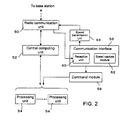
- FIG. 2 illustrates an example of the constitution of the mobile terminal in the present embodiment.
- the mobile terminal comprises radio communication module 50 designed for wireless communication with a base station, central computing unit 52, a plurality of processing units 54 each corresponding to a data processing software component designed to optimize the operational performance of the terminal, communication interface 56 designed to capture the traveling speed of the terminal from an external source, and command module 58 designed to distribute the captured speed to each of the data processing software components, that is, to each of processing units 54.
- Communication interface 56 may be equipped with reception unit 60 designed to wirelessly receive the traveling speed of the terminal.
- communication interface 56 may be equipped with speed capture module 62 designed to automatically capture in real time the traveling speed of the terminal.
- the mobile terminal may include speed transmission unit 64 which transmits the captured traveling speed to a base station of a telecommunication network as a specific message including the traveling speed.
- the base station preferably comprises a channel estimation algorithm, a multipath search algorithm and a power control algorithm capable of exploiting the traveling speed sent to the station by the terminal to improve reception performance at the level of the base station and at the level of the mobile as well.
Landscapes
- Engineering & Computer Science (AREA)
- Computer Security & Cryptography (AREA)
- Computer Networks & Wireless Communication (AREA)
- Signal Processing (AREA)
- Mobile Radio Communication Systems (AREA)
Abstract
Description
- The present invention is in the field of telecommunications, and more specifically it relates to a method of optimizing the performance of a mobile terminal comprising a radio communication module, a central computing unit and a plurality of data processing software components. The present invention also relates to a mobile terminal.
- To prepare for possible handovers in a mobile telecommunication network, a mobile unit (UE; user equipment) in communication has to identify neighboring cells. For this, the mobile applies a procedure of searching for cells that comprises the step of performing measurements on neighboring cells, which allows for switching to the cell that offers an optimal communication quality. In searching for cells, a major problem arises when the sampling clock of the mobile is imprecise and/or when there is a Doppler deviation between the base station with which the mobile is in communication and the cell the mobile should identify.
- A method for solving this problem is described in French patent application No. 02 07617 filed by the present applicant on June 20, 2002. The solution proposed in the above application includes the step of applying digital filtering to the measurement samples collected in a plurality of time windows so as to give a predominant weight to the measurements performed in the most recent time windows. It should be noted that this solution does not take Into account the traveling speed of the mobile terminal in the cellular network.
- Moreover, detection performance of mobile terminals in a cellular network is highly dependent on the channel propagation properties. Degradation of the information carried by a transmitted signal in terms of amplitude, phase and/or frequency may be caused by these properties. This results in an increase in bit error rate (BER) and deterioration of global service quality offered.
- To correct this degradation, a technique known in the prior art comprises the steps of estimating the impulse response (CIR: Channel Impulse Response) of the propagation channel and applying to the received signal a correction calculated according to the estimation. The precision of this estimation significantly varies according to the traveling speed of the terminal. To improve the precision, a known technique comprises the step of applying particular digital filtering, such as for example the filtering based on the technique called WMSA (Weighted Multi-slot Averaging) described in the document by H. Andoh, M. Sawahashi and F. Adachi, "Channel estimation filter using time-multiplexed pilot channel for coherent RAKE combining in DS-CDMA mobile radio," IEICE Trans. Commun., Vol. E81-B, No. 7, July 1998.
- A disadvantage of this method comes from the fact that to calculate the coefficients of the digital filter, it is necessary to know a priori the dynamic properties of the channel that are directly related to the traveling speed of the terminal.
- Furthermore, studies made public specifically in the document by H. Holma and A. Toskala, "WCDMA for UMTS," Wiley & Sons, 2000 shows that closed-loop power control is ineffective for speeds over 100 Km/h. It is also futile to send power control commands to the base station when this speed is surpassed.
- A first solution to this problem would consist of completely stopping the transmission of these commands. However, this is not now allowed by current technical specifications.
- An object of the present invention is to propose a simple method allowing for simultaneous improvement in performance of hardware resources and software resources of a mobile terminal, providing the terminal with a parameter representing usage conditions of the terminal.
- The present invention proposes a method of optimizing performance of a mobile terminal which comprises a radio communication module, a central computing unit and a plurality of data processing software components.
- The method according to the present invention comprises the steps of:
- capturing the traveling speed of the terminal from an external source; and
- distributing the captured speed to each of the data processing software components.
-
- Preferably, the captured traveling speed is distributed according to the nature of processing of each software component and the value of the traveling speed.
- In a first embodiment, capturing of the traveling speed is performed manually.
- in a second embodiment, the traveling speed is detected automatically in real time by the terminal.
- The present invention applies to a mobile terminal comprising a radio communication module, a central computing unit, a cell search algorithm, a closed-loop power control algorithm and an algorithm for deactivating transmission diversity in order to save energy.
- The mobile terminal according to the present invention further comprises a communication interface designed to capture the traveling speed of the terminal from an external source and a command module designed to distribute the captured speed to each of the software components of the algorithms.
- In a first embodiment, the communication interface comprises a module for automatically capturing the traveling speed of the terminal in real time.
- In a second embodiment, the communication interface comprises means for wirelessly receiving the traveling speed of the terminal.
- In the third embodiment, the terminal comprises means for transmitting to a base station of a telecommunication network a specific message comprising the traveling speed.
- The base station comprises a channel estimation algorithm, a multipath search algorithm and a power control algorithm capable of exploiting the traveling speed sent to the station by the terminal to improve reception performance at the level of the base station and at the level of the mobile as well.
- In the present invention, since the traveling speed of the mobile terminal is captured and distributed to a data processing software component of each algorithm, each algorithm can know the traveling speed of the terminal and perform the process based on the traveling speed. The simultaneous improvement in performance of hardware resources and software resources of a mobile terminal is thus achieved.
- Other features and advantages of the invention will be apparent from the description below, taken by way of no limiting example, with reference to the single accompanying figure illustrating the main steps of the method according to the invention.
- FIG. 1 is a flow chart illustrating the main steps of the method according to the present invention; and
- FIG. 2 is a block diagram illustrating the mobile terminal according to an embodiment of the present invention.
-
- The following description relates to improvement in detection performance of a mobile terminal in a GSM/UMTS (Global System for Mobile communication/Universal Mobile Telecommunications System) telecommunication network.
- The idea of the invention is to provide the terminal with a priori information regarding the environment in which the terminal is used so as to parameterize the signal processing algorithms according to the environment.
- FIG. 1 illustrate the main steps of the method according to the present invention. Referring to FIG. 1, information on the environment for usage of the terminal is recovered from an external source in the
first step 2. - For this, the mobile terminal comprises an interface that allows the user to select their traveling speed on a display screen and validate the selection manually. Thus, when the user is stationary, the captured speed is zero.
- When the user travels on foot with his or her terminal, the speed that is automatically captured or detected is represented on the display screen by an icon corresponding to a speed within a range of 3 Km/h to 10 Km/h.
- When the terminal is used in a car, the captured speed may be represented by a plurality of icons, each corresponding to an interval of speeds varying in steps of 10 Km/h for example.
- When the terminal is used in a train, the captured speed is represented by a plurality of icons, each corresponding to an interval of speeds varying in steps of 50 Km/h for example.
- In a variant embodiment, the speed is automatically detected by the terminal. This embodiment is particularly adapted to the case where the terminal is used in a moving car or train.
- In the former case, the terminal is equipped with a hands-free kit and a connector attached to a connecting socket provided for this purpose in the vehicle in order to recover directly and in real time the speed at which the car and mobile travel.
- In the latter case, the information may be broadcast in the train by using the Bluetooth or Wi-Fi technology.
- Therefore, the terminal is equipped with hardware components necessary for supporting one of these technologies, and also with a program that periodically executes the search for information broadcast in the train.
- The speed is captured or detected in step 4.
- The captured speeds are simultaneously distributed in
step 6 to the following data processing software components which optimize the operation performance of the mobile terminal: -
Channel Estimation 8, -
Cell Search 10, - Power Control 12,
-
Transmission Diversity 14, - Filtering of estimation of the impulse response of the
propagation channel 16, - Filtering of estimation of the
power profile 18, and - Calculating of averaging window sizes for
coherent estimation 20. -
- Each of the signal processing algorithms of these data processing software components performs its processing based on the traveling speed of the terminal. Here, the captured traveling speed is preferably distributed according to the nature of processing of each software component and the value of the traveling speed.
- It should be noted that in the majority of the signal processing algorithms cited above, it is not necessary to know precisely the traveling speed of the terminal.
- FIG. 2 illustrates an example of the constitution of the mobile terminal in the present embodiment. The mobile terminal comprises
radio communication module 50 designed for wireless communication with a base station,central computing unit 52, a plurality ofprocessing units 54 each corresponding to a data processing software component designed to optimize the operational performance of the terminal,communication interface 56 designed to capture the traveling speed of the terminal from an external source, andcommand module 58 designed to distribute the captured speed to each of the data processing software components, that is, to each ofprocessing units 54.Communication interface 56 may be equipped withreception unit 60 designed to wirelessly receive the traveling speed of the terminal. Alternatively,communication interface 56 may be equipped withspeed capture module 62 designed to automatically capture in real time the traveling speed of the terminal. - The mobile terminal may include
speed transmission unit 64 which transmits the captured traveling speed to a base station of a telecommunication network as a specific message including the traveling speed. - In a telecommunication network in which the mobile terminals according to the present invention are used, the base station preferably comprises a channel estimation algorithm, a multipath search algorithm and a power control algorithm capable of exploiting the traveling speed sent to the station by the terminal to improve reception performance at the level of the base station and at the level of the mobile as well.
Claims (7)
- A method of optimizing performance of a mobile terminal comprising a radio communication module, a central computing unit and a plurality of data processing software components, the method comprising the steps of:capturing traveling speed of the mobile terminal from an external source; anddistributing the captured traveling speed to each of the data processing software components.
- The method according to claim 1, wherein the captured traveling speed is distributed according to nature of processing of each data processing software component and value of the traveling speed.
- The method according to claim 1 or 2, wherein the capturing of the traveling speed is performed manually.
- The method according to claim 1, 2, or 3, wherein the traveling speed is detected automatically in real time by the mobile terminal.
- A mobile terminal, comprising:a radio communication module,a central computing unit,a plurality of data processing software components designed to optimize operational performance of said mobile terminal,a communication interface designed to capture the traveling speed of the mobile terminal from an external source; anda command module designed to distribute the captured traveling speed to each of the data processing software components.
- The mobile terminal according to claim 5, wherein said communication interface comprises means for wirelessly receiving the traveling speed of the mobile terminal.
- The mobile terminal according to claim 5 or 6, further comprising means for transmitting the captured traveling speed to a base station.
Applications Claiming Priority (2)
| Application Number | Priority Date | Filing Date | Title |
|---|---|---|---|
| FR0300657A FR2850233B1 (en) | 2003-01-22 | 2003-01-22 | METHOD OF OPTIMIZING THE PERFORMANCE OF A MOBILE TERMINAL |
| FR0300657 | 2003-01-22 |
Publications (2)
| Publication Number | Publication Date |
|---|---|
| EP1441551A1 true EP1441551A1 (en) | 2004-07-28 |
| EP1441551B1 EP1441551B1 (en) | 2005-11-09 |
Family
ID=32524987
Family Applications (1)
| Application Number | Title | Priority Date | Filing Date |
|---|---|---|---|
| EP04001207A Expired - Lifetime EP1441551B1 (en) | 2003-01-22 | 2004-01-21 | Method of optimizing the performance of a mobile terminal |
Country Status (6)
| Country | Link |
|---|---|
| US (1) | US7242939B2 (en) |
| EP (1) | EP1441551B1 (en) |
| JP (1) | JP4586959B2 (en) |
| CN (1) | CN1288857C (en) |
| DE (1) | DE602004000168T2 (en) |
| FR (1) | FR2850233B1 (en) |
Families Citing this family (3)
| Publication number | Priority date | Publication date | Assignee | Title |
|---|---|---|---|---|
| US20060222122A1 (en) * | 2005-03-31 | 2006-10-05 | Pantech Co., Ltd. | Method for implementing diversity in mobile telephone and mobile telephone incorporating the same |
| SE529024C2 (en) | 2005-06-20 | 2007-04-10 | Teliasonera Ab | Method and system for measuring the speed of movement of terminal when connecting connection |
| KR101361829B1 (en) * | 2007-10-24 | 2014-02-12 | 삼성전자주식회사 | Apparatus for handover based on dynamic beamforming scheme and method thereof |
Citations (5)
| Publication number | Priority date | Publication date | Assignee | Title |
|---|---|---|---|---|
| DE19843664A1 (en) * | 1997-09-24 | 1999-04-15 | Toyota Motor Co Ltd | Radio communication system for moving objects |
| US6032050A (en) * | 1994-05-20 | 2000-02-29 | Fujitsu Limited | Method for standby control in a mobile telecommunications network setting standby conditions conforming to different modes of communication and mobile unit using same |
| DE19849780C1 (en) * | 1998-10-28 | 2000-09-21 | Siemens Ag | Signal transmission method for radio communication transmitting speech and image-information |
| US6208861B1 (en) * | 1995-09-29 | 2001-03-27 | Nec Corporation | Mobile terminal with GPS function |
| WO2001073959A1 (en) * | 2000-03-24 | 2001-10-04 | Gte Service Corporation | Energy conserving network protocol |
Family Cites Families (10)
| Publication number | Priority date | Publication date | Assignee | Title |
|---|---|---|---|---|
| US6490460B1 (en) * | 1998-12-01 | 2002-12-03 | Qualcomm Incorporated | Forward and reverse link power control using position and mobility information |
| JP3477520B2 (en) * | 1999-04-21 | 2003-12-10 | 松下電器産業株式会社 | Mobile communication device, communication system, and communication method |
| JP3637238B2 (en) * | 1999-04-28 | 2005-04-13 | 富士通株式会社 | Cell search method, synchronization device, and recording medium |
| KR20010038528A (en) * | 1999-10-26 | 2001-05-15 | 조정남 | Apparatus and method for controlling a power of reverse link in CDMA system |
| JP2001127692A (en) * | 1999-10-29 | 2001-05-11 | Sony Corp | Receiving device and receiving processing method |
| JP2001204057A (en) * | 2000-01-18 | 2001-07-27 | Denso Corp | Wireless communication terminal |
| JP2001251670A (en) * | 2000-03-03 | 2001-09-14 | Matsushita Electric Ind Co Ltd | Wireless communication system |
| JP4419274B2 (en) * | 2000-05-22 | 2010-02-24 | 株式会社デンソー | Wireless communication system |
| JP2001346239A (en) * | 2000-05-31 | 2001-12-14 | Toshiba Corp | Mobile radio communication device and cell search method |
| JP2002246969A (en) * | 2001-02-15 | 2002-08-30 | Matsushita Electric Ind Co Ltd | Diversity receiving apparatus and method, and diversity control program |
-
2003
- 2003-01-22 FR FR0300657A patent/FR2850233B1/en not_active Expired - Fee Related
-
2004
- 2004-01-21 EP EP04001207A patent/EP1441551B1/en not_active Expired - Lifetime
- 2004-01-21 DE DE602004000168T patent/DE602004000168T2/en not_active Expired - Lifetime
- 2004-01-21 US US10/760,537 patent/US7242939B2/en not_active Expired - Lifetime
- 2004-01-21 CN CNB2004100330900A patent/CN1288857C/en not_active Expired - Fee Related
- 2004-01-22 JP JP2004014872A patent/JP4586959B2/en not_active Expired - Fee Related
Patent Citations (5)
| Publication number | Priority date | Publication date | Assignee | Title |
|---|---|---|---|---|
| US6032050A (en) * | 1994-05-20 | 2000-02-29 | Fujitsu Limited | Method for standby control in a mobile telecommunications network setting standby conditions conforming to different modes of communication and mobile unit using same |
| US6208861B1 (en) * | 1995-09-29 | 2001-03-27 | Nec Corporation | Mobile terminal with GPS function |
| DE19843664A1 (en) * | 1997-09-24 | 1999-04-15 | Toyota Motor Co Ltd | Radio communication system for moving objects |
| DE19849780C1 (en) * | 1998-10-28 | 2000-09-21 | Siemens Ag | Signal transmission method for radio communication transmitting speech and image-information |
| WO2001073959A1 (en) * | 2000-03-24 | 2001-10-04 | Gte Service Corporation | Energy conserving network protocol |
Also Published As
| Publication number | Publication date |
|---|---|
| JP2004229302A (en) | 2004-08-12 |
| CN1527498A (en) | 2004-09-08 |
| JP4586959B2 (en) | 2010-11-24 |
| DE602004000168D1 (en) | 2005-12-15 |
| EP1441551B1 (en) | 2005-11-09 |
| CN1288857C (en) | 2006-12-06 |
| FR2850233B1 (en) | 2005-05-06 |
| DE602004000168T2 (en) | 2006-05-24 |
| US7242939B2 (en) | 2007-07-10 |
| US20040152465A1 (en) | 2004-08-05 |
| FR2850233A1 (en) | 2004-07-23 |
Similar Documents
| Publication | Publication Date | Title |
|---|---|---|
| US10285121B2 (en) | Cell selection in a cellular communication network | |
| US9380557B2 (en) | Adaptive out of service scanning | |
| US9131515B2 (en) | Selecting from among plural channel estimation techniques | |
| US9949197B2 (en) | Information processor, communication system and method | |
| US20120115463A1 (en) | Method and device for improved user equipment measurements and reporting | |
| CN102761923B (en) | A kind of cell switch determining method and equipment | |
| JP2021506188A (en) | Methods and equipment for determining path loss | |
| EP1863309A1 (en) | Mobile terminal of cdma system, mobile communication method of cdma system, and communication quality estimating method | |
| JP6245465B2 (en) | Wireless communication apparatus and wireless base station switching method | |
| JP2017120994A (en) | Terminal apparatus, communication control apparatus, communication system, and communication control method | |
| CN111149388B (en) | Communication processing method, device and computer storage medium | |
| US20150304977A1 (en) | Method and apparatus for timing advance selection for synchronized uplink transmission | |
| US9191892B1 (en) | Enhanced mobility state detection in mobile communication terminals | |
| US20120231743A1 (en) | Mobile communication device and method of operating a mobile communication device | |
| EP4184813A1 (en) | Information transmission method and apparatus, communication device, and storage medium | |
| CN102098703B (en) | Method and device for determining terminal measurement frequency in cell handover | |
| EP1441551B1 (en) | Method of optimizing the performance of a mobile terminal | |
| US7107056B2 (en) | Method and system for estimating movement speed of mobile unit | |
| US10999790B1 (en) | Systems and methods for selectively connecting to distributed units (“DUs”) in a wireless network based on rates of change of signal strengths of candidate DUs | |
| EP2323274A3 (en) | System and method for performing weighted processing on uplink signal | |
| CN107872867A (en) | Communication equipment and the method for recovering data receiver | |
| KR20020071950A (en) | Wireless communications receiver employing quick paging channel symbols | |
| CN103731863A (en) | Base station data updating and maintaining method and system based on mobile intelligent terminal | |
| CN100530994C (en) | Method for searching terminal signal time delay phase by base station | |
| US20020059036A1 (en) | Integrity of pilot phase offset measurements for predicting pilot strength |
Legal Events
| Date | Code | Title | Description |
|---|---|---|---|
| PUAI | Public reference made under article 153(3) epc to a published international application that has entered the european phase |
Free format text: ORIGINAL CODE: 0009012 |
|
| 17P | Request for examination filed |
Effective date: 20040426 |
|
| AK | Designated contracting states |
Kind code of ref document: A1 Designated state(s): AT BE BG CH CY CZ DE DK EE ES FI FR GB GR HU IE IT LI LU MC NL PT RO SE SI SK TR |
|
| AX | Request for extension of the european patent |
Extension state: AL LT LV MK |
|
| 17Q | First examination report despatched |
Effective date: 20040830 |
|
| AKX | Designation fees paid |
Designated state(s): DE GB IT |
|
| GRAP | Despatch of communication of intention to grant a patent |
Free format text: ORIGINAL CODE: EPIDOSNIGR1 |
|
| GRAS | Grant fee paid |
Free format text: ORIGINAL CODE: EPIDOSNIGR3 |
|
| GRAA | (expected) grant |
Free format text: ORIGINAL CODE: 0009210 |
|
| AK | Designated contracting states |
Kind code of ref document: B1 Designated state(s): DE GB IT |
|
| REG | Reference to a national code |
Ref country code: GB Ref legal event code: FG4D |
|
| REF | Corresponds to: |
Ref document number: 602004000168 Country of ref document: DE Date of ref document: 20051215 Kind code of ref document: P |
|
| PLBE | No opposition filed within time limit |
Free format text: ORIGINAL CODE: 0009261 |
|
| STAA | Information on the status of an ep patent application or granted ep patent |
Free format text: STATUS: NO OPPOSITION FILED WITHIN TIME LIMIT |
|
| 26N | No opposition filed |
Effective date: 20060810 |
|
| REG | Reference to a national code |
Ref country code: GB Ref legal event code: 732E Free format text: REGISTERED BETWEEN 20141023 AND 20141029 |
|
| PGFP | Annual fee paid to national office [announced via postgrant information from national office to epo] |
Ref country code: IT Payment date: 20160127 Year of fee payment: 13 |
|
| PG25 | Lapsed in a contracting state [announced via postgrant information from national office to epo] |
Ref country code: IT Free format text: LAPSE BECAUSE OF NON-PAYMENT OF DUE FEES Effective date: 20170121 |
|
| REG | Reference to a national code |
Ref country code: DE Ref legal event code: R082 Ref document number: 602004000168 Country of ref document: DE Representative=s name: VOSSIUS & PARTNER PATENTANWAELTE RECHTSANWAELT, DE Ref country code: DE Ref legal event code: R081 Ref document number: 602004000168 Country of ref document: DE Owner name: LENOVO INNOVATIONS LIMITED, HK Free format text: FORMER OWNER: NEC CORP., TOKYO, JP |
|
| PGFP | Annual fee paid to national office [announced via postgrant information from national office to epo] |
Ref country code: DE Payment date: 20190131 Year of fee payment: 16 Ref country code: GB Payment date: 20190130 Year of fee payment: 16 |
|
| REG | Reference to a national code |
Ref country code: DE Ref legal event code: R119 Ref document number: 602004000168 Country of ref document: DE |
|
| GBPC | Gb: european patent ceased through non-payment of renewal fee |
Effective date: 20200121 |
|
| PG25 | Lapsed in a contracting state [announced via postgrant information from national office to epo] |
Ref country code: DE Free format text: LAPSE BECAUSE OF NON-PAYMENT OF DUE FEES Effective date: 20200801 Ref country code: GB Free format text: LAPSE BECAUSE OF NON-PAYMENT OF DUE FEES Effective date: 20200121 |