EP1441015A1 - Methods of forming polybenzimidazole coating film and of forming film - Google Patents
Methods of forming polybenzimidazole coating film and of forming film Download PDFInfo
- Publication number
- EP1441015A1 EP1441015A1 EP02800289A EP02800289A EP1441015A1 EP 1441015 A1 EP1441015 A1 EP 1441015A1 EP 02800289 A EP02800289 A EP 02800289A EP 02800289 A EP02800289 A EP 02800289A EP 1441015 A1 EP1441015 A1 EP 1441015A1
- Authority
- EP
- European Patent Office
- Prior art keywords
- polybenzimidazole
- prepolymer
- coating
- substrate
- forming
- Prior art date
- Legal status (The legal status is an assumption and is not a legal conclusion. Google has not performed a legal analysis and makes no representation as to the accuracy of the status listed.)
- Withdrawn
Links
- 0 C*(C)C=Nc(ccc(C(C=C[C@]1N=Cc2ccc(*(C)*)cc2)=CC1N)c1)c1N Chemical compound C*(C)C=Nc(ccc(C(C=C[C@]1N=Cc2ccc(*(C)*)cc2)=CC1N)c1)c1N 0.000 description 1
Classifications
-
- C—CHEMISTRY; METALLURGY
- C09—DYES; PAINTS; POLISHES; NATURAL RESINS; ADHESIVES; COMPOSITIONS NOT OTHERWISE PROVIDED FOR; APPLICATIONS OF MATERIALS NOT OTHERWISE PROVIDED FOR
- C09J—ADHESIVES; NON-MECHANICAL ASPECTS OF ADHESIVE PROCESSES IN GENERAL; ADHESIVE PROCESSES NOT PROVIDED FOR ELSEWHERE; USE OF MATERIALS AS ADHESIVES
- C09J179/00—Adhesives based on macromolecular compounds obtained by reactions forming in the main chain of the macromolecule a linkage containing nitrogen, with or without oxygen, or carbon only, not provided for in groups C09J161/00 - C09J177/00
- C09J179/04—Polycondensates having nitrogen-containing heterocyclic rings in the main chain; Polyhydrazides; Polyamide acids or similar polyimide precursors
-
- C—CHEMISTRY; METALLURGY
- C08—ORGANIC MACROMOLECULAR COMPOUNDS; THEIR PREPARATION OR CHEMICAL WORKING-UP; COMPOSITIONS BASED THEREON
- C08G—MACROMOLECULAR COMPOUNDS OBTAINED OTHERWISE THAN BY REACTIONS ONLY INVOLVING UNSATURATED CARBON-TO-CARBON BONDS
- C08G73/00—Macromolecular compounds obtained by reactions forming a linkage containing nitrogen with or without oxygen or carbon in the main chain of the macromolecule, not provided for in groups C08G12/00 - C08G71/00
- C08G73/06—Polycondensates having nitrogen-containing heterocyclic rings in the main chain of the macromolecule
- C08G73/18—Polybenzimidazoles
-
- C—CHEMISTRY; METALLURGY
- C09—DYES; PAINTS; POLISHES; NATURAL RESINS; ADHESIVES; COMPOSITIONS NOT OTHERWISE PROVIDED FOR; APPLICATIONS OF MATERIALS NOT OTHERWISE PROVIDED FOR
- C09D—COATING COMPOSITIONS, e.g. PAINTS, VARNISHES OR LACQUERS; FILLING PASTES; CHEMICAL PAINT OR INK REMOVERS; INKS; CORRECTING FLUIDS; WOODSTAINS; PASTES OR SOLIDS FOR COLOURING OR PRINTING; USE OF MATERIALS THEREFOR
- C09D179/00—Coating compositions based on macromolecular compounds obtained by reactions forming in the main chain of the macromolecule a linkage containing nitrogen, with or without oxygen, or carbon only, not provided for in groups C09D161/00 - C09D177/00
- C09D179/04—Polycondensates having nitrogen-containing heterocyclic rings in the main chain; Polyhydrazides; Polyamide acids or similar polyimide precursors
-
- B—PERFORMING OPERATIONS; TRANSPORTING
- B05—SPRAYING OR ATOMISING IN GENERAL; APPLYING FLUENT MATERIALS TO SURFACES, IN GENERAL
- B05D—PROCESSES FOR APPLYING FLUENT MATERIALS TO SURFACES, IN GENERAL
- B05D3/00—Pretreatment of surfaces to which liquids or other fluent materials are to be applied; After-treatment of applied coatings, e.g. intermediate treating of an applied coating preparatory to subsequent applications of liquids or other fluent materials
- B05D3/02—Pretreatment of surfaces to which liquids or other fluent materials are to be applied; After-treatment of applied coatings, e.g. intermediate treating of an applied coating preparatory to subsequent applications of liquids or other fluent materials by baking
- B05D3/0254—After-treatment
Definitions
- the present invention relates to a method for forming a polybenzimidazole coating. More particularly, the present invention relates to a method for forming a polybenzimidazole coating, wherein a polybenzimidazole prepolymer solution is coated onto a substrate and the prepolymer is cyclized in the coated solution to form a polybenzimidazole coating which covers the substrate.
- Polybenzimidazoles possess excellent energy resistance and chemical resistance. However, because of the excellent chemical resistance among these properties, for example, excellent solvent resistance, the solubility of polybenzimidazoles in solvents is so low that only solutions having a relatively low polybenzimidazole concentration can be prepared. Further, due to this property, enhancing the viscosity of the solution by increasing the polybenzimidazole concentration is difficult. Therefore, for example, when the polybenzimidazole solution is coated onto a substrate to form a coating, a thick coating cannot be formed without difficulties.
- polybenzimidazoles are expected to be utilized in semiconductor production devices and the like.
- the covering of the production device on its surface formed of a metal or the like with a polybenzimidazole coating can protect the production device and, at the same time, can prevent the semiconductor device, to be produced, from being brought into contact with a metal, whereby the contamination of the semiconductor device with impurities can be prevented.
- difficulties are encountered in forming a satisfactorily thick coating by coating of the polybenzimidazole solution.
- the incorporation of a metal solubilizer has also been studied.
- this method also cannot significantly improve the solubility of polybenzimidazoles and, in addition, is disadvantageously causative of the inclusion of metallic impurities.
- the method for forming a cured coating on a surface of a substrate according to the present invention is characterized by comprising the steps of: coating a solution containing a polybenzimidazole prepolymer onto a surface of a substrate; and heating the coating to cyclize the prepolymer.
- the use of a concentrated prepolymer solution can realize the formation of a polybenzimidazole coating having a large thickness, which has hitherto been unattainable, on a substrate and can impart heat resistance, chemical resistance and other properties to the surface of the substrate.
- a polybenzimidazole prepolymer is one which can be cyclized optionally upon heating or the like to form a polybenzimidazole resin.
- the molecular weight and the like of the prepolymer are not particularly limited, but are selected so that the prepolymer is highly soluble in a solvent used and can be satisfactorily cured upon cyclization.
- polybenzimidazole refers to a polymer comprising substituted or unsubstituted benzimidazole as monomer units.
- the substituent may be any one so far as the substituent does not sacrifice the effect of the present invention.
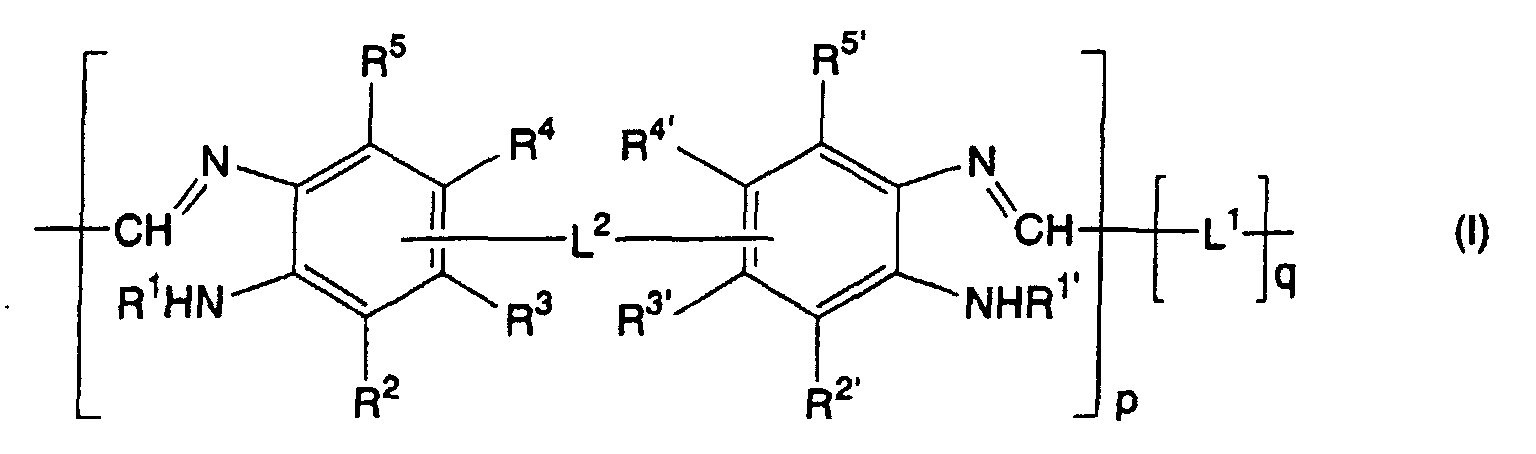
- Preferred polybenzimidazole are represented by formula (I): wherein R 1 to R 5 and R 1' to R 5' each independently are a substituent; L 1 is a divalent linking group; L 2 is a divalent linking group which bonds any one of R 1 to R 5 to any one of R 1' to R 5' ; and p and q each are a number which indicates the degree of polymerization.
- R 1 to R 5 and R 1' to R 5' each independently are preferably hydrogen, an alkyl group having 1 to 10 carbon atoms, an aryl group having 6 to 12 carbon atoms, a halogen, a hydroxyl group, or an alkoxyl group having 1 to 10 carbon atoms.
- L 1 and L 2 each independently are preferably a single bond or a divalent linking group comprised of a chalcogen atom, an aromatic compound, an aliphatic compound, an alicyclic compound, or a heterocyclic compound.
- L 1 or L 2 is a linking group comprised of an aliphatic compound, an alkylene having 1 to 8 carbon atoms is preferred; when L 1 or L 2 is a linking group comprised of an aromatic compound, phenylene or naphthylene is preferred; when L 1 or L 2 is a linking group comprised of a heterocyclic compound, pyridinylene, pyrazinylene, furanylene, quinolinylene, thiophenylene, pyranylene, indenylene, or furylenylene is preferred; and when L 1 or L 2 is a linking group comprised of chalcogen, -O-, -S-, or -SO 2 - is preferred.
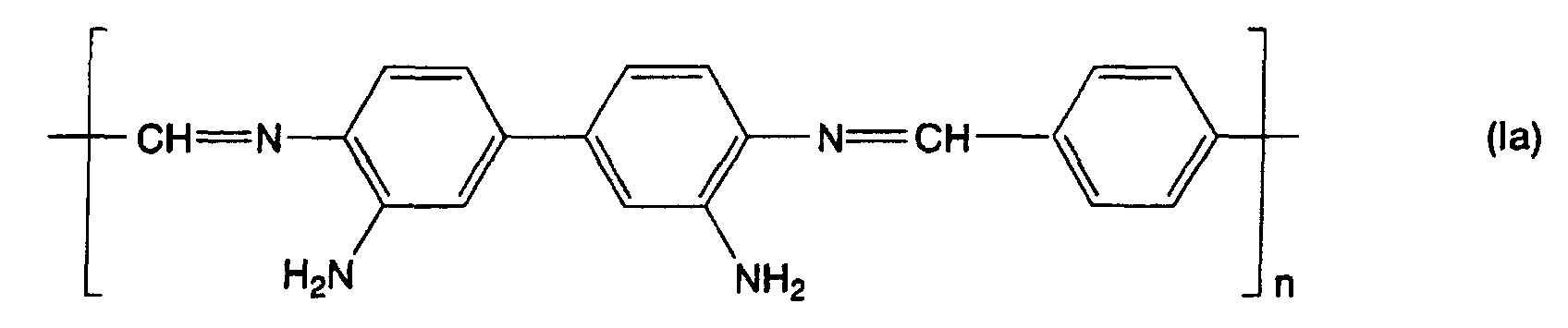
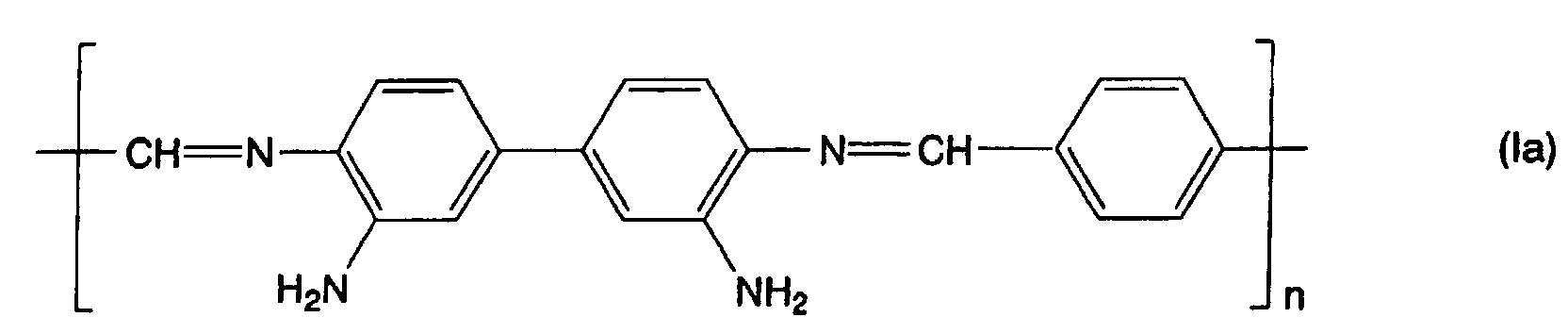
- Preferred prepolymers among the prepolymers represented by formula (I) are represented by formula (Ia) wherein n is a number which represents the degree of polymerization.
- Polybenzimidazoles produced by condensing prepolymers represented by formula (I) are represented by formula (II), and particularly polybenzimidazoles produced by condensing prepolymers represented by formula (Ia) are represented by formula (IIa) wherein R 1 to R 5 , R 1' to R 5' , L 1 , L 2 , p, q, and n are as defined above.
- a polybenzimidazole is finally produced.
- This polybenzimidazole may have a wide range of intrinsic viscosities depending upon the structure, molecular weight and the like. In the present invention, however, the molecular weight of the polybenzimidazole is generally 2,000 to 1,000,000, preferably 2,000 to 300,000, more preferably 5,000 to 100,000. Preferably, the polybenzimidazole used in the present invention has an intrinsic viscosity of not less than 0.2.
- polybenzimidazoles include:
- the solvent is used for dissolving the polybenzimidazole prepolymer and is preferably one which can dissolve the prepolymer and does not decompose the prepolymer or a polymer produced by the cyclization of the prepolymer.
- the solvent is preferably a polar solvent from the viewpoint of solubility.
- Preferred solvents are methyl pyrrolidone, dimethylacetamide, dimethylformamide, diethylacetamide, dimethylmethoxyacetamide, dimethyl sulfone, and mixtures thereof.
- the solution comprising a polybenzimidazole prepolymer used in the method according to the present invention is a solution of the above polybenzimidazole dissolved in the above solvent.
- Two methods may be mentioned for preparing the prepolymer solution: (1) a method wherein the prepolymer is dissolved in the solvent; and (2) a method wherein precursors, i.e., monomers, of a prepolymer, are reacted in a liquid phase and the liquid after the reaction as such is used as the prepolymer solution.
- the amount of the prepolymer used is preferably 1 to 50% by weight , more preferably 20 to 30% by weight, from the viewpoints of finally forming a thicker polybenzimidazole coating and maintaining the coatability of the prepolymer solution.
- the prepolymer may be prepared, for example, by reacting tetraaminodiphenyl corresponding to a monomer unit in the first brackets in formula (I) with a dialdehyde corresponding to a monomer unit in the second brackets in formula (I) in a suitable solvent.
- a prepolymer wherein R 1 to R 5 and R 1' to R 5' each are hydrogen, L 1 is phenyl, and L 2 is a single bond, may be prepared by reacting 3,3',4,4'-tetraaminodiphenyl with dialdehydebenzene.
- a prepolymer solution is obtained after the reaction. If this prepolymer solution as such can be coated onto a substrate, then the process could be simplified. For this reason, a solvent, in which the solubility of the prepolymer is high, is preferably selected as the solvent for the monomers.
- the above described solvents may be mentioned as specific examples of the solvent for the monomers.
- the concentration of the monomer solution is preferably regulated so that the concentration of the finally obtained prepolymer solution is suitable.
- the concentration range of the monomer solution in this case is preferably 10 to 80% by weight.
- a preferred mixing method is to add one of the monomer solutions at a suitable dropping speed to the other monomer solution with stirring.
- the reaction is preferably carried out at -40 to 40°C from the viewpoints of practical temperature and the prevention of the production of impurities by a side reaction.
- the dropping speed at that time is preferably 0.01 to 10% by weight/min based on the initial weight of the solution to be dropped.
- the prepolymer may be produced by any other method.
- the prepolymer is produced by a method which is carried out in the absence of a metal catalyst from the viewpoint of preventing the inclusion of metallic impurities in the prepolymer.
- the solvent used preferably, metal impurities are absent, and the metal impurity concentration is low.
- the prepolymer solution may contain other additives in addition to the polybenzimidazole prepolymer.
- additives include fillers.
- Fillers usable herein include (1) inorganic fillers, specifically glass fibers, metallic fibers, silicon carbide, and the like, and (2) organic fillers, specifically carbon fibers, carbon black, graphite, and resins such as polybenzimidazole resins.
- inorganic fillers specifically glass fibers, metallic fibers, silicon carbide, and the like
- organic fillers specifically carbon fibers, carbon black, graphite, and resins such as polybenzimidazole resins.
- the addition of these fillers can often offer advantageous effects, for example, improved strength of the formed polybenzimidazole coating, increased coating thickness, impartation of electrical characteristics, for example, insulating properties, and improved slidability.
- the above prepolymer solution is coated on a substrate.
- any substrate may be used. Since, however, the prepolymer is cyclized by heating, the substrate should have suitable heat resistance according to the heating temperature.
- Specific examples of materials for the substrate usable herein include metals, for example, stainless steel, iron, aluminum, and copper, and inorganic materials, for example, glass, ceramics, for example, alumina, sapphire, mullite, and cordierite. These substrates may be surface treated prior to coating. For example, in the case of metallic substrates, the surface thereof may be subjected to anodizing treatment or roughening treatment.
- the substrate used may be properly selected from the above substrates.
- the prepolymer solution is coated onto a substrate, and the coated substrate is heated to form a polybenzimidazole coating.
- the prepolymer solution may be coated onto the substrate by any method, and examples thereof include spray coating, dip coating, roll coating, curtain coating.
- a part of the solvent Prior to heating, if necessary, a part of the solvent may be removed from the wet coating.
- the removal of the solvent may be carried out by heating the wet coating to a temperature at which a cyclization reaction and a side reaction do not take place or are less likely to take place, or by applying reduced pressure.
- the removal of excessive solvent in this way prior to the heating can suppress the occurrence of air bubbles or the like at the time of heating and can reduce defects in the finally cured coating.
- the coating is heated to cyclize the prepolymer.
- the heating may be carried out by any method. In general, however, the heating is carried out using a heating oven, a hot plate, infrared irradiation or the like.
- the temperature is gradually raised. Specifically, the temperature rise rate is preferably 1 to 20°C/min, more preferably 1 to 5°C/min.
- the ultimate temperature is generally 300 to 400°C. If necessary, after the temperature reaches the ultimate temperature, heating may be continued at a given temperature.
- coating and heating may be repeated to form a thicker coating.
- a polybenzimidazole film may be formed by forming a cured coating on the surface of a substrate according to the above-described method for coating formation and then separating the cured coating from the substrate.
- the separation of the cured coating may be carried out by any method. In general, however, mechanical separation is used.
- the surface of the substrate may be subjected to easy-separation treatment before the polybenzimidazole prepolymer solution is coated onto the substrate. Examples of the easy-separation treatment usable herein include planishing of the surface of the substrate and coating of a remover onto the surface of the substrate.
- a solution of 2.68 g of dialdehydebenzene in 40 g of dimethylacetamide was added dropwise to a solution of 4.28 g of 3,3',4,4'-tetraaminodiphenyl in 60 g of dimethylacetamide with stirring at 0°C at a dropping rate of 0.1% by weight/min to produce a prepolymer.
- the resultant viscous liquid was coated by dipping onto an anodized stainless steel substrate. The temperature of the coated substrate was raised from room temperature to 380°C over a period of 3 hr for baking. As a result, a 20 ⁇ m-thick polybenzimidazole coating could be formed. Further, a 200 ⁇ m-thick polybenzimidazole coating could be finally formed by repeating the above procedure.
Landscapes
- Chemical & Material Sciences (AREA)
- Chemical Kinetics & Catalysis (AREA)
- Organic Chemistry (AREA)
- Wood Science & Technology (AREA)
- Life Sciences & Earth Sciences (AREA)
- Engineering & Computer Science (AREA)
- Materials Engineering (AREA)
- Medicinal Chemistry (AREA)
- Polymers & Plastics (AREA)
- Health & Medical Sciences (AREA)
- Macromolecular Compounds Obtained By Forming Nitrogen-Containing Linkages In General (AREA)
- Application Of Or Painting With Fluid Materials (AREA)
- Coating Of Shaped Articles Made Of Macromolecular Substances (AREA)
- Moulding By Coating Moulds (AREA)
- Paints Or Removers (AREA)
Abstract
There are provided a method for forming a polybenzimidazole coating on a surface of a substrate, and a method for forming a polybenzimidazole film. The method for forming a polybenzimidazole coating comprises the steps of: coating a solution containing a polybenzimidazole prepolymer onto a surface of a substrate; and heating the coated substrate to cyclize the prepolymer and thus to form a cured coating on the surface of the substrate. The method for forming a polybenzimidazole film comprises separating the cured coating, formed by the above method, from the substrate.
Description
The present invention relates to a method for forming
a polybenzimidazole coating. More particularly, the present
invention relates to a method for forming a polybenzimidazole
coating, wherein a polybenzimidazole prepolymer solution is
coated onto a substrate and the prepolymer is cyclized in
the coated solution to form a polybenzimidazole coating which
covers the substrate.
Polybenzimidazoles possess excellent energy
resistance and chemical resistance. However, because of the
excellent chemical resistance among these properties, for
example, excellent solvent resistance, the solubility of
polybenzimidazoles in solvents is so low that only solutions
having a relatively low polybenzimidazole concentration can
be prepared. Further, due to this property, enhancing the
viscosity of the solution by increasing the polybenzimidazole
concentration is difficult. Therefore, for example, when
the polybenzimidazole solution is coated onto a substrate
to form a coating, a thick coating cannot be formed without
difficulties.
On the other hand, by virtue of their properties,
polybenzimidazoles are expected to be utilized in
semiconductor production devices and the like. Specifically,
the covering of the production device on its surface formed
of a metal or the like with a polybenzimidazole coating can
protect the production device and, at the same time, can
prevent the semiconductor device, to be produced, from being
brought into contact with a metal, whereby the contamination
of the semiconductor device with impurities can be prevented.
As described above, however, difficulties are encountered
in forming a satisfactorily thick coating by coating of the
polybenzimidazole solution. In order to solve the above
problem, the incorporation of a metal solubilizer has also
been studied. However, this method also cannot
significantly improve the solubility of polybenzimidazoles
and, in addition, is disadvantageously causative of the
inclusion of metallic impurities.
The method for forming a cured coating on a surface of
a substrate according to the present invention is
characterized by comprising the steps of: coating a solution
containing a polybenzimidazole prepolymer onto a surface of
a substrate; and heating the coating to cyclize the
prepolymer.
In the method for coating formation according to the
present invention, the use of a concentrated prepolymer
solution can realize the formation of a polybenzimidazole
coating having a large thickness, which has hitherto been
unattainable, on a substrate and can impart heat resistance,
chemical resistance and other properties to the surface of
the substrate.
In the method according to the present invention, a
polybenzimidazole prepolymer is one which can be cyclized
optionally upon heating or the like to form a
polybenzimidazole resin. The molecular weight and the like
of the prepolymer are not particularly limited, but are
selected so that the prepolymer is highly soluble in a solvent
used and can be satisfactorily cured upon cyclization.
Here polybenzimidazole refers to a polymer comprising
substituted or unsubstituted benzimidazole as monomer units.
When the benzimidazole has a substituent, the substituent
may be any one so far as the substituent does not sacrifice
the effect of the present invention.
Preferred polybenzimidazole are represented by
formula (I):
 wherein
R1 to R5 and R1' to R5' each independently are a substituent;
L1 is a divalent linking group;
L2 is a divalent linking group which bonds any one of R1 to R5 to any one of R1' to R5'; and
p and q each are a number which indicates the degree of polymerization.
R1 to R5 and R1' to R5' each independently are a substituent;
L1 is a divalent linking group;
L2 is a divalent linking group which bonds any one of R1 to R5 to any one of R1' to R5'; and
p and q each are a number which indicates the degree of polymerization.
Here R1 to R5 and R1' to R5' each independently are
preferably hydrogen, an alkyl group having 1 to 10 carbon
atoms, an aryl group having 6 to 12 carbon atoms, a halogen,
a hydroxyl group, or an alkoxyl group having 1 to 10 carbon
atoms.
L1 and L2 each independently are preferably a single
bond or a divalent linking group comprised of a chalcogen
atom, an aromatic compound, an aliphatic compound, an
alicyclic compound, or a heterocyclic compound.
When L1 or L2 is a linking group comprised of an aliphatic
compound, an alkylene having 1 to 8 carbon atoms is preferred;
when L1 or L2 is a linking group comprised of an aromatic
compound, phenylene or naphthylene is preferred; when L1 or
L2 is a linking group comprised of a heterocyclic compound,
pyridinylene, pyrazinylene, furanylene, quinolinylene,
thiophenylene, pyranylene, indenylene, or furylenylene is
preferred; and when L1 or L2 is a linking group comprised of
chalcogen, -O-, -S-, or -SO2- is preferred.
Preferred prepolymers among the prepolymers
represented by formula (I) are represented by formula (Ia)
 wherein n is a number which represents the degree of
polymerization.
wherein n is a number which represents the degree of
polymerization.
Polybenzimidazoles produced by condensing prepolymers
represented by formula (I) are represented by formula (II),
and particularly polybenzimidazoles produced by condensing
prepolymers represented by formula (Ia) are represented by
formula (IIa)

 wherein R1 to R5, R1' to R5', L1, L2, p, q, and n are as defined
above.
wherein R1 to R5, R1' to R5', L1, L2, p, q, and n are as defined
above.
In the method according to the present invention, a
polybenzimidazole is finally produced. This
polybenzimidazole may have a wide range of intrinsic
viscosities depending upon the structure, molecular weight
and the like. In the present invention, however, the
molecular weight of the polybenzimidazole is generally 2,000
to 1,000,000, preferably 2,000 to 300,000, more preferably
5,000 to 100,000. Preferably, the polybenzimidazole used in
the present invention has an intrinsic viscosity of not less
than 0.2.
Specific examples of such polybenzimidazoles include:
In the method according to the present invention, the
solvent is used for dissolving the polybenzimidazole
prepolymer and is preferably one which can dissolve the
prepolymer and does not decompose the prepolymer or a polymer
produced by the cyclization of the prepolymer. The solvent
is preferably a polar solvent from the viewpoint of
solubility.
Preferred solvents, particularly polar solvents, are
methyl pyrrolidone, dimethylacetamide, dimethylformamide,
diethylacetamide, dimethylmethoxyacetamide, dimethyl
sulfone, and mixtures thereof.
The solution comprising a polybenzimidazole
prepolymer used in the method according to the present
invention is a solution of the above polybenzimidazole
dissolved in the above solvent. Two methods may be mentioned
for preparing the prepolymer solution: (1) a method wherein
the prepolymer is dissolved in the solvent; and (2) a method
wherein precursors, i.e., monomers, of a prepolymer, are
reacted in a liquid phase and the liquid after the reaction
as such is used as the prepolymer solution.
When the prepolymer is dissolved in the solvent, the
amount of the prepolymer used is preferably 1 to 50% by weight ,
more preferably 20 to 30% by weight, from the viewpoints of
finally forming a thicker polybenzimidazole coating and
maintaining the coatability of the prepolymer solution.
In the case of the method wherein monomers are reacted
in a liquid phase to produce a prepolymer solution, the
prepolymer may be prepared, for example, by reacting
tetraaminodiphenyl corresponding to a monomer unit in the
first brackets in formula (I) with a dialdehyde corresponding
to a monomer unit in the second brackets in formula (I) in
a suitable solvent. For example, a prepolymer, wherein R1
to R5 and R1' to R5' each are hydrogen, L1 is phenyl, and L2
is a single bond, may be prepared by reacting 3,3',4,4'-tetraaminodiphenyl
with dialdehydebenzene.
When monomer solutions corresponding to respective
monomer units are reacted to produce a prepolymer, a
prepolymer solution is obtained after the reaction. If this
prepolymer solution as such can be coated onto a substrate,
then the process could be simplified. For this reason, a
solvent, in which the solubility of the prepolymer is high,
is preferably selected as the solvent for the monomers. The
above described solvents may be mentioned as specific
examples of the solvent for the monomers. Thus, the method
wherein the monomers are reacted in a liquid phase, can easily
provide a prepolymer solution having an increased
concentration and thus is preferred.
When a prepolymer is produced from monomer solutions,
the concentration of the monomer solution is preferably
regulated so that the concentration of the finally obtained
prepolymer solution is suitable. The concentration range of
the monomer solution in this case is preferably 10 to 80%
by weight. When these monomer solutions are mixed together,
a preferred mixing method is to add one of the monomer
solutions at a suitable dropping speed to the other monomer
solution with stirring. At that time, the reaction is
preferably carried out at -40 to 40°C from the viewpoints of
practical temperature and the prevention of the production
of impurities by a side reaction. The dropping speed at that
time is preferably 0.01 to 10% by weight/min based on the
initial weight of the solution to be dropped.
The prepolymer may be produced by any other method. In
any case, preferably, the prepolymer is produced by a method
which is carried out in the absence of a metal catalyst from
the viewpoint of preventing the inclusion of metallic
impurities in the prepolymer. Further, regarding the
solvent used, preferably, metal impurities are absent, and
the metal impurity concentration is low.
The prepolymer solution may contain other additives in
addition to the polybenzimidazole prepolymer. Such
additives include fillers.
Fillers usable herein include (1) inorganic fillers,
specifically glass fibers, metallic fibers, silicon carbide,
and the like, and (2) organic fillers, specifically carbon
fibers, carbon black, graphite, and resins such as
polybenzimidazole resins. The addition of these fillers can
often offer advantageous effects, for example, improved
strength of the formed polybenzimidazole coating, increased
coating thickness, impartation of electrical
characteristics, for example, insulating properties, and
improved slidability.
In the method according to the present invention, the
above prepolymer solution is coated on a substrate. In this
case, any substrate may be used. Since, however, the
prepolymer is cyclized by heating, the substrate should have
suitable heat resistance according to the heating temperature.
Specific examples of materials for the substrate usable
herein include metals, for example, stainless steel, iron,
aluminum, and copper, and inorganic materials, for example,
glass, ceramics, for example, alumina, sapphire, mullite,
and cordierite. These substrates may be surface treated
prior to coating. For example, in the case of metallic
substrates, the surface thereof may be subjected to anodizing
treatment or roughening treatment.
Also in the formation of a polybenzimidazole film, the
substrate used may be properly selected from the above
substrates.
In the method according to the present invention, the
prepolymer solution is coated onto a substrate, and the coated
substrate is heated to form a polybenzimidazole coating.
The prepolymer solution may be coated onto the
substrate by any method, and examples thereof include spray
coating, dip coating, roll coating, curtain coating.
Prior to heating, if necessary, a part of the solvent
may be removed from the wet coating. The removal of the
solvent may be carried out by heating the wet coating to a
temperature at which a cyclization reaction and a side
reaction do not take place or are less likely to take place,
or by applying reduced pressure. The removal of excessive
solvent in this way prior to the heating can suppress the
occurrence of air bubbles or the like at the time of heating
and can reduce defects in the finally cured coating.
Thereafter, the coating is heated to cyclize the
prepolymer. The heating may be carried out by any method.
In general, however, the heating is carried out using a
heating oven, a hot plate, infrared irradiation or the like.
Preferably, the temperature is gradually raised.
Specifically, the temperature rise rate is preferably 1 to
20°C/min, more preferably 1 to 5°C/min. The ultimate
temperature is generally 300 to 400°C. If necessary, after
the temperature reaches the ultimate temperature, heating
may be continued at a given temperature.
If necessary, coating and heating may be repeated to
form a thicker coating.
A polybenzimidazole film may be formed by forming a
cured coating on the surface of a substrate according to the
above-described method for coating formation and then
separating the cured coating from the substrate. The
separation of the cured coating may be carried out by any
method. In general, however, mechanical separation is used.
In this connection, it should be noted that, in order to
facilitate the separation of the cured coating from the
substrate, the surface of the substrate may be subjected to
easy-separation treatment before the polybenzimidazole
prepolymer solution is coated onto the substrate. Examples
of the easy-separation treatment usable herein include
planishing of the surface of the substrate and coating of
a remover onto the surface of the substrate.
A solution of 2.68 g of dialdehydebenzene in 40 g of
dimethylacetamide was added dropwise to a solution of 4.28
g of 3,3',4,4'-tetraaminodiphenyl in 60 g of
dimethylacetamide with stirring at 0°C at a dropping rate of
0.1% by weight/min to produce a prepolymer. The resultant
viscous liquid was coated by dipping onto an anodized
stainless steel substrate. The temperature of the coated
substrate was raised from room temperature to 380°C over a
period of 3 hr for baking. As a result, a 20 µm-thick
polybenzimidazole coating could be formed. Further, a 200
µm-thick polybenzimidazole coating could be finally formed
by repeating the above procedure.
Claims (10)
- A method for forming a polybenzimidazole coating, comprising the steps of: coating a solution containing a a polybenzimidazole prepolymer onto a surface of a substrate; and heating the coated substrate to cyclize the prepolymer and thus to form a cured coating on the surface of the substrate.
- The method according to claim 1, wherein the polybenzimidazole prepolymer is represented by formula (Ia)wherein n is a number which represents the degree of polymerization.
- The method according to claim 1 or 2, wherein the solution has a concentration of 1 to 50% by weight.
- The method according to any one of claims 1 to 3, wherein the solution comprises a polar solvent as a solvent.
- The method according to claim 4, wherein the solvent is selected from the group consisting of methyl pyrrolidone, dimethylacetamide, dimethylformamide, diethylacetamide, dimethylmethoxyacetamide, dimethyl sulfone, and mixtures thereof.
- The method according to any one of claims 1 to 5, wherein the polybenzimidazole prepolymer is synthesized in the absence of a metal catalyst.
- The method according to any one of claims 1 to 6, wherein the solution comprises a filler.
- The method according to any one of claims 1 to 7, wherein the heating is carried out so that the temperature is raised to 300 to 400°C at a temperature rise rate of 1 to 20°C/min.
- An article with a coating formed thereon by the method according to any one of claims 1 to 8.
- A method for film formation, comprising the steps of: coating a solution containing a polybenzimidazole prepolymer onto a surface of a substrate; heating the coated substrate to cyclize the prepolymer and thus to form a cured coating on the surface of the substrate; and separating the cured coating from the substrate.
Applications Claiming Priority (3)
| Application Number | Priority Date | Filing Date | Title |
|---|---|---|---|
| JP2001303323A JP2003105259A (en) | 2001-09-28 | 2001-09-28 | Polybenzimidazole coating and film forming method |
| JP2001303323 | 2001-09-28 | ||
| PCT/JP2002/010195 WO2003029374A1 (en) | 2001-09-28 | 2002-09-30 | Methods of forming polybenzimidazole coating film and of forming film |
Publications (2)
| Publication Number | Publication Date |
|---|---|
| EP1441015A1 true EP1441015A1 (en) | 2004-07-28 |
| EP1441015A4 EP1441015A4 (en) | 2004-12-08 |
Family
ID=19123423
Family Applications (1)
| Application Number | Title | Priority Date | Filing Date |
|---|---|---|---|
| EP02800289A Withdrawn EP1441015A4 (en) | 2001-09-28 | 2002-09-30 | Methods of forming polybenzimidazole coating film and of forming film |
Country Status (5)
| Country | Link |
|---|---|
| US (1) | US6896931B2 (en) |
| EP (1) | EP1441015A4 (en) |
| JP (1) | JP2003105259A (en) |
| KR (1) | KR20040044388A (en) |
| WO (1) | WO2003029374A1 (en) |
Cited By (1)
| Publication number | Priority date | Publication date | Assignee | Title |
|---|---|---|---|---|
| WO2019057498A1 (en) * | 2017-09-20 | 2019-03-28 | Technische Universitaet Wien | PROCESS FOR PREPARING POLYBENZIMIDAZOLENE |
Families Citing this family (5)
| Publication number | Priority date | Publication date | Assignee | Title |
|---|---|---|---|---|
| DE10258580A1 (en) * | 2002-12-16 | 2004-06-24 | Celanese Ventures Gmbh | High molecular weight polyazoles, e.g. useful for making shaped products, fibers, films, coatings and electrode membranes, produced by polymerizing a selected particle size fraction |
| DE102005058579A1 (en) * | 2005-12-08 | 2007-06-14 | Sartorius Ag | High molecular weight polyazoles with improved solubility and process for their preparation |
| JP2007262160A (en) * | 2006-03-27 | 2007-10-11 | Osaka Prefecture | Fine particles of polyimidazole or precursor thereof and method for producing the same |
| US8475925B2 (en) * | 2010-06-22 | 2013-07-02 | Pbi Performance Products, Inc. | PBI/epoxy coatings |
| US9598541B2 (en) * | 2013-06-04 | 2017-03-21 | Pbi Performance Products, Inc. | Method of making polybenzimidazole |
Family Cites Families (12)
| Publication number | Priority date | Publication date | Assignee | Title |
|---|---|---|---|---|
| US3174947A (en) * | 1962-02-14 | 1965-03-23 | Univ Illinois | Polybenzimidazoles and their preparation |
| DE1645124A1 (en) * | 1965-04-22 | 1970-09-24 | Du Pont | Aldehyde-amine condensation resins and processes for their preparation |
| US3763107A (en) * | 1970-11-10 | 1973-10-02 | D Alelio G Francis | Polybenzimidazoles and method of preparation |
| US4414383A (en) * | 1982-05-24 | 1983-11-08 | Celanese Corporation | High molecular weight polybenzimidazole preparation with phosphorus containing polymerization catalyst |
| DE3411706A1 (en) * | 1984-03-29 | 1985-10-10 | Siemens AG, 1000 Berlin und 8000 München | METHOD FOR PRODUCING POLYIMIDAZOLE AND POLYIMIDAZOPYRROLONE PRE-STAGES |
| DE3411714A1 (en) * | 1984-03-29 | 1985-10-10 | Siemens AG, 1000 Berlin und 8000 München | METHOD FOR PRODUCING POLYIMIDAZOLE AND POLYIMIDAZOPYRROLON RELIEF STRUCTURES |
| JPH0497138A (en) * | 1990-08-09 | 1992-03-30 | Naoya Ogata | Nonlinear optical material made of high-polymer thin film and production thereof |
| JPH0982459A (en) * | 1995-09-14 | 1997-03-28 | Nippon Petrochem Co Ltd | Layered structure for heating |
| JPH09237525A (en) * | 1996-02-29 | 1997-09-09 | Sumitomo Wiring Syst Ltd | Flat rectangular electric wire, its using method, and its manufacture |
| JP3607004B2 (en) * | 1996-07-05 | 2005-01-05 | クラリアント インターナショナル リミテッド | Solution of polybenzimidazole compound and process for producing the same |
| JP3405645B2 (en) * | 1996-09-17 | 2003-05-12 | 株式会社東芝 | Polyazole precursor composition, method for producing electronic component, and electronic component |
| JP3478094B2 (en) * | 1997-11-28 | 2003-12-10 | 東レ株式会社 | Method for dehydration ring closure of heat-resistant polymer precursor |
-
2001
- 2001-09-28 JP JP2001303323A patent/JP2003105259A/en active Pending
-
2002
- 2002-09-30 KR KR10-2003-7007063A patent/KR20040044388A/en not_active Abandoned
- 2002-09-30 US US10/432,556 patent/US6896931B2/en not_active Expired - Fee Related
- 2002-09-30 WO PCT/JP2002/010195 patent/WO2003029374A1/en not_active Ceased
- 2002-09-30 EP EP02800289A patent/EP1441015A4/en not_active Withdrawn
Cited By (2)
| Publication number | Priority date | Publication date | Assignee | Title |
|---|---|---|---|---|
| WO2019057498A1 (en) * | 2017-09-20 | 2019-03-28 | Technische Universitaet Wien | PROCESS FOR PREPARING POLYBENZIMIDAZOLENE |
| US11718715B2 (en) | 2017-09-20 | 2023-08-08 | Technische Universität Wien | Process for preparing polybenzimidazoles |
Also Published As
| Publication number | Publication date |
|---|---|
| US6896931B2 (en) | 2005-05-24 |
| JP2003105259A (en) | 2003-04-09 |
| KR20040044388A (en) | 2004-05-28 |
| WO2003029374A1 (en) | 2003-04-10 |
| EP1441015A4 (en) | 2004-12-08 |
| US20040028824A1 (en) | 2004-02-12 |
Similar Documents
| Publication | Publication Date | Title |
|---|---|---|
| CN1210362C (en) | Tackifier and self-priming resin composition and articles prepared therefrom | |
| US5741585A (en) | Polyamic acid precursors and methods for preparing higher molecular weight polyamic acids and polyimidebenzoxazole | |
| JP3971759B2 (en) | Method for processing polyamic acid and polyamic acid into polyimide benzoxazole film | |
| KR101497705B1 (en) | A thermosetting polyimide silicone resin composition and a cured film thereof | |
| JP2001114893A (en) | Polybenzoxazole resin and its precursor | |
| US3803075A (en) | Soluble polyimides from 2,6-diamino-s-triazines and dianhydrides | |
| US6896931B2 (en) | Methods of forming polybenzimidazole coating film and of forming film | |
| JPH036226A (en) | Manufacturing method of polyimide resin | |
| JPH0377228B2 (en) | ||
| CN105504270A (en) | Preparation method of crosslinking poly(p-phenylenebenzobisoxazole) film | |
| JP2624724B2 (en) | Polyimide siloxane composition | |
| EP0040415B1 (en) | Heat-resistant resin compositions and their use for coating metal substrates | |
| EP0456515B1 (en) | Polyimides and thermosetting resin compositions containing the same | |
| US7064176B2 (en) | Coating material for electronic components | |
| EP0304022A2 (en) | Polyimide coating composition | |
| JPH1036469A (en) | Thermosetting resin | |
| EP0260833A2 (en) | Process for producing polyamide acid having siloxane bonds and polyimide having siloxane bonds and isoindoloquinazolinedione rings | |
| JPH0142969B2 (en) | ||
| CN111511840A (en) | Polyimide precursor solution and polyimide film using same | |
| Bruma et al. | Fluorinated poly (benzoxazole–imide) s | |
| JPH11140297A (en) | Resin composition, cured product and adhesive film | |
| JPH0791378B2 (en) | Method for producing polyimide containing crosslinked silicon | |
| JPH03168259A (en) | Metal substrate coated with polyetheramideimide resin and production thereof | |
| JPS6260415B2 (en) | ||
| JP3998987B2 (en) | Coating varnish for insulating film and insulating film |
Legal Events
| Date | Code | Title | Description |
|---|---|---|---|
| PUAI | Public reference made under article 153(3) epc to a published international application that has entered the european phase |
Free format text: ORIGINAL CODE: 0009012 |
|
| 17P | Request for examination filed |
Effective date: 20040428 |
|
| AK | Designated contracting states |
Kind code of ref document: A1 Designated state(s): AT BE BG CH CY CZ DE DK EE ES FI FR GB GR IE IT LI LU MC NL PT SE SK TR |
|
| A4 | Supplementary search report drawn up and despatched |
Effective date: 20041021 |
|
| RAP1 | Party data changed (applicant data changed or rights of an application transferred) |
Owner name: AZ ELECTRONIC MATERIALS USA CORP. |
|
| STAA | Information on the status of an ep patent application or granted ep patent |
Free format text: STATUS: THE APPLICATION IS DEEMED TO BE WITHDRAWN |
|
| 18D | Application deemed to be withdrawn |
Effective date: 20090401 |