EP1440836A1 - Adaptive cruise control apparatus - Google Patents
Adaptive cruise control apparatus Download PDFInfo
- Publication number
- EP1440836A1 EP1440836A1 EP03257593A EP03257593A EP1440836A1 EP 1440836 A1 EP1440836 A1 EP 1440836A1 EP 03257593 A EP03257593 A EP 03257593A EP 03257593 A EP03257593 A EP 03257593A EP 1440836 A1 EP1440836 A1 EP 1440836A1
- Authority
- EP
- European Patent Office
- Prior art keywords
- vehicle
- vehicle speed
- look
- target
- values
- Prior art date
- Legal status (The legal status is an assumption and is not a legal conclusion. Google has not performed a legal analysis and makes no representation as to the accuracy of the status listed.)
- Granted
Links
- 230000003044 adaptive effect Effects 0.000 title claims abstract description 16
- 238000000034 method Methods 0.000 claims description 6
- 238000010276 construction Methods 0.000 description 2
- 230000003247 decreasing effect Effects 0.000 description 1
- 238000010586 diagram Methods 0.000 description 1
- 230000000694 effects Effects 0.000 description 1
- 238000010348 incorporation Methods 0.000 description 1
Images


Classifications
-
- B—PERFORMING OPERATIONS; TRANSPORTING
- B60—VEHICLES IN GENERAL
- B60T—VEHICLE BRAKE CONTROL SYSTEMS OR PARTS THEREOF; BRAKE CONTROL SYSTEMS OR PARTS THEREOF, IN GENERAL; ARRANGEMENT OF BRAKING ELEMENTS ON VEHICLES IN GENERAL; PORTABLE DEVICES FOR PREVENTING UNWANTED MOVEMENT OF VEHICLES; VEHICLE MODIFICATIONS TO FACILITATE COOLING OF BRAKES
- B60T7/00—Brake-action initiating means
- B60T7/12—Brake-action initiating means for automatic initiation; for initiation not subject to will of driver or passenger
- B60T7/22—Brake-action initiating means for automatic initiation; for initiation not subject to will of driver or passenger initiated by contact of vehicle, e.g. bumper, with an external object, e.g. another vehicle, or by means of contactless obstacle detectors mounted on the vehicle
-
- B—PERFORMING OPERATIONS; TRANSPORTING
- B60—VEHICLES IN GENERAL
- B60K—ARRANGEMENT OR MOUNTING OF PROPULSION UNITS OR OF TRANSMISSIONS IN VEHICLES; ARRANGEMENT OR MOUNTING OF PLURAL DIVERSE PRIME-MOVERS IN VEHICLES; AUXILIARY DRIVES FOR VEHICLES; INSTRUMENTATION OR DASHBOARDS FOR VEHICLES; ARRANGEMENTS IN CONNECTION WITH COOLING, AIR INTAKE, GAS EXHAUST OR FUEL SUPPLY OF PROPULSION UNITS IN VEHICLES
- B60K31/00—Vehicle fittings, acting on a single sub-unit only, for automatically controlling vehicle speed, i.e. preventing speed from exceeding an arbitrarily established velocity or maintaining speed at a particular velocity, as selected by the vehicle operator
- B60K31/0008—Vehicle fittings, acting on a single sub-unit only, for automatically controlling vehicle speed, i.e. preventing speed from exceeding an arbitrarily established velocity or maintaining speed at a particular velocity, as selected by the vehicle operator including means for detecting potential obstacles in vehicle path
-
- B—PERFORMING OPERATIONS; TRANSPORTING
- B60—VEHICLES IN GENERAL
- B60T—VEHICLE BRAKE CONTROL SYSTEMS OR PARTS THEREOF; BRAKE CONTROL SYSTEMS OR PARTS THEREOF, IN GENERAL; ARRANGEMENT OF BRAKING ELEMENTS ON VEHICLES IN GENERAL; PORTABLE DEVICES FOR PREVENTING UNWANTED MOVEMENT OF VEHICLES; VEHICLE MODIFICATIONS TO FACILITATE COOLING OF BRAKES
- B60T2201/00—Particular use of vehicle brake systems; Special systems using also the brakes; Special software modules within the brake system controller
- B60T2201/02—Active or adaptive cruise control system; Distance control
-
- B—PERFORMING OPERATIONS; TRANSPORTING
- B60—VEHICLES IN GENERAL
- B60W—CONJOINT CONTROL OF VEHICLE SUB-UNITS OF DIFFERENT TYPE OR DIFFERENT FUNCTION; CONTROL SYSTEMS SPECIALLY ADAPTED FOR HYBRID VEHICLES; ROAD VEHICLE DRIVE CONTROL SYSTEMS FOR PURPOSES NOT RELATED TO THE CONTROL OF A PARTICULAR SUB-UNIT
- B60W2554/00—Input parameters relating to objects
- B60W2554/40—Dynamic objects, e.g. animals, windblown objects
- B60W2554/404—Characteristics
- B60W2554/4042—Longitudinal speed
-
- B—PERFORMING OPERATIONS; TRANSPORTING
- B60—VEHICLES IN GENERAL
- B60W—CONJOINT CONTROL OF VEHICLE SUB-UNITS OF DIFFERENT TYPE OR DIFFERENT FUNCTION; CONTROL SYSTEMS SPECIALLY ADAPTED FOR HYBRID VEHICLES; ROAD VEHICLE DRIVE CONTROL SYSTEMS FOR PURPOSES NOT RELATED TO THE CONTROL OF A PARTICULAR SUB-UNIT
- B60W2554/00—Input parameters relating to objects
- B60W2554/80—Spatial relation or speed relative to objects
- B60W2554/804—Relative longitudinal speed
Definitions
- the present invention relates to adaptive cruise control for motor vehicles.
- Conventional cruise control systems fulfil the function of speed control of the vehicle.
- a desired speed is set by the driver and a control system operates on the engine (usually the throttle only) to maintain the desired speed.
- this simple speed control is acceptable to the driver, however if the traffic is heavy the driver is faced with constantly adjusting the set speed in order to maintain a safe distance from preceding traffic and may have to disengage the cruise control in order to brake.
- Many systems have now been developed by the addition of a distance sensor to the conventional cruise control system which adds distance keeping to the basic speed control function.
- Many such systems also include means to monitor the relative velocities of the vehicle which is equipped with the cruise control system and a preceding vehicle.
- the engine control also often includes a limited authority braking system, so that the speed control / distance keeping can be effected by a combination of the throttle and the brake.
- Such a system may operate as an adaptive cruise control system which, when activated, enables the vehicle in question to reduce speed automatically when a preceding target vehicle is detected in its path. The vehicle will then follow, no closer than a minimum set time gap (equivalent to a minimum distance), the closest preceding target vehicle that is "in path.” This will continue until the closest preceding target vehicle is detected to move out of the path of the vehicle at which point the original set speed is resumed.
- a minimum set time gap equivalent to a minimum distance
- an adaptive cruise control system is one that maintains cruise speed in the same way as a conventional cruise control system when the road ahead is clear but when following a vehicle, maintains the gap to the vehicle ahead by operating the throttle and brake systems.
- the gap is usually expressed in terms of time headway, for example one second.
- the time headway concept is only valid in steady state conditions, so, when trying to automatically stop behind a target vehicle which comes to a halt in a traffic queue, a different strategy is required.
- adaptive cruise control apparatus for controlling the distance of a vehicle from a target, the vehicle being equipped with a target range measuring device, a vehicle speed measuring device, a braking system and a throttle controller, characterised in that the adaptive cruise control apparatus includes a look-up table containing pre-computed brake demand values for given target ranges and vehicle speeds, and a controller for receiving target range and vehicle speed values from the target range measuring device and vehicle speed measuring device respectively, and being adapted to select, from the look-up table, a brake demand value relating to the received target range and vehicle speed values, for application to the braking system.
- a method for controlling the distance of a vehicle from a target the vehicle being equipped with a target range measuring device, a vehicle speed measuring device, a braking system and a throttle controller, characterised in that the method includes the steps of; receiving a target range value from the target range measuring device, receiving a vehicle speed value from the vehicle speed measuring device, selecting from a look-up table containing pre computed brake demand values for given target ranges and vehicle speeds, a brake demand value relating to the received target range and vehicle speed values, and applying the selected brake demand value to the braking system.
- the invention permits an adaptive cruise control vehicle to be brought to a standstill behind a preceding target vehicle.
- the inventors have discovered that automatically stopping a vehicle in accordance with Newton's equations of motion i.e. substantially linearly, by applying a constant deceleration rate, feels unnatural to the driver.
- Most drivers when manually bringing a vehicle to halt behind a preceding one, tend to decelerate initially at a comparatively high rate until they are within around twelve metres from the vehicle in front and then decelerate more gradually until the vehicle comes to rest a metre or two behind the preceding vehicle.
- the use of a look-up table enables emulation of this driver behaviour.
- the invention is able to deliver a consistent and smooth way of stopping behind a preceding vehicle.
- the invention has the further advantage of eliminating hunting which can occur when operating the conventional adaptive cruise control system under such conditions.
- the look-up table may be compiled empirically.
- the present invention further provides a vehicle equipped with adaptive cruise control apparatus in accordance with said first aspect.
- the controller acts to decelerate the vehicle in a linear fashion until the target range is approximately 12 metres, vehicle speed is less than around four metres per second and the vehicle is closing in on the target. Subsequently, the controller decelerates the vehicle in a non-linear fashion.
- the look-up table may be configured to include vehicle speed demand values relating to measured target range.
- the controller is further adapted to select from the look up table a vehicle speed demand appropriate to the measured target range, for applying to the throttle controller.
- a further optional refinement to this creep mode of operation comprises a state machine implemented in the controller that forces vehicle speed demand to zero when the brake demand value selected by the controller is non-zero.
- this refinement ensures that the vehicle is not being asked to accelerate whilst at the same time, still braking.
- priority is given to braking.
- One situation in which this refinement is useful is when the target pulls away whilst the equipped vehicle is still braking to a standstill behind.
- the state machine waits for the brakes to be fully off before applying the speed demand to the throttle controller.
- an adaptive cruise control apparatus (1) is fitted to a vehicle (not shown).
- the vehicle is also equipped with a radar sensor (2) for measuring the distance between the vehicle so-equipped and a preceding target vehicle (not shown) and also relative vehicle speed, a speed sensor (3) for measuring the speed of the equipped vehicle, a braking system (4), an engine management system (5) and a throttle actuator (6). All the equipment represented in figure 1, with the exception of the apparatus (1), operates in a conventional manner.
- the adaptive cruise control apparatus (1) comprises a controller (7) and a look up table (8).
- the controller (7) has connections to all the other modules of figure 1 enabling it to receive and monitor target range values and equipped vehicle speed values, access the look up table (8) and send brake demand and throttle demand signals to the brake system (4) and engine management system (5) respectively.
- a portion of the look-up table (8) has a two-dimensional construction which gives brake demand values as a function of preceding target vehicle range and equipped vehicle speed.
- the map associated with this first part is shown in figure 2.
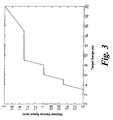
- Another portion of the look-up table (8) has a one-dimensional construction which provides a desired equipped vehicle speed value as a function of target range.
- the map associated with this second part is shown in figure 3.
- the equipped vehicle In operation, initially the equipped vehicle is functioning in adaptive cruise control mode and following a preceding target vehicle at a fixed distance, say 25 metres, in accordance with a set time headway.
- the target vehicle needs to slow down and stop behind a queue of vehicles.
- the controller (7) uses a conventional proportional derivative algorithm to generate the appropriate brake demand signal which is fed to the braking system (4).
- the brake demand signal generated at this point in time decelerates the equipped vehicle in a linear fashion down to range of twelve metres and a speed of four metres per second.
- the apparatus (1) enters a mode of operation whereby brake demand is dictated by the look-up table map of figure 2, that is the controller (7) monitors target distance (via the radar sensor (2)) and the speed of the equipped vehicle via the speed sensor (3) interrogates the look up table (figure 2) to extract the brake demand value relating to the distance and speed values and the generates the appropriate demand signal and applies this signal to the braking system (4). It performs this routine every 100 millisecond in this example until the equipped vehicle comes to standstill.
- the controller (7) then acts to permit the equipped vehicle to move along slowly (in "creep mode") following behind the target vehicle as the target vehicle moves forwards in a traffic queue.
- the controller (7) continues to monitor target range but now interrogates the one dimensional part of the look up table (8) for a desired vehicle speed value for the measured target range (figure 3).
- the controller (7) then generates a speed demand signal which it sends to the engine management system (5) which, in turn, send an appropriate throttle demand control signal to the throttle actuator (6).
- a state machine (9) incorporated in the controller (7) forces the speed demand signal to zero whenever the braking map output (figure 2) of the lookup table is non-zero.
Landscapes
- Engineering & Computer Science (AREA)
- Transportation (AREA)
- Mechanical Engineering (AREA)
- Chemical & Material Sciences (AREA)
- Combustion & Propulsion (AREA)
- Controls For Constant Speed Travelling (AREA)
- Control Of Vehicle Engines Or Engines For Specific Uses (AREA)
Abstract
Description
- The present invention relates to adaptive cruise control for motor vehicles.
- Conventional cruise control systems fulfil the function of speed control of the vehicle. A desired speed is set by the driver and a control system operates on the engine (usually the throttle only) to maintain the desired speed. When the traffic is light, this simple speed control is acceptable to the driver, however if the traffic is heavy the driver is faced with constantly adjusting the set speed in order to maintain a safe distance from preceding traffic and may have to disengage the cruise control in order to brake.
- Many systems have now been developed by the addition of a distance sensor to the conventional cruise control system which adds distance keeping to the basic speed control function. Many such systems also include means to monitor the relative velocities of the vehicle which is equipped with the cruise control system and a preceding vehicle. Moreover the engine control also often includes a limited authority braking system, so that the speed control / distance keeping can be effected by a combination of the throttle and the brake.
- Such a system may operate as an adaptive cruise control system which, when activated, enables the vehicle in question to reduce speed automatically when a preceding target vehicle is detected in its path. The vehicle will then follow, no closer than a minimum set time gap (equivalent to a minimum distance), the closest preceding target vehicle that is "in path." This will continue until the closest preceding target vehicle is detected to move out of the path of the vehicle at which point the original set speed is resumed. An example of this type of system is disclosed in patent document US 5,710,565.
- Hence an adaptive cruise control system is one that maintains cruise speed in the same way as a conventional cruise control system when the road ahead is clear but when following a vehicle, maintains the gap to the vehicle ahead by operating the throttle and brake systems. The gap is usually expressed in terms of time headway, for example one second. However, the time headway concept is only valid in steady state conditions, so, when trying to automatically stop behind a target vehicle which comes to a halt in a traffic queue, a different strategy is required.
- According to a first aspect of the present invention there is provided adaptive cruise control apparatus for controlling the distance of a vehicle from a target, the vehicle being equipped with a target range measuring device, a vehicle speed measuring device, a braking system and a throttle controller, characterised in that the adaptive cruise control apparatus includes a look-up table containing pre-computed brake demand values for given target ranges and vehicle speeds, and a controller for receiving target range and vehicle speed values from the target range measuring device and vehicle speed measuring device respectively, and being adapted to select, from the look-up table, a brake demand value relating to the received target range and vehicle speed values, for application to the braking system.
- According to a second aspect of the present invention, there is provided a method for controlling the distance of a vehicle from a target, the vehicle being equipped with a target range measuring device, a vehicle speed measuring device, a braking system and a throttle controller, characterised in that the method includes the steps of;
receiving a target range value from the target range measuring device,
receiving a vehicle speed value from the vehicle speed measuring device,
selecting from a look-up table containing pre computed brake demand values for given target ranges and vehicle speeds, a brake demand value relating to the received target range and vehicle speed values,
and applying the selected brake demand value to the braking system. - The invention permits an adaptive cruise control vehicle to be brought to a standstill behind a preceding target vehicle.
- The inventors have discovered that automatically stopping a vehicle in accordance with Newton's equations of motion i.e. substantially linearly, by applying a constant deceleration rate, feels unnatural to the driver. Most drivers, when manually bringing a vehicle to halt behind a preceding one, tend to decelerate initially at a comparatively high rate until they are within around twelve metres from the vehicle in front and then decelerate more gradually until the vehicle comes to rest a metre or two behind the preceding vehicle. The use of a look-up table enables emulation of this driver behaviour. Thus the invention is able to deliver a consistent and smooth way of stopping behind a preceding vehicle.
- The invention has the further advantage of eliminating hunting which can occur when operating the conventional adaptive cruise control system under such conditions.
- The look-up table may be compiled empirically.
- The present invention further provides a vehicle equipped with adaptive cruise control apparatus in accordance with said first aspect.
- In a preferred embodiment, the controller acts to decelerate the vehicle in a linear fashion until the target range is approximately 12 metres, vehicle speed is less than around four metres per second and the vehicle is closing in on the target. Subsequently, the controller decelerates the vehicle in a non-linear fashion.
- Optionally, the look-up table may be configured to include vehicle speed demand values relating to measured target range. In this case when braking is no longer required and the vehicle is creeping along behind the target in a queue of vehicles, the controller is further adapted to select from the look up table a vehicle speed demand appropriate to the measured target range, for applying to the throttle controller.
- A further optional refinement to this creep mode of operation, comprises a state machine implemented in the controller that forces vehicle speed demand to zero when the brake demand value selected by the controller is non-zero. As braking effect takes a finite time to ramp down to zero, this refinement ensures that the vehicle is not being asked to accelerate whilst at the same time, still braking. As a safety feature, priority is given to braking. One situation in which this refinement is useful is when the target pulls away whilst the equipped vehicle is still braking to a standstill behind. The state machine waits for the brakes to be fully off before applying the speed demand to the throttle controller.
- Some embodiments of the invention will now be described, by way of example only, with reference to the drawings of which;
- figure 1 is a block diagram showing an adaptive cruise control apparatus in accordance with an embodiment of the invention and its incorporation with conventional vehicle systems,
- figure 2 is a look-up table braking map in accordance with an embodiment of the invention, and
- figure 3 is a look-up table speed map in accordance with an embodiment of the invention.
-
- In figure 1 an adaptive cruise control apparatus (1) is fitted to a vehicle (not shown). The vehicle is also equipped with a radar sensor (2) for measuring the distance between the vehicle so-equipped and a preceding target vehicle (not shown) and also relative vehicle speed, a speed sensor (3) for measuring the speed of the equipped vehicle, a braking system (4), an engine management system (5) and a throttle actuator (6). All the equipment represented in figure 1, with the exception of the apparatus (1), operates in a conventional manner.
- The adaptive cruise control apparatus (1) comprises a controller (7) and a look up table (8). The controller (7) has connections to all the other modules of figure 1 enabling it to receive and monitor target range values and equipped vehicle speed values, access the look up table (8) and send brake demand and throttle demand signals to the brake system (4) and engine management system (5) respectively.
- A portion of the look-up table (8) has a two-dimensional construction which gives brake demand values as a function of preceding target vehicle range and equipped vehicle speed. In this example, the map associated with this first part is shown in figure 2. Another portion of the look-up table (8) has a one-dimensional construction which provides a desired equipped vehicle speed value as a function of target range. In this example, the map associated with this second part is shown in figure 3.
- In operation, initially the equipped vehicle is functioning in adaptive cruise control mode and following a preceding target vehicle at a fixed distance, say 25 metres, in accordance with a set time headway. Suppose that the target vehicle needs to slow down and stop behind a queue of vehicles. As the target begins to slow, its decreasing range to the equipped vehicle is detected by the controller (7) via the radar system (2). Knowing the target range and the speed of the equipped vehicle, the controller (7) uses a conventional proportional derivative algorithm to generate the appropriate brake demand signal which is fed to the braking system (4). The brake demand signal generated at this point in time decelerates the equipped vehicle in a linear fashion down to range of twelve metres and a speed of four metres per second. When these two range and speed conditions are met and the controller (7) detects via the radar system (2), that the vehicle is closing in on the target, then the apparatus (1) enters a mode of operation whereby brake demand is dictated by the look-up table map of figure 2, that is the controller (7) monitors target distance (via the radar sensor (2)) and the speed of the equipped vehicle via the speed sensor (3) interrogates the look up table (figure 2) to extract the brake demand value relating to the distance and speed values and the generates the appropriate demand signal and applies this signal to the braking system (4). It performs this routine every 100 millisecond in this example until the equipped vehicle comes to standstill.
- Once stopped, (either automatically or by the drivers action), the controller (7) then acts to permit the equipped vehicle to move along slowly (in "creep mode") following behind the target vehicle as the target vehicle moves forwards in a traffic queue. The controller (7) continues to monitor target range but now interrogates the one dimensional part of the look up table (8) for a desired vehicle speed value for the measured target range (figure 3). The controller (7) then generates a speed demand signal which it sends to the engine management system (5) which, in turn, send an appropriate throttle demand control signal to the throttle actuator (6). A state machine (9) incorporated in the controller (7) forces the speed demand signal to zero whenever the braking map output (figure 2) of the lookup table is non-zero.
Claims (7)
- Adaptive cruise control apparatus (1) for controlling distance of a vehicle from a target, the vehicle being equipped with a target range measuring device (2), a vehicle speed measuring device (3), a braking system (4) and a throttle controller (6), characterised in that the apparatus (1) includes, a look-up table (8) containing pre computed brake demand values for given target ranges and vehicle speeds, and a controller (7) for receiving target range and vehicle speed values from the target range measuring device (2) and the vehicle speed measuring device (3) respectively, and being adapted to select, from the look-up table (8), a brake demand value relating to the received target range and vehicle speed values for application to the braking system (4).
- Apparatus as claimed in claim 1 in which the look up table (8) further contains pre-computed vehicle speed demand values for given target ranges and in which the controller (7) is further adapted to select from the look-up table (8) a vehicle speed demand value for application to the throttle controller (6).
- Apparatus as claimed in claim 2 in which the controller (7) incorporates a state machine (9) for forcing the selected vehicle speed demand value to zero when a selected brake demand is non-zero.
- A vehicle incorporating the adaptive cruise control apparatus (1) of any preceding claim.
- A method for controlling the distance of a vehicle from a target, the vehicle being equipped with a target range measuring device (2), a vehicle speed measuring device (3), a braking system (4) and a throttle controller (6), characterised in that the method includes the steps of;
receiving a target range value from the target range measuring device (2),
receiving a vehicle speed value from the vehicle speed measuring device (3),
selecting from a look-up table (8) containing pre computed brake demand values for given target ranges and vehicle speeds, a brake demand value relating to the received target range and vehicle speed values,
and applying the selected brake demand value to the braking system (4). - A method as claimed in claim 5 including the further step of selecting a pre-computed vehicle speed demand value from a look-up table (8) containing vehicle speed demand values for given target ranges,
and applying the selected vehicle speed demand value to the throttle controller (6). - A method as claimed in claim 6 including the further step of forcing the selected vehicle speed demand value to zero when a selected brake demand value is non-zero.
Applications Claiming Priority (2)
| Application Number | Priority Date | Filing Date | Title |
|---|---|---|---|
| GB0300974 | 2003-01-16 | ||
| GBGB0300974.3A GB0300974D0 (en) | 2003-01-16 | 2003-01-16 | Adaptive cruise control apparatus |
Publications (2)
| Publication Number | Publication Date |
|---|---|
| EP1440836A1 true EP1440836A1 (en) | 2004-07-28 |
| EP1440836B1 EP1440836B1 (en) | 2008-03-26 |
Family
ID=9951248
Family Applications (1)
| Application Number | Title | Priority Date | Filing Date |
|---|---|---|---|
| EP03257593A Expired - Lifetime EP1440836B1 (en) | 2003-01-16 | 2003-12-03 | Adaptive cruise control apparatus |
Country Status (4)
| Country | Link |
|---|---|
| US (1) | US20040193353A1 (en) |
| EP (1) | EP1440836B1 (en) |
| DE (1) | DE60319944T2 (en) |
| GB (1) | GB0300974D0 (en) |
Cited By (1)
| Publication number | Priority date | Publication date | Assignee | Title |
|---|---|---|---|---|
| CN103209851A (en) * | 2010-08-11 | 2013-07-17 | 丰田自动车株式会社 | Vehicle control device and vehicle control method |
Families Citing this family (9)
| Publication number | Priority date | Publication date | Assignee | Title |
|---|---|---|---|---|
| JP4172434B2 (en) * | 2004-07-30 | 2008-10-29 | トヨタ自動車株式会社 | Inter-vehicle distance control device |
| DE112006002248B4 (en) * | 2005-08-24 | 2014-04-24 | Hino Motors, Ltd. | Device for automatic brake control |
| US7953521B2 (en) * | 2005-12-30 | 2011-05-31 | Microsoft Corporation | Learning controller for vehicle control |
| JP4412356B2 (en) * | 2007-06-13 | 2010-02-10 | 株式会社デンソー | Vehicle collision mitigation device |
| US8311720B2 (en) * | 2009-01-09 | 2012-11-13 | Robert Bosch Gmbh | Lost target function for adaptive cruise control |
| US8823504B2 (en) * | 2011-01-27 | 2014-09-02 | Bendix Commercial Vehicle Systems Llc | System and method for adjusting braking pressure |
| US9393963B2 (en) | 2014-09-19 | 2016-07-19 | Paccar Inc | Predictive cruise control system with advanced operator control and feedback |
| JP6728921B2 (en) * | 2016-04-15 | 2020-07-22 | いすゞ自動車株式会社 | Driving support device |
| US11872985B2 (en) * | 2021-03-30 | 2024-01-16 | Toyota Motor Engineering & Manufacturing North America, Inc. | Determining a setting for a cruise control |
Citations (6)
| Publication number | Priority date | Publication date | Assignee | Title |
|---|---|---|---|---|
| US4434469A (en) * | 1980-01-18 | 1984-02-28 | Nissan Motor Company, Limited | Automatic speed control system for an automotive vehicle |
| US4622636A (en) * | 1983-05-23 | 1986-11-11 | Nissan Motor Company, Limited | System and method for automatically controlling vehicle speed |
| WO1998029279A2 (en) * | 1996-12-30 | 1998-07-09 | Continental Teves Ag & Co. Ohg | Method and device for steering or controlling a vehicle |
| EP0897824A2 (en) * | 1997-08-20 | 1999-02-24 | Ford Motor Company Limited | Adaptive cruise control system with mode change display |
| US6327530B1 (en) * | 1998-07-13 | 2001-12-04 | Denso Corporation | Apparatus and method for controlling a distance between two traveling vehicles and a recording medium for storing the control method |
| DE10059792A1 (en) * | 2000-12-01 | 2002-06-13 | Volkswagen Ag | Distance regulation system for vehicles following close behind each other on road has computer emitting reference signal for comparison with actual distance signal |
Family Cites Families (10)
| Publication number | Priority date | Publication date | Assignee | Title |
|---|---|---|---|---|
| US5173859A (en) * | 1990-11-05 | 1992-12-22 | General Motors Corporation | Automatic vehicle deceleration |
| GB9303434D0 (en) * | 1993-02-20 | 1993-04-07 | Lucas Ind Plc | Method of and apparatus for cruise control |
| JP3470453B2 (en) * | 1995-04-06 | 2003-11-25 | 株式会社デンソー | Inter-vehicle distance control device |
| US6233515B1 (en) * | 1998-12-07 | 2001-05-15 | Jaguar Car, Limited | Adaptive vehicle cruise control system and methodology |
| JP3675235B2 (en) * | 1999-06-30 | 2005-07-27 | 日産自動車株式会社 | Vehicle travel control device |
| JP3809756B2 (en) * | 2000-08-29 | 2006-08-16 | トヨタ自動車株式会社 | Travel control device |
| US6622810B2 (en) * | 2001-11-05 | 2003-09-23 | General Motors Corporation | Adaptive cruise control system |
| JP2003260957A (en) * | 2002-03-11 | 2003-09-16 | Hitachi Ltd | Headway control system |
| US6785611B2 (en) * | 2002-08-01 | 2004-08-31 | Visteon Global Technologies, Inc. | Driver alert for vehicle with adaptive cruise control system |
| US6778897B2 (en) * | 2002-11-27 | 2004-08-17 | Visteon Global Technologies, Inc. | Adaptive cruise control system and strategy |
-
2003
- 2003-01-16 GB GBGB0300974.3A patent/GB0300974D0/en not_active Ceased
- 2003-12-03 EP EP03257593A patent/EP1440836B1/en not_active Expired - Lifetime
- 2003-12-03 DE DE60319944T patent/DE60319944T2/en not_active Expired - Fee Related
-
2004
- 2004-01-16 US US10/758,834 patent/US20040193353A1/en not_active Abandoned
Patent Citations (6)
| Publication number | Priority date | Publication date | Assignee | Title |
|---|---|---|---|---|
| US4434469A (en) * | 1980-01-18 | 1984-02-28 | Nissan Motor Company, Limited | Automatic speed control system for an automotive vehicle |
| US4622636A (en) * | 1983-05-23 | 1986-11-11 | Nissan Motor Company, Limited | System and method for automatically controlling vehicle speed |
| WO1998029279A2 (en) * | 1996-12-30 | 1998-07-09 | Continental Teves Ag & Co. Ohg | Method and device for steering or controlling a vehicle |
| EP0897824A2 (en) * | 1997-08-20 | 1999-02-24 | Ford Motor Company Limited | Adaptive cruise control system with mode change display |
| US6327530B1 (en) * | 1998-07-13 | 2001-12-04 | Denso Corporation | Apparatus and method for controlling a distance between two traveling vehicles and a recording medium for storing the control method |
| DE10059792A1 (en) * | 2000-12-01 | 2002-06-13 | Volkswagen Ag | Distance regulation system for vehicles following close behind each other on road has computer emitting reference signal for comparison with actual distance signal |
Cited By (1)
| Publication number | Priority date | Publication date | Assignee | Title |
|---|---|---|---|---|
| CN103209851A (en) * | 2010-08-11 | 2013-07-17 | 丰田自动车株式会社 | Vehicle control device and vehicle control method |
Also Published As
| Publication number | Publication date |
|---|---|
| EP1440836B1 (en) | 2008-03-26 |
| US20040193353A1 (en) | 2004-09-30 |
| DE60319944D1 (en) | 2008-05-08 |
| DE60319944T2 (en) | 2009-04-09 |
| GB0300974D0 (en) | 2003-02-19 |
Similar Documents
| Publication | Publication Date | Title |
|---|---|---|
| US7822526B2 (en) | Vehicle headway maintenance assist system and method | |
| EP2817190B1 (en) | Speed control method and system | |
| US7395144B2 (en) | Brake assisting control system using a distance index | |
| US5771481A (en) | Apparatus and method for cruise control | |
| US6856887B2 (en) | Adaptive cruise control system and method for automotive vehicle with inter-vehicle distance control function | |
| EP0720928B1 (en) | Cruise control system | |
| EP2000380A2 (en) | Vehicle travel control device and vehicle travel control method | |
| EP1440836B1 (en) | Adaptive cruise control apparatus | |
| EP4056437B1 (en) | Driving control apparatus for vehicle | |
| CN113613966A (en) | Vehicle brake control device | |
| US6618664B2 (en) | Automatic vehicular velocity controlling system and method for automotive vehicle | |
| KR20210022679A (en) | Vehicle operating method and control device | |
| JPH08238954A (en) | Device and method for cruise control | |
| CN115593411A (en) | Operation of a vehicle train having a plurality of motor vehicles | |
| KR20200019295A (en) | System and method for setting optimal distance for front vehicle | |
| JP7211387B2 (en) | Driving support device and driving support method | |
| EP1695859A1 (en) | An adaptive cruise control (ACC) system | |
| US7228220B2 (en) | Device for adaptive distance and speed control with having torque dampening | |
| JP2005263098A (en) | Automatic cruise control device | |
| EP1437254B1 (en) | An adaptive cruise control system for a motor vehicle | |
| US6179080B1 (en) | Radar output control system | |
| JP2000118369A (en) | Travel control device for vehicles | |
| RU2398691C2 (en) | Method to control vehicle speed and/or control speed by brake-decelerator | |
| US10850733B2 (en) | Method for automatically adjusting the vehicle speed | |
| JP7848173B2 (en) | Vehicle control system |
Legal Events
| Date | Code | Title | Description |
|---|---|---|---|
| PUAI | Public reference made under article 153(3) epc to a published international application that has entered the european phase |
Free format text: ORIGINAL CODE: 0009012 |
|
| AK | Designated contracting states |
Kind code of ref document: A1 Designated state(s): AT BE BG CH CY CZ DE DK EE ES FI FR GB GR HU IE IT LI LU MC NL PT RO SE SI SK TR |
|
| AX | Request for extension of the european patent |
Extension state: AL LT LV MK |
|
| 17P | Request for examination filed |
Effective date: 20050128 |
|
| AKX | Designation fees paid |
Designated state(s): DE FR GB |
|
| 17Q | First examination report despatched |
Effective date: 20050610 |
|
| RAP1 | Party data changed (applicant data changed or rights of an application transferred) |
Owner name: FORD GLOBAL TECHNOLOGIES, LLC. |
|
| 17Q | First examination report despatched |
Effective date: 20050610 |
|
| GRAP | Despatch of communication of intention to grant a patent |
Free format text: ORIGINAL CODE: EPIDOSNIGR1 |
|
| GRAS | Grant fee paid |
Free format text: ORIGINAL CODE: EPIDOSNIGR3 |
|
| GRAA | (expected) grant |
Free format text: ORIGINAL CODE: 0009210 |
|
| AK | Designated contracting states |
Kind code of ref document: B1 Designated state(s): DE FR GB |
|
| REG | Reference to a national code |
Ref country code: GB Ref legal event code: FG4D |
|
| REF | Corresponds to: |
Ref document number: 60319944 Country of ref document: DE Date of ref document: 20080508 Kind code of ref document: P |
|
| ET | Fr: translation filed | ||
| PLBE | No opposition filed within time limit |
Free format text: ORIGINAL CODE: 0009261 |
|
| STAA | Information on the status of an ep patent application or granted ep patent |
Free format text: STATUS: NO OPPOSITION FILED WITHIN TIME LIMIT |
|
| 26N | No opposition filed |
Effective date: 20081230 |
|
| PGFP | Annual fee paid to national office [announced via postgrant information from national office to epo] |
Ref country code: FR Payment date: 20081205 Year of fee payment: 6 |
|
| PGFP | Annual fee paid to national office [announced via postgrant information from national office to epo] |
Ref country code: DE Payment date: 20081230 Year of fee payment: 6 |
|
| REG | Reference to a national code |
Ref country code: FR Ref legal event code: ST Effective date: 20100831 |
|
| PG25 | Lapsed in a contracting state [announced via postgrant information from national office to epo] |
Ref country code: FR Free format text: LAPSE BECAUSE OF NON-PAYMENT OF DUE FEES Effective date: 20091231 |
|
| PG25 | Lapsed in a contracting state [announced via postgrant information from national office to epo] |
Ref country code: DE Free format text: LAPSE BECAUSE OF NON-PAYMENT OF DUE FEES Effective date: 20100701 |
|
| PGFP | Annual fee paid to national office [announced via postgrant information from national office to epo] |
Ref country code: GB Payment date: 20181129 Year of fee payment: 16 |
|
| GBPC | Gb: european patent ceased through non-payment of renewal fee |
Effective date: 20191203 |
|
| PG25 | Lapsed in a contracting state [announced via postgrant information from national office to epo] |
Ref country code: GB Free format text: LAPSE BECAUSE OF NON-PAYMENT OF DUE FEES Effective date: 20191203 |