EP1440733A1 - Magnetic particles - Google Patents
Magnetic particles Download PDFInfo
- Publication number
- EP1440733A1 EP1440733A1 EP02801548A EP02801548A EP1440733A1 EP 1440733 A1 EP1440733 A1 EP 1440733A1 EP 02801548 A EP02801548 A EP 02801548A EP 02801548 A EP02801548 A EP 02801548A EP 1440733 A1 EP1440733 A1 EP 1440733A1
- Authority
- EP
- European Patent Office
- Prior art keywords
- magnetic
- reaction
- reactive component
- magnetic particle
- magnetic particles
- Prior art date
- Legal status (The legal status is an assumption and is not a legal conclusion. Google has not performed a legal analysis and makes no representation as to the accuracy of the status listed.)
- Withdrawn
Links
Images

Classifications
-
- G—PHYSICS
- G01—MEASURING; TESTING
- G01N—INVESTIGATING OR ANALYSING MATERIALS BY DETERMINING THEIR CHEMICAL OR PHYSICAL PROPERTIES
- G01N33/00—Investigating or analysing materials by specific methods not covered by groups G01N1/00 - G01N31/00
- G01N33/48—Biological material, e.g. blood, urine; Haemocytometers
- G01N33/50—Chemical analysis of biological material, e.g. blood, urine; Testing involving biospecific ligand binding methods; Immunological testing
- G01N33/53—Immunoassay; Biospecific binding assay; Materials therefor
- G01N33/543—Immunoassay; Biospecific binding assay; Materials therefor with an insoluble carrier for immobilising immunochemicals
- G01N33/544—Immunoassay; Biospecific binding assay; Materials therefor with an insoluble carrier for immobilising immunochemicals the carrier being organic
- G01N33/545—Synthetic resin
-
- B—PERFORMING OPERATIONS; TRANSPORTING
- B03—SEPARATION OF SOLID MATERIALS USING LIQUIDS OR USING PNEUMATIC TABLES OR JIGS; MAGNETIC OR ELECTROSTATIC SEPARATION OF SOLID MATERIALS FROM SOLID MATERIALS OR FLUIDS; SEPARATION BY HIGH-VOLTAGE ELECTRIC FIELDS
- B03C—MAGNETIC OR ELECTROSTATIC SEPARATION OF SOLID MATERIALS FROM SOLID MATERIALS OR FLUIDS; SEPARATION BY HIGH-VOLTAGE ELECTRIC FIELDS
- B03C1/00—Magnetic separation
- B03C1/005—Pretreatment specially adapted for magnetic separation
- B03C1/01—Pretreatment specially adapted for magnetic separation by addition of magnetic adjuvants
-
- C—CHEMISTRY; METALLURGY
- C12—BIOCHEMISTRY; BEER; SPIRITS; WINE; VINEGAR; MICROBIOLOGY; ENZYMOLOGY; MUTATION OR GENETIC ENGINEERING
- C12N—MICROORGANISMS OR ENZYMES; COMPOSITIONS THEREOF; PROPAGATING, PRESERVING, OR MAINTAINING MICROORGANISMS; MUTATION OR GENETIC ENGINEERING; CULTURE MEDIA
- C12N11/00—Carrier-bound or immobilised enzymes; Carrier-bound or immobilised microbial cells; Preparation thereof
- C12N11/14—Enzymes or microbial cells immobilised on or in an inorganic carrier
-
- G—PHYSICS
- G01—MEASURING; TESTING
- G01N—INVESTIGATING OR ANALYSING MATERIALS BY DETERMINING THEIR CHEMICAL OR PHYSICAL PROPERTIES
- G01N33/00—Investigating or analysing materials by specific methods not covered by groups G01N1/00 - G01N31/00
- G01N33/48—Biological material, e.g. blood, urine; Haemocytometers
- G01N33/50—Chemical analysis of biological material, e.g. blood, urine; Testing involving biospecific ligand binding methods; Immunological testing
- G01N33/53—Immunoassay; Biospecific binding assay; Materials therefor
- G01N33/543—Immunoassay; Biospecific binding assay; Materials therefor with an insoluble carrier for immobilising immunochemicals
- G01N33/54313—Immunoassay; Biospecific binding assay; Materials therefor with an insoluble carrier for immobilising immunochemicals the carrier being characterised by its particulate form
- G01N33/54326—Magnetic particles
-
- H—ELECTRICITY
- H01—ELECTRIC ELEMENTS
- H01F—MAGNETS; INDUCTANCES; TRANSFORMERS; SELECTION OF MATERIALS FOR THEIR MAGNETIC PROPERTIES
- H01F1/00—Magnets or magnetic bodies characterised by the magnetic materials therefor; Selection of materials for their magnetic properties
- H01F1/01—Magnets or magnetic bodies characterised by the magnetic materials therefor; Selection of materials for their magnetic properties of inorganic materials
- H01F1/03—Magnets or magnetic bodies characterised by the magnetic materials therefor; Selection of materials for their magnetic properties of inorganic materials characterised by their coercivity
- H01F1/032—Magnets or magnetic bodies characterised by the magnetic materials therefor; Selection of materials for their magnetic properties of inorganic materials characterised by their coercivity of hard-magnetic materials
- H01F1/10—Magnets or magnetic bodies characterised by the magnetic materials therefor; Selection of materials for their magnetic properties of inorganic materials characterised by their coercivity of hard-magnetic materials non-metallic substances, e.g. ferrites, e.g. [(Ba,Sr)O(Fe2O3)6] ferrites with hexagonal structure
- H01F1/11—Magnets or magnetic bodies characterised by the magnetic materials therefor; Selection of materials for their magnetic properties of inorganic materials characterised by their coercivity of hard-magnetic materials non-metallic substances, e.g. ferrites, e.g. [(Ba,Sr)O(Fe2O3)6] ferrites with hexagonal structure in the form of particles
- H01F1/112—Magnets or magnetic bodies characterised by the magnetic materials therefor; Selection of materials for their magnetic properties of inorganic materials characterised by their coercivity of hard-magnetic materials non-metallic substances, e.g. ferrites, e.g. [(Ba,Sr)O(Fe2O3)6] ferrites with hexagonal structure in the form of particles with a skin
-
- H—ELECTRICITY
- H01—ELECTRIC ELEMENTS
- H01F—MAGNETS; INDUCTANCES; TRANSFORMERS; SELECTION OF MATERIALS FOR THEIR MAGNETIC PROPERTIES
- H01F1/00—Magnets or magnetic bodies characterised by the magnetic materials therefor; Selection of materials for their magnetic properties
- H01F1/01—Magnets or magnetic bodies characterised by the magnetic materials therefor; Selection of materials for their magnetic properties of inorganic materials
- H01F1/03—Magnets or magnetic bodies characterised by the magnetic materials therefor; Selection of materials for their magnetic properties of inorganic materials characterised by their coercivity
- H01F1/12—Magnets or magnetic bodies characterised by the magnetic materials therefor; Selection of materials for their magnetic properties of inorganic materials characterised by their coercivity of soft-magnetic materials
- H01F1/14—Magnets or magnetic bodies characterised by the magnetic materials therefor; Selection of materials for their magnetic properties of inorganic materials characterised by their coercivity of soft-magnetic materials metals or alloys
- H01F1/147—Alloys characterised by their composition
- H01F1/14708—Fe-Ni based alloys
- H01F1/14733—Fe-Ni based alloys in the form of particles
- H01F1/14741—Fe-Ni based alloys in the form of particles pressed, sintered or bonded together
- H01F1/1475—Fe-Ni based alloys in the form of particles pressed, sintered or bonded together the particles being insulated
- H01F1/14758—Fe-Ni based alloys in the form of particles pressed, sintered or bonded together the particles being insulated by macromolecular organic substances
-
- H—ELECTRICITY
- H01—ELECTRIC ELEMENTS
- H01F—MAGNETS; INDUCTANCES; TRANSFORMERS; SELECTION OF MATERIALS FOR THEIR MAGNETIC PROPERTIES
- H01F1/00—Magnets or magnetic bodies characterised by the magnetic materials therefor; Selection of materials for their magnetic properties
- H01F1/01—Magnets or magnetic bodies characterised by the magnetic materials therefor; Selection of materials for their magnetic properties of inorganic materials
- H01F1/03—Magnets or magnetic bodies characterised by the magnetic materials therefor; Selection of materials for their magnetic properties of inorganic materials characterised by their coercivity
- H01F1/12—Magnets or magnetic bodies characterised by the magnetic materials therefor; Selection of materials for their magnetic properties of inorganic materials characterised by their coercivity of soft-magnetic materials
- H01F1/34—Magnets or magnetic bodies characterised by the magnetic materials therefor; Selection of materials for their magnetic properties of inorganic materials characterised by their coercivity of soft-magnetic materials non-metallic substances, e.g. ferrites
- H01F1/36—Magnets or magnetic bodies characterised by the magnetic materials therefor; Selection of materials for their magnetic properties of inorganic materials characterised by their coercivity of soft-magnetic materials non-metallic substances, e.g. ferrites in the form of particles
-
- G—PHYSICS
- G01—MEASURING; TESTING
- G01N—INVESTIGATING OR ANALYSING MATERIALS BY DETERMINING THEIR CHEMICAL OR PHYSICAL PROPERTIES
- G01N2446/00—Magnetic particle immunoreagent carriers
- G01N2446/80—Magnetic particle immunoreagent carriers characterised by the agent used to coat the magnetic particles, e.g. lipids
- G01N2446/84—Polymer coating, e.g. gelatin
-
- Y—GENERAL TAGGING OF NEW TECHNOLOGICAL DEVELOPMENTS; GENERAL TAGGING OF CROSS-SECTIONAL TECHNOLOGIES SPANNING OVER SEVERAL SECTIONS OF THE IPC; TECHNICAL SUBJECTS COVERED BY FORMER USPC CROSS-REFERENCE ART COLLECTIONS [XRACs] AND DIGESTS
- Y10—TECHNICAL SUBJECTS COVERED BY FORMER USPC
- Y10S—TECHNICAL SUBJECTS COVERED BY FORMER USPC CROSS-REFERENCE ART COLLECTIONS [XRACs] AND DIGESTS
- Y10S428/00—Stock material or miscellaneous articles
- Y10S428/90—Magnetic feature
-
- Y—GENERAL TAGGING OF NEW TECHNOLOGICAL DEVELOPMENTS; GENERAL TAGGING OF CROSS-SECTIONAL TECHNOLOGIES SPANNING OVER SEVERAL SECTIONS OF THE IPC; TECHNICAL SUBJECTS COVERED BY FORMER USPC CROSS-REFERENCE ART COLLECTIONS [XRACs] AND DIGESTS
- Y10—TECHNICAL SUBJECTS COVERED BY FORMER USPC
- Y10T—TECHNICAL SUBJECTS COVERED BY FORMER US CLASSIFICATION
- Y10T428/00—Stock material or miscellaneous articles
- Y10T428/29—Coated or structually defined flake, particle, cell, strand, strand portion, rod, filament, macroscopic fiber or mass thereof
- Y10T428/2982—Particulate matter [e.g., sphere, flake, etc.]
- Y10T428/2991—Coated
-
- Y—GENERAL TAGGING OF NEW TECHNOLOGICAL DEVELOPMENTS; GENERAL TAGGING OF CROSS-SECTIONAL TECHNOLOGIES SPANNING OVER SEVERAL SECTIONS OF THE IPC; TECHNICAL SUBJECTS COVERED BY FORMER USPC CROSS-REFERENCE ART COLLECTIONS [XRACs] AND DIGESTS
- Y10—TECHNICAL SUBJECTS COVERED BY FORMER USPC
- Y10T—TECHNICAL SUBJECTS COVERED BY FORMER US CLASSIFICATION
- Y10T428/00—Stock material or miscellaneous articles
- Y10T428/29—Coated or structually defined flake, particle, cell, strand, strand portion, rod, filament, macroscopic fiber or mass thereof
- Y10T428/2982—Particulate matter [e.g., sphere, flake, etc.]
- Y10T428/2991—Coated
- Y10T428/2998—Coated including synthetic resin or polymer
Definitions
- the present invention relates to magnetic particles which can provide reaction fields having high reaction efficiency and allow reaction products to be readily separated and recovered; and to a method for producing reaction products by use of the magnetic particles.
- microorganisms are either directly added to a reaction mixture system or immobilized through a immobilization technique.
- reaction efficiency becomes generally lower.
- a substrate solution is usually allowed to pass through the immobilized microorganism phase, where the following problems are noted: insufficient contact time between the substrate and the microorganisms, or when the contact time is prolonged to a sufficient level, reaction efficiency is reduced. Therefore, from the viewpoint of reaction efficiency, direct addition of immobilized microorganisms into a reaction mixture is desired.
- reaction mixture contains not only the reaction product, but also the starting materials, medium components, etc.
- reactions making use of microorganisms and antigen-antibody reactions cannot proceed endlessly even when starting materials are added continuously. Indeed, since the reaction is eventually saturated, maintaining high reaction efficiency is difficult.
- an object of the present invention is to provide means for realizing a reaction field of high reaction efficiency and facilitating separation and recovery of reaction product.
- the present inventor has found that magnetic particles produced by coating the surfaces of magnetic particulate cores with a readily decomposable or easily soluble polymer to which a reactive component such as microorganism, antigen, antibody, enzyme, or receptor has been incorporated allow reaction to proceed in the coating layer, and that the reaction is more efficient than when attained in a liquid phase. Moreover, after completion of reaction, solid-liquid separation can be easily performed by controlling magnetic force, making recovery of the resultant reaction product easy and efficient.
- the present invention has been achieved on the basis of these findings.
- the present invention provides a magnetic particle including particulate magnetic material and a readily decomposable or easily soluble polymer coating layer containing a reactive component, the coating layer being disposed on the surface of the magnetic material.
- the present invention also provides a method for producing a reaction product, characterized by allowing the magnetic particle of the invention to react with a substance capable of reacting with the aforementioned reactive component, separating the magnetic particle from the reaction system under control of magnetic force, and subsequently decomposing or dissolving the readily decomposable or easily soluble polymer, to thereby recover the reaction product.
- the magnetic particle of the present invention is formed of a core and a shell.
- the core is made of a particulate magnetic material
- the shell is made of a readily decomposable or easily soluble polymer containing a reactive component.
- the particulate magnetic material may be a magnetic material per se, or may be in the form of a coated particle-the coat may be gelatinized-prepared by coating the magnetic material with non-reactive organic polymer or an inorganic substance in advance.
- preferred magnetic materials include iron and magnetic iron oxide.
- the non-reactive organic polymer include polystyrene, latex, divinylbenzene latex, sodium alginate, and carrageenan.
- non-reactive inorganic substance examples include ceramic, silica, alumina, silica-alumina, and charcoal powder.
- the size of the particulate magnetic material ranges from 0.1 ⁇ m to 20 mm, and is preferably 0.2 ⁇ m to 20 mm.
- the magnetic material may be spherical, generally spherical, square, or may have any other shape, so long as it assumes the form of a particle.
- the readily decomposable or easily soluble polymer which serves as the coating layer of the magnetic particle of the present invention is not decomposed or dissolved during reaction, but is decomposed or dissolved after solid-liquid separation following completion of reaction, the polymer is preferably decomposed or dissolved under conditions different from those under which reaction of reactive component takes place.
- polymers examples include the following polymers: when the reaction component is reactive under alkaline conditions, polymers which are decomposed or dissolved specifically under acidic conditions; when the reaction component is reactive under acidic conditions, polymers which are decomposed or dissolved specifically under alkaline conditions; and when the reaction component is reactive under physiological conditions; e.g., at 30 to 40°C, polymers which are decomposed or dissolved at a temperature higher than such a temperature range, for example, at a temperature of 50°C or more.
- the readily decomposable or easily soluble polymer is a gel-formable polymer.
- gel-formable polymers there may be selected polymers which can be transformed into a sol under acidic conditions; polymers which can be transformed into a sol under alkaline conditions; or polymers which can be transformed into a sol under temperature changes.
- reactive component of the present invention Preferred reactive components are those which can be reacted under physiological conditions, such as antigens, antibodies, receptors, enzymes, and microorganisms. Of these, antigens, antibodies, receptors, enzymes, and microorganisms are more preferred.
- antigens and antibodies include various biological components, and monoclonal or polyclonal antibodies thereto.
- enzymes include those derived from animals, plants, or microorganisms.
- microorganisms include bacteria, eumycetes, yeasts, basidiomysetes, and viruses.
- microorganisms are particularly preferred.
- the microorganisms used in wastewater treatment include those belonging to genus pseudomonas ( e . g ., Pseudomonas denitrificans ), genus nitrobacter ( e.g., Nitrobacter agilis ), genus nitrosomonas ( e.g., Nitrosomonas europaea ), or to genus alcaligenes, nitrifying bacteria, denitrifying bacteria, chlorella, and bacteria belonging to genus citorobacter.
- photosynthesis bacteria include bacteria belonging to genus rhodobacter ( e.g., Rhodobacter sphaeroides ).
- yeast include those belonging to genus saccharomyces.
- any of the reactive components is incorporated into a coating layer in an amount of 0.1 to 70 wt%, preferably 1 to 50 wt%, more preferably 1 to 30 wt%.
- the volume ratio of the amount of coating layer to the amount of the magnetic material of the core is 1/10 or more, preferably 1/10 to 10,000 times.
- the magnetic particles of the invention may be produced, for example, by dropwise addition of a suspension containing readily decomposable or easily soluble polymer, a reactive component, and magnetic particles to medium which does not dissolve the polymer.
- the readily decomposable or easily soluble polymer may be coated as a double layer.
- the method of producing the reactive component by use of the magnetic particles of the present invention is preferably carried out by allowing the magnetic particles to react with a substance that reacts with the aforementioned reactive component, separating the magnetic particles from the reaction system by use of magnetic control, and then recovering the reaction product by dissolving the readily decomposable or easily soluble polymer.
- the substance which reacts with the reactive component include antibody in the case where the reactive component is an antigen, antigen in the case where the reactive component is an antibody, a substrate in the case where the reactive component is an enzyme, and a binding substance in the case where the reactive component is a receptor.
- the reactive component is bacteria, substances utilized by the bacteria, such as wastewater, factory wastewater, and industrial waste, can be used.
- the reaction conditions are determined on the basis of relation between the reactive component and the reaction substance. For example, when bacteria, antigens, antibodies, etc. are employed as the reactive component, physiological conditions (room temperature to 40°C) are preferred. Addition of the magnetic particles of the present invention to a liquid phase containing the reaction substance is convenient and preferred for starting reaction.
- control of the magnetic force may be performed by bringing a paramagnetic material closer to the side surface.
- control of the magnetic force may be achieved by switching an electromagnet ON and OFF.
- the magnetic particles are recovered and the aforementioned polymer is decomposed or dissolved, whereby the reaction product can be recovered very easily.
- reaction when bacteria or enzymes are used as the reactive component, the reaction usually saturates and stops at a certain point. However, when some of the magnetic particles are removed by the magnetic control and new magnetic particles are supplied, the reaction proceeds further and reaction efficiency is drastically improved.
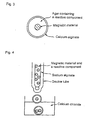
- Gelatin powder (15 g) is dissolved in ultra pure water (150 mL) under heating. Separately, photosynthetic bacteria ( rhodobacter sphaeroides RV) serving as a reactive component is added to ultra pure water (150 mL). The resultant solutions are mixed together. The solution mixture is maintained at about 50°C, and slowly added dropwise (e.g., at 50 droplets/minute) to oil or an organic solvent cooled at about 5°C, whereby gel spheres (2 to 15 mm in diameter) are obtained (Fig. 2). Each gel sphere contains one to three pieces of magnetic material (a magnet measuring about 5 mm in diameter).
- the same magnetic material as that employed in Example 2 is used as the core, and the core is covered with agar gel or sol, serving as the main layer, containing 2 to 7 wt.% photosynthetic bacteria ( rhodobacter sphaeroides RV) as a reactive component.
- the agar gel or sol is wrapped with an outer film containing 2 wt.% calcium alginate to provide sufficient strength, whereby a three-layered gel sphere is obtained (Fig. 3).
- the gel sphere is produced as shown in Fig. 4 through use of a double tube and by way of addition dropwise to 1% calcium chloride solution, followed by cooling.
- magnetic particles of the present invention obtained by the same method as that employed in Example 2, generated hydrogen from organic acid caused by photosynthetic bacteria immobilized in the magnetic particles was examined.
- the number of cells contained in agar in the magnetic particles of the present invention was controlled so as to attain an optical turbidity of 2.0 at a wavelength of 660 nm.
- the concentration of the agar was 3%, and a buffer was employed instead of ultra pure water.
- the bacteria in the magnetic particles of the present invention were cultured in a hydrogen-generating culture medium (containing 100-mM HEPES, 60-mM sodium lactate (substrate), and 10-mM sodium glutamate (nitrogen source substrate)) in an argon atmosphere under anaerobic conditions at 30°C and under light (light intensity: 10 klux).
- a hydrogen-generating culture medium containing 100-mM HEPES, 60-mM sodium lactate (substrate), and 10-mM sodium glutamate (nitrogen source substrate)
- reaction rate tended to be higher than that in the substrate solution.
- the substrate solution and the magnetic particles could be easily separated from each other by placing a magnet on a wall of the container.
- the agar gel dissolved when the recovered magnetic particles were heated at about 50°C, and the magnetic material and the gel were successfully separated from each other.
Landscapes
- Health & Medical Sciences (AREA)
- Engineering & Computer Science (AREA)
- Life Sciences & Earth Sciences (AREA)
- Chemical & Material Sciences (AREA)
- Immunology (AREA)
- Biomedical Technology (AREA)
- Molecular Biology (AREA)
- Physics & Mathematics (AREA)
- General Health & Medical Sciences (AREA)
- Urology & Nephrology (AREA)
- Hematology (AREA)
- Biotechnology (AREA)
- Microbiology (AREA)
- Biochemistry (AREA)
- Power Engineering (AREA)
- Analytical Chemistry (AREA)
- Wood Science & Technology (AREA)
- Food Science & Technology (AREA)
- Cell Biology (AREA)
- Organic Chemistry (AREA)
- General Physics & Mathematics (AREA)
- Pathology (AREA)
- Dispersion Chemistry (AREA)
- Zoology (AREA)
- Bioinformatics & Cheminformatics (AREA)
- Genetics & Genomics (AREA)
- Medicinal Chemistry (AREA)
- Inorganic Chemistry (AREA)
- General Engineering & Computer Science (AREA)
- Dermatology (AREA)
- Spectroscopy & Molecular Physics (AREA)
- Electromagnetism (AREA)
- Immobilizing And Processing Of Enzymes And Microorganisms (AREA)
- Apparatus Associated With Microorganisms And Enzymes (AREA)
- Preparation Of Compounds By Using Micro-Organisms (AREA)
- Compounds Of Iron (AREA)
- Physical Or Chemical Processes And Apparatus (AREA)
Abstract
Description
| Substrate solution | Agar | |||
| pH | buffer | pH | buffer | |
| A | 6.8 | HEPES | - | H2O |
| B | 6.8 | HEPES | 6.8 | HEPES |
| C | 5.7 | MES | - | H2O |
| D | 5.7 | MES | 5.7 | MES |
| E | 8.5 | TAPS | - | water |
| F | 8.5 | TAPS | 8.5 | TAPS |
Claims (6)
- A magnetic particle comprising particulate magnetic material and a readily decomposable or easily soluble polymer coating layer containing a reactive component, the coating layer being disposed on the surface of the magnetic material.
- The magnetic particle according to claim 1, wherein the reactive component reacts under physiological conditions.
- The magnetic particle according to claim 1 or 2, wherein the reactive component is an antigen, an antibody, a receptor, an enzyme, or a microorganism.
- The magnetic particle according to any one of claims 1 through 3, wherein the readily decomposable or easily soluble polymer is decomposed or dissolved under conditions different from those where the reactive component reacts.
- The magnetic particle according to any one of claims 1 through 4, wherein the readily decomposable or easily soluble polymer is a gel-formable polymer.
- A method for producing a reaction product, characterized by allowing a magnetic particle as recited in any one of claims 1 through 5 to react with a substance capable of reacting with the reactive component, separating the magnetic particle from the reaction system under control of magnetic force, and subsequently decomposing or dissolving the readily decomposable or easily soluble polymer, to thereby recover the reaction product.
Applications Claiming Priority (3)
| Application Number | Priority Date | Filing Date | Title |
|---|---|---|---|
| JP2001313974A JP4072994B2 (en) | 2001-10-11 | 2001-10-11 | Magnetic particles |
| JP2001313974 | 2001-10-11 | ||
| PCT/JP2002/010590 WO2003033159A1 (en) | 2001-10-11 | 2002-10-11 | Magnetic particles |
Publications (2)
| Publication Number | Publication Date |
|---|---|
| EP1440733A1 true EP1440733A1 (en) | 2004-07-28 |
| EP1440733A4 EP1440733A4 (en) | 2008-07-09 |
Family
ID=19132359
Family Applications (1)
| Application Number | Title | Priority Date | Filing Date |
|---|---|---|---|
| EP02801548A Withdrawn EP1440733A4 (en) | 2001-10-11 | 2002-10-11 | MAGNETIC PARTICLES |
Country Status (4)
| Country | Link |
|---|---|
| US (1) | US7297405B2 (en) |
| EP (1) | EP1440733A4 (en) |
| JP (1) | JP4072994B2 (en) |
| WO (1) | WO2003033159A1 (en) |
Cited By (1)
| Publication number | Priority date | Publication date | Assignee | Title |
|---|---|---|---|---|
| WO2019042521A1 (en) * | 2017-08-26 | 2019-03-07 | Aj Innuscreen Gmbh | MEANS AND METHOD FOR THE DETECTION OF ANALYTES BY MEANS OF MACROSCOPIC GRANULATE PARTICLES |
Families Citing this family (12)
| Publication number | Priority date | Publication date | Assignee | Title |
|---|---|---|---|---|
| US20040234962A1 (en) * | 2003-05-02 | 2004-11-25 | Javier Alarcon | Multicoated or multilayer entrapment matrix for protein biosensor |
| JP4207754B2 (en) * | 2003-10-31 | 2009-01-14 | 和光純薬工業株式会社 | Immunological measurement method using magnetic substance |
| US9267167B2 (en) * | 2004-06-28 | 2016-02-23 | Becton, Dickinson And Company | Dissolvable films and methods including the same |
| WO2011089130A2 (en) * | 2010-01-19 | 2011-07-28 | Basf Se | Method for producing hollow bodies having enclosed freely displaceable particles |
| US8557329B2 (en) | 2010-05-06 | 2013-10-15 | International Business Machines Corporation | Method for silica encapsulation of magnetic particles |
| DK179911B1 (en) | 2013-09-30 | 2019-10-03 | Total E&P Danmark A/S | Anvendelse af magnetiske nanopartikler til depletering af aromatiske forbindelser i olie |
| US10150908B2 (en) | 2013-09-30 | 2018-12-11 | Total E&P Danmark A/S | Method and system for the recovery of oil, using water that has been treated using magnetic particles |
| WO2015044444A1 (en) | 2013-09-30 | 2015-04-02 | Mærsk Olie Og Gas A/S | Water treatment suited for oil production wells |
| DK179840B1 (en) | 2013-09-30 | 2019-07-30 | Total E&P Danmark A/S | Method and system for the enhanced recovery of oil, using water that has been depleted in ions using magnetic particles |
| KR101781976B1 (en) * | 2015-04-08 | 2017-10-23 | 한국과학기술연구원 | Nano-structured hybrid particle, manufacturing method thereof, and device containing the particle |
| CN108226485B (en) * | 2018-02-12 | 2020-06-30 | 中国人民解放军陆军军医大学 | Composite immunomagnetic bead for separating and purifying hepatic stellate cells and preparation method thereof |
| IT202100026681A1 (en) * | 2021-10-18 | 2023-04-18 | Torino Politecnico | PROCESS FOR THE PRODUCTION OF NANO-COATED FERROMAGNETIC MATERIALS |
Family Cites Families (17)
| Publication number | Priority date | Publication date | Assignee | Title |
|---|---|---|---|---|
| US3892673A (en) * | 1971-03-24 | 1975-07-01 | Graham Magnetics Inc | Composition of metal salt crystals having a polymeric coating |
| DE3000483A1 (en) * | 1979-01-09 | 1980-07-17 | Fuji Photo Film Co Ltd | MICROCAPSULES FOR IMMUNOLOGICAL PROVISIONS |
| US4452773A (en) * | 1982-04-05 | 1984-06-05 | Canadian Patents And Development Limited | Magnetic iron-dextran microspheres |
| US4612247A (en) * | 1984-06-27 | 1986-09-16 | Cape Cod Research, Inc. | Magnetic cellulose-derivative structures |
| US4582622A (en) * | 1984-10-12 | 1986-04-15 | Fujirebio Kabushiki Kaisha | Magnetic particulate for immobilization of biological protein and process of producing the same |
| US5597531A (en) * | 1985-10-04 | 1997-01-28 | Immunivest Corporation | Resuspendable coated magnetic particles and stable magnetic particle suspensions |
| US5262176A (en) * | 1986-07-03 | 1993-11-16 | Advanced Magnetics, Inc. | Synthesis of polysaccharide covered superparamagnetic oxide colloids |
| JP2979414B2 (en) * | 1989-09-29 | 1999-11-15 | 富士レビオ株式会社 | Magnetic particles and immunoassay using the same |
| JPH0599926A (en) * | 1991-10-11 | 1993-04-23 | Tdk Corp | Method for measuring bacterium, cell and virus |
| DE19528029B4 (en) * | 1995-07-31 | 2008-01-10 | Chemagen Biopolymer-Technologie Aktiengesellschaft | Magnetic polymer particles based on polyvinyl alcohol, process for their preparation and use |
| GB9600427D0 (en) * | 1996-01-10 | 1996-03-13 | Nycomed Imaging As | Contrast media |
| US6479302B1 (en) * | 1997-01-30 | 2002-11-12 | Merck Patent Gesellschaft Mit | Method for the immunological determination of an analyte |
| JPH11191510A (en) | 1997-12-25 | 1999-07-13 | Jsr Corp | Magnetic polymer particles, production method thereof and diagnostic agent |
| JPH11191509A (en) * | 1997-12-25 | 1999-07-13 | Jsr Corp | Magnetic particle, its manufacturing and diagnostic medicine |
| FR2773416B1 (en) * | 1998-01-06 | 2000-02-11 | Bio Merieux | IMPROVED MAGNETIC PARTICLES, PROCESSES FOR OBTAINING SAME AND THEIR USES IN THE SEPARATION OF MOLECULES |
| US6761877B2 (en) * | 2000-02-18 | 2004-07-13 | Biocrystal, Ltd. | Functionalized encapsulated fluorescent nanocrystals |
| SE517421C2 (en) * | 2000-10-06 | 2002-06-04 | Bioglan Ab | New production of microparticles involves use of aqueous solution of purified amylopectin-based starch of reduced molecular weight |
-
2001
- 2001-10-11 JP JP2001313974A patent/JP4072994B2/en not_active Expired - Fee Related
-
2002
- 2002-10-11 US US10/490,742 patent/US7297405B2/en not_active Expired - Fee Related
- 2002-10-11 WO PCT/JP2002/010590 patent/WO2003033159A1/en not_active Ceased
- 2002-10-11 EP EP02801548A patent/EP1440733A4/en not_active Withdrawn
Cited By (1)
| Publication number | Priority date | Publication date | Assignee | Title |
|---|---|---|---|---|
| WO2019042521A1 (en) * | 2017-08-26 | 2019-03-07 | Aj Innuscreen Gmbh | MEANS AND METHOD FOR THE DETECTION OF ANALYTES BY MEANS OF MACROSCOPIC GRANULATE PARTICLES |
Also Published As
| Publication number | Publication date |
|---|---|
| EP1440733A4 (en) | 2008-07-09 |
| US7297405B2 (en) | 2007-11-20 |
| WO2003033159A1 (en) | 2003-04-24 |
| JP2003119030A (en) | 2003-04-23 |
| JP4072994B2 (en) | 2008-04-09 |
| US20040241428A1 (en) | 2004-12-02 |
Similar Documents
| Publication | Publication Date | Title |
|---|---|---|
| US7297405B2 (en) | Magnetic particles having core-shell structure | |
| US4744933A (en) | Process for encapsulation and encapsulated active material system | |
| US4749620A (en) | Encapsulated active material system | |
| Matsunaga et al. | Use of magnetic particles isolated from magnetotactic bacteria for enzyme immobilization | |
| CA1254528A (en) | Process for encapsulation and encapsulated active material system | |
| Castanier et al. | Ca-carbonates precipitation and limestone genesis—the microbiogeologist point of view | |
| Lei et al. | The preparation and catalytically active characterization of papain immobilized on magnetic composite microspheres | |
| van Loosdrecht et al. | Influence of interfaces on microbial activity | |
| Shan et al. | Biodesulfurization of dibenzothiophene by microbial cells coated with magnetite nanoparticles | |
| Wingard Jr | Enzyme engineering | |
| Ibrahim et al. | Enhancement of alkaline protease activity and stability via covalent immobilization onto hollow core-mesoporous shell silica nanospheres | |
| Safarik et al. | Magnetically responsive yeast cells: methods of preparation and applications | |
| Sureka et al. | Catalytic biosensors from complex coacervate core micelle (C3M) thin films | |
| Tanyolaç et al. | A new low cost magnetic material: magnetic polyvinylbutyral microbeads | |
| JPS62171686A (en) | Production of biological group composite | |
| Toyota et al. | Population study of sizes and components of self-reproducing giant multilamellar vesicles | |
| EP0197088A1 (en) | Hollow porous microsphere bioreactors and biochemical processes using same | |
| Rojas-Chapana et al. | Co-operative leaching and chemotaxis of thiobacilli studied with spherical sulphur/sulphide substrates | |
| CN113908783B (en) | Magnetic polymer composite particles and preparation method and application thereof | |
| JPH01141594A (en) | Magnetic membrane capsule and its use | |
| Robatjazi et al. | Immobilization of magnetic modified Flavobacterium ATCC 27551 using magnetic field and evaluation of the enzyme stability of immobilized bacteria | |
| Rioux et al. | Anthranilate-promoted iron uptake in Rhizobium leguminosarum | |
| EP0245986B1 (en) | Immobilization of nonanchorage-dependent cells | |
| JPH0452202A (en) | Magnetic material fine particles | |
| JP2007049966A (en) | Immobilization of microbial cell on hydrophobic carrier |
Legal Events
| Date | Code | Title | Description |
|---|---|---|---|
| PUAI | Public reference made under article 153(3) epc to a published international application that has entered the european phase |
Free format text: ORIGINAL CODE: 0009012 |
|
| 17P | Request for examination filed |
Effective date: 20040408 |
|
| AK | Designated contracting states |
Kind code of ref document: A1 Designated state(s): AT BE BG CH CY CZ DE DK EE ES FI FR GB GR IE IT LI LU MC NL PT SE SK TR |
|
| AX | Request for extension of the european patent |
Extension state: AL LT LV MK RO SI |
|
| A4 | Supplementary search report drawn up and despatched |
Effective date: 20080605 |
|
| 17Q | First examination report despatched |
Effective date: 20090910 |
|
| GRAP | Despatch of communication of intention to grant a patent |
Free format text: ORIGINAL CODE: EPIDOSNIGR1 |
|
| RTI1 | Title (correction) |
Free format text: METHOD FOR PRODUCING A REACTION PRODUCT AND MAGNETIC PARTICLES |
|
| STAA | Information on the status of an ep patent application or granted ep patent |
Free format text: STATUS: THE APPLICATION IS DEEMED TO BE WITHDRAWN |
|
| 18D | Application deemed to be withdrawn |
Effective date: 20110608 |