EP1439465A1 - Procédé d'assistance personnalisée à la navigation au sein d'un réseau de télécommunication tel que le réseau internet - Google Patents
Procédé d'assistance personnalisée à la navigation au sein d'un réseau de télécommunication tel que le réseau internet Download PDFInfo
- Publication number
- EP1439465A1 EP1439465A1 EP04290134A EP04290134A EP1439465A1 EP 1439465 A1 EP1439465 A1 EP 1439465A1 EP 04290134 A EP04290134 A EP 04290134A EP 04290134 A EP04290134 A EP 04290134A EP 1439465 A1 EP1439465 A1 EP 1439465A1
- Authority
- EP
- European Patent Office
- Prior art keywords
- user
- access operations
- profiles
- navigation
- access
- Prior art date
- Legal status (The legal status is an assumption and is not a legal conclusion. Google has not performed a legal analysis and makes no representation as to the accuracy of the status listed.)
- Withdrawn
Links
Images
Classifications
-
- G—PHYSICS
- G06—COMPUTING OR CALCULATING; COUNTING
- G06F—ELECTRIC DIGITAL DATA PROCESSING
- G06F9/00—Arrangements for program control, e.g. control units
- G06F9/06—Arrangements for program control, e.g. control units using stored programs, i.e. using an internal store of processing equipment to receive or retain programs
- G06F9/44—Arrangements for executing specific programs
- G06F9/451—Execution arrangements for user interfaces
- G06F9/453—Help systems
-
- G—PHYSICS
- G06—COMPUTING OR CALCULATING; COUNTING
- G06F—ELECTRIC DIGITAL DATA PROCESSING
- G06F16/00—Information retrieval; Database structures therefor; File system structures therefor
- G06F16/90—Details of database functions independent of the retrieved data types
- G06F16/95—Retrieval from the web
- G06F16/953—Querying, e.g. by the use of web search engines
- G06F16/9535—Search customisation based on user profiles and personalisation
Definitions
- the present invention relates generally to a method of assistance personalized for navigation within a telecommunications network such as Internet network.
- a telecommunications network like the Internet
- the information is available at sites spread over the network and is accessible to from any access point such as a user terminal.
- a system distributed information as the World Wide Web makes available to users a distributed set of composite multimedia documents linked together by hypertext links. Web sites and documents, identified by addresses called URLs (for Uniform Resource Locator), are accessible and viewable thanks to software called browsers.
- URLs for Uniform Resource Locator
- link the means of access to an object. It could be, for example, of a hypertext link.
- a common type of information access is through a server.
- a function of a server is to deliver, at the request of a user, information actually contained in a set of information with which it is associated.
- the server allows a user to access information contained for example in a remote local network.
- a web server receives an HTTP request access to an object sent by the user terminal and transmits the object back requested as a message.
- HTTP Hyper Text Transfer Protocol
- HTTP is a well-known access protocol to a web URL.
- navigation is meant here a succession of operations executed by a user from a user terminal associated with a browser to access the information available at sites spread over the network.
- a session of navigation is the set of information access operations available at the level sites distributed over the network between a network connection (login) and a network disconnection (logout).
- a browsing session can be broken down into a series of access operations.
- vigation sequence for designate a sequence of such ordered access operations, for example according to the development over time.
- information access operations are generated by a series of access commands, for example commands of activation of link giving rise to HTTP request for access to objects identified by URL addresses.
- access commands for example commands of activation of link giving rise to HTTP request for access to objects identified by URL addresses.
- different means of access to information can be envisaged. Among these are may cite a commonly designated user-controlled access operation by the term "click", in reference to the use of a pointing device as a mouse allowing to position a pointer on a link and to activate this link by a means of activation. It can also be a voice command, keyboard means, etc.
- access operations can be a page consultation. But it can also be editing, if you access the document by an extension of the http protocol such as the so-called webDav extension. On the one in general, this is any manipulation carried out by a user of a document accessed by the above written means.
- This is any manipulation carried out by a user of a document accessed by the above written means.
- We can cite in addition to consultation and editing, transmission, archiving, etc. of a document.
- the series of access operations results in a series of accessed objects, for example a sequence of page views.
- the site stores in a storage facility provided for this effect the history of access operations concerning each user.
- navigation assistance is meant assistance provided to the user under the form in particular of recommendation of links.
- Links can be found under URL addresses to activate or shortcuts to archive.
- the links can point to objects such as products for sale on a site, images, videos, particular passages of text etc.
- the assistant must be able to to explain his recommendations.
- Personalized navigation assistance means assistance provided to the user taking into account a profile of this user.
- Recommendations provided by the wizard vary depending on the profile of the user.
- identification In these processes and devices existing today, personalization involves storing user information allowing identification as complete as possible for this user.
- This information is of several types, for example of “socio-demographic” type such as name, first name, age, gender, place of residence, income or even of the “preferences” type indicating the user preferences in various fields such as cinema, literature etc.
- This information is used to segment the user population so that they can adapt the content offered on the pages according to class membership or to another.
- Such information is stored and used with the consent of users, for example via an eTrust charge.
- Identification can be done simply by authentication, a user registering and then accessing the site in him transmitting identifier data (login) and password data.
- a other means of identification can be the IP number of the user terminal, i.e.
- IP Internet Protocol
- a third means of identification may be what is known as "HTTP cookie". It is a set of bits of code that a server uses to store data on a user with whom he exchanges information (client) and which can be retrieved later by the same server either during the same session, or in a subsequent session.
- All of the information stored for a specific user is designated by the term user profile or customer profile.
- a first problem posed by the personalization of assistance to navigation as it is practiced today is the simple fact that it requires asking a user for active participation in the form a communication of personal data. This user involvement is often badly perceived. It has also been noted that the information given is not not always accurate.
- a second problem posed by the personalization of assistance to the navigation as it is currently practiced is that the classes used to segment the user population are too general and do not not accurately reflect variations in navigation depending on users.
- Many data mining techniques, called data-mining have been developed to further refine user classes.
- data processing involved in these techniques is relatively heavy and expensive.
- these treatments cannot be performed online, that is to say in same time as the browsing session.
- One user has one profile and only one who evolves little and periodically, at the end of long data-mining processes. During of a navigation, the user profile does not adapt to the different orientations of research he is conducting. Therefore, from a user perspective, the personalization may seem poor.
- the navigation of a user is relatively complex today because that it can be motivated by different points of view of the user.
- the latter can have multiple centers of interest and navigation can be motivated by one or the other of these centers of interest or even by a combination of these centers of interest.
- the navigation of the user is affected by the fact that he pursues different objectives, by the fact that the navigation is done in different contexts or even by the fact that the user may be of different moods.
- Personalization must be able adapt more finely to the different points of view of the same user who translate through multi-interest, multi-objective, multi-context navigation, even, multi-mood.
- vigation reason (called pattern in Anglo-Saxon terminology) to designate a recurring aspect of observable navigation in a set of navigation sessions.
- Personalization can be based on navigation analysis so as not to no longer solicit the user.
- the performance of customization using the patterns from log analysis as it is currently practiced are relatively small.
- the data available are only those of a server: machine number, addresses of page views with date and type of browser used. This data is often coupled with declarative data, of the socio-demographic or preference data type, requested from users. It is then necessary to execute the same heavy data-mining treatments and expensive mentioned above.
- the present invention relates to navigation assistance which would make it possible to overcome the problems previously mentioned.
- the information generated by the information generation step is advantageously information allowing to constitute an online help, like link recommendations.
- the user profile used to generate online help is an anonymous profile, which means a profile that has not been transmitted by the user himself but who was assigned to this user based on his navigation. It is therefore the navigation operations themselves which determine the user profile.
- This anonymous profile is constructed over the navigation sequences and comes from an association of predetermined profiles.
- the method according to the invention can be executed by a personalization, that is to say a component independent of the site to be personalized, point of view of its architecture.
- a customization engine can be installed on a site but also removed from the site.
- the personalization engine seeks not to directly identify a user but to recognize a way of navigate, this way allowing to characterize the user.
- This way of navigation is characterized by information access operations, such as sequences page views, which are data always available on a website.
- the process according to the invention is therefore adaptable to any site. To be able to analyze how navigate the user online, we retrieve the commands for accessing information, for example "clicks".
- An access command collection system can be provided at the level of a proxy suitable for generating sequences of access commands and to transmit them to the module at which the comparison step is carried out as it generates them. These are not logs recorded by a server in a file which are only useful for offline processing.
- said operational patterns access profiles are associated with predetermined respective user profiles during a preliminary stage of constitution of profiles databases anonymous.
- databases containing typical navigation sets associated with user data can understand navigation classes, preference classes, classes socio-demographic and frequent subsets of URLs. Of course suitable links are created between these databases.
- the same subset of navigation operations can correspond to a plurality of preference profiles or socio-demographic profiles, and so on.
- Databases can be established using a panel of users who are asked to navigate on a site. These users are authenticated and their browsing, possibly commented, are recorded. Declarative data may be requested from them during their navigation. For an already existing site, we can rely on those users of the site who spontaneously give personal information.
- the preferences and socio-demographic data collected, associated with navigation in the form of logs recorded by the site are processed in order to extract the said predetermined navigation patterns associated with user profiles.
- said anonymous profile databases are updated based on the use of one or those of said user profiles which are associated with one or more patterns of predetermined access operations which correspond to said sequence of access operations retrieved.
- Databases can be updated by usage analysis profiles, that is, for example the use that users make of personalized information such as link recommendations to them data. Lists of profiles which, during navigation, have been associated with these navigations and the use of these profiles are stored and, by type processing data-mining operated regularly, the warehouse databases are revised and / or enriched regularly. Of course, these databases can be constantly updated using personal information that some users can possibly donate during their navigations. Learning new profiles will advantageously be done in the background.
- said step of recovering sequences of access operations is executed repeatedly for sequences successive access operations, each of said sequences comprising a number access operations greater than or equal to a given minimum number, said steps of comparison and generation of information being executed after each step of recovery based on all the sequences of access operations recovered.
- the information for example online help, generated therefore varies during navigation, the new sequences of access operations retrieved allowing create or delete anonymous profiles associated with navigation. So a user will see different candidate profiles follow one another during their navigation, these candidate profiles allowing assistance adapted to the different orientations of its navigation.
- the minimum number of access operations that a sequence contains is the minimum number of access operations necessary for the sequence to be associated with a minimum of relevance to one or more profiles. advantageously, this minimum number will be three. That is to say that from a sequence of three page views, it is possible to associate this sequence with at least one profile for produce information such as, for example, a link recommendation.
- said recovery step is executed a first time to retrieve a first sequence of access operations comprising a number of access operations at least equal to said minimum number, then is executed several times to recover several sequences each time nested access operations including different numbers of access operations greater than or equal to said minimum number.
- each time the recovery step is executed for example after each information access operation, several nested sequences are recovered. For example, can be recovered a first sequence comprising the last three access to information operations, a second sequence including the last four access to information operations and so on up to a last sequence comprising all the access operations to navigation information.
- Each of these access sequences can be compared with predetermined patterns so as to fine-tune a list of profiles candidates associated with navigation.
- said recovery step also retrieves data characteristic of existing time intervals between successive access operations to the sequence of operations access retrieved, said comparison step comparing said sequence of access operations retrieved for reasons of predetermined access operations in taking into account said respective time interval data.
- the time interval between access to information operations is a criterion allowing a finer association of a navigation sequence with one or more anonymous profiles.
- the same navigation sequence can correspond to several preset navigation patterns associated in databases with different profiles anonymous, but some of these profiles may be rejected based on the time intervals between operations of the retrieved navigation sequence.
- the time interval data also allow to isolate typical sequences of navigation characteristics of either profile.
- said recovery step also retrieves characteristic data of objects corresponding to successive access operations to the access operation sequence retrieved, said step of comparing comparing said sequence of operations of access retrieved for reasons for predetermined access operations taking into account said object data.
- the type of object for example the type of a page viewed, associated with an operation access to information is a characteristic that makes it possible to describe in a more general navigation sequence. According to the types of objects corresponding to operations of a recovered sequence, this can correspond to associated patterns to predetermined profiles taking into account the type of generalization of access to information. Thus, other candidate profiles can be associated with reasons for navigation corresponding to the retrieved navigation sequences.
- said step of comparing associates with each pattern corresponding to the sequence of access operations retrieved during said retrieval step a plurality of relevant profiles to which are associated relevance weights, those of said relevant profiles which have a weight of adapted relevance being added to a list of relevant profiles associated with said audit user, said step of generating information generating information corresponding to each of the relevant profiles from said list of relevant profiles.
- said information generated is recommendations presented to said user, each of the recommendations corresponding to a profile relevant from said list of relevant profiles being presented to the user taking account of the relevance weight of said profile.
- the relevance weights of the relevant profiles are recalculated in taking into account the new retrieved sequence or new sequences retrieved, those of the relevant profiles which no longer have a suitable relevance weight being removed from said list of relevant profiles.
- the relevance weights of the relevant profiles are recalculated in taking into account whether the user has followed the recommendations presented or not during the previous information generation stage, those of the relevant profiles who no longer have a suitable relevance weight being removed from said list of profiles relevant.
- a personalization engine 1 applies to a web server site.
- the engine of personalization is the overall system that manages personalization. It is a component independent of the site from the point of view of its architecture which can be interconnected to the site. If desired, this component can be removed from the site.
- the personalization engine 1 includes overall a data warehouse 12 and a processing module 10.
- the data warehouse 12 contains databases relating, one to navigation reasons, the others to preference data and socio-demographic, these databases being linked to each other others so that for each navigation reason there corresponds one or more candidate profiles.
- the data warehouse 12 contains four types of data forming navigation classes, preference classes, classes socio-demographic, as well as frequent subsets of URLs. of the links are created between these four types of data.
- the processing module 10 comprises a sub-assembly adapted to recover the navigations that a user performs from a user terminal 13 and a subset dynamic pairing adapted to link a navigation current and predetermined profiles extracted from the data warehouse 12.
- the subset of module 10 adapted to retrieve navigations is a proxy, i.e. it acts as an intermediary in exchanges between the terminal user 13 and the server site. It therefore receives HTTP requests for access to objects issued at the user terminal and it can therefore generate sequences of access command, for example click sequences, and submit them to the module as it builds them. Command sequences can be submitted to the matching module with information like the time intervals between access control and, possibly, the types of pages views.
- This subset also feeds a navigation history database of the profile warehouse 12.
- this subset also collects information concerning the use made by the user of the personalized information generated by the personalization engine. For example, when personalization is carried out in the form of a recommendation for links, module 10 records the monitoring of these user recommendations.
- the dynamic matching subset of module 10 is adapted, from a current navigation sequence, to search the databases of profile warehouse data 12 to determine a plurality of relevant profiles corresponding to this navigation sequence, each profile being assigned a weight of calculated relevance.
- This research can also be carried out from a plurality of sequences recovered simultaneously or successively. In this last case, each new sequence retrieved can lead to adding relevant profiles and modify the relevance weights for the relevant profiles already present.
- criteria such as time intervals between access commands and types of page views can also be taken into account for the conduct of research in the database and the calculation of relevance weights.
- a preliminary stage of constitution of bases of Anonymous profile data must first be executed.
- these databases can be established using a panel of users who are asked to browse the site.
- Data from preferences and socio-demographic data retrieved and navigation data data are subjected to a data-mining analysis so as to produce the four databases described above and create the links between these bases.
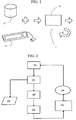
- Fig. 2 schematically describes the operation of the present invention.
- a user performs from a terminal user of access to information operations.
- the proxy collects the access commands to information or clicks and forwards those clicks to the matching module where they are broken down into sub-assemblies during step 102, but also at the warehouse of profiles 12 where they are stored at step 105 in a history of navigation.
- the proxy also transmits the data to the profile warehouse 12 using the lists of profiles chosen (step 105).
- the pairing module gradually receives the access commands generated by the proxy.
- sequences comprising at least three access controls must be isolated.
- This step therefore generates first a first sequence comprising the first three access commands of the navigation that it transmits in step 103.
- step 102 is executed again, thereafter, it generates nested navigation sequences. For example, when the user has carried out four information access operations, step 102 can generate a first navigation sequence containing the four access operations and a second navigation sequence comprising the last three operations access. In an alternative embodiment, step 102 generates sequences successive nested.
- the matching module searches the databases data relevant profiles for current navigation. Research is done via a matching function. Several profiles can correspond to each sequence of navigation retrieved by step 102. The matching function takes account of of all the sequences recovered to determine the relevant profiles. of the relevance weights are calculated for each profile which may correspond to the current navigation. Those of relevant profiles who have a suitable relevance weight are added to a list of relevant profiles associated with the current navigation. If, by elsewhere, profiles on this list are found, due to new calculations conducted taking into account the last sequence or sequences transmitted by step 102, assigned a relevance weight which is no longer sufficient, these profiles are excluded from the listing. On the other hand, the relevance weights of the relevant profiles found on the list are recalculated according to whether the user has followed the recommendations already or not presented. The fact that the user follows recommendations presented in relation with a profile reinforces the relevance of this profile.
- the list of relevant profiles is used to personalize the site at step 104 level.
- Each profile can give rise to a recommendation by link 106 presented to the user by a navigation assistant.
- the recommendation link is given taking into account the relevance weight of the associated profile.
- the links can be URLs. They can also be shortcuts to archive in the bookmarks. These links can also point to objects such as products sell on the site, images, videos, etc.
- the assistant can explain the advice he gives and can provide the user with a vision of his representation in the system, that is, the profile or profiles that the system assigns to it.
- the method then returns to step 100 where it waits for the user to perform a new navigation operation.
- step 102 transmits a first navigation sequence consisting of commands A, B and C in step 103.
- the matching module performs a search based on the retrieved sequence in the profiles warehouse databases allowing him to update a number of relevant profiles including those with an appropriate relevance weight are added to a list of relevant profiles.
- This list is transmitted in step 104 where a navigation assistant is based on the profiles in the list to establish link recommendations. Each recommendation is associated with a profile and is presented taking into account the relevance weight of this profile.
- step 100 the assistant recommends the user a link corresponding to command D.
- the user will follow the recommendation and execute the command D.
- Au level of step 101 this command is retrieved by the proxy and transmitted from a part at step 105 for recording in the profile warehouse and secondly at step 102.
- step 101 are also transmitted in step 105 the data arising from the fact that the user has followed the recommendation made and which will be used to enrich the data warehouse during the next processing of data mining.
- step 102 two new navigation sequences are generated, a first including the four commands A, B, C and D and a second comprising the last three commands B, C and D.
- the matching module performs based on both of the retrieved sequences searches in the profiles warehouse databases allowing him to update a certain number of relevant profiles, including those with a weight of relevant relevance are added to the relevant profile list. The process continues then in the same way.
- Databases can be updated by usage analysis profiles, that is, for example the use that users make of personalized information such as link recommendations to them data.
- Data-mining processing is carried out regularly from lists of profiles that have been generated and their uses.
- these basics of data can be constantly updated using the information personal information that some users may give during their navigations. The learning of new profiles will be advantageously carried out in background process.
- the warehouse of anonymous profiles can be shared for several sites and hosted, for example, by a trusted third party who takes care of the constitution of panels, steering the panelist navigation on different customer sites, constitution of the warehouse of anonymous profiles and maintenance of this warehouse of anonymous profiles supplied by client sites with new and historical logs use of anonymous profiles as well as manual corrections made by users who have been associated with profiles that these users themselves have found to be inaccurate.
- a method according to the invention can also be implemented on an intranet in taking into account the sequence of intranet access commands, types of different resources viewed, viewed, edited, created, people contacted, etc.
Landscapes
- Engineering & Computer Science (AREA)
- Theoretical Computer Science (AREA)
- Databases & Information Systems (AREA)
- Software Systems (AREA)
- Physics & Mathematics (AREA)
- General Engineering & Computer Science (AREA)
- General Physics & Mathematics (AREA)
- Data Mining & Analysis (AREA)
- Human Computer Interaction (AREA)
- Information Retrieval, Db Structures And Fs Structures Therefor (AREA)
- Information Transfer Between Computers (AREA)
Abstract
Description
Claims (14)
- Procédé d'assistance personnalisée à la navigation au sein d'un réseau de télécommunication, ledit procédé étant adapté à fournir une aide en ligne à un utilisateur qui, ayant accédé à un site dudit réseau, exécute une succession d'opérations d'accès à l'information, ledit procédé étant caractérisé en ce qu'il comprend :une étape (101, 102) de récupération d'une séquence d'opérations d'accès à l'information exécutées par ledit utilisateur,une étape (103) de comparaison de ladite séquence d'opérations d'accès à des motifs d'opérations d'accès prédéterminés, lesdits motifs d'opérations d'accès prédéterminés étant associés à des profils utilisateurs respectifs prédéterminés, etune étape (104) de génération d'informations d'assistance personnalisée à la navigation se basant sur celui ou ceux desdits profils utilisateurs prédéterminés qui sont associés à un ou des motifs d'opérations d'accès prédéterminés qui correspondent à ladite séquence d'opérations d'accès récupérée.
- Procédé selon la revendication 1, caractérisé en ce que lesdits motifs d'opérations d'accès prédéterminés sont associés à des profils utilisateurs respectifs prédéterminés au cours d'une étape préliminaire de constitution de bases de données de profils anonymes.
- Procédé selon la revendication 2, caractérisé en ce que lesdites bases de données de profils anonymes sont réactualisées en se basant sur l'utilisation de celui ou de ceux desdits profils utilisateurs prédéterminés qui sont associés à un ou des motifs d'opérations d'accès prédéterminés qui correspondent à ladite séquence d'opérations d'accès récupérée.
- Procédé selon l'une quelconque des revendications précédentes, caractérisé en ce que ladite étape de récupération (101, 102) des séquences d'opérations d'accès est exécutée à plusieurs reprises pour des séquences d'opérations d'accès successives, chacune desdites séquences comprenant un nombre d'opérations d'accès supérieur ou égal à un nombre minimum donné, lesdites étapes de comparaison (103) et de génération d'informations (104) étant exécutées après chaque étape de récupération (101, 102) en se basant sur l'ensemble des séquences d'opérations d'accès récupérées.
- Procédé selon la revendication 4, caractérisé en ce que ladite étape de récupération (101, 102) est exécutée une première fois pour récupérer une première séquence d'opérations d'accès comprenant un nombre d'opérations d'accès au moins égal audit nombre minimum, puis est exécutée à plusieurs reprises pour récupérer à chaque fois plusieurs séquences imbriquées d'opérations d'accès comprenant différents nombres d'opérations d'accès supérieurs ou égaux audit nombre minimum.
- Procédé selon l'une quelconque des revendications précédentes, caractérisé en ce que ladite étape de récupération (101, 102) récupère également des données caractéristiques des intervalles de temps existant entre les opérations d'accès à l'information successives de la séquence d'opérations d'accès récupérée, ladite étape de comparaison (103) comparant ladite séquence d'opérations d'accès récupérée à des motifs d'opérations d'accès prédéterminés en tenant compte desdites données d'intervalles de temps respectives.
- Procédé selon l'une quelconque des revendications précédentes, caractérisé en ce que ladite étape de récupération (101, 102) récupère également des données caractéristiques des objets correspondant aux opérations d'accès à l'information successives de la séquence d'opérations d'accès récupérée, ladite étape de comparaison comparant ladite séquence d'opérations d'accès récupérée à des motifs d'opérations d'accès prédéterminés en tenant compte desdites données d'objets.
- Procédé selon l'une quelconque des revendications précédentes, caractérisé en ce que ladite étape de comparaison (103) associe à chaque séquence d'opérations d'accès récupérée lors de ladite étape de récupération (101, 102) une pluralité de profils pertinents auxquels sont associés des poids de pertinence, ceux desdits profils pertinents qui ont un poids de pertinence adapté étant ajoutés à une liste de profils pertinents associée audit utilisateur, ladite étape de génération d'informations (104) générant des informations correspondant à chacun des profils pertinents de ladite liste de profils pertinents.
- Procédé selon la revendication 8, caractérisé en ce que lesdites informations générées par ladite étape de génération d'informations (104) sont des recommandations présentées audit utilisateur, chacune des recommandations associées à un profil pertinent de ladite liste de profils pertinents étant présentée à l'utilisateur en tenant compte du poids de pertinence dudit profil.
- Procédé selon la revendication 8 ou 9, caractérisé en ce que, lors de l'étape de comparaison (103) suivant chaque étape de récupération (101, 102) d'une séquence d'opérations d'accès ou de plusieurs séquences d'opérations d'accès, les poids de pertinence des profils pertinents sont recalculés en tenant compte de la nouvelle séquence récupérée ou des nouvelles séquences récupérées, ceux des profils pertinents qui n'ont plus un poids de pertinence adapté étant écartés de ladite liste de profils pertinents.
- Procédé selon l'une quelconque des revendications 8 à 10, caractérisé en ce que, lors de l'étape de comparaison (103) suivant chaque étape de récupération (101, 102) d'une séquence d'opérations d'accès ou de plusieurs séquences d'opérations d'accès, les poids de pertinence des profils pertinents sont recalculés en tenant compte du fait que l'utilisateur a suivi ou non les recommandations présentées lors de l'étape de génération d'informations (104) précédente, ceux des profils pertinents qui n'ont plus un poids de pertinence adapté étant écartés de ladite liste de profils pertinents.
- Système d'assistance personnalisée à la navigation au sein d'un réseau de télécommunication, caractérisé en ce qu'il comprend un moteur de personnalisation (1) comprenant un entrepôt de données (12) contenant des bases de données relatives à des motifs de navigation prédéterminés et à des données de profils utilisateurs prédéterminées et un module de traitement (10) comprenant des moyens pour récupérer des séquences de navigation qu'un utilisateur effectue à partir d'un terminal (13) et des moyens pour mettre en oeuvre un procédé d'assistance personnalisée à la navigation conformément aux revendications 1 à 11.
- Système d'assistance personnalisée à la navigation selon la revendication 12, caractérisé en ce que ledit entrepôt de données (12) est hébergé par un tiers de confiance.
- Système selon la revendication 12 ou 13, caractérisé en ce que lesdits moyens pour récupérer des séquences de navigation sont un proxy qui agit comme intermédiaire dans les échanges entre ledit terminal (13) et le site serveur.
Applications Claiming Priority (2)
| Application Number | Priority Date | Filing Date | Title |
|---|---|---|---|
| FR0300584A FR2850185A1 (fr) | 2003-01-20 | 2003-01-20 | Frocede d'assistance personnalisee a la navigation au sein d'un reseau de telecommnication tel que le resau internet |
| FR0300584 | 2003-01-20 |
Publications (1)
| Publication Number | Publication Date |
|---|---|
| EP1439465A1 true EP1439465A1 (fr) | 2004-07-21 |
Family
ID=32524980
Family Applications (1)
| Application Number | Title | Priority Date | Filing Date |
|---|---|---|---|
| EP04290134A Withdrawn EP1439465A1 (fr) | 2003-01-20 | 2004-01-19 | Procédé d'assistance personnalisée à la navigation au sein d'un réseau de télécommunication tel que le réseau internet |
Country Status (2)
| Country | Link |
|---|---|
| EP (1) | EP1439465A1 (fr) |
| FR (1) | FR2850185A1 (fr) |
Citations (2)
| Publication number | Priority date | Publication date | Assignee | Title |
|---|---|---|---|---|
| US5848396A (en) * | 1996-04-26 | 1998-12-08 | Freedom Of Information, Inc. | Method and apparatus for determining behavioral profile of a computer user |
| US6260035B1 (en) * | 1996-07-19 | 2001-07-10 | Microsoft Corporation | Intelligent user assistance facility for a software program |
-
2003
- 2003-01-20 FR FR0300584A patent/FR2850185A1/fr active Pending
-
2004
- 2004-01-19 EP EP04290134A patent/EP1439465A1/fr not_active Withdrawn
Patent Citations (2)
| Publication number | Priority date | Publication date | Assignee | Title |
|---|---|---|---|---|
| US5848396A (en) * | 1996-04-26 | 1998-12-08 | Freedom Of Information, Inc. | Method and apparatus for determining behavioral profile of a computer user |
| US6260035B1 (en) * | 1996-07-19 | 2001-07-10 | Microsoft Corporation | Intelligent user assistance facility for a software program |
Non-Patent Citations (4)
| Title |
|---|
| CANNATARO M ET AL: "An XML-based architecture for adaptive web hypermedia systems using a probabilistic user model", PROCEEDINGS 2000 INTERNATIONAL DATABASE ENGINEERING AND APPLICATIONS SYMPOSIUM, 18 September 2000 (2000-09-18), pages 257 - 265, XP010519034 * |
| HUA-FU LI ET AL: "PNP: mining of profile navigational patterns", DATA MINING AND KNOWLEDGE DISCOVERY: THEORY, TOOLS, AND TECHNOLOGY IV, ORLANDO, FL, USA, 1-4 APRIL 2002, vol. 4730, 2002, Proceedings of the SPIE - The International Society for Optical Engineering, 2002, SPIE-Int. Soc. Opt. Eng, USA, pages 252 - 260, XP002267511, ISSN: 0277-786X * |
| SARUKKAI R R: "Link prediction and path analysis using Markov chains", COMPUTER NETWORKS, ELSEVIER SCIENCE PUBLISHERS B.V., AMSTERDAM, NL, vol. 33, no. 1-6, June 2000 (2000-06-01), pages 377 - 386, XP004304779, ISSN: 1389-1286 * |
| SHAHABI C ET AL: "A framework for efficient and anonymous Web Usage Mining based on client-side tracking", WEBKDD 2001 - MINING WEB LOG DATA ACROSS ALL CUSTOMERS TOUCH POINTS. THIRD INTERNATIONAL WORKSHOP. REVISED PAPERS (LECTURE NOTE IN ARTIFICIAL INTELLIGENCE VOL.2356), WEBKDD 2001 - MINING WEB LOG DATA ACROSS ALL CUSTOMERS TOUCH POINTS. THIRD INTERNATI, 2002, 2002, Berlin, Germany, Springer-Verlag, Germany, pages 113 - 144, XP009024338, ISBN: 3-540-43969-2 * |
Also Published As
| Publication number | Publication date |
|---|---|
| FR2850185A1 (fr) | 2004-07-23 |
Similar Documents
| Publication | Publication Date | Title |
|---|---|---|
| US20160171511A1 (en) | Real-time data analytics for enhancing sales and other support functions | |
| US9152704B2 (en) | System and method for adaptive text recommendation | |
| KR100854561B1 (ko) | 개인용 포털과 웹 컨텐츠 신디케이션의 통합 방법 | |
| FR2947358A1 (fr) | Un assistant-conseiller utilisant l'analyse semantique des echanges communautaires | |
| EP1367506A1 (fr) | Systeme permettant de fournir des informations transformees en reponse a une demande de recherche | |
| US20170344384A1 (en) | System for utilizing one or more data sources to generate a customized interface | |
| FR2988192A1 (fr) | Procede et systeme de developpement d'applications de consultation de contenus et services sur un reseau de telecommunication, de distribution et d'execution de telles applications sur de multiples appareils. | |
| WO2008083129A1 (fr) | Système et appareil de présentation de contenu concernant une communication | |
| FR2800886A1 (fr) | Methode et systeme pour serveur web multilingue | |
| WO2006076516A2 (fr) | Fourniture personnalisable d'information audio | |
| EP1204044A1 (fr) | Procédé et système d'optimisation de consultations d'ensembles de données par une pluralité de clients | |
| CA2442893A1 (fr) | Systeme de telechargement de contenu multimedia et procede associe | |
| FR2802670A1 (fr) | Procede de communication de biens ou de services par des moyens electroniques sur des reseaux du type internet | |
| US20200342856A1 (en) | Multi-modal interface in a voice-activated network | |
| US20060173880A1 (en) | System and method for generating contextual survey sequence for search results | |
| WO2004040873A2 (fr) | Architecture informatique en reseau multi-etages | |
| CN113536108A (zh) | 一种信息推荐的方法和装置 | |
| EP1439465A1 (fr) | Procédé d'assistance personnalisée à la navigation au sein d'un réseau de télécommunication tel que le réseau internet | |
| CA3165016C (fr) | Recherche automatisee et systeme informatique de presentation | |
| FR3030079A1 (fr) | Moyens pour determiner un niveau de pertinence d’une ressource dans un systeme de traitement d’informations | |
| US20060173820A1 (en) | System and method for generating contextual survey sequence for search results | |
| EP3853784B1 (fr) | Procédé d'analyse des dysfonctionnements d'un système et dispositifs associés | |
| WO2025080796A1 (fr) | Formation de réseaux neuronaux sur des données de session | |
| FR2809205A1 (fr) | Procede et systeme d'acces a un ensemble d'informations stockees dans une base de donnees et relatives a un evenement actuel ou passe, en particulier une chanson diffusee par une station de radiodiffusion | |
| FR3003966A1 (fr) | Procede d'adaptation dynamique d'un environnement logiciel execute a partir d'un terminal de communication d'un utilisateur, au cours d'une communication entre l'utilisateur et au moins un interlocuteur. |
Legal Events
| Date | Code | Title | Description |
|---|---|---|---|
| PUAI | Public reference made under article 153(3) epc to a published international application that has entered the european phase |
Free format text: ORIGINAL CODE: 0009012 |
|
| AK | Designated contracting states |
Kind code of ref document: A1 Designated state(s): AT BE BG CH CY CZ DE DK EE ES FI FR GB GR HU IE IT LI LU MC NL PT RO SE SI SK TR |
|
| AX | Request for extension of the european patent |
Extension state: AL LT LV MK |
|
| 17P | Request for examination filed |
Effective date: 20040918 |
|
| AKX | Designation fees paid |
Designated state(s): DE ES FR GB IT |
|
| 17Q | First examination report despatched |
Effective date: 20050614 |
|
| 17Q | First examination report despatched |
Effective date: 20050614 |
|
| STAA | Information on the status of an ep patent application or granted ep patent |
Free format text: STATUS: THE APPLICATION IS DEEMED TO BE WITHDRAWN |
|
| 18D | Application deemed to be withdrawn |
Effective date: 20070811 |