EP1438307B1 - Derivatives of 4-(thio- or selenoxanthene-9-ylidene)-piperidine or acridine and its use as a selective 5-ht2b receptor antagonist - Google Patents
Derivatives of 4-(thio- or selenoxanthene-9-ylidene)-piperidine or acridine and its use as a selective 5-ht2b receptor antagonist Download PDFInfo
- Publication number
- EP1438307B1 EP1438307B1 EP02785280A EP02785280A EP1438307B1 EP 1438307 B1 EP1438307 B1 EP 1438307B1 EP 02785280 A EP02785280 A EP 02785280A EP 02785280 A EP02785280 A EP 02785280A EP 1438307 B1 EP1438307 B1 EP 1438307B1
- Authority
- EP
- European Patent Office
- Prior art keywords
- methyl
- piperidine
- ethoxy
- yliden
- thioxanthen
- Prior art date
- Legal status (The legal status is an assumption and is not a legal conclusion. Google has not performed a legal analysis and makes no representation as to the accuracy of the status listed.)
- Expired - Lifetime
Links
- 0 C*(C)c(cc1)ccc1C(O)=O Chemical compound C*(C)c(cc1)ccc1C(O)=O 0.000 description 3
- ZFCRURYZCFPFMG-UHFFFAOYSA-N CC(C)C(c(cccc1)c1Br)=O Chemical compound CC(C)C(c(cccc1)c1Br)=O ZFCRURYZCFPFMG-UHFFFAOYSA-N 0.000 description 1
Classifications
-
- C—CHEMISTRY; METALLURGY
- C07—ORGANIC CHEMISTRY
- C07D—HETEROCYCLIC COMPOUNDS
- C07D401/00—Heterocyclic compounds containing two or more hetero rings, having nitrogen atoms as the only ring hetero atoms, at least one ring being a six-membered ring with only one nitrogen atom
- C07D401/02—Heterocyclic compounds containing two or more hetero rings, having nitrogen atoms as the only ring hetero atoms, at least one ring being a six-membered ring with only one nitrogen atom containing two hetero rings
- C07D401/04—Heterocyclic compounds containing two or more hetero rings, having nitrogen atoms as the only ring hetero atoms, at least one ring being a six-membered ring with only one nitrogen atom containing two hetero rings directly linked by a ring-member-to-ring-member bond
-
- A—HUMAN NECESSITIES
- A61—MEDICAL OR VETERINARY SCIENCE; HYGIENE
- A61P—SPECIFIC THERAPEUTIC ACTIVITY OF CHEMICAL COMPOUNDS OR MEDICINAL PREPARATIONS
- A61P1/00—Drugs for disorders of the alimentary tract or the digestive system
-
- A—HUMAN NECESSITIES
- A61—MEDICAL OR VETERINARY SCIENCE; HYGIENE
- A61P—SPECIFIC THERAPEUTIC ACTIVITY OF CHEMICAL COMPOUNDS OR MEDICINAL PREPARATIONS
- A61P11/00—Drugs for disorders of the respiratory system
-
- A—HUMAN NECESSITIES
- A61—MEDICAL OR VETERINARY SCIENCE; HYGIENE
- A61P—SPECIFIC THERAPEUTIC ACTIVITY OF CHEMICAL COMPOUNDS OR MEDICINAL PREPARATIONS
- A61P11/00—Drugs for disorders of the respiratory system
- A61P11/06—Antiasthmatics
-
- A—HUMAN NECESSITIES
- A61—MEDICAL OR VETERINARY SCIENCE; HYGIENE
- A61P—SPECIFIC THERAPEUTIC ACTIVITY OF CHEMICAL COMPOUNDS OR MEDICINAL PREPARATIONS
- A61P13/00—Drugs for disorders of the urinary system
- A61P13/08—Drugs for disorders of the urinary system of the prostate
-
- A—HUMAN NECESSITIES
- A61—MEDICAL OR VETERINARY SCIENCE; HYGIENE
- A61P—SPECIFIC THERAPEUTIC ACTIVITY OF CHEMICAL COMPOUNDS OR MEDICINAL PREPARATIONS
- A61P15/00—Drugs for genital or sexual disorders; Contraceptives
-
- A—HUMAN NECESSITIES
- A61—MEDICAL OR VETERINARY SCIENCE; HYGIENE
- A61P—SPECIFIC THERAPEUTIC ACTIVITY OF CHEMICAL COMPOUNDS OR MEDICINAL PREPARATIONS
- A61P25/00—Drugs for disorders of the nervous system
-
- A—HUMAN NECESSITIES
- A61—MEDICAL OR VETERINARY SCIENCE; HYGIENE
- A61P—SPECIFIC THERAPEUTIC ACTIVITY OF CHEMICAL COMPOUNDS OR MEDICINAL PREPARATIONS
- A61P25/00—Drugs for disorders of the nervous system
- A61P25/06—Antimigraine agents
-
- A—HUMAN NECESSITIES
- A61—MEDICAL OR VETERINARY SCIENCE; HYGIENE
- A61P—SPECIFIC THERAPEUTIC ACTIVITY OF CHEMICAL COMPOUNDS OR MEDICINAL PREPARATIONS
- A61P43/00—Drugs for specific purposes, not provided for in groups A61P1/00-A61P41/00
-
- A—HUMAN NECESSITIES
- A61—MEDICAL OR VETERINARY SCIENCE; HYGIENE
- A61P—SPECIFIC THERAPEUTIC ACTIVITY OF CHEMICAL COMPOUNDS OR MEDICINAL PREPARATIONS
- A61P9/00—Drugs for disorders of the cardiovascular system
-
- A—HUMAN NECESSITIES
- A61—MEDICAL OR VETERINARY SCIENCE; HYGIENE
- A61P—SPECIFIC THERAPEUTIC ACTIVITY OF CHEMICAL COMPOUNDS OR MEDICINAL PREPARATIONS
- A61P9/00—Drugs for disorders of the cardiovascular system
- A61P9/12—Antihypertensives
-
- C—CHEMISTRY; METALLURGY
- C07—ORGANIC CHEMISTRY
- C07D—HETEROCYCLIC COMPOUNDS
- C07D409/00—Heterocyclic compounds containing two or more hetero rings, at least one ring having sulfur atoms as the only ring hetero atoms
- C07D409/02—Heterocyclic compounds containing two or more hetero rings, at least one ring having sulfur atoms as the only ring hetero atoms containing two hetero rings
- C07D409/04—Heterocyclic compounds containing two or more hetero rings, at least one ring having sulfur atoms as the only ring hetero atoms containing two hetero rings directly linked by a ring-member-to-ring-member bond
-
- C—CHEMISTRY; METALLURGY
- C07—ORGANIC CHEMISTRY
- C07D—HETEROCYCLIC COMPOUNDS
- C07D421/00—Heterocyclic compounds containing two or more hetero rings, at least one ring having selenium, tellurium, or halogen atoms as ring hetero atoms
- C07D421/02—Heterocyclic compounds containing two or more hetero rings, at least one ring having selenium, tellurium, or halogen atoms as ring hetero atoms containing two hetero rings
- C07D421/04—Heterocyclic compounds containing two or more hetero rings, at least one ring having selenium, tellurium, or halogen atoms as ring hetero atoms containing two hetero rings directly linked by a ring-member-to-ring-member bond
Definitions
- the present invention relates to derivatives of 4-(Thio- or Selenoxanthene-9-ylidene)-piperidine and acridine and pharmaceutically acceptable salts thereof, which exhibit useful pharmacological properties, including utility as selective 5-HT 2B receptor antagonists for treatment of a disease state which can be alleviated by treatment with a 5-HT 2B receptor antagonist.
- Serotonin a neurotransmitter with mixed and complex pharmacological characteristics, was first discovered in 1948, and subsequently has been the subject of substantial research. Serotonin, also referred to as 5-hydroxytryptamine (5-HT), acts both centrally and peripherally on discrete 5-HT receptors. Currently, fourteen subtypes of serotonin receptor are recognized and delineated into seven families, 5-HT 1 , to 5-HT 7 . Within the 5-HT 2 family, 5-HT 2A , 5-HT 2B and 5-HT 2C subtypes are known to exist. These subtypes share sequence homology and display similarities in their specificity for a wide range of ligands. Nomenclature and classification of 5-HT receptors have been reviewed (see Martin and Humphrey, Neuropharm. 1994, 33, 261-273 and Hoyer et al., Pharm. Rev. 1994. 46, 157-203).
- the 5-HT 2B receptor was first characterized in rat isolated stomach fundus (see Clineschmidt et al., J. Pharmacol. Exp. Ther. 1985, 235, 696-708; Cohen and Wittenauer, J. Cardiovasc. Pharmacol. 1987, 10, 176-181) and initially cloned from rat (see Foguet et al., EMBO 1992, 11, 3481-3487) followed by the cloning of the human 5-HT 2B receptor (see Schmuck et al., FEBS Lett. 1994, 342, 85-90; Kursar et al., Mol. Pharmacol. 1994, 46, 227-234).
- the closely related 5-HT 2C receptor was first characterized as a 5-HT 1C subtype (see Pazos et al., Eur. J. Pharmacol. 1984, 106, 539-546) and was subsequently recognized as belonging to the 5-HT 2 receptor family (see Pritchett et al., EMBO J. 1988, 7, 4135-4.140).
- 5-HT 2B and 5-HT 2C receptor antagonists are also targets for 5-HT 2B receptor antagonists.
- Current evidence strongly supports a therapeutic role for 5-HT 2B/2C receptor antagonists in treating anxiety (e.g.. generalized anxiety disorder, panic disorder and obsessive compulsive disorder), alcoholism and addiction to other drugs of abuse, depression, migraine, sleep disorders, feeding disorders (e.g., anorexia nervosa) and priapism.
- anxiety e.g.. generalized anxiety disorder, panic disorder and obsessive compulsive disorder
- alcoholism and addiction to other drugs of abuse depression, migraine, sleep disorders, feeding disorders (e.g., anorexia nervosa) and priapism.
- current evidence strongly supports a therapeutic role for selective 5-HT 2B receptor antagonists that will offer distinct therapeutic advantages collectively in efficacy, rapidity of onset and absence of side effects.
- Such agents are expected to be useful in the treatment of hypertension, disorders of the gastrointestinal track (e.g., irritable bowel syndrome, hypertonic lower esophageal sphinter, motility disorders), restenosis, asthma and obstructive airway disease, and prostatic hyperplasia (e.g., benign prostatic hyperplasia).
- disorders of the gastrointestinal track e.g., irritable bowel syndrome, hypertonic lower esophageal sphinter, motility disorders
- restenosis e.g., asthma and obstructive airway disease
- prostatic hyperplasia e.g., benign prostatic hyperplasia
- US-A-3,275,640 describes generically substituted 1-hydrocarbyl-4-(9H-thioxanthene-9-ylidene)-piperidines and their preparation. It is also disclosed that the compounds may be used as therapeutic agents because of their antihistaminic and/or antiserotonin properties.
- a vasotonic lysergic acid selected from ergostine, ergotamine, dihydroergostine, dihydroergotamine, ergovaline, 5'-methylergoalanine
- caffeine and
- DE-A-22 56 392 discloses 4-(9H-thioxanthene-9-ylidene)-piperidine derivatives wherein the nitrogen atom of the piperidine ring is bonded to an alkyl radical substituted with cyano, -COR or -COOR. Sleep-inducing properties are attributed to these derivatives.
- JP-A-61106573 refers to the use of substituted 4-(9H-thioxanthene-9-ylidene)-piperidines as pesticides.
- R1 is methyl, ethyl, propyl, isopropyl, butyl, isobutyl, pentyl (straight or branched), hexyl (straight or branched), methoxy, ethoxy, propoxy, isopropoxy, butoxy, isobutoxy, phenoxy, trifluoromethyl, trifluoromethoxy, amino, dimethylamino, fluorine, chlorine, bromine, -CON(CH 3 ) 2 or -CON(C 2 H 5 ) 2 , R2 is methyl , ethyl, propyl, isopropyl , butyl, isobutyl, pentyl, hexyl, hydroxy or hydrogen, or R1 and R2 are forming a heterocycle, R3 is methyl, ethyl, propyl, isopropyl, butyl isobutyl, pentyl, hexyl, hydroxy or hydrogen, or R1 and
- R1 and R4 are of particular interest in the present invention.
- R1 is involved in mediating the selectivity of the compound for the 5-HT 2B receptor.
- R4, however, is involved in mediating the affinity for the H 1 receptor.
- R1 is a lower alkyl or alkoxy group, or halogenated alkyl or alkoxy group, sterically promoting, but not hindering the receptor binding.
- R4 is preferably a polar group, particularly a small polar group, however, each group lowering the H 1 affinity is suitable for the according use.
- R2, R3 and R5 independently can be any residue, as long as the binding to the 5-HT 2B receptor is not hindered.
- the present invention is also directed to the use of such a compound for the manufacture of a medicament for treatment of a disease state which can be alleviated by treatment with a 5-HT 2B receptor antagonist.
- the present invention further relates to a pharmaceutical composition
- a pharmaceutical composition comprising such a compound or a pharmaceutically acceptable salt thereof, in admixture with one or more pharmaceutically acceptable carriers.
- “Pharmaceutically acceptable salt” refers to those salts which retain the biological effectiveness and properties of the free bases and which are not biologically or otherwise undesirable, formed with inorganic acids such as hydrochloric acid, hydrobromic acid, sulfuric acid, nitric acid, phosphoric acid and the like, and organic acids such as acetic acid, propionic acid, glycolic acid, pyruvic acid, oxalic acid, malic acid, malonic acid, succinic acid, maleic acid, fumaric acid, tartaric acid, citric acid, benzoic acid, cinnamic acid, mandelic acid, methanesulfonic acid, ethanesulfonic acid, p-toluenesulfonic acid, salicylic acid, ascorbic acid and the like.
- inorganic acids such as hydrochloric acid, hydrobromic acid, sulfuric acid, nitric acid, phosphoric acid and the like
- organic acids such as acetic acid, propionic acid, glycolic
- treatment covers any treatment of a disease in a mammal, particularly a human, and includes:
- disease state which can be alleviated by treatment with a 5-HT 2B receptor antagonist is intended to cover all disease states which are generally acknowledged in the art to be usefully treated with compounds having affinity for 5-HT 2B receptors in general, and those disease states which have been found to be usefully treated by one of the compounds of the present invention.
- disease states include, but are not limited to, migraine, pain (e.g.
- disorders of the gastrointestinal track e.g., irritable bowel syndrome, hypertonic lower esophageal sphinter, motility disorders
- restenosis asthma and obstructive airway disease
- prostatic hyperplasia e.g., benign prostatic hyperplasia
- priapism e.g., priapism
- R1 is an isopropyl, dimethylamino, methoxy or ethoxy group
- R2 is methyl, ethyl or hydrogen, or R1 and R2 are forming a heterocycle
- R3 is ethyl or hydrogen
- R4 is methoxy, hydroxy, ethyl, methyl or hydrogen
- R5 is methyl or hydrogen
- R6 is methyl
- X is S, N or Se, or a pharmaceutically acceptable salt thereof, with the proviso that if R1 is ethoxy and X is S at least one of R2, R3, R4 and R5 is not hydrogen.
- the compound is selected of the group consisting of 4-(6-Isopropyl-1-methoxy-thioxanthen-9-yliden)-1-methyl-piperidine, 4-(6-Ethoxy-1-ethyl-thioxanthen-9-yliden)-1-methyl-piperidine, 4-(6-Ethoxy-1-methoxy-thioxanthen-9-yliden)-1-methyl-piperidine, 4-(6-Methoxy-1-methoxy-thioxanthen-9-yliden)-1-methyl-piperidine, 4-(6-Dimethylamino-1-methoxy-thioxanthen-9-yliden)-1-methyl-piperidine, 4-(6-Dimethylamino-1-hydroxy-thioxanthen-9-yliden)-1-methyl-piperidine, 4-(3-Ethoxy-selenoxanthen-9-yliden)-1-methyl-piperidine, 4-(3-Ethoxy-1-selenoxanthen-9-y
- the compound for the use as a medicament and for the preparation of a pharmaceutical composition is selected of the group consisting of 4-(6-Isopropyl-1-methoxy-thioxanthen-9-yliden)-1-methyl-piperidine, 4-(6-Isopropyl-1-hydroxy-thioxanthen-9-yliden)-1-methyl-piperidine, 4-(6-Ethoxy-1-ethyl-thioxanthen-9-yliden)-1-methyl-piperidine, 4-(6-Ethoxy-1-methoxy-thioxanthen-9-yliden)-1-methyl-piperidine, 4-(6-Ethoxy-1-hydroxy-thioxanthen-9-yliden)-1-methyl-piperidine, 4-(6-Methoxy-1-methoxy-thioxanthen-9-yliden)-1-methyl-piperidine, 4-(6-Dimethylamino-1-methoxy-thioxanthen-9-yliden)-1-methyl-piper
- US-A-3,275,640 describes the antihistaminic and/or antiserotonin properties of the class of substituted 1-hydrocarbyl-4-(9H-thioxanthene-9-ylidene)-piperidines in general it neither discloses the 4-(thio- or selenoxanthene-9-ylidene)-piperidine or acridine derivatives of the present invention nor correlates a selected derivative with a special antihistaminic and/or antiserotonin property.
- antiserotonin property is indeed a very broad term and refers to 14 different receptor subtypes.
- R1 shall be substituted by any of the residues cited above to serve as a pharmaceutical compound with selective affinity for the 5-HT 2B receptor.
- substitution on R1 is a lower alkyl or alkoxy group, or halogenated alkyl or alkoxy group. Said groups appear to promote particularly the binding of the compound to the 5-HT 2B receptor.
- the remaining affinity of the compounds to human H 1 receptors can be lowered by substitutions at R4.
- the anti-histaminergic effects of non-R4 substituted 4-(thio- or selenoxanthene-9-ylidene)-piperidine or acridine derivatives will likely result in sedation.
- R4 comprises a substitution, which is preferably selected from small side groups, particularly preferred are small polar side groups.
- any side group lowering the affinity of the compound to the H 1 receptor can be comprised.
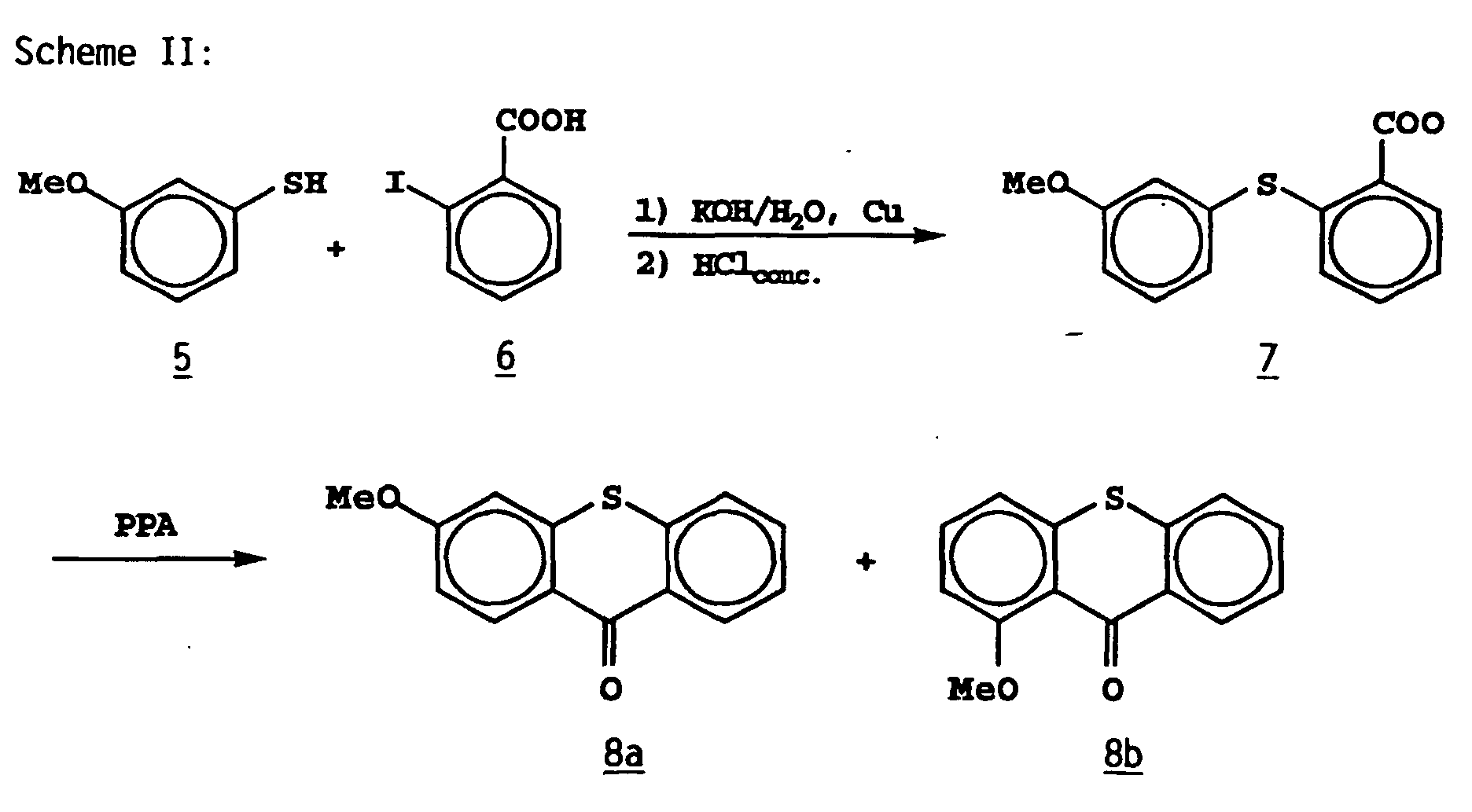
- 3-ethoxythioxanthone One way to synthesize the educt 1 , i.e. 3-ethoxythioxanthone, starts from 3-methoxythioxanthone 8a that may be prepared by a procedure described by I. Cervena, J. Metysova, E. Svatek, B. Kakac, J. Holubek, M. Hrubantova, and M. Protiva, in Coll. Czech. Chem. Comm. 41, 881-904 (1978) (Scheme II). 3-Methoxythiophenol 5 is reacted with 2-iodobenzoic acid 6 in a boiling solution of KOH in the presence of copper. After addition of hydrochloric acid the coupled acid 7 is obtained.
- the acid 7 is cyclized with polyphosphoric acid to produce a mixture of the isomeres 3-methoxythioxanthone 8a and 1-methoxythioxanthone 8b that can be separated by chromatography, preferably column chromatography.
- Other separation technologies may be used on an industrial scale to manufacture and separate the product, including, but not limited to by example Simulated Moving Bed Separations, Capillary Electrophoresis, High Troughput High Pressure Multi or Single Column Separation methods using chiral or non chiral support and separations media. Enzymatic dehydration in combination with any of the aforementioned technologies or enzyme enrichment separation methods used separately or in combination with any above can also be used.
- the separated 3-methoxythioxanthene 8a can be transferred for example to 3-hydroxy thioxanthene 9 by treatment with hydrobromic acid and acetic acid.
- the 3-hydroxy thioxanthene 9 can then be reacted with iodoethane in the presence of a base, preferably K 2 CO 3 , to produce 3-ethoxythioxanthone 1 according to Scheme III:
- the compounds of this invention are human 5-HT 2B receptor antagonists. Affinity for the 5-HT 2B receptors was demonstrated using an in vitro binding assay utilizing cloned human 5-HT 2B receptors radiolabelled with [ 3 H]-5HT, as shown in the examples. Selectivity for the human 5-HT 2B receptor was shown by counter screening at human 5-HT 2A and 5-HT 2C receptors. Antagonist properties for HT 2B were determined in rat stomach fundus longitudinal muscle. Affinity for the human H 1 receptor was determined using an in vitro binding assay utilizing cloned human H 1 receptors radiolabelled with [ 3 H]-mepyramine, as shown in the examples. Antagonist properties were determined by [ 3 H]Inositol phosphate production in transiently transfected HEK-293 cells.
- the compounds of this invention are useful for treating diseases which can be ameliorated by blockade of 5-HT 2B receptors. Because of the similarities in the pharmacology of ligand interactions at 5-HT 2C and 5-HT 2B receptors many of the therapeutic targets that have been proposed for 5-HT 2C receptor antagonists are also targets for 5-HT 2B receptor antagonists. In particular, several clinical observations suggest a therapeutic role for 5-HT 2B receptor antagonists in the prevention of migraine, in that mobilization of 5-HT into the plasma is believed to be a precipitating factor in migraine.
- non-selective 5-HT 2B receptor agonists provoke migraine attacks in susceptible individuals
- non-selective 5-HT 2B receptor antagonists are effective in preventing the onset of migraine (see Kalkman, Life Sciences 1994, 54, 641-644). It is speculated that activation of 5-HT 2B receptors located on endothelial cells of meningeal blood vessels triggers migraine attacks through the formation of nitric oxide (see Schmuck et al., Eur. J. Neurosci. 1996, 8, 959-967).
- 5-HT serotonin
- 5-HT is a mediator of sensitization of nerve terminal nociceptors that may occur in the genesis of pain associated with inflammation.
- the 5-HT 2B receptor is highly sensitive to activation by 5-HT and specific blockade by selective 5-HT 2B antagonists may provide a novel avenue toward analgesia therapy.
- 5-HT 2B receptors play a crucial role in the sensitizing actions of serotonin are suggested by several lines of evidence. Firstly, 5-HT 2B receptors are present in the human intestine (see Borman et al., Brit. J. Pharmacol. 1995, 114, 1525-1527 and Borman et al., Ann. of the New York Acad. of Sciences 1997, 812, 222-223).
- 5-HT 2B receptors activation of 5-HT 2B receptors can result in the production of nitric oxide, an agent capable of sensitizing sensory nerve fibers (see Glusa et al., Naunyn-Schmied. Arch. Pharmacol. 1993, 347, 471-477 and Glusa et al., Brit. J. Pharmacol. 1996, 119, 330-334).
- poorly selective drugs which display high affinity for the 5-HT 2B receptor are clinically effective in reducing the pain associated with IBS and related disorders (see Symon et al., Arch. Disease in Childhood 1995, 72, 48-50 and Tanum et al., Scand. J. Gastroenterol. 1996, 31, 318-325). Together these findings suggest that a selective 5-HT 2B receptor antagonist will attenuate both the gastrointestinal pain and abnormal motility associated with IBS.
- serotonin displays a potent mitogenic activity in cultured smooth muscle and endothelial cells via activation of 5-HT 2 receptors (see Pakala et al., Circulation 1994, 90, 1919-1926).
- this mitogenic activity appears to be mediated via activation of a tyrosine kinase second messenger pathway involving mitogen activated protein kinase (MAPK) (see Lee et al., Am. J. Physiol. 1997, 272(1 pt 1), C223-230 and Kelleher et al., Am. J. Physiol. 1995, 268(6 pt 1), L894-901).
- MAPK mitogen activated protein kinase
- 5-HT 2B receptors couple to MAPK (see Nebigil et al., Proc. Natl. Acad Sci. U.S.A. 2000, 97, 22591-2596), coupled with the high affinity of serotonin for this receptor subtype, indicates that a selective 5-HT 2B receptor antagonist may offer protection against restenosis of autografted blood vessels or of vessels following angioplasty.
- 5-HT 2B receptors are present in bronchial smooth muscle (see Choi et al., Febs Letters 1996, 391, 45-51) and have been shown to stimulate smooth muscle mitogenesis in airways smooth muscle (see Lee et al., Am. J. Physiol. 1994, 266, L46-52). Since elevated concentrations of circulating free serotonin are closely associated with clinical severity and pulmonary function in symptomatic asthmatics, serotonin may play an important role in the pathophysiology of acute attacks (see Lechin et al., Ann. Allergy, Asthma, Immunol. 1996, 77, 245-253).
- 5-HT 2B receptor antagonists in treating prostatic hyperplasia. Obstruction of the urinary tract can occur as a result of prostatic hyperplasia and excessive prostatic constriction of the urethra. This in turn leads to diminished urinary flow rates and an increased urgency and frequency of urination.
- 5-HT 2B receptors are present in the human prostrate (see Kursar et al., Mol. Pharmacol. 1994, 46, 227-234) and a receptor with the pharmacological attributes of this receptor subtype mediates contraction of the tissue (see Killam et al., Eur. J. Pharmacol. 1995, 273, 7-14).
- 5-HT 2B receptors mediate smooth muscle and fibrotic hyperplasia (see Launay et al., J. Biol. Chem. 1996, 271, 3141-3147) and serotonin is mitogenic in the prostate (see Cockett et al., Urology 1993, 43, 512-519), therefore a selective 5-HT 2B receptor antagonist may have utility not only in mitigating the excessive prostatic constriction, but also in preventing progression of tissue hyperplasia.
- This therapeutic target for 5-HT 2C receptor antagonists is equally a target for 5-HT 2B receptor antagonists.
- administration of the active compound and salts described herein can be via any of the accepted modes of administration, including oral, parenteral and otherwise systemic route of administration.
- Any pharmaceutically acceptable mode of administration can be used, including solid, semi-solid or liquid dosage forms, such as, for example, tablets, suppositories, pills, capsules, powders, liquids, suspensions, or the like, preferably in unit dosage forms suitable for single administration of precise dosages, or in sustained or controlled release dosage forms for the prolonged administration of the compound at a predetermined rate.
- the compositions will typically include a conventional pharmaceutical carrier or excipient and at least one of the compounds of the present invention or the pharmaceutically acceptable salts thereof and, in addition, may include other medicinal agents, pharmaceutical agents, carriers, adjuvants, etc.
- an effective dose for oral, parenteral and otherwise systemic routes of administration is in the range of 0.01-20 mg/kg/day, preferably 0.1-10 mg/kg/day. For an average 70 kg human, this would amount to 0.7-1400 mg per day, or preferably 7-700 mg/day.
- conventional non-toxic solid carriers include, for example, pharmaceutical grades of mannitol, lactose, cellulose, cellulose derivatives, sodium crosscarmellose, starch, magnesium stearate, sodium saccharin, talcum, glucose, sucrose, magnesium carbonate, and the like may be used.
- the active compound as defined above may be formulated as suppositories using, for example, polyalkylene glycols, e.g PEG (polyethyleneglycol) or PEG derivatives , acetylated triglycerides and the like, as the carrier.
- Liquid pharmaceutically administrable compositions can, for example, be prepared by dissolving, dispersing, etc.
- compositions to be administered may also contain minor amounts of nontoxic auxiliary substances such as wetting or emulsifying agents, pH buffering agents and the like, for example, sodium acetate, sorbitan monolaurate, triethanolamine sodium acetate, sorbitan monolaurate, triethanolamine oleate, etc.
- auxiliary substances such as wetting or emulsifying agents, pH buffering agents and the like, for example, sodium acetate, sorbitan monolaurate, triethanolamine sodium acetate, sorbitan monolaurate, triethanolamine oleate, etc.
- the composition or formulation to be administered will, in any event, contain a quantity of the active compound(s) in an amount effective to alleviate the symptoms of the subject being treated.
- Dosage forms or compositions containing one of the present piperidine compounds in the range of 0.25 to 95% by weight with the balance made up from non-toxic carrier may be prepared.
- a pharmaceutically acceptable non-toxic composition is formed by the incorporation of any of the normally employed excipients, such as, for example pharmaceutical grades of mannitol, lactose, cellulose, cellulose derivatives, sodium crosscarmellose, starch, magnesium stearate, sodium saccharin, talcum, glucose, sucrose, magnesium, carbonate, and the like.
- excipients such as, for example pharmaceutical grades of mannitol, lactose, cellulose, cellulose derivatives, sodium crosscarmellose, starch, magnesium stearate, sodium saccharin, talcum, glucose, sucrose, magnesium, carbonate, and the like.
- Such compositions take the form of solutions, suspensions, tablets, pills, capsules, powders, sustained release formulations and the like.
- Such compositions may contain 1 to 95 % by weight of one of the compounds of the present invention, more preferably 2 to 50 % by weight, most preferably 5 to 8 % by weight.
- Parenteral administration is generally characterized by injection, either subcutaneously, intramuscularly or intravenously.
- Injectables can be prepared in conventional forms, either as liquid solutions or suspensions, solid forms suitable for solution or suspension in liquid prior to injection, or as emulsions.
- Suitable excipients are, for example, water, saline, dextrose, glycerol, ethanol or the like.
- the pharmaceutical compositions to be administered may also contain minor amounts of non-toxic auxiliary substances such as wetting or emulsifying agents, pH buffering agents and the like, such as for example, sodium acetate, sorbitan monolaurate, triethanolamine oleate, triethanolamine sodium acetate, etc.
- Transdermal or "pulsed" transdermal administration may be supported by cremes, gels, dispersions and the like.
- a more recently devised approach for parenteral administration employs the implantation of a slow-release or sustained-release system, such that a constant level of dosage is maintained (see, e.g., US-A-3,710,795).
- the percentage of active compounds contained in such parental compositions is highly dependent on the specific nature thereof, as well as the activity of the compound and the needs of the subject. However, percentages of one of the inventive piperidine compounds of 0.1 to 10 % by weight in solution are employable, and will be higher if the composition is a solid which will be subsequently diluted to the above percentages. Preferably the composition will comprise 0.2 to 2 % by weight of one of the piperidine compounds in solution.
- administration may be achieved by any pharmaceutically acceptable mode of administration which provides adequate local concentrations to provide the desired response.
- pharmaceutically acceptable modes of administration include direct administration to the eye via drops and controlled release inserts or implants, as well as systemic administration as previously described.
- Drops and solutions applied directly to the eye are typically sterilized aqueous solutions containing 0.1 to 10 % by weight, most preferably 0.5 to 1 % by weight of one of the novel piperidine compounds, along with suitable buffer, stabilizer, and preservative.
- the total concentration of solutes should be such that, if possible, the resulting solution is isotonic with the lacrimal fluid (though this is not absolutely necessary) and has an equivalent pH in the range of pH 6-8.
- Typical preservatives are phenyl mercuric acetate, thimerosal, chlorobutanol, and benzalkonium chloride.
- Typical buffer systems and salts are based on, for example, citrate, borate or phosphate; suitable stabilizers include glycerin and polysorbate 80.
- the aqueous solutions are formulated simply by dissolving the solutes in a suitable quantity of water, adjusting the pH to about 6.8-8.0, making a final volume adjustment with additional water, and sterilizing the preparation using methods known to those in the art.
- the dosage level of the resulting composition will, of course, depend on the concentration of the drops, the condition of the subject and the individual magnitude of responses to treatment. However, a typical ocular composition could be administered at the rate of about 2-10 drops per day per eye of a 0.5 % by weight solution of one of the piperidine compounds.
- compositions of the present invention may also be formulated for administration in any convenient way by analogy with other topical compositions adapted for use in mammals. These compositions may be presented for use in any conventional manner with the aid of any of a wide variety of pharmaceutical carriers or vehicles.
- a pharmaceutically acceptable non-toxic formulation can take the form of semisolid, liquid, or solid, such as, for example, gels, creams, lotions, solutions, suspensions, ointments, powders, or the like.
- the active component may be formulated into a syrup orgel using ethanol, propylene glycol, propylene carbonate, polyethylene glycols, diisopropyl adipate, glycerol, water, etc., with appropriate gelling agents, such as Carbomers, Klucels, etc.
- the formulation may also contain minor amounts of non-toxic auxiliary substances such as preservatives, antioxidants, pH buffering agents, surface active agents, and the like.
- Actual methods of preparing such dosage forms are known, or will be apparent, to those skilled in the art; for example, see Remington's Pharmaceutical Sciences, Mack Publishing Company, Easton, Pa., 19th Edition, 1995.
- the pharmaceutical composition is administered in a single unit dosage form for continuous treatment or in a single unit dosage form ad libitum when relief of symptoms is specifically required.
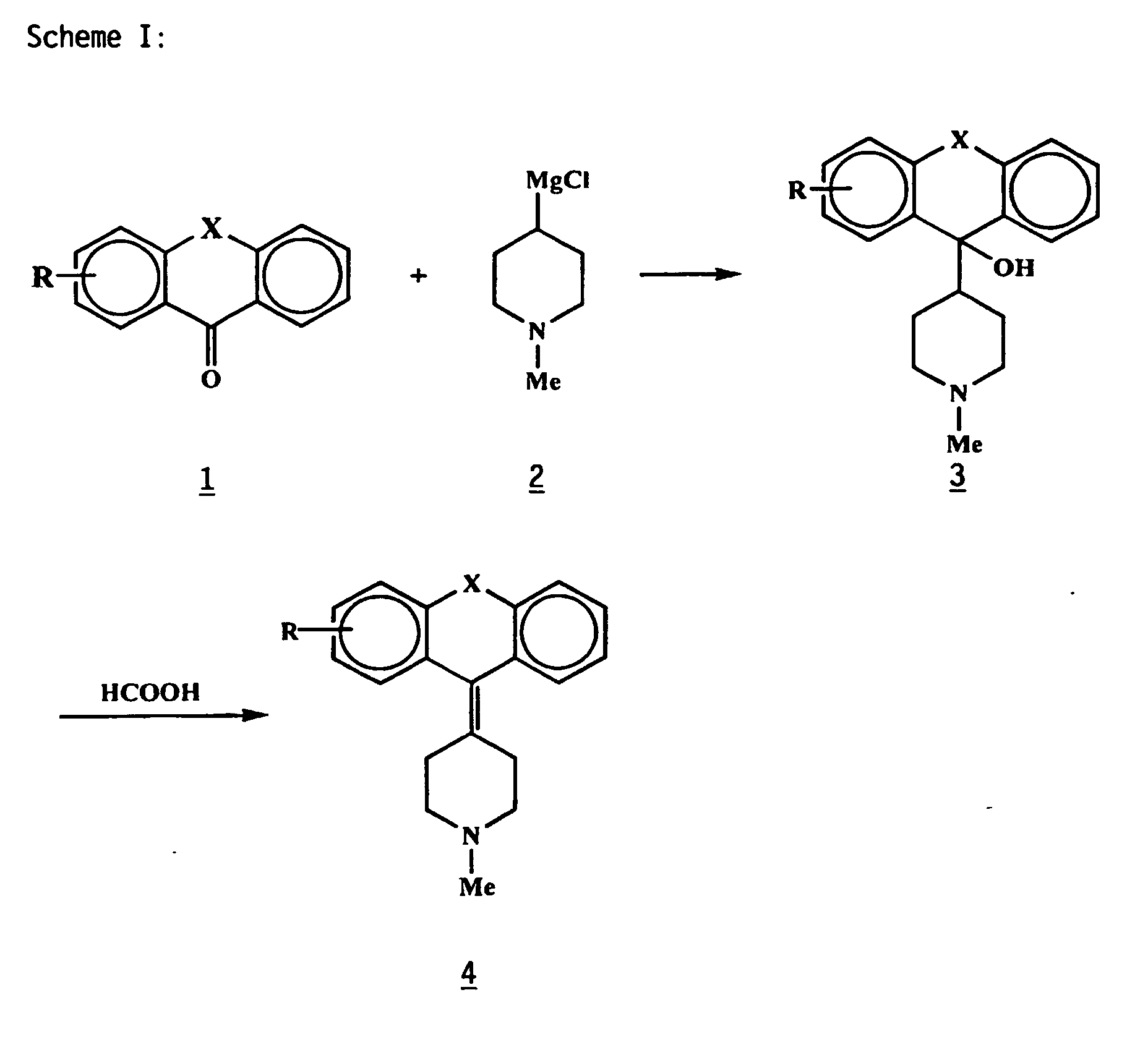
- 6-Ethoxy-1-methoxythioxanthone 1 is reacted with the Grignard reagent 2 prepared from 1-methyl-4-halopiperidine, preferably 1-methyl-4-chloropiperidine, according to Scheme I.
- the alcohol 3 is isolated and dehydrated with an acid, preferably hydrochloric acid or formic acid to produce 1-methyl-4-(3-ethoxy-9H-thioxanthene-9-ylidene)-piperidine ( 4 ).
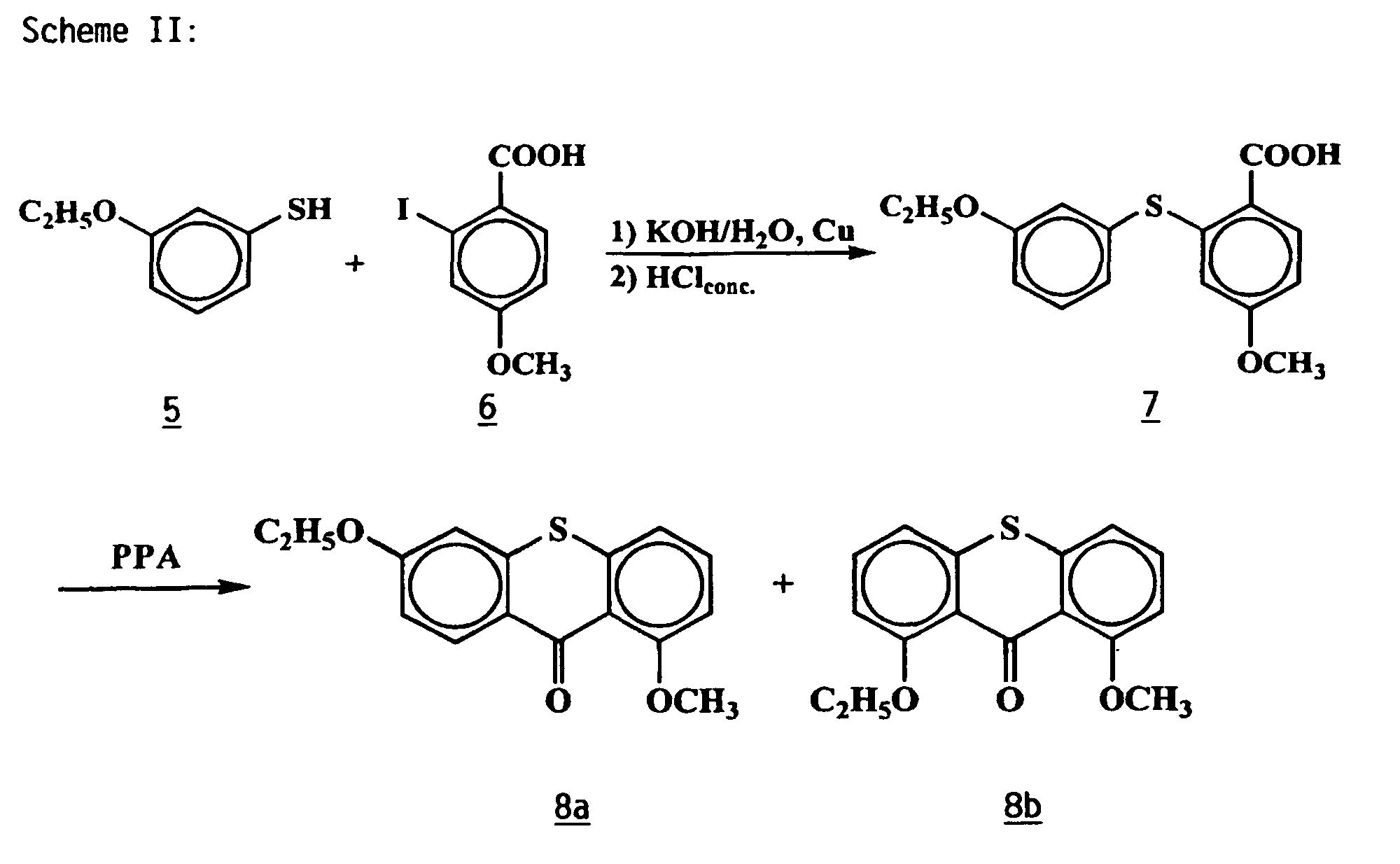
- the acid 7 is cyclized with polyphosphoric acid to produce a mixture of the isomeres 1-methoxy-6-ethoxythioxanthone 8a and 1-methoxy-8-ethoxythioxanthone 8b that can be separated by chromatography, preferably column chromatography.
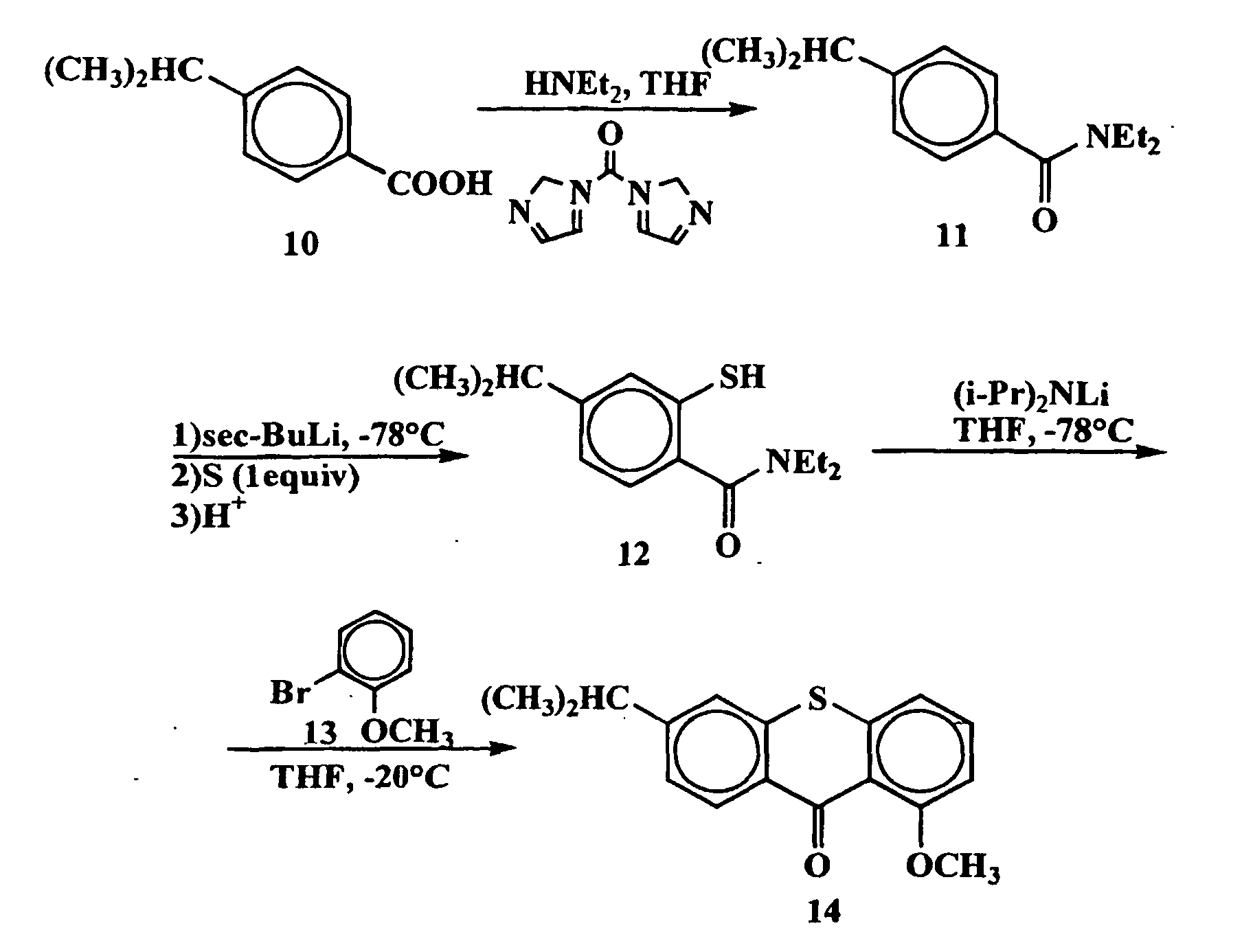
- a second procedure to produce the "top" ketone is based on the method of M. Watanabe et al., Chem. Pharm Bull. 37, 36-41 (1989). Starting from 4-isopropylbenzoicacid 10, this is converted to the amide 11 which is treated with strong base to extract the proton adjacent to the amide group and, after the introduction of molecular sulfur and treatment with acid, the thiol group is introduced as in 12. Treatment of the bromoanisole 13 with strong base converts it to a benzyne that reacts with 12 to produce the desired ketone 14.
- the crude product is dissolved in acetic acid (100 ml). Water (100 ml) and zinc (5 g) is added and the mixture is stirred with a magnetic stirrer and heated at 65°C for 24 h. The solution is extracted with methylene chloride (1 x 100 ml). The organic layer is separated and washed with water (3 x 100 ml). The solvent is then removed. The crude product is purified with an ISCO-flash system using methylene chloride and methanol (gradient). Purity 75 % Yield 3.5 g, 70 %
- the crude product is dissolved in acetic acid (50 ml). Water (50 ml) and zinc (2.5 g) is added and the mixture is stirred with an magnetic stirrer and heated at 65°C for 24 h. The solution is extracted with methylene chloride (1 x 100 ml). The organic layer is separated and washed with water (3 x 100 ml) and brine (1 x 100 ml). The solution is dried with Na 2 SO 4 and then filtered off. The solvent is then removed. The crude product is purified with an ISCO-flash system using methylene chloride and methanol (gradient). Purity 76 % Yield 950 mg, 38 %
- the crude product is dissolved in acetic acid (50 ml). Water (25 ml) and zinc (2.5 g) is added and the mixture is stirred with a magnetic stirrer and heated at 65°C for 24 h. The solution is extracted with methylene chloride (1 x 100 ml). The organic layer is separated and washed with water (3 x 100 ml) and brine (1 x 100 ml). The solution is dried with Na 2 SO 4 and then filtered off. The solvent is then removed. The purity of the crude product was high so no further purification was necessary. Purity 93 % Yield 1.05 g, 58 %
- the synthesis is done according to step 2.1.6, using 2-ethylbromobenzene instead of 2-methoxybromobenzene.
- step 2.1.6 The synthesis is done according to step 2.1.6, using 4-Isopropyl-2-thiobenzoicacid-diethylamide (0.9 g, 6.32 mmol) as educt.
- step 2.1.6 ° using the diselenide obtained from step 2.1.5 (1.0 g, 4.3 mmol selenide) as educt and bromobenzene (1.146 ml, 10.9 mmol) as reactant.
- 4-Chlor-1-methylpiperidine*HCl (20 g) is converted into its free amine by dissolving it in 25 % NH 3 /H 2 O-solution (250 ml), followed by extraction with ether. The organic layer is washed twice with brine, dried with Na 2 SO 4 and evaporated. The pure amine is kept under argon.
- the solution must be kept under argon.
- 6-Ethoxy-1-methoxy-thioxanthene-9-one (100 mg, 0.349 mmol) is dissolved in dry THF (5 ml).
- 1-Methyl-piperidine-4-yl-magnesium chloride (3 eq, from step 2.2.1) is added drop wise. After completion of the addition of the Grignard reagent, the solution is allowed to stir over night. Control of the reaction is done by TCL (1 % methanol/CH 2 Cl 2 ). After the reaction is complete, the reaction is quenched first with acetic acid (5 ml), then with water (5 ml). The solvents are evaporated and the resulting carbinol is dehydrated with acetic anhydride (5 ml, reflux, 4 h).
- the crude product is purified with flash chromatography and then transferred into its hydrochloride by heating it in aqueous HCl (50 eq HCl , 5 ml, 4 h, 50°C). The solvent is evaporated and the product dissolved in a mixture of tert. butyl alcohol and water (2 ml, 4:1, v/v) and lyophylized. Purity 92 % Yield 20 mg, 16 %
- 6-Isopropyl-1-methoxy-thioxanthene-9-one (100 mg, 0.35 mmol) is dissolved in dry THF (5 ml).
- 1-Methyl-piperidine-4-yl-magnesium chloride (3 eq, from step 2.2.1) is added drop wise.
- the solution is allowed to stir over night. Control of the reaction is done by TLC (1 % methanol/CH 2 Cl 2 ). After the reaction is complete, the reaction is quenched first with acetic acid (5 ml), then with water (5 ml). The solvents are evaporated and the resulting carbinol is dehydrated with acetic anhydride (reflux, 4 h).
- the crude product is purified with flash chromatography and then transferred into its hydrochloride by heating it in aqueous HCl (50 eq HCl, 5 ml, 4 h, 50°C). The solvent is evaporated and the product dissolved in a mixture of tert. butyl alcohol and water (2 ml, 4:1, v/v) and lyophylized. Purity >98 % Yield 25 mg, 20 %
- 6-Ethoxy-1-ethyl-thioxanthene-9-one (50 mg, 0.18 mmol) is dissolved in dry THF (5 ml).
- 1-Methyl-piperidine-4-yl-magnesium chloride (3 eq, from step 2.2.1) is added drop wise. After the first drop, the solution changed its color from light yellow to dark brown. After completion of the addition of the Grignard reagent, the solution is allowed to stir over night. Control of the reaction is done by TCL (1 % methanol/CH 2 Cl 2 ). After the reaction is complete, the reaction is quenched first with acetic acid (5 ml), then with water (5 ml). The solvents are evaporated and the resulting carbinol is dehydrated with acetic anhydride (reflux, 4 h).
- the crude product is purified with flash chromatography and then transferred into its hydrochloride by heating it in aqueous HCl (50 eq HCl, 5 ml, 4 h, 50°C). The solvent is evaporated and the product dissolved in a mixture of tert. butyl alcohol and water (2 ml, 4:1, v/v) and lyophylized. Purity >97 % Yield 10.8 mg, 16 %
- the crude product is purified with flash chromatography and then transferred into its hydrochloride by heating it in aqueous HCl (50 eq HCl, 5 ml, 4 h, 50°C). The solvent is evaporated and the product dissolved in a mixture of tert. butyl alcohol and water (2 ml, 4:1, v/v) and lyophylized. Purity >97 % Yield 28 mg, 46 %
- m-Phenetidine (5 ml, 38.7 mmol) is added to a solution of KOH (7.385 g, 131,6 mmol), water (77 ml) and 2-iodobenzoic acid (9.6 g, 38,7 mmol). Powdered copper (77 mg. 1.22 ⁇ mol) is added and the mixture is refluxed under stirring over night (16 h).
- the crude product is purified with flash chromatography and then transferred into its hydrochloride by heating it in aqueous HCl (50 eq HCl, 5 ml, 4 h, 50°C). The solvent is evaporated and the product dissolved in a mixture of tert. butyl alcohol and water (2 ml, 4:1, v/v) and lyophylized. Purity 99 % Yield 22 mg, 32 %
- HEK 293 cells transiently transfected with an expression plasmid pXMD1-hu2B encoding the human 5-HT2B receptor were used as described previously (Schmuck et al., Eur. J. Pharmacol., 1996, 8, 959-967). Two days after transfection cells were harvested, pelleted at 500g for 5 min at 4°C, gently resuspended in ice-cold buffer1 (50 mM TRIS pH 7.7, 4 mM CaCl 2 ) and homogenized using a Polytron PT 1200 tissue homogenizer (position 6 for 30 s).
- the following describes receptor binding methods in which ligands with high affinity for 5-HT 2B receptors were counter screened at 5-HT 2A and 5-HT 2C receptors to demonstrate selectivity.
- 5-HT 2A receptors were labelled with [ 3 H]ketanserin in human cortex, in HEK293 cells expressing a cloned human 5-HT 2A receptor and in HEK293 cells expressing the rat 5-HT 2A receptor.
- concentrations of radioligand ranged from 0.01 nM to 2.0 nM.
- Assays were conducted in 0.5 ml of assay buffer (50 mM Tris-HCl, 4 mM calcium chloride, 0.1 % by weight ascorbic acid) (pH 7.4 at 4°C). Non-specifc binding was defined with 10 mM unlabelled ketanserin. After a 60 min incubation at 32°C, membranes were harvested onto filters treated with 0.1 % by weight of polyethylenimine and the bound radioactivity was determined.
- Radioligand was [ 3 H]-5HT and that the assay buffer contained pargyline in a concentration of 10 mM and 0.1 % by weight of ascorbic acid.
- concentration of [ 3 H]-5HT ranged from 0.05 to 8 nM.
- Non-specific binding was defined with 10 mM 5-HT. Incubations were for 120 min at 4°C.
- 5-HT 2C receptors were labelled in choroid plexus, Cos-7 cells expressing the human 5-HT 2C receptor and in NIH-3T3 expressing the rat 5-HT 2A receptor.
- Radioligand was [ 3 H]mesulergine.
- the radioligand concentration for competition studies was approximately 0.2 nM while for saturation binding studies the concentration ranged from 0.1 to 18 nM.
- Non-specific binding was defined with 10 ⁇ M unlabelled mesulergine.
- Strips of longitudinal muscle were obtained from the stomach fundus of male Sprague Dawley rats. The mucosa was removed and the strips were suspended with a resting tension of 1 g in oxygenated (95% O 2 /5% CO 2 ) Tyrode solution at 37°C.
- the composition of the Tyrode solution was as follows (mM): NaCl 136.9; KCl 2.7; NaH 2 PO 4 0.4; MgCl 2 1.0; glucose 5.6; NaHCO 3 11.9; CaCl 2 1.8.
- Concentration-response curves to 5-HT receptor agonists were constructed under conditions where cyclooxygenase activities were inactivated by 3 ⁇ m indomethacin, monoamine oxidase activities inactivated by 0.1 mM pargyline, and uptake mechanisms inactivated by 30 ⁇ M cocaine and 30 ⁇ M corticosterone.
- the compounds of the present invention were found to be selective antagonists at the 5-HT 2B receptor.
- COS-7 cells were transiently transfected with an expression plasmid pCineohH1, pCineohH2, pCineohH3 and pCineohH4 encoding the human Histamine H 1 , H 2. H 3 or H 4 receptor, respectively.
- Transfected cells were harvested after 48 h, homogenized in ice-cold 50 mM Na 2 /potassium phosphate buffer (pH 7.4) and used for radioligand binding studies.
- cell homogenated were incubated either with 1 nM [ 3 H]-mepyramine, 15 nM [ 3 H]-thiotidine, 0.5 nM [ 3 H]-R- ⁇ -Methylhistamine, or 15 nM [ 3 H]-pyramilamine and increasing concentrations of competing ligands.
- the incubations were stopped by rapid dilution with 3 ml of ice-cold 50 mM Na 2 /potassium phosphate buffer (pH 7.4).
- the bound radioactivity was seperated by filatration through Whatman GF/C filters that had been treated with 0.3 % polyethyleneimine.
- transiently transfected HEK-293 cells were seeded in 24 well plates and labeled to equilibrium with myo -[2- 3 H]-inositol (3 ⁇ Ci/ml) for an additional 24 hours in growth medium.
- the medium was aspirated and cells were washed once with 500 ⁇ l HBS-buffer (130 mM NaCl, 900 ⁇ M NaH 2 PO 4 , 800 ⁇ M MgSO 4 , 5.4 mM KCl, 1.8 mM CaCl 2 , 25 mM Glucose in 20 mM HEPES pH 7.4).
Landscapes
- Health & Medical Sciences (AREA)
- Chemical & Material Sciences (AREA)
- Organic Chemistry (AREA)
- General Health & Medical Sciences (AREA)
- Veterinary Medicine (AREA)
- Public Health (AREA)
- Chemical Kinetics & Catalysis (AREA)
- General Chemical & Material Sciences (AREA)
- Medicinal Chemistry (AREA)
- Nuclear Medicine, Radiotherapy & Molecular Imaging (AREA)
- Bioinformatics & Cheminformatics (AREA)
- Pharmacology & Pharmacy (AREA)
- Life Sciences & Earth Sciences (AREA)
- Animal Behavior & Ethology (AREA)
- Engineering & Computer Science (AREA)
- Pulmonology (AREA)
- Neurology (AREA)
- Biomedical Technology (AREA)
- Cardiology (AREA)
- Neurosurgery (AREA)
- Heart & Thoracic Surgery (AREA)
- Pain & Pain Management (AREA)
- Urology & Nephrology (AREA)
- Endocrinology (AREA)
- Reproductive Health (AREA)
- Pharmaceuticals Containing Other Organic And Inorganic Compounds (AREA)
- Hydrogenated Pyridines (AREA)
- Plural Heterocyclic Compounds (AREA)
- Nitrogen Condensed Heterocyclic Rings (AREA)
Abstract
Description



| Purity | 98 % |
| Yield | 25 g. 94 % |
| Purity | 96 % |
| Yield | 6,0 g, 90 % |
| Purity | 75 % |
| Yield | 3.5 g, 70 % |
| Purity | 76 % |
| Yield | 950 mg, 38 % |
| Purity | 93 % |
| Yield | 1.05 g, 58 % |
| Purity (HPLC, 214 nm) | 84,4 % |
| Yield | 0.5 g (25 %) |
To magnesium pellets (0.434 g, 16.5 mmol) and dry THF (1.4 ml), one crystal of iodine and ethyl iodide (60,4 µl, 0,75 µmol) are added. As soon as the Grignard reaction starts, the amine solution is added drop wise to the solution. The solution is slightly stirred and sometimes heated with a heat-gun to keep the THF boiling. After the amine solution is added, the reaction solution is refluxed for 2 h to finish the reaction.
| Purity | 92 % |
| Yield | 20 mg, 16 % |
| Purity | >98 % |
| Yield | 25 mg, 20 % |
| Purity | >97 % |
| Yield | 10.8 mg, 16 % |
| Purity | >97 % |
| Yield | 28 mg, 46 % |
| Purity | 95 % |
| Yield | 3.0 g, 30 % |
| Purity | >95 % |
| Yield | 200 mg, 14 % |
| Purity | 99 % |
| Yield | 22 mg, 32 % |
The concentration of 1-methyl-4-(3-ethoxy-9H-thioxanthene-9-ylidene)-piperidine producing 50% inhibition of binding (IC50) was determined using iterative curve fitting techniques.
| Receptor Affinity: pK Values of the compounds | ||||
| Compound | 5-HT2A receptor | 5HT2B receptor | H1 receptor | 5NT2C receptor |
| 4-(6-Ethoxy-1-methoxy-thioxanthen-9-yliden)-1-methyl-piperidine | 8,99 | 10,35 | 8,43 | 7,77 |
| 4-(6-Ethoxy-1-hydroxy-thioxanthen-9-yliden)-1-methyl-piperidine | 8,82 | 10,94 | 7,44 | 7,86 |
| 4-(6-Isopropyl-1-methoxy-thioxanthen-9-yliden)-1-methyl-piperidine | 9,13 | 9,77 | 7,98 | 7,79 |
| 4-(6-Isopropyl-1-hydroxy-thioxanthen-9-yliden)-1-methyl-piperidine | 9,11 | 9,92 | 7,45 | 7,52 |
| 3-Ethoxy-9-(1-methyl-piperidine-4-ylidene)-9,10-dihydro-acridine | 8,93 | 9,13 | 7,53 | 7,43 |
| 4-(6-Methoxy-1-methoxy-thioxanthen-9-yliden)-1-methyl-piperidine | 10,37 | 11,06 | 9,89 | 8,81 |
Claims (12)
- Compound according to the Formulawherein R1 is ethyl, propyl, isopropyl, butyl, isobutyl, pentyl (straight or branched), hexyl (straight or branched), ethoxy, propoxy, isopropoxy, butoxy, isobutoxy, phenoxy, trifluoromethyl, trifluoromethoxy, amino, dimethylamino, -CON(CH3)2 or -CON(C2H5)2, R2 is methyl, ethyl, propyl, isopropyl, butyl, isobutyl, pentyl, hexyl, hydroxy or hydrogen, or R1 and R2 are forming a heterocycle. R3 is methyl, ethyl, propyl, isopropyl, butyl isobutyl, pentyl, hexyl, hydroxy or hydrogen, R4 is hydroxy, methoxy, ethoxy, propoxy, isopropoxy, butoxy, isobutoxy, trifluormethyl, amino, dimethylamino, diethylamino, fluorine, chlorine or bromine, methyl, ethyl, propyl, isopropyl, butyl or hydrogen. R5 is methyl or hydrogen. R6 is methyl or ethyl and X is S, N or Se, or a pharmaceutically acceptable salt thereof, with the proviso that if R1 is ethoxy and X is S at least one of R2. R3. R4 and R5 is not hydrogen.

- Compound according to the Formulawherein R1 is methyl, ethyl, propyl, isopropyl, butyl, isobutyl, pentyl (straight or branched), hexyl (straight or branched), methoxy, ethoxy, propoxy, isopropoxy, butoxy, isobutoxy, phenoxy, trifluoromethyl, trifluoromethoxy, amino, dimethylamino, bromine, -CON(CH3)2 or -CON(C2H5)2, R2 is methyl, ethyl, propyl, isopropyl, butyl, isobutyl, pentyl, hexyl, hydroxy or hydrogen, or R1 and R2 are forming a heterocycle. R3 is methyl, ethyl, propyl, isopropyl, butyl isobutyl, pentyl, hexyl, hydroxy or hydrogen, R4 is hydroxy, methoxy, ethoxy, propoxy, isopropoxy, butoxy, isobutoxy, trifluormethyl, amino, dimethylamino, diethylamino, fluorine, chlorine or bromine, methyl, ethyl, propyl, isopropyl, butyl or hydrogen, R5 is methyl or hydrogen, R6 is methyl or ethyl and X is S, N or Se, or a pharmaceutically acceptable salt thereof, with the proviso that if R1 is ethoxy and X is S at least one of R2, R3. R4 and R5 is not hydrogen for use as a medicament.
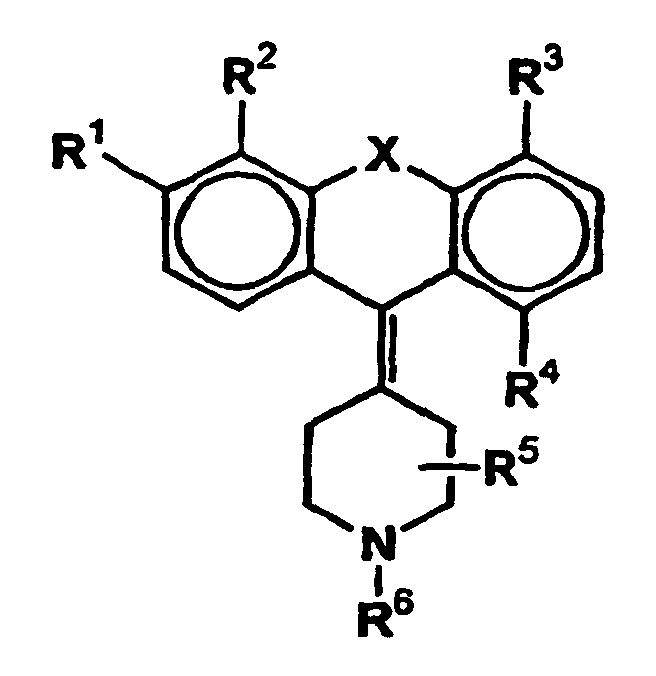
- Use of a compound according to claim 2 for the manufacture of a medicament for treatment of a disease state which can be alleviated by treatment with a 5-HT2B antagonist.
- The use of claim 3 wherein the disease state is selected from the diseases migraine, hypertension, disorders of the gastrointestinal tract, restenosis, asthma, obstructive airway disease, bronchial pulmonary dysplasia, prostatic hyperplasia and priapism.
- The use of claim 3 or 4 wherein the disease state comprises pain.
- The use of claim 5 wherein the disease state comprises inflammatory pain, neuropathic pain, cancer pain, acute pain or chronic pain.
- The use of claim 4 wherein the disease state comprises allergic asthma, irritable bowel syndrome, hypertonic lower esophageal sphinter, motility disorders or benign prostatic hyperplasia.
- A pharmaceutical composition comprising a compound according to claim 1 or 2 or a pharmaceutically acceptable salt thereof, in admixture with one or more pharmaceutically acceptable carriers.
- Compound according to claim 1 or 2, use according to any of claims 3 to 7 or composition according to claim 8, whereby in the general formula R1 is an isopropyl, dimethylamino, methoxy or ethoxy group, R2 is ethyl or hydrogen, or R1 and R2 are forming a heterocycle, R3 is ethyl or hydrogen, R4 is methoxy, hydroxy, ethyl, methyl or hydrogen, R5 is methyl or hydrogen, R6 is methyl and X is S. N or Se, or a pharmaceutically acceptable salt thereof, with the proviso that if R1 is ethoxy and X is S at least one of R2. R3, R4 and R5 is not hydrogen.
- Use or composition according to claim 9, whereby the compound is selected from the group of 4-(6-Isopropyl-1-methoxy-thioxanthen-9-yliden)-1-methyl-piperidine, 4-(6-Isopropyl-1-hydroxy-thioxanthen-9-yliden)-1-methyl-piperidine, 4-(6-Ethoxy-1-ethyl-thioxanthen-9-yliden)-1-methyl-piperidine, 4-(6-Ethoxy-1-methoxy-thioxanthen-9-yliden)-1-methyl-piperidine, 4-(6-Ethoxy-1-hydroxy-thioxanthen-9-yliden)-1-methyl-piperidine, 4-(6-Methoxy-1-methoxy-thioxanthen-9-yliden)-1-methyl-piperidine, 4-(6-Dimethylamino-1-methoxy-thioxanthen-9-yliden)-1-methyl-piperidine, 4-(6-Dimethylamino-1-hydroxy-thioxanthen-9-yliden)-1-methyl-piperidine, 4-(3-Ethoxy-selenoxanthen-9-yliden)-1-methyl-piperidine, 4-(3-Ethoxy-1-methoxy-selenoxanthen-9-yliden)-1-methyl-piperidine, 4-(3-Ethoxy-1-hydroxy-selenoxanthen-9-yliden)-1-methyl-piperidine, 3-Ethoxy-9-(1-methyl-piperidine-4-ylidene)-9,10-dihydro-acridine, 6-Ethoxy-1-methoxy-9-(1-methyl-piperidine-4-ylidene)-9,10-dihydro-acridine, 6-Ethoxy-1-hydroxy-9-(1-methyl-piperidine-4-ylidene)-9,10-dihydro-acridine, 4-(3-Ethoxy-5-ethyl-thioxanthen-9-yliden)-1-methyl-piperidine. 4-(3-Ethoxy-4-methyl-thioxanthen-9-yliden)-1-methyl-piperidine, 4-(3-Ethoxy-4-ethyl-thioxanthen-9-yliden)-1-methyl-piperidine, 4-(3-Ethoxy-thioxanthen-9-yliden)-1,3-dimethyl-piperidine, 4-(3,4-(Cyclopent-3'-oxy-1'-eno)-thioxanthen-9-yliden)-1-methyl-piperidine, 4-(3,4-(Cyclopent-4'-oxy-1'-eno)-thioxanthen-9-yliden)-1-methyl-piperidine and 4-(3,4-(Cyclopent-5'-oxy-1'-eno)-thioxanthen-9-yliden)-1-methyl-piperidine.
- Compound according to claim 9, whereby the compound is selected from the group of 4-(6-Isopropyl-1-methoxy-thioxanthen-9-yliden)-1-methyl-piperidine, 4-(6-Ethoxy-1-ethyl-thioxanthen-9-yliden)-1-methyl-piperidine, 4-(6-Ethoxy-1-methoxy-thioxanthen-9-yliden)-1-methyl-piperidine, 4-(6-Methoxy-1-methoxy-thioxanthen-9-yliden)-1-methyl-piperidine, 4-(6-Dimethylamino-1-methoxy-thioxanthen-9-yliden)-1-methyl-piperidine, 4-(6-Dimethylamino-1-hydroxy-thioxanthen-9-yliden)-1-methyl-piperidine, 4-(3-Ethoxy-selenoxanthen-9-yliden)-1-methyl-piperidine, 4-(3-Ethoxy-1-methoxy-selenoxanthen-9-yliden)-1-methyl-piperidine. 4-(3-Ethoxy-1-hydroxy-selenoxanthen-9-yliden)-1-methyl-piperidine, 3-Ethoxy-9-(1-methyl-piperidine-4-ylidene)-9,10-dihydro-acridine, 6-Ethoxy-1-methoxy-9-(1-methyl-piperidine-4-ylidene)-9,10-dihydro-acridine, 6-Ethoxy-1-hydroxy-9-(1-methyl-piperidine-4-ylidene)-9,10-dihydro-acridine, 4-(3-Ethoxy-5-ethyl-thioxanthen-9-yliden)-1-methyl-piperidine, 4-(3-Ethoxy-4-methyl-thioxanthen-9-yliden)-1-methyl-piperidine, 4-(3-Ethoxy-4-ethyl-thioxanthen-9-yliden)-1-methyl-piperidine, 4-(3-Ethoxy-thioxanthen-9-yliden)-1,3-dimethyl-piperidine, 4-(3,4-(Cyclopent-3'-oxy-1'-eno)-thioxanthen-9-yliden)-1-methyl-piperidine. 4-(3,4-(Cyclopent-4'-oxy-1'-eno)-thioxanthen-9-yliden)-1-methyl-piperidine and 4-(3,4-(Cyclopent-5'-oxy-1'-eno)-thioxanthen-9-yliden)-1-methyl-piperidine.
- Method for the preparation of a compound according to claim 1 or as defined in claims 2, 9 or 11, comprising a Grignard reaction.
Priority Applications (1)
| Application Number | Priority Date | Filing Date | Title |
|---|---|---|---|
| EP02785280A EP1438307B1 (en) | 2001-10-25 | 2002-10-23 | Derivatives of 4-(thio- or selenoxanthene-9-ylidene)-piperidine or acridine and its use as a selective 5-ht2b receptor antagonist |
Applications Claiming Priority (4)
| Application Number | Priority Date | Filing Date | Title |
|---|---|---|---|
| EP01125527 | 2001-10-25 | ||
| EP01125527A EP1306376A1 (en) | 2001-10-25 | 2001-10-25 | Derivatives of 4-(thio- or selenoxanthene-9-ylidene)-piperidine or acridine and its use as a selective 5-HT2B receptor antagonist |
| EP02785280A EP1438307B1 (en) | 2001-10-25 | 2002-10-23 | Derivatives of 4-(thio- or selenoxanthene-9-ylidene)-piperidine or acridine and its use as a selective 5-ht2b receptor antagonist |
| PCT/EP2002/011817 WO2003035646A2 (en) | 2001-10-25 | 2002-10-23 | Derivatives of 4-(thio- or selenoxanthene-9-ylidene)-piperidine or acridine and its use as a selective 5-ht2b receptor antagonist |
Publications (2)
| Publication Number | Publication Date |
|---|---|
| EP1438307A2 EP1438307A2 (en) | 2004-07-21 |
| EP1438307B1 true EP1438307B1 (en) | 2005-08-03 |
Family
ID=8179078
Family Applications (2)
| Application Number | Title | Priority Date | Filing Date |
|---|---|---|---|
| EP01125527A Withdrawn EP1306376A1 (en) | 2001-10-25 | 2001-10-25 | Derivatives of 4-(thio- or selenoxanthene-9-ylidene)-piperidine or acridine and its use as a selective 5-HT2B receptor antagonist |
| EP02785280A Expired - Lifetime EP1438307B1 (en) | 2001-10-25 | 2002-10-23 | Derivatives of 4-(thio- or selenoxanthene-9-ylidene)-piperidine or acridine and its use as a selective 5-ht2b receptor antagonist |
Family Applications Before (1)
| Application Number | Title | Priority Date | Filing Date |
|---|---|---|---|
| EP01125527A Withdrawn EP1306376A1 (en) | 2001-10-25 | 2001-10-25 | Derivatives of 4-(thio- or selenoxanthene-9-ylidene)-piperidine or acridine and its use as a selective 5-HT2B receptor antagonist |
Country Status (13)
| Country | Link |
|---|---|
| EP (2) | EP1306376A1 (en) |
| JP (1) | JP4452501B2 (en) |
| KR (1) | KR100921214B1 (en) |
| CN (1) | CN100345843C (en) |
| AT (1) | ATE301119T1 (en) |
| AU (1) | AU2002350603B2 (en) |
| CA (1) | CA2462416C (en) |
| DE (1) | DE60205397T2 (en) |
| DK (1) | DK1438307T3 (en) |
| ES (1) | ES2246416T3 (en) |
| RU (1) | RU2314305C2 (en) |
| WO (1) | WO2003035646A2 (en) |
| ZA (1) | ZA200403095B (en) |
Families Citing this family (10)
| Publication number | Priority date | Publication date | Assignee | Title |
|---|---|---|---|---|
| WO2004057338A1 (en) * | 2002-12-23 | 2004-07-08 | Bayer Healthcare Ag | Diagnostics and therapeutics for diseases assosciated with 5-hydroxytryptamine (serotonin) receptor 2b (5-hteb) |
| NZ572901A (en) * | 2003-06-27 | 2010-06-25 | Janssen Pharmaceutica Nv | Tricyclic delta opioid modulators |
| US7553850B2 (en) | 2004-08-05 | 2009-06-30 | Janssen Pharmaceutica Nv | Tricyclic-bridged piperidinylidene derivatives as δ-opioid modulators |
| WO2006069277A1 (en) | 2004-12-22 | 2006-06-29 | Janssen Pharmaceutica N.V. | TRICYCLIC δ-OPIOID MODULATORS |
| EP1833826B1 (en) | 2004-12-22 | 2009-05-27 | Janssen Pharmaceutica N.V. | Tricyclic delta-opioid modulators |
| KR20070104380A (en) | 2005-01-06 | 2007-10-25 | 얀센 파마슈티카 엔.브이. | TRICYCLIC delta;-OPIOID MODULATORS |
| RU2008101667A (en) * | 2005-06-16 | 2009-07-27 | Янссен Фармацевтика Н.В. (Be) | TRICYCLIC OPIOID MODULATORS |
| WO2008124184A1 (en) * | 2007-04-09 | 2008-10-16 | Xvasive Inc. | Treatment of headaches, neck pain, joint pain and inflammatory-type pain |
| WO2014117863A1 (en) | 2013-02-01 | 2014-08-07 | Biofrontera Bioscience Gmbh | Salt polymorph of thioxanthene - 9 - ylidene - 1 - methyl piperidine acid addition salts as antimigraine compounds |
| KR102105682B1 (en) | 2018-08-29 | 2020-04-28 | 성균관대학교산학협력단 | Novel 2-acyl Acridine derivatives, preparation method thereof, and pharmaceutical compositions for the prevention or treatment of cancer containing the same as an active ingredient |
Family Cites Families (8)
| Publication number | Priority date | Publication date | Assignee | Title |
|---|---|---|---|---|
| NL283292A (en) * | 1961-09-29 | |||
| NL301204A (en) * | 1962-12-07 | |||
| NL6818027A (en) * | 1968-01-09 | 1969-07-11 | ||
| BE791699A (en) * | 1971-11-22 | 1973-05-21 | Sandoz Sa | NEW THIOXANTHEN DERIVATIVES, THEIR PREPARATION AND THEIR APPLICATION AS MEDICINAL PRODUCTS |
| ZA756550B (en) * | 1974-11-06 | 1976-09-29 | Smithkline Corp | Pharmaceutical compositions and method of producing antipsychotic activity without extrapyramidal symptoms |
| US4086350A (en) * | 1974-11-06 | 1978-04-25 | Smithkline Corporation | Pharmaceutical compositions and method of producing anti-psychotic activity without extrapyramidal symptoms |
| US4285956A (en) * | 1978-05-12 | 1981-08-25 | Kefalas A/S | Xanthene and thioxanthene derivatives, compositions thereof and treatment therewith |
| US4777177A (en) * | 1984-10-19 | 1988-10-11 | Ciba-Geigy Corporation | Pesticidal thioxanthen-9-ylidenepiperidines |
-
2001
- 2001-10-25 EP EP01125527A patent/EP1306376A1/en not_active Withdrawn
-
2002
- 2002-10-23 CA CA2462416A patent/CA2462416C/en not_active Expired - Fee Related
- 2002-10-23 DE DE60205397T patent/DE60205397T2/en not_active Expired - Lifetime
- 2002-10-23 CN CNB028210700A patent/CN100345843C/en not_active Expired - Fee Related
- 2002-10-23 KR KR1020047006240A patent/KR100921214B1/en not_active Expired - Fee Related
- 2002-10-23 RU RU2004116070/04A patent/RU2314305C2/en not_active IP Right Cessation
- 2002-10-23 AT AT02785280T patent/ATE301119T1/en active
- 2002-10-23 EP EP02785280A patent/EP1438307B1/en not_active Expired - Lifetime
- 2002-10-23 ES ES02785280T patent/ES2246416T3/en not_active Expired - Lifetime
- 2002-10-23 AU AU2002350603A patent/AU2002350603B2/en not_active Ceased
- 2002-10-23 JP JP2003538162A patent/JP4452501B2/en not_active Expired - Fee Related
- 2002-10-23 WO PCT/EP2002/011817 patent/WO2003035646A2/en not_active Ceased
- 2002-10-23 DK DK02785280T patent/DK1438307T3/en active
-
2004
- 2004-04-22 ZA ZA200403095A patent/ZA200403095B/en unknown
Also Published As
| Publication number | Publication date |
|---|---|
| JP2005510504A (en) | 2005-04-21 |
| CA2462416C (en) | 2011-04-26 |
| DE60205397T2 (en) | 2006-05-24 |
| CN1575291A (en) | 2005-02-02 |
| ATE301119T1 (en) | 2005-08-15 |
| DK1438307T3 (en) | 2005-12-12 |
| DE60205397D1 (en) | 2005-09-08 |
| AU2002350603B2 (en) | 2008-02-28 |
| EP1306376A1 (en) | 2003-05-02 |
| RU2314305C2 (en) | 2008-01-10 |
| WO2003035646A3 (en) | 2003-09-04 |
| CA2462416A1 (en) | 2003-05-01 |
| WO2003035646A2 (en) | 2003-05-01 |
| ES2246416T3 (en) | 2006-02-16 |
| ZA200403095B (en) | 2005-01-25 |
| KR20040047982A (en) | 2004-06-05 |
| KR100921214B1 (en) | 2009-10-09 |
| CN100345843C (en) | 2007-10-31 |
| HK1073311A1 (en) | 2005-09-30 |
| JP4452501B2 (en) | 2010-04-21 |
| RU2004116070A (en) | 2005-11-10 |
| EP1438307A2 (en) | 2004-07-21 |
Similar Documents
| Publication | Publication Date | Title |
|---|---|---|
| TWI263497B (en) | Pyridinoylpiperidines as 5-HT1F agonists | |
| SU1041034A3 (en) | Process for preparing derivatives of piperidinylalkyl quinazoline or their salts with pharmaceutically acceptable acids | |
| US5753663A (en) | Pyrimidine derivatives | |
| US6642228B1 (en) | α1b-adrenergic receptor antagonists | |
| US7511064B2 (en) | Derivatives of 4-(thio- or selenoxanthene-9-ylidene)-piperidine or acridine and its use as a selective 5-HT2B receptor antagonist | |
| EP1513826A1 (en) | New indolylpiperidine derivatives as potent antihistaminic and antiallergic agents | |
| JPH08225568A (en) | 3- <1,2,3,6-tetrahydro- <1-alkylenearyl> -4-pyridinyl>-and 3- <1-alkylenearyl> -4-piperidinyl-1H-indoles: novel 5-HT1F agonists | |
| JP2002504103A (en) | 3-substituted 3,4-dihydrothieno [2,3-d] pyrimidine derivatives | |
| CA2462416C (en) | Derivatives of 4-(thio- or selenoxanthene-9-ylidene)-piperidine or acridine and its use as a selective 5-ht2b receptor antagonist | |
| JP2001512727A (en) | Bicyclic compounds as ligands for the 5HT-1 receptor | |
| JPH06511239A (en) | Heteroalkoxybenzazepines | |
| AU2002350603A1 (en) | Derivatives of 4-(thio- or selenoxanthene-9-ylidene)-piperidine or acridine and its use as a selective 5-ht?2b? receptor antagonist | |
| EP1321169A1 (en) | Combination of a serotonin receptor antagonist with a histidine decarboxylase inhibitor as a medicament | |
| JP3377227B2 (en) | Derivatives of amide analogs of certain methano-bridged quinolizines | |
| KR100588249B1 (en) | Tetrahydrobenzindole derivatives | |
| US5955470A (en) | Derivatives of amide analogs of certain methano bridged quinolizines | |
| EP1270568A1 (en) | 1-methyl-4-(3-ethoxy-9h-thioxanthene-ylidene)-piperidine and its use as 5-HT2B and/or H1 antagonist | |
| US5905084A (en) | 5-HTIF -agonists effective in treating migraine | |
| US5444056A (en) | Aminoalkoxyphenyl derivatives, process for their preparation and compositions containing them | |
| JP3727569B2 (en) | Tetrahydroquinazoline-2,4-diones and their therapeutic use | |
| US20030022920A1 (en) | 1-Methyl-4- (3-ethoxy-9H-thioxanthene-9-ylidene) -piperidine and its use as 5-HT2B/H1 receptor antagonist | |
| JPH09512025A (en) | Tricyclic derivatives as 5HT-lower 2C and 5HT-lower 2B antagonists | |
| KR900005034B1 (en) | Fused Bicyclic Imide and Method for Making the Same | |
| US5869497A (en) | Method of treating or ameliorating the symptoms of common cold or allergic rhinitis | |
| HK1073311B (en) | Derivatives of 4-(thioxanthene-9-ylidene)-piperidine or acridine and its use in the manufacture of a medicament |
Legal Events
| Date | Code | Title | Description |
|---|---|---|---|
| PUAI | Public reference made under article 153(3) epc to a published international application that has entered the european phase |
Free format text: ORIGINAL CODE: 0009012 |
|
| 17P | Request for examination filed |
Effective date: 20040317 |
|
| AK | Designated contracting states |
Kind code of ref document: A2 Designated state(s): AT BE BG CH CY CZ DE DK EE ES FI FR GB GR IE IT LI LU MC NL PT SE SK TR |
|
| AX | Request for extension of the european patent |
Extension state: AL LT LV MK RO SI |
|
| RIN1 | Information on inventor provided before grant (corrected) |
Inventor name: FROIMOWITZ, MARK Inventor name: ULLMER, CHRISTOPH Inventor name: BELLOTT, EMILE Inventor name: LUEBBERT, HERMANN Inventor name: GORDON, DOUGLAS |
|
| RIN1 | Information on inventor provided before grant (corrected) |
Inventor name: GORDON, DOUGLAS Inventor name: ULLMER, CHRISTOPH Inventor name: LUEBBERT, HERMANN Inventor name: FROIMOWITZ, MARK Inventor name: BELLOTT, EMILE |
|
| GRAP | Despatch of communication of intention to grant a patent |
Free format text: ORIGINAL CODE: EPIDOSNIGR1 |
|
| GRAS | Grant fee paid |
Free format text: ORIGINAL CODE: EPIDOSNIGR3 |
|
| GRAA | (expected) grant |
Free format text: ORIGINAL CODE: 0009210 |
|
| AK | Designated contracting states |
Kind code of ref document: B1 Designated state(s): AT BE BG CH CY CZ DE DK EE ES FI FR GB GR IE IT LI LU MC NL PT SE SK TR |
|
| REG | Reference to a national code |
Ref country code: GB Ref legal event code: FG4D |
|
| REG | Reference to a national code |
Ref country code: CH Ref legal event code: EP |
|
| REG | Reference to a national code |
Ref country code: IE Ref legal event code: FG4D |
|
| REF | Corresponds to: |
Ref document number: 60205397 Country of ref document: DE Date of ref document: 20050908 Kind code of ref document: P |
|
| REG | Reference to a national code |
Ref country code: GR Ref legal event code: EP Ref document number: 20050402849 Country of ref document: GR |
|
| REG | Reference to a national code |
Ref country code: CH Ref legal event code: NV Representative=s name: ISLER & PEDRAZZINI AG |
|
| REG | Reference to a national code |
Ref country code: SE Ref legal event code: TRGR |
|
| REG | Reference to a national code |
Ref country code: DK Ref legal event code: T3 |
|
| REG | Reference to a national code |
Ref country code: EE Ref legal event code: FG4A Ref document number: E000164 Country of ref document: EE Effective date: 20051004 |
|
| REG | Reference to a national code |
Ref country code: ES Ref legal event code: FG2A Ref document number: 2246416 Country of ref document: ES Kind code of ref document: T3 |
|
| ET | Fr: translation filed | ||
| REG | Reference to a national code |
Ref country code: CH Ref legal event code: PFA Owner name: BIOFRONTERA BIOSCIENCE GMBH Free format text: BIOFRONTERA PHARMACEUTICALS GMBH#HEMMELRATHER WEG 201#51377 LEVERKUSEN (DE) -TRANSFER TO- BIOFRONTERA BIOSCIENCE GMBH#HEMMELRATHER WEG 201#51377 LEVERKUSEN (DE) |
|
| RAP2 | Party data changed (patent owner data changed or rights of a patent transferred) |
Owner name: BIOFRONTERA BIOSCIENCE GMBH |
|
| PLBE | No opposition filed within time limit |
Free format text: ORIGINAL CODE: 0009261 |
|
| STAA | Information on the status of an ep patent application or granted ep patent |
Free format text: STATUS: NO OPPOSITION FILED WITHIN TIME LIMIT |
|
| REG | Reference to a national code |
Ref country code: PT Ref legal event code: PD4A Owner name: BIOFRONTERA BIOSCIENCE GMBH, DE Effective date: 20060424 |
|
| NLT1 | Nl: modifications of names registered in virtue of documents presented to the patent office pursuant to art. 16 a, paragraph 1 |
Owner name: BIOFRONTERA BIOSCIENCE GMBH |
|
| NLT2 | Nl: modifications (of names), taken from the european patent patent bulletin |
Owner name: BIOFRONTERA BIOSCIENCE GMBH Effective date: 20060517 |
|
| 26N | No opposition filed |
Effective date: 20060504 |
|
| REG | Reference to a national code |
Ref country code: EE Ref legal event code: HC1A Ref document number: E000164 Country of ref document: EE |
|
| REG | Reference to a national code |
Ref country code: FR Ref legal event code: CD |
|
| REG | Reference to a national code |
Ref country code: CH Ref legal event code: PCAR Free format text: ISLER & PEDRAZZINI AG;POSTFACH 1772;8027 ZUERICH (CH) |
|
| BECN | Be: change of holder's name |
Owner name: *BIOFRONTERA BIOSCIENCE G.M.B.H. Effective date: 20050803 |
|
| PG25 | Lapsed in a contracting state [announced via postgrant information from national office to epo] |
Ref country code: CY Free format text: LAPSE BECAUSE OF NON-PAYMENT OF DUE FEES Effective date: 20071023 |
|
| REG | Reference to a national code |
Ref country code: EE Ref legal event code: HC1A Ref document number: E000164 Country of ref document: EE |
|
| REG | Reference to a national code |
Ref country code: DE Ref legal event code: R082 Ref document number: 60205397 Country of ref document: DE Representative=s name: FLEISCHER, ENGELS & PARTNER MBB, PATENTANWAELT, DE |
|
| PGFP | Annual fee paid to national office [announced via postgrant information from national office to epo] |
Ref country code: LU Payment date: 20141023 Year of fee payment: 13 |
|
| PGFP | Annual fee paid to national office [announced via postgrant information from national office to epo] |
Ref country code: EE Payment date: 20141013 Year of fee payment: 13 Ref country code: FI Payment date: 20141013 Year of fee payment: 13 Ref country code: GR Payment date: 20141014 Year of fee payment: 13 Ref country code: SK Payment date: 20141020 Year of fee payment: 13 Ref country code: IE Payment date: 20141024 Year of fee payment: 13 Ref country code: MC Payment date: 20141014 Year of fee payment: 13 Ref country code: BG Payment date: 20141013 Year of fee payment: 13 Ref country code: CZ Payment date: 20141016 Year of fee payment: 13 |
|
| PGFP | Annual fee paid to national office [announced via postgrant information from national office to epo] |
Ref country code: CY Payment date: 20141007 Year of fee payment: 13 Ref country code: PT Payment date: 20141020 Year of fee payment: 13 |
|
| PGFP | Annual fee paid to national office [announced via postgrant information from national office to epo] |
Ref country code: BE Payment date: 20141021 Year of fee payment: 13 |
|
| REG | Reference to a national code |
Ref country code: FR Ref legal event code: PLFP Year of fee payment: 14 |
|
| REG | Reference to a national code |
Ref country code: PT Ref legal event code: MM4A Free format text: LAPSE DUE TO NON-PAYMENT OF FEES Effective date: 20160426 |
|
| PG25 | Lapsed in a contracting state [announced via postgrant information from national office to epo] |
Ref country code: LU Free format text: LAPSE BECAUSE OF NON-PAYMENT OF DUE FEES Effective date: 20151023 |
|
| REG | Reference to a national code |
Ref country code: EE Ref legal event code: MM4A Ref document number: E000164 Country of ref document: EE Effective date: 20151031 |
|
| PG25 | Lapsed in a contracting state [announced via postgrant information from national office to epo] |
Ref country code: MC Free format text: LAPSE BECAUSE OF NON-PAYMENT OF DUE FEES Effective date: 20151102 |
|
| REG | Reference to a national code |
Ref country code: SK Ref legal event code: MM4A Ref document number: E 220 Country of ref document: SK Effective date: 20151023 |
|
| REG | Reference to a national code |
Ref country code: GR Ref legal event code: ML Ref document number: 20050402849 Country of ref document: GR Effective date: 20160506 |
|
| REG | Reference to a national code |
Ref country code: IE Ref legal event code: MM4A |
|
| PG25 | Lapsed in a contracting state [announced via postgrant information from national office to epo] |
Ref country code: CZ Free format text: LAPSE BECAUSE OF NON-PAYMENT OF DUE FEES Effective date: 20151023 Ref country code: GR Free format text: LAPSE BECAUSE OF NON-PAYMENT OF DUE FEES Effective date: 20160506 Ref country code: CY Free format text: LAPSE BECAUSE OF NON-PAYMENT OF DUE FEES Effective date: 20151023 |
|
| PG25 | Lapsed in a contracting state [announced via postgrant information from national office to epo] |
Ref country code: PT Free format text: LAPSE BECAUSE OF NON-PAYMENT OF DUE FEES Effective date: 20160426 Ref country code: SK Free format text: LAPSE BECAUSE OF NON-PAYMENT OF DUE FEES Effective date: 20151023 Ref country code: EE Free format text: LAPSE BECAUSE OF NON-PAYMENT OF DUE FEES Effective date: 20151031 |
|
| REG | Reference to a national code |
Ref country code: FR Ref legal event code: PLFP Year of fee payment: 15 |
|
| PG25 | Lapsed in a contracting state [announced via postgrant information from national office to epo] |
Ref country code: IE Free format text: LAPSE BECAUSE OF NON-PAYMENT OF DUE FEES Effective date: 20151023 Ref country code: BG Free format text: LAPSE BECAUSE OF NON-PAYMENT OF DUE FEES Effective date: 20160630 |
|
| PGFP | Annual fee paid to national office [announced via postgrant information from national office to epo] |
Ref country code: AT Payment date: 20161020 Year of fee payment: 15 |
|
| PG25 | Lapsed in a contracting state [announced via postgrant information from national office to epo] |
Ref country code: FI Free format text: LAPSE BECAUSE OF NON-PAYMENT OF DUE FEES Effective date: 20151023 |
|
| PG25 | Lapsed in a contracting state [announced via postgrant information from national office to epo] |
Ref country code: BE Free format text: LAPSE BECAUSE OF NON-PAYMENT OF DUE FEES Effective date: 20151031 |
|
| REG | Reference to a national code |
Ref country code: FR Ref legal event code: PLFP Year of fee payment: 16 |
|
| PGFP | Annual fee paid to national office [announced via postgrant information from national office to epo] |
Ref country code: FR Payment date: 20171024 Year of fee payment: 16 Ref country code: TR Payment date: 20171023 Year of fee payment: 16 Ref country code: DK Payment date: 20171019 Year of fee payment: 16 Ref country code: DE Payment date: 20170922 Year of fee payment: 16 |
|
| PGFP | Annual fee paid to national office [announced via postgrant information from national office to epo] |
Ref country code: IT Payment date: 20171023 Year of fee payment: 16 Ref country code: SE Payment date: 20171019 Year of fee payment: 16 Ref country code: ES Payment date: 20171121 Year of fee payment: 16 Ref country code: NL Payment date: 20171019 Year of fee payment: 16 Ref country code: CH Payment date: 20171019 Year of fee payment: 16 Ref country code: GB Payment date: 20171019 Year of fee payment: 16 |
|
| REG | Reference to a national code |
Ref country code: AT Ref legal event code: MM01 Ref document number: 301119 Country of ref document: AT Kind code of ref document: T Effective date: 20171023 |
|
| PG25 | Lapsed in a contracting state [announced via postgrant information from national office to epo] |
Ref country code: AT Free format text: LAPSE BECAUSE OF NON-PAYMENT OF DUE FEES Effective date: 20171023 |
|
| REG | Reference to a national code |
Ref country code: DE Ref legal event code: R119 Ref document number: 60205397 Country of ref document: DE |
|
| REG | Reference to a national code |
Ref country code: DK Ref legal event code: EBP Effective date: 20181031 |
|
| REG | Reference to a national code |
Ref country code: SE Ref legal event code: EUG |
|
| REG | Reference to a national code |
Ref country code: CH Ref legal event code: PL |
|
| REG | Reference to a national code |
Ref country code: NL Ref legal event code: MM Effective date: 20181101 |
|
| GBPC | Gb: european patent ceased through non-payment of renewal fee |
Effective date: 20181023 |
|
| PG25 | Lapsed in a contracting state [announced via postgrant information from national office to epo] |
Ref country code: SE Free format text: LAPSE BECAUSE OF NON-PAYMENT OF DUE FEES Effective date: 20181024 Ref country code: DE Free format text: LAPSE BECAUSE OF NON-PAYMENT OF DUE FEES Effective date: 20190501 Ref country code: NL Free format text: LAPSE BECAUSE OF NON-PAYMENT OF DUE FEES Effective date: 20181101 |
|
| PG25 | Lapsed in a contracting state [announced via postgrant information from national office to epo] |
Ref country code: CH Free format text: LAPSE BECAUSE OF NON-PAYMENT OF DUE FEES Effective date: 20181031 Ref country code: FR Free format text: LAPSE BECAUSE OF NON-PAYMENT OF DUE FEES Effective date: 20181031 Ref country code: LI Free format text: LAPSE BECAUSE OF NON-PAYMENT OF DUE FEES Effective date: 20181031 |
|
| PG25 | Lapsed in a contracting state [announced via postgrant information from national office to epo] |
Ref country code: GB Free format text: LAPSE BECAUSE OF NON-PAYMENT OF DUE FEES Effective date: 20181023 Ref country code: IT Free format text: LAPSE BECAUSE OF NON-PAYMENT OF DUE FEES Effective date: 20181023 Ref country code: DK Free format text: LAPSE BECAUSE OF NON-PAYMENT OF DUE FEES Effective date: 20181031 |
|
| REG | Reference to a national code |
Ref country code: ES Ref legal event code: FD2A Effective date: 20191203 |
|
| PG25 | Lapsed in a contracting state [announced via postgrant information from national office to epo] |
Ref country code: ES Free format text: LAPSE BECAUSE OF NON-PAYMENT OF DUE FEES Effective date: 20181024 |
|
| PG25 | Lapsed in a contracting state [announced via postgrant information from national office to epo] |
Ref country code: TR Free format text: LAPSE BECAUSE OF FAILURE TO SUBMIT A TRANSLATION OF THE DESCRIPTION OR TO PAY THE FEE WITHIN THE PRESCRIBED TIME-LIMIT Effective date: 20050803 |