EP1437749B1 - Electrolyte solution for driving electrolytic capacitor and electrolytic capacitor - Google Patents
Electrolyte solution for driving electrolytic capacitor and electrolytic capacitor Download PDFInfo
- Publication number
- EP1437749B1 EP1437749B1 EP02768066.9A EP02768066A EP1437749B1 EP 1437749 B1 EP1437749 B1 EP 1437749B1 EP 02768066 A EP02768066 A EP 02768066A EP 1437749 B1 EP1437749 B1 EP 1437749B1
- Authority
- EP
- European Patent Office
- Prior art keywords
- acid
- electrolytic capacitor
- electrolytic solution
- nitro
- salt
- Prior art date
- Legal status (The legal status is an assumption and is not a legal conclusion. Google has not performed a legal analysis and makes no representation as to the accuracy of the status listed.)
- Expired - Lifetime
Links
- 239000003990 capacitor Substances 0.000 title claims description 191
- 239000008151 electrolyte solution Substances 0.000 title claims description 156
- 150000002832 nitroso derivatives Chemical class 0.000 claims description 116
- 125000000449 nitro group Chemical group [O-][N+](*)=O 0.000 claims description 113
- XLYOFNOQVPJJNP-UHFFFAOYSA-N water Substances O XLYOFNOQVPJJNP-UHFFFAOYSA-N 0.000 claims description 103
- 150000003839 salts Chemical class 0.000 claims description 59
- 239000002904 solvent Substances 0.000 claims description 57
- -1 dimethoxynitrobenzyl alcohol Chemical compound 0.000 claims description 42
- 239000003792 electrolyte Substances 0.000 claims description 37
- 239000011888 foil Substances 0.000 claims description 37
- 150000001732 carboxylic acid derivatives Chemical class 0.000 claims description 30
- OFOBLEOULBTSOW-UHFFFAOYSA-N Malonic acid Chemical compound OC(=O)CC(O)=O OFOBLEOULBTSOW-UHFFFAOYSA-N 0.000 claims description 27
- 150000007522 mineralic acids Chemical class 0.000 claims description 25
- 239000000203 mixture Substances 0.000 claims description 25
- QTBSBXVTEAMEQO-UHFFFAOYSA-N Acetic acid Chemical compound CC(O)=O QTBSBXVTEAMEQO-UHFFFAOYSA-N 0.000 claims description 24
- MUBZPKHOEPUJKR-UHFFFAOYSA-N Oxalic acid Chemical compound OC(=O)C(O)=O MUBZPKHOEPUJKR-UHFFFAOYSA-N 0.000 claims description 24
- KRKNYBCHXYNGOX-UHFFFAOYSA-N citric acid Chemical compound OC(=O)CC(O)(C(O)=O)CC(O)=O KRKNYBCHXYNGOX-UHFFFAOYSA-N 0.000 claims description 24
- 150000001875 compounds Chemical class 0.000 claims description 24
- BDAGIHXWWSANSR-UHFFFAOYSA-N methanoic acid Natural products OC=O BDAGIHXWWSANSR-UHFFFAOYSA-N 0.000 claims description 24
- 239000003960 organic solvent Substances 0.000 claims description 24
- NBIIXXVUZAFLBC-UHFFFAOYSA-N Phosphoric acid Chemical compound OP(O)(O)=O NBIIXXVUZAFLBC-UHFFFAOYSA-N 0.000 claims description 22
- 239000002253 acid Substances 0.000 claims description 17
- PHOQVHQSTUBQQK-SQOUGZDYSA-N D-glucono-1,5-lactone Chemical compound OC[C@H]1OC(=O)[C@H](O)[C@@H](O)[C@@H]1O PHOQVHQSTUBQQK-SQOUGZDYSA-N 0.000 claims description 16
- RTZKZFJDLAIYFH-UHFFFAOYSA-N Diethyl ether Chemical compound CCOCC RTZKZFJDLAIYFH-UHFFFAOYSA-N 0.000 claims description 16
- VZCYOOQTPOCHFL-OWOJBTEDSA-N Fumaric acid Chemical compound OC(=O)\C=C\C(O)=O VZCYOOQTPOCHFL-OWOJBTEDSA-N 0.000 claims description 16
- LNOPIUAQISRISI-UHFFFAOYSA-N n'-hydroxy-2-propan-2-ylsulfonylethanimidamide Chemical compound CC(C)S(=O)(=O)CC(N)=NO LNOPIUAQISRISI-UHFFFAOYSA-N 0.000 claims description 16
- XNGIFLGASWRNHJ-UHFFFAOYSA-N phthalic acid Chemical compound OC(=O)C1=CC=CC=C1C(O)=O XNGIFLGASWRNHJ-UHFFFAOYSA-N 0.000 claims description 16
- YGSDEFSMJLZEOE-UHFFFAOYSA-N salicylic acid Chemical compound OC(=O)C1=CC=CC=C1O YGSDEFSMJLZEOE-UHFFFAOYSA-N 0.000 claims description 16
- VZCYOOQTPOCHFL-UHFFFAOYSA-N trans-butenedioic acid Natural products OC(=O)C=CC(O)=O VZCYOOQTPOCHFL-UHFFFAOYSA-N 0.000 claims description 16
- 150000003863 ammonium salts Chemical class 0.000 claims description 13
- 239000000243 solution Substances 0.000 claims description 13
- OSWFIVFLDKOXQC-UHFFFAOYSA-N 4-(3-methoxyphenyl)aniline Chemical compound COC1=CC=CC(C=2C=CC(N)=CC=2)=C1 OSWFIVFLDKOXQC-UHFFFAOYSA-N 0.000 claims description 12
- KGBXLFKZBHKPEV-UHFFFAOYSA-N boric acid Chemical compound OB(O)O KGBXLFKZBHKPEV-UHFFFAOYSA-N 0.000 claims description 12
- 239000004327 boric acid Substances 0.000 claims description 12
- 235000019253 formic acid Nutrition 0.000 claims description 12
- UMFJAHHVKNCGLG-UHFFFAOYSA-N n-Nitrosodimethylamine Chemical compound CN(C)N=O UMFJAHHVKNCGLG-UHFFFAOYSA-N 0.000 claims description 12
- 125000005210 alkyl ammonium group Chemical group 0.000 claims description 11
- 229910000147 aluminium phosphate Inorganic materials 0.000 claims description 11
- 239000000010 aprotic solvent Substances 0.000 claims description 11
- RGHNJXZEOKUKBD-SQOUGZDYSA-N D-gluconic acid Chemical compound OC[C@@H](O)[C@@H](O)[C@H](O)[C@@H](O)C(O)=O RGHNJXZEOKUKBD-SQOUGZDYSA-N 0.000 claims description 10
- WNLRTRBMVRJNCN-UHFFFAOYSA-N adipic acid Chemical compound OC(=O)CCCCC(O)=O WNLRTRBMVRJNCN-UHFFFAOYSA-N 0.000 claims description 10
- WPYMKLBDIGXBTP-UHFFFAOYSA-N benzoic acid Chemical compound OC(=O)C1=CC=CC=C1 WPYMKLBDIGXBTP-UHFFFAOYSA-N 0.000 claims description 10
- CQRYARSYNCAZFO-UHFFFAOYSA-N o-hydroxybenzyl alcohol Natural products OCC1=CC=CC=C1O CQRYARSYNCAZFO-UHFFFAOYSA-N 0.000 claims description 10
- BVJSUAQZOZWCKN-UHFFFAOYSA-N p-hydroxybenzyl alcohol Chemical compound OCC1=CC=C(O)C=C1 BVJSUAQZOZWCKN-UHFFFAOYSA-N 0.000 claims description 10
- 159000000000 sodium salts Chemical class 0.000 claims description 10
- RUKISNQKOIKZGT-UHFFFAOYSA-N 2-nitrodiphenylamine Chemical compound [O-][N+](=O)C1=CC=CC=C1NC1=CC=CC=C1 RUKISNQKOIKZGT-UHFFFAOYSA-N 0.000 claims description 8
- IQUPABOKLQSFBK-UHFFFAOYSA-N 2-nitrophenol Chemical class OC1=CC=CC=C1[N+]([O-])=O IQUPABOKLQSFBK-UHFFFAOYSA-N 0.000 claims description 8
- OTLNPYWUJOZPPA-UHFFFAOYSA-N 4-nitrobenzoic acid Chemical compound OC(=O)C1=CC=C([N+]([O-])=O)C=C1 OTLNPYWUJOZPPA-UHFFFAOYSA-N 0.000 claims description 8
- FERIUCNNQQJTOY-UHFFFAOYSA-N Butyric acid Chemical compound CCCC(O)=O FERIUCNNQQJTOY-UHFFFAOYSA-N 0.000 claims description 8
- 235000011054 acetic acid Nutrition 0.000 claims description 8
- 150000001720 carbohydrates Chemical class 0.000 claims description 8
- XBDQKXXYIPTUBI-UHFFFAOYSA-N dimethylselenoniopropionate Natural products CCC(O)=O XBDQKXXYIPTUBI-UHFFFAOYSA-N 0.000 claims description 8
- 239000001530 fumaric acid Substances 0.000 claims description 8
- VZCYOOQTPOCHFL-UPHRSURJSA-N maleic acid Chemical compound OC(=O)\C=C/C(O)=O VZCYOOQTPOCHFL-UPHRSURJSA-N 0.000 claims description 8
- 239000011976 maleic acid Substances 0.000 claims description 8
- CJTYSXOOAFRHEC-UHFFFAOYSA-N n-hydroxy-n-phenylnitramide Chemical compound [O-][N+](=O)N(O)C1=CC=CC=C1 CJTYSXOOAFRHEC-UHFFFAOYSA-N 0.000 claims description 8
- BDJRBEYXGGNYIS-UHFFFAOYSA-N nonanedioic acid Chemical compound OC(=O)CCCCCCCC(O)=O BDJRBEYXGGNYIS-UHFFFAOYSA-N 0.000 claims description 8
- 235000006408 oxalic acid Nutrition 0.000 claims description 8
- FJKROLUGYXJWQN-UHFFFAOYSA-N papa-hydroxy-benzoic acid Natural products OC(=O)C1=CC=C(O)C=C1 FJKROLUGYXJWQN-UHFFFAOYSA-N 0.000 claims description 8
- ACVYVLVWPXVTIT-UHFFFAOYSA-N phosphinic acid Chemical compound O[PH2]=O ACVYVLVWPXVTIT-UHFFFAOYSA-N 0.000 claims description 8
- 229960004889 salicylic acid Drugs 0.000 claims description 8
- ISIJQEHRDSCQIU-UHFFFAOYSA-N tert-butyl 2,7-diazaspiro[4.5]decane-7-carboxylate Chemical compound C1N(C(=O)OC(C)(C)C)CCCC11CNCC1 ISIJQEHRDSCQIU-UHFFFAOYSA-N 0.000 claims description 8
- WFSDXXBNBWRUNB-UHFFFAOYSA-N (2,3-dinitrophenyl)-phenylmethanone Chemical compound [O-][N+](=O)C1=CC=CC(C(=O)C=2C=CC=CC=2)=C1[N+]([O-])=O WFSDXXBNBWRUNB-UHFFFAOYSA-N 0.000 claims description 7
- PXWYZLWEKCMTEZ-UHFFFAOYSA-N 1-ethyl-2-nitrobenzene Chemical compound CCC1=CC=CC=C1[N+]([O-])=O PXWYZLWEKCMTEZ-UHFFFAOYSA-N 0.000 claims description 7
- MCIDYUGTJBLEST-UHFFFAOYSA-N 2,3-dinitrobenzaldehyde Chemical compound [O-][N+](=O)C1=CC=CC(C=O)=C1[N+]([O-])=O MCIDYUGTJBLEST-UHFFFAOYSA-N 0.000 claims description 7
- UFBJCMHMOXMLKC-UHFFFAOYSA-N 2,4-dinitrophenol Chemical compound OC1=CC=C([N+]([O-])=O)C=C1[N+]([O-])=O UFBJCMHMOXMLKC-UHFFFAOYSA-N 0.000 claims description 7
- KRTDQDCPEZRVGC-UHFFFAOYSA-N 2-nitro-1h-benzimidazole Chemical compound C1=CC=C2NC([N+](=O)[O-])=NC2=C1 KRTDQDCPEZRVGC-UHFFFAOYSA-N 0.000 claims description 7
- SLAMLWHELXOEJZ-UHFFFAOYSA-N 2-nitrobenzoic acid Chemical compound OC(=O)C1=CC=CC=C1[N+]([O-])=O SLAMLWHELXOEJZ-UHFFFAOYSA-N 0.000 claims description 7
- UDAIGHZFMLGNDQ-UHFFFAOYSA-N 2-nitroquinoline Chemical compound C1=CC=CC2=NC([N+](=O)[O-])=CC=C21 UDAIGHZFMLGNDQ-UHFFFAOYSA-N 0.000 claims description 7
- VYWYYJYRVSBHJQ-UHFFFAOYSA-N 3,5-dinitrobenzoic acid Chemical compound OC(=O)C1=CC([N+]([O-])=O)=CC([N+]([O-])=O)=C1 VYWYYJYRVSBHJQ-UHFFFAOYSA-N 0.000 claims description 7
- BNUHAJGCKIQFGE-UHFFFAOYSA-N Nitroanisol Chemical compound COC1=CC=C([N+]([O-])=O)C=C1 BNUHAJGCKIQFGE-UHFFFAOYSA-N 0.000 claims description 7
- 239000013522 chelant Substances 0.000 claims description 7
- 239000011248 coating agent Substances 0.000 claims description 7
- 238000000576 coating method Methods 0.000 claims description 7
- AYLBVKUPVXVTSO-UHFFFAOYSA-N n,n-diphenylnitramide Chemical compound C=1C=CC=CC=1N([N+](=O)[O-])C1=CC=CC=C1 AYLBVKUPVXVTSO-UHFFFAOYSA-N 0.000 claims description 7
- DZQXQAXLDXJEAG-UHFFFAOYSA-N n-(2-hydroxyphenyl)nitramide Chemical compound OC1=CC=CC=C1N[N+]([O-])=O DZQXQAXLDXJEAG-UHFFFAOYSA-N 0.000 claims description 7
- FJCCWUVWFDOSAU-UHFFFAOYSA-N n-benzylnitramide Chemical compound [O-][N+](=O)NCC1=CC=CC=C1 FJCCWUVWFDOSAU-UHFFFAOYSA-N 0.000 claims description 7
- OTTDNSOROCXRCU-UHFFFAOYSA-N n-methyl-n-(2-methylphenyl)nitramide Chemical compound [O-][N+](=O)N(C)C1=CC=CC=C1C OTTDNSOROCXRCU-UHFFFAOYSA-N 0.000 claims description 7
- OXNIZHLAWKMVMX-UHFFFAOYSA-N picric acid Chemical compound OC1=C([N+]([O-])=O)C=C([N+]([O-])=O)C=C1[N+]([O-])=O OXNIZHLAWKMVMX-UHFFFAOYSA-N 0.000 claims description 7
- 159000000001 potassium salts Chemical class 0.000 claims description 7
- 229950002929 trinitrophenol Drugs 0.000 claims description 7
- YOJKKXRJMXIKSR-UHFFFAOYSA-N 1-nitro-2-phenylbenzene Chemical group [O-][N+](=O)C1=CC=CC=C1C1=CC=CC=C1 YOJKKXRJMXIKSR-UHFFFAOYSA-N 0.000 claims description 6
- VUZPGEIXNYGDJN-UHFFFAOYSA-N 1-nitroethanol Chemical compound CC(O)[N+]([O-])=O VUZPGEIXNYGDJN-UHFFFAOYSA-N 0.000 claims description 6
- KFRLDGDNVDFWRP-UHFFFAOYSA-N 2,3-dinitro-n-phenylaniline Chemical compound [O-][N+](=O)C1=CC=CC(NC=2C=CC=CC=2)=C1[N+]([O-])=O KFRLDGDNVDFWRP-UHFFFAOYSA-N 0.000 claims description 6
- BCXPQVAKSISXLB-UHFFFAOYSA-N 2-nitro-1,3-benzothiazol-4-amine Chemical compound NC1=CC=CC2=C1N=C([N+]([O-])=O)S2 BCXPQVAKSISXLB-UHFFFAOYSA-N 0.000 claims description 6
- JTWHVBNYYWFXSI-UHFFFAOYSA-N 2-nitro-1-phenylethanone Chemical compound [O-][N+](=O)CC(=O)C1=CC=CC=C1 JTWHVBNYYWFXSI-UHFFFAOYSA-N 0.000 claims description 6
- DBMPHBQSQZZRDP-UHFFFAOYSA-N 2-nitro-2-phenylacetonitrile Chemical compound [O-][N+](=O)C(C#N)C1=CC=CC=C1 DBMPHBQSQZZRDP-UHFFFAOYSA-N 0.000 claims description 6
- JIZRGGUCOQKGQD-UHFFFAOYSA-N 2-nitrothiophene Chemical compound [O-][N+](=O)C1=CC=CS1 JIZRGGUCOQKGQD-UHFFFAOYSA-N 0.000 claims description 6
- UVSUQUOUHQHYGW-UHFFFAOYSA-N 3-amino-2-nitrobenzenesulfonic acid Chemical compound NC1=CC=CC(S(O)(=O)=O)=C1[N+]([O-])=O UVSUQUOUHQHYGW-UHFFFAOYSA-N 0.000 claims description 6
- VVLXEASYKMQILM-UHFFFAOYSA-N 3-amino-2-nitrobenzonitrile Chemical compound NC1=CC=CC(C#N)=C1[N+]([O-])=O VVLXEASYKMQILM-UHFFFAOYSA-N 0.000 claims description 6
- ADSNHKTXYJZXDF-UHFFFAOYSA-N 3-hydroxy-2-nitrobenzaldehyde Chemical compound OC1=CC=CC(C=O)=C1[N+]([O-])=O ADSNHKTXYJZXDF-UHFFFAOYSA-N 0.000 claims description 6
- RITQAMSEQYWFML-UHFFFAOYSA-N 3-methoxy-2-nitroaniline Chemical compound COC1=CC=CC(N)=C1[N+]([O-])=O RITQAMSEQYWFML-UHFFFAOYSA-N 0.000 claims description 6
- VDCZKCIEXGXCDJ-UHFFFAOYSA-N 3-methyl-2-nitroaniline Chemical compound CC1=CC=CC(N)=C1[N+]([O-])=O VDCZKCIEXGXCDJ-UHFFFAOYSA-N 0.000 claims description 6
- KABADTQADCBGSX-UHFFFAOYSA-N 3-nitro-2-phenyldiazenylnaphthalen-1-ol Chemical compound Oc1c(N=Nc2ccccc2)c(cc2ccccc12)[N+]([O-])=O KABADTQADCBGSX-UHFFFAOYSA-N 0.000 claims description 6
- IOCXBXZBNOYTLQ-UHFFFAOYSA-N 3-nitrobenzene-1,2-diamine Chemical compound NC1=CC=CC([N+]([O-])=O)=C1N IOCXBXZBNOYTLQ-UHFFFAOYSA-N 0.000 claims description 6
- JSTCPNFNKICNNO-UHFFFAOYSA-N 4-nitrosophenol Chemical compound OC1=CC=C(N=O)C=C1 JSTCPNFNKICNNO-UHFFFAOYSA-N 0.000 claims description 6
- HWTDMFJYBAURQR-UHFFFAOYSA-N 80-82-0 Chemical compound OS(=O)(=O)C1=CC=CC=C1[N+]([O-])=O HWTDMFJYBAURQR-UHFFFAOYSA-N 0.000 claims description 6
- KCXVZYZYPLLWCC-UHFFFAOYSA-N EDTA Chemical compound OC(=O)CN(CC(O)=O)CCN(CC(O)=O)CC(O)=O KCXVZYZYPLLWCC-UHFFFAOYSA-N 0.000 claims description 6
- UBUCNCOMADRQHX-UHFFFAOYSA-N N-Nitrosodiphenylamine Chemical compound C=1C=CC=CC=1N(N=O)C1=CC=CC=C1 UBUCNCOMADRQHX-UHFFFAOYSA-N 0.000 claims description 6
- LZDVHJSVPSREIA-UHFFFAOYSA-N n-(1,3-thiazol-2-yl)nitramide Chemical compound [O-][N+](=O)NC1=NC=CS1 LZDVHJSVPSREIA-UHFFFAOYSA-N 0.000 claims description 6
- QFCSRGLEMDRBMN-UHFFFAOYSA-N n-(2-methylphenyl)nitramide Chemical compound CC1=CC=CC=C1N[N+]([O-])=O QFCSRGLEMDRBMN-UHFFFAOYSA-N 0.000 claims description 6
- BXZCQEHMYWYVMK-UHFFFAOYSA-N n-(nitromethoxy)aniline Chemical compound [O-][N+](=O)CONC1=CC=CC=C1 BXZCQEHMYWYVMK-UHFFFAOYSA-N 0.000 claims description 6
- LZGUHMNOBNWABZ-UHFFFAOYSA-N n-nitro-n-phenylnitramide Chemical compound [O-][N+](=O)N([N+]([O-])=O)C1=CC=CC=C1 LZGUHMNOBNWABZ-UHFFFAOYSA-N 0.000 claims description 6
- VBEGHXKAFSLLGE-UHFFFAOYSA-N n-phenylnitramide Chemical compound [O-][N+](=O)NC1=CC=CC=C1 VBEGHXKAFSLLGE-UHFFFAOYSA-N 0.000 claims description 6
- XUZLXCQFXTZASF-UHFFFAOYSA-N nitro(phenyl)methanol Chemical compound [O-][N+](=O)C(O)C1=CC=CC=C1 XUZLXCQFXTZASF-UHFFFAOYSA-N 0.000 claims description 6
- 239000005711 Benzoic acid Substances 0.000 claims description 5
- RGHNJXZEOKUKBD-UHFFFAOYSA-N D-gluconic acid Natural products OCC(O)C(O)C(O)C(O)C(O)=O RGHNJXZEOKUKBD-UHFFFAOYSA-N 0.000 claims description 5
- 239000001361 adipic acid Substances 0.000 claims description 5
- 235000011037 adipic acid Nutrition 0.000 claims description 5
- 235000010233 benzoic acid Nutrition 0.000 claims description 5
- 238000007598 dipping method Methods 0.000 claims description 5
- 239000000174 gluconic acid Substances 0.000 claims description 5
- 235000012208 gluconic acid Nutrition 0.000 claims description 5
- 239000002798 polar solvent Substances 0.000 claims description 5
- VCVKIIDXVWEWSZ-YFKPBYRVSA-N (2s)-2-[bis(carboxymethyl)amino]pentanedioic acid Chemical compound OC(=O)CC[C@@H](C(O)=O)N(CC(O)=O)CC(O)=O VCVKIIDXVWEWSZ-YFKPBYRVSA-N 0.000 claims description 4
- RTBFRGCFXZNCOE-UHFFFAOYSA-N 1-methylsulfonylpiperidin-4-one Chemical compound CS(=O)(=O)N1CCC(=O)CC1 RTBFRGCFXZNCOE-UHFFFAOYSA-N 0.000 claims description 4
- SJZRECIVHVDYJC-UHFFFAOYSA-N 4-hydroxybutyric acid Chemical compound OCCCC(O)=O SJZRECIVHVDYJC-UHFFFAOYSA-N 0.000 claims description 4
- OKTJSMMVPCPJKN-UHFFFAOYSA-N Carbon Chemical group [C] OKTJSMMVPCPJKN-UHFFFAOYSA-N 0.000 claims description 4
- KDYFGRWQOYBRFD-UHFFFAOYSA-N Succinic acid Natural products OC(=O)CCC(O)=O KDYFGRWQOYBRFD-UHFFFAOYSA-N 0.000 claims description 4
- 125000000217 alkyl group Chemical group 0.000 claims description 4
- JFCQEDHGNNZCLN-UHFFFAOYSA-N anhydrous glutaric acid Natural products OC(=O)CCCC(O)=O JFCQEDHGNNZCLN-UHFFFAOYSA-N 0.000 claims description 4
- KDYFGRWQOYBRFD-NUQCWPJISA-N butanedioic acid Chemical compound O[14C](=O)CC[14C](O)=O KDYFGRWQOYBRFD-NUQCWPJISA-N 0.000 claims description 4
- 235000019260 propionic acid Nutrition 0.000 claims description 4
- IUVKMZGDUIUOCP-BTNSXGMBSA-N quinbolone Chemical compound O([C@H]1CC[C@H]2[C@H]3[C@@H]([C@]4(C=CC(=O)C=C4CC3)C)CC[C@@]21C)C1=CCCC1 IUVKMZGDUIUOCP-BTNSXGMBSA-N 0.000 claims description 4
- 229920006395 saturated elastomer Polymers 0.000 claims description 4
- 150000003628 tricarboxylic acids Chemical class 0.000 claims description 4
- 150000002762 monocarboxylic acid derivatives Chemical class 0.000 claims description 3
- 239000003495 polar organic solvent Substances 0.000 claims description 2
- LYCAIKOWRPUZTN-UHFFFAOYSA-N Ethylene glycol Chemical compound OCCO LYCAIKOWRPUZTN-UHFFFAOYSA-N 0.000 description 195
- 230000000694 effects Effects 0.000 description 50
- UFHFLCQGNIYNRP-UHFFFAOYSA-N Hydrogen Chemical compound [H][H] UFHFLCQGNIYNRP-UHFFFAOYSA-N 0.000 description 35
- 230000000052 comparative effect Effects 0.000 description 35
- FLDCSPABIQBYKP-UHFFFAOYSA-N 5-chloro-1,2-dimethylbenzimidazole Chemical compound ClC1=CC=C2N(C)C(C)=NC2=C1 FLDCSPABIQBYKP-UHFFFAOYSA-N 0.000 description 30
- 239000001741 Ammonium adipate Substances 0.000 description 30
- 235000019293 ammonium adipate Nutrition 0.000 description 30
- 229910052782 aluminium Inorganic materials 0.000 description 20
- XAGFODPZIPBFFR-UHFFFAOYSA-N aluminium Chemical compound [Al] XAGFODPZIPBFFR-UHFFFAOYSA-N 0.000 description 20
- 238000012360 testing method Methods 0.000 description 16
- 239000007789 gas Substances 0.000 description 15
- 239000000654 additive Substances 0.000 description 14
- 235000019441 ethanol Nutrition 0.000 description 14
- 238000000034 method Methods 0.000 description 14
- 150000002828 nitro derivatives Chemical class 0.000 description 14
- 229910052739 hydrogen Inorganic materials 0.000 description 13
- 239000001257 hydrogen Substances 0.000 description 13
- SRBFZHDQGSBBOR-IOVATXLUSA-N D-xylopyranose Chemical compound O[C@@H]1COC(O)[C@H](O)[C@H]1O SRBFZHDQGSBBOR-IOVATXLUSA-N 0.000 description 8
- 230000006872 improvement Effects 0.000 description 8
- 230000008859 change Effects 0.000 description 7
- LFQSCWFLJHTTHZ-UHFFFAOYSA-N Ethanol Chemical compound CCO LFQSCWFLJHTTHZ-UHFFFAOYSA-N 0.000 description 6
- OKUGAOMPLZNWRT-UHFFFAOYSA-N diazanium;pentanedioate Chemical compound [NH4+].[NH4+].[O-]C(=O)CCCC([O-])=O OKUGAOMPLZNWRT-UHFFFAOYSA-N 0.000 description 6
- 238000006703 hydration reaction Methods 0.000 description 6
- 230000005764 inhibitory process Effects 0.000 description 6
- YEJRWHAVMIAJKC-UHFFFAOYSA-N 4-Butyrolactone Chemical compound O=C1CCCO1 YEJRWHAVMIAJKC-UHFFFAOYSA-N 0.000 description 5
- GEHMBYLTCISYNY-UHFFFAOYSA-N Ammonium sulfamate Chemical compound [NH4+].NS([O-])(=O)=O GEHMBYLTCISYNY-UHFFFAOYSA-N 0.000 description 5
- NHJPVZLSLOHJDM-UHFFFAOYSA-N azane;butanedioic acid Chemical compound [NH4+].[NH4+].[O-]C(=O)CCC([O-])=O NHJPVZLSLOHJDM-UHFFFAOYSA-N 0.000 description 5
- 239000012046 mixed solvent Substances 0.000 description 5
- 125000000018 nitroso group Chemical group N(=O)* 0.000 description 5
- XAWCLWKTUKMCMO-UHFFFAOYSA-N 2-nitroethylbenzene Chemical compound [O-][N+](=O)CCC1=CC=CC=C1 XAWCLWKTUKMCMO-UHFFFAOYSA-N 0.000 description 4
- 229930091371 Fructose Natural products 0.000 description 4
- 239000005715 Fructose Substances 0.000 description 4
- RFSUNEUAIZKAJO-ARQDHWQXSA-N Fructose Chemical compound OC[C@H]1O[C@](O)(CO)[C@@H](O)[C@@H]1O RFSUNEUAIZKAJO-ARQDHWQXSA-N 0.000 description 4
- WQZGKKKJIJFFOK-GASJEMHNSA-N Glucose Natural products OC[C@H]1OC(O)[C@H](O)[C@@H](O)[C@@H]1O WQZGKKKJIJFFOK-GASJEMHNSA-N 0.000 description 4
- 230000000996 additive effect Effects 0.000 description 4
- PYMYPHUHKUWMLA-UHFFFAOYSA-N arabinose Natural products OCC(O)C(O)C(O)C=O PYMYPHUHKUWMLA-UHFFFAOYSA-N 0.000 description 4
- SRBFZHDQGSBBOR-UHFFFAOYSA-N beta-D-Pyranose-Lyxose Natural products OC1COC(O)C(O)C1O SRBFZHDQGSBBOR-UHFFFAOYSA-N 0.000 description 4
- 150000001735 carboxylic acids Chemical class 0.000 description 4
- 238000006243 chemical reaction Methods 0.000 description 4
- 230000007423 decrease Effects 0.000 description 4
- 239000008103 glucose Substances 0.000 description 4
- 238000006722 reduction reaction Methods 0.000 description 4
- CFBYEGUGFPZCNF-UHFFFAOYSA-N 2-nitroanisole Chemical compound COC1=CC=CC=C1[N+]([O-])=O CFBYEGUGFPZCNF-UHFFFAOYSA-N 0.000 description 3
- DNIAPMSPPWPWGF-UHFFFAOYSA-N Propylene glycol Chemical compound CC(O)CO DNIAPMSPPWPWGF-UHFFFAOYSA-N 0.000 description 3
- 238000010521 absorption reaction Methods 0.000 description 3
- 150000001298 alcohols Chemical class 0.000 description 3
- 238000007796 conventional method Methods 0.000 description 3
- MTHSVFCYNBDYFN-UHFFFAOYSA-N diethylene glycol Chemical compound OCCOCCO MTHSVFCYNBDYFN-UHFFFAOYSA-N 0.000 description 3
- 238000004519 manufacturing process Methods 0.000 description 3
- XAEFZNCEHLXOMS-UHFFFAOYSA-M potassium benzoate Chemical compound [K+].[O-]C(=O)C1=CC=CC=C1 XAEFZNCEHLXOMS-UHFFFAOYSA-M 0.000 description 3
- WYXIGTJNYDDFFH-UHFFFAOYSA-Q triazanium;borate Chemical compound [NH4+].[NH4+].[NH4+].[O-]B([O-])[O-] WYXIGTJNYDDFFH-UHFFFAOYSA-Q 0.000 description 3
- WYMDDFRYORANCC-UHFFFAOYSA-N 2-[[3-[bis(carboxymethyl)amino]-2-hydroxypropyl]-(carboxymethyl)amino]acetic acid Chemical compound OC(=O)CN(CC(O)=O)CC(O)CN(CC(O)=O)CC(O)=O WYMDDFRYORANCC-UHFFFAOYSA-N 0.000 description 2
- BTJIUGUIPKRLHP-UHFFFAOYSA-N 4-nitrophenol Chemical compound OC1=CC=C([N+]([O-])=O)C=C1 BTJIUGUIPKRLHP-UHFFFAOYSA-N 0.000 description 2
- PEDCQBHIVMGVHV-UHFFFAOYSA-N Glycerine Chemical compound OCC(O)CO PEDCQBHIVMGVHV-UHFFFAOYSA-N 0.000 description 2
- FSVCELGFZIQNCK-UHFFFAOYSA-N N,N-bis(2-hydroxyethyl)glycine Chemical compound OCCN(CCO)CC(O)=O FSVCELGFZIQNCK-UHFFFAOYSA-N 0.000 description 2
- LRHPLDYGYMQRHN-UHFFFAOYSA-N N-Butanol Chemical compound CCCCO LRHPLDYGYMQRHN-UHFFFAOYSA-N 0.000 description 2
- 230000005856 abnormality Effects 0.000 description 2
- 230000009471 action Effects 0.000 description 2
- 125000003277 amino group Chemical group 0.000 description 2
- SRSXLGNVWSONIS-UHFFFAOYSA-N benzenesulfonic acid Chemical compound OS(=O)(=O)C1=CC=CC=C1 SRSXLGNVWSONIS-UHFFFAOYSA-N 0.000 description 2
- 229940092714 benzenesulfonic acid Drugs 0.000 description 2
- 238000004140 cleaning Methods 0.000 description 2
- 230000007797 corrosion Effects 0.000 description 2
- 238000005260 corrosion Methods 0.000 description 2
- 239000003989 dielectric material Substances 0.000 description 2
- NFDRPXJGHKJRLJ-UHFFFAOYSA-N edtmp Chemical compound OP(O)(=O)CN(CP(O)(O)=O)CCN(CP(O)(O)=O)CP(O)(O)=O NFDRPXJGHKJRLJ-UHFFFAOYSA-N 0.000 description 2
- 239000007772 electrode material Substances 0.000 description 2
- 238000005530 etching Methods 0.000 description 2
- DEFVIWRASFVYLL-UHFFFAOYSA-N ethylene glycol bis(2-aminoethyl)tetraacetic acid Chemical compound OC(=O)CN(CC(O)=O)CCOCCOCCN(CC(O)=O)CC(O)=O DEFVIWRASFVYLL-UHFFFAOYSA-N 0.000 description 2
- IFQUWYZCAGRUJN-UHFFFAOYSA-N ethylenediaminediacetic acid Chemical compound OC(=O)CNCCNCC(O)=O IFQUWYZCAGRUJN-UHFFFAOYSA-N 0.000 description 2
- 230000003631 expected effect Effects 0.000 description 2
- 125000000524 functional group Chemical group 0.000 description 2
- 229930182830 galactose Natural products 0.000 description 2
- 150000008282 halocarbons Chemical class 0.000 description 2
- 150000002431 hydrogen Chemical class 0.000 description 2
- 125000002887 hydroxy group Chemical group [H]O* 0.000 description 2
- 150000002500 ions Chemical class 0.000 description 2
- WABPQHHGFIMREM-UHFFFAOYSA-N lead(0) Chemical compound [Pb] WABPQHHGFIMREM-UHFFFAOYSA-N 0.000 description 2
- 230000004048 modification Effects 0.000 description 2
- 238000012986 modification Methods 0.000 description 2
- 150000007524 organic acids Chemical class 0.000 description 2
- BDERNNFJNOPAEC-UHFFFAOYSA-N propan-1-ol Chemical compound CCCO BDERNNFJNOPAEC-UHFFFAOYSA-N 0.000 description 2
- 230000009467 reduction Effects 0.000 description 2
- 238000007789 sealing Methods 0.000 description 2
- 238000005507 spraying Methods 0.000 description 2
- WMUZDBZPDLHUMW-UHFFFAOYSA-N (2-nitrophenyl)acetic acid Chemical compound OC(=O)CC1=CC=CC=C1[N+]([O-])=O WMUZDBZPDLHUMW-UHFFFAOYSA-N 0.000 description 1
- YBADLXQNJCMBKR-UHFFFAOYSA-N (4-nitrophenyl)acetic acid Chemical compound OC(=O)CC1=CC=C([N+]([O-])=O)C=C1 YBADLXQNJCMBKR-UHFFFAOYSA-N 0.000 description 1
- UOCLXMDMGBRAIB-UHFFFAOYSA-N 1,1,1-trichloroethane Chemical compound CC(Cl)(Cl)Cl UOCLXMDMGBRAIB-UHFFFAOYSA-N 0.000 description 1
- DOEKMBDKQGHGBL-UHFFFAOYSA-N 1-nitro-3-(3-nitro-2-phenylphenoxy)-2-phenylbenzene Chemical compound C=1C=CC=CC=1C=1C([N+](=O)[O-])=CC=CC=1OC1=CC=CC([N+]([O-])=O)=C1C1=CC=CC=C1 DOEKMBDKQGHGBL-UHFFFAOYSA-N 0.000 description 1
- KKTRZAZFCRHFFW-UHFFFAOYSA-N 1-nitrocyclohexa-3,5-diene-1,2-dicarboxylic acid Chemical compound OC(=O)C1C=CC=CC1(C(O)=O)[N+]([O-])=O KKTRZAZFCRHFFW-UHFFFAOYSA-N 0.000 description 1
- URDCARMUOSMFFI-UHFFFAOYSA-N 2-[2-[bis(carboxymethyl)amino]ethyl-(2-hydroxyethyl)amino]acetic acid Chemical compound OCCN(CC(O)=O)CCN(CC(O)=O)CC(O)=O URDCARMUOSMFFI-UHFFFAOYSA-N 0.000 description 1
- VASZYFIKPKYGNC-DHTOPLTISA-N 2-[[(1r,2r)-2-[bis(carboxymethyl)amino]cyclohexyl]-(carboxymethyl)amino]acetic acid;hydrate Chemical compound O.OC(=O)CN(CC(O)=O)[C@@H]1CCCC[C@H]1N(CC(O)=O)CC(O)=O VASZYFIKPKYGNC-DHTOPLTISA-N 0.000 description 1
- WDMUXYQIMRDWRC-UHFFFAOYSA-N 2-hydroxy-3,4-dinitrobenzoic acid Chemical compound OC(=O)C1=CC=C([N+]([O-])=O)C([N+]([O-])=O)=C1O WDMUXYQIMRDWRC-UHFFFAOYSA-N 0.000 description 1
- KIPMDPDAFINLIV-UHFFFAOYSA-N 2-nitroethanol Chemical compound OCC[N+]([O-])=O KIPMDPDAFINLIV-UHFFFAOYSA-N 0.000 description 1
- GZJIQNJINXQYTG-UHFFFAOYSA-N 2-nitrooxybenzoic acid Chemical compound OC(=O)C1=CC=CC=C1O[N+]([O-])=O GZJIQNJINXQYTG-UHFFFAOYSA-N 0.000 description 1
- GNGCALKASVBYMT-UHFFFAOYSA-N 2-nitroso-n-phenylaniline Chemical compound O=NC1=CC=CC=C1NC1=CC=CC=C1 GNGCALKASVBYMT-UHFFFAOYSA-N 0.000 description 1
- BAJQRLZAPXASRD-UHFFFAOYSA-N 4-Nitrobiphenyl Chemical group C1=CC([N+](=O)[O-])=CC=C1C1=CC=CC=C1 BAJQRLZAPXASRD-UHFFFAOYSA-N 0.000 description 1
- 125000003143 4-hydroxybenzyl group Chemical group [H]C([*])([H])C1=C([H])C([H])=C(O[H])C([H])=C1[H] 0.000 description 1
- TYMLOMAKGOJONV-IDEBNGHGSA-N 4-nitroaniline Chemical compound N[13C]1=[13CH][13CH]=[13C]([N+]([O-])=O)[13CH]=[13CH]1 TYMLOMAKGOJONV-IDEBNGHGSA-N 0.000 description 1
- JKTYGPATCNUWKN-UHFFFAOYSA-N 4-nitrobenzyl alcohol Chemical compound OCC1=CC=C([N+]([O-])=O)C=C1 JKTYGPATCNUWKN-UHFFFAOYSA-N 0.000 description 1
- UKWUOTZGXIZAJC-UHFFFAOYSA-N 4-nitrosalicylic acid Chemical compound OC(=O)C1=CC=C([N+]([O-])=O)C=C1O UKWUOTZGXIZAJC-UHFFFAOYSA-N 0.000 description 1
- QGZKDVFQNNGYKY-UHFFFAOYSA-O Ammonium Chemical compound [NH4+] QGZKDVFQNNGYKY-UHFFFAOYSA-O 0.000 description 1
- FCKYPQBAHLOOJQ-UHFFFAOYSA-N Cyclohexane-1,2-diaminetetraacetic acid Chemical compound OC(=O)CN(CC(O)=O)C1CCCCC1N(CC(O)=O)CC(O)=O FCKYPQBAHLOOJQ-UHFFFAOYSA-N 0.000 description 1
- FBPFZTCFMRRESA-KVTDHHQDSA-N D-Mannitol Chemical compound OC[C@@H](O)[C@@H](O)[C@H](O)[C@H](O)CO FBPFZTCFMRRESA-KVTDHHQDSA-N 0.000 description 1
- VGGSQFUCUMXWEO-UHFFFAOYSA-N Ethene Chemical compound C=C VGGSQFUCUMXWEO-UHFFFAOYSA-N 0.000 description 1
- 239000005977 Ethylene Substances 0.000 description 1
- DGAQECJNVWCQMB-PUAWFVPOSA-M Ilexoside XXIX Chemical compound C[C@@H]1CC[C@@]2(CC[C@@]3(C(=CC[C@H]4[C@]3(CC[C@@H]5[C@@]4(CC[C@@H](C5(C)C)OS(=O)(=O)[O-])C)C)[C@@H]2[C@]1(C)O)C)C(=O)O[C@H]6[C@@H]([C@H]([C@@H]([C@H](O6)CO)O)O)O.[Na+] DGAQECJNVWCQMB-PUAWFVPOSA-M 0.000 description 1
- 229930195725 Mannitol Natural products 0.000 description 1
- ZLMJMSJWJFRBEC-UHFFFAOYSA-N Potassium Chemical compound [K] ZLMJMSJWJFRBEC-UHFFFAOYSA-N 0.000 description 1
- 239000006087 Silane Coupling Agent Substances 0.000 description 1
- 230000004913 activation Effects 0.000 description 1
- 230000002730 additional effect Effects 0.000 description 1
- 230000002411 adverse Effects 0.000 description 1
- WQZGKKKJIJFFOK-PHYPRBDBSA-N alpha-D-galactose Chemical compound OC[C@H]1O[C@H](O)[C@H](O)[C@@H](O)[C@H]1O WQZGKKKJIJFFOK-PHYPRBDBSA-N 0.000 description 1
- 150000001412 amines Chemical class 0.000 description 1
- VZTDIZULWFCMLS-UHFFFAOYSA-N ammonium formate Chemical compound [NH4+].[O-]C=O VZTDIZULWFCMLS-UHFFFAOYSA-N 0.000 description 1
- 238000002048 anodisation reaction Methods 0.000 description 1
- 238000013459 approach Methods 0.000 description 1
- WQZGKKKJIJFFOK-VFUOTHLCSA-N beta-D-glucose Chemical compound OC[C@H]1O[C@@H](O)[C@H](O)[C@@H](O)[C@@H]1O WQZGKKKJIJFFOK-VFUOTHLCSA-N 0.000 description 1
- 229910001593 boehmite Inorganic materials 0.000 description 1
- 239000007853 buffer solution Substances 0.000 description 1
- 239000003985 ceramic capacitor Substances 0.000 description 1
- 229940100060 combination of electrolytes Drugs 0.000 description 1
- 238000000354 decomposition reaction Methods 0.000 description 1
- 230000003247 decreasing effect Effects 0.000 description 1
- 230000003111 delayed effect Effects 0.000 description 1
- 230000002542 deteriorative effect Effects 0.000 description 1
- 150000001991 dicarboxylic acids Chemical class 0.000 description 1
- 229940021013 electrolyte solution Drugs 0.000 description 1
- 239000011532 electronic conductor Substances 0.000 description 1
- CPNMAYYYYSWTIV-UHFFFAOYSA-N ethyl 2-nitrobenzoate Chemical compound CCOC(=O)C1=CC=CC=C1[N+]([O-])=O CPNMAYYYYSWTIV-UHFFFAOYSA-N 0.000 description 1
- 235000011187 glycerol Nutrition 0.000 description 1
- 150000002334 glycols Chemical class 0.000 description 1
- FAHBNUUHRFUEAI-UHFFFAOYSA-M hydroxidooxidoaluminium Chemical compound O[Al]=O FAHBNUUHRFUEAI-UHFFFAOYSA-M 0.000 description 1
- 230000002401 inhibitory effect Effects 0.000 description 1
- 230000000977 initiatory effect Effects 0.000 description 1
- 238000011068 loading method Methods 0.000 description 1
- 239000000594 mannitol Substances 0.000 description 1
- 235000010355 mannitol Nutrition 0.000 description 1
- 238000005259 measurement Methods 0.000 description 1
- 230000007246 mechanism Effects 0.000 description 1
- 229910052751 metal Inorganic materials 0.000 description 1
- 239000002184 metal Substances 0.000 description 1
- 238000002156 mixing Methods 0.000 description 1
- 150000002763 monocarboxylic acids Chemical class 0.000 description 1
- 239000005486 organic electrolyte Substances 0.000 description 1
- 239000005518 polymer electrolyte Substances 0.000 description 1
- 229920001296 polysiloxane Polymers 0.000 description 1
- 229910052700 potassium Inorganic materials 0.000 description 1
- 239000011591 potassium Substances 0.000 description 1
- 239000000843 powder Substances 0.000 description 1
- 238000001556 precipitation Methods 0.000 description 1
- 230000008569 process Effects 0.000 description 1
- 230000001737 promoting effect Effects 0.000 description 1
- 230000009257 reactivity Effects 0.000 description 1
- 239000000565 sealant Substances 0.000 description 1
- 229910052708 sodium Inorganic materials 0.000 description 1
- 239000011734 sodium Substances 0.000 description 1
- 239000007787 solid Substances 0.000 description 1
- 230000003381 solubilizing effect Effects 0.000 description 1
- 239000000126 substance Substances 0.000 description 1
- 125000001424 substituent group Chemical group 0.000 description 1
- 229910052715 tantalum Inorganic materials 0.000 description 1
- GUVRBAGPIYLISA-UHFFFAOYSA-N tantalum atom Chemical compound [Ta] GUVRBAGPIYLISA-UHFFFAOYSA-N 0.000 description 1
- ZIBGPFATKBEMQZ-UHFFFAOYSA-N triethylene glycol Chemical compound OCCOCCOCCO ZIBGPFATKBEMQZ-UHFFFAOYSA-N 0.000 description 1
Images
Classifications
-
- H—ELECTRICITY
- H01—ELECTRIC ELEMENTS
- H01G—CAPACITORS; CAPACITORS, RECTIFIERS, DETECTORS, SWITCHING DEVICES, LIGHT-SENSITIVE OR TEMPERATURE-SENSITIVE DEVICES OF THE ELECTROLYTIC TYPE
- H01G9/00—Electrolytic capacitors, rectifiers, detectors, switching devices, light-sensitive or temperature-sensitive devices; Processes of their manufacture
- H01G9/004—Details
- H01G9/022—Electrolytes; Absorbents
-
- H—ELECTRICITY
- H01—ELECTRIC ELEMENTS
- H01G—CAPACITORS; CAPACITORS, RECTIFIERS, DETECTORS, SWITCHING DEVICES, LIGHT-SENSITIVE OR TEMPERATURE-SENSITIVE DEVICES OF THE ELECTROLYTIC TYPE
- H01G9/00—Electrolytic capacitors, rectifiers, detectors, switching devices, light-sensitive or temperature-sensitive devices; Processes of their manufacture
- H01G9/004—Details
- H01G9/022—Electrolytes; Absorbents
- H01G9/035—Liquid electrolytes, e.g. impregnating materials
Definitions
- the present invention relates to an electrolytic capacitor, more specifically, the present invention relates to an electrolytic solution for driving an electrolytic capacitor, which ensures a low impedance, excellent low-temperature stability, reduction in the increase of pressure inside the capacitor due to a hydrogen gas generated in a high temperature environment, and good working life property, and also relates to an electrolytic capacitor and, particularly, to an aluminum electrolytic capacitor.
- the capacitor is a general electric parts and is widely used in power source circuits or noise filters for digital circuits in various electric and electronic products.
- Capacitors are roughly classified into electrolytic capacitors and other capacitors (e.g., ceramic capacitors, film capacitors).
- electrolytic capacitors various kinds are being used and examples thereof include aluminum electrolytic capacitors and wet tantalum electrolytic capacitors.
- particularly excellent effects are expected from an aluminum electrolytic capacitor in the present invention and accordingly, the present invention is hereinafter described by referring to an aluminum electrolytic capacitor, however, the present invention is not limited to an aluminum electrolytic capacitor and can be widely applied to electrolytic capacitors in general.
- a valve metal is used for the electrode material of the electrolytic capacitor.
- aluminum is used for the electrode material.
- the basic structure of the electrolytic capacitor takes a form (element) such that anode and cathode are prepared each by forming a predetermined amount of an oxide film as a dielectric material on the surface of an electrode (if desired, the surface area is increased by a treatment such as etching and thereby the electrostatic capacitance is controlled), these two electrodes are disposed to face each other and an electrolytic solution is held therebetween with an intervention of a separator (release paper).
- This electrolytic capacitor element is seal-packaged to complete an electrolytic capacitor.
- Some electrolytic capacitor elements have a coiled structure or have a stacked layer structure.
- the properties of the electrolytic solution are an important factor governing the performance of the electrolytic capacitor.
- the anode or cathode foil used has a high etching magnification and the resistivity of the capacitor body is large.
- the electrolytic solution used therefor is always required to have low resistivity (specific resistance) and high electrical conductivity.
- the electrolytic solution of the electrolytic capacitor was generally prepared by dissolving a carboxylic acid such as adipic acid and benzoic acid or an ammonium salt thereof as an electrolyte in a solvent consisting of ethylene glycol (EG) as the main solvent and water was added thereto to about 10 wt%.
- EG ethylene glycol
- the thus-obtained electrolytic solution has a specific resistance of about 1.5 ⁇ m (150 ⁇ cm).
- a capacitor is required to have a low impedance (Z) so as to satisfactorily provide a suitable performance.
- the impedance is determined by various factors. For example, the impedance decreases when the electrode area of the capacitor is increased and therefore, in a large-size capacitor, a low impedance is naturally obtained. Also, there is an approach of attaining a low impedance by improving the separator. However, and particularly in a small-size capacitor, the specific resistance of the electrolytic solution is a large factor governing the impedance.
- An aluminum electrolytic capacitor uses an electrolytic solution and therefore, is poor in low-temperature properties.
- the ratio Z (-40°C)/Z (20°C) of the impedance at -40°C at 100 kHz to the impedance at 20°C is about 40 and fairly large. Under these circumstances, an aluminum electrolytic capacitor having a low impedance, a low specific resistance and excellent low-temperature stability is required at present.
- Water used as one portion of the solvent in the electrolytic solution of the aluminum electrolytic capacitor is chemically active with the aluminum constituting the anode or cathode foil and this causes a problem that water reacts with the anode or cathode foil to generate a hydrogen gas.
- the pressure inside the capacitor is increased, stress is imposed to the capacitor element, the coil structure is deformed or broken, the electrolytic solution is splashed outside, the safety vent is actuated, and the properties are seriously deteriorated.
- an attempt to absorb the generated hydrogen gas has been made so as to eliminate the problem of hydrogen gas generated in a load test or the like of the electrolytic capacitor.
- 59-15374 discloses an electrolytic solution for driving an electrolytic capacitor, characterized in that a carboxylic acid and an ammonium salt of carboxylic acid are added to a solvent obtained by adding from 5 to 20 wt% of water to ethylene glycol and to the prepared buffer solution, from 0.05 to 3 wt% of p-nitrophenol is added to prepare the electrolytic solution.
- a carboxylic acid and an ammonium salt of carboxylic acid are added to a solvent obtained by adding from 5 to 20 wt% of water to ethylene glycol and to the prepared buffer solution, from 0.05 to 3 wt% of p-nitrophenol is added to prepare the electrolytic solution.
- Japanese Examined Patent Publication (Kokoku) No. 63-14862 discloses an electrolytic solution for driving an electrolytic capacitor, which can provide an excellent anticorrosive effect for cleaning with a halogenated hydrocarbon, characterized in that o-nitroanisole is added to an electrolytic solution obtained by dissolving an organic or inorganic acid of various types or a salt thereof as a solute in a solvent mainly comprising ethylene glycol.
- This patent publication states that the o-nitroanisole used as an anticorrosive has an activity of absorbing hydrogen gas and provides an effect of absorbing hydrogen gas generated from the inside of the electrolytic capacitor during use and thereby preventing an accidental safety-vent operation or a change in the electrostatic capacitance.
- the p-nitrophenol or o-nitroanisole can provide an effect of absorbing hydrogen gas, at an initial stage, in an electrolytic solution for driving an electrolytic capacitor, is commonly used and has a low water concentration, a sufficiently high effect of absorbing hydrogen gas cannot be obtained and cannot be maintained when the amount of water in the solvent of the electrolytic solution is 20 wt% or more or when the electrolytic capacitor is used over a long period of time in a high-temperature environment.
- an object of the present invention is to provide an electrolytic solution for driving an electrolytic capacitor, which ensures low impedance, has an excellent low-temperature stability represented by the ratio of impedance between low temperature and ordinary temperature, has a good working life property and has a capability of providing an excellent hydrogen gas-absorbing effect even when an electrolytic solution using a mixed solvent having a large water content ratio is used or when the electrolytic capacitor is used in a high-temperature environment.
- the object of the present invention includes providing an electrolytic capacitor using the electrolytic solution.
- Another object of the present invention is to provide an electrolytic capacitor using a driving electrolytic solution having a solvent composition with 30 wt% or more thereof being water, wherein a solvent-soluble nitro compound or nitroso compound is contained in the capacitor element.
- the present invention is defined by the features of claim 1 and provides an electrolytic solution for driving an electrolytic capacitor, comprising a solvent consisting of from 20 to 55 wt% of an organic solvent and from 80 to 45 wt% of water, which contains at least one nitro or nitroso compound as mentioned in claim 1.
- a solvent consisting of from 20 to 55 wt% of an organic solvent and from 80 to 45 wt% of water, which contains at least one nitro or nitroso compound as mentioned in claim 1.
- an electrolytic solution for driving an electrolytic capacitor comprising a solvent consisting of from 20 to 80 wt% of an organic solvent and from 80 to 20 wt% of water, which contains nitrophenol, nitrobenzoic acid, dinitrobenzoic acid, nitroacetophenone or nitroanisole, and by this means, the above-described objects can be attained.
- the nitro or nitroso compound is considered to act and provide an effect as follows.
- the hydrogen gas generated by the hydration reaction between the aluminum electrode foil and water as the solvent, increases the pressure inside the capacitor to impose a stress on the capacitor element and this causes various phenomena and seriously deteriorates the properties of the capacitor, for example, deforming or breaking the structure of the element, promoting the splashing of the electrolytic solution outside or actuating the safety vent.
- the nitro or nitroso compound acts to prevent these phenomena.
- the nitro or nitroso compound efficiently absorbs hydrogen generated inside the capacitor and prevents the capacitor from deteriorating in properties. This process is a chemical reaction and a reduction reaction.
- the absorption of hydrogen which prevents the increase of pressure inside the capacitor, takes place at the chemical reaction of reducing the nitro group of the nitro compound into an amino group.
- the nitro compound consumes hydrogen to change into a nitroso compound and further consumes hydrogen to change into an amino compound.
- the nitroso group has the same reaction mechanism as the nitro group and changes into an amino group.
- important here are the hydrogen-absorbing ability of the compound and the fact that the nitro or nitroso compound is present (dissolved or dispersed) in the distributed state in the electrolytic solution.
- the nitro compound reacts with hydrogen and first changes into a nitroso compound.
- nitro compounds become insoluble in the electrolytic solution when the nitro group changes into a nitroso group, and have a tendency to locally deposit inside the capacitor element. Another substituent within the compound acting to render the nitro compound soluble in a solvent is affected and this is also responsible for the tendency. However, there is a nitroso group soluble in a solvent.
- the nitroso group is not so high in the reactivity with hydrogen as compared with the nitro group and some nitroso groups resulting from the reduction of nitro group are deposited and localized and become physically poor in the reaction with hydrogen.
- the nitroso compound is far higher in the hydrogen-absorbing ability than other substances and can be satisfactorily used in practice.
- the nitroso compound can be uniformly present in the electrolytic solution to provide a good dissolved state similarly to the nitro compound, whereby the hydrogen gas generated is efficiently absorbed and good capacitor properties are maintained.
- two or more nitro or nitroso compounds are preferably used in combination.
- the absorption of hydrogen can be continued for a long period of time and the properties of the capacitor can be stabilized.
- the nitro or nitroso compound is preferably added in an amount of 0.10 to 5 wt% based on the entire amount of the electrolytic solution. Even when one nitro or nitroso compound is used, an excellent hydrogen-absorbing effect can be provided by combining it with other electrolytic components.
- the organic solvent used in combination with water for forming a mixed solvent is preferably a protonic solvent, an aprotic solvent or a mixture thereof. More specifically, a protonic solvent and an aprotic solvent each may be used alone or, if desired, two or more thereof may be used in an arbitrary combination.
- the protonic solvent is preferably an alcohol compound and the aprotic solvent is preferably a lactone compound or the like.
- the carboxylic acid or a salt thereof which can be used as the electrolyte in the electrolytic solution of the present invention is preferably one or more member selected from the group consisting of a monocarboxylic acid, a dicarboxylic acid, a tricarboxylic acid, a carboxylic acid having a functional group such as hydroxyl group, a saturated carboxylic acid and an unsaturated carboxylic acid, represented by formic acid, acetic acid, propionic acid, butyric acid, p-nitrobenzoic acid, salicylic acid, benzoic acid, oxalic acid, malonic acid, succinic acid, glutaric acid, adipic acid, fumaric acid, maleic acid, phthalic acid, azelaic acid, citric acid and hydroxybutyric acid, derivatives thereof and their ammonium salts, sodium salts, potassium salts, amine salts and alkylammonium salts.
- the carboxylic acid or a salt thereof is preferably a formic acid, an acetic acid, a p-nitrobenzoic acid, a salicylic acid, an oxalic acid, a malonic acid, a fumaric acid, a maleic acid, a phthalic acid, a citric acid, a sulfamic acid, an ethylenediaminetetraacetic acid, or an ammonium, sodium, potassium, amine or alkylammonium salts thereof, more preferably a formic acid.
- the inorganic acid or a salt thereof which can be used as the electrolyte is preferably one or more member selected from the group consisting of an inorganic acid represented by phosphoric acid, phosphorous acid, hypophosphorous acid, boric acid, sulfamic acid and alkylphosphoric acid, an inorganic acid having a carbon chain such as alkyl group, and their ammonium salts, sodium salts, potassium salts, amine salts and alkylammonium salts.
- the electrolytic solution of the present invention preferably contains a carboxylic acid in combination with an inorganic acid selected from a phosphoric acid, a phosphorous acid, a boric acid, a hypophosphorous acid, a sulfamic acid and an alkylphosphoric acid and, particularly, from a phosphoric acid, a phosphorous acid and a boric acid.
- an inorganic acid selected from a phosphoric acid, a phosphorous acid, a boric acid, a hypophosphorous acid, a sulfamic acid and an alkylphosphoric acid and, particularly, from a phosphoric acid, a phosphorous acid and a boric acid.
- the electrolyte for use in the present invention may contain, if desired, an additive selected from the group consisting of:
- the electrolytic solution for driving an electrolytic capacitor of the present invention can have a specific resistance of 68 ⁇ cm or less, preferably 40 ⁇ cm or less, more preferably 30 ⁇ cm or less.
- an electrolytic capacitor comprising an electrolytic solution containing a solvent consisting of 20 to 55 wt% of an organic solvent and from 80 to 45 wt% of water
- the nitro or nitroso compound is not necessarily required to be present in the electrolytic solution but the objects can be similarly attained by constructing the capacitor to contain the nitro or nitroso compound in a portion inside the capacitor other than in the electrolytic solution and an additional effect is provided by constructing the capacitor to contain the nitro or nitroso compound both in the electrolytic solution and in a portion inside the capacitor other than in the electrolytic solution.
- the nitro or nitroso compound satisfactorily exerts the hydrogen-absorbing effect.
- the present invention provides an electrolytic solution for driving an electrolytic capacitor, comprising a solvent consisting of from 20 to 55 wt% of an organic solvent and from 80 to 45 wt% of water, which contains one or more nitro or nitroso compound except for nitrophenol, nitrobenzoic acid, dinitrobenzoic acid, nitroacetophenone and nitroanisole;
- the nitro or nitroso compound is preferably soluble in water, a polar solvent or a protonic polar organic solvent;
- the electrolyte solution preferably comprises at least one electrolyte selected from the group consisting of a carboxylic acid or a salt thereof, and an inorganic acid or a salt thereof;
- the nitro or nitroso compound is aminonitroanisole, aminonitrotoluene, aminonitrophenolsulfonic acid, aminonitrobenzenesulfonic acid, aminonitrobenzothiazole, aminonitrobenzonitrile, ethylnitrobenzene, diaminonitrobenzene, dinitroaniline, dinitrodiphenylamine, dinitrophenol, dinitrobenzaldehyde, dinitrobenzophenone, nitroaminothiazole, dimethylnitroaniline, dimethoxynitrobenzyl alcohol, trinitrophenol, nitroaniline, nitroaminotoluene, nitroaminophenol, nitroethanol, nitroethylbenzene, nitrodiphenylamine, nitrothiophene, nitrotoluidine, nitrohydroxyaniline, nitrobiphenyl, nitrophenylacetonitrile, nitrophenylazonaphthol, nitrophenylaniline, diethyl nitrophenylphosphate,
- nitro or nitroso compounds are preferably used in combination of two or more thereof;
- the nitro or nitroso compound is preferably contained in an amount of 0.01 to 5 wt% based on the entire amount of the electrolytic solution;
- the electrolytic solution preferably additionally contains from 0.01 to 10% of a salt or derivative of nitrophenol, nitrobenzoic acid, dinitrobenzoic acid, nitroacetophenone and nitroanisole;
- the organic solvent is preferably a protonic solvent, an aprotic solvent or a mixture thereof;
- the carboxylic acid or a salt thereof is preferably selected from the group consisting of a monocarboxylic acid, a dicarboxylic acid, a tricarboxylic acid, a saturated carboxylic acid and an unsaturated carboxylic acid, represented by formic acid, acetic acid, propionic acid, butyric acid, p-nitrobenzoic acid, salicylic acid, benzoic acid, oxalic acid, malonic acid, succinic acid, glutaric acid, adipic acid, fumaric acid, maleic acid, phthalic acid, azelaic acid, citric acid and hydroxybutyric acid, derivatives thereof, and their ammonium salt, sodium salt, potassium salt, amine salt and alkylammonium salt;
- the carboxylic acid or a salt thereof is preferably selected from the group consisting of a formic acid, an acetic acid, a p-nitrobenzoic acid, a salicylic acid, an oxalic acid, a malonic acid, a fumaric acid, a maleic acid, a phthalic acid, a citric acid, a sulfamic acid, an ethylenediaminetetraacetic acid, and their ammonium salt, sodium salt, potassium salt, amine salt and alkylammonium salt;
- the carboxylic acid or a salt thereof is preferably a formic acid
- the inorganic acid or a salt thereof is preferably selected from the group consisting of an inorganic acid represented by phosphoric acid, phosphorous acid, hypophosphorous acid, boric acid, sulfamic acid and alkylphosphoric acid, an inorganic acid having a carbon chain such as alkyl group, and their ammonium salts, sodium salts, potassium salts, amine salts and alkylammonium salts;
- the electrolytic solution preferably comprises a combination of the carboxylic acid or a salt thereof and at least one inorganic acid selected from a phosphoric acid, a phosphorous acid, a boric acid, a hypophosphorous acid, a sulfamic acid and an alkylphosphoric acid;
- the electrolytic solution preferably comprises at least one compound selected from the group consisting of (1) a chelate compound, (2) saccharides, (3) a hydroxybenzyl alcohol and(or) an L-glutamic-diacetic acid or a salt thereof and (4) a gluconic acid and(or) a gluconic lactone;
- the solvent preferably consists of 20 to 55 wt% of an organic solvent and 80 to 45 wt% of water;
- the solvent preferably consists of 20 to 35 wt% of an organic solvent and 80 to 65 wt% of water;
- the specific resistance of the electrolytic solution is preferably 68 ⁇ cm or less
- the specific resistance of the electrolytic solution is preferably 40 ⁇ cm or less
- the specific resistance of the electrolytic solution is preferably 30 ⁇ cm or less
- An electrolytic capacitor preferably comprises the electrolytic solution
- the present invention further provides an electrolytic capacitor using an electrolytic solution constituted by a solvent consisting of from 20 to 55 wt% of an organic solvent and from 80 to 45 wt% of water, the electrolytic capacitor comprising a nitro or nitroso compound except for nitrophenol, nitrobenzoic acid, dinitrobenzoic acid, nitrophenone and nitroanisole, in a portion inside the capacitor other than in the electrolytic solution;
- the nitro or nitroso compound is aminonitroanisole, aminonitrotoluene, aminonitrophenolsulfonic acid, aminonitrobenzenesulfonic acid, aminonitrobenzothiazole, aminonitrobenzonitrile, ethylnitrobenzene, diaminonitrobenzene, dinitroaniline, dinitrodiphenylamine, dinitrophenol, dinitrobenzaldehyde, dinitrobenzophenone, nitroaminothiazole, dimethylnitroaniline, dimethoxynitrobenzyl alcohol, trinitrophenol, nitroaniline, nitroaminotoluene, nitroaminophenol, nitroethanol, nitroethylbenzene, nitrodiphenylamine, nitrothiophene, nitrotoluidine, nitrohydroxyaniline, nitrobiphenyl, nitrophenylacetonitrile, nitrophenylazonaphthol, nitrophenylaniline, diethyl nitrophenylphosphate,
- the electrolytic capacitor preferably comprises the nitro or nitroso compound or an isomer, salt or derivative thereof on the electrode surface;
- the nitro or nitroso compound or an isomer, salt or derivative thereof is preferably attached or permeation-filled to the electrode surface by the coating or by the dipping in a solution having dissolved therein the nitro or nitroso compound or an isomer, salt or derivative thereof;
- the nitro or nitroso compound or an isomer, salt or derivative thereof is preferably contained in a separator constituting the electrolytic capacitor;
- the nitro or nitroso compound or an isomer, salt or derivative thereof is preferably attached or dipped to the separator by coating or by dipping in a solution having dissolved therein the nitro or nitroso compound or an isomer, salt or derivative thereof;
- the amount of the nitro or nitroso compound or an isomer, salt or derivative thereof contained in the electrode foil is preferably from 0.007 to 1 mg/cm 2 (projectional area);
- the amount of the nitro or nitroso compound or an isomer, salt or derivative thereof contained in the separator is preferably from 0.007 to 1 mg/cm 2 (projectional area);
- the electrolytic solution for driving an electrolytic capacitor of the present invention is characterized in that a solvent comprising a mixture of an organic solvent and water and having a high water concentration is used as the solvent for dissolving the electrolyte.
- a protonic solvent and an aprotic solvent can be used individually or in an arbitrary combination.
- Suitable examples of the protonic solvent include alcohol compounds.
- Specific examples of the alcohol compound which can be advantageously used include, but are not limited to, monohydric alcohol such as ethyl alcohol, propyl alcohol and butyl alcohol, dihydric alcohols (glycols) such as ethylene glycol, diethylene glycol, triethylene glycol and propylene glycol, and trihydric alcohols such as glycerin.
- Suitable examples of the aprotic solvent include lactone compounds. Specific examples of the lactone compound which can be advantageously used include, but are not limited to, ⁇ -butyrolactone and other intramolecular polarizable compounds.
- one protonic solvent may be used, one aprotic solvent may be used, a plurality of protonic solvents may be used, a plurality of aprotic solvents may be used, or a mixed solvent of one or more protonic solvent and one or more aprotic solvent may be used.
- the nitro or nitroso compound used in the present invention is sparingly soluble in water or a polar solvent
- a method of selecting one or more solvent capable of solubilizing the nitro or nitroso compound and dissolving in a polar solvent, and thereby dissolving the nitro or nitroso compound in a solvent constituting the electrolytic solution water or a polar solvent may be employed.
- the nitro or nitroso compound may be formed into fine powder in the dissolved solution and uniformly dispersed.
- the electrolytic solution of the present invention water is used as a solvent component in addition to the above-described organic solvent.
- the present invention differs from conventional electrolytic solutions in that a relatively large amount of water is used in combination.
- a solvent is used, so that the solidifying point of the solvent can be decreased, the electrolytic solution can be in turn improved in the specific resistance property at low temperatures and good low-temperature stability shown by a small difference in the specific resistance between low temperature and ordinary temperature can be realized.
- the content of water in the electrolytic solution is from 45 to 80 wt%, with the remainder being the organic solvent.
- the degree of depression in solidifying point of the electrolytic solution is insufficient and good low-temperature stability of the electrolytic capacitor can hardly be obtained.
- the content of water in the solvent of the electrolytic solution is most preferably from 65 to 80 wt%.
- the amount of the organic solvent is the remaining amount excluding water.
- the electrolyte in the electrolytic solution of the present invention is an organic acid, preferably a carboxylic acid or a salt thereof, or an inorganic acid or a salt thereof. These electrolyte components may be used individually or in a combination of two or more thereof.
- monocarboxylic acids dicarboxylic acids, tricarboxylic acids
- carboxylic acids having a functional group such as hydroxyl group
- saturated carboxylic acids and unsaturated carboxylic acids represented by formic acid, acetic acid, propionic acid, butyric
- carboxylic acids and salts thereof preferred in view of ion conductivity are a formic acid, an acetic acid, a p-nitrobenzoic acid, a salicylic acid, an oxalic acid, a malonic acid, a fumaric acid, a maleic acid, a phthalic acid, a citric acid, a sulfamic acid, an ethylenediaminetetraacetic acid, and their ammonium salts, sodium salts, potassium salts, amine salts and alkylammonium salts, more preferred is formic acid because of its large ion conductivity.
- inorganic acid which can also be used as the electrolyte component
- examples of the inorganic acid which can also be used as the electrolyte component include, but are not limited to, inorganic acids represented by phosphoric acid, phosphorous acid, hypophosphorous acid, boric acid, sulfamic acid and alkylphosphoric acid, and inorganic acids having a carbon chain such as alkyl group.
- the salt of the above-described carboxylic acid or inorganic acid various salts can be used but suitable examples of the salt include an ammonium salt, a sodium salt, a potassium salt, an amine salt and an alkylammonium salt. Among these salts, an ammonium salt is preferred.
- the inorganic acid or a salt thereof When the inorganic acid or a salt thereof is used as the electrolyte in practicing the present invention, a lowering of the solidifying point of the electrolytic solution can be expected and therefore, this can contribute to a further improvement in the low-temperature stability of the electrolytic solution.
- the use of the inorganic acid or a salt thereof is also noticeable in that the hydrogen gas absorbing ability derived from the nitro or nitroso compound particularly used in the present invention can be maintained for a long period of time.
- an electrolyte such as inorganic acid or a salt thereof is used in combination with an above-described electrolyte such as carboxylic acid or a salt thereof
- an inorganic acid-base electrolyte has been heretofore used mainly in medium to high-voltage (160 to 500 volt) type electrolytic capacitors in view of electrical conductivity.
- the inorganic acid-base electrolyte can also be advantageously used in low-voltage (less than 160 volt) type electrolytic capacitors.
- the amount of the electrolyte used in the electrolytic solution of the present invention can be appropriately determined depending on various factors such as characteristics required of the electrolytic solution and capacitor finally obtained, the kind, composition and amount of solvent used, and the kind of electrolyte used.
- the content of the inorganic acid-base electrolyte in the mixed electrolyte can be changed over a wide range, however, usually, the inorganic acid-base electrolyte is preferably contained in an amount of about 0.1 to 15 wt% based on the entire amount of the electrolyte.
- the electrolytic solution of the present invention is an electrolytic solution for driving an electrolytic capacitor obtained by incorporating at least one nitro or nitroso compound except for nitrophenol, nitrobenzoic acid, dinitrobenzoic acid, nitroacetophenone and nitroanisole, into an electrolytic solution having the above-described specific composition, namely, comprising a mixed solvent consisting of from 20 to 55 wt% of an organic solvent and from 80 to 45 wt% of water, and at least one electrolyte preferably selected from the group consisting of a carboxylic acid or a salt thereof, and an inorganic acid or a salt thereof.
- this nitro or nitroso compound include aminonitroanisole, aminonitrotoluene, aminonitrophenolsulfonic acid, aminonitrobenzenesulfonic acid, aminonitrobenzothiazole, aminonitrobenzonitrile, ethylnitrobenzene, nitroaminothiazole, dinitroaniline, dinitrodiphenylamine, dinitrophenol, dinitrobenzaldehyde, dinitrobenzophenone, diaminonitrobenzene, dimethylnitroaniline, dimethoxynitrobenzyl alcohol, trinitrophenol, nitroaniline, nitroaminotoluene, nitroaminophenol, nitroethanol, nitroethylbenzene, nitrodiphenylamine, nitrothiophene, nitrotoluidine, nitrohydroxyaniline, nitrobiphenyl, nitrophenylacetonitrile, nitrophenylazonaphthol,nitrophenylaniline, diethyl nitrophenylphosphate
- the electrolytic solution for driving an electrolytic capacitor of the present invention may additionally contain nitrophenol, nitrobenzoic acid, dinitrobenzoic acid, nitroacetophenone, nitroanisole or a salt or derivative thereof in an amount of 0.01 to 10 wt%, together with the nitro or nitroso compound selected from the above-described nitro compounds and nitroso compounds.
- the nitro or nitroso compound used here also has an activity of inhibiting the device from corroding by the action of a halogenated hydrocarbon such as trichloroethane used in the cleaning of a printed board (in other words, a halogen-capturing activity).
- a halogenated hydrocarbon such as trichloroethane used in the cleaning of a printed board
- this compound can provide a satisfactory hydrogen gas absorbing effect and a halogen-capturing activity even when used individually, because the electrolytic solution itself has a specific composition effective for obtaining the effect of the present invention, however, according to the knowledge acquired this time by the present inventors, when two or more nitro or nitroso compounds are used in combination, a more preferred effect can be expected by bringing out respective advantageous properties. For example, by combining two or more nitro or nitroso compounds having a quick hydrogen gas absorbing effect and a delayed hydrogen gas absorbing effect, a hydrogen gas absorbing effect can be continuously obtained over a long period of time.
- the nitro or nitroso compound is usually used in an amount of preferably from 0.01 to 5 wt% based on the entire amount of the electrolytic solution. If the amount of the nitro or nitroso compound added is less than 0.01 wt%, the expected effect can be scarcely obtained, whereas even if it exceeds 5 wt%, the expected effect cannot be more enhanced and, in the case of a compound having a low solubility, this may adversely affect other properties such as precipitation. However, in the case of having an activity as an electrolyte participating in the electrical conductivity, the nitro or nitroso compound can be added up to 10 wt%.
- the excellent hydrogen gas absorbing effect of the present invention can be confirmed also in the relation with the electrolyte used together.
- conventional electrolytic solutions only one nitro compound is added to only a carboxylic acid-base electrolyte or only one nitro compound is added to only an inorganic acid-base electrolyte.
- a satisfactory hydrogen gas absorbing effect cannot be obtained when the content of water in the solvent is large.
- an electrolytic solution where a carboxylic acid-base electrolyte and an inorganic acid-base electrolyte are mixed.
- the electrolytic solution of the present invention can contain components other than those described above, as additional additives.
- Suitable examples of additives include the following compounds described in the invention which the present inventors have invented simultaneously with the present invention and filed as a separate patent application.
- Examples thereof include ethylenediaminetetraacetic acid (EDTA), trans-1,2-diaminocyclohexane-N,N,N',N'-tetraacetic acid monohydrate (CyDTA), dihydroxyethylglycine (DHEG), ethylenediaminetetrakis(methylenephosphonic acid) (EDTPO), diethylenetriamine-N,N,N',N",N"-pentaacetic acid (DTPA), diaminopropanoltetraacetic acid (DPTA-OH), ethylenediaminediacetic acid (EDDA), ethylenediamine-N,N'-bis(methylenephosphonic acid) hemihydrate (EDDPO), glycol ether diaminetetraacetic acid (GEDTA) and hydroxyethylethylenediaminetriacetic acid (EDTA-OH).
- EDTA ethylenediaminetetraacetic acid
- CyDTA trans-1,2-diaminocyclohex
- the chelate compound is preferably added in an amount of 0.01 to 3 wt%.
- Such a chelate compound can provide effects such as prolongation of the working life of a capacitor due to inhibition of the hydration reaction of an aluminum (Al) electrode foil of a low-impedance capacitor, improvement in the low-temperature stability of an electrolytic capacitor (the solvent has a composition close to non-frozen state and therefore, the change in the impedance between normal temperature and low temperature decreases), and improvement of corrosion resistance.
- the saccharides are preferably added in an amount of 0.01 to 5 wt%. These saccharides can provide effects such as prolongation of the working life of a capacitor due to inhibition of the hydration reaction of an Al electrode foil of a low-impedance capacitor, inhibition of decomposition or activation of an electrolyte (e.g. carboxylic acid) due to the addition of saccharides, and improvement in the low-temperature stability of an electrolytic capacitor (the solvent has a composition close to non-frozen state and therefore, the change in the impedance between normal temperature and low temperature decreases).
- an electrolyte e.g. carboxylic acid
- this additive is preferably added in an amount of 0.01 to 5 wt%.
- This additive can provide effects such as prolongation of the working life of a capacitor due to inhibition of the hydration reaction of an Al electrode foil of a low-impedance capacitor, and improvement in the low-temperature stability of an electrolytic capacitor (the solvent has a composition close to non-frozen state and therefore, the change in the impedance between normal temperature and low temperature decreases).
- the electrolytic solution of the present invention can contain, if desired, (4) gluconic acid, gluconic lactone and the like individually or in combination. Generally, this additive is preferably added in an amount of 0.01 to 5 wt%.
- the gluconic acid or gluconic lactone additionally contained in the electrolytic solution of the present invention can provide remarkable effects such as improvement of corrosion resistance in addition to the effects such as prolongation of the working life of an electrolytic capacitor and improvement in the low-temperature stability, and the effects peculiar to the present invention such as excellent hydrogen gas absorbing effect.
- additives commonly used in the field of aluminum electrolytic capacitor or other electrolytic capacitors may be further added. Suitable examples of the additives commonly used include mannitol, silane coupling agent, water-soluble silicone and polymer electrolyte.
- the electrolytic solution of the present invention can be prepared by mixing and dissolving those various components in an arbitrary order. Fundamentally, a conventional technique can be used as it is without any modification.
- the electrolytic solution of the present invention can be easily prepared by preparing a solvent having a high water concentration, which is a mixture of an organic solvent and water, and then dissolving an electrolyte, a nitro or nitroso compound and if desired, arbitrary additives in the obtained solvent.
- the electrolytic capacitor of the present invention can also be produced according to a conventional technique, similarly to the electrolytic solution.
- an anode foil and a cathode foil are prepared by forming an oxide film as a dielectric material on an electrode foil to a predetermined thickness, these anode and cathode foils are disposed to face each other and a separator (release paper) is interposed therebetween.
- the thus-fabricated device is impregnated with the electrolytic solution of the present invention and then packaged by an appropriate method, whereby an aluminum electrolytic capacitor can be produced.
- the electrolytic solution of the present invention is used, so that there can be achieved an effect of improving the low-temperature stability due to a mixed solvent of an organic solvent and water, a hydrogen gas absorbing effect due to addition of a nitro compound, and an effect of prolonging the working life and giving a low impedance resulting from inhibition of the hydration reaction due to use of a specific electrolyte.
- a sufficiently high hydrogen absorbing effect can be exerted even when the nitro or nitroso compound is not present in the electrolytic solution but when the nitro or nitroso compound is present in a physically hydrogen-generating site, more specifically, in the form of a film or the like on the electrode surface or in the vicinity thereof or in the state of being contained in the separator.
- a physically hydrogen-generating site more specifically, in the form of a film or the like on the electrode surface or in the vicinity thereof or in the state of being contained in the separator.
- suitable effects are confirmed.
- the site attached with a current takeout lead of the electrode readily generates hydrogen and therefore, it is effective to localize a nitro or nitroso compound thereat.
- the nitro or nitroso compound can be present also in the electrolytic solution in addition to the portion except for in the electrolytic solution, inside the capacitor, and this is a preferred embodiment.
- the nitro or nitroso compound In the case of allowing the nitro or nitroso compound to be present in such a form inside the capacitor, the nitro or nitroso compound needs not be soluble in the electrolytic solution or may have a low solubility and this provides an effect of extending the selection range of the nitro or nitroso compound which can be used.
- the nitro or nitroso compound is dissolved in a soluble solvent and the resulting solution is coated on an electrode (foil or electrode tab) or a separator and if desired, dried, or the electrode (foil or electrode tab) is dipped in the solution, whereby the nitro or nitroso compound can be attached to the separator.
- the solvent in which the nitro or nitroso compound is dissolved may or may not be soluble in the electrolytic solution. This is for the following reasons. Even if the solvent is soluble or insoluble in the electrolytic solution, the same coated film results when dried after the coating.
- the solution is not dried and a wet coated film is present, even if the solvent is soluble, when the solvent has a high viscosity, the coated film is present in the thin spacing between electrodes for a long period of time while having a concentration gradient. Also, even when the solvent is insoluble, it may suffice if the nitro or nitroso compound can react with hydrogen. That is, the method of attaching the nitro or nitroso compound or allowing it to be present on the electrode surface or inner surface of the container or the method of incorporating the compound into the separator is not particularly limited. When the nitro or nitroso compound is present in a portion inside the capacitor other than in the electrolytic solution, even if a part of the nitro or nitroso compound dissolves in the electrolytic solution, this causes no problem.
- the amount thereof is more than the amount of giving the effects when added to the electrolytic solution, that is, 0.01% or more in terms of the electrolytic solution and the amount is optimally from 0.007 to 1 mg/cm 2 (projected area).
- the amount may be appropriately corrected.
- the capacitor manufactured as such can achieve a hydrogen gas absorbing effect and an effect of prolonging the working life and giving a low impedance resulting from inhibition of the hydration reaction due to the electrolytic solution using a specific electrolyte.
- the present invention provides an electrolytic capacitor comprising the electrolytic solution for driving an electrolytic capacitor of the present invention, and an electrolytic capacitor comprising a nitro or nitroso compound inside the capacitor.
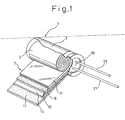
- the structure and shape of the electrolytic capacitor using the electrolytic solution for an electrolytic capacitor of the present invention are not particularly limited but examples thereof are briefly described below by referring to Fig. 1 .
- the capacitor 1 comprises a sealing case 3 and a coiled element 5 housed in the sealing case 3.
- the element 5 contains an anode foil 9 composed of an aluminum foil having a surface dielectric film 11 formed by anodization, an aluminum cathode foil 13 opposing the surface electrode film 11 of the anode foil 9, and a separator 15 between the anode foil 11 and the cathode foil 13.
- the stacked body 7 is wound together with another separator 17 to provide a coil element 5 and the element is impregnated with an electrolytic solution and disposed in the case 3.
- an anode lead wire 21 and a cathode lead wire 23 are connected to the anode foil 11 and the cathode foil 13, respectively, through respective lead tabs (not shown).
- the electrolytic capacitor of the present invention uses the electrolytic solution for an electrolytic capacitor of the present invention.
- the electrolytic solutions used in Examples were measured for specific resistance at 30°C and the results are shown in the Table of each Example. Also, the manufactured electrolytic capacitors were measured for impedance at low temperature (-40°C) and impedance at ordinary temperature (20°C), then the impedance ratio (Z ratio) as the ratio of respective measured values was determined at different frequencies of 120 Hz and 100 kHz and the values are shown in the Table of each Example.
- An electrolytic capacitor (10 WV-1,000 ⁇ F) device having a coil structure was impregnated with an electrolytic solution having the composition shown in Table 1 below and housed in an aluminum case with a bottom such that the lead tab for taking out the electrode was protruded outside the case, and the opening of this case was sealed with an elastic sealant to manufacture an electrolytic capacitor.
- Table 1 The results obtained in the characteristic tests are shown together in Table 1 below.
- Example 1 The procedure of Example 1 was repeated except that in these examples, for the purpose of comparison, a nitro or nitroso compound was eliminated from the electrolytic solution used and the composition of the electrolytic solution was changed as shown in Table 1 below. The results obtained in the characteristic tests are shown together in Table 1 below.
- the Z ratio is small, particularly, the Z ratio at a high frequency of 100 kH is small as compared with those of Comparative Examples.
- a nitro compound was added to the electrolytic solution in an amount of 0.01 to 5 wt% , stable properties were exhibited even after the passage of 2,000 hours at 105°C and the capacitor itself was free of breakage or characteristic abnormality ascribable to gas generation.
- Example 1 The procedure of Example 1 was repeated except that in these Examples, the compositions of the electrolytic solutions used were changed to those shown together in Table 2 below so as to confirm the effect brought by the simultaneous addition of a chelate compound and a nitro or nitroso compound. As seen in the Table, satisfactory results were obtained. In Table 2 below, test results of Comparative Examples 1 to 4 are also shown.
- Example 1 The procedure of Example 1 was repeated except that in these Examples, the compositions of the electrolytic solutions used were changed to those shown together in Table 3 below so as to confirm the effect brought by the simultaneous addition of saccharides and a nitro or nitroso compound. As seen in Table 3, satisfactory test results were obtained. In Table 3 below, the test results of Comparative Examples 1 to 4 are also shown. Table 3 No.
- Example 1 The procedure of Example 1 was repeated except that, in these Examples, the compositions of the electrolytic solutions used were changed to those shown together in Table 4 below so as to confirm the effect brought by the simultaneous addition of hydroxybenzyl alcohol, glutamic-diacetic acid or the like and a nitro or nitroso compound. As seen in Table 4, satisfactory test results were obtained. In Table 4 below, test results of Comparative Examples 1 to 4 are also shown. Table 4 No.
- Example 1 The procedure of Example 1 was repeated except that, in these Examples, the compositions of the electrolytic solutions used were changed to those shown together in Table 5 below so as to confirm the effect brought by the simultaneous addition of a nitro or nitroso compound and gluconic lactone. As seen in Table 5, satisfactory test results were obtained. In Table 5 below, test results of Comparative Examples 1 to 4 are also shown. Table 5 No.
- Example 1 The procedure of Example 1 was repeated except that in these Examples, the compositions of the electrolytic solutions used were changed to those shown together in Table 6 below so as to confirm the effect brought by the arbitrary combination of various additives. As seen in Table 6, satisfactory test results were obtained. In Table 6 below, test results of Comparative Examples 1 to 4 are also shown.
- Example 1 The procedure of Example 1 was repeated except that in these Examples, the conditions for the measurement of capacitor properties by a high-temperature load test at 105°C while applying a rated voltage employed in Example 1 were changed to the passing of 8,000 hours at 105°C so as to confirm an improvement in the working life property.
- Table 7 The results obtained are shown in Table 7 below.
- capacitors were manufactured.
- Capacitors for comparison were manufactured using an electrolytic solution not containing a nitro or nitroso compound and capacitors of 10 wv-1,000 ⁇ F were manufactured using a capacitor element where a predetermined amount of a solvent-soluble nitro or nitroso compound was attached to the separator of the electrolytic capacitor element and, similarly to the capacitors for comparison, using an electrolytic solution not containing a nitro or nitroso compound.
- capacitors were subjected to a load test at 105°C.
- the means for attaching a nitro or nitroso compound to the separator As for the means for attaching a nitro or nitroso compound to the separator, a method of preparing a water/alcohol solution containing from 1 to 5 wt% of a nitro or nitroso compound and directly spraying a constant amount of the solution by an atomizer at the time of taking up the capacitor element, to attach the nitro or nitroso compound, was employed. The amount attached was confirmed by measuring the weight and set to an amount more than the minimum amount effective when the nitro or nitroso compound is contained in the electrolytic solution.
- Electrolytic capacitors as Comparative Examples were manufactured using an electrolytic solution not containing a nitro or nitroso compound and capacitors of 10 wv-1,000 ⁇ F were manufactured using a capacitor element where a predetermined amount of a solvent-soluble nitro or nitroso compound was coated on the electrode foil of the electrolytic capacitor element and using the same electrolytic solution as in Comparative Examples. These capacitors were subjected to a load test at 105°C.
- a water/alcohol solution containing from 1 to 5 wt% of a nitro or nitroso compound was prepared and an operation of dipping an electrode foil previously cut into a belt form in a solution having dissolved therein a nitro or nitroso compound was repeated to attach a predetermined amount of nitro or nitroso compound. Also, similarly to the separator, coating by spraying was attempted. The amount attached was confirmed by measuring the weight and set to an amount more than the minimum amount effective when the nitro or nitroso compound is contained in the electrolytic solution.
- an electrolytic solution for driving an electrolytic capacitor which ensures a low impedance, excellent low-temperature stability represented by the impedance ratio between low temperature and ordinary temperature, and good working life and can exert an excellent hydrogen gas absorbing effect even when an electrolytic solution using a solvent having a large water content ratio is used or the electrolytic capacitor is used in a high-temperature environment.
- an electrolytic capacitor particularly, an aluminum electrolytic capacitor using this electrolytic solution, which has a low impedance, an excellent low-temperature stability, good working life property and high reliability and is free of failure ascribable to the action of water used in the solvent.
- the latitude in the type and presence of the nitro or nitroso compound as the compound added to achieve these purposes is widened and the utilization thereof is expanded.
Landscapes
- Engineering & Computer Science (AREA)
- Power Engineering (AREA)
- Chemical & Material Sciences (AREA)
- Chemical Kinetics & Catalysis (AREA)
- Electrochemistry (AREA)
- Microelectronics & Electronic Packaging (AREA)
- Organic Low-Molecular-Weight Compounds And Preparation Thereof (AREA)
- Electric Double-Layer Capacitors Or The Like (AREA)
- Compositions Of Macromolecular Compounds (AREA)
Description
- The present invention relates to an electrolytic capacitor, more specifically, the present invention relates to an electrolytic solution for driving an electrolytic capacitor, which ensures a low impedance, excellent low-temperature stability, reduction in the increase of pressure inside the capacitor due to a hydrogen gas generated in a high temperature environment, and good working life property, and also relates to an electrolytic capacitor and, particularly, to an aluminum electrolytic capacitor.
- The capacitor is a general electric parts and is widely used in power source circuits or noise filters for digital circuits in various electric and electronic products. Capacitors are roughly classified into electrolytic capacitors and other capacitors (e.g., ceramic capacitors, film capacitors).
- At present, various kinds of electrolytic capacitors are being used and examples thereof include aluminum electrolytic capacitors and wet tantalum electrolytic capacitors. Here, particularly excellent effects are expected from an aluminum electrolytic capacitor in the present invention and accordingly, the present invention is hereinafter described by referring to an aluminum electrolytic capacitor, however, the present invention is not limited to an aluminum electrolytic capacitor and can be widely applied to electrolytic capacitors in general.
- For the electrode material of the electrolytic capacitor, a valve metal is used. In the case of an aluminum electrolytic capacitor, aluminum is used for the electrode material. The basic structure of the electrolytic capacitor takes a form (element) such that anode and cathode are prepared each by forming a predetermined amount of an oxide film as a dielectric material on the surface of an electrode (if desired, the surface area is increased by a treatment such as etching and thereby the electrostatic capacitance is controlled), these two electrodes are disposed to face each other and an electrolytic solution is held therebetween with an intervention of a separator (release paper). This electrolytic capacitor element is seal-packaged to complete an electrolytic capacitor. Some electrolytic capacitor elements have a coiled structure or have a stacked layer structure.
- In the electrolytic capacitor as described above, the properties of the electrolytic solution are an important factor governing the performance of the electrolytic capacitor. Particularly, accompanying recent downsizing of the electrolytic capacitor, the anode or cathode foil used has a high etching magnification and the resistivity of the capacitor body is large. To cope with this, the electrolytic solution used therefor is always required to have low resistivity (specific resistance) and high electrical conductivity.
- Heretofore, the electrolytic solution of the electrolytic capacitor was generally prepared by dissolving a carboxylic acid such as adipic acid and benzoic acid or an ammonium salt thereof as an electrolyte in a solvent consisting of ethylene glycol (EG) as the main solvent and water was added thereto to about 10 wt%. The thus-obtained electrolytic solution has a specific resistance of about 1.5 Ω·m (150 Ω·cm).
- On the other hand, a capacitor is required to have a low impedance (Z) so as to satisfactorily provide a suitable performance. The impedance is determined by various factors. For example, the impedance decreases when the electrode area of the capacitor is increased and therefore, in a large-size capacitor, a low impedance is naturally obtained. Also, there is an approach of attaining a low impedance by improving the separator. However, and particularly in a small-size capacitor, the specific resistance of the electrolytic solution is a large factor governing the impedance.
- In recent years, an electrolytic solution having a low specific resistance and using an aprotic organic solvent such as GBL (γ-butyrolactone) has been developed (see, for example, Japanese Unexamined Patent Publication (Kokai) Nos.
62-145713 62-145714 62-145715 - An aluminum electrolytic capacitor uses an electrolytic solution and therefore, is poor in low-temperature properties. In fact, the ratio Z (-40°C)/Z (20°C) of the impedance at -40°C at 100 kHz to the impedance at 20°C is about 40 and fairly large. Under these circumstances, an aluminum electrolytic capacitor having a low impedance, a low specific resistance and excellent low-temperature stability is required at present.
- Water used as one portion of the solvent in the electrolytic solution of the aluminum electrolytic capacitor is chemically active with the aluminum constituting the anode or cathode foil and this causes a problem that water reacts with the anode or cathode foil to generate a hydrogen gas. As a result, the pressure inside the capacitor is increased, stress is imposed to the capacitor element, the coil structure is deformed or broken, the electrolytic solution is splashed outside, the safety vent is actuated, and the properties are seriously deteriorated. Conventionally, an attempt to absorb the generated hydrogen gas has been made so as to eliminate the problem of hydrogen gas generated in a load test or the like of the electrolytic capacitor. For example, Japanese Examined Patent Publication (Kokoku) No.
59-15374 - Furthermore, Japanese Examined Patent Publication (Kokoku) No.
63-14862 - However, according to the studies by the present inventors, it is found that although the p-nitrophenol or o-nitroanisole can provide an effect of absorbing hydrogen gas, at an initial stage, in an electrolytic solution for driving an electrolytic capacitor, is commonly used and has a low water concentration, a sufficiently high effect of absorbing hydrogen gas cannot be obtained and cannot be maintained when the amount of water in the solvent of the electrolytic solution is 20 wt% or more or when the electrolytic capacitor is used over a long period of time in a high-temperature environment.
- The present invention has been made to solve those problems in conventional techniques nd an object of the present invention is to provide an electrolytic solution for driving an electrolytic capacitor, which ensures low impedance, has an excellent low-temperature stability represented by the ratio of impedance between low temperature and ordinary temperature, has a good working life property and has a capability of providing an excellent hydrogen gas-absorbing effect even when an electrolytic solution using a mixed solvent having a large water content ratio is used or when the electrolytic capacitor is used in a high-temperature environment. The object of the present invention includes providing an electrolytic capacitor using the electrolytic solution.
- Another object of the present invention is to provide an electrolytic capacitor using a driving electrolytic solution having a solvent composition with 30 wt% or more thereof being water, wherein a solvent-soluble nitro compound or nitroso compound is contained in the capacitor element.
- In one aspect, the present invention is defined by the features of claim 1 and provides an electrolytic solution for driving an electrolytic capacitor, comprising a solvent consisting of from 20 to 55 wt% of an organic solvent and from 80 to 45 wt% of water, which contains at least one nitro or nitroso compound as mentioned in claim 1. The present inventors have previously disclosed in Japanese Unexamined Patent Publication (Kokai) No.
2000-173872 US 6 285 543 , an electrolytic solution for driving an electrolytic capacitor, comprising a solvent consisting of from 20 to 80 wt% of an organic solvent and from 80 to 20 wt% of water, which contains nitrophenol, nitrobenzoic acid, dinitrobenzoic acid, nitroacetophenone or nitroanisole, and by this means, the above-described objects can be attained. Thereafter, studies have been continuously made and, as a result, it has been confirmed that the above-described objects can be similarly attained not only by those specific compounds but also by other nitro or nitroso compounds, those specific compounds previously disclosed are not necessarily excellent on taking account of the use conditions of the electrolytic capacitor, and an effect similar to or more excellent than the effect by those previously disclosed specific compounds can be provided using compounds including those deemed inferior in the performance to the previously disclosed specific compounds by appropriately selecting the organic solvent or designing the form of the compound present inside the electrolytic capacitor or by combining two or more thereof. Based on these findings, the present invention has been accomplished. - In the electrolytic solution for driving an electrolytic capacitor of the present invention, the nitro or nitroso compound is considered to act and provide an effect as follows.
- The hydrogen gas generated, by the hydration reaction between the aluminum electrode foil and water as the solvent, increases the pressure inside the capacitor to impose a stress on the capacitor element and this causes various phenomena and seriously deteriorates the properties of the capacitor, for example, deforming or breaking the structure of the element, promoting the splashing of the electrolytic solution outside or actuating the safety vent. The nitro or nitroso compound acts to prevent these phenomena. The nitro or nitroso compound efficiently absorbs hydrogen generated inside the capacitor and prevents the capacitor from deteriorating in properties. This process is a chemical reaction and a reduction reaction.
- The absorption of hydrogen, which prevents the increase of pressure inside the capacitor, takes place at the chemical reaction of reducing the nitro group of the nitro compound into an amino group. The nitro compound consumes hydrogen to change into a nitroso compound and further consumes hydrogen to change into an amino compound. As for the absorption of hydrogen, the nitroso group has the same reaction mechanism as the nitro group and changes into an amino group. However, important here are the hydrogen-absorbing ability of the compound and the fact that the nitro or nitroso compound is present (dissolved or dispersed) in the distributed state in the electrolytic solution. The nitro compound reacts with hydrogen and first changes into a nitroso compound. Many nitro compounds become insoluble in the electrolytic solution when the nitro group changes into a nitroso group, and have a tendency to locally deposit inside the capacitor element. Another substituent within the compound acting to render the nitro compound soluble in a solvent is affected and this is also responsible for the tendency. However, there is a nitroso group soluble in a solvent.
- The nitroso group is not so high in the reactivity with hydrogen as compared with the nitro group and some nitroso groups resulting from the reduction of nitro group are deposited and localized and become physically poor in the reaction with hydrogen. However, the nitroso compound is far higher in the hydrogen-absorbing ability than other substances and can be satisfactorily used in practice. When a nitroso compound soluble in a solvent is used, the nitroso compound can be uniformly present in the electrolytic solution to provide a good dissolved state similarly to the nitro compound, whereby the hydrogen gas generated is efficiently absorbed and good capacitor properties are maintained. In order to obtain a more outstanding effect, two or more nitro or nitroso compounds are preferably used in combination. By making use of a difference in the reduction reaction rate of those nitro or nitroso compounds, the absorption of hydrogen can be continued for a long period of time and the properties of the capacitor can be stabilized. In the case of using a nitro or nitroso compound by adding it to the electrolytic solution of the present invention, the nitro or nitroso compound is preferably added in an amount of 0.10 to 5 wt% based on the entire amount of the electrolytic solution. Even when one nitro or nitroso compound is used, an excellent hydrogen-absorbing effect can be provided by combining it with other electrolytic components.
- The organic solvent used in combination with water for forming a mixed solvent is preferably a protonic solvent, an aprotic solvent or a mixture thereof. More specifically, a protonic solvent and an aprotic solvent each may be used alone or, if desired, two or more thereof may be used in an arbitrary combination. The protonic solvent is preferably an alcohol compound and the aprotic solvent is preferably a lactone compound or the like.
- The carboxylic acid or a salt thereof which can be used as the electrolyte in the electrolytic solution of the present invention is preferably one or more member selected from the group consisting of a monocarboxylic acid, a dicarboxylic acid, a tricarboxylic acid, a carboxylic acid having a functional group such as hydroxyl group, a saturated carboxylic acid and an unsaturated carboxylic acid, represented by formic acid, acetic acid, propionic acid, butyric acid, p-nitrobenzoic acid, salicylic acid, benzoic acid, oxalic acid, malonic acid, succinic acid, glutaric acid, adipic acid, fumaric acid, maleic acid, phthalic acid, azelaic acid, citric acid and hydroxybutyric acid, derivatives thereof and their ammonium salts, sodium salts, potassium salts, amine salts and alkylammonium salts. The carboxylic acid or a salt thereof is preferably a formic acid, an acetic acid, a p-nitrobenzoic acid, a salicylic acid, an oxalic acid, a malonic acid, a fumaric acid, a maleic acid, a phthalic acid, a citric acid, a sulfamic acid, an ethylenediaminetetraacetic acid, or an ammonium, sodium, potassium, amine or alkylammonium salts thereof, more preferably a formic acid.
- The inorganic acid or a salt thereof which can be used as the electrolyte is preferably one or more member selected from the group consisting of an inorganic acid represented by phosphoric acid, phosphorous acid, hypophosphorous acid, boric acid, sulfamic acid and alkylphosphoric acid, an inorganic acid having a carbon chain such as alkyl group, and their ammonium salts, sodium salts, potassium salts, amine salts and alkylammonium salts.
- The electrolytic solution of the present invention preferably contains a carboxylic acid in combination with an inorganic acid selected from a phosphoric acid, a phosphorous acid, a boric acid, a hypophosphorous acid, a sulfamic acid and an alkylphosphoric acid and, particularly, from a phosphoric acid, a phosphorous acid and a boric acid.
- In addition to the nitro or nitroso compound, the electrolyte for use in the present invention may contain, if desired, an additive selected from the group consisting of:
- (1) a chelate compound, (2) saccharides, (3) a hydroxybenzyl alcohol and(or) an L-glutamic-diacetic acid or a salt thereof and (4) a gluconic acid and(or) a gluconic lactone. These additives may be used individually, or two or more additives may be used in an arbitrary combination.
- The electrolytic solution for driving an electrolytic capacitor of the present invention can have a specific resistance of 68 Ωcm or less, preferably 40 Ωcm or less, more preferably 30 Ωcm or less.
- In another aspect of the present invention, as a result of further continuing studies based on the above-described experimental results and knowledge, it has been found that in an electrolytic capacitor comprising an electrolytic solution containing a solvent consisting of 20 to 55 wt% of an organic solvent and from 80 to 45 wt% of water, the nitro or nitroso compound is not necessarily required to be present in the electrolytic solution but the objects can be similarly attained by constructing the capacitor to contain the nitro or nitroso compound in a portion inside the capacitor other than in the electrolytic solution and an additional effect is provided by constructing the capacitor to contain the nitro or nitroso compound both in the electrolytic solution and in a portion inside the capacitor other than in the electrolytic solution.
- For example, even when the nitro or nitroso compound is not present in the electrolytic solution but is present in the physical hydrogen-generating site, namely, on the electrode foil surface or in the vicinity thereof, or in the state of being uniformly contained in a separator, the nitro or nitroso compound satisfactorily exerts the hydrogen-absorbing effect.
- That is, the present invention provides an electrolytic solution for driving an electrolytic capacitor, comprising a solvent consisting of from 20 to 55 wt% of an organic solvent and from 80 to 45 wt% of water, which contains one or more nitro or nitroso compound except for nitrophenol, nitrobenzoic acid, dinitrobenzoic acid, nitroacetophenone and nitroanisole; The nitro or nitroso compound is preferably soluble in water, a polar solvent or a protonic polar organic solvent;
The electrolyte solution preferably comprises at least one electrolyte selected from the group consisting of a carboxylic acid or a salt thereof, and an inorganic acid or a salt thereof; - The nitro or nitroso compound is aminonitroanisole, aminonitrotoluene, aminonitrophenolsulfonic acid, aminonitrobenzenesulfonic acid, aminonitrobenzothiazole, aminonitrobenzonitrile, ethylnitrobenzene, diaminonitrobenzene, dinitroaniline, dinitrodiphenylamine, dinitrophenol, dinitrobenzaldehyde, dinitrobenzophenone, nitroaminothiazole, dimethylnitroaniline, dimethoxynitrobenzyl alcohol, trinitrophenol, nitroaniline, nitroaminotoluene, nitroaminophenol, nitroethanol, nitroethylbenzene, nitrodiphenylamine, nitrothiophene, nitrotoluidine, nitrohydroxyaniline, nitrobiphenyl, nitrophenylacetonitrile, nitrophenylazonaphthol, nitrophenylaniline, diethyl nitrophenylphosphate, nitrophenolmethyl ether, nitrobenzimidazole, nitrobenzenesulfonic acid, nitromethoxyaniline, hydroxynitrotoluene, hydroxynitrobenzaldehyde, nitrosodimethylamine, nitrosophenylaniline, nitrosophenol, nitroquinoline, or an isomer, salt, derivative, coordinate bonded form or clathrate form thereof;
- The nitro or nitroso compounds are preferably used in combination of two or more thereof;
- The nitro or nitroso compound is preferably contained in an amount of 0.01 to 5 wt% based on the entire amount of the electrolytic solution;
- The electrolytic solution preferably additionally contains from 0.01 to 10% of a salt or derivative of nitrophenol, nitrobenzoic acid, dinitrobenzoic acid, nitroacetophenone and nitroanisole;
- The organic solvent is preferably a protonic solvent, an aprotic solvent or a mixture thereof;
- The carboxylic acid or a salt thereof is preferably selected from the group consisting of a monocarboxylic acid, a dicarboxylic acid, a tricarboxylic acid, a saturated carboxylic acid and an unsaturated carboxylic acid, represented by formic acid, acetic acid, propionic acid, butyric acid, p-nitrobenzoic acid, salicylic acid, benzoic acid, oxalic acid, malonic acid, succinic acid, glutaric acid, adipic acid, fumaric acid, maleic acid, phthalic acid, azelaic acid, citric acid and hydroxybutyric acid, derivatives thereof, and their ammonium salt, sodium salt, potassium salt, amine salt and alkylammonium salt;
- The carboxylic acid or a salt thereof is preferably selected from the group consisting of a formic acid, an acetic acid, a p-nitrobenzoic acid, a salicylic acid, an oxalic acid, a malonic acid, a fumaric acid, a maleic acid, a phthalic acid, a citric acid, a sulfamic acid, an ethylenediaminetetraacetic acid, and their ammonium salt, sodium salt, potassium salt, amine salt and alkylammonium salt;
- The carboxylic acid or a salt thereof is preferably a formic acid;
- The inorganic acid or a salt thereof is preferably selected from the group consisting of an inorganic acid represented by phosphoric acid, phosphorous acid, hypophosphorous acid, boric acid, sulfamic acid and alkylphosphoric acid, an inorganic acid having a carbon chain such as alkyl group, and their ammonium salts, sodium salts, potassium salts, amine salts and alkylammonium salts;
- The electrolytic solution preferably comprises a combination of the carboxylic acid or a salt thereof and at least one inorganic acid selected from a phosphoric acid, a phosphorous acid, a boric acid, a hypophosphorous acid, a sulfamic acid and an alkylphosphoric acid;
- The electrolytic solution preferably comprises at least one compound selected from the group consisting of (1) a chelate compound, (2) saccharides, (3) a hydroxybenzyl alcohol and(or) an L-glutamic-diacetic acid or a salt thereof and (4) a gluconic acid and(or) a gluconic lactone;
- The solvent preferably consists of 20 to 55 wt% of an organic solvent and 80 to 45 wt% of water;
- The solvent preferably consists of 20 to 35 wt% of an organic solvent and 80 to 65 wt% of water;
- The specific resistance of the electrolytic solution is preferably 68 Ωcm or less;
- The specific resistance of the electrolytic solution is preferably 40 Ωcm or less;
- The specific resistance of the electrolytic solution is preferably 30 Ωcm or less;
- An electrolytic capacitor preferably comprises the electrolytic solution;
- The present invention further provides an electrolytic capacitor using an electrolytic solution constituted by a solvent consisting of from 20 to 55 wt% of an organic solvent and from 80 to 45 wt% of water, the electrolytic capacitor comprising a nitro or nitroso compound except for nitrophenol, nitrobenzoic acid, dinitrobenzoic acid, nitrophenone and nitroanisole, in a portion inside the capacitor other than in the electrolytic solution;
- The nitro or nitroso compound is aminonitroanisole, aminonitrotoluene, aminonitrophenolsulfonic acid, aminonitrobenzenesulfonic acid, aminonitrobenzothiazole, aminonitrobenzonitrile, ethylnitrobenzene, diaminonitrobenzene, dinitroaniline, dinitrodiphenylamine, dinitrophenol, dinitrobenzaldehyde, dinitrobenzophenone, nitroaminothiazole, dimethylnitroaniline, dimethoxynitrobenzyl alcohol, trinitrophenol, nitroaniline, nitroaminotoluene, nitroaminophenol, nitroethanol, nitroethylbenzene, nitrodiphenylamine, nitrothiophene, nitrotoluidine, nitrohydroxyaniline, nitrobiphenyl, nitrophenylacetonitrile, nitrophenylazonaphthol, nitrophenylaniline, diethyl nitrophenylphosphate, nitrophenolmethyl ether, nitrobenzimidazole, nitrobenzenesulfonic acid, nitromethoxyaniline, hydroxynitrotoluene, hydroxynitrobenzaldehyde, nitrosodimethylamine, nitrosophenylaniline, nitrosophenol, nitroquinoline, or an isomer, salt, derivative, coordinate bonded form or clathrate form thereof;
- The electrolytic capacitor preferably comprises the nitro or nitroso compound or an isomer, salt or derivative thereof on the electrode surface;
- The nitro or nitroso compound or an isomer, salt or derivative thereof is preferably attached or permeation-filled to the electrode surface by the coating or by the dipping in a solution having dissolved therein the nitro or nitroso compound or an isomer, salt or derivative thereof;
- The nitro or nitroso compound or an isomer, salt or derivative thereof is preferably contained in a separator constituting the electrolytic capacitor;
- The nitro or nitroso compound or an isomer, salt or derivative thereof is preferably attached or dipped to the separator by coating or by dipping in a solution having dissolved therein the nitro or nitroso compound or an isomer, salt or derivative thereof;
- The amount of the nitro or nitroso compound or an isomer, salt or derivative thereof contained in the electrode foil is preferably from 0.007 to 1 mg/cm2 (projectional area);
- The amount of the nitro or nitroso compound or an isomer, salt or derivative thereof contained in the separator is preferably from 0.007 to 1 mg/cm2 (projectional area);
-
-
Fig. 1 is a schematic view of an electrolytic capacitor. - The electrolytic solution for driving an electrolytic capacitor of the present invention is characterized in that a solvent comprising a mixture of an organic solvent and water and having a high water concentration is used as the solvent for dissolving the electrolyte.
- For the organic solvent, as described above, a protonic solvent and an aprotic solvent can be used individually or in an arbitrary combination. Suitable examples of the protonic solvent include alcohol compounds. Specific examples of the alcohol compound which can be advantageously used include, but are not limited to, monohydric alcohol such as ethyl alcohol, propyl alcohol and butyl alcohol, dihydric alcohols (glycols) such as ethylene glycol, diethylene glycol, triethylene glycol and propylene glycol, and trihydric alcohols such as glycerin. Suitable examples of the aprotic solvent include lactone compounds. Specific examples of the lactone compound which can be advantageously used include, but are not limited to, γ-butyrolactone and other intramolecular polarizable compounds. In the case of using one or more selected from the protonic and aprotic solvents in practicing the present invention, more specifically, one protonic solvent may be used, one aprotic solvent may be used, a plurality of protonic solvents may be used, a plurality of aprotic solvents may be used, or a mixed solvent of one or more protonic solvent and one or more aprotic solvent may be used. When the nitro or nitroso compound used in the present invention is sparingly soluble in water or a polar solvent, a method of selecting one or more solvent capable of solubilizing the nitro or nitroso compound and dissolving in a polar solvent, and thereby dissolving the nitro or nitroso compound in a solvent constituting the electrolytic solution, water or a polar solvent may be employed. Also, the nitro or nitroso compound may be formed into fine powder in the dissolved solution and uniformly dispersed.
- In the electrolytic solution of the present invention, water is used as a solvent component in addition to the above-described organic solvent. Particularly, the present invention differs from conventional electrolytic solutions in that a relatively large amount of water is used in combination. According to the present invention, such a solvent is used, so that the solidifying point of the solvent can be decreased, the electrolytic solution can be in turn improved in the specific resistance property at low temperatures and good low-temperature stability shown by a small difference in the specific resistance between low temperature and ordinary temperature can be realized. The content of water in the electrolytic solution is from 45 to 80 wt%, with the remainder being the organic solvent. If the water content is less than 20 wt% or exceeds 80 wt%, the degree of depression in solidifying point of the electrolytic solution is insufficient and good low-temperature stability of the electrolytic capacitor can hardly be obtained. The content of water in the solvent of the electrolytic solution is most preferably from 65 to 80 wt%. In the solvent, the amount of the organic solvent is the remaining amount excluding water.
- The electrolyte in the electrolytic solution of the present invention is an organic acid, preferably a carboxylic acid or a salt thereof, or an inorganic acid or a salt thereof. These electrolyte components may be used individually or in a combination of two or more thereof. Examples of the carboxylic acid which can be used as the electrolyte component include, but are not limited to, monocarboxylic acids, dicarboxylic acids, tricarboxylic acids, carboxylic acids having a functional group such as hydroxyl group, saturated carboxylic acids and unsaturated carboxylic acids, represented by formic acid, acetic acid, propionic acid, butyric acid, p-nitrobenzoic acid, salicylic acid, benzoic acid, oxalic acid, malonic acid, succinic acid, glutaric acid, adipic acid, fumaric acid, maleic acid, phthalic acid, azelaic acid, citric acid and hydroxybutyric acid, and derivatives thereof.
- Among these carboxylic acids and salts thereof, preferred in view of ion conductivity are a formic acid, an acetic acid, a p-nitrobenzoic acid, a salicylic acid, an oxalic acid, a malonic acid, a fumaric acid, a maleic acid, a phthalic acid, a citric acid, a sulfamic acid, an ethylenediaminetetraacetic acid, and their ammonium salts, sodium salts, potassium salts, amine salts and alkylammonium salts, more preferred is formic acid because of its large ion conductivity.
- Examples of the inorganic acid which can also be used as the electrolyte component include, but are not limited to, inorganic acids represented by phosphoric acid, phosphorous acid, hypophosphorous acid, boric acid, sulfamic acid and alkylphosphoric acid, and inorganic acids having a carbon chain such as alkyl group.
- As for the salt of the above-described carboxylic acid or inorganic acid, various salts can be used but suitable examples of the salt include an ammonium salt, a sodium salt, a potassium salt, an amine salt and an alkylammonium salt. Among these salts, an ammonium salt is preferred.
- When the inorganic acid or a salt thereof is used as the electrolyte in practicing the present invention, a lowering of the solidifying point of the electrolytic solution can be expected and therefore, this can contribute to a further improvement in the low-temperature stability of the electrolytic solution. The use of the inorganic acid or a salt thereof is also noticeable in that the hydrogen gas absorbing ability derived from the nitro or nitroso compound particularly used in the present invention can be maintained for a long period of time.
- According to the studies by the present inventors, when an electrolyte such as inorganic acid or a salt thereof is used in combination with an above-described electrolyte such as carboxylic acid or a salt thereof, an effect of remarkably prolonging the working life of the electrolytic capacitor, as compared with the case where these are used individually, can be obtained. In conventional electrolytic capacitors, an inorganic acid-base electrolyte has been heretofore used mainly in medium to high-voltage (160 to 500 volt) type electrolytic capacitors in view of electrical conductivity. However, when a combination of electrolytes is used as in the present invention, the inorganic acid-base electrolyte can also be advantageously used in low-voltage (less than 160 volt) type electrolytic capacitors.
- The amount of the electrolyte used in the electrolytic solution of the present invention can be appropriately determined depending on various factors such as characteristics required of the electrolytic solution and capacitor finally obtained, the kind, composition and amount of solvent used, and the kind of electrolyte used. For example, as above, when an inorganic acid-base electrolyte is used in combination with a carboxylic acid-base electrolyte, the content of the inorganic acid-base electrolyte in the mixed electrolyte can be changed over a wide range, however, usually, the inorganic acid-base electrolyte is preferably contained in an amount of about 0.1 to 15 wt% based on the entire amount of the electrolyte.
- As another characteristic feature of the electrolytic solution of the present invention, it is an electrolytic solution for driving an electrolytic capacitor obtained by incorporating at least one nitro or nitroso compound except for nitrophenol, nitrobenzoic acid, dinitrobenzoic acid, nitroacetophenone and nitroanisole, into an electrolytic solution having the above-described specific composition, namely, comprising a mixed solvent consisting of from 20 to 55 wt% of an organic solvent and from 80 to 45 wt% of water, and at least one electrolyte preferably selected from the group consisting of a carboxylic acid or a salt thereof, and an inorganic acid or a salt thereof.
- Specific examples of this nitro or nitroso compound include aminonitroanisole, aminonitrotoluene, aminonitrophenolsulfonic acid, aminonitrobenzenesulfonic acid, aminonitrobenzothiazole, aminonitrobenzonitrile, ethylnitrobenzene, nitroaminothiazole, dinitroaniline, dinitrodiphenylamine, dinitrophenol, dinitrobenzaldehyde, dinitrobenzophenone, diaminonitrobenzene, dimethylnitroaniline, dimethoxynitrobenzyl alcohol, trinitrophenol, nitroaniline, nitroaminotoluene, nitroaminophenol, nitroethanol, nitroethylbenzene, nitrodiphenylamine, nitrothiophene, nitrotoluidine, nitrohydroxyaniline, nitrobiphenyl, nitrophenylacetonitrile, nitrophenylazonaphthol,nitrophenylaniline, diethyl nitrophenylphosphate, nitrophenolmethyl ether, nitrobenzimidazole, nitrobenzenesulfonic acid, nitromethoxyaniline, hydroxynitrotoluene, hydroxynitrobenzaldehyde, nitrosodimethylamine, nitrosophenylaniline, nitrosophenol, nitroquinoline, and their isomers, salts, derivatives, coordinate bonded forms and clathrate forms.
- The electrolytic solution for driving an electrolytic capacitor of the present invention may additionally contain nitrophenol, nitrobenzoic acid, dinitrobenzoic acid, nitroacetophenone, nitroanisole or a salt or derivative thereof in an amount of 0.01 to 10 wt%, together with the nitro or nitroso compound selected from the above-described nitro compounds and nitroso compounds.
- The nitro or nitroso compound used here also has an activity of inhibiting the device from corroding by the action of a halogenated hydrocarbon such as trichloroethane used in the cleaning of a printed board (in other words, a halogen-capturing activity).
- In adding the nitro or nitroso compound to the electrolytic solution of the present invention, this compound can provide a satisfactory hydrogen gas absorbing effect and a halogen-capturing activity even when used individually, because the electrolytic solution itself has a specific composition effective for obtaining the effect of the present invention, however, according to the knowledge acquired this time by the present inventors, when two or more nitro or nitroso compounds are used in combination, a more preferred effect can be expected by bringing out respective advantageous properties. For example, by combining two or more nitro or nitroso compounds having a quick hydrogen gas absorbing effect and a delayed hydrogen gas absorbing effect, a hydrogen gas absorbing effect can be continuously obtained over a long period of time.
- The nitro or nitroso compound is usually used in an amount of preferably from 0.01 to 5 wt% based on the entire amount of the electrolytic solution. If the amount of the nitro or nitroso compound added is less than 0.01 wt%, the expected effect can be scarcely obtained, whereas even if it exceeds 5 wt%, the expected effect cannot be more enhanced and, in the case of a compound having a low solubility, this may adversely affect other properties such as precipitation. However, in the case of having an activity as an electrolyte participating in the electrical conductivity, the nitro or nitroso compound can be added up to 10 wt%.
- The excellent hydrogen gas absorbing effect of the present invention can be confirmed also in the relation with the electrolyte used together. In conventional electrolytic solutions, only one nitro compound is added to only a carboxylic acid-base electrolyte or only one nitro compound is added to only an inorganic acid-base electrolyte. By this means, however, a satisfactory hydrogen gas absorbing effect cannot be obtained when the content of water in the solvent is large. The same applies to an electrolytic solution where a carboxylic acid-base electrolyte and an inorganic acid-base electrolyte are mixed. However, in the case of the electrolytic solution of the present invention (using only one nitro or nitroso compound), surprisingly, a hydrogen gas absorbing ability can be maintained for a far longer period of time than the conventional sole use, even in the carboxylic acid-base/inorganic acid-base mixed electrolytes.
- If desired, the electrolytic solution of the present invention can contain components other than those described above, as additional additives. Suitable examples of additives include the following compounds described in the invention which the present inventors have invented simultaneously with the present invention and filed as a separate patent application.
- Examples thereof include ethylenediaminetetraacetic acid (EDTA), trans-1,2-diaminocyclohexane-N,N,N',N'-tetraacetic acid monohydrate (CyDTA), dihydroxyethylglycine (DHEG), ethylenediaminetetrakis(methylenephosphonic acid) (EDTPO), diethylenetriamine-N,N,N',N",N"-pentaacetic acid (DTPA), diaminopropanoltetraacetic acid (DPTA-OH), ethylenediaminediacetic acid (EDDA), ethylenediamine-N,N'-bis(methylenephosphonic acid) hemihydrate (EDDPO), glycol ether diaminetetraacetic acid (GEDTA) and hydroxyethylethylenediaminetriacetic acid (EDTA-OH). Generally, the chelate compound is preferably added in an amount of 0.01 to 3 wt%. Such a chelate compound can provide effects such as prolongation of the working life of a capacitor due to inhibition of the hydration reaction of an aluminum (Al) electrode foil of a low-impedance capacitor, improvement in the low-temperature stability of an electrolytic capacitor (the solvent has a composition close to non-frozen state and therefore, the change in the impedance between normal temperature and low temperature decreases), and improvement of corrosion resistance.
- Examples thereof include glucose, fructose, xylose and galactose. Generally, the saccharides are preferably added in an amount of 0.01 to 5 wt%. These saccharides can provide effects such as prolongation of the working life of a capacitor due to inhibition of the hydration reaction of an Al electrode foil of a low-impedance capacitor, inhibition of decomposition or activation of an electrolyte (e.g. carboxylic acid) due to the addition of saccharides, and improvement in the low-temperature stability of an electrolytic capacitor (the solvent has a composition close to non-frozen state and therefore, the change in the impedance between normal temperature and low temperature decreases).
- Examples thereof include 2-hydroxybenzyl alcohol, L-glutamic-diacetic acid and a salt thereof. Generally, this additive is preferably added in an amount of 0.01 to 5 wt%. This additive can provide effects such as prolongation of the working life of a capacitor due to inhibition of the hydration reaction of an Al electrode foil of a low-impedance capacitor, and improvement in the low-temperature stability of an electrolytic capacitor (the solvent has a composition close to non-frozen state and therefore, the change in the impedance between normal temperature and low temperature decreases).
- These compounds (1) to (3) each can provide many remarkable effects when added to the electrolytic solution of the present invention.
- In addition to the above-described additives (including the case of adding a sole nitro or nitroso compound), the electrolytic solution of the present invention can contain, if desired, (4) gluconic acid, gluconic lactone and the like individually or in combination. Generally, this additive is preferably added in an amount of 0.01 to 5 wt%. The gluconic acid or gluconic lactone additionally contained in the electrolytic solution of the present invention can provide remarkable effects such as improvement of corrosion resistance in addition to the effects such as prolongation of the working life of an electrolytic capacitor and improvement in the low-temperature stability, and the effects peculiar to the present invention such as excellent hydrogen gas absorbing effect.
- Other than the additives described above, additives commonly used in the field of aluminum electrolytic capacitor or other electrolytic capacitors may be further added. Suitable examples of the additives commonly used include mannitol, silane coupling agent, water-soluble silicone and polymer electrolyte. The electrolytic solution of the present invention can be prepared by mixing and dissolving those various components in an arbitrary order. Fundamentally, a conventional technique can be used as it is without any modification. For example, the electrolytic solution of the present invention can be easily prepared by preparing a solvent having a high water concentration, which is a mixture of an organic solvent and water, and then dissolving an electrolyte, a nitro or nitroso compound and if desired, arbitrary additives in the obtained solvent.
- The electrolytic capacitor of the present invention can also be produced according to a conventional technique, similarly to the electrolytic solution. For example, an anode foil and a cathode foil are prepared by forming an oxide film as a dielectric material on an electrode foil to a predetermined thickness, these anode and cathode foils are disposed to face each other and a separator (release paper) is interposed therebetween. The thus-fabricated device is impregnated with the electrolytic solution of the present invention and then packaged by an appropriate method, whereby an aluminum electrolytic capacitor can be produced. In the obtained aluminum electrolytic capacitor, the electrolytic solution of the present invention is used, so that there can be achieved an effect of improving the low-temperature stability due to a mixed solvent of an organic solvent and water, a hydrogen gas absorbing effect due to addition of a nitro compound, and an effect of prolonging the working life and giving a low impedance resulting from inhibition of the hydration reaction due to use of a specific electrolyte.
- Furthermore, according to the present invention, it is confirmed that a sufficiently high hydrogen absorbing effect can be exerted even when the nitro or nitroso compound is not present in the electrolytic solution but when the nitro or nitroso compound is present in a physically hydrogen-generating site, more specifically, in the form of a film or the like on the electrode surface or in the vicinity thereof or in the state of being contained in the separator. Also when the nitro or nitroso compound is attached to the inner surface of the capacitor container, suitable effects are confirmed. Particularly, the site attached with a current takeout lead of the electrode readily generates hydrogen and therefore, it is effective to localize a nitro or nitroso compound thereat. As such, even when the nitro or nitroso compound is present in a portion inside the capacitor other than in the electrolytic solution, the effects can be confirmed. Moreover, in this case, the nitro or nitroso compound can be present also in the electrolytic solution in addition to the portion except for in the electrolytic solution, inside the capacitor, and this is a preferred embodiment.
- In the case of allowing the nitro or nitroso compound to be present in such a form inside the capacitor, the nitro or nitroso compound needs not be soluble in the electrolytic solution or may have a low solubility and this provides an effect of extending the selection range of the nitro or nitroso compound which can be used.
- For example, the nitro or nitroso compound is dissolved in a soluble solvent and the resulting solution is coated on an electrode (foil or electrode tab) or a separator and if desired, dried, or the electrode (foil or electrode tab) is dipped in the solution, whereby the nitro or nitroso compound can be attached to the separator. The solvent in which the nitro or nitroso compound is dissolved may or may not be soluble in the electrolytic solution. This is for the following reasons. Even if the solvent is soluble or insoluble in the electrolytic solution, the same coated film results when dried after the coating. In the case where the solution is not dried and a wet coated film is present, even if the solvent is soluble, when the solvent has a high viscosity, the coated film is present in the thin spacing between electrodes for a long period of time while having a concentration gradient. Also, even when the solvent is insoluble, it may suffice if the nitro or nitroso compound can react with hydrogen. That is, the method of attaching the nitro or nitroso compound or allowing it to be present on the electrode surface or inner surface of the container or the method of incorporating the compound into the separator is not particularly limited. When the nitro or nitroso compound is present in a portion inside the capacitor other than in the electrolytic solution, even if a part of the nitro or nitroso compound dissolves in the electrolytic solution, this causes no problem.
- In the case of attaching or incorporating the nitro or nitroso compound to the electrode or separator, the amount thereof is more than the amount of giving the effects when added to the electrolytic solution, that is, 0.01% or more in terms of the electrolytic solution and the amount is optimally from 0.007 to 1 mg/cm2 (projected area). When the nitro or nitroso compound is present in the site other than the electrode or separator or when present also in the electrolytic solution, the amount may be appropriately corrected.
- Examples of the nitro compound and the nitroso compound which can be used in such a method include aminonitroanisole, aminonitrotoluene, aminonitrophenolsulfonic acid, aminonitrobenzenesulfonic acid, aminonitrobenzothiazole, aminonitrobenzonitrile, ethylnitrobenzene, diaminonitrobenzene, dinitroaniline, dinitrodiphenylamine, dinitrophenol, dinitrobenzaldehyde, dinitrobenzophenone, nitroaminothiazole, dimethylnitroaniline, dimethoxynitrobenzyl alcohol, trinitrophenol, nitroaniline, nitroaminotoluene, nitroaminophenol, nitroethanol, nitroethylbenzene, nitrodiphenylamine, nitrothiophene, nitrotoluidine, nitrohydroxyaniline, nitrobiphenyl, nitrophenylacetonitrile, nitrophenylazonaphthol, nitrophenylaniline, diethyl nitrophenylphosphate, nitrophenolmethyl ether, nitrobenzimidazole, nitrobenzenesulfonic acid, nitromethoxyaniline, hydroxynitrotoluene, hydroxynitrobenzaldehyde, nitrosodimethylamine, nitrosophenylaniline, nitrosophenol, nitroquinoline, and their isomers, salts, derivatives, coordinate bonded forms and clathrate forms. Similarly to the addition of the nitro compound, the capacitor manufactured as such can achieve a hydrogen gas absorbing effect and an effect of prolonging the working life and giving a low impedance resulting from inhibition of the hydration reaction due to the electrolytic solution using a specific electrolyte.
- In still another aspect, based on the above-described experimental results and knowledge, the present invention provides an electrolytic capacitor comprising the electrolytic solution for driving an electrolytic capacitor of the present invention, and an electrolytic capacitor comprising a nitro or nitroso compound inside the capacitor.
- The structure and shape of the electrolytic capacitor using the electrolytic solution for an electrolytic capacitor of the present invention are not particularly limited but examples thereof are briefly described below by referring to
Fig. 1 . The capacitor 1 comprises a sealing case 3 and acoiled element 5 housed in the sealing case 3. Theelement 5 contains ananode foil 9 composed of an aluminum foil having asurface dielectric film 11 formed by anodization, analuminum cathode foil 13 opposing thesurface electrode film 11 of theanode foil 9, and aseparator 15 between theanode foil 11 and thecathode foil 13. Thestacked body 7 is wound together with anotherseparator 17 to provide acoil element 5 and the element is impregnated with an electrolytic solution and disposed in the case 3. InFig. 1 , ananode lead wire 21 and acathode lead wire 23 are connected to theanode foil 11 and thecathode foil 13, respectively, through respective lead tabs (not shown). The electrolytic capacitor of the present invention uses the electrolytic solution for an electrolytic capacitor of the present invention. - The present invention is described in greater detail below by referring to Examples. These Examples are only to illustrate the present invention and, needless to say, the present invention is not limited thereto. Examples 1,2, 11, 13, 19, 20, 23, 33, 41, 42, 51, 62, 70, 73, 75, 78 and 79 are embodiments of the invention; the further examples are useful for understanding the invention.
- The electrolytic solutions used in Examples were measured for specific resistance at 30°C and the results are shown in the Table of each Example. Also, the manufactured electrolytic capacitors were measured for impedance at low temperature (-40°C) and impedance at ordinary temperature (20°C), then the impedance ratio (Z ratio) as the ratio of respective measured values was determined at different frequencies of 120 Hz and 100 kHz and the values are shown in the Table of each Example. Furthermore, for evaluating the working life property of each electrolytic capacitor, the capacitance, tan δ and leakage current were examined each on the initial property (characteristic value immediately after the manufacture of capacitor) and the characteristic change after the passing of a predetermined time while applying a rated voltage under a high-temperature load test condition of 105°C and results are shown in the Table of each Example.
- An electrolytic capacitor (10 WV-1,000 µF) device having a coil structure was impregnated with an electrolytic solution having the composition shown in Table 1 below and housed in an aluminum case with a bottom such that the lead tab for taking out the electrode was protruded outside the case, and the opening of this case was sealed with an elastic sealant to manufacture an electrolytic capacitor. The results obtained in the characteristic tests are shown together in Table 1 below.
- The procedure of Example 1 was repeated except that in these examples, for the purpose of comparison, a nitro or nitroso compound was eliminated from the electrolytic solution used and the composition of the electrolytic solution was changed as shown in Table 1 below. The results obtained in the characteristic tests are shown together in Table 1 below.


- As can be seen from these results, in the electrolytic capacitors using the electrolytic solution of the present invention, the Z ratio is small, particularly, the Z ratio at a high frequency of 100 kH is small as compared with those of Comparative Examples. This reveals that the electrolytic capacitor using the electrolytic solution of the present invention exhibits good low-temperature stability over a wide frequency range. Particularly, in the electrolytic capacitors using the electrolytic solution of the present invention, when a nitro compound was added to the electrolytic solution in an amount of 0.01 to 5 wt% , stable properties were exhibited even after the passage of 2,000 hours at 105°C and the capacitor itself was free of breakage or characteristic abnormality ascribable to gas generation. On the other hand, in all electrolytic capacitors of Comparative Examples using an electrolytic solution not containing a nitro or nitroso compound, a safety vent was actuated as a result of expansion of the case caused by the generation of hydrogen gas at the initial stage of the high-temperature loading before the passing of 2,000 hours and the capacitor could not be used. It is understood from these Examples that, according to the present invention, the prolongation of the working life of an electrolytic capacitor can be easily achieved. Examples 11 to 20:
- The procedure of Example 1 was repeated except that in these Examples, the compositions of the electrolytic solutions used were changed to those shown together in Table 2 below so as to confirm the effect brought by the simultaneous addition of a chelate compound and a nitro or nitroso compound. As seen in the Table, satisfactory results were obtained. In Table 2 below, test results of Comparative Examples 1 to 4 are also shown.


- The procedure of Example 1 was repeated except that in these Examples, the compositions of the electrolytic solutions used were changed to those shown together in Table 3 below so as to confirm the effect brought by the simultaneous addition of saccharides and a nitro or nitroso compound. As seen in Table 3, satisfactory test results were obtained. In Table 3 below, the test results of Comparative Examples 1 to 4 are also shown.
Table 3 No. Composition of Electrolytic Solution [wt%] Specific Resistance at 30°C [Ω·cm] Z Ratio Initial Value After 2,000 Hours at 105°C 120 Hz [-40/20°C] 100 kHz [-40/20°C] Capacitance (µF) tan δ [%] Leakage Current [µA] Capacitance [µF] tan δ [%] Leakage Current [µA] Appearance Comparative Example 1 Ethylene glycol 90.0 180 4.0 120.0 1002 8.5 6.5 940 8.6 6.2 Water 5.0 Ammonium adipate 5.0 Comparative Example 2 Ethylene glycol 60.0 85 1.3 36.1 1008 7.0 6.5 In all samples, the safety vent was actuated in 500 hours due to gas evolution. Water 30.0 Ammonium adipate 10.0 Comparative Example 3 Ethylene glycol 45.0 40 1.1 9.7 1014 5.7 6.1 In all samples, the safety vent was actuated in 250 hours due to gas evolution. Water 40.0 Ammonium adipate 15.0 Comparative Example 4 Ethylene glycol 30.0 20 1.0 7.9 1023 4.7 6.9 In all samples, the safety vent was actuated in 250 hours due to gas evolution. Water 50.0 Ammonium adipate 20.0 Example 21 (reference) Ethylene glycol 19.8 30 1.1 4.4 1030 5.2 7.8 917 5.8 2.4 Water 60.0 Ammonium glutarate 17.8 Fructose 1.0 Dinitrosalicylic acid 0.4 Sulfamic acid 1.0 Example 22 Ethylene glycol 14.8 25 1.1 4.7 1027 4.8 7.9 924 5.4 2.6 Water 60.0 Ammonium adipate 23.8 Ethyl nitrobenzene 0.5 Xylose 1.0 Example 23 Ethylene glycol 21.2 26 1.1 3.8 1025 5.0 7.8 930 5.6 2.5 Water 52.0 Ammonium succinate 24.8 Glucose 1.0 Dinitrophenol 0.6 Benzenesulfonic acid 0.4 Example 24 Ethylene glycol 48.7 51 1.0 4.1 1016 6.2 7.4 935 6.8 2.8 Water 40.8 Ammonium borate 9.0 Dinitrobenzophenone 0.5 Xylose 1.0 Example 25 Ethylene glycol 53.2 64 1.0 3.9 1009 6.5 7.7 938 7.1 2.4 Water 31.0 Ammonium sulfamate 13.8 Fructose 1.0 Dimethylnitroaniline 0.5 Phosphoric acid 0.5 Example 26 (reference) Ethylene glycol 59.2 59 1.0 3.6 1011 6.2 6.3 944 6.8 2.4 Water 20.8 Ammonium adipate 17.8 Glucose 0.5 Ethyl nitrobenzoate 0.7 Boric acid 1.0 Example 27 Ethylene glycol 61.9 66 1.0 3.8 1003 7.2 6.9 944 7.8 2.4 Water 27.0 Ammonium adipate 9.3 Dimethoxynitrobenzyl alcohol 0.8 Fructose 1.0 Example 28 Ethylene glycol 38.2 45 1.0 3.7 1016 5.9 6.6 935 6.5 2.5 Water 41.0 Ammonium glutarate 18.8 Trinitrophenol 1.0 Galactose 1.0 Example 29 Ethylene glycol 47.7 52 1.0 4.0 1014 6.3 7.1 943 6.9 2.6 Water 39.7 Ammonium adipate 10.2 Sulfamic acid 0.4 Nitroaniline 1.0 Xylose 1.0 Example 30 Ethylene glycol 51.2 63 1.0 3.6 1018 6.9 6.7 947 7.5 2.7 Water 30.1 Ammonium succinate 16.2 Boric acid 1.1 Nitroaminophenol 0.4 Glucose 1.0 - The procedure of Example 1 was repeated except that, in these Examples, the compositions of the electrolytic solutions used were changed to those shown together in Table 4 below so as to confirm the effect brought by the simultaneous addition of hydroxybenzyl alcohol, glutamic-diacetic acid or the like and a nitro or nitroso compound. As seen in Table 4, satisfactory test results were obtained. In Table 4 below, test results of Comparative Examples 1 to 4 are also shown.
Table 4 No. Composition of Electrolytic Solution [wt%] Specific Resistance at 30°C [Ω·cm] Z Ratio Initial Value After 2,000 Hours at 105°C 120 Hz [-40/20°C] 100 kHz [-40/20°C] Capacitance (µF) tan δ [%] Leakage Current [µA] Capacitance [µF] tan δ [%] Leakage Current [µA] Appearance Comparative Example 1 Ethylene glycol 90.0 180 4.0 120.0 1002 8.5 6.5 940 8.6 6.2 Water 5.0 Ammonium adipate 5.0 Comparative Example 2 Ethylene glycol 60.0 85 1.3 36.1 1008 7.0 6.5 In all samples, the safety vent was actuated in 500 hours due to gas evolution. Water 30.0 Ammonium adipate 10.0 Comparative Ethylene Comparative Example 3 Ethylene glycol 45.0 40 1.1 9.7 1014 5.7 6.1 In all samples, the safety vent was actuated in 250 hours due to gas evolution. Water 40.0 Ammonium adipate 15.0 Comparative Example 4 Ethylene glycol 30.0 20 1.0 7.9 1023 4.7 6.9 In all samples, the safety vent was actuated in 250 hours due to evolution. Water 50.0 Ammonium adipate 20.0 Example 31 Ethylene glycol 17.7 26 1.1 4.4 1034 5.0 7.6 920 5.6 2.6 Water 61.0 Ammonium glutarate Sulfamic acid 17.2 Nitroethanol 1.7 Glutamic-diacetic 1.0 acid 1.4 Example 32 Ethylene glycol 14.2 23 1.1 4.5 1036 4.8 7.8 932 5.4 2.6 Water 60.0 Ammonium adipate 23.4 Nitrophenyl acetate 1.0 Glutamic-diacetic acid 1.4 Example 33 Ethylene glycol 21.0 28 1.1 4.2 1033 5.1 7.8 930 5.7 2.7 Water 51.3 Ammonium succinate Benzenesulfonic 24.8 acid Nitroquinoline 0.4 Hydroxybenzyl 0.5 alcohol 2.0 Example 34 Ethylene glycol 44.7 58 1.2 4.0 1026 6.6 7.4 944 7.2 2.5 Water 40.2 Ammonium borate 9.8 Nitrodiphenylamine 1.0 Hydroxybenzyl alcohol 4.3 Example 35 Ethylene glycol 52.2 67 1.0 3.7 1019 6.9 7.9 948 7.5 2.4 Water 30.4 Ammonium sulfamate 13.8 Phosphoric acid 0.4 Nitrobiphenyl 0.6 Glutamic-diacetic acid 2.6 Example 36 (reference) Ethylene glycol 57.5 84 1.0 3.6 1013 7.2 6.8 944 7.8 2.2 Water 20.7 Ammonium adipate 15.8 Nitrophenylphenyl ether 1.0 Hydroxybenzyl alcohol 2.6 Glutamic-diacetic acid 2.2 Example 37 Ethylene glycol 58.8 76 1.0 3.8 1015 7.1 6.9 944 7.7 2.4 Water 26.4 Ammonium adipate 11.3 Nitrobenzimidazole 0.5 Ammonium glutarate 1.5 Glutamic-diacetic acid 1.5 Example 38 Ethylene glycol 39.6 46 1.0 3.6 1018 6.0 6.7 937 6.6 2.6 Water 40.0 Ammonium glutarate 19.0 Nitrophenolmethyl ether 0.4 Hydroxybenzyl alcohol 1.0 Example 39 (reference) Ethylene glycol 48.8 54 1.0 3.8 1016 6.3 6.5 945 6.9 2.5 Water 39.3 Ammonium adipate 9.4 Sulfamic acid 0.4 Nitrobenzyl alcohol 1.1 Hydroxybenzyl alcohol 1.0 Example 40 Ethylene glycol 51.2 64 1.0 3.6 1016 6.6 6.7 945 7.2 2.7 Water 30.1 Ammonium succinate 16.2 Boric acid 1.1 Nitrophenylaniline 0.4 Glutamic-diacetic acid 1.0 - The procedure of Example 1 was repeated except that, in these Examples, the compositions of the electrolytic solutions used were changed to those shown together in Table 5 below so as to confirm the effect brought by the simultaneous addition of a nitro or nitroso compound and gluconic lactone. As seen in Table 5, satisfactory test results were obtained. In Table 5 below, test results of Comparative Examples 1 to 4 are also shown.
Table 5 No. Composition of Electrolytic Solution [wt%] Specific Resistance at 30°C [Ω·cm] Z Ratio Initial Value After 2,000 Hours at 105°C 120 Hz [-40/20°C] 100 kHz [-40/20°C] Capacitance (µF) tan δ [%] Leakage Current [µA] Capacitance [µF] tan δ [%] Leakage Current [µA] Appearance Comparative Example 1 Ethylene glycol 90.0 180 4.0 120.0 1002 8.5 6.5 940 8.6 6.2 Water 5.0 Ammonium adipate 5.0 Comparative Example 2 Ethylene glycol 60.0 85 1.3 36.1 1008 7.0 6.5 In all samples, the safety vent was actuated in 500 hours due to gas evolution. Water 30.0 Ammonium adipate 10.0 Comparative Example 3 Ethylene glycol 45.0 40 1.1 9.7 1014 5.7 6.1 In all samples, the safety vent was actuated in 250 hours due to gas evolution. Water 40.0 Ammonium adipate 15.0 Comparative Example 4 Ethylene glycol 30.0 20 1.0 7.9 1023 4.7 6.9 In all samples, the safety vent was actuated in 250 hours due to gas evolution. Water 50.0 Ammonium adipate 20.0 Example 41 Ethylene glycol 25.0 25 1.1 4.6 1033 4.8 7.8 888 5.6 2.4 Water 68.0 Ammonium formate 5.4 Hypophosphorous acid 0.4 Gluconic lactone 0.2 Dinitrobenzaldehyde 0.5 Nitrohydroxyaniline 0.5 Example 42 Ethylene glycol 22.0 28 1.1 4.4 1034 5.1 7.9 900 5.9 2.6 Water 59.0 Ammonium glutarate 16.2 Sulfamic acid 1.6 Gluconic lactone 0.2 Nitrodiphenylamine 0.5 Nitrophenylazonaphthol 0.5 No. Composition of Electrolytic Solution [wt%] Specificz Resistance at 30°C [Ω·cm] Z Ratio Initial Value After 2,000 Hours at 105°C 120 Hz [-40/20°C] 100 kHz [-40/20°C] Capacitance (µF) tan δ [%] Leakage Current [µA] Capacitance [µF] tan δ [%] Leakage Current [µA] Appearance Example 43 Ethylene glycol 16.0 23 1.1 4.1 1025 4.8 7.9 902 5.6 2.5 Water 60.0 Ammonium adipate 22.8 Gluconic lactone 0.2 Nitrophenylaniline 0.5 Nitrohydroxyaniline 0.5 Example 44 (reference) Ethylene glycol 23.0 22 1.1 4.0 1021 4.8 7.8 919 5.6 2.4 Water 50.0 Ammonium succinate 25.4 Benzenesulfonic acid 0.4 Gluconic lactone 0.2 Hydroxynitrobenzoic acid 1.0 Example 45 (reference) Ethylene glycol 48.0 56 1.2 4.0 1025 6.6 7.5 933 7.4 2.5 Water 40.0 Ammonium borate 10.8 Gluconic lactone 0.2 Nitrophenylacetic acid 1.0 Example 46 (reference) Ethylene glycol 54.0 63 1.0 3.8 1016 6.8 7.1 935 7.6 2.4 Water 30.0 Ammonium sulfamate 14.4 Phosphoric acid 0.4 Gluconic lactone 0.2 Nitrosodiphenylamine 1.0 Example 47 Ethylene glycol 60.0 82 1.0 3.6 1013 7.1 6.9 942 7.9 2.4 Water 20.0 Ammonium adipate 18.4 Boric acid 0.4 Gluconic lactone 0.2 Nitrophenolmethyl ether 1.0 Example 48 (reference) Ethylene glycol 62.0 78 1.0 3.8 1015 7.1 6.8 949 7.9 2.4 Water 27.2 Ammonium adipate 10.0 Gluconic lactone 0.2 Nitrophthalic acid 0.8 Nitrophenol 0.8 Example 49 Ethylene glycol 40.0 44 1.0 3.6 1018 5.9 6.7 937 6.5 2.5 Water 40.0 Ammonium glutarate 18.8 Gluconic lactone 0.2 Nitroaminotoluene 1.0 Example 50 (reference) Ethylene glycol 50.0 58 1.0 3.7 1013 6.4 6.9 942 7.0 2.4 Water 39.6 Ammonium adipate 9.2 Sulfamic acid 0.4 Gluconic lactone 0.2 Nitrosalicylic acid 0.6 - The procedure of Example 1 was repeated except that in these Examples, the compositions of the electrolytic solutions used were changed to those shown together in Table 6 below so as to confirm the effect brought by the arbitrary combination of various additives. As seen in Table 6, satisfactory test results were obtained. In Table 6 below, test results of Comparative Examples 1 to 4 are also shown.

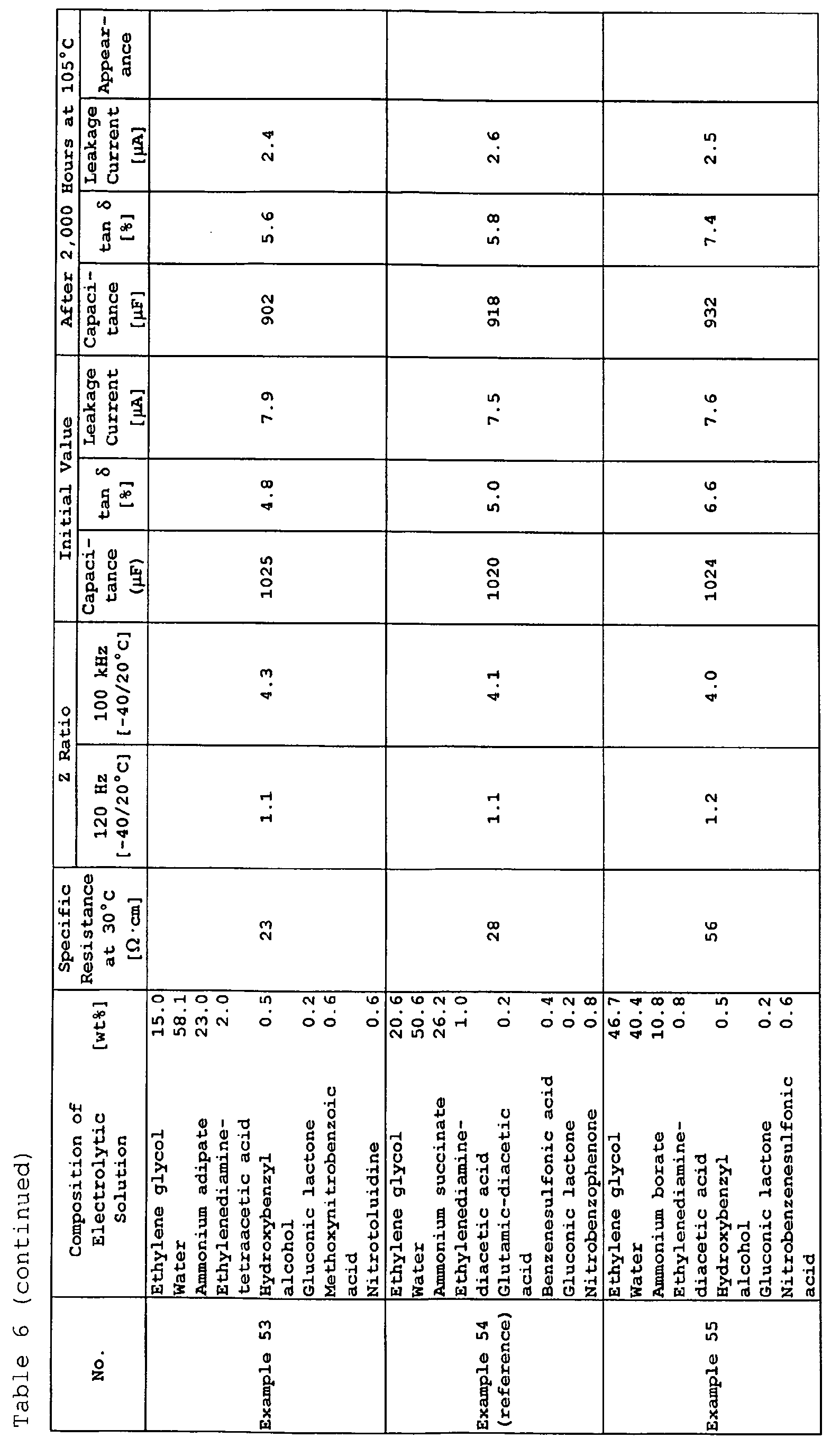


- The procedure of Example 1 was repeated except that in these Examples, the conditions for the measurement of capacitor properties by a high-temperature load test at 105°C while applying a rated voltage employed in Example 1 were changed to the passing of 8,000 hours at 105°C so as to confirm an improvement in the working life property. The results obtained are shown in Table 7 below.


- As can be seen from the results shown in Table 7 above, in Comparative Examples 2 to 4 using an electrolytic solution containing 20 wt% or more of water in the solvent and not containing a nitro or nitroso compound, all capacitors broke down between 250 and 500 hours. In Examples 64, 65, 67 and 69, the capacitors showed abnormality in the properties in 3,000 to 5,000 hours. On the other hand, in Examples 61, 62, 63, 68 and 70, the capacitors maintained very good properties even after the passage of 8,000 hours. Furthermore, it is noticeable that the working life property of the electrolytic capacitor was improved by using a carboxylic acid or a salt thereof as the organic electrolyte and an inorganic acid as the inorganic electrolyte in combination.
- Using the capacitor element used in Example 1, capacitors were manufactured. Capacitors for comparison were manufactured using an electrolytic solution not containing a nitro or nitroso compound and capacitors of 10 wv-1,000 µF were manufactured using a capacitor element where a predetermined amount of a solvent-soluble nitro or nitroso compound was attached to the separator of the electrolytic capacitor element and, similarly to the capacitors for comparison, using an electrolytic solution not containing a nitro or nitroso compound. These capacitors were subjected to a load test at 105°C. As for the means for attaching a nitro or nitroso compound to the separator, a method of preparing a water/alcohol solution containing from 1 to 5 wt% of a nitro or nitroso compound and directly spraying a constant amount of the solution by an atomizer at the time of taking up the capacitor element, to attach the nitro or nitroso compound, was employed. The amount attached was confirmed by measuring the weight and set to an amount more than the minimum amount effective when the nitro or nitroso compound is contained in the electrolytic solution.
- The results are shown in Table 8.
Table 8 No. Composition of Electrolytic Solution, Separator Constituting Capacitor Element [wt%] Specific Resistance at 30°C [Ω·cm] Z Ratio Initial Value After 1,000 Hours at 105°C 120 Hz [-40/20°C] 100 kHz [-40/20°C] Capacitance (µF) tan δ [%] Leakage Current [µA] Capacitance [µF] tan δ [%] Leakage Current [µA] Appearance Comparative Example 1 Ethylene glycol 90.0 180 4.0 120.0 1002 8.5 6.5 940 8.6 6.2 Water 5.0 Ammonium adipate 5.0 Comparative Example 5 Ethylene glycol 60.0 40 1.3 36.1 1011 7.1 6.6 In all samples, the safety vent was actuated in 500 hours due to gas evolution. Water 30.0 Ammonium adipate Normal separator 10.0 Comparative Example 6 Ethylene glycol 45.0 20 1.1 9.7 1016 5.8 6.2 In all samples, the safety vent was actuated in 250 hours due to gas evolution. Water 40.0 Ammonium sulfamate Normal separator 15.0 Comparative Example 7 Ethylene glycol 30.0 20 1.0 7.9 1024 4.8 6.8 In all samples, the safety vent was actuated in 250 hours due to gas evolution. Water 50.0 Ammonium adipate Normal separator 20.0 Example 71 (reference) Ethylene glycol 60.0 85 1.3 36.1 1013 7.2 6.8 907 7.9 2.9 Water 30.0 Ammonium adipate Dinitrobenzoic acid-coated separator 10.0 Example 72 (reference) Ethylene glycol 45.0 20 1.1 9.7 1015 5.9 6.5 903 6.5 2.9 Water 40.0 Ammonium Sulfamate Hydroxynitrobenzoic acid-coated separator 15.0 Example 73 Ethylene glycol 30.0 20 1.0 7.9 1021 4.7 6.7 909 5.3 2.9 Water 50.0 Ammonium adipate Trinitrophenol-coated separator 20.0 Example 74 Ethylene glycol 45.0 40 1.1 9.7 1015 5.9 6.5 903 6.5 2.9 Water 40.0 Ammonium adipate Nitrosodimethylamine-coated separator 15.0 Example 75 Ethylene glycol 30.0 20 1.0 7.9 1021 4.7 6.7 909 5.3 2.9 Water 50.0 Ammonium adipate Nitroquinoline-coated separator 20.0 - In Comparative Examples, all capacitors were broken down before 500 hours, whereas capacitors using a separator attached with a nitro or nitroso compound exhibited very good properties even after the passage of 1,000 hours.
- Electrolytic capacitors as Comparative Examples were manufactured using an electrolytic solution not containing a nitro or nitroso compound and capacitors of 10 wv-1,000 µF were manufactured using a capacitor element where a predetermined amount of a solvent-soluble nitro or nitroso compound was coated on the electrode foil of the electrolytic capacitor element and using the same electrolytic solution as in Comparative Examples. These capacitors were subjected to a load test at 105°C. As for the means for coating a nitro or nitroso compound to the electrode foil surface, a water/alcohol solution containing from 1 to 5 wt% of a nitro or nitroso compound was prepared and an operation of dipping an electrode foil previously cut into a belt form in a solution having dissolved therein a nitro or nitroso compound was repeated to attach a predetermined amount of nitro or nitroso compound. Also, similarly to the separator, coating by spraying was attempted. The amount attached was confirmed by measuring the weight and set to an amount more than the minimum amount effective when the nitro or nitroso compound is contained in the electrolytic solution.
- The results are shown in Table 9.
Table 9 No. Composition of Electrolytic Solution, form of electrode foil [wt%] Specific Resistance at 30°C [Ω·cm] Z Ratio Initial Value After 1,000 Hours at 105°C 120 Hz [-40/20°C] 100 kHz [-40/20°C] Capacitance (µF) tan δ [%] Leakage Current [µA] Capacitance [µF] tan δ [%] Leakage Current [µA] Appearance Comparative Example 1 Ethylene glycol 90.0 180 4.0 120.0 1002 8.5 6.5 940 8.6 6.2 Water 5.0 Ammonium adipate 5.0 Comparative Example 8 Ethylene glycol 60.0 40 1.3 36.1 1011 7.1 6.6 In all samples, the safety vent was actuated in 500 hours due to gas evolution. Water 30.0 Ammonium adipate Normal anode foil 10.0 Comparative Example 9 Ethylene glycol 45.0 20 1.1 9.7 1016 5.8 6.2 In all samples, the safety vent was actuated in 250 hours due to gas evolution. Water 40.0 Ammonium sulfamate Normal anode foil 15.0 Comparative Example 10 Ethylene glycol 30.0 20 1.0 7.9 1024 4.8 6.8 In all samples, the safety vent was actuated in 250 hours due to gas evolution. Water 50.0 Ammonium adipate Normal cathode foil 20.0 Example 76 (reference) Ethylene glycol 60.0 40 1.1 9.7 1012 5.8 6.5 901 6.4 2.9 Water 30.0 Ammonium adipate Dinitrobenzoic acid-coated anode foil 10.0 Example 77 (reference) Ethylene glycol 45.0 20 1.1 6.4 1010 4.2 6.5 899 4.8 3.1 Water 40.0 Ammonium Sulfamate Hydroxynitrobenzoic acid-coated cathode foil 15.0 Example 78 Ethylene glycol 30.0 20 1.2 8.5 1015 4.8 7 900 5.3 3.5 Water 50.0 Ammonium adipate Nitrosodimethylamine-coated cathode foil 20.0 Example 79 Ethylene glycol 30.0 20 1.0 7.9 1020 4.8 6.8 908 5.4 3.2 Water 50.0 Ammonium adipate Trinitrophenol-coated cathode foil 20.0 Example 80 Ethylene glycol 30.0 20 1.0 7.9 1019 4.8 6.7 907 5.4 3.0 Water 50.0 Ammonium adipate Nitroquinoline-coated anode foil 20.0 - In Comparative Examples, all capacitors were broken down before 500 hours, whereas capacitors using an electrode foil coated with a nitro or nitroso compound exhibited very good properties even after the passage of 1,000 hours.
- These results reveal that even if a nitro or nitroso compound is not present in the electrolytic solution, when a nitro or nitroso compound is present in the capacitor element, the working life is greatly improved.
- While the present invention is described by referring to various suitable Examples, needless to say, the present invention is not limited to these Examples and various changes and modifications can be made therein without departing from the scope of the invention as defined in the claims. For example, although a coil-shape capacitor element is used in Examples, a stacked layer-type capacitor element can also be used in the same manner.
- According to the present invention, there is provided an electrolytic solution for driving an electrolytic capacitor, which ensures a low impedance, excellent low-temperature stability represented by the impedance ratio between low temperature and ordinary temperature, and good working life and can exert an excellent hydrogen gas absorbing effect even when an electrolytic solution using a solvent having a large water content ratio is used or the electrolytic capacitor is used in a high-temperature environment. Furthermore, according to the present invention, there is provided an electrolytic capacitor, particularly, an aluminum electrolytic capacitor using this electrolytic solution, which has a low impedance, an excellent low-temperature stability, good working life property and high reliability and is free of failure ascribable to the action of water used in the solvent. In addition, the latitude in the type and presence of the nitro or nitroso compound as the compound added to achieve these purposes is widened and the utilization thereof is expanded.
Claims (26)
- An electrolytic solution, for driving an electrolytic capacitor, comprising a solvent consisting of from 20 to 55 wt% of an organic solvent and from 80 to 45 wt% of water, which contains one or more nitro or nitroso compound selected from the group consisting of dinitrodiphenylamine, diaminonitrobenzene, aminonitroanisole, nitrosophenylaniline, aminonitrophenolsulfonic acid, nitroaminophenol, aminonitrobenzonitrile, nitroaminothiazole, aminonitrotoluene, dinitroaniline, nitrosophenol, aminonitrobenzothiazole, aminonitrobenzenesulfonic acid, ethylnitrobenzene, dinitrophenol, dinitrobenzophenone, dimethylnitroaniline, dimethoxynitrobenzyl alcohol, trinitrophenol, nitroaniline, nitroethanol, nitroquinoline, nitrodiphenylamine, nitrobiphenyl, nitrobenzimidazole, nitrophenolmethyl ether, nitrophenylaniline, dinitrobenzaldehyde, nitrohydroxyaniline, nitrophenylazonaphthol, nitroaminotoluene, nitromethoxyaniline, hydroxynitrotoluene, nitrotoluidine, nitrobenzenesulfonic acid, nitroehtylbenzene, nitrothiophene, diethyl nitrophenylphosphate, nitrophenylacetonitrile, hydroxynitrobenzaldehyde, and nitrosodimethylamine.
- The electrolytic solution for driving an electrolytic capacitor according to claim 1, wherein the nitro or nitroso compound is soluble in water, a polar solvent or a protonic polar organic solvent.
- The electrolytic solution for driving an electrolytic capacitor according to claim 1 or 2, which comprises at least one electrolyte selected from the group consisting of a carboxylic acid or a salt thereof, and an inorganic acid or salt thereof.
- The electrolytic solution for driving an electrolytic capacitor according to any of claims 1 to 3, wherein the solvent consists of 20 to 35 wt% of an organic solvent and 80 to 65 wt% of water.
- The electrolytic solution for driving an electrolytic capacitor according to any one of claims 1 to 4, wherein the nitro or nitroso compounds are used in combination of two or more thereof.
- The electrolytic solution for driving an electrolytic capacitor according to any one of claims 1 to 5, wherein the nitro or nitroso compound is contained in an amount of 0.01 to 5 wt% based on the entire amount of the electrolytic solution.
- The electrolytic solution for driving an electrolytic capacitor according to claim 6, which additionally contains from 0.01 to 10% of a salt or derivative of nitrophenol, nitrobenzoic acid, dinitrobenzoic acid, nitroacetophenone and nitroanisole.
- The electrolytic solution for driving an electrolytic capacitor according to any one of claims 1 to 7, wherein the organic solvent is a protonic solvent, an aprotic solvent or a mixture thereof.
- The electrolytic solution for driving an electrolytic capacitor according to any one of claims 3 to 8, wherein the carboxylic acid or a salt thereof is selected from the group consisting of a monocarboxylic acid, a dicarboxylic acid, a tricarboxylic acid, a saturated carboxylic acid and an unsaturated carboxylic acid, represented by formic acid, acetic acid, propionic acid, butyric acid, p-nitrobenzoic acid, salicylic acid, benzoic acid, oxalic acid, malonic acid, succinic acid, glutaric acid, adipic acid, fumaric acid, maleic acid, phthalic acid, azelaic acid, citric acid and hydroxybutyric acid, derivatives thereof, and their ammonium salts, sodium salts, potassium salts, amine salts and alkylammonium salts.
- The electrolytic solution for driving an electrolytic capacitor according to any one of claims 3 to 8, wherein the carboxylic acid or a salt thereof is selected from the group consisting of a formic acid, an acetic acid, a p-nitrobenzoic acid, a salicylic acid, an oxalic acid, a malonic acid, a fumaric acid, a maleic acid, a phthalic acid, a citric acid, a sulfamic acid, an ethylenediaminetetraacetic acid, and their ammonium salts, sodium salts, potassium salts, amine salts and alkylammonium salts.
- The electrolytic solution for driving an electrolytic capacitor according to any one of claims 3 to 8, wherein the carboxylic acid or a salt thereof is a formic acid.
- The electrolytic solution for driving an electrolytic capacitor according to any one of claims 3 to 8, wherein the inorganic acid or a salt thereof is selected from the group consisting of an inorganic acid represented by phosphoric acid, phosphorous acid, hypophosphorous acid, boric acid, sulfamic acid and alkylphosphoric acid, an inorganic acid having a carbon chain such as alkyl group, and their ammonium salts, sodium salts, potassium salts, amine salts and alkylammonium salts.
- The electrolytic solution for driving an electrolytic capacitor according to any one of claims 3 to 11, which comprises a combination of the carboxylic acid or a salt thereof and at least one inorganic acid selected from a phosphoric acid, a phosphorous acid, a boric acid, a hypophosphorous acid, a sulfamic acid and an alkylphosphoric acid.
- The electrolytic solution for driving an electrolytic capacitor according to any one of claims 1 to 13, which further comprises at least one compound selected from the group consisting of (1) a chelate compound, (2) saccharides, (3) a hydroxybenzyl alcohol and(or) an L-glutamic-diacetic acid or a salt thereof and (4) a gluconic acid and(or) a gluconic lactone.
- The electrolytic solution for driving an electrolytic capacitor according to any one of claims 1 to 14, wherein the specific resistance of the electrolytic solution is 68 Ωcm or less.
- The electrolytic solution for driving an electrolytic capacitor according to any one of claims 1 to 14, wherein the specific resistance of the electrolytic solution is 40 Ωcm or less.
- The electrolytic solution for driving an electrolytic capacitor according to any one of claims 1 to 14, wherein the specific resistance of the electrolytic solution is 30 Ωcm or less.
- An electrolytic capacitor comprising an electrolytic solution for driving an electrolytic capacitor according to any one of claims 1 to 17.
- An electrolytic capacitor using an electrolyte solution constituted by a solvent consisting of from 20 to 55 wt% of an organic solvent and from 80 to 45 wt% of water, which contains one or more nitro or nitroso compound selected from the group consisting of dinitrodiphenylamine, diaminonitrobenzene, aminonitroanisole, nitrosophenylaniline, aminonitrophenolsulfonic acid, nitroaminophenol, aminonitrobenzonitrile, nitroaminothiazole, aminonitrotoluene, dinitroaniline, nitrosophenol, aminonitrobenzothiazole, aminonitrobenzenesulfonic acid, ethylnitrobenzene, dinitrophenol, dinitrobenzophenone, dimethylnitroaniline, dimethoxynitrobenzyl alcohol, trinitrophenol, nitroaniline, nitroethanol, nitroquinoline, nitrodiphenylamine, nitrobiphenyl, nitrobenzimidazole, nitrophenolmethyl ether, nitrophenylaniline, dinitrobenzaldehyde, nitrohydroxyaniline, nitrophenylazonaphthol, nitroaminotoluene, nitromethoxyaniline, hydroxynitrotoluene, nitrotoluidine, nitrobenzenesulfonic acid, nitroehtylbenzene, nitrothiophene, diethyl nitrophenylphosphate, nitrophenylacetonitrile, hydroxynitrobenzaldehyde, and nitrosodimethylamine.
- The electrolytic capacitor according to claim 19, wherein the solvent consists of 20 to 35 wt% of an organic solvent and 80 to 65 wt% of water.
- The electrolytic capacitor according to claim 19 or 20, which comprises the nitro or nitroso compound or an isomer, salt or derivative thereof on the electrode surface.
- The electrolytic capacitor according to any one of claims 19 to 21, wherein the nitro or nitroso compound or an isomer, salt or derivative thereof is attached or impregnated to the electrode surface by the coating or by the dipping in a solution having dissolved therein the nitro or nitroso compound or an isomer, salt or derivative thereof.
- The electrolytic capacitor according to any one of claims 19 to 22, wherein the nitro or nitroso compound or an isomer, salt or derivative thereof is contained in a separator constituting the electrolytic capacitor.
- The electrolytic capacitor according to any one of claims 19 to 23, wherein the nitro or nitroso compound or an isomer, salt or derivative thereof is attached or dipped to the separator by coating or by dipping in a solution having dissolved therein the nitro or nitroso compound or an isomer, salt or derivative thereof.
- The electrolytic capacitor according to any one of claims 19 to 22, wherein the amount of the nitro or nitroso compound set forth in claim 20 or an isomer, salt or derivative thereof contained in the electrode foil is from 0.007 to 1 mg/cm2, referring to the projectional area.
- The electrolytic capacitor according to any one of claims 19, 23 and 24, wherein the amount of the nitro or nitroso compound or an isomer, salt or derivative thereof contained in the separator is from 0.007 to 1 mg/cm2 , referring to the projectional area.
Applications Claiming Priority (3)
| Application Number | Priority Date | Filing Date | Title |
|---|---|---|---|
| JP2001294783 | 2001-09-26 | ||
| JP2001294783 | 2001-09-26 | ||
| PCT/JP2002/009878 WO2003028052A1 (en) | 2001-09-26 | 2002-09-25 | Electrolyte solution for driving electrolytic capacitor and electrolytic capacitor |
Publications (3)
| Publication Number | Publication Date |
|---|---|
| EP1437749A1 EP1437749A1 (en) | 2004-07-14 |
| EP1437749A4 EP1437749A4 (en) | 2008-06-25 |
| EP1437749B1 true EP1437749B1 (en) | 2013-07-17 |
Family
ID=19116327
Family Applications (1)
| Application Number | Title | Priority Date | Filing Date |
|---|---|---|---|
| EP02768066.9A Expired - Lifetime EP1437749B1 (en) | 2001-09-26 | 2002-09-25 | Electrolyte solution for driving electrolytic capacitor and electrolytic capacitor |
Country Status (7)
| Country | Link |
|---|---|
| US (2) | US20040245105A1 (en) |
| EP (1) | EP1437749B1 (en) |
| JP (1) | JPWO2003028052A1 (en) |
| KR (1) | KR100573448B1 (en) |
| CN (1) | CN100456398C (en) |
| TW (1) | TW561498B (en) |
| WO (1) | WO2003028052A1 (en) |
Families Citing this family (31)
| Publication number | Priority date | Publication date | Assignee | Title |
|---|---|---|---|---|
| JP4570303B2 (en) * | 2001-12-28 | 2010-10-27 | ルビコン株式会社 | Electrolytic capacitor and electrolytic solution for electrolytic capacitor drive |
| ITMI20050904A1 (en) * | 2005-05-17 | 2006-11-18 | Getters Spa | ADDITIVE FOR ELECTROLYTIC CONDENSERS |
| JP4555163B2 (en) * | 2005-06-10 | 2010-09-29 | ニチコン株式会社 | Electrolytic solution for driving electrolytic capacitors |
| CN102405550B (en) * | 2009-02-27 | 2014-12-24 | 株式会社Lg化学 | Electrolyte and secondary battery containing same |
| US8734667B2 (en) | 2010-04-06 | 2014-05-27 | Cardiac Pacemakers, Inc. | Electrolyte for high voltage electrolytic capacitors and methods |
| US8605411B2 (en) * | 2010-09-16 | 2013-12-10 | Avx Corporation | Abrasive blasted conductive polymer cathode for use in a wet electrolytic capacitor |
| CN105551801B (en) * | 2011-12-19 | 2018-12-21 | 帝化株式会社 | electrolytic capacitor and its manufacturing method |
| CN102760573B (en) * | 2012-07-10 | 2015-07-15 | 何平洲 | Electrolyte of medium-voltage and high-voltage aluminium electrolytic capacitors and preparation method thereof |
| JP6256970B2 (en) * | 2013-06-17 | 2018-01-10 | テイカ株式会社 | Electrolytic capacitor and manufacturing method thereof |
| JP6323771B2 (en) * | 2013-09-26 | 2018-05-16 | 富山薬品工業株式会社 | Electrolytic solution for electrolytic capacitor drive |
| CN104183873B (en) * | 2014-09-07 | 2017-01-11 | 桂林理工大学 | Electrolyte containing Bi-(p-(N,N,N-dodecyl dimethylamino ammonium bromide) benzaldehyde) hydrazine and preparation method of electrolyte |
| CN104332664B (en) * | 2014-09-07 | 2017-01-11 | 桂林理工大学 | Electrolyte containing di-(p-(N,N,N-decyldimethylamino ammonium bromide)benzaldehyde)hydrazine acetal, and its preparation method thereof |
| CN106558732B (en) * | 2015-09-28 | 2019-04-19 | 比亚迪股份有限公司 | A lithium ion battery electrolyte and lithium ion battery |
| JP2019110147A (en) * | 2016-04-27 | 2019-07-04 | 宇部興産株式会社 | Electrolyte for aluminum electrolytic capacitor and aluminum electrolytic capacitor using the same |
| US10210997B2 (en) * | 2016-08-08 | 2019-02-19 | Rubycon Corporation | Solid electrolytic capacitor and manufacturing method thereof |
| CN107845504B (en) | 2016-09-19 | 2020-07-24 | 深圳新宙邦科技股份有限公司 | Electrolyte for aluminum electrolytic capacitor and aluminum electrolytic capacitor using the same |
| CN106653370B (en) * | 2016-11-29 | 2018-08-21 | 无锡泰威电子有限公司 | A kind of wide temperature Working electrolyte of anhydrous ultralow temperature and preparation method thereof |
| KR102071401B1 (en) * | 2017-02-16 | 2020-01-30 | 삼화전기 주식회사 | Electrolytic solution for electrolytic capacitor |
| JP6668302B2 (en) * | 2017-09-20 | 2020-03-18 | 株式会社東芝 | Rechargeable batteries, battery packs and vehicles |
| KR102711392B1 (en) * | 2018-05-23 | 2024-09-27 | 엘지이노텍 주식회사 | Liquid lens, camera module and optical device/instrument including the same |
| CN109712822B (en) * | 2018-12-27 | 2020-09-08 | 东莞理工学院 | Super capacitor based on tetra-p-hydroxyphenylmanganoporphyrin-phthalate |
| CN109887750B (en) * | 2019-02-20 | 2020-10-16 | 中国振华(集团)新云电子元器件有限责任公司(国营第四三二六厂) | Working electrolyte of non-solid electrolyte tantalum capacitor, preparation method of working electrolyte and non-solid electrolyte tantalum capacitor |
| US20220023623A1 (en) * | 2019-04-15 | 2022-01-27 | Leonhardt Ventures Llc | Sonic hedgehog delivery |
| CN110428980A (en) * | 2019-07-31 | 2019-11-08 | 太仓碧奇新材料研发有限公司 | A kind of preparation method of multilayer composite membrane |
| CN110676075B (en) * | 2019-10-15 | 2021-04-06 | 江苏科技大学 | A kind of preparation method of pyrite-based supercapacitor electrode plate |
| CN111600080A (en) * | 2020-05-28 | 2020-08-28 | 南开大学 | An electrolyte additive and electrolyte for improving low temperature performance of aqueous battery |
| CN112582181B (en) * | 2020-11-10 | 2022-02-11 | 西安交通大学 | Electrolyte for low-voltage aluminum electrolytic capacitor with high hydration resistance and preparation method |
| CN115172056B (en) * | 2022-06-27 | 2025-09-30 | 深圳新宙邦科技股份有限公司 | Electrolyte for high-voltage aluminum electrolytic capacitor and high-voltage aluminum electrolytic capacitor |
| JP2024010870A (en) * | 2022-07-13 | 2024-01-25 | 日本ケミコン株式会社 | Electrolytic capacitor |
| JP7849412B2 (en) * | 2024-05-17 | 2026-04-21 | ルビコン株式会社 | Electrolytic capacitor and method for manufacturing an electrolytic capacitor |
| CN119889929A (en) * | 2024-12-18 | 2025-04-25 | 东莞东阳光科研发有限公司 | Aluminum electrolytic capacitor electrolyte, preparation method thereof and aluminum electrolytic capacitor |
Family Cites Families (20)
| Publication number | Priority date | Publication date | Assignee | Title |
|---|---|---|---|---|
| JPS5915374B2 (en) | 1977-12-29 | 1984-04-09 | マルコン電子株式会社 | Electrolyte for driving electrolytic capacitors |
| US4479167A (en) * | 1983-08-01 | 1984-10-23 | Sprague Electric Company | Electrolytic capacitor |
| JPS6094719A (en) | 1983-10-28 | 1985-05-27 | 日本ケミコン株式会社 | Electrolyte for driving electrolytic condenser |
| JPS61156717A (en) * | 1984-12-27 | 1986-07-16 | 日本ケミコン株式会社 | Electrolytic capacitor |
| JPS62145715A (en) | 1985-12-20 | 1987-06-29 | 三菱油化株式会社 | Electrolyte for electrolytic capacitors |
| JPS62145714A (en) | 1985-12-20 | 1987-06-29 | 三菱油化株式会社 | Electrolyte for electrolytic capacitors |
| JPS62145713A (en) | 1985-12-20 | 1987-06-29 | 三菱油化株式会社 | Electrolyte for electrolytic capacitors |
| JPS63250108A (en) * | 1987-04-07 | 1988-10-18 | ニチコン株式会社 | Electrolyte for driving electrolytic capacitor |
| JPH02154411A (en) * | 1988-12-07 | 1990-06-13 | Elna Co Ltd | Electrolyte for driving electrolytic capacitor |
| JPH03136225A (en) * | 1989-10-20 | 1991-06-11 | Elna Co Ltd | Electrolytic condenser driving electrolyte |
| JPH0410515A (en) * | 1990-04-27 | 1992-01-14 | Hitachi Aic Inc | Electrolyte for electrolytic capacitor |
| JP3123772B2 (en) * | 1991-06-11 | 2001-01-15 | 三洋電機株式会社 | Organic semiconductor solid electrolytic capacitors |
| JPH05205978A (en) * | 1992-01-27 | 1993-08-13 | Nichicon Corp | Electrolyte of electrolytic capacitor |
| US5687057A (en) * | 1993-10-06 | 1997-11-11 | Philips Electronics North America Corporation | Longer life electrolytic capacitors and electrolyte therefor |
| JP3722520B2 (en) * | 1995-08-08 | 2005-11-30 | マルコン電子株式会社 | Electrolytic solution for electrolytic capacitor drive |
| JPH11283874A (en) * | 1998-01-28 | 1999-10-15 | Matsushita Electric Ind Co Ltd | Electrolytic capacitor |
| JP3366268B2 (en) * | 1998-12-01 | 2003-01-14 | ルビコン株式会社 | Electrolytic solution for driving electrolytic capacitor and electrolytic capacitor using the same |
| TW452810B (en) * | 1999-03-17 | 2001-09-01 | Nippon Chemicon | Electrolyte for electrolytic capacitor |
| JP2001185457A (en) * | 1999-12-24 | 2001-07-06 | Nippon Chemicon Corp | Electrolytic solution for electrolytic capacitor |
| JP3910773B2 (en) | 1999-12-27 | 2007-04-25 | エルナー株式会社 | Aluminum electrolytic capacitor driving electrolyte and aluminum electrolytic capacitor |
-
2002
- 2002-09-25 CN CNB028030168A patent/CN100456398C/en not_active Expired - Lifetime
- 2002-09-25 US US10/490,651 patent/US20040245105A1/en not_active Abandoned
- 2002-09-25 WO PCT/JP2002/009878 patent/WO2003028052A1/en not_active Ceased
- 2002-09-25 JP JP2003531487A patent/JPWO2003028052A1/en active Pending
- 2002-09-25 EP EP02768066.9A patent/EP1437749B1/en not_active Expired - Lifetime
- 2002-09-25 KR KR1020037006942A patent/KR100573448B1/en not_active Expired - Lifetime
- 2002-09-26 TW TW091122159A patent/TW561498B/en not_active IP Right Cessation
-
2006
- 2006-10-04 US US11/542,148 patent/US7539006B2/en not_active Expired - Fee Related
Also Published As
| Publication number | Publication date |
|---|---|
| US7539006B2 (en) | 2009-05-26 |
| JPWO2003028052A1 (en) | 2005-01-13 |
| CN100456398C (en) | 2009-01-28 |
| KR100573448B1 (en) | 2006-04-26 |
| US20040245105A1 (en) | 2004-12-09 |
| KR20030051869A (en) | 2003-06-25 |
| CN1529892A (en) | 2004-09-15 |
| WO2003028052A1 (en) | 2003-04-03 |
| TW561498B (en) | 2003-11-11 |
| US20070029529A1 (en) | 2007-02-08 |
| EP1437749A4 (en) | 2008-06-25 |
| EP1437749A1 (en) | 2004-07-14 |
Similar Documents
| Publication | Publication Date | Title |
|---|---|---|
| EP1460660B1 (en) | Electrolytic capacitor and electrolytic solution for driving electrolytic capacitor | |
| US7539006B2 (en) | Electrolytic solution for driving electrolytic capacitor and electrolytic capacitor | |
| EP1760737B1 (en) | Use of an electrolyte for driving electrolytic capacitor and electrolytic capacitor | |
| JP3366268B2 (en) | Electrolytic solution for driving electrolytic capacitor and electrolytic capacitor using the same | |
| EP1006536B1 (en) | Electrolytic solution for electrolytic capacitor and electrolytic capacitor using the same | |
| JP3623139B2 (en) | Electrolytic solution for electrolytic capacitor driving and electrolytic capacitor using the same | |
| JP3623115B2 (en) | Electrolytic solution for electrolytic capacitor driving and electrolytic capacitor using the same | |
| JP3609068B2 (en) | Electrolytic solution for electrolytic capacitor driving and electrolytic capacitor using the same | |
| JP3635224B2 (en) | Electrolytic solution for electrolytic capacitor driving and electrolytic capacitor using the same | |
| JP4822671B2 (en) | Electrolytic solution for electrolytic capacitor driving and electrolytic capacitor using the same | |
| JP3366267B2 (en) | Electrolytic solution for driving electrolytic capacitor and electrolytic capacitor using the same | |
| JP3703817B2 (en) | Electrolytic solution for electrolytic capacitor driving and electrolytic capacitor using the same | |
| JP3509811B2 (en) | Electrolytic solution for driving electrolytic capacitor and electrolytic capacitor using the same | |
| JP2003059773A (en) | Electrolytic capacitor driving electrolyte and electrolytic capacitor using it |
Legal Events
| Date | Code | Title | Description |
|---|---|---|---|
| PUAI | Public reference made under article 153(3) epc to a published international application that has entered the european phase |
Free format text: ORIGINAL CODE: 0009012 |
|
| 17P | Request for examination filed |
Effective date: 20040326 |
|
| AK | Designated contracting states |
Kind code of ref document: A1 Designated state(s): AT BE BG CH CY CZ DE DK EE ES FI FR GB GR IE IT LI LU MC NL PT SE SK TR |
|
| A4 | Supplementary search report drawn up and despatched |
Effective date: 20080523 |
|
| RBV | Designated contracting states (corrected) |
Designated state(s): DE |
|
| 17Q | First examination report despatched |
Effective date: 20101006 |
|
| GRAP | Despatch of communication of intention to grant a patent |
Free format text: ORIGINAL CODE: EPIDOSNIGR1 |
|
| RIN1 | Information on inventor provided before grant (corrected) |
Inventor name: KOMATSU, AKIHIKO Inventor name: OGAWARA, TETSUSHI |
|
| GRAS | Grant fee paid |
Free format text: ORIGINAL CODE: EPIDOSNIGR3 |
|
| GRAA | (expected) grant |
Free format text: ORIGINAL CODE: 0009210 |
|
| AK | Designated contracting states |
Kind code of ref document: B1 Designated state(s): DE |
|
| REG | Reference to a national code |
Ref country code: DE Ref legal event code: R096 Ref document number: 60245256 Country of ref document: DE Effective date: 20130905 |
|
| PLBE | No opposition filed within time limit |
Free format text: ORIGINAL CODE: 0009261 |
|
| STAA | Information on the status of an ep patent application or granted ep patent |
Free format text: STATUS: NO OPPOSITION FILED WITHIN TIME LIMIT |
|
| 26N | No opposition filed |
Effective date: 20140422 |
|
| REG | Reference to a national code |
Ref country code: DE Ref legal event code: R097 Ref document number: 60245256 Country of ref document: DE Effective date: 20140422 |
|
| PGFP | Annual fee paid to national office [announced via postgrant information from national office to epo] |
Ref country code: DE Payment date: 20210916 Year of fee payment: 20 |
|
| REG | Reference to a national code |
Ref country code: DE Ref legal event code: R071 Ref document number: 60245256 Country of ref document: DE |