EP1435670A1 - Lithium secondary cell and method for manufacturing negative plate active material used therefor - Google Patents
Lithium secondary cell and method for manufacturing negative plate active material used therefor Download PDFInfo
- Publication number
- EP1435670A1 EP1435670A1 EP02801505A EP02801505A EP1435670A1 EP 1435670 A1 EP1435670 A1 EP 1435670A1 EP 02801505 A EP02801505 A EP 02801505A EP 02801505 A EP02801505 A EP 02801505A EP 1435670 A1 EP1435670 A1 EP 1435670A1
- Authority
- EP
- European Patent Office
- Prior art keywords
- secondary battery
- lithium secondary
- active material
- negative active
- battery according
- Prior art date
- Legal status (The legal status is an assumption and is not a legal conclusion. Google has not performed a legal analysis and makes no representation as to the accuracy of the status listed.)
- Withdrawn
Links
Images

Classifications
-
- H—ELECTRICITY
- H01—ELECTRIC ELEMENTS
- H01M—PROCESSES OR MEANS, e.g. BATTERIES, FOR THE DIRECT CONVERSION OF CHEMICAL ENERGY INTO ELECTRICAL ENERGY
- H01M4/00—Electrodes
- H01M4/02—Electrodes composed of, or comprising, active material
- H01M4/36—Selection of substances as active materials, active masses, active liquids
- H01M4/48—Selection of substances as active materials, active masses, active liquids of inorganic oxides or hydroxides
- H01M4/50—Selection of substances as active materials, active masses, active liquids of inorganic oxides or hydroxides of manganese
- H01M4/505—Selection of substances as active materials, active masses, active liquids of inorganic oxides or hydroxides of manganese of mixed oxides or hydroxides containing manganese for inserting or intercalating light metals, e.g. LiMn2O4 or LiMn2OxFy
-
- H—ELECTRICITY
- H01—ELECTRIC ELEMENTS
- H01M—PROCESSES OR MEANS, e.g. BATTERIES, FOR THE DIRECT CONVERSION OF CHEMICAL ENERGY INTO ELECTRICAL ENERGY
- H01M10/00—Secondary cells; Manufacture thereof
- H01M10/05—Accumulators with non-aqueous electrolyte
- H01M10/052—Li-accumulators
- H01M10/0525—Rocking-chair batteries, i.e. batteries with lithium insertion or intercalation in both electrodes; Lithium-ion batteries
-
- H—ELECTRICITY
- H01—ELECTRIC ELEMENTS
- H01M—PROCESSES OR MEANS, e.g. BATTERIES, FOR THE DIRECT CONVERSION OF CHEMICAL ENERGY INTO ELECTRICAL ENERGY
- H01M4/00—Electrodes
- H01M4/02—Electrodes composed of, or comprising, active material
- H01M4/36—Selection of substances as active materials, active masses, active liquids
- H01M4/362—Composites
- H01M4/366—Composites as layered products
-
- H—ELECTRICITY
- H01—ELECTRIC ELEMENTS
- H01M—PROCESSES OR MEANS, e.g. BATTERIES, FOR THE DIRECT CONVERSION OF CHEMICAL ENERGY INTO ELECTRICAL ENERGY
- H01M4/00—Electrodes
- H01M4/02—Electrodes composed of, or comprising, active material
- H01M4/36—Selection of substances as active materials, active masses, active liquids
- H01M4/48—Selection of substances as active materials, active masses, active liquids of inorganic oxides or hydroxides
- H01M4/485—Selection of substances as active materials, active masses, active liquids of inorganic oxides or hydroxides of mixed oxides or hydroxides for inserting or intercalating light metals, e.g. LiTi2O4 or LiTi2OxFy
-
- H—ELECTRICITY
- H01—ELECTRIC ELEMENTS
- H01M—PROCESSES OR MEANS, e.g. BATTERIES, FOR THE DIRECT CONVERSION OF CHEMICAL ENERGY INTO ELECTRICAL ENERGY
- H01M4/00—Electrodes
- H01M4/02—Electrodes composed of, or comprising, active material
- H01M4/36—Selection of substances as active materials, active masses, active liquids
- H01M4/48—Selection of substances as active materials, active masses, active liquids of inorganic oxides or hydroxides
- H01M4/52—Selection of substances as active materials, active masses, active liquids of inorganic oxides or hydroxides of nickel, cobalt or iron
- H01M4/525—Selection of substances as active materials, active masses, active liquids of inorganic oxides or hydroxides of nickel, cobalt or iron of mixed oxides or hydroxides containing iron, cobalt or nickel for inserting or intercalating light metals, e.g. LiNiO2, LiCoO2 or LiCoOxFy
-
- H—ELECTRICITY
- H01—ELECTRIC ELEMENTS
- H01M—PROCESSES OR MEANS, e.g. BATTERIES, FOR THE DIRECT CONVERSION OF CHEMICAL ENERGY INTO ELECTRICAL ENERGY
- H01M4/00—Electrodes
- H01M4/02—Electrodes composed of, or comprising, active material
- H01M4/36—Selection of substances as active materials, active masses, active liquids
- H01M4/58—Selection of substances as active materials, active masses, active liquids of inorganic compounds other than oxides or hydroxides, e.g. sulfides, selenides, tellurides, halogenides or LiCoFy; of polyanionic structures, e.g. phosphates, silicates or borates
- H01M4/583—Carbonaceous material, e.g. graphite-intercalation compounds or CFx
- H01M4/587—Carbonaceous material, e.g. graphite-intercalation compounds or CFx for inserting or intercalating light metals
-
- Y—GENERAL TAGGING OF NEW TECHNOLOGICAL DEVELOPMENTS; GENERAL TAGGING OF CROSS-SECTIONAL TECHNOLOGIES SPANNING OVER SEVERAL SECTIONS OF THE IPC; TECHNICAL SUBJECTS COVERED BY FORMER USPC CROSS-REFERENCE ART COLLECTIONS [XRACs] AND DIGESTS
- Y02—TECHNOLOGIES OR APPLICATIONS FOR MITIGATION OR ADAPTATION AGAINST CLIMATE CHANGE
- Y02E—REDUCTION OF GREENHOUSE GAS [GHG] EMISSIONS, RELATED TO ENERGY GENERATION, TRANSMISSION OR DISTRIBUTION
- Y02E60/00—Enabling technologies; Technologies with a potential or indirect contribution to GHG emissions mitigation
- Y02E60/10—Energy storage using batteries
Definitions
- the present invention relates to a lithium secondary battery and a process for production of a negative active material used therein, particularly to improvement of negative active material.
- lithium secondary battery (hereinafter may be referred to simply as "battery”) has found wide applications as a battery for an electric source of portable electronic appliances such as mobile telephone, VTR, note type computer and the like. Further, lithium secondary battery, having a single cell voltage of about 4 V (which is higher than those of conventional secondary batteries such as lead-acid battery and the like) and a high energy density, is drawing people's attention not only as an electronic source for the above-mentioned portable electronic appliances but also as an electric source for start-up of a motor of an electric vehicle (EV) or hybrid electric vehicle (HEV) whose use by the public as a low-pollution vehicle is promoted actively in the midst of recent environmental problems.
- EV electric vehicle
- HEV hybrid electric vehicle
- This lithium secondary battery is constituted by a positive electrode and a negative electrode both capable of occluding and releasing lithium ion reversibly, and a non-aqueous electrolytic solution which is a solution of lithium ion dissolved in a non-aqueous solvent.
- non-aqueous electrolytic solution there is generally used a solution obtained by dissolving a lithium salt in a carbonic acid ester solvent such as ethylene carbonate (EC), propylene carbonate (PC) or the like.
- a carbonic acid ester solvent such as ethylene carbonate (EC), propylene carbonate (PC) or the like.
- lithium compound oxide such as lithium cobalt oxide (LiCoO 2 ), lithium nickel oxide (LiNiO 2 ), lithium manganese oxide (LiMn 2 O 4 ) or the like.
- an amorphous carbon material called hard carbon, or a highly graphitized carbon material such as artificial graphite, natural graphite or the like.
- lithium secondary battery there has heretofore been used frequently, as the negative active material, a highly graphitized carbon material because it can give a battery superior in relative discharge capacity.
- lithium secondary battery tends to become a high-temperature state when overcharged or used continuously.
- a lithium secondary battery using the above-mentioned highly graphitized carbon material it is known that the carbon material is deteriorated in a high-temperature state of battery and gives rise to a reduction in relative discharge capacity.
- the present inventors applied a high load to a battery using a highly graphitized carbon material as the negative electrode active material and used the battery at a high temperature, and then decomposed the battery to examine the negative active material. As a result, it was found that lithium ion was trapped on the surface of the highly graphitized carbon material and was in a dedoping-impossible state.
- Patent Literature 1 As a relevant prior art, there is disclosed the following process (see, for example, Patent Literature 1 shown below), i.e. a process for producing a negative active material constituted by composite particles composed of mother particles (graphite) capable of occluding and releasing lithium ion and child particles (an amorphous carbon material) consisting of carbon having particle diameters smaller than those of the mother particles, present on the surfaces of the mother particles so as to form an integral material, by using a mechanochemical treatment which comprises mixing a powder of the mother particles (graphite) with a powder of the child particles (an amorphous carbon material) and applying a compressive force and a shear force to the resulting mixed powder to obtain composite particles wherein the child particles (an amorphous carbon material) are present on the surfaces of the mother particles (graphite) so as to form an integral material.
- a mechanochemical treatment which comprises mixing a powder of the mother particles (graphite) with a powder of the child particles (an a
- a negative active material which is formed by covering the surfaces of mother particles consisting of graphite, with an amorphous carbon material highly resistant to high temperatures and which retains a graphite property of superior relative discharge capacity and yet is low in high-temperature deterioration, it is possible to obtain a battery capable of maintaining its energy density and output density at high levels even at a high load, i.e. at high temperatures.
- Patent Literature 1 JP-A-11-265716
- the present invention has been made in view of such past problems and aims at providing a lithium secondary battery which hardly shows a reduction in relative discharge capacity even at high temperatures and is superior in cycle characteristic by using a negative active material low in deterioration wherein only the surface and its vicinity are made of an amorphous carbon material and its inside is made of a crystalline graphite; and a process for producing a negative active material used therein.
- a lithium secondary battery and a process for producing a negative active material used therein as described below.
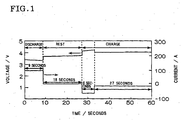
- Fig. 1 is a graph showing a charge-discharge pattern in a cycle test.
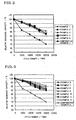
- Fig. 2 is a graph showing the results of cycle tests of Examples 1 to 5 and Comparative Example 1.
- Fig. 3 is a graph showing the results of cycle tests of Examples 6 to 12 and Comparative Example 2.
- Fig. 4 is a graph showing the results of cycle tests of Examples 13 to 15 and Comparative Example 3.
- Fig. 5 is a graph showing the results of cycle tests of Examples 16 to 18 and Comparative Example 4.
- the first aspect of the present invention is, as described above, a lithium secondary battery comprising a positive electrode formed using a positive active material and a negative electrode formed using a negative active material, characterized in that the negative active material has a lattice strain of 1% or less as measured by X-ray diffractometry, the negative active material has a crystallite diameter of 150 ⁇ or more as measured by X-ray diffractometry, and in the Raman spectrum of the negative active material obtained with an argon ion laser beam, a ratio (Ib/Ia) of peak intensity (Ib) at 1,330 to 1,360 cm -1 to peak intensity (Ia) at 1,550 to 1,580 cm -1 satisfies a relation of 0.1 ⁇ (Ib/Ia) ⁇ 0.8.
- a lithium secondary battery which hardly shows a reduction in relative discharge capacity even at high temperatures and which is superior in cycle characteristic.
- the X-ray diffraction result of a negative active material was obtained by analyzing a diffraction image obtained from an ordinary X-ray powder diffractometry, using the integral width method of Wilson; specifically, there was used RINT 2000 Series Application Software "Analysis of Crystallite Size and Lattice Strain” (third edition, issued on Oct. 16 of 1996) produced by Rigaku Denki K.K.
- counting time and X-ray intensity are adjusted so that the count number of diffraction peak becomes 5,000 or more, in order to obtain a measurement result of high accuracy.
- the peaks used for calculation there are appropriately selected at least three peaks of largest intensity.
- the Raman spectrum was specifically measured using a spectrophotometer, NR-1800 produced by Nihon Bunko K.K. and an argon laser beam of 5,145 ⁇ wavelength, in a measurement range of 50 ⁇ m at an exposure time of 60 seconds; and it was shown by using the axis of abscissa as wave number (cm -1 ) and the axis of ordinate as intensity.
- intensity refers to the intensity of a light obtained by a charge-coupled device (CCD) or the like
- the peak intensity in a given wave number range refers to the intensity of each peak from baseline.
- the surface and its vicinity of the negative active material used are made of an amorphous carbon material and the inside of the active material is made of graphite, is specified by particular values; and the crystallinity of the surface and its vicinity of the negative active material is specified by Raman spectrum and the crystallinity of the inside thereof is specified by X-ray diffraction.
- Raman spectrum is measured by applying an argon laser beam to a substance and detecting the resulting Raman scattering light; however, since a visible light can generally enter a substance only by about half wavelength, a surface layer of about several hundred ⁇ is observed.
- the X-ray used has a high transmittancy and reaches as deep as the inside of a substance and accordingly the average of the whole substance is observed; therefore, by investigation in comparison with the result of Raman spectrum, the inside state of negative active material can be grasped.
- the peak of 1,330 to 1,360 cm -1 corresponds to the peak of amorphous substance and the peak of 1,550 to 1,580 cm -1 corresponds to the peak of crystalline substance. Therefore, it follows that the larger the Ib/Ia of peak intensity Ib to peak intensity Ia, the higher the amorphism of surface.
- the integral width method of Wilson is used in the present invention and the indication is made in terms of lattice strain and crystallite diameter. In this case, the smaller the lattice strain or the larger the crystallite diameter, the higher the crystallinity.
- the second aspect of the present invention is, as described previously, a process for producing a negative active material for lithium secondary battery, which comprises heat-treating a raw material for a base material capable of occluding and releasing lithium ion and a raw material for a surface material covering a surface of the base material, to produce a negative active material for lithium secondary battery comprising the base material and the surface material covering the surface of the base material, the process being characterized in that the base material comprises a first base material which has come to have lithium ion occludability and releasability as a result of the heat treatment and/or a second base material which is a carbon material inherently having lithium ion occludability and releasability, and the process comprises coating the raw material for the surface material on the surface of the raw material for the first base material and/or the raw material for the second base material to produce a composite raw material, and then heat-treating the composite raw material.
- the surface of the graphite base material can be covered with a high temperature resistant amorphous carbon material, and it is possible to produce a negative active material which retains a graphite property of hardly showing a reduction in relative discharge capacity and yet being low in the high-temperature deterioration caused by the reaction between surface of negative active material and non-aqueous electrolytic solution.
- the adhesivity between the base material (graphite) and the surface material (an amorphous carbon material) is enhanced and the peeling of the surface material (an amorphous carbon material) from the base material (graphite) is suppressed; as a result, there can be produced a negative active material capable of providing a lithium secondary battery which hardly shows a reduction in relative discharge capacity even at high temperatures and which is superior in cycle characteristic.
- a raw material for the first base material and the raw material for the surface material a raw material, which is carbonizable by a heat treatment, specifically a synthetic resin.
- a material that is carbonizable by a heat treatment and, as the raw material for the surface material, a material that can become an amorphous carbon material by a heat treatment.
- an easily graphitizable resin is preferably used as the raw material for the first base material
- an easily graphitizable carbon material is preferably used as the raw material for the second base material
- a hardly graphitizable resin is preferably used as the raw material for the surface material.
- the above-mentioned raw material for the first base material and/or the above-mentioned raw material for the second base material are preferably used in the form of powder. It is because when the raw material for the first base material and/or the raw base material for the second base material is used in the form of mass or plate, a grinding step is necessary after their coating with the raw material for the surface material; as a result, the surface material is easily peeled from the base material and moreover the base material has a surface portion not coated with the surface material.
- a spraying method which comprises dissolving the raw material for the surface material in an organic solvent and spraying the organic solution, in a mist, onto the raw material for the first base material and/or the raw material for the second base material
- an immersion method which comprises immersing the raw material for the first base material and/or the raw base material for the second base material in the organic solution, because uniform coating of the surface material on the surface of the base material is made possible.
- the method for heat-treating the composite material obtained by using the above-mentioned coating method there is preferred a method which comprises conducting a heat treatment at such a temperature and for such a time as the raw material for the first base material, constituting the composite raw material is graphitized and the raw material for the surface material, constituting the composite raw material is not graphitized.
- a negative active material comprising a base material made of graphite and an amorphous carbon material covering the surface of the base material.
- the third aspect of the present invention is a process for producing a negative active material for lithium secondary battery by a heat treatment of a graphitic carbon, characterized in that the graphitic carbon is heat-treated in an oxygen-containing atmosphere.
- the heat treatment is conducted preferably at a temperature of 500 to 1,000°C. It is because when the heat treatment temperature is less than 500°C, oxidation is unlikely to occur in view of the reaction rate and, when the heat treatment temperature is more than 1,000°C, the graphitic carbon burns completely and comes to have no amorphous layer remaining on the surface.
- the heat treatment is conducted preferably by using a rotary kiln. There is no particular restriction as to the kind, etc. of the rotary kiln used, and an ordinary type can be used.
- the oxygen-containing atmosphere may be an atmosphere using air, and the graphitic carbon is preferably a fibrous highly-graphitized carbon because it can give a battery of low internal resistance.
- the fourth aspect of the present invention is a process for producing a negative active material for lithium secondary battery by oxidation of a graphitic carbon, characterized in that the oxidation of the graphitic carbon is conducted by an oxidizing agent.
- an oxidizing agent an inorganic acid is preferably used.
- the inorganic acid a mixed acid of concentrated nitric acid and concentrated sulfuric acid is preferred.
- the fifth aspect of the present invention is a process for producing a negative active material for lithium secondary battery by a physical treatment of a graphitic carbon, characterized in that the graphitic carbon is subjected to a high-impact treatment using a hard rotary body.
- the circumferential rotary speed of the hard rotary body is preferably 50 to 100 m/sec. It is because when the circumferential rotary speed is 50 m/sec or less, no sufficient impact force is applied to the graphitic carbon and, when the circumferential rotary speed is 100 m/sec or more, the impact applied is too strong and the graphitic carbon is broken.
- the hard rotary body a stainless steel-made or alumina-made substance is preferably used because they have a high hardness and hardly invite contamination with impurities.
- the hard rotary body may be an ordinary rotary blade.
- the sixth aspect of the present invention is a lithium secondary battery comprising a positive electrode formed using a positive active material and a negative electrode formed using a negative active material, characterized in that the negative active material has been produced by a production process according to any of the above-mentioned second to fifth aspects of the present invention.
- the battery Using a negative active material which is hardly deteriorated even at high temperatures, the battery has merits of hardly showing a reduction in relative discharge capacity even at high temperatures and being superior in cycle characteristic.
- lithium manganese compound oxides such as lithium manganese oxide (LiMn 2 O 4 ) and the like and lithium transition metal compound oxides such as lithium cobalt oxide (LiCoO 2 ), lithium nickel oxide (LiNiO 2 ) and the like.
- the lithium manganese compound oxide preferably contains a group IIIB element.
- the IIIB group element is preferably aluminum (Al) and/or boron (B) in view of the long-term storability of lithium secondary battery, the availability and handleability of a compound containing the element, etc.
- the lithium manganese compound oxide is also preferred to contain vanadium (V).
- V vanadium
- a lithium manganese compound oxide containing vanadium (V) is large in crystallite size and can impart, to a lithium secondary battery using it as the positive active material, a superior charge-discharge cycle characteristic at high temperatures.
- the lithium manganese compound oxide is also preferred to contain nickel (Ni) and/or titanium (Ti).
- a lithium manganese compound oxide containing nickel (Ni) and/or titanium (Ti) is low in electrical resistance and a lithium secondary battery using such a compound oxide as the positive active material can have a low internal resistance.
- a (Li/Mn) of less than 0.5 is not preferred because a lithium secondary battery using such a lithium manganese compound oxide as the positive active material is high in cycle characteristic deterioration.
- a (Li/Mn) of more than 0.6 is not preferred because the resulting lithium secondary battery has a small capacity.
- the process for producing the above-mentioned lithium manganese compound oxide is described briefly.
- the salts of these elements used as raw materials are preferred to have high purity and be inexpensive.
- they are preferably a carbonate, a hydroxide or an organic acid salt; however, a nitrate, a hydrochloride, a sulfate or the like may also be used.
- salts and oxides of Al, B, V, Ni, Ti and other elements may be prepared.
- a lithium salt and other raw materials, mentioned above are mixed so as to give an intended composition; the resulting mixed powder is fired in an oxidizing atmosphere at 800 to 850°C for 5 to 50 hours at least once; thereby, a lithium manganese compound oxide whose crystal structure is, for example, a spinel structure, can be obtained.
- the oxidizing atmosphere refers generally to an atmosphere having such an oxygen partial pressure that a sample inside the firing furnace can give rise to an oxidation reaction. It is specifically air, an oxygen atmosphere or the like.
- organic solvent used in the non-aqueous electrolytic solution there is preferably used a single solvent or a mixed solvent, which can include ⁇ -butyrolactone, tetrahydrofuran, acetonitrile, or a carbonic acid ester solvent such as ethylene carbonate (EC), diethyl carbonate (DEC), dimethyl carbonate (DMC) and propylene carbonate (PC), and the like.
- a single solvent or a mixed solvent which can include ⁇ -butyrolactone, tetrahydrofuran, acetonitrile, or a carbonic acid ester solvent such as ethylene carbonate (EC), diethyl carbonate (DEC), dimethyl carbonate (DMC) and propylene carbonate (PC), and the like.
- lithium fluoride complex compounds such as lithium phosphate hexafluoride (LiPF 6 ) and lithium borofluoride (LiBF 4 ), and lithium halides such as lithium perchlorate (LiClO 4 ).
- LiPF 6 is particularly preferred because it is hardly decomposed by oxidation and gives a non-aqueous electrolytic solution of high electrical conductivity.
- a coin cell type battery wherein a separator is disposed between a positive active material and a negative active material both of plate shape and an electrolytic solution is filled; and a cylindrical or box-shaped battery using an electrode body produced by winding or laminating, via a separator, a positive electrode plate obtained by applying a positive active material on a metal foil and a negative electrode plate obtained similarly by applying a negative active material on a metal foil.
- 1,000 g of an easily graphitizable resin (a raw material for the first base material) was powdered by a vibration mill in dried air.
- a carbon material (a raw material for the second base material) was used in a powder form.
- 10 g of a hardly graphitizable resin (a raw material for the surface material) was dissolved in 1,000 ml of toluene.
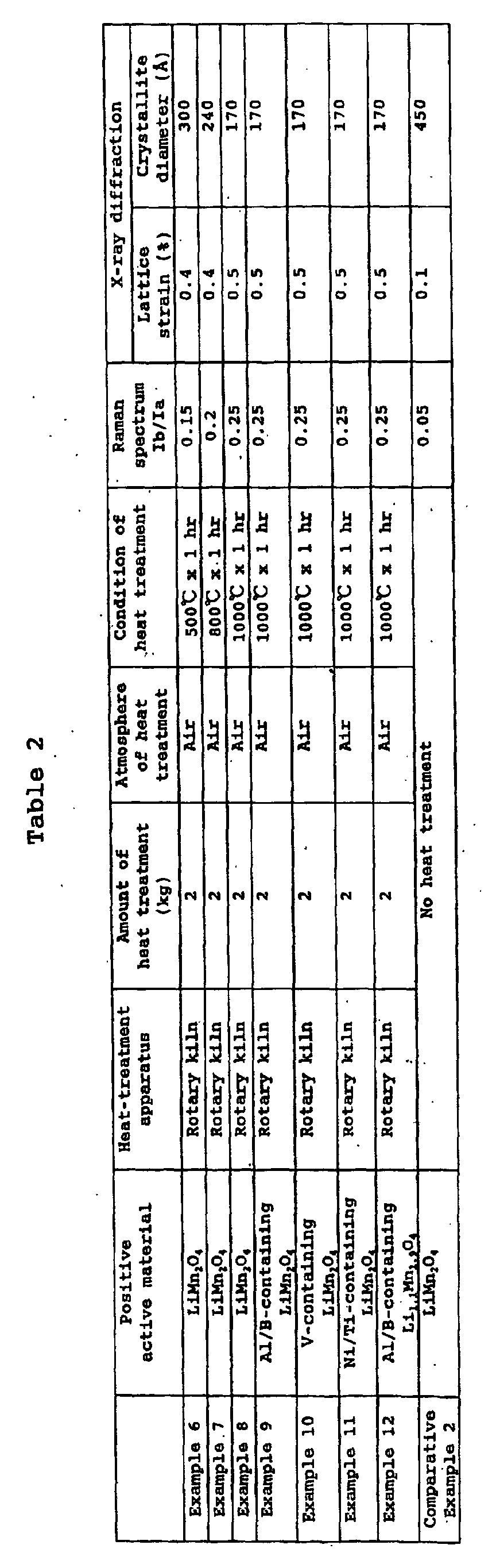
- Predetermined amount of fibrous highly-graphitized carbon powder was fed into a rotary kiln; a graphitic carbon was recovered at the downstream of the core tube of the rotary kiln; thereby, various negative active materials were produced (Examples 6 to 12 and Comparative Example 2).
- the rpm of rotary kiln and the slope of kiln core tube were set so that the speed of treatment became 2 kg/hr.
- Table 2 the amount of each highly-graphitized carbon heat-treated, the atmosphere of heat treatment, the conditions of heat treatment, and the Ib/Ia, lattice strain (%) and crystallite diameter ( ⁇ ) of each negative active material obtained.
- lithium manganese compound oxide As raw materials for lithium manganese compound oxide, there were prepared manganese salts (Mn salts), i.e. MnO 2 and MnCO 3 , and lithium salts (Li salts), i.e. Li 2 CO 3 and LiOH. They were mixed in required amounts so as to become a compositional ratio of LiMn 2 O 4 . Each mixture obtained was fired in an oxygen-containing atmosphere under firing conditions of 800 to 850°C x 5 to 50 hours, to obtain lithium manganese compound oxides (Examples 1 to 8, Examples 13 to 18 and Comparative Examples 1 to 4).
- Mn salts manganese salts
- Li salts lithium salts
- lithium manganese salts i.e. MnO 2 and MnCO 3
- lithium salts i.e. Li 2 CO 3 and LiOH. They were mixed in required amounts so as to become a compositional ratio of LiMn 2 O 4 or Li 1.1 Mn 1.9 O 4 .
- the mixture was wet-stirred, dried and fired in an oxygen-containing atmosphere under conditions of 800 to 850°C x 5 to 50 hours, to obtain lithium manganese compound oxides (Examples 9 to 12).
- the lithium manganese compound oxide obtained by the above-mentioned production process was used as a positive active material. Thereto was added acetylene black as a conductivity-improving agent in an amount of 4% by mass relative to 100% by mass of the compound oxide. Further, a solvent and a binder were added to prepare a positive electrode material slurry: The slurry was applied on both sides of an aluminum foil of 20 ⁇ m in thickness, in a thickness (each side) of about 100 ⁇ m, to produce a positive electrode plate. The negative active material obtained by the above-mentioned production process was applied on both sides of a copper foil of 10 ⁇ m in thickness, in a thickness (each side) of about 80 ⁇ m, to produce a negative electrode plate.
- a wound type electrode body was produced and accommodated in a battery case; a non-aqueous electrolytic solution was filled therein; thereby, various lithium secondary batteries were produced (Examples 1 to 18 and Comparative Examples 1 to 4).
- the non-aqueous electrolytic solution there was used a solution obtained by dissolving LiPF 6 as an electrolyte in an equal-volume mixed solvent of EC and DEC in a concentration of 1 mole/l.
- the capacities of the batteries after initial charge were all about 10 Ah.
- a cycle test was conducted by repeating a charge-discharge cycle (one cycle) shown in Fig. 1. That is, one cycle was set at a pattern of discharging a battery having a charge state of 50% of depth of discharge, at a current of 100 A corresponding to 10C (discharge rate) for 9 seconds, then having a rest for 18 seconds, thereafter conducting charge at 70 A for 6 seconds, successively conducting charge at 18 A for 27 seconds to allow the battery to again have a charge state of 50%. Incidentally, by finely controlling the current (18 A) of second charge, the variations in depth of discharge in various cycles were minimized.
- Fig. 2 is shown a graph indicating the results of cycle tests of Examples 1 to 5 and Comparative Example 1.
- Fig. 3 is shown a graph indicating the results of cycle tests of Examples 6 to 12 and Comparative Example 2.
- Fig. 4 is shown a graph indicating the results of cycle tests of Examples 13 to 15 and Comparative Example 3.
- Fig. 5 is shown a graph indicating the results of cycle tests of Examples 16 to 18 and Comparative Example 4.
- the batteries of Examples 1 to 5 according to the present invention achieved a relative discharge capacity of 83% or more in a cycle test of 20,000 times, and exhibited a cycle characteristic better than that of Comparative Example 1 in which a negative active material produced by the present invention was not used.
- a base material made of graphite is covered with a surface material made of an amorphous carbon material and the base material and the surface material are hardly peeled from each other and, therefore, the high-temperature deterioration of the negative active material is inhibited, resulting in improved cycle characteristic.
- the batteries of Examples 6 to 12 according to the present invention achieved a relative discharge capacity of 85% or more in a cycle test of 20,000 times, and exhibited a cycle characteristic better than that of Comparative Example 2 in which a negative active material produced by the present invention was not used. This is thought to be because the surface of a graphitic carbon'is oxidized and only the surface and its vicinity have been made amorphous and, therefore, the high-temperature deterioration of the negative active material is inhibited. resulting in improved cycle characteristic.
- the batteries of Examples 9 to 12 have been found to be even higher in relative discharge capacity (%) after 20,000 cycles than batteries having, as the positive active material, a lithium manganese compound oxide without containing Al, B, V, Ni or Ti.
- the batteries of Examples 13 to 15 according to the present invention achieved a relative discharge capacity of 85% or more in a cycle test of 20,000 times, and exhibited a cycle characteristic better than that of Comparative Example 3 in which a negative active material produced by the present invention was not used. This is thought to be because the surface of a graphitic carbon is oxidized and only the surface and its vicinity have been made amorphous and, therefore, the high-temperature deterioration of the negative active material is inhibited, resulting in improved cycle characteristic.
- the batteries of Examples 16 to '18 according to the present invention achieved a relative discharge capacity of 84% or more in a cycle test of 20,000 times, and exhibited a cycle characteristic better than that of Comparative Example 4 in which a negative active material produced by the present invention was not used.
- a graphitic carbon is subjected to a high-impact treatment and the surface and its vicinity have been made amorphous and, therefore, the high-temperature deterioration of the negative active material is inhibited, resulting in improved cycle characteristic.
- the lithium secondary battery of the present invention is preferably used specifically in an internal electrode body of wound type or lamination type, particularly in such an internal electrode body having a capacity of 2 Ah or more.
- the present battery is preferably used for motor drive of an electric vehicle or a hybrid electric vehicle, or engine start-up, as a battery for vehicle in which discharge of large current takes place frequently and which tends to become a high-temperature state.
- the lattice strain and crystallite diameter of the negative active material as measured by X-ray diffractometry are in predetermined ranges, and the Raman spectrum of the negative active material has particular peaks; therefore, the present battery hardly shows a reduction in relative discharge capacity and is superior in cycle characteristic.
- a raw material for surface material is coated on the surface of a raw material for base material to produce a composite raw material and this composite raw material is heat-treated; therefore, there can be produced a negative active material which has a high adhesivity between the base material and the surface material and which is hardly deteriorated even at high temperatures.
- a graphitic carbon is (1) heat-treated in an oxygen-containing atmosphere, (2) oxidized by an oxidizing agent, or (3) subjected to a high-impact treatment by a hard rotary body; therefore, there can be produced a negative active material which has a high adhesivity between the base material and the surface material and which is hardly deteriorated even at high temperatures.
- the lithium secondary battery of the present invention uses a negative active material obtained by any of the production processes mentioned above; therefore, it has advantages of hardly showing a reduction in relative discharge capacity and being superior in cycle characteristic.
Landscapes
- Chemical & Material Sciences (AREA)
- Chemical Kinetics & Catalysis (AREA)
- Electrochemistry (AREA)
- General Chemical & Material Sciences (AREA)
- Engineering & Computer Science (AREA)
- Composite Materials (AREA)
- Materials Engineering (AREA)
- Manufacturing & Machinery (AREA)
- Inorganic Chemistry (AREA)
- Battery Electrode And Active Subsutance (AREA)
- Secondary Cells (AREA)
Abstract
A lithium secondary battery of the present invention
is characterized in that the negative active material has a
lattice strain of 1% or less as measured by X-ray
diffractometry, the negative active material has a
crystallite diameter of 150 Å or more as measured by X-ray
diffractometry, and, in the Raman spectrum of the negative
active material obtained with an argon ion laser beam, a
ratio (Ib/Ia) of peak intensity (Ib) at 1,330 to 1,360 cm-1
to peak intensity (Ia) at 1,550 to 1,580 cm-1 satisfies a
relation of 0.1 ≦ Ib/Ia ≦ 0.8; hardly shows a reduction in
relative discharge capacity even at high temperatures; and
is superior in cycle characteristic.
Description
The present invention relates to a lithium secondary
battery and a process for production of a negative active
material used therein, particularly to improvement of
negative active material.
In recent years, lithium secondary battery (hereinafter
may be referred to simply as "battery") has found wide
applications as a battery for an electric source of portable
electronic appliances such as mobile telephone, VTR, note
type computer and the like. Further, lithium secondary
battery, having a single cell voltage of about 4 V (which is
higher than those of conventional secondary batteries such as
lead-acid battery and the like) and a high energy density, is
drawing people's attention not only as an electronic source
for the above-mentioned portable electronic appliances but
also as an electric source for start-up of a motor of an
electric vehicle (EV) or hybrid electric vehicle (HEV) whose
use by the public as a low-pollution vehicle is promoted
actively in the midst of recent environmental problems.
This lithium secondary battery is constituted by a
positive electrode and a negative electrode both capable of
occluding and releasing lithium ion reversibly, and a non-aqueous
electrolytic solution which is a solution of lithium
ion dissolved in a non-aqueous solvent.
As the non-aqueous electrolytic solution, there is
generally used a solution obtained by dissolving a lithium
salt in a carbonic acid ester solvent such as ethylene
carbonate (EC), propylene carbonate (PC) or the like.
Also, as the active material for positive electrode,
there is used a lithium compound oxide such as lithium cobalt
oxide (LiCoO2), lithium nickel oxide (LiNiO2), lithium
manganese oxide (LiMn2O4) or the like.
As the active material for negative electrode, there is
used an amorphous carbon material called hard carbon, or a
highly graphitized carbon material such as artificial
graphite, natural graphite or the like.
In lithium secondary battery, there has heretofore been
used frequently, as the negative active material, a highly
graphitized carbon material because it can give a battery
superior in relative discharge capacity.
It is well known that lithium secondary battery tends
to become a high-temperature state when overcharged or used
continuously. In a lithium secondary battery using the
above-mentioned highly graphitized carbon material, it is
known that the carbon material is deteriorated in a high-temperature
state of battery and gives rise to a reduction in
relative discharge capacity. The present inventors applied a
high load to a battery using a highly graphitized carbon
material as the negative electrode active material and used
the battery at a high temperature, and then decomposed the
battery to examine the negative active material. As a
result, it was found that lithium ion was trapped on the
surface of the highly graphitized carbon material and was in
a dedoping-impossible state. From this, it can be presumed
that when the battery became a high-temperature state, the
surface of the negative active material composed of a highly
graphitized carbon material reacted with the non-aqueous
electrolytic solution and the function of the highly
graphitized carbon material as a negative active material was
deteriorated.
As a relevant prior art, there is disclosed the
following process (see, for example, Patent Literature 1
shown below), i.e. a process for producing a negative active
material constituted by composite particles composed of
mother particles (graphite) capable of occluding and
releasing lithium ion and child particles (an amorphous
carbon material) consisting of carbon having particle
diameters smaller than those of the mother particles, present
on the surfaces of the mother particles so as to form an
integral material, by using a mechanochemical treatment which
comprises mixing a powder of the mother particles (graphite)
with a powder of the child particles (an amorphous carbon
material) and applying a compressive force and a shear force
to the resulting mixed powder to obtain composite particles
wherein the child particles (an amorphous carbon material)
are present on the surfaces of the mother particles
(graphite) so as to form an integral material. By using, in
a lithium secondary battery, a negative active material which
is formed by covering the surfaces of mother particles
consisting of graphite, with an amorphous carbon material
highly resistant to high temperatures and which retains a
graphite property of superior relative discharge capacity and
yet is low in high-temperature deterioration, it is possible
to obtain a battery capable of maintaining its energy density
and output density at high levels even at a high load, i.e.
at high temperatures.
However, in the process which comprises applying a
compressive force and a shear force to a mixed powder of
mother particles (graphite) and child particles (an amorphous
carbon material) to make the mother particles (graphite) and
the child particles (an amorphous carbon material) into one
integral material, the carbon material hardly sticks to the
surfaces of the graphite; therefore, there has been a problem
that when the battery obtained becomes a high-temperature
state, the mother particles consisting of graphite and the
child particles consisting of a carbon material tend to peel
from each other and this negative active material is
deteriorated easily.
The present invention has been made in view of such
past problems and aims at providing a lithium secondary
battery which hardly shows a reduction in relative discharge
capacity even at high temperatures and is superior in cycle
characteristic by using a negative active material low in
deterioration wherein only the surface and its vicinity are
made of an amorphous carbon material and its inside is made
of a crystalline graphite; and a process for producing a
negative active material used therein.
According to the present invention there are provided a
lithium secondary battery and a process for producing a
negative active material used therein as described below.
the negative active material has a lattice strain of 1% or less as measured by X-ray diffractometry,
the negative active material has a crystallite diameter of 150 Å or more as measured by X-ray diffractometry, and
in a Raman spectrum of the negative active material obtained with an argon ion laser beam, a ratio (Ib/Ia) of peak intensity (Ib) at 1,330 to 1,360 cm-1 to peak intensity (Ia) at 1,550 to 1,580 cm-1 satisfies a relation of 0.1 ≦ (Ib/Ia) ≦ 0.8.
the base material comprises a first base material which has come to have lithium ion occludability and releasability by the heat-treating and/or a second base material which is a carbon material inherently having lithium ion occludability and releasability, and
the process comprises coating the raw material for the surface material on the surface of the raw material for the first base material and/or a raw material for the second base material to produce a composite raw material, and then heat-treating the composite raw material.
Fig. 1 is a graph showing a charge-discharge pattern in
a cycle test. Fig. 2 is a graph showing the results of cycle
tests of Examples 1 to 5 and Comparative Example 1. Fig. 3
is a graph showing the results of cycle tests of Examples 6
to 12 and Comparative Example 2. Fig. 4 is a graph showing
the results of cycle tests of Examples 13 to 15 and
Comparative Example 3. Fig. 5 is a graph showing the results
of cycle tests of Examples 16 to 18 and Comparative Example
4.
The mode for carrying out the present invention is
described specifically below with referring to the
accompanying drawings.
The first aspect of the present invention is, as
described above, a lithium secondary battery comprising a
positive electrode formed using a positive active material
and a negative electrode formed using a negative active
material, characterized in that
the negative active material has a lattice strain of 1% or less as measured by X-ray diffractometry,
the negative active material has a crystallite diameter of 150 Å or more as measured by X-ray diffractometry, and
in the Raman spectrum of the negative active material obtained with an argon ion laser beam, a ratio (Ib/Ia) of peak intensity (Ib) at 1,330 to 1,360 cm-1 to peak intensity (Ia) at 1,550 to 1,580 cm-1 satisfies a relation of 0.1 ≦ (Ib/Ia) ≦ 0.8. Thereby, it is possible to provide, as shown in the results of Examples described later, a lithium secondary battery which hardly shows a reduction in relative discharge capacity even at high temperatures and which is superior in cycle characteristic.
the negative active material has a lattice strain of 1% or less as measured by X-ray diffractometry,
the negative active material has a crystallite diameter of 150 Å or more as measured by X-ray diffractometry, and
in the Raman spectrum of the negative active material obtained with an argon ion laser beam, a ratio (Ib/Ia) of peak intensity (Ib) at 1,330 to 1,360 cm-1 to peak intensity (Ia) at 1,550 to 1,580 cm-1 satisfies a relation of 0.1 ≦ (Ib/Ia) ≦ 0.8. Thereby, it is possible to provide, as shown in the results of Examples described later, a lithium secondary battery which hardly shows a reduction in relative discharge capacity even at high temperatures and which is superior in cycle characteristic.
In the present invention, the X-ray diffraction result
of a negative active material was obtained by analyzing a
diffraction image obtained from an ordinary X-ray powder
diffractometry, using the integral width method of Wilson;
specifically, there was used RINT 2000 Series Application
Software "Analysis of Crystallite Size and Lattice Strain"
(third edition, issued on Oct. 16 of 1996) produced by Rigaku
Denki K.K. In this X-ray diffraction, counting time and X-ray
intensity are adjusted so that the count number of
diffraction peak becomes 5,000 or more, in order to obtain a
measurement result of high accuracy. Further, as the peaks
used for calculation, there are appropriately selected at
least three peaks of largest intensity.
Also in the present invention, the Raman spectrum was
specifically measured using a spectrophotometer, NR-1800
produced by Nihon Bunko K.K. and an argon laser beam of 5,145
Å wavelength, in a measurement range of 50 µm at an exposure
time of 60 seconds; and it was shown by using the axis of
abscissa as wave number (cm-1) and the axis of ordinate as
intensity. Here, intensity refers to the intensity of a
light obtained by a charge-coupled device (CCD) or the like,
and the peak intensity in a given wave number range refers to
the intensity of each peak from baseline.
In the lithium secondary battery of the present
invention, that only the surface and its vicinity of the
negative active material used are made of an amorphous carbon
material and the inside of the active material is made of
graphite, is specified by particular values; and the
crystallinity of the surface and its vicinity of the negative
active material is specified by Raman spectrum and the
crystallinity of the inside thereof is specified by X-ray
diffraction. Raman spectrum is measured by applying an argon
laser beam to a substance and detecting the resulting Raman
scattering light; however, since a visible light can
generally enter a substance only by about half wavelength, a
surface layer of about several hundred Å is observed. In
contrast, in X-ray diffraction, the X-ray used has a high
transmittancy and reaches as deep as the inside of a
substance and accordingly the average of the whole substance
is observed; therefore, by investigation in comparison with
the result of Raman spectrum, the inside state of negative
active material can be grasped.
Specifically explaining, in Raman spectrum, the peak of
1,330 to 1,360 cm-1 corresponds to the peak of amorphous
substance and the peak of 1,550 to 1,580 cm-1 corresponds to
the peak of crystalline substance. Therefore, it follows
that the larger the Ib/Ia of peak intensity Ib to peak
intensity Ia, the higher the amorphism of surface. In X-ray
diffraction, the sharper the observed peak of a substance,
the higher its crystallinity; in order to indicate it
numerically, the integral width method of Wilson is used in
the present invention and the indication is made in terms of
lattice strain and crystallite diameter. In this case, the
smaller the lattice strain or the larger the crystallite
diameter, the higher the crystallinity.
The second aspect of the present invention is, as
described previously, a process for producing a negative
active material for lithium secondary battery, which
comprises heat-treating a raw material for a base material
capable of occluding and releasing lithium ion and a raw
material for a surface material covering a surface of the
base material, to produce a negative active material for
lithium secondary battery comprising the base material and
the surface material covering the surface of the base
material, the process being characterized in that
the base material comprises a first base material which has come to have lithium ion occludability and releasability as a result of the heat treatment and/or a second base material which is a carbon material inherently having lithium ion occludability and releasability, and
the process comprises coating the raw material for the surface material on the surface of the raw material for the first base material and/or the raw material for the second base material to produce a composite raw material, and then heat-treating the composite raw material. Thereby, the surface of the graphite base material can be covered with a high temperature resistant amorphous carbon material, and it is possible to produce a negative active material which retains a graphite property of hardly showing a reduction in relative discharge capacity and yet being low in the high-temperature deterioration caused by the reaction between surface of negative active material and non-aqueous electrolytic solution. Further, by using a method which comprises coating the raw material for the surface material on the surfaces of the raw material for the first base material and/or the raw material for the second base material and then heat-treating the resulting material to form an integral material, the adhesivity between the base material (graphite) and the surface material (an amorphous carbon material) is enhanced and the peeling of the surface material (an amorphous carbon material) from the base material (graphite) is suppressed; as a result, there can be produced a negative active material capable of providing a lithium secondary battery which hardly shows a reduction in relative discharge capacity even at high temperatures and which is superior in cycle characteristic.
the base material comprises a first base material which has come to have lithium ion occludability and releasability as a result of the heat treatment and/or a second base material which is a carbon material inherently having lithium ion occludability and releasability, and
the process comprises coating the raw material for the surface material on the surface of the raw material for the first base material and/or the raw material for the second base material to produce a composite raw material, and then heat-treating the composite raw material. Thereby, the surface of the graphite base material can be covered with a high temperature resistant amorphous carbon material, and it is possible to produce a negative active material which retains a graphite property of hardly showing a reduction in relative discharge capacity and yet being low in the high-temperature deterioration caused by the reaction between surface of negative active material and non-aqueous electrolytic solution. Further, by using a method which comprises coating the raw material for the surface material on the surfaces of the raw material for the first base material and/or the raw material for the second base material and then heat-treating the resulting material to form an integral material, the adhesivity between the base material (graphite) and the surface material (an amorphous carbon material) is enhanced and the peeling of the surface material (an amorphous carbon material) from the base material (graphite) is suppressed; as a result, there can be produced a negative active material capable of providing a lithium secondary battery which hardly shows a reduction in relative discharge capacity even at high temperatures and which is superior in cycle characteristic.
In the present invention, there is preferably used, as
the raw material for the first base material and the raw
material for the surface material, a raw material, which is
carbonizable by a heat treatment, specifically a synthetic
resin. There is preferably used, as the raw material for the
first base material, a material that is carbonizable by a
heat treatment and, as the raw material for the surface
material, a material that can become an amorphous carbon
material by a heat treatment. Thereby, it is possible to
produce a negative active material comprising a base material
made of graphite and an amorphous carbon material covering
the surface of the base material.
More specifically, an easily graphitizable resin is
preferably used as the raw material for the first base
material, an easily graphitizable carbon material is
preferably used as the raw material for the second base
material, and a hardly graphitizable resin is preferably used
as the raw material for the surface material.
In the present invention, the above-mentioned raw
material for the first base material and/or the above-mentioned
raw material for the second base material are
preferably used in the form of powder. It is because when
the raw material for the first base material and/or the raw
base material for the second base material is used in the
form of mass or plate, a grinding step is necessary after
their coating with the raw material for the surface material;
as a result, the surface material is easily peeled from the
base material and moreover the base material has a surface
portion not coated with the surface material.
In the present invention, it is preferred to use, as
the method for coating the raw material for the surface
material on the surface of the raw material for the first
base material and/or the raw material for the second base
material, a spraying method which comprises dissolving the
raw material for the surface material in an organic solvent
and spraying the organic solution, in a mist, onto the raw
material for the first base material and/or the raw material
for the second base material, and/or an immersion method
which comprises immersing the raw material for the first base
material and/or the raw base material for the second base
material in the organic solution, because uniform coating of
the surface material on the surface of the base material is
made possible.
As the method for heat-treating the composite material
obtained by using the above-mentioned coating method, there
is preferred a method which comprises conducting a heat
treatment at such a temperature and for such a time as the
raw material for the first base material, constituting the
composite raw material is graphitized and the raw material
for the surface material, constituting the composite raw
material is not graphitized. Thereby, it is possible to
produce a negative active material comprising a base material
made of graphite and an amorphous carbon material covering
the surface of the base material. Incidentally, the specific
temperature and time employed are explained in Examples.
The third aspect of the present invention is a process
for producing a negative active material for lithium
secondary battery by a heat treatment of a graphitic carbon,
characterized in that the graphitic carbon is heat-treated in
an oxygen-containing atmosphere. In the process, the heat
treatment is conducted preferably at a temperature of 500 to
1,000°C. It is because when the heat treatment temperature
is less than 500°C, oxidation is unlikely to occur in view of
the reaction rate and, when the heat treatment temperature is
more than 1,000°C, the graphitic carbon burns completely and
comes to have no amorphous layer remaining on the surface.
The heat treatment is conducted preferably by using a rotary
kiln. There is no particular restriction as to the kind,
etc. of the rotary kiln used, and an ordinary type can be
used. The oxygen-containing atmosphere may be an atmosphere
using air, and the graphitic carbon is preferably a fibrous
highly-graphitized carbon because it can give a battery of
low internal resistance.
The fourth aspect of the present invention is a process
for producing a negative active material for lithium
secondary battery by oxidation of a graphitic carbon,
characterized in that the oxidation of the graphitic carbon
is conducted by an oxidizing agent. In the process, as the
oxidizing agent, an inorganic acid is preferably used. As
the inorganic acid, a mixed acid of concentrated nitric acid
and concentrated sulfuric acid is preferred.
The fifth aspect of the present invention is a process
for producing a negative active material for lithium
secondary battery by a physical treatment of a graphitic
carbon, characterized in that the graphitic carbon is
subjected to a high-impact treatment using a hard rotary
body. In the high-impact treatment, the circumferential
rotary speed of the hard rotary body is preferably 50 to 100
m/sec. It is because when the circumferential rotary speed
is 50 m/sec or less, no sufficient impact force is applied to
the graphitic carbon and, when the circumferential rotary
speed is 100 m/sec or more, the impact applied is too strong
and the graphitic carbon is broken. As the hard rotary body,
a stainless steel-made or alumina-made substance is
preferably used because they have a high hardness and hardly
invite contamination with impurities. The hard rotary body
may be an ordinary rotary blade.
Next, description is made on the sixth aspect of the
present invention. The sixth aspect of the present invention
is a lithium secondary battery comprising a positive
electrode formed using a positive active material and a
negative electrode formed using a negative active material,
characterized in that the negative active material has been
produced by a production process according to any of the
above-mentioned second to fifth aspects of the present
invention. Using a negative active material which is hardly
deteriorated even at high temperatures, the battery has
merits of hardly showing a reduction in relative discharge
capacity even at high temperatures and being superior in
cycle characteristic.
As other members (materials) constituting the lithium
secondary batteries according to the first and sixth aspects
of the present invention, various known materials can be
used. As the positive active material, for example, there
can be used lithium manganese compound oxides such as lithium
manganese oxide (LiMn2O4) and the like and lithium transition
metal compound oxides such as lithium cobalt oxide (LiCoO2),
lithium nickel oxide (LiNiO2) and the like.
The lithium manganese compound oxide preferably
contains a group IIIB element. The reason is not clear;
however, when a group IIIB element is contained in the
lithium manganese compound oxide, a lithium secondary battery
using the lithium manganese compound oxide as the positive
active material can have excellent long-term storage
capability. Incidentally, the IIIB group element is
preferably aluminum (Al) and/or boron (B) in view of the
long-term storability of lithium secondary battery, the
availability and handleability of a compound containing the
element, etc.
The lithium manganese compound oxide is also preferred
to contain vanadium (V). A lithium manganese compound oxide
containing vanadium (V) is large in crystallite size and can
impart, to a lithium secondary battery using it as the
positive active material, a superior charge-discharge cycle
characteristic at high temperatures.
The lithium manganese compound oxide is also preferred
to contain nickel (Ni) and/or titanium (Ti). A lithium
manganese compound oxide containing nickel (Ni) and/or
titanium (Ti) is low in electrical resistance and a lithium
secondary battery using such a compound oxide as the positive
active material can have a low internal resistance.
The ratio of lithium (Li) and manganese (Mn) contained
in the lithium manganese compound oxide is preferably (Li/Mn)
= 0.5 to 0.6 (molar ratio), more preferably 0.52 to 0.6
(molar ratio), further preferably 0.52 to 0.58. A (Li/Mn) of
less than 0.5 is not preferred because a lithium secondary
battery using such a lithium manganese compound oxide as the
positive active material is high in cycle characteristic
deterioration. A (Li/Mn) of more than 0.6 is not preferred
because the resulting lithium secondary battery has a small
capacity.
Then, the process for producing the above-mentioned
lithium manganese compound oxide is described briefly.
First, there are prepared salts and/or oxides of the
individual elements (Li, Mn, other metal elements, etc.)
constituting the lithium manganese compound oxide. Needless
to say, the salts of these elements, used as raw materials
are preferred to have high purity and be inexpensive.
Specifically, they are preferably a carbonate, a hydroxide or
an organic acid salt; however, a nitrate, a hydrochloride, a
sulfate or the like may also be used. As necessary, salts
and oxides of Al, B, V, Ni, Ti and other elements may be
prepared.
A lithium salt and other raw materials, mentioned above
are mixed so as to give an intended composition; the
resulting mixed powder is fired in an oxidizing atmosphere at
800 to 850°C for 5 to 50 hours at least once; thereby, a
lithium manganese compound oxide whose crystal structure is,
for example, a spinel structure, can be obtained.
Incidentally, the oxidizing atmosphere refers generally to an atmosphere having such an oxygen partial pressure that a sample inside the firing furnace can give rise to an oxidation reaction. It is specifically air, an oxygen atmosphere or the like.
Incidentally, the oxidizing atmosphere refers generally to an atmosphere having such an oxygen partial pressure that a sample inside the firing furnace can give rise to an oxidation reaction. It is specifically air, an oxygen atmosphere or the like.
As the organic solvent used in the non-aqueous
electrolytic solution, there is preferably used a single
solvent or a mixed solvent, which can include γ-butyrolactone,
tetrahydrofuran, acetonitrile, or a carbonic
acid ester solvent such as ethylene carbonate (EC), diethyl
carbonate (DEC), dimethyl carbonate (DMC) and propylene
carbonate (PC), and the like.
As the electrolyte, there are mentioned lithium
fluoride complex compounds such as lithium phosphate
hexafluoride (LiPF6) and lithium borofluoride (LiBF4), and
lithium halides such as lithium perchlorate (LiClO4). One
kind or more kinds thereof are dissolved in the above-mentioned
solvent and used. LiPF6 is particularly preferred
because it is hardly decomposed by oxidation and gives a non-aqueous
electrolytic solution of high electrical
conductivity.
As to the structure of the battery, there can be
mentioned a coin cell type battery wherein a separator is
disposed between a positive active material and a negative
active material both of plate shape and an electrolytic
solution is filled; and a cylindrical or box-shaped battery
using an electrode body produced by winding or laminating,
via a separator, a positive electrode plate obtained by
applying a positive active material on a metal foil and a
negative electrode plate obtained similarly by applying a
negative active material on a metal foil.
The present invention is described more specifically
below by way of Examples. However, the present invention is
in no way restricted by these Examples.
1,000 g of an easily graphitizable resin (a raw
material for the first base material) was powdered by a
vibration mill in dried air. A carbon material (a raw
material for the second base material) was used in a powder
form. Separately, 10 g of a hardly graphitizable resin (a
raw material for the surface material) was dissolved in 1,000
ml of toluene. In the resulting toluene solution was
immersed the powdered easily graphitizable resin or the
carbon material powder for 5 minutes to coat the surface of
the easily graphitizable resin or the carbon material powder
with the hardly graphitizable resin; then, the toluene
solution was removed; the coated material was dried in a
high-temperature vessel of 100°C for 12 hours to produce
composite raw materials. Each composite raw material was
heat-treated in a nitrogen atmosphere, then disintegrated,
and sieved so as to have particle diameters of 100 µm or
less, whereby negative active materials were produced
(Examples 1 to 5 and Comparative Example 1). Incidentally,
there are shown, in Table 1, the kinds of each easily
graphitizable resin, carbon material and hardly graphitizable
resin, the conditions of heat treatment, and the Ib/Ia,
lattice strain (%) and crystallite diameter (Å) of each
negative active material obtained.

Predetermined amount of fibrous highly-graphitized
carbon powder was fed into a rotary kiln; a graphitic carbon
was recovered at the downstream of the core tube of the
rotary kiln; thereby, various negative active materials were
produced (Examples 6 to 12 and Comparative Example 2). The
rpm of rotary kiln and the slope of kiln core tube were set
so that the speed of treatment became 2 kg/hr. Incidentally,
there are shown, in Table 2, the amount of each highly-graphitized
carbon heat-treated, the atmosphere of heat
treatment, the conditions of heat treatment, and the Ib/Ia,
lattice strain (%) and crystallite diameter (Å) of each
negative active material obtained.
First, 16 liters of a 68% concentrated nitric acid
aqueous solution and 32 liters of a 96% concentrated sulfuric
acid aqueous solution were mixed at normal temperature to
produce a mixed acid of concentrated nitric acid and
concentrated sulfuric acid. Into this mixed acid was fed 1
kg of a fibrous highly-graphitized carbon powder, and they
were subjected to heating and refluxing at a given
temperature for 1 hour. Then, the mixed acid containing the
graphite powder was cooled to normal temperature and filtered
to recover an oxidized graphite powder. This graphite powder
was washed with water and dried at 100°C for 24 hours to
produce various negative active materials (Examples 13 to 15
and Comparative Example 3). Incidentally, there are shown,
in Table 3, the amount of oxidation, the temperature of
oxidation, and the Ib/Ia, lattice strain (%) and crystallite
diameter (Å) of each negative active material obtained.
 A fibrous highly-graphitized carbon powder of given amount
was fed into Hybridizer NHS-1, a product of Nara Kikai K.K.,
and subjected to a high-impact treatment at a predetermined
circumferential speed using rotary blades, to produce
negative active materials (Examples 16 to 18 and Comparative
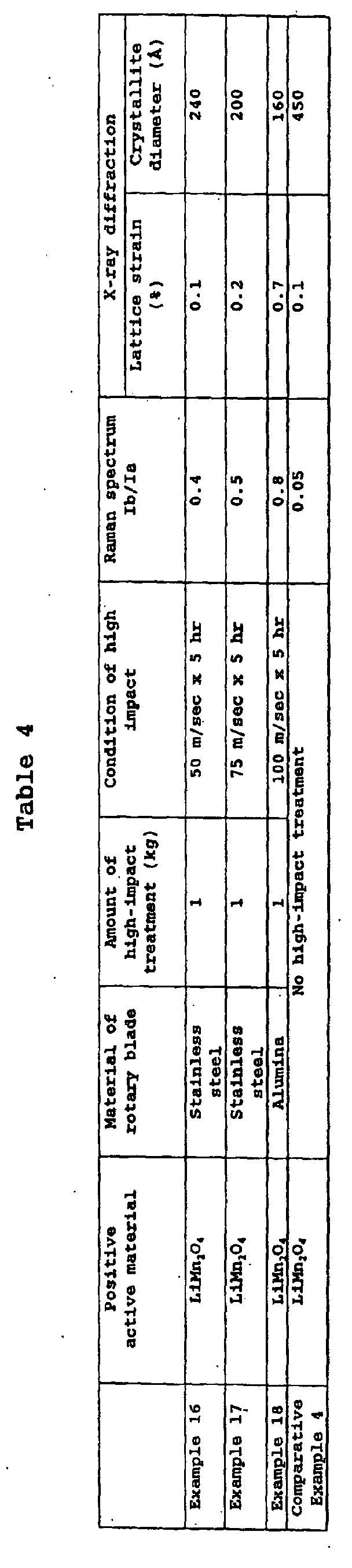
Example 4). Incidentally, there are shown, in Table 4, the
material of rotary blade, the amount subjected to high-impact
treatment, the conditions of high-impact treatment, and the
Ib/Ia, lattice strain (%) and crystallite diameter (Å) of
each negative active material obtained.
A fibrous highly-graphitized carbon powder of given amount
was fed into Hybridizer NHS-1, a product of Nara Kikai K.K.,
and subjected to a high-impact treatment at a predetermined
circumferential speed using rotary blades, to produce
negative active materials (Examples 16 to 18 and Comparative
Example 4). Incidentally, there are shown, in Table 4, the
material of rotary blade, the amount subjected to high-impact
treatment, the conditions of high-impact treatment, and the
Ib/Ia, lattice strain (%) and crystallite diameter (Å) of
each negative active material obtained.
As raw materials for lithium manganese compound oxide,
there were prepared manganese salts (Mn salts), i.e. MnO2
and MnCO3, and lithium salts (Li salts), i.e. Li2CO3 and
LiOH. They were mixed in required amounts so as to become a
compositional ratio of LiMn2O4. Each mixture obtained was
fired in an oxygen-containing atmosphere under firing
conditions of 800 to 850°C x 5 to 50 hours, to obtain
lithium manganese compound oxides (Examples 1 to 8, Examples
13 to 18 and Comparative Examples 1 to 4).
As raw materials for lithium manganese compound oxide,
there were prepared manganese salts (Mn salts), i.e. MnO2
and MnCO3, and lithium salts (Li salts), i.e. Li2CO3 and
LiOH. They were mixed in required amounts so as to become a
compositional ratio of LiMn2O4 or Li1.1Mn1.9O4. To each mixture
obtained were added, as additives, TiO2, NiO, V2O5, B2O3 and
Al2O3 [Example 9: Al2O3 = 5, B2O3 = 0.5; Example 10: V2O5 =
0.5; Example 11: NiO = 1.5, TiO2 = 1.5; Example 12: Al2O3 =
5, B2O3 = 0.5 (unit is a ratio (molar ratio, %) relative to
the amount (moles) of manganese salt)]. Then, the mixture
was wet-stirred, dried and fired in an oxygen-containing
atmosphere under conditions of 800 to 850°C x 5 to 50 hours,
to obtain lithium manganese compound oxides (Examples 9 to
12).
The lithium manganese compound oxide obtained by the
above-mentioned production process was used as a positive
active material. Thereto was added acetylene black as a
conductivity-improving agent in an amount of 4% by mass
relative to 100% by mass of the compound oxide. Further, a
solvent and a binder were added to prepare a positive
electrode material slurry: The slurry was applied on both
sides of an aluminum foil of 20 µm in thickness, in a
thickness (each side) of about 100 µm, to produce a positive
electrode plate. The negative active material obtained by
the above-mentioned production process was applied on both
sides of a copper foil of 10 µm in thickness, in a thickness
(each side) of about 80 µm, to produce a negative electrode
plate. Using the positive electrode plate and the negative
electrode plate, a wound type electrode body was produced
and accommodated in a battery case; a non-aqueous
electrolytic solution was filled therein; thereby, various
lithium secondary batteries were produced (Examples 1 to 18
and Comparative Examples 1 to 4). Here, as the non-aqueous
electrolytic solution, there was used a solution obtained by
dissolving LiPF6 as an electrolyte in an equal-volume mixed
solvent of EC and DEC in a concentration of 1 mole/l. The
capacities of the batteries after initial charge were all
about 10 Ah.
A cycle test was conducted by repeating a charge-discharge
cycle (one cycle) shown in Fig. 1. That is, one
cycle was set at a pattern of discharging a battery having a
charge state of 50% of depth of discharge, at a current of
100 A corresponding to 10C (discharge rate) for 9 seconds,
then having a rest for 18 seconds, thereafter conducting
charge at 70 A for 6 seconds, successively conducting charge
at 18 A for 27 seconds to allow the battery to again have a
charge state of 50%. Incidentally, by finely controlling
the current (18 A) of second charge, the variations in depth
of discharge in various cycles were minimized. Further, in
order to know the change in battery capacity in the
durability test, capacity measurement was made as necessary
at a current of 0.2 C at a charge stoppage voltage of 4.1 V
at a discharge stoppage voltage of 2.5 V; the battery
capacity at a predetermined cycles was divided by the
initial battery capacity; the resulting value was taken as
relative discharge capacity (%). In Fig. 2 is shown a graph
indicating the results of cycle tests of Examples 1 to 5 and
Comparative Example 1. In Fig. 3 is shown a graph
indicating the results of cycle tests of Examples 6 to 12
and Comparative Example 2. In Fig. 4 is shown a graph
indicating the results of cycle tests of Examples 13 to 15
and Comparative Example 3. In Fig. 5 is shown a graph
indicating the results of cycle tests of Examples 16 to 18
and Comparative Example 4.
As seen from Fig. 2, the batteries of Examples 1 to 5
according to the present invention achieved a relative
discharge capacity of 83% or more in a cycle test of 20,000
times, and exhibited a cycle characteristic better than that
of Comparative Example 1 in which a negative active material
produced by the present invention was not used. This is
thought to be because the surface of a base material made of
graphite is covered with a surface material made of an
amorphous carbon material and the base material and the
surface material are hardly peeled from each other and,
therefore, the high-temperature deterioration of the
negative active material is inhibited, resulting in improved
cycle characteristic.
As seen from Fig. 3, the batteries of Examples 6 to 12
according to the present invention achieved a relative
discharge capacity of 85% or more in a cycle test of 20,000
times, and exhibited a cycle characteristic better than that
of Comparative Example 2 in which a negative active material
produced by the present invention was not used. This is
thought to be because the surface of a graphitic carbon'is
oxidized and only the surface and its vicinity have been
made amorphous and, therefore, the high-temperature
deterioration of the negative active material is inhibited.
resulting in improved cycle characteristic. The batteries
of Examples 9 to 12 have been found to be even higher in
relative discharge capacity (%) after 20,000 cycles than
batteries having, as the positive active material, a lithium
manganese compound oxide without containing Al, B, V, Ni or
Ti.
As seen from Fig. 4, the batteries of Examples 13 to 15
according to the present invention achieved a relative
discharge capacity of 85% or more in a cycle test of 20,000
times, and exhibited a cycle characteristic better than that
of Comparative Example 3 in which a negative active material
produced by the present invention was not used. This is
thought to be because the surface of a graphitic carbon is
oxidized and only the surface and its vicinity have been
made amorphous and, therefore, the high-temperature
deterioration of the negative active material is inhibited,
resulting in improved cycle characteristic.
As seen from Fig. 5, the batteries of Examples 16 to
'18 according to the present invention achieved a relative
discharge capacity of 84% or more in a cycle test of 20,000
times, and exhibited a cycle characteristic better than that
of Comparative Example 4 in which a negative active material
produced by the present invention was not used. This is
thought to be because a graphitic carbon is subjected to a
high-impact treatment and the surface and its vicinity have
been made amorphous and, therefore, the high-temperature
deterioration of the negative active material is inhibited,
resulting in improved cycle characteristic.
The lithium secondary battery of the present invention
is preferably used specifically in an internal electrode
body of wound type or lamination type, particularly in such
an internal electrode body having a capacity of 2 Ah or
more. There is no particular restriction as to the
applications of the present lithium secondary battery;
however, the present battery is preferably used for motor
drive of an electric vehicle or a hybrid electric vehicle,
or engine start-up, as a battery for vehicle in which
discharge of large current takes place frequently and which
tends to become a high-temperature state.
As described above, in the lithium secondary battery
of the present invention, the lattice strain and crystallite
diameter of the negative active material as measured by X-ray
diffractometry are in predetermined ranges, and the
Raman spectrum of the negative active material has
particular peaks; therefore, the present battery hardly
shows a reduction in relative discharge capacity and is
superior in cycle characteristic.
According to the process of the present invention for
producing a negative active material for lithium secondary
battery, a raw material for surface material is coated on
the surface of a raw material for base material to produce a
composite raw material and this composite raw material is
heat-treated; therefore, there can be produced a negative
active material which has a high adhesivity between the base
material and the surface material and which is hardly
deteriorated even at high temperatures.
Further According to the process of the present
invention for producing a negative active material for
lithium secondary battery, a graphitic carbon is (1) heat-treated
in an oxygen-containing atmosphere, (2) oxidized by
an oxidizing agent, or (3) subjected to a high-impact
treatment by a hard rotary body; therefore, there can be
produced a negative active material which has a high
adhesivity between the base material and the surface
material and which is hardly deteriorated even at high
temperatures.
Further, the lithium secondary battery of the present
invention uses a negative active material obtained by any of
the production processes mentioned above; therefore, it has
advantages of hardly showing a reduction in relative
discharge capacity and being superior in cycle
characteristic.
Claims (36)
- A lithium secondary battery comprising a positive electrode formed using a positive active material and a negative electrode formed using a negative active material, characterized in that
the negative active material has a lattice strain of 1% or less as measured by X-ray diffractometry,
the negative active material has a crystallite diameter of 150 Å or more as measured by X-ray diffractometry, and
in a Raman spectrum of the negative active material obtained with an argon ion laser beam, a ratio (Ib/Ia) of the peak intensity (Ib) at 1,330 to 1,360 cm-1 to peak intensity (Ia) at 1,550 to 1,580 cm-1 satisfies a relation of 0.1 ≦ (Ib/Ia) ≦ 0.8. - A process for producing a negative active material for lithium secondary battery, which comprises heat-treating a raw material for a base material capable of occluding and releasing lithium ion, and a raw material for a surface material covering a surface of the base material, to produce a negative active material for lithium secondary battery comprising the base material and the surface material covering the surface of the base material, characterized in that
the base material comprises a first base material which has come to have lithium ion occludability and releasability by the heat-treating and/or a second base material which is a carbon material inherently having lithium ion occludability and releasability, and
the process comprises coating the raw material for the surface material on the surface of the raw material for the first base material and/or a raw material for the second base material to produce a composite raw material, and then heat-treating the composite raw material. - A process for producing a negative active material for lithium secondary battery according to Claim 2, wherein a material carbonizable by a heat treatment is used as the raw material for the first base material and as the raw material for the surface material.
- A process for producing a negative active material for lithium secondary battery according to Claim 2 or 3, wherein a synthetic resin is used as the raw material for the first base material and as the raw material for the surface material.
- A process for producing a negative active material for lithium secondary battery according to any of Claims 2 to 4, wherein a material graphitizable by a heat treatment is used as the raw material for the first base material.
- A process for producing a negative active material for lithium secondary battery according to any of Claims 2 to 5, wherein a material capable of becoming an amorphous carbon material by a heat treatment is used as the raw material for the surface material.
- A process for producing a negative active material for lithium secondary battery according to any of Claims 2 to 6, wherein an easily graphitizable resin is used as the raw material for the first base material.
- A process for producing a negative active material for lithium secondary battery according to any of Claims 2 to 7, wherein an easily graphitizable carbon material is used as the raw material for the second base material.
- A process for producing a negative active material for lithium secondary battery according to any of Claims 2 to 8, wherein a hardly graphitizable resin is used as the raw material for the surface material.
- A process for producing a negative active material for lithium secondary battery according to any of Claims 2 to 9, wherein a powdered material is used as the raw material for the first base material and/or the raw material for. the second base material.
- A process for producing a negative active material for lithium secondary battery according to any of Claims 2 to 10, wherein as a method for the coating, there is used a spraying method which comprises dissolving the raw material for the surface material in an organic solvent and spraying the organic solution, in a mist, onto the raw material for the first base material and/or the raw material for the second base material, and/or an immersion method which comprises immersing the raw material for the first base material and/or the raw material for the second base material in the organic solution
- A process for producing a negative active material for lithium secondary battery according to any of Claims 2 to 11, wherein as a method for the heat treatment, there is used a method which comprises conducting a heat treatment at such a temperature and for such a time as the raw material for the first base material, constituting the composite raw material is graphitized and the raw material for the surface material, constituting the composite raw material is not graphitized.
- A process for producing a negative active material for lithium secondary battery by a heat treatment of a graphitic carbon, characterized in that the graphitic carbon is heat-treated in an oxygen-containing atmosphere.
- A process for producing a negative active material for lithium secondary battery according to Claim 13, wherein the heat treatment is conducted at a temperature of 500 to 1,000 °C.
- A process for producing a negative active material for lithium secondary battery according to Claim 13 or 14, wherein the heat treatment is conducted using a rotary kiln.
- A process for producing a negative active material for lithium secondary battery according to any of Claims 13 to 15, wherein air is used as the oxygen-containing atmosphere.
- A process for producing a negative active material for lithium secondary battery according to any of Claims 13 to 16, wherein a fibrous highly-graphitized carbon is used as the graphitic carbon.
- A process for producing a negative active material for lithium secondary battery by oxidation of a graphitic carbon, characterized in that the oxidation of the graphitic carbon is conducted by an oxidizing agent.
- A process for producing a negative active material for lithium secondary battery according to Claim 18, wherein an inorganic acid is used as the oxidizing agent.
- A process for producing a negative active material for lithium secondary battery according to Claim 18 or 19, wherein a mixed acid of concentrated nitric acid and concentrated sulfuric acid is used as the oxidizing agent.
- A process for producing a negative active material for lithium secondary battery by a physical treatment of a graphitic carbon, characterized in that the graphitic carbon is subjected to a high-impact treatment using a hard rotary body.
- A process for producing a negative active material for lithium secondary battery according to Claim 21, wherein the circumferential rotary speed of the hard rotary body in the high-impact treatment is 50 to 100 m/sec.
- A process for producing a negative active material for lithium secondary battery according to Claim 21 or 22, wherein a stainless steel-made or alumina-made rotary body is used as the hard rotary body.
- A process for producing a negative active material for lithium secondary battery according to any of Claims 21 to 23, wherein a rotary blade is used as the hard rotary body.
- A lithium secondary battery comprising a positive electrode formed using a positive active material and a negative electrode formed using a negative active material, characterized in that the negative active material has been produced by a process for producing a negative active material for lithium secondary battery set forth in any of Claims 2 to 24.
- A lithium secondary battery according to Claim 1 or 25, wherein the positive active material is a lithium manganese compound oxide.
- A lithium secondary battery according to Claim 26, wherein crystal structure of the lithium manganese compound oxide is a spinel structure.
- A lithium secondary battery according to Claim 26 or 27, wherein the lithium manganese compound oxide contains a group IIIB element.
- A lithium secondary battery according to Claim 28, wherein the group IIIB element is aluminum (Al) and/or boron (B).
- A lithium secondary battery according to any of Claims 26 to 29, wherein the lithium manganese compound oxide contains vanadium (V).
- A lithium secondary battery according to any of Claims 26 to 30, wherein the lithium manganese compound oxide contains nickel (Ni) and/or titanium (Ti).
- A lithium secondary battery according to any of Claims 26 to 31, wherein the ratio of lithium (Li) and manganese (Mn) in the lithium manganese compound oxide is (Li/Mn) = 0.5 to 0.6 (molar ratio).
- A lithium secondary battery according to any of Claims 1 and 25 to 32, wherein the battery capacity is 2 Ah or more.
- A lithium secondary battery according to any of Claims 1 and 25 to 33, which is for mounting on a vehicle.
- A lithium secondary battery according to Claim 34, which is for engine start.
- A lithium secondary battery according to Claim 34 or 35, which is for an electric vehicle or a hybrid electric vehicle.
Applications Claiming Priority (3)
| Application Number | Priority Date | Filing Date | Title |
|---|---|---|---|
| JP2001312910 | 2001-10-10 | ||
| JP2001312910 | 2001-10-10 | ||
| PCT/JP2002/010457 WO2003034518A1 (en) | 2001-10-10 | 2002-10-09 | Lithium secondary cell and method for manufacturing negative plate active material used therefor |
Publications (2)
| Publication Number | Publication Date |
|---|---|
| EP1435670A1 true EP1435670A1 (en) | 2004-07-07 |
| EP1435670A4 EP1435670A4 (en) | 2008-03-12 |
Family
ID=19131484
Family Applications (1)
| Application Number | Title | Priority Date | Filing Date |
|---|---|---|---|
| EP02801505A Withdrawn EP1435670A4 (en) | 2001-10-10 | 2002-10-09 | Lithium secondary cell and method for manufacturing negative plate active material used therefor |
Country Status (4)
| Country | Link |
|---|---|
| US (1) | US20030219652A1 (en) |
| EP (1) | EP1435670A4 (en) |
| JP (1) | JPWO2003034518A1 (en) |
| WO (1) | WO2003034518A1 (en) |
Families Citing this family (16)
| Publication number | Priority date | Publication date | Assignee | Title |
|---|---|---|---|---|
| JP4666876B2 (en) * | 2001-09-26 | 2011-04-06 | Jfeケミカル株式会社 | Composite graphite material and method for producing the same, negative electrode material for lithium ion secondary battery, and lithium ion secondary battery |
| JP2005093414A (en) * | 2003-03-10 | 2005-04-07 | Sanyo Electric Co Ltd | Lithium cell |
| JP2005259592A (en) * | 2004-03-12 | 2005-09-22 | Sanyo Electric Co Ltd | Nonaqueous electrolytic solution for secondary battery, and nonaqueous electrolytic solution secondary battery |
| FR2873496B1 (en) * | 2004-07-26 | 2016-04-01 | Commissariat Energie Atomique | ELECTRODE FOR LITHIUM ACCUMULATOR, METHOD OF MANUFACTURING SUCH ELECTRODE AND LITHIUM ACCUMULATOR COMPRISING SUCH ELECTRODE |
| KR20250004383A (en) | 2005-10-20 | 2025-01-07 | 미쯔비시 케미컬 주식회사 | Lithium secondary cell and nonaqueous electrolytic solution for use therein |
| US8153303B2 (en) * | 2006-11-10 | 2012-04-10 | Tokai Carbon Co., Ltd. | Negative electrode material for lithium ion secondary battery and method for producing the same |
| JP5049820B2 (en) * | 2008-02-29 | 2012-10-17 | 日立ビークルエナジー株式会社 | Lithium ion secondary battery |
| US20110039162A1 (en) * | 2009-08-11 | 2011-02-17 | Samsung Electronics Co., Ltd. | All-solid secondary battery and positive electrode used therefor |
| JP2012221951A (en) * | 2011-04-01 | 2012-11-12 | Hitachi Chem Co Ltd | Negative electrode material for lithium secondary battery, method for manufacturing the same, negative electrode for lithium secondary battery, and lithium secondary battery |
| KR101182433B1 (en) * | 2011-05-11 | 2012-09-12 | 삼성에스디아이 주식회사 | Negative active material, method for preparing the same, and lithium battery comprising the same |
| JP6451598B2 (en) * | 2015-11-09 | 2019-01-16 | 信越化学工業株式会社 | Method of manufacturing negative electrode active material for rotary cylindrical furnace and non-aqueous electrolyte secondary battery |
| JP6769803B2 (en) * | 2016-09-23 | 2020-10-14 | プライムアースEvエナジー株式会社 | Lithium ion secondary battery |
| KR102053843B1 (en) * | 2016-11-08 | 2019-12-09 | 주식회사 엘지화학 | Anode and method for preparing the same |
| EP3327830B1 (en) | 2016-11-25 | 2019-11-06 | Sumitomo Rubber Industries, Ltd. | Metal-ion secondary battery |
| CN108649239B (en) * | 2018-05-14 | 2021-06-15 | 陕西科技大学 | A method for regulating the lattice stress of oxide-type electrocatalysts |
| US12351462B1 (en) | 2024-10-25 | 2025-07-08 | Urbix, Inc. | Graphite shaping and coating devices, systems, and methods |
Family Cites Families (16)
| Publication number | Priority date | Publication date | Assignee | Title |
|---|---|---|---|---|
| JP2643035B2 (en) * | 1991-06-17 | 1997-08-20 | シャープ株式会社 | Carbon negative electrode for non-aqueous secondary battery and method for producing the same |
| JP3335366B2 (en) * | 1991-06-20 | 2002-10-15 | 三菱化学株式会社 | Electrodes for secondary batteries |
| JP3113057B2 (en) * | 1992-04-30 | 2000-11-27 | 三菱化学株式会社 | Manufacturing method of electrode material |
| EP0573266B1 (en) * | 1992-06-01 | 1999-12-08 | Kabushiki Kaisha Toshiba | Lithium secondary battery and method of manufacturing carbonaceous material for negative electrode of the battery |
| DE69422854T2 (en) * | 1993-06-03 | 2000-10-19 | Sony Corp., Tokio/Tokyo | Secondary battery with liquid non-aqueous electrolyte |
| JP3666032B2 (en) * | 1994-09-30 | 2005-06-29 | 三菱化学株式会社 | Method for producing carbon-based composite material |
| DE19515630A1 (en) * | 1995-04-28 | 1996-10-31 | Varta Batterie | Electrochemical lithium secondary element |
| JPH08335460A (en) * | 1995-06-07 | 1996-12-17 | Hitachi Chem Co Ltd | Manufacture of carbon material for lithium secondary battery and lithium secondary battery using carbon material for lithium secondary battery |
| JPH10140425A (en) * | 1996-11-15 | 1998-05-26 | Nikkiso Co Ltd | Graphitized vapor grown carbon fiber, method for producing the same, and non-aqueous electrolyte secondary battery using the same as a negative electrode |
| WO1998054779A1 (en) * | 1997-05-30 | 1998-12-03 | Matsushita Electric Industrial Co., Ltd. | Nonaqueous electrolyte secondary battery |
| US6482547B1 (en) * | 1998-05-21 | 2002-11-19 | Samsung Display Devices Co., Ltd. | Negative active material for lithium secondary battery and lithium secondary battery using the same |
| US6632569B1 (en) * | 1998-11-27 | 2003-10-14 | Mitsubishi Chemical Corporation | Carbonaceous material for electrode and non-aqueous solvent secondary battery using this material |
| JP2000357512A (en) * | 1999-06-14 | 2000-12-26 | Hitachi Chem Co Ltd | Graphite particles for lithium secondary battery negative electrode, negative electrode for lithium secondary battery, and lithium secondary battery |
| US6231829B1 (en) * | 1999-09-09 | 2001-05-15 | Korea Advanced Institute Of Science And Technology | Carbonaceous material for anodes of rechargeable lithium-ion battery and method and apparatus for synthesizing the same |
| US6623886B2 (en) * | 1999-12-29 | 2003-09-23 | Kimberly-Clark Worldwide, Inc. | Nickel-rich quaternary metal oxide materials as cathodes for lithium-ion and lithium-ion polymer batteries |
| EP1134827A3 (en) * | 2000-03-16 | 2007-06-13 | Sony Corporation | Non-aqueous electrolyte secondary battery and method of preparing carbon-based material for negative electrode |
-
2002
- 2002-10-09 JP JP2003537139A patent/JPWO2003034518A1/en active Pending
- 2002-10-09 WO PCT/JP2002/010457 patent/WO2003034518A1/en not_active Ceased
- 2002-10-09 EP EP02801505A patent/EP1435670A4/en not_active Withdrawn
-
2003
- 2003-03-27 US US10/401,267 patent/US20030219652A1/en not_active Abandoned
Also Published As
| Publication number | Publication date |
|---|---|
| US20030219652A1 (en) | 2003-11-27 |
| WO2003034518A1 (en) | 2003-04-24 |
| JPWO2003034518A1 (en) | 2005-02-03 |
| EP1435670A4 (en) | 2008-03-12 |
Similar Documents
| Publication | Publication Date | Title |
|---|---|---|
| JP6251373B2 (en) | Nonaqueous electrolyte battery, battery pack, assembled battery, and automobile | |
| JP6130053B1 (en) | Battery pack and battery pack | |
| JP6058836B2 (en) | Active material, non-aqueous electrolyte battery, battery pack, assembled battery, and vehicle | |
| EP2784855B1 (en) | Positive electrode active material, nonaqueous electrolyte battery, and battery pack | |
| KR100986328B1 (en) | Nonaqueous Electrolyte Battery, Lithium Titanium Composite Oxide, and Battery Pack | |
| JP4213687B2 (en) | Nonaqueous electrolyte battery and battery pack | |
| EP1722439B1 (en) | Nonaqueous electrolyte battery, lithium-titanium composite oxide, battery pack and vehicle | |
| CN104124443B (en) | Active material, nonaqueous electrolyte battery and set of cells for battery | |
| US7655358B2 (en) | Positive active material composition for rechargeable lithium battery and method of preparing positive electrode using same | |
| JP6407515B2 (en) | Positive electrode active material, non-aqueous electrolyte secondary battery, battery pack and vehicle | |
| EP3352261B1 (en) | Non-aqueous electrolyte cell and cell pack | |
| CN106104866B (en) | Battery packs and battery packs | |
| KR20080007469A (en) | Positive electrode active material and preparation method thereof, and battery | |
| US20030219652A1 (en) | Lithium secondary battery and process for production of negative active material therein | |
| CN105977454B (en) | Active material, nonaqueous electrolyte battery, group battery, battery pack and automobile | |
| KR20170108812A (en) | Electrode, non-aqueous electrolyte battery, battery pack and vehicle | |
| JP2014209442A (en) | Active material for battery use, nonaqueous electrolyte battery, battery pack, and method for manufacturing active material for battery use | |
| JP2004071542A (en) | Negative electrode active material, negative electrode using the same, nonaqueous electrolyte battery using the same, and method for producing negative electrode active material | |
| KR20170032903A (en) | Active material for batteries, nonaqueous electrolyte battery, assembled battery, battery pack and automobile | |
| CA2459225A1 (en) | Lithium secondary battery | |
| JP6567447B2 (en) | Active material for lithium ion secondary battery, negative electrode, non-aqueous electrolyte battery, battery pack, and vehicle | |
| EP2509140A1 (en) | Negative electrode active material, method of preparing the same and lithium secondary battery including negative electrode active material | |
| US20150099176A1 (en) | Positive electrode active material, nonaqueous electrolyte battery, and battery pack | |
| JP5076301B2 (en) | Secondary battery | |
| JP6316383B2 (en) | Battery active materials, non-aqueous electrolyte batteries, battery packs and automobiles |
Legal Events
| Date | Code | Title | Description |
|---|---|---|---|
| PUAI | Public reference made under article 153(3) epc to a published international application that has entered the european phase |
Free format text: ORIGINAL CODE: 0009012 |
|
| 17P | Request for examination filed |
Effective date: 20031014 |
|
| AK | Designated contracting states |
Kind code of ref document: A1 Designated state(s): AT BE BG CH CY CZ DE DK EE ES FI FR GB GR IE IT LI LU MC NL PT SE SK TR |
|
| A4 | Supplementary search report drawn up and despatched |
Effective date: 20080213 |
|
| STAA | Information on the status of an ep patent application or granted ep patent |
Free format text: STATUS: THE APPLICATION HAS BEEN WITHDRAWN |
|
| 18W | Application withdrawn |
Effective date: 20080416 |