EP1435375B1 - Rubber composition - Google Patents
Rubber composition Download PDFInfo
- Publication number
- EP1435375B1 EP1435375B1 EP02800775.5A EP02800775A EP1435375B1 EP 1435375 B1 EP1435375 B1 EP 1435375B1 EP 02800775 A EP02800775 A EP 02800775A EP 1435375 B1 EP1435375 B1 EP 1435375B1
- Authority
- EP
- European Patent Office
- Prior art keywords
- group
- rubber composition
- rubber
- formula
- component
- Prior art date
- Legal status (The legal status is an assumption and is not a legal conclusion. Google has not performed a legal analysis and makes no representation as to the accuracy of the status listed.)
- Expired - Lifetime
Links
Classifications
-
- C—CHEMISTRY; METALLURGY
- C08—ORGANIC MACROMOLECULAR COMPOUNDS; THEIR PREPARATION OR CHEMICAL WORKING-UP; COMPOSITIONS BASED THEREON
- C08K—Use of inorganic or non-macromolecular organic substances as compounding ingredients
- C08K5/00—Use of organic ingredients
- C08K5/04—Oxygen-containing compounds
- C08K5/10—Esters; Ether-esters
- C08K5/12—Esters; Ether-esters of cyclic polycarboxylic acids
-
- C—CHEMISTRY; METALLURGY
- C08—ORGANIC MACROMOLECULAR COMPOUNDS; THEIR PREPARATION OR CHEMICAL WORKING-UP; COMPOSITIONS BASED THEREON
- C08K—Use of inorganic or non-macromolecular organic substances as compounding ingredients
- C08K3/00—Use of inorganic substances as compounding ingredients
- C08K3/01—Use of inorganic substances as compounding ingredients characterized by their specific function
- C08K3/013—Fillers, pigments or reinforcing additives
-
- C—CHEMISTRY; METALLURGY
- C08—ORGANIC MACROMOLECULAR COMPOUNDS; THEIR PREPARATION OR CHEMICAL WORKING-UP; COMPOSITIONS BASED THEREON
- C08K—Use of inorganic or non-macromolecular organic substances as compounding ingredients
- C08K5/00—Use of organic ingredients
- C08K5/04—Oxygen-containing compounds
- C08K5/10—Esters; Ether-esters
- C08K5/101—Esters; Ether-esters of monocarboxylic acids
-
- C—CHEMISTRY; METALLURGY
- C08—ORGANIC MACROMOLECULAR COMPOUNDS; THEIR PREPARATION OR CHEMICAL WORKING-UP; COMPOSITIONS BASED THEREON
- C08K—Use of inorganic or non-macromolecular organic substances as compounding ingredients
- C08K5/00—Use of organic ingredients
- C08K5/04—Oxygen-containing compounds
- C08K5/10—Esters; Ether-esters
- C08K5/11—Esters; Ether-esters of acyclic polycarboxylic acids
-
- C—CHEMISTRY; METALLURGY
- C08—ORGANIC MACROMOLECULAR COMPOUNDS; THEIR PREPARATION OR CHEMICAL WORKING-UP; COMPOSITIONS BASED THEREON
- C08K—Use of inorganic or non-macromolecular organic substances as compounding ingredients
- C08K5/00—Use of organic ingredients
- C08K5/54—Silicon-containing compounds
Definitions
- the present invention relates to a rubber composition, more specifically to a rubber composition which comprises an inorganic filler as a reinforcing filler and which is improved in a processability and a storage modulus and a tire using the above composition.
- Carbon black has so far been used as a reinforcing filler for a rubber in many cases. This is because carbon black can provide a high reinforcing property and an excellent abrasion resistance as compared with the other fillers.
- carbon black can provide a high reinforcing property and an excellent abrasion resistance as compared with the other fillers.
- it is considered to reduce a filling amount of carbon black or use carbon black having a large particle diameter.
- the reinforcing property, the abrasion resistance and the gripping property on a wet road are unavoidably lowered in any cases.
- silicate hydrate (wet silica) is known as a filler which allows the low heat-generating property to stand together with the gripping property on a wet road, and filed is a large number of patents such as, for example, Japanese Patent Application Laid-Open No. 252431/1991 , Japanese Patent Application Laid-Open No. 248116/1994 , Japanese Patent Application Laid-Open No. 70369/1995 , Japanese Patent Application Laid-Open No. 188466/1995 , Japanese Patent Application Laid-Open No. 196850/1995 , Japanese Patent Application Laid-Open No. 225684/1996 , Japanese Patent Application Laid-Open No. 245838/1996 and Japanese Patent Application Laid-Open No. 337687/1996 .
- a silane coupling agent has been developed in order to improve the defects described above, but the dispersion of silica has not reached a satisfactory level as yet. In particular, it has been difficult to industrially obtain the good dispersion of silica.
- available are methods such as increasing a blending amount of a reinforcing filler such as carbon and silica and blending a filler having a smaller particle size, but a non-vulcanized rubber is not avoided from being deteriorated in a processability in any cases.
- a method in which some kind of a hardening resin is added is available as well, but it has the demerit that the heat generating property is deteriorated.
- Rubber compositions containing various additives are disclosed in EP-A-1026196 ; JP 7/026066 , JP 10/251448 and EP-A-0447066 .
- an object of the present invention is to provide a rubber composition which is excellent in the dispersibility of an inorganic filler, so that a viscosity of the non-vulcanized rubber is not elevated and the processability thereof is not damaged and which does not roughen the surface of the rubber and is improved in a storage modulus, and a tire using the above rubber composition.
- R 14 represents hydrogen or methyl
- R 15 represents ethylene group or propylene group
- the rubber composition in the present invention comprises (A) the natural rubber and/or the diene base synthetic rubber as an essential component, and in this case, the diene base synthetic rubber includes, for example, a polyisoprene synthetic rubber (IR), a polybutadiene rubber (BR), a styrene-butadiene rubber (SBR), an acrylonitrile-butadiene rubber (NBR), a chloroprene rubber (CR) and a butyl rubber (IIR).
- IR polyisoprene synthetic rubber
- BR polybutadiene rubber
- SBR styrene-butadiene rubber
- NBR acrylonitrile-butadiene rubber
- CR chloroprene rubber
- IIR butyl rubber
- the natural rubber and the diene base synthetic rubber of this component (A) may be used alone or in combination of two or more kinds thereof.
- an inorganic filler is used as the component (B) in the rubber composition of the present invention, and in this case, the inorganic filler means silica or a compound represented by the following Formula (VIII): dM 1 ⁇ xSiO y ⁇ zH 2 O (VIII) wherein M 1 is at least one selected from metal selected from the group consisting of aluminum, magnesium, titanium, calcium and zirconium, oxides or hydroxides of these metals, hydrates thereof and carbonates of these metals, and d, x, y and z each are an integer of 1 to 5, an integer of 0 to 10, an integer of 2 to 5 and an integer of 0 to 10.
- Formula (VIII) Formula (VIII): dM 1 ⁇ xSiO y ⁇ zH 2 O (VIII) wherein M 1 is at least one selected from metal selected from the group consisting of aluminum, magnesium, titanium, calcium and zirconium, oxides or hydroxides of these metals, hydrates thereof and carbonates of
- the above inorganic compound is at least one metal selected from aluminum, magnesium, titanium, calcium and zirconium, a metal oxide or a metal hydroxide thereof.
- alumina such as ⁇ -alumina and ⁇ -alumina
- alumina monohydrate such as boehmite and diaspore
- aluminum hydroxide [Al(OH) 3 ) such as gibbsite and bayerite
- aluminum carbonate (Al 2 (CO 3 ) 2 ]
- magnesium hydroxide [Mg(OH) 2 ]
- magnesium oxide MgO
- magnesium carbonate MgCO 3
- talc (3MgO ⁇ 4SiO 2 ⁇ H 2 O), attapulgite (5MgO ⁇ 8SiO 2 ⁇ 9H 2 O)
- titanium white TiO 2
- titanium black TiO 2n-1
- calcium oxide CaO
- aluminum magnesium oxide MgO ⁇ Al 2 O 3
- clay Al 2 O 3 ⁇ 2SiO 2
- These inorganic compounds represented by Formula (VIII) may be used alone or in combination of two or more kinds thereof. Further, these compounds can be used as well in a mixture with silica.
- silica is particularly preferred among the inorganic fillers described above.
- the inorganic filler in the present invention is preferably a powder having a particle diameter of 0.01 to 10 ⁇ m. If the particle diameter is less than 0.01 ⁇ m, the mixing work is deteriorated in spite of expecting no rise in the gripping force. On the other hand, if it exceeds 10 ⁇ m, the storage modulus is extremely reduced, and the abrasion resistance is deteriorated. Accordingly, both are not preferred. From the viewpoint of these effects, the particle diameter falls more preferably in a range of 0.05 to 5 ⁇ m.
- a filler in which a specific surface area measured by a mercury penetration method falls in a range of 80 to 300 m 2 /g is preferably used for the inorganic filler described above. Controlling this specific surface area to 80 to 300 m 2 /g makes the dispersion of the inorganic filler into rubber better and improves a processability and an abrasion resistance of the rubber composition. More preferred specific surface area falls in a range of 100 to 250 m 2 /g in terms of a balance between the reinforcing property, the processability and the abrasion resistance.
- a content of the inorganic filler of the component (B) falls preferably in a range of 10 to 140 mass parts per 100 mass parts of the component (A) described above. Controlling this content to 10 to 140 mass parts makes it possible to achieve the object of the present invention without exerting an adverse effect on the rubber physical properties such as the reinforcing property and the others.
- This content of the component (B) is more preferably 20 to 90 mass parts.
- (E) acrylate or methacrylate represented by Formula (IV): is used.
- R 14 represents hydrogen or methyl group
- R 15 represents ethylene group or propylene group
- k is an integer of 0 to 30.
- the above acrylate or methacrylate has a molecular weight of 250 or more.
- the alkyl group described above may be linear, branched or cyclic, and the examples thereof include various octyl groups (n-octyl, branched octyl and cyclooctyl; hereinafter the same shall apply), various nonyl groups, various decyl groups, various dodecyl groups, various tetradecyl groups, various hexadecyl groups, various octadecyl groups, various behenyl groups, various octenyl groups, various decenyl groups and oleyl groups.
- various octyl groups n-octyl, branched octyl and cyclooctyl; hereinafter the same shall apply
- various nonyl groups various decyl groups, various dodecyl groups, various tetradecyl groups, various hexadecyl groups, various octadecyl groups, various be
- the aryl group may have a substituent such as a lower alkyl group on an aromatic ring, and the examples thereof include a phenyl group, various tolyl groups, various xylyl groups, an ⁇ - or ⁇ -naphthyl group, various methylnaphthyl groups and various dimethylnaphthyl groups.
- the examples of the formula described above include 2-methacryloyloxyethyl hexahydrophthalate, 2-acryloyloxyethyl phthalate and 2-acryloyloxyethyl hexahydrophthalate.
- a content of the compound (E) which is an active ingredient contained in the storage modulus-improving agent (E) for the inorganic filler-blended rubber of the present invention falls in a range of preferably 50 to 100 mass %, more preferably 80 to 100 mass %.
- the compound (E) may be used alone or in combination of two or more kinds thereof. Also, unreacted matters produced in the production process for the compound (E) may be contained in the above storage modulus-improving agent for the rubber. Further, a process oil and esters other than those used in the present invention can be contained therein. Further, the above storage modulus-improving agent for the rubber is preferably used after carried on a fine particle of silica from the viewpoint of handling.
- the compound (E) of the present invention is added in an amount falling in a range of preferably 0.1 to 10 mass parts, more preferably 0.5 to 6 mass parts per 100 mass parts of the rubber component.
- the storage modulus-improving agent (E) of the present invention preferably further contains an aliphatic amine (F).
- the aliphatic amine is preferably an aliphatic tertiary amine and more preferably an amine represented by Formula (VIII): wherein R 17 represents an alkyl group having 4 to 24 carbon atoms, preferably an alkyl group having 8 to 22 carbon atoms, and R 18 and R 19 each represent an alkyl group having 1 to 8 carbon atoms, preferably an alkyl group having 1 to 2 carbon atoms.
- a ratio (E)/(F) of the component (E) to the component (F) falls in a range of preferably 0.1 to 10, particularly preferably 0.2 to 5. Further, an amount of the component (F) falls in a range of preferably 0.1 to 10 mass parts, more preferably 0.5 to 6 mass parts per 100 mass parts of the rubber (A).
- a silane coupling agent (G) is preferably added, if desired, in order to further enhance the effects of the present invention.
- Optional ones selected from silane coupling agents which have so far publicly been known can be used for this silane coupling agent.
- the examples of the silane coupling agent represented by Formula (V) include bis(3-triethoxysilylpropyl) tetrasulfide, bis(3-trimethoxysilylpropyl) tetrasulfide, bis(3-methyldimethoxysilylpropyl) tetrasulfide, bis(3-triethoxysilylethyl) tetrasulfide, bis(3-triethoxysilylpropyl) disulfide, bis(3-trimethoxysilylpropyl) disulfide and bis(3-triethoxysilylpropyl) trisulfide;
- the examples of the silane coupling agent represented by Formula (VI) include 3-mercaptopropyltrimethoxysilane, 3-mercaptopropyltriethoxysilane, vinyltriethoxysilane, vinyltrimethoxysilane, 3-aminopropyltriethoxysilane
- the silane coupling agent of the component (G) used according to desire may be used alone or in combination of two or more kinds thereof.
- a content thereof in the composition is selected in a range of 1 to 20 mass % based on the component (B) described above. If this content is less than 1 mass %, it is likely that the effects obtained by blending the silane coupling agent are not sufficiently exhibited. On the other hand, if it exceeds 20 mass %, the effects thereof do not grow larger in proportion to the amount thereof, and it is rather economically disadvantageous.
- the preferred content of this silane coupling agent of the component (B) falls in arrange of 3 to 15 mass %.
- An addition method of the compound (E) in the present invention shall not specifically be restricted, and they can be added and mixed with the rubber component by means of a conventional mixer, for example, a Banbury mixer, a roll and an intensive mixer.
- a conventional mixer for example, a Banbury mixer, a roll and an intensive mixer.
- various additives which are usually used in the rubber industry, for example, carbon black, vulcanizing agents, vulcanization-accelerating agents, antioxidants, scorch inhibitors, softening agents, zinc oxide and stearic acid can be added, if desired, to the rubber composition of the present invention as long as the objects of the present invention are not damaged.
- the rubber composition of the present invention is suitably used for a tread rubber for a tire and a base tread rubber.
- a pneumatic tire is produced by a conventional method using the rubber composition of the present invention.
- the rubber composition of the present invention to which various chemicals are added, if necessary, as described above is extruded and processed into, for example, a member for a tread at a stage where the rubber composition is not vulcanized, and it is stuck and molded by means of a tire molding machine by a conventional method, whereby a crude tire is molded.
- This crude tire is heated and pressed in a vulcanizing machine, whereby a tire is obtained.
- carbon black among the additives described above an addition amount thereof falls in a range of 0 to 80 mass parts, preferably 0 to 40 mass parts per 100 mass parts of the rubber.
- Carbon black is classified into channel black, furnace black, acetylene black and thermal black according to the production processes, and any ones can be used.
- Measurement was carried out based on JIS K7198 by means of DVA-200 manufactured by IT Measurement Control Co., Ltd., wherein a test piece having a length of 2.0 mm, a width of 5 mm and a thickness of 2 mm was used to carry out the measurement at a test temperature of -80 to 100°C, a distortion rate of 2 %, a frequency of 50 Hz and a heating speed of 5°C/minute.
- the values of the storage modulus (E') at 60°C are shown in terms of an index in Table 1 to Table 4, wherein the indices were obtained by comparing the values of the storage modulus with those of controls (Comparative Examples 1, 5, 9 and 13). It is shown that the larger the index of the storage modulus (E') is, the better the physical properties of the rubber are.
- the surface state of a test piece (length 200 mm X width 150 mm ⁇ thickness about 2 mm) was observed with the naked eye and evaluated according to the following criteria.
- the absence of the surface roughness shows that a compatibility of the storage modulus-improving agent with the rubber or a dispersibility of the filler is excellent.
- the Mooney viscosity [ML 1+4 ] was measured at 125°C based on JIS K6300-1994 and shown in terms of an index, wherein the values of Comparative Examples 1, 5, 9 and 13 were set to 100 respectively. The smaller the numeral, the better the processability.
- the respective components shown in Table 1 were mixed in blending proportions shown in Table 1 to prepare rubber compositions. They were prepared by means of a Banbury mixer and a roll mixer. Vulcanization was carried out at a temperature of 165°C, and the vulcanizing time was prescribed by Curast T 90 value (minute) ⁇ 1.5 time.
- the rubber composition in the present invention is excellent in the dispersibility of an inorganic filler, so that it does not elevate a viscosity of a non-vulcanized rubber and does not damage the processability, and it does not bring about roughening on the surface of rubber and is improved in a storage modulus by blending the storage modulus-improving agent of the present invention. Further, when this rubber composition is used for a tread of a pneumatic tire, A rise in the driving stability is observed.
Landscapes
- Chemical & Material Sciences (AREA)
- Health & Medical Sciences (AREA)
- Chemical Kinetics & Catalysis (AREA)
- Medicinal Chemistry (AREA)
- Polymers & Plastics (AREA)
- Organic Chemistry (AREA)
- Compositions Of Macromolecular Compounds (AREA)
Description
- The present invention relates to a rubber composition, more specifically to a rubber composition which comprises an inorganic filler as a reinforcing filler and which is improved in a processability and a storage modulus and a tire using the above composition.
- Carbon black has so far been used as a reinforcing filler for a rubber in many cases. This is because carbon black can provide a high reinforcing property and an excellent abrasion resistance as compared with the other fillers. On the other hand, when intending to reduce heat generation of rubber for a tire for the purpose of saving consumption of fuel in automobiles in order to meet social demand for energy saving in recent years, it is considered to reduce a filling amount of carbon black or use carbon black having a large particle diameter. However, it is known that the reinforcing property, the abrasion resistance and the gripping property on a wet road are unavoidably lowered in any cases. On the other hand, silicate hydrate (wet silica) is known as a filler which allows the low heat-generating property to stand together with the gripping property on a wet road, and filed is a large number of patents such as, for example, Japanese Patent Application Laid-Open No.
252431/1991 248116/1994 70369/1995 188466/1995 196850/1995 225684/1996 245838/1996 337687/1996 - In this wet silica, however, the particles themselves tend to coagulate due to the hydrogen bond of a silanol group which is a surface functional group, so that mixing time has to be extended in order to improve the dispersion of silica into a rubber. Also, there has been the defect that the insufficient dispersion of silica into a rubber elevates a Mooney viscosity of the rubber composition and deteriorates the processability such as extrusion. Further, there have been the defects that because of acidity on the surface of silica particles, a base substance which is used as a vulcanization-accelerating agent is adsorbed thereon and the rubber is not sufficiently vulcanized and that hence the storage modulus is not enhanced.
- A silane coupling agent has been developed in order to improve the defects described above, but the dispersion of silica has not reached a satisfactory level as yet. In particular, it has been difficult to industrially obtain the good dispersion of silica. In order to improve the storage modulus which contributes to a driving stability of a tire, available are methods such as increasing a blending amount of a reinforcing filler such as carbon and silica and blending a filler having a smaller particle size, but a non-vulcanized rubber is not avoided from being deteriorated in a processability in any cases. Further, a method in which some kind of a hardening resin is added is available as well, but it has the demerit that the heat generating property is deteriorated.
- On the other hand, methods in which a resin is added are disclosed as a method for elevating a driving stability without damaging a fuel-saving property of a silica-blended rubber in Japanese Patent Application Laid-Open No.
80205/2000 290433/2000 - Further, a rubber composition to which a compound having a polymerizable unsaturated bond and a specific functional group is added is proposed in Japanese Patent Application Laid-Open No.
179841/2002 - Rubber compositions containing various additives are disclosed in
EP-A-1026196 ;JP 7/026066 JP 10/251448 EP-A-0447066 . - Under such circumstances, an object of the present invention is to provide a rubber composition which is excellent in the dispersibility of an inorganic filler, so that a viscosity of the non-vulcanized rubber is not elevated and the processability thereof is not damaged and which does not roughen the surface of the rubber and is improved in a storage modulus, and a tire using the above rubber composition.
- Intensive researches repeated by the present inventors in order to achieve the object described above has resulted in finding that the above object can be achieved by a rubber composition characterized by comprising (A) a natural rubber and/or a diene base synthetic rubber, (B) an inorganic filler and (E) acrylate or methacrylate having a molecular weight of 250 or more, represented by Formula (IV):

- The rubber composition in the present invention comprises (A) the natural rubber and/or the diene base synthetic rubber as an essential component, and in this case, the diene base synthetic rubber includes, for example, a polyisoprene synthetic rubber (IR), a polybutadiene rubber (BR), a styrene-butadiene rubber (SBR), an acrylonitrile-butadiene rubber (NBR), a chloroprene rubber (CR) and a butyl rubber (IIR). The natural rubber and the diene base synthetic rubber of this component (A) may be used alone or in combination of two or more kinds thereof.
- Next, an inorganic filler is used as the component (B) in the rubber composition of the present invention, and in this case, the inorganic filler means silica or a compound represented by the following Formula (VIII):
dM1·xSiOy·zH2O (VIII)
wherein M1 is at least one selected from metal selected from the group consisting of aluminum, magnesium, titanium, calcium and zirconium, oxides or hydroxides of these metals, hydrates thereof and carbonates of these metals, and d, x, y and z each are an integer of 1 to 5, an integer of 0 to 10, an integer of 2 to 5 and an integer of 0 to 10. - When both of x and z are 0 in Formula (VIII), the above inorganic compound is at least one metal selected from aluminum, magnesium, titanium, calcium and zirconium, a metal oxide or a metal hydroxide thereof.
- Capable of being used as the inorganic filler represented by Formula (VIII) are alumina (Al2O3) such as γ-alumina and α-alumina, alumina monohydrate (Al2O3·H2O) such as boehmite and diaspore, aluminum hydroxide [Al(OH)3) such as gibbsite and bayerite, aluminum carbonate [(Al2(CO3)2], magnesium hydroxide [Mg(OH)2], magnesium oxide (MgO), magnesium carbonate (MgCO3), talc (3MgO·4SiO2·H2O), attapulgite (5MgO·8SiO2·9H2O), titanium white (TiO2), titanium black (TiO2n-1), calcium oxide (CaO), calcium hydroxide [Ca(OH)2], aluminum magnesium oxide (MgO·Al2O3), clay (Al2O3· 2SiO2), kaoline (Al2O3·2SiO2·2H2O), pyrophyllite (Al2O3·4SiO2· H2O), bentonite (Al2O3·4SiO2·2H2O), aluminum silicate (Al2SiO5, Al4·3SiO4·5H2O), magnesium silicate (Mg2SiO4, MgSiO3), calcium silicate (Ca2·SiO4), aluminum calcium silicate (Al2O3·CaO·2SiO2), magnesium calcium silicate (CaMgSiO4), calcium carbonate (CaCO3), zirconium oxide (ZrO2), zirconium hydroxide [ZrO(OH)2· nH2O], zirconium carbonate [Zr(CO3)2] and crystalline aluminosilicates containing hydrogen, an alkaline metal or an alkaline earth metal each correcting a charge as is the case with various zeolites. M1 in Formula (VIII) is preferably at least one selected from aluminum metal, oxides or hydroxides of aluminum, hydrates thereof and carbonates of aluminum.
- These inorganic compounds represented by Formula (VIII) may be used alone or in combination of two or more kinds thereof. Further, these compounds can be used as well in a mixture with silica.
- In the present invention, silica is particularly preferred among the inorganic fillers described above.
- The inorganic filler in the present invention is preferably a powder having a particle diameter of 0.01 to 10 µm. If the particle diameter is less than 0.01 µm, the mixing work is deteriorated in spite of expecting no rise in the gripping force. On the other hand, if it exceeds 10 µm, the storage modulus is extremely reduced, and the abrasion resistance is deteriorated. Accordingly, both are not preferred. From the viewpoint of these effects, the particle diameter falls more preferably in a range of 0.05 to 5 µm.
- A filler in which a specific surface area measured by a mercury penetration method falls in a range of 80 to 300 m2/g is preferably used for the inorganic filler described above. Controlling this specific surface area to 80 to 300 m2/g makes the dispersion of the inorganic filler into rubber better and improves a processability and an abrasion resistance of the rubber composition. More preferred specific surface area falls in a range of 100 to 250 m2/g in terms of a balance between the reinforcing property, the processability and the abrasion resistance. This specific surface area (SHG) is calculated from SHG (m2/g) = 2V/r [V = whole pore volume (m3/g) and r = average pore radius (m)] supposing that the pore is cylindrical.
- In the composition of the present invention, a content of the inorganic filler of the component (B) falls preferably in a range of 10 to 140 mass parts per 100 mass parts of the component (A) described above. Controlling this content to 10 to 140 mass parts makes it possible to achieve the object of the present invention without exerting an adverse effect on the rubber physical properties such as the reinforcing property and the others. This content of the component (B) is more preferably 20 to 90 mass parts.
- According to the invention, (E) acrylate or methacrylate represented by Formula (IV):

- The alkyl group described above may be linear, branched or cyclic, and the examples thereof include various octyl groups (n-octyl, branched octyl and cyclooctyl; hereinafter the same shall apply), various nonyl groups, various decyl groups, various dodecyl groups, various tetradecyl groups, various hexadecyl groups, various octadecyl groups, various behenyl groups, various octenyl groups, various decenyl groups and oleyl groups. The aryl group may have a substituent such as a lower alkyl group on an aromatic ring, and the examples thereof include a phenyl group, various tolyl groups, various xylyl groups, an α - or β-naphthyl group, various methylnaphthyl groups and various dimethylnaphthyl groups.
- The examples of the formula described above include 2-methacryloyloxyethyl hexahydrophthalate, 2-acryloyloxyethyl phthalate and 2-acryloyloxyethyl hexahydrophthalate.
- A content of the compound (E) which is an active ingredient contained in the storage modulus-improving agent (E) for the inorganic filler-blended rubber of the present invention falls in a range of preferably 50 to 100 mass %, more preferably 80 to 100 mass %.
- In the present invention, the compound (E) may be used alone or in combination of two or more kinds thereof. Also, unreacted matters produced in the production process for the compound (E) may be contained in the above storage modulus-improving agent for the rubber. Further, a process oil and esters other than those used in the present invention can be contained therein. Further, the above storage modulus-improving agent for the rubber is preferably used after carried on a fine particle of silica from the viewpoint of handling.
- The compound (E) of the present invention is added in an amount falling in a range of preferably 0.1 to 10 mass parts, more preferably 0.5 to 6 mass parts per 100 mass parts of the rubber component.
- Also, the storage modulus-improving agent (E) of the present invention preferably further contains an aliphatic amine (F). In this case, the aliphatic amine is preferably an aliphatic tertiary amine and more preferably an amine represented by Formula (VIII):
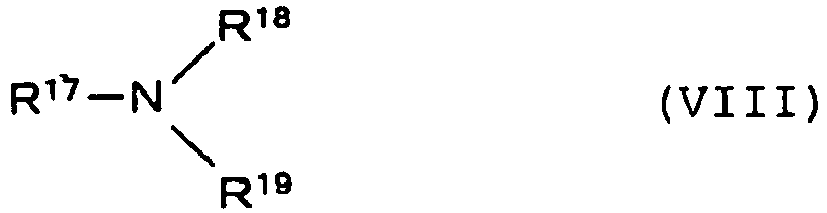
- A ratio (E)/(F) of the component (E) to the component (F) falls in a range of preferably 0.1 to 10, particularly preferably 0.2 to 5. Further, an amount of the component (F) falls in a range of preferably 0.1 to 10 mass parts, more preferably 0.5 to 6 mass parts per 100 mass parts of the rubber (A).
- In the rubber composition of the present invention, a silane coupling agent (G) is preferably added, if desired, in order to further enhance the effects of the present invention. Optional ones selected from silane coupling agents which have so far publicly been known can be used for this silane coupling agent. In particular, preferably used is at least one selected from a compound represented by Formula (V):
AaB3-aSi-X-Sb-X-SiAaB3-a (V)
(wherein A represents CcH2c+1O (c is an integer of 1 to 3) or a chlorine atom; B represents an alkyl group having 1 to 3 carbon atoms; X represents a saturated or unsaturated alkylene group having 1 to 9 carbon atoms or an arylene group having 7 to 15 carbon atoms; a is an integer of 1 to 3, and b is an integer of 1 or more and may have distribution, provided that when a is 1, two B's may be the same or different, and when a is 2 or 3, two or three A's may be the same or different), a compound represented by Formula (VI):
AaB3-aSi-X-Y (VI)
(wherein A, B, X and a are the same as described above, and Y represents a mercapto group, a vinyl group, an amino group, a glycidoxy group or an epoxy group) and a compound represented by Formula (VII):
AaB3-aSi-X-Sb-Z (VII)
(wherein A, B, X, a and b are the same as described above, and Z represents a benzothiazolyl group, an N,N-dimethylthiocarbamoyl group, a methacryloyl group or a saturated or unsaturated hydrocarbon group having 1 to 15 carbon atoms). - The examples of the silane coupling agent represented by Formula (V) include bis(3-triethoxysilylpropyl) tetrasulfide, bis(3-trimethoxysilylpropyl) tetrasulfide, bis(3-methyldimethoxysilylpropyl) tetrasulfide, bis(3-triethoxysilylethyl) tetrasulfide, bis(3-triethoxysilylpropyl) disulfide, bis(3-trimethoxysilylpropyl) disulfide and bis(3-triethoxysilylpropyl) trisulfide; the examples of the silane coupling agent represented by Formula (VI) include 3-mercaptopropyltrimethoxysilane, 3-mercaptopropyltriethoxysilane, vinyltriethoxysilane, vinyltrimethoxysilane, 3-aminopropyltriethoxysilane, 3-aminopropyltrimethoxysilane, 3-mercaptopropylmethyldimethoxysilane, Y-glycidoxypropyltrimethoxysilane and Y-glycidoxypropylmethyldiethoxysilane; and the examples of the silane coupling agent represented by Formula (VII) include 3-trimethoxysilylpropyl-N,N-dimethylcarbamoyl tetrasulfide, 3-trimethoxysilylpropylbenzothiazolyl tetrasulfide, 3-trimethoxysilylpropylmethacryloyl monosulfide and 3-triethoxysilylpropyl-n-octyl disulfide.
- In the present invention, the silane coupling agent of the component (G) used according to desire may be used alone or in combination of two or more kinds thereof. A content thereof in the composition is selected in a range of 1 to 20 mass % based on the component (B) described above. If this content is less than 1 mass %, it is likely that the effects obtained by blending the silane coupling agent are not sufficiently exhibited. On the other hand, if it exceeds 20 mass %, the effects thereof do not grow larger in proportion to the amount thereof, and it is rather economically disadvantageous. Considering the blend effects and the economical efficiency, the preferred content of this silane coupling agent of the component (B) falls in arrange of 3 to 15 mass %.
- An addition method of the compound (E) in the present invention shall not specifically be restricted, and they can be added and mixed with the rubber component by means of a conventional mixer, for example, a Banbury mixer, a roll and an intensive mixer.
- Further, various additives which are usually used in the rubber industry, for example, carbon black, vulcanizing agents, vulcanization-accelerating agents, antioxidants, scorch inhibitors, softening agents, zinc oxide and stearic acid can be added, if desired, to the rubber composition of the present invention as long as the objects of the present invention are not damaged. The rubber composition of the present invention is suitably used for a tread rubber for a tire and a base tread rubber. A pneumatic tire is produced by a conventional method using the rubber composition of the present invention. That is, the rubber composition of the present invention to which various chemicals are added, if necessary, as described above is extruded and processed into, for example, a member for a tread at a stage where the rubber composition is not vulcanized, and it is stuck and molded by means of a tire molding machine by a conventional method, whereby a crude tire is molded. This crude tire is heated and pressed in a vulcanizing machine, whereby a tire is obtained.
- In the case of carbon black among the additives described above, an addition amount thereof falls in a range of 0 to 80 mass parts, preferably 0 to 40 mass parts per 100 mass parts of the rubber. Carbon black is classified into channel black, furnace black, acetylene black and thermal black according to the production processes, and any ones can be used.
- Next, the present invention shall be explained in further details with reference to examples, but the present invention shall by no means be restricted by these examples. The physical properties of the rubber compositions obtained in the respective examples were measured by methods shown below.
- Measurement was carried out based on JIS K7198 by means of DVA-200 manufactured by IT Measurement Control Co., Ltd., wherein a test piece having a length of 2.0 mm, a width of 5 mm and a thickness of 2 mm was used to carry out the measurement at a test temperature of -80 to 100°C, a distortion rate of 2 %, a frequency of 50 Hz and a heating speed of 5°C/minute. The values of the storage modulus (E') at 60°C are shown in terms of an index in Table 1 to Table 4, wherein the indices were obtained by comparing the values of the storage modulus with those of controls (Comparative Examples 1, 5, 9 and 13). It is shown that the larger the index of the storage modulus (E') is, the better the physical properties of the rubber are.
- The surface state of a test piece (length 200 mm X width 150 mm × thickness about 2 mm) was observed with the naked eye and evaluated according to the following criteria. The absence of the surface roughness shows that a compatibility of the storage modulus-improving agent with the rubber or a dispersibility of the filler is excellent.
- ○: scratches and dents are not observed at all
- Δ : scratches and dents are a little observed
- × : scratches and dents are considerably observed
- The Mooney viscosity [ML1+4] was measured at 125°C based on JIS K6300-1994 and shown in terms of an index, wherein the values of Comparative Examples 1, 5, 9 and 13 were set to 100 respectively. The smaller the numeral, the better the processability.
- The respective components shown in Table 1 were mixed in blending proportions shown in Table 1 to prepare rubber compositions. They were prepared by means of a Banbury mixer and a roll mixer. Vulcanization was carried out at a temperature of 165°C, and the vulcanizing time was prescribed by Curast T 90 value (minute) × 1.5 time.
- In each of these rubber compositions, the dynamic viscoelasticity, the Mooney viscosity and the surface roughness were evaluated as the indices of the physical properties of the vulcanized rubbers. The results thereof are shown in Table 1. In the dynamic viscoelasticity measuring test and the Mooney viscosity, the values were shown in terms of an index, wherein the value of Comparative Example 1 was set to a reference.
Table 1-1 Example 1* 2* 3* 4* 5 6 SBR #1502*1 100 100 100 100 100 100 Carbon black*2 10 10 10 10 10 10 Silica*3 40 40 40 40 40 40 Silane coupling agent*4 4 4 4 4 4 4 Zinc oxide 3 3 3 3 3 3 Stearic acid 2 2 2 2 2 2 Sulfur 1.5 1.5 1.5 1.5 1.5 1.5 Monomalic acid maleate 2 Ethylene glycol dimaleate 2 1,6-Hexanediol dimaleate 2 N-(2-carboxyethyl)maleamic acid 2 Mono(ω-acryloyloxyPOE(10)) trimellitate*5 2 Mono(2-methacryloyloxyethyl) trimellitate 2 Mono (ω-methacryloyloxyPOP(9)) trimellitate*5 POE(8)glycerin trimaleate*5 Glycerin dimaleate Polybutylene maleate*6 Poly(PEG 200) maleate*7 Polybutylene adipate maleate*8 Diethyl maleate Caprylic acid Mono(2-methacryloyloxyethyl) succinate Bismaleimide resin*9 Vulcanization-accelerating agent*10 2 2 2 2 2 2 Antioxidant*11 1 1 1 1 1 1 E' index 147 151 134 127 143 142 Mooney viscosity (ML1+4) 103 102 101 102 98 102 Surface roughness ○ ○ ○ ○ ○ ○ * not according to the invention Table 1-2 Example 7 8* 9* 10* 11* 12* SBR #1502*1 100 100 100 100 100 100 Carbon black*2 10 10 10 10 10 10 Silica*3 40 40 40 40 40 40 Silane coupling agent*4 4 4 4 4 4 4 Zinc oxide 3 3 3 3 3 3 Stearic acid 2 2 2 2 2 2 Sulfur 1.5 1.5 1.5 1.5 1.5 1.5 Monomalic acid maleate Ethylene glycol dimaleate 1,6-Hexanediol dimaleate N-(2-carboxyethyl)maleamic acid Mono(ω-acryloyloxyPOE(10)) trimellitate*5 Mono(2-methacryloyloxyethyl) trimellitate Mono(ω-methacryloyloxyPOP(9)) trimellitate*5 2 POE(8)glycerin trimaleate*5 2 Glycerin dimaleate 2 Polybutylene maleate*6 2 Poly(PEG 200) maleate*7 2 Polybutylene adipate maleate*8 2 Diethyl maleate Caprylic acid Mono(2-methacryloyloxyethyl) succinate Bismaleimide resin*9 Vulcanization-accelerating agent*10 2 2 2 2 2 2 Antioxidant*11 1 1 1 1 1 1 E' index 132 136 141 145 147 133 Mooney viscosity (ML1+4) 98 96 101 96 94 95 Surface roughness ○ ○ ○ ○ ○ ○ * not according to the invention Table 1-3 Comparative Example 1 2 3 4 5 SBR #1502*1 100 100 100 100 100 Carbon black*2 10 10 10 10 10 Silica*3 40 40 40 40 40 Silane coupling agent*4 4 4 4 4 4 Zinc oxide 3 3 3 3 3 Stearic acid 2 2 2 2 2 Sulfur 1.5 1.5 1.5 1.5 1.5 Monomalic acid maleate Ethylene glycol dimaleate 1,6-Hexanediol dimeleate N-(2-carboxyethyl) malaamic acid Mono(ω-acryloyloxyPOE(10)) trimellitate*5 Mono(2-methacryloyloxyethyl) trimellitate Mono(ω-methacryloyloxyPOP(9)) trimellitate*5 POE(8)glycerin trimaleate*5 Glycerin dimaleate Polybutylene maleate*6 Poly(PEG 200) maleate *7 Polybutylene adipate maleate*8 Diethyl maleate 2 Caprylic acid 2 Mono(2-methacryloyloxyethyl) succinate 2 Bismaleimide resin*9 2 Vulcanization-accelerating agent*10 2 2 2 2 2 Antioxidant*11 1 1 1 1 1 E' index 100 98 95 110 123 Mooney viscosity (ML1+4) 100 95 93 96 101 Surface roughness ○ ○ ○ ○ × *1: manufactured by JSR Co., Ltd.
*2: Seast 300 manufactured by Tokai Carbon Co., Ltd.
*3: Nipseal AQ (SHG = 140 m2/g: obtained by granulating Nipseal VN3) manufactured by Nippon Silica Co., Ltd.
*4: Bis(3-triethoxysilylpropyl) tetrasulfide
*5: POE(n) represents polyoxyethylene in which n mole of oxyethylene is added, and POP(n) represents polyoxypropylene in which n mole of oxypropylene is added
*6: a compound in which in Formula (III), R8 is a group represented by- (R11O-COR12-COO-)tR11O-; R11 is butylene group; R12 is -CH=CH-; and t is 4
*7: a compound in which in Formula (III), R8 is a group represented by- (R11O-COR12-COO-)tR11O-; R11 is -(R13O)uR13- (R13 is ethylene group, and u is 3.5); R12 is -CH=CH-; and t is 4
*8: a compound in which in Formula (III), R8 is a group represented by- (R11O-COR12-COO-)tR11O-; R11 is butylene group; R12 is butylene group; and t is 4
*9: Bismaleimidetriazine resin, manufactured by Mitsubishi Gas Chemical Co., Ltd., using BT-2680 which was crushed
*10: N-oxydiethylene-2-benzothiazolesulfeneamide
*11: N-(1,3-dimethylbutyl)-N'-phenyl-phenylenediamine - The respective components shown in Table 2 were mixed in blending proportions shown in Table 2 to prepare rubber compositions. The rubbers were prepared and vulcanized by the same methods as in Example 1.
- In each of these rubber compositions, the dynamic viscoelasticity, the Mooney viscosity and the surface roughness were evaluated as indices for the physical properties of the vulcanized rubbers. The results thereof are shown in Table 2. In the dynamic viscoelasticity measuring test and the Mooney viscosity, the values were shown in terms of an index, wherein the value of Comparative Example 6 was set to a reference.
Table 2-1 Example 13* 14* 15 * 16 17 18 SBR #1502*1 100 100 100 100 100 100 Carbon black*2 10 10 10 10 10 10 Silica*3 40 40 40 40 40 40 Silane coupling agent*4 4 4 4 4 4 4 Zinc oxide 3 3 3 3 3 3 Stearic acid 2 2 2 2 2 2 Sulfur 1.5 1.5 1.5 1.5 1.5 1.5 Maleic acid 0.9 Monoethyl maleate 1 Cyclohexane-1,4-dimethanol dimaleate 1 Mono(ω-acryloyloxyPOE(10)) trimellitate*5 1 Mono(2-methacryloyloxyethyl) trimellitate 1 Mono(ω-methacryloyloxyPOP(9)) trimellitate*5 1 POE(8)glycerin trimaleate*5 Glycerin dimaleate Polybutylene maleate*6 Poly(PEG 200) maleate*7 Polybutylene adipate maleate*8 N,N-dimethyldecylamine 1.1 1 1 1 1 1 Diethyl maleate Mono(2-methacryloyloxyethyl) succinate Bismaleimide resin*9 Vulcanization-accelerating agent*10 2 2 2 2 2 2 Antioxidant*11 1 1 1 1 1 1 E' index 110 112 115 125 121 121 Mooney viscosity (MLI-4) 94 89 91 90 93 90 Surface roughness ○ ○ ○ ○ ○ ○ * not according to the invention Table 2-2 Example 19* 20* 21* 22* 23* SBR #1502*1 100 100 100 100 100 Carbon black*2 10 10 10 10 10 Silica*3 40 40 40 40 40 Silane coupling agent*4 4 4 4 4 4 Zinc oxide 3 3 3 3 3 Stearic acid 2 2 2 2 2 Sulfur 1.5 1.5 1.5 1.5 1.5 Maleic acid Monoethyl maleate Cyclohexane-1,4-dimethanol dimaleate Mono (ω-acryloyloxyPOE(10)) trimellitate*5 Mono(2-methacryloyloxyethyl) trimellitate Mono(ω-methacryloyloxyPOP(9)) trimellitate*5 POE(8)glycerin trimaleate*5 1 Glycerin dimaleate 1 Polybutylene maleate*6 1 Poly(PEG 200) maleate*7 1 Polybutylene adipate maleate*8 1 N,N-dimethyldecylamine 1 1 1 1 1 Diethyl maleate Mono(2-methacryloyloxyethyl) succinate Bismaleimide resin*9 Vulcanization-accelerating agent*10 2 2 2 2 2 Antioxidant*11 1 1 1 1 1 E' index 114 117 124 126 119 Mooney viscosity (ML1+4) 89 94 89 88 90 Surface roughness ○ ○ ○ ○ ○ * not according to the invention Table 2-3 Comparative Example 6 7 8 9 10 SBR #1502*1 100 100 100 100 100 Carbon black*2 10 10 10 10 10 Silica*3 40 40 40 40 40 Silane coupling agent*4 4 4 4 4 4 Zinc oxide 3 3 3 3 3 Stearic acid 2 2 2 2 2 Sulfur 1.5 1.5 1.5 1.5 1.5 Maleic acid Monoethyl maleate Cyclohexane-1,4-dimethanol dimaleate Mono(ω-acryloyloxyPOE (10)) trimellitate*5 Mono(2-methacryloyloxyethyl) trimellitate Mono(ω-methacryloyloxyPOP(9)) trimellitate*5 POE(8)glycerin trimaleate*5 Glycerin dimaleate Polybutylene maleate*6 Poly(PEG 200) maleate*7 Polybutylene adipate maleate*8 N,N-dimethyldecylamine 2 Diethyl maleate 2 Mono(2-methacryloyloxyethyl) succinate 2 Bismaleimide resin*9 2 Vulcanization-accelerating agent*10 2 2 2 2 2 Antioxidant*11 1 1 1 1 1 E' index 100 98 95 110 123 Mooney viscosity (ML1+4) 100 95 89 96 101 Surface roughness ○ ○ ○ ○ × - The respective components shown in Table 3 were mixed in blending proportions shown in Table 3 to prepare rubber compositions. The rubbers were prepared and vulcanized by the same methods as in Example 1.
- In each of these rubber compositions, the dynamic viscoelasticity, the Mooney viscosity and the surface roughness were evaluated as the indices for the physical properties of the vulcanized rubbers. The results thereof are shown in Table 3. In the dynamic viscoelasticity measuring test and the Mooney viscosity, the values were shown in terms of an index, wherein the value of Comparative Example 11 was set to a reference.
Table 3-1 Example 24* 25* 26* SBR #1502*1 100 100 100 Carbon black*2 10 10 10 Silica*3 40 40 40 Silane coupling agent*4 4 4 4 Zinc oxide 3 3 3 Stearic acid 2 2 2 Sulfur 1.5 1.5 1.5 Di(N,N-dimethylaminohexyl) maleate 2 Mono[N-dodecyl-N-(2-hydroxyethyl)aminoethyl] Maleate 2 Di(N,N-dimethylaminohexyl) fumarate 2 Diethyl maleate N,N-dimethyldecylamine Mono(2-methacryloyloxyethyl) succinate Bismaleimide resin*9 Vulcanization-accelerating agent*10 2 2 2 Antioxidant*11 1 1 1 E' index 118 113 122 Mooney viscosity (ML1+4) 94 97 93 Surface roughness ○ ○ ○ * not according to the invention Table 3-2 Comparative Example 11 12 13 14 15 SBR #1502*1 100 100 100 100 100 Carbon black*2 10 10 10 10 10 Silica*3 40 40 40 40 40 Silane coupling agent*4 4 4 4 4 4 Zinc oxide 3 3 3 3 3 Stearic acid 2 2 2 2 2 Sulfur 1.5 1.5 1.5 1.5 1.5 Di(N,N-dimethylaminohexyl) maleate Mono[N-dodecyl-N-(2-hydroxyethyl)-aminoethyl] maleate Di(N,N-dimethylaminohexyl) fumarate Diethyl maleate 2 N,N-dimethylstearylamine 2 Mono(2-methacrvloyloxyethyl) succinate 2 Bismaleimide resin*9 2 Vulcanization-accelerating agent*10 2 2 2 2 2 Antioxidant*11 1 1 1 1 1 E' index 100 98 93 110 123 Mooney viscosity (ML1+4) 100 95 88 96 101 Surface roughness ○ ○ ○ ○ × - The respective components shown in Table 4 were mixed in blending proportions shown in Table 4 to prepare rubber compositions. The rubbers were prepared and vulcanized by the same methods as in Example 1.
- In each of these rubber compositions, the dynamic viscoelasticity, the Mooney viscosity and the surface roughness were evaluated. The results thereof are shown in Table 4. In the dynamic viscoelasticity measuring test and the Mooney viscosity, the values were shown in terms of an index, wherein the value of Comparative Example 16 was set to a reference.
Table 4 Comparative Example 16 Example 27 28 29 30 31 SBR 1712*12 110 110 110 110 110 110 RSS #3*13 20 20 20 20 20 20 Carbon black*4 20 20 20 20 20 20 Silicic acid hydrate*15 50 50 50 50 50 50 Silane coupling agent*4 4 4 4 4 4 Zinc oxide 3 3 3 3 3 Stearic acid 1 1 1 1 1 1 Sulfur 1.5 1.5 1.5 1.5 1.5 2-Methacryloyloxyethyl hexahydrophthalte 2 4 8 2-Acryloyloxyethyl phthalate 2 Mono(ω-acryloyloxyPOE(10)) trimellitate*5 2 Aroma oil 5 5 5 5 5 5 Wax 1 1 1 1 1 1 Vulcanization-accelerating agent DM*16 0.5 0.5 0.5 0.5 0.5 0.5 Vulcanization-accelerating agent NS*17 1 1 1 1 1 1 Antioxidant*18 1 1 1 1 1 1 E' index 100 149 155 179 191 171 Mooney viscosity (ML1+4) 100 88 88 83 79 98 Surface roughness Δ ○ ○ ○ ○ ○ *12: manufactured by JSR Co., Ltd.
*13: Natural rubber
*14: Seast KH manufactured by Tokai Carbon Co., Ltd.
*15: Nipseal AQ (SHG = 140 m2/g) manufactured by Nippon Silica Co., Ltd.
*16: Dibenzothiazyl disulfide
*17: N-tert-butyl-2-benzothiazylsulfeneamide
*18: 6C[N-phenyl-N'-(1,3-dimethylbutyl)p-phenylenediamine - It was confirmed that a driving stability of a tire was improved by using the rubber composition of the present invention for a tread of a tire for automobiles having a size of 205/60R15.
- The rubber composition in the present invention is excellent in the dispersibility of an inorganic filler, so that it does not elevate a viscosity of a non-vulcanized rubber and does not damage the processability, and it does not bring about roughening on the surface of rubber and is improved in a storage modulus by blending the storage modulus-improving agent of the present invention. Further, when this rubber composition is used for a tread of a pneumatic tire, A rise in the driving stability is observed.
Claims (9)
- A rubber composition comprising (A) a natural rubber and/or a diene base synthetic rubber, (B) an inorganic filler and (E) acrylate or methacrylate having a molecular weight of 250 or more, represented by Formula (IV):

- A rubber composition as claimed in claim 1, comprising 10 to 140 mass parts of the component (B) per 100 mass parts of the component (A).
- A rubber composition as claimed in claim 1 or 2, comprising 0.1 to 10 mass parts of the component (E) per 100 mass parts of the component (A).
- A rubber composition as claimed in any of claims 1 to 3, wherein the inorganic filler (B) is silica.
- A rubber composition as claimed in any of claims 1 to 4, further comprising (F) an aliphatic amine.
- A rubber composition as claimed in claim 5, wherein the aliphatic amine (F) is an aliphatic tertiary amine.
- A rubber composition as claimed in any of claims 1 to 6, further comprising (G) a silane coupling agent in a proportion of 1 to 20 mass % based on the component (B).
- A rubber composition as claimed in claim 7, wherein the silane coupling agent (G) is at least one selected from a compound represented by Formula (V):
AaB3-aSi-X-Sb-X-SiAaB3-a (V)
wherein A represents CcH2c+1O or a chlorine atom and c is an integer of 1 to 3; B represents an alkyl group having 1 to 3 carbon atoms; X represents a saturated or unsaturated alkylene group having 1 to 9 carbon atoms or an arylene group having 7 to 15 carbon atoms; a is an integer of 1 to 3, and b is an integer of 1 or more and may have distribution, provided that when a is 1, two B's may be the same or different, and when a is 2 or 3, two or three A's may be the same or different, a compound represented by Formula (VI):
AaB3-aSi-X-Y (VI)
wherein A, B, X and a are the same as described above, and Y represents a mercapto group, a vinyl group, an amino group, a glycidoxy group or an epoxy group, and a compound represented by Formula (VII):
AaB3-aSi-X-Sb-Z (VII)
wherein A, B, X, a and b are the same as described above, and Z represents a benzothiazolyl group, an N,N-dimethylthiocarbamoyl group, a methacryloyl group or a saturated or unsaturated hydrocarbon group having 1 to 15 carbon atoms. - A tire characterized by using the rubber composition as claimed in any of claims 1 to 8 for a tread member.
Priority Applications (2)
| Application Number | Priority Date | Filing Date | Title |
|---|---|---|---|
| EP10005726A EP2223958B1 (en) | 2001-10-05 | 2002-10-04 | Rubber composition |
| EP10005725A EP2226354B1 (en) | 2001-10-05 | 2002-10-04 | Rubber composition |
Applications Claiming Priority (3)
| Application Number | Priority Date | Filing Date | Title |
|---|---|---|---|
| JP2001310497 | 2001-10-05 | ||
| JP2001310497 | 2001-10-05 | ||
| PCT/JP2002/010376 WO2003031510A1 (en) | 2001-10-05 | 2002-10-04 | Rubber composition |
Related Child Applications (2)
| Application Number | Title | Priority Date | Filing Date |
|---|---|---|---|
| EP10005726A Division-Into EP2223958B1 (en) | 2001-10-05 | 2002-10-04 | Rubber composition |
| EP10005725A Division-Into EP2226354B1 (en) | 2001-10-05 | 2002-10-04 | Rubber composition |
Publications (3)
| Publication Number | Publication Date |
|---|---|
| EP1435375A1 EP1435375A1 (en) | 2004-07-07 |
| EP1435375A4 EP1435375A4 (en) | 2005-12-14 |
| EP1435375B1 true EP1435375B1 (en) | 2014-07-16 |
Family
ID=19129461
Family Applications (3)
| Application Number | Title | Priority Date | Filing Date |
|---|---|---|---|
| EP02800775.5A Expired - Lifetime EP1435375B1 (en) | 2001-10-05 | 2002-10-04 | Rubber composition |
| EP10005725A Expired - Lifetime EP2226354B1 (en) | 2001-10-05 | 2002-10-04 | Rubber composition |
| EP10005726A Expired - Lifetime EP2223958B1 (en) | 2001-10-05 | 2002-10-04 | Rubber composition |
Family Applications After (2)
| Application Number | Title | Priority Date | Filing Date |
|---|---|---|---|
| EP10005725A Expired - Lifetime EP2226354B1 (en) | 2001-10-05 | 2002-10-04 | Rubber composition |
| EP10005726A Expired - Lifetime EP2223958B1 (en) | 2001-10-05 | 2002-10-04 | Rubber composition |
Country Status (4)
| Country | Link |
|---|---|
| US (2) | US7799856B2 (en) |
| EP (3) | EP1435375B1 (en) |
| CN (1) | CN1305950C (en) |
| WO (1) | WO2003031510A1 (en) |
Families Citing this family (10)
| Publication number | Priority date | Publication date | Assignee | Title |
|---|---|---|---|---|
| JP4323175B2 (en) * | 2003-01-28 | 2009-09-02 | 株式会社ブリヂストン | Pneumatic tire |
| JP4733968B2 (en) * | 2004-11-25 | 2011-07-27 | 株式会社ブリヂストン | Rubber composition for tire and pneumatic tire using the same |
| ES2472318T3 (en) | 2007-03-05 | 2014-06-30 | Bridgestone Corporation | Pneumatic tire |
| JP2012131876A (en) | 2010-12-21 | 2012-07-12 | Bridgestone Corp | Rubber composition and tire using the same |
| DE102013101343A1 (en) | 2012-10-24 | 2014-04-24 | Continental Reifen Deutschland Gmbh | Rubber compound and pneumatic vehicle tires |
| DE102012110121A1 (en) | 2012-10-24 | 2014-04-24 | Continental Reifen Deutschland Gmbh | Rubber compound and pneumatic vehicle tires |
| FR3022261B1 (en) * | 2014-06-12 | 2016-06-03 | Michelin & Cie | IN SITU GUM CABLE COMPRISING A SCRUB COMPOSITION COMPRISING A CORROSION INHIBITOR |
| FR3022262B1 (en) * | 2014-06-12 | 2016-06-03 | Michelin & Cie | IN SITU GUM CABLE COMPRISING A SCRUB COMPOSITION COMPRISING A CORROSION INHIBITOR |
| WO2020160000A1 (en) * | 2019-01-29 | 2020-08-06 | Firestone Polymers, Llc | Method for producing polydienes with reduced cold flow |
| US11721551B2 (en) * | 2021-01-26 | 2023-08-08 | Tokyo Electron Limited | Localized stress regions for three-dimension chiplet formation |
Citations (1)
| Publication number | Priority date | Publication date | Assignee | Title |
|---|---|---|---|---|
| EP1026196A2 (en) * | 1999-02-08 | 2000-08-09 | Bridgestone Corporation | Pneumatic tire |
Family Cites Families (30)
| Publication number | Priority date | Publication date | Assignee | Title |
|---|---|---|---|---|
| US4857257A (en) * | 1983-06-13 | 1989-08-15 | Allied-Signal Inc. | Rotationally molding crosslinkable polyethylene composition |
| US4495326A (en) | 1984-01-09 | 1985-01-22 | The Firestone Tire & Rubber Company | Rubber compounds containing zinc dimethacrylate |
| US4700103A (en) * | 1984-08-07 | 1987-10-13 | Ngk Spark Plug Co., Ltd. | Spark plug and its electrode configuration |
| JPS61221242A (en) * | 1985-03-27 | 1986-10-01 | Bridgestone Corp | Low heat generating rubber composition |
| GB2206889B (en) * | 1987-06-11 | 1991-03-20 | Asics Corp | Rubber composition and golf ball comprising it |
| JPH0643526B2 (en) | 1987-06-11 | 1994-06-08 | 大塚化学株式会社 | Rubber composition |
| EP0405982A1 (en) | 1989-06-28 | 1991-01-02 | Nippon Petrochemicals Company, Limited | Filler-incorporated thermoplastic resin composition |
| JP3021516B2 (en) | 1990-03-02 | 2000-03-15 | 株式会社ブリヂストン | Pneumatic tire |
| DE69119125T3 (en) | 1990-03-02 | 2001-01-11 | Bridgestone Corp., Tokio/Tokyo | tire |
| FR2673187B1 (en) | 1991-02-25 | 1994-07-01 | Michelin & Cie | RUBBER COMPOSITION AND TIRE COVERS BASED ON SAID COMPOSITION. |
| JP3403747B2 (en) | 1993-02-23 | 2003-05-06 | 株式会社ブリヂストン | Rubber composition for tire |
| JPH06306211A (en) | 1993-04-26 | 1994-11-01 | Sumitomo Chem Co Ltd | Rubber composition and vulcanization adhesion method with reinforcing material using the same |
| JP3366380B2 (en) | 1993-07-13 | 2003-01-14 | 株式会社ブリヂストン | Rubber composition for tire tread |
| CA2108772C (en) | 1993-08-09 | 2005-07-05 | David John Zanzig | Tire with silica reinforced tread |
| JP3325683B2 (en) | 1993-12-27 | 2002-09-17 | 株式会社ブリヂストン | Rubber composition for tire tread |
| DE59507998D1 (en) | 1994-11-30 | 2000-04-20 | Sp Reifenwerke Gmbh | Rubber compound, tire tread made therefrom and tires with this tire tread |
| JP3454327B2 (en) | 1995-01-13 | 2003-10-06 | 株式会社ブリヂストン | Pneumatic tire |
| JP3459316B2 (en) | 1995-06-13 | 2003-10-20 | 住友ゴム工業株式会社 | Rubber composition for tread |
| JPH10251448A (en) | 1997-03-10 | 1998-09-22 | Bridgestone Corp | Rubber composition and heavy-duty pneumatic tire produced therefrom |
| ES2176910T3 (en) * | 1997-03-25 | 2002-12-01 | Bridgestone Corp | ADDITIVE FOR MASTICATION OF NATURAL RUBBER, METHOD OF MASTICATION, COMPOSITION OBTAINED FROM THE SAME AND PNEUMATIC COVER. |
| US6130277A (en) * | 1997-03-31 | 2000-10-10 | Bridgestone Corporation | Rubber composition improved in anti-static property and pneumatic tire using the same |
| US6337533B1 (en) * | 1998-06-05 | 2002-01-08 | Denso Corporation | Spark plug for internal combustion engine and method for manufacturing same |
| JP4363697B2 (en) | 1998-06-25 | 2009-11-11 | 株式会社ブリヂストン | Rubber composition for tire tread and pneumatic tire using the rubber composition |
| DE19961768B4 (en) * | 1998-12-21 | 2013-07-18 | Denso Corporation | A spark plug for an internal combustion engine having molten portions of an iridium alloy outside a spark discharge area |
| JP4204722B2 (en) | 1999-02-05 | 2009-01-07 | 株式会社ブリヂストン | Rubber composition and pneumatic tire |
| JP4433634B2 (en) * | 2000-06-29 | 2010-03-17 | 株式会社デンソー | Spark plug for cogeneration |
| US6359046B1 (en) * | 2000-09-08 | 2002-03-19 | Crompton Corporation | Hydrocarbon core polysulfide silane coupling agents for filled elastomer compositions |
| JP4635332B2 (en) | 2000-12-12 | 2011-02-23 | Jsr株式会社 | Rubber composition |
| DE10103045A1 (en) * | 2001-01-24 | 2002-07-25 | Bosch Gmbh Robert | Manufacturing ignition plug electrode involves joining electrode to precious metal using heat generated by continuously operating laser beam, causing melting in boundary region |
| US20040171725A1 (en) * | 2001-06-01 | 2004-09-02 | Richardson Benny R. | Substrates with modified carbon surfaces in composites |
-
2002
- 2002-10-04 CN CNB028195779A patent/CN1305950C/en not_active Expired - Lifetime
- 2002-10-04 WO PCT/JP2002/010376 patent/WO2003031510A1/en not_active Ceased
- 2002-10-04 US US10/491,272 patent/US7799856B2/en not_active Expired - Lifetime
- 2002-10-04 EP EP02800775.5A patent/EP1435375B1/en not_active Expired - Lifetime
- 2002-10-04 EP EP10005725A patent/EP2226354B1/en not_active Expired - Lifetime
- 2002-10-04 EP EP10005726A patent/EP2223958B1/en not_active Expired - Lifetime
-
2010
- 2010-08-04 US US12/850,262 patent/US8110625B2/en not_active Expired - Fee Related
Patent Citations (1)
| Publication number | Priority date | Publication date | Assignee | Title |
|---|---|---|---|---|
| EP1026196A2 (en) * | 1999-02-08 | 2000-08-09 | Bridgestone Corporation | Pneumatic tire |
Also Published As
| Publication number | Publication date |
|---|---|
| US20100298488A1 (en) | 2010-11-25 |
| US7799856B2 (en) | 2010-09-21 |
| EP1435375A1 (en) | 2004-07-07 |
| EP2223958A1 (en) | 2010-09-01 |
| CN1564845A (en) | 2005-01-12 |
| WO2003031510A1 (en) | 2003-04-17 |
| EP2226354B1 (en) | 2012-12-12 |
| US20040249032A1 (en) | 2004-12-09 |
| EP2223958B1 (en) | 2011-12-28 |
| US8110625B2 (en) | 2012-02-07 |
| EP2226354A1 (en) | 2010-09-08 |
| EP1435375A4 (en) | 2005-12-14 |
| CN1305950C (en) | 2007-03-21 |
Similar Documents
| Publication | Publication Date | Title |
|---|---|---|
| US8110625B2 (en) | Rubber composition | |
| RU2326906C2 (en) | Elastomer composition, method of fabrication of elastomer product and tread or car tyre insert | |
| JP3902107B2 (en) | Rubber composition | |
| JP5189296B2 (en) | Rubber composition and pneumatic tire using the same | |
| JP6318095B2 (en) | Rubber composition and pneumatic tire using the same | |
| EP3144341A1 (en) | Method for producing rubber composition for tires, and pneumatic tire | |
| EP1550694A1 (en) | Acrylic rubber composition and crosslinked object | |
| EP1225200B1 (en) | Rubber composition and pneumatic tire | |
| JP4323175B2 (en) | Pneumatic tire | |
| CN101080452B (en) | Silica-filled elastomeric compounds | |
| JP4282387B2 (en) | Pneumatic tire | |
| EP1081187B1 (en) | Rubber composition containing silica or silicate and salt of an amine | |
| JP2009280699A (en) | Tire | |
| EP1816156B1 (en) | Rubber composition and pneumatic tire using the same | |
| JP2013173847A (en) | Method of manufacturing rubber composition | |
| JP5592219B2 (en) | Method for producing rubber composition | |
| JP2007277411A (en) | Rubber composition and pneumatic tire | |
| JP2010241868A (en) | Tire | |
| JP2005002295A (en) | Rubber composition for tire and tire | |
| JP2008127468A (en) | Rubber composition and pneumatic tire by using the same | |
| JP2004204100A (en) | Pneumatic tire | |
| WO2018225373A1 (en) | Rubber composition, crosslinked rubber composition, rubber article, and tire | |
| EP1783164A1 (en) | Filled elastomeric compounds | |
| JP5129454B2 (en) | Rubber composition for tire tread and pneumatic tire using the same | |
| JP2002284929A (en) | Rubber composition and pneumatic tire |
Legal Events
| Date | Code | Title | Description |
|---|---|---|---|
| PUAI | Public reference made under article 153(3) epc to a published international application that has entered the european phase |
Free format text: ORIGINAL CODE: 0009012 |
|
| 17P | Request for examination filed |
Effective date: 20040325 |
|
| AK | Designated contracting states |
Kind code of ref document: A1 Designated state(s): AT BE BG CH CY CZ DE DK EE ES FI FR GB GR IE IT LI LU MC NL PT SE SK TR |
|
| A4 | Supplementary search report drawn up and despatched |
Effective date: 20051031 |
|
| RBV | Designated contracting states (corrected) |
Designated state(s): DE ES FR GB IT |
|
| GRAP | Despatch of communication of intention to grant a patent |
Free format text: ORIGINAL CODE: EPIDOSNIGR1 |
|
| INTG | Intention to grant announced |
Effective date: 20140122 |
|
| GRAS | Grant fee paid |
Free format text: ORIGINAL CODE: EPIDOSNIGR3 |
|
| GRAA | (expected) grant |
Free format text: ORIGINAL CODE: 0009210 |
|
| AK | Designated contracting states |
Kind code of ref document: B1 Designated state(s): DE ES FR GB IT |
|
| REG | Reference to a national code |
Ref country code: GB Ref legal event code: FG4D |
|
| REG | Reference to a national code |
Ref country code: DE Ref legal event code: R096 Ref document number: 60246447 Country of ref document: DE Effective date: 20140821 |
|
| PG25 | Lapsed in a contracting state [announced via postgrant information from national office to epo] |
Ref country code: ES Free format text: LAPSE BECAUSE OF FAILURE TO SUBMIT A TRANSLATION OF THE DESCRIPTION OR TO PAY THE FEE WITHIN THE PRESCRIBED TIME-LIMIT Effective date: 20140716 |
|
| REG | Reference to a national code |
Ref country code: DE Ref legal event code: R097 Ref document number: 60246447 Country of ref document: DE |
|
| PLBE | No opposition filed within time limit |
Free format text: ORIGINAL CODE: 0009261 |
|
| STAA | Information on the status of an ep patent application or granted ep patent |
Free format text: STATUS: NO OPPOSITION FILED WITHIN TIME LIMIT |
|
| 26N | No opposition filed |
Effective date: 20150417 |
|
| GBPC | Gb: european patent ceased through non-payment of renewal fee |
Effective date: 20141016 |
|
| PG25 | Lapsed in a contracting state [announced via postgrant information from national office to epo] |
Ref country code: GB Free format text: LAPSE BECAUSE OF NON-PAYMENT OF DUE FEES Effective date: 20141016 |
|
| REG | Reference to a national code |
Ref country code: FR Ref legal event code: PLFP Year of fee payment: 14 |
|
| REG | Reference to a national code |
Ref country code: FR Ref legal event code: PLFP Year of fee payment: 15 |
|
| REG | Reference to a national code |
Ref country code: FR Ref legal event code: PLFP Year of fee payment: 16 |
|
| REG | Reference to a national code |
Ref country code: FR Ref legal event code: PLFP Year of fee payment: 17 |
|
| PGFP | Annual fee paid to national office [announced via postgrant information from national office to epo] |
Ref country code: DE Payment date: 20211020 Year of fee payment: 20 |
|
| PGFP | Annual fee paid to national office [announced via postgrant information from national office to epo] |
Ref country code: IT Payment date: 20211028 Year of fee payment: 20 Ref country code: FR Payment date: 20211021 Year of fee payment: 20 |
|
| REG | Reference to a national code |
Ref country code: DE Ref legal event code: R071 Ref document number: 60246447 Country of ref document: DE |