EP1435240A2 - Solid oral dosage form comprising a combination of methformin and glibenclamide - Google Patents
Solid oral dosage form comprising a combination of methformin and glibenclamide Download PDFInfo
- Publication number
- EP1435240A2 EP1435240A2 EP04008415A EP04008415A EP1435240A2 EP 1435240 A2 EP1435240 A2 EP 1435240A2 EP 04008415 A EP04008415 A EP 04008415A EP 04008415 A EP04008415 A EP 04008415A EP 1435240 A2 EP1435240 A2 EP 1435240A2
- Authority
- EP
- European Patent Office
- Prior art keywords
- glibenclamide
- metformin
- oral dosage
- dosage form
- composition
- Prior art date
- Legal status (The legal status is an assumption and is not a legal conclusion. Google has not performed a legal analysis and makes no representation as to the accuracy of the status listed.)
- Ceased
Links
- 229960004580 glibenclamide Drugs 0.000 title claims abstract description 137
- ZNNLBTZKUZBEKO-UHFFFAOYSA-N glyburide Chemical compound COC1=CC=C(Cl)C=C1C(=O)NCCC1=CC=C(S(=O)(=O)NC(=O)NC2CCCCC2)C=C1 ZNNLBTZKUZBEKO-UHFFFAOYSA-N 0.000 title claims abstract description 137
- 239000006186 oral dosage form Substances 0.000 title claims abstract description 47
- 239000007787 solid Substances 0.000 title claims abstract description 38
- XZWYZXLIPXDOLR-UHFFFAOYSA-N metformin Chemical compound CN(C)C(=N)NC(N)=N XZWYZXLIPXDOLR-UHFFFAOYSA-N 0.000 claims abstract description 69
- 229960003105 metformin Drugs 0.000 claims abstract description 52
- 239000008194 pharmaceutical composition Substances 0.000 claims abstract 6
- 239000000203 mixture Substances 0.000 claims description 53
- 239000002245 particle Substances 0.000 claims description 28
- 239000003814 drug Substances 0.000 claims description 8
- 208000001072 type 2 diabetes mellitus Diseases 0.000 claims description 7
- 239000002775 capsule Substances 0.000 claims description 6
- 239000002552 dosage form Substances 0.000 claims description 3
- 201000001421 hyperglycemia Diseases 0.000 claims description 2
- 239000008187 granular material Substances 0.000 description 18
- 238000009472 formulation Methods 0.000 description 17
- OETHQSJEHLVLGH-UHFFFAOYSA-N metformin hydrochloride Chemical compound Cl.CN(C)C(=N)N=C(N)N OETHQSJEHLVLGH-UHFFFAOYSA-N 0.000 description 12
- 229960004329 metformin hydrochloride Drugs 0.000 description 11
- HQKMJHAJHXVSDF-UHFFFAOYSA-L magnesium stearate Chemical compound [Mg+2].CCCCCCCCCCCCCCCCCC([O-])=O.CCCCCCCCCCCCCCCCCC([O-])=O HQKMJHAJHXVSDF-UHFFFAOYSA-L 0.000 description 10
- 238000011282 treatment Methods 0.000 description 10
- 238000012360 testing method Methods 0.000 description 8
- 201000010099 disease Diseases 0.000 description 5
- 208000037265 diseases, disorders, signs and symptoms Diseases 0.000 description 5
- 238000001727 in vivo Methods 0.000 description 5
- 235000019359 magnesium stearate Nutrition 0.000 description 5
- 239000000463 material Substances 0.000 description 5
- 229920002785 Croscarmellose sodium Polymers 0.000 description 4
- 229920000168 Microcrystalline cellulose Polymers 0.000 description 4
- 238000011260 co-administration Methods 0.000 description 4
- 229960001681 croscarmellose sodium Drugs 0.000 description 4
- NOESYZHRGYRDHS-UHFFFAOYSA-N insulin Chemical compound N1C(=O)C(NC(=O)C(CCC(N)=O)NC(=O)C(CCC(O)=O)NC(=O)C(C(C)C)NC(=O)C(NC(=O)CN)C(C)CC)CSSCC(C(NC(CO)C(=O)NC(CC(C)C)C(=O)NC(CC=2C=CC(O)=CC=2)C(=O)NC(CCC(N)=O)C(=O)NC(CC(C)C)C(=O)NC(CCC(O)=O)C(=O)NC(CC(N)=O)C(=O)NC(CC=2C=CC(O)=CC=2)C(=O)NC(CSSCC(NC(=O)C(C(C)C)NC(=O)C(CC(C)C)NC(=O)C(CC=2C=CC(O)=CC=2)NC(=O)C(CC(C)C)NC(=O)C(C)NC(=O)C(CCC(O)=O)NC(=O)C(C(C)C)NC(=O)C(CC(C)C)NC(=O)C(CC=2NC=NC=2)NC(=O)C(CO)NC(=O)CNC2=O)C(=O)NCC(=O)NC(CCC(O)=O)C(=O)NC(CCCNC(N)=N)C(=O)NCC(=O)NC(CC=3C=CC=CC=3)C(=O)NC(CC=3C=CC=CC=3)C(=O)NC(CC=3C=CC(O)=CC=3)C(=O)NC(C(C)O)C(=O)N3C(CCC3)C(=O)NC(CCCCN)C(=O)NC(C)C(O)=O)C(=O)NC(CC(N)=O)C(O)=O)=O)NC(=O)C(C(C)CC)NC(=O)C(CO)NC(=O)C(C(C)O)NC(=O)C1CSSCC2NC(=O)C(CC(C)C)NC(=O)C(NC(=O)C(CCC(N)=O)NC(=O)C(CC(N)=O)NC(=O)C(NC(=O)C(N)CC=1C=CC=CC=1)C(C)C)CC1=CN=CN1 NOESYZHRGYRDHS-UHFFFAOYSA-N 0.000 description 4
- 229940016286 microcrystalline cellulose Drugs 0.000 description 4
- 235000019813 microcrystalline cellulose Nutrition 0.000 description 4
- 239000008108 microcrystalline cellulose Substances 0.000 description 4
- 239000000047 product Substances 0.000 description 4
- XLYOFNOQVPJJNP-UHFFFAOYSA-N water Substances O XLYOFNOQVPJJNP-UHFFFAOYSA-N 0.000 description 4
- DPXJVFZANSGRMM-UHFFFAOYSA-N acetic acid;2,3,4,5,6-pentahydroxyhexanal;sodium Chemical compound [Na].CC(O)=O.OCC(O)C(O)C(O)C(O)C=O DPXJVFZANSGRMM-UHFFFAOYSA-N 0.000 description 3
- 230000036765 blood level Effects 0.000 description 3
- 235000010947 crosslinked sodium carboxy methyl cellulose Nutrition 0.000 description 3
- 239000003085 diluting agent Substances 0.000 description 3
- 229940079593 drug Drugs 0.000 description 3
- 230000000694 effects Effects 0.000 description 3
- 230000001747 exhibiting effect Effects 0.000 description 3
- 229920003088 hydroxypropyl methyl cellulose Polymers 0.000 description 3
- 229940127017 oral antidiabetic Drugs 0.000 description 3
- 239000000243 solution Substances 0.000 description 3
- IJGRMHOSHXDMSA-UHFFFAOYSA-N Atomic nitrogen Chemical compound N#N IJGRMHOSHXDMSA-UHFFFAOYSA-N 0.000 description 2
- WQZGKKKJIJFFOK-GASJEMHNSA-N Glucose Natural products OC[C@H]1OC(O)[C@H](O)[C@@H](O)[C@@H]1O WQZGKKKJIJFFOK-GASJEMHNSA-N 0.000 description 2
- 208000013016 Hypoglycemia Diseases 0.000 description 2
- 102000004877 Insulin Human genes 0.000 description 2
- 108090001061 Insulin Proteins 0.000 description 2
- WHNWPMSKXPGLAX-UHFFFAOYSA-N N-Vinyl-2-pyrrolidone Chemical compound C=CN1CCCC1=O WHNWPMSKXPGLAX-UHFFFAOYSA-N 0.000 description 2
- 239000004480 active ingredient Substances 0.000 description 2
- 239000011230 binding agent Substances 0.000 description 2
- 229920002678 cellulose Polymers 0.000 description 2
- 239000001913 cellulose Substances 0.000 description 2
- 235000010980 cellulose Nutrition 0.000 description 2
- 239000011248 coating agent Substances 0.000 description 2
- 238000000576 coating method Methods 0.000 description 2
- 239000013066 combination product Substances 0.000 description 2
- 229940127555 combination product Drugs 0.000 description 2
- 230000000295 complement effect Effects 0.000 description 2
- 230000037213 diet Effects 0.000 description 2
- 235000005911 diet Nutrition 0.000 description 2
- -1 glipizlde Chemical compound 0.000 description 2
- 239000008103 glucose Substances 0.000 description 2
- 238000005469 granulation Methods 0.000 description 2
- 230000003179 granulation Effects 0.000 description 2
- 239000001866 hydroxypropyl methyl cellulose Substances 0.000 description 2
- 235000010979 hydroxypropyl methyl cellulose Nutrition 0.000 description 2
- UFVKGYZPFZQRLF-UHFFFAOYSA-N hydroxypropyl methyl cellulose Chemical compound OC1C(O)C(OC)OC(CO)C1OC1C(O)C(O)C(OC2C(C(O)C(OC3C(C(O)C(O)C(CO)O3)O)C(CO)O2)O)C(CO)O1 UFVKGYZPFZQRLF-UHFFFAOYSA-N 0.000 description 2
- 239000004615 ingredient Substances 0.000 description 2
- 229940125396 insulin Drugs 0.000 description 2
- 238000000034 method Methods 0.000 description 2
- 238000002156 mixing Methods 0.000 description 2
- 230000036470 plasma concentration Effects 0.000 description 2
- 229920000642 polymer Polymers 0.000 description 2
- 229920000036 polyvinylpyrrolidone Polymers 0.000 description 2
- 235000013855 polyvinylpyrrolidone Nutrition 0.000 description 2
- 229940069328 povidone Drugs 0.000 description 2
- 239000000843 powder Substances 0.000 description 2
- 239000008213 purified water Substances 0.000 description 2
- 230000001225 therapeutic effect Effects 0.000 description 2
- SODPIMGUZLOIPE-UHFFFAOYSA-N (4-chlorophenoxy)acetic acid Chemical compound OC(=O)COC1=CC=C(Cl)C=C1 SODPIMGUZLOIPE-UHFFFAOYSA-N 0.000 description 1
- BOVGTQGAOIONJV-BETUJISGSA-N 1-[(3ar,6as)-3,3a,4,5,6,6a-hexahydro-1h-cyclopenta[c]pyrrol-2-yl]-3-(4-methylphenyl)sulfonylurea Chemical compound C1=CC(C)=CC=C1S(=O)(=O)NC(=O)NN1C[C@H]2CCC[C@H]2C1 BOVGTQGAOIONJV-BETUJISGSA-N 0.000 description 1
- LLJFMFZYVVLQKT-UHFFFAOYSA-N 1-cyclohexyl-3-[4-[2-(7-methoxy-4,4-dimethyl-1,3-dioxo-2-isoquinolinyl)ethyl]phenyl]sulfonylurea Chemical compound C=1C(OC)=CC=C(C(C2=O)(C)C)C=1C(=O)N2CCC(C=C1)=CC=C1S(=O)(=O)NC(=O)NC1CCCCC1 LLJFMFZYVVLQKT-UHFFFAOYSA-N 0.000 description 1
- 210000002237 B-cell of pancreatic islet Anatomy 0.000 description 1
- RKWGIWYCVPQPMF-UHFFFAOYSA-N Chloropropamide Chemical compound CCCNC(=O)NS(=O)(=O)C1=CC=C(Cl)C=C1 RKWGIWYCVPQPMF-UHFFFAOYSA-N 0.000 description 1
- VZCYOOQTPOCHFL-OWOJBTEDSA-N Fumaric acid Chemical compound OC(=O)\C=C\C(O)=O VZCYOOQTPOCHFL-OWOJBTEDSA-N 0.000 description 1
- VEXZGXHMUGYJMC-UHFFFAOYSA-N Hydrochloric acid Chemical compound Cl VEXZGXHMUGYJMC-UHFFFAOYSA-N 0.000 description 1
- CPELXLSAUQHCOX-UHFFFAOYSA-N Hydrogen bromide Chemical compound Br CPELXLSAUQHCOX-UHFFFAOYSA-N 0.000 description 1
- 206010022489 Insulin Resistance Diseases 0.000 description 1
- JLRGJRBPOGGCBT-UHFFFAOYSA-N Tolbutamide Chemical compound CCCCNC(=O)NS(=O)(=O)C1=CC=C(C)C=C1 JLRGJRBPOGGCBT-UHFFFAOYSA-N 0.000 description 1
- 239000008186 active pharmaceutical agent Substances 0.000 description 1
- 239000007864 aqueous solution Substances 0.000 description 1
- 210000004027 cell Anatomy 0.000 description 1
- 229960001761 chlorpropamide Drugs 0.000 description 1
- 238000002648 combination therapy Methods 0.000 description 1
- 239000013065 commercial product Substances 0.000 description 1
- 230000000052 comparative effect Effects 0.000 description 1
- 230000003247 decreasing effect Effects 0.000 description 1
- 230000007812 deficiency Effects 0.000 description 1
- 229940088679 drug related substance Drugs 0.000 description 1
- 238000001035 drying Methods 0.000 description 1
- 229950005627 embonate Drugs 0.000 description 1
- 239000012530 fluid Substances 0.000 description 1
- 229960000346 gliclazide Drugs 0.000 description 1
- 229960003468 gliquidone Drugs 0.000 description 1
- 230000004110 gluconeogenesis Effects 0.000 description 1
- 229940095884 glucophage Drugs 0.000 description 1
- 238000000338 in vitro Methods 0.000 description 1
- 238000011221 initial treatment Methods 0.000 description 1
- 230000003914 insulin secretion Effects 0.000 description 1
- 210000004153 islets of langerhan Anatomy 0.000 description 1
- 238000010902 jet-milling Methods 0.000 description 1
- 239000000314 lubricant Substances 0.000 description 1
- 238000004519 manufacturing process Methods 0.000 description 1
- 208000030159 metabolic disease Diseases 0.000 description 1
- 229910052757 nitrogen Inorganic materials 0.000 description 1
- 230000002093 peripheral effect Effects 0.000 description 1
- 239000000546 pharmaceutical excipient Substances 0.000 description 1
- 230000000704 physical effect Effects 0.000 description 1
- 150000003839 salts Chemical class 0.000 description 1
- 238000007873 sieving Methods 0.000 description 1
- 238000009097 single-agent therapy Methods 0.000 description 1
- 238000001179 sorption measurement Methods 0.000 description 1
- 230000006641 stabilisation Effects 0.000 description 1
- 230000004936 stimulating effect Effects 0.000 description 1
- 239000007916 tablet composition Substances 0.000 description 1
- 239000000454 talc Substances 0.000 description 1
- 229910052623 talc Inorganic materials 0.000 description 1
- 231100001274 therapeutic index Toxicity 0.000 description 1
- 238000002560 therapeutic procedure Methods 0.000 description 1
- 229960002277 tolazamide Drugs 0.000 description 1
- OUDSBRTVNLOZBN-UHFFFAOYSA-N tolazamide Chemical compound C1=CC(C)=CC=C1S(=O)(=O)NC(=O)NN1CCCCCC1 OUDSBRTVNLOZBN-UHFFFAOYSA-N 0.000 description 1
- 229960005371 tolbutamide Drugs 0.000 description 1
- VZCYOOQTPOCHFL-UHFFFAOYSA-N trans-butenedioic acid Natural products OC(=O)C=CC(O)=O VZCYOOQTPOCHFL-UHFFFAOYSA-N 0.000 description 1
- 230000004584 weight gain Effects 0.000 description 1
- 235000019786 weight gain Nutrition 0.000 description 1
- 238000005550 wet granulation Methods 0.000 description 1
Images


Classifications
-
- A—HUMAN NECESSITIES
- A61—MEDICAL OR VETERINARY SCIENCE; HYGIENE
- A61K—PREPARATIONS FOR MEDICAL, DENTAL OR TOILETRY PURPOSES
- A61K31/00—Medicinal preparations containing organic active ingredients
- A61K31/13—Amines
- A61K31/155—Amidines (), e.g. guanidine (H2N—C(=NH)—NH2), isourea (N=C(OH)—NH2), isothiourea (—N=C(SH)—NH2)
-
- A—HUMAN NECESSITIES
- A61—MEDICAL OR VETERINARY SCIENCE; HYGIENE
- A61K—PREPARATIONS FOR MEDICAL, DENTAL OR TOILETRY PURPOSES
- A61K31/00—Medicinal preparations containing organic active ingredients
- A61K31/64—Sulfonylureas, e.g. glibenclamide, tolbutamide, chlorpropamide
-
- A—HUMAN NECESSITIES
- A61—MEDICAL OR VETERINARY SCIENCE; HYGIENE
- A61P—SPECIFIC THERAPEUTIC ACTIVITY OF CHEMICAL COMPOUNDS OR MEDICINAL PREPARATIONS
- A61P3/00—Drugs for disorders of the metabolism
-
- A—HUMAN NECESSITIES
- A61—MEDICAL OR VETERINARY SCIENCE; HYGIENE
- A61P—SPECIFIC THERAPEUTIC ACTIVITY OF CHEMICAL COMPOUNDS OR MEDICINAL PREPARATIONS
- A61P3/00—Drugs for disorders of the metabolism
- A61P3/08—Drugs for disorders of the metabolism for glucose homeostasis
- A61P3/10—Drugs for disorders of the metabolism for glucose homeostasis for hyperglycaemia, e.g. antidiabetics
-
- A—HUMAN NECESSITIES
- A61—MEDICAL OR VETERINARY SCIENCE; HYGIENE
- A61P—SPECIFIC THERAPEUTIC ACTIVITY OF CHEMICAL COMPOUNDS OR MEDICINAL PREPARATIONS
- A61P5/00—Drugs for disorders of the endocrine system
- A61P5/48—Drugs for disorders of the endocrine system of the pancreatic hormones
- A61P5/50—Drugs for disorders of the endocrine system of the pancreatic hormones for increasing or potentiating the activity of insulin
Definitions
- the present invention relates to solid oral dosage forms for the treatment of non-insulin dependent diabetes.
- Non-insulin dependent diabetes is a metabolic disorder characterized by hyperglycaemia, which occurs due to insulin deficiency, insulin resistance and reduced glucose tolerance.
- sulphonylureas act by stimulating Insulin release and are thus only effective with some residual pancreatic beta-cell activity
- examples of sulphonylureas available are glibenclamide, gliclazide, tolbutamide, glipizlde, tolazamide, gliquidone and chlorpropamide.
- the biguanidines, such as metformin act by decreasing gluconeogenesis and by increasing peripheral utilisation of. glucose, and as they require endogenous insulin they are only effective with some residual pancreatic islet cell activity.
- non-insulin dependent diabetes involves diet control and exercise. Only after this has been shown to be inadequate are oral antidiabetic drugs used, and then only to complement the effect of diet and not replace it. Monotherapy with an oral antidiabetic can be an effective treatment for many years. However the efficiency can decrease with time. Due to sulphonylureas and biguanidines having complementary modes of action, combined therapy is now an established form of treatment for non-insulin dependent diabetes.
- the present invention relates to solid oral dosage forms comprising a combination of metformin and glibenclamide (also named glyburide).
- a combination of metformin with glibenclamide has been disclosed in WO 97/17975 for the treatment of type II diabetes with a defined ratio of the two active ingredients, which is a requirement in order to obtain an optimum therapeutic effect.
- This prior art defines an optimum therapeutic ratio of metformin hydrochloride to glibenclamide of 100:1, for example 500mg of metformin hydrochloride with 5mg glibenclamide in a single dosage unit.
- This ratio allows a range of daily doses, based on increasing the number of tablets taken per day, that avoid poor disease control through underdosing of either ingredient when there is a requirement for co-administration, and avoids hypoglycaemia by overdosing of either component when so co-administered.
- Assurance of performance in clinical use which will derive from having a product exhibiting appropriate bioavailability of the glibenclamide component, is a key requirement for physicians wishing to treat patients with a combination formulation.
- Appropriate bioavailability implies that 5mg of glibenclamide formulated into a combination tablet with metformin is absorbed to an acceptably similar extent, and at a comparable rate, to glibenclamide dosed as a single entity formulation of the same strength when dosed concurrently with a single entity formulation of metformin.
- the reference discloses a suitable ratio of the two active ingredients in a single dosage form, in order to model how the two individual ingredients might be desirably co-administered (based on how they would be dosed according to usual practice associated with currently available single entity formulations). It does not teach how to assure that such a combination formulation will perform in terms of bioavailability of glibenclamide. This bioavailability should be as similar as possible to when the relevant doses of the two single entity formulations are co-administered.
- glibenclamide selected from the group consisting of metformin and glibenclamide, and in particular a tablet, exhibiting glibenclamide bioavailability comparable to the bioavailability obtained with the separated administration of metformin and glibenclamide, when judged by the area under the curve of the in-vivo analysis.
- the present invention provides in particular a tablet comprising a combination of metformin and glibenclamide, exhibiting a comparable glibenclamide bioavailability to the co-administered tablets.
- the solid oral form such as a tablet, according to the invention, contains a combination of glibenclamide and metformin in which the size of the glibenclamide is such that at most 10% of the particles are less than 2 ⁇ m and at most 10% of the particles are greater than 60 ⁇ m.
- the size of the glibenclamide is such that at most 10% of the particles are less than 3 ⁇ m and at most 10% of the particles are greater than 40 ⁇ m.
- This specific particle size range of glibenclamide may be obtained by sieving or air jet milling.
- the solid oral dosage form comprises a combination of metformin and glibenclamide in which the size of glibenclamide is such that at most 25 % of the particles are less than 11 ⁇ m and at most 25 % of the particles are greater than 46 ⁇ m.
- 50 % of particles are less than 23 ⁇ m.
- Metformin may be used as a salt of metformin, such as hydrochloride, fumarate, hydrobromide, p-chlorophenoxy acetate or embonate.
- the weight ratio of metformin salt to glibenclamide should preferably be between 50/1 to 250/1.
- compositions for the oral dosage form is provided in the table below, with ranges on components being provided:
- compositions are as follows:
- the tablet according to the present invention may be obtained by a process comprising:
- the mixture used for forming the granules comprises a granulating binder.
- This granulating binder is in particular a polyvinylpyrolidone such as for example, a polyvinylpyrolidone having a molecular weight of 45 000.
- the polyvinylpyrolidone may be used in a proportion of 2 to 4% by weight with respect to the final tablet.
- the granules may be sieved and dried.
- the granules are then blended with a diluent and tabletting aid.
- the diluent may be any material usually used for making tablets, such as microcrystalline cellulose.
- the tabletting aid may be any material usually for making tablets, such as magnesium stearate.
- the tablets thus obtained may then be coated with a hydrophilic cellulose polymer and talc.
- the hydrophilic cellulose polymer may be 2-hydroxypropyl methylcellulose.
- a tablet of metformin/glibenclamide has been prepared as follows:
- a tablet of metformin/glibenclamide has been prepared as follows:
- the two batches of tablets were administered to healthy patients in comparison to co-administered glibenclamide (marketed under the trade name Daonil) and metformin hydrochloride (16 patients for each group).
- AUC area under the curve
- compositionally-identical individual batches of tablets of metformin hydrochloride-glyburide 500/2.5mg were prepared using each of these lots of glibenclamide and dosed to humans, the following pharmacokinetic parameters were found on analysis of the glibenclamide plasma concentration-time curves:
- Glibenclamide having these particle size characteristics have powder surface area values in the range 1.7 to 2.2 m 2 g -1 as determined by nitrogen adsorption. Therefore material of these properties when formulated as described in this work is distinct from the material disclosed in US 3 979 520 which required glibenclamide of powder surface area in excess of 3m 2 g -1 (preferably 5 to 10 m 2 g -1 ) to yield appropriate glibenclamide bioavailability.
- the glibenclamide of particle size properties detailed in this work, when formulated as described here produces appropriate glibenclamide bioavailability in humans as described in the next test.
- metformin hydrochloride-glibenclamide tablets 500/5mg was prepared as follows. Glibenclamide (1.0kg) with the above defined size was tumble mixed with 2.8kg of croscarmellose sodium and this mixture was then blended in a high shear mixer with metformin hydrochloride (100kg) to which 0.5% by weight of magnesium stearate had been added.
- This dry mix was wet granulated in a high shear mixer with 12.1kg of an aqueous solution of povidone (containing 4kg of povidone).
- the wet granules were dried in a fluid bed drier at 60°C to a defined moisture content.
- the dried (loss on drying 2-3% w/w) granules were size reduced in a oscillator (1.0mm screen aperture) then tumble mixed with 10.8kg of microcrystalline cellulose, followed by mixing with 0.9kg of the tablet lubricant magnesium stearate.
- the lubricated granules were compressed using 16mm x 8mm capsule shaped tooling and the tablet cores were film coated (weight gain approximately 2% w/w) with the proprietary film coat material Opadry 32920 to yield the final yellow, capsule-shaped tablets.
- the proprietary film coat material Opadry 32920 to yield the final yellow, capsule-shaped tablets.
- a human pharmacokinetic study volunteer either were dosed with one of these tablets or with a treatment being one 500mg GlucophageTM tablet plus one 5mg MicronaseTM tablet co-administered.
- Glibenclamide plasma levels following dosing were analysed and the following pharmacokinetic were found for this component: Treatment Parameter Mean Adjusted geometric mean Ratio of means (Point estimate) Combination Tablet 500/5 Cmax 122 116 1.14 AUC (O-T) 859 831 1.07 Glucophage+ Micronase Cmax 113 101 - AUC (O-T) 842 780 -
- Glibenclamide bioavailability from the combination tablet is comparable to that from the reference glibenclamide formulation, MicronaseTM. This would thus allow patients to conveniently take one tablet of the combination product instead of two tablets of existing therapies together, without concern that low glibenclamide blood levels would result, which might occur with prior art formulations and lead to loss of control of disease.
Landscapes
- Health & Medical Sciences (AREA)
- Pharmacology & Pharmacy (AREA)
- Veterinary Medicine (AREA)
- Public Health (AREA)
- Chemical & Material Sciences (AREA)
- General Health & Medical Sciences (AREA)
- Medicinal Chemistry (AREA)
- Animal Behavior & Ethology (AREA)
- Life Sciences & Earth Sciences (AREA)
- Diabetes (AREA)
- Epidemiology (AREA)
- Chemical Kinetics & Catalysis (AREA)
- Organic Chemistry (AREA)
- Nuclear Medicine, Radiotherapy & Molecular Imaging (AREA)
- General Chemical & Material Sciences (AREA)
- Bioinformatics & Cheminformatics (AREA)
- Engineering & Computer Science (AREA)
- Endocrinology (AREA)
- Hematology (AREA)
- Obesity (AREA)
- Emergency Medicine (AREA)
- Acyclic And Carbocyclic Compounds In Medicinal Compositions (AREA)
- Medicinal Preparation (AREA)
- Pharmaceuticals Containing Other Organic And Inorganic Compounds (AREA)
Abstract
Description
- The present invention relates to solid oral dosage forms for the treatment of non-insulin dependent diabetes.
- Non-insulin dependent diabetes is a metabolic disorder characterized by hyperglycaemia, which occurs due to insulin deficiency, insulin resistance and reduced glucose tolerance.
- There are two main groups of oral antidiabetic drugs available: these are the sulphonylureas and the biguanidines. Sulphonylureas act by stimulating Insulin release and are thus only effective with some residual pancreatic beta-cell activity, examples of sulphonylureas available are glibenclamide, gliclazide, tolbutamide, glipizlde, tolazamide, gliquidone and chlorpropamide. The biguanidines, such as metformin, act by decreasing gluconeogenesis and by increasing peripheral utilisation of. glucose, and as they require endogenous insulin they are only effective with some residual pancreatic islet cell activity.
- The initial treatment of non-insulin dependent diabetes involves diet control and exercise. Only after this has been shown to be inadequate are oral antidiabetic drugs used, and then only to complement the effect of diet and not replace it. Monotherapy with an oral antidiabetic can be an effective treatment for many years. However the efficiency can decrease with time. Due to sulphonylureas and biguanidines having complementary modes of action, combined therapy is now an established form of treatment for non-insulin dependent diabetes.
- To improve patient compliance a combined tablet would be an advantage. The present invention relates to solid oral dosage forms comprising a combination of metformin and glibenclamide (also named glyburide).
- A combination of metformin with glibenclamide has been disclosed in WO 97/17975 for the treatment of type II diabetes with a defined ratio of the two active ingredients, which is a requirement in order to obtain an optimum therapeutic effect. This prior art defines an optimum therapeutic ratio of metformin hydrochloride to glibenclamide of 100:1, for example 500mg of metformin hydrochloride with 5mg glibenclamide in a single dosage unit. This ratio allows a range of daily doses, based on increasing the number of tablets taken per day, that avoid poor disease control through underdosing of either ingredient when there is a requirement for co-administration, and avoids hypoglycaemia by overdosing of either component when so co-administered. Assurance of performance in clinical use, which will derive from having a product exhibiting appropriate bioavailability of the glibenclamide component, is a key requirement for physicians wishing to treat patients with a combination formulation. Appropriate bioavailability implies that 5mg of glibenclamide formulated into a combination tablet with metformin is absorbed to an acceptably similar extent, and at a comparable rate, to glibenclamide dosed as a single entity formulation of the same strength when dosed concurrently with a single entity formulation of metformin.
- This prior art does not teach how to formulate a combination product of metformin with glibenclamide so as to assure appropriate bioavailability of the glibenclamide component. There is no issue in this respect in the case of metformin hydrochloride on account of its high water solubility and therefore the bioavailability of metformin from combination formulations will not be discussed further. It is however a very important aspect to consider for glibenclamide as this is a poorly soluble drug substance (solubility is 0.1mg/ml in water at 25°C - practically insoluble as defined by the USP).
- As such, its rate of solution after administration of a dosage form will influence the rate and extent of entry of the drug into the bloodstream (bioavailability). The control of the rate and extent of entry into the bloodstream is important for appropriate therapeutic effect.
- Hence, the reference discloses a suitable ratio of the two active ingredients in a single dosage form, in order to model how the two individual ingredients might be desirably co-administered (based on how they would be dosed according to usual practice associated with currently available single entity formulations). It does not teach how to assure that such a combination formulation will perform in terms of bioavailability of glibenclamide. This bioavailability should be as similar as possible to when the relevant doses of the two single entity formulations are co-administered.
- In addition, when a combination tablet using standard galenic procedures is proceeded with standard generic glibenclamide in the combination tablet, a reduced bioavailability in comparison to the co-prescribed situation was apparent.
- It has now been found using in-vitro and in-vivo testing that the reduced bioavailability is related to the particle size and the particle size distribution of the glibenclamide. It has been found that particles which are too small result in high glibenclamide blood levels with consequent risk of hypoglycaemia and particles which are too large cannot dissolve sufficiently rapidly to give comparable bioavailability with the co-prescribed situation. It is therefore necessary to have a closely defined particle size distribution of the glibenclamide in the combination form.
- The selection of a specific size fraction of glibenclamide enables the production of a solid oral dosage form comprising a combination of metformin and glibenclamide, and in particular a tablet, exhibiting glibenclamide bioavailability comparable to the bioavailability obtained with the separated administration of metformin and glibenclamide, when judged by the area under the curve of the in-vivo analysis.
- The present invention provides in particular a tablet comprising a combination of metformin and glibenclamide, exhibiting a comparable glibenclamide bioavailability to the co-administered tablets.
- In a first embodiment, the solid oral form such as a tablet, according to the invention, contains a combination of glibenclamide and metformin in which the size of the glibenclamide is such that at most 10% of the particles are less than 2 µm and at most 10% of the particles are greater than 60 µm. Preferably, the size of the glibenclamide is such that at most 10% of the particles are less than 3 µm and at most 10% of the particles are greater than 40 µm. This specific particle size range of glibenclamide may be obtained by sieving or air jet milling.
- In a second embodiment, the solid oral dosage form comprises a combination of metformin and glibenclamide in which the size of glibenclamide is such that at most 25 % of the particles are less than 11 µm and at most 25 % of the particles are greater than 46 µm.
- Preferably, 50 % of particles are less than 23 µm.
- Metformin may be used as a salt of metformin, such as hydrochloride, fumarate, hydrobromide, p-chlorophenoxy acetate or embonate. The weight ratio of metformin salt to glibenclamide should preferably be between 50/1 to 250/1.
- The preferred compositions for the oral dosage form is provided in the table below, with ranges on components being provided:

- The especially preferred compositions are as follows:

- The tablet according to the present invention may be obtained by a process comprising:
- a) forming granules by wet granulation of a mixture of metformin and glibenclamide;
- b) blending the granules with a tabletting aid and diluent, and
- c) tabletting the blend thus obtained into tablets.
-
- Advantageously the mixture used for forming the granules comprises a granulating binder. This granulating binder is in particular a polyvinylpyrolidone such as for example, a polyvinylpyrolidone having a molecular weight of 45 000. The polyvinylpyrolidone may be used in a proportion of 2 to 4% by weight with respect to the final tablet.
- After the granulating step the granules may be sieved and dried.
- The granules are then blended with a diluent and tabletting aid. The diluent may be any material usually used for making tablets, such as microcrystalline cellulose. The tabletting aid may be any material usually for making tablets, such as magnesium stearate.
- The tablets thus obtained may then be coated with a hydrophilic cellulose polymer and talc. The hydrophilic cellulose polymer may be 2-hydroxypropyl methylcellulose.
- The following examples and tests illustrate the present invention.
- A tablet of metformin/glibenclamide has been prepared as follows:
- 66.6 g of polyvinylpyrolidone are mixed with 246 g of purified water with a stirrer. 1500 g metformin hydrochloride, 7.5 g of glibenclamide (with a 10 to 90% size range between 2 to 60 µm), 42 g croscarmellose sodium and 284.4 g of microcrystalline cellulose are mixed in a granulator. The polyvinylpyronolidone solution is added to the granulator and the wet mass is granulated. The granules are extruded through a 1 mm mesh. The granules are emptied into a preheated fluidised bed dryer and the granules are dried. 97.5 g of microcrystalline cellulose is mixed into the granules using a tumbling mixer. 12 g of magnesium stearate is added to the tumbling mixer and mix. The granule mix is tabletted using a suitable tablet press. The tablets are coated with a 2% hydroxypropyl methylcellulose coat in a coating machine.
-
- A tablet of metformin/glibenclamide has been prepared as follows:
- 5.83 g of glibenclamide (with a 10 to 90% size range between 2 to 60 µm), are preblended with 32.67 g of croscarmellose sodium. 46.67 g of polyvinylpyrolidone are mixed with 93.33 g of purified water with a stirrer. The glibenclamide-croscarmellose sodium blend is mixed with 1166.6 g of metformin hydrochloride in a granulator. The polyvinylpyrolidone solution is added to the granulator and the wet mass is granulated. The granules are emptied into a preheated fluidised bed dryer and the granules are dried. The particle size of the granules is reduced by passing through a 1 mm mesh. 131.83 g of microcrystalline celulose are mixed into the granules in the granulator. 16.3 g of magnesium stearate are added to the granulator and mixed. The granule mix is tabletted using a suitable tablet press. The tablets are coated with a 2% hydroxypropyl methylcellulose coat in a coating machine.
-
- In-vivo bioavailability tests were performed with tablets prepared as disclosed in example 2, using two batches of glibenclamide. The two batches have the following 10 to 90% particle size range:
- batch A: 3.47-38.08 µm
- batch B: 15.63-91.6 µm.
-
- The distribution of the particle size of batches A and B are illustrated in figure 1.
- The two batches of tablets were administered to healthy patients in comparison to co-administered glibenclamide (marketed under the trade name Daonil) and metformin hydrochloride (16 patients for each group).
- The comparative concentrations of glibenclamide in a tablet comprising a combination of metformin and respectively the batch A and the batch B of glibenclamide and with the co-administration are shown respectively in figures 2 and 3.
- The area under the curve (AUC) are the following:
AUC (ng/ml/h) combination with batch A 790.5 combination with batch B 353.0 co-administration 869.3 - It appears that with the combination according to the invention with batch A the AUC is substancially the same as in the case of co-administration, whereas with the combination with batch B the AUC is more clearly different.
- Careful examination of blood levels of glibenclamide in humans following administration of a series of tablet formulations of metformin hydrochloride combined with glibenclamide (identified as
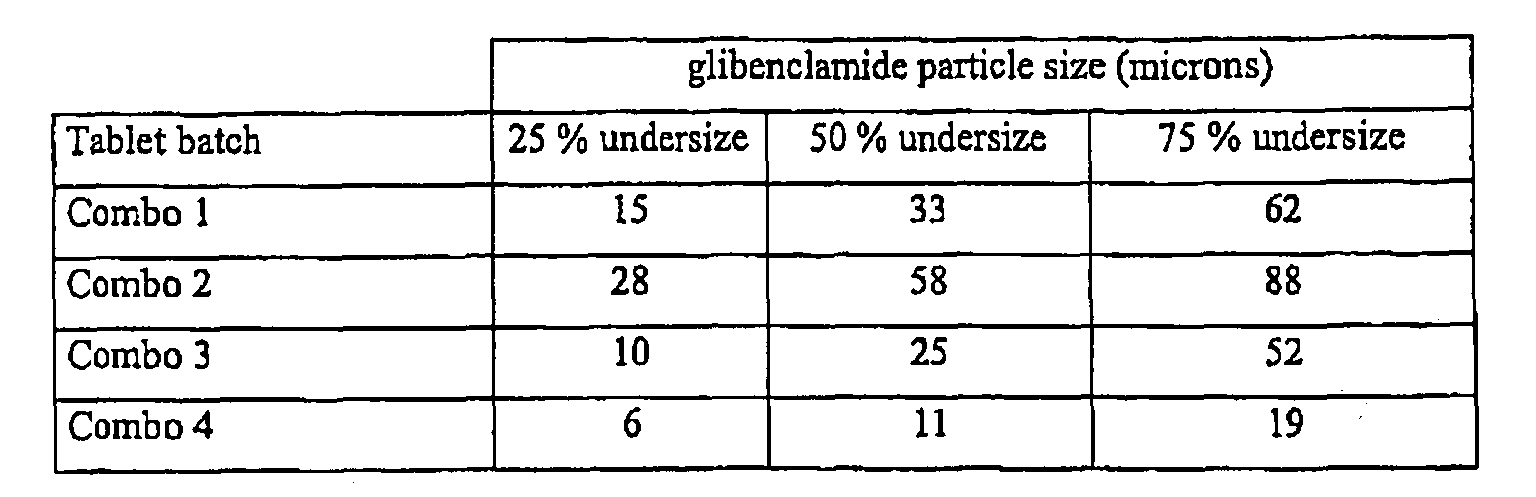
formulations Combo 1, 2, 3 and 4), where the formulation are identical save for the particle size characteristics of the glibenclamide used, compared with commercially available reference formulations of metformin hydrochloride (Glucophage™, Bristol-Myers Squibb) and glibenclamide (Micronase™, Upjohn) dosed together, allowed definition of particle characteristics for glibenclamide that would assure appropriate bioavailability of the glibenclamide component from the combination formulation. This means that disease control when patients are first treated with such a combination formulation will be predictable, based on prior physician knowledge of treatments employing either single drug. - Alternatively, if patients have undergone prior stabilisation of their disease by adding treatment with a commercial product like Micronase™ to existing treatment with Glucophage™ (or vice versa), then the switch over to a more convenient treatment employing the combination in a single tablet (and where the appropriate bioavailability of the glyburide component is assured) will result in the desired level of disease control being maintained.
- Data from the studies with metformin hydrochloride/glibenclamide tablets formulated with glibenclamide of different particle size characteristics allowed the development of a correlation between drug particle size and the in vivo performance. The properties of the lots of glyburide used in the series of combination tablets employed are shown in the table below:
- When four compositionally-identical individual batches of tablets of metformin hydrochloride-glyburide 500/2.5mg were prepared using each of these lots of glibenclamide and dosed to humans, the following pharmacokinetic parameters were found on analysis of the glibenclamide plasma concentration-time curves:
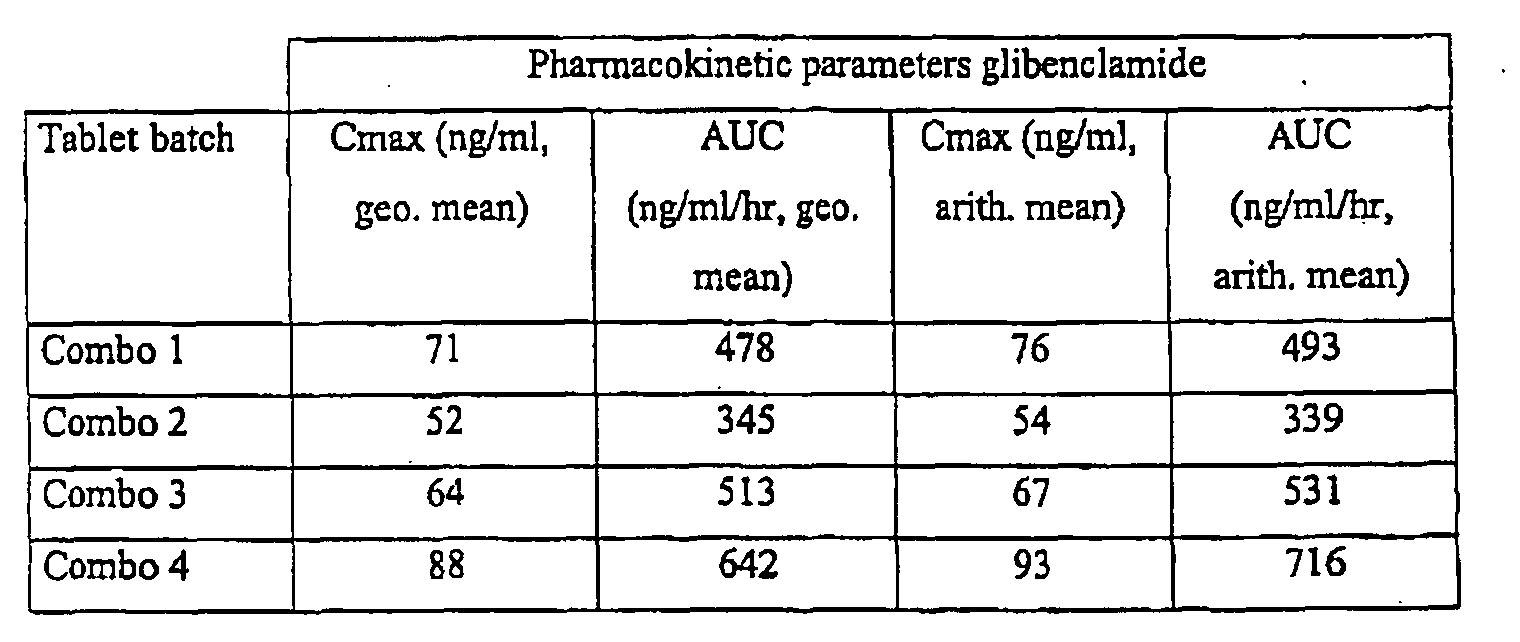
- A reasonable correlation can be obtained between particle size and the maximum attained geometric mean glibenclamide plasma concentration, Cmax, and also with the geometric mean area under the glibenclamide plasma concentration-time curve, AUC.
- From these correlations, projected limits on particle size for glyburide that would give predicted Cmax and AUC values ± 25 % of a mean value for batches of the reference glibenclamide formulation, Micronase™ utilised in the in vivo studies become:
25% undersize limits 50% undersize limits 75% undersize limits Cmax <0-18 microns <0-37 microns <0-63 microns AUC <0-11 microns <0-25 microns <0-46 microns 25% undersize limits 50% undersize limits 75% undersize limits ≤ 11 microns ≤ 23 microns ≤ 46 microns - Glibenclamide having these particle size characteristics have powder surface area values in the range 1.7 to 2.2 m2g-1 as determined by nitrogen adsorption. Therefore material of these properties when formulated as described in this work is distinct from the material disclosed in US 3 979 520 which required glibenclamide of powder surface area in excess of 3m2g-1 (preferably 5 to 10 m2g-1) to yield appropriate glibenclamide bioavailability. The glibenclamide of particle size properties detailed in this work, when formulated as described here produces appropriate glibenclamide bioavailability in humans as described in the next test.
- A batch of metformin hydrochloride-glibenclamide tablets 500/5mg was prepared as follows. Glibenclamide (1.0kg) with the above defined size was tumble mixed with 2.8kg of croscarmellose sodium and this mixture was then blended in a high shear mixer with metformin hydrochloride (100kg) to which 0.5% by weight of magnesium stearate had been added.
- This dry mix was wet granulated in a high shear mixer with 12.1kg of an aqueous solution of povidone (containing 4kg of povidone). The wet granules were dried in a fluid bed drier at 60°C to a defined moisture content. The dried (loss on drying 2-3% w/w) granules were size reduced in a oscillator (1.0mm screen aperture) then tumble mixed with 10.8kg of microcrystalline cellulose, followed by mixing with 0.9kg of the tablet lubricant magnesium stearate. The lubricated granules were compressed using 16mm x 8mm capsule shaped tooling and the tablet cores were film coated (weight gain approximately 2% w/w) with the proprietary film coat material Opadry 32920 to yield the final yellow, capsule-shaped tablets. In a human pharmacokinetic study volunteer either were dosed with one of these tablets or with a treatment being one 500mg Glucophage™ tablet plus one 5mg Micronase™ tablet co-administered. Glibenclamide plasma levels following dosing were analysed and the following pharmacokinetic were found for this component:
Treatment Parameter Mean Adjusted geometric mean Ratio of means (Point estimate) Combination Tablet 500/5 Cmax 122 116 1.14 AUC (O-T) 859 831 1.07 Glucophage+ Micronase Cmax 113 101 - AUC (O-T) 842 780 - - Glibenclamide bioavailability from the combination tablet is comparable to that from the reference glibenclamide formulation, Micronase™. This would thus allow patients to conveniently take one tablet of the combination product instead of two tablets of existing therapies together, without concern that low glibenclamide blood levels would result, which might occur with prior art formulations and lead to loss of control of disease.
- Instead of compressing into tablet granulation as prepared for test 3 was filled into size 00 capsules to either provide for metformin hydrochloride/glibenclamide 500mg/5mg product or the 500mg/2.5mg product. Granulation was filled into size 1 capsules to provide the 250mg/2.5mg product.
- These capsule exhibited acceptable physical properties and provide an alternative to the tablets. Formulations as described in WO 97/17975 could not be filled in capsules of a size acceptable to most patients because of the larger amount of excipients employed the formulations they described.
Claims (30)
- A pharmaceutical composition comprising a single solid oral dosage form containing an effective dose of metformin and an effective dose of glibenclamide wherein, after oral administration thereof to a human, the bioavailibility of glibenclamide is comparable to the bioavailability of glibenclamide achieved by oral administration of separate solid oral dosage forms to a human, one containing glibenclamide and the other metformin, in the same respective effective doses as in said single oral dosage form.
- A pharmaceutical composition comprising a single solid oral dosage form containing an effective dose of metformin and an effective dose of glibenclamide wherein, after oral administration thereof to a human, the Cmax and AUC of glibenclamide are comparable to the Cmax and AUC of glibenclamide achieved by oral administration of separate solid oral dosage forms to a human, one containing glibenclamide and the other metformin, in the same respective effective doses as in said single oral dosage form.
- A pharamaceutical composition comprising a single solid oral dosage form containing an effective dose of metformin and an effective dose of glibenclamide wherein, after oral administration thereof to a human, the Cmax and AUC of glibenclamide are + 25% of the Cmax and AUC, respectively, of the glibenclamide achieved by oral administration to a human of separate solid oral dosage forms, one containing glibenclamide and the other metformin, in the same respective effective doses as in said single oral dosage form.
- A pharmaceutical composition comprising a single solid oral dosage form containing an effective dose of metformin and an effective dose of glibenclamide wherein, after oral administration thereof to a human, the mean Cmax and mean AUC values of glibenclamide are, respectively, + 25% of 113 ng/ml and + 25% of 842 ng/ml/hr, for a 5mg unit dose of glibenclamide, or proportionally higher or lower values for higher or lower unit doses of glibenclamide, respectively.
- A pharmaceutical composition comprising a single solid oral dosage form containing an effective dose of metformin and an effective dose glibenclamide wherein, after oral administration thereof to a human, the adjusted geometric mean Cmax and adjusted geometric mean AUC values of glibenclamide are, respectively, + 25% of 101 ng/ml and + 25% of 780 ng/ml/hr, for a 5 mg unit dose of glibenclamide, or proportionally higher or lower values for higher or lower unit doses of glibenclamide, respectively.
- A pharmaceutical composition comprising a single solid oral dosage form containing an effective dose of metformin and an effective dose of glibenclamide wherein, after oral administration thereof to a human, the Cmax and AUC of glibenclamide are comparable to the Cmax and AUC of glibenclamide achieved by oral administration of separate solid oral dosage forms to a human, one containing glibenclamide and the other metformin, in the same respective effective doses as in said single oral dosage form, the particle size of the glibenclamide in said single dosage form not being such that it alone achieves said comparable bioavailability.
- A composition of one of claims 1-6 wherein the weight ratio of metformin to glibenclamide is 50/1 to 250/1.
- A composition of one of claims 1-6 wherein the weight ratio of metformin to glibenclamide is about 100/1.
- A composition of one of claims 1-6 wherein the weight ratio of metformin to glibenclamide is about 200.
- A composition of one of claims 1-6 wherein the unit dose of metformin is about 500 mg or about 250 mg.
- A composition of claim 10 wherein the unit dose of glibenclamide is 5, 2.5 or 1.25 mg.
- A composition of one of claims 1-6 in the form of a tablet or capsule.
- A composition of claim 3 wherein said Cmax and AUC values of glibenclamide in said single solid oral dosage form are + 20% of said Cmax and AUC values, respectively, of glibenclamide in said separate glibenclamide solid oral dosage form.
- A composition of claim 3 wherein said Cmax and AUC values of glibenclamide in said single solid oral dosage form are + 15% of said Cmax and AUC values, respectively, of glibenclamide in said separate glibenclamide solid oral dosage form.
- A composition of claim 3 wherein said Cmax and AUC values of glibenclamide in said single solid oral dosage form are + 10% of said Cmax and AUC values, respectively, of glibenclamide in said separate glibenclamide solid oral dosage form.
- A composition of claim 3 wherein said Cmax and AUC values of glibenclamide in said single solid oral dosage form are + 5% of said Cmax and AUC values, respectively, of glibenclamide in said separate glibenclamide solid oral dosage form.
- A composition of one of claims 4 or 5 wherein said Cmax and AUC values are + 20% of said numerical ranges.
- A composition of one of claims 4 or 5 wherein said Cmax and AUC values are + 15% of said numerical ranges.
- A composition of one of claims 4 or 5 wherein said Cmax and AUC values are + 10% of said numerical ranges.
- A composition of one of claims 4 or 5 wherein said Cmax and AUC values are + 5% of said numerical ranges.
- Use of a composition according to any of claims 1-6 for the preparation of a medicament for treating non-insulin dependent diabetes or hyperglycaemia.
- Use of a composition for the preparation of a medicament for achieving a bioavailability of glibenclamide in a human upon administering orally a single solid oral dosage form containing an effective dose of metformin and an effective dose of glibenclamide, said bioavailability being comparable to the bioavailability of glibenclamide achieved by oral administration of separate solid oral dosage forms to a human, one containing glibenclamide and the other metformin, in the same respective effective doses as in said single oral dosage form, said composition comprising formulating glibenclamide with metformin in said single solid oral dosage form so as to assure said comparable bioavailability.
- Use of a composition for the preparation of a medicament for achieving a bioavailability of glibenclamide in a human upon administering orally a single solid oral dosage form containing an effective dose of metformin and an effective dose of glibenclamide, said bioavailability being comparable to the bioavailability of glibenclamide achieved by oral administration of separate solid oral dosage forms to a human, one containing glibenclamide and the other metformin, in the same respective effective doses as in said single oral dosage form, said composition comprising formulating glibenclamide with metformin in said single solid oral dosage form so as to assure said comparable bioavailability, said formulating not being achieved solely by selection of particle size of glibenclamide.
- Use of a composition for the preparation of a medicament for increasing bioavailability of glibenclamide in a human upon administering orally a single solid oral dosage form containing an effective dose of metformin and an effective dose of glibenclamide, such that said increased bioavailability is comparable to the bioavailability of glibenclamide achieved by oral administration of separate solid oral dosage forms to a human, one containing glibenclamide and the other metformin, in the same respective effective doses as in said single oral dosage form, said composition comprising formulating glibenclamide with metformin in said single solid oral dosage form so as to assure said comparable bioavailability.
- Use of a composition for the preparation of a medicament for increasing bioavailability of glibenclamide in a human upon administering orally a single solid oral dosage form containing an effective dose of metformin and an effective dose of glibenclamide, such that said increased bioavailability is comparable to the bioavailability of glibenclamide achieved by oral administration of separate solid oral dosage forms to a human, one containing glibenclamide and the other metformin, in the same respective effective doses as in said single oral dosage form, said composition comprising formulating glibenclamide with metformin in said single solid oral dosage form so as to assure said comparable bioavailability, said formulating not being achieved solely by selection of particle size of glibenclamide.
- The use of one of claims 23 or 25 wherein said formulating is not achieved by selection of particle size of glibenclamide.
- A composition of one of claims 1-6 wherein metformin is present as a metformin salt.
- A use of one of claims 22-25 wherein metformin is present as a metformin salt.
- A use of claim 21 wherein metformin is present as a metformin salt.
- A use of claim 26 wherein metformin is present as a metformin salt.
Priority Applications (2)
| Application Number | Priority Date | Filing Date | Title |
|---|---|---|---|
| EP04008415A EP1435240A3 (en) | 1998-07-15 | 1999-07-12 | Solid oral dosage form comprising a combination of methformin and glibenclamide |
| EP10185329A EP2269613A3 (en) | 1998-07-15 | 1999-07-12 | Solid orald dosage form comprising a combination of metformin and glibenclamide |
Applications Claiming Priority (4)
| Application Number | Priority Date | Filing Date | Title |
|---|---|---|---|
| EP98401781A EP0974356B1 (en) | 1998-07-15 | 1998-07-15 | Tablets comprising a combination of metformin and glibenclamide |
| EP98401781 | 1998-07-15 | ||
| EP04008415A EP1435240A3 (en) | 1998-07-15 | 1999-07-12 | Solid oral dosage form comprising a combination of methformin and glibenclamide |
| EP99940114A EP1011684A2 (en) | 1998-07-15 | 1999-07-12 | Solid oral dosage form comprising a combination of metformin and glibenclamide |
Related Parent Applications (1)
| Application Number | Title | Priority Date | Filing Date |
|---|---|---|---|
| EP99940114A Division EP1011684A2 (en) | 1998-07-15 | 1999-07-12 | Solid oral dosage form comprising a combination of metformin and glibenclamide |
Publications (2)
| Publication Number | Publication Date |
|---|---|
| EP1435240A2 true EP1435240A2 (en) | 2004-07-07 |
| EP1435240A3 EP1435240A3 (en) | 2009-08-12 |
Family
ID=8235441
Family Applications (4)
| Application Number | Title | Priority Date | Filing Date |
|---|---|---|---|
| EP98401781A Revoked EP0974356B1 (en) | 1998-07-15 | 1998-07-15 | Tablets comprising a combination of metformin and glibenclamide |
| EP04008415A Ceased EP1435240A3 (en) | 1998-07-15 | 1999-07-12 | Solid oral dosage form comprising a combination of methformin and glibenclamide |
| EP10185329A Ceased EP2269613A3 (en) | 1998-07-15 | 1999-07-12 | Solid orald dosage form comprising a combination of metformin and glibenclamide |
| EP99940114A Ceased EP1011684A2 (en) | 1998-07-15 | 1999-07-12 | Solid oral dosage form comprising a combination of metformin and glibenclamide |
Family Applications Before (1)
| Application Number | Title | Priority Date | Filing Date |
|---|---|---|---|
| EP98401781A Revoked EP0974356B1 (en) | 1998-07-15 | 1998-07-15 | Tablets comprising a combination of metformin and glibenclamide |
Family Applications After (2)
| Application Number | Title | Priority Date | Filing Date |
|---|---|---|---|
| EP10185329A Ceased EP2269613A3 (en) | 1998-07-15 | 1999-07-12 | Solid orald dosage form comprising a combination of metformin and glibenclamide |
| EP99940114A Ceased EP1011684A2 (en) | 1998-07-15 | 1999-07-12 | Solid oral dosage form comprising a combination of metformin and glibenclamide |
Country Status (27)
| Country | Link |
|---|---|
| US (2) | US6303146B1 (en) |
| EP (4) | EP0974356B1 (en) |
| JP (2) | JP2002520371A (en) |
| KR (2) | KR20040053177A (en) |
| CN (2) | CN1146427C (en) |
| AP (1) | AP1450A (en) |
| AR (2) | AR013052A1 (en) |
| AT (1) | ATE250418T1 (en) |
| AU (2) | AU753604B2 (en) |
| BR (1) | BR9906600A (en) |
| CA (1) | CA2303537C (en) |
| DE (1) | DE69818444T2 (en) |
| DK (1) | DK0974356T3 (en) |
| DZ (1) | DZ2846A1 (en) |
| ES (1) | ES2206868T3 (en) |
| ID (1) | ID25784A (en) |
| MA (1) | MA24930A1 (en) |
| MY (1) | MY129552A (en) |
| NZ (1) | NZ503248A (en) |
| OA (1) | OA11400A (en) |
| PT (1) | PT974356E (en) |
| RU (2) | RU2226396C2 (en) |
| SI (1) | SI0974356T1 (en) |
| TW (2) | TW555560B (en) |
| UY (1) | UY25611A1 (en) |
| WO (1) | WO2000003742A2 (en) |
| ZA (1) | ZA200001159B (en) |
Cited By (3)
| Publication number | Priority date | Publication date | Assignee | Title |
|---|---|---|---|---|
| CN104127424A (en) * | 2014-07-30 | 2014-11-05 | 沈阳药科大学 | Glibenclamide derivative, preparation method and application thereof |
| CN105030793A (en) * | 2015-08-25 | 2015-11-11 | 瑞阳制药有限公司 | Metformin hydrochloride and glibenclamide capsule and preparation method thereof |
| EP2451482B1 (en) | 2009-07-08 | 2019-05-01 | Janssen Pharmaceutica NV | Combination therapy for the treatment of diabetes |
Families Citing this family (46)
| Publication number | Priority date | Publication date | Assignee | Title |
|---|---|---|---|---|
| US20040081697A1 (en) * | 1998-11-12 | 2004-04-29 | Smithkline Beecham P.L.C. | Pharmaceutical composition for modified release of an insulin sensitiser and another antidiabetic agent |
| US20040102486A1 (en) * | 1998-11-12 | 2004-05-27 | Smithkline Beecham Corporation | Novel method of treatment |
| US6586438B2 (en) | 1999-11-03 | 2003-07-01 | Bristol-Myers Squibb Co. | Antidiabetic formulation and method |
| KR20070089259A (en) * | 1999-11-03 | 2007-08-30 | 브리스톨-마이어스스퀴브컴파니 | Pharmaceutical composition comprising a complex of metformin and glybenclamide |
| US20010036479A1 (en) | 2000-01-14 | 2001-11-01 | Gillian Cave | Glyburide composition |
| FR2816840B1 (en) | 2000-11-17 | 2004-04-09 | Flamel Tech Sa | MEDICINE BASED ON SUSTAINED RELEASE ANTI-HYPERCLYCEMIA MICROCAPSULES AND METHOD FOR PREPARING THE SAME |
| FR2816841B1 (en) * | 2000-11-22 | 2004-02-06 | Lipha | NOVEL PHARMACEUTICAL COMPOSITIONS WITH ANTIDIABETIC ACTION AND PROCESS FOR THEIR PREPARATION |
| CA2725833A1 (en) * | 2001-01-12 | 2002-07-18 | Sun Pharmaceutical Industries Limited | Spaced drug delivery system |
| FR2825023B1 (en) * | 2001-05-23 | 2005-04-15 | Flamel Tech Sa | ANTIDIABETIC ORAL PHARMACEUTICAL FORM "ONE TAKEN PER DAY" INCLUDING BIGUANIDE AND AT LEAST ONE OTHER ACTIVE INGREDIENT |
| US20050271737A1 (en) * | 2001-06-07 | 2005-12-08 | Chinea Vanessa I | Application of a bioactive agent to a substrate |
| US7767249B2 (en) * | 2001-06-07 | 2010-08-03 | Hewlett-Packard Development Company, L.P. | Preparation of nanoparticles |
| US8206753B2 (en) * | 2001-06-20 | 2012-06-26 | Metaproteomics, Llc | Anti-inflammatory botanical products for the treatment of metabolic syndrome and diabetes |
| ATE378054T1 (en) * | 2001-07-30 | 2007-11-15 | Mitsubishi Pharma Corp | REMEDY FOR RELIEVING HYPERGLYCEMIA AFTER EATING |
| US8101209B2 (en) | 2001-10-09 | 2012-01-24 | Flamel Technologies | Microparticulate oral galenical form for the delayed and controlled release of pharmaceutical active principles |
| ITFI20010230A1 (en) * | 2001-11-29 | 2003-05-29 | Menarini Int Operations Lu Sa | PHARMACEUTICAL COMPOSITIONS FOR THE TREATMENT OF TYPE II DIABETES |
| US7183321B2 (en) * | 2001-12-17 | 2007-02-27 | Bristol-Myers Squibb Company | Antidiabetic formulation and method |
| ES2284829T3 (en) * | 2002-01-25 | 2007-11-16 | Laboratorios Silanes, S.A. De C.V. | PHARMACEUTICAL COMPOSITION USED TO CONTROL GLUCOSE IN BLOOD IN PATIENTS WITH TYPE 2 DIABETES. |
| PT1476138E (en) * | 2002-02-21 | 2012-02-14 | Valeant Internat Barbados Srl | Modified release formulations of at least one form of tramadol |
| US20030187074A1 (en) * | 2002-03-04 | 2003-10-02 | Javed Hussain | Oral compositions for treatment of diabetes |
| US20030219482A1 (en) * | 2002-03-21 | 2003-11-27 | Chaudhari Sunil Sudhakar | Multiparticulate compositions for once-a-day administration |
| MXPA04009968A (en) | 2002-04-09 | 2004-12-13 | Flamel Tech Sa | Oral suspension of active principle microcapsules. |
| DE60323474D1 (en) | 2002-04-09 | 2008-10-23 | Flamel Tech Sa | ORAL PHARMACEUTICAL FORMULATION IN THE FORM OF AQUEOUS SUSPENSION OF MICRO-CAPSULES FOR THE MODIFIED RELEASE OF AMOXICILLIN |
| WO2003105809A1 (en) | 2002-06-17 | 2003-12-24 | Themis Laboratories Private Limited | Multilayer tablets containing thiazolidinedione and biguanides and methods for producing them |
| US7445796B2 (en) * | 2002-08-19 | 2008-11-04 | L. Perrigo Company | Pharmaceutically active particles of a monomodal particle size distribution and method |
| US20060002998A1 (en) * | 2002-11-15 | 2006-01-05 | Anupam Trehan | Pharmaceutical dosage forms of biguanide-sulfonylurea combinations |
| FR2853831A1 (en) * | 2003-03-05 | 2004-10-22 | Usv Ltd | SOLID DOSAGE FOR ORAL USE OF METFORMIN AND GLYBURIDE AND PROCESS FOR PREPARING THE SAME |
| AU2004229285A1 (en) * | 2003-04-15 | 2004-10-28 | Chugai Seiyaku Kabushiki Kaisha | Remedy for diabetes |
| US20060121108A1 (en) * | 2004-12-02 | 2006-06-08 | Prasad C K | System and method for producing a directly compressible, high-potency formulation of metformin hydrochloride |
| CN100341495C (en) * | 2004-12-29 | 2007-10-10 | 三九医药股份有限公司 | Solid dispersion and preoral combination of glibenclamide and preparation method |
| KR100760430B1 (en) * | 2004-12-31 | 2007-10-04 | 한미약품 주식회사 | Sustained release combination preparations for oral administration of a diabetes treatment and preparation method thereof |
| PE20061245A1 (en) * | 2005-03-30 | 2007-01-06 | Generex Pharm Inc | COMPOSITIONS FOR ORAL TRANSMUCOUS TRANSMISSION OF METFORMIN |
| US8529537B2 (en) * | 2005-08-05 | 2013-09-10 | Kimberly-Clark Worldwide, Inc. | Absorbent article with enclosures |
| MXPA05009633A (en) * | 2005-09-08 | 2007-03-07 | Silanes Sa De Cv Lab | Stable pharmaceutical composition comprising immediate-release glimepiride and delayed-release metformin. |
| ATE540681T1 (en) | 2006-06-26 | 2012-01-15 | Amgen Inc | METHOD FOR TREATING ATHEROSCLERosis |
| WO2008062273A2 (en) * | 2006-11-20 | 2008-05-29 | Cadila Pharmaceuticals Limited | Solid oral dosage form having antidiabetic drug combination |
| UA98799C2 (en) | 2007-07-19 | 2012-06-25 | Такеда Фармасьютикал Компани Лимитед | Solid preparation comprising alogliptin and metformin hydrochloride |
| NZ582794A (en) | 2007-07-26 | 2012-09-28 | Amgen Inc | Modified lecithin-cholesterol acyltransferase enzymes |
| WO2011135106A1 (en) * | 2010-04-26 | 2011-11-03 | Smart Pharma Solutions, S.L | Highly dispersible granulate for the preparation of formulations of high dosage active substances and procedure for the obtainment thereof |
| RU2451506C1 (en) | 2011-06-02 | 2012-05-27 | Сергей Юрьевич Лешков | Combination for treatment of diabetes and complications thereof |
| CA2858572C (en) | 2011-12-08 | 2023-01-17 | Amgen Inc. | Human lcat antigen binding proteins and their use in therapy |
| WO2013090452A1 (en) * | 2011-12-12 | 2013-06-20 | Orbis Biosciences, Inc. | Sustained release particle formulations |
| WO2019070109A1 (en) * | 2017-10-03 | 2019-04-11 | Infinite Clinical Research International, S.A. De C.V. | Triconjugate for treating diabetes mellitus |
| JP2023528565A (en) | 2020-04-01 | 2023-07-05 | ハンジョウ ジョンメイ フアドン ファーマシューティカル シーオー.,エルティーディー. | Crystal Form A of GLP-1 Receptor Agonist and Method for Preparing The Same |
| EP4141008A4 (en) | 2020-04-01 | 2024-04-17 | Hangzhou Zhongmei Huadong Pharmaceutical Co., Ltd. | PHARMACEUTICALLY ACCEPTABLE ACID SALT OF THE FREE BASE OF A GLP-1 RECEPTOR AGONIST AND METHOD OF MANUFACTURING THE SAME |
| KR102484756B1 (en) * | 2020-11-13 | 2023-01-06 | 한국생산기술연구원 | Method for granulating powder medium having increased solubility and ease of handling |
| CN113143940A (en) * | 2020-12-30 | 2021-07-23 | 成都恒瑞制药有限公司 | Preparation method of antidiabetic pharmaceutical composition |
Citations (2)
| Publication number | Priority date | Publication date | Assignee | Title |
|---|---|---|---|---|
| US4060634A (en) | 1973-09-26 | 1977-11-29 | Boehringer Mannheim G.M.B.H. | Rapidly resorbable glibenclamide |
| WO1997017975A1 (en) | 1995-11-14 | 1997-05-22 | Abiogen Pharma S.R.L. | A glibenclamide-metformin combination for the treatment of diabetes mellitus of type ii |
Family Cites Families (12)
| Publication number | Priority date | Publication date | Assignee | Title |
|---|---|---|---|---|
| DE362704C (en) * | 1921-08-09 | 1922-11-02 | Naamlooze Vennootschap Interna | Device for lowering a load, in particular a lifeboat |
| US3174901A (en) | 1963-01-31 | 1965-03-23 | Jan Marcel Didier Aron Samuel | Process for the oral treatment of diabetes |
| DE2348334C2 (en) | 1973-09-26 | 1982-11-11 | Boehringer Mannheim Gmbh, 6800 Mannheim | New form of preparation of N-4- [2- (5-chloro-2-methoxybenzamido) ethyl] -phenyl-sulfonyl-N'-cyclohexylurea |
| US4916163A (en) | 1985-06-04 | 1990-04-10 | The Upjohn Company | Spray-dried lactose formulation of micronized glyburide |
| DE3833439A1 (en) | 1988-10-01 | 1991-09-12 | Hoechst Ag | METHOD FOR MICRONIZING GLIBENCLAMIDE |
| IE63463B1 (en) * | 1989-02-06 | 1995-04-19 | Zeneca Ltd | Phenylsulphone derivatives |
| GB9016978D0 (en) * | 1990-08-02 | 1990-09-19 | Ici Plc | Acetamide derivatives |
| DK36392D0 (en) | 1992-03-19 | 1992-03-19 | Novo Nordisk As | USE OF CHEMICAL COMPOUND |
| DE4323636A1 (en) | 1993-07-15 | 1995-01-19 | Hoechst Ag | Pharmaceutical preparations from coated, poorly water-soluble pharmaceutical substances for inhalation pharmaceutical forms and processes for their preparation |
| TW438587B (en) | 1995-06-20 | 2001-06-07 | Takeda Chemical Industries Ltd | A pharmaceutical composition for prophylaxis and treatment of diabetes |
| EP1787646A3 (en) | 1997-06-18 | 2007-10-03 | Smithkline Beecham Plc | Novel method of treatment |
| US6544564B1 (en) * | 2001-11-27 | 2003-04-08 | Michael Donald Farley | Cytotoxic pharmaceutical composition |
-
1998
- 1998-07-15 DK DK98401781T patent/DK0974356T3/en active
- 1998-07-15 SI SI9830517T patent/SI0974356T1/en unknown
- 1998-07-15 EP EP98401781A patent/EP0974356B1/en not_active Revoked
- 1998-07-15 DE DE69818444T patent/DE69818444T2/en not_active Revoked
- 1998-07-15 PT PT98401781T patent/PT974356E/en unknown
- 1998-07-15 AT AT98401781T patent/ATE250418T1/en not_active IP Right Cessation
- 1998-07-15 ES ES98401781T patent/ES2206868T3/en not_active Expired - Lifetime
-
1999
- 1999-07-12 KR KR10-2004-7005583A patent/KR20040053177A/en not_active Ceased
- 1999-07-12 NZ NZ503248A patent/NZ503248A/en not_active IP Right Cessation
- 1999-07-12 AU AU54179/99A patent/AU753604B2/en not_active Expired
- 1999-07-12 EP EP04008415A patent/EP1435240A3/en not_active Ceased
- 1999-07-12 ID IDW20000482D patent/ID25784A/en unknown
- 1999-07-12 JP JP2000559876A patent/JP2002520371A/en active Pending
- 1999-07-12 WO PCT/EP1999/005571 patent/WO2000003742A2/en not_active Ceased
- 1999-07-12 CA CA002303537A patent/CA2303537C/en not_active Expired - Lifetime
- 1999-07-12 AP APAP/P/2000/001757A patent/AP1450A/en active
- 1999-07-12 EP EP10185329A patent/EP2269613A3/en not_active Ceased
- 1999-07-12 EP EP99940114A patent/EP1011684A2/en not_active Ceased
- 1999-07-12 RU RU2000109583/15A patent/RU2226396C2/en active
- 1999-07-12 CN CNB998013625A patent/CN1146427C/en not_active Expired - Lifetime
- 1999-07-12 KR KR10-2000-7002714A patent/KR100478347B1/en not_active Expired - Lifetime
- 1999-07-12 RU RU2003126257/15A patent/RU2286788C2/en active
- 1999-07-12 CN CNA031092314A patent/CN1486698A/en active Pending
- 1999-07-12 BR BR9906600-9A patent/BR9906600A/en not_active Application Discontinuation
- 1999-07-13 MA MA25681A patent/MA24930A1/en unknown
- 1999-07-14 TW TW088111959A patent/TW555560B/en not_active IP Right Cessation
- 1999-07-14 DZ DZ990146A patent/DZ2846A1/en active
- 1999-07-14 MY MYPI99002968A patent/MY129552A/en unknown
- 1999-07-14 US US09/353,141 patent/US6303146B1/en not_active Expired - Lifetime
- 1999-07-14 TW TW092113257A patent/TWI245632B/en not_active IP Right Cessation
- 1999-07-15 AR ARP990103470A patent/AR013052A1/en not_active Application Discontinuation
- 1999-07-15 UY UY25611A patent/UY25611A1/en not_active Application Discontinuation
-
2000
- 2000-03-07 ZA ZA200001159A patent/ZA200001159B/en unknown
- 2000-03-15 OA OA1200000076A patent/OA11400A/en unknown
-
2002
- 2002-12-27 US US10/329,426 patent/USRE38629E1/en not_active Expired - Lifetime
-
2003
- 2003-03-31 JP JP2003094873A patent/JP2003292443A/en active Pending
- 2003-11-11 AU AU2003261560A patent/AU2003261560A1/en not_active Abandoned
-
2008
- 2008-04-07 AR ARP080101435A patent/AR065970A2/en not_active Application Discontinuation
Patent Citations (2)
| Publication number | Priority date | Publication date | Assignee | Title |
|---|---|---|---|---|
| US4060634A (en) | 1973-09-26 | 1977-11-29 | Boehringer Mannheim G.M.B.H. | Rapidly resorbable glibenclamide |
| WO1997017975A1 (en) | 1995-11-14 | 1997-05-22 | Abiogen Pharma S.R.L. | A glibenclamide-metformin combination for the treatment of diabetes mellitus of type ii |
Cited By (4)
| Publication number | Priority date | Publication date | Assignee | Title |
|---|---|---|---|---|
| EP2451482B1 (en) | 2009-07-08 | 2019-05-01 | Janssen Pharmaceutica NV | Combination therapy for the treatment of diabetes |
| US11576894B2 (en) | 2009-07-08 | 2023-02-14 | Janssen Pharmaceutica Nv | Combination therapy for the treatment of diabetes |
| CN104127424A (en) * | 2014-07-30 | 2014-11-05 | 沈阳药科大学 | Glibenclamide derivative, preparation method and application thereof |
| CN105030793A (en) * | 2015-08-25 | 2015-11-11 | 瑞阳制药有限公司 | Metformin hydrochloride and glibenclamide capsule and preparation method thereof |
Also Published As
Similar Documents
| Publication | Publication Date | Title |
|---|---|---|
| USRE38629E1 (en) | Solid oral dosage form comprising a combination of metformin and glibenclamide | |
| AU771705B2 (en) | Glyburide composition | |
| AU2001260212C1 (en) | Composition | |
| EA006766B1 (en) | Pharmaceutical compositions comprising metformin and glibenclamide for the treatment of type-ii diabetes mellitus | |
| US20060088594A1 (en) | Highly compressible controlled delivery compositions of metformin | |
| US20030224046A1 (en) | Unit-dose combination composition for the simultaneous delivery of a short-acting and a long-acting oral hypoglycemic agent | |
| EP4045048A1 (en) | Oral formulations comprising sitagliptin hci monohydrate with improved pharmaceutical characteristics | |
| US20040147564A1 (en) | Combinations of glimepiride and the thiazolidinedione for treatment of diabetes | |
| WO2006109175A2 (en) | Solid dosage form of an antidiabetic drug | |
| WO2004069229A1 (en) | Dual release anti-diabetic drugs and process of production thereof | |
| CN112022827B (en) | Cyproheptadine hydrochloride quick-release pharmaceutical preparation and preparation method thereof | |
| MXPA00002568A (en) | Solid oral dosage form comprising a combination of metformin and glibenclamide | |
| OA12714A (en) | Solid oral dosage form comprising a combination ofmetformin and glibenclamide. | |
| WO2004091587A1 (en) | Multiple release anti-diabetic drugs and process of production thereof | |
| WO2004082591A2 (en) | Pharmaceutical composition for treatment of diabetes mellitus |
Legal Events
| Date | Code | Title | Description |
|---|---|---|---|
| PUAI | Public reference made under article 153(3) epc to a published international application that has entered the european phase |
Free format text: ORIGINAL CODE: 0009012 |
|
| 17P | Request for examination filed |
Effective date: 20040407 |
|
| AC | Divisional application: reference to earlier application |
Ref document number: 1011684 Country of ref document: EP Kind code of ref document: P |
|
| AK | Designated contracting states |
Kind code of ref document: A2 Designated state(s): AT BE CH CY DE DK ES FI FR GB GR IE IT LI LU MC NL PT SE |
|
| AX | Request for extension of the european patent |
Extension state: AL LT LV MK RO SI |
|
| TPAC | Observations filed by third parties |
Free format text: ORIGINAL CODE: EPIDOSNTIPA |
|
| PUAL | Search report despatched |
Free format text: ORIGINAL CODE: 0009013 |
|
| AK | Designated contracting states |
Kind code of ref document: A3 Designated state(s): AT BE CH CY DE DK ES FI FR GB GR IE IT LI LU MC NL PT SE |
|
| AX | Request for extension of the european patent |
Extension state: AL LT LV MK RO SI |
|
| 17Q | First examination report despatched |
Effective date: 20100318 |
|
| AKX | Designation fees paid |
Designated state(s): AT BE CH CY DE DK ES FI FR GB GR IE IT LI LU MC NL PT SE |
|
| STAA | Information on the status of an ep patent application or granted ep patent |
Free format text: STATUS: THE APPLICATION HAS BEEN REFUSED |
|
| 18R | Application refused |
Effective date: 20170501 |