EP1435119B1 - Electrode material and preparation method thereof - Google Patents
Electrode material and preparation method thereof Download PDFInfo
- Publication number
- EP1435119B1 EP1435119B1 EP02781934A EP02781934A EP1435119B1 EP 1435119 B1 EP1435119 B1 EP 1435119B1 EP 02781934 A EP02781934 A EP 02781934A EP 02781934 A EP02781934 A EP 02781934A EP 1435119 B1 EP1435119 B1 EP 1435119B1
- Authority
- EP
- European Patent Office
- Prior art keywords
- carbon
- fluorine
- treated carbon
- graphite
- nli
- Prior art date
- Legal status (The legal status is an assumption and is not a legal conclusion. Google has not performed a legal analysis and makes no representation as to the accuracy of the status listed.)
- Expired - Lifetime
Links
- 238000002360 preparation method Methods 0.000 title abstract description 5
- 239000007772 electrode material Substances 0.000 title description 2
- OKTJSMMVPCPJKN-UHFFFAOYSA-N Carbon Chemical compound [C] OKTJSMMVPCPJKN-UHFFFAOYSA-N 0.000 claims abstract description 81
- 229910052799 carbon Inorganic materials 0.000 claims abstract description 36
- 150000003839 salts Chemical class 0.000 claims abstract description 30
- 229910052744 lithium Inorganic materials 0.000 claims abstract description 22
- WHXSMMKQMYFTQS-UHFFFAOYSA-N Lithium Chemical compound [Li] WHXSMMKQMYFTQS-UHFFFAOYSA-N 0.000 claims abstract description 17
- HBBGRARXTFLTSG-UHFFFAOYSA-N Lithium ion Chemical compound [Li+] HBBGRARXTFLTSG-UHFFFAOYSA-N 0.000 claims abstract description 7
- 229910001416 lithium ion Inorganic materials 0.000 claims abstract description 7
- 239000011247 coating layer Substances 0.000 claims abstract description 6
- 229910002804 graphite Inorganic materials 0.000 claims description 24
- 239000010439 graphite Substances 0.000 claims description 24
- 239000011248 coating agent Substances 0.000 claims description 21
- 238000000576 coating method Methods 0.000 claims description 21
- 238000000034 method Methods 0.000 claims description 20
- 239000006183 anode active material Substances 0.000 claims description 9
- 239000000126 substance Substances 0.000 claims description 9
- 229910052751 metal Inorganic materials 0.000 claims description 7
- 239000002184 metal Substances 0.000 claims description 7
- XSXHWVKGUXMUQE-UHFFFAOYSA-N osmium dioxide Inorganic materials O=[Os]=O XSXHWVKGUXMUQE-UHFFFAOYSA-N 0.000 claims description 7
- 229910003481 amorphous carbon Inorganic materials 0.000 claims description 6
- 239000002904 solvent Substances 0.000 claims description 6
- 238000010438 heat treatment Methods 0.000 claims description 5
- 239000011259 mixed solution Substances 0.000 claims description 5
- 229910006145 SO3Li Inorganic materials 0.000 claims description 4
- 229910021382 natural graphite Inorganic materials 0.000 claims description 4
- 150000002894 organic compounds Chemical class 0.000 claims description 4
- 239000007864 aqueous solution Substances 0.000 claims description 3
- 239000002152 aqueous-organic solution Substances 0.000 claims description 3
- 229910021383 artificial graphite Inorganic materials 0.000 claims description 3
- 229910052757 nitrogen Inorganic materials 0.000 claims description 3
- 229910016861 F9SO3 Inorganic materials 0.000 claims description 2
- 229910052791 calcium Inorganic materials 0.000 claims description 2
- 239000000835 fiber Substances 0.000 claims description 2
- 229910052749 magnesium Inorganic materials 0.000 claims description 2
- 239000000203 mixture Substances 0.000 claims description 2
- 230000003647 oxidation Effects 0.000 claims description 2
- 238000007254 oxidation reaction Methods 0.000 claims description 2
- 229910052712 strontium Inorganic materials 0.000 claims description 2
- 229910052717 sulfur Inorganic materials 0.000 claims description 2
- 229910001558 CF3SO3Li Inorganic materials 0.000 claims 1
- 229910016855 F9SO2 Inorganic materials 0.000 claims 1
- 238000005507 spraying Methods 0.000 claims 1
- 239000010405 anode material Substances 0.000 abstract description 8
- 210000004027 cell Anatomy 0.000 description 15
- 239000000463 material Substances 0.000 description 15
- 239000007784 solid electrolyte Substances 0.000 description 14
- 239000003792 electrolyte Substances 0.000 description 12
- 230000007423 decrease Effects 0.000 description 11
- 230000000052 comparative effect Effects 0.000 description 7
- 238000000354 decomposition reaction Methods 0.000 description 7
- LFQSCWFLJHTTHZ-UHFFFAOYSA-N Ethanol Chemical compound CCO LFQSCWFLJHTTHZ-UHFFFAOYSA-N 0.000 description 6
- 239000002002 slurry Substances 0.000 description 5
- 238000006243 chemical reaction Methods 0.000 description 4
- 238000004299 exfoliation Methods 0.000 description 4
- 239000007789 gas Substances 0.000 description 4
- 239000000243 solution Substances 0.000 description 4
- 239000002000 Electrolyte additive Substances 0.000 description 3
- 239000000654 additive Substances 0.000 description 3
- 150000001450 anions Chemical class 0.000 description 3
- 239000011230 binding agent Substances 0.000 description 3
- 239000007787 solid Substances 0.000 description 3
- 238000003860 storage Methods 0.000 description 3
- IJGRMHOSHXDMSA-UHFFFAOYSA-N Atomic nitrogen Chemical compound N#N IJGRMHOSHXDMSA-UHFFFAOYSA-N 0.000 description 2
- KMTRUDSVKNLOMY-UHFFFAOYSA-N Ethylene carbonate Chemical compound O=C1OCCO1 KMTRUDSVKNLOMY-UHFFFAOYSA-N 0.000 description 2
- 229910001290 LiPF6 Inorganic materials 0.000 description 2
- SECXISVLQFMRJM-UHFFFAOYSA-N N-Methylpyrrolidone Chemical compound CN1CCCC1=O SECXISVLQFMRJM-UHFFFAOYSA-N 0.000 description 2
- 239000002033 PVDF binder Substances 0.000 description 2
- 239000011149 active material Substances 0.000 description 2
- 239000006182 cathode active material Substances 0.000 description 2
- 238000009831 deintercalation Methods 0.000 description 2
- 238000003487 electrochemical reaction Methods 0.000 description 2
- JBTWLSYIZRCDFO-UHFFFAOYSA-N ethyl methyl carbonate Chemical compound CCOC(=O)OC JBTWLSYIZRCDFO-UHFFFAOYSA-N 0.000 description 2
- 238000009830 intercalation Methods 0.000 description 2
- 230000002427 irreversible effect Effects 0.000 description 2
- 239000002931 mesocarbon microbead Substances 0.000 description 2
- 229920002981 polyvinylidene fluoride Polymers 0.000 description 2
- 239000000047 product Substances 0.000 description 2
- 239000002994 raw material Substances 0.000 description 2
- XLYOFNOQVPJJNP-UHFFFAOYSA-N water Substances O XLYOFNOQVPJJNP-UHFFFAOYSA-N 0.000 description 2
- JZVUAOCDNFNSGQ-UHFFFAOYSA-N 7-methoxy-2-phenyl-1h-quinolin-4-one Chemical compound N=1C2=CC(OC)=CC=C2C(O)=CC=1C1=CC=CC=C1 JZVUAOCDNFNSGQ-UHFFFAOYSA-N 0.000 description 1
- RYGMFSIKBFXOCR-UHFFFAOYSA-N Copper Chemical compound [Cu] RYGMFSIKBFXOCR-UHFFFAOYSA-N 0.000 description 1
- 230000000996 additive effect Effects 0.000 description 1
- QVGXLLKOCUKJST-UHFFFAOYSA-N atomic oxygen Chemical compound [O] QVGXLLKOCUKJST-UHFFFAOYSA-N 0.000 description 1
- 230000015572 biosynthetic process Effects 0.000 description 1
- 239000006227 byproduct Substances 0.000 description 1
- -1 carbon fluoride compound Chemical class 0.000 description 1
- 239000002388 carbon-based active material Substances 0.000 description 1
- 150000001768 cations Chemical class 0.000 description 1
- 239000011294 coal tar pitch Substances 0.000 description 1
- 150000001875 compounds Chemical class 0.000 description 1
- 230000008602 contraction Effects 0.000 description 1
- 239000011889 copper foil Substances 0.000 description 1
- 230000007812 deficiency Effects 0.000 description 1
- 210000001787 dendrite Anatomy 0.000 description 1
- 230000000694 effects Effects 0.000 description 1
- 239000008151 electrolyte solution Substances 0.000 description 1
- 238000010304 firing Methods 0.000 description 1
- MCVFFRWZNYZUIJ-UHFFFAOYSA-M lithium;trifluoromethanesulfonate Chemical compound [Li+].[O-]S(=O)(=O)C(F)(F)F MCVFFRWZNYZUIJ-UHFFFAOYSA-M 0.000 description 1
- 238000004519 manufacturing process Methods 0.000 description 1
- 238000002156 mixing Methods 0.000 description 1
- 239000011255 nonaqueous electrolyte Substances 0.000 description 1
- 150000002902 organometallic compounds Chemical class 0.000 description 1
- 230000033116 oxidation-reduction process Effects 0.000 description 1
- 229910052760 oxygen Inorganic materials 0.000 description 1
- 239000001301 oxygen Substances 0.000 description 1
- 239000002245 particle Substances 0.000 description 1
- 238000010345 tape casting Methods 0.000 description 1
- 238000001149 thermolysis Methods 0.000 description 1
Images




Classifications
-
- H—ELECTRICITY
- H01—ELECTRIC ELEMENTS
- H01M—PROCESSES OR MEANS, e.g. BATTERIES, FOR THE DIRECT CONVERSION OF CHEMICAL ENERGY INTO ELECTRICAL ENERGY
- H01M4/00—Electrodes
- H01M4/02—Electrodes composed of, or comprising, active material
- H01M4/36—Selection of substances as active materials, active masses, active liquids
- H01M4/58—Selection of substances as active materials, active masses, active liquids of inorganic compounds other than oxides or hydroxides, e.g. sulfides, selenides, tellurides, halogenides or LiCoFy; of polyanionic structures, e.g. phosphates, silicates or borates
- H01M4/583—Carbonaceous material, e.g. graphite-intercalation compounds or CFx
-
- H—ELECTRICITY
- H01—ELECTRIC ELEMENTS
- H01M—PROCESSES OR MEANS, e.g. BATTERIES, FOR THE DIRECT CONVERSION OF CHEMICAL ENERGY INTO ELECTRICAL ENERGY
- H01M10/00—Secondary cells; Manufacture thereof
- H01M10/05—Accumulators with non-aqueous electrolyte
- H01M10/052—Li-accumulators
- H01M10/0525—Rocking-chair batteries, i.e. batteries with lithium insertion or intercalation in both electrodes; Lithium-ion batteries
-
- H—ELECTRICITY
- H01—ELECTRIC ELEMENTS
- H01M—PROCESSES OR MEANS, e.g. BATTERIES, FOR THE DIRECT CONVERSION OF CHEMICAL ENERGY INTO ELECTRICAL ENERGY
- H01M4/00—Electrodes
- H01M4/02—Electrodes composed of, or comprising, active material
- H01M4/04—Processes of manufacture in general
-
- H—ELECTRICITY
- H01—ELECTRIC ELEMENTS
- H01M—PROCESSES OR MEANS, e.g. BATTERIES, FOR THE DIRECT CONVERSION OF CHEMICAL ENERGY INTO ELECTRICAL ENERGY
- H01M4/00—Electrodes
- H01M4/02—Electrodes composed of, or comprising, active material
- H01M4/04—Processes of manufacture in general
- H01M4/0402—Methods of deposition of the material
- H01M4/0404—Methods of deposition of the material by coating on electrode collectors
-
- H—ELECTRICITY
- H01—ELECTRIC ELEMENTS
- H01M—PROCESSES OR MEANS, e.g. BATTERIES, FOR THE DIRECT CONVERSION OF CHEMICAL ENERGY INTO ELECTRICAL ENERGY
- H01M4/00—Electrodes
- H01M4/02—Electrodes composed of, or comprising, active material
- H01M4/04—Processes of manufacture in general
- H01M4/0402—Methods of deposition of the material
- H01M4/0419—Methods of deposition of the material involving spraying
-
- H—ELECTRICITY
- H01—ELECTRIC ELEMENTS
- H01M—PROCESSES OR MEANS, e.g. BATTERIES, FOR THE DIRECT CONVERSION OF CHEMICAL ENERGY INTO ELECTRICAL ENERGY
- H01M4/00—Electrodes
- H01M4/02—Electrodes composed of, or comprising, active material
- H01M4/04—Processes of manufacture in general
- H01M4/0471—Processes of manufacture in general involving thermal treatment, e.g. firing, sintering, backing particulate active material, thermal decomposition, pyrolysis
-
- H—ELECTRICITY
- H01—ELECTRIC ELEMENTS
- H01M—PROCESSES OR MEANS, e.g. BATTERIES, FOR THE DIRECT CONVERSION OF CHEMICAL ENERGY INTO ELECTRICAL ENERGY
- H01M4/00—Electrodes
- H01M4/02—Electrodes composed of, or comprising, active material
- H01M4/36—Selection of substances as active materials, active masses, active liquids
- H01M4/362—Composites
- H01M4/366—Composites as layered products
-
- H—ELECTRICITY
- H01—ELECTRIC ELEMENTS
- H01M—PROCESSES OR MEANS, e.g. BATTERIES, FOR THE DIRECT CONVERSION OF CHEMICAL ENERGY INTO ELECTRICAL ENERGY
- H01M4/00—Electrodes
- H01M4/02—Electrodes composed of, or comprising, active material
- H01M4/36—Selection of substances as active materials, active masses, active liquids
- H01M4/60—Selection of substances as active materials, active masses, active liquids of organic compounds
-
- H—ELECTRICITY
- H01—ELECTRIC ELEMENTS
- H01M—PROCESSES OR MEANS, e.g. BATTERIES, FOR THE DIRECT CONVERSION OF CHEMICAL ENERGY INTO ELECTRICAL ENERGY
- H01M4/00—Electrodes
- H01M4/86—Inert electrodes with catalytic activity, e.g. for fuel cells
- H01M2004/8678—Inert electrodes with catalytic activity, e.g. for fuel cells characterised by the polarity
- H01M2004/8684—Negative electrodes
-
- Y—GENERAL TAGGING OF NEW TECHNOLOGICAL DEVELOPMENTS; GENERAL TAGGING OF CROSS-SECTIONAL TECHNOLOGIES SPANNING OVER SEVERAL SECTIONS OF THE IPC; TECHNICAL SUBJECTS COVERED BY FORMER USPC CROSS-REFERENCE ART COLLECTIONS [XRACs] AND DIGESTS
- Y02—TECHNOLOGIES OR APPLICATIONS FOR MITIGATION OR ADAPTATION AGAINST CLIMATE CHANGE
- Y02E—REDUCTION OF GREENHOUSE GAS [GHG] EMISSIONS, RELATED TO ENERGY GENERATION, TRANSMISSION OR DISTRIBUTION
- Y02E60/00—Enabling technologies; Technologies with a potential or indirect contribution to GHG emissions mitigation
- Y02E60/10—Energy storage using batteries
-
- Y—GENERAL TAGGING OF NEW TECHNOLOGICAL DEVELOPMENTS; GENERAL TAGGING OF CROSS-SECTIONAL TECHNOLOGIES SPANNING OVER SEVERAL SECTIONS OF THE IPC; TECHNICAL SUBJECTS COVERED BY FORMER USPC CROSS-REFERENCE ART COLLECTIONS [XRACs] AND DIGESTS
- Y02—TECHNOLOGIES OR APPLICATIONS FOR MITIGATION OR ADAPTATION AGAINST CLIMATE CHANGE
- Y02E—REDUCTION OF GREENHOUSE GAS [GHG] EMISSIONS, RELATED TO ENERGY GENERATION, TRANSMISSION OR DISTRIBUTION
- Y02E60/00—Enabling technologies; Technologies with a potential or indirect contribution to GHG emissions mitigation
- Y02E60/30—Hydrogen technology
- Y02E60/50—Fuel cells
Definitions
- the present invention relates to an anode material for a battery and a preparation method. thereof, and particularly to an anode material for a battery comprising a carbon core and a coating layer containing a fluorine-type organometal salt and having superior room temperature and high temperature cycle life properties, and a preparation method thereof.
- a lithium or lithium ion secondary battery is one battery satisfying requirements of such miniaturized equipment, because it has a high capacity and shows high voltage.
- a lithium ion secondary battery uses a non-aqueous electrolyte and a material capable of intercalating and deintercalating lithium as a cathode and an anode, and it has a separator that separates the two electrodes in the electrolyte.
- Japanese Laid-open Patent Publication Sho 57-208079 disclosed a method for coating amorphous carbon on the surface of an electrode by coating an organic substance that can be carbonated on the surface of graphite carbon and firing it, in order to solve the above problems.
- electric potential during charge/discharge is similar to that of graphite, namely close to the oxidation-reduction potential of lithium metal, and thus largely contributes to improved cycle life properties, but amorphous carbon existing on the surface has negative effects on capacity.
- battery capacity is determined by capacity per unit weight of cathode active material and anode active material, and irreversible capacity thereof.
- lithium supplied to a cathode is consumed for decomposition of an electrolyte on the surface of carbon, the anode active material, to form a solid electrolyte interface (SEI), and the solid electrolyte interface restrains decomposition of electrolyte to make the battery operate normally. Since, in order to form a solid electrolyte interface, a specific amount of lithium is consumed and most is supplied from the cathode, battery capacity decreases by as much as the amount of consumed lithium.
- SEI solid electrolyte interface
- the thickness and properties of the formed solid electrolyte interface is determined by the kinds of carbon, electrolyte, and surface properties of the carbon active material, etc.
- the thickness of the formed solid electrolyte interface is thinner and more solid, the amount of consumed lithium is smaller, and thus capacity and cycle life properties of the battery can be improved.
- Japanese Laid-open Patent Publication No. 2000-353545 has disclosed use of various additives that are decomposed earlier than an electrolyte on the surface of cathode and anode active materials to form a solid SEI film, and thus function to improve life properties of a battery.
- these additives are expensive and the decomposition voltage changes with purity of the electrolyte, etc., they are problematic to use except under special conditions.
- a solid electrolyte interface formed by an additive is thermally unstable, and it is not helpful for the overall stability of a battery.
- an object of the present invention to provide an anode active material for a battery that can improve cycle life properties of a battery without using an electrolyte additive.
- the present invention provides surface-treated carbon, comprising:
- the present invention also provides a method for preparing surface-treated carbon, comprising the steps of;
- the present invention also provides a lithium or lithium ion secondary battery comprising the surface-treated carbon as an anode active material.
- a fluorine-type organometal salt-containing metal such as lithium is coated on the surface of carbon, and it is heat-treated at a specific temperature to react the fluorine-type organometal salt with the surface of the carbon to form a solid electrolyte interface thereon. Since metal or lithium from decomposition by-products of organometal salt exists on the surface of the carbon, it provides lithium or metal required for forming a solid electrolyte interface on the surface of an anode during a first charge or formation of a battery.
- a solid electrolyte interface formed by electrochemical reaction decreases to further improve capacity of the battery.
- a solid electrolyte interface formed by electrochemical reaction is neither thermally stable nor physically solid, and thus a battery with an electrochemically formed interface has cycle property and stability deficiencies, while a solid electrolyte interface formed by heat-treatment has superior thermal stability and thus contributes to battery stability as well as cycle life properties of a battery.
- the carbon core used in the present invention is selected from a group consisting of artificial graphite, natural graphite, fiber graphite, amorphous graphite, graphite coated with amorphous carbon, and a mixture thereof.
- the fluorine-type organometal salt used in the present invention is preferably a compound in which metal cations and a fluorine-type organic compound existing as anions are bound to each other, as represented by the following Chemical Formula 1 or 2:
- A is a fluorine-type organic compound containing at least one CF 3 ;
- D is an oxidation product of C, S, or P;
- E is C or N;
- M is a metal atom selected from Li, Na, K, Mg, Ca, Sr, Ba, B, Al, Si, Y, Ti, or Sn;
- r, x and y are independently an integer of 1 to 5; and
- z is 0 or 1.
- the anode material for a battery of the present invention is prepared by coating a fluorine-type organometal salt on the carbon core, and heat-treating it to form a solid electrolyte interface.
- the fluorine-type organometal salt to be coated is dissolved in an aqueous solution or organic solution solvent such as water or alcohol, etc., to form a uniform solution.
- an aqueous solution or organic solution solvent such as water or alcohol, etc.
- lithium and anions are dissociated or dissolved in molecular units.
- the amount of the coating layer differs according to the kinds of carbon, specific surface area, surface properties, etc., but it is preferably 0.001 to 30 mole% of the carbon.
- Carbon to be coated is introduced into a solution in which an organometal salt is dissolved to prepare a slurry.
- the slurry is agitated and heated to remove a solvent, thereby coating an organometal salt on the surface of the carbon.
- the fluorine-type organometal salt is dissolved in an aqueous solution or organic solution such as water or alcohol, etc. to prepare a mixed solution.
- the mixed solution is sprayed on carbon flowing in hot air of 50 °C or more, and the solvent is evaporated to remove it.
- the coated carbon core is heat-treated at 200 to 900 °C for 10 minutes to 10 hours while introducing gases to form a carbon fluoride compound containing the new metal on the surface of the carbon.
- the gas for controlling the atmosphere includes air or a mixed gas of nitrogen and oxygen, and a flow rate thereof is set to 0.05 to 3.0 L/gh.
- Lithium trifluoroacetate (CF 3 CO 2 Li) as a coating material was dissolved in ethanol, and agitated for 10 minutes or more to prepare a uniformly mixed solution.
- a graphite (MCMB 25-28, Osaka gas Ltd., Japan) core was added to the obtained mixed solution while agitating to prepare a slurry.
- the salt was deposited on the surface of the graphite to coat it while removing the ethanol solvent.
- the contents of the coating material were controlled to 0.1 mole% of graphite, assuming that all the coating material was coated on the surface of the graphite.
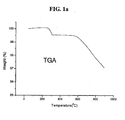
- Fig. 1 shows results of observing thermal change of the coated salt using a thermogravimetric analyzer. It was confirmed that decomposition occurred at 300 °C with accompanying large exothermic reactions.
- the coated graphite was used as an anode active material to prepare an electrode.
- Polyvinylidene fluoride (PVdF) was used as a binder, and the mixing weight ratio of the active material and binder was 93: 7.
- the binder was dissolved in n-methyl pyrrolidone (NMP) and the prepared active material was added to prepare a slurry.
- NMP n-methyl pyrrolidone
- the slurry was coated on a copper foil by a tape casting method, and dried in a vacuum drier at 130 °C for 2 hours to prepare an anode.
- Lithium metal was used as a cathode.
- the cathode and the anode were cut to an appropriate size to manufacture a coin cell.
- 1 mole of LiPF 6 solution was used as an electrolyte, and ethylene carbonate (EC) and ethylmethyl carbonate (EMC) were mixed in a mole ratio of 1 : 2 to use an electrolyte solution.
- the manufactured cell is represented by [C/LiPF 6 (1M) in EX+2EMC/Li].
- a cell was manufactured by the same method as in Example 1, except that lithium trifluoromethanesulfonate (CF 3 SO 3 Li) was used as a coating material.
- CF 3 SO 3 Li lithium trifluoromethanesulfonate
- a cell was manufactured by the same method as in Example 1, except that N-lithiotrifluoromethanesulfonimide «CF 3 SO 2 ) 2 NLi) was used as a coating material.
- a cell was manufactured by the same method as in Example 1, except that (CF 3 SO 2 ) 3 CLi was used as a coating material.
- a cell was manufactured by the same method as in Example 1, except that (CF 3 CF 2 CH 2 OSO 2 ) 2 NLi was used as a coating material.
- a cell was manufactured by the same method as in Example 1, except that CF 3 CO 2 Li was used as a coating material, and the mole ratio of the coating material to graphite was controlled to 0.03 mole%.
- a cell was manufactured by the same method as in Example 1, except that (CF 2 SO 2 ) 3 CLi was used as a coating material, the mole ratio of the coating material to graphite was controlled to 0.1 mole%, and the heat-treatment temperature was 500 °C.
- a cell was manufactured by the same method as in Example 1, except that coal tar pitch was used as the raw material, it was carbonated at 800 °C for 1 hour and then graphitized at 2800 °C for 5 hours and the product was used as a core, and (CF 3 SO 2 ) 2 NLi was used as coating material.
- a cell was manufactured by the same method as in Example 1, except that the graphite (MCMB 25-28) core was not coated.
- Fig. 2 shows charge and discharge curves at room temperature (25 °C), and it can be confirmed that the cell of Example 1 in which the surface of the graphite core was coated showed a larger capacity per unit weight than that of Comparative Example in which the surface of the core was not coated.
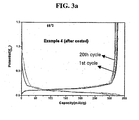
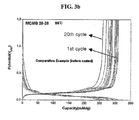
- Fig. 3 shows charge and discharge curves at high temperature (55 °C), and it can be confirmed that the cell of Example 4 in which the surface of the graphite core was coated showed a small capacity decrease according to progress of cycles compared to that of Comparative Example.
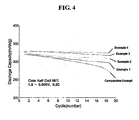
- Figs. 4 and 5 show cycle life properties at high temperature (55 °C), and it can be seen that the cell of Comparative Example in which the surface of the graphite core was not coated showed a large capacity decrease according to the progress of cycles compared to those of Examples 1 to 8 in which the surface of the graphite core was coated.
- Fig. 6 shows C-rate properties, i.e., high rate charge properties at room temperature (25 °C) and high temperature (55 °C), and it can be confirmed that the cells of Examples 4 and 6 in which the surface of the graphite core were coated showed superior high rate charge properties to those of Comparative Example in which the surface of the core was not coated.
- a lithium or lithium ion secondary battery comprising the surface-treated carbon as an anode material has superior room temperature and high temperature cycle life properties without using an electrolyte additive, as well as improved high temperature storage properties and battery capacity.
Landscapes
- Chemical & Material Sciences (AREA)
- Chemical Kinetics & Catalysis (AREA)
- Electrochemistry (AREA)
- General Chemical & Material Sciences (AREA)
- Engineering & Computer Science (AREA)
- Manufacturing & Machinery (AREA)
- Composite Materials (AREA)
- Materials Engineering (AREA)
- Inorganic Chemistry (AREA)
- Battery Electrode And Active Subsutance (AREA)
- Secondary Cells (AREA)
- Carbon And Carbon Compounds (AREA)
Abstract
Description
- The present invention relates to an anode material for a battery and a preparation method. thereof, and particularly to an anode material for a battery comprising a carbon core and a coating layer containing a fluorine-type organometal salt and having superior room temperature and high temperature cycle life properties, and a preparation method thereof.
- Recently, electronic equipment such as telephones, video cameras, computers, etc. have been made portable and are thus miniaturized. Additionally, batteries and main power supply devices in such equipment have also been miniaturized. However, consumed power increases rather than decreases as the equipment becomes smaller, as functions of such equipment are diversified. A lithium or lithium ion secondary battery is one battery satisfying requirements of such miniaturized equipment, because it has a high capacity and shows high voltage. A lithium ion secondary battery uses a non-aqueous electrolyte and a material capable of intercalating and deintercalating lithium as a cathode and an anode, and it has a separator that separates the two electrodes in the electrolyte.
- As an anode material, lithium metal has been tested, but lithium can form dendrites during the charge/discharge process that may penetrate the separator to reach the cathode and thus cause a short circuit and ignition. Japanese Laid-open Patent Publication
Sho 57-208079 - Recently, Japanese Laid-open Patent Publication
Sho 57-208079 - In a lithium ion secondary battery, battery capacity is determined by capacity per unit weight of cathode active material and anode active material, and irreversible capacity thereof.
- Generally, during the first charge process, lithium supplied to a cathode is consumed for decomposition of an electrolyte on the surface of carbon, the anode active material, to form a solid electrolyte interface (SEI), and the solid electrolyte interface restrains decomposition of electrolyte to make the battery operate normally. Since, in order to form a solid electrolyte interface, a specific amount of lithium is consumed and most is supplied from the cathode, battery capacity decreases by as much as the amount of consumed lithium.
- In addition, the thickness and properties of the formed solid electrolyte interface is determined by the kinds of carbon, electrolyte, and surface properties of the carbon active material, etc. When the thickness of the formed solid electrolyte interface is thinner and more solid, the amount of consumed lithium is smaller, and thus capacity and cycle life properties of the battery can be improved.
- On the surface of carbon with high crystallinity, such as natural graphite or artificial graphite, a substantial irreversible exfoliation reaction occur as a result of reaction with the electrolyte, etc., to greatly decrease battery capacity.
- Recently, carbon has been surface-treated and amorphous carbon has been coated to prevent exfoliation as a result of reaction with the electrolyte, and an SEI interface with a minimum thickness is formed to restrain decomposition of the electrolyte. However, as the cycles proceed, the SEI interface is partially destroyed by repeated expansion and contraction of graphite anode active material, and the capacity greatly decreases because of continuous decomposition of the electrolyte, and the energy density also decreases because of a voltage drop due to electrical resistance on each electrode. Particularly, if a raw material such as natural graphite is used, exfoliation occurs on the surface of the graphite to seriously destroy the surface, and a thick solid electrolyte interface is formed on the surface to greatly decrease life properties of the battery.
- In order to solve these problems, Japanese Laid-open Patent Publication No.
2000-353545 - Accordingly, there is a need for a material that can improve life properties, high temperature storage properties, and capacity of a battery without using an electrolyte additive.
- In order to solve these problems, it is an object of the present invention to provide an anode active material for a battery that can improve cycle life properties of a battery without using an electrolyte additive.
- It is another object of the present invention to provide a method for preparing an anode active material for a battery that can improve high temperature storage properties and capacity as well as cycle life properties of a battery.
- In order to achieve these objects, the present invention provides surface-treated carbon, comprising:
- a) a carbon core; and
- b) a coating layer containing a fluorine-type organometal salt.
- The present invention also provides a method for preparing surface-treated carbon, comprising the steps of;
- a) providing a carbon core;
- b) providing a fluorine-type organometal salt;
- c) coating the b) fluorine-type organometal salt on the a) carbon core; and
- d) heat-treating the c) coated carbon core.
- The present invention also provides a lithium or lithium ion secondary battery comprising the surface-treated carbon as an anode active material.
-
-
Fig. 1 a is a TGA graph showing thermal change of a fluorine-type organometal salt coated on the surface of a graphite core according to the present invention. -
Fig. 1b is a DSC graph showing thermal change of a fluorine-type organometal salt coated on the surface of a graphite core according to the present invention. -
Fig. 2a shows charge and discharge curves of graphite of which the surface is coated with a fluorine-type organometal salt according to the present invention, at room temperature (25 °C). -
Fig. 2b shows charge and discharge curves of graphite of which the surface is not coated, at room temperature (25 °C). -
Fig. 3a shows charge and discharge curves of graphite of which the surface is coated with a fluorine-type organometal salt according to the present invention, at high temperature (55 °C). -
Fig. 3b shows charge and discharge curves of graphite of which the surface is not coated, at high temperature (55 °C). -
Fig. 4 andFig. 5 show cycle life properties of batteries at high temperature (55 °C). -
Fig. 6 shows C-rate properties, i.e., high-rate charge properties, at room temperature (25 °C) and high temperature (55 °C). - According to the present invention, a fluorine-type organometal salt-containing metal such as lithium is coated on the surface of carbon, and it is heat-treated at a specific temperature to react the fluorine-type organometal salt with the surface of the carbon to form a solid electrolyte interface thereon. Since metal or lithium from decomposition by-products of organometal salt exists on the surface of the carbon, it provides lithium or metal required for forming a solid electrolyte interface on the surface of an anode during a first charge or formation of a battery.
- Accordingly, lithium from a cathode is not consumed, and thus the amount of lithium capable of reversibly intercalating and deintercalating increases to improve capacity of a battery. Additionally, since organic compounds existing as anions of a fluorine-type organometal salt are decomposed during heat-treatment of a surface to form a solid electrolyte interface, a solid electrolyte interface formed by electrochemical reaction decreases to further improve capacity of the battery. A solid electrolyte interface formed by electrochemical reaction is neither thermally stable nor physically solid, and thus a battery with an electrochemically formed interface has cycle property and stability deficiencies, while a solid electrolyte interface formed by heat-treatment has superior thermal stability and thus contributes to battery stability as well as cycle life properties of a battery.
- The carbon core used in the present invention is selected from a group consisting of artificial graphite, natural graphite, fiber graphite, amorphous graphite, graphite coated with amorphous carbon, and a mixture thereof.
- The fluorine-type organometal salt used in the present invention is preferably a compound in which metal cations and a fluorine-type organic compound existing as anions are bound to each other, as represented by the following Chemical Formula 1 or 2:
- [Chemical Formula 1]
AxDyEzM - [Chemical Formula 2]
(A-D)xEzM - In the
Chemical Formula
A is a fluorine-type organic compound containing at least one CF3;
D is an oxidation product of C, S, or P;
E is C or N;
M is a metal atom selected from Li, Na, K, Mg, Ca, Sr, Ba, B, Al, Si, Y, Ti, or Sn;
r, x and y are independently an integer of 1 to 5; and
z is 0 or 1. - More preferably, the fluorine-type organometal salt is (C2F5)2P(=O)OLi, CF3CO2Li, (CF3CO)2NLi, CF3SO3Li, C4F9SO3Li, C6F5SO3Li, CgF17SO3Li, (CF3SO2NLi, (CF3CH2OSO2)2NLi, ((CF3)2CHOSO2)2NLi, (C4F9SO2)(CF3SO2)NLi, (CF3SO2)3CLi, (CF3CH2OSO2)3CLi, or (CF3CF2CH2OSO2)2NLi.
- The anode material for a battery of the present invention is prepared by coating a fluorine-type organometal salt on the carbon core, and heat-treating it to form a solid electrolyte interface.
- The fluorine-type organometal salt to be coated is dissolved in an aqueous solution or organic solution solvent such as water or alcohol, etc., to form a uniform solution. In the solution, lithium and anions are dissociated or dissolved in molecular units. The amount of the coating layer differs according to the kinds of carbon, specific surface area, surface properties, etc., but it is preferably 0.001 to 30 mole% of the carbon.
- Carbon to be coated is introduced into a solution in which an organometal salt is dissolved to prepare a slurry. The slurry is agitated and heated to remove a solvent, thereby coating an organometal salt on the surface of the carbon. The fluorine-type organometal salt is dissolved in an aqueous solution or organic solution such as water or alcohol, etc. to prepare a mixed solution. The mixed solution is sprayed on carbon flowing in hot air of 50 °C or more, and the solvent is evaporated to remove it.
- Then, the coated carbon core is heat-treated at 200 to 900 °C for 10 minutes to 10 hours while introducing gases to form a carbon fluoride compound containing the new metal on the surface of the carbon. The gas for controlling the atmosphere includes air or a mixed gas of nitrogen and oxygen, and a flow rate thereof is set to 0.05 to 3.0 L/gh. Some atoms in the coating layer, although there is a variance according to temperature, may be doped into central particles during heat-treatment.
- The present invention will be explained in more detail with reference to the following Examples and Comparative Examples. However, these are to illustrate the present invention and the present invention is not limited to them.
- Lithium trifluoroacetate (CF3CO2Li) as a coating material was dissolved in ethanol, and agitated for 10 minutes or more to prepare a uniformly mixed solution. A graphite (MCMB 25-28, Osaka gas Ltd., Japan) core was added to the obtained mixed solution while agitating to prepare a slurry. The salt was deposited on the surface of the graphite to coat it while removing the ethanol solvent. The contents of the coating material were controlled to 0.1 mole% of graphite, assuming that all the coating material was coated on the surface of the graphite.
- The coated graphite was heat-treated at 700 °C for 3 hours under an air atmosphere using an electric furnace to remove remaining solvent and to simultaneously cause thermolysis of the coating material, thereby coating the metal organic compound on the surface.
Fig. 1 shows results of observing thermal change of the coated salt using a thermogravimetric analyzer. It was confirmed that decomposition occurred at 300 °C with accompanying large exothermic reactions. - The coated graphite was used as an anode active material to prepare an electrode. Polyvinylidene fluoride (PVdF) was used as a binder, and the mixing weight ratio of the active material and binder was 93: 7.
- The binder was dissolved in n-methyl pyrrolidone (NMP) and the prepared active material was added to prepare a slurry. The slurry was coated on a copper foil by a tape casting method, and dried in a vacuum drier at 130 °C for 2 hours to prepare an anode. Lithium metal was used as a cathode. The cathode and the anode were cut to an appropriate size to manufacture a coin cell. 1 mole of LiPF6 solution was used as an electrolyte, and ethylene carbonate (EC) and ethylmethyl carbonate (EMC) were mixed in a mole ratio of 1 : 2 to use an electrolyte solution. The manufactured cell is represented by [C/LiPF6(1M) in EX+2EMC/Li].
- A cell was manufactured by the same method as in Example 1, except that lithium trifluoromethanesulfonate (CF3SO3Li) was used as a coating material.
- A cell was manufactured by the same method as in Example 1, except that N-lithiotrifluoromethanesulfonimide «CF3SO2)2NLi) was used as a coating material.
- A cell was manufactured by the same method as in Example 1, except that (CF3SO2)3CLi was used as a coating material.
- A cell was manufactured by the same method as in Example 1, except that (CF3CF2CH2OSO2)2NLi was used as a coating material.
- A cell was manufactured by the same method as in Example 1, except that CF3CO2Li was used as a coating material, and the mole ratio of the coating material to graphite was controlled to 0.03 mole%.
- A cell was manufactured by the same method as in Example 1, except that (CF2SO2)3CLi was used as a coating material, the mole ratio of the coating material to graphite was controlled to 0.1 mole%, and the heat-treatment temperature was 500 °C.
- A cell was manufactured by the same method as in Example 1, except that coal tar pitch was used as the raw material, it was carbonated at 800 °C for 1 hour and then graphitized at 2800 °C for 5 hours and the product was used as a core, and (CF3SO2)2NLi was used as coating material.
- A cell was manufactured by the same method as in Example 1, except that the graphite (MCMB 25-28) core was not coated.
- Charge/discharge properties, and C-rate, room temperature, and high temperature cycle life properties of the cells of Examples 1 to 8 and Comparative Example were evaluated, and the results are shown in
Figs. 2 to 6 . The charge/discharge voltage range was 1.5 to 0.005 V. -
Fig. 2 shows charge and discharge curves at room temperature (25 °C), and it can be confirmed that the cell of Example 1 in which the surface of the graphite core was coated showed a larger capacity per unit weight than that of Comparative Example in which the surface of the core was not coated. -
Fig. 3 shows charge and discharge curves at high temperature (55 °C), and it can be confirmed that the cell of Example 4 in which the surface of the graphite core was coated showed a small capacity decrease according to progress of cycles compared to that of Comparative Example. -
Figs. 4 and5 show cycle life properties at high temperature (55 °C), and it can be seen that the cell of Comparative Example in which the surface of the graphite core was not coated showed a large capacity decrease according to the progress of cycles compared to those of Examples 1 to 8 in which the surface of the graphite core was coated. -
Fig. 6 shows C-rate properties, i.e., high rate charge properties at room temperature (25 °C) and high temperature (55 °C), and it can be confirmed that the cells of Examples 4 and 6 in which the surface of the graphite core were coated showed superior high rate charge properties to those of Comparative Example in which the surface of the core was not coated. - A lithium or lithium ion secondary battery comprising the surface-treated carbon as an anode material has superior room temperature and high temperature cycle life properties without using an electrolyte additive, as well as improved high temperature storage properties and battery capacity.
Claims (11)
- Surface-treated carbon, comprisinga) a carbon core; andb) a coating layer containing a fluorine-type organometal salt.
- The surface-treated carbon according to Claim 1, wherein the a) carbon core is selected from a group consisting of artificial graphite, natural graphite, fiber graphite, amorphous carbon, graphite coated with amorphous carbon, and a mixture thereof.
- The surface-treated carbon according to Claim 1, wherein the b) fluorine-type organometal salt is represented by the following Chemical Formula 1 or 2:[Chemical Formula 1]
AxDyEzM[Chemical Formula 2]
(A-D)rEzM(In the Chemical Formula 1 or 2,A is a fluorine-type organic compound containing at least one CF3;D is an oxidation product of C, S, or P;E is C or N;M is a metal atom selected from Li, Na, K, Mg, Ca, Sr, Ba, B, Al, Si, Y, Ti, orSn;r, x, and y are independently an integer of 1 to 5; andz is 0 or 1.) - The surface-treated carbon according to Claim 3, wherein the fluorine-type organometal salt is (C2F5)2P(=O)OLi, CF3CO2Li, (CF3CO)2NLi, CF3SO3Li, C4F9SO3Li, C6F5SO3Li, C9F17SO3Li, (CF3SO2)2NLi, (CF3CH2OSO2)2NLi, ((CF3)2CHOSO2)2NLi, (C4F9SO2(CF3SO2NLi, (CF3SO2)3CLi, (CF3CH2OSO2)3CLi, or (CF3CF2CH2OSO2NLi.
- The surface-treated carbon according to Claim 1, wherein the b) fluorine-type organometal salt is coated in an amount of 0.001 to 30 moles per 100 moles of the a) carbon core.
- A method for preparing surface-treated carbon, comprising the steps of:a) providing a carbon core;b) providing a fluorine-type organometal salt;c) coating the b) fluorine-type organometal salt on the a) carbon core; andd) heat-treating the c) coated carbon core.
- The method for preparing surface-treated carbon according to Claim 6, wherein the c) coating is conducted by dissolving the fluorine-type organometal salt in an aqueous solution or organic solution to prepare a mixed solution, and spraying it onto carbon flowing in hot air of 50 °C or more to evaporate solvent only.
- The method for preparing surface-treated carbon according to Claim 6, wherein, in step c), the fluorine-type organometal salt is coated in an amount of 0.001 to 30 moles per 100 moles of the carbon core.
- The method for preparing surface-treated carbon according to Claim 6, wherein the d) heat-treatment is conducted at 200 to 900 °C for 10 minutes to 10 hours.
- Surface-treated carbon prepared by the method of Claim 6.
- A lithium or lithium ion secondary battery comprising the surface-treated carbon of Claim 1 as an anode active material.
Applications Claiming Priority (5)
| Application Number | Priority Date | Filing Date | Title |
|---|---|---|---|
| KR20010063088 | 2001-10-12 | ||
| KR2001063088 | 2001-10-12 | ||
| KR2002014823 | 2002-03-19 | ||
| KR10-2002-0014823A KR100440489B1 (en) | 2001-10-12 | 2002-03-19 | Electrode materials and method for preparing thereof |
| PCT/KR2002/001894 WO2003032414A1 (en) | 2001-10-12 | 2002-10-10 | Electrode material and preparation method thereof |
Publications (2)
| Publication Number | Publication Date |
|---|---|
| EP1435119A1 EP1435119A1 (en) | 2004-07-07 |
| EP1435119B1 true EP1435119B1 (en) | 2011-08-10 |
Family
ID=26639388
Family Applications (1)
| Application Number | Title | Priority Date | Filing Date |
|---|---|---|---|
| EP02781934A Expired - Lifetime EP1435119B1 (en) | 2001-10-12 | 2002-10-10 | Electrode material and preparation method thereof |
Country Status (5)
| Country | Link |
|---|---|
| US (1) | US20040042954A1 (en) |
| EP (1) | EP1435119B1 (en) |
| JP (1) | JP2005505487A (en) |
| CN (1) | CN1231984C (en) |
| WO (1) | WO2003032414A1 (en) |
Families Citing this family (14)
| Publication number | Priority date | Publication date | Assignee | Title |
|---|---|---|---|---|
| CN100499215C (en) * | 2003-11-04 | 2009-06-10 | 上海杉杉科技有限公司 | Preparing method for carbon negative material of lithium ion battery |
| US7785661B2 (en) * | 2003-12-19 | 2010-08-31 | Conocophillips Company | Methods of preparing composite carbon-graphite-silicon particles and using same |
| US7618678B2 (en) * | 2003-12-19 | 2009-11-17 | Conocophillips Company | Carbon-coated silicon particle powders as the anode material for lithium ion batteries and the method of making the same |
| US20100210453A1 (en) * | 2006-03-29 | 2010-08-19 | Max-Planck-Gesellschaft Zur Foerderung Der Wissenschaften E.V. | Preparation Of Nanostructured Metals And Metal Compounds And Their Uses |
| JP5355203B2 (en) | 2009-04-27 | 2013-11-27 | パナソニック株式会社 | Lithium primary battery and manufacturing method thereof |
| JP5515476B2 (en) | 2009-07-16 | 2014-06-11 | ソニー株式会社 | Secondary battery, negative electrode, positive electrode and electrolyte |
| US20150027615A1 (en) * | 2012-03-15 | 2015-01-29 | William Marsh Rice University | Methods of making multilayer energy storage devices |
| CN102760881A (en) * | 2012-07-27 | 2012-10-31 | 奇瑞汽车股份有限公司 | Surface-coated natural graphite, preparation method thereof and lithium ion battery |
| JP6939307B2 (en) | 2017-09-19 | 2021-09-22 | トヨタ自動車株式会社 | Method for manufacturing water-based lithium-ion secondary battery, negative electrode active material composite, and method for manufacturing water-based lithium-ion secondary battery |
| CN110915033B (en) * | 2017-12-01 | 2022-06-07 | 株式会社Lg化学 | Negative electrode for lithium secondary battery and lithium secondary battery including the same |
| US12489138B2 (en) | 2019-10-15 | 2025-12-02 | Industry-University Cooperation Foundation Hanyang University Erica Campus | Intermediate product of solid electrolyte, solid electrolyte using same, secondary battery including same, and method for manufacturing same |
| EP4047683A4 (en) | 2019-10-15 | 2024-03-13 | Industry-University Cooperation Foundation Hanyang University ERICA Campus | ELECTRODE INTERMEDIATE PRODUCT, ELECTRODE POWDER, ELECTRODE WITH IT, ELECTRODE PELLET WITH IT AND METHOD FOR THE PRODUCTION OF THE SAME |
| CN112786862A (en) * | 2021-01-26 | 2021-05-11 | 复旦大学 | Fluoride surface-modified secondary battery carbon negative electrode material and preparation method thereof |
| CN117199249B (en) * | 2023-11-08 | 2024-03-08 | 深圳海辰储能科技有限公司 | Negative plates, energy storage devices and electrical equipment |
Family Cites Families (6)
| Publication number | Priority date | Publication date | Assignee | Title |
|---|---|---|---|---|
| US3113048A (en) * | 1960-04-21 | 1963-12-03 | Exxon Research Engineering Co | Electrodeposition of polymers in porous electrodes |
| JPS581982B2 (en) * | 1975-07-14 | 1983-01-13 | ミツイフロロケミカル カブシキガイシヤ | Tetrafluoroethylene |
| JPS5271628A (en) * | 1975-12-10 | 1977-06-15 | Sanyo Electric Co | Method of making cathode of nonnaqueous electrolyte batteries |
| US5712062A (en) * | 1992-11-06 | 1998-01-27 | Daikin Industries, Ltd. | Carbon fluoride particles, preparation process and uses of the same |
| JP4187347B2 (en) * | 1998-04-02 | 2008-11-26 | 三星エスディアイ株式会社 | Method for producing negative electrode active material for lithium ion battery |
| KR100399650B1 (en) * | 2001-10-27 | 2003-09-29 | 삼성에스디아이 주식회사 | Positive active material for lithium-sulfur battery and method of preparing same |
-
2002
- 2002-10-10 WO PCT/KR2002/001894 patent/WO2003032414A1/en not_active Ceased
- 2002-10-10 US US10/450,357 patent/US20040042954A1/en not_active Abandoned
- 2002-10-10 CN CNB02803032XA patent/CN1231984C/en not_active Expired - Fee Related
- 2002-10-10 JP JP2003535274A patent/JP2005505487A/en active Pending
- 2002-10-10 EP EP02781934A patent/EP1435119B1/en not_active Expired - Lifetime
Also Published As
| Publication number | Publication date |
|---|---|
| US20040042954A1 (en) | 2004-03-04 |
| WO2003032414A1 (en) | 2003-04-17 |
| EP1435119A1 (en) | 2004-07-07 |
| CN1476644A (en) | 2004-02-18 |
| CN1231984C (en) | 2005-12-14 |
| JP2005505487A (en) | 2005-02-24 |
Similar Documents
| Publication | Publication Date | Title |
|---|---|---|
| KR101483123B1 (en) | Anode active material comprising metal nanocrystal composite, method of preparing the same, and anode and lithium battery having the material | |
| JP5435934B2 (en) | Cathode and lithium battery using the same | |
| EP1711971B1 (en) | Electrode additives coated with electro conductive material and lithium secondary comprising the same | |
| CN1833328B (en) | Positive electrode material for secondary battery, process for producing the same and secondary battery | |
| US6218050B1 (en) | Cabonaceous material for negative electrode of lithium secondary battery and lithium secondary battery using same | |
| KR20180104174A (en) | The pre-lithiated electrode material and the cell using it | |
| KR20120056674A (en) | Positive active material for rechargeable lithium battery, method of preparing the same, and rechargeable lithium battery including the same | |
| KR20140058177A (en) | Positive active material for lithium sulfur battery and lithium sulfur battery comprising same | |
| US20040042954A1 (en) | Electrode material and preparation method thereof | |
| KR101659349B1 (en) | Positive active material for lithium sulfur battery, method for manufacturing the same, and lithium sulfur battery including the same | |
| JP7705476B2 (en) | Composite positive electrode active material, positive electrode and lithium battery using the same, and manufacturing method thereof | |
| JP7818611B2 (en) | Rechargeable Battery Cell | |
| KR100318375B1 (en) | Lithium ion secondary battery | |
| CN121713286A (en) | Lithium secondary batteries | |
| JP4707950B2 (en) | Method for producing positive electrode active material for lithium battery, positive electrode active material for lithium battery, electrode for lithium battery, and lithium battery | |
| EP4329013B1 (en) | Method for preparing cathode additive for lithium secondary battery | |
| KR100551006B1 (en) | Lithium ion secondary battery | |
| JP4120860B2 (en) | Method for producing positive electrode material for secondary battery, and secondary battery | |
| CN115119528A (en) | Lithium transition metal oxide, positive electrode additive for lithium secondary battery, and lithium secondary battery comprising same | |
| KR100440489B1 (en) | Electrode materials and method for preparing thereof | |
| KR101895902B1 (en) | Positive active material for rechargeable lithium battery, method of preparing the same, and rechargeable lithium battery including the same | |
| US20240113327A1 (en) | Solid-state electrolyte, lithium battery comprising solid-state electrolyte, and preparation method of solid-state electrolyte | |
| EP4329012A1 (en) | Cathode additive for lithium secondary battery, method for preparing same, cathode comprising same, and lithium secondary battery | |
| JP7804089B2 (en) | Electrolyte additive for secondary battery, non-aqueous electrolyte for lithium secondary battery containing the same, and lithium secondary battery | |
| CN120712673B (en) | Electrolyte additive, electrolyte for lithium secondary battery comprising same, and lithium secondary battery |
Legal Events
| Date | Code | Title | Description |
|---|---|---|---|
| PUAI | Public reference made under article 153(3) epc to a published international application that has entered the european phase |
Free format text: ORIGINAL CODE: 0009012 |
|
| 17P | Request for examination filed |
Effective date: 20030611 |
|
| AK | Designated contracting states |
Kind code of ref document: A1 Designated state(s): AT BE BG CH CY CZ DE DK EE ES FI FR GB GR IE IT LI LU MC NL PT SE SK TR |
|
| RIN1 | Information on inventor provided before grant (corrected) |
Inventor name: KWON, YONG-HOON Inventor name: IM, KEUN-YUNG Inventor name: KIM, JIN-ON Inventor name: LEE, KI-YOUNG Inventor name: PARK, HONG-KYU Inventor name: LEE, YEON-HEE Inventor name: PARK, SEONG-YONG |
|
| GRAP | Despatch of communication of intention to grant a patent |
Free format text: ORIGINAL CODE: EPIDOSNIGR1 |
|
| GRAS | Grant fee paid |
Free format text: ORIGINAL CODE: EPIDOSNIGR3 |
|
| GRAA | (expected) grant |
Free format text: ORIGINAL CODE: 0009210 |
|
| AK | Designated contracting states |
Kind code of ref document: B1 Designated state(s): AT BE BG CH CY CZ DE DK EE ES FI FR GB GR IE IT LI LU MC NL PT SE SK TR |
|
| REG | Reference to a national code |
Ref country code: GB Ref legal event code: FG4D |
|
| REG | Reference to a national code |
Ref country code: CH Ref legal event code: EP |
|
| REG | Reference to a national code |
Ref country code: IE Ref legal event code: FG4D |
|
| REG | Reference to a national code |
Ref country code: DE Ref legal event code: R096 Ref document number: 60240758 Country of ref document: DE Effective date: 20111013 |
|
| REG | Reference to a national code |
Ref country code: NL Ref legal event code: VDEP Effective date: 20110810 |
|
| PG25 | Lapsed in a contracting state [announced via postgrant information from national office to epo] |
Ref country code: FI Free format text: LAPSE BECAUSE OF FAILURE TO SUBMIT A TRANSLATION OF THE DESCRIPTION OR TO PAY THE FEE WITHIN THE PRESCRIBED TIME-LIMIT Effective date: 20110810 Ref country code: SE Free format text: LAPSE BECAUSE OF FAILURE TO SUBMIT A TRANSLATION OF THE DESCRIPTION OR TO PAY THE FEE WITHIN THE PRESCRIBED TIME-LIMIT Effective date: 20110810 Ref country code: NL Free format text: LAPSE BECAUSE OF FAILURE TO SUBMIT A TRANSLATION OF THE DESCRIPTION OR TO PAY THE FEE WITHIN THE PRESCRIBED TIME-LIMIT Effective date: 20110810 Ref country code: PT Free format text: LAPSE BECAUSE OF FAILURE TO SUBMIT A TRANSLATION OF THE DESCRIPTION OR TO PAY THE FEE WITHIN THE PRESCRIBED TIME-LIMIT Effective date: 20111212 |
|
| REG | Reference to a national code |
Ref country code: AT Ref legal event code: MK05 Ref document number: 520162 Country of ref document: AT Kind code of ref document: T Effective date: 20110810 |
|
| PG25 | Lapsed in a contracting state [announced via postgrant information from national office to epo] |
Ref country code: CY Free format text: LAPSE BECAUSE OF FAILURE TO SUBMIT A TRANSLATION OF THE DESCRIPTION OR TO PAY THE FEE WITHIN THE PRESCRIBED TIME-LIMIT Effective date: 20110810 Ref country code: GR Free format text: LAPSE BECAUSE OF FAILURE TO SUBMIT A TRANSLATION OF THE DESCRIPTION OR TO PAY THE FEE WITHIN THE PRESCRIBED TIME-LIMIT Effective date: 20111111 Ref country code: AT Free format text: LAPSE BECAUSE OF FAILURE TO SUBMIT A TRANSLATION OF THE DESCRIPTION OR TO PAY THE FEE WITHIN THE PRESCRIBED TIME-LIMIT Effective date: 20110810 |
|
| PG25 | Lapsed in a contracting state [announced via postgrant information from national office to epo] |
Ref country code: CZ Free format text: LAPSE BECAUSE OF FAILURE TO SUBMIT A TRANSLATION OF THE DESCRIPTION OR TO PAY THE FEE WITHIN THE PRESCRIBED TIME-LIMIT Effective date: 20110810 Ref country code: SK Free format text: LAPSE BECAUSE OF FAILURE TO SUBMIT A TRANSLATION OF THE DESCRIPTION OR TO PAY THE FEE WITHIN THE PRESCRIBED TIME-LIMIT Effective date: 20110810 |
|
| PG25 | Lapsed in a contracting state [announced via postgrant information from national office to epo] |
Ref country code: EE Free format text: LAPSE BECAUSE OF FAILURE TO SUBMIT A TRANSLATION OF THE DESCRIPTION OR TO PAY THE FEE WITHIN THE PRESCRIBED TIME-LIMIT Effective date: 20110810 Ref country code: MC Free format text: LAPSE BECAUSE OF NON-PAYMENT OF DUE FEES Effective date: 20111031 |
|
| REG | Reference to a national code |
Ref country code: CH Ref legal event code: PL |
|
| PLBE | No opposition filed within time limit |
Free format text: ORIGINAL CODE: 0009261 |
|
| STAA | Information on the status of an ep patent application or granted ep patent |
Free format text: STATUS: NO OPPOSITION FILED WITHIN TIME LIMIT |
|
| PG25 | Lapsed in a contracting state [announced via postgrant information from national office to epo] |
Ref country code: DK Free format text: LAPSE BECAUSE OF FAILURE TO SUBMIT A TRANSLATION OF THE DESCRIPTION OR TO PAY THE FEE WITHIN THE PRESCRIBED TIME-LIMIT Effective date: 20110810 |
|
| 26N | No opposition filed |
Effective date: 20120511 |
|
| PG25 | Lapsed in a contracting state [announced via postgrant information from national office to epo] |
Ref country code: CH Free format text: LAPSE BECAUSE OF NON-PAYMENT OF DUE FEES Effective date: 20111031 Ref country code: LI Free format text: LAPSE BECAUSE OF NON-PAYMENT OF DUE FEES Effective date: 20111031 |
|
| REG | Reference to a national code |
Ref country code: IE Ref legal event code: MM4A |
|
| REG | Reference to a national code |
Ref country code: DE Ref legal event code: R097 Ref document number: 60240758 Country of ref document: DE Effective date: 20120511 |
|
| PG25 | Lapsed in a contracting state [announced via postgrant information from national office to epo] |
Ref country code: IE Free format text: LAPSE BECAUSE OF NON-PAYMENT OF DUE FEES Effective date: 20111010 |
|
| PG25 | Lapsed in a contracting state [announced via postgrant information from national office to epo] |
Ref country code: ES Free format text: LAPSE BECAUSE OF FAILURE TO SUBMIT A TRANSLATION OF THE DESCRIPTION OR TO PAY THE FEE WITHIN THE PRESCRIBED TIME-LIMIT Effective date: 20111121 |
|
| PG25 | Lapsed in a contracting state [announced via postgrant information from national office to epo] |
Ref country code: LU Free format text: LAPSE BECAUSE OF NON-PAYMENT OF DUE FEES Effective date: 20111010 |
|
| PG25 | Lapsed in a contracting state [announced via postgrant information from national office to epo] |
Ref country code: BG Free format text: LAPSE BECAUSE OF FAILURE TO SUBMIT A TRANSLATION OF THE DESCRIPTION OR TO PAY THE FEE WITHIN THE PRESCRIBED TIME-LIMIT Effective date: 20111110 |
|
| PG25 | Lapsed in a contracting state [announced via postgrant information from national office to epo] |
Ref country code: TR Free format text: LAPSE BECAUSE OF FAILURE TO SUBMIT A TRANSLATION OF THE DESCRIPTION OR TO PAY THE FEE WITHIN THE PRESCRIBED TIME-LIMIT Effective date: 20110810 |
|
| REG | Reference to a national code |
Ref country code: FR Ref legal event code: PLFP Year of fee payment: 15 |
|
| REG | Reference to a national code |
Ref country code: FR Ref legal event code: PLFP Year of fee payment: 16 |
|
| REG | Reference to a national code |
Ref country code: FR Ref legal event code: PLFP Year of fee payment: 17 |
|
| PGFP | Annual fee paid to national office [announced via postgrant information from national office to epo] |
Ref country code: IT Payment date: 20210923 Year of fee payment: 20 Ref country code: FR Payment date: 20210927 Year of fee payment: 20 |
|
| PGFP | Annual fee paid to national office [announced via postgrant information from national office to epo] |
Ref country code: GB Payment date: 20210927 Year of fee payment: 20 Ref country code: BE Payment date: 20210917 Year of fee payment: 20 |
|
| PGFP | Annual fee paid to national office [announced via postgrant information from national office to epo] |
Ref country code: DE Payment date: 20210916 Year of fee payment: 20 |
|
| REG | Reference to a national code |
Ref country code: DE Ref legal event code: R071 Ref document number: 60240758 Country of ref document: DE |
|
| REG | Reference to a national code |
Ref country code: BE Ref legal event code: PD Owner name: LG ENERGY SOLUTION, LTD.; KR Free format text: DETAILS ASSIGNMENT: CHANGE OF OWNER(S), OTHER; FORMER OWNER NAME: LG CHEM, LTD. Effective date: 20221006 Ref country code: BE Ref legal event code: MK Effective date: 20221010 |
|
| REG | Reference to a national code |
Ref country code: GB Ref legal event code: PE20 Expiry date: 20221009 |
|
| PG25 | Lapsed in a contracting state [announced via postgrant information from national office to epo] |
Ref country code: GB Free format text: LAPSE BECAUSE OF EXPIRATION OF PROTECTION Effective date: 20221009 |
|
| REG | Reference to a national code |
Ref country code: DE Ref legal event code: R081 Ref document number: 60240758 Country of ref document: DE Owner name: LG ENERGY SOLUTION LTD., KR Free format text: FORMER OWNER: LG CHEM. LTD., SEOUL, KR Ref country code: DE Ref legal event code: R081 Ref document number: 60240758 Country of ref document: DE Owner name: LG ENERGY SOLUTION, LTD., KR Free format text: FORMER OWNER: LG CHEM. LTD., SEOUL, KR |
|
| P01 | Opt-out of the competence of the unified patent court (upc) registered |
Effective date: 20230323 |
|
| REG | Reference to a national code |
Ref country code: GB Ref legal event code: 732E Free format text: REGISTERED BETWEEN 20230824 AND 20230831 |
|
| REG | Reference to a national code |
Ref country code: DE Ref legal event code: R081 Ref document number: 60240758 Country of ref document: DE Owner name: LG ENERGY SOLUTION, LTD., KR Free format text: FORMER OWNER: LG ENERGY SOLUTION LTD., SEOUL, KR |