EP1434870B1 - Enzymatic process for the preparation of substituted 2-amino-3-(2-amino-phenylsulfanyl)-propionic acid - Google Patents
Enzymatic process for the preparation of substituted 2-amino-3-(2-amino-phenylsulfanyl)-propionic acid Download PDFInfo
- Publication number
- EP1434870B1 EP1434870B1 EP02779375A EP02779375A EP1434870B1 EP 1434870 B1 EP1434870 B1 EP 1434870B1 EP 02779375 A EP02779375 A EP 02779375A EP 02779375 A EP02779375 A EP 02779375A EP 1434870 B1 EP1434870 B1 EP 1434870B1
- Authority
- EP
- European Patent Office
- Prior art keywords
- formula
- amino
- sup
- reaction
- tert
- Prior art date
- Legal status (The legal status is an assumption and is not a legal conclusion. Google has not performed a legal analysis and makes no representation as to the accuracy of the status listed.)
- Expired - Lifetime
Links
- 0 CC(C)(C)OC(N(*)[C@@](*)(CSc(c(N[O-])c1)ccc1C(OCC=I)=O)C(OC)=O)=O Chemical compound CC(C)(C)OC(N(*)[C@@](*)(CSc(c(N[O-])c1)ccc1C(OCC=I)=O)C(OC)=O)=O 0.000 description 4
- XRGGJHCPCXGVET-JTQLQIEISA-N Bc(cc1)cc(N)c1SC[C@@H](C(O)=O)NC(OC(C)(C)C)=O Chemical compound Bc(cc1)cc(N)c1SC[C@@H](C(O)=O)NC(OC(C)(C)C)=O XRGGJHCPCXGVET-JTQLQIEISA-N 0.000 description 1
- YILWZWCVXVXKBJ-UHFFFAOYSA-N CC(C)(C)OC(NC(CSc(c(N)c1)ccc1Br)C(O)=O)=O Chemical compound CC(C)(C)OC(NC(CSc(c(N)c1)ccc1Br)C(O)=O)=O YILWZWCVXVXKBJ-UHFFFAOYSA-N 0.000 description 1
Classifications
-
- C—CHEMISTRY; METALLURGY
- C12—BIOCHEMISTRY; BEER; SPIRITS; WINE; VINEGAR; MICROBIOLOGY; ENZYMOLOGY; MUTATION OR GENETIC ENGINEERING
- C12P—FERMENTATION OR ENZYME-USING PROCESSES TO SYNTHESISE A DESIRED CHEMICAL COMPOUND OR COMPOSITION OR TO SEPARATE OPTICAL ISOMERS FROM A RACEMIC MIXTURE
- C12P13/00—Preparation of nitrogen-containing organic compounds
- C12P13/04—Alpha- or beta- amino acids
-
- C—CHEMISTRY; METALLURGY
- C07—ORGANIC CHEMISTRY
- C07C—ACYCLIC OR CARBOCYCLIC COMPOUNDS
- C07C323/00—Thiols, sulfides, hydropolysulfides or polysulfides substituted by halogen, oxygen or nitrogen atoms, or by sulfur atoms not being part of thio groups
- C07C323/50—Thiols, sulfides, hydropolysulfides or polysulfides substituted by halogen, oxygen or nitrogen atoms, or by sulfur atoms not being part of thio groups containing thio groups and carboxyl groups bound to the same carbon skeleton
- C07C323/51—Thiols, sulfides, hydropolysulfides or polysulfides substituted by halogen, oxygen or nitrogen atoms, or by sulfur atoms not being part of thio groups containing thio groups and carboxyl groups bound to the same carbon skeleton having the sulfur atoms of the thio groups bound to acyclic carbon atoms of the carbon skeleton
- C07C323/57—Thiols, sulfides, hydropolysulfides or polysulfides substituted by halogen, oxygen or nitrogen atoms, or by sulfur atoms not being part of thio groups containing thio groups and carboxyl groups bound to the same carbon skeleton having the sulfur atoms of the thio groups bound to acyclic carbon atoms of the carbon skeleton the carbon skeleton being further substituted by nitrogen atoms, not being part of nitro or nitroso groups
- C07C323/58—Thiols, sulfides, hydropolysulfides or polysulfides substituted by halogen, oxygen or nitrogen atoms, or by sulfur atoms not being part of thio groups containing thio groups and carboxyl groups bound to the same carbon skeleton having the sulfur atoms of the thio groups bound to acyclic carbon atoms of the carbon skeleton the carbon skeleton being further substituted by nitrogen atoms, not being part of nitro or nitroso groups with amino groups bound to the carbon skeleton
- C07C323/59—Thiols, sulfides, hydropolysulfides or polysulfides substituted by halogen, oxygen or nitrogen atoms, or by sulfur atoms not being part of thio groups containing thio groups and carboxyl groups bound to the same carbon skeleton having the sulfur atoms of the thio groups bound to acyclic carbon atoms of the carbon skeleton the carbon skeleton being further substituted by nitrogen atoms, not being part of nitro or nitroso groups with amino groups bound to the carbon skeleton with acylated amino groups bound to the carbon skeleton
-
- C—CHEMISTRY; METALLURGY
- C07—ORGANIC CHEMISTRY
- C07C—ACYCLIC OR CARBOCYCLIC COMPOUNDS
- C07C323/00—Thiols, sulfides, hydropolysulfides or polysulfides substituted by halogen, oxygen or nitrogen atoms, or by sulfur atoms not being part of thio groups
- C07C323/50—Thiols, sulfides, hydropolysulfides or polysulfides substituted by halogen, oxygen or nitrogen atoms, or by sulfur atoms not being part of thio groups containing thio groups and carboxyl groups bound to the same carbon skeleton
- C07C323/62—Thiols, sulfides, hydropolysulfides or polysulfides substituted by halogen, oxygen or nitrogen atoms, or by sulfur atoms not being part of thio groups containing thio groups and carboxyl groups bound to the same carbon skeleton having the sulfur atom of at least one of the thio groups bound to a carbon atom of a six-membered aromatic ring of the carbon skeleton
- C07C323/63—Thiols, sulfides, hydropolysulfides or polysulfides substituted by halogen, oxygen or nitrogen atoms, or by sulfur atoms not being part of thio groups containing thio groups and carboxyl groups bound to the same carbon skeleton having the sulfur atom of at least one of the thio groups bound to a carbon atom of a six-membered aromatic ring of the carbon skeleton the carbon skeleton being further substituted by nitrogen atoms, not being part of nitro or nitroso groups
-
- C—CHEMISTRY; METALLURGY
- C07—ORGANIC CHEMISTRY
- C07D—HETEROCYCLIC COMPOUNDS
- C07D285/00—Heterocyclic compounds containing rings having nitrogen and sulfur atoms as the only ring hetero atoms, not provided for by groups C07D275/00 - C07D283/00
- C07D285/36—Seven-membered rings
-
- C—CHEMISTRY; METALLURGY
- C12—BIOCHEMISTRY; BEER; SPIRITS; WINE; VINEGAR; MICROBIOLOGY; ENZYMOLOGY; MUTATION OR GENETIC ENGINEERING
- C12P—FERMENTATION OR ENZYME-USING PROCESSES TO SYNTHESISE A DESIRED CHEMICAL COMPOUND OR COMPOSITION OR TO SEPARATE OPTICAL ISOMERS FROM A RACEMIC MIXTURE
- C12P11/00—Preparation of sulfur-containing organic compounds
-
- C—CHEMISTRY; METALLURGY
- C12—BIOCHEMISTRY; BEER; SPIRITS; WINE; VINEGAR; MICROBIOLOGY; ENZYMOLOGY; MUTATION OR GENETIC ENGINEERING
- C12P—FERMENTATION OR ENZYME-USING PROCESSES TO SYNTHESISE A DESIRED CHEMICAL COMPOUND OR COMPOSITION OR TO SEPARATE OPTICAL ISOMERS FROM A RACEMIC MIXTURE
- C12P41/00—Processes using enzymes or microorganisms to separate optical isomers from a racemic mixture
- C12P41/003—Processes using enzymes or microorganisms to separate optical isomers from a racemic mixture by ester formation, lactone formation or the inverse reactions
- C12P41/005—Processes using enzymes or microorganisms to separate optical isomers from a racemic mixture by ester formation, lactone formation or the inverse reactions by esterification of carboxylic acid groups in the enantiomers or the inverse reaction
-
- Y—GENERAL TAGGING OF NEW TECHNOLOGICAL DEVELOPMENTS; GENERAL TAGGING OF CROSS-SECTIONAL TECHNOLOGIES SPANNING OVER SEVERAL SECTIONS OF THE IPC; TECHNICAL SUBJECTS COVERED BY FORMER USPC CROSS-REFERENCE ART COLLECTIONS [XRACs] AND DIGESTS
- Y02—TECHNOLOGIES OR APPLICATIONS FOR MITIGATION OR ADAPTATION AGAINST CLIMATE CHANGE
- Y02P—CLIMATE CHANGE MITIGATION TECHNOLOGIES IN THE PRODUCTION OR PROCESSING OF GOODS
- Y02P20/00—Technologies relating to chemical industry
- Y02P20/50—Improvements relating to the production of bulk chemicals
- Y02P20/55—Design of synthesis routes, e.g. reducing the use of auxiliary or protecting groups
Definitions
- the present invention relates to a new enzymatic process for the preparation of compounds of formula I wherein
- EP 0407033 A an enzymatic stereoselective hydrolysis of racemic mixtures of esters of 2-substituted acids, other than 2-halo propionic acids, into the corresponding enantiomeric acids is described.
- the reaction is carried out in the presence of Candida rugosa lipase isoenzymes, an organic solvent (e.g. toluene) and a reducing agent.
- the process is especially useful for the stereoselective production of S-ketoprofen, S-ibuprofen, S-fenoprofen, S-2-phenylpropionic acid and S-indoprofen.
- EP 0178553 A the preparation of aromatically substituted L-amino acids by selective hydrolysis of the corresponding alkyl esters with chymotrypsin is described.
- the aim of the present invention therefore is a novel and inventive process for the preparation of substituted 2-amino-3-(2-amino-phenylsulfanyl)-propionic acids.
- the compounds of formula I may be manufactured by the process of the present invention, which provides a new process for the preparation of substituted 2-amino-3-(2-amino-phenylsulfanyl)-propionic acid of formula I wherein
- alkyl denotes an optionally substituted straight or branched chain hydrocarbon residue containing 1 to 12 carbon atoms, such as methyl, ethyl, n-propyl, isopropyl, n-butyl, sec-butyl, isobutyl, tert.-butyl, pentyl, hexyl, heptyl, octyl, nonyl, decyl, undecyl, dodecyl including their different isomers.
- Suitable substituents for the alkyl chain may be selected from 1-3 halogens such as fluorine or chlorine, or C 1-4 -alkoxy such as methoxy or ethoxy.
- Examples for substituted alkyl are 2-chloroethyl, 2-fluoroethyl, 2,2,2-trifluoroethyl or 2-methoxyethyl.
- Alkyl in R 1 is as defined above and preferably a straight or branched chain hydrocarbon residue containing 1 to 7 carbon atoms. Alkyl in R 1 is more preferred methyl, ethyl, propyl, isopropyl, n-butyl, sec-butyl, isobutyl or tert.-butyl.
- Alkyl in R 4 is as defined above and preferably an optionally substituted straight or branched chain hydrocarbon residue containing 1 to 7 carbon atoms. Suitable substituents for the alkyl chain may be selected from 1-3 halogen such as fluorine or chlorine, or C 1-4 -alkoxy such as methoxy or ethoxy. Examples for substituted alkyl are 2-chloroethyl, 2-fluoroethyl, 2,2,2-trifluoroethyl or 2-methoxyethyl. Alkyl in R 4 is more preferred a straight chain hydrocarbon residue containing 1 to 7 or 1 to 4 carbon atoms.
- Examples are methyl, ethyl, propyl, n-butyl, n-pentyl, n-hexyl, n-heptyl. Preferred examples are methyl, ethyl or propyl. Most preferred alkyl in R 4 is methyl.
- amino protecting group refers to groups such as those employed in peptide chemistry as described in Green T. Protective Groups in Organic Synthesis, Chapter 5, John Wiley and Sons, Inc. (1981), pp. 218-287, such as an allyloxycarbonyl group (ALLOC), a lower alkoxycarbonyl group (e.g. tert.-butoxycarbonyl (t-BOC)), a substituted lower alkoxycarbonyl group (e.g. trichloroethoxycarbonyl), an optionally substituted aryloxycarbonyl group (e.g.
- ALLOC allyloxycarbonyl group
- t-BOC lower alkoxycarbonyl group
- t-BOC substituted lower alkoxycarbonyl group
- aryloxycarbonyl group e.g.
- p-nitrobenzyloxycarbonyl benzyloxycarbonyl (Z) or phenyloxycarbonyl
- an alkanoyl group e.g. formyl, acetyl
- an aroyl group e.g. benzoyl
- a halogen-alkanoyl group e.g. trifluoroacetyl
- a silyl protective group e.g. tert.-butyldimethylsilyl.
- Preferred amino protecting groups are benzyloxycarbonyl, tert.-butoxycarbonyl, allyloxycarbonyl or benzoyl, especially preferred amino protecting group is tert.-butoxycarbonyl.
- alkoxy groups are methoxy, ethoxy, n-propyloxy, iso-propyloxy, n-butyloxy, 1-sec-butyloxy, iso-butyloxy, tert.-butyloxy, pentyloxy, hexyloxy, heptyloxy including their different isomers.
- alkoxycarbonyl groups are methoxycarbonyl, ethoxycarbonyl, propoxycarbonyl, tert.-butoxycarbonyl and the like. Preferred lower alkoxycarbonyl is tert.-butoxycarbonyl.
- alkenyl as used herein denotes an unsubstituted or substituted hydrocarbon chain radical having from 2 to 8 carbon atoms, preferably from 2 to 4 carbon atoms, and having at least one olefinic double bond, including their different isomers. Examples are vinyl, allyl or isopropenyl.
- alkenyloxycarbonyl for R 3 is allyloxycarbonyl or isopropenyloxycarbonyl, more preferred is allyloxycarbonyl.
- halogen signifies fluorine, chlorine, bromine or iodine.
- Preferred halogen is bromine.
- the number n may be either 1 or 2, preferably the number n is 1.
- the substituent R 3 may be in any possible position attached to the phenyl ring. If n is 1, R 3 may be in the 3,4,5 or 6-position of the phenyl ring. Preferably, the R 3 substituent is in the 4-position. If n is 2, both R 3 substituents may be in the independently from each other in the 3,4,5 or 6-position of the phenyl ring.
- a preferred embodiment of the invention is a process for the preparation of compounds of formula I, characterized in that compound of formula II is wherein R 1 , R 2 , R 3 , R 4 and n are as defined above.
- the process is carried out with a protease in an aqueous system, containing an organic co-solvent, at a pH of 4.0 - 10, preferred 6.0 - 8.5.
- Compound of formula II may be used in any possible mixture of the L or D enantiomers.
- the conversion is accomplished preferably with a racemic mixture or with a mixture which only contains the L-isomer.
- the unreacted remaining D-ester is removed by an extraction step prior to acidification of the reaction medium and subsequent extraction of the L-acid.
- Suitable enzymes as catalysts for the reactions are proteases, preferably cheap bulk proteases of microbial origin, more preferred are Bacillus proteases (like Savinase from Novo Nordisk) or subtilisins e.g. subtilisin Carlsberg from Novo Nordisk (Alkalase) or from Solvay (Protease-L) or Aspergillus proteases (like Prozyme 6 from Amano) or Tritachium proteases (Proteinase K from Fluka). Most preferred enzyme as catalyst for the reactions is subtilisin Carlsberg (e.g. Alcalase from Novo Nordisk).
- enzymes may be used in immobilized form.
- the reaction is carried out in an aqueous system with an organic co-solvent, such as a water-immiscible solvent or a water-miscible organic co-solvent.
- an organic co-solvent such as a water-immiscible solvent or a water-miscible organic co-solvent.
- the water-immiscible solvent may be used in any ratio with the aqueous phase, preferred ratio is 25-75% (v/v).
- the water-miscible organic co-solvent may be used in an amount as high as tolerated by the enzyme, typically 5-25% (v/v) but which might exceed even 50% (v/v), e.g. in case of subtilisin Carlsberg.
- the reaction is carried out at a reaction temperature from 0°C to 50°C, preferred at a reaction temperature between 15°C and 40°C, and most preferred at a reaction temperature between 15°C and 25°C.
- aqueous phase common buffer solutions known in the art for biochemical conversions may be used, such as sodium or potassium phosphate in a concentration of up to 1M, preferably between about 5mM and about 50mM.
- a buffer solution may additionally contain one of the usual salts like e.g. sodium or potassium chloride, and also LiSCN, Na 2 SO 4 or a polyhydric alcohol e.g. a sugar; in a concentration up to 1M.
- Suitable organic co-solvents are technically common solvents. Examples are ethers (e.g. tetrahydrofuran (THF), dioxan or tert.-butyl methyl ether (TBME)), lower alcohols, esters (e.g. ethyl acetate), polar aprotic solvents (e.g. dimethylsulfoxide (DMSO), dimethylacetamide, N,N-dimethylformamide (DMF) or acetone).
- Preferred organic co-solvents are tetrahydrofuran (THF), tert.-butyl methyl ether (TBME) and ethyl acetate.
- lower alcohol denotes straight chain or branched alkyl residues containing 1 to 8 carbon atoms with one hydroxy group, such as methanol, ethanol, propanol, isopropanol, butanol, isobutanol, tert.-butanol, pentanol, hexanol, heptanol or octanol, preferably methanol, ethanol, propanol, isopropanol, butanol, isobutanol, tert.-butanol and more preferred alcohol are methanol or ethanol.
- the substrate is suitably applied as a solution in a 0.1- 25% overall concentration (w/w). A more preferred overall concentration is 1-10%.
- the pH of the reaction mixture is maintained under vigorous stirring at the selected pH-value by the controlled addition of a base.
- Preferred bases are aqueous NaOH or KOH solutions.
- the enantiomerically pure product of formula I is worked up conventionally after phase separation, by acidification of the aqueous phase with a suitable acid and subsequent extraction with a suitable organic solvent.
- reaction scheme 1 substituted 2-nitro fluoro-aromatic of formula a) is reacted with protected cysteine (e.g. BOC-Cysteine-methylester) of formula b) to obtain the corresponding nitro-phenyl substituted protected cysteine of formula c).
- protected cysteine e.g. BOC-Cysteine-methylester
- the reaction is conveniently carried out under basic conditions (with a diisopropylamine, e.g. ethyldiisopropylamine) in an appropriate organic solvent, such as hexane, diisopropylether, ethyl acetate, methanol, ethanol, propanol, dichloromethane, DMF or DMSO.
- the reaction temperature is preferably between -30°C to +150°C.
- the reaction is carried out with BOC-Cysteine-methylester in ethanol in the presence of ethyldiisopropylamine at a temperature
- the second step of the reaction is carried out in that the nitro group of the nitro-phenyl substituted protected cysteine of formula c) is reduced to the corresponding amino-phenyl substituted protected cysteine of formula II.
- the reduction reaction is carried out according to methods known in the art for example known in textbooks on organic chemistry e.g. J. March (1992), "Advanced Organic Chemistry: Reactions, Mechanisms, and Structure". 4 th ed. John Wiley & Sons).
- the reaction is conveniently carried out with a suitable reducing agent (e.g.
- Zinc and optional NH 4 Cl) in acidic media with organic solvents such as hexane, diisopropylether, ethyl acetate, methanol, ethanol, propanol, dichloromethane, DMF, DMSO, preferably methanol.
- organic solvents such as hexane, diisopropylether, ethyl acetate, methanol, ethanol, propanol, dichloromethane, DMF, DMSO, preferably methanol.
- the reaction temperature is preferably between -30°C to +150°C.
- the NH 2 -group of compound of amino-phenyl substituted protected cysteine of formula II may be alkylated with R 1 Hal, wherein R 1 is as defined above and Hal is chlorine or bromine.
- Compounds of the formula I are versatile building blocks for the synthesis of 1,5-benzothiazepines.
- Such benzothiazepine scaffolds have been used as a constrained dipeptide mimics in various enzyme inhibitors (protease, interleukin-1 ⁇ -converting enzyme, elastase or angiotensin-converting enzyme, but also as GPCR antagonists (cholecystokinin, angiotensin II receptor).
- enzyme inhibitors protease, interleukin-1 ⁇ -converting enzyme, elastase or angiotensin-converting enzyme, but also as GPCR antagonists (cholecystokinin, angiotensin II receptor).
- GPCR antagonists cholecystokinin, angiotensin II receptor
- the benzothiazepines are prepared according reaction scheme 2: wherein R 1 , R 2 , R 3 , R 4 and n are as described for compounds of formula I and II.
- the cyclisation reaction of compound of formula I to obtain benzothiazepine of formula III is carried out thermally or in the presence of an appropriate reagent, for example as described in G.C. Morton et al., Tet. Lett., 41 (2000) 3029-3033).
- the reaction is conveniently carried out with a carbodiimide in an appropriate solvent such as hexane, xylene, diisopropylether, ethyl acetate, methanol, ethanol, propanol, dichloromethane, DMF or DMSO.
- the reaction temperature is preferably between -30°C to +150°C.
- the reaction is preferably carried out at room temperature in DMF in the presence of EDAC (1-ethyl-3-(3-dimethylaminopropyl) carbodiimide hydrochloride).
- the biphasic reaction mixture was separated.
- the aqueous phase was washed briefly with 11 TBME for the separation of small amounts of lipophilic impurities and traces of the remaining substrate.
- the combined organic phases were extracted with 1 x 250ml 0.1 M potassium phosphate buffer pH 7.6.
- the combined aqueous phases were acidified to pH 2 with 32% hydrochloric acid and extracted with 1.51 ethyl acetate.
- the resulting emulsion was separated by the addition of 10% Dicalite under stirring and a subsequent filtration.
- the aqueous phase was extracted with 2 x 11 ethyl acetate.
- reaction mixture was acidified to pH 2 with 32% hydrochloric acid, filtered over Decalite. After phase separation the aqueous phase was extracted with 3 x 275ml ethyl acetate. The combined organic phases were dried on anhydrous sodium sulfate and evaporated. The residue was dissolved in dichloromethane, evaporated and dried at HV to give 1.56g N-tert.-butoxycarbonyl-3-(2-amino-4-bromophenylthio)-L-alanine as a pale yellow solid (yield: 99.8%).
- the reaction is carried out as described in G.C. Morton et al., Tet. Lett., 41 (2000) 3029-3033.).
- the product from the enzyme hydrolysis (15.2g, 38.8mmol, leq) and EDAC (1-Ethyl-3-(3-dimethylaminopropyl) carbodiimide hydrochloride) (7.44g, 38.8mmol, 1 eq) in DMF (500 mL) was stirred at room temperature for 16h, concentrated and the residue dissolved in ethyl acetate (500 ml) and extracted with aq. NaHCO 3 (1M) (500mL) and water (500mL).
- aqueous phase was extracted once with 1l TBME.
- the combined TBME phases were extracted with 2 x 0.410.1 M potassium phosphate buffer pH 7.6.
- the combined aqueous phases were acidified to pH 2 with 32% hydrochloric acid and extracted with 3 x 0.51 ethyl acetate.
- the phase separation was achieved by filtration on Dicalite.
- the combined ethyl acetate phases were dried on anhydrous sodium sulfate and evaporated.
- reaction mixture was extracted with 100ml TBME. After phase separation the aqueous phase was acidified to pH 2.3 with 32% hydrochloric acid and extracted with 3 x 250ml ethyl acetate. In case a stabile emulsion was formed the phase separation was achieved by filtration on Dicalite. The combined ethyl acetate extracts were dried on anhydrous sodium sulfate and evaporated.
Landscapes
- Chemical & Material Sciences (AREA)
- Organic Chemistry (AREA)
- Engineering & Computer Science (AREA)
- Life Sciences & Earth Sciences (AREA)
- Zoology (AREA)
- Wood Science & Technology (AREA)
- Health & Medical Sciences (AREA)
- General Engineering & Computer Science (AREA)
- General Chemical & Material Sciences (AREA)
- Chemical Kinetics & Catalysis (AREA)
- Biotechnology (AREA)
- Biochemistry (AREA)
- Bioinformatics & Cheminformatics (AREA)
- Microbiology (AREA)
- General Health & Medical Sciences (AREA)
- Genetics & Genomics (AREA)
- Analytical Chemistry (AREA)
- Preparation Of Compounds By Using Micro-Organisms (AREA)
- Organic Low-Molecular-Weight Compounds And Preparation Thereof (AREA)
- Nitrogen- Or Sulfur-Containing Heterocyclic Ring Compounds With Rings Of Six Or More Members (AREA)
- Pharmaceuticals Containing Other Organic And Inorganic Compounds (AREA)
- Peptides Or Proteins (AREA)
Abstract
Description
- The present invention relates to a new enzymatic process for the preparation of compounds of formula I

- R1 is hydrogen or alkyl;
- R2 is an amino protecting group;
- each R3 is independently halogen, carboxyl, alkoxycarbonyl, alkenyloxycarbonyl or benzyloxycarbonyl;
- n is 1 or 2.
- In EP 0407033 A an enzymatic stereoselective hydrolysis of racemic mixtures of esters of 2-substituted acids, other than 2-halo propionic acids, into the corresponding enantiomeric acids is described. The reaction is carried out in the presence of Candida rugosa lipase isoenzymes, an organic solvent (e.g. toluene) and a reducing agent. The process is especially useful for the stereoselective production of S-ketoprofen, S-ibuprofen, S-fenoprofen, S-2-phenylpropionic acid and S-indoprofen.
- In EP 0178553 A the preparation of aromatically substituted L-amino acids by selective hydrolysis of the corresponding alkyl esters with chymotrypsin is described.
- In DE 2804892 the preparation of optically pure N-acyl-L-threonine by hydrolysing N-acyl-DL-threonine ester with serine protease, especially subtilisin Carlsberg, is described.
- No enzymatic reaction for the preparation of compounds of the formula I has been described in the literature.
- Attempts to synthesise compounds of formula I by chemical hydrolysis resulted in low yields and decomposition of the starting material.
- The aim of the present invention therefore is a novel and inventive process for the preparation of substituted 2-amino-3-(2-amino-phenylsulfanyl)-propionic acids.
- The compounds of formula I may be manufactured by the process of the present invention, which provides a new process for the preparation of substituted 2-amino-3-(2-amino-phenylsulfanyl)-propionic acid of formula I
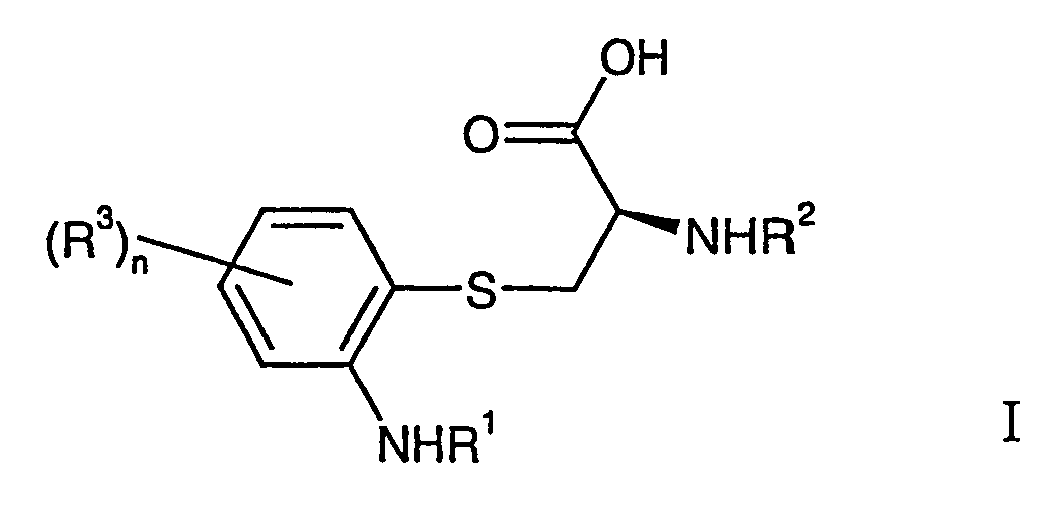
- R1 is hydrogen or alkyl;
- R2 is an amino protecting group;
- each R3 is independently halogen, carboxyl, alkoxycarbonyl, alkenyloxycarbonyl or benzyloxycarbonyl;
- n is 1 or 2,
- R4 is alkyl or benzyl,
- with a protease in an aqueous system containing an organic co-solvent.
- With the enzymatic approach described herein a selective hydrolysis of the ester under mild reaction conditions is possible.
- In the structural formula presented herein a wedged bond () denotes that the substituent is above the plane of the paper.

- The term "alkyl" as used herein denotes an optionally substituted straight or branched chain hydrocarbon residue containing 1 to 12 carbon atoms, such as methyl, ethyl, n-propyl, isopropyl, n-butyl, sec-butyl, isobutyl, tert.-butyl, pentyl, hexyl, heptyl, octyl, nonyl, decyl, undecyl, dodecyl including their different isomers.
- Suitable substituents for the alkyl chain may be selected from 1-3 halogens such as fluorine or chlorine, or C1-4-alkoxy such as methoxy or ethoxy. Examples for substituted alkyl are 2-chloroethyl, 2-fluoroethyl, 2,2,2-trifluoroethyl or 2-methoxyethyl.
- Alkyl in R1 is as defined above and preferably a straight or branched chain hydrocarbon residue containing 1 to 7 carbon atoms. Alkyl in R1 is more preferred methyl, ethyl, propyl, isopropyl, n-butyl, sec-butyl, isobutyl or tert.-butyl.
- Alkyl in R4 is as defined above and preferably an optionally substituted straight or branched chain hydrocarbon residue containing 1 to 7 carbon atoms. Suitable substituents for the alkyl chain may be selected from 1-3 halogen such as fluorine or chlorine, or C1-4-alkoxy such as methoxy or ethoxy. Examples for substituted alkyl are 2-chloroethyl, 2-fluoroethyl, 2,2,2-trifluoroethyl or 2-methoxyethyl. Alkyl in R4 is more preferred a straight chain hydrocarbon residue containing 1 to 7 or 1 to 4 carbon atoms. Examples are methyl, ethyl, propyl, n-butyl, n-pentyl, n-hexyl, n-heptyl. Preferred examples are methyl, ethyl or propyl. Most preferred alkyl in R4 is methyl.
- The term "amino protecting group" as used herein refers to groups such as those employed in peptide chemistry as described in Green T. Protective Groups in Organic Synthesis, Chapter 5, John Wiley and Sons, Inc. (1981), pp. 218-287, such as an allyloxycarbonyl group (ALLOC), a lower alkoxycarbonyl group (e.g. tert.-butoxycarbonyl (t-BOC)), a substituted lower alkoxycarbonyl group (e.g. trichloroethoxycarbonyl), an optionally substituted aryloxycarbonyl group (e.g. p-nitrobenzyloxycarbonyl, benzyloxycarbonyl (Z) or phenyloxycarbonyl), an alkanoyl group (e.g. formyl, acetyl), an aroyl group (e.g. benzoyl), a halogen-alkanoyl group (e.g. trifluoroacetyl) or a silyl protective group (e.g. tert.-butyldimethylsilyl). Preferred amino protecting groups are benzyloxycarbonyl, tert.-butoxycarbonyl, allyloxycarbonyl or benzoyl, especially preferred amino protecting group is tert.-butoxycarbonyl.
- The term "alkoxycarbonyl" denotes an C1-7-alkoxy residue attached to a carbonyl group (>C=O). Examples for alkoxy groups are methoxy, ethoxy, n-propyloxy, iso-propyloxy, n-butyloxy, 1-sec-butyloxy, iso-butyloxy, tert.-butyloxy, pentyloxy, hexyloxy, heptyloxy including their different isomers. Examples for alkoxycarbonyl groups are methoxycarbonyl, ethoxycarbonyl, propoxycarbonyl, tert.-butoxycarbonyl and the like. Preferred lower alkoxycarbonyl is tert.-butoxycarbonyl.
- The term "alkenyloxycarbonyl" denotes an alkenyl-oxy residue attached to an carbonyl group (>C=O). The term "alkenyl" as used herein denotes an unsubstituted or substituted hydrocarbon chain radical having from 2 to 8 carbon atoms, preferably from 2 to 4 carbon atoms, and having at least one olefinic double bond, including their different isomers. Examples are vinyl, allyl or isopropenyl.
- Preferred "alkenyloxycarbonyl" for R3 is allyloxycarbonyl or isopropenyloxycarbonyl, more preferred is allyloxycarbonyl.
- The term halogen signifies fluorine, chlorine, bromine or iodine. Preferred halogen is bromine.
- The number n may be either 1 or 2, preferably the number n is 1.
- The substituent R3 may be in any possible position attached to the phenyl ring. If n is 1, R3 may be in the 3,4,5 or 6-position of the phenyl ring. Preferably, the R3 substituent is in the 4-position. If n is 2, both R3 substituents may be in the independently from each other in the 3,4,5 or 6-position of the phenyl ring.
- A preferred embodiment of the invention is a process for the preparation of compounds of formula I, characterized in that compound of formula II is

- In a further preferred embodiment of the process invention
- R1 is hydrogen or alkyl,
- more preferred
- R1 is hydrogen;
- R2 is an amino protecting group,
- more preferred
- R2 is an amino protecting group;
- each R3 is independently halogen, carboxyl or alkenyloxycarbonyl;
- R4 is alkyl or benzyl,
- more preferred
- R4 is alkyl;
- n is 1 or 2,
- more preferred
- n is 1.
- In another preferred embodiment of the invention the process is carried out with a protease in an aqueous system, containing an organic co-solvent, at a pH of 4.0 - 10, preferred 6.0 - 8.5.
- After the enzymatic hydrolysis of the substrate of formula II the enantiomeric pure product of formula I is separated by acidification and subsequent extraction.
- Compound of formula II may be used in any possible mixture of the L or D enantiomers. The conversion is accomplished preferably with a racemic mixture or with a mixture which only contains the L-isomer.
- When employing a mixture of isomers, the unreacted remaining D-ester is removed by an extraction step prior to acidification of the reaction medium and subsequent extraction of the L-acid.
- Suitable enzymes as catalysts for the reactions are proteases, preferably cheap bulk proteases of microbial origin, more preferred are Bacillus proteases (like Savinase from Novo Nordisk) or subtilisins e.g. subtilisin Carlsberg from Novo Nordisk (Alkalase) or from Solvay (Protease-L) or Aspergillus proteases (like Prozyme 6 from Amano) or Tritachium proteases (Proteinase K from Fluka). Most preferred enzyme as catalyst for the reactions is subtilisin Carlsberg (e.g. Alcalase from Novo Nordisk).
- As an alternative the enzymes may be used in immobilized form.
- The reaction is carried out in an aqueous system with an organic co-solvent, such as a water-immiscible solvent or a water-miscible organic co-solvent. The water-immiscible solvent may be used in any ratio with the aqueous phase, preferred ratio is 25-75% (v/v). The water-miscible organic co-solvent may be used in an amount as high as tolerated by the enzyme, typically 5-25% (v/v) but which might exceed even 50% (v/v), e.g. in case of subtilisin Carlsberg.
- The reaction is carried out at a reaction temperature from 0°C to 50°C, preferred at a reaction temperature between 15°C and 40°C, and most preferred at a reaction temperature between 15°C and 25°C.
- As to the aqueous phase, common buffer solutions known in the art for biochemical conversions may be used, such as sodium or potassium phosphate in a concentration of up to 1M, preferably between about 5mM and about 50mM. Such a buffer solution may additionally contain one of the usual salts like e.g. sodium or potassium chloride, and also LiSCN, Na2SO4 or a polyhydric alcohol e.g. a sugar; in a concentration up to 1M.
- Suitable organic co-solvents are technically common solvents. Examples are ethers (e.g. tetrahydrofuran (THF), dioxan or tert.-butyl methyl ether (TBME)), lower alcohols, esters (e.g. ethyl acetate), polar aprotic solvents (e.g. dimethylsulfoxide (DMSO), dimethylacetamide, N,N-dimethylformamide (DMF) or acetone). Preferred organic co-solvents are tetrahydrofuran (THF), tert.-butyl methyl ether (TBME) and ethyl acetate.
- The term "lower alcohol" as used herein denotes straight chain or branched alkyl residues containing 1 to 8 carbon atoms with one hydroxy group, such as methanol, ethanol, propanol, isopropanol, butanol, isobutanol, tert.-butanol, pentanol, hexanol, heptanol or octanol, preferably methanol, ethanol, propanol, isopropanol, butanol, isobutanol, tert.-butanol and more preferred alcohol are methanol or ethanol.
- The substrate is suitably applied as a solution in a 0.1- 25% overall concentration (w/w). A more preferred overall concentration is 1-10%.
- After addition of the enzyme, the pH of the reaction mixture is maintained under vigorous stirring at the selected pH-value by the controlled addition of a base. Preferred bases are aqueous NaOH or KOH solutions.
- After termination of the reaction, the enantiomerically pure product of formula I is worked up conventionally after phase separation, by acidification of the aqueous phase with a suitable acid and subsequent extraction with a suitable organic solvent.
- Compounds of formula I are synthesized, according to the present invention, in high enantiomeric purity, which means that enantiomeric excesses of 90% or higher, preferred an enantiomeric excess of 95% or higher may be achieved.
- Compounds of formula II are prepared according the following reaction scheme or in a conventional manner known to the skilled in the art.

- In reaction scheme 1, substituted 2-nitro fluoro-aromatic of formula a) is reacted with protected cysteine (e.g. BOC-Cysteine-methylester) of formula b) to obtain the corresponding nitro-phenyl substituted protected cysteine of formula c). The reaction is conveniently carried out under basic conditions (with a diisopropylamine, e.g. ethyldiisopropylamine) in an appropriate organic solvent, such as hexane, diisopropylether, ethyl acetate, methanol, ethanol, propanol, dichloromethane, DMF or DMSO. The reaction temperature is preferably between -30°C to +150°C. Most preferred, the reaction is carried out with BOC-Cysteine-methylester in ethanol in the presence of ethyldiisopropylamine at a temperature of 110°C.
- Compounds of formula a) and the protected cysteine (e.g. BOC-Cysteine-methylester) of formula b) are commercially available or synthesized according to methods known from textbooks about organic chemistry e.g. from J. March (1992), "Advanced Organic Chemistry: Reactions, Mechanisms, and Structure", 4th ed. John Wiley & Sons).
- The second step of the reaction is carried out in that the nitro group of the nitro-phenyl substituted protected cysteine of formula c) is reduced to the corresponding amino-phenyl substituted protected cysteine of formula II. The reduction reaction is carried out according to methods known in the art for example known in textbooks on organic chemistry e.g. J. March (1992), "Advanced Organic Chemistry: Reactions, Mechanisms, and Structure". 4th ed. John Wiley & Sons). The reaction is conveniently carried out with a suitable reducing agent (e.g. Zinc and optional NH4Cl) in acidic media with organic solvents such as hexane, diisopropylether, ethyl acetate, methanol, ethanol, propanol, dichloromethane, DMF, DMSO, preferably methanol. The reaction temperature is preferably between -30°C to +150°C.
- The NH2-group of compound of amino-phenyl substituted protected cysteine of formula II may be alkylated with R1Hal, wherein R1 is as defined above and Hal is chlorine or bromine.
- The compounds of formula II-a and II-b (see below) are novel intermediates and therefore also subject of the present invention


- Compounds of the formula I are versatile building blocks for the synthesis of 1,5-benzothiazepines. Such benzothiazepine scaffolds have been used as a constrained dipeptide mimics in various enzyme inhibitors (protease, interleukin-1β-converting enzyme, elastase or angiotensin-converting enzyme, but also as GPCR antagonists (cholecystokinin, angiotensin II receptor). The possible different uses is described in G.C. Morton et al., Tet. Lett., 41 (2000) 3029-3033.
- The benzothiazepines are prepared according reaction scheme 2:

- The cyclisation reaction of compound of formula I to obtain benzothiazepine of formula III is carried out thermally or in the presence of an appropriate reagent, for example as described in G.C. Morton et al., Tet. Lett., 41 (2000) 3029-3033). The reaction is conveniently carried out with a carbodiimide in an appropriate solvent such as hexane, xylene, diisopropylether, ethyl acetate, methanol, ethanol, propanol, dichloromethane, DMF or DMSO. The reaction temperature is preferably between -30°C to +150°C. The reaction is preferably carried out at room temperature in DMF in the presence of EDAC (1-ethyl-3-(3-dimethylaminopropyl) carbodiimide hydrochloride).
- In the following examples the abbreviations used have the following significations.
- ISP-MS
- ion spray positive mass spectroscopy
- ISN-MS
- ion spray negative mass spectroscopy
- EI-MS
- electron impact mass spectroscopy
- SFC
- super critical fluid chromatography
- NMR
- nuclear magnetic resonance spectroscopy
- IR
- infra red spectroscopy
- HV
- high vacuum
- min
- minute(s)
-
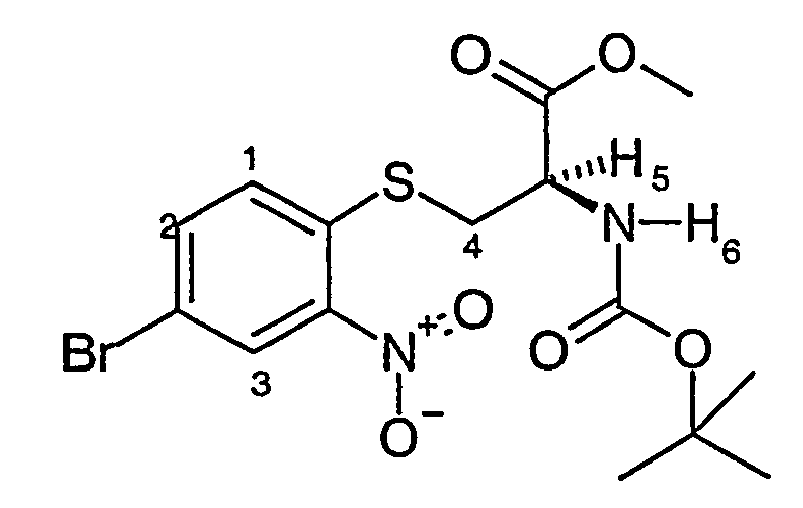
- The reaction is carried out as described in M. K. Schwarz et al., J. Org. Chem. 1999, 64,2219-2231. To a solution of commercially available BOC-Cysteine-Methylester (27.38g, 116.35mmol, 1 eq),N-Ethyldiisopropylamine (DIPEA) (4.4mL, 25.75mmol, 2.5 eq) in EtOH (310 mL) was added 5-bromo-2-fluoronitrobenzene (25.62g ; 116,45mmol; 1 eq) and heated at 110°C for 3 h. The progress of the reaction was monitored by HPLC. The solvent was evaporated to a red-brown oil and this was partitioned between water (600mL) and ethyl acetate (3 X 300mL). Drying (Na2SO4), and evaporation gave crude product which was recrystallised with cyclohexane to give yellow crystals (38.75g, 77%). Analytical data: 1H-NMR (CDCl3, 400MHz): 1.430 (s, 9H, O(CH 3)); 3.350 (dd, 1H, H(4'), J4'-4'' =5.2Hz, J4'-5=14.4Hz); 3.500 (dd,1H, H(4"), J4"-4'=5.2Hz, J4"-5=14.4Hz); 3.755 (s ,3H, OCH 3); 4.621 (m,1H, H(5)); 5.301 (d, 1H, H(6), J6-5=6.4Hz); 7.449 (d, 1H, H(1), J1-2=8.8Hz); 7.670 (dd,1H, H(2), J1-2=8.8Hz, J2-3=2.0Hz); 8.278 (d, 1H, H(3), J2-3=2Hz). IR: 3353 cm-1 (NH);1765 cm-1 (Ester -C=O); 1686 cm-1 (Carbamate -C=O); 1546 cm-1(Amide -C=O); 1460 and 1329 cm-1(NO2); 1220 cm-1(Ester). MS: m/z=452.3 [M+NH4 +] with 79Br; m/z=454.3 [M+ NH4 +] with 81Br; m/z=457.3 [M+Na+] with 79Br; m/z=459.3 [M+Na+] with 81Br. Rf=0.38 in Ethyl acetate / Hexane 1 :2 on SiO2.
-

- The reaction is carried out as described in J. Slade et.al., J. Med. Chem. 1985, 28, 1517-1521). A mixture of the nitro compound from above (40.34g, 92.6mmol, 1 eq), NH4Cl (19.81g, 370.6mmol, 4 eq) is added and Zn (79.37g, 1.204mmol, 13 eq) in MeOH (950 mL) was heated at reflux for 16h and the resultant mixture filtered through Celite and washed with boiling MeOH. After concentration, the crude product was partitioned between ethyl acetate and a NaHCO3 (aq.). The resultant oil was chromatographed using ethyl acetate / hexane / 3% triethylamine) to give the product (21.11g, 56%). Analytical data: 1H-NMR (CDCl3, 400MHz): 1.395 (s, 9H, O(CH 3)); 3.185 (d, 2H, H(4), J4-5=4Hz) ; 3.617 (s, 3H, OCH 3); 4.446 (s, 2H, H(7)) ; 4.528 (m,1H, H(5)); 5.502 (d,1H, H(6), 16-5=8Hz) ; 6.793 (dd,1H, H(3), J3-2=2Hz, J3-1=8.4Hz) ;6.868 ( d,1H, H(3), J3-2=2Hz), 7.225 (d,1H, H(1), J1-2=8.4Hz). IR: 3356cm-1 (-NH2, -NH) ; 1744cm-1 (Ester -C=O); 1707cm-1 (Carbamate -C=O) ; 1504cm-1 (Amide) ; 1250cm-1 (Ester). MS: m/z=405.3 [M+H+] with 79Br; m/z=407.3 [M+H+] with 81Br. Rf=0.47 in ethyl acetate / hexane 1 :2 on SiO2.
-

- 19.9g (48.02mmol) of N-tert.-butoxycarbonyl-3-(2-amino-4-bromophenylthio)-L-alanine methyl ester (97.8%) was dissolved in 750ml TBME and emulsified in 31 buffer solution (0.1M sodium chloride, 20mM sodium phosphate pH 7.5) under vigorous stirring. 12.0ml Alcalase 2.4 L and 30mg Substilisin A [both enzyme preparations are subtilisin Carlsberg from Novo Nordisk] were added and the pH was maintained at 7.5 under vigorous stirring by the controlled addition (pH-static) of 1.0N sodium hydroxide solution. After 7d 44.75ml of 1.0N sodium hydroxide solution was consumed and the conversion degree was >99% (HPLC analysis). The biphasic reaction mixture was separated. The aqueous phase was washed briefly with 11 TBME for the separation of small amounts of lipophilic impurities and traces of the remaining substrate. The combined organic phases were extracted with 1 x 250ml 0.1 M potassium phosphate buffer pH 7.6. The combined aqueous phases were acidified to pH 2 with 32% hydrochloric acid and extracted with 1.51 ethyl acetate. The resulting emulsion was separated by the addition of 10% Dicalite under stirring and a subsequent filtration. The aqueous phase was extracted with 2 x 11 ethyl acetate. The combined ethyl acetate phases were dried on anhydrous sodium sulfate and evaporated. The residue was dissolved in dichloromethane, evaporated and dried at HV to give 18.79g N-tert.-butoxycarbonyl-3-(2-amino-4-bromophenylthio)-L-alanine as a pale yellow solid (yield: 81.8%). Analytical data: 1H-NMR (CDCl3, 400MHz) 1.399 (s, 9H, OC(CH 3)); 3.184 (dd, 1H, SCH 2, J=14.2Hz, J=6.6Hz); 3.235 (dd, 1H, SCH 2, J=14.2Hz, J=6.6Hz); 4.515 (m, 1H, COCHNH); 5.517 (d, 1H, CONHCH, J=6.8Hz); 6.796 (dd, 1H, arom., J=2Hz, J=8.4Hz); 6.876 (d,1H, arom., J=2Hz); 7.250 (d, 1H, arom., J=8.4Hz). IR (ATR-IR) 3445 and 3355cm-1 (-NH, -NH2); 2978 and 2929cm-1 broad (-COOH); 1693cm-1 (COOH-C=O,carbamate-C=O); 1508cm-1 (amide-CO-NH); 1247 and 1157cm-1 (COOH). MS (ESI-positive ionization) m/z=391.1 [M+H+] with 79Br; m/z=393.1 [M+H+] with 81Br; m/z=413.2 [M+Na+] with 79Br; m/z=415.2 [M+Na+] with 81Br. OR [α]D= +53.3° (CHCl3; c=1.0). HPLC analysis: column: ABZ+plus; mobile phase: A: 0.1% TFA in H2O; B: MeCN; gradient B: 30 - 80% 0 -15 min, 80 - 30% 15-16 min, 30% 16-19.5 min; flow:1 ml/min; pressure: 50 - 80 bar; detection: UV, 300nm; retention times: 12.1 min (product-acid) 13.5 min (substrate-ester).
- 1.65g (3.99mmol) of N-tert.-butoxycarbonyl-3-(2-amino-4-bromophenylthio)-L-alanine methyl ester (98%) was dissolved in 65ml TBME and emulsified in 240ml buffer solution (0.1M sodium chloride; 20mM sodium phosphate pH 7.5) under vigorous stirring. 0.75ml Alcalase 2.4 L [a subtilisin Carlsberg from Novo Nordisk] was added and the pH maintained at 7.5 under vigorous stirring by the controlled addition (pH-static) of 1.0N sodium hydroxide solution. After 33h 4.23ml of 1.0N sodium hydroxide solution was consumed and the conversion degree was >99% (HPLC analysis). The reaction mixture was acidified to pH 2 with 32% hydrochloric acid, filtered over Decalite. After phase separation the aqueous phase was extracted with 3 x 275ml ethyl acetate. The combined organic phases were dried on anhydrous sodium sulfate and evaporated. The residue was dissolved in dichloromethane, evaporated and dried at HV to give 1.56g N-tert.-butoxycarbonyl-3-(2-amino-4-bromophenylthio)-L-alanine as a pale yellow solid (yield: 99.8%).
- 100mg (0.242mmol) of N-tert.-butoxycarbonyl-3-(2-amino-4-bromophenylthio)-L-alanine methyl ester (98%) was added to a system consisting of 20% organic co-solvent (see following table) and 80% buffer solution (0.1M sodium chloride; 3mM sodium phosphate pH 7.5) under vigorous stirring. 100ul Alcalase 2.4 L [a subtilisin Carlsberg from Novo Nordisk] was added and the pH maintained at 7.5 under vigorous stirring by the controlled addition (pH-static) of 0.1N sodium hydroxide solution. At the end of the reaction the conversion degree was determined by HPLC.
organic co-solvent, total reaction volume conversiona in % comments ethyl acetate, 20ml ~59% Base consumption was exhausted (>200%) and the reaction was aborted. THF, 50ml >97% 24mg (0.058mmmol) substrate and 50ul Alcalase TBME, 25ml >99% aThe conversion was calculated from the peak area of HPLC analysis at 300nm. - 200mg (0.493mmol) of N-tert.-butoxycarbonyl-3-(4-bromo-2-aminophenylthio)-L-alanine methyl ester (93.8%) was added to a system consisting of 5ml TBME and 20ml buffer solution (0.1M sodium chloride; 3mM sodium phosphate pH 7.0) under vigorous stirring. Enzyme [see following table] was added and the pH maintained at 7.0 under vigorous stirring by the controlled addition (pH-static) of 0.1N sodium hydroxide solution. After termination of the reaction the reaction mixture was washed twice with 25ml TBME, acidified to pH 2.5 with 25% HCl and extracted with 3 x 25ml ethyl acetate. The combined organic phases were dried over sodium sulfate, the solvent evaporated and the residue dried on a high vacuum.
enzyme (company) enzyme amount time h titrating agent consumed ml product (amount; HPLC-purity) Prozyme 6 42mg 44 4.76 191mg; (Amano Pharmaceuticals) 92.2% Savinase 16L 100µl 43 4.969 195mg: (Novo Nordisk) 90.7% -

- The reaction is carried out as described in G.C. Morton et al., Tet. Lett., 41 (2000) 3029-3033.). The product from the enzyme hydrolysis (15.2g, 38.8mmol, leq) and EDAC (1-Ethyl-3-(3-dimethylaminopropyl) carbodiimide hydrochloride) (7.44g, 38.8mmol, 1 eq) in DMF (500 mL) was stirred at room temperature for 16h, concentrated and the residue dissolved in ethyl acetate (500 ml) and extracted with aq. NaHCO3 (1M) (500mL) and water (500mL). Drying (NaSO4) and concentrated to give the product (14.5g, quantitative). Analytical data: 1H-NMR (CDCl3, 400MHz): 1.409 (s, 9H, O(CH 3 )); 2.939 (t, 1H, H(4'), J=11.6Hz) ; 3.794 (dd, 1H, H(4"), J4"-5=11Hz, J4"-4'=6.4Hz); 4.439 (m,1H, H(5)) ; 5.567 (d,1H, H(6), J6-5=8Hz) ; 7.306 (d,1H, H(2), J2-1=8Hz, J2-3=2Hz); 7.337 (d, 1H, H(3), J3-2=2Hz); 7.748 (d,1H, H(1), J1-2=8Hz); 8.042 (s,1H, H(7)). IR: 3284 and 3184 cm-1 (-NH); 1729cm-1 (Carbamate -C=O); 1678cm-1 (Amide -C=O); 1574cm-1 (Amide); 1251cm-1 (Ester). MS: m/z=373.3 [M+H+] with 79Br; m/z=375.3 [M+H+] with 81Br; m/z=395 [M+Na+] with 79Br; m/z=397 [M+Na+] with 81Br. Rf=0.23 in Ethyl acetate /Hexane 1 :2 on SiO2.
-

- 4-Fluoro-3-nitrobenzoic acid (49.95g, 269.8mmol, leq) was dissolved in methanol (350mL) and Cs2CO3 (44.06g,135.2mmol, 0.5eq) added and the solvent evaporated. Then the Cs-salt was dissolved in DMF, heated to 50°C and treated with allylbromide (22.8mL, 269.8mmol, leq). After 5 mins. the solvent was evaporated and the resultant solid triturated in Et2O. Filtration and evaporation gave the crude allylester quantitatively. The next step is carried according to M. K. Schwarz et al., J. Org. Chem. 1999,64,2219-2231. The allyl ester (30g, 133.2mmol, leq), BOC-Cysteine-Methylester (31.35g, 133.2mmol, 1 eq) and DIPEA (68.3mL, 399.6mmol, 3eq) is added slowly (exothermic reaction is observed) in EtOH was stirred at rt for 3 hours, and concentrated to give a solid which was recrystallised from diisopropylether (46.16g, 79%). Analaytical data: 1H-NMR (CDCl3, 400MHz): 1.443 (s, 9H, O(CH 3 ));3.401 (dd,1H; H(7'), J7'-7"=2.4Hz, J7'-8=6Hz); 3.506 (dd, 1H, H(7"), J7"-7'=2.4Hz, J7"-8=6Hz); 3.777 (s ,3H, OCH 3); 4.608 (m, 1H, H(8)) ; 4.860 (dt, 2H, H(3',3"), J3-2=5.6Hz ; J3-1=1.6Hz); 5.322 (q,1H, H(1'), J=0.8Hz) ; 5.347 (t,1H, H(1"), J=0.8Hz) ; 5.406 (d,1H, H(9), J9-8=1.6Hz); 6.032 (m, 1H, H(2)) ; 7.625 (d, 1H, H(5), J5-4 =8.4Hz) ; 8.201 (dd,1H, H(4), J4-5=8.4Hz, J4-6=1.6Hz); 8.830 (d, 1H, H(6), J6-4=1.6Hz). IR: 3350cm-1(-NH) ; 1742cm-1 (Ester-C=O); 1719cm-1(Conj. Ester-C=O); 1686cm-1 (Carbamate-C=O); 1523 and 1334cm-1(-NO2); 1245cm-1(Ester). MS: m/z=441.3 [M+H+]; m/z=458.4 [M+ NH4 +]; m/z=463.2 [M+Na+].Rf=0.40 in Ethyl acetate / Hexane 1:2 on SiO2.
-

- The reaction is carried out as described in J. Slade et.al., J. Med. Chem.1985, 28, 1517-1521. The above product (506mg, 1.15mmol, 1eq), aq. NH4Cl (20mL) and Zn (976mg, 14.9mmol, 13eq) in DME (15mL) was stirred and heated at 80°C for 16h. The solvent was evaporated and the residue dissolved in ethyl acetate (250mL) and extracted with (aq.) sodium NaHCO3 (1M) (3 X 50mL). The organic phase was dried with NaSO4 and evaporated to give a yellow oil which crystallized after few days (276mg, 60%). Analytical data: 1H-NMR (CDCl3, 400MHz): 1.380 (s, 1H, O(CH 3)); 3.283 (d, 2H, H(7', 7"), J7-8=4.4Hz) ; 3.579 (s,3H, OCH 3); 4.445 (s, 2H, H(10',10")) ; 4.554 (m,1H, H(8)) ; 4.787 (ddd, 2H, H(2', 2"), J=1.2Hz) ; 5.283 (dd,1H, H(1'), J1'-2=10.6Hz, J1'-1"=1.2Hz) ; 5.390 (dd, 1H, H(1"), J1"-2=17.8Hz, J1"-1=1.2Hz) ; 5.506 (d, 1H, H(9), J9-8=7.6Hz) ; 6.015 (m, 1H, H(8)); 7.360 (dd, 1H, H(2), J4-5=8Hz, J4-6=1.6Hz); 7.398 (d, 1H, H(6), J6-4 =1.6Hz) ; 7.425 (d,1H, H(5), J5-4=8Hz). IR: 3378cm-1(-NH, -NH2); 1751cm-1(Ester - C=O); 1713cm-1(Conj. Ester -C=O) ; 1685cm-1(Carbamate-C=O) ; 1511cm-1(-Amide) ; 1220cm-1(Ester). MS: m/z=411.3 [M+H+]; m/z=433.3 [M+Na+].Rf=0.27 in Ethyl acetate / Hexane 1 :2 on SiO2.
-

- 6.4g (15.658mmol) of N-tert.-butoxycarbonyl-3-(4-alloxycarbonyl-2-aminophenylthio)-L-alanine methyl ester (99%) was dissolved in 480ml TBME and emulsified in 1.51 buffer solution (0.1M sodium chloride;160mM sodium phosphate pH 7.5) under vigorous stirring. 12.0ml Alcalase 2.4 L [a subtilisin Carlsberg from Novo Nordisk] was added and the pH maintained at 7.5 under vigorous stirring by the controlled addition (pH-static) of 1.0N sodium hydroxide solution. After 48.5h 16.6ml of 1.0N sodium hydroxide solution was consumed and the conversion degree was >97% (HPLC analysis). After phase separation the aqueous phase was extracted once with 1l TBME. The combined TBME phases were extracted with 2 x 0.410.1 M potassium phosphate buffer pH 7.6. The combined aqueous phases were acidified to pH 2 with 32% hydrochloric acid and extracted with 3 x 0.51 ethyl acetate. In case a stabile emulsion was formed the phase separation was achieved by filtration on Dicalite. The combined ethyl acetate phases were dried on anhydrous sodium sulfate and evaporated. The residue was dissolved in dichloromethane, evaporated and dried at HV to give 5.85g N-tert.-butoxycarbonyl-3-(4-alloxycarbonyl-2-aminophenylthio)-L-alanine as a yellow highly viscous oil (yield: 94.6%). Analyticat data: 1H-NMR (DMSO, 400MHz) 1.338 (s, 9H, OC(CH 3)); 3.077 (dd,1H, SCH 2, J=12.8Hz, J=6.8Hz); 3.238 (dd,1H, SCH 2, J=13.8Hz, J=4.6Hz); 3.867 (m,1H, COCHNH); 4.753 (d, 2H, COOCH 2, J=5.2Hz); 5.526 (d,1H, CH=CH 2, J=10Hz); 5.538 (d,1H, CH=CH 2, J=17.6Hz); 5.595 (m, 2H, NH 2); 6.018(ddtr, 1H, CH2CH=CH2, J=16.6Hz, J=10.6Hz, J=5.6Hz); 6.519 (m, 1H, CONHCH); 6.876 (d, 1H, arom. CSCH, J=8.4Hz); 7.330 (d, 1H, arom. CSCHCH, J=8.4Hz); 7.338 (s,1H, arom. CHCNH2). IR (ATR-IR) 3420 and 3355cm-1 (-NH, -NH2); 2980 and 2935 cm-1 broad (-COOH); 1705cm-1 (COOH -C=O, carbamate -C=O); 1510cm-1 (amide-CO-NH); 1486cm-1 aromate; 1229 and 1160cm-1 (COOH); 982 and 932 cm-1 (vinyl, -C=CH2). MS (ESI-positive ionisation) m/z=397.1 [M+H+]; m/z=419.4 [M+Na+]. OR [α]D= +16.16 ° (CHCl3; c=1.0). HPLC analysis: column: ABZ+plus; mobile phase: A: 0.1% TFA in H20; B: MeCN; gradient B: 30 - 80% 0 -15 min, 80 - 30% 15 - 16 min, 30% 16 -19.5 min; flow: 1 ml/min; pressure:50 - 80 bar; detection: UV, 300nm; retention times: 11.2 min (product-acid); 12.7 min (substrate-ester).
- 0.769mg (1.658mmol) of N-tert.-butoxycarbonyl-3-(4-alloxycarbonyl-2-aminophenyl-thio)-L-alanine methyl ester was dissolved in 40ml TBME and emulsified in 220ml 0.1M sodium chloride solution; 3mM sodium phosphate buffer pH 7.5 under vigorous stirring. 1.0ml Alcalase 2.4 L [a subtilisin Carlsberg from Novo Nordisk] was added and the pH maintained at 7.5 under vigorous stirring by the controlled addition (pH-static) of 1.0N sodium hydroxide solution. After 45.4h 23.6ml of 1.0N sodium hydroxide solution was consumed and the conversion degree was > 97% (HPLC analysis). The reaction mixture was extracted with 100ml TBME. After phase separation the aqueous phase was acidified to pH 2.3 with 32% hydrochloric acid and extracted with 3 x 250ml ethyl acetate. In case a stabile emulsion was formed the phase separation was achieved by filtration on Dicalite. The combined ethyl acetate extracts were dried on anhydrous sodium sulfate and evaporated. The residue was dissolved in dichloromethane, evaporated and dried at HV to give 604mg N- tert.-butoxycarbonyl-3-(4-alloxycarbonyl-2-aminophenylthio)-L-alanine as a pale yellow solid (yield: 93.9%, purity: 95%).
- 200mg (0.487mmol) of N-tert.-butoxycarbonyl-3-(4-alloxycarbonyl-2-aminophenylthio)-L-alanine methyl ester (96.7%) was added to a system consisting of 2 to 5ml of an organic co-solvent (see following table) and 20ml buffer solution (0.1M sodium chloride; 3mM sodium phosphate pH 7.0) under vigorous stirring. Alcalase 2.4 L [a subtilisin Carlsberg from Novo Nordisk, amount see following table] was added and the pH maintained at 7.0 under vigorous stirring by the controlled addition (pH-static) of 0.1N sodium hydroxide solution. The reaction was monitored by the consumption of titrating agent, and the formation of the product confirmed by HPLC.
organic co-solvent, amount Alcalase, amount time h comments ethanol, 2.0ml 100µl 72 consumption of titrating agent at the end of the reaction: 115% acetone, 5.0ml 200µl 171 consumption of titrating agent at the end of the reaction: 103% THF, 5.0ml 100µl 146 consumption of titrating agent at the end of the reaction: 98% TBME, 5.0ml 100µl 72 consumption of titrating agent at the end of the reaction: 119% - 200mg (0.487mmol) of N-tert.-butoxycarbonyl-3-(4-alloxycarbonyl-2-aminophenylthio)-L-alanine methyl ester (96.7%) was added to a system consisting of 5ml TBME and 20ml buffer solution (0.1M sodium chloride; 3mM sodium phosphate pH 7.0) under vigorous stirring. Enzyme [see following table] was added and the pH maintained at 7.0 under vigorous stirring by the controlled addition (pH-static) of 0.1N sodium hydroxide solution. The reaction was monitored by the consumption of titrating agent, and the formation of the product confirmed by HPLC.
enzyme (company) enzyme amount time h comments Prozyme 6 (Amano Pharmaceuticals) 50mg 42 consumption of titrating agent at the end of the reaction: 112% Proteinase K (Fluka) 25mg 137 slow: after 137h only 40% (of theory) of titrating agent was consumed - 200mg (0.487mmol) of N-tert.-butoxycarbonyl-3-(4-alloxycarbonyl-2-aminophenylthio)-L-alanine methyl ester (96.7%) was added to a system consisting of 5ml TBME and 20ml buffer solution (0.1M sodium chloride; 3mM sodium phosphate pH 7.0) under vigorous stirring at 40°C.100µl of Alcalase 2.4 L [a subtilisin Carlsberg from Novo Nordisk] was added and the pH maintained at 7.0 under vigorous stirring at 40°C by the controlled addition (pH-static) of 0.1N sodium hydroxide solution. After a consumption 5.44ml of titrating agent (112% of theory; after 17.4h) the reaction mixture was washed with 25ml TBME, acidified to pH 2.5 with 1N HCl and extracted with 3 x 25ml ethyl acetate. The combined organic phases were dried over sodium sulfate, the solvent evaporated and the residue dried on a high vacuum to give 190mg (0.479mmol; 98%) of the product acid in 94.5% HPLC-purity (area-%).
-

- The reaction is carried out as described in G.C. Morton et al., Tet. Lett., 41 (2000) 3029-3033. The product from the enzyme hydrolysis (5.6g, 14.1mmol, leq) was dissolved in DMF (75mL) and treated with EDAC (2.70g, 14.1mmol, leq) and stirred at room temperature for 16h. After concentration the residue was dissolved in ethyl acetate (500mL) and extracted with (aq.) NaHCO3 (1M) (3 X 150mL) and water (3 X 150mL). The organic phase was dried (Na2SO4) and evaporated to give yellow oil. After chromatography with ethyl acetate / hexane 1 :2. yellow crystals were obtained (4.96g, 93%). Analytical data: 1H-NMR (CDCl3, 400MHz):1.400 (s,1H, O(CH 3)); 3.014 (t,1H, H(7'or 7"), J=12Hz) ; 3.815 (dd,1H, H(7'or 7"), J7-8=12Hz, J7'-7"=6.4Hz) ; 4.466 (m,1H, H(8)) ; 4.835 (d, 2H, H(3', 3"), J3-2= 5.7Hz ) ; 5.316 (dd,1H, H(1'), J1'-2=10.5Hz, J1'- 1"=1.2Hz) ; 5.413 (dd,1H, H(1"), J1"-2=17.2Hz, J1"-1=1.2Hz) ; 5.581 (d,1H, H(9), J9- 8=8Hz ) ; 6.013 (m, 1H, H(8)) ; 7.338 (d, 1H, H(5), J5-4=11.1Hz); 7.704 (s, 1H, H(10)); 7.751 (d,1H, H(6), J6-4=1.8Hz) ;7.338 (dd, 1H, H(2), J4-5=11.1Hz, J4-6=1.8Hz). IR: 3206cm- 1 (-NH); 1720cm-1 (Carbamate -C=O); 1671cm-1 (Amide-C=O); 1500cm-1 (Amide-CO-NH) ; 1209cm-1 (Ester). MS: m/z=379.3 [M+H+];m/z=401.4 [M+Na+]. Rf=0.36 in Ethyl acetate / Hexane 1 :2 on SiO2.
-

- 200mg (0.540mmol) of N-tert.-butoxycarbonyl-3-(4-carboxy-2-aminophenylthio)-L-alanine methyl ester was added to a system consisting of 5ml TBME and 20ml buffer solution (0.1M sodium chloride; 3mM sodium phosphate pH 7.0) under vigorous stirring. 100µl of Alcalase 2.5 L [a subtilisin Carlsberg from Novo Nordisk]was added and the pH maintained at 7.0 under vigorous stirring by the controlled addition (pH-static) of 0.1N sodium hydroxide solution. After a consumption 5.847ml of titrating agent (108% of theory; after 1.5h) the reaction mixture was washed twice with 25ml TBME, acidified to pH 2.5 with 25% HCl and extracted with 3 x 25ml ethyl acetate. The combined organic phases were dried over sodium sulfate, the solvent evaporated and the residue dried on a HV to give 187mg (0.479mmol) N-tert.-butoxycarbonyl-3-(2-amino-4-carboxyphenylthio)-L-alanine as yellow crystals (yield: 93.4%). Analytical data: HPLC-purity: 96.4%% (area). 1H-NMR (DMSO, 400MHz) 1.378 (s, 9H, OC(CH 3)); 2.982 (dd, 1H, SCH 2, J=13.2Hz, J=9.6Hz); 3.150 (dd,1H, SCH 2, J=13.2Hz, J=4.4Hz); 3.950 (m,1H, COCHNH); 5.542 (m, 2H, -NH 2); 7.067 (dd,1H, CONHCH, J=8.0Hz, J=1.6Hz); 7.201(d, 1H, arom. SCCH, J=8.0Hz); 7.298 (d,1H, arom. SCCHCH, J=8.0Hz); 7.323 (d,1H, arom. CHCNH2, J=1.6Hz);12.73 (bs, 2H, 2 -COOH). IR: 3445 and 3347cm-1 (-NH, -NH2); 2977 and 2930cm-1 broad (-COOH);1720 and 1692cm-1 (COOH -C=O, carbamate -C=O); 1608cm-1 (-COO-); 1509cm-1 (amide -CO-NH);1486 cm-1 (aromate); 1247 and 1163cm-1 (COOH). ISN-MS: m/z=355.1 [M-H+]. OR [α]D= +13.00° (EtOH; c=1.0).
reacting compounds of formula II

Claims (9)
- A process for the preparation of compounds of formula I
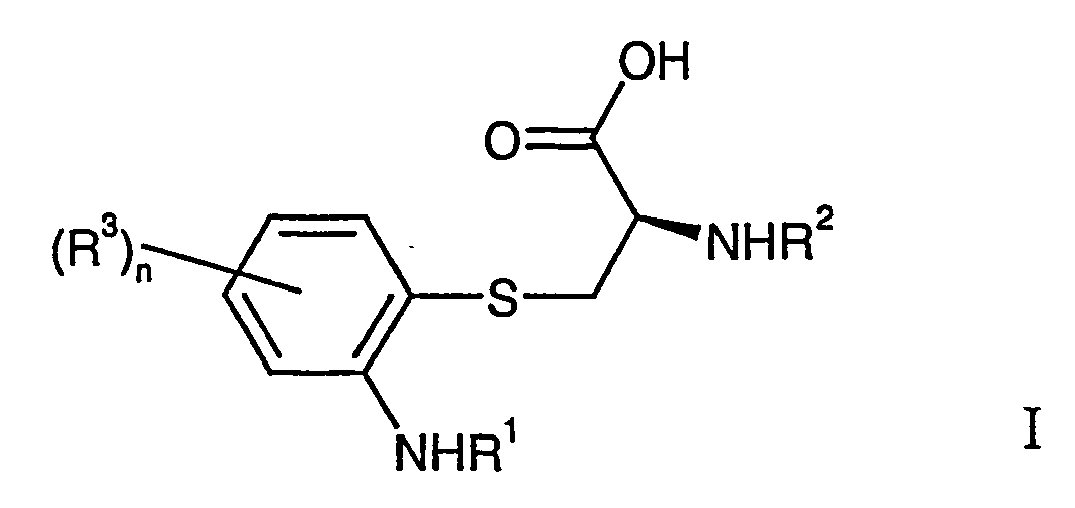 R1 is hydrogen or alkyl;R2 is an amino protecting group;each R3 is independently halogen, carboxyl, alkoxycarbonyl, alkenyloxycarbonyl or benzyloxycarbonyl;n is 1 or 2,which process comprises
reacting compounds of formula II R4 is alkyl or benzyl,with a protease in an aqueous system containing an organic co-solvent.
 - A process according to claim 1, characterized in that compound of formula II is

- A process according to claims 1 and 2, characterized in that
R1 is hydrogen or alkyl;
R2 is an amino protecting group;
each R3 is independently halogen, carboxyl or alkenyloxycarbonyl;
R4 is alkyl or benzyl;
n is 1 or 2. - A process according to any one of claims 1-3, characterized in that
R1 is hydrogen;
R2 is an amino protecting group;
R3 is halogen, carboxyl or alkenyloxycarbonyl;
R4 is alkyl;
n is 1. - A process according to any one of claims 1-4, characterized in that the reaction is carried out at pH of 6.0 - 8.5.
- A process according to any one of claims 1-5, characterized in that the reaction is carried out with a Bacillus protease, subtilisin, an Aspergillus protease or a Tritachium protease.
- A process according to any one of claims 1-6, characterized in that the organic co-solvent is tetrahydrofuran, dioxan, tert.-butyl methyl ether, a C1-8-alkohol, ethyl acetate, dimethylsulfoxide, dimethylacetamide or acetone.
- Compound of formula


- Process according to any one of claims 1-7, characterised in that the compound of formula I is further processed to a benzothiazepine of formula III

Priority Applications (1)
| Application Number | Priority Date | Filing Date | Title |
|---|---|---|---|
| EP02779375A EP1434870B1 (en) | 2001-09-25 | 2002-09-19 | Enzymatic process for the preparation of substituted 2-amino-3-(2-amino-phenylsulfanyl)-propionic acid |
Applications Claiming Priority (4)
| Application Number | Priority Date | Filing Date | Title |
|---|---|---|---|
| EP01122906 | 2001-09-25 | ||
| EP01122906 | 2001-09-25 | ||
| PCT/EP2002/010511 WO2003029477A1 (en) | 2001-09-25 | 2002-09-19 | Enzymatic process for the preparation of substituted 2-amino-3-(2-amino-phenylsulfanyl)-propionic acid |
| EP02779375A EP1434870B1 (en) | 2001-09-25 | 2002-09-19 | Enzymatic process for the preparation of substituted 2-amino-3-(2-amino-phenylsulfanyl)-propionic acid |
Publications (2)
| Publication Number | Publication Date |
|---|---|
| EP1434870A1 EP1434870A1 (en) | 2004-07-07 |
| EP1434870B1 true EP1434870B1 (en) | 2006-12-27 |
Family
ID=8178714
Family Applications (1)
| Application Number | Title | Priority Date | Filing Date |
|---|---|---|---|
| EP02779375A Expired - Lifetime EP1434870B1 (en) | 2001-09-25 | 2002-09-19 | Enzymatic process for the preparation of substituted 2-amino-3-(2-amino-phenylsulfanyl)-propionic acid |
Country Status (15)
| Country | Link |
|---|---|
| US (1) | US7011960B2 (en) |
| EP (1) | EP1434870B1 (en) |
| JP (1) | JP4359142B2 (en) |
| KR (1) | KR100882972B1 (en) |
| CN (1) | CN100413972C (en) |
| AT (1) | ATE349545T1 (en) |
| CA (1) | CA2461296C (en) |
| DE (1) | DE60217145T2 (en) |
| DK (1) | DK1434870T3 (en) |
| ES (1) | ES2278061T3 (en) |
| HU (1) | HU228360B1 (en) |
| IL (2) | IL160527A0 (en) |
| JO (1) | JO2426B1 (en) |
| MX (1) | MXPA04002694A (en) |
| WO (1) | WO2003029477A1 (en) |
Families Citing this family (5)
| Publication number | Priority date | Publication date | Assignee | Title |
|---|---|---|---|---|
| EP2484781B1 (en) | 2006-08-01 | 2017-08-23 | Applied Biosystems, LLC | Detection of analytes and nucleic acids |
| US8349899B1 (en) | 2008-12-03 | 2013-01-08 | Arrowhead Center, Inc. | Selective inhibitors of EG5 motors and methods of use |
| US8765817B1 (en) | 2008-12-03 | 2014-07-01 | Arrowhead Center, Inc. | Selective inhibitors of EG5 motors and methods of use |
| JPWO2015064453A1 (en) * | 2013-11-01 | 2017-03-09 | 株式会社糖鎖工学研究所 | Method for producing D-form or L-form amino acid derivative having thiol group |
| CN104404098A (en) * | 2014-12-15 | 2015-03-11 | 苏州汉酶生物技术有限公司 | Biological preparation method of lipoic acid |
Family Cites Families (11)
| Publication number | Priority date | Publication date | Assignee | Title |
|---|---|---|---|---|
| DE2804892A1 (en) * | 1977-02-09 | 1978-08-10 | Procter & Gamble | PROCESS FOR THE PRODUCTION OF L-THREONINE AND ITS N-ACYL DERIVATIVE |
| DE3438189A1 (en) * | 1984-10-18 | 1986-04-24 | Hoechst Ag, 6230 Frankfurt | METHOD FOR PRODUCING AROMATICALLY SUBSTITUTED L-AMINO ACIDS |
| CN87108140A (en) * | 1987-12-17 | 1988-10-19 | 山西省生物研究所 | Method for producing D-alpha amino acid substances |
| US5106750A (en) * | 1988-08-30 | 1992-04-21 | G. D. Searle & Co. | Enantio- and regioselective synthesis of organic compounds using enol esters as irreversible transacylation reagents |
| US5108916A (en) * | 1989-06-05 | 1992-04-28 | Rhone-Poulenc Rorer, S.A. | Process for stereoselectively hydrolyzing, transesterifying or esterifying with immobilized isozyme of lipase from candida rugosa |
| DE4009891A1 (en) * | 1990-03-28 | 1991-10-02 | Guenter Erich Prof Dr Jeromin | Prepn. of optically active alcohol(s) and carbonic acid di:ester(s) - by hydrolysis of racemic carbonic acid di:ester(s) with lipase |
| ZA925360B (en) * | 1991-07-17 | 1993-06-14 | Smithkline Beecham Corp | Retroviral protease inhibitors. |
| US5215918A (en) * | 1992-06-19 | 1993-06-01 | Bend Research, Inc. | Enantiomeric enrichment of (R,S)-3-quinuclidinol |
| DE4445954A1 (en) * | 1994-12-22 | 1996-06-27 | Abb Management Ag | Waste incineration process |
| CZ298144B6 (en) * | 1997-11-27 | 2007-07-04 | Lonza Ag | Process for preparing (1S,4R)- or (1R,4S)-4-(2-amino-6-chloro-9-H-purin-9-yl)-2-cyclopentene-1-methanol |
| DE60123513T2 (en) * | 2000-04-19 | 2007-05-10 | Basilea Pharmaceutica Ag | Process for the preparation of D-asparagine derivatives |
-
2002
- 2002-09-19 ES ES02779375T patent/ES2278061T3/en not_active Expired - Lifetime
- 2002-09-19 DK DK02779375T patent/DK1434870T3/en active
- 2002-09-19 CA CA2461296A patent/CA2461296C/en not_active Expired - Fee Related
- 2002-09-19 CN CNB02817772XA patent/CN100413972C/en not_active Expired - Fee Related
- 2002-09-19 JP JP2003532690A patent/JP4359142B2/en not_active Expired - Fee Related
- 2002-09-19 EP EP02779375A patent/EP1434870B1/en not_active Expired - Lifetime
- 2002-09-19 AT AT02779375T patent/ATE349545T1/en active
- 2002-09-19 HU HU0401500A patent/HU228360B1/en not_active IP Right Cessation
- 2002-09-19 DE DE60217145T patent/DE60217145T2/en not_active Expired - Lifetime
- 2002-09-19 WO PCT/EP2002/010511 patent/WO2003029477A1/en not_active Ceased
- 2002-09-19 MX MXPA04002694A patent/MXPA04002694A/en active IP Right Grant
- 2002-09-19 KR KR1020047004254A patent/KR100882972B1/en not_active Expired - Fee Related
- 2002-09-19 IL IL16052702A patent/IL160527A0/en unknown
- 2002-09-23 US US10/252,971 patent/US7011960B2/en not_active Expired - Lifetime
- 2002-09-24 JO JO200294A patent/JO2426B1/en active
-
2004
- 2004-02-23 IL IL160527A patent/IL160527A/en not_active IP Right Cessation
Also Published As
| Publication number | Publication date |
|---|---|
| JP2005503830A (en) | 2005-02-10 |
| MXPA04002694A (en) | 2004-06-18 |
| WO2003029477A1 (en) | 2003-04-10 |
| DE60217145T2 (en) | 2007-10-25 |
| ES2278061T3 (en) | 2007-08-01 |
| IL160527A0 (en) | 2004-07-25 |
| DK1434870T3 (en) | 2007-04-30 |
| IL160527A (en) | 2010-05-31 |
| US20030119152A1 (en) | 2003-06-26 |
| ATE349545T1 (en) | 2007-01-15 |
| KR20040044979A (en) | 2004-05-31 |
| EP1434870A1 (en) | 2004-07-07 |
| JO2426B1 (en) | 2008-04-17 |
| CA2461296A1 (en) | 2003-04-10 |
| CN100413972C (en) | 2008-08-27 |
| CA2461296C (en) | 2011-07-05 |
| HU228360B1 (en) | 2013-03-28 |
| CN1553959A (en) | 2004-12-08 |
| KR100882972B1 (en) | 2009-02-12 |
| JP4359142B2 (en) | 2009-11-04 |
| HUP0401500A2 (en) | 2005-02-28 |
| HUP0401500A3 (en) | 2005-11-28 |
| DE60217145D1 (en) | 2007-02-08 |
| US7011960B2 (en) | 2006-03-14 |
Similar Documents
| Publication | Publication Date | Title |
|---|---|---|
| EP3386955B1 (en) | Intermediates for the preparation of sacubitril and their preparation | |
| EP3558930B1 (en) | New process for early sacubitril intermediates | |
| EP2360160A1 (en) | Intermediates and their use for producing benzoxazine derivative | |
| CN101573349B (en) | Process for preparing 3,5-di-omicron-acyl-2-fluoro-2-C-methyl-D-ribono-gamma-lactone | |
| CA2461296C (en) | Enzymatic process for the preparation of substituted 2-amino-3-(2-amino-phenylsulfanyl)-propionic acid | |
| JPS59172442A (en) | Manufacture of n-alkylated amino acid and ester of same | |
| KR20000005286A (en) | Enzymatic process for stereoselective preparation of therapeutic amides | |
| US6639094B2 (en) | Process for producing α-aminoketone derivatives | |
| US6683214B2 (en) | Process for producing α-aminoketones | |
| US6069272A (en) | Simplified method for the production of vinyl glycine (2-aminobut-3-enoic acid) and a convenient resolution of a derivative | |
| EP2038260B1 (en) | Stereoselective synthesis of (s)-1-methyl-3-phenylpiperazine | |
| CN105392891B (en) | Process for producing D-or L-amino acid derivative having thiol group | |
| US7012152B2 (en) | Method for producing lysine derivative | |
| JP3568914B2 (en) | New method for producing D-asparagine derivative | |
| AU744660B2 (en) | Process for preparing 1-pyruvyl-L-proline | |
| JP2002234881A (en) | Method for producing optically active 5,5-dimethyl-1,3- thiazolidine-4-craboxylic acid derivative | |
| JPH0770066A (en) | Optically active dihydropyridine compound and its synthesis | |
| CH699014B1 (en) | Method for recovery of salt of L-biphenyl alanine compound, involves preparing L-biphenyl alanine compound, separating aqueous layer and organic layer, and adding inorganic salt and organic solvent to aqueous layer |
Legal Events
| Date | Code | Title | Description |
|---|---|---|---|
| PUAI | Public reference made under article 153(3) epc to a published international application that has entered the european phase |
Free format text: ORIGINAL CODE: 0009012 |
|
| 17P | Request for examination filed |
Effective date: 20040426 |
|
| AK | Designated contracting states |
Kind code of ref document: A1 Designated state(s): AT BE BG CH CY CZ DE DK EE ES FI FR GB GR IE IT LI LU MC NL PT SE SK TR |
|
| AX | Request for extension of the european patent |
Extension state: AL LT LV MK RO SI |
|
| RIN1 | Information on inventor provided before grant (corrected) |
Inventor name: IDING, HANS Inventor name: WIRZ, BEAT Inventor name: ROGERS-EVANS, MARK Inventor name: TONG, HAN, MIN Inventor name: BORTHWICK, SCOTT Inventor name: BLEICHER, KONRAD Inventor name: SCHMID, STEFAN |
|
| RIN1 | Information on inventor provided before grant (corrected) |
Inventor name: IDING, HANS Inventor name: SCHMID, STEFAN Inventor name: ROGERS-EVANS, MARK Inventor name: BLEICHER, KONRAD Inventor name: WIRZ, BEAT Inventor name: BORTHWICK, SCOTT Inventor name: TONG, HAN, MIN |
|
| GRAP | Despatch of communication of intention to grant a patent |
Free format text: ORIGINAL CODE: EPIDOSNIGR1 |
|
| GRAS | Grant fee paid |
Free format text: ORIGINAL CODE: EPIDOSNIGR3 |
|
| GRAA | (expected) grant |
Free format text: ORIGINAL CODE: 0009210 |
|
| AK | Designated contracting states |
Kind code of ref document: B1 Designated state(s): AT BE BG CH CY CZ DE DK EE ES FI FR GB GR IE IT LI LU MC NL PT SE SK TR |
|
| AX | Request for extension of the european patent |
Extension state: LT LV |
|
| PG25 | Lapsed in a contracting state [announced via postgrant information from national office to epo] |
Ref country code: CZ Free format text: LAPSE BECAUSE OF FAILURE TO SUBMIT A TRANSLATION OF THE DESCRIPTION OR TO PAY THE FEE WITHIN THE PRESCRIBED TIME-LIMIT Effective date: 20061227 Ref country code: SK Free format text: LAPSE BECAUSE OF FAILURE TO SUBMIT A TRANSLATION OF THE DESCRIPTION OR TO PAY THE FEE WITHIN THE PRESCRIBED TIME-LIMIT Effective date: 20061227 Ref country code: FI Free format text: LAPSE BECAUSE OF FAILURE TO SUBMIT A TRANSLATION OF THE DESCRIPTION OR TO PAY THE FEE WITHIN THE PRESCRIBED TIME-LIMIT Effective date: 20061227 |
|
| REG | Reference to a national code |
Ref country code: GB Ref legal event code: FG4D |
|
| REG | Reference to a national code |
Ref country code: IE Ref legal event code: FG4D |
|
| REF | Corresponds to: |
Ref document number: 60217145 Country of ref document: DE Date of ref document: 20070208 Kind code of ref document: P |
|
| PG25 | Lapsed in a contracting state [announced via postgrant information from national office to epo] |
Ref country code: SE Free format text: LAPSE BECAUSE OF FAILURE TO SUBMIT A TRANSLATION OF THE DESCRIPTION OR TO PAY THE FEE WITHIN THE PRESCRIBED TIME-LIMIT Effective date: 20070327 Ref country code: BG Free format text: LAPSE BECAUSE OF FAILURE TO SUBMIT A TRANSLATION OF THE DESCRIPTION OR TO PAY THE FEE WITHIN THE PRESCRIBED TIME-LIMIT Effective date: 20070327 |
|
| REG | Reference to a national code |
Ref country code: DK Ref legal event code: T3 |
|
| PG25 | Lapsed in a contracting state [announced via postgrant information from national office to epo] |
Ref country code: PT Free format text: LAPSE BECAUSE OF FAILURE TO SUBMIT A TRANSLATION OF THE DESCRIPTION OR TO PAY THE FEE WITHIN THE PRESCRIBED TIME-LIMIT Effective date: 20070528 |
|
| LTIE | Lt: invalidation of european patent or patent extension |
Effective date: 20061227 |
|
| ET | Fr: translation filed | ||
| REG | Reference to a national code |
Ref country code: ES Ref legal event code: FG2A Ref document number: 2278061 Country of ref document: ES Kind code of ref document: T3 |
|
| PLBE | No opposition filed within time limit |
Free format text: ORIGINAL CODE: 0009261 |
|
| STAA | Information on the status of an ep patent application or granted ep patent |
Free format text: STATUS: NO OPPOSITION FILED WITHIN TIME LIMIT |
|
| 26N | No opposition filed |
Effective date: 20070928 |
|
| PG25 | Lapsed in a contracting state [announced via postgrant information from national office to epo] |
Ref country code: GR Free format text: LAPSE BECAUSE OF FAILURE TO SUBMIT A TRANSLATION OF THE DESCRIPTION OR TO PAY THE FEE WITHIN THE PRESCRIBED TIME-LIMIT Effective date: 20070328 Ref country code: MC Free format text: LAPSE BECAUSE OF NON-PAYMENT OF DUE FEES Effective date: 20070930 |
|
| PG25 | Lapsed in a contracting state [announced via postgrant information from national office to epo] |
Ref country code: EE Free format text: LAPSE BECAUSE OF FAILURE TO SUBMIT A TRANSLATION OF THE DESCRIPTION OR TO PAY THE FEE WITHIN THE PRESCRIBED TIME-LIMIT Effective date: 20061227 |
|
| PG25 | Lapsed in a contracting state [announced via postgrant information from national office to epo] |
Ref country code: LU Free format text: LAPSE BECAUSE OF NON-PAYMENT OF DUE FEES Effective date: 20070919 Ref country code: CY Free format text: LAPSE BECAUSE OF FAILURE TO SUBMIT A TRANSLATION OF THE DESCRIPTION OR TO PAY THE FEE WITHIN THE PRESCRIBED TIME-LIMIT Effective date: 20061227 |
|
| PG25 | Lapsed in a contracting state [announced via postgrant information from national office to epo] |
Ref country code: TR Free format text: LAPSE BECAUSE OF FAILURE TO SUBMIT A TRANSLATION OF THE DESCRIPTION OR TO PAY THE FEE WITHIN THE PRESCRIBED TIME-LIMIT Effective date: 20061227 |
|
| REG | Reference to a national code |
Ref country code: FR Ref legal event code: PLFP Year of fee payment: 14 |
|
| PGFP | Annual fee paid to national office [announced via postgrant information from national office to epo] |
Ref country code: DK Payment date: 20150826 Year of fee payment: 14 Ref country code: IE Payment date: 20150826 Year of fee payment: 14 |
|
| PGFP | Annual fee paid to national office [announced via postgrant information from national office to epo] |
Ref country code: BE Payment date: 20150916 Year of fee payment: 14 Ref country code: AT Payment date: 20150825 Year of fee payment: 14 |
|
| PGFP | Annual fee paid to national office [announced via postgrant information from national office to epo] |
Ref country code: NL Payment date: 20150930 Year of fee payment: 14 |
|
| REG | Reference to a national code |
Ref country code: FR Ref legal event code: PLFP Year of fee payment: 15 |
|
| PG25 | Lapsed in a contracting state [announced via postgrant information from national office to epo] |
Ref country code: BE Free format text: LAPSE BECAUSE OF NON-PAYMENT OF DUE FEES Effective date: 20160930 |
|
| REG | Reference to a national code |
Ref country code: DK Ref legal event code: EBP Effective date: 20160930 |
|
| REG | Reference to a national code |
Ref country code: NL Ref legal event code: MM Effective date: 20161001 |
|
| REG | Reference to a national code |
Ref country code: AT Ref legal event code: MM01 Ref document number: 349545 Country of ref document: AT Kind code of ref document: T Effective date: 20160919 |
|
| REG | Reference to a national code |
Ref country code: IE Ref legal event code: MM4A |
|
| PG25 | Lapsed in a contracting state [announced via postgrant information from national office to epo] |
Ref country code: NL Free format text: LAPSE BECAUSE OF NON-PAYMENT OF DUE FEES Effective date: 20161001 |
|
| PG25 | Lapsed in a contracting state [announced via postgrant information from national office to epo] |
Ref country code: IE Free format text: LAPSE BECAUSE OF NON-PAYMENT OF DUE FEES Effective date: 20160919 |
|
| REG | Reference to a national code |
Ref country code: FR Ref legal event code: PLFP Year of fee payment: 16 |
|
| PG25 | Lapsed in a contracting state [announced via postgrant information from national office to epo] |
Ref country code: AT Free format text: LAPSE BECAUSE OF NON-PAYMENT OF DUE FEES Effective date: 20160919 |
|
| PGFP | Annual fee paid to national office [announced via postgrant information from national office to epo] |
Ref country code: GB Payment date: 20170829 Year of fee payment: 16 Ref country code: IT Payment date: 20170913 Year of fee payment: 16 Ref country code: FR Payment date: 20170823 Year of fee payment: 16 Ref country code: CH Payment date: 20170725 Year of fee payment: 16 |
|
| REG | Reference to a national code |
Ref country code: BE Ref legal event code: MM Effective date: 20160930 |
|
| PG25 | Lapsed in a contracting state [announced via postgrant information from national office to epo] |
Ref country code: DK Free format text: LAPSE BECAUSE OF NON-PAYMENT OF DUE FEES Effective date: 20160930 |
|
| PGFP | Annual fee paid to national office [announced via postgrant information from national office to epo] |
Ref country code: DE Payment date: 20170928 Year of fee payment: 16 |
|
| PGFP | Annual fee paid to national office [announced via postgrant information from national office to epo] |
Ref country code: ES Payment date: 20171004 Year of fee payment: 16 |
|
| REG | Reference to a national code |
Ref country code: DE Ref legal event code: R119 Ref document number: 60217145 Country of ref document: DE |
|
| REG | Reference to a national code |
Ref country code: CH Ref legal event code: PL |
|
| GBPC | Gb: european patent ceased through non-payment of renewal fee |
Effective date: 20180919 |
|
| PG25 | Lapsed in a contracting state [announced via postgrant information from national office to epo] |
Ref country code: DE Free format text: LAPSE BECAUSE OF NON-PAYMENT OF DUE FEES Effective date: 20190402 Ref country code: IT Free format text: LAPSE BECAUSE OF NON-PAYMENT OF DUE FEES Effective date: 20180919 |
|
| PG25 | Lapsed in a contracting state [announced via postgrant information from national office to epo] |
Ref country code: CH Free format text: LAPSE BECAUSE OF NON-PAYMENT OF DUE FEES Effective date: 20180930 Ref country code: FR Free format text: LAPSE BECAUSE OF NON-PAYMENT OF DUE FEES Effective date: 20180930 Ref country code: LI Free format text: LAPSE BECAUSE OF NON-PAYMENT OF DUE FEES Effective date: 20180930 |
|
| PG25 | Lapsed in a contracting state [announced via postgrant information from national office to epo] |
Ref country code: GB Free format text: LAPSE BECAUSE OF NON-PAYMENT OF DUE FEES Effective date: 20180919 |
|
| REG | Reference to a national code |
Ref country code: ES Ref legal event code: FD2A Effective date: 20191031 |
|
| PG25 | Lapsed in a contracting state [announced via postgrant information from national office to epo] |
Ref country code: ES Free format text: LAPSE BECAUSE OF NON-PAYMENT OF DUE FEES Effective date: 20180920 |