EP1434145A2 - Mechanismus zur Reduktion der Wiederauffindungszeit in einer Hardwareimplementation mit Pipeline eines baumbasierten IP-Wiederauffindungsalgorithmuses - Google Patents
Mechanismus zur Reduktion der Wiederauffindungszeit in einer Hardwareimplementation mit Pipeline eines baumbasierten IP-Wiederauffindungsalgorithmuses Download PDFInfo
- Publication number
- EP1434145A2 EP1434145A2 EP03257662A EP03257662A EP1434145A2 EP 1434145 A2 EP1434145 A2 EP 1434145A2 EP 03257662 A EP03257662 A EP 03257662A EP 03257662 A EP03257662 A EP 03257662A EP 1434145 A2 EP1434145 A2 EP 1434145A2
- Authority
- EP
- European Patent Office
- Prior art keywords
- pipeline
- search
- prefix
- pipeline unit
- units
- Prior art date
- Legal status (The legal status is an assumption and is not a legal conclusion. Google has not performed a legal analysis and makes no representation as to the accuracy of the status listed.)
- Withdrawn
Links
Images


Classifications
-
- G—PHYSICS
- G06—COMPUTING OR CALCULATING; COUNTING
- G06F—ELECTRIC DIGITAL DATA PROCESSING
- G06F16/00—Information retrieval; Database structures therefor; File system structures therefor
- G06F16/90—Details of database functions independent of the retrieved data types
- G06F16/903—Querying
- G06F16/90335—Query processing
- G06F16/90344—Query processing by using string matching techniques
Definitions
- the present invention is directed, in general, to multi-bit trie based network search engines and, more specifically, to improving the performance of hardware pipelined multi-bit trie based network search engines.
- Network routers for packet-based communications protocols such as Internet Protocol (IP) direct incoming information to the next neighbor along a route to the intended destination for the packet.
- IP Internet Protocol
- each router along the route must perform route address prefix (normally referred to as just "prefix") lookup operations on a prefix (or routing) table to determine the appropriate next hop address for the destination IP prefix.
- route address prefix normally referred to as just "prefix”
- Such operations are performed by either an embedded network processor or, more commonly, by a separate network search engine.
- CAM content addressable memory
- the CAM compares incoming data with the value stored in the data memory under the control of the mask value, which may be programmed to override the comparison result to "always match" (i.e., "don't care").
- a CAM-based network search engine functions by storing all prefixes of a routing table in a CAM array in a specific, prioritized order, with each prefix's associated next hop information stored in a corresponding (linked) location in another memory.
- a key is placed on the comparand (compare operand) bus of the CAM array and compared against all prefixes in the memory.
- the array of match results from all comparisons is sent through a priority logic unit to determine the highest priority match, with the winning match used to address the next hop memory from which the corresponding next hop information is read and returned.
- a trie (from the middle four letters of "retrieve") is a tree-based data structure built to represent binary strings, where each bit or group of bits in the string determines the direction taken among branches within the tree.
- a binary (unibit or single bit) trie proceeds bit-by-bit and has at most two branches from each node, while a multi-bit consumes multiple bits at a time and has several branches at each node, each branch leading to the next level.
- the number of bits consumed or examined during branch selection at each node is referred to as a stride.
- a uniform width stride trie is a trie with all strides having the same width, except possibly the last stride, which may be the remainder of the prefix length after being divided by the stride width.
- the multi-bit trie algorithm works by storing and retrieving prefixes in a uniform stride width trie, grouping all branches in the same level with the same parent (next higher stride level) stride value into a table, referred to as a trie table. At each level, the corresponding stride value provides an index into a trie table entry containing the information needed to get to the next level.
- a multi-bit trie has the advantage that prefixes with common high order bits (strides) will share the same parent trie tables, reducing the memory required to store the prefixes.
- the maximum possible number of entries within the next level trie table is 2 n .
- the algorithm encodes all next level stride values from the same parent into a 2 n bit data field stored in the entry within the parent trie table, along with a pointer containing the base address of the next level (child) trie table, in a data structure referred to as a trie node.
- Table compression is achieved by allocating memory for the actual number of table entries that exist, instead of the maximum size 2 n .
- a similar type of data structure referred to as an end node, is used, except in this case the pointer points to a table containing next hop information instead of a next level trie table.
- Routing table lookup is also performed in same width strides, with the value of the next level stride from the input search key (typically an IP address of 32 or 64 bits) decoded and processed together with the associated data field in the stride value's parent table entry. If a stored route with the same prefix stride value is determined to exist within the trie, an index is calculated using the information in the parent table, then the search continues using the table pointer and the calculated index to form an address leading to the next level trie table entry. If a match is not found, the search terminates without success. If a search reaches an end node and a match is found, the search is successful and the associated next hop information is read from the next hop table.
- the input search key typically an IP address of 32 or 64 bits
- Successfully completing a lookup in a multi-bit trie requires multiple levels of the trie to be traversed. At each level, the tree node is accessed from memory and used, along with the stride value, to determine the address of the trie node at the next level.
- latencies within hardware multi-bit tire network search engines can contribute to the overall latencies within the network router, and therefore within the network itself.
- a primary object of the present invention to provide, for use in a multi-bit trie network search engine for a network router, a series of hardware pipeline units each processing a stride during prefix search operations on a multi-bit trie and including, within at least one pipeline unit other than the last pipeline unit, a mechanism for retiring search results from the respective pipeline unit rather than passing the search results through the remaining pipeline units.
- Early retirement may be triggered by either the absence of subsequent strides to be processed or completion (a miss or end node match) of the search at the current stride, together with an absence of active search operations in subsequent pipeline units for systems not supporting out-of-order completion of pipelined search operations.
- the early retirement mechanism may be included in those pipeline units corresponding to a last stride for a maximum prefix length shorter than the pipeline (e.g., 20 or 32 bit prefixes rather than 64 bit prefixes), in pipeline units selected on some other basis, or in every pipeline unit. Worst-case and/or average latency for prefix search operations is reduced.
- FIGURES 1 through 4A-4B discussed below, and the various embodiments used to describe the principles of the present invention in this patent document are by way of illustration only and should not be construed in any way to limit the scope of the invention. Those skilled in the art will understand that the principles of the present invention may be implemented in any suitably arranged device.
- FIGURE 1 depicts a processing system utilizing a configurable multi-stage pipeline multi-bit trie network search engine according to one embodiment of the present invention.
- Processing system 100 implements a portion of an Internet Protocol (IP) network router and includes a system controller or network processing unit (NPU) 101 coupled to a network packet search engine (NPSE) 102, which in turn is coupled to external memory 103.
- NPSE 102 receives addresses and/or commands from system controller 101 as well as prefixes for the next hop address, and returns the next hop address to system controller 101.
- NPSE 102 transmits data table memory addresses to external memory, together with a data pointer to the next hop address within a data table, determined from prefix tables 104, to external memory 103.
- NPSE 102 receives from external memory 103 the next hop address from the table and entry within data tables 105 identified by the address and data pointer.
- System controller 101 is coupled to a backplane 106 and through a network interface 107 to a network.
- NPSE 102 is preferably coupled to system controller 101 by a high-speed 36-bit network processor unit (NPU) interface and to external memory 103 by a high-speed 36-bit static random access memory (SRAM) interface.
- NPU network processor unit
- SRAM static random access memory
- Each interface is implemented by a quad data rate (QDR) architecture, with the system controller 101 as the master for the NPU interface and the external memory 103 as the slave for the SRAM interface, providing 36 bit simultaneous data input/output (I/O) at two words per clock with a maximum clock frequency of 250 mega-Hertz (MHz) for peak aggregate bandwidth of 4.5 gigabytes/second (GB/s).
- QDR quad data rate
- FIGURE 2 is a diagram of a microarchitecture for a configurable multi-stage pipelined multi-bit trie network search engine according to one embodiment of the present invention.
- NPSE 102 includes: an NPU interface 200 coupling the NPSE 102 to the system controller 101; an arbiter 201; a central processor unit (CPU) 202 with associated memory (SRAM) 203 containing the programs executed by CPU 202; an SRAM controller 204 coupling the NPSE 102 to the external memory 103; and an array (sixteen in the exemplary embodiment) of pipeline logic units 205a-205n and a corresponding set (also sixteen in the exemplary embodiment) of configurable memory blocks 206a-206n forming a series of virtual memory banks, with pipeline logic units 205a-205n and memory blocks 206a-206n coupled by a crossbar 207 enabling the virtual bank configurations.
- NPSE 102 The major tasks performed by NPSE 102 are route insert, delete and search, which expect NPSE 102 to maintain the routing table by inserting routes into and deleting routes from the internal and external memory, and to perform a route search on the prefixes presented and return the associated next hop information.
- FIGURE 3 illustrates hardware pipelining of multi-bit trie searches within a configurable multi-stage pipelined multi-bit trie network search engine according to one embodiment of the present invention.
- the search through multiple trie levels may be pipelined as shown, with each process level operating on a different stride for a given search key and processing of a new search key initiated each cycle.
- each level of the pipeline is working on a different search key, while processing the stride bits (for that search key) at that level.
- a miss or an end node match within any of pipeline units other than the last (pipeline unit 205n) produces a result that is passed without further processing through the remainder of the pipeline units.
- multi-bit trie algorithms are implemented as software programs running on a general-purpose programmable processor. To the extent hardware implementations of multi-bit trie algorithms have been proposed, latencies associated with the search through such a hardware trie are not discussed or addressed.
- An importation component of hardware implementation of a multi-bit trie algorithm is the amount of on-chip storage required to store the trie tables.
- the memory must be large enough to store large routing tables with several hundred thousand prefixes in core routers.
- the access to the memory must be pipelined, which means the memory must be configurable and flexible for simultaneous accessibility in each stage of the pipeline or level of the trie.
- One consequence of having a configurable memory structure on-chip is that processing a stride at each trie level takes longer.
- a 64 bit address prefix for Internet Protocol version 6 (IPv6) packets (typically only 64 bits of the 128 bit prefixes for IPv6 packets are relevant in a search) can be examined at wire speed, but the work done at each level is greater: the configurable on-chip SRAM memory bank 206a-206n needs to be accessed, the trie node entry extracted, and the next trie level address computed. Up to four cycles may be required for these processes in each pipeline unit 205a-205n, resulting in a 64 cycle latency.
- IPv6 Internet Protocol version 6
- the latency of pipeline units 205a-205n imposes an unnecessary restriction on the search completion time for prefixes that are less than 64 bits in length.
- the pipelined implementation depicted suffers from the drawback that the entire 64 cycle latency is wasted even when a prefix lookup find the longest prefix match in the first one or two levels, so that average-case lookup latency also suffers.
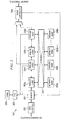
- FIGURES 4A and 4B depict in greater detail the structure of a pipeline unit for a process level within a configurable multi-stage pipelined multi-bit trie network search engine according to various embodiments of the present invention.
- FIGURE 4A illustrates the details of a pipeline unit for one embodiment addressing worst-case latency for a given table.
- Each table that is built and traversed in NPSE 102 is for a specific networking application that is, IPv4/IPv6, VPN, etc., which means that generally the maximum prefix length 1 in the table is known.
- L max ceiling(1%4)
- an IPv4 table will have a maximum prefix length of 32 bits and a maximum number of search levels (for 4 bit strides) of eight.
- the worst-case latency for a 32 bit IPv4 search key should be no more than 32 cycles.
- results of the eighth pipeline unit must be passed through the remaining eight pipeline units as described above, the full 64 cycles will be required.
- FIGURE 4A illustrates a structure that, assuming all lookups are handled in-order, reduces the worst-case latency from 64 cycles to 32 cycles.
- Each pipeline unit 205i within the series of pipeline units 205a-205n includes processing logic 401 for the corresponding process level i receiving an input, if any, from the previous process level i-1 through a buffer 402. As a lookup operation proceeds down the pipeline, the number of input bits within the input search key remaining to be processed as strides are consumed at each level is tracked.
- a signal 403 is generated indicating when there are no strides remaining.
- This signal 403 is employed by logic 404 to generate an input to a control unit 405 (e.g., a demultiplexer) determining whether the search result continues through the pipeline (i.e., is passed to the buffer for process level i+1) or is retired.
- a control unit 405 e.g., a demultiplexer
- logic 404 receives active search signals from each subsequent pipeline unit within the series 205a-205n.
- NPSE 102 only processes prefixes of a single length that is less than a maximum supported length (i.e., while adapted to handle either IPv4 or IPv6 prefixes, in operation NPSE 102 is employed to handle only IPv4 prefixes), such active search signals are not required.
- FIGURE 4A multiple instances of the structure in FIGURE 4A may be implemented within pipeline units 205a-205n.
- the structure of FIGURE 4A may also be implemented at the fifth pipeline unit to allow early retirement of lookups on 20 bit VPN prefixes in 30 cycles rather than 32 or 64 cycles, again provided that there are no active, outstanding lookups in process levels greater than the fifth if NPSE 102 handles lookups for different length prefixes.
- a search complete signal 406 is asserted.
- signal 406 is asserted and there are no active searches further down in the pipeline, then this particular search can retire from the pipeline regardless of whether there are strides remaining in the prefix to be processed. The search results no longer need be staged through the rest of the pipeline.
- the search completion detection system of FIGURE 4B may be implemented within every pipeline unit 205a-205n (i.e., at every process level) to allow retirement of each search at the earliest possible point.
- routing an timing constraints, as well as other practical reasons, may justify using the structure of FIGURE 4B only at certain levels or prefix lengths that can benefit the average-case latency.
- the mechanisms of FIGURES 4A and 4B are not required in the last pipeline unit 205n, although an active search signal from that pipeline unit 205n may be required for preceding pipeline units for process levels i through n-1.
- a reorder buffer may be used to return search responses in-order, reducing average latency at the cost of increased design complexity.
- the present invention reduces the latency of lookup requests in a pipelined multi-bit trie network search engine. NPUs that cannot generate a sufficient number of threads to take full advantage of the long latency in the search engine pipeline often find their input queues on the router line card backed up while waiting for the current threads to complete the associated lookup request. With a reduced worst-case or average-case latency, lookups will complete faster and reduce or avoid such congestion.
Landscapes
- Engineering & Computer Science (AREA)
- Databases & Information Systems (AREA)
- Theoretical Computer Science (AREA)
- Computational Linguistics (AREA)
- Data Mining & Analysis (AREA)
- Physics & Mathematics (AREA)
- General Engineering & Computer Science (AREA)
- General Physics & Mathematics (AREA)
- Data Exchanges In Wide-Area Networks (AREA)
- Compression Or Coding Systems Of Tv Signals (AREA)
Applications Claiming Priority (2)
| Application Number | Priority Date | Filing Date | Title |
|---|---|---|---|
| US313395 | 1981-10-21 | ||
| US10/313,395 US7924839B2 (en) | 2002-12-06 | 2002-12-06 | Mechanism to reduce lookup latency in a pipelined hardware implementation of a trie-based IP lookup algorithm |
Publications (2)
| Publication Number | Publication Date |
|---|---|
| EP1434145A2 true EP1434145A2 (de) | 2004-06-30 |
| EP1434145A3 EP1434145A3 (de) | 2006-08-02 |
Family
ID=32468240
Family Applications (1)
| Application Number | Title | Priority Date | Filing Date |
|---|---|---|---|
| EP03257662A Withdrawn EP1434145A3 (de) | 2002-12-06 | 2003-12-05 | Mechanismus zur Reduktion der Wiederauffindungszeit in einer Hardwareimplementation mit Pipeline eines baumbasierten IP-Wiederauffindungsalgorithmuses |
Country Status (3)
| Country | Link |
|---|---|
| US (1) | US7924839B2 (de) |
| EP (1) | EP1434145A3 (de) |
| JP (1) | JP2004194321A (de) |
Cited By (1)
| Publication number | Priority date | Publication date | Assignee | Title |
|---|---|---|---|---|
| CN102831492A (zh) * | 2012-06-06 | 2012-12-19 | 西安电子科技大学 | 工业缝制行业中平衡生产线的方法 |
Families Citing this family (12)
| Publication number | Priority date | Publication date | Assignee | Title |
|---|---|---|---|---|
| US7782853B2 (en) | 2002-12-06 | 2010-08-24 | Stmicroelectronics, Inc. | Apparatus and method of using fully configurable memory, multi-stage pipeline logic and an embedded processor to implement multi-bit trie algorithmic network search engine |
| US7702882B2 (en) * | 2003-09-10 | 2010-04-20 | Samsung Electronics Co., Ltd. | Apparatus and method for performing high-speed lookups in a routing table |
| US7430560B1 (en) * | 2005-07-22 | 2008-09-30 | X-Engines, Inc. | Multi-level compressed lock-up tables formed by logical operations to compress selected index bits |
| US20080126609A1 (en) * | 2006-09-14 | 2008-05-29 | Integrated Device Technology, Inc. | Method for improved efficiency and data alignment in data communications protocol |
| US7774526B2 (en) * | 2006-09-14 | 2010-08-10 | Integrated Device Technology, Inc. | Method for deterministic timed transfer of data with memory using a serial interface |
| US20080071948A1 (en) * | 2006-09-14 | 2008-03-20 | Integrated Device Technology, Inc. | Programmable interface for single and multiple host use |
| US7827218B1 (en) | 2006-11-18 | 2010-11-02 | X-Engines, Inc. | Deterministic lookup using hashed key in a multi-stride compressed trie structure |
| KR101034389B1 (ko) * | 2009-04-22 | 2011-05-16 | (주) 시스메이트 | 패킷 내 시그니처 위치에 따른 시그니처 검색 방법 |
| US8902902B2 (en) | 2012-07-18 | 2014-12-02 | Netronome Systems, Incorporated | Recursive lookup with a hardware trie structure that has no sequential logic elements |
| US10135734B1 (en) | 2015-12-28 | 2018-11-20 | Amazon Technologies, Inc. | Pipelined evaluations for algorithmic forwarding route lookup |
| US10284472B2 (en) * | 2017-01-24 | 2019-05-07 | Cisco Technology, Inc. | Dynamic and compressed trie for use in route lookup |
| US10212082B2 (en) * | 2017-07-01 | 2019-02-19 | Cisco Technology, Inc. | Dynamic priority of content-addressable memory blocks used in determining a highest-priority matching entry |
Family Cites Families (16)
| Publication number | Priority date | Publication date | Assignee | Title |
|---|---|---|---|---|
| US5471593A (en) * | 1989-12-11 | 1995-11-28 | Branigin; Michael H. | Computer processor with an efficient means of executing many instructions simultaneously |
| US5854921A (en) * | 1995-08-31 | 1998-12-29 | Advanced Micro Devices, Inc. | Stride-based data address prediction structure |
| US6209020B1 (en) * | 1996-09-20 | 2001-03-27 | Nortel Networks Limited | Distributed pipeline memory architecture for a computer system with even and odd pids |
| US6430527B1 (en) * | 1998-05-06 | 2002-08-06 | Avici Systems | Prefix search circuitry and method |
| US6560610B1 (en) * | 1999-08-10 | 2003-05-06 | Washington University | Data structure using a tree bitmap and method for rapid classification of data in a database |
| US6891834B1 (en) * | 1999-09-09 | 2005-05-10 | Avici Systems | Apparatus and method for packet scheduling |
| US6711153B1 (en) * | 1999-12-13 | 2004-03-23 | Ascend Communications, Inc. | Route lookup engine |
| US6731644B1 (en) * | 2000-02-14 | 2004-05-04 | Cisco Technology, Inc. | Flexible DMA engine for packet header modification |
| US7085285B2 (en) * | 2000-03-01 | 2006-08-01 | Realtek Semiconductor Corp. | xDSL communications systems using shared/multi-function task blocks |
| US7966421B2 (en) * | 2000-06-21 | 2011-06-21 | SAtech Group, A.B. Limited Liability Company | Method and apparatus for logically expanding the length of a search key |
| US6772268B1 (en) * | 2000-12-22 | 2004-08-03 | Nortel Networks Ltd | Centralized look up engine architecture and interface |
| US6691124B2 (en) | 2001-04-04 | 2004-02-10 | Cypress Semiconductor Corp. | Compact data structures for pipelined message forwarding lookups |
| US7017021B2 (en) | 2001-04-04 | 2006-03-21 | Cypress Semiconductor Corp. | High-speed message forwarding lookups for arbitrary length strings using pipelined memories |
| US20030236968A1 (en) * | 2002-06-19 | 2003-12-25 | Anindya Basu | Method and apparatus for generating efficient data structures for use in pipelined forwarding engines |
| US7171490B2 (en) * | 2002-09-18 | 2007-01-30 | Lucent Technologies Inc. | Method and apparatus for reducing the number of write operations during route updates in pipelined forwarding engines |
| US7099881B2 (en) * | 2002-12-06 | 2006-08-29 | Stmicroelectronics, Inc. | Method for increasing average storage capacity in a bit-mapped tree-based storage engine by using remappable prefix representations and a run-length encoding scheme that defines multi-length fields to compactly store IP prefixes |
-
2002
- 2002-12-06 US US10/313,395 patent/US7924839B2/en not_active Expired - Fee Related
-
2003
- 2003-12-05 EP EP03257662A patent/EP1434145A3/de not_active Withdrawn
- 2003-12-08 JP JP2003408995A patent/JP2004194321A/ja active Pending
Cited By (2)
| Publication number | Priority date | Publication date | Assignee | Title |
|---|---|---|---|---|
| CN102831492A (zh) * | 2012-06-06 | 2012-12-19 | 西安电子科技大学 | 工业缝制行业中平衡生产线的方法 |
| CN102831492B (zh) * | 2012-06-06 | 2015-09-02 | 西安电子科技大学 | 工业缝制行业中平衡生产线的方法 |
Also Published As
| Publication number | Publication date |
|---|---|
| JP2004194321A (ja) | 2004-07-08 |
| EP1434145A3 (de) | 2006-08-02 |
| US7924839B2 (en) | 2011-04-12 |
| US20040111395A1 (en) | 2004-06-10 |
Similar Documents
| Publication | Publication Date | Title |
|---|---|---|
| US7782853B2 (en) | Apparatus and method of using fully configurable memory, multi-stage pipeline logic and an embedded processor to implement multi-bit trie algorithmic network search engine | |
| US8295286B2 (en) | Apparatus and method using hashing for efficiently implementing an IP lookup solution in hardware | |
| US7437354B2 (en) | Architecture for network search engines with fixed latency, high capacity, and high throughput | |
| US7130847B2 (en) | Prefix search method | |
| US20080046428A1 (en) | Method and system for providing cascaded trie-based network packet search engines | |
| US6665297B1 (en) | Network routing table | |
| US8625604B2 (en) | Hash-based prefix-compressed trie for IP route lookup | |
| CN1316390C (zh) | 用树状分段改善树搜索性能和存储器带宽的方法和系统 | |
| US6553002B1 (en) | Apparatus and method for routing data packets through a communications network | |
| US8880507B2 (en) | Longest prefix match using binary search tree | |
| US7924839B2 (en) | Mechanism to reduce lookup latency in a pipelined hardware implementation of a trie-based IP lookup algorithm | |
| JPWO2004032435A1 (ja) | ビットストリングの照合方法および装置 | |
| US6529897B1 (en) | Method and system for testing filter rules using caching and a tree structure | |
| CN1653455A (zh) | 用于低存储器开销数据库的方法和数据结构 | |
| EP1794979A2 (de) | Selektive datenstrukturnachbildung | |
| US8180958B2 (en) | Key selection device and process for content-addressable memory | |
| US7013367B2 (en) | Caching associative memory using non-overlapping data | |
| US6961337B2 (en) | Interleaved processing system for processing frames within a network router | |
| JP5631278B2 (ja) | 内容参照メモリ | |
| JP3639553B2 (ja) | ルーティング処理装置およびルーティング方法 | |
| JP3700574B2 (ja) | 検索成功信号先読み式出力データ選択装置 | |
| US20080059696A1 (en) | System and method for comparand reuse |
Legal Events
| Date | Code | Title | Description |
|---|---|---|---|
| PUAI | Public reference made under article 153(3) epc to a published international application that has entered the european phase |
Free format text: ORIGINAL CODE: 0009012 |
|
| AK | Designated contracting states |
Kind code of ref document: A2 Designated state(s): AT BE BG CH CY CZ DE DK EE ES FI FR GB GR HU IE IT LI LU MC NL PT RO SE SI SK TR |
|
| AX | Request for extension of the european patent |
Extension state: AL LT LV MK |
|
| PUAL | Search report despatched |
Free format text: ORIGINAL CODE: 0009013 |
|
| AK | Designated contracting states |
Kind code of ref document: A3 Designated state(s): AT BE BG CH CY CZ DE DK EE ES FI FR GB GR HU IE IT LI LU MC NL PT RO SE SI SK TR |
|
| AX | Request for extension of the european patent |
Extension state: AL LT LV MK |
|
| 17P | Request for examination filed |
Effective date: 20070125 |
|
| AKX | Designation fees paid |
Designated state(s): DE FR GB IT |
|
| 17Q | First examination report despatched |
Effective date: 20090210 |
|
| STAA | Information on the status of an ep patent application or granted ep patent |
Free format text: STATUS: THE APPLICATION IS DEEMED TO BE WITHDRAWN |
|
| 18D | Application deemed to be withdrawn |
Effective date: 20090623 |