EP1433874A2 - Method for metal oxide thin film deposition via MOCVD - Google Patents
Method for metal oxide thin film deposition via MOCVD Download PDFInfo
- Publication number
- EP1433874A2 EP1433874A2 EP03258031A EP03258031A EP1433874A2 EP 1433874 A2 EP1433874 A2 EP 1433874A2 EP 03258031 A EP03258031 A EP 03258031A EP 03258031 A EP03258031 A EP 03258031A EP 1433874 A2 EP1433874 A2 EP 1433874A2
- Authority
- EP
- European Patent Office
- Prior art keywords
- metal
- precursor
- group
- mocvd process
- substrate
- Prior art date
- Legal status (The legal status is an assumption and is not a legal conclusion. Google has not performed a legal analysis and makes no representation as to the accuracy of the status listed.)
- Ceased
Links
Images


Classifications
-
- G—PHYSICS
- G11—INFORMATION STORAGE
- G11C—STATIC STORES
- G11C13/00—Digital stores characterised by the use of storage elements not covered by groups G11C11/00, G11C23/00, or G11C25/00
- G11C13/0002—Digital stores characterised by the use of storage elements not covered by groups G11C11/00, G11C23/00, or G11C25/00 using resistive RAM [RRAM] elements
- G11C13/0007—Digital stores characterised by the use of storage elements not covered by groups G11C11/00, G11C23/00, or G11C25/00 using resistive RAM [RRAM] elements comprising metal oxide memory material, e.g. perovskites
-
- C—CHEMISTRY; METALLURGY
- C23—COATING METALLIC MATERIAL; COATING MATERIAL WITH METALLIC MATERIAL; CHEMICAL SURFACE TREATMENT; DIFFUSION TREATMENT OF METALLIC MATERIAL; COATING BY VACUUM EVAPORATION, BY SPUTTERING, BY ION IMPLANTATION OR BY CHEMICAL VAPOUR DEPOSITION, IN GENERAL; INHIBITING CORROSION OF METALLIC MATERIAL OR INCRUSTATION IN GENERAL
- C23C—COATING METALLIC MATERIAL; COATING MATERIAL WITH METALLIC MATERIAL; SURFACE TREATMENT OF METALLIC MATERIAL BY DIFFUSION INTO THE SURFACE, BY CHEMICAL CONVERSION OR SUBSTITUTION; COATING BY VACUUM EVAPORATION, BY SPUTTERING, BY ION IMPLANTATION OR BY CHEMICAL VAPOUR DEPOSITION, IN GENERAL
- C23C16/00—Chemical coating by decomposition of gaseous compounds, without leaving reaction products of surface material in the coating, i.e. chemical vapour deposition [CVD] processes
- C23C16/22—Chemical coating by decomposition of gaseous compounds, without leaving reaction products of surface material in the coating, i.e. chemical vapour deposition [CVD] processes characterised by the deposition of inorganic material, other than metallic material
- C23C16/30—Deposition of compounds, mixtures or solid solutions, e.g. borides, carbides, nitrides
- C23C16/40—Oxides
-
- H—ELECTRICITY
- H10—SEMICONDUCTOR DEVICES; ELECTRIC SOLID-STATE DEVICES NOT OTHERWISE PROVIDED FOR
- H10N—ELECTRIC SOLID-STATE DEVICES NOT OTHERWISE PROVIDED FOR
- H10N70/00—Solid-state devices having no potential barriers, and specially adapted for rectifying, amplifying, oscillating or switching
- H10N70/011—Manufacture or treatment of multistable switching devices
- H10N70/021—Formation of switching materials, e.g. deposition of layers
- H10N70/023—Formation of switching materials, e.g. deposition of layers by chemical vapor deposition, e.g. MOCVD, ALD
-
- H—ELECTRICITY
- H10—SEMICONDUCTOR DEVICES; ELECTRIC SOLID-STATE DEVICES NOT OTHERWISE PROVIDED FOR
- H10N—ELECTRIC SOLID-STATE DEVICES NOT OTHERWISE PROVIDED FOR
- H10N70/00—Solid-state devices having no potential barriers, and specially adapted for rectifying, amplifying, oscillating or switching
- H10N70/20—Multistable switching devices, e.g. memristors
-
- H—ELECTRICITY
- H10—SEMICONDUCTOR DEVICES; ELECTRIC SOLID-STATE DEVICES NOT OTHERWISE PROVIDED FOR
- H10N—ELECTRIC SOLID-STATE DEVICES NOT OTHERWISE PROVIDED FOR
- H10N70/00—Solid-state devices having no potential barriers, and specially adapted for rectifying, amplifying, oscillating or switching
- H10N70/801—Constructional details of multistable switching devices
- H10N70/821—Device geometry
- H10N70/826—Device geometry adapted for essentially vertical current flow, e.g. sandwich or pillar type devices
-
- H—ELECTRICITY
- H10—SEMICONDUCTOR DEVICES; ELECTRIC SOLID-STATE DEVICES NOT OTHERWISE PROVIDED FOR
- H10N—ELECTRIC SOLID-STATE DEVICES NOT OTHERWISE PROVIDED FOR
- H10N70/00—Solid-state devices having no potential barriers, and specially adapted for rectifying, amplifying, oscillating or switching
- H10N70/801—Constructional details of multistable switching devices
- H10N70/881—Switching materials
- H10N70/883—Oxides or nitrides
- H10N70/8836—Complex metal oxides, e.g. perovskites, spinels
-
- G—PHYSICS
- G11—INFORMATION STORAGE
- G11C—STATIC STORES
- G11C2213/00—Indexing scheme relating to G11C13/00 for features not covered by this group
- G11C2213/30—Resistive cell, memory material aspects
- G11C2213/31—Material having complex metal oxide, e.g. perovskite structure
Definitions
- the present invention relates to metal oxide thin films, metalorganic precursors, and metalorganic chemical vapor deposition (MOCVD), especially as related to the formation of resistive memory materials.
- MOCVD metalorganic chemical vapor deposition
- resistive memory materials are now making it possible to produce non-volatile memory cells based on a change in resistance.
- Materials having a perovskite structure among them colossal magnetoresistance (CMR) materials and high temperature superconductivity (HTSC) materials, are materials that have electrical resistance characteristics that can be changed by external influences.
- CMR colossal magnetoresistance
- HTSC high temperature superconductivity
- the properties of materials having perovskite structures can be modified by applying one or more short electrical pulses to a thin film or bulk material.
- the electric field strength or electric current density from the pulse, or pulses is sufficient to switch the physical state of the materials so as to modify the properties of the material.
- the pulse is of low enough energy so as not to destroy, or significantly damage, the material.
- Multiple pulses may be applied to the material to produce incremental changes in properties of the material.
- One of the properties that can be changed is the resistance of the material.
- the change may be at least partially reversible using pulses of opposite polarity, or the same polarity but with lower amplitude and wider width, from those used to induce the initial change.
- the objective of the present invention is to provide a metalorganic chemical vapor deposition (MOCVD) process for depositing resistive memory materials.
- MOCVD metalorganic chemical vapor deposition
- an MOCVD process for forming a metal-containing film on a substrate comprising: a) introducing an alkoxide precursor into a reactor containing the substrate; and b) introducing a second metal-containing precursor into the reactor containing the substrate, thereby achieving the above described objective.
- the metal-containing film has the formula M' x M" (1-x) M y O z , wherein M' is a metal selected from the group consisting of La, Ce, Pr, Nd, Pm, Sm, Y, Sc, Yb, Lu, and Gd; M" is a metal selected from the group consisting of Mg, Ca, Sr, Ba, Pb, Zn, and Cd; M is a metal selected from the group consisting of Mn, Ce, V, Fe, Co, Nb, Ta, Cr, Mo, W, Zr, Hf and Ni; x is a value from 0 to 1; y has a value of 0, 1 or 2; and z may have an integer value of 1 through 7.
- the alkoxide precursor has the formula M°(OR) v , wherein M° is selected from the group consisting of La, Pr, Nb, Ta, W, Zr, and Hf; O is oxygen; R is an alkyl; and v is 3 or 4.
- the alkyl is selected from the group consisting of C 2 H 5 , CH(CH 3 ) 2 , C(CH 3 ) 3 , and CH 2 CH 2 CH 3 .
- the alkoxide precursor has the formula VO(OR) 3 , wherein V is vanadium; O is oxygen; and R is an alkyl.
- the alkyl is selected from the group consisting of C 2 H 5 , CH(CH 3 ) 2 , C(CH 3 ) 3 , and CH 2 CH 2 CH 3 .
- the second metal containing precursor is a metal- ⁇ diketone precursor.
- the second metal containing precursor is a metal- ⁇ diketone precursor.
- the metal- ⁇ diketone precursor has the formula M°(tmhd) u , wherein M° is a metal selected from the group consisting of La, Ce, Pr, Nd, Pm, Sm, Y, Sc, Yb, Lu, Gd, Mg, Ca, Sr, Ba, Pb, Zn, Cd, Mn, Fe, Co, Cr, Mo, Zr, Hf, and Ni; and u is the valence of M°.
- u is 2, 3, or 4.
- the metal- ⁇ diketone precursor is dissolved in an organic hydrocarbon solvent prior to being introduced into a reactor containing the substrate.
- the organic hydrocarbon solvent is selected from the group consisting of octane, THF, butyl ether, butyl acetate, tetraglymer, and iso -propanol.
- the alkoxide precursor is dissolved in an organic hydrocarbon solvent prior to being introduced into a reactor containing the substrate.
- the organic hydrocarbon solvent is selected from the group consisting of octane, THF, butyl ether, butyl acetate, tetraglymer, and iso -propanol.
- the alkoxide precursor is dissolved in an organic hydrocarbon solvent prior to being introduced into a reactor containing the substrate.
- the organic hydrocarbon solvent is selected from the group consisting of octane, THF, butyl ether, butyl acetate, tetraglymer, and iso -propanol.
- the second metal containing precursor is a metal-carbonyl precursor.
- the second metal containing precursor is a metal-carbonyl precursor.
- the metal-carbonyl precursor has the formula M°(CO) w , wherein M° is a metal selected from the group consisting of Ni, Fe, Cr, Co and W; C is carbon; O is oxygen; and w has an integer value of 3, 4, 5, or 6.
- the metal-carbonyl precursor is dissolved in an organic hydrocarbon solvent prior to being introduced into the reactor containing the substrate.
- the organic hydrocarbon solvent is selected from the group consisting of octane, THF, butyl ether, butyl acetate, tetraglymer, and iso -propanol.
- an MOCVD process for forming a metal-containing film on a substrate comprising: a) introducing an metal-carbonyl precursor into a reactor containing the substrate; and b) introducing a second metal-containing precursor into the reactor containing the substrate, thereby achieving the above-described objective.
- the metal-containing film has the formula M' x M" (1-x) M y O z , wherein M' is a metal selected from the group consisting of La, Ce, Pr, Nd, Pm, Sm, Y, Sc, Yb, Lu, and Gd; M" is a metal selected from the group consisting of Mg, Ca, Sr, Ba, Pb, Zn, and Cd; M is a metal selected from the group consisting of Mn, Ce, V, Fe, Co, Nb, Ta, Cr, Mo, W, Zr, Hf and Ni; x has a value from 0 to 1; y has a value of 0, 1 or 2; and z has an integer value of 1 through 7.
- the metal-carbonyl precursor is dissolved in an organic hydrocarbon solvent prior to being introduced into the reactor containing the substrate.
- the organic hydrocarbon solvent is selected from the group consisting of octane, THF, butyl ether, butyl acetate, tetraglymer, and iso -propanol.
- the second metal containing precursor is a metal- ⁇ diketone precursor.
- the metal- ⁇ diketone precursor has the formula M°(tmhd) u , wherein M° is a metal selected from the group consisting of La, Ce, Pr, Nd, Pm, Sm, Y, Sc, Yb, Lu, Gd, Mg, Ca, Sr, Ba, Pb, Zn, Cd, Mn, Fe, Co, Cr, Mo, Zr, Hf, and Ni; and u is the valence of M°.
- u is 2, 3, or 4.
- the metal- ⁇ diketone precursor is dissolved in an organic hydrocarbon solvent prior to being introduced into the reactor containing the substrate.
- the organic hydrocarbon solvent is selected from the group consisting of octane, THF, butyl ether, butyl acetate, tetraglymer, and iso -propanol.
- the metal-carbonyl containing precursor has the formula M°(CO) w , wherein M° is a metal selected from the group consisting of Ni, Fe, Cr, Co and W; C is carbon; O is oxygen; and w has an integer value of 3, 4, 5, or 6.
- an MOCVD process for forming a metal-containing film having a formula M' x M" (1-x) M y O z , wherein M' is a metal selected from the group consisting of La, Ce, Pr, Nd, Pm, Sm, Y, Sc, Yb, Lu, and Gd; M" is a metal selected from the group consisting of Mg, Ca, Sr, Ba, Pb, Zn and Cd; M is a metal selected from the group consisting of Mn, Ce, V, Fe, Co, Nb, Ta, Cr, Mo, W, Zr, Hf and Ni; x has a value from 0 and 1; y has a value of 0, 1 or 2; and z has an integer value of 1 through 7, on a substrate, comprising: a) introducing a metal- ⁇ diketone precursor having the formula M°(tmhd) u , wherein M° is a metal selected from the group consisting
- the alkoxide precursor has the formula M°(OR) v , wherein M° is a metal selected from the group consisting of La, Pr, Nb, Ta, W, Zr, and Hf; and R is an alkyl.
- the alkyl is selected from the group consisting of C 2 H 5 , CH(CH 3 ) 2 , C(CH 3 ) 3 , and CH 2 CH 2 CH 3 .
- the alkoxide precursor has the formula VO(OR) 3 , wherein R is an alkyl.
- the alkyl is selected from the group consisting of C 2 H 5 , CH(CH 3 ) 2 , C(CH 3 ) 3 , and CH 2 CH 2 CH 3 .
- the metal-carbonyl precursor has the formula M°(CO) w , wherein M° is a metal selected from the group consisting of Ni, Fe, Cr, Co and W; C is carbon; O is oxygen; and w has an integer value of 3, 4, 5, or 6.
- the metal- ⁇ diketone precursor is dissolved in an organic hydrocarbon solvent, selected from the group consisting of octane, THF, butyl ether, butyl acetate, tetraglymer, and iso -propanol, prior to being introduced into the MOCVD chamber containing the substrate.
- organic hydrocarbon solvent selected from the group consisting of octane, THF, butyl ether, butyl acetate, tetraglymer, and iso -propanol
- the alkoxide precursor is dissolved in an organic hydrocarbon solvent, selected from the group consisting of octane, THF, butyl ether, butyl acetate, tetraglymer, and iso -propanol, prior to being introduced into the MOCVD chamber containing the substrate.
- an organic hydrocarbon solvent selected from the group consisting of octane, THF, butyl ether, butyl acetate, tetraglymer, and iso -propanol
- the metal-carbonyl precursor is dissolved in an organic hydrocarbon solvent, selected from the group consisting of octane, THF, butyl ether, butyl acetate, tetraglymer, and iso -propanol, prior to being introduced into the MOCVD chamber containing the substrate.
- organic hydrocarbon solvent selected from the group consisting of octane, THF, butyl ether, butyl acetate, tetraglymer, and iso -propanol
- the MOCVD process further comprises forming a bottom electrode on the substrate prior to introducing any precursor, wherein the bottom electrode is Pt, Ir, IrO 2 or RuO 2 .
- the MOCVD process further comprises introducing another oxygen source into the MOCVD chamber containing the substrate.
- the metal- ⁇ diketone precursor is Mn(tmhd) 3
- the second metal-containing precursor is an alkoxide precursor comprising Pr(OCH(CH 3 ) 2 ) 3
- the MOCVD process further comprises a second metal- ⁇ diketone precursor Ca(tmhd) 2 , whereby the metal containing film that is formed is PCMO.
- the metal- ⁇ diketone precursor is Pr(tmhd) 3
- the second metal-containing precursor is a metal-carbonyl precursor comprising Mn(CH 3 C 5 H 4 )(CO) 3
- the MOCVD process further comprises a second metal- ⁇ diketone precursor Ca(tmhd) 2 , whereby the metal containing film that is formed is PCMO.
- the metal- ⁇ diketone precursor is Ca(tmhd) 2
- the second metal-containing precursor is a metal-carbonyl precursor comprising Mn(C 5 H 5 )(CO) 3
- the MOCVD process further comprises a third precursor that is an alkoxide precursor comprising Pr(OCH(CH 3 ) 2 ) 3 , whereby the metal containing film that is formed is PCMO.
- An MOCVD process is provided for forming metal-containing films having the general formula M' x M" (1-x) M y O z , wherein M' is a metal selected from the group consisting of La, Ce, Pr, Nd, Pm, Sm, Y, Sc, Yb, Lu, and Gd; M" is a metal selected from the group consisting of Mg, Ca, Sr, Ba, Pb, Zn, and Cd; M is a metal selected from the group consisting of Mn, Ce, V, Fe, Co, Nb, Ta, Cr, Mo, W, Zr, Hf and Ni; x has a value from 0 to 1; y has a value of 0, 1 or 2; and z has an integer value of 1 through 7.
- the MOCVD process uses precursors selected from alkoxide precursors, ⁇ -diketonate precursors, and metal carbonyl precursors in combination to produce metal-containing films, including resistive memory materials.
- a substrate is placed into an MOCVD chamber and selected precursors are introduced.
- the precursors are selected from three general groups.
- the first group of precursors are alkoxides having the general formulas of M°(OR) v or VO(OR) 3 ; where M° is selected from the group consisting of La, Pr, Nb, Ta, W, Zr, and Hf; V is vanadium; O is oxygen; R is an alkyl, possibly selected from the group consisting of C 2 H 5 , CH(CH 3 ) 2 , C(CH 3 ) 3 , and CH 2 CH 2 CH 3 ; and v is 3 or 4.
- the second group of possible precursors are ⁇ -diketonate precursors, for example tmhd precursors having the formula M°(tmhd) u , wherein M° is a metal selected from the group consisting of La, Ce, Pr, Nd, Pm, Sm, Y, Sc, Yb, Lu, Gd, Mg, Ca, Sr, Ba, Pb, Zn, Cd, Mn, Fe, Co, Cr, Mo, Zr, Hf, and Ni; and u is the valence of M°.
- M° is a metal selected from the group consisting of La, Ce, Pr, Nd, Pm, Sm, Y, Sc, Yb, Lu, Gd, Mg, Ca, Sr, Ba, Pb, Zn, Cd, Mn, Fe, Co, Cr, Mo, Zr, Hf, and Ni
- u is the valence of M°.
- the third group of possible precursors are metal-carbonyls having the formula M°(CO) w , wherein M° is a metal selected from the group consisting of Ni, Fe, Cr, Co and W; C is carbon; O is oxygen; and w has an integer value of 3, 4, 5, or 6. Multiple precursors may be selected from one, or more, of these groups of precursors and introduced into the MOCVD chamber to produce the desired metal-containing films.
- This third group of metal carbonyls also includes precursors of the more general form RM°(CO) w , where R is an alkyl or an unsaturated monocyclic hydrocarbon, such as cyclopentadieyl or methylcyclopentadieyl.
- organic hydrocarbon solvent may be selected from the group consisting of octane, THF, butyl ether, butyl acetate, tetraglymer, and iso -propanol resulting in liquid precursors.
- Solid precursors may be sublimated and introduced into the MOCVD chamber using a carrier gas, or a liquid precursor may be introduced by a carrier gas after being vaporized.
- the present invention makes possible the advantages of providing a metalorganic chemical vapor deposition (MOCVD) process for depositing resistive memory materials.
- MOCVD metalorganic chemical vapor deposition
- Metaloxide compositions that are candidates for resistive memory material applications have the general formula of M' x M" (1-x )M y O z , in which M' is selected from La, Ce, Pr, Nd, Pm, Sm, Y, Sc, Yb, Lu, or Gd; M" is selected from Mg, Ca, Sr, Ba, Pb, Zn or Cd; and M is selected from Mn, Ce, V, Fe, Co, Nb, Ta, Cr, Mo, W, Zr, Hf, or Ni.
- x ranges from 0 to 1
- y is 0, 1 or 2
- z is an integer from 1 through 7.
- Some of these materials are considered to be a doped M y O z materials, so it is possible to add two dopants M' and M" as described above.
- PrCaMnO 3 PCMO
- M' or M may be used, which corresponds to x being either 0 or 1.
- SrZrO 3 would fit this description.
- a third dopant can be added from either the M' or the M" materials.
- LPCMO corresponds to a PCMO material with lanthanum (La) added as an additional dopant.
- precursors are used that are preferably volatile at temperatures ranging from about 25 °C to about 230 °C at low pressures ranging from about 0.05 torr to about 10 torr. These precursors may be solid precursor or liquid precursor solutions.
- a first group of precursors are ⁇ -diketonates, which are formed by a metal combined with a ⁇ -diketone.
- the ⁇ -diketone may be, for example, 2, 2, 6, 6-tetramethyl-3,5-heptanedione, also referred to more concisely as tmhd.
- tmhd precursors for use in MOCVD processes for depositing resistive memory materials include precursors having the formula M°(tmhd) u , where M° is La, Ce, Pr, Nd, Pm, Sm, Y, Sc, Yb, Lu, Gd, Mg, Ca, Sr, Ba, Pb, Zn, Cd, Mn, Fe, Co, Cr, Mo, Zr, Hf, or Ni, and u equal 2, 3 or 4.
- a second group of precursors are alkoxides.
- alkoxides suitable for use in MOCVD processes for depositing resistive memory material are alkoxides that have the formula M°(OR) v , where M° is a metal, such as La, Pr, Nb, Ta, W, Zr, or Hf; O is oxygen; R is an alkyl; and v has the value of 3 or 4.
- the alkyl, R may be, for example, C 2 H 5 , CH(CH 3 ) 2 , C(CH 3 ) 3 , or CH 2 CH 2 CH 3 .
- Alkoxides having the formula VO(OR) 3 may be used to introduce vanadium (V) into an MOCVD process, where O is oxygen and R is an alkyl.
- the alkyl, R may be, for example, C 2 H 5 , CH(CH 3 ) 2 , C(CH 3 ) 3 , or CH 2 CH 2 CH 3 .
- a third group of precursors are carbonyls having the formula M°(CO) w , where M° is a metal, such as Ni, Fe, Cr, Co, or W; C is carbon; O is oxygen; and w has a value of 3, 4, 5, or 6.
- This third group of metal carbonyls also includes precursors of the more general form RM°(CO) w , where R is an alkyl or an unsaturated monocyclic hydrocarbon, such as cyclopentadieyl or methylcyclopentadieyl.
- Mn(C 5 H 5 )(CO) 3 or Mn(CH 3 C 5 H 4 )(CO) 3 are carbonyls that may be used to provide manganese.
- the precursors discussed above for MOCVD processes may be used in solid or liquid form. It is possible to dissolve either solid or liquid precursors to produce a liquid precursor having more desirable properties.
- the precursors described above can be dissolved in hydrocarbon solvents.
- the preferred organic hydrocarbon solvents will not react with the precursor being dissolved; will provide high solubility of the precursor being dissolved; and will keep the precursor solution stable for a reasonable amount of time.
- suitable hydrocarbon solvents include octane, THF, butyl ether, butyl acetate, tetraglymer and iso-propanol.
- Fig. 1 shows a schematic illustration of a CVD chamber 10 for performing an MOCVD process.
- a substrate 12 is placed within the CVD chamber 10.
- the substrate 12 may be introduced into the chamber 10 through a handler 14.
- Solid precursor sources 16, 17 and 18, and a gas source 20 are shown schematically.
- Each solid precursor source provides one element for the desired reaction.
- Mn(tmhd) 3 , Pr(tmhd) 3 , and Ca(tmhd) 2 with the addition of oxygen as the gas source 20, may be used to produce PCMO.
- the solid precursor is placed in a heated ampule 22 and delivery lines 24 are heated to cause sublimation of the solid precursor into a precursor gas, which is then delivered into a premixing chamber 28 by a carrier gas 26.
- Suitable carrier gases include nitrogen, and argon.
- a gas valve 30 may be used to control the flow of the carrier gas into the ampule.
- a second valve 32 may be used to control the flow of the carrier gas and precursor into the chamber 10.
- a mass flow controller (MFC) 34 may be used to further regulate the flow into the chamber 10.
- MFC mass flow controller
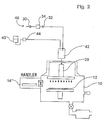
- Fig. 2 shows a schematic illustration of the CVD chamber 10 for performing an MOCVD process using a liquid precursor 40.
- the substrate 12 is placed within the CVD chamber 10.
- the substrate 12 may be introduced into the chamber 10 through the handler 14.
- the liquid precursor 40 is produced by dissolving other precursors, for example the solid precursors described above, in an organic hydrocarbon solvent.
- the liquid precursor 40 will be injected into a vaporizer 42 by a micro-pump 44.
- the liquid precursor will be vaporized to a gas state in the vaporizer and delivered into the chamber 10 by a carrier gas 46, which may also act as a reactant gas, and be at least partially incorporated into the resulting film.
- the gas valve 30 may be used to control the flow of the carrier gas into the vaporizer.
- the second valve 32 may be used to further control the flow of the carrier gas into the chamber 10.
- the mass flow controller 34 may be used to further regulate the flow into the chamber 10, possibly through a showerhead, or a gas distributor 29.
- additional gases may also be introduced.
- the additional gases may include oxygen, nitrous oxide, or other gases to be reacted during the MOCVD process, or buffer gases, such as nitrogen or argon, that aid in regulating the pressure within the chamber, or are otherwise desirable, but are not incorporated into the deposited material.
- buffer gases such as nitrogen or argon, that aid in regulating the pressure within the chamber, or are otherwise desirable, but are not incorporated into the deposited material.
- oxygen which may be incorporated into the final metal-containing film, it may be desirable to provide oxygen from another gas source to supplement oxygen already present in the precursors or to provide oxygen in the case of precursors that do not include oxygen.
- Fig. 3 shows the substrate 12 prior to MOCVD processing.
- the substrate 12, as shown comprises a substrate material 62 that has been patterned to produce a bottom electrode 64.
- An insulating layer 66 has been deposited and patterned to open a contact to the bottom electrode 64.
- the substrate material 62 may be silicon, with or without another overlying material or oxide, for example YBCO.
- the bottom electrode 64 is preferably Pt, Ir, IrO 2 , or RuO 2 , or other material that is a suitable bottom electrode for resistive memory applications. Some of these materials have been identified as providing for epitaxial or pseudo-epitaxial crystal growth for resistive memory materials.
- the substrate 12 has been shown comprising additional structures, it remains possible and within the scope of this process to use MOCVD to deposit resistive memory material onto a suitable flat substrate 12 with or without a bottom electrode.
- Fig. 4 shows the substrate 12 following processing in the MOCVD chamber.
- a layer of metal containing film 70 has been formed overlying the insulating layer 66 and the bottom electrode 64.
- the metal containing film 70 could have been formed over the substrate material 62 without any insulating layer or bottom electrode.
- the metal containing film 70 is formed by introducing the substrate 12 into the MOCVD chamber as discussed above and exposing the substrate to desired precursors.
- the substrate 12 is exposed to a combination of precursors from one or more of the classes of precursors described above, such as ⁇ -diketonates, alkoxides, or metal carbonyls, along with oxygen to form a layer of metal containing film having the general formula M' x M" (1-x) M y O z .
- This exemplary MOCVD process produces a PCMO film on a substrate.
- the substrate is placed in an MOCVD chamber.
- a liquid precursor is produced by dissolving solid precursors of Mn(tmhd) 3 , Pr(tmhd) 3 , and Ca(tmhd) 2 in a mixed solvent of butyl ether and tetraglymer.
- This liquid precursor is injected into a vaporizer and introduced into the MOCVD chamber.
- Oxygen is also introduced into the MOCVD chamber, where the precursors and oxygen react to form a PCMO film on the surface of the substrate.
- This exemplary MOCVD process produces a lathanum-calcium manganese oxide (LCMO) film on a substrate.
- the substrate is placed in an MOCVD chamber.
- a liquid precursor is produced by dissolving solid precursors of Mn(tmhd) 3 , La(tmhd) 3 , and Ca(tmhd) 2 in a mixed solvent of butyl ether and tetraglymer.
- This liquid precursor is injected into a vaporizer and introduced into the MOCVD chamber.
- Oxygen is also introduced into the MOCVD chamber, where the precursors and oxygen react to form an LCMO film on the surface of the substrate.
- This exemplary MOCVD process produces a PCMO film on a substrate.
- the substrate is placed in an MOCVD chamber.
- a liquid precursor is produced by dissolving solid precursors of Mn(tmhd) 3 , Pr(OCH(CH 3 ) 2 ) 3 , and Ca(tmhd) 2 in a mixed solvent of butyl ether and tetraglymer.
- This liquid precursor is injected into a vaporizer and introduced into the MOCVD chamber.
- Oxygen is also introduced into the MOCVD chamber, where the precursors and oxygen react to form a PCMO film on the surface of the substrate.
- This exemplary MOCVD process produces a PCMO film on a substrate.
- the substrate is placed in an MOCVD chamber.
- a liquid precursor is produced by dissolving solid precursors of Mn(CH 3 C 5 H 4 )(CO) 3 , Pr(tmhd) 3 , and Ca(tmhd) 2 in a mixed solvent of butyl ether and tetraglymer.
- This liquid precursor is injected into a vaporizer and introduced into the MOCVD chamber.
- Oxygen is also introduced into the MOCVD chamber, where the precursors and oxygen react to form a PCMO film on the surface of the substrate.
- This exemplary MOCVD process produces a PCMO film on a substrate.
- the substrate is placed in an MOCVD chamber.
- a liquid precursor is produced by dissolving solid precursors of Mn(C 5 H 5 )(CO) 3 , Pr(OCH(CH 3 ) 2 ) 3 , and Ca(tmhd) 2 in a mixed solvent of butyl ether and tetraglymer.
- This liquid precursor is injected into a vaporizer and introduced into the MOCVD chamber.
- Oxygen is also introduced into the MOCVD chamber, where the precursors and oxygen react to form a PCMO film on the surface of the substrate.
- the present invention can provide, in the field of the formation of resistive memory materials, a metal oxide thin films, metalorganic precursors, and metalorganic chemical vapor deposition (MOCVD), especially as related to the formation of resistive memory materials.
- MOCVD metalorganic chemical vapor deposition
Landscapes
- Chemical & Material Sciences (AREA)
- Engineering & Computer Science (AREA)
- Materials Engineering (AREA)
- Mechanical Engineering (AREA)
- Chemical Kinetics & Catalysis (AREA)
- General Chemical & Material Sciences (AREA)
- Inorganic Chemistry (AREA)
- Metallurgy (AREA)
- Organic Chemistry (AREA)
- Manufacturing & Machinery (AREA)
- Chemical Vapour Deposition (AREA)
- Formation Of Insulating Films (AREA)
- Semiconductor Memories (AREA)
Abstract
Description
Claims (45)
- An MOCVD process for forming a metal-containing film on a substrate comprising:a) introducing an alkoxide precursor into a reactor containing the substrate; andb) introducing a second metal-containing precursor into the reactor containing the substrate.
- The MOCVD process of claim 1, wherein the metal-containing filmhas the formula M'xM"(1-x)MyOz, wherein M' is a metal selected from the group consisting of La, Ce, Pr, Nd, Pm, Sm, Y, Sc, Yb, Lu, and Gd; M" is a metal selected from the group consisting of Mg, Ca, Sr, Ba, Pb, Zn, and Cd; M is a metal selected from the group consisting of Mn, Ce, V, Fe, Co, Nb, Ta, Cr, Mo, W, Zr, Hf and Ni; x has a value from 0 to 1; y has a value of 0, 1 or 2; and z has an integer value of 1 through 7.
- The MOCVD process of claim 2, wherein the alkoxide precursor has the formula M°(OR)v, wherein M° is selected from the group consisting of La, Pr, Nb, Ta, W, Zr, and Hf; O is oxygen; R is an alkyl; and v is 3 or 4.
- The MOCVD process of claim 3, wherein the alkyl is selected from the group consisting of C2H5, CH(CH3)2, C(CH3)3, and CH2CH2CH3.
- The MOCVD process of claim 2, wherein the alkoxide precursor has the formula VO(OR)3, wherein V is vanadium; O is oxygen; and R is an alkyl.
- The MOCVD process of claim 5, wherein the alkyl is selected from the group consisting of C2H5, CH(CH3)2, C(CH3)3, and CH2CH2CH3.
- The MOCVD process of claim 1, wherein the second metal containing precursor is a metal-β diketone precursor.
- The MOCVD process of claim 2, wherein the second metal containing precursor is a metal-β diketone precursor.
- The MOCVD process of claim 8, wherein the metal-β diketone precursor has the formula M°(tmhd)u, wherein M° is a metal selected from the group consisting of La, Ce, Pr, Nd, Pm, Sm, Y, Sc, Yb, Lu, Gd, Mg, Ca, Sr, Ba, Pb, Zn, Cd, Mn, Fe, Co, Cr, Mo, Zr, Hf, and Ni; and u is the valence of M°.
- The MOCVD process of claim 9, wherein u is 2, 3, or 4.
- The MOCVD process of claim 10, wherein the metal-β diketone precursor is dissolved in an organic hydrocarbon solvent prior to being introduced into a reactor containing the substrate.
- The MOCVD process of claim 11, wherein the organic hydrocarbon solvent is selected from the group consisting of octane, THF, butyl ether, butyl acetate, tetraglymer, and iso-propanol.
- The MOCVD process of claim 4, wherein the alkoxide precursor is dissolved in an organic hydrocarbon solvent prior to being introduced into a reactor containing the substrate.
- The MOCVD process of claim 13, wherein the organic hydrocarbon solvent is selected from the group consisting of octane, THF, butyl ether, butyl acetate, tetraglymer, and iso-propanol.
- The MOCVD process of claim 6, wherein the alkoxide precursor is dissolved in an organic hydrocarbon solvent prior to being introduced into a reactor containing the substrate.
- The MOCVD process of claim 15, wherein the organic hydrocarbon solvent is selected from the group consisting of octane, THF, butyl ether, butyl acetate, tetraglymer, and iso-propanol.
- The MOCVD process of claim 1, wherein the second metal containing precursor is a metal-carbonyl precursor.
- The MOCVD process of claim 2, wherein the second metal containing precursor is a metal-carbonyl precursor.
- The MOCVD process of claim 18, wherein the metal-carbonyl precursor has the formula M°(CO)w, wherein M° is a metal selected from the group consisting of Ni, Fe, Cr, Co and W; C is carbon; O is oxygen; and w has an integer value of 3, 4, 5, or 6.
- The MOCVD process of claim 19, wherein the metal-carbonyl precursor is dissolved in an organic hydrocarbon solvent prior to being introduced into the reactor containing the substrate.
- The MOCVD process of claim 20, wherein the organic hydrocarbon solvent is selected from the group consisting of octane, THF, butyl ether, butyl acetate, tetraglymer, and iso-propanol.
- An MOCVD process for forming a metal-containing film on a substrate comprising:a) introducing an metal-carbonyl precursor into a reactor containing the substrate; andb) introducing a second metal-containing precursor into the reactor containing the substrate.
- The MOCVD process of claim 22, wherein the metal-containing film has the formula M'xM"(1-x)MyOz, wherein M' is a metal selected from the group consisting of La, Ce, Pr, Nd, Pm, Sm, Y, Sc, Yb, Lu, and Gd; M" is a metal selected from the group consisting of Mg, Ca, Sr, Ba, Pb, Zn, and Cd; M is a metal selected from the group consisting of Mn, Ce, V, Fe, Co, Nb, Ta, Cr, Mo, W, Zr, Hf and Ni; x has a value from 0 to 1; y has a value of 0, 1 or 2; and z has an integer value of 1 through 7.
- The MOCVD process of claim 23, wherein the metal-carbonyl precursor is dissolved in an organic hydrocarbon solvent prior to being introduced into the reactor containing the substrate.
- The MOCVD process of claim 24, wherein the organic hydrocarbon solvent is selected from the group consisting of octane, THF, butyl ether, butyl acetate, tetraglymer, and iso-propanol.
- The MOCVD process of claim 23 , wherein the second metal containing precursor is a metal-β diketone precursor.
- The MOCVD process of claim 26, wherein the metal-β diketone precursor has the formula M°(tmhd)u, wherein M° is a metal selected from the group consisting of La, Ce, Pr, Nd, Pm, Sm, Y, Sc, Yb, Lu, Gd, Mg, Ca, Sr, Ba, Pb, Zn, Cd, Mn, Fe, Co, Cr, Mo, Zr, Hf, and Ni; and u is the valence of M°.
- The MOCVD process of claim 27, wherein u is 2, 3, or 4.
- The MOCVD process of claim 27, wherein the metal-β diketone precursor is dissolved in an organic hydrocarbon solvent prior to being introduced into the reactor containing the substrate.
- The MOCVD process of claim 29, wherein the organic hydrocarbon solvent is selected from the group consisting of octane, THF, butyl ether, butyl acetate, tetraglymer, and iso-propanol.
- The MOCVD process of claim 23, wherein the metal-carbonyl containing precursor has the formula M°(CO)w, wherein M° is a metal selected from the group consisting of Ni, Fe, Cr, Co and W; C is carbon; O is oxygen; and w has an integer value of 3, 4, 5, or 6.
- An MOCVD process for forming a metal-containing film, having a formula M'xM"(1-x)MyOz, wherein M' is a metal selected from the group consisting of La, Ce, Pr, Nd, Pm, Sm, Y, Sc, Yb, Lu, and Gd; M" is a metal selected from the group consisting of Mg, Ca, Sr, Ba, Pb, Zn and Cd; M is a metal selected from the group consisting of Mn, Ce, V, Fe, Co, Nb, Ta, Cr, Mo, W, Zr, Hf and Ni; x has a value from 0 and 1; y has a value of 0, 1 or 2; and z has an integer value of 1 through 7, on a substrate, comprising:a) introducing a metal-β diketone precursor having the formula M°(tmhd)u, wherein M° is a metal selected from the group consisting of La, Ce, Pr, Nd, Pm, Sm, Y, Sc, Yb, Lu, Gd, Mg, Ca, Sr, Ba, Pb, Zn, Cd, Mn, Fe, Co, Cr, Mo, Zr, Hf, and Ni; and u has a value of 2, 3 or 4, into an MOCVD chamber containing the substrate;b) introducing asecond metal-containingprecursor, wherein the second metal containing precursor is an alkoxide precursor or a metal-carbonyl precursor, into the MOCVD chamber containing the substrate; andc) introducing oxygen into the MOCVD chamber containing the substrate.
- The MOCVD process of claim 32, wherein the alkoxide precursor has the formula M°(OR)v, wherein M° is a metal selected from the group consisting of La, Pr, Nb, Ta, W, Zr, and Hf; and R is an alkyl.
- The MOCVD process of claim 33, wherein the alkyl is selected from the group consisting of C2H5, CH(CH3)2, C(CH3)3, and CH2CH2CH3.
- The MOCVD process of claim 32, wherein the alkoxide precursor has the formula VO(OR)3, wherein R is an alkyl.
- The MOCVD process of claim 35, wherein the alkyl is selected from the group consisting of C2H5, CH(CH3)2, C(CH3)3, and CH2CH2CH3.
- The MOCVD process of claim 32, wherein the metal-carbonyl precursor has the formula M°(CO)w, wherein M° is a metal selected from the group consisting of Ni, Fe, Cr, Co and W; C is carbon; O is oxygen; and w has an integer value of 3, 4, 5, or 6.
- The MOCVD process of claim 32, wherein the metal-β diketone precursor is dissolved in an organic hydrocarbon solvent, selected from the group consisting of octane, THF, butyl ether, butyl acetate, tetraglymer, and iso-propanol, prior to being introduced into the MOCVD chamber containing the substrate.
- The MOCVD process of claim 32, wherein the alkoxide precursor is dissolved in an organic hydrocarbon solvent, selected from the group consisting of octane, THF, butyl ether, butyl acetate, tetraglymer, and iso-propanol, prior to being introduced into the MOCVD chamber containing the substrate.
- The MOCVD process of claim 32, wherein the metal-carbonyl precursor is dissolved in an organic hydrocarbon solvent, selected from the group consisting of octane, THF, butyl ether, butyl acetate, tetraglymer, and iso-propanol, prior to being introduced into the MOCVD chamber containing the substrate.
- The MOCVD process of claim 32, further comprising forming a bottom electrode on the substrate prior to introducing any precursor, wherein the bottom electrode is Pt, Ir, IrO2 or RuO2.
- The MOCVD process of claim 32, further comprising introducing another oxygen source into the MOCVD chamber containing the substrate.
- The MOCVD process of claim 32, wherein the metal-β diketone precursor is Mn(tmhd)3, the second metal-containing precursor is an alkoxide precursor comprising Pr(OCH(CH3)2)3, and further comprising a second metal-β diketone precursor Ca(tmhd)2, whereby the metal containing film that is formed is PCMO.
- The MOCVD process of claim 32, wherein the metal-β diketone precursor is Pr(tmhd)3, the second metal-containing precursor is a metal-carbonyl precursor comprising Mn(CH3C5H4)(CO)3, and further comprising a second metal-β diketone precursor Ca(tmhd)2, whereby the metal containing film that is formed is PCMO.
- The MOCVD process of claim 32, wherein the metal-β diketone precursor is Ca(tmhd)2, the second metal-containing precursor is a metal-carbonyl precursor comprising Mn(C5H5)(CO)3, and further comprising a third precursor that is an alkoxide precursor comprising Pr(OCH(CH3)2)3, whereby the metal containing film that is formed is PCMO.
Applications Claiming Priority (2)
| Application Number | Priority Date | Filing Date | Title |
|---|---|---|---|
| US326347 | 1999-06-04 | ||
| US10/326,347 US6887523B2 (en) | 2002-12-20 | 2002-12-20 | Method for metal oxide thin film deposition via MOCVD |
Publications (2)
| Publication Number | Publication Date |
|---|---|
| EP1433874A2 true EP1433874A2 (en) | 2004-06-30 |
| EP1433874A3 EP1433874A3 (en) | 2004-08-11 |
Family
ID=32468984
Family Applications (1)
| Application Number | Title | Priority Date | Filing Date |
|---|---|---|---|
| EP03258031A Ceased EP1433874A3 (en) | 2002-12-20 | 2003-12-19 | Method for metal oxide thin film deposition via MOCVD |
Country Status (6)
| Country | Link |
|---|---|
| US (1) | US6887523B2 (en) |
| EP (1) | EP1433874A3 (en) |
| JP (1) | JP2004204348A (en) |
| KR (1) | KR100696920B1 (en) |
| CN (1) | CN1262683C (en) |
| TW (1) | TWI283713B (en) |
Cited By (3)
| Publication number | Priority date | Publication date | Assignee | Title |
|---|---|---|---|---|
| DE102004005385A1 (en) * | 2004-02-03 | 2005-10-20 | Infineon Technologies Ag | Use of dissolved hafnium alkoxides or zirconium alkoxides as precursors for hafnium oxide and hafnium oxynitride layers or zirconium oxide and zirconium oxynitride layers |
| WO2008058264A3 (en) * | 2006-11-08 | 2008-09-04 | Symetrix Corp | Correlated electron memory |
| US7722926B2 (en) | 2005-08-02 | 2010-05-25 | Samsung Electronics Co., Ltd. | Organometallic compounds and methods of forming thin films including the use of the same |
Families Citing this family (36)
| Publication number | Priority date | Publication date | Assignee | Title |
|---|---|---|---|---|
| KR100773537B1 (en) | 2003-06-03 | 2007-11-07 | 삼성전자주식회사 | Non-volatile memory device including one switching element and one resistor, and manufacturing method thereof |
| CN100545303C (en) | 2003-08-20 | 2009-09-30 | 维高仪器股份有限公司 | Alkyl Squeeze Flow for Vertical Flow Rotating Disk Reactors |
| US6962648B2 (en) * | 2003-09-15 | 2005-11-08 | Global Silicon Net Corp. | Back-biased face target sputtering |
| US7402456B2 (en) * | 2004-04-23 | 2008-07-22 | Sharp Laboratories Of America, Inc. | PCMO thin film with memory resistance properties |
| JP4565897B2 (en) * | 2004-06-14 | 2010-10-20 | 株式会社Adeka | Thin film forming raw material and thin film manufacturing method |
| US20060068099A1 (en) * | 2004-09-30 | 2006-03-30 | Sharp Laboratories Of America, Inc. | Grading PrxCa1-xMnO3 thin films by metalorganic chemical vapor deposition |
| US7425504B2 (en) * | 2004-10-15 | 2008-09-16 | 4D-S Pty Ltd. | Systems and methods for plasma etching |
| US20060081467A1 (en) * | 2004-10-15 | 2006-04-20 | Makoto Nagashima | Systems and methods for magnetron deposition |
| US20060081466A1 (en) * | 2004-10-15 | 2006-04-20 | Makoto Nagashima | High uniformity 1-D multiple magnet magnetron source |
| JP4632765B2 (en) * | 2004-10-21 | 2011-02-16 | 株式会社Adeka | Alkoxide compound, raw material for thin film formation, and method for producing thin film |
| KR100682926B1 (en) | 2005-01-31 | 2007-02-15 | 삼성전자주식회사 | Nonvolatile Memory Device Using Resistor and Manufacturing Method Thereof |
| US20060182886A1 (en) * | 2005-02-15 | 2006-08-17 | Guidotti Emmanuel P | Method and system for improved delivery of a precursor vapor to a processing zone |
| US7566477B2 (en) * | 2005-03-31 | 2009-07-28 | Tokyo Electron Limited | Method for saturating a carrier gas with precursor vapor |
| US20100270004A1 (en) * | 2005-05-12 | 2010-10-28 | Landess James D | Tailored profile pedestal for thermo-elastically stable cooling or heating of substrates |
| US7833904B2 (en) * | 2005-06-16 | 2010-11-16 | The Trustees Of Columbia University In The City Of New York | Methods for fabricating nanoscale electrodes and uses thereof |
| JP4783070B2 (en) * | 2005-06-24 | 2011-09-28 | シャープ株式会社 | Semiconductor memory device and manufacturing method thereof |
| JPWO2007026509A1 (en) * | 2005-08-29 | 2009-03-05 | シャープ株式会社 | Variable resistance element and manufacturing method thereof |
| US8395199B2 (en) | 2006-03-25 | 2013-03-12 | 4D-S Pty Ltd. | Systems and methods for fabricating self-aligned memory cell |
| US8454810B2 (en) | 2006-07-14 | 2013-06-04 | 4D-S Pty Ltd. | Dual hexagonal shaped plasma source |
| US7932548B2 (en) | 2006-07-14 | 2011-04-26 | 4D-S Pty Ltd. | Systems and methods for fabricating self-aligned memory cell |
| US20080011603A1 (en) * | 2006-07-14 | 2008-01-17 | Makoto Nagashima | Ultra high vacuum deposition of PCMO material |
| KR100824294B1 (en) * | 2006-08-01 | 2008-04-22 | 한국화학연구원 | Method for manufacturing iron oxide thin film for nonvolatile REMA elements by chemical vapor deposition |
| US8308915B2 (en) | 2006-09-14 | 2012-11-13 | 4D-S Pty Ltd. | Systems and methods for magnetron deposition |
| KR101501888B1 (en) * | 2006-10-06 | 2015-03-11 | 비코 인스트루먼츠 인코포레이티드 | Density-matching alkyl push flow for vertical flow rotating disk reactors |
| US8018760B2 (en) | 2006-12-28 | 2011-09-13 | Panasonic Corporation | Resistance variable element and resistance variable memory apparatus |
| US7883745B2 (en) | 2007-07-30 | 2011-02-08 | Micron Technology, Inc. | Chemical vaporizer for material deposition systems and associated methods |
| TWI472882B (en) * | 2008-05-06 | 2015-02-11 | 諾菲勒斯系統公司 | Photoresist stripping method and device |
| US8033771B1 (en) | 2008-12-11 | 2011-10-11 | Novellus Systems, Inc. | Minimum contact area wafer clamping with gas flow for rapid wafer cooling |
| JP5530118B2 (en) * | 2009-04-08 | 2014-06-25 | 東京エレクトロン株式会社 | Method for forming manganese oxide film, method for manufacturing semiconductor device, and semiconductor device |
| US9303319B2 (en) | 2010-12-17 | 2016-04-05 | Veeco Instruments Inc. | Gas injection system for chemical vapor deposition using sequenced valves |
| US8371567B2 (en) | 2011-04-13 | 2013-02-12 | Novellus Systems, Inc. | Pedestal covers |
| WO2013103594A1 (en) | 2012-01-06 | 2013-07-11 | Novellus Systems, Inc. | Adaptive heat transfer methods and systems for uniform heat transfer |
| JP5949586B2 (en) * | 2013-01-31 | 2016-07-06 | 東京エレクトロン株式会社 | Raw material gas supply apparatus, film forming apparatus, raw material supply method, and storage medium |
| US10347547B2 (en) | 2016-08-09 | 2019-07-09 | Lam Research Corporation | Suppressing interfacial reactions by varying the wafer temperature throughout deposition |
| KR102814796B1 (en) | 2019-07-26 | 2025-05-29 | 삼성전자주식회사 | Method of forming binary oxide film, method of fabricating semiconductor device, method of forming dielectric film, and semiconductor device |
| FI20205101A1 (en) * | 2020-01-31 | 2021-08-01 | Turun Yliopisto | Novel thin film material for memristor, and a memristor comprising such material |
Family Cites Families (15)
| Publication number | Priority date | Publication date | Assignee | Title |
|---|---|---|---|---|
| US3100212A (en) * | 1960-01-12 | 1963-08-06 | Ethyl Corp | Process of preparing dihydropentalenyl manganese tricarbonyl |
| US3702336A (en) * | 1970-12-10 | 1972-11-07 | Du Pont | Reaction products of ketones with carbonyl-ph3 complexes of chromium,molybdenum,and tungsten |
| US5840897A (en) * | 1990-07-06 | 1998-11-24 | Advanced Technology Materials, Inc. | Metal complex source reagents for chemical vapor deposition |
| US5820664A (en) * | 1990-07-06 | 1998-10-13 | Advanced Technology Materials, Inc. | Precursor compositions for chemical vapor deposition, and ligand exchange resistant metal-organic precursor solutions comprising same |
| US5204313A (en) * | 1990-12-07 | 1993-04-20 | Eastman Kodak Company | Process of forming a high temperature superconductor on a metal substrate surface |
| JPH05247650A (en) * | 1992-03-02 | 1993-09-24 | Nikko Kyodo Co Ltd | Metallic alkoxyd composition for chemical vapor deposition and manufacture of insulated film using same |
| US20030152813A1 (en) * | 1992-10-23 | 2003-08-14 | Symetrix Corporation | Lanthanide series layered superlattice materials for integrated circuit appalications |
| US6344079B1 (en) * | 1995-03-31 | 2002-02-05 | Advanced Technology Materials, Inc. | Alkane and polyamine solvent compositions for liquid delivery chemical vapor deposition |
| US6444264B2 (en) * | 1995-03-31 | 2002-09-03 | Advanced Technology Materials, Inc. | Method for liquid delivery CVD utilizing alkane and polyamine solvent compositions |
| JP3195265B2 (en) * | 1997-01-18 | 2001-08-06 | 東京応化工業株式会社 | Coating solution for forming Bi-based ferroelectric thin film, ferroelectric thin film formed using the same, and ferroelectric memory |
| US6204139B1 (en) * | 1998-08-25 | 2001-03-20 | University Of Houston | Method for switching the properties of perovskite materials used in thin film resistors |
| US6238734B1 (en) * | 1999-07-08 | 2001-05-29 | Air Products And Chemicals, Inc. | Liquid precursor mixtures for deposition of multicomponent metal containing materials |
| US6503561B1 (en) * | 1999-07-08 | 2003-01-07 | Air Products And Chemicals, Inc. | Liquid precursor mixtures for deposition of multicomponent metal containing materials |
| US6500499B1 (en) * | 2000-03-10 | 2002-12-31 | Air Products And Chemicals, Inc. | Deposition and annealing of multicomponent ZrSnTi and HfSnTi oxide thin films using solventless liquid mixture of precursors |
| US6503314B1 (en) * | 2000-08-28 | 2003-01-07 | Sharp Laboratories Of America, Inc. | MOCVD ferroelectric and dielectric thin films depositions using mixed solvents |
-
2002
- 2002-12-20 US US10/326,347 patent/US6887523B2/en not_active Expired - Lifetime
-
2003
- 2003-11-19 JP JP2003390014A patent/JP2004204348A/en active Pending
- 2003-11-27 TW TW092133414A patent/TWI283713B/en not_active IP Right Cessation
- 2003-12-13 KR KR1020030090950A patent/KR100696920B1/en not_active Expired - Fee Related
- 2003-12-19 EP EP03258031A patent/EP1433874A3/en not_active Ceased
- 2003-12-22 CN CNB2003101232900A patent/CN1262683C/en not_active Expired - Fee Related
Cited By (3)
| Publication number | Priority date | Publication date | Assignee | Title |
|---|---|---|---|---|
| DE102004005385A1 (en) * | 2004-02-03 | 2005-10-20 | Infineon Technologies Ag | Use of dissolved hafnium alkoxides or zirconium alkoxides as precursors for hafnium oxide and hafnium oxynitride layers or zirconium oxide and zirconium oxynitride layers |
| US7722926B2 (en) | 2005-08-02 | 2010-05-25 | Samsung Electronics Co., Ltd. | Organometallic compounds and methods of forming thin films including the use of the same |
| WO2008058264A3 (en) * | 2006-11-08 | 2008-09-04 | Symetrix Corp | Correlated electron memory |
Also Published As
| Publication number | Publication date |
|---|---|
| US6887523B2 (en) | 2005-05-03 |
| CN1510162A (en) | 2004-07-07 |
| KR20040055594A (en) | 2004-06-26 |
| TWI283713B (en) | 2007-07-11 |
| CN1262683C (en) | 2006-07-05 |
| US20040121074A1 (en) | 2004-06-24 |
| TW200424338A (en) | 2004-11-16 |
| EP1433874A3 (en) | 2004-08-11 |
| KR100696920B1 (en) | 2007-03-20 |
| JP2004204348A (en) | 2004-07-22 |
Similar Documents
| Publication | Publication Date | Title |
|---|---|---|
| US6887523B2 (en) | Method for metal oxide thin film deposition via MOCVD | |
| Coll et al. | Atomic layer deposition of functional multicomponent oxides | |
| US6238734B1 (en) | Liquid precursor mixtures for deposition of multicomponent metal containing materials | |
| KR100399478B1 (en) | Liquid precursor mixtures for deposition of multicomponent metal containing materials | |
| US5972430A (en) | Digital chemical vapor deposition (CVD) method for forming a multi-component oxide layer | |
| US7696550B2 (en) | Bipolar switching PCMO capacitor | |
| WO2011106072A2 (en) | Use of ruthenium tetroxide as a precursor and reactant for thin film depositions | |
| Lo Presti et al. | Metal‐organic chemical vapor deposition of oxide perovskite films: a facile route to complex functional systems | |
| US20060068099A1 (en) | Grading PrxCa1-xMnO3 thin films by metalorganic chemical vapor deposition | |
| WO2001045864A1 (en) | Low temperature process for high density thin film integrated capacitors, and amorphously frustrated ferroelectric materials therefor | |
| KR101096227B1 (en) | Method for formimg multicomponent conductive oxide and method for manufacturing capacitor using the same | |
| JP3500787B2 (en) | Method for producing bismuth compound and dielectric substance of bismuth compound | |
| CN1453832A (en) | Gas phase growth method of oxidative dielectric thin film | |
| EP1120475A1 (en) | A method and system for MOCVD of PGO films | |
| JP4153333B2 (en) | Method for producing oxide thin film | |
| Shin et al. | Compositional Control of Ferroelectric SrBi2Ta2 O 9 Thin Films by Liquid Delivery MOCVD Using a Single Cocktail of Sr [Ta (OEt) 5 (dmae)] 2 and Bi (C 6 H 5) 3 | |
| KR100497926B1 (en) | Method for manufacturing a ferroelectric thin film and source material for metal organic chemical vapor deposition | |
| JP3104613B2 (en) | Method for producing bismuth layered compound | |
| Chen et al. | Metalorganic Chemical Vapor Deposition of Thin Film ZrO2 and Pb (Zr, Ti) O3: Precursor Chemistry and Process Characteristics | |
| Buskirk et al. | Common and unique aspects of perovskite thin film CVD processes | |
| KR100400219B1 (en) | Precursor composition for forming PZT film and a reservoir of the same | |
| Tavares | Deposition of ceramic oxide thin films by metalorganic chemical vapour deposition | |
| KR100480501B1 (en) | Process for the formation of pzt thin film by metal-organic chemical vapor deposition | |
| JPH0959089A (en) | Chemical vapor deposition method | |
| Isobe et al. | Characteristics of ferroelectric SrBi2Ta2O9 thin films grown by “flash” MOCVD |
Legal Events
| Date | Code | Title | Description |
|---|---|---|---|
| PUAI | Public reference made under article 153(3) epc to a published international application that has entered the european phase |
Free format text: ORIGINAL CODE: 0009012 |
|
| PUAL | Search report despatched |
Free format text: ORIGINAL CODE: 0009013 |
|
| AK | Designated contracting states |
Kind code of ref document: A2 Designated state(s): AT BE BG CH CY CZ DE DK EE ES FI FR GB GR HU IE IT LI LU MC NL PT RO SE SI SK TR |
|
| AX | Request for extension of the european patent |
Extension state: AL LT LV MK |
|
| RIC1 | Information provided on ipc code assigned before grant |
Ipc: 7C 23C 16/18 A |
|
| AK | Designated contracting states |
Kind code of ref document: A3 Designated state(s): AT BE BG CH CY CZ DE DK EE ES FI FR GB GR HU IE IT LI LU MC NL PT RO SE SI SK TR |
|
| AX | Request for extension of the european patent |
Extension state: AL LT LV MK |
|
| 17P | Request for examination filed |
Effective date: 20050210 |
|
| AKX | Designation fees paid |
Designated state(s): DE FR GB IT |
|
| APBN | Date of receipt of notice of appeal recorded |
Free format text: ORIGINAL CODE: EPIDOSNNOA2E |
|
| APAF | Appeal reference modified |
Free format text: ORIGINAL CODE: EPIDOSCREFNE |
|
| APBT | Appeal procedure closed |
Free format text: ORIGINAL CODE: EPIDOSNNOA9E |
|
| STAA | Information on the status of an ep patent application or granted ep patent |
Free format text: STATUS: THE APPLICATION HAS BEEN REFUSED |
|
| 18R | Application refused |
Effective date: 20070315 |