EP1433820A1 - Bichromophoric molecules - Google Patents
Bichromophoric molecules Download PDFInfo
- Publication number
- EP1433820A1 EP1433820A1 EP03079080A EP03079080A EP1433820A1 EP 1433820 A1 EP1433820 A1 EP 1433820A1 EP 03079080 A EP03079080 A EP 03079080A EP 03079080 A EP03079080 A EP 03079080A EP 1433820 A1 EP1433820 A1 EP 1433820A1
- Authority
- EP
- European Patent Office
- Prior art keywords
- molecule
- chromophore
- group
- colorant
- carbon atoms
- Prior art date
- Legal status (The legal status is an assumption and is not a legal conclusion. Google has not performed a legal analysis and makes no representation as to the accuracy of the status listed.)
- Withdrawn
Links
- 238000010521 absorption reaction Methods 0.000 claims abstract description 29
- 125000001424 substituent group Chemical group 0.000 claims description 17
- 125000004432 carbon atom Chemical group C* 0.000 claims description 16
- 125000002837 carbocyclic group Chemical group 0.000 claims description 8
- 125000000623 heterocyclic group Chemical group 0.000 claims description 7
- 229910052739 hydrogen Inorganic materials 0.000 claims description 6
- 239000001257 hydrogen Substances 0.000 claims description 6
- 125000000217 alkyl group Chemical group 0.000 claims description 5
- 125000003118 aryl group Chemical group 0.000 claims description 5
- 125000000753 cycloalkyl group Chemical group 0.000 claims description 4
- 229910052736 halogen Inorganic materials 0.000 claims description 4
- 150000002367 halogens Chemical class 0.000 claims description 4
- 125000003341 7 membered heterocyclic group Chemical group 0.000 claims description 3
- UFHFLCQGNIYNRP-UHFFFAOYSA-N Hydrogen Chemical compound [H][H] UFHFLCQGNIYNRP-UHFFFAOYSA-N 0.000 claims description 3
- 125000004093 cyano group Chemical group *C#N 0.000 claims description 3
- 125000001960 7 membered carbocyclic group Chemical group 0.000 claims description 2
- 150000001450 anions Chemical class 0.000 claims description 2
- 239000006185 dispersion Substances 0.000 claims description 2
- 239000000725 suspension Substances 0.000 claims description 2
- 150000002431 hydrogen Chemical class 0.000 claims 1
- 239000003086 colorant Substances 0.000 description 90
- -1 3-(2,4-di-t-pentylphenoxy) propyl Chemical group 0.000 description 71
- 239000000203 mixture Substances 0.000 description 12
- 0 CCCC*C(CCCC)Cc(cc1)ccc1C(c1ccc(CN([C@@](C2C#N)N=Nc(cc3OC)c(*)cc3N(CC)CC)N=C2C(C)(C)C)cc1)=CC=C[C@@](C(C=C1)C=CC1=C)c1ccc(C[n]2nc(C(C)(C)C)c(C)c2N=Nc(c(*)c2)cc(C#N)c2N(CC)CC)cc1 Chemical compound CCCC*C(CCCC)Cc(cc1)ccc1C(c1ccc(CN([C@@](C2C#N)N=Nc(cc3OC)c(*)cc3N(CC)CC)N=C2C(C)(C)C)cc1)=CC=C[C@@](C(C=C1)C=CC1=C)c1ccc(C[n]2nc(C(C)(C)C)c(C)c2N=Nc(c(*)c2)cc(C#N)c2N(CC)CC)cc1 0.000 description 11
- 230000000052 comparative effect Effects 0.000 description 10
- 150000001875 compounds Chemical class 0.000 description 8
- 230000003287 optical effect Effects 0.000 description 7
- 238000012546 transfer Methods 0.000 description 7
- QTBSBXVTEAMEQO-UHFFFAOYSA-N Acetic acid Chemical compound CC(O)=O QTBSBXVTEAMEQO-UHFFFAOYSA-N 0.000 description 6
- XEKOWRVHYACXOJ-UHFFFAOYSA-N Ethyl acetate Chemical compound CCOC(C)=O XEKOWRVHYACXOJ-UHFFFAOYSA-N 0.000 description 6
- LFQSCWFLJHTTHZ-UHFFFAOYSA-N Ethanol Chemical compound CCO LFQSCWFLJHTTHZ-UHFFFAOYSA-N 0.000 description 5
- IJGRMHOSHXDMSA-UHFFFAOYSA-N Atomic nitrogen Chemical compound N#N IJGRMHOSHXDMSA-UHFFFAOYSA-N 0.000 description 4
- RTZKZFJDLAIYFH-UHFFFAOYSA-N Diethyl ether Chemical compound CCOCC RTZKZFJDLAIYFH-UHFFFAOYSA-N 0.000 description 4
- IMNFDUFMRHMDMM-UHFFFAOYSA-N N-Heptane Chemical compound CCCCCCC IMNFDUFMRHMDMM-UHFFFAOYSA-N 0.000 description 4
- 238000011109 contamination Methods 0.000 description 4
- 239000000976 ink Substances 0.000 description 4
- 238000000034 method Methods 0.000 description 4
- 239000007787 solid Substances 0.000 description 4
- IAZDPXIOMUYVGZ-UHFFFAOYSA-N Dimethylsulphoxide Chemical compound CS(C)=O IAZDPXIOMUYVGZ-UHFFFAOYSA-N 0.000 description 3
- OKKJLVBELUTLKV-UHFFFAOYSA-N Methanol Chemical compound OC OKKJLVBELUTLKV-UHFFFAOYSA-N 0.000 description 3
- YXFVVABEGXRONW-UHFFFAOYSA-N Toluene Chemical compound CC1=CC=CC=C1 YXFVVABEGXRONW-UHFFFAOYSA-N 0.000 description 3
- 238000006243 chemical reaction Methods 0.000 description 3
- 238000003384 imaging method Methods 0.000 description 3
- 239000000463 material Substances 0.000 description 3
- 238000002360 preparation method Methods 0.000 description 3
- 238000010992 reflux Methods 0.000 description 3
- XLYOFNOQVPJJNP-UHFFFAOYSA-N water Substances O XLYOFNOQVPJJNP-UHFFFAOYSA-N 0.000 description 3
- NINIDFKCEFEMDL-UHFFFAOYSA-N Sulfur Chemical compound [S] NINIDFKCEFEMDL-UHFFFAOYSA-N 0.000 description 2
- QVGXLLKOCUKJST-UHFFFAOYSA-N atomic oxygen Chemical compound [O] QVGXLLKOCUKJST-UHFFFAOYSA-N 0.000 description 2
- 230000000903 blocking effect Effects 0.000 description 2
- IAQRGUVFOMOMEM-UHFFFAOYSA-N but-2-ene Chemical compound CC=CC IAQRGUVFOMOMEM-UHFFFAOYSA-N 0.000 description 2
- 239000011248 coating agent Substances 0.000 description 2
- 238000000576 coating method Methods 0.000 description 2
- IRUNKQSGDBYUDC-UHFFFAOYSA-N diethoxymethyl acetate Chemical compound CCOC(OCC)OC(C)=O IRUNKQSGDBYUDC-UHFFFAOYSA-N 0.000 description 2
- 125000001495 ethyl group Chemical group [H]C([H])([H])C([H])([H])* 0.000 description 2
- 125000004435 hydrogen atom Chemical class [H]* 0.000 description 2
- 125000001165 hydrophobic group Chemical group 0.000 description 2
- 239000005457 ice water Substances 0.000 description 2
- 229910052757 nitrogen Inorganic materials 0.000 description 2
- 229910052760 oxygen Inorganic materials 0.000 description 2
- 239000001301 oxygen Substances 0.000 description 2
- 230000003381 solubilizing effect Effects 0.000 description 2
- 239000002904 solvent Substances 0.000 description 2
- 238000001228 spectrum Methods 0.000 description 2
- 229910052717 sulfur Inorganic materials 0.000 description 2
- 239000011593 sulfur Substances 0.000 description 2
- 125000004149 thio group Chemical group *S* 0.000 description 2
- ITMCEJHCFYSIIV-UHFFFAOYSA-N triflic acid Chemical compound OS(=O)(=O)C(F)(F)F ITMCEJHCFYSIIV-UHFFFAOYSA-N 0.000 description 2
- BWHDROKFUHTORW-UHFFFAOYSA-N tritert-butylphosphane Chemical compound CC(C)(C)P(C(C)(C)C)C(C)(C)C BWHDROKFUHTORW-UHFFFAOYSA-N 0.000 description 2
- 125000002941 2-furyl group Chemical group O1C([*])=C([H])C([H])=C1[H] 0.000 description 1
- WRBRIRNGWAUZRF-UHFFFAOYSA-N 2-methyl-2-[(2-methylpropan-2-yl)oxy]propane;sodium Chemical compound [Na].CC(C)(C)OC(C)(C)C WRBRIRNGWAUZRF-UHFFFAOYSA-N 0.000 description 1
- 125000000175 2-thienyl group Chemical group S1C([*])=C([H])C([H])=C1[H] 0.000 description 1
- AJDKZWLPPHJPOJ-UHFFFAOYSA-N C=1C=CC=C(Cl)C=1NN(CC)CC(C=1C=CC=CC=1)NC1=CC=CC=C1 Chemical compound C=1C=CC=C(Cl)C=1NN(CC)CC(C=1C=CC=CC=1)NC1=CC=CC=C1 AJDKZWLPPHJPOJ-UHFFFAOYSA-N 0.000 description 1
- KIBHQULPSKPCLW-NLGBLNBJSA-N CC(C/C=C(\CC1)/C(N(CCNS(C)(=O)=O)c2ccccc2)=C1/C=C/C=C(/C(c(cc1)ccc1NS(C)(=O)=O)=C(C#N)C#N)\C#N)/C(/C#N)=C(\[C-](C#N)C#N)/c(cc1)ccc1NS(C)(=O)=O Chemical compound CC(C/C=C(\CC1)/C(N(CCNS(C)(=O)=O)c2ccccc2)=C1/C=C/C=C(/C(c(cc1)ccc1NS(C)(=O)=O)=C(C#N)C#N)\C#N)/C(/C#N)=C(\[C-](C#N)C#N)/c(cc1)ccc1NS(C)(=O)=O KIBHQULPSKPCLW-NLGBLNBJSA-N 0.000 description 1
- OKTJSMMVPCPJKN-UHFFFAOYSA-N Carbon Chemical compound [C] OKTJSMMVPCPJKN-UHFFFAOYSA-N 0.000 description 1
- 229920008347 Cellulose acetate propionate Polymers 0.000 description 1
- KKUKTXOBAWVSHC-UHFFFAOYSA-N Dimethylphosphate Chemical compound COP(O)(=O)OC KKUKTXOBAWVSHC-UHFFFAOYSA-N 0.000 description 1
- VGGSQFUCUMXWEO-UHFFFAOYSA-N Ethene Chemical compound C=C VGGSQFUCUMXWEO-UHFFFAOYSA-N 0.000 description 1
- 239000005977 Ethylene Substances 0.000 description 1
- NTIZESTWPVYFNL-UHFFFAOYSA-N Methyl isobutyl ketone Chemical compound CC(C)CC(C)=O NTIZESTWPVYFNL-UHFFFAOYSA-N 0.000 description 1
- UIHCLUNTQKBZGK-UHFFFAOYSA-N Methyl isobutyl ketone Natural products CCC(C)C(C)=O UIHCLUNTQKBZGK-UHFFFAOYSA-N 0.000 description 1
- 229910019142 PO4 Inorganic materials 0.000 description 1
- VYPSYNLAJGMNEJ-UHFFFAOYSA-N Silicium dioxide Chemical compound O=[Si]=O VYPSYNLAJGMNEJ-UHFFFAOYSA-N 0.000 description 1
- XUIMIQQOPSSXEZ-UHFFFAOYSA-N Silicon Chemical compound [Si] XUIMIQQOPSSXEZ-UHFFFAOYSA-N 0.000 description 1
- KEAYESYHFKHZAL-UHFFFAOYSA-N Sodium Chemical compound [Na] KEAYESYHFKHZAL-UHFFFAOYSA-N 0.000 description 1
- PMZURENOXWZQFD-UHFFFAOYSA-L Sodium Sulfate Chemical compound [Na+].[Na+].[O-]S([O-])(=O)=O PMZURENOXWZQFD-UHFFFAOYSA-L 0.000 description 1
- 239000011358 absorbing material Substances 0.000 description 1
- 125000002777 acetyl group Chemical group [H]C([H])([H])C(*)=O 0.000 description 1
- 125000002252 acyl group Chemical group 0.000 description 1
- 125000004423 acyloxy group Chemical group 0.000 description 1
- 125000003342 alkenyl group Chemical group 0.000 description 1
- 125000003545 alkoxy group Chemical group 0.000 description 1
- 150000001412 amines Chemical class 0.000 description 1
- 125000004397 aminosulfonyl group Chemical group NS(=O)(=O)* 0.000 description 1
- 238000013459 approach Methods 0.000 description 1
- 125000004104 aryloxy group Chemical group 0.000 description 1
- 125000004429 atom Chemical group 0.000 description 1
- 210000003323 beak Anatomy 0.000 description 1
- 125000001584 benzyloxycarbonyl group Chemical group C(=O)(OCC1=CC=CC=C1)* 0.000 description 1
- 239000011230 binding agent Substances 0.000 description 1
- 230000015572 biosynthetic process Effects 0.000 description 1
- 125000001246 bromo group Chemical group Br* 0.000 description 1
- 125000004744 butyloxycarbonyl group Chemical group 0.000 description 1
- 125000003917 carbamoyl group Chemical group [H]N([H])C(*)=O 0.000 description 1
- 229910052799 carbon Inorganic materials 0.000 description 1
- 125000006297 carbonyl amino group Chemical group [H]N([*:2])C([*:1])=O 0.000 description 1
- 125000003178 carboxy group Chemical group [H]OC(*)=O 0.000 description 1
- 125000001309 chloro group Chemical group Cl* 0.000 description 1
- 238000004737 colorimetric analysis Methods 0.000 description 1
- 125000000113 cyclohexyl group Chemical group [H]C1([H])C([H])([H])C([H])([H])C([H])(*)C([H])([H])C1([H])[H] 0.000 description 1
- 125000004177 diethyl group Chemical group [H]C([H])([H])C([H])([H])* 0.000 description 1
- XNMQEEKYCVKGBD-UHFFFAOYSA-N dimethylacetylene Natural products CC#CC XNMQEEKYCVKGBD-UHFFFAOYSA-N 0.000 description 1
- JRBPAEWTRLWTQC-UHFFFAOYSA-N dodecylamine Chemical compound CCCCCCCCCCCCN JRBPAEWTRLWTQC-UHFFFAOYSA-N 0.000 description 1
- 230000005670 electromagnetic radiation Effects 0.000 description 1
- 238000005516 engineering process Methods 0.000 description 1
- 125000003754 ethoxycarbonyl group Chemical group C(=O)(OCC)* 0.000 description 1
- 238000001914 filtration Methods 0.000 description 1
- 125000001153 fluoro group Chemical group F* 0.000 description 1
- 125000000524 functional group Chemical group 0.000 description 1
- 238000010438 heat treatment Methods 0.000 description 1
- 125000005842 heteroatom Chemical group 0.000 description 1
- BHEPBYXIRTUNPN-UHFFFAOYSA-N hydridophosphorus(.) (triplet) Chemical compound [PH] BHEPBYXIRTUNPN-UHFFFAOYSA-N 0.000 description 1
- 230000002209 hydrophobic effect Effects 0.000 description 1
- 125000002887 hydroxy group Chemical group [H]O* 0.000 description 1
- 125000001841 imino group Chemical group [H]N=* 0.000 description 1
- 238000010348 incorporation Methods 0.000 description 1
- 230000031700 light absorption Effects 0.000 description 1
- 125000002496 methyl group Chemical group [H]C([H])([H])* 0.000 description 1
- 125000006216 methylsulfinyl group Chemical group [H]C([H])([H])S(*)=O 0.000 description 1
- 125000004170 methylsulfonyl group Chemical group [H]C([H])([H])S(*)(=O)=O 0.000 description 1
- 238000013508 migration Methods 0.000 description 1
- 230000005012 migration Effects 0.000 description 1
- 239000002480 mineral oil Substances 0.000 description 1
- 235000010446 mineral oil Nutrition 0.000 description 1
- 125000001421 myristyl group Chemical group [H]C([*])([H])C([H])([H])C([H])([H])C([H])([H])C([H])([H])C([H])([H])C([H])([H])C([H])([H])C([H])([H])C([H])([H])C([H])([H])C([H])([H])C([H])([H])C([H])([H])[H] 0.000 description 1
- 125000001624 naphthyl group Chemical group 0.000 description 1
- 125000000449 nitro group Chemical group [O-][N+](*)=O 0.000 description 1
- 238000005457 optimization Methods 0.000 description 1
- 239000012044 organic layer Substances 0.000 description 1
- 125000001820 oxy group Chemical group [*:1]O[*:2] 0.000 description 1
- YJVFFLUZDVXJQI-UHFFFAOYSA-L palladium(ii) acetate Chemical compound [Pd+2].CC([O-])=O.CC([O-])=O YJVFFLUZDVXJQI-UHFFFAOYSA-L 0.000 description 1
- 125000006678 phenoxycarbonyl group Chemical group 0.000 description 1
- 125000001997 phenyl group Chemical group [H]C1=C([H])C([H])=C(*)C([H])=C1[H] 0.000 description 1
- UYWQUFXKFGHYNT-UHFFFAOYSA-N phenylmethyl ester of formic acid Natural products O=COCC1=CC=CC=C1 UYWQUFXKFGHYNT-UHFFFAOYSA-N 0.000 description 1
- 125000003170 phenylsulfonyl group Chemical group C1(=CC=CC=C1)S(=O)(=O)* 0.000 description 1
- NBIIXXVUZAFLBC-UHFFFAOYSA-K phosphate Chemical compound [O-]P([O-])([O-])=O NBIIXXVUZAFLBC-UHFFFAOYSA-K 0.000 description 1
- 239000010452 phosphate Substances 0.000 description 1
- OJMIONKXNSYLSR-UHFFFAOYSA-N phosphorous acid Chemical compound OP(O)O OJMIONKXNSYLSR-UHFFFAOYSA-N 0.000 description 1
- 239000000049 pigment Substances 0.000 description 1
- 229920000139 polyethylene terephthalate Polymers 0.000 description 1
- 239000005020 polyethylene terephthalate Substances 0.000 description 1
- 238000007639 printing Methods 0.000 description 1
- 125000001453 quaternary ammonium group Chemical group 0.000 description 1
- 238000010791 quenching Methods 0.000 description 1
- 239000000741 silica gel Substances 0.000 description 1
- 229910002027 silica gel Inorganic materials 0.000 description 1
- 239000010703 silicon Substances 0.000 description 1
- 229910052710 silicon Inorganic materials 0.000 description 1
- 125000004469 siloxy group Chemical group [SiH3]O* 0.000 description 1
- 229910000104 sodium hydride Inorganic materials 0.000 description 1
- 239000012312 sodium hydride Substances 0.000 description 1
- 229910052938 sodium sulfate Inorganic materials 0.000 description 1
- 235000011152 sodium sulphate Nutrition 0.000 description 1
- 239000000243 solution Substances 0.000 description 1
- 239000007858 starting material Substances 0.000 description 1
- 238000003756 stirring Methods 0.000 description 1
- 125000000475 sulfinyl group Chemical group [*:2]S([*:1])=O 0.000 description 1
- 125000005420 sulfonamido group Chemical group S(=O)(=O)(N*)* 0.000 description 1
- 125000000472 sulfonyl group Chemical group *S(*)(=O)=O 0.000 description 1
- 238000003786 synthesis reaction Methods 0.000 description 1
- 125000000999 tert-butyl group Chemical group [H]C([H])([H])C(*)(C([H])([H])[H])C([H])([H])[H] 0.000 description 1
- 238000007651 thermal printing Methods 0.000 description 1
- 125000002088 tosyl group Chemical group [H]C1=C([H])C(=C([H])C([H])=C1C([H])([H])[H])S(*)(=O)=O 0.000 description 1
- ZMANZCXQSJIPKH-UHFFFAOYSA-O triethylammonium ion Chemical compound CC[NH+](CC)CC ZMANZCXQSJIPKH-UHFFFAOYSA-O 0.000 description 1
- 125000002023 trifluoromethyl group Chemical group FC(F)(F)* 0.000 description 1
- 238000009834 vaporization Methods 0.000 description 1
- 230000008016 vaporization Effects 0.000 description 1
- 238000001429 visible spectrum Methods 0.000 description 1
- 239000001060 yellow colorant Substances 0.000 description 1
Classifications
-
- B—PERFORMING OPERATIONS; TRANSPORTING
- B41—PRINTING; LINING MACHINES; TYPEWRITERS; STAMPS
- B41M—PRINTING, DUPLICATING, MARKING, OR COPYING PROCESSES; COLOUR PRINTING
- B41M5/00—Duplicating or marking methods; Sheet materials for use therein
- B41M5/26—Thermography ; Marking by high energetic means, e.g. laser otherwise than by burning, and characterised by the material used
- B41M5/40—Thermography ; Marking by high energetic means, e.g. laser otherwise than by burning, and characterised by the material used characterised by the base backcoat, intermediate, or covering layers, e.g. for thermal transfer dye-donor or dye-receiver sheets; Heat, radiation filtering or absorbing means or layers; combined with other image registration layers or compositions; Special originals for reproduction by thermography
- B41M5/46—Thermography ; Marking by high energetic means, e.g. laser otherwise than by burning, and characterised by the material used characterised by the base backcoat, intermediate, or covering layers, e.g. for thermal transfer dye-donor or dye-receiver sheets; Heat, radiation filtering or absorbing means or layers; combined with other image registration layers or compositions; Special originals for reproduction by thermography characterised by the light-to-heat converting means; characterised by the heat or radiation filtering or absorbing means or layers
- B41M5/465—Infrared radiation-absorbing materials, e.g. dyes, metals, silicates, C black
-
- C—CHEMISTRY; METALLURGY
- C09—DYES; PAINTS; POLISHES; NATURAL RESINS; ADHESIVES; COMPOSITIONS NOT OTHERWISE PROVIDED FOR; APPLICATIONS OF MATERIALS NOT OTHERWISE PROVIDED FOR
- C09B—ORGANIC DYES OR CLOSELY-RELATED COMPOUNDS FOR PRODUCING DYES, e.g. PIGMENTS; MORDANTS; LAKES
- C09B23/00—Methine or polymethine dyes, e.g. cyanine dyes
- C09B23/02—Methine or polymethine dyes, e.g. cyanine dyes the polymethine chain containing an odd number of >CH- or >C[alkyl]- groups
-
- C—CHEMISTRY; METALLURGY
- C09—DYES; PAINTS; POLISHES; NATURAL RESINS; ADHESIVES; COMPOSITIONS NOT OTHERWISE PROVIDED FOR; APPLICATIONS OF MATERIALS NOT OTHERWISE PROVIDED FOR
- C09B—ORGANIC DYES OR CLOSELY-RELATED COMPOUNDS FOR PRODUCING DYES, e.g. PIGMENTS; MORDANTS; LAKES
- C09B56/00—Azo dyes containing other chromophoric systems
- C09B56/16—Methine- or polymethine-azo dyes
-
- C—CHEMISTRY; METALLURGY
- C09—DYES; PAINTS; POLISHES; NATURAL RESINS; ADHESIVES; COMPOSITIONS NOT OTHERWISE PROVIDED FOR; APPLICATIONS OF MATERIALS NOT OTHERWISE PROVIDED FOR
- C09D—COATING COMPOSITIONS, e.g. PAINTS, VARNISHES OR LACQUERS; FILLING PASTES; CHEMICAL PAINT OR INK REMOVERS; INKS; CORRECTING FLUIDS; WOODSTAINS; PASTES OR SOLIDS FOR COLOURING OR PRINTING; USE OF MATERIALS THEREFOR
- C09D11/00—Inks
- C09D11/50—Sympathetic, colour changing or similar inks
Definitions
- This invention relates to molecules having a first chromophore having a maximum absorption above 700nm and an independent second chromophore having a different absorption maximum than the first chromophore.
- Such materials can be used, for example, in laser thermal printing system, in which the donor sheet includes an IR colorant that strongly absorbs at the wavelength of the laser. When the donor is irradiated, this absorbing material converts light energy to thermal energy and transfers the heat to the colorant in the immediate vicinity, thereby heating the colorant to its vaporization temperature for transfer to the receiver. Since the local temperature can reach as high as 600°C, infrared colorants tend to get transferred to some extent. As a result, there is some unwanted color contamination. Therefore, there is a need to have IR absorbing compounds that exhibit the same colors as the final images, so that the color contamination problem associated with laser thermal proofing can be reduced.
- the invention provides a molecule containing a first chromophore that exhibits a first absorption maximum above 700nm and a second chromophore that exhibits a second absorption maximum different from the first absorption maximum, wherein the absorption of the first and second chromophores are substantially independent of each other.
- the molecule exhibits improved stability.
- colorant refers to a compound such as a dye or pigment that absorbs electromagnetic radiation in the visible or non-visible spectrum and the term “chromophore” refers to the portion or portions of the compound that perform the absorption function in the visible or non-visible region of the spectrum.
- a colorant molecule contains a first chromophore that exhibits a first absorption maximum above 700nm and a second absorption maximum different from the first absorption maximum, typically at least 40nm different from the first absorption maximum and usually either (a) above 700nm or (b) from 400-700nm, wherein the absorption of the first and second moieties are substantially independent of the presence of each other, such as where the first and second chromophores are not linked by a conjugated chain.
- this arrangement would be useful for laser activated colorant transfer imaging.
- the colorants exhibit advantageous light stability.
- the incorporation of the chromophores in the same molecule helps to insure that the visible and IR images will be transferred at an equal rate. This enables less color contamination.
- the colorant molecule may contain more than one second chromophore. These moieties may be identical and have the same maximum absorption or may be separate, separated in ⁇ -max by at least 40nm from the other second moieties.
- the colorant molecule is represented by general formula I: (IR) m -L-(VIS) n wherein:
- the colorant is represented by the formula II: wherein:
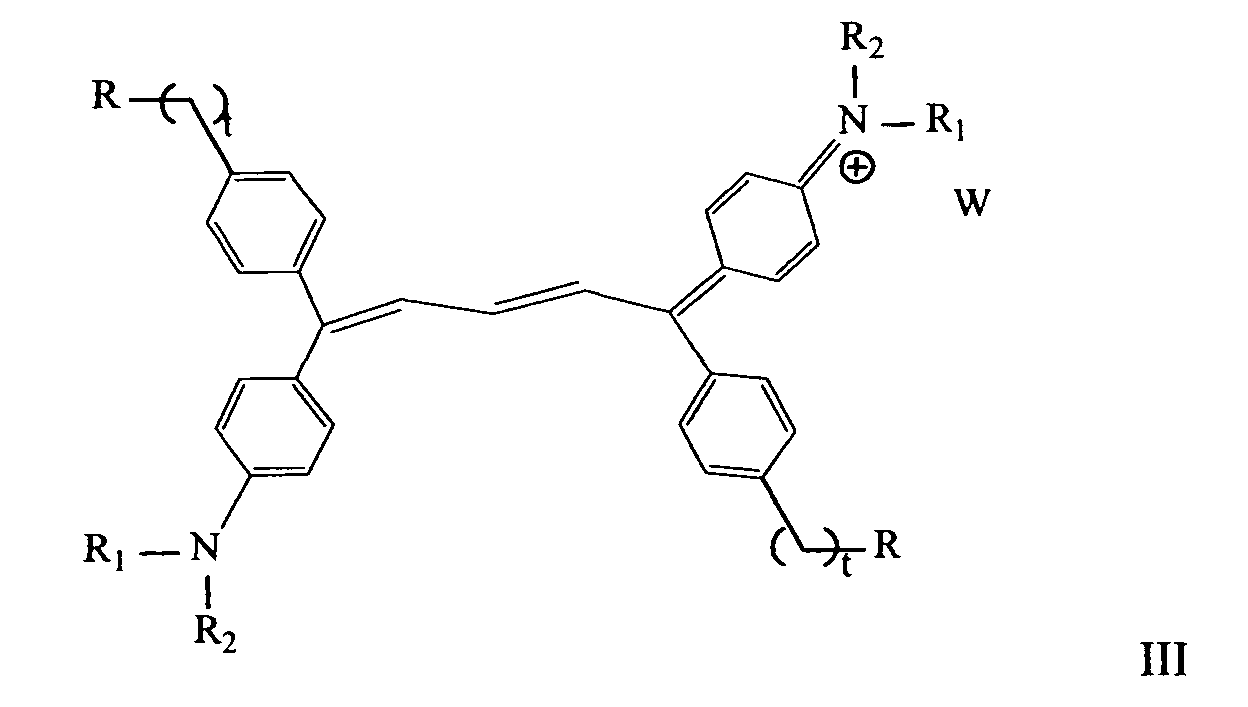
- a particular embodiment of the colorant is represented by formula III: where R, t, R 1 , R 2 and W are as described for formula II.
- the colorants of the invention may be used alone or in combination with other colorants of the same type or with conventional IR or image colorants.
- the colorants with yellow, cyan, or magenta chromophores are often employed.
- the colorant molecules may comprise functional groups such as hydrophobic groups, solubilizing groups, blocking groups, and releasing or releasable groups. Hydrophobic colorants are usually employed.
- a laser activated colorant transfer imaging donor element may conveniently employ the colorant molecule of the invention.
- Such elements are well-known in the art and typically use a colorant coverage of from 0.05 to 1 g/m 2 . If the color of the visible chromophore is inherently within the same range as that of the image colorant desired, then IR and image ink ratio is fixed since they are in the same molecule, which simplifies the color-matching process.
- group means any group or radical other than hydrogen.
- substituent group when reference is made in this application to a compound or group that contains a substitutable hydrogen, it is also intended to encompass not only the unsubstituted form, but also its form further substituted with any substituent group or groups as herein mentioned, so long as the substituent does not destroy properties necessary for the intended utility.
- a substituent group may be halogen or may be bonded to the remainder of the molecule by an atom of carbon, silicon, oxygen, nitrogen, phosphorous, or sulfur.
- the substituent may be, for example, halogen, such as chloro, bromo or fluoro; nitro; hydroxyl; cyano; carboxyl; or groups which may be further substituted, such as alkyl, including straight or branched chain or cyclic alkyl, such as methyl, trifluoromethyl, ethyl, t -butyl, 3-(2,4-di- t -pentylphenoxy) propyl, cyclohexyl, and tetradecyl; alkenyl, such as ethylene, 2-butene; alkoxy, such as methoxy, ethoxy, propoxy, butoxy, 2-methoxyethoxy, sec- butoxy, hexyloxy, 2-ethylhexyloxy, tetradecyloxy, 2-(2,4-di- t -pentylphenoxy)ethoxy, and 2-dodecyloxyethoxy; aryl such as
- the substituents may themselves be further substituted one or more times with the described substituent groups.
- the particular substituents used may be selected by those skilled in the art to attain the desired desirable properties for a specific application and can include, for example, hydrophobic groups, solubilizing groups, blocking groups, and releasing or releasable groups.
- the substituents may be joined together to form a ring such as a fused ring unless otherwise provided.
- the above groups and substituents thereof may include those having up to 48 carbon atoms, typically 1 to 36 carbon atoms and usually less than 24 carbon atoms, but greater numbers are possible depending on the particular substituents selected.
- the colored IR colorants listed above not only provide a novel class of chromophores potentially useful for many applications, they also provide additional advantage, i.e., stabilities. They may be used in any desired form such as solutions, dispersions, or suspensions. The following examples are provided to illustrate such advantage of the invention.
- IR colorant samples listed below are used as control compounds in order to demonstrate the advantage of the present invention. These control compounds are either mixtures (C1 to C-5) of IR and Image Colorant (1:2 ratio) or other infrared colorants (C-6 to C-9) that have substantial absorption in the visible portion of the electromagnetic absorption range. Control colorants C-6 to C-8 were obtained through the preparation described in U.S. Patent 6,248,886 and U.S. Patent 6,248,893. Colorant C-9 was prepared according to the method described in the published literature (J. Chem. Res. Synpos. (1990), (2), 50-51).
- This element was prepared by coating on a poly(ethyleneterephthalate) support Colorant 1 at 0.1 g/m 2 in a cellulose acetate propionate binder at 0.5 g/m 2 .
- the solvent used for the coating was a 70/30 v/v mixture of methyl isobutyl ketone and 3A alcohol.
- This element was the same as Element 1 except that Colorant 1 was replaced with Colorant 2.
- This element was the same as Element 1 except that Colorant 1 was replaced with Colorant 3.
- This element was the same as Element 1 except that Colorant 1 was replaced with comparative colorant sample C-1.
- This element was the same as Element 1 except that Colorant 1 was replaced with comparative colorant sample C-2.
- This element was the same as Element 1 except that Colorant 1 was replaced with comparative colorant sample C-3.
- This element was the same as Element 1 except that Colorant 1 was replaced with comparative colorant sample C-4.
- This element was the same as Element 1 except that Colorant 1 was replaced with comparative colorant sample C-5.
- Table 1 The data of Table 1 is grouped so as to make comparison between colorants of similar structure easier.
- the table shows that, for the colorants tested, the colorants within the invention are much more stable than the comparison colorants.
- the covalent attachment of colored chromophores for Colorants 1, 2, and 3 exhibit a lower loss of density under light exposure conditions.
- Example 1 was repeated except that the elements were placed into a dark black box with constant dry airflow for a period of 24 hours to 4 weeks.
- This element was the same as Element 1 except that Colorant 1 was replaced with comparative colorant sample C-6.
- This element was the same as Element 1 except that Colorant 1 was replaced with comparative colorant sample C-7.
- This element was the same as Element 1 except that Colorant 1 was replaced with comparative colorant sample C-8.
- This element was the same as Element 1 except that Colorant 1 was replaced with comparative colorant sample C-9.
- Table 2 illustrates the advantage of the inventive colorants from a dark stability standpoint.
- control colorants above have been shown to be useful for various applications as described in the already referenced publications, they decomposed readily in the dark compared to the inventive colorants. This property would be undesirable in applications where the absorption and the inherent visible color is meant to add to the permanent color density of an image. This stability requirement is often essential in digital proofing where the undesirable transfer of colored IR colorant is offset by the visible portion of the colorant in the final colorimetry.
- Example 1 was repeated except that the elements were placed in a wet-oven chamber (38°C/90RH) for four weeks. The following results were obtained: Colorant No. Type % Optical Density Loss After 4 Weeks at IR ⁇ max C-1 Camp 8.23 C-4 Comp 57.02 C-5 Comp 10.86 1 Inv 2.06 C-2 Comp 5.80 2 Inv 2.74 C-3 Comp 7.89 3 Inv 0.70
Landscapes
- Chemical & Material Sciences (AREA)
- Organic Chemistry (AREA)
- Life Sciences & Earth Sciences (AREA)
- Engineering & Computer Science (AREA)
- Materials Engineering (AREA)
- Wood Science & Technology (AREA)
- Physics & Mathematics (AREA)
- Optics & Photonics (AREA)
- Plural Heterocyclic Compounds (AREA)
- Compositions Of Macromolecular Compounds (AREA)
Abstract
Disclosed is a molecule containing a first chromophore that
exhibits a first absorption maximum above 700nm and a second chromophore that
exhibits a second absorption maximum different from the first absorption
maximum, wherein the absorption of the first and second chromophores are
substantially independent of each other. The molecule exhibits improved stability.
Description
- This invention relates to molecules having a first chromophore having a maximum absorption above 700nm and an independent second chromophore having a different absorption maximum than the first chromophore.
- In recent years, there is a strong need in various high technology applications for compounds that absorb in the infrared regions of the electromagnetic spectrum. Such materials can be used, for example, in laser thermal printing system, in which the donor sheet includes an IR colorant that strongly absorbs at the wavelength of the laser. When the donor is irradiated, this absorbing material converts light energy to thermal energy and transfers the heat to the colorant in the immediate vicinity, thereby heating the colorant to its vaporization temperature for transfer to the receiver. Since the local temperature can reach as high as 600°C, infrared colorants tend to get transferred to some extent. As a result, there is some unwanted color contamination. Therefore, there is a need to have IR absorbing compounds that exhibit the same colors as the final images, so that the color contamination problem associated with laser thermal proofing can be reduced.
- Secondly, there is also a need for printing inks with absorption beyond 700 nm, particularly in the near IR region. It is normally done by adding to the ink a second colorant having a separate IR chromophore, which requires co-optimization of both image ink and IR colorants. Such process is always tedious and inaccurate. Additionally, there would be an advantage to have a single compound containing both IR and image chromophore, so that there is no difference between them in term of migration rate.
- In EP 499,822 A1, it is suggested to incorporate in a single molecule two independent visible colorant moieties in order to increase the visible colorant density. In U.S. 5,972,838, it is suggested to use a mixture of IR and visible colorants in a thermal transfer donor but this approach introduces concerns of unwanted color contamination because of unwanted incidental visible light absorption by the IR colorant and because the two colorants have different transfer rates.
- It is a problem to be solved to provide an IR colorant material that exhibits good stability.
- The invention provides a molecule containing a first chromophore that exhibits a first absorption maximum above 700nm and a second chromophore that exhibits a second absorption maximum different from the first absorption maximum, wherein the absorption of the first and second chromophores are substantially independent of each other.
- The molecule exhibits improved stability.
- As used herein, the term "colorant" refers to a compound such as a dye or pigment that absorbs electromagnetic radiation in the visible or non-visible spectrum and the term "chromophore" refers to the portion or portions of the compound that perform the absorption function in the visible or non-visible region of the spectrum. In accordance with the invention, a colorant molecule contains a first chromophore that exhibits a first absorption maximum above 700nm and a second absorption maximum different from the first absorption maximum, typically at least 40nm different from the first absorption maximum and usually either (a) above 700nm or (b) from 400-700nm, wherein the absorption of the first and second moieties are substantially independent of the presence of each other, such as where the first and second chromophores are not linked by a conjugated chain. In some imaging processes, it may be desired that the colorant molecule have a second absorption whose maximum is typically above 700nm, below 400nm, or visible in the range of from 400-700nm. In the latter case, this arrangement would be useful for laser activated colorant transfer imaging. The colorants exhibit advantageous light stability. The incorporation of the chromophores in the same molecule helps to insure that the visible and IR images will be transferred at an equal rate. This enables less color contamination.
- The colorant molecule may contain more than one second chromophore. These moieties may be identical and have the same maximum absorption or may be separate, separated in λ-max by at least 40nm from the other second moieties.
- The colorant molecule is represented by general formula I:
- L represents the non-chromophoric portions of the colorant molecule and does not conjugate the first and second chromophores;
- each IR chromophore independently represents a chromophore with λ-max above 700nm;
- each VIS chromophore independently represents a chromophore with λ-max from 400-700nm; and
- m and n are independently 1-6.
-
- In a preferred embodiment, the colorant is represented by the formula II:wherein:

- each R independently represents hydrogen or a substituent such that at least one such group is a colored chromophore;
- X1, X2 and X3 each independently represents hydrogen, halogen, cyano, an alkyl group having 1 to 12 carbon atoms, a cycloalkyl group having 5 to 10 carbon atoms in the carbocyclic ring, an aryl group having 6 to 10 carbon atoms in the carbocyclic ring, or any two of said X1, X2, and X3 may be joined together to complete a 5- to 7-membered carbocyclic or heterocyclic ring group, and m is 1-3;
- each of R1, and R2 independently represents an alkyl group having 1 to 12 carbon atoms a cycloalkyl group having 5 to 10 carbon atoms in the carbocyclic ring, an aryl group having 6 to 10 carbon atoms in the carbocyclic ring, or a heterocyclic or polymeric backbone group; provided R1 and R2 may be joined together to form a 5- to 7-membered heterocyclic ring group;
- each of r1, r2, and r3 independently represents a substituent group and each n is 0-4; and each t is 0-4; and
- W is a monovalent counter anion to balance the charge on the colorant molecule.
-
- A particular embodiment of the colorant is represented by formula III:where R, t, R1, R2 and W are as described for formula II.
- Besides the visible chromophores specifically shown herein, other useful visible chromophores may be employed including those disclosed in U.S. Patents 4,541,830; 4,698,651; 4,695,287; 4,701,439; 4,757,046; 4,743,582; 4,769,360; and 4,753,922.
- The colorants of the invention may be used alone or in combination with other colorants of the same type or with conventional IR or image colorants. The colorants with yellow, cyan, or magenta chromophores are often employed. The colorant molecules may comprise functional groups such as hydrophobic groups, solubilizing groups, blocking groups, and releasing or releasable groups. Hydrophobic colorants are usually employed.
- A laser activated colorant transfer imaging donor element may conveniently employ the colorant molecule of the invention. Such elements are well-known in the art and typically use a colorant coverage of from 0.05 to 1 g/m2. If the color of the visible chromophore is inherently within the same range as that of the image colorant desired, then IR and image ink ratio is fixed since they are in the same molecule, which simplifies the color-matching process.
- Unless otherwise specifically stated, use of the term "group", "substituted" or "substituent" means any group or radical other than hydrogen. Additionally, when reference is made in this application to a compound or group that contains a substitutable hydrogen, it is also intended to encompass not only the unsubstituted form, but also its form further substituted with any substituent group or groups as herein mentioned, so long as the substituent does not destroy properties necessary for the intended utility. Suitably, a substituent group may be halogen or may be bonded to the remainder of the molecule by an atom of carbon, silicon, oxygen, nitrogen, phosphorous, or sulfur. The substituent may be, for example, halogen, such as chloro, bromo or fluoro; nitro; hydroxyl; cyano; carboxyl; or groups which may be further substituted, such as alkyl, including straight or branched chain or cyclic alkyl, such as methyl, trifluoromethyl, ethyl, t-butyl, 3-(2,4-di-t-pentylphenoxy) propyl, cyclohexyl, and tetradecyl; alkenyl, such as ethylene, 2-butene; alkoxy, such as methoxy, ethoxy, propoxy, butoxy, 2-methoxyethoxy, sec-butoxy, hexyloxy, 2-ethylhexyloxy, tetradecyloxy, 2-(2,4-di-t-pentylphenoxy)ethoxy, and 2-dodecyloxyethoxy; aryl such as phenyl, 4-t-butylphenyl, 2,4,6-trimethylphenyl, naphthyl; aryloxy, such as phenoxy, 2-methylphenoxy, alpha- or beta-naphthyloxy, and 4-tolyloxy; carbonamido, such as acetamido, benzamido, butyramido, tetradecanamido, alpha-(2,4-di-t-pentyl-phenoxy)acetamido, alpha-(2,4-di-t-pentylphenoxy)butyramido, alpha-(3-pentadecylphenoxy)-hexanamido, alpha-(4-hydroxy-3-t-butylphenoxy)-tetradecanamido, 2-oxo-pyrrolidin- 1-yl, 2-oxo-5-tetradecylpyrrolin-1-yl, N-methyltetradecanamido, N-succinimido, N-phthalimido, 2,5-dioxo-1-oxazolidinyl, 3-dodecyl-2,5-dioxo-1-imidazolyl, and N-acetyl-N-dodecylamino, ethoxycarbonylamino, phenoxycarbonylamino, benzyloxycarbonylamino, hexadecyloxycarbonylamino, 2,4-di-t-butylphenoxycarbonylamino, phenylcarbonylamino, 2,5-(di-t-pentylphenyl)carbonylamino, p-dodecylphenylcarbonylamino, p-tolylcarbonylamino, N-methylureido, N,N-dimethylureido, N-methyl-N-dodecylureido, N-hexadecylureido, N,N-dioctadecylureido, N,N-dioctyl-N'-ethylureido, N-phenylureido, N,N-diphenylureido, N-phenyl-N-p-tolylureido, N-(m-hexadecylphenyl)ureido, N,N-(2,5-di-t-pentylphenyl)-N'-ethylureido, and t-butylcarbonamido; sulfonamido, such as methylsulfonamido, benzenesulfonamido, p-tolylsulfonamido, p-dodecylbenzenesulfonamido, N-methyltetradecylsulfonamido, N,N-dipropylsulfamoylamino, and hexadecylsulfonamido; sulfamoyl, such as N-methylsulfamoyl, N-ethylsulfamoyl, N,N-dipropylsulfamoyl, N-hexadecylsulfamoyl, N,N-dimethylsulfamoyl; N-[3-(dodecyloxy)propyl]sulfamoyl, N-[4-(2,4-di-t-pentylphenoxy)butyl]sulfamoyl, N-methyl-N-tetradecylsulfamoyl, and N-dodecylsulfamoyl; carbamoyl, such as N-methylcarbamoyl, N,N-dibutylcarbamoyl, N-octadecylcarbamoyl, N-[4-(2,4-di-t-pentylphenoxy)butyl]carbamoyl, N-methyl-N-tetradecylcarbamoyl, and N,N-dioctylcarbamoyl; acyl, such as acetyl, (2,4-di-t-amylphenoxy)acetyl, phenoxycarbonyl, p-dodecyloxyphenoxycarbonyl methoxycarbonyl, butoxycarbonyl, tetradecyloxycarbonyl, ethoxycarbonyl, benzyloxycarbonyl, 3-pentadecyloxycarbonyl, and dodecyloxycarbonyl; sulfonyl, such as methoxysulfonyl, octyloxysulfonyl, tetradecyloxysulfonyl, 2-ethylhexyloxysulfonyl, phenoxysulfonyl, 2,4-di-t-pentylphenoxysulfonyl, methylsulfonyl, octylsulfonyl, 2-ethylhexylsulfonyl, dodecylsulfonyl, hexadecylsulfonyl, phenylsulfonyl, 4-nonylphenylsulfonyl, and p-tolylsulfonyl; sulfonyloxy, such as dodecylsulfonyloxy, and hexadecylsulfonyloxy; sulfinyl, such as methylsulfinyl, octylsulfinyl, 2-ethylhexylsulfinyl, dodecylsulfinyl, hexadecylsulfinyl, phenylsulfinyl, 4-nonylphenylsulfinyl, and p-tolylsulfinyl; thio, such as ethylthio, octylthio, benzylthio, tetradecylthio, 2-(2,4-di-t-pentylphenoxy)ethylthio, phenylthio, 2-butoxy-5-t-octylphenylthio, and p-tolylthio; acyloxy, such as acetyloxy, benzoyloxy, octadecanoyloxy, p-dodecylamidobenzoyloxy, N-phenylcarbamoyloxy, N-ethylcarbamoyloxy, and cyclohexylcarbonyloxy; amine, such as phenylanilino, 2-chloroanilino, diethylamine, dodecylamine; imino, such as 1 (N-phenylimido)ethyl, N-succinimido or 3-benzylhydantoinyl; phosphate, such as dimethylphosphate and ethylbutylphosphate; phosphite, such as diethyl and dihexylphosphite; a heterocyclic group, a heterocyclic oxy group or a heterocyclic thio group, each of which may be substituted and which contain a 3 to 7 membered heterocyclic ring composed of carbon atoms and at least one hetero atom selected from the group consisting of oxygen, nitrogen and sulfur, such as 2-furyl, 2-thienyl, 2-benzimidazolyloxy or 2-benzothiazolyl; quaternary ammonium, such as triethylammonium; and silyloxy, such as trimethylsilyloxy.
- If desired, the substituents may themselves be further substituted one or more times with the described substituent groups. The particular substituents used may be selected by those skilled in the art to attain the desired desirable properties for a specific application and can include, for example, hydrophobic groups, solubilizing groups, blocking groups, and releasing or releasable groups. When a molecule may have two or more substituents, the substituents may be joined together to form a ring such as a fused ring unless otherwise provided. Generally, the above groups and substituents thereof may include those having up to 48 carbon atoms, typically 1 to 36 carbon atoms and usually less than 24 carbon atoms, but greater numbers are possible depending on the particular substituents selected.
- The following are examples of colorants of the invention:
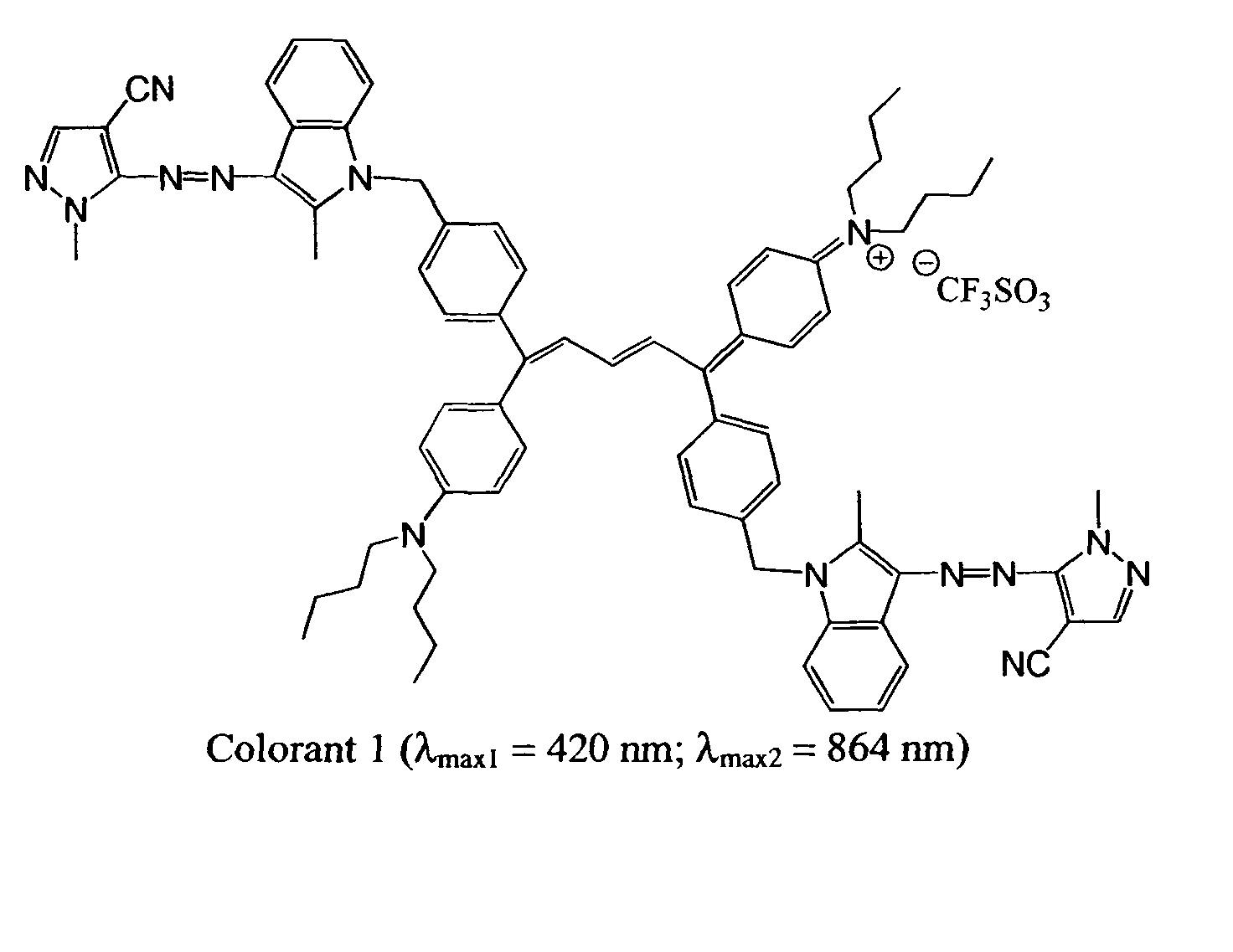

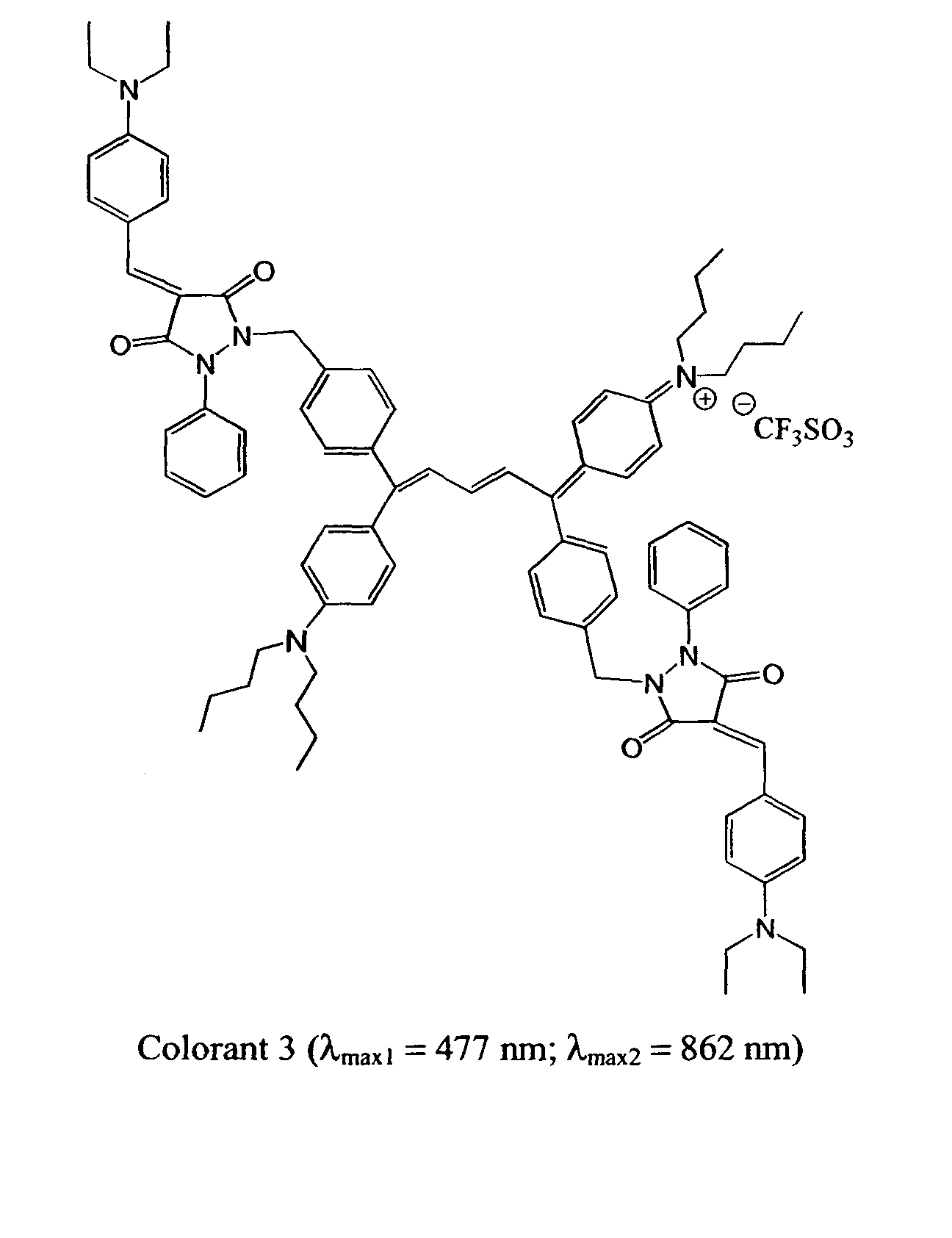

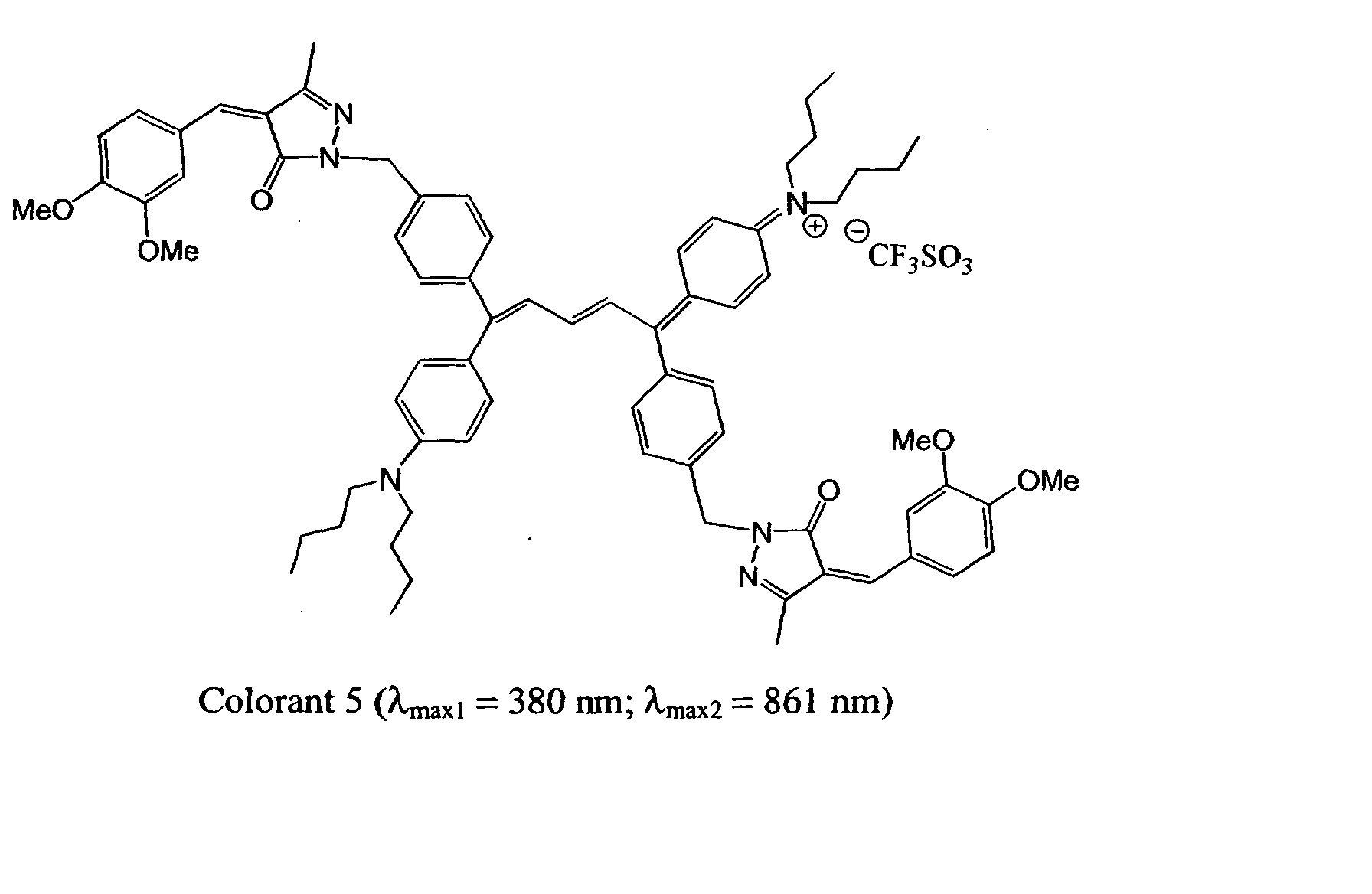


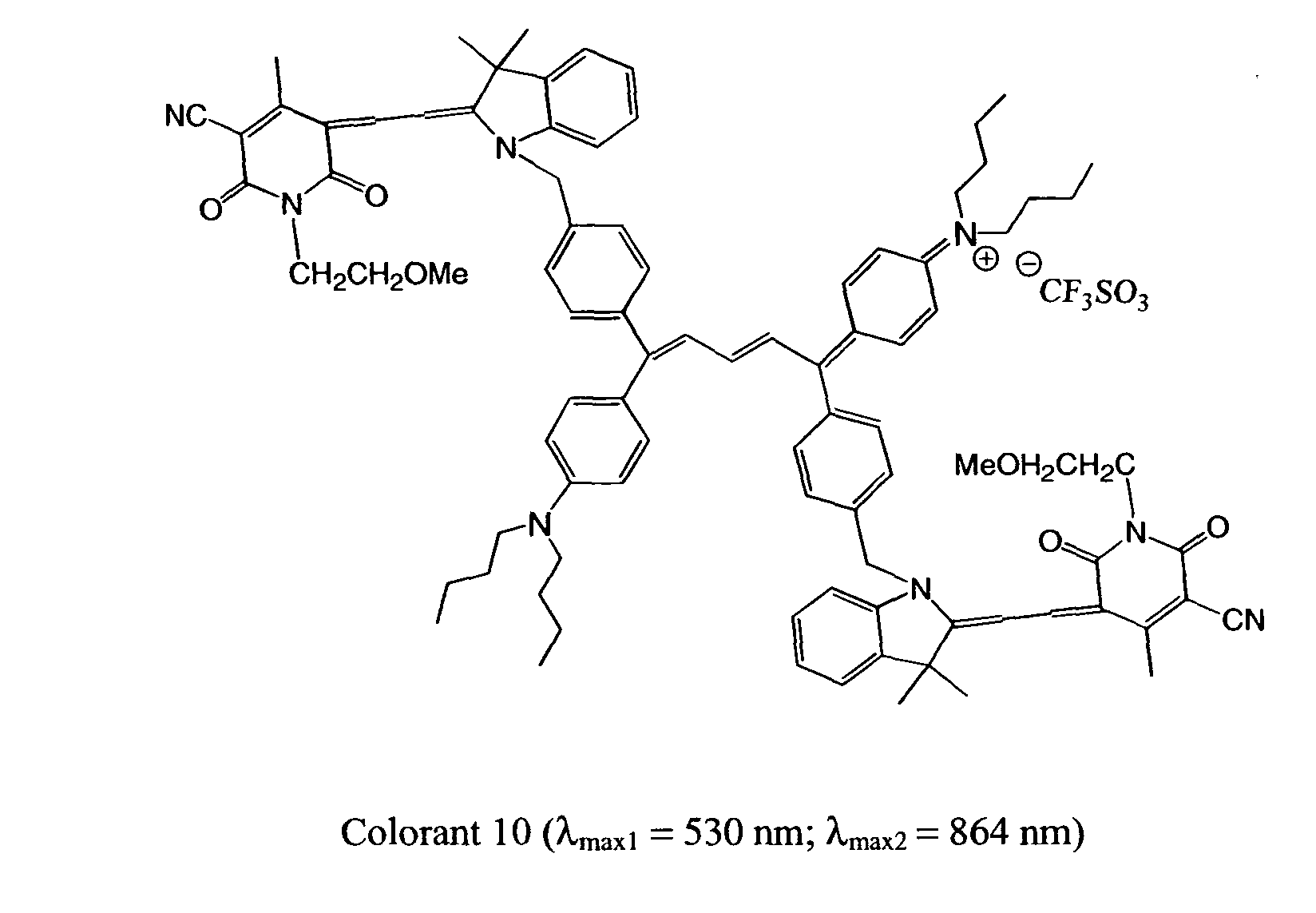


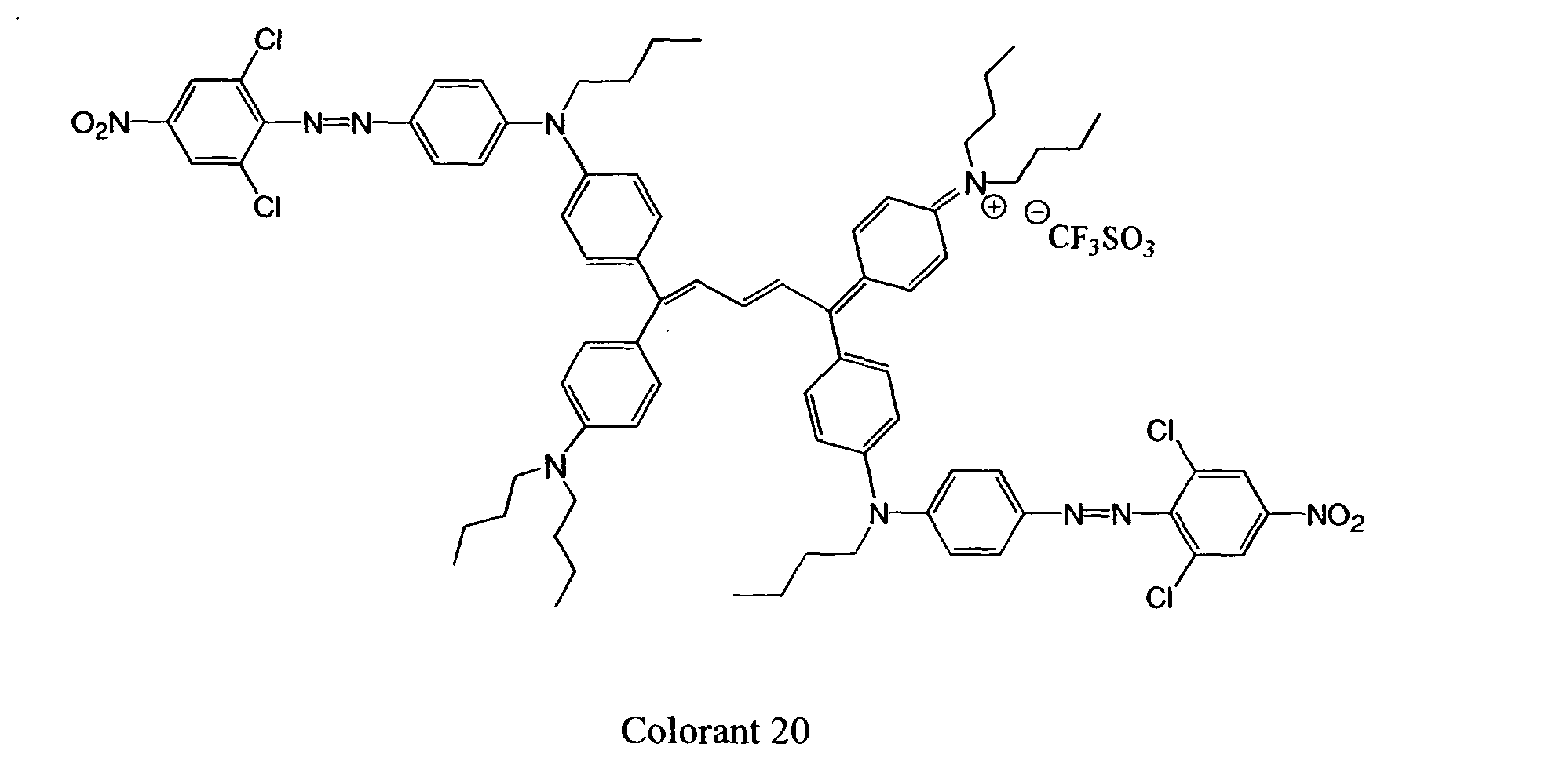


- General preparation of the colorants with t = I of this invention is illustrated by the following synthetic scheme (Colorant 1).

- To a 200 ml round bottomed flask containing a sample of yellow colorant intermediate A (3.8g, 14 mmoles) and DMSO (50 ml) was added sodium hydride (0.7g, 60% in mineral oil, 17 mmoles). The resulting mixture was stirred under N2 at room temperature for 0.5 hr before the intermediate B (4.3g, 12 mmoles) was added. After overnight stirring at room temperature, the mixture was diluted with water (500 ml), a yellow solid began to precipitate from the solution, the solid was collected by filtration and washed with more water. The unreacted starting materials A and B could be removed from methanol and heptane washes respectively. 3.8g of pure intermediate C was obtained at 54% yield.
- A sample of intermediate C (3.7g, 6.4 mmoles) was dissolved in acetic acid (25 ml), then diethoxymethyl acetate (1.62g, 10 mmoles) was added and finally triflic acid (0.5g, 3.3 mmoles) were added dropwise. The resulting mixture was heated to reflux for half-hour (the reaction was monitored by appearance of an ir peak at 850 nm).
- The mixture was cooled with an ice-water bath and poured to a beaker containing 500ml ether, the product started to precipitate, the solid was collected and recrystallized twice from ethanol (100ml), 3.0g material was obtained at 80% yield.
- General preparation of the colorants with t = 0 of this invention is illustrated by the following synthetic scheme (Colorant 22).

- To a mixture of intermediate A (3.0 g, 9.4 mmoles) and B (3.6g, 9.4 mmoles) in toluene (20 ml) were added under N2 palladium acetate (30mg, 0.12 mmoles), tri-t-butylphosphine (36mg, 0.18 mmoles) and sodium-t-butyl oxide (1.4g, 14.5 mmoles) The resulting mixture was heated at reflux for 2 hours. Water (50 ml) was added to quench the reaction, the mixture was extracted with ethyl acetate (2X50 ml), the organic layer was dried over sodium sulfate, the residual after solvent removal was purified through a silica gel column eluted with 1:1 heptane /ethyl acetate. 4.8g of product was obtained at 82% yield.
- A sample of intermediate C (3.26g, 5 mmoles) was dissolved in acetic acid (25 ml), then diethoxymethyl acetate (1.26g, 8 mmoles) was added and finally triflic acid (0.4g, 3 mmoles) were added dropwise. The resulting mixture was heated to reflux for half-hour (the reaction was monitored by appearance of an ir peak at 830 nm). The mixture was cooled with an ice-water bath and poured to a beak containing 400 ml ether, the product started to precipitate, the solid was collected and recrystalized twice from ethanol (80 ml), 2.0g product was obtained.
- The colored IR colorants listed above not only provide a novel class of chromophores potentially useful for many applications, they also provide additional advantage, i.e., stabilities. They may be used in any desired form such as solutions, dispersions, or suspensions. The following examples are provided to illustrate such advantage of the invention.
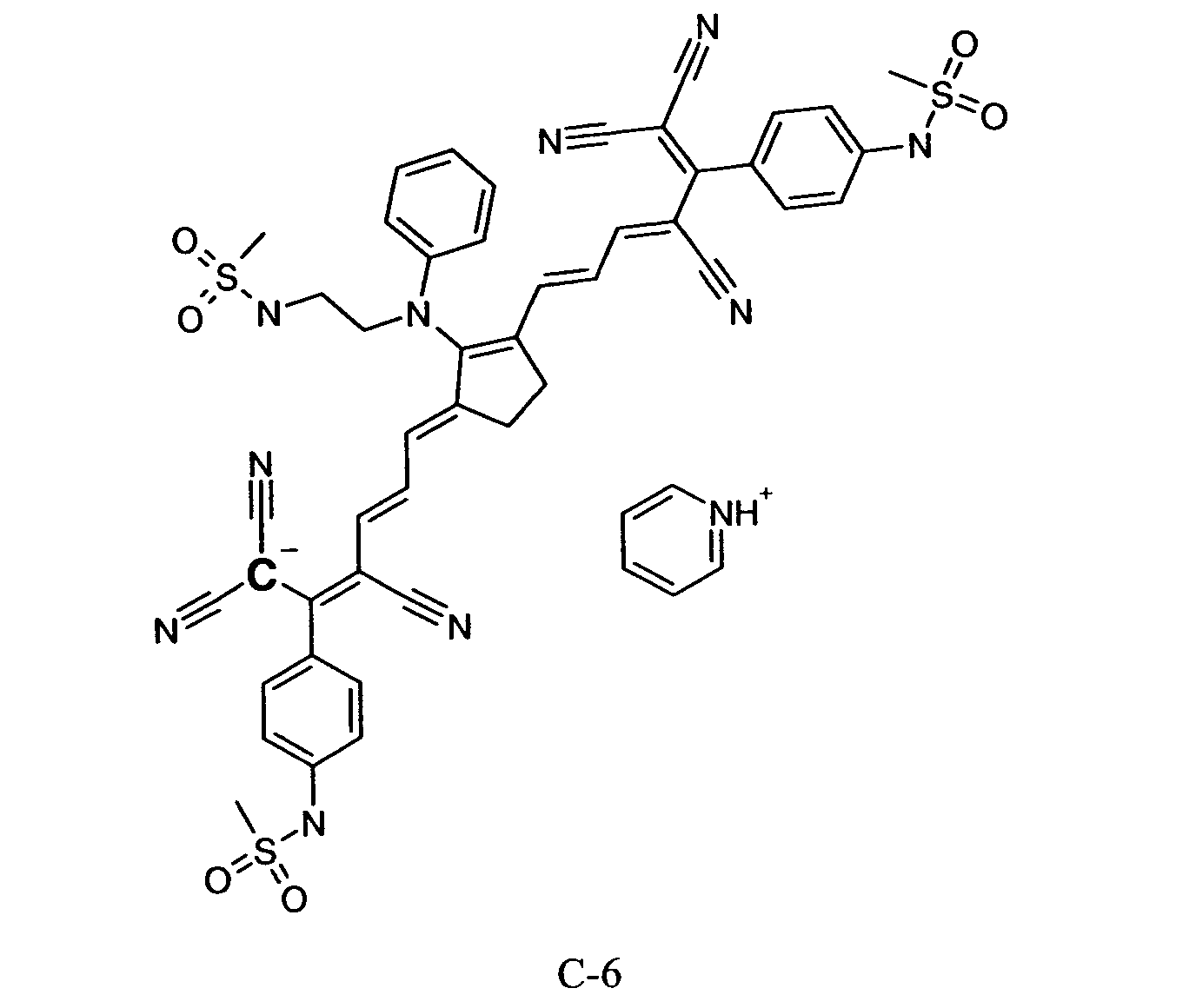
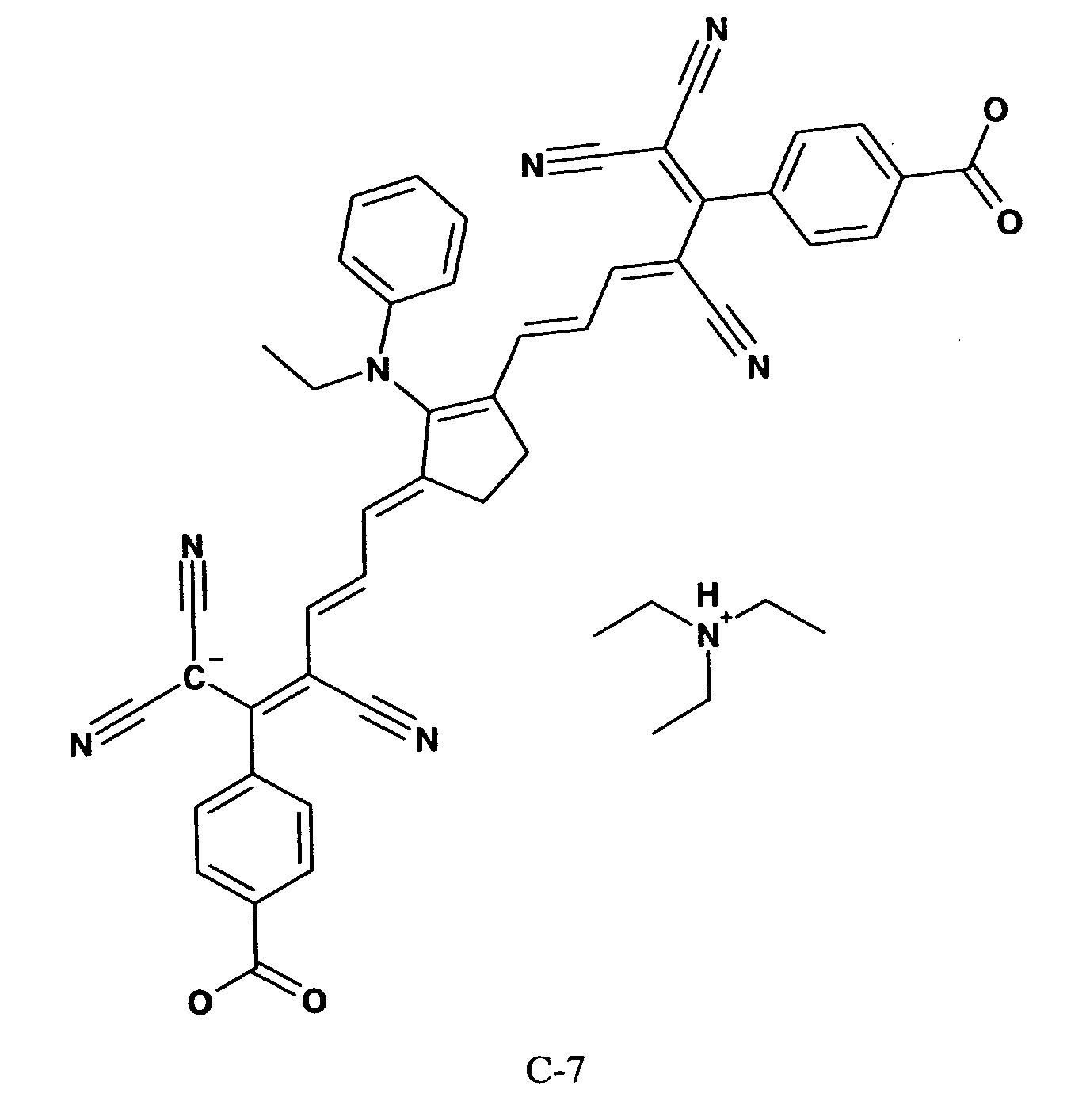
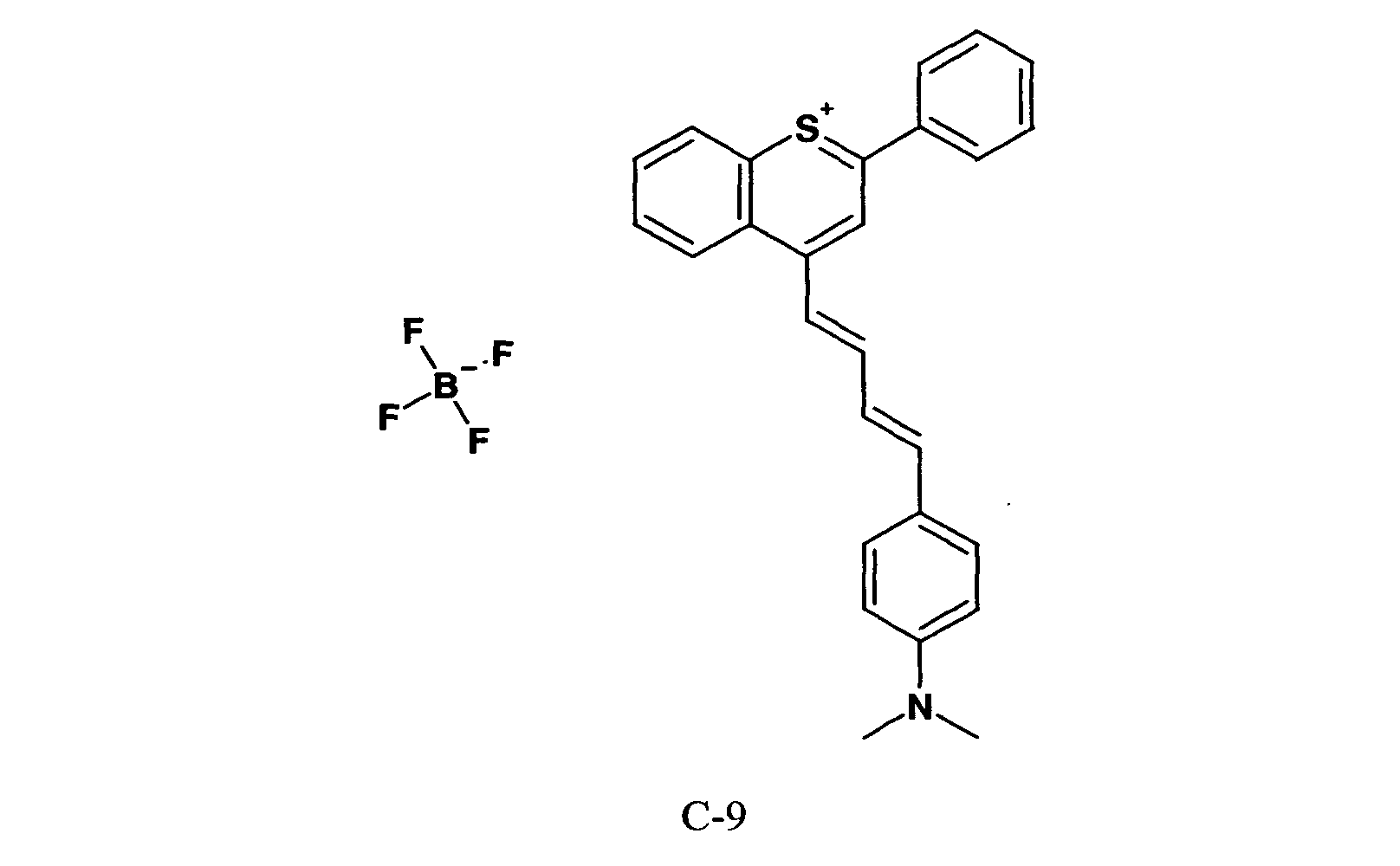
- IR colorant samples listed below are used as control compounds in order to demonstrate the advantage of the present invention. These control compounds are either mixtures (C1 to C-5) of IR and Image Colorant (1:2 ratio) or other infrared colorants (C-6 to C-9) that have substantial absorption in the visible portion of the electromagnetic absorption range. Control colorants C-6 to C-8 were obtained through the preparation described in U.S. Patent 6,248,886 and U.S. Patent 6,248,893. Colorant C-9 was prepared according to the method described in the published literature (J. Chem. Res. Synpos. (1990), (2), 50-51).


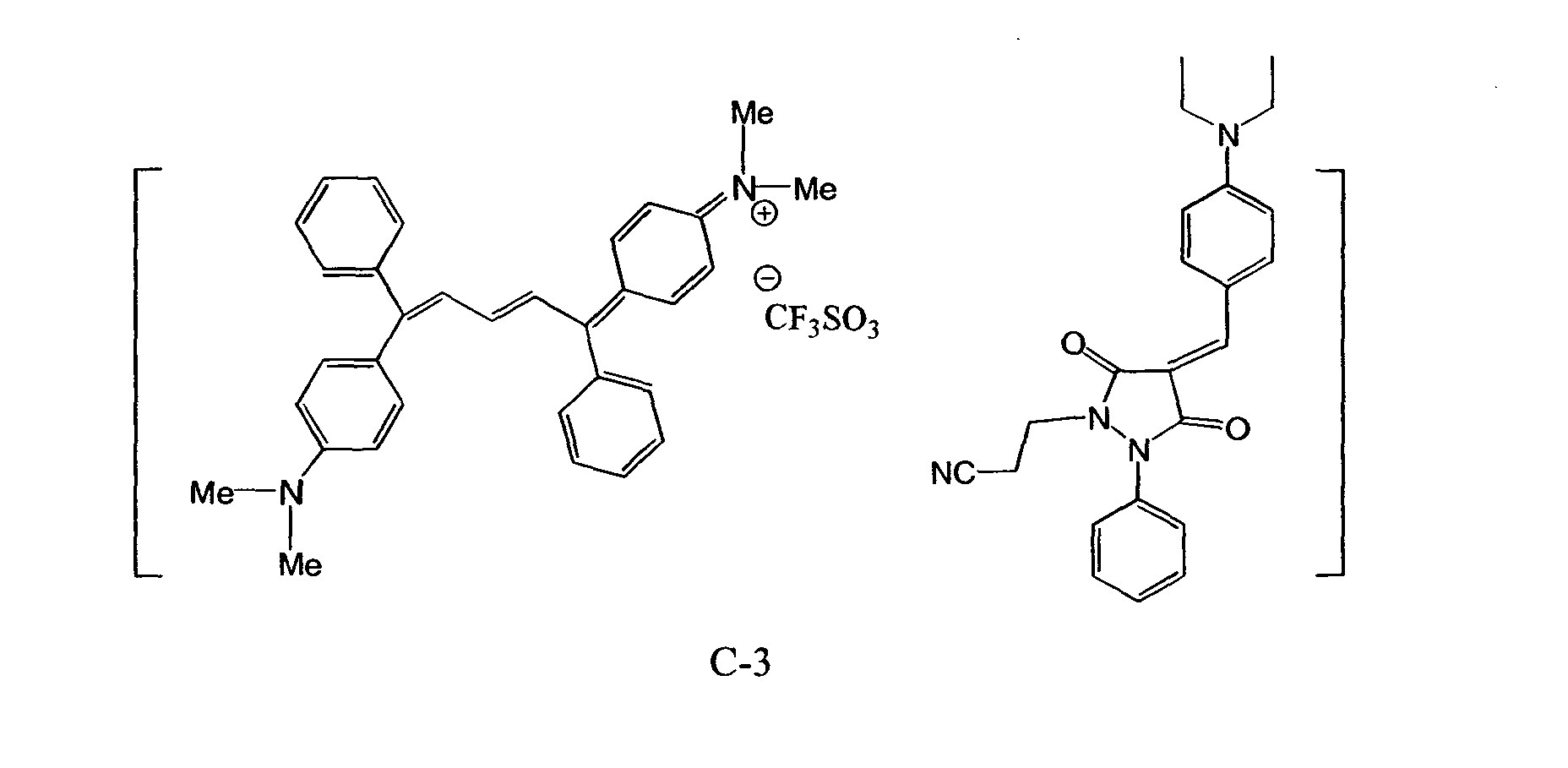

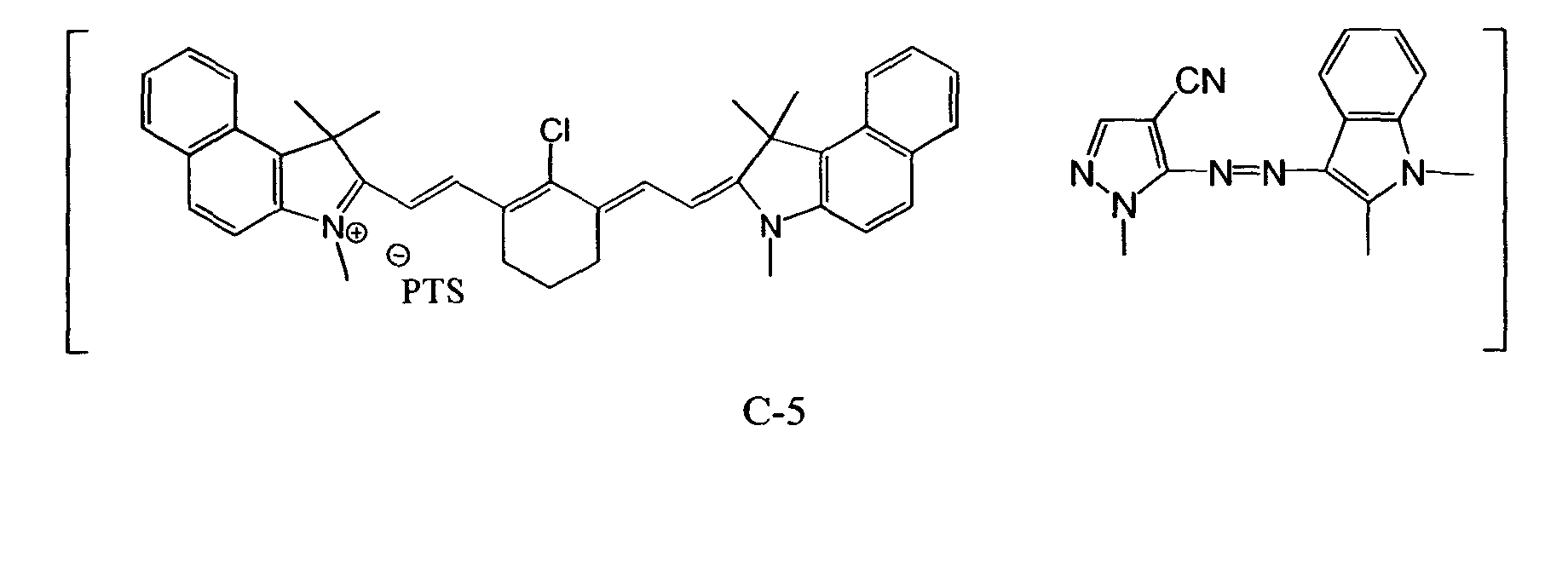

- This element was prepared by coating on a poly(ethyleneterephthalate) support Colorant 1 at 0.1 g/m2 in a cellulose acetate propionate binder at 0.5 g/m2. The solvent used for the coating was a 70/30 v/v mixture of methyl isobutyl ketone and 3A alcohol.
- This element was the same as Element 1 except that Colorant 1 was replaced with Colorant 2.
- This element was the same as Element 1 except that Colorant 1 was replaced with Colorant 3.
- This element was the same as Element 1 except that Colorant 1 was replaced with comparative colorant sample C-1.
- This element was the same as Element 1 except that Colorant 1 was replaced with comparative colorant sample C-2.
- This element was the same as Element 1 except that Colorant 1 was replaced with comparative colorant sample C-3.
- This element was the same as Element 1 except that Colorant 1 was replaced with comparative colorant sample C-4.
- This element was the same as Element 1 except that Colorant 1 was replaced with comparative colorant sample C-5.
- The above elements were placed under fluorescent room light conditions for a period of 4 weeks. To calculate the percent optical density loss, from the optical density value at λ-max before light exposure the optical density value after light exposure was subtracted. The resulting value was divided by the optical density value before light exposure and multiplied by one hundred. Results are presented in Table 1:
Colorant No. Type % Optical Density Loss After 4 Weeks at IR λ-max C-1 Comp 24.12 C-4 Comp 57.02 C-5 Comp 95.84 1 Inv 13.64 C-2 Comp 10.73 2 Inv 9.18 C-3 Comp 22.03 3 Inv 16.76 - The data of Table 1 is grouped so as to make comparison between colorants of similar structure easier. The table shows that, for the colorants tested, the colorants within the invention are much more stable than the comparison colorants. The covalent attachment of colored chromophores for Colorants 1, 2, and 3 exhibit a lower loss of density under light exposure conditions.
- Example 1 was repeated except that the elements were placed into a dark black box with constant dry airflow for a period of 24 hours to 4 weeks.
- This element was the same as Element 1 except that Colorant 1 was replaced with comparative colorant sample C-6.
- This element was the same as Element 1 except that Colorant 1 was replaced with comparative colorant sample C-7.
- This element was the same as Element 1 except that Colorant 1 was replaced with comparative colorant sample C-8.
- This element was the same as Element 1 except that Colorant 1 was replaced with comparative colorant sample C-9.
- All colorants (Colorant 1 to Colorant 16) provided by the invention showed excellent dark stability; virtually no density loss is observed over a period of 4 weeks. On the other hand, other infrared colorants (comparative C6 to C9), that have substantial absorption in the visible portion of the electromagnetic absorption range, are readily decomposed compared to the inventive colorants in the dark (see Table 2).
IR Colorant Sample λmax1, λmax2 (nm) 24 Hours in Dark % IR Colorant Density Loss C-6 700, 870 31 C-7 700-900 15 C-8 610,815 30 C-9 712,845 31 Inventive Colorant 1 to Colorant 16 See λmax values with formulas ~ 0 - Table 2 illustrates the advantage of the inventive colorants from a dark stability standpoint. Although the control colorants above have been shown to be useful for various applications as described in the already referenced publications, they decomposed readily in the dark compared to the inventive colorants. This property would be undesirable in applications where the absorption and the inherent visible color is meant to add to the permanent color density of an image. This stability requirement is often essential in digital proofing where the undesirable transfer of colored IR colorant is offset by the visible portion of the colorant in the final colorimetry.
- Example 1 was repeated except that the elements were placed in a wet-oven chamber (38°C/90RH) for four weeks. The following results were obtained:
Colorant No. Type % Optical Density Loss After 4 Weeks at IR λmax C-1 Camp 8.23 C-4 Comp 57.02 C-5 Comp 10.86 1 Inv 2.06 C-2 Comp 5.80 2 Inv 2.74 C-3 Comp 7.89 3 Inv 0.70 - This example shows that the inventive colorants tested exhibited a reduced optical density loss under high humidity conditions vs the comparisons.
- The entire contents of the patents and other publications referred to in this specification are incorporated herein by reference.
Claims (10)
- A molecule containing a first chromophore that exhibits a first absorption maximum above 700nm and a second chromophore that exhibits a second absorption maximum different from the first absorption maximum, wherein the absorption of the first and second chromophores are substantially independent of each other.
- The molecule of claim 1 wherein the second absorption maximum is either (a) above 700nm or (b) from 400-700nm.
- The molecule of claim 1 or 2 containing more than one second chromophore.
- The molecule of claim 1 or 2 wherein the first and second chromopores are separated in λ-max by at least 10nm.
- The molecule of claim 1 represented by a general formula:L represents the non-chromophoric portions of the molecule and does not conjugate the first and second chromophores;each IR chromophore independently represents a chromophore with λ-max above 700nm;each VIS chromophore independently represents a chromophore with λ-max from 400-700; andm and n are independently 1-6.
- A molecule of claim 1 represented by the formula IIwherein:
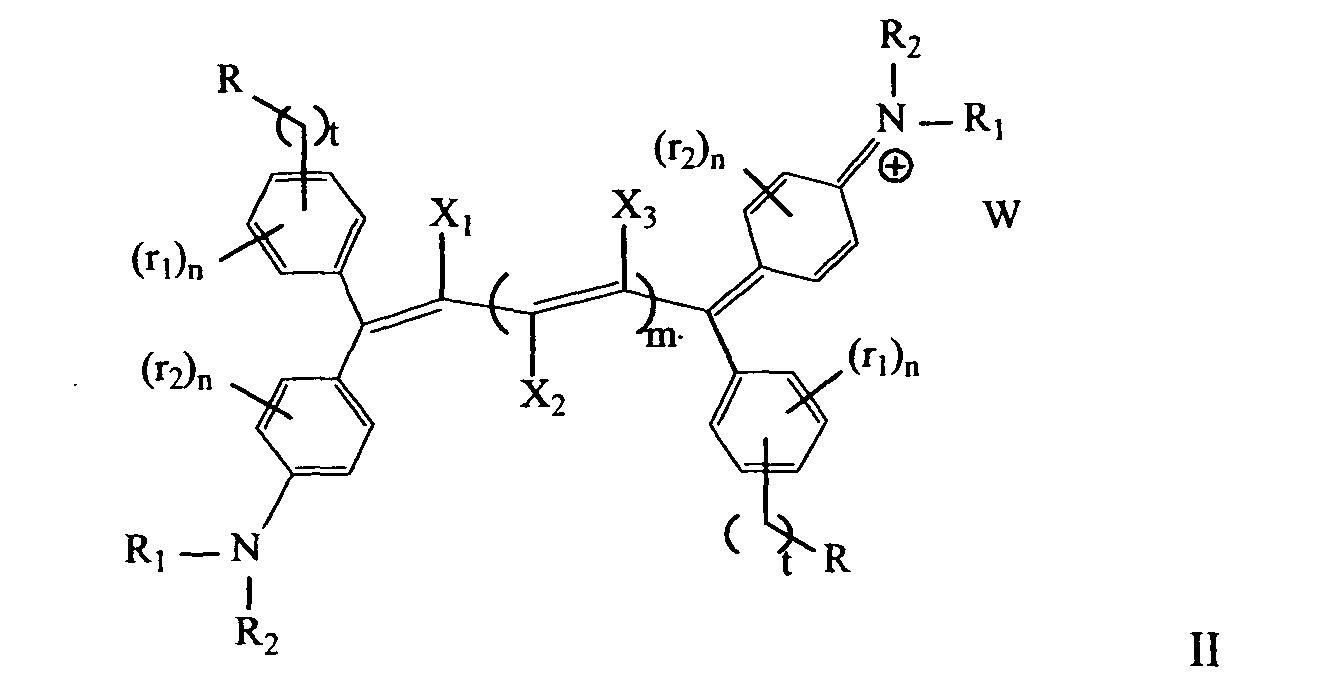 each R independently represents hydrogen or a substituent such that at least one such group is a colored chromophore;X1, X2 and X3 each independently represents hydrogen, halogen, cyano, an alkyl group having 1 to 12 carbon atoms, a cycloalkyl group having 5 to 10 carbon atoms in the carbocyclic ring, an aryl group having 6 to 10 carbon atoms in the carbocyclic ring, or any two of said X1, X2, and X3 may be joined together to complete a 5- to 7-membered carbocyclic or heterocyclic ring group, and m is 1-3;each of R1, and R2 independently represents an alkyl group having 1 to 12 carbon atoms a cycloalkyl group having 5 to 10 carbon atoms in the carbocyclic ring, an aryl group having 6 to 10 carbon atoms in the carbocyclic ring, or a heterocyclic or polymeric backbone group; provided R1 and R2 may be joined together to form a 5- to 7-membered heterocyclic ring group;each of r1, r2, and r3 independently represents a substituent group and each n is 0-4; and each t is 0-4; andW is a monovalent counter anion to balance the charge on the molecule.
 - The molecule of claims 1 or 2 wherein the first and second chromophores are not linked by a conjugated chain.
- A dispersion containing the molecule of any of claims 1-7.
- A suspension containing the molecule of any of claims 1-7.
- The molecule of claim 1 selected from the group consisting of:
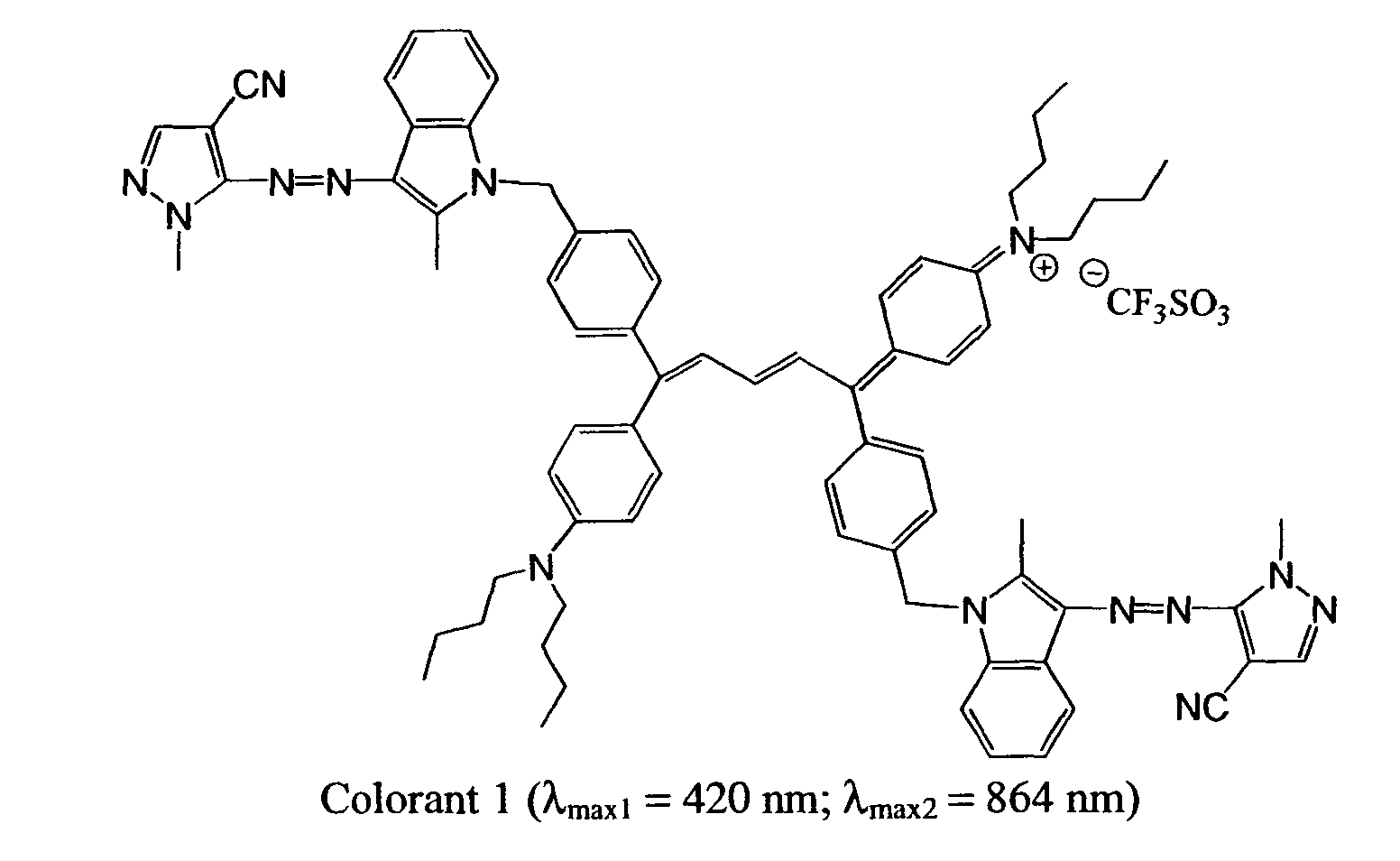

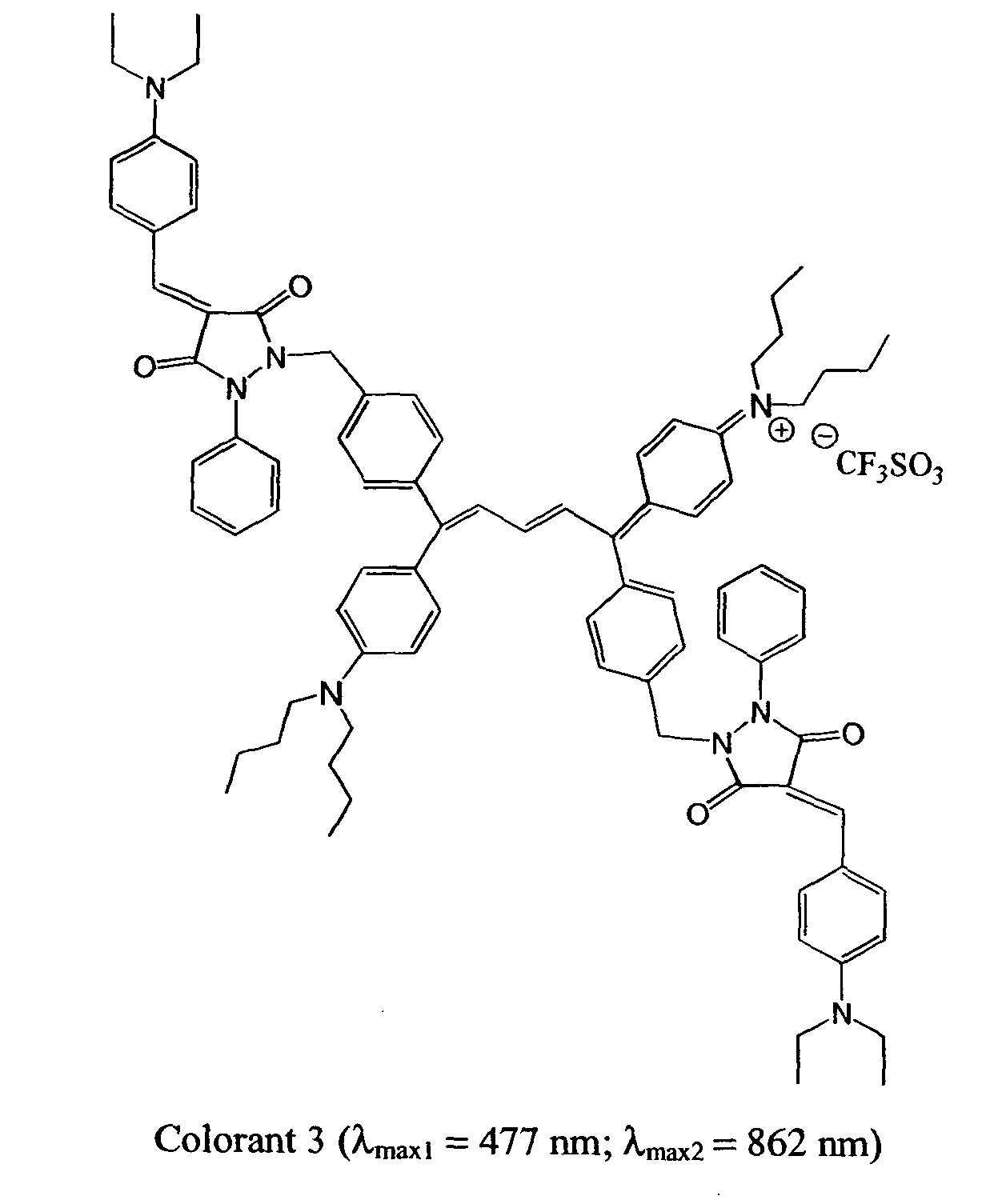


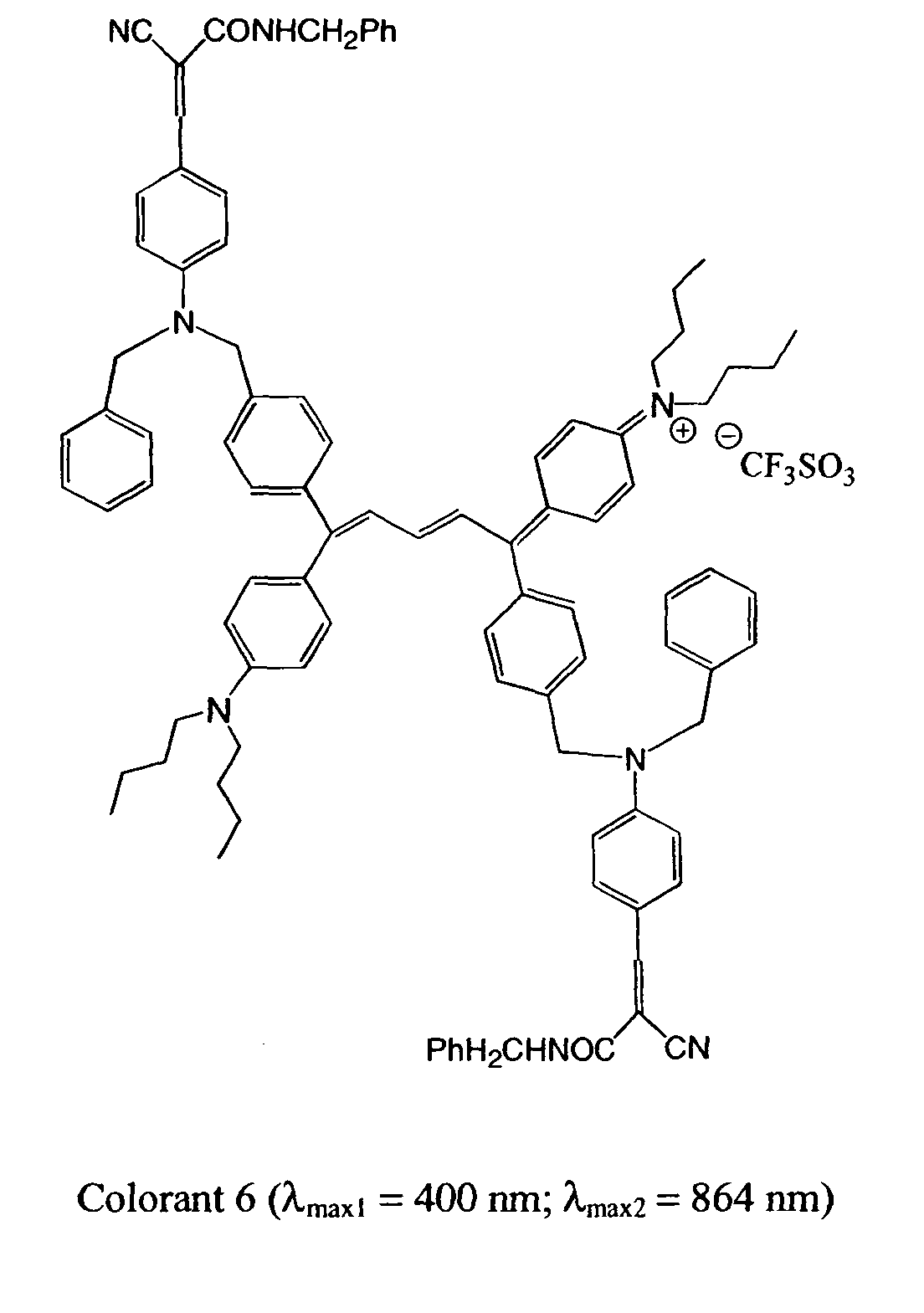
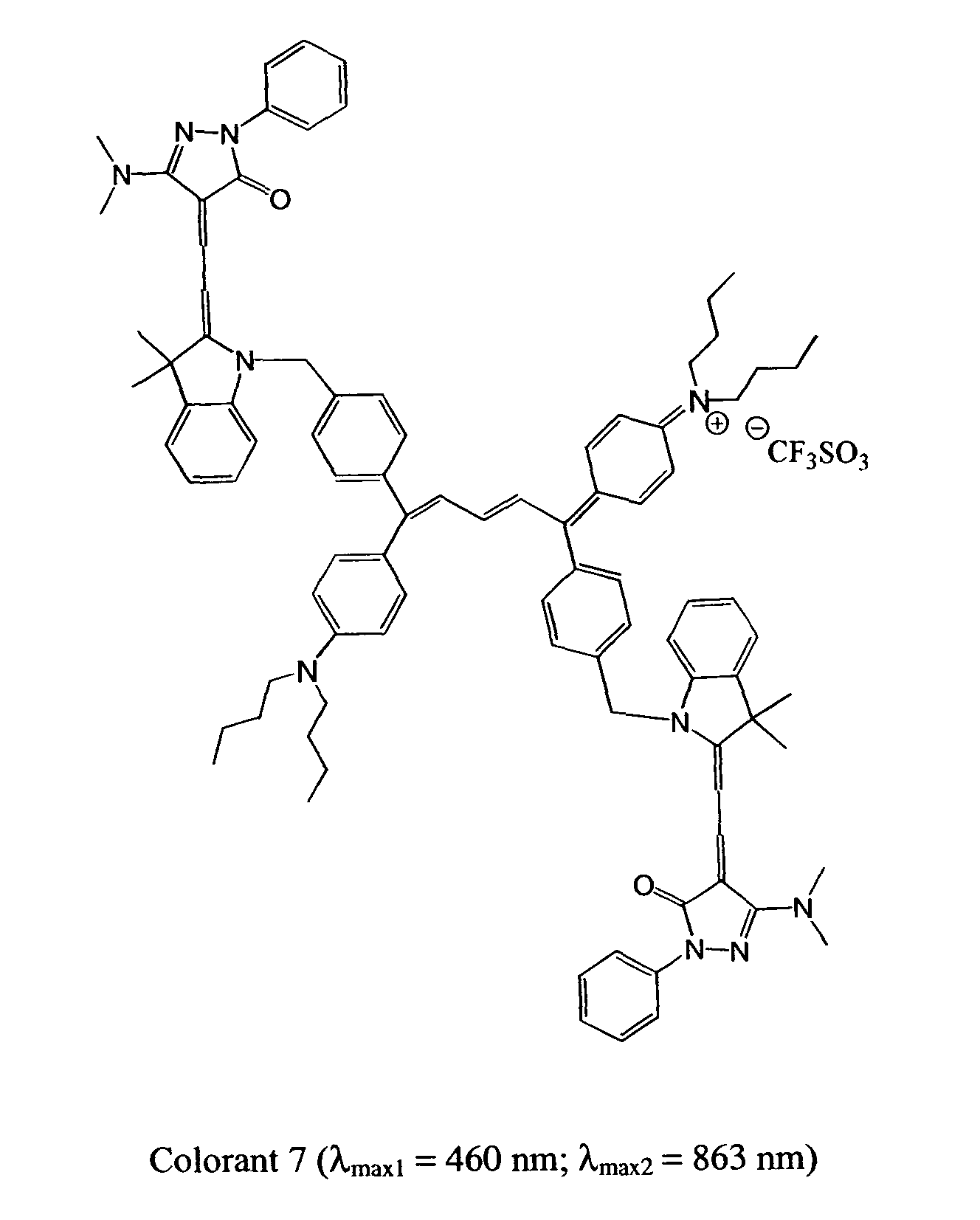
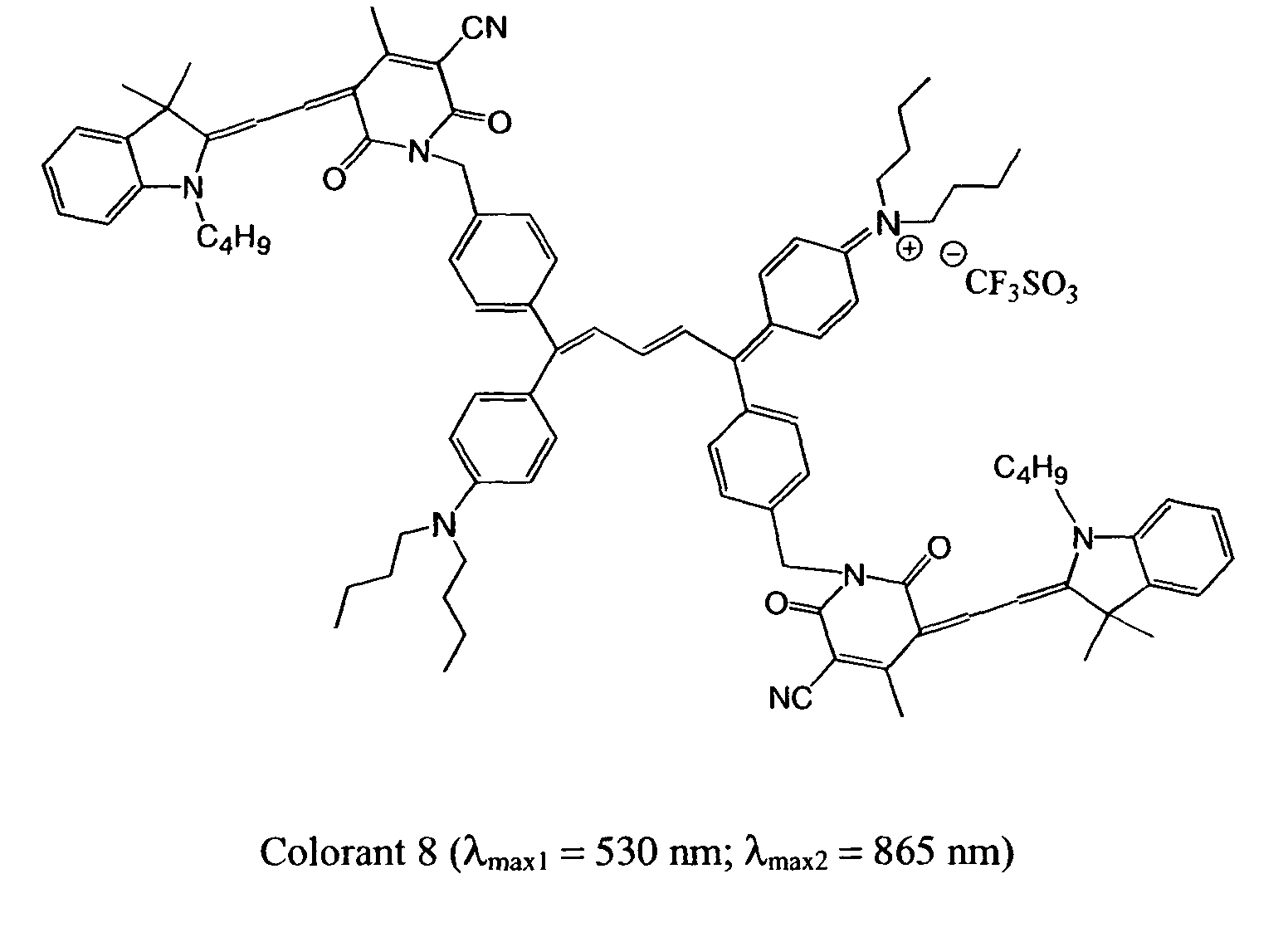


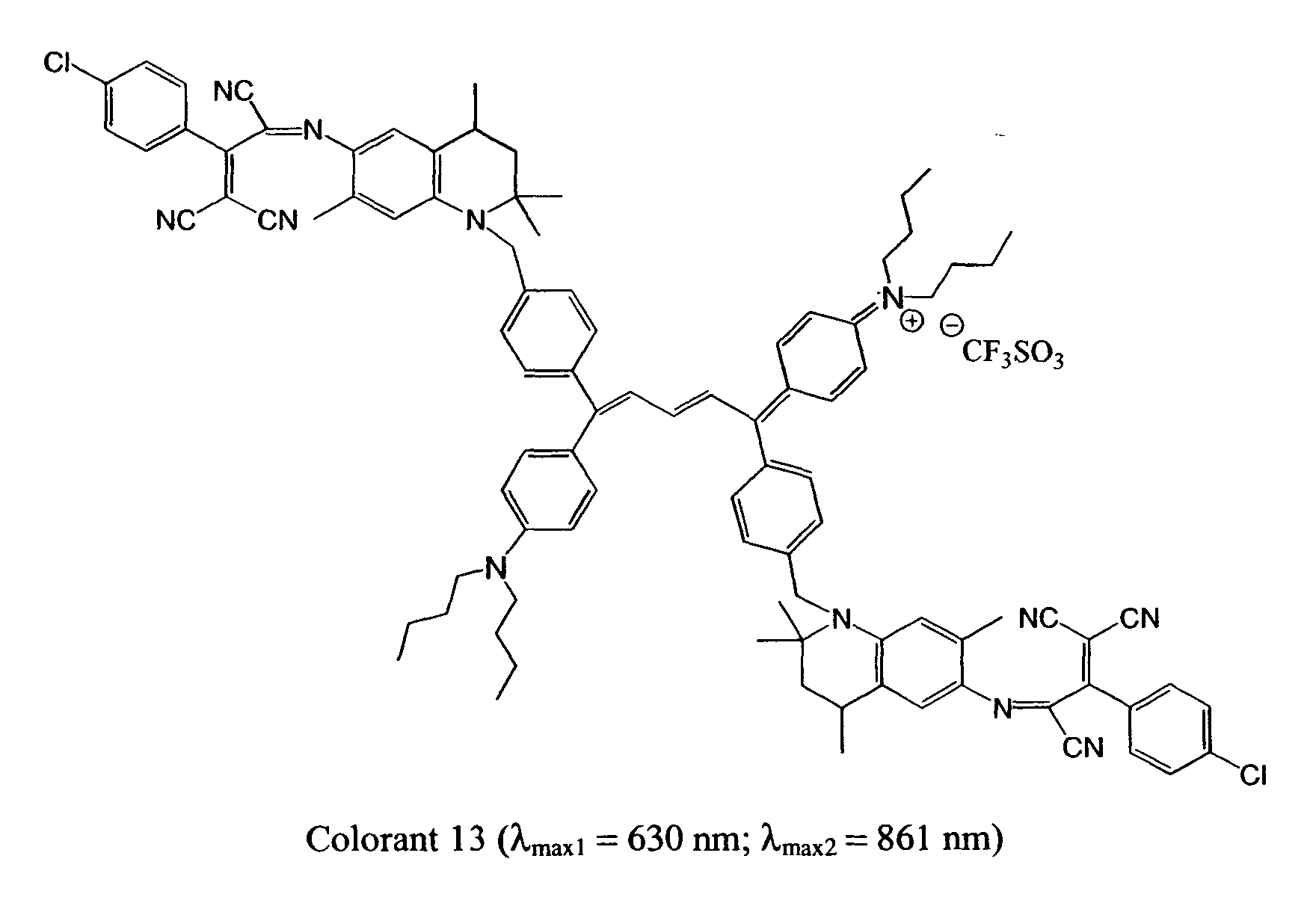
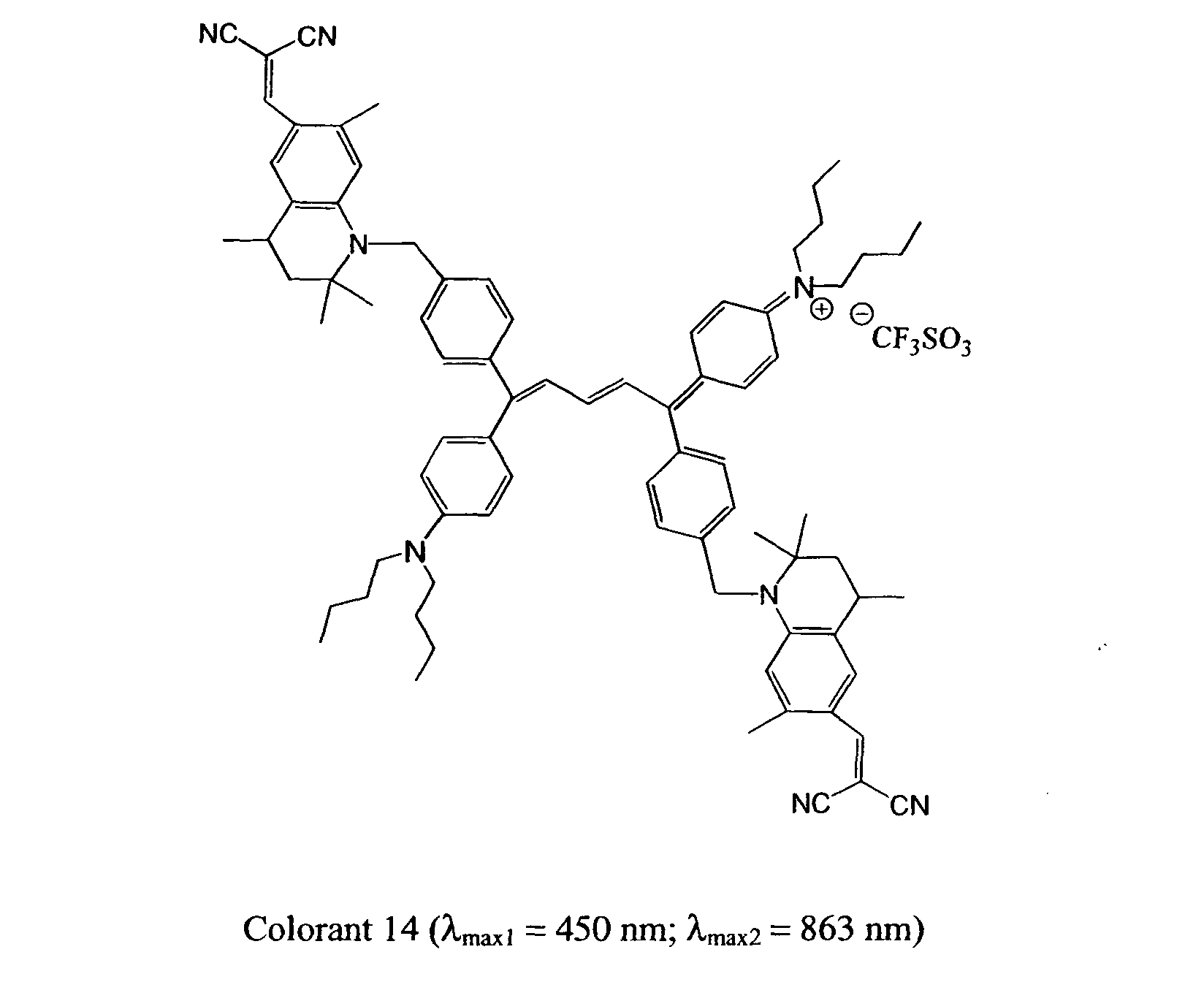
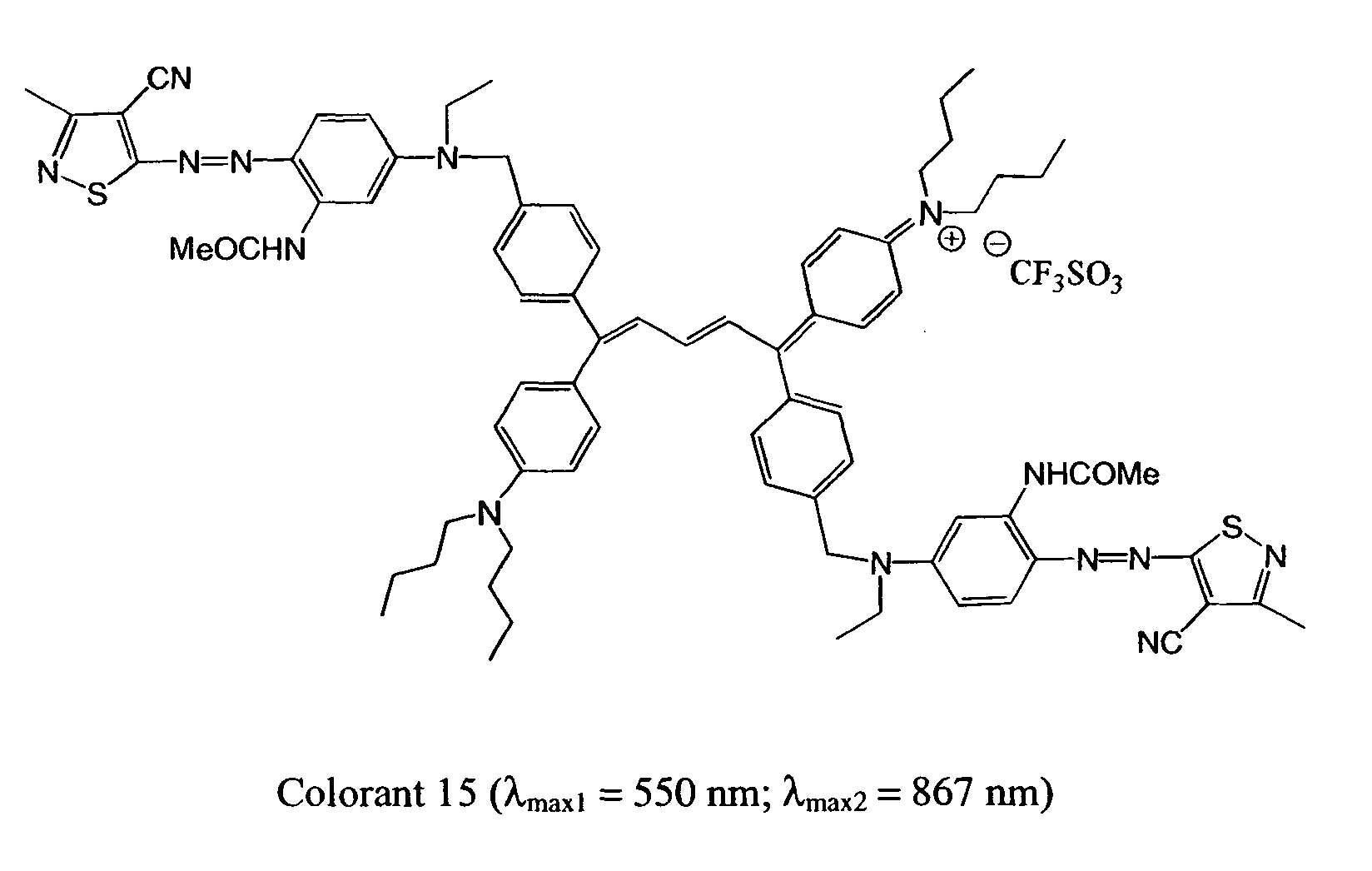


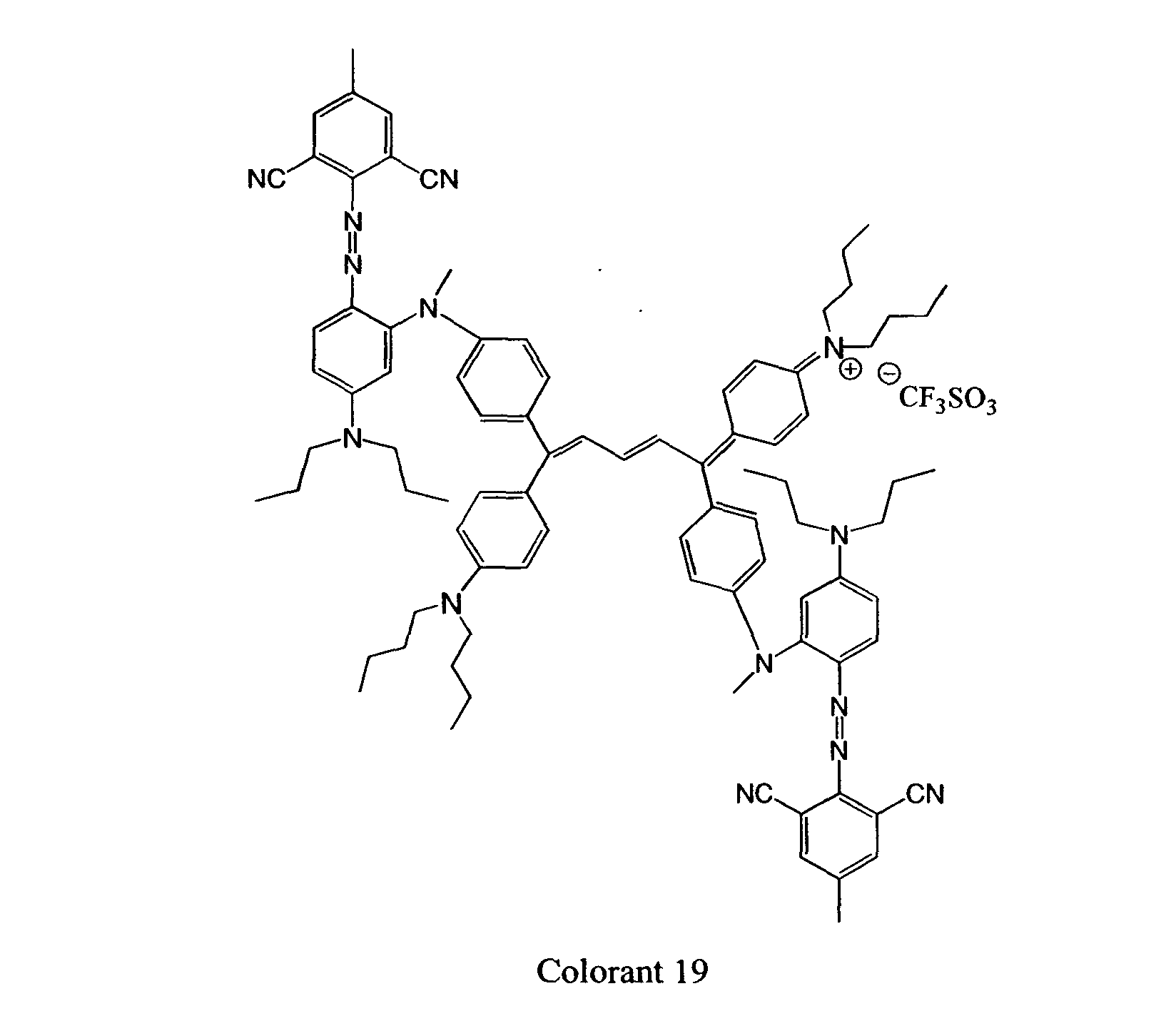
 and
and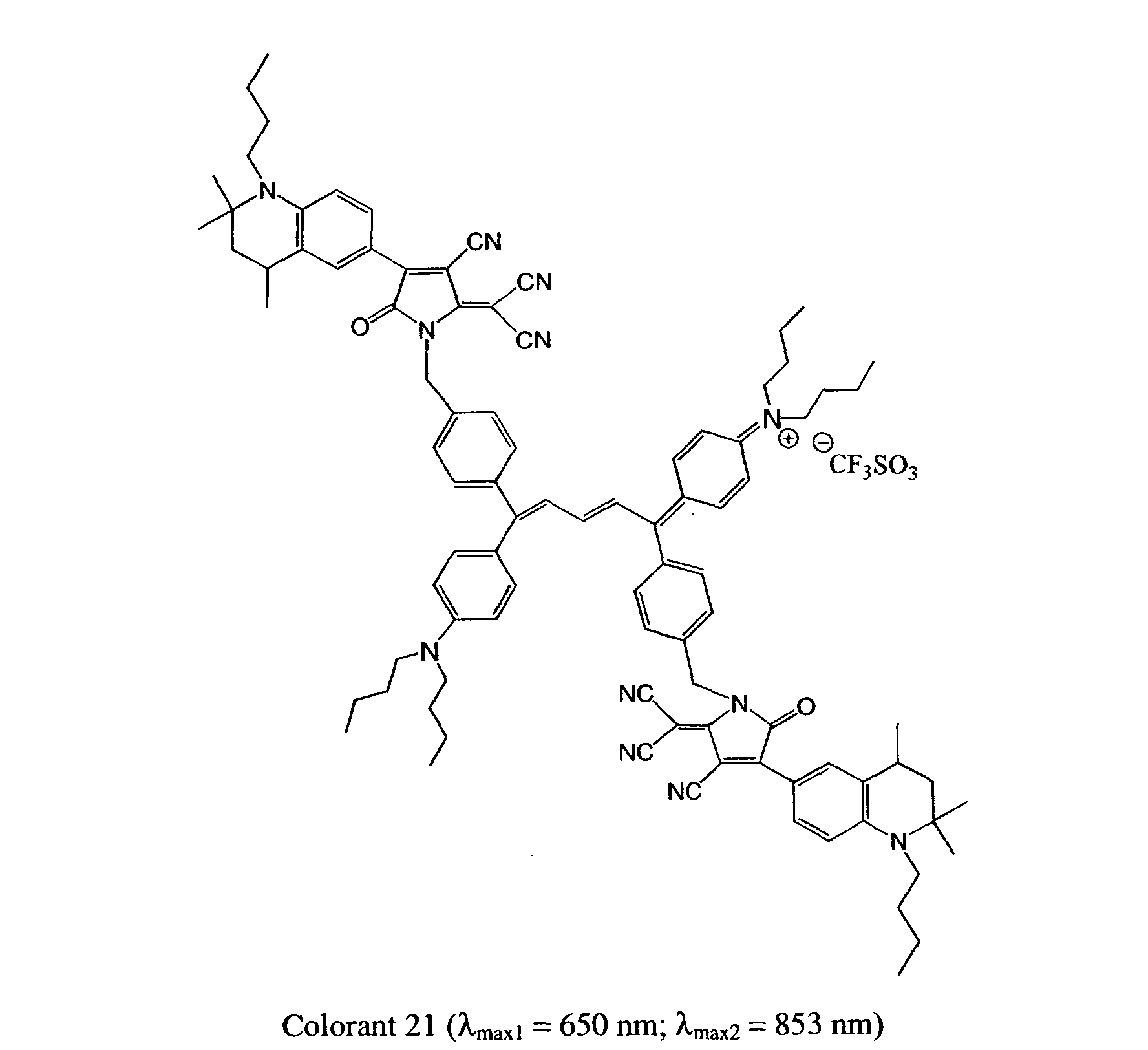

Applications Claiming Priority (2)
| Application Number | Priority Date | Filing Date | Title |
|---|---|---|---|
| US329912 | 2002-12-26 | ||
| US10/329,912 US6831163B2 (en) | 2002-12-26 | 2002-12-26 | Bichromophoric molecules |
Publications (1)
| Publication Number | Publication Date |
|---|---|
| EP1433820A1 true EP1433820A1 (en) | 2004-06-30 |
Family
ID=32469038
Family Applications (1)
| Application Number | Title | Priority Date | Filing Date |
|---|---|---|---|
| EP03079080A Withdrawn EP1433820A1 (en) | 2002-12-26 | 2003-12-15 | Bichromophoric molecules |
Country Status (4)
| Country | Link |
|---|---|
| US (1) | US6831163B2 (en) |
| EP (1) | EP1433820A1 (en) |
| JP (1) | JP2004211096A (en) |
| CN (1) | CN1511824A (en) |
Cited By (1)
| Publication number | Priority date | Publication date | Assignee | Title |
|---|---|---|---|---|
| WO2020218297A1 (en) * | 2019-04-26 | 2020-10-29 | 株式会社Adeka | Polymethine compound |
Families Citing this family (4)
| Publication number | Priority date | Publication date | Assignee | Title |
|---|---|---|---|---|
| JP5619494B2 (en) * | 2010-06-30 | 2014-11-05 | 株式会社日本触媒 | Yellow dye and color filter color mixing inhibitor and dye composition containing the same |
| CN103436047B (en) * | 2013-08-05 | 2015-09-02 | 宁波龙欣精细化工有限公司 | A kind of Novel bisazo methine nickel complexing solvent dyestuff containing benzimidazolone ring and its preparation method and application |
| WO2018043451A1 (en) * | 2016-09-05 | 2018-03-08 | 株式会社Adeka | Polymethine compound |
| CN116194444A (en) | 2020-07-17 | 2023-05-30 | 富士胶片株式会社 | Photoelectric conversion element, imaging element, photosensor and compound |
Citations (5)
| Publication number | Priority date | Publication date | Assignee | Title |
|---|---|---|---|---|
| US4950639A (en) * | 1989-06-16 | 1990-08-21 | Eastman Kodak Company | Infrared absorbing bis(aminoaryl)polymethine dyes for dye-donor element used in laser-induced thermal dye transfer |
| EP0499822A1 (en) * | 1991-02-20 | 1992-08-26 | BASF Aktiengesellschaft | Bichromophore methine dyes |
| EP0675003A1 (en) * | 1994-03-29 | 1995-10-04 | Minnesota Mining And Manufacturing Company | Thermal transfer imaging |
| EP0747700A2 (en) * | 1995-06-07 | 1996-12-11 | Carnegie-Mellon University | Fluorescent labelling complexes with large stokes shifts formed by coupling together cyanine and other fluorochromes capable of resonance energy transfer |
| US5843617A (en) * | 1996-08-20 | 1998-12-01 | Minnesota Mining & Manufacturing Company | Thermal bleaching of infrared dyes |
Family Cites Families (11)
| Publication number | Priority date | Publication date | Assignee | Title |
|---|---|---|---|---|
| US5223476A (en) * | 1989-05-02 | 1993-06-29 | Dai Nippon Insatsu Kabushiki Kaisha | Heat transfer sheet |
| US5281572A (en) * | 1990-02-15 | 1994-01-25 | Basf Aktiengesellschaft | Bichromorphic methine and azamethine dyes and process for transferring them |
| DE4004614A1 (en) * | 1990-02-15 | 1991-08-22 | Basf Ag | METHOD FOR TRANSMITTING METHINE DYES CONTAINING BICHROMOPHORES IN CYANOGROUPES |
| JP2518446B2 (en) * | 1990-05-18 | 1996-07-24 | 三菱自動車工業株式会社 | Vehicle output control device |
| US5935758A (en) * | 1995-04-20 | 1999-08-10 | Imation Corp. | Laser induced film transfer system |
| WO1997011641A1 (en) * | 1995-09-27 | 1997-04-03 | Artann Laboratories | Measuring anisotropic mechanical properties of tissue |
| US5972838A (en) | 1998-06-24 | 1999-10-26 | Eastman Kodak Company | Infrared-absorbing cyanine colorants for laser-colorant transfer |
| JP4132547B2 (en) * | 2000-03-01 | 2008-08-13 | 富士フイルム株式会社 | Image forming material and planographic printing plate precursor using the same |
| US6623908B2 (en) * | 2001-03-28 | 2003-09-23 | Eastman Kodak Company | Thermal imaging composition and imaging member containing polymethine IR dye and methods of imaging and printing |
| EP1422274A1 (en) * | 2002-11-20 | 2004-05-26 | Eastman Kodak Company | Display element with a backprint |
| US6841514B2 (en) * | 2002-12-26 | 2005-01-11 | Eastman Kodak Company | Thermal transfer imaging element containing infrared bichromophoric colorant |
-
2002
- 2002-12-26 US US10/329,912 patent/US6831163B2/en not_active Expired - Fee Related
-
2003
- 2003-12-15 EP EP03079080A patent/EP1433820A1/en not_active Withdrawn
- 2003-12-24 CN CNA2003101231467A patent/CN1511824A/en active Pending
- 2003-12-26 JP JP2003435295A patent/JP2004211096A/en active Pending
Patent Citations (5)
| Publication number | Priority date | Publication date | Assignee | Title |
|---|---|---|---|---|
| US4950639A (en) * | 1989-06-16 | 1990-08-21 | Eastman Kodak Company | Infrared absorbing bis(aminoaryl)polymethine dyes for dye-donor element used in laser-induced thermal dye transfer |
| EP0499822A1 (en) * | 1991-02-20 | 1992-08-26 | BASF Aktiengesellschaft | Bichromophore methine dyes |
| EP0675003A1 (en) * | 1994-03-29 | 1995-10-04 | Minnesota Mining And Manufacturing Company | Thermal transfer imaging |
| EP0747700A2 (en) * | 1995-06-07 | 1996-12-11 | Carnegie-Mellon University | Fluorescent labelling complexes with large stokes shifts formed by coupling together cyanine and other fluorochromes capable of resonance energy transfer |
| US5843617A (en) * | 1996-08-20 | 1998-12-01 | Minnesota Mining & Manufacturing Company | Thermal bleaching of infrared dyes |
Cited By (2)
| Publication number | Priority date | Publication date | Assignee | Title |
|---|---|---|---|---|
| WO2020218297A1 (en) * | 2019-04-26 | 2020-10-29 | 株式会社Adeka | Polymethine compound |
| CN113316572A (en) * | 2019-04-26 | 2021-08-27 | 株式会社艾迪科 | Polymethine compounds |
Also Published As
| Publication number | Publication date |
|---|---|
| JP2004211096A (en) | 2004-07-29 |
| US20040127360A1 (en) | 2004-07-01 |
| US6831163B2 (en) | 2004-12-14 |
| CN1511824A (en) | 2004-07-14 |
Similar Documents
| Publication | Publication Date | Title |
|---|---|---|
| EP1833930B1 (en) | Yellow dyes for ink jet inks | |
| EP1740662B1 (en) | Ink jet ink set | |
| US6831163B2 (en) | Bichromophoric molecules | |
| US6841514B2 (en) | Thermal transfer imaging element containing infrared bichromophoric colorant | |
| US6703111B2 (en) | Laser thermal imaging process, dye, and element | |
| US20040002605A1 (en) | Synthesis for quinacridone compounds | |
| US6903214B1 (en) | Synthesis of bis(azinyl)amine-BF2 complex | |
| US7056375B2 (en) | Solubilized dyes for inks | |
| US6869909B2 (en) | Yellow images with improved light stability and yellow dyes useful therein | |
| US6864216B2 (en) | Thermal magenta donor and dyes | |
| EP0672667B1 (en) | Oxidative desulfurization and halogenation of thioacylated pyrazolotriazole compounds | |
| EP1113006A1 (en) | Process for the synthesis of 2,5-dicarbonamidophenolic couplers and benzoxazole derivatives as intermediates | |
| US5864042A (en) | Process for preparation of a 4-amino-5-mercapto-3-substituted- 1,2,4!triazole compound | |
| US7449500B2 (en) | Ink jet ink containing multimetallic polymeric colorants | |
| US5945540A (en) | Synthesis of certain pyrazolo- 1,5-a! benzimidazole compounds | |
| US6657066B1 (en) | Synthesis of certain triazole compounds | |
| US20030228979A1 (en) | Thermal magenta donor and dyes | |
| US20030226219A1 (en) | Thermal yellow donor and dyes | |
| EP1408026A1 (en) | Alpha-amino-N-allylamidino nitrobenzene compound and synthesis |
Legal Events
| Date | Code | Title | Description |
|---|---|---|---|
| PUAI | Public reference made under article 153(3) epc to a published international application that has entered the european phase |
Free format text: ORIGINAL CODE: 0009012 |
|
| AK | Designated contracting states |
Kind code of ref document: A1 Designated state(s): AT BE BG CH CY CZ DE DK EE ES FI FR GB GR HU IE IT LI LU MC NL PT RO SE SI SK TR |
|
| AX | Request for extension of the european patent |
Extension state: AL LT LV MK |
|
| 17P | Request for examination filed |
Effective date: 20041109 |
|
| AKX | Designation fees paid |
Designated state(s): DE GB |
|
| STAA | Information on the status of an ep patent application or granted ep patent |
Free format text: STATUS: THE APPLICATION IS DEEMED TO BE WITHDRAWN |
|
| 18D | Application deemed to be withdrawn |
Effective date: 20061005 |