EP1433467A1 - Composition réductrice pour la mise en forme permanente ou le défrisage des cheveux contenant une phase mésomorphe son procédé de préparation et procédé de mise en forme permanente ou de défrissage des cheveux - Google Patents
Composition réductrice pour la mise en forme permanente ou le défrisage des cheveux contenant une phase mésomorphe son procédé de préparation et procédé de mise en forme permanente ou de défrissage des cheveux Download PDFInfo
- Publication number
- EP1433467A1 EP1433467A1 EP03293326A EP03293326A EP1433467A1 EP 1433467 A1 EP1433467 A1 EP 1433467A1 EP 03293326 A EP03293326 A EP 03293326A EP 03293326 A EP03293326 A EP 03293326A EP 1433467 A1 EP1433467 A1 EP 1433467A1
- Authority
- EP
- European Patent Office
- Prior art keywords
- composition
- composition according
- weight
- reducing
- hair
- Prior art date
- Legal status (The legal status is an assumption and is not a legal conclusion. Google has not performed a legal analysis and makes no representation as to the accuracy of the status listed.)
- Granted
Links
Classifications
-
- A—HUMAN NECESSITIES
- A61—MEDICAL OR VETERINARY SCIENCE; HYGIENE
- A61K—PREPARATIONS FOR MEDICAL, DENTAL OR TOILETRY PURPOSES
- A61K8/00—Cosmetics or similar toiletry preparations
- A61K8/02—Cosmetics or similar toiletry preparations characterised by special physical form
- A61K8/0295—Liquid crystals
-
- A—HUMAN NECESSITIES
- A61—MEDICAL OR VETERINARY SCIENCE; HYGIENE
- A61K—PREPARATIONS FOR MEDICAL, DENTAL OR TOILETRY PURPOSES
- A61K8/00—Cosmetics or similar toiletry preparations
- A61K8/18—Cosmetics or similar toiletry preparations characterised by the composition
- A61K8/30—Cosmetics or similar toiletry preparations characterised by the composition containing organic compounds
- A61K8/40—Cosmetics or similar toiletry preparations characterised by the composition containing organic compounds containing nitrogen
- A61K8/41—Amines
-
- A—HUMAN NECESSITIES
- A61—MEDICAL OR VETERINARY SCIENCE; HYGIENE
- A61K—PREPARATIONS FOR MEDICAL, DENTAL OR TOILETRY PURPOSES
- A61K8/00—Cosmetics or similar toiletry preparations
- A61K8/18—Cosmetics or similar toiletry preparations characterised by the composition
- A61K8/30—Cosmetics or similar toiletry preparations characterised by the composition containing organic compounds
- A61K8/46—Cosmetics or similar toiletry preparations characterised by the composition containing organic compounds containing sulfur
-
- A—HUMAN NECESSITIES
- A61—MEDICAL OR VETERINARY SCIENCE; HYGIENE
- A61Q—SPECIFIC USE OF COSMETICS OR SIMILAR TOILETRY PREPARATIONS
- A61Q5/00—Preparations for care of the hair
- A61Q5/04—Preparations for permanent waving or straightening the hair
-
- A—HUMAN NECESSITIES
- A45—HAND OR TRAVELLING ARTICLES
- A45D—HAIRDRESSING OR SHAVING EQUIPMENT; EQUIPMENT FOR COSMETICS OR COSMETIC TREATMENTS, e.g. FOR MANICURING OR PEDICURING
- A45D7/00—Processes of waving, straightening or curling hair
- A45D7/04—Processes of waving, straightening or curling hair chemical
Definitions
- the present invention relates to a reducing composition for permanent shaping or straightening of hair, its preparation process, a permanent shaping process or straightening and a device with several compartments or "kit”.
- One of the techniques commonly used in the field cosmetic to give hair a lasting shape consists of to deform the hair using a compound reducing agent then an oxidizing compound.
- the most common technique for obtaining a deformation permanent hair is firstly to achieve the opening of the disulfide bonds (-S-S-) of keratin (cystine) to using a composition containing a reducing compound, then after preferably having rinsed the hair thus treated, to be reconstituted in a second time, said disulfide bonds by applying to the hair previously tensioned by curlers or the like means, or shaped or smoothed by others, a composition oxidizing also called "fixer" so as to give the form wanted to the hair.
- This technique thus makes it possible to carry out either the waving of hair, either straightening or straightening it or smoothing it out.
- This new form imposed on the hair by a treatment chemical is durable over time for a few weeks and resists in particular the action of washing with water or shampoos and this in contrast to techniques using products from styling resulting in temporary deformation, such as setting folds, such deformation disappearing when styling or shampooing.
- the reducing compositions generally used for the first step in a permanent shaping operation or hair straightening contain at least one reducing compound in a medium aqueous, and generally ammonia as a basifying agent.
- the Applicant has surprisingly and unexpectedly found that we could limit this release of ammonia so important by adding a mesomorphic phase in a composition reducing permanent shaping or hair straightening comprising at least one reducing compound and ammonia, in one quantity of at least 10% by weight relative to the total weight of the said composition.
- the present invention therefore relates to a composition reducing for permanent shaping or straightening of hair comprising, in an aqueous medium, at least one compound reducing agent, ammonia and at least 10% mesomorphic phase by relative to the total weight of said composition.
- the invention also relates to a process for preparing said composition.
- Another object of the invention consists in a method of setting in permanent form and hair straightening using said composition.
- the invention also relates to a device with several compartments or kit comprising said composition.
- the reducing composition according to the invention for permanent shaping or straightening of the hair, includes, in an aqueous medium, at least one reducing compound, ammonia, and at least one mesomorphic phase in an amount of at least minus 10% by weight, better still at least 15% by weight relative to the weight of the composition.
- said composition comprises the phase mesomorph in an amount less than or equal to 85% by weight of the reducing composition
- ammonia is in the mesomorphic phase or outside of this phase.
- mesomorphic phase is meant an intermediate state between a crystalline state and a liquid state.
- the mesomorphic phase used in the composition according to the invention is preferably chosen from the reverse hexagonal (H 2 ), lamellar (L ⁇ and L ⁇ ) and inverse cubic (I 2 and V 2 ) phases.
- a L ⁇ lamellar phase Preferably used in the invention, a L ⁇ lamellar phase.
- reverse hexagonal phase is meant a hexagonal arrangement of parallel cylindrical micelles of amphiphilic molecules (Handbook of lipid research 4, the physical chemistry of lipids from alkanes to phospholipids, DM Small Editor, 1986, Plenum Press, p. 51 -56).
- fluid lamellar phase or phase L ⁇ is meant a phase in which the molecules of surfactants and / or more generally of amphiphilic compounds are organized in the form of bimolecular layers spaced apart by aqueous sheets.
- the molecules are distributed according to a hexagonal or orthorhombic geometry and their fatty chains are in a liquid state, they are oriented perpendicular to the plane of the bimolecular layers but have no specific orientation with respect to each other in the plan of these layers (Handbook of lipid research 4, the physical chemistry of lipids from alkanes to phospholipids, DM Small Editor, 1986, Plenum Press, p. 51-56).
- gel lamellar phase or “L ⁇ phase” is intended to mean a phase in which the molecules of surfactants and / or more generally of amphiphilic compounds are organized in the form of bimolecular layers spaced apart by aqueous sheets. Within the bimolecular layers, the molecules are distributed according to a hexagonal or orthorhombic geometry and their hydrocarbon chains are in a crystalline state, they are oriented perpendicular to the plane of the bimolecular layers but have no specific orientation with respect to each other in the plan of these layers (Handbook of lipid research 4, the physical chemistry of lipids from alkanes to phospholipids, DM Small Editor, 1986, Plenum Press, p. 51-56).
- cubic phase is meant a phase organized in a manner bipolar in distinct hydrophilic and lipophilic domains, in contact narrow and forming a three-dimensional network with cubic symmetry.
- a such an organization has been described in particular in "Latation”, Vol. 23, pages 306-315, March 1992 and in "Lipid Technology", Vol. 2 n ° 2, pages 42-45, April 1990.
- the cubic phase is said to be of direct type or reverse.
- the reverse cubic phase corresponds to a continuous phase oily.
- the mesomorphic phase structure can be verified by polarization microscopy and X-ray scattering at small angles or any other method well known in the art.
- the mesomorphic phase comprises preferably at least one nonionic surfactant mono- or polyoxyalkylenated or mono- or polyglycerolated having an HLB less than or equal to 10, preferably between 1 and 5.
- the HLB or hydrophilic-lipophilic balance of the surfactant (s) non-ionic used according to the invention is the HLB according to GRIFFIN defined in the publication J. Soc. Cosm. Chem. 1954 (Volume 5), pages 249-256, or the HLB determined experimentally and such as described in the work of the authors F. PUISIEUX and M. SEILLER, entitled "GALENICA 5: Dispersed systems - Tome I - Agents surface and emulsions - Chapter IV - Notions of HLB and HLB review, pages 153-194 - paragraph 1.1.2. Determination of HLB by experimental route, pages 164-180.
- nonionic surfactants which carry in their molecule one or more oxyalkylene groups chosen from the following groups -CH 2 -CH 2 -O-, -CH 2 - CH 2 -CH 2 -O-, -CH 2 -CH (CH 3 ) -O- or mixtures thereof.
- nonionic surfactants which carry in their molecule one or more glycerol groups.
- Surfactants Usable in the Present invention are polyglycerolated fatty alcohols, mono- fatty alcohols or polyoxyethylenated, mono- or polyglycerolated fatty amides comprising on average from 1 to 5 glycerol groups, the mono- or polyoxyethylenated alkylphenols, oxide condensates ethylene and propylene on fatty alcohols, vegetable oils polyoxyethylenated, esters of fatty acids and polyethylene glycols, esters of polyoxyethylenated fatty acids and sorbitol, and their mixtures.
- nonionic surfactants having a HLB> 5 we can notably cite those sold under the brands following commercial:
- the nonionic surfactant being particularly suitable for the invention is hexadecyl alcohol with 2 moles of glycerol
- the nonionic surfactant (s) are preferably present in an amount ranging from 5 to 30% by weight, better still from 5.5 to 30% by weight, and even more preferably from 10 to 20% by weight, relative to the total weight of the reducing composition.
- the mesomorphic phase can also further comprise at at least one fatty alcohol containing from 8 to 30 carbon atoms, preferably 12 to 22 carbon atoms.
- fatty alcohols examples include hexadecanol.
- the fatty alcohol is preferably present in an amount ranging from 3 to 20% by weight, better still 5 to 15% by weight, relative to the total weight of the reducing composition.
- Ammonia is especially present in the composition reducing agent according to the invention, in an amount of 0.01 to 4% by weight, of preferably from 0.05 to 2% by weight relative to the total weight of the composition.
- cysteine and its various derivatives in particular N-acetylcysteine
- cysteamine and its various derivatives in particular its acylated C 1 -C 4 derivatives such as N-acetyl cysteamine or N-propionyl cysteamine
- thiolactic acid and its esters in particular glycerol monothiolactate
- thioglycolic acid and its esters in particular glycerol or glycol monothioglycolate, and thioglycerol.
- N-mercaptoalkylamides of sugars such as N- (mercapto-2-ethyl) gluconamide, ⁇ -mercaptopropionic acid and its derivatives, thiomalic acid, panthetyin, N- (mercaptoalkyl) ⁇ -hydroxyalkylamides described in patent application EP-A-354,835 and the N-mono- or N, N-dialkylmercapto 4-butyramides described in patent application EP-A-368,763, the aminomercaptoalkylamides described in patent application EP-A-432,000 and the alkylaminomercaptoalkylamides described in patent application EP-A-514,282, the mixture of 2-hydroxypropyl thioglycolate (2/3) and 2-hydroxy methyl thioglycolate -1 ethyl (67/33) described in patent application FR-A-2 679 448.
- sugars such as N- (mercapto-2-ethyl) gluconamide,
- the preferred reducing compounds are thioglycolic acid and cysteine.
- the reducing compounds as mentioned above are generally present in a concentration which can be between 0.1 and 30% by weight, and preferably between 1 and 20% by weight relative to the weight total of the reducing composition.
- the reducing compositions according to the invention may contain in addition usual and conventional additives, alone or in mixtures, such that surfactants different from those mentioned above, of the type non-ionic, anionic, cationic or amphoteric.
- surfactants different from those mentioned above, of the type non-ionic, anionic, cationic or amphoteric.
- these may in particular mention the alkyl sulfates, the alkylbenzenesulfates, the alkyl ether sulfates, alkyl sulfonates, ammonium salts quaternary, alkyl betaines, alkanolamides of fatty acids, esters of oxyethylenated fatty acids, as well as other nonionic surfactants of the hydroxypropyl ether type.
- the reducing composition additionally contains nonionic surfactants with an HLB less than or equal to 10, at least one surfactant, the latter is generally present at a maximum concentration of 30% by weight, and preferably between 0.5 and 10% by weight, relative to the total weight of the reducing composition.
- composition reducing agent may also contain a treating agent of a cationic, anionic, non-ionic or amphoteric.
- treating agents one can including citing those described in French patent applications Nos 2 598 613 and 2 470 596. It can also be used as agents treating volatile or non-volatile, linear or cyclic silicones and their mixtures, polydimethylsiloxanes, polyorganosiloxanes quaternized such as those described in the French patent application No. 2,535,730, polyorganosiloxanes containing aminoalkyl groups modified by alkoxycarbonylalkyl groups such as those described in US Patent No.
- polyorganosiloxanes such that the polydimethylsiloxane-polyoxyalkyl copolymer of the type Dimethicone-Copolyol, a polydimethylsiloxane with groups stearoxy- (stearoxydimethicone) terminals, a copolymer polydimethyl-siloxanedialkylammonium acetate or a copolymer polyalkylbetaine polydimethyl-siloxane described in the application for British Patent No. 2,197,352, organo-modified polysiloxanes by mercapto or mercaptoalkyl groups such as those described in French Patent No. 1,530,369 and in the application for European Patent No. 295,780, as well as silanes such as stearoxytrimethylsilane.
- the reducing composition may also contain other treating ingredients such as cationic polymers such as those used in the compositions of French patents Nos 2 472 382 and 2 495 931, or alternatively cationic polymers of the ionene type such as those used in the compositions.
- the reducing composition can be in the form a lotion, thickened or not, a cream, a gel, or any other appropriate form.
- the aqueous medium used in the present invention preferably consists of water or a hydroalcoholic solution of a lower C 1-4 alcohol such as ethanol, isopropanol or butanol.
- a particularly interesting embodiment of the invention consists in using an aqueous medium not containing organic solvent.
- the reducing composition is preferably in the form of a thickened cream so as to maintain the hair as straight as possible.
- the oily phase may consist by various products such as paraffin oil, petrolatum oil, sweet almond oil, avocado oil, olive oil, esters fatty acids like glyceryl monostearate, palmitates ethyl or isopropyl, alkyl myristates such as myristates propyl, butyl or cetyl.
- the reducing compositions can also contain at least one disulfide known for its use in a composition reducing agent for self-neutralizing perm.
- disulfides include dithioglycolic acid, dithioglycerol, cystamine, N, N'-diacetyl-cystamine, cystine, pantethine, and the disulphides of N- (mercapto-alkyl) ⁇ -hydroxyalkylamides described in the request for European patent EP 354 835, the disulphides of N-mono or N, N-dialkylmercapto-4-butyramides described in the EP patent application 368 763, the disulphides of the aminomercaptoalkylamides described in patent application EP 432,000, and the disulfides of alkylaminomercaptoalkylamides described in the EP patent application 514 282.
- These disulfides are generally present in a report molar from 0.5 to 2.5, and preferably 1 to 2, relative to the agent reducer (see US Patent 3,768,490).
- the pH of the reducing compositions can be optionally adjusted by adding acidifying agents such as, for example, acid hydrochloric acid, acetic acid, lactic acid or boric acid, or basifying agents other than ammonia.
- acidifying agents such as, for example, acid hydrochloric acid, acetic acid, lactic acid or boric acid, or basifying agents other than ammonia.
- the pH is generally between 6 and 10, preferably between 7 and 9.5.
- ammonia is added in step a) and / or in step b), other words it is either added during the preparation of the mesomorphic phase, either already present in the middle of the composition reducing agent before addition of the mesomorphic phase, or added in the reducing composition after incorporation of the mesomorphic phase.
- Another embodiment consists in incorporating a phase mesomorph containing ammonia in a medium containing itself ammonia.
- the hair tensioning step can be carried out work by all appropriate and known mechanical means, such as rollers, curlers.
- Oxidizing agents usable in the context of this invention can in particular be chosen from peroxide hydrogen or hydrogen peroxide, urea peroxide; the bromates of alkali metals; persalts such as perborates and persulfates; and enzymes such as peroxidases and redox two-fold electrons.
- the use of hydrogen peroxide or said bromates is particularly preferred.
- the concentration of hydrogen peroxide can vary from 1 to 10 volumes, but it is preferably equal to approximately 8 volumes.
- the concentration of bromates is generally between 1 and 12% by weight and that of the persalts is generally between 0.1 and 15% by weight relative to the total weight of the composition oxidizing.
- the pH of the oxidizing composition can be between 2 and 7, and preferably between 3 and 6.
- the invention also relates to a device with several compartments or "kit” for permanent shaping or hair straightening, comprising at least two compartments of which one of them contains a reducing composition as defined above.
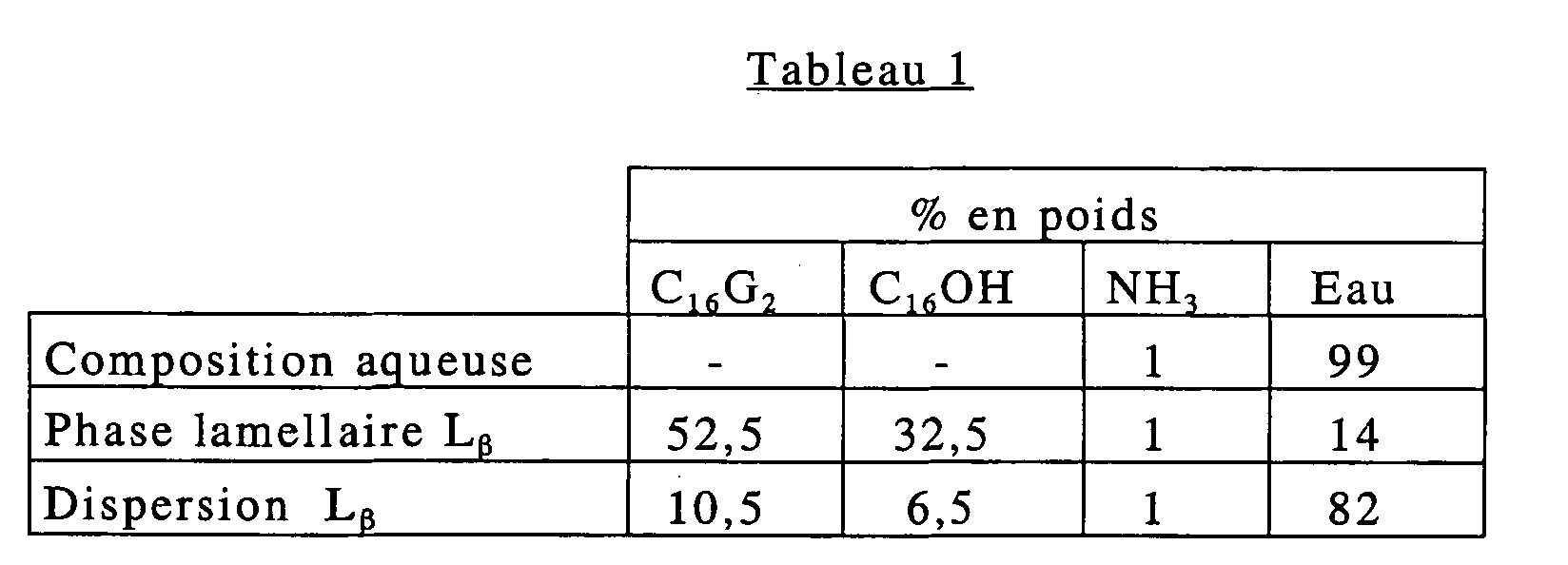
- An aqueous composition was also prepared to serve as a control, as well as a dispersion of the lamellar phase L ⁇ in water (or dispersion L ⁇ ).
- the structure of the lamellar phase was checked by microscopy polarization and X-ray scattering at small angles.
- ammonia evolution was then measured with colorimetric tubes, on 10 ml samples of each of the compositions, contained in open 30 ml flasks. The resulting uncertainty is about 10% maximum. The measurements for each sample lasted from 20 to 30 seconds.
- the lamellar phase sample diffuses 3 to 8 times less than the control sample.
- a reducing composition was prepared by mixing with room temperature (around 20 to 25 ° C), 100 g. live lamellar prepared in Example 1, and 15 g. of a support of the components of which are listed below.
- the components of the reducing composition including the components of the lamellar phase, are indicated below with their weight proportion relative to the total weight of the reducing composition.
- Components of the reducing composition % in weight - Ammonium bicarbonate 5.3 - Pentasodium salt of diethylene-triamine-pentacetic acid in 40% aqueous solution 0.17 - Oxyethylenated oleocetyl alcohol (20 EO) 0.67 - Perfume 0.33 - Cocoylamidopropyl betaine / glyceryl monolaurate mixture in 30% aqueous solution 1.1 - Polydimethylsiloxane with aminoethyl, aminopropyl and alpha-omega silanol groups, in cationic emulsion 2.2 - Ammonium thioglycolate in 71% aqueous solution 12.8 - Tetramethyl-hexamethylenediamine / 1,3-dichloropropylene polycondensate in 60%
Landscapes
- Life Sciences & Earth Sciences (AREA)
- Health & Medical Sciences (AREA)
- Animal Behavior & Ethology (AREA)
- General Health & Medical Sciences (AREA)
- Public Health (AREA)
- Veterinary Medicine (AREA)
- Birds (AREA)
- Epidemiology (AREA)
- Chemical & Material Sciences (AREA)
- Crystallography & Structural Chemistry (AREA)
- Cosmetics (AREA)
- Detergent Compositions (AREA)
Abstract
Description

| Composants de la composition réductrice : | % en poids |
| - Bicarbonate d'ammonium | 5,3 |
| - Sel pentasodique de l'acide diéthylène-triamine-pentacétique en solution aqueuse à 40% | 0,17 |
| - Alcool oléocétylique oxyéthyléné (20 OE) | 0,67 |
| - Parfum | 0,33 |
| - Mélange cocoylamidopropylbétaine/monolaurate de glycéryle en solution aqueuse à 30% | 1,1 |
| - Polydiméthylsiloxane à groupes aminoéthyle, aminopropyle et alpha-oméga silanols, en émulsion cationique | 2,2 |
| - Thioglycolate d'ammonium en solution aqueuse à 71% | 12,8 |
| - Polycondensat tétraméthyl-hexaméthylènediamine/ 1,3-dichloropropylène en solution aqueuse à 60 % | 1,3 |
| - Ammoniaque (20%) | 2,0 |
| - Alcool hexadécylique à 2 moles de glycérol | 8,8 |
| - Hexadécanol | 5,4 |
| - Eau désionisée qs | 100 |
Claims (22)
- Composition réductrice de mise en forme permanente ou de défrisage des cheveux, caractérisée en ce qu'elle comprend, dans un milieu aqueux, au moins un composé réducteur de la kératine, de l'ammoniac et au moins une phase mésomorphe présente en une quantité d'au moins 10 % en poids par rapport au poids de la composition.
- Composition selon la revendication 1, caractérisée en ce que la quantité de phase mésomorphe est supérieure ou égale à 15 % en poids par rapport au poids de la composition.
- Composition selon la revendication 1 ou 2, caractérisée en ce que la quantité de phase mésomorphe est inférieure ou égale à 85 % en poids par rapport au poids total de la composition.
- Composition selon l'une quelconque des revendications 1 à 3, caractérisée en ce que la phase mésomorphe est choisie parmi les phases hexagonales inverses (H2), lamellaires (Lα et Lβ) et cubiques inverses (I2 et V2).
- Composition selon la revendication 4, caractérisée en ce que la phase mésomorphe est une phase lamellaire Lβ.
- Composition selon l'une quelconque des revendications 1 à 5, caractérisée en ce que la phase mésomorphe comprend au moins un tensioactif non ionique présentant une HLB inférieure ou égale à 10, de préférence comprise entre 1 et 5.
- Composition selon la revendication 6, caractérisée en ce que les tensioactifs non ioniques sont choisis parmi les alcools gras polyglycérolés, les alcools gras mono- ou polyoxyéthylénés, les amides gras mono- ou polyglycérolés comportant en moyenne de 1 à 5 groupements glycérol, les alkylphénols mono- ou polyoxyéthylénés ayant plus de 2 moles d'oxyde d'éthylène, les condensats d'oxydes d'éthylène et de propylène sur des alcools gras, les huiles végétales polyoxyéthylénées ayant plus de 5 moles d'oxyde d'éthylène, les esters d'acides gras et de polyéthylèneglycols, les esters d'acides gras et de sorbitol polyoxyéthylénés, et leurs mélanges.
- Composition selon la revendication 7, caractérisée en ce que le tensioactif non ionique est l'alcool hexadécylique à 2 moles de glycérol.
- Composition selon l'une quelconque des revendications 6 à 8, caractérisée en ce que le tensioactif non ionique est présent en une quantité allant de 5 à 30 % en poids, mieux encore de 10 à 20 % en poids, par rapport au poids total de la composition réductrice.
- Composition selon l'une quelconque des revendications précédentes, caractérisée en ce que la phase mésomorphe comprend en outre au moins un alcool gras comportant de 8 à 30 atomes de carbone.
- Composition selon la revendication 10, caractérisée en ce que l'alcool gras est l'hexadécanol.
- Composition selon la revendication 10 ou 11, caractérisée en ce que l'alcool gras est présent en une quantité allant de 3 à 20 % en poids, mieux encore de 5 à 15 % en poids, par rapport au poids total de la composition réductrice.
- Composition selon l'une quelconque des revendications précédentes, caractérisée en ce qu'elle comprend l'ammoniac en une quantité de 0,01 à 4 % en poids par rapport au poids total de la composition.
- Composition selon la revendication 13, caractérisée en ce qu'elle comprend l'ammoniac en une quantité de 0,05 à 2 % en poids par rapport au poids total de la composition.
- Composition selon l'une quelconque des revendications précédentes, caractérisée en ce que le composé réducteur est choisi parmi les sulfites et/ou les bisulfites de métaux alcalins ou alcalino-terreux ou d'ammonium, et les thiols.
- Composition selon la revendication 15, caractérisée en ce que le composé réducteur est choisi parmi l'acide thioglycolique et la cystéine.
- Composition selon l'une quelconque des revendications précédentes, caractérisée en ce que le composé réducteur est présent en une quantité comprise entre 1 et 30% en poids, et de préférence entre 5 et 20% en poids par rapport au poids total de la composition réductrice.
- Composition selon l'une quelconque des revendications précédentes, caractérisée en ce que le milieu aqueux est constitué par l'eau ou par une solution hydroalcoolique d'un alcool inférieur en C1-4 tel que l'éthanol, l'isopropanol ou le butanol.
- Procédé de préparation de la composition réductrice selon l'une quelconque des revendications précédentes, caractérisé en ce qu'il comprend les étapes de :l'ammoniac étant ajouté dans l'étape a) et/ou l'étape b).a) mélange d'au moins un tensioactif non ionique présentant une HLB inférieure ou égale à 10, de préférence comprise entre 1 et 5, avec de l'eau, et éventuellement avec un ou plusieurs alcools gras, pour préparer la phase mésomorphe, etb) addition d'au moins un composé réducteur,
- Procédé de mise en forme permanente ou de défrisage des cheveux, caractérisé en ce que l'on applique une composition réductrice selon l'une quelconque des revendications 1 à 18, pendant ou après l'étape de mise sous tension des cheveux par un moyen mécanique ou mis en forme par tous les moyens manuels,
l'on applique après un temps de pose suffisant pour permettre la réduction des liaisons disulfures des cheveux, et après un rinçage éventuel, une composition oxydante contenant au moins un agent oxydant, et
l'on procède au rinçage. - Procédé de mise en forme permanente ou de défrisage des cheveux selon la revendication 20, caractérisé en ce que l'agent oxydant est choisi parmi les bromates de métaux alcalins et le peroxyde d'hydrogène.
- Dispositif à plusieurs compartiments ou "kit" pour la mise en forme permanente ou le défrisage des cheveux, comportant au moins deux compartiments dont l'un d'entre eux renferme une composition réductrice selon l'une quelconque des revendications 1 à 18.
Applications Claiming Priority (2)
| Application Number | Priority Date | Filing Date | Title |
|---|---|---|---|
| FR0216597 | 2002-12-24 | ||
| FR0216597A FR2848833B1 (fr) | 2002-12-24 | 2002-12-24 | Composition reductrice pour la mise en forme permanente ou le defrisage des cheveux, contenant une phase mesomorphe, son procede de preparation et procede de mise en forme permanente ou de defrisage des cheveux |
Publications (2)
| Publication Number | Publication Date |
|---|---|
| EP1433467A1 true EP1433467A1 (fr) | 2004-06-30 |
| EP1433467B1 EP1433467B1 (fr) | 2006-07-05 |
Family
ID=32406468
Family Applications (1)
| Application Number | Title | Priority Date | Filing Date |
|---|---|---|---|
| EP03293326A Expired - Lifetime EP1433467B1 (fr) | 2002-12-24 | 2003-12-24 | Composition réductrice pour la mise en forme permanente ou le défrisage des cheveux contenant une phase mésomorphe, son procédé de préparation et procédé de mise en forme permanente ou de défrissage des cheveux |
Country Status (4)
| Country | Link |
|---|---|
| EP (1) | EP1433467B1 (fr) |
| AT (1) | ATE332121T1 (fr) |
| DE (1) | DE60306611T2 (fr) |
| FR (1) | FR2848833B1 (fr) |
Cited By (2)
| Publication number | Priority date | Publication date | Assignee | Title |
|---|---|---|---|---|
| EP1685825A1 (fr) * | 2005-01-28 | 2006-08-02 | L'oreal | Procédé de traitement capillaire et utilisation dudit procédé |
| US7815901B2 (en) | 2005-01-28 | 2010-10-19 | L'ORéAL S.A. | Hair treatment method |
Citations (10)
| Publication number | Priority date | Publication date | Assignee | Title |
|---|---|---|---|---|
| FR1313557A (fr) * | 1962-02-02 | 1962-12-28 | Therachemie Chem Therapeut | Produit pour le traitement des scléro-protéines contenant du soufre |
| US3975515A (en) * | 1973-09-29 | 1976-08-17 | Wella Ag | Reducing the alkali concentration in hair treating compositions |
| GB2026052A (en) * | 1978-05-19 | 1980-01-30 | Yamahatsu Sangyo Kaisha | Permanent waving |
| US4394520A (en) * | 1964-01-29 | 1983-07-19 | Societe Anonyme Dite: L'oreal | 5-Ureido-3-thia hexanedioic acid |
| US4548811A (en) * | 1982-11-08 | 1985-10-22 | Shiseido Company Ltd. | Waving lotion for cold waving |
| US4560554A (en) * | 1983-09-20 | 1985-12-24 | Shiseido Company Ltd. | Neutralizer for cold waving |
| US4781724A (en) * | 1985-12-09 | 1988-11-01 | Wella Aktiengesellschaft | Process for the simultaneous dyeing and permanent shaping of hair |
| WO1997004738A1 (fr) * | 1995-07-28 | 1997-02-13 | Wella Aktiengesellschaft | Procede de mise en forme permanente des cheveux |
| US6173717B1 (en) * | 1997-12-19 | 2001-01-16 | Wella Aktiengesellschaft | Hair shaping method using acidic aqueous intermediate rinse to prevent overcurling |
| FR2816210A1 (fr) * | 2000-11-08 | 2002-05-10 | Oreal | Composition pour la decoloration ou la deformation permanente des fibres keratiniques comprenant un polyurethane associatif cationique |
-
2002
- 2002-12-24 FR FR0216597A patent/FR2848833B1/fr not_active Expired - Fee Related
-
2003
- 2003-12-24 EP EP03293326A patent/EP1433467B1/fr not_active Expired - Lifetime
- 2003-12-24 DE DE60306611T patent/DE60306611T2/de not_active Expired - Lifetime
- 2003-12-24 AT AT03293326T patent/ATE332121T1/de not_active IP Right Cessation
Patent Citations (10)
| Publication number | Priority date | Publication date | Assignee | Title |
|---|---|---|---|---|
| FR1313557A (fr) * | 1962-02-02 | 1962-12-28 | Therachemie Chem Therapeut | Produit pour le traitement des scléro-protéines contenant du soufre |
| US4394520A (en) * | 1964-01-29 | 1983-07-19 | Societe Anonyme Dite: L'oreal | 5-Ureido-3-thia hexanedioic acid |
| US3975515A (en) * | 1973-09-29 | 1976-08-17 | Wella Ag | Reducing the alkali concentration in hair treating compositions |
| GB2026052A (en) * | 1978-05-19 | 1980-01-30 | Yamahatsu Sangyo Kaisha | Permanent waving |
| US4548811A (en) * | 1982-11-08 | 1985-10-22 | Shiseido Company Ltd. | Waving lotion for cold waving |
| US4560554A (en) * | 1983-09-20 | 1985-12-24 | Shiseido Company Ltd. | Neutralizer for cold waving |
| US4781724A (en) * | 1985-12-09 | 1988-11-01 | Wella Aktiengesellschaft | Process for the simultaneous dyeing and permanent shaping of hair |
| WO1997004738A1 (fr) * | 1995-07-28 | 1997-02-13 | Wella Aktiengesellschaft | Procede de mise en forme permanente des cheveux |
| US6173717B1 (en) * | 1997-12-19 | 2001-01-16 | Wella Aktiengesellschaft | Hair shaping method using acidic aqueous intermediate rinse to prevent overcurling |
| FR2816210A1 (fr) * | 2000-11-08 | 2002-05-10 | Oreal | Composition pour la decoloration ou la deformation permanente des fibres keratiniques comprenant un polyurethane associatif cationique |
Cited By (3)
| Publication number | Priority date | Publication date | Assignee | Title |
|---|---|---|---|---|
| EP1685825A1 (fr) * | 2005-01-28 | 2006-08-02 | L'oreal | Procédé de traitement capillaire et utilisation dudit procédé |
| FR2881346A1 (fr) * | 2005-01-28 | 2006-08-04 | Oreal | Procede de traitement capillaire et utilisation dudit procede |
| US7815901B2 (en) | 2005-01-28 | 2010-10-19 | L'ORéAL S.A. | Hair treatment method |
Also Published As
| Publication number | Publication date |
|---|---|
| FR2848833A1 (fr) | 2004-06-25 |
| ATE332121T1 (de) | 2006-07-15 |
| DE60306611D1 (de) | 2006-08-17 |
| DE60306611T2 (de) | 2007-07-05 |
| FR2848833B1 (fr) | 2005-06-24 |
| EP1433467B1 (fr) | 2006-07-05 |
Similar Documents
| Publication | Publication Date | Title |
|---|---|---|
| EP0723772B1 (fr) | Composition réductrice comprenant un acide aminé basique et un polymère cationique | |
| EP1767187B1 (fr) | Composition cosmétique comprenant un composé organique du silicium, et procédé de mise en forme des cheveux | |
| EP0440547B1 (fr) | Composition cosmétique réductrice pour la déformation permanente des cheveux à base d'un ester de l'acide thioglycolique et de N-acyl(C2-C4)cystéamine et son procédé de mise en oeuvre | |
| EP1468667B1 (fr) | Procédé de traitement capillaire et utilisation du procédé pour le lissage des cheveux | |
| EP0940136B1 (fr) | Agent réducteur à plusieurs composants et procédé de déformation permanente des cheveux le mettant en oeuvre | |
| EP1024780A1 (fr) | Agent reducteur a plusieurs composants comprenant au moins une composition sous forme de poudre contenant un reducteur des liaisons disulfures du cheveu et procede de deformation permanente des matieres keratiniques | |
| EP1302194A1 (fr) | Utilisation d'un composé de polyguanidine pour le traitement ou la mise en forme des cheveux, notamment le défrisage ou la permanente | |
| EP1347738B1 (fr) | Composition transparente de traitement cosmetique de type emulsion eau-dans-huile | |
| FR2709954A1 (fr) | Compositions cosmétiques contenant un copolymère bloc linéaire polysiloxane-polyoxyalkylène et un polymère cationique, et leurs utilisations. | |
| FR2705564A1 (fr) | Nouveau procédé de déformation permanente des cheveux et composition pour sa mise en Óoeuvre contenant en association un amino ou amidothiol et au moins un bromure minéral. | |
| CA2323138C (fr) | Compositions cosmetiques contenant une emulsion d'un copolymere vinyldimethicone/dimethicone et un tensioactif cationique et leurs utilisations | |
| WO1997012585A1 (fr) | Composition pour le traitement des matieres keratiniques comprenant au moins un polymere silicone greffe, a squelette polysiloxanique greffe par des monomeres organiques non-silicones et au moinsun hydrocarbure liquide en c11-c¿26? | |
| EP1347737B1 (fr) | Composition cosmetique comprenant une silicone volatile, un tensioactif silicone et un tensioactif cationique | |
| FR2923713A1 (fr) | Composition reductrice epaissie. | |
| CA2256948A1 (fr) | Agent oxydant a plusieurs composants et procede de deformation permanente des cheveux le mettant en oeuvre | |
| EP1433467B1 (fr) | Composition réductrice pour la mise en forme permanente ou le défrisage des cheveux contenant une phase mésomorphe, son procédé de préparation et procédé de mise en forme permanente ou de défrissage des cheveux | |
| EP1415641A1 (fr) | Emulsion crème oxydante, huile-dans-eau, pour le traitement des fibres kératiniques humaines | |
| US7867478B2 (en) | Reducing composition for permanently reshaping or straightening the hair, containing a certain amount of mesomorphic phase, process for preparing it and process for permanently reshaping or straightening the hair | |
| EP1265585A1 (fr) | Systeme huile silicone / co-solvant concentre en matiere(s) active(s) cosmetique(s) liposoluble(s), emulsion et formulation cosmetiques correspondantes | |
| FR2992192A1 (fr) | Composition cosmetique des particules d'aerogel de silice hydrophobe et un polymere epaississant acrylique | |
| FR2854568A1 (fr) | Utilisation de dithiols dans une composition de deformation permanente des cheveux | |
| EP0884998B1 (fr) | Nouveau procede pour la deformation permanente des matieres keratiniques | |
| FR2872421A1 (fr) | Procede de deformation permanente des cheveux mettant en oeuvre des polymeres filmogenes elastomeres | |
| EP1535596A1 (fr) | Composition de mise en forme permanente des cheveux comprenant au moins une amine secondaire ou tertiaire | |
| EP1532961A1 (fr) | Composition de mise en forme des cheveux comprenant au moins une base hors hydroxyde |
Legal Events
| Date | Code | Title | Description |
|---|---|---|---|
| PUAI | Public reference made under article 153(3) epc to a published international application that has entered the european phase |
Free format text: ORIGINAL CODE: 0009012 |
|
| 17P | Request for examination filed |
Effective date: 20040108 |
|
| AK | Designated contracting states |
Kind code of ref document: A1 Designated state(s): AT BE BG CH CY CZ DE DK EE ES FI FR GB GR HU IE IT LI LU MC NL PT RO SE SI SK TR |
|
| AX | Request for extension of the european patent |
Extension state: AL LT LV MK |
|
| AKX | Designation fees paid |
Designated state(s): AT BE BG CH CY CZ DE DK EE ES FI FR GB GR HU IE IT LI LU MC NL PT RO SE SI SK TR |
|
| 17Q | First examination report despatched |
Effective date: 20050311 |
|
| GRAC | Information related to communication of intention to grant a patent modified |
Free format text: ORIGINAL CODE: EPIDOSCIGR1 |
|
| GRAP | Despatch of communication of intention to grant a patent |
Free format text: ORIGINAL CODE: EPIDOSNIGR1 |
|
| RIC1 | Information provided on ipc code assigned before grant |
Ipc: A61K 8/41 20060101ALI20060123BHEP Ipc: A61K 8/46 20060101AFI20060123BHEP Ipc: A61K 8/02 20060101ALI20060123BHEP Ipc: A61Q 5/04 20060101ALI20060123BHEP |
|
| GRAS | Grant fee paid |
Free format text: ORIGINAL CODE: EPIDOSNIGR3 |
|
| GRAA | (expected) grant |
Free format text: ORIGINAL CODE: 0009210 |
|
| AK | Designated contracting states |
Kind code of ref document: B1 Designated state(s): AT BE BG CH CY CZ DE DK EE ES FI FR GB GR HU IE IT LI LU MC NL PT RO SE SI SK TR |
|
| PG25 | Lapsed in a contracting state [announced via postgrant information from national office to epo] |
Ref country code: IT Free format text: LAPSE BECAUSE OF FAILURE TO SUBMIT A TRANSLATION OF THE DESCRIPTION OR TO PAY THE FEE WITHIN THE PRESCRIBED TIME-LIMIT;WARNING: LAPSES OF ITALIAN PATENTS WITH EFFECTIVE DATE BEFORE 2007 MAY HAVE OCCURRED AT ANY TIME BEFORE 2007. THE CORRECT EFFECTIVE DATE MAY BE DIFFERENT FROM THE ONE RECORDED. Effective date: 20060705 Ref country code: NL Free format text: LAPSE BECAUSE OF FAILURE TO SUBMIT A TRANSLATION OF THE DESCRIPTION OR TO PAY THE FEE WITHIN THE PRESCRIBED TIME-LIMIT Effective date: 20060705 Ref country code: SI Free format text: LAPSE BECAUSE OF FAILURE TO SUBMIT A TRANSLATION OF THE DESCRIPTION OR TO PAY THE FEE WITHIN THE PRESCRIBED TIME-LIMIT Effective date: 20060705 Ref country code: AT Free format text: LAPSE BECAUSE OF FAILURE TO SUBMIT A TRANSLATION OF THE DESCRIPTION OR TO PAY THE FEE WITHIN THE PRESCRIBED TIME-LIMIT Effective date: 20060705 Ref country code: SK Free format text: LAPSE BECAUSE OF FAILURE TO SUBMIT A TRANSLATION OF THE DESCRIPTION OR TO PAY THE FEE WITHIN THE PRESCRIBED TIME-LIMIT Effective date: 20060705 Ref country code: RO Free format text: LAPSE BECAUSE OF FAILURE TO SUBMIT A TRANSLATION OF THE DESCRIPTION OR TO PAY THE FEE WITHIN THE PRESCRIBED TIME-LIMIT Effective date: 20060705 Ref country code: FI Free format text: LAPSE BECAUSE OF FAILURE TO SUBMIT A TRANSLATION OF THE DESCRIPTION OR TO PAY THE FEE WITHIN THE PRESCRIBED TIME-LIMIT Effective date: 20060705 Ref country code: CZ Free format text: LAPSE BECAUSE OF FAILURE TO SUBMIT A TRANSLATION OF THE DESCRIPTION OR TO PAY THE FEE WITHIN THE PRESCRIBED TIME-LIMIT Effective date: 20060705 Ref country code: IE Free format text: LAPSE BECAUSE OF FAILURE TO SUBMIT A TRANSLATION OF THE DESCRIPTION OR TO PAY THE FEE WITHIN THE PRESCRIBED TIME-LIMIT Effective date: 20060705 |
|
| REG | Reference to a national code |
Ref country code: GB Ref legal event code: FG4D Free format text: NOT ENGLISH |
|
| REG | Reference to a national code |
Ref country code: CH Ref legal event code: EP |
|
| REG | Reference to a national code |
Ref country code: IE Ref legal event code: FG4D Free format text: LANGUAGE OF EP DOCUMENT: FRENCH |
|
| REF | Corresponds to: |
Ref document number: 60306611 Country of ref document: DE Date of ref document: 20060817 Kind code of ref document: P |
|
| PG25 | Lapsed in a contracting state [announced via postgrant information from national office to epo] |
Ref country code: BG Free format text: LAPSE BECAUSE OF FAILURE TO SUBMIT A TRANSLATION OF THE DESCRIPTION OR TO PAY THE FEE WITHIN THE PRESCRIBED TIME-LIMIT Effective date: 20061005 Ref country code: DK Free format text: LAPSE BECAUSE OF FAILURE TO SUBMIT A TRANSLATION OF THE DESCRIPTION OR TO PAY THE FEE WITHIN THE PRESCRIBED TIME-LIMIT Effective date: 20061005 Ref country code: SE Free format text: LAPSE BECAUSE OF FAILURE TO SUBMIT A TRANSLATION OF THE DESCRIPTION OR TO PAY THE FEE WITHIN THE PRESCRIBED TIME-LIMIT Effective date: 20061005 |
|
| PG25 | Lapsed in a contracting state [announced via postgrant information from national office to epo] |
Ref country code: ES Free format text: LAPSE BECAUSE OF FAILURE TO SUBMIT A TRANSLATION OF THE DESCRIPTION OR TO PAY THE FEE WITHIN THE PRESCRIBED TIME-LIMIT Effective date: 20061016 |
|
| GBT | Gb: translation of ep patent filed (gb section 77(6)(a)/1977) |
Effective date: 20061005 |
|
| NLV1 | Nl: lapsed or annulled due to failure to fulfill the requirements of art. 29p and 29m of the patents act | ||
| PG25 | Lapsed in a contracting state [announced via postgrant information from national office to epo] |
Ref country code: PT Free format text: LAPSE BECAUSE OF FAILURE TO SUBMIT A TRANSLATION OF THE DESCRIPTION OR TO PAY THE FEE WITHIN THE PRESCRIBED TIME-LIMIT Effective date: 20061205 |
|
| PG25 | Lapsed in a contracting state [announced via postgrant information from national office to epo] |
Ref country code: MC Free format text: LAPSE BECAUSE OF NON-PAYMENT OF DUE FEES Effective date: 20061231 Ref country code: BE Free format text: LAPSE BECAUSE OF NON-PAYMENT OF DUE FEES Effective date: 20061231 |
|
| REG | Reference to a national code |
Ref country code: IE Ref legal event code: FD4D |
|
| PLBE | No opposition filed within time limit |
Free format text: ORIGINAL CODE: 0009261 |
|
| STAA | Information on the status of an ep patent application or granted ep patent |
Free format text: STATUS: NO OPPOSITION FILED WITHIN TIME LIMIT |
|
| 26N | No opposition filed |
Effective date: 20070410 |
|
| BERE | Be: lapsed |
Owner name: L'OREAL Effective date: 20061231 |
|
| PG25 | Lapsed in a contracting state [announced via postgrant information from national office to epo] |
Ref country code: GR Free format text: LAPSE BECAUSE OF FAILURE TO SUBMIT A TRANSLATION OF THE DESCRIPTION OR TO PAY THE FEE WITHIN THE PRESCRIBED TIME-LIMIT Effective date: 20061006 |
|
| PG25 | Lapsed in a contracting state [announced via postgrant information from national office to epo] |
Ref country code: EE Free format text: LAPSE BECAUSE OF FAILURE TO SUBMIT A TRANSLATION OF THE DESCRIPTION OR TO PAY THE FEE WITHIN THE PRESCRIBED TIME-LIMIT Effective date: 20060705 |
|
| PG25 | Lapsed in a contracting state [announced via postgrant information from national office to epo] |
Ref country code: HU Free format text: LAPSE BECAUSE OF FAILURE TO SUBMIT A TRANSLATION OF THE DESCRIPTION OR TO PAY THE FEE WITHIN THE PRESCRIBED TIME-LIMIT Effective date: 20070106 Ref country code: TR Free format text: LAPSE BECAUSE OF FAILURE TO SUBMIT A TRANSLATION OF THE DESCRIPTION OR TO PAY THE FEE WITHIN THE PRESCRIBED TIME-LIMIT Effective date: 20060705 Ref country code: LU Free format text: LAPSE BECAUSE OF NON-PAYMENT OF DUE FEES Effective date: 20061224 |
|
| REG | Reference to a national code |
Ref country code: CH Ref legal event code: PL |
|
| PG25 | Lapsed in a contracting state [announced via postgrant information from national office to epo] |
Ref country code: LI Free format text: LAPSE BECAUSE OF NON-PAYMENT OF DUE FEES Effective date: 20071231 Ref country code: CH Free format text: LAPSE BECAUSE OF NON-PAYMENT OF DUE FEES Effective date: 20071231 |
|
| PG25 | Lapsed in a contracting state [announced via postgrant information from national office to epo] |
Ref country code: CY Free format text: LAPSE BECAUSE OF FAILURE TO SUBMIT A TRANSLATION OF THE DESCRIPTION OR TO PAY THE FEE WITHIN THE PRESCRIBED TIME-LIMIT Effective date: 20060705 |
|
| PGFP | Annual fee paid to national office [announced via postgrant information from national office to epo] |
Ref country code: GB Payment date: 20101222 Year of fee payment: 8 |
|
| PGFP | Annual fee paid to national office [announced via postgrant information from national office to epo] |
Ref country code: FR Payment date: 20130107 Year of fee payment: 10 |
|
| PGFP | Annual fee paid to national office [announced via postgrant information from national office to epo] |
Ref country code: DE Payment date: 20121219 Year of fee payment: 10 |
|
| GBPC | Gb: european patent ceased through non-payment of renewal fee |
Effective date: 20121224 |
|
| PG25 | Lapsed in a contracting state [announced via postgrant information from national office to epo] |
Ref country code: GB Free format text: LAPSE BECAUSE OF NON-PAYMENT OF DUE FEES Effective date: 20121224 |
|
| REG | Reference to a national code |
Ref country code: DE Ref legal event code: R119 Ref document number: 60306611 Country of ref document: DE |
|
| REG | Reference to a national code |
Ref country code: FR Ref legal event code: ST Effective date: 20140829 |
|
| REG | Reference to a national code |
Ref country code: DE Ref legal event code: R119 Ref document number: 60306611 Country of ref document: DE Effective date: 20140701 |
|
| PG25 | Lapsed in a contracting state [announced via postgrant information from national office to epo] |
Ref country code: DE Free format text: LAPSE BECAUSE OF NON-PAYMENT OF DUE FEES Effective date: 20140701 |
|
| PG25 | Lapsed in a contracting state [announced via postgrant information from national office to epo] |
Ref country code: FR Free format text: LAPSE BECAUSE OF NON-PAYMENT OF DUE FEES Effective date: 20131231 |