EP1432645B1 - Divalent metal oxide doped aluminium oxide, produced by flame hydrolysis and aqueous dispersions thereof - Google Patents
Divalent metal oxide doped aluminium oxide, produced by flame hydrolysis and aqueous dispersions thereof Download PDFInfo
- Publication number
- EP1432645B1 EP1432645B1 EP02772336A EP02772336A EP1432645B1 EP 1432645 B1 EP1432645 B1 EP 1432645B1 EP 02772336 A EP02772336 A EP 02772336A EP 02772336 A EP02772336 A EP 02772336A EP 1432645 B1 EP1432645 B1 EP 1432645B1
- Authority
- EP
- European Patent Office
- Prior art keywords
- oxide
- aluminium oxide
- aqueous dispersion
- doped
- dispersion according
- Prior art date
- Legal status (The legal status is an assumption and is not a legal conclusion. Google has not performed a legal analysis and makes no representation as to the accuracy of the status listed.)
- Expired - Lifetime
Links
Images

Classifications
-
- C—CHEMISTRY; METALLURGY
- C01—INORGANIC CHEMISTRY
- C01F—COMPOUNDS OF THE METALS BERYLLIUM, MAGNESIUM, ALUMINIUM, CALCIUM, STRONTIUM, BARIUM, RADIUM, THORIUM, OR OF THE RARE-EARTH METALS
- C01F7/00—Compounds of aluminium
- C01F7/02—Aluminium oxide; Aluminium hydroxide; Aluminates
- C01F7/30—Preparation of aluminium oxide or hydroxide by thermal decomposition or by hydrolysis or oxidation of aluminium compounds
-
- C—CHEMISTRY; METALLURGY
- C01—INORGANIC CHEMISTRY
- C01F—COMPOUNDS OF THE METALS BERYLLIUM, MAGNESIUM, ALUMINIUM, CALCIUM, STRONTIUM, BARIUM, RADIUM, THORIUM, OR OF THE RARE-EARTH METALS
- C01F7/00—Compounds of aluminium
- C01F7/02—Aluminium oxide; Aluminium hydroxide; Aluminates
-
- B—PERFORMING OPERATIONS; TRANSPORTING
- B82—NANOTECHNOLOGY
- B82Y—SPECIFIC USES OR APPLICATIONS OF NANOSTRUCTURES; MEASUREMENT OR ANALYSIS OF NANOSTRUCTURES; MANUFACTURE OR TREATMENT OF NANOSTRUCTURES
- B82Y30/00—Nanotechnology for materials or surface science, e.g. nanocomposites
-
- C—CHEMISTRY; METALLURGY
- C01—INORGANIC CHEMISTRY
- C01F—COMPOUNDS OF THE METALS BERYLLIUM, MAGNESIUM, ALUMINIUM, CALCIUM, STRONTIUM, BARIUM, RADIUM, THORIUM, OR OF THE RARE-EARTH METALS
- C01F7/00—Compounds of aluminium
- C01F7/02—Aluminium oxide; Aluminium hydroxide; Aluminates
- C01F7/30—Preparation of aluminium oxide or hydroxide by thermal decomposition or by hydrolysis or oxidation of aluminium compounds
- C01F7/302—Hydrolysis or oxidation of gaseous aluminium compounds in the gaseous phase
-
- C—CHEMISTRY; METALLURGY
- C03—GLASS; MINERAL OR SLAG WOOL
- C03C—CHEMICAL COMPOSITION OF GLASSES, GLAZES OR VITREOUS ENAMELS; SURFACE TREATMENT OF GLASS; SURFACE TREATMENT OF FIBRES OR FILAMENTS MADE FROM GLASS, MINERALS OR SLAGS; JOINING GLASS TO GLASS OR OTHER MATERIALS
- C03C19/00—Surface treatment of glass, not in the form of fibres or filaments, by mechanical means
-
- C—CHEMISTRY; METALLURGY
- C09—DYES; PAINTS; POLISHES; NATURAL RESINS; ADHESIVES; COMPOSITIONS NOT OTHERWISE PROVIDED FOR; APPLICATIONS OF MATERIALS NOT OTHERWISE PROVIDED FOR
- C09D—COATING COMPOSITIONS, e.g. PAINTS, VARNISHES OR LACQUERS; FILLING PASTES; CHEMICAL PAINT OR INK REMOVERS; INKS; CORRECTING FLUIDS; WOODSTAINS; PASTES OR SOLIDS FOR COLOURING OR PRINTING; USE OF MATERIALS THEREFOR
- C09D17/00—Pigment pastes, e.g. for mixing in paints
- C09D17/004—Pigment pastes, e.g. for mixing in paints containing an inorganic pigment
- C09D17/007—Metal oxide
-
- C—CHEMISTRY; METALLURGY
- C09—DYES; PAINTS; POLISHES; NATURAL RESINS; ADHESIVES; COMPOSITIONS NOT OTHERWISE PROVIDED FOR; APPLICATIONS OF MATERIALS NOT OTHERWISE PROVIDED FOR
- C09G—POLISHING COMPOSITIONS; SKI WAXES
- C09G1/00—Polishing compositions
- C09G1/02—Polishing compositions containing abrasives or grinding agents
-
- C—CHEMISTRY; METALLURGY
- C09—DYES; PAINTS; POLISHES; NATURAL RESINS; ADHESIVES; COMPOSITIONS NOT OTHERWISE PROVIDED FOR; APPLICATIONS OF MATERIALS NOT OTHERWISE PROVIDED FOR
- C09K—MATERIALS FOR MISCELLANEOUS APPLICATIONS, NOT PROVIDED FOR ELSEWHERE
- C09K3/00—Materials not provided for elsewhere
- C09K3/14—Anti-slip materials; Abrasives
- C09K3/1436—Composite particles, e.g. coated particles
-
- C—CHEMISTRY; METALLURGY
- C09—DYES; PAINTS; POLISHES; NATURAL RESINS; ADHESIVES; COMPOSITIONS NOT OTHERWISE PROVIDED FOR; APPLICATIONS OF MATERIALS NOT OTHERWISE PROVIDED FOR
- C09K—MATERIALS FOR MISCELLANEOUS APPLICATIONS, NOT PROVIDED FOR ELSEWHERE
- C09K3/00—Materials not provided for elsewhere
- C09K3/14—Anti-slip materials; Abrasives
- C09K3/1454—Abrasive powders, suspensions and pastes for polishing
- C09K3/1463—Aqueous liquid suspensions
-
- H—ELECTRICITY
- H10—SEMICONDUCTOR DEVICES; ELECTRIC SOLID-STATE DEVICES NOT OTHERWISE PROVIDED FOR
- H10P—GENERIC PROCESSES OR APPARATUS FOR THE MANUFACTURE OR TREATMENT OF DEVICES COVERED BY CLASS H10
- H10P52/00—Grinding, lapping or polishing of wafers, substrates or parts of devices
- H10P52/40—Chemomechanical polishing [CMP]
- H10P52/403—Chemomechanical polishing [CMP] of conductive or resistive materials
-
- H—ELECTRICITY
- H10—SEMICONDUCTOR DEVICES; ELECTRIC SOLID-STATE DEVICES NOT OTHERWISE PROVIDED FOR
- H10P—GENERIC PROCESSES OR APPARATUS FOR THE MANUFACTURE OR TREATMENT OF DEVICES COVERED BY CLASS H10
- H10P70/00—Cleaning of wafers, substrates or parts of devices
- H10P70/20—Cleaning during device manufacture
- H10P70/27—Cleaning during device manufacture during, before or after processing of conductive materials, e.g. polysilicon or amorphous silicon layers
- H10P70/277—Cleaning during device manufacture during, before or after processing of conductive materials, e.g. polysilicon or amorphous silicon layers the processing being a planarisation of conductive layers
-
- C—CHEMISTRY; METALLURGY
- C01—INORGANIC CHEMISTRY
- C01P—INDEXING SCHEME RELATING TO STRUCTURAL AND PHYSICAL ASPECTS OF SOLID INORGANIC COMPOUNDS
- C01P2002/00—Crystal-structural characteristics
- C01P2002/50—Solid solutions
- C01P2002/52—Solid solutions containing elements as dopants
- C01P2002/54—Solid solutions containing elements as dopants one element only
-
- C—CHEMISTRY; METALLURGY
- C01—INORGANIC CHEMISTRY
- C01P—INDEXING SCHEME RELATING TO STRUCTURAL AND PHYSICAL ASPECTS OF SOLID INORGANIC COMPOUNDS
- C01P2002/00—Crystal-structural characteristics
- C01P2002/70—Crystal-structural characteristics defined by measured X-ray, neutron or electron diffraction data
- C01P2002/72—Crystal-structural characteristics defined by measured X-ray, neutron or electron diffraction data by d-values or two theta-values, e.g. as X-ray diagram
-
- C—CHEMISTRY; METALLURGY
- C01—INORGANIC CHEMISTRY
- C01P—INDEXING SCHEME RELATING TO STRUCTURAL AND PHYSICAL ASPECTS OF SOLID INORGANIC COMPOUNDS
- C01P2004/00—Particle morphology
- C01P2004/60—Particles characterised by their size
- C01P2004/62—Submicrometer sized, i.e. from 0.1-1 micrometer
-
- C—CHEMISTRY; METALLURGY
- C01—INORGANIC CHEMISTRY
- C01P—INDEXING SCHEME RELATING TO STRUCTURAL AND PHYSICAL ASPECTS OF SOLID INORGANIC COMPOUNDS
- C01P2004/00—Particle morphology
- C01P2004/60—Particles characterised by their size
- C01P2004/64—Nanometer sized, i.e. from 1-100 nanometer
-
- C—CHEMISTRY; METALLURGY
- C01—INORGANIC CHEMISTRY
- C01P—INDEXING SCHEME RELATING TO STRUCTURAL AND PHYSICAL ASPECTS OF SOLID INORGANIC COMPOUNDS
- C01P2006/00—Physical properties of inorganic compounds
- C01P2006/12—Surface area
-
- C—CHEMISTRY; METALLURGY
- C01—INORGANIC CHEMISTRY
- C01P—INDEXING SCHEME RELATING TO STRUCTURAL AND PHYSICAL ASPECTS OF SOLID INORGANIC COMPOUNDS
- C01P2006/00—Physical properties of inorganic compounds
- C01P2006/22—Rheological behaviour as dispersion, e.g. viscosity, sedimentation stability
-
- C—CHEMISTRY; METALLURGY
- C01—INORGANIC CHEMISTRY
- C01P—INDEXING SCHEME RELATING TO STRUCTURAL AND PHYSICAL ASPECTS OF SOLID INORGANIC COMPOUNDS
- C01P2006/00—Physical properties of inorganic compounds
- C01P2006/90—Other properties not specified above
Definitions
- the invention relates to aluminium oxide produced by flame hydrolysis and doped with divalent metal oxides, aqueous dispersions hereof, their production and use.
- CMP process is a technology that is used to planarise surfaces and to produce structures into the submicron range on semiconductor wafers.
- dispersions are generally used that have one or more chemically active compounds, at least one abrasive and also a large number of additives capable of changing the properties of the dispersion depending on their desired use.
- the abrasive particles which, in the CMP process, should have a high abrasion rate without scratching the surface to be polished, are particularly important. Furthermore, the dispersion should be stable against flocculation and sedimentation of the abrasive particles.
- the zeta potential of the abrasive particles in the dispersion plays an important part in this.
- the particles in a CMP dispersion are electrically charged. This may be due to dissociation of surface groups or desorption or adsorption of ions on the particle surface.
- the electrical charge generally lies not in, but on, the surface of the particle.
- the zeta potential depends on the type of particle, for example silicon dioxide, aluminium oxide, magnesium oxide, cerium oxide.
- the IEP gives the pH value at which the zeta potential is zero.
- the IEP is at a pH of ca 9 for aluminium oxide, ca 3.8 for silicon dioxide, and ca 12.4 for magnesium oxide.
- the density of the charge on the surface can be influenced by changing the concentration of the potential-determining ions in the surrounding electrolyte.
- the charge can be changed by setting the pH value.
- the potential can further be changed by adding salts or surfactants.
- Particles of the same material will possess the same sign of the surface charge and thus repel each other. If the zeta potential is too small, however, the repelling force cannot, compensate for the Waals attraction of the particles and this may result in flocculation or sedimentation of the particles.
- the surface charge may have a different sign and thus be held onto the surface to be polished. This may result in uneven polishing. Consequently, costly cleaning processes may be required after the polishing step.
- EP1048617 discloses an aluminium oxide doped with silicon, produced by flame hydrolysis, and the use of this material for dispersions for chemical mechanical polishing.
- WO 00/73396 discloses a CMP dispersion containing abrasive particles with the spinell structure MgO ⁇ x Al 2 O 3 , which are obtained by calcination and the zeta potential of which may be changed by varying the magnesium oxide/aluminium oxide ratio.
- the disadvantage of this process is the formation of alpha-aluminium oxide, which can cause scratching during polishing.
- stabilisation of the softer gamma-aluminium oxide phase is postulated, this is however proportionately dependent on the content of magnesium oxide.
- the higher the magnesium oxide content the lower the alpha-aluminium oxide formation.
- even small quantities of alpha-aluminium oxide can, however, lead to scratching during polishing.
- the object of the present invention is to provide abrasive particles in which the zeta potential and BET specific surface area can be varied indpendently of each other and which produce a largely scratch-free surface during polishing.
- the invention provides an aluminium oxide doped with a divalent metal oxide, produced by flame hydrolysis and which has no spinell structures or alpha-aluminium oxide detectable in an x-ray diffractogram.
- Flame hydrolysis is understood to mean the formation of an aluminium oxide doped with a divalent metal oxide in the gas phase in a flame, which is produced by the reaction of a combustion gas and an oxygen-containing gas, preferably air.
- the reaction of the combustion gas with the oxygen-containing gas produces water vapour, which hydrolyses the precursor substances of aluminium oxide and the divalent metal oxide.
- Secondary reactions produce the aluminium oxide according to the invention.
- Suitable combustion gases are hydrogen, methane, ethane, propane, hydrogen being preferred in particular.
- highly-disperse, non-porous primary particles are formed first, which can grow together as the reaction progresses to form aggregates, which can further combine to form agglomerates.
- the divalent metal oxide according to the invention is the doping component.
- a dopant is understood to mean a substance which, as a metal component, carries a divalent metal, and which is converted to the oxide during production of the powder according to the invention.
- the content of the doping component in the aluminium oxide according to the invention relates to the respective oxide.
- the particles according to the invention have no spinell structures. This may be due to the differing production method. In the pyrogenic process on which the invention is based, no spinell phases are formed, in spite of the high temperatures. The extremely short residence time of the particles at high temperatures which, in a kinetically controlled reaction, produces particles without spinell structures, may be responsible for this. Sputtering experiments using an aluminium oxide doped with magnesium oxide as an example, have also shown that the concentration of the doping component follows a gradient, and thus the highest magnesium oxide concentration was analysed on the surface of the particle.
- the BET specific surface area of the doped aluminium oxide determined to DIN 66131, can be from 1 to 1000 m 2 /g.
- the range can be from 50 to 400 m 2 /g, the range 100 to 250 m 2 /g being particularly advantageous.
- the proportion of doping component in the aluminium oxide according to the invention can be 10 ppm to 5 wt.%.
- the range 100 ppm to 3 wt.% is preferred, in particular the range can be 0.1 to 2 wt.%.
- the doping components can be the divalent metal oxides of magnesium, calcium, zinc, manganese, copper, cobalt or iron.
- An aluminium oxide with magnesium oxide as the doping component is preferred in particular.
- the invention further relates to a process for the production of the doped aluminium oxide, which is characterised in that a homogeneous gas mixture of a previously vapourised aluminium halogenide and an aerosol is fed into a flame of an oxygen-containing gas and a combustion gas, as used for the production of oxides by the flame hydrolysis method, the gas mixture is allowed to react in the flame and the doped aluminium oxide formed is separated from the gas stream by a known method, the starting material of the aerosol being a solution of a divalent metal salt, and the aerosol being produced by nebulisation using an aerosol generator.
- the invention further provides an aqueous dispersion containing the particles according to the invention.
- the solid content of the dispersion according to the invention is primarily determined by the intended use. In order to save transport costs, the aim will be to produce a dispersion with as high a solid content as possible, whilst for certain applications, such as for example chemical-mechanical polishing, dispersions with low solid contents are used.
- the size of the aggregates of the aluminium oxide according to the invention in the dispersion can be less than 150 nm. In particular the range can be less than 100 nm.
- the aqueous dispersion can have a pH value of 3 to 12.
- the pH value can be set by acids or bases and serves to increase the stability of the dispersion.
- the IEP of the particles according to the invention on the one hand, and the stability of other substances in the dispersion, for example the oxidising agent, on the other, must be taken into account.
- Inorganic acids organic acids or mixtures of these can be used as acids.
- phosphoric acid phosphorous acid
- nitric acid phosphorous acid
- sulfuric acid mixtures thereof and their acid reacting salts
- inorganic acids phosphoric acid, phosphorous acid, nitric acid, sulfuric acid, mixtures thereof and their acid reacting salts
- the pH value can be increased by the addition of ammonia, alkali hydroxides or amines.
- Ammonia and potassium hydroxide are preferred in particular.
- the dispersion according to the invention can contain 0.3 to 20 wt.% of at least one oxidising agent, which can be hydrogen peroxide, a hydrogen peroxide adduct such as for example urea adduct, an organic peracid, an inorganic peracid, an iminoperacid, a persulfate, perborate, percarbonate, oxidising metal salts and/or mixtures of these. Hydrogen peroxide and its adducts are preferred in particular.
- the dispersion according to the invention can contain at least one oxidation activator, the purpose of which is to increase the oxidation rate during chemical-mechanical polishing.
- Suitable oxidation catalysts are the metal salts of Ag, Co, Cr, Cu, Fe, Mo, Mn, Ni, Os, Pd, Ru, Sn, Ti, V and mixtures thereof. Carboxylic acids, nitriles, ureas, amides and esters are also suitable. Iron-II-nitrate is preferred in particular.
- the concentration of the oxidation catalyst can be varied in a range of 0.001 to 2 wt.% depending on the oxidising agent and polishing task. In particular the range can be from 0.01 to 0.05 wt.%.
- the dispersion according to the invention can further contain 0.001 to 2 wt.% of at least one corrosion inhibitor.
- Suitable inhibitors encompass the group of nitrogen-containing heterocyclics such as benzotriazol, substituted benzimidazols, substituted pyrazines, substituted pyrazoles, glycine and mixtures thereof.
- 0.001 to 10 wt.% of at least one surfactant substance of a non-ionic, cationic, anionic or amphoteric type can be added to it.
- the invention further provides a process for the production of the dispersion with dispersing and/or milling devices, which produce an energy input of at least 200 KJ/m 3 .
- dispersing and/or milling devices which produce an energy input of at least 200 KJ/m 3 .
- These include systems according to the rotor-stator principle, for example Ultra-Turrax machines, or mechanically agitated ball mills. Higher energy charges are possible with a planetary kneader/mixer. However, the effectiveness of this system depends on the mixture processed having a sufficiently high viscosity to incorporate the high shear energies required to disperse the particles.
- High-pressure homogenisers can be used to obtain aqueous dispersions in which the aluminium oxide according to the invention can be less than 150 nm, and preferably less than 100 nm.
- the invention further provides the use of the dispersion according to the invention for the chemical-mechanical polishing of metallic and non-metallic surfaces.
- the good stability of the dispersion according to the invention over a broad pH range makes it possible, for example, to polish aluminium, aluminium alloys, copper, copper alloys, tungsten, titanium, tantalum, silicon nitride, titanium nitride, tantalum nitride.
- dispersions according to the invention is suitable for the production of very fine-particle surface coatings in the paper industry or for the production of special types of glass.
- the BET-surface of the powders used was determined according to DIN 66131.
- the viscosity of the dispersions is determined with a Physica MCR 300 rotation rheometer and CC 27 measuring beaker.
- the viscosity value is determined at a shearing rate of 100 s -1 . This shearing rate is in a range in which the viscosity is practically independent of the shearing load.
- the zeta potential is determined with a DT-1200 device from Dispersion Technology Inc, using the CVI process.
- the aggregate size in the dispersion is determined by dynamic light scattering.
- the zetasizer 3000 Hsa (Malvern Instruments, UK) is used.
- the volume- and number-weighted median values of the peak analysis are given.
- Example 1 1.31 kg/h AlCl 3 are evaporated at ca 130 °C and transferred to the central tube of the burner. 0.538 Nm 3 /h (primary hydrogen), 1.35 Nm 3 /h air and 0.43 Nm 3 /h inert gas (N 2 ) are also fed into the central tube. The gas mixture flows out of the inner nozzle of the burner and burns in the combustion chamber and the water-cooled flame tube attached to it. 0,05 Nm 3 /h (shell- or secondary-) hydrogen is fed into the the shell nozzle surrounding the central nozzle to avoid baked-on deposits on the nozzles. An additional 20 Nm 3 /h secondary air is fed into the combustion chamber.
- the second gas component flows from the axial tube into the central tube.
- the second gas stream consists of an aerosol charged with a magnesium salt.
- This magnesium salt aerosol is produced by nebulisation from a 15% aqueous magnesium nitrate solution in an aerosol generator. 71.6 g/h magnesium salt solution are atomised.
- This nebulised magnesium salt solution is fed through heated pipes using a carrier gas of 1.0 Nm 3 /h air, the salt vapour mist being converted to gas and salt crystal aerosol at temperatures of ca 180°.
- the temperature of the gas mixture AlCl 3 -air-hydrogen, aerosol
- AlCl 3 -air-hydrogen, aerosol is measured at the burner mouth; it is 295°C.
- reaction gases and the aluminium oxide doped with magnesium that is formed are sucked through a cooling system by applying negative pressure and the particle gas stream is thus cooled to ca 100 to 160°C.
- the solid is separated from the waste gas stream in a filter or cyclone.
- the aluminium oxide doped with magnesium is deposited as a white, fine-particle powder.
- any hydrochloric acid residues still adhering to the particles are removed at high temperature by treatment with air containing water vapour.
- Method A 29.0 kg DI water and 25 g 100% acetic acid ("glacial acetic acid”) are added to a 60 1 special steel charge container. 4.38 kg of the particles from example 5 are sucked in and roughly pre-dispersed using an Ystrahl dispersion and suction mixer (at 4500 rpm). During powder intake, a pH value of 4.5 +- 0.3 is maintained by the addition of acetic acid. After powder intake, dispersion is completed using an Ystrahl Z 66 rotor/stator throughput homogeniser with four processing rings, a stator slit width of 1 mm and a speed of 11 500 rpm.
- a pH value of 4.5 is set by adding more acetic acid and this has not changed even after 15 minutes' dispersal at 11 500 rpm. With the 25 g acetic acid provided, 389 g were used in all.
- An abrasive body concentration of 12.5 wt.% is set (dispersion 8A) by adding 1.24 kg water.
- Method B Approximately half of the dispersion from method A is milled with a high pressure homogenizer, Ultimaizer System from Sugino Machine Ltd., model HJP-25050, at a pressure of 250 Mpa, a diamond nozzle diameter of 0.3 mm and two passes through the mill (dispersion 8B).
- a high pressure homogenizer Ultimaizer System from Sugino Machine Ltd., model HJP-25050
- dispersions 9A and 9B are produced with the particles from example 6 and dispersions 10A and 10B with the particles from example 7.
- the particles from example 6 are used with the same dispersion method to produce dispersions 11A and 11B with an abrasive body concentration of 30 wt.%. 874 g acetic acid were required to set the pH value of 4.5.
- Dispersions of aluminium oxide Alu C, Degussa AG
- dispersions 12A and 12B are used for comparison.
- Fig. 1 shows the course of the zeta potential of the powders according to examples 6 and 7 of the invention in comparison with undoped aluminium oxide designated 0 (Alu C, Degussa AG).
- the value of the zeta potential depends only slightly on the proportion of the doping component in the aluminium oxide according to the invention.
- the IEP can be shifted to higher pH values by increasing the content of the doping component. This means that tailor-made particles with a defined IEP can be produced and thus the application range of the dispersion can be extended without having to re-optimise the numerous other components in a CMP dispersion.
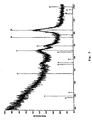
- Fig. 2 shows the x-ray diffractogram of the powder according to example 6 of the invention.
- Reflexes of MgAl 2 O 4 (spinell), designated “o” in the diffractogram cannot be detected.
- the reflexes of the powder according to the invention are substantially identical to those of gamma-aluminium oxide, designated "x" in the diffractogram.
- the powder according to the invention shows no reflexes of alpha-aluminium oxide.
- examples 8B, 9B, 10B and 12B are diluted with DI water to an abrasive particle content of 5 wt.% for polishing purposes. 1.3 wt.% glycine and 7.5 wt.% hydrogen peroxide are then added.
- After-cleaning After polishing, the wafer is rinsed with DI water for 30 s and then cleaned on both sides and spun dry in a brush cleaning unit with spray jet and megasonic support.
- Tab. 3 shows the polishing results.
- dispersions 13 to 15 according to the invention have slightly lower copper abrasion rates irrespective of the working pressure, but have better nonuniformity.
- Table 1 Experimental conditions for the production of doped aluminium oxide and characteristics of the particles obtained Example no. AlCl 3 kg/h Gas Temp. °C Mg- Precursor Precursor concentration Gew.-% Precursor nebulised g/h Solution nebulised g/h Mg- content wt.% BET-spec.
Landscapes
- Chemical & Material Sciences (AREA)
- Organic Chemistry (AREA)
- Engineering & Computer Science (AREA)
- Materials Engineering (AREA)
- Life Sciences & Earth Sciences (AREA)
- Inorganic Chemistry (AREA)
- Geology (AREA)
- Physics & Mathematics (AREA)
- Composite Materials (AREA)
- Nanotechnology (AREA)
- Thermal Sciences (AREA)
- General Chemical & Material Sciences (AREA)
- Chemical Kinetics & Catalysis (AREA)
- Geochemistry & Mineralogy (AREA)
- Condensed Matter Physics & Semiconductors (AREA)
- General Physics & Mathematics (AREA)
- Crystallography & Structural Chemistry (AREA)
- Mechanical Engineering (AREA)
- Wood Science & Technology (AREA)
- Compounds Of Alkaline-Earth Elements, Aluminum Or Rare-Earth Metals (AREA)
- Mechanical Treatment Of Semiconductor (AREA)
- Catalysts (AREA)
- Solid-Sorbent Or Filter-Aiding Compositions (AREA)
- Pigments, Carbon Blacks, Or Wood Stains (AREA)
Abstract
Description
- The invention relates to aluminium oxide produced by flame hydrolysis and doped with divalent metal oxides, aqueous dispersions hereof, their production and use.
- Chemical-mechanical polishing, (CMP process) is a technology that is used to planarise surfaces and to produce structures into the submicron range on semiconductor wafers. For this purpose, dispersions are generally used that have one or more chemically active compounds, at least one abrasive and also a large number of additives capable of changing the properties of the dispersion depending on their desired use.
- The abrasive particles which, in the CMP process, should have a high abrasion rate without scratching the surface to be polished, are particularly important. Furthermore, the dispersion should be stable against flocculation and sedimentation of the abrasive particles.
- The zeta potential of the abrasive particles in the dispersion plays an important part in this. The particles in a CMP dispersion are electrically charged. This may be due to dissociation of surface groups or desorption or adsorption of ions on the particle surface. Here the electrical charge generally lies not in, but on, the surface of the particle. The zeta potential depends on the type of particle, for example silicon dioxide, aluminium oxide, magnesium oxide, cerium oxide.
- An important value connected with the zeta potential is the isoelectric point (IEP). The IEP gives the pH value at which the zeta potential is zero. The IEP is at a pH of
ca 9 for aluminium oxide, ca 3.8 for silicon dioxide, and ca 12.4 for magnesium oxide. - The density of the charge on the surface can be influenced by changing the concentration of the potential-determining ions in the surrounding electrolyte. In those dispersions
in which the particles carry acid or basic groups on the surface, the charge can be changed by setting the pH value. The potential can further be changed by adding salts or surfactants. - Particles of the same material will possess the same sign of the surface charge and thus repel each other. If the zeta potential is too small, however, the repelling force cannot, compensate for the Waals attraction of the particles and this may result in flocculation or sedimentation of the particles.
- With various materials, for example abrasive particles and surfaces to be polished, the surface charge may have a different sign and thus be held onto the surface to be polished. This may result in uneven polishing.
Consequently, costly cleaning processes may be required after the polishing step. - As the isoelectric points of the common abrasive particles and the surfaces to be polished are often very far apart (titanium oxide ca 9.5, tungsten ca 1), it is often difficult to set a CMP dispersion in such a way that it is stable and also that no particles adhere to the surface to be polished.
- The options described above for influencing the zeta potential are available in principle. However the dispersion must be considered as a whole, with all its components. Thus a shift in the pH value may increase the zeta potential, but at the same time, this may set off the decomposition of the oxidising agent. Furthermore, selectivity may be impaired, in particular with metal polishing. Finally, the additives, which are often represented in the percent range in the CMP dispersions, may themselves enter into reactions.
- EP1048617 discloses an aluminium oxide doped with silicon, produced by flame hydrolysis, and the use of this material for dispersions for chemical mechanical polishing.
- WO 00/73396 discloses a CMP dispersion containing abrasive particles with the spinell structure MgO·x Al2O3, which are obtained by calcination and the zeta potential of which may be changed by varying the magnesium oxide/aluminium oxide ratio.
- The disadvantage of this process is the formation of alpha-aluminium oxide, which can cause scratching during polishing. Although stabilisation of the softer gamma-aluminium oxide phase is postulated, this is however proportionately dependent on the content of magnesium oxide. In other words, the higher the magnesium oxide content, the lower the alpha-aluminium oxide formation. As stated in WO 00/73396, even small quantities of alpha-aluminium oxide can, however, lead to scratching during polishing.
- Although the formation of alpha-aluminium oxide falls as the magnesium oxide content increases, the BET specific surface area of the particle is also reduced. If a MgO·x Al2O3 has a BET specific surface area of 100 m2/g at x=25, at x=1 it is only 40 m2/g, which may restrict its use in CMP dispersions.
- This means that a reduction in the alpha-aluminium oxide content goes hand-in-hand with a reduction in the BET specific surface area. The two values cannot be varied independently of each other.
- The change in zeta potential with the magnesium content disclosed is not discussed any further. However, it can be concluded from what is said above, that a variation in the zeta potential changes the BET specific surface area and alpha-aluminium oxide content at the same time.
- The object of the present invention is to provide abrasive particles in which the zeta potential and BET specific surface area can be varied indpendently of each other and which produce a largely scratch-free surface during polishing.
- The invention provides an aluminium oxide doped with a divalent metal oxide, produced by flame hydrolysis and which has no spinell structures or alpha-aluminium oxide detectable in an x-ray diffractogram.
- Flame hydrolysis according to the invention is understood to mean the formation of an aluminium oxide doped with a divalent metal oxide in the gas phase in a flame, which is produced by the reaction of a combustion gas and an oxygen-containing gas, preferably air. The reaction of the combustion gas with the oxygen-containing gas produces water vapour, which hydrolyses the precursor substances of aluminium oxide and the divalent metal oxide. Secondary reactions produce the aluminium oxide according to the invention. Suitable combustion gases are hydrogen, methane, ethane, propane, hydrogen being preferred in particular. During flame hydrolysis, highly-disperse, non-porous primary particles are formed first, which can grow together as the reaction progresses to form aggregates, which can further combine to form agglomerates.
- The divalent metal oxide according to the invention is the doping component. A dopant is understood to mean a substance which, as a metal component, carries a divalent metal, and which is converted to the oxide during production of the powder according to the invention. The content of the doping component in the aluminium oxide according to the invention relates to the respective oxide.
- In contrast to the particles disclosed in WO 0073396 the particles according to the invention have no spinell structures. This may be due to the differing production method. In the pyrogenic process on which the invention is based, no spinell phases are formed, in spite of the high temperatures. The extremely short residence time of the particles at high temperatures which, in a kinetically controlled reaction, produces particles without spinell structures, may be responsible for this. Sputtering experiments using an aluminium oxide doped with magnesium oxide as an example, have also shown that the concentration of the doping component follows a gradient, and thus the highest magnesium oxide concentration was analysed on the surface of the particle.
- The BET specific surface area of the doped aluminium oxide, determined to DIN 66131, can be from 1 to 1000 m2/g. Advantageously for CMP applications, the range can be from 50 to 400 m2/g, the range 100 to 250 m2/g being particularly advantageous.
- The proportion of doping component in the aluminium oxide according to the invention can be 10 ppm to 5 wt.%. The range 100 ppm to 3 wt.% is preferred, in particular the range can be 0.1 to 2 wt.%.
- The doping components can be the divalent metal oxides of magnesium, calcium, zinc, manganese, copper, cobalt or iron.
- An aluminium oxide with magnesium oxide as the doping component is preferred in particular.
- The invention further relates to a process for the production of the doped aluminium oxide, which is characterised in that a homogeneous gas mixture of a previously vapourised aluminium halogenide and an aerosol is fed into a flame of an oxygen-containing gas and a combustion gas, as used for the production of oxides by the flame hydrolysis method, the gas mixture is allowed to react in the flame and the doped aluminium oxide formed is separated from the gas stream by a known method, the starting material of the aerosol being a solution of a divalent metal salt, and the aerosol being produced by nebulisation using an aerosol generator.
- The invention further provides an aqueous dispersion containing the particles according to the invention.
- The solid content of the dispersion according to the invention is primarily determined by the intended use. In order to save transport costs, the aim will be to produce a dispersion with as high a solid content as possible, whilst for certain applications, such as for example chemical-mechanical polishing, dispersions with low solid contents are used. A solid content of 0.1 to 70 wt.%, in particular in the range 1 to 30 wt.%, is preferred according to the invention. In this range, the dispersion has good stability.
- The size of the aggregates of the aluminium oxide according to the invention in the dispersion can be less than 150 nm. In particular the range can be less than 100 nm.
- The aqueous dispersion can have a pH value of 3 to 12. The pH value can be set by acids or bases and serves to increase the stability of the dispersion. Here, the IEP of the particles according to the invention on the one hand, and the stability of other substances in the dispersion, for example the oxidising agent, on the other, must be taken into account.
- Inorganic acids, organic acids or mixtures of these can be used as acids.
- In particular phosphoric acid, phosphorous acid, nitric acid, sulfuric acid, mixtures thereof and their acid reacting salts can be used as inorganic acids.
- Carboxylic acids of the general formula CnH2n+1CO2H, where n=0-6 or n= 8,10,12, 14, 16, or dicarboxylic acids of the general formula HO2C (CH2)n CO2H, where n=0-4, or hydroxycarboxylic acids of the general formula R1R2C(OH)CO2H, where R1=H, R2=CH3, CH2CO2H, CH(OH)CO2H, or phthalic acid or salicylic acid, or acid reacting salts of these acids or mixtures of these acids and their salts are preferred as organic acids.
- The pH value can be increased by the addition of ammonia, alkali hydroxides or amines. Ammonia and potassium hydroxide are preferred in particular.
- Furthermore, the dispersion according to the invention can contain 0.3 to 20 wt.% of at least one oxidising agent, which can be hydrogen peroxide, a hydrogen peroxide adduct such as for example urea adduct, an organic peracid, an inorganic peracid, an iminoperacid, a persulfate, perborate, percarbonate, oxidising metal salts and/or mixtures of these. Hydrogen peroxide and its adducts are preferred in particular.
- As a result of the reduced stability of some oxidising agents in relation to other components of the dispersion according to the invention, it may be useful to add these immediately before the dispersion is used.
- Furthermore, the dispersion according to the invention can contain at least one oxidation activator, the purpose of which is to increase the oxidation rate during chemical-mechanical polishing. Suitable oxidation catalysts are the metal salts of Ag, Co, Cr, Cu, Fe, Mo, Mn, Ni, Os, Pd, Ru, Sn, Ti, V and mixtures thereof. Carboxylic acids, nitriles, ureas, amides and esters are also suitable. Iron-II-nitrate is preferred in particular. The concentration of the oxidation catalyst can be varied in a range of 0.001 to 2 wt.% depending on the oxidising agent and polishing task. In particular the range can be from 0.01 to 0.05 wt.%.
- The dispersion according to the invention can further contain 0.001 to 2 wt.% of at least one corrosion inhibitor. Suitable inhibitors encompass the group of nitrogen-containing heterocyclics such as benzotriazol, substituted benzimidazols, substituted pyrazines, substituted pyrazoles, glycine and mixtures thereof.
- In order to stabilise the dispersion further, for example against deposition of the abrasive, flocculation and decomposition of the oxidising agent, 0.001 to 10 wt.% of at least one surfactant substance of a non-ionic, cationic, anionic or amphoteric type, can be added to it.
- The invention further provides a process for the production of the dispersion with dispersing and/or milling devices, which produce an energy input of at least 200 KJ/m3. These include systems according to the rotor-stator principle, for example Ultra-Turrax machines, or mechanically agitated ball mills. Higher energy charges are possible with a planetary kneader/mixer. However, the effectiveness of this system depends on the mixture processed having a sufficiently high viscosity to incorporate the high shear energies required to disperse the particles.
- High-pressure homogenisers can be used to obtain aqueous dispersions in which the aluminium oxide according to the invention can be less than 150 nm, and preferably less than 100 nm.
- With these devices, two pre-dispersed suspension streams under high pressure are released through a nozzle. The two dispersion jets collide with each other exactly and the particles mill themselves. In another embodiment, the predispersion is also placed under high pressure, but the collision of the particles takes place against armoured wall areas. The operation can be repeated as often as desired to obtain smaller particles.
- The invention further provides the use of the dispersion according to the invention for the chemical-mechanical polishing of metallic and non-metallic surfaces. The good stability of the dispersion according to the invention over a broad pH range makes it possible, for example, to polish aluminium, aluminium alloys, copper, copper alloys, tungsten, titanium, tantalum, silicon nitride, titanium nitride, tantalum nitride.
- Furthermore, the dispersions according to the invention is suitable for the production of very fine-particle surface coatings in the paper industry or for the production of special types of glass.
- The BET-surface of the powders used was determined according to DIN 66131.
- The viscosity of the dispersions is determined with a Physica MCR 300 rotation rheometer and CC 27 measuring beaker. The viscosity value is determined at a shearing rate of 100 s-1. This shearing rate is in a range in which the viscosity is practically independent of the shearing load.
- The zeta potential is determined with a DT-1200 device from Dispersion Technology Inc, using the CVI process.
- The aggregate size in the dispersion is determined by dynamic light scattering. The zetasizer 3000 Hsa (Malvern Instruments, UK) is used. The volume- and number-weighted median values of the peak analysis are given.
- Example 1: 1.31 kg/h AlCl3 are evaporated at ca 130 °C and transferred to the central tube of the burner. 0.538 Nm3/h (primary hydrogen), 1.35 Nm3/h air and 0.43 Nm3/h inert gas (N2) are also fed into the central tube. The gas mixture flows out of the inner nozzle of the burner and burns in the combustion chamber and the water-cooled flame tube attached to it. 0,05 Nm3/h (shell- or secondary-) hydrogen is fed into the the shell nozzle surrounding the central nozzle to avoid baked-on deposits on the nozzles. An additional 20 Nm3/h secondary air is fed into the combustion chamber.
- The second gas component flows from the axial tube into the central tube. The second gas stream consists of an aerosol charged with a magnesium salt. This magnesium salt aerosol is produced by nebulisation from a 15% aqueous magnesium nitrate solution in an aerosol generator. 71.6 g/h magnesium salt solution are atomised. This nebulised magnesium salt solution is fed through heated pipes using a carrier gas of 1.0 Nm3/h air, the salt vapour mist being converted to gas and salt crystal aerosol at temperatures of ca 180°. The temperature of the gas mixture (AlCl3-air-hydrogen, aerosol) is measured at the burner mouth; it is 295°C.
- After flame hydrolysis, the reaction gases and the aluminium oxide doped with magnesium that is formed are sucked through a cooling system by applying negative pressure and the particle gas stream is thus cooled to ca 100 to 160°C. The solid is separated from the waste gas stream in a filter or cyclone.
- The aluminium oxide doped with magnesium is deposited as a white, fine-particle powder. In a further step, any hydrochloric acid residues still adhering to the particles are removed at high temperature by treatment with air containing water vapour.
- Examples 2 to 7 are carried out in the same way as example 1. the parameters are given in Table 1.
- Method A: 29.0 kg DI water and 25 g 100% acetic acid ("glacial acetic acid") are added to a 60 1 special steel charge container. 4.38 kg of the particles from example 5 are sucked in and roughly pre-dispersed using an Ystrahl dispersion and suction mixer (at 4500 rpm). During powder intake, a pH value of 4.5 +- 0.3 is maintained by the addition of acetic acid. After powder intake, dispersion is completed using an Ystrahl Z 66 rotor/stator throughput homogeniser with four processing rings, a stator slit width of 1 mm and a speed of 11 500 rpm. Before rotor/stator dispersal, a pH value of 4.5 is set by adding more acetic acid and this has not changed even after 15 minutes' dispersal at 11 500 rpm. With the 25 g acetic acid provided, 389 g were used in all. An abrasive body concentration of 12.5 wt.% is set (dispersion 8A) by adding 1.24 kg water.
- Method B: Approximately half of the dispersion from method A is milled with a high pressure homogenizer, Ultimaizer System from Sugino Machine Ltd., model HJP-25050, at a pressure of 250 Mpa, a diamond nozzle diameter of 0.3 mm and two passes through the mill (dispersion 8B).
- Similarly dispersions 9A and 9B are produced with the particles from example 6 and dispersions 10A and 10B with the particles from example 7.
- The particles from example 6 are used with the same dispersion method to produce dispersions 11A and 11B with an abrasive body concentration of 30 wt.%. 874 g acetic acid were required to set the pH value of 4.5.
- Dispersions of aluminium oxide (Alu C, Degussa AG)(dispersions 12A and 12B) are used for comparison.
- The analytical data of the dispersions are shown in Table 2.
- Fig. 1 shows the course of the zeta potential of the powders according to examples 6 and 7 of the invention in comparison with undoped aluminium oxide designated 0 (Alu C, Degussa AG). The value of the zeta potential depends only slightly on the proportion of the doping component in the aluminium oxide according to the invention. However the IEP can be shifted to higher pH values by increasing the content of the doping component. This means that tailor-made particles with a defined IEP can be produced and thus the application range of the dispersion can be extended without having to re-optimise the numerous other components in a CMP dispersion.
- Fig. 2 shows the x-ray diffractogram of the powder according to example 6 of the invention. Reflexes of MgAl2O4 (spinell), designated "o" in the diffractogram, cannot be detected. The reflexes of the powder according to the invention are substantially identical to those of gamma-aluminium oxide, designated "x" in the diffractogram. The powder according to the invention shows no reflexes of alpha-aluminium oxide.
- The dispersions of examples 8B, 9B, 10B and 12B are diluted with DI water to an abrasive particle content of 5 wt.% for polishing purposes. 1.3 wt.% glycine and 7.5 wt.% hydrogen peroxide are then added.
- Polishing tool and Polishing parameters
Polishing machine: MECAPOL E460 (STEAG) with 46 cm platen and 6" wafer carrier Polishing pad: IC1400 (RODEL Corp) Pad conditioning with diamond segment after each polished wafer Slurry quantity: 120 ml/min for all trials Polishing parameters: pA working pressure 10 to 125 kPa Standard 45 and 60 kPa pR Back pressure 10 kPa ωp=ωc=40 rpm (for all trials) Sweep = 4 cm (for all trials) Polishing time: 2 min - After-cleaning: After polishing, the wafer is rinsed with DI water for 30 s and then cleaned on both sides and spun dry in a brush cleaning unit with spray jet and megasonic support.
- Cu: 6" Wafer with 140 nm oxide, 50 nm TaN and ca 500 or 1000 nm PVD-Cu over entire surface.
- Tab. 3 shows the polishing results. In comparison with polishing dispersion 16,
dispersions 13 to 15 according to the invention have slightly lower copper abrasion rates irrespective of the working pressure, but have better nonuniformity.Table 1: Experimental conditions for the production of doped aluminium oxide and characteristics of the particles obtained Example no. AlCl3 kg/h Gas Temp. °C Mg- Precursor Precursor concentration Gew.-% Precursor nebulised g/h Solution nebulised g/h Mg- content wt.% BET-spec. Surface area m2/g 1 1.31 295 Mg(NO3)2 15 10.7 71.6 0.582 110 2 1.31 300 Mg(NO3)2 15 11.3 75.0 0.610 53 3 1.31 287 Mg(NO3)2 15 11.0 73.7 0.599 180 4 0.656 291 Mg(NO3)2 15 11.1 73.8 1.20 186 5 1.31 296 MgCl 25 3.0 59.9 0.253 105 6 0.656 294 Mg(NO3)2 15 11.2 74.0 1.13 101 7 1.31 291 Mg(NO3)2 5 2.03 26.1 0.11 118 H2 core: 0.538 Nm3/h; H2 shell: 0.05 Nm3/h;
N2 core: 0.43 Nm3/h; N2 shell: 0.10 Nm3/h;
Carrier gas nebuliser: 1 Nm3/hTable 2: Analytical data for the dispersions Example Powder from example Dispersion method Content MgO- doped Al2O3 Ø (Number) Ø (Volume) Viscosity [wt.%] [nm] (1) [nm] (2) [mPas] 8A 5 A 12.5 61 108 3 8B 5 B 12.5 58 73 2 9A 6 A 12.5 61 109 3 9B 6 B 12.5 58 74 2 10A 7 A 12.5 59 106 3 10B 7 B 12.5 56 71 2 11A 6 A 30 57 101 15 11B 6 B 30 43 66 7 12A Alu C A 12.5 78 133 3 12B Alu C B 12.5 57 79 2 (1) Average particle diameter (number); (2) Average particle diameter (volume) Table 3: Polishing results Example Dispersion from example Abrasion nm Cu/min at 45 kPa Abrasion nm Cu/min at 60 kPa Non- uniformity at 45 kPa Non-uniformity at 60 kPa 13 8B 148 186 3.4 4.3 14 9B 155 191 4.1 5.5 15 10B 142 180 4.3 6.1 16 12B 164 205 5.3 7.7
Claims (17)
- Aluminium oxide doped with a divalent metal oxide, produced by flame hydrolysis which has no spinell structures or alpha-aluminium oxide detectable in an x-ray diffractogram.
- Aluminium oxide according to claim 1, characterised in that the BET specific surface area is 1 to 1000m2/g.
- Aluminium oxide according to claims 1 or 2, characterised in that the content of the doping component is 10 ppm to 5 wt.%.
- Aluminium oxide according to claims 1 to 3, characterised in that the divalent metal oxide is magnesium oxide, calcium oxide, zinc oxide, manganese oxide, copper oxide, cobalt oxide or iron oxide.
- Process for the production of the aluminium oxide according to claims 1 to 4, characterised in that a homogeneous gas mixture of a previously vaporised aluminium halogenide and an aerosol is fed into a flame of an oxygen-containing gas and a combustion gas, as used for the production of oxides by the flame hydrolysis method, the gas mixture is allowed to react in the flame and the doped aluminium oxide formed is separated from the gas stream in the known way, the starting substance of the aerosol being a solution of a divalent metal salt, and the aerosol being produced by nebulisation using an aerosol generator.
- Aqueous dispersion containing aluminium oxide according to claims 1 to 4.
- Aqueous dispersion according to claim 6, characterised in that the content of doped aluminium oxide in the dispersion is 0.1 to 70 wt.% in relation to the whole dispersion.
- Aqueous dispersion according to claims 6 or 7, characterised in that the average particle size of the doped aluminium oxide is smaller than 150 nm.
- Aqueous dispersion according to claims 6 to 8, characterised in that its pH value is 3 to 12.
- Aqueous dispersion according to claims 6 to 9, characterised in that it contains 0.3 - 20 wt.%, in relation to the whole dispersion of at least one oxidising agent.
- Aqueous dispersion according to claims 6 to 10, characterised in that it contains 0.001 to 2 wt.%, in relation to the whole dispersion, of at least one oxidation activator.
- Aqueous dispersion according to claims 6 to 11, characterised in that it contains 0.001 to 2 wt.%, in relation to the whole dispersion, of at least one corrosion inhibitor.
- Aqueous dispersion according to claims 6 to 12, characterised in that it contains 0.001 to 10 wt.%, in relation to the whole dispersion, of at least one surfactant substance.
- Process for the production of an aqueous dispersion according to claims 6 to 13, characterised in that the doped aluminium oxide is dispersed in an aqueous medium with an energy input of at least 200 KJ/m3.
- Process for the production of an aqueous dispersion according to claim 14, characterised in that to mill and disperse the doped, pyrogenically produced metal oxide particles, a device is used in an aqueous medium, in which the particles to be dispersed are under pressure of up to 3500 kg/cm2, are released through a nozzle and collide with each other or with wall areas of the device.
- Use of an aqueous dispersion according to claims 6 to 13 for chemical-mechanical polishing of metallic and non-metallic surfaces.
- Use of the aqueous dispersion according to claims 6 to 13 for the production of fine-particle surface coatings in the paper industry or for the production of special types of glass.
Applications Claiming Priority (3)
| Application Number | Priority Date | Filing Date | Title |
|---|---|---|---|
| DE10149130A DE10149130A1 (en) | 2001-10-05 | 2001-10-05 | Flame hydrolytic alumina doped with divalent metal oxide is used in aqueous dispersion for chemical-mechanical polishing of metallic and nonmetallic surfaces, coating paper or producing special glass |
| DE10149130 | 2001-10-05 | ||
| PCT/EP2002/010638 WO2003031333A2 (en) | 2001-10-05 | 2002-09-23 | Divalent metal oxide doped aluminium oxide, produced by flame hydrolysis and aqueous dispersions thereof |
Publications (2)
| Publication Number | Publication Date |
|---|---|
| EP1432645A2 EP1432645A2 (en) | 2004-06-30 |
| EP1432645B1 true EP1432645B1 (en) | 2006-12-27 |
Family
ID=7701481
Family Applications (1)
| Application Number | Title | Priority Date | Filing Date |
|---|---|---|---|
| EP02772336A Expired - Lifetime EP1432645B1 (en) | 2001-10-05 | 2002-09-23 | Divalent metal oxide doped aluminium oxide, produced by flame hydrolysis and aqueous dispersions thereof |
Country Status (9)
| Country | Link |
|---|---|
| US (1) | US20040240062A1 (en) |
| EP (1) | EP1432645B1 (en) |
| JP (1) | JP2005504706A (en) |
| KR (1) | KR100596355B1 (en) |
| CN (1) | CN1263679C (en) |
| AT (1) | ATE349405T1 (en) |
| AU (1) | AU2002337125A1 (en) |
| DE (2) | DE10149130A1 (en) |
| WO (1) | WO2003031333A2 (en) |
Families Citing this family (38)
| Publication number | Priority date | Publication date | Assignee | Title |
|---|---|---|---|---|
| DE10360087A1 (en) | 2003-12-20 | 2005-07-21 | Degussa Ag | Flame hydrolysis produced, hochoberflächiges alumina powder |
| DE102004031785A1 (en) * | 2004-07-01 | 2006-01-26 | Degussa Ag | Polyol-containing silica dispersion |
| DE102004037044A1 (en) | 2004-07-29 | 2006-03-23 | Degussa Ag | Agent for equipping cellulose-based and / or starch-based substrates with water-repellent and, at the same time, fungus, bacteria, insect and algae-deficient properties |
| DE102004037045A1 (en) | 2004-07-29 | 2006-04-27 | Degussa Ag | Aqueous silane nanocomposites |
| DE102004037118A1 (en) * | 2004-07-30 | 2006-03-23 | Degussa Ag | Titanium dioxide-containing dispersion |
| DE102004049427A1 (en) | 2004-10-08 | 2006-04-13 | Degussa Ag | Polyether-functional siloxanes, polyethersiloxane-containing compositions, processes for their preparation and their use |
| DE102005004872A1 (en) | 2005-02-03 | 2006-08-10 | Degussa Ag | Aqueous emulsions of functional alkoxysilanes and their condensed oligomers, their preparation and use for surface treatment |
| DE102005032427A1 (en) * | 2005-07-12 | 2007-01-18 | Degussa Ag | Aluminum oxide dispersion |
| DE102005033393B4 (en) | 2005-07-16 | 2014-04-03 | Clariant International Limited | Process for the preparation of nanocrystalline α-Al 2 O 3 |
| EP1907323B1 (en) * | 2005-07-16 | 2018-04-25 | Archroma IP GmbH | Process for the preparation of nanoparticles of alumina and oxides of elements of main groups i and ii of the periodic table |
| US7553465B2 (en) * | 2005-08-12 | 2009-06-30 | Degussa Ag | Cerium oxide powder and cerium oxide dispersion |
| EP1922368B1 (en) * | 2005-08-18 | 2016-12-21 | Clariant Finance (BVI) Limited | Coating materials containing mixed oxide nanoparticles |
| DE102006006656A1 (en) | 2005-08-26 | 2007-03-01 | Degussa Ag | Silane-containing binder for composites |
| DE102006006655A1 (en) * | 2005-08-26 | 2007-03-01 | Degussa Ag | Cellulose- or lignocellulose-containing composites based on a silane-based composite as binder |
| DE102005053071A1 (en) | 2005-11-04 | 2007-05-16 | Degussa | Process for the preparation of ultrafine powders based on polymaiden, ultrafine polyamide powder and their use |
| ATE440072T1 (en) * | 2005-11-12 | 2009-09-15 | Evonik Degussa Gmbh | METHOD FOR PRODUCING DOPED METAL OXIDE PARTICLES |
| DE102005059960A1 (en) * | 2005-12-15 | 2007-06-28 | Degussa Gmbh | Highly filled transition alumina-containing dispersion |
| DE102006017701A1 (en) * | 2006-04-15 | 2007-10-25 | Degussa Gmbh | Silicon-titanium mixed oxide powder, dispersion thereof and titanium-containing zeolite produced therefrom |
| US8155674B2 (en) * | 2006-08-22 | 2012-04-10 | Research In Motion Limited | Apparatus, and associated method, for dynamically configuring a page message used to page an access terminal in a radio communication system |
| DE102006039269A1 (en) * | 2006-08-22 | 2008-02-28 | Evonik Degussa Gmbh | Dispersion of alumina, coating composition and ink receiving medium |
| DE102007003435A1 (en) * | 2007-01-23 | 2008-07-24 | Clariant International Ltd. | Printing ink for any type of printing process, contains silanised mixed oxide nano-particles comprising aluminum oxide and Main Group I or II oxide, and may also contain micronised polyolefin wax |
| ES2725499T3 (en) | 2007-04-20 | 2019-09-24 | Evonik Degussa Gmbh | Mixture containing an organosilicon compound and its use |
| DE102007038314A1 (en) | 2007-08-14 | 2009-04-16 | Evonik Degussa Gmbh | Process for the controlled hydrolysis and condensation of epoxy-functional organosilanes and their condensation with further organofunctional alkoxysilanes |
| DE102007040246A1 (en) * | 2007-08-25 | 2009-02-26 | Evonik Degussa Gmbh | Radiation-curable formulations |
| DE102008007261A1 (en) | 2007-08-28 | 2009-03-05 | Evonik Degussa Gmbh | Aqueous silane systems based on bis (trialkoxysilylalkyl) amines |
| DE102007049743A1 (en) * | 2007-10-16 | 2009-04-23 | Evonik Degussa Gmbh | Silicon-titanium mixed oxide powder, dispersion thereof and titanium-containing zeolite produced therefrom |
| DE102007054885A1 (en) * | 2007-11-15 | 2009-05-20 | Evonik Degussa Gmbh | Process for the fractionation of oxide nanoparticles by cross-flow membrane filtration |
| DE102009002499A1 (en) | 2009-04-20 | 2010-10-21 | Evonik Degussa Gmbh | Dispersion comprising surface-modified silica particles with quaternary, amino-functional organosilicon compounds |
| DE102009002477A1 (en) | 2009-04-20 | 2010-10-21 | Evonik Degussa Gmbh | Quaternary amino functional, organosilicon compounds containing composition and their preparation and use |
| CN102013527B (en) * | 2009-09-08 | 2012-08-29 | 清华大学深圳研究生院 | Rechargeable zinc ion battery |
| TWI605112B (en) * | 2011-02-21 | 2017-11-11 | 福吉米股份有限公司 | Grinding composition |
| AT512230B1 (en) * | 2011-11-22 | 2016-02-15 | Berndorf Band Gmbh | POLISH |
| CN104718162B (en) * | 2012-09-28 | 2017-11-21 | Dic株式会社 | α-alumina fine particles and production method thereof |
| JP6223565B2 (en) * | 2013-07-11 | 2017-11-01 | エボニック デグサ ゲーエムベーハーEvonik Degussa GmbH | Method for producing metal oxide |
| CN107074578A (en) * | 2014-10-24 | 2017-08-18 | 巴斯夫欧洲公司 | Method for High Temperature Synthesis of Aluminates by Flame Jet Pyrolysis |
| WO2016148664A1 (en) * | 2015-03-18 | 2016-09-22 | Anadolu Universitesi Rektorlugu | Production of composite spinel powders in core/shell structure by flame pyrolysis method |
| CN106745194B (en) * | 2016-12-15 | 2017-12-29 | 西安航空学院 | The preparation method of ZnO hollow Nano particles |
| CN116161688B (en) * | 2022-12-12 | 2024-11-08 | 雅安百图高新材料股份有限公司 | Preparation method of nano spherical alumina |
Family Cites Families (7)
| Publication number | Priority date | Publication date | Assignee | Title |
|---|---|---|---|---|
| JPS61250084A (en) * | 1985-04-30 | 1986-11-07 | Kureha Chem Ind Co Ltd | Composite whetstone particle for magnetic abrasion and production thereof |
| DE19650500A1 (en) * | 1996-12-05 | 1998-06-10 | Degussa | Doped, pyrogenic oxides |
| US20030077221A1 (en) * | 2001-10-01 | 2003-04-24 | Shivkumar Chiruvolu | Aluminum oxide powders |
| DE19847161A1 (en) * | 1998-10-14 | 2000-04-20 | Degussa | Fumed silica doped with aerosol |
| DE19919635A1 (en) * | 1999-04-30 | 2000-11-23 | Degussa | Silicon-aluminum mixed oxide |
| US6251150B1 (en) * | 1999-05-27 | 2001-06-26 | Ekc Technology, Inc. | Slurry composition and method of chemical mechanical polishing using same |
| DE19943291A1 (en) * | 1999-09-10 | 2001-03-15 | Degussa | Pyrogenic alumina |
-
2001
- 2001-10-05 DE DE10149130A patent/DE10149130A1/en not_active Ceased
-
2002
- 2002-09-23 DE DE60217141T patent/DE60217141T2/en not_active Expired - Lifetime
- 2002-09-23 AU AU2002337125A patent/AU2002337125A1/en not_active Abandoned
- 2002-09-23 CN CNB028197062A patent/CN1263679C/en not_active Expired - Fee Related
- 2002-09-23 US US10/486,793 patent/US20040240062A1/en not_active Abandoned
- 2002-09-23 AT AT02772336T patent/ATE349405T1/en not_active IP Right Cessation
- 2002-09-23 JP JP2003534323A patent/JP2005504706A/en not_active Withdrawn
- 2002-09-23 KR KR1020047004924A patent/KR100596355B1/en not_active Expired - Fee Related
- 2002-09-23 WO PCT/EP2002/010638 patent/WO2003031333A2/en not_active Ceased
- 2002-09-23 EP EP02772336A patent/EP1432645B1/en not_active Expired - Lifetime
Also Published As
| Publication number | Publication date |
|---|---|
| WO2003031333A3 (en) | 2003-12-04 |
| EP1432645A2 (en) | 2004-06-30 |
| ATE349405T1 (en) | 2007-01-15 |
| JP2005504706A (en) | 2005-02-17 |
| CN1263679C (en) | 2006-07-12 |
| CN1564784A (en) | 2005-01-12 |
| AU2002337125A1 (en) | 2003-04-22 |
| DE10149130A1 (en) | 2003-04-10 |
| DE60217141D1 (en) | 2007-02-08 |
| KR20040049859A (en) | 2004-06-12 |
| KR100596355B1 (en) | 2006-07-06 |
| WO2003031333A2 (en) | 2003-04-17 |
| US20040240062A1 (en) | 2004-12-02 |
| DE60217141T2 (en) | 2007-10-25 |
Similar Documents
| Publication | Publication Date | Title |
|---|---|---|
| US20040240062A1 (en) | Aluminum oxide produced by flame hydrolysis and doped with divalent metal oxides and aqueous dispersions hereof | |
| US7169322B2 (en) | Aqueous dispersion, process for its production and use | |
| JP3990559B2 (en) | Aqueous dispersion for polishing a semiconductor substrate or a layer applied thereon and method for producing the same | |
| EP1732999B1 (en) | Dispersion for the chemical-mechanical polishing of metal surfaces containing metal oxide particles and a cationic polymer | |
| US6676719B2 (en) | Aqueous dispersion, a process for the preparation and the use thereof | |
| US6761747B2 (en) | Dispersion containing pyrogenically manufactured abrasive particles with superparamagnetic domains | |
| JP4215692B2 (en) | Polycrystalline cerium oxide powder, method for producing the same, use of the powder, dispersion containing the powder, and method for producing the powder | |
| US6689692B1 (en) | Composition for oxide CMP | |
| JP3883969B2 (en) | Aqueous dispersion, process for its production and use thereof | |
| KR20090122932A (en) | Dispersion Containing Cerium Oxide and Colloidal Silicon Dioxide | |
| US7888396B2 (en) | Silicon dioxide dispersion | |
| US20070043124A1 (en) | Dispersion for chemical-mechanical polishing | |
| CN101235254A (en) | Dispersions for Chemical Mechanical Polishing |
Legal Events
| Date | Code | Title | Description |
|---|---|---|---|
| PUAI | Public reference made under article 153(3) epc to a published international application that has entered the european phase |
Free format text: ORIGINAL CODE: 0009012 |
|
| 17P | Request for examination filed |
Effective date: 20040320 |
|
| AK | Designated contracting states |
Kind code of ref document: A2 Designated state(s): AT BE BG CH CY CZ DE DK EE ES FI FR GB GR IE IT LI LU MC NL PT SE SK TR |
|
| AX | Request for extension of the european patent |
Extension state: AL LT LV MK RO SI |
|
| GRAP | Despatch of communication of intention to grant a patent |
Free format text: ORIGINAL CODE: EPIDOSNIGR1 |
|
| GRAS | Grant fee paid |
Free format text: ORIGINAL CODE: EPIDOSNIGR3 |
|
| GRAA | (expected) grant |
Free format text: ORIGINAL CODE: 0009210 |
|
| AK | Designated contracting states |
Kind code of ref document: B1 Designated state(s): AT BE BG CH CY CZ DE DK EE ES FI FR GB GR IE IT LI LU MC NL PT SE SK TR |
|
| PG25 | Lapsed in a contracting state [announced via postgrant information from national office to epo] |
Ref country code: AT Free format text: LAPSE BECAUSE OF FAILURE TO SUBMIT A TRANSLATION OF THE DESCRIPTION OR TO PAY THE FEE WITHIN THE PRESCRIBED TIME-LIMIT Effective date: 20061227 Ref country code: FI Free format text: LAPSE BECAUSE OF FAILURE TO SUBMIT A TRANSLATION OF THE DESCRIPTION OR TO PAY THE FEE WITHIN THE PRESCRIBED TIME-LIMIT Effective date: 20061227 Ref country code: IT Free format text: LAPSE BECAUSE OF FAILURE TO SUBMIT A TRANSLATION OF THE DESCRIPTION OR TO PAY THE FEE WITHIN THE PRESCRIBED TIME-LIMIT;WARNING: LAPSES OF ITALIAN PATENTS WITH EFFECTIVE DATE BEFORE 2007 MAY HAVE OCCURRED AT ANY TIME BEFORE 2007. THE CORRECT EFFECTIVE DATE MAY BE DIFFERENT FROM THE ONE RECORDED. Effective date: 20061227 Ref country code: LI Free format text: LAPSE BECAUSE OF FAILURE TO SUBMIT A TRANSLATION OF THE DESCRIPTION OR TO PAY THE FEE WITHIN THE PRESCRIBED TIME-LIMIT Effective date: 20061227 Ref country code: BE Free format text: LAPSE BECAUSE OF FAILURE TO SUBMIT A TRANSLATION OF THE DESCRIPTION OR TO PAY THE FEE WITHIN THE PRESCRIBED TIME-LIMIT Effective date: 20061227 Ref country code: SK Free format text: LAPSE BECAUSE OF FAILURE TO SUBMIT A TRANSLATION OF THE DESCRIPTION OR TO PAY THE FEE WITHIN THE PRESCRIBED TIME-LIMIT Effective date: 20061227 Ref country code: NL Free format text: LAPSE BECAUSE OF FAILURE TO SUBMIT A TRANSLATION OF THE DESCRIPTION OR TO PAY THE FEE WITHIN THE PRESCRIBED TIME-LIMIT Effective date: 20061227 Ref country code: DK Free format text: LAPSE BECAUSE OF FAILURE TO SUBMIT A TRANSLATION OF THE DESCRIPTION OR TO PAY THE FEE WITHIN THE PRESCRIBED TIME-LIMIT Effective date: 20061227 Ref country code: CZ Free format text: LAPSE BECAUSE OF FAILURE TO SUBMIT A TRANSLATION OF THE DESCRIPTION OR TO PAY THE FEE WITHIN THE PRESCRIBED TIME-LIMIT Effective date: 20061227 Ref country code: CH Free format text: LAPSE BECAUSE OF FAILURE TO SUBMIT A TRANSLATION OF THE DESCRIPTION OR TO PAY THE FEE WITHIN THE PRESCRIBED TIME-LIMIT Effective date: 20061227 |
|
| REG | Reference to a national code |
Ref country code: GB Ref legal event code: FG4D |
|
| REG | Reference to a national code |
Ref country code: IE Ref legal event code: FG4D |
|
| REF | Corresponds to: |
Ref document number: 60217141 Country of ref document: DE Date of ref document: 20070208 Kind code of ref document: P |
|
| RAP2 | Party data changed (patent owner data changed or rights of a patent transferred) |
Owner name: DEGUSSA GMBH |
|
| PG25 | Lapsed in a contracting state [announced via postgrant information from national office to epo] |
Ref country code: BG Free format text: LAPSE BECAUSE OF FAILURE TO SUBMIT A TRANSLATION OF THE DESCRIPTION OR TO PAY THE FEE WITHIN THE PRESCRIBED TIME-LIMIT Effective date: 20070327 Ref country code: SE Free format text: LAPSE BECAUSE OF FAILURE TO SUBMIT A TRANSLATION OF THE DESCRIPTION OR TO PAY THE FEE WITHIN THE PRESCRIBED TIME-LIMIT Effective date: 20070327 |
|
| PG25 | Lapsed in a contracting state [announced via postgrant information from national office to epo] |
Ref country code: ES Free format text: LAPSE BECAUSE OF FAILURE TO SUBMIT A TRANSLATION OF THE DESCRIPTION OR TO PAY THE FEE WITHIN THE PRESCRIBED TIME-LIMIT Effective date: 20070407 |
|
| NLT2 | Nl: modifications (of names), taken from the european patent patent bulletin |
Owner name: DEGUSSA GMBH Effective date: 20070221 |
|
| PG25 | Lapsed in a contracting state [announced via postgrant information from national office to epo] |
Ref country code: PT Free format text: LAPSE BECAUSE OF FAILURE TO SUBMIT A TRANSLATION OF THE DESCRIPTION OR TO PAY THE FEE WITHIN THE PRESCRIBED TIME-LIMIT Effective date: 20070528 |
|
| NLV1 | Nl: lapsed or annulled due to failure to fulfill the requirements of art. 29p and 29m of the patents act | ||
| REG | Reference to a national code |
Ref country code: CH Ref legal event code: PL |
|
| EN | Fr: translation not filed | ||
| PLBE | No opposition filed within time limit |
Free format text: ORIGINAL CODE: 0009261 |
|
| STAA | Information on the status of an ep patent application or granted ep patent |
Free format text: STATUS: NO OPPOSITION FILED WITHIN TIME LIMIT |
|
| RAP2 | Party data changed (patent owner data changed or rights of a patent transferred) |
Owner name: EVONIK DEGUSSA GMBH |
|
| 26N | No opposition filed |
Effective date: 20070928 |
|
| PG25 | Lapsed in a contracting state [announced via postgrant information from national office to epo] |
Ref country code: FR Free format text: LAPSE BECAUSE OF FAILURE TO SUBMIT A TRANSLATION OF THE DESCRIPTION OR TO PAY THE FEE WITHIN THE PRESCRIBED TIME-LIMIT Effective date: 20070817 Ref country code: GR Free format text: LAPSE BECAUSE OF FAILURE TO SUBMIT A TRANSLATION OF THE DESCRIPTION OR TO PAY THE FEE WITHIN THE PRESCRIBED TIME-LIMIT Effective date: 20070328 Ref country code: MC Free format text: LAPSE BECAUSE OF NON-PAYMENT OF DUE FEES Effective date: 20070930 |
|
| GBPC | Gb: european patent ceased through non-payment of renewal fee |
Effective date: 20070923 |
|
| PG25 | Lapsed in a contracting state [announced via postgrant information from national office to epo] |
Ref country code: IE Free format text: LAPSE BECAUSE OF NON-PAYMENT OF DUE FEES Effective date: 20070924 |
|
| PG25 | Lapsed in a contracting state [announced via postgrant information from national office to epo] |
Ref country code: GB Free format text: LAPSE BECAUSE OF NON-PAYMENT OF DUE FEES Effective date: 20070923 Ref country code: FR Free format text: LAPSE BECAUSE OF FAILURE TO SUBMIT A TRANSLATION OF THE DESCRIPTION OR TO PAY THE FEE WITHIN THE PRESCRIBED TIME-LIMIT Effective date: 20061227 |
|
| PG25 | Lapsed in a contracting state [announced via postgrant information from national office to epo] |
Ref country code: EE Free format text: LAPSE BECAUSE OF FAILURE TO SUBMIT A TRANSLATION OF THE DESCRIPTION OR TO PAY THE FEE WITHIN THE PRESCRIBED TIME-LIMIT Effective date: 20061227 |
|
| PG25 | Lapsed in a contracting state [announced via postgrant information from national office to epo] |
Ref country code: CY Free format text: LAPSE BECAUSE OF FAILURE TO SUBMIT A TRANSLATION OF THE DESCRIPTION OR TO PAY THE FEE WITHIN THE PRESCRIBED TIME-LIMIT Effective date: 20061227 Ref country code: LU Free format text: LAPSE BECAUSE OF NON-PAYMENT OF DUE FEES Effective date: 20070923 |
|
| PG25 | Lapsed in a contracting state [announced via postgrant information from national office to epo] |
Ref country code: TR Free format text: LAPSE BECAUSE OF FAILURE TO SUBMIT A TRANSLATION OF THE DESCRIPTION OR TO PAY THE FEE WITHIN THE PRESCRIBED TIME-LIMIT Effective date: 20061227 |
|
| PGFP | Annual fee paid to national office [announced via postgrant information from national office to epo] |
Ref country code: DE Payment date: 20130919 Year of fee payment: 12 |
|
| REG | Reference to a national code |
Ref country code: DE Ref legal event code: R119 Ref document number: 60217141 Country of ref document: DE |
|
| REG | Reference to a national code |
Ref country code: DE Ref legal event code: R119 Ref document number: 60217141 Country of ref document: DE Effective date: 20150401 |
|
| PG25 | Lapsed in a contracting state [announced via postgrant information from national office to epo] |
Ref country code: DE Free format text: LAPSE BECAUSE OF NON-PAYMENT OF DUE FEES Effective date: 20150401 |