EP1432260A1 - Système de transmission radioélectrique d'information entre une infrastructure et des mobiles - Google Patents
Système de transmission radioélectrique d'information entre une infrastructure et des mobiles Download PDFInfo
- Publication number
- EP1432260A1 EP1432260A1 EP20030293049 EP03293049A EP1432260A1 EP 1432260 A1 EP1432260 A1 EP 1432260A1 EP 20030293049 EP20030293049 EP 20030293049 EP 03293049 A EP03293049 A EP 03293049A EP 1432260 A1 EP1432260 A1 EP 1432260A1
- Authority
- EP
- European Patent Office
- Prior art keywords
- cell
- train
- radio
- mobile
- frequencies
- Prior art date
- Legal status (The legal status is an assumption and is not a legal conclusion. Google has not performed a legal analysis and makes no representation as to the accuracy of the status listed.)
- Granted
Links
- 230000005540 biological transmission Effects 0.000 title claims abstract description 30
- 230000001413 cellular effect Effects 0.000 claims description 4
- 238000010586 diagram Methods 0.000 description 5
- 230000001360 synchronised effect Effects 0.000 description 4
- 235000021183 entrée Nutrition 0.000 description 3
- 238000001228 spectrum Methods 0.000 description 3
- 239000000835 fiber Substances 0.000 description 2
- 238000000429 assembly Methods 0.000 description 1
- 238000013475 authorization Methods 0.000 description 1
- 230000007423 decrease Effects 0.000 description 1
- 238000005315 distribution function Methods 0.000 description 1
- 230000005684 electric field Effects 0.000 description 1
- 238000005562 fading Methods 0.000 description 1
- 230000036039 immunity Effects 0.000 description 1
- 239000011229 interlayer Substances 0.000 description 1
- 238000005259 measurement Methods 0.000 description 1
- 230000005855 radiation Effects 0.000 description 1
- 230000009897 systematic effect Effects 0.000 description 1
Images


Classifications
-
- H—ELECTRICITY
- H04—ELECTRIC COMMUNICATION TECHNIQUE
- H04W—WIRELESS COMMUNICATION NETWORKS
- H04W16/00—Network planning, e.g. coverage or traffic planning tools; Network deployment, e.g. resource partitioning or cells structures
- H04W16/02—Resource partitioning among network components, e.g. reuse partitioning
- H04W16/12—Fixed resource partitioning
-
- H—ELECTRICITY
- H04—ELECTRIC COMMUNICATION TECHNIQUE
- H04W—WIRELESS COMMUNICATION NETWORKS
- H04W16/00—Network planning, e.g. coverage or traffic planning tools; Network deployment, e.g. resource partitioning or cells structures
- H04W16/02—Resource partitioning among network components, e.g. reuse partitioning
-
- H—ELECTRICITY
- H04—ELECTRIC COMMUNICATION TECHNIQUE
- H04W—WIRELESS COMMUNICATION NETWORKS
- H04W84/00—Network topologies
Definitions
- the present invention relates to cellular systems of radio transmission of information between infrastructure and mobiles subject to travel on a specific route.
- the invention finds a particularly important application in the domain of transport on own site, and in particular in networks railways that are at least partly in tunnels, where multiple reflections are particularly to be feared. However, it can also be used in other areas, and in particular for connections with aircraft in flight or on the ground on well-defined routes.
- the coding can in particular be of the so-called multiplexing type. frequency distribution and orthogonal coding (OC FDM) or of the coding type with spread spectrum by direct sequence.
- OC FDM frequency distribution and orthogonal coding
- the present invention aims in particular to further increase immunity interference.
- the invention notably proposes a system cellular radio information transmission whose infrastructure has fixed transmitting and receiving stations, or radio bases, distributed on along the path and assigned to successive cells, so that each cell is provided with at least two transceivers, which frame it and whose transmitters are synchronized and preferably transmit with a coding to tolerate or use multiple paths; next the invention fixed station transceivers and at least one transceiver carried by the mobile are controlled so that the exchanges between the mobile and the transceivers assigned to the same cell are performed, when the mobile is in the cell, alternately at two different frequencies during two successive radio cycles.
- Each cycle will usually consist of several frames exchange, relatively short to increase the quality of services.
- Frames containing essential information can be systematically transmitted on both frequencies in succession. Others can be issued only once and others can be repeated on request following a faulty transmission.
- the frequency pair used in a cell will advantageously made up of two frequencies different from those used in cells adjacent.
- the pairs of frequencies In the portions of the network in the open air, where the range of emitters can be very high, the pairs of frequencies, from the available frequencies, so that the same torque frequency is only reused as far as possible.
- we have a reduced number of frequencies we will seek all less to use, in cells likely to interfere, only one common frequency.
- interlayer transceivers To a given cell can be assigned, in addition to the two surrounding transceivers, interlayer transceivers distributed.
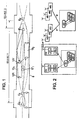
- Figure 1 shows a tunnel portion 8 of a two-track rail transport system which will be collectively referred to below as the track.
- Track base stations Along the track path are distributed track base stations.
- Cells are surrounded by two base stations.
- Each base station comprises a transceiver provided with an antenna, with a narrow lobe in a tunnel or on rectilinear parts.
- the antennas of the transceivers E 1 , E ' 1 belonging to two base stations transmit to each other in cell No. 1 and also have a rear lobe which causes the cell to extend beyond the interval between the stations.
- One or more intermediate stations E " 1 will often be distributed at intervals in the cell, between the base stations E 1 and E ' 1.
- the transceivers assigned to the same cell are synchronized at the symbol level.
- the transceivers of a given cell transmit at the same carrier frequency and constitute a common channel.
- Each base station S placed on one side of a cell to which it is assigned, situated on one side of a cell is adjacent to another station having a transceiver E ' 0 or E 2 , assigned respectively to cell 0 or to cell 2.
- each antenna has a relatively narrow front main lobe, directed towards the cell and a less intense rear lobe. But in practice we will optimize the antenna lobes according to each geographic location. By removing radio stations from different cells and increasing the overlap between cells, their number can be reduced.
- each mobile such as 10 1 , 10 2 , comprises a 12V transmit-receive antenna directed towards the front and a 12R transmit-receive antenna directed towards the rear.
- the antennas can be associated with a common transceiver apparatus or with separate apparatuses.
- Each switchgear (or switchgear) is designed to add the energies received from the transmitters E 1 and E ' 1 , when the mobile is in cell n ° 1.
- a system as a whole can have the functional constitution general indicated in figure 2.
- the principle architecture of the part of the system which is supported by the channel (channel side) can be considered to have four subsets.
- a synchronization link is provided between the WTU channel transmission units in the same cell.
- All channel radio units in the same cell can be linked to the same fiber optic interface electronic card, in the WTU channel transmission.
- the link between the antennas of the WRU channel radio units and the antennas of the 12V, 12R transceivers of the mobiles 10 is carried out in microwave or microwave, usually in a band reserved for spread spectrum applications.
- the frequency will generally be between 2400 and 2483 MHz or between 5725 and 5850 MHz.
- transceiver with one or two antennas or two transceivers coupled attacking the same antenna or antennas respectively.
- CRU equipment on board a mobile (such as a train by example) will be more or less complex depending on the constitution of the train.
- antennas can be placed on the roof of the train, we will try to use only one CRU equipment in the middle of the train. If, for reasons of size, it is not possible to place an antenna on the roof, we will then be led to place the antennas at both ends and therefore to use radio equipment at each end.
- Two sub-assemblies, possibly on the head and tail cars, will then respectively provide a radio distribution function on the mobile and a radio frequency selection function on the mobile. These two functions can be fulfilled respectively by a CRDU radio distribution module and a CRFU radio frequency module attacking one or more antennas.
- the mobile In addition to the radio part, the mobile carries a control unit on-board ensuring the radio functions of the on-board party, designated by TRF. Links with equipment and software such as requests for communication, on-board customers, etc. allow you to transfer orders and information transmitted and distributed via the radio function of train TRF.
- the exchanges in a cell between the stations which frame the cell and a mobile which is in the cell are carried out on two different frequencies, alternating with each radio cycle.
- the use of more than two frequencies can be considered, but it has only one reduced interest. Indeed, the advantage, in terms of redundancy, that would bring more than two frequencies for the transfer of essential information would be obtained only by transmitting this information three times.
- the number of possible combinations avoiding the presence of a common frequency in adjacent cells would be reduced.
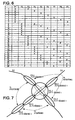
- the available frequency band is of 83 MHz (which is for example the case of the instrumentation band medical scientific ISM from 2400 to 2483 MHz) we can split this band in nine channels having center frequencies F1 to F9. These channels can be 6 MHz wide, leaving an interval of 8 to 9 MHz to reduce the contribution between adjacent channels. Two of these channels nonadjacent, having frequencies Fx and Fy are associated with each cell. There are then 28 pairs for which the two frequencies are not adjacent. Figure 6 shows a possible distribution.
- the transmission will generally be carried out in phase modulation at two states or four states, (say BPSK or QPSK), with spread spectrum direct sequence; it is advantageous to use the DQPSK mode with four mutually orthogonal spreading sequences.
- the transmission can be done in time division multiplex, called TDMA or TDMA, to radio links.
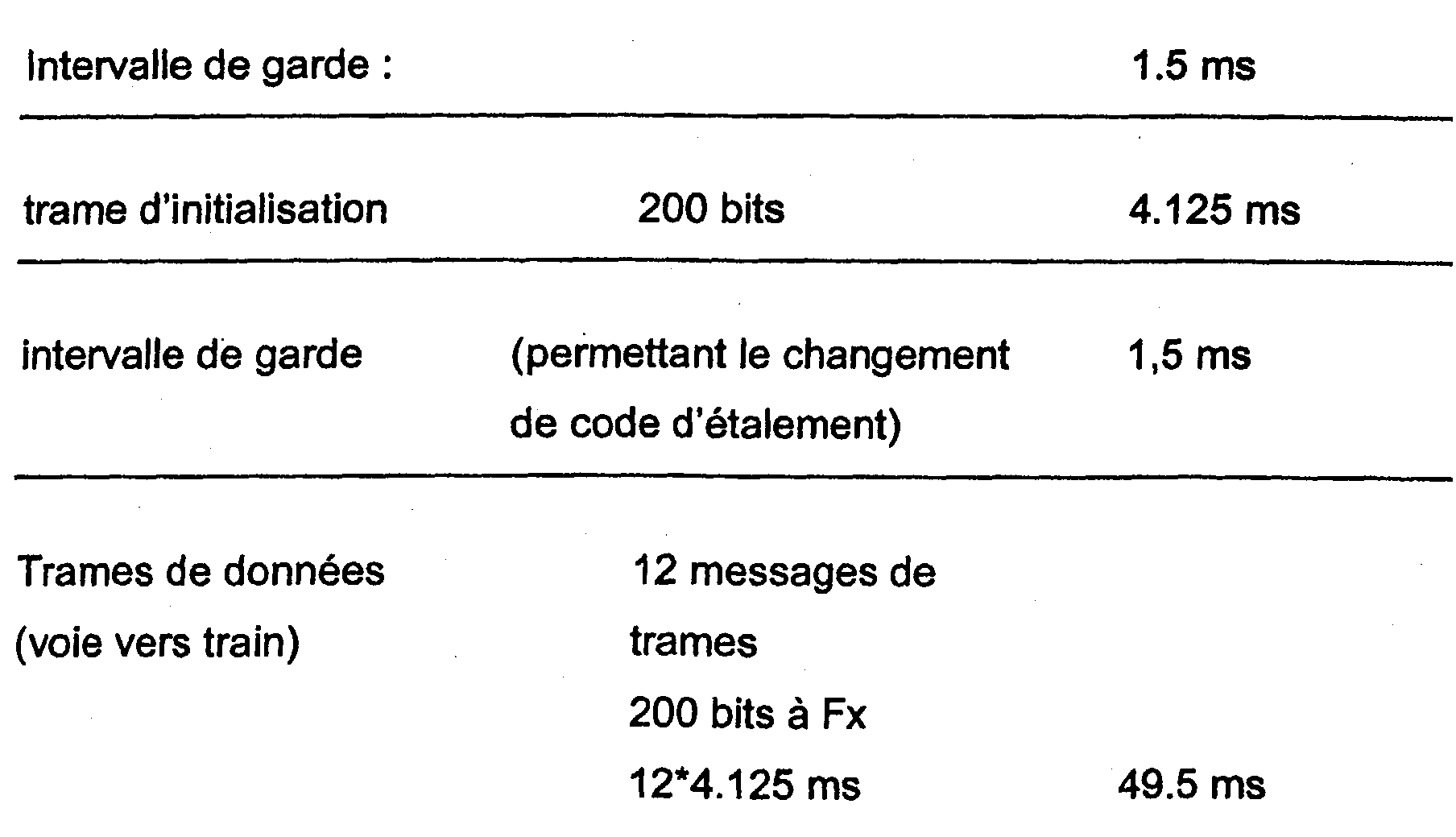
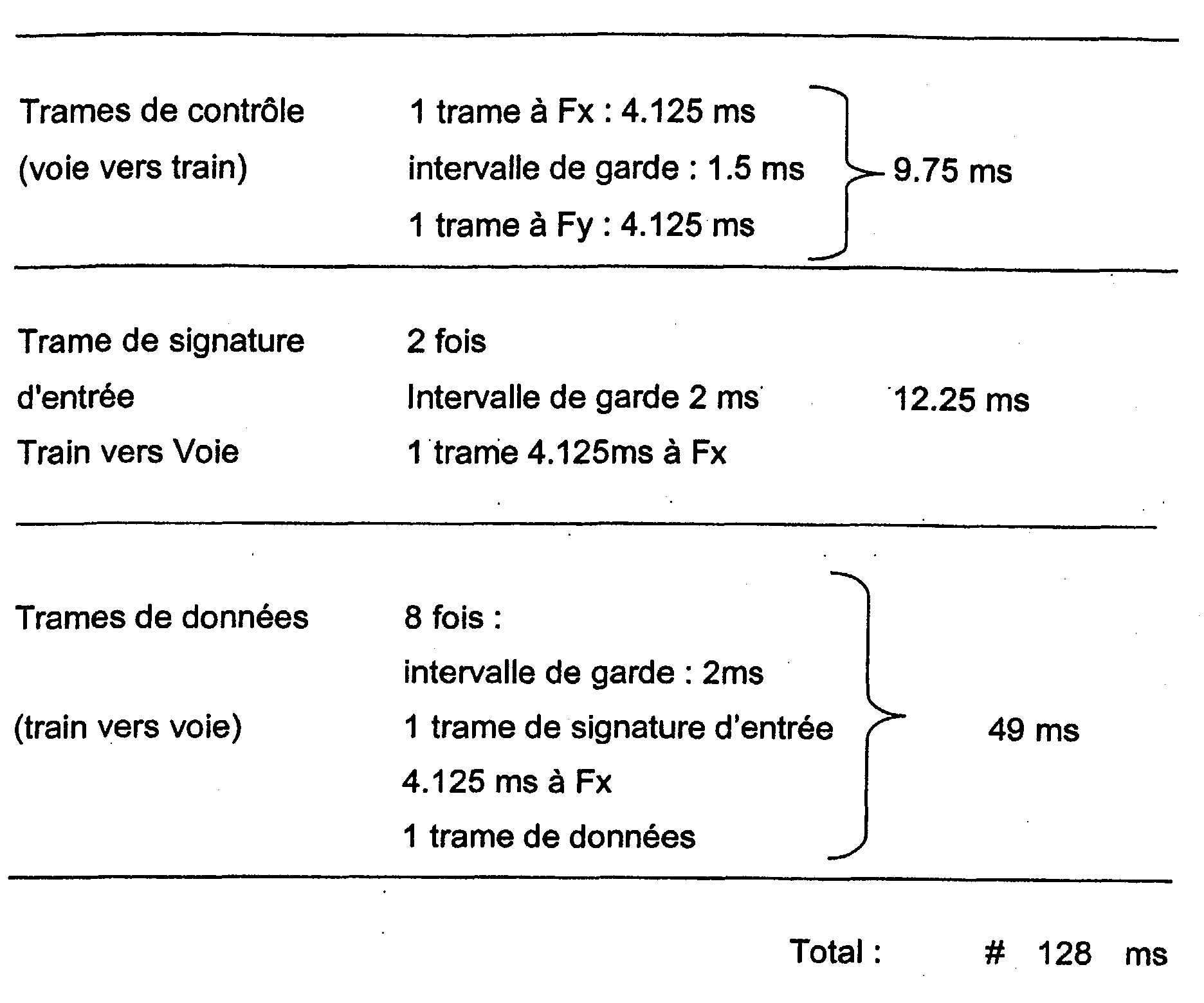
- the exchanges between the mobile and the cell stations are carried out by cycles with alternation between the two frequencies Fx and Fy chosen for the cell.
- Each cycle consists of several frames.
- the rate will generally be reduced enough to obtain a high resistance to jamming, fading and path multiple.
- We will frequently use a rate of 32 or 64 Kbits per second although higher speed (up to 256 kbits / s) is possible.
- the cycle is cut into slices or "slots" and the rate is 64 kbps.
- the signature frame input can be repeated in case of poor reception of the first transmission.
- the initialization frame constitutes the radio database and is only used by the radio part of the train to configure itself.
- the data frames to the trains have a content which depends on the application and the “client” or user terminal on the train. They are encrypted.
- the cell control frame used by the radio part of the train to configure, contains management information, such as allocation of slices to the different trains.
- the entry signature frame is used by the train entering a cell to identify with the radio track equipment, consisting of a or two WTU units.
- the passing of hand takes place in a strong field, in an area of overlap of two cells radio, indicated by R.
- the two train radio units CRU AV and CRU AR of the train successively transfer.
- the CRU AV unit performs the transfer as soon as it exceeds the track unit WRU 1 (position of the train in lines) full), where the radio frequency field decreases since there is passage in the CRU-AV rear lobe.
- the CRU AR unit transfers nearby WRU 2 track unit (dashed position).
- the train signals the start of the handover by sending the frame signature.
- the track transmission unit then registers the train in the list of those present in the cell. It clears the train when the failure to respond of the train persists beyond a specified time (10 sec for example) or a number of queries determined (4 for example)
- FIG. 7 shows the case of a crossing between two lines S1 and S2.
- the frequencies assigned to the different cells 1 to 6 likely to interfere with with each other are seven in number.
- the possible interferences are indicated by double dashed arrows.
- three spreading sequences, indicated by 1, 2 and 3 are distributed among the 7 cells with overlapping radio electric fields.
- the spreading sequences are different between two cells likely to interfere on a common frequency.
- Cell control frames are used for this, containing a list of trains to which a time slot or slot is allocated.
- the track cell controller tells it affects a time slot, as soon as the train has identified itself as an input (sign-in).
- a deterministic protocol using for example the location of trains to using tags carried by the way, can be used to resolve conflicts when several trains seek to register at the same time in a cell.
- the time slots allocated to the trains are changed so dynamic, from the track.
- the track cell controller comprising one or more units of channel transmission, can be provided to request the on-board system to re-transmit information which it did not receive during the cycle which has just finish, which increases the robustness of the system, without increasing the flow as much as a systematic rehearsal would.
Landscapes
- Engineering & Computer Science (AREA)
- Computer Networks & Wireless Communication (AREA)
- Signal Processing (AREA)
- Mobile Radio Communication Systems (AREA)
Abstract
Description
- par des réseaux, qui utiliseront souvent un protocole Ethernet, à un contrôleur de zone Ze, qui peut lui-même être à redondance :
- à des postes clients de voie (utilisateurs de la transmission), de façon classique ;
- par des lignes de transmission placées le long la voie, généralement constituées par des liens à fibres optique EF, à des équipements radio de voie, dits wayside radio équipements, pouvant avoir deux unités radio de voie WRU.
Si, pour des raisons de gabarit, il n'est pas possible de placer d'antenne en toiture, on sera alors conduit à placer les antennes aux deux extrémités et donc à utiliser un équipement radio à chaque extrémité. Deux sous-ensembles, éventuellement sur les voitures de tête et de queue, assureront alors respectivement une fonction de répartition radio sur le mobile et une fonction de sélection de fréquence radio sur le mobile. Ces deux fonctions peuvent être remplies respectivement par un module de distribution radio CRDU et un module radio fréquence CRFU attaquant une ou des antennes.
Claims (8)
- Système cellulaire de transmission radioélectrique d'information entre une infrastructure et des mobiles (10, 12) assujettis à se déplacer suivant un trajet déterminé, dont l'infrastructure comporte des stations fixes d'émission réception réparties le long du trajet et affectées à des cellules successives et dont chaque mobile porte un émetteur-récepteur, les émetteurs-récepteurs des stations fixes et l'émetteur récepteur porté par chacun des mobiles sont commandés de façon que les échanges entre le mobile et les émetteurs-récepteurs affectés à une même cellule soient effectués, lorsque le mobile est dans la cellule, en alternance à deux fréquences différentes (Fx, Fy) lors de deux cycles radio successifs.
- Système suivant la revendication 1, dans lequel chaque cycle est constitué de plusieurs trames d'échange courtes.
- Système suivant la revendication 1 ou 2, utilisant un mode de transmission à multiplexage temporel AMRT.
- Système suivant la revendication 1 ou 2, dans lequel des trames contenant une information essentielle sont systématiquement émises sur les deux fréquences en succession.
- Système suivant l'une quelconque des revendications précédentes, dans lequel la paire de fréquences utilisée dans une cellule est constituée de deux fréquences différentes de celles utilisées dans les cellules adjacentes.
- Système suivant selon l'une quelconque des revendications précédentes, dans lequel les échanges entre le train et un sous-système de voie s'effectuent en utilisant un multiplexage AMRT et un protocole d'allocation de tranches temporelles aux trains avec allocation d'une tranche à chaque train entrant dans une cellule depuis une unité de radio de voie en réponse à l'envoi d' une identification d'entrée par le train au sous-système de voie.
- Système suivant la revendication 6, dans lequel la sortie du train hors d'une cellule est détectée par non-réponse répétée du train à une requête de l'unité radio de voie affectée à la cellule.
- Système suivant la revendication 1, dans lequel le train comporte deux unités radio de train (CRU AV et CRU AR) placées l'une à l'avant et l'autre à l'arrière, prévues pour permettre un passage de main d'une cellule à une autre indépendamment et successivement pour les deux unités.
Applications Claiming Priority (2)
| Application Number | Priority Date | Filing Date | Title |
|---|---|---|---|
| FR0216220 | 2002-12-19 | ||
| FR0216220A FR2849336B1 (fr) | 2002-12-19 | 2002-12-19 | Systeme de transmission radioelectrique d'information entre une infrastructure et des mobiles |
Publications (2)
| Publication Number | Publication Date |
|---|---|
| EP1432260A1 true EP1432260A1 (fr) | 2004-06-23 |
| EP1432260B1 EP1432260B1 (fr) | 2015-10-14 |
Family
ID=32338954
Family Applications (1)
| Application Number | Title | Priority Date | Filing Date |
|---|---|---|---|
| EP03293049.7A Expired - Lifetime EP1432260B1 (fr) | 2002-12-19 | 2003-12-05 | Système de transmission radioélectrique d'information entre une infrastructure et des mobiles |
Country Status (5)
| Country | Link |
|---|---|
| US (1) | US7171196B2 (fr) |
| EP (1) | EP1432260B1 (fr) |
| ES (1) | ES2558838T3 (fr) |
| FR (1) | FR2849336B1 (fr) |
| SG (1) | SG116518A1 (fr) |
Cited By (2)
| Publication number | Priority date | Publication date | Assignee | Title |
|---|---|---|---|---|
| WO2011144260A1 (fr) * | 2010-05-19 | 2011-11-24 | Siemens Sas | Installation de communication entre un client mobile et un ensemble de base radio reparties sur un parcours du client mobile |
| EP2842829A1 (fr) | 2013-08-30 | 2015-03-04 | Siemens S.A.S. | Système de transmission de données entre un mobile et une infrastructure sol |
Families Citing this family (5)
| Publication number | Priority date | Publication date | Assignee | Title |
|---|---|---|---|---|
| KR20040064853A (ko) * | 2003-01-10 | 2004-07-21 | 유티스타콤코리아 유한회사 | 이동통신 시스템에서의 아날로그 광 전송 연장을 이용한다중 연결 분산형 기지국 장치 및 중계 장치 |
| US20070184831A1 (en) * | 2003-06-30 | 2007-08-09 | Shinichi Morimoto | Communication system |
| KR20140117847A (ko) * | 2013-03-27 | 2014-10-08 | 한국전자통신연구원 | 이동체의 핸드오버 방법 및 이를 이용하는 이동체의 통신 장치 |
| US10667087B2 (en) | 2016-02-16 | 2020-05-26 | Telefonaktiebolaget Lm Ericsson (Publ) | Backhaul for access points on high speed trains |
| EP3836621B1 (fr) * | 2019-12-13 | 2023-10-18 | Fluidmesh Networks S.r.l. | Gestion de keyhole d'antenne dans une communication radio sans fil |
Citations (4)
| Publication number | Priority date | Publication date | Assignee | Title |
|---|---|---|---|---|
| FR2366751A1 (fr) * | 1976-09-30 | 1978-04-28 | Siemens Ag | Systeme de radiocommunications |
| EP0618688A2 (fr) * | 1993-04-01 | 1994-10-05 | Daimler-Benz Aerospace Aktiengesellschaft | Système pour la transmission de données par radio entre au moins une station mobile et n stations de base fixes ordonnées le long d'un trajet |
| DE19630575A1 (de) * | 1996-07-30 | 1998-02-05 | Sel Alcatel Ag | System zur semikontinuierlichen Steuerung von spurgeführten Fahrzeugen |
| EP0838965A1 (fr) * | 1996-10-24 | 1998-04-29 | Matra Transport International | Système cellulaire de transmission radioélectrique d'information entre une infrastructure et des mobiles |
Family Cites Families (7)
| Publication number | Priority date | Publication date | Assignee | Title |
|---|---|---|---|---|
| JP2679442B2 (ja) * | 1991-04-17 | 1997-11-19 | 日本電気株式会社 | ディジタル移動通信方式 |
| SE500830C2 (sv) * | 1993-05-17 | 1994-09-12 | Ericsson Telefon Ab L M | Förfarande och anordning vid kanalutnyttjandet i ett radiokommunikationssystem |
| US6094575A (en) * | 1993-11-01 | 2000-07-25 | Omnipoint Corporation | Communication system and method |
| US5548808A (en) * | 1993-12-08 | 1996-08-20 | Motorola, Inc. | Method for performing a handoff in a communication system |
| FR2718907B1 (fr) * | 1994-04-15 | 1996-05-24 | Alcatel Mobile Comm France | Procédé AMRF à structure trame-multitrame et signal correspondant. |
| US5901144A (en) * | 1995-04-13 | 1999-05-04 | Hitachi, Ltd. | Mobile radio communications system |
| US6130905A (en) * | 1996-07-03 | 2000-10-10 | Brother Kogyo Kabushiki Kaisha | Wireless communication system |
-
2002
- 2002-12-19 FR FR0216220A patent/FR2849336B1/fr not_active Expired - Lifetime
-
2003
- 2003-12-05 ES ES03293049.7T patent/ES2558838T3/es not_active Expired - Lifetime
- 2003-12-05 EP EP03293049.7A patent/EP1432260B1/fr not_active Expired - Lifetime
- 2003-12-11 US US10/732,818 patent/US7171196B2/en not_active Expired - Lifetime
- 2003-12-18 SG SG200307553A patent/SG116518A1/en unknown
Patent Citations (4)
| Publication number | Priority date | Publication date | Assignee | Title |
|---|---|---|---|---|
| FR2366751A1 (fr) * | 1976-09-30 | 1978-04-28 | Siemens Ag | Systeme de radiocommunications |
| EP0618688A2 (fr) * | 1993-04-01 | 1994-10-05 | Daimler-Benz Aerospace Aktiengesellschaft | Système pour la transmission de données par radio entre au moins une station mobile et n stations de base fixes ordonnées le long d'un trajet |
| DE19630575A1 (de) * | 1996-07-30 | 1998-02-05 | Sel Alcatel Ag | System zur semikontinuierlichen Steuerung von spurgeführten Fahrzeugen |
| EP0838965A1 (fr) * | 1996-10-24 | 1998-04-29 | Matra Transport International | Système cellulaire de transmission radioélectrique d'information entre une infrastructure et des mobiles |
Cited By (3)
| Publication number | Priority date | Publication date | Assignee | Title |
|---|---|---|---|---|
| WO2011144260A1 (fr) * | 2010-05-19 | 2011-11-24 | Siemens Sas | Installation de communication entre un client mobile et un ensemble de base radio reparties sur un parcours du client mobile |
| EP2842829A1 (fr) | 2013-08-30 | 2015-03-04 | Siemens S.A.S. | Système de transmission de données entre un mobile et une infrastructure sol |
| WO2015028190A1 (fr) * | 2013-08-30 | 2015-03-05 | Siemens S.A.S. | Système de transmission de données entre un mobile et une infrastructure sol |
Also Published As
| Publication number | Publication date |
|---|---|
| ES2558838T3 (es) | 2016-02-09 |
| HK1065210A1 (en) | 2005-02-08 |
| FR2849336A1 (fr) | 2004-06-25 |
| SG116518A1 (en) | 2005-11-28 |
| US20050059387A1 (en) | 2005-03-17 |
| FR2849336B1 (fr) | 2005-04-15 |
| US7171196B2 (en) | 2007-01-30 |
| EP1432260B1 (fr) | 2015-10-14 |
Similar Documents
| Publication | Publication Date | Title |
|---|---|---|
| EP0916215B1 (fr) | Procede de transmission sur une pluralite de supports de transmission, a repartition dynamique des donnees, et emetteur et terminal correspondants | |
| EP0658024B1 (fr) | Réseau local à transmission radio | |
| EP0480505A1 (fr) | Système de transmission radioélectrique comportant une pluralité de dispositifs d'abonné | |
| FR2655220A1 (fr) | Systeme de communication de zone. | |
| FR2929781A1 (fr) | Station relais a double radio. | |
| EP0838965B1 (fr) | Système cellulaire de transmission radioélectrique d'information entre une infrastructure et des mobiles | |
| EP1432260B1 (fr) | Système de transmission radioélectrique d'information entre une infrastructure et des mobiles | |
| EP0641096B1 (fr) | Procédé d'accès multiple par répartition en fréquences orthogonales, station centrale, station répartie, système et utilisation correspondants | |
| FR2928063A1 (fr) | Dispositif pour la transmission point-a point de donnees, sans fil et a haut debit, entre un vehicule en stationnement et une infrastructure fixe | |
| EP0977380A1 (fr) | Système de radiocommunication cellulaire mettant en oeuvre une répétition de données en aval d'une station de base, et dispositif de répétition de données correspondant | |
| EP0511103A1 (fr) | Système de transmission d'informations entre le sol et des mobiles notamment dans les communications sol-trains | |
| CA2769537A1 (fr) | Methode d'acces multiple aux ressources radio dans un reseau ad hoc mobile et systeme mettant en oeuvre la methode | |
| EP3266123A1 (fr) | Procede et systeme de transmission multi-utilisateur 4d-tdma | |
| FR2935493A1 (fr) | Procede et dispositif de suivi d'antenne. | |
| EP3516794B1 (fr) | Procédé permettant une discrimination de communications montantes ou descendantes | |
| WO2017017059A1 (fr) | Procede de decouverte d'un noeud d'un reseau ad hoc | |
| EP1460773A1 (fr) | Procédé et système de communication UWB | |
| EP1705810B1 (fr) | Systèmes de communication pour le contrôle de convois | |
| FR3075531A1 (fr) | Procede d allocation dynamique de ressources radio, procedes de transmission et de reception d un flux de donnees enrichi associes | |
| EP1964367B1 (fr) | Routage et optimisation du debit point a point dans un reseau ad hoc multisauts | |
| FR2845541A1 (fr) | Procede et dispositif de liaisons de donnees a tres haut debit | |
| Katsoulis | Satellite telecommunications in the military: Advantages, limitations and the networking challenge | |
| EP2689541B1 (fr) | Dispositif de communication tdma à deux antennes émettant deux balises | |
| EP0786875B1 (fr) | Transmission sécurisée de données sur N canaux normaux et au moins un canal de secours | |
| FR3162577A1 (fr) | Procédé de transmission de données, émetteur et récepteur correspondants, système de transmission de données et produit programme d’ordinateur |
Legal Events
| Date | Code | Title | Description |
|---|---|---|---|
| PUAI | Public reference made under article 153(3) epc to a published international application that has entered the european phase |
Free format text: ORIGINAL CODE: 0009012 |
|
| AK | Designated contracting states |
Kind code of ref document: A1 Designated state(s): AT BE BG CH CY CZ DE DK EE ES FI FR GB GR HU IE IT LI LU MC NL PT RO SE SI SK TR |
|
| AX | Request for extension of the european patent |
Extension state: AL LT LV MK |
|
| 17P | Request for examination filed |
Effective date: 20040918 |
|
| REG | Reference to a national code |
Ref country code: HK Ref legal event code: DE Ref document number: 1065210 Country of ref document: HK |
|
| AKX | Designation fees paid |
Designated state(s): DE ES GB IT NL |
|
| 17Q | First examination report despatched |
Effective date: 20071023 |
|
| RAP1 | Party data changed (applicant data changed or rights of an application transferred) |
Owner name: SIEMENS SAS |
|
| RAP1 | Party data changed (applicant data changed or rights of an application transferred) |
Owner name: SIEMENS S.A.S. |
|
| REG | Reference to a national code |
Ref country code: DE Ref legal event code: R079 Ref document number: 60348135 Country of ref document: DE Free format text: PREVIOUS MAIN CLASS: H04Q0007360000 Ipc: H04W0016020000 |
|
| RIC1 | Information provided on ipc code assigned before grant |
Ipc: H04W 16/02 20090101AFI20150304BHEP |
|
| GRAP | Despatch of communication of intention to grant a patent |
Free format text: ORIGINAL CODE: EPIDOSNIGR1 |
|
| INTG | Intention to grant announced |
Effective date: 20150511 |
|
| RAP1 | Party data changed (applicant data changed or rights of an application transferred) |
Owner name: SIEMENS S.A.S. |
|
| GRAS | Grant fee paid |
Free format text: ORIGINAL CODE: EPIDOSNIGR3 |
|
| GRAA | (expected) grant |
Free format text: ORIGINAL CODE: 0009210 |
|
| AK | Designated contracting states |
Kind code of ref document: B1 Designated state(s): DE ES GB IT NL |
|
| REG | Reference to a national code |
Ref country code: GB Ref legal event code: FG4D Free format text: NOT ENGLISH |
|
| REG | Reference to a national code |
Ref country code: DE Ref legal event code: R096 Ref document number: 60348135 Country of ref document: DE |
|
| REG | Reference to a national code |
Ref country code: ES Ref legal event code: FG2A Ref document number: 2558838 Country of ref document: ES Kind code of ref document: T3 Effective date: 20160209 |
|
| REG | Reference to a national code |
Ref country code: NL Ref legal event code: MP Effective date: 20151014 |
|
| REG | Reference to a national code |
Ref country code: HK Ref legal event code: GR Ref document number: 1065210 Country of ref document: HK |
|
| PG25 | Lapsed in a contracting state [announced via postgrant information from national office to epo] |
Ref country code: IT Free format text: LAPSE BECAUSE OF FAILURE TO SUBMIT A TRANSLATION OF THE DESCRIPTION OR TO PAY THE FEE WITHIN THE PRESCRIBED TIME-LIMIT Effective date: 20151014 Ref country code: NL Free format text: LAPSE BECAUSE OF FAILURE TO SUBMIT A TRANSLATION OF THE DESCRIPTION OR TO PAY THE FEE WITHIN THE PRESCRIBED TIME-LIMIT Effective date: 20151014 |
|
| REG | Reference to a national code |
Ref country code: DE Ref legal event code: R119 Ref document number: 60348135 Country of ref document: DE |
|
| PLBE | No opposition filed within time limit |
Free format text: ORIGINAL CODE: 0009261 |
|
| STAA | Information on the status of an ep patent application or granted ep patent |
Free format text: STATUS: NO OPPOSITION FILED WITHIN TIME LIMIT |
|
| 26N | No opposition filed |
Effective date: 20160715 |
|
| GBPC | Gb: european patent ceased through non-payment of renewal fee |
Effective date: 20160114 |
|
| PG25 | Lapsed in a contracting state [announced via postgrant information from national office to epo] |
Ref country code: DE Free format text: LAPSE BECAUSE OF NON-PAYMENT OF DUE FEES Effective date: 20160701 Ref country code: GB Free format text: LAPSE BECAUSE OF NON-PAYMENT OF DUE FEES Effective date: 20160114 |
|
| REG | Reference to a national code |
Ref country code: ES Ref legal event code: PC2A Owner name: SIEMENS MOBILITY SAS Effective date: 20200507 |
|
| PGFP | Annual fee paid to national office [announced via postgrant information from national office to epo] |
Ref country code: ES Payment date: 20230321 Year of fee payment: 20 |
|
| REG | Reference to a national code |
Ref country code: ES Ref legal event code: FD2A Effective date: 20240103 |
|
| PG25 | Lapsed in a contracting state [announced via postgrant information from national office to epo] |
Ref country code: ES Free format text: LAPSE BECAUSE OF EXPIRATION OF PROTECTION Effective date: 20231206 |
|
| PG25 | Lapsed in a contracting state [announced via postgrant information from national office to epo] |
Ref country code: ES Free format text: LAPSE BECAUSE OF EXPIRATION OF PROTECTION Effective date: 20231206 |