EP1432170A2 - Verfahren und Anordnung zur unterschiedlichen Erzeugung kryptographischer Sicherungen von Mitteilungen in einem Hostgerät - Google Patents
Verfahren und Anordnung zur unterschiedlichen Erzeugung kryptographischer Sicherungen von Mitteilungen in einem Hostgerät Download PDFInfo
- Publication number
- EP1432170A2 EP1432170A2 EP03025254A EP03025254A EP1432170A2 EP 1432170 A2 EP1432170 A2 EP 1432170A2 EP 03025254 A EP03025254 A EP 03025254A EP 03025254 A EP03025254 A EP 03025254A EP 1432170 A2 EP1432170 A2 EP 1432170A2
- Authority
- EP
- European Patent Office
- Prior art keywords
- logic circuit
- security device
- output
- postal security
- input
- Prior art date
- Legal status (The legal status is an assumption and is not a legal conclusion. Google has not performed a legal analysis and makes no representation as to the accuracy of the status listed.)
- Granted
Links
Images


Classifications
-
- H—ELECTRICITY
- H04—ELECTRIC COMMUNICATION TECHNIQUE
- H04L—TRANSMISSION OF DIGITAL INFORMATION, e.g. TELEGRAPHIC COMMUNICATION
- H04L9/00—Cryptographic mechanisms or cryptographic arrangements for secret or secure communications; Network security protocols
- H04L9/32—Cryptographic mechanisms or cryptographic arrangements for secret or secure communications; Network security protocols including means for verifying the identity or authority of a user of the system or for message authentication, e.g. authorization, entity authentication, data integrity or data verification, non-repudiation, key authentication or verification of credentials
- H04L9/3247—Cryptographic mechanisms or cryptographic arrangements for secret or secure communications; Network security protocols including means for verifying the identity or authority of a user of the system or for message authentication, e.g. authorization, entity authentication, data integrity or data verification, non-repudiation, key authentication or verification of credentials involving digital signatures
- H04L9/3252—Cryptographic mechanisms or cryptographic arrangements for secret or secure communications; Network security protocols including means for verifying the identity or authority of a user of the system or for message authentication, e.g. authorization, entity authentication, data integrity or data verification, non-repudiation, key authentication or verification of credentials involving digital signatures using DSA or related signature schemes, e.g. elliptic based signatures, ElGamal or Schnorr schemes
-
- G—PHYSICS
- G06—COMPUTING OR CALCULATING; COUNTING
- G06Q—INFORMATION AND COMMUNICATION TECHNOLOGY [ICT] SPECIALLY ADAPTED FOR ADMINISTRATIVE, COMMERCIAL, FINANCIAL, MANAGERIAL OR SUPERVISORY PURPOSES; SYSTEMS OR METHODS SPECIALLY ADAPTED FOR ADMINISTRATIVE, COMMERCIAL, FINANCIAL, MANAGERIAL OR SUPERVISORY PURPOSES, NOT OTHERWISE PROVIDED FOR
- G06Q50/00—Information and communication technology [ICT] specially adapted for implementation of business processes of specific business sectors, e.g. utilities or tourism
- G06Q50/06—Energy or water supply
-
- H—ELECTRICITY
- H04—ELECTRIC COMMUNICATION TECHNIQUE
- H04L—TRANSMISSION OF DIGITAL INFORMATION, e.g. TELEGRAPHIC COMMUNICATION
- H04L2209/00—Additional information or applications relating to cryptographic mechanisms or cryptographic arrangements for secret or secure communication H04L9/00
- H04L2209/12—Details relating to cryptographic hardware or logic circuitry
Definitions
- the invention relates to a method and an arrangement for different Creation of cryptographic backups of messages in a host device according to the preamble of claims 1 and 5.
- Die Invention is for mail processing equipment with a security module suitable, which has a corresponding cryptographic security different depending on one in the mail processing device set message type. It comes especially in franking machines, Addressing machines and other mail processing equipment for use.
- a franking imprint contains a message with a previously entered one and stored postal information including postage data to carry the letter.
- Modern franking machines allow the printing of a special marking in addition to the aforementioned communication. For example, the aforementioned communication generates a message authentication code and then a barcode formed as a marker. If a security imprint with one Marking is printed, this enables a verification of the authenticity the security imprint, for example in the post office (US 5,953,426).
- the applicant's JetMail® franking machine is with a base and with a removable meter.
- the latter includes a Security module, for example a digital signature for one Security impression of the franking machine generated (US 6,041,704).
- a security module can be a hardware accounting unit and a unit for securing the Have printing the postage data (EP 789 333 A2).
- the hardware accounting unit was with a user circuit ASIC and the another unit with an OTP processor (One Time Programmable) realized.
- OTP processor One Time Programmable
- the accounting process cannot be changed by a program can be manipulated and also any cryptographic Algorithm can be called up in the read-only memory for the OTP processor get saved.
- An internal OTP memory saves read-out sensitive data (including cryptographic keys), for example to reload a credit or to generate a cryptographic Securing a message from the franking machine is required.
- a known encryption algorithm for example Data Encryption Standard (DES) for the formation of MACs for messages of different types are used, each for Type a predetermined cryptographic key is agreed.
- DES Data Encryption Standard
- the safety housing of the safety module offers external protection before spying out the cryptographic key (DE 201 12 350 U1).
- Franking machines are usually only developed for a single purpose, namely to print postage indicia. Here comes more expensive Crypotechnology used. If there were other possible applications to open up, using the approved signature algorithms without any risk of confusion with the postal Postage stamp exists, that would affect the functionality of the device expand.
- Another way of processing with the cryptographic algorithm data used depending on the message type in a special Way to compile or by using the message format for a reloading franking is chosen differently than the message format an ordinary postmark, for example without a ZIP, etc., is due to the very different provisions of the national Postal authorities or private mail carriers are not always feasible.
- the invention is based, a method and a task Arrangement for the different generation of cryptographic security to develop messages in a host device, the different generation depending on one set Message type is controlled.
- the task is performed with the features of the method according to the claim 1 and solved with the features of the arrangement according to claim 5.
- a signature is used to cryptographically secure a message, the signatures differing in the way in which they are generated when messages are used for different purposes.
- the cryptographic algorithms for generating signatures can be implemented separately or together in logic in accordance with the hardware or program in the read-only memory of a postal security device PSD. Based on the consideration that the storage of different programs in the above-mentioned read-only memory, each program being used to execute a specific cryptographic algorithm, enables any combination of signature algorithms and hash algorithms for a message type, a logic is additionally connected to a postal security device.
- the logic alone or in conjunction with programs in the read-only memory of the postal security device and possibly additionally with programs in the read-only memory of the host device, executes at least one specific algorithm from the multiplicity of cryptographic algorithms, the execution being controlled as a function of a respectively set message type.
- the cryptology On the output side, the cryptology has at least one output which is connected directly or indirectly to the input of a second logic circuit in the interior of the postal security device.
- the crypto algorithms can be implemented outside the PSD's in cryptology and / or within the PSD's.
- the inputs or outputs of logic circuits or parameters of hash functions can be switched by a logic circuit using change-over switches, the logic circuits using crypto algorithms of identical and different structure.
- a switch can be implemented in the PSD and / or outside the PSD and triggered by the PSD or host.
- Other possible uses in the field of mail processing are special franking marks such as postage correction indicia, or military mail or embassy mail.
- FIG. 1 shows a simplified illustration of the generation of a signature by means of a known postal security device (PSD).
- PSD postal security device
- a message m is applied to a first logic circuit 11 via an input e of the PSD 10 and applies a first crypto-algorithm to the message m.
- the output a of the first logic circuit 11 is present at the input of a second logic circuit 12, which applies a digital signature algorithm (DAS) to the output signal a in order to generate data for a signature.
- DAS digital signature algorithm
- the logic circuits can include a software or hardware module that executes the corresponding algorithm in software or hardware.
- the digital signature algorithm (DAS) known from US Pat. No. 5,231,668 or a comparable standard algorithm is implemented in software by the second logic circuit.
- a corresponding program that can be processed by a microprocessor is implemented in the read-only memory (not shown) of the second logic circuit of the security module.
- the first crypto algorithm is now implemented in terms of hardware and externally of the PSD 10 by means of the first logic circuit.
- the first logic circuit is implemented in a switchable manner. In order to generate signatures for different purposes, an arrangement has been created that uses two different permitted hash functions with the same signature algorithm.
- FIG. 2 shows a host-controlled switchover of the crypto algorithms for generating a signature using the postal security device.
- the Both logic circuits 21 and 22 and the switch 24 form one Host-controlled cryptology 20, which has a control data input c and with its output d with the information input i of the PSD 10 is connected.
- RSA Raster, Shamir, Adleman
- DAS Digital Signature Algorithm
- ECDSA Elliptic Curve Digital Signature Algorithm
- the second message M is intended for a second purpose.
- a signature calculated for a second purpose can be prevented from being output as applicable for a first purpose.
- FIG. 3 shows a combination of the same crypto algorithms 221 and 222 within the logic circuit 22. It is envisaged that the latter by using another crypto-algorithm or by the duplicate application of the same crypto-algorithm by the logic circuit 21 differs.
- Figure 4 shows simple structures of such Crypto algorithms, wherein the logic circuit 22 by the additional Application of another crypto-algorithm from logic circuit 21 different. It is known to form an HMAC that is based on a known hash function SHA-1 based. An H-MAC also requires Message m another key k as input. It is provided that the latter through the additional application of another crypto-algorithm or by using different keys a same crypto-algorithm differs from the logic circuit 21.
- FIG. 5a shows a second variant of a host-controlled switchover the crypto algorithms for generating a signature represented by the postal security device.
- a Ordinary postal security device PSD 10 with cryptology 20 interconnected and thereby expanded its functionality, that signatures are formed according to three different purposes can be.
- the ordinary PSD 10 again has two logic circuits 11 and 12 on which a software or hardware module can include.
- the cryptology 20 has a host-controlled one input-side switch 24 for the message m.
- the contacts I, II and III of the switch 24 are each one of the inputs e1, e2, e3 Logic circuits 11, 22, 23 on, the logic circuits 22 and 23 in the cryptology 20 are arranged.
- the cryptology 20 points on the output side an interconnection of the outputs a2, a3 of the Logic circuits 22 and 23 and a connection of the output d to Information input i of the PSD 10 on.
- the exit a1 the Logic circuit 11 is also connected to information input i of PSD 10 connected.
- the information input i of the PSD 10 is with the second Logic circuit 12 connected on the input side, which is another Algorithm, for example a DAS, on the output signal applies to generate data for a signature.
- FIG. 5b shows a PSD-controlled switchover of the crypto algorithms for generating a signature using the postal Security device according to a first variant.
- the PSD has an internal one Logic circuit 11 for a first crypto-algorithm and a second Logic circuit 12 to generate the data for a signature.
- the Cryptology 20 has logic circuits for a second and third Crypto algorithm 22 and 23 and does not require an input Switch.
- the contacts I, II and III of the switch 14 are each one of the inputs e1, e2, e3 Logic circuits 11, 22, 23 on, the logic circuits 22 and 23 in the cryptology 20 and associated inputs e2 and e3 are provided.
- the cryptology 20 has one on the output side Connection d for connecting the outputs a2, a3 of the logic circuit 22 and 23 with the information input i of the PSD 10.
- FIG. 6 shows a second variant of a PSD-controlled switchover of the crypto-algorithms for generating a signature by means of the postal security device.
- Its output a 1 is applied to the first contact I of a changeover switch 14 within the PSD 10.
- the output a 1 is also connected to the input e 2 of a first logic circuit 11 inside the PSD 10.
- Its output a 2 is connected to the second contact II of the switch 14 within the PSD 10.
- Both respective first logic circuits 21 and 11 can have the same crypto-algorithm and are run through in succession by the message when the contact II of the switch 14 is selected via a control data input c by the PSD.
- the output a 1 of the first logic circuit 21 is also connected to the input e 3 of a third logic circuit 23 of the cryptology 20, ie externally from the PSD 10. Its output a 3 is connected to the third contact III of the switch 14 within the PSD 10.
- the switchover between the first logic circuit 21 and the third logic circuit 23, both of which are arranged externally from the PSD 10, and the first logic circuit 11, which is arranged internally in the PSD 10, takes place immediately before passing through the second logic circuit 12 which is arranged internally in the PSD 10.
- FIG. 7 shows a PSD-controlled switchover of the crypto algorithms for generating a signature by means of the postal security device according to variant 3.
- a first logic circuit 21 for a first crypto algorithm has an input e 1 for a message m and an output a 1 , which corresponds to an input e 2 for a second logic circuit 23 for a second crypto-algorithm is connected, its output a 2 being connected to an input e 3 for a third logic circuit 23 for a third crypto-algorithm, its output a 3 at the information input i of the postal security device 10 is applied.
- the cryptology 20 is connected on the output side to the postal security device 10, the output a 1 of the first logic circuit 21 at a first contact I, the output a 2 of the second logic circuit 22 at a second contact II and the output a 3 of the further logic circuit 23 abuts a third contact III of a PSD-controlled switch 14 within the postal security device 10.
- the switch 14 is coupled on the output side to a second logic circuit 12 within the postal security device 10, which generates the signature.
- FIG. 8 shows a third variant of a host-controlled switchover of the crypto algorithms for generating a signature by means of the postal security device.
- a cryptology 20 arranged externally by the postal security device 10 is connected at least with its output d to an information input i of the postal security device 10.
- the postal security device 10 internally has a logic circuit 12 which applies a digital signature algorithm to the output signal delivered by the output d in order to generate data for a signature.
- the cryptology 20 has a number of logic circuits 21, 23 and a changeover switch 26, which has a control data input c 2 , for control by a host (not shown).
- the changeover switch 26 is connected to the further logic circuit 23 and switches over a key k1, k2 for the further crypto algorithm.
- a first logic circuit 21 for a first crypto-algorithm has an input e 1 for a message m and an output a 1 , which is connected to an input e 3 for a further logic circuit 23 for a further crypto-algorithm, its output a 3 at the information input i of the second logic circuit 12, which generates the signature.
- FIG. 9 shows a fourth variant of a host-controlled switchover of the crypto algorithms for generating a signature by means of the postal security device.
- a second switch 24 is provided in the host-controlled cryptology 20, contacts I and II of the Switch 24 are connected to the outputs a 1 and a 3 of the first and third logic circuits 21 and 23.
- the switch 24 forms the output d on the output side, which is connected to the information input i of the postal security device 10. It is provided that the changeover switches 24 and 26 are controlled by a host (not shown) via a control data input c 1 , c 2 .
- FIG. 10 shows a host and PSD-controlled switchover of the crypto algorithms for generating a signature by means of the postal security device.
- the postal security device 10 has at least one logic circuit 11 and the cryptology 20 has at least one logic circuit 23.
- the crypto logic 20 has a first host-controlled changeover switch 26, which switches over a key k1, k2 for the further crypto-algorithm of the further logic circuit 23.
- a second PSD-controlled switch 14 is provided in the postal security device 10, contacts I and II of the switch 14 having the outputs a 1 and a 3 of the first and third logic circuits 11 and 23 are connected.
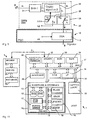
- FIG. 11 shows a block circuit of a host device.
- the postal Security device 10 and cryptology 20 are by means of interfaces i, d operationally connected via an internal host 37.
- a Hardware and interface circuit 13 of the postal security device 10 for the interface i can, for example, with an application-specific Circuit (ASIC) can be realized.
- ASIC application-specific Circuit
- the latter is to be carried out the aforementioned cryptographic functions with a data processing unit 16 and with non-volatile memories 15 to carry out connected by other functions.
- the data processing unit 16 has a microprocessor ( ⁇ P) with real-time clock (RTC), FLASH memory and RAM (SRAM).
- the security device 10 has via internal monitoring units 17 and 19 and an internal BUS 19.
- the host device 1 also has a non-volatile Memory 35, microprocessor 36, read-only memory 33, working memory 34 as well as via a modem 32, keyboard 39 and display controller 38 with display unit (Not shown).
- the host device 1 can use a communication link 2 can be connected to a remote data center 5.
- the data center 5 has, for example, a modem 52, one Server 53 and a database 54.
- the host device 1 is not shown in FIG Way - using a communication link or interface another device, for example a printing device, can be connected.
- the invention is not limited to the present or such embodiments limited, where at least two different by one Authority-approved hash functions with the same signing algorithm to be used. Alternatively, the same hash function can be used with two various approved signature algorithms can be used.
- the Cryptology 20 is then also connected to the PSD 10. The various approved signature algorithms and their switching are carried out by software.
- the cryptology 20 only contains a logic circuit 21 for a crypto-algorithm, for example one known hash function.
Landscapes
- Engineering & Computer Science (AREA)
- Business, Economics & Management (AREA)
- Health & Medical Sciences (AREA)
- Computer Security & Cryptography (AREA)
- Economics (AREA)
- Human Resources & Organizations (AREA)
- Tourism & Hospitality (AREA)
- Public Health (AREA)
- Water Supply & Treatment (AREA)
- General Health & Medical Sciences (AREA)
- Computer Networks & Wireless Communication (AREA)
- Marketing (AREA)
- Primary Health Care (AREA)
- Strategic Management (AREA)
- Signal Processing (AREA)
- Physics & Mathematics (AREA)
- General Business, Economics & Management (AREA)
- General Physics & Mathematics (AREA)
- Theoretical Computer Science (AREA)
- Devices For Checking Fares Or Tickets At Control Points (AREA)
- Management, Administration, Business Operations System, And Electronic Commerce (AREA)
- Storage Device Security (AREA)
Abstract
Description
Ausgehend von der Überlegung, dass die Speicherung von unterschiedlichen Programmen im vorgenannten Festwertspeicher, wobei jedes Programm zur Ausführung eines bestimmten kryptographischen Algorithmusses dient, eine beliebige Kombination von Signieralgorithmen und Hash-algorithmen für einen Mitteilungstyp ermöglicht, wird eine Logik zusätzlich an ein postalischen Sicherheitsgerät angeschlossen. Die Logik führt allein oder in Verbindung mit Programmen im Festwertspeicher des postalischen Sicherheitsgerätes und gegebenenfalls zusätzlich mit Programmen im Festwertspeicher des Hostgerätes mindestens einen bestimmten Algorithmus aus der Vielzahl der kryptographischen Algorithmen aus, wobei die Ausführung in Abhängigkeit von einem jeweils eingestellten Mitteilungstyp gesteuert wird.
Die Cryptologik weist ausgangsseitig mindestens einen Ausgang auf, der direkt oder indirekt auf den Eingang einer zweiten Logikschaltung im Inneren des postalischen Sicherheitsgerätes geschaltet ist. Die Cryptoalgorithmen können außerhalb des PSD's in der Cryptologik und/oder innerhalb des PSD's implementiert sein. Durch Umschalter können die Ein- oder Ausgänge von Logikschaltungen oder Parameter von Hashfunktionen von einer Logikschaltung geschaltet werden, wobei die Logikschaltungen gleich und unterschiedlich aufgebaute Cryptoalgorithmen verwenden. Ein Umschalter kann im PSD und/oder außerhalb des PSD's implementiert sein und dabei vom PSD oder Host getriggert werden. Je weniger die Host application und je mehr die PSD application das Erzeugen einer Signatur bestimmen soll, um so geeigneter sind Varianten, in welchen der Umschalter im PSD realisiert ist. Soll im anderen Fall die Host application die Entscheidung treffen, um so geeigneter sind Varianten, in welchen der Umschalter außerhalb des PSD realisiert ist. Damit ergeben sich eine Vielzahl an Varianten der im Inneren der Cryptologik und des PSD's implementierten Struktur bzw. der betriebsmäßigen Zusammenschaltung beider, so dass Signaturen erzeugt werden können, die für das Frankieren von Post ungültig aber für andere Zwecke geeignet bzw. gültig sind. Weitere Anwendungsmöglichkeiten im Bereich der Postbearbeitung sind noch spezielle Freistempel wie zum Beispiel postage correction indicia, oder military mail oder embassy mail. Darueber hinaus gibt es nichtpostalische Anwendungen im Bereich Ticketing und wertbehafteter Belege, für die nun sinnvollerweise dieselben zugelassenen Signieralgorithmen verwenden werden, ohne eine Verwechselungsgefahr mit postalischen Freistempel. Das gestattet es weitere Anwendungsmöglichkeiten zu erschließen, was die Funktionalität beispielsweise von Frankiermaschinen erweitert.
- Figur 1,
- vereinfachte Darstellung der Generierung einer Signatur mittels eines bekannten postalischen Sicherheitsgerätes (priort art),
- Figur 2,
- Host-gesteuerte Umschaltung der Cryptoalgorithmen für eine Generierung einer Signatur mittels des postalischen Sicherheitsgerätes (Variante 1),
- Figur 3,
- 4, Darstellung der Strukturen eines Cryptoalgorithmus,
- Figur 5a,
- zweite Variante einer host-gesteuerten Umschaltung der Cryptoalgorithmen für eine Generierung einer Signatur mittels des postalischen Sicherheitsgerätes,
- Figur 5b,
- PSD-gesteuerte Umschaltung der Cryptoalgorithmen für eine Generierung einer Signatur mittels des postalischen Sicherheitsgerätes (Variante 1),
- Figur 6,
- zweite Variante einer PSD-gesteuerten Umschaltung der Cryptoalgorithmen für eine Generierung einer Signatur mittels des postalischen Sicherheitsgerätes,
- Figur 7,
- dritte Variante einer PSD-gesteuerten Umschaltung der Cryptoalgorithmen für eine Generierung einer Signatur mittels des postalischen Sicherheitsgerätes,
- Figur 8,
- dritte Variante einer host-gesteuerten Umschaltung der Cryptoalgorithmen für eine Generierung einer Signatur mittels des postalischen Sicherheitsgerätes,
- Figur 9,
- vierte Variante einer host-gesteuerten Umschaltung der Cryptoalgorithmen für eine Generierung einer Signatur mittels des postalischen Sicherheitsgerätes,
- Figur 10,
- Host- und PSD-gesteuerte Umschaltung der Cryptoalgorithmen für eine Generierung einer Signatur mittels des postalischen Sicherheitsgerätes,
- Figur 11,
- Blockschaltung eines Hostgerätes.
Der ersten Cryptolalgorithmus wird nun im Unterschied zur bekannten Variante hardwaremäßig und extern des PSD 10 mittels der ersten Logikschaltung ausführt. In einer ersten Variante wird die ersten Logikschaltung zuschaltbar realisiert. Um Signaturen für unterschiedliche Zwecke zu generieren, wurde eine Anordnung geschaffen, die zwei verschiedene zugelassene Hashfunktionen bei demselben Signieralgorithmus benutzt.
Claims (17)
- Verfahren zur unterschiedlichen Erzeugung kryptographischer Sicherungen von Mitteilungen in einem Hostgerät, wobei zur kryptographischen Sicherung einer Mitteilung für einen ersten Zweck eine erste Signatur und zur kryptographischen Sicherung einer Mitteilung für einen zweiten Zweck eine zweite Signatur eingesetzt wird, gekennzeichnet dadurch, dass sich die Signaturen in der Art ihrer Erzeugung unterscheiden.
- Verfahren nach Anspruch 1, gekennzeichnet dadurch, dass die kryptographischen Algorithmen zur Erzeugung von Signaturen programmgemäß im Festwertspeicher eines postalischen Sicherheitsgerätes (10), implementiert und dass die Signaturen programmgesteuert erzeugt werden, wobei mindestens ein kryptographischer Algorithmus hardwaremäßig und außerhalb des postalischen Sicherheitsgerätes (10) ausgeführt wird.
- Verfahren nach Anspruch 1, gekennzeichnet dadurch, dass die kryptographischen Algorithmen zur Erzeugung von Signaturen programmgesteuert in separaten Logiken realisiert und Signaturen erzeugt werden.
- Verfahren nach Anspruch 1, gekennzeichnet dadurch, dass eine beliebige Kombination von Signier- und Hash-algorithmen für einen Mitteilungstyp erzeugt wird, indem eine Logik allein oder in Verbindung mit Programmen im Festwertspeicher des postalischen Sicherheitsgerätes (10) und gegebenenfalls zusätzlich mit Programmen im Festwertspeicher des Hostgerätes mindestens einen bestimmten Algorithmus aus der Vielzahl der kryptographischen Algorithmen ausführt, wobei die Ausführung in Abhängigkeit vom einem jeweils eingestellten Mitteilungstyp gesteuert wird.
- Anordnung zur unterschiedlichen Erzeugung kryptographischer Sicherungen von Mitteilungen in einem Hostgerät, mindestens mit einem postalischen Sicherheitsgerät (10), gekennzeichnet dadurch, dass eine Cryptologik (20) extern vom postalischen Sicherheitsgerät (10) angeordnet ist und mindestens mit ihrem Ausgang (d) mit einem Informationseingang (i) des postalischen Sicherheitsgerätes (10) verbunden ist und dass das postalische Sicherheitsgerät (10) eine Logikschaltung (12) aufweist, die einen digitalen Signaturalgorithmus auf das vom Ausgang (d) gelieferte Ausgangssignal anwendet, um Daten für eine Signatur zu erzeugen.
- Anordnung, nach Anspruch 5, gekennzeichnet dadurch, dass eine host-gesteuerte Cryptologik (20) vorgesehen ist, welche einen Steuerdateneingang (c, c1, c2) aufweist.
- Anordnung, nach den Ansprüchen 5 und 6, gekennzeichnet dadurch, dass die host-gesteuerte Cryptologik (20) eine Anzahl an Logikschaltungen (21, 22, 23) und einen Umschalter (24, 26) aufweist, der vom Host (1) gesteuert wird.
- Anordnung, nach den Ansprüchen 5 bis 7, gekennzeichnet dadurch, dass eine erste Logikschaltung (21) für einen ersten Cryptoalgorithmus und eine zweite Logikschaltung (22) für einen zweiten Cryptoalgorithmus eingangsseitig verbunden sind und ausgangsseitig jeweils auf Kontakte (I und II) des Umschalters (24) führen, wobei letzterer ausgangsseitig am Eingang der zweiten Logikschaltung (12) anliegt, die die Signatur erzeugt. (Fig.2)
- Anordnung, nach den Ansprüchen 5 bis 7, gekennzeichnet dadurch, dass das postalischen Sicherheitsgerät (10) eine erste Logikschaltung (11) für einen ersten Cryptoalgorithmus und eine zweite Logikschaltung (12) aufweist, die Daten für eine Signatur erzeugt, dass die host-gesteuerte Cryptologik (20) eine zweite und dritte Logikschaltung (22) und (23) und einen Umschalter (24) aufweist, wobei die erste Logikschaltung (11) des postalischen Sicherheitsgerätes (10) und die zweite und dritte Logikschaltung (22) und (23) ausgangsseitig mit dem Informationseingang (i) des postalischen Sicherheitsgerätes (10) verbunden sind, wobei der Informationseingang (i) mit der zweiten Logikschaltung (12) eingangsseitig verbunden ist, sowie dass der Umschalter (24) einen Eingang für eine Mitteilung (m) und Kontakte (I, II und III) aufweist, die jeweils am Eingang (e1, e2, e3) der Logikschaltungen (11, 22, 23) anliegen. (Fig.5a)
- Anordnung, nach den Ansprüchen 5 bis 7, gekennzeichnet dadurch, dass eine erste Logikschaltung (21) für einen ersten Cryptoalgorithmus einen Eingang (e1) für eine Mitteilung (m) und einen Ausgang (a1) aufweist, der mit einem Eingang (e3) für eine weitere Logikschaltung (23) für einen weiteren Cryptoalgorithmus verbunden ist, wobei deren Ausgang (a3) am Informationseingang (i) einer zweiten Logikschaltung (12) des postalischen Sicherheitsgerätes (10) anliegt, wobei die zweiten Logikschaltung (12) die Signatur erzeugt.
- Anordnung, nach Anspruch 10, gekennzeichnet dadurch, dass mit der weiteren Logikschaltung (23) für den weiteren Cryptoalgorithmus ein Umschalter (26) verbunden ist, der einen Schlüssel (k1, k2) umschaltet. (Fig.8)
- Anordnung, nach den Ansprüchen 10 bis 11, gekennzeichnet dadurch, dass ein erster und ein zweiter Umschalter (24, 26) in der host-gesteuerten Cryptologik (20) vorgesehen sind, wobei die Umschalter (24 und 26) über einen Steuerdateneingang (c1, c2) durch einen Host steuerbar sind, wobei Kontakte (I und II) des Umschalters (24) mit den Ausgängen (a1) und (a3) der ersten und dritten Logikschaltung (21) und (23) sowie dass der zweite Umschalter (24) ausgangsseitig den Ausgang (d) bildet, der mit dem Informationseingang (i) des postalischen Sicherheitsgerätes (10) verbunden ist. (Fig.9)
- Anordnung, nach den Ansprüchen 5 und 6, gekennzeichnet dadurch, dass das postalische Sicherheitsgerät (10) und die Cryptologik (20) jeweils mindestens eine Logikschaltung (11) und (23) aufweisen und dass die Cryptologik (20) einen ersten host-gesteuerten Umschalter (26) aufweist, der einen Schlüssel (k1, k2) für den weiteren Cryptoalgorithmus der weiteren Logikschaltung (23) umschaltet, dass ein zweiter PSD-gesteuerter Umschalter (14) in dem postalischen Sicherheitsgerät (10) vorgesehen ist, wobei Kontakte (I bzw. II) des zweiten Umschalters (14) mit den Ausgängen (a1 bzw. a3) der ersten bzw. dritten Logikschaltung (11) und (23) verbunden sind. (Fig. 10)
- Anordnung, nach Anspruch 5, gekennzeichnet dadurch, dass das postalische Sicherheitsgerät (10) oder die Cryptologik (20) mindestens eine Logikschaltung (11) und (22, 23) aufweisen sowie dass die Cryptologik (20) ausgangsseitig mindestens mit dem Ausgang (d) direkt oder indirekt auf den Eingang (i) der zweiten Logikschaltung (12) geschaltet ist, die im Inneren des postalischen Sicherheitsgerätes (10) angeordnet ist.
- Anordnung, nach Anspruch 5, gekennzeichnet dadurch, dass das postalische Sicherheitsgerät (10) und die Cryptologik (20) jeweils mindestens eine Logikschaltung (11) und (22, 23) aufweisen sowie dass das postalische Sicherheitsgerät (10) einen PSD-gesteuerten Umschalter (14) mit einem Steuerdateneingang (c) aufweist, wobei die erste Logikschaltung (11) des postalischen Sicherheitsgerätes (10) und die zweite und dritte Logikschaltung (22) und (23) der Cryptologik (20) ausgangsseitig mit dem Informationseingang (i) des postalischen Sicherheitsgerätes (10) verbunden sind, sowie dass der Umschalter (14) einen Eingang für eine Mitteilung (m) und Kontakte (I, II und III) aufweist, die jeweils am Eingang (e1, e2, e3) der Logikschaltungen (11, 22, 23) anliegen. (Fig.5b)
- Anordnung, nach Anspruch 5, gekennzeichnet dadurch, dass eine erste Logikschaltung (21) für einen ersten Cryptoalgorithmus einen Eingang (e1) für eine Mitteilung (m) und einen Ausgang (a1) aufweist, der mit einem Eingang (e3) für eine weitere Logikschaltung (23) für einen weiteren Cryptoalgorithmus verbunden ist, wobei deren Ausgang (a3) am Informationseingang (i) des postalischen Sicherheitsgerätes (10) anliegt, dass die Cryptologik (20) ausgangsseitig mit dem postalischen Sicherheitsgerätes (10) verbunden ist, wobei der Ausgang (a1) der ersten Logikschaltung (21) an einem ersten Kontakt (I) und wobei der Ausgang (a3) der weiteren Logikschaltung (23) an einem dritten Kontakt (III) eines PSD-gesteuerten Umschalters (14) innerhalb des postalischen Sicherheitsgerätes (10) anliegt und wobei an einem zweiten Kontakt (II) des Umschalters (14) der Ausgang (a2) einer ersten Logikschaltung (11) innerhalb des postalischen Sicherheitsgerätes (10) anliegt, welche eingangsseitig am Ausgang (a1) der ersten Logikschaltung (21) der Cryptologik (20) angeschlossen ist und dass der Umschalter (14) ausgangsseitig an eine zweite Logikschaltung (12) innerhalb des postalischen Sicherheitsgerätes (10) gekoppelt ist, die die Signatur erzeugt.(Fig.6)
- Anordnung, nach Anspruch 5, gekennzeichnet dadurch, dass eine erste Logikschaltung (21) für einen ersten Cryptoalgorithmus einen Eingang (e1) für eine Mitteilung (m) und einen Ausgang (a1) aufweist, der mit einem Eingang (e2) für eine zweite Logikschaltung (23) für einen zweiten Cryptoalgorithmus verbunden ist, wobei deren Ausgang (a2) mit einem Eingang (e3) für eine dritte Logikschaltung (23) für einen dritten Cryptoalgorithmus verbunden ist, wobei deren Ausgang (a3) am Informationseingang (i) des postalischen Sicherheitsgerätes (10) anliegt, dass die Cryptologik (20) ausgangsseitig mit dem postalischen Sicherheitsgerätes (10) verbunden ist, wobei der Ausgang (a1) der ersten Logikschaltung (21) an einem ersten Kontakt (I), wobei der Ausgang (a2) der zweiten Logikschaltung (22) an einem zweiten Kontakt (II) und wobei der Ausgang (a3) der weiteren Logikschaltung (23) an einem dritten Kontakt (III) eines PSD-gesteuerten Umschalters (14) innerhalb des postalischen Sicherheitsgerätes (10) anliegt und dass der Umschalter (14) ausgangsseitig an eine zweite Logikschaltung (12) innerhalb des postalischen Sicherheitsgerätes (10) gekoppelt ist, die die Signatur erzeugt.(Fig.7)
Applications Claiming Priority (2)
| Application Number | Priority Date | Filing Date | Title |
|---|---|---|---|
| DE10260406A DE10260406B4 (de) | 2002-12-16 | 2002-12-16 | Verfahren und Anordnung zur unterschiedlichen Erzeugung kryptographischer Sicherungen von Mitteilungen in einem Hostgerät |
| DE10260406 | 2002-12-16 |
Publications (3)
| Publication Number | Publication Date |
|---|---|
| EP1432170A2 true EP1432170A2 (de) | 2004-06-23 |
| EP1432170A3 EP1432170A3 (de) | 2005-05-18 |
| EP1432170B1 EP1432170B1 (de) | 2014-11-26 |
Family
ID=32336558
Family Applications (1)
| Application Number | Title | Priority Date | Filing Date |
|---|---|---|---|
| EP03025254.8A Expired - Lifetime EP1432170B1 (de) | 2002-12-16 | 2003-11-06 | Verfahren und Anordnung zur unterschiedlichen Erzeugung kryptographischer Sicherungen von Mitteilungen in einem Hostgerät |
Country Status (3)
| Country | Link |
|---|---|
| US (2) | US7610247B2 (de) |
| EP (1) | EP1432170B1 (de) |
| DE (1) | DE10260406B4 (de) |
Families Citing this family (6)
| Publication number | Priority date | Publication date | Assignee | Title |
|---|---|---|---|---|
| DE102007011309B4 (de) * | 2007-03-06 | 2008-11-20 | Francotyp-Postalia Gmbh | Verfahren zur authentisierten Übermittlung eines personalisierten Datensatzes oder Programms an ein Hardware-Sicherheitsmodul, insbesondere einer Frankiermaschine |
| EP3522050A1 (de) * | 2007-05-18 | 2019-08-07 | Verimatrix, Inc. | System und verfahren zur definition von programmierbaren verarbeitungsschritten, die beim schutz der daten angewendet werden |
| US10305871B2 (en) * | 2015-12-09 | 2019-05-28 | Cloudflare, Inc. | Dynamically serving digital certificates based on secure session properties |
| US9660978B1 (en) | 2016-08-08 | 2017-05-23 | ISARA Corporation | Using a digital certificate with multiple cryptosystems |
| US20180167366A1 (en) * | 2016-12-12 | 2018-06-14 | Qualcomm Incorporated | Cryptographic mode programmability |
| CN113748642B (zh) * | 2019-02-26 | 2024-09-20 | 上海亚融信息技术有限公司 | 数字签名终端和安全通信方法 |
Family Cites Families (21)
| Publication number | Priority date | Publication date | Assignee | Title |
|---|---|---|---|---|
| US5231668A (en) * | 1991-07-26 | 1993-07-27 | The United States Of America, As Represented By The Secretary Of Commerce | Digital signature algorithm |
| US5179591A (en) * | 1991-10-16 | 1993-01-12 | Motorola, Inc. | Method for algorithm independent cryptographic key management |
| US5524072A (en) * | 1991-12-04 | 1996-06-04 | Enco-Tone Ltd. | Methods and apparatus for data encryption and transmission |
| US5805711A (en) * | 1993-12-21 | 1998-09-08 | Francotyp-Postalia Ag & Co. | Method of improving the security of postage meter machines |
| US5815577A (en) * | 1994-03-18 | 1998-09-29 | Innovonics, Inc. | Methods and apparatus for securely encrypting data in conjunction with a personal computer |
| US6636970B2 (en) * | 1995-02-14 | 2003-10-21 | Fujitsu Limited | Software encoding using a combination of two types of encoding and encoding type identification information |
| DE59710554D1 (de) * | 1996-01-31 | 2003-09-18 | Francotyp Postalia Ag | Frankiermaschine |
| US6009417A (en) * | 1996-09-24 | 1999-12-28 | Ascom Hasler Mailing Systems, Inc. | Proof of postage digital franking |
| US6169804B1 (en) * | 1996-11-21 | 2001-01-02 | Pitney Bowes Inc. | Method for verifying the expected postage security device and its status |
| US5812990A (en) * | 1996-12-23 | 1998-09-22 | Pitney Bowes Inc. | System and method for providing an additional cryptography layer for postage meter refills |
| US5953426A (en) * | 1997-02-11 | 1999-09-14 | Francotyp-Postalia Ag & Co. | Method and arrangement for generating and checking a security imprint |
| US6240183B1 (en) * | 1997-06-19 | 2001-05-29 | Brian E. Marchant | Security apparatus for data transmission with dynamic random encryption |
| DE19748954A1 (de) * | 1997-10-29 | 1999-05-06 | Francotyp Postalia Gmbh | Verfahren für eine digital druckende Frankiermaschine zur Erzeugung und Überprüfung eines Sicherheitsabdruckes |
| US6058384A (en) * | 1997-12-23 | 2000-05-02 | Pitney Bowes Inc. | Method for removing funds from a postal security device |
| US6044350A (en) * | 1998-12-24 | 2000-03-28 | Pitney Bowes Inc. | Certificate meter with selectable indemnification provisions |
| DE19958721A1 (de) * | 1999-12-06 | 2001-07-12 | Francotyp Postalia Gmbh | Frankierverfahren und -vorrichtung |
| US6438530B1 (en) * | 1999-12-29 | 2002-08-20 | Pitney Bowes Inc. | Software based stamp dispenser |
| DE10020904B4 (de) * | 2000-04-28 | 2004-12-09 | Francotyp-Postalia Ag & Co. Kg | Verfahren zur sicheren Distribution von Sicherheitsmodulen |
| JP2002207426A (ja) * | 2001-01-10 | 2002-07-26 | Sony Corp | 公開鍵証明書発行システム、公開鍵証明書発行方法、および電子認証装置、並びにプログラム記憶媒体 |
| DE20112350U1 (de) * | 2001-07-16 | 2002-01-17 | Francotyp Postalia Gmbh | Anordnung zum Schutz eines Sicherheitsmoduls |
| DE10136608B4 (de) * | 2001-07-16 | 2005-12-08 | Francotyp-Postalia Ag & Co. Kg | Verfahren und System zur Echtzeitaufzeichnung mit Sicherheitsmodul |
-
2002
- 2002-12-16 DE DE10260406A patent/DE10260406B4/de not_active Expired - Fee Related
-
2003
- 2003-10-21 US US10/690,012 patent/US7610247B2/en not_active Expired - Fee Related
- 2003-11-06 EP EP03025254.8A patent/EP1432170B1/de not_active Expired - Lifetime
-
2007
- 2007-09-20 US US11/858,352 patent/US8099367B2/en not_active Expired - Fee Related
Also Published As
| Publication number | Publication date |
|---|---|
| US8099367B2 (en) | 2012-01-17 |
| US20080010210A1 (en) | 2008-01-10 |
| EP1432170A3 (de) | 2005-05-18 |
| US7610247B2 (en) | 2009-10-27 |
| DE10260406A1 (de) | 2004-07-08 |
| DE10260406B4 (de) | 2007-03-08 |
| US20040117314A1 (en) | 2004-06-17 |
| EP1432170B1 (de) | 2014-11-26 |
Similar Documents
| Publication | Publication Date | Title |
|---|---|---|
| EP0944027B1 (de) | Frankiereinrichtung und ein Verfahren zur Erzeugung gültiger Daten für Frankierabdrucke | |
| EP1405274B1 (de) | Verfahren zum überprüfen der gültigkeit von digitalen freimachungsvermerken | |
| DE69932396T2 (de) | Verfahren und Vorrichtung zur sicheren Schlüsselübertragung zwischen einer Frankiermaschine und einer entfernten Datenzentrale | |
| DE10136608B4 (de) | Verfahren und System zur Echtzeitaufzeichnung mit Sicherheitsmodul | |
| DE19744786A1 (de) | Digitalsignatur-Protokoll | |
| EP0892368A2 (de) | Verfahren zur Statistikmodusnachladung und zur statistischen Erfassung nach Statistikklassen bei der Speicherung eines Datensatzes | |
| EP1432170B1 (de) | Verfahren und Anordnung zur unterschiedlichen Erzeugung kryptographischer Sicherungen von Mitteilungen in einem Hostgerät | |
| DE10056599C2 (de) | Verfahren zum Versehen von Postsendungen mit Freimachungsvermerken | |
| DE19816344A1 (de) | Verfahren zur sicheren Schlüsselverteilung | |
| EP0969420B1 (de) | Verfahren zur sicheren Übertragung von Dienstdaten an ein Endgerät und Anordnung zur Durchführung des Verfahrens | |
| DE60015907T2 (de) | Verfahren und Vorrichtung zur Erzeugung von Nachrichten welche eine prüfbare Behauptung enthalten dass eine Veränderliche sich innerhalb bestimmter Grenzwerte befindet | |
| EP1455311A2 (de) | Verfahren zum sicheren Datenaustausch | |
| EP1279147B1 (de) | Verfahren zum versehen von postsendungen mit freimachungsvermerken | |
| EP1340197B1 (de) | Verfahren zum versehen von postsendungen mit frankierungsvermerken | |
| DE10020561C2 (de) | Sicherungsmodul und Verfahren zur Erstellung fälschungssicherer Dokumente | |
| DE69930202T2 (de) | Verfahren zur Begrenzung der Schlüsselbenutzung in einem Frankiersystem welches kryptographisch gesicherte Briefmarken produziert | |
| DE102004032323A1 (de) | Verfahren und Anordnung zum Erstatten von Porto | |
| EP1222512B1 (de) | Sicherungsmodul und verfahren zur erstellung fälschungssicherer dokumente | |
| EP1398741A2 (de) | Gesicherte Speicherung von Journaldaten | |
| EP1486028B1 (de) | Verfahren und vorrichtung zur erstellung prüfbar fälschungssicherer dokumente | |
| DE102005061686A1 (de) | Verfahren und Anordnung zum Bereitstellen sicherheitsrelevanter Dienste durch ein Sicherheitsmodul einer Frankiermaschine | |
| EP3553726A1 (de) | Verfahren zum manipulationssicheren speichern von transaktionsdaten in einem system mit elektronischen registrierkassen und system |
Legal Events
| Date | Code | Title | Description |
|---|---|---|---|
| PUAI | Public reference made under article 153(3) epc to a published international application that has entered the european phase |
Free format text: ORIGINAL CODE: 0009012 |
|
| AK | Designated contracting states |
Kind code of ref document: A2 Designated state(s): AT BE BG CH CY CZ DE DK EE ES FI FR GB GR HU IE IT LI LU MC NL PT RO SE SI SK TR |
|
| AX | Request for extension of the european patent |
Extension state: AL LT LV MK |
|
| PUAL | Search report despatched |
Free format text: ORIGINAL CODE: 0009013 |
|
| AK | Designated contracting states |
Kind code of ref document: A3 Designated state(s): AT BE BG CH CY CZ DE DK EE ES FI FR GB GR HU IE IT LI LU MC NL PT RO SE SI SK TR |
|
| AX | Request for extension of the european patent |
Extension state: AL LT LV MK |
|
| 17P | Request for examination filed |
Effective date: 20050601 |
|
| RAP1 | Party data changed (applicant data changed or rights of an application transferred) |
Owner name: FRANCOTYP-POSTALIA GMBH |
|
| AKX | Designation fees paid |
Designated state(s): AT BE BG CH CY CZ DE DK EE ES FI FR GB GR HU IE IT LI LU MC NL PT RO SE SI SK TR |
|
| REG | Reference to a national code |
Ref country code: DE Ref legal event code: R079 Ref document number: 50315168 Country of ref document: DE Free format text: PREVIOUS MAIN CLASS: H04L0009320000 Ipc: G06Q0050060000 |
|
| RIC1 | Information provided on ipc code assigned before grant |
Ipc: H04L 9/32 20060101ALI20140422BHEP Ipc: G06Q 50/06 20120101AFI20140422BHEP |
|
| GRAP | Despatch of communication of intention to grant a patent |
Free format text: ORIGINAL CODE: EPIDOSNIGR1 |
|
| INTG | Intention to grant announced |
Effective date: 20140618 |
|
| GRAS | Grant fee paid |
Free format text: ORIGINAL CODE: EPIDOSNIGR3 |
|
| GRAA | (expected) grant |
Free format text: ORIGINAL CODE: 0009210 |
|
| AK | Designated contracting states |
Kind code of ref document: B1 Designated state(s): AT BE BG CH CY CZ DE DK EE ES FI FR GB GR HU IE IT LI LU MC NL PT RO SE SI SK TR |
|
| REG | Reference to a national code |
Ref country code: GB Ref legal event code: FG4D Free format text: NOT ENGLISH |
|
| REG | Reference to a national code |
Ref country code: CH Ref legal event code: EP |
|
| REG | Reference to a national code |
Ref country code: AT Ref legal event code: REF Ref document number: 698570 Country of ref document: AT Kind code of ref document: T Effective date: 20141215 |
|
| REG | Reference to a national code |
Ref country code: IE Ref legal event code: FG4D Free format text: LANGUAGE OF EP DOCUMENT: GERMAN |
|
| REG | Reference to a national code |
Ref country code: DE Ref legal event code: R096 Ref document number: 50315168 Country of ref document: DE Effective date: 20150108 |
|
| RAP2 | Party data changed (patent owner data changed or rights of a patent transferred) |
Owner name: FRANCOTYP-POSTALIA GMBH |
|
| REG | Reference to a national code |
Ref country code: NL Ref legal event code: T3 |
|
| REG | Reference to a national code |
Ref country code: SE Ref legal event code: TRGR |
|
| PG25 | Lapsed in a contracting state [announced via postgrant information from national office to epo] |
Ref country code: FI Free format text: LAPSE BECAUSE OF FAILURE TO SUBMIT A TRANSLATION OF THE DESCRIPTION OR TO PAY THE FEE WITHIN THE PRESCRIBED TIME-LIMIT Effective date: 20141126 Ref country code: ES Free format text: LAPSE BECAUSE OF FAILURE TO SUBMIT A TRANSLATION OF THE DESCRIPTION OR TO PAY THE FEE WITHIN THE PRESCRIBED TIME-LIMIT Effective date: 20141126 Ref country code: PT Free format text: LAPSE BECAUSE OF FAILURE TO SUBMIT A TRANSLATION OF THE DESCRIPTION OR TO PAY THE FEE WITHIN THE PRESCRIBED TIME-LIMIT Effective date: 20150326 |
|
| REG | Reference to a national code |
Ref country code: DE Ref legal event code: R081 Ref document number: 50315168 Country of ref document: DE Owner name: FRANCOTYP-POSTALIA GMBH, DE Free format text: FORMER OWNER: FRANCOTYP-POSTALIA AG & CO. KG, 16547 BIRKENWERDER, DE Effective date: 20141128 Ref country code: DE Ref legal event code: R081 Ref document number: 50315168 Country of ref document: DE Owner name: FRANCOTYP-POSTALIA GMBH, DE Free format text: FORMER OWNER: FRANCOTYP-POSTALIA GMBH, 16547 BIRKENWERDER, DE Effective date: 20150330 |
|
| PG25 | Lapsed in a contracting state [announced via postgrant information from national office to epo] |
Ref country code: CY Free format text: LAPSE BECAUSE OF FAILURE TO SUBMIT A TRANSLATION OF THE DESCRIPTION OR TO PAY THE FEE WITHIN THE PRESCRIBED TIME-LIMIT Effective date: 20141126 Ref country code: GR Free format text: LAPSE BECAUSE OF FAILURE TO SUBMIT A TRANSLATION OF THE DESCRIPTION OR TO PAY THE FEE WITHIN THE PRESCRIBED TIME-LIMIT Effective date: 20150227 |
|
| PG25 | Lapsed in a contracting state [announced via postgrant information from national office to epo] |
Ref country code: CZ Free format text: LAPSE BECAUSE OF FAILURE TO SUBMIT A TRANSLATION OF THE DESCRIPTION OR TO PAY THE FEE WITHIN THE PRESCRIBED TIME-LIMIT Effective date: 20141126 Ref country code: EE Free format text: LAPSE BECAUSE OF FAILURE TO SUBMIT A TRANSLATION OF THE DESCRIPTION OR TO PAY THE FEE WITHIN THE PRESCRIBED TIME-LIMIT Effective date: 20141126 Ref country code: DK Free format text: LAPSE BECAUSE OF FAILURE TO SUBMIT A TRANSLATION OF THE DESCRIPTION OR TO PAY THE FEE WITHIN THE PRESCRIBED TIME-LIMIT Effective date: 20141126 Ref country code: RO Free format text: LAPSE BECAUSE OF FAILURE TO SUBMIT A TRANSLATION OF THE DESCRIPTION OR TO PAY THE FEE WITHIN THE PRESCRIBED TIME-LIMIT Effective date: 20141126 Ref country code: SK Free format text: LAPSE BECAUSE OF FAILURE TO SUBMIT A TRANSLATION OF THE DESCRIPTION OR TO PAY THE FEE WITHIN THE PRESCRIBED TIME-LIMIT Effective date: 20141126 |
|
| REG | Reference to a national code |
Ref country code: DE Ref legal event code: R097 Ref document number: 50315168 Country of ref document: DE |
|
| PLBE | No opposition filed within time limit |
Free format text: ORIGINAL CODE: 0009261 |
|
| STAA | Information on the status of an ep patent application or granted ep patent |
Free format text: STATUS: NO OPPOSITION FILED WITHIN TIME LIMIT |
|
| 26N | No opposition filed |
Effective date: 20150827 |
|
| REG | Reference to a national code |
Ref country code: FR Ref legal event code: PLFP Year of fee payment: 13 |
|
| PGFP | Annual fee paid to national office [announced via postgrant information from national office to epo] |
Ref country code: IT Payment date: 20151125 Year of fee payment: 13 Ref country code: DE Payment date: 20151016 Year of fee payment: 13 Ref country code: GB Payment date: 20151118 Year of fee payment: 13 Ref country code: CH Payment date: 20151118 Year of fee payment: 13 |
|
| PG25 | Lapsed in a contracting state [announced via postgrant information from national office to epo] |
Ref country code: SI Free format text: LAPSE BECAUSE OF FAILURE TO SUBMIT A TRANSLATION OF THE DESCRIPTION OR TO PAY THE FEE WITHIN THE PRESCRIBED TIME-LIMIT Effective date: 20141126 |
|
| PGFP | Annual fee paid to national office [announced via postgrant information from national office to epo] |
Ref country code: AT Payment date: 20151119 Year of fee payment: 13 Ref country code: FR Payment date: 20151119 Year of fee payment: 13 Ref country code: SE Payment date: 20151118 Year of fee payment: 13 Ref country code: NL Payment date: 20151118 Year of fee payment: 13 |
|
| PG25 | Lapsed in a contracting state [announced via postgrant information from national office to epo] |
Ref country code: LU Free format text: LAPSE BECAUSE OF FAILURE TO SUBMIT A TRANSLATION OF THE DESCRIPTION OR TO PAY THE FEE WITHIN THE PRESCRIBED TIME-LIMIT Effective date: 20151106 Ref country code: MC Free format text: LAPSE BECAUSE OF FAILURE TO SUBMIT A TRANSLATION OF THE DESCRIPTION OR TO PAY THE FEE WITHIN THE PRESCRIBED TIME-LIMIT Effective date: 20141126 |
|
| REG | Reference to a national code |
Ref country code: IE Ref legal event code: MM4A |
|
| PG25 | Lapsed in a contracting state [announced via postgrant information from national office to epo] |
Ref country code: IE Free format text: LAPSE BECAUSE OF NON-PAYMENT OF DUE FEES Effective date: 20151106 |
|
| PG25 | Lapsed in a contracting state [announced via postgrant information from national office to epo] |
Ref country code: HU Free format text: LAPSE BECAUSE OF FAILURE TO SUBMIT A TRANSLATION OF THE DESCRIPTION OR TO PAY THE FEE WITHIN THE PRESCRIBED TIME-LIMIT; INVALID AB INITIO Effective date: 20031106 Ref country code: BG Free format text: LAPSE BECAUSE OF FAILURE TO SUBMIT A TRANSLATION OF THE DESCRIPTION OR TO PAY THE FEE WITHIN THE PRESCRIBED TIME-LIMIT Effective date: 20141126 |
|
| REG | Reference to a national code |
Ref country code: DE Ref legal event code: R119 Ref document number: 50315168 Country of ref document: DE |
|
| REG | Reference to a national code |
Ref country code: CH Ref legal event code: PL |
|
| REG | Reference to a national code |
Ref country code: SE Ref legal event code: EUG |
|
| REG | Reference to a national code |
Ref country code: NL Ref legal event code: MM Effective date: 20161201 |
|
| REG | Reference to a national code |
Ref country code: AT Ref legal event code: MM01 Ref document number: 698570 Country of ref document: AT Kind code of ref document: T Effective date: 20161106 |
|
| GBPC | Gb: european patent ceased through non-payment of renewal fee |
Effective date: 20161106 |
|
| PG25 | Lapsed in a contracting state [announced via postgrant information from national office to epo] |
Ref country code: LI Free format text: LAPSE BECAUSE OF NON-PAYMENT OF DUE FEES Effective date: 20161130 Ref country code: CH Free format text: LAPSE BECAUSE OF NON-PAYMENT OF DUE FEES Effective date: 20161130 Ref country code: BE Free format text: LAPSE BECAUSE OF NON-PAYMENT OF DUE FEES Effective date: 20151130 |
|
| REG | Reference to a national code |
Ref country code: FR Ref legal event code: ST Effective date: 20170731 |
|
| PG25 | Lapsed in a contracting state [announced via postgrant information from national office to epo] |
Ref country code: TR Free format text: LAPSE BECAUSE OF FAILURE TO SUBMIT A TRANSLATION OF THE DESCRIPTION OR TO PAY THE FEE WITHIN THE PRESCRIBED TIME-LIMIT Effective date: 20141126 Ref country code: SE Free format text: LAPSE BECAUSE OF NON-PAYMENT OF DUE FEES Effective date: 20161107 Ref country code: AT Free format text: LAPSE BECAUSE OF NON-PAYMENT OF DUE FEES Effective date: 20161106 |
|
| PG25 | Lapsed in a contracting state [announced via postgrant information from national office to epo] |
Ref country code: NL Free format text: LAPSE BECAUSE OF NON-PAYMENT OF DUE FEES Effective date: 20161201 |
|
| PG25 | Lapsed in a contracting state [announced via postgrant information from national office to epo] |
Ref country code: FR Free format text: LAPSE BECAUSE OF NON-PAYMENT OF DUE FEES Effective date: 20161130 Ref country code: IT Free format text: LAPSE BECAUSE OF NON-PAYMENT OF DUE FEES Effective date: 20161106 |
|
| PG25 | Lapsed in a contracting state [announced via postgrant information from national office to epo] |
Ref country code: GB Free format text: LAPSE BECAUSE OF NON-PAYMENT OF DUE FEES Effective date: 20161106 Ref country code: DE Free format text: LAPSE BECAUSE OF NON-PAYMENT OF DUE FEES Effective date: 20170601 |