EP1431753A2 - Coating dry estimating method, coating dry estimating system and recording medium - Google Patents
Coating dry estimating method, coating dry estimating system and recording medium Download PDFInfo
- Publication number
- EP1431753A2 EP1431753A2 EP03028755A EP03028755A EP1431753A2 EP 1431753 A2 EP1431753 A2 EP 1431753A2 EP 03028755 A EP03028755 A EP 03028755A EP 03028755 A EP03028755 A EP 03028755A EP 1431753 A2 EP1431753 A2 EP 1431753A2
- Authority
- EP
- European Patent Office
- Prior art keywords
- coating
- dry
- mesh
- amount
- integrated value
- Prior art date
- Legal status (The legal status is an assumption and is not a legal conclusion. Google has not performed a legal analysis and makes no representation as to the accuracy of the status listed.)
- Withdrawn
Links
Images




Classifications
-
- G—PHYSICS
- G01—MEASURING; TESTING
- G01N—INVESTIGATING OR ANALYSING MATERIALS BY DETERMINING THEIR CHEMICAL OR PHYSICAL PROPERTIES
- G01N33/00—Investigating or analysing materials by specific methods not covered by groups G01N1/00 - G01N31/00
- G01N33/26—Oils; Viscous liquids; Paints; Inks
- G01N33/32—Paints; Inks
Definitions
- the present invention relates to a coating dry estimating method of estimating a dry state of coating applied to a coating target, a coating dry estimating system and a recording medium.
- Dry of coating applied to a coating target such as a vehicle body or the like is carried out by radiation based on infrared rays or the like or by high temperature air blowing.
- the drying process of the coating contains not only evaporation of solvent contained in the coated film, but also hardening of coated film.
- the hardening of the coated film progresses by inducing bridging reaction (polymerization reaction) of molecules of coating material contained in the coated film to polymerize the molecules.
- bridging reaction polymerization reaction
- a proper dry temperature range and a proper integrated heat amount range exist every coating material.
- the surface temperature is different among sites of the coating target, and thus dispersion occurs in the dry state of the coating every site.
- the dry state of the coating is estimated, it is particularly important to estimate the dry state of a site which is hardly dried like the inside of a car body or the like.
- it is required to optimize the setting of dry conditions in the drying furnace, the body structure of the coating target, the coating conditions, etc. so that the dispersion of the dry state is eliminated.
- JP-A-2001-96216 discloses a baking temperature monitoring system for monitoring the surface temperature of a coating target in a drying furnace.
- the present invention has been implemented in view of the foregoing situation, and has an object to estimate the dry state of the coating target with high precision.
- the present invention has been implemented in view of the foregoing situation, and has an object to estimate the dry state of the coating target with high precision.
- a first invention provides a coating dry estimating method of estimating a dry state of coating on a coating target.
- This method has a first step of calculating temperature data indicating transition of a temperature distribution of the coating target with time lapse, a second step of calculating an integrated value of an amount of heat applied to the coating on the basis of the temperature data, and a third step of estimating the dry state of the coating on the basis of the integrated value of the amount of heat.
- the third step contains a step of comparing the integrated value of the amount of heat applied to the coating with a threshold value for judging dry of the coating to estimate the dry state of the coating.
- the second step is a step of determining a time period for which the temperature of the coating target is within a predetermined temperature range in the temperature data, and calculating the integrated value of the amount of heat applied to the coating within the time period.
- this second step may contain a step of correcting the integrated value of the amount of heat on the basis of at least one of the film thickness of the coating, the kind of coating material used for the coating and the content of solvent contained in the coating.
- the first step contains a step of superposing a coating target mesh achieved by representing the coating target in the form of a mesh on an in-furnace area mesh achieved by modeling a dry furnace and representing the dry furnace in the form of a mesh while moving the coating target mesh in conformity with a movement pattern representing a movement locus of the coating target, thereby generating superposed grids time-sequentially, and a step of analyzing the temperature distribution of the coating target by using each of the superposed grids generated time-sequentially.
- the coating target mesh comprises a fine mesh achieved by representing the internal structure of a member at a note site to be noted for analysis in the form of a mesh, and a rough mesh achieved by representing the surface of the coating target at portions other than the note site in the form of a mesh.
- a second invention provides a recording medium recorded with a program for making a computer execute a coating dry estimating method of estimating a dry state of coating on a coated coating target which is provided in the above first invention.
- a third invention provides a coating dry estimating system for estimating a dry state of coating on a coated coating target.
- This system has a storage device for storing a threshold value for judgment of dry of the coating, and a computer for calculating temperature data representing transition of a temperature distribution of the coating target with time lapse, calculating an integrated value of the amount of heat applied to the coating on the basis of the temperature data, and comparing the integrated value of the amount of heat applied to the coating with the threshold value to estimate the dry state of the coating. It is preferable that the computer calculates a time period for which the temperature of the coating target is within a predetermined temperature range in the temperature data, and calculating an integrated value of the amount of heat applied to the coating within the time period.
- the computer corrects the integrated value of the amount of heat on the basis of at least one of the film thickness of the coating, the kind of coating material used for the coating and the content of solvent contained in the coating.
- FIG. 1 is a diagram showing the construction of a coating dry estimating system for vehicle bodies according to the present invention.
- This system comprises a computer 1, an input device 2 such as a keyboard, a mouse or the like, a display device 3 such as CRT, a liquid crystal display or the like, and a storage device 4 such as a magnetic disc or the like.
- the computer 1 comprises CPU, RAM, ROM, an input/output interface, etc. as well known.
- the computer 1 numerically analyzes the surface temperature of a vehicle body serving as an analysis target, and estimates the dry state of the coating on the basis of the analysis result.
- An operator properly operates the input device 2 on the basis of the information displayed on the display device 3 to indicate a constituent part serving as an analysis target, input numerical values, etc.
- Material characteristic values, dimensions, conditions, etc. associated with the drying furnace, air, the vehicle body and the coating are stored as data for estimating the dry state of the coating in the storage device 4.
- the data related to the drying furnace contain internal dimension of the drying furnace, a heat source (duct) position, the temperature and velocity of hot air, etc.
- the data related to the air contain the gas constant, the density, molecular mass, viscosity, heat capacity, thermal conductivity, mass diffusion coefficient, normal state enthalpy, Reynolds number, etc. of the air, etc.
- the data related to the drying furnace and the data related to the air are used to analyze the temperature distribution in the drying furnace.
- the data related to the vehicle body contains the density, thermal conductance, heat capacity, electric conductivity, permeability, etc.
- the data related to the vehicle body are used to analyze the temperature distribution on the surface of the vehicle body.
- the data related to the coating contain a threshold value for the temperature in the drying process of the coating, a threshold value for judgment of the dry of the coating, the type of coating material, the film thickness of the coating, the type of solvent, the content of solvent, specific gravity, coefficient of heat transfer, bridging reaction heat, vaporization heat, etc.
- These data related to the coating are used to analyze evaporation of the solvent and hardening of the coating.
- the moving speed of the vehicle body, the treatment time, the initial temperature of the vehicle body, etc. are also stored as analysis conditions for the temperature analysis of the vehicle body in the storage device 4.
- a vehicle-body mesh 5 (coating target mesh) achieved by representing the coating target in the form of a mesh and a drying furnace mesh 6 are used to calculate the temperature distribution of the overall vehicle body.
- Fig. 2 is a diagram showing an example of the vehicle body mesh.
- the vehicle body mesh 5 is achieved by representing the shape of the vehicle body itself and the surrounding space thereof in the form of a mesh.
- a front pillar and a center pillar are represented by fine meshes 5a with which the shapes of the sites are finely represented, and the shapes of the other sites are represented by rough meshes 5b with which the shapes of the sites are represented more roughly than those of the fine meshes 5a.
- the vehicle-body mesh 5 is generated by superposing two kinds of meshes, a fine mesh 5a and a rough mesh 5b.
- the fine mesh 5a represents the structure of a site being noted for the coating dry estimation by using a relatively fine mesh.
- the front pillar or the center pillar is set as a site being noted, not only the plates 11, 12 corresponding to the outer plates of the vehicle body, but also the internal enforcing members 13 to 15 are finely represented as shown in Fig. 3.
- the fine mesh 5a is designed in a finer mesh structure than the drying furnace mesh 6 described later from the viewpoint of securing the estimation precision of the coating dry.
- the rough mesh 5b represents the outer plate of the vehicle body at the portions other than the note sites by using a rougher mesh than the fine mesh 5a, and it does not represent the internal structure.
- the rough mesh 5b when the front pillar or the center pillar is represented by the rough mesh 5b, only he plates 11, 12 of Fig. 3 are represented by meshes.
- the reason why the outer plate of the vehicle body at the portions other than the note sites is represented by meshes resides in that the outer plate of the vehicle plate has a great effect on fluidity of air in the drying furnace when the temperature distribution in the drying furnace is determined.
- the drying furnace mesh 6 represents a modeled drying furnace in the form of a mesh.
- Fig. 4 is a diagram showing an example of the drying furnace mesh 6. That is, an area heated in the drying furnace is represented as an in-furnace area mesh 6b for which the material characteristic value indicating heated air is set. Furthermore, the outside air of the drying furnace is represented as an out-furnace area mesh 6a for which the material characteristic value indicating non-heated air is set. A temperature boundary is set at the boundary between the in-furnace area mesh 6b and the out-furnace area mesh 6a. In addition, a duct, a wall boundary (Wall boundary) of the drying furnace, etc. are further set in the in-furnace area mesh 6a. These meshes 5, 6 are superposed on each other while moving the vehicle-body mesh 5 in conformity with a movement pattern indicating a movement locus of the vehicle body on the drying furnace mesh 6, thereby generating superposed grids time-sequentially.
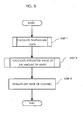
- Fig. 5 is a flowchart showing the procedure of the coating dry estimation for the vehicle body.
- the computer 1 calculates temperature data representing transition of the temperature distribution of the vehicle body with time lapse.
- Fig. 6 is a flowchart showing the calculation procedure of the temperature data.
- the operator inputs various data such as the superposed grids generated from the vehicle-body mesh 5 and the drying furnace mesh 6, the material characteristic value, the analysis condition, etc. to set the initial values of the temperature distribution for the vehicle body and the drying furnace.
- the computer 1 stores the temperature distribution before calculation (the temperature distribution of the preceding analysis in the second and subsequent analysis) in the storage device 4 such as a magnetic disc or the like.
- a calculation time step is advanced from a time told for the preceding analysis by ⁇ t [sec] (step 13), the position of the vehicle-body mesh 5 at the current time tnew is renewed, and the vehicle-body mesh 5 is moved ahead along a conveyor line (step 14).
- the computer 1 solves a well-known thermal diffusion equation by using a finite volume method, a finite element method, a finite differential method or the like to calculate the temperature distribution in the drying furnace (step 16).
- the temperature distribution on the surface of the vehicle body is calculated on the basis of the temperature distribution in the drying furnace which is calculated in step 16 (step 17).
- step 12 A series of processes from the step 12 to the step 17 as described above are repeated until a predetermined treatment time has elapsed on the basis of a judgment of step 18, whereby the temperature data are achieved as the time-varying temperature distribution.
- the step goes from step 18 to step 19, and the computer 1 outputs the temperature data and finishes the calculation processing of the temperature data.
- step 2 of Fig. 2 the computer 1 calculates the integrated value of the amount of heat (accumulated heat amount) on the basis of the temperature data calculated in the preceding step 1.
- Fig. 7 shows a calculation routine of the integrated value of the amount of heat
- Fig. 8 is a diagram showing the integrated value of the heat amount.
- a solid line of Fig. 8 represents transition of temperature at a note site (for example, one mesh in the vehicle-body mesh 5) in the temperature data calculated in the step 1.
- the computer 1 calculates a correction value Ts on the basis of the coating condition.
- the amount of heat consumed through the dry of the coating is associated with hardening of the coating and evaporation of the solvent.
- the correction value Ts for subtracting the heat amount related to the evaporation of the solvent from the temperature data is calculated by the equation 1.
- the condition of the coating used to calculate the correction value Ts contains the kind of the coating material, the film thickness of the coating, the content of the solvent contained in the coating.
- K represents a coefficient based on the type of the coating material
- Th represents the film thickness of the coating
- C represents the content of the solvent.
- a1 to a4 represent predetermined coefficients.
- step 22 the computer 1 corrects the temperature data by using the correction value Ts.
- the correction of the temperature data is carried out by uniformly subtracting the correction value Ts from the temperature data (transition of the temperature) before the correction.
- a one-dotted chain line of Fig. 8 represents the temperature data corrected on the basis of the correction value Ts.
- step 23 by using the corrected temperature data, the computer 1 calculates a time period for which the hardening of the coating progresses.
- it is required as a condition for progression of the hardening of the coating that the temperature of the coating is within a proper temperature range in the dry of the coating.
- the temperature range is varied in accordance with the coating material, and it is regulated by upper and lower threshold values of the upper limit value Tmax of the reaction temperature and the lower limit value Tmin of the reaction temperature.
- Tmax of the reaction temperature When the temperature of the coating is set to be higher than the upper limit value Tmax of the reaction temperature, a decomposition reaction called as a side reaction occurs in the coating film constituting the coating, and the hardening of the coating film is disturbed.
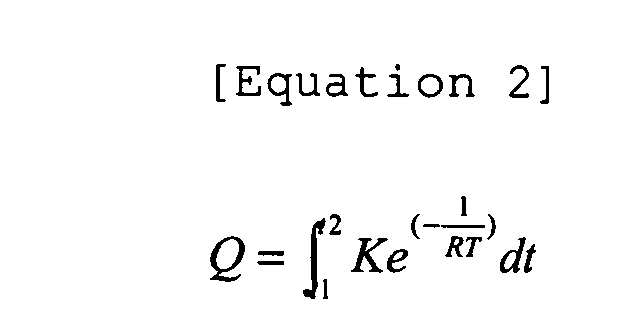
- step 24 the computer 1 calculates the integrated value Q of the amount of heat applied to the coating within the time period from t1 to t2 for which the hardening of'the coating progresses.
- the integrated value Q of the heat amount is calculated by integrating the equation 2 for the corrected temperature data (one-dotted chain line of Fig. 8).
- K represents a coefficient based on the kind of the coating material
- R represents gas constant
- T represents the temperature at some timing of the corrected temperature data
- t1, t2 represents the timing calculated in step 23.
- the integrated value Q of the heat amount may be calculated on the basis of the corrected temperature data by integrating the amount of heat for the time period from t1 to t2 for which the hardening of the coating progresses. In this case, the integrated value Q of the heat amount corresponds to a hatched portion of Fig. 8.
- the computer 1 outputs the integrated value Q of the heat amount and finishes the calculation processing of the integrated value Q of the heat amount.
- step 3 subsequent to step 2, the computer 1 estimates the dry state of the coating. Specifically, the integrated value Q of the amount of heat applied to the coating is compared with the threshold value for the judgment of the dry of the coating, and the dry state of the coating is estimated.
- the threshold value is set every coating material, and it is regulated by the upper and lower threshold values of the upper limit value Qmax of the integrated value of the heat amount and the lower limit value Qmin of the integrated value of the heat amount.
- the integrated value Q of the heat amount is not less than the upper limit value Qmax, a decomposition reaction occurs in the coating film constituting the coating, and also overheat (excessive dry) of the coating film occurs, so that a coating dry failure is judged.
- the integrated value Q of the heat amount is not more than the lower limit value Qmin, so that it is judged that the dry state of the coating is insufficient.
- the dry state estimated on the basis of the threshold values and the integrated value Q of the heat amount as described above is calculated for the overall vehicle body by using the superposed grids. The judgment result achieved every vehicle-body site is displayed on the display device 3.
- the temperature data and the integrated value of the heat amount are compared with the respective threshold values, whereby the dry state of the coating applied to the vehicle body can be estimated.
- the operator can grasp the dry state every vehicle-body site by checking the dry state of the coating thus estimated. Accordingly, sites at which coating failure is liable to occur in the vehicle body can be grasped, and coating quality can be enhanced, so that the development time period and the development cost for the improvement in style of vehicle bodies can be reduced.
- more efficient dry conditions can be set through the estimation and improvement of the dry state of the coating, and thus the present invention contributes to an effect of reducing the exhaust amount of carbon dioxide (energy saving).
- the calculation of the temperature data representing the time-varying temperature distribution and the calculation of the integrated value of the heat amount (containing the correction related to the solvent) are carried out independently of each other. Accordingly, when the coating conditions such as the kinds of the coating material and the solvent, etc. are changed, the correction related to the coating material and the solvent changed may be carried out by using the temperature data calculated in the preceding analysis. As a result, the calculation of the temperature data can be omitted, and the coating condition can be efficiently selected
- the dry estimation of the overall vehicle body is carried out by using the vehicle-body mesh. Therefore, transfer of the heat amount between members of the vehicle body can be calculated, and thus the temperature distribution of the overall vehicle body can be calculated with high precision. Accordingly, the estimation precision of the dry state of the coating can be further enhanced.
- the correction value is subtracted from the temperature data for the correction related to evaporation of solvent.
- the correction method for the evaporation of the solvent is not limited to the above embodiment.
- it may be modified so that the correction value related to the integrated value of the amount of heat is calculated on the basis of the coating condition described above and then the correction value is subtracted from the integrated value of the heat amount. If the consumption of the heat amount by the evaporation of solvent can be neglected, the correction processing may be omitted.
- the estimation of the dry state of the coating can be efficiently carried out by selectively carrying out the correction processing on the basis of the coating condition.
- a recording medium in which a computer program for implementing the function of the above embodiment is recorded may be equipped to a system having the construction as shown in Fig. 1.
- the computer 1 in the system reads out and executes the computer program stored in the recording medium, whereby the object of this invention can be attained.
- the computer program itself read out from the recording medium implements the novel function of this invention, and thus the recordingmediumhaving the program recorded therein constitutes this invention.
- CD-ROM, a flexible disc, a hard disc, a memory card, an optical disc, DVD-ROM, DVD-RAM or the like may be used as the recording medium in which the computer program is recorded.
- the computer program itself for implementing the function of the above embodiment has the novel function.
- the dry state of coating applied to a coating target is estimated by calculating the integrated value of the amount of heat on the basis of temperature data representing transition of the temperature distribution of the coating target with time lapse.
- the estimation of the dry state is carried out on an actual coating-target basis (actual work basis) , so that the dry state of the coating target can be estimated with higher precision as compared with the prior art in which the estimation is carried out on a drying-furnace basis.
Landscapes
- Health & Medical Sciences (AREA)
- Life Sciences & Earth Sciences (AREA)
- Chemical & Material Sciences (AREA)
- Engineering & Computer Science (AREA)
- Food Science & Technology (AREA)
- Medicinal Chemistry (AREA)
- Physics & Mathematics (AREA)
- Analytical Chemistry (AREA)
- Biochemistry (AREA)
- General Health & Medical Sciences (AREA)
- General Physics & Mathematics (AREA)
- Immunology (AREA)
- Pathology (AREA)
- Application Of Or Painting With Fluid Materials (AREA)
- Coating Apparatus (AREA)
- Investigating Or Analyzing Materials Using Thermal Means (AREA)
- Drying Of Solid Materials (AREA)
Abstract
Description
a second step of calculating an integrated value of an amount of heat applied to the coating on the basis of the temperature data, and a third step of estimating the dry state of the coating on the basis of the integrated value of the amount of heat.
By way of example only, specific embodiments of the present invention will now be described, with reference to the accompanying drawing, in which:
Claims (10)
- A coating dry estimating method of estimating a dry state of coating on a coating target, comprising:a first step of calculating temperature data indicating transition of a temperature distribution of the coating target with time lapse;a second step of calculating an integrated value of an amount of heat applied to the coating on the basis of the temperature data; anda third step of estimating the dry state of the coating on the basis of the integrated value of the amount of heat.
- The coating dry estimating method according to claim 1, wherein the third step contains a step of comparing the integrated value of the amount of heat applied to the coating with a threshold value for judging dry of the coating to estimate the dry state of the coating.
- The coating dry estimating method according to claim 2, wherein the second step is a step of determining a time period for which the temperature of the coating target is within a predetermined temperature range in the temperature data, and calculating the integrated value of the amount of heat applied to the coating within the time period.
- The coating dry estimating method according to claim 3, wherein the second step contains a step of correcting the integrated value of the amount of heat on the basis of at least one of the film thickness of the coating, the kind of coating material used for the coating and the content of solvent contained in the coating.
- The coating dry estimating method according to any one of claims 1 to 4, wherein the first step contains a step of superposing a coating target mesh achieved by representing the coating target in the form of a mesh on an in-furnace area mesh achieved by modeling a dry furnace and representing the dry furnace in the form of a mesh while moving the coating target mesh in conformity with a movement pattern representing a movement locus of the coating target, thereby generating superposed grids time-sequentially, and a step of analyzing the temperature distribution of the coating target by using each of the superposed grids generated time-sequentially.
- The coating dry estimating method according to claim 5, wherein the coating target mesh comprises a fine mesh achieved by representing the internal structure of a member at a note site to be noted for analysis in the form of a mesh, and a rough mesh achieved by representing the surface of the coating target at portions other than the note site in the form of a mesh.
- A recording medium recorded with a program for making a computer execute a coating dry estimating method of estimating a dry state of coating on a coated coating target, comprising:a first step of calculating temperature data indicating transition of a temperature distribution of the coating target with time lapse;a second step of calculating an integrated value of an amount of heat applied to the coating on the basis of the temperature data; anda third step of estimating the dry state of the coating on the basis of the integrated value of the amount of heat.
- A coating dry estimating system for estimating a dry state of coating on a coated coating target, comprising:a storage device for storing a threshold value for judgment of dry of the coating; anda computer for calculating temperature data representing transition of a temperature distribution of the coating target with time lapse, calculating an integrated value of the amount of heat applied to the coating on the basis of the temperature data, and comparing the integrated value of the amount of heat applied to the coating with the threshold value to estimate the dry state of the coating.
- The coating dry estimating system according to claim 8, wherein the computer calculates a time period for which the temperature of the coating target is within a predetermined temperature range in the temperature data, and calculating an integrated value of the amount of heat applied to the coating within the time period.
- The coating dry estimating system according to claim 9, wherein the computer corrects the integrated value of the amount of heat on the basis of at least one of the film thickness of the coating, the kind of coating material used for the coating and the content of solvent contained in the coating.
Applications Claiming Priority (2)
| Application Number | Priority Date | Filing Date | Title |
|---|---|---|---|
| JP2002362428 | 2002-12-13 | ||
| JP2002362428A JP2004188382A (en) | 2002-12-13 | 2002-12-13 | Paint drying prediction method, paint drying prediction system, and recording medium |
Publications (2)
| Publication Number | Publication Date |
|---|---|
| EP1431753A2 true EP1431753A2 (en) | 2004-06-23 |
| EP1431753A3 EP1431753A3 (en) | 2010-08-25 |
Family
ID=32376196
Family Applications (1)
| Application Number | Title | Priority Date | Filing Date |
|---|---|---|---|
| EP03028755A Withdrawn EP1431753A3 (en) | 2002-12-13 | 2003-12-12 | Coating dry estimating method, coating dry estimating system and recording medium |
Country Status (3)
| Country | Link |
|---|---|
| US (1) | US7021822B2 (en) |
| EP (1) | EP1431753A3 (en) |
| JP (1) | JP2004188382A (en) |
Families Citing this family (4)
| Publication number | Priority date | Publication date | Assignee | Title |
|---|---|---|---|---|
| US7249882B2 (en) * | 2005-10-14 | 2007-07-31 | Delta Electronics Inc. | Method for determining integration initial value of PID controller |
| JP4601660B2 (en) * | 2007-11-28 | 2010-12-22 | 関東自動車工業株式会社 | How to prevent failure of remelting of uncured film by volatile solvent in drying oven |
| JP5273591B2 (en) * | 2008-03-06 | 2013-08-28 | 日立化成株式会社 | Coating drying simulation method |
| JP6080297B2 (en) * | 2013-02-25 | 2017-02-15 | 東レエンジニアリング株式会社 | Coating drying simulation device and coating drying device |
Family Cites Families (15)
| Publication number | Priority date | Publication date | Assignee | Title |
|---|---|---|---|---|
| EP0071988B1 (en) * | 1981-08-05 | 1988-05-11 | Sumitomo Rubber Industries Limited | Apparatus for automatically measuring and controlling chemical reaction amount |
| US4907533A (en) * | 1986-09-08 | 1990-03-13 | Bgk Finishing Systems, Inc. | Automotive coating treatment apparatus with plural radiant lamps |
| EP0367020B1 (en) | 1988-10-31 | 1992-12-23 | Volkswagen Aktiengesellschaft | Method for gear shift of a change speed gear |
| JPH0396760A (en) | 1989-09-11 | 1991-04-22 | Nissan Motor Co Ltd | Creep preventing device for composite clutch type parallel shaft automatic transmission |
| US5136497A (en) * | 1990-07-12 | 1992-08-04 | Bdm International, Inc. | Material consolidation modeling and control system |
| US5345397A (en) * | 1991-11-25 | 1994-09-06 | The Boeing Company | Optimal composite curing system and method |
| JP3403745B2 (en) * | 1993-02-15 | 2003-05-06 | 本田技研工業株式会社 | Paint drying oven simulation system |
| DE4316784C2 (en) | 1993-05-19 | 1997-02-06 | Getrag Getriebe Zahnrad | Drive unit for motor vehicles |
| JP2878964B2 (en) | 1994-05-02 | 1999-04-05 | アイシン・エィ・ダブリュ株式会社 | Control method and control device for automatic transmission |
| US5659972A (en) * | 1995-10-06 | 1997-08-26 | Avery Dennison Corporation | Apparatus and method for drying or curing web materials and coatings |
| JPH11118740A (en) * | 1997-10-17 | 1999-04-30 | Canon Inc | Thermal analysis method and thermal analysis device |
| US6099162A (en) * | 1997-10-24 | 2000-08-08 | Hydril Company | Resin cure monitor |
| JP3219245B2 (en) * | 1998-08-13 | 2001-10-15 | 株式会社日立国際電気 | Temperature control simulation method and temperature control simulation device |
| JP2001096216A (en) * | 1999-09-30 | 2001-04-10 | Nisshin Steel Co Ltd | Baking temperature monitor system in coating material continuous baking oven for metallic band plate |
| JP4097176B2 (en) * | 2001-08-02 | 2008-06-11 | 本田技研工業株式会社 | Thermal analysis method and apparatus |
-
2002
- 2002-12-13 JP JP2002362428A patent/JP2004188382A/en not_active Withdrawn
-
2003
- 2003-12-12 EP EP03028755A patent/EP1431753A3/en not_active Withdrawn
- 2003-12-12 US US10/733,379 patent/US7021822B2/en not_active Expired - Fee Related
Also Published As
| Publication number | Publication date |
|---|---|
| US7021822B2 (en) | 2006-04-04 |
| US20050047476A1 (en) | 2005-03-03 |
| JP2004188382A (en) | 2004-07-08 |
| EP1431753A3 (en) | 2010-08-25 |
Similar Documents
| Publication | Publication Date | Title |
|---|---|---|
| US8078351B2 (en) | Estimation of surface lateral coefficient of friction | |
| Keen et al. | Bias-free identification of a linear model-predictive steering controller from measured driver steering behavior | |
| JP4185951B2 (en) | Method for optimizing a vehicle and an engine driving such a vehicle | |
| Simmonds et al. | Complete body aerodynamic study of three vehicles | |
| JP2004532398A5 (en) | ||
| US7021822B2 (en) | Coating dry estimating method, coating dry estimating system and recording medium | |
| US6816756B2 (en) | Paint film thickness predicting method and system for actual car, and recording medium | |
| Ren et al. | Development of effective bicycle model for wide ranges of vehicle operations | |
| Onishi et al. | Vehicle aerodynamics simulation for the next generation on the K computer: part 2 use of dirty CAD data with modified Cartesian grid approach | |
| Li et al. | Vehicle stability control based on vehicle motion state and tire force estimation | |
| Hoffman et al. | Using the Milliken Moment Method and dynamic simulation to evaluate vehicle stability and controllability | |
| Bendell | Investigation of a coupled CFD and thermal modelling methodology for prediction of vehicle underbody temperatures | |
| Poirel et al. | Flutter-margin method accounting for modal parameters uncertainties | |
| US6353777B1 (en) | Path correction for lane change analysis | |
| Kaushik | Thermal management of a Vehicle's underhood and underbody using appropriate math-based analytical tools and methodologies | |
| JP2000055790A (en) | Road surface μ estimation device | |
| JP2002045961A (en) | Heating furnace heating evaluation method and method for estimating temperature of object to be heated using this heating evaluation method | |
| Ball et al. | Considerations for applying and interpreting monte carlo simulation analyses in accident reconstruction | |
| Khondge et al. | Automation of vehicle aerodynamic shape exploration and optimization using integrated mesh morphing and CFD | |
| Rao et al. | A semi–computational method to predict body temperatures in an automotive paint bake oven | |
| Khaknejad et al. | Refining Pickup Cabin NVH Quality via Optimising Exhaust Mountings Using DOE Method | |
| Parsons et al. | Tire Vertical Force Description for Vehicle Handling Simulations (Abstracts) | |
| Longobardi et al. | Tire Thermal Model with State Observer Integration for Enhanced Real-Time Temperature Prediction | |
| Heese et al. | Investigation of the Influence of Rolling Resistance Model Approaches on Simulated Consumption/Range | |
| Hekkala et al. | Mathematical model of heat and mass transfer in the steel belt sintering process |
Legal Events
| Date | Code | Title | Description |
|---|---|---|---|
| PUAI | Public reference made under article 153(3) epc to a published international application that has entered the european phase |
Free format text: ORIGINAL CODE: 0009012 |
|
| AK | Designated contracting states |
Kind code of ref document: A2 Designated state(s): AT BE BG CH CY CZ DE DK EE ES FI FR GB GR HU IE IT LI LU MC NL PT RO SE SI SK TR |
|
| AX | Request for extension of the european patent |
Extension state: AL LT LV MK |
|
| PUAL | Search report despatched |
Free format text: ORIGINAL CODE: 0009013 |
|
| AK | Designated contracting states |
Kind code of ref document: A3 Designated state(s): AT BE BG CH CY CZ DE DK EE ES FI FR GB GR HU IE IT LI LU MC NL PT RO SE SI SK TR |
|
| AX | Request for extension of the european patent |
Extension state: AL LT LV MK |
|
| AKY | No designation fees paid | ||
| STAA | Information on the status of an ep patent application or granted ep patent |
Free format text: STATUS: THE APPLICATION IS DEEMED TO BE WITHDRAWN |
|
| 18D | Application deemed to be withdrawn |
Effective date: 20110226 |