EP1431732A1 - Pressure sensor - Google Patents
Pressure sensor Download PDFInfo
- Publication number
- EP1431732A1 EP1431732A1 EP03028633A EP03028633A EP1431732A1 EP 1431732 A1 EP1431732 A1 EP 1431732A1 EP 03028633 A EP03028633 A EP 03028633A EP 03028633 A EP03028633 A EP 03028633A EP 1431732 A1 EP1431732 A1 EP 1431732A1
- Authority
- EP
- European Patent Office
- Prior art keywords
- housing
- semiconductor device
- terminal
- pressure sensor
- fluorine
- Prior art date
- Legal status (The legal status is an assumption and is not a legal conclusion. Google has not performed a legal analysis and makes no representation as to the accuracy of the status listed.)
- Withdrawn
Links
- 239000004065 semiconductor Substances 0.000 claims abstract description 44
- YCKRFDGAMUMZLT-UHFFFAOYSA-N Fluorine atom Chemical compound [F] YCKRFDGAMUMZLT-UHFFFAOYSA-N 0.000 claims abstract description 34
- 229910052731 fluorine Inorganic materials 0.000 claims abstract description 34
- 239000011737 fluorine Substances 0.000 claims abstract description 34
- 239000000853 adhesive Substances 0.000 claims abstract description 32
- 230000001070 adhesive effect Effects 0.000 claims abstract description 32
- 230000004308 accommodation Effects 0.000 claims abstract description 29
- 239000012530 fluid Substances 0.000 claims abstract description 22
- 229920001296 polysiloxane Polymers 0.000 claims abstract description 18
- 238000007789 sealing Methods 0.000 claims abstract description 6
- 239000003921 oil Substances 0.000 claims description 13
- 239000010702 perfluoropolyether Substances 0.000 claims description 8
- 239000011342 resin composition Substances 0.000 claims description 7
- 238000004519 manufacturing process Methods 0.000 description 8
- 239000000126 substance Substances 0.000 description 5
- 239000004734 Polyphenylene sulfide Substances 0.000 description 4
- 150000001875 compounds Chemical class 0.000 description 4
- 229920000069 polyphenylene sulfide Polymers 0.000 description 4
- 230000002349 favourable effect Effects 0.000 description 3
- 230000035945 sensitivity Effects 0.000 description 3
- 229910000831 Steel Inorganic materials 0.000 description 2
- 150000002222 fluorine compounds Chemical class 0.000 description 2
- 239000010959 steel Substances 0.000 description 2
- 230000008961 swelling Effects 0.000 description 2
- KRHYYFGTRYWZRS-UHFFFAOYSA-M Fluoride anion Chemical compound [F-] KRHYYFGTRYWZRS-UHFFFAOYSA-M 0.000 description 1
- 125000003342 alkenyl group Chemical group 0.000 description 1
- 125000004429 atom Chemical group 0.000 description 1
- 210000000988 bone and bone Anatomy 0.000 description 1
- 125000004435 hydrogen atom Chemical group [H]* 0.000 description 1
- -1 platinum group compound Chemical class 0.000 description 1
- 229920002050 silicone resin Polymers 0.000 description 1
- XLYOFNOQVPJJNP-UHFFFAOYSA-N water Chemical compound O XLYOFNOQVPJJNP-UHFFFAOYSA-N 0.000 description 1
Images


Classifications
-
- G—PHYSICS
- G01—MEASURING; TESTING
- G01L—MEASURING FORCE, STRESS, TORQUE, WORK, MECHANICAL POWER, MECHANICAL EFFICIENCY, OR FLUID PRESSURE
- G01L19/00—Details of, or accessories for, apparatus for measuring steady or quasi-steady pressure of a fluent medium insofar as such details or accessories are not special to particular types of pressure gauges
- G01L19/0061—Electrical connection means
- G01L19/0084—Electrical connection means to the outside of the housing
-
- G—PHYSICS
- G01—MEASURING; TESTING
- G01L—MEASURING FORCE, STRESS, TORQUE, WORK, MECHANICAL POWER, MECHANICAL EFFICIENCY, OR FLUID PRESSURE
- G01L19/00—Details of, or accessories for, apparatus for measuring steady or quasi-steady pressure of a fluent medium insofar as such details or accessories are not special to particular types of pressure gauges
- G01L19/06—Means for preventing overload or deleterious influence of the measured medium on the measuring device or vice versa
- G01L19/0627—Protection against aggressive medium in general
- G01L19/0645—Protection against aggressive medium in general using isolation membranes, specially adapted for protection
Definitions
- the present invention relates to a pressure sensor.
- a pressure sensor disclosed in Japanese Patent Publication No. 2819783 is known.
- This pressure sensor is provided with a semiconductor device that is capable of detecting a pressure, a terminal that is connected to the semiconductor device by a bonding wire, a housing having an accommodation space for accommodating the semiconductor device, the bonding wire and the terminal, a diaphragm for scaling the accommodation space, and working fluid that is sealed in the accommodation space and transmits a pressure applied to the diaphragm to the semiconductor device.
- Fluorine-based oil that is composed of perfluoro polyether is used as the working fluid.
- silicone-based adhesive is used in this type of the pressure sensor for sealing between the terminal and the housing.
- the diaphragm is deformed when a pressure to be detected acts on the diaphragm, and the pressure is transmitted to the semiconductor device by the working fluid.
- the semiconductor device detects the pressure, a signal of the pressure is sent to the terminal via the bonding wire, and is then sent to other devices by the terminal.
- swelling of the silicone-based adhesive is prevented due to characteristics of fluorine compound and silicone compound. Accordingly, in this pressure sensor, reduction in adhesivity of the silicone-based adhesive is prevented, whereby sealability between the terminal and the housing is maintained and durability is also demonstrated.
- a pressure sensor such as that disclosed in Japanese Patent Laid-Open Publication No. 2001-99737 is also known.
- This pressure sensor is provided with a semiconductor device that is capable of directly detecting a pressure, a terminal that is connected to the semiconductor device by a bonding wire, and a housing having an accommodation space for accommodating the semiconductor device, the bonding wire, and the terminal, and but is not provided with the aforementioned diaphragm.
- the semiconductor device, the bonding wire, and the terminal are buried in fluorine-based gel that is filled in the accommodation space as the working fluid, and further, an upper portion of the terminal and the housing are coated with fluorine-based adhesive.
- this pressure sensor when a pressure to be detected acts on the surface of the fluorine-based gel, the pressure is transmitted to the semiconductor device by the fluorine-based gel.
- the semiconductor device detects the pressure, a signal of the pressure is sent to the terminal via the bonding wire, and is then sent to other devices by the terminal.
- the fluorine-based gel and the fluorine-based adhesive demonstrate durability by being exposed to gasoline vapor, water vapor, or the like.
- the present invention has been devised in consideration of the above problems. It is an object of the present invention to provide a pressure sensor with which a pressure can be detected with high sensitivity, and a low manufacturing cost can be achieved.
- a pressure sensor of a first aspect of the present invention includes a semiconductor device that is capable of detecting a pressure, a terminal that is connected to the semiconductor device by a bonding wire, a housing having an accommodation space for accommodating the semiconductor device, the bonding wire and the terminal, a diaphragm for sealing the accommodation space, and working fluid sealed in the accommodation space for transmitting a pressure that is applied to the diaphragm to the semiconductor device.
- the working fluid is silicone-based oil
- the terminal and the housing are sealed by a fluorine-based adhesive.
- a pressure sensor of a second aspect of the present invention includes a semiconductor device that is capable of directly detecting a pressure, a terminal that is connected to the semiconductor device by a bonding wire, and a housing having an accommodation space for accommodating the semiconductor device, the bonding wire and the terminal.
- the terminal and the housing are sealed by the fluorine-based adhesive.
- the fluorine-based adhesive is perfluoro polyether resin composition.
- a pressure sensor is provided with a housing 3, a diaphragm 8 and working fluid 9 as shown in FIG. 1.
- the housing 3 is composed of a first housing 1 made from, for example, PPS (polyphenylene sulfide) and a second housing 2 that is made from steel and provided on the periphery of one end of the first housing 1.
- the one end of the first housing 1 forms an accommodation space 4 with the second housing 2.
- the accommodation space 4 is sealed by the diaphragm 8 that is sandwiched between the first housing 1 and the second housing 2.
- a connector 1a for external electrical connection is formed on the other end of the first housing 1.
- One end of the second housing 2 is provided with an introducing hole 2a that penetrates therethrough for introducing a detected substance 11 to the side of the diaphragm 8.
- the other end of the second housing 2 is caulked to the first housing 1.
- the working fluid 9 of the silicone-based oil is scaled in the accommodation space 4.
- the semiconductor device 5 that is capable of detecting a pressure and the terminal 6 that is connected to the semiconductor device 5 by the bonding wire 7 arc accommodated in the accommodation space 4.
- the semiconductor device 5 is adhered to the first housing 1.
- the terminal 6 is provided to penetrate through the first housing 1 such that one end is protruded to the accommodation space 4 and the other end is protruded to the inside of the connector 1a.
- An end of the terminal 6 is, as shown in FIG. 2, integrally adhered to the first housing 1 by the fluorine-based adhesive 10 in a sealed state, thus preventing working fluid from leaking from a minute gap between the terminal 6 and the first housing 1.
- a perfluoro polyether resin composition (SIFEL614 made by Shin-Etsu Chemical Co., Ltd.) is adopted as the fluorine-based adhesive 10.
- the diaphragm 8 receives a pressure of the detected substance 11 that is introduced from the introducing hole 2a of the second housing 2, and the pressure is transmitted to the semiconductor device 5 by the working fluid 9. Then, the pressure is converted to an electric signal by the semiconductor device 5. This electric signal is taken outside via the bonding wire 7 and the terminal 6 of the connector 1a.
- the silicone-based oil which is the working fluid 9 maintains favorable pressure transmissibility.
- the fluorine-based adhesive 10 demonstrates favorable adhesive performance. Furthermore, swelling of the fluorine-based adhesive 10 is prevented due to joint characteristics of the silicone compound and the fluorine compound.
- sealability between the terminal 6 and the first housing 1 is maintained by preventing reduction in adhesivity of the fluorine-based adhesive 10, thus durability is demonstrated.
- the silicone-based oil is less expensive than the fluorine-based adhesive 10, an increase in a manufacturing cost is not caused even when a large amount of the silicone-based oil is used as the working fluid 9.
- a pressure sensor As shown in FIGS. 3 and 4, a pressure sensor according to a second embodiment of the present invention is provided with a semiconductor device 5 that is capable of directly detecting a pressure, and a housing 23 having an accommodation space 24.
- the semiconductor device 5, a bonding wire 7, and a terminal 6 are accommodated in the accommodation space 24.
- the housing 23 is composed of a first housing 21 made from, for example, PPS (polyphenylene sulfide) and a second housing 22 that is made from steel and provided on the periphery of one end of the first housing 21.
- the one end of the first housing 21 forms the accommodation space 24 with the second housing 22.
- a connector 21a for external electrical connection is formed on the other end of the first housing 21.
- One end of the second housing 22 is provided with an introducing hole 22a that penetrates therethrough for introducing a detected substance 11.
- the other end of the second housing 22 is caulked to the first housing 21.
- the accommodation space 24 and the introducing hole 22a are communicated with each other.
- the semiconductor device 5 is adhered to the first housing 21.
- the terminal 6 is provided to penetrate through the first housing 21 such that one end is protruded to the accommodation space 24 and the other end is protruded to the inside of the connector 21 a.
- the terminal 6 is adhered to the first housing 21 by the fluorine-based adhesive 10,
- a perfluoro polyether resin composition (SIFEL614 made by Shin-Etsu Chemical Co., Ltd.) is also adopted as the fluorine-based adhesive 10.
- a pressure of the detected substance 11 that is introduced from the introducing hole 22a of the second housing 22 is directly transmitted to the semiconductor device 5. Then, the pressure is converted to an electric signal by the semiconductor device 5. This electric signal is taken outside via the bonding wire 7 and the terminal 6 of the connector 21a.
- the terminal 6 and the first housing 21 are scaled only by the fluorine-based adhesive 10 whose adhesive performance has been significantly improved.
- a sealing function of the fluorine-based adhesive 10 reliably prevents the detected substance 11 from leaking from a minute gap between the terminal 6 and the first housing 21.
- the working fluid is not provided, therefore, the low manufacturing cost can be achieved.
- a pressure can be detected with high sensitivity, and the low manufacturing cost can be also achieved according to the pressure sensor of the second embodiment.
- the pressure sensor is not provided with a diaphragm, the low manufacturing cost can be further reduced.
- the perfluoro polyether resin composition is a hardening resin composition that is composed of (A) a straight-chain fluoropolyether compound containing an alkenyl group in a molecule and having a perfluoro polyether structure in the back bone, (B) a fluoride organic silicone compound having hydrogen atom bonded to a silicone atom in a molecule, and (C) a platinum group compound.
- This type of the fluorine-based adhesive is, for example, disclosed in Japanese Patent Laid-Open Publication No. HEI 9-95615.
- a pressure sensor is provided with a semiconductor device that is capable of detecting a pressure, a terminal that is connected to the semiconductor device by a bonding wire, a housing having an accommodation space for the semiconductor device, the bonding wire, and the terminal, a diaphragm for sealing the accommodation space, and working fluid that is sealed in the accommodation space and transmits a pressure applied to the diaphragm to the semiconductor device.
- the working fluid is silicone-based oil, and the terminal and the housing are scaled by fluorine-based adhesive
Landscapes
- Physics & Mathematics (AREA)
- General Physics & Mathematics (AREA)
- Measuring Fluid Pressure (AREA)
- Pressure Sensors (AREA)
Abstract
Description
- The disclosure of Japanese Patent Application No. 2002-364414 filed on December 16, 2002 including the specification, drawings and abstract is incorporated herein by reference in its entirety.
- The present invention relates to a pressure sensor.
- As an example of a conventional pressure sensor, a pressure sensor disclosed in Japanese Patent Publication No. 2819783 is known. This pressure sensor is provided with a semiconductor device that is capable of detecting a pressure, a terminal that is connected to the semiconductor device by a bonding wire, a housing having an accommodation space for accommodating the semiconductor device, the bonding wire and the terminal, a diaphragm for scaling the accommodation space, and working fluid that is sealed in the accommodation space and transmits a pressure applied to the diaphragm to the semiconductor device. Fluorine-based oil that is composed of perfluoro polyether is used as the working fluid. In general, silicone-based adhesive is used in this type of the pressure sensor for sealing between the terminal and the housing.
- In this pressure sensor, the diaphragm is deformed when a pressure to be detected acts on the diaphragm, and the pressure is transmitted to the semiconductor device by the working fluid. The semiconductor device detects the pressure, a signal of the pressure is sent to the terminal via the bonding wire, and is then sent to other devices by the terminal. In this case, in this pressure sensor, while the fluorine-based oil as the working fluid maintains favorable pressure transmissibility, swelling of the silicone-based adhesive is prevented due to characteristics of fluorine compound and silicone compound. Accordingly, in this pressure sensor, reduction in adhesivity of the silicone-based adhesive is prevented, whereby sealability between the terminal and the housing is maintained and durability is also demonstrated.
- Furthermore, a pressure sensor such as that disclosed in Japanese Patent Laid-Open Publication No. 2001-99737 is also known. This pressure sensor is provided with a semiconductor device that is capable of directly detecting a pressure, a terminal that is connected to the semiconductor device by a bonding wire, and a housing having an accommodation space for accommodating the semiconductor device, the bonding wire, and the terminal, and but is not provided with the aforementioned diaphragm. Moreover, the semiconductor device, the bonding wire, and the terminal are buried in fluorine-based gel that is filled in the accommodation space as the working fluid, and further, an upper portion of the terminal and the housing are coated with fluorine-based adhesive.
- In this pressure sensor, when a pressure to be detected acts on the surface of the fluorine-based gel, the pressure is transmitted to the semiconductor device by the fluorine-based gel. The semiconductor device detects the pressure, a signal of the pressure is sent to the terminal via the bonding wire, and is then sent to other devices by the terminal. In this case, in this pressure sensor, the fluorine-based gel and the fluorine-based adhesive demonstrate durability by being exposed to gasoline vapor, water vapor, or the like.
- However, since the pressure sensor disclosed in Japanese Patent Publication No. 2819783 uses expensive fluorine-based oil as the working fluid, a large amount of the fluorine-based oil is used, thus causing an increase in the manufacturing cost. If low-cost silicone-based oil is used as the working fluid instead of the fluorine-based oil, since the terminal and the housing are scaled by the silicone-based adhesive, the silicone-based adhesive swells due to joint characteristics of silicone resin, thus reducing adhesivity. As a result, scaling between the terminal and the housing becomes insufficient, thereby causing a concern about durability.
- Furthermore, in the pressure sensor disclosed in Japanese Patent Laid-Open Publication No. 2001-99737 uses both fluorine-based gel and fluorine-based adhesive for protection from outside environment. Therefore, the manufacturing cost increases.
- The present invention has been devised in consideration of the above problems. It is an object of the present invention to provide a pressure sensor with which a pressure can be detected with high sensitivity, and a low manufacturing cost can be achieved.
- A pressure sensor of a first aspect of the present invention includes a semiconductor device that is capable of detecting a pressure, a terminal that is connected to the semiconductor device by a bonding wire, a housing having an accommodation space for accommodating the semiconductor device, the bonding wire and the terminal, a diaphragm for sealing the accommodation space, and working fluid sealed in the accommodation space for transmitting a pressure that is applied to the diaphragm to the semiconductor device. In this pressure sensor, the working fluid is silicone-based oil, and the terminal and the housing are sealed by a fluorine-based adhesive.
- A pressure sensor of a second aspect of the present invention includes a semiconductor device that is capable of directly detecting a pressure, a terminal that is connected to the semiconductor device by a bonding wire, and a housing having an accommodation space for accommodating the semiconductor device, the bonding wire and the terminal. In this pressure sensor, the terminal and the housing are sealed by the fluorine-based adhesive.
- According to the results of tests conducted by the inventors, it is preferable for the pressure sensor of the first and second aspects of the present invention that the fluorine-based adhesive is perfluoro polyether resin composition.
-
- FIG. 1 is a cross sectional view showing a pressure sensor according to a first embodiment of the present invention;
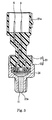
- FIG. 2 is an enlarged cross sectional view showing a pressure sensor according to the first embodiment of the present invention;
- FIG. 3 is a cross sectional view showing a pressure sensor according to a second embodiment of the present invention; and
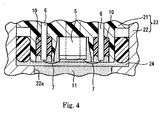
- FIG. 4 is an enlarged cross sectional view showing a pressure sensor according to the second embodiment of the present invention.
-
- Hereinafter, first and second embodiments of the present invention will be explained with reference to the accompanying drawings.
- A pressure sensor according to a first embodiment of the present invention is provided with a
housing 3, adiaphragm 8 and workingfluid 9 as shown in FIG. 1. Thehousing 3 is composed of a first housing 1 made from, for example, PPS (polyphenylene sulfide) and a second housing 2 that is made from steel and provided on the periphery of one end of the first housing 1. The one end of the first housing 1 forms anaccommodation space 4 with the second housing 2. Theaccommodation space 4 is sealed by thediaphragm 8 that is sandwiched between the first housing 1 and the second housing 2. In addition, aconnector 1a for external electrical connection is formed on the other end of the first housing 1. One end of the second housing 2 is provided with an introducinghole 2a that penetrates therethrough for introducing a detectedsubstance 11 to the side of thediaphragm 8. The other end of the second housing 2 is caulked to the first housing 1. In addition, the workingfluid 9 of the silicone-based oil is scaled in theaccommodation space 4. - As shown in FIG. 2, the
semiconductor device 5 that is capable of detecting a pressure and theterminal 6 that is connected to thesemiconductor device 5 by thebonding wire 7 arc accommodated in theaccommodation space 4. Thesemiconductor device 5 is adhered to the first housing 1. In addition, as shown in FIG. 1, theterminal 6 is provided to penetrate through the first housing 1 such that one end is protruded to theaccommodation space 4 and the other end is protruded to the inside of theconnector 1a. An end of theterminal 6 is, as shown in FIG. 2, integrally adhered to the first housing 1 by the fluorine-basedadhesive 10 in a sealed state, thus preventing working fluid from leaking from a minute gap between theterminal 6 and the first housing 1. In the present embodiment, a perfluoro polyether resin composition (SIFEL614 made by Shin-Etsu Chemical Co., Ltd.) is adopted as the fluorine-basedadhesive 10. - In the pressure sensor configured as above, the
diaphragm 8 receives a pressure of the detectedsubstance 11 that is introduced from the introducinghole 2a of the second housing 2, and the pressure is transmitted to thesemiconductor device 5 by theworking fluid 9. Then, the pressure is converted to an electric signal by thesemiconductor device 5. This electric signal is taken outside via thebonding wire 7 and theterminal 6 of theconnector 1a. - In this case, in the pressure sensor, the silicone-based oil which is the working
fluid 9 maintains favorable pressure transmissibility. In addition, the fluorine-basedadhesive 10 demonstrates favorable adhesive performance. Furthermore, swelling of the fluorine-basedadhesive 10 is prevented due to joint characteristics of the silicone compound and the fluorine compound. As a result, in the pressure sensor, sealability between theterminal 6 and the first housing 1 is maintained by preventing reduction in adhesivity of the fluorine-basedadhesive 10, thus durability is demonstrated. Moreover, since the silicone-based oil is less expensive than the fluorine-basedadhesive 10, an increase in a manufacturing cost is not caused even when a large amount of the silicone-based oil is used as the workingfluid 9. - Therefore, a pressure can be detected with high sensitivity, and the low manufacturing cost can be achieved according to the pressure sensor of the first embodiment. In addition, adhesive performance of the recent fluorine-based adhesive has been significantly improved.
- As shown in FIGS. 3 and 4, a pressure sensor according to a second embodiment of the present invention is provided with a
semiconductor device 5 that is capable of directly detecting a pressure, and ahousing 23 having anaccommodation space 24. Thesemiconductor device 5, abonding wire 7, and aterminal 6 are accommodated in theaccommodation space 24. Thehousing 23 is composed of a first housing 21 made from, for example, PPS (polyphenylene sulfide) and asecond housing 22 that is made from steel and provided on the periphery of one end of the first housing 21. The one end of the first housing 21 forms theaccommodation space 24 with thesecond housing 22. In addition, aconnector 21a for external electrical connection is formed on the other end of the first housing 21. One end of thesecond housing 22 is provided with an introducinghole 22a that penetrates therethrough for introducing a detectedsubstance 11. The other end of thesecond housing 22 is caulked to the first housing 21. Theaccommodation space 24 and the introducinghole 22a are communicated with each other. - The
semiconductor device 5 is adhered to the first housing 21. In addition, theterminal 6 is provided to penetrate through the first housing 21 such that one end is protruded to theaccommodation space 24 and the other end is protruded to the inside of theconnector 21 a. Theterminal 6 is adhered to the first housing 21 by the fluorine-basedadhesive 10, In the second embodiment, a perfluoro polyether resin composition (SIFEL614 made by Shin-Etsu Chemical Co., Ltd.) is also adopted as the fluorine-basedadhesive 10. - In the pressure sensor configured as above, a pressure of the detected
substance 11 that is introduced from the introducinghole 22a of thesecond housing 22 is directly transmitted to thesemiconductor device 5. Then, the pressure is converted to an electric signal by thesemiconductor device 5. This electric signal is taken outside via thebonding wire 7 and theterminal 6 of theconnector 21a. - In this case, in the pressure sensor, the
terminal 6 and the first housing 21 are scaled only by the fluorine-based adhesive 10 whose adhesive performance has been significantly improved. A sealing function of the fluorine-based adhesive 10 reliably prevents the detectedsubstance 11 from leaking from a minute gap between the terminal 6 and the first housing 21. In addition, the working fluid is not provided, therefore, the low manufacturing cost can be achieved. - Therefore, a pressure can be detected with high sensitivity, and the low manufacturing cost can be also achieved according to the pressure sensor of the second embodiment. In addition, since the pressure sensor is not provided with a diaphragm, the low manufacturing cost can be further reduced.
- In addition, It is preferable that the perfluoro polyether resin composition is a hardening resin composition that is composed of (A) a straight-chain fluoropolyether compound containing an alkenyl group in a molecule and having a perfluoro polyether structure in the back bone, (B) a fluoride organic silicone compound having hydrogen atom bonded to a silicone atom in a molecule, and (C) a platinum group compound. This type of the fluorine-based adhesive is, for example, disclosed in Japanese Patent Laid-Open Publication No. HEI 9-95615.
- The present example and embodiment are to be considered as illustrative and not restrictive and the invention not to be limited to the detail given herein, but may be modified within the scope and equivalence of the appended claims.
- A pressure sensor is provided with a semiconductor device that is capable of detecting a pressure, a terminal that is connected to the semiconductor device by a bonding wire, a housing having an accommodation space for the semiconductor device, the bonding wire, and the terminal, a diaphragm for sealing the accommodation space, and working fluid that is sealed in the accommodation space and transmits a pressure applied to the diaphragm to the semiconductor device. The working fluid is silicone-based oil, and the terminal and the housing are scaled by fluorine-based adhesive
Claims (4)
- A pressure sensor including a semiconductor device capable of detecting a pressure, a terminal that is connected to the semiconductor device by a bonding wire, a housing having an accommodation space for accommodating the semiconductor device, bonding wire and the terminal, a diaphragm for sealing the accommodation space, working fluid that is sealed in the accommodation space, and transmits the pressure applied to the diaphragm to the semiconductor device, wherein
the working fluid is a silicone-based oil, and the terminal and the housing arc scaled by a fluorine-based adhesive. - A pressure sensor including a semiconductor device that is capable of directly detecting a pressure, a terminal that is connected to the semiconductor device by a bonding wire, and a housing having an accommodation space for accommodating the semiconductor device, the bonding wire and the terminal, wherein
the terminal and the housing are sealed by a fluorine-based adhesive. - The pressure sensor according to claim 1, wherein the fluorine-based adhesive is a perfluoro polyether resin composition.
- The pressure sensor according to claim 2, wherein the fluorine-based adhesive is a perfluoro polyether resin composition.
Applications Claiming Priority (2)
| Application Number | Priority Date | Filing Date | Title |
|---|---|---|---|
| JP2002364414 | 2002-12-16 | ||
| JP2002364414A JP2004198147A (en) | 2002-12-16 | 2002-12-16 | Pressure sensor |
Publications (1)
| Publication Number | Publication Date |
|---|---|
| EP1431732A1 true EP1431732A1 (en) | 2004-06-23 |
Family
ID=32376220
Family Applications (1)
| Application Number | Title | Priority Date | Filing Date |
|---|---|---|---|
| EP03028633A Withdrawn EP1431732A1 (en) | 2002-12-16 | 2003-12-15 | Pressure sensor |
Country Status (3)
| Country | Link |
|---|---|
| US (1) | US7096739B2 (en) |
| EP (1) | EP1431732A1 (en) |
| JP (1) | JP2004198147A (en) |
Families Citing this family (6)
| Publication number | Priority date | Publication date | Assignee | Title |
|---|---|---|---|---|
| JP4768281B2 (en) * | 2005-02-08 | 2011-09-07 | 株式会社ジェイテクト | Pressure sensor and manufacturing method thereof |
| JP2007040772A (en) * | 2005-08-02 | 2007-02-15 | Mitsubishi Electric Corp | Semiconductor pressure sensor |
| US20070197922A1 (en) * | 2006-02-17 | 2007-08-23 | Honeywell International Inc. | Disposable pressure sensor systems and packages therefor |
| JP2011149895A (en) * | 2010-01-25 | 2011-08-04 | Yokogawa Electric Corp | Pressure measuring device |
| DE102011013912A1 (en) * | 2011-03-15 | 2012-09-20 | Volkswagen Aktiengesellschaft | pressure sensor |
| GB2555829B (en) | 2016-11-11 | 2019-11-20 | Sensata Technologies Inc | Encapsulations for MEMS sense elements and wire bonds |
Citations (5)
| Publication number | Priority date | Publication date | Assignee | Title |
|---|---|---|---|---|
| FR2686692A1 (en) * | 1992-01-28 | 1993-07-30 | Jaeger | SEMICONDUCTOR PRESSURE SENSOR AND MANUFACTURING METHOD. |
| EP1091201A2 (en) * | 1999-10-04 | 2001-04-11 | Shin-Etsu Chemical Co., Ltd. | Pressure sensor unit |
| US6260417B1 (en) * | 1999-10-13 | 2001-07-17 | Denso Corporation | Semiconductor pressure sensor device with multi-layered protective member that reduces void formation |
| US20020062698A1 (en) * | 2000-11-27 | 2002-05-30 | Hironobu Baba | Pressure sensor having semiconductor sensor chip |
| US20030200813A1 (en) * | 2002-04-24 | 2003-10-30 | Hironobu Baba | Pressure sensor with a corrosion-resistant diaphragm |
Family Cites Families (20)
| Publication number | Priority date | Publication date | Assignee | Title |
|---|---|---|---|---|
| JPS5112437B2 (en) * | 1971-10-01 | 1976-04-19 | ||
| JPS5687194A (en) * | 1979-12-19 | 1981-07-15 | Hitachi Ltd | Differential pressure transmitter |
| ATE34613T1 (en) * | 1983-11-10 | 1988-06-15 | Kristal Instr Ag | TRANSDUCER ELEMENT, PROCESS FOR ITS MANUFACTURE AND USE FOR A PRESSURE TRANSDUCER. |
| JP2819783B2 (en) | 1990-06-08 | 1998-11-05 | 株式会社デンソー | Semiconductor pressure sensor |
| JPH05149814A (en) * | 1991-11-29 | 1993-06-15 | Fuji Electric Co Ltd | Double diaphragm type semiconductor pressure sensor |
| JPH05283713A (en) * | 1992-03-31 | 1993-10-29 | Mitsubishi Electric Corp | Semiconductor sensor |
| US5375472A (en) * | 1992-05-15 | 1994-12-27 | Mitsubishi Denki Kabushiki Kaisha | Pressure sensor having multiple O-ring sealants provided in series and a fuel tank provided therewith |
| JP3198779B2 (en) * | 1994-03-04 | 2001-08-13 | 株式会社デンソー | Manufacturing method of semiconductor pressure detector |
| JP3892065B2 (en) * | 1995-07-28 | 2007-03-14 | 株式会社デンソー | Sensor device and sensor chip fixing method |
| JP3239717B2 (en) | 1995-09-29 | 2001-12-17 | 信越化学工業株式会社 | Curable composition |
| US5689089A (en) * | 1996-09-20 | 1997-11-18 | Motorola, Inc. | Electronic control module having fluid-tight seals of a polymer material which expands when wet |
| JPH1123396A (en) * | 1997-06-30 | 1999-01-29 | Tokai Rika Co Ltd | Sensor chip bonding structure and sensor manufacturing method |
| US6298730B1 (en) * | 1997-12-11 | 2001-10-09 | Nagano Keiki Co., Ltd. | Pressure sensor |
| JP4253898B2 (en) * | 1999-02-22 | 2009-04-15 | 株式会社デンソー | Pressure sensor device |
| JP2000337983A (en) * | 1999-05-25 | 2000-12-08 | Nippon Seiki Co Ltd | Pressure detector and its manufacturing method |
| US6512255B2 (en) * | 1999-09-17 | 2003-01-28 | Denso Corporation | Semiconductor pressure sensor device having sensor chip covered with protective member |
| US6453747B1 (en) * | 2000-01-12 | 2002-09-24 | Peter A. Weise | Hermetic pressure transducer |
| JP2001296197A (en) * | 2000-04-12 | 2001-10-26 | Denso Corp | Pressure sensor |
| JP2001311673A (en) * | 2000-04-28 | 2001-11-09 | Fujikura Ltd | Semiconductor pressure sensor |
| JP3873792B2 (en) * | 2002-03-29 | 2007-01-24 | 株式会社デンソー | Pressure sensor |
-
2002
- 2002-12-16 JP JP2002364414A patent/JP2004198147A/en active Pending
-
2003
- 2003-12-15 EP EP03028633A patent/EP1431732A1/en not_active Withdrawn
- 2003-12-16 US US10/735,692 patent/US7096739B2/en not_active Expired - Fee Related
Patent Citations (5)
| Publication number | Priority date | Publication date | Assignee | Title |
|---|---|---|---|---|
| FR2686692A1 (en) * | 1992-01-28 | 1993-07-30 | Jaeger | SEMICONDUCTOR PRESSURE SENSOR AND MANUFACTURING METHOD. |
| EP1091201A2 (en) * | 1999-10-04 | 2001-04-11 | Shin-Etsu Chemical Co., Ltd. | Pressure sensor unit |
| US6260417B1 (en) * | 1999-10-13 | 2001-07-17 | Denso Corporation | Semiconductor pressure sensor device with multi-layered protective member that reduces void formation |
| US20020062698A1 (en) * | 2000-11-27 | 2002-05-30 | Hironobu Baba | Pressure sensor having semiconductor sensor chip |
| US20030200813A1 (en) * | 2002-04-24 | 2003-10-30 | Hironobu Baba | Pressure sensor with a corrosion-resistant diaphragm |
Also Published As
| Publication number | Publication date |
|---|---|
| US7096739B2 (en) | 2006-08-29 |
| US20040177695A1 (en) | 2004-09-16 |
| JP2004198147A (en) | 2004-07-15 |
Similar Documents
| Publication | Publication Date | Title |
|---|---|---|
| KR101945923B1 (en) | Sensor Unit Having a Sensor Chip and Pressure Detection Device Containing same | |
| JP4052263B2 (en) | Pressure sensor | |
| WO2014122855A1 (en) | Pressure detection unit | |
| US7096739B2 (en) | Pressure sensor containing fluorine-based adhesive | |
| JP3310207B2 (en) | Immersion water level gauge | |
| JP4608228B2 (en) | Pressure sensor and manufacturing method thereof | |
| JP2006170650A (en) | Pressure sensor and pressure water level gauge | |
| JP3603772B2 (en) | Pressure sensor | |
| JP2600863B2 (en) | Mounting structure of high pressure semiconductor type pressure sensor | |
| JP2009103574A (en) | Pressure sensor | |
| CN101184977A (en) | sensor | |
| JP2005326338A (en) | Pressure sensor | |
| EP1302762A1 (en) | Pressure detection device | |
| JP4442399B2 (en) | Pressure sensor and its assembly structure | |
| JP2006023110A (en) | Pressure sensor | |
| JP2000028464A (en) | Pressure sensor | |
| JP2003315194A (en) | Pressure sensor | |
| JPH1090094A (en) | Pressure detector | |
| JP4905383B2 (en) | Pressure sensor | |
| JP2003004570A (en) | Pressure sensor for fluid | |
| JP3991808B2 (en) | Pressure sensor | |
| JP3991787B2 (en) | Pressure sensor | |
| JP2005164478A (en) | Pressure sensor | |
| JP2006208087A (en) | Pressure sensor | |
| CN120702661A (en) | A pressure guiding structure and pressure sensor |
Legal Events
| Date | Code | Title | Description |
|---|---|---|---|
| PUAI | Public reference made under article 153(3) epc to a published international application that has entered the european phase |
Free format text: ORIGINAL CODE: 0009012 |
|
| AK | Designated contracting states |
Kind code of ref document: A1 Designated state(s): AT BE BG CH CY CZ DE DK EE ES FI FR GB GR HU IE IT LI LU MC NL PT RO SE SI SK TR |
|
| AX | Request for extension of the european patent |
Extension state: AL LT LV MK |
|
| 17P | Request for examination filed |
Effective date: 20040809 |
|
| AKX | Designation fees paid |
Designated state(s): DE FR GB |
|
| RAP1 | Party data changed (applicant data changed or rights of an application transferred) |
Owner name: JTEKT CORPORATION |
|
| RIN1 | Information on inventor provided before grant (corrected) |
Inventor name: SUZUKI, KAZUSHI,JTEKT CORPORATION Inventor name: YAMAKAWA, TOMONARI,JTEKT CORPORATION Inventor name: KAWAMURA, TETSUSHI,JTEKT CORPORATION |
|
| 17Q | First examination report despatched |
Effective date: 20080912 |
|
| STAA | Information on the status of an ep patent application or granted ep patent |
Free format text: STATUS: THE APPLICATION HAS BEEN WITHDRAWN |
|
| 18W | Application withdrawn |
Effective date: 20080917 |